All posts by Griff

My passion is studying American history leading up to & including the Civil War. I particularly enjoy reading, transcribing & researching primary sources such as letters and diaries.

1862: Peter Lightle to Sena (Downing) Lightle

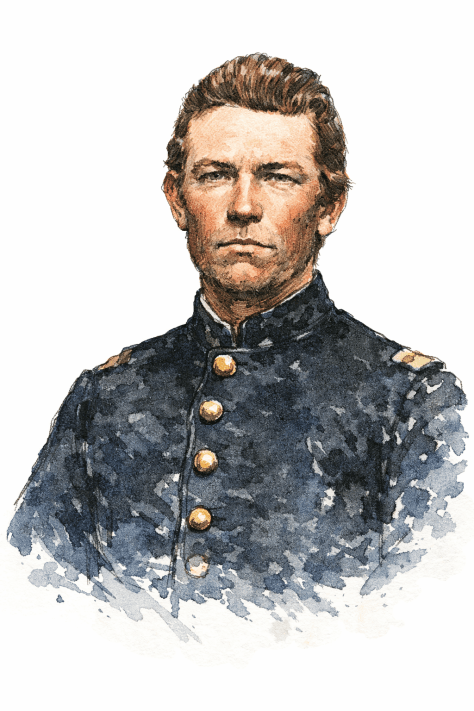
The following letters were written by Peter Lightle (1832-1862), the son of Samuel Lightle (1798-1851) and Lear Ford (1802-1870) of Ross county, Ohio. Peter was married to Sena Downing (1834-1910) 1856 in Pike county, Ohio, and had two young children, Evangeline (b. 1858) and Albert (b. 1860) at the time that he answered his country’s call to serve as a corporal in Co. D, 33rd Ohio Infantry. Muster records inform us that he enlisted on 17 August 1861 and served until his death on the battlefield at Perryville, Kentucky, on 8 October 1862. Pension records describe Peter as standing 5’9″ tall with dark eyes and black hair.

On August 27, 1862, Confederate cavalry and artillery attacked Fort McCook which was garrisoned by the 33rd Ohio Infantry, prompting the Union soldiers to retreat under the cover of darkness. The Northern soldiers withdrew to Decherd, Tennessee and then marched to Nashville and Bowling Green, where it rejoined the rest of the Army of the Ohio, which was in pursuit of General Braxton Bragg’s Confederate army. The Northern army then moved to Louisville, Kentucky, where it arrived on September 26. On October 1, 1862, the Army of the Ohio departed Louisville in search of the Confederates, finding them at Perryville, Kentucky. At the Battle of Perryville (October 8, 1862), the 33rd entered the engagement with approximately four hundred men. The regiment had 129 men killed or wounded in the battle, nearly one-third of its total active strength.

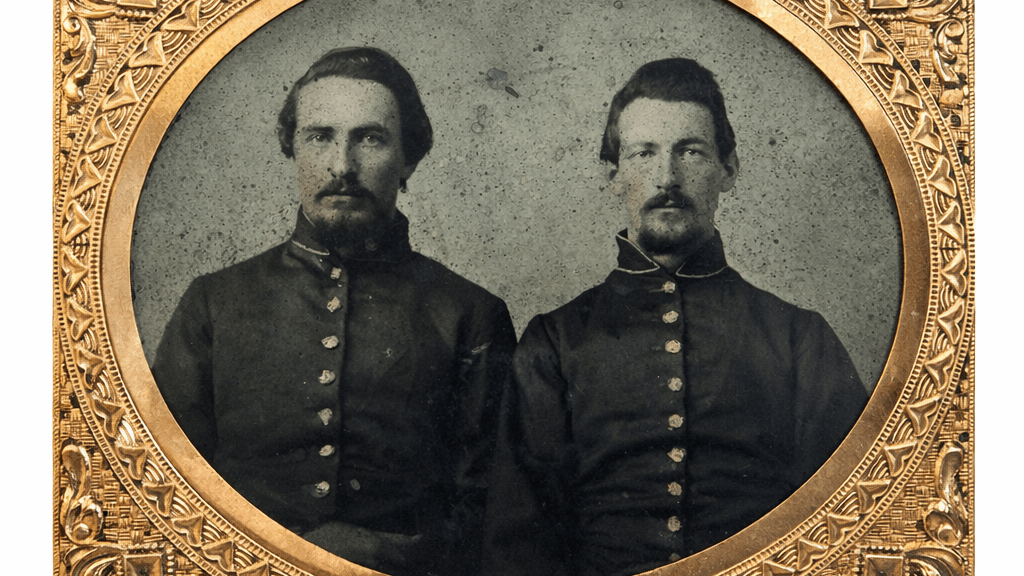
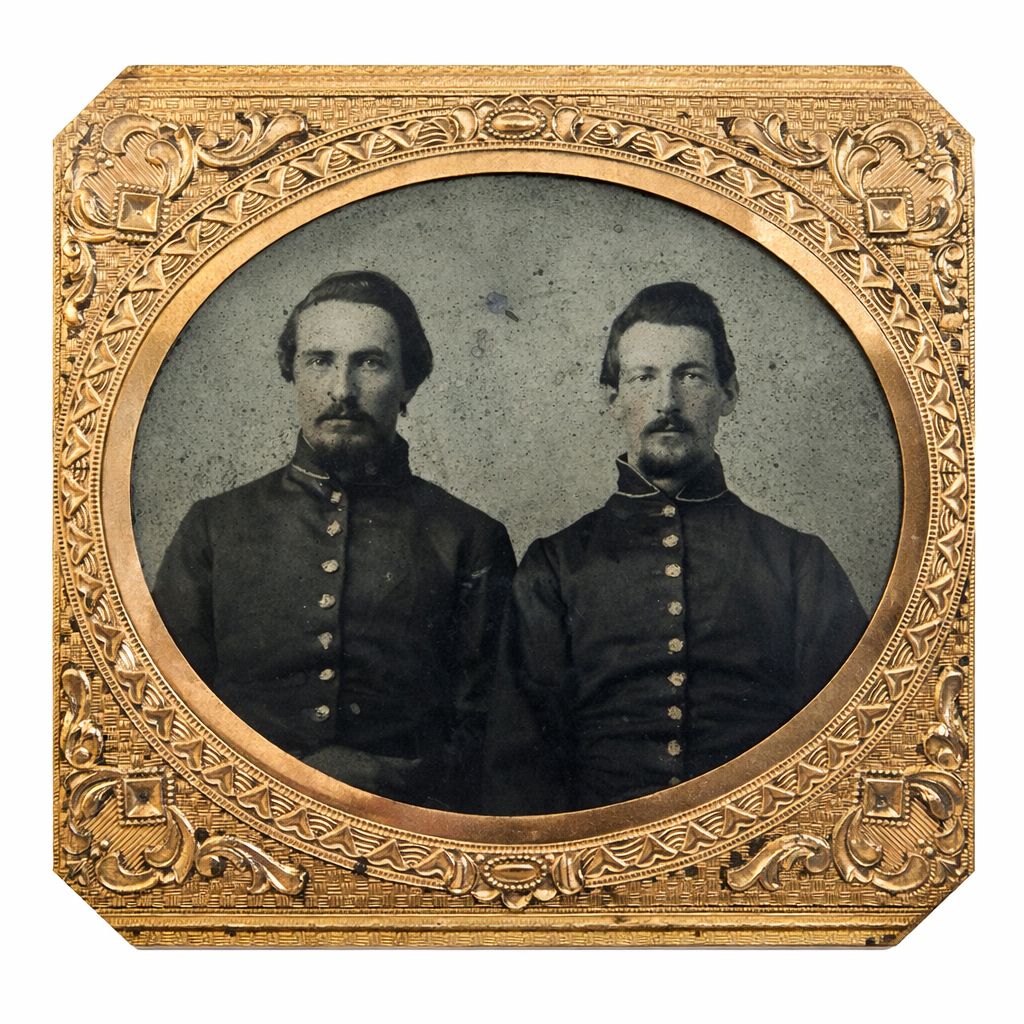
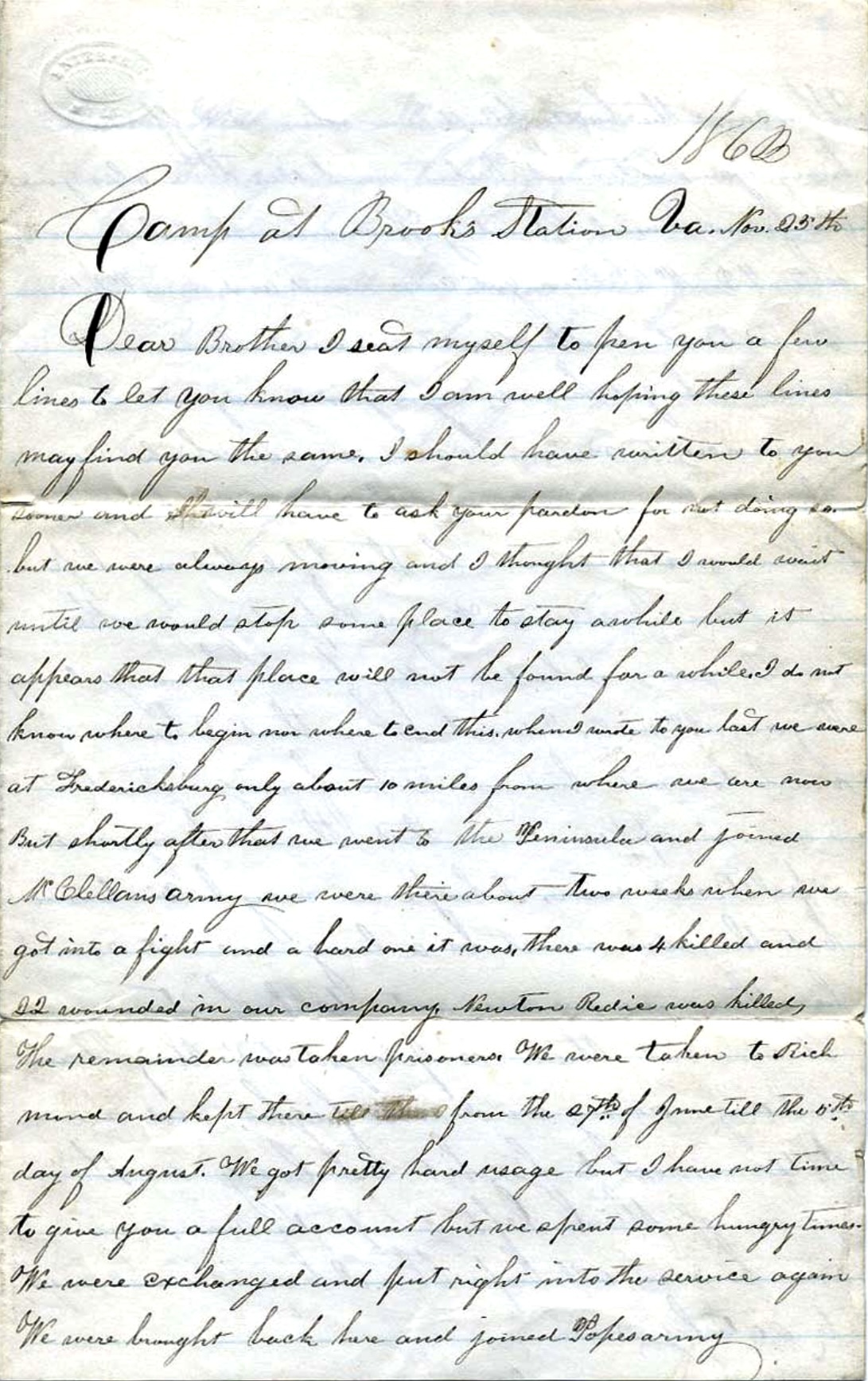
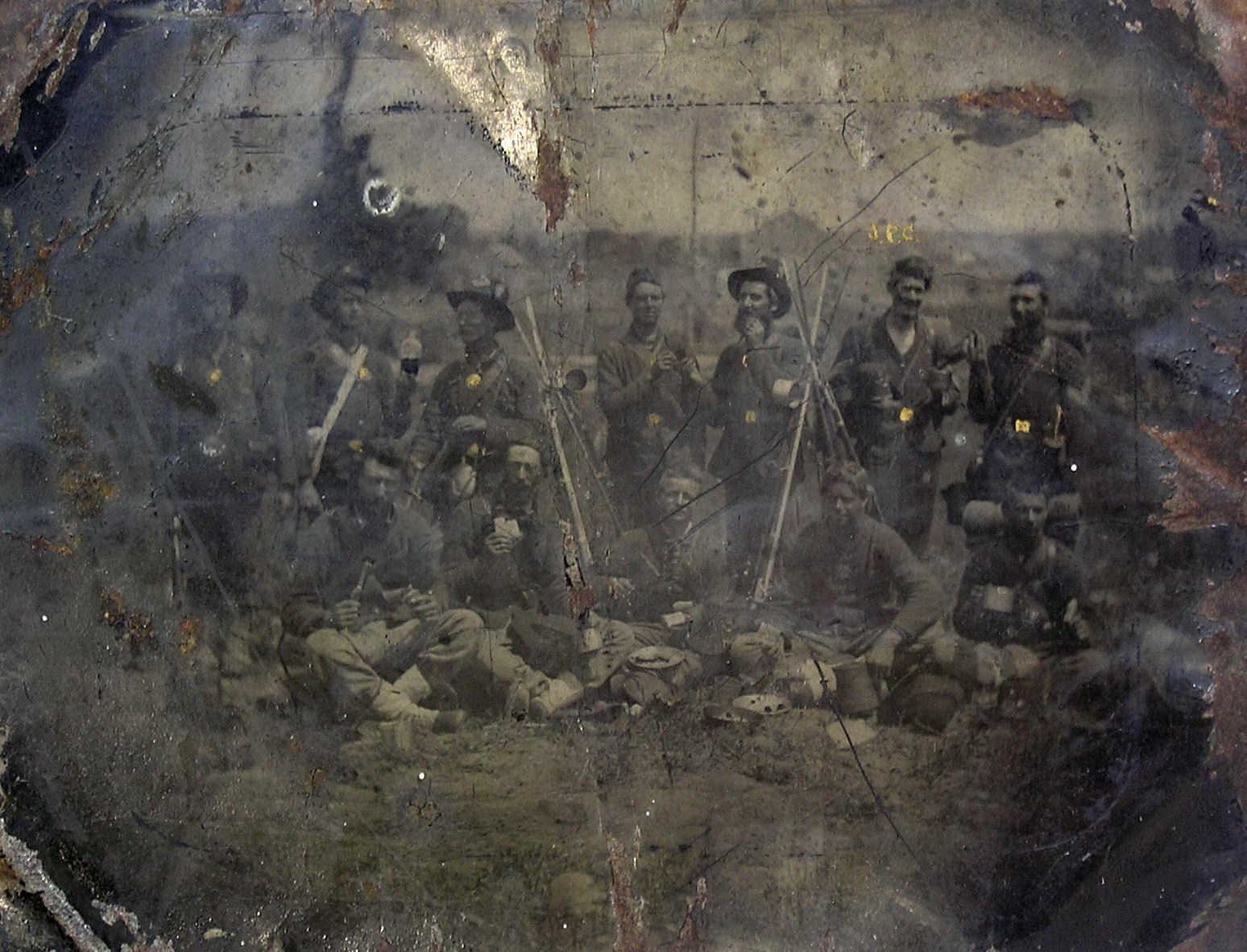
Peter’s letters and the family tintypes are the property of Natalie Stocks who graciously made them available to Spared & Shared for transcription and publication. Peter was her g-g-g grandfather by way of his daughter Evangeline. She inherited the letters of Peter, and his brother in law, William Washington Downing, and his brother in law, Henry Downing.(33rd OH Infantry Regiment). All of the letters were written to Peter’s wife, Mrs. Sena Downing Lightle.

Letter 1

Camp Taylor
May 14, 1862

Dear Sena,

I take my pen in hand to let you know that I am well at present and truly hope when this reaches you it may find you all well. I received a letter from you the 12th and was very glad to hear from you but sorry to hear that Albert was sick. I had no time to write to you any sooner. I came in the same day from picket that I received your letter and got my dinner and sit down to read the papers that the boys got from home and the next morning I went on camp guard and came off this morning.

You said that you wanted me to write to you and tell you how I like Dixie but the people in it don’t do so well. We still have a little muss with them now and then but they can’t come in. They think that the Yankees is hard cases and they don’t miss it much. General Mitchell tells us that we have the greatest praise of any other division in the army. I think we will have the rebels all cleaned out of this place pretty soon and then I don’t know where they will go then.

Albert Lightle, b. 1860

I am enjoying myself as well as can be expected. I would like to be at home very well now while Albert is sick but I can’t. I trust that you can get along as well with him as if I was there. I would like to see the children before they forget me. You have told me that Albert was getting a little better and that the doctor told you that he would get along with good care. I trust that you will take as good a care as you can. I think the time won’t be long until I can come home and see you again. I would like to try my hand on a [ ] again but not until the war is settled and then I think I can settle self with satisfaction. For a while there was a great many men that voted for Abraham Lincoln about our town and said they was ready to fight for him, but it takes them a long time to get at it. I think by the time the war is over, they will be ready to gass about it.

I will have to close my letter pretty soon to go on Battalion Drill. It is very warm here now and still a getting warmer. It will soon be harvest [time] here. The wheat is ripe but it is not much of a crop. Tell Clem [James] I would like to hear from him and know whether he is dead or not. I want you to write and let me know how you all are as soon as you get this letter. So no more at present but [remain] yours until death, — Peter Lightle

to Sena Lightle

Please excuse my mistakes and awkward spelling.


Letter 2

Camp near Battle Creek
August 17, 1862

Dear wife and children,

It is with pleasure that I take my pen in hand to inform you that I am well at present and truly hope when this reaches you it may find you all enjoying the same blessing.

Now the first thing I will tell you what we are doing. We are fortifying this place. There is about six hundred men at work on it day and night. Our regiment is at work on it today. The reason that I am not at work there was about three corporals out of Co. D [were] detailed and that left Bewn Lewis and myself in camp. We are on duty about every other day and expect to be until we get our job completed and then I think we will have a good time—but not as good as I seen in former days.

Now Sena, it has been one year and two days [and] just about this hour since I took dinner with you and not much prospect getting to eat with you for two more long years. But I will pass the time as fast as possible. As for my part, I would just as leave be here. But them at home is what I look at. But I trust in God that we may all meet again before long and enjoy peace and happiness once more together. I have often thought when I have been on guard by myself that I was not in any danger because I always tried to do my duty as far as I knew how.

Now Sena, I have written you the truth as near as I could. I received a paper from you a few days ago with a few lines in it. I was glad to get it. I have not had a letter from you for about two weeks and I can’t tell the reason for I wrote two letters every week. I want you to write as often as you can for I would like to hear from you once a week anyhow. Please write and tell me how you are getting [along] with the children. I want you to take care of them and yourself until I come home. Don’t work yourself to death because I ain’t at home for I think that what money I send home [should] pretty near keep you.

But I must bring my letter to a close. Please write. So no more at present but remain yours until death, — Peter Lightle

to Sena


Letter 3

Camp on Chaplin Heights
October 11th 1862

Mrs. Lightle,

It becomes my painful duty to inform you of the death of your husband who fell in the action of the 8th [at Perryville, Kentucky]. He fell in the discharge of his duty and lived but a few moments. As he lay, I took his hand in my own and his last words were, “Remember my wife.” His loss can, only by yourself, be felt more heavily than the company. Exhorting you to not mourn for what we each and all owe our country, I remain yours respectfully, — J. Hinson, Capt. Co. d, 33rd OVI 1

1 Born in Ohio, Joseph Hinson (1842-1904) enlisted in the 1st Ohio Infantry for three months on 16 Apr 1861. Mustered in as a Private in Company G at Lancaster, Pennsylvania on 29 Apr 1861. Mustered out with his Company at Camp Chase, Columbus, Ohio on 1 Aug 1861. Enlisted in the 33rd Ohio Infantry for three years. Mustered in as 1st Lieutenant of Company D at Camp Morrow, near Portsmouth, Ohio on 27 Aug 1861. Promoted to Captain on 23 Mar 1862. Severely wounded in the left arm on 20 Sep 1863 during the Battle of Chickamauga, Georgia resulting in his arm being amputated. Returned to his Company on 23 Jan 1864. Promoted to Major on 28 Jan 1865 and transferred to Field and Staff (F&S). Promoted to Lieutenant Colonel on 18 May 1865. Promoted to Colonel on 26 Jun 1865, but not mustered. Mustered out with the Regiment at Louisville, Kentucky.

1863-64: Don Fernando Johnson to Electa (Noble) Johnson

The following letters were written by Don Fernando Johnson (1819-1888), the son of Stephen Johnson (1786-1853) and Electa Noble (1787-1878) of Vernon, Tolland county, Connecticut. At the time of the 1860 US Census, Don was residing in Willimantic, Windham county, Connecticut, and employed as a master carpenter. He was married to Sarah Cordelia Crane (1825-1894).

Johnson’s first letter, written to his mother, refers to the death of his father-in-law, Millen Crane (1802-1863)—the husband of Sally (Bennett) Crane (1807-1886) of Mansfield City, Connecticut. We learn from the letter that Millen Crane contracted typhoid fever while visiting his son, Lt. Alvin M. Crane (1839-1922) of Co. D, 21st Connecticut Infantry, in Portsmouth, Virginia, where Alvin was on Provost Duty. Alvin survived the war but was wounded in the Battle of Drewry’s Bluff in May 1864.

Johnson’s second letter speaks to the progress of the war as Grant’s Overland Campaign began and also refers to the recent Gold Hoax.

Letter 1

Addressed to Mrs. Electa Johnson, Vernon Depot, Connecticut

Willimantic [Tolland county] Connecticut]
October 25th 1863

Dear Mother,

The delay of this letter which I intended to have written a week ago was caused by the sickness of Father Crane which you probably heard of by way of Sarah’s letter to Harriet. I have now to announce to you his sudden death. He died last Tuesday, the 20th, about 1 o’clock p.m. His funeral was Wednesday the day after. It was thought not prudent to put it longer time as his disease was such which was considered by the doctor the Camp Fever, or Typhoid of the worst kind.

Lt. Alvin M. Crane, Co. D, 21st Connecticut Volunteers

The circumstances of his sickness and death were these. Alvin was very anxious he should make him a visit to Portsmouth, Virginia, where the 21st was then doing Provost duty, and Father Crane has also been anxious to go. He started in company with some others going to the same place about the middle of September and was gone from home about three weeks. He enjoyed his visit well except one day was confined to his room sick. He with Alvin visited Yorktown, Norfolk, Fortress Monroe, and a number of the hospitals so using his time well. The doctor thought he took the disease whilst there but our folks think he was some unwell before he started as the Camp Fever is not considered contagious by many. He had been unwell since he come home, which was two weeks to a day from the time he died. He was so to be about the house and even work picking up potatoes the Thursday before. He had no doctor before last Sunday which night Sarah and myself watched with him. We found him quite sick though none of us considered him dangerous. He had that day been out of his right mind but was quite rational Monday when we left him, but soon grew worse, and did not have his reason again.

Such are some of the circumstances of his sickness and death. His loss will be much felt by all who had to do with him. He was a good husband, a kind parent, and has ever been a good friend to me. Though it may seemingly ill become me to write out an eulogy at this time, I must say of him to do justice to the departed that he was a man of strong principle and character and had the old sage or philosopher Diogenes lived at this time, he would not have been compelled to go about with a candle in his hand in broad daylight in search of an honest man for no one can rise up and say he was not. And to his great tenacity to what he thought was true and right, I will only quote what was said by the preacher of his funeral discourse: that he was made of that fit kind of material for a martyr.

We are getting on about as usual. I am at work about in the village. Have no help now and doing some repair shingling, &c. We shall look for Harriet now any time Sarah wants to have her come before she commences her school. I have heard nothing from you since Sarah was to B. Write us soon all the news. We are having fine weather now besides beautiful moon light evenings. I must close this hoping this finds you all well. — D. F. Johnson


Letter 2

Willimantic
May 22, 1864

Dear mother,

My delay in writing you before may be charged to the account of much visiting back and forward of late, which we were very glad to receive….

What warm weather for the Spring months. It is like summer. The leaves are about as much grown as they usually are the middle of June. The grass has got high enough to make butter lower. The birds sing whilst they busy making their nests. Great big bumble bees to the consternation and astonishment of my wife and Mrs. Bradley fly in and mount the sugar bowl just the same as if it were cheap as of old. The lilac are in full blossom; also the apple trees, filling the air with odorous and fragrancy so pleasing to smell, whilst Johnny Atwood goes barefooted and has blown out in the seat of his trousers. In fact, everything seemingly indicates a forward season.

The war news now most engrosses the attention. About half of it is bogus but enough is known of Gen. Grant’s movements to give the people confidence that he will give the Rebs hell before long. By his management, the result of this campaign is beyond the region of doubt so far as human eye can see.—“Mudsills” are now in the ascendant and will be historical in the admiration and praises of the times to come. But a great deal more blood has yet to flow, but the right must prevail.

The forged Proclamation created universal astonishment all over the country. the perpetrator of that document should be caught and his wind shut off at once. [see Civil War Gold Hoax]

We have the names of some of the Willimantic Boys killed or wounded in the late fights—none that you know. Lieut. [Charles A.] Wood went from this place in the 7th Conn. Vols., married here, [and] is reported killed [at the Battle of Drewry’s Bluff on 14 May 1864]. His parents live in Rockville.

[My brother-in-law] Alvin [Crane] is with Butler before Richmond. They will have some hard fighting to do there. If Harriet is at home, tell her that when Lester wasn’t but three days old, or before he had the whopping cough or a little before, he broke out with the measles. He come very near having the small pox. I guess if I had not known how to doctor no better than most folks do, he would have died if he had had it. But I think it was the itch that saved him as it made him scratch to get along so well so to be so bold a Captain….

1862: David Williams Cheever to Anna C. (Nichols) Cheever

Dr. Cheever performing surgery in 1880

The following letters were written in 1862 by 31 year-old Dr. David Williams Cheever (1831-1915), a graduate of the Harvard Medical School where he later taught [see biographical sketch]. Cheever wrote the letters while serving as a surgeon at the Judiciary Square Hospital in Washington D. C. during the summer of 1862. This hospital was sometimes called the “Washington Infirmary.” It consisted of “commodious frame buildings” erected on the square after the burning of the first infirmary in November 1861. The new buildings were opened in April 1862.

In his letters, Cheever mentions a colleague, Dr. Frank Brown—an 1861 graduate of the Harvard Medical School. Brown mentions Cheever in a 16 June 1862 letter I transcribed in 2014 (see 1862: Francis Henry Brown to Charles Francis Wyman) which reads as follows: “Yesterday while at dinner, we received orders for one or two surgeons from our hospitals to proceed immediately to a church near the station to take charge of a large number of wounded from [Gen’l James] Shield’s Division near Winchester. So Dr. [David Williams] Cheever and I hurried our two ambulances with nurses, boys, orderlies of all kinds, instruments, soup, coffee & brandy, & went full gallop for the place. We found on arrival by some negligence our orders had been delivered too late and we had to come back. The wounded had been carried to other hospitals.”

Though President Lincoln and his wife are frequently noted for their visits to various hospitals around Washington D.C. during the war, the specific account written by Cheever in his letter of 27 July 1862 is remarkable for its details on the President’s interactions with the soldiers and his impressions on both President and Mrs. Lincoln.

Dr. Cheever wrote these letters to his wife, Anna C. (Nichols) Cheever with whom he married in 1860.

Letter 1

Washington
June 7th 1862

Dear Annie,

Your letter of the 4th I was very glad to get. I will answer business questions first. Please open my letters & send any of consequence only. I should like to have you call on a few of my best patients, as Robinson, Tomey, Hughes, & perhaps Smith, and say I left in great haste, but shall be back before a great while, Tell the Tomey’s, Hughes, & Smith’s that I left my business with Dr. Hodges, No. 50, Chauncey Street. All things if you feel well enough.

Please say to Mother that I have written John to send her a check for $100 which she can pay to Simpson & we can settle the balance when I come home. If she wants to communicate with Simpson, he lives No. 15 Kirkland St. leading out of Pleasant Street. But she had better wait for him to call, perhaps. If you want anything, no doubt your parents will attend to you. Please tell Mother also that if the carpet people press for pay, I will tell John to send her money to pay that also.

I had a letter from John lately. He says they are well and are going to Rockaway on the 18th. He has bought a pony and wagon for his children to ride there. Charles Emerson has left college and joined the New York 7th Regiment which is in Baltimore. So the war takes us all.

On Wednesday p.m. we had an arrival of 225 wounded, all at once, from McClellan’s army, so we had plenty to do & I was busy all the next day dressing wounds, &c. I have about 60 under my care now. Many flesh wounds—four with shattered hands, two shot through the bowels, and two through the lungs. It takes me all the morning to fix them. Besides which, as this hospital is under military law, we have in turn to be what is called Officer of the Day. This individual has to attend to the police of the house, sign passes for patients to go beyond the sentries into the town, put hose who come home after hours or drunk into the guard house, and to make two visits of inspection over the whole house & premises, kitchen, guard, &c.—one about noon and the other after 12 at night. All this besides doing medical duty. So we have enough on that day which comes ever five days.

We have an abundance of everything in way of clothing, lint, food and luxuries for the patients. They have been pouring in the last two days since the wounded came. We have now in the hospital 544 patients. With all these goodies come a host of sympathetic females who want to see and administer to the patriots—many from sympathy, many from curiosity—all kinds, good, strong, strong-minded, & impudent, from Miss Dix down. There are many excellent people. Many also who cannot understand that visitors to a hospital must be restricted to a certain hours—that sick men must have time to eat and sleep and be private sometimes, & not be a menagerie of curious & admirable wonders. The amount of flowers that are daily poured into the building is something astonishing. The wards are constantly fresh with garlands & bouquets of exquisite roses &c.

In all this, people’s feelings are to be appreciated, but it is sometimes overdone. The evening my wounded came into the ward, on looking round I saw a group of men and women giving them lemonade &c. They had got by the guard somehow, and on my asking if they had any friends among them, a young lady—an ethereal creature—replied, “We are all friends!!” in the most benignant manner. I told her I was about to have those men undressed & dress their wounds & perhaps she had better retire, which she did after having bid them all good night.

A good story is told of the wounded in New York. “What shall I do for you my brave man?” said a sympathizing female to one of the soldiers. “I need nothing, madam!” “But do let me do something. Shall I not bathe your brow?” “If you desire to very much, madam, but if you do, you will be the fourteenth woman who has done it before today.”

We have many interesting cases here of sickness and injury—some deaths. The hospital is a good one. Well ventilated and spacious. We have no other news to tell you. The weather now is delightful. I am glad you and the baby are so flourishing. Take good care of yourself. I expect the garden will present a curious appearance by the time I get home. Has the grass come up? or many flower seeds?

Write soon and remember me to Mother. Say that I have so much to do I cannot write to more than one. With much love, your husband, — D. W. Cheever


Letter 2

Washington
June 16, 1862

My dear love,

Your letters of the 11th and 13th are received. I am very much obliged to you for them both. I have delayed one day in replying, both because I have been very busy, and because I wished to give the question about my returning a mature consideration. This I have done & have come to the conclusion to stay here. Such advantages as I now have are unequaled elsewhere and I consider it worth the sacrifice of a new family to remain & improve them. I know that you are well willing to endure my absence, and as long as things go on well with you and remain advantageous here, I shall stay up to a certain time. You may, therefore, say to the gentleman that I feel it my duty to stay here just now, and cannot limit myself to return on the 1st of July, though it is not improbable that I may be back early in that month. I am very sorry & have thought a good deal of it, but it is decided now. Don’t tell Mother.

The government is making vast preparations for wounded from the expected battle of Richmond. Yet is may not come. If things become uninteresting, I may be back in two or three weeks after all. I shall not stay after the 1st of August.

On Saturday, you will be glad to learn I did my first operation. It was tying the carotid artery which is ranked among the capital or more important operations, as those are called, who success or failure involves life. I got along very well for a first time and the result promises to be successful. The case was that is a man shot through the neck and face in whom bleeding came on & could be checked in no other way. Two days before, Dr. Page tied the axillary & yesterday one of the other gentlemen amputated and arm, all for secondary hemorrhage., which comes on sometimes when the wound begins to slough.

We work hard. Fortunately a cool day has made us all feel better today. It was very hot Saturday and Saturday evening. To give you some idea of how we are kept moving, I will give you my experience from Friday night to Sunday night.

Friday night at 12, I was called to check the bleeding of this man which I did for the time. Saturday I was called by my boy at 6.30 as I have done every morning, & in order to get through my work, I make my medical visit to a medical ward before breakfast, and my surgical dressing visit in the forenoon. While at breakfast I was called again to my bleeding friend, when we tied the carotid. Then I had to make my surgical visit and dressing to 40, which with the amount of suppuration & heat going on is pretty laborious. I was Officer of the Day also and had to sign papers and all passes for the men who wanted to go out, visit the whole house, and inspect every scullery, ward, water closet & settle rows with the cooks, put the drunks &c. in the guard house, write up a hospital record of my cases, make an evening visit to my wards & wind up the day by making the grand rounds through every room, all round outside, to the guard, &c. after 12 at night.

It was a hot, but moonlight night, & going along to one place, I found the sentinel asleep & succeeded in taking his musket away unperceived & carried it off which is regarded as a great feat. I had another sentinel posted & the sleeper locked up & then went to bed. I was very sorry for the poor devil, but it was my duty to do it. He will be punished somehow. Our guard is growing slack and we are going to have a new one.

Sunday morning at 6.30 again, [worked] hard until near 12 at noon when the weekly General Inspection come, and all the officers go round together, following the head one and inspect and poke out corners and behind beds and blow up and find all the fault necessary. The hospital looks nice Sunday, I assure you, and indeed every day. It is scrubbed and mopped daily. The only difficulty is in getting clothes enough & washed fast enough to change 500 men often enough as many are wounded, &c. The way we use up bandages and supplies would astonish you. 500 loaves of bread, a keg of butter, and a barrel or 30 dozen of eggs every day, and other things in proportion. We have an abundance.

Sunday I was late at dinner because I was called off to do something in the ward. At dinner came an order to send a medical officer with nurses &c., to dress 300 wounded in a church, just arrived. I was sent with Dr. Brown as assistant, but on getting there found only five who had not been removed to other hospitals. Those five I took here and had three in my ward to attend to that evening. Then I went to bed.

Now I am going out for a little walk—first time for two days. I am very well. Love to mother. Yours affectionately, — D. W. C.


Letter 3

Washington
June 19, 1862

My dear little wife,

Here we are again, “Officer of the Day” and it is so hard to keep awake until 12 when one is tired that I am going to try the expedient of writing to you. Your welcome letter with the photography came duly to hand. I think one very good and have it pinned up over my table in my chamber. I am very glad to have even this memento of you to look at. I assure you, it is very pleasant to see when one is tired. It makes me feel very easy that you take my absence so bravely & that you are really getting along so smoothly. I trust you will continue to do so while I stay here.

I had a very pleasant letter from your brother Richard offering me any services in his power. I have answered it and also written to Demy [?] about the class supper. I don’t know of any other business that needs attending to now. Please keep me informed of how much I lose in calls, &c. and do not economize but make yourself comfortable.

I was going to tell you in my last of my experience in going to a church after wounded. We received orders to send an efficient medical officer at once with nurses, dressings, &c. to the church to take care of wounded. Dr. Page sent me with Dr. Brown as assistant, and three nurses, surgical fixings, a pail of soup, and one of coffee, &c. in an ambulance. As I have already told you, we found all had been removed but five, but we had a very ludicrous time removing them. We found a crowd extending out into the middle of the street composed mainly of ladies. Two of the patients were very sick. One laid out in front of the altar, one sitting up, and the next laid out on boards & mattresses laid over the tops of the pews. The persistence and wrath of that crowd against their being moved anywhere were astonishing. They wanted them kept there and to stay there & nurse them. All sorts of messes were around, including a huge saucepan with about a gallon of gruel. Wine and brandy were being poured into the sick in great profusion and the soldier who was sitting up with a ball through his arm began to feel so set up that he said he guessed he was well off where he was, and he would stay there.

I had two ambulances, stretchers, and a guard of six men with corporal. Those best off I put in the ambulance and had the two sickest carried up all the way by hand on the stretchers by the guard. The ladies besought me to leave them there for them to nurse all night, but finally yielded to my obedience to my orders, which told me to take all there were left to the hospital. All sorts of luxuries were forced upon the sick ones. Someone shoved a bed pan into our ambulance just as it started and one old lady tried to force upon me a bottle of lemon syrup with a rag stopper. However, off they went at last. I had to stay to see if any more were coming & detailed Dr. Brown to go up with the men on stretchers. Poor Brown! he had a sweet procession of citizens up through the streets of a Sunday afternoon following the cortege.

I stayed there two mortal hours & I answered about 500 questions in that time. There is no doubt these people were very kind & the soldiers have been shamefully neglected somehow. They arrived the evening before by railroad from Shields’ Division & no news of their coming being known, had to stay in the cars all night, or go into the church. All were fed by the citizens and many taken into private houses for the night. You have seen perhaps that the surgeon in charge of them has been dismissed from the service for alleged neglect. It is hard to say whose fault is was.

Congratulate me that I did a grand operation yesterday of amputation at the shoulder joint. It came out well & is thought one of the bigger operations—much more than a common amputation of arm or leg. I had the whole surgical staff to assist and a big fuss generally. There was no alternative for the man but amputation or death—gangrene having extended to within 6 inches of the shoulder.

Today Dr. Brown had a hemorrhage & may tie a big artery soon. So we go. We have received orders to hold all our convalescents & lighter cases ready to send away at any time to make room for others.
Love to all. Yours, — D. W. C.


Letter 4

Washington
June 23, 1862

My very dear wife,

Your last letter is received. I was very sorry to learn that you were so disappointed about my staying longer away. Do not be unhappy; I know you will try not to. The time will soon pass when I shall be home again, and I trust we can have a very happy winter if we get things straightened out about a nurse, &c. The baby will have forgot what little he remembers of me ere long. He must change fast also. You have not told me whether he had much trouble in getting his two teeth. You must write all about little affairs which interest me in absence. I am very glad to know that Mother is so comfortably settled & likes her house. It will be very nice for next winter. Even Aunt Elizabeth too is becoming reconciled to it. Do you hear anything of Edwin? I am sure I would not ask.

Take much love, my darling, from me and be very sure I shall be happy with you once more, by and bye. Only think, next week is the 1st of July.

Meanwhile I feel that I am seeing and learning a great deal here. The surgical experience is larger than I could get in any other way. I have some interesting medical cases also, though those are chiefly typhoid, debility, & rheumatism. Nothing particularly new has occurred to me since I last wrote. I have another arm in prospect to operate on in a few days, and some smaller operations. Today we had a ligature of the subclavian artery by Dr. Brown, very well done. And tomorrow he amputates a leg. There are another arm and leg waiting for other gentlemen so you see we have enough to see and do.

We are getting thinned out somewhat now and have been ordered to have all convalescents ready to be sent away at any moment so that we can accommodate at a few hours notice some 300 new patients. As a specimen of the great preparations government is making in expectation of a great battle, the Surgeon General has just informed the Secretary of War that he has ready then thousand of beds in regular & temporary hospitals. They say government will take all the Washington churches.

This great battle may end in a retreat of the Rebels instead of a fight. A few weeks must decide it. They say McClellan is now reinforced by McDowell and others with 50,000 men. The issue cannot run on far into July without a result of some sort.

We see very little of Washington outside of the Hospital. It is the dirtiest place you ever saw. And walking out one of those very mild, delicious summer evenings they have here is changed from a pleasure to a pain by the constant succession of smells at every step. There is no drainage or scavenger departments, and hogs run about under the arches of the Capitol. The air is somewhat miasmatous, and all take precautionary doses of quinine every few days to keep off the chills & fever. We are all very well.

I forgot to tell you that I went to see the Navy Yard the other day. It is particularly interesting in the manufacture of shot, shell, balls and finishing of cannon &c. We saw many big cannons and mortars, like those used on the Mississippi & at New Orleans. We saw 150 pounders swinging round in the air in great cranes as easily as a feather, and noiseless machinery slowly boring and rifling them. We saw a machine which presses musket balls out of cold lead at the rate of some 60,000 a day, and also a like one for Minié balls. Hot shot and shell were being poured out of molten iron into moulds by the hundreds together. Here you realize something of the gigantic scale on which war is now conducted and with what missiles.

The weather here is comfortable. We live well but the cooking is not extra. We have just had a great tin can made to make beef tea in by the gallon—a great things for the patients. Write soon. Give love to all and tell Mother she must read all my letters even if she does not receive any.
Yours very affectionately, — D. W. Cheever


Letter 5

Washington
Sunday evening, June 29, 1862

My very dear wife,

Your letters are all received and I have been trying several days to answer them, but have really had not a moment when I did not feel too tired out to write. You may excuse me when you learn that we are temporarily very short handed of surgeons—one having been sent with McClellan’s army and the other, Dr. Brown, having gone to Boston for a week’s furlough to see his wife who is sick. So we have only four to do the work of six, and besides, have to be Officer of the Day every three days. As usual, I take the biggest slice of work, having 5 wards to carry on instead of two, but I have made two amputations out of this little dodge, one of which—an arm—I did yesterday, and the other—a leg—I took off this afternoon. Both are doing well. I may say I lamed them by the work I have done. Within the last fortnight I have taken off a finger, removed three of the bones of the foot, tied the carotid, and done three amputations, one shoulder joint, one arm, and one leg—4 capital operating & 2 or 3 minor ones.
Within the same space of time, other gentlemen here have done 4 amputations, tied two large arteries, and removed sundry fragments of bone, making in all in this hospital 7 amputations and three large arteries, besides lesser operations in two weeks. At all of these I have assisted so you see we have had lively work with surgery, besides receiving 50 new patients who were sick.

Dr. Alfred Haven did his first operation—amputating a leg—three days ago and got along very well. The big boys have got in the way of coming down to criticize the youthful operators, and yesterday I had a distinguished audience composed of the Medical Director of this District, the Medical Inspector, and other dignitaries. One of our number, the next day after his operation was witnessed, was ordered to take charge of another hospital, and yesterday the same compliment was paid to me. But I am very glad that Mr. Page got me kept here where I had much rather stay, for the officer in charge of a Military Hospital has a very laborious time with official and executive duties & less chance & time to practice himself.

Calvin Gates Page, Harvard Class of 1852 (from the 1922 Yearbook).

Dr. [Calvin Gates] Page 1 sends his compliments to you and says that I am not going back until the war is over, or he will put me in the guard house, wives and babies to the contrary notwithstanding (he having heard of the expected event from Mrs. Page). Never fear but I shall be back in August. I thank you very much, darling, for writing so as to make me feel very easy about home. You are a true wife and my little love comme toujours [as ever]. I shall be only too happy to see you again. And I send home your photography with great regret & a protect that I have another at once for I shall miss it very much.

I have had a letter from Aunt Elizabeth today who is tolerable. She wants you to visit her and says everything is ready, &c. I would try to go for a few days if possible & you feel well enough. Also, I advise you by all means to go to New Bedford if you are confident of bearing the journey well, and if it will amuse you. It is steady hot here but I am very well. I am delighted to hear about Mother and Edwin. I have written to her. You must have a funny garden going on. Tell Rauffer not to set you on fire the 4th of July. I have no doubt the baby is very fine now.
We hear tonight of a considerable battle before Richmond which must bring on a general engagement in a few days or end in a retreat. We had two come in today wounded in the skirmish of Thursday. We hear of Dr. Crehove [?] that he has done extremely well and that his officers, he having been displaced by the return of Dr. Revere, were so anxious to keep him that they got him made their chaplain, or really a medical assistant, I suppose, under that name and rank.

Be very careful not to hurt yourself if you go away, and if you anticipate a fatiguing trip to Saugus, do not go. Think how dreadful that would be. With much love to all & the most to you, I remain your affectionate husband, — David W. Cheever

P. S. In the Boston Med. & Surgical Journal for Thursday last (June 26th) is published a letter I wrote Dr. Dale about the hospital. 2 It is published nearly opposite the Adams House. Your brother might get it for you.


1 Calvin Gates Page, Sr. (1829-1869) was a practicing physician in Boston when the Civil War began. He was married to Susan Haskell Keep (1830-1895) and was the father of three children at the time he offered his services as a surgeon at the Judiciary Square Hospital. In August 1862, he was commissioned as Assistant Surgeon in the 39th Massachusetts Infantry and served until mid-November 1863.
2 The letter appears below:


Letter 6

Washington
July 3rd 1862

My darling love,

Your letter has been received & I believe answered, and tomorrow I look for another. As usual I take the night of being Officer of the Day to write you. Many of our patients being convalescent now, we have not so much to do. Nor have we had any operations since I wrote. One of the gentlemen, however, expects to amputate tomorrow. Dr. Brown, I hope, saw you in Boston. He was to call Tuesday afternoon & will bring me news of you tomorrow or next day. I asked him to call on you.

One of our number who went to the Peninsula returned so we are not so short-handed. Meanwhile, however, Dr. [Calvin] Page has been sent off to the army before Richmond on Tuesday night at an hour’s notice. He wanted me to go with him and tried to have me & I would have given a good deal to be there now, but it was refused on the ground that it would not do to weaken the hospital staff anymore & that I should soon be needed & have more than I could do here. So I was ordered to stay and shall endeavor to do my duty.

We expect to have our hospital cleared of convalescents & to take in at least 300 wounded by and bye. We have now some vacant beds & shall probably receive 50 wounded tomorrow or next day. 1,000 are expected daily.

Dr. [Alfred] Haven, having been the longest in the hospital, was left in charge in Dr. Page’s absence, and in an office requiring no little labor, anxiety & fuss, I am thankful I have not got it. Things go on very well so far. Dr. Page has gone down in the nick of time & will probably find plenty to do. We hope he may be back in a fortnight but cannot tell.

Apropos of having appointment the other day, the morning he was put in charge, we were at the Surgeon General’s Office where we saw the immortal Cole of Boston, bigger than life, and surveying the Great Officials like a Prince. He asked Dr. Haven where he was, and learning of his new appointment, said at once, “Oh yes! We heard of that in Boston, and were much pleased.” “But,” said Dr. Haven, “I was only appointed last evening.” “Well,” replied the never-failing Cole, “Some friend must have telegraphed it then!” Query? When? to Boston and back to Cole in Washington?

Everything is in such an uncertain state about the war, and the air is so full of rumors that it is hard to get at the truth. But everybody fears—and indeed, I am afraid it is too true—that McClellan’s army has sustained a great reverse. It is certain that there have been four days severe fighting, on Thursday, Friday, Monday & Tuesday (yesterday) and that the slaughter has been great on both sides. The killed and wounded cannot but be numbered by thousands & the Great Army has fallen back 10 or 12 miles. How many of these poor devils have been left on the field in the enemies hands we cannot tell.

Dr. Edward Perry Vollum (1827-1902), Medical Inspector in McClellan’s Army of the Potomac during the Peninsula Campaign. McClellan told him just prior to the Seven Days Battles that he could “go into Richmond any day he chose.”

Dr. [Edward Perry] Vollum, the Medical Inspector of McClellan’s army, who had just come from the war and went back Tuesday night taking Page, said, “You will have hot & bloody work and no sleep, night or day.” Through the same source I learn that McClellan told Vollum last week before these battles, & he told us (only one remove, you see), that he—McClellan—could go into Richmond any day he chose. Is it not strange—war is very uncertain. This will prolong it I fear another year, and then comes up the old trouble of [foreign] intervention. So the President’s call for 300,000 more men looks the same way. Yet this evening there are brighter rumors about McClellan’s having gained a victory yesterday. We must wait events. Meanwhile, keep well and contented as you can & wait for your loving husband, — D. W. Cheever


Letter 7

Washington
July 10, 1862

My own sweet love,

I do not know that I have anything to say to you this evening except to tell you how much I love you and long to see you. Poor little darling, how lonely you must be sometimes. Wait. Time will soon pass away and then you will have me once more. I miss your photograph very much & think it a pity you took it away before I came home. I believe it is six weeks tomorrow since I left you, walking down Fourth Street. Does it seem longer?

Today we have cool weather after great heat. Most of my 60 officers have got furloughs to go home and have left the hospital so I am waiting for another filling up. Besides, I have given one of my wards to Dr. Brown so that I retain only my original two wards. All this gives me more time. We are kept trotting trying to get our pay. I have been three times and am going again tomorrow. When I get it, I shall send you some.

I sent today a little package by Adam’s Express to you which you may think to be jewelry, but which contains morbid specimens which I wish to keep safe. Please open the cover and see if the little bottles are all right. If not, the contents are to be put in a bottle of alcohol and water half and half. The box also contains dry bones which are safe enough.

I am going to endeavor to make inquiries about Adj. Merriam tomorrow; I have been unable to before. I was sent today to see a sick Rebel prisoner in a private house amid secesh sympathizers. He was quite a good looking fellow but kept very mum.

Tomorrow I expect to have an important operation. Dr. Brown also has one.

My little darling, I am glad you get along so bravely and that people take care of you. I hope you have regular meals & eat enough and that everything goes on quietly in housekeeping & you have no worries or alarms. My own love, take care of yourself for my sake, for you must always love me as I do you, my dear wife. Do not fear our being happy in each other once more. For I love you now then times more than two years ago. You are part of me & my life. Kiss me good night, my dearest love, and dream of me till you have me once ore. — D. W. C.

P. S. Remembrance to all hands.


Letter 8

Washington
July 19, 1862

My darling,

Your last dear letter is received. I am afraid I have delayed writing a day or two longer than usual this time but you must forgive me. I am very glad to learn that you continue to throve with the baby. John writes me hoping you may be able to meet them in Saugus. I hope you will not undertake it, for I think it too great a risk to run. I hope you or Mother may have a little visit from Annie.

I am sorry the time has seemed so long to you since I have been away. I too begin to wish for hime and you. And it will be but a very short time now, ere I shall be with you once more. Then I trust we shall have a while of quiet time together. Home will seem very luxurious, I expect.

I have comparatively light work now. So many of our wounded fell into the enemies hands that we exceed in accommodations what we need. Washington is said to have 2,000 spare beds now in its 17 hospitals. We are not full and we have more lightly sick than wounded. Yet something turns up occasionally. Dr. Page amputated an arm on Thursday & yesterday I took off a leg. I do not see prospect of more wounded just now, which is perhaps as well for me as I am coming home.

I have done a pretty good share of work since I have ben here—perhaps my share for this season. Good night my dove. Excuse more, I am so sleepy. Believe always in my passionate love for my dear little wife whom I will soon kiss. Love to all. — David W. Cheever


Letter 9

Washington
Tuesday evening, July 22, 1862

My very dear wife,

Your letter of Sunday is received. Fear not that anything will detain me beyond the early part of August. I must wait here long enough to make out my two months so as to draw my second month’s pay. This will end the 2nd of August & I shall then come straight home. This will be in about ten days. Meanwhile, take specially good care of yourself and let me hear often from you. I begin to feel a little anxious to get home to you myself, and with you shall count the days. I shall be very glad to get somewhere where it is not quite so hot, and to have the luxuries of civilized life.

We have comparatively little going on here now though I had to amputate an arm at a few minute’s notice yesterday morning. We learn now, however, that all our wounded in the rebels’ hands are to be given up and forwarded to various hospitals. There must be several thousand of them and I should not be surprised if we were to be filled up with them in the course of a fortnight. This will not affect my course, however. I have today sent my resignation to the Surgeon General to take effect on the 1st of August. I am inclined to think that the rebels have grown more humane or more politic in their treatment of prisoners & wounded. I enclose the Congressional Report of the Atrocities committed at Manassas. These I do not doubt because I have conversed with intelligent people present in that battle & on the field afterwards who represent things quite as bad as the report does.

Congress has at last adjourned and we are freed from a very disagreeable set of visitors. Washington continues as dirty and as uninteresting as ever. Last Sunday afternoon I took a walk over Long Bridge into Virginia. It is a forlorn looking structure about a mile long, partly old and made of earth and bricks, and partly wood and modern. It is none too wide for two carriages to pass each other, and you may judge how it may be adapted for the passage of an army. That part of Washington, the bridge, and the Virginia shore near it, are all poor and wretched and desolate. And it seems strange that so contemptible a locality should have riveted the attention of 20 millions in intelligent people so long, or that so much of money & life should be thrown away to reclaim such a country.

The Long Bridge from the Virginia shoreline; US Capitol at far right. Ca. 1863

From the bridge the view is full of historical objects—Arlington house, Arlington Heights, Forts Albany & Corcoran, and various camps shining far off on the hillsides. Part of the 14th Massachusetts were on guard at the bridge. From here there was also a fine view of Washington, and one could judge what an opportunity the rebels had of contemplating the White House, the Capitol, &c. when they occupied the opposite shores. In the center rises above all the unfinished Washington Monument—a sad example of the incompleteness of the National structure begun by Washington.

There is nothing else new. I hope Mother and John & Annie may be together in Saugus next Sunday. Before long I shall see my dear little wife and baby again. Till then, wait as quietly as you can, my dear love. I hope that we shall have a happy & quiet winter, unaffected by things outside. With love to all. I remain affectionately your husband, — D. W. Cheever


Letter 10

Washington
Sunday evening, July 27, 1862

My own love,

As I am Officer of the Day, you will expect the usual letter. I hope to get one from you tomorrow.

Drs. [Alfred] Haven and [Frank] Brown were suddenly ordered to the Peninsula yesterday to take down a party of nurses. We hope they will be back in a few days so we have a little more to do again.

Newspaper drawing depicting Lincoln’s visit to the Depot Field Hospital near City Point, Va. (Courtesy New York State Library)

Yesterday we had a visit from the President & wife. 1 They came in very quietly, dressed in mourning, & the President went round & shook hands with each of the 400 patients. Quite a job. 2

Mrs. L[incoln] is quite an inferior appearing person. The President is tall & ungainly & awkward. His face, however, shows extreme kindness, & honesty, & shrewdness. He went round with great perseverance, & seemed to like to do it, though it must be a tremendous bore. His wife says he will do it at all the hospitals. There are some things comical about him but he has proved himself so far above his party & the time in firmness, honor & conservatism that I do not wish to say a word against him. They had a very plain carriage & attendants.

Today we had preaching in the hospital in the afternoon, which went off pretty well. There are many rumors about Jackson’s being at Gordonsville with a large force, & being about to make a demonstration on Washington. It would not be surprising if they did.

My little dove, do you want to see me? I hope you will have me next Sunday. What will you do? Don’t get too excited & get into mischief. I will try to write again. Yours with everlasting love, — D. W. Cheever


1 Lincoln’s visit to the Judiciary Square Hospital must have taken some time yet the visit but it was not recorded (yet) on the Lincoln Log, the Daily Chronology of the Life of Abraham Lincoln.

2 The hospitals were sometimes part of the afternoon rides taken by Mr. & Mrs. Lincoln. One observer noted: “Mr. Lincoln’s manner was full of the geniality and kindness of his nature. Wherever he saw a soldier who looked sad and ‘down-hearted,’ he would take him by the hand and speak words of encouragement and hope. The poor fellows’ faces would lighten up with pleasure when he addressed them, and he scattered blessings and improved cheerfulness wherever he went.” [Source: Charles Bracelen Flood, 1864: Lincoln at the Gates of History, p. 101.]

1864: Simeon Terry Miner to Alice Avery

The following letters were written by Simeon Terry Miner (1839-1902) of Geonoa, Cayuga county, New York, while serving as a private, in Co. F, 16th New York Heavy Artillery. He had previously served in Battery I of the 3rd New York Light Artillery. He reenlisted in the 16th “Heavies” in January 1864, imagining perhaps that he would only see garrison duty in some eastern seaboard fortress but Grant broke up this large regiment and chose to use them as infantrymen and in the summer of 1864. He mustered out with the company on 21 August 1865, at Washington, D. C. Simeon was the orphaned son of Edson T. Miner (1804-1848) and Eliza Ann Rich (18xx-1845). He wrote the letters to his cousin, Alice Avery, of Genoa.

In July, 1864, seven companies of the 16th New York Heavy Artillery were assigned to the 2nd brigade, Terry’s (1st) division, 10th Corps, and two companies to the 1st brigade, 3d division, same corps. On Aug. 9, 1864, when Gen. Butler called for volunteers to cut the Dutch gap canal through the peninsula in the James river near Farrar’s island, with a view to outflanking the enemy’s batteries and the obstructions in the river, Cos. A, B, C, F, G and K responded, and 600 men were selected from them to perform the perilous task. During the progress of the work, they were exposed to the enemy’s fire, and only protected themselves by throwing up the dirt from the canal as fast as possible, living in “gopher holes” along the river bank. They were withdrawn after several of the men had been killed and wounded, though Maj. Strong still continued in charge of the work and Maj. Prince in command of the battalion.

In Oct., 1864, seven companies were heavily engaged with Terry’s division at Darbytown road, sustaining a loss of II killed and 54 wounded, and in the action at the same place a few days later lost 13 killed and wounded. From July 27 to Dec, 1864, when the regiment was before Petersburg and Richmond, it sustained constant small losses, aggregating 30 killed, wounded and missing. From Dec, 1864, Cos. A, B, C, F, G and K served in the 1st division, 24th corps, and another detachment in the artillery brigade, same corps, engaging with some loss at Fort Fisher, the Cape Fear intrenchments. Fort Anderson, and near Wilmington, N. C. In July, 1865, the various detachments of the regiment were united and on Aug. 21, 1865, commanded by Col. Morrison, it was mustered out at Washington, D. C.


Letter 1

Addressed to Miss Alice Avery, Genoa, Cayuga county, New York

Front Line of Defenses
Near Bermuda Hundred
August 20th 1864

Cousin Alice,

Your welcome letter of the 12th was received this morning. You are mistaken about our position. We are not in front of Petersburg but are with Butler’s Army about six or seven miles from that place, but can hear all the artillery firing. Our position is on the extreme right of Butler’s line of works. The fleet lies in the James river close to us. The Rebs’ works are about 500 or 600 yards in front of where we now camp.

The regiment has been badly split up since I wrote you last. Six hundred of our men have been away doing Engineer duty, leaving only about 250 here. We are in one of the extreme outposts away in front of the main lines of works—nothing between us and the Rebs but our picket line. (The batteries on our right have just opened fire.)

Take a map of the James river and find Turkey Bend. Just above it you will find a place called Dutch Gap. Close to this gap the river makes a sharp bend to the south. On this bend our (Butler’s) works commence and run by zig zag south till they come to the Appomattox. You will notice these works run in a line parallel to the Richmond & Petersburg road which the rebs have to keep strongly guarded or our force will sever one of their main lines of communication, but they have still one more line left—it is the Danville road.

A heavy battle was fought day before yesterday on the north side of the James. It was very heavy. We could hear the cannons & the musketry. The smoke was very plain to be seen. We could not see the lines of battle but could plainly see the bursting shells. We are afraid our men were driven back but have no news to be relied upon. The people at home know more than we do. We know nothing—only what we can see and hear. If we hear heavy firing, we know nothing of the result till northern papers announce it.

We are led to believe from accounts that reach us from home that there will be difficulty in enforcing the draft. Many of our men are very much disheartened by the present military condition and if they could by any means get clear of the army, nothing could induce them to reenter the army—not even force. The rank and file, or those I have heard speak, are very bitter on the present Administration and it is my opinion the present head of the government could not get one in four of the votes of the New York and New England troops. Such is their dislike of the present Cabinet and its doings. Nothing but a change will satisfy them. Many begin to talk of giving up the contest as a bad job. Grant is fast losing the confidence of the men. There is too much President making.

Last night there was very heavy [firing] at Petersburg. We don’t know the cause.

What was the reason of Mr. Boughton coming home? Did his health give out or was there some other reason for it?

In regard to money matters, my object was to get it in some shape that the depreciation of Government stocks and Bank security would not reduce its original value.

I have just heard from one of our men who has been over the James that the heavy firing I mentioned was an attempt of the Rebs to take works from our Corps (10th) which they had taken the day or two before. They held it but the Division is badly cut up. Our regiment is now under marching orders but we don’t know whether we shall go to the regiment or not.

All day yesterday and today it has rained. Last night was very bad. Our tents consist of two pieces of light canvas buttoned together. These are thrown over a pole and fastened to the ground by stakes. In marching, these tents are taken apart and each man carries half a tent. These are the famous shelter tents. The pieces are about five feet square. Some of them linen—others of cotton. The canvas is about the heft and thickness of two thicknesses of heavy sheeting.

Our men have lost two killed besides having several wounded. I have not heard the number from other regiments. I wrote to Orlando a few days ago. Tell me in your answer if he received it. A letter from me goes to all of you. Write soon. Direct as before & to the 10th Corps. — S. T. Miner


Letter 2

With 10th Corps in Field
October 30th 1864

Dear cousin Alice,

Your welcome letter of October 23rd I received this morning. I was glad to get it. Today is Sunday and quite a gloomy one too (although the day is bright) if reports be true. Report has it that Grant has lost heavily and has been repulsed. The loss is said to be eight thousand. If that be so, things look pretty black for us in this quarter. Wherever we advance we always find an equal number of Rebels. We are all getting sick of this, I tell you. Although the armies seem to meet with some success in other parts, the reverse seems to be the case here. What the reason is, I cannot tell.

If Grant is defeated, the price of gold will again go up and we have the contest prolonged for another year. The disloyal faction will come out boldly with their operations and sooner or later, I fear we must give in. I have got the blues like thunder over such prospects as our men talk over. What little U.S. stock I have, I shall sell. I think the value is steadily reducing and I am shaky in my faith. I hardly know what to do. If the present financial policy of the government is continued, repudiation must come we all fear. We are becoming States Rights men, as regards money matters. Just think of it, a dollar will hardly buy a man enough to make a respectable lunch from, and more of the same kind coming everyday. This the government has to pay full price of gold for. This course, if persisted in will smash us sure.

The men of McClellan ideas are feeling quite fine over our defeat. This Army was also engaged and obliged to retreat although the loss was not as heavy as on the south side of the river. You people at home do not fully understand the feeling in the Army. The men are fast becoming “Peace at any price.” More than two-thirds of our regiment follow that cry. Honor and patriotism have actually played out with a large portion of them. The only thing that keeps man here is the feeling for their friends at home. I fear the election of Lincoln will cause a great deal of bad feeling & desertion.

You say you wish you could take a peek ay me. You would find me sitting in a little tent not high enough to stand in, with a portfolio on my knee writing to you. We have a small fireplace i one corner which keeps us quite comfortable. Our bed consists of pine boughs spread on the ground and covered with a rubber blanket. The nights are quite cold, many times have quite heavy frosts.

How do the people feel toward the soldiers? Our men think the office holders only want them for a handle, then will kick them aside after rising. The late frauds in soldiers’ votes goes strongly to confirm the idea. My opinion is that it is but little more than politics that keeps the war going. Rich contractors playing their points to rob the men of the Army supported by the Administration on the one side and gold gamblers sustained by Democratic papers and men on the other.

I really wish I could be with you to enjoy your big bin of apples & potatoes for I really need something of the kind to keep me healthy and cannot get it. I guess you will pronounce this a genuine Copperhead epistle so I’ll not write anymore this time but wait till I hear further from Grant’s repulse. Do not neglect to write to me because I feel pretty blue on government affairs.

Write soon. Direct as usual. — S. T. Miner

1863: William Tuckey Meredith to Sarah Emlen (Scott) Meredith

The following letter was written by US Navy Assistant Paymaster William Tuckey Meredith (1839-1920) who received his appointment from President Abraham Lincoln in September 1861 and was eventually assigned to serve under “Damn the Torpedoes” Admiral David Farragut aboard the USS Hartford—the Admiral’s flagship.

William was the son of Joseph Dennie Meredith (1814-1856) and Sarah Emlen Scott (1818-1909) of Philadelphia, Pennsylvania. William (or “Willie”) was named after his grandfather (died in 1844) who was a successful attorney and president of the Schuylkill Bank. Willie’s uncle was William Morris Meredith, a Whig, who served as the Attorney General of Pennsylvania and as the 19th US Secretary of the Treasury under President Zachery Taylor.

Willie’s letter informs his mother of a recent passage down the Mississippi to New Orleans and of his return to the Flagship USS Hartford. He tells her of being fired on by Confederate guerrillas near Donaldsonville, Louisiana, and that he is convinced commerce cannot be safely restored simply by capturing Vicksburg and Port Hudson.

USS Hartford officers relax on deck, 1864. They are, seated (front, left-right): Surgeon Philip Lansdale; Ensign W.H. Whiting; and Chief Engineer Thomas Williamson; Standing (rear, left to right): Surgeon William Commons; Paymaster William T. Meredith (holding the rope); Captain Charles Haywood, USMC; Lieutenant H.B. Tyson; Lieutenant J.C. Kinney, U.S. Army Signal Corps; and Ensign G.B. Glidden; And seated (extreme left, rear): A.A. Engineer T.B. Brown.

After the war Meredith would write poetry including the poem “Farragut” memorializing the taking of Mobile Bay by Farragut’s fleet in August 1864.

“Farragut”

Mobile Bay, 5 August, 1864, by William Tuckey Meredith

FARRAGUT, Farragut, 
Old Heart of Oak, 
Daring Dave Farragut, 
Thunderbolt stroke, 
Watches the hoary mist
Lift from the bay, 
Till his flag, glory-kissed, 
Greets the young day. 

Far, by gray Morgan’s walls, 
Looms the black fleet.
Hark, deck to rampart calls 
With the drums’ beat! 
Buoy your chains overboard, 
While the steam hums; 
Men! to the battlement,
Farragut comes. 
See, as the hurricane 

Hurtles in wrath 
Squadrons of clouds amain 
Back from its path!
Back to the parapet, 
To the guns’ lips, 
Thunderbolt Farragut 
Hurls the black ships. 

Now through the battle’s roar
Clear the boy sings, 
“By the mark fathoms four,” 
While his lead swings. 
Steady the wheelmen five 
“Nor’ by East keep her,”
“Steady,” but two alive: 
How the shells sweep her! 

Lashed to the mast that sways 
Over red decks, 
Over the flame that plays
Round the torn wrecks, 
Over the dying lips 
Framed for a cheer, 
Farragut leads his ships, 
Guides the line clear.

On by heights cannon-browed, 
While the spars quiver; 
Onward still flames the cloud 
Where the hulks shiver. 
See, yon fort’s star is set,
Storm and fire past. 
Cheer him, lads—Farragut, 
Lashed to the mast! 

Oh! while Atlantic’s breast 
Bears a white sail,
While the Gulf’s towering crest 
Tops a green vale, 
Men thy bold deeds shall tell, 
Old Heart of Oak, 
Daring Dave Farragut,
Thunderbolt stroke!

T R A N S C R I P T I O N

An envelope addressed to Willie.

U. S. Steamer Monongahela
Mississippi River below Port Hudson
July 7th 1863

My dear Mother,

I am on my way back to the Hartford after a trip to New Orleans for money & supplies. I left the ship on the 2d, crossed the point and reached the city next morning in the little tug boat Ida. On the way down we were fired into by the rebels but fortunately no one was hurt. It took me until yesterday to get all that I wanted and last night I started to return, the Monongahela and New London acting as convoy for my little tug. All went pleasantly until this morning at 10 o’clock when we were again attacked by artillery & infantry. For some time the firing was pretty severe. We had five men wounded and one killed. Among the former was the captain of the vessel, Abner Reed. He is a very fine gentleman, liked by all. His death unfortunately will occur just as he is recovering from the disfavor of the Department produced by former bad habits. Of course you will not mention this. 1

We have just passed the Admiral on board of the Tennessee and he gives us the intelligence of the taking of Vicksburg & 25,000 prisoners. Port Hudson must soon follow now. Hurrah!

This morning’s experience only confirms me in the opinion that I have always expressed, that as long as this war lasts, so long will the Mississippi be closed to general commerce, the fall of Vicksburg and Port Hudson to the contrary notwithstanding. Even an armed escort to every single steamboat could be of no avail in preventing the enemy from bringing their infantry and light artillery into play behind any part of the levee from New Orleans to Memphis. Commerce will be impossible during the war. I say again, even supposing the country adjacent to the river be occupied by our troops, we can never check these marauding bands who will make their appearance at 10,000 different points.

Baton Rouge. Evening. I change vessels here and will cut this short that I may send it down by the first mail. Let me hear from home. Love to all.

Ever, — Willie


1 Willie clearly gives the commander of the tug as Abner Reed but this surname is either misspelled or other official records are in error for he most certainly was the same Abner Read (1821-1863) who’s career is thoroughly laid out in the following Wikipedia biography—See Abner Read — and whose death is reported as: On the morning of July 7, 1863, Southern forces opened fire on the ship with artillery and musketry when she was about ten miles below Donaldsonville. A shell smashed through the bulwarks on her port quarter [says USS Monongahela] wounding Read in his abdomen and his right knee. He was taken to a hospital at Baton Rouge, Louisiana, where he died on the evening of the next day.

In an article appearing in the New York World on 20 July 1863 under the heading “On the River,” it was stated that, “Last week there was but one rebel battery on the river below Donaldsonville—now there are three, viz. one three miles below that place; a second at College Point, twenty miles nearer this city; and a third ten miles below and nearer New Orleans than College Point, armed, as represented, with smooth9-pound and rifled 10-pound guns. Scarcely a boat going up or down has escaped a shot from some or all of these batteries. The St. Mary, the Monongahela, all the river boats, tugboats, steamboats, and what not, have been fired at, and some of them have been hit. The gunboat Monongahela, July 8, received six shots, one of which disemboweled her commander, Abner Reed, who has since died, and another man on board was killed. For a quiet river, it is a singular state of things, surely. The levee furnishes a ready-made earthwork, the embrasures are dug, and it is said that negroes are collected on the top of the levee for the gunboats to fire at in return, if they choose. The water is so low in the river that it is almost impossible for the gunboats to fire at the batteries with any effect, while the batteries have every advantage…”

1864: Charlotte Melissa (Miller) Coon to Edna Amanda Miller

The following letter was written by Charlotte Melissa (Miller) Coon (1821-1917), the daughter of Daniel Miller (1785-1852) and Jane Wick Genung (1792-1878). She wrote the letter to her sister, Edna Amanda Miller (1834-1928) of Seneca Falls, New York. Charlotte was married in 1842 to John V. Coon (1822-1895) and lived in Elyria, Lorain county, Ohio, where her husband had practiced law since 1846 as well as dabbled in farming and manufacturing enterprises.

In her letter, Charlotte describes the departure of her 17 year-old son John Emir Coon (1847-1889) who had enlisted, with his parent’s permission, into the Union army. He was mustered on 11 May 1864 as a private in Co. K, 135th Ohio Infantry—a 100 days regiment. The 135th OVI left Ohio for Cumberland, Maryland, May 11. It was assigned to duty as railroad guard on the Baltimore & Ohio Railroad at North Mountain, Opequan Station, and Martinsburg until July 3. At North Mountain, a portion of the regiment was captured and sent to Andersonville Prison. It participated in operations around Harpers Ferry July 4–7, and performed guard duty at Maryland Heights until September. Participated in the actions at Maryland Heights July 3–7. Emir was mustered out of the service three and a half months later, on September 1, 1864.

The “Oberlin Company” was also mentioned in the letter. This refers to Co. K of the 150th OVI, a unit largely composed of Oberlin college students and other local young men. We learn from the letter that they were initially intended to be part of the 135th OVI but a dispute among the officers resulted in their being sent to Cleveland instead to become part of the 150th OVI where they also served for 100 days. Rather than guarding railroads, however, they garrisoned the forts defending Washington D. C. To read a letter by one of its soldiers, see 1864: Allen Albert Wright to William Wheeler Wright on Spared & Shared 22.

After service in the Civil War, Emir attended Cornell University and was united in marriage with Elizabeth Boynton. In 1871 Emir’s father came to Blue Rapids and discovered the presence of gypsum among the ledges near Blue Rapids. Finding it to be of good quality he and Emir returned to Blue Rapids from Elyria, Ohio, in 1872 and built the first mill west of the Mississippi river and commenced the manufacture of plaster of Paris. Marshall county owed them the origin of the largest single manufacturing within it’s borders. This mill was operated for 12 years , when the firm discontinued business. The 1880 Census shows his profession as a lawyer and the father of two girls; Frances and Florence. On May 29, 1889, while on his way home from the mills, just in front of the Baptist church, he was seen to stagger and fall, and before anyone could reach him he was dead. The cause of death is not positively known. Emir moved permanently to Blue Rapids in 1876

T R A N S C R I P T I O N

Elyria [Lorain county, Ohio]
May 10, 1864

Dear Sis Edna,

Yours of May 5th was gladly received and read with pleasure. I thank you for writing such a long letter so well filled with good news and especially for the words of encouragement and sympathy addressed to ourselves. Lottie’s letter too was so good and sympathizing. Please tender my thanks to her.

Emir left with his company this morning. They go to Columbus to be armed and equipped (the old equipments to be left behind as they belong to the State) and from there wherever the government chooses to send them. You will recollect they were to be ready for marching orders the 2d of May. Accordingly the Oberlin Company came down that day. They were not allowed to go to the hotel but taken in and entertained among our citizens—two and four in a place out of pure good will and friendship—as they were going with our boys and we wanted to make their acquaintance. We found them very nice young men—mostly college students—some studying theology—and many professors of religion. We had felt very much gratified to have our boys go with a company who would set them a good example and whose influence over them would be the right kind. They in turn had felt very grateful and a mutual warm friendship had sprung up. But by some disaffection among the officers which I cannot explain to you, the Oberlin Company were sent with the Cleveland regiment to Camp Cleveland yesterday a.m. And three hours after they left, our company received orders to report to Col. W. C. Cooper at Camp Chase. Col. Cooper commands a Mt. Vernon regiment which they say is a fine regiment. The boys of both companies felt much dissatisfaction about the matter, as well as our citizens generally. I clip what Washburn says and send it along.

We could have prevented Emir’s going on account of his age and not having had his father’s consent to join the company but he was so anxious and determined on going that we thought it would not be wise to detain him although it was like tearing our hearts out to let him go—so young and inexperienced as he is—into so much danger both morally and physically. It will seem almost wicked for us to go to our warm beds at night and think of our poor boy standing guard perhaps in a severe storm—or at best in a frail tent lying on the cold damp ground.

It has rained steady all day today and is quite cold. The past two weeks has been very exciting and wearing to us all—not only us—but most families who had boys going. Last week the town was full of soldiers who were drilling before our eyes every day. Other parents who have young boys in the company are feeling very bad. The young girls and citizens, many of them, went in the rain to the depot to see the soldiers off feeling fine and glad to start. Mary went to Vermilion last night and came back this morning. She bid Emir goodbye on the cars and has cried all day since until her eyes are almost cried out. Her mother was not quite as well as she had been.

Allie is in school every day—is healthy [and] growing fast and having lots of play and fine times. Jo[hn] is busy in court which is now in session. Mrs. Clark, Mrs. Byington, Lida and Mrs. Vincent visited here last week. They send their love to you. I have got a beautiful pressed flower wreath made. Are you pressing flowers? Do not fail to press a nice lot this summer. Is Jacob & Ruth coming West this summer? We would like to see them here, and Mother with them. Mother might make us a visit—when she has a girl to leave the work with, & a daughter to oversee her. With love to yourself. —Mother, Albert & all. Yours sister, –C. M. Coon

1864: Wife to her Confederate Husband

An Ambrotype of unidentified Confederate officer and his wife posted by Steve Lott on Civil War Faces.

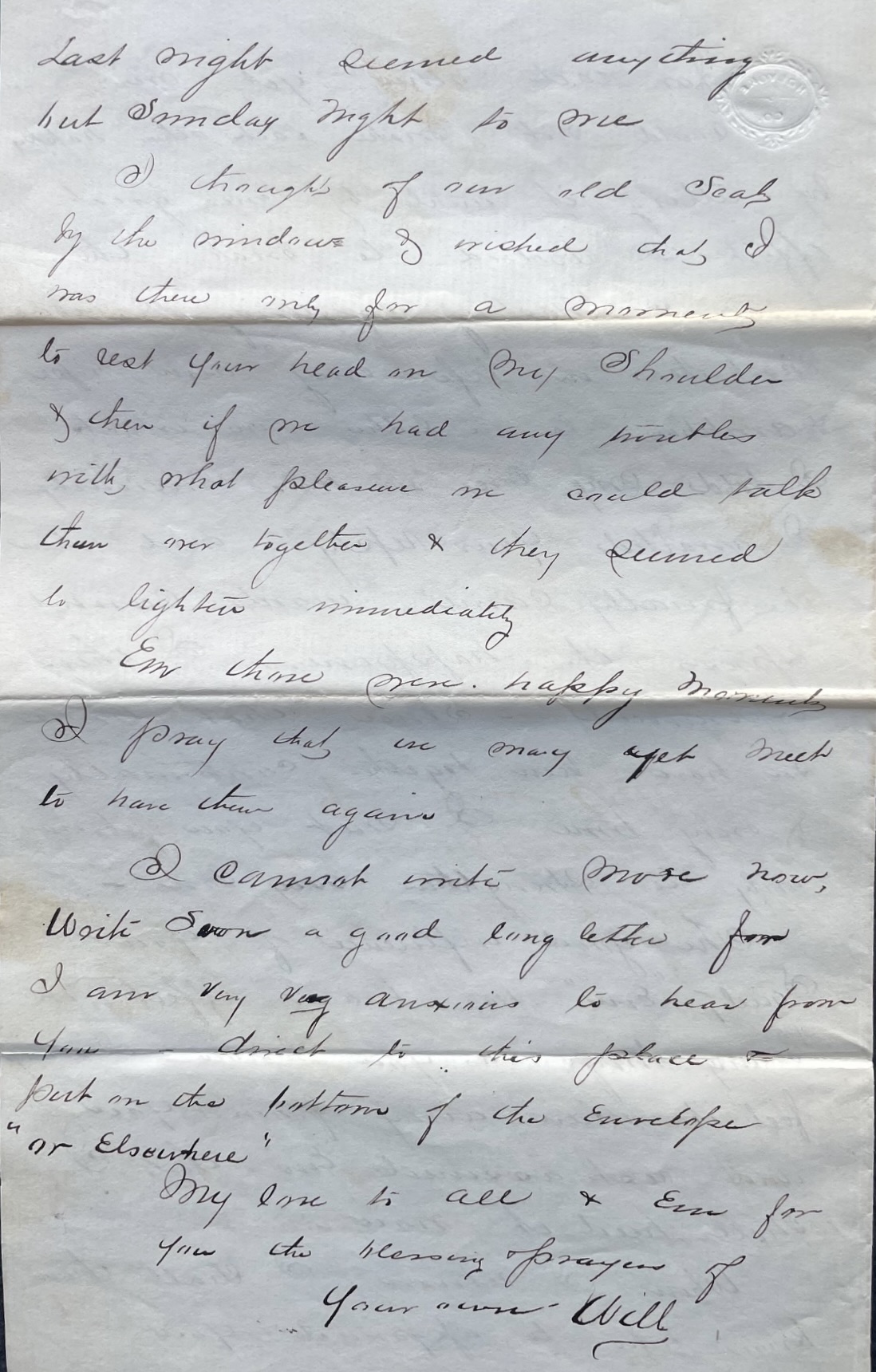
The following letter was composed by a young woman whose husband apparently served in the Confederacy. Although the specific year is not indicated, if Friday the 19th of February is correct, then it was written in 1864. She refers to his absence on “business” and asserts that his “duty” necessitates it, leaving some uncertainty regarding his actual involvement in the Confederate service or in some other capacity. In her correspondence, she makes mention of “darkies” in the household and utilizes a scrap of paper for her writing—an item that was certainly in short supply by the conclusion of the war, further implying that this letter was drafted within the confines of the Confederacy. The information presented is simple insufficient for me to make any definitive conclusions regarding the couple’s identity.

T R A N S C R I P T I O N

Friday, 19th February [1864]
I sent you a letter on Thursday

My own dear husband,

I would not have written before but awaited your directions for your address. When you receive it, nearly two or full two weeks will have passed since our cruel separation. The time will have passed more rapidly to you than to me, having other subjects to engross your attention. I hope you cannot mind the separation as much as I do. I have sympathy too in my sorrow—& strange to say, not so much from my family as from the darkies. For instance, on the morning just as you drove off, was watching you as long as possible from the window. Robb coming in the gate, soliloquizing “This is a cruel world.” Lena said she wanted to come & watch me in my room when I sat in here alone & advised me to walk with the other young ladies & not be so mournful as to go alone every day. But I am mourning, so, I will not take her advice but go alone. I wish for my true love back again, but I only wish for the time to come when your duty will allow you to be here with a free conscience. I must be thankful for the cup of happiness already allowed us.

Tula begs me to thank you for your trouble. Hope Mr. Alf enjoyed his mammoth segar & that yours smoked nicely. I hope you did not tell Alf anything about L. They would not suit.I must find a little fault with your last letter. Its length of 4 long pages was fully appreciated but you may cause your wife much trouble from one sentence which was duly weighed and considered by your lordship before penning it. It is this—“I believe time will be afforded me to see you again before going out because neither of us could realize that I was leaving you for long.” Since I read that, one idea has filled my brain and occupied my attention. I am afraid to beg you to come for you will think I a behaving badly to want you here. But if your business will allow, I say, “Come to my arms my husband.” If! you come, you must try and bring “Ernestine” for me to lean how much you wish me to love. If Ernestine [does] not, you could bring Maggie as easily as you could a book. Believe that I live in and for you only, write often to your affectionate, — Wife

The 1864 Diary of Cyrenius Whetstone, Goodspeed’s Battery

The following diary was kept by Cyrenius Whetstone (1839-1922) of New Baltimore, Stark county, Ohio. He enlisted in Battery A, 1st Ohio Light Artillery (“Goodspeed’s Battery”) on 25 September 1861 and served until 31 July 1865. He was married to Charlotte (“Lottie”) Scovel in 1879. He was the son of Solomon Whetstone (1810-1873) and Catherine D. Stickler (1808-1860). A pension record gives his date and place of death as 26 June 1922 at Rock Falls, Illinois.

A brief biographical sketch appears in a history of the battery which reads: “Cyrenius Whetstone enlisted with the Battery at its organization and served with it in all the marches through Kentucky and Tennessee. At the Battle of Stones River, after his gun squad had lost its gun, he used a musket in the day’s battle with the 42nd Illinois Volunteer Infantry. He also participated in the battles of Liberty Gap and Chickamauga, and in the whole of the campaign to and from Atlanta during 1864; was promoted to Corporal on the 13th of September, 1864. Discharged at Cleveland, Ohio, on July 31st 1865.”

Battery A was mustered into national service for three-years at Camp Chase, Columbus, Ohio, in September 1861. They were immediately moved to Gallipolis, Ohio and assigned to Brigadier General Cox and on 22 October 1861 ordered to report to General A.M. McCook, at Camp Nevin, Kentucky. By 1862 the unit had moved to Green River; Louisville; Nashville; Pittsburgh Landing; and the advance on Corinth. Still assigned to McCook they marched to Florence, Alabama; Battle Creek; Jasper; Decard Station; Winchester; Tullahoma; Shelbyville; and Nashville. With General Buell, they marched into Kentucky and fought at Dog Walk and Bowling Green, Kentucky. They also fought with General Rosecrans at Stones River.

In 1863 Battery A was combined with the 20th OIB and Simonson’s Indiana Battery to constitute an artillery brigade in the Army of the Cumberland’s Second Division. The brigade accompanied McCook at Tullahoma; Liberty; Hoovers Gap and over Sand Mountain. They fought with gallantry in the battle of Chickamauga, and for defense of Chattanooga. On October 18th, 1863, Battery A reported to General Speer, at Sale Creek. They advanced through East Tennessee to relive Burnside at Knoxville, and had daily engagements with confederate cavalry until the middle of January 1864.

The unit mustered out at the beginning of 1864, but by February, after a 30 day furlough, most of the men rejoined the unit in Cincinnati, Ohio. Battery A first returned to Nashville, and then on to Catoosa Springs, where they joined the Second Division, Fourth Army Corps, with General Sherman. After joining Sherman’s Army, the unit moved on to Gallatin, Tennessee. Towards the end of the war Battery A was sent to New Orleans with Stanley’s Division, and remained there until they were finally mustered out of national service on July 31, 1865. By the end of the war, the battery had lost 15 men killed in action and 33 to disease. A free book on the History of Goodspeed’s Battery can be found online written by Henry M. Davidson.

This diary spans the year 1864 with the rendezvous of the Battery at Cincinnati until after the Battle of Nashville in mid December 1864.

For those interested in reading letters transcribed by Spared & Shared written by members of the 1st Ohio Light Artillery, among its various Batteries, see:

Albert D. Clark, Battery A, 1st Ohio Light Artillery (1 Letter)
Joseph M. Tomlinson, Battery A, 1st Ohio Light Artillery (1 Letter)
Thomas Corwin Potter, Battery B, 1st Ohio Light Artillery (1 Letter)
Thomas Corwin Potter, Battery B, 1st Ohio Light Artillery (5 Letters)
William Henry Olds, Battery C, 1st Ohio Light Artillery (1 Letter)
Hiram T. Gilbert, Battery D, 1st Ohio Light Artillery (1 Letter)
Charles C. Bark, Battery E, 1st Ohio Light Artillery (6 Letters)
Benjamin F. Hard, Battery G, 1st Ohio Light Artillery (1 Letter)
Jacob Stein, Battery K, 1st Ohio Light Artillery (1 Letter)
Perry J. Ramsower, Battery L, 1st Ohio Light Artillery (1 Letter)

This diary is the property of Evan Iannone and was made available for transcription and publication on Spared & Shared by express consent.

Identified as Battery A, 1st Ohio Light Artillery, by Larry Strayer in the book, Chickamauga by Time-Life Books. The original albumen photograph is said to have been taken by the Nashville firm of A.S. Morse.

T R A N S C R I P T I O N

Friday, January 1, 1864—Lay in camp at Buffalo Creek, Tennessee.

Wednesday, January 13, 1864—Left Buffalo Creek, Marched about fourteen miles and camped for the night.

Wednesday, January 20, 1864—Arrived at Camp Nelson at nine o’clock a.m. Went to General Hospital to see [brother] Allen [104th OVI]. Stayed with him till the Battery came up. Boarded with the convalescents.

Thursday, January 21, 1864—Allen went to Frankfort. I remained at Camp Nelson till noon. Then started for Nicholasville and remained at the above named place during the night.

Friday, January 22, 1864—Took the cars at Nicholasville for Covington, Kentucky. Arrived at Covington at 11 o’clock in the night. Rendezvoused at the barracks.

Saturday, 23, 1864—Arrived at Cincinnati about ten o’clock a.m. Rendezvoused at Sixth Street Bazaar. Boarded at the Soldiers’ Home.

Monday, February 1, 1864—Took the cars at Cincinnati for Cleveland at 6 a.m. Arrived at Cleveland at 4 p.m. Took supper at the Depot and lodging at the New England Hotel.

Friday, February 5, 1864—Received a furlough at Camp Cleveland to continue 30 days.

Saturday, February 6, 1864—Left Cleveland at 8 a.m. Arrived at Ravenna at ten a.m. Went to the Town Hall where there was an address delivered by Judge Day. Then took dinner at the Taylor House. Started for Randolph at 7 p.m. Stayed with William Ch___ the 7th.

Sunday, February 7, 1864—Arrived at R, M. Hamilton’s at 11 a.m. Took dinner with them. Arrived at Balty [New Baltimore, Stark county, OH] at 4 p.m. Stopped at A. Hamilton’s

Monday, March 7, 1864—Left New Baltimore about noon. Went to R. M. Hamilton’s. Mate & I went to Davis’s, then to W. Hutchen’s, then back to Davis’s again. At 4 p.m., Genl. & I started for Atwater Station. Arrived at Cleveland at 10 p.m. Stayed at the New England Hotel.

Tuesday, March 8, 1864—Went to Camp Cleveland at 8 a.m. Went back to the New England Hotel and stayed that. Genl. and I went to 65, told some lies, then went to the Algier House, took supper, then went with Jim Kendrick and had an oyster supper.

Wednesday, March 9, 1864—Went to Picture Gallery. Had an Ambrotype taken. Then went to Camp. Drew clothing. Went to New England Hotel. Stayed all night. Wrote a letter to A. Hamilton. Sent him physiognomy of those taken.

Thursday, March 10, 1864—Left Cleveland at 9 a.m. Arrived Cincinnati at 8 p.m. Bivouacked in the Depot for the night.

Friday, March 11, 1864—Left Cincinnati at 9 a.m. Arrived Louisville 12 p.m. On the Ohio and Mississippi Railroad. Arrived at Seymour about noon. Stay in the depot till twelve o’clock that night. Had a prayer meeting. The Boys had a big time bumming it around town.

Saturday, March 12, 1864—Arrived at Louisville 12 a.m. Rendezvoused on the corner of Main and 1st Streets. Went to a Picture Gallery and sat for one dozen photographs. Went to see the 19th Ohio Vol. Vet. Infantry. Visited Jink Davis. He went to my quarters with me & he and I played [illegible].

Sunday, March 13, 1864—Left Louisville at 3 p.m. Went to Picture Gallery and received half dozen photographs.

Monday, March 14, 1864—Arrived at Nashville at 6 a.m. Went out to camp and pitched tents. Wrote a letter to Harriet Whetstone & sent her a photograph.

Tuesday, March 15, 1864—Lay in camp at Nashville. Wrote a letter to Allen. We had quite a snow storm. Had a big time initiating the new recruits.

Wednesday, March 16, 1864—Battery C left for the front. Battery A occupied their quarters. I went to Nashville, got shaved, then went and visited Jink Davis. Took dinner with him. Played a game of Seven-Up and beat our opponents 4 out of 7.

Thursday, March 17, 1864—Wrote a letter to Lidia Hollabough. Sent her a photograph. Swept the park. Jink Davis & Perry Woods are here. There were a number of promotions made among the corporals and sergeants. Enjoyed a dance this evening in the Park.

Friday, March 18, 1864—Drilled foot drill at 9 a.m. After drill I went to Nashville. Went to the Post Office. Then to a hardware store. Purchased a frying pan. Paid $1 for it. Returned to camp and wrote a letter to photographers at Louisville, Ky.

Tuesday, April 26, 1864—Received orders to prepare to march to the front. Drew ten days rations & cooked them. Drew dog tents and clothing.

Wednesday, April 27, 1864—Left Camp Brough at 7 a.m. Arrived at Lavergne about three p.m. and camped for the night. Had a big time pitching our new dog tents.

Thursday, April 28, 1864—Left Lavergne at 8 a.m. Had a devil of a rain storm last night and pump tent blew down & had a gay time. Had potatoes, meat, coffee and bread for breakfast. Arrived at Murfreesboro at 12 M. Camped near Camp Sill at Stone River.

Friday, April 29, 1864—Arrived at Shelbyville about 2 p.m. Pitched tents on the bank of Duck River. Went in bathing. Had a big time swimming horses. Marched 22 miles.

Saturday, April 30, 1864—Left Shelbyville at 7 a.m. Had quite a rain storm. Got lost in the wilderness & had a devil of a time. Marched about 22 miles. Arrived at Tullahoma at 2 p.m. WEnt to the Depit. Pitched tents near our old camping ground. Had some of Mate;s tea for supper.

Sunday, May 1, 1864—Left Tullahoma at 7 a.m. Crossed Elk River. Passed through Decherd about noon. Arrived at Cowan Station about ten o’clock p.m. and camped for the night. Marched 20 miles.

Monday, May 2, 1864—Left Cowan Station at 7 a.m., crossed the Cumberland Mountains. Arrived at the Blue Springs at two p.m. and camped for the night. Marched about 20 miles.

Tuesday, May 3, 1864—Left Blue Springs in Sweden’s Cove about 7 a.m. Stopped to rest at our old camping ground. Visited the grave of Walton Phelps. Arrived at Bridgeport about two p.m. & camped for the night. The 7th OVI left for the front just before our arrival. Drew a large supply of Sanitary stores.

Wednesday, May 4, 1864—Left Bridgeport this morning. Crossed the Tennessee River on the railroad bridge. Marched through the narrows 18 miles. Camped for the night 10 miles from Chattanooga in Wahatchie Valley.

Thursday, May 5, 1864—Arrived at Chattanooga about noon. Camped for the night on our old camping ground. Drew a 12-pound Battery. Went to the river to water horses. Wrote two letters—one to Emeline & one to A. Hamilton.

THE ATLANTA CAMPAIGN

Friday, May 6, 1864—Left Chattanooga at 7 a.m. on road to join our Division. Passed over the Chickamauga Battlefield. Saw bones of our dead soldiers bleaching in the sun. Came by the way of Gordon’s Mill. Arrived at Ringgold & joined our Division sometime after dark. Marched about 25 miles.

Saturday, May 7, 1864—Was on guard last night. Had reveille at 2 a.m. and at four. We left for the front at six. Took a position in line of battle. Took a 2nd position near Tunnel Hill. Our Brigade advanced & battery halted. Here we saw General Willich & his Brigade. All fighting done today on the right by Hooker.

Sunday, May 8, 1864—Stayed in camp near Tunnel Hill all day and the preceding night. Had considerable skirmishing. Our forces occupied Tunnel Hill. Wrote a letter to Lide but did not send it out.

Monday, May 9, 1864—Left camp near Tunnel Hill at 6 o’clock and moved to the left about 1.5 miles Parked the Battery in a corn field near an old log house. Lay idle all day. Had heavy skirmishing on Face Rock [Rocky Face] Ridge. John Shook and I went to top of ridge. Saw the 42nd Illinois Boys.

Tuesday, May 10, 1864—Encamped last night near the ridge and on the left of the line. Had constant but light skirmishing all day. Commenced raining about noon and continued to rain all the latter part of the day. Battery M, 1st Ohio Battery went out & threw a few shell on the right of our Division.

Wednesday, May 11, 1864—Remain in our same position. Skirmishing still continues but light. Rained like the Devil last night. Went upon the ridge this morning. Nothing new. Saw two Rebel engines coming into Dalton [illegible].

Thursday, May 12, 1864—Had reveille at two o’clock & moved at four. Marched about 7.5 miles to the left and relieved the 23rd Army Corps. They moved to the right wing. Kept falling back during the day. Skirmishing continued as usually light. Threw up barricades at last position.

Friday, May 13, 1864—Had reveille at two. Marched at four a.m. Arrived at Dalton about ten and found it evacuated. Rested an hour. Had a gay time ransacking the town. Marched 8 miles from town and camped for the night. Cavalry had quite a skirmish in the evening.

Saturday, May 14, 1864—Had reveille at 3 a.m. Left camp about 6 a.m. Took position in line of battle about eight. Changed position several times. The fighting commenced fifteen minutes before one p.m. The Battery was not engaged. Fighting heavy on the left.

Sunday, May 15, 1864—Took position in fortifications at 3 p.m. Done some digging. Skirmishing quite brisk. Battery commenced firing. Fired 12 rounds. Vack [Victor B.?] Stanford badly wounded by premature discharge. Darius Roe, W[ilson] Davidson, A[uston] D. Bishop, & J. Van Ornum wounded by premature discharge.

[Editor’s note: Victor B. Stanford was wounded in the Battle of Resaca and died on 4 June 1864 at Chattanooga. Regrettably, it appears that his wounds were due to a premature discharge of their own guns—not enemy fire. The other four men listed appear to have been wounded in the same manner though not mortally.]

Monday, May 16, 1864—Had reveille at 3 o’clock & marched at 6 a.m. Found the Rebs had absconded. Arrived at Coosa River about noon. Rested about two hours. Crossed the river and after marching a while, halted. Skirmishing continues. Resaca evacuated.

Tuesday, May 17, 1864—Left camp near Calhoun about daylight. Skirmished through the town. Advanced about two miles when skirmishing commenced quite brisk. Battery halted and came into position. Camped for the night four miles from Calhoun.

Wednesday, May 18, 1864—Left camp about 8 a.m.. Advanced very cautiously. The Rebs falling back but were very stubborn. Had quite a fight in the evening. Camped for the night about a mile from town called Deerville.

Thursday, May 19, 1864—Left Camp about 7 a.m. Arrived at Deerville about 9 & halted till noon. The [illegible]/ Skirmishing in front today. Camped for the night about [ ] miles from Deerville.

Friday, May 20, 1864—Left camp at early dawn. Arrived at Kingston at 11 a.m. and halted for dinner. Advanced at 12 M & after marching two miles found the enemy in line of battle. Drove them till dark, then camped for the night.

Saturday, May 21, 1864—Moved back from the front about a mile & camped for a day or two’s rest. Perry Woods was here today. Went with him to the 19th OVI. Jink Davis came with me when I returned to my quarters. In the evening went to the 42nd Illinois.

Sunday, May 22, 1864—Lay in camp. Done my washing & played poker during the remainder of the day. In the evening Clint Allen & I went to see some Rebel prisoners and had quite a conversation with them.

Monday, May 23, 1864—We still remain in camp. [Gen.] Thomas’s Headquarters which were located near us moved this morning. Left camp about noon. Arrived at the river and crossed about 9 o’clock. Marched about 11 miles. Went into camp at midnight.

Tuesday, May 24, 1864—Left camp at 7 a.m. Marched through the pine regions about ten miles. Camped in a narrow valley. Was detailed to cut a road through the woods. Rained like the very Devil. Were five miles in the rear of our Division.

Wednesday, May 25, 1864—Left camp about 8 a.m. Had to double teams to ascend the ridge. The country traveled over today is very hilly & is but very thinly settled. The timber is principally pine. Water rather scarce. Heavy fighting in front of Dallas. Commenced at 5.

Thursday, May 26, 1864—Camped in a wheat field last night. Had a rain storm. Remained in camp till about 6 p.m., then started to join our Division which was then at the front, a distance of about five miles. Arrived at front about 8 p.m. Went in line. No. 1 & 2 went on picket.

Friday, May 27, 1864—Cannonading opened quite brisk about six a.m. Moved a mile to the left. Remained there till [ ]. The Rebs shelled us like the Devil. Moved to the right a mile, took position in front earthworks. Worked till 2 a.m. last night.

Saturday, May 28, 1864—Got up at about 3 a.m. At 11 a.m., the Rebs made a demonstration in our front. Came over their fortifications. We gave them double charge of canister which sent them back flying.

Sunday, May 29, 1864—Worked last night till two a.m. The Rebs commenced heavy firing along the whole line which was returned. Our Battery fired about six rounds to each gun. The firing continued a half hour when the Rebs dried up.

Monday, May 30, 1864—But very little artillery firing today. Musketry is kept up brisk now from behind fortifications. Was on guard last night. The enemy made quite a noise chopping. Could hear them talking very distinct. Was called to my post about 2 a.m.

Tuesday, May 31, 1864—Was called up at early dawn. Considerable cannonading on the left. James Robinson was wounded today in the left leg. Had it amputated. Received a letter from Helen R. today.

[Editors Note: James T. Robinson died on June 25, 1864, at Chattanooga, Term., of wounds received in action at Dalton, Ga.]

Wednesday, June 1, 1864—Was called to our post once last night. Wrote a letter to Em C. today. Nothing worthy of note occurred during the latter part of the day.

Thursday, June 2, 1864—Still remain in fortifications. Skirmishing continues as usual. Had pretty hard fighting on the left today. Had quite a rain storm in the afternoon.

Friday, June 3, 1864—Remain in fortifications. Firing continues as usual. The right section moved somewhere to the left last night. Wrote a letter to Helen R. Commenced raining about noon & continued raining all day and night.

Saturday, June 4, 1864—Moved our piece into the place that No. 1 occupied. Was on guard. Pickets run in last night. Were all called to our posts. Ed[ward] Cain was wounded this morning. [illegible]

Sunday, June 5, 1864—Were relieved last night by one of Genl. Osterhaus’ Bsatteries. When arrived at the caissons, it was a.m. Found the Rebel works in front of Dallas evacuated this morning. Pulled out of Park about noon. Moved a little to the right and went to fortifying.

Monday, June 6, 1864—Moved out of fortifications this morning and followed the retreating Rebels. Marched about 8 miles and went into camp at 5 p.m. This camp was about 3 miles from Altoona Station pass.

Tuesday, June 7, 1864—Remained in camp today. Done my washing today & changed clothes. Hiram Swartz paid us a visit today. Wrote a letter today. In the evening went to the 42nd Illinois [illegible].

Wednesday, June 8, 1864—Remained in camp. Wrote a letter to Samantha Chain. Perry Woods came to see us today. Commenced raining at 1 p.m. Went to see Davis Boys in the evening. Saw D. Reichard. He is looking well.

Thursday, June 9, 1864—Still remain in camp. Several of our boys who have been prisoners returned today and brought us the sad intelligence that Vack Stanford died on the 5th. Jink Davis was here today and also some of the 42nd Illinois Boys.

Friday, June 10, 1864—Left camp at 8 a.m. Marched very slow & cautiously. Passed Hooker’s Corps. Arrived at the front in the evening. There was but very little firing done today. Marched about three miles.

Saturday, June 11, 1864—Camped at an old house last night. Rained like the very devil. Marched at about 9 a.m. Advanced very cautiously. Went into park near the lines in the evening. Marched about two miles but very little firing today.

Sunday, June 12, 1864—Still continues to rain. Gen. Woods’ Division passed from our left toward the right. Wrote a letter to Ben Switzer. Heard but very little firing today. Rained all day without ceasing.

Monday, June 13, 1864—Ceased raining about 2 p.m. Went out to the lines today. Called at Harker’s Headquarters for mail. Did not get any. Skirmishing continues but light.

Tuesday, June 14, 1864—Cannonading heavy this morning. Was on guard last night. It is reported that McPherson captured a thousand prisoners on the left yesterday. [ ] up at noon. Heavy skirmishing at 5 p.m. Moved a mile to the left front and camped for the night. Reb Gen. Polk killed.

Wednesday, June 15, 1864—Marched at noon. After going a mile, the Battery came into position and on our way to this place I came across Myron. Skirmishing heavy today. The 42nd [Illinois] was engaged. Myron was with the regiment. Came to our gun and stayed all night with me.

Thursday, June 16, 1864—Moved our gun to the front and throwing good works. All the pieces but Nos. 2 & 3 done some firing. In the evening, the Battery moved three hundred yards to the front & took position in [illegible].

Friday, June 17, 1864—Was on guard last night. Our skirmishers advanced at early dawn & found the Rebel works evacuated. Battery moved at 8 a.m. Heavy skirmishing & cannonading commenced at noon. At 5 p.m. the Battery came to position at an old house a little [ ] Brigade. Fired 20 rounds to a gun.

Saturday, June 18, 1864—Moved three hundred yards to the front. Found the enemy again in force & fortified. Battery remained here all day. Rained like the Devil. Battery fired 470 rounds. [Archibald A.] McMasters was hurt by a primer which he supposed had failed. Stepped in & pulled it out just as the [illegible] is changed.

[Editor’s note: Muster rolls indicate that Archibald A. McMasters “was wounded June 18, 1864, in battle of Kennesaw Mountain, Ga.”]

Sunday, June 19th, 1864—Moved at 8 a.m. The Rebs having again evacuated [illegible].

Monday, June 20, 1864—[see Battle of Kennesaw Mountain] Remained in position at the cotton gin till in the afternoon when our battery & Spencer’s Battery [H] moved to the front & took a position in front of the hill. Commenced firing at 4 p.m. Had a hot time with some Rebel batteries. Dock [Levi] Griswold was wounded in wrist by a shell.

Tuesday, June 21, 1864—The 14th Corps relieved our Corps last night. Battery moved back to the cotton gin this morning. Moved to the right, our Corps having relieved the 20th Corps Hookers. Our Corps advanced the line half a mile. Our Battery took a position with Wood’s Division by an old house near the 19th OVVI.

Wednesday, June 22, 1864—Were on the front line all day. Changed position several times. Our piece fired 5 shots [illegible]. Hooker [?] advanced the line with some hard fighting but [?] the enemy [illegible].

Thursday, June 23, 1864—Moved a half mile to the right and took a position in open field by an old chimney. Battery fired 72 rounds of solid [shot]. Stanley’s men drove the Rebs out of their picket pits & held the pits.

Friday, June 24, 1864—We threw up works for our guns last night. [James] Courtney died this morning [of wounds in field hospital near Kennesaw Mountain]. Captain [Wilbur F.] Goodspeed relieved Captain [Charles] Aleshire as Chief of Artillery of our Division, Very quiet along the lines all day.

Saturday, June 25, 1864—Heavy cannonading on the line this morning. [Samuel M.] McDowell’s Battery moved into the line of works in front of us in night. The Battery drew clothing. I received a letter [illegible].

Sunday, June 26, 1864—Were called to our posts with orders to be reeady to commence firing. Commenced firing at 9 a.m. Fired 12 rounds. Our Division & Stanley’s Division charged the Rebel works &some of [them] succeeded in taking the works but were compelled to fall back. Heard today Gen’l. [Charles G.] Harker was killed. [Daniel] McCook wounded.

Monday, June 27, 1864—Strengthened our works with sand bags last night. Visited the 42nd [Illinois Boys] today. Was very quiet today along the whole line.

Tuesday, June 28, 1864—[no entry]

Wednesday, June 29, 1864—Turned our Nos. 3 & 5 pieces and drew two from McDowell’s Battery. Our men are out between the lines with a [Flag of] Truce burying the dead. The boys are exchanging papers with the enemy and also trading coffee for tobacco.

Thursday, June 30, 1864—Last night the enemy made a demonstration in front of our Division. Musketry was very heavy [while it] lasted. Twenty-four of our pieces [ ] to the rear & Battery M filled their places. Wrote letter to Eliza.

Friday, July 1, 1864—Had another [ ] last night. Lasted 15 minutes. John Shook and I went to the 19th OVI. At 5 p.m. the Battery fired 30 rounds at the Rebel works [illegible].

Saturday, July 2, 1864—Were called to our posts at four. Commenced firing at 6 a.m Fired ten rounds. In the evening our Division moved a mile and a half to the left to relieve one Division of the 14th Army Corps. The Battery relieved Battery I of our regiment.

Sunday, July 3, 1864—Got up this morning & found the enemy had evacuated their position in front of Kennesaw Mountain. Moved at 6 a.m. Arrived at Marietta about noon. Passed to the right of the town. Marched 9 miles.

Monday, July 4, 1864—Camped in a field by the railroad. Was on guard last night. Reveille at 4 o’clock. Lieutenant [Henry C.] Grant’s Section & Battery M moved to the front. Found the enemy again fortified. Remained by the Battery. Moved out. Camp by an old house in a [ ] orchard.

Tuesday, July 5, 1864—Moved at 6 a.m. The Rebs had good works which they left very hastily. Skirmishing continued at 4 p.m. We arrived at the Chattahoochee River [and found] the enemy have again taken up a very strong position on the south side of the river. I went on the hill where Atlanta could be seen.

Wednesday, July 6, 1864—Last night we took position on a ridge near the river. The Pioneers built works for the Battery this morning. We strengthened our works. Gen. Thomas & a number of Corps generals were here. The Battery was ordered to fire at Reb picket pits. Fired two rounds.

Thursday, July 7, 1864—Wrote a letter to Sue Whetstone. At 6 p.m., Battery fired 18 rounds. At 8, all the artillery in the Corps had orders to fire, our Battery giving the signal. Battery fired 72 rounds. This firing was done to attract the attention of the Rebs while Schofield laid a pontoon [bridge] across the river. Was a [success?].

Friday, July 8, 1864—Rebel pontoon bridge was moved last night. Is very quiet along the lines today. The Johnny Rebs & Yanks went in battling with each other. Built a bowery over our gun today.

Saturday, July 9, 1864—At 7 a.m, our Division started on an expedition up the river to a town by the name of Roswell, distance 16 miles. Arrived there at 5 p.m. The infantry crossed the river. Several men died from sun stroke. The heat was intense.

Sunday, Jul 10, 1864—Battery is lying in Roswell. Heavy cannonading on the right of us. Is supposed to be Schofield. Two Divisions of the 16th Army Corps came in today, crossed the river, and relieved our Division. Received a letter from Allen.

Monday, July 11, 1864—Lay in camp at Roswell. John Shook and I went after blackberries. Had blackberry dumplings, stewed berries, apple sauce & biscuit for dinner. Done my washing, then went to town after soap. Visited nearly all the houses & also the ruins of the factories.

Tuesday, July 12, 1864—The Division marched from Roswell at 8 a.m. Went back to our former camp at the railroad. Had a gay time smashing our furniture. Camped near the pontoon bridge.

Wednesday, July 13, 1864—Left camp at 8 a.m., crossed the river on pontoon [bridge] at 9 a.m. After marching 2.5 miles, parked the Battery. Right and Left sections went to the front and took position. John Shook and I went after berries. Wrote letter to Ell. Worked on fortifications till ten p.m.

Thursday, July 14, 1864—Lay in camp. Part of the 23rd Army Corps passed by this morning. Is very quiet at the front today. Received a letter from Robb Crockett. Am on guard tonight. Had quite a rain storm. Jink Davis paid us a visit this evening.

Friday, July 15, 1864—Battery still remains in camp. Jink Davis and I were to the 104th OVI. Took dinner with Captain Andrew J. Southworth [of Co. B]. Had a game of Seven Up with the Boys. Wrote a letter to Robb Crockett.

From the History of the 104th Ohio Volunteer Infantry, page 56.

Saturday, July 16, 1864—In camp. Wrote a letter to Elvira G. Went to the 42nd [Illinois] and found [illegible]. Our Division made a reconnaissance. Found the enemy. All quiet at the front.

Sunday, July 17, 1864—Remained in camp today. Done my washing. Wrote a letter to Hal and received one from Em. Went to see Myron this evening. He was detailed to the Division Ambulance Corps.

Monday, July 18, 1864—Had reveille at 3 o’clock. Marched at 5 Had slight skirmishing. Marched 7 miles. Are now within 5 miles of Atlanta. Have formed a line of battle. Battery is in position at an old house. Received a letter from [ ].

Tuesday, July 19, 1864—All is quiet this morning. Our forces are fortifying. There are apparently [ ] Rebels near. Heavy cannonading commenced about noon & continued throughout the day. In the evening we advanced two miles to Battle Creek [illegible].

Wednesday, July 20, 1864—In position at Peach Tree Creek. All is quiet this morning. At 10 a.m., our forces advanced & drove the Rebs from their skirmish pits. At 3 p.m., the Battery crossed Peach Tree Creek [and] took a position in line of battle. At 4 p.m., the Rebs charged us & were repulsed with terrible slaughter. Battery fired 74 rounds.

Robert Jenkins’ book, published in 2021, explores this battle in detail.

[Editor’s Note: “When Sherman began his final push toward Atlanta, he divided his forces, sending Thomas’s Army of the Cumberland directly toward the city and ordering Schofield’s Army of the Ohio and McPherson’s Army of the Tennessee around Atlanta to the east. Hood viewed this as an opportunity to strike a blow for the Confederacy. In order to approach Atlanta, Thomas’s army had to cross Peachtree Creek in several places. Johnston had been aware of that while still in command and had devised a plan to attack Thomas’s soldiers at the time of the crossing. When the crossing took place on July 20, Hood implemented Johnston’s plan. Unfortunately for the Southerners, Thomas’s army had already crossed the creek when the attack began at about 4:00 p.m., instead of the planned time of 1 p.m. The assault initially showed some promise, but the Federals were able to hold their ground, eventually punishing the Rebels with high casualties. The Battle of Peachtree Creek cost the Confederacy nearly 5,000 men killed, wounded, and captured or missing, compared to about 1,700 for the Union.” Source: Ohio Civil War]

Thursday, July 21, 1864—Very quiet on the lines today. Our forces are burying the Rebel dead. The Rebel General [Clement Hoffman] Stevens [of Georgia Brigade] was killed. Fortified last night. Remained in our works today.

Friday, July 22, 1864—Advanced at 8 a.m. After marching 1.5 miles, again encountered the enemy. Battery came into position and fired 74 rounds. The Rebs done splendid artillery firing. At 5 p.m., the enemy charged McPherson & was repulsed with great loss. Hear Gen. McPherson was killed.

Saturday, July 23, 1864—Worked on fortifications last night and this morning. The Johnnies keep up a continual artillery firing & also considerable musketry. Gen. [William T.] Sherman & also Gen. [Lovell] Rousseau passed us today.

Sunday, July 24, 1864—Remained in works today. The Johnnies keep up a continuous firing from their batteries but do very little damage. Wrote a letter to Em___.

Monday, July 25, 1864—Rebs done considerable cannonading last night. Could hear them fighting on the Right Wing at 12 o’clock last night. Built a line of works in front. Cannoneers built embrasures. Moved into the works at 4 p.m.

Tuesday, July 26, 1864—Built a bowery over our gun this morning. Allen was here last night. He and I went to see Myron. Allen went back to him command this morning. Our section moved to the left at five p.m. and took a position to guard a ravine.

Wednesday, July 27, 1864—Built a fort for our gun this morning. Wrote a letter to Bobb Crockett. Gen. McPherson’s forces are moving to the right. A brisk firing is kept up to attract the Johnnies’ attention in our front.

Thursday, July 28, 1864—Wrote a letter to Em today. A continual musketry firing & also cannonading is kept up in our front to attract the Johnnies’ attention while the flank is moving round.

Friday, July 29, 1864—Made an addition to our fort today. Is quiet in our front today. Heavy firing was heard on the right. Lasted for about an hour. The fighting was done by the 15th Corps. The Rebs were repulsed with heavy loss. Wrote a letter to Henry.

Saturday, July 30, 1864—Still remain in our fort. Is very quiet in our lines but heavy skirmishing in the 20th Corps which drove the Johnnies from their skirmish pits.

Sunday, July 31, 1864—Hitched up and prepared for inspection at 9 a.m. The inspecting officer failed to come. At 5 p.m., we were relieved by Battery M, 1st O. L. A. Battery moved to the rear and parked near Corps Headquarters & pitched tents.

Monday, August 1, 1864—Made preparations to build boweries over our tents. The 23rd Corps is moving to the right. Our Corps is building a line of works one half mile in the rear of our present lines. Have orders to cease work—that we are going to move further to the rear. Climb a tree and took a peep at the City [of Atlanta].

Tuesday, August 2, 1864—Moved to the rear a mile and a half and went into camp. Policed the Park. Then write a letter to Corp. Roe. The 23rd Army Corps moved by our camp this morning. Myron was to the Battery this evening. The 32nd Indiana non vets started home today.

Wednesday, August 3, 1864—Was on guard last night & today. Built a bowery over my tent this morning. Went to see Myron. Came back, policed the Park, then took a shave. Is very quiet on the lines today. The skirmish line advanced but had to fall back again.

Thursday, August 4, 1864—Policed the Park this morning. The Boys went out foraging today. In the afternoon, I took a stroll along the lines. Visited Jink [Jenkins] Davis. Returned to camp and had some green corn and apple sauce for supper.

Friday, August 5, 1864—Joseph Ulm and I done our washing this morning. Heavy cannonading on the right. Received a letter from A. Hamilton and also one from A. Whetstone.

Saturday, August 6, 1864—Took our carriages to the creek today and washed them. Prepare for inspection [illegible].

Sunday, August 7, 1864—Was on guard last night and today. Had quite a rain storm last night. Did not have an inspection today. Received a letter from E. G. with photo enclosed.

Monday, August 8, 1864—Took a walk today along the lines. Went to the right as far as the 16th Army Corps. Witnessed the shelling of the City by our long ranged batteries. Joseph Ulm and I were to the Corps Hospital.

Tuesday, August 9, 1864—Commenced building a stable for our horses today. Had quite a rain storm. There was considerable cannonading along the lines. Rebs do not reply with their artillery.

Wednesday, August 10, 1864—Finished our barn today. Is raining again. Cannonading heavy along the whole line. Wrote a letter to E. G. Was on guard last night. Rained all night.

Thursday, August 11, 1864—Was out foraging today. Was very warm. Came near getting sun struck. Had green corn for supper.

Friday, August 12, 1864—Heavy cannonading on the right. Is very quit in our front. The long ranged batteries [fire] a gun every five minutes. Was ill and in bed all day.

Saturday, August 13, 1864—Very quiet in the lines. Reported good news from Mobile. The boys are oiling their harnesses today. Jet [Justin] Rogers & I went after beef shanks this evening.

Sunday, August 14, 1864—Joseph Ulm and I are detailed to boil out some Neats’ Foot Oil today. Had an inspection at 9 a.m. I and Joe were not present.

Monday, August 15, 1864—Was on guard last night. Today heavy musketry on the right at 3 o’clock last night. The usual quiet prevailed on the lines today.

Tuesday, August 16, 1864—Wrote a letter to Helen R. today. Had a General Inspection at 2 p.m. Received the sad intelligence through the papers that Allen [S.] Whetstone was among the missing of the 4th Kentucky Mounted Infantry.

[Editor’s note: Allen S. Whetstone (1837-1909) Served in the 104th Ohio Infantry (U.S.A.) as private from August 11, 1862 to April 9, 1864. Served in the 4th Kentucky Mounted Infantry (U.S.A.) as first lieutenant from April 16, 1864 to December 9, 1864.]

Wednesday, August 17, 1864—Considerable firing on the lines today. Wrote a letter to Harriet today. Made a feint along the lines in our Corps tonight. Our Battery moved about two miles to [ ], made considerable noise, then returned to camp. Arrived in camp at 12 midnight.

Thursday, August 18, 1864—Heavy cannonading by the Johnnies this morning. Went up to the front this afternoon. Seen nothing of importance. Drew five days rations last night.

Friday, August 19, 1864—Was on guard last night and today. Terrific artillery firing at 4 o’clock this morning. Was done mostly by our batteries. It is reported in camp today that Kilpatrick has cut the Macon Railroad. Had a rain storm this evening.

Saturday, August 20, 1864—Is very quiet along the lines today. Jenk Davis paid us a visit this afternoon. Received a letter from Sue Whetstone & also one from Em with photo enclosed. Had a rain storm today.

Sunday, August 21, 1864—Went out foraging this morning—like Hell I did. Rained nearly all day. Wrote a letter to Em Whetstone. B. Maxwell and George Bissett were here on a visit.

Monday, August 22, 1864—Went out foraging this morning. Received a letter from Corp. Roe and also one from Samantha Chain. Replied to Alex’s letter.

Tuesday, August 23, 1864—All quiet in the lines this morning. Was to the 19th OVVI on a visit today. Played a big game of Seven Up.

Wednesday, August 24, 1864—Marched at 1 p.m. Moved about three miles to the right. Occupied the works which the 11th Army Corps had abandoned. Camped for the night just in rear of the line.

Thursday, August 25, 1864—Had reveille at early dawn. The 2nd & 3rd Divisions passed the 1st Division which was guarding the rear. The Battery was left with the 1st Division. Pulled out of the works about 10 a.m. The Johnnies threw a few shell this morning. Marched about 6 miles. Camped close to Battery M, 1st Ohio.

Friday, August 26, 1864—Left camp at 8 a.m. Marched about four miles. The infantry threw up a line of works after relieving the cavalry. Went into camp about 4 p.m. Parked on a hill in a grove. There was some slight skirmishing today.

Saturday, August 27, 1864—Moved at 10 a.m. The whole 14th Corps train passed us. Didn’t march over a mile during the day. Built a bridge over a small creek in the afternoon. Started to join our Corps at 8 p.m. Marched 4 miles. Arrived at camp at 12 o’clock. Had a big time going through a swamp.

August 28 through September 1, 1864 [No entries]

Friday, September 2, 1864—Our Corps struck the Macon Railroad this morning & was engaged in destroying it all day. At 4 p.m. the 14th Army Corps attacked the Johnnies in front of Jonesboro and gave them a sound thrashing. Captured 1600 of them and 16 pieces of artillery. The Battery camped for the night on the left of the RR near the battlefield.

Major Gen. Thomas John Wood, 4th Cavalry US Army, suffered a leg wound in the Battle of Lovejoy’s Station.

Saturday, September 3, 1864—The Johnnies evacuated Atlanta last night. The 20th Army Corps occupied the city this morning. Our Corps advanced at 9 a.m. After marching five miles, found the Johnnies again in line of battle. At 5 p.m., Gen. Wood’s [cavalry] charged the Rebs [at Lovejoy’s Station] and were repulsed. Col. [Charles F.] Manderson and Gen. [Thomas John] Wood were wounded.

Sunday, September 4, 1864–Battery lay at cotton gin all day. No important news from the front. Had a rain storm. No. 5 & 6 went out on the lines & done some firing.

Monday, September 5, 1864—Lay at cotton gin. Wrote a letter to Matt Chain. In the evening the Army abandoned its position in front of Lovejoy Station and fall back 7 miles toward Atlanta. Battery went into camp at 12 o’clock. Parked in a field near the railroad.

Tuesday, September 6, 1864—Moved this morning at 8 a.m. After marching about 1.5 miles, pitched tents with orders to remain during the night. Marched with the Artillery Brigade today.

Wednesday, September 7, 1864—Had reveille at 2 o’clock this morning. Marched at 4. After marching 6 miles, went into camp within 7 miles of Atlanta. Joseph Ulm, Jacob Fifer, and I went out after forage.

Thursday, September 8, 1864—Arrived at Atlanta about two p.m. Went into camp on the Decatur Railroad a mile east of the City on the battlefield where McPherson fell.

September 9, 1864 through October 2, 1864 [No entries]

Monday, October 3, 1864—Camp at Atlanta. Had reveille at 2 o’clock. Left camp at early dawn to start for Johnnie Hood who had gone to our rear. Crossed the pontoon bridge at Vining Station. Camped within 5 miles of Marietta. Marched 13 miles.

Tuesday, October 4, 1864—Had reveille at early dawn. Marched at noon. Passed through Marietta about 4 p.m. Went into camp at Kennesaw Mountain. Marched 6 miles today. Battle at Altoona Pass. Rebel loss 600.

Wednesday, October 5, 1864—In camp at Kennesaw Mountain. Marched at 5 p.m. After marching 5 miles, went into camp about a mile from Pine Mountain & near the old house from which we fired on the 17th of June when in position with Willich’s Brigade.

Thursday, October 6, 1864—Lay in camp today. Nothing worthy of note occurred. Rain quite hard all day. Was on guard last night & today.

Friday, October 7, 1864—Changed camp at 9 a.m. After marching a mile, we joined our Corps and went into camp near Pine Mountain. Heard some cannonading on the left this evening. The Johnniesattacked the 15th ARmy Corps and were repulsed.

Saturday, October 8, 1864—In camp near Pine Mountain. Lay close to Willich’s Brigade. Was in my tent all day reading a novel. Moved at 3 p.m. Marched 8 miles. Went into camp in an open field near Acworth. Was 10 p.m. when we pulled into Park.

Sunday, October 9, 1864—Changed camp this morning at 10 a.m. Move about a mile. Our camp located near the railroad & close to Acworth. Had an order read to us at Roll Call concerning the fight at Altoona.

Monday, October 10, 1864—In camp at Acworth. Went out grazing horses. Returned to camp and marched at 3 p.m. Passed through Altoona at dusk. Arrived at Cartersville at 10 p.m. and camped for the night. Marched 9 miles.

Tuesday, October 11, 1864—Had reveille at 4 o’clock. Marched at early dawn. Passed through Cartersville. Arrived at Kingston at 2 p.m. and halted for dinner and held an election. Camped for the night in a woods a mile from Kingston. Received mail this evening.

Wednesday, October 12, 1864—Had reveille at early dawn. Marched at 9 a.m. Heard some cannonading on the left today. Marched about 22 miles and camped within three miles of Rome, Georgia.

Thursday, October 13, 1864—In camp three miles from Rome. The Boys are all out after forage. Heard some cannonading on the right of Rome. Battery moved at 4 p.m. After marching 15 miles, went into camp at one o’clock. Camped in the woods on a high hill 9 miles from Calhoun, Georgia. Skirmish at Resaca this morning.

Friday, October 14, 1864—Marched at 8 a.m. Passed through Calhoun about 10 a.m. and arrived at Resaca at noon. Camped for the night two miles north of town. A Negro Regiment captured at Dalton today.

Hubbard Pryor show at the time of his enlistment (left) and after donning the uniform of the 44th USCT.

[Editor’s Note: The Negro regiment captured at Dalton, Georgia, was the 44th USCT consisting of about 600 Black soldiers and 150 white officers, who were guarding the railroad when they were surprised by General John Bell Hood’s forces. While white officers were quickly paroled, the Black soldiers faced re-enslavement or harsh conditions as prisoners, highlighting the brutal racial disparity in treatment during the Civil War, with one soldier, Hubbard Pryor, surviving to tell his story.] 

Saturday, October 15, 1864—Left camp near Resaca at 8 a.m. Marched six miles toward Dalton, then halted. The infantry marched over Rocky Face Ridge at dusk. We went back to Resaca with the wagon train. Battery took a position in Reb works and camped for the night.

Sunday, October 16, 1864—Left camp at 7 a.m. on route for Snake Creek Gap. Halted for dinner at the entrance of the Gap. Passed the Gap two miles & camped for the night at White Church.

Monday, October 17, 1864—Lay in camp at the White Church. Visited the 104th OVI. Received orders to forage off of the country for our subsistence.

Tuesday, October 18, 1864—Left camp at the White Church at 8 a.m. Passed through Dug Gap. Marched 16 miles and camped in a hill in an open field.

Wednesday, October 19, 1864—Lay in camp till the 14th Army Corps passed us. J. Shook and myself went out foraging. Killed a pig. Battery moved at 12 noon. Marched 15 miles. Camped at Summerville, Alabama.

Thursday, October 20, 1864—Left camp at Summerville at 7 a.m. Marched 20 miles. Camped at Gaylesville, Alabama. Passed through some excellent country today.

Friday, October 21, 1864—In camp near Gaylesville. Received mail this morning. Got a letter from Myron and one from Mate Hamilton. Changed camp in the evening. Moved half a mile.

Saturday, October 22, 1864—Was on guard last night and today. Write a letter to Myron today.

October 23, 1864 through November 26, 1864 [No entries]

Sunday, November 27, 1864—Lay in ditch at Columbia, Tennessee. Rained all day. In the evening, Battery moved 1.5 miles to the left. Found the pontoon bridge broken down. Remained in the woods that night.

Monday, November 28, 1864—Moved back to our works again. In the evening forded Duck River. Went into camp two miles from the crossing. Saw Battery I.

Tuesday, November 29, 1864—Battle fought at Spring Hill. The battery participated. Hazen J. Corlis killed. Fred Fairchilds wounded slightly in foot.

[Editor’s Note: Whetstone records very little of this action though the role played by the Battery was significant. Gen. Stanley later admitted that, “The Union forces were only saved from irretrievable loss by the stubborn resistance which Battery A made with well directed volleys of shell and canister, and its concentration of fire under the direction of Capt. Goodspeed.” Source: History of Battery A by Henry M. Davidson, page 132.]

Wednesday, November 30, 1864—Battle of Franklin. Battery fired but a few rounds. Captain Scovill slightly wounded [in the breast by a musket ball].

Thursday, December 1, 1864—Arrived at Nashville. Lay in camp near Fort Negley. Saw Milt Whetstone this eve.

Friday, December 2, 1864—Moved a mile to the right. Took a position in the line on the Charlotte Pike.

December 2, 1864 through December 13, 1864 [No entries]

Wednesday, December 14, 1864—Was relieved from the 4th Army Corps. Battery E, 1st Michigan taking our place.

Thursday, December 15, 1864—Battle at Nashville fought.

Friday, December 16, 1864—Battle concluded.

Battery F, 1st Ohio Light Artillery (National Archives)

1861: Jacob W. Rush to Daniel Huntington

The following letter was written by German emigrant Pvt. Jacob W. Rush (1845-1902) of Co. L, 3rd Ohio Cavalry. His pension records inform us that Jacob was wounded twice and spent 8 months in prison at Cahaba, Alabama. He was exchanged from prison on 27 April 1865 and survived the explosion aboard the steamboat Sultana on his return home. He married Sarah Kelley Webb (1846-1915) in 1868.

Jacob’s father was Thomas Rush, born in Bavaria in 1813, and in 1860 enumerated as a farmer in Kelleys Island, Erie county, Ohio. We learn from the letter that 16 year old Jacob did not have his father’s permission to enlist so he probably lied about his age in order to be accepted into the regiment.

A post war image of Jacob W. Rush

An obituary posted on Find-A-Grave states that “Jacob W. Rush was one of the most conspicuous characters in the affairs of Pawnee county and western Kansas for many years. He came to Larned from Kelly’s Island, Ohio, in the later seventies, and engaged in the banking business and for many years was president of the First National Bank, which closed its doors in 1896 under circumstances well known to all our readers. He took a prominent part in politics for a number of years, being state senator from this district from 1882 until 1890. He was financier of remarkable ability and was closely connected with all the trouble that disturbed this community since the early nineties. His life was one of many ups and downs but he met all reverses resolutely and never failed to retrieve himself from them. There is no doubt that had death not overtaken him he would have soon repaired in his new home at Lawton, where he was in the brokerage business, the fortune which it is believed was seriously crippled towards the end of his career in Larned and during his short experience in business in Kansas City. He was a man of decided character and made equally strong enemies and friends wherever he was. His death is the concluding chapter to one of most remarkable and notorious conditions of business and social affairs that ever existed in any community in the state. He leaves three daughters, one son and a widow to mourn his untimely death. The sympathy of the entire community is extended to Mrs. Rush, who during the past few months has lost her father and mother, and now her husband.”

[Note: This letter is from the personal collection of Evan Iannone and was made available for transcription and publication on Spared & Shared by express consent.]

A couple of unidentified troopers from Co. H, 3rd Ohio Cavalry. Taken at Camp Worcester in 1861. (LOC)

T R A N S C R I P T I O N

Addressed to Mr. Daniel Huntington, Kelley’s Island, Erie county, Ohio

Camp Worcester [Monroeville, Ohio]
December 4, 1861

Dan Huntington,

Dear friend, I see that you have heard all about my enlisting and I was glad to hear from you. We have a good time out here and live fat. We have coffee and bread and I do not know what all. I’d like to come home for a few days but I am afraid my father [would] make me stay home so I think I will stay here. I wrote to John Ward last week.

We drill once a day and that is dress parade and that is in the afternoon at 3 o’clock until 4 o’clock. And [then] we water our horses. I enlisted Sunday, November the 24th. I went back to Sandusky the same day and came back Monday. My Mother was over here last Saturday and tried to get me home but I enlisted to stay and I will do so if I can.

Mary wrote to me last week. I was in Sandusky last Monday to see my Mother but I did not see her for she had left. I went back to Monroeville the same day for we cannot stay over night with a pass. We will leave here inside of 10 or 12 days. We are going to Cincinnati we think. We made our tent as big again as it was and got a stove for it.

I must close my letter for I was on huard last night from 12 o’clock till 7 o’clock this morning and I am sleepy. Give my best respects to all the boys and girls and all them that inquire of me. Write soon to your friend, — Jacob Rush

“Death before Dishonor”

The 1864 captivity of Andrew Clark McCoy, 9th Minnesota Infantry, at Andersonville.

Andrew Clark McCoy (1842-1913) was born in Crete, Will County, Illinois, on December 26, 1842, and with his father’s family settled upon a farm in Salem township, Olmstead County, Minnesota in 1856. He received his education in the district school and later at Hamline University which was then located at Red Wing. While there, he enlisted in 1862 in the 9th Minnesota Infantry—a regiment that had the misfortune of earning the sobriquet, the “hard luck” regiment. This regiment was trained and used as companies on the frontier in its first year of service, scattered at various posts in Minnesota and later Missouri. In September 1863 the Ninth received a short furlough, and in October the companies departed Minnesota in groups for Missouri. Here, as part of the Department of the Missouri, the regiment spent the next seven months guarding railroads from near St. Louis westward to the Kansas state line. In May 1864 the Ninth concentrated at St. Louis. At dress parade on the evening of May 26 the entire regiment came together with all ten companies present for the first time in the Ninth’s history.

Andrew Clark McCoy, Co. F, 9th Minnesota Infantry (courtesy of Ryan Martin)

From St. Louis the Ninth Minnesota moved to Memphis, where they joined an expedition led by General Samuel Sturgis. They were tasked with protecting Union railroad supply lines from Confederate raiders while Sherman’s army campaigned toward Atlanta. On June 10 1864, Sturgis’s force clashed with Confederate General Nathan Bedford Forrest in the Battle of Brice’s Crossroads (Guntown), Mississippi. Sturgis’ units joined the battle piecemeal and were defeated by Forrest. Throughout the night and into the next morning Forrest pursued the federals for more than twenty miles. The Southerners captured many cannon and wagons, as well as some 1600 prisoners. 235 men from the Ninth Minnesota were sent to prison camps.”

The following speech was written sometime after the war by McCoy chronicling his experience at Andersonville, the notorious Confederate prison located in Sumter, Georgia, where he was held in captivity for about six months in 1864. Following is exchange from prison, McCoy returned to his regiment and served until August 1865. Following his discharge, he returned to Olmstead county where he became a prominent farmer and leading citizen, serving as a town supervisor, as county commissioner, and as a member of the school board. He took an active part in Grand Army affairs and my hunch is that this speech may have been prepared for one such meeting. A copy of the speech was made available to the Rochester Public Library in 1908. How much earlier it was written is unknown. I have published it here because I could not find any evidence that it had ever been published. My thanks to Ryan Martin for sharing the speech.

T R A N S C R I P T I O N

“I was a member of Company F, 9th Reg, Infantry, Minnesota. I was captured at Ripley, Mississippi on the 11th day of June 1864, the very day after the Guntown disaster. Was conveyed through Selma, Demopolis, Montgomery, and Macon to Andersonville. Andersonville is about 60 miles south of Macon and ½ mile east of Anderson, a little railroad station. The prison was simply a stockade built of logs cut 18 feet long hewn flat set in the ground 4 feet and stood 14 feet above it, the enclosure contained 13 acres, 20 feet inside of the stockade were stakes about 2 feet long driven in the ground 12 feet apart. Narrow strips of boards were nailed on tops of the stakes and this was the “dead line.” There were 33 perches around the stockade in each of which stood one guard. The prison was first occupied by federal soldiers held as prisoners of was on March 12, 1864. They were from Bell Island and Libby prisons. This prison was used about one year.” — Account written by A. C. McCoy.

A SPEECH MADE BY A. C. McCOY ABOUT PERSONAL EXPERIENCES AS A CAPTURED UNION SOLDIER HELD AS A PRISONER OF WAR BY THE ARMY OF THE CONFEDERACY

On the 19 day of June 1864 between sundown and dark, 700 of us Guntown victims stood in line in front of the South gate at Andersonville prison—and were counted off into squads of 90 men each. Three of these squads or 270 men made a detachment. The squads were numbered from one to three. The detachments were numbered in order from one side to the other of the Stockade. At the conclusion of the counting the large plank gate opened, and after passing into a sort of ante yard the prison gate proper was opened and we were ordered to go inside. While the counting was going on, Capt. Wirtz and other officers and men mounted apparently ready for any emergency.

Oh! What a sight met our eyes as we entered the prison and the terrible stench that greeted our nostrils—men half naked—complexion colored by sun and pitch pine, smoke-haggard countenances, flesh shriveled and drawn tight to the bone, eye sunken and glassy—it was difficult to believe that they belonged to the same race of beings as ourselves. The great question which presented itself to us at that time was where we could find a place to stand or sit down, to say nothing about unoccupied ground to lie down on at this end of the prison. Every inch of space seemed to be taken, but after a while we separated and found places to lie down in the narrow spaces left for the men to walk in. Our sleep was not one of rest for body or mind—and to add to our discomfiture, we were trampled on by men going back and forth from the creek and slough and the terrible tongue lashing we received for being in their way.

We got through the night without any broken bones or serious scars however, but morning found us possessed with an awful gnawing for something to eat; it being 48 hours since we had tasted food. About 8 o’clock we reported in the drive way near the South gate, according to orders received the night before, where a rebel sergeant met us and escorted us north over the creek and slough to a point northeast of the north gate where our detachment from the “dead line” and on the Second street East from it. These streets were about 3 feet wide and usually ran from the north end to the slough, there being no cross walks excepting the wide driveway at the north gate which was left for and used by the mule team and wagon that brought in our rations. This gate was only used for this purpose.

Sketch of Andersonville Prison by Barbara McCoy

Here we remained without any shelter of any kind until the stockade was enlarged by an addition of 5 acres on the north end which when completed the north wall of the old enclosure was left standing excepting here and there two of the timbers were taken out to give access between the old enclosure and the new one. Eight of us managed to get out one of those pine timbers by considerable digging with the tools nature had given us—our fingers took it to where we had dug a hole about 16 inches deep and wide enough to permit eight of us to lie down spoon fashion, and by the use of an old hatchet we got out six stakes and material in shape and strong enough to hold up 8 inches of dirt above this hole when completed. This afforded a good shelter from the hot rays of the sun by day and dew at night—but in hard rainstorms the roof would wash off and we were obliged to pull out and stand and take it. The hole filled up with water and mud—but usually in a few hours the water soaked into the ground—the soil being a mixture of clay and sand. After the storm had passed over, we re-covered the roof. In July and August we had quite a number of hard rainstorms which was a Godsend for those confined there as it washed away many tons of filth and cleansed the enclosure generally.

Through nearly midway between the North and South gate east and west was a soft slough or quagmire. Through the center of this ran a small creek of water running from west to east. The ground sloped on either side toward this slough. On this creek above the stockade was the cook house and above that was located the camp of the guards. The wash from this camp and the refuse from the cook house entered the creek before it reached the stockade. All the water we used came from this creek. The slough was used for the offal of the prison or dumping place for all who could get there.

In order to get as good water as possible the whole camp were obliged to get it on the west side within a few feet of the “dead line.” It was here that so many of the boys were shot and killed by the guards. At this place there was always a crowd, especially so in the forenoon, of 500 persons or more, each waiting his turn at the water and in the jam and crowding some one or more would reach too far up the stream and under the “dead line.” The guards who seemed to be always alert as to the Yanks violating prison rules without using any discretion or reason whatsoever would fire from their perches on either side of the stream right into the crowd nearest the “dead line.” The offer held out furlough to any and every guard who shot a federal prisoner for crossing the “dead line.” The guards made no bones in telling us so.

In the hands of the water brigade you could see all kinds of ingenious contrivances imaginable for carrying water, some with shoes, old boot tops, bags made from rubber blankets. I saw small buckets made from material got inside of staves with hoops, spliced the ends of which were riveted together with zinc nails taken from the heel of an old boot or shoe. Our outfit for cooking usually consisted of one or more half canteen, a tin cup and a case knife which someone of the mess brought into the enclosure or was lucky enough to find strolling from its rightful owner. We were furnished absolutely nothing inside the prison, aside rations. Lucky was the man who when captured was suffered to retain his haversack and his individual kit of field cooking utensils. Nearly all who were captured by Forrest’s men were robbed of their money, watches, pocket knives, hats and the whole private cooking outfit that was of any consequence. When our rations were issued to us uncooked, each one cooked his own, the dishes being too small for more. The outfit heretofore mentioned was the common property of the mess and in the use of which each took his turn. Arches were constructed of clay for cup and half canteen to sit on underneath of which was a fire made from a few splints of pitch pine.

Wood was a scarce article inside of the stockade and it was necessary for us to economize in its use—while not more than 80 rods from where we were we could see hundreds of cords standing in the tree. Every morning at 8 o’clock a rebel sergeant came inside, called us in line 2 deep to answer our names as he called them and as we answered he would check us off on his book—and from these checks the number of rations were issued or each check on his book represented a ration for that day. There was a sergeant for each detachment. One man of our number was appointed by the rebel sergeant to draw rations for the detachment of 270 men. Then there was a man chosen from each of the squads to draw its share of 270 rations. The detachment sergeant would divide the amount he received into three equal parts and one of those parts represented one man’s ration for a day of 24 hours. In the course of the forenoon the wagon containing our rations was driven in. For a time our ration was corn bread with a couple ounces of raw beef and at other times in lieu of corn bread would be corn meal. At other times it would be corn meal mush with no meat or salt. When mush was issued to us, it came in steaming hot and was measured out to the detachment sergeant from the wagon with a common shovel. The corn meal in whatever way it was dished up to us—whether cooked or raw—was coarsely ground and unbolted. No salt was used in the cooked food or issued to us except on two occasions and the allowance then was so small that it was of little value. Sometimes our ration would be a pint of half cooked peas or red beans which were full of black bugs. Our digestive organs could do nothing with them. On one occasion we received each a tablespoonful of vinegar and on two occasions the same quantity of sour molasses. A ration of corn bread was a piece about the size of my hand, of raw meal 1 pint, of mush 3/4 of a quart. The mush we could not keep as it would sour inside of two hours. We ate it up right away. Most of the corn bread was hardly baked through. The meat when we got any was given with one or the other named ration. The last two months no meat was issued. The raw meal we wet up with water and cooked it on the ever handy half canteen. The beef we stewed in the same dish. Our corn bread ration we tried to make last as long as possible for us to restrain our knawing stomachs. When other kinds of cooked foods were issued, we were obliged to eat it up right away to keep it from spoiling.

You understand that we were destitute of any utensils for receiving or keeping of the rations and the men who drew the food for detachments and squads had only a blanket or rubber pouch to carry the stuff from the wagon to the place of division. In my own case, I tore out the sleeve lining from my blouse to hold the rations of my mess. We had been there less than a month when our boys commenced to die of dysentery and bowel troubles caused by the quality of food received, from exposure and impure water. Nearly all were reduced to walking skeletons. The prison was a breeder of disease. The slough a bed of squirming maggots, and air impregnated with foul odors from the cesspool—and for some distance back from it the air was filled with flies bred there. The death rate was greater among those who were unfortunate enough to be located on its borders. Many died later of starvation and of that loathsome disease, scurvy, and gangrene and of other diseases bred by the scanty allowance and unwholesome nature of food received, and the want of proper sanitary regulations. The pangs of hunger were at times terrible to endure. At night would dream of home and its surroundings, of being about ready to sit up at a table spread with the most palatable layout imaginable, only to wake up and hear the groans of the sick and dying all around us, the guards cry the number of their posts and the hour of night ending with “all is well,” and then realize our dreadful situation—that we were in the hands of men who were not possessed with such a thing as pity, mercy, reason or manly consideration. Our stomachs many times would not retain the food and at other times the sight of it would sicken us. Many times in my own case while standing in the ranks for roll call, I became dizzy from weakness and could not see an object 20 rods in front of me and had to sit down to keep from falling. But this feeling wore off as the day advanced and would be able to take considerable exercise and feel quite well considering.

Our time at first was spent in studying our surroundings, playing games with devices of our own manufacture, talking, relating our boyhood experiences, &c. But the uppermost thought always to be considered was the opinion of each one as to the length of time he thought our stay would be there. This opinion was asked for many times a day—anxious to know of home, of the outside world and what our armies were doing. The want of suitable and sufficient food turned our minds in that direction, would tell of the good meals we had helped to stow away, of what they consisted and how cooked. Would even remember of the crusts of bread we had seen floating round in our folk’s swill barrel and think what a feast we would have if we could get at it. Would wonder if General Stoneman or someone else would not come down on the guards and relieve us—and a thousand and one thought of like nature suggested by one and another. Little did we think or dream that we lived under the following order which if carried out meant certain death to all of us:

Headquarters Military Prison, Andersonville, Ga.
July 27, 1864

The officers on duty and in charge of the battery of the Florida Artillery at the time will, upon receiving notice that the enemy has approached within seven miles of this post, open upon the Stockade with grapeshot, without reference to the situation beyond these lines of defense.

John H. Winder, Brigadier-General Commanding

[Original clipped from newspaper taken from the Confederacy records]

Our daily routine was about this—1st, in line for roll call—2nd, draw rations—3rd, cook and eat same—4th, if any of our friends were sick to help or carry them over to the south gate and there wait with them their turn to be taken before the doctor—5th, if any of our number had died during the last 24 hours to carry him out through the south gate and leave his body there to be picked by the burial party and while out there to pick up some wood and bring back with us—6th, would skirmish for vermin, first take the shirt and then the pants and go over each article carefully—usually twice a day—and if there were any in our mess who were unable to look over their own clothes someone would do it for him. These little demons increased in number and size most rapidly and throve the best of anything I ever saw or heard of in all of God’s creation. I know they sapped the life’s blood from many a poor fellow’s veins. As a matter of fact, all those who had been confined there any length of time were reduced in flesh and strength and had but little blood left in their body. The ground was alive with the vermin. It was no unusual thing to have the outside of our clothes covered in the morning so thick that we could scrape off these pests with a knife or rather a stick with the edges sharpened. We had no chance to wash our clothes and they were worn until they literally dropped off us, which were replaced by stripping the dead who were taken out nearly naked. Usually a shirt or a part of a blouse was left on them. The dead were laid out with hands crossed below the breast, wrists tied together as was also the feet. The name, regiment, and state to which he belonged was written on a piece of paper and fastened to the breast of the garment left on him.

The sick were often compelled to wait 3 or 4 hours in the hot sun before their turn came to see doctors. Many died there while waiting. It became useless to go to the gate for medical aid from the fact that the doctors had no medicine to give excepting the steepings of weeds and herbs said to have medicinal properties. The hospital on the outside was always full and it was generally known that to go there in nearly every case was but so many steps nearer the trench. Many times when our young Johnnie came inside to call the roll, he would report to us the death of this and that one of our detachment who had left for the hospital but the day before. During the months of July and August there was about 35,000 persons confined in the stockade and the average daily death rate for those two months was 200. The number of inmates was kept up by new arrivals from Grant’s and Sherman’s armies. From these arrivals we learned what our armies were doing. The Johnnies only let us know of federal reverses. During the long time confined there I never saw a newspaper of any kind.

When the new arrivals came inside, the boys in their eagerness to gain news would gather and stand around them in great immense crowds which the rebels in their fear, or otherwise, construed to be a gathering to plan an outbreak. So one day some of the guards came inside and stuck stakes with white stripes of cloth fastened to them through the center of the stockade north and south and orders were given that if we congregated on the west side of this line of stakes—that is, on the side next to the gates—they would open on us with shell and canister. They did one afternoon by firing two guns. One shot went clear over the stockade. The other struck between the dead line and the wall of the north end.

During the last week in September, they took the first trainload of men out. It was supposed for exchange—in fact, they told us it was. But after the second trainload was taken out, all such hopes were dispelled. Our show began to look blue and no wonder that some became discouraged and gave up and in their delirium crossed the “dead line” that the guards might put an end to their miserable existence. It looked as if our only show to escape from death was by taking the Oath of Allegiance and enter the Confederate service. This inducement was constantly held out to us. They called for men to go out on parole to make shoes and for men who were acquainted with machinery who could run and keep the same in repair, offered great inducements to such, but few expressed a desire to go and those who did were reasoned with by their fellows and most cases were persuaded to remain inside. Those who did go outside on parole did it thinking their show for escape would be better and with the intentions to do so at the first opportunity offered. A fixed determination generally prevailed that no one, let come what may, would do anything to aid or help the rebels—or in short, “Death before Dishonor.”

Some of their modes of punishments aside from cutting off rations were: They tied men up by their thumbs to limbs of trees so high that their toes would just touch the ground and kept them there in that position from 8 to 10 hours at a time, or until the victim fainted. One day out by the south gate, I saw men laying on their backs with the hot southern sun beating down on them, their feet fastened to stocks, arms stretched out full length, their wrists tied to stakes driven in the ground in such a position that it was impossible for them to shift their position in any way. One of our boys who had helped to carry a dead person out borrowed an ax of a negro to cut up some limbs of a tree to carry inside, he concealed the ax in such a way as to elude detection of the two guards at the gate and brought it inside and when the ax was missed they compelled the negro with a guard to go inside and pick out the man who had the ax, which he did, and he was taken out with the negro and they were both ordered to bare their backs. The negro’s hands were tied to a short post and a rawhide whip of 3 strands was given to the white man and he was ordered to give the negro 30 hard lashes. He remonstrated but was told he must do so, or he would received a double dose. After he had whipped the negro, they changed positions from active to receptive—vice versa. There were kept on the outside of the stockade at the southeast corner in a covered shed, a dozen bloodhounds in charge of their master. They were kept and used to capture escaped prisoners and paroled men who attempted to run away. Quite a number of tunnels were dug from the inside under the stockade well and those who escaped through them were scented by the hounds, and run down or treed in a few hours after their escape had been discovered (of course these escapes were made at night). The poor runaways were obliged to climb a tree in order to keep the hounds from tearing them to pieces before their mounted master came up to call them off.

Three weeks before I was paroled for exchange, I was removed to Savannah, Ga. I was there one week at the end of which was taken to Milan or Camp Lawton—both prisons were stockades. The enclosures were constructed of the same material and in the same way as Andersonville. At Savannah the dead lines were lit up at night by lamps but we were crowded in there to almost suffocation. Rations were better, however, both in quantity and quantity. At Milan the stockade enclosed 60 acres and there were not over 8,000 of us there. The prison was new and had not been occupied more than a week before our arrival. The treetops of timbers cut for the enclosure were mostly there so wood was plenty. We needed it badly for it was getting to be pretty cold and frosty at night. Quite a stream of water ran through the stockade and no slough. By the use of this stream and some fixing up which was done before it was occupied made it more healthy and in accordance with true sanitary rules. Was there two weeks when on one afternoon in the first week of December 1864, a rebel sergeant and surgeon came in and called for all the sick to fall in line. The boys were a little slow about it, had been fooled so many times that they thought there was some game in it, but I said to my mess, “I’m going to see what’s in it anyway.” I had no more idea I would pass or that it meant exchange than I have of owning this hall. I took a place in line and when the surgeon came to me, he looked me squarely in the eye and said gruffly, ‘What’s the trouble with you?” I answered, “Bone scurvy.” He pinched my right arm midway between the shoulder and elbow joint, turned to the sergeant and said, “Put his name down.” As fast as our names were written down, we were separated from the rest and were formed in a separate line and as soon as there was a train load of us, we were marched to a vacant corner of the stockade where we stayed that night under a special guard. The next morning we went through the gate en route to the station 3/4 of a mile away, walked along the road between the files of guards. It took me ½ day to walk that distance and I did my best!

We boarded a flat car and rode all night in an awful cold rainstorm. Arriving at Savannah in the morning, we found men with tables and blank paroles for us to sign. While waiting my turn I noticed that there were some dead bodies carried from the cars, this was no unusual occurrence in the transporting of men from the rebel prisons. After all the men had signed their paroles we were marched to the river past Fort McCallister and to our fleet of transports. Steamed alongside on the them, a gangplank was laid down between the two boats a Federal stood on one edge, a Butternut on the other of the plank, and counted us as we passed from one boat to the other. It was not long before we were treated to “Yankee food,” after which we washed and scrubbed ourselves, hair and beard trimmed, after which we donned decent clothing. In a few days we were examined and those who were thought to be able to stand the trip were put on board an ocean steamer for Annapolis, Maryland. The others were left on hospital boats we passed. And after three days passage, arrived at Annapolis and had the joyous satisfaction of planting our feet once more in “God’s country, and standing beneath “Old Glory ‘Free’.”

There were 184 of the 9th Minnesota volunteers in Andersonville. 128 died there; 56 came out alive. Of my Co. F, 19 were captured; 13 died in prison. Only 6 came out alive.

Two privates who served with McCoy in Co. F, 9th Minnesota Infantry. Both were from Crete, Illinois, but served in the Minnesota regiment. At left is John H. Dodge who survived the war. At right is Edwin Horace Adams who died of starvation in the Florence Stockade on February 19, 1865 two days before prisoners were exchanged. His cenotaph in Crete has an unreadable epitaph except for the last few words “…that awful Florence Hell.” Both images were taken in the same studio; Dodge wears his sack coat and Adams wears his dress coat. [Images courtesy of Ryan Martin]
No artistry conveys the miserable conditions of Andersonville than this actual photograph. (LOC)