My passion is studying American history leading up to & including the Civil War. I particularly enjoy reading, transcribing & researching primary sources such as letters and diaries.
The following letter was written by Abel Hartley Comstock (1840-1926), the son of Isaac Dailey Comstock (1809-1900 and Eliza Rozell (1812-1879). He wrote the letter to his cousin, Mary D. Rozell.
Abel enlisted in Co. K of the 11th Pennsylvania Cavalry (108th Volunteers)—sometimes called “Harlan’s Light Cavalry.” He served from 31 August 1861 to 1 September 1864.
The 11th Pennsylvania Cavalry was ordered to Fortress Monroe, Virginia, in mid-November 1861 and they remained there on duty at nearby Camp Hamilton until May 1862. Comstock’s letter speaks of the arrival of infantry at Camp Hamilton as McClellan began his build up for launching the Peninsula Campaign.
Abel was a poor speller and I have corrected most of it so it could be read more easily but left a sentence or two spelled as he wrote it.
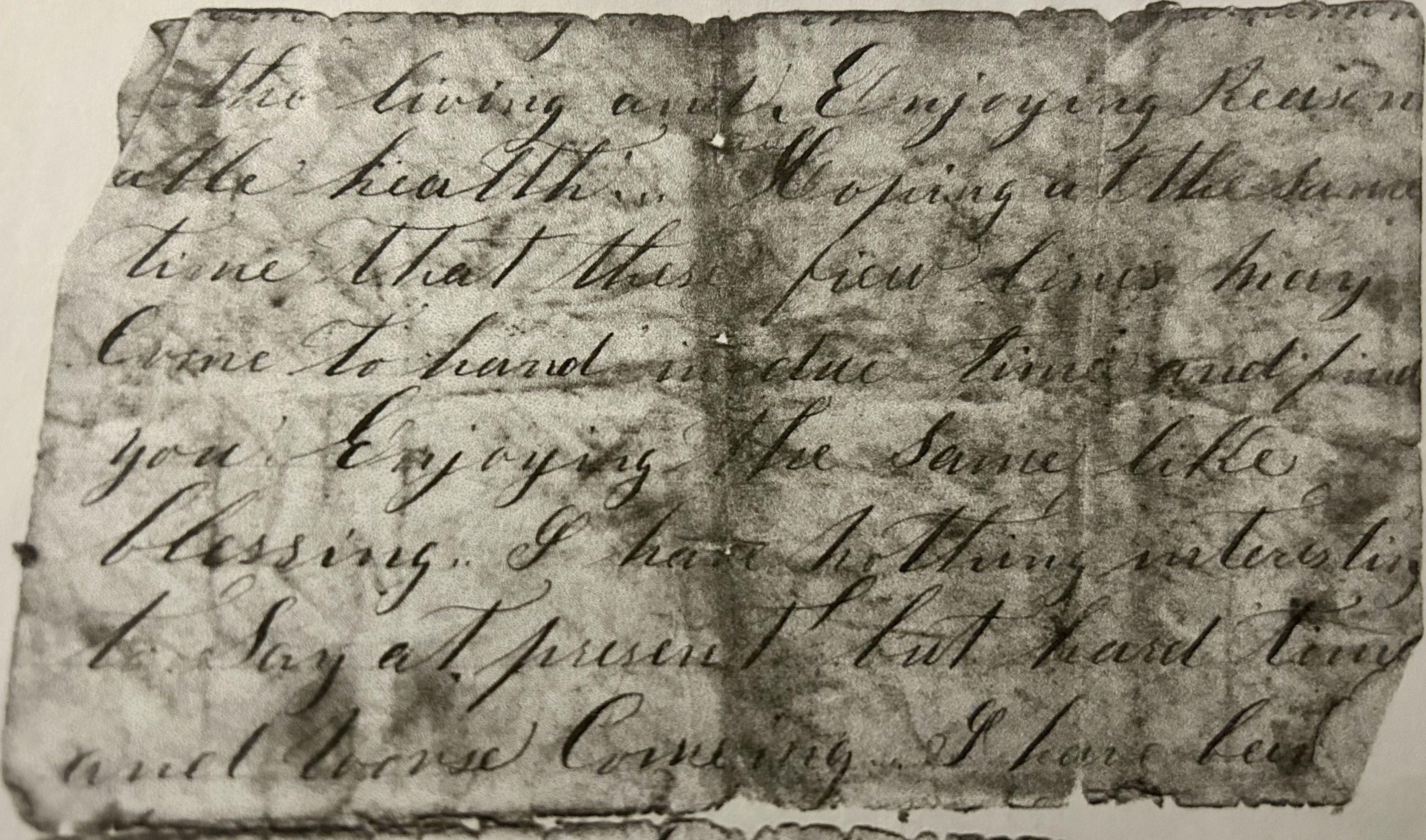
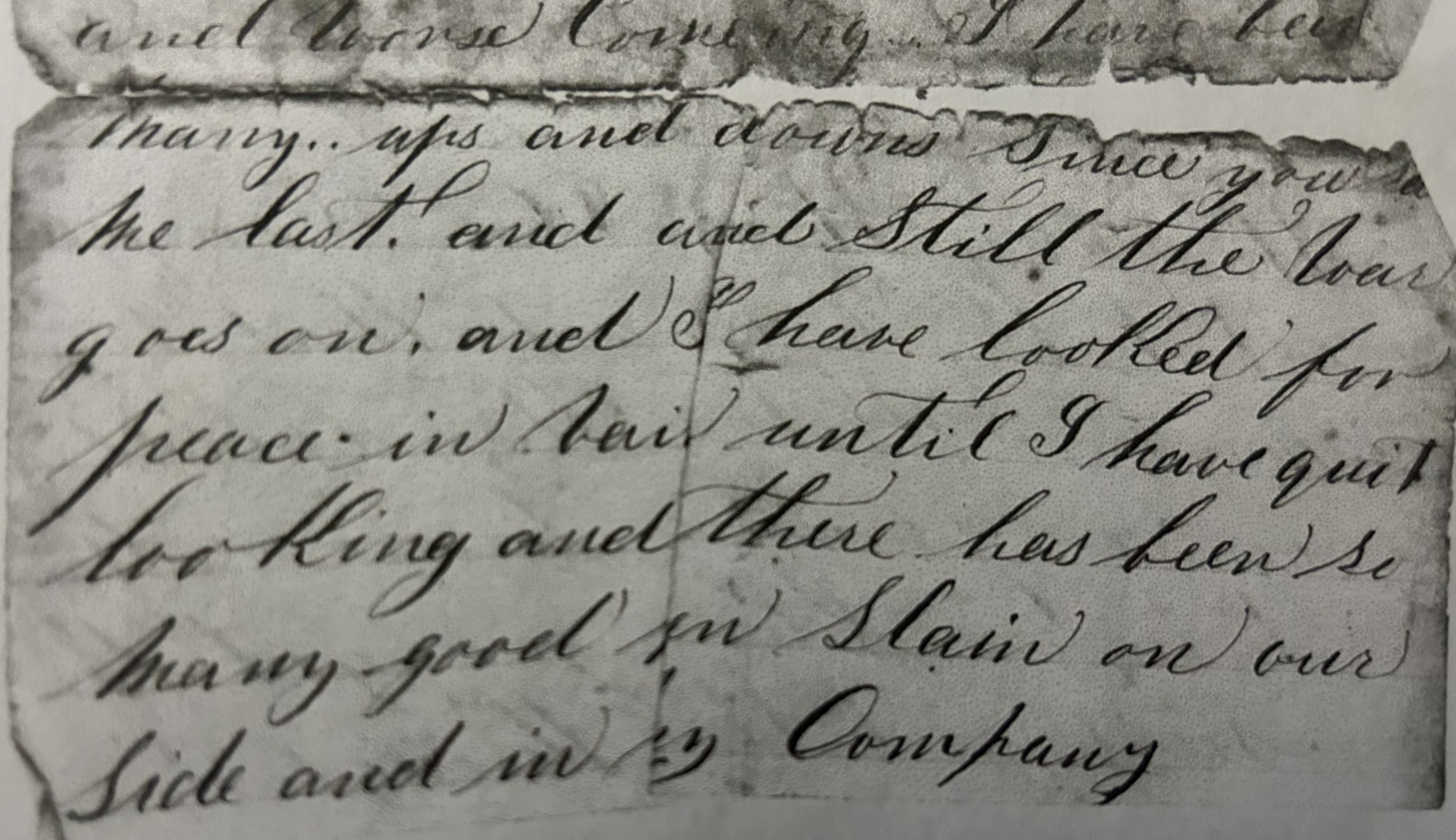
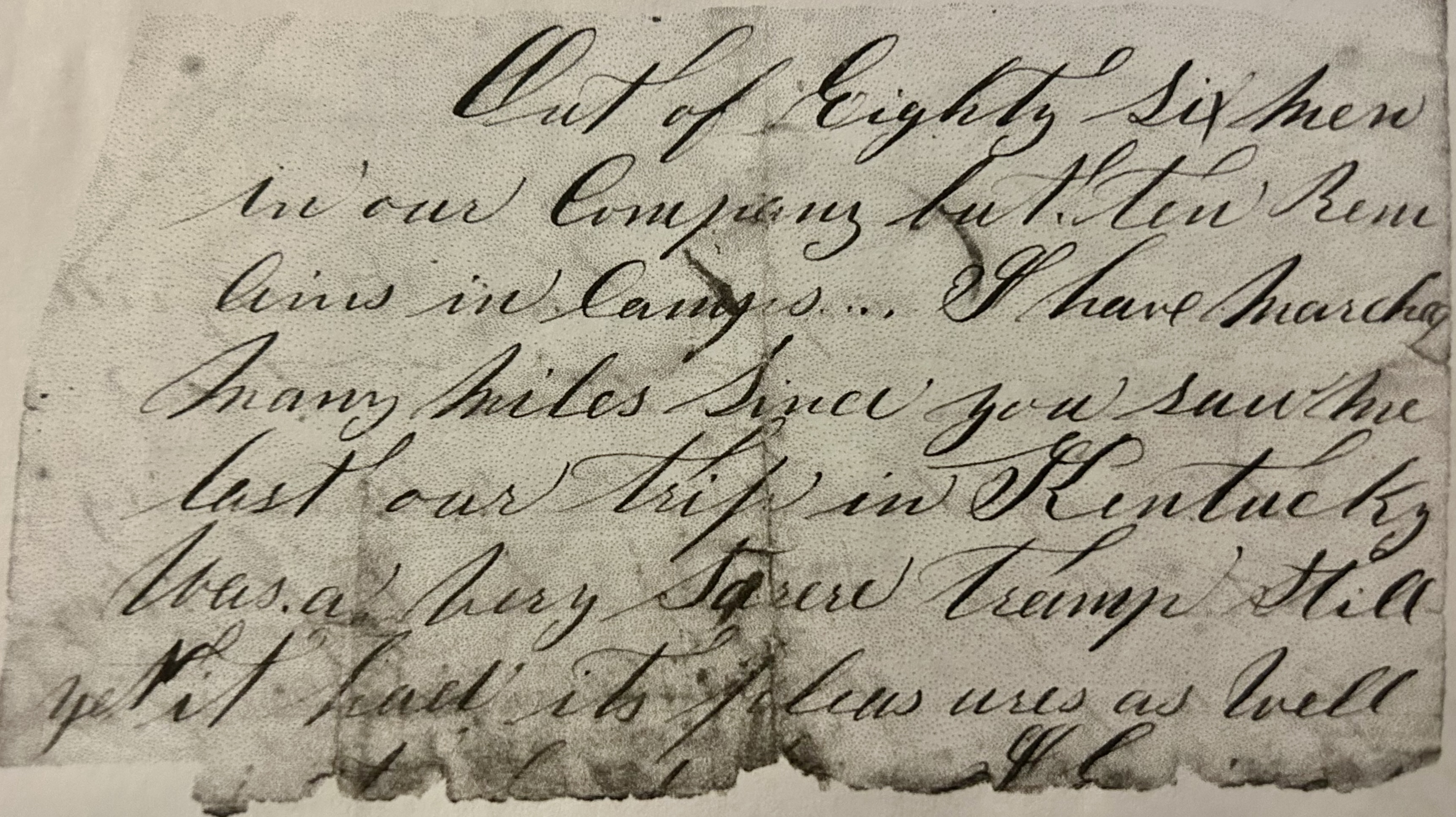
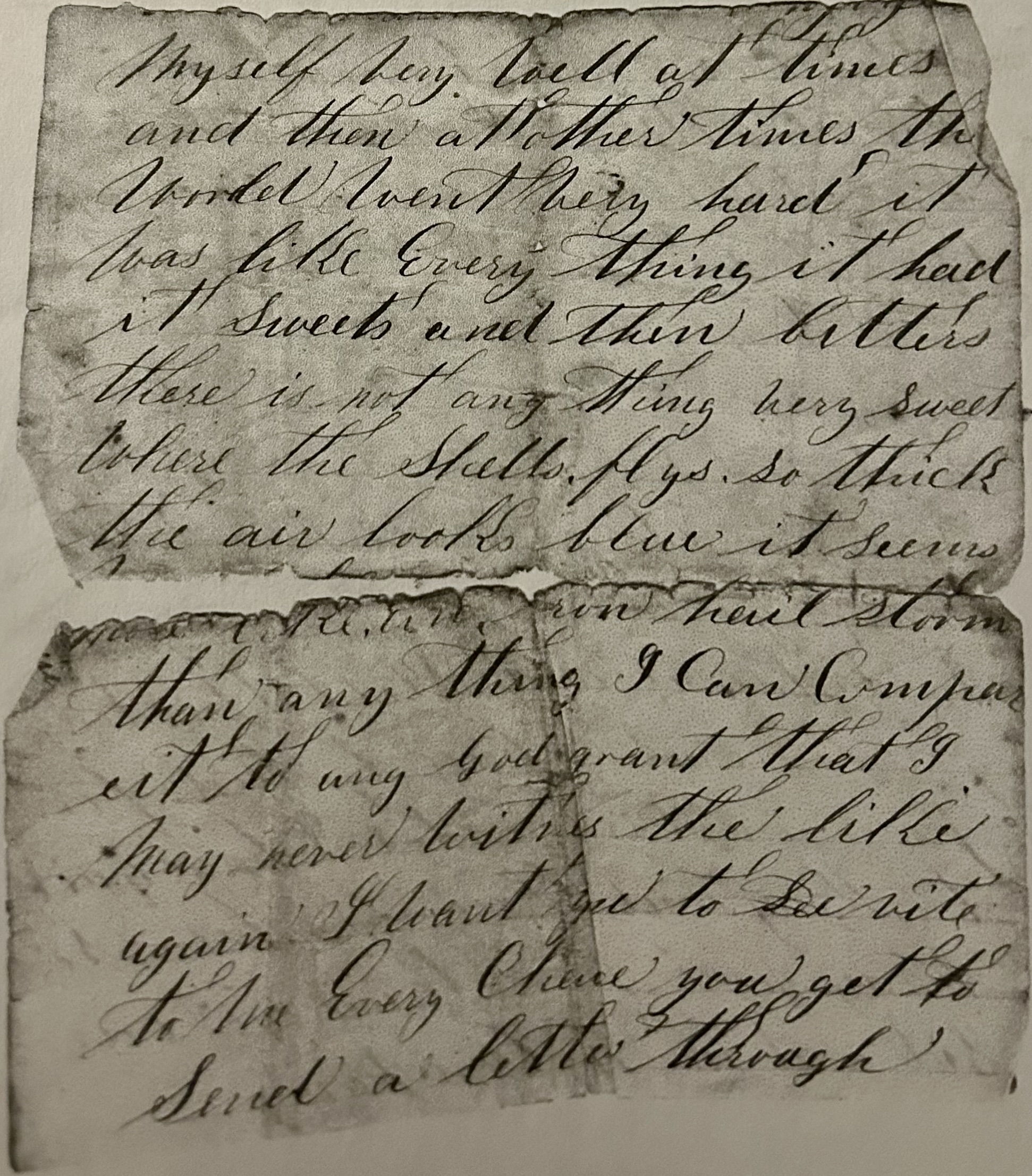
It is with pleasure that I am seated to inform you that I am well at present and hope these few intended lines may reach you and find you enjoying the same blessing.
Well, Mary, I have not much to write today. I have not written to yo before so if I make any mistakes, don’t think hard of it for you know that I am a careless boy anyhow and always were. But I will try to do the best that I can.
Well, I guess that I will give you a little history of soldiering. I think that it is a hard life. Well here is some of it. You can guess at it for yourself. We took down our tents Sunday to march and it has rained ever since and we have laid on the ground so if you call that comfortable, then I have nothing more to say. But when the weather is fair again and the ground gets dry again and the wind is fair, we will march on with the army which is 150,000 strong. They are going to Richmond to make the rebels retreat or take a flogging if we don’t get defeated in it. And I hope that we will have good luck and take the remainder of Old Jeff’s army and ketch him so that he will make no more disturbensing whair for if I could git him I wold use his head for a wash dish until it began to leak and then fead it to the dogs.
Well, Mary, I will stop writing about war for I expect that you are tired of hearing it mentioned. So I will tell you of something else, I saw Lew Rozell Sunday and Emry. They were well and fat as fools and black as a nigger. They say that they like it first best with the exceptions of lying on the ground. Sam Lilly is with them. You can tell Lib that he is well and looks like the same old chap yet.
Pardon Covey and James Rozell are well and kicking yet. I believe Vink Covey is in the 52nd too but I did not see him. But he is well, so the Boys say. I had to run away to get to see Loran and had to run the picket guard to get there and stood a good chance of getting shot in the operation but nothing ventured, nothing had, so I tried it and got through.
So I will close for it is late so goodbye for the present. So write soon. From your affectionate [cousin] — A. H. Comstock
To Mary P. Rozell
M. D. Write soon. Give my best respects to all if they wish it but not without goodbye but not forever, for I think that I will see you again.
The following letter was written by Joseph Emmons Blanding (1841-1862), the son of Asa Blanding (1797-1861) and Caroline Mann (1807-1847) of Attleboro, Bristol county, Massachusetts. A carpenter by trade before the war, Joseph enlisted on 15 June 1861 to serve in Co. I, 7th Massachusetts Infantry. He was wounded on 1 July 1862 in the Battle of Malvern Hill and died two months later on 11 September 1862 [one report says from wounds, one from dysentery].
Joseph wrote the letter from the regiment’s winter quarters at Camp Brightwood outside Washington D. C.
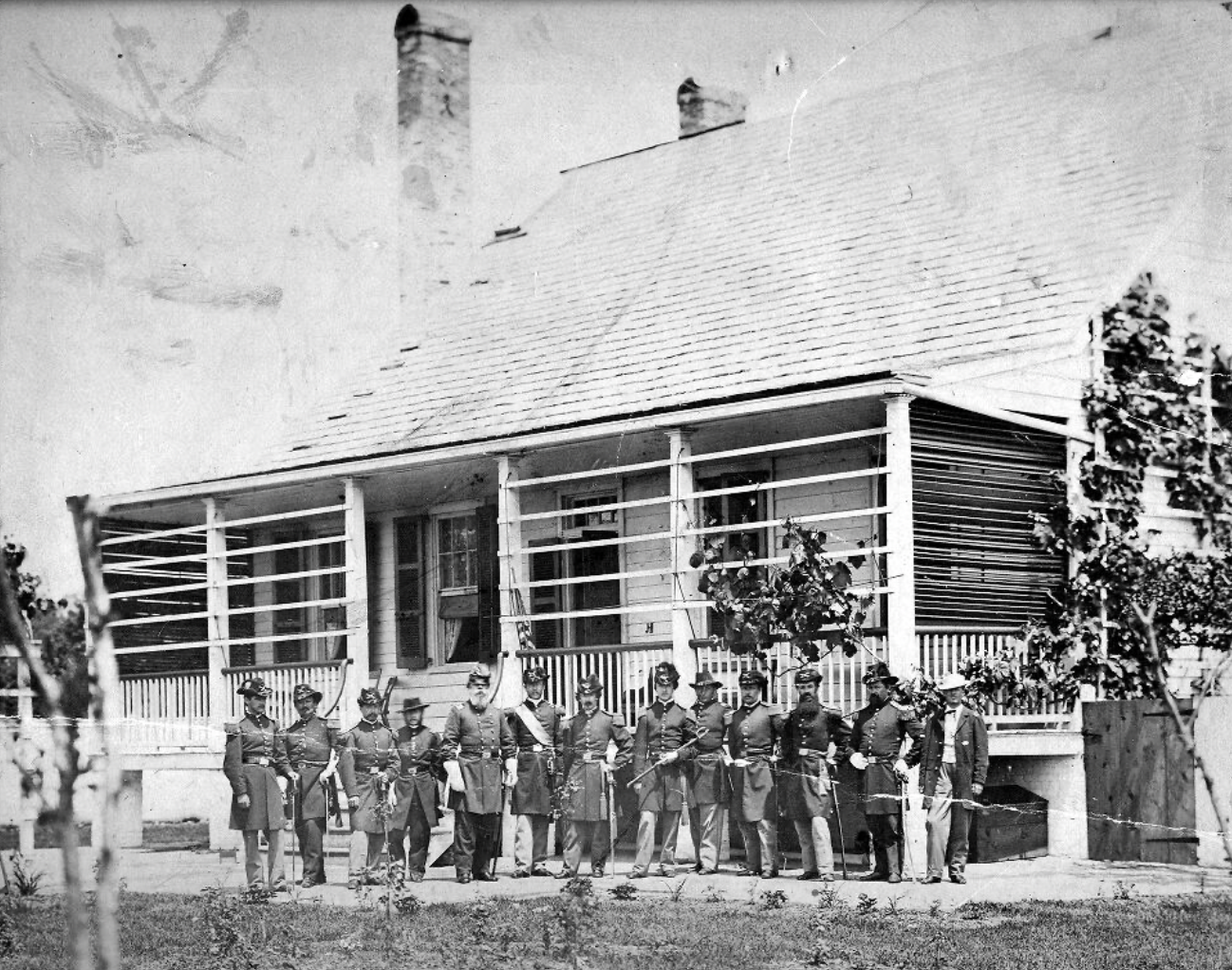
The log house winter quarters of the 7th Massachusetts Infantry at Camp Brightwood in January 1862.[University of Delaware Digital Collections]
T R A N S C R I P T I O N
[Camp Brightwood] Washington [D. C.] January 14, 1862
Dear Cousin,
I will try to write you a few lines just to tell you I am here and still in good health. I believe you wrote me last but I have not had many letters to answer and so I have got out of the way of writing much so you must try and excuse me.
I do not have much news to send that is interesting but I will give you a description of our winter quarters. They are four to a company, 28 and 34 feet long, and ten feet wide made of split logs 6 and 8 feet long set up in the ground endwise and the cracks filled up with mud that does not stand the weather very well and the top is made of our old tents sewed together and put on for a roof. We have a fire place in each of them and bunks to sleep in put up on one side so they make a great improvement on the tents and we have a good, comfortable time of it here.
I think if you had your health and truse [?] out here, you would enjoy yourself. There is good rabbit hunting out here and a few wild turkeys. I saw a man go by last Tuesday with three wild turkeys slung over his horse. He hot them in the woods where we go to stand guard every fortnight. Any quantity of coons and a few opossums here—rather better than it is over back of Stimpson’s. I guess you have cleaned them up before this.
By the way, I want to hear from you. I ave not heard from you or anything about you for ever so long. I am sure I wrote Frank last. Why don’t she write. Perhaps she has and I have not received it—at least I have not heard from her this longtime. Just tell her I should be happy to hear from her.
By the way, if you hear that I have been in the guard house, you must not be skeert, for it is a fact. They got me rather foul the other day. I was on guard on a cold day and our quarters were close to the guards so I just took a look in there to get war, and the Officer of the Day came around, turned out the guards, and J. E. B. was not there and so—chuck into the guard house he goes to wait for a court martial. It came off in a few days and they brought in a charge against me of disobedience of orders, found me (together with 13 others who were put in at the same time and for the same offense) guilty and fined me 6.50 dollars. Nothing like this miliary. they do play this thing up fine, I can tell you.
A day or two since we saw the Col. J[oseph] H[enry] Wheelock, colonel of the 7th, riding around the parade ground drunk as a fool for which he was arrested and finally excused from the command of the regiment so we have no colonel now. By the way, he come in a religious man and put every man he heard swear in the guard house. That was his style and you see how it turned out. 1
No room for any more so I must close with a good bye and write soon.
Your cousin, — Joseph E. Blanding
1 Colonel Joseph Henry Wheelock resigned, citing that his health was “too feeble to endure the hardships of camp life in this latitude and at his season of the year.” Wheelock would die in Washington in May. [Source: The civil War in the East]
The following letter was written by George Chauncey Peck (1830-1906), a carpenter by trade, and the son of William Peck (1803-1879) and Elizabeth Tolles (1803-1886) of Woodbridge, New Haven, Connecticut. He was also the husband of Betsey Eliza Perkins (1834-1935) with whom he married in 1853 and had two children at the time of his enlistment. Muster rolls reveal that George enlisted as a corporal in Co. A, 10th Connecticut Infantry, in August 1862. He mustered out as a sergeant on 7 October 1864.
The 10th Connecticut was one of Connecticut’s most successful civil war regiments, compiling an exemplary record of service in the Union Army. The 10th saw action in the coastal campaign during the early years of the war, which culminated with the siege of Charleston. The 10th went on to fight the trench battles of Richmond, earning praise from Union generals and Ulysses S. Grant. The 10th was active at the war’s very end, when they blocked Robert E. Lee’s attempt to escape from Virginia. And, the 10th was present at Appomattox Court House when Lee surrendered to Grant. All told, the 10th regiment fought in twenty-three battles and at least as many skirmishes. [Wikipedia]
In this letter of April 1863, George wrote from Seabrook Island off the coast of South Carolina where his regiment, with three others, were rotated off and on outpost and guard duty for nearly three months.
Betsey (Perkins) Peck and husband, George Chauncey Peck of Woodbridge, Connecticut
T R A N S C R I P T I O N
On picket at the Upper End Seabrook Island April 28, [1863]
Dear Father and Mother,
You must not feel hard if I have not written before. I had intended to but it had not come so I could as I wanted to but now I have a little time by myself before dinner. I must give you a little account of our life in the woods.
To begin at the beginning, we are on one of the islands that line the coast of South Carolina. We are some 20 or 25 miles from Charleston. This island has one large plantation and the other house to match [illegible] by a Mr. Seabrook but he has deserted his house. We have a regiment here to do picket duty and came on over in three weeks and stay on 7 day. We are in sight of the rebel pickets. Can see them any time. They are all mounted and have very good horses. They are dressed in all sorts of cloth—some dark, some of the light, some have on felt hats and some caps (grey). They came down and fired at us—or they did the first day that we came out here. But since, they have kept rather shy. They saw our pickets. Some of the boys get up in trees to see more of them. Edgar [Giles] Smith was up in the tree and they shot at him but it went through the top of the tree above his head. I think he got down soon. Our Boys saw the fire and returned it soon and they were off sudden. Since the first day, they have not fired.
Our General sent out a flag-of-truce yesterday and we expect one in our lines today. It is about some letters from some prisoners that we took at Stono Island just above us. They can see Charleston from that island. They have fortified Charleston very strong and in order to take it, has got to be done with a large force if they do not do anything with the monitor and gunboats. But they are to do something with the gunboats. They are fitting out another expedition and it is soon to make a strike on Charleston. They could do more than they did before. Why they did not is a mystery to me. They claimed that they silenced Moultrie and breached Sumpter [Sumter] and done all they wanted to, but I think they have a good deal to do before Charleston is ours. But from what we are able to find out, they are making extensive preparation for the next grand attack. I hope that the next will be the one and the right one and that Sumpter and the forts will be ours and that Charleston will be burned to the ground. I have some matches saved for that purpose if I am permitted to go up there safe. We can’t find out much what is going on here—only that some movements are on foot. I find the men ready for the fight as ever and down on the Copperheads. (by the way, I see by the paper that they have placed you on the Police [?] list for this year.)
I am glad that Gov. Buckingham is our next governor and may he do as well as usual for us and take the same interest in our welfare. By the time this reaches you, you will be off to Legislation for I can’t tell when our mail will go. I have not heard from home since I left Fort Hamilton excepting a letter that came from there from Eliza. I am…
I had to stop for the dinner. You will want to know how we get along in this part of our duty. I will tell you. In the first place, we have our cook go with us of course. We take two camp kettles and carry our stuff with us and cook it then in the woods. We are some three miles from our camp in the woods. We have to make our tents of the leaves. We can use our tents for they would see where we are so they reason for using green boughs. We use the Palmetto leaves for our huts. Now about our meals, we have to carry it to the picket post. They are about 3/4 of a mile from our reserve on duty. They can’t have their post but one at a time, 4 men on a post, so we are on the reserve and have to carry it to them. Have been on the reserve all the time sergeant of the reserve. By the way, I forgot the carrying around the meals. We take the coffee in our camp better for we cook our salt junk in the same kettle we make the coffee and when we get it made, it is as black as a cat is—the water.
The way we get our water, we take a cracker box and dig down into the ground somewhere near where we want to cook, sink the box down, then the water comes in it. It’s not as good as rain water that you would catch at home but it is all that we can get and have to take that. I drink as little as I can but am dry sometimes. Then I chew a limb of some bark. We cook our salt junk and cut it up and put into a box and then go around with it. I have been with most of the timeserving it out to them so it goes from day to day til our time is out. We stay out 7 days, then another regiment comes out and takes our place. We have four regiments on this island now and our turn will come once in four weeks. But this is doing picket duty in cr___ for we see the rebel picket all the time and they see us also but they have not fired on us since the first day. They found out that the 10th Conn. Vols. is on, but as soon as any other comes, then firing.
It is some healthy here now but how long it will be so I can’t say. The men are in first rate spirits—ready for anything that duty calls them to do. We are waiting for something to be done somewhere. We do not get much news and therefore can’t tell much what is going on up North. I am very anxious to hear from home. By the way, what did you think of the pictures of your soldier son? I did not have time to write you anything and though they might speak for themself in some light—that is, if you have got them. I hope you have. I found Leonard well but not as fleshy as I was in hopes to. I am satisfied in my mind that he smokes too much for his good. He seemed glad to see me and I am sure [ ] glad to see him I landed at landing and I found him as soon as I could. Stayed all night with him and part of the next day. We were together and we did not let our tongue lay still, I tell you. It seems as if I had lived some 19 months in a very short time. We talked old matters over and it seemed as if I was ready to go and stay my three years out and say not one word. As for his troubles, he seemed to take it quite cool. I am satisfied in my own mind that he was a little careless but not enough to be served as they served him. He is like much in his company and in others and the captain said he was ready to do his duty at anytime. I don’t know that I think he may get it back again sometime. I hope so for [I] feel different about it than some.
I saw Lieut. Townsend but not the Captain. I suppose he will be mad at me for slighting him. I [ ] to but I was in a great hurry to get [ ] and did not have time to go back the second time. In fact, I did not care to see him. I have not much of an opinion of him. Make the best of him from all that I can learn. I seen the other boys and seen in particular. He is as natural as life and it did me good to see him. I saw him down at the landing first with John Hernes. Tey all were looking well and seemed glad to see me from they way they came around me, taking my going home and then back. I have seen and met with much that I shall long remember. I think if my life is spared any length of time, I am [in] hopes that the time will soon come that I can see the things in their own light. We have many rumors with us about this thing the same as it was with us last winter, but nothing that is to be believed.
I feel in my heart that the time is soon coming for a quick change and the most cheering news is from the North that there is a great interest manifested amongst the people in some places. Oh! that the people will feel that from God comes all good and that they are ready to lie low at His feet and call for help. If so, then we can hope fr help and only then. I feel the same now as when I first told you my feeling about my enlisting. I shall always feel that He who rules all things well, had these thing for our good and that when we as a Nation are sufficiently humble, then He will lift the load from our shoulder. I feel that I wsa called to go and to go in the way I did. It was not for money that I went but for the love of my country and for her I will die if it is God’s will. But I feel He has more work for me to do although it may be [ ] humble. I have my work to do and as soon as I got to the company, I found something to do to this one and that I am glad to say that I can see some change in some all ready….
Mother, I hope you will continue to remember us all (soldiers) in your daily supplication to God. I know you will. I feel it now. Hoping you will be spared till the end. I must close for this time to you. I shall write to Wales and Jennie soon. I hope you will answer this soon in a good long letter. I shall want to hear all that is going on. Remember me to all the friends, far and near, — Geo. C. Peck
These letters were written by Charles McGill (1792-1859) and his younger brother, Robert Tyler McGill (1795-1875). They were the sons of John McGill (1762-1827) and Elizabeth Belt (1763-1834). Charles and Robert lived very different lives. For 26 years, Charles was employed as a seaman in the merchant service, earning a reputation for nautical skills and for withstanding the severest privations and hardships. Once his entire crew fell victims to yellow fever in a foreign port. Once he was upon the ocean for days in a small boat, without food or drink, his ship having sunk and with it the earnings of his previous life. After many voyages, sometimes prosperous, but often of shipwreck or perilous disaster, he retired from a profession he had served so well about 1836, since which time he has resided in Georgetown, D. C. His later years were marked by declining health as is evident in these letters. He died at Berkeley Spring, Virginia, on 26 August 1859.
Robert, on the other hand, lived on the family farm in Prince George’s County, Maryland, until he took a job in 1825 as a clerk in the Treasury Department in Washington City, from which place he wrote many of the letters in this collection during the Civil War. His job at the Department was to settle the accounts of Navy agents.
All of the letters, either by Charles or Henry, were written to their relative, Levin West (1789-1863), or after his death on 18 June 1863, to Levin’s youngest daughter Susan (1841-1937). Levin had a farm in Petersville, Frederick county, Maryland. At the time of the 1850 US Census, Levin owned seven slaves ranging in age from 3 to 40. In 1860, he owned 9 slaves ranging in age from 8 to 60. Levin’s home in Petersville was a stone structure constructed in the Federal style with later additions in brick. It was built in 1815 and still stands today as a historic site.
It is challenging to discover letters penned by gentlemen whose lifespans coincided with the emergence of the new Nation, one of whom witnessed its fragmentation.
The Treasury Building in Washington D. C. where Robert Tyler McGill worked in 1860.
Letter 1
3d May 1856
Dear Levin,
We received your favor of the 1st inst. and were truly shocked at the sad news. To say that we sympathize with poor Patrick and you all are natural words & too weak to express our feelings for our dear friends. Death, my dear sir, is constantly making inroads upon our affections and warning us in most emphatic language, “Be ye also ready.” I wish for the power to console, but time and a higher power can only give that.
I will annex a sort of drawing with some directions which I hope you will be able to understand of the “corn coverer,” but it is more than I can now for I, this moment more than ever, wish for some of your mechanical genius that I might plan better and sometimes execute too. I am in a hurry for you to get this, hence my writing—always bad—but now worse. I hope you can read it. Do make our united and kindest regards to your family all and all friends.
The extreme severity of the winter did us much damage in loss of fruit & vegetables & flowers too. I fear we shall not have a peach, but I hope a plenty of apples, pears, plums and grapes. Believe me now as always yours truly & affectionately, — Robt. T. McGill
Letter 2
Georgetown April 2, 1857
Dear Levin,
Your very kind and acceptable letter of the 2nd February is now before me and really I feel ashamed that I have not answered it before. But let me assure you I have thought nonetheless of you or your dear family, and all our relations on the tract. I have been and am now suffering with a severe cold but I hope when warm weather sets in I shall feel better. I am now happy. Godliness is great riches, provided we can learn to be content with what we have. I suppose by this time you have finished fallowing your land for corn. I wonder if you are as industrious as you were when I was with you. I suppose you are. I saw Cousin Patrick and cousin Belt when they were down, and it was then, Levin, I felt the want of a house and home of my own that I could have entertained my cousins and return the kind hospitality in some measure that I received fro them and all my dear relations. I was glad to see them looking so well. I regret cousin Belt could not sell his horses in Georgetown. When I called to see him last, he had left about one hour [previous] for Baltimore. I do not know when I was more surprised—particularly when he told me he would stay a few days longer and endeavor to sell his horses. They were really fine horses and I was in hopes he would have met with a ready sale. But as he made up his mind to go, I hope he was enabled to get a ready sale and better proce in Baltimore. I was truly glad to see them both and hear from you all and that you were well.
Robert McGill lives in Washington and is looking very well and happy and rejoicing at having sold at the time we did and I am pleased, gratified, and happy to know that he is happy and contented. We have lived as brothers should live and I hope it will remain so. Not a wish of is but what I would gratify, and I am sure he has the same feeling towards me. We lived on a farm together and we never had one unkind word or ill feeling towards each other, and sincerely do I return my thanks to my blessed Redeemer for it. I should like to hear how cousin Clara Belt has got [along]. I hope she may yet live to enjoy good health. Levin, please present my kind regards to her. I often pray, if the will our Blessed Savior, her restoration to health. I hope to live to see you all again sometime this year. I am afraid if I go too often, I may wear my welcome out and I am now in the situation without a home of my own to return the hospitality of my dear friends and relations.
Levin, I love you all and I hope and have no fear but it will last to my journey’s end in this world. Robert seems very anxious to pay you all a visit but when, I cannot say. We often talk of you all and oh! how often do I think of my happy visit to you. And may God reward you all, my dear cousins, for your kindness. Cousin Ella Page has not sent her little babe down to me yet to take care of and nurse but I suppose she is afraid to trust me. Farewell Levin. Love to cousin Eliza, and every member of your family. And also to one and all my cousins on the tract, and believe me ever your affectionate friend and relative, — Charles McGill
P. S. Please write soon and I will promise to be more punctual in future.
Letter 3
Washington City Tuesday, 14 July 1857
Dear Levin,
My brother [Charles] and myself contemplate leaving here this day week the 21st at 6 a.m., arriving at Knoxville [Frederick Co., Maryland], I suppose, about 12 o’clock, when, if entirely convenient to yourself and family, of which I trust you will let me know immediately, I will stop some days with you and see other friends before I proceed farther in Virginia to Berkley, &c. &c. provided you can with convenience send for, or meet, me at Knoxville that day.
My Brother, I think, will write this day to Lloyd Thomas, probably saying he will go to his house. But for myself, my last, mostly to you and yours, was made so pleasant and agreeable by you all that I am now tempted to repeat it, believing I shall again meet the same warm & welcome reception. My kind regards to your family and friends all, and believe me as ever yours truly and sincerely, — Robert T. McGill
Letter 4
Georgetown, District of Columbia Thursday, December 24th 1857
Dear Levin.
Your letter of the 19th inst. I have but this moment received owing to the oversight of the postmaster—a worthy but inform man. Therefore we have sometimes to put up with great inconvenience and often losses by not receiving a letter in due time. I now return you thanks for writing. I could not imagine why I did not hear from you but not for a moment did I attribute it to any unkindness. In fact, Levin, I am more to blame than you are. I think in my letter to you I promised to write as soon as I could ascertain what and where the extent of suspensions and depreciation of currency and the monetary crisis. It will be some time yet before confidence can be restored between man and man, however good and secure they may be. I cannot yet say how it will be with me until January dividends roll round and see how they are paid up. At the present time, the prospects are good and I hope may continue. I never wish to look upon the dark side, sufficient unto the day, the evil thereof.
I thank you dear Levin for your kind and polite invitation to spend Christmas with you and your dear family, but I am sorry it will be out of my power to do so at present as it will require my attention here until after at least the 14th of January. I shall see Robert tomorrow and let him know the purport of your letter. I know he is similarly situated with myself and impossible to leave at this time.
I am truly happy to hear of your good health and family. And all friends and relatives. I can never forget the hospitality and kindness shown me by yourself, family, and all my relatives while with you. I am glad to hear cousin Bettie Clagett is well and her little baby which was a dear sweet little thing. Levin, you cannot imagine the pleasure I took in visiting cousin and Mr. Clagett—to see them so happy and comfortable—apparently without a care or trouble in this world. Oh how I do love to visit families where peace and quiet, love and happiness exists. I can then enjoy so much everything around me. You did not say you expected cousin Mollie and Belt to spent the Christmas with you but I suppose they will [and] to have your children and grandchildren with you on such an occasion. I do not, Levin, envy your happiness for it makes me feel happy to know that you and cousin Eliza will be. I shall imagine I see you all on that day tomorrow and often shall I think of you.
How is my cousin Patrick? I hope he is well. Did he hold out or give out during seeding time? I think I know the field where you had so much work and hard labor to prepare for seeding—the field opposite the barn where you had potatoes. I do not think a much worse field could be found to put in order for wheat; so I thought at the time. I believe if perseverance and hard labor would accomplish anything, it was bound to be done, and I am glad to hear of your success.
I heard from sister Tyler yesterday. She is well and when I write again, I shall send her your kind remembrance. Now Levin, farewell and may God’s blessing be with you all now and forever. Love to cousin Eliza and all my dear cousins, and friends on the Maryland Tract. I wish you all my dear cousins, a pleasant Christmas, a Happy New Year, and many returns. Believe me sincerely your affectionate friend and relative, — Charles McGill
P. S. Levin. write soon. It gives me pleasure and happiness to hear from you.
Letter 5
Berkeley Springs [Virginia] August 11th 1858
Dear Levin,
I wrote you a few lines to let you know that I am now here at last on my way home. We left Washington City July 15th 1858. From thence we went to Baltimore, got breakfast, proceeded to Harrisburg, spent a short time there, then to Carlisle in Cumberland county, Pa., and visited the Carlisle Springs, and Mount Holly Springs in that neighborhood. From there we went to Chambersburg, spent a day and night, then left for Bedford Springs—a long tedious ride in the stage. Stayed a fortnight, took a private conveyance over to Cumberland, spent four days in that place, and am now here on my way home.
I have gone through many scenes and knocked about a great deal trying if possible to regain my health. May I hope I have succeeded. I was traveling for health—not for pleasure. I am in hopes I met with both.
The particulars of Robert’s and my journey I will give when we meet, it is will interest you and your dear family. You shall hear it all as I will never—if I am spared—undertake such a fatiguing journey again. But as I am now through safely and feel so much better, I am rejoiced I undertook it. Now Levin, ig Fod’s willing, we intend leaving here next Monday morning the 16th August, dine at Harpers Ferry, be at Knoxville, at what hour, you will know better than I can. Therefore, Levin, Robert and myself will be indebted to you for a conveyance from Knoxville to your house. I would write you the particulars of our journey but as we are to meet so soon, I will wait until that time. Robert is well and sends much love to you all; and all relatives and friends. Farewell to you all; with love to all; and believe me ever your sincere, affectionate relation, — Charles McGill
Berkeley Springs August 11th 1857 [1858]
Be at Knoxville Monday, August 16th, 1858
Levin West, Esq., Petersville, Maryland
Letter 6
Georgetown, D. C. March 18th 1859
Dear Levin,
It appears like a long time since I have had the pleasure of hearing from you directly. But do not think I have forgotten you for I assure you, not a day passes over without my thinking of you and your dear, kind and affectionate family.
Levin, I find I am fast failing in health and strength, so much so when I look back, I can scarcely believe I am the same person. But God’s will be done. I hope I may be prepared to leave whenever it pleases God to call me. I have very little left to tie me to this world except to prepare to meet with my Savior where I hope to meet with you and all my dear friends. My health has been bad all winter. The season of Lent has rolled round upon us once more and blessed be God, I am yet able to attend church in the day at least. Oh Levin, what a comfort to me that I can and am able to get to church twice a day. I have not been out of the house after sunset since October last.
I saw Robert yesterday. I told him I intended to write you today. He sends his love to you all and begs me to say to you e hopes soon to get through with your land warrant as everything goes by turns. He thinks they [will] be able to take up yours in about ten days. He feels now pretty sure he will get it through and send it on by mail to you.
Levin, many have been the changes with you since I was with you last. The old settlers passing off, and property getting into other hands. I sometimes feel a little sad when I look back and see how completely the neighborhood is broken up.
Cousin Eliza [McGill] Bradley departed this life on the 12th inst. and Levin, if ever there was a Christian and a sincere one left this world, she was one. No one could say too much in her praise. I never saw a more lovely corpse in my life. Her loss among the Christian community will be severely felt. Her whole study seemed wrapped in doing good. It may be truly said this world had no charms for her—at least none others than doing all the good she could. But Levin, she is now surely in Heaven with her Savior, awaiting for all her Christian friends. Why should her death make her friends sad when they know she is now happy? We can only say farewell, dear happy Christian. I heard from her sister Tyler a few days ago. She is as well as could be expected at her time of life. 1
Levin, this is a very uninteresting letter but I thought I would write for fear you might forget me. Now dear Levin, farewell. Love to cousin Eliza and all your dear family as well as to all my dear relatives. Write soon and believe me ever your sincere friend and relation, — Charles McGill
1 Eliza McGill (Thomas) Bradley (1834-1859) was the daughter of John McGill Thomas (1800-1834) and Harriet Margaret Dunlop Thomas Lufborough (1809-1886). She was the wife of Joseph Habersham Bradley, Jr. (1831-1874). She was buried at Oak Hill Cemetery in Washington D. C. Eliza’s husband bore a “remarkable resemblance to John Wilkes Booth and on April 15, 1865, the night after the tragic event in Ford’s Theater, he was driving home in his buggy along a lonely road when he was held up by policemen and arrested. When he protested, he was told that he was John Wilkes Booth and was taken to jail. He insisted he was not, but to no avail. After a good while he got in touch with friends who identified him and he was released and went home.” [Source: Find-A-Grave]
Letter 7
Georgetown, D. C. June 6th 1859
Dear Levin,
Your letter of the 27th of April is now before me and am sorry to say unanswered to this late date, but I assure you, Levin, I thought of you and all your family daily and have said to myself day after day, well tomorrow I will answer Levin’s letter.
I have not been well all winter, and spring I have not been out of the house after sundown since October last; but I am very thankful that it is no worse. I put my faith and trust in my blessed Redeemer and bow with submission to His will, and never feel unhappy if possible under any circumstances; keep clear of all excitement upon any subject, particularly when I find the person I am conversing with or myself becoming so, for every word spoken after that only serves to make it worse and worse, and engenders ill feelings and I thank God I do not harbor any ill feelings against that person living. But some I want to have as little to do with possible, and pity them for their faults and pray for them too. 1
I was glad to find from your letter that crops in your section were so favorable, and indeed they are yet from all directions. And also to hear you bid fair to have a good peach crop. I have never in my life taken or felt more interest in the success of farmers than I do at the present time. The whole country—or indeed the whole world—is dependent upon them. Therefore, Levin, they shall have my prayers for good crops and good prices, and I think at present there is a fine prospect for both. The European war must keep up everything very high no matter how great the crop, for it looks likely that all Europe will become involved. What money to be wasted, and lives to be destroyed, to gratify ambition, and all to keep the balance of power, jealous of each other. I suppose we shall hear of some great battle soon. 2
I will now talk to you of something more agreeable to my feelings. You say Patrick and yourself were about enclosing your yard. Oh, I do wish I could have beeb up there to superintend and give my counsel and advice. No doubt you would have finished quicker, but you might have hurt yourselves—particularly when I would only go so far to look after you, sitting on piazza in the shade all the time. But oh! Levin, it was cruel in you to make Bob’s mouth and mine water at the mention of Bonny Clabber [curdled sour milk]. I believe ut made me sick at the idea of not being able to enjoy it with you. I wish you would enclose a plate full when you write. Bob begs me while you are about that; you must send him two gallons in a separate letter. Levin, I do not envy you it, but I do wish I had some. I think it would fatten me up and I should feel better.
I often think of you all and the happy time and kindness we received from your dear family and self, and all our dear relatives. It was a time, and as long as life lasts, will never be forgotten by Robert or myself. We seldom meet but what we talk of it and thank you all for the kindness we received. Levin, I assure you that goes a great way to make me feel happy. I do not know what rout Bob intends to take this year. If we are well and able, and if possible, we will try to pay you a visit, and all our friends once more at least. As I find my health and strength failing me fast, God’s will be done. I do not expect we shall leave home until about the middle of July. We did expect to pay sister Tyler a visit about this time, but Mr. Tyler is repairing & painting house which he says will take him seven weeks and the smell of paint in a confined room makes me sick. Love to all, cousin Eliza, and every member of your dear family, and all my relations. Believe me as ever, dear Levin, your affectionate friend and relative, — Charles McGill
1 Charles appears purposely vague but I believe he is referring to the rising sectional crisis in America.
2 The European war Charles refers to was the Second Italian War of Independence (also known as the Austro-French-Piedmontese War) fought between April and July 1859. The Battle of Solferino was the climatic battle of that war, fought on 24 June 1859.
Letter 8
Washington City, D. C. 13th July 1859
Dear Levin,
I saw yesterday your kind letter of the 11th inst. to my brother [Charles] and regret to say it found him quite sick in bed. He is now much better & his doctor says he will be up and out in a few days. If so, we hope to leave here next week for our trip to the mountains of Pennsylvania, Virginia, and Maryland, and hope o be able to visit you—not sooner, however, than September. The exact time we will inform you of from Virginia. But Levin, my brother’s health is extremely delicate—a great and rapid prostration, I fear, of the system. From once a herculean constitution, as you know, he is now but a shadow—just what we might have expected from his 27 years great exposure on the ocean wave. My own health never was better but I must go with, be with, and remain with my brother, for Levin, we are both going down hill of life and as Burns beautifully expresses it, “Still hand in hand we will go. And sleep together at the foot.”
The weather is oppressively war here now. Our town is very dull. The school examinations, the picnics, &c. are all over. Politicians have all apparently retired to some secret corner to get ready, stretch and smooth the wires for the great political race of next year.
I am happy that the Agriculturists generally have at length, this year, been blessed with bountiful crops. I never have here seen vegetables so fine, so abundant, and so cheap.
Do remember us kindly and affectionately to your family each & to all enquiring friends and believe me as always yours truly and sincerely, — Robert. T. McGill
Letter 9
Jordon [ ] Springs, Virginia Monday, August 20th 1860
Dear Levin,
Here I am after more than a month roaming, first on the bayshore and then to the mountains of Virginia and though I have seen much to interest me, and had placed before me the most tempting viands, still I begin now to long for a more home feeling and to be with those who are nearer and dearer to me. With that view, I will name the coming Saturday, the 25th inst. to be at Knoxville [Maryland] after dining early at the [Harper’s] Ferry. Can you make it convenient to meet or send for me there? You know the hour. I will defer much. I could and would say till we meet, I trust on Saturday evening.
Remember me very kindly to each and every member of your family and to all friends and believe as ever yours truly and sincerely, — Robt. T. McGill
Letter 10
Washington City, D. C. Monday, 1st October 1860
My dear friend,
“Home again.” Yes. even I as solitary as I may be, that word home has charms to me that I trust may never be obliterated. This cold, dreary, rainy Autumnal day, my room made cheerful by a bright hickory fire, and more so by holding sweet converse with dear absent friends, is among the charms. And I can now say truly with one wiser than we, “To know God and to possess a satisfied and grateful heart are among the richest possessions we can enjoy in this world.” I think I am satisfied. I know I am grateful. But I commenced this chiefly to express that gratitude in part, only as I can, to you and each of your dear family, to whom you may show this, for having added so much to those pleasures I enjoyed the last two months.
To this I will add that since my return, I have heard more favorable news from my dear, only, sister and found all my friends better and doing better than I anticipated.
The great Political race is near at hand. I do not think much of either nag, and if the grand Union course can be kept clear of foul weeds and briars, I care but little which horse wins. I still think & hope it will be decided here next winter as it is our only chance to keep out Sour Crout & lasses id-est Old Abe. 1
Fewer improvements have been made here than usual the past summer owing to the uncertainty of things alluded to above. Even the public [infrastructure] improvements drag on slowly. Confidence—confidence is wanting I fear. The Great I am I trust will watch over and guide us safely.
Lord Renfrew is expected this week. A great fuss at the White House there will be. I doubt if I see him. I shall follow no eager throng to do so. I dislike them as I do man worship. 2
Remember me with much affection to each and every one of your dear family and believe me as always yours truly and sincerely, — Robt. T. McGill
P. S. If or when you have anything of interest, will you answer this and oblige? — R. T. M.
1 I find myself uncertain about Robert’s message in this context. The mention of sauerkraut poses a challenge to interpret. I consulted historian Jonathan White for clarity, and he proposed that this reference might pertain to the substantial German support that Abraham Lincoln garnered during the 1860 election.
2” Lord Renfew” was the incognito alias used by the 19-year-old Prince of Wales (who later became King Edward VII) during his historic tour of North America. To avoid diplomatic protocol complications and intense press scrutiny, he traveled as “Lord Baron Renfrew” while visiting the United States.
Letter 11
Washington City, D. C. 9th January 1861
Dear Levin,
Since the receipt of your favor of the 1st inst., I have hoped daily to see and hear something of and from the political elements that would be more cheering for you to hear or me to write, but alas! hope in man, even our counsellors, and legislators, I fear is fast dying out & things are looking more and more gloomy. In the morning, a bright clear speck may be seen in the distance on the political horizon; at noon, it is clouded over; and at night all is dark and a storm rages. And so it has been since 1st December. The Administration, at first slow and lethargic, I fear now is disposed to be precipitate and rash. A medium course in all things, I always advocated. Cautious, but firm and decided.
I much fear, Levin, this eternal hatred & warfare against slavery by the North has determined them never to recognize property in slaves. [Anything] less than that, I think the South will not submit to. “Quere” —which is right or how is it to be settled? Why you and I would say by compromise. Indeed, on Monday morning the plan, having in view that object, of Senator Crittenden & urged by the Border State Committee (which you no doubt have seen) was thought to be full, fair, and completely acceptable to all parties North and South for or by that compromise, but now it appears not. The North seems to maintain a sullen silence, will do nothing, suggest nor advocate anything conciliatory. What is to be done?
I sometimes fear the South are determined that Mr. Lincoln shall not be inaugurated. I think such a course wrong & must lead to anarchy & bloodshed. From such we can only say, “Spare us, good Lord, spare the people, and let not this heritage be brought to confusion.” But I must stop on this subject. I may have said too much or said and written it too badly to be interesting to you.
You can form no idea how seriously these times affects everything here. You in the country, rural districts, are happy in being strangers to it. Every day appears almost like a Sabbath—property and stocks of all kinds sadly depreciated. No debts paid or collected. Business men would all be broken in a week but for forbearance. Nothing like the usual gay, cheerful, society will appear here in our midst this winter. Thus far my health is excellent & just enough paying stocks to keep me from debt. Cash in hand to last me till warm weather & then, if times are not better, be not surprised if Barleywood should receive one idler among its industrious household to help you to consume that great crop of corn, together with, I trust then, a good supply of Clabber.
The fact is, Levin, I am too old to fight, too old to run away, too old or too lazy—you may say which—to work. So I think I am in a quandary which, when necessary, I will call upon you as Hercules to help me out of. I need not tell you amidst it all, I am trying to keep my spirits up. By the way, I have just had sent me a gallon of the finest Crab Apple Cider I ever saw. Oh! how I wish you were here this moment to take a glass with me. As it is, I will (in a bumper) drink health, happiness, and prosperity in the New Year and always to you and all your dear household, to each and everyone, be pleased to remember me most kindly and affectionately to, and believe me as always truly your friend. — Robt. T. McGill
P. S. I give you good measure, all deficiencies in quality is made good in quantity.
Letter 12
Washington City, D. C. 16th May 1861
My dear friend,
Since I last wrote to you, the aspect of affairs has so changed and O! how lamentably changed in and for the best interests of our once happy, prosperous and honored country? How, when and where the madness that seems to be everywhere stalking through the land is to be stopped, His wisest (as yet) appear unable to say. Having always had a great respect for & a high confidence in your opinions and judgment, I write now to ask for your full and unbiased views of the state of things as they now exist and who are culpable for precipitating us into what seems now seriously to threaten us. Oh! most horrid even to mention a Civil war. My heart sickens at the thought.
Of late it appears you have had so much excitement at Harpers Ferry & your immediate neighborhood that I am the more anxious to hear from you all and what part, if any, you have taken in the scenes conducted around and near you. I sometimes fear that in my last letter to you, I expressed my views & feelings too freely but I am unwilling yet to believe that we differ materially as to how our beloved, good old state should have acted. I may err as we are all liable to, but I never thought that the remedy for ills complained of was in secession & much less so in a Civil war. If we do not or cannot agree in opinion, I beseech you not to let an honest difference alienate us as friends & relatives.
I perceive your old time honored courthouse was burned down recently. What good did the Legislature that met lately in your midst do, and what more will they do by meeting there again the 4th of June?
Our city wears all the appearance of a great military encampment on the eve of battle with near 40,000 soldiers and a daily parade of 5 or 10,000 with a dozen full bands of music does not now create more stir than a corporal’s guard with a drum & fife would have done a year ago—so easily does human nature become accustomed to any and all changes. I learn there are near 1,000 head of beef cattle in and near here together with I suppose 20 vessel loads of provisions. O the horrors of even an imaginary necessity for such a state of things.
The worst feature in all this is the total prostration of business, property of all kinds, and no employment to be had; much suffering must be the result & that soon & to some who a year ago thought themselves comparatively independent, I regret to say among them I have here some valued friends.
When you write, do let me know all about P. McGill, your son,s, and all our relatives. Remember me very affectionately to each and every member of your family and to all friends near you and believe me always yours, truly and sincerely, — Robt. T. McGill
P. S. I have this moment eard from Mr. T & my sister. They are well. My own health never was better and I try and keep up my spirits by having my jokes among the Yankee Soldiery, &c. — R. T. M
Letter 13
Washington City, D. C. 12th November 1862
Dear Levin,
I was absent when your letter of the 5th inst. reached here, as Mr. Clagett may have told you. I did not get back till Monday night. Yesterday I exerted myself every way to get some reliable information on the subject of your letter to communicate. Late last night I visited a lawyer who is well acquainted and somewhat interested in the subject who told me positively that at the last session of Congress, no bill did pass touching your case. Such a bill was reported and passed one house only, except one prepared to meet an isolated case in Missouri. He said such a bill as you allude to will certainly pass this coming winter and advises in the meantime that you procure and retain all the affidavits you can relative to your loss, and if you can et any such from any of the officers who witnessed the depredations, it would very much strengthen your claim.
I think during the winter, F. Thomas could & would keep you posted on the subject. I will myself keep a look out and do any and everything I can to aid you. Like yourself (from losses in stock, &c.) I had too to go to work again and now have scarce a leisure moment from 7 a.m. to 5 p.m., my dinner hour. I am thankful, however, to be able to say that my health was never better. Most ardently do I (with you) wish that something could be done to put a stop to this most unnatural and wicked waste of life, blood and treasure.
I have not seen my only sister for more than a year. I however very often write to and hear from her. She too is in good health for her age, for like yourself, she is past her three score and ten.
Now Levin, I must beg you to remember me kindly and affectionately to your family all and to each relative I have near you. I desire sincerely to look upon you all still as near and dear relatives and friends, and although we may never meet again in this wicked world, let us look forward to that happy land, and pray, as I do, that we may all finally meet there, where there will be no wars or rumors of wars. Truly your friend, &c, — Robt. T. McGill
Letter 14
Washington City, D. C. 18th November 1862
Dear Levin,
Your two letters (in one) of the 9th and 10th inst. are before me. It was early in the morning of the 8th I saw Mr. Clagett at Bladensburgh. He told me you had written to me. I had left here the evening before on the way to Baltimore and other places on business and did not get back till Monday night when I received your letter of the 5th. All the spare time I had on Tuesday I was seeking the information you desired and wrote you of all I could the next day of the 12th.
I trust you received it for you will perceive I received and answered your letter as early as it was possible to do so. For fear, however, you did not get it, I will briefly say that the Act of Congress you refer to only passed one house last winter, but will be acted on in both houses & become a law this winter, it is supposed. If so, I will procure & send it to you.
Dear Levin, although I received none of the many letters you say you wrote, still it pleases me to think you had thought of and written to me, for by some of my relatives & others I was once proud to call my friends, I have been since this most unholy & ruinous war, treated with so much coldness—nay, almost rudeness, that I had almost doubted if I had a relative or friend. I thank you kindly for your pressing invitation to visit you, but for this winter, necessity, advancing age, and a constant occupation (though in good health for my years), will confine me to this city now entirely. I trust our Heavenly Father may watch over us and in His own god time, bring to us days of peace and comfort.
Remember me most kindly to your family and to all friends. Oh! how often and much do I think of you all. Believe me dear friend, as ever yours affectionately, — Robt. T. McGill
Letter 15
Washington City, D. C. 21st December 1862
Dear Levin,
I received your favor of the 1st inst. and have deferred answering it, only with the hope that I might in the future see even a dim prospect of seeing or visiting you all once more, or of a better state of things to our down-trodden country. But alas! I can see none. This will reach you, I hope, in xmas week—that old festival that in our younger days would awaken such joyous hours. But now when you assemble around the hearth your beloved ones, and look abroad upon this once happy land and view the picture of woe and desolation, I confess such scenes unman me. Abolitionism—surely you are allied to Satan. Oh! the misery, where and when will it end? Amidst it all the innocent suffers alike with the guilty. Who is benefitted? Surely none in the short time now left to you and I. But enough of this.
Most happy should I be to be able to avail myself of your kind invitation to spend even a portion of the next week with you, but dear Levin, though not as old as yourself, I too feel as if the last sands were dropping from the glass and my few remaining days must be spend diligently in preparing for a better world. I have been confined to my room the last two days and a little sickness now leaves its indelible marks on me.
I may be too desponding and far be it from me to cast a greater gloom on you and yours, but to my mind, unacquainted as I am with the evil machinations of the worse than evil politicians, I much fear that utter ruin and woe stares us in the face. Would to Heaven I may be mistaken and that better days may yet be in store for us. To Him who made all things—all things are surely possible. To Him then as our only sure refuge, let us cast our hopes for peace and safety here and happiness hereafter.
Among my friends here in [ ], I often hear of death, sickness, trials and troubles. Indeed, those time, I presume none are exempt. O for the power to make all friends happy and bring to them peace, prosperity and security. Then indeed should I be supremely happy. Most sincerely do I sympathize with Col. Dunlop & cousin Kitty at their loss, and such and invaluable son. What victories can make amends or bring him back to them? None. Please say this much, with my love tho them.
Well, Levin, I have written you a long letter and said but little, I fear, that is at all interesting to you. Make my kind regards to your family each and all and to all friends near you and believe me now and always truly your friend and well wisher. — Robt. T. McGill
Letter 16
Washington City, D. C. Sunday evening, February 22nd, 1863
Dear Levin,
Since I received your letter of the 16th inst. I have employed the few leisure moments I had in trying to find out something (I had hoped favorably) relative to your enquiries, but alas! every step I took seemed to be more adverse. I learned last night that a Bill was now pending in Congress (with a bad prospect of its success) to appoint Commissioners who should examine the extent of damages, judge of the justice of the claims by the evidence presented, and report to the next Congress, what portion ought to be paid & then ask for an appropriation to liquidate the same. Now my dear friend, whilst I wish most sincerely & would cheerfully do everything for your success, still I cannot command it. With no power or influence to make or unmake, I am but an humble and silent observer of events surrounding us all, and with pain do I say I see no particular bright or cheering prospect ahead to comfort us, but the only one—viz: Do the best we can and rely upon Him who alone can make and destroy.
The times, the losses, crosses, bad feelings and bitter enmities growing out of them at times appalls me so that I am ready almost to shrink from myself & wonder what land or country it is I live in. But enough of all this gloom. Like yourself, I am wonderfully permitted to enjoy a great share of good health for one of my age and like yourself, I do what I can to preserve and continue it thus good, though not with as many good reasons as you have (your family about you) to desire longevity. But there is a wiser one than you or I that directs and guides all things for the best.
I wish sincerely I could see a prospect justifying my naming a period when I might be able to visit you or indeed any Maryland friends but alas! the uncertainty, trials and changes all, all forbid me now to feed my fancy with a renewal of such bygone days of happiness and pleasure, and I am doomed to linger and toil on here in the hope of doing some little good to others who Providence has made it my duty and I make it my pleasure to do what I can for.
Do remember me most kindly to each and all your family & to every enquiring friend. How is Parick? Has he any children? How does Erasmus get along? Tell my little cousin Mollie McGill I fear that my traveling days are now nearly over. Passing events are fast hastening and admonishing me to prepare for that more certain journey from which no traveler returns.
Believe me as ever truly your friend, — Robt. T. McGill
Letter 17
Washington City, D. C. 26th July 1863
My cousin Susan,
As you did to write it, so so I select the Sabbath day to answer your kind letter if the 19th inst. for as the theme to us both, is Holy, so is the day appropriate thereto.
I received a letter from your brother and answered it. I hope he received it and showed it to the family all, for it contained much that I would say here. Usually I dislike letters of condolence from prudential motives only, for it seems to open afresh the sluice of grief for which time and silence appear to be the only medicine. your dear Father I knew and loved well for more than fifty years, and I believe such feelings were reciprocated, and I was proud in having such a friend, now more than ever needed by me, for he had virtues to be esteemed and qualities to be loved.
But my cousin, doubtless you will say & probably correctly too, I am not capable of judging, but to me I often think those who are called home to Jesus first are far better off. O! the sweetness of that word—rest. To ceasse from all the weariness of life, to be done with its cares, its perplexities, its sorrows, and its miseries. For with the times and its surroundings, what is there worth living for? After losing nearly half I was worth, I now nearly three score and ten, if not from actual necessity, still to avoid thoughts worse than poverty, which are now forced on us all, as well as to aid some to me dear little minors who really seem to have none but myself to look to for education, or support, hence I say I have gone hard to work 7 or 8 hours daily and from it, I think, I am a happier if not a better man.
Make my kind and affectionate regards to your good Mother and to each and all friends with and near you. I can scarce think or speak of the pleasure it would give me to be able to pay you all a visit, and on such an evening as this and many others like it, after tea, to walk up and see Patrick and his little family & then to extend the moonlight stroll with you and others down the road to see cousin Eliza Thomas and on to see Dr. West and family. But such pleasures and comforts are for me only in anticipation, but probably I do not deserve the reality. The Lord knows best what to do with and for me. I will pray for grace to say, “Thy will be done.”
I am at least determined to try and be satisfied if not pleased with all—this being my aim, I will move calmly on until I am called hence to join our departed friends. May the blessed Lord be wi, bless and comfort your dear Mother and each and all she holds dear is the prayer of your sincere friend and relative, — Robt. T. McGill
Letter 18
Washington D. C. April 2nd 1865
Cousin Susan,
Your very kind and polite letter of the 25th ult. was to me like a bright spot on the wintery waste of time. This unholy war has apparently so changed the feelings of many that as I was once proud to call near and dear relatives, now alas! scarce deign to say “How are you? or “I would be glad to see you.” Hence, your letter brought back to me many old associations and bygone days that are so pleasant to think of. If I know myself, I have not one unkind thought or feelings towards any, on a mere difference of opinion in politics, religion, or whose opinion should predominate. Far different, if not the very reverse, has been the conduct of many towards me whom I thought 4 years since were my friends. Hence, I have scarce left this place but for a day on business in that time.
Gladly would I accept the polite invitation of your Mother and family to visit you all this summer. But I too have just passed my three score and ten, when it is not wise to make calculations for that many days for future enjoyment. I however, after three years incessant labor in office, hope to take a trip this summer and to take my great niece Mary Mackall with me—probably to Niagara, Canada, the Lakes, &c. and to show her something of the great cities—New York and Philadelphia. She and her three brothers are now orphans adn look to me much as their best friend. It affords me great pleasure to assist them for they are grateful, polite, and affectionate, and that is all I desire, and it alone nerves me up to great exertions even at 70.
My health is excellent and I think my constant occupation tends greatly to keep it so. I live a very quiet and somewhat retired life, entirely free from discussions and excitements of any kind. Now, my cousin, are you not tired of this prosy letter? I wish for your sake the quality was at all equal to the quantity of it. My dear only sister, whom I have not seen for near 4 years owing to the times, I learn is very feeble in health. Remember me most kindly to your dear Mother and to each and every friend who thinks half as much of me as I do of them, and believe me always truly your friend and relative, — Robt. T. McGill
Some notes on family relationship recorded by Charles McGill before his death in 1859:
This letter was written by Joseph Henry Capen (1840-1867) of Boston, Massachusetts, to his brother Samuel Billings Capen. They were the sons of Samuel Childs Capen (1812-1879) and Ann Billings (1805-1864). Joseph was working as a clerk in Boston at the time of his enlistment as a private in Co. F, 44th Massachusetts Infantry in August 1862. The 44th Massachusetts—known as the “Second New England Guards“—was a nine-month regiment recruited heavily from the Boston area.
Joseph’s letter gives us incredible detail of his activities between March 26 and April 2, 1863 during which time the Battle (or Siege) of Washington was taking place some 30+ miles distant from their camp. (see Siege of Washington, N. C.) Joseph gives us a chronology of the gunboat cannonading that could be heard from their camp at picket outpost near Batchelder’s Creek north of Newbern.
Over the years, I have transcribed a number of letters by members of the 44th Massachusetts. They include:
Addressed to Mr. Samuel B. Capen, care of Mr. Wm. E. Bright, Boston, Mass.
Outpost Camp Batchelder’s Creek April 1, 1863
Dear Parents and Brother,
I wrote last under date of March 26 and closed the letter March 30th, In the p.m., I took a bath & spent the rest of the p.m. in mending. In the eve, went into J[ames] E. W.’s and spent the night with him, Alfred and Frank both being on guard. Read a little but spent more time in conversation, there being several others in during the evening. Had a very pleasant time. It was a very cold day, feeling more like a chilly day with a northeast wind in Boston, than almost anything I have experienced before. During the night it rained very hard, leaking somewhat through our tents. These shelter tents are very thin, but they shed water much better than I expected so that we have very little trouble in the heaviest rains.
Tuesday, March 31st. Again on picket and went again to the Neuse Bridge. I was also again on the 3rd Relief with the same men as Sunday. It was a very raw, windy, cold day, cloudy & threatening rain. We went to work first and built some rousing fires which we kept up all day and had a good bed of coals for the night. We were on from 1 to 3 p.m. We kept several timbers of the floor of the bridge up all day and the two bars up at this end to stop cavalry. Everything was quiet. I read a little during the day but it seems very difficult on picket to accomplish much in the way of reading & writing. There are so many matters claiming attention besides conversation. Just before sunset it cleared away and the sun set clear. At 7.30 I lay down and slept nicely till 11 when it came our turn to go on.
It began to rain soon after we went on & rained most of the time we were on but ceased about 1 o’clock. It was a little milder in the evening, but the wind freshened in the night so that it was quite cool. E[dward] P. Wright and myself sat up the two hours following till 3 o’clock. We had a very pleasant time talking with Corp. [Charles] Francis. The sergeant remains up half the night & the corporal the other half. By the way, I may sometimes state some facts about the number or position of our forces for the sake of having them on record, which I should not care to have much said about.
About 3 o’clock, turned in and slept till 4 when we were all aroused and ordered to take our place silently in the rifle pits, decidedly a damp place. We remained there until broad daylight. As soon as it was somewhat light, a man was sent across the bridge to see if there was anything wrong, but we had no trouble. At 6.30 we returned to the huts and started our fires. I suppose this was a sort of April fool game as there was little apprehension of an attack, though our scouts yesterday morning brought in word that there were 40,000 rebels at Cold Creek who intended to attack Newbern. This is doubtless exaggerated but if any attack is made, it probably must come soon, as their forces must be need at Charleston or in Virginia.
Firing was heard yesterday morning at daylight & has continued all the a.m. There are rumors that Washington [North Carolina] has been attacked & there must be something going on, I think. The firing sounds like that of gunboats but we are anxious to hear from the 44th. Three companies have been sent for, probably either to relieve us or reinforce us, and 30 days rations and knapsacks have been sent up by the other five companies.
Evening. Have been mending this p.m. and accomplished considerable, having taken about all the stitches that were needed. The team and sutler brought us quite exciting intelligence this p.m. Gen. Foster with 1800 men is besieged at Washington by a large force of rebels, stated at from 8 to 13,000. There are two or three gunboats there, but the rebels have placed batteries below so that the river is blockaded & the transports cannot get up. It is reported that a brigade has gone up in transports but cannot get by the blockade. Also that the 44th has lost some men. Gen. Foster offered a reward to anyone who would take down dispatches & the sutler volunteered and succeeded, though fired upon & his boat struck twice. How much reliance can be placed on these statements, I know not, but it is evident that the 44th is in a tight place. Eight companies are there & also, I expect, most of the 27th [Mass.]. May God protect them. The firing has continued all day. This p.m. very heavy, but regular, sounding like gunboats. We have great faith in Foster & I hope we shall come out all right. Spent the night with J[ames] E. Wright & slept finely.
Thursday, April 2nd. On picket. J[ames] E. W. took a man’s place & went on as a private. We were together with one man from Co. B and Sergt. [George Minot] Weld at the bridge on Washington Road, the hardest post of all, and harder now than when I was on before. I went on first two hours at the bridge and then two hours more at a new post, We can see but a short distance beyond the bridge on the road but from the landing, by cutting away a little on the opposite side of the creek, we can see much farther, and one man is kept here all the time to guard the landing & boats & keep a lookout across the river and up the road. At 12 o’clock, was relieved till 2. Had time to get dinner and to read Samuel’s letter of the 21st which was brought down to me. Went on from 2 to 4 at the bridge. Quite a number of men came down to fish, though they did not have very good success. There are, however, a good many fish in the river. From 4 to 6 was on guard at the landing—a long two hours. Then at my supper, after which went to the middle post to see if there was any news from the 44th. We had heard but one gun all day. This looked as the question was settled. Nothing definite had been heard, but Washington was reported to be still in our possession & the rebel force smaller than at first stated.
Made my preparations for the night and then lay down half an hour till 8 when I went on. In the p.m., fifteen men were sent up to the Neuse Bridge who took it all up and cut some of the stringers so that it will now trouble the rebels a little to cross. All quiet from 8 to 10. Had a visit to ascertain about my ammunition, some having been sent up. Difficulties were made up to the men in the eve after “taps.” Sergt. [George M.] Weld also came up and stayed some time. At 10, went to the other post. Had to keep watch from the road out to the creek, traveling back and forth & listening. A little after ten, heard a distant gun but no more. Some of us thought we heard at times during the day and evening very distant firing, scarcely perceptible, but the wind blew hard all day and night, making it difficult to distinguish sounds accurately where there is so much rustling of dry leaves and so much animal life. About 11 our extra ammunition was brought to us. The time passed quiet, rapidly, and pleasantly till 12. It was mild and although partially cloudy, the moon made it quite light.
At 12 o’clock, turned in and slept nicely til 4 o’clock, Sergt. [George M.] Weld taking my place from 2 to 4. Otherwise I should have had but two hours sleep. I felt quite bright for the next two hours, which are very important ones on picket, as the rebels usually commence an attack about daylight & there are some chances of an attack upon Newbern. We got through safely. The Lieutenant made his visit a little before five and we kept a sharp watch till daylight.
At 6 o’clock commenced a very rapid, sharp cannonading in the direction of Washington. They are evidently hard at work there today and if we still hold the place, I hope our forces will be able to hold out. I remained at the post most of the time till nearly 7 when finally relieved, after which I had a good breakfast, though I was some time eating it, having various interruptions. A scouting party was sent out of about all the men left in camp. A part went across the river in the large boat and two returned for the rest with Lieut. Soule. Sergt. [George M.] Weld, and I went across with them and paddled the boat back. On our return saw Elmer Messinger and one of the commissary clerks who had brought up the ammunition. Elmer is now very well, having entirely recovered from his attack of measles. Finished my breakfast & by that time, which was quite late, 8.20 o’clock, the relief arrived. After attending to various matters, wrote till dinner time. After dinner we had a good time cracking nuts. Sergt. Jones doing the cracking, and we the eating, but all of course helping to crack jokes.
The firing which commenced at 6 this morning continued very rapid for a couple of hours, when it slackened somewhat, but it was kept up till about noon when it ceased. 3 p.m. It has commenced again. I must close at once in order to send this. Please excuse this haste. Your affectionate son & brother, — Joseph H. Capen
William Henry Mix, Co. K, 2nd New Hampshire Infantry
This letter was written by William “Henry” Mix (1840-1922) of Warsaw, Wyoming County, New York. His parents were Charles Knight Mix (1814-1877) and Caroline M. Worden (1817-1855). In his lifetime, William was employed as a dry goods merchant, a farmer, and a real estate agent. Mix wrote the letter to May Evelyn (“Eva”) Knapp and her mother. Eva was born on July 9th, 1844 to Charles Harlow Knapp 1803–1894 & Roxcynthia Matilda Worden 1811–1894. Though Mix called them “mother” and “”sister,” they were actually his aunt and first cousin. Eva married Alvah C. Manson (1841-1922) in December 1866.
William Henry Mix enlisted as a private in Co. K, 2nd New Hampshire Volunteers on 21 April 1861 serving with the unit for over two years. He survived a chest wound received at the Battle of Gettysburg in July 1863. He was later offered a commission as Lieutenant in Co. I, 19th U.S.C.T. [Colored Troops] and mustered in at Camp Stanton, Benedict, Maryland on 9 January 1864.
Addressed to Miss Eva Knapp, Warsaw, Wyoming county, New York
Opposite Fredericksburg, Virginia Sickles Division Co. K, 2nd New Hampshire Volunteers December 6th 1862
Dear Cousin Eva,
I received your welcome letter of the 27th ult. a few days since with the stamps, Electa’s letter & Alice’s, all unsealed, and open to inspection for the public! Surely “John” [?] must have called the morning and sent it off, and taking so many kisses from your dewey lips, there was not enough moisture left to dampen the mucilage. I shan’t allow any such proceedings! You must do up all your hugging & kissing at night and bound up early next morning, fresh and rosy to meet the “king of day.” You seldom catch a peek at his lovely visage before 8 or 9 o’clock the time of year.
Wesley is much better now. He can chew now and the smelling has gone down that was on his neck. He will get his discharge probably in about three years from the time he enlisted. Ditto here—if I don’t get a “life discharge” sooner. I thought he would be sent back with the sick, but her got better and has nearly recovered. I saw him, Anson, and Alvin about a week ago. Also Sheffield who, poor fellow, has been unwell some time.
You’re a smart girl! He sent his regards to you some time ago. You thought we might at least return the compliment. In my old diary, I had the address of Heman and this everlasting Denia [?] please send the regiment, company or battery, Division & Corps, again and perhaps I can find them. I’ve got the “Raven” at last & no thanks to Miss Eva either. A charming (of course) New England lassie wrote it for me. And because I said nothing about receiving it when I wrote to her Uncle Mr. Weeks, she again wrote it off for your humble servant & said as I wrote nothing about receiving it, she thought it did not reach me, which was true. Mr. Weeks, not hearing from me in over two months wrote to Col. [Gilman] Marston & received his answer but a few days before I wrote.
I am glad you enjoyed yourself we well Thanksgiving! We were on a long march to this place & when it came noon, we sat down to eat our Thanksgiving dinner which consisted of not roast turkey, plum puddings, chickens, pies, cakes and other fancy fixings, but it did consist of four hard bread and a small piece of bacon! As I say munching my hard bread and chewing on the bacon, my mind wandered back to the comforts and luxuries of Thanksgiving at home. For a moment, I was tempted to repine at my lot. Yet it was but a moment for in glancing around, I saw not the happy faces & manly forms of many brave fellows that were with us full of health & life one year ago. They have fought their last fight. Ah yes, I have many things to be thankful for this Thanksgiving—that I enjoy good health and my aimless life has been spared, while Oh! too many of my comrades are no more!
On the “front” again a chance to talk with the little rebs & big rebs, uncouth & ragged specimens of the southern bipeds, with now and then a partly decent-looking gray back; pickets a few rods apart, arms stacked, looking as unconcerned as though on fatigue duty.
How silent and gloomy the town. It seems like a city of the dead! Now & then may be seen a squad of the regiment on picket, promenading its once dense, crowded streets, an army wagon or two, or cavalryman dashing through with “orders” are now all that’s left of the millionaires carriages & hosts of drays that once thronged the streets & make the [ ] of palatial residences which resounded back to elegant churches. Suppose dim and silent aisles now feel not the tread of the gaily dressed throng & walls near not the edict that buys and sells—aye, shackles the limbs—of our own race in servitude!
Eva, be careful how you raise the hopes of a certain Mr. D that can never be realized. You will repent it. You marry an old Bach! T’will be time enough to talk about it when you get to be an “old maid.” By that time, I’ll be an “old Buck!” Then according to your promise when I was at home last, we will settle down together. Oh! by the by, if I should lose an arm or leg, why I’ll release you from your promise. Ain’t I magnanimous, eh! fair Coz? Nonsense! Don’t take it so much to heart. I like your letters in what ever mood you write. Will you never learn to take me as I mean?
I wrote to Electa & Smart Alice (of course). Write soon. Your devoted cousin, — Henry
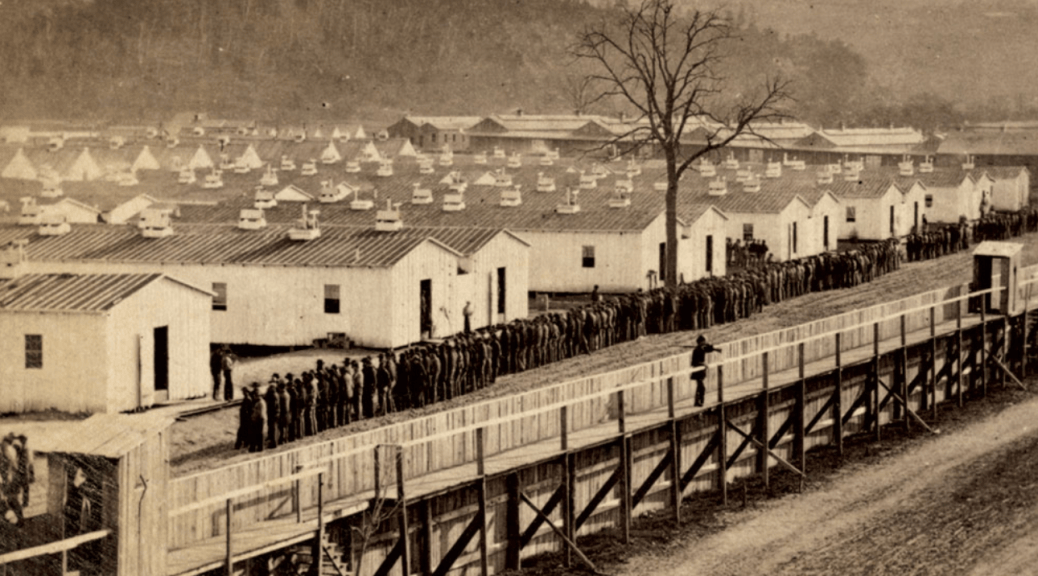
The fields are white! Winter in canvas houses! Pleasant here! Yet we’ve raised ours up four logs high, banked it up. Made a [ ] chimney on the side which makes it comfortable compared with most of them!
The following letter was written by Augustus Norton (1837-1917), the son of Joseph Hull Norton (1808-1888) and Rosanna Graham Johnson (1812-1882) of Athens, Athens county, Ohio. Augustus attended Ohio University in Athens, Ohio, and was married to Sarah Westcott Putnam (1845-1940) in 1860 before he enlisted as a 1st Lieutenant in Co. F, 1st West Virginia Cavalry. After one year of service, he resigned his commission and returned to Ohio where he helped organize the 7th Ohio Cavalry. He started as the Captain of Co. I in the fall of 1862 but was promoted to Major of the regiment by late December 1862. He resigned on 30 January 1864 on account of failing health.
Major Augustus Norton’s Frock Coat.
In 2012, Forsythes’ Auctions listed the Frock 7th Ohio Cavalry Coat that “belonged to Major Augustus Norton, with period inked inscription on inside liner of left arm near shoulder reading “Maj. A. Norton/7th OV Cav.”. This blue wool seven button double breasted officer’s frock coat has three shield breasted eagle cuff buttons with “C” in shield as do the fourteen buttons on front and four on split tail in rear. Green silk lining and polished linen lining in sleeves. Norton enlisted as captain but was soon promoted to Major in Nov. of 62. Regiment was drawn from SW Ohio, where Norton was from the Hocking Hills area. Known as the River Regiment their engagements included Carter’s Station, Mt. Sterling, KY Dutton’s Hill, Mills Springs, Rocky Gap, pursued and cornered Morgan’s Cavalry through Ohio to Bluffington Island. Captured CSA garrison at Cumberland Gap, second fight at Carter’s Station, Tenn., Blue Springs, lost 112 men at Rogersville, Siege of Knoxville, Bean’s Station, New Market, Danbridge, Fair Garden, fought and defeated Morgan’s Cavalry again near Cynthiana, KY., Franklin, Tenn., City Gate and Nashville. This cavalry unit saw some very heavy fighting throughout the war with 560 casualties in the regiment. A very few small moth holes and light wear at collar.”
T R A N S C R I P T I O N
Addressed to Miss Julia F. Norton, Athens, Athens county, Ohio
Lexington, Kentucky April 11, 1863
Dear Sister,
We are again quartered in our old camp at this place. We were brought back under orders to go up to Big Sandy—that is, one half of the regiment was to go there and the other half to go to Mt. Sterling. But I expect we will not be divided. The prospect now is that we will go to Tennessee. Everything in military is so uncertain that it is hard to tell what will become of us. I suppose ere this Father has received my letter sent from Crab Orchard giving him a full description of our last fight at Somerset. If I knew how long we were going to remain here, I would like to have Father send me some things or come down with them, but I guess it is most too uncertain. Although quite a number of the officers wives and friends are visiting them.
Had we been sent to Big Sandy, I would probably have been able to made you a short visit this summer but I will in all probability not get home for a year or more. It is but natural that we should feel a desire to meet our friends at home, but I presume that it is easier for me to be absent than it is for almost anyone else, although I think as much of my parents & sisters as anyone. Yet there is not the attention there or anywhere else that most young men of my age have to draw any attention in that direction. I sometimes feel like a stranger in a strange land, friendless and forsaken with nothing to look forward to in the future—nothing to cheer and make merry the weary soldiers—nothing in view which will in after years fully compensate me for the toil and hardships I am undergoing. In short, the future seems all a blank.
Yet I know that it has been my own fault that I am so situated. But so it is! Such is my fate! And I shall have to make the best of it. Unless there is quite a change in my mind, I never shall return to Athens to live, but will wander to some distant land, to wile away my remaining days in solitude.
Dear sister, I am doing very wrong, I fear, in writing you such a letter as this but such are my feelings this morning that if I write at all, I cannot help expressing them to you. You may wonder what caused me to have such feelings. Oh! no one knows the inner secrets of my heart “save Him who knoweth all things.” And no one ever can. They are buried deep in the secret corners of my heart and there will continue to dwell while life shall last. And when we shall arrive at our long, long home, our journey shall be ended, and we shall abandon our abodes of clay. Then will we be free. Then will we cast aside all our earthly troubles and join that heavenly band in singing songs of praises never ending. How the Christian longs for the arrival of that glorious day. Ah! Christian did I say? How few the number. How many will receive that unwelcome order, depart from me ye cursed. The gates of hell are open for you. Go thence & receive your just doom.
We were paid off yesterday & I will send Father some money soon. I want to buy me a horse first. My riding is too horrid on [ ]. There is nothing new here. Gen. Burnside is in the field with his “Gloves off” and something will no doubt be done soon. I will write to Father in a day or two. Give my love to all the family. Also to Aunt R___. Write soon and tell me all that in going on in Old Athens. Don’t forget to write soon to your unworthy brother, — Augustus
The following letter was written by Louisa (Rounds) Fairman (1822-1899), the wife of Harry A. Fairman (1818-1857). The couple were married on 30 July 1843. Harry was the son of Jared Fairman (1784-1874) and Hannah Howard (1797-1878).
T R A N S C R I P T I O N
Addressed to Mr. Jared Fairman, Borodino, Wayne county, Michigan
Adrian [Michigan] July 28, 1850
Dear Parents,
It is again my pleasant task to give you intelligence of our dear Harry [1818-1857]. I received a letter dated May 28th from him saying he was very well, but had not heard from any of you yet. He says he will be home late in the fall, or early in the winter if he is alive and well, whether he has a fortune or not. But he wanted to know if I would be willing to go there to live for a few years, so it seems he has some idea of going back if he comes home in the fall. But I shall not give myself much trouble about that, let me but get with him again, and I’ll go where he goes after that, I think.
You will see by this that I am still in Adrian but I shall leave here next week if nothing occurs to deter me longer. We have had a good visit with Uncle Charles [D. Howard] and Aunt Margaret [Vosburg]. Aunt and the children were here about two weeks. Went home [to Detroit] last Tuesday.
The funeral obsequies of President [Zachary] Taylor were observed in this place last Tuesday. The ceremonies were very interesting and impressive. The several different orators were out in regalia. An address by the Rev. Mr. [David A.] Curtis. The procession was half a mile long—quite imposing.
We have not seen anything of Ma and [brother] Sebre [Howard Fairman (1837-1911) yet. I am really sorry you could not come while I am here. I suppose sister Sarah [H. Fairman (1820-1866)] has it all her own way at home this summer, there all alone. I should think she would feel as if she was an only daughter. But I hope the rest of us will be mentioned often enough so she will not get the idea it is really so. I would like to come and see you before I go down home, but circumstances will not premit me to do so. Aunt Margaret [Howard] said she was going to visit you before long and wished to do so, but I shall see her at Detroit as I shall go there to take a boat for Buffalo.
I hope to hear from you at Buffalo or at my father’s. I hope to visit you next winter with my dear husband. Oh! dear me, it is a long time till winter. Love to all. Goodbye. Affectionately, your daughter, — Louisa
We don’t know what Wakeman looked like but he probably wore a uniform like this one of a hospital steward.
The following letter was written by 46 year-old Wakeman Young Andrews (1816-1886)—a man described as “earnest and true in all his dealings” who served as a hospital steward in the 108th New York Infantry during the American Civil War. He served with his son, Samuel W. Andrews (1844-1872) in Company I. Samuel survived the war but died of consumption in June 1872. Wakeman was discharged for disability on 27 December 1862, just one month after this letter was penned. He died in Rochester, Monroe county, New York, at the age of 69.
Wakeman datelined his letter from Washington D. C. in late November 1862, a couple of months after the Battle of Antietam where the regiment first saw the elephant. At Antietam, they suffered 30 killed, 122 wounded, and 43 missing.
[Editor’s Note: My thanks to Abbey Weber Jones for providing a first draft transcription of this letter.]
T R A N S C R I P T I O N
Washington [D. C.] November 25th 1862
Dear Col. [Oliver Hazard] Palmer,
I arrived here from Bolivar Hospital at Harpers Ferry Friday evening and I hope I never again hafto experience what I had to [go] thru after the regiment left. I cannot write you what I went through and the treatment received from Red Tape Doctors. Walter Crawford, the hospital cook, will inform you when he sees you. I did all in my power to make our men comfortable and to save their lives. After the regiment left, [I] went to the Division Hospital and seen Dr. Grant about bringing the sick there. He wanted to know why I did not bring the sick the day the regiment left. I told him I did not know that there was any order to that effect. He said there was and that Col. Palmer knew it. I told him I had not heard of any such order. He said I could bring as many sick as I would bring tents to put them in.
I took down the hospital ten[t] and one wall ten[t] and sent 4 shelter tents complete and sent 34 of the sick. Then there was left on the ground on[ly] shelter tents, besides 44 [patients]. I did know what to do with them so I had them stay hoping they would be well enough in a few days to go to the regiment. But General Green came to the camp and ordered me to clear the camp that day. I went to the General Hospital to see what could be done with them. They asked me why I did not bring them down the day the regiment left. I told them I did not know of any such order. They said that was not so. Dr. Ross said he gave the order. I told him if you had received any such order, you would have told me. So, there seems to be a good deal of feeling against the 108th [New York Infantry]. They asked me how many could not walk and I told them about eight and they said bring them to the hospital. I got an ambulance and went to the camp and General Green had ordered the camp to be racked up and fire set to the piles and we had all we could do to save the tents.
I got my men together and took them to the General Hospital. Then most of the men had to put up their shelter tents to cover them from the cold. So you see a little what I have had to contend with—a sick son near death’s door in one tent, Lieutenant [John M.] Davey in another, no doctor, except going and pleading with the surgeon of the 137th New York S. V. He came a few times or all he could and [still] do duty to his regiment. Finally I had a room hunted up in the second story of a house and sent my son there. And by that means and the blessings of God and other means used, he is still alive but broken in health. He looks like a shadow and I am not much better.
I was eight days before I could get teams to carry to the ferry the medicine and hospital stores. And before I came away, Capt. Flagg said, “you had better take your stores to Washington if you would wish them safe.” And on going to the warehouse, I found it so. Boxes had been broke[n] open, knapsacks torn to piece[s] and general destruction seemed to reign. Then I went to General Slocum and told him I wish to leave for Washington and wished to take the stores with me. He gave me transportation and they arrived here yesterday and are in store in the government warehouse and Col. Rucker told me they would be safe there anytime with Dr. [John F.] Whitbeck within the medicine and hospital stores. By ordering them, they can be sent forward.
They are marked J. F. Whitbeck, Washington, District of Columbia. I have done the best I could since the regiment left and if I have erred or done wrong, it is by ignorance—not knowing a better way. I have done all I could for our sick that the Doctor would let me, although I have been sick much of the time since the regiment left. I worked and then would lay down and so continued till our present time.
And now, dear Col. Palmer, the saddest part of my letter is to come. I suppose I am a ruined man so far as health is concerned for life by over doing and straining, I have a bad rupture come on my left side running down from my groin in the bag of my testicles giving me [a] great deal of pain and [it] troubles me to walk. And when I cough, it hurts me still more. [My] throat has been very bad and I cough and run a good deal of blood by times. Now what am I to do? I have done the best I could at all times and have [ ] been my strength and I am now suffering from it.
The doctor of the 149th Regiment New York S. Volunteers came to see my son and I told him [the doctor] who I was and he told me it would be dangerous to my life to go further in the service. Dr Arner [1st Assistant Surgeon] came in yesterday morning and went out at 11 o’clock to join the regiment. I expected to see him and have him examine me so he could inform you and Doctor Whitbeck. Now I have stated to you how I am and I am convinced it would cost me my life—and that very soon—to go with the regiment. Will you not send me some permit in writing that I could go home? On the money that is owing me by [the] government, I care little about. My head has been in the work of taking care of the sick and had I good health and [was] strong, I would like to go forward and take care of the sick and endeavor to save their lives. The spirit may be willing you know, but the flesh too weak to perform. Please write me any early reply.
Yours truly, W. Y. Andrews [Wakeman Young Andrews]
P. S. Enclosed I send statement of the number in [the] hospital, where they are, and how many deaths. Walter Crawford, which has been our cook, would make a good hospital steward and could attend to the place well. I had a letter from Dr. W[illiam] S[mith] Ely, 2nd Assistant Surgeon] yesterday. He said he would be released in two or three weeks and would then go and join the regiment. Yours truly — W. Y. Andrews
Pip: Letters that survived two centuries of attic boxes, estate sales, and archivists with good judgment — and here we are, reading them on the internet
Mara: This episode draws on Griff’s recent posts, covering soldiers writing home from the front, personal correspondence from the home front and beyond, and one early maritime letter that predates the Civil War by half a century.
Pip: Three very different kinds of distance — battlefield, frontier, open ocean.
Mara: Let’s start with the soldiers.
Voices From the Front Lines
Pip: What does a soldier actually put in a letter home — and what does he leave out?
Mara: James Bennett McKee, writing to his sister Mary from camp near Fredericksburg on New Year’s Day 1863, gives us the texture of it: “soldiering is hard business.”
Pip: Five words that carry a lot. He’s just survived Fredericksburg, where his regiment took 177 casualties in an hour and a half, and that’s what he offers her — not horror, just a plain accounting.
Mara: The letters are full of that restraint. He worries about a missing box from home, asks after a neighbor’s wedding, gently scolds Mary for wishing him ill so he’d miss a battle. The domestic and the dangerous sit right next to each other.
Pip: George Brown Eckert, writing to his sister Rachel across eight letters, is less restrained — he calls the defeat at Fredericksburg “a bad one at that” and describes Union troops destroying pianos in the city with axes.
Mara: Eckert is also lobbying hard for a furlough. He writes from the Mud March aftermath — sick with chills and fever, rheumatism in his arm — describing sixteen horses struggling to pull a single light artillery piece out of the mire.
Pip: Meanwhile Mathias Shumaker, writing from Brandy Station just weeks before Spotsylvania, tells his friend Henry Martz “I like it better here than at home. We have more fun here than at home.” He would be wounded, captured, and dead at Andersonville by July.
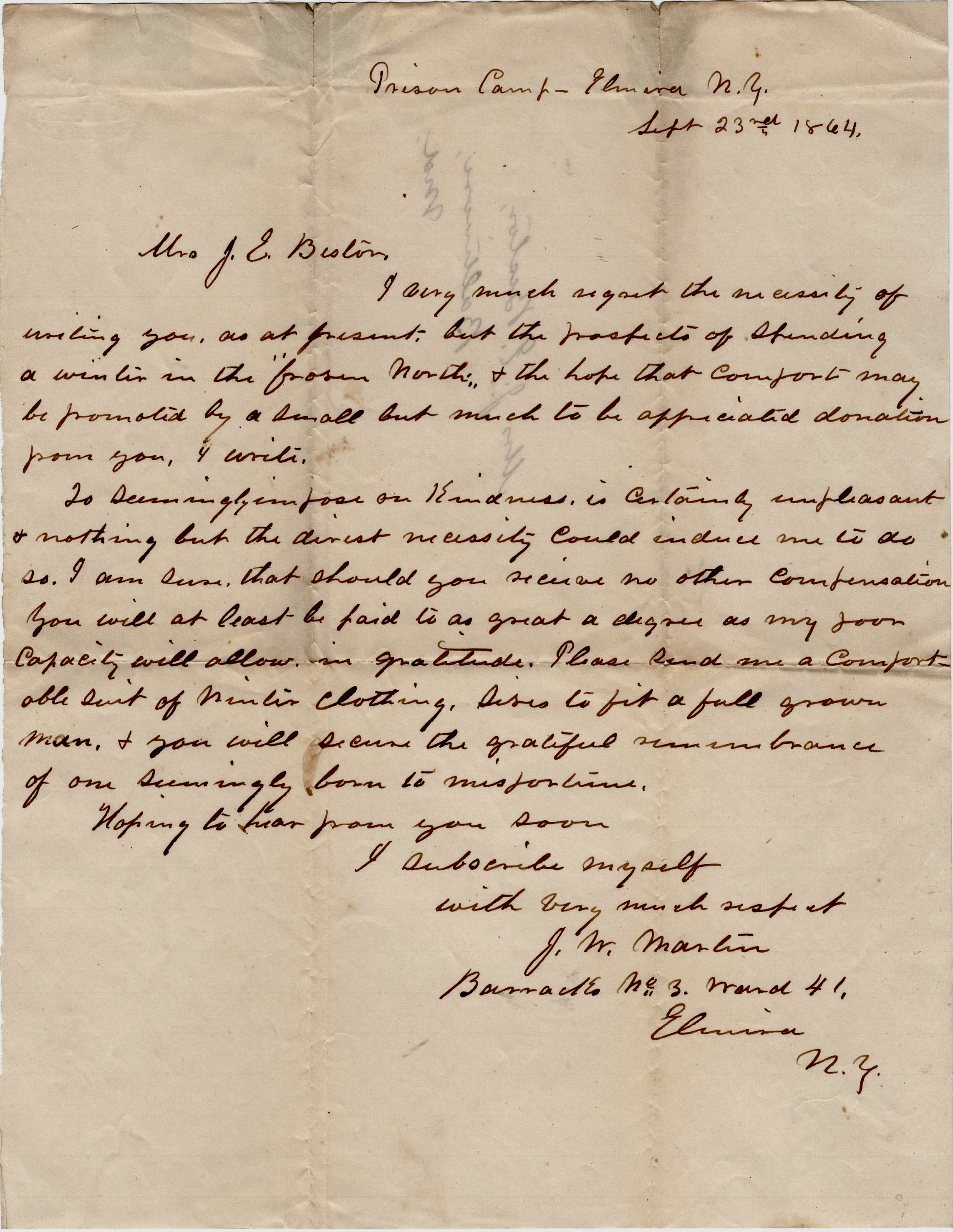
Mara: Abram Clark, writing from Fort Marion in Florida, measures his experience against his cousin’s: she mentions a relative who was “under fire for 5 days.” Clark counters that he was “under as heavy fire as any man living ever say for 13 days and nights” and watched comrades “dropped by hundreds at a few rounds of grape and shell.”
Pip: The assistant surgeon Adam Clark Baum writes the longest dispatches — battle narratives that read like dispatches, including a scene at Cold Harbor where Union and Confederate soldiers quietly stopped shooting, climbed out of their works, and started chatting until an officer ordered them back at gunpoint
Mara: Abbie Brundage writes from the Aurora home front, three days after the Gettysburg Address, worrying about the cost of living and how the poor will survive the winter. Her husband’s regiment fought at Gettysburg; she’s writing to a cousin still in the field.
Pip: Henry Ballou is counting alligators on the Mississippi. Forty-four of them, from the deck of a troop transport heading to New Orleans.
Mara: Charles Weeks, recovering from a wound at Bethesda Church, writes a brief practical letter trying to keep a friend out of the Invalid Corps. John Crabb reports the fall of Fort Blakely — the last major assault of the war — with quiet confidence: “I think our work is about done now.” And John Augustus, writing from South Carolina in January 1865, asks his sister Jane to pray for him.
Pip: The range is remarkable — from Eckert’s furious lobbying to Augustus’s simple request for someone to remember him.
Mara: The next letters step away from the battlefield entirely.
Letters Between Friends and Family
Pip: Not every letter in this batch is addressed to a regiment — some are just people trying to stay connected across distance.
Mara: Ellie, writing to her friend Cinda Hughes in Ohio on April 16, 1865, captures the whiplash of that particular week: “The folks were almost crazy here when the news came Richmond was taken and Lee had surrendered. They rung all the bells in town and have had bonfires almost every evening this week.” Then Lincoln was shot, and the flags went to half-mast.
Pip: One letter, two American moods, forty-eight hours apart.
Mara: Phineas Talcott writes from Denver in December 1873, describing a frontier life he calls “a Mark Twain Life” — his sewing machine sales agency has gone bust, he’s heading to a ranch to hunt antelope, and he’s been practicing conversation with an Indian chief. And James Ward, a Confederate soldier at Chaffin’s Farm, writes to Viola Haney in the Shenandoah Valley, defending his intentions and reporting that the men haven’t had meat in ten days.
Pip: From jubilation to bankruptcy to a hungry soldier pleading his case to a skeptical woman — the personal letter contains everything.
Mara: Speaking of distance measured in ocean miles — one letter in this episode predates all of them by sixty years.
Quarantine on the Mediterranean
Pip: What does a letter look like when it has to be dipped in vinegar before it can leave the ship?
Mara: Jeremiah Winslow, writing to Thomas and Charity Rotch from quarantine off Marseille in October 1806, explains exactly that: “All letters passing from vessels at quarantine must be put in vinegar. Therefore you must not think it strange if the paper should be colored.”
Pip: The paper is stained, the brig has been battered by one of the worst Mediterranean storms in memory, and Winslow is stuck on a rock island with a French pilot and a guard, waiting six days for clearance to go ashore.
Mara: He reflects on the voyage at length — the near-wrecks, the profane sailors, the captain who had drifted from his Quaker faith and seemed to be finding his way back. Winslow writes that in the moments of greatest danger he felt “more calmness than I could have experienced on the most high was my only refuge.”
Pip: Two hundred and twenty years old, and it still reads like a man trying to make sense of surviving something he wasn’t sure he would.
Mara: What holds all of these together is the gap between what the writers know and what their readers know — every letter is written into uncertainty.
Pip: And somehow they all found their way here. Next episode, more of what the mail carried.