My passion is studying American history leading up to & including the Civil War. I particularly enjoy reading, transcribing & researching primary sources such as letters and diaries.
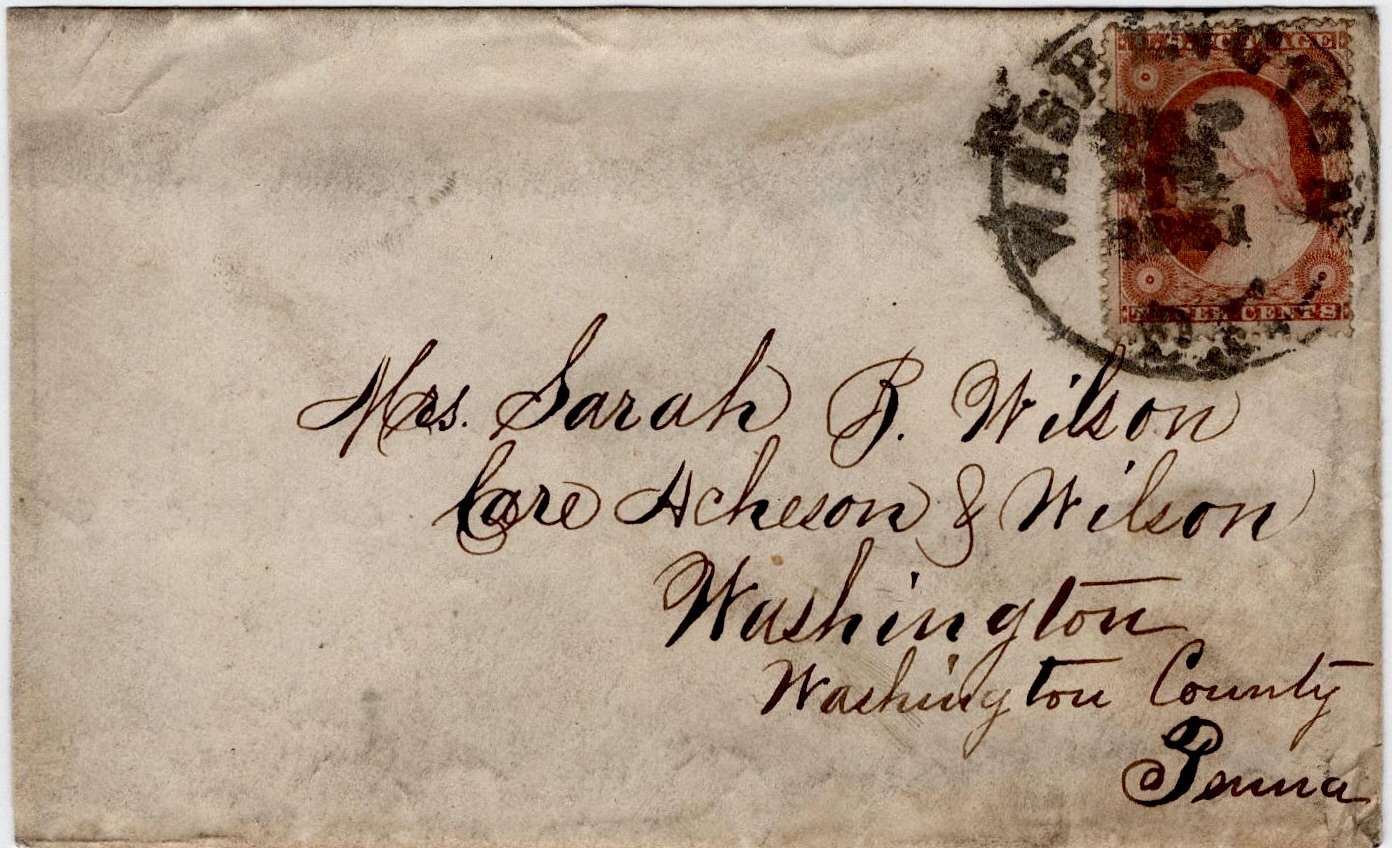
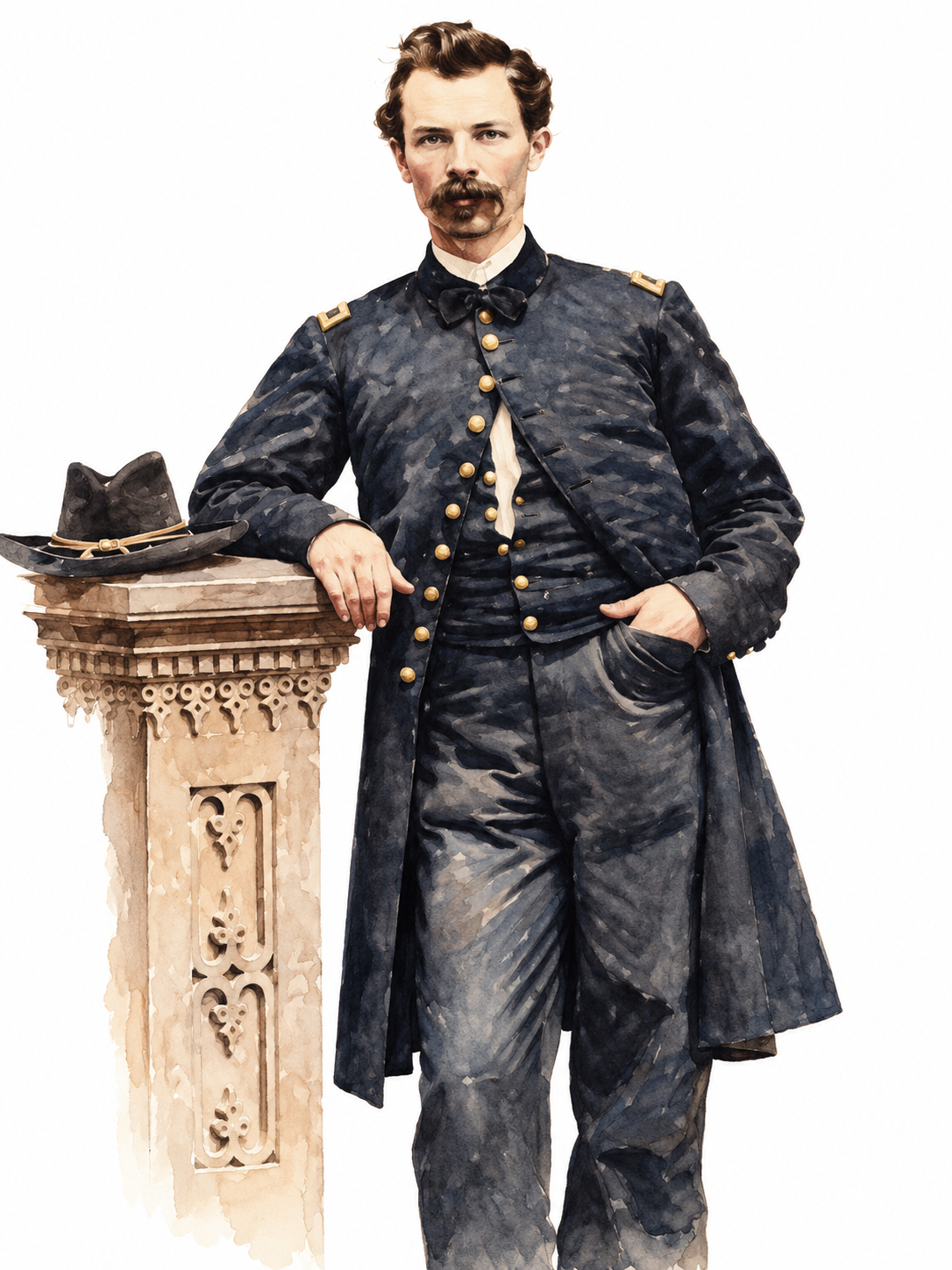
The following letter was written by George Baird Caldwell (1840-1916), the son of Alfred Caldwell and Martha Baird of Washington, Pennsylvania. A graduate of Washington College, he was studying law in the office of the firm of eminent lawyers, Acheson & Wilson, at Washington, Pennsylvania, when the war broke out. When the first call was made for what was known as the “three months men,” George “left his law studies and took the field as a member of the 12th Pennsylvania Regiment, being appointed a corporal in his company, and although small in size, he did his full duty during this term of enlistment.
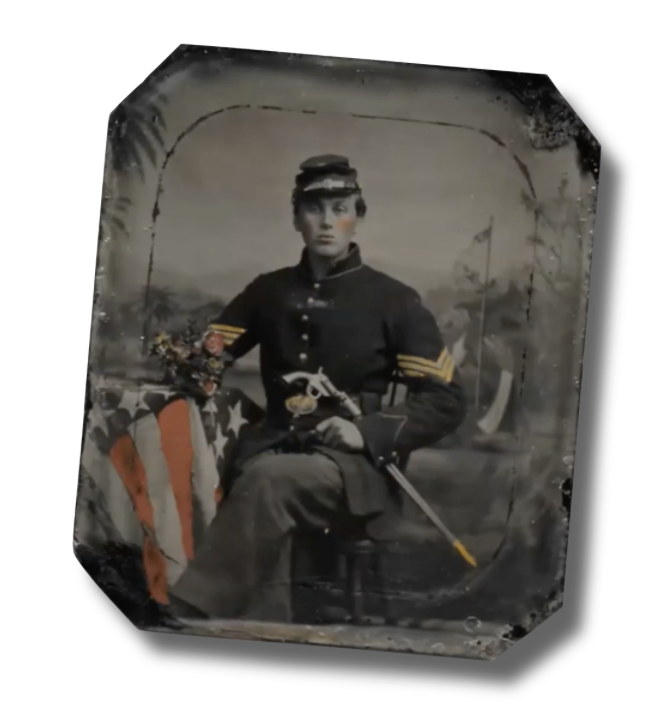
While in Beaufort in 1862, many soldiers in the Roundhead Regiment had their tintype taken like this one of Sgt. Robert Moffatt (Michael Kraus Collection)
Upon returning home, his regiment having been discharged, George immediately reenlisted at Washington in Co. A of the 100th Pennsylvania Regiment, known as “The Round Head Regiment.” With this regiment he went under Gen. Benham to South Carolina and took part in an abortive attempt by that general to storm the Confederate works in and about the city of Charleston. By request of the loyal governor of Virginia, Mr. Caldwell, after a service of eighteen months in the ranks, was honorably discharged from the Pennsylvania troops by proper authority, for the purpose of receiving a commission in a loyal Virginia regiment being organized, and which was afterwards known as the 12 West Virginia (Union) Infantry. He was commissioned first lieutenant and adjutant of this new regiment, and served with it until practically the close of the war, when he was honorably discharged from the service on account of a reduction of the army, and entered upon the practice of his profession as an attorney-at-law in the city of Wheeling, serving, in all, nearly four years as a soldier.”
“While with his commanders, Gen. Thoburn and Col. Curtis of his own regiment, making reconnaissance, just before the battle of Fisher’s Hill, (called Mount Hope by the Confederates), a Confederate battery of field artillery, securing the range to where this clump of Union officers was gathered on an eminence, threw a shell into their midst, which carried off one leg of the horse upon which Adjutant Caldwell was riding. The next day he went into action on foot. As he was near one end of the Union line, which had pushed forward and covered ground faster than the rest of the assailants, he was one of the earliest to scale the Confederate works, and found himself almost alone when he jumped down amid the enemy. While shouting his commands to the Confederates, who were throwing down their arms and surrendering, to get over the works in the direction from which he had come, and behind the Union lines, a private soldier, who had scaled the works long after he had done so, stooped down, right at the adjutant’s feet, and picked up a Confederate flag or stand of colors, encased in a black oil-cloth case, which had been for some minutes lying at the officer’s feet, unobserved by him. A sergeant of his regiment called to him and asked him to take the colors from this soldier who had picked them up, saying that they rightfully belonged to the adjutant, whose foot was almost on them, and who, as stated, had been in the works long before the man who picked the flag up. He refused to take the captured colors from the enlisted man who had picked them up, because, as he always said, he would not have it charged to him that he had exercised his power as an officer over an enlisted man in such a case, however much justification he might have for it.” [Source: Caldwell Family Records]
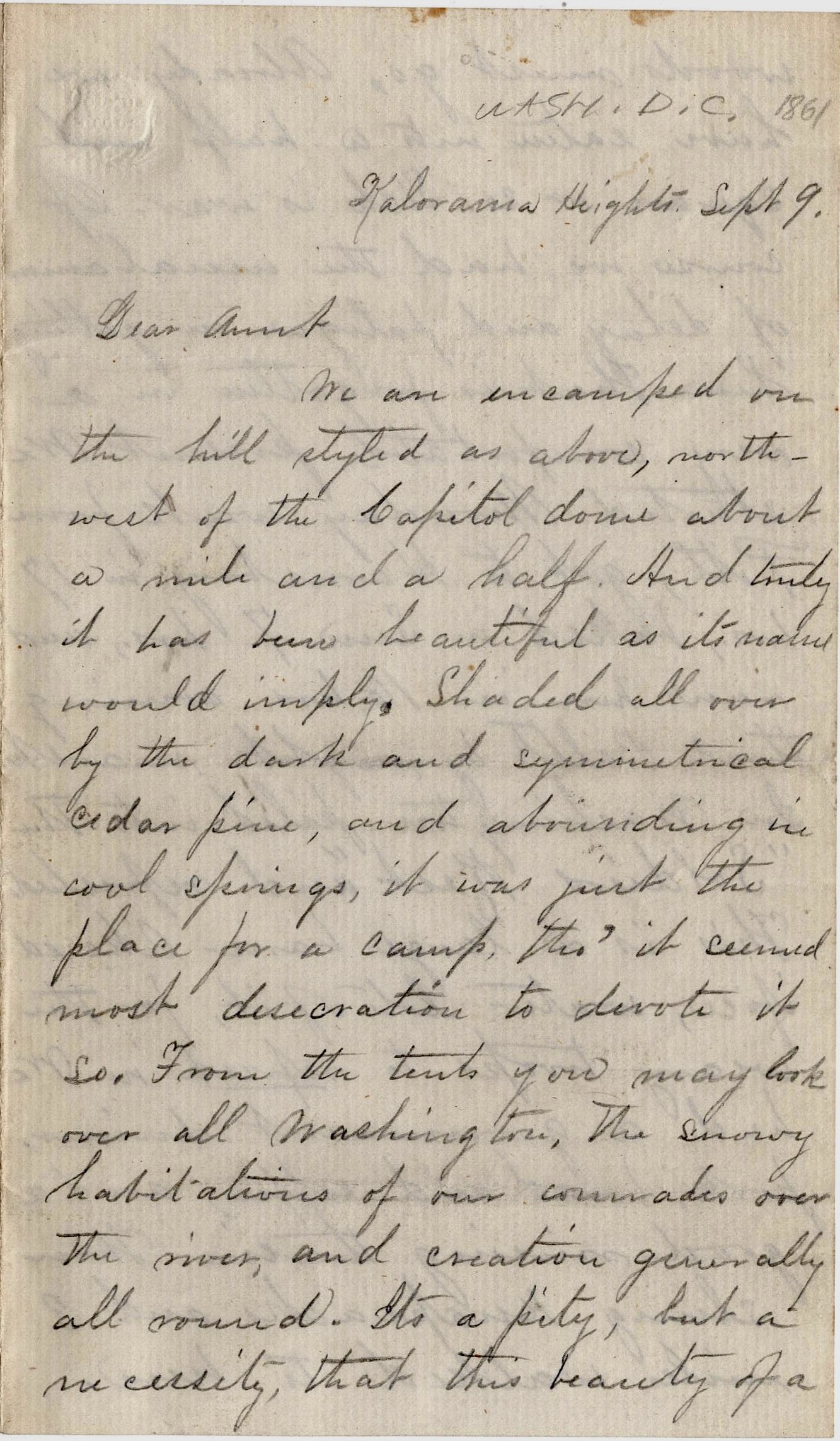
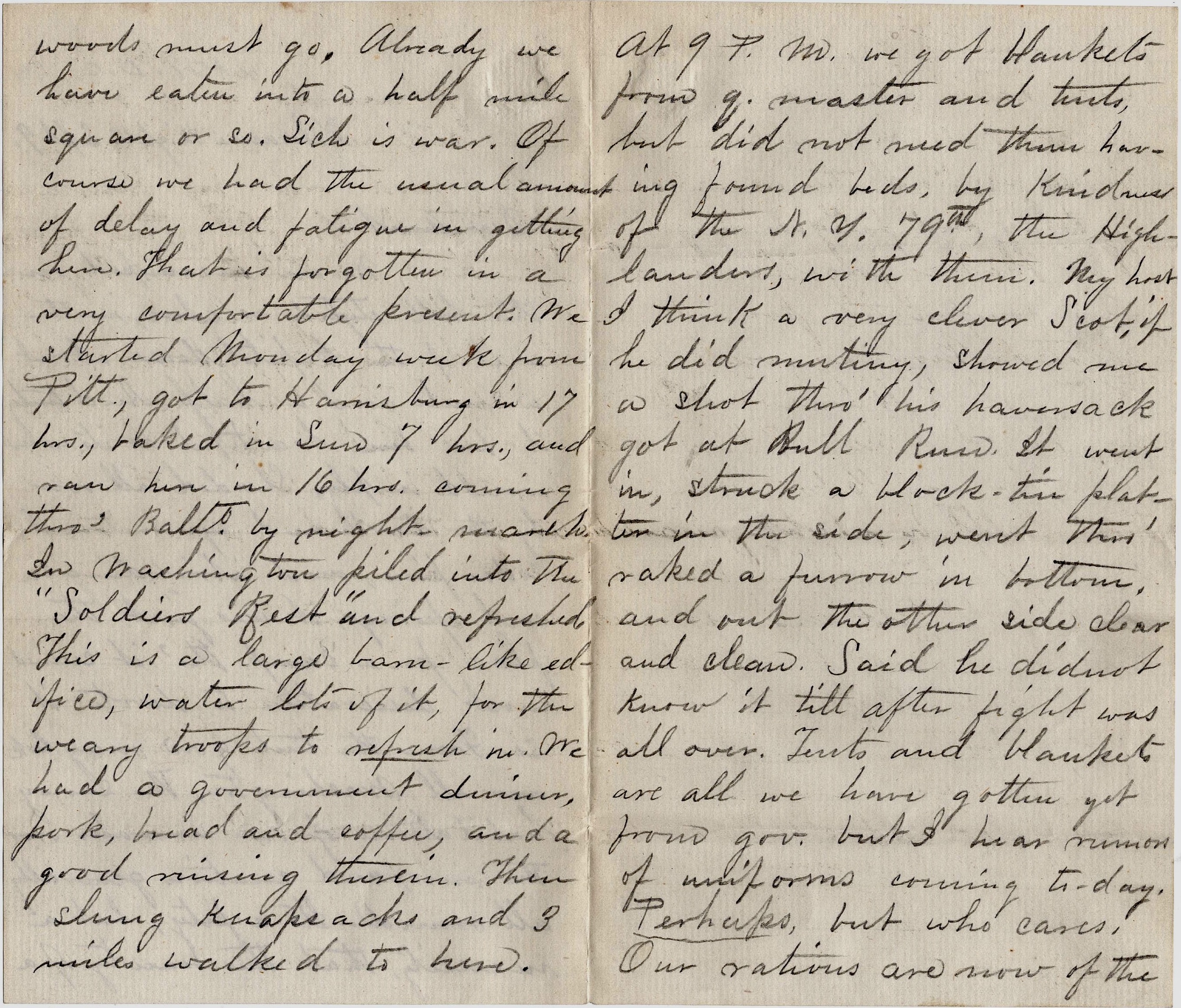
T R A N S C R I P T I O N
Kalorama Heights [D C.] September 9 [1861]
Dear Aunt,
We are encamped on the hill styled as above, northwest of the Capitol dome about a mile and a half. And truly it has been beautiful as its name would imply. Shaded all over by the dark and symmetrical cedar pine, and abounding in cool springs, it was just the place for a camp, tho’ it seemed most desecration to devote it so. From the tents you may look over all Washington. The snowy habitations of our comrades over the river, and creation generally all round. It’s a pity, but a necessity, that this beauty of a woods must go. Already we have eaten into a half mile square or so. Such is war. Of course we had the usual amount of delay and fatigue in getting here. That is forgotten in a very comfortable present.
We started Monday week from Pittsburgh, got to Harrisburg in 17 hrs., baked in sun 7 hours, and ran here in l6 hrs coming thro’ Baltimore by night march. In Washington, piled into the “Soldiers Rest” and refreshed. This is a large barn-like edifice, water—lots of it—for the weary troops to refresh in. We had a government dinner, pork, bread and coffee, and a good rinsing therein. Then slung knapsacks and 3 miles walked to here.
At 9 p.m. we got blankets from quartermaster and tents, but did not need them, having found beds by kindness of the N. Y. 79th—the Highlanders—with them. My host I think a very clever Scot, [even] if he did mutiny, 1 showed me a shot thro’ his haversack got at Bull Run. It went in, struck a black tin platter in the side, went thro’, raked a furrow in bottom, and out the other side clear and clean. Said he did not know it till after the fight was all over.
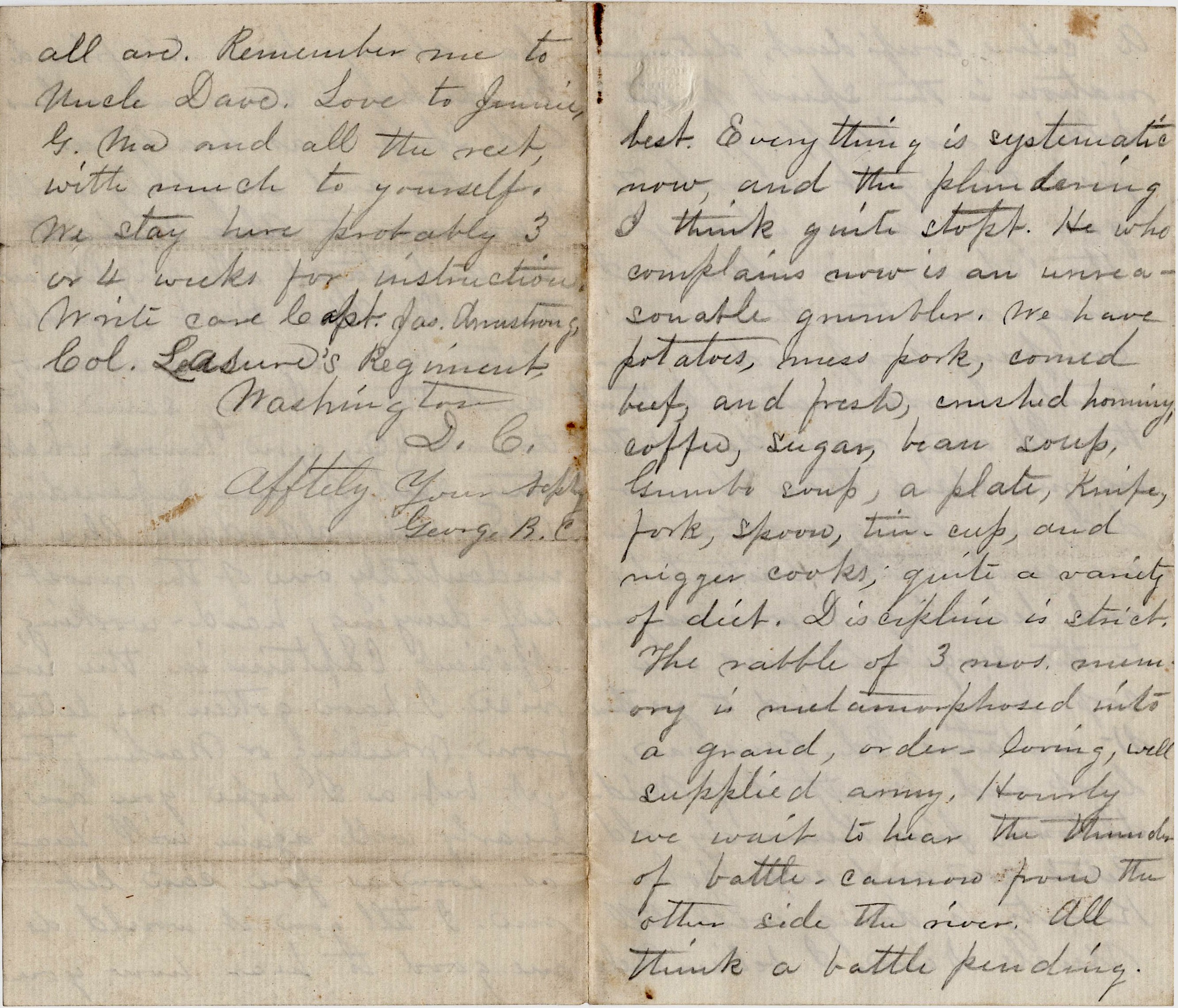
Tents and blanket are all we have gotten yet from the government but I hear rumors of uniforms coming today perhaps—but who cares. Our rations are now of the best. Everything is systematic now, and the plundering I think quite stopped. He who complains now is an unreasonable grumbler. We have potatoes, mess pork, corned beef, and fresh, crushed hominy, coffee, sugar, bean soup, Gumbo soup, a plate, knife, fork, spoon, tin cup, and nigger cooks; quite a variety of diet. Discipline is strict. The rabble of 3 months memory is metamorphosed into a grand, order-loving, well-supplied army. Hourly we wait to hear the thunder of battle cannon from the other side the river. All think a battle pending.
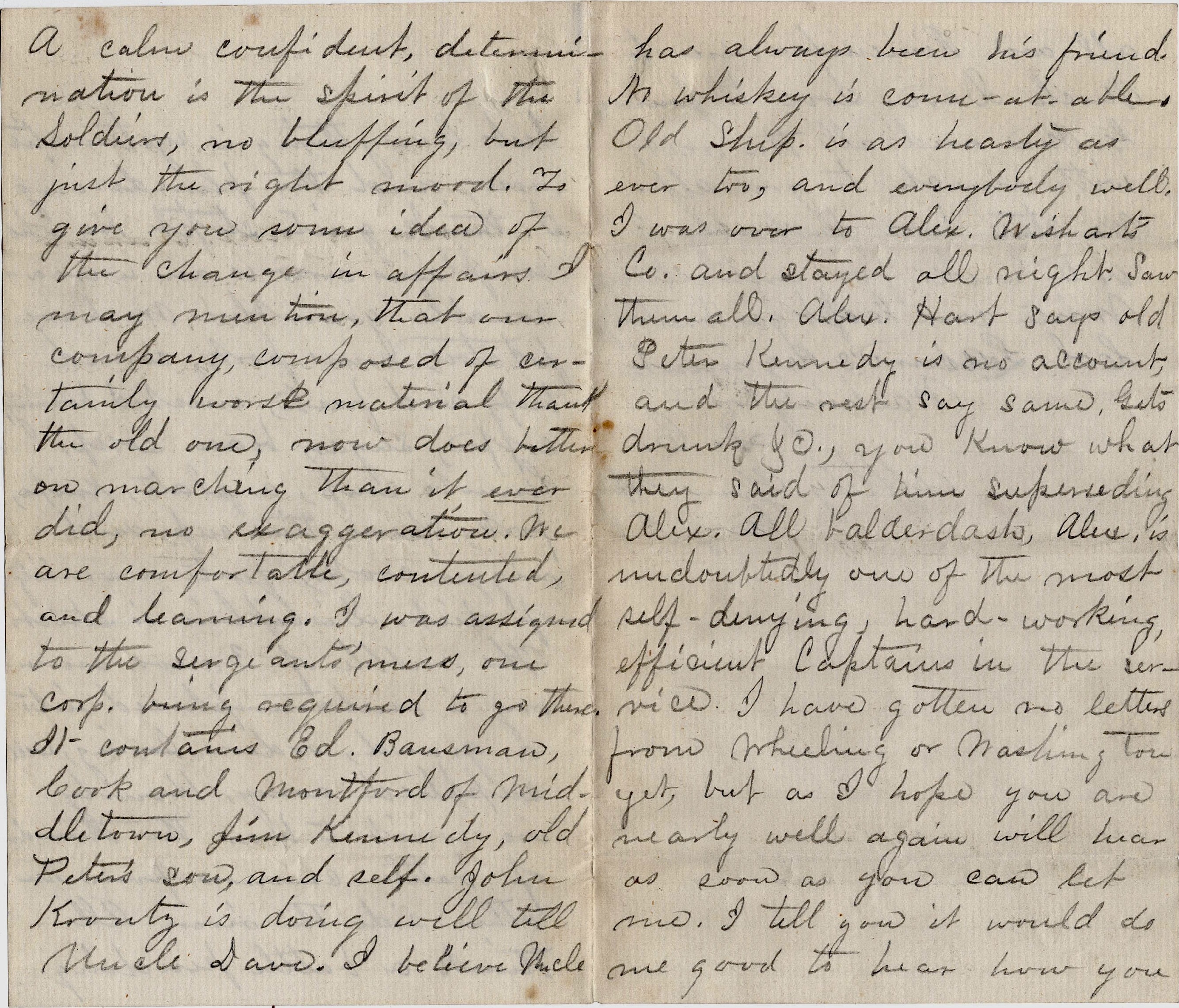
A calm, confident, determination is the spirit of the soldiers—no bluffing, but just the right mood. To give you some idea of the change in affairs, I may mention that our company, composed of certainly worse material than the old one, now does better on marching than it ever did—no exaggeration. We are comfortable, contented, and learning. I was assigned to the sergeants’ mess, one corporal being required to go there. It contains Ed Bausman, [John] Cook and [James W.] Montford of Middletown, Jim Kennedy—old Peter’s son, and self. John Koontz is doing well. Tell Uncle Dave. I believe uncle has always been his friend. No whiskey is come-at-able. Old Ship is as hearty as ever too, and everybody well.
I was over to Alex Wishart’s Co. and stayed all night. Saw them all. Alex. Hart says old Peter Kennedy is no account, and the rest say same. Gets drunk &c. You know what they said of him superseding Alex. All balderdash. Alex is undoubtedly one of the most self-denying, hard-working efficient captains in the service.
I have gotten no letters from Wheeling or Washington yet, but as I hope you are nearly well again will hear as soon as you can let me. I tell you it would do me good to hear how you all are. Remember me to Uncle Dave. Love to Jennie, G’Ma and all the rest, with much to yourself. We stay here probably 3 or 4 weeks for instruction. Write care of Capt. Jas. Armstrong, Col. Leasure’s Regiment, Washington D.C.
Affectionally your Nephew, George B. C.
1 The 79th New York (“Highlanders”) Infantry suffered severe losses at Bull Run, including the death of their Colonel, James Cameron (brother of Secy. of War Simon Cameron). When they did not get a chance to return to New York to recruit and select their own replacement Colonel, they revolted and refused to obey orders or perform fatigue duty in building defenses around Washington D. C.
These letters were written by Meriwether “Jeff” Thompson (1826–1876), one of the more colorful Confederate commanders in the Trans-Mississippi theater. A native of Virginia who settled in St. Joseph, Missouri, Thompson worked as a surveyor, engineer, businessman, and served as mayor of St. Joseph before the war. He was married in 1848 to Emma Hayes, the daughter of a Baltimore artist. An ardent secessionist, he was elected brigadier general of the Missouri State Guard in 1861 and became famous for his operations in the swamps and river country of southeastern Missouri, earning the nickname “Swamp Fox of the Confederacy.” Although commonly styled a Confederate general, Thompson’s brigadier-general rank was actually in the Missouri State Guard; he never received that rank in the regular Confederate Army. His wartime service carried him through Missouri, Arkansas, Tennessee, and Louisiana, including a brief stint commanding Confederate river vessels.
Thompson was captured at Pocahontas, Arkansas, in August 1863 while attempting to raise a new command. After confinement in St. Louis and at Johnson’s Island, Ohio, he was transferred to Fort Delaware, the formidable Union prison on Pea Patch Island in the Delaware River. Thus, when he wrote this letter in March 1864, the once highly mobile “Swamp Fox” had been a prisoner for more than six months. At Fort Delaware he became a prominent figure among the Confederate officers, writing poetry and helping organize entertainments to relieve the monotony of captivity. He remained there until his exchange in August 1864, after which he returned to the field, commanded troops during Sterling Price’s Missouri campaign, and ultimately surrendered his command in Arkansas in May 1865. He died of tuberculosis in 1876—a disease he probably contracted while in prison. [Sources: Encyclopedia of Arkansas, Civil War on the western Border (KC Public Library)]
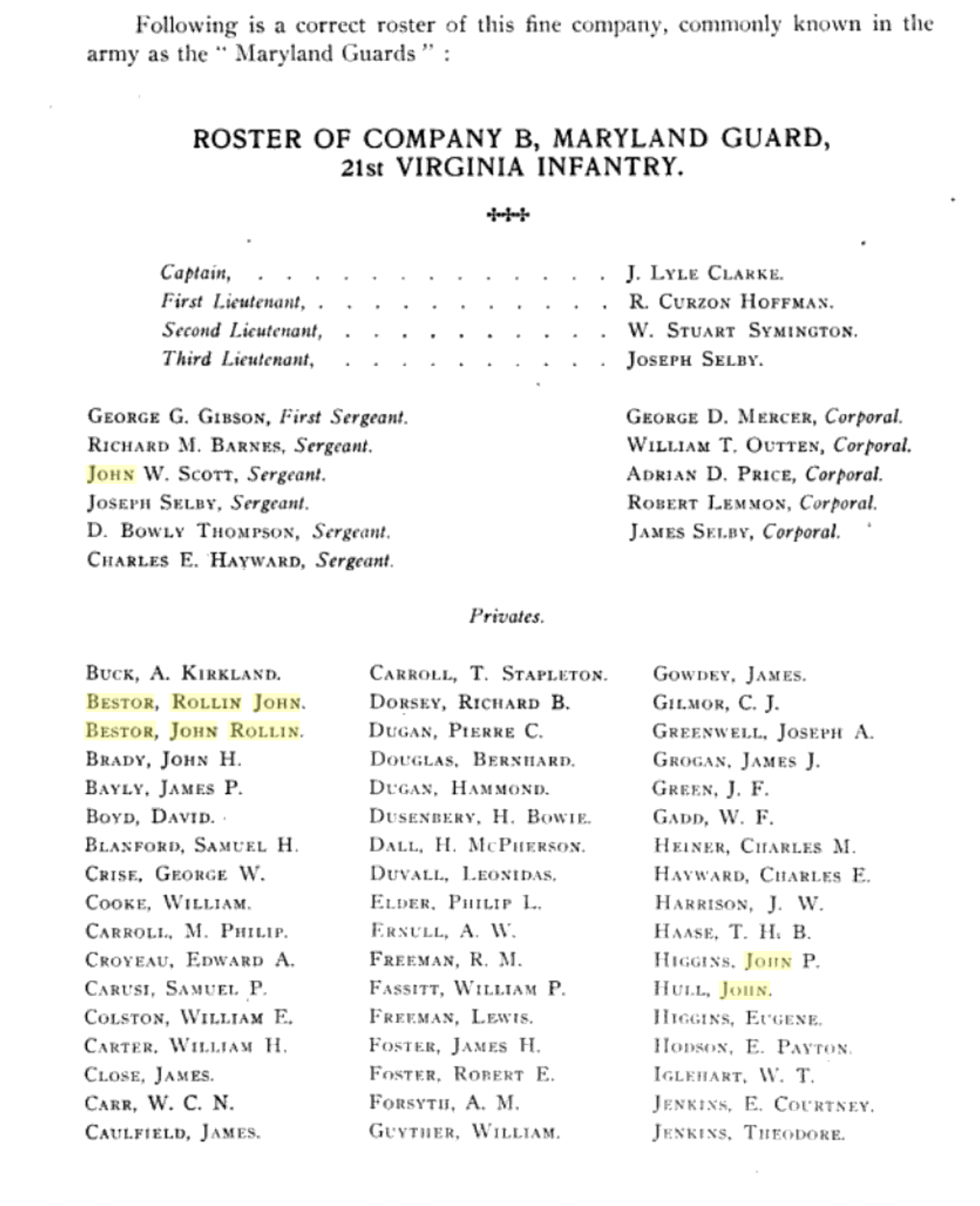
Thompson wrote the letters to his Baltimore relative, Jane Eliza (Brown) Bestor (1820-1885), the wife of John Rollin Bestor, Sr. (1813-1867). This Baltimore couple had twin sons who served in the Maryland Guard that became Co. B, 21st Virginia Infantry. Their letters have been transcribed and may be found at 1861-65: The Bestor Brothers of Baltimore.
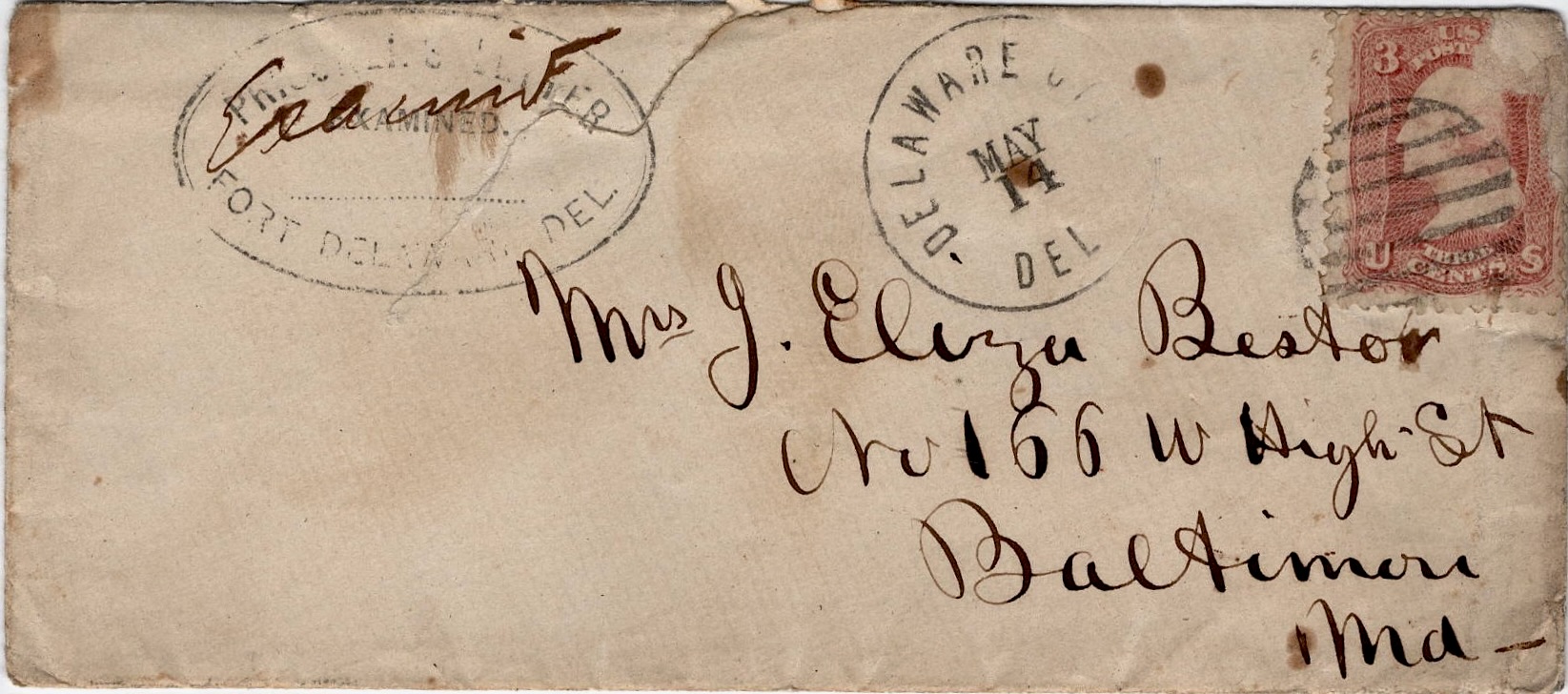
An interesting aspect of this particular letter is that it was three pages in length. Most prisoners were limited in their correspondence to one page—for both outgoing and incoming letters. “Supposedly, all letters were examined by censors and any letter over one page was considered to be contraband and therefore not delivered to the prisoner. This rule led to prisoners using every square inch of the page to write their messages. At times the letters greater than one page were removed from the cover, and the empty cover was sent to the prisoner. When General M. Jeff Thompson was imprisoned on Johnson’s Island in September of 1863, he took steps to eliminate the one page rule. He struck a deal with those censoring the letters. Long letters were to be read by the censors in the evening rather than during the day. Thompson would see that they received two and one-half cents per page for each page read. The censors agreed, but the matter had to be kept secret. This worked well as the censors were able to make several dollars more per day than their pay. However, the scheme fell apart when a prisoner complained to the prison commandant that he had to pay a dime tax to receive a four page letter. After the matter was investigated, the long letter mail was stopped.” Perhaps Thompson struck such a deal at Fort Delaware as well for his are the only letters I’ve seen that exceeded one page. [Source: Letters to and from Confederate Prisoners]
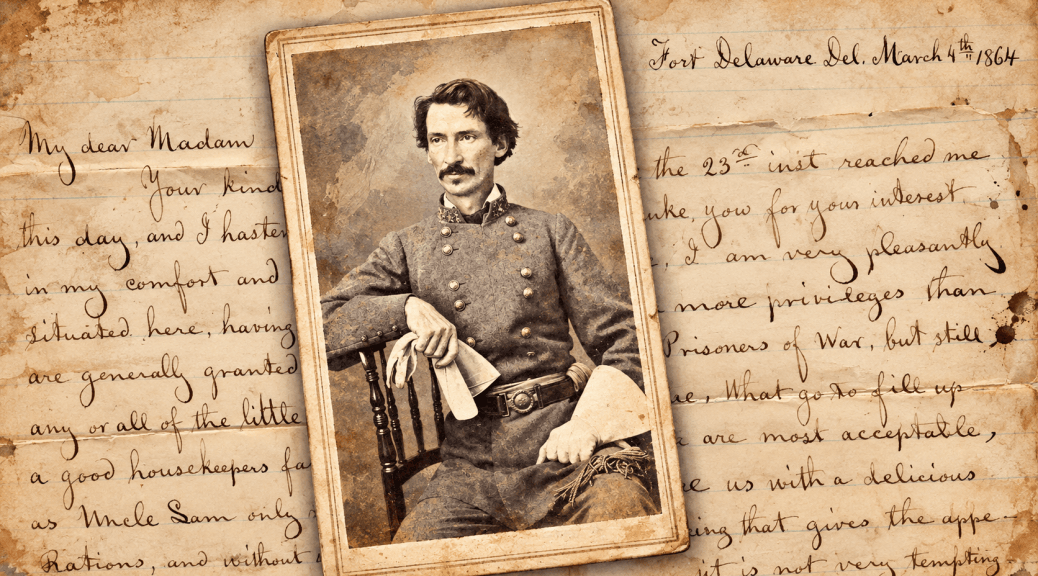
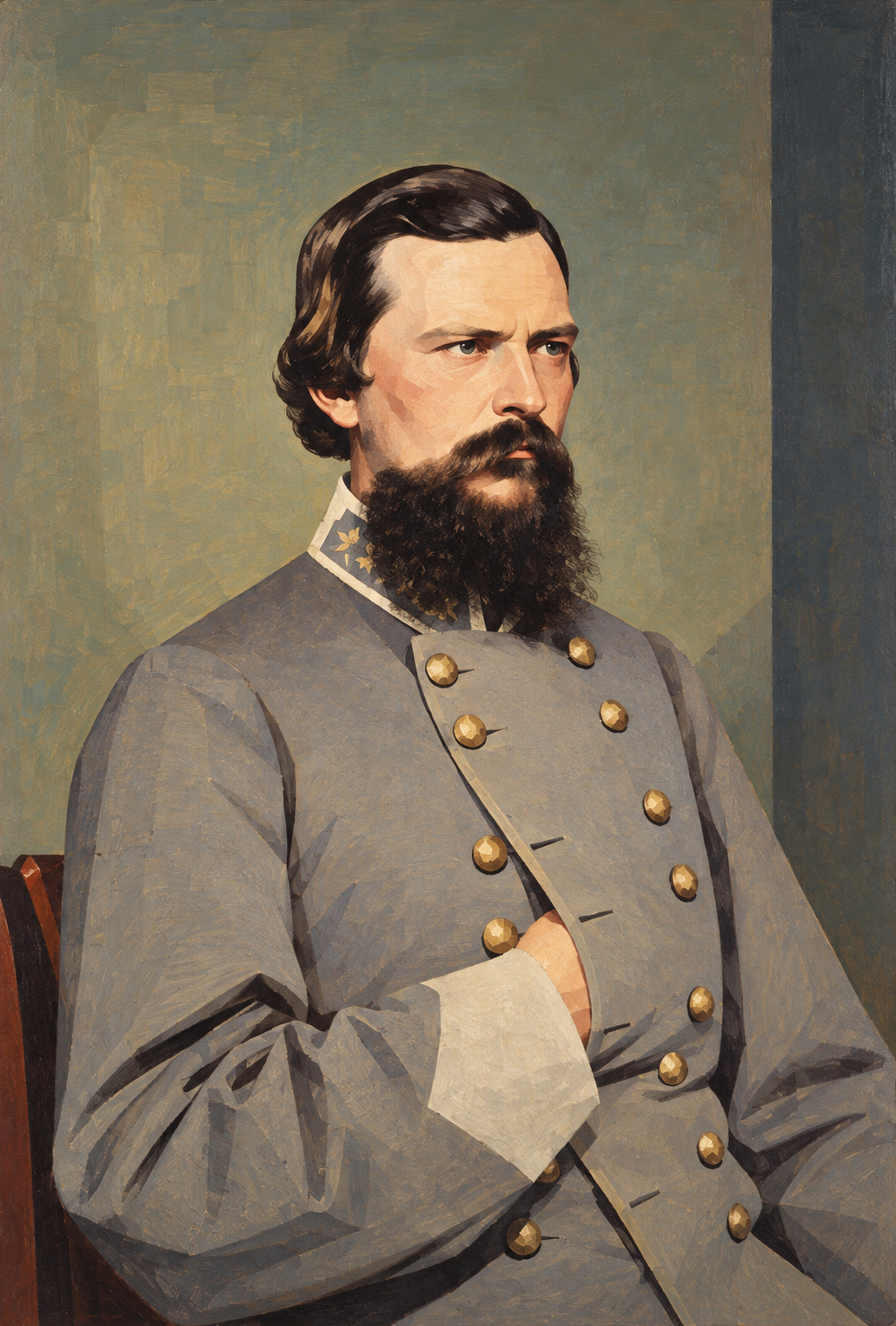
[Editor’s Note: The image of Thompson in the header is based on a photograph in the Library of Congress.]
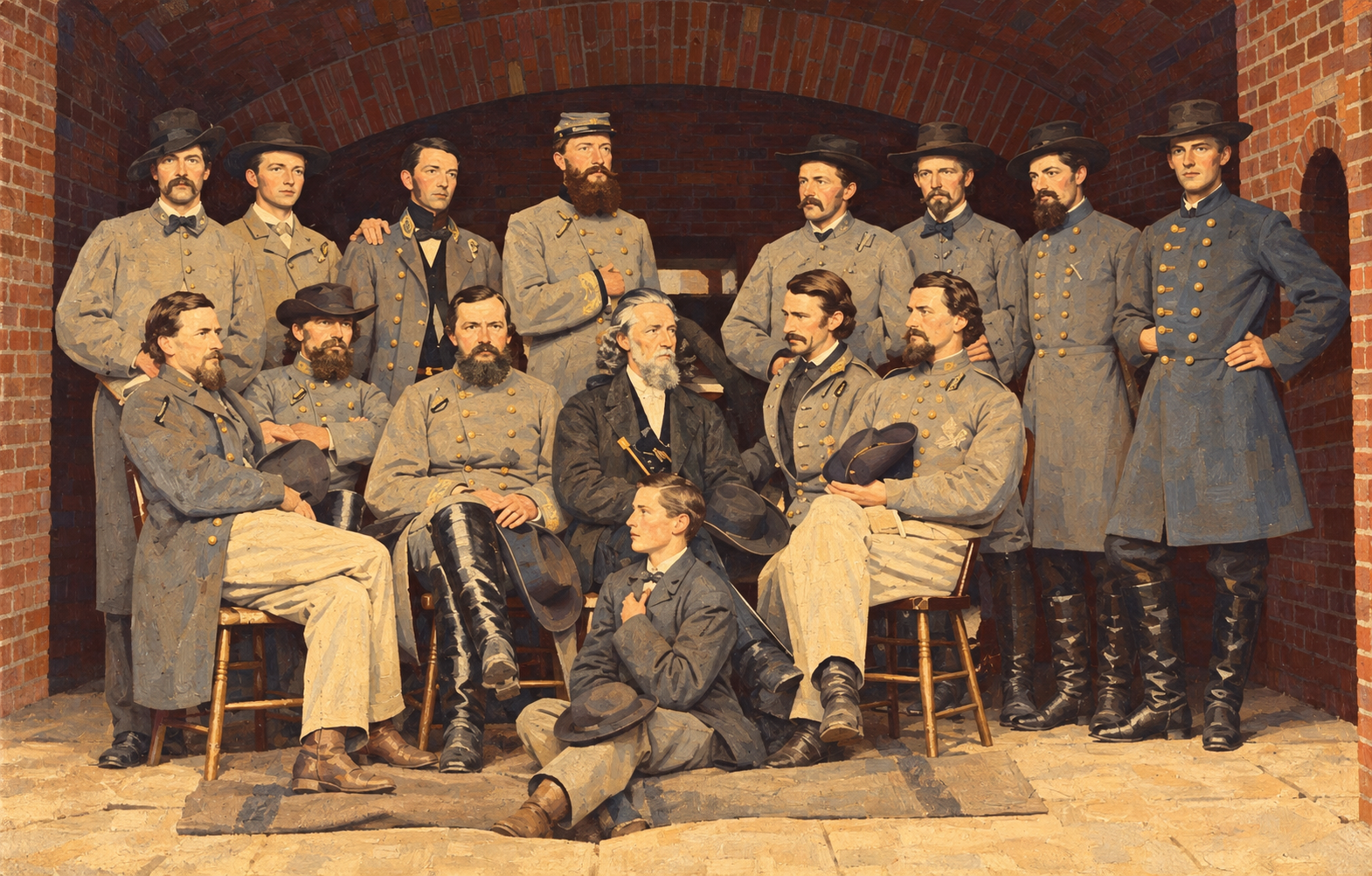
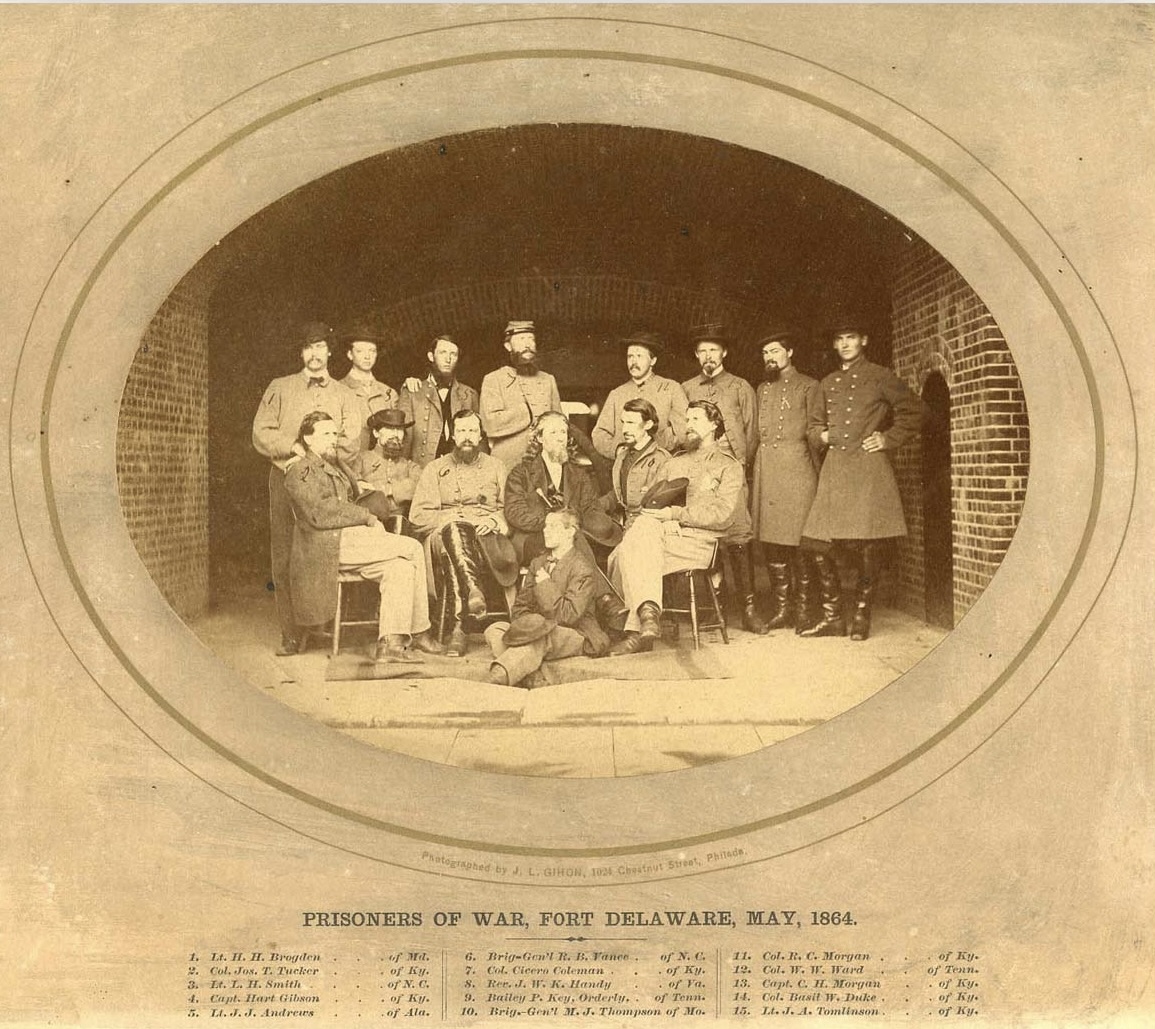
This image of Confederate officers held at Fort Delaware was taken in April 1864. M. Jeff Thompson is seated second from right. The Rev. Isaac W. K. Handy, a political prisoner held at Fort Delaware wrote on 30 April 1864, “The photographer has been the great man of the day. The artist tried his skill, with a group embracing the paroled officers, [Henry] Brogden and myself, making fifteen in all.
“The company did me the honor to give me the central position with General [Robert] Vance on the right, and Gen. [Jeff] Thompson on the left—the others seated on either side, or standing in the rear, with Bailey [Peyton] Key, the orderly, on a blanket in front.
“Something was said about bringing a couple of Rebel ladies into the picture. Gen. Jeff [Thompson] good humoredly suggested, that it was ‘bad enough to introduce a preacher into such company;’ and so the ladies, beautiful, and thoroughly ‘secesh,’ will be more appropriately daguerreotyped upon the hearts of certain distinguished heroes, for whom their visit was more especially intended.”
Letter 1
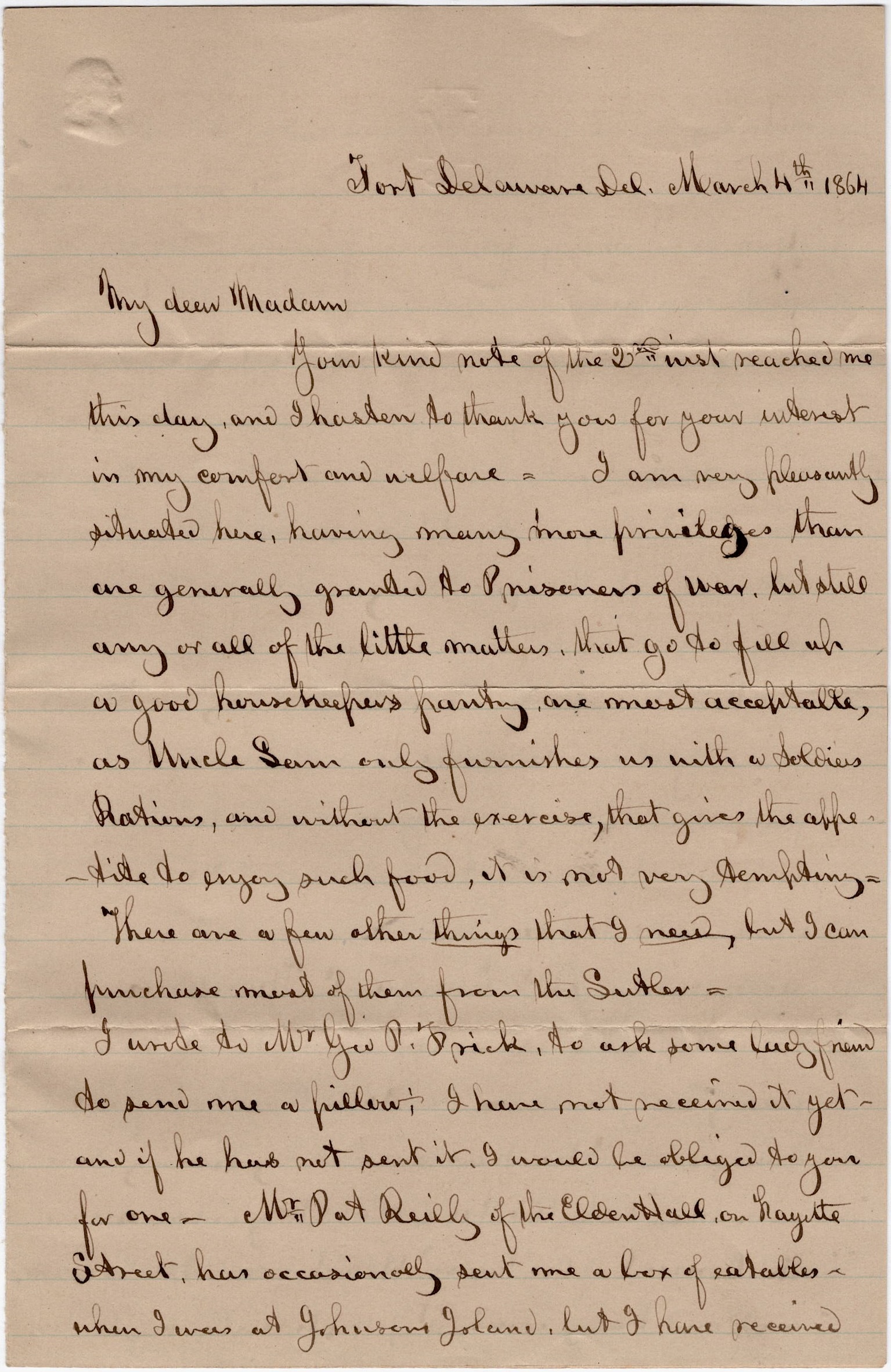
Fort Delaware, Delaware March 4th 1864
My dear Madam,
Your kind note of the 2nd inst. reached me this day and I hasten to thank you for your interest in my comfort and welfare. I am very pleasantly situated here, having many more privileges than are generally granted to Prisoners of War. But still any or all of the little matters that go to fill up a good housekeeper’s pantry are most acceptable as Uncle Sam only furnishes us with a soldier’s rations, and without the exercise, that gives the appetite to enjoy such food, it is not very tempting. There are a few other things that I need but I can purchase most of them from the sutler.
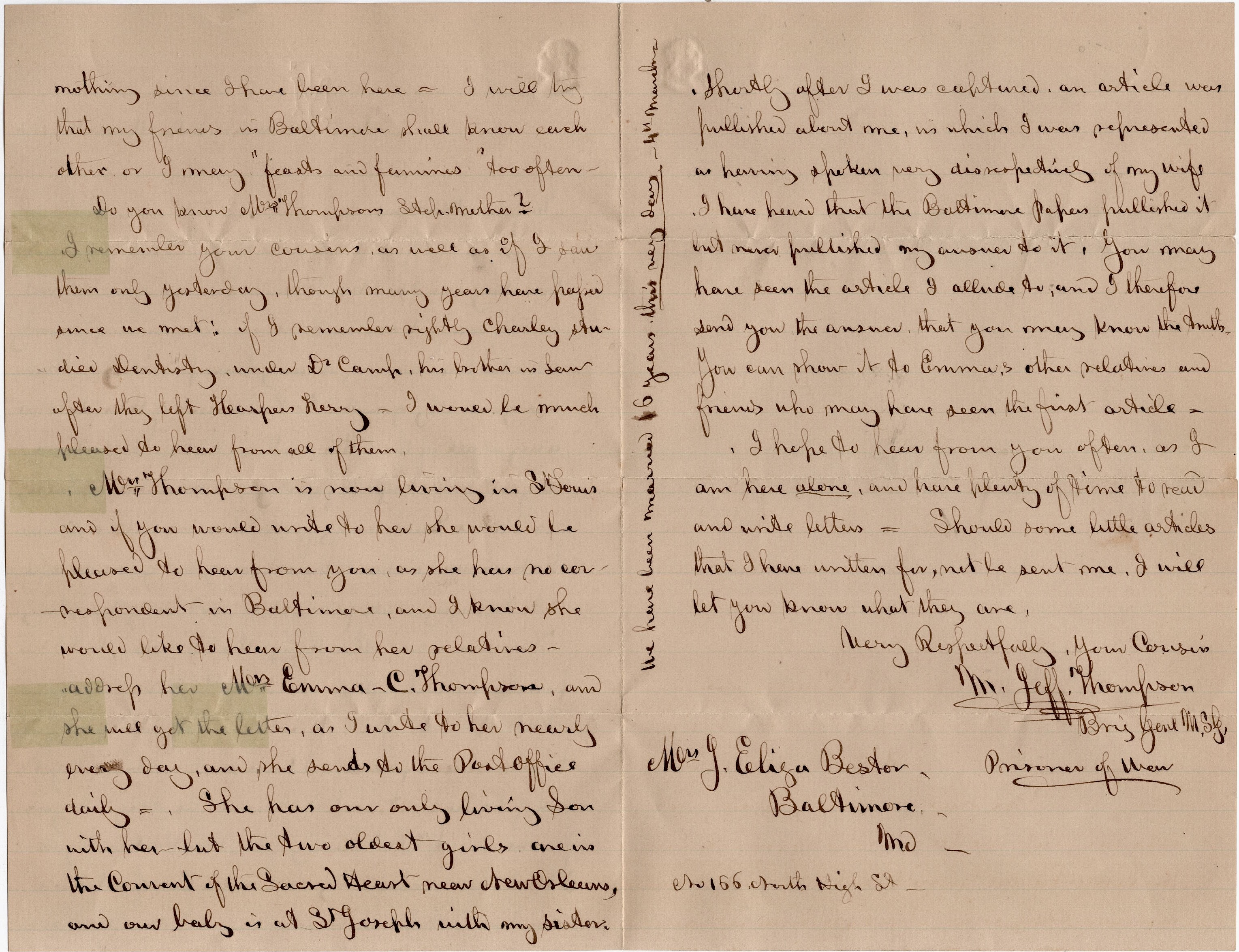
I wrote to Mr. George R. Frick to ask some lady friend to send me a pillow. I have not received it yet and if he has not sent it, I would be onliged to you for one. Mr. Pat Reilly of the Elden Hall on Lafayette Street has occasionally send me a box of eatables when I was at Johnson’s Island, but I have received nothing since I have been here. 1 I will try that my friends in Baltimore shall know each other or I may “feasts and famines” too often.
Do you know Mrs. Thompson’s step mother? I remember your cousins as well as if I saw them only yesterday, though many years have passed since we met. If I remember tightly, Charley studies Dentistry under Dr. Camp, his brother-in-law, after they left Harpers Ferry. I would be much pleased to hear from all of them.
Mrs. Thompson is now living in St. Louis and if you would write to her, she would be pleased to hear from you as she has no correspondent in Baltimore and I know she would like to hear from her relatives. Address her Mrs. Emma C. Thompson and she will get the letter as I write to her nearly every day and she send to the post office daily. She has our only living son with her but the two oldest girls are in the Convent of the Sacred Heart near New Orleans and our baby is at St. Joseph with my sister.
Shortly after I was captured, an article was published about me in which I was represented as having spoken very disrespectfully of my wife. I have heard that the Baltimore papers published it but never published my answer to it. You may have seen the article I allude to and I therefore send you the answer that you may know the truth. You can show it to Emma’s other relatives and friends who may have seen the first article.
I hope to hear from you often as I am here alone and have plenty of time to read and write letters. Should some little articles that I have written for not be sent me, I will let you know what they are.
Very respectfully, your cousin, — M. Jeff Thompson, Brig. Gen. M. S. G. [Missouri State Guard], Prisoner of War
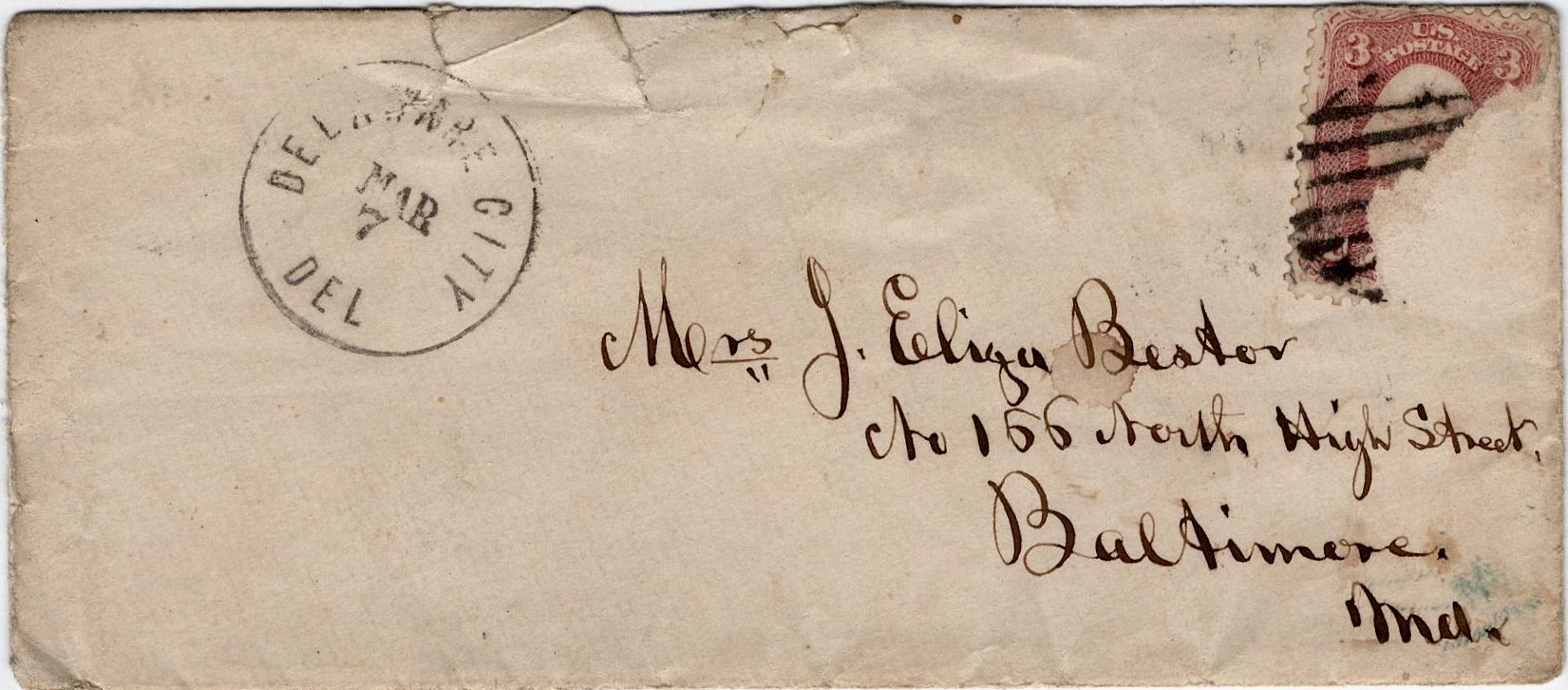
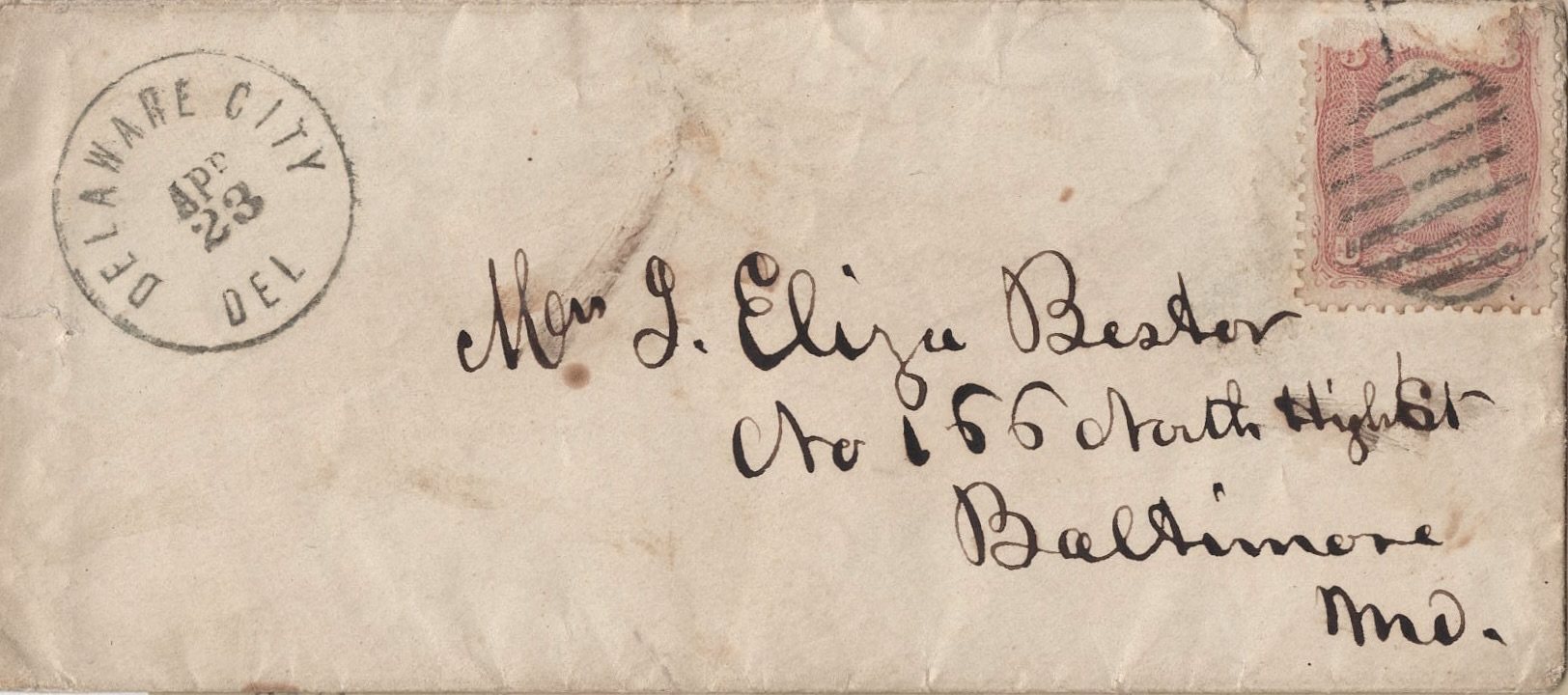
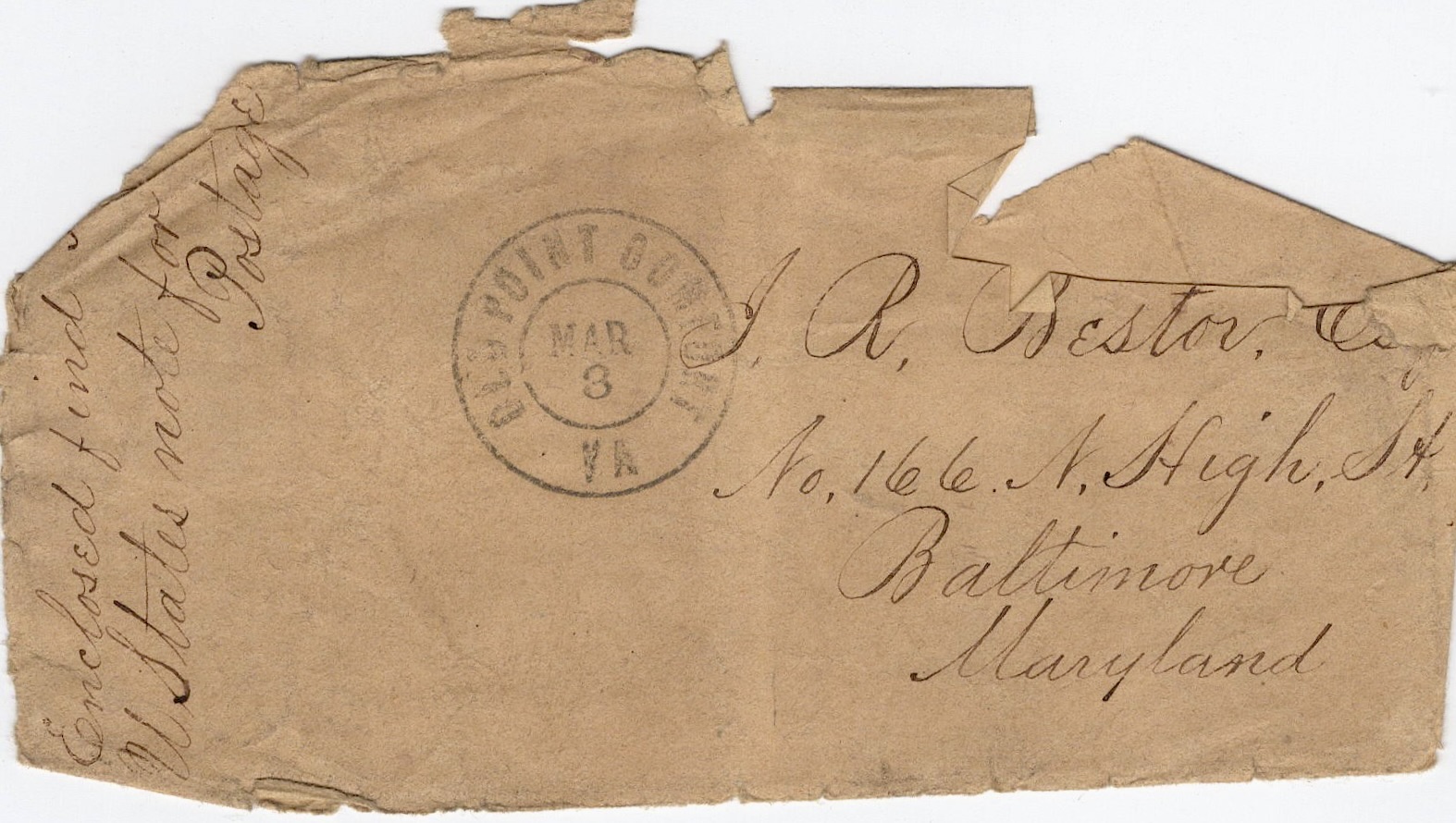
To Mrs. J. Eliza Bestor, Baltimore, Md., No. 166 North Hight Street.
We have been married 16 years this very day—4th March.
1 Patrick Reilly was the proprietor of Eldon Hall, a well-known restaurant and dining saloon in Baltimore. It was located at 75-78 West Fayette Street. Reilly sold it in 1888.
Letter 2
Fort Delaware Del. April 5th, 1864—Tuesday night
Dear Cousin,
The Box reached me safely today, and I am delighted with the pants and coat, and everything else sent.
Today has been too inclement to go to the barracks to distribute the other clothes, but tomorrow I hope to be able to get down. The collars were the style I wear exactly, and I now have enough to last me through the war, and the steel collar will do to wear where washing is difficult to be done. I received several things from New York today and am now well supplied with clothes. I gave my old clothes to the “pile” to be distributed tomorrow. I can only have a valise full of clothes on hand with a probability of getting them through when I am exchanged, and therefore when I get anything that suits me better than what I have, I give away what I swap for.
Martin’s bundles will be properly delivered. He was present today when the boxes were delivered and was sent away empty handed because my boxes were not examined, and I had not received the letter until after he had gone back to the barracks. After he was gone, we found the bundles and they will be delivered to him tomorrow.
Brogden did not report anything as being for me but as I often eat with him, it answered the same purpose when he received boxes. But now I am not permitted to visit the Political Prison and therefore cannot eat with him now. Brogden now has a parole of the Island, and is much in my room. He is a very nice fellow, and I am quite fond of him.
The fresh oysters you sent are soured, and I have tried the experiment of pickling one can, but the others had to be thrown away. I regretted it much as I am passionately fond of them, and these looked so large and fine that I felt tempted to risk the cholera morbus on them. The Cove Oysters are nice, and I stewed and ate one can of them by myself today. The tomatoes are my next favorite dish to oysters, and I will try them tomorrow.
My messmates all send their thanks to you for your sympathy, and also for the eatables. We have ten now besides Bail! (our orderly) in the mess, and I am the housekeeper or chief of mess. So I have my hands full of business.
I suppose you allude to Major Simon’s sister. Did her Father receive a letter from me shortly after I came here? If he did not, I will write again, just for the pleasure it will give Gus some of these days, when he knows that I told his Father what a brave and efficient officer he was.
I sent Miss Lou one of my Photographs last night which will replace the mad L [?] one you gave away. If you would like to have one of the others, I will send it to you, as I have two of them left.
You must cheer up about your Jewels, and thank God and be proud that you are able to do so much for your country. I know it is hard—very hard—to be separated from them when they are in constant danger, but if you are uneasy and unhappy about them, it may unnerve their arms and then they would be truly in danger. I wish my girls were all boys and old enough to be in the ranks. I would be very proud of them.
Since the creation of the world there has been wars, and there always will be wars, and the bravest and the best will do the fighting and sacrifice their lives for Liberty, Glory, Religion, or honor, and brave sons should have brave Mothers, and you must trust your Jewels in the hands of God, and abide His will.
Give my kindest regards to all friends and relatives. I will write again soon.
Your Grateful Cousin — M. Jeff. Thompson
<missing scans>
Letter 3
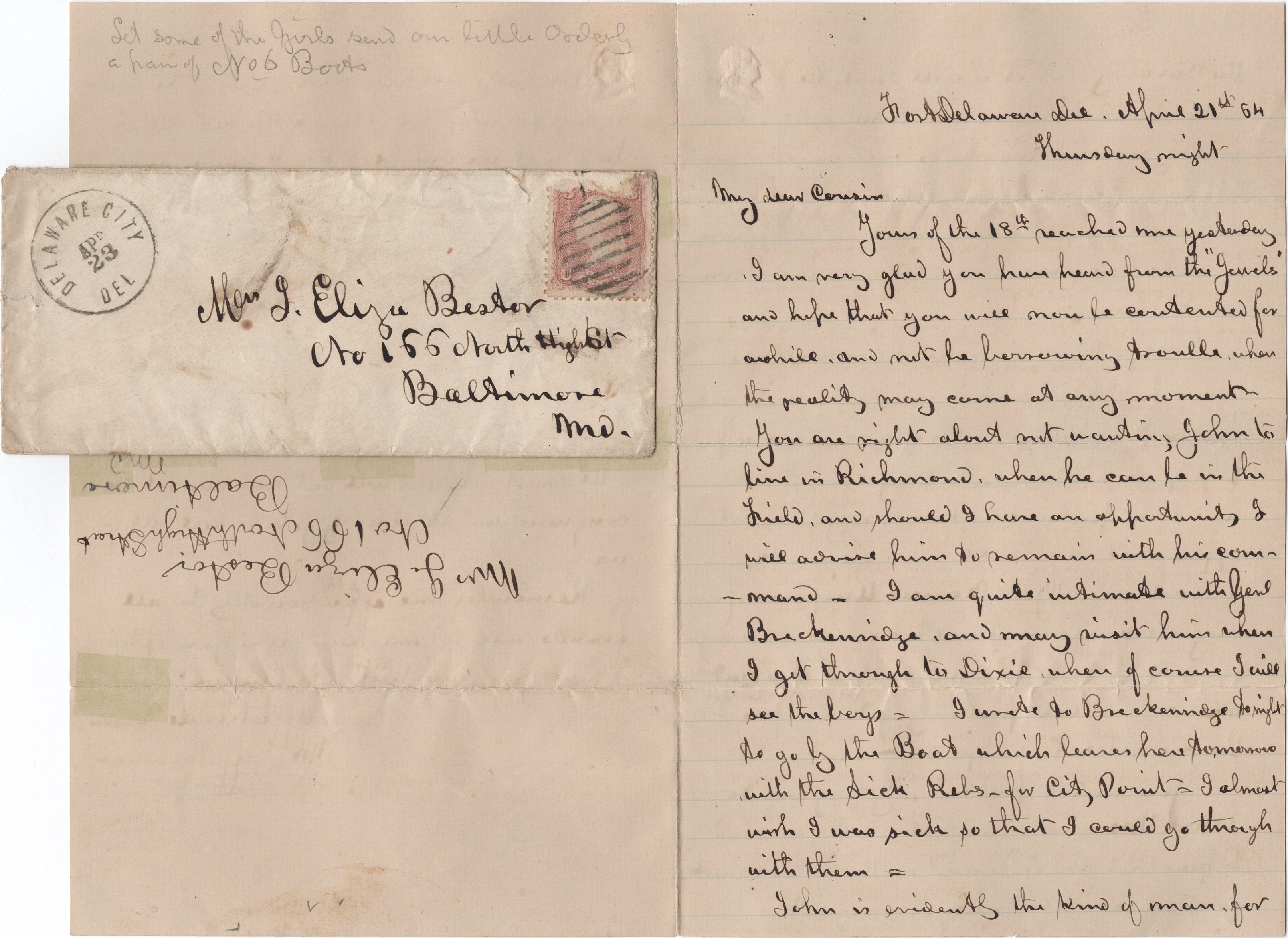
Fort Delaware, Del. April 21st ’64 Thursday night
My dear Cousin,
Yours of the 18th reached me yesterday. I am very glad you have heard from the “Jewels” and hope that you will be contented for a while and not be borrowing trouble when the reality may come at any moment. You are right about not wanting John to live in Richmond when he can be in the field and should I have an opportunity, I will advise him to remain with his command. I am quite intimate with Gen’l Breckenridge and may visit him when I get through to Dixie, when of course I will see the boys. I wrote to Breckenridge tonight to go by the Boat, which leaves here tomorrow with the sick Rebs for City Point. I almost wish I was sick so that I could go through with them.
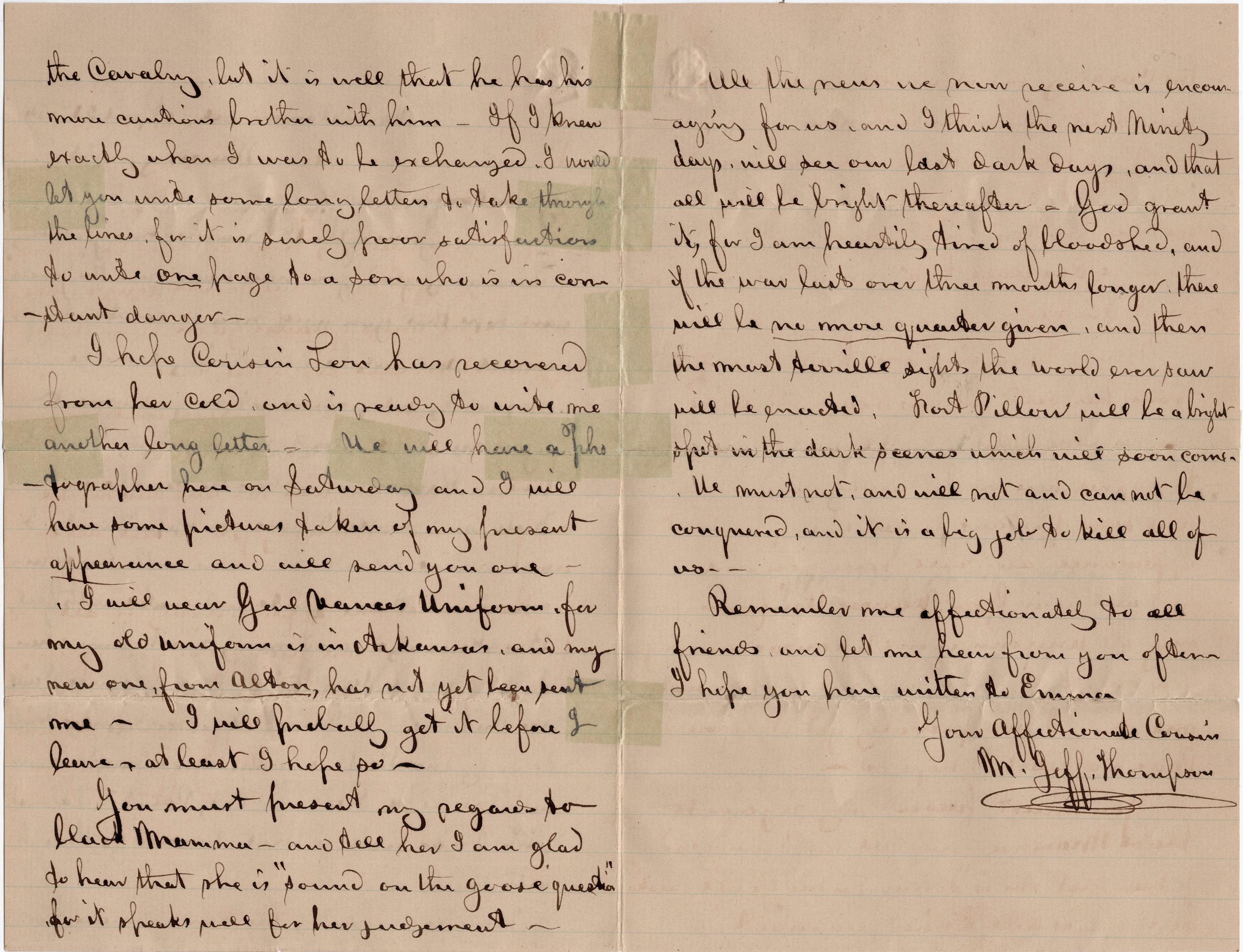
John is evidently the kind of man for the cavalry, but it is well that he has his more cautious brother with him. If I knew exactly when I was to be exchanged, I would let you write some long letters to take through the lines, for it is surely poor satisfaction to write one page to a son who is in constant danger.
Gen. Robert Brank Vance. On 14 Mar. 1865 Vance was given a full pardon and allowed to return to North Carolina on condition that he not fight again.
I hope Cousin Lou has recovered from her cold and is ready to write me another long letter. We will have a photographer here on Saturday and I will have some pictures taken of my present appearance and will send you one. I will wear Gen’l [Robert Brank] Vance’s uniform for my old uniform is in Arkansas, and my new one from Alton has not yet been sent me. I will probably get it before I leave—at least I hope so.
You must present my regards to black Mamma and tell her I am glad to hear that she is “sound on the goose question,” for it speaks well for her judgement.
All the news we now receive is encouraging for us and I think the next ninety days will see our last dark days, and that all will be bright thereafter. God grant it, for I am heartily tired of bloodshed, and if the war lasts over three months longer, there will be no more quarter given, and then the most terrible sights the world ever saw will be enacted. Fort Pillow will be a bright spot in the dark scenes which will soon come. We must not, and will not and cannot be conquered, and it is a big job to kill all of us.
Remember me affectionately to all friends and let me hear from you often. I hope you have written to Emma.
Your affectionate Cousin, — M. Jeff. Thompson
Let some of the girls send our little orderly a pair of no. 6 boots.
General Robert B. Vance is seated third from left; M. Jeff Thompson seated 2nd from right. The 15 year old “boy”orderly” seated on the ground in front was Bailey Payton Key of Tennessee. He must have been the orderly referred to in this letter.[Delaware Historical Society Collections]
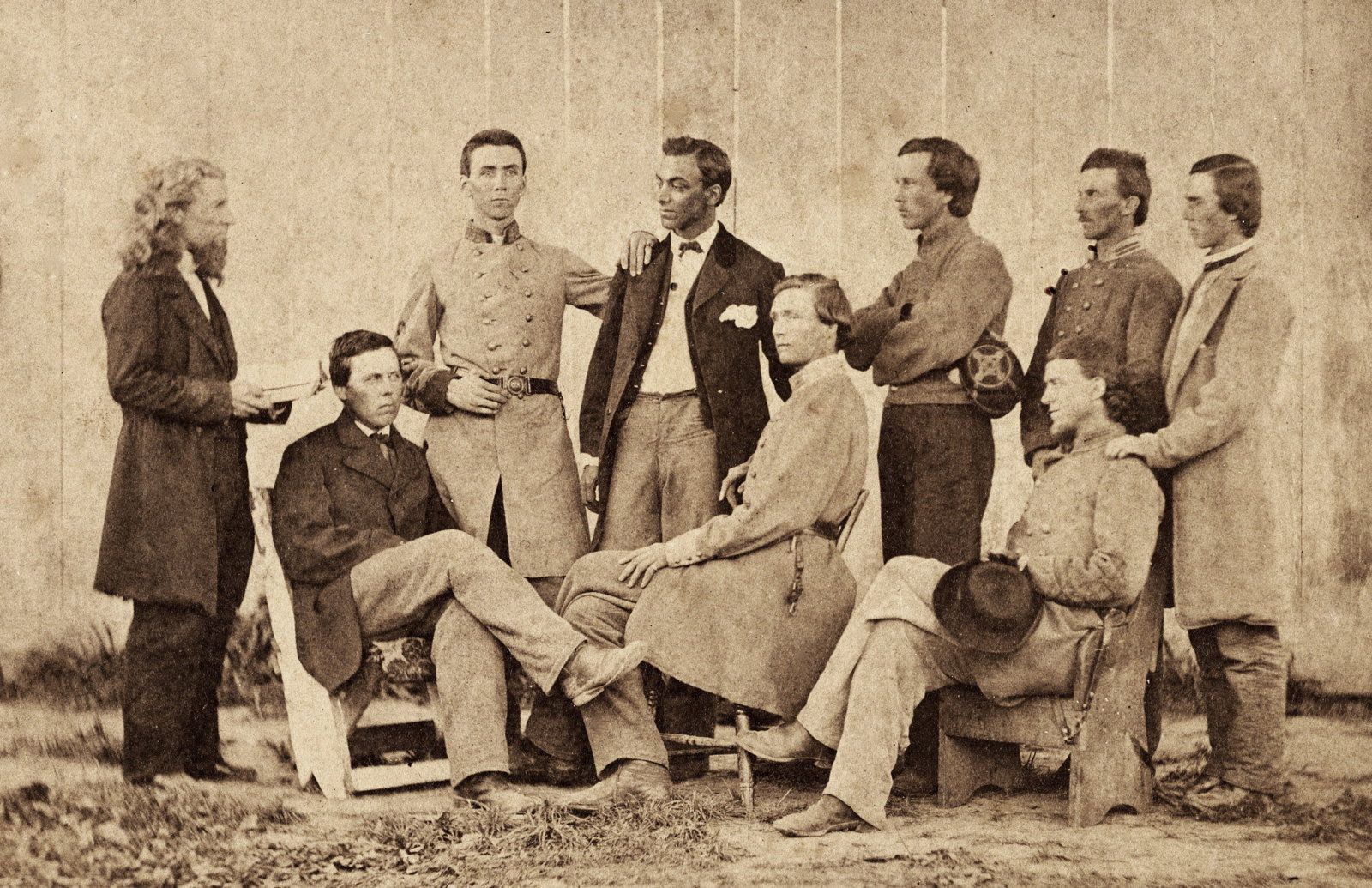
Another scene from Fort Delaware showing Rev. Isaac W. K. Handy (1815-1878) preaching to fellow prisoners around 1863. Seated L-R: Lt. J. N. McFarland, Capt. G. L. Roberts, and Capt. W. F. Gordon; Standing L-R: Rev. Isaac W. K. Handy, Capt. J. H. Dye, Lt. Wash C. Shane, Lt. T. S. Armistead, Capt. J. J. Dunkle, and Lt. J. T. Mackey. Rev. Isaac W. Handy (1815-1878) served Presbyterian congregations in Delaware, Missouri, Maryland, and Virginia. During the Civil War, the Union Army detained him at Fort Delaware for fifteen months for refusing to deny allegations that he made statements against the American flag. While at Fort Delaware, he preached every day and conducted Bible classes, contributing to the conversion of over seventy Confederate officers. (Presbyterian Historical Society).
Letter 4
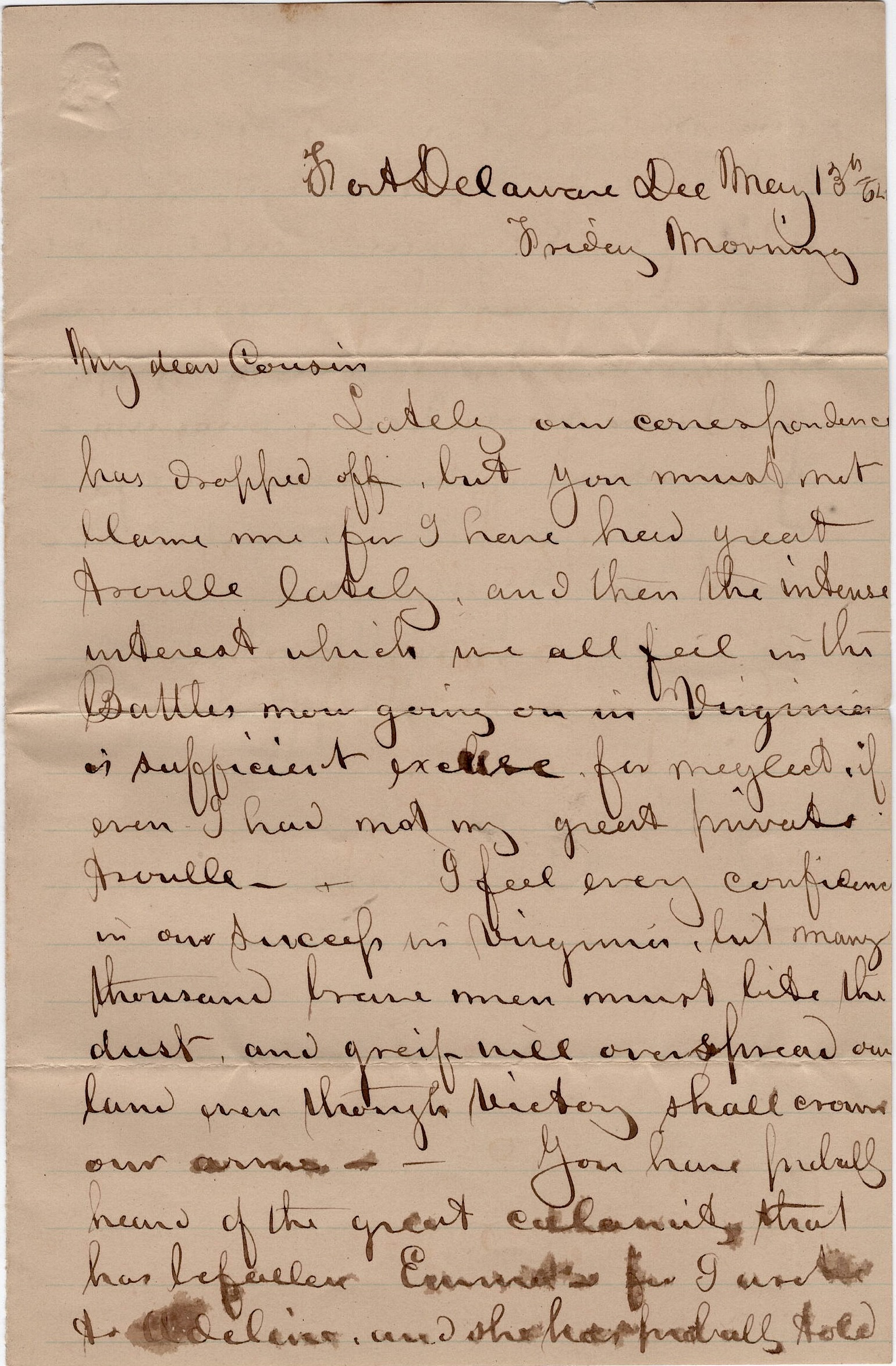
Fort Delaware, Delaware May 13th 1864 Friday morning
My dear Cousin,
Lately our correspondence has dropped off but you must not blame me for I have had great trouble lately, and then the intense interest which we all feel in the battles now going on in Virginia is sufficient excuse for neglect if even I had not my great private trouble.
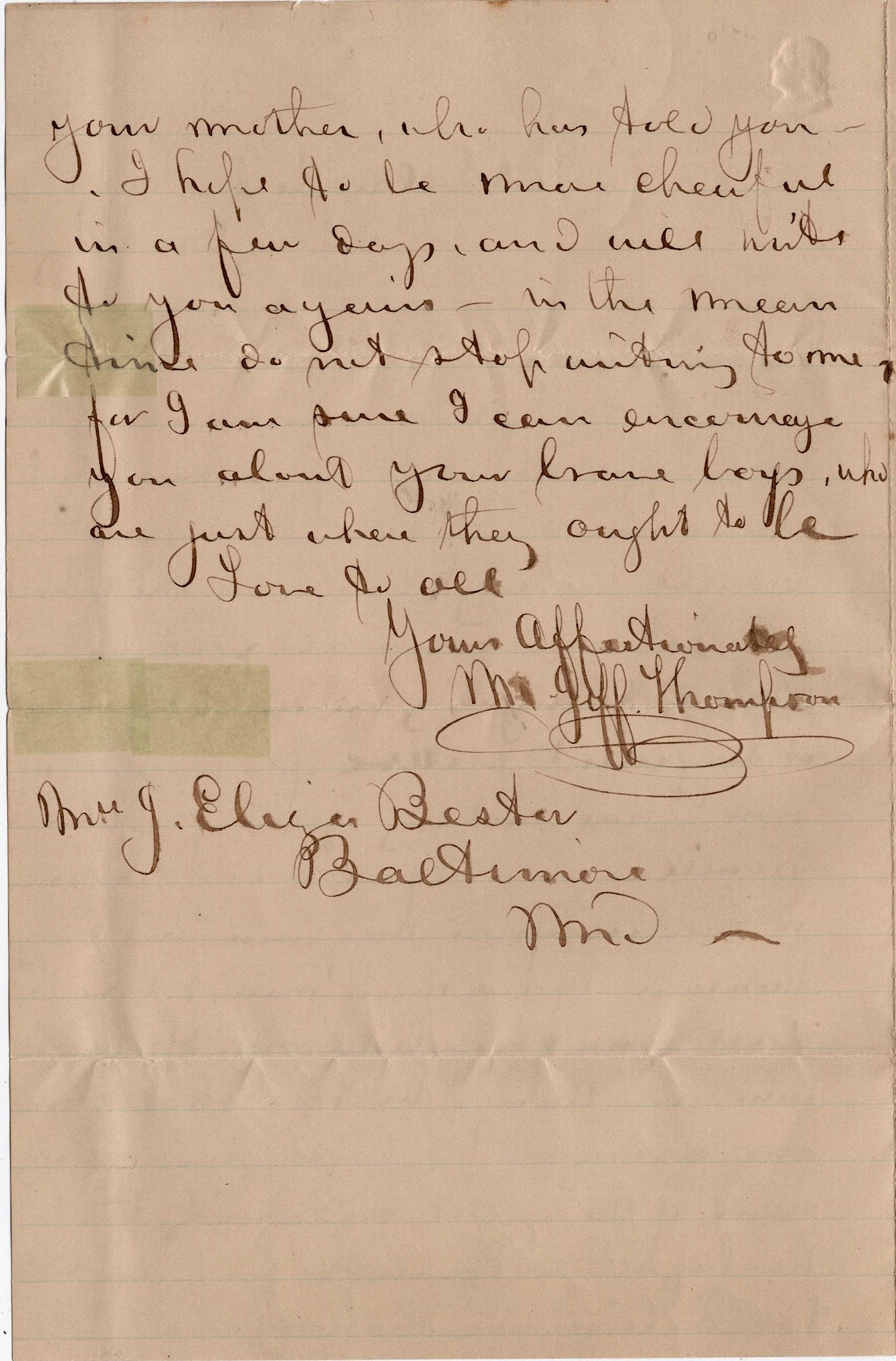
I feel every confidence in our success in Virginia but many thousand brave men must bite the dust and grief will overspread our lane even though victory shall crown our arms. You have probably heard of the great calamity that has befallen [my wife] Emma for I wrote To Adeline and she has probably told your mother who has told you. I hope to be more cheerful in a few days and will write to you again. In the meantime, do not stop writing to me for I am sure I can encourage you about your brave boys who are just where they ought to be. Love to all.
Yours affectionately, — M. Jeff Thompson
To Mrs. J. Eliza Bestor, Baltimore, Md.
Letter 4
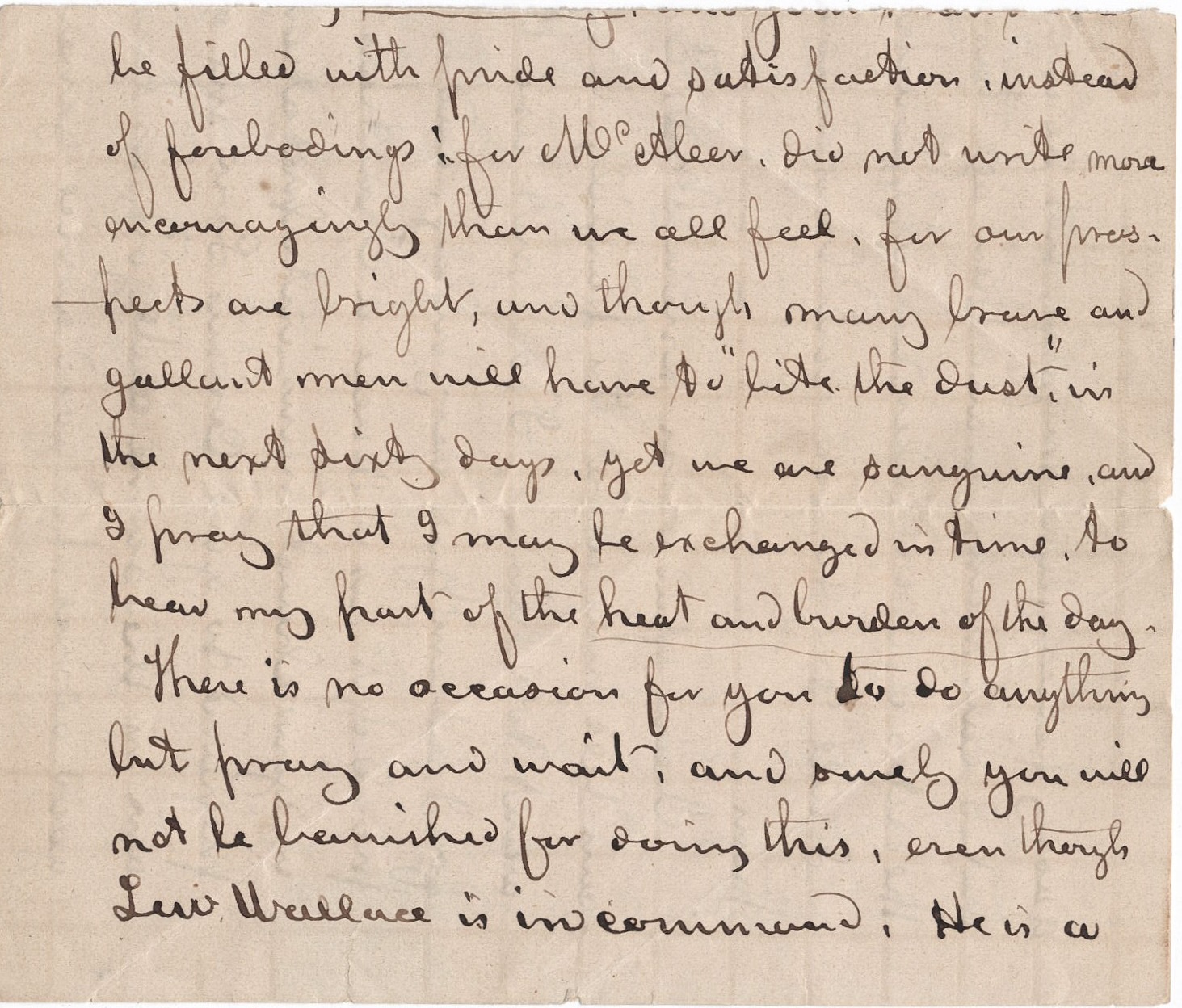
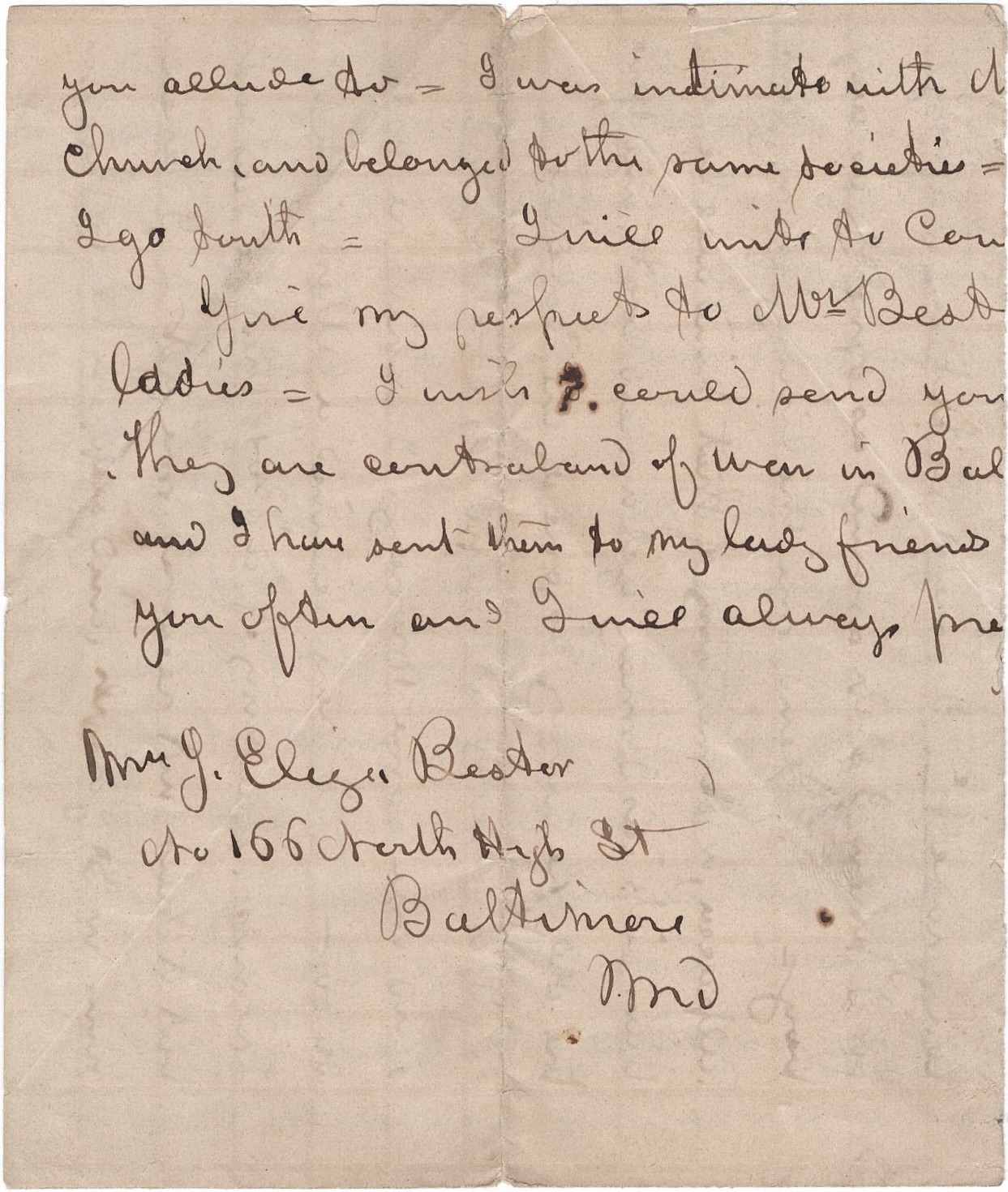
[Editor’s note: These two scraps of a letter are clearly in Gen. M. Jeff Thompson’s handwriting but I don’t know if they were associated with any of the earlier letters or just the remnants of another letter.]
….be filled with pride and satisfaction instead of forebodings for McAleer did not write more encouragingly than we all feel, for our prospects are bright, and though many brave and gallant men have to “bite the dust,” in the next sixty days, yet we are sanguine and I pray that I may be exchanged in time to bear my part of the heat and burden of the day.
There is no occasion for you to do anything but pray and wait and surely you will not be banished for doing this, even though Lew Wallace is in command. He is a…
…you allude to. I was intimate with [paper torn (PT)] church and belonged to the same societies [PT) I go South. I will write to [PT].
Give my respect to Mr. Bestor [PT] ladies. I wish I could send you [PT] They are contraband of war in Baltimore [PT] and I hav sent them to my lady friends [PT] you often and I will always pray [PT]
to Mts. Eliza Bestor, No. 166 North High Street, Baltimore, Md.
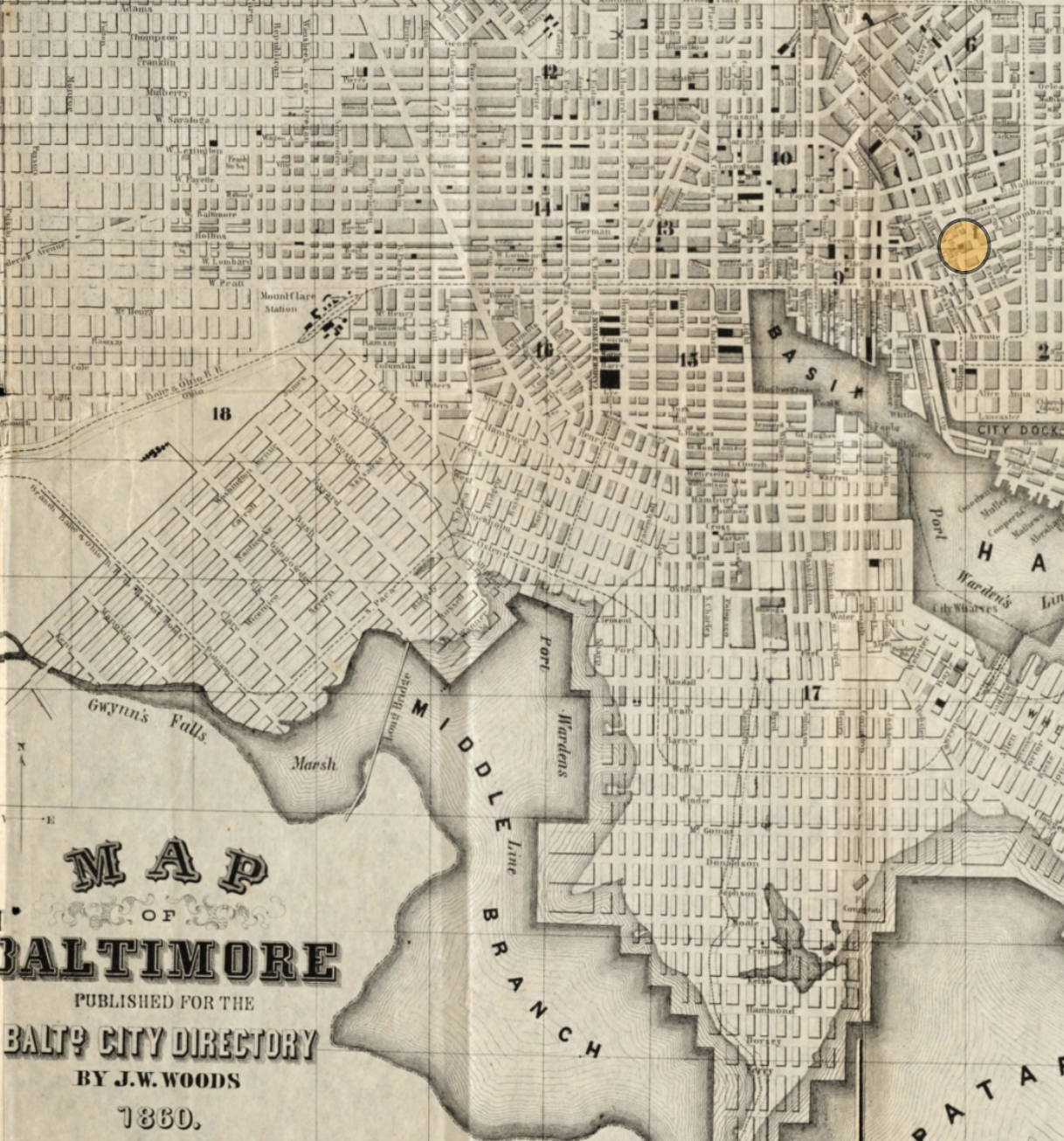
The following letters were written by Rollin John Bestor (1842-1899) and his twin brother, John Rollin Bestor, Jr. (1842-1891). They were the sons of John Rollin Bestor, Sr. (1813-1867), a Baltimore book-keeper, and his wife, Jane Eliza Brown (1820-1885). The couple married in Baltimore in October 1835. In 1860, they resided at 97 South High Street—a dense, bustling, enclave that had been the heart of Baltimore’s German-Jewish community but was transitioning to a working class society of Irish and Italian emigrants. Their home was most likely a two or three-story row house on a gas-lit cobblestone street frequented by horse-drawn omnibuses that daily transported passengers to the inner city. A few blocks to the south, within walking distance, was the harbor basin, lined with wharves, packing houses, and tobacco warehouses. By 1863, the Bestor family had moved to 166 North High Street, an older established neighborhood almost in the shadow of the Fayette Street Phoenix Shot Tower. The boys’ father had a presence in Baltimore in the 1830’s; he left advertisements in the local papers offering flute lessons and for selling a one horse buggy. John Rollins, Jr. was also trained in music—gave concert at Masonic Hall in 1853. He also won an award for penmanship in 1852.
When the Civil War began the boys turned their back on Baltimore and joined Co. B of the Maryland Guard. They quickly moved to Richmond where they drilled, mustered into service, and were eventually assigned to the 21st Virginia Infantry.
Obituary of John Rollin Bestor, published in The Sun, 18 May 1891. Burial was at Loudon Park Cemetery. “Mr. Bestor was born in Baltimore 48 years ago, was graduated from a college at Chillicothe, Ohio at the age on 19 years, and became a civil engineer… [He worked in City Surveyor’s office and later for the Chesapeake & Potomac Telephone Company.] At the outbreak of the late war, he enlisted in Col. J. Lyle Clark’s regiment, was captured, and after being imprisoned at Fort McHenry for a short time, was exchanged and served till 1865.” [Died of a brain tumor]. Note: The only possible colleges in Chillicothe at that time would have been John Allen’s Ohio Military Academy that operated from 1857 to 1860, or the Chillicothe Academy (not technically a college).
After the war, Rollin Bestor was listed in the 1870 Baltimore Directory as a bookkeeper for the N C. Railroad. His obituary states that he was at one time on the private staff of stonewall Jackson. He died in 1899 of Bright’s Disease at his home at 19 Washington Avenue in New Rochelle, Westchester county, New York, when he was 57 years old. He was married to Lucy Maria Tuller (b. 1847).
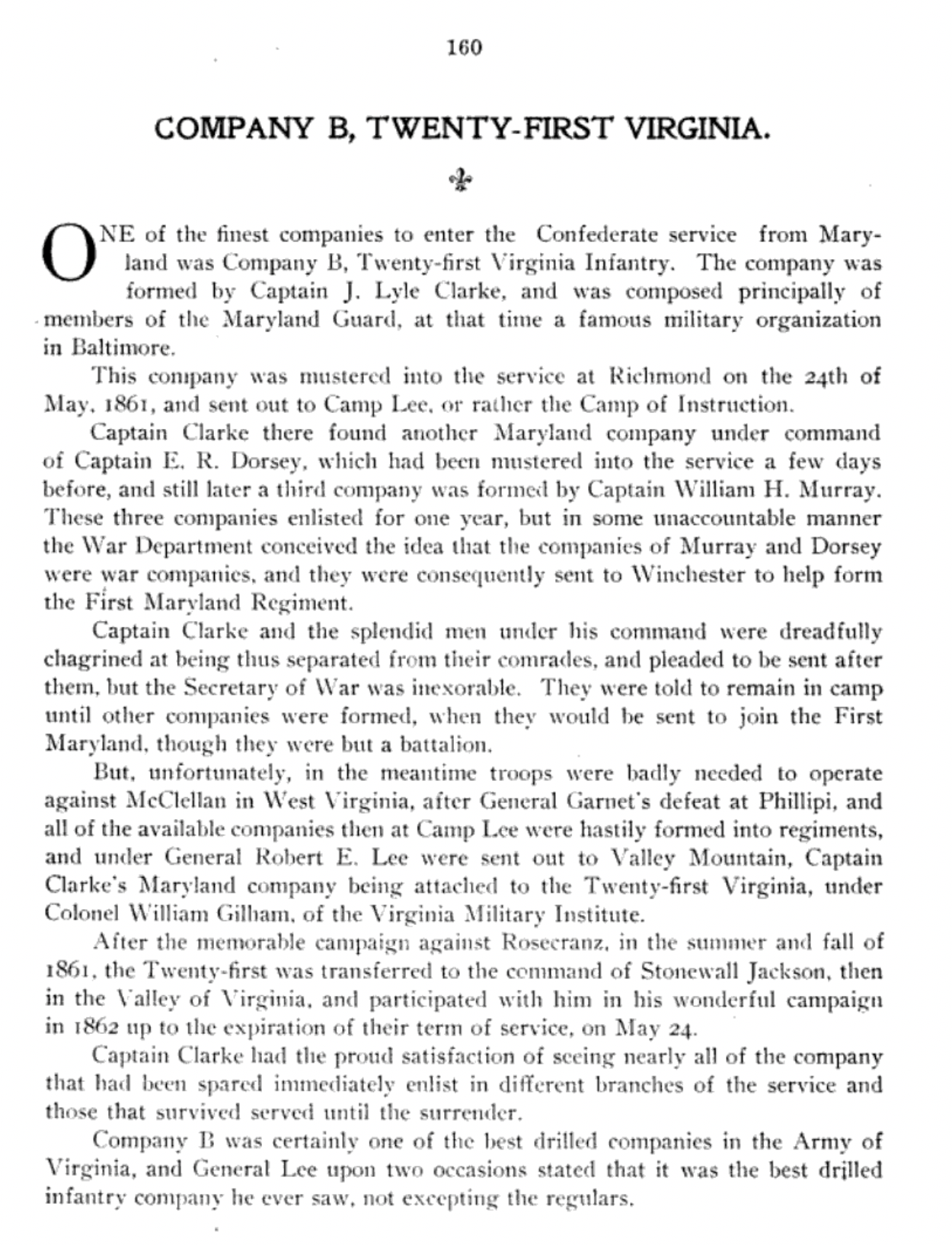
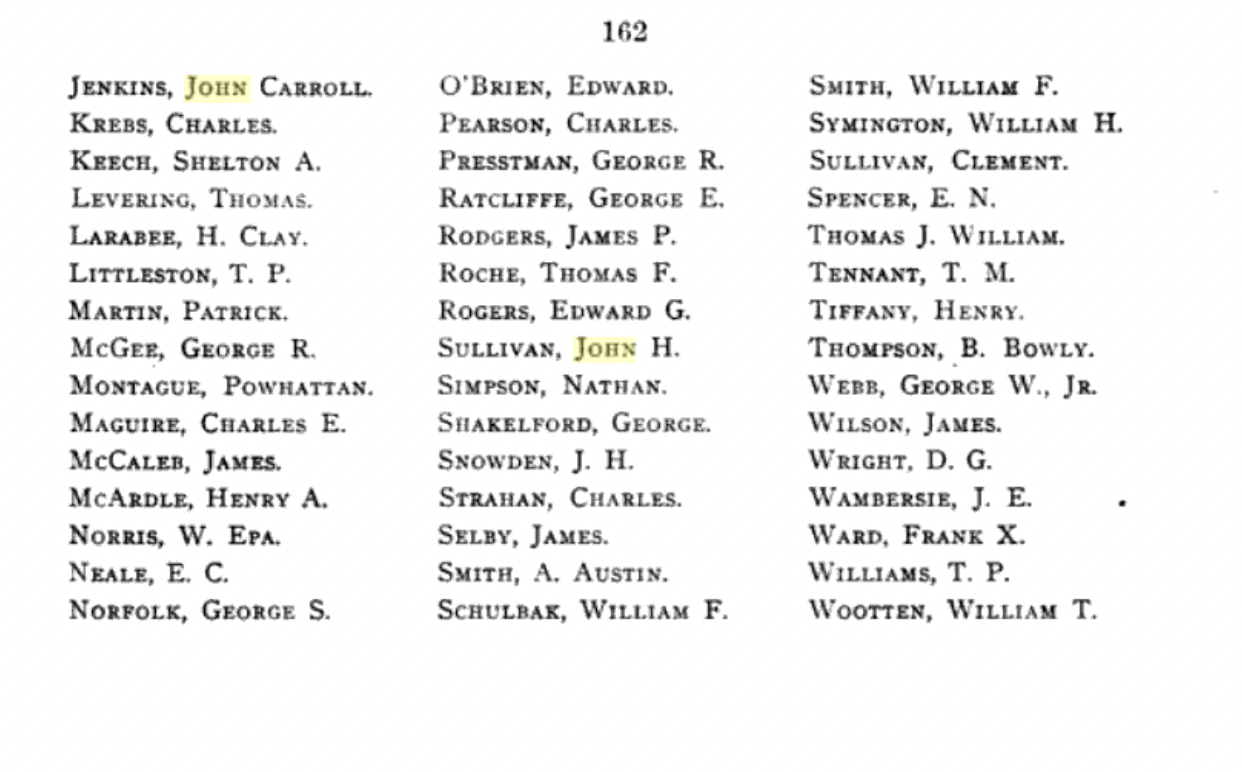
The following pages are from The Maryland Line in the Confederate army, 1861-1865, pages 160-162.
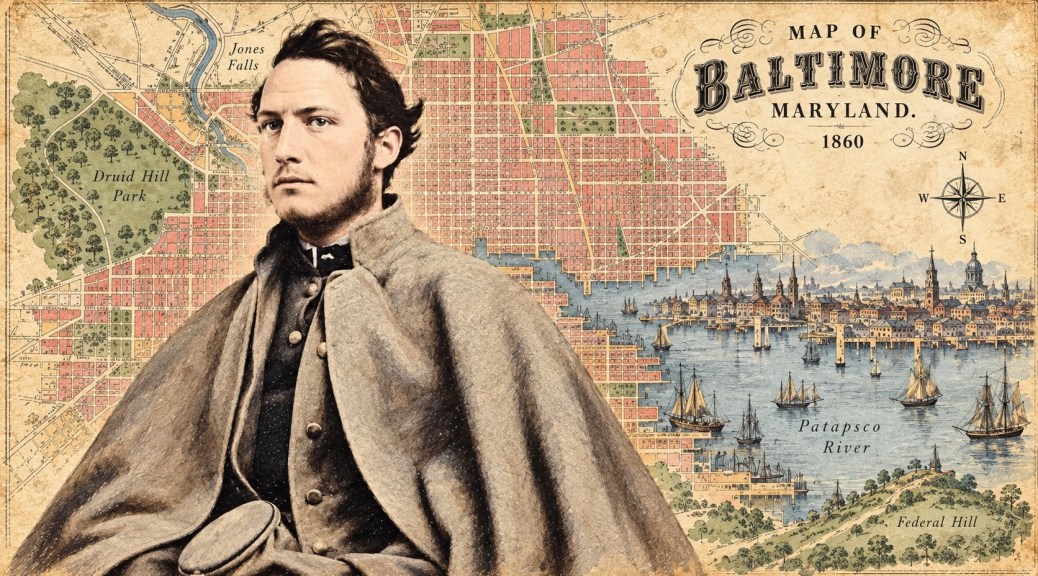
97 South High Street was located within the orange circle on this 1860 Map of Baltimore, MD
Letter 1
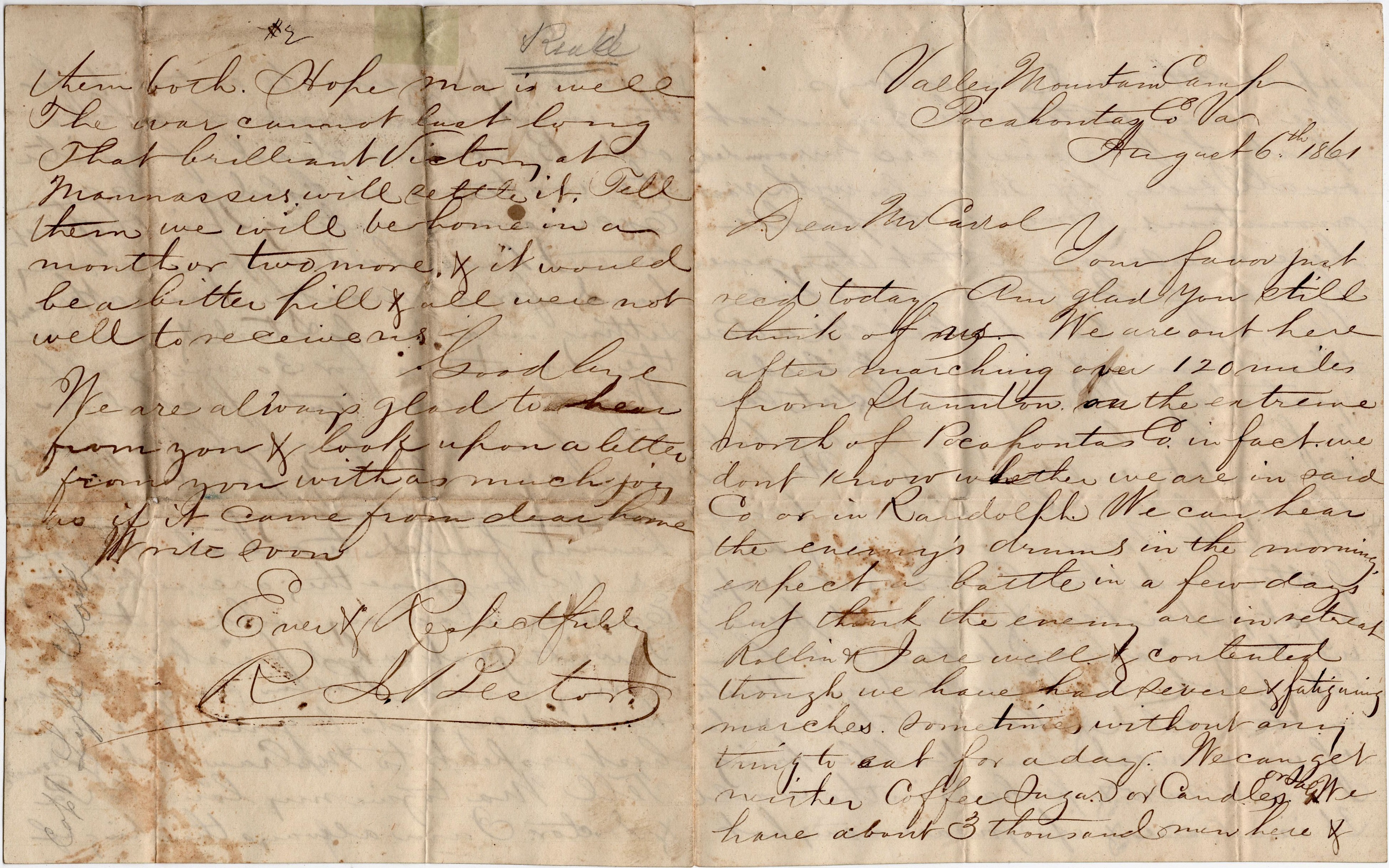
Editor’s Note: In August 1861, Gen. Robert E. Lee marched north an area along the Pocahontas-Randolph County Line where he established his headquarters at Valley Mountain, guarding the pass between the two counties. The Confederate troops spent a miserable, rainy month at Valley Mountain. The cave mentioned in this letter was the Simmons-Mingo Cave.
Valley Mountain Camp Pocahontas Co., Va. August 6th 1861
Dear Mr. Carrol.
Your favor just received today. Am glad you still think oof us. We are out here after marching over 120 miles from Staunton on the extreme north of Pocahontas county. In fact, we don’t know whether we are in said county or in Randolph. We can hear the enemy’s drums in the morning, expect battle in a few days, but think the enemy are in retreat. Rollin & I are well contented though we have had severe & fatiguing marches—sometimes without any time to east for a day. We can get neither coffee, sugar, or candles or salt.
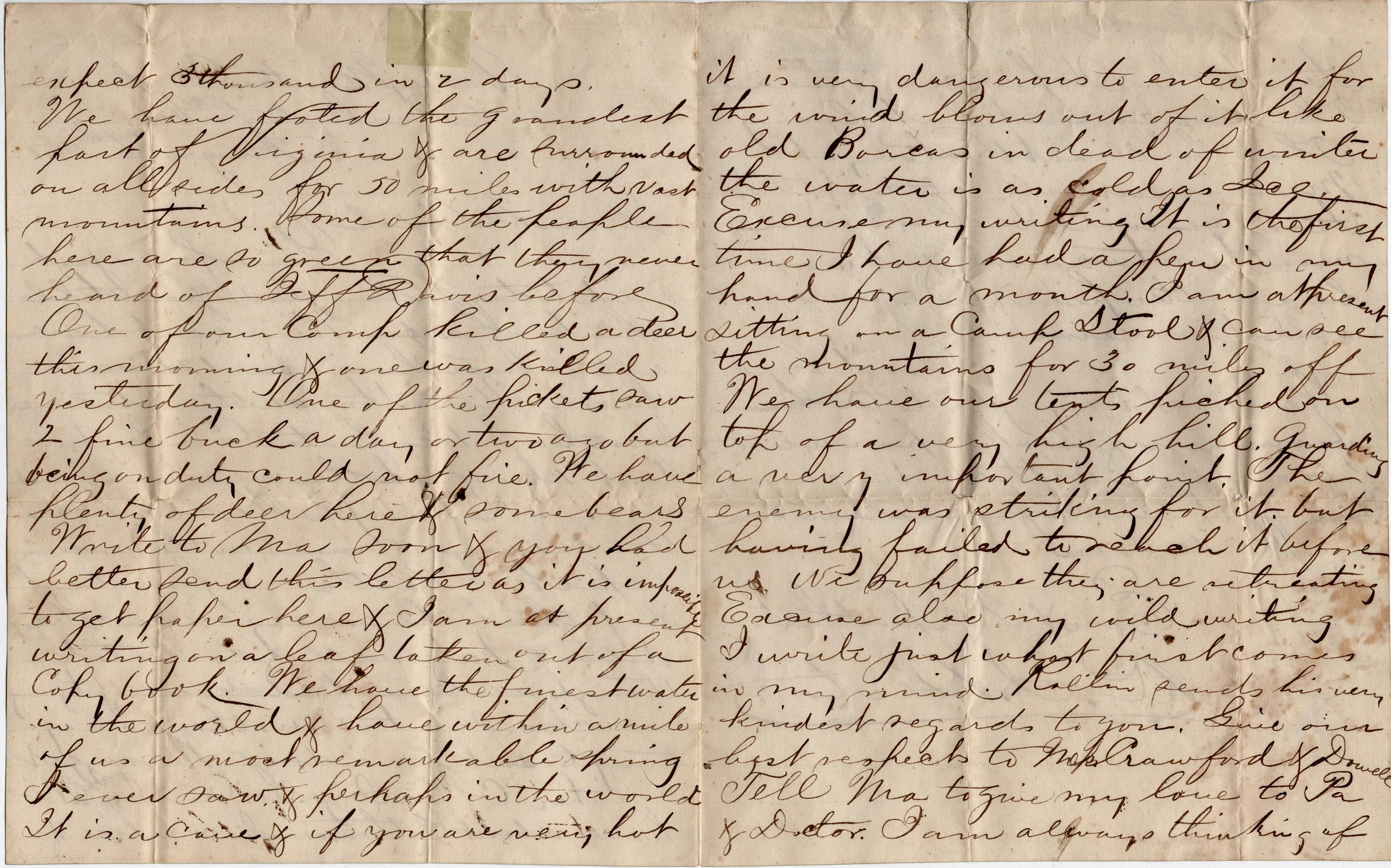
We have about three thousand men here and expect three thousand [more] in two days. We have footed the grandest part of Virginia & are surrounded on all sides for 50 miles with vast mountains. Some of the people here are so green that they never heard of Jeff Davis before. One of our camp killed a deer this morning and one was killed yesterday. One of the pickets saw two fine bucks a day or two ago but being on duty could not fire. We have plenty of deer here and some bears.
Write to Ma soon & you had better send this letter as it is impossible to get paper here & I am at present writing on a leaf taken out of a copy book. We have the finest water in the world & have within a mile of us a most remarkable spring I ever saw & perhaps in the world. It is a cave & if you are very hot, it is very dangerous to enter it for the wind blows out of it like Old Boreas in dead of winter. The water is as cold as ice.
Excuse my writing. It is the first time I have had a pen in my hand for a month. I am at present sitting on a camp stool & can see the mountains for 30 miles off. We have our tents pitched on top of a very high hill guarding a very important point. The enemy was striking for it but having failed to reach it before us, we suppose they are retreating. Excuse also my wild writing. I write just what first comes in my mind. Rollin send his very kindest regards to you. Give our best respects to Mrs. Crawford & Dowell. Tell Ma to give my love to Pa & Doctor. I am always thinking of them both. Hope Ma is well.
The war cannot last long. That brilliant victory at Manassas will settle it. Tell them we will be home in a month or two more & it would be a bitter pill if all were not well to receive us. Goodbye. We are always glad to hear from you & look upon a letter from you with as much joy as if it came from dear home. Write soon.
Ever & Respectfully, — R. J. Bestor
Letter 2
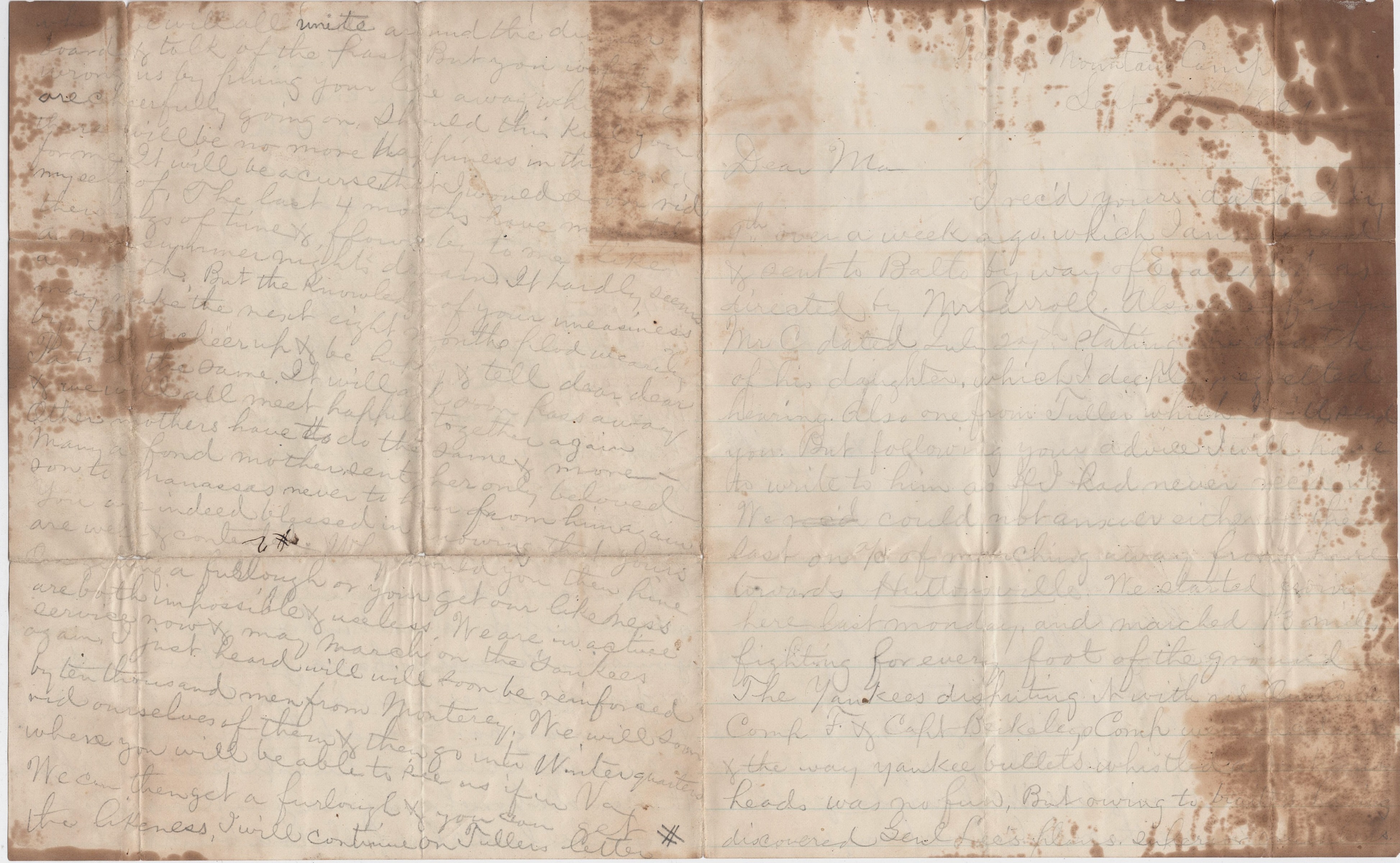
[Editor’s Note: This letter describes the fight at Cheat Mountain in mid September1861. “The three Confederate brigades that attacked Cheat Summit Fort on September 12 had to contend with limited visibility due to poor weather conditions, a defending force that knew the terrain well, and poor coordination between each brigade; during the battle, each brigade acted independently and never made contact with each other. The 14th Indiana, comprised of about 300 men, put up a stubborn defense that was so aggressive that Confederate commanders believed the force was much larger than it was in reality. Daunted by these odds, they withdrew. At the same time, three more Confederate brigades were attacking Camp Elkwater, but the camp’s well-prepared entrenchments allowed for a solid Federal defense. Lee soon called off the entire attack. He maneuvered in the area before withdrawing to Valley Mountain on September 17.” Source: American Battlefield Trust]
Valley Mountain Camp September 17th 1861
Dear Ma,
I received yours dated July 9th over a week ago which I answered & sent to Baltimore by way of [Evansport] as directed by Mr. Carroll. Also one from Mr. C. dated July 27th stating the death of his daughter which I deeply regretted hearing. Also one from Tuller which I will send you.
But following your advice, I will have to write to him as if I had never received it. We could not answer either of the last on account of marching away from here towards Huttonsville. We started from here last Monday and marched 13 miles, fighting for every foot of the ground—the Yankees disputing it with us. Our company, Co. F, and Capt. Berkeley’s company were in advance & the way Yankee bullets whistled about our heads was no fun. But owing to traitors having discovered Gen. Lee’s plans, inferior numbers, & one or two false steps of some of our commanders, we could not go on & retreated.
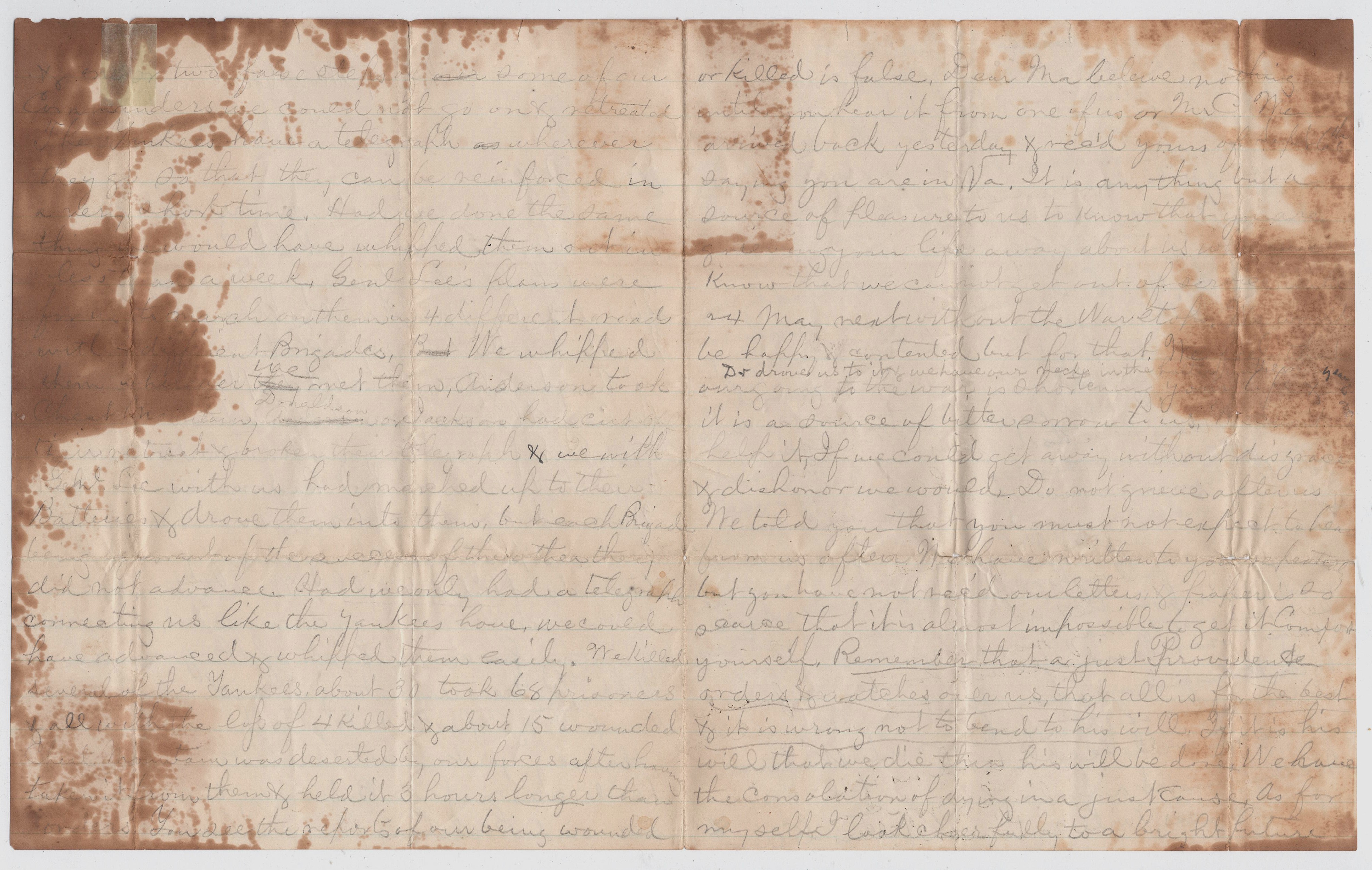
The Yankees have a telegraph wherever they go so that they can be reinforced in a very short time. Had we done the same thing, we would have whipped them out in less than a week. Gen. Lee’s plans were for us to march on them in four different roads with four different brigades. We whipped them whenever we met them. Anderson took Cheat Mountain. Donaldson or Jackson cut off their retreat & broke their telegraph, and we with Gen. Lee with us had marched up to their batteries & drove them into them, but each brigade being ignorant of the success of the other—they did not advance. Had we only had a telegraph connecting us like the Yankees have, we could have advanced and whipped them easily.
We killed several of the Yankees—about 30, took 68 prisoners, and all with the loss of 4 killed & about 15 wounded. Cheat Mountain was deserted by our forces after having taken it from them & held it three hours longer than orders. You see the reports of our being wounded or killed is false. Dear Ma, believe nothing until you hear it from one of us or Mr. C.
We arrived back yesterday and received yours of September 6th saying you are in Virginia. It is anything but a source of pleasure to us to know that you are grieving your life away about us when you know that we cannot get out of service until 24 May next without the war stops. We would be happy & contented but for that. We feel that our going to the war is shortening your life and it is a source of bitter sorrow to us.
Dr. drove us to it & we have our necks in the halter until the year is over. We could not help it. If we could get away without disgrace & dishonor, we would. Do not grieve after us. We told you that you must not expect to hear from us often. We have written to you repeatedly but you have not received our letters and paper is so scarce that it is almost impossible to get it. Comfort yourself. Remember that a just Providence orders & watches over us—that all is for the best, & it is wrong notto bend to His will. If it is His will that we die, the His will be done. We have the consolation of dying in a just cause. As for myself, I look cheerfully to a bright future when we will all unite around the dinner board & talk of the past.
But you woefully wrong us by pining your life away while we are cheerfully going on. Should this kill you, there will be no happiness in the world for me. It will be a curse that I would soon rid myself of. The last four months have mounted the wings of time & flown by to me like a mid summer night’s dream. It hardly seems a month. But the knowledge of your uneasiness may make the next eight months plod wearily by. It will all soon pass away & we will all meet happily together again. Other mothers have to do the same—and more. Many a fond mother sent her only beloved son to Manassas, never to hear from him again. You are indeed blessed in knowing that yours are well & contented. Why should you then pine?
Our getting a furlough or your getting our likeness are both impossible & useless. We are in active service now & may march on the Yankees again. I just heard we will soon be reinforced by ten thousand men from Monterey. We will soon rid ourselves of them & then go into winter quarters where you will be able to see us if in Virginia. We can get a furlough & you can get the likeness. I will continue on Tuller’s letter. [end of letter, unsigned]
Letter 3
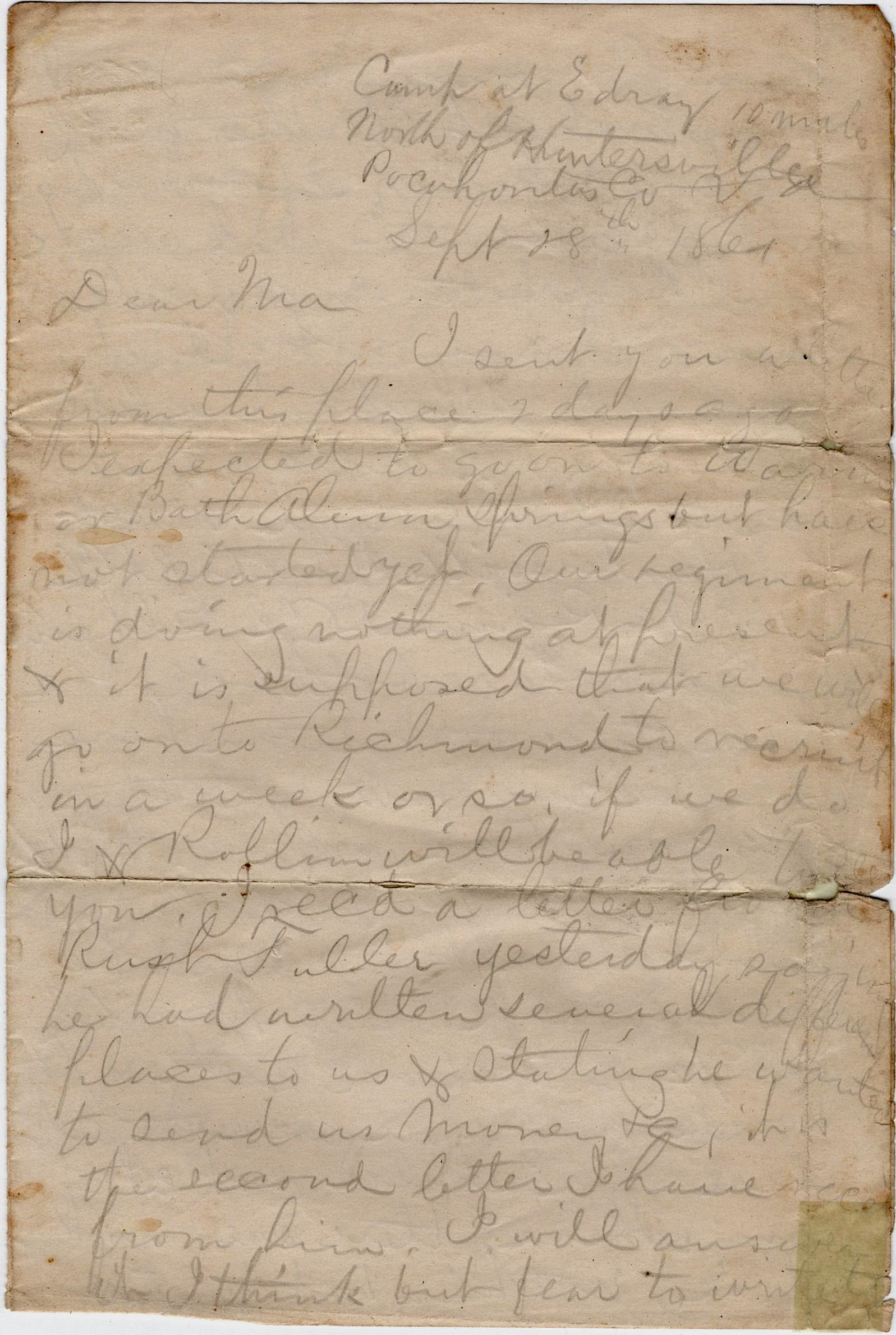
Camp at Edray 10 miles north of Huntersville Pocahontas county, Virginia September 28th 1861
Dear Ma,
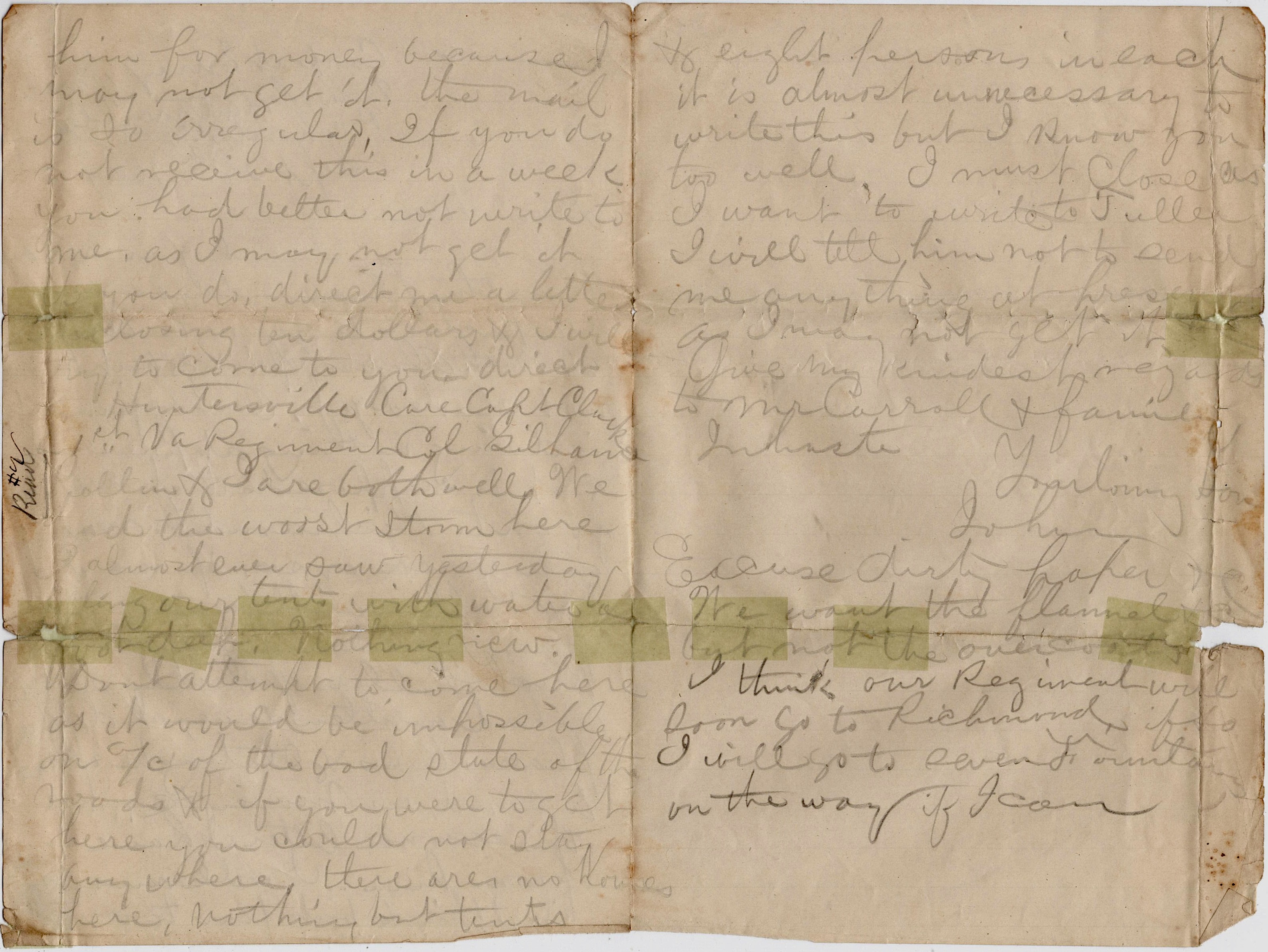
I sent you a letter from this place two days ago. I expected to go on to Warm or Bath Alum Springs but have not started yet. Our regiment is doing nothing at present & it is supposed that we will go on to Richmond to recruit in a week or so. If we do. I and Rollin will be able to see you. I received a letter from Rush Tuller yesterday saying he had written several different places to us & stating he wanted to send us money &c. It is the second letter I have received from him. I will answer it, I think, but fear to write to him for money because I may not get it. The mail is so irregular. If you do not receive this in a week, you had better not write to me as I may not get it. If you do, direct me a letter enclosing ten dollars and I will try to come to you. Direct to Huntersville, Care of Capt. Clarke, 21st Virginia Regiment, Col. Gilham.
Rollin & I are both well. We had the worst storm here I almost ever saw yesterday, filling our tents with water a foot deep. Nothing new. Don’t attempt to come here as it would be impossible on account of the bad state of the roads & if you were to get here, you could not stay anywhere. There are no houses here—nothing but tents & eight persons in each. It is almost unnecessary to write this but I know you too well.
I must close as I want to write to Tuller. I will tell him not to send me anything at present as I may not get it. Give my kindest regards to Mr. Carroll & family. In haste.
Your loving son, — John
Excuse dirty paper, &c. We want the flannel but not the overcoat &c. I think our regiment will soon go to Richmond. If so, I will go to Seven Fountains on the way if I can.
Letter 4
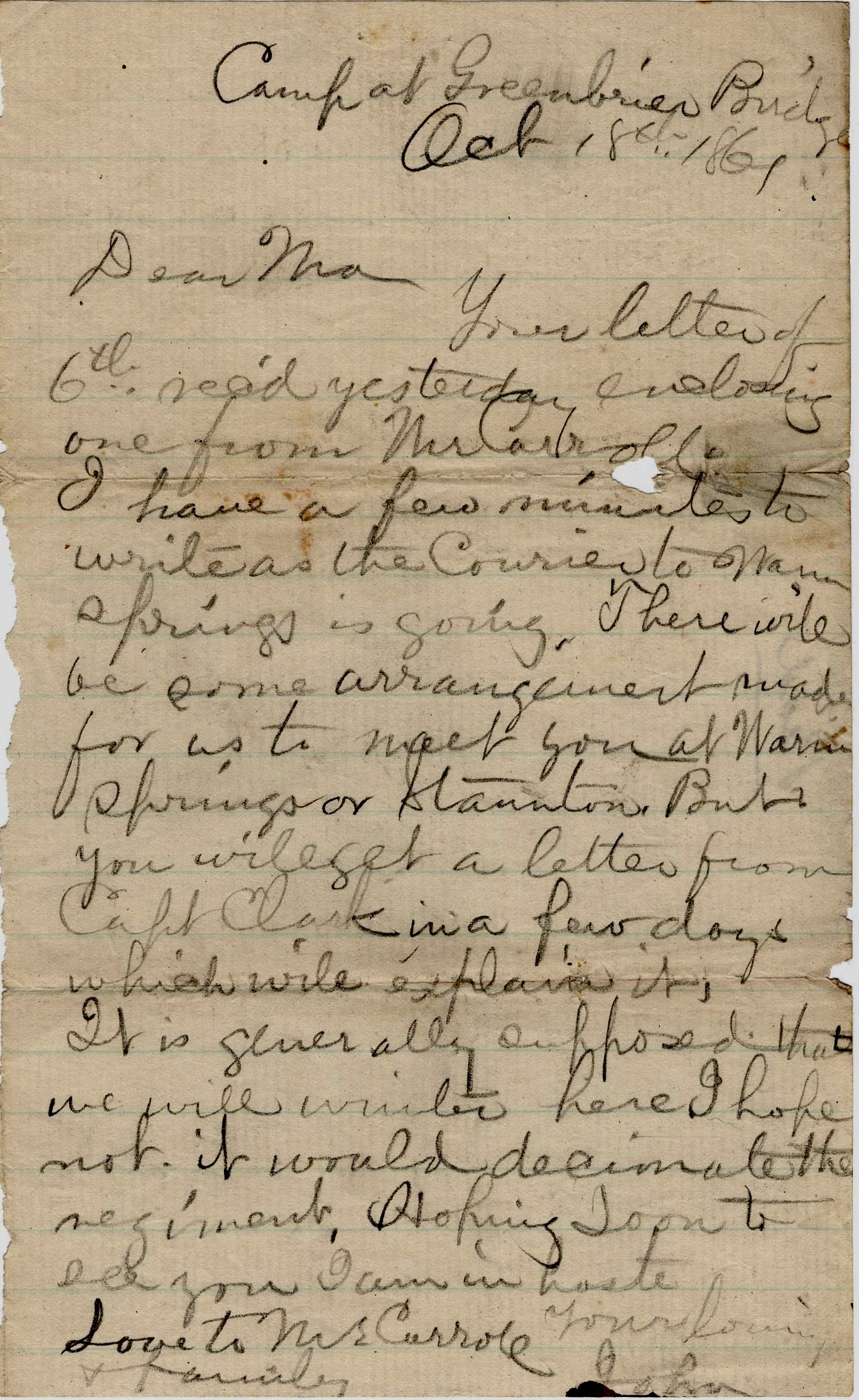
Camp at Greenbrier Bridge October 18, 1861
Dear Ma,
Your letter of 6th received yesterday enclosing one from Mr. Carroll. I have a few minutes to write as the courier to Warm Springs is going. There will be some arrangement made for us to meet you at Warm Springs or Staunton but you will get a letter from Capt. Clarke in a few days which will explain it.
It is generally supposed that we will winter here. I hope not. It would decimate the regiment. Hoping soon to see you. I am in haste. Love to Mr. Carroll & family. Your loving son, — John
Letter 5
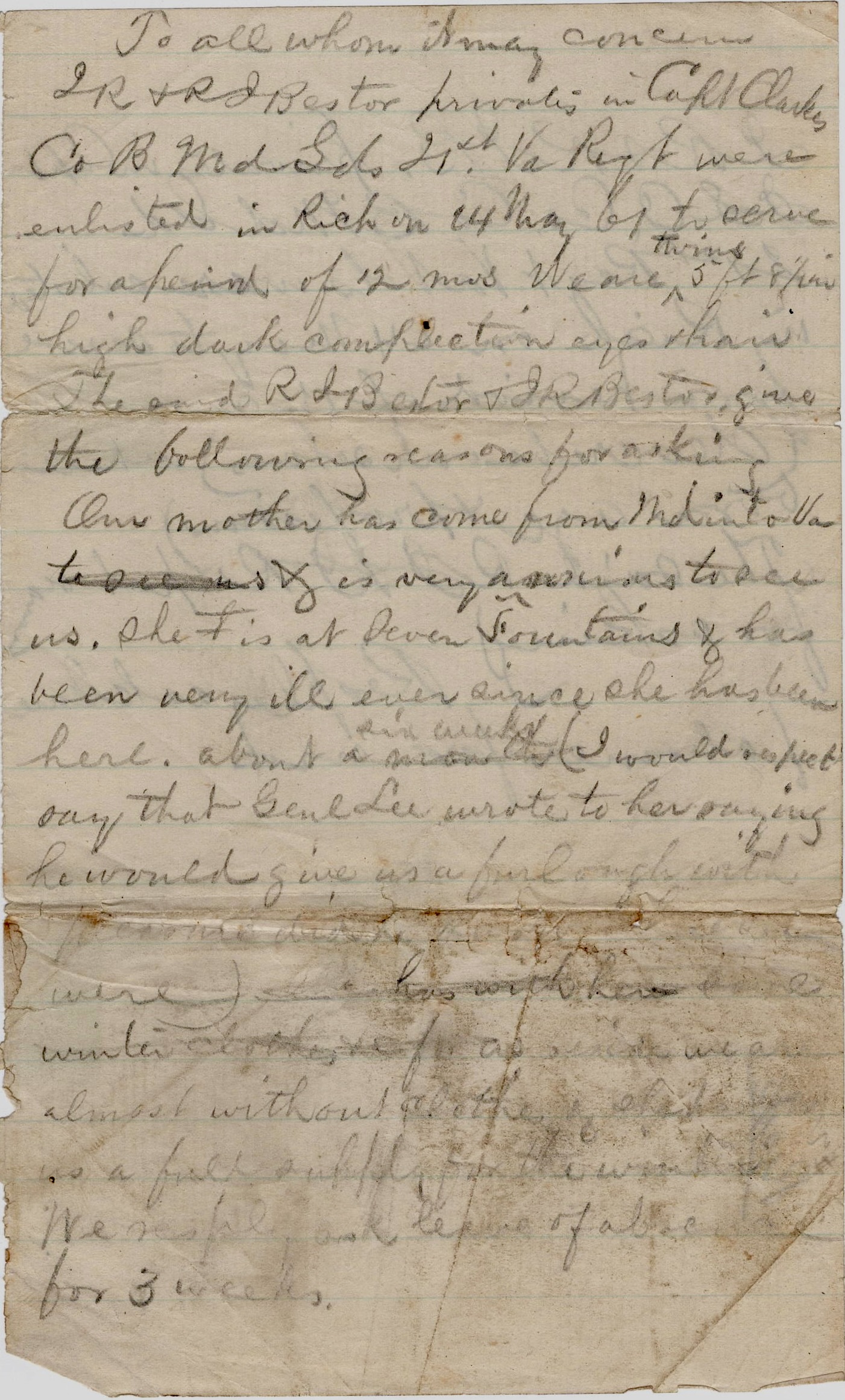
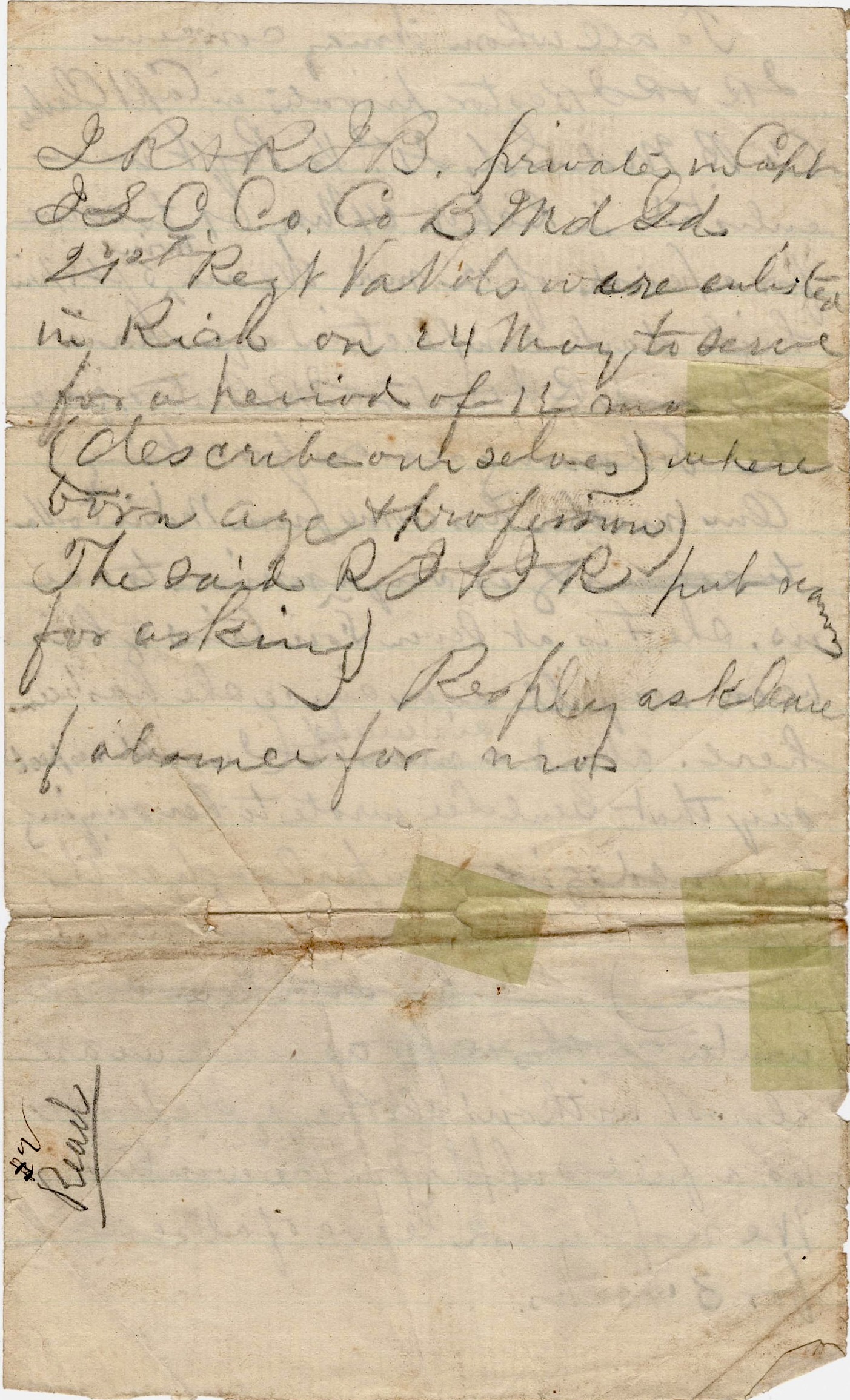
To all whom it may concern. JR & RJ Bestor, privates in Capt. Clarke’s Co. B. Md. Gds. 21st Va. Regt., were enlisted in Richmond on 24 May ’61 to serve for a period of 12 mos. We are twins, 5 ft. 8½ in. high, dark complection, eyes, & hair. The said R. J. Bestor & J. R. Bestor give the following reasons for asking. Our mother has come from Md. into Va. & is very anxious to see us. She is at Seven Fountains & has been very ill ever since she has been here—about six weeks. I would respectfully say that Gen. Lee wrote to her saying he would give us a furlough with pleasure [illegible]… She has with her some winter clothes for us, & as we are almost without clothes, she will give us a full supply for the winter. We respectfully ask leave of absence for 3 weeks.
Furlough pass
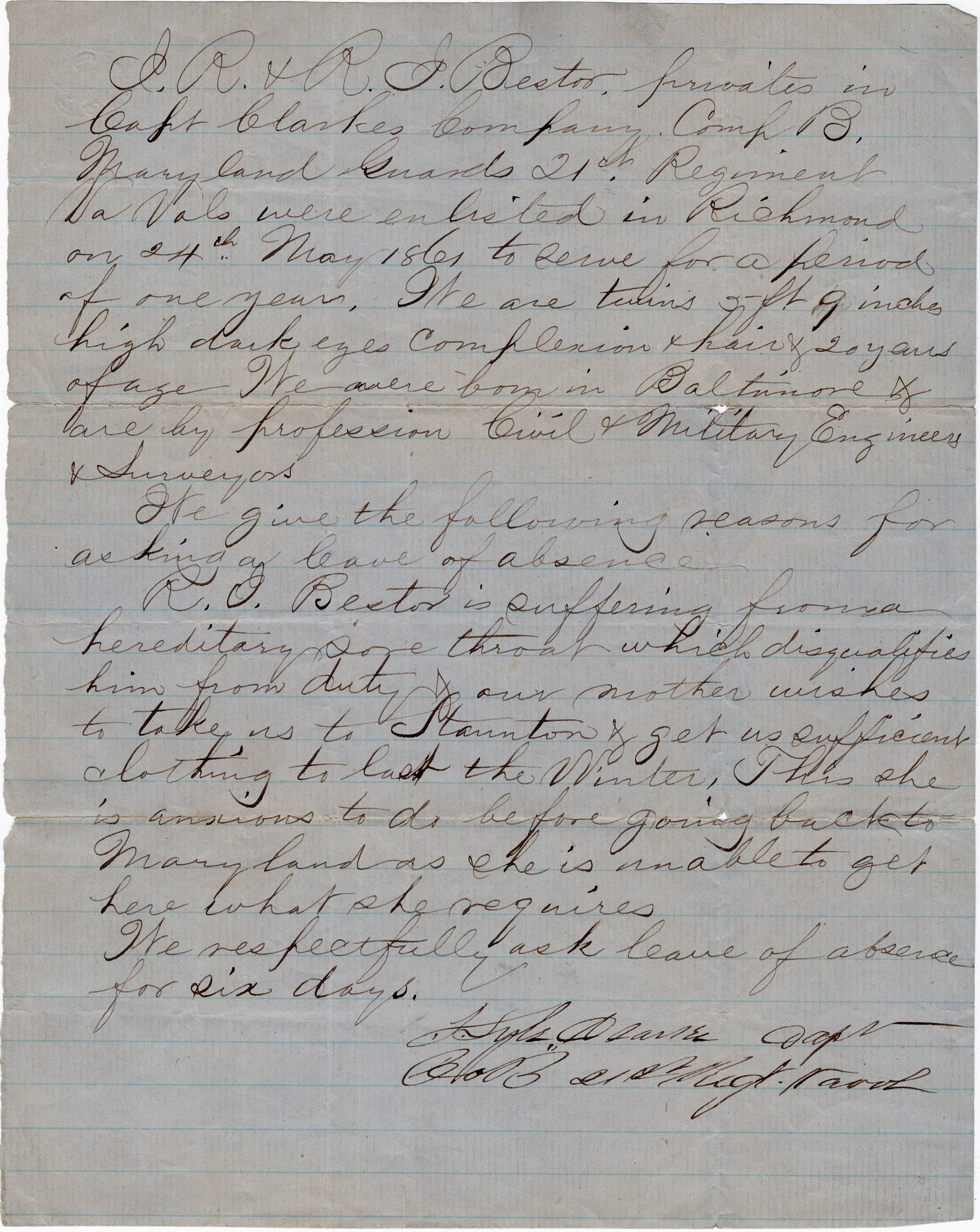
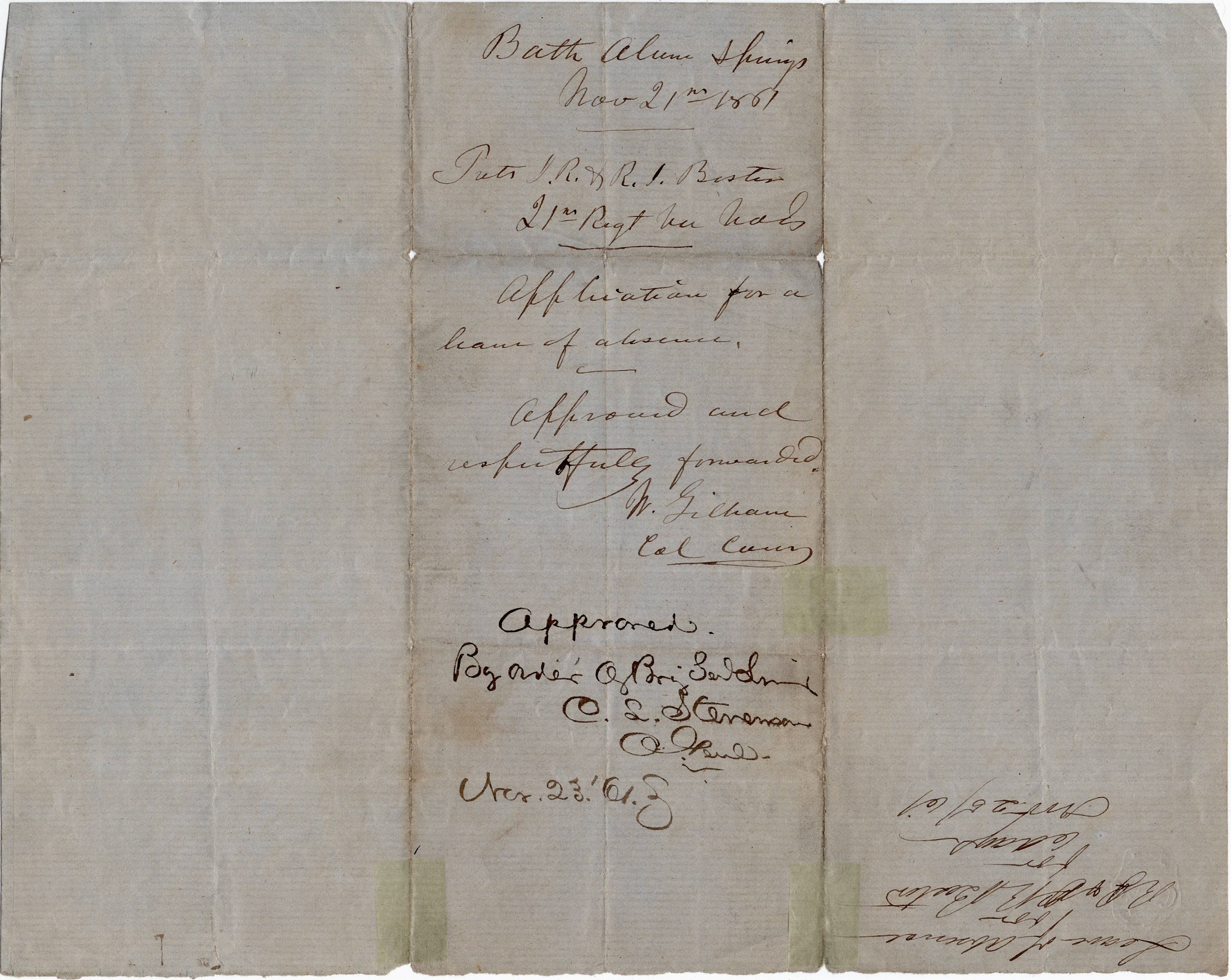
J. R. & R. J. Bestor, privates in Capt,. Clarke’s company, Co. B, Maryland Guards, 21st Regiment Virginia Vols., were enlisted in Richmond on 24th May 1861 to serve for a period of one year. We are twins, 5 ft, 9 inches high, dark eyes, complexion & hair & 20 years of age. We were born in Baltimore & are by profession Civil & Military Engineers & Surveyors.
We give the following reasons for asking a leave of absence.
R. J. Bestor is suffering from hereditary sore throat which disqualifies him from duty & our mother wishes to take us to Staunton & get us sufficient clothing to last the winter. This she is anxious to do before going back to Maryland as she is unable to get here what she requires.
We respectfully ask leave of absence for six days.
J. Lyls Clarke, Capt. Co. B, 21st Regiment Va. Vols.
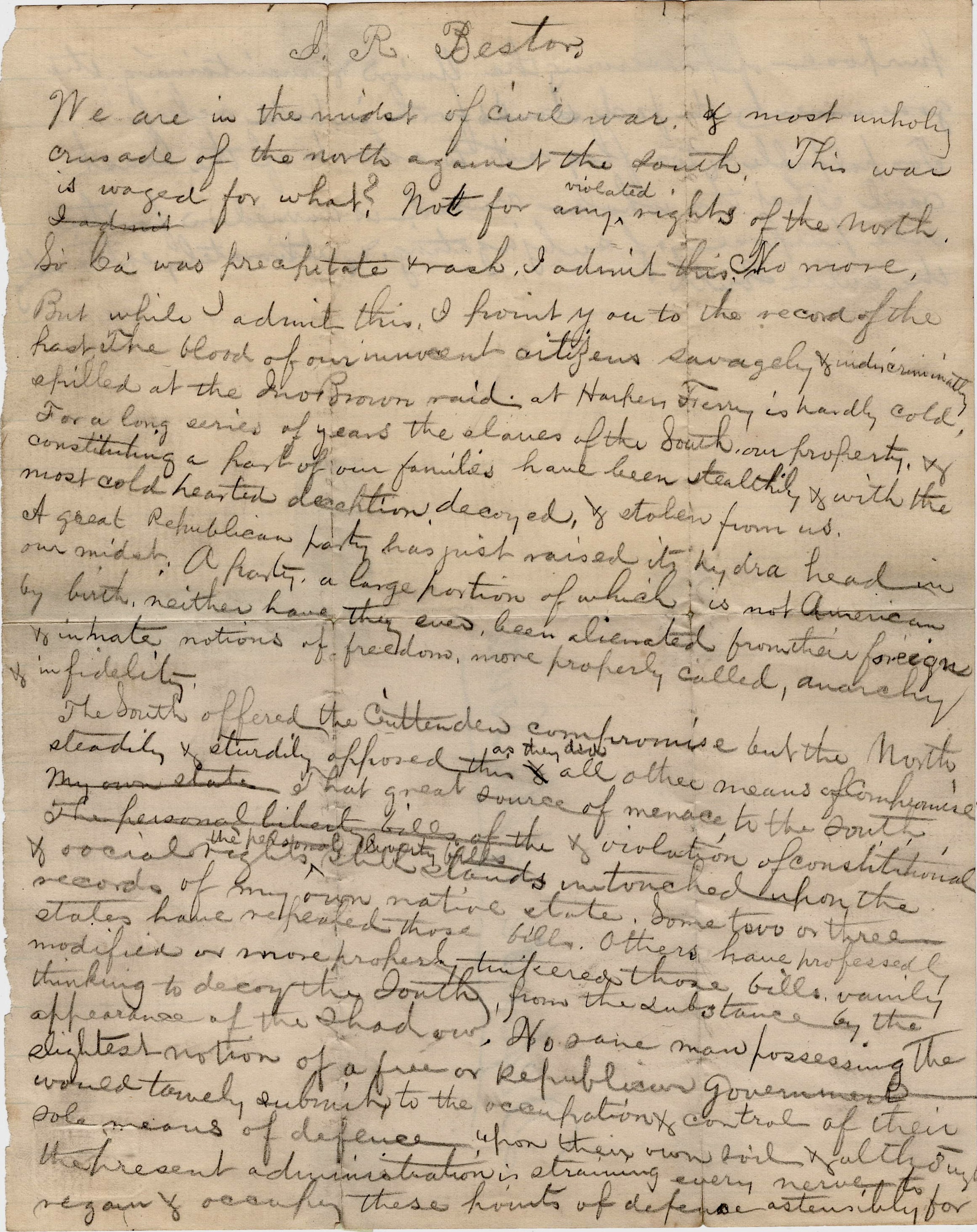
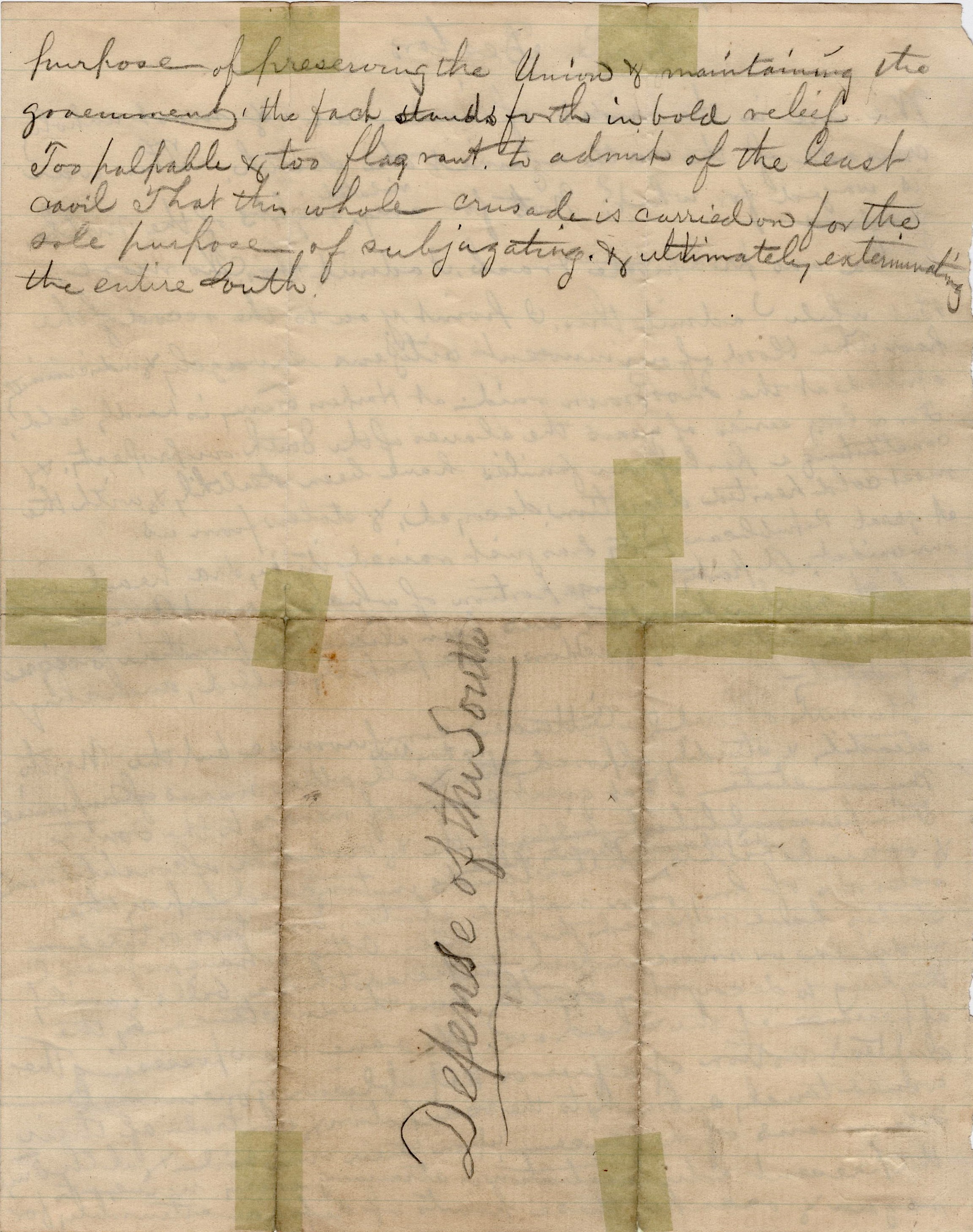
The following undated manifesto entitled the “Defense of the South” was signed by John Rollin Bestor. My guess is that it was penned during the winter of 1861-62, possibly as late as 1863.
Defense of the South
We are in the midst of civil war—a most unholy crusade of the north against the south. This war is waged for what? Not for any violated rights of the north. So Virginia was precipitate & rash, I admit this. No more. But while I admit this, I point you to the record of the past. The blood of our innocent citizens savagely & indiscriminatly spilled at the Jno. Brown raid at Harpers Ferry is hardly cold. For a long series of years the slaves of the South, our property, & constituting a part of our families, have been stealthily & with the most cold-hearted deception, decoyed, & stolen from us. A great Republican party has just raised its hydra head in our midst. A party, a large portion of which is not American by birth. Neither have they ever been alienated from their foreign & innate notions of freedom, more properly called, anarchy & infidelity.
The South offered the Crittenden Compromise but the North steadily & sturdily opposed this as they did all other means of compromise. That great source of menace to the South & violation of constitutional & social rights, the personal liberty bills, still stands untouched upon the records of my own native state. Some two or three states have repealed those bills. Others have professedly modified or more tinkered those bills, vainly thinking to decoy the South from the substance by the appearance of shadow. No sane man possessing the slightest notion of a free or Republican Government would tamely submit to the occupation & control of their sole means of defense upon their own soil & although the present administration is straining every nerve to regain & occupy these points of defence ostensibly for purpose of preserving the Union & maintaining the government, the fact stands forth in bold relief too palpable & too flagrant to admit of the least cavil—that this whole crusade is carried on for the sole purpose of subjugating & ultimately exterminating the entire South.
Letter 6
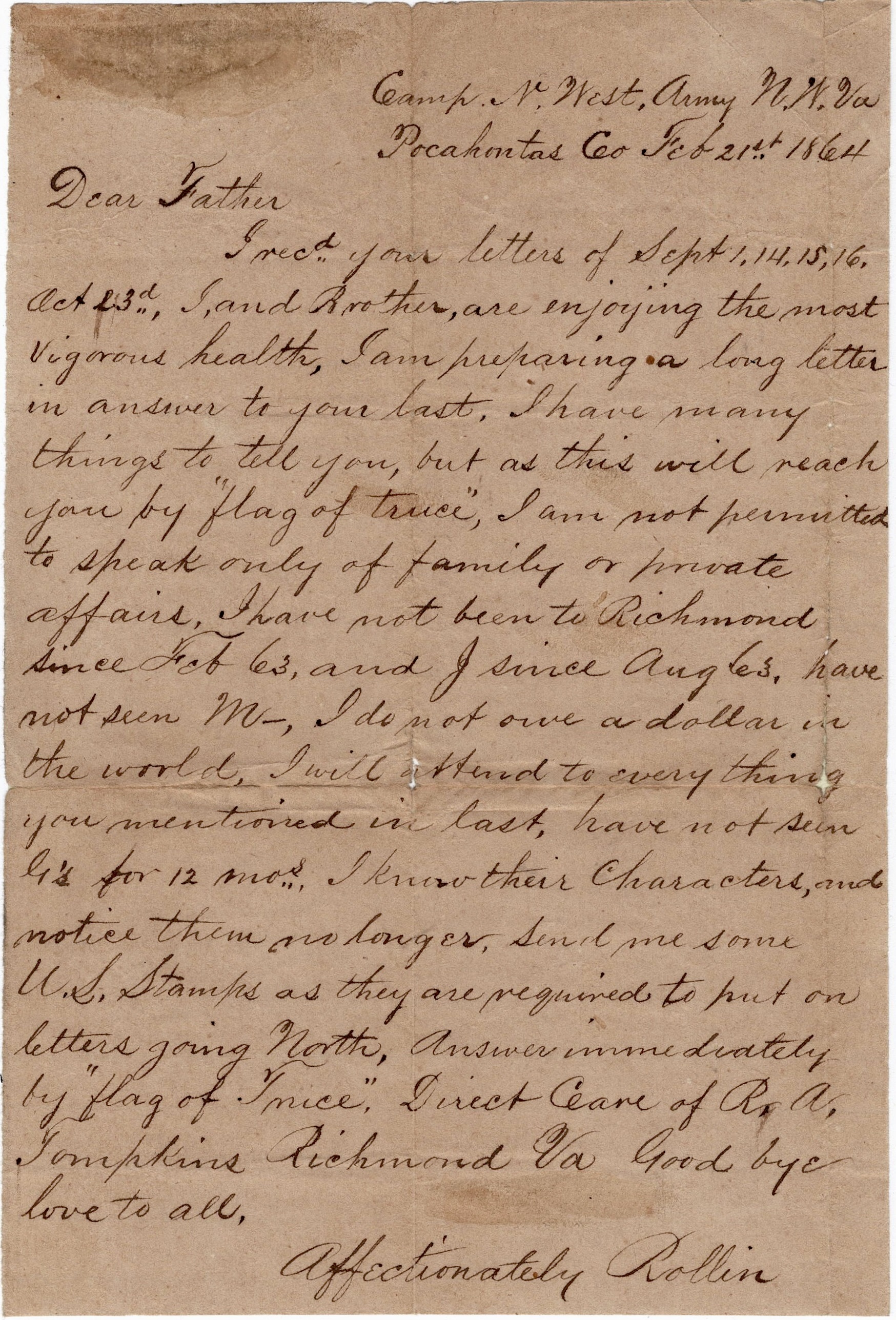
Camp N. West Army Northwest Va. Pocahontas Co. Feb. 21st, 1864
Dear Father,
I rec’d your letters of Sept. 1, 14, 15, 16, Oct. 23rd. I and brother are enjoying the most vigorous health. I am preparing a long letter in answer to your last. I have many things to tell you, but as this will reach you by “flag of truce,” I am not permitted to speak—only of family or private affairs.
I have not been to Richmond since Feb. ’63, and J[ohn] since August ’63. Have not seen M—-. I do not owe a dollar in the world. I will attend to everything you mentioned in last. Have not seen G’s for 12 mos. I know their characters and notice them no longer. Send me some U.S. Stamps as they are required to put on letters going North.
Answer immediately by “flag of Truce.” Direct Care of R. A. Tompkins, Richmond, Va. Good bye. Love to all. Affectionately, — Rollin
Letter 7
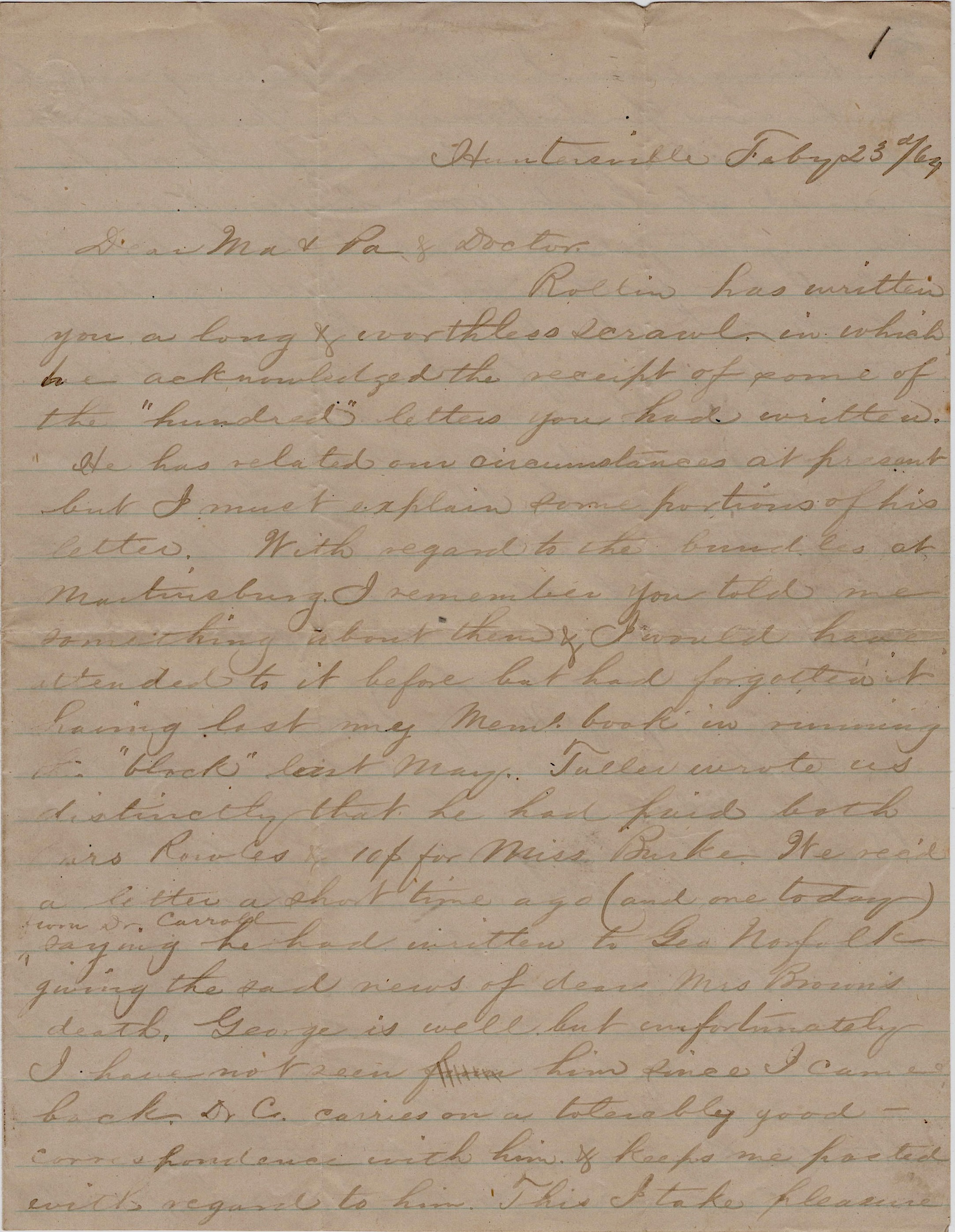
Huntersville Feby 23rd/64
Dear Ma & Pa & Doctor,
Rollin has written you a long & worthless scrawl in which he acknowledged the receipt of some of the “hundred” letters you had written. He has related our circumstances at present, but I must explain some portions of his letter. With regard to the bundles at Martinsburg, I remember you told me something about them & I would have attended to it before but had forgotten it, having lost my Memo. book in running the “block” last May. Tuller wrote us distinctly that he had paid both Mrs. Rowles & $10 for Miss Burke.
We rec’d a letter a short time ago (and one today from Dr. Carroll saying he had written to Geo. Norfolk giving the sad news of dear Mrs. Brown’s death. George is well, but unfortunately I have not seen him since I came back. Dr. Carroll carries on a tolerably good correspondence with him & keeps me posted with regard to him. This I take pleasure in doing, since I like George very much on his own account, but more on account of his two pretty sisters, from both of which, having received at least 10,000 kisses, it would be ungrateful in me not to keep posted about him for their sakes.
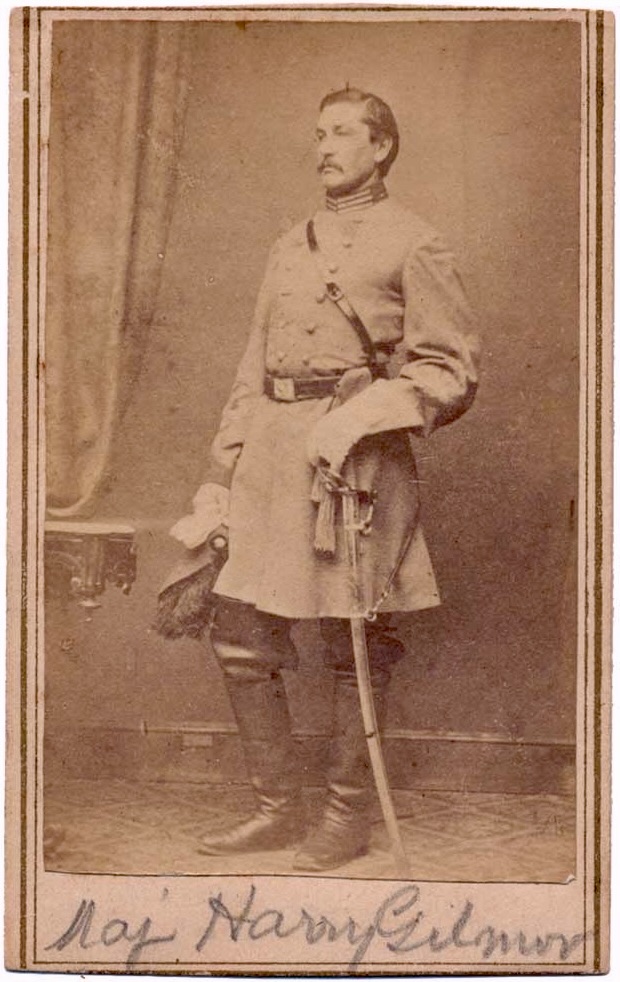
Maj. Harry Gilmor of Baltimore, commanded his own 200-men unit called “Gilmor’s Raiders” (The Horse Soldier)
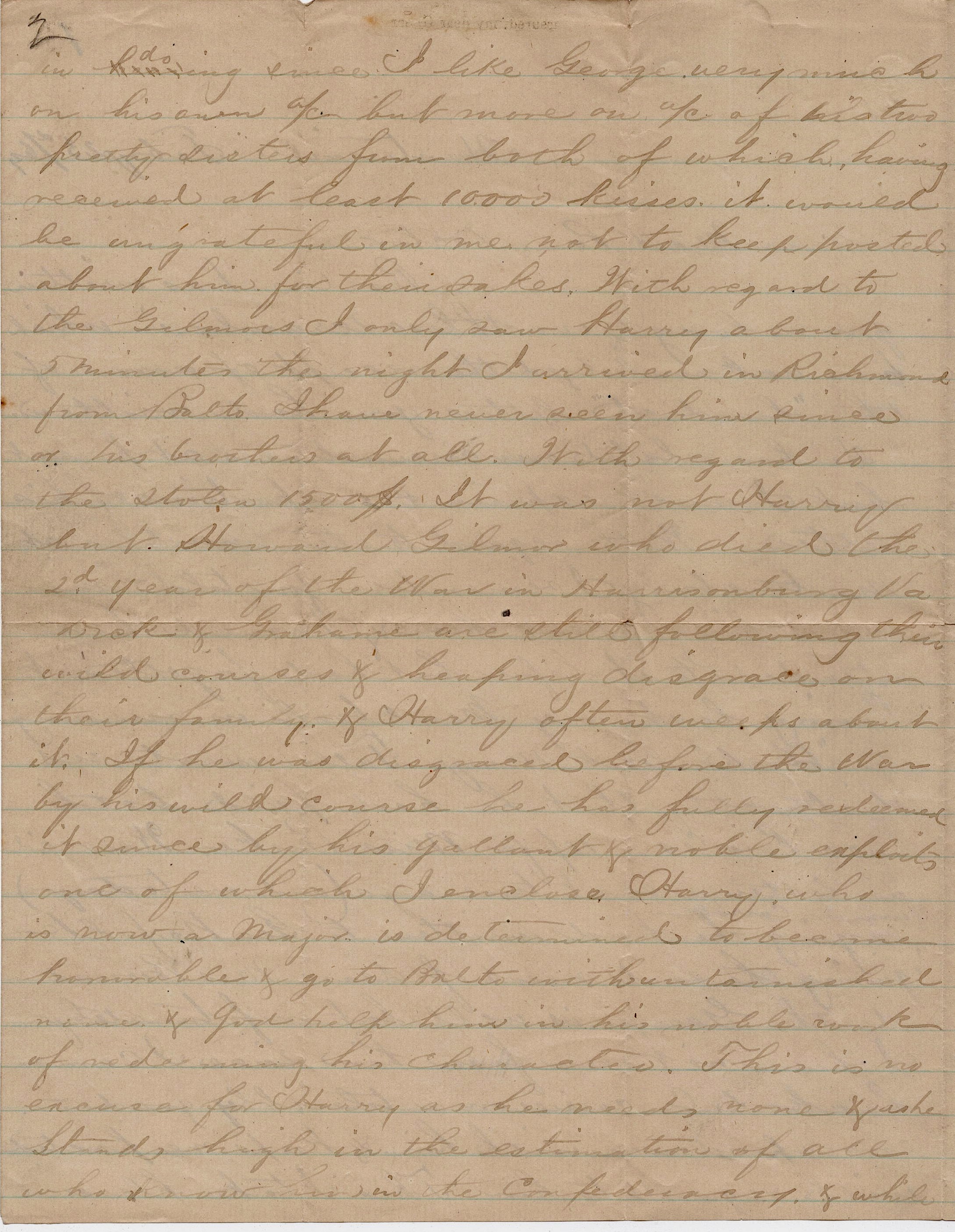
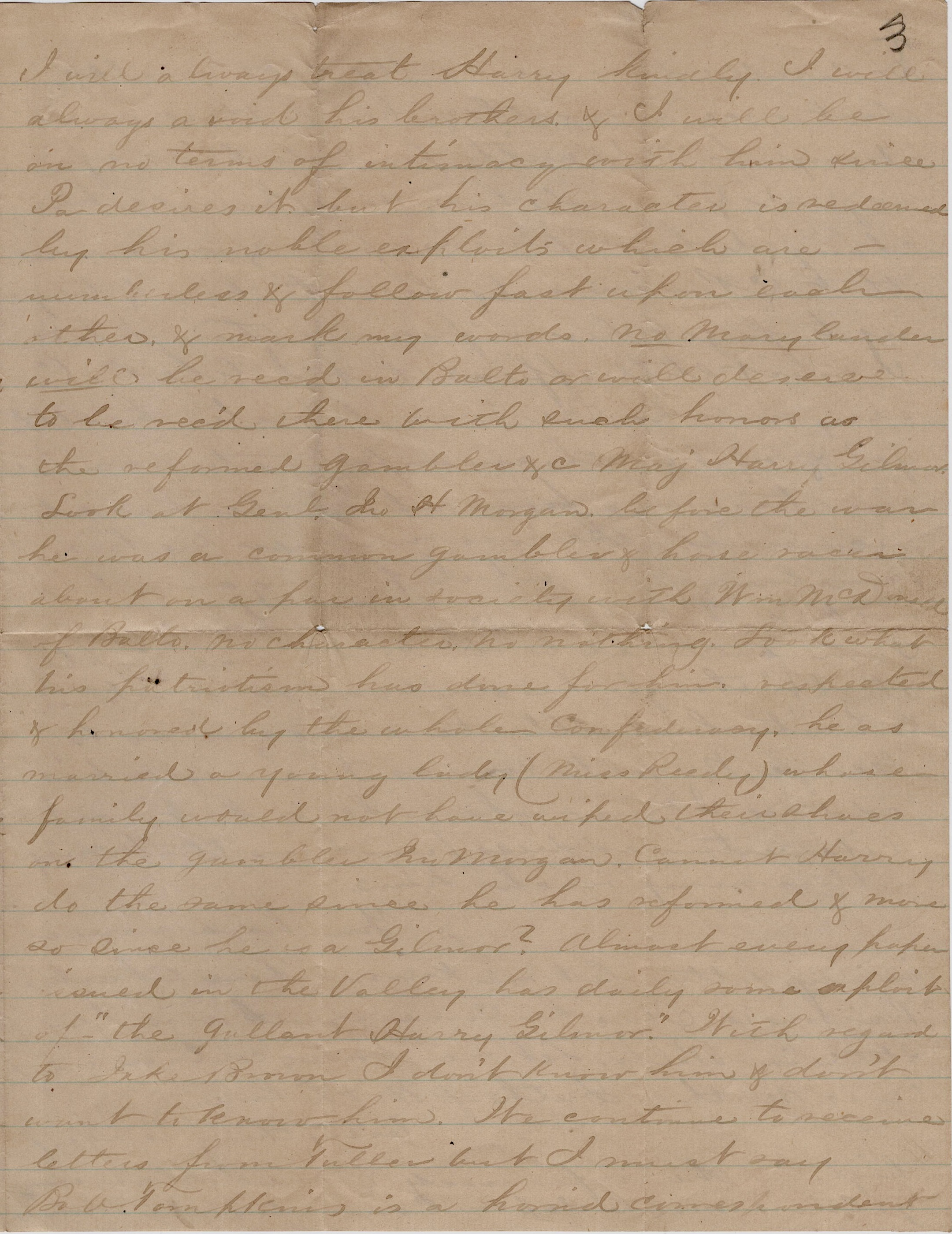
With regard the Gilmor’s, I only saw Harry about 5 minutes the night I arrived in Richmond from Baltimore. I have never seen him since or his brothers at all. With regard to the stolen $1500. it was not Harry but Howard Gilmor who died the 2nd year of the war in Harrisonburg, Va. Dick & Grahame are still following their wild courses & heaping disgrace on their family & Harry often weeps about it. If he was disgraced before the war by his wild course, he has fully redeemed it since by his gallantry & noble exploits, one of which I enclose. Harry, who is now a Major, is determined to become honorable & go to Baltimore with untarnished name & God help him in his noble work of redeeming his character. This is no excuse for Harry, as he needs none & as he stands high in the estimation of all who know him in the Confederacy, & while I will always treat Harry kindly, I will always avoid his brothers & I will be on no terms of intimacy with him since Pa desires it. But his character is redeemed by his noble exploits, which are numberless & follow fast upon each other, & mark my words, no Marylander will be rec’d in Baltimore or will deserve to be rec’d there with such honors as the reformed gambler &c. Maj. Harry Gilmor. 1
Look at Gen’1 Jno. H[unt] Morgan before the war. He was a common gambler & horse racer about on a par in society with William McDonald of Baltimore. 2 No character. No nothing. Look what his patriotism has done for him. Respected & honored by the whole Confederacy. He has married a young lady (Miss Ready), whose family would not have wiped their shoes on the gambler Mr. Morgan. Cannot Harry do the same since he has reformed & more so, since he is a Gilmor? Almost every paper isued in the Valley has daily some exploit of “the Gallant Harry Gilmor.”
With regard to Jake Brown, I don’t know him & don’t want to know him.
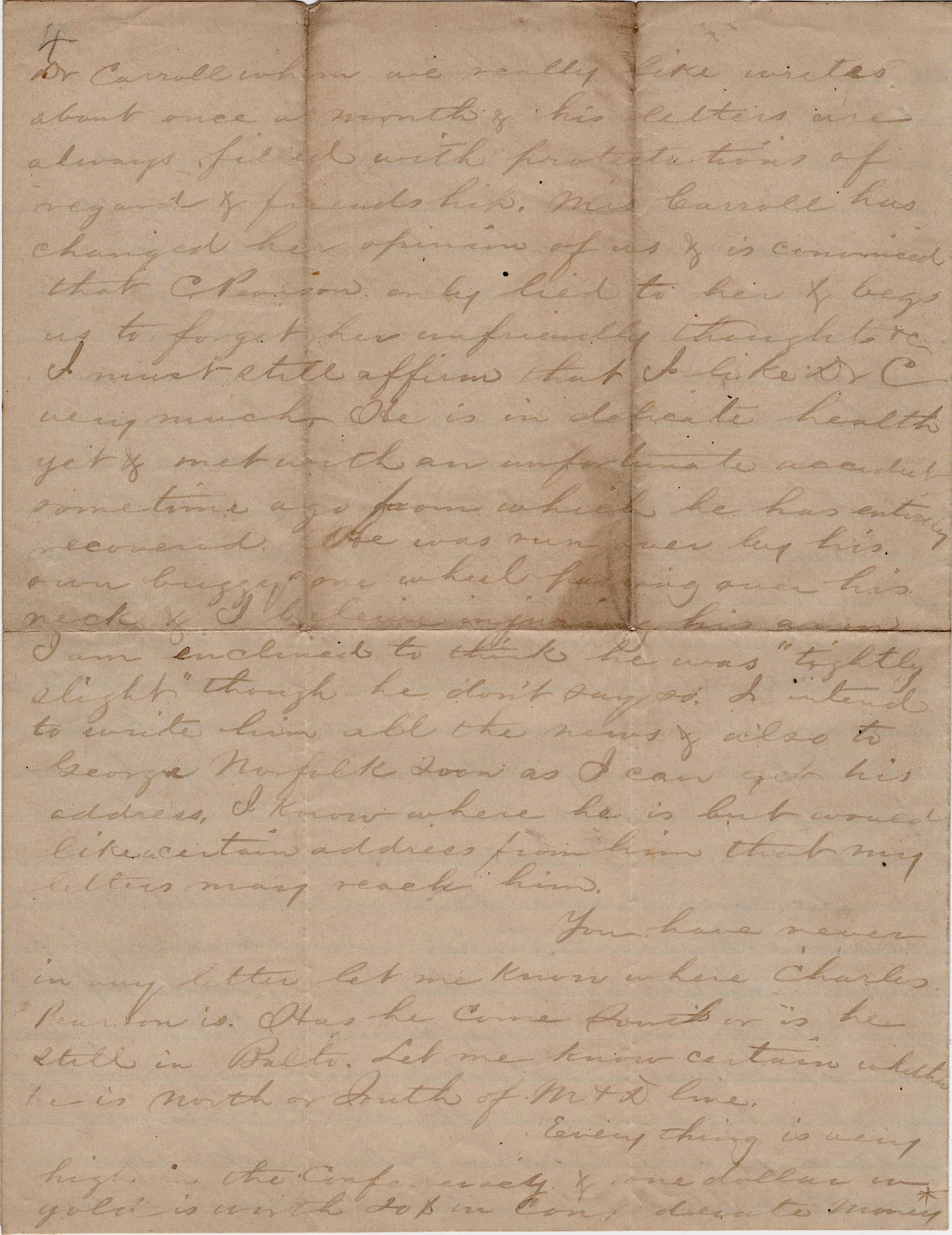
We continue to receive letters from Tuller, but I must say Bob Tompkins is a horrid correspondent. Dr. Carroll—whom we really like—writes about once a month & his letters are always filled with protestations of regard & friendship. Mrs. Carroll has changed her opinion of us & is convinced that C. Pearson only lied to her & begs us to forget her unfriendly thoughts &c. I must still affirm that I like Dr. Carroll very much. He is in delicate health yet & met with an unfortunate accident sometime ago from which he has entirely recovered. He was run over by his own buggy, one wheel passing over his neck & I believe injuring his arm. I am inclined to think he was “tightly slight,” though he don’t say so. I intend to write all the news & also to George Norfolk soon as I can get his address. I know where he is but would like a certain address from him that my letters may reach him.
You have never in any letters let me know where Charles Pearson is. Has he come South or is he still in Baltimore? Let me know certain whether he is north or south of Mason-Dixon line. Everything is very high in the Confederacy & one dollar in gold is worth $20 in Confederate money.
2 William (“Billy”) McDonald was a famous “sporting man, high roller, and enthusiastic horseman of Baltimore in the 1850s. He inherited a staggering fortune in 1850 from his father, Lt. Col. William McDonald (a wealthy merchant and War of 1812 militia leader). Rather than maintaining the family business, Billy became a legendary bon vivant who rapidly blew through his inheritance on a lavish lifestyle, high-stakes sports gambling, and horse racing. Because of his strong Southern sympathies, federal authorities targeted him, seized his properties, and threw him briefly into the prison at Fort McHenry.
Letter 8
[Editor’s note: This limited one page letter was most likely carried North by a Flag-of-Truce. It seems to be carefully worded to avoid the identity of not only the author but those who would be assisting the prisoners named. It’s my believe that the letter was written by John Rollin Bestor though he used the surname Belmont to sign his letter. The handwriting looks like John’s.]
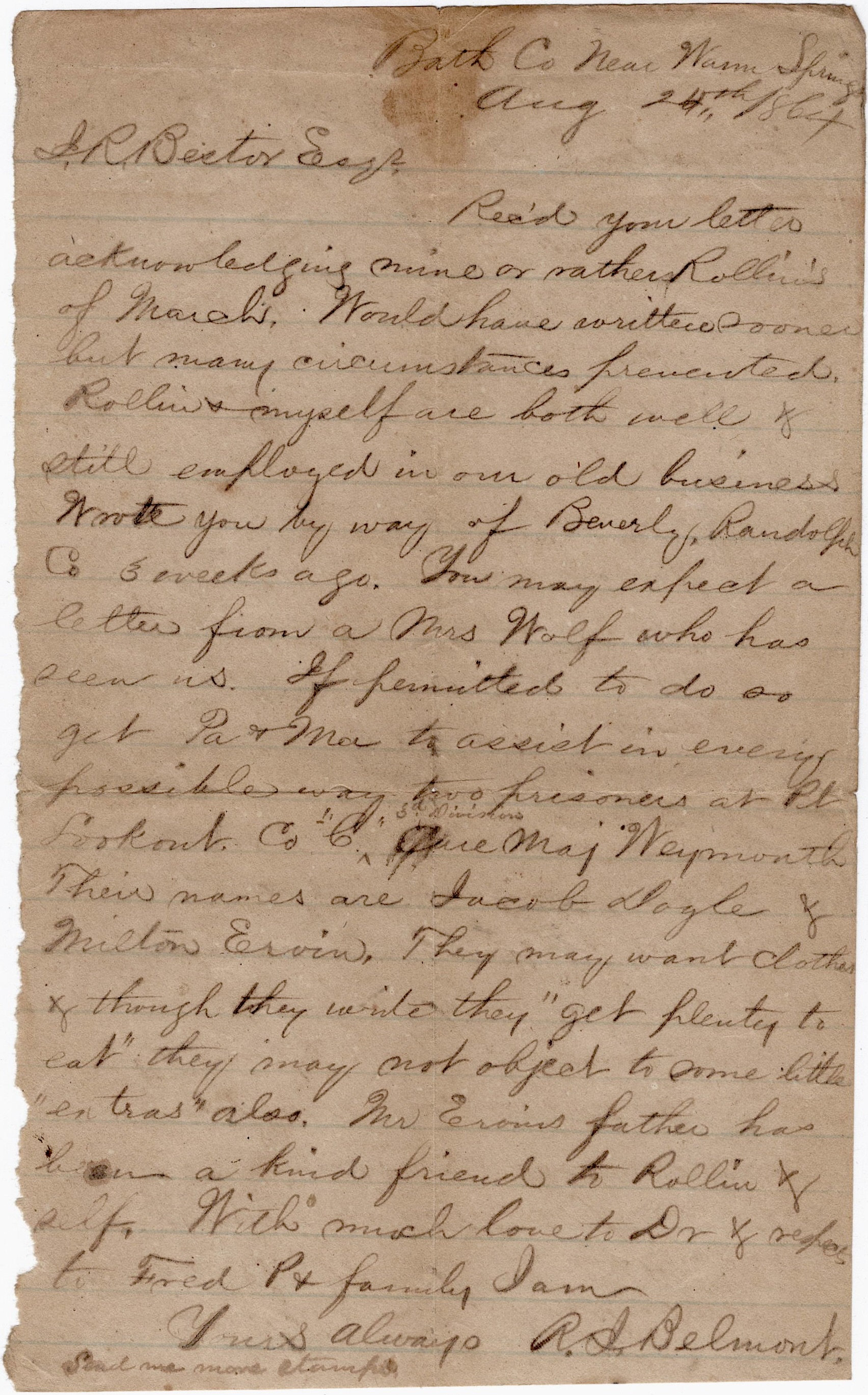
Bath County near Warm Springs August 24th 1864
J. R. Bestor, Esq.
Received your letter acknowledging mine, or rather Rollins’ of March. Would have written soon but many circumstances prevented. Rollin & myself are both well & still employed in our old business. Wrote you by way of Beverly, Randolph county, three weeks ago. You may expect a letter from a Mrs. Wolf who has seen us. If permitted to do so, get Pa & Ma, to assist in every possible way two prisoners at Point Lookout, care of Major Weymonth, Co. C, 3rd Division. Their names are Jacob Doyle 1 & Milton Ervin. They may want clothes & though they write they “get plenty to eat,” they may not object to some little “extras” also. Mr. Ervin’s father has been a kind friend to Rollin & self. With much love to Dr. & respect to Fred P. & family, I am yours always, — R. J. Belmont
Send me more stamps.
1 I believe this is the same Jacob Doyle from Hagerstown, Maryland, who served in Congress. B, 31st Virginia Infantry. He was taken prisoner on 5 May 1864 at Mine Run, Virginia, and taken to the prison at Point Pleasant, Maryland, but then transferred to Elmira Prison Camp on 30 July 1864. He died there on 18 September 1864.
Letter 9
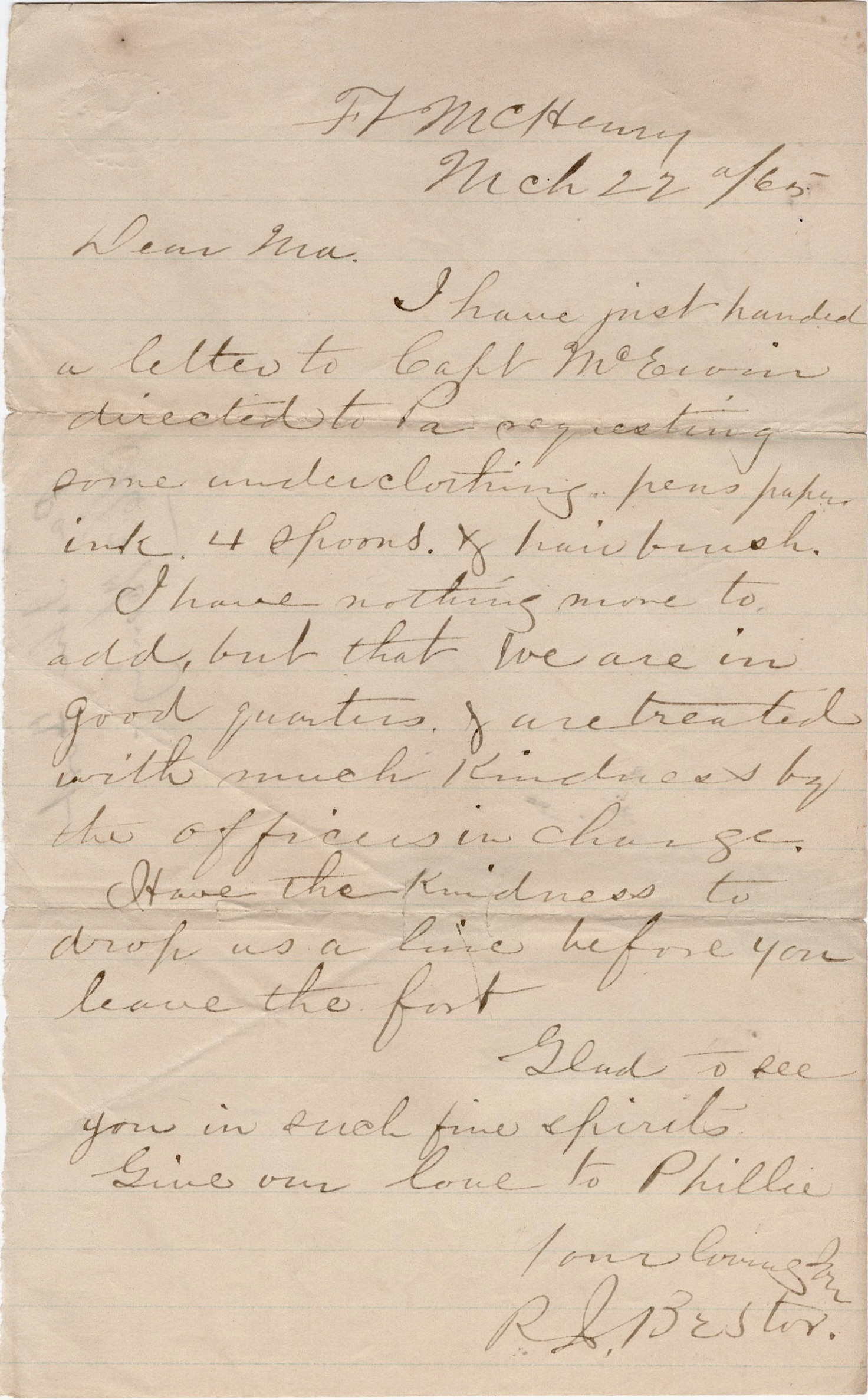
Fort McHenry [Baltimore, Maryland] March 22, 1865
Dear Ma.
I have just handed a letter to Capt. McEwin directed to Pa requesting some underclothing, pens, paper, ink, 4 spoons & hair brush. I have nothing more to add, but that we are in good quarters & are treated with much kindness by the officers in charge. Have the kindness to drop us a line before you leave the fort.
Glad to see you in such fine spirits. Give our love to Phillie.
Your loving son, — R. J. Bestor
Letter 10
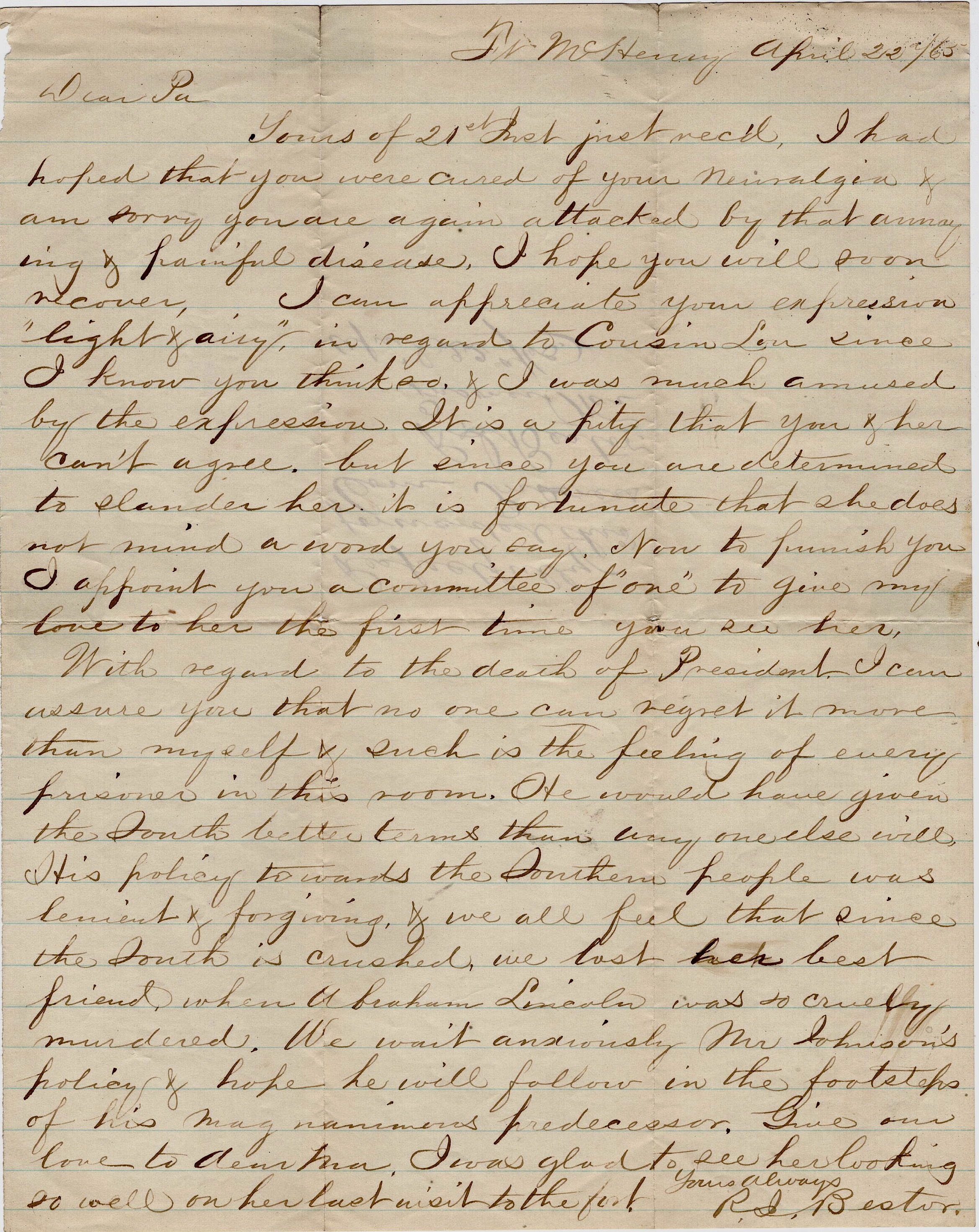
Fort McHenry [Baltimore, Maryland] April 22, 1865
Dear Pa,
Yours of 21st Inst. just received. I had hoped that you were cured of your neuralgia & am sorry you are again attacked by that annoying & painful disease. I hope you will soon recover. I can appreciate your expression “light & airy” in regard to Cousin Lou, since I know you think so & I was much amused by the expression. It is a pity that you & her can’t agree, but since you are determined to slander, it is fortunate that she does not mind a word you say. Now to punish you, I appoint you a committee of “one” to give my love to her the first time you see her.
With regard to the death of President, I can assure you that no one can regret it more than myself & such is the feeling of every prisoner in this room. He would have given the South better service than anyone else will. His policy towards the Southern people was lenient & forgiving & we all feel that since the South is crushed, we lost her best friend when Abraham Lincoln was so cruelly murdered. We wait anxiously Mr. Johnson’s policy & hope he will follow on the footsteps of his magnanimous predecessor.
Give our love to dear Ma. I was glad to see her looking so well on her last visit to the fort. Yours always, — R. J. Bestor
[written on other side]
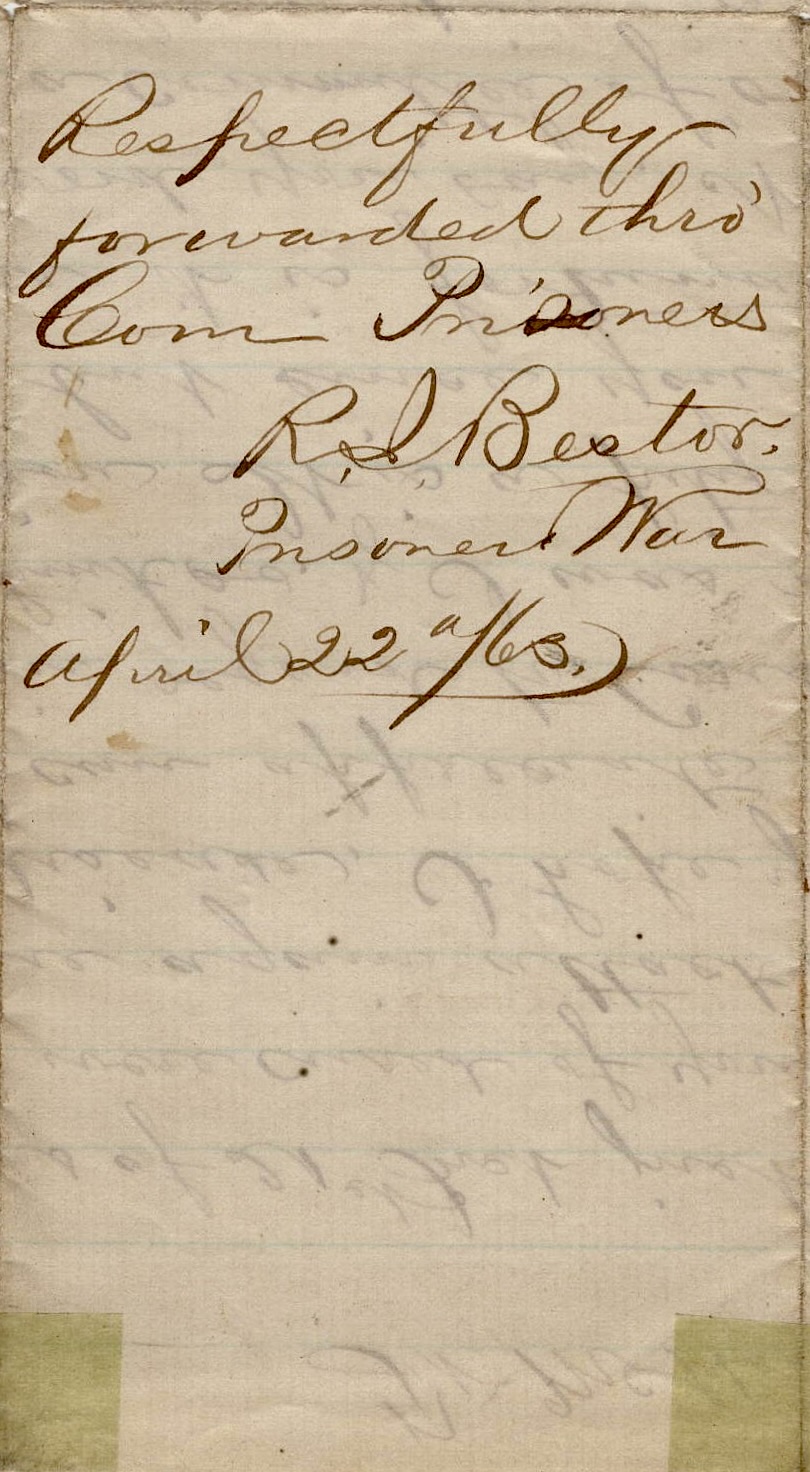
Respectfully forwarded thro’ Com. Prisoners. R. J. Bestor, Prisoner of War, April 22/65
Letter 11
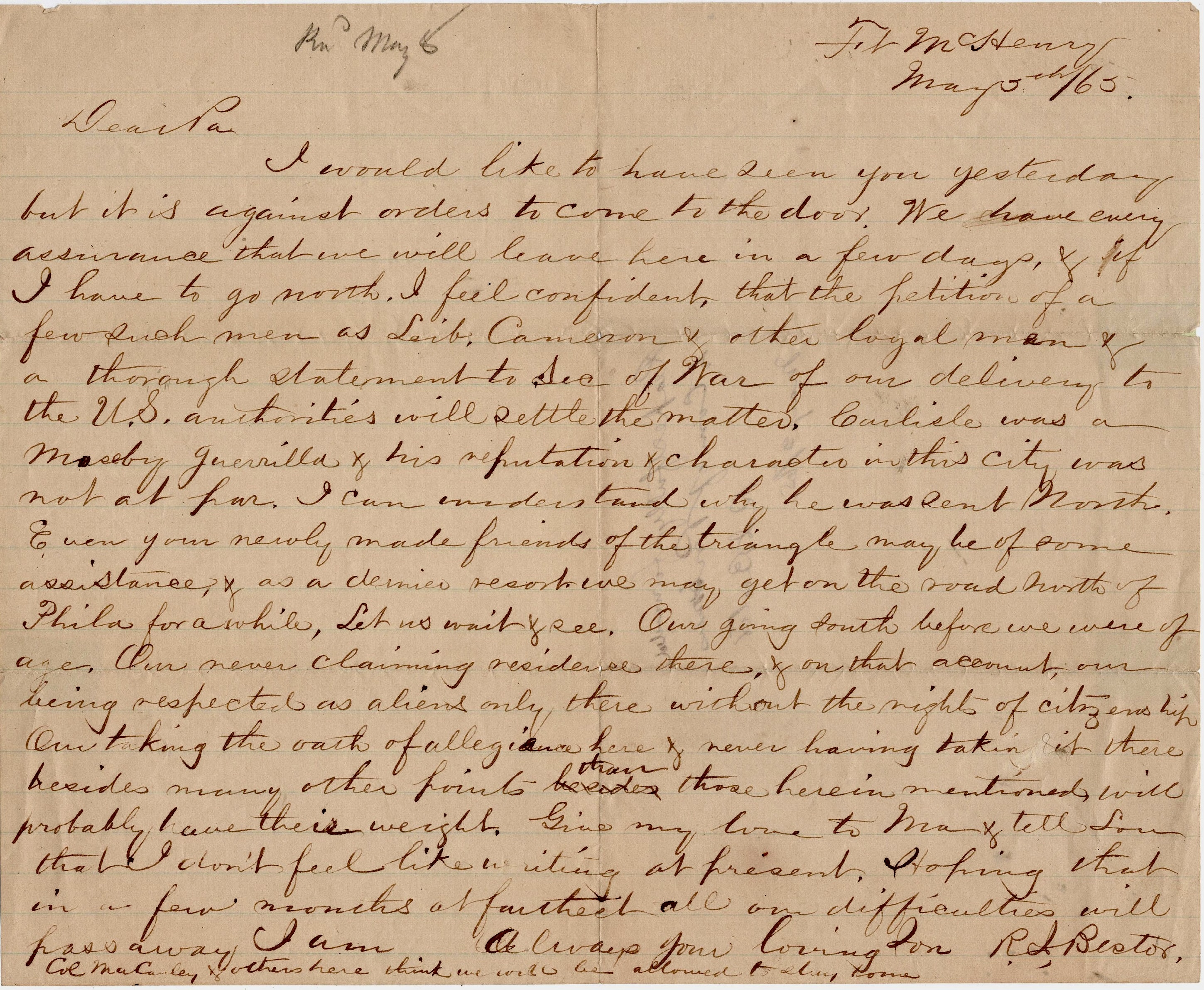
Fort McHenry [Baltimore, Maryland] May 5th 1865
Dear Pa,
I would like to have seen you yesterday but it is against orders to come to the door. We have every assurance that we will leave here in a few days & if I have to go North, I feel confident that the petition of a few such men as Leib, Cameron & other loyal men, and a thorough statement to the Secretary of War of our delivery to the U. S. authorities will settle the matter. [David Grafton] Carlisle was a Mosby guerrilla & his reputation & character in this city was not at par. I can understand why he was sent North. 1 Even your newly made friends of the triangle may be of some assistance, & as a denier resort, we may get on the road north of Philadelphia for a while. Let us wait & see. Our going South before we were of age, our never claiming residence there, & on that account, our being respected as aliens only there, without the rights of citizenship, our taking the Oath of Allegiance here & never having taken it there, besides many other points than those herein mentioned will probably have their weight.
Give my love to Ma & tell Lou that I don’t feel like writing at present, hoping that in a few months at farthest all our difficulties will pass away. I am always your loving son, — R. J. Bestor
Col. McCauley & others here think we will be allowed to stay home.
1 David “Grafton” Carlisle was taken prisoner on 18 February 1865 at Upperville and sent to Fort McHenry with a note, “guerrilla, not to be exchanged.” He took the oath on 1 May 1865 at Fort McHenry.
Capt. Amos Thompson Allen, mortally wounded at Cold Harbor.
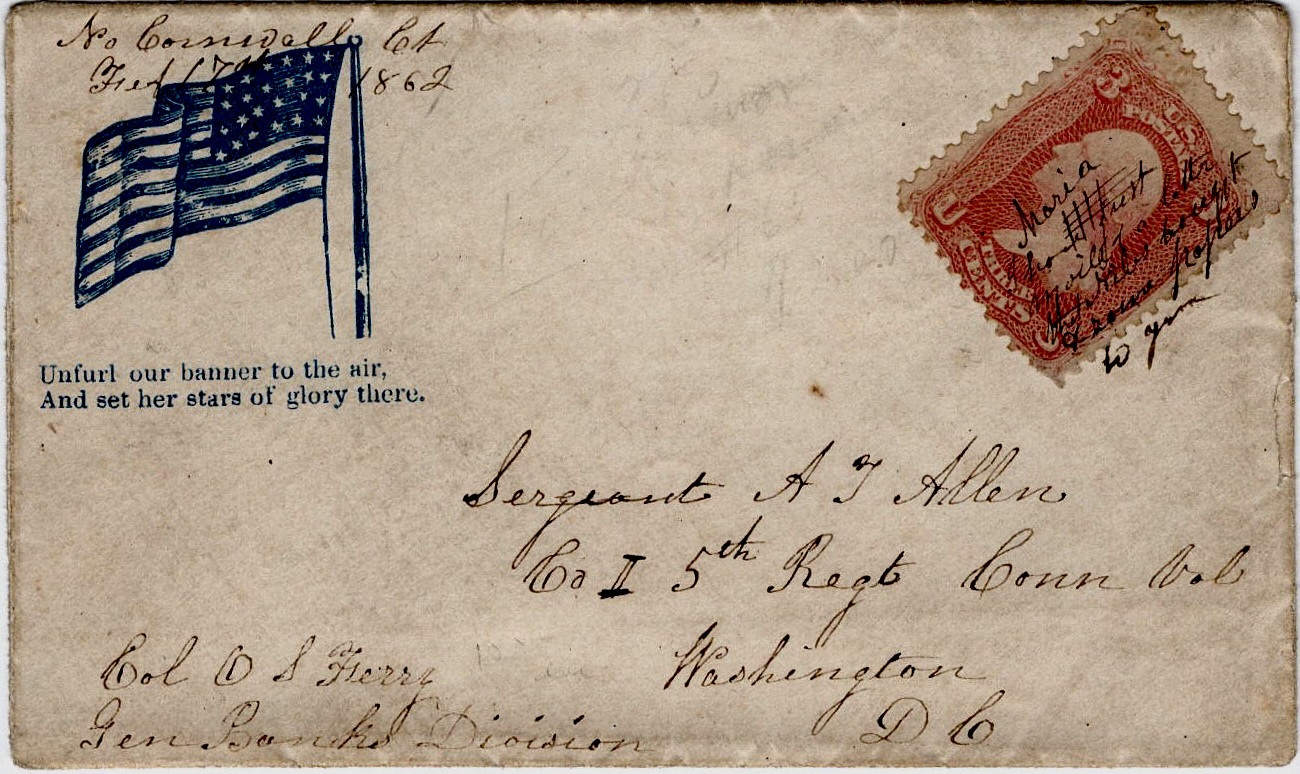
This letter was written by Maria Allen to her brother Amos Thompson Allen (1838-1864). They were the children of Chester Allen and Eliza Ingersoll. Amos enlisted on 22 June 1861 as a 1st Sergeant in Co. I, 5th Connecticut Infantry. In December 1862, he was given a commission as 1st Lieutenant and transferred to Co. F, 11th Connecticut Infantry. In April 1864 he was transferred to Co. H, 11th Connecticut where he was appointed Captain.
Unfortunately, the Captain received a severe would in the left leg during the Battle of Cold Harbor on 3 June 1864 which required amputation. He died at home on 5 July 1864.
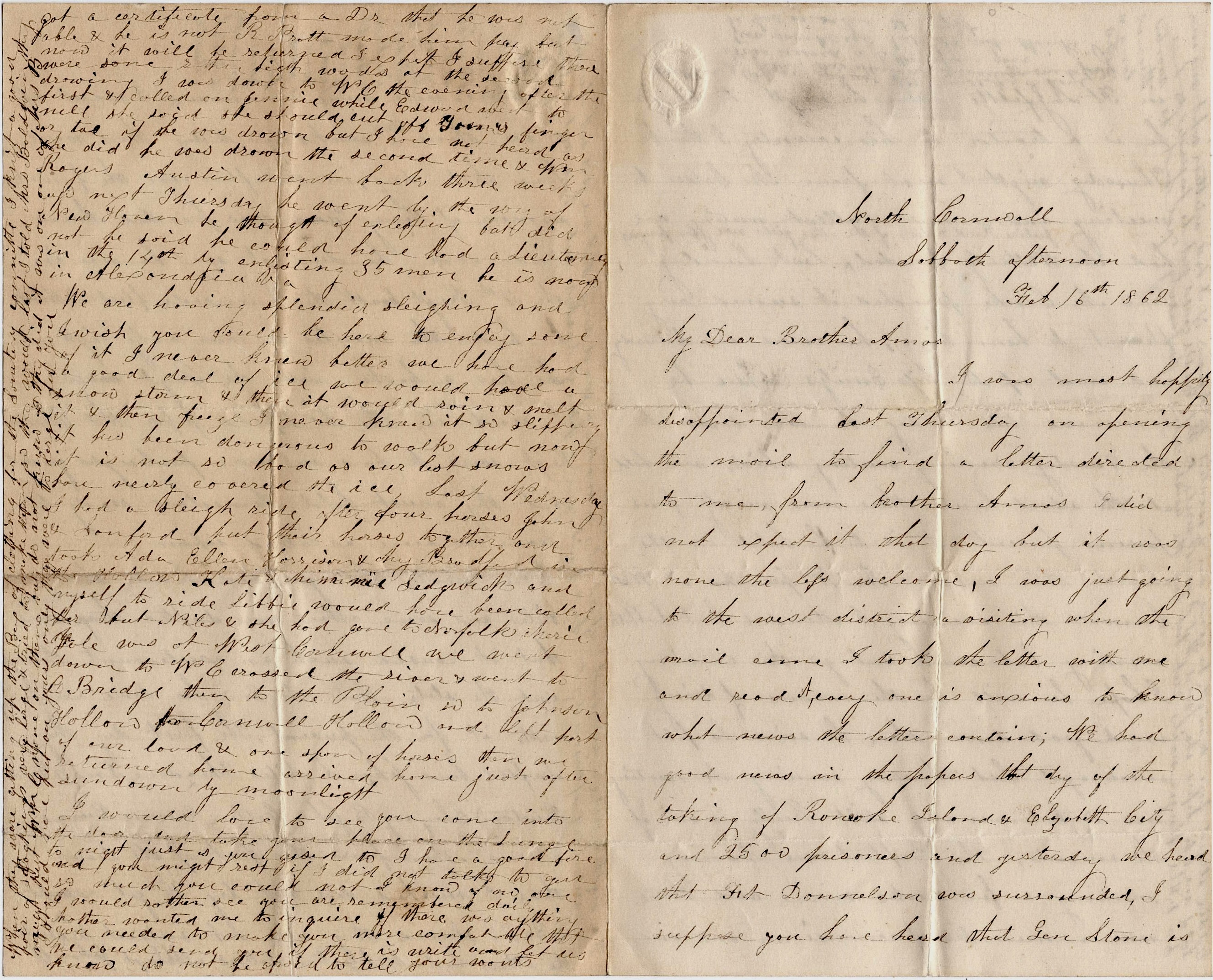
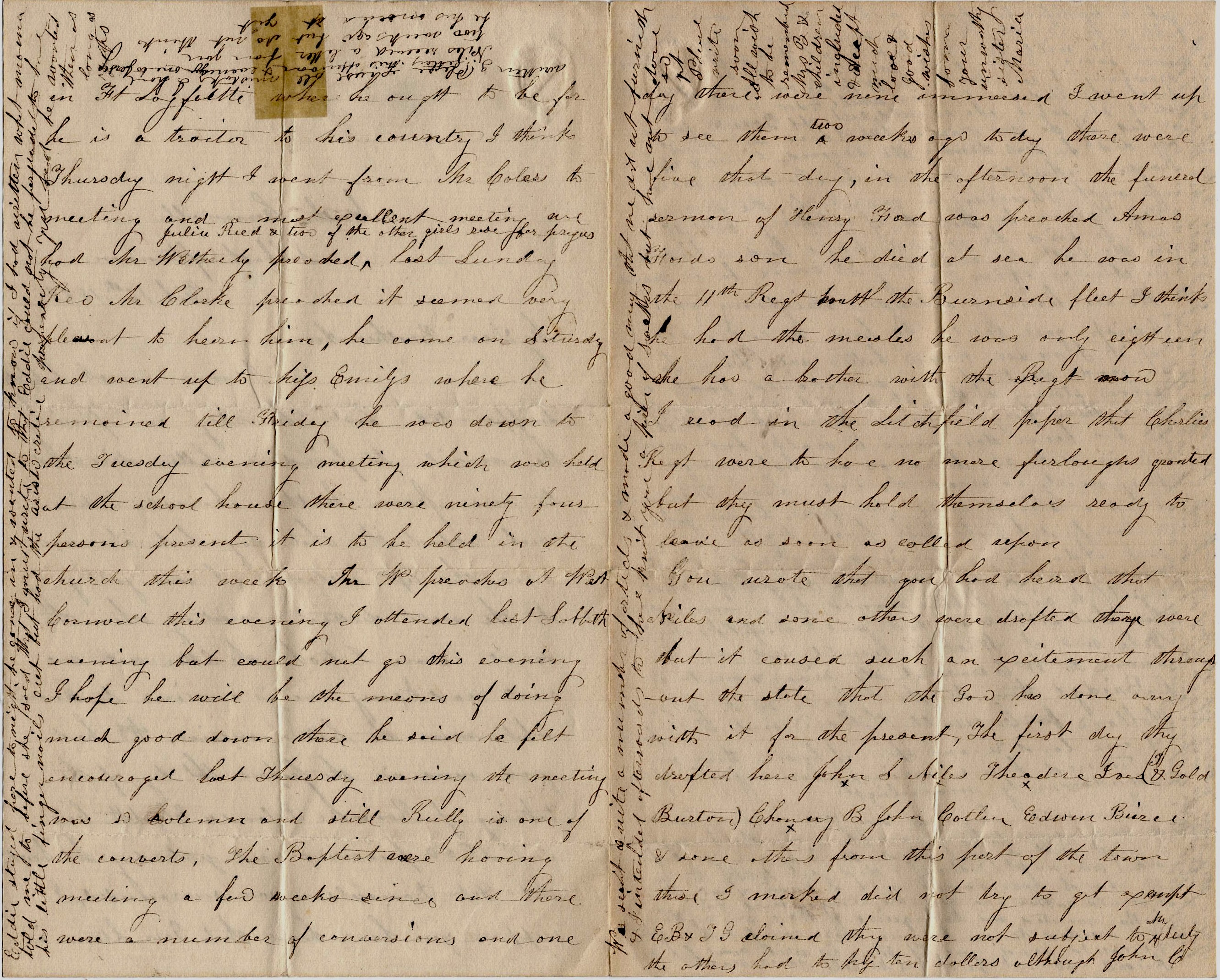
Maria’s letter gives home front news to her brother, including details of the fuss over a State ordered draft in January 1862.
T R A N S C R I P T I O N
Directed to Sergeant A. T. Allen, Co. I, 5th Regt. Conn. Vols., Washington, D. C.
North Cornwall Sabbath afternoon February 16th 1862
My Dear Brother Amos,
I was most happily disappointed last Thursday on opening the mail to find a letter directed to me from brother Amos. I did not expect it that day but it was none the less welcome. I was just going to the west district a visiting when the mail came. I took the letter with me and read it. Everyone is anxious to know what news the letter contains.
We had good news in the papers that day of the taking of Roanoke Island & Elizabeth City and 2500 prisoners and yesterday we heard that Fort Donelson was surrendered. I suppose you have heard that Gen. Stone is in Fort Lafayette where he ought to be for he is a traitor to his country, I think.
Thursday night I went from the Coles’ to meeting and a most excellent meeting we had. Mr. [Charles] Wetherly [or Wetherby] preached, Julia Reed & two of the other girls read for prayers. Last Sunday, Rev. Mr. [William C.] Clarke preached. It seemed very pleasant to hear him. He come on Saturday and went up to Miss Emily’s where he remained till Friday. He was down to the Tuesday evening meeting which was held at the school house. There were 94 persons present. It is to be held in the church this week. Mr. Wetherly preaches at West Cornwall this evening. I attended last Sabbath evening but could not go this evening. I hope he will be the means of doing much good down there. He said he felt encouraged last Thursday evening. The meeting was so solemn and still. Rully is one of the converts. The Baptists were having meeting a few weeks since and there were a number of conversions and one day there were nine immersed. I went up to see them two weeks ago. There were five that day.
In the afternoon, the funeral sermon of Henry [C.] Ford was preached—Amos Ford’s son. He died at sea. He was in [Co. D of] the 11th Regiment with the Burnside fleet. I think he had the measles. He was only 18. He has a brother with the regiment now. I read in the Litchfield paper that Charlie’s regiment were to have no more furloughs granted but they must hold themselves ready to leave as soon as called upon.
You wrote that you had heard that Niles and some others were drafted. They were. But it caused such an excitement throughout the state that the Governor has done away with it for the present. The first day they drafted here, John S. Niles, Theadore Ives, & T. Gold Burton, Chancey B., John Cotten, Edwin Bierce, & some others from this part of the town that I marked did not try to get exempt. E. B. & T. G. claimed they were not subject to duty. The others had to pay ten dollars although John C. got a certificate from a doctor that he was not able & he is not. R. Pratt made him pay but now it will be returned I expect. 1
I was down to West Cornwall the evening after the first & called on Jennie while Edward went to mill. She said she should cut off Tom’s finger or toe if he was drawn the second time. And William Roger’s Austin went back three weeks ago next Thursday. He went by the way of New Haven. He thought of enlisting but did not. He said he could have had a lieutenancy in the 14th by enlisting 35 men. He is now in Alexandria, Virginia.
We are having splendid sleighing and I wish you could be here to enjoy some of it. I never knew better. We have had a good deal of ice. We would have a snow storm and then it would rain & melt it & then freeze. I never knew it so slippery. It has been dangerous to walk but now it is not so bad as our last snows have nearly covered the ice. Last Wednesday I had a sleigh ride after four horses. John & Sanford put their horses together and took Ada, Ellen, Harrison & [ ] Bradford in the Hollow. Kate & Minnie Sedgwick and myself to ride. Libbie would have been called after but Niles & she had gone to Norfolk…We went down to C. Bridge, then to the Olain to Johnson Hollow from Cornwall Hollow and left part of our load & one span of horses. Then we returned home. Arrived home just after sundown by moonlight.
I would love to see you come into the door and take your place on the lounge tonight just as you used to. I have a good fire and you might rest if I did not talk to you so much you could not. I know of no one I would rather see. You are remembered daily. Mother wanted me to inquire if there was anything you needed to make you more comfortable that we could send you. If there is, write and let us know. Do not be afraid to tell your wants….
from your unworthy sister, — Maria
1 The draft to which Maria refers was instituted by Connecticut Governor Buckingham to augment the ranks of the State Militia, which had suffered depletion due to volunteers enlisting in State Regiments for U.S. service. While these individuals were not anticipated to be activated immediately, in the event of a Federal draft, they would have been among the first to be conscripted. This prospect was met with considerable discontent by those whose names were drawn, prompting them to seek declarations of exemption. Upon selection, the men were afforded five days to establish their exempt status, secure a substitute, or incur a fine of ten dollars. [Source: Litchfield Enquirer, 30 January 1862]
This letter was written by Edwin R. Paine (1840-1880), the son of Lewis Whipple and Jane (Nelson) Paine of Bristol county, Massachusetts. He first enlisted in the 1st Rhode Island Detached Militia in May 1861 for 90 days but the following year, in September, 1862, he enlisted in Co. H, 40th Massachusetts Infantry. Co. H was raised primarily in Essex county with several men from towns like Attleboro. He was discharged for disability on 15 July 1864 at Boston, giving Attleboro, Massachusetts as his residence. In October 1861, he was married to Margaret N. Shields (1841-1899) and had a son named Nelson born in 1862. He’s buried in Pawtucket, Providence county, Rhode Island.
The 40th Massachusetts left the state on 8 September 1862 and was comparatively inactive for some time and remained on picket and guard duty in and around Washington until the spring of 1863. On 15 April 1863, it moved to Suffolk, Va., then under siege, where it was engaged in two reconnaissances on April 24 and May 3. It then moved to West Point, Va., Yorktown, Williamsburg, White House landing in succession, and was engaged with the enemy at Baltimore cross-roads, on July 2. It then passed through Washington on the 11th, and went to Frederick, Md., where it joined the Army of the Potomac in the pursuit of Lee’s army after the battle of Gettysburg. On Aug. 6, it was ordered to Folly island, Charleston harbor, and occupied the trenches in front of Fort Wagner until the surrender of that stronghold. On account of its high repute for excellence in drill and discipline, it was equipped as mounted infantry at Hilton Head in Jan., 1864, and moved on Feb. 4, to Jacksonville, Fla., where it formed part of the Light brigade composed of the 40th, the independent battalion Mass. cavalry and Battery B, 1st U. S. Artillery, Col. Henry acting brigadier. It was engaged at Barber’s ford and Olustee, losing in the latter engagements 5 killed, 23 wounded and 4 missing.
T R A N S C R I P T I O N
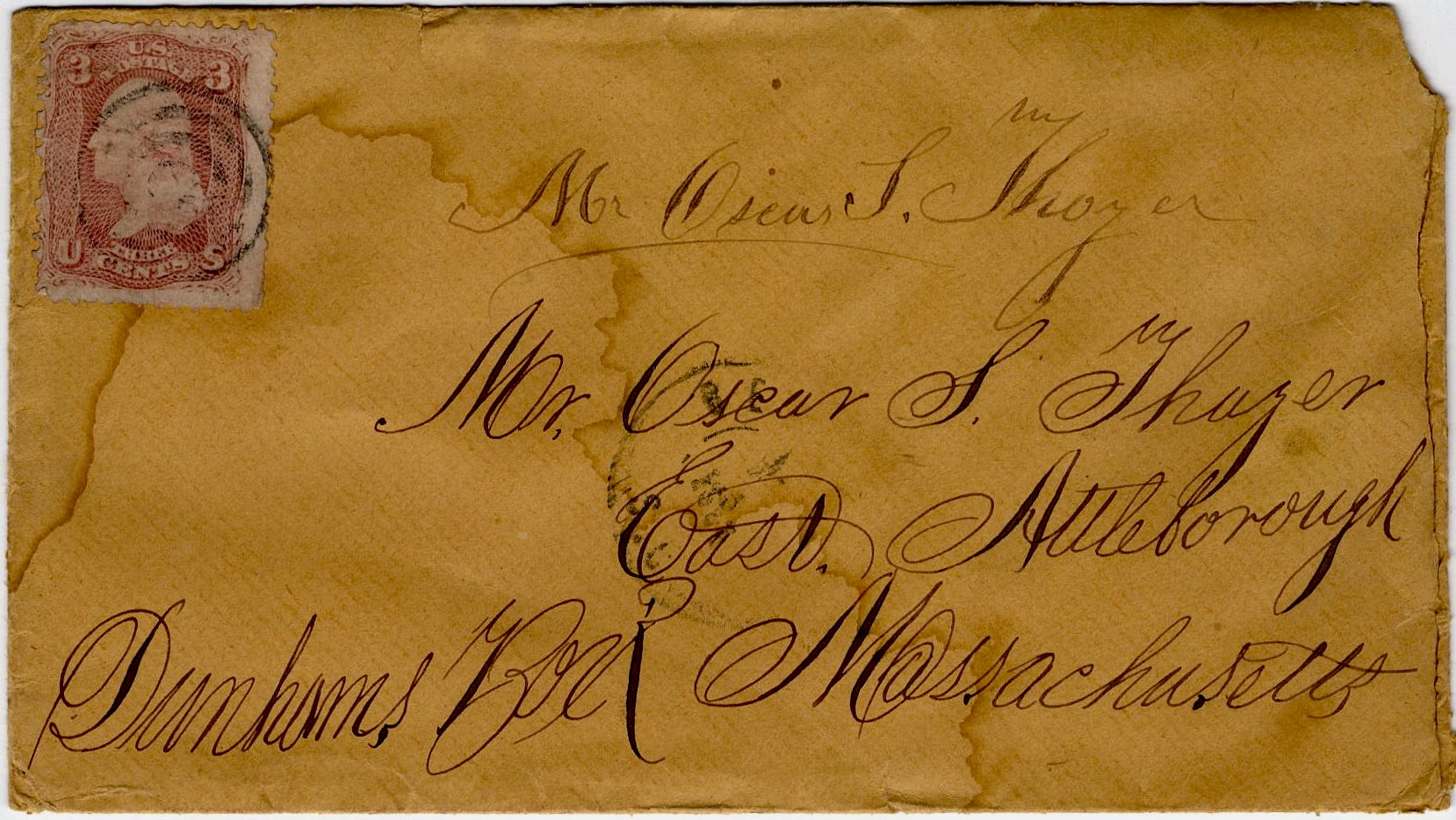
Directed to Mr. Oscar S. Thayer, Wast Attleborough, Massachusetts; Dunham’s Box
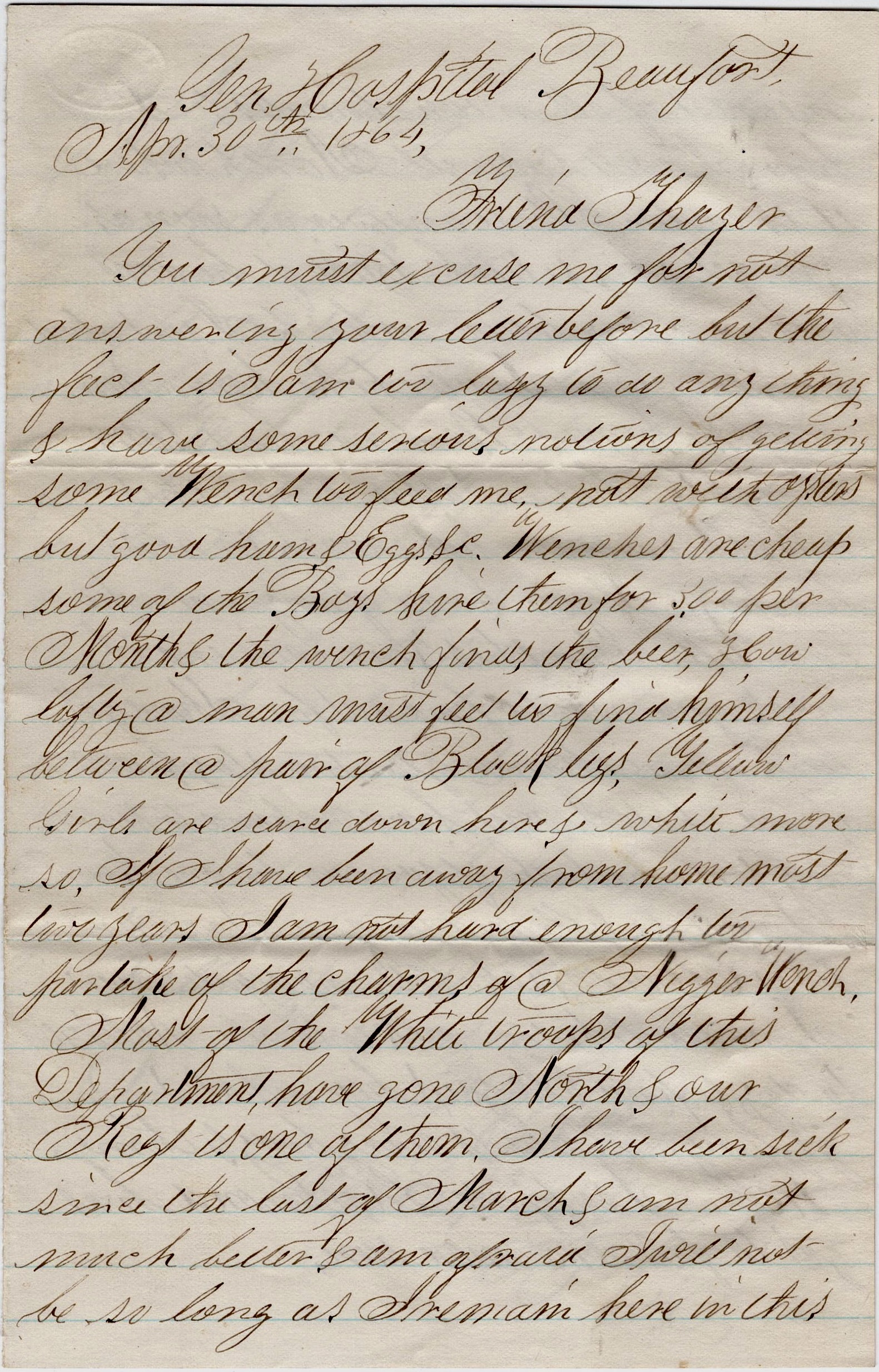
General Hospital, Beaufort April 30th 1864
Friend Thayer,
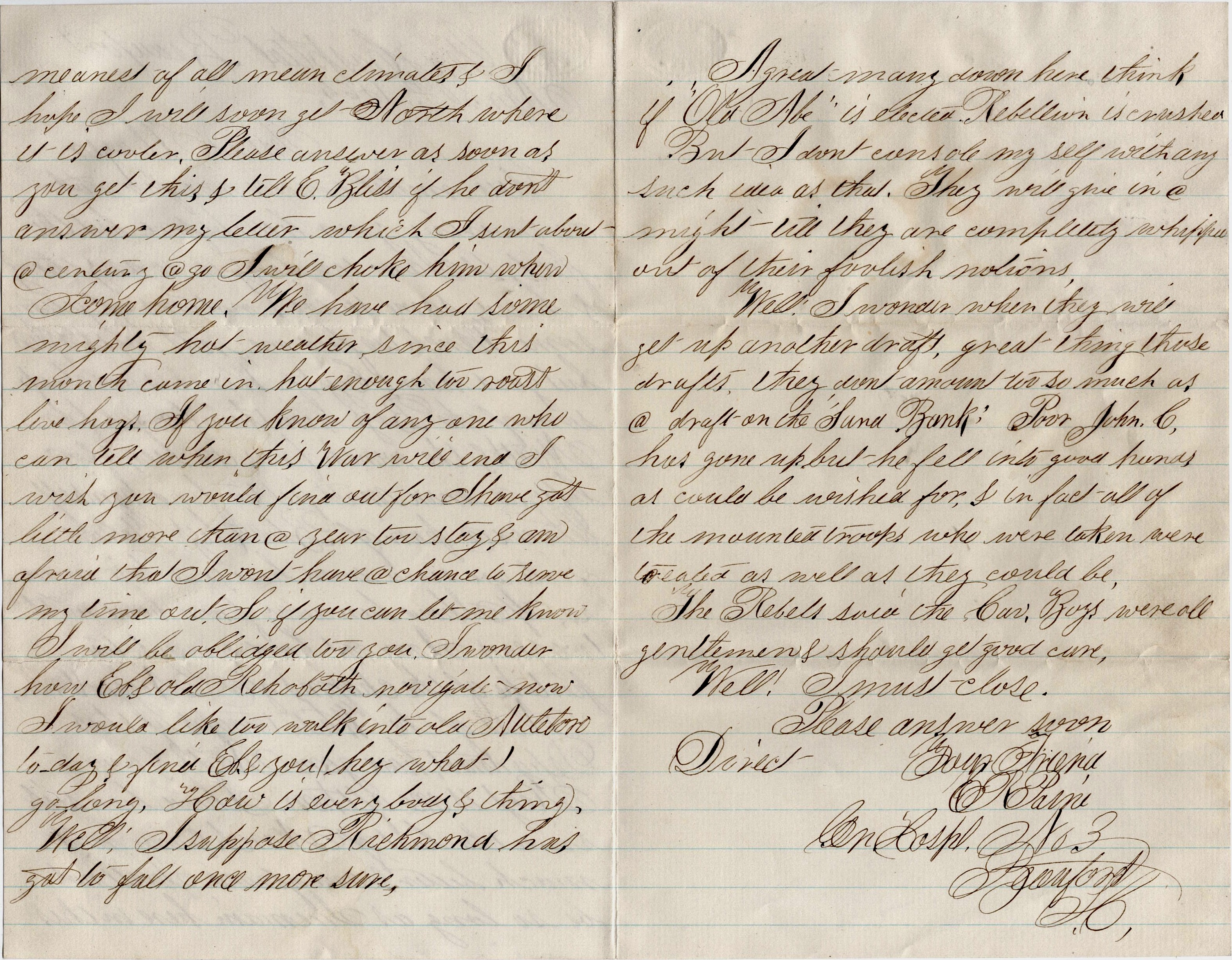
You must excuse me for not answering your letter before but the fact is I am too lazy to do anything. I have some serious notions of getting some wench to feed me–not with oysters, but good ham & eggs, &c. Wenches are cheap. Some of the boys hire them for $3 per month & the wench finds the beer. How lofty a man must feel to find himself between a pair of Black legs. Yellow girls are scarce down here & White more so. If I had been away from home most two years, I am not hard enough to partake of the charms of a Nigger Wench. Most of the White troops of this department have gone North & our regiment is one of them. I have been sick since the last of March & am not much better & am afraid I will not be so long as I remain here in this meanest of all climates & I hope I will soon get North where it is cooler.
Please answer as soon as you get this & tell E. Bliss if he don’t answer my letter which I sent about a century ago, I will choke him when I come home.
We have had some mighty hot weather since this month came in—hot enough to roast live hogs. If you know of anyone who can tell when this war will end, I wish you would find out for I have got little more than a year to stay & am afraid that I won’t have a chance to serve my time out. So if you can let me know, I will be obliged to you. I wonder how Eb’s old Rehoboth navigates now? I would like to walk into Old Attleboro today to find Eb & you (hey what) go long. How is everybody & things?
Well, I suppose Richmond has got to fall once more, sure. A great many down here think if “Old Abe” is elected, [the] Rebellion is crushed. But I don’t console myself with any such idea as that. They will [not] give in a might till they are completely whipped out of their foolish notions.
Well, I wonder when they will get up another draft? Great thing those drafts. They don’t amount to so much as a draft on the “Sand Bank.” Poor John C. has gone up but he fell into [as] good hands as could be wished for, & in fact, all of the mounted troops who were taken were treated as well as they could be.
The Rebels saw the cavalry boys were all gentlemen & should get good care. Well, I must close. Please answer soon. Your friend, R. Paine
This letter was written by Lafayette Cornelius Cooper, a member of the Troup (Georgia) Artillery (also known as Carlton’s Battery)—an elite light artillery unit that fought extensively with the Army of Northern Virginia. Born in 1842 to Temple Franklin Cooper (1805-1864) and Unity Love Patrick (1825-1896) of Franklin county, Georgia, Lafayette Cooper joined the Athens-based Troup Artillery at the outbreak of the war. When the unit formally departed for Savannah in April 1861, he was initially mustered in as a 2nd Corporal. He rose through the non-commissioned officer ranks to Sergeant, and was later commissioned as a Lieutenant. At the Battle of Gettysburg, Cooper’s unit served as part of Colonel Henry Coalter Cabell’s Artillery Battalion, attached to Major General Lafayette McLaws’ Division of Longstreet’s First Army Corps. During the intense fighting on July 2, Cabell’s battalion actively engaged Union forces while supporting the famous assaults through the Peach Orchard and Wheatfield,
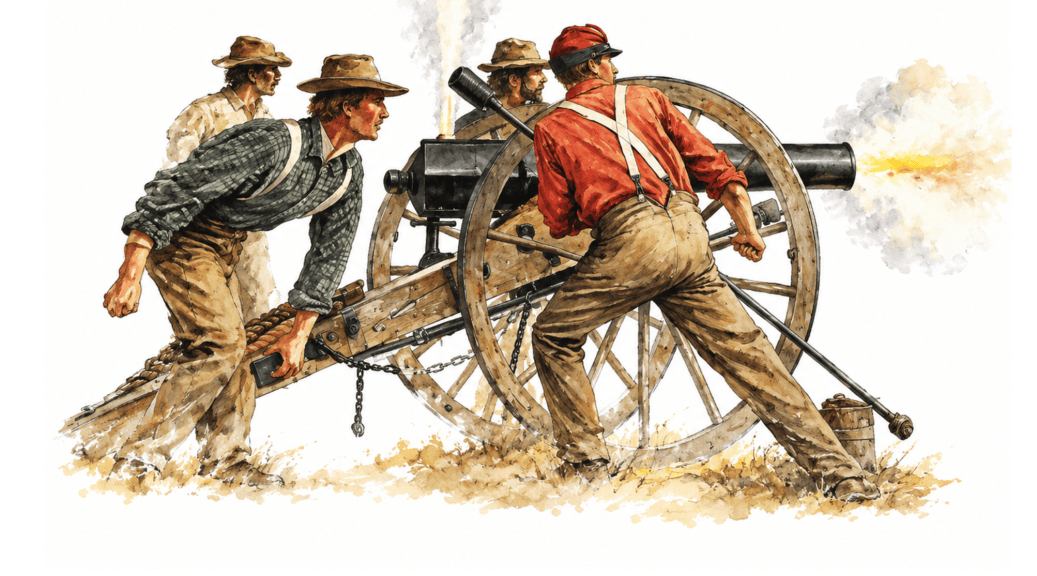
[Note: the AI-generated watercolor on the header of this post is based on Gallon’s painting of a Confederate Battery at Gettysburg.]
T R A N S C R I P T I O N
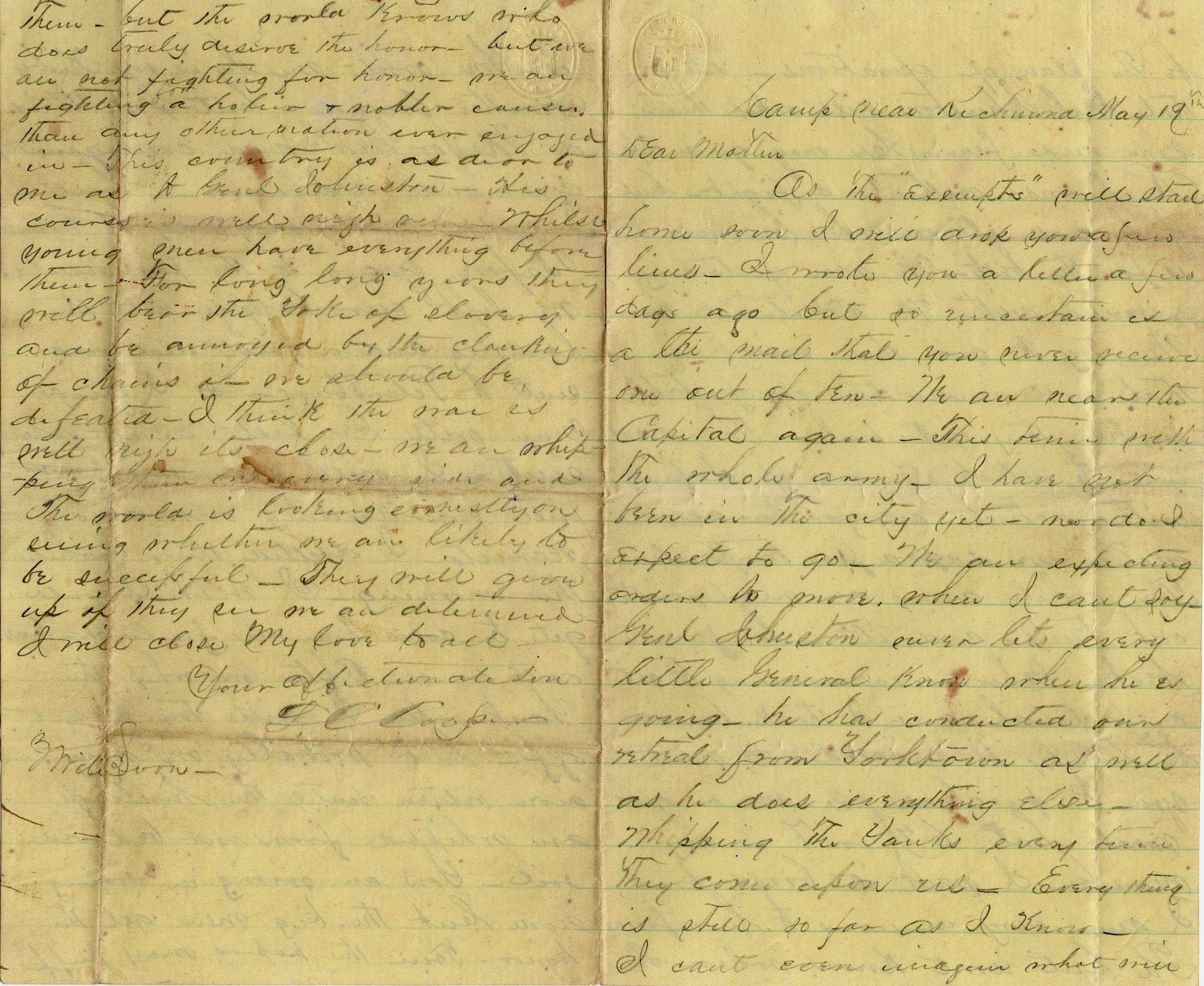
Camp near Richmond, [Virginia] May 19th [1862]
Dear Mother,
As the “exempts” will start home soon, I will drop you a few lines. I wrote you a letter a few days ago but so uncertain is the mail that you never receive one out of ten.
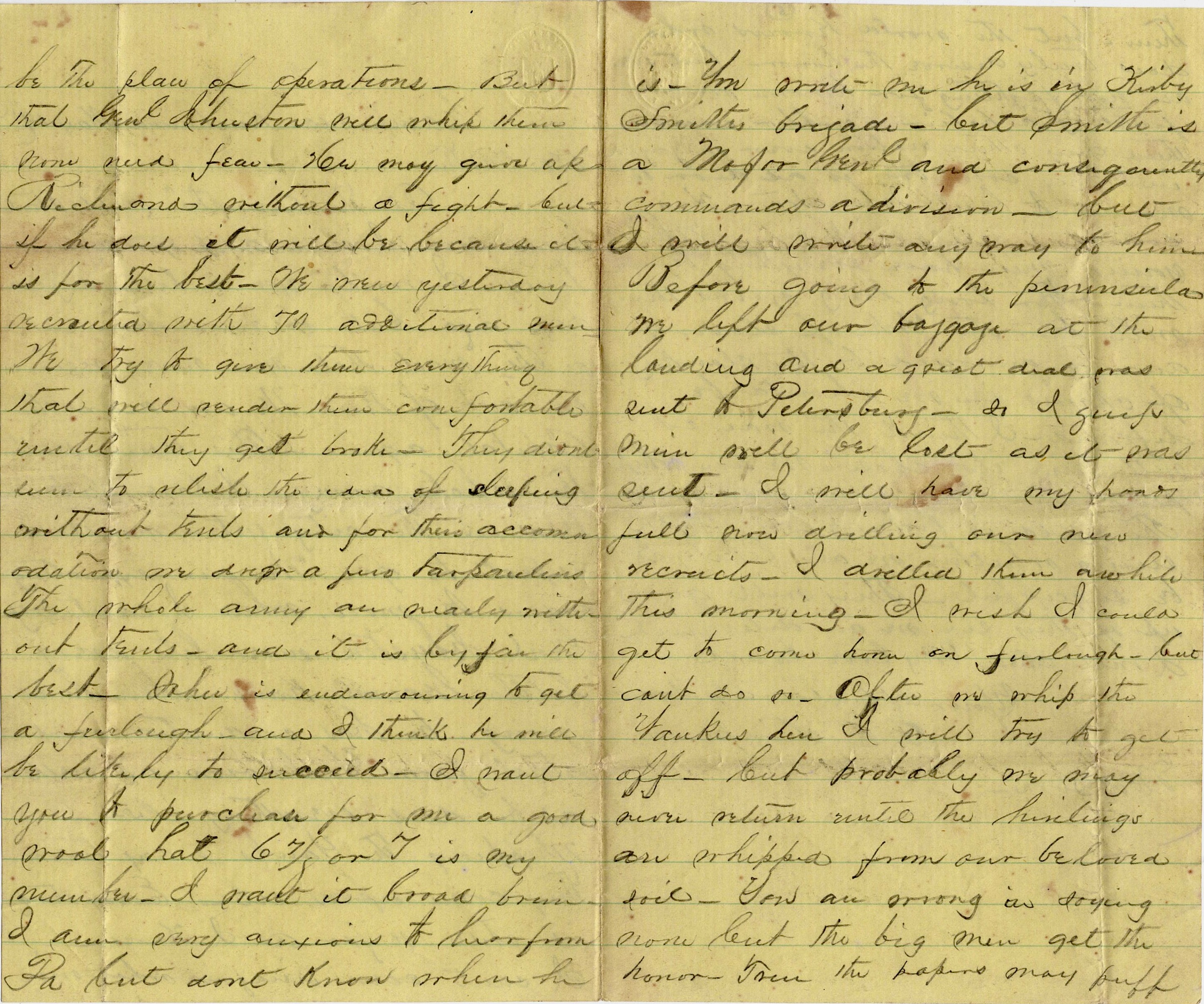
We are near the Capitol again—the time with the whole army. I have not been in the city yet, nor do I expect to go. We are expecting orders to move—when, I can’t say. Gen. Johnston never lets every little general know when he is going. He has conducted our retreat from Yorktown as well as he does everything else—whipping the Yanks every time they come upon us. Everything is still so far as I know. I can’t even imagine what will be the plan of operations. But that Gen. Johnston will whip them, none need fear. He may give up Richmond without a fight, but if he does, it will be because it is for the best.
We were yesterday recruited with 70 additional men. We try to give them everything that will render them comfortable until they get broke. They don’t seem to relish the idea of sleeping without tents and for their accommodation we drape a few tarpaulins. The whole army are nearly without tents and it is by far the best.
John is endeavoring to get a furlough and I think he will be likely to succeed. I want you to purchase for me a good wool hat; 6 7/8 or 7 is my number. I want it broad brim. I am very anxious to hear from Pa but don’t know where he is. You write me he is in Kirby Smith’s Brigade but Smith is a Major General and consequently commands a division. But I will write anyway to him. 1
Before going to the Peninsula, we left our baggage at the landing and a great deal was sent to Petersburg, so I guess mine will be lost as it was sent. I will have my hands full now drilling our new recruits. I drilled them awhile this morning. I wish I could get to come home on furlough but can’t do so. After we whip the Yankees here, I will try to get off but probably we may never return until the hirelings are whipped from our beloved soil.
You are wrong in saying none but the big men get the honor. True, the papers may puff them, but the world knows who does truly deserve the honor. But we are not fighting for honor. We are fighting a holier & nobler cause than any other nation ever engaged in. This country is as dear to me as to Gen. Johnston. His course is well night run, whilst young men have everything before them. For long, long years they will bear the yoke of slavery and be annoyed by the clanking of chains if we should be defeated.
I think the war is well nigh [at] its close. We are whipping them on every side and the world is looking earnestly on, seeing whether we are likely to be successful. They will give up if they see we are determined.
I will close. My love to all. Your affectionate son, — L. C. Cooper
Write soon.
1 Lafayette’s father, Temple F. Cooper was Captain of Co. K, 52nd Georgia Vol. Infantry.
This letter was written by Joseph Bloomfield Osborn (1842-1876), the son of Joseph Miller Osborn (1806-1876) and Martha Williams (1807-1871) of Bloomfield, Essex county, New Jersey. Joseph wrote the letter while an ordinary seaman serving aboard the USS Vanderbilt in 1865. Prior to his service in the US Navy, he was a member of Co. F, 26th New Jersey Infantry. The USS Vanderbilt was a heavy side-wheel steamer cruiser built by Cornelius Vanderbilt for transatlantic passage but made available to the US Government at the start of the Civil War. In January 1865, she joined in the heavy naval bombardment against Fort Fisher.
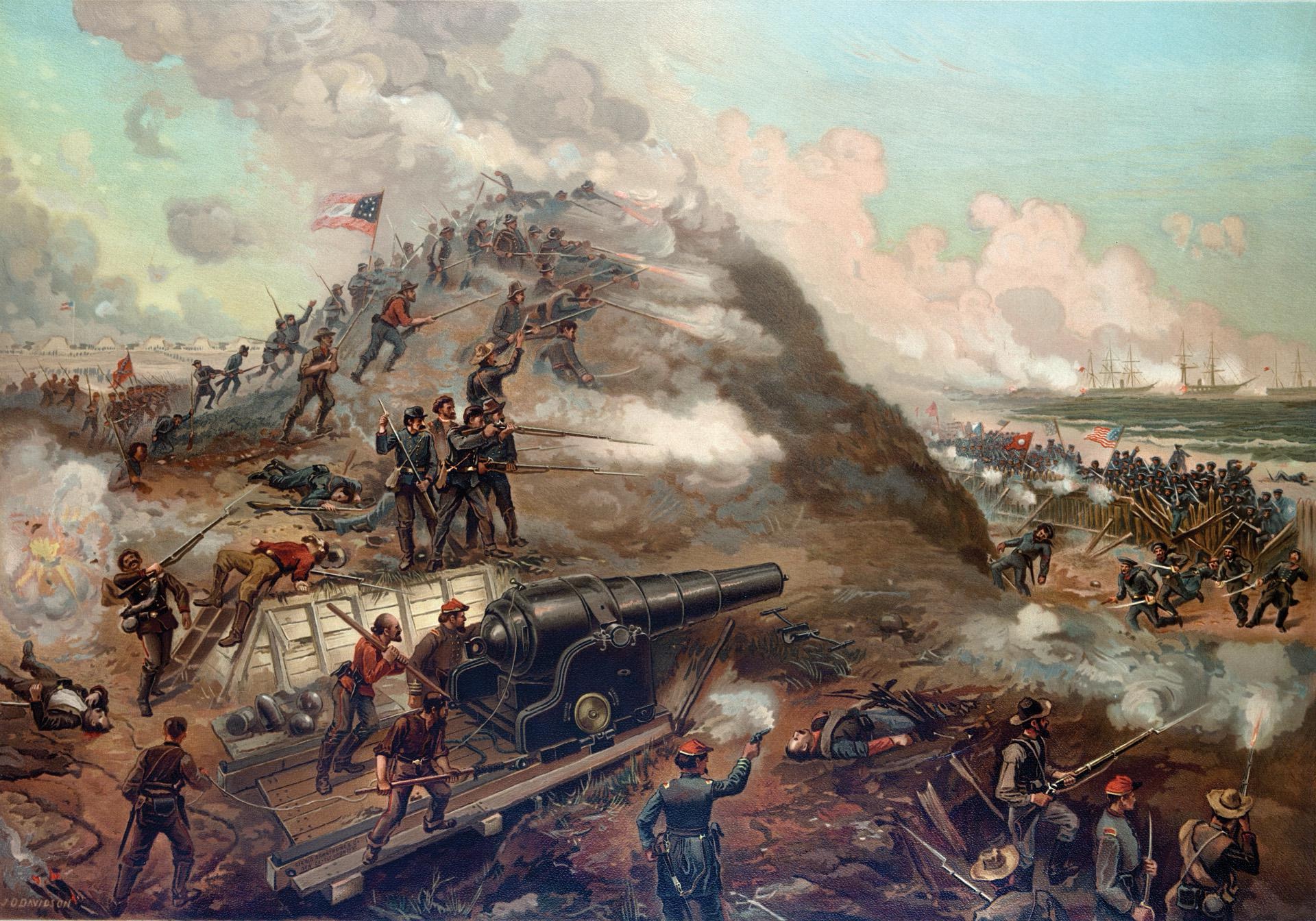
In addition to bombarding the forts from the sea, a landing party of some 1600 to 200 US sailors and 400 marines assaulted the northeast salient of Fort Fisher. “Three successive waves of sailors and marines were to attack the eastern seawall, but instead the assault went forward in a single unorganized mass. 2,000 sailors and marines crashed into the Confederate defenses. The battle was intense and furious. Although greatly outnumbered, the Rebel soldiers clung tenaciously to their defenses. Marines were meant to use rifle fire from nearby trenches to cover the assault armed only with pistols and cutlasses. Though this assault failed to carry the fort, their presence took the attention of the fort’s defenders leading to success by the infantry forces assaulting the opposite side. Its capture sealed off of one of the Confederacy’s last major ports.
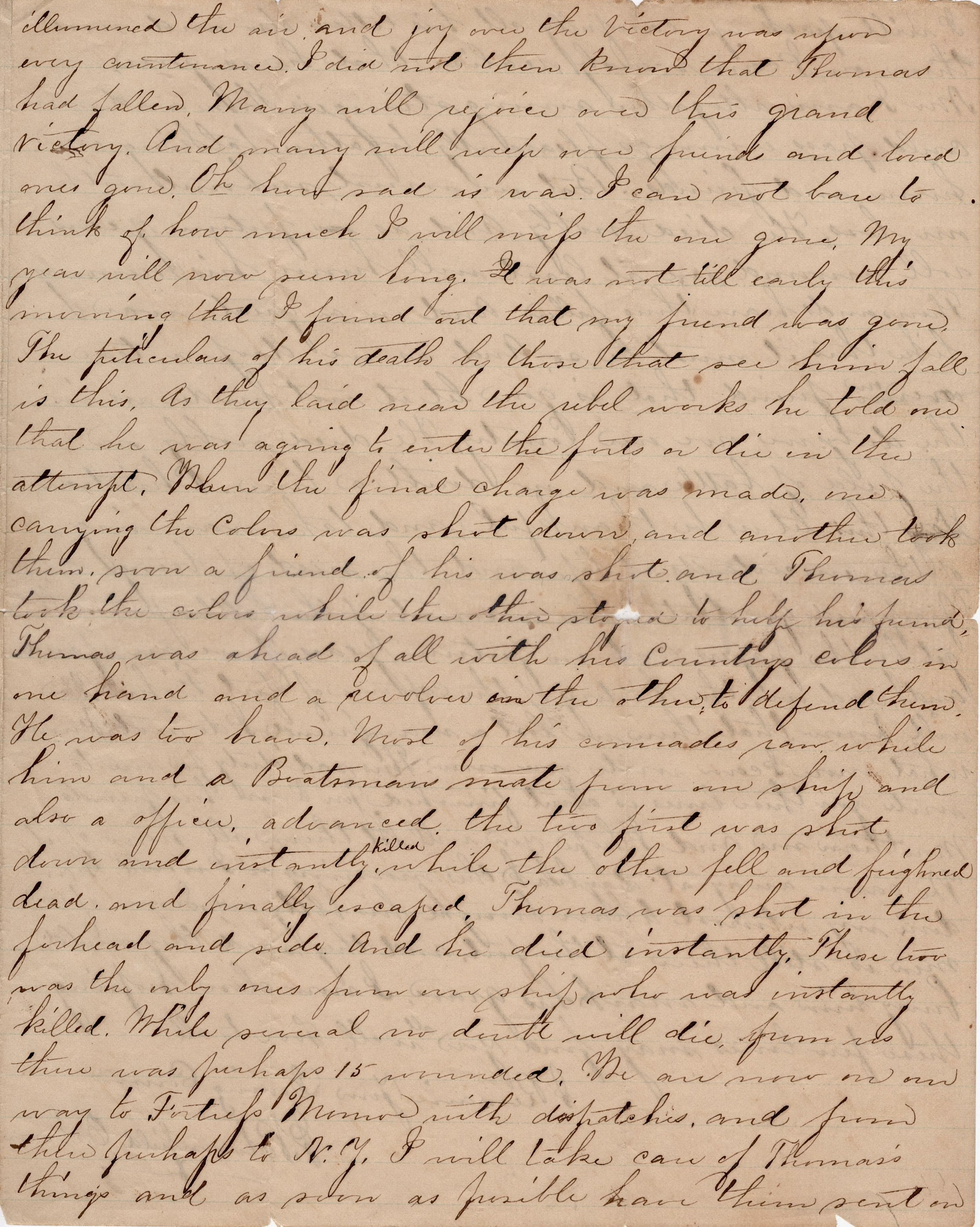
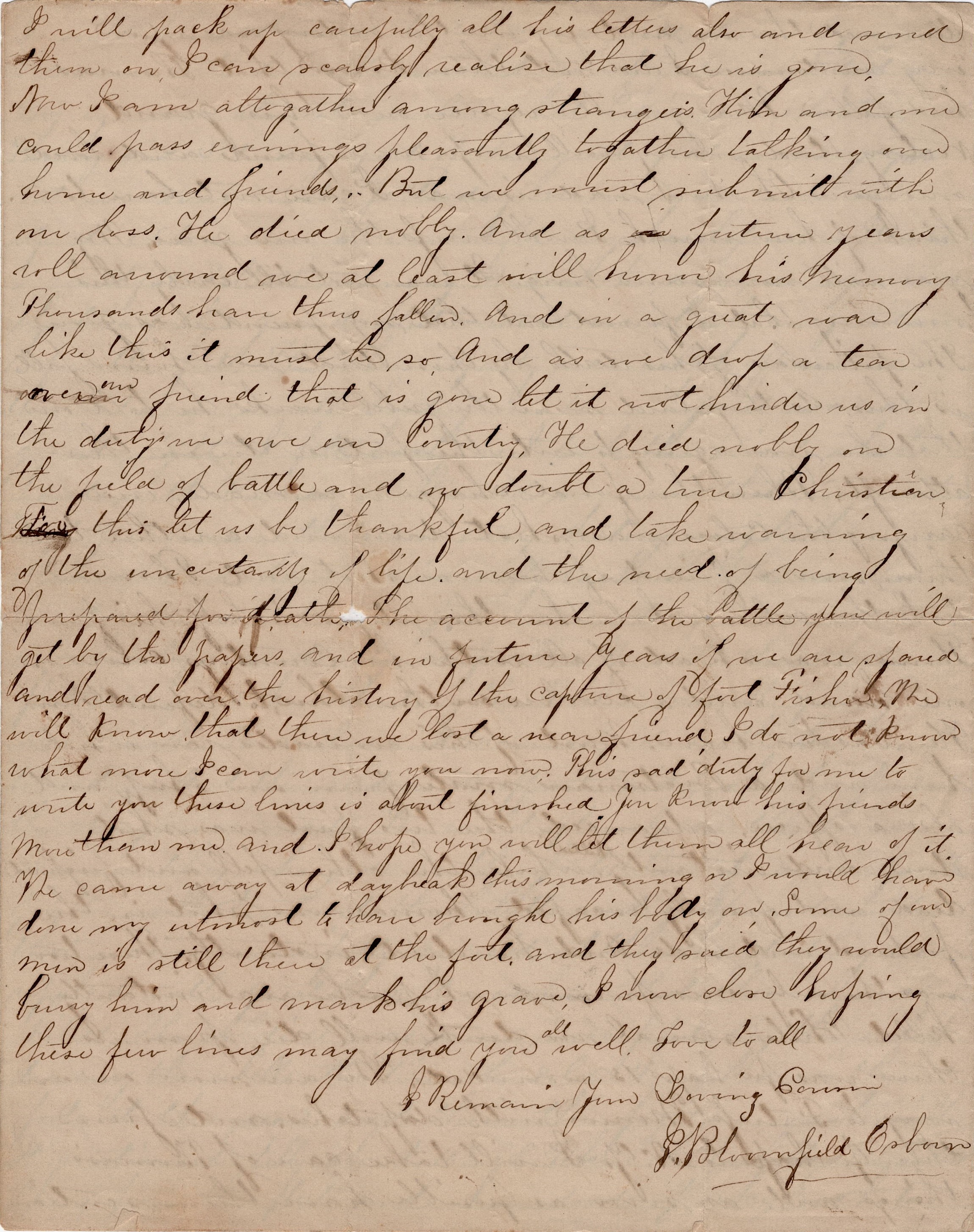
Joseph’s 4-page letter describes the bombardment of Fort Fisher on January 15, 1865 and in particular the assault on the fort by the landing party of selected or volunteer sailors and marines. One of the landing party was Joseph’s close friend and shipmate Thomas Cosgrove of Bloomfield, New Jersey, who volunteered in spite of the dangerous mission, determined “to enter the fort or to die in the attempt.” Joseph gives us an account of his friend’s death, carrying the US Flag to the top of the sandhill and partly through the breach in the palisades [see US Genwebsites].
Apparently a number of Joseph’s letters are archived and on microfilm in the Library of Congress and are characterized as an “excellent but little known collection.” See Joseph Bloomfield Osborn papers, 1862-1865.
The January 15, 1865 assault on Fort Fisher by sailors and marines.
T R A N S C R I P T I ON
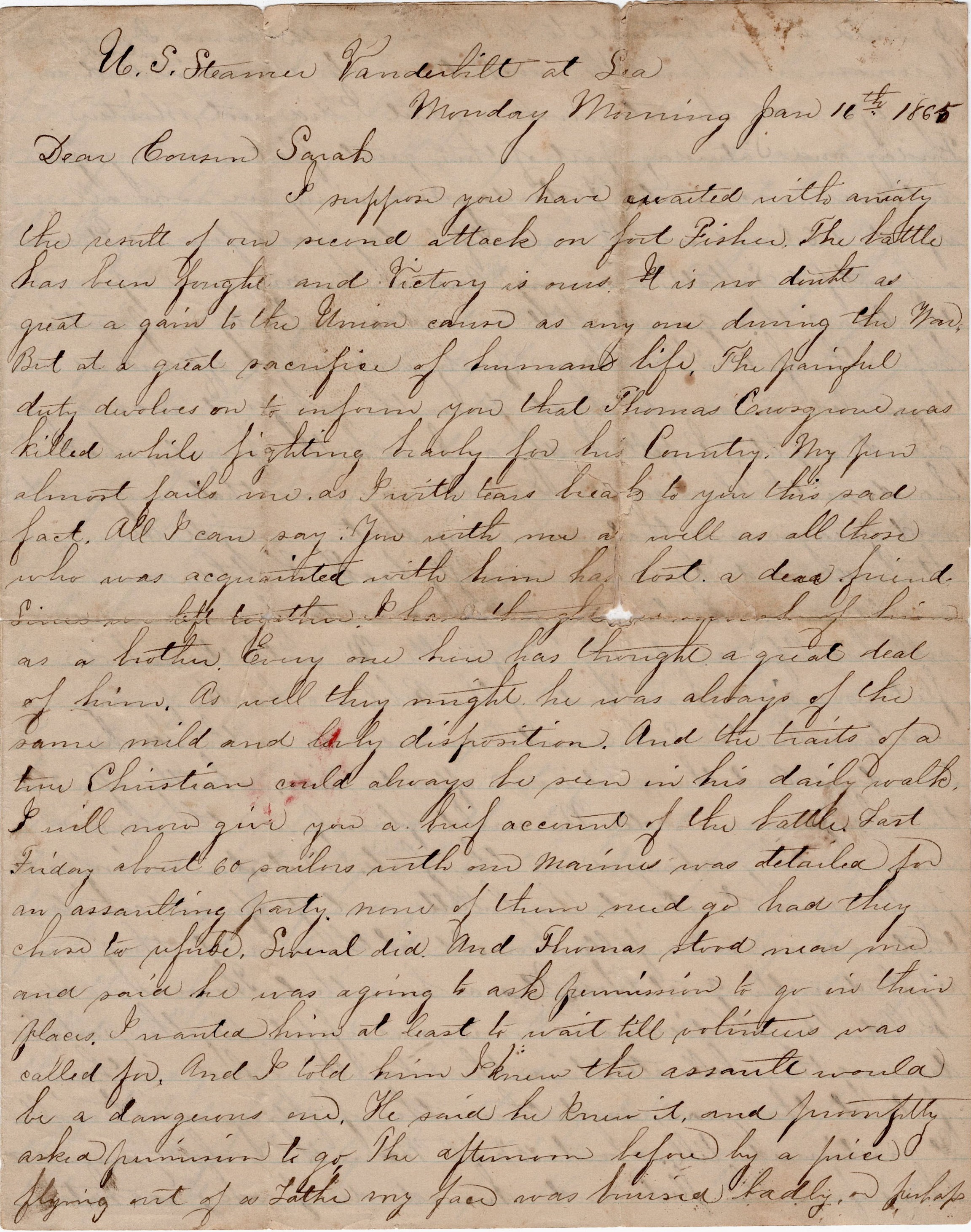
U. S. Steamer Vanderbilt at Sea Monday morning, January 16th 1865
Dear Cousin Sarah,
I suppose you have waited with anxiety the result of or second attack on Fort Fisher. The battle has been fought and Victory is ours. It is no doubt as great a gain to the Union cause as any one during the war. But at a great sacrifice of human life. The painful duty devolves on [me] to inform you that Thomas Cosgrove was killed while fighting bravely for his country. My pen almost fails me as I with tears break to you this sad fact. All I can say, you, with me as well as all those who was acquainted with him has lost a dear friend. Since we left together, I have thought a good deal of him as a brother, Everyone here has thought a great deal of him. As well they might. He was always of the same, mild and lively disposition. And the traits of a true Christian could always be seen in his daily walk.
I will now give you a brief account of the battle. Last Friday about 60 sailors with our marines was detailed for an assaulting party. None of them need go had they chosen to refuse. Several did and Thomas stood near me and said he was agoing to ask permission to go in their places. I wanted him at least to wait till volunteers was called for and I told him I knew the assault would be a dangerous one. He said he knew it and promptly asked permission to go. The afternoon before by a piece flying out of a lathe, my face was bruised badly or perhaps I would have volunteered too. As I came with him, I wanted to remain with him. He wished me to remain on board and as my eye was almost swollen shut, I did not volunteer.
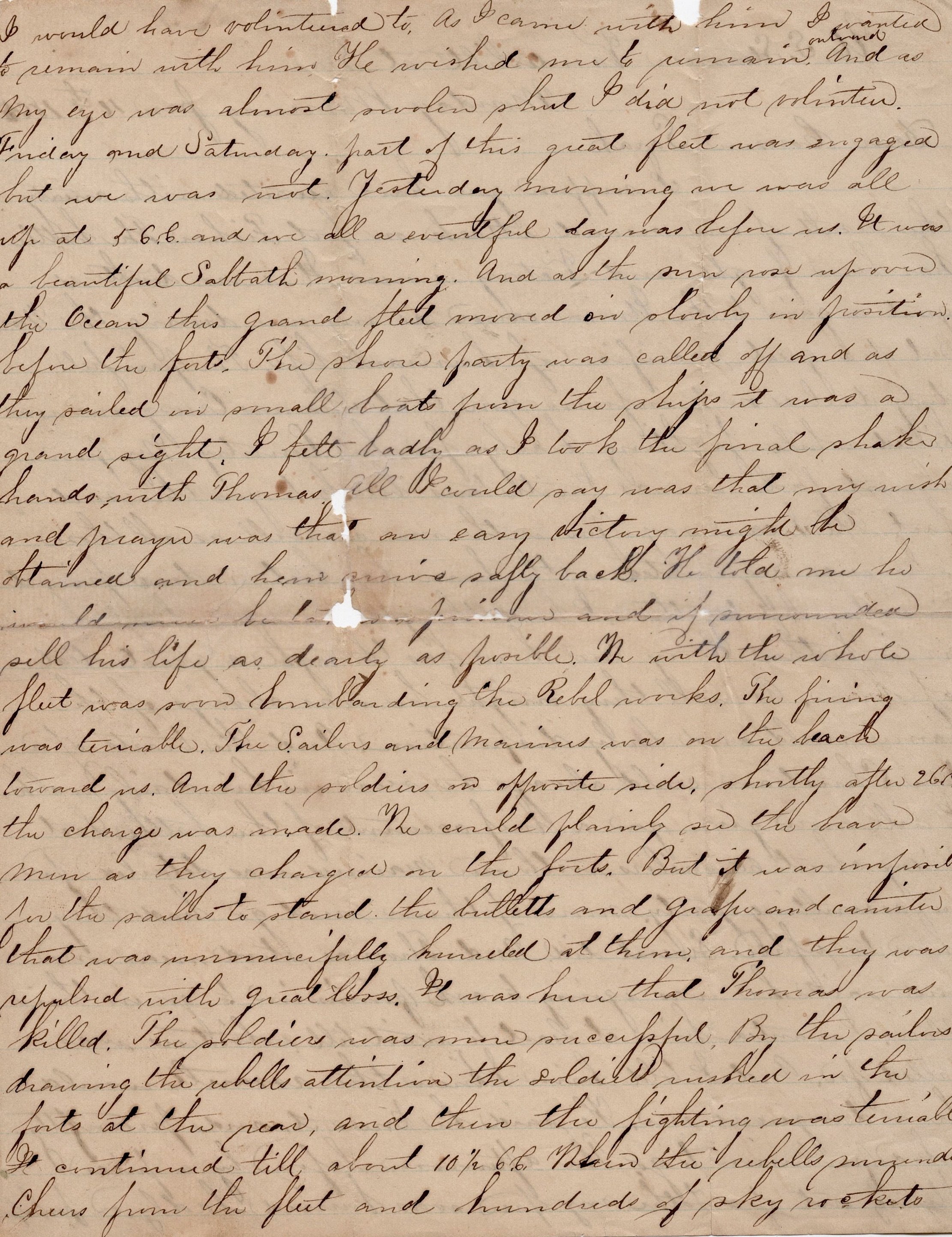
Friday and Saturday part of this great fleet was engaged but we was not. Yesterday morning we was all up at 5 o’clock and we all [saw] an eventful day was before us, It was a beautiful Sabbath morning. And as the sun rose up over the Ocean, this grand fleet moved on slowly in position before the forts. The shore party was called off and as they sailed in small boats from the ships, it was a grand sight. I felt badly as I took the final shake of hands with Thomas. All I could say was that my wish and prayer was that an easy victory might be obtained and him arrive safely back. He told me he would never be taken a prisoner and if wounded, sell his life as dearly as possible.
We with the whole fleet was soon bombarding the Rebel works. The firing was terrible. The sailors and marines was on the beach toward us and the soldiers on opposite side. Shortly after 2 o’clock, the charge was made. We could plainly see the brave men as they charged on the forts. But it was impossible for the sailors to stand the bullets and grape and canister that was unmercifully hurled at them and they was repulsed with great loss. It was here that Thomas was killed. The soldiers was more successful. By the sailors drawing the Rebel’s attention, the soldiers rushed in the forts at the rear and then the fighting was terrible. It continued till about 10.30 o’clock. When the rebels surrendered, cheers from the fleet and hundreds of sky rockets illumined the air and joy over the victory was upon every countenance. I did not then know that Thomas had fallen. Many will rejoice over this grand victory and many will weep over friends and loved ones gone. Oh how sad is war. I cannot bear to think of how much I will miss the one gone. My year will now seem long.
It was not till early this morning that I found out that my friend was gone. The particulars of his death by those that see him fall is this. As they laid near the rebel works, he told me that he was agoing to enter the forts or die in the attempt. When the final charge was made, one carrying the colors was shot down and Thomas took the colors while the other stopped to help his friend. Thomas was ahead of all with his country’s colors in one hand and a revolver in the other to defend them. He was too brave. Most of his comrades ran while him and a Boatsman mate from our ship and also a officer advanced. The two first was shot down and instantly killed while the other fell and feigned dead and finally escaped.
Thomas was shot in the forehead and side and he died instantly. These two was the only ones from our ship who was instantly killed while several, no doubt, will [yet] die from us. There was perhaps 15 wounded.
We are now on our way to Fortress Monroe with dispatches and from there perhaps to New York City. I will take care of Thomas’ things and as soon as possible have them sent. I will pack up carefully all his letters also and send them on. I can scarcely realize that he is gone. Now I am altogether among strangers. Him and me could pass evenings pleasantly together talking over home and friends. But we must submit with our loss. He died nobly. And as future years roll around, we at least will honor his memory. Thousands have thus fallen. And in a great war like this, it must be so. And as we drop a tear over our friend that is gone, let it not hinder us in the duty we owe our country. He died nobly on the field of battle and no doubt a true Christian. For this, let us be thankful and take warning of the uncertainty of life and the need of being prepared for death.
The account of the battle you will get by the papers and in future years, if we are spared and read over the history of the capture of Fort Fisher, we will know that then we lost a near friend. I do not know what more I can write you now. This sad duty for me to write you these lines is about finished. You know his friends more than me and I hope you will let them all hear of it. We came away at daybreak this morning or I would have done my utmost to have brought his body on. Some of our men is still there at the fort and they said they would bury him and mark his grave. I now close hoping these few lines may find you all well. Love to all.
I remain your loving cousin, — J. Bloomfield Osborn
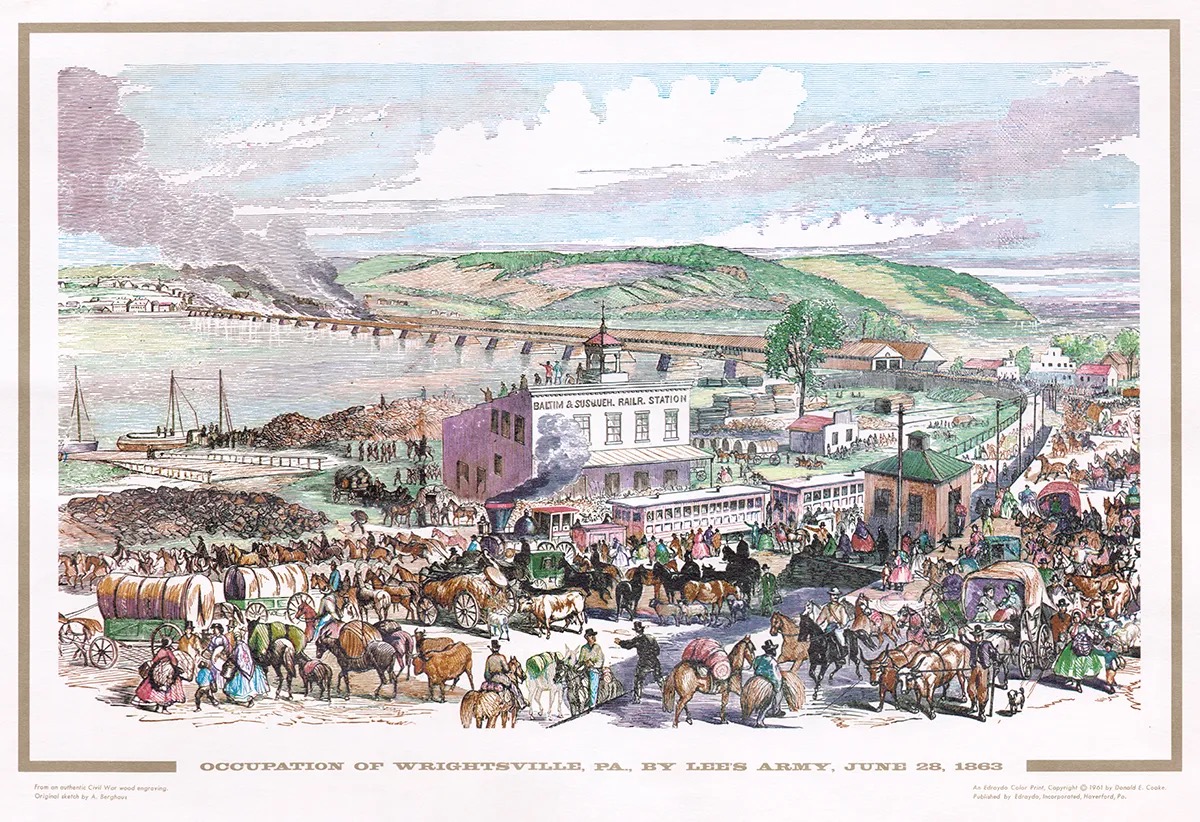
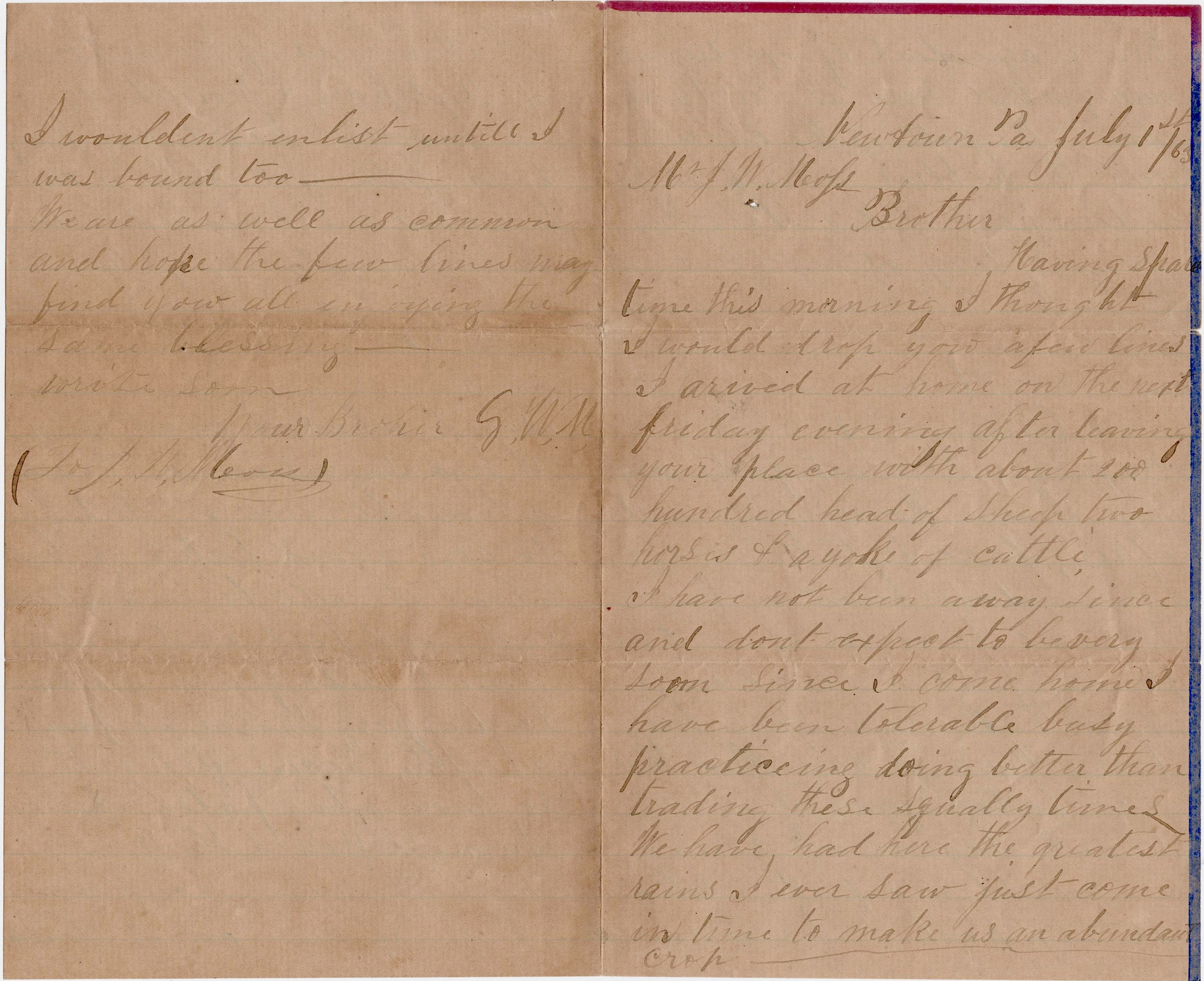
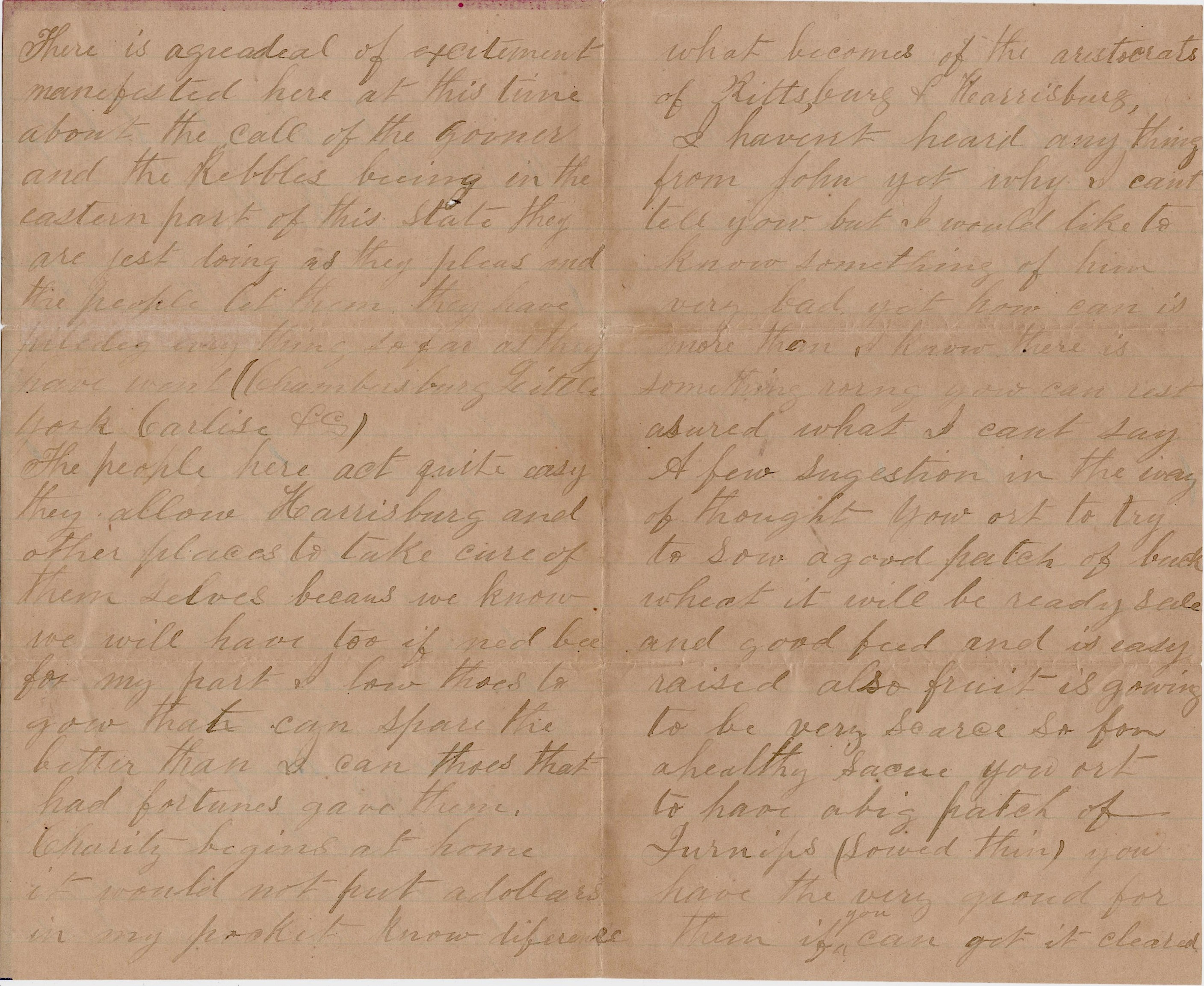
The following letter was written by G. W. Moss to his brother J. W. Moss on 1 July 1863—the first day of the Battle of Gettysburg. He wrote the letter from (presumably) his home in Newtown, Bucks county, Pennsylvania, mentioning the “excitement” of the populace on account of the “call of the Governor and the Rebels being in the eastern part of the State.” The call by the governor was for the home militia to turn out to defend the state.
T R A N S C R I P T I O N
Newtown, [Bucks county] Pennsylvania July 1, 1863
Mr. J. W. Moss, brother,
Having spare time this morning, I thought I would drop you a few lines. I arrived at home on the next Friday evening after leaving your place with about 200 head of sheep, two horses and a yoke of cattle. I have not been away since and don’t expect to be very soon. Since I come home, I have been tolerable busy practicing doing better than trading these squally times.
We have had here the greatest rains I ever saw—just come in time to make us an abundant crop.
There is a great deal of excitement manifested here at this time about the call of the Governor and the Rebels being in the eastern part of this State. They are just doing as they please and the people let them, They have pillaged everything so far as they have went (Chambersburg, Little York, Carlisle, &c.). The people here act quite easy. They allow Harrisburg and other places to take care of themselves because we know we will have to if need be. For my part, I [al]low those to go that can spare the [time] better than I can—those that had fortunes gave them. Charity begins at home. It would not put a dollar in my pocket, no difference what becomes of the aristocrats of Pittsburgh & Harrisburg.
I haven’t heard anything from John yet. Why? I can’t tell you but I would like to know something of him very bad. Yet how can I is more than I know. There is something wrong, you can rest assured. What? I can’t say. A few suggestions in the way of thought. You ought to try to sow a good patch of buckwheat. It will be ready sale and good feed and is easily raised. Also fruit is growing to be very scarce so for a healthy secure, you ought to have a big patch of turnips (sowed then). You have the very ground for them if you can get it cleared. I wouldn’t enlist until I was bound to.
We are as well as common and hope the few lines may find you all enjoying the same blessing. Write soon. Your brother, — G. W. M.
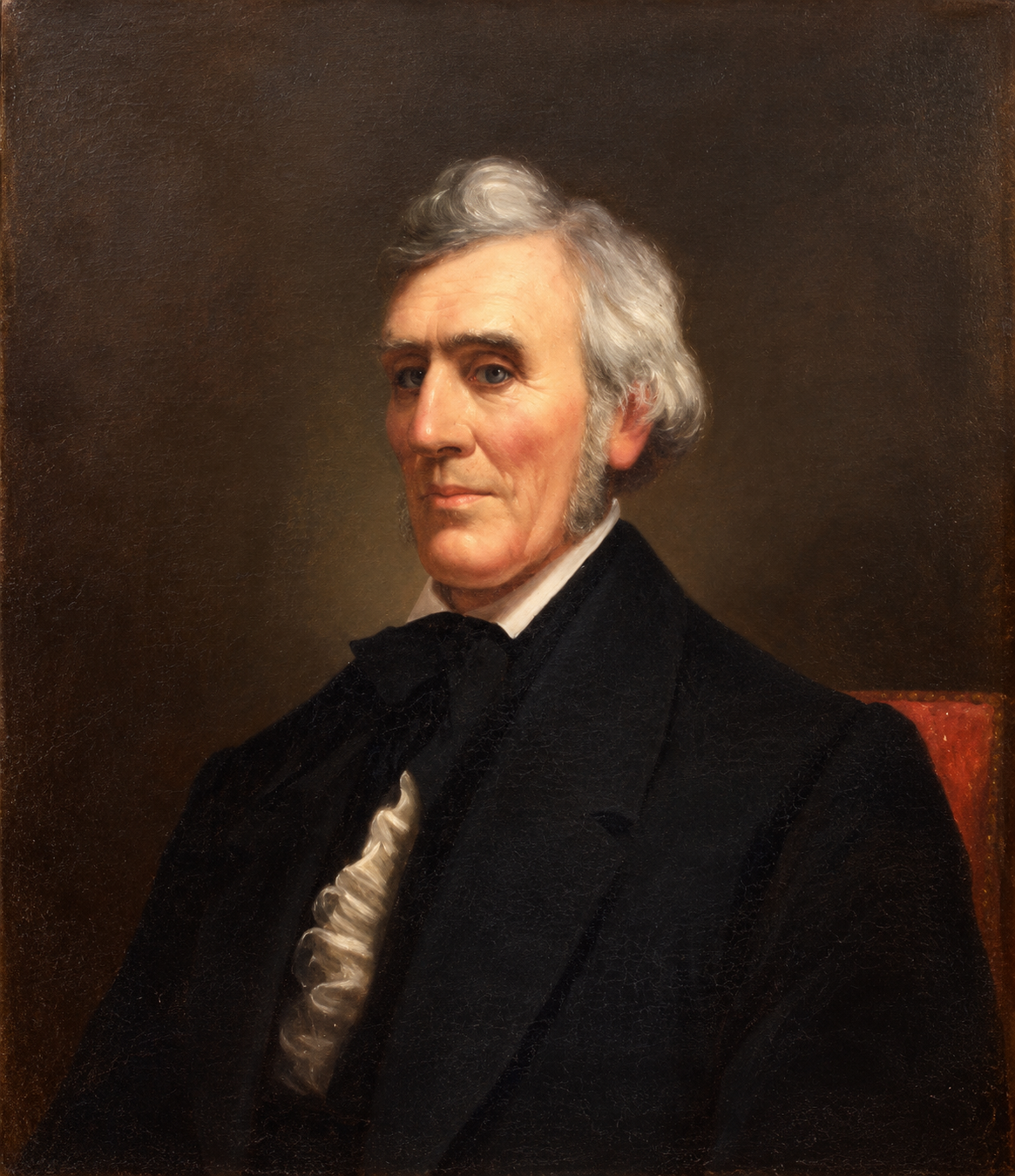
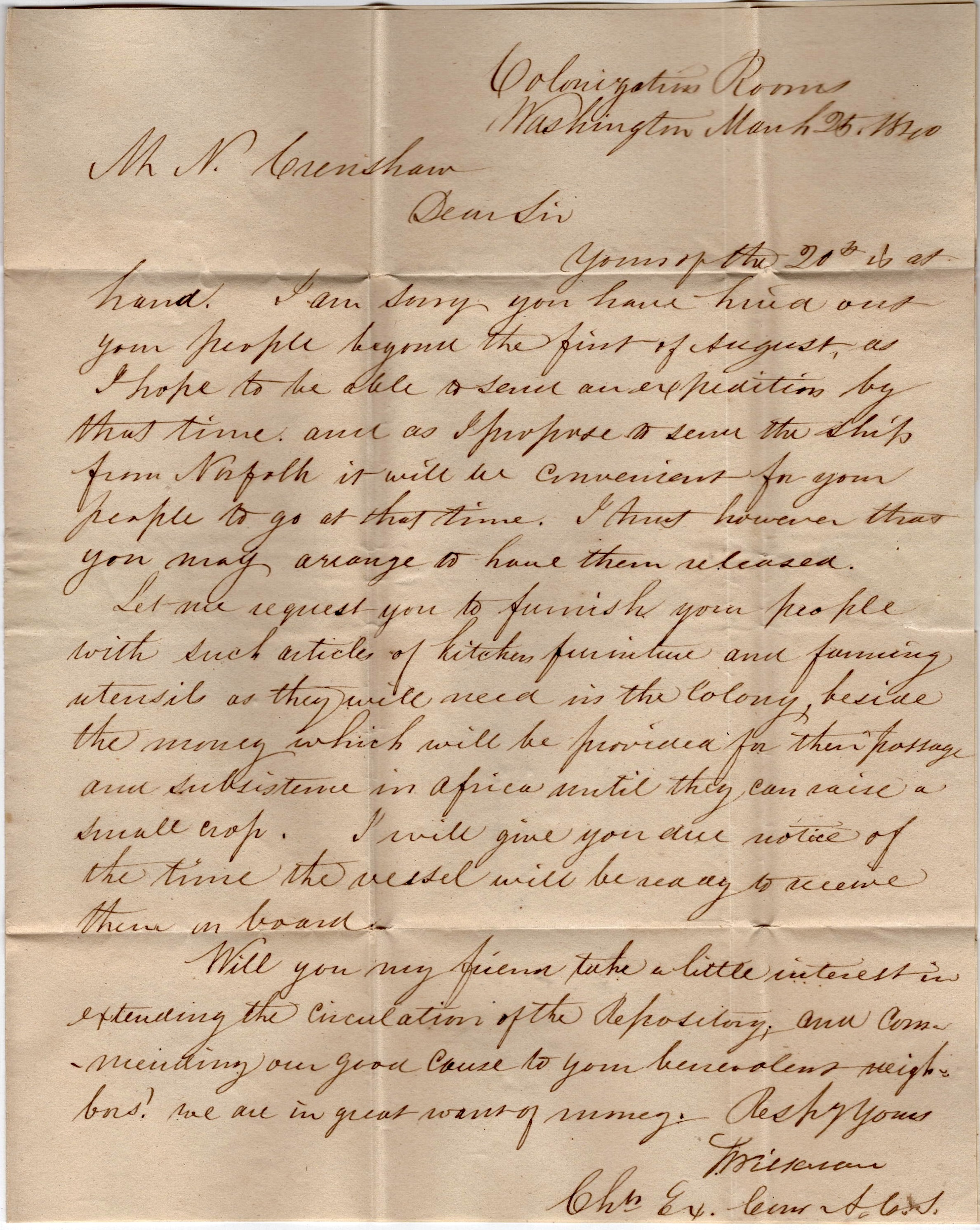
Samuel Wilkeson, Board President of the American Colonization Society
The following letter was written by Samuel Wilkeson (1781-1848), one of the most powerful and influential figures within the American Colonization Society (ACS). In 1840 when this letter was written, he was serving as the General Agent and Board President of the society. A former mayor of Buffalo and independently wealthy, Wilkeson eschewed a salary to aid the financially struggling society in recruiting and transporting free Blacks to Liberia.
Wilkeson datelined his 1840 letter from the “Colonization Rooms” of the society in Washington City. These rooms were located in downtown Washington near the US Navy Department and the White House complex. From their editorial office, the society published and distributed its monthly journal, the African Repository and Colonial Journal to keep its donors informed on the repatriation process.
Wilkeson wrote the letter to Nathaniel Chapman Crenshaw (1791-1866), a prominent Quaker minister and resident of Hanover county, Virginia. As an active member and leader of the Cedar Creek Quaker community and the Virginia Half Years Meeting, Crenshaw was a devout abolitionist. Because Virginia law strictly restricted the manumission of enslaved people and forced newly freed slaves to leave the state within a restricted timeframe, souther Quakers like Crenshaw devised a legal workaround. They would legally purchase or accept ownership of slaves through trusts and wills, but treat them as free and prevent them from being sold. They hired them out to others to pay for their subsistence until manumission and transport out of the state could be arranged—in this case, to send them to Liberia, Africa. [Source: In trust to Liberation, Nathaniel C. Crenshaw and Eliza Hopkins Crenshaw]
Pictured in header: Nathaniel Crenshaw and his wife, Eliza (Hopkins) Crenshaw, ca. 1846.
T R A N S C R I P T I O N
Directed to Mr. N. Crenshaw, Montpelier, Va.; envelope franked by Alex Duncan (Member of Congress—Ohio.)
Colonization Rooms Washington [City, D. C.] March 25, 1840
Mr. N. Crenshaw
Dear sir, yours of the 20th is at hand. I am sorry you have hired out your people beyond the first of August as I hope to be able to send an expedition by that time, and as I propose to send the ship from Norfolk, it will be convenient for your people to go at that time. I trust, however, that you may arrange to have them released.
Let me request you to furnish your people with such articles of kitchen furniture and farming utensils as they will need in the Colony, beside the money which will be provided for their passage and subsistence in Africa until they can raise a small crop. I will give you due notice of the time the vessel will be ready to receive them on board.
Will you my friend, take a little interest in extending the circulation of the Repository and commending our good cause to your benevolent neighbors! We are in great want of money. Respectfully yours, [Samuel] Wilkeson, Chairman Ex. Committee, A. C. S.
This letter was written by William H. Banner and was directed to “Miss Barbrah Dellinger” whom he called, “my dear love” and even declared himself her “intended husband” but I have not been able to link the two in any Pennsylvania marriage records. I think it likely they never married.
The author directs Barbara to send her letters to him at the US General Hospital in York but he does not give us any indication that he was sick or wounded. It seems clear that he was working there, however, and given that he had to have a pass to leave the hospital, he must have been in military service. I found a William Henry Banner (1846-1917) that seems to fit the profile of such a soldier. William was born in York county, the son of William & Anna Mary (Baughman) Banner. In 1860, he was learning the blacksmith trade. In July 1862, at the overstated age of 18, he mustered into Co. F, 107th Pennsylvania Infantry but was ordered discharged for reasons unknown effective June 11, 1864. Under circumstances like these, it was often the case that a soldier who became ill and could not stand the rigors of camp life, would be kept on as a nurse at whatever hospital they were sent. He would have been on “detached duty.” Finally, he may have been discharged when a surgeon determined he was no longer needed but not capable of returning to his regiment. William married Pauline Keller about 1865 after completed a second brief tour with the 200th Pennsylvania Infantry.
But who was Barbara Dellinger? My best guess is she was the same young woman by that name born to John S. Dellinger and Elizabeth Smith in Lancaster county, Pennsylvania, in 1847. If so, she must have declined William’s invitation to become his “beloved” for she later married Benjamin F. Neff (1848-1882) in the early 1870s. After Ben died, she married Orville C. Kidder (1840-1897). She died in 1923.
The distance from York to Mountville where the Dellingers lived was approximately 17 miles.
T R A N S C R I P T I O N
U. S. General Hospital at York, Pennsylvania July 18, 1863
My Dear Love,
I now enjoy the present opportunity to address a few lines to you hoping that when these few lines come to hand, that they may find you in good health. I am very well. My dear intended wife, I will inform you that I received your kind and welcome letter on the 17th and I was very glad to hear from you indeed.
My dear love, I will inform you that we received about 80 wounded men in this hospital.
The folks around here are pretty well scared about the draft. I think they will draft here next week.
We have a great deal of rain here for the few last days.
Miss Barbrah Dellinger, I think a great deal of you and I love you from my soul and if you love me as I love you, no knife can cut our love in two. Now my dear love, I will inquire several questions from you and I hope you will answer me those especially. I intend to marry you and make you my beloved and I think we will make a good pair. And if I can’t get you, why I don’t want to marry any person in my life. It is my whole trust to get you, my dear.
My dear, did that girl come that day when I was out last—you know, that other fellow’s girl? Do you think I could have stayed with you that night if it had not rained? Please let me know in return. My dear love, I would much rather speak to you personally than through corresponding but it can’t be helped.
I expect to get paid off the next week. Then I will get a pass and come and see you and stay with you several days and nights and the first chance that I get, I will get my picture taken and send it to you. And I would very much like to have your picture. My dear, you must not think hard of my boldness in this respect. Here is a kiss for you. I hope you will answer this as soon as you receive this. And one thing [more], I hope you will not keep any other person’s company or let no one touch you in one way. Remain true to me and I will to you.
If ever I return to thee a happy bride you shall be.
My dear love, please answer this as soon as you receive this. I can’t write much more now for I am busy so I show my best respects to your parents. So I must close for the present. Believe me to remain your very respectfully intended husband, — Wm. H. Banner