My passion is studying American history leading up to & including the Civil War. I particularly enjoy reading, transcribing & researching primary sources such as letters and diaries.
The NYS Battle Flag Collection includes one flag carried by the 23rd Independent Battery, a silk, swallowtail guidon in the “stars and stripes” pattern prescribed in General Order No. 4, dated January 18, 1862. The canton includes 34 gold painted stars in the typical, two-concentric circles, additional star in each corner, pattern.
The following letter was written by Penuel Bobst (1839-1873), the son of Michael Bobst (1801-1866) and Elizabeth Wagner (1804-1862) of Pendleton, Niagara county, New York. Penuel enlisted on 7 November 1861 in Battery A, New York Rocket Battalion (later designated 23rd N. Y. Battery). At the time of his enlistment, he was described as a 5′ 9″ tall, brown haired, hazel-eyed single farmer. He began his service as a wagoner but was later reduced to a private and was promoted to corporal about the time of his reenlistment in January 1865. He mustered out of the battery on 14 July 1865 at Buffalo, New York.
The New York Battalion holds the distinction of being the first officially designated rocket unit and was uniquely positioned as the sole such entity within the Union army. Secretary of War Cameron sought the expertise of Thomas William Lion—an English soldier of fortune—to deliberate on the rockets developed by the British General Sir William Congreve in the early 1800s. Consequently, Secretary Cameron sanctioned the establishment of a “Rocket Battalion,” appointing Lion as its commander. The operational specifics were delegated to Brigadier General William Farquhar Barry, the newly appointed Chief of Artillery of the Army of the Potomac. The unit was aptly named “General Barry’s Battalion.” Both the rockets and the 160 soldiers recruited from upstate New York were untested, embodying a pioneering spirit. The first company consisted of Captain Alfred Ransom’s Battery from Niagara County, which would later be identified as the 23rd Independent Battery, New York Light Artillery.
William Hale’s rotary rocket (Smithsonian Institution)
The New York Rocket Battalion departed from Albany, N.Y., arriving in Washington, D.C., on December 10, 1861. The unit was stationed at Camp Duncan, situated approximately a mile east of the unfinished Capitol, on the sodden terrain allocated for General Barry’s artillery. On New Year’s Day, 1862, Camp Duncan was officially renamed Camp Congreve. Major Lion was equipped with rockets engineered by the British civil engineer William Hale. These rockets varied in length from 12 to 20 inches, with diameters ranging from 2.25 to 3 inches. The launchers consisted of wrought iron tubes, measuring 8 feet in length and supported by tripods. They also tried firing using eight breechloading cannon designed to fire Hale rockets.
Testing revealed that Major Lion’s rockets were impractical for military use, however, so at New Berne, N.C., General Jesse Reno ultimately dismissed Major Lion and the “Rocket Battalion” was thereafter assigned 3-inch rifled Rodman steel guns. The Battalion fought valiantly with its artillery, particularly during engagements in North Carolina. It retained the designation “New York Rocket Battalion” until February 11, 1863, when Special Order No. 81 from Albany officially redefined the unit as the 23rd and 24th Independent Batteries of Light Artillery, New York Volunteers. It remained for future conflicts to enhance the development of rockets and launchers. (See: A brief history of Rocketry—Early Rockets to Goddard]
[Note: His given name is sometimes spelled Pennel in records.]
T R A N S C R I P T I O N
December 25, 1861 Merry Christmas
Dear Friends,
I am glad that I have got the privilege of writing to you to let you know how I am. I am well—all but my right [foot] has got a blister on it so that I can hardly walk but that will soon get well, I think. Besides that, I as well as I ever was in my life. I think that I will have to have it opened if it don’t break itself. I have been around all the time till today. I am in the tent today. but I think that next week I will be at work again. Mary, I hope that you will not think hard of me for not writing sooner for I have got so many to write to that I hant got much time to spare and so I will write to you now and [if you] will write to me once a week, I will write to you as often as I can. But write all the news and how the folks are getting along.
Mary, I like it well here and I will stay here till the war is over unless they send me home. I don’t know how soon that will be but I hope that it will not [be] till the war is over. And if I do come back there, I will not stay in that part of the world long ffor I don’t like it there much. I would like to see you all and like to have a sleigh ride with you for they don’t have no snow here, It is nice here [but] the dust flies like sixty in the streets.
Tell Lil that she must write to me for she must be like all the rest of the folks down there, They don’t write unless I write to each of them first. But I would like to hear from you all. Tell the folks that I am as steady [as] an old man for I go to bed at nine every night and that did not suit some of the boys for they did want to run around nights but that did not trouble me. I made a mistake in writing this letter for I wrote on the wrong side but that son’t make no odds. You must tear turn the best side out.
Capt. Alfred Ransom
Direct to Penuel Bobst, Washington D. C., Camp Duncan, Rockett Battalion, Co. A, care of Captain [Alfred] Ransom
This is Christmas but it don’t seem like it. All is still here about. I wish that I was at home New Years. I think I would have a good time of it. But when I shall get home, I don’t know and perhaps never. But we will all come home in the spring if we live for they will all be settled by that time.
Mary, I must stop writing for this time. I will write again. Write as soon as you get this and tell all the rest of them to write to me. C. Penuel Bobst, Washington D. C., Camp Duncan, Rocket Battalion Co. A, Care of Captain Ransom
The following letter was written by Percival C. Bishop (1842-1921) who was 21 when he enlisted on 27 September 1864 in Co. I, 175th Ohio Infantry. He mustered out of the service at Columbia, Tennessee, on 19 June 1865. The regiment was organized for one year’s service on October 11, 1864, under Colonel Daniel W. McCoy. It proceeded at once to Nashville. During Hood’s invasion it performed garrison duty at Columbia, Tennessee. One of the Regiment’s outposts was captured, after strong resistance, by Hood’s troops. At Franklin the regiment was positioned near the Carter Cotton Gin and when the Confederate line broke through, they were ordered to counterattack with a bayonet charge, driving the Patrick Cleyburne’s Division before it. They played a more significant role in winning the battle than they were given credit for. Its loss in this engagement was 161. It occupied Fort Negley during the battle of Nashville, and afterwards guarded the Railroad near Columbia. The Regiment was finally mustered out July 13, 1865.
Percival was the son of Reuben Bishop (1810-1875) and Mary Cooper (1815-1895) of Perry, Wood county, Ohio.
See video for good sketch of the 175th Ohio at the Battle of Franklin. See letter by Joseph Tuttle Garner of Co. A, 175th Ohio for a description of the Battle of Franklin.
T R A N S C R I P T I O N
Post Hospital Columbia, Tennessee March 24, 1865
Dear Cousin,
It is with becoming reverence that I seat myself to try to answer your much beloved letter which I received a few days ago and was pleased to know that you were well and all the rest well. I am not very well yet. I have had the bilious fever since I wrote to you before but am pretty near well again now. This is the reason I have not written to you before, because I was not able to answer it sooner.
Well Amanda, I hope when this reaches you, it will find you and all the rest well and enjoying yourselves. Well Amanda, you spoke of a soldier’s life as being a hard one. Well, I tell you, it is, that is so. Since I left home I have seen a good deal—some pretty hard times and some very good ones too. Our regiment has always been so fortunate as to be stationed at one place—only while Old Hood run us back to Nashville. So you can see that we have never had no hard marching to do. We have never been engaged in but one battle and that was at Franklin and it was a very hard one. Our regiment lost 150 men killed and wounded.
Well, Amanda, as for a soldier’s life, I like it very well while I am well. But when one gets sick, then it is hard. I am on detached duty now here in the hospital and expect to stay here as long as our regiment does stay at this place which I suppose will be until our time expires. I have a very good place to stay here and a plenty to eat and am enjoying myself very well as soldiers will.
I suppose you are a having good times now a making sugar. Well I hope you may. I should like to be there to eat some of the sugar but I can not now and if nothing happens, I will come and see you all when my time is out.
Well, I must close for his time. Give my love to all of your folks and take a share for yourself. Tell Seymour I will write to him soon. So goodbye. Write soon. From your cousin, — P. C. Bishop
To Miss Amanda Aldrich
Dear Aunt,
It is with the greatest of pleasure that I seat myself to answer your kind letter which I received the other day and it found me sick with the bilious fever. But I am now almost well again. Well Aunt, I hope when this reaches you it will find you well and enjoying yourself. Well, as for a soldier, I am enjoying myself very well now. It is very pleasant weather down here now and I hain’t much to do and have a plenty to eat and a good place to stay.
Well Aunt, you must take all the comfort you can and when this cruel war is over and I get home, I shall come and see you all and if I don’t get to come, I will try and live so that we can meet in heaven above. Well, I must close for this time. So goodbye. Write soon. From your nephew, — P. C. Bishop to Aunt Cynthia Aldrich
Direct to Percival C. Bishop, Co. I, 175th OVV, in care of [Capt.] Abram Houghland
The following stampless letter was written in 1802 by Samuel Dubose (1758-1811) from Pimlico plantation in Pendleton District outside of Charleston, South Carolina. It was written to John Ewing Colhoun (1749-Oct. 26, 1802), a planter, lawyer, South Carolina legislator, and United States senator. Born in Staunton, Virginia, he attended Princeton College, and graduated in 1774. After studying law and being admitted to the bar in 1783, he set up practice in Charleston, South Carolina, working mostly in estate settlements and personal injury suits. John C. Calhoun, his son, was also a Senator and former Vice President, famous for the political idea of nullification and the famous Compromise of 1850 that delayed the Civil War for ten years.
The author of this letter was Samuel DuBose, Sr. (1758-1811). He was the son of Isaac DuBose and Catherine Boisseau.
Pimlico was one of three plantations that John E. Colhoun inherited from his father-in-law Samuel Bonneau. The other plantations were “Bonneau’s Ferry” and “Santee” in the South Carolina Lowcountry. Court records indicate that relations between the Colhoun family and their 100+ slaves were not always harmonious. In the late summer of 1798—four years prior to this letter—five of John Ewing Colhoun’s slaves plotted to poison their owners and flee the state. The plan was hatched by Hazard (mentioned in the following letter) and was carried out but failed to result in the death of any of the Colhouns. The five slaves were soon captured and tried in court. One slave (“Will”) was hanged for his part in obtaining the poison. The remaining four were all whipped, branded on the forehead, and had their ears cropped as punishment. In the Colhoun records, all four appear at the Ferry rice plantation near Charleston in 1804. [Source: Black History and the Enslaved of the Calhouns, by Dr. Mandi Barnard]
The slaves of John Ewing Colhoun among his various plantations, compiled in 1802, are enumerated in his will. See Slaves of John Ewing Colhoun.
T RA N S C R I P T I O N
Addressed to John Ewing Colhoun, Esqr., Pendleton District, South Carolina
Pimlico [Plantation] 12 September 1802
Sir,
With pleasure I can inform you that your rice here has come forward beyond my expectation. The greatest part I think very good. As to say what number of barrels it will turn out, I cannot at this time as there is a great deal depending in the harvest. I much fear of it falling. The rice at the Ferry is much better than last year. The corn here and at the Ferry some part is very good. The other but indifferent. Root potatoes & turnips [?] but ordinary from the outward appearance as we have made no trial of them as yet.
I have removed as many hands to the ferry as I could spare from minding birds for the purpose of stopping the [ ] and other repairs necessary to be done for the next year’s crop. I do not expect to have any great deal of this business done as harvest is drawing nigh.
The corn I wish to have brought in soon as the Negroes make rather too free with it. The sawyers will be done [with] the mending this week. Hazzard [Hazard] I have hired to Mr. Peter Boughton the 30th of last month at 3/10 per month—the most I could get the payments as directed.
Mrs. Dubose is very unwell with the fever at this time. Your Negroes in general are well except Stepney’s wife at the ferry that has been laid up some time with a swelling on one of her thighs. I some fear [it] will prove dangerous.
Yours &c. — Sam Dubose
N. B. Your carriage has been sent to the Ferry for some time.
I could not find an image of Richard but here’s a tintype of Pvt. Joel B. Barefoot of Co. F, 37th Alabama Infantry.(Alabama Confederate Images)
The following letters were written by Pvt. Richard J. Kent (1839-1863) who enlisted in Co. G, 37th Alabama Infantry on 24 April 1862 at Auburn, Lee county, Alabama. Richard was married to Martha July Stenson (1842-1910) on 11 October 1859 in Chambers county, Alabama. Richard was wounded during the siege of Vicksburg, shot just under the collar bone. He died a few days later on 2 July 1863 in a Vicksburg hospital.
Richard had two younger brothers who served with him in the same company—John T. Kent (1841-1862) and Absolom B. Kent (1844-1921). The former died of disease on 27 March 1863 at Vicksburg; the latter survived the war.
I have downloaded some images of enlisted men who served in the 37th Alabama Infantry from the Alabama Confederate Images page on Facebook. I have found it to be an excellent resource.
Letter 1
Montgomery, Alabama May 31, 1862
Dear wife,
I now take my seat to write to you to let you know that I am well at the present time and have been ever since I left home. I have nothing of importance to write to you at the present. We started for Corinth on Thursday last and got to Montgomery and struck camp where we are now and expect to stay until Monday when we will take up the line of march for Corinth if orders is correct and we get no further orders.
Pvt. Elias Wiley Wright, Co. H, 37th Alabama Infantry. Wright enlisted on 29 August 1862 in Lawrenceville, Alabama. He became a POW when Vicksburg, Mississippi capitulated to Federal forces in July 1863, but he was soon paroled. His wife Susan died in 1864, leaving their 6 children destitute. Elias wrote a letter attempting to be discharged from the military early in 1865. But the war soon ended. Wright died in 1897 and is buried in Hartford, Geneva County, Alabama. (Alabama Confederate Images)
We have got our uniforms, such as they are. They look like negro cloth. We have no knapsacks nor canteens as yet nor no bounty money. Some of them says that we will get it before we leave here though I don’t think so. I am as well satisfied as you could expect to be where I am and in the camps though I want to go to Corinth as we have started or some other place. I don’t like the city of Montgomery so far as I have saw as yet. I want to go to Hilliard’s Legion this evening if I can get off and see how I like the rest of the town and see how I like his Legion.
Joe Chambers and several of the boys has been to see us since we have come here. I haven’t nothing very interesting since I left. Only the night we got here I heard the prettiest music that I ever heard on the boat. I have nothing of importance, only I want to see you the worst in the world though I am deprived of that privilege and I don’t know at the present when I can have the privilege of coming home though I want to come as soon as possible. It would be the greatest pleasure to me in the world to get to come home before we get off to Corinth or any other place.
So I must come to a close for the present. May the God of all grace be with you and bless and sanctify and preserve you and keep you from all the evils of the world. And if we meet no more in this world, that we may the well assured…[end of letter missing]
Letter 2
Lowndes county, Mississippi June 29, 1862
Dear wife,
I today take my seat to drop you a few lines to inform you that I received your letter by mail and read it to my sorrow for I made a mistake in reading it. I thought that you stated that father was dead which gave me much sorrow and trouble for was very low at the time that I received the [letter] with the relapse from the measles at that time. I had the hardest kind of agues every night and fever in the day to pay up. I was taken on the 15th—the same day that you wrote your letter and from then till Wednesday or Thursday night I had an ague after which I suffered a great deal. The pain was so severe that I wore a mustard plaster for four hours one evening and it didn’t blister nor release the pain so next morning just at the peep of day I had two plasters fixed up and had one put on my breast and the other on my right side which I let stay on till sundown and the pain was so severe that they made a knot on my side too, the size of hen’s egg or not quite as large. After I had taken off the blister, I asked the doctor—I mean Smith—to examine it and he says, “Hant you had a lick there?” I told him no, that it was from the pain that the knot was there. He said when I got well that he would cure them knots. I never said anything but I [wanted to tell the] old fellow when I get well, there will [be] no knot there for you to cure until the pains come again.
Absolom landed here last Wednesday the 25th, I think it was. I received your letter then which I was compelled to lay aside until yesterday evening when I took it and read it with pleasure not not with half the pleasure that I would have [if I] spent the time with you for it does seem to me that one hour with you would be like a lifetime of enjoyment. I could sit and talk with you with the greatest pleasure.
I have been sick as I have said before. I have lay in the tents two weeks today and my hip bones is rubbed my hip almost right raw. I went out this morning up to my tent about fifty or sixty yards for the first time. I feel that I am a mending as fast as can be expected to be as low as I was. I do hope and trust that God has been with me in my afflictions and that He will raise me to a state of pure health. I received yours and the hair which I will try to do as you requested me. Tell Puss Williamson that Jack has been sick ever since he left Montgomery though not laid up. Tell her that sometime past—I don’t remember the day—that he was taken with the pneumonia and has been very low. He is on the men but not able to walk. I think if he will take care of hisself, that he will be up in a few days.
I landed here last Wednesday and I thought that I would wait a day or two to see how things was. I am as well satisfied as you could expect to be here. I have seen better land and better crops that I thought there was in the Southern Confederacy. I saw one fish at Mobile that would [weigh?] 400 lbs. I thought that I would send you two of the scales that you [could] see them. I want you to write to me as soon as you get this letter and write all the news you have. So nothing more till I hear from you. — Richard J. Kent
Letter 3
Lowndes county, Mississippi July 19, 1862
Dear Wife,
I this evening take my seat to write to you to let you hear from me. I wrote to you the 17th and give it to Ans Roberson to carry to Cusseta [Chambers county, Alabama] but he hant started yet and is going to start in the morning—him or Mr. Sudler one—and I thought that I would write a few lines this evening that you might hear later news from us. I am still improving. I have got so that I can walk up in camp one time more and I feel pretty well except my hands and knees. My hands feel dead and when I have any weight on them, they feel like there was a thousand pins a sticking in them. And my knees feels about the same way when I start to walk though I can tolerable well with a stick.
I want to see you the worst in the world though I am deprived of the privilege of that enjoyment for I would consider it a great enjoyment to me to see you and all the connections and talk with you. It would be the greatest pleasure to me in the world if it was so that I could come home. But there is no chance to get off on a furlough. The only chance is to get a discharge. Sometimes I think I would apply for a discharge but I don’t know as yet that I will do it. In that case, I thought that I would just let everything alone a few days till I got a little more strength and then I thought if my breast didn’t get better, I would go to the doctor and tell him that if he didn’t sure me, that I couldn’t stand the camps. I can’t get a long breath without putting my hands to my breast and if it is not cured, I shall not be able for service here.
Ab[solom] is well or is about if he don’t eat too much and I hope that he won’t do that. He does the most of our cooking for us. Tell Williams folks that Jack has been very bad off since you was here. The doctor says he will give him a discharge and I think that they will have it ready by the time he gets able to come. [ ] is on the mend and has been ever since you left. He has been up here but once since you left…Tell Williams folks to tell George Davis’s wife too that he is well.
So I must close by saying to you that I want to see you and the baby the worst in the world. I want you to write to me as soon as you get this letter and write how rain has been there and write how crops is. So nothing more till I hear from you. — R. J. Kent
Letter 4
Columbus, Mississippi August 4, 1862
Dear Wife,
I today take my seat to write to you to let you hear from me. I ain’t well yet though I am still on the mend slowly, thought it is slow indeed for I do gain strength the slowest in the world. I can scarcely get over a pair of steps five or six steps high to go to the well.
John landed here the 31st day of July. He was well as you could expect, I reckon. When he got here the morning that he got here, I left the camp for the hospital in town and I han’t seen him since though I have heard from him every day. This morning Capt. [Warner W.] Meadors came up to see us. He says that John is doing pretty well. I said that I had went to the hospital so I have not because I was so bad off but to try to get something sone for my side and breast and I have got nothing done as yet. I think that I should try the doctor to let me go back to camps this evening if it don’t rain.
Ab[salom Kent] has been pretty sick though he is now up and about and has quit taken medicine and I hope that he will be well in a few days. We had a good rain here last Thursday night and we have had rain off and on ever since. Yesterday we had a hard rain down at the camps.
I want you to write how rain has been there and tell Par to write how crops is there in part of the country. Tell them that I want to see them all the most in the world. I want to see you and the baby [Margaret] the worst in the world. It would be the greatest pleasure to me to sit and talk with you for one hour for it does seem like it is a long time to stay away from you. I want to come home to see you but it does look like the chance is bad. I will come as soon as I can get off.
I received your letter you sent by [brother] John and read it with pleasure. It filled my heart with love and gratitude. The one that you wrote on that little piece of paper, I can’t write anything to you about in this letter. I will write you an answer to that in a day or two as soon as I can get to camps where I can get paper and envelopes and I will write to you and back it in your name. Back your letters as you have been at before. So goodbye till I hear from you, — R. J. Kent
to M. J. Kent
Letter 5
Itawamba county, Mississippi August 12, 1862
Dear Wife,
I today take my pen in hand to drop you a few lines to let you hear from me. I have nothing of importance to write to you, only I do want to say to you that I ain’t well yet. I am better though. I am weak and have pains in my ankles when I walk. I hant done any duty yet more than help raise tents and cook. John is doing tolerable well. He went out on drill this morning for the first time. The ergeant got here yesterday from Columbus. He says that the Boys is doing very well and I think from that that Ab[solom] will be with us in a few days for I want to see him. When I left him there was nothing the matter with him—only pains. I hope that they were not reumatism as I thought they was at first.
Jack Williamson is dead. The doctor said he thought that was the name though he wasn’t certain for he didn’t see him. But he then thought that it was so. He died noght before last if it is so.
General Sterling Price, nicknamed “Old Pap” by his men.
I wrote to you before that we had orders to move and I didn’t know where but we are now at Saltillo in Mississippi. We are in 30 or 35 miles of the Yankee army and I can’t tell how soon we may be closer for we are under Old General Price and all his army is here, or nearly so.
I wrote to you that I would answer the little letter that you wrote to me but I hant time this morning. I will say to you that I want to see you the worst in the world. When I get to studying about you and the baby, I hardly can help crying though I hope though it is the will of God, and if it is, I know that all things will work for good to them that love Him. I want to come home to see you and all the connections. Tell Mother that I want to see her and all the family very bad and that I would write to her this morning if I had time. But the mail starts off now and if I miss this mail, I can’t send my letter before next week so I must come to a close. So goodbye for the present. Write to me as soon as you get this letter and write all the news you have. Direct your letters to Saltillo, Mississippi. — R. J. Kent
To Mrs. M. J. Kent
To Mr. Richard J. Kent, Mississippi, Saltillo P. O., 37th Reg. Alabama Vol. in the care of Captain W[arner] W. Meadors, Col. [James Ferguson] Dowdell commanding.
Letter 6
Saltillo, Mississippi August 18th 1862
Dear Wife,
I take my seat to write to let you know that I am about the same old seven and six, only I feel a little worse for the last two or three days. I ain’t went to duty yet and I don’t know when I shall if I don’t get better.
We are still at Saltillo but I can’t say how long we will be here for we are expecting to move every day. The Yanks is cutting down the corn up above us here and destroying everything they can. I heard yesterday that our cavalry was ordered to advance up near the enemy. The number of miles that they were to be from the enemy, I don’t recollect, but I think it was in four miles of the enemy, and if they do, we will have to move up there to protect them. The officers says that they are looking for a fight every day anyhow but I think that is all false for the Yanks is 16 or 17 miles off. They doubled the guards yesterday morning and made as many more post round the camps as they were before which look very suspicious that there was something out too. I don’t know that there is anything of the sort depending. I hope there is not for I ain’t able to march not to go for a battle either.
Ab[solom] reached here last night just after we hay lay down. He has had the rheumatism very bad and has them yet. He can hardly straighten his left arm this morning though I hope it won’t be long before he will get well again. John is here. He was very sick last night though he is up and out on drill this morning.
I want to see you very bad for it does seem to me the longest time I ever saw, though when I think of the duties of my country and the welfare and happiness of my family and the promises of God that we shall meet either in this world or in the world to come, it gives the greatest encouragement of anything else at present. Tell Father and Mother that I want to see them and all the family very bad but I am deprived of the privilege of that enjoyment at this time though I hope to live to get home once more and to see you all alive once more in this world. If not, if God shall see fit to take me from time to eternity, either by sickness or by the enemy’s musket balls, I hope to see you all in the heavens above where pain and parting will be no more.
So I must come to a close for the present. May the blessings of God be with you and bear you up in all your troubles, trials, and afflictions in this life and at last when shallop be no more, may the God of all be with you in that trying hour of death and at last receive your spirit up to heaven to praise Him through eternal ages, world without end, amen.
—Richard J. Kent to Mrs. M. J. Kent
Letter 7
Okolona, Mississippi August 26, 1862
Dear Wife,
I this morning take my seat to drop you a few lines to let you hear from me and to let you know that I am still in the land of the living though i am not well. I have severe pains in my side and breast at times. I am at the hospital in Okolona though not worse off than I was when I was at home. I can go where I please if I had the chance and eat more than ever I did in my life. I was sent here last Sunday morning and the doctor came round Monday morning and prescribed for me and I have taken a dose of medicine this morning. I don’t know whether he will do me any good or not but I thought he will cure me for I know that I want to get well and enjoy good health once more if ever anybody did.
Ab[solom] is here too. He came here when I did. He was very sick for a few days before we left camps though he is now doing very well—only weakness. He says he feels very well. He can knock about and eat tolerable hearty though the doctor is giving him medicine. But I think that he won’t need medicine but a few days. John was well when we left camps with the exception of running off at the bowels and I hant heard from him since. I wish I knowed how he is so that I could write to you. Tell Mother how we are and that I want to see them all very bad though I am deprived of that privilege at this time.
I want to see you the worst in the world for it does seem to me that it would be the greatest joy to see you that I ever enjoyed. But when I think of the cause for which I came here, it makes me bear it all with patience, and to hope that if I ain’t permitted to meet you in this world, to meet you in Heaven [where] peace and parting is no more.
I received the letter you sent in Puss Steon’s letter. Abe Williams got the letter and broke it open in a crowd and when he taken it out, I saw my name on it and I taken it. I was glad to get to read it though Mr. Williams had told me how you all was getting on. Tell Mr. Williams that Toby was sick when I left camps though not down. Write to me as son as you get this letter and write how Hunt is getting on. Write and direct your letter to Okolona, Mississippi, General Hospital, Ward No. 16. I will write down here the back as you must back it.
To Mr. Richard J. Kent, General Hospital Ward No. 16, Okolona P. O., Mississippi
And so I must come to a close for this time. Write soon and her Par to write to me too for I want to hear from him. Tell Mother to not get mad with me because I don’t write her a special letter for I intend to write her a letter if I can get a chance. So goodbye till I hear from you. — R. J. Kent
Letter 8
Baldwyn, Mississippi September 9, 1862
Dear wife,
I take my seat to write to you to let you know that I am yet among the living. I have got so as I can do duty one time more. I weight 100 and 42 lbs and am as well as common when I am at home. I have nothing of importance to write to you at present, only me and Ab[solom] came from the hospital last Saturday and Sunday morning our Brigade started to move and we all came with it and we are now at Baldwyn, 24 miles below Corinth, and I don’t think that we will lay here but a few days before we take up the line of march for Corinth and they say that there is 40 thousand Yankees there. Our Brigade is No. 4 1 and we are going to give up our muskets and draw Enfield rifles today and then we will be armed as well as any brigade in the Confederacy ad will be ready to try the Yankees as far as one trip anyhow if we get the worst end of the bargain. But I am yet of the same opinion that I was when I left home for I don’t think that they ever will be able to make much off of us for I am still of the opinion that we can stand it as long as they can if God will be with us. But if He be against us, I hope that the war may come to a close some way or another. But God grant that we may have success in battle and that it may not be long before the glorious and happy time of the peace and joys of home may return. And God grant that there may be no more wars in our land.
Pvt. William Leonard Dorman, Company I, 37th Alabama Infantry. Dorman, a resident of Chambers County, enlisted on 13 May 1862 in Auburn, Alabama. On 3 October 1862 he was wounded, and subsequently captured, at the Battle of Corinth, Mississippi. The wound resulted in the amputation of his left arm. After recovering, he was on detached duty enlisting conscripts in 1863 before being given a medical discharge from the military in 1864. Dorman survived the war, died in 1901, and is buried in Chambers County, Alabama. (Alabama Confederate Images)
John and Absolom is both got the diarrhea but is up and about. We marched from Saltillo up here day before yesterday which liked to have got us but we made out to get here. There was five Yankees and a negro prisoners brought in here last night of which they say that the negro says he was the chaplain of the 34th Ohio Regiment. 2 I don’t say that it is so for I didn’t see them myself, but I saw them that said that they did and I have no right to dispute it. I would be glad to come across a little bunch of Yanks just to get one or two shots at them.
I want to see you all very bad for I hant had no letter from you since Mr. Williams was out here and I have wrote one or two letters to you since. I want you to write to me as soon as you get this letter and write all the news you have and direct your letters to Baldwyn, Mississippi. Tell Mother and all the connection that I would be glad to see them but I am deprived of that privilege now but I am in hopes that I won’t always be for I hope to get home some day or another. May God bless you and be with you and uphold you in all your trials and afflictions. So nothing more till I hear from you. — R. J. Kent
1 The Fourth Brigade included the 37th Alabama, the 36th, 37th, and 38th Mississippi, and Lucas’s Missouri Battery.
2The 34th Ohio Infantry (Piatt’s Zouaves) was on duty in western Virginia at the time so I think it’s unlikely these Yankees were prisoners from that regiment. It’s possible I have misinterpreted the regiment designation, however. I could also not find any record of a Black chaplain serving a Union regiment until at least 1863.
Iuka, Mississippi
Letter 9
Baldwyn [Mississippi] September 25, 1862
Dear wife,
I this morning take the time to write to you to let you know that I am well as this time and I hope that these few lines may find you and all the family well and doing well. I have nothing of importance to write to you at this time, only we left Baldwyn as I wrote before and went to Iuka which was taken without the firing of a gun and a great deal of government stores, but the feds reinforced and came back on us and we lay in line of battle five days and night in succession till Friday last, the 19th, when they got so near us that we attacked them and fought for two hours and a half which was till after dark when we drove them back and taken nine pieces of artillery that they say has been charged time and again and never was taken before.
Pvt. Benjamin Robert Bryan, Company C, 37th Alabama Infantry. Bryan enlisted on 2 April 1862 in Leon, Alabama. He was killed on 11 June 1863 during the Siege of Vicksburg, Mississippi. (Alabama Confederate Images)
The firing ceased and we lay on the battleground right in the lines where the enemy first formed their lines though their numbers was 50 or 75 thousand or upwards. Our loss in killed and wounded and missing is said to be about one thousand while there is said to be 7000. Though notwithstanding all of that, General Price thought it best to vacate the place and we left Saturday morning and they were shelling the town before we got out of it. We burnt the cotton before we left and the Yanks followed us the first day till in the evening when they came up with our rear guards when we had another little fight and killed 90 of them at one fire, when the enemy fell back and we hant seen them since and we marched back to Baldwyn where we are at this time. We are going to move from this place in a day or two but I don’t know where to.
I will tell you something of the battle. John was left at the hospital when we started up there and Ab[solom] went with us but he was taken sick and wasn’t in the fight. I was in the fight from the beginning to the end of it though I didn’t get hurt. But there was four bullet holes cut through my coat, but didn’t hurt me. I wanted to see the battlefield the next morning in day time but I didn’t get the chance to see it.
I want to see you the worst in the world. If I could see you I could tell you a great deal more than I can write. We lost our knapsacks and all we had but what we had on. But as good luck would have it, I left one shirt and one pair of pants in a box here at this place which I will get this evening if nothing happens. Ab[solom] lost all he had too. I want you to fix me one good thick shirt and one pair of pants and one pair of drawers and a good woolen vest if you can—one that will fit Par well will fit me. And two pair of socks for I hant got but the pair that I have got on. You can send them by Mr. Welch the last of next month. He is bringing boxes to the regiment then. I will write to you again before he comes back. Try to have them ready if you can. — R. J. Kent
In the fighting at Corinth on October 4, 1862, the 37th Alabama charged on the Union right’s flank in the area under the red circle, driving the Union forces back as shown.
Letter 10
Mississippi October 11, 1862
Dear wife,
I take my pen in hand to write to you to let you hear from me adn to tell you of my trip and trials since i wrote to you last. I am well and I hope that these few lines may find you and all of the rest of the family enjoying the same like blessings. I have nothing that is very good to write to you, only I hant heard from you since I wrote to you last.
1st Sgt. Thomas J. Strickland, Company B and Company C, 37th Alabama Infantry. He enlisted in Daviston, Tallapoosa County, Alabama on 15 March 1862. He served until the end, surrendering in North Carolina in 1865. In this image, he is wearing English imported military gear. (Alabama Confederate Images)
We started on a march the next morning after I wrote to you last and have been marching ever since. We went from Baldwyn to Corinth and yesterday was a week ago we got up there and attacked the enemy in their breastworks Friday morning when we drove them back, captured several pieces of artillery, and drove them back into town. Our loss was very heavy on Friday and Friday night we lay in line of battle on the side of the railroad right at the edge of town. Saturday morning we made a charge on the enemy and we had to charge another breastwork and battery which we had to face for about a half of a mile right through an open field which we done and taken it with much loss of men but we taken it and drove them back into town into their forts where they fought us rapidly and we had to charge them again and it was about three or four hundred yards from the breastworks to the fort right in as close a place as you most ever saw. And they had one fort on our right and a heavy battery on our left playing on us from both sides and one fort in front pouring grape canister [ ] and cannon balls in on us from both sides and in front, almost as thick as hail which we had to march through to the fort, which we did, and drove them back again into another fort that they had where they fought us for some time. And [then] they thought they would charge us and run us back but we held our position against them till we saw that their force was too strong for us when we was ordered to retreat, when we retreated back and I thought that they would get the last one of us but there was a few of us left that was left.
We came back Saturday and Sunday till in the evening when they thought that they would cut us off at a creek where we had another little fight but our Brigade was not in that very much. We fired one round only and we turned and taken another road and made our escape to this place. I went through it all and didn’t get a scratch. Ab[solom] went to the hospital from Baldwyn and I hant heard from him since. John started with us and went with us till the last night before we got to Corinth and I left him and John Weaver with the wagons sick, and I hant seen him since and I don’t know how he is now or where he is. Some says that they think that he is taken prisoner or is dead but I have heard from last Sunday evening just before night coming along the road but I didn’t get the chance to see him myself. But I am in hopes that he has missed the road and gone to Baldwyn. If he is, he will write to you. If not, I will write you word the next letter that I write to you.
We lost our captain in the battle and Lieutenant [S. M.] Robertson lost his left arm. I want you to tell Mrs. William that Toby is dead. Tell him that I didn’t see him killed nor hant seen him yet but from what I can find out, he is dead. There is a man said that he saw him shot. He said that he was struck with a grape shot and shot the back of his head off. I know that if that be so, that he is dead. Tell Mrs. Harmon that John is well. Tell Mrs. Holloway that Jim is with us and is well. Tell her that the old man has been at the hospital and has been for a long time. I wrote to you before that I wanted you to send some clothes by Mr. W. Welch and I do yet. Send me one pair of pants and, one pair of drawers, one shirt, and two or three pair of socks and one vest if you can get it made. Tell Mother to send John and Ab[solom] some clothes too for Ab lost all his clothes. I don’t know what to tell you to send him. Tell Par to try to fix up a box and pack them all together and mark all that is put in it and if Mrs. Harmon wants to send John anything, to put it in too and carry the box to Cusseta the 3rd morning in November and he said he would be there to take charge of it and bring it to me wherever I am. Tell Mrs. Harmon to send John two shirts and to mark them so that we can know them. If you can, I want you to have it in Cusseta so that he can bring it to me for I need the clothes.
I want you to write to me as soon as you get this letter and write all the news you have. So nothing more, only I remain your affectionate husband until death. — Richard J. Kent
To Mrs. Martha J. Kent
Letter 11
Holly Springs, Mississippi October 17, 1862
Dear Wife,
I take my seat to write to you to let you know that I am well as common and I hope that these few lines may find you and all the rest of the family well and doing well. I have nothing of much importance to write more than I wrote to you in my letter the other day, We taken the trip to Corinth as I wrote to you and fought Friday and Saturday at Corinth till we retreated and we came back Saturday evening and camped and Sunday we marched on till about one o’clock when we came to the creek where we had to fight them again, which we did as gallant as ever soldiers did till our train got started and then we continued the retreat on with the wagons to protect them and we marched on the biggest part of the night to get to the forks of the road where we thought they would try to cut us off. But we succeeded in getting there first and camped the rest of the night. Then we marched on till we got to this place where we are now, 6 miles below Holly Springs on the Mississippi Central Railroad. But I don’t know how long we will stay here for we got orders night before last to be ready to march at any moment’s warning. But we may stay here a week or two yet for all I know, and I am in hopes that we will for I want to rest and recruit up a while before we start to march again for I never was as more broke down and more out in my life.
We left John at the creek Sunday before last as I wrote to you before and I wrote that it was expected that they were taken prisoners but I hoped not. But I was mistaken for John and John Weaver was both taken last Monday was a week ago by the Yanks and carried to Bolivar and kept them till the other day when they got paroled and they brought them back 5 miles this side of Legrange where they delivered them up to our officers and they brought them down to Holly Springs and have them as pass and told them to go to their regiment as quick as they could which they did. They got here last night about 9 o’clock and I was glad to see them. They are both sick yet but able to be about though they are paroled and will have to stay here for they say that we have got more prisoners than they have and in consequence of that, they say that they were exchanged as they were paroled at Iuka. And after all that, [ ] deserted since to bring them back for three is some that has deserted or gone and we don’t know where to. [ ] has deserted and gone on home claiming to be wounded which is not so for Peter Frederick left him late on Sunday evening and he wasn’t hurt then nor he didn’t stand up in the fight as a man ought to. He wasn’t in the fight at all. We have but one officer in our company and it is Peter Frederick and we elected him yesterday. Ab[solom] came in from the hospital yesterday and he is not well yet but is able to get about.
I want to see you and all of the family very bad and I want you to write to me as soon as you get this letter and write how you are getting along. I got a letter for John yesterday morning which I read with pleasure and was glad to hear that you was all well. Write and direct your letters to Holly Springs, Mississippi, and send us them clothes by Mr. W. Welch. He told me to tell you to have them in Cusseta the 3rd morning in November and I want you to try and have them the time to start that morning for if you don’t, I will fail to get them. — R. J. Kent
Letter 12
Tupelo, Mississippi November 15, 1862
Dear and affectionate wife,
I this morning take my pen in hand to let you know that I hant forgot you yet. I am well, all except my knees. The have been swelled up for three days and nights and have me so that I can scarcely get about. I hope that these lines may find you and all of the family well and doing well.
The Raleigh Standard, 5 November 1862
I want to see you and all of the rest of the family very bad but I am deprived of that privilege at this time. But I hope that I won’t be long for I think that there is a going to be a rebellion before long if that law is put in force for I think that this army is almost ready to rebel anyhow. There is a great many that swears that they won’t fight under General [John Creed] Moore again for the way he acted at Corinth for I said all the time that if he had attacked the enemy on the right as he promised to do, we would have been there now for we had the enemy drove back from the breastworks when we was ordered to retreat and Dr. Austin has been to the regiment and he says that the Yank general told him that they were in full retreat when we was ordered to retreat. Then they stopped and come back. If the men stands up to what they say, this war can’t keep on much longer the way it is going on and I hope that they will be as good as their word for I want this war to close some way or another and I hope that it won’t be long before it does for if the black flag is raised as it is said it will be, I think it will put an end to the war for I didn’t leave my home to come here and fight under no such laws and I don’t think that I shall now at this time for I don’t think that it is right to fight under no such flag.1
I want you to pray for me that I may come through safe and get home once more to enjoy your presence once more for it would be the greatest pleasure to me to get to see you once more in this world. I received the box that Mr. Welch brought to me last night and also your letter that you sent and read it with pleasure to hear from you and to hear that you was well and that Margaret was well. And I felt like I would give the world to see you and her also. I got one pair of pants, one pair of drawers, one shirt, one pair of socks, and one suit for John and Ab all but socks and two pair of socks for them and John Harmons clothes also. The bread that was in the box was all spoiled on the account of Mr. Welch’s having to stop for the Yankees was after us and we was retreating and they wouldn’t let him come up the road till we got stopped which was a good idea and I was glad of it for I was afraid that he would come to us and he would have everything and lose it again. But I have got them now and I will try to keep them if I can.
Ab[solom] is here in camps but he is very weak in the back yet, He worked on detail yesterday for the first time. He has got his clothes too and John’s is here and him in the hospital. But I intend to send his back to him by Mr. Welch. He was very sick the last time I heard from him.
Gen. John Creed Moore (1824-1910)
We are building breastworks here to defend ourselves if the enemy should attack us here at this place. If they don’t get in behind us.
So I must come to a close for this time. May God [bless] you and comfort you is my prayer for His name sake. I intend to try to come home between now and next month if I can get off and can live. So nothing more till I hear from you. So goodbye for this time. — Mr. Richard J. Kent
to Mrs. Martha J. Kent.
I forgot to tell you where to write to me. Direct your letter to Tupelo, Mississippi.
Tupelo, Mississippi November 15, 1862
Dear father and mother and all the rest,
I seat myself this evening to write to you to inform you that I am well at this time except my knees. They have been swelled up for three days and nights and pain me so that I can hardly get up when I am down. I hope that these lines may find you all well and doing well. I want to see you and all of the rest of the family the worst in the world but I am deprived of the privilege yet this time. But I hope it won’t be long before I shall enjoy the privilege of seeing you and enjoying your presence once more in this life for I think that if the laws that is trying to be put in force that it will close and that soon or else there will be a rebellion before very long for I don’t think that this army is a going to stand up to the laws if they go on the way that we hear that they are going.
The Potter Journal, Coudersport, PA, 12 November 1862
I received the box by Mr. Welch and all the clothes and provisions last night and the letters also. Ab[solom] is here in camps but his back is weak yet. He was on detail yesterday for the first time. He has got his clothes. John is at the hospital but I intend to send his clothes to him as Mr. Welch goes back.
We are building breastworks here to defend ourselves in the place of charges but I am in hopes that we won’t have to fight them any more. I want you to write to me as soon as you get this letter and direct your letter to Tupelo, Mississippi. I want you to pray for me and John and Ab[solom] that we may get through safe and I get home safe once more that we may enjoy your presence once more in this life. May the God of all grace and comfort be with you and all of the family to bless and comfort you in all of your trials, troubles and afflictions of this life. So goodbye for this time. — J. R. Kent to Mr. Isiah Kent
1 The notion of fighting under the Black Flag seems to have been born out of President Lincoln’s announced intention to issue the Emancipation Proclamation. It was reported that one of the Confederate regiments in the Battle of Corinth carried a black flag in the last charge. The standard bearer was said to have been riddled with bullets and unburied after the battle, left to rot in the hot sun, his body propped up against a stump holding the black. Most Christian soldiers like Richard Kent, found the idea of fighting under a Black flag repulsive and vowed to throw down their arms first. [Source: Philadelphia Public Ledger, 12 November 1862]
Letter 13
Durant, Mississippi December 1, 1862
Dear wife,
I seat myself this morning to drop you a few lines to inform you that I am well except my knees. They ain’t but very little better, if any, and the doctor says that I have got the jaundice but I don’t feel sick.
Pvt. John Summers, Co. G, 37th Alabama Infantry. Summers enlisted on 10 May 1862 in Auburn, Alabama and served as the regimental color bearer. He became a POW when Vicksburg, Mississippi capitulated to Federal forces in July 1863, but he was soon paroled. At the Battle of Missionary Ridge in Chattanooga, Tennessee on 25 November 1863, Summers “had the flag staff shot from his hands; He seized the colors again, and waving them aloft, continued in the charge. Although the valiant color-bearer was wounded in the charge and captured, the flag was rescued and retained by the regiment, carried throughout the Atlanta campaign, and brought home after the surrender in North Carolina by Lt. Col. William F. Slaton.” Summers survived his wound and his time as a POW and was exchanged before the war ended. He survived the war, died on 15 February 1896, and is buried in Lee County, Alabama.(Alabama Confederate Images)
I left the regiment the day after Mr. Ervin started home. I sent you a letter by him. When I left camps, Ab[solom] was complaining of his back a right smart and his bowels running off but I hant heard from him since so I can’t tell you how he is though I am in hopes that he has got well. I hant heard from John since I wrote to you before. I thought that I would go to Jackson before this but I can’t get to go there nor nowhere else.
I am in Durant, Mississippi, in the hospital and I don’t know how long I shall stay here but I think that I shall stay here till I get well if they don’t send me off nor the Yankees don’t come down here. It is reported that they are a fighting at [Tupelo] where I left them and if they are, my notion is that the enemy will flank them and cut them off which it is suspicioned that they have got round this morning for there is seven trains due down the road this morning and there ain’t nary one come yet.
I would be glad to know how things are working up there this morning if I could and I can’t wait to see you the worst in the world but I can’t get off to come home now for they won’t give me no furlough to come home and I don’t know when I can get to come now. I would give all the money that I have got to get to come home if it would do any good. I intend to come the first time that I can get the chance if I live. I want you to do the best you can till I get to come and I shall pray for you that God bless you and comfort you in all your trials, troubles and afflictions of this life for it is through the mercies and blessing of God that we are permitted to live and we should be thankful to Him and pray to Him to continue to bless and comfort us. I want to see you the worst in the world and I intend to see you if I live and you live for it does seem to me that one month is as long as a year. It is my desire to live so that if we should not meet any more in this world that we may meet in that which is to come where we can spend an eternity in praising God the Father and the Son and Holy Ghost—three in one—for He says in the Holy Scriptures that they who live and walk uprightly shall enter into His Kingdom, and on the other hand He says they that do wickedness shall be cast into a lake that burns with fire and brimstone for ever and ever. Should we then not try to live so that when we come to die, we may be accepted of Him?…I feel for one that this present world is only punishment sent on us for our disobedience and transgressions for I feel that I have sinned against God and His laws…My opinion is that if we as a people and as a Nation would pray to God earnestly desiring that this war and strife that is among us should be removed, that God would cause peace and morality to abound throughout the land.
I must come to a close for this time by saying to you to write to me as soon as you get this. Write all the news you have. Direct your letter to Durant, Mississippi. Tell Mrs. [H____ ] that Jim was well when I left the regiment. Tell her that the old man is here at the hospital where I am and says he thinks that he is getting better. So goodbye till I hear from you. — Richard J. Kent to Mrs. Martha J. Kent
Letter 14
Durant, Mississippi December 4, 1862
Dear wife,
I this morning seat myself to write to you to let you know how I am and where I am. I am at the hospital at Durant, Mississippi, and I am well, all except my knees and legs and my back and side. They pain me powerfully this morning and I have got the jaundice a little but not very bad as yet. I can’t tell you nothing more about [my brothers] Ab[solom] and John than I wrote the other day. Ab is with the regiment and I can’t get no news from there. And John is at Jackson, or he was there the last time I heard from him.
I have some little war news to write to you. Our army is falling back from Tupelo without firing but two guns and I saw a man from there yesterday that told me that the Yankees shelled our army night before last at Oxford eight miles this side of our breastworks. They are falling back to Grenada and it is supposed that they would take no stand there for it is said that they will continue to fall back until they get down below here to Jackson before they stand to fight the enemy unless they cut us off adn they are trying to do that as hard as they can. And if they do get in below our army, there will be some hard fighting done if all our men don’t desert for they are deserting every day. I heard the other day that there wasn’t but sixty men deserted out of one company and they say that they are deserting constantly from the army and there was one man deserted out of our ward last night that lived one hundred miles from here at Columbus, Mississippi.
I expect to stay here if I don’t get no better and the doctor don’t send me off anyhow and if I do stay here till they come here, I intend to go with them if I can walk at all for I wish that I was with them now and I am a great mind to try to get to them for I ain’t satisfied by no means at all to be here and them there. But I know if I was there and the Yankees was to get after us close as they have been after us, that they would catch me for I know that I can’t run as I did from Corinth and I don’t want to get in the hands of the enemy if I can help it though I do want to be with the boys to help them out if they should have to fight.
Mr. [James David] Hadaway received a letter from home this morning dated the 25th of December which I read with pleasure to hear that they were all well and I was more than glad to hear from you and to hear that you had a fine son and was doing well too. I am sorry that I was not there to be with you. I would have given all the money that I have made since I have been out to have been with you and no one ccan tell what I would give to yet to see you and your sweet little babe now for I know it is as sweet as it can be as well as if I had seen it. I knowed that there was something the matter at home and told Mr. Hadaway the other day that there was something the matter at home for I couldn’t go to sleep without dreaming some thing or another about home and I was very uneasy and couldn’t rest through the day for studying about you.
You wanted me to send you a name for the baby. I must say to you that I hant at this time got no name particular for it or in other words, I don’t know that I am very choice in names. I will just say to you to name it to suit yourself as I can’t be there. I want to see you the worst I ever wanted to see anybody in my life for I can’t be satisfied no where nor at no place all through the day for you ain’t off of my mind as much as one hour through the day nor hant been for some time. I have even wanted to see you so bad but it is out of my power to get to come home now until this fight is over if I can get to then. So I must close for this time. So goodbye till I hear from you. — Mr. Richard J. Kent
to Mrs. Martha J. Kent
Letter 15
Grenada, Mississippi December 17, 1862
Dear wife,
I seat myself this morning to drop you a few lines to inform you that I am well at this time, all except my knees. I though that they were well and came from the hospital and had to march eight miles to camps and six miles back yesterday and it has made me nearly as bad as ever. And we are expecting to march now at this time but I don’t know where to nor which way. We may go up the railroad towards Hatchee Bridge where we retreated from, but I don’t think that we will for I don’t think that we will stay to fight but very little till we get down to Jackson. I think we may stay here till the Yankees comes and give them a little fight and then run to Jackson for it is what General Pemberton said when he first stopped here—that he would stop and give them a little fight and then retreat to Jackson and there take stand and fight them there. And I don’t believe that we will fight them much before we do get there. But it is the general opinion of the army that we will fight them here at this place but I don’t think that there will be much damage done here at this place. They are sending the sick off this morning.
John and Ab[solom] is both here but John is going to start back to Jackson on the account of not being exchanged. Ab[solom] is well—all but the diarrhea. He is going to stay here with the army at the present. I have not received nary letter from you since Mr. Welch came and I have wrote 5 or 6 since and I want to hear from you the worst in the world. I heard from you through Mr. Hadaway’s letter but it wasn’t half as much satisfaction to me as if I had got a letter from you myself. The letter stated that you had a fine son and you wanted me to send you a name for it. I want you to name it to suit yourself as I can’t get to come home for there is no chance for me to get to come home now and I don’t know when there will be. But not until the army gets settled again and there is no telling when that will be.
I want to see you the worst in the world for it does seem to me that if I could get to see you that it would be the greatest enjoyment to me in this world. I must come to a close for John has got to start. I want you to write to me and direct your letters to Jackson, Mississippi, and if I don’t get there, John will send it to me wherever I am for there is no telling now where I will be. So nothing more till I hear from you. So goodbye for this time. — Richard J. Kent
to Mrs. Martha J. Kent
I would write more if I had time so I want you to write to me how you are a getting along.
Letter 16
Camp Rogers [near] Grenada, Mississippi December 23, 1862
My dear and affectionate wife,
I seat myself this morning the 23rd of December to inform you that I am as well as common. I have very severe pains in my side and breast though not bad enough to lay up for it and I was vaccinated [for small pox] last Monday was a week ago and my arm is getting very sore. Ab[solom] is complaining this morning of feeling like he was going to have a chill and John is at Jackson and I hant heard from him since he went there. I hant got nothing of very much importance to write to you at this time more than I want to see you very bad but I am deprived of the privilege now at this time. But I hope that it won’t be long before we get to meet and live in peace and harmony together through this life and live together in the world to come where we can live and sing the praise of God our Redeemer through all eternity. And I hope that if we ain’t permitted to meet no more in this world, that you will pray for you and me that we may meet in the blessed paradise of God.
I want you to send me one bed quilt by Mr. Welch if you can spare it. He is going to start from Cusseta the 15th of January and tell Mother that Ab[solom] says he wants here to send him some butter and eggs and some sausages. We are living pretty well now. We draw pork and beef now and cornbread but we don’t get no flour at all. We have drawed our money and I have got some money to send to you as soon as I can get a safe chance. I will send it by Mr. Welch when he comes or sooner if I get a safe chance. We was to draw two months wages today but when the pay roll master came, he didn’t have the pay roll fixed and so I don’t know when we will get it now. I want you to do the best you can and try to get along for I don’t know when I can get the chance to come home for it is now nearly Christmas and there ain’t no chance of coming home and there is so much deserting that they have got very tight all at once. I intend to come home as soon as I can if I live that long, and I hope that I will for I don’t yet feel like I will be killed in a battle and I have been in some very close places since I left home.
I would be glad if the war would close without another fight for I ain’t as anxious as I was when I left home to. I though I knowed the evil of this war before I left home and it has turned out just about as I expected so I ain’t deceived at all. I want you to write to me as soon as you get this letter and write how Margaret is and how she is getting along and right how much she has growed. Right how much she weighs and write how the baby is and if you have named it, and if you have, what you have named it.
I would be the gladdest in the world to see it and if I could get the chance to come home. So I must come to a close for this time. So nothing new—only I remain your affectionate husband until death. Goodbye for this time. — R. J. Kent
Write to me and direct your letter to Grenada, Mississippi.
Camp Rodgers near Grenada, Miss. December 23, 1862
Dear father and mother and all,
I seat myself this evening to drop you a few lines to inform you that I am as well as common, all except that I have stated in my letter. Only my jaw is swelled a right smart and hurts me very much. And I think that I am taken the mumps. I weighed this morning and weighed one hundred and seventy-eight lbs. Tell Mat that I forgot to tell her how much I weighed. I want to see you the worst in the world. I want you to write to me as soon as you get this letter and write all about the affairs of our state and write all the news…– R. J. Kent
Letter 17
Vicksburg, Mississippi January 10, 1863
Dear wife,
I seat myself to write you a few lines. I want to see you the worst in the world but I am deprived of that privilege for I am far away in the army and no chance of getting to come home. You wrote to me that they were a going to take the women and carry them to someplace and make them work. I tell you to stay at home and if anybody dare undertake to move you, I want you to just tell him to tend to his business if he has any for you have to work for what you got. I want you to do the best you can till I get to come home for I am coming some day or other but I don’t see how long it will be before I can get the chance.
You wrote to me to send you a lock of my hair. I will try to do. I hant never got to but one place where I could have my combertops taken and that was at Jackson and I had the mumps and I wouldn’t have it taken so I hant got to sent it to get nor I don’t know when I can get the chance to have it taken again but if I ever do, I intend to have it and send it to you.
So I must close for this time by saying goodbye till I hear from you . — Richard J. Kent
To Mrs. Martha J. Kent
Vicksburg, Mississippi January 10, 1863
Dear Mother,
I seat myself this morning to write to you to inform you ogf my health. I ain’t well today nor have been for some time but am up and about and am with my regiment at this time and I hope that these few lines may find you well. I want to see you very bad but I am deprived of the privilege that I once enjoyed for I once could go to see everyone I pleased and stay as long as I pleased, but now I can’t fo at all. I have to stay right in camps and can’t get to see no one but those here with me. We was once a happy people when we could all stay at home and go to meeting and sing and pray together. It was a happy time to enjoy to go to meeting and meet each other there and talk of the love of God and of His grace and comforts for the little hope that I have in God is about all the comfort that I have here. It bears me up in my afflictions and troubles of this life. It gives me comfort amid the darkest trials and enables me to bear them and not complain. When I think what Christ suffered for me well before I drawed my breath, I think of His suffering and think why should I not suffer a little when He brings it on me for the suffering of this life will only work out for us [ ] of glory. — Richard J. Kent
Letter 18
Camps near Vicksburg, Mississippi February 7, 1863
My dear and affectionate wife,
I seat myself this morning to write to you to let you know that I am well at this time and I hope that when these lines come to hand that they may find you well and doing well. I have nothing of much importance to write to you at this time more than I received a letter from you of the date on the 13th and one of the 18th and was glad to hear from you and to hear that you was well. And I received a letter from Par dated the 31st and was glad to hear that they were all well and doing well. Mr. Welch got here yesterday and brought our boxes and I got mine and my quilt and two pair of socks and Ab[solom] got his butter and paper and sausages and John Harmon got his quilt and socks and butter. John and Ab[solom] is both here and well, or Ab is well and John is not well for his is down nearly all the time with them pains.
I was at town yesterday to help load our boxes and I found out that they were expecting the Yanks to land their forces in town every day and the people was moving out as fast as they could and they were moving the ammunition from the depot as fast as they could. But their hant been no [ ] since Wednesday morning but the Yanks is in plain view from town and their boats look like a town in the river and they ran one by town the other morning and it is lying in sight down the river. 1
Col. [James F.] Dowdell got back yesterday from home and George Davis and Syl[vania] Burney got here yesterday morning. you wrote too that George Davis said that I toted Ab[solom] from Iuka. I did not tote him but he held round my neck and walked that way till about three o’clock in the evening and a Lt. Col. let him ride his horse about three miles and we got him in a ambulance wagon and sent him on till we stopped that night and next morning I went and got him and carried him back and put him in our wagon and sent him on to Baldwyn and from there to the hospital. But he is well and as fat as he can be and I am fat and enjoy better health than I have for five or six years before till a day or two ago. I have taken the worst cough in the world and I cough myself nearly to death sometimes.
You wrote that Margaret Ann weighed 32 lbs. and the baby weighted 13 and I was glad to hear that they were growing so well and I would be the gladdest in the world to see you and them too if I could get the chance.
The cannons has begun to fire down towards town but I don’t think there will be be any fight now. Col. Dowdell says that he thinks that we will all be at home in three months or ninety days and I am in hopes that it will be so for I know that I never was as tired of anything before in all my life as I am of this war. I want to see you the worst in the world, I feel like if I could just get to see you and be with you one hour that it would be the greatest pleasure to me in the world. And I intend to try to get a furlough as soon as this fight is decided here at this place for there ain’t no use to try till it is decided. But I think maybe I can get one after it is over, if I live.
You wrote to me that Mr. Brish and [ ] was [illegible] and you said Joe Porter [?] and I was sorry to hear it but it is the way we all have to go sooner or later. So I want you to pray to God for me and look to Him for help and protection through this life and at last to receive you in Heaven where you can praise Him through all eternity, world without end. So farewell.
1 On 2 February 1863, Admiral Porter sent Charles Ellet aboard “Queen of the West” past the batteries at Vicksburg to judge the strength of their defenses.
Letter 19
Camp Timmons, 1 Vicksburg, Mississippi February 12, 1863
My dear and affectionate wife,
I seat myself this evening to drop you a few lines to let you hear from me once more though it hant been but a few days ago Mr. Welch [ ]. I thought that I would send you a few lines to let you know that I am well at this time and I hope that these few lines my find you well. I have enjoyed better health for the last month than I have in 6 or 7 years but I now feel the effects of the pneumonia right smart. John is here but he is sick and has been ever since he started to Corinth, but he has been able to walk about the most of the time and he is able to walk about the camps now but that is all and I am afraid that he won’t be able to do nothing as long as he stays here. Ab[solom] is as well as he can be and as fat as a bear and as mischievous as ever.
We are expecting a fight here at this place every day. Our regiment went out on picket last night two miles from here right at the bend of the river above town and I stood guard right by the edge of the water and if you will go to someone that has a map, they can show you right where we stood last night for it was right at the bend of the river. And this morning we were ordered to fall in lines of battle if the alarm of a cannon was heard and about twelve o’clock they fired three guns and we fell in lines at the word, but we didn’t leave camp for we got news to stay in camp and we are here yet and drilled this evening but I expect that about Saturday or Sunday we will have it good fashion for I do believe that the Yankees intend to fight us here before they quit this place.
I suppose that Joe Smith is [ ] town but I hant seen him and I suppose that he says that any smart man can get a furlough and [ ] will be when he gets [ ] if he stays in this army for it will take more than one time crying furloughs here for I suppose that he wrote for a furlough [ ] that he may cry tears as much as he pleased. But it won’t do any good for if it would, I would [illegible]….decided if I live to get through it and I hope I will for I do hope that God will let me live and get home once more.
So I want you to talk to God for help and protection in this life and at last to [ ] your spirit to heaven where you can shout and praise His name through all eternity…Goodbye for this time. So fare you well till I see you. — Mr. Richard J. Kent
To. Mrs. Martha J. Kent
1 Camp Timmons was located on Haynes Bluff. The camp was described on 31 January 1863 by a member of the 42nd Alabama as “a very low wet swampy place” and “very disagreeable when it rains.” — Private James A. Ferguson [source: http://www.rootsweb.com/~allamar/CWletters.html.]
Letter 20
Camp Timmons [on Haynes Bluff] near Vicksburg, Mississippi February 26, 1863
My dear and affectionate wife,
I seat myself to drop you a few lines to let you hear from me once more and to tell you that I am well as common at this time. I have nothing of much importance to write more than I want to see you the worst in the world, It would be the greatest pleasure to me to get to see you and the children for I know that I do want to be with you and enjoy your presence and company once more. But I can’t tell when I will get the chance to come home for we are still expecting a fight here every hour. We are called out in line of battle about every other night but I don’t know whether we will have any here at this place. It is said that we have taken two gunboats down below town but I can’t say that it is so for I don’t know. But I am in hopes that is.
We had to stand picket last night on the river and it rained and was a terrible night and it has been raining all day today and part of the time as hard as I ever saw in rain in my life.
I received a letter from you a few days ago that was wrote the 12th of January but I hant received once since Mr. Welch came, and I want to get one from you the worst in the world for I sent you fifty-five dollars in a letter by him and I want to know whether you have got it or not. And I want ot hear how you are getting along.
So I must close my letter and I will write you a good one as soon as I get an answer from you. So may God of all grace and comfort be with you to bless and comfort you amid all your trials and troubles of this life. — Richard J. Kent
To Mrs. Martha J. Kent
Letter 21
Camp Timmons, Vicksburg, Mississippi March 3, 1863
My dear and affectionate wife,
I seat myself this evening to drop you a few lines to let you know that I am well at this time and I hope that when these lines come to hand that they may find you well and doing well. I have nothing of much importance to write to you at this time more than I received your letter this evening of the date of the 20th and was glad to hear that you wrestled well. But I was sorry to hear that Emily had been sick. You wrote that Par has sold Crockett for ninety dollars and I was glad to hear it for I was afraid that I couldn’t pay that note this winter. I have sent you 55 dollars by Mr. Welch and if there is more than you are obliged to have, I want you get Par to pay Pink McGinty for them hogs. But I want you to keep enough for you to make out on if there is enough. I will send you some more as soon as I draw again, if I live to draw anymore.
We are still expecting a fight here every day. Our company is on picket at this time and I am with it and we have to wade the water for a half mile from ankle deep to half the calf to get here and to go back after rations for we have to stay out on picket a week at the time. And we have to go back for rations every two days and I am afraid that it will make us all sick. But it has to be done or give this place up to the Yankees from the Chickasaw Bayou to the Yazoo river and I don’t want them to get nary foot of land that I can help for I had much rather drive them back one foot than for them to advance one inch. There is something out but I don’t know what it is for the Yankees sent a flag of truce to our men day before yesterday and yesterday our men sent a flag of truce to them and Old General Price came down and was riding round but I don’t know what it is for. But there is something out sure as the world stands. It may be that they are a going to put us back under Old Pap and I don’t want to go under him for I believe that if we do, that he will take us to Missouri and I don’t want to go. 1
I got John’s letter also of 22nd and broke it open and read it. You may tell Mat Smith that Joe’s regiment is just below town but I hant seen him for I can’t get the chance to go down there. But I saw Jep and John Reese in town one day and they said that he was there and was well. I want to go and see all the boys as quick as I can get the chance.
Ab[solom] is here with me and is well. John is in Vicksburg at the hospital. He went there week before last and I hant heard from him since for they would not let me to go to see him before we come on picket and I can’t go till I get off. But I intend to go as soon as I get off picket and then I will write to you again. I want you to write to me as soon as you get the letter I sent by Mr. Welch and write to me whether you got the money that I sent by him or not for I want to know as soon as I can. And write often for I want to get a letter from you every week so I can know how you are getting along. Write to me whether [rest of letter missing].
1 “Pemberton also was about to lose a corps commander—Gen. Sterling Price. Price wanted to return to his native Missouri and carry Missouri troops with him, but Pemberton was much too impressed with the Missourians to let them go. Richmond supported Pemberton’s decision, and Price departed, leaving his beloved troops behind.” [Source: The Campaign for Vicksburg]
Letter 22
Fort Pemberton 1 April 5, 1863
My dear and affectionate wife,
I seat myself this blessed Sabbath morning to write to you to let you know that I am well at this time and I hope that when these lines come to hand that they may find you all well and doing well. I have nothing of much importance to write to you at this time more than I received your letter yesterday evening. It was good to hear from you and to hear that you were all well. You wrote that you had wrote eight letters since Mr. Welch was here and I have received four and I was glad to hear that you had received the money that I sent you. And you said that Ab[solom] wrote that we had nothing to eat but beef and [ ] but I can tell you that we have bread and have had all the time and we [illegible]… and get bread and meat a plenty and some syrup and sugar and I am in hopes that we will get a plenty as long as the war lasts for I do think that it will soon come ot a close for it is thought that this battle will about decide the question if we can hold this place, and I think that we will hold it for General Loring says he will hold it at all hazard. 2 And I think that we have got it fixed so that we can hold it without much trouble and we are still at work both [illegible, paper torn]… of Greenwood but I don’t know whether it was hte Yankees or our people.
Day before yesterday we moved out of the fort up in an old field and just as we got stopped and all sitting down and standing huddled up, there was a shell or a ball came over and struck the ground right among us missing General Loring about four or five feet. I was on camp guard at the time and it didn’t pass me more than right or ten steps but I don’t think that the Yankees knowed that we was there. Neither do I think that they intended to come where it did for I think that they were just trying their guns and it just happened to come across there for they had shot two or three before and the shells bursted up above us. Consequently I think that it was a accident shot and a lucky one on our side for it didn’t hurt no one at all.
You wrote that [our daughter] Margaret Ann was as sweet as she could be and I know that she is also. You said that [our son] John Thomas was sweet and the smartest little boy in the country for you said that he could sit up by hisself and growed very fast and I was glad to hear it and to hear that Margaret Ann was well for you wrote in the last letter that I got from you that she had been very sick and you had had the doctor with her. But I am in hopes that you won’t have to have the doctor with her no more with none of [remainder illegible, paper torn]
1 Fort Pemberton, located near Greenwood, Mississippi, was a Confederate stronghold that the Union forces attempted to capture but failed. The fort, situated on a narrow strip of land between the Tallahatchie and Yazoo Rivers, repelled multiple Union attacks in March and early April, effectively halting the Yazoo Pass expedition.
2 Gen. William Wing Loring was sent to support Pemberton at Vicksburg in December 1862. In February 1863, he was ordered to keep the Federals from moving up the Tallahatchie River, Loring and his men built Fort Pemberton, which was located on a narrow neck of land between that river and the Yazoo. To further hamper the bluecoats, he had the Star of the West (the same ship that had unsuccessfully tried to relieve Fort Sumter in January of 1861) sunk across the Tallahatchie, blocking any advance. On March 11, the Federals opened fire, but found their shells did little damage to the cotton-bale and earth fort. With only three cannon, Loring and his men turned away the Union flotilla, which included two ironclads. During the battle, Loring earned the nickname “Old Blizzards” by shouting “Give them blizzards, boys, give them blizzards!” above the din of the cannon. (Renowned for his excitability and temper, one of Loring’s men once commented that the general could “curse a cannon up hill without horses.”) By early April, Loring had driven the Federals back up the river. [Source: William Wing Loring]
Letter 23
Warrenton, Mississippi May 8, 1863
Dear wife,
I seat myself to write to you to inform you that I am as well as common and hope that when these lines coexist to hand, that they mat find you well and enjoying the best of God’s blessings. I have nothing of much importance to write to you at this time more than I received your kind letter of the date of the 27th and read it with pleasure to hear from you and to hear that you was all well for it has been nearly 12 months since I saw you or heard from you, only by letter, and it looks like the longest time that I ever saw for I want to come home so bad and I am still in hopes that it won’t be long till I will have the opportunity of coming home and that to stay.
We are now eight miles below Vicksburg on the Mississippi river at Warrenton and have been expecting a fight here ever since we have been here but we hant had it yet. Our men had a little fight with the enemy the day before we got here down on the Big Black [river] and it was reported that Woods’ Regiment was cut all to pieces but I have learned better sense for I can’t hear of but two men being wounded and as they went on down there, the men fell out of ranks and straggled off instead of going in on fighting for their country. After we got here and put out pickets, they found three or four of them that had stopped and put up at a negro quarter and was staying there and then made them get away from but I don’t know where they went to then and I am sorry that the Alabamans hant got no more patriotism about them than that for if there was ever a time that their assistance was needed, it is now.
Last Sunday night [3 May 1863] we was out on picket on the bank of the river and three transport boats started to pass Vicksburg and we sunk one and burned two of them and just at day the two that was on fire came floating down the river in a blaze all over and we taking some prisoners. But I don’t know how many.1
Ab[solom] is with me and is as [ ] and saucy as a bear. Tell Mrs. Harmon that John is here and well and looks as well as she ever saw him. Tell Mother htat I want to see her very bad and also tell your grandmother that I want to see her and I am in hopes that it won’t be long before I can get to come home and see you all once more in this life.
So I must come to a close by saying tell Mother that she wrote o me to see if there was any chance to send John home and you may tell her that there is [no] chance for me to bring him for it has been tried [ ] but if they could send anyone from home, he could be cured but that would cost a great deal. Tell her that if I could, I would bring him home with the greatest of pleasure but they won’t let me off to come no way at all. So I want you to continue to look to God for help and protection through this life and finally at last, when times [ ] with you to receive your spirit in Heaven, to praise God through all eterniyt, world with[out] end. Write to me as soon as you get this letter and still direct your letter to Vicksburg, Mississippi.
Goodbye till I hear from you again. — Mr. Richard J. Kent
To Mrs. M. J. Kent
1 On Sunday, 3 May 1863, a tug and two barges loaded with stores for General Grant’s army attempt to bypass Vicksburg. The expedition was led by Capt. William H. Ward of Co. B, 47th OVI, and 37 volunteers from the 47th OVI and 27th Missouri. They shoved off from Milliken’s Bend and as soon as they came in range of the Vicksburg batteries, they were under constant fire. Capt. Ward wrote, “The scene was indescribably grand and awe-inspiring as we steamed slowly past the city amid the roar of more than a hundred guns, with their death-dealing missiles whistling and shrieking over and around us, and exploding on board, while the patter of bullets from the infantry resembled a fall of hail-stones. The barges were large and unwieldy; and as we could make only about six miles an hour at best, the enemy’s gunners were able to get our range accurately. We had been struck many times but not seriously damaged. The little tug seemed to bear a charmed life, for we passed several times within a hundred yards of the heaviest batteries.”
The moment the tugboat was hit by a shell.
“We had now been under fire three-quarters of an hour, and had reached a point below the city where ten minutes more meant safety. The steady ‘puff-puff’ of the little tug gave assurance that all was right, and we were beginning to indulge in mental congratulations on the success of the expedition, when a roar like the bursting of a volcano, caused the barges to rock as if shaken by an earthquake, and in an instant the air was filled with burning coals, flying timbers, and debris. A plunging shot from a heavy gun, stationed on an eminence far in the rear, had struck the tug and penetrated to the furnaces, where it exploded, blowing the boilers and machinery up through the deck, and completely wrecking the vessel. The blazing coals fell in a shower over both barges, setting fire to the bales of hay in hundreds of places at once. The enemy sent up a cheer upon witnessing our misfortune, and for a few minutes seemingly redoubled their fire. The tug went down like a plummet, while the barges were soon blazing wrecks, drifting with the eddying current of the river. No recourse remained but surrender, and the waving of a handkerchief from a soldier’s bayonet caused the firing to cease. The flames compelled the survivors to seek safety by taking to the water, and, having no boats, we floated off on bales of hay and found them surprisingly buoyant. The wounded were first cared for, and then all took passage on the hay-bale line.”
“The enemy now hailed us from shore, ordering us to come in and surrender, but, on learning that we had no boats, sent their own to our assistance, capturing all but one of the survivors. That one, Julius C. Conklin by name, was the only man in the party who could not swim. He managed, with the aid of a piece of wreckage, to reach the Louisiana shore unobserved by the enemy, and rejoined his company two days later. When all had been rescued and assembled in the moonlight under guard of Confederate bayonets, the roll was called, and just sixteen, less than half our original number, were found to have survived. Some of the scalded men were piteous sights to behold, the flesh hanging in shreds from their faces and bodies, as they ran about in excruciating agony, praying that something be done to relieve their sufferings. These, with the wounded, were speedily sent to a hospital, where some of them died the next day.” [Source: Civil War Talk]
The following letters were written by Daniel Hart Eddleman (1843-1864), the son of William Eddleman (1812-1890) and Louisa Smith (1810-1889) of Germantown, Philadelphia county, Philadelphia. Daniel enlisted as a private on 6 November 1861 in Co. C, 58th Pennsylvania Volunteer Infantry.
A Hardee Hat said to have been issued to a member of Co. F, 58th Pennsylvania, early in the war.
Daniel was promoted to a corporal just days before he was killed in action at the Battle of Chapin’s Farm (a.k.a. Fort Harrison, or New Market Heights) on 28 September 1864. In that action, the 58th Pennsylvania, under the command of Major Winn, led the dawn advance against Confederate Fort Harrison along with the 188th Pennsylvania. The regiments had to cross 1200 yards of open, ascending ground. In he History of the Pennsylvania Volunteers, Samuel Bates wrote that, “the two regiments moved forward at a regular pace, until within five hundred yards, when, in the face of a storm of shot and shell that swept their ranks, they rushed forward as one man until they reached the little ridge in front of the fort. Here, all, with one accord, dropped upon the ground, under partial shelter; but only for an instant; for at this moment General Ord came dashing up, and, inspired by the presence and daring of their chief, the men sprang forward with wild shouts, passed the abatis and the ditch, and scaling the parapet, drove the enemy in rout and confusion from the fort.The colors of the Fifty-eighth, which had three times fallen in the desperate onset, were planted upon the parapet by Captain Cecil Clay, who, with Adjutant Johnson, was among the first to enter the fort. As Captain Clay, who had just taken the flag from the hands of the fallen corporal, attempted to raise it upon the fort, he received two gun-shot wounds in the right arm. The flag itself was completely riddled, and the staff twice shot off. The victory was complete, and fort, heavy guns, small arms, battle-flags, and prisoners, graced the triumph of the victors.” The regiment lost six officers and 128 enlisted men of the nine officers and 228 men who began the charge.
Daniel’s older brother, Horatio Smith Eddleman (1839-1910) also served in the same company and was wounded at Chapin’s Farm but survived the battle and mustered out of the regiment as a sergeant in June 1865. Horatio was married to Sarah A. Jones (1843-1913) before entering the service.
For other letters by members of the 58th Pennsylvania, previously transcribed and published by Spared & Shared, see:
Confederate Fort Harrison following its capture on 28 September 1864.
Letter 1
Camp at Gosport [Navy Yard] May 19, 1862
Dear Father and Mother, sister and brother,
I take my pen in hand to let you know that we are well at present and I hope that these few lines will find you the same. I received your letter last Saturday and I was sorry to hear that George was sick.
We did have a jolly old time a moving and we ain’t done yet for we are going to Richmond adn that is a hundred and sixty miles from here. That will be a big march. We have to go fifteen miles a day till we get there but I don’t know when we will start. We did march here yesterday and when we got here, there was not a dry stitch on us. It was as hot as the hottest day last summer. I told you we didn’t have to take our knapsacks but we did and it did cut my shoulder so I did not know what to do. I don’t know what I will do when we get our long march.
We have been in four camps within a week. We are in camp close by the Navy Yard. It is the biggest navy [yard] in the world. The rebels burnt it before they left it. They didn’t leave a thing in it that would burn. I never saw such a destruction in my life before.
I was fishing in ythe Elizabeth River today and so I will have a mess of fish for supper. There is a very heavy thunder shower here now and the water is coming in our tent.
Give my love to all the folks. Rash [Horatio] sends his love to you. So no more at present. Goodbye from your brother, Daniel Eddleman
To Elizabeth Eddleman
I hope George will be well when you get this. When you write, write to Gosport Navy Yard, 58th Regiment P. V., Capt. [Alfred] Ripka, Co. C, or elsewhere. Give my love to Mary Curlis and Abby Pratt.
Letter 2
Camp near the [Gosport] Navy Yard May 30, 1862
Dear father and mother, sister and brother,
I take my pen in hand to let you know that we are well at present and I hope that these few lines will find you the same. I received your letter last Wednesday and was glad to hear that George was a getting better.
We have had another move but not far. We are about a mile from the [Gosport] Navy Yard. The Colonel says we will lay here a good while. We are a mounting cannons. All along where we are there is a big breastwork throwed up and the cannons is on it. The whole Division is along it. If the rebels does retreat from Richmond, we do expect them to come back here. They told the citizens when they went away they would be back in a short time but I think they will have fun before they get here.
Washington is in danger again. They have sent all the home guards there and five or six regiments of volunteers from New York.
I got a letter from John last week and they said they was all well.
We are in camp in a a eight-acre corn field. The corn is six inches high. The man that owns it would not take the Oath of Allegiance and so they have destroyed it for him. He come through here yesterday and he looked as sour as the sour end of a sweet pickle.
I have just signed the pay roll to get paid. We will get paid tomorrow if nothing happens.
I went to the Episcopal Church last Sunday and he had a very nice sermon but he did not pray for the President of the United States.
It does rain most every other day here and when it don’t rain, it is so warm that we sweat and get as wet as when it rains.
They are making a law to send all of the married men home and keep the single ones for five years.
It is getting so warm that I must fetch my letter to a close so give my love to Sally and Agnes and Deal and Mary and to all of the rest of the folks, and keep a good share of it yourself. So goodbye from your brother, — Daniel Eddleman
to his sister, Elizabeth Eddleman
Write to Mr. Daniel Eddleman, Gosport Navy Yard, 58th Regiment P. V., Capt. Ripka, Co. C, Vol. Infantry, or elsewhere.
Tell Mary Curlis I will answer her letter as soon as I get it. Send some post stamps. I do owe six now.
Letter 3
Washington, North Carolina December 22, 1863
Dear Mother, Sister and Brother,
I take my pen in hand to let you know that I am well at present and I hope that these few lines will find you all in the same health. I received your kind letter last week and was glad to hear that you was all well. I would wrote soon[er] but we went out on a raid and so I hadn’t time to do anything.
We had orders last Wednesday afternoon to be ready with one days rations at four o’clock. Well [at] four o’clock the line was formed and off we started. We marched on the main road for nine miles and then we had to take the swamp. We didn’t go far in the swamp before we come to a crick which was 8 or ten feet deep and a hundred yards wide. We thought we had that to swim but we went up the crick a ways and we found a log that went across it so we got on the log and across we went. Every once and awhile we would hear a man go in the water course. He would go clean under.
After we got across the crick, we marched on about ten miles further and then we seen the lights of a rebel’s camp. As soon as we seen the camp, we had orders to charge so we [went] off on a full run with a charge bayonet right for the camp. We got to the shanties and we up with the butts of our guns and busted the doors in, and they didn’t know a thing about [it] till we was in their shanties. We got them all and all their horses and everything they had. This is some paper that I got there and this is a rebel’s envelope. I have got lots of them.
We got [back] to Washington on Thursday at one o’clock and on Friday I went with the prisoners to Newbern and got back from there yesterday, so you see this is the only chance that I have had to answer your letter.
I would like to see you. I wish I could get home but I guess there ain’t no chance till my time is out and that ain’t quite ten months yet. It will soon pass around. You must excuse my bad writing for this is rebel paper and it’s just like them—good for nothing. Give my love to mother and Sally and all the girls that I know, and [keep] a share for yourself. So no more at present. Goodbye. I still remain your true brother, — Daniel Eddleman
Write soon, dear sister, and don’t forget me.
Letter 4
Camp Front of Petersburg May 8, 1864
Dear Mother, Sister and Brother,
I take my pen in hand to let you know that I am well at present and I hope that these few lines will find you in good health and spirits.
We are in a big army now. There is sixty thousand men in it. We are in the First Division, Third Brigade, and Eighteenth Army Coreps. We had a hard time a getting here. We did evacuate Little Washington. We got on the boat on Thursday afternoon the 28th and we left the wharf at dark, and on Friday morning at ten o’clock, we was anchored in Hatteras. We laid there till Saturday. At eleven o’clock the anchor was raised and we started out to sea for Fortress Monroe. We got to the fort at ten o’clock on Sunday and there we got orders to go to Yorktown. We got there just at dark. By the time we got landed and got to our camping ground, it was ten o’clock. When we got there, we felt like laying down and take a sleep.
We laid there three nights and two days, and on Wednesday the 4th of May at ten o’clock, we got on the boats at Yorktown and the next day, just at dark in the evening, we landed at City Point where they was to exchange prisoners nine miles from Petersburg. We laid there all night Thursday night and on Friday morning at day light, we was on the road for this place. We got here at one o’clock in line of battle, three miles from Petersburg, and here we are yet, expecting a battle every hour. The First Brigade went out yesterday and they had a little fight.
So no more at present. Goodbye. Write as soon as you get this. Give my love to all of the folks. Rash [Horatio] sends his love to you all. From, — Daniel Eddleman
Direct to First Division, Third Brigade, and Eighteenth Army Corp, 58th Regiment, Pennsylvania Volunteers, Co. C.
The following letter was written by Sergeant Freeman Hawkins Bowron (1839-1910) of Champlain who enlisted at the age of 22 in Co. H, 11th New York Cavalry in March 1862. The 11th New York Cavalry was nicknamed “Scott’s Nine Hundred” or “First United States Cavalry.” He worked his way up in rank to 1st Sergeant before accepting a commission as 2nd Lieutenant. After the war he married Clara A. Earle (1849-1923) and settled in Geneva, Kane county, Illinois.
Freeman was the son of Joseph and Jane Bowron of Champlain, New York.
Albumen photograph of J.R. Bostwick, Sutler of the 11th New York Cavalry.
T R A N S C R I P T I O N
Muddy Branch, Maryland January 18, 1864
Dear Brother,
I now take my pen in hand to write a few lines to you in answer to yours of the 12th which I received in due course of mail. I was happy to hear that you were well as this leaves me at present. There is nothing going on here at present. It has rained most of the day but I have been playing Euchre most of the day so I have not been troubled much with the rain. We generally pass off the lonely days playing the game.
Ben, I cannot enlist until the 5th of March. By that time you will have concluded what you are going to do. Get on a store of goods if possible and we will show John that he is not Almighty. Ben, I do not see how you can take so much from him as you do. I could not. But you may be in the right of it. It was a damn mean trick in him but never mind. Get started and I will be there to help you I think. Then we will see how much he has made by acting as he has done. According to the present prospect, I do not think that I shall reenlist when my two years are up. It depends altogether on what kind of a chance is offered.
When I entered the service, there was no large bounty offered as an inducement to volunteers. So I think that if I reenlist, it will be at the time that there is the largest bounty being paid and not leave a blot upon my patriotism by doing so. At present, those of this regiment who reenlist get only the government bounty which is $400. We get no state bounty as we are U. S. Volunteers and on the same ground as Regulars. New York nor any other state having men in this regiment cannot count them on their quota. I do not say that I shall not reenlist at the expiration of my term, for at that time or even before there may be such inducements offered as would make it best for me to do so. But I think very favorable of what you propose doing and unless there is something extraordinary happens, I will be with you and glad of the chance.
I hear from Sy Moor every week. He was well when he last wrote. Ben, have you seen that Soldiers Memorial that I sent to Father? If so, what do you think of it? What has been done with my colt? This paper is as greasy as hell.
Well, Ben, I have not got any more to say as the Boy said when he got up in the morning and found the sheets rather moist. So I will draw to a close by hoping to hear from you very soon. From your loving brother, — F. H. Bowron, 1st Sergt., Co. H, Scotts 900.
These letters were written by Gilman Collamore (1834-1888), the son of Col. John and Polly (Little) Collamore of Boston, Massachusetts. He wrote the letter to his brother John Collamore who was living in Paris, France, during the American Civil War. The Collamore family rivaled Tiffany’s as New York City importers for the wealthy of fine British porcelain, china and glass, as well as elegant American cut-glass and pottery.
But Gilman and John Collamore’s older brother, George Washington Collamore (1818-1863), chose a distinct path from his siblings. George became a Boston lawyer, forming a partnership with John A. Andrew—the future Civil War Governor of Massachusetts. Like Andrew, a fervent Abolitionist, Collamore relocated his family to “bleeding Kansas” in 1856 and assumed the role of agent for the New England Kansas Relief Committee, which provided essential supplies to Kansas emigrants amidst their violent struggle against pro-slavery forces. With the onset of the Civil War, George was commissioned as a brigadier general and tasked with equipping Kansas volunteer regiments for the Union Army. Subsequently, he was elected Mayor of Lawrence, Kansas—a pro-Union stronghold for anti-slavery emigrants. He believed that the town, with its staunchly pro-Union populace, would be sheltered from the hostilities that had plagued the state. However, on August 21, 1863, Confederate Raiders—criminals and outlaws organized into a ruthless guerrilla force by William Clarke Quantrill, a pre-war slave-catcher—assaulted Lawrence, resulting in the deaths of 150 men and boys while targeting the despised Collamore.
On August 26, Gilman conveyed the first of a series of somber letters to his brother John in Paris, delivering the “sad and distressing” news, conveyed by Governor Andrew, regarding the death of their brother George. George’s son Hoffman had sustained serious injuries and their property had been devastated. “This loss has completely unmanned me,” Gilman expressed, “I cannot believe we could be called upon to mourn his loss so soon.” A week later, Gilman wrote once more, filled with sorrow and bewilderment, recounting the “sad, sad day” of George’s funeral after his remains had reached Boston, accompanied by his widow and wounded son. He provided a brief account of George’s demise, suffocated while hiding in a well dug into the cellar floor as his house was engulfed in flames by “ruffians.” Having seen him only a few weeks prior, Gilman had implored George not to return to Kansas, but George was resolute, insisting he had business there that required his attention. In a third letter, composed at the end of September, Gilman delivered a long, detailed, and tragically dramatic account, detailing the “full particulars” of how George’s son, shot from his horse, narrowly escaped death at the hands of 20 guerrillas masquerading as Union troops, sent with the intent to locate and murder his father, followed by Mrs. Julia Collamore’s personal account of how her husband met his untimely end.
[Note: These letters are from a private collection (RM) and were offered for transcription and publication on Spared & Shared by express consent.]
Alvin Howell painting of Quantrill’s Raid, commissioned in 1966 for old Lawrence City Hall, title unknown. The image is reproduced courtesy of the Douglas County Historical Society, Watkins Community Museum of History, where the painting is currently in storage.
Letter 1
Boston [Massachusetts] August 24th 1863
My dear brother John
I was very glad to get the letter of June & July & should have answered them before but was in the country at the time for my health which of late has not been what I could wish. I note particularly the contents but they are at home. I will answer them in my next for I am too unwell & sad to do so now.
My purpose in writing at this time is to give you the sad & distressing news of the death of our brother George in Kansas, the particulars of which we only know from the enclosed paper and also two telegrams received—one from Lawrence & another from Leavenworth, Kansas. I have seen Gov. Andrew & he showed me the telegrams which are to the purport that George was killed & his son Hoffman seriously wounded & would probably die, & that their property has been destroyed.
Six weeks since our brother was in Boston perfectly well & happy & he and I were together several hours & was to return to Kansas the next day. I cannot reconcile myself to this severe loss, taken out of the world in perfect health & without warning. I had talked to him a great deal about going back. I wanted him to stay here until the troubles in that part of the country was settled, but he told me that he did not fear anything serious in Lawrence. Gov. Andrew has telegraphed to Kansas to know what is needed & I have suggested someones going on, & tomorrow or next day we shall decide what is best to be done.
The family has our sympathy in this their sad misfortune. I shall tender to them all the aid I can do and hope they will try to bear up under the severe affliction. Oh my dear brother, this loss has completely unmanned me. I cannot believe we could be called upon to mourn his loss so soon. All send their love while in distress. Your affectionate brother, — Gilman
Letter 2
Boston [Massachusetts] September 4, 1863
My dear Brother,
Yesterday was a sad, sad day to us all. We paid the last tribute to the remains of our dear brother; how can I write to you in any intelligent way when my heart is so full of sorrow & my mind so bewildered. But I must nerve myself to the task. Oh God, spare me from the lot.
The remains of our dear brother arrived here day before yesterday with his family which I was expecting hourly. I called upon them at once to sympathize with them in their sore affliction. It was a speechless meeting for some time. We could but give vent to tears & lamentations; the recital of brutal murder which is announced in the papers cannot but faintly give you the horrors of the scenes enacted at Lawrence.
Our dear brother did all he could do to protect himself and family and at last went into his well for safety where he would have been safe if his home had not been fired. The ruffians set fire to his house which was contiguous to the well & there he was suffocated. Oh can it be possible that I am not to see him again? Only two months since he was with me & spent some two hours with me. I told him not to go back to Kansas. He said their home is there which I must attend to. “Oh George,” said I, “I would not go there if you were to give me the whole of Kansas.” He said he should be back again in three or four months. Oh how little he thought of the mysterious ways of Providence. We know not what a day may bring forth.
Oh my dear brother, I hope you will have strength to stand up under the severe trial & may God spare your life many years. I could write you much more if my strength would allow me but I must close as by another steamer. I only wish you was here that I might join in assisting you to bear up under this heavy burthen. God give you strength to do so. All send their love & sympathy in this our day of gloom. Your affectionate brother, — Gilman
Excuse this letter
Letter 3
Boston [Massachusetts] September 24, 1863
My dear brother John,
I have this day received your letter without date acknowledging the receipt of mine of August 24th coneying to you the sad news of the death of our dear brother. I have written to you four letters, all of which I hope you have received before this, which will give you full particulars relating to our brother’s decease, burial, &c.
If a few should not reach you, I will write you again in full as you desire. The raid into Lawrence was made at day break on the morning of the 21st August. Hoffman, early on the morning of the 21st, went out on horseback a gunning and had proceeded about a mile from the house when he came up with 15 to 20 men on horseback dressed in U. S. soldiers uniforms riding into Lawrence and who he took to be U. S. soldiers but who proved to be guerrillas. They ordered him to halt, which he did, and at that instant they fired their revolvers at him, the balls whistling all about him, one of which took effect in his leg, wounding him severely & several striking his horse. He feigned being killed and fell from his horse, and as he was falling they fired again, but fortunately missed him. And again, while he was lying upon the ground, they fired point blank at him, but again missed him, and then went on supposing him to be dead. He lay some time upon the ground, when three to four hundred guerrillas came along and passed him, supposing him to be dead and fortunately without firing at him. Soon after they passed him, he crawled to a home nearby occupied by Irish people into which he went, going down cellar & there remained some five hours & from which place he came out from further being harmed.
Mrs. Collamore tells me that our brother attended a railroad meeting the evening before the raid and addressed the meeting for about an hour and that she retired to bed early & before our brother arrived home. But during the night she awoke and found him by her side. Before daybreak she awoke and heard guns firing at a distance. She listened for a time and again heard them, when she awoke our brother & while he was listening, the windows were raised by the guerrillas and demanded to know who lived there. She told them that no one but herself and children. They again demanded to know who lived in the house when she again replied, no one but herself and children, and for a short time they left, seemingly satisfied. When she got out of bed & went to the window and saw them murdering the people all around & told George of what was going on [was] when George jumped out of bed & requested her to give him his pistols while he dressed himself. She begged him not to use them, but told him to get into the closet. He replied that was no place for him, and again asked for his pistols. She then told him to get into the well. He then went down stairs and soon after she followed to see that he was safe, but he had not got into the well. She begged of him to get in. He replied he could not leave her and the children. She begged of him to save himself and she would look after herself and the children.
He went down and she returned four different times to see if he was safe and he answered her every time that he was. When they broke into the home—some 30 to 50—and pointed their pistols at her head and one of the children and demanded to know where Mr. Collamore was, she replied he has gone East. They told her she lied and with an oath demanded to know where Mr. Collamore was. She again replied that he had gone East. They then demanded the money & what was in the home she gave up. They then searched the house and turned things upside down and took what they wanted and down stairs piled up all the combustible things they could lay their hands upon and fired the house in a dozen different places and she and the children ran out as best they could. And from the time the house was fired, she knew there could be no chance for our brother to escape. The house was burned and fell on the well and smothered our brother and his hired man there, and all that she could do was of no avail. As soon as the fire would permit, a neighbor—Mr. [Joseph] Lowe—went down into the well. The rope broke and was again fastened to him when it broke again and before he could be got out, [he] had expired [too], making three persons that lost their lives in the well.
All of our brother’s papers are lost, together with his books, accounts, will, &c. Nothing was saved & no papers on any account are here, our brother, on his last trip to Kansas having taken all with him. In addition to the home 1 he lived in, they burned some 6 or 8 other buildings belonging to him so that there is scarcely anything left there but the landed property.
The remains of our brother was brought here and all the family arrived, which are still here, and they saved nothing but what they stood in. You will have received a particular account of the funeral in my last letter. I will not repeat it here. It is very necessary that you should come home & see to the affairs here. They have suffered during our brother’s absence in Kansas & someone should be here to look after them & I sincerely hope as I have written you before, that you will at once return & look after them. I am told there has been considerable loss of rent during our brother’s absence in Kansas, the truth of which I do not know. All of our dear brother’s family was with him. They—that is, the two oldest boys he took with him when he last went on, say some six weeks before his death. The rest of the family were in Kansas. He left them there when he came here for his two sons.
My dear brother, I cannot realize as yet that our dear brother has gone. The whole appears to me a dream. I hope you will have left for home before this reaches Paris as it is of importance that you should be here. Cousin John & Eben arrived home a few days since in good health; the former has called upon me at the office and the latter at the house, & deeply sympathetic with us in our affliction. Lucinda has a room already for you at our home & is daily looking for your arrival & in her double affliction at the loss of her own brother, desires to be remembered to you as also all the children. Your affectionate brother, — Gilman
Hoffman’s 2 gaining fast.
1 The location of George W. Collamore’s home has recently been determined to have stood at the northeast corner of Sixth and Louisiana Streets in Lawrence. It was totally consumed by fire according to Mrs. Collamore’s account.See Anniversary of Quantrill’s Raid.
2 John Hoffman Collamore (1846-1865) was wounded by a shot from Quantrill’s band of raiders. He was a target for many bullets as the raiders passed his body lying by the roadside and his clothing was full of holes, but the first shot was the only shot that penetrated his flesh. Soon after this event he enlisted as a private in a Kansas regiment. When 19 years of age he was appointed second lieutenant in the 3rd Regiment Massachusetts Heavy Artillery, mustering at Boston October 14, 1864. He was made first lieutenant September 1, 1865 and saw much rough service with the Army of the Potomac. On one occasion he succeeded delivering an important message, after six other men had been shot from their horses in making the same attempt. Being a large robust man he had no fears for disease that took away many of his fellow officers. However, he finally succumbed to a malignant fever and was sent North, where he died on September 17, 1865.
The following letter was written by Albert Roswell Lee (1841-1922), the son of Roswell Taylor Lee (1801-1880) and Delia E. Esselstyn (1804-1887 of Cape Vincent, Jefferson county, New York. Albert was 20 years old when he enlisted to serve two years in Co. K, 24th New York Infantry. He mustered in as a sergeant and was discharged for disability on 23 September 1862 after having spent the summer repairing bridges on detached duty with the Engineer Corps.
Although Albert addressed the letter to “Wife Mary,” it is important to note that he was not married, which raises significant questions about the choice of address. The contents of the letter further indicate his single status, making it peculiar for him to express surprise at receiving correspondence from a spouse, or to conclude with a request to “remember me to all the ladies and to some in particular.” Genealogical records confirm that Albert did not enter into marriage until the mid-1870s.
T R A N S C R I P T I O N
Patriotic stationery used by Albert
Headquarters 24th Regt. N. Y. S. V. Co. K October 10th 1861
Wife Mary,
Your letter came to hand last Tuesday evening. I should have written a letter in answer to it before this but I have had so much to tend to of late that I could not so I hope you will excuse me for neglecting to write. I will be more prompt the next time. Little did I dream when I write to you that I should have the pleasure of receiving an answer in return and am very thankful for having the chance to thank you.
Mary, I thank you very much indeed for writing such a kind letter to me—a soger boy who is out in Old Virginia fighting for my dear native land.
I hardly know what to write. I am not much of a hand to write letters—especially to a young lady. But for all that, I will try and write something which I hope will interest you, but I have my doubts.
Capt. [Andrew J.] Barney 1 and part of his company [Co. K] were ordered out scouting last Tuesday morning. They left the camp about 9 o’clock and returned six o’clock in the afternoon and they brought one rebel, five horses, and shot three of the rebels besides. I will send a paper with the account.
I must bring this poor letter to a close for I am very hungry and I will get nothing to eat if I don’t flow around. Please remember me to all the ladies and to some in particular. I must close this letter. Goodbye and believe me yours, — A. R. Lee
1 Andrew J. Barney was 32 years old when he enrolled at Belleville to serve two years in the 24th New York Vols. He mustered in as captain of Co. K and was promoted to Major on 19 December 1861. He was killed on 30 August 1862 at 2nd Bull Run.
It seems improbable that the identify of the author of this letter will never be revealed. From the content we learn that he was a resident of Georgetown, District of Columbia; that both of his parents were still living in 1861; that his father held some “office” of importance, and that he voted Republican despite having his job threatened for doing so. This implies to me that held a political patronage job in the central government. His initials appear to read “G. W.” but was it his first and last name or his first and middle name?
The author was likely affiliated with the Democratic Party and benefited from a political patronage position during the Buchanan administration; however, he assigns full responsibility to the Democratic Party for its inability to secure victory in the 1860 Presidential Election, attributing this failure to the party’s lack of unity in supporting a single candidate against the Republican nominee.
T R A N S C R I P T I O N
[Georgetown, District of Columbia] October 29th 1861
My dear Uncle,
Your welcome letter has been received. We were all delighted to hear from you & yours & that you were all well. I wrote a short time ago in regard to those articles of furniture. Do you not think it best to dispose of them? particularly the carpets? The moth will eat them up. I really do not think they will ever get them again though no one can tell. I trust they may indeed.
You wrote me word that you were going to write Cowan a letter. I think upon reflection you had better not as he threatened to have Father turned out sometime ago. He may probably do more harm than good. Is Senator Cowan of Pennsylvania a brother of his? I should like very much to have some good paying place. I think after the treatment of the Democratic Party, I ought to have something. Although holding only a temporary place under government, I voted for the opposition candidate to the Democratic & at the last election for a regular Republican, when all were told they would be removed from their office if they either time, & I boldly & fearlessly did it in both instances.
I have always bitterly opposed Democracy in every shape & form, and was delighted when they were defeated & hope & pray to God they may never have the reigns again. They have broken up the glorious Union—one which could never be surpassed in this world & one which every American should be proud to live in. I glory in the Stars & Stripes. Oh! what a shame that such a country as ours should be degraded by a civil war. Had Old Buchanan only reinforced Fort Sumter, then, in my opinion, all this would have been prevented. I should have reinforced it at all hazards had I been the President.
There is a tremendous army here and General McClellan so far has proven himself a great man. It looks very lively here in Georgetown.
There is nothing new. I trust this may find you and yours all well. All are well here except Father. He has an awful cold. I am beginning to feel uneasy about him. He is advanced in life now and of course we cannot expect him to live a great while longer. His memory is a good deal impaired. Mother is unhappy about him. Please do not name it because should he hear it, he will give me beans. I trust his memory may last as long as life lasts. Otherwise, he may lose his Office & that would be a very sad thing & a melancholy one too. He looks very well but the slightest change gives him cold.
Well, I must close. Love to all. I tell you my little growing family makes me scratch my head some now. Reply soon & believe me yours sincerely, — G. W.
Your letter postmarked the 22nd I never received until the 27th, making five days. What is the cause? I presume the times makes a difference.
The following letter was only signed “John” and leaves us with too few clues to confirm his identity but he was most certainly a member of the U. S. Signal Corps attached to Gen. Benjamin F. Butler’s Army of the James which was encamped on Bermuda Hundred.
“Although telegraphy was used extensively during the Petersburg campaign, signal trees, towers and buildings remained vital tools for each army to observe the movements of the enemy from an elevated vantage point. Information gained from such observations could then be relayed through all available means of communication, including signaling by flag or torch. Military uses of these locations included artillery spotting, mapping, and photography. The fourth estate also climbed these posts as special artists drew the siege lines and battlefields and reported war news.”
1864. “Bermuda Hundred, Virginia. Headquarters of Gen. Benjamin Butler.” Future congressman and governor of Massachusetts. Wet plate glass negative from the Civil War Photograph Collection, Library of Congress.
T R A N S C R I P T I O N
Headquarters Gen. Butler in the Field Near Bermuda Hundred July 3rd 1864
Dear Brother,
I received a letter from you containing my certificate a weeks ago today. There is not much of interest to write but I thought I would send you a few lines.
I have been acting as cook during the past week and one of the other boys was to take his turn tomorrow but we concluded as it was so warm weather that ut would be best to hire a cook, so today we engaged a colored gentleman for that office at the low price of fourteen dollars a month. We have eight men in our mess—two sergeants, two clerks, and four men. The latter run the [signal] station. It will be much better for us now that we do not have to be round a fire this hot weather and more than all that, our darky keeps the flies off while we are eating.
Gen. [Benjamin F.] Butler has been trying some experiments today with bomb shells which are rather dangerous play things to handle. He went about twenty rods [110 yards] to the rear of camp and touched them off while resting on the ground, probably to try the force of them. They went screeching over camp, some of the pieces striking in the road about twenty rods from the front of our tent. One piece went just over the commissary tent and came within three feet of an old mule. They are about eleven inch shell, I should think. I think he must have made a mistake and mistaken today for the “Fourth.”
There was quite brisk firing yesterday. It is reported that Gen. Grant is mining one of the most formidable of the rebel forts in front of the city and two days ago had proceeded more than half way 1 and perhaps tomorrow he will open the celebration of the “Fourth” by a grand explosion and finish up by taking the city.
No rain yet and no signs of any. Enclosed I send you two pictures of our tent. The small cedars at the left of the picture, where the flag is, is our station. As the station we communicate with is only a mile from us, we are not obliged to have a high station, but watch on the ground within those little trees, which are cedars, that we cut down in the woods and set them out round the station for shade. I wish you would get the pictures put on cardboard and have them framed.
“As the station we communicate with is only a mile from us, we are not obliged to have a high station, but watch on the ground.” William Waud Sketch. Night signalling by torches across the James River.
Today is mother’s birthday. I believe also Sallie Everett’s. Please write as often as possible. From your brother, — John
1 Digging the mine for the Battle of the Crater started on June 25, 1864. The Union miners, primarily from the 48th Pennsylvania Infantry Regiment, including many experienced coal miners, made rapid progress, sometimes digging 40 feet a day. By July 17, 1864, they had excavated a shaft reaching 511 feet (510.8 feet according to one source), bringing the mine to a point 20-22 feet below the Confederate position at Elliott’s Salient. Although the exact date when the mine was “half done” is not specified, it can be inferred from the available information that the main shaft, which extended under the Confederate lines, was approximately completed by mid-July, around July 17th. The lateral tunnel was then dug and completed by July 23rd, and the mine was packed with explosives by July 27th. The explosives were detonated on the morning of July 30, 1864.

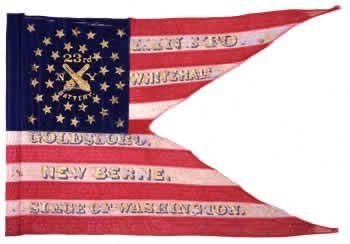
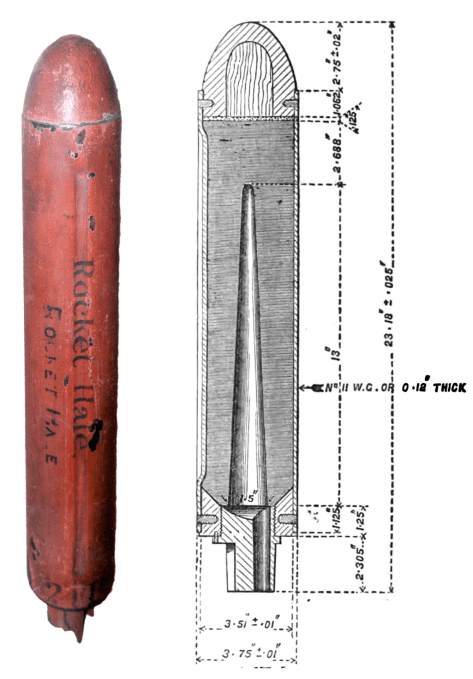
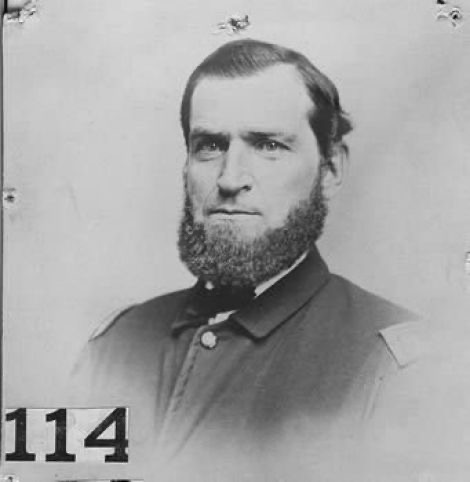

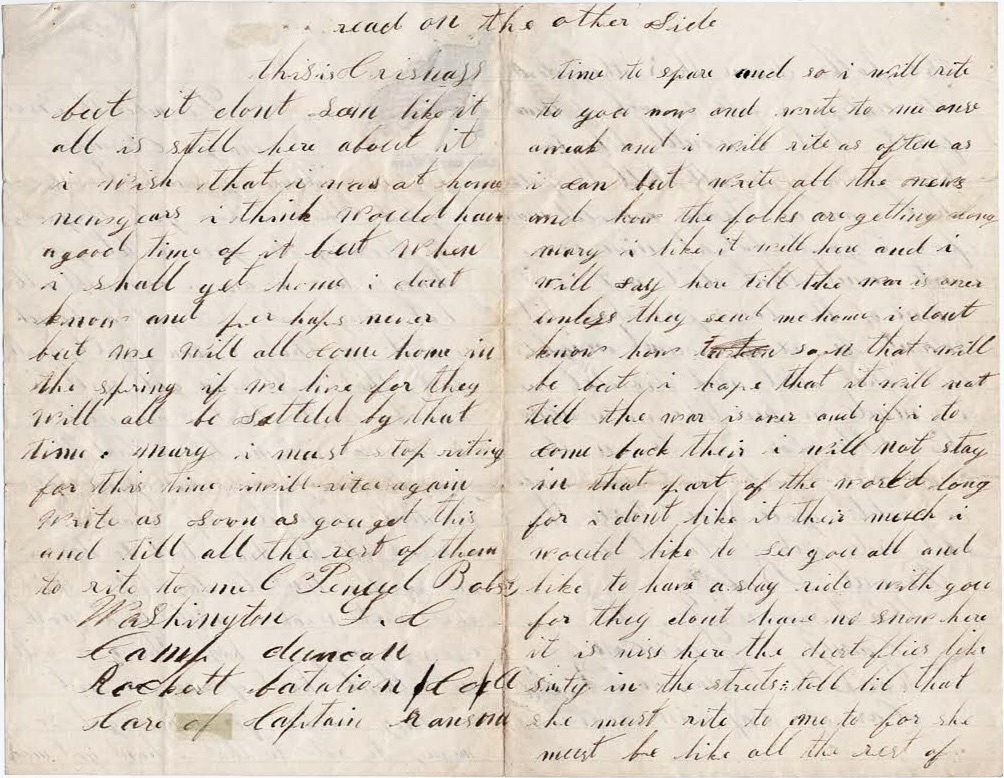


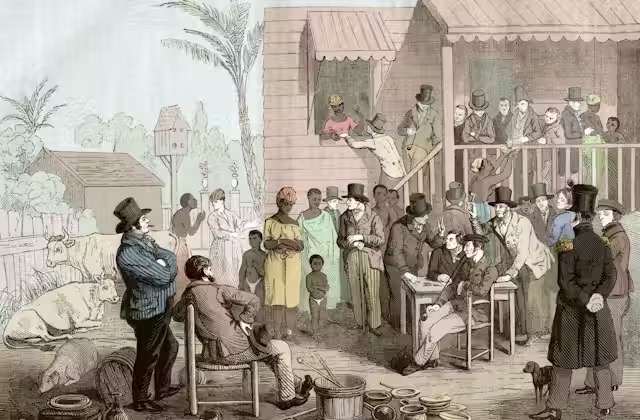

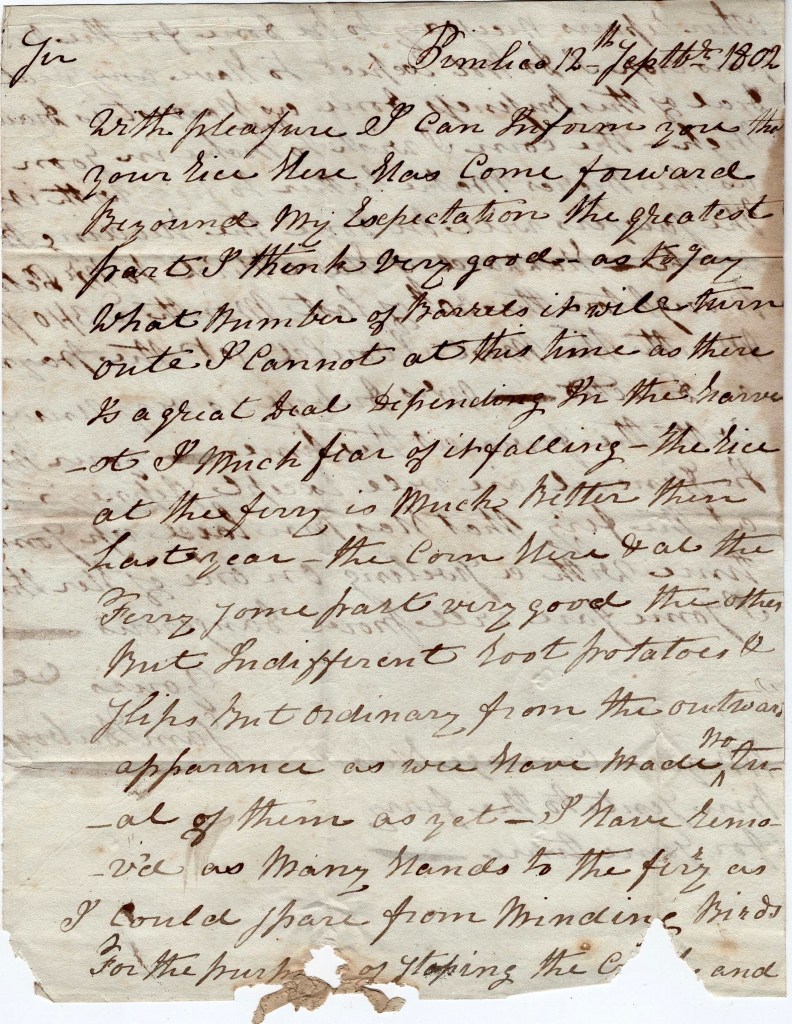
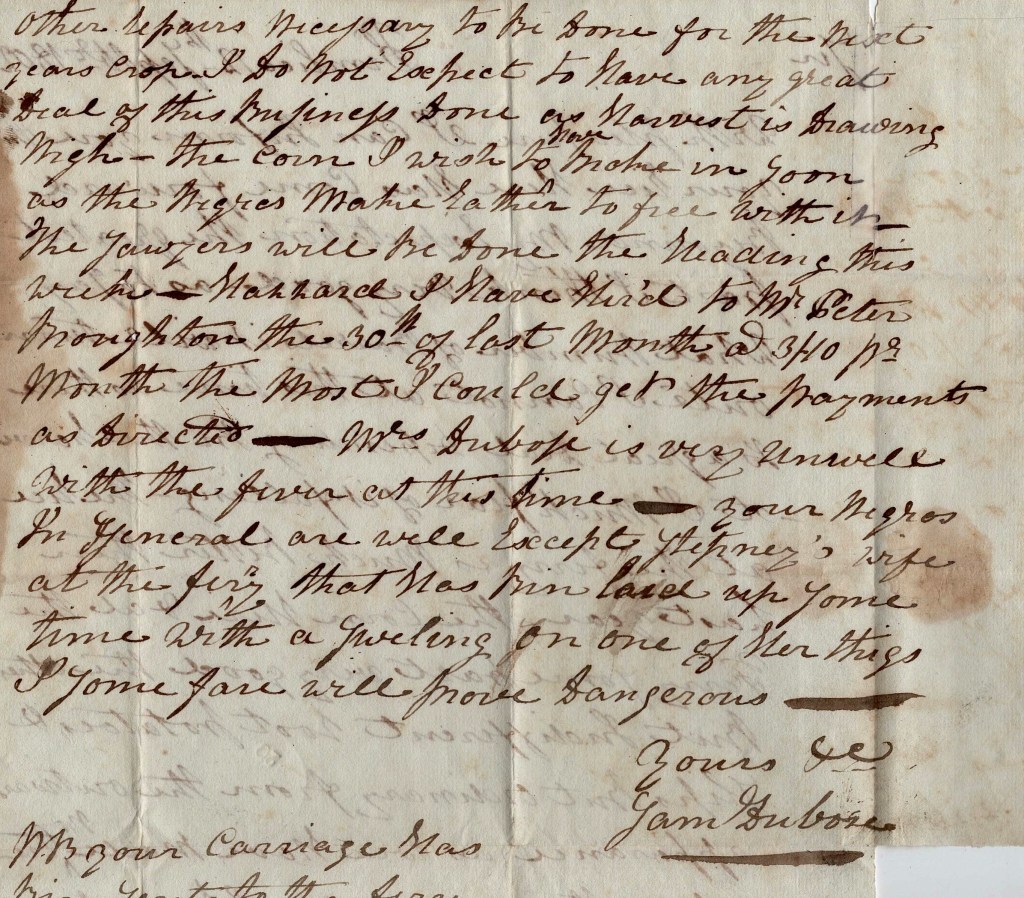
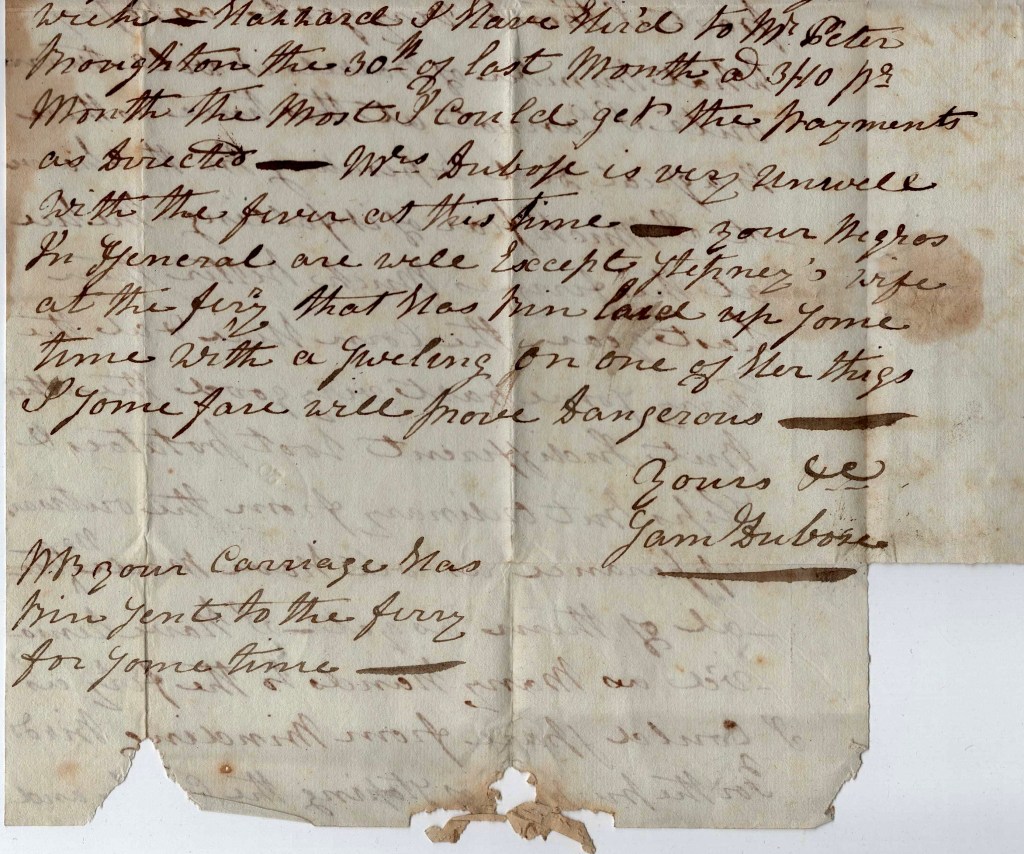


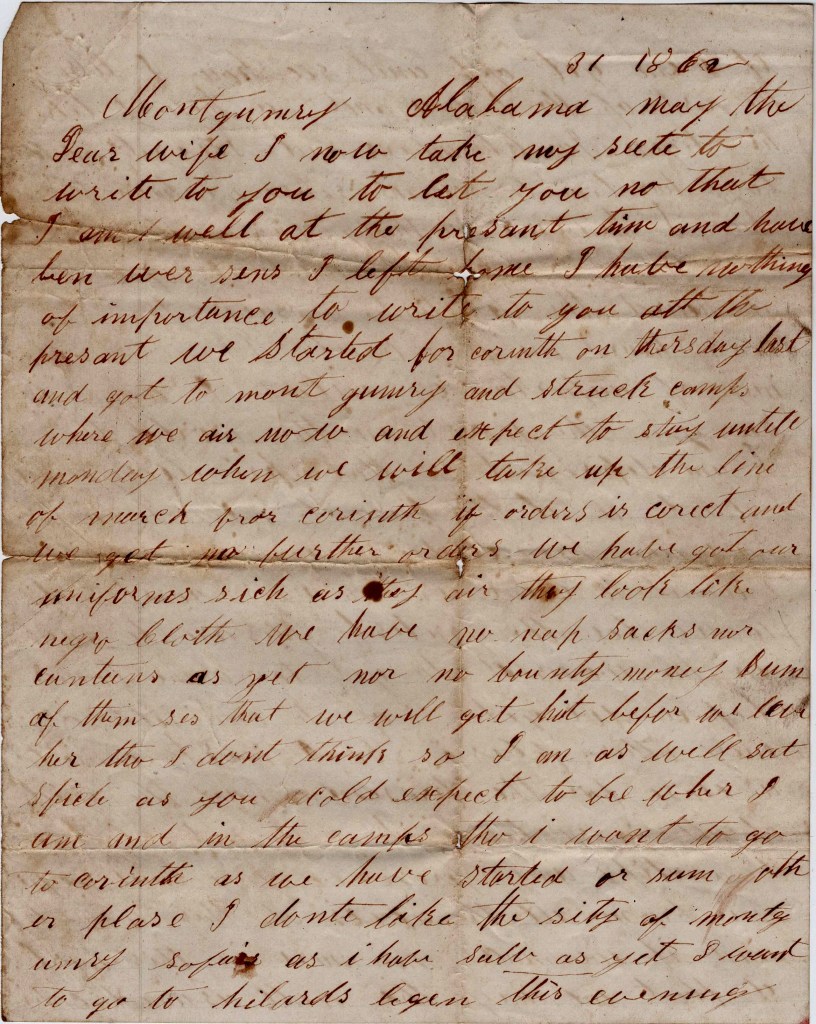
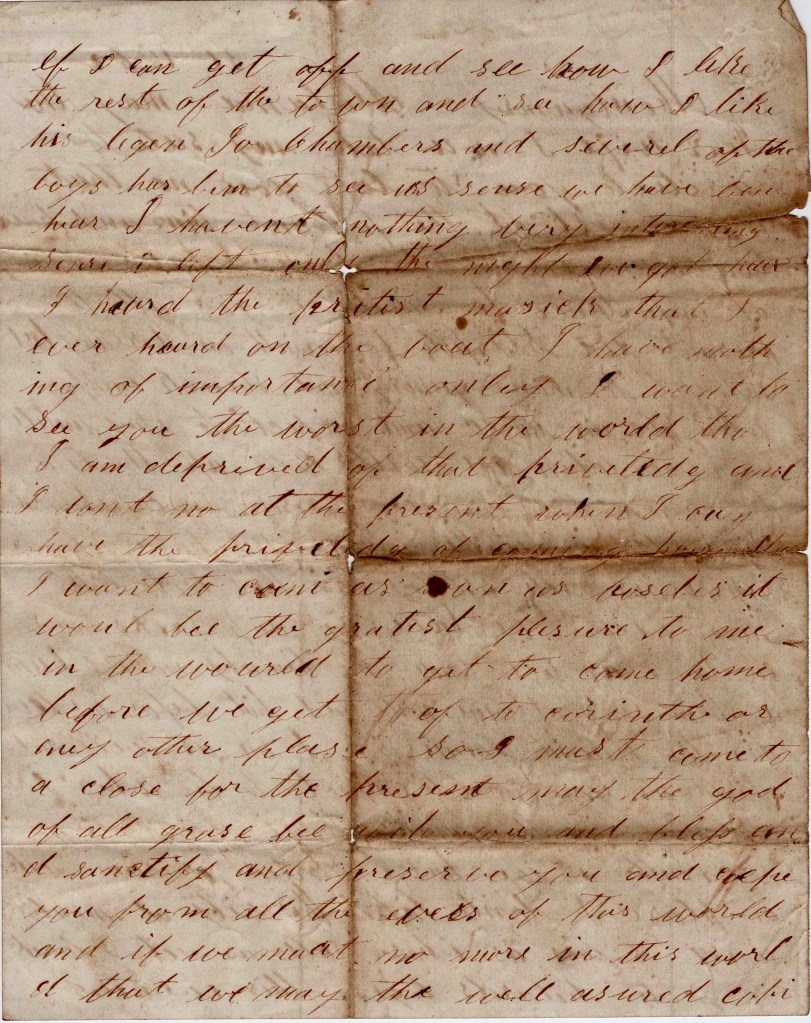
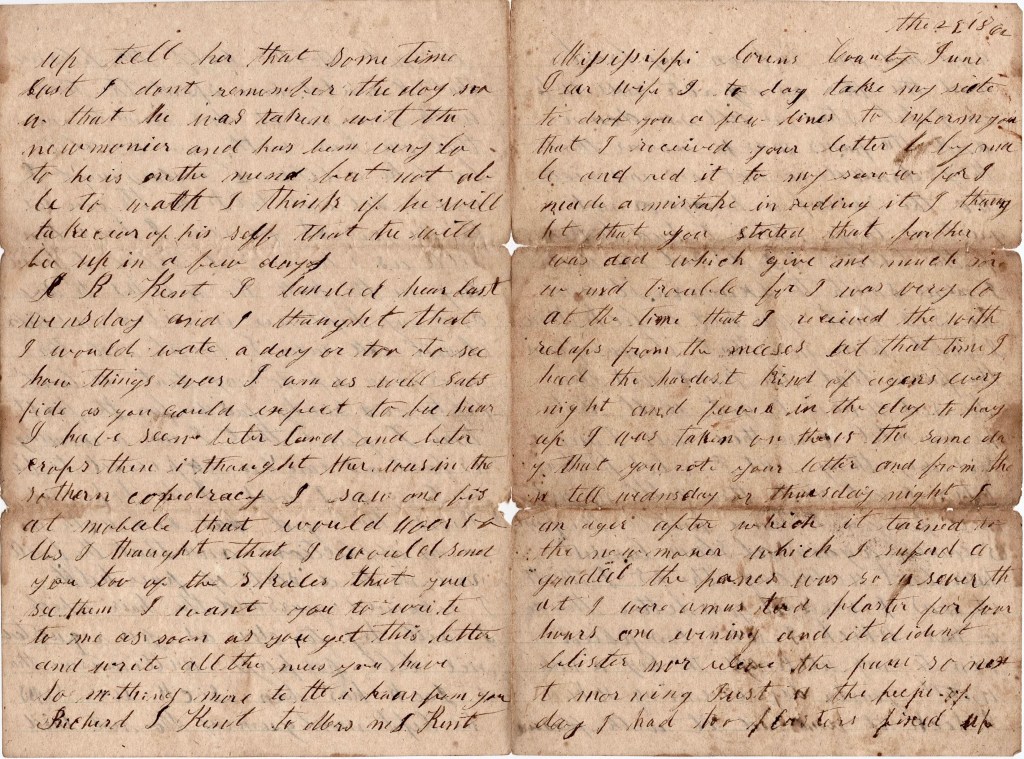


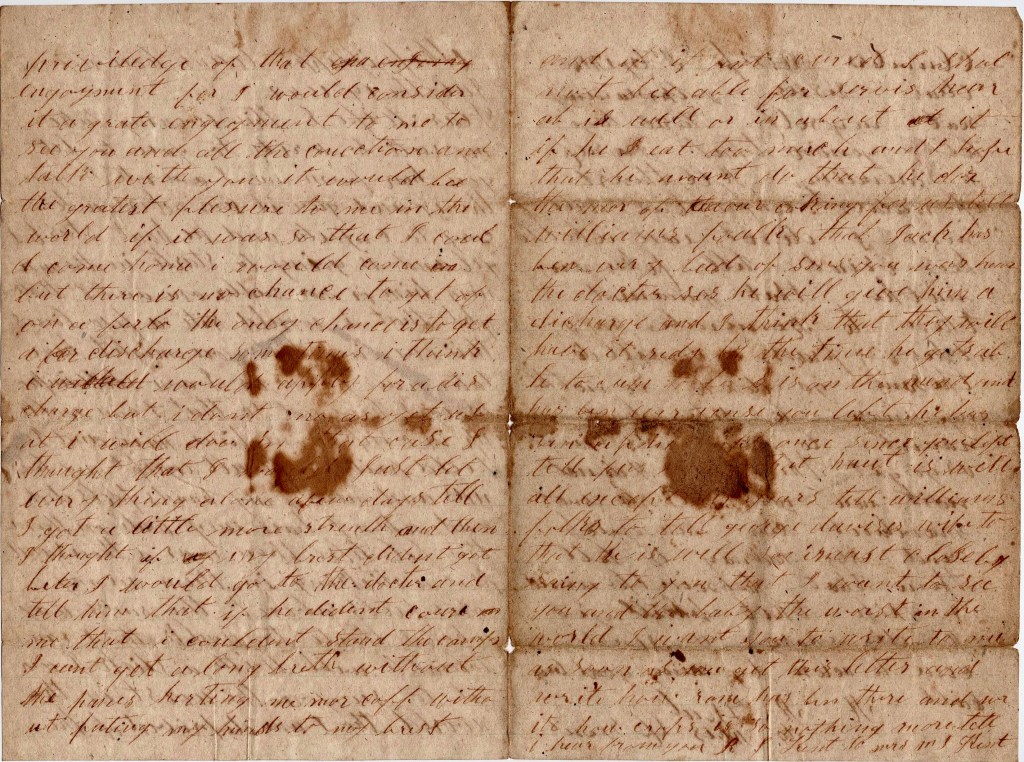
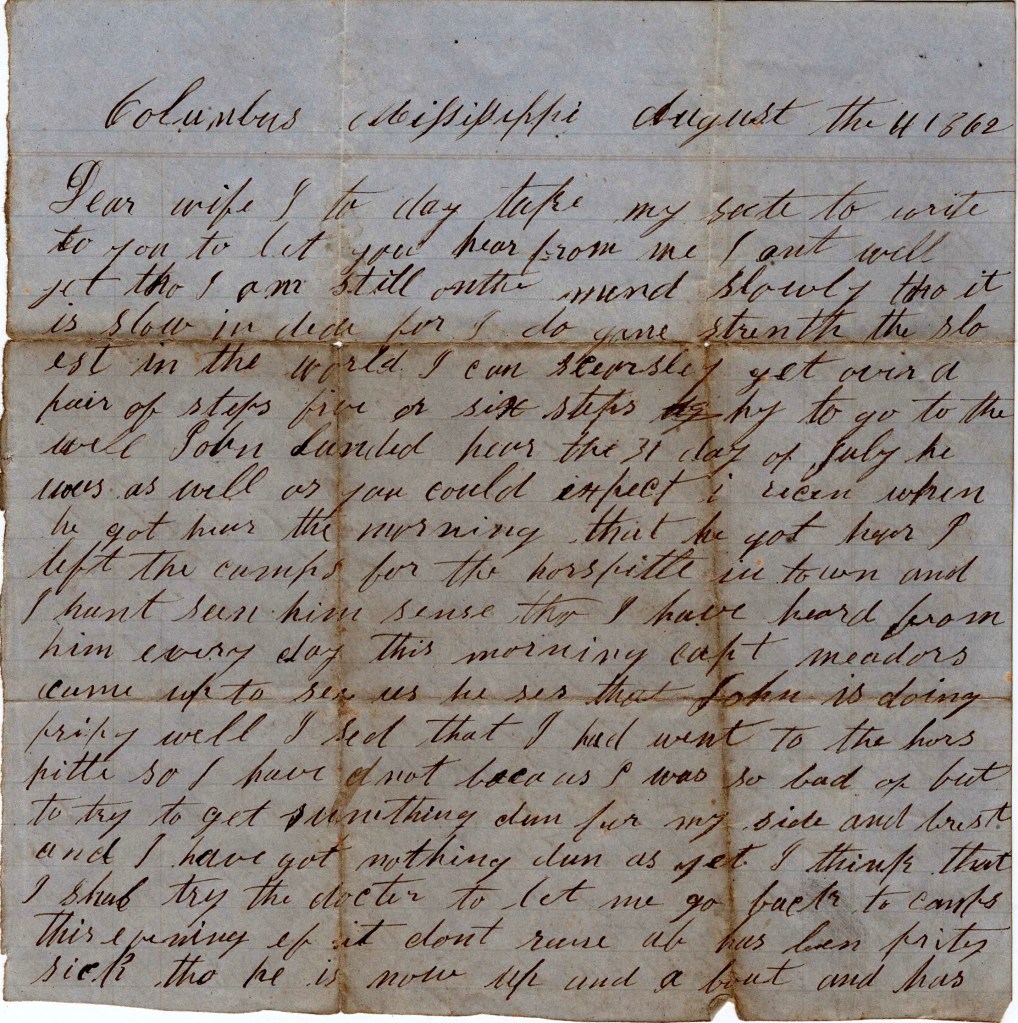
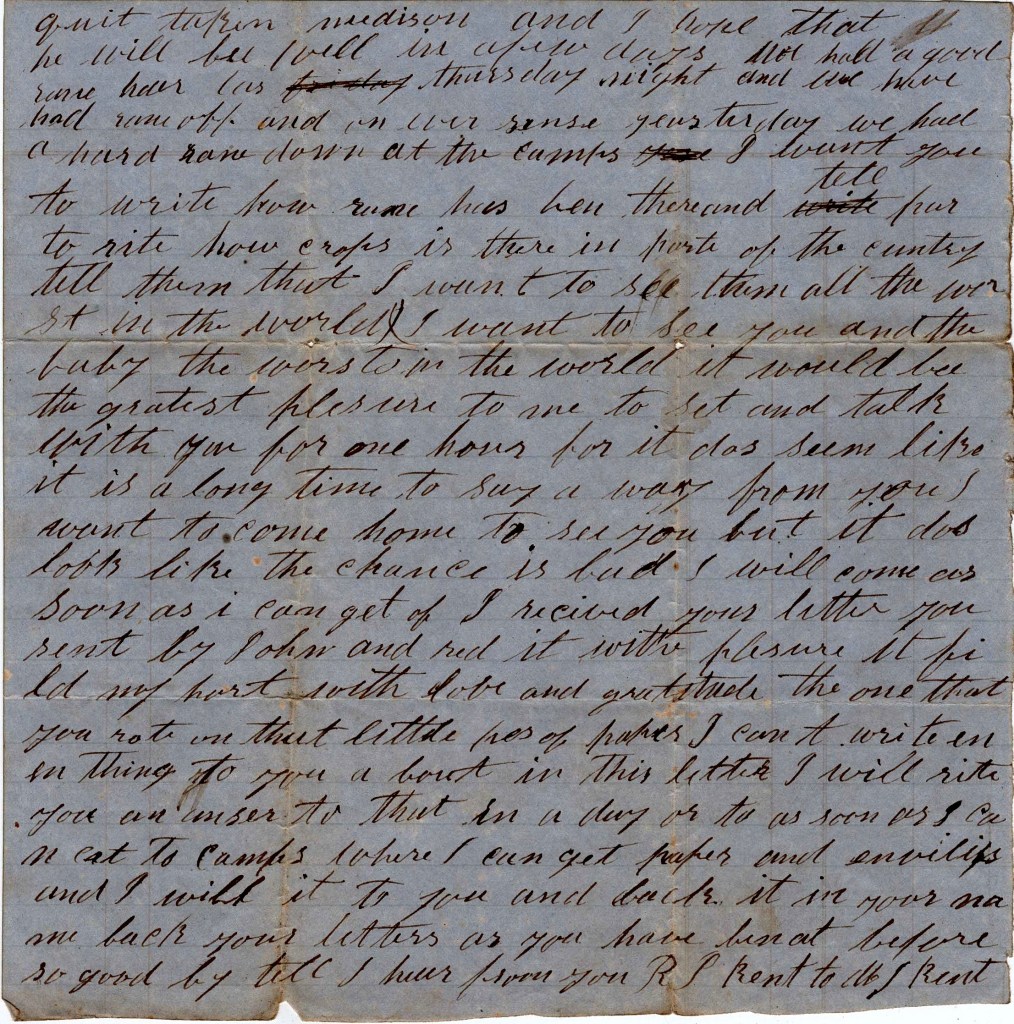


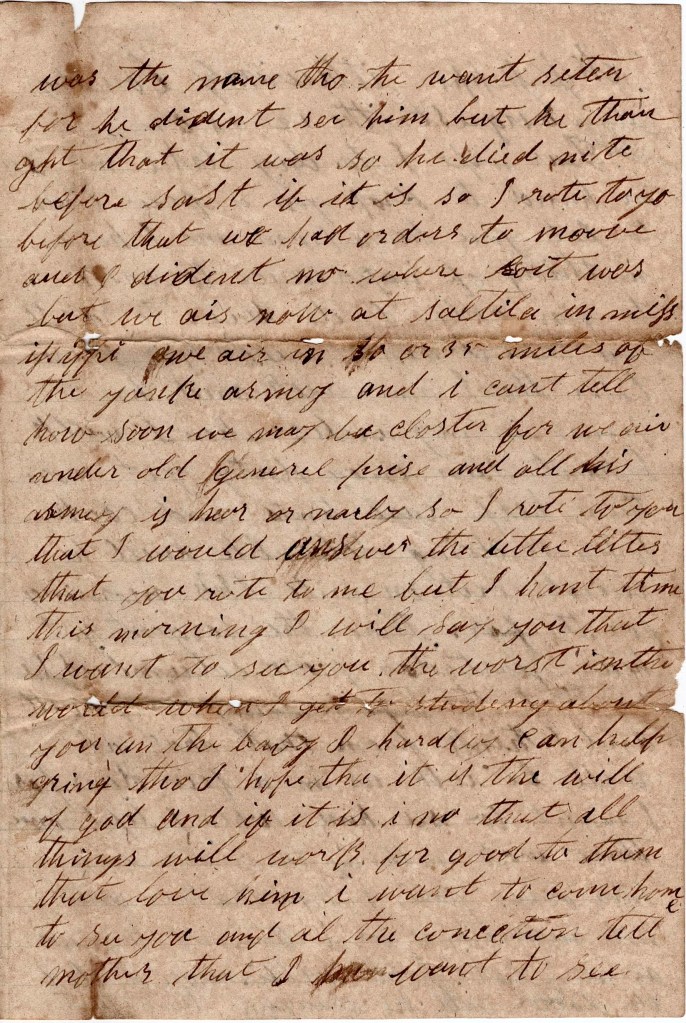
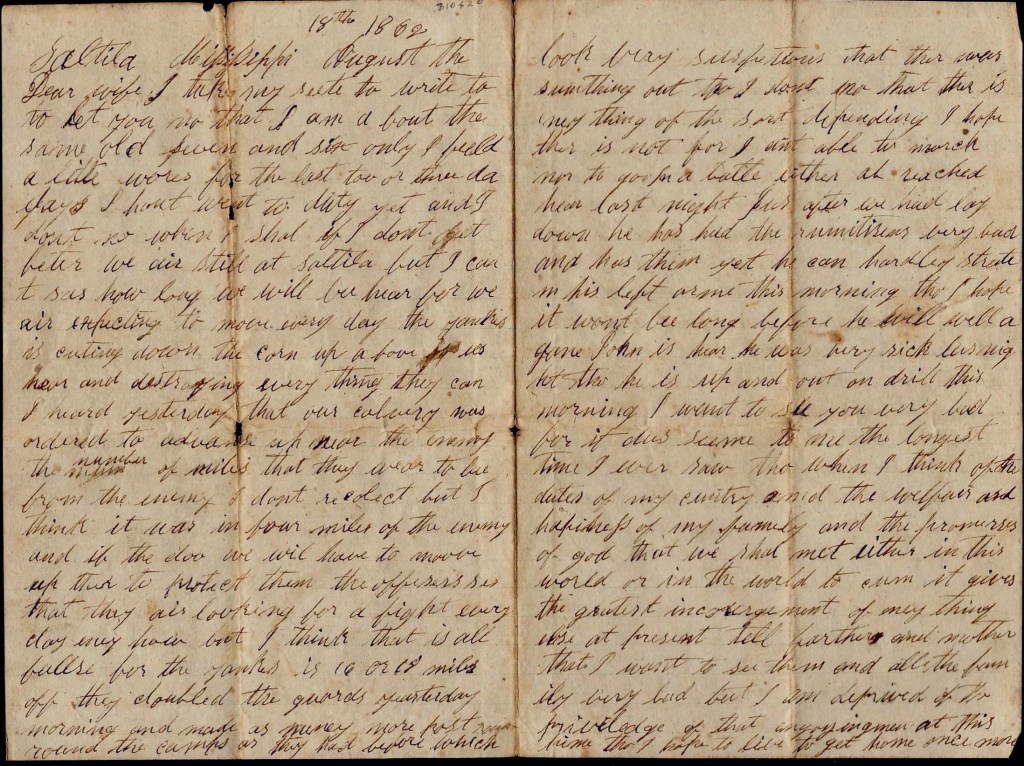

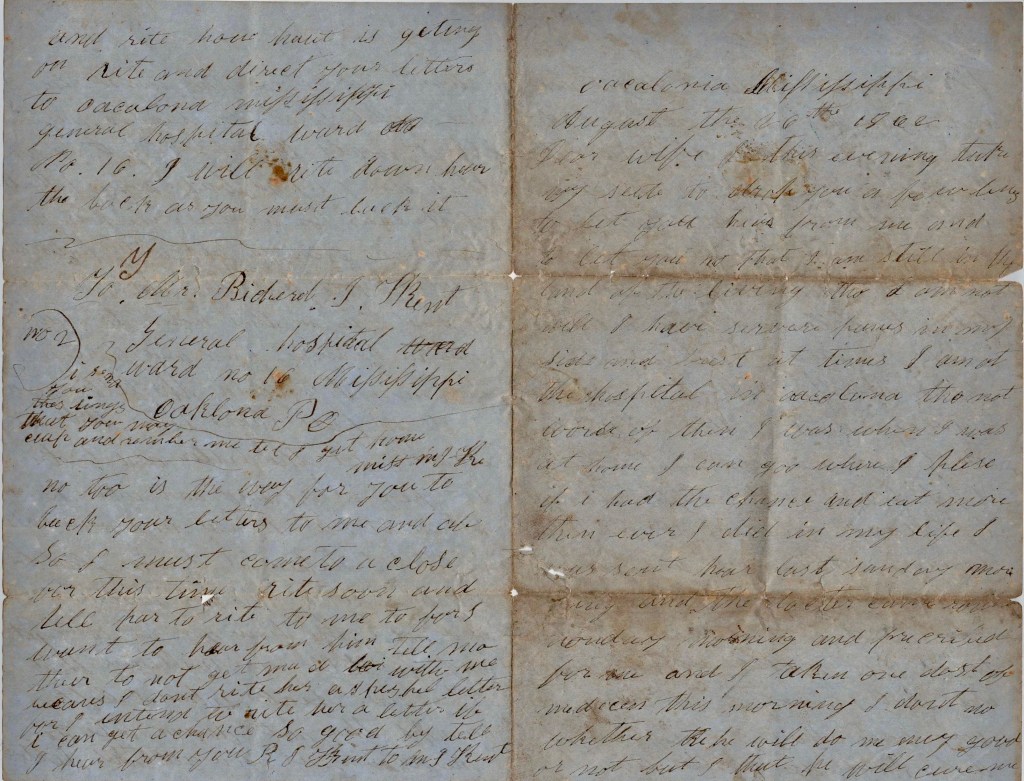

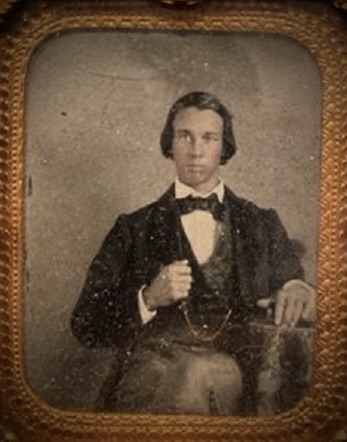

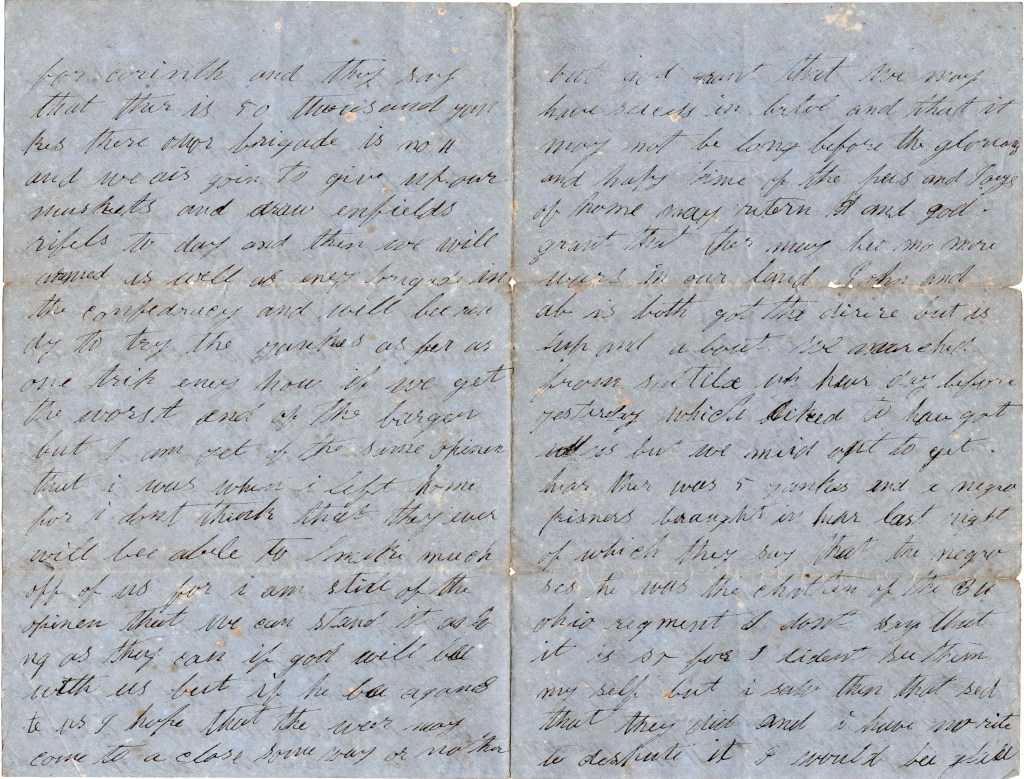

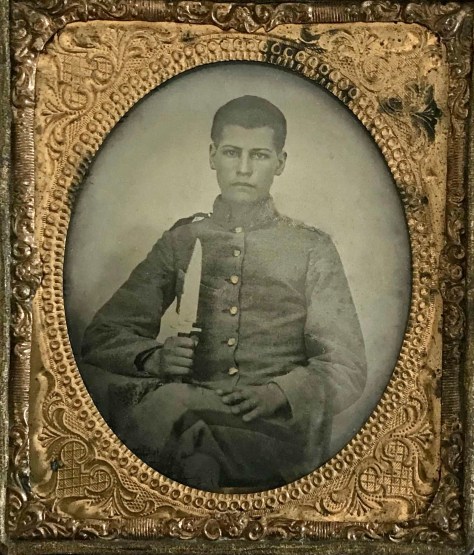
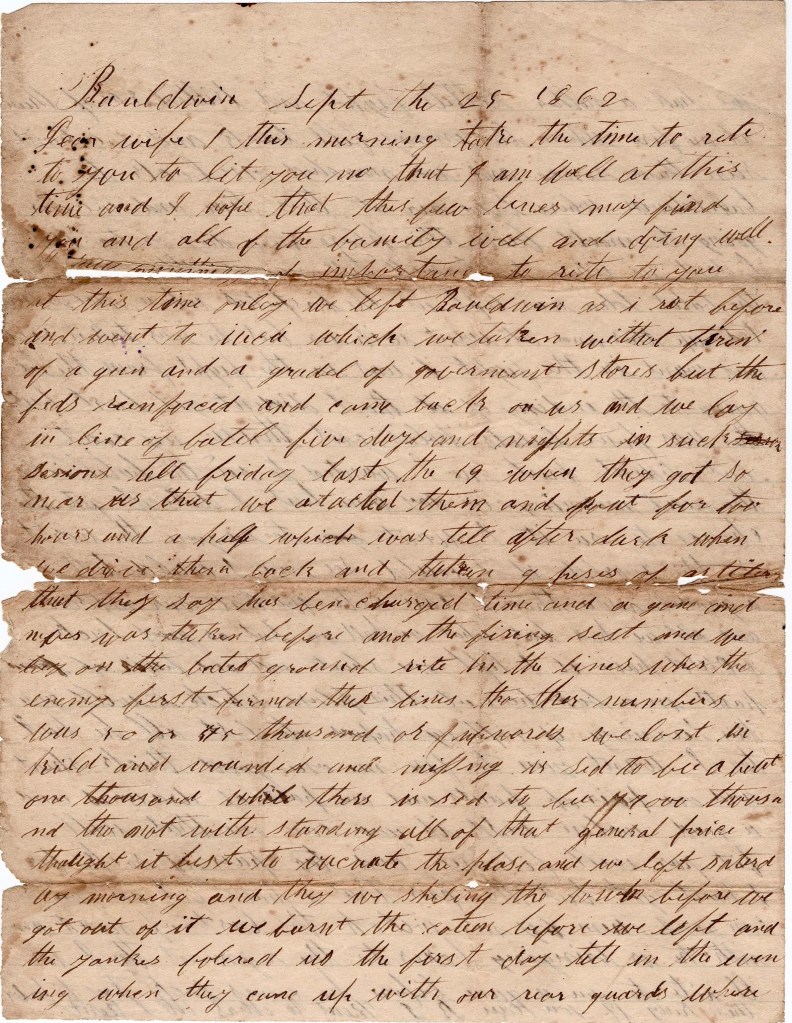

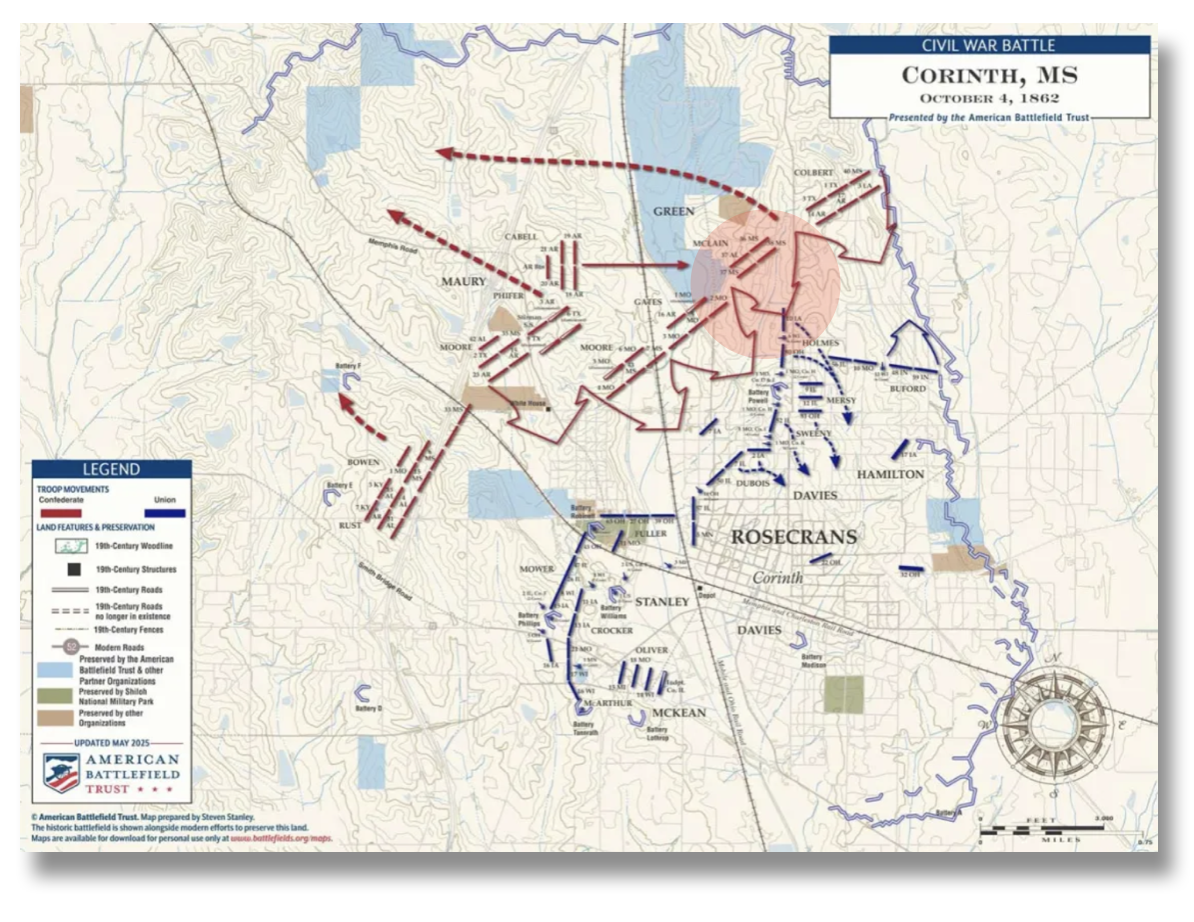

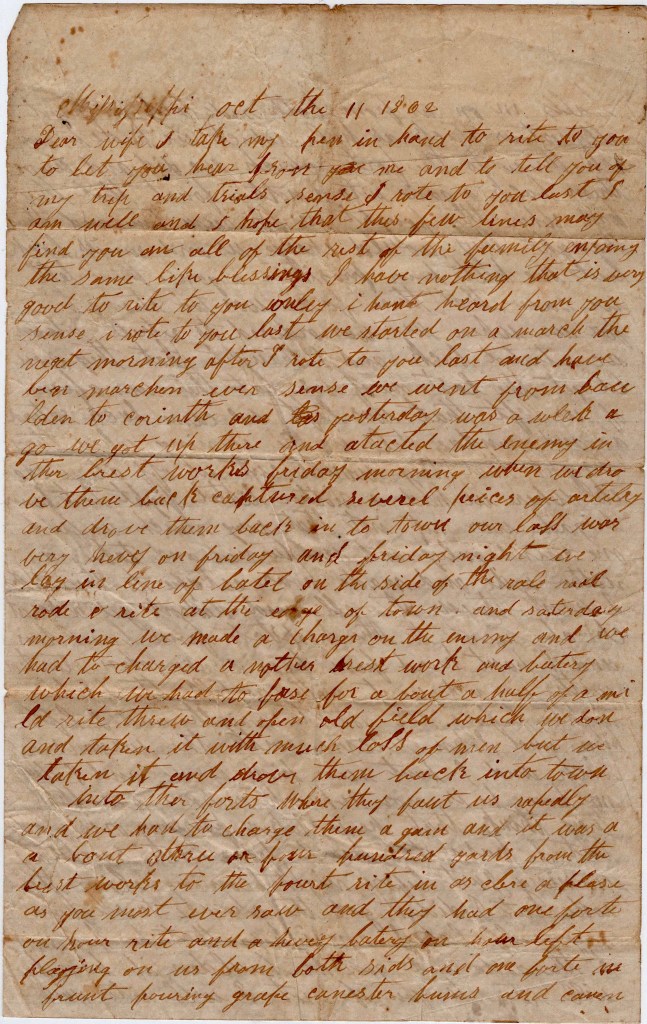
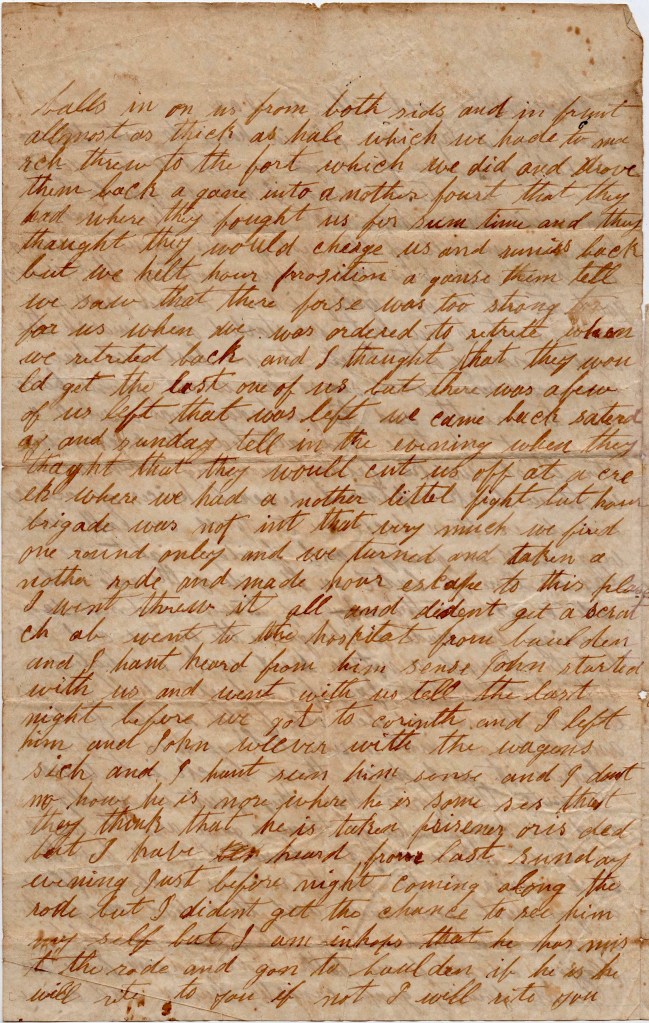
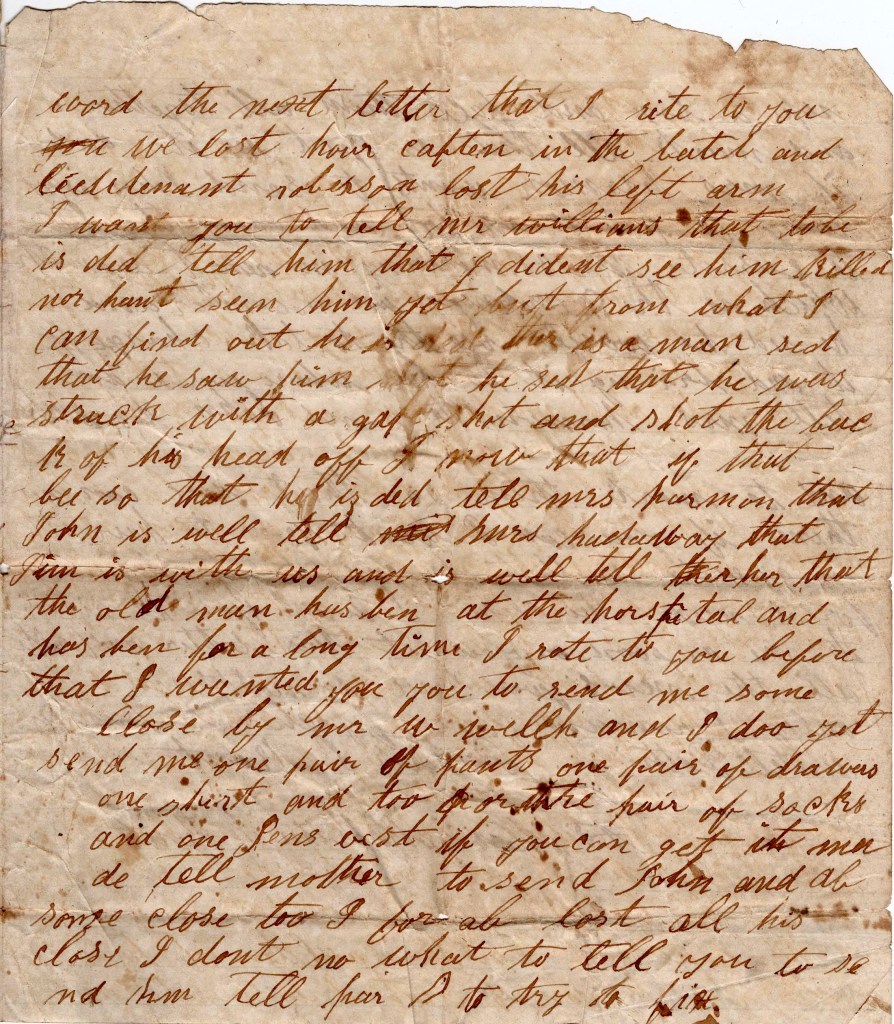

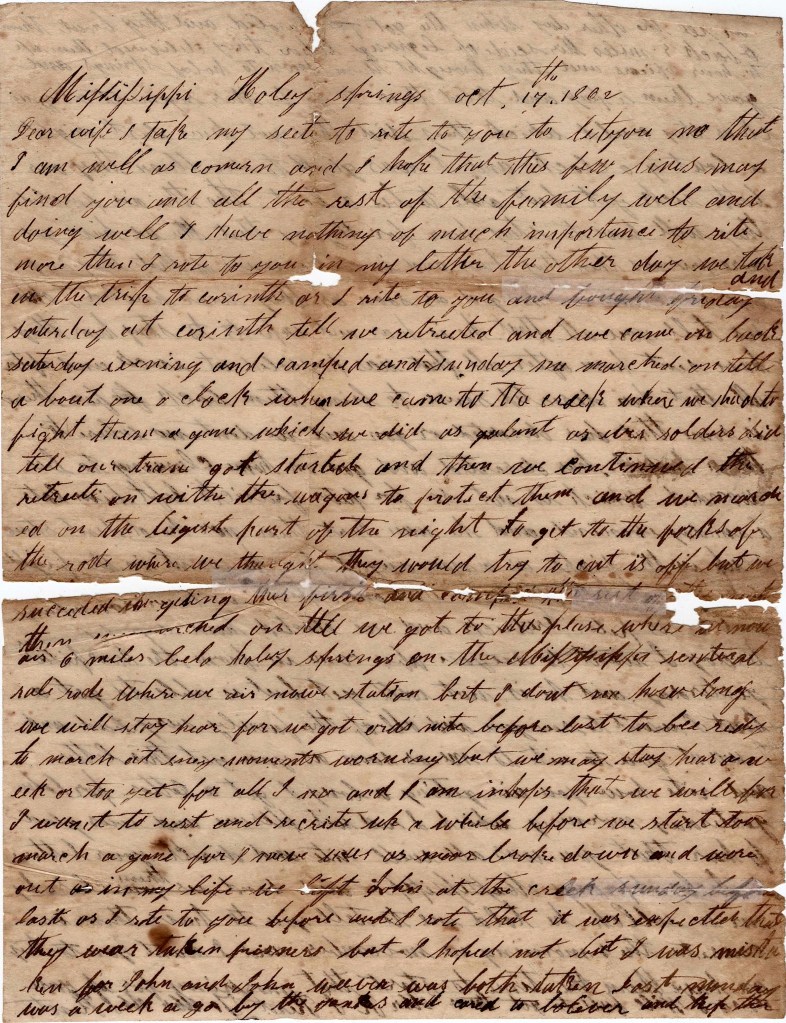
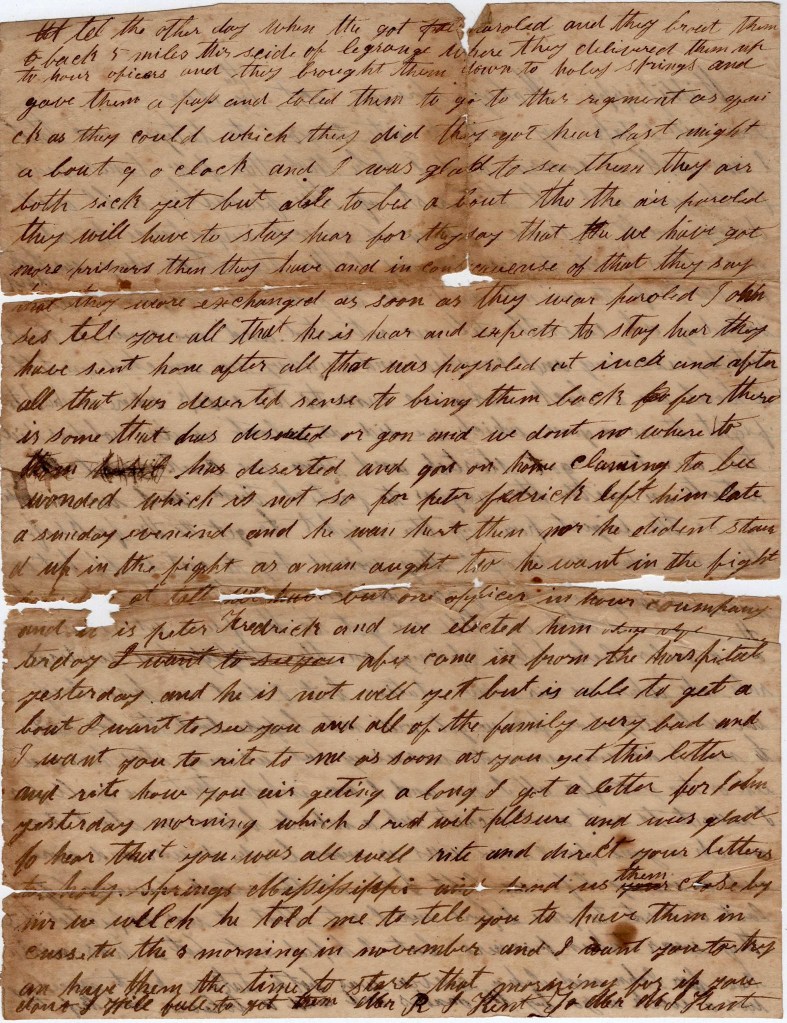
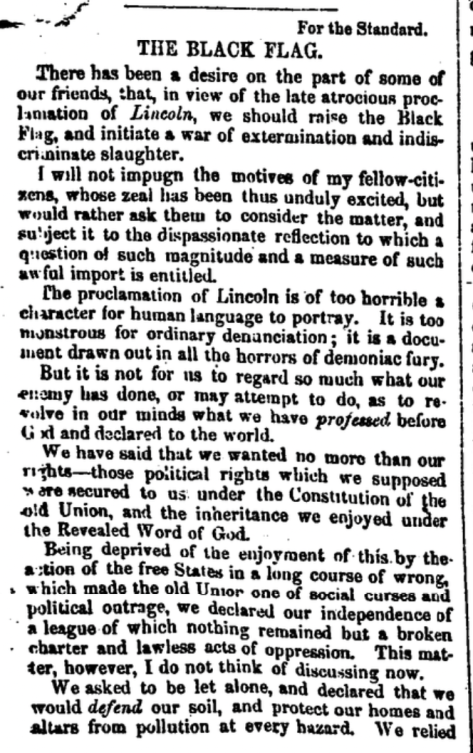
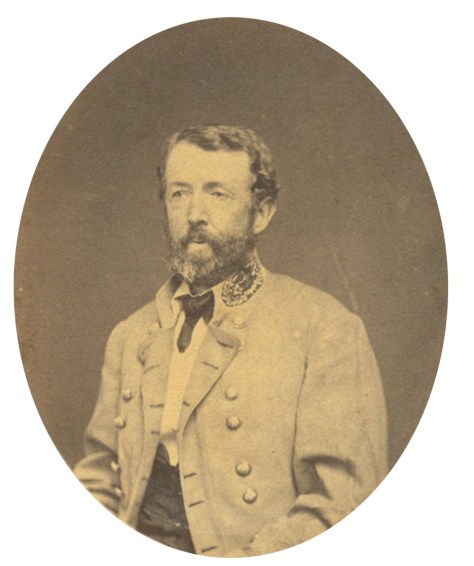

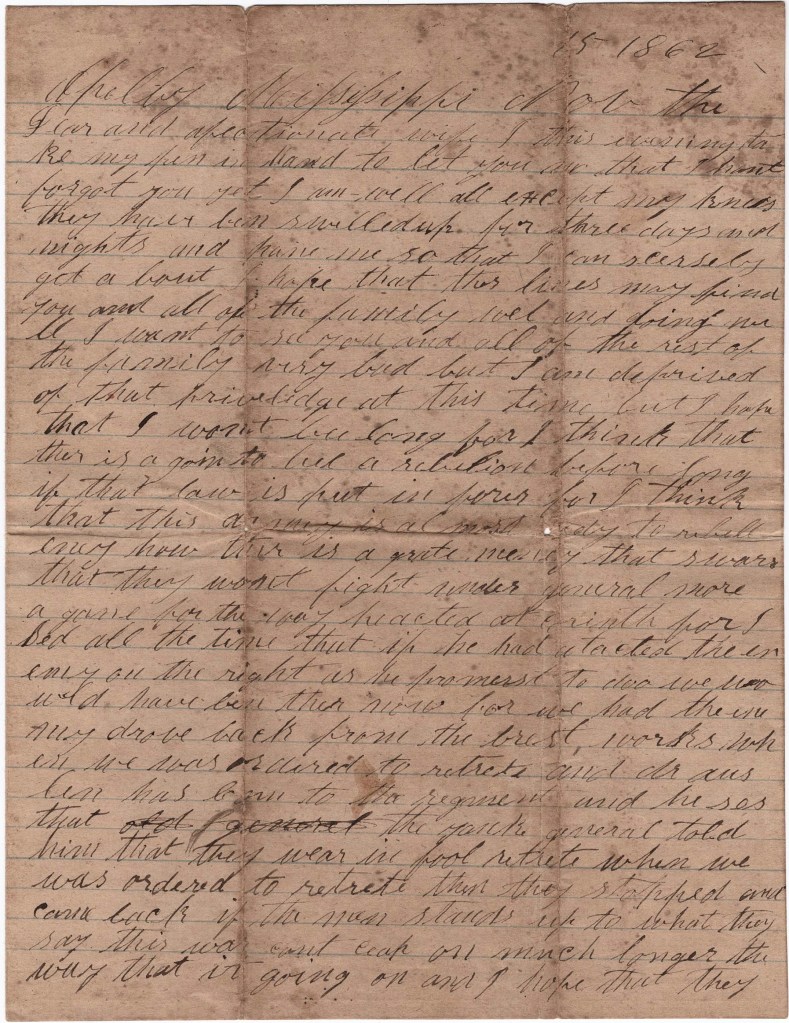
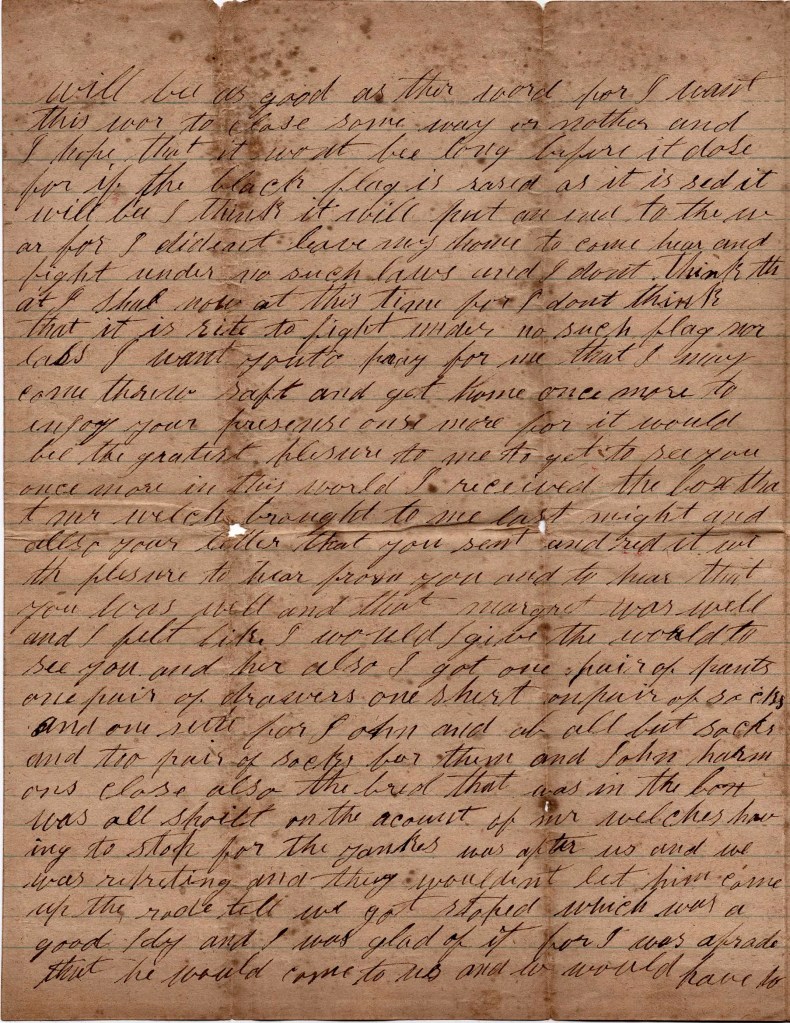

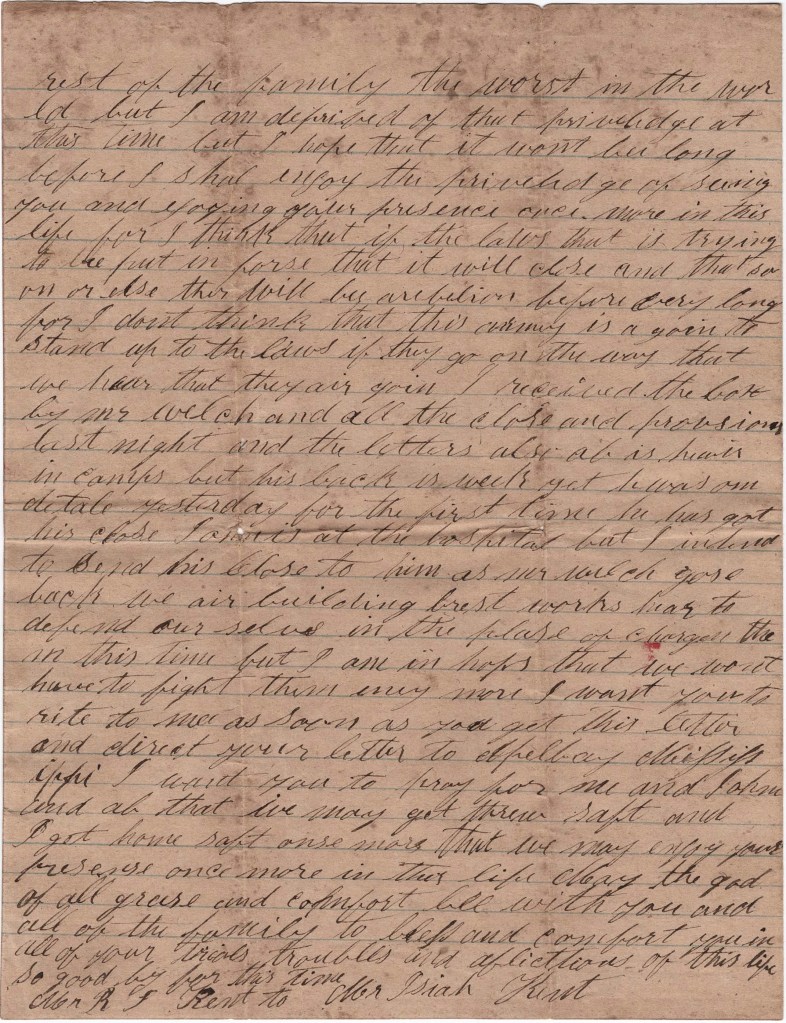
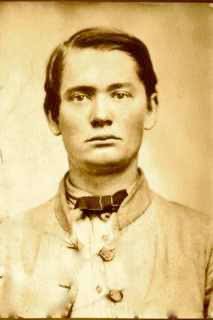

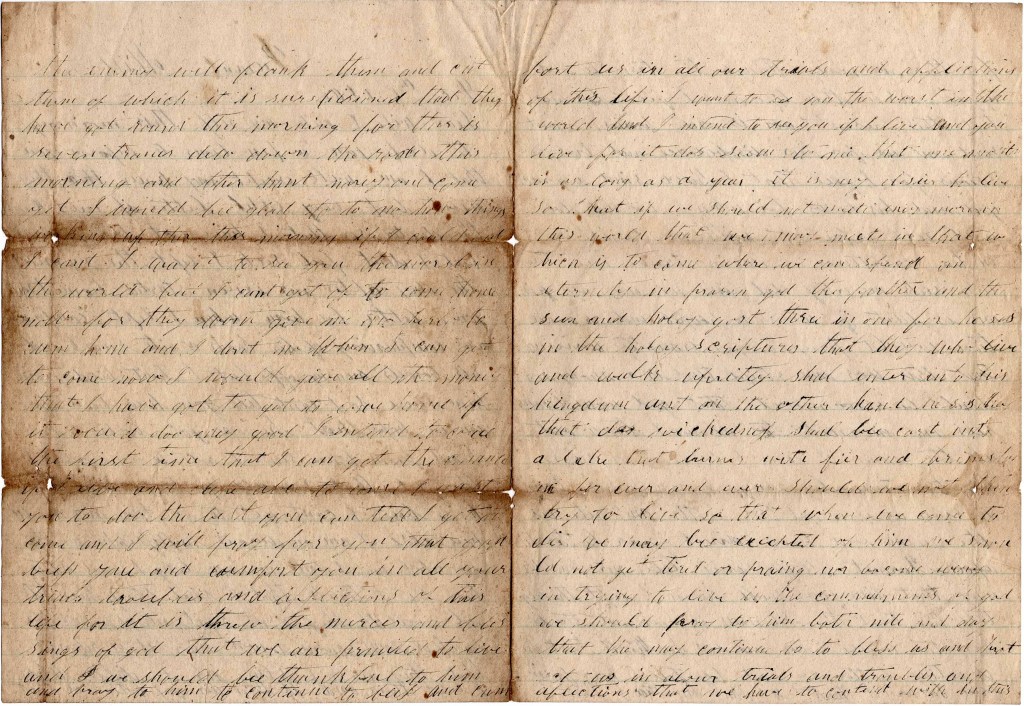
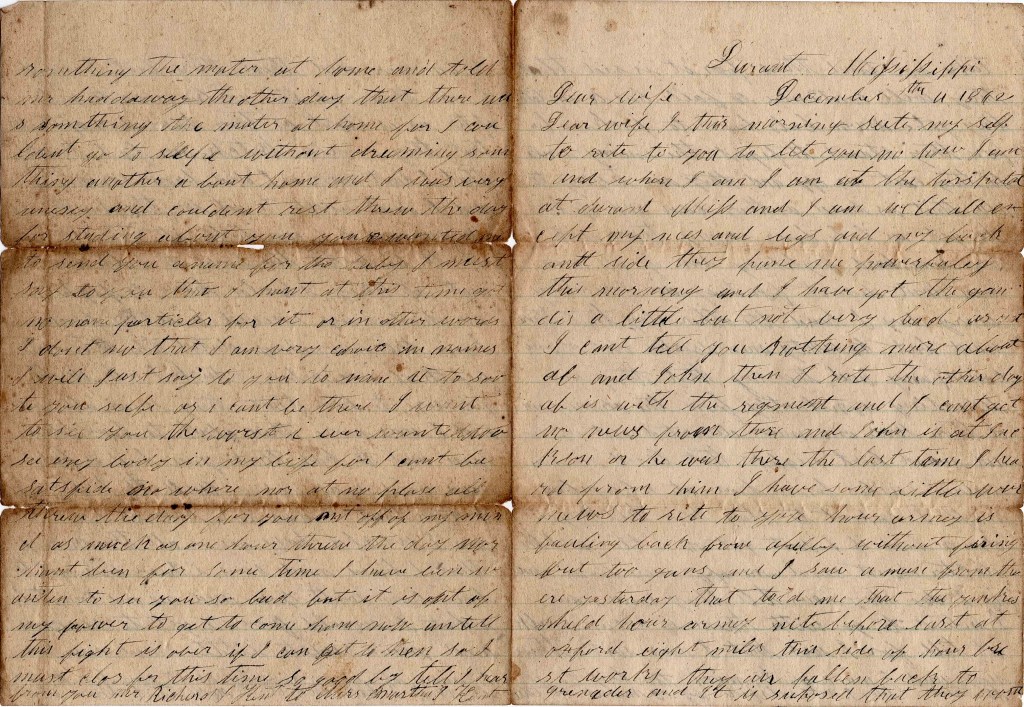
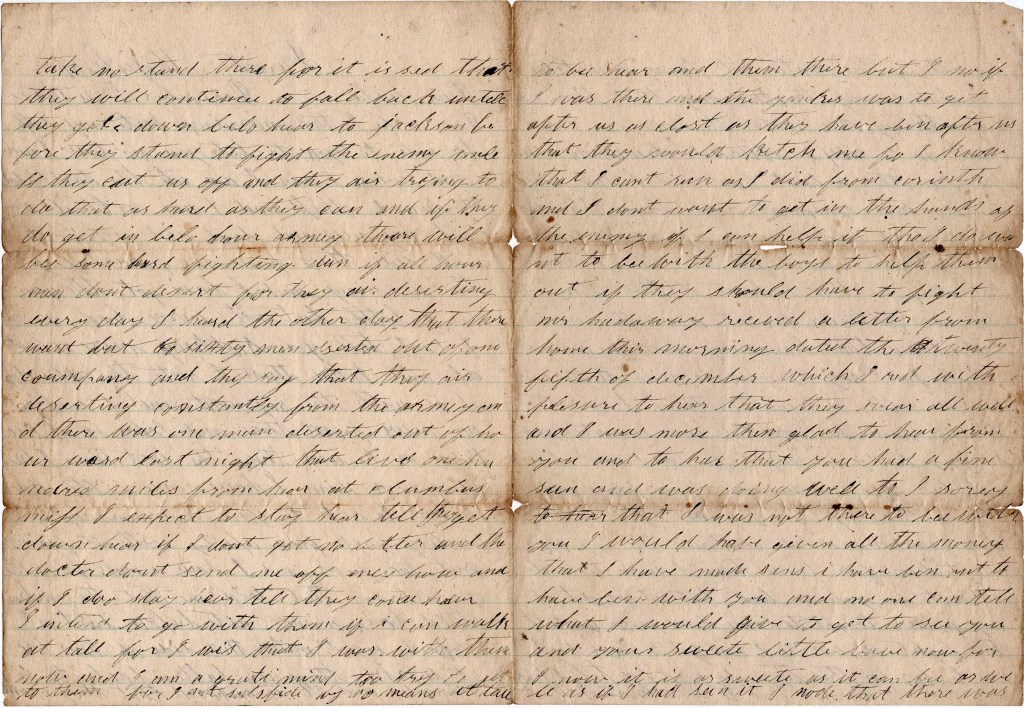

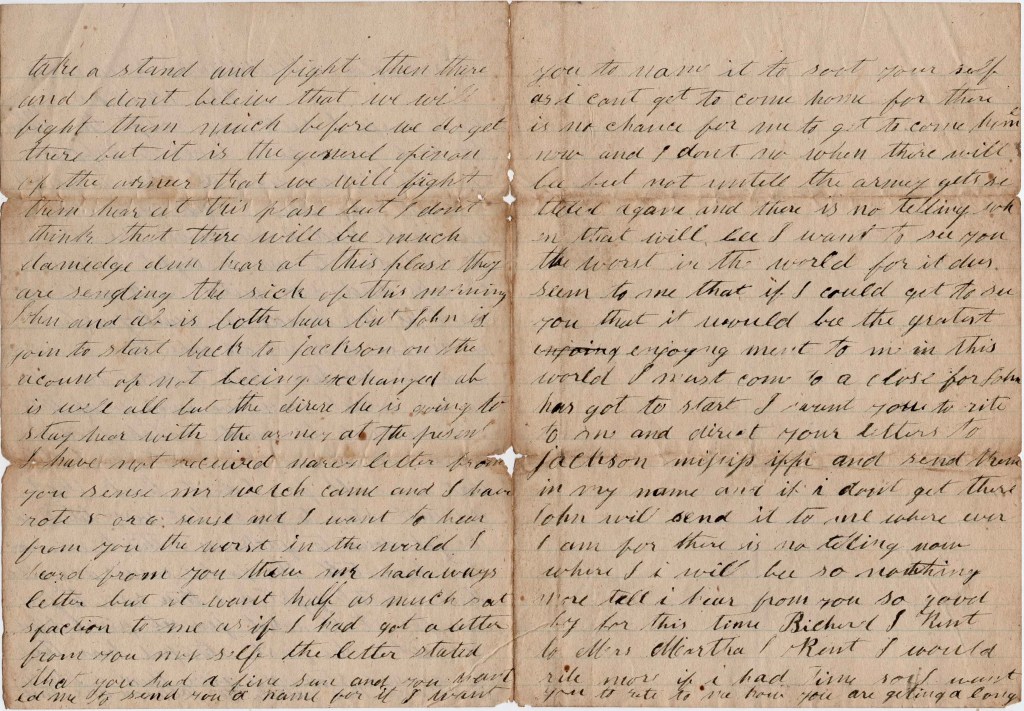
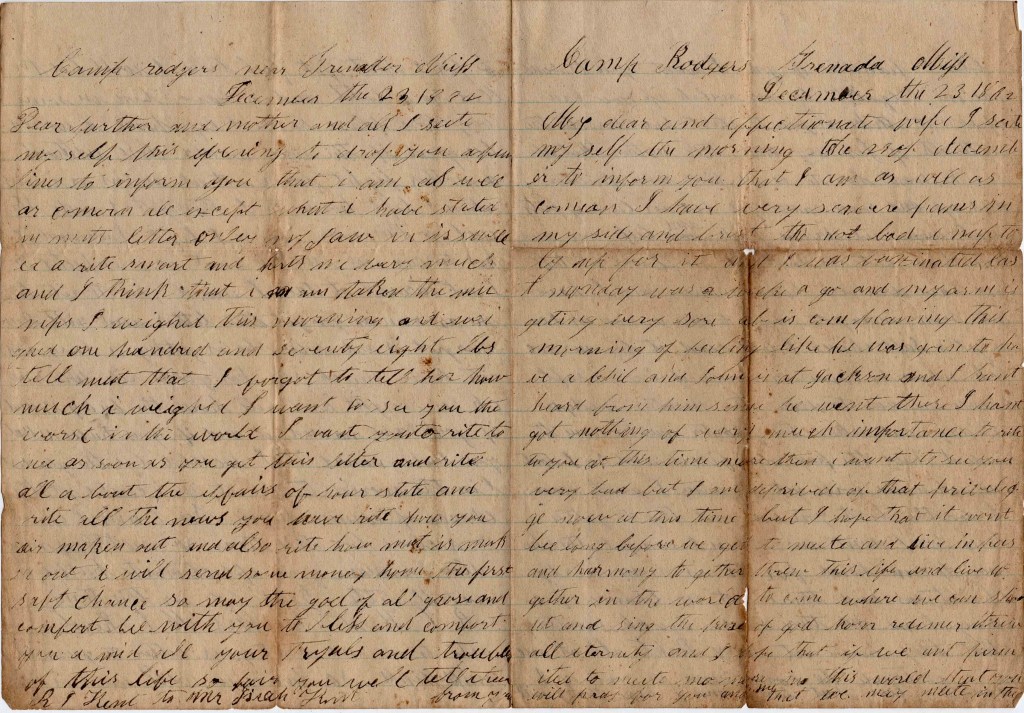
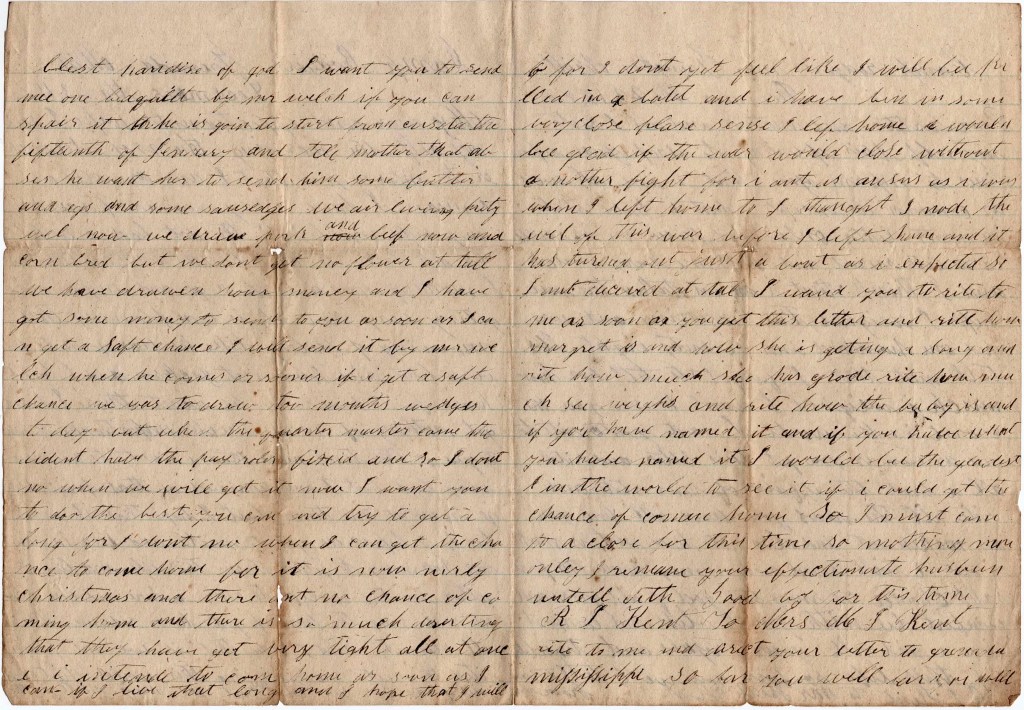
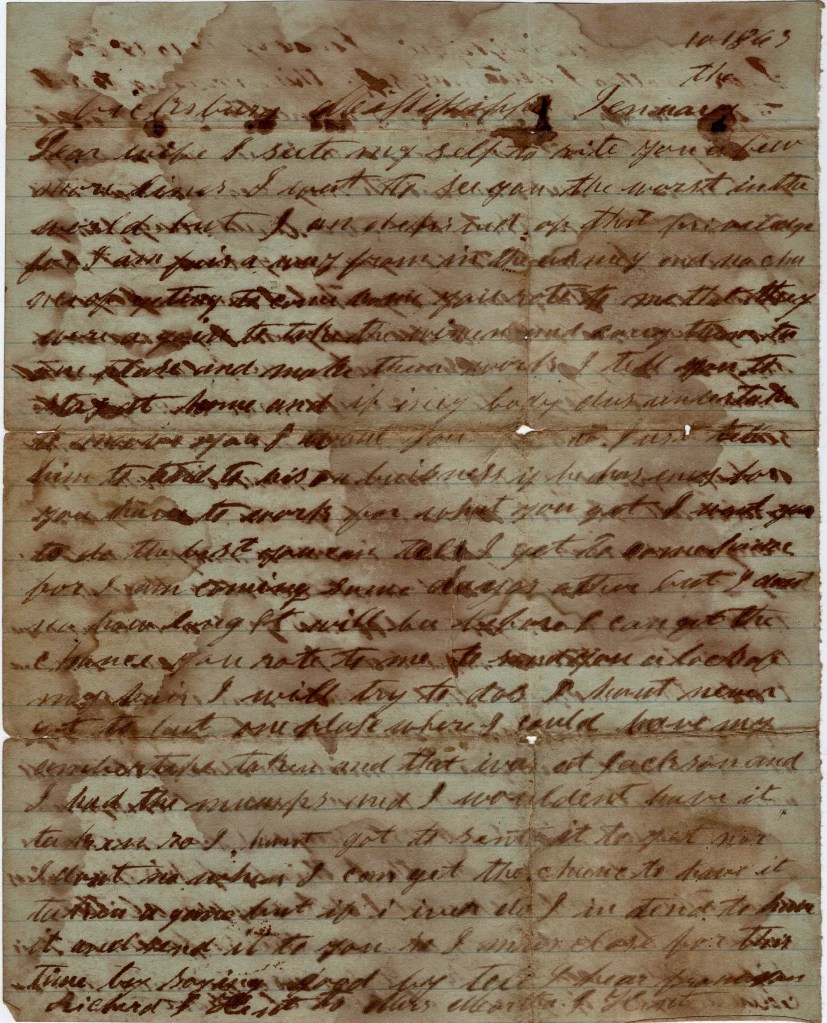


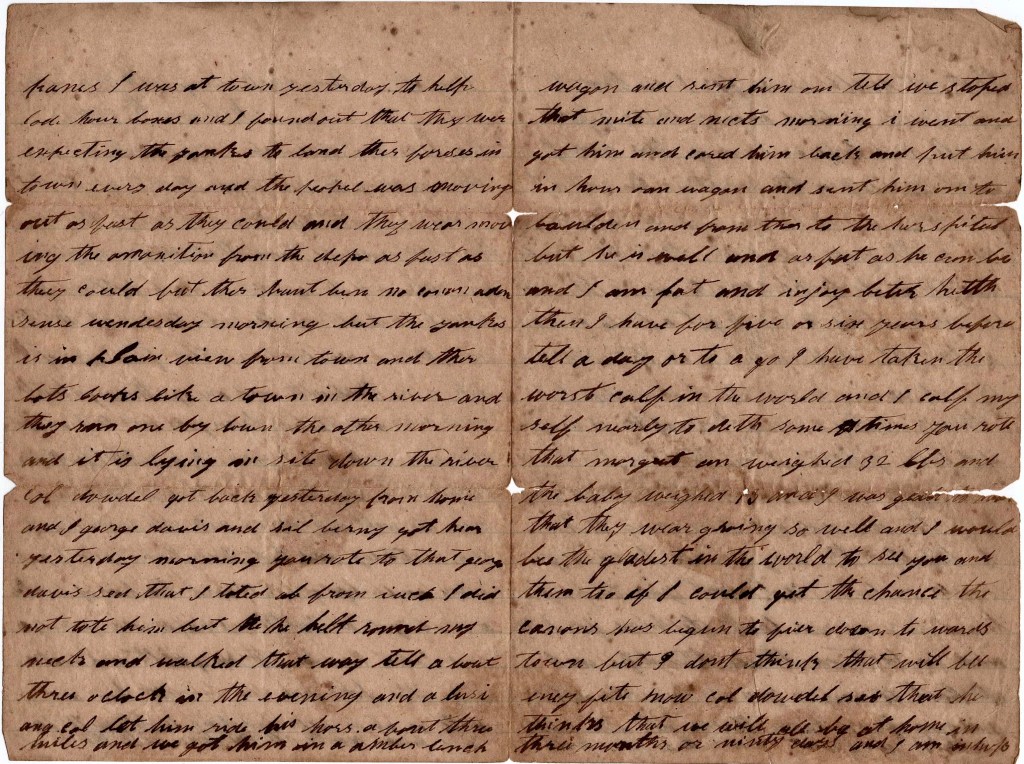


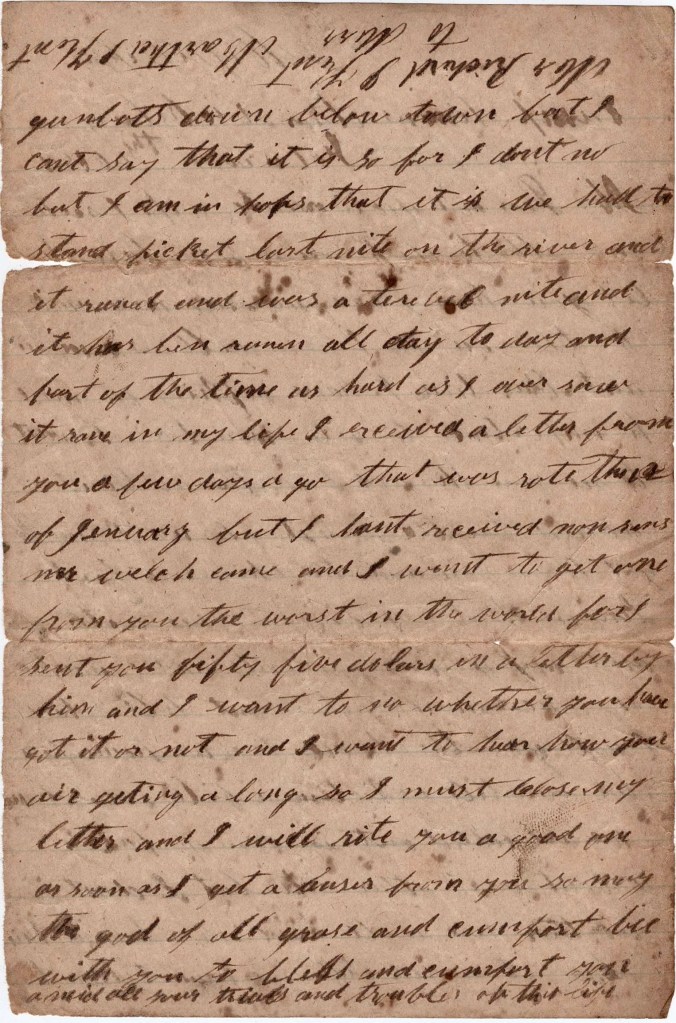


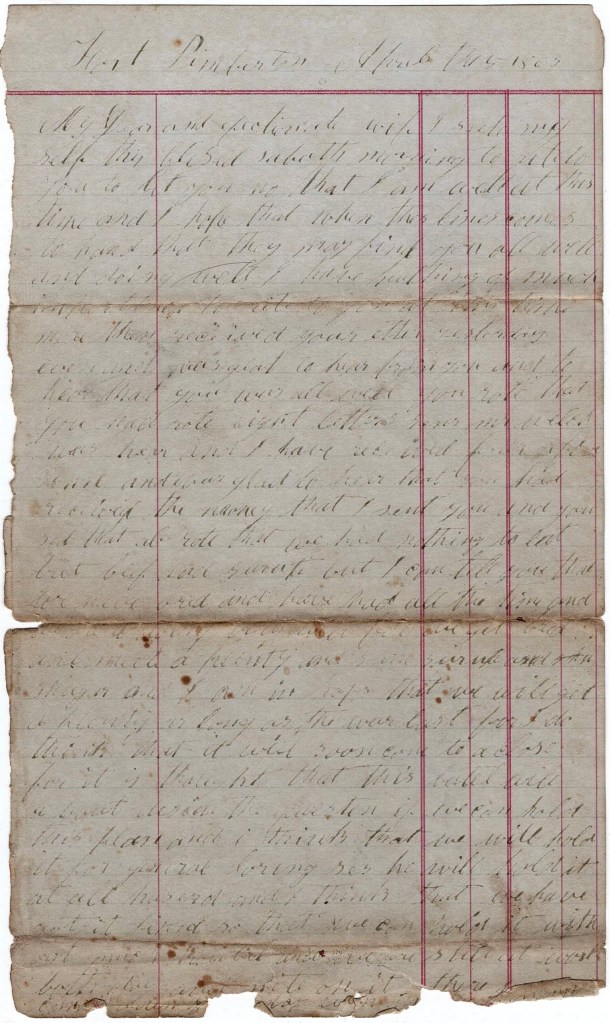


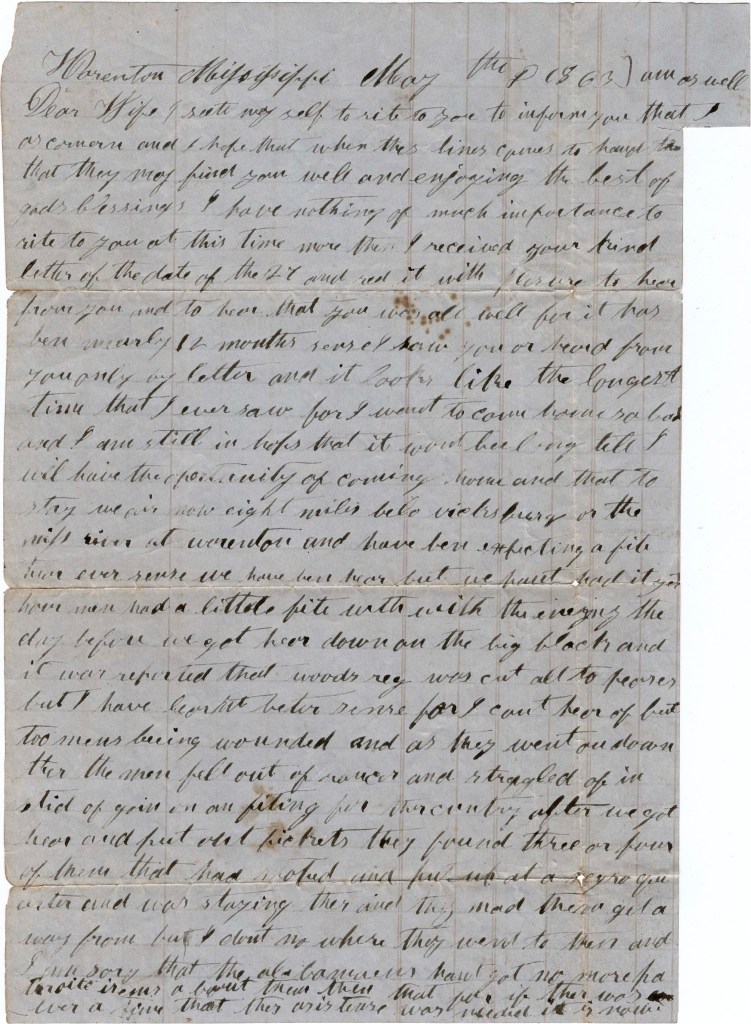
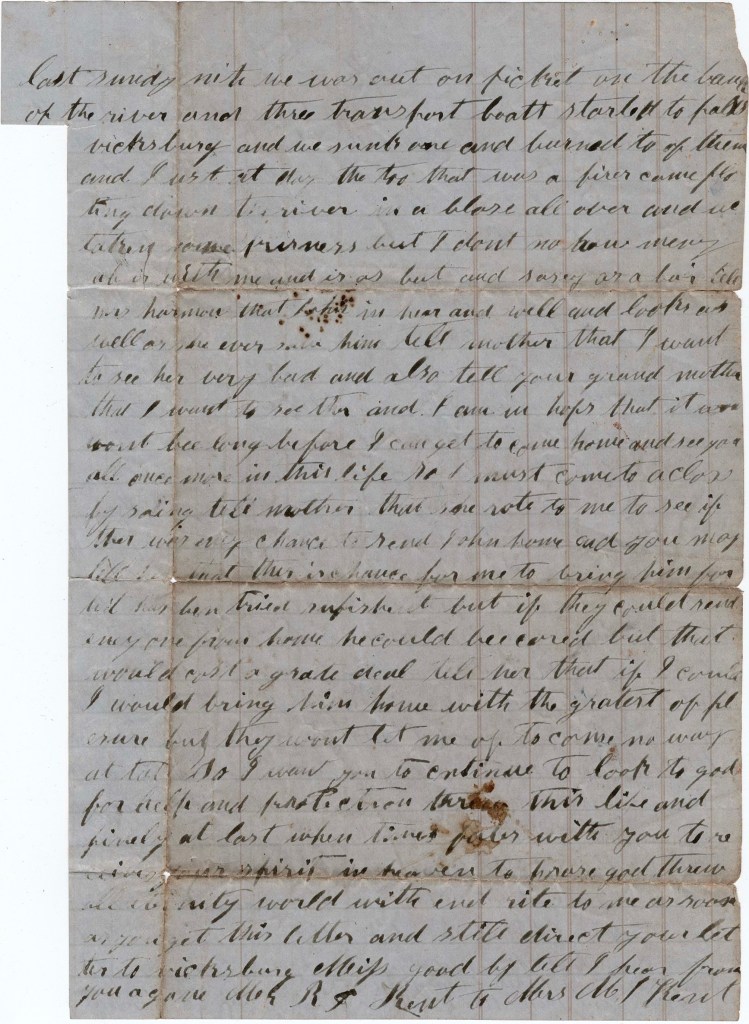
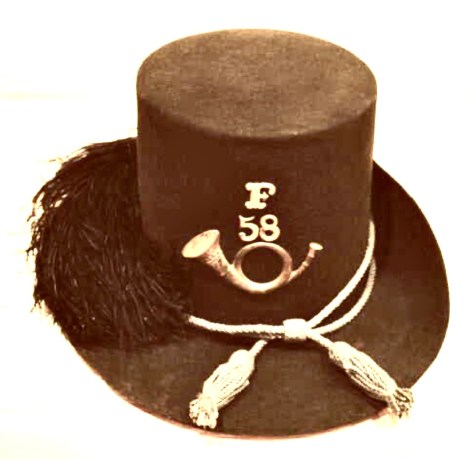


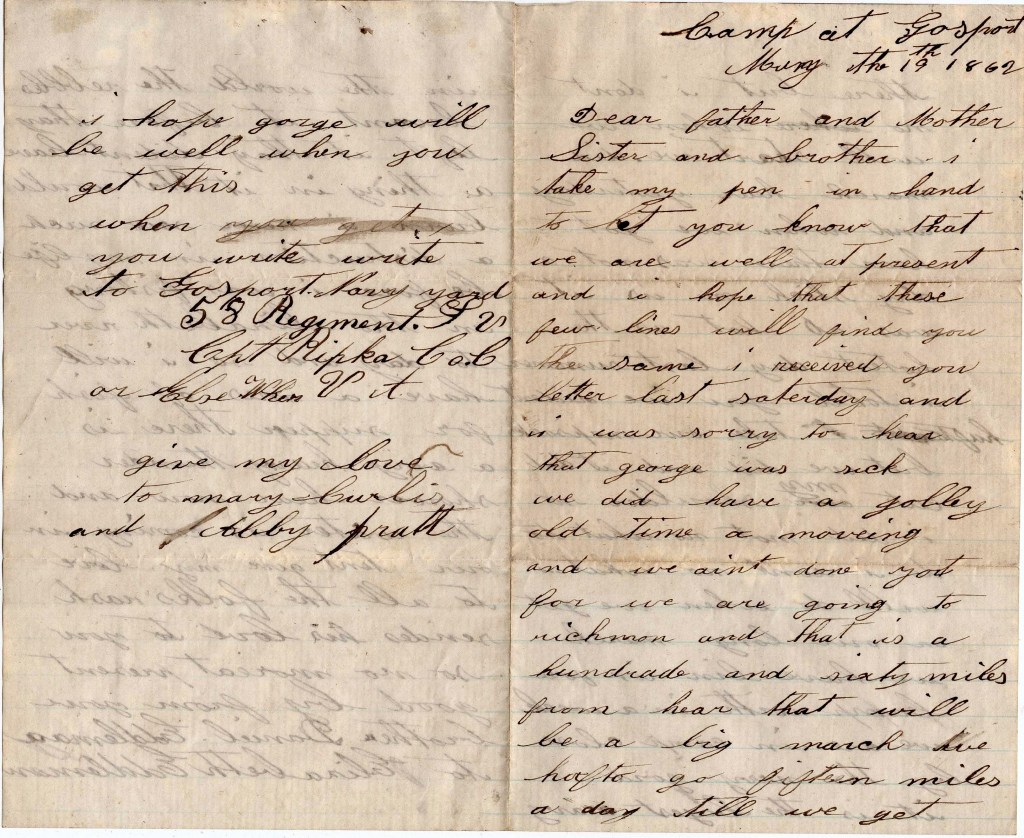


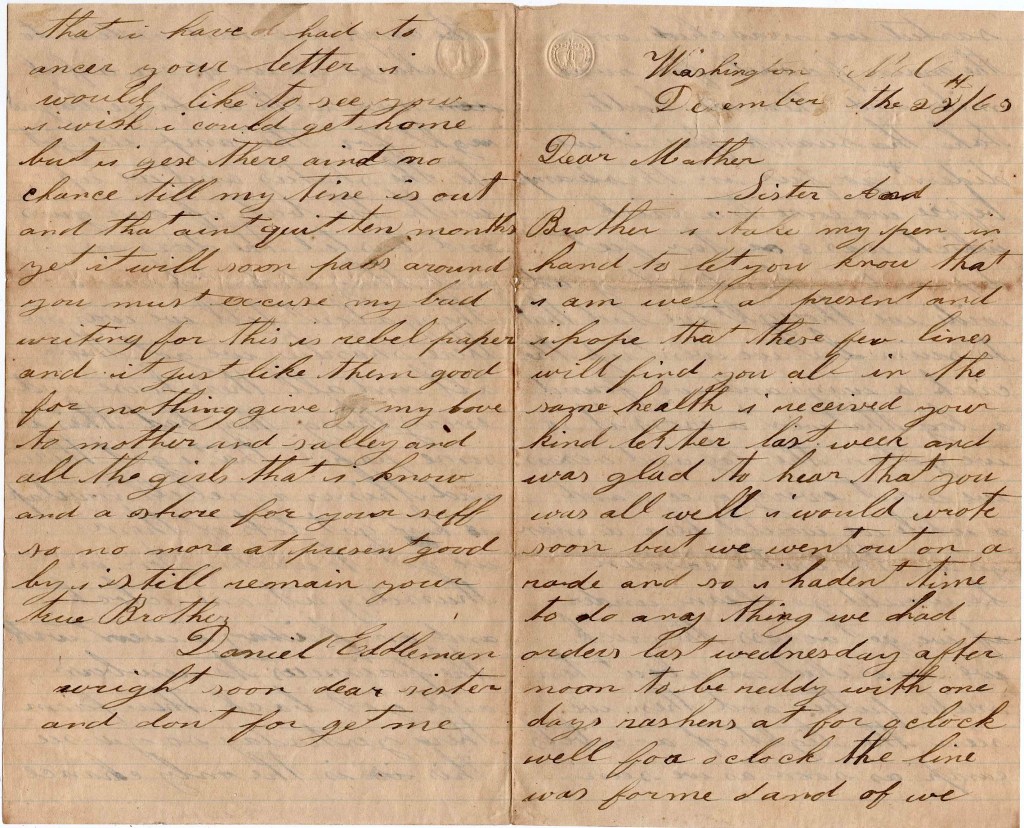
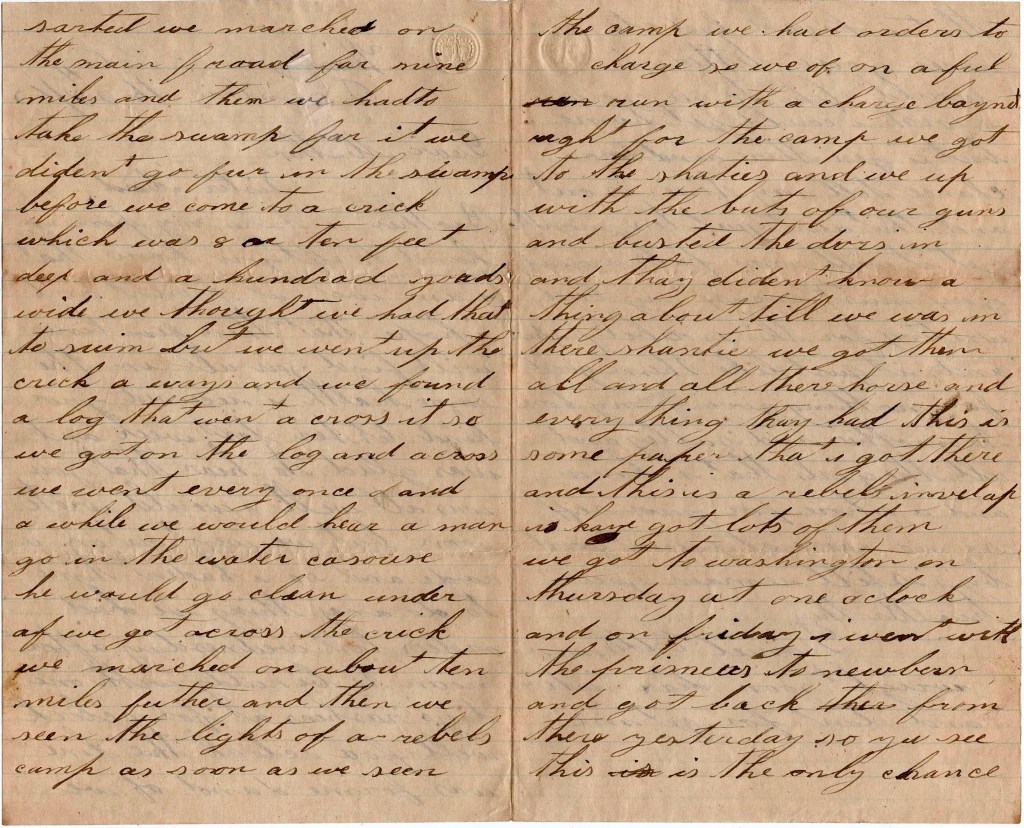

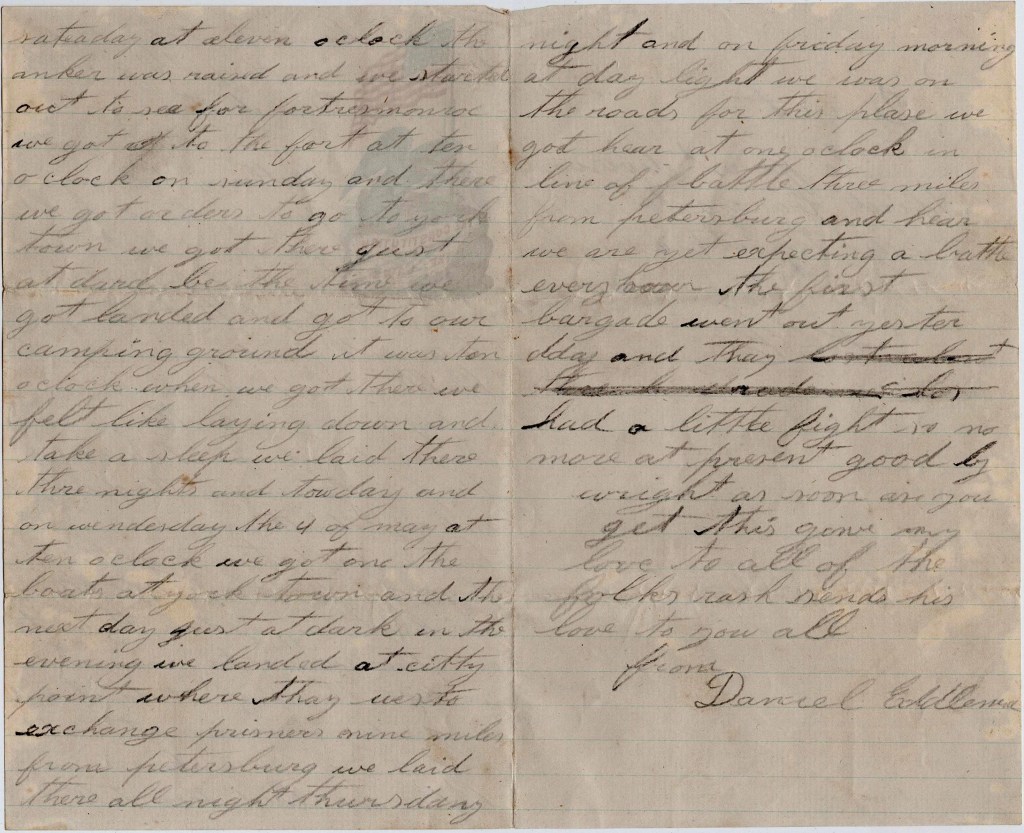

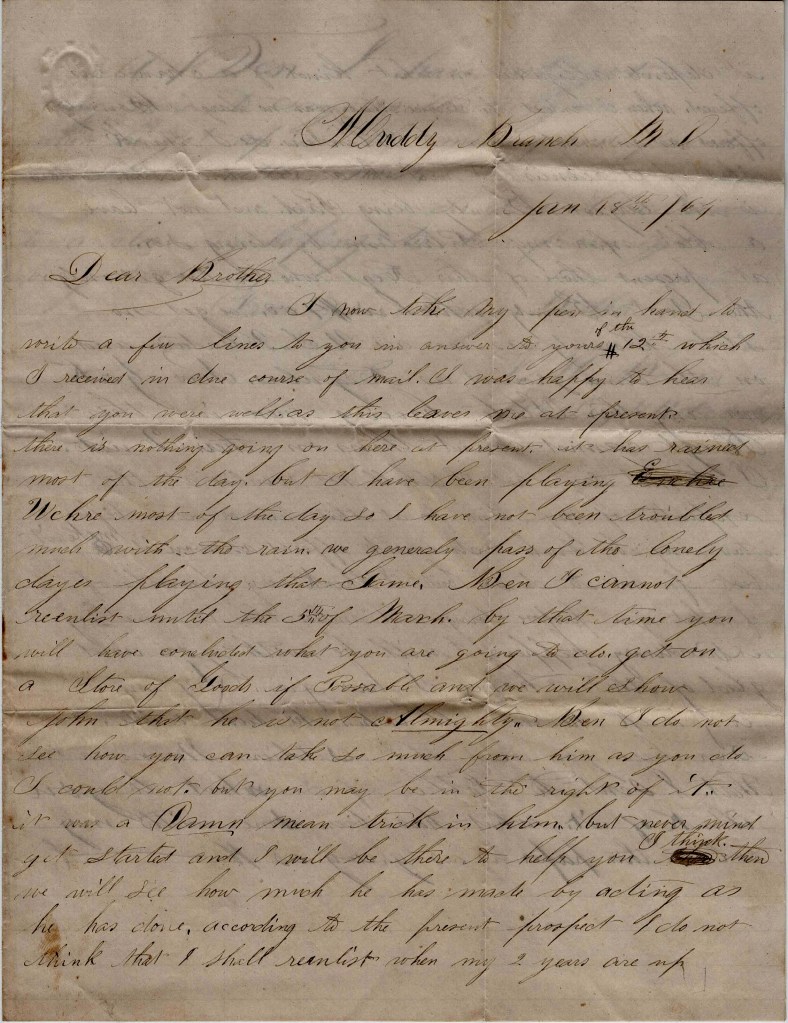

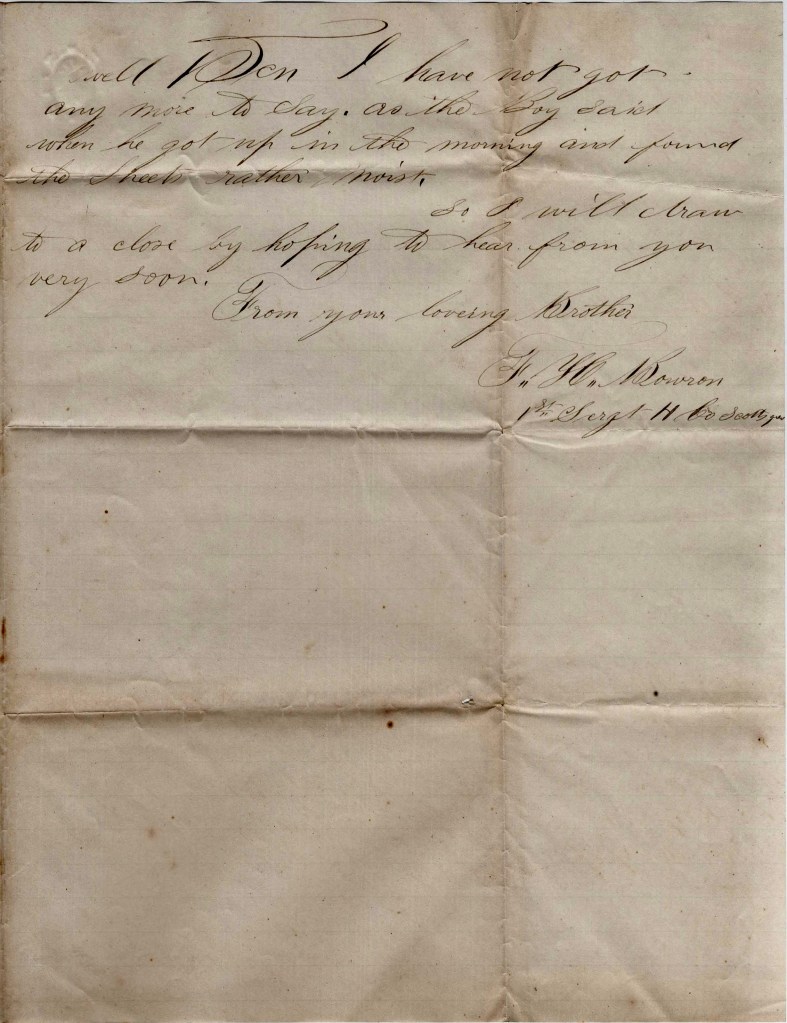
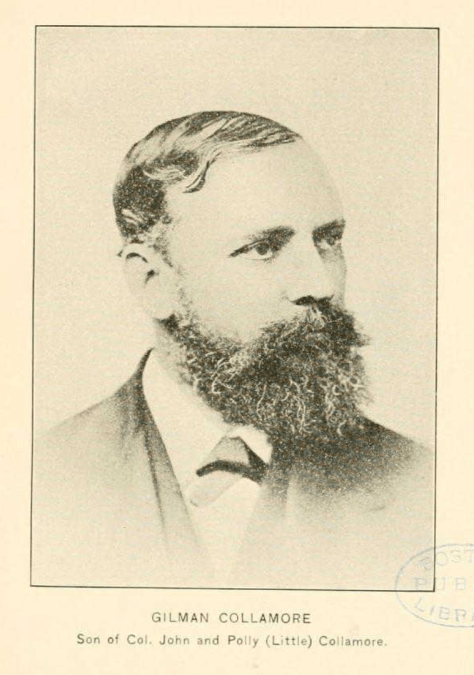
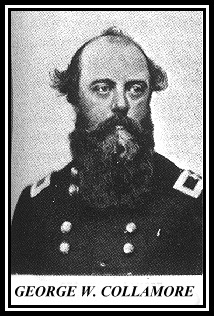


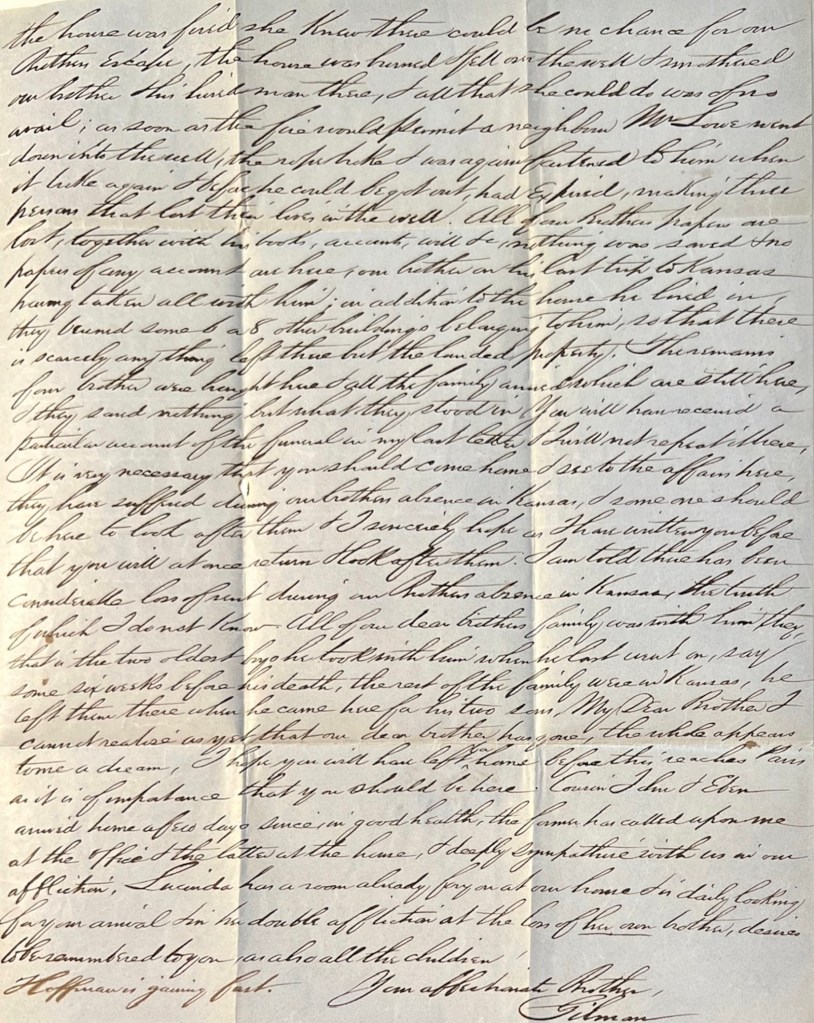


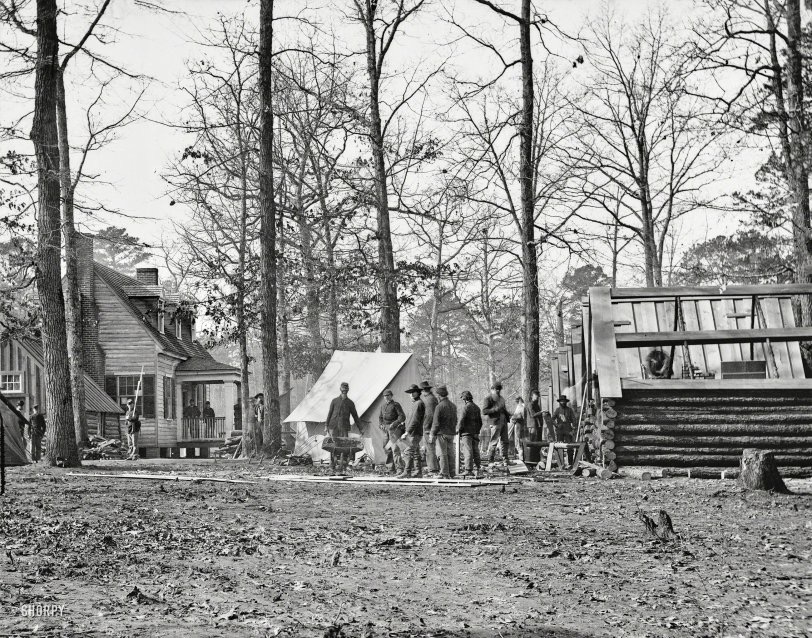

 Spared & Shared 23