My passion is studying American history leading up to & including the Civil War. I particularly enjoy reading, transcribing & researching primary sources such as letters and diaries.
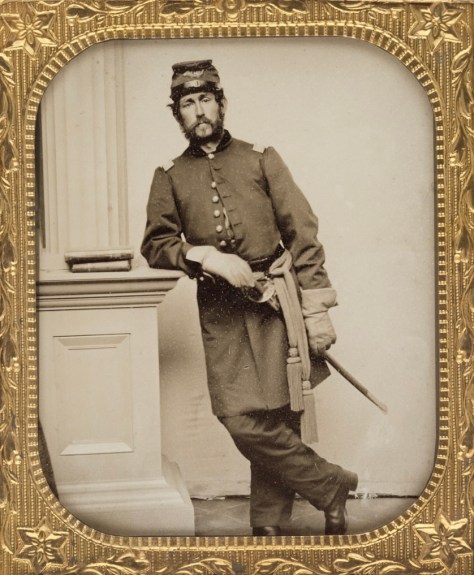
I could not find an image of John but here is one of Sergt. Samuel Cole Wright of Co. E, 29th Massachusetts Infantry, taken at Camp Butler, Newport News, Va.
This letter was written by Pvt. John W. Morse (1843-Aft1900) of Co. A, 29th Massachusetts Infantry. John was a bootmaker when he enlisted at age 18 on 18 April 1861 in the 1st Battalion Massachusetts Infantry. At Newport News, Virginia, the original seven companies were combined with three new Companies (“F,” “G” and “H”) in December 1861. They were attached to the Department of Virginia at Newport News until May, 1862.
In 1855, 12 year-old John W. Morse was enumerated in the household of bootmaker George Washington May (1814-1885) and his wife, Hanna Fuller, in Stoughton, Norfolk county, Massachusetts. It appears he was apprenticed to George May learning the bootmaker’s trade. That census gives John W. Morse’s birthplace as “Pumbrook”, Massachusetts.
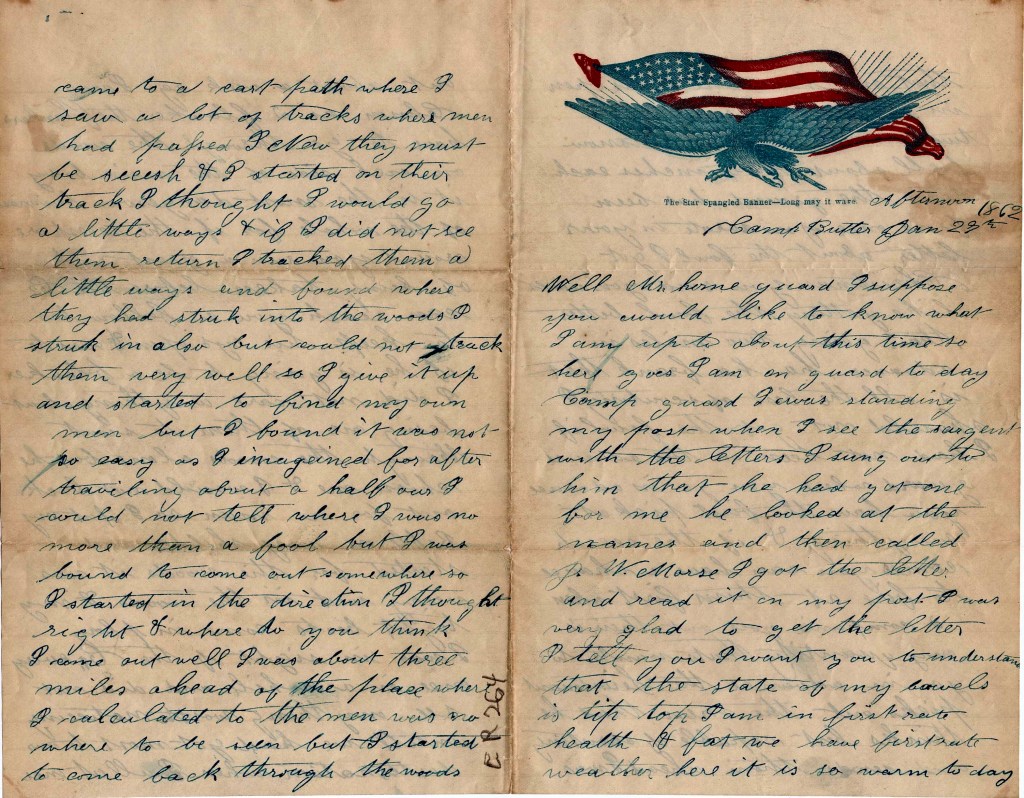
Well Mr. Home Guard, I suppose you would like to know what I am up to about this time so here goes. I am on guard today—camp guard. I was standing my post when I see the sergeant with the letters. I sung out to him that he had got one for me. He looked at the names and then called J. W. Morse! I got the letter and read it on my post. I was very glad to get the letter, I tell you. I want you to understand that the state of my bowels is tip top. I am in first rate health & fat.
We have first rate weather here. It is so warm today that we have the doors open in our houses. We have had two snow storms but the snow fell about two inches each time. The ground has been froze once.
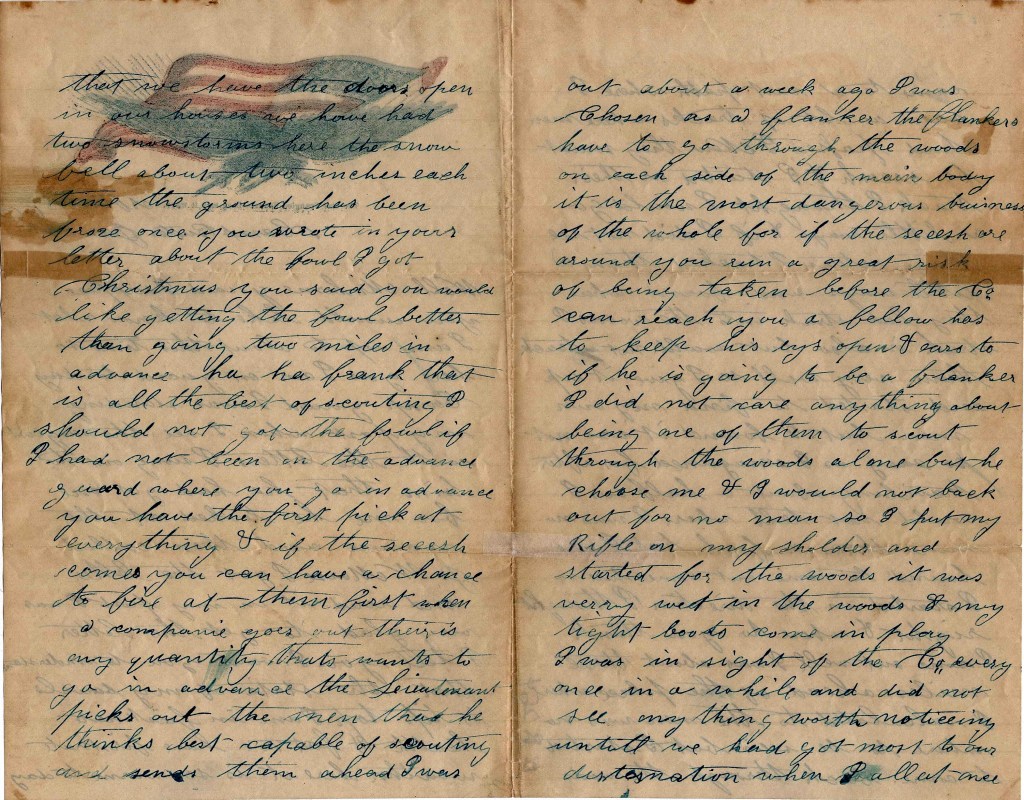
You wrote in your letter about the fowl I got Christmas. You said you would like getting the fowl better than going two miles in advance. Ha, ha, Frank. That is all the best of scouting. I should not [have] got the fowl if I had not been in the advance guard. When you go in advance, you have the first pick at everything. And if the secesh come, you can have a chance to fire at them first. When a company goes out, there is any quantity that wants to go in advance. The Lieutenant picks out the men that he thinks best capable of scouting and sends them ahead.
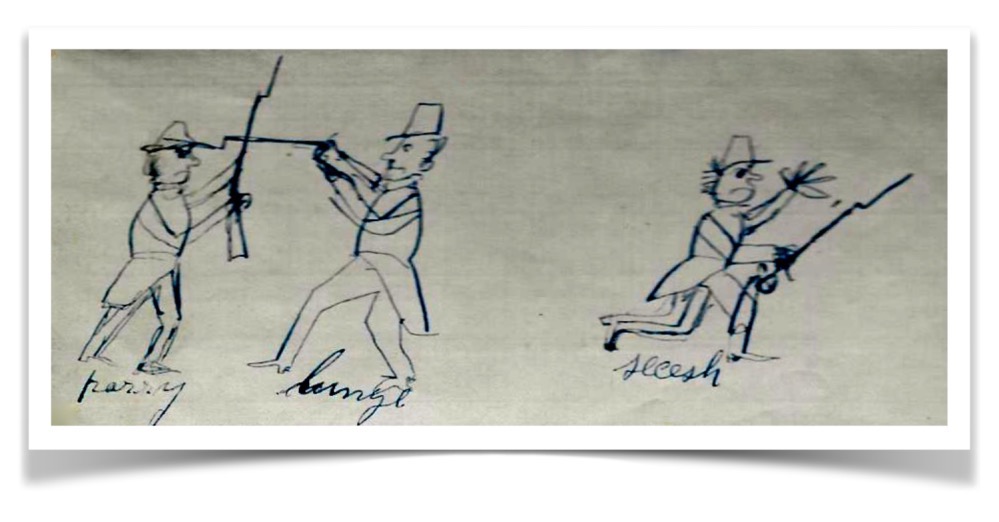
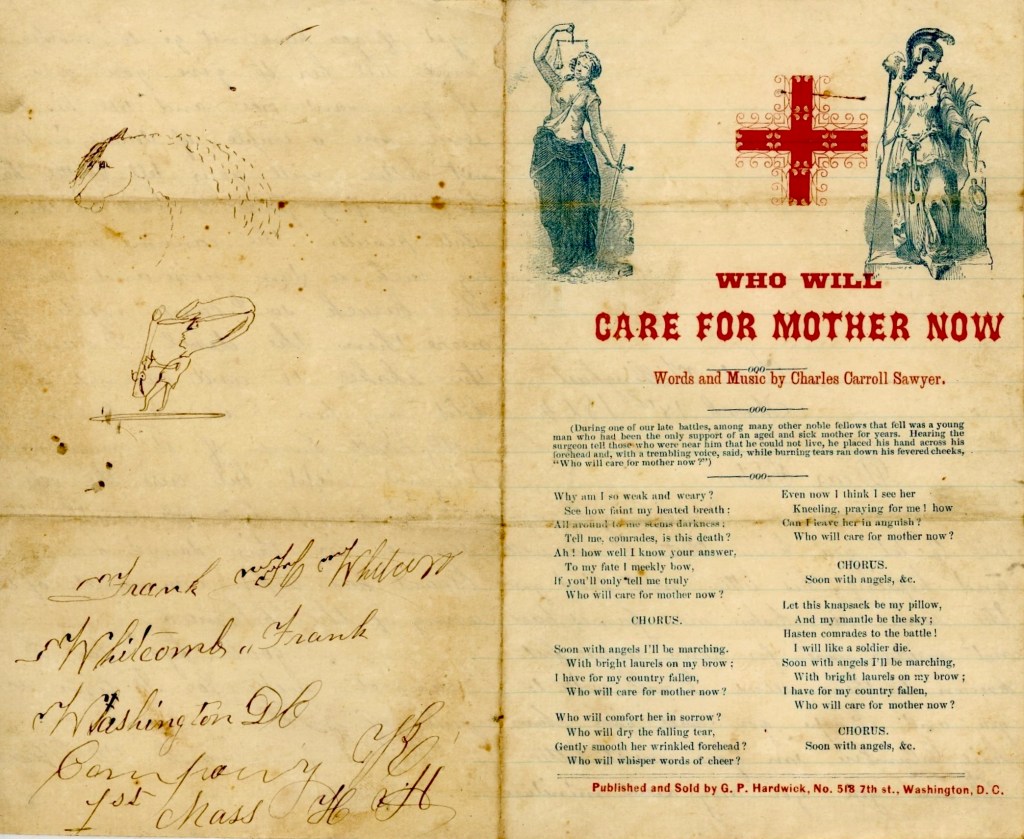
Some artwork by John W. Morse, 29th Massachusetts
I was out about a week ago. I was chosen as a flanker. The flankers have to go through the woods on each side of the main body. It is the most dangerous business of the whole for if the secesh are around, you run a great risk of being taken before the company can reach you. A fellow has to keep his eyes open & ears too if he is going to be a flanker. I did not care anything about being one of them to scout through the woods alone but he chose me & I would not back out for no man so I put my rifle on my shoulder and started for the woods. It was very wet in the woods & my tight boots come in play. I was in sight of the company every once in a while and did not see anything worth noticing until we had got most to our destination when I, all at once, came to a cart path where I saw a lot of tracks where men had passed. I knew they must be secesh & I started on their track. I thought I would go a little ways & if I did not see them return.
I tracked them a little ways and found where they had struck into the woods [so] I struck in also but could not track them very well so I give it up and started to find my own men. But I found it was not so easy as I imagined for after traveling about a half an hour I could not tell where I was, no more than a fool. But I was bound to come out somewhere, so I started in the direction I thought right & where do you think I come out? Well I was about three miles ahead of the place where I calculated. The men was nowhere to be seen, but I started to come back through the woods and soon found them. I was on the right. The flanker on the left got lost and went close to the secesh guard before he found out where he was. He saw the secesh and came very near being taken prisoner.
When I found our men, they were just returning home. They had got their team loaded with boards. I was out yesterday scouting and got a pig and killed him with my bowie knife. I have got a first rate knife. I bought it off a Dutchman.
We had a great excitement last night. The news came that the secesh was going to take this place if they had to wade in blood knee deep. We were ordered to keep everything in readiness. We have forty rounds of cartridges in our box all of the time. We heard today they were going to run the blockade. They will have a nice time of it, I tell you.
It is getting most dark and I shall have to close. When you receive this, if you have not sent the box, I want you to write a letter the same time you send the box so I shall know when to look for it. Tom Mullen, I think, does not drink anything. I have never seen him touch any. I think this war must last a year longer. The rebels will hold out just as long as it is possible but I can’t write any more so farewell from your brother and protecter—ha, ha.
— John W, Morse, Camp Butler, Newport News, Va.
P. S. Please write soon. Tell Aunt Rhoda when I come home next summer. I shall want to sleep in the kitchen on the floor I shall forget all about a bed. It is getting so dark I cannot hardly [read] my writing. So good bye, J. W. Morse
Though only signed “John,” I can safely attribute this letter to John B. Wilson (1834-1866) who served as the captain of Co. H, 15th Maine Infantry. From his letter we learn that he was serving in the Office of the Provost Marshal at Fort Barrancas, Florida, but that he aspired for a change of duty and that he had requested his father to use whatever influence he had with Maine’s new Governor, Abner Coburn, for a change in commission. From another letter that I found for sale written by this same John (signed “John B.”), he hoped for a commission as a surgeon, having been practicing as a physician in Exeter, Maine since 1859. In a history of the 15th Maine, I discovered the following relevant biography: John B. Wilson was transferred for promotion on 15 June 1863 as Surgeon of the 96th USCT in October 1863. He served with distinction as Surgeon in charge of the post hospital at Fort Esperanzas, Texas, and later as Surgeon in Charge of the USA Hospital at Fort Gaines, Florida. He was discharged from the service in January 1865.
John wrote the letter to his wife, the former Samantha (“Sammie”) Tryphosa Perkins (1837-1881). The couple were married in 1860 and their child, Charles Branch Wilson (1861-1941) was born in October 1861. After John’s death in 1866, Sammie married Dr. Atwood Crosby (1838-1883) in 1870.
[Note: This letter is from the private collection of Don Andrew and was offered for transcription and publication on Spared & Shared by express consent.]
T R A N S C R I P T I O N
Office of Provost Marshall Barrancas, Florida 1 April 19th 1863
My darling wife,
Since I last wrote you, a mail has arrived bring me four letters from your dear hand, one of them as late as March 29th. They were read & reread and then took the place in my breast pocket of two received by previous mail which had been so long bosom can perceive as to be scarcely legible. I did not drop old friends, however, who had been worn out in my servies but gave them a good place for the great good they have done.
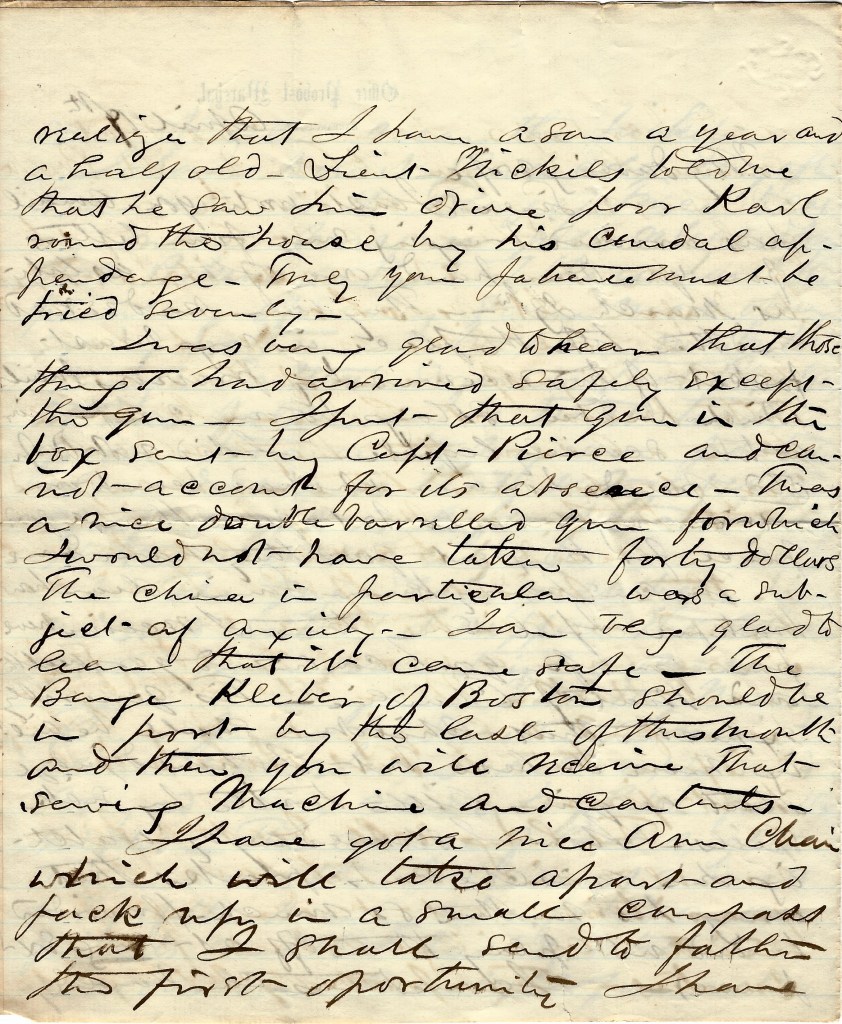
You can hardly know, Sammie dear, how thankful I feel every time I receive news from you for your continued good health and that of Charlie. Tis generally expected that children shall be ailing more or less but I should judge that he gives little trouble by sick spells. How I should enjoy watching his mischievous pranks that annoy his mother so much (provided he did not play them off at my expense). I sometimes can hardly realize that I have a son a year and a half old. Lieut. [John B.] Nickels told me that he saw him drive poor R___ round the house by his caudal appendage [tail]. Truly your patience must be tried severely.
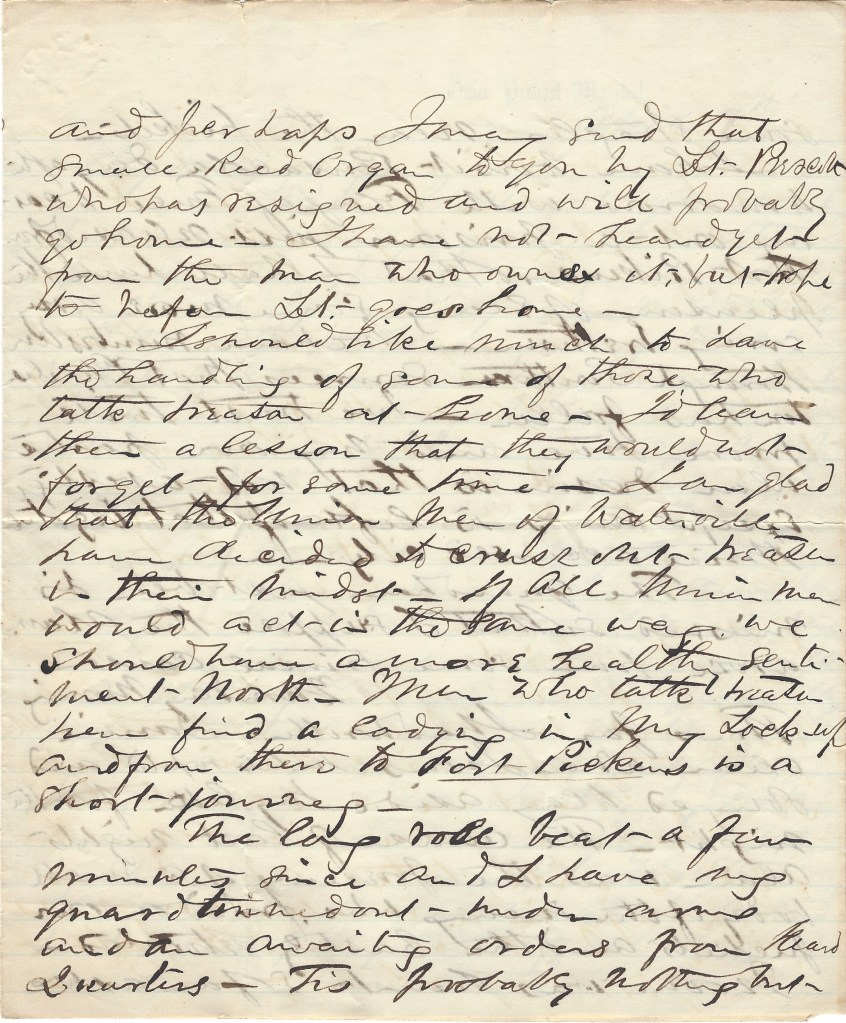
I was very glad to hear that those things had arrived safely except the gun. I put that gun in the box sent by Capt. Pierce and cannot account for its absence. Twas a nice, double barreled gun for which I would not have taken forty dollars. The china in particular was a subject of anxiety. I am very glad to learn that it came safe. The Barque Kleber of Boston should be in port by the last of this month and then you will receive that sewing machine and contents. I have got a nice arm chair which will take apart and pack up in a small compass that I shall send to father the first opportunity I have and perhaps I may send that small reed organ to you by Kt. Prescott who has resigned and will probably go home. I have not heard yet from the man who owns it but hope to before Lt. goes home.
I should like much to have the handling of some of those who talk treason at home to learn them a lesson that they would not forget for some time. I am glad that the Union men of Waterville have decided to crush out treason in their midst. If all Union men would act in the same way, we should have a more healthy sentiment North. Men who talk treason here find a lodging in my lock up and from there to Fort Pickens is a short journey.
The long roll beat a few minutes since and I have my guard turned out under arms and are awaiting orders from headquarters. Tis probably nothing but some straggler near the pickets. I have to visit Pensacola day after tomorrow with Flag of Truce to carry out a prisoner just released from Fort Pickens so that I shall have the pleasure of seeing some more of my Southern brethren. We have rumors here though southern sources that Charleston has fallen. We trust twill prove true and my own particular design is that not a vestige except ruins is left of that bigoted, thrice accursed city.
The guard have just been dismissed so that I suppose the alarm arose from some trivial cause.
Monday morning. Thus far I had written, Sammie dear, when I was interrupted and obliged to lay aside my letter for the night. The cause of last night’s alarm was the presence of a small body of the enemy who fired on our pickets and then hastily retreated. No one was hurt so far as we know.
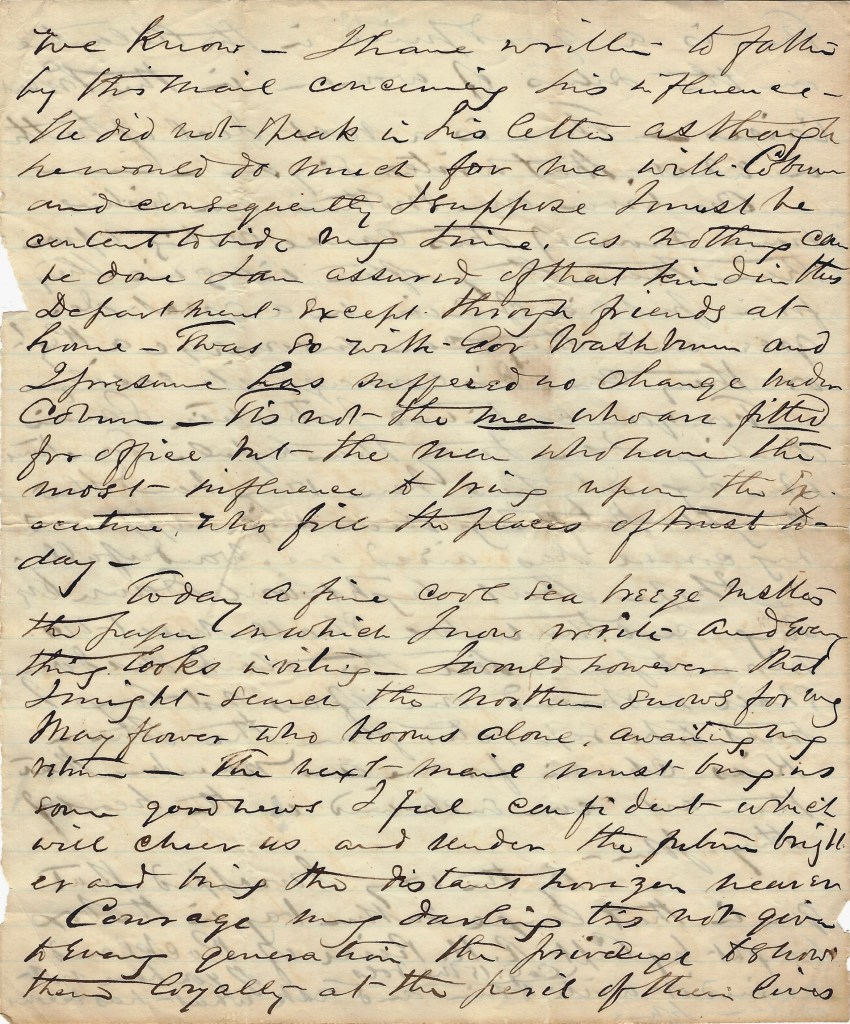
I have written to father by this mail concerning his influence. He did not speak in his letter as though he would so much for me with [Gov. Abner] Coburn and consequently I suppose I must be content to bide my time as nothing can be done and am assured of that kind in this Department except through friends at home. Twas so with Gov. Washburn and I presume has suffered no change under Coburn. Tis not the men who are fitted for office but the men who have the most influence to bring upon the Executive who fill the places of trust today.
Today a fine cool sea breeze rustles the paper in which I now write and everything looks inviting. I would, however, that I might search the Northern snows for my Mayflower who blooms alone, awaiting my return. The next mail must bring us some good news, I feel confident, which will cheer us and render the future brighter and bring the distant horizon nearer. Courage, my darling, tis not given to every generation the privilege & shows them loyalty at the peril of their lives. There is a good piece in the Atlantic [Magazine] on the duties of woman in the present crises. There is a vast deal of truth in what that writer says.
Capt. Ranson Newton Pierce, Co. G, 15th Maine Infantry
Our wives, our mothers, our sisters have more of this cause resting upon them than they often imagine. They form public opinion in a great degree and they can encourage a regiment or they can discourage it easily. For your continued patriotism, Sammie darling, I am truly thankful. Sometimes when my duty has been very hard, the thought that my dear wife approved my course has aided me wonderfully. I hope that we shall meet no more to part till the dark shadow shall shroud one of us, not long I trust to be separated from the other. Kiss Charlie for me and remember that thou art enshrined in the heart of thy John.
By the way, I wrapped that gun in that large [ ] bag in the box brought by Capt. R[ansom] N[ewton] Pierce of Rockland, Co. G, 15th Maine Volunteers. If you have not received it, write him and ask what has become of it. — John
1 Fort Barrancas, was built in the 1830s at the location of San Carlos de Antonio, a Spanish fort dating back to the conquistadors. Barrancas stood closest to the naval yard, located on a bluff overlooking the bay.
The following letter was written by Thomas Winset (1838-1863), who enlisted as a corporal in Company K of the 19th Indiana Infantry on July 29, 1861. He subsequently rose to the rank of sergeant. Thomas met his end at Gettysburg in the afternoon of July 1, 1863, as he and his fellow soldiers in the 19th Indiana—part of the esteemed Iron Brigade—valiantly resisted and repelled the Confederate assault in Herbst’s Woods during the first day’s engagement, striving to gain precious time for additional corps of the Army of the Potomac to reach the battlefield. William Murray of Co. K witnessed the death of Sgt. Winset who was killed instantly when he was shot in the forehead. Murray was standing only two feet away from him at the time and later described the fighting: “The slaughter in our ranks became frightful, beyond description. The dead lay piled up on the ground, and the shrieks and groans of the wounded was too horrible for contemplation.”
By the time of the Battle of Gettysburg, the Iron Brigade had established a formidable reputation as a fierce adversary, having endured the trials of Second Bull Run, South Mountain, Antietam, Fredericksburg, and Chancellorsville. They were distinguished throughout the conflict as the “Black Hats,” a name derived from the black Hardee hats of the 1858 model that were issued to Regular Army soldiers, contrasting with the blue forage caps worn by the majority of other Union Army units.
Thomas was the son of Gilbert P. Winset (1811-1898) and Emma Dodson (1818-1872) of Selma, Delaware county, Indiana.
T R A N S C R I P T I O N
Addressed to Miss Jane E. Campbell, Selma, Delaware county, Indiana
Camp Craig, Fairfax County, Va. October 25th 1861
Much beloved and ever remembered one,
In reply to your very kind and interesting epistle dated the 8th, I deferred answering it before this time but it has been so I could not until now partly because I haven’t had time and partly because nothing of much interest has transpired for the past two or three weeks except the recovery of several of our sick boys has returned from the hospital.
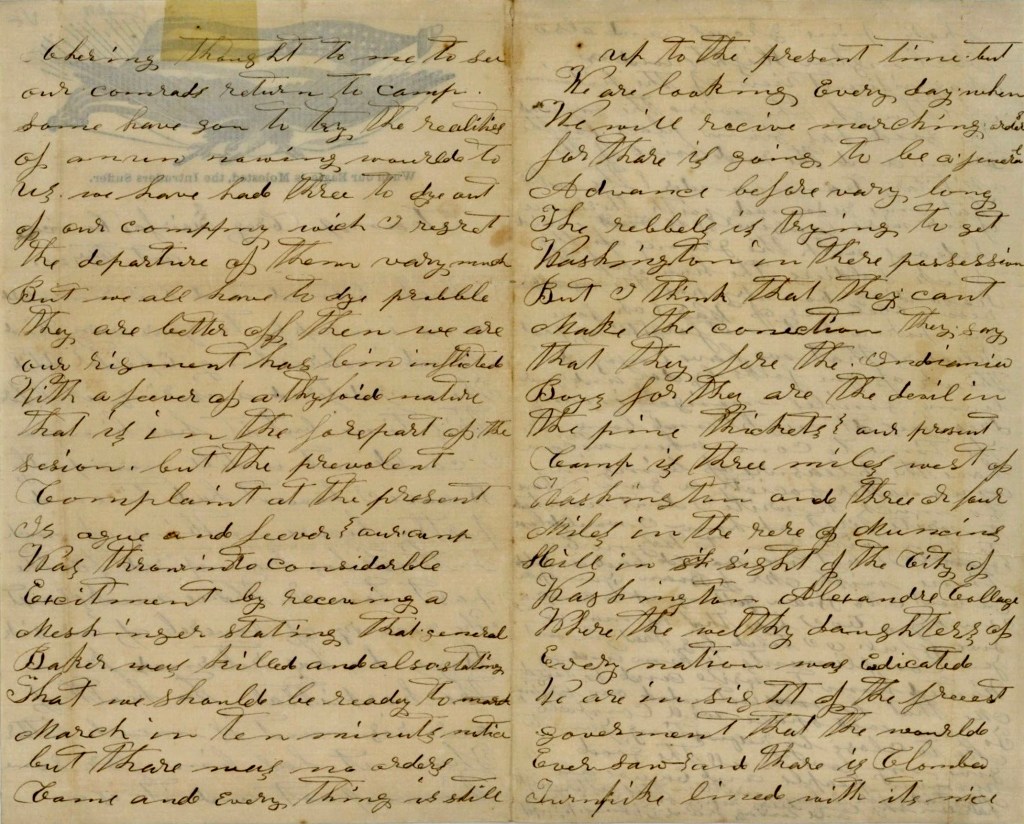
The health of our regiment is much better than it has been for some time past and it is a cheering thought to me to see our comrades return to camp. Some have gone to try the realities of an unknowing world, to viz: we have had three to die out of our company which I regret the departure of them very much. But we all have to die. Probably they are better off than we are. Our regiment has been inflicted with a fever of a typhoid nature that is in the forepart of the session, but the prevalent complaint at the present is ague and fever.
Our camp was thrown into considerable excitement by receiving a messinger stating that General Baker was killed [see Battle of Ball’s Bluff] and also stating that we should be ready to march in ten minutes notice but there was no orders came and everything is still up to the present time. But we are looking every day when we will receive marching orders for there is going to be a general advance before very long. The rebels is trying to get Washington in their possession but I think that they can’t make the connection. They say that they fear the Indiana Boys for they are the devil in the pine thickets.
Our present camp is three miles west of Washington and three or four miles in the rear of Munson’s Hill in the sight of the City of Washington [and] Alexandria College where the wealthy daughters of every Nation was educated. We are in sight of the freest government that the world ever saw and there is Columbia Turnpike lined with its nice shady pine groves and also Arlington Heights and a magnificent view of the Potomac. Although the wise, the song and the good [?] has given place for the drum and the rude noise of the military commander, the walls that once resounded with the eloquence of our wise lawgivers is now made hideous with the groans of the sick soldiers [and] the houses of the resounding country has the resemblance of war.
Oh Jane, you spoke about not forgetting past pleasures that we have enjoyed. I think of you folks by day and your loving smiles mingle in my dreams at night and I long for the time to come when we can have the pleasure of being in one another’s society again.
I have so much to write, I don’t know what to write first. Oh, how I would love to been with you to Wayne county. I’ll bet we would have had a nice time with Mr. J. Bean. You spoke about Mr. Bean getting up to campaign in Wayne county. I hope that he may be successful. I told Lige that you sent your compliments to him and wanted him to write and he fold me that he intended on writing to you. Well, space will compel me to close by requesting you to give my love to all the good Union people and excuse all mistakes for I have written this after night. Pardon my long delay. Reply soon. Your true and loving friend, — Thomas Winset
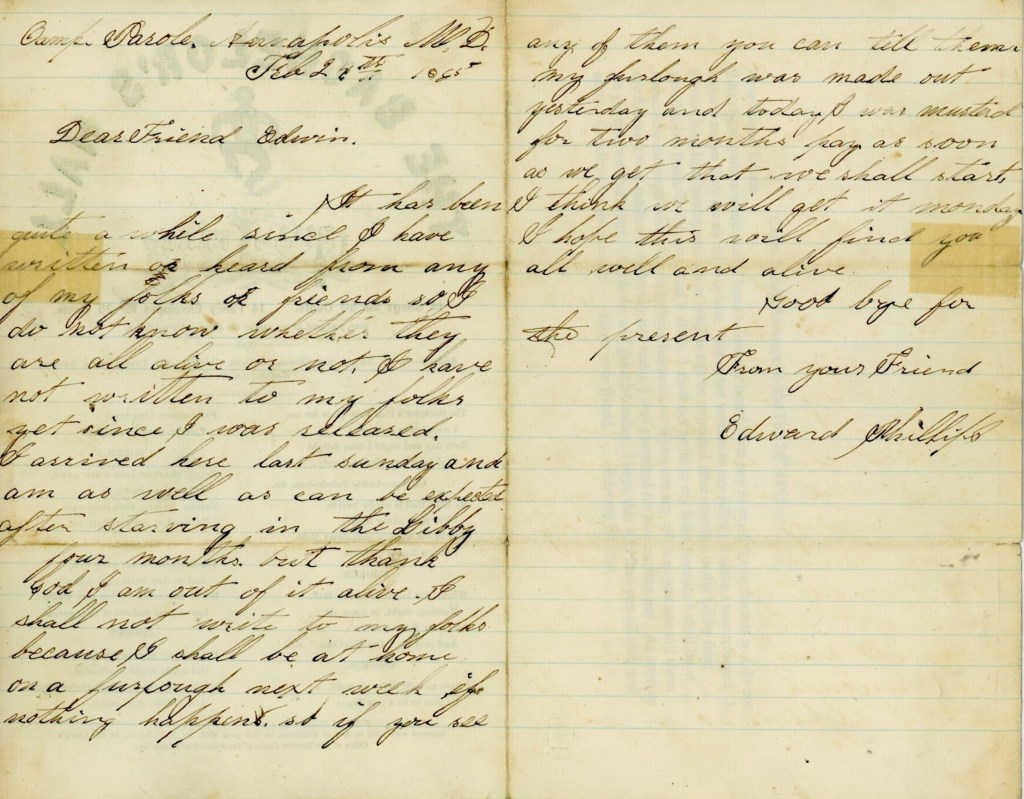
Camp Parole, Annapolis, Maryland February 24th 1865
Dear Friend Edwin,
It has been quite a while since I have written or heard from any of my folks or friends so do not know whether they are all alive or not. I have not written to my folks yet since I was released. I arrived here last Sunday and am as well as can be expected after starving in the Libby four months but thank God I am out of it alive. I shall not write to my folks because I shall be at home on a furlough next week if nothing happens. If you see any of them, you can tell them my furlough was made out yesterday and today I was mustered for two months pay. As soon as we get that, we shall start. I think it we will get it Monday. I hope this will find you all well and alive. Goodbye for the present. From your friend, — Edward Phillips
The following letter was written by Francis (“Frank”) Henry Whitcomb (1846-1904) who enlisted in December 1863 to serve as a private in Co. K, 1st Massachusetts Heavy Artillery. He was the son of Asa Whitcomb (1799-1868) and Adaline Augusta Hoar (1813-1892) of Bolton, Worcester, Massachusetts. Frank claimed he was 18 when he enlisted but he was really just 17. Frank mustered out of the regiment on 16 August 1865 at Washington D. C. and returned to Massachusetts where he became a shoemaker in Hudson. He later married Carrie Brigham (1850-1894).
T R A N S C R I P T I O N
Fort Tillinghast March 18th 1864
Dear Sister,
I now seat myself to let you know that I was well and hoping this letter will find you the same. As John nor James have not written me for some reason best known to themselves, I will write to you and I hope you will give them hail Columbia in your next letter.
Have you got my miniature yet? If you have not, go to Mother and tell her to give you one if you want one and tell her to send me a couple of dollars in her next letter, will you? Tell Nettie that he is a bully fellow to send me them slate pencils. The cannons are making such a damn noise and shake the barracks so I can’t write no more than the Devil. I have got the shakes too and cannot hardly hold my pen. We are having a pretty hard time of it now—work day and night—but cuss the odds. I hain’t got but 33 months to serve in this damned hole.
Grant has taken command of the Army of the Potomac. Goodbye for I cannot write for I am so full of [smudged] — Frank Whitcomb
Frank Whitcomb, Company K, 1st Mass. H. A., Washington D. C.
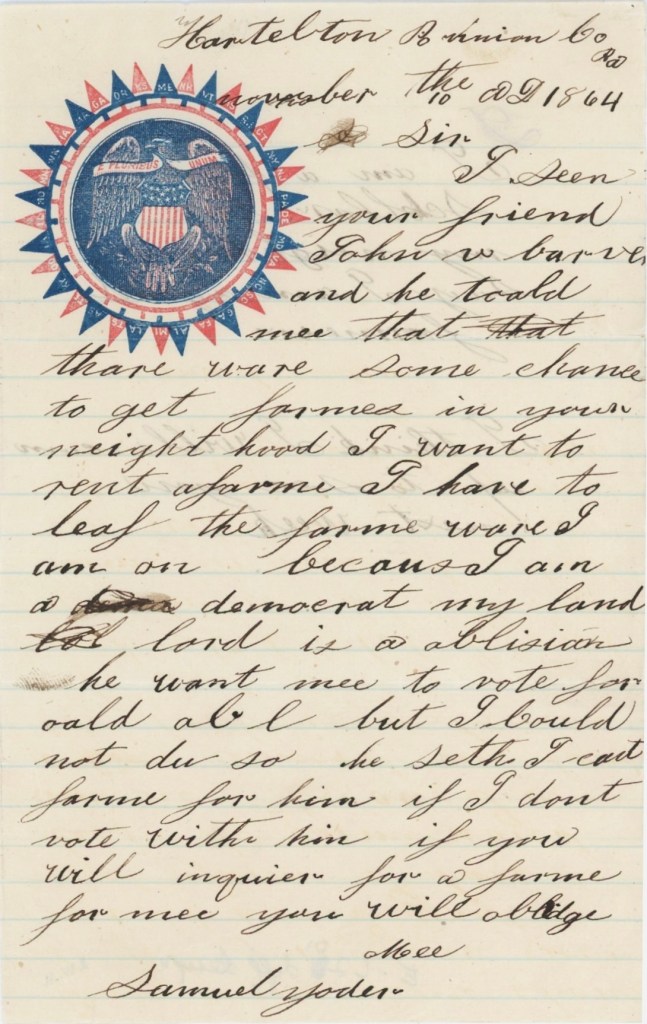
There were several farmers by the name of Samuel Yoder who lived in Union county at the time this letter was written. I’m inclined to believe it was the one born in 1824 but could be wrong. The Yoder surname is closely associated with the Mennonite and Amish faiths who generally shunned war and I suspect Samuel’s religious principles steered him toward the “Peace” candidate in 1864.
T R A N S C R I P T I O N
Hartleton P. O., Union county, Pa. November 10, 1864
Sir,
I seen your friend John V. Carver and he told me that there was some chance to get farms in your neighborhood. I want to rent a farm. I have to leave the farm where I am on because I am a Democrat [and] my landlord is an abolitionist. He wants me to vote for Old Abe but I could not do so. He says I can’t farm for him if I don’t vote with him. If you will enquirer for a farm for me, you will oblige me. — Samuel Yoder
I am a poor scholar but my neighbors say I am a good farmer. I think I will come up to see you next week.
I could not find an image of Frank but here is one of Perry Coleman who also served in Co. C, 10th Massachusetts Infantry.
The following letters were written by Francisco (“Frank”) C. Park (1840-1932), the son of Harvey Hart Park (1815-1892) and Sarah F. Amidon (1817-1895) of Monson, Hampden county, Massachusetts. Frank enlisted in June 1861 to serve in Co. C, 10th Massachusetts Infantry. At the time of his enlistment he was described as standing 5 feet 7.5 inches tall, with blue eyes and gray hair. He remained in the service until 1 July 1864. I’m not certain who the first letter was addressed to but the second was his mother and younger sister Sarah E. Park (1846-1907) who married John Thayer b. 1835) in September 1863. John Thayer was probably the older brother of Josiah Thayer who served in the 10th Massachusetts with Frank.
Frank’s second and third letters unveil the brooding thoughts of a weary warrior disillusioned by the monotony of war and the drudgery of camp life.
Letter One
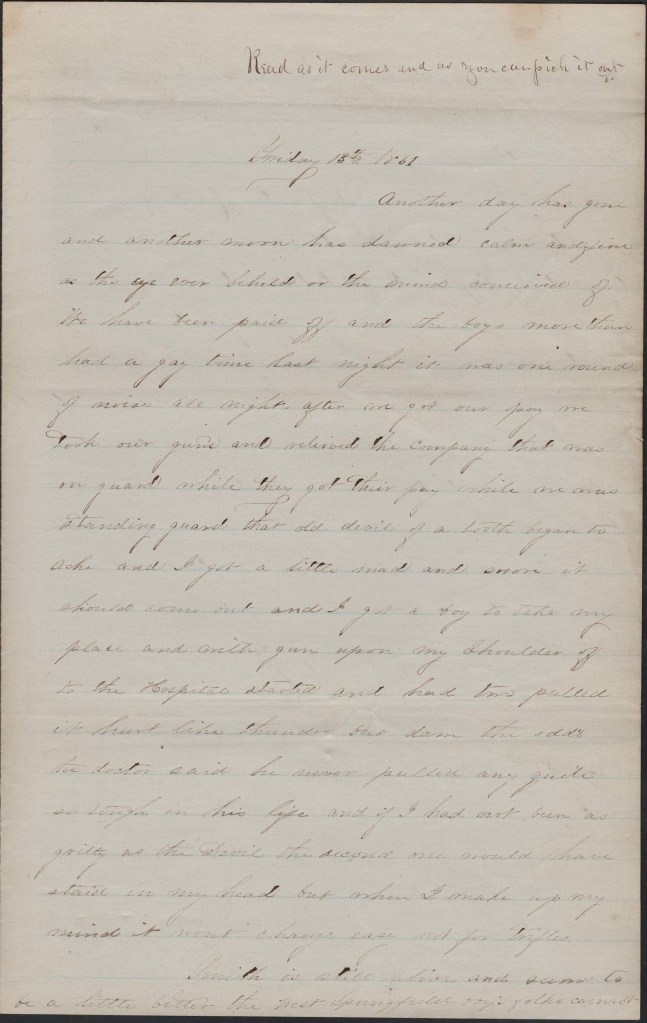
[Kalorama Heights or Camp Brightwood near Washington D. C.] Friday [September?] 13th 1861
Another day has gone and another morn has dawned, calm and fine as the eye ever beheld or the mind conceived of. We have been paid off and the boys more than had a gay time last night. It was one round of noise all night. After we got our pay, we took our guns and relieved the company that was on guard while they got their pay. While we was standing guard, that old devil of a tooth began to ache and I got a little mad and swore it should come out and I got a boy to take my place and with gun upon my shoulder, off to the hospital started and had two pulled. It hurt like thunder but damn the odds. The doctor said he never pulled any quite so tough in his life and if I had not been as gritty as the devil, the second one would have stayed in my head. But when I make up my mind, it won’t change easy—not for trifles.
Smith is still alive and seems to be a little better. The West Springfield boy’s folks cannot be heard from so they have concluded to bury him upon the ground and the services will be performed at nine this morn.
As for the revolvers, we want a good rig, good sheathes. The money we are a going to send by Express the first time it comes up here so you may keep your eye open for the package. I still remain well. So does Josiah [Thayer]!
Tell Mrs. Morrison that when I come home, I will call and get some cider. Tell her that I am all right and hope she is the same. I have not time to write to them as I promised and said I would yesterday but I have no time so shall have to let it go for this time. So goodbye for now.
I remain your true friend and also the poor soldier boy in health and in happiness. Love to all, so farewell till my next which I shall send Monday. — Frank C. Park
Directions. I will send in the Express package for all the needful.
Letter Two
Harrison’s Landing July 22nd 1862
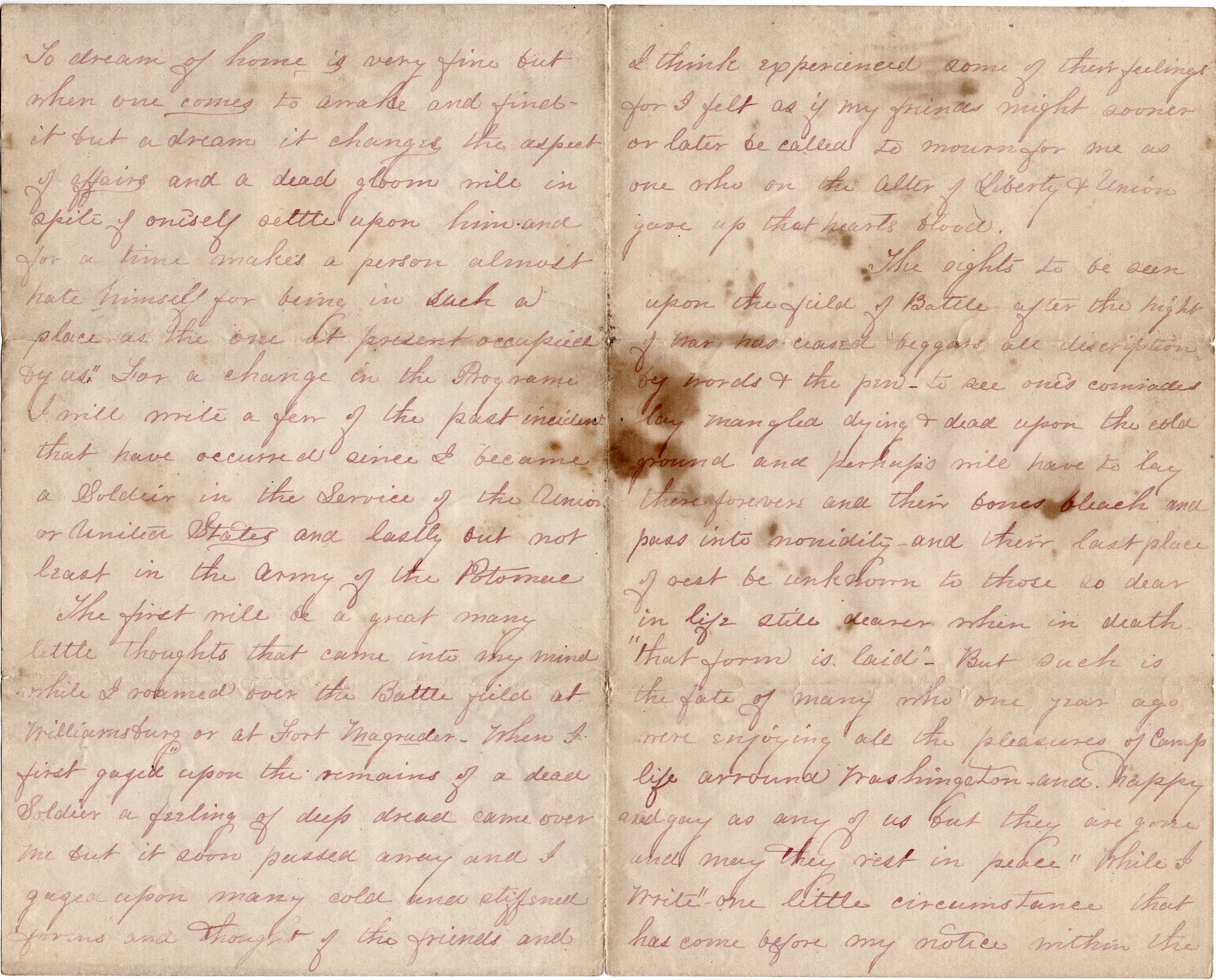
Stray thoughts. The day is fine still. The sun is hid most of the time. It is cool and nice—the most comfortable day I have seen for a long time. It is also very quiet. No guns are heard from the time the signal gun is fired at 4 o’clock, until sunset when another is fired and then, for as much as an hour, the bugle is heard in all directions and roll call has to be tended to before anything can be had for supper or “tea.” Then by the time supper is well finished, it is dark and off to bed (such as it is) and repose until morn and dream of that Haven of rest and that home long since left behind and those kind friends left for a long time unseen! To dream of home is very fine, but when one comes to awake and finds it but a dream, it changes the aspect of affairs and a dead gloom will, in spite of oneself, settle upon him and for a time makes a person almost hate himself for being in such a place as the one at present occupied by us. For a change in the program I will write a few of the past incidents that have occurred since I became a soldier in the service of the Union, or United States, and lastly but not least in the Army of the Potomac.
The first will be a great many little thoughts that came into my mind while I roamed over the Battlefield at Williamsburg or at Fort Magruder. When I first gazed upon the remains of a dead soldier, a feeling of deep dread came over me. But it soon passed away and I gazed upon many cold and stiffened forms and thought of the friends and I think experienced some of their feelings for I felt as if my friends might sooner or later be called to mourn for me as one who on the altar of Liberty & Union gave up that hearts blood.
The sights to be seen upon the field of battle after the night of war has ceased “beggars all description” by words & the pen. To see one’s comrades lay mangled, dying & dead upon the cold ground, and perhaps will have to lay there forever and their bones bleach and pass into nonidentity and their last place of rest be unknown to those so dear in life, still dearer when in death “that form is laid.” But such is the fate of many who one year ago were enjoying all the pleasures of camp life around Washington and happy and gay as any of us. But they are gone and may they rest in peace.
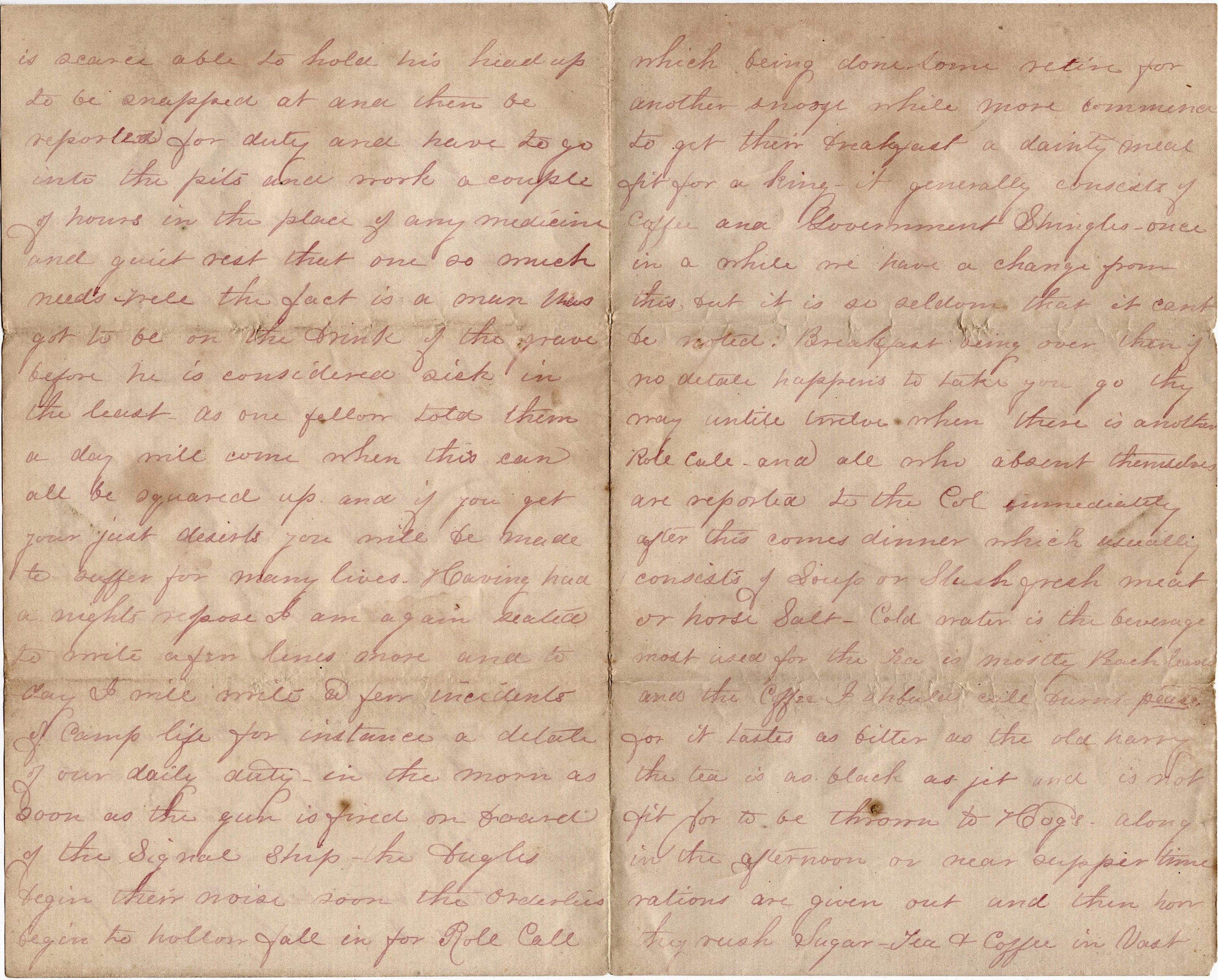
While I write, one little piece of circumstance that has come before my notice within the past few days, is the case of E. F. Wiley of Belchertown. Some three weeks ago it became visible that he was upon the decline, but still the doctors reported him for duty about every other day until three days before he got his furlough to go home. He started for home scarce able to stand and got as far as New York and there died, thus showing the great skill and knowledge of our doctors. The very morn he started, one of the hospital nurses said all that was the matter with him was he was run down and would be well enough in a few days if he took care of himself. He died and it is the talk of the whole regiment how our sick are treated, and the doctor is often asked how such a one is, he will snap up us short [by saying], “He is some better.” I tell you, it is devilish rough when a man is scarce able to hold his lead up to be snapped at and then be reported for duty and have to go into the pits and work a couple of hours in the place of any medicine and quiet rest that one so much needs. Well, the fact is, a man has got to be on the brink of the grave before he is considered sick in the least. As one fellow told them, “A day will come when this can all be squared up, and if you get your just deserts, you will be made to suffer for many lives.”
Having had a night’s repose, I am again seated to write a few lines more and today I will write a few incidents of camp life. For instance, a detail of our daily duty. In the morn as soon as the gun is fired on board of the Signal Ship, the bugles begin their noise. Soon orderlies begin to holler, “Fall in for roll call,” which being done, some retire for another snooze, while more commence to get them breakfast—a dainty meal fit for a king. It generally consists of coffee and government shingles. Once in a while we have a change from this but it is so seldom that it can’t be noted.
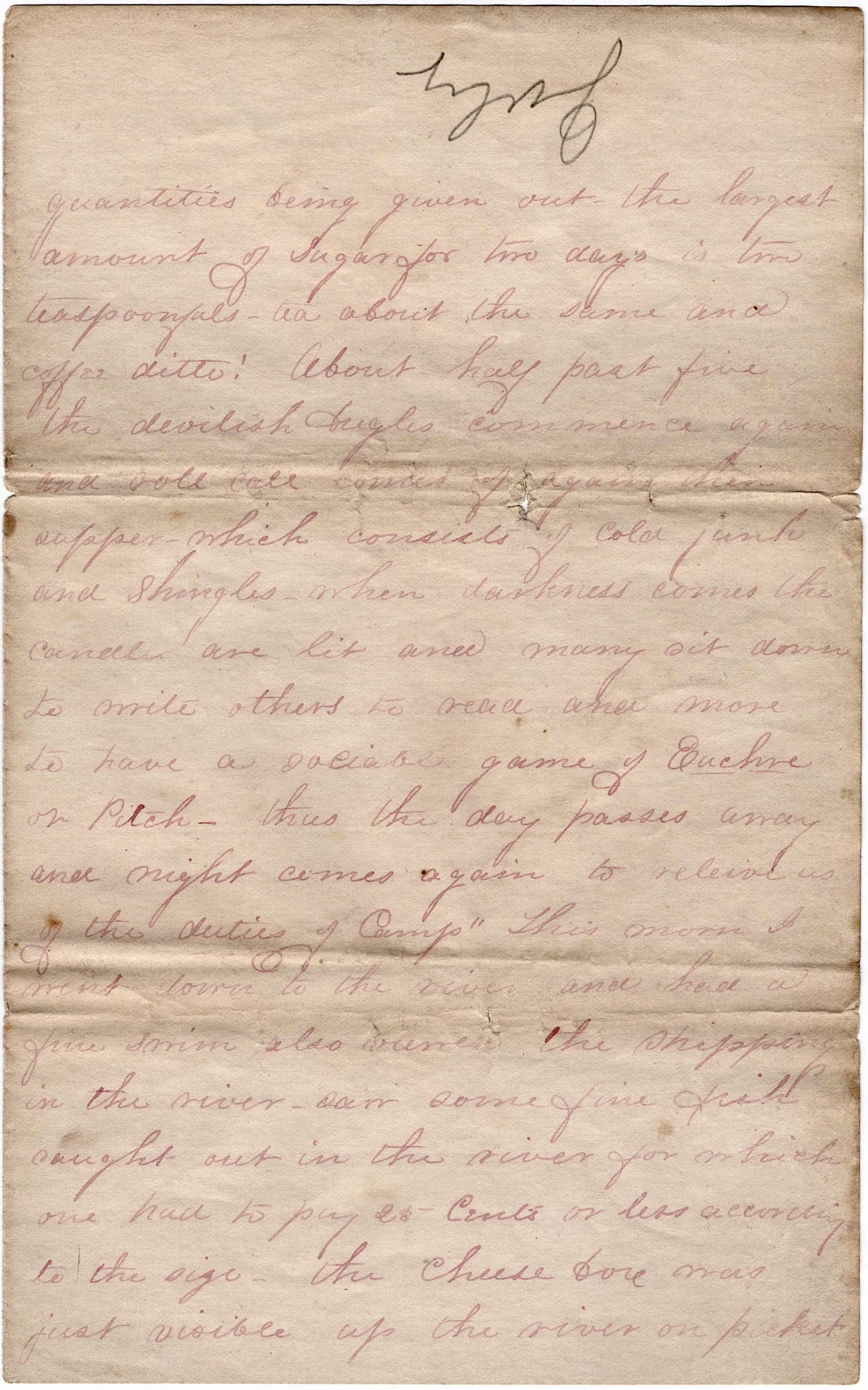
Breakfast being over, then, if no detail happens to take, you go thy way until twelve when there is another roll call and all who absent themselves are reported to the Colonel immediately. After this comes dinner which consists of soup or slush, fresh meat or horse salt, cold water is the beverage most used, for the tea is mostly peach leaves, and the coffee I should call burned peas, for it tastes as bitter as the Old Harry [Devil]. The tea is as black as jet and is not fit to be thrown to hogs. Along in the afternoon or near supper time, rations are given out and then how they rush, sugar, tea & coffee in vast quantities being given out. The largest amount of sugar for two days is two teaspoonfuls, tea about the same, and coffee ditto! About half past five, the devilish bugles commence again and roll call comes off again and then supper, which consists of cold junk and shingles. When darkness comes the candles are lit and many sit down to write, others to read, and more to have a social game of Euchre or Pitch. Thus the day passes away and night comes again to relieve us of duties of camp.
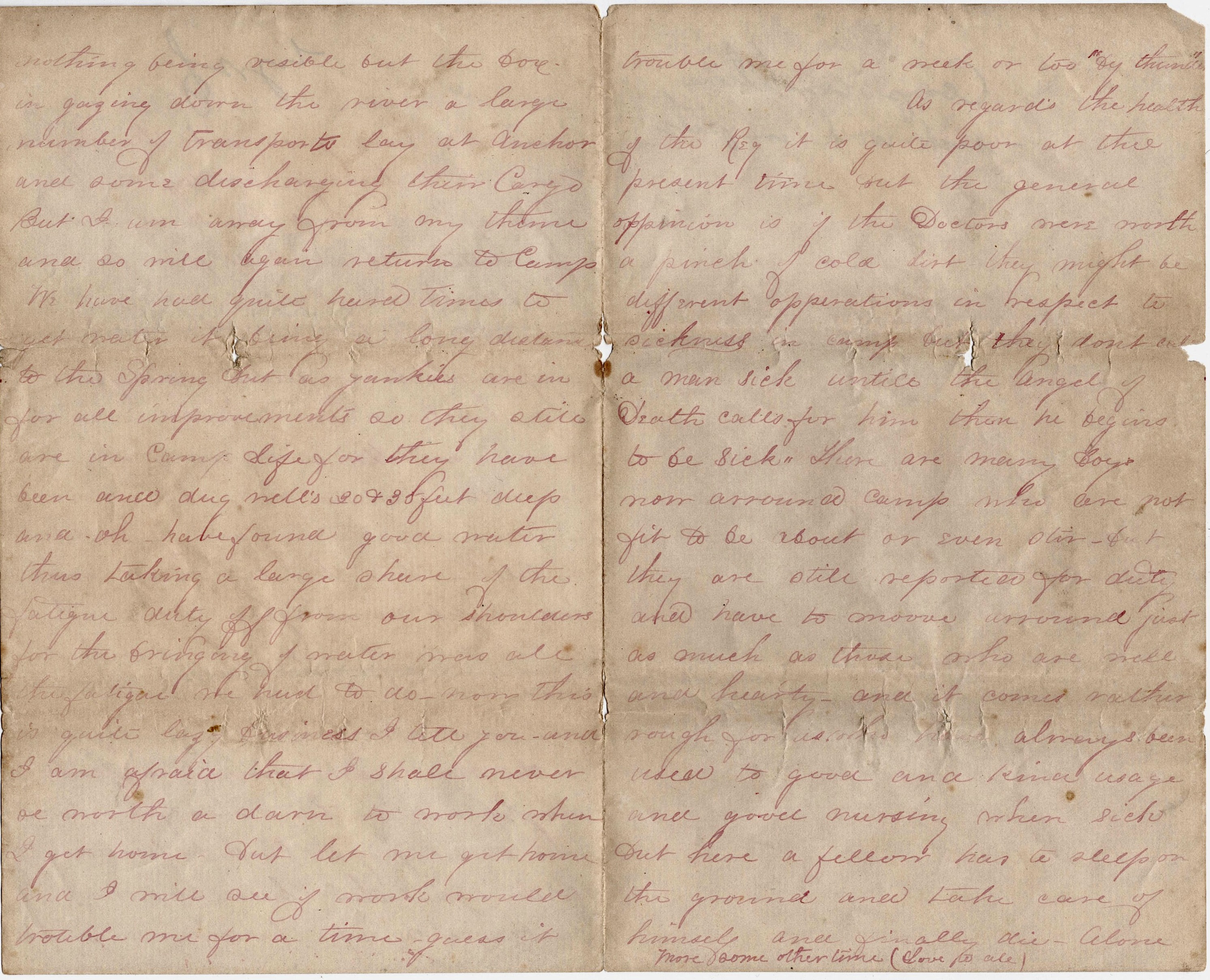
This morn I went down to the river and had a fine swim; also viewed the shipping in the river. Saw some fine fish caught out in the river for which one had to pay 25 cents or less according to the size. The Cheese box [U.S.S. Monitor] was just visible up the river on picket, nothing being visible but the box. In gazing down the river, a larger number of transports lay at anchor and some discharging their cargo. But I am away from my theme, and so will again return to camp.
“The Cheese box [U.S.S. Monitor] was just visible up the river on picket, nothing being visible but the box. “
We have had quite hard times to get water, it being along distance to the spring. But as Yankees are in for all improvements, so they still are in camp life, for they have been and dug wells 20 & 30 feet deep, and Oh, have found good water, thus taking a large share of the fatigue duty off from our shoulders for the bringing of water was all the fatigue we had to do. Now this is quite lazy business I tell you, and I am afraid that I shall never be worth a darn to work when I get home. But let me get home and I will see if work would trouble me for a time—guess it would trouble me for a week or two “by Thunder.”
As regards the health of the regiment, it is quite poor at the present time but the general opinion is if the doctors were worth a pinch of cold dirt, they might be different operations in respect to sickness in camp. But they don’t call a man sick until the angel of death calls for him. Then he begins to be sick. There are many boys now around camp who are not fit to be about or even stir, but they are still reported for duty and have to move around just as much as those who are well and hearty, and it comes rather hard for us have always been used to good and kind usage and good nursing when sick. But here a fellow has to sleep on the ground and take care of himself and finally die—alone. More some other rime. (Love to all)
I will bet that you dare not fill a box with some eatables and send them to me and put in some butter & sugar and some cake that will keep five or six days when well done up in paper. If you will send me, I will send the money when we get paid off. Put in some cookies and never mind the cost but send me the bill for I am half starved by thunder. Stamp it instead of Washington to Fortress Monroe, Va. Keyes Corps. Co. C, 10th Massachusetts Volunteers
Letter 3
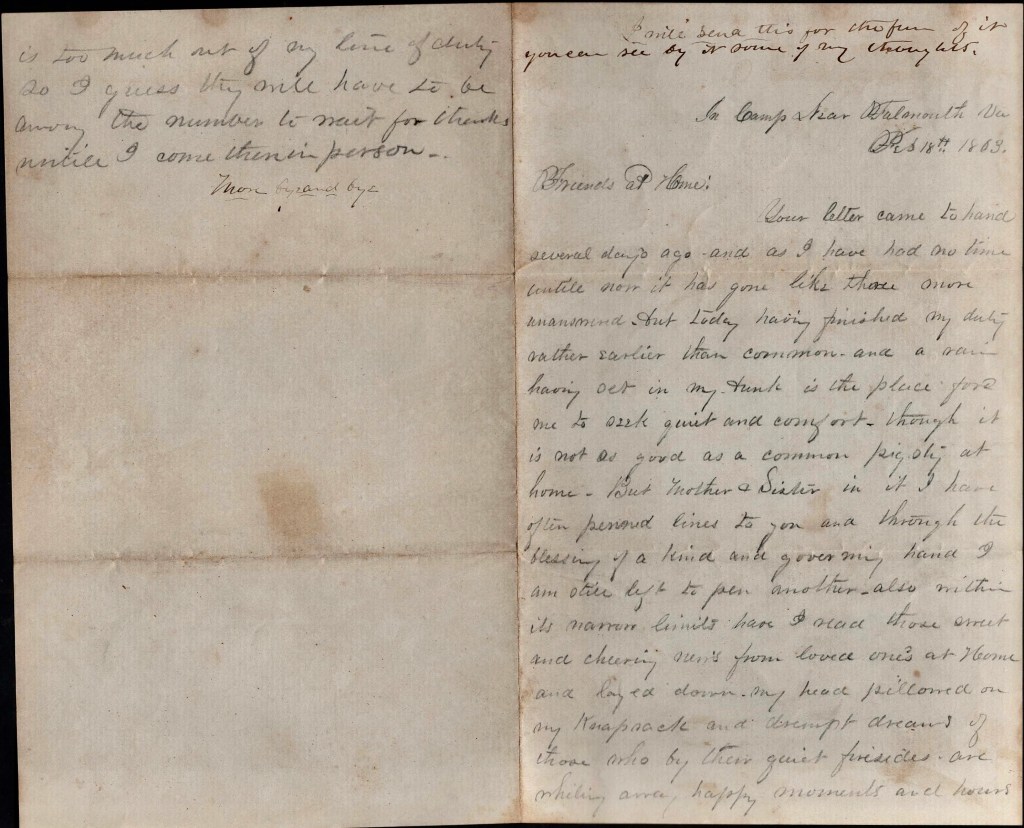
In camp near Falmouth, Va. February 18, 1863
Friends at home,
Your letter came to hand several days ago and as I have had no time until now, it has gone like three more unanswered. But today having finished my duty rather earlier than common and a rain having set in, my trunk is the place for me to seek quiet and comfort, tough it is not as good as a common pig sty at home. But Mother & Sister, in it I have often penned lines to you and through the blessing of a kind and governing hand, I am still left to pen another. Also within its narrow limits have I read those sweet and cheering news from loved ones at home and laid down my head pillowed in my knapsack and dreamt dreams of those who by their quiet firesides are whiling away happy moments and hours scarcely casting one thought of those here living the life of privation and even suffering. How long shall this last is the question that I am unable to answer, but sincerely hope not long, for being worn out and tired of such a life it is but misery to stay here, even when ones thoughts are allowed to stray back to times of old when by a cheerful fire the family circle was complete. But how many of these bright circles are broken? How many are caused to morn a link gone, never to be replaced or filled by another? Alas, it is sad even for us to think of. We who have become hardened to all kinds of sights and toughened to all exposure. Memory will cling like the woodbine to an ancient house hard to be disengaged.
The dreams of a solder are all vanity. The reality is for others to enjoy—those who have been more wise and stayed at home. But let this suffice. We are as happy & contented as one can possibly be in this God forsaken country that we are sole inhabitants of at the present time. The principle notable features are wind and rain, snow and slush, back your wood a mile or more, live in burrows like the animals of the North, used like mules for all sorts of business, even to backing wood for shoulder straps. Then when it is fair weather, give us some of the most unearthly drills ever thought of. But there is no use of grumbling. They have the power and they exercise it. Darn me if they don’t. It is near dark and I must close for tonight.
February 19, 1863. This morn at roll call Josiah again answered to his name. He brought quite a number of things for me that were very handy said to have been sent by the Young Ladies Aid Society. You ask me to write a letter to be read before it. Well it is too much out of my line of duty so I guess they will have to be among the number to wait for thanks until I come there in person.
More by and by. I will send this for the fun of it. You can see by it some of my thoughts.
The following Prisoner of War (POW) Letter was penned by Reuben M. Colby (1839-1893) who served in Co. B, 20th Ohio Volunteer Infantry (OVI). He entered the service on 27 April 1861 as a sergeant in Co. H and was promoted to sergeant in Co. B in September 1861. He was next commissioned a 2nd Lieutenant in January 1863 and a 1st Lieutenant in July 1864. He finally mustered out as a Captain on 15 July 1865. In 1850, 10 year-old Reuben was living with his parents, Simeon and stepmother Marianne (Porter) Colby in Roxbury, Norfolk, Massachusetts. In 1860, Reuben was working as a carpenter in Louisville, Kentucky.
In his brief letter—limited to one page by military authorities—Reuben informs his correspondent that he was taken prisoner at the Battle of Atlanta on 22 July 1864 and was imprisoned a month later in Charleston, South Carolina, after being held briefly at Macon.
The Charleston City Jail was used to hold Union Officer Prisoners. Over 2,000 were held here in the fall of 1864 though many of them had to sleep outside.(LOC)
T R A N S C R I P T I O N
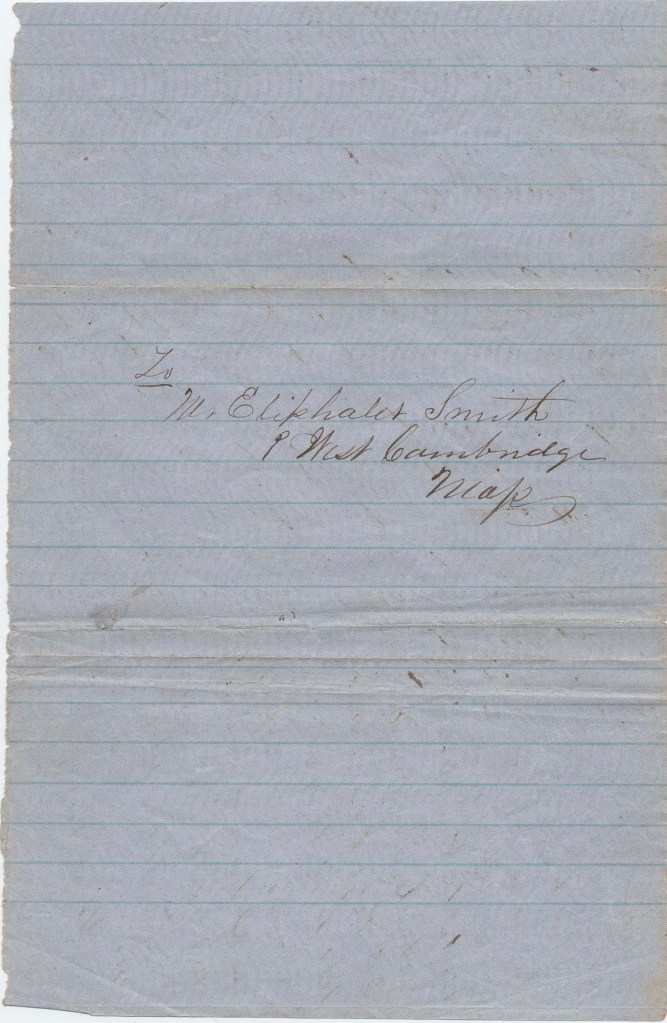
Addressed to Mr. Eliphalet Smith, West Cambridge, Massachusetts
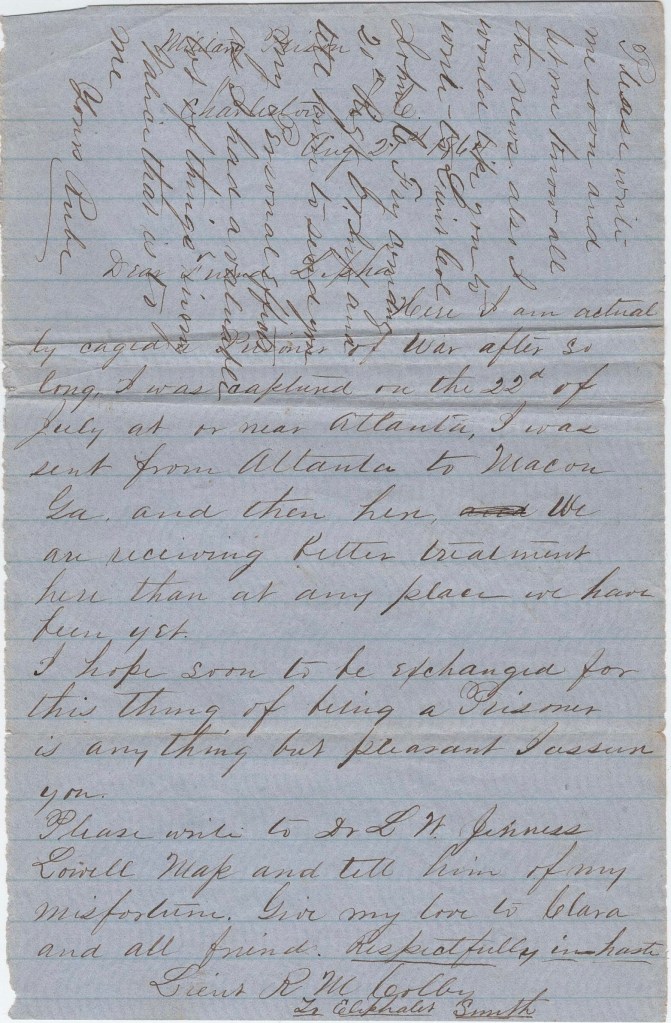
Military Prison, Charleston, S. C. August 21st 1864
Dear friend Lipha,
Here I am actually caged a Prisoner of War after so long. I was captured on the 22nd of July at or near Atlanta. I was sent from Atlanta to Macon, Georgia, and then here. We are receiving better treatment here than at any place we have been yet. I hope soon to be exchanged for this thing of being a prisoner is anything but pleasant I assure you.
Please write to Dr. L. W. Jenness, Lowell, Mass., and tell him of my misfortune. Give my love to Clara and all friends. Respectfully in haste. — Lieut. R. M. Colby
Please write me soon and let me know all the news. Also I would like you to write to Lieut. Colonel John C. Fry, commanding 20th Regiment O. V. Infantry and tell him to send you my personal effects as I had a valuable lot of things in my valise—that is, to me. Yours, — Rube
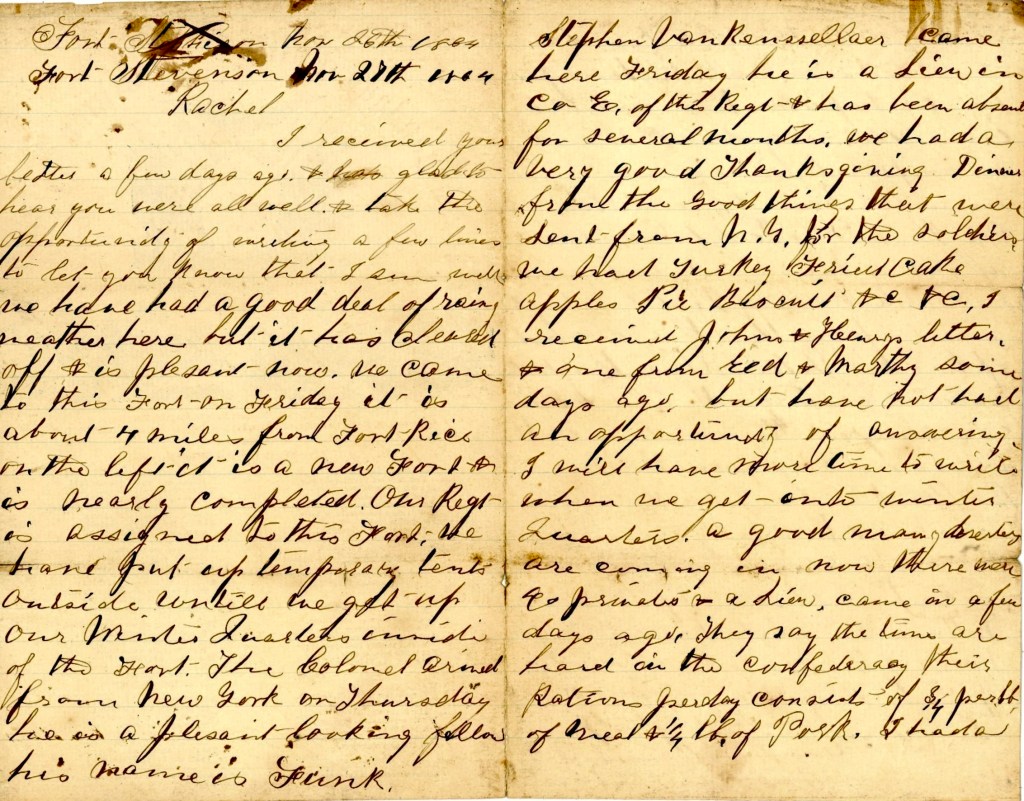
The following letter was written by George M. Chambers (1842-1907) of Lisbon, St. Lawrence county, New York. George was a sergeant in Co. D, 39th New York Infantry—sometimes called the “Garibaldi Guard.” Initially, the regiment was divided into ten companies of men of different national heritage: three German, three Hungarian, one Swiss, one Italian, one French, one Portuguese and Spanish. On May 31, 1863, the regiment was consolidated into four companies: A, B, C and D. The regiment expanded as new companies were recruited in the field. On December 8, 1863, Company E was added; on December 14, 1863, Company F joined. On December 19, 1863, Company G was added; and on December 30, 1863 Company H joined. Companies I and K joined in January, 1864. Companies A, B, C and D were mustered out in New York city June 24, 1864. Enlistees who were not entitled to be discharged were transferred to other companies within the regiment. Six companies: E, F, G, H, I and K, remained in service. In October, 1864, a new Company D, mustered mostly from Malone, New York joined the regiment for one year. George Chambers would have been in this last enlistment. He was still employed as a 20 year-old farmer in Lisbon at the time of the 1863 Draft Registration. He wrote the letter to his older sister, Rachel Chambers (1826-1880) who died single.
T R A N S C R I P T I O N
Fort Stevenson 1 November 27th 1864
Rachel,
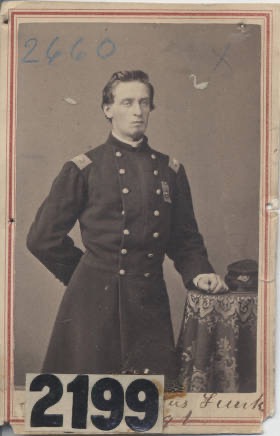
Col. Augustus Funk (1841-1883), 39th NY Infantry
I received your letter a few days ago and was glad to hear you were all well & take the opportunity of writing a few lines to let you know that I am well. We had a good deal of rainy weather here but it has cleared off & is pleasant now. We came to this fort on Friday. It is about 4 miles from Fort Rice on the left. It is a new fort & is nearly completed. Our regiment is assigned to this fort. We have put up temporary tents outside until we get up our winter quarters inside of the fort. The Colonel arrived from New York on Thursday. He is a pleasant looking fellow. His name is [Augustus] Funk.
Stephen Van Rensselaer came here Friday. He is a lieutenant in Co. E of this regiment & has been absent for several months. We had a very good Thanksgiving dinner from the good things that were sent from New York for the soldiers. We had turkey, fried cake, apple pie, biscuits &c. &c. I received John & Henry’s letter and one from Red & Marthy some days ago but have not had an opportunity of answering. I will have more time to write when we get into winter quarters. A good many deserters are coming in now. There was 40 privates & a lieutenant came in a few days ago. They say the times are hard in the Confederacy. Their rations per day consist of 3/4 per lb. of meal & 1/4 lb. of pork.
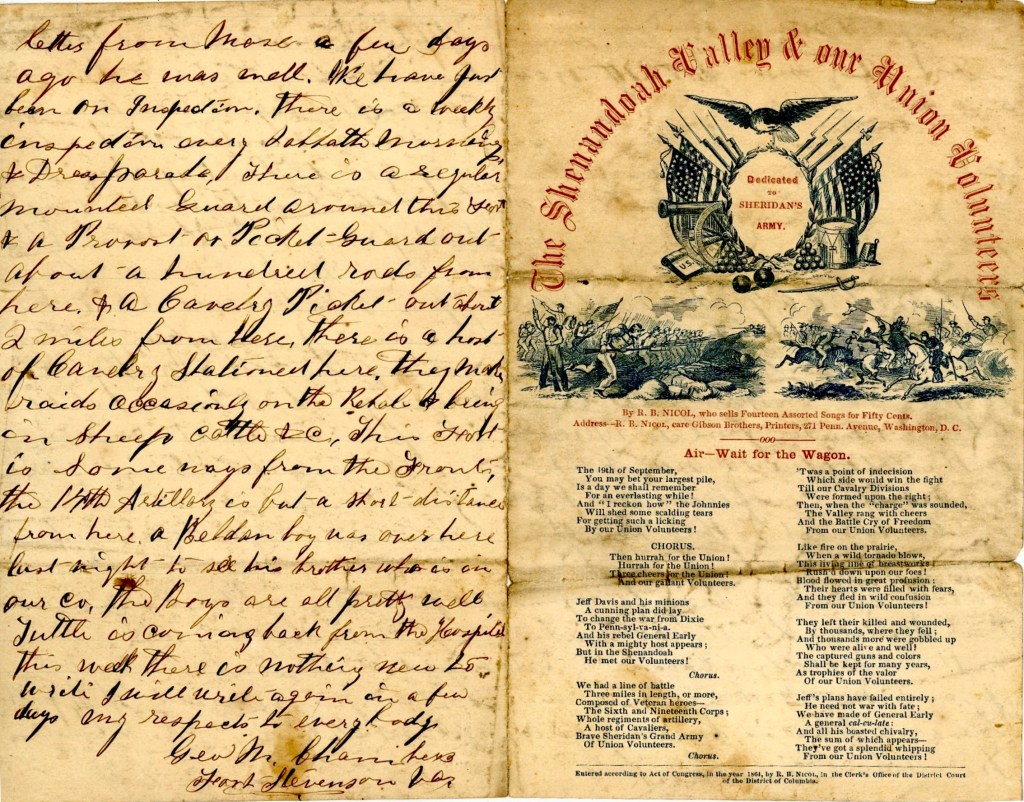
I had a letter from Mose a few days ago. He was well. We have just been on inspection. There is a weekly inspection every Sabbath morning & Dress Parade. There is a regular mounted guard around this fort & a Provost or picket guard out about a hundred rods from here & a cavalry picket out about two miles from here. There is a host of cavalry stationed here. They make raids occasionally on the Rebels and bring in sheep, cattle, &c.
This fort is some ways from the front. The 14th Artillery is but a short distance from here. A Belden boy was over here last night to see his brother who is in our company. The boys are all pretty well. Tuttle is coming back from the hospital this week. There is nothing new to write. I will write again in a few days. My respects to everybody. — George M. Chambers, Fort Stevenson, Va.
1 Fort Stevenson was described by Theodore Lyman, a member of Meade’s staff, as being by the William House, near the Jerusalem Plank Road, not far from Petersburg, Va. On 14 October 1864 he described Fort Stevenson as nearly done, “a work of large relief, capable of sheltering near 1,000 men and with a bastion front.” [The Private Notebooks of Lt. Col. Theodore Lyman, Edited by David Lowe, Kent State University Press, 2007]
I could not find an image of Charles but here is one of Dexter Berry, Co. I, 107th New York Infantry (Photo Sleuth)
The following letter was written by Charles E. Potter (1834-1904) who served in Co. H, 107th New York Infantry. Charles was married to Mary S. Warren (1834-1894) and residing in Hector, Schuyler county, New York, at the time of the 1860 US Census. He was employed as a carpenter. His son, Lyman, was two years old.
According to muster rolls, Charles enlisted on 29 July 1862 as a private; was promoted to corporal not long after, and was promoted to sergeant in March 1863. He was discharged from the service in mid-June 1865.
Charles’ letter refers to the Battle of 2nd Bull Run which was fought between 28 August and 30 August, 1862, in Prince William county, Virginia.
T R A N S C R I P T I O N
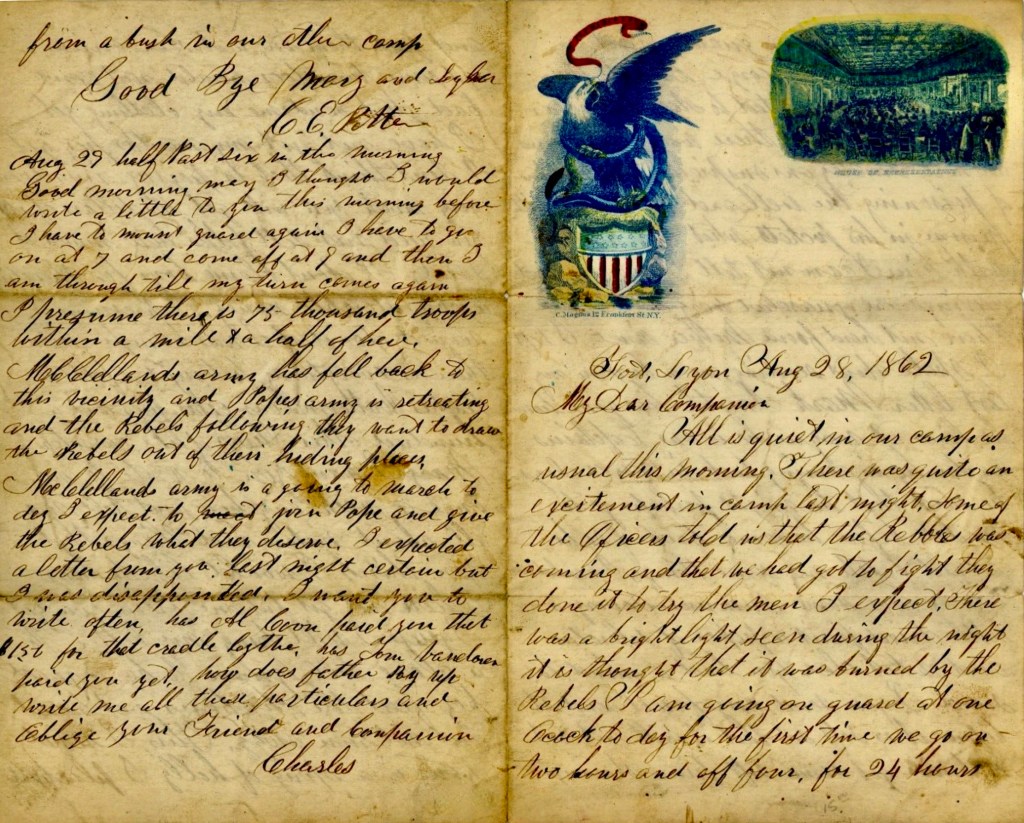
Fort Lyon (Washington D. C. Defenses] August 28, 1862
My Dear Companion,
All is quiet in our camp as usual this morning. There was quite an excitement in camp last night. Some of the officers told us that the Rebs was coming and that we had got to fight. They done it to try the men, I expect. There was a bright light seen during the night. It is thought that it was burned by the rebels. I am going on guard at one o’clock today for the first time. We go on two hours and off four, for 24 hours. I had as soon be on guard as not.
I sent a letter to George Burritt this morning. I neglected to state the other time I wrote that there was a man arrested here Sunday on suspicion of intention of poisoning the well and was found with poison in his pockets. What will be done with him, I cannot tell. The wells and springs are guarded very close now.
I have not heard from Mother since I left. I spoke about sending me a box in my last letter. Mark Smith has gone home. He lives at Wayne. He is our Captain’s 1 waiter. He is coming back in 8 or 10 days. He said that he might perhaps go to Burdett before he came back. If so, he would fetch me some things. I would like to have some summer savory, a little dried fruit, a paper of salaretin, and what[ever] else you had a mind to send. If you send any fruit, send it before it is soft so that it will not rot or bruise. Get some soft pine shavings and pack them in. A dozen onions and some tomatoes would not come bad. Don’t send me any clothing yet.
I have not got my month’s pay yet. I don’t think that is paying in advance very much. You will get 10 dollars of it. You need not tell folks how much I send. I don’t blame boys for spending a considerable money. I presume I would do it if I was a single man. There is everything to tempt a fellow—peaches, watermelons, cakes, pies, and a hundred other things of like character.
Mary, I want you to write to me once a week anyhow and tell me all about matters and things that you think I would like to hear. I have not got but one from you yet. I guess I will bring my letter to a close. Tell Lyman to be a good boy, feed the chickens, eat bread, and not run away. This I send you is a sprig of holly I plucked from a bush in our camp. Goodbye Mary and Lyman. — C. E. Potter
August 29th. Half past six in the morning. Good morning Mary. I thought I would write a little to you this morning before I have to mount guard again. I have to go on at 7 and come off at 9 and then I am through till my turn comes again. I presume there is 75 thousand troops within a mile and a half of here. McClellan’s army has fell back to this vicinity and Pope’s army is retreating and the Rebels following. They want to draw the Rebels out of their hiding places. McClellan’s army is a going to march today, I expect, to join Pope and give the Rebels what they deserve.
I expected a letter from you last night certain but I was disappointed. I want you to write often. Has Al Coon paid you that $1.50 for that cradle scythe? Has Tom Van Dorn paid you yet? How does father pay up? Write me all these particulars and oblige your friend and companion, — Charles
1 The Captain of Co. H, 107th New York Infantry at the time was Erastus C. Clark. He was wounded in action at Antietam on 17 September 1862 and discharged for disability a couple months later.





















 Spared & Shared 23