My passion is studying American history leading up to & including the Civil War. I particularly enjoy reading, transcribing & researching primary sources such as letters and diaries.
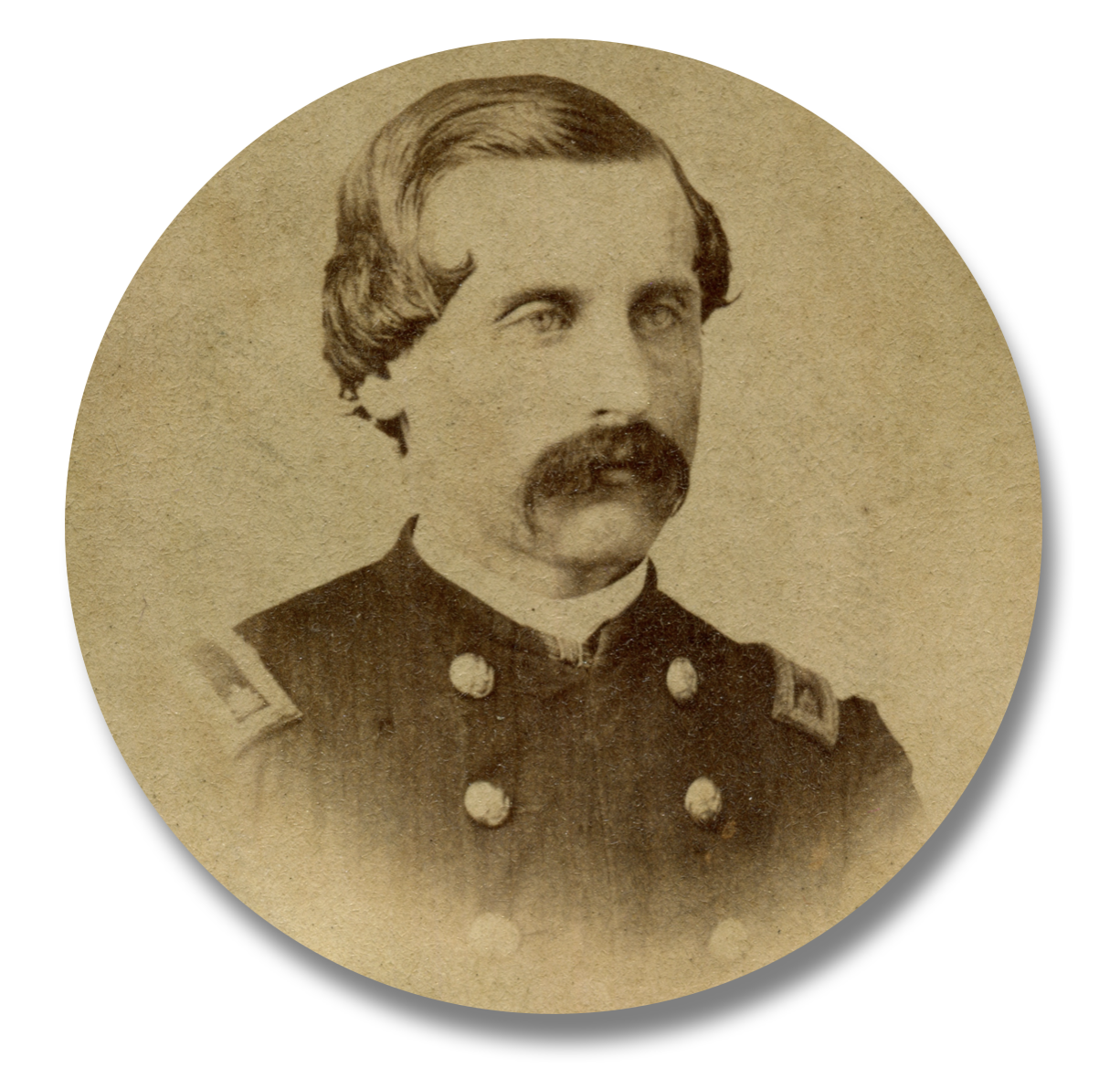
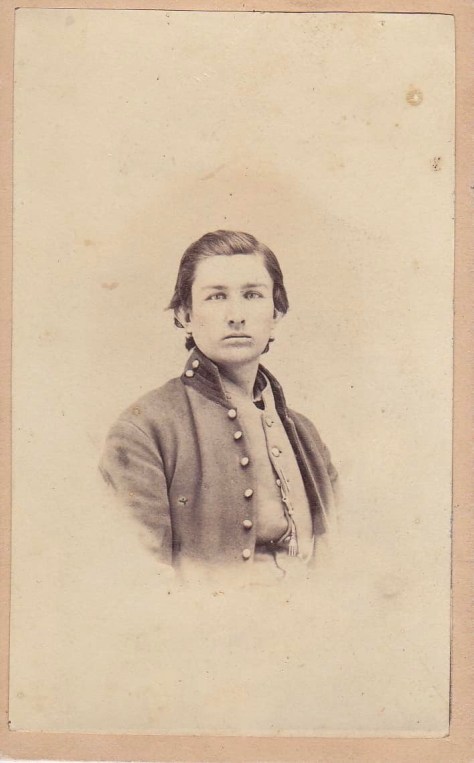
I could not find an image of Hiram but here is one of Jacob Wagner who served in Co. I of the 49th Pennsylvania Infantry (Photo Sleuth)
The following letter was written by Hiram Greenland (1839-1873), the son of Nathan Greenland (1805-1880) and Matilda Ramsey (1810-1865) of Calvin, Huntingdon county, Pennsylvania. Hiram was 21 years old, a single farmer living with his parents when he enlisted in September 1861 at Harrisburg in the 49th Pennsylvania Infantry. He was mustered into the service on 24 October 1861 at Camp Griffin in Virginia (near Lewinsville) where he wrote this letter to his cousin three weeks later. Muster records indicate that Hiram was in Co. D when he began his service but was later transferred to Co. B and then eventually deserted and was dishonorably discharged in November 1864. After the war he settled in Chester county and died in 1873. There is a soldier’s marker on his grave in Cassville, Pa.
T R A N S C R I P T I O N
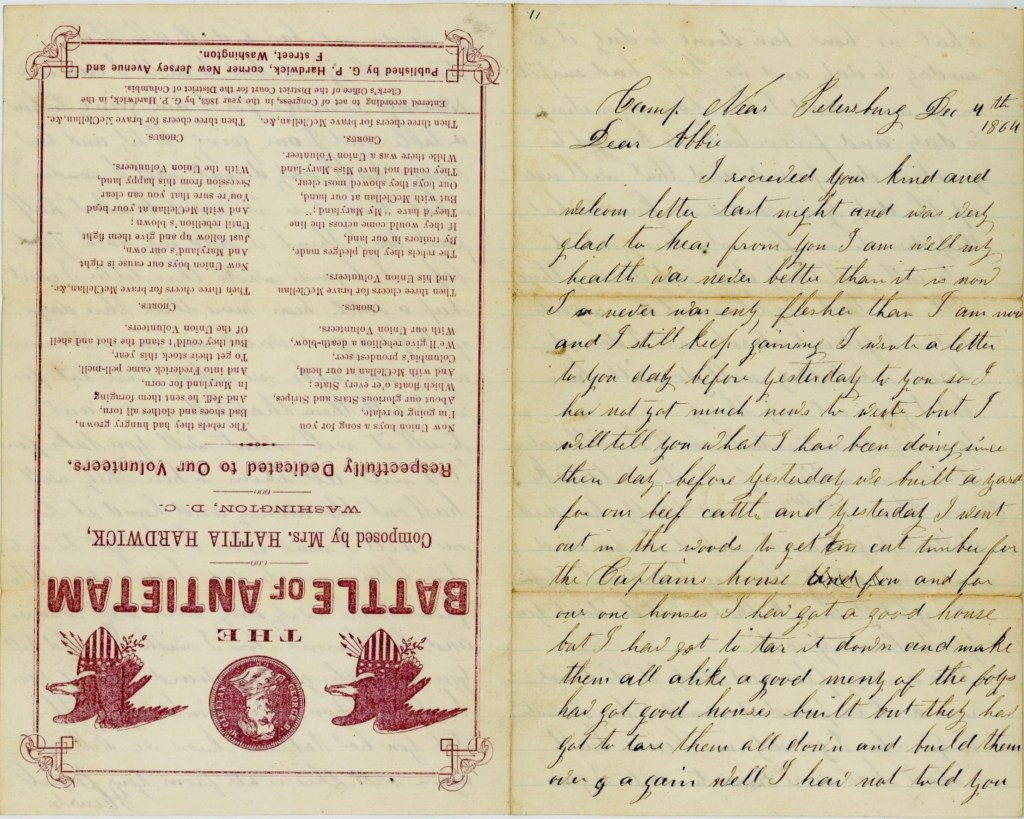
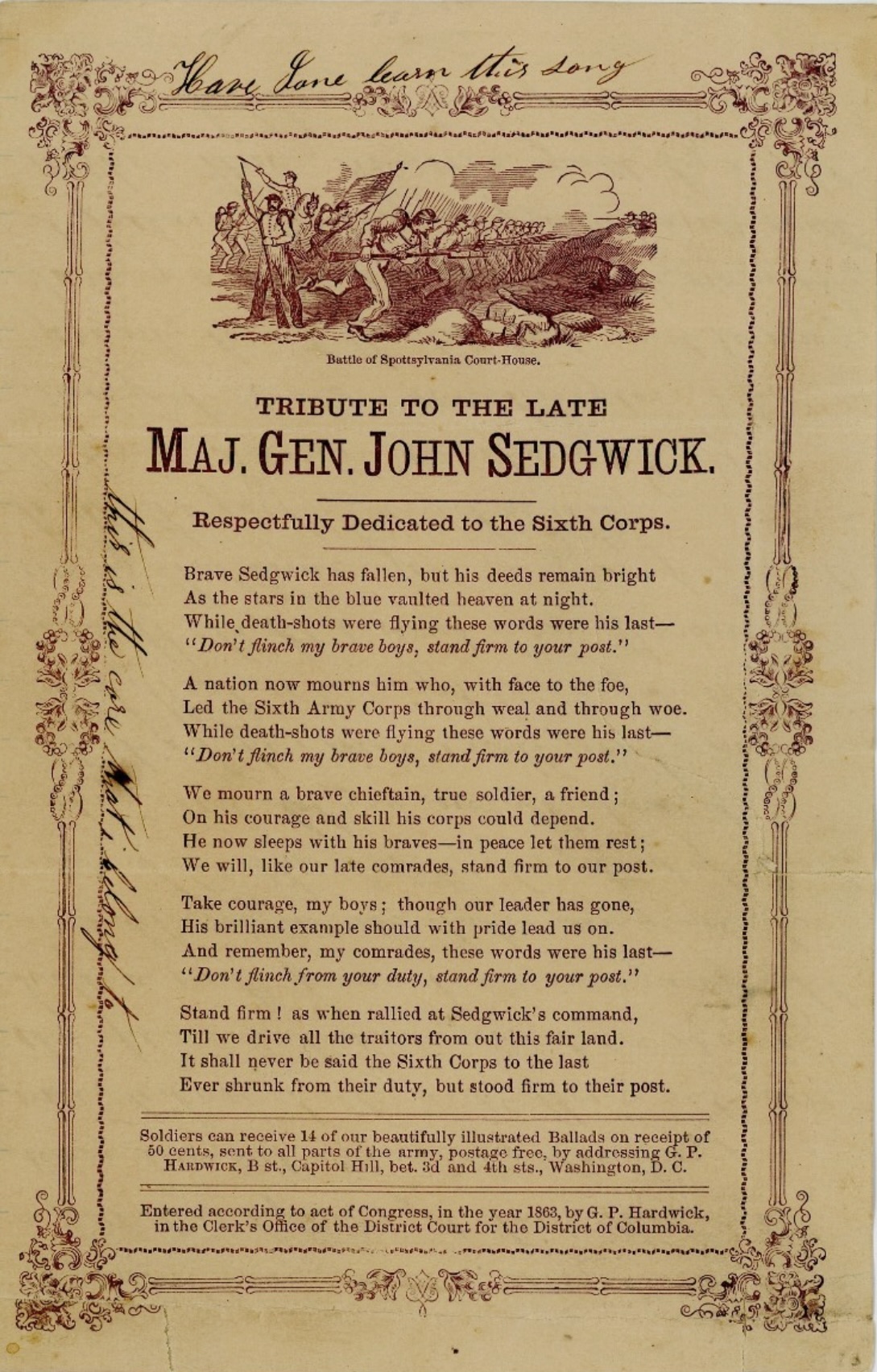
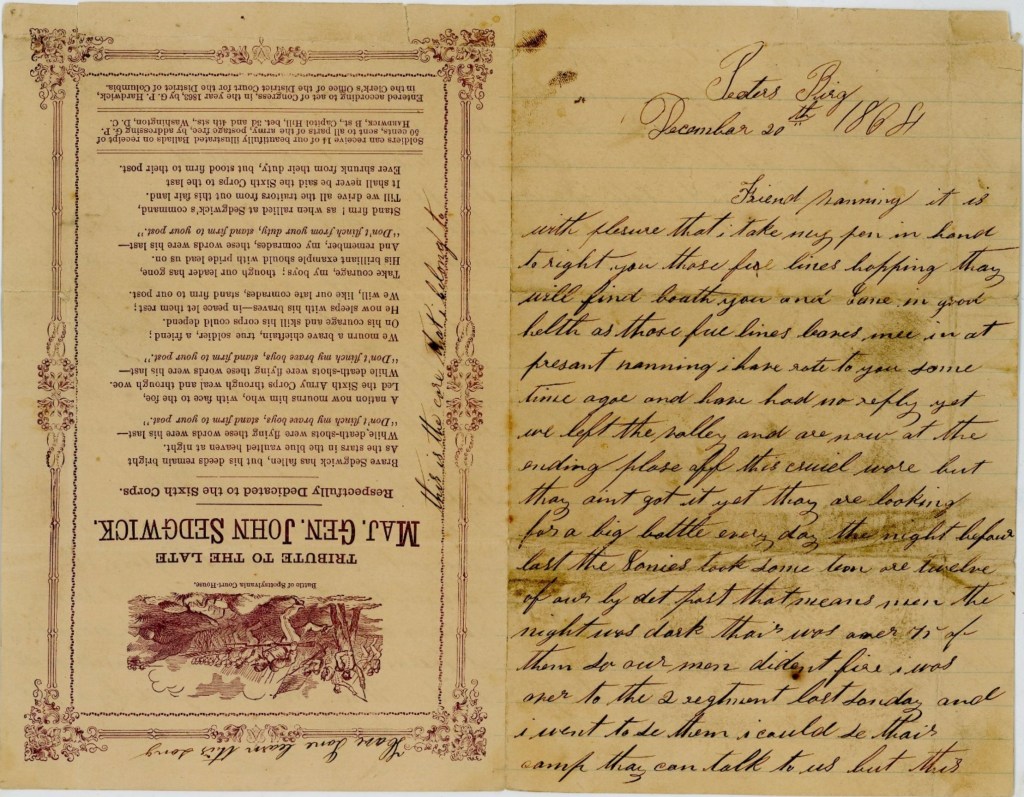
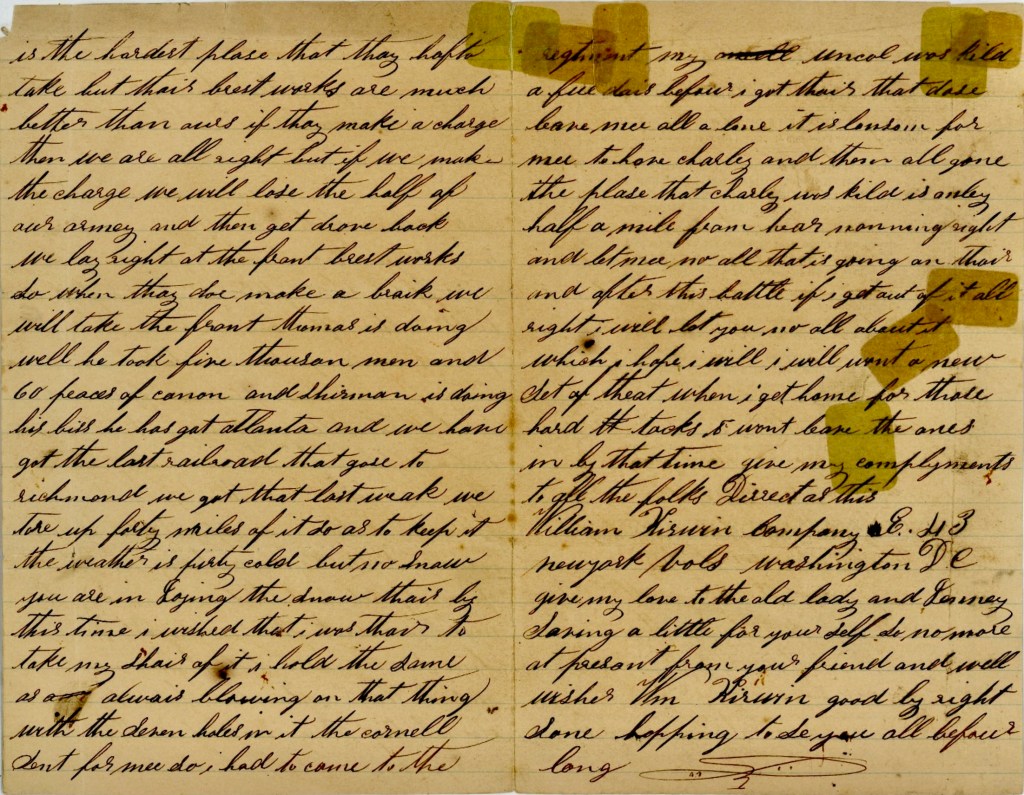
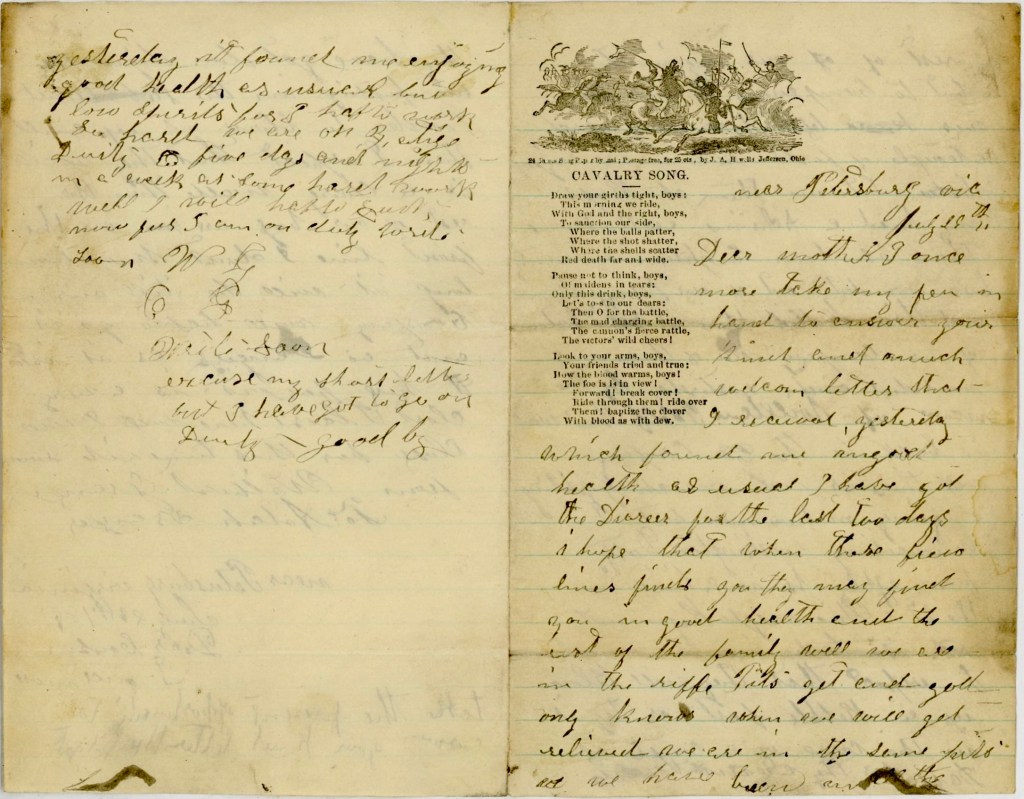
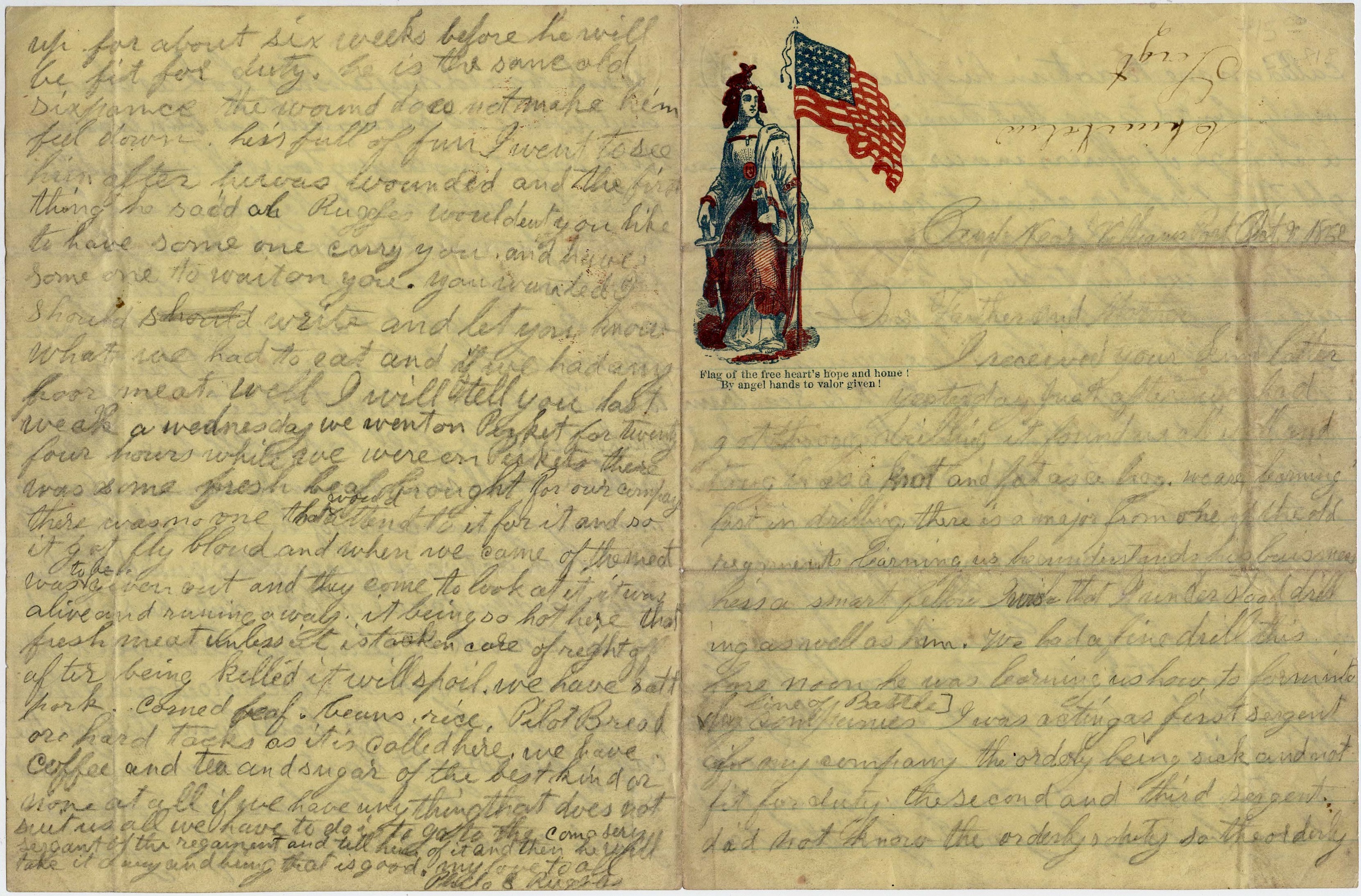
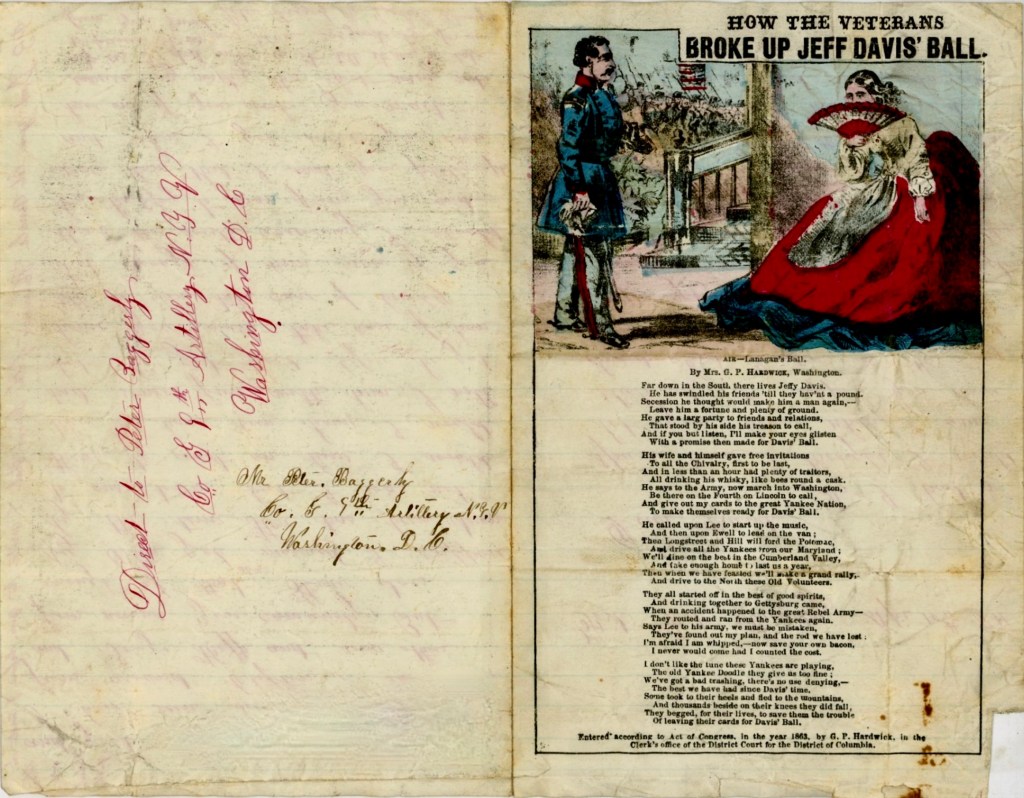
Patriotic stationery (with Poem to the 49th Penna. Regiment) used in Hiram’s letter.
I resume my pen today in order to answer a letter which I received a good spell back and I am almost ashamed to write now any more but, however, there has not been anything going on or any importance since I received yours and I have a great many more to write to than I can tend to so that I forget who I have wrote to and who I have to but don’t think that I have wrote to you lately.
Now I must inform you that Alfred Swope, Amos B[ ] and myself has had the measles and is just getting so that we can be up and move around a little yet but I feel very weak yet and I don’t think that I will be fit for duty before New Years if all goes right and I don’t get a backset now. The health of the 49th is very poor for there is as many as 175 on the sick list but yet there has been but three died yet and the typhoid fever is one of the main diseases. Yet our surgeons is master of it and has not lost a case of fever.
Now you stated in your letter something which I have not saw in any letter yet but yours which was that I ought to be up there—that I was needed for a teacher. In return I would just say that let the scholars take care of themselves and let the teachers, which are needed worse here than there, take up arms and fight to maintain their rights and liberties and there is the time when all is peace to return to the school room.
When I enlisted in this great conquest, I did not think of anything but that it was my duty to do so and I think that it is the duty of every young man that was brought up under the Stars & Stripes and that lived in peace under them should now rally round the flag and see that it is not insulted.
Now you stated that you was down to see my gal. When you was up at our place, I spect you didn’t stay.
Our regiment was out on a scout on December 6th with several others but the 49th went 12 miles farther than any of the rest and drove the rebel pickets in and chased them all to Centreville. So says a contraband that was brought in a few days after. Now I feel so bad that I will close for the present. No more but remain your affectionate friend, — H. Greenland
[to] William Greenland
Answer and address to Washington D. C., 49th Regt. P. V. in care of Capt. J[ames] D. Campbell
This letter was written by Samuel H. Hastings (1818-1863) of Hubbardstown who enlisted as a private for nine months service in Co. H, 53rd Massachusetts Infantry. He claimed to be a carpenter at the time of his enlistment though census records indicate he was a farmer. Unfortunately he did not survive the war. He died of disease in Baton Rouge, Louisiana on 21 July 1863, just five weeks after he wrote this letter to his wife letting her know he expected to be home about the 1st of August—“if spared.” Samuel was married in 1844 to Dorinda Clifford (1820-1875) and they had one child, Lilla Maria Hastings (1853-1893).
After it was organized in the fall of 1862, the 53rd Massachusetts was assigned to the expedition to go to Louisiana and once there, in January 1863, it was placed in Gooding’s 3rd Brigade, Paine’s 3rd Division, 19th Army Corps. After participating on some expeditions into Louisiana, the 53rd found itself in May 1863 at Bayou Sara, bearing down on Port Hudson from the north.
T R A N S C R I P T I O N
Cook House in the woods in rear of Port Hudson June 13th 1863
Dear wife,
Don’t you think we were a happy lot of boys last eve. The mail come to us with a large lot of letters. How many do you think I had? There was 8 from you and 6 from others; 14 in all. It took me some time to read them all. One from J. Smith, one from Fitch, 1 from E. W., one from C. H., 1 from Loring, 1 from Hannah, I shan’t have to answer them all. I hardly have time to write all I want to you. After you get this, if you have time, you may write to Hannah. She is atBellows Falls, Vermont. If you don’t have time, let it be. She wrote that she was coming down this summer. E.’s letter you can answer. The letters I received from you were No. 14, (15 I received before). I have all up as high as 22 dated 19th of May so I have all up to that time. I presume there are more on the way. I hope that we shall get our mails now. Those envelopes and stamps come in play now for I was all out of stamps & it is rather hard to get them here at this time.
We remain here yet. Our regiment has not done anything since we came back from Clinton. The cooking is the hardest part of the work now this hot weather. There is a flag of truce up now. I don’t know whether they are going to surrender or what it is for, I hope they are. It is 9 weeks since we first came here. I am nearly a mile and a half from the regiment. Four of us cook for all. We have three colored men to bring our water & cut our wood. That helps a good deal. You spoke about your butter. I think you have done nicely to sell so much. I wish I had some to eat. It would be so nice. I hope I shall get home sometime to eat some of it. I think H. can cut all of the grass for 1/9 of it is as good as it has been years back. It is so handy for him. I must leave off writing now for we are cooking rice for supper.
Sunday morn [14 June]. This day is to be a day of sorrow with some of us. Probably hundreds have been killed ere this. The battle commenced at 3 this morn. I went to the regiment at one this morn with coffee so they might have something warm to drink. I saw [your brother] J[osephus Clifford]. He said he was in hopes to go through. I think he is prepared for the worst. Port Hudson must be ours before noon today. I think there are days enough in the week besides Sunday to fight but most of ours comes on that day. Could I be where I could attend church today, I should rather than to hear the sound of the cannons & muskets & the whizzing of the bullets. But that is all that we can hear this morn. We have beans to cook today. Can’t tell who will be left to eat them or when we can get them to the men.
Do you expect to go to church today? I hope you will have a chance to go with somebody. I don’t think you are able to walk this warm weather. We call it hot out here. I shall not finish this today for I may have some news to write so I will stop now.
We did not succeed as we thought we should but met with a great loss. Co. H did not have any killed & but one wounded of any account—a young man by the name of [Jacob S.] Raynor from Warwick. Lost one leg. Don’t think he will live. 1 J[osephus] went through safe. I don’t expect to have a chance to send this now any farther than New Orleans. I believe there is no mail goes now. I wish this war was over. How many a sad heart this battle must make. Co. F—the Barre Company—suffered a good deal.
You spoke about our time. I don’t expect we shall get home until the first of August. I shall expect to be at home then if spared. It will take about a year to make 9 months, but never mind. I don’t think I shall go again. If we can get this place soon, I think it will be all we shall do here. But I don’t know as we shall be able to take it. It is harder than it was supposed to take. But she must come some time. It is so hot. It is worse for the men can’t stand what they could in cold weather. My paper is most filled up so I must close this letter. I am as well as I expect to be while I stay in this climate. J. sends love to all. I don’t know as I shall write as often as I have done for I don’t get much time. I hardly get time to rest half as much as I need to. This from your affectionate husband, With much love to all. — S. H. H.
1 Pvt. Jacob S. Raynor was born in Athol on 28 October 1844. He died on 28 June 1863 from a severe leg wound received in the assault on Port Hudson on 14 June 1863.
The following letter was written by George Darrah (1819-1903) of Cadyville, Clinton county, New York. George was born in Canada but came to the United States in 1833 and married Elizabeth Ann Stackpole (1822-1890). Their oldest children, George Darrah, Jr. (1840-1922), and Frederick Darrah (1842-1864) are the principal subjects of this letter, both of them having served as Union soldiers.
George Elizabeth (Stackpole) Darrah of Cadyville, New York (Ancestry.com)
George Darrah, Jr. was working as teamster in Plattsburgh, New York, when he was drafted into Co. H, 83rd New York Infantry. He was wounded—as described in the letter—near the beginning of Grant’s Overland Campaign and was never able to return to his regiment but after regaining some use of his arm, he was transferred into the Veteran’s Reserve Corps to complete his term of service.
Frederick Darrah was working as a teamster in Plattsburgh when he enlisted in September 1864 as a private in 2nd New York Veteran Cavalry. He died of chronic diarrhea at Morganza, Pointe Coupee Parish, Louisiana.
George wrote the letter to his brother John W. Darrah (1818-1900), the husband of Eliza Finch (1825-1906). They were residents of Williamstown, Dodge county, Wisconsin, at the time. Their oldest son, Wallace William Darrah (1845-1864) also served in the Union army. Wallace served as a corporal in Co. B, 10th Wisconsin Infantry, but was wounded and taken prisoner at the Battle of Chickamauga in September 1863. He died in mid-January 1864 while in prison at Danville, Virginia. We learn from this letter that their second oldest son, Charles Darrah (1847-Bef1865) also died but must have been at home and not in the service.
T R A N S C R I P T I O N
Cadyville [Clinton county, New York] March 19th 1865
Mr. John Darrah, dear brother
I will write a few lines to you to let you know that there is still such a man a living as George Darrah, but it seems to me as though you have forgotten me. But I hope I shall see you again if it’s God’s will. This letter leaves all of us well at present and hoping they will find you enjoying the same blessings. I say all but there is a separation in my family as well as in yours. This cruel war has made almost every house in our land a house of mourning and bereavement excepting some of Big Popular Black-hearted thieves. I was informed of the death of [your sons] Wallis and Charley, but poor Wallis did not have his father and his mother to soothe him in his last of his troubles. We always had letters from him while he was in the service until he was taken prisoner. He sent his photograph and we have got it yet. I suppose he suffered a thousand deaths before he died. There is some Boys here that has been prisoners and they look like death when they get away.
I will tell you about my boys. One year ago last July George was drafted and was taken down to Virginia and was but right front in speaking distance of Mr. Rebs and he skirmished with them until the 1st of last May when Grant made his flank move for Richmond. He was in the battle for ten days. He says that one time there was so many balls struck his knapsack that it cut it to pieces so that all of his things fell out and none of the balls hit his body until he was marching forward when up jumped a Rebel a few feet forward of him and fired at him as he was loading his gun and the ball passed through his left arm below his elbow, stoving one of the bones all to pieces and cut off all of the cords of is arm and he bled almost to death before he got it done up. He got a furlough to come home for thirty days and then he went back, remained in the hospital until election when he came home again. His arm has got so he can use it some now. He is doing picket duty now on the Baltimore & Ohio Railroad near Washington. He was fat and rugged when he was at home last fall in November and he says he is well now. When the Rebel fired at him he [the Rebel] started to run but George’s comrade plunked him in the head.
Now I will tell you about poor Frederick. Last September there [was] no talk of enlistments or [of] being drafted so he made up his mind he would go for one year. I said all I could to him not to go but he said he was sure he would be drafted and go he should for one year. He went from New York to New Orleans and from there to Morganza up the Mississippi River 180 miles above New Orleans and was taken sick with the rheaumatics and chronic diarrhea and on the 23rd day of last January he bid adieu to all of his friends. He had a number of them with him from home and that is the only consolation I have about him. They nursed him day and night to save him but all in vain. His time had come and he had to go. He told his Uncle Joseph Robberts and James Norcross that watched with him the day before he died that he could not live. He had his senses to the last. He said he could see the angels waiting for him. About his last words was he told his uncle to tell all of his friends that he died happy and longed to see the time come when his sufferings would be over. Poor fellow. How many times he must though of my parting words with him but alas, it was too late. He went a long road to meet his death. He lays on the banks of the Mississippi—no friend to view his place of burial. He was a good and smart young man as you would see walking the road. I am sad with his loss. God knows how many more like him will have to go before this cruel and cursed war is over.
All the brothers and sisters here is smart. Lester and Guinup lives out in Franklin county and Mother is with Lester. I had a letter a few days ago from them. They was well at that time. I should be happy to get a letter from you. I got one from Levi Darrah [Co. F, 44th Wisconsin] a short time ago. He was in Nashville, Tennessee, then. I wrote an answer immediately. I had a great many letters from William’s George until lately I have not had any. I would be very happy to know if he is living. If you will answer this, I will write you again and tell you all that is going on here. Elizabeth sends her love to Eliza and a part to yourself. Write and let me know how you get along. So I must close for it is 11 o’clock and go to bed. So good night. — George Darrah
I wish you much joy with your little son and hope when he gets grown up that he will not be destroyed by a cursed negro war.
Eliza Hurlbert, please forward this to brother John Darrah.
This letter was probably written by a member of the 27th Georgia while in the trenches at Petersburg. Unfortunately I was not able to identity who wrote it and I’m not certain that I have actually gotten the names correctly. The author wrote the letter to his sister “Jocie” which was probably short for Josephine. She was married to someone named John and they had a young daughter named “Sadie” or Sarah. The author may have had a brother serving in the 27th as well who was assigned to duty in Savannah rather than Petersburg.
T R A N S C R I P T I O N
Petersburg, Virginia September 27th 1864
Dear Sister Jocie,
I received your most welcome letter today and was glad to hear from you once more and to hear that Bro. Shon was at home but sorry to hear of his sickness. I was in hopes he was well when I heard he had gone back to camp [ ] but am sorry [to] hear different in your letter.
I have no news of importance to write. Everything has been very quiet here for the last day or two. Of course we have the usual cannonading and picket firing along the lines which does not do much damage to either side. Some days they take a notion and shell the city very furiously. It does not generally result in much damage in the way of life. I went over to see Frank last Sunday. They were both well. I will deliver your message to them when I see them again.
I have not heard from home since the 18th. All was well and expecting the Yankees to come at any time which I am afraid they will do some night before they know it. I am afraid I will never get to see my home again—at least until the war is ended. And you know chances are slim in war. If the Yankees were all sunk in the middle of the blue sea, it would not grieve me much.
I would like very much to see your little Sadie. You say she is so interesting. I am afraid you praise her good looks too much. You must let me judge for you. As you know, a mother always looks on her children with [ ] eyes. I am in hopes I will have a chance of coming to see you before the war ends but I think it very doubtful. Nothing would give me more pleasure but furloughs are so short that by the time I got home and tell them all howdy, I’d have to pack back to the army. I am as tired of this war as mortal ever was.
You wrote to know Willie’s address. Direct your letter in care of Capt. Dougherty, Co. E, Savannah 27th Ga. Battalion, Savannah, Ga. Willy seems to be very lonely down there but I think he is much better off there than here.
Sister, I think you are mistaken when you say you have the advantage of me for I know I love you as much as any brother ever loved a sister and think all the rest do also. I almost despaired of hearing from you or Bro. John. I wrote several letters and did not receive and answer to any of them. Excuse this short letter as my candle is waxing low which reminds me that I must bid you good night. Kiss John for me. Love to all and reserve a portion for yourself. From your brother, — Jonnie B.
These letters were written by Adam Scholl Brey (1833-1916) who was a 27 year-old bricklayer from Montgomery county, Pennsylvania when he enlisted in Co. H, 3rd Pennsylvania Reserves (32nd Pennsylvania Infantry) on 18 June 1861. Adam was discharged from the regiment on 28 July 1864 after three years service. When Adam enlisted, he was described as standing 5 feet, 7 inches tall, with grey eyes and black hair. He was hospitalized on 4 September 1862 at Bedloes Island in New York but I have not learned why.
Letter 1
Camp near Hunter’s Mill, Virginia March 14, 1862
Dear Brother,
Your letter came duly to hand on the 14th of March and was glad to hear that you have received the money and that you’re all well at present. I am in good state of health and hope this may find you all the same. I must also inform you that we are moved. I suppose you have seen it already in the paper. We left Camp Pierpont [near Langley, Va.] March the 10th afternoon at one o’clock and arrived at Hunter’s Mill the same day at ten o’clock in the evening. That day we marched about 18 miles. Our camp is 7 miles on this side Centreville as near as I know. We are encamped neat the Leesburg Railroad, just about one hundred yards on this side.
I will now inform you a little about our camp life in this part of the country. We did not take our tents along—nothing but what we could carry in our knapsacks. Some of our company had small tents to carry in their knapsack but we did not get any yet. We went to work and built ourselves tents with little brushes as good as we could to sleep under. I must also inform you that we have marching orders again to leave tomorrow morning at three o’clock.
And about the war, I suppose you know more than I do at present. Dear brother, I have one likeness yet that I left at Camp Pierpont which I will send to your wife. I had three. One I sent to father and one to Matilda Smith’s sister’s daughter but this here is not quite as good as the others. I kept it on purpose to send it to you but it did not suit me well enough to send it to you. I thought I would get it better but I got no chance to get it better. It looks like a robber but it is to protect ourselves. She says that she would pay the cost to send the likeness but I don’t want her to pay anything.
Dear Brother, I will do so as a favor to send you $15 dollars more if we get our pay soon enough. But I don’t know how soon that we will get it. With this, I will come to a close. Excuse my bad writing for I have no ink at present and I was in a hurry. As soon as you receive this likeness, please let me know soon. I will give you the direction to your letter.
Mr. Adam S. Brey, Co. H, 3rd Regiment Penn. Reserve Vol. Corps., Care of Col. Horatio G. Sickel, Washington D. C.
Then it don’t make no different where we are. The letters will be forwarded to us. Your brother Adam
Letter 2
Headquarters 3rd Regiment P. R. V. C. Gen. M’Calls Division Camp Manassas Junction April 16th 1862
Dear Brother Peter,
I take the pen in hand to write a few lines to you to inform you that I am well at present and hope these few lines will find you the same. I also inform you that I received father’s letter and was very glad to hear that he is well again. I understand in father’s letter that you was sick.
I will now inform you that we left camp near Alexandria on the 10th of April at 7 o’clock in the morning and marched to the other side of Centerville and slept there until the other morning. We marched about 18 or 20 miles that day so we start again in the morning at 7 o’clock for Manassas Junction and arrived there at two o’clock noon. And then the other morning I and six of my comrades went to the battlefield where the Battle of Manassas was fought but we did not see much but dead horses and the graves where the dead bodies are buried.
About the war, I suppose you all know as much as I do if you read the paper. Excuse me for not writing sooner, I thought you could hear the news in father’s letter just as well as if I wrote to you and another thing, I had no chance to write hardly [at] the time since we was moving so you will please let this letter read to father and with this I will come to a close hoping you will not forget me in writing. My best respects to you all. Your affectionate brother, — Adam
Direct your letter to Mr. Adam S. Brey, Co. H, 3rd Regt. P. R. V. C., Washington D.C.
Letter 3
Camp near Fredericksburg May 28th 1862
Dear Brother,
Your welcome letter of 22nd inst. came duly to hand which pleased me very much to hear that you are all well at present. I enjoy good health at present and hope this may find you all the same. Again, it gives me great pleasure to receive letters from you. I feel when I am reading them almost as if I was talking to you and I hope the time may come soon again that I can have the pleasure to speak with you all. So God’s Will that I shall return to Old Pennsylvania with life again which I hope the time will come soon again.
I must also inform you that we left camp near Falmouth. We are encamped about a miles on this side Fredericksburg and on this side of the Rappahannock River yet. We lay alongside at the railroad which runs to Fredericksburg. The railroad bridge is finished again so that the cars can run to the town of Fredericksburg.
I must also inform you how the Rebels treat our men. An old gray-headed man which was a Rebel, he passed one of our men who was lying nearby a well. He was wounded [and] he asked this old man for a drink of water which he give him. In one hand he has the cup and in the other hand a revolver which he shot him instantly dead. And on the march from [ ] Station to Falmouth, five men of the 12th Regiment belonging to our Division which were so tired that they could not march along no more with the regiment so they had to stay behind and a party of Rebels took them and tied their legs at the limbs of the trees with their heads hanging downwards with their throat cut off. That is the way our cavalry found them when they went out scouting a few days after the march.
And I would tell more such work which the Rebels done but I must hurry to close my letter for the drum beats for drill.
N. B. I will send this little locket as a present to William and with this I will come to a close hoping you will not forget me in writing. Write soon again. Yours truly, your brother, — Adam
Excuse my mistakes and bad writing. I was in a hurry. My best respects to you and all enquiring friends. Your brother, — Adam
The following letter was written by John William Duncan (b. 1830) who enlisted at Charlotte, Virginia, on 22 September 1861 in Paris’ Company Virginia Artillery (alias Staunton Hill Artillery). He was mustered out the battalion on 25 April 1865 at Durham Station, Orange county, North Carolina. Serving with John in the same unit was his younger brother Thomas Agee Duncan (1839-1927). The unit was divided into three sections: two served in the Department of South Carolina, Georgia, and Florida near Savannah and the third in the Department of North Carolina. In May, 1862, they united in North Carolina and aided in the defense of Wilmington. One section was captured at Fort Anderson and the other two were assigned to B. C. Manly’s Battalion in the Army of Tennessee. Only a few surrendered on April 26, 1865. Its captains were Charles Bruce and Andrew B. Paris.
The Duncan brothers were from Marysville, Charlotte county, Virginia. Their parents were Jacob Agee Duncan (b. 1805) and Martha Eliza Wilkes (b. 1813).
T R A N S C R I P T I O N
Wilmington, North Carolina May 17, 1862
Dear Parents & Sisters,
I wrote you 11th inst. saying I would write again when we got in camp. Well we are in our tents again. We left Savannah Tuesday morning and got to Charleston Wednesday night and landed in Wilmington Friday morning and came from town 4 miles into camp with the other section yesterday. We are all in camp together. I am getting well of the measles and hope I shall soon be able to go on duty. I came through on the sick list from Savannah. I stopped at hotels and got such things as I could eat and had comfortable lodgings. It cost me some $6 or $7 dollars. I thought I had better spend a little money than run the risk of losing my life by sleeping out in the weather and it raining some of the time. I feel much better since we got in a colder climate. If think if the change of climate does not make me take cold, I will soon be well.
Bro. Thomas is about well and will be able for duty next week. Cousin Ed has got well and is now at the hospital at Wilmington waiting on Mr. J[ames M.] Austin—one of our mess. Mr. Austin has not got over the measles yet. He is quite feeble and in a state of debility, having night sweats and low fevers. He was not willing to be left behind and his trip made him worse. With good attention I hope he will soon be well again. He is a nice man. Not many of our men are very sick. Some complaining.
When we arrived yesterday, Mr. [Wood] Bouldin had left his section and gone to Richmond. He came in this morning & Lieut. [Andrew B.] Paris had some quite angry words about uniting the sections. The War Department ordered Lieut. Paris to connect the section so the company could be organized under the Conscript Act. I understand that Lieut. Bouldin wants his section cut off entirely from the company. Lieut. Paris has the most men in his section and if Capt. [Charles] Bruce resigns, Lieut. Paris will get the captaincy which does not sit well on Lieut. Bouldin’s stomach. I think Bouldin & Lieut. Gain are Capt. Bruce’s choice, but not the men who have the right to select their own officers to serve under during this long and distressing war.
We have got to organize by the 26th inst. Then we will be in for three years or the war. We will be granted furloughs to come home once during that time. The boys from our settlement are well. Capt. and Billy, Mr. [John W.] Eggleston & Mr. Marshall. I like the climate here much better than in Georgia. I do not know how we will fare yet. I did not see any corn bread in Georgia. I hear we will get it here. But I hope to [go to] Virginia. I heard Wednesday in Charleston that Richmond was in the hands of the enemy.
Mr. [Andrew J.] Middleton wishes to be remembered by you all. We are under Gen. [Theophilus] Holmes. I cannot say when we will get into a fight. I must close by asking you to write immediately as I. think it doubtful about remaining here long. I remain your son and brother, — John W. Duncan
An unidentified young man from the mid 1850s (Rick Brown Collection)
This letter was written by 22 year-old Nathaniel Bourne (1833-1889), the son of Israel and Elizabeth (Jenkins) Bourne of Barnstable, Massachusetts. He was reared and educate in New England and was married in Oswego county, New York, in 1858, when about twenty-five years of age, to his cousin, Huldah Worth (1827-1913), a daughter of Thomas R. and Mary (Bourne) Worth. Immediately after their marriage the young couple came to Iowa, settling in Dubuque county, where they lived for three years. They then removed to Linn county, taking up their abode in Cedar Rapids, where Mr. Bourne continued to make his home until his death, which occurred December 27, 1889. Throughout that period he carried on operations as a builder and contractor and in later years was active in real-estate interests.
T R A N S C R I P T I O N
“City of Chicago” lithograph on stationery used by Nathaniel.
Chicago [Illinois] August 21, 1855
Dear Cousin,
I think you said that you would answer an effusion from the pen of mine illiterate self. At any rate, I guess I shall find out about it. Well, let me see. I left the fair town of Redfield on Tuesday, arrived at Rome the same day. Wednesday at about 11.30 I started en route for “Out West.” Arrived here Thursday evening. The people here talk about as much of going west as in New York. However, I think I can safely say that I have made a beginning in that direction.
Well, what next? What a minute and let me chew my pen holder. Let’s see—hmmmm—sus-a-day. Wish I knew what to write…Saw lots of houses and barns, some very fine looking farms and some not so fine. Have a confused idea of stumps and trees, highlands and swamps, towns and villages, dust, smoke, & cinders, &c. and after turning the world wrong and about so that North was South, they landed me in Chicago at about 9 in the evening and dark as pocket with a pouring rainstorm. Suppose I must bear in mind that I am writing to the fair sex. Therefore, I must not give my composition a too masculine turn. Well, I ain’t used to writing so [it’s a] tough job. Oh dear, most wish I hadn’t commenced (begun).
I don’t suppose that the detail of my journey will be very interesting. to you. Chicago is situated on a low, flat tract of land on the west side of Lake Michigan. It is a very thriving place at present. Work is very plenty. Almost anyone who has a mind to work can find employment. Professional gentlemen like myself are in good demand—wages from $1.70 to $2 per diem. Board 3.50 to $4 per week, washing about 50 cents besides. Costs about $5 a week to live. That is but a mere trifle for a rich man to pay but it makes a poor one with a family having rather hard times to make two ends meet. Fortunately I am neither one or the other.
The sidewalks are made of planks. They go jumping and tilting as you walk over them and in the dark if you are not careful, you may stub your — and fall headlong. 1 The lake water is used almost exclusively for cooking, washing, and drinking, &c. It is raised a sufficient elevation by steam power and then conducted over the city by the means of pipes. I haven’t seen any ladies that would scarce fear a comparison with those at R[edfield]. One of these days when I get in more comfortable circumstances, I may — well, never mind. Time enough yet if it isn’t too late…I once heard of a man who said that if he had any clothes to repair that he would take them to Quaker meeting for the old adage went that “where the least is said soonest mended.”
I like the place very well. Think I shall make quite a pause in this vicinity. Well, in fact I don’t seem to know either how or what to write. Won’t you please to give me some advice on the subject. Of course you will be favorably impressed with my connected, smooth, elaborate style of composition.
I have made a dot with a lead pencil on the picture in front where I reside. I suppose that house stands in the same place under the hill as when I last saw it. Wish you would present my compliments to that cow that I undertook to milk and didn’t. Suppose she would appreciate a handful of grass more highly than forty such. Wish I had a handful of—well, cheese in embryo. Well now, I am going to stop. I believe I can’t write… My P.O. addresss is Chicago, Illinois. You will please put this in the fire as soon as you have perused it. You. will please answer this. I’ll try to do better next time. So goodbye, — From Cousin Nathaniel
To Miss H. Worth
North side of Lake Street, west of Clark. 1843. (Heise and Edgerton, Chicago: Center for Enterprise)
1 Chicago’s sidewalks and many of its streets were planked in the 1840s and after years of exposure to the yearly cyclical nature of Chicago’s climate, began to rot and wear badly. “Before long, the planked streets became waiting booby-traps as the rotting boards would snap without warning with a resulting one-two punch: first, the broken plank would rise into the air, often slapping a horse in the face; then on the way down, the falling missile would crash into the muck below, splashing any innocent bystander with the ungodly [sewage] effluent [flowing beneath].”
The following letter was written by Scott Winfield Harrington (1842-1909), a native of Pennsylvania, who came to Sheboygan county, Wisconsin in the early 1850s with his parents. In the fall of 1861, he enlisted in Co. A, 1st Wisconsin Cavalry but after 15 months of campaigning in Missouri, he became too ill to carry on and he was discharged. Once home and having fully recovered, he again enlisted in the 17th Illinois Cavalry, rising in rank from sergeant to Captain of Co. A. He mustered out of the 17th Illinois Cavalry on 2 October 1865.
After leaving the service at war’s end, he married Sarah Asenath Cooper (1846-1915) in Ozaukee and eventually settled in Sioux City, Iowa, where he became a merchant and grain dealer.
T R A N S C R I P T I O N
Patriotic Letterhead of stationery used by Scott
Camp Fremont Ripon, Wisconsin October 4th 1861
Friend Sidney,
I take this opportunity to write you a few lines to let you know how I get along and where I am and what I am doing. In the first place I am very well in body but not very well in mind. I enlisted in the First Battalion of Wisconsin Cavalry the 14th day of August ’61 and have not got my uniform yet, so that is the reason I am not very well in mind. But I know in this terrible time the government cannot get everything in a moment so I shall have to be patient and if anyone does not want patience to join the army now, I do not know where or when he does want patience.
This [regiment] was first started for a Battalion of 4 hundred men but since then the Colonel has been ordered to raise it to a regiment of twelve hundred men. There is about seven hundred in camp now. We will not be likely to leave the state under about two months for we cannot get our arms under that time. We shall have plenty of time to train our horses and that is just what we need. We have got in our tents now and it is very pleasant. We were quartered in a college building until we got our tents.
I have not been home since I enlisted and I suppose my folks will give me a nice talking for enlisting, but I think that I am doing my duty to my God and my Country, and if I have to go against my parents wishes, I think that I am doing right. If I get killed on the battlefield, I have no wife and children to mourn for me as a great many of the soldiers have, but still I leave a mother that thinks just as much of me as any wife does of hers husband and mother is the only one that I regret to leave. To be sure, it is not a very pleasant feeling to think that I am going off and leave my young friends, perhaps never to see them more in this world. But it is not such a feeling as it is to leave mother.
I have nothing more to write of any consequence (and what I have wrote I do not know as is of much consequence). There is no excitement here now at all. You must excuse this poor writing and spelling for my writing table is a hand trunk turned down on the side and my chair is my blanket laid on the ground, so you may judge how pleasant writing it is. Give my respects to all enquiring friends. Please write soon and oblige your ever true friend, — Scott H. Harrington
This letter was written by John M. Thornton (1838-1917), the orphaned son of Charles Thornton (1790-1856) and Frinda Severance (1801-1849). He wrote the letter to his sister, Elizabeth Olivia (Thornton) Davis (1834-1876), the wife of Henry Lafayette Davis (1826-1900). In 1860, when he was 22, he was enumerated in the household of James Harper of Poultney, Rutland county, Vermont, where he was employed as a farm hand.
John would have been 23 when he enlisted in the late summer of 1861 to serve in Co. I, 5th Vermont Infantry.
When John was 78 years old, he “committed suicide by hanging himself with a rope in the barn at the home of Mrs. J. N. Thomas in Forestdale where he boarded.” He was buried in Pine Hill Cemetery in Brandon, Vt.
The 5th Vermont was brigaded with other Vermont Regiments in the “Vermont Brigade” and made their camp near Lewinsville, Virginia, late in 1861. They spent the winter in canvas tents. (Vermont Historical Society)
T R A N S C R I P T I O N
Camp Griffin camp near Lewinsville south of chain bridge 3 miles November 28, 1861
Dear Sister,
I thought that I would write and let you know that I am not quite as well as usual. We are a great many of us sick here. They die off pretty fast. There has seventeen died out of this regiment.
We had a Grand Review the seventeenth [should be 20th] of this month. There was between eighty and a hundred thousand men here that day. We saw McClellan and Uncle Abe was there with his body guards with him. One of them fell off from his horse but he was not hurt much. They was saluted from all directions by the soldiers. Uncle Abe rode with his hat in hand. The Prince of Paris [Prince de Joinville of France] was here that day. He had the most splendid horse that I ever saw. He [the horse] was a very prompett [?] fellow. He was milk white. He had black eyes. He was an easy traveler and the Prince was an easy rider.
The Grand Review of the Army of the Potomac was held at Bailey’s Crossroads, Virginia, in eastern Fairfax County on 20 November 1861. Among those in attendance was President Abraham Lincoln. (Harper’s Weekly)
We stayed there most of the day, then we came home. We were pretty tired. The next day we went out on a scouting and traveled five miles farther but we did not see anything of them. We stayed there till most night, then we came home again. We saw lots of brush tents that the rebels had encamped in. There was loose straw that had been stored to dry which they had been drove from their brush houses which was too bad cause the weather was not cold enough to freeze them to death.
You must give my respects to [ ]. This likeness was taken in cloudy day and it don’t look very well for that reason. I have sent some money to the Bank of Rutland, I received a letter from [brother] Francis and he sends me a paper every week. I received your letter from Henry [Davis] all safe.
We have not moved yet and the weather is pretty cold here now [to be] in cloth tents. We are holding Thanksgiving here today but we have no turkeys. Write as soon as you get this. From your affectionate brother, — J. M. Thornton
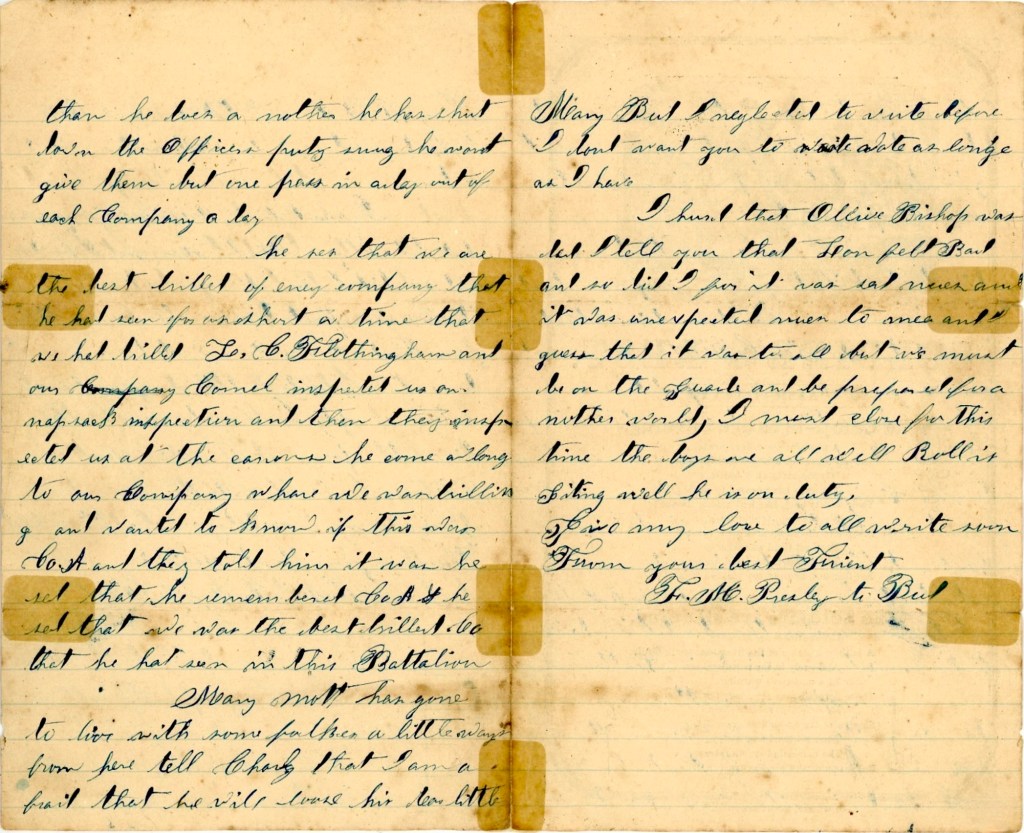
I could not find an image of Charles Howard but here is one of Charles Smith who served in the 1st Massachusetts Heavy Artillery, Battery C (Al and Claudia Niemic Collection)
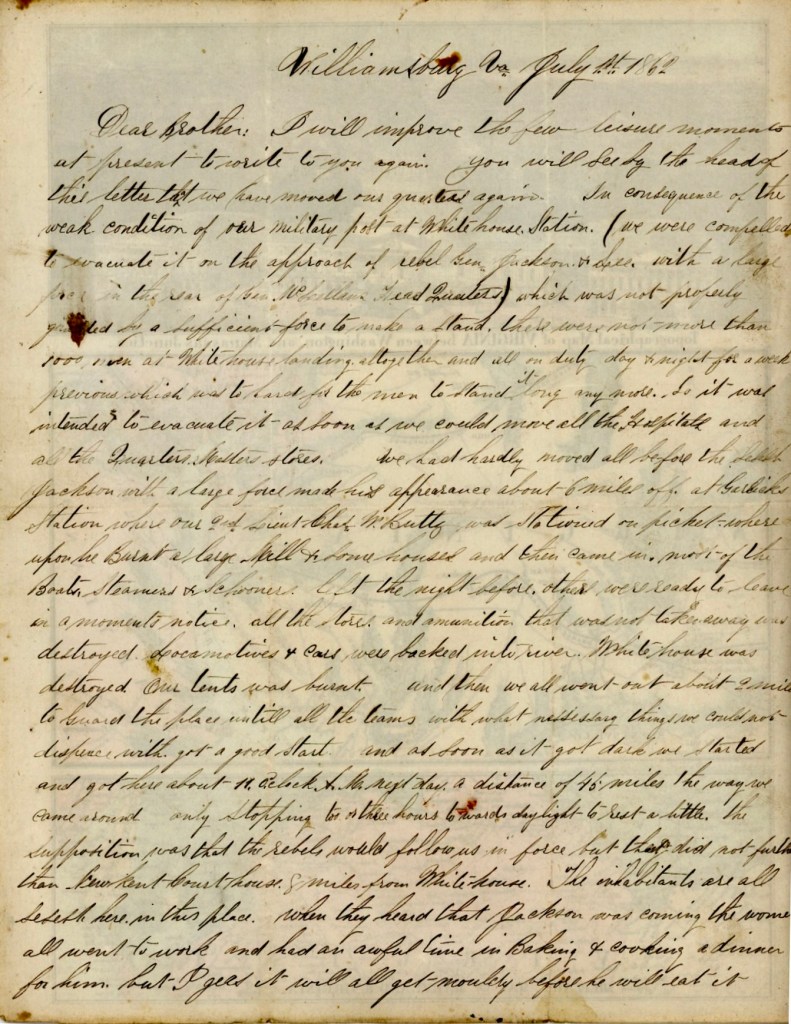
The following letter was written by Charles E. Howard (1842-1868) who enlisted at Lawrence, Essex county, Massachusetts, to serve in Co. K, 14th Massachusetts (Infantry) Regiment on 5 July 1861. However, this regiment was converted to a Heavy Artillery unit on January 1, 1862. They were officially made the 1st Massachusetts Heavy Artillery as Charles writes in his letter. There were 2552 men that served in the regiment through the war. The unit suffered 486 fatalities; 215 KIA or mortally wounded, 115 died due to disease or accident, 156 died as POWs along with 4 MIAs presumed dead.
Charles was the son of a stonecutter named Eli Bangs Howard (1811-1851) and Rebecca Bartlett Dow (1810-1874). 17 year-old Charles was the only child living at home in Lawrence with his mother, a dressmaker, when the 1860 US Census was taken. Living in the same household was Rebecca’s mother Abigail (age 69). Charles survived the war but died of consumption in 1868 at age 26.
T R A N S C R I P T I O N
Headquarters Heavy Artillery 14th Mass. Regt., Co. K February 8, 1862
Dear Cousin,
I have a few leisure moments now to answer your letter which I received a week ago. You must excuse me for not writing before for I have not had much time. We are changed into heavy artillery so we do not have much time to write. We have just returned from drill and my arms are so tired that I can hardly handle the pen. We are called the 1st Massachusetts Heavy Artillery, Battery K, but we go by the name of the 14th Mass. Regt., Co. K. Our letters will come either way. We have to drill on the big guns every day that is fair. We have nothing but mud, mud. The mud in some places is two feet deep. That is the reason why the army do not make at attack. Our major and some more men have gone to Lawrence to recruit more men for this regiment. I think that we will all be at home next fall.
Ask aunt what she will sell me a whole cheese for. If she will sell me a whole cheese, mother will put it in my box and send it to me. How does grandfather get along? How does aunt sell her butter? I would like to see you and all of the folks. Tell aunt that if I live to get home, I will come and see her. Have you got much snow there? We have not more than one inch, if that. In some places the mud is 3 or 4 feet deep. You never, nor I never saw the mud so deep as it is in Virginia.
Tell Sumner that I want him to write to me. Tell him that I know Freeman Harley and his brother. Tell him that I see them most every day, sometimes work with him. Give my love to the girls that aren’t married yet. When are you a going to get married? Send me the marriage card when you get married so that I can see who you are married to. I do not know when I shall get married. There are plenty of Niggers out here and if Sumner wants a Nigger, send him out here and I will show him some.
The dinner has just come and you would laugh to see them run to get it. They run like pigs.
We have a shoemaker in our house so he mends all of our shoes but we have to pay him 50 cents for it. I will write a few lines to Olive Ann in this letter. Why does not Olive write to me? She has not answered my letter that i wrote her. Give my love to all. From your cousin, — C. E. Howard to C. J. H.
Dear Cousin, I now write a few lines to you hoping to hear from you soon. Have you. seen or heard of Abby yet? How does she get along? Tell her that I should like to see her. Tell her to write. I want to hear from her and you. very much, How does her mother get along? Tell Abby that I will answer her letter if she will write.
The Boys are eating dinner. I think that the war will all be over next November and we will all be at home. I heard that you. and Emeline went to the meadow and had a good time skating and then went to a party. I wish that I had been there. You must of had a splendid time. Was Abby there? When I read her letter and heard that you had a good time, I wished that I had been there. Tell Emeline that I wish that when she goes to a party, [ ] to have a good time for me. Won’t you write soon as you get this? From your cousin, — C. E. H.