My passion is studying American history leading up to & including the Civil War. I particularly enjoy reading, transcribing & researching primary sources such as letters and diaries.
The following letter was written by Henry H. Joslin (1843-1909) who enlisted at the age of 17 in Co. C, 55th Illinois Infantry. When he enlisted, he was described as a 5′ 11″ blue-eyed, light haired, farmer from Rockford, Winnebago county, Illinois. He reenlisted as a veteran in February 1864 and was discharged for disability on 30 June 1865.
Henry was the son of George Henry Joslin (1819-1881) and Eunice A. Olmstead (1822-1881). The family was enumerated in Harrison township, Winnebago county, Illinois in the 1860 US Census.
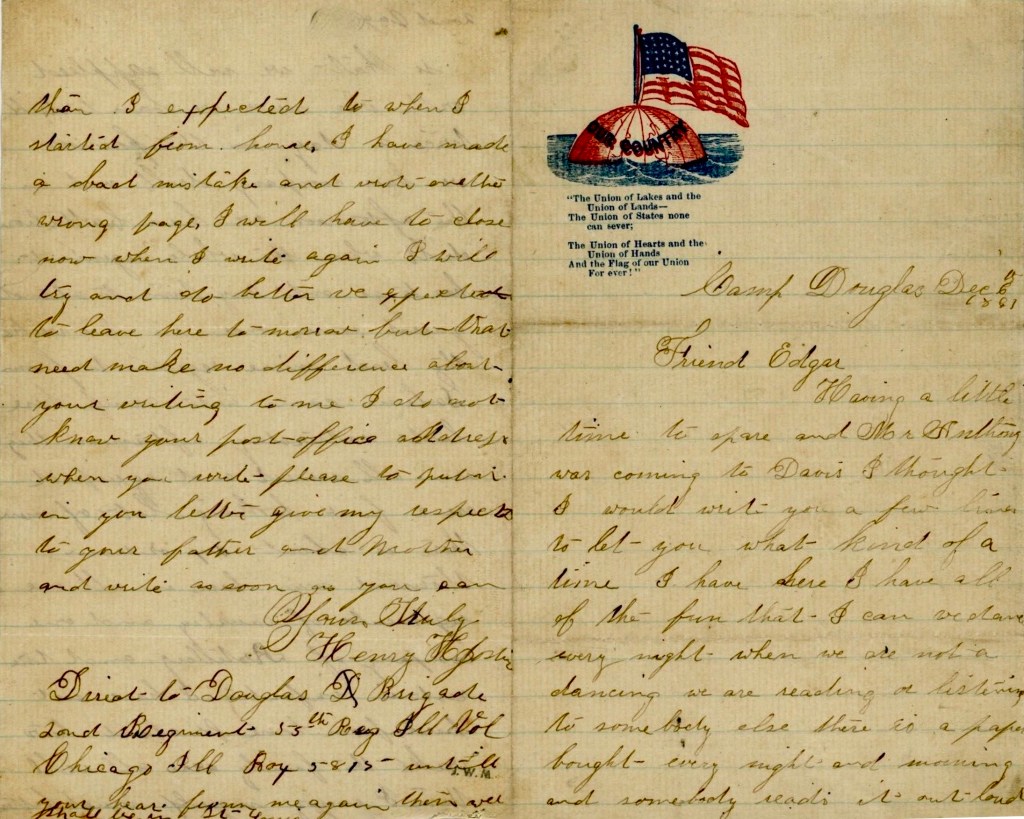
Henry wrote his letter from Camp Douglas near Chicago in December 1861 where the regiment was organized and drilled. Most of the members were recruited from Northern Illinois counties such as LaSalle, Fulton, Grundy, Ogle, Winnebago, DeKalb, DuPage, Kane, McDonough, Carroll, and Knox. Some of the early enlistees even helped build Camp Douglas. Because they were ill equipped, they did not participate in the taking of Forts Donelson and Henry. They saw their first action at the Battle of Shiloh.
Transcription
Camp Douglas [near Chicago] December 6th 1861
Friend Edgar,
Having a little time to spare and Mr. Anthony was coming to Davis, I thought I would write you a few lines to let you [know] what kind of a time I have here. I have all the fun that I can. We dance every night. When we are not a dancing, we are reading or listening to somebody else. There is a paper bought every night and morning and somebody reading it out loud so that we [are] well supplied with war news.
We have to drill twice a day in the forenoon. We have battalion drill when the whole regiment has to go out. My turn to stand guard comes once in two weeks. The Lead Mine Regiment from Galena 1 came into camp here last Saturday afternoon. They are a fine-looking lot of men. There is about six or seven thousand men here in all; one regiment of cavalry and one of artillery, and the rest is infantry.
I have not heard from home for about two weeks. The family were all well then. I enjoy myself much better than I expected to when I started from home. I have made a bad mistake and wrote on the wrong page. I will have to close now. When I write again, I will try and do better.
We expected to leave here tomorrow but that need make no difference about your writing to me. I do not know your post office address. When you write, please to put in your letter. Give my respects to your father and mother and write as son as you can.
Yours truly, — Henry H. Joslin
Direct to Douglas Brigade, 2nd Regiment, 55th Regiment Illinois Vol., Chicago, Illinois, Box 5815 until you hear from me again. Then we shall be in St. Louis.
1 The “Washburn Lead Mine Regiment” from Galena, Illinois, was the nickname given the 45th Illinois Infantry. In November 1861, the seven companies that had formed were armed with short Enfield Rifles and moved to Camp Douglas, in Chicago, where they were joined by companies from other parts of the state to form a full regiment of ten companies. Jasper A. Maltby a Galena gunsmith, who had served in the Mexican War, was selected as Lt. Colonel to replace the former Lt. Colonel, who had resigned. Melancthon Smith, the postmaster of Rockford, Illinois became the regiment’s major. After the regiment was mustered into U.S. service on December 25, 1861, they were sent to Cairo, Illinois on January 12, 1862.
The following letter was written by Moses Ludwick Hower (1837-1923), the son of Adam Hower (1800-1881) and Rachel Ludwick (1798-1886) of Plain Township, Stark county, Ohio. Moses was 23 years old when he enlisted as a private in Co. A, 19th Ohio Infantry. He remained with the regiment until 20 August 1863 when he was transferred into the Veteran Reserve Corps.
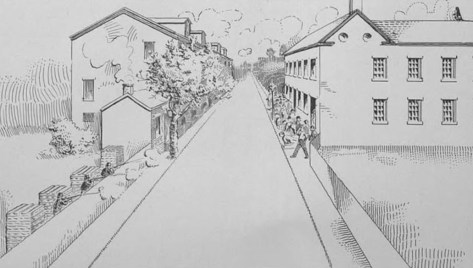
Moses wrote the letter on 11 June 1862 from Henderson, Kentucky, which was lightly garrisoned by soldiers from the Louisville Provost office and Andrew’s Michigan Battery. Moses clearly disliked Henderson, thinking it “as hard a secesh town as I was in yet. No stars and stripes to be seen.” As anxious as he was to leave it, there’s a good chance he was no longer in the town a few days afterward when three Confederates soldiers crept into the town at night on 29 June 1862 and fired on unsuspecting Federals lounging on the porch of the National Hotel before slipping away in the darkness. The only casualty was an unfortunate sow caught in the crossfire.
Artist’s rendering of the 3 Confederate soldiers firing on the Federals in front of the National Hotel in Henderson, Kentucky
Transcription
Patriotic letterhead on Moses’ letter, “The Whole Union, Forever”
Henderson, Kentucky June 11th 1862
Dear Brother and friends,
I will try and write a few lines to you. I would a wrote sooner but I dis not expect that I would stay here as long as I have. When they took me away from the regiment, they told me that the boat would take me to Cincinnati and there we could get furloughs to go home, but they did not do that. But they run us off here and this is as hard a secesh town as I was in yet. No stars and stripes to be seen in the breadth here and that is not near all. I could stay here for I am not afraid of the rebels but our fare is so poor. This is the hardest living I ever had. We get corn meal mixed with water and then dried so that when we break it apart, it all crumbs up. And coffee—as they call it—but I cannot call it coffee for it looks more like dishwater. And about once a week a little meat, but the pieces are so small that I cannot taste what it is. But we had something extra for dinner today. We had onion soup with tops and all cut in and some lettuce.
Now I will stop all that and give you a history as near as I can of my sickness. I took sick the twenty-first of April. At first I had the diarrhea and then we got orders to march and I was very weak. But as we did not march far, I got along, but the next day I got the chill fever and then our doctor—or Butcher as we call him—gave me a lot of quinine which took me down so that I cannot get over it as it seems. I was then put in the hospital at Hamburg and from there they took me here. I am now about well al[though] I am weak yet. But if I had the money that the Government owes me, I think I could walk.
I can see Indiana but the Ohio river is between me and Indiana. But I could easy get across if I only had my money. That is about all for this time. I do not know how long I will have to stay here yet and I cannot tell you to write for I will leave the first opportunity I can get. That is all. Your brother truly, — Moses L. Hower
P. S. You can give this to Isaac’s and all other friends to read it. — M. L. Hower
The following letter was written by William E. Boorn of Co. E, 26th New York Infantry. Companies A, B, C, and E were raised in Utica county and accepted into the service by the State on 17 May 1861 for a term of two years. The 26th New York Infantry was sometimes referred to as the 2nd Oneida Regiment. The regiment was present at Cedar mountain and participated in the campaign in Virginia under Gen. Pope, losing in the second battle of Bull Run 169 in killed, wounded and missing. On Sept. 12, it was assigned to the 2nd brigade, 2nd division, 1st corps, Army of the Potomac, and was active at South mountain and Antietam.
At the battle of Fredericksburg, the regiment met with its heaviest loss. Out of 300 members engaged 170 were killed, wounded or missing, of whom 51 were mortally wounded. After the battle winter quarters were established at Belle Plain and occupied, except during the “Mud March,” until the Chancellorsville movement in the spring of 1863, during which the regiment performed advance picket duty. It was mustered out at Utica, May 28, 1863, having lost 108 members by death from wounds and 42 by death from other causes.
It should be noted that William’s name appears as William E. Bowen on the company roster though his signature appears to read Boorn. William was twenty years old when he enlisted. He had subsequent service in Co. C, 14th Artillery.
The 26th New York Infantry at Fort Lyon (Library of Congress)
Transcription
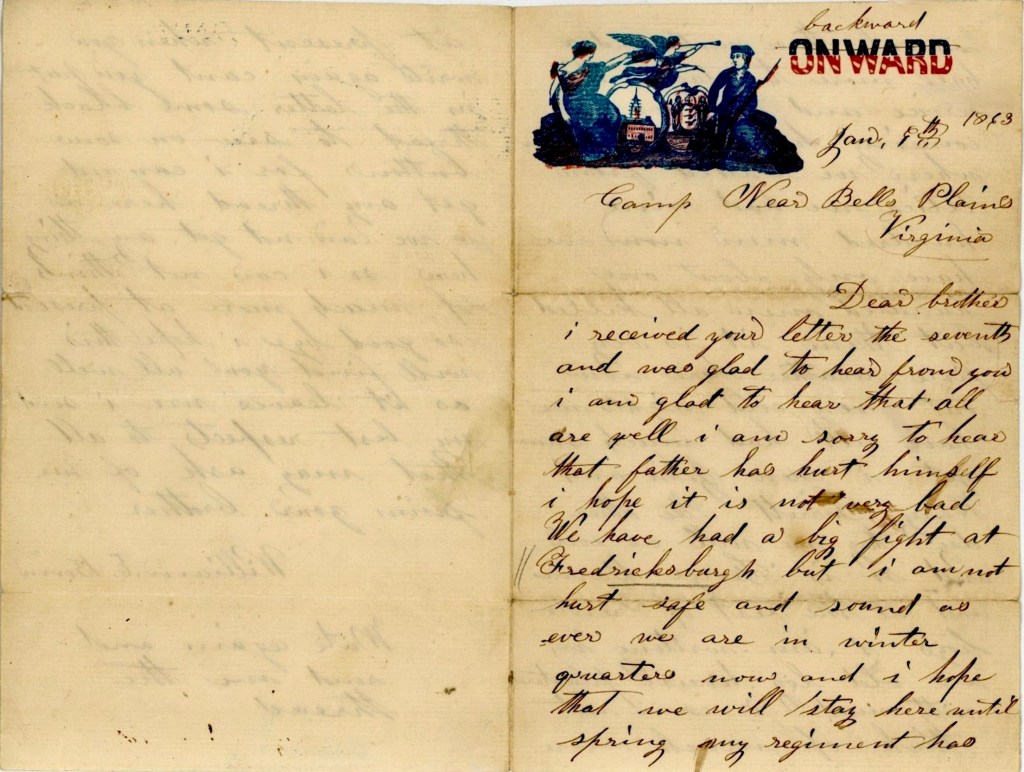
Patriotic stationery William used. Following the setback at Fredericksburg, William crossed out the word “Onward” and wrote the word, “Backward.”
Camp near Belle Plain, Virginia January 9th 1863
Dear brother,
I received your letter the seventh and was glad to hear from you. I am glad to hear that all are well. I am sorry to hear that father has hurt himself. I hope it is not very bad.
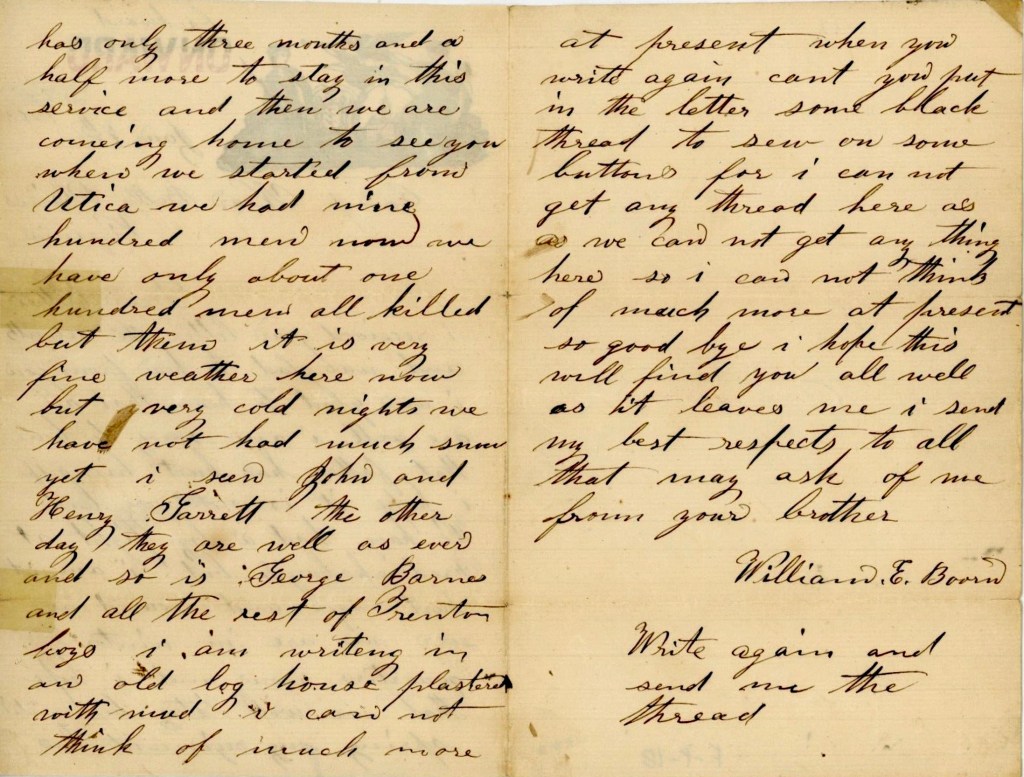
We have had a big fight at Fredericksburg but I am not hurt. Safe and sound as ever. We are in winter quarters now and I hope that we will stay here until spring. My regiment has only three months and a half more to stay in this service and then we are coming home to see you. When we started from Utica, we had nine hundred men. Now we have only about one hundred men—all killed but them.
It is very fine weather here now but very cold nights. We have not had much snow yet. I seen John and Henry Garrett 1 the other day. They are well as ever and all the rest of Trenton boys. I am writing in an old log house plastered with mud. I cannot think of much more at present.
When you write again, can’t you put in the letter some black thread to sew on some buttons for I cannot get any thread here as we cannot get anything here. So I cannot think of much more at present. So goodbye. I hope this will find you all well as it leaves me. I send my best respects to all that may ask of me. From your brother, –William E. Boorn
Write again and send me the thread.
1 I believe these boys were in Co. E, 97th New York Volunteers.
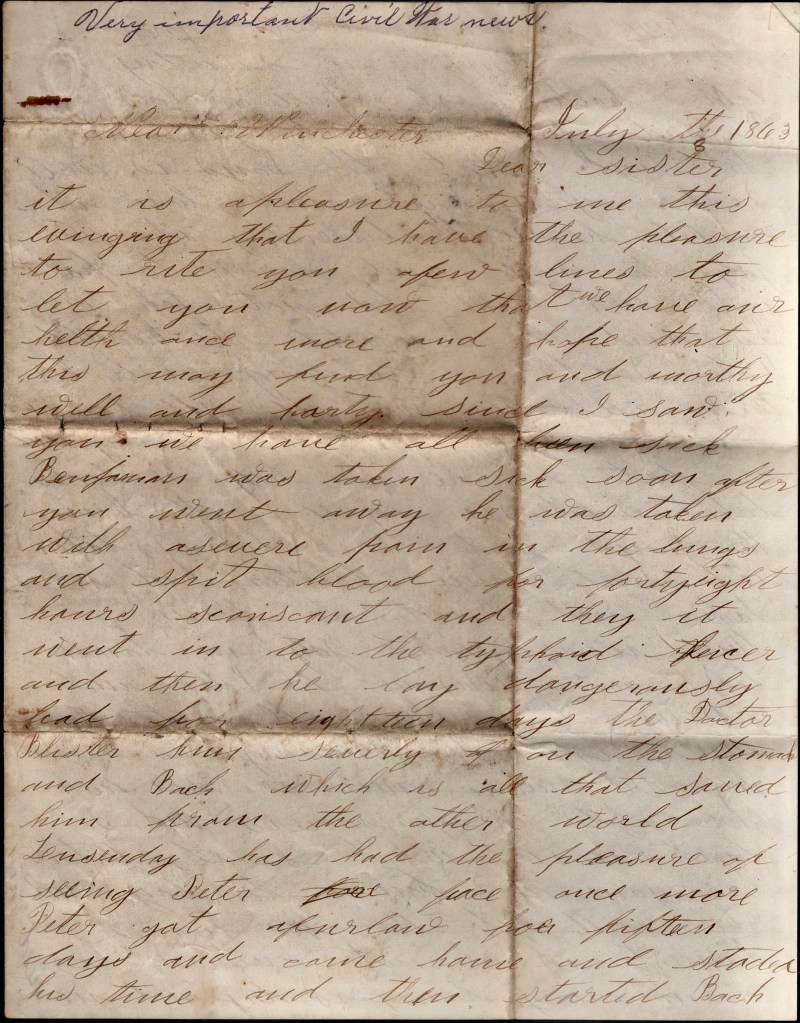
The following letter was written by 15 year-old Amanda A. Beasley (1848-1931), the daughter of James H. Beasley (1804-1854) and Hannah Cowgill (1811-Aft1880) of Winchester, Scott county, Illinois. She wrote the letter to her sister Nancy “Catherine” (Beasley) Record, the widow of Lawrence M. Record (1829-1862). Lawrence was the son of Rev. John A Record (1802-1858) and Lucy W. McManus (1809-1886) of Winchester, Scott county, Illinois. Lawrence was killed on 6 April 1862 at the Battle of Shiloh while serving in Co. H, 14th Illinois Infantry. Catherine and Lawrence were living in Macoupin county, Illinois, when he enlisted; they had one child named Martha (b. 27 May 1856).
In her letter, Amanda refers to several siblings. She speaks of the severe illness of her brother Benjamin F. Beasley (1846-1918). She mentions her brother Richard Beasley (b. 1844). She speaks of her sister Lucinda Ellen (Beasley) Obermyer (1938-1927) having an opportunity to see her husband Peter Obermeyer (1834-1921) who served in Co. D, 129th Illinois Infantry, home on a 15 -day furlough. She also had two brothers (the “Boys”) who also served in Co. D, 129th Illinois Infantry; they were James Beasley (1840-1903) and George A. Beasley (1843-1924).
Transcription
Near Winchester [Scott county, Illinois] July 8th 1863
Dear Sister,
It is a pleasure to me this evening that I have the pleasure to write you a few lines to let you know that we have our health and more and hope that this may find you and Worthy well and hearty. Since I saw you we have all been sick. Benjamin was taken sick soon after you went away. He was taken with a severe pain in the lungs and spit blood for forty-eight hours [ ] and then it went into the typhoid fever and then he lay dangerously bad for eighteen days. The doctor blister[ed] him severely on the stomach and back which is all that saved him from the other world.
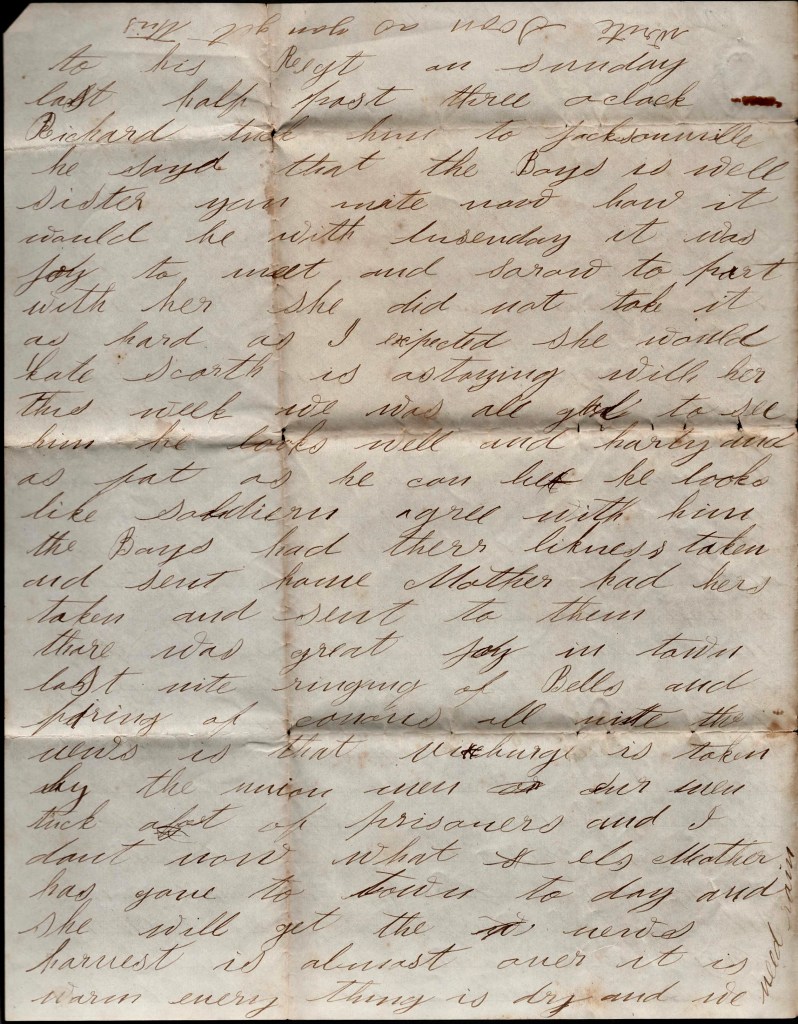
Lucinda has had the pleasure of seeing Peter’s face once more. Peter got a furlough for fifteen days and came home and stayed his time and then started back to his regiment on Sunday last [at] half past three o’clock. Richard took him to Jacksonville. He said that the Boys is well. Sister, you might know how it would be with Lucinda. It was joy to meet and sorrow to part with her. She did not take it as hard as I expected she would.
Kate Scorth is a staying with her this week. We was all glad to see him. He looks well and hearty and as fat as he can be. He looks like soldiering agrees with him. The Boys had their likeness taken and sent home. Mother had hers taken and sent to them.
There was great joy in town last night—ringing of bells and firing of cannons all night. The news is that Vicksburg is taken by the Union men. Our men took a lot of prisoners and I don’t know what else. Mother has gone to town today and she will get the news.
Harvest is almost over. It is warm. Everything is dry and we need rain.
Last Saturday, the Fourth of July passed off quite still in town. They had no celebration here but there was one at Exeter and one at Jacksonville and one at Glasgow. At Glasgow there was some fighting done. There was one man killed. His name I don’t know. 1
Well Catherine, I believe that there is a chance for young girls to marry yet for old Jane Martin 2 is to be married this evening at eight o’clock to a man by the name of Nathaniel Wilson from Glasgow. There has been several weddings went off ever since I wrote. Lately it looks like there is some men left behind yet.
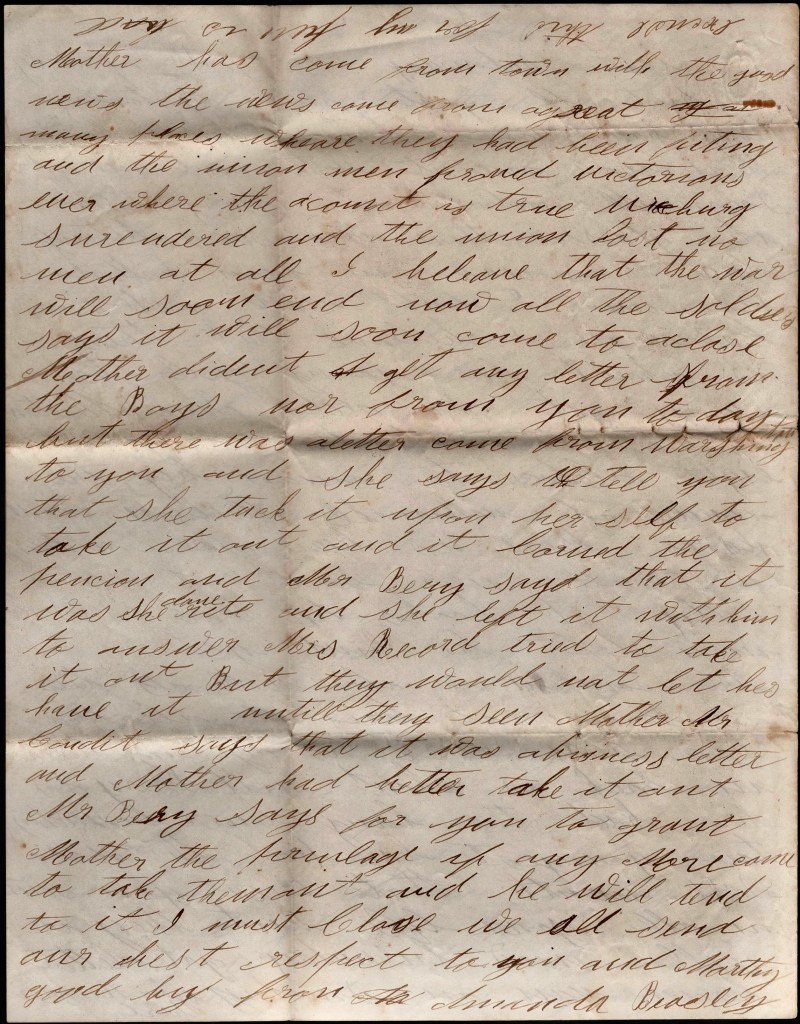
The connection is all well as far as I know at present. All that has been sick is a getting better. In fact, is about well. Becky has had the lung fever. Her two youngest have had the worst sore mouth that ever you saw in all your life but they are well now. Lucinda got a letter from you on Sunday when I was there.
Mother has come from town with the good news. The news came from a great many places where they had been fighting and the Union men proved victorious everywhere. The account is true—Vicksburg surrendered and the Union lost no men at all. I believe that the war will soon end now. All the soldiers say it will soon come to a close. Mother didn’t get any letter from the Boys nor from you today but there was a letter came from Washington to you and she says to tell you that she took it upon herself to take it out and it contained the pension and Mr. Berry said that it was she done right and she left it with him to answer. Mrs. [Lucy] Record tried to take it out but they would not let her have it until they seen Mother. Mr. Condit says that it was a business letter and Mother had better take it out. Mr. Berry says for you to grant Mother the privilege if anymore come to take the money and he will tend to it.
I must close. We all send our best respects to you and Martha. Goodbye. From Amanda Beasley
1 I could not find any information regarding this incident in Glasgow, Scott county, Illinois, on the 4th of July 1863. It may have been a conflict arising between a Unionist and a Copperhead (Peace Democrat).
2 Nancy “Jane” Martin (1836-1911) was the daughter of James & Nancy Martin of Scott county, Illinois. Jane was 26 years of age when she married in July 1863 in Scott county to Nathaniel Wilson. This was considered “old” by 19th Century standards. Her obituary claims she grew up in Alsey, Scott county, Illinois. Nathaniel died about 1890.
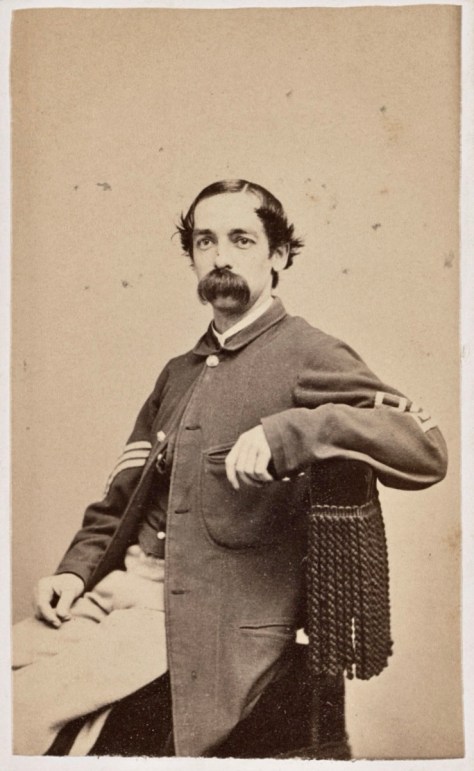
I could not find an image of Steve but here is Charles H. Haseltine who served as 1st Sergeant of Co. H, 22nd Massachusetts (Photo Sleuth)
The following letter was penciled by Stephen W. Fitts (1835-1903), the son of Daniel French Fitts (1805-1883) and Susan Fellows (1805-1888) of Haverhill, Essex county, Massachusetts. Steve enlisted on 8 October 1861 as a private in Co. H, 22nd Massachusetts Infantry. Also serving in the same company was his younger brother, Henry Thomas Fitts (1842-1919). Steve served with the regiment until 13 December 1862 when he was severely wounded at the Battle of Fredericksburg and was discharged three months later on 24 March 1863.
Steve was married in 1859 to Mary Abbie Chick and was working as a “shoe cutter” in Haverhill just prior to his enlistment. When he died in 1903, the Boston Post published the following notice: “Mr. Fitts, who was a Haverhill boy, and who had enlisted at the age of 27, who served throughout the hardest fighting of the war, taking part at Gettsyburg, Fair Oakes, Gaines Mills, the Wilderness, Antietam, and Frederickton, was wounded and discharged for disability March 1, 1863.” Knowledgeable readers will recognize that Gettysburg and the Wilderness were fought after Steve was discharged from the service.
Transcription
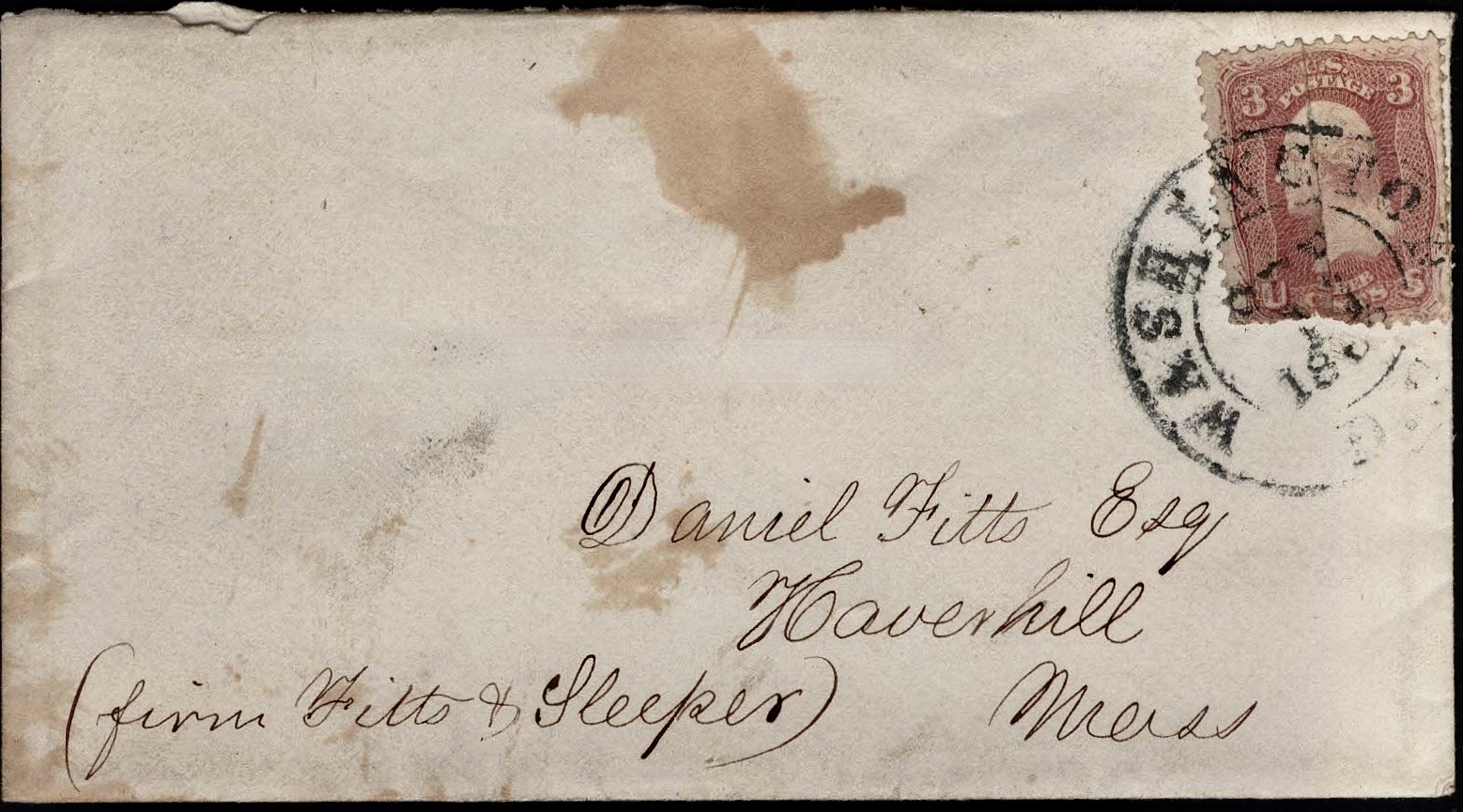
Addressed to Daniel Fitts, Esq., Haverhill, Massachusetts
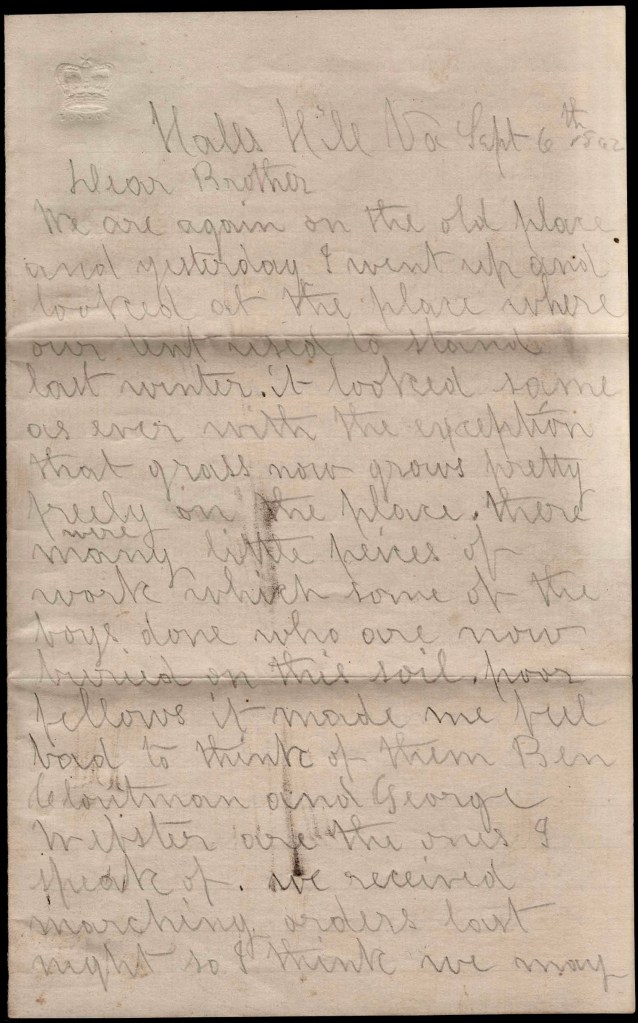
Hall’s Hill, Virginia September 6th 1862
Dear Brother,
We are again on the old place and yesterday I went up and looked at the place where our tent used to stand last winter. It looked same as ever with the exception that grass now grows pretty freely on the place. There were many little pieces of work whch some of the boys done who are now buried on this soil. Poor fellows. It made me feel bad to think of them. Ben Cloutman 1 and George Webster 2 are the ones I speak of.
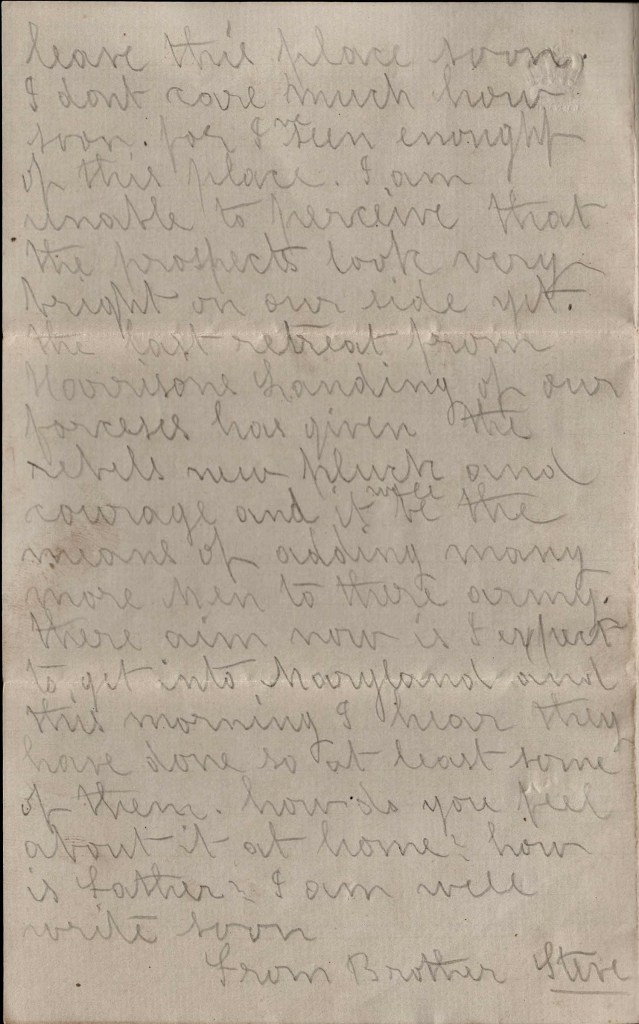
We received marching orders last night so I think we may leave this place soon. I don’t care much how soon for I seen enough of this place. I am unable to perceive that the prospects look very bright on our side yet. The last retreat from Harrison’s Landing of our forces have given the rebels new pluck and courage and it will be the means of adding many more men to their army. Their aim now is I expect to get into Maryland and this morning I hear they have done so—at least some of them. How do you feel about it at home? How is father? I am well. Write soon. From brother Steve.
1 Corp. Benjamin Cloutman died of disease on 26 July 1862.
2 George Lewis Webster (1842-1862) was killed in the Battle of Gaines’ Mill, Virginia, on 27 June 1862.
The following letter was written by James S. Simmons (1823-1870) who first enlisted in late September 1862 as a private in Co. C, 43rd Massachusetts Infantry. He mustered out of that regiment in late July 1863 and later mustered into the 16th Independent Battery, Massachusetts Light Artillery.
The Battery moved from Washington D. C. to Fairfax Court House, Virginia, on 6 December 1864 and was on duty there and at Vienna till 17 June 1865 when they were ordered to Massachusetts and mustered out 13 July 1865. They never saw any active combat.
James wrote the letter to his brother, George C. Simmons (1824-1889) of Stoughton, Norfolk county, Massachusetts where he worked in a boot manufactory.
Transcription
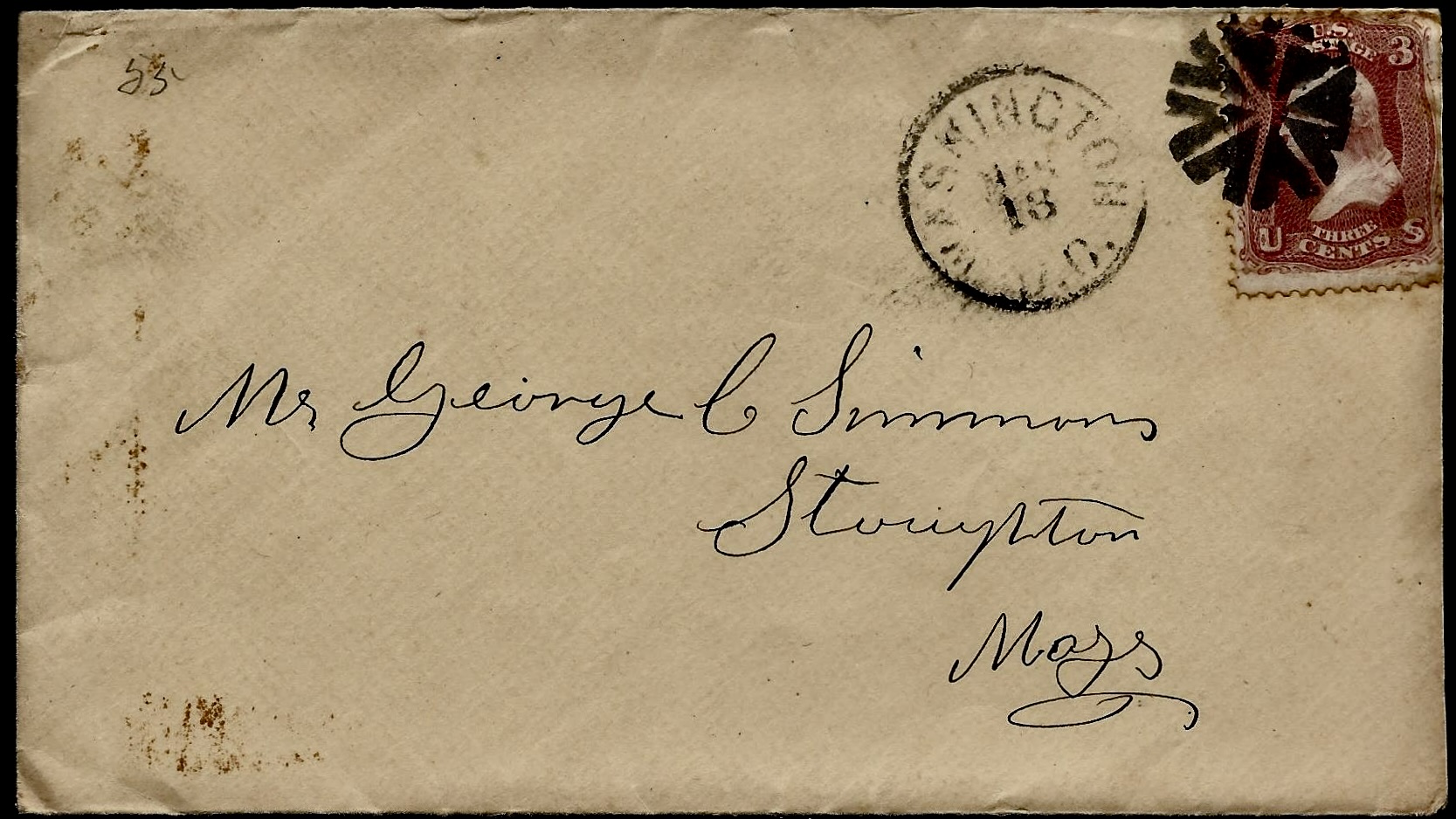
Addressed to Mr. George C. Simmons, Stoughton, Massachusetts
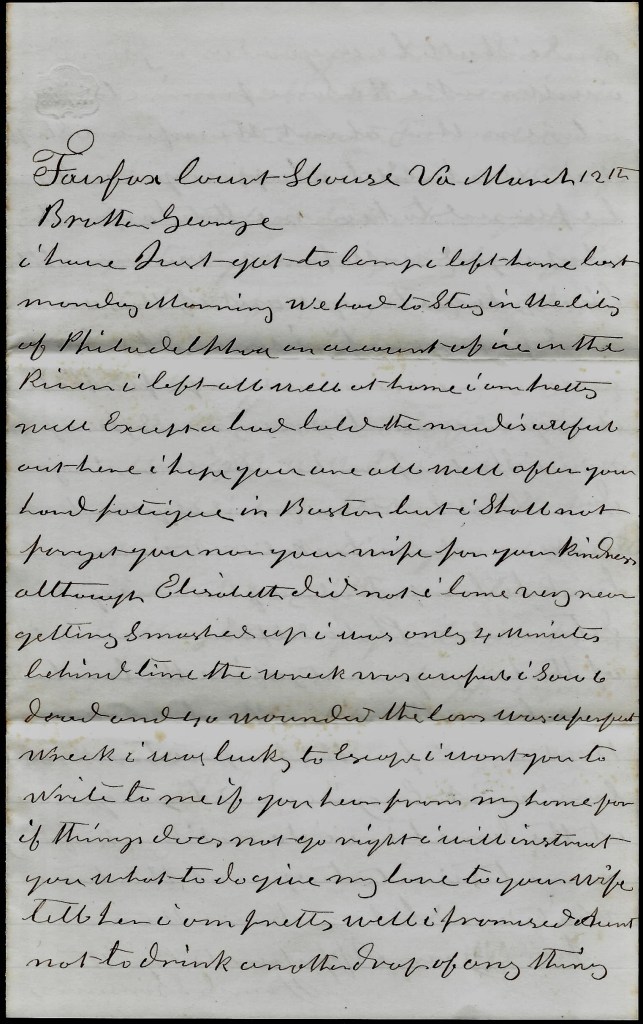
Fairfax Court House, Va. March 25, [1865]
Brother George,
I have just got to camp. I left home last Monday morning. We had to stay in the City of Philadelphia on account of ice in the river. I left all well at home. I am pretty well except a bad cold. The mud is awful out here. I hope you are all well after your hard fatigue in Boston but I shall not forget you nor your wife for your kindness although Elizabeth did not. I come very near getting smashed up. I was only 4 minutes behind time. The wreck was awful. I saw six dead and 40 wounded. The loss was a perfect wreck. I was lucky to escape.
I want you to write me if you hear from my home for if things does not go right, I will instruct you what to do. Give my love to your wife. Tell her I am pretty well. I promised Aunt not to drink another drop of anything and I shall be as good as my word. I will make the same promise to you. I love nothing about the infernal stuff—it is all a habit. So I suppose you will be pleased to hear me state to you this.
I hope God will prosper our arms this spring so we can get out of this army and rejoin our families and kindred once more. We must hope for the best. It is good weather but very muddy here just now. I started from here just now to go down street but was afraid of getting lost in tyhe mud so I backed out.
I arrived back to camp Friday afternoon. I got detained in Philadelphia on account of the large quantity of ice. The cars could not cross the river. They cross on a boat made for the purpose. Tracks are laid on it. Engine and train goes over at the same time. 1
I do not think of any more to write to you at this time. Write and let me know the news. From your affectionate brother, — James S. Simmons
The boys were all glad to see me back. They came and shook hands with me. They had two horses die with Farcy 2 while I was gone. They had no one to doctor them if they had all been sick. I have got to get things straightened up. They can’t get a man to look after everything as I do. The Captain is glad to see me in my old place, I tell you. He is very friendly to me and sociable. I do just as I please. It is alright with him what I do. He asks me about the stable and the horses my opinion. It is all right what I tell him. That’s what no other man can do in the Battery. If you could be i nmy house and see my big fire, you would laugh, it looks bully I tell you. Well, I must stop so goodnight. — J. S. S.
1 Philadelphia relied on ferries, including those operated by companies like the Camden and Atlantic (C&A) Railroad and the Pennsylvania Railroad (PRR), to transport train cars and passengers across the Delaware River between Philadelphia and Camden, as no bridge crossed the width of the river until 1926.
2 The horse disease sometimes called “farcy” is actually glanders. Its skin form is known as farcy. It’s a serious, contagious, and often fatal disease caused by the bacterium Burkholderia mallei.
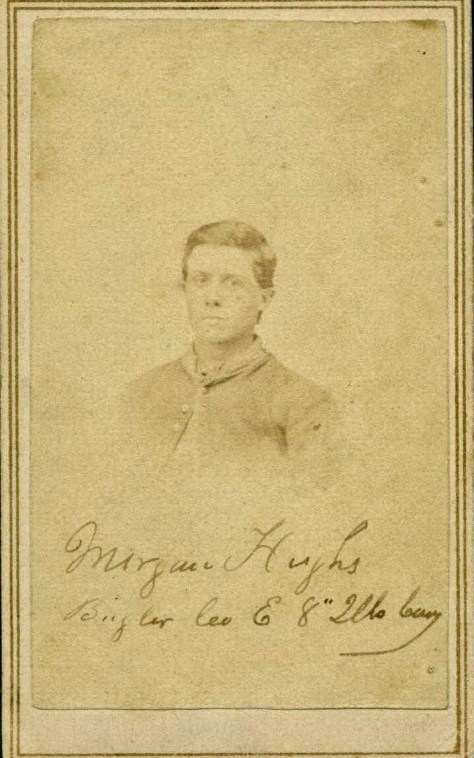
Morgan Hughes, Bugler, Co. E, 8th Illinois Cavalry
Morgan Hughes enlisted in Co. E of the 8th Illinois Cavalry on September 18th, 1861 in Saint Charles, Illinois at Camp Kane. Towards the end of his original three year enlistment, he reenlisted as a veteran. The official records show him mustering out of service on July 17th, 1865 as a bugler in Chicago, Illinois.
Muster rolls show him as being the bugler of Co. E at the time of the battle of Gettysburg. The battle was started by Lt. Marcellus Jones of Co. E, who fired the first shot from Levi Shaffer’s carbine and gave the command to open fire to the rest of the boys of Co. E. As bugler Morgan would have been the company’s main means of communication. One source suggests that Morgan was standing next to or near Lt. Jones when he fired the first shot of the battle.
The Illinois 8th Cavalry was attached to General Buford’s Corps. They were the first union troops to enter Gettysburg, and the first to fire on the Confederate forces early on July 1, 1863. Buford’s Corps held off the Confederate troops until reinforcements arrived on the evening of the 1st.
Morgan’s obituary appeared in the Aurora Beacon News on Wednesday, November 1, 1916:
Death Summons Morgan Hughes—Prominent Civil War Veteran and Grand Army Officer Passes away Late Yesterday
Was for 22 Years Officer of the Day for Post 20 G.A.R. -Funeral Friday Afternoon
Morgan Hughes, aged 73 years, veteran of the civil war, and one of the best known men of Aurora, died yesterday afternoon at 1 o’clock at his home. 438 North Avenue, after a lingering illness of nearly three years.
Mr. Hughes was born at Schuylkill Haven, Pa., July 25, 1843, and came to Illinois in 1856, first settling on a farm near Naperville. Later, at the close of the civil war, in 1866, through which he had served, he moved into this city. He enlisted at the outbreak of the war at age of 19 years and served four years in Company E, Eighth Illinois Cavalry as Bugler. He was past commander of G.A.R. post no. 20, of Aurora and was always active in the social and other activities of that organization from the time it was formed. He was Officer of the Day of the post for 22 years. For many years he had charge of a squad of the old veterans which visited the different schools each Decoration Day. He had been connected with the Western United Gas & Electric Co. for the past 25 years in the capacity of salesman.
Mr. Hughes leaves to mourn his death, his wife Lavinia; three children, Frank A. Hughes, Omaha, Neb., Bert Hughes, Detroit, Mich., and Mrs. George Shields of Aurora; three brothers, Joseph, Bushrod and Martin, all of Naperville; two sisters, Mrs. Sarah Enck and Mrs. Hartzell of Naperville; four grandchildren, Agatha and Virginia Adams, Corp. Russell G. Hughes who is at the border at the present time, and Aldine Hughes of Detroit.
The funeral Services will be held from the Grand Army hall Friday afternoon at 3 o’clock. Full military Grand Army burial services will be held under the charge of Comrade Cronk. The Rev. R.H. Claxon of the First Baptist church will officiate. Short services at the home, 438 North Avenue will precede the services at the G.A.R. hall, and will be strictly private, for family only. Interment will be in Montgomery Cemetery. [Military History Online]
The following letter, written in December 1890, to his comrade Bent Kelley, records some remembrances of their time together in the 8th Illinois Cavalry during the Civil War.
Bugler Morgan Hughe’s bugle and tintype on display in the Gettysburg Cyclorama & Museum(on loan from the Mary Jane Fraley Family)
Transcription
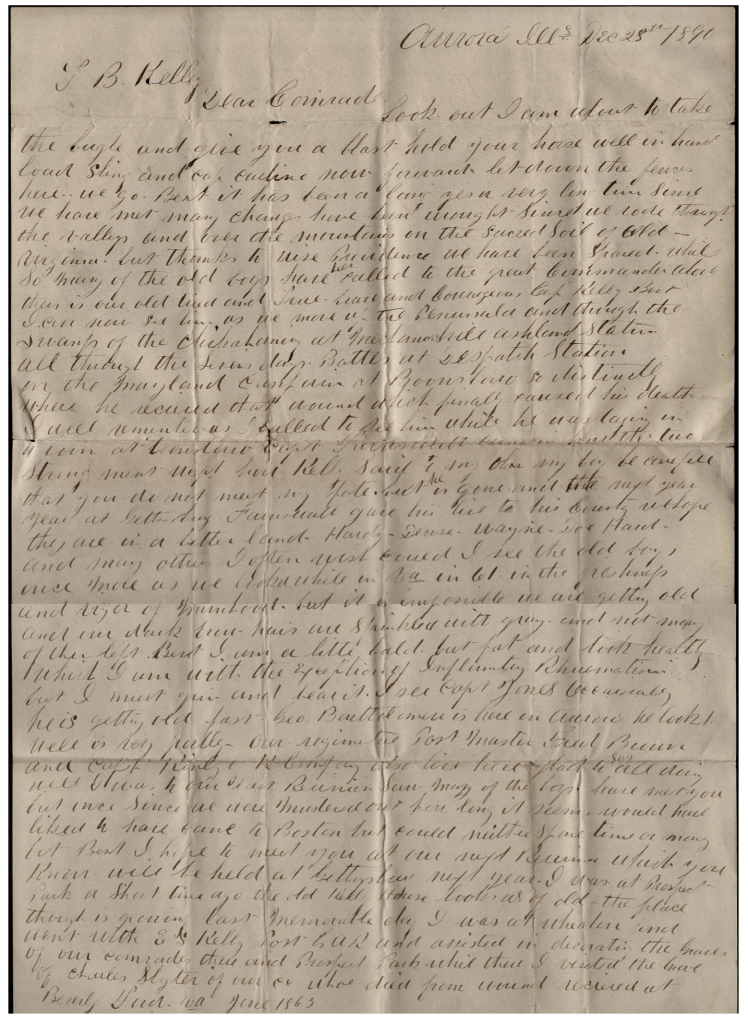
Aurora, Illinois December 28th 1890
T. B. Kelley Dear Comrade
Look out! I am about to take the bugle and give you a blast. Hold your horse well in hand—load, sling, and cap carbine. Now forward, let down the fence—here we go! Bent, it has been a long—yes, a very long time since we have met. Many changes have been wrought since we rode through the valleys and over the mountains on the Sacred Soil of Old Virginia. But thanks to Wise Providence, we have been spared while so many of the old boys have been called to the great Commander above. There is our old, tired and true, brave and courageous Capt. [Elisha S.] Kelley. Bent, I can now see him as we move up the Peninsula and through the swamp of the Chickahominy at Mechanicsville, Ashland Station, all through the Seven Days Battles, at Despatch Station, on the Maryland Campaign at Boonsboro, so distinctly where he received that wound which finally caused his death.
I well remember I called to see him while he was laying in a room at Boonsboro. Capt. [Elon J.] Farnsworth came in and the two strong men wept but Kelley said, “Oh my boy, be careful that you do not meet my fate.” But he is gone and the next year at Gettysburg, Farnsworth gave his life to his country. We hope they are in a better land. Hardy, Deuse, Wayne, Doc, Hard and many others. I often wish I could see the old boys once more as we looked while in Virginia in ’61 in the freshness and vigor of manhood. But it is impossible. We are getting old and our dark brow hairs are sprinkled with gray and not many of them left. Bent, I am a little bald, but fat and look healthy which I am with the exception of inflammatory rheumatism. But I must grin and bear it.
I see Capt. [Marcellus] Jones occasionally. He is getting old fast. George Bartholomew is here in Aurora. He looks well. Is very portly. Our regimental post master Fred Brown and Capt. [John A.] Kinley of K Company also live here, glad to say all doing well. I was to our last reunion. Saw many of the boys. Have met you but once since we were mustered out. How long it seems. Would have like to have come to Boston but could neither spare tie or money. But Bent, I hope to meet you at our next reunion which you know will be held at Gettysburg next year. I was at Prospect Park a short time ago. The Old Kelley House looks as of old. The place though is growing. Last Memorial Day I was at Wheaton and went with E. S. Kelley Post GAR and assisted in decorating the graves of our comrades there and Prospect Park. While there I visited the graves of Charles Slyter of our company who died from wound received at Beverly Ford, Va. June 1863.
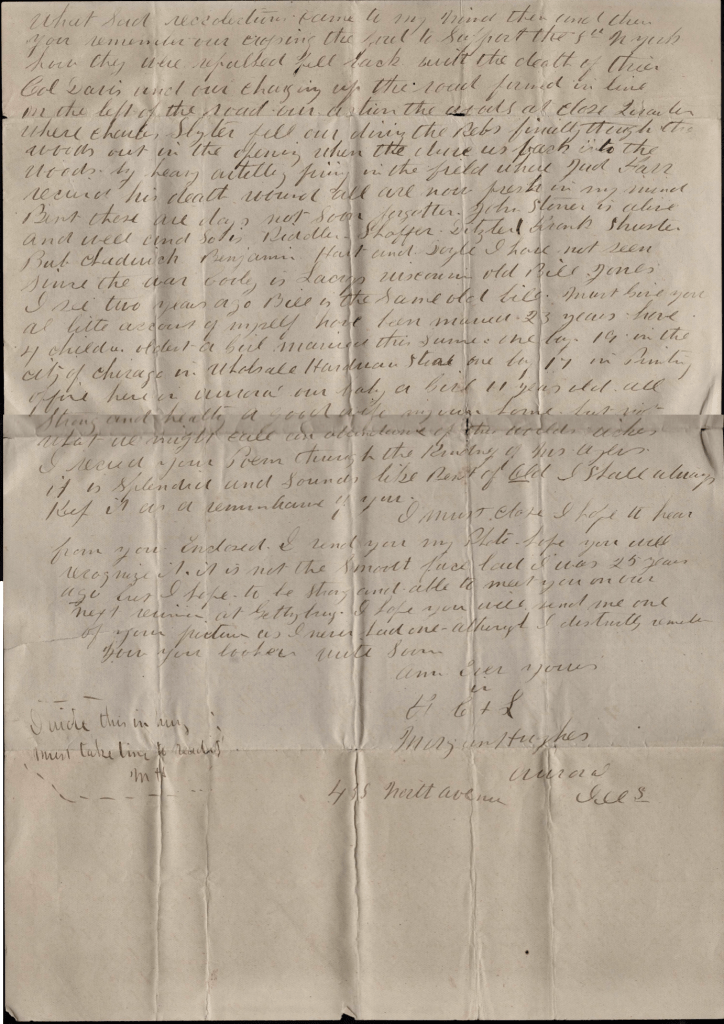
What sad recollections came to my mind then, and then you remember our crossing the ford to support the 8th New York—how they were repulsed, fell back with the death of their Col. Davis, and our charging up the road, formed in line on the left of the road, our action in the woods at close quarters where Charles Slyter fell, our driving the Rebs finally through the woods, out in the opening where they drove us back to the woods by heavy artillery, firing in the field where Jud Farr received his death wound. All are now fresh in my mind.
Bent, these are days not soon forgotten. John Stoner is alive and well and so is Riddle, Shaffer, Ditzler. Frank Shurte, Bub Chadwick, Bejamin Hart and Doyle I have not seen since the war. Cooley is in Lacross, Wisconsin. Old Bill Jones I see two years ago. Bill is the same old Bill.
Must give you a little account of myself. Have been married 23 years, have 4 children, oldest a girl, married this summer. One boy 19 in the City of Chicago in wholesale hardware store, one boy 17 in Printing Office here in Aurora, Our baby, a girl, 11 years old. All strong and healthy. A good wife. My own home but not what we might call an abundance of te world’s riches.
I received your poem through the kindness of Mr. Ayles. It is splendid and sounds like Bent of old. I shall always keep it as a remembrance of you. I must close. I hope to jear from you. Enclosed I send you my photo. Hope you will recognize it. It is not the smooth face lad I was 25 years ago but I hope to be strong and able to meet you on our next reuion at Gettysburg. I hope you will send me one of your pictures. I never had one although I distinctly remember you your looks. Write soon. I am as ever, F C & L, — Morgan Hughes, Aurora, Illinois
“Private Morgan Hughes of Jones’ Co. E, 8th Illinois Cavalry, started the debate in an 1891 submission just a week prior to the dedication of the regiment’s Gettysburg monument. After reading a previous article by a member of the 7th Wisconsin Infantry stating that the ‘Iron Brigade’ of the Army of the Potomac opened the Gettysburg battle, Hughes determined to set the record straight. Lest Buford’s cavalry’s role prior to the general infantry fighting on the first day be forgotten, Hughes recounted his regiment’s arrival at Gettysburg on June 30, and his posting at Jones’ reserve headquarters at Herr’s Tavern. Riding forward with Jones to the picket post at Knoxlyn Ridge, Hughes watched as Jones ‘took a carbine from one of the boys’ and fired at the advancing Confederates. ‘The opening of the battle of Gettysburg,’ Hughes concluded, ‘belongs to the 8th Ill. Cav.’”
Capt. Thomas Rhodes Duval commanded Co. D, 62nd Georgia Cavalry. His sword and jacket are in the New Orleans Confederate Museum.
The following poignant letter was written by John Howard Black (1846-1864), the son of Gabriel Fitzgerald Black, Sr. (1806-1879) and Susan Howard (1818-1874) of Yadkin county, North Carolina. John served in the Confederate army as a member of Co. D, 62nd Georgia Cavalry which was transferred to the 8th Georgia Cavalry at about the time this letter was penciled. John’s letter describes the death and burial of his older brother, 19 year-old Marmaduke (“Duke”) William Black (1844-1864) who served in the same company.
In less than three months, John also died of disease in a Richmond Hospital on 6 October 1864.
Transcription
Addressed to Mr. Gabriel Black
July 14, 1864
Dear Father and Mother, Brothers and Sisters,
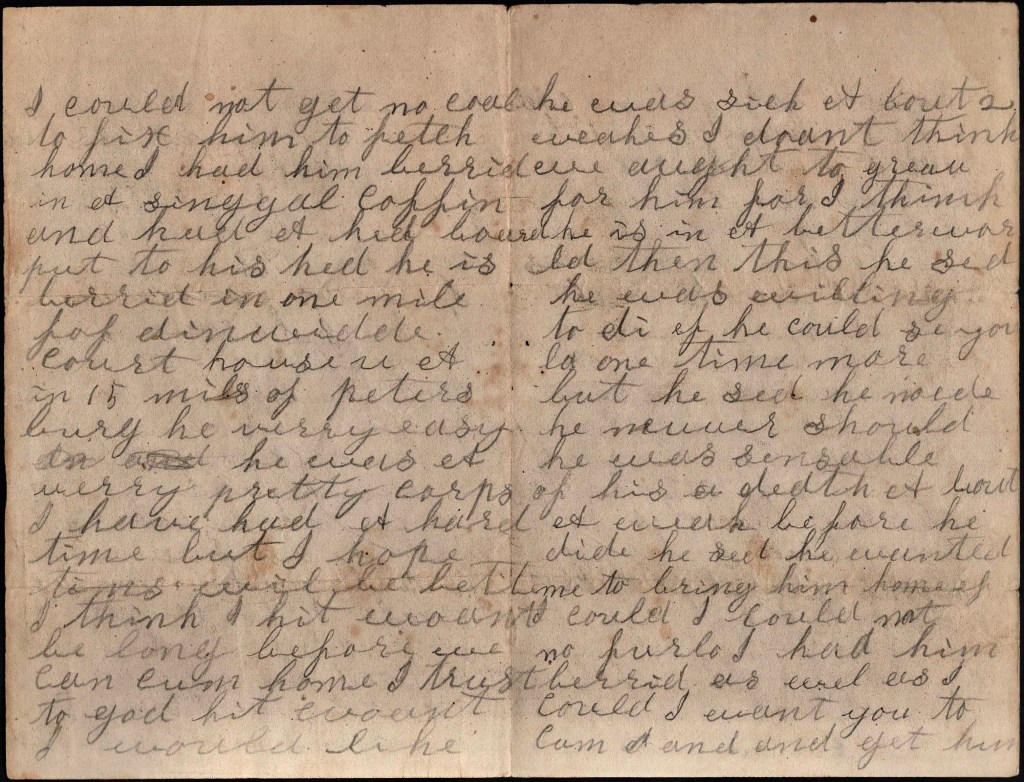
I take my pen in hand to let you know I have not forgot you yet. I have wrote to you twice since Duke died. I am very sorry too we had to part with him but we can’t help it. He was attended as well as if he had been at home. I was with him all the time. He was 1 mile of Dinwiddie Court House at John H. Young’s. He died the 9th. I could not get no [char]coal 1 to fix him to fetch home. I had him buried in a single coffin and had a head board put to his head. He is buried in one mile of Dinwiddie Court House and in 15 miles of Petersburg. He [died] very easy. He was a very pretty corpse. I have had a hard time but I hope times will be better. I think it won’t be long before we can come home. I trust to God it won’t.
He was sick about two weeks. I don’t think we ought to grieve for him for I think he is in a better world than this. He said he was willing to die if he could see you all one time more but he said he knowed he never should. He was sensible of his death. About a week before he died, he said he wanted me to bring him home if I could. I could not—no furlough. I had him buried as well as I could. I want you to come and get him. I would like to hear from you. I would like to see you all and hope I will soon. I think this cruel war will close soon. So I must close, Write soon. Direct to Petersburg, Va. in care of Captain [Thomas Rhodes] Duval, Co. D, 62nd Georgia [Cavalry]
So I remain your loving son until death, — John
1 Charcoal and alcohol were occasionally used to forestall decay, particularly in the heat of the summer when ice was not available.
I could not find an image of James but here is one of Franklin Hoobler of Co. G, 129th Illinois. Franklin was killed by an accidental gunshot in April 1863. (Photo Sleuth)
The following letter was written by James Beasley (1840-1903), the son of James H. Beasley (1804-1854) and Hannah Cowgill (1811-Aft1880) of Winchester, Scott county, Illinois.
James enlisted on 13 August 1862 in Co. D, 129th Illinois Infantry. At the time of his enlistment, he was described as a 5 foot 6 inch tall, dark-haired, hazel-eyed, single farmer. He mustered into the regiment on 8 September 1862 and mustered out on 8 June 1865 at Washington D. C.
Also serving in the same company with James was his younger brother, George A. Beasley (1843-1924). He wrote the letter to his younger sister, Amanda A. Beasley (1848-1931). He refers to his younger brothers Dick (b. 1844) and Ben (b. 1846).
Transcription
Near the Chattahoochie River September 12, 1864
Kind sister,
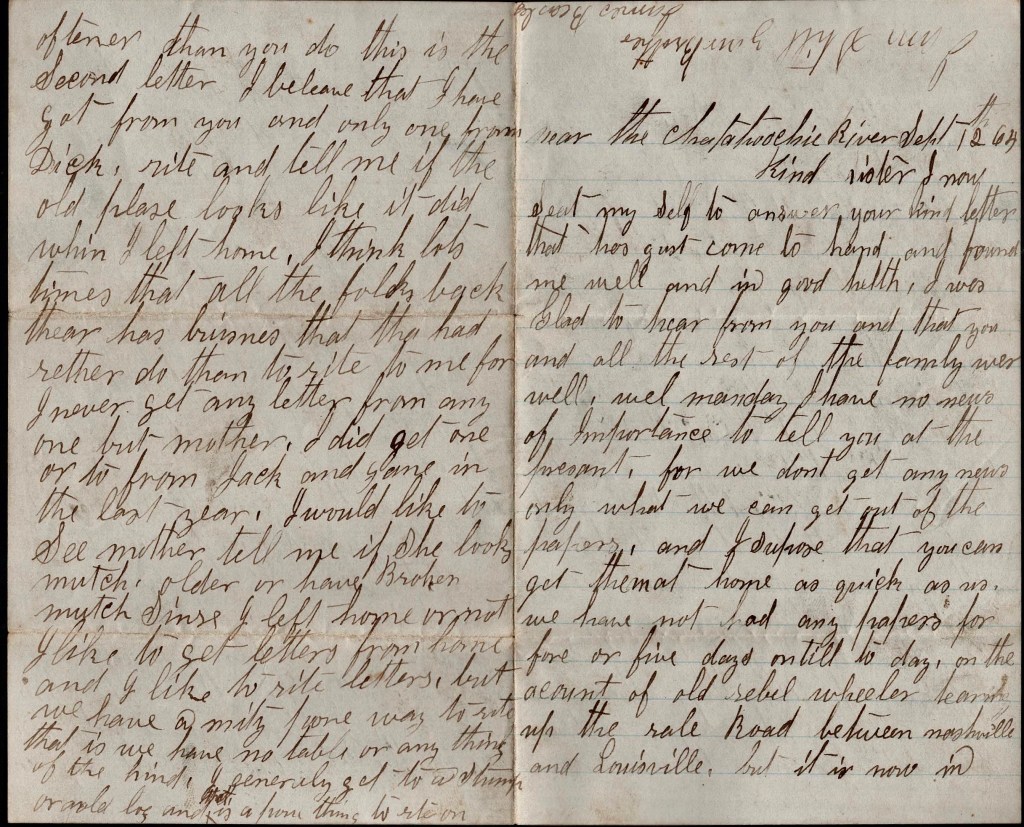
I now seat myself to answer your kind letter that has just come to hand and found me well and in good health. I was glad to hear from you and that you and all the rest of the family were well. Well, Mandy, I have no news of importance to tell you at the present for we don’t get any news—only what we can get out of the papers, and I suppose that you can get them at home as quick as us. We have not had any papers for four or five days until today on the account of Old Rebel Wheeler tearing up the railroad between Nashville and Louisville. But it is now in operation again so we will get our mail more regular.
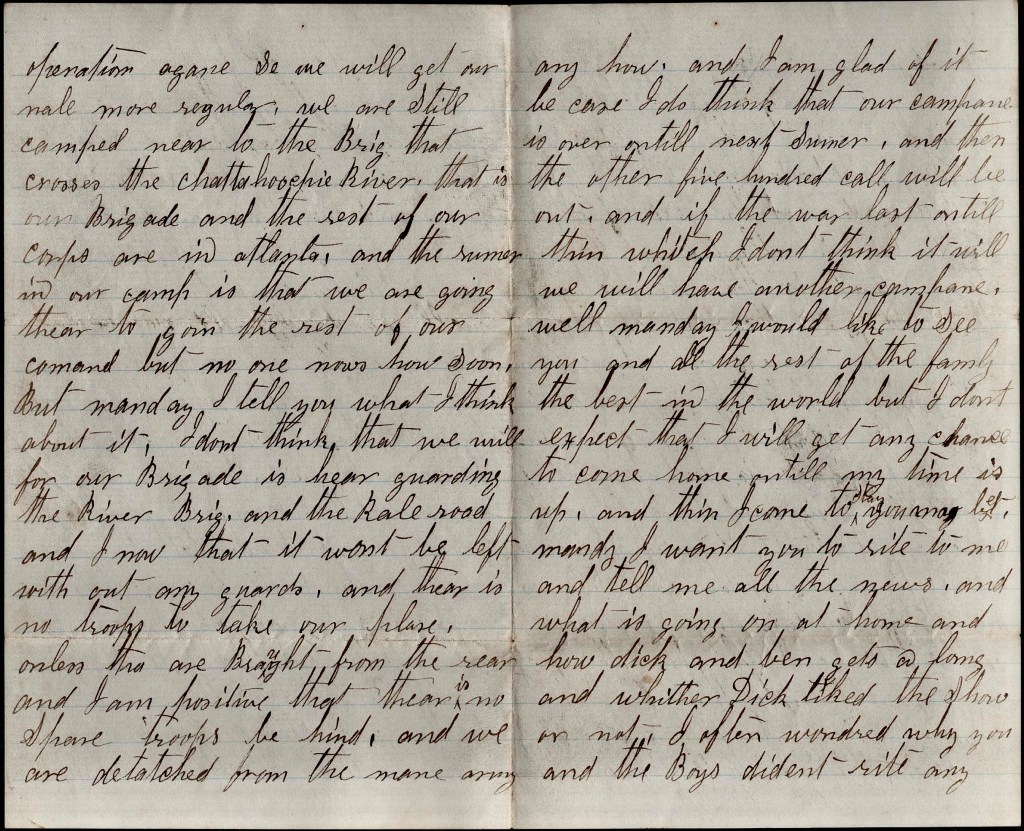
We are still camped near to the bridge that crosses the Chattahoochie river—that is, our Brigade—and the rest of our Corps are in Atlanta. And the rumor in our camp is that we are going there to join the rest of our command but no one knows how soon. But Mandy, I tell you what I think about it, I don’t think that we will for our Brigade is here guarding the river bridge and the railroad and I know that it won’t be left without any guards. And there is no troops to take our place. unless they are brought from the rear and I am positive that there is no spare stroops behind. And we are detached from the main army anyhow and I am glad of it because I do think that our company is over until next summer and then the other five hundred call will be out. And if the war lasts until then—which I don’t think it will—we will have another campaign.
Well, Mandy, I would like to see you and all the rest of the family the best in the world but I don’t expect that I will ever get a chance to come home until my time is up. And then I come to stay, you may bet. Mandy, I want you to write me and tell me all the news and what is going on at home and how Dick and Ben gets along and whether Dick liked the show or not. I often wondered why you and the Boys didn’t write any oftener than you do. This is the second letter, I believe, that I have got from you and only one from Dick. Write and tell me if the old place looks like it did when I left home. I think lots times that all the folks back there has business that they had rather do than to write to me for I never get any letter from anyone but Mother. I did get one or two from Jack and Jane in the last year. I would like to see Mother. Tell me if she looks much older or have broken much since I left home or not.
I like to get letters from home and I like to write letters, but we have a mighty poor way to write—that is, we have no table or anything of the kind. I generally get to a stump or old log and it is a poor thing to write on. I am still your brother, — James Beasley
I could not find an image of George but here is one of William Wesley Propst of Co. K, 129th Illinois Infantry. (Craig Colandro Collection)
The following letters were written by George A. Beasley (1843-1924), the son of James H. Beasley (1804-1854) and Hannah Cowgill (1811-Aft1880) of Winchester, Scott county, Illinois. George was 19 years old when he enlisted in Co. D, 129th Illinois Infantry. At the time of his enlistment, he was described as a 5 foot 5 inch tall, dark-haired, hazel-eyed, single farmer. He mustered into the regiment on 8 September 1862 at Pontiac and mustered out on 8 June 1865 at Washington D. C.
The third letter suggests that some time between his enlistment and March 1864, George was married to Mary Elizabeth Long. The couple were divorced in 1878.
Also serving in the same company with George was his older brother, James Beasley (1840-1903).
Letter 1
Nashville, Tennessee February 3, 1863
Kind and beloved sister,
It is the will of God that I am permitted to write you a few lines. The letter you wrote last came to hand the other day and found us all well. It was received with joy by me. I was truly glad to hear that you had not forgotten me but I was sorry to hear that you had all been sick. I hope by the time you get those few lines they may find the health of the family good.
Sister, you wrote as if you thought I had forgotten you but you need not cherish any such idea. I ofttimes think of you when the camp lights is blown out. This is a beautiful day. The sun shines brightly. The air is mild and pleasant but there is considerable stir in camp. We have orders to march to Bridgeport, Alabama—the distance of one hundred and thirteen miles. The roads are very bad at present and it looks as if it will be a hard trip for us to travel.
Tell Mother that I have not had a letter from her for some time. I have wrote several letters to you since I left Gallatin which I have got no answer from. There is no telling when I will have the opportunity of writing to you again. If you please, write to me for you have a better way of writing than I have.
I will give you the prices of produce as follows. Eggs is worth thirty cents a dozen. Butter sixty cents per pound. Cheese thirty cents per pound. Chickens is worth 6 dollars a dozen. Fresh pork $10 a hundred. Beef the same. Corn is worth 60 cents per bushel. Oats the same. Board is worth 7 to 10 dollars a week. Money is plenty and trade is scarce. Wood sold here this winter as high as 24 dollars a cord and there was some families have had to do without wood. There was a woman told me she had to do without a fire in her house for two days before she could get wood to buy.
Sister, I must begin to make arrangements to march so I will close. Your loving brother, — George A. Beasley
Look over mistakes, bad spelling, &c. Direct your letters to this place and they will follow us.
Letter 2
South Tunnel, Tennessee March 24, 1863
Dear Sister,
I this morning take my pen in hand to answer your kind letter. It was dated March the 15th. Your letter found me in middling health. Sisterm you wanted me to tell you what the present cost I sent you. It cost me 450 cts. Sister, you are welcome to them and ten times as much more if you need it.
Sister, you wrote that you thought the war would come to a close. I think it will myself and then if I am alive, I will come home to see you. The Boys is in middling good health and good spirits. They say that they will be at home before long. The rebels is getting what they need at all points and I think they will have to sue for peace before long.
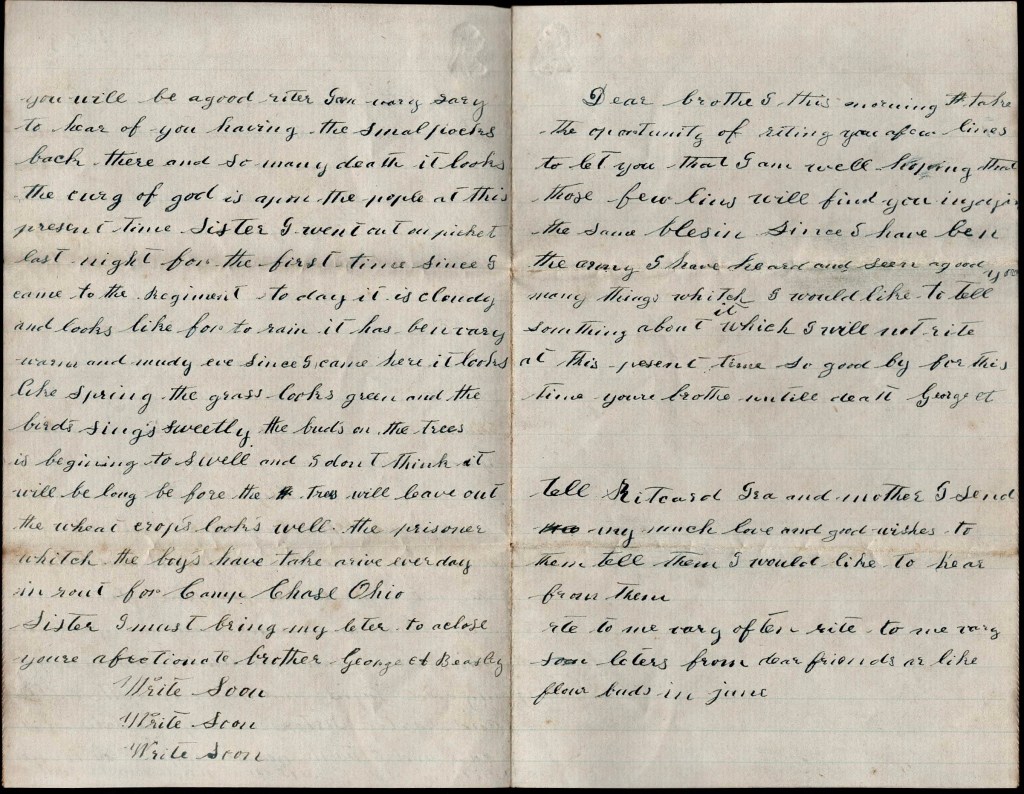
Sister, I have underwent a good many afflictions since I last saw you which I hope is for my good. James [Beasley] and Peter [Frame] is both well and hearty. Sister, I read your letter with ease and I think you have improved in your writing and if you keep on it, it won’t be long before you will be a good writer. I am very sorry to hear of you having the small pox back there and so many deaths. It looks [as if] the curse of God is upon the people at this present time.
Sister, I went out on picket last night for the first time since I came to the regiment. Today it is cloudy and looks like for to rain. It has been very warm and windy ever since I came here. It looks like spring. The grass looks green and the birds sings sweetly. The buds on the trees is beginning to swell and I don’t think it will be long before the trees will leaf out. The wheat crops look well. The prisoners which the Boys have taken arrive every day in route for Camp Chase, Ohio.
Sister, I must bring my letter to a close. Your affectionate brother, — George A. Beasley
Write soon. Write soon. Write soon.
Dear brother, this morning I take the opportunity of writing you a few lines to let you know that I am well, hoping these few lines will find you enjoying the same blessing. Since I have been away, I have heard and seen a good many things which I would like to tell you something about it which I will not write at this present time. So goodbye for this time. Your brother until death. — George
Tell Richard Gea and Mother I send my much love and good wushes to them. Tell them I would like to hear from them. Write to me very often. Write to me very son. Letters from dear friends are like flower buds in June.
Letter 3
Nashville, Tennessee March 11th 1862 [should be 1864]
Kind and loving sister,
It is with the greatest pleasure I seat myself to answer your kind and loving letter which came to hand a few days ago. It was gladly received with joy by me. Sister, I would like to tell [you] that I was well but I cannot. There is some disease like the [ ]. This has been very hard on me. We have an attentive physician to attend us and are in a good hospital which many a poor soldier has not. Therefore, I think I have no room to complain. It is true my bodily health is not good, but that is nothing strange for me. It looks like I have been afflicted so much that it comes natural to me for to be so. Therefore, I am contented with my lot. This is the second time I have been up since I have been here.
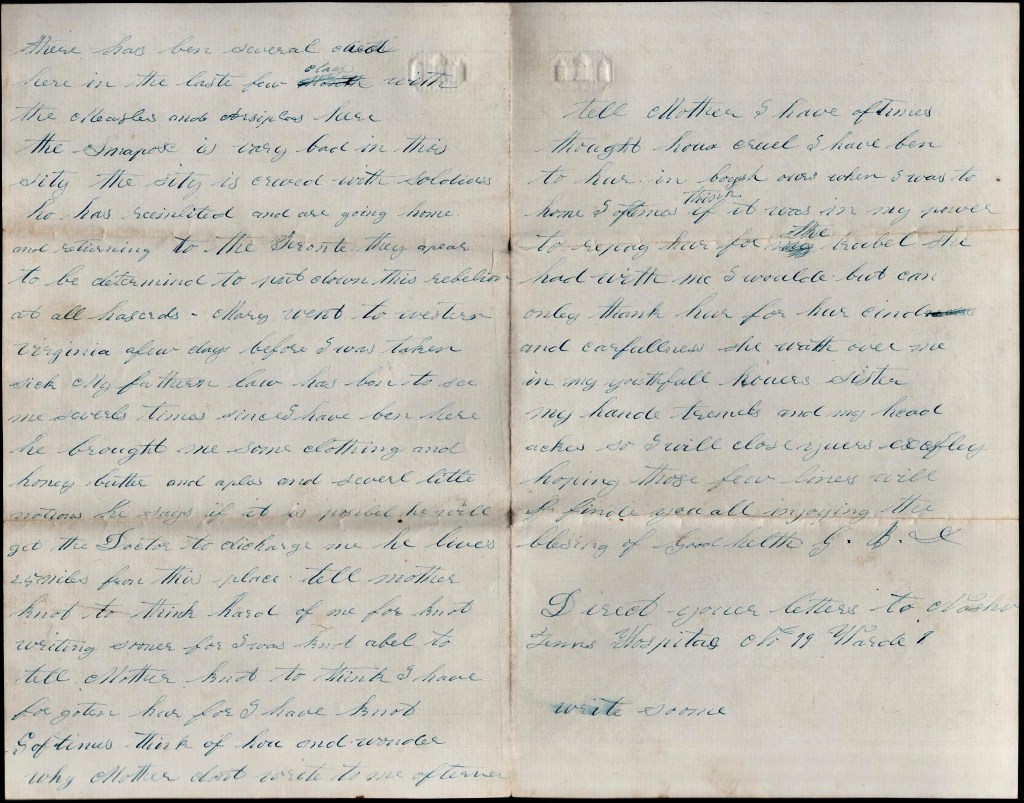
Our regiment left some time last month. Jonas and Peter was both well the last time I saw them. There has been several died here in the last few days with the measles and erysipelas here. The smallpox is very bad in this city. The city is crowded with soldiers who has reenlisted and are going home and returning to the front. They appear to be determined to put down this rebellion at all hazards.
Mary went to western Virginia a few days before I was taken sick. My father-in-law has been to see me several times since I have been here. He brought me some clothing and honey butter and apples and several little notions. He says if it is possible, he will get the doctor to discharge me. He lives 25 miles from this place.
Tell Mother not to think hard of me for not writing sooner for I was not able to. Tell Mother not to think I have forgotten her for I have not. I ofttimes think of her and wonder why Mother don’t write to me oftener. Tell Mother I have ofttimes thought how cruel I have been to her in boyish hours when I was to home. I ofttimes think if it was in my power to repay her for the trouble she had with me I would, but can only thank her for her kind and carefulness she watched over me in my youthful hours.
Sister, my hand trembles and my head aches so I will close, hoping these few lines will find you all enjoying the blessing of good health, — G. B.
Direct your letters to Nashville, Tennessee, No. 19, Ward 1
Write soon.
Sister, you was telling me about that nut cracking [and] how you girls had such a jolly time and how you wished me there. It is true I would like to have been present with you. It gives me much joy to hear of you girls enjoying yourselves back there in Old Scott [county]. You was saying you wished for the war to close. Yes, and so do I.
Mary was to see me before she left. It was a sad parting to us both but Grandpa was sick and she had to go take care of him. The enjoyment of life will soon be gone, our youth hour no more.
















 Spared & Shared 23