Category Archives: 55th Illinois Infantry

1863: Isaac Thorn Bishop to Victoria A. Bishop

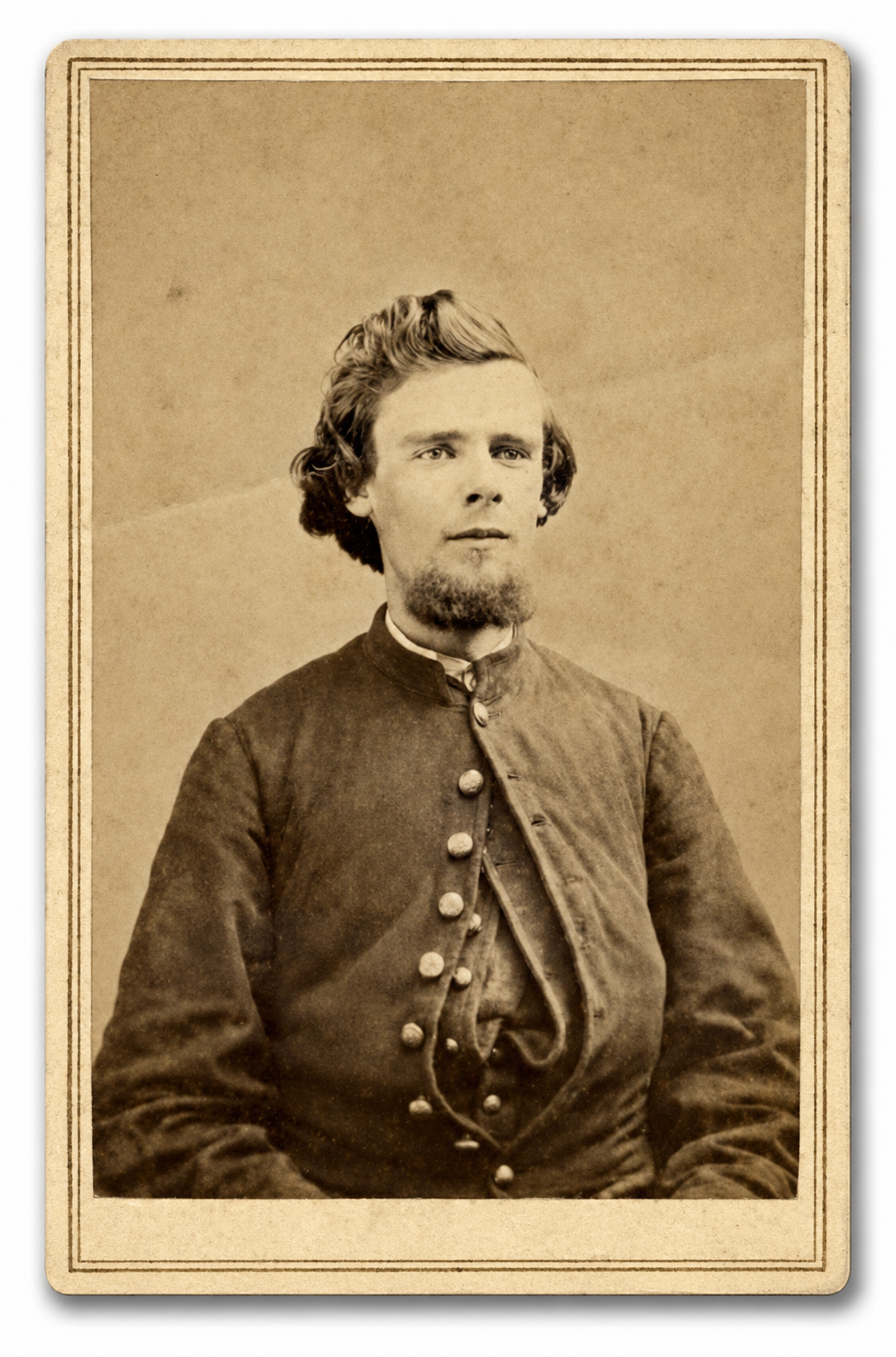
Isaac Thorn Bishop, Co. C, 55th Illinois Vols.

The following letters were written by Isaac Thorn Bishop (1844-1920), a native of Somers, Kenosha county, Wisconsin, who was working as a dry goods clerk in Kenosha when he volunteered for service as a private in Battery B, 2nd Illinois Light Artillery Regiment. He was quickly transferred, however, to Co. C, 55th Illinois Infantry and joined the regiment following their transfer to the western theater. He saw extensive combat during the Vicksburg Campaign, and wrote an account of the Battle of Arkansas Post in a letter to his sister on 14 January 1863 [see Letter 1 transcript below from The Telegraph-Courier, 12 February 1863 via Newspapers.com].

In the summer of 1863, while at Young’s Point, opposite Vicksburg, they helped to dig the canal which was usually called by the soldiers, “Grant’s Ditch.” Isaac then fought with his regiment from Grand Gulf to Raymond, and next at Champion Hills, Black River Bridge, and in the siege of Vicksburg. During the siege of Vicksburg he was assigned special duty in the Ordnance Department of the 15th Army Corps. After the capitulation of Vicksburg, he was transferred to the Post Ordnance Department. In January 1864, he was assigned to duty in the Ordnance Department, Military Division of the Mississippi, located at Nashville, Tenn., by order of Lieut. Gen. U.S. Grant, where he remained until the close of the War, in May 1865.

Isaac wrote all of these letter to his older sister, Victoria A. Bishop (1841-1903) who never married and most likely deserves the credit for having preserved her brother’s letters.

See also—1863: Jacob Bishop to Isaac Thorn Bishop, published in 2015 on Spared & Shared 9.

Other letters by member of Co. C, 55th Illinois Vols. published on Spared & Shared include:
Augustus C. Goakey, Co. C, 55th Illinois (3 Letters)
Thomas Goakey, Co. C, 55th Illinois (7 Letters)
Henry H. Joslin, Co. C, 55th Illinois (1 Letter)

Letter 1

On board the Southwestern
January 14th 1863.

Dear sister,

Since I wrote to you last I have been through another bloody battle, and have been through hardships and trials that would wreck the strongest frame of man. But I can put up with it because we have had such good luck.

We sailed up the Arkansas river about 150 miles; stopped about five miles below Fort Arkansas Post, (this is an old military post—the oldest fort in the United States, having been built before the Revolutionary war) and landed our forces Saturday morning; 25,000 infantry, four companies of cavalry, 10 batteries, and four iron-clad gunboats. We marched slowly along until within about a half mile of the Rebel lines, drove in their pickets, and then the order came for the 55th [Illinois] to deploy as skirmishers and advance. It was getting pretty dark then, so that we could not see ten rods. All that we could see to aim at was the flash of their guns. After we had gone about fifty yards, we stopped and kept up a continual fire.

There happened to be a large stump right before me when we stopped, and I just dropped down behind that where I was safe, and loaded and fired as fast as I could. I can tell you, it looked pretty to see the bomb shells fly over us and burst, but we had not been there long before they got the range on us with their artillery, and then—boom, boom—went the shells right amongst us. One hit and burst right on a man’s hip that lay a little way from me and tore him up dreadfully. And then a piece struck the man lying next to me and wounded him. Then the Colonel drew us back a little way, and stopped firing for that night.

Sunday morning—as it is a rule for the northern army not to fight on Sunday—we did not make the attack but at one o’clock, the rebels began to throw shot and shell at as, and you know the yankees could not stand that, and so we let into them. Our gunboats threw shell into the Fort from the river and we shelled them from the land, at the same time advancing towards their breastworks, and everyone that attempted to shoot would fall. We fired at them so fast that they could not get time to [reload and] shoot.

When we got within about 20 rods [110 yards] of the breastworks, one of our regiments laid down and crept along on our bellies We did not get up to fire, but would load and then roll over on our backs, and fire. We worked it in that way about one hour, and then the firing began to cease a little, and we jumped up to see what was the matter, and to our surprise, they had run up the white flag to surrender. Then our men gave three cheers and all was still as death for a moment—except the groans of the dying and wounded—and then we surrounded them to see what we had got. We marched them into the fort, and as they went in,
they piled up their arms at the door.

Well now I will tell you what we got: nine thousand stands of arms—most of them the best of Enfield rifles, seven thousand prisoners, and as near as I can find out, about one million bushels of corn and meal, every horse and mule they had, all their commissary goods and wagons, cartridge boxes, belts, any quantities of sugar, molasses, beet &c., three siege guns, 132-pounders, 20 pieces of light artillery, and a boat load of ammunition. Perhaps you remember of reading about the rebels taking a boat loaded with ammunition a short time ago? Well we took all that back again and considerable more with it.

But the joke comes now on the rebels. The next morning after the battle, two regiments of reinforcements and the stage with four horses came in and we took them; so you can see we made a clean sweep of everything. I got a nice dirk knife and scabbard which I am going to send home the first chance l can get. Also some secesh letters by which you will see how things are going in Texas.

Monday morning. I visited the battlefield before breakfast. I thought Vicksburg was a dreadful sight, but it was nothing like this; our artillery just tore them all to pieces. I will tell you a few of the horrible sights I saw on the field. First about their artillery. The battery on the left had only two horses left out of twenty-four. I saw one cannon with six splendid gray horses hitched to it, but they were all blowed to pieces with balls, and the caisson that belonged to it had four dead ones hitched to it; their horses were nearly all killed. Our guns threw shot so thick that the rebels were obliged to leave their guns and go to their breastworks.

Now to the men. The first was a man with his head all gone but just his face. I thought that was dreadful but the next was four lay side by side, one was cut open from his hips to his shoulders, the next was one with both legs off at the knees, right by his side was one that his hips and legs were about four feet from the rest of his body, the next was one that a shel had struck and cut one arm off and set fire to his clothes, and it burnt him all over to a crisp. One more and I will stop, and that was three brothers lay together, two of them were struck by our balls and the other seeing both his brothers dead he drew his revolver and shot himself. They lay side by side just where they fell.

Your affectionate brother, — Isaac Bishop


Letter 2

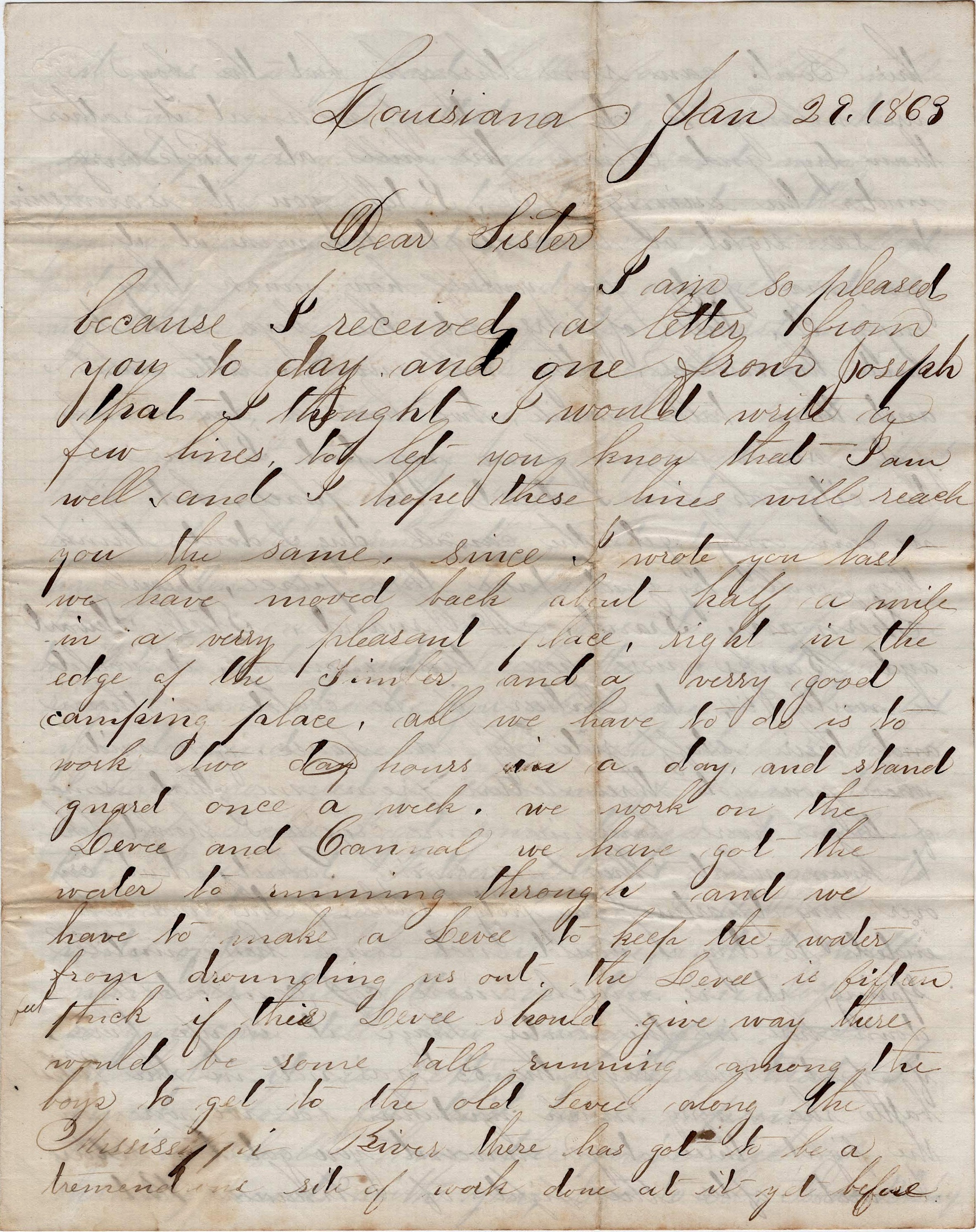
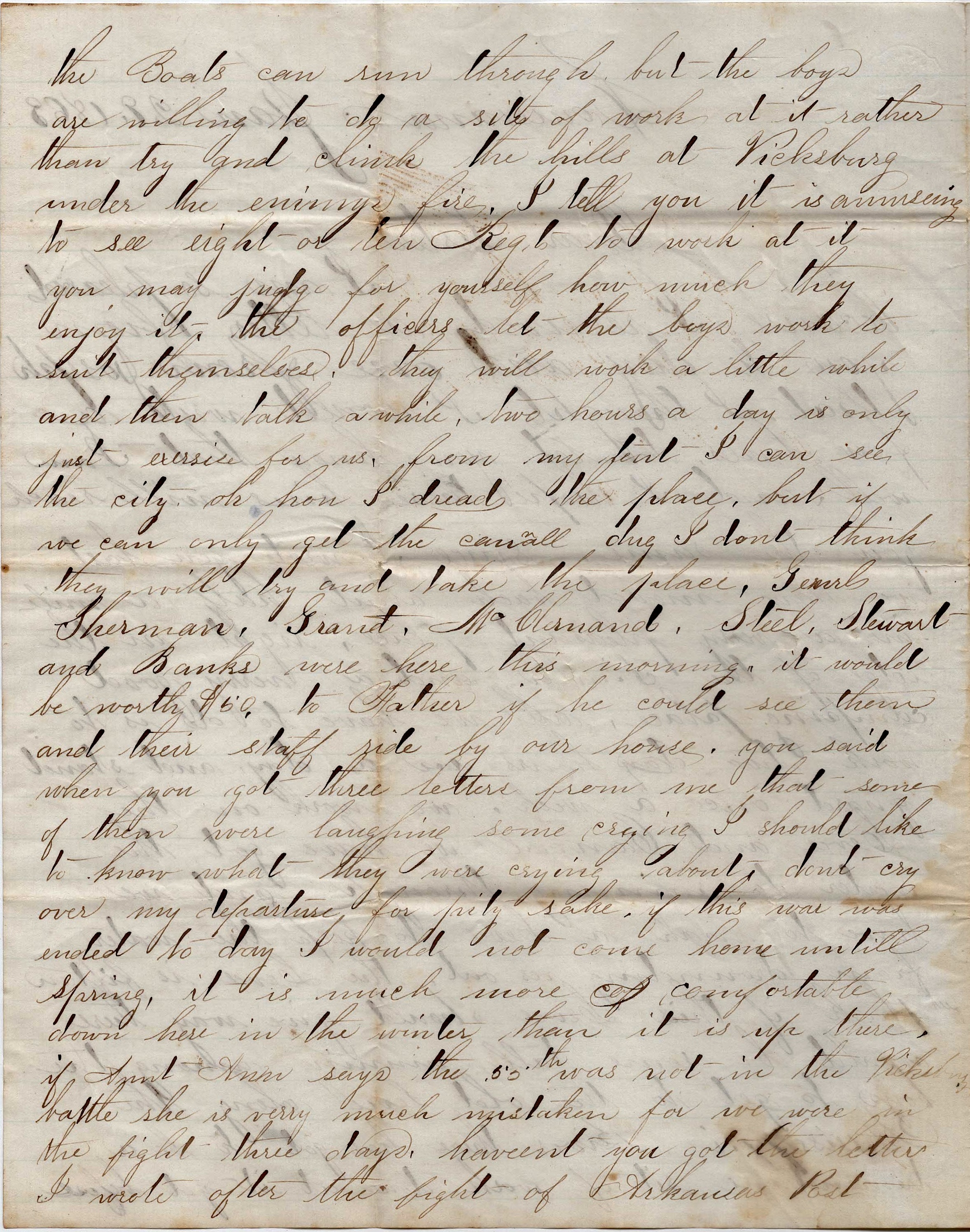
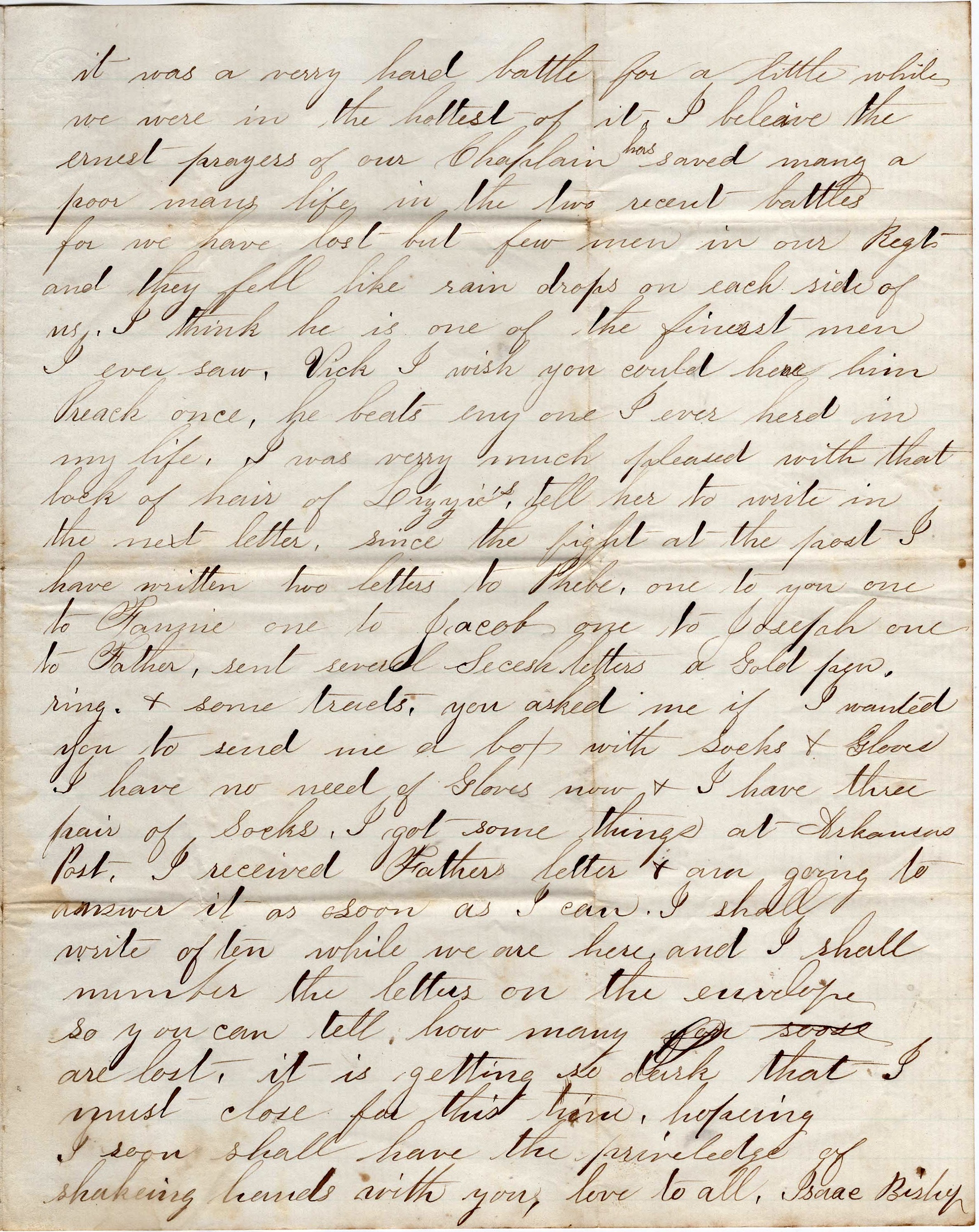
Louisiana
January 29, 1863

Dear Sister,

I am so pleased because I received a letter from you today and one from Joseph that I thought I would write a few lines to let you know that I am well and I hope these lines will reach you the same.

Since I wrote you last, we have moved back about half a mile in a very pleasant place right in the edge of the timber and a very good camping place. All we have to do is to work two day hours in a day and stand guard once a week. We work on the levee and canal. We have got the water to running through and we have to make a levee to keep the water from drowning us out. The levee is fifteen feet thick. If this levee should give way, there would be some tall running among the boys to get to the old levee along the Mississippi river. There has got to be a tremendous sight of work done at it yet before the boats can run through but the boys are willing to do a sight of work at it rather than try and climb the hills at Vicksburg under the enemy’s fire. I tell you, it is amusing to see eight or ten regiments to work at it. You may judge for yourself how much they enjoy it. The officers let the boys work to suit themselves. They will work a little while and then talk awhile. Two hours a day is only just exercise for us.

From my tent I can see the city. Oh how I dread the place. But if we can only get the canal dug, I don’t think they will try and take the place. Generals Sherman, Grant, McClernand, Steel, Stewart and Banks were here this morning. It would be worth $50 to Father if he could see them and their staff ride by our house. You said when you got three letters from me that some of them were laughing, some crying. I should like to know what they were crying about. Don’t cry over my departure for pity sake. If this war ended today, I would not come home until spring—it is much more comfortable down here in the winter than it is up there.

If Aunt Ann says the 55th was not in the Vicksburg battle, she is very much mistaken for we were in the fight three days. Haven’t you got the letter I wrote after the fight at Arkansas Post [dated Jan. 14th]? It was a very hard battle for a little while. We were in the hottest of it. I believe the earnest prayers of our chaplain [Milton Lorenzo Haney 1] has saved many a poor man’s life in the two recent battles for we have lost but two men in our regiment and they fell like rain drops on each side of us. I think he is one of the finest men I ever saw. Vick, I wish you could hear him preach once. He beats anyone I ever heard in my life. I was very much pleased with that lock of hair of Lizzie’s. Tell her to write in the next letter.

Since the fight at the Post, I have written two letters to Phebe, one to you, one to Fannie, sent several secesh letters, a gold pen, ring, and some [religious] tracts. You asked me if I wanted you to send me a box of socks and gloves. I have no need of gloves now and I have three pair of socks. I got some things at Arkansas Post. I received Father’s letter and am going to answer it as soon as I can. I shall write often while we are here and I shall number the letters on the envelopes so you can tell how many are lost.

It is getting so dark that I must close for this time hoping I soon shall have the privilege of shaking hands with you. Love to all. — Isaac Bishop

1 The chaplain of the 55th Illinois Infantry was a Methodist named Milton Lorenzo Haney (1825-1922). He was known as the “fighting chaplain” and was awarded the Medal of Honor while voluntarily carrying a musket in the ranks during the fighting on 22 July 1864 before Atlanta.
Letter 3

Haines Bluff
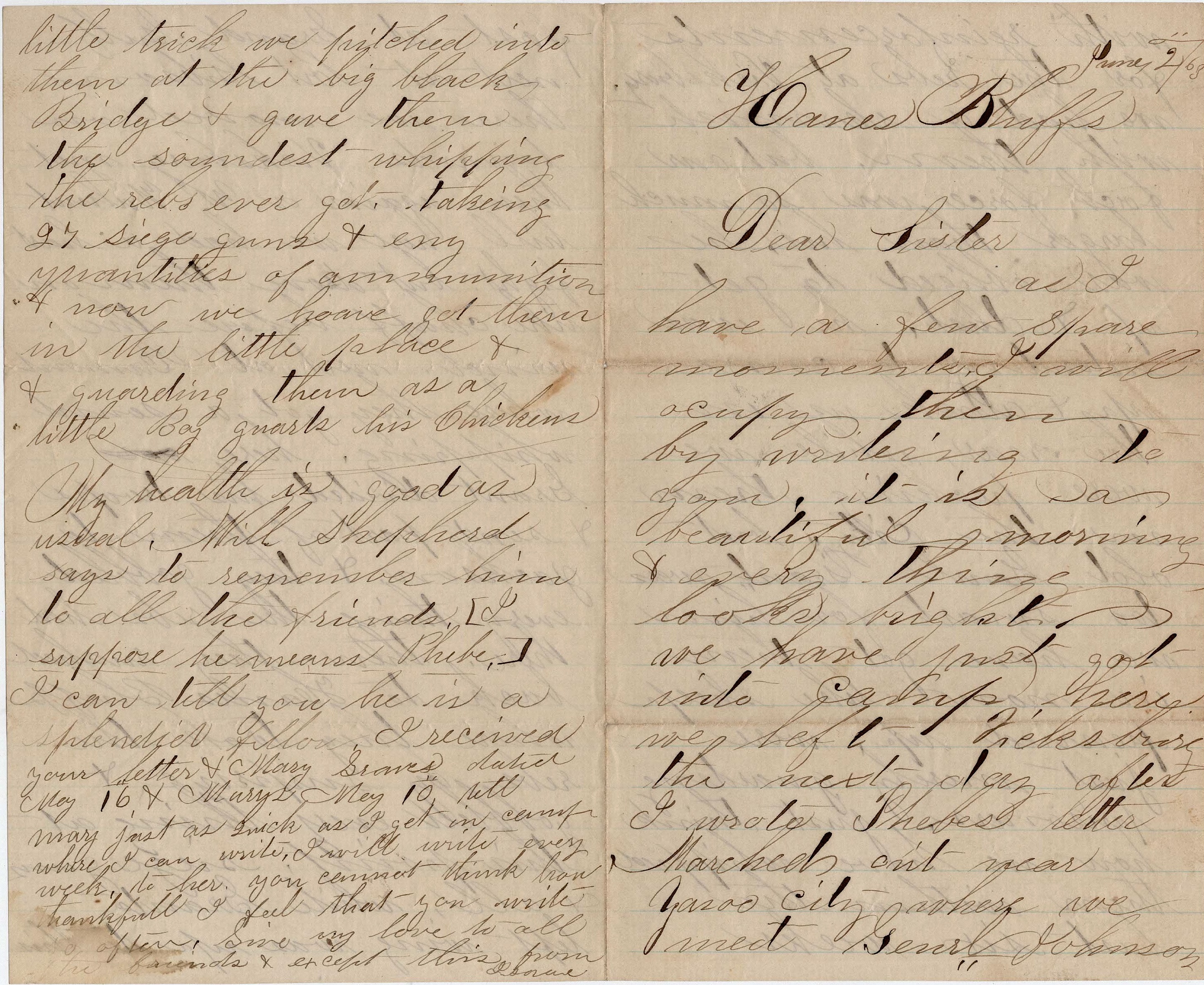
June 2, 1863

Dear Sister,

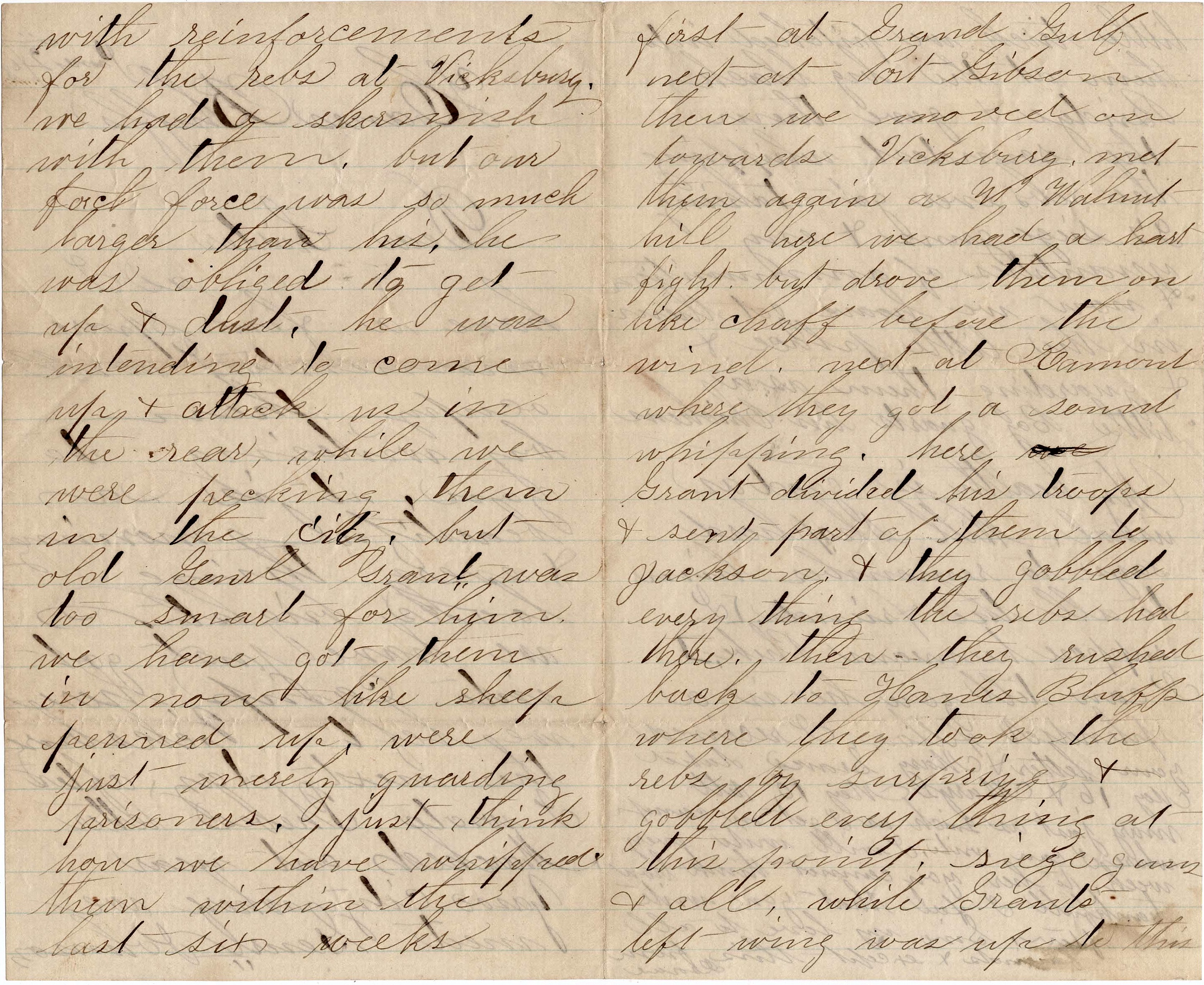
As I have a few spare moments, I will occupy them by writing to you. It is a beautiful morning and everything looks bright. We have just got into camp here. We left Vicksburg the next day after I wrote Phebe’s letter, marched out near Yazoo City where we met Gen. Johnston with reinforcements for the rebs at Vicksburg. We had a skirmish with them but our force was so much larger than his, he was obliged to get up & dust. He was intending to come up & attack us in the rear which we were pecking them in the city, but old Gen. Grant was too smart for him. We have got them in now like sheep penned up. We’re just merely guarding prisoners.

Just think how we have whipped them within the last six weeks. First at Grand Gulf, next at Port Gibson, then we marched on towards Vicksburg, met them again at Walnut Hill. Here we had a hard fight but drove them on like chaff before the wind. Next at Raymond where they got a sound whipping. Grant divided his troops and sent part of them to Jackson & they gobbled every thing the rebs had there. Then they rushed back to Haines Bluff where they took the rebs by surprise & gobbled everything at this point, siege guns and all. While Grant’s left wing was up to this little trick, we pitched into them at the Big Black Bridge and gave them the soundest whipping the rebs ever got, taking 27 siege guns and any quantity of ammunition. And now we have got them in the little place & guarding them as a little boy guards his chickens.

My health is good as usual. Will Shepherd says to remember him to all the friends (I suppose he means Phebe). I can tell you he is a splendid fellow. I received your letter & Mary Graves’ dated May 16th and Mary L’s May 10th. Tell Mary just as quick as I get in camp where I can write, I will write every week to her. You cannot think how thankful I feel that you write so often. Give my love to all friends and accept this from, — Isaac
Letter 4

Vicksburg [Mississippi]
July 17, 1863

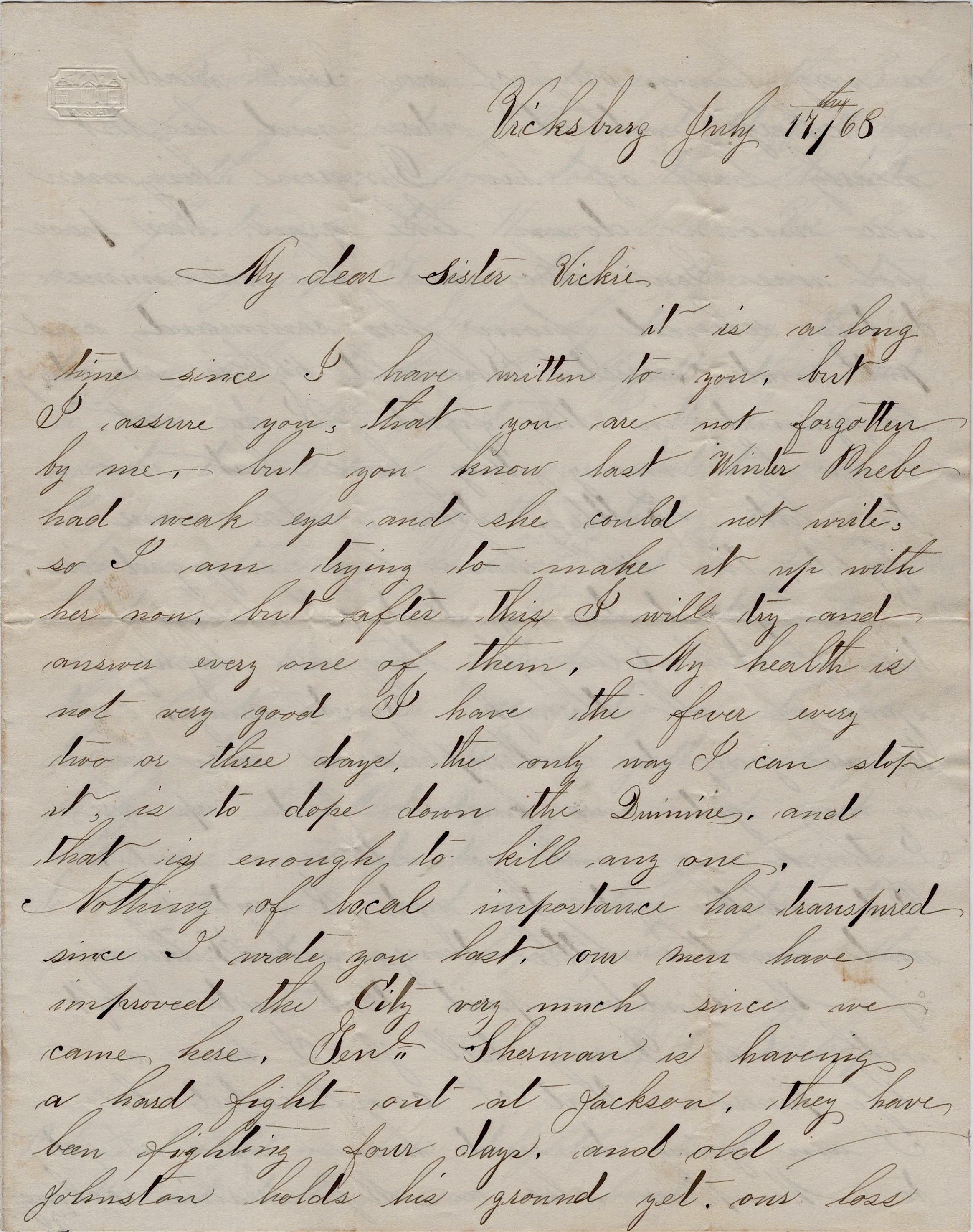
My dear sister Vickie,

It is a long time since I have written to you but I assure you that you are not forgotten by me. But you know last winter Phebe had weak eyes and she could not write, so I am trying to make it up with her now. But after this, I will try and answer every one of them. My health is not very good. I have the [malarial] fever every two or three days. The only way I can stop it is to dope down the quinine and that is enough to kill anyone.

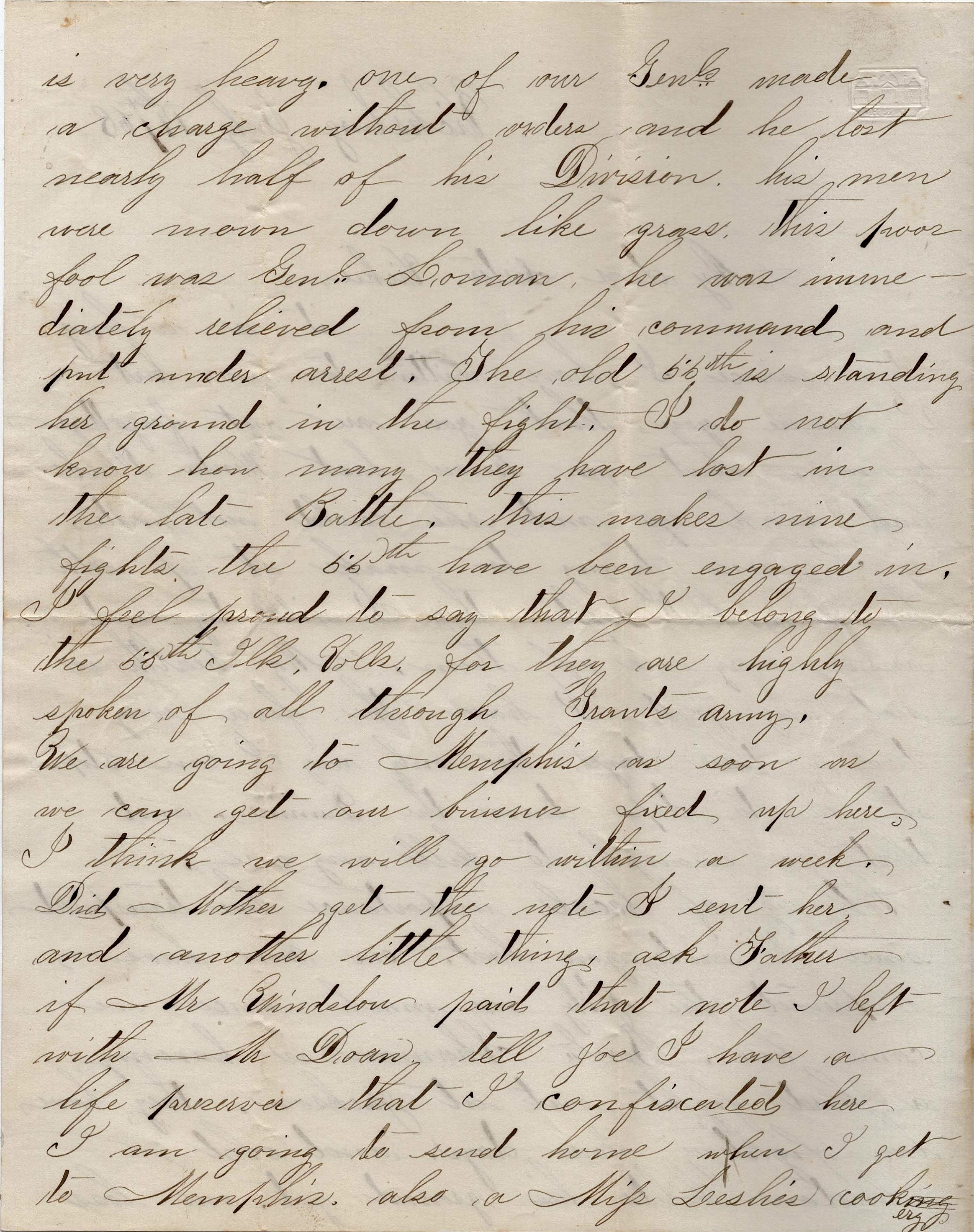
Nothing of local importance has transpired since I wrote you last. Our men have improved the city very much since we came here. Gen. Sherman is having a hard fight out at Jackson. They have been fighting four days and old Johnston holds his ground yet. Our loss is very heavy. One of our generals made a charge without orders and he lost nearly half of his division. His men were mown down like grass. This poor fool was Gen. [Jacob Gartner] Lauman. He was immediately relieved from his command and put under arrest.

The Old 55th [Illinois] is standing her ground in the fight. I do not know how many they have lost in the late battle. This makes nine fights the 55th have been engaged in. I feel proud tp say that I belong to the 55th Illinois Vols. for they are highly spoken of all through Grant’s army.

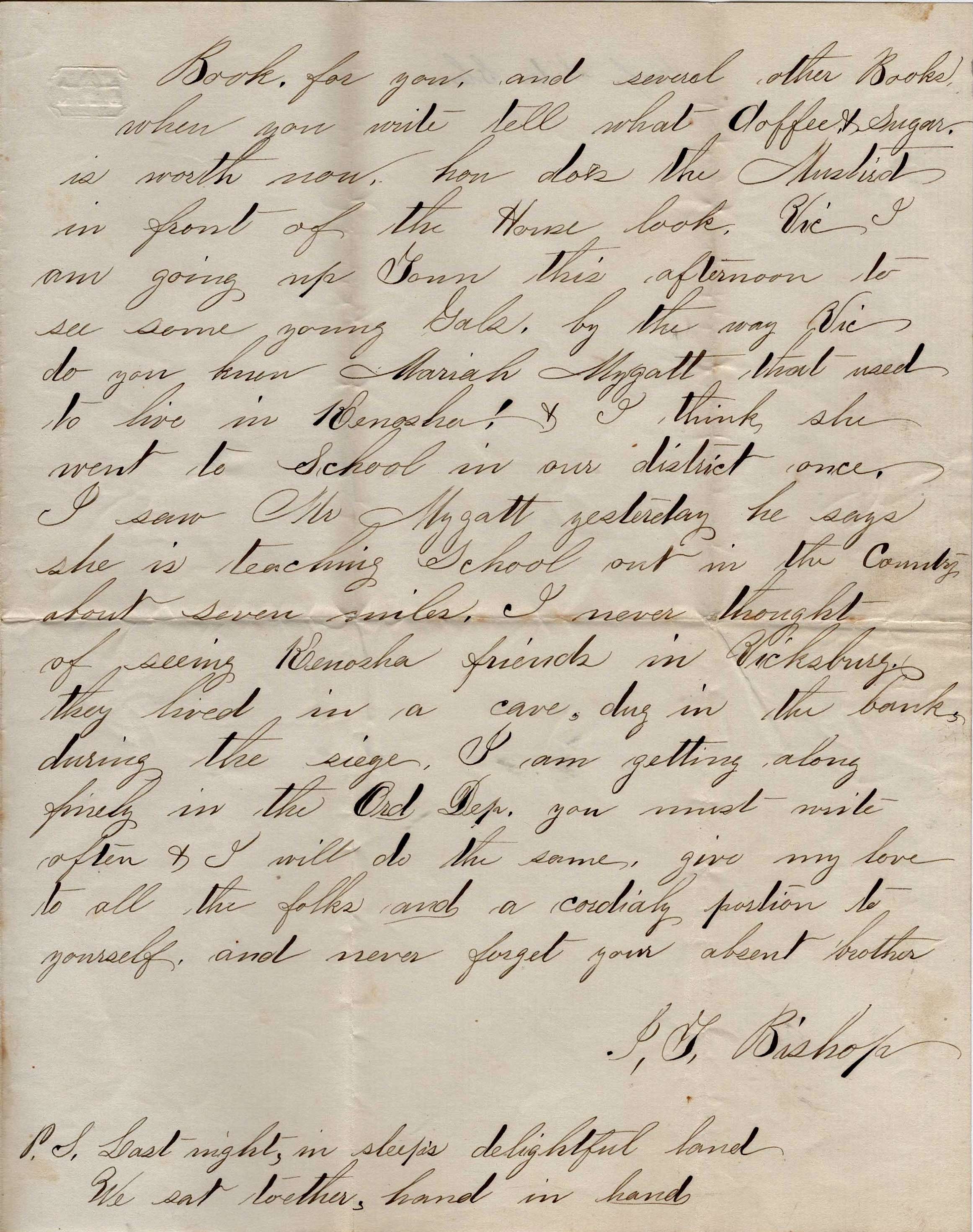
We are going to Memphis as soon as we can get our business fixed up here. I think we will go within a week. Did Mother get the note I sent her? And another little thing, ask Father if Mr. Windslow paid that note I left with Mr. Doan. Tell Joe I have a life preserver that I confiscated here [that] I am going to send home when I get to Memphis. Also a Miss Leslie’s Cookery Book for you and several other books. When you write, tell what coffee & sugar is worth now. How does the mustard in front of the house look?

Vic, I am going up town this afternoon to see some young gals. By the way, Vic, do you know Mariah Mygatt that used to live in Kenosha? I think she went to school in our district once. I saw Mr. Mygatt yesterday. He says she is teaching school out in the country about 7 miles. I never thought of seeing Kenosha friends in Vicksburg. They lived in a cave dug in the bank during the siege. I am getting along finely in the Ordnance Department. You must write often and I will do the same. Give my love to all the folks and a cordially portion to yourself. and never forget your absent brother, — I. T. Bishop

P. S. Last night in sleep’s delightful land, we sat together, hand in hand.
1861: Henry H. Joslin to Friend Edgar

Henry H. Joslin, Co. C, 55th Illinois Infantry

The following letter was written by Henry H. Joslin (1843-1909) who enlisted at the age of 17 in Co. C, 55th Illinois Infantry. When he enlisted, he was described as a 5′ 11″ blue-eyed, light haired, farmer from Rockford, Winnebago county, Illinois. He reenlisted as a veteran in February 1864 and was discharged for disability on 30 June 1865.

Henry was the son of George Henry Joslin (1819-1881) and Eunice A. Olmstead (1822-1881). The family was enumerated in Harrison township, Winnebago county, Illinois in the 1860 US Census.

Henry wrote his letter from Camp Douglas near Chicago in December 1861 where the regiment was organized and drilled. Most of the members were recruited from Northern Illinois counties such as LaSalle, Fulton, Grundy, Ogle, Winnebago, DeKalb, DuPage, Kane, McDonough, Carroll, and Knox. Some of the early enlistees even helped build Camp Douglas. Because they were ill equipped, they did not participate in the taking of Forts Donelson and Henry. They saw their first action at the Battle of Shiloh.

Transcription

Camp Douglas [near Chicago]
December 6th 1861

Friend Edgar,

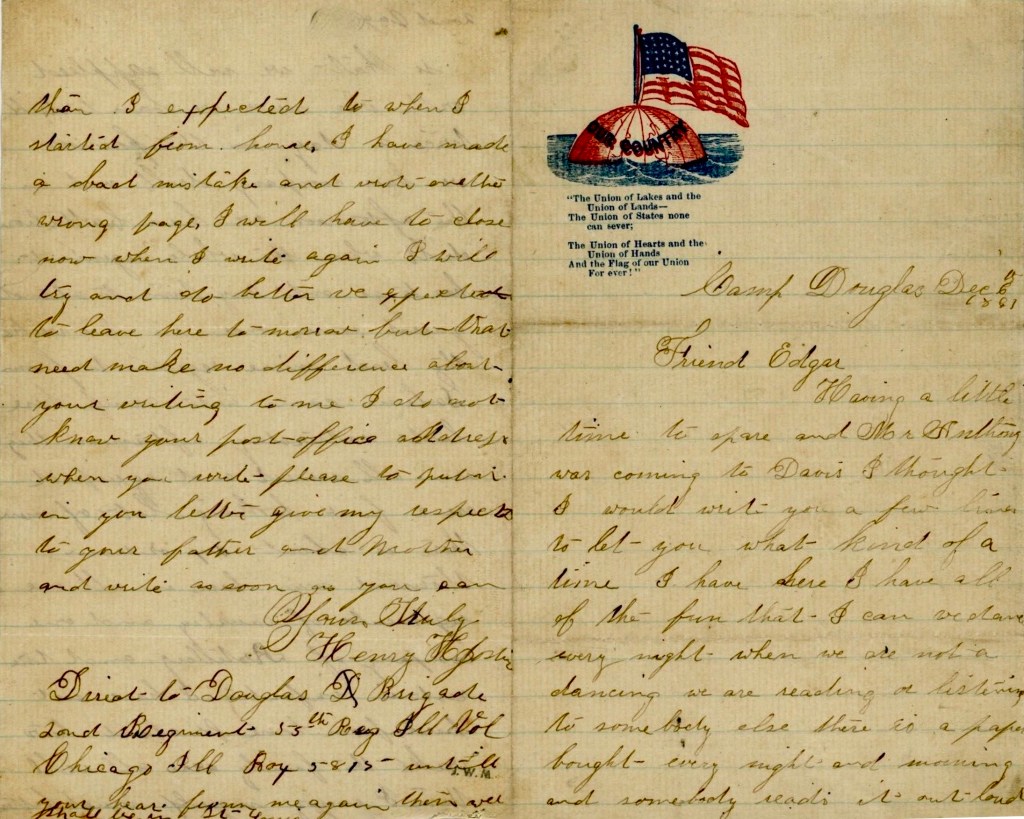
Having a little time to spare and Mr. Anthony was coming to Davis, I thought I would write you a few lines to let you [know] what kind of a time I have here. I have all the fun that I can. We dance every night. When we are not a dancing, we are reading or listening to somebody else. There is a paper bought every night and morning and somebody reading it out loud so that we [are] well supplied with war news.

We have to drill twice a day in the forenoon. We have battalion drill when the whole regiment has to go out. My turn to stand guard comes once in two weeks. The Lead Mine Regiment from Galena 1 came into camp here last Saturday afternoon. They are a fine-looking lot of men. There is about six or seven thousand men here in all; one regiment of cavalry and one of artillery, and the rest is infantry.

I have not heard from home for about two weeks. The family were all well then. I enjoy myself much better than I expected to when I started from home. I have made a bad mistake and wrote on the wrong page. I will have to close now. When I write again, I will try and do better.

We expected to leave here tomorrow but that need make no difference about your writing to me. I do not know your post office address. When you write, please to put in your letter. Give my respects to your father and mother and write as son as you can.

Yours truly, — Henry H. Joslin

Direct to Douglas Brigade, 2nd Regiment, 55th Regiment Illinois Vol., Chicago, Illinois, Box 5815 until you hear from me again. Then we shall be in St. Louis.


1 The “Washburn Lead Mine Regiment” from Galena, Illinois, was the nickname given the 45th Illinois Infantry. In November 1861, the seven companies that had formed were armed with short Enfield Rifles and moved to Camp Douglas, in Chicago, where they were joined by companies from other parts of the state to form a full regiment of ten companies. Jasper A. Maltby a Galena gunsmith, who had served in the Mexican War, was selected as Lt. Colonel to replace the former Lt. Colonel, who had resigned. Melancthon Smith, the postmaster of Rockford, Illinois became the regiment’s major. After the regiment was mustered into U.S. service on December 25, 1861, they were sent to Cairo, Illinois on January 12, 1862.

1864-65: Thomas Goakey to his Family

The following letters were written by Thomas Goakey (1844-1883) who enlisted in Co. C, 55th Illinois Infantry, on 5 January 1864. According to his military record, Thomas was wounded in the fighting near Atlanta, Georgia, on 3 August 1864 but recovered and joined his regiment at Goldsboro, North Carolina. He mustered out of the regiment at Little Rock, Arkansas, on 14 August 1865.

Thomas was the son of Justin Goakey (1783-1871) and Mary Eliza Hudson (1815-1887) of Harrison, Winnebago county, Illinois.

Letter 1

March 17, 1864

My dear Sister,

I take my pen in hand to let you know that I am well at present and hope these few lines will find you enjoying the same health at present.

Josephine, I will tell you what happened between here and Nashville. The train was captured at Murfreesboro and it was burnt up as we learn here. Gus is well and Henry too and all the other boys.

I received your letter March the 5th. No more at present. From Thomas Goakey

So goodbye. I send my best respects to all enquiring friends.


Letter 2

Dallas, Georgia
May 31, 1864

Dear Brother,

I take the opportunity to write you a few lines today to let you know that I am well at present and hoping these few lines will find you the same as it leaves me at present.

Oh Joe, they have been very heavy fighting here day before yesterday and night before last. The rebels charged on our works and they were nicely piled up here them for they were cut down like grass with a scythe and the soon scaddle [skedaddle] back on double quick times.

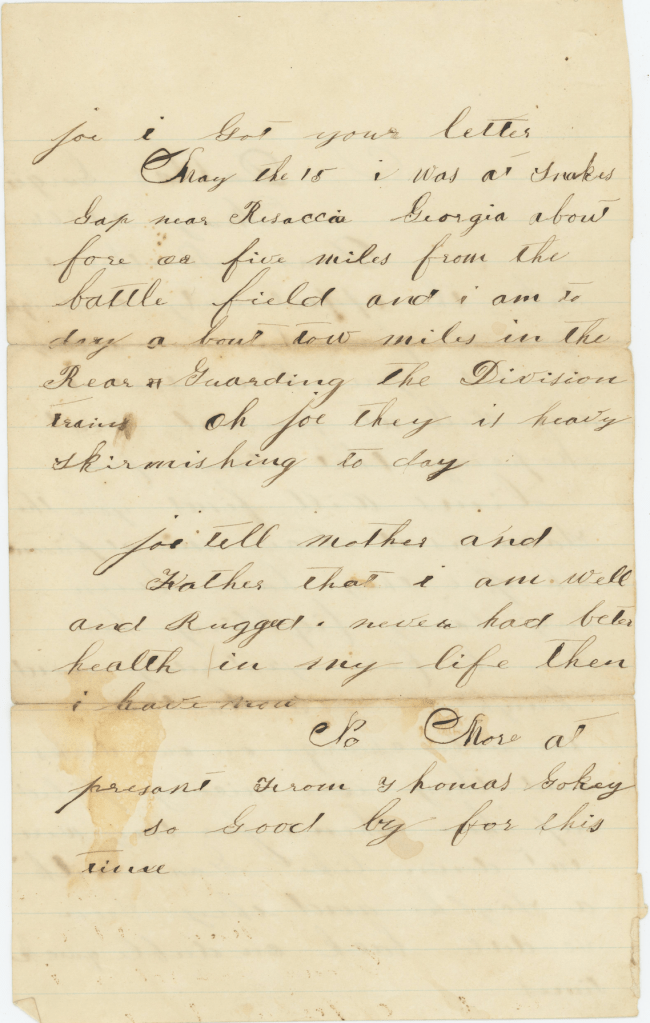
Joe, I got your letter May 15th. I was at Snakes Gap near Resaca, Georgia, about four or five miles from the battlefield and I am today about two miles in the rear guarding the Division trains. Oh, Joe, they is heavy skirmishing today.

Joe, tell Mother and Father that I am well and rugged. Never had better health in my life than I have now.

No more at present. From Thomas Goakey

Do goodbye for this time.


Letter 3

Big Shanty, Georgia
June 14, 1864

Dear Mother,

I take my pen in hand to address you a few lines to let you know that I am well and hope these few lines will find you in the same [health] as it leaves me at present time.

Mother, I have got two letters from home since the Seventeen of April and I don’t see what is the matter—the mail, or [un]less there is no one to home to write to us down here, or what is the matter with it. Mother, are you all dead or all alive? I am sure that I don’t know what is the matter with you and the rest of the folks for I am one of the boys.

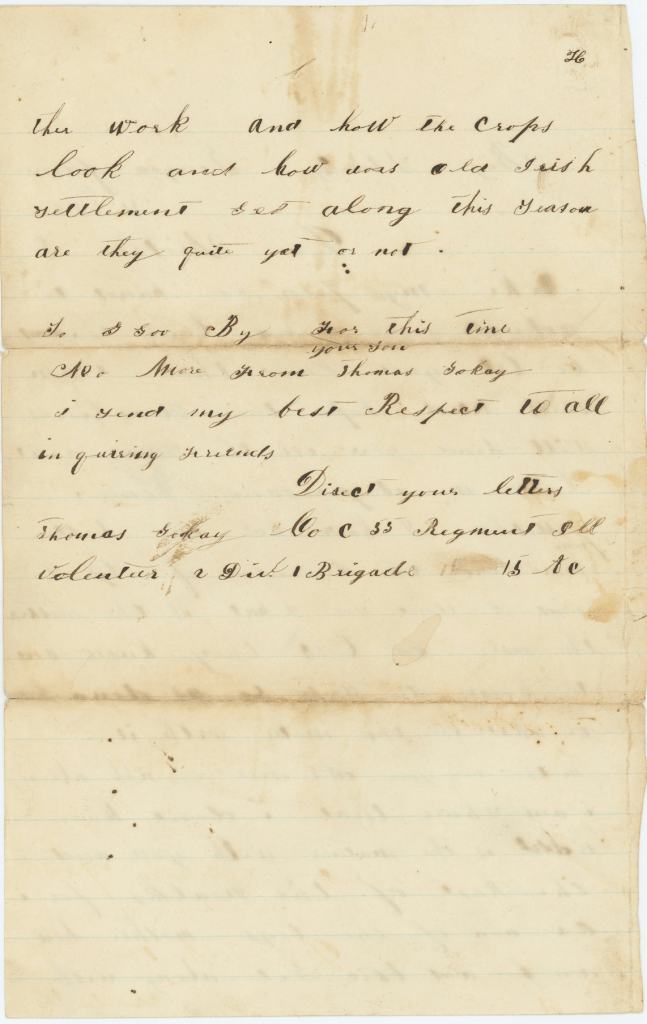
Mother, how does Joe and Elic get along with the work and how [do] the crops look? And how does Old Irish Settlement get along this season? Are they quiet yet, or not?

So goodbye for this time. No more. From your son, — Thomas Goakey

I send my respects to all enquiring friends. Direct your letters to Thomas Goakey, Co. C, 55th Regt. Illinois Infantry, 2nd Division, 1st Brigade, 15th Army Corps


Letter 4

January 1st 1865

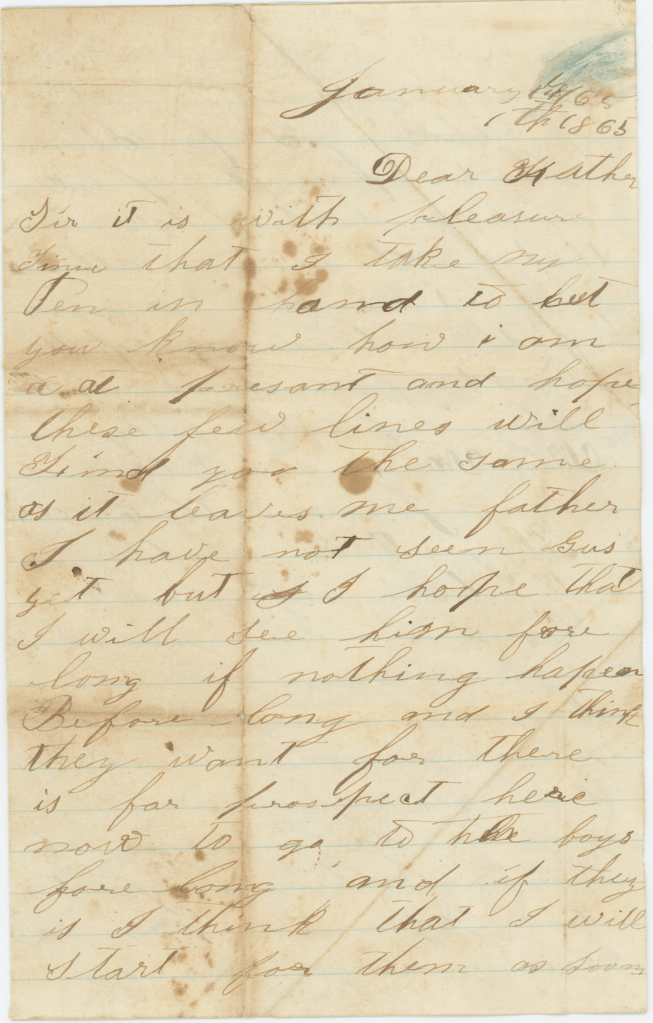
Dear Father,

Sir, it is with pleasure that I take my pen in hand to let you know how I am at present and hope these few lines will find you the same as it leaves me, Father, I have not seen Gus yet but I hope that I will see him before long in nothing happens before long, and I think they won’t for there is a fair prospect to go to the boys before long. And if they is, I think that I will start for them soon as I can get out of this God forsaken hole for this place is th last place that God ever made for it is the crumbs of the leaving of the rest for it is in the valley of the valleys. No more at present.

January 6th, 1865

My dear father, I take my pen in hand to let you know that I am in the hospital at present and I am about as well as I was when I left you the last time at home. Father, I just have signed the pay roll this morning for two months pay and as soon as I get it I will send some of it to you by Express and if you need it, you can use it as soon as you get it for anything.

Father, I have not done a bit of duty since I left home on the 15th day of November. I have fared hard since I left home this last time for the road was cut and we fare slim for awhile. But now we are faring very well at present for we have all that we want to hear here now.

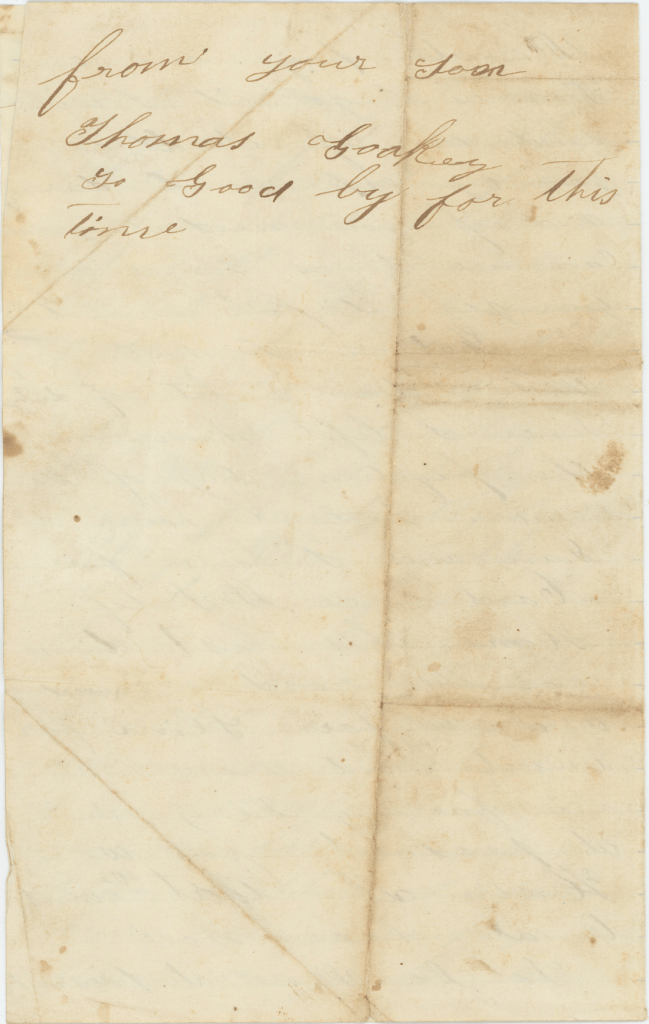
So no more at present. From your son, — Thomas Goakey

So goodbye for this time.


Letter 5

Goldsboro, North Carolina
March 29, 1865

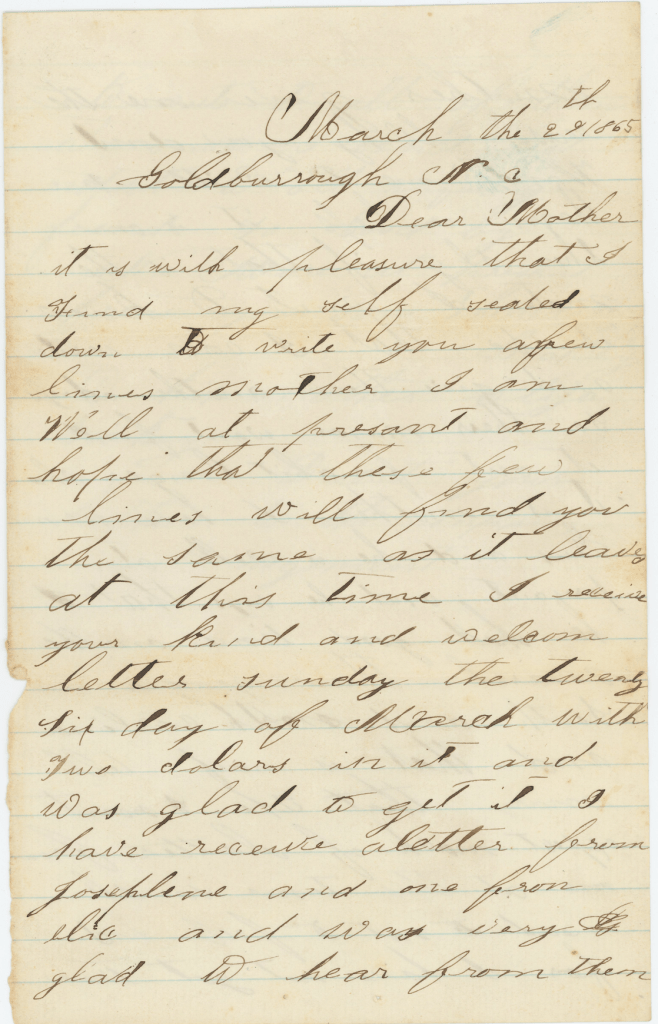
Dear Father,

It is with pleasure that I find myself seated down to write you a few lines. Mother, I am well at present and hope that these few lines will find you the same as it leaves me at this time. I received your kind and welcome letter Sunday the 26th day of March with two dollars in it and was glad to get it. I have received a letter from Josephine and one from Elic and was very glad to hear from them.

Mother, give me the reason why you don’t want me to write to them or less it is on the sly. If that is the matter, I want to know it so that I can write and give them another address so their man won’t find it out for a bit longer who it is.

Mother I have seen Gus and he is well at present and he says that he had a good time on the march through Georgia and South and North Carolina and that is enough. Tell Mary that she can’t expect much of a letter from me at this time so she will not feel bad for I have not got time to write to all of them at once. I send [my] best respects to all inquiring friends. So goodbye.

No more at present. From your son, — Thomas Goakey

To his mother, Eliza Goakey

Direct your letter to the company and regiment.


Letter 6

Camp near Richmond, Va.
May 11, 1865

Dear Mother,

It is with pleasure that I take my pen in hand to write to you once more and to let you know that I am well at present and hope these few lines will find you the same as it leaves me at this time. Gus is well too and we expect to start for Washington City in a day or two and we don’t know how long we will stay there. We are to be reviewed there and then we will muster out of the service in a few weeks and then I think we will be at home by the 4th day of July 1865.

No more at present for this time. From your son, — Thomas Goakey to his mother

So goodbye for this time.


Letter 7

Louisville, Kentucky
June 10, 1865

Dear Mother,

It is with pleasure that I take my pen in hand to inform you how I am at this time. I have a bad cold and that is all. Gus is well too and hope that these few lines will find you the same as it leaves me at this time. Mother, we are to be paid in a few days and then I will send part of it home and keep part of it to but a few postage stamps.

I send to you so you and the rest can write once or twice a week for you must not think that we are going home tight off for we can’t so that little thing when we are a mind to.

I must bring my letter to a close by saying write soon as you get this. From your son, — Thomas Goakey

To his mother, Eliza Goakey. Direct to Louisville, Ky.


1862-65: Augustus C. Goakey to Eliza (Hudson) Goakey

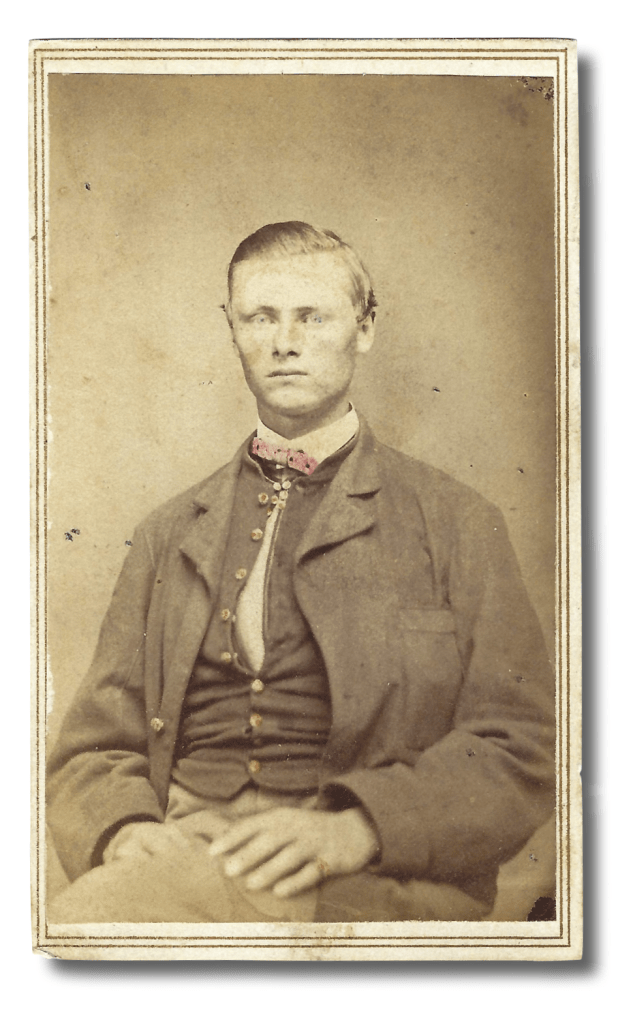
I could not find an image of Gus but here is a CDV of Henry Joslin who also served in Co. C, 55th Illinois Infantry (Austin Sundtrom Collection)

The following letters were written by Augustus (“Gus”) C. Goakey (1838-1911), the son of Justin Goakey (1783-1871) and Mary Eliza Hudson (1815-1887) of Burritt township, Winnebago county, Illinois.

Augustus was mustered into Co. C, 55th Illinois Infantry in October 1861. At the time of his enlistment he was described as a 5′ 8″ tall, black-haired, black-eyed, 23 year-old farmer. He mustered out on 24 August 1865.

Gus’ obituary states that he was in “some of the notable engagement and most hotly contested battles” in the Civil War. “He was for 120 consecutive days under the fire of the enemy, all of which is recorded on his discharge” papers. “He joined Sherman’s ranks at the beginning of the eventful campaign…and remained with him until the army was mustered out at Washington D. C.

[Note: These letters are from the personal collection of Austin Sundstrom are were transcribed and published on Spared & Shred by express consent.]

Letter 1

Memphis, Tennessee
August 5th 1862

Ever remembered Mother,

Once more I take time to write a few lines to you to let you know where I am. Well, I am in the army yet and in Memphis—that stronghold of the rebels. But it did not prove so strong as they thought it would at that time. I am well as can be expected after our long & wearied marches. I got somewhat wore out then but am getting better fast now. It is pretty hot weather here but we do not have much to do here for for the Niggers do all the work on the fort and let the soldiers rest & recruit up. There is no special news to write this time.

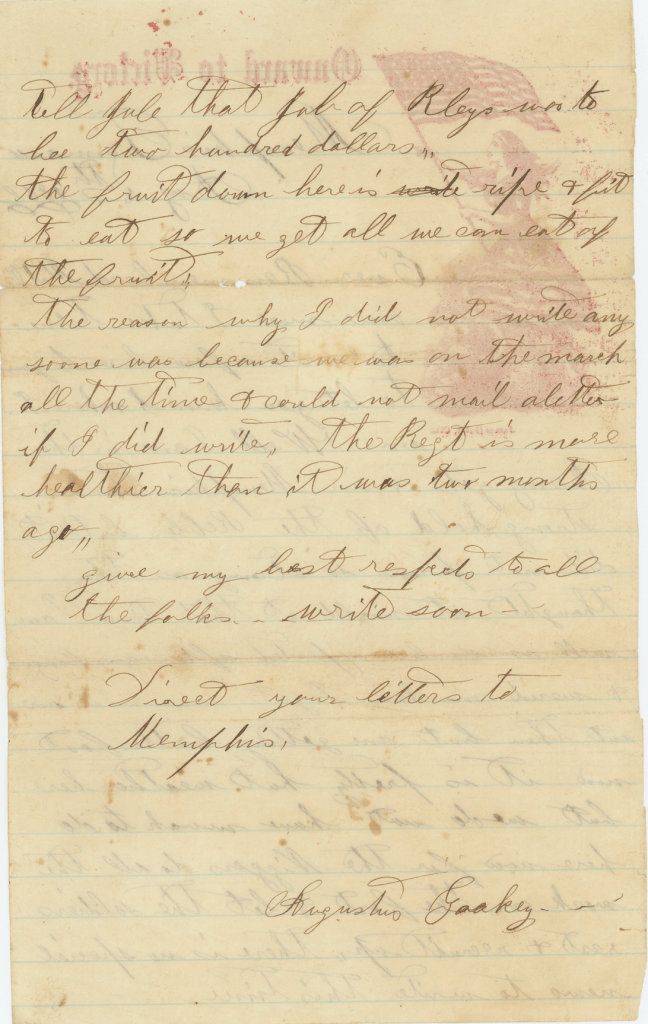
Tell Jule that job of Riley’s was to her two hundred dollars.

The fruit down here is ripe and fit to eat so we get all we can eat of the fruit. 

The reason why I did not write any sooner was because we was on the march all the time & could not mail a letter if I did write. The regiment is more healthier than it was two months ago.

Give my best respects to all the folks. Write soon. Direct your letters to Memphis.

— Augustus Goakey


Letter 2

Camp Opposite Vicksburg
February 21, 1863

Dear Mother,

I now take the opportunity of letting you know that I am well and hope that these few lines will find you enjoying the same blessing of life.

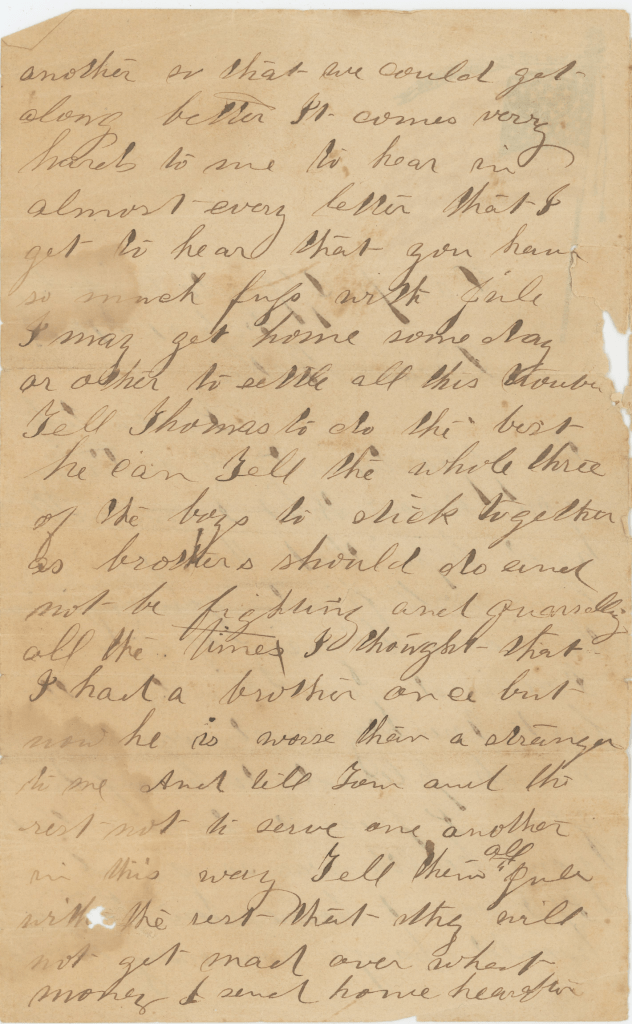
I received your kind letter last Tuesday and was very much pleased to hear from you. I was pleased to hear your health was so good. If I was at hom now I would change someway or another so that we could get along better. It comes very hard to me to hear in almost every letter that I get to hear that you have so much fuss with Jule. I may get home some day or another to settle all this trouble.

Tell Thomas to do the best he can. Tell the whole three of the boys to stick together as brothers should so and not be fighting and quarreling all the time. I thought that I had a brother once but now he is worse than a stranger to me. And tell Tom and the rest not to serve one another in this way. Tell them all—Jule with the rest—that they will not get mad over what money I send home hereafter.

If you can get some postage stamps handy, send me some for they are very scarce down here.

It has been very bad weather here for the last two weeks. It rains nearly all the time. No more at present. Write soon. I remain your son, — Augustus


Letter 3

Goldsboro, Ga. [should be North Carolina]
April [?] 1865

My dear beloved Mother,

With pleasure I take this present occasion of addressing you these few lines to inform you that I am well at this present time. Still hoping that these few lines may find you enjoying the same good blessing.

I received a letter from you a few days ago. I was glad to hear from you. I have not had the opportunity to write sooner.

We left Beaufort on the 27th of January. We had quite a difficult march through swamps and [ ]. We had to fight the enemy in a great many places. We are now at Goldsboro, N. C. You will think that the enemy are very strong but they are not. You have a great many conflicting reports from Richmond. I think that when we make two more marches, this war will be over. I don’t think that our troubles will last long. O am in hopes that I will be home in 2 or 3 months. If not in that time, I will in two years.

I got a letter from my brother Joseph. He is at Memphis, Tennessee. He was well at the time.

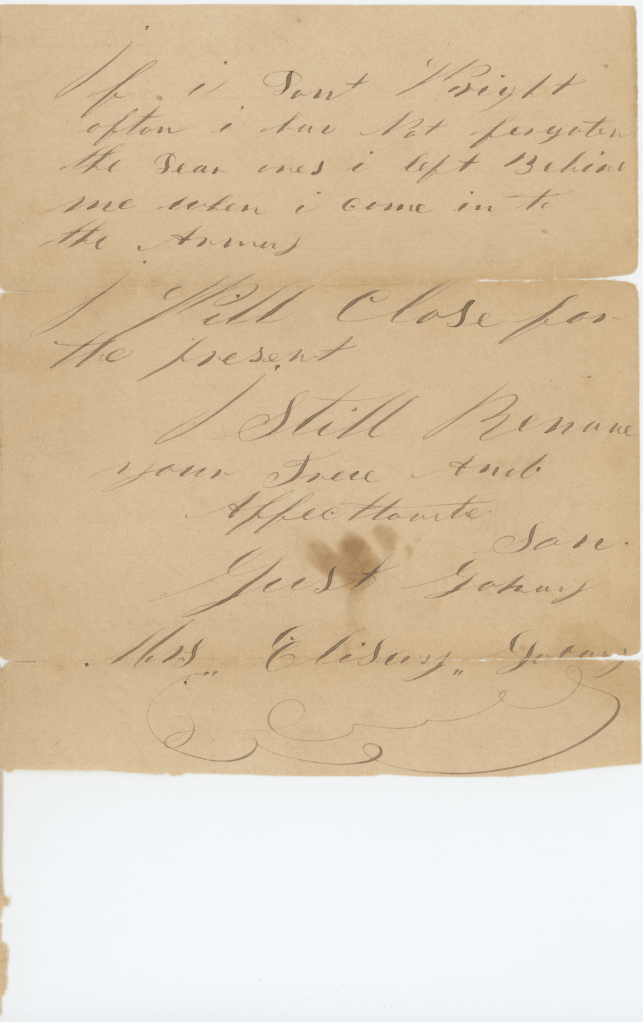
Jones is now with me. It is a great comfort to me to be with him. He is well and hearty. Charles was here to see me since we was here. He is well. I will write to my sister and I’ll see if she will answer it. You will please send me 50 cents postage stamps. If I don’t write often, I have not forgotten the dear ones I left behind me when I come in the army.

I will close for the present. I still remain your true and affectionate son, — Gust Goakey

[to] Mrs. Elisa Goakey