My passion is studying American history leading up to & including the Civil War. I particularly enjoy reading, transcribing & researching primary sources such as letters and diaries.
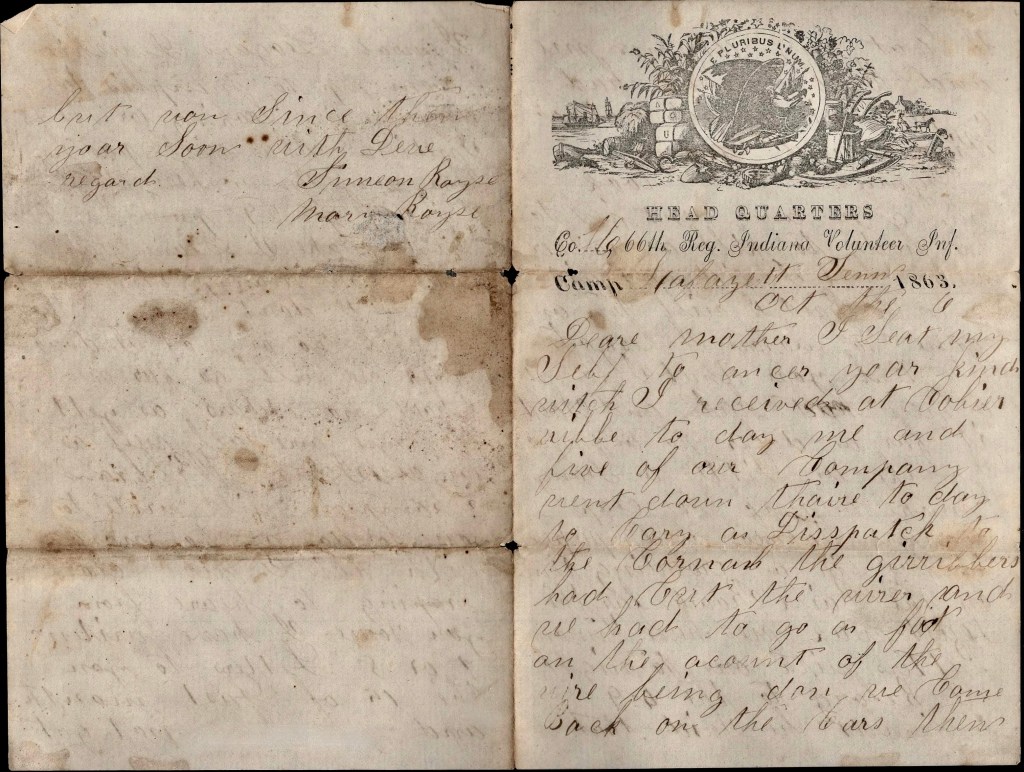
The following letter was written by Simeon G. Royse (1837-1867), the son of John W. and Mary (Garriott) Royse of Fredericksburg, Washington county, Indiana. Simon enlisted as a private in Co. H, 66th Indiana Infantry on 19 August 1862 and mustered out of the service on 13 June 1865.
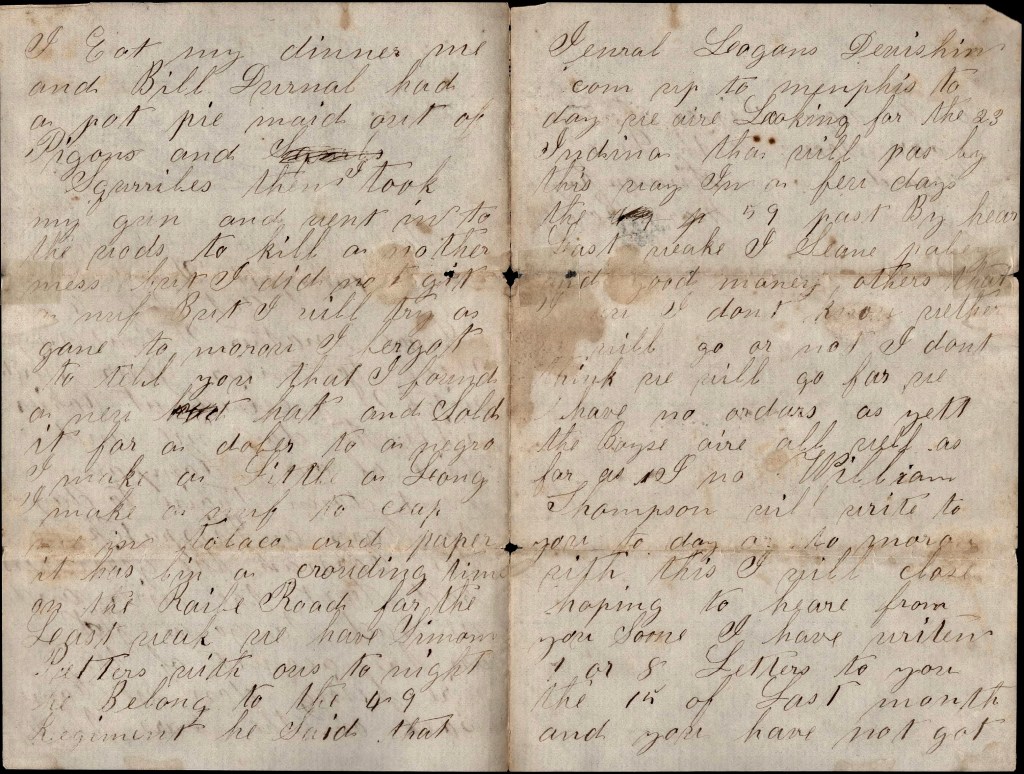
I seat myself to answer your kind [letter] which I received at Collierville today. Me and five of our company went down there today to carry a dispatch to the Colonel. The guerrillas had cut the wire and we had to go on foot on the account of the wire being down. We come back on the cars then.
I eat my dinner. Me and Bill Durnill had a pot pie made out of pigeons and squirrels. Then I took my gun and went into the woods to kill another mess but I did not get enough. But I will try again tomorrow. I forgot to tell you that I found a new hat and sold it for a dollar to a negro. I make a little along. I make enough to keep me in tobacco and paper.
It has been a crowding time on the railroad for the last week. We have Simon Potters with us tonight. He belongs to the 49th Regiment. He said that General Logan’s Division come up to Memphis today. We are looking for the 23rd Indiana. They will pass by this way in a few days. The 59th passed by here last week. I seen Paleys and a good many others that I knew. I don’t know whether we will go or not. I don’t think w will go for we have no orders as yet. The boys are all well as far as I know.
William Thompson will write to you today or tomorrow with this. I will close hoping to hear from you soon. I have written 7 or 8 letters to you the 15th of last month and you have not got but one since then. Your son with due regard, — Simeon Royse
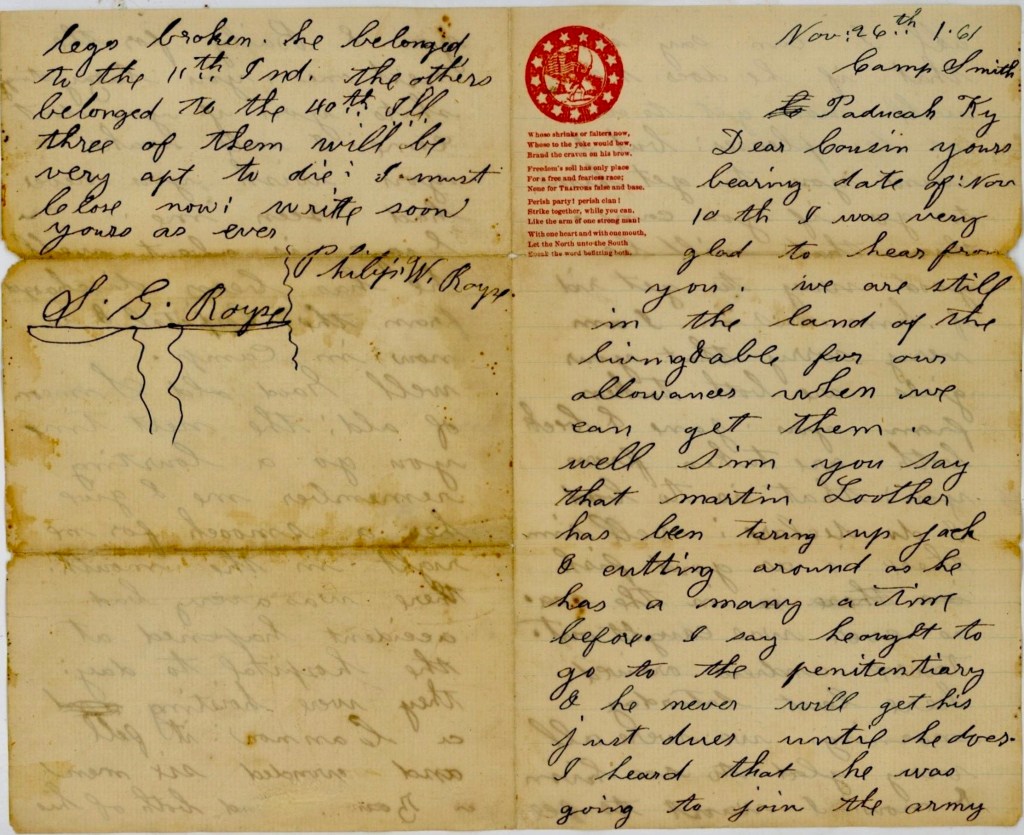
The following letter was written by Philip W. Royse (1840-1865), the son of Frederick Royse (1817-1849) and “Marcy” Zaring (1822-1905) of Fredericksburg, Washington county, Indiana. Philip enlisted on 27 July 1861 as a corporal in Co. C, 23rd Indiana Infantry but was later reduced to ranks and mustered out on 28 July 1864 after three years service. Though he survived the war, he died at home on 21 October 1865.
Philip wrote the letter to his cousin, Simeon G. Royse (1837-1867), the son of John W. and Mary (Garriott) Royse of Fredericksburg, Indiana.
Transcription
Camp Smith Paducah, Kentucky November 26, 1861
Dear Cousin,
Yours [received] bearing date of November 10th. I was very glad to hear from you. We are still in the land of the living & able for our allowances when we can get them.
Well, Sim, you say that Martin Luther has been tearing up Jack and cutting around as he has a many a time before. I say he ought to go to the penitentiary & he never will get his just dues until he does. I heard that he was going to join the army. All I can say is that if he does, he will not get to do as he pleases. But I want you to get him to go if you can. Then that will be a good way to get rid of him.
Sim, I am very sorry that your girls are both taken from you. Jane & Beck both are taken from you—that is too bad, I do declare. Well, Sim, there is as good fish in the sea as ever was caught out.
Trave Andrew arrived here last Saturday morning. We were all very glad to see him and now I want to see you & Baily for the next ones—you lazy stingy shits you. If you don’t come, I will make you wish you never had seen me. George is about well. He has been discharged from the hospital and is now in camp. Well, good old Simeon of old, the next time you go a courting, remember me and give her a smooch for me right in the mouth.
There was a very bad accident happened at the hospital today. They were hoisting a cannon. It fell and wounded six men. A Zouave had both of his legs broken. He belonged to the 11th Indiana. The others belonged to the 40th Illinois. Three of them will be very apt to die.
I must close now. write soon. Yours as ever, — Philip W. Royse
The following letter was written by Charles (“Charlie”) Frederick Frink (b. 1842), the son of James Frink and Martha Goodhue Prescott of New Haven, Connecticut,
Charles was a 19 year-old clerk in the mercantile establishment of J. E. Wesener & Co. in Akron, Ohio, at the time he enlisted on 22 April 1861 in Co. G, 19th Ohio Volunteer Infantry (OVI)—a three-month’s regiment. He mustered out of the regiment on 31 August 1861.
In the New Haven city directory of 1863, it appears that Charles had returned East and went into partnership in the grover business with his brother, Nathan C. Frink (N. F. & C. F. F.), their establishment located at Green & Hamilton in New Haven.
Charles wrote the letter to his sister, Adelaide A. (Frink) Everit (1831-1910), the wife of William Lyon Everit (1826-1915) who were living in Akron, Ohio, in 1861. The “Mattie” and “Willie” mentioned in the final paragraph were Adelaide’s children.
The Battle of Rich Mountain
Transcription
Camp Buchanan Buchanan, Upshur county, Virginia July 6th 1861
My dear sister,
I received your very welcome letter yesterday and was quite vexed to think that that any of the boys had wrote that I was sick. I never was better in my life than I have been for the last two weeks and if I continue so to be, I shall be perfectly satisfied with my three months service in the Army of the U. S. and the State of Ohio.
We had an inspection of arms yesterday which resulted favorably for the whole regiment and especially for Co. G. The report is that we are to be paid off in a few days. Whether it is true or not, I do not know but think it probable. There was also a trial to see how many men would go for three years or during the war. There was fifteen men out of Co. G., Lieutenant [Gilbert S.] Carpenter heading the list, and I heard the Colonel [Samuel Beatty] remark that there was about 150 or 175 men in the regiment that would probably go for the war.
We have had pretty hard times for the last seven or eight days and the boys are looking forward with a good deal of feeling for the end of their three months and I think will be perfectly satisfied to remain at home for some time to come.
I had a letter from mother at Clarksburg. She wished me to return home as soon as my three months expired and come to think it over, I think it will be the best thing I can do for the present at least for if I returned to Akron, I should not want to go back to J[oseph] E. Wesener & Co. and I cannot see any other chance for the present. I shall write to Will and have him see if he cannot get me some kind of a place in New York.
If you please, you may pack my trunk and somewhere near the time my term expires—say three or four days—you may send it out by Express to New Haven.
If we get paid off and I ever get into any civilized town, I will send you a picture of Charles F. Frink with arms, equipments, and uniform so that you can see what kind of a child he is. Perhaps he would look better if he would have a dried cracker and an old tin cup in his hand but he will dispense with that for the present.
I wish you would ask William to send me a Cleveland and New York paper as soon as he can as we get nothing of that kind here—that is, nothing that is new.
As there is a call for drill, I will close and wishing you to bid goodbye to all Akron folks for me, I remain your affectionate brother, — Charlie
P. S. Love to Mattie & Willie and you must excuse this writing and the mistakes as I am writing on an old tin plate. — Charlie
Beverly July 14th 1861
Dear sister,
I have just received this letter from one of the boys. I sent it from Buchanan by one of Co. H boys and he lost his knapsack on his way home and it was picked up and returned to our camp this morning.
On Thursday morning the 11th of June [should be July] we arose at 2 o’clock and marched about 12 miles across the mountain to the Rebel camp at Rich Mountain. They had it very strongly fortified but we attacked them in the rear and completely routed them taking about 50 prisoners and killing and wounding as many more. We took 4 pieces of cannon and about 100 stand of arms and all their camp equipage. It is valued at about $50,000. [See Battle of Rich Mountain]
I think we will return home very soon now as there seems nothing more to do this side of Richmond. — Charlie
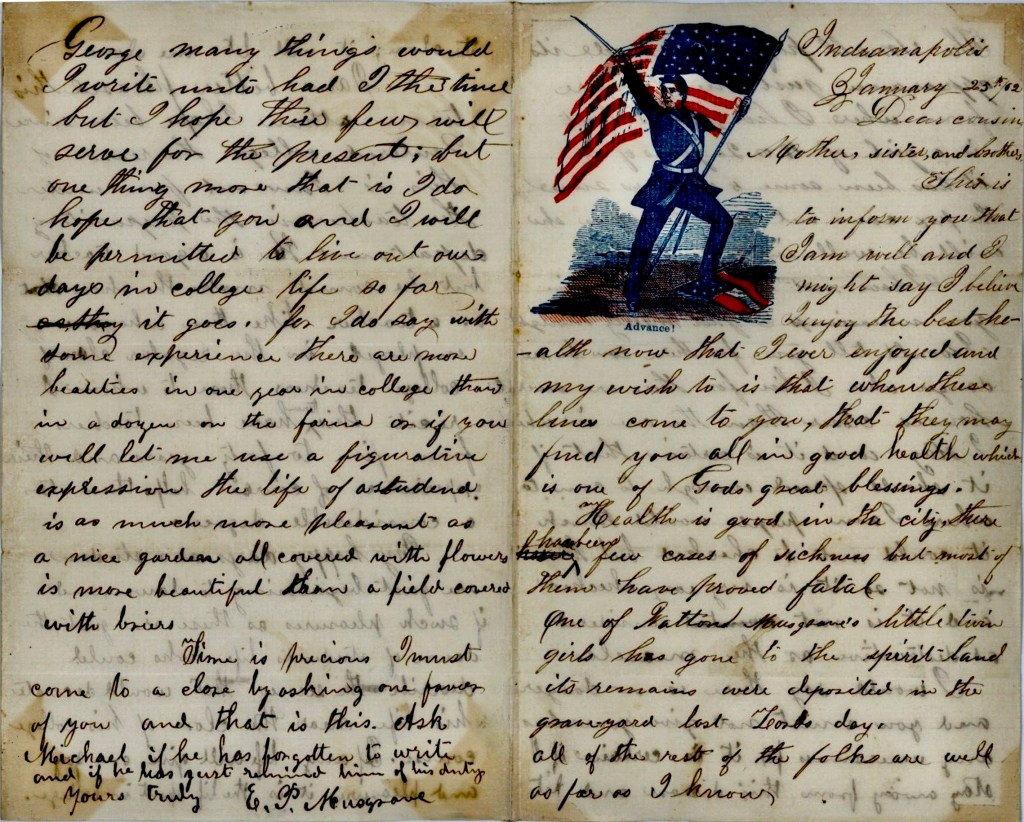
The following letter was written by Elias Prather Musgrave (1844-1864)m the son of Jacob Eli Musgrave (1805-1857) and Elizabeth Flake (1813-1899) of Martinsville, Morgan county, Indiana. Elias and Mattie Evans were married in May 1863. Elias wrote the letter to his mother and siblings but primarily to his cousin George W. Flake (b. 1840) who lived in Martinsville too.
A relative, Walton Musgrave (1828-1874), is mentioned in the letter. In 1860, Walton was a farmer in Warren township, Marion county, Indiana. He was married to Olive Smith (b. 1841) in 1856.
Transcription
Indianapolis [Indiana] January 23, 1862
Dear cousin, Mother, sister, and brothers,
This is to inform you that I am well and I might say I believe I enjoy the best health now that I ever enjoyed and my wish to is that when these lines come to you, that they may find you all in good health which is one of God’s great blessings. Health is good in the city; there has been a few cases of sickness but most of them have [not] proved fatal.
One of Walton Musgrave’s little twin girls has gone to the spirit land. Its remains were deposited in the graveyard last Lord’s day. All of the rest of the folks are well as far as I know.
The small pox has made its appearance just one square from where I live; the subject is a girl of 18 or 20 years of age. It has been some 5 or 6 days since the pox came out and I suppose she will be well in a few days.
I have not written this to give you uneasiness. I just merely thought I would tell you for there are several houses closer than the one in which I stay and it is certain that if it should spread enough to come to where I am, people would think it could not be checked. But this is not so. It is very easy checked and it is not considered as destructive as the measles. I would say there is no danger and you must not give yourselves any uneasiness for it is certain if I stay away from this disease and let it alone, it will let me alone.
I am better pleased this term than I have been since I entered college. The reason of this is I am out from under the teacher in the preparatory department. He is a good teacher but he cannot make the show as a teacher like those who are employed in the regular class of college teachers those to whom I recite this term have been teachers from five to forty years and their experience of course helps them to a considerable degree.
My happy days as a student are just beginning to dawn and if such pleasures as these are just the dawn of student’s life, who could describe scenes that would decorate his life near the close of his college course. If any life will give one joy and pleasure, it is the life spent in college.
George, many thing would I write had I the time but hope these few will serve for the present. But one thing more—that is I do hope that you and I will be permitted to live out our days in college life so far it goes for I do say with some experience there are more beauties in one year in college than in a dozen on the farm, or if you will let e use a figurative expression, the life of a student is as much more pleasant as a nice garden, all covered with flowers is more beautiful that a field covered with briars.
Time is precious. I must come to a close by asking one favor of you and that is this. Ask Michael if he has forgotten to write and if he has, just remind him of his duty. Yours truly, — E. P. Musgrave
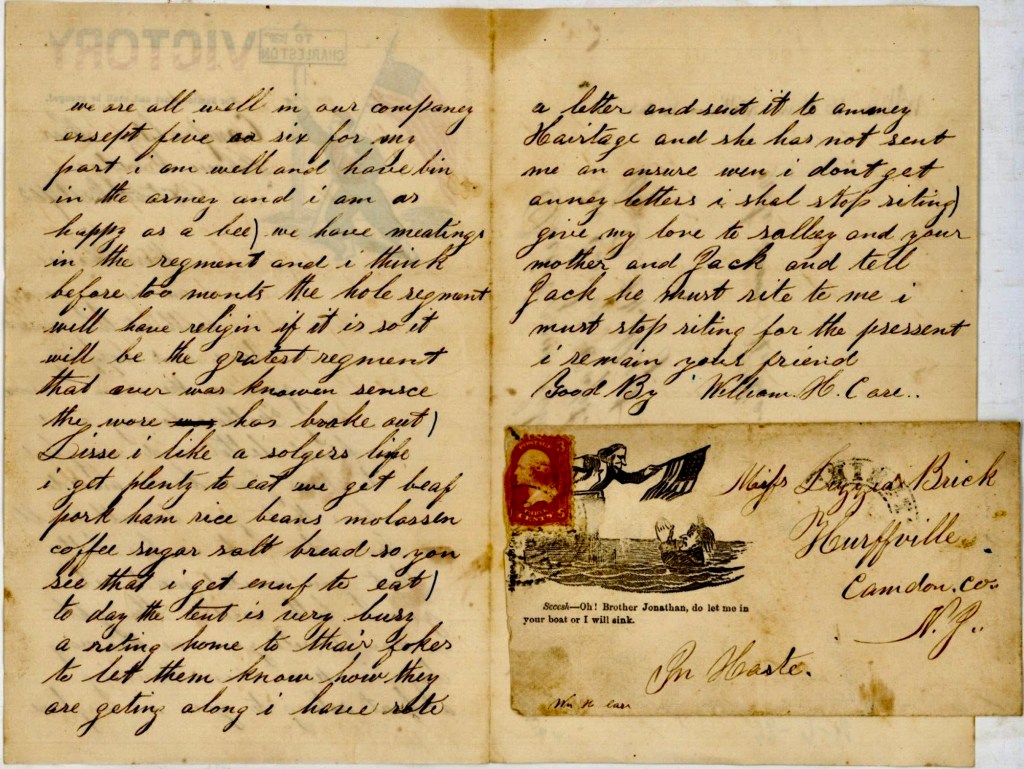
The following letter was written by William H. Carr who served in Co. D, 24th New Jersey Infantry—a nine months’ regiment. On Sept. 28, 1862, the regiment was equipped with Belgian rifles and other necessary accouterments for service, and on Tuesday, the 30th, broke camp and departed for Washington, going by steamer to Philadelphia and thence by rail. It was brigaded with the 28th N. J. and 128th Pa. regiments, under the colonel of the former, acting Brig.-Gen. Abercrombie having command of the division, which occupied the extreme right of the brigade on the Leesburg road. It was afterward permanently brigaded with the 4th and 8th Ohio, 14th Ind., 7th Va., and 28th N. J. regiments under the charge of Brig.-Gen. Kimball, in French’s division, Couch’s corps. It participated in the fighting at Fredericksburg, and the loss of the regiment, which behaved admirably throughout, was severe, amounting in all to 160.
According to regimental records, William survived the war. He was mustered out of the service at Beverly, New Jersey, on 29 June 1863. William wrote the letter to Lizzie Brick (1845-1919) who married John C. Thompson (1838-1911) in 1864 and resided in Hurffville, Gloucester county, New Jersey.
View from heights above the Chain Bridge, showing the ruins of a brick chimney (courtesy of Library of Congress). The remnants of the brick industrial building are visible below, to the right of the Chain Bridge.
Transcription
Addressed to Miss Lizzie Brick, Hurffville. Camden county, New Jersey
Camp Oldon near Chain Bridge October 21st 1862
Miss Lizzie,
I am enjoying good health at this present time and hoping you are the same. I received my Father’s loving and kind letter and was glad to hear from home and to hear that you are all well. Mr. Watson wrote on his letter that you wanted me to write you a letter and I thought I would write you one this very day. I have been thinking about writing to you a long time.
We are all well in our company except five or six. For my part, I am well and have been in the army and I am as happy as a bee. We have meetings in the regiment and I think before two months the whole regiment will have religion. It it is so, it will be the greatest regiment that ever was known since the war has broke out.
Lizzie, I like a soldier’s life. I get plenty to eat. We get beef, pork, ham, rice, beans, molasses, coffee, sugar, soft bread. So you see that i get enough to eat. Today the tent is very busy a writing home to their folks to let them know how they are getting along. I have wrote a letter and sent it to Anney Hairtage and she has not sent me an answer. When I don’t get any letters, I shall stop writing. Give my love to Sally and your mother and Jack and tell Jack he must write to me. I must stop writing for the present. I remain your friend. Goodbye. — William H. Carr
Direct your letter to William H. Carr in care of Capt. Ward, Co. D, 24th Regt. N. J. Vols., Washington D. C. Write soon
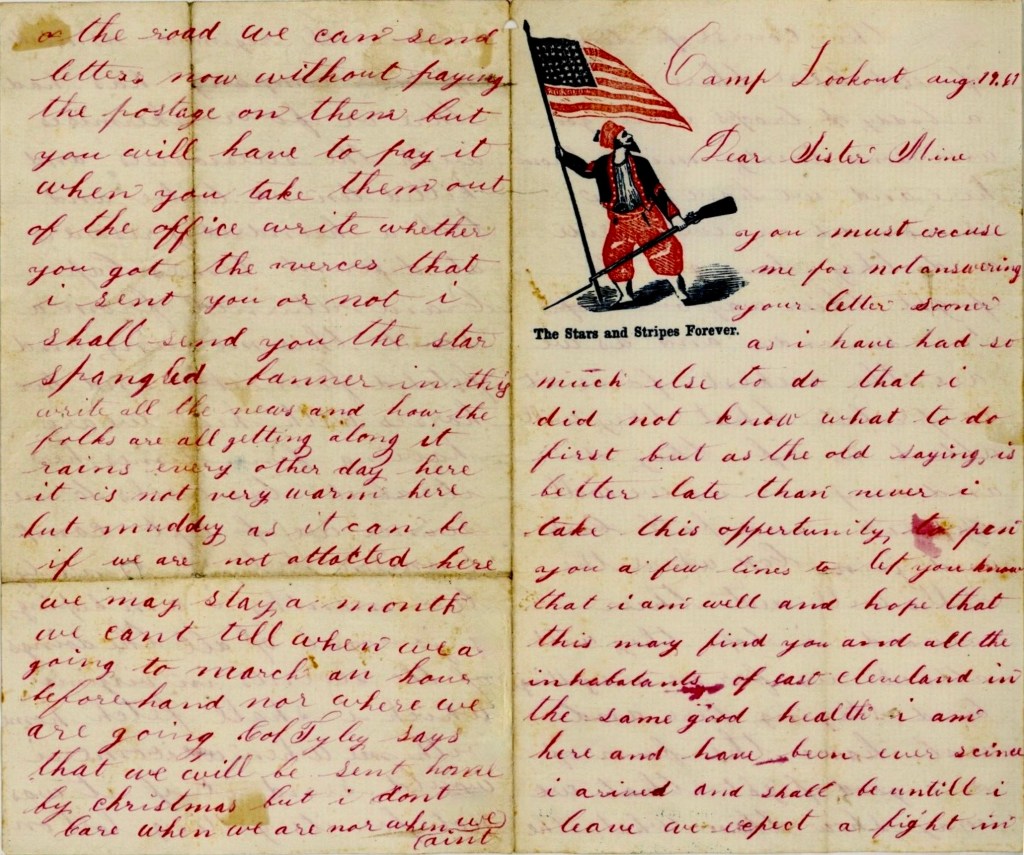
The following letter was written by a soldier in Co. A, 7th Ohio Volunteer Infantry (OVI). Unfortunately he did not sign his letter or there was, at one time, a second sheet. He wrote the letter to his sister but does not give her name. We only know that she (and probably he) lived in East Cleveland, Ohio.
Transcription
Camp Lookout [West Va.] August 19, 1861
Dear sister mine,
You must excuse me for not answering your letter sooner as I have had so much else to do that I did not know what to do first but as the old saying is better late than never, I take his opportunity to pen you a few lines to let you know that I am well and hope that this may find you and all the inhabitants of East Cleveland in the same good health. I am here and have been ever since I arrived and shall be until I leave.
We expect a fight in the course of time if not before. There is a body of troops under Gov. Wise some twenty miles from here and we have them surrounded on every side and they have got to fight their way out or surrender. And we are the weakest force, it is probable that they will attack us if they do and over power us. We will retreat and fall back and join Cox where the rebels will meet their reward. I hope they will attack us for we are getting tired staying here and not have the fun of one good fight that we may show them what the 7th Regiment is made of.
Capt. Orrin J. Crane, Co. A, 7th OVI
Our company has had three or four skirmishes with the secessionists and killed ten or twelve and took a hundred prisoners at different times. Capt. [Orrin Johnson] Crane returned from a scout this morning and fetched four rebels and two horses with him. We are having fine times here. It [seems] about two weeks to me since we left Camp Dennison but it is nearly two months.
I am keeping a journal of all the doings of the 7th in Virginia which I shall fetch home with me when I come. I would send it if it was not for its getting lost on the road. We can send letters now without paying the postage on them but you will have to pay it when you take them out of the office. Write whether you got the verses that I sent you or not. I shall send you the Star Spangled Banner in this.
Write all the news and how the folks are all getting along. It rains every other day here. It is not very warm here but muddy as it can be. If we are attacked here, we may stay a month. We can’t tell when we are a going to march an hour beforehand,, not where we are going. Col. [E. B.] Tyler says that we will be sent home by Christmas but I don’t care when we are nor when we ain’t. [no signature]
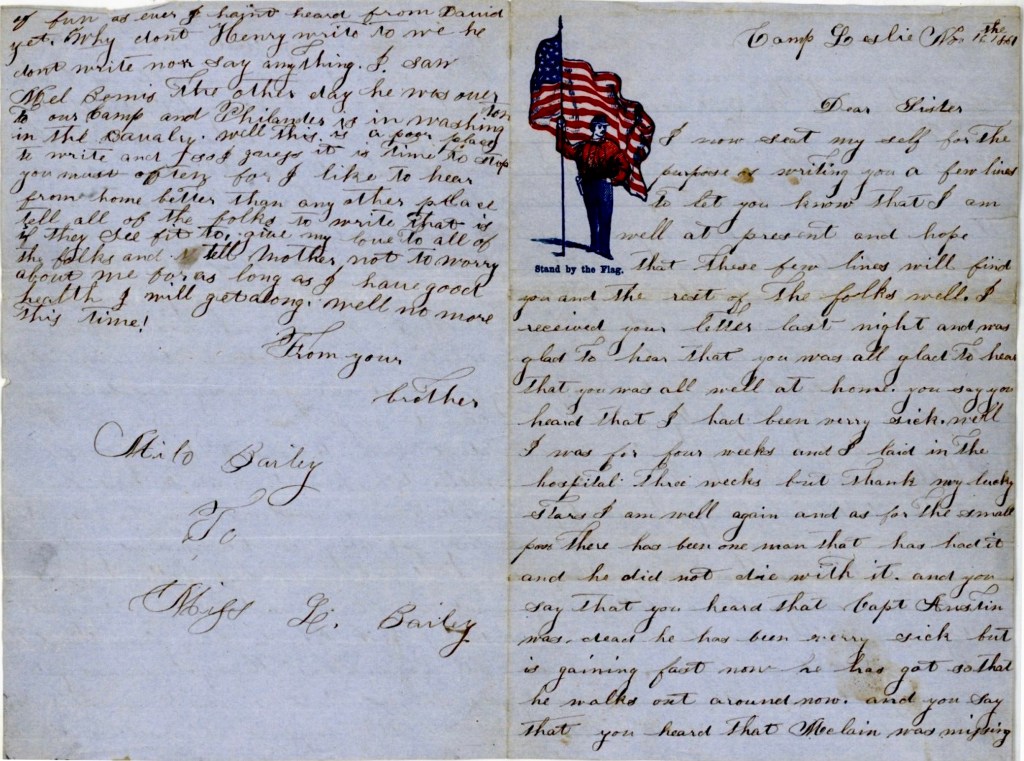
This letter was written by 16 year-old Milo Bailey (b. 1845) who enlisted as a private on 7 October 1861 At Wattsburg, Erie county, Pa. to serve in Co. K, 83rd Pennsylvania Infantry. Milo was wounded at the Battle of Gaines Mill on 27 June 1861 during the Peninsula Campaign and was discharged for wounds on 6 February 1863. He later reenlisted in February 1864 and was promoted to corporal of Co. B in March 1865. He mustered out of the regiment in late June 1865 as a veteran.
Transcription
Camp Leslie November 16th 1861
Dear Sister,
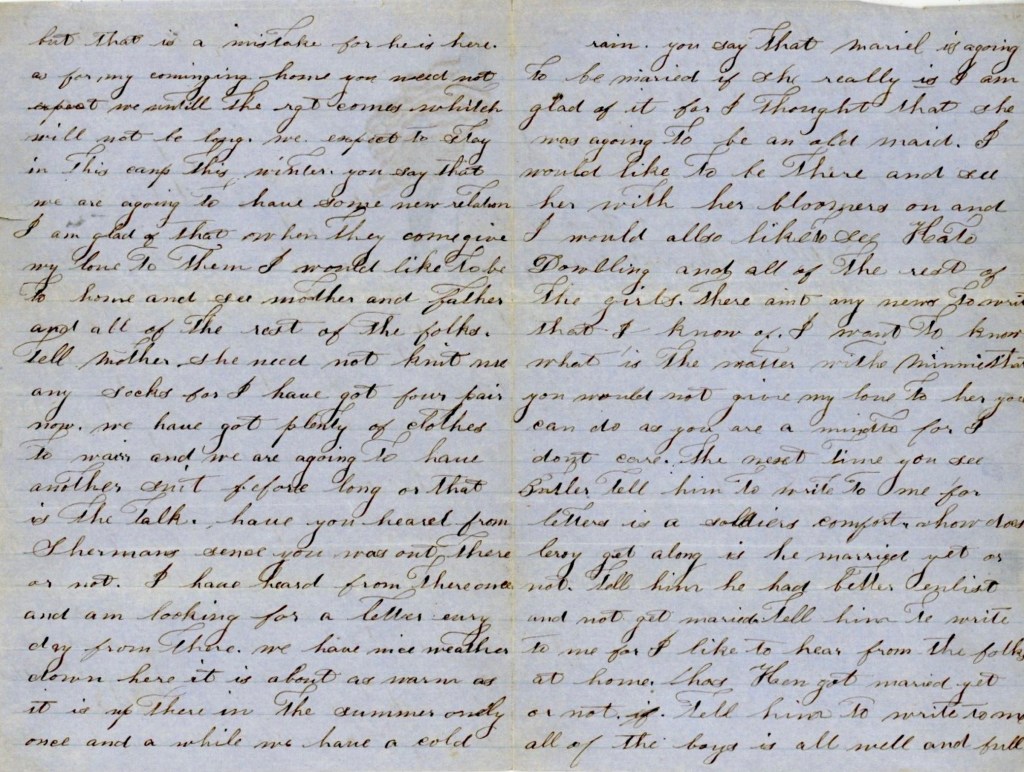
I now seat myself for the purpose of writing you a few lines to let you know that I am am well at present and hope that these few lines will find you and the rest of the folks well. I received your letter last night and was glad to hear that you was all well at home. you say you heard that I had been sick. Well I was for four weeks and I laid in the hospital three weeks but thank my lucky stars, I am well again and as for the small pox, there has been one man that has had it and he did not die with it.
And you say that you heard that Capt. [Thomas M.] Austin was dead. He has been very sick but is gaining fast now. He has got so that he walks out around now. And you say that you heard that McClain was missing but that is a mistake for he is here. As for my coming home, you need not expect me until the regiment comes which will not be long. We expect to stay in this camp this winter.
You say that we are agoing to have some new relation. I am glad of that. When they come, give my love to them. I would like to be to home and see mother and father and all of the rest of the folks. Tell mother she need not knit me any socks for I have got four pair now. We have got plenty of clothes to wear and we are agoing to have another suit before long—or that is the talk. Have you heard from Sherman since you was out there or not? I have heard from there once and am looking for a letter every day from there.
We have nice weather down here. It is about as warm as it is up there in the summer, only once and a while we have a cold rain. You say that Mariel is agoing to be married. If she really is, I am glad of it for I thought that she was agoing to be an old maid. I would like to be there and see her with her bloomers on and I would also like to see Kate Dowling and all of the rest of the girls. There ain’t any news to write that I know of. I want to know what is the matter with Minnie that you would not give my love to her. You can do as you are a mind to for I don’t care. The next time you see Butler, tell him to write to me for letters is a soldier’s comfort. How does Leroy get along? Is he married? Tell him to write to me for I like to hear from the folks at home…
All of the boys is all well and full of fun as ever. I hain’t heard from David yet. Why don’t Henry write to me? He don’t write nor say anything. I saw Mel Bemis the other day. He was over to our camp and Philander is in Washington in the cavalry. Well, this is a poor place to write and so I guess it is time to stop. You must [write] often for I like to hear from home better than any other place. Tell all of the folks to write—that is, if they see fit to. Give my love to all of the folks and tell mother not to worry about me for as long as I have good health, I will get along. Well not more this time!
The following letter was written by George G. Hussey (1839-1910) who enlisted on 1 September 1861 as a sergeant in Co. D, 1st Wisconsin Cavalry. He reenlisted as a veteran and mustered out of the regiment on 19 July 1865 at Edgefield, Tennessee. George was from Springvale, Wisconsin.
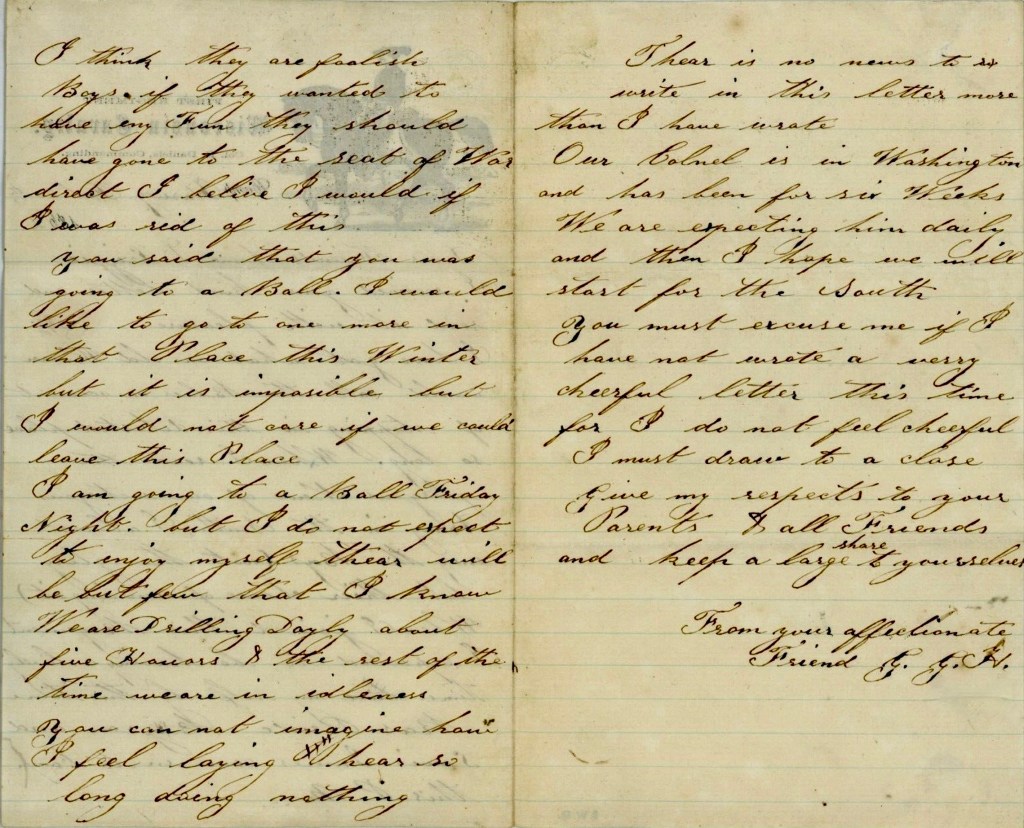
I received your kind letter and read it with pleasure. I have got what an old woman would call the blues on account of stopping in this detested place so long. When I read the glorious news of our victorious Army in the South, I almost envy the boys (not the glory but their chance of winning it). When I joined this regiment, I expected to be having a lively time myself by this time.
Ross Pride, Byron and Lewis James came into camp this p.m. I think they are foolish boys. If they wanted to have any fun, they should have gone to the seat of war direct. I believe I would if I was rid of this.
You said that you was going to a Ball. I would like to go to one more in that place this winter but it is impossible. But I would not care if we could leave this place. I am going to a Ball Friday night but I do not expect to enjoy myself. There will be but few that I know.
We are drilling about five hours & the rest of the time we are in idleness. You cannot imagine how I feel laying here so long doing nothing. There is no news to write in this letter more than I have wrote.
Our Colonel is in Washington and has been for six weeks. We are expecting him daily and then I hope we will start for the South. You must excuse me if I have not wrote a very cheerful letter this time for I do not feel cheerful. I must draw to a close.
Give my respects to your parents & all friends and keep a large share for yourselves. From your affectionate friend, — G. G. H.
With more time I could probably identify these female correspondents but they most certainly lived in Mississippi and their “men folk” were in the Confederate service.
Transcription
Pleasant Valley [Mississippi] January 2nd, 1864
Dear Emily,
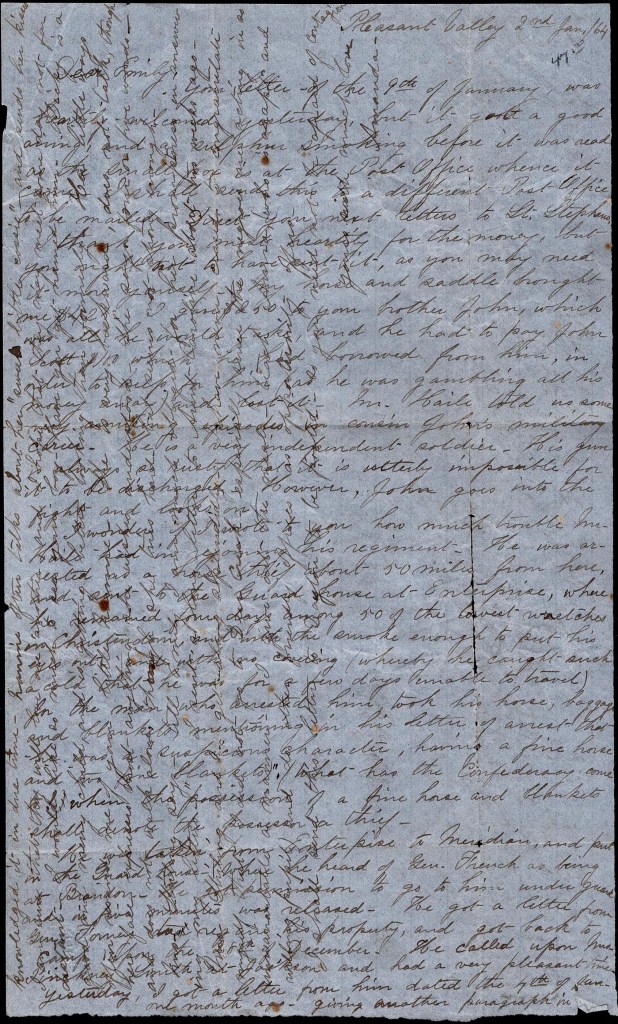
Your letter of the 9th of January was heartily welcomed yesterday, but it got a good airing and a sulphuric smoking before it was read as the smallpox is at the Post Office whence it came. I shall send this to a different Post Office to be mailed. Direct your next letters to Lt. Stephens. I thank you most heartily for the money, but you ought not to have sent it as you may need it more yourself. My horse and saddle brought me $425. I gave $250 to your brother John, which was all he would take, and he had to pay John Scott $100 which he had borrowed from him in order to keep for him as he was gambling all his money away and lost it. Mr. Haile told us some very amusing episodes in cousin John’s military career. He is a very independent soldier. His gun is always so rusty that it is utterly impossible for it to be discharged. However, John goes into the fight and looks on.
I wonder if I wrote to you how much trouble Mr. Haile had in rejoining his regiment. He was arrested as a horse thief about 50 miles from here and sent to the guard house at Enterprise where he remained four days among 50 of the lowest wretches in Christendom, and with the smoke enough to put his eyes out and with no covering (whereby he caught such a cold that he was for a few days unable to travel) for the man who arrested him took his horse, baggage, and blankets, mentioning in his letter of arrest that he was a suspicious character, having a fine horse and two fine blankets. What has the Confederacy come to when the possession of a fine horse and blankets shall denote the possessor a thief.
He was taken from Enterprise to Meridian and put in the guard house where he heard of Gen. French as being at Brandon. He got permission to go to him under guard and in five minutes was released. He got a letter from Gen. Forney to regain his property and got back to Camp Pony the 28th of December. He called upon Mrs. Pinckney Smith at Jackson and had a very pleasant time. Yesterday, I got a letter from him dated the 4th of January—one month ago—giving another paragraph in the chapter of misfortunes, which is far worse than all.
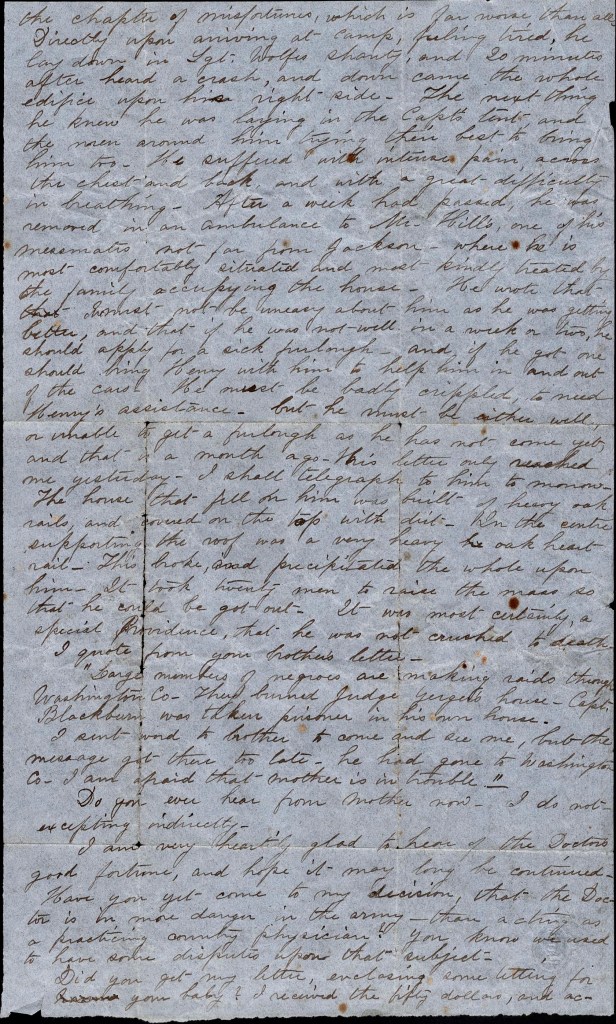
Directly upon arriving at camp, feeling tired, he lay down in Sgt. Wolf’s shanty and 20 minutes after heard a crash and down came the whole edifice upon his right side. The next thing he knew he was laying in the Captain’s tent and the men around him trying their best to bring him to. He suffered with intense pain across the chest and back and with a great difficult in breathing. After a week had passed, he was removed in an ambulance to Mr. Hill’s—one of his mess mates not far from Jackson—where he is most comfortably situated and most kindly treated by the family occupying the house. He wrote that I must not be uneasy about him as he was getting better, and that if he was not well in a week or two, he should apply for a sick furlough, and if he got one should bring Henry with him to help him in and out of the cars. He must be badly crippled to need Henry’s assistance but he must be either well or unable to get a furlough as he has not come yet and that is a month ago. His letter only reached me yesterday. I shall telegraph to him tomorrow. The house that fell on him was built of heavy oak rails and covered on the top with dirt. In the center, supporting the roof, was a very heavy oak heart rail. This broke and precipitated the whole upon him. It took twenty men to raise the mass so that he could be got out. It was most certainly a special providence that he was not crushed to death.
I quote from your brother’s letter – “Large members of negroes are making raids through Washington County. They burned Judge [William] Yerger‘s house. Captain Blackburn 1 was taken prisoner in his own house. I sent word to brother to come and see me but the message got there too late—he had gone to Washington Co. I am afraid that mother is in trouble.”
Do you ever hear from Mother now? I do not excepting indirectly. I am very heartily glad to hear of the Doctor’s good fortune and hope it may long be continued. Have you yet come to my decision that the Doctor is in more danger in the army than acting as a practicing country physician? You know we used to have some disputes upon that subject.
Did you get my letter enclosing some letting [?] for your baby? I received the fifty dollars, and acknowledged it in due time. Nannie often talks about her “sweet little Cassie” and sends her kisses. I am sure that they will love one another and I hope that they may meet someday not far distant. I would like so much to see your boy. Have you yet named him? Ducky is a good and merry child and is getting better looking than formerly. Her little ways often remind me of your little Nannie. She is very backward and does not talk, though her face expresses most anything she wishes understood. She says four or five words and does not walk alone though she tries hard but seems not strong enough. Mrs. Starling and I get along splendidly. I have never ceased to congratulate myself that I did not go to Deer Creek—especially since the negroes are acting in so unaccountable a manner. I give out the meal, teach Anna (who is an apt and willing pupil) and do other friendly offices as opportunity offers. I shall send this letter to Dayton to be posted so you need not be afraid of contagion. Yours with much love, — Amanda
1 Possibly George T. Blackburn (1825-1870). He married Mary Bell Johnson in 1859 in Washington county, Mississippi. He served in Co. O in the 28th Cavalry. Buried in Lexington, Fayette county, Mississippi.
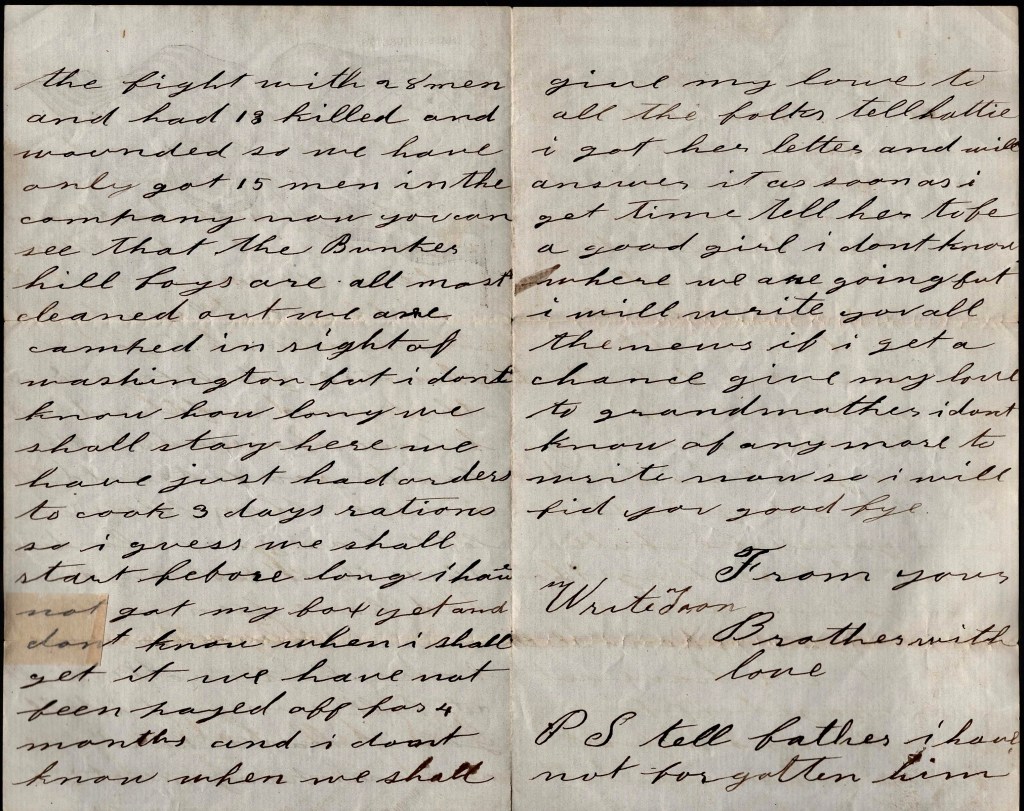
The following letter was unsigned and the envelope has long been separated from the letter so it is not possible to say with certainty who wrote it based on the limited clues within it. The description of troop movements and his reference to his company as the “Bunker Hill” boys initially lead me to conclude that he was a member of the 11th Massachusetts Infantry, Co. I being known as the Bunker Hill Company. The letter was written on 5 September 1862, a few days after the Battle of 2nd Bull Run when the regiment was bivouacked at Fort Lyon, just south of Alexandria, Virginia. All of these clues led me to the 11th Massachusetts until I read an account of the battle by their captain who claimed they were paid off in late July 1862 and the author of this letter claims they were yet owed four months pay.
In the 2nd Battle of Bull Run, the 11th Massachusetts fought in Grover’s Brigade and were part of the force making a bayonet charge against the Confederate position along an unfinished railroad bed. They managed to break through the Confederate line at this point but were ultimately repulsed with heavy loses. The 11th Massachusetts suffered 40% casualties in less than 20 minutes.
Transcription
Camp near Alexandria September 5, 1862
Dear Sister,
I now take my pen to write you a few lines to let you know that I am safe and well. I have received 2 letters from you but could not answer them before we left Harrison’s Landing the 15th of last month and have been on the march ever since. We have had another fight at Bull Run and I tell you, it was a hard one. Our company went into the fight with 28 men and had 13 killed and wounded so we have only got 15 men in the company now. You can see that the Bunker Hill boys are almost cleaned out.
We are camped in sight of Washington but I don’t know how long we shall stay here. We have just had orders to cook three days rations so I guess we shall start before long. I have not got my box yet and don’t know when I shall get it. We have not been paid off for four months and I don’t know when we shall.
Give my love to all the folks. Tell Hattie I got her letter and will answer it as soon as I get time. Tell her to be a good girl. I don’t know where we are going but I will write you all the news if I get a chance. Give my love to grandmother. I don’t know of any more to write now so I will bid you goodbye. From your brother with love








 Spared & Shared 23