My passion is studying American history leading up to & including the Civil War. I particularly enjoy reading, transcribing & researching primary sources such as letters and diaries.
The following letter was written by Van Buren Wintersteen (1836-1867), the eldest son of James and Sally (Roath) Wintersteen of Montville, Geauga county, Ohio.
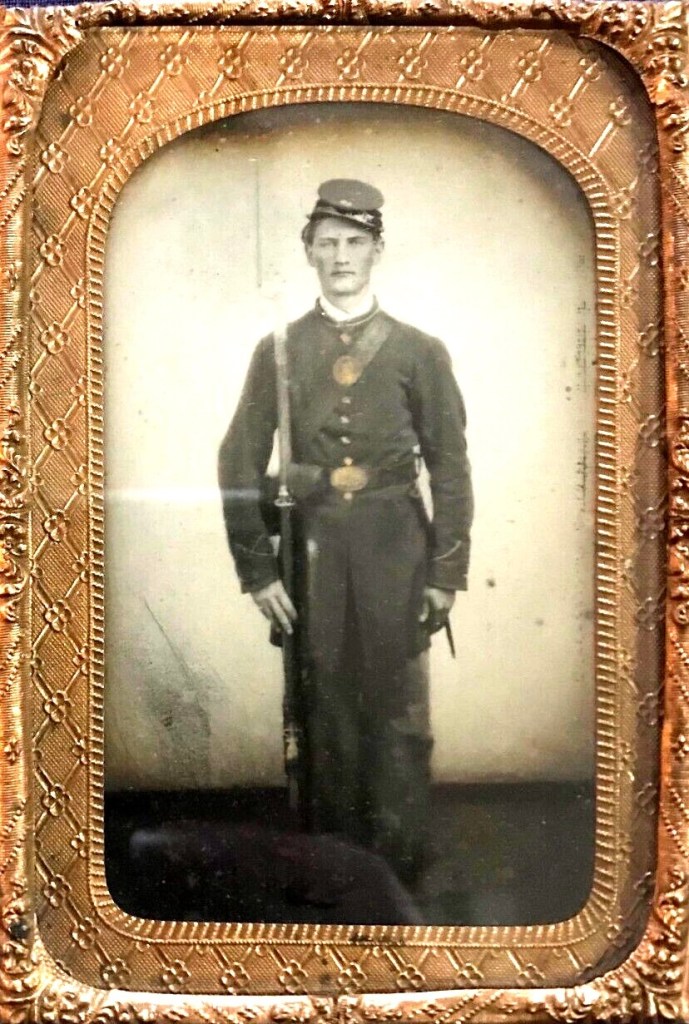
I could not find an image of V. B. Wintersteen but here is one of Phillip Bradley who also served in Co. B, 88th OVI
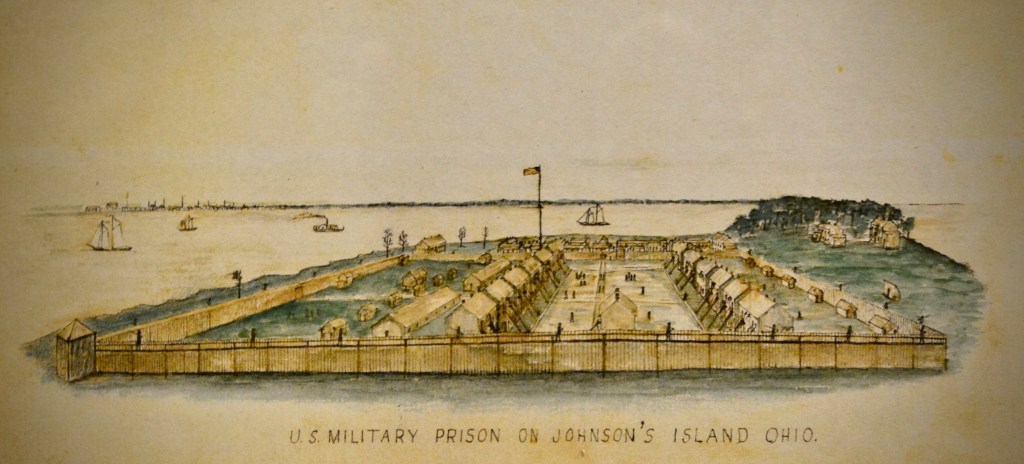
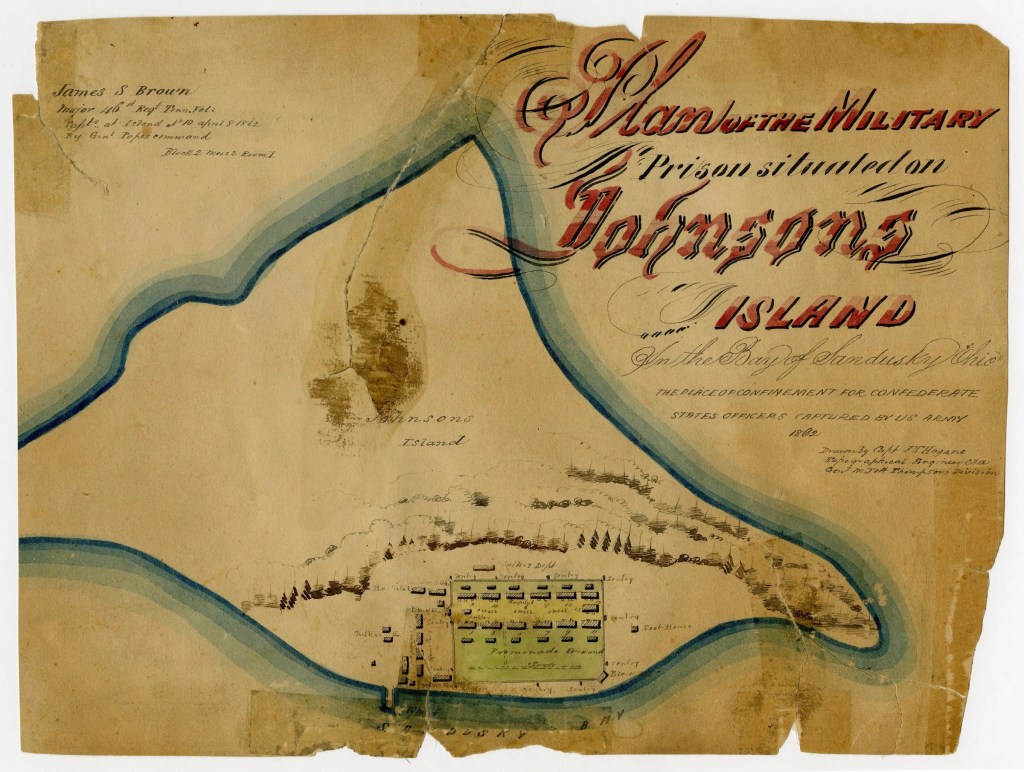
Wintersteen mustered into Co. B, 88th Ohio Infantry as a private on 26 June 1862 and mustered out on 26 September 1862. During those three months of service he was on duty as a prison guard in Hoffman’s Battalion at Johnson’s Island Prison in Sandusky Bay. Most of Hoffman’s Battalion were enlisted for three years and consisted of four companies of men who not only served as guards but helped construct the camp; some of the men also participated in a military campaign in western Virginia during 1862. During the summer of 1862, however, Wintersteen and others were recruited to serve just three months to supplement the guard force.
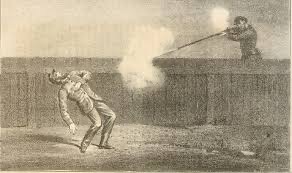
The initial detainees at Johnson’s Island were captured at Fort Donelson and Island No. 10 in the spring of 1862. Generally, those first captured in 1862 experienced exchanges after approximately five months, while individuals arriving post-Gettysburg in July 1863 remained incarcerated for 12 to 18 months. Notably, the prisoners who came in April 1862 were released in September, prior to the onset of the severe winter winds that swept across Sandusky Bay. The regulations governing the prison mandated the extinguishing of lights and the requirement for prisoners to be in bed at specified times; they were expected to demonstrate prompt and unquestioning obedience to the guards’ directives, observing the demarcation line strictly. Fortunately, not all guards adhered to these rules rigidly. There are recorded instances of prisoners being shot at close range, with bullets missing so substantially that those imprisoned speculated whether the guard had intentionally missed or was merely inept as a marksman.
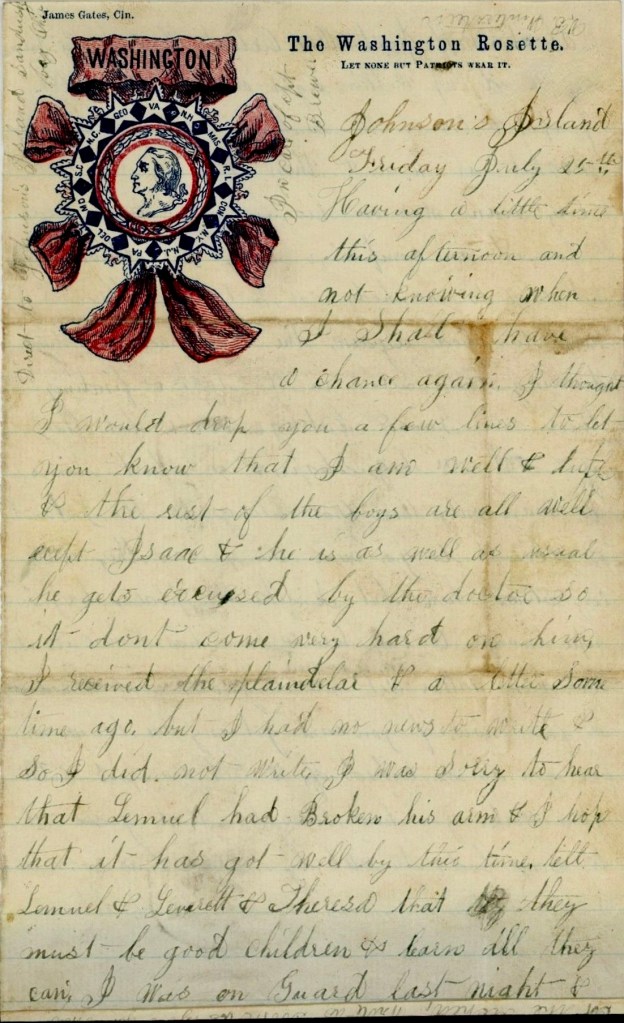
Having a little time this afternoon and not knowing when I shall have a chance again, I thought I would drop you a few lines to let you know that I am well & tough, and the rest of the boys are all well except Isaac [D. Nickerson] & he is as well as usual. He gets excused by the doctors so it don’t come very hard on him.
I received the [Cleveland] Plain Dealer and a letter some time ago but I had no news to write & so I did not write. I was sorry to hear that Lemuel had broken his arm and I hope that it has got well by this time. Tell Lemuel & Leverett & Theresa that they must be good children & learn all they can.
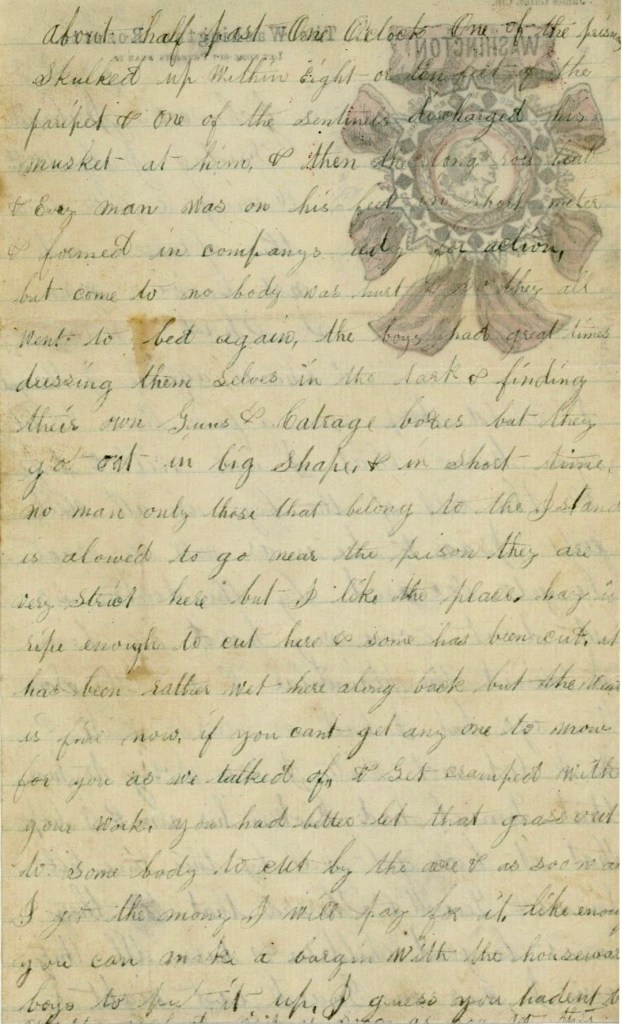
I was on guard last night & about half past one o’clock one of the prisoners skulked up within eight or ten feet of the parapet & one of the sentinels discharged his musket at him, and then the long roll beat & every man was on his feet in short meter & formed in companies ready for action. But come to nobody was hurt & so they all went to bed again. The boys had great times dressing themselves in the dark and finding their own guns and cartridge boxes but they got out in big shape & in short time. No man—only those that belong to the Island—is allowed to go near the prison. They are very strict here but I like the place.
Hay is ripe enough to cut here and some has been cut. It has been rather wet here along back but the weather is fine now. If you can’t get anyone to mow for you as we talked of & get cramped with your work, you had better let that grass out to somebody to cut by the acre & as soon as I get the money, I will pay for it. Like enough you can make a bargain with the houseware boys to put it up. I guess you hadn’t…[rest of letter is missing]
Direct to Johnson’s Island, Sandusky Bay, Ohio. In care of Capt. [Daniel] Brewer, V. B. [Van Buren] Wintersteen
The following letter was written by Robert Brooks Terry (1842-1901), the son of William Terry (1814-1863) and Grizzella Brady (1812-1905) of Philadelphia, Pennsylvania. Robert was married to Ida Jane Piersol, 20 years his junior in 1889.
I could not find an image of Robert but here is one of Daniel Goodman of Co. K, 36th Pennsylvania Infantry who also was taken prisoner on 5 May 1864 and survived imprisonment at Andersonville. (LOC)
Robert was only 18 years old when he enlisted in June 1861 to serve in Co. K, 36th Pennsylvania Infantry (7th Pennsylvania Reserves). In his letter of April 21, 1864, datelined from a camp near Bristoe Station, Virginia, just two weeks prior to the launch of Grant’s Overland Campaign, Robert conjectured that his regiment wouldn’t see much action. “I judge we will be kept in the rear,” he reassured his sister. He could not have been more wrong. His regiment was in the front lines and heavily engaged in the first day’s action in the Wilderness where they suffered heavy casualties—over 300 killed, wounded or missing. Surrounded and forced to surrender, 272 officers and men in the regiment were taken prisoner and marched to Orange Court House, then to Lynchburg, Virginia. The enlisted men were sent to Andersonville, Georgia, a notorious prison camp, while the officers were sent to Camp Oglethorpe in Macon, Georgia. Robert was one of the “lucky” one to survive the ordeal. He was released on 1 March 1865 and mustered out on 27 April 1865.
Letter 1
Much of the following letter refers to the Battle of Ball’s Bluff which ended badly for the Union army due to poor communication by George McClellan. Readers are referred to the Army Historical Foundation’s article entitled, “Disaster at Ball’s Bluff, 21 October 1861” for a more complete understanding of events.
Camp Pierpont Fairfax county, Virginia February 26, 1862
Dear Father,
I received your most welcome letter on the 26th inst. and I was very glad to hear from you. The weather out here now is very good. We had a regular hurricane out here on last Monday but did not damage to anything in this regiment but the tents and it took the majority of them with it. But our tent stood the storm like a rock. It also done a good bit of damage in Washington. Over in the 3rd Regiment, it blowed a tree on a couple of fellows, killing one instantly and breaking both of the legs of the other. I reckon we will be on the move now shortly, maybe inside of the next 2 weeks but I cannot tell exactly.
The Captains gave us new cartridges, 40 rounds to each man, and the orders were to put them in our cartridge box so as to get them out on a double quick. I judge by that that there is a going to be some running besides fighting.
The War Department has sent over about 400 wagons for the use of the division. And that looks like moving. I don’t hardly think we will go beyond Leesburg. We will have the advance till we get to Leesburg. And if we go on to Manassas, Banks will cross at Edward’s Ferry opposite Leesburg and lead on to Manassas. Banks won’t cross till we get on the move and get to Leesburg for they tried it once before and we were ordered there but only got as far as Difficult Creek and was ordered back to camp. And the consequence was that “Stone” sent over Baker’s Brigade which was cut to pieces and Baker himself killed. And what wasn’t killed was taken prisoners. But if we had to kept on, that Balls Bluff affair would never happened. As McCall had his whole division on the move amounting to 15,000 men but was ordered back before he got half way to Leesburg and that both the whole thing.
I heard the news boys a hollering through the camp this morning that Nashville had surrendered. I received a letter from Isiah Bready on last Saturday. He got his situation in the Post Office at Alexander. I expect him up to see me every day as he told me in the letter that he would come up when he gets time. The doctor vaccinated all of us one day last week. He wanted something to do I think. It was to keep us from getting the small pox. I guess I will stop now as I want to say a few words to Lou. Give my best respects to all my friends, &c. From your affectionate son, — Robert B. Terry
Dear Sister [Louisa],
I received your letter on the 24th inst. and was very glad to hear from you. they ought to send the home guards down in this neighborhood for about 3 months. I think it would do the country more good than parading around the streets of Philadelphia. The Rebels at Manassas are 30,000 strong and they are all to die before the place is taken. The other 30,000 they have called away from there & Centerville. If we have the right kind of artillery, it will not take long to take that or Richmond.
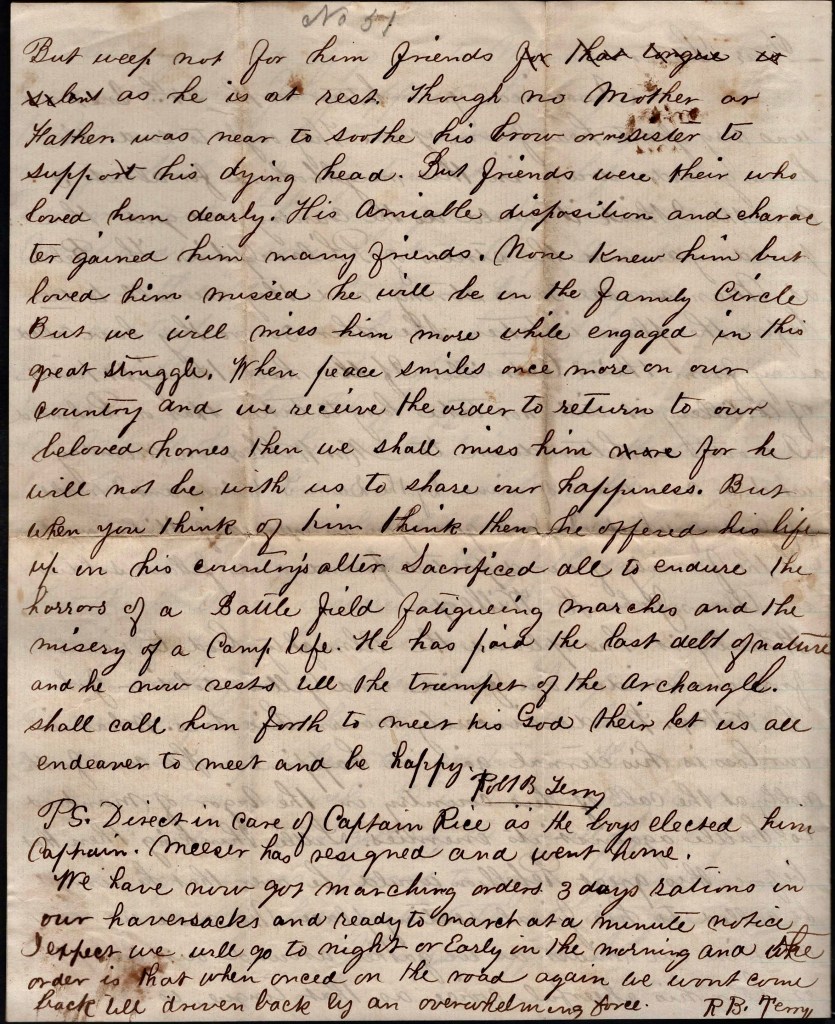
I wrote a letter down to Mr. Willcox on Monday which a messmate of mine, Samuel T. Wilson, and I made up and of which I shall give you an extract of. It is as follows: “To the family of our departed friend and fellow soldier in arms, John H. Willcox [Wilcox]. Whereby it has pleased the Almighty God to remove from our midst our friend and fellow soldier John H. Willcox, we do solemnly mourn his loss. What is our loss is his eternal gain in happiness. He came forth nobly at the call of his country in the vigor of manhood to battle against its enemies, little thinking then that before htis great Rebellion would be over, that he would be called to his final resting place. No more will he meet in our midst as we gather around our camp fire or hear his cheerful voice as that tongue is silent. But weep not for him friends as he is at rest. Though no mother or father was near to soothe his brow or no sister to support his dying head, but friends were there who loved him dearly. His amiable disposition and character gained him many friends, None knew him but loved him. Missed he will be in the family circle. But we will miss him more while engaged in the great struggle. When peace smiles once more on our country and we receive the order to return to our beloved homes, then we shall miss him for he will not be with us to share our happiness. But when you. think of him, think then he offered his life upon his country’s alter, sacrificed all to endure the horrors of a battlefield, fatiguing marches, and the misery of a camp life. He has paid the last debt of nature and he now rests till the trumpet of the archangel shall call him forth to meet his God. There let us all endeavor to meet and be happy. — Robt. B. Terry
P. S. Direct in care of Captain [James M.] Rice as the boys elected him Captain. [Casper] Martin has resigned and went home. We have not got marching orders. Three. days rations in our haversacks and ready to march at a minute’s notice. I expect we will go tonight or early in the morning and the order is that when once on the road again, we won’t come back till driven back by an overwhelming force. — R. B. Terry
Letter 2
Robert wrote the letter to his younger sister, Louisa B. Terry (1844-1865) who was employed as a 21 year-old school teacher in Philadelphia at the time of her death on 5 December 1865.
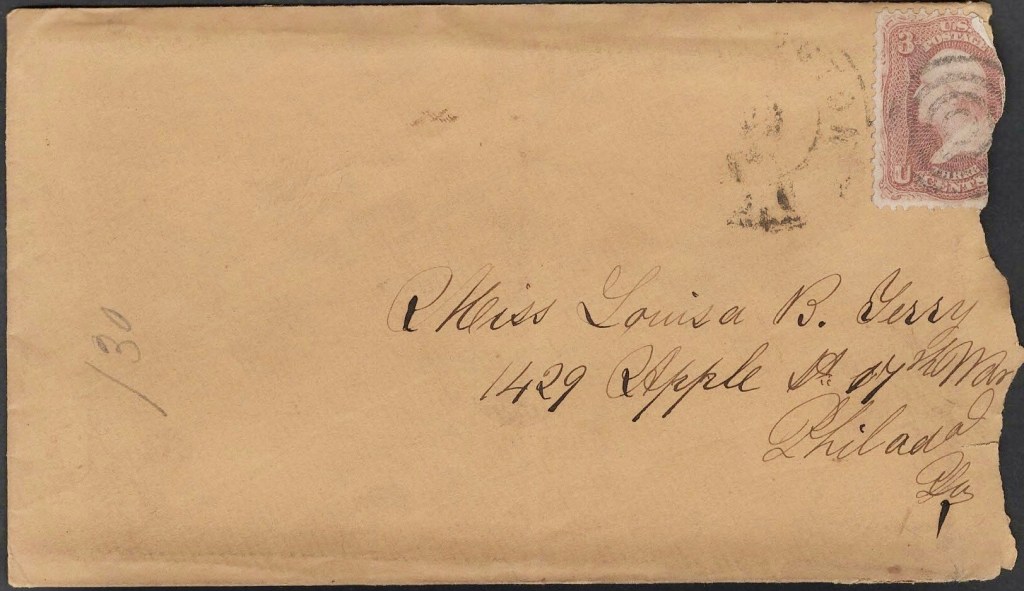
Addressed to Miss Louisa B. Terry, 1429 Apple Street, 17th Ward, Philadelphia, Pa.
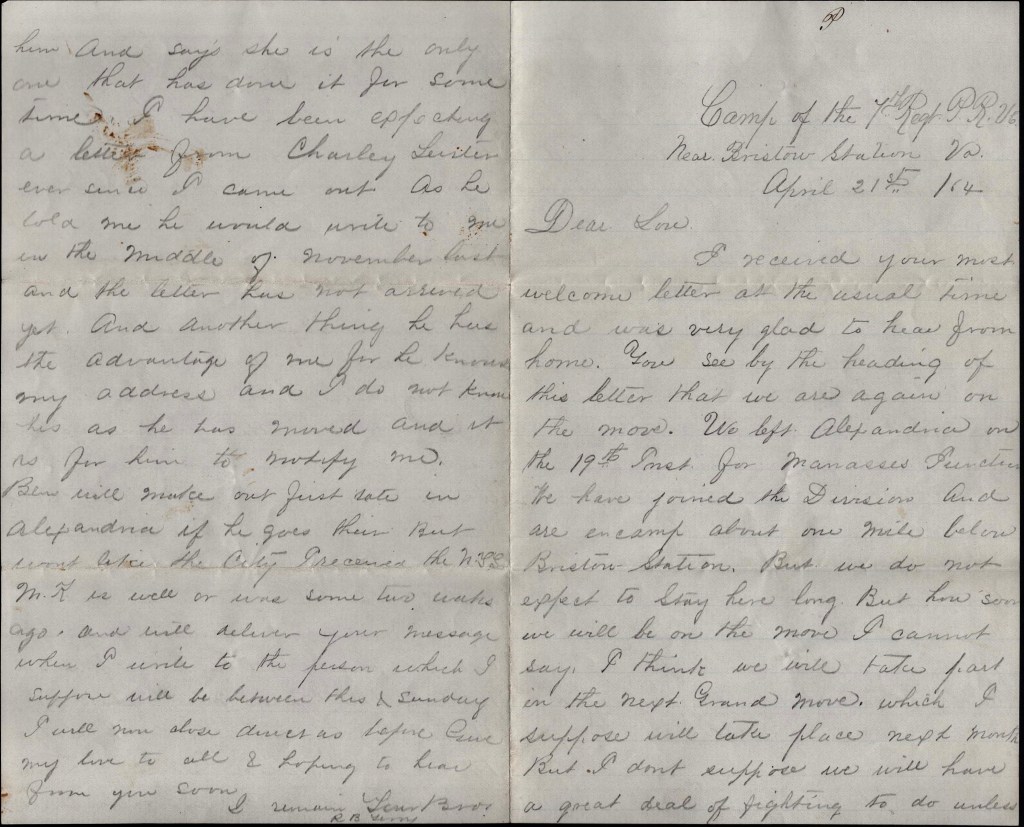
Camp of the 7th Regt. P. R. V. Infantry Near Bristoe Station, Va. April 21st 1864
Dear Lou,
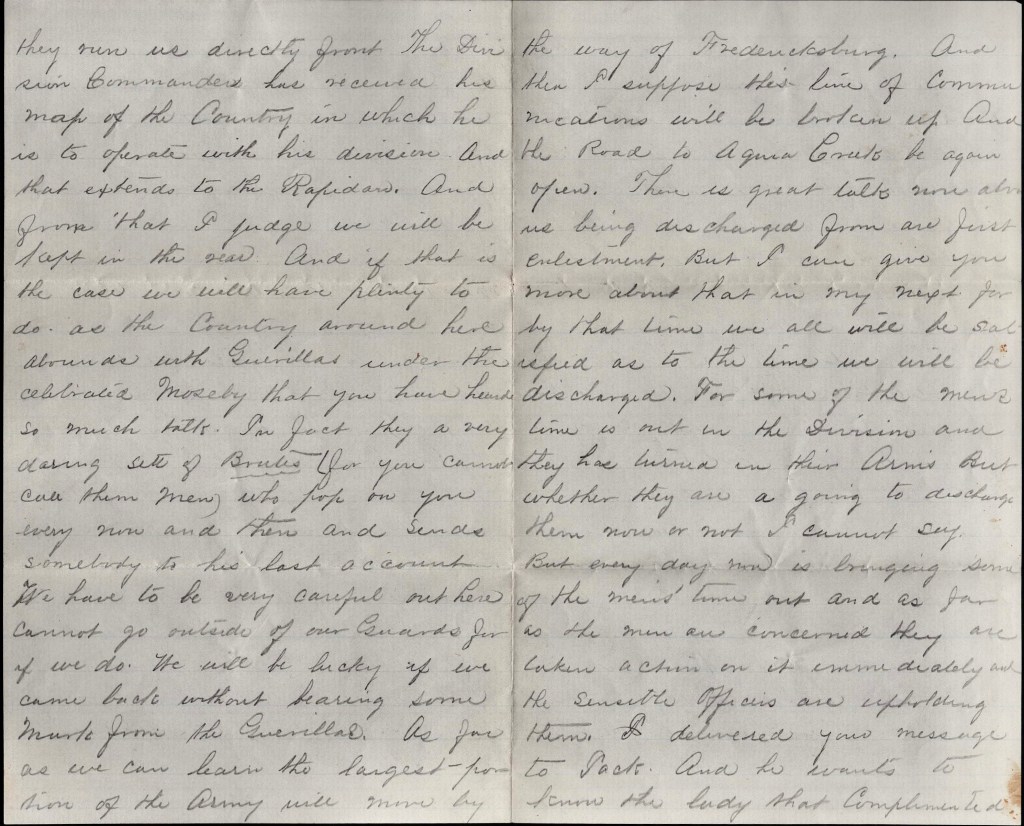
I received your most welcome letter at the usual time and was very glad to hear from home. You see by the heading of this letter that we are again on the move. We left Alexandria on the 19th inst. for Manassas Junction. We have joined the Division and are encamp[ed] about one mile below Bristoe Station. But we do not expect to stay here long. But how soon we will be on the move, I cannot say. I think we will take part in the next grand move which I suppose will take place next month. But I don’t suppose we will have a great deal of fighting to do unless they run us directly front.
The Division commander has received his map of the country in which he is to operate with his Division and that extends to the Rapidan. And from that, I judge we will be kept in the rear. And if that is the case, we will have plenty to do as the country around here abounds with guerrillas under the celebrated Mosby that you have heard so much talk. In fact, they [are] a very daring set of brutes (for you cannot call them men) who pop on you every now and then and sends somebody to his last account. We have to be very careful out here—cannot go outside of our guards for if we do, we will be lucky if we come back without bearing some mark from the guerrillas.
As far as we can learn, the largest portion of the Army will move by the way of Fredericksburg, and then I suppose the line of communications will be broken up and the road to Aquia Creek be again open.
There is great talk now about us being discharged from our first enlistment but I can give you more about that in my next for by that time we all will be satisfied as to the time we will be discharged. For some of the men’s time is out in the Division and they has turned in their arms. But whether they are a going to discharge them now or not, I cannot say. But every day now is bringing some of the men’s time out and as far as the men are concerned, they are taken action on it immediately and the sensible officers are upholding them.
I delivered your message to Jack and he wants to know the lady that complimented him and says she is the only one that has done it for some time. I have been expecting a letter from Charley Leister ever since I came out as he told me he would write to me in the middle of November last and the letter has not arrived yet. And another thing, he has the advantage of me for he knows my address and I do not know his as he has moved and it is for him to notify me.
Ben will make out first rate in Alexandria if he goes there but won’t like the city. I received the N. Y. T. [New York Tribune]. M. K. is well or was some two weeks ago and will deliver your message when I write to the person which I suppose will be between this and Sunday. I will now close. Direct as before. Give my love to all & hoping to hear from you soon, I remain your brother, — R. B. Terry
The letter was composed by Luther Hurd (1842-1881), who served as a clerk in Boston in 1864 before volunteering for duty in Company B of the 5th Massachusetts Volunteer Militia (100 days 1864). This regiment was established to garrison federal forts that had previously been occupied by Heavy Artillery units, which were redeployed to the front lines in Virginia to engage in infantry combat. The regiment commenced its service in July and was returned home on 6 November 1864.
From Luther’s letter to his sister Addie, it is evident that he has been diligently serving as a nurse in the post hospital throughout his tenure with the 5th Massachusetts Volunteer Militia. Rather than returning home with his fellow militia members, he consented to the solemn request of his gravely ill captain, John Norton Coffin (1825-1891) from Somerville, Massachusetts, to remain and provide care until his recovery. Capt. Coffin, married to Dorcas Jane Powers (1831-1898), was the father of two children living in November 1864, the time at which this correspondence was written. Prior to his service in the Volunteer Militia of 1864, Coffin held the rank of 1st Lieutenant in the 8th Independent Battery Massachusetts Light Artillery. Capt. Coffin ultimately recovered from his illness, living until 1891, when he passed away at the age of 66 and was laid to rest in his birthplace, Portsmouth, New Hampshire.
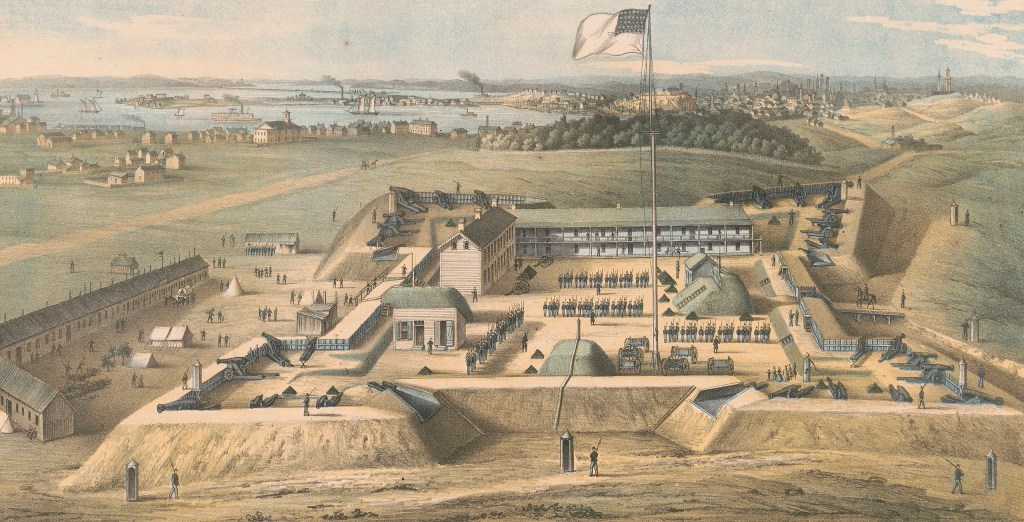
Fort Marshall, Baltimore, Maryland, ca. 1862
Transcription
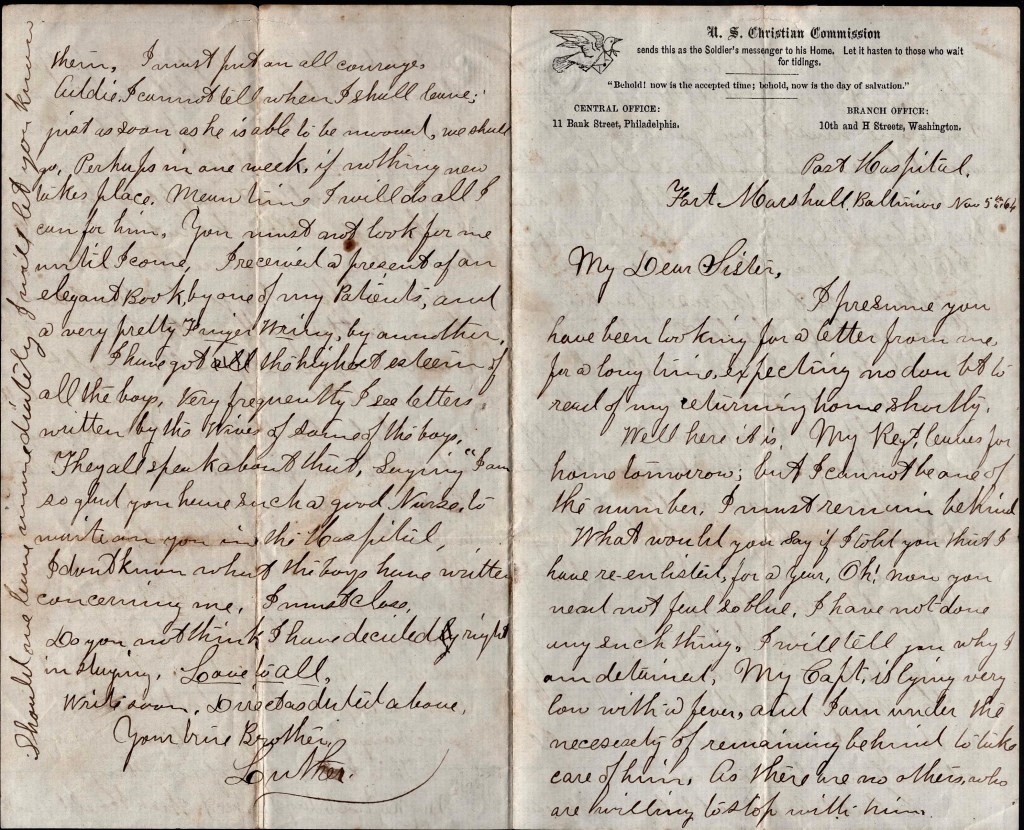
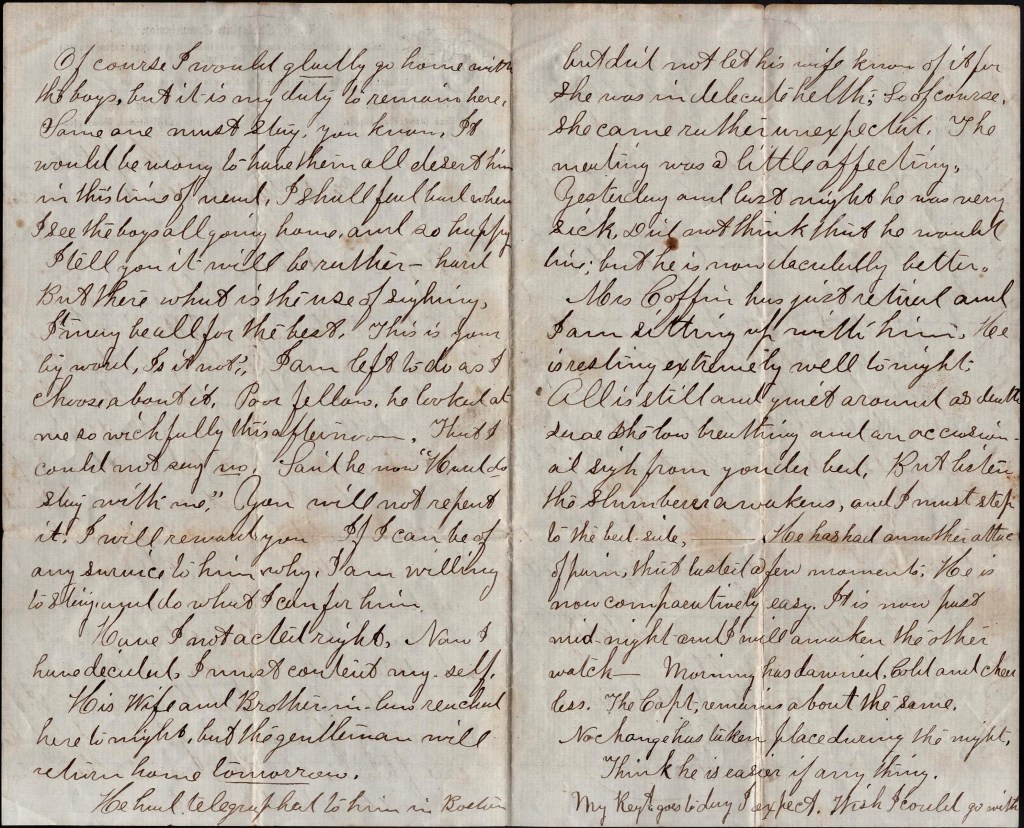
Post Hospital Fort Marshall, Baltimore [Md.] November 5th 1864
My dear sister,
I presume you have been looking for a letter from me for a long time, expecting no doubt to read of my returning home shortly. Well her it is. My regiment leaves for home tomorrow but I cannot be one of the number. I must remain behind. What would you say if I told you that I have reenlisted for a year. Oh! now you need not feel so blue. I have not done any such thing. I will tell you why I am detained.
My captain is lying very low with a fever and I am under the necessity of remaining behind to take care of him as there are no others who are willing to stop with him. Of course I would gladly go home with the boys but it is my duty to remain here. Someone must stay you know. It would be wrong to have them all desert him in this time of need. I shall feel bad when I see the boys all going home and so happy. I tell you, it will be rather hard. But then, what is the use if sighing. It may be all for the best. This is your big word, is it not? I am left to do as I choose about it.
Poor fellow. He looked at me so wishfully this afternoon that I could not say no. Said he now, “Hurd, do stay with me.You will not repent it. I will reward you.” If I can be of any service to him, why I am willing to stay and do what I can for him. Have I not acted right? Now I have decided, I must content myself.
His wife and brother-in-law reached here tonight but the gentleman will return home tomorrow. He had telegraphed to him in Boston but did not let his wife know of it for she was in delicate health. So of course she came rather unexpected. The meeting was a little affecting.
Yesterday and last night he was very sick. Did not think that he would live; but he is now decidedly better. Mrs. Coffin has just retired and I am sitting up with him. He is resting extremely well tonight. All is still and quiet around as death except the low breathing and an occasional sigh from yonder bed. But listen, the slumber awakens and I must step to the bedside. He has had another attack of pain that lasted a few moments. He is now comparatively easy. It is now past midnight and I will awaken the other watch.
Morning has arrived—cold and cheerless. the captain remains about the same. No changes has taken place during the night. Think he is easier if anything.
My regiment goes today I expect. Wish I could go with them. I must put on all courage. Addie, I cannot tell when I shall leave; just as soon as he is able to be moved we shall go. Perhaps in a week if nothing new takes place. Meantime I will do all I can for him. You must not look for me until I come. I received a present of an elegant book by one of my patients and a very pretty finger ring by another.
I have got the highest esteem of all the boys. Very frequently I see letters written by the wives of some of the boys. They all speak about that, saying “I am so glad you have such a good nurse to wait on you in the hospital.” I don’t know what the boys have written concerning me.
I must close. Do you not think I have decided right in staying? Love to all. Write soon. Direct as directed above. Your true brother, — Luther
Rachel Finley (Bartlett) Griffith of Edgar county, Illinois
This letter was written by a woman who lived in or near Paris, Edgar county, Illinois, in August 1861. It is either unsigned or, more likely, a second sheet is missing which would provide us with her identity. She wrote the letter to Kittie (Griffith) Lawrence (1830-1915) whom she refers to as her sister. Since Kittie did not have a sister, my hunch is that it was written by Kittie’s sister-in-law, Rachel Finley (Bartlett) Griffith (1829-1870), the wife of Orville E. Griffith (1829-1875) of Edgar county, Illinois.
Kittie’s full name was actually Ann Katherine (Griffith) Lawrence. She was married to James Lawrence of Lincoln, Logan county, Illinois. The couple were married in Edgar county in 1849 and had relocated to Topeka, Shawnee county, Kansas by 1860, but then returned to Illinois during the Civil War. Kittie and Rachel’s husband, Orville, were the two oldest children of Joseph Robinson Griffith (1806-1849) and Caroline Guthrie (1806-1850), both deceased ten years prior to the Civil War.
Transcription
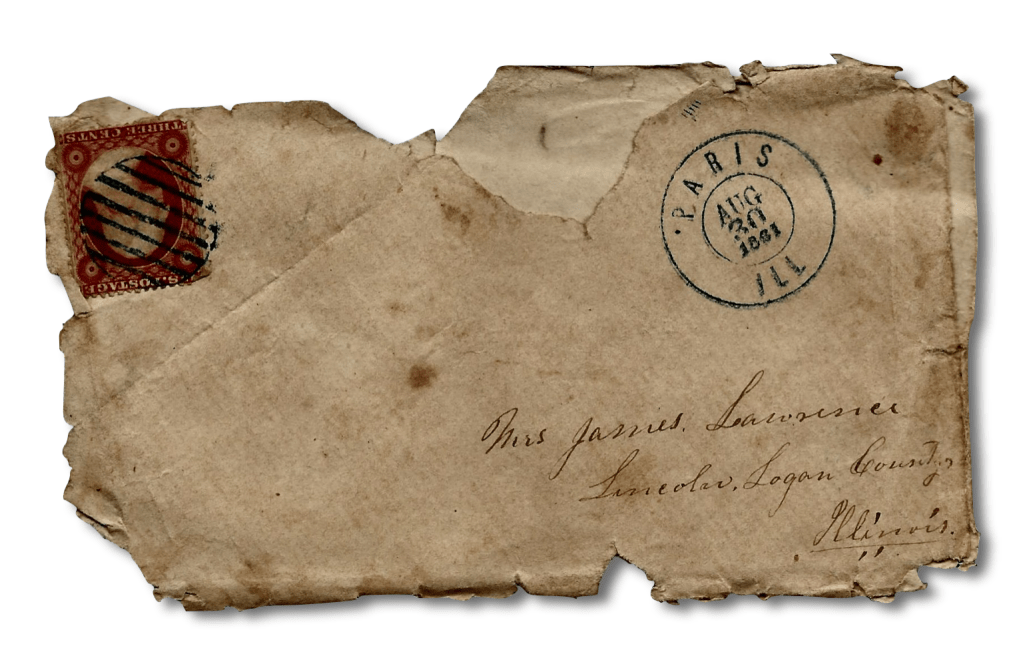
Addressed to Mrs. James Lawrence, Lincoln, Logan county, Illinois; postmarked Paris, Illinois, 30 August 1861
At school August 28, 1861
My dear sister Kittie,
Although some time has elapsed since your kind favor came to hand, and you perhaps may think it has been forgotten or neglected (which I could not wonder if you did) yet it has not been. But if you will credit me, I could not collect money enough to buy paper, stamps and envelopes, and so this morning I went to the dry goods store and got paper and envelopes obviously credit and there is not a stamp or three cent piece in the house to send this when it is finished.
We do not know what the world is coming to unless it is coming to an end. It is needless to say anything about excitement for doubtless you know enough about it. But I doubt very much if we have not (at least) five rebels where you have one. The Union men think that at the recent Secesh rally there were no less than three hundred of them in Paris, and now would you believe it, they are allowed to make public speeches much to the annoyance of the Union ladies. I never saw our community of women so much out of patience with their men as they were for allowing Andy Hunter 1 and that thing—(I don’t know what to call him anything mean enough but Amos Green 2) to make speeches on the occasion. If the ladies had been in power, they would have been deprived of the privilege of belching there—allow me to say—devilish lies. I did not say that to swear but it is all the word that would suit at all.
It is astonishing to see what a state of feeling exists among a religious people—especially the women. They are perfectly wild. Our most quiet and pious people, it takes but a word to rouse them to fighting humor, and it is not to be wondered at when those we love most dearly are unduly torn from us, forced to undergo and endure all the hardships, trials, and privations of the soldier’s life and then be shot down like dogs in an unjust war. Is it any wonder I say that people allow themselves to be carried away with excitement. And then to think that we have to put up with their insults right here in the North where men ought to, and do know better, but who just yield to the promptings of the few selfish office seekers which infest every community.
Kittie, it would startle you (but you may have been startled in the same way) to hear some of our cool, quiet, pious men talk and make threats. The poor fool dregs of the democratic party (I mean this modern democratic party) have appointed an extra session of Court just to get Big Creek annexed to this precinct or township or some political division (I am not as well posted in these things as I ought to be. If you don’t know, James will.) The object is, however, to get that one united to this so it will at the elections go democratic, or secesh rather. Court is in session now and I just tremble until it is through. The excitement concerning it has partially abated.
Edgar [County] has sent four or five companies of infantry and a cavalry company starts tomorrow Friday week. I believe I told you our preacher was captain of the first company. [James F.] Jaquess has gone as chaplain of a cavalry company. 3 Phil Minear 4, Crene, [Edward] Rutledge, 5 and I can’t tell how many of our “big” preachers have gone as captains or chaplains. Excuse this pen. It writes when it pleases only. [unsigned or last of letter is missing]
1 Andrew (“Andy”) Jackson Hunter (1831-1913) moved to Paris, Illinois with his parents in 1832 from Greencastle, Indiana. He eventually became a lawyer and practiced in Paris until 1864 when he was elected to the Illinois Senate as a Democrat.
2 Amos Green was a notorious Peace Democrat (Copperhead) in Edgar county who broadly influenced public opinion a the editor of the Times—the Democratic organ in the county. Michael Kleen published an article called “A Confrontation in Paris” that tells the tale of how and en effort to shut down a newspaper in Edgar countym Illinois, led to one of the Civil War’s most violent home front riots.Green saw the Civil War as unjust and Lincoln as a despot who had to be stopped. He wrote vicious denunciations of the administration in local newspapers. He was arrested for sedition in 1862. After his release in August 1862, he became the grand commander of the secret Order of American Knights in Illinois, which fought restrictions on civil liberties. It was also called the Knights of the Golden Circle and later the Sons of Liberty. Green was funded by the Confederate government to arrange riots at the Democratic National Convention in 1864. Although the riots never materialized, he continued giving antigovernment speeches until he was again arrested in November 1864. After this arrest, he agreed to testify for the government about the activities of the Knights; his testimony implicated others but ignored his own deep involvement in antigovernment plots. In 1864, a clash between Copperheads and Union Soldiers in Charleston, Illinois resulted in nine dead and twelve wounded in what is now called the “Charleston Riot.”
3 James F. Jaquess volunteered as chaplain of the 6th Illinois Cavalry. He later became Colonel of the 73rd Illinois Infantry.
4 Philip N. Minear (b. 1836), a clergyman in Paris, Edgar county, Illinois, volunteered as the chaplain of the 25th Illinois Infantry but resigned on 11 July 1862.
5 Edward Rutledge volunteered as chaplain for the 61st Illinois Infantry. He mustered out in September 1862.
The following letter was written by Andrew George Buell (1842-1925), the son of Charles Buell (1792-1863) and Charlotte Carver (1805-1890) of Franklin, Delaware county, New York.
Andrew enlisted on 1 October 1861 to serve as a private in Co. A, 101st New York Infantry. In September 1862, near Chantilly, Va., he became deaf in one ear when a comrade discharged his gun nearby. He was transferred to Co. B, 37th New York Infantry on 24 December 1862 and was taken prisoner at the battle of Chancellorsville on May 3, 1863, the same day his brother Arthur was wounded. He was later wounded at Spotsylvania as well. He was discharged from the service on 2 October 1864.
In his letter, Andrew writes his parents of the dead soldiers yet unburied on the battlefield of Fair Oaks (or Seven Pines) in Henrico county, Virginia, that was fought on May 31st-June 1st, 1862. The battlefield was approximately six miles east of Richmond at the intersection of the Williamsburg and Nine Mile Roads.
Transcription
101st New York Volunteers [Henrico county] Virginia June 12th, 1862
Dear father & mother,
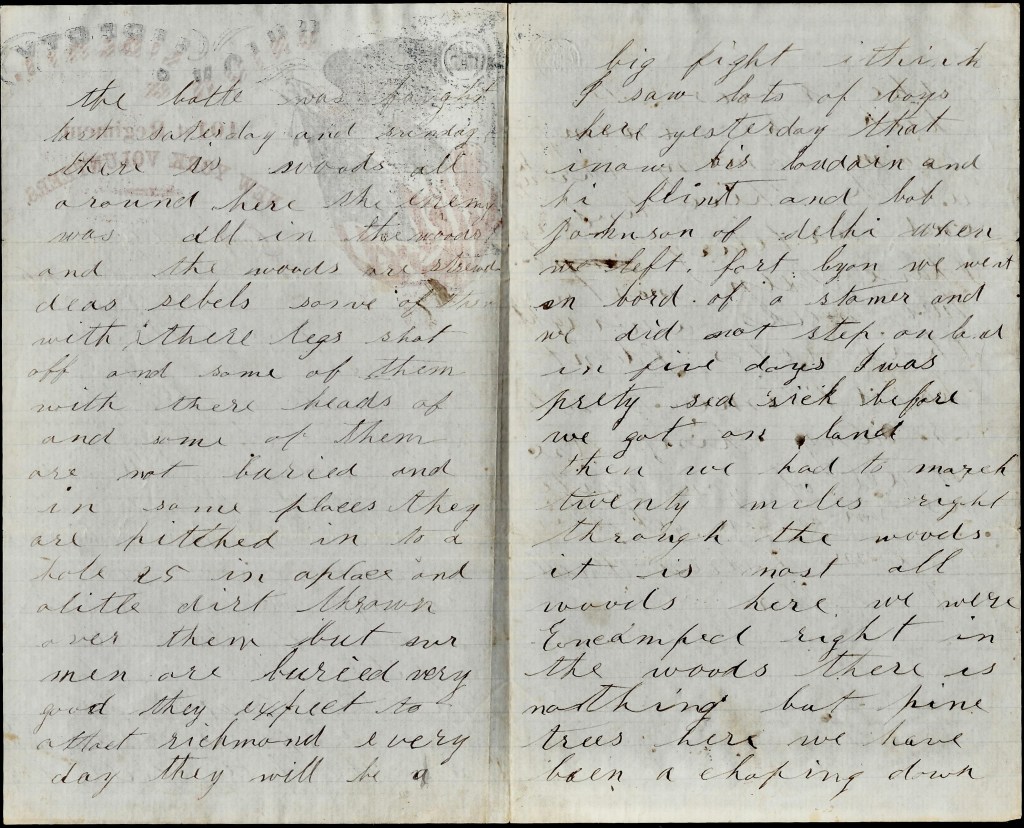
I take this opportunity to write a few lines to you to let you know that we are well and hope that these few lines will find you the same. We are now near the enemy. We are in fives miles of the rebel Capitol where we can see the traitors from our camp. We are encamped on the battlefield where the battle was fought last Saturday and Sunday [May 31-June1 1862]. There is woods all around here. The enemy was all in the woods and the woods are strewed [with] dead rebels—some of them with their legs shot off and some of them with their heads off, and some of them are not buried and in some places they are pitched into a hole 25 in a place and a little dirt thrown over them. But our men are buried very good. They expect to attack Richmond every day. They will be a big fight, I think.
I saw lots of boys here yesterday that I know—Bis. Loudon and Hi Flint and Bob Johnson of Delhi [Delaware county, New York]. 1 When we left Fort Lyon we went on board Odyssey a steamer and we did not step on land in five days. I was pretty sea sick before we got on land. Then we had to march twenty miles right through the woods. It is most all woods here. We were encamped right in the woods. There is nothing but pine trees here. We have been a chopping down the trees to keep the enemy from coming through with their cavalry and artillery.
I have been most two weeks a writing this letter. I don’t have time to write or anything else. All of you write as soon as you get this. From Andrew Buell
to Mother
1 Believe these Delhi residents were in the 72nd New York Infantry.
The following letter was written by a soldier named “Charley” who I believe served in the 18th Ohio Volunteer Infantry. This regiment was formed in September 1861 and was brigaded with the 19th and 24th Illinois and 37th Indiana Regiments in Turchin’s Brigade, Mitchell’s (Third) Division of the Army of the Ohio. The letter was sent to Daniel Beard of Ross county, from which many members of the 18th Ohio enlisted, particularly those in Co. A. Searching the roster for soldiers named “Charles” in the 18th OVI, I was able to find only one who initially served in Co. A, but was later transferred to Co. I (as stated in his letter). His name was Charles Leaverton. According to the 1863 Draft Registration Records, Charles was born in Maryland and he was 24 years old in 1863.
Charles wrote the letter to his friend, Daniel M. Beard (1838-1907) of Ross County, Ohio. Daniel was the son of William Beard (18xx-1868) and Amanda Rodgers (1806-1887). He married Arvilla Jane Augustus (1844-1926), the daughter of Springer and Lucretia Jane (Jenkins) Augustus in 1863.
Transcription
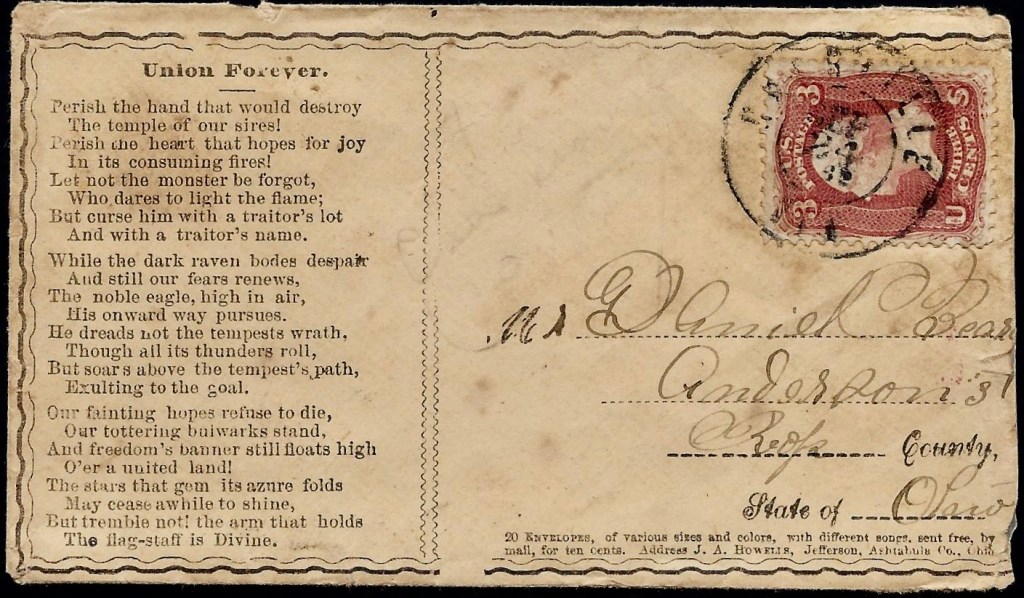
Addressed to Mr. Daniel Beard, Anderson Station, Ross county, Ohio, Postmarked September 24, 1862 [?]
Friend Daniel,
The above verso Daniel is my heart toward you and your patriotic family. I think I know your zeal. I think I can comprehend yours and your noble Sire’s and mother & sister’s motives. You think they are good. I acknowledge they are. I acknowledge were it not for a deeper consciousness, I could adopt your principles and think myself happy. But Daniel, I must be a Christian. I must learn a more humble, though I better, far better know that I would be better than other people simply to be better. But that I must endeavor to obey God and have a hope understanding for the better world.
The experimental lessons of obedience of first dissolving and suffering is a very deal out to me as anyone else.” But I unfortunately have been subject of such experience all my life. I hope I may yet learn. I hope I may finally conclude and submit. I have now come to the end of another lesson. When I enlisted, you know how I did it. You know how I was conscious I were risking all. I tried to be a soldier as others and made a tolerable soldier until the 1st of last June when I were transferred to Company I. Since then we were dissolved as a Division under Mitchell and brigade under Turchin. Under this dishonorable calamity, and some other things, I were led to review things. We were doomed to guard railroads. I thought with my companion that the game was up with us. I had and I was led on until I began to moralize things. Then I began to be myself again. I became unhappy and gradually lost my ambition to soldiering. Now I am no more a soldier, I do not know what I shall do but I know what is my duty. I must return to where I started. I purposely & willingly took upon me an oath to do an evil. I must now as an imperative duty cast that oath off, even at hte expense of my life perhaps. It will cost all of this. But I am fast making up my mind to do it. You may see me some day for a few hours and you may hear of me being taken up as a deserter and shot.
You know something of the condition of my feelings when I left. Daniel, I loved your family. I loved you. You know I did love my country, my government, and the American people. But I must do what will secure for me a better home—what will make me fit for a better government. Had it not been for one member of your family, I would likely been with you yet or at least out of the service. But David, I despised redeemer in my heart and could not bear to be called on. I know you know yourself from what I have written you in different letters since I am a soldier how I went in persecution against the secessionists. I even showed them as hard I dare not shoot. But now I am done. I must take it all back. You understand my principle. I told you often I am now more htan ever of those same principles. I think I will see you some day a short time and I will tell you more than I can now though I do not think I can live a soldier much longer. Look out for me, humbly [?] good friend, – Charley
The following letter was written by Eber L. Robinson (1828-1903), the son of Eber Robinson (1792-1863) and Alzade Lee (1807–Bef1860) of East Windsor, Hartford county, Connecticut.
Eber was 31 years old when he enlisted as a private in Co. B, 11th Connecticut Infantry. He was discharged for disability on 22 October 1862 after one year’s service.
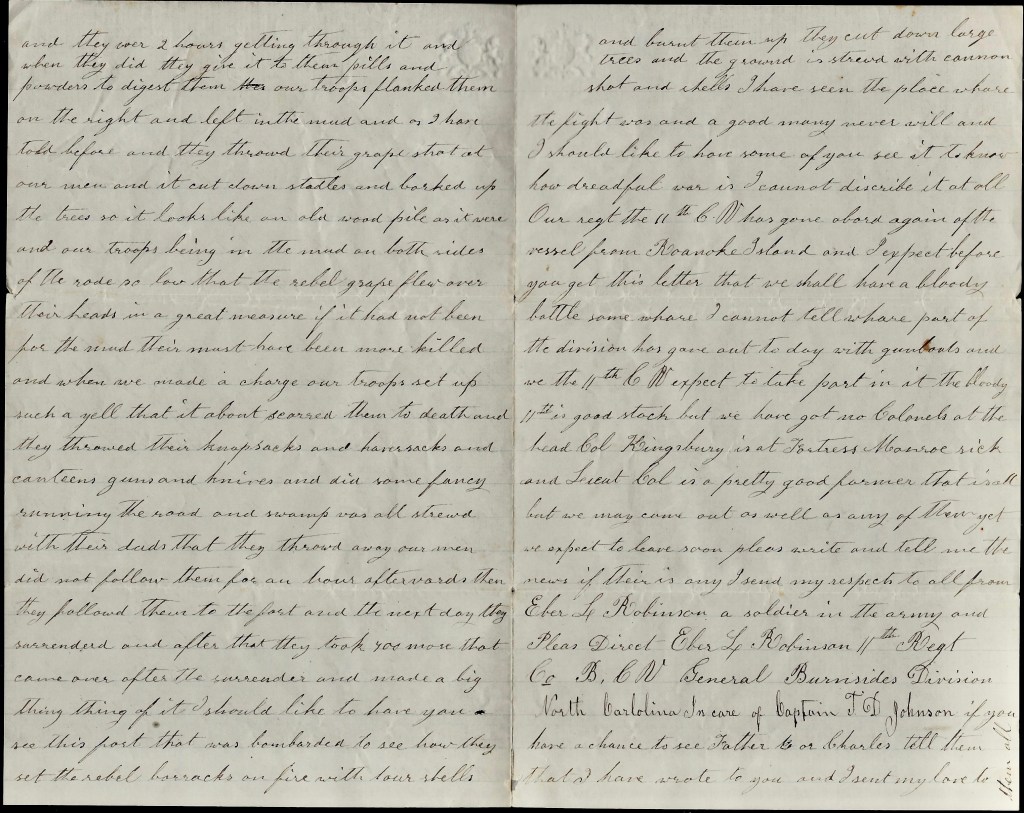
Eber’s letter gives a description of the battle and battlefield on Roanoke Island though his regiment was not engaged in the actual fighting. The battle took place on February 7-8, 1862.
Transcription
Headquarters Roanoke Island 11th Regiment, Co.B, Connecticut Vols. Gen. Burnsides Division March 6, 1862
Dear Sir,
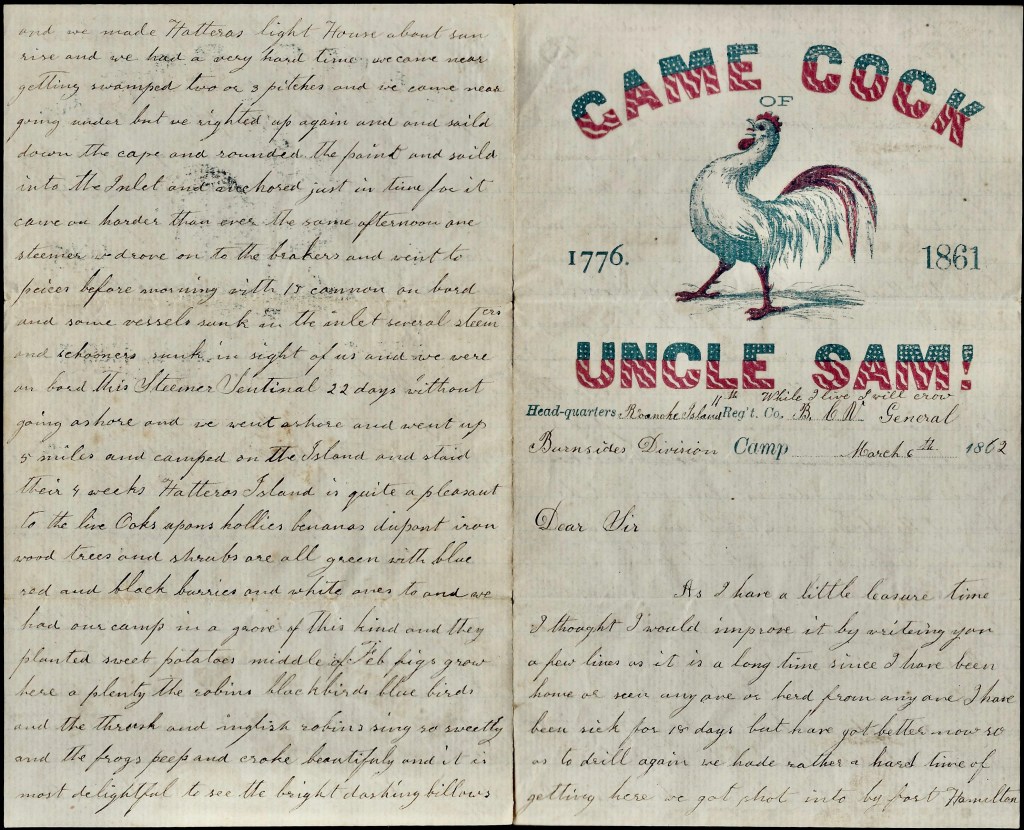
As I have a little leisure time, I thought I would improve it by writing you a few lines as it is a long time since I have been home or seen anyone or heard from anyone. I have been sick for 18 days but have got better now so as to drill again.
We had rather a hard time of getting here. We got shot into by Fort Hamilton down below New York with a 24-pound ball 3 miles from the fort and the shot struck the steamer just under the walking beam and we went back to New York and staid till about 11 o’clock at night. Gen. Burnside and an engineer ran and pronounced it safe to go to sea and then we set sail again for Annapolis. The ball came just over the wheel house right over my head and broke the thick iron plate under the brasses and broke that and the rod that the bell hung on—an 2½ inch iron—and glanced and went through a waste box down through the deck into the state room and it was saved and weighed 24 Ibs. But it made our hair stick up, I reckon. It did not do any damage of any account. The name of the steamer is New Brunswick and its running trips was Boston to St. Johns, New Brunswick. 1
After the shot, we had a pleasant trip to Annapolis. We were 48 hours going. We landed on Thursday and went ashore Friday and went into camp and staid there 3 weeks on Maryland shores. Annapolis is a hard-looking place—abut 100 years behind the times. We had a little snow Friday before we left about 2 inches deep. The night before we left, some of the soldiers set fire to a house about 300 yards of the camp and burnt up thrashing machines, wagons, carts and the like of that, and burnt 500 bushels of corn, 5 mules and pigs and poultry and [the] loss [was] about 3 thousand dollars.
We left the next morning and went down to Fortress Monroe. We got stuck in the mud and lay all night and the next day till 2 o’clock that night and we left the New York Zouaves fast in the mud and started again for Fortress Monroe and we got in there Saturday about 4 o’clock.
We set sail again at 10 in the evening and put out to sea and sailed all the rest of the night and Sunday morning we were out [of] sight of land at sunrise and we kept sailing all day and a heavy sea and fog came on and the wind blew a gale and we fired cannon several times through the day to get some report from the rest of the fleet but herd nothing. No Sunday in war times at all.
We anchored Sunday about sundown—it was so foggy—and staid till about 2 o’clock in the morning [when] it cleared off and then we started again [although] the wind blew harder and the sea heavier than before and we made Hatteras light house about sunrise. We had a very hard time. We came near getting swamped two or 3 pitches and we came near going under, but we righted up again and sailed down the cape and rounded the point and sailed into the Inlet and anchored just in time for it came on harder than ever. The same afternoon, one steamer was drove onto the breakers and went to pieces before morning with 15 cannon on board, and some vessels sunk in the inlet. Several steamers and schooners sunk in sight of us.
We were on board this Steamer Sentinel [for] 22 days without going ashore. We went ashore and went up 5 miles and camped on the Island and staid there 4 weeks. Hatteras Island is quite a pleasant [place]. The live oaks upon holly berries, ironwood trees and shrubs are all green with blue, red, and black berries and white ones too. We had our camp in a grove of this kind and they planted sweet potatoes middle of February. Figs grow here a plenty. The robins, blackbirds, bluebirds, and the thrush and English robins sing so sweetly and the frogs peep and croak beautifully, and it is most delightful to see the bright dashing billows roll and heave. We had to go to drill on the beach and there were 7 or 8 regiments here on the Island.
Last Thursday, one week ago from this, we went aboard of the Eastern Queen and sailed up the Pamlico Sound for Roanoke Island and we landed ashore again on Sunday about noon and pitched our tents and did not get them up till dark. Then we had to get supper after that, and as I said before, we cannot regard the Sabbath at all for we have to work about as much as any day.
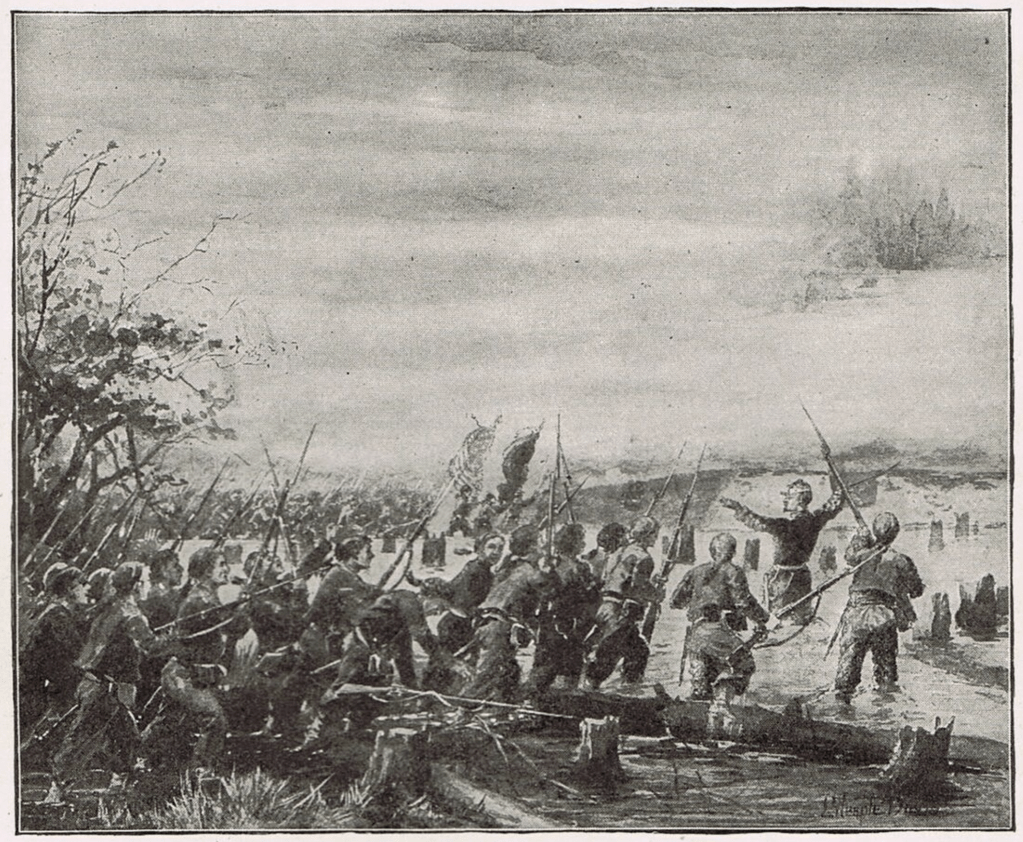
Last Monday I went up to the battle ground where our 10th Connecticut Regiment had a good fight. The rebels had it fixed to shoot down our troops by the hundreds. They had a masked battery with 3 cannon planted [on Supple’s Hill] so as to cut down our troops clean as they came up the road. This battery was built across the road calculated to sweep them clean for it was all mud and water on both sides up to the waist, but our troops with Gen. Burnside had two darkies that went from here down to Hatteras and told him just how it was situated and our troops had the advantage then. They marched about 3 quarters of a mile through the mud, brush, and water up to the waist and they were 2 hours getting through it, and when they did, they give it to them pills and powder to digest them. Our troops flanked them on the right and left in the mud. As I have told before, they throwed their grape shot at our men and it cut down stodles [?] and barked up the trees so it looks like an old wood pile as it were. Our troops, being in the mud on both sides of the road so low that the rebel grape flew over their heads in a great measure. If it had not been for the mud, there must have been more killed.
Titled, “Capture of Roanoke Island” 1899 Historical Print by Jones Bros. Publishing Co., Cincinnati, Ohio
When we made a charge, our troops set up such a yell that it about scared them to death and they throwed their knapsacks and haversacks and canteens, guns, and knives, and did some fancy running. The road and swamp was all strewed with their duds that they throwed away. Our men did not follow them for an hour afterwards. Then they followed them to the fort [Fort Barstow] and the next day they surrendered and after that they took 700 more that came over after the surrender and made a big thing of it. I should like to have you see this fort that was bombarded to to see how they set the rebel barracks on fire with our shells and burned them up. They cut down large trees and the ground is strewed with cannon shot and shells. I have seen the place where the fight was and a good many never will. I should like to have some of you to see it to know how dreadful war is. I cannot describe it at all.
Our regiment—the 11th Connecticut Volunteers—has gone aboard again of the vessel from Roanoke Island and I expect before you get this letter that we shall have a bloody battle somewhere. I cannot tell where. Part of the division has gone out today with gunboats and we, the 11th C. V., expect to take part in it. The Bloody 11th is good stock but have got no colonel at the head. Col. Kingsbury is at Fortress Monroe sick and Lieut. Col. is a pretty good farmer [but] that is all. But we may come out as well as any of them yet. We expect to leave soon. Pleas write and tell me the news, if there is any. I send my respects to all. From Eber L. Robinson—a soldier in the army and please direct to Eber L. Robinson, 11th Regt., Co. B, C. V., General Burnside’s Division, North Carolina, in care of Captain T. D. Johnson.
If you have a chance to see Father or Charles, tell them that I have wrote to you and I send my love to them all.
1This incident was reported in the New York Times as follows: “STEAMER NEW BRUNSWICK, AT ANCHOR OFF ANNAPOLIS, Friday, Dec. 20, 1861. The Connecticut Eleventh, which arrived in New-York on Tuesday, en route for Annapolis, reembarked on the afternoon of that day on the transports New-York and New-Brunswick–the right wing of the regiment upon the former, the left upon the latter. The fortunes of the left wing are those of your correspondent, and they iuclude a one-sided naval engagement which took place at about 6 o’clock in the evening, near Fort Hamilton, and which ended in the ignominious defeat of our transport, which was obliged to return to her anchorage off the “Battery,” the Captain and engineers supposing her to be disabled.
The facts in the case are simply these: The transport left the pier at about dusk and steamed down the bay. When near Fort Hamilton she was challenged by a Government vessel, in the usual manner — i.e., a shot across her bow. For reasons as yet unknown the transport held her course, regardless of the challenge. Another shot from the vigilant sentinel, and a ball whistles over our devoted heads; still the transport holds her course; a signal rocket from the sentinel vessel and Fort Hamilton opens upon us with a 24-pounder, the shot crashing through the machinery and passing out of a state-room. This had the desired effect, and the transport hove to. It is hardly less than a miracle that not one of the five hundred on board was injured. Had the ball entered the boat in any other direction, or a few feet higher or lower, many lives must have been sacrificed to the criminal carelessness of whoever is responsible for the safe conduct of the troops. How does it happen that there are men employed by Government on transports so stupidly ignorant of their profession? With the exception of those in charge, who were directly responsible, I believe it would be difficult to find a man among us who did not understand the meaning of the first shot. This accident (if such it can properly be called) occasioned a delay of some six hours, and these hours cost the Government at the rate of about seven hundred dollars per day.”
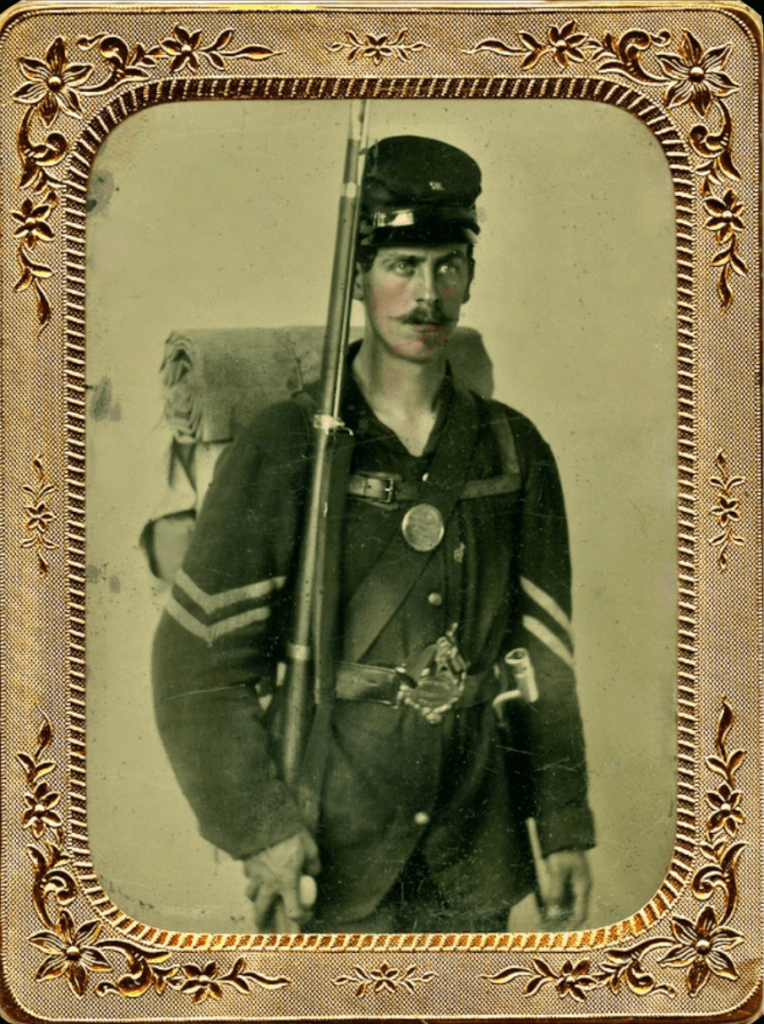
I could not find an image of Samuel but here is Leonidas Allen of Co. F, 18th OVI (Ohio Memory)
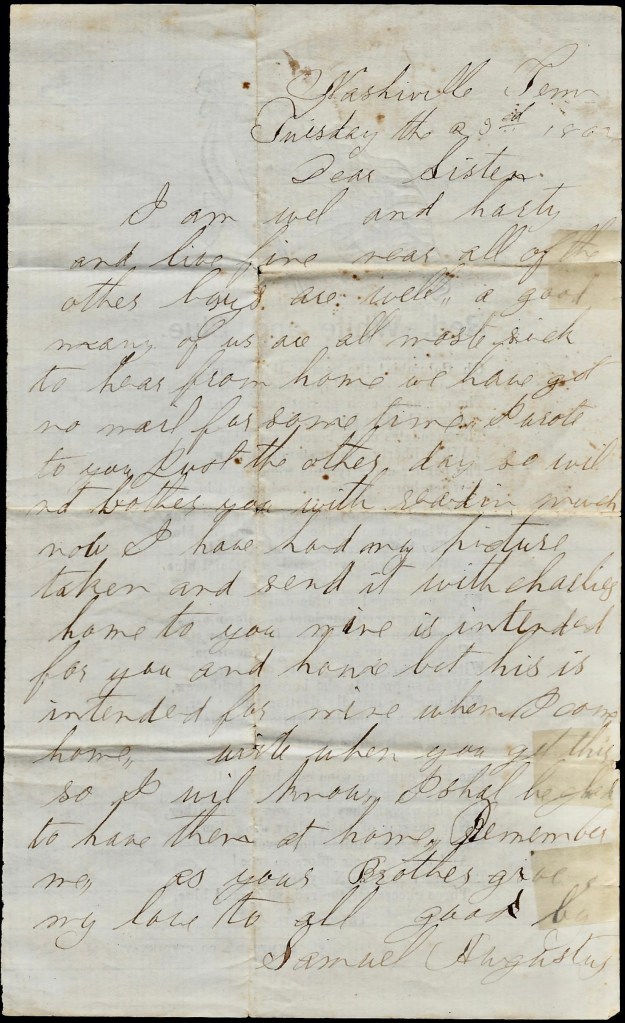
The following letter was written by Royal “Samuel” Augustus (1842-1863), the son of Springer Augustus (1804-1851) and Lucretia Jane Jenkins (1805-1878) of Union township, Ross county, Ohio. He wrote the letter to his sister, Arvilla Jane Augustus (1844-1926), who married Daniel M. Beard (1838-1907) in 1863.
Samuel enlisted on 9 August 1861 as a private in Co. A, 18th Ohio Volunteer Infantry (OVI). He was promoted to a corporal in October 1861 and was killed in the Battle of Stones River on 2 January 1863.
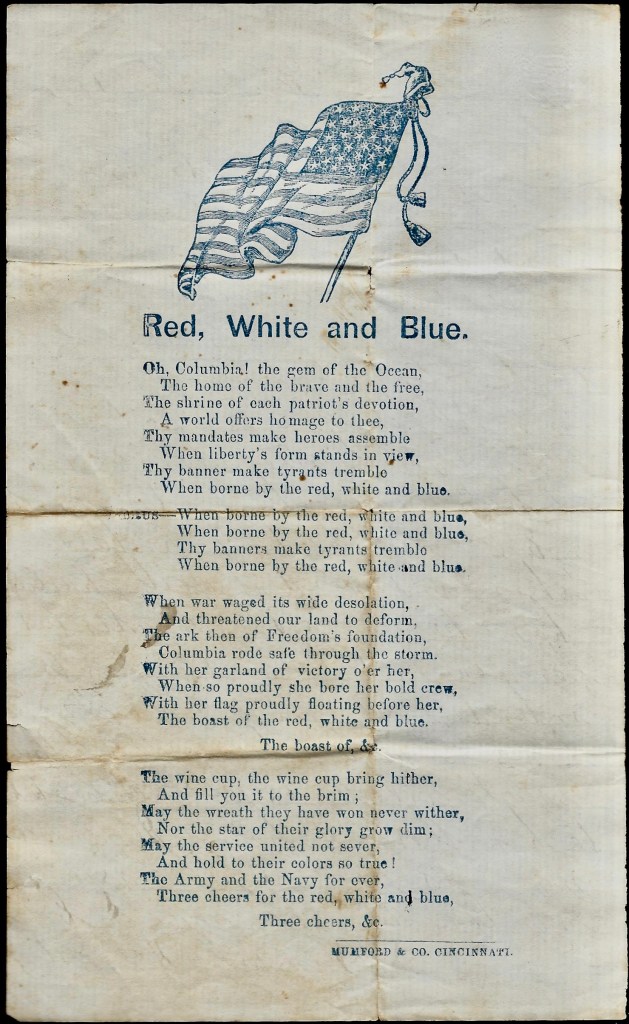
Samual wrote this brief letter from Nashville where the regiment was left to guard the city while the remainder of the Army of the Ohio pursued Bragg’s Army of Tennessee in Kentucky. The letter was written on the back of a song sheet with the words to “Columbia, the Gem of the Ocean.”
Transcription
Addressed to Miss A. J. Augustus, Shiloh. From 18th Ohio Regiment, Politeness of Thomas McFarland, Company A, 18th Regt. Ohio Volunteers
Nashville, Tennessee Tuesday the 23rd [September] 1862
Dear Sister,
I am well and hearty and live fine. Near all of the other boys are well. A good man of us are almost sick to hear from home. We have got no mail for some time. I wrote to you just the other day so will not bother you with writing much now.
I have had my picture taken and sent it with Charley home to you. Mine is intended for you and home but his is intended for mine when I come home. Write when you get this so I will know. I shall be glad to have them at home. Remember me as your brother. Give my love to all. Goodbye. — Samuel Augustus
This letter was written by Granville Griffith (b. 1835), the son of Joseph Robinson Griffith (1806-1849) and Caroline Guthrie (1806-1850) of Edgar, Illinois. Granville addressed the letter to his sister, Ann Katherine (Griffith) Lawrence (1830-1915) and her husband, James Lawrence (1825-1869) of Lincoln, Logan county, Illinois. James and Ann were married in Edgar County, Illinois, in 1849 and had relocated to Topeka, Shawnee county, Kansas by 1860, but then returned to Illinois during the Civil War.
Mentioned in the letter are Granville’s brother, Columbus Griffith, and Thomas Lawrence (presumably a relative), both of whom served in Co. I, 2nd Kansas Cavalry. Thomas’ enlistment papers inform us he was born in Edgar county, Illinois in 1836. His Find-A-Grave biographical sketch confirms his enlistment in the 2nd Kansas Cavalry on 25 August 1862 but it states that he was “killed in action at the Battle of Prairie Grove” on 7 December 1862 and that he was “buried as an unknown soldier.” This information is inconsistent with the letter, however, that claims he survived the battle but received a severe leg wound that was probably mortal and had been taken to a hospital in Fayetteville. The “John T.” who journeyed to Fayetteville to attend to Thomas was probably John Thomas Lawrence (1830-1876) who was married in Edgar county, Ohio, in 1854 to Margaret M. Matthews and was living in Ottumwa, Kansas in 1863.
Addressed to James Lawrence, Lincoln, Logan county, Illinois
Hartford, [Lyon county] Kansas January 7th 1863
Dear Brother and Sister,
I received your letter a few days ago and should have answered it sooner but have been so busy that I have not had time. We are well and I hope by the time this reaches you that you will be all well again.
I was very sorry to hear of poor little Eddie’s death 1 but one great consolation—he is better off than we are.
I heard last week that Columbus had the small pox but I am in hopes that is not so. He is still at Fort Scott in the hospital. Thomas Lawrence was wounded at Prairie Grove—shot through the knee and I heard that he would have to have his leg taken off. John T. has gone to him. He is at Fayetteville, Arkansas.
I don’t know that I have anything to write that would interest you. The health of the country is good. Our college 2 in Hartford is nearly completed. I want you to write to me as soon as you get this. Tell me how you are getting along, what you think of doing, &c.
Mary joins in sending her love to you all. From your brother and sister, — G. and M. E. Griffith
Tell Joseph when you write to me he must write soon.
1 Edwin Lawrence was born in 1859. He must have died in late 1862.
2 The old Hartford Collegiate Institute was built in 1863 by John Griffith and Richard How. The Hartford Collegiate Institute was a branch of Baker University, and served to prepare students for entrance into the Methodist university in Baldwin City, Kansas (southeast of Lawrence).
The old limestone building that was once the Hartford Collegiate Institute still stands at 315 College Boulevard i nHartford. It was placed on the National Register of Historic Places in 1972.
I could not find an image of George but here is one of Corp. Benjamin Moore of the 5th Massachusetts Infantry (Kevin Canberg Collection)
The following letter was written by George Whitefield Dow (1831-1882), the son of Joshua Dow and Miriam Watson of Plaistow, Rockingham county, New Hampshire. He was married first, in September 1850, to Maria Ann Sanborn (1834-1852). He then married Olivia A. Smith of Salisbury, Massachusetts, in May 1853, and in the 1860 US Census, he was enumerated in Salem, Essex county, Massachusetts, working as a Railroad Repairman. The couple had a 6 year-old son named George.
It was on 19 April 1861 that George enlisted as a private in Co. H (“Salem City Guards”), 5th Massachusetts Infantry. He was with the regiment at the Battle of Bull Run on 21 July 1861 where he was taken prisoner. He was confined at Richmond on 23 July 1861 and at New Orleans on 24 September 1861. He was paroled at Washington, North Carolina, on 2 June 1862 and mustered out of the regiment at Boston on 24 June 1862.
The Fifth Regiment Massachusetts Volunteer Infantry charges up a hill in Washington D.C. during training, May 1861, the U.S. Capitol is shown in the background.
Transcription
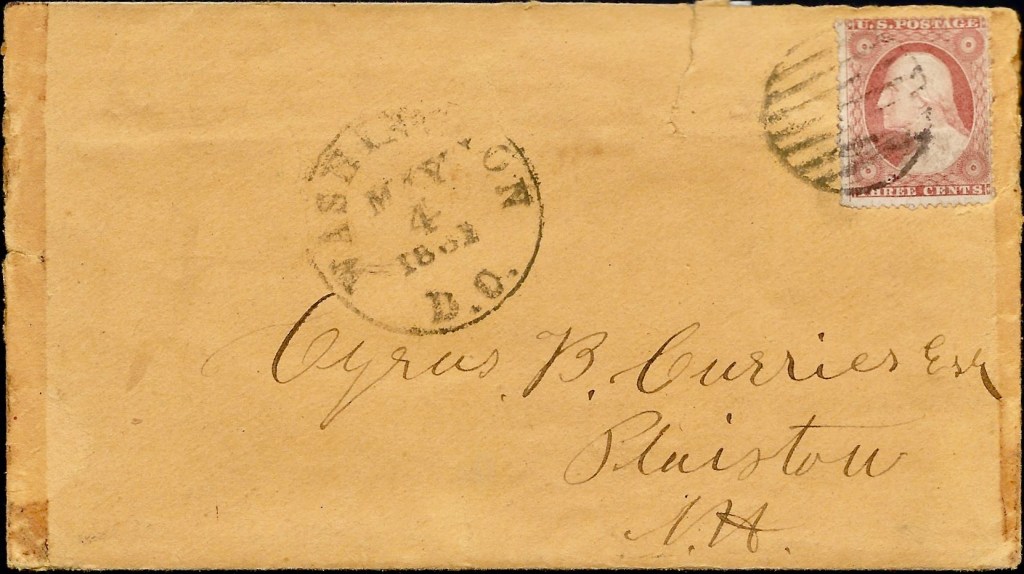
Addressed to Cyrus B. Curries, Esq., Plaistow, New Hampshire
Washington [D. C.] May 4th 1861
Cousin Cyrus,
Having a few minutes to spare, I thought that I would write you a few lines—the last perhaps that you will ever hear from me. I am enlisted in the 5th Regiment Massachusetts Volunteers to fight for my country. We arrived here a week ago today. We had a hard time in getting here. I shot my first man in Maryland 2½ miles below Annapolis Junction. We had quite a brush with the suckers about daylight, but we have drove them to cover the same as we shall Jeff Davis. You can have no idea of a skirmish in woods at daybreak. I felt as though I should s[hi]t at first, but I soon was as crazy as a Bed Bug & on the whole, I rather like to put consute [?] out of the suckers.
Col. Samuel Crocker Lawrence, 5th Massachusetts Infantry
Last Thursday night, I was on guard on the Bridge that leads across the Potomac River. I saw a sucker sneaking along & hailed him when he rose up & fired at me, but did not hit me. And in about 2 jerks of a sheep’s tail, I put a plum hole chuck through his heart, & Col. [Samuel Crocker] Lawrence—my colonel—said I was a good boy & that I done just right. But cousin, I suppose my time will come soon. I feel just as though & should never see old Plaistow again. But I have got just as good pluck for all of that & when I do fall, I shall fall at my post. I think that I am on the right side & shall fight just as long as I can draw a bead on a Southerner.
I know that I shall have the sympathy of all my friends & all true Yankees. I would [be] willing [to] face the cannon’s mouth but I can’t help thinking of my poor wife & boy. If I should fall, they will be left to the cold world & it makes my heart ache to think of it some times. But I would not come home now if I could. New England Blood has been spilt on southern soil & it shall be avenged a gallon for every drop. I hate the sight & smell of a southerner. I have got 24 rounds of ball cartridges in my box & I don’t mean to throw a single one away. When I draw a bead on a southerner, he is mighty apt to fall.
I want you show this letter to Luke & Mary & any body else that you are a mind to. Tell George Sumner that there is room for him out here. We want all good shots out here for the sneaking murder[er]s have got to fall.
Give my love to all & if you never see me again, remember that I leave a wife & boy that is very dear to me. I cannot write any more now. I sent a kiss enclosed for cousin Margaret & you will please deliver it immediately. Goodbye, perhaps forever, but I hope not. — George W. Dow
To C. B. Curries, Plaistow, N. H.
P.S. I have got a good revolver & know how to use it. It was given to me in Faneuil Hall by the Eastern R.R. boys.















 Spared & Shared 23