My passion is studying American history leading up to & including the Civil War. I particularly enjoy reading, transcribing & researching primary sources such as letters and diaries.
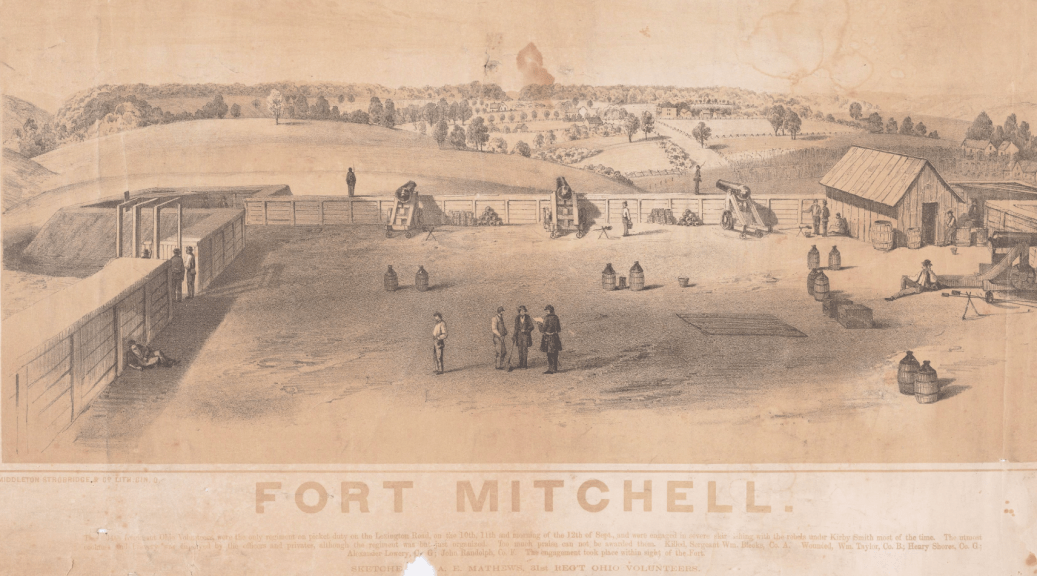
The following letter was written by William Taylor of Co. B, 104th Ohio Infantry. William wrote the letter from a Union hospital in Kentucky, where he was recovering from a shot through the bowels received during a skirmish at the Covington outposts known as Fort Mitchell overlooking the Lexington Pike.
As described in an article by Steve Preston published in 2019 on the 1862 siege of Cincinnati, the 104th Ohio was among these regiments mustered into action quickly in the fall of 1862 to confront the Rebel army marching on Cincinnati. “The outpost at Fort Mitchell received the brunt of the probing by the Confederate force…According to the Cincinnati Gazette, Saturday, September 13, 1862 edition, the 104th occupied the property of a local Southern sympathizer by the last name of Buckner. Just south of the Buckner residence was a wooded area that spread over both sides of the road. It had been filled with Confederates rumored to be from Texas. On Tuesday, September 9th, initial skirmishing began. The firefight between the companies of the 104th and the Texan troops reached its peak by Thursday the 11th. That afternoon would be the final action as heavy rains moved in and the Confederate forces withdrew. No known record of rebel casualties from the skirmishes is known…The 104th Regiment of the Ohio Volunteer Infantry suffered five casualties, the only known casualties from the Siege of Cincinnati caused by hostile gunfire. Private William Taylor of Company B was shot through the bowels. Private John Randolph of Company F was shot through the chest. Private Alexander Lowery from Company G was severely wounded in the leg. Another soldier, Private Henry Shants (or Shantz) supposedly of Company G, was shot in the right arm with the ball entering his side.”
From the muster rolls we learn that William Taylor never returned to his regiment though he yearned for his “revenge.” I hope they shall all be killed or something else become of them,” he wrote his friend, Henry Shanafelt, Jr. of Stark county, Ohio. William was discharged at Cincinnati, Ohio, on 16 March 1863.
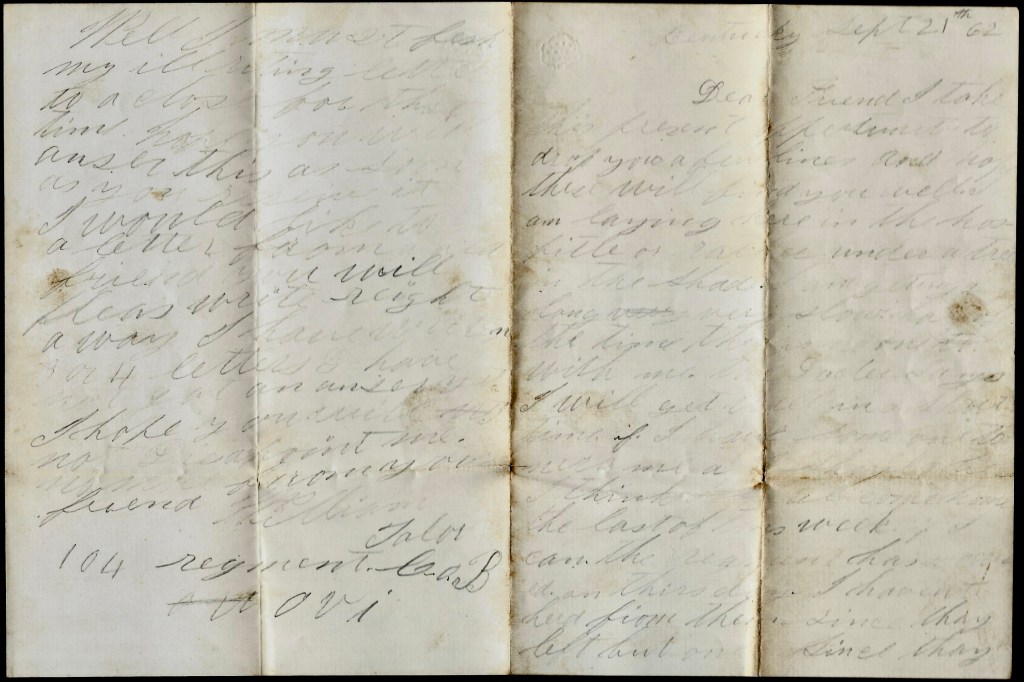
Transcription
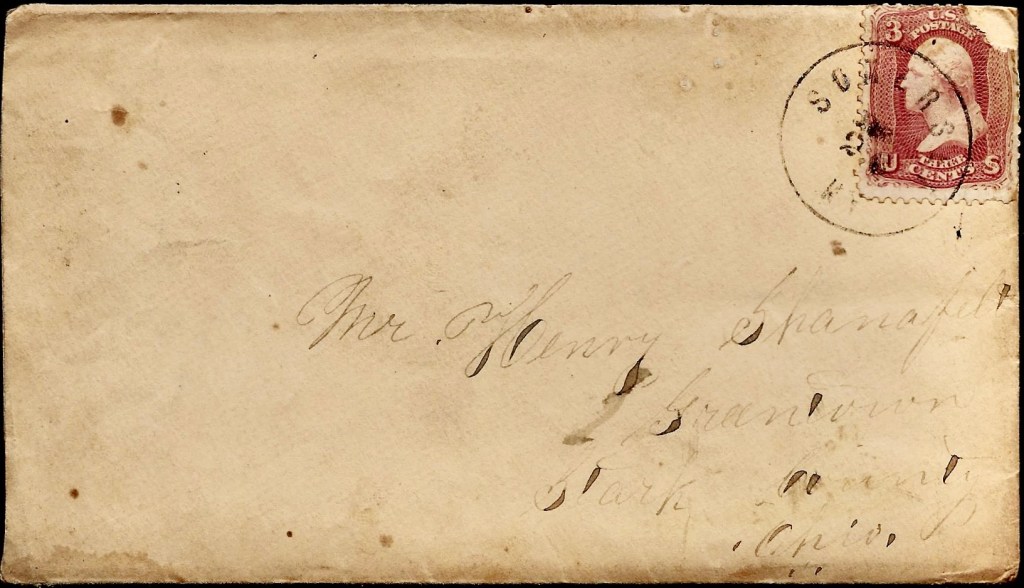
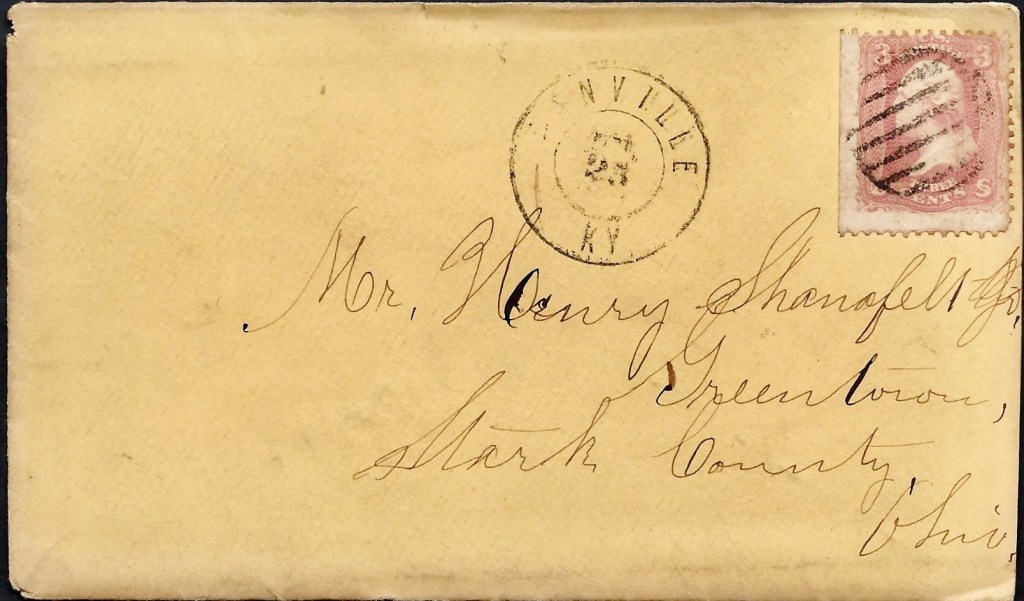
Addressed to Mr. Henry Shanafelt, Greentown, Stark county, Ohio (but not certain the letter goes with the envelope)
Kentucky September 21st 1862
Dear Friend,
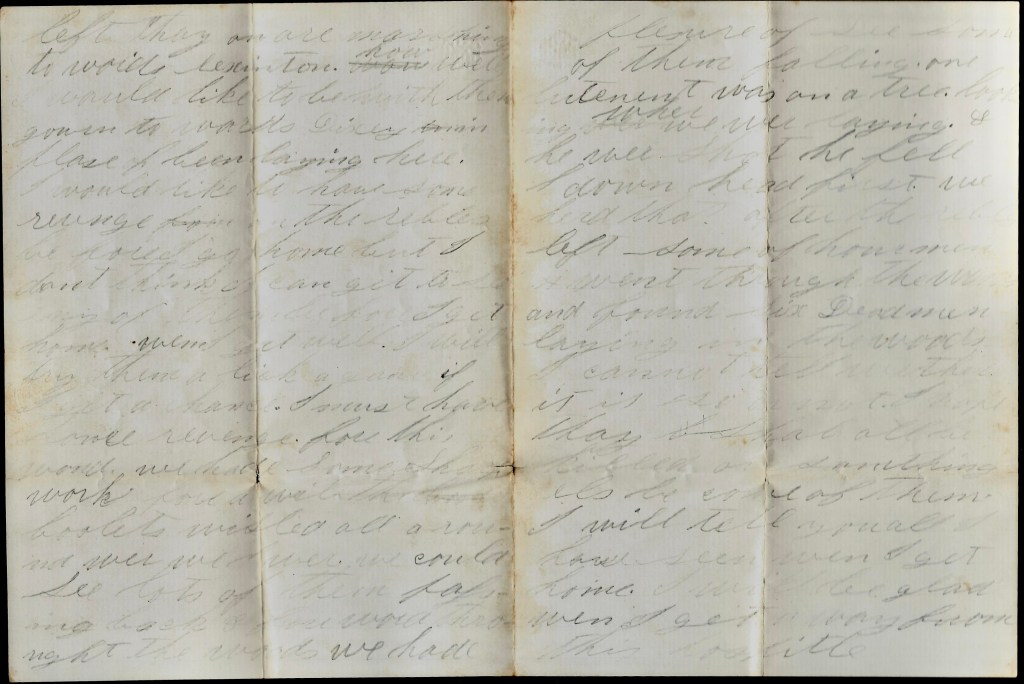
I take this present opportunity to drop you a few lines and hope these will find you well. I am laying here in the hospital, or rather under a tree in the shade. I am getting along very slow. Half of the time there is no one with me. The doctor says I will get well in a short time if I have someone to nurse me and I shall be [illegible.] I think I shall come home the last of this week if I can. The regiment has moved on Thursday. I haven’t heard from them but once since they left. They are marching towards Lexington. How well I would like to be with them going towards Dixie in place of laying here. I would like to have some revenge on the rebels before I go home but I don’t think I can get to see any of them before I get home.
When I get well, I will try them a lick again if I get a chance. I must have some revenge for this world. We had some sharp work for a while. The bullets whistled all around where we were. We could see lots of them falling back & forward through the woods. We had pleasure of see[ing] some of them falling. One Lieutenant was on a tree looking where we were laying & he were shot. He fell down head first. We heard that after the rebels left, some of our men went through them woods and found six dead men laying in the woods. I cannot tell whether it is so or not. I hope they shall all be killed or something else become of them. I will tell you all I have seen when I get home. I will be glad when I get away from this hospital.
Well, I must fetch my ill writing letter to a close for this time. Hope you will answer this as soon as you receive it. I would like to [get] a letter from an old friend. You will please write right away. I have written 3 or 4 letters & have not got an answer yet. I hope you will not disappoint me. No more. From your friend, — William Talor [Taylor]
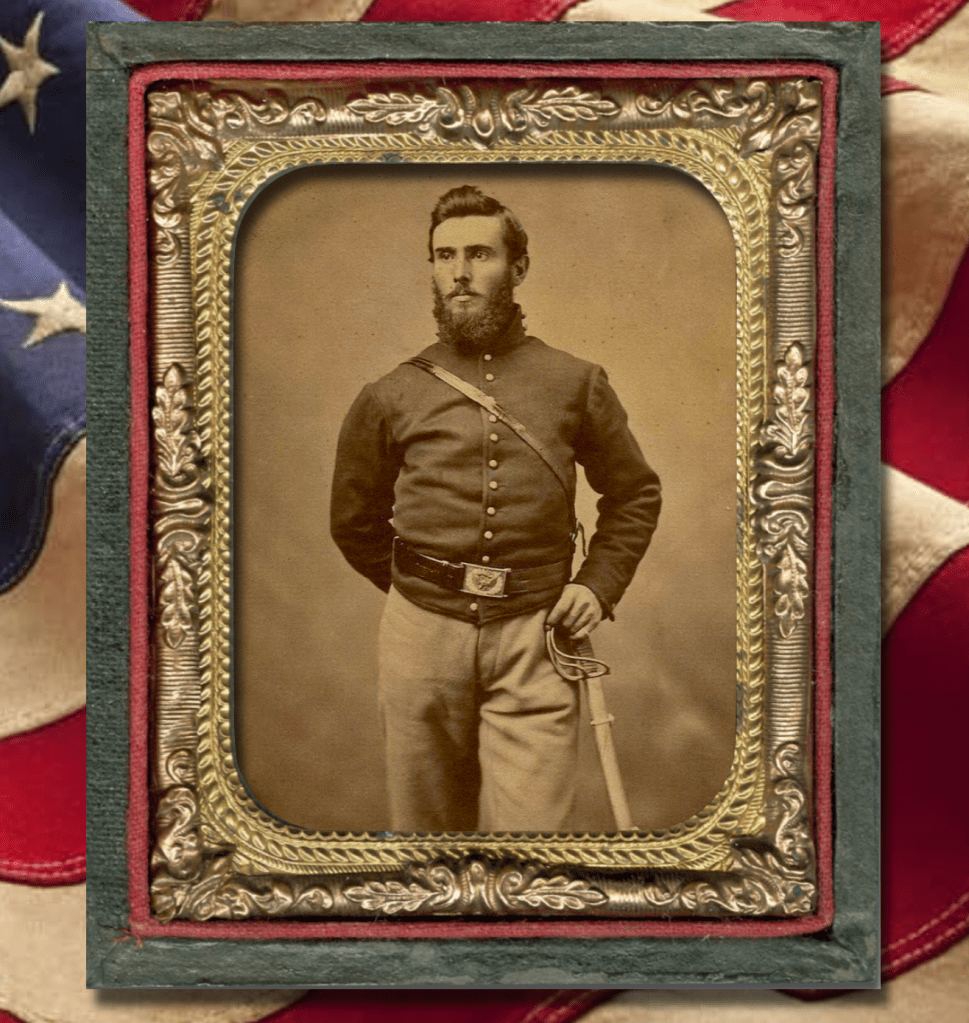
I could not find an image of Hiram but here is one of Isaac Lorenzo Peirce of Co. B, 2nd Ohio Cavalry. Isaac was mortally on 13 September 1864 while on picket duty near Berryville, Virginia.
The following brief letter was written by Hiram Rober (1842-1863) of Stark county, Ohio. Hiram mustered into Co. A, 2nd Ohio Cavalry in mid-August 1861 to serve three years. According to the State Records of the 2nd Ohio Cavalry, Hiram was shot in the chest in a skirmish two miles from Lick Creek Bridge on the road to Blue Springs (now Mosheim) in Greene county, Tennessee in October 1863 just a few weeks after this letter was written in late July 1863. He was originally buried at Blue Springs but later reinterred in the Knoxville National Cemetery, grave no. 1686.
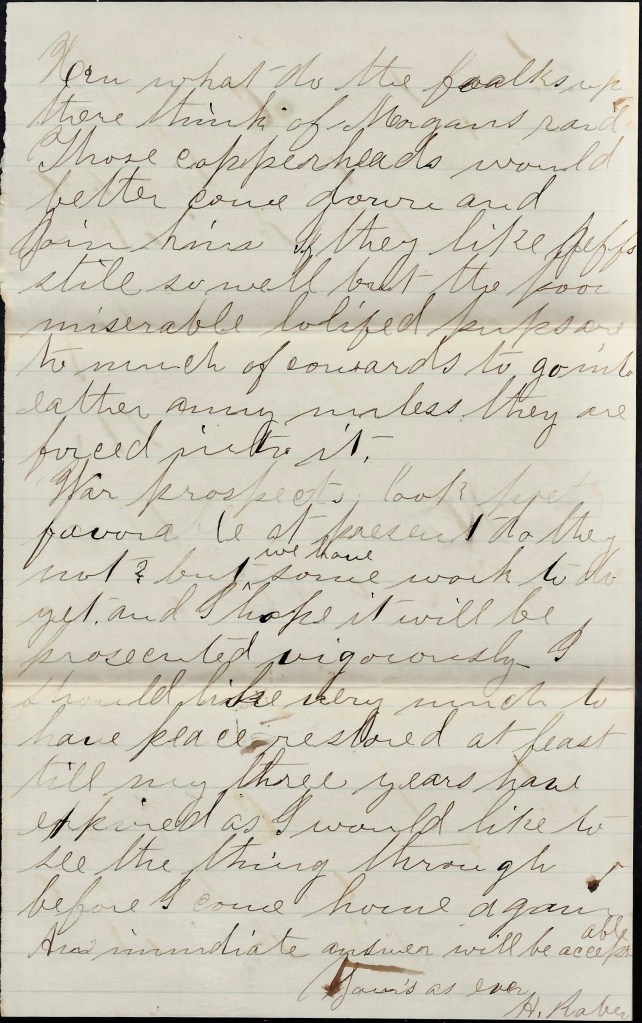
Hiram wrote the letter to Henry Shanafelt, Jr. of Greentown, Stark county, Ohio, asking his friend, “What do the folks up there think of Morgan’s raid?”
Transcription
Hen,
What do the folks up there think of Morgan’s raid? Those Copperheads would better come down and join him if they like Jeff’s style so well. But the poor miserable low life pups are too much of cowards to go into either army unless they are forced into it.
War prospects look pretty favorable at present, do they not? But we have some work to do yet and I hope it will be prosecuted vigorously. I should like very much to have peace restored at least till my three have expired as I would like to see the thing through before I come home again. An immediate answer will be be acceptable. Yours as ever, — H. Raber
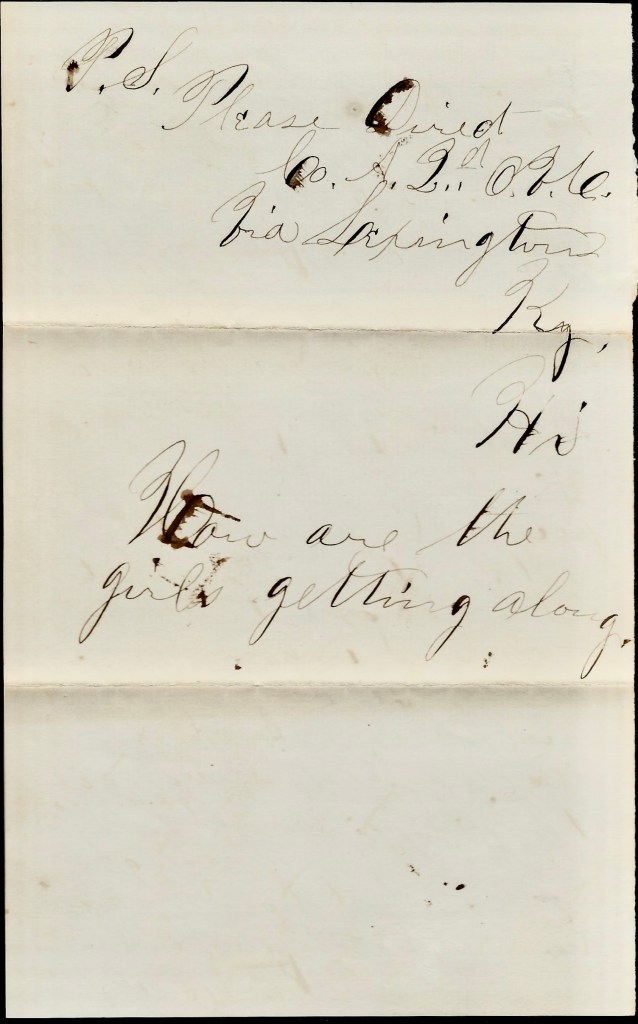
P. S. Please direct to Co. A. 2nd O. V. C., via Lexington, Kentucky
A post war image of William W. Smith, veteran of the 104th OVI and survivor of the S. S. Sultana disaster.(Ancestry.com)
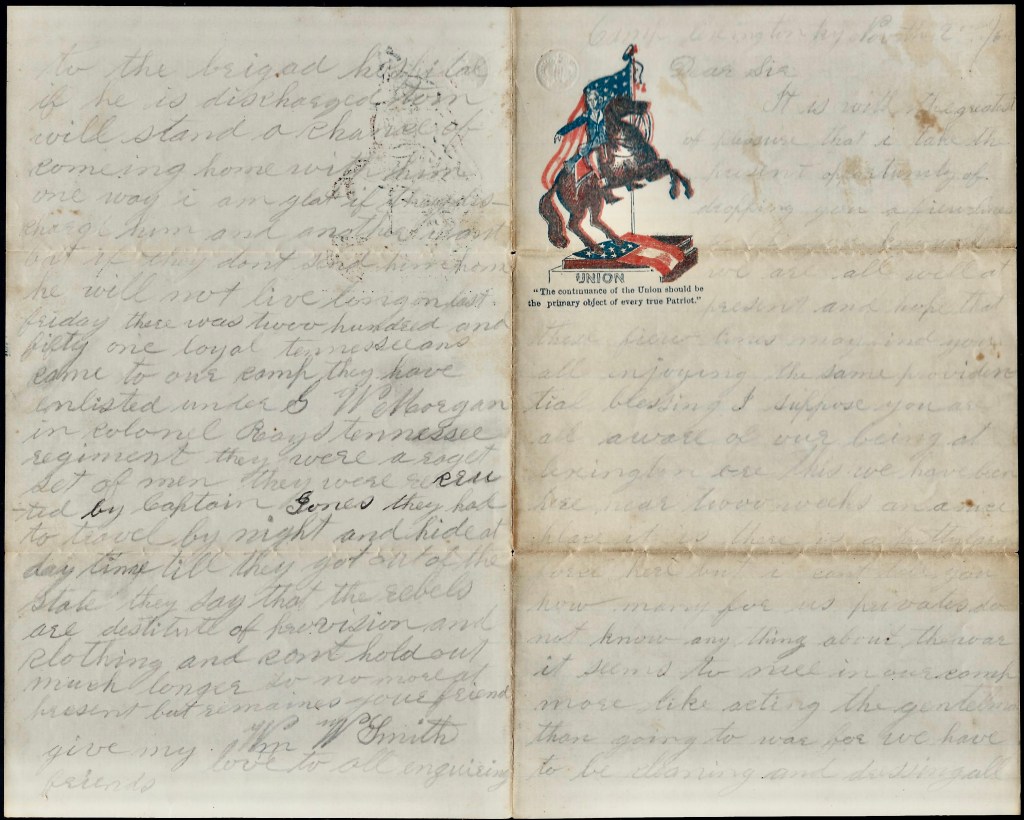
The following letter was written by William Wendel Smith (1842-1908), the son of Charles Smith (1807-1879) and Rebecca Weaver (1808-1885) of Stark county, Ohio—formerly of Perry county, Pennsylvania. William was 20 years old and working as an apprentice to learn the carriage maker’s trade from Robert Latimer in Canton when he mustered into Co. B, 104th Ohio Infantry in August 1862. On May 31, 1864, he was shot in the arm during the Battle of Dallas (Georgia). On Nov. 30, 1864, he was captured during the Battle of Franklin (Tennessee). Initially held at Cahaba Prison (Alabama), he was transferred to notorious Andersonville Prison (Georgia) in early 1865. He was freed as part of a prisoner exchange on April 1, 1865.
On April 27, 1865, he was among an estimated 2,400 home-bound Union soldiers, former POWs and other passengers aboard the badly overcrowded S.S. Sultana, a steamboat, when it exploded in the Mississippi River near Memphis, killing about 1,600. William Wendel Smith suffered burns but survived. After his return to Stark County, Ohio, he became a farmer.
The identity of the letter’s recipient is not revealed in the letter but it was found in a collection of letters addressed to Henry Shanafelt, Jr. (1827-1893) of Greentown, Stark county, Ohio, so we presume that he was the “Dear Sir.”
Transcription
Camp Lexington, Kentucky November 12th 1862
Dear Sir,
Posted on Find-A-Grave
It is with the greatest of pleasure that I take the present opportunity of dropping you a few lines to let you know that we are all well at present and hope that these few lines may find you all enjoying the same providential blessing. I suppose you are all aware of our being at Lexington ere this. We have been here near two weeks and a nice place it is. There is a pretty large force here but I can’t tell you how many for us privates do not know anything about the war. It seems to me in our camp more like acting the gentleman than going to war for we have to be cleaning and dressing all the time. One day we get orders to clean our brass and guns and put on our best clothes for inspection, and another for review, and so it goes. Instead of marching on and fighting the battles that must be fought before this war is over, we are kept here dress and fixing up for review or some other darned kind of view until our ranks are thinned by sickness and death. And the rebels are gone and we must march after them but far enough behind so as not to get any booty from them. It seems to me as if our generals was afraid of this war closing too soon and they not making enough to fill their pockets. But I think they have got a general [William S. Rosecrans] at the head of the Cumberland Army that will not fail to capture Bragg’s Army if he gets such a chance as Buell had.
We had a snow on last Saturday night six inches deep. It was pretty cold on Sunday but it cleared off on Monday and it has been pretty warm since. But today it is trying to rain. It looks as if it would succeed.
The talk is in our regiment that they are going to take our tents from us and give us little rubber tents large enough for three and them we must carry. About that time, I will sleep out in the big tent before I will carry one. Daniel France 1 has not been well for some time but he is now soon fit for duty. I think J[ohn] W. Raber 2 will be discharged from service for disability. He has been sent to the Brigade Hospital. If he is discharged, Tom will stand a chance of coming home with him. One way I am glad if they discharge him and another won’t but if they don’t send him home, he will not live long.
On last Friday there was two hundred and fifty-one loyal Tennesseans came to our camp. They have enlisted under G. W. Morgan in Colonel [Daniel Mack] Ray’s Tennessee Regiment. 3 They were recruited by Captain Jones. They had to travel by night and hide at daytime till they got out of the State. They say that the rebels are destitute of provision and clothing and can’t hold out much longer.
So no more at present but remain your friend. Give my love to all enquiring friends. — Wm. W. Smith
1 Daniel France was detailed as blacksmith in engineer battalion, 23rd Army Corps, April 4, 1864.
2 John W. Raber (1838-1930) was from Greentown, Stark county, Ohio, which is where Henry Shanafelt (believed to be the letter’s recipient) lived during the Civil War.
3 Daniel Mack Ray was born in Yancy County North Carolina on March 27, 1833. He grew up in Sevier County, Tennessee later receiving his academic education in Burnsville, North Carolina and Dandridge, Tennessee. After his education was complete, he worked as a school teacher, and was living in east Tennessee when the war broke out. With the outbreak of the Civil War, he remained loyal to the Union, and joined the Army after a year of clandestine work behind enemy lines in eastern Kentucky, blowing up bridges and obstructing the invading rebel armies. According to one obituary, Ray organized neighbors to burn several railroad bridges in order to delay pro-southern forces entering the state. He then made his way to Flat Lick, Kentucky, to enlist in the Union army, receiving a commission on October, 10 1862 as First Lieutenant and Adjutant of the 3rd Tennessee Infantry, U.S., part of the Army of Ohio, resigning from that unit six months later to take a commission as Colonel of the 2nd Tennessee Cavalry, U.S., on August 6, 1862 with whom he served with for the remainder of his extensive war service commanding a brigade in Sheridan’s Atlantic campaign under Major General David S. Stanley and Colonel Edward M. McCook.
I could not find an image of Sidnor but here is Corp. Mathias Orr of Co. D, 70th OVI.
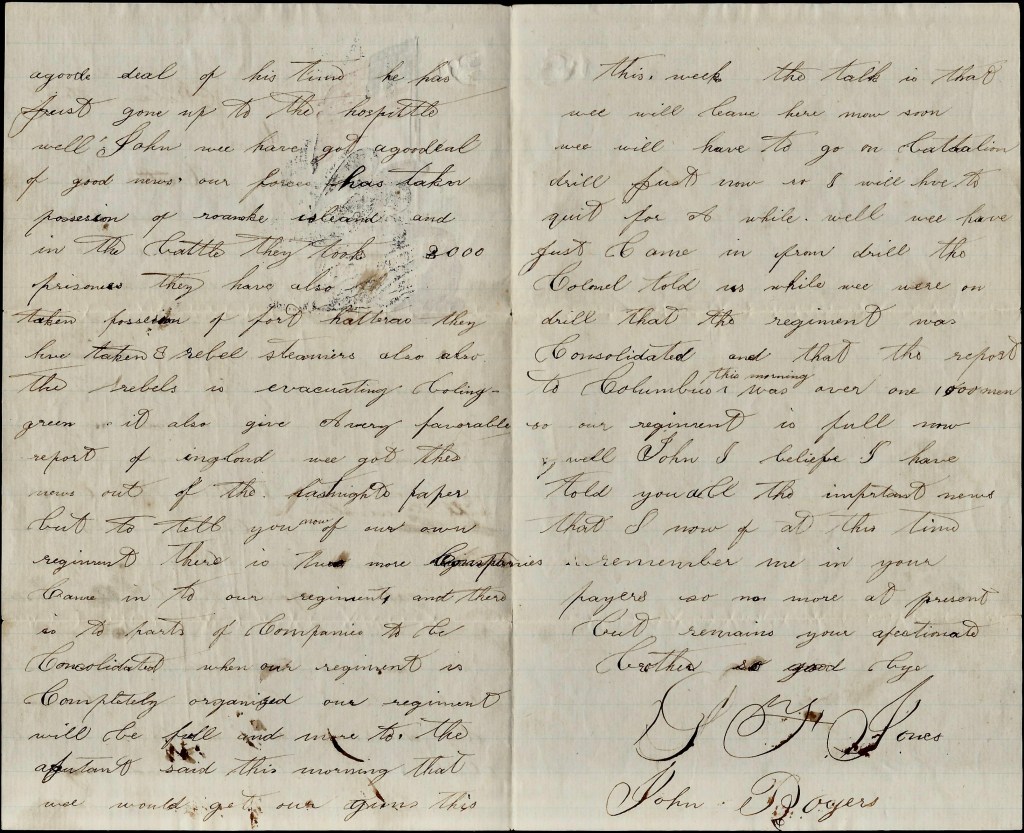
The following letter was written by Sidnor Franklin Jones (1841-1932), the son of Abel Jones (1807-1873) and Julia A. VanPelt (1815-1882) of Adams county, Ohio—formerly of Virginia. He enlisted on 1 November 1861 to serve three years in Co. E, 70th Ohio Volunteer Infantry (OVI), the same company as Samuel P. Kilpatrick who is mentioned in the letter. Sidnor does not give the location where he wrote the letter but the regimental history informs us that it was Camp Dennison where they regiment organized and remained until February 1862 when they were then ordered to Paducah, Kentucky, and incorporated into Sherman’s Division. It’s baptism of fire came at Shiloh.
Sidnor wrote the letter to his brother-in-law, John Wilson Rogers (1831-1917), the husband of Sarah Catherine Jones (1836-1910). The couple were married in December 1852 and resided in Adams county, Ohio.
After the war, Sidnor returned to Adams county, Ohio, where he married Louisa Thoroman (1844-1934) and then moved to Crawford county, Illinois, and finally to Wilson county, Kansas. He died in 1932 at Osawatomie, Kansas (possibly at the insane asylum?).
Transcription
Addressed to Mr. John W. Rogers, Tranquility P. O., Adams county, Ohio; postmarked Cairo, IL(this envelope goes with the Jones archive but the letter was not sent in this envelope)
[Camp Denison, Ohio] February 14th 1862
Brother [&] Sister,
It is through the goodness and mercy of God that I am spared and with reasonable health have this opportunity of writing a few lines to you to let you know that we are getting along very well. I am as well as I have been since I came to camp with the exceptions of cold and I hope that these few lines mat find you enjoying good health. The health of the regiment is generally good. There has been one death here since I came back but it was caused by drinking. Sam Kilpatrick is sick but I think it is caused by trouble. He is out of his head a good deal of the time. He has just gone up to the hospital.
Well, John, we have got a good deal of food news. Our forces has taken possession of Roanoke Island and the battle they took 2,000 prisoners. They have also taken possession of Fort Hatteras. They have taken three rebel steamers also. Also the rebels is evacuating Bowling Green. It also give a very favorable report of England. We got the news out of last night’s paper.
But to tell you now of our own regiment, there is three more companies came into our regiment and there is two parts of companies to be consolidated. When our regiment is completely organized, our regiment will be full and more too. The adjutant said this morning that we would get our guns this week. The talk is that we will leave here now soon. We will have to go on Battalion drill just now so I will have to quit for a while.
Well, we have just come in from drill. The Colonel told us while we were on drill that the regiment was consolidated and that the report to Columbus this morning was over one thousand men, so our regiment is full now.
Well John, I believe I have told you all the important news that I know of at this time. Remember me in your prayers. So no more at present but remain your affectionate brother. So goodbye. — S. F. Jones
I could not find an image of Edward but here is one of Oscar S. Howe (1843-1863) of Kendall county who served in Co. E, 36th Illinois Infantry
This letter came to me for transcription without an envelope and with only the signature “Edward” but I’m inclined to attribute it to Edward W. Brundage (b. 1837), a native of New York State, who served in Co. I, 36th Illinois Infantry. The author draws a comparison between the city of Springfield, Missouri, through which they had recently passed to both Oswego and Sandwich which I recognize as two towns in Kendall county, Illinois. Co. I of the 36th Illinois was recruited almost exclusively in Oswego and Brundage is the only soldier in that company with the name Edward. He was originally enlisted in August 1861 as a private but was soon promoted to be the regimental quartermaster. He was discharged from the regiment for disability in mid-April 1862, however. In 1863, after he was discharged from the service. Edward was enumerated in “West Kane” county.
According to his muster records, Edward was a merchant in Oswego before he entered the service which makes sense that he would take notice the stores in Springfield, Mo.
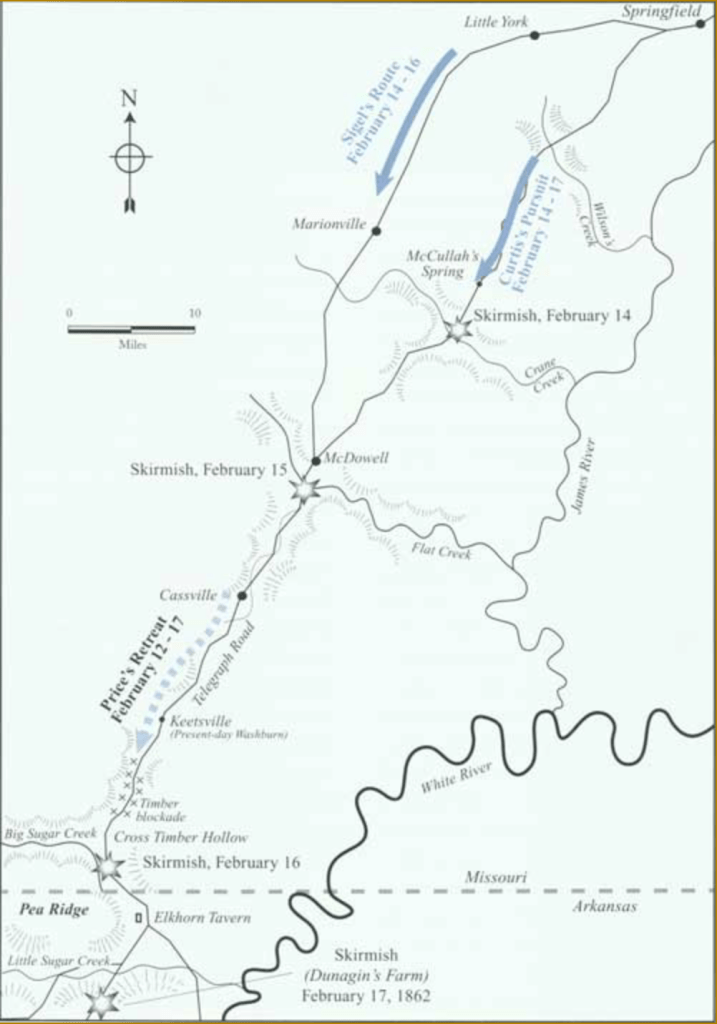
Edward’s letter describes the pursuit of Gen. Sterling Price’s army as it withdrew from Springfield and into Arkansas where the Battle of Elkhorn Tavern (Pea Ridge) was fought on 6 March 1862. Union forces were primarily from Iowa, Indiana, Illinois, Missouri and Ohio and over half were German immigrants who were placed in the 1st and 2nd divisions under the command of Brig. General Franz Sigel, also a German immigrant. Native born regiments were assigned to the 3rd and 4th Divisions. In the fight at Elkhorn Tavern, the 36th Illinois and the 12th Missouri drove the Confederates away from the guns in Oberson’s field.
To read other letters published on Spared & Shared by members of the 36th Illinois Infantry, see: Freeman Stanton Dunklee, Co. A, 36th Illinois (1 Letter) Henry C. Baxter, Co. E, 36th Illinois (1 Letter) James B. Sifleet, Co. F, 36th Illinois (1 Letter) John F. Weeks, Co. K, 36th Illinois (1 Letter)
Transcription
The pursuit of Gen. Price from Springfield, Missouri, to Elkhorn Tavern in Arkansas.
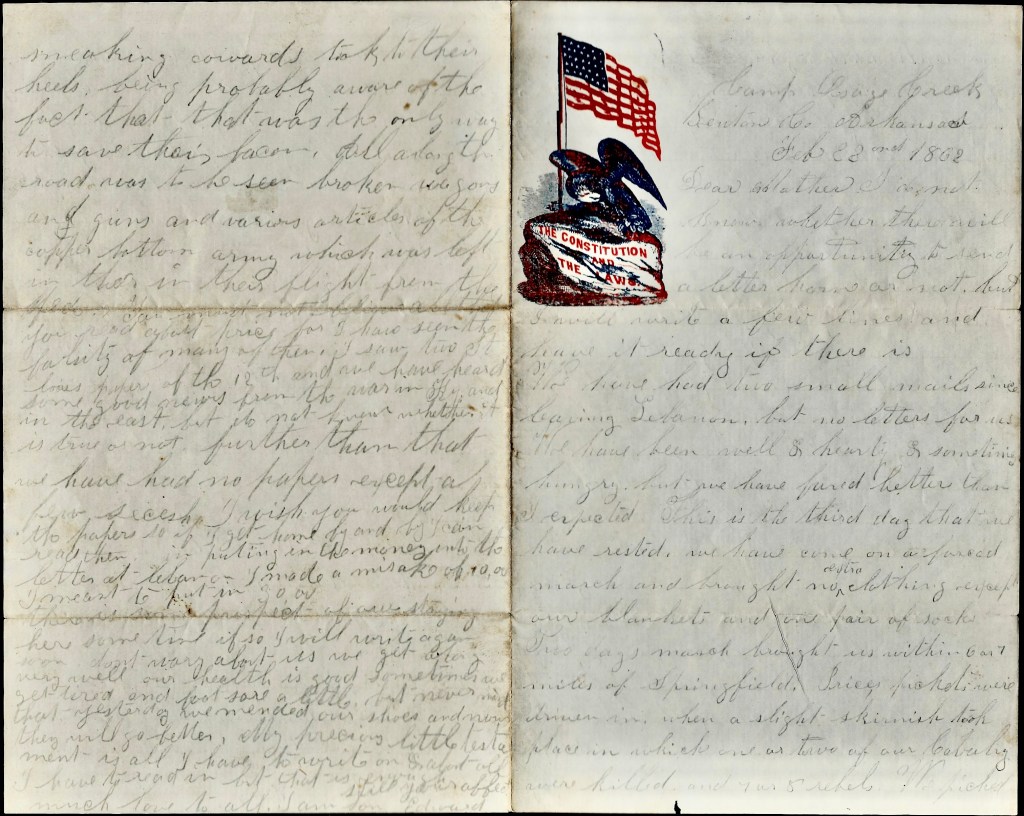
Camp Osage Creek Benton Co., Arkansas February 22nd 1862
Dear Mother,
I do not know whether there will be an opportunity to send a letter home or not, but I will write a few lines and have it ready if there is. We have had two small mails since leaving Lebanon, but no letters for us. We have been well & hearty & sometimes hungry but we have fared better than I expected. This is the third day that we have rested. We have come on a forced march and brought no extra clothing except our blankets and one pair of socks Two days march brought us within 6 or 7 miles of Springfield. Price’s pickets were driven in, when a slight skirmish took place in which one or two of our cavalry were killed and 7 or 8 rebels. We pitched no tents that night but lay on the ground and held ourselves prepared for any emergency, but all was quiet At 4 o’clock we took up our line of march to Springfield but soon found that Price and his large, well-drilled, splendidly armed and equipped army had skedaddled on double quick and was going to make his famous stand on his old battle ground at Wilson’s Creek some 12 miles from Springfield. But no stand did he make as you probably very well know.
Springfield has been a very pretty town but it is now filthy, gloomy, and deserted. Many pretty cottages have been used as stables for horses and mules & quarters for the rebel outlaws. It is about as large a place as Oswego or Sandwich but there are not so many stores. We followed on after Price, part of the army taking the road that he took and part another that intercepted that some 40 or 50 miles from Springfield where they intended to catch the runaway but failed. He passed us about 12 hours ahead. The division that followed him pushed him too fast and the other did not go as fast as they could till after he had got away. Then we put in and traveled from 18 to 25 miles a day. Our advance had scratches with his rear guard most every day. They took 4 pieces of cannon, killed some, and took some prisoners.
On Wednesday, two or three regiments of infantry, our cavalry, and I think one battery of artillery, and the little mountain howitzers, encountered nearly his whole force on Sugar Creek. Our side lost about 15 killed. The number wounded, I do not know. The rebels lost about 100 killed and a good many wounded. The most of our force did not get up in time, but we could hear the music. A number of regiments went on double quick & were just coming up when the sneaking cowards took to their heels, being probably aware of the fact that that was the only way to save their bacon. All along the road was to be seen broken wagons and guns and various articles of the copper bottom army which was left in their flight from the feds. You must not believe all you read about Price for I have seen the falsity of many of them. I saw two St. Louis papers of the 12th and we have heard some good news from the war in Kentucky and in the East, but do not know whether it is true or not. Further than that, we have had no papers except a few secesh. I wish you would keep the papers so if I get home by and by I can read them.
In putting in the money into the letter at Lebanon, I made a mistake of 10.00. I meant to put in 30.00. There is some prospect of our staying here some time. If so, I will write again soon. Don’t worry about us. We get along very well. Our health is good. Sometimes we get tired and foot sore a little, but never mind that. Yesterday we mended our shoes and now they will go better. My precious little testament is all I have to write on & about all I have to read in, but that is enough. Much love to all. I am still your affectionate son, — Edward
The following letters were written by John M. Britton who enlisted as a private for three years in Co. H, 8th New Jersey Infantry on 5 September 1861 and later transferred to Co. C. He reenlisted on 25 December 1863 (carried under the name Briton). The variations in spelling make it difficult to track down John’s family but I believe he was the son of Henry Britton (1807-1877) and his wife Mary (b. 1813) who were residents of Carpentersville, Warren county, New Jersey. In the 1850 US Census, this family was enumerated in Franklin township, Warren county, N. J. as the Henry and Mary Brittain family and their children at that time were Elizabeth (“Libby”), age 15 (1834-1904); John, age 12; Mercey, age 8 (1842-1911); and David J., age 5.
Little else could be learned about John except that he survived the war and married Catharine Lobb (b. 1843), the daughter of Jacob Lobb and Susan Morehouse of Rahway, New Jersey.
Letter 1
Patriotic Letterhead “One Flag and One Government” with verse, “Our Country’s Flag”
Camp Jersey [Meridian Hill] October 21, [1861] Monday morning, seven o’clock
I have just had my breakfast, tin cup of coffee, a piece of pork, and bread. That was my meal. All of the boys have their pipes and are smoking away. I would rather write than to smoke so I will write first and then smoke. We had a prayer meeting in the Colonel’s tent last evening. It was filled full. It lasted only one hour.
It is quite cool this morning. The soldiers are drawing on their overcoats. The wild pigeons are flying thick.
Half past eight. I have just come off drill. We were drilling double quick—that is what we call a Bull Run Retreat. We run and keep step. It is fun. Perhaps we will need it one of these days but we will never retreat unless we receive orders from our officer to do so. We are ready to go in the battlefield as soon as called on. Our armies are driving the rebels back. They have cleared them pretty well out of Virginia. We know all about the war. The papers come in our camp every morning so we know everything that is going on.
We are thirty-nine miles from Bulls Run and four miles from Chain Bridge. Last Friday the rebels had to retreat. We could hear the cannons roar very plainly. They fired very fast. We seen a secession balloon go up last Friday [18 October 1861] but it did not stay up very long and just after it came down, the firing commenced. I suppose he seen something he did not like.
We are going to have a brass band in our regiment. We have got nothing but drums now and I am getting tired hearing them. We have twenty all together and such a racket as they make I never heard. You can’t hear anybody speak unless they yelp their best.
They are building barracks in Washington to accommodate 60 thousand soldiers this winter. I believe we are to go to South Carolina or else take up our quarters in Washington. My wish is that we will get in Washington. We have a great deal of rain here. It appears to rain very easy. You must not look for me home before next spring and perhaps not then.
I am glad Junkin got the carriage. You must all make good use of it. I think by the time I get home I will have enough money to pay for it. I would like to come home and see you all very much. Obediah Evans started home yesterday. He went to get more recruits. He was the only one from our company. There was a lieutenant from one of the other companies with him. He lives at Pattenburg. Obediah is a sergeant in our company. Daniel Cowl said I should tell you he was well and liked it first rate. I guess I will stop writing.. No more. Your affectionate brother, — John Britton, Meridian Hill
Dear sister Mercy, I do not know as I have anything to write to you—only I want you and Junkin to enjoy yourselves the best you can. I would like to be home and take you out riding. Junkin, I want you to break the colt in single so when I come home, I can ride behind her. I don’t know when I will get home to stay but if I live, I will get home in the spring to see you. No more from your brother, — John B.
Letter 2
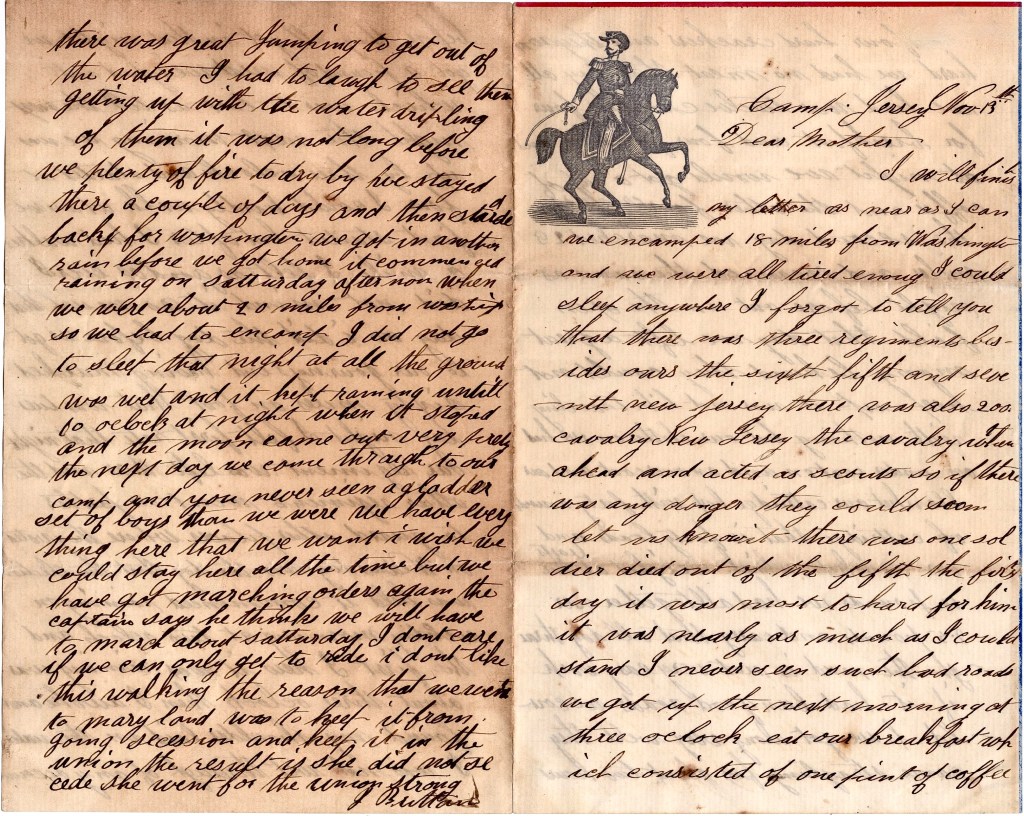
Camp Jersey November 13, [1861]
Dear mother,
I will finish my letter as near as I can. We encamped 18 miles from Washington and we were all tired enough. I could sleep anywhere. I forgot to tell you that there was three regiments besides ours—the Sixth, Fifth and Seventh New Jersey. There was also 200 cavalry [from] New Jersey. The cavalry went ahead and acted as scouts so if there was any danger they could soon let us know it. There was one soldier died out of the Fifth the first day. It was most too hard for him. It was nearly as much as I could stand. I never seen such bad roads.
We got up the next morning at 3 o’clock, eat our breakfast which consisted of one pint of coffee and four hard crackers and they were hard. We had no meat that day. All we had was twelve crackers—four for breakfast and four for dinner, and at night we would get a cup of coffee and the other four crackers. The 2nd day we marched 23 miles and encamped the same as night before, out in the open field. That day we left a great many behind. They could not keep up. It was not like traveling with nothing but our clothes on. We had an under coat and an overcoat and our blankets, our cartridge box with forty rounds of cartridges—that is, forty loads, and our muskets which weighed at the least ten pounds. We had altogether over 25 pounds and carry all that day through the mud is not very easy work. If it had been good roads, we could have got along very well. They came straggling for about two hours before they all got in that night. We got a pound of meat weighed out which was to last us till the next night.
The next morning we was up by three o’clock and started at four. I could hardly walk when we first started but after I had walked a mile, I felt as good as ever. I did not mind it as much that day as I did the day before. We got to our journey’s end having marched sixty miles on foot. That was Tuesday night. I felt first rate that night. Our regiment was left there and the other regiments went on farther to guard other places where they voted.
On Wednesday was the day that the election was held. It commenced raining on Wednesday morning at two o’clock and the first I knew it was raining was about three o’clock when I awoke and found my shoulder laid in the water. I was not wet through of any account [but] there was great jumping to get out of the water. I had to laugh to see them getting up with the water dripping off them. It was not long before we [had] plenty of fire to dry by. We stayed there a couple of days and then started back for Washington. We got in another rain before we got home. It commenced raining on Saturday afternoon when we were about 20 miles from Washington so we had to encamp. I did not go to sleep that night at all. The ground was set and it kept raining until 10 o’clock at night when it stopped and the moon came out very pretty.
The next day we came through to our camp and you never seen a gladder set of boys that we were. We have everything here that we want. I wish we could stay here all the time but we have got marching orders again. The Captain says he thinks we will have to march about Saturday. I don’t care if we can only get to ride. I don’t like this walking. The reason that we went to Maryland was to keep it from going secession and keep it in the Union. The result is she did not secede. She went for the Union strong. — J. Britton
Letter 3
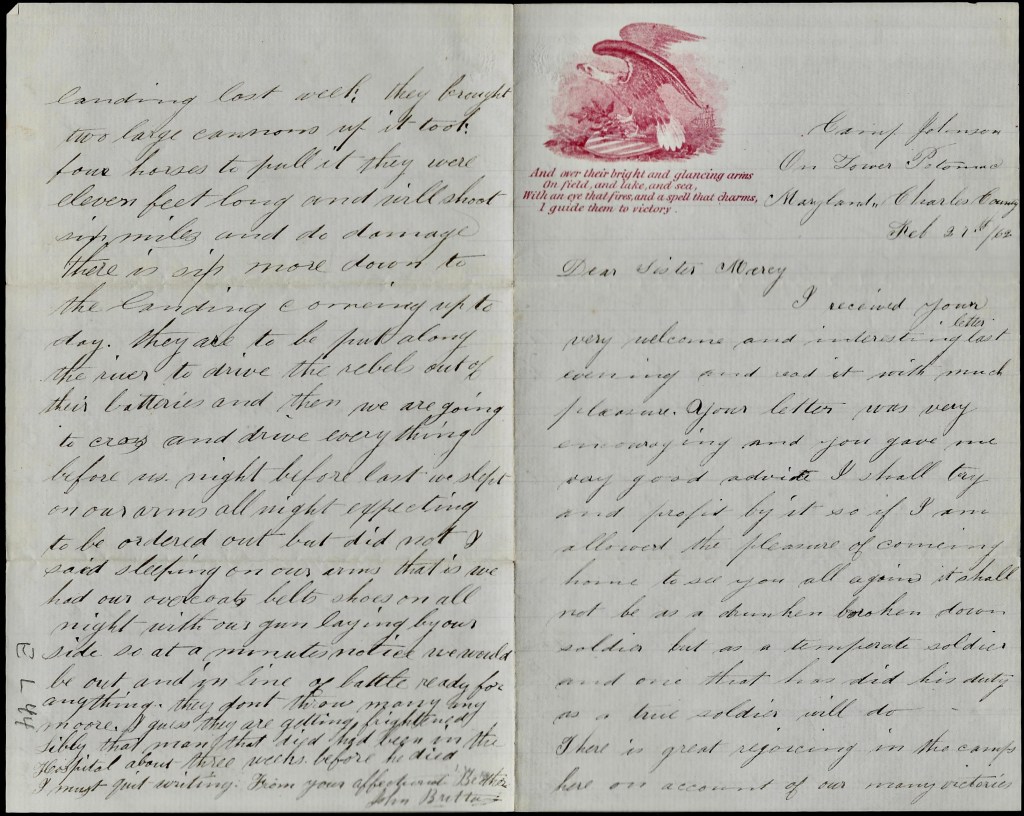
John wrote this letter in late February 1862 from Camp Johnson (named after their Colonel Adolphus Johnson). This camp was located near Budd’s Ferry on the lower Potomac. They spent most of the winter at this location. Their first major engagement wasn’t until 5 May 1862 at the Battle of Williamsburg.
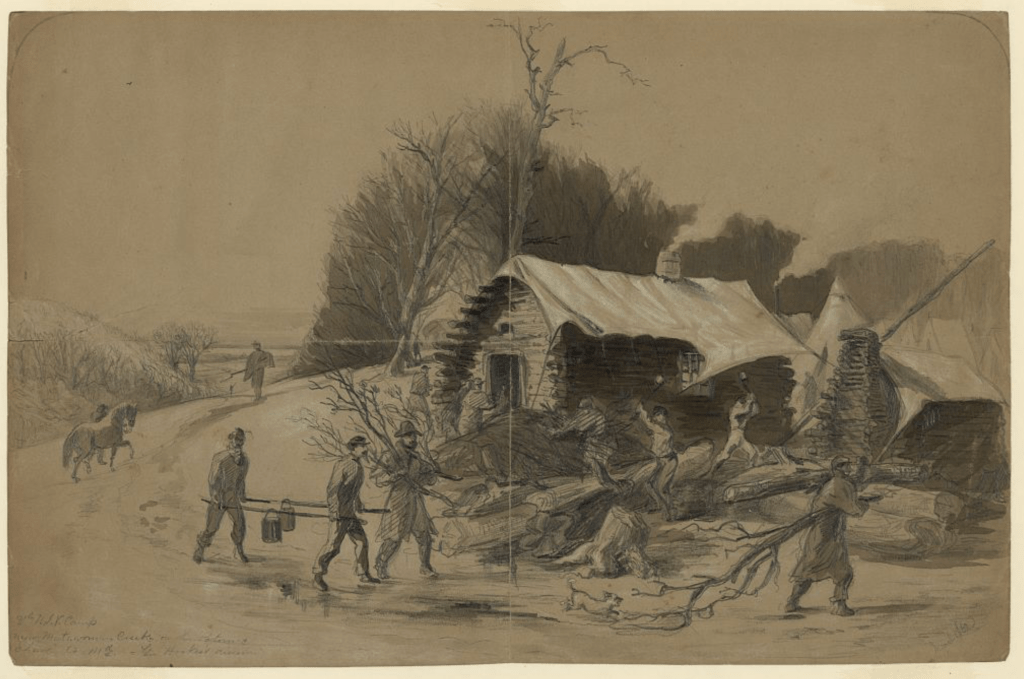
Winter encampment of 8th New Jersey Infantry near Budd’s Ferry
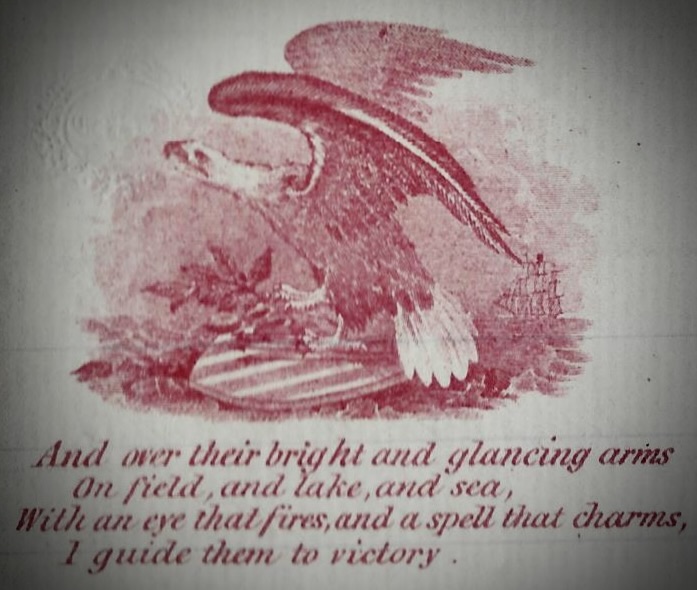
Patriotic stationery used by Britton.
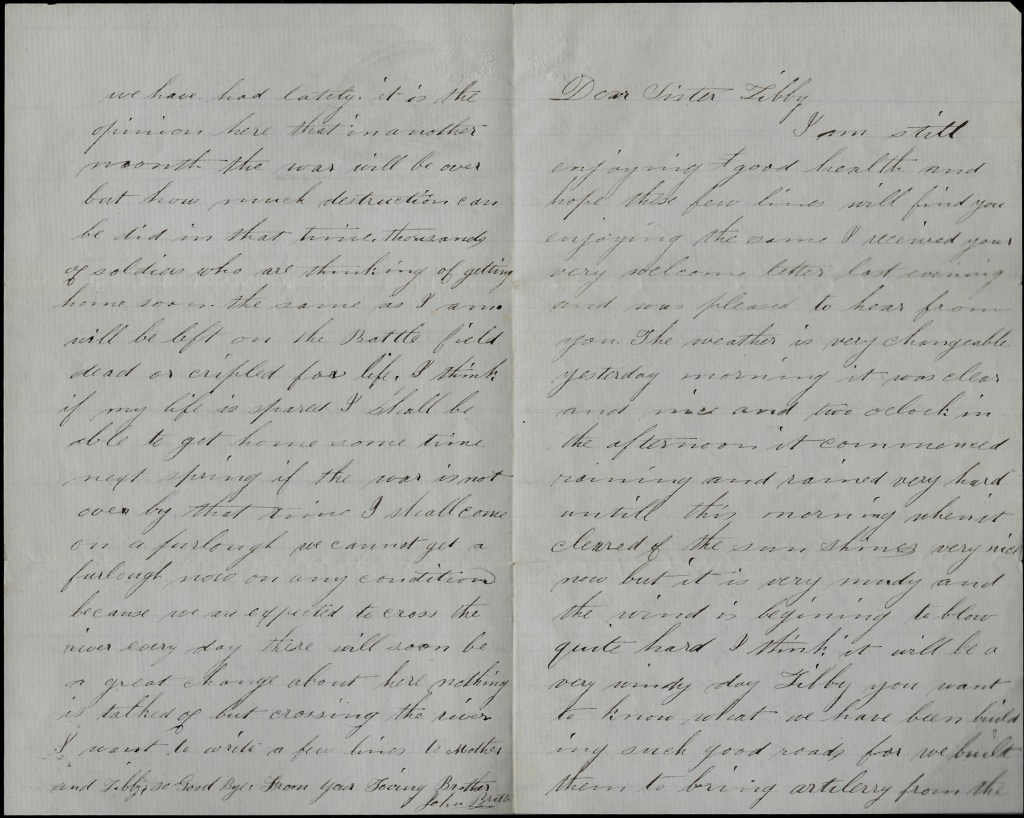
Camp Johnson On Lower Potomac Charles county, Maryland February 27th 1862
Dear Sister Mercy,
I received your very welcome and interesting letter last evening and read it with much pleasure. Your letter was very encouraging and you gave me some good advice. I shall try and profit by it so if I am allowed the pleasure of coming home to see you all again, it shall not be as a drunken, broken down soldier, but as a temperate soldier and one that has did his duty as a true soldier will do.
There is great rejoicing in the camp here on account of our many victories we have had lately. It is the opinion here than in another month, the war will be over. But how much destruction can be did in that time, thousands of soldiers who are thinking of getting home soon the same as I am will be left on the battlefield, dead or crippled for life. I think if my life is spared, I shall be able to get home some time next spring. If the war is not over by that time, I shall come on a furlough. We cannot get a furlough now on any condition because we are expected to cross the [Potomac] river every day. There will soon be a great change about here. Nothing is talked of but crossing the river.
I want to write a few lines to Mother and Libby so goodbye from your loving brother, — John Britton
Dear Sister Libby,
I am still enjoying good health and hope these few lines will find you enjoying the same. I received your very welcome letter last evening and was pleased to hear from you. The weather is very changeable. Yesterday morning it was clear and nice and two o’clock in the afternoon it commenced raining and rained very hard until this morning when it cleared off. The sun shines very nice now but it is very muddy and the wind is beginning to blow quite hard. I think it will be a very windy day.
Libby, you want to know what we have been building such good roads for. We built them to bring artillery from the landing last week. They brought two large cannons up. It took four horses to pull it. they were eleven feet long and will shoot six miles and do damage. There is six more down to the landing coming up today. They are to be put along the river to drive the rebels out of their batteries and then we are going to cross and drive everything before us.
Night before last we slept on our arms al night expecting to be ordered out but did not. I said sleeping on our arms—that is, we had our overcoats, belts, shoes on all night with our gun laying by our side so at a moment’s notice we would be out and in line of battle ready for anything. They don’t throw many any more. I guess they are getting frightened. Libby, that man that died had been in the hospital about three weeks before he died.
I must quit writing. From your affectionate brother, – John Britton
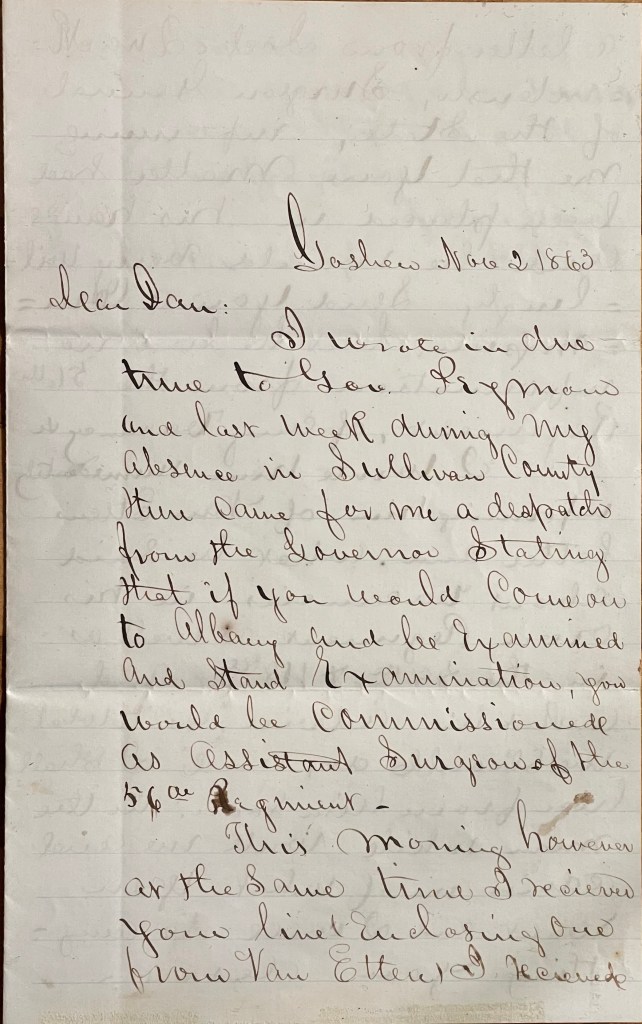
The following letter was penned by Hon. Charles Henry Winfield (1822-1888), an attorney and former district attorney of Orange county, New York who was elected to the US Congress as a democrat in 1863 and served two terms.
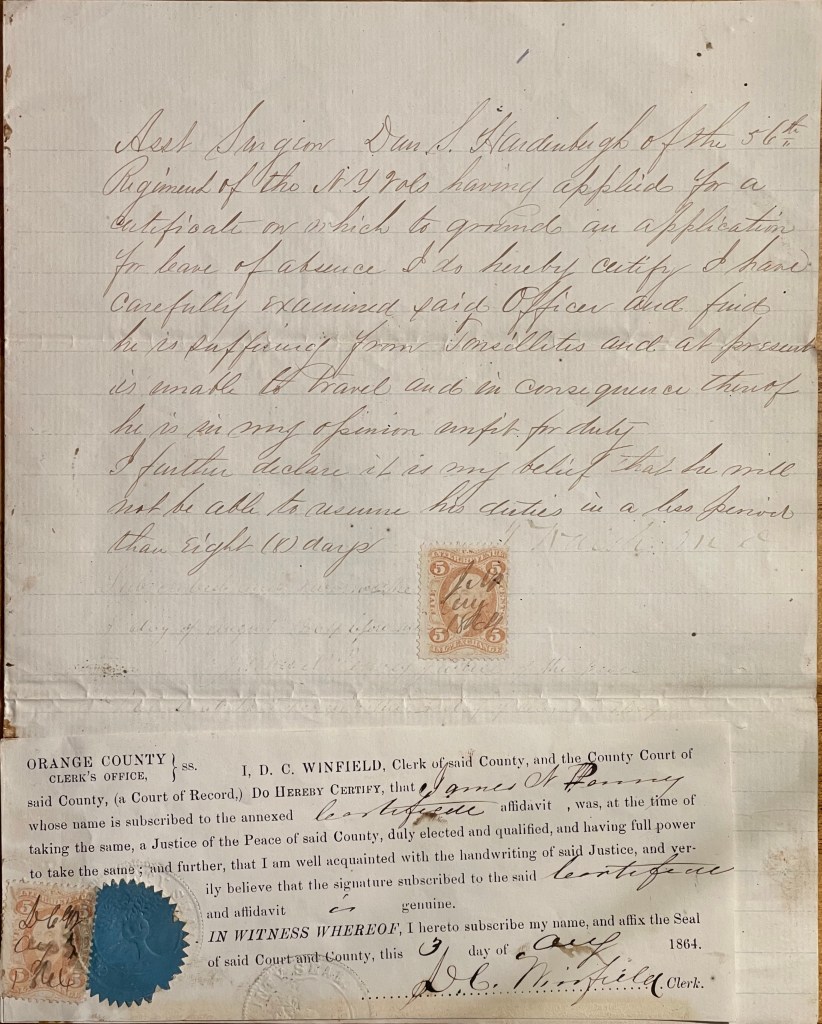
The content of the letter pertains to the appointment of Daniel S. Hardenburg (1840-1908) as an Assistant Surgeon in the 56th New York Infantry. Daniel was the son of Dr. Charles Hardenburgh (1802-1874) and Mary E. Chandler (1815-18xx) of Port Jervis, Orange county, New York. According to military records, Daniel received his appointment on 11 November 1863 and that he participated in the Battle of Honey Hill and all of the battles accompanying Gen. John P. Hatch’s Expedition up Red River and the siege of Charleston, South Carolina. He later became the post surgeon at Georgetown, South Carolina.
[Note: This letter is from the personal collection of Kyle Williams and was made available for transcription and publication on Spared & Shared by express consent.]
Transcription
Addressed to Dr. Daniel S. Hardenburg
Goshen [Orange county, New York] November 2, 1863
Dear Dan,
I wrote in due time to Gov. [Horatio] Seymour and last week during my absence in Sullivan county, there came for me a dispatch from the Governor stating that if you would come on to Albany and be examined and stand examination, you would be commissioned as Assistant Surgeon of the 56th Regiment.
This morning however at the same time I received your line enclosing one from [Solomon] Van Etten, I received a letter from Doctor [John Van Pelt] Quackenbush, Surgeon General of the State, informing me that your matter had been placed in his hands and he would very willingly send you a commission, but he had no information from the 56th Regiment of any vacancy, &c.
I wrote him immediately informing him of Van Etten’s letter and what he said about vacancies in his own regiment as well as the 48th and 118th and asked his advice as to what we should do, and I shall hear from him soon. In the mean while write me and advise me of what you hear and I will do anything you desire.
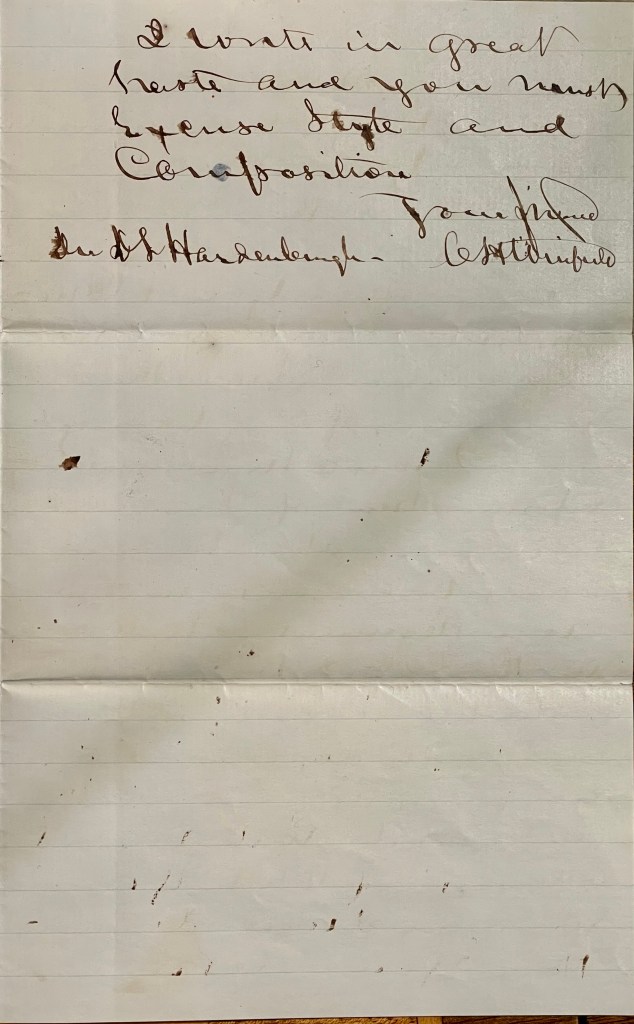
I wrote in great haste and you must excuse style and composition. Your friend, — C. H. Winfield
I could not find an image of Milton but here is a cdv of 1st Lt. Henry A. Still of Co. E, 56th New York Infantry (Photo Sleuth)
This letter was written just days before James Henry F. Milton (1832-1910) enlisted in Co. E, 56th New York Infantry. He was mustered in on 29 August as 1st Lieutenant of his company and was promoted to Captain of Co. A on 6 August 1862. He was discharged from the regiment on 31 March 1865.
James was known to his friends as “Dock.” After attending the 1859-60 Medical lectures at the University of Pennsylvania, he began the practice of medicine in Liberty. In the 1860 US Census he was enumerated in the household of Benjamin W. Baker, a grocer in Liberty, where he probably lodged and boarded. After the war, he resumed his profession as a doctor, eventually settling in Philadelphia.
Dock wrote the letter to a friend named “Brigham” who is otherwise unidentified. My hunch is that it was written to Lewis Alexander Brigham (1831-1885)—a contemporary of Dock’s—who was born in New York Mills, New York, and graduated from Hamilton College in Clinton in 1849. He studied to be a lawyer and pass the New York bar in 1855. He then set up a practice in New York City and got into politics. In 1850, after graduating from Hamilton College, Lewis Brigham was a teacher in Sullivan county. I could find no other Brigham’s living in Sullivan county in that period.
[Note: This letter is from the private collection of Kyle A. Williams and was made available for transcription and publication on Spared & Shared by express consent.]
Transcription
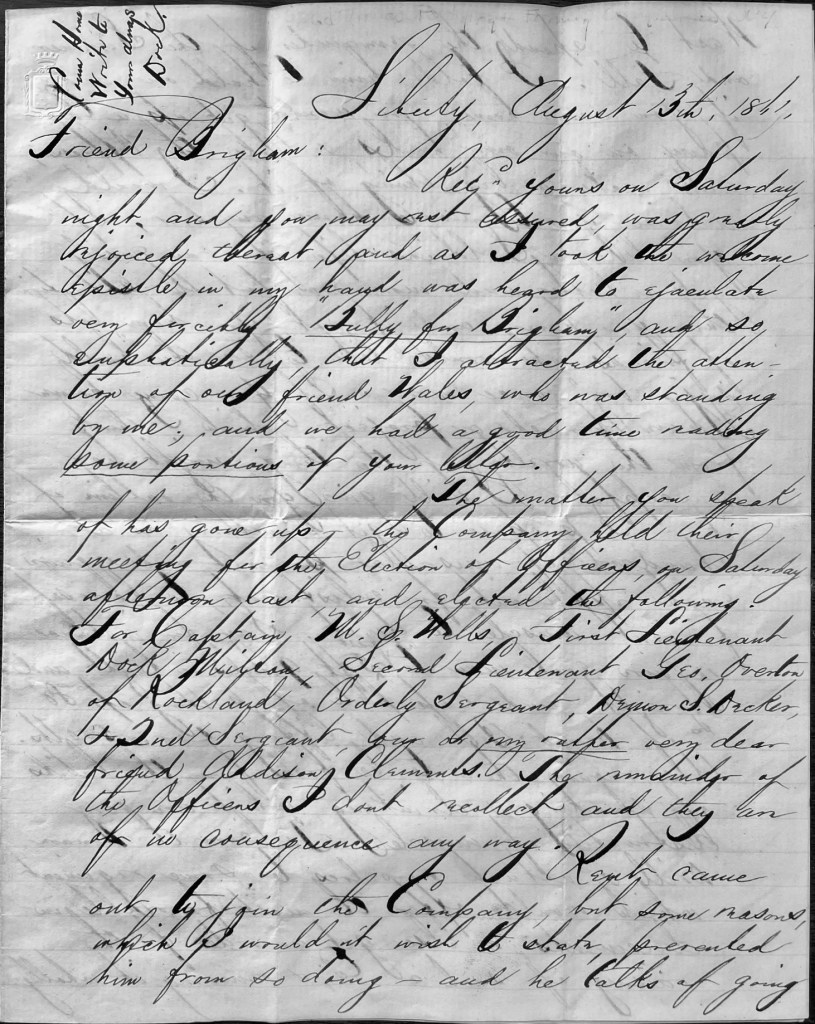
Liberty [Sullivan county, New York] August 13th 1861
Friend Brigham,
Received yours on Saturday night and you may rest assured was greatly rejoiced thereat, and as I took the welcome epistle in my hand was heard to ejaculate every forcibly, “Bully for Brigham” and so emphatically that I attracted the attention of our friend [Reuben] Wales who was standing by me, and we had a good time reading some portions of your letter.
The matter you speak of has gone up—the Company held their meeting for the elections of officers on Saturday afternoon last and elected the following. For Captain, M[elvin] S. Wells; 1st Lieutenant, Dock Milton; Second Lieutenant, George [P.] Overton of Rockland; Orderly Sergeant, Demon S. Decker; & 2nd Sergeant, our, or my, rather very dear friend Addison [J.] Clements. The remainder of the officers I don’t recollect and they are of no consequence any way.
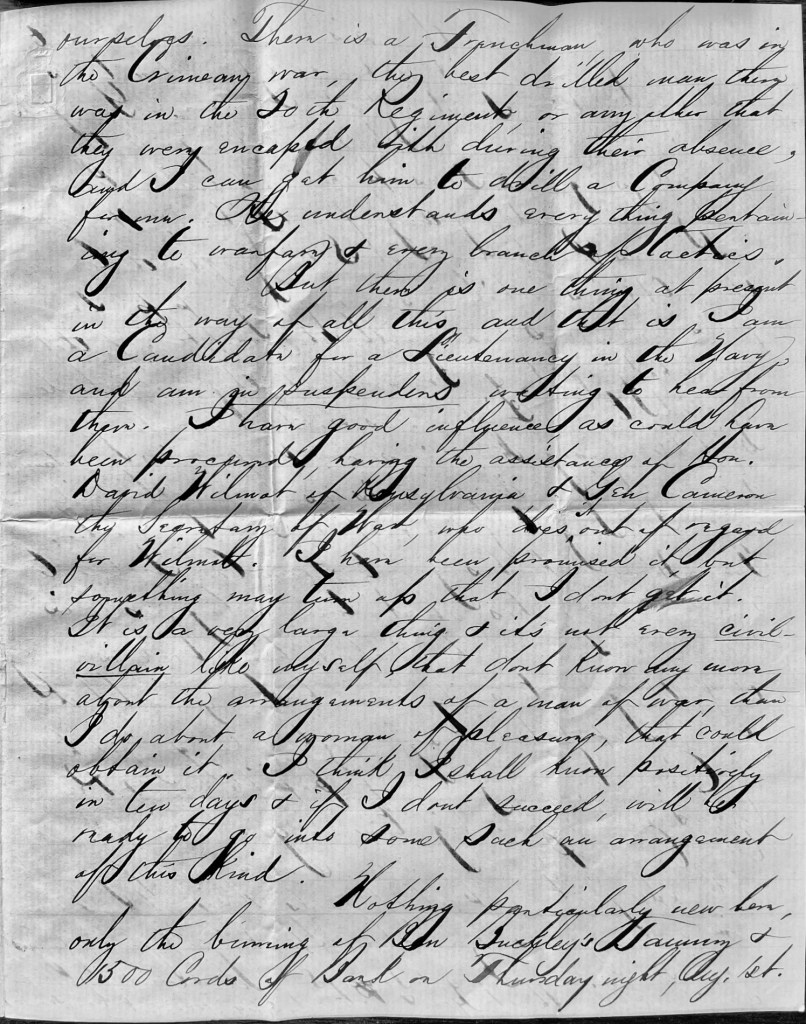
Reub[en Wales] came out to join the company but some masons which I wouldn’t wish to state prevented him from so doing and he talks of going West to spend the remainder of the summer and fall. I told him to hold on and if you came home, we would get up a company on our own hooks, & take the officers and make a big thing of it. I would advise you to come home anyhow. If you like a soldier’s life, you can easily get a better and more comfortable situation that you have and if not, you have lots of friends who would like to see the “bould soger boy” once more.
If you come home, I have formed a project which I think from the novelty of the thing might be successful. I will give you the outline of it. I propose to get something as a standard of muscular power and require each applicant for enlistment to have sufficient muscle to do it. Say for instance require each man to be at least 5 feet, 9 inches in height, and straight, and capable of putting up 80 lb. of dumb bell and lifting 200 or 500 lbs. Also require them to be free from the habits of smoking & drinking, which are very destructive of muscle. To learn the Zouave drills & attach ourselves to some regiment which would offer the most favorable inducements, or else get an order for the raising of such a company & running it wholly ourselves. There is a Frenchman who was in the Crimean War—the best drilled man there was in the 20th Regiment or any other that they were encamped with during their absence, and I can get him to drill a company for me. He understands everything pertaining to warfare & every branch of tactics.
But there is one thing at present in the way of all this and that is I am a candidate for a Lieutenancy in the Navy and am in suspenders waiting to hear form them I have good influence as could have been procured, having the assistance of Hon. David Wilmot of Pennsylvania & Gen. [Simon] Cameron, the Secretary of War, who does out of regard for Wilmot. I have been promised it but something may turn up that I don’t get it. It is a very large thing & it’s not every civil villain like myself that don’t know any more about the arrangements of a man of war than I do about a woman of pleasure, that could obtain it. I think I shall know positively in ten days & if I don’t succeed, will be reay to go into some such arrangement of this kind.
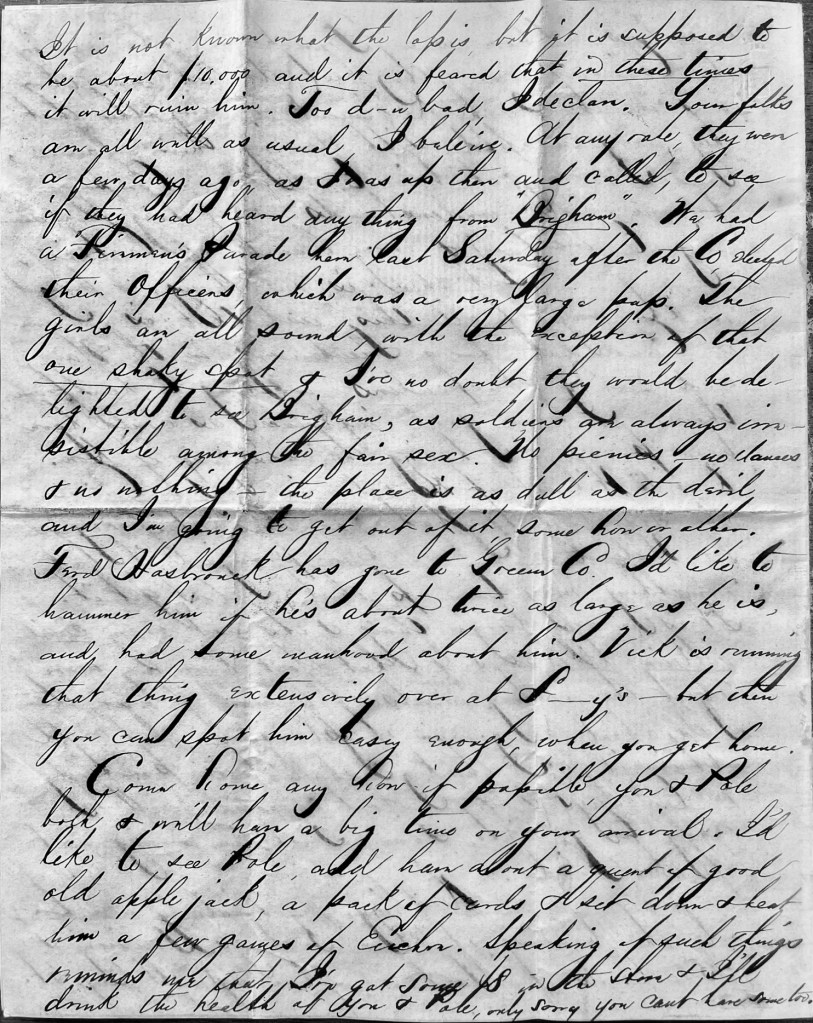
Nothing particularly new here—only the burning of Ben[jamin P.] Buckley’s Tannery & 1500 cords of bark on Thursday night, August 1st. It is not know what the loss is, but it is supposed to be about $10,000 and it is feared that in these times, it will ruin him. To damn bad, I declare.
Your folks are all well as usual, I believe. At any rate, they were a few days ago as I was up there and called to see if they had heard anything from “Brigham.” We had a Fireman’s Parade here last Saturday after the company elected their officers which was a very large pop [?]. The girls are all sound, with the exception of that one shaky spot & I’ve no doubt they would be delighted to see Brigham, as soldiers are always irresistible among the fair sex. No picnics, no dances, and no nothing—the place is as dull as the devil and I’m going to get out of it somehow or other.
Ferd Hasbrouck has gone to Green county. I’d like to hammer him if he’s about as twice as large as he is, and had some manhood about him. Vick is running that thing extensively over at L—-y’s, but then you can spot him easy enough when you get home. Come home anyhow if possible—you and Pole both—and we’ll have a big time on your arrival. I’d like to see Pole and have about a quart of good old applejack, a pack of cards, & sit down and beat him a few games of Euchre. Speaking of such things reminds me that I’ve got some $ in the store & I’ll drink the health of you & Pole, only sorry you can’t have some too. Come home. Write to yours always, — Dock
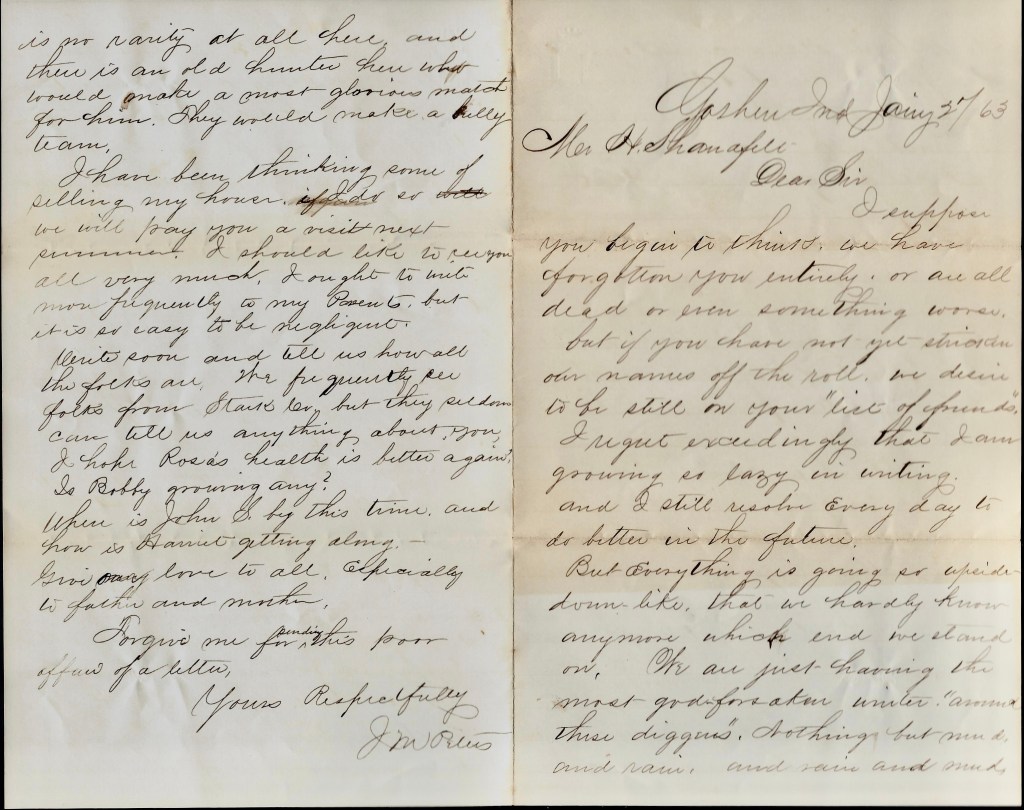
The following letter was written from Goshen, Elkhart county, Indiana by Joseph Murray Peters (1830-1917), a merchant druggist and the husband of Margaret Cunningham (1834-1893). Joseph was born in Lancaster, Pennsylvania, the son of John Peters (1792-1880) and Elizabeth Regina Murray (1794-1877).
Joseph wrote the letter to Henry Shanafelt, Jr. (1827-1893) of Greentown, Stark county, Ohio, who was the husband of Rosa F. Peters (1832-1917)—an older sister of Joseph’s.
The content of the letter is pretty much limited to weather and the economy so historians looking for war news will be disappointed in it but what is most surprising is the total absence of any war news—particularly as it affects the economy. One would not have a clue from this letter that the war had any impacts on this northern Indiana county and community.
Transcription
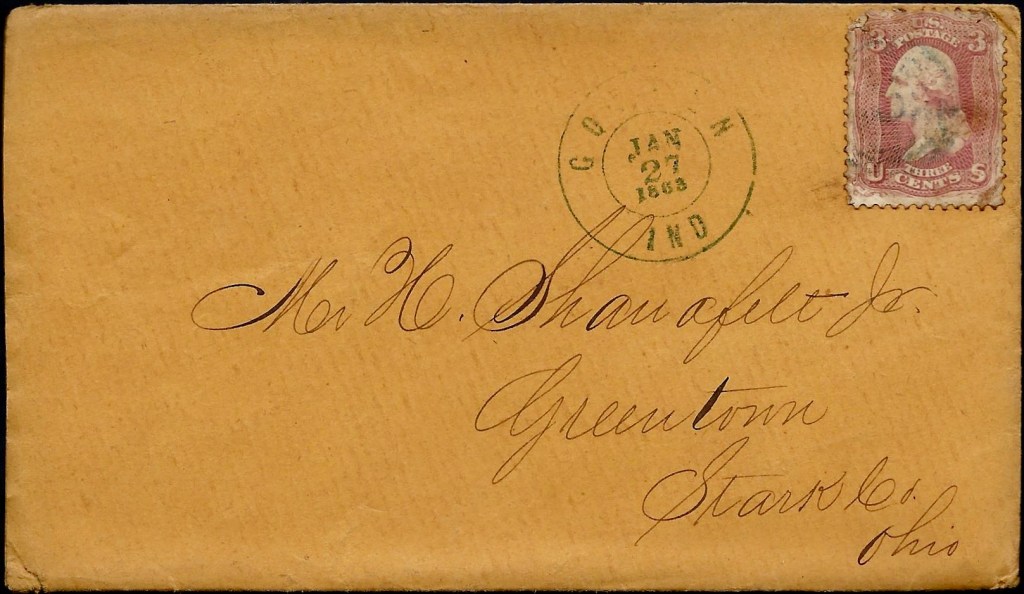
Addressed to Mr. H. Shanafelt, Jr., Greentown, Stark county, Ohio
Goshen, Indiana January 27, 1863
Mr. H[enry] Shanafelt Dear Sir,
I suppose you begin to think we have forgotten you entirely or are all dead or even something worse, but if you have not yet stricken our names off the roll. We desire to be still on your “list of friends.” I regret exceedingly that I am growing so lazy in writing and I still resolve every day to do better in the future.
But everything is going so upside down like that we hardly know anymore which end we stand on. We are just having the most God-forsaken winter “around these diggens.” Nothing but mud and rain, and rain and mud. And from all accounts you are not faring much better in regard to the weather. We have not had a monthful of sleighing yet.
Times are getting somewhat dull perhaps in consequence of miserable roads, but trade has been very good all fall and winter. Merchants have been having a genuine old harvest. All kinds of produce has been bringing better prices than last winter and farmers have been more liberal in consequence. Wheat is selling now at $1.12 per bushel, corn 45, oats, 40, potatoes 50, pork 3.75 to 4.50, butter 14, eggs $1/dozen, lard 6, tallows 8, wood per cord 1.75 (best kind).
Our folks are only in tolerable health. Margaret had a spell of ague last week and Frank—by the way permit me to introduce you to Mr. Frank Harvey Peters who was five months old the 20th instant and usually one of the finest, fattest and happiest folks that ever blessed a home—but he too has been unwell for several days now. [ ] is probably teaching. Carrie is doing well, appearing quite healthy.
Maybe you are not aware that Grandmamma Cunningham is with us, She has been with us just two weeks tonight. She tok us entirely by surprise. Why can not some of my relatives come and see us. I think any of you would feel well paid after seeing the country and things in general. I think it would be just the place for you to sell goods and for George Guily to follow either coopering or farming. And last but not least, for old Pete to follow hunting. There’s plenty of game yet within a few miles of town—venison is no rarity at all here, and there is an old hunter here who would make a most glorious match for him. They would make a bully team.
I have been thinking some of selling my house. If I do so, we will pay you a visit next summer. I should like to see you all very much. I ought to write more frequently to my parents but it is so easy to be negligent. Write soon and tell us how all the folks are. We frequently see folks from Stark county but they seldom can tell us anything about you. I hope Rosa’s health is better again? Is Bobby growing any?
Where is John S. by this time, and how is Harriet getting along? Give love to all—especially father and mother. Forgive me for sending this poor affair of a letter. Yours respectfully, — J. M. Peters
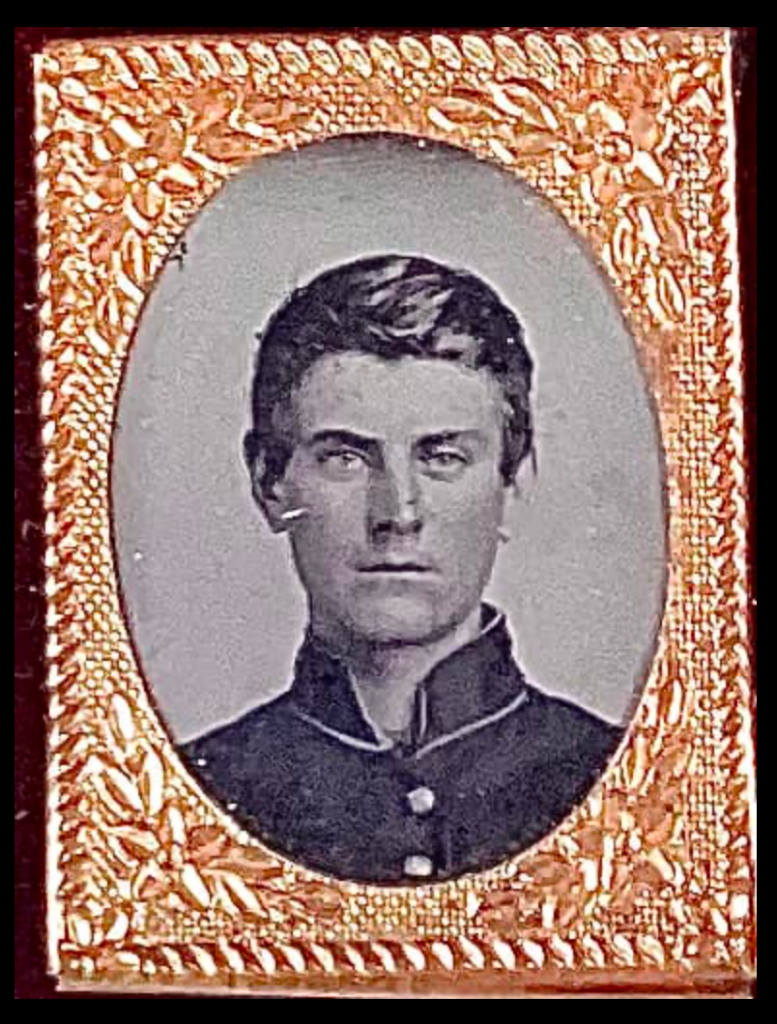
Corporal Franklin Shanafelt(Ronald Chojnacki Collection)
The following letters were written by Franklin Shanafelt (1842-1892), the son of Peter Shanafelt (1800-1875) and Elizabeth Funk (1801-1863) who moved from their home on Antietam Creek in Funkstown, Maryland, to Greentown, Stark county, Ohio, in the mid 1840s. Franklin was twenty years old when he enlisted on 14 August 1862 as a private in Co. E, 115th Ohio Volunteer Infantry (OVI). He was promoted to corporal in December 1862 and remained with the regiment until he was mustered out on 22 June 1865 at Murfreesboro, Tennessee.
When Franklin returned from the service, he married Catharine (“Kate”) Housley (1842-1911) in March 1866 and lived out his days as a farmer in Stark county, Ohio.
Most of Franklin’s letter were sent to his older brother Henry Shanafelt (1827-1893). Some of the letters are addressed to Henry’s wife, Rosana or “Rose” (Peters) Shanafelt. Henry and Rose were married in 1856. Henry was a grocer in Greentown.
Readers are referred to “Battling for the Blockhouses with the 115th Ohio,” posted on Dan Masters’ Civil War Chronicles, 3 December 2021. In the early part of December 1864, nearly 200 members of the Regiment, who were stationed in block-houses, were captured, and after being paroled were placed on the ill-fated Steamer “Sultana” which exploded on the Mississippi River near Memphis, Tenn., April 27, 1865.
24 Members of Congress. E, 115th OVI (Ronald Chojnacki Collection)
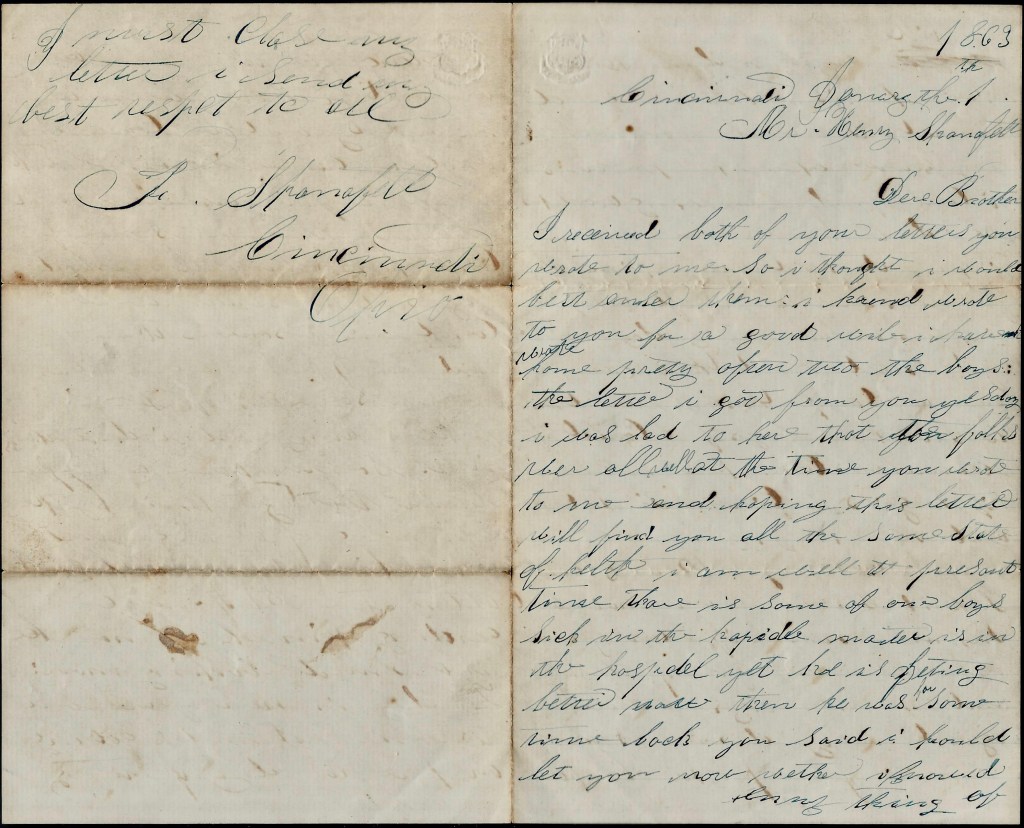
Letter 1
Cincinnati, Ohio January 1, 1863
Dear Brother,
I received both of your letters you wrote to me so I thought I would best answer them in kind. I ain’t wrote to you for a good while. I hain’t wrote home pretty often to the boys. The letter I got from you yesterday, I was glad to hear that the folks were all well at the time you wrote to me and hoping this letter will find you all the same state of health. I am well at present time. There is some of our boys sick in the hospital. Maiter is in the hospital yet. He is getting better now than he was for some time. You said I should let you know whether I heard anything of Bill Taylor. I don’t know where he is. I have enquired around through the boys whether they know where he is. I haven’t heard anything of John since they left Lexington. I expect a letter every day from him.
You said the 2nd Ohio Cavalry was at Camp Chase. I would like to see them boys if I could. If Carnelson [?] come home, tell him if he gets to Cincinnati to come and see us boys. The name of [our] barracks is named Kemper Barracks, one Second Street between Main and Sycamore Street. If I can get a furlough, I will go up there and see the boys.
We take a good many deserters there. I might get up there before long. We take them all around. I have been to Louisville, Kentucky, and to Covington and to Cairo, Illinois with men. We travel a good deal here. There was some come from Louisville yesterday. They said the streets were all covered with Sambo’s there. THey said that John Morgan was within 30 miles of Louisville with his army but I don’t think it is so. We had a rebel Colonel that they ketch in by the left wiing of our regiment. Took him horse, saddle, [ ]. We are guarding him here now. He is a smart-looking man.
Today is New Years but there is not much going on here today of anything. I must close my letter. I send my best respects to all. — F. Shanafelt
Cincinnati, Ohio
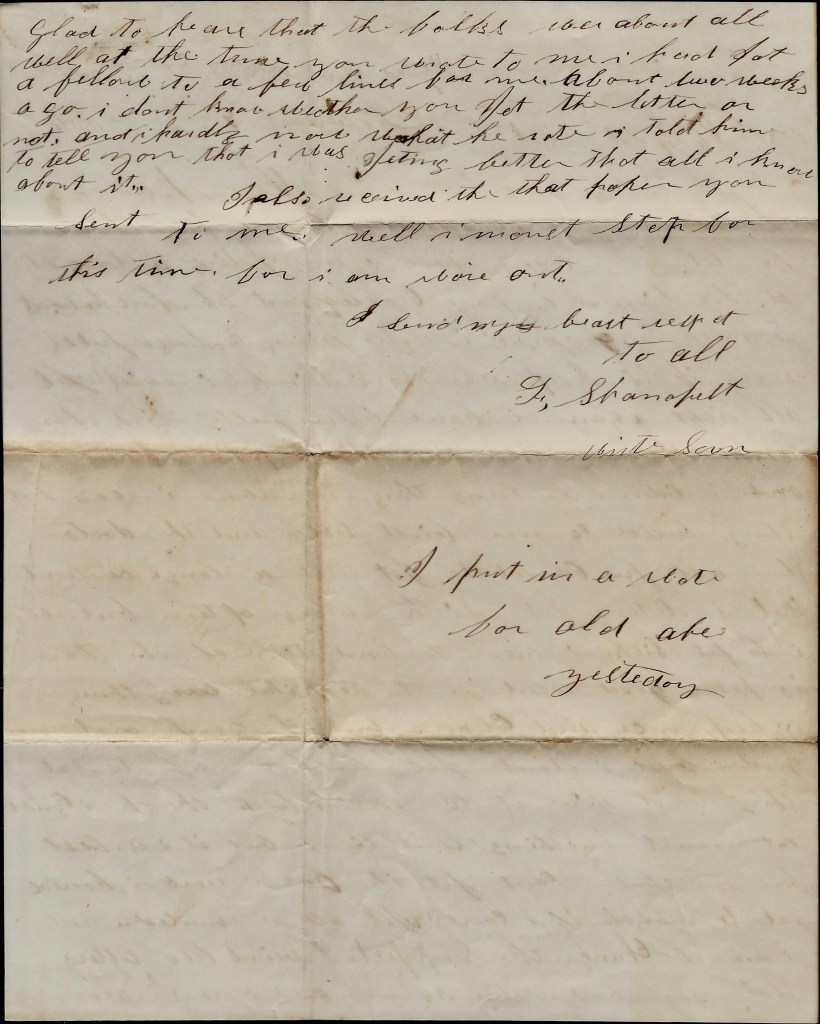
Letter 2
Hospital No. 1 November 9, 1864
Dear Brother,
I will try and send you a few lines to let you know how I am getting along at this time. I have crawled out of bed about a week ago and I am getting along pretty well. If I keep on so, I think I will get all right again. I have been pretty sick for about three weeks. I had the typhoid fever and I didn’t know anything nor knew where I was. But they tended to me first rate and the doctor done all he could to get me along. He said that I didn’t get sick very often but when I do get sick, I have a hard time of it. There is pretty good nurses in the hospital. Everything is kept nice and clean but the grub ain’t very good. But I don’t get half enough to eat. They won’t give it to me [ ] though I could eat most anything sometimes. But it is best for me that I can’t get it for I know I should eat too much if I could get all I wanted.
Well, I must change the subject. I received two letters that you had written to me and I was very glad to hear that the folks were about all well at the time you wrote to me. I hat got a fellow to write a few lines for me about two weeks ago. I don’t know whether you got the letter or not, and I hardly know what he wrote. I told him to tell you that I was getting better. That’s all I know about it. I also received that paper you sent to me. Well, I must stop for this time for I am wore out. I send you my best respects to all. — F. Shanafelt
I put in a vote for Old Abe yesterday.
Letter 3
[On December 2, 1864, Hood had ordered Bate to destroy the railroad and blockhouses between Murfreesboro and Nashville and join Forrest for further operations. On December 4, Bate’s division attacked Blockhouse No. 7 protecting the railroad crossing at Overall’s Creek, but Union forces fought it off.]
Overall Creek Block House No. 7 February 6, 1865
Friend Rose,
I received your letter a few weeks ago and I was very glad to hear from you and all the rest of the folks about Greentown and to hear that they were all well except the young soldier had come to lofe. You had stated in your letter than he was sick but I’m hoping when this letter come to hand will find you all enjoying good health.
Rose, you had stated in your letter that you was going to surprise me when you had stated that Cornelius had got home once more. You’re right, it did surprise me when I found that he had got back to his own state once more. I say Bully for him. Rose, you had said that Hen had been out for rabbits. I would like to take a good rabbit hunt again where there is lots of snow down on such a country. There ain’t enough snow to track a mouse. Sleighing is played out in this country. I haven’t saw a sled in Tennessee. I don’t believe that they know what sleighing means. I suppose that there has been a great deal of snow in Ohio this winter and I suppose that folks enjoyed themselves going sleighing and especially what few young folks there is to home. But I suppose that they are getting pretty well cleaned out about town—that is, the young men. But I suppose there is plenty of young women yet in town.
Rose, you wanted to know whether I had your photograph. I have got it and I will stick to it as long as I have a button on my pants. So you can bet I will keep it for if the buttons would come all off, I would be in a bad fix, don’t you think so? Rose, tell Maria Kisner and Susan Carpenter and Harriet Shanafelt that I want them to send me their photographs and if they don’t, I might throw a stone in their gardens someday for it.
I must close for this time. I send my respects to all, — F. Shanfelt
The weather has been very nice down [here] for the last few weeks. Write again soon.
Letter 4
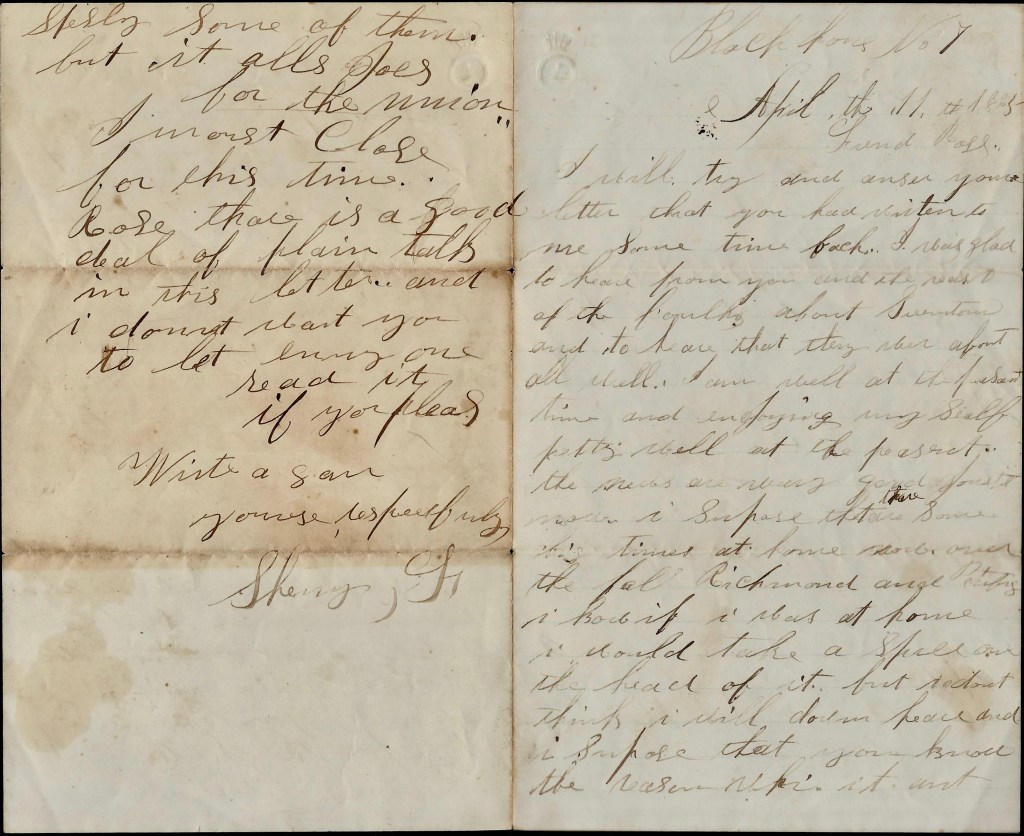
Blockhouse No. 7 April 11, 1865
Friend Rose,
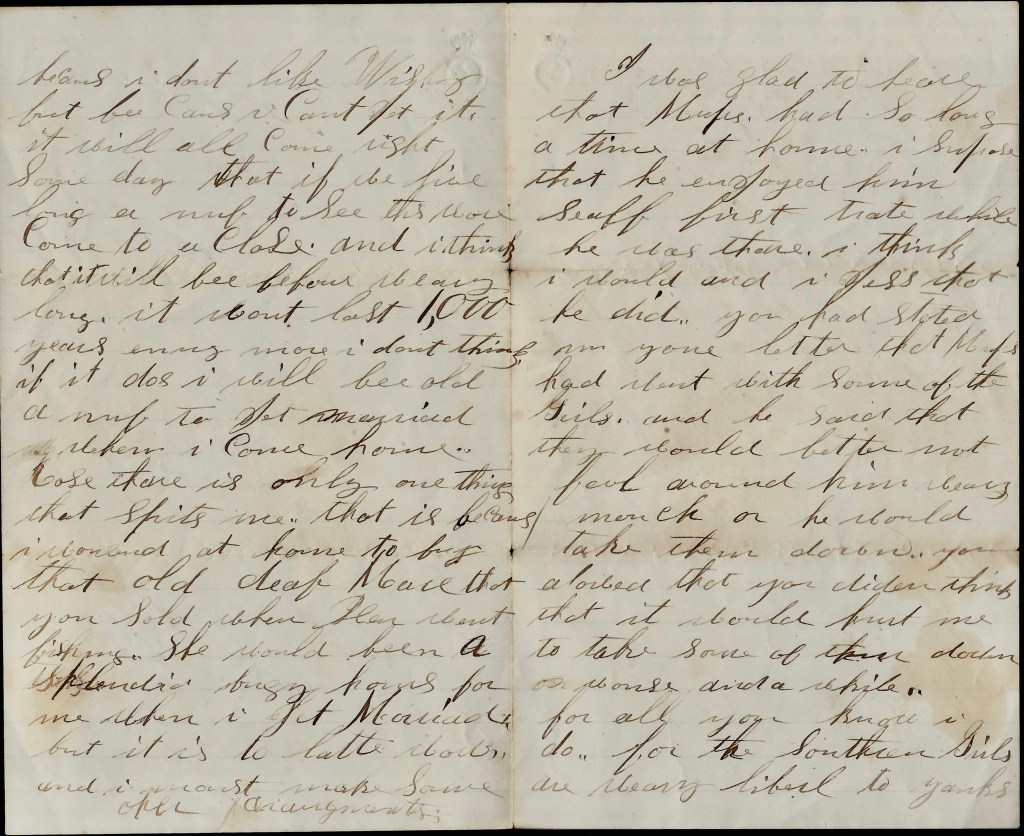
I will try and answer your letter that you had written to me some time back. I was glad to hear from you and the rest of the family about Greentown and to hear that they were about all well. I am well at the present time and enjoying myself pretty well at the present. The news are very good just now. I suppose that there are some big times at home now over the fall of Richmond and Petersburg. I know if I was at home I would take a spill on the head of it but I don’t think I will down here and I suppose that you know the reason why. It ain’t because I don’t like whiskey, but because I can’t get it. It will all come right some day—that is, if we live long enough to see this war come to a close. And I think that it will be before very long. It won’t last 1,000 years any more, I don’t think. If it does, I will be old enough to get married when I come home.
Rose, there is only one thing that spites me. That is because I couldn’t be at home to bug that old deaf mare that you sold when Hen went fishing. She would have been a splendid buggy horse for me when I get married. But it is too late now and I must make some other arrangements.
I was glad to hear that Mapes had so long a time at home. I suppose that he enjoyed himself first rate while he was there. I think I would and I guess that he did. You had stated in your letter that Mapes had went with some of the girls and he said that they would better not fool around him very much or he would take them down. You allowed that you didn’t think that it would hurt me to take some of them down once and a while. For all you know, I do for the Southern girls are very liberal to Yanks—especially some of them. But it all goes for the Union.
I must close for this time. Rose, there is a good deal of plain talk in this letter and I don’t want you to let anyone read it, if you please. Write soon. Yours respectfully, — Sheny, F.
Letter 5
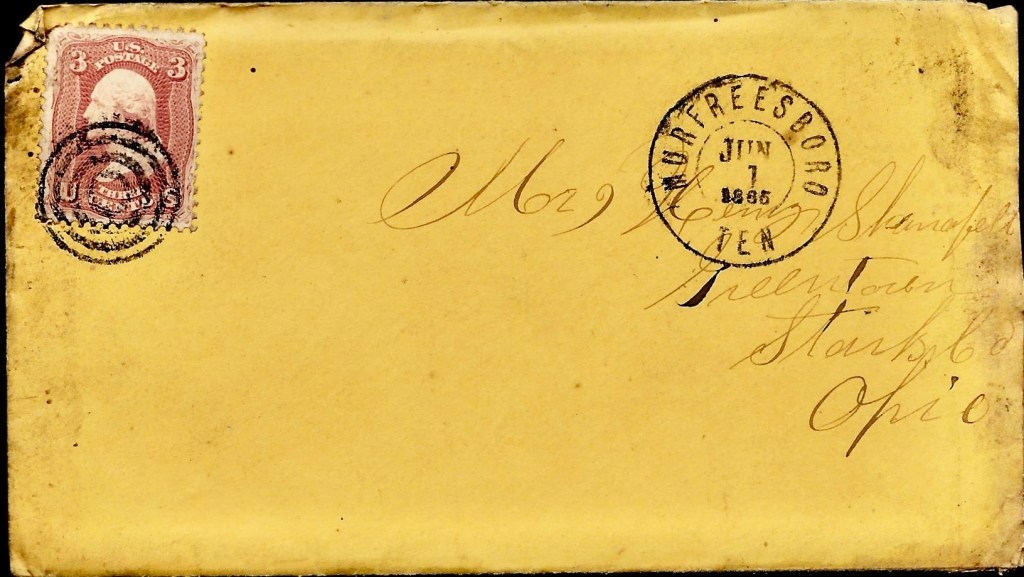
Addressed to Mr. Henry Shanafelt, Greentown, Stark county, Ohio
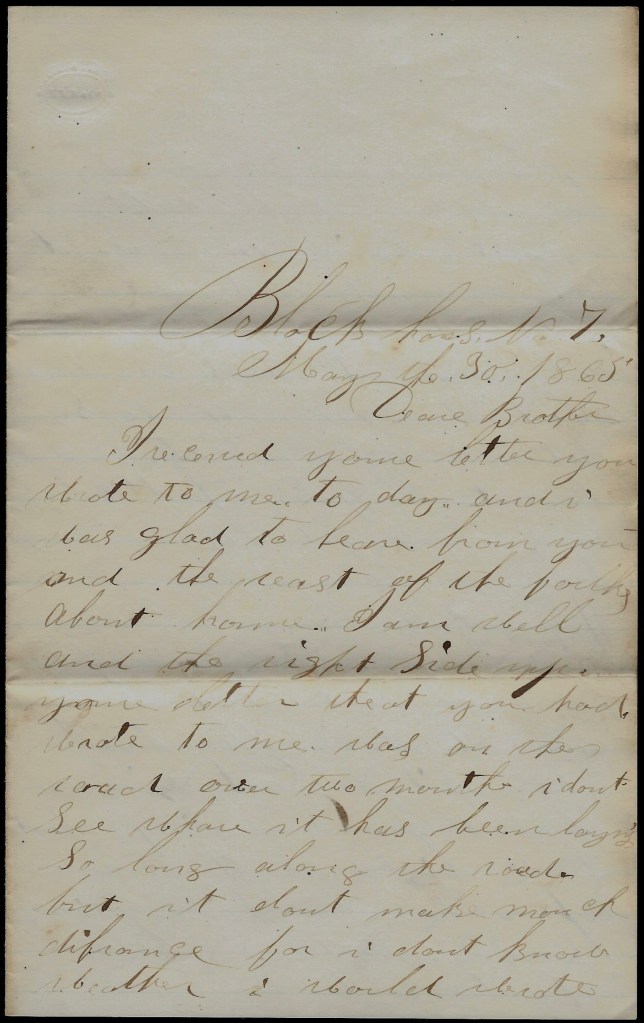
Block House No. 7 May 30, 1865
Dear Brother,
I received your letter you wrote to me today and I was glad to hear from you and the rest of the folks about home. I am well and the rest of the right side up. Your letter that you had wrote to me was on the road over two months. I don’t see where it has been laying so long along the road but it don’t make much difference for I don’t know whether I would wrote any sooner or not for there was a big talk about being mustered out but I think that we will serve out our time or almost at least. We have about three months to serve yet and then our time will be out.
I guess the 114th Regt. will soon get home. I say Bully for them. Hen, it is getting pretty damn hot down here now. There is a few patches of wheat about here and it looks [as] though it was fit to cut in a few days. Corn is up about knee high. We [ ] more than have a time eating mulberries. There is lots of them down here.
I got a letter from Rose Shanafelt a few days ago and was glad to hear from the folks. I also received the photograph that Maria had sent to me and I was very glad to get it and it is pretty good. It looks natural. I must bring my letter to a close. I might talk about a good many things yet but I will drop it at present.





















 Spared & Shared 23