My passion is studying American history leading up to & including the Civil War. I particularly enjoy reading, transcribing & researching primary sources such as letters and diaries.
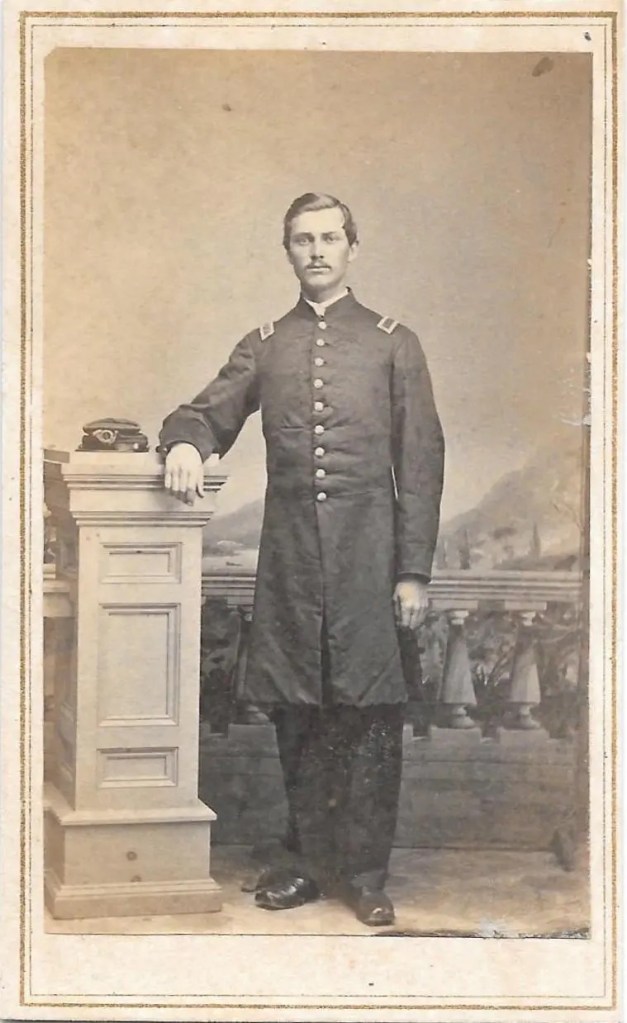
I could not find an image of Asbrah but here is a cdv of Albert Henry Clay Jewett who also served in Co. D, 4th New Hampshire Infantry until he was commissioned an officer in Co. I. (Dave Morin Collection)
The following letter was written by 32 year-old Asbrah Pike Howe (1831-1897) of Acworth, Sullivan county, New Hampshire. Asbra was the son of Ephraim Howe (1791-1865) and Charlotte Pike (1795-1884). He was married in 1853 to Diadema Hull (1825-1910) and had a two year-old son named Frank when he enlisted in Co. D, 4th New Hampshire Infantry.
Asbrah wrote the letter to his hometown friend, informing him of siege operations his regiment was involved in on Morris Island near Charleston, South Carolina. From the regimental history we learn that, “The spring of 1863 opened with an attack upon Morris Island, then followed the siege of Charleston. Gen. Q A. Gillmore commanded the expedition. The division in which the Fourth New Hampshire found itself was commanded by Gen. A. H. Terry. The Fourth brigaded with the Third New Hampshire, Sixth Connecticut, and a battalion of sharpshooters. This brigade was commanded by Col. Louis Bell of the Fourth. Two long sand-bar islands on the coast just south of Charleston harbor formed the basis of an attack upon Charleston. Folly Island was captured with very little resistance.
The Fourth New Hampshire worked twenty-one nights in building batteries to attack Morris Island, which is separated from Folly Island by a narrow creek. On the 10th of July the Fourth participated in an attack on Morris Island. The successive charges on Fort Wagner were repulsed by the enemy. On the 23d of July the Fourth dug the first trench and planted the first chevaux-de-frise, for the long siege of Fort Wagner. From the 23d of July to the 7th of September may be looked upon as one continued battle under the blazing sun of South Carolina—digging trenches, advancing lines, repelling attacks and doing severe out post duty. The morning of September 7, when the line was formed for the final charge, the news came that the fort was evacuted. The capture of Fort Wagner resulted in the immediate capture of the whole island.”
Transcription
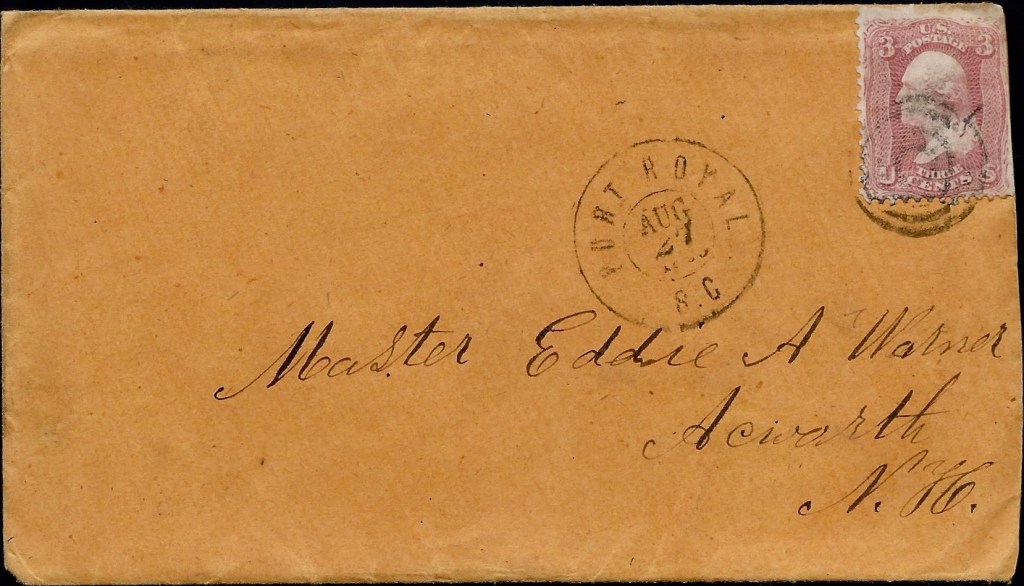
Addressed to Master Eddie A. Warner, Acworth, New Hampshire; postmarked Port Royal, S. C.
Camp Morris Island, South Carolina 4th [New Hampshire] Regiment, Co. D, USA August 22, 1863
Friend Eddie,
I was somewhat surprised and pleased to receive a letter from you which came in due time under date of August 9th. I had almost begun to think that I had no friends in Acworth outside of my own family for I have received but very few letters since I left home except those which came from home.
The bombardment of the defenses around Charleston commenced the 17th of this month and still continues but we are strictly forbidden by a General Order from Gen. Gilmore to write any particulars in regard to the progress of events.
Suffice it to say, therefore, that the general features of the case are favorable to the Union cause. Some casualties occur daily but the loss of life on our side has not yet been very great. Last night one of the sergeants of this company, while on picket, was hit by the fragment of a shell thrown from Fort Johnson from the effect of which he died this morning. I suppose all eyes are turned anxiously in the direction of Charleston waiting to see it in the hands of the Federal army but you must wait patiently for it is no small thing to subdue a city so strongly fortified.
My health is middling good at present but I have not been able to do duty for about a month, but am on duty now. I must draw to a close by wishing these few lines will find you in good health and spirits and hoping to hear from you again soon. Convey my compliments to all inquiring friends. With much respect, I remain your sincere friend, — A. P. Howe
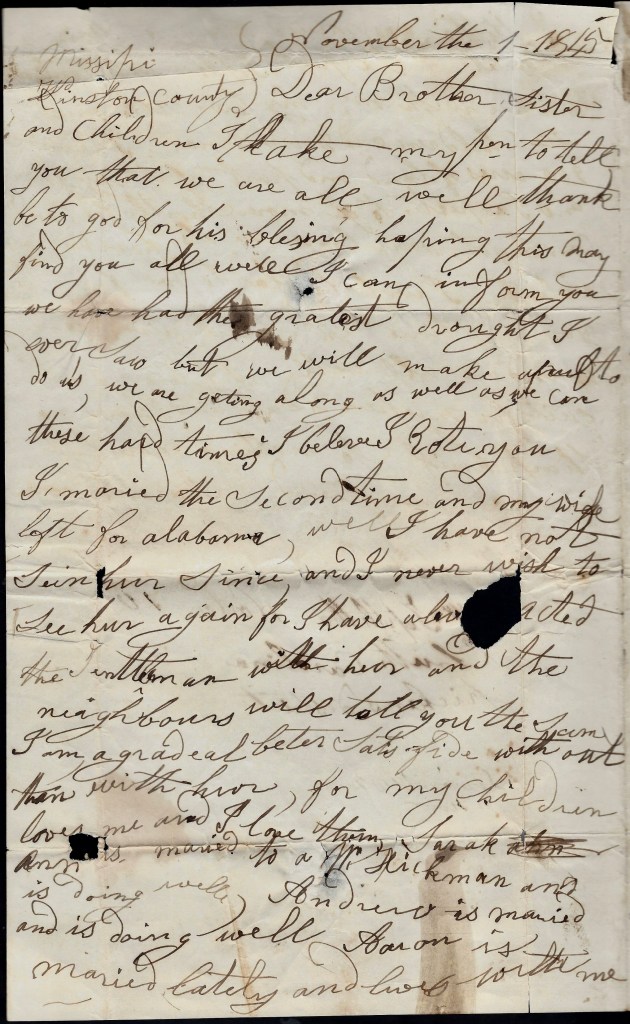
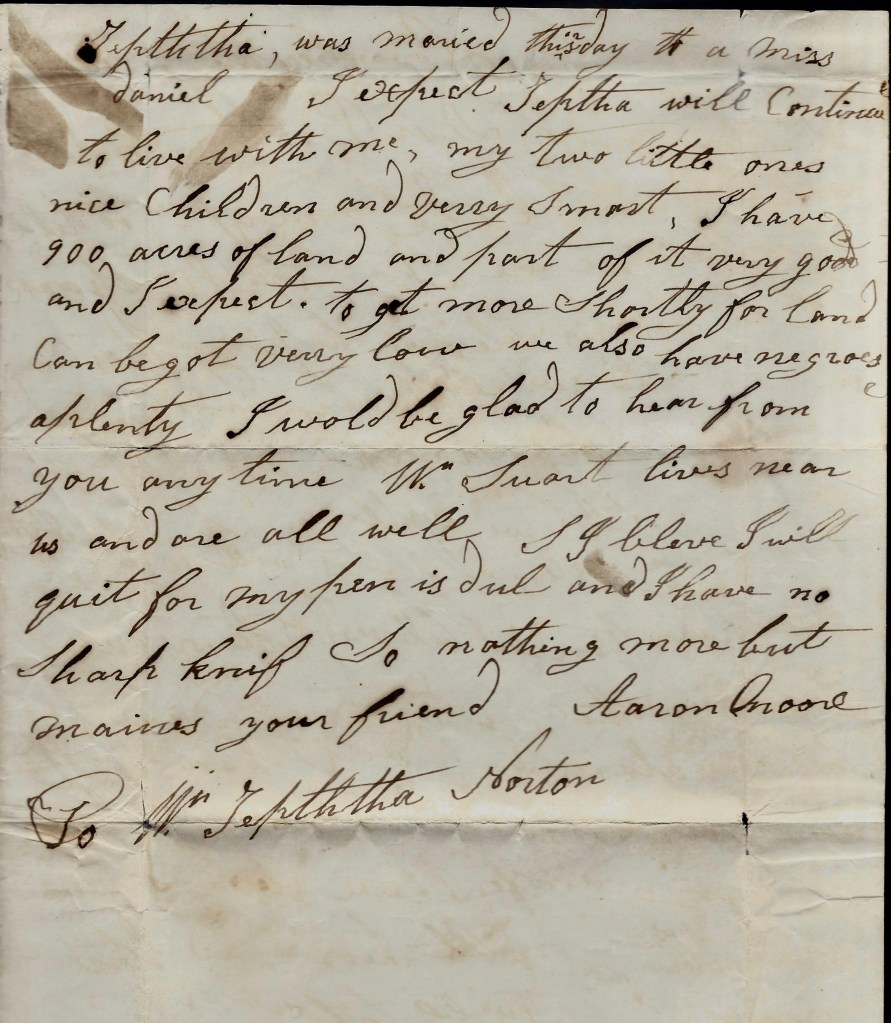
The following letter was written by Aaron J. Moore (1792-1862), a native of South Carolina and of partial Choctaw descent, who married Jane Tally (1796-1839) and relocated to Autauga county, Alabama by 1820, and then to Winston county, Mississippi, prior to the 1840 US Census. Known children by his first wife included: Aaron Tally Moore (1817-1860) who married a woman named Mary E. Burnside [?] the year before the date of this letter; Jeptha Norton Moore (1820-1886); Sarah Ann Moore (1821-1860) who married William J. Hickman (b. 1819) in February 1842; Martha Jane Moore (1834-1853); and Alexander Travis Moore (1836-1884). In the 1850 Slave Schedule, Aaron is recorded owning 11 slaves ranging in age from 2 to 45, mostly male.
We learn from Aaron’s letter that he was remarried after the death of his first wife but that she had abandoned him and gone to Alabama—presumably her home, for we find that an Aaron Moore was married to Elizabeth Prestridge (1797-1874) on 3 December 1842 in Perry, Alabama. Elizabeth was the widow of Joseph W. Prestridge (1794-1836). Her maiden name was Bagley and they had married in 1812. Her youngest child with Joseph was George Harper Prestridge (1832-1863), a member of Co. A, 6th Arkansas (Confederate) Cavalry. It does not appear that Elizabeth ever remarried after leaving Aaron. She was enumerated in the household of her younger brother, a slaveholder named Berton Rucker Prestridge at Oakmulgee, Perry county, Alabama, in 1850. Today her remains lie buried under a smashed tombstone in Balch Cemetery, Alvarado, Texas.
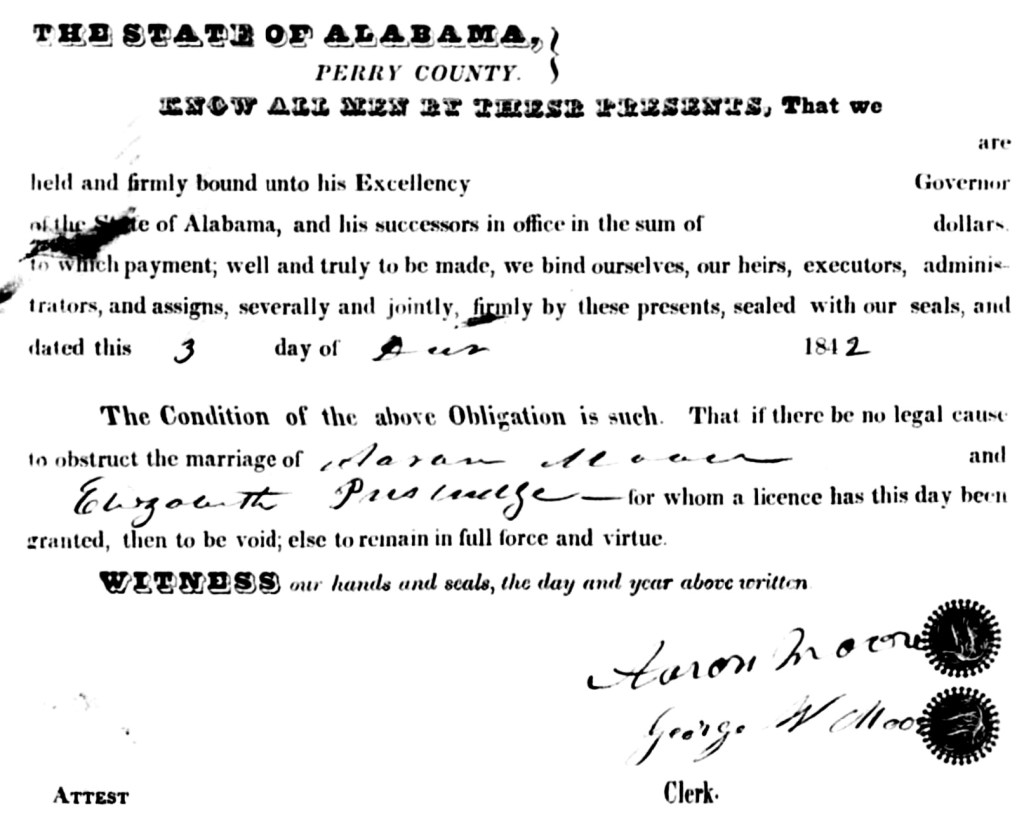
Marriage Record in Perry County, Alabama, dated 3 December 1842.
Transcription
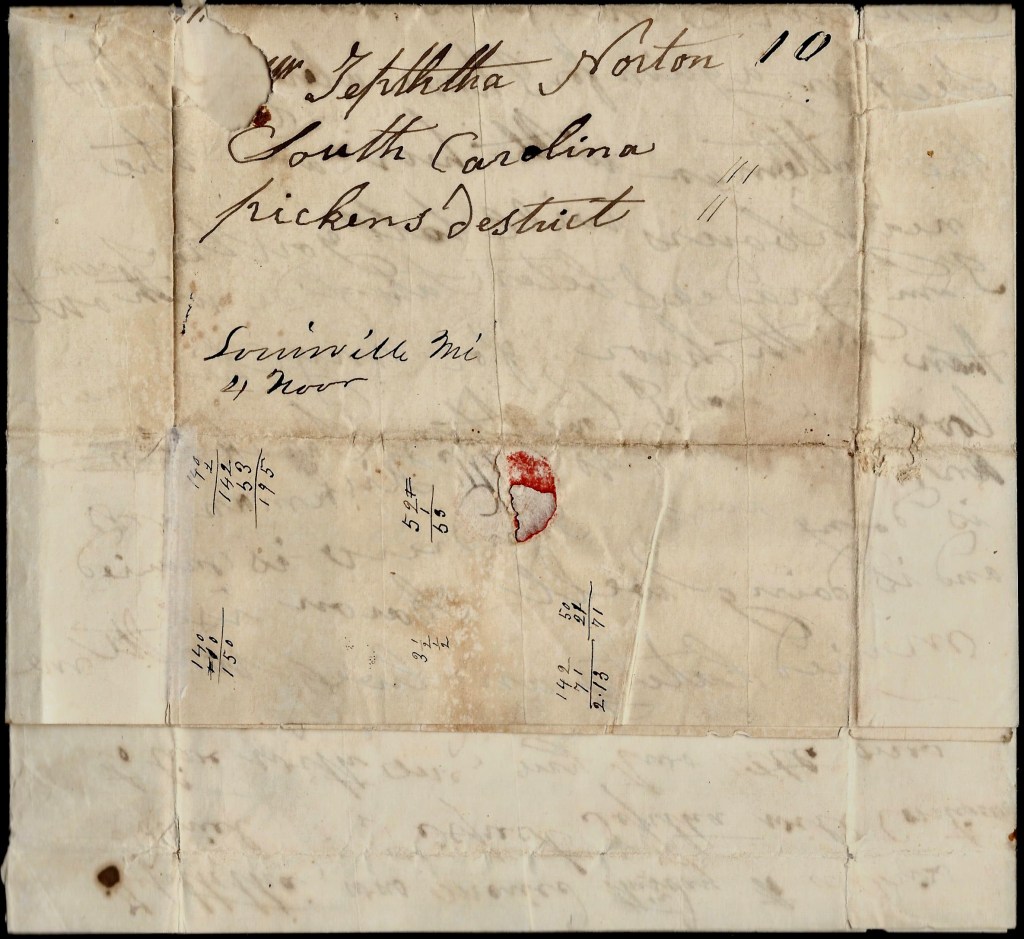
Stampless letter addressed to Jeptha Norton, South Carolina, Pickens District
[Louisville] Winston county, Mississippi November 1, 1845
Dear Brother, Sister & Children,
I take my pen to tell you that we are all well, thanks be to God for His blessing, hoping this may find you all well. I can inform you we have had the greatest drought I ever saw but we will make enough to do us. We are getting along as well as we can these hard times. I believe I wrote you I married the second time and my wife left for Alabama. Well I have not seen her since and I never wish to see her again for I have always acted the gentleman with her and the neighbors will tell you the same. I am a great deal better satisfied without than with her for my children loves me and I love them. Sarah Ann is married to a W. Hickman and is doing well. Andrew is married and is doing well. Aaron is married lately and lives with me.
Jeptha was married Thursday to a Miss Daniel. I expect Jeptha will continue to live with me. My two little ones are nice children and very smart. I have 900 acres of land and part of it very good and I expect to get more shortly for land can be got very low. We also have negroes aplenty. I would be glad to hear from you anytime. W. Smart lives near us and are all well. I believe I will quit for my pen is dull and I have no sharp knife so nothing more but remain your friend, — Aaron Moore
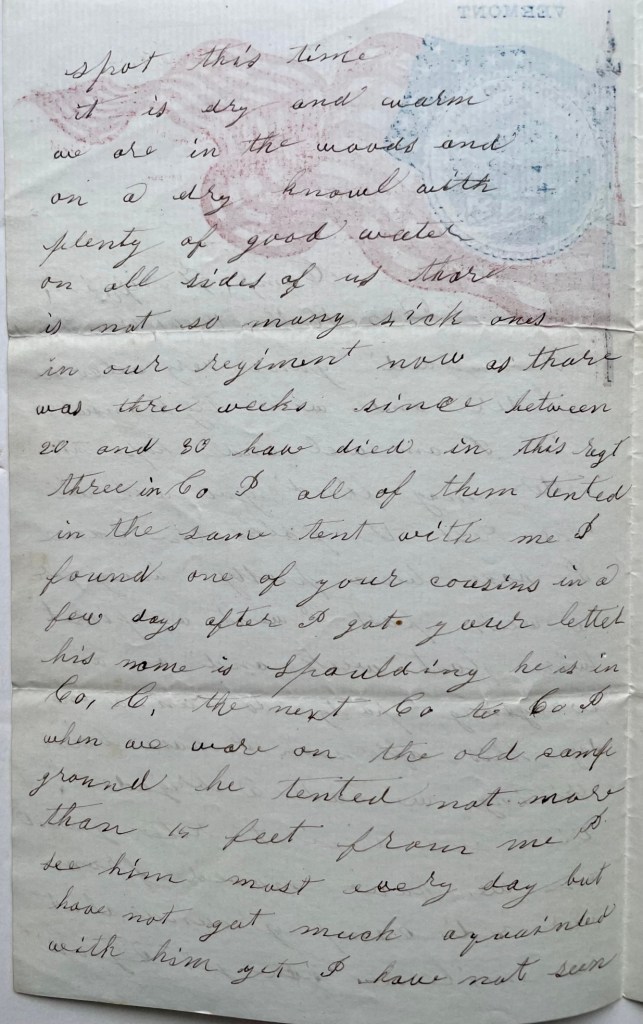
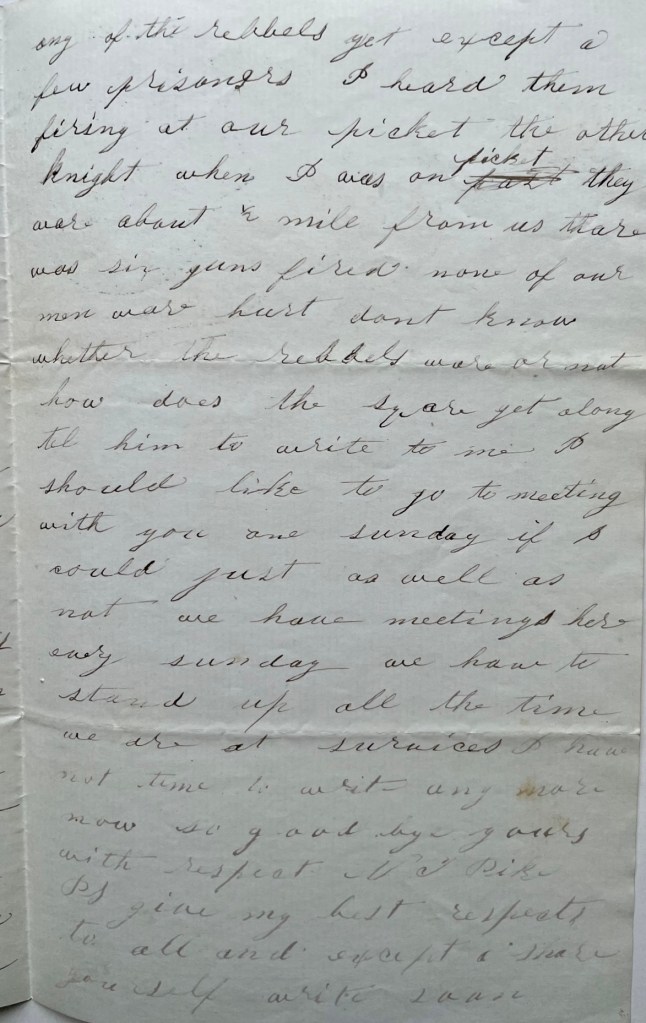
The following letter was written by 28 year-old Norman Taylor Pike who enlisted in September 1861 as a private in Co. I of the 4th Vermont Infantry. He was taken prisoner at Weldon Railroad south of Petersburg, Virginia, on 23 June 1864 and died a POW at Andersonville. His date of death was recorded as 30 November 1864. His remains are now at the Andersonville National Cemetery, Grave No. 12198.
Norman’s parents were Isaac Newton Pike (1803-18840 and Jane Holt Stiles (1807-1872) of Windham county, Vermont.
The 4th Vermont Infantry at Camp Griffin, Langley, Virginia, 1861
[Note: This letter is from the private collection of Greg Herr and was offered for transcription and publication on Spared & Shared by express consent.]
Transcription
Camp Griffin December 16th 1861
Dear Friend,
I received your very welcome letter and will try to answer it. I am well and hope this letter may find you and all the rest of the folks the same. I have been pretty busy for a week past. I went on picket twice last week and on a foraging party to Vienna one day. This afternoon I have been drilling. We had a Brigade Drill and a first rate good one.
We have moved from our old camp ground about one mile. We have got a good spot this time. It is dry and warm. We are in the woods and on a dry knoll with plenty of good water on all sides of us. There is not so many sick ones in our regiment now as there was three weeks since. Between 20 and 30 have died in this regiment—three in Co. I. All of them tented in the same tent with me. I found one of your cousins in a few days after I got your letter. His name is Spaulding. He is in Co. C, the next company to Co. I. When we were on the old camp ground, he tented not more than 15 feet from me. I see him most every day but have not got much acquainted with him yet.
I have not seen any of the rebels yet except a few prisoners. I heard them firing at our picket the other night when I was on picket. There were about half a mile from us. There was six guns fired. None of our men were hurt. Don’t know whether the rebels were or not.
How does the squire get along. Tell him to write to me. I should like to go to meeting with you one Sunday if I would just as well as not. We have meetings here every Sunday. We have to stand up all the time we are at services. I have not time to write any more now so goodbye. Yours with respect, — N. T. Pike
P. S. Give my best respects to all and accept a share yourself. Write soon.
The following letter was written by Corp. John C. Allen who was 22 years old when he enlisted at New York City to serve two years in Co. D, 31st New York Infantry. He entered the service as a private in June 1861 but was shortly after promoted to corporal. During the Peninsula Campaign, John was wounded and captured at Gaines Mill on 27 June 1862 but was paroled and exchanged a month later. He mustered out with his company in June 1863.
The 31st New York was sometimes called the Montezuma Regiment or the Baxter Light Guards. They left the state and served at or near Washington D. C. from the time of their arrival in late June 1861 until joining the Army of the Potomac (AOP) in its Spring 1862 Campaign. At the time this letter was written in late December 1861, the regiment was in General Franklin’s Brigade of the AOP.
TRANSCRIPTION
Alexandria Camp 31st New York Vols. December 22d 1861
Dear Father,
I take my pen again to write to you. I have been out on picket since I last wrote to you. Was gone four days. We had very mild weather. I suppose you have had good weather.
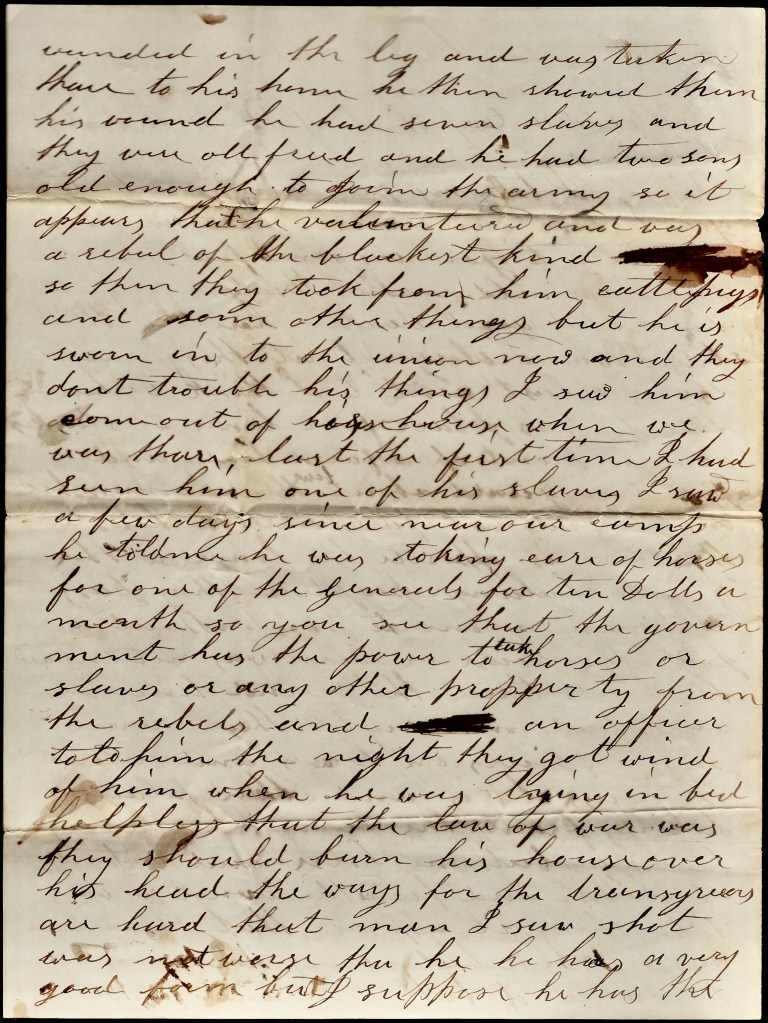
Here I will tell you a story about this place that we last went to. I think we have been to this place four times. We stacked arms in front of a farm house and posted a guard, about three in number, on the road not far from the house. The barn is opposite the house so the guard challenges people as they pass, allowing no one to pass without a pass. The house or barn was not entered the first time. The second time we went at midnight. There came some officers on horses and entered the house, barn and other places, taking from the barn three horses leaving but one horse and entered the house and found the owner as was told them. It appears that this man was in the rebel army and was in the Battle of Bull Run and was wounded in the leg and was taken there to his home. He then showed them his wound. He had seven slaves and they were all freed and he had two sons old enough to join the army so it appears that he volunteered and was a rebel of the blackest kind.
So then they took from him cattle, pigs and some other things but he is sworn into the Union now and they don’t trouble his things. I saw him come out of his hog house when we was there last—the first time I had seen him. One of this slaves I saw a few days since near our camp. He told me he was taking care of horses for one of the Generals for ten dollars a month so you see that the Government has the power to take horses or slaves or any other property from the rebels and an officer told him the night they got wind of him when he was laying in bed helpless that the law of war was they should burn his house over his head. The ways for the transgressors are hard.
That man I saw shot was not worse than he. He has a very good farm but I suppose he has that same old heart. The woodland is all cut down. Gen. Lee of the rebel army has a large tract of land there—the wood being all cut down last fall and now they are cutting it in four feet [lengths] and carting it to the different camps.
Nothing very uncommon took place [on picket]. We came in on Friday. I took as much tobacco as I wanted out of a field that was left by a rebel, I suppose, as it is too late to gather it at this season of year. I venture to say that 99 out a 100 of the inhabitants of this neighborhood are rebels.
It is dark. You see I don’t get on the line. Will say if there is any tax for me to pay, let me know and I will send it on. It begins to rain. Without any regard to receiving your letters from you, I write to you. It may be some time before I write and it may not so if you do not receive letters from me regular, you must not think strange. I hear that in New York there is three feet of snow. If so, it is much milder here than there.
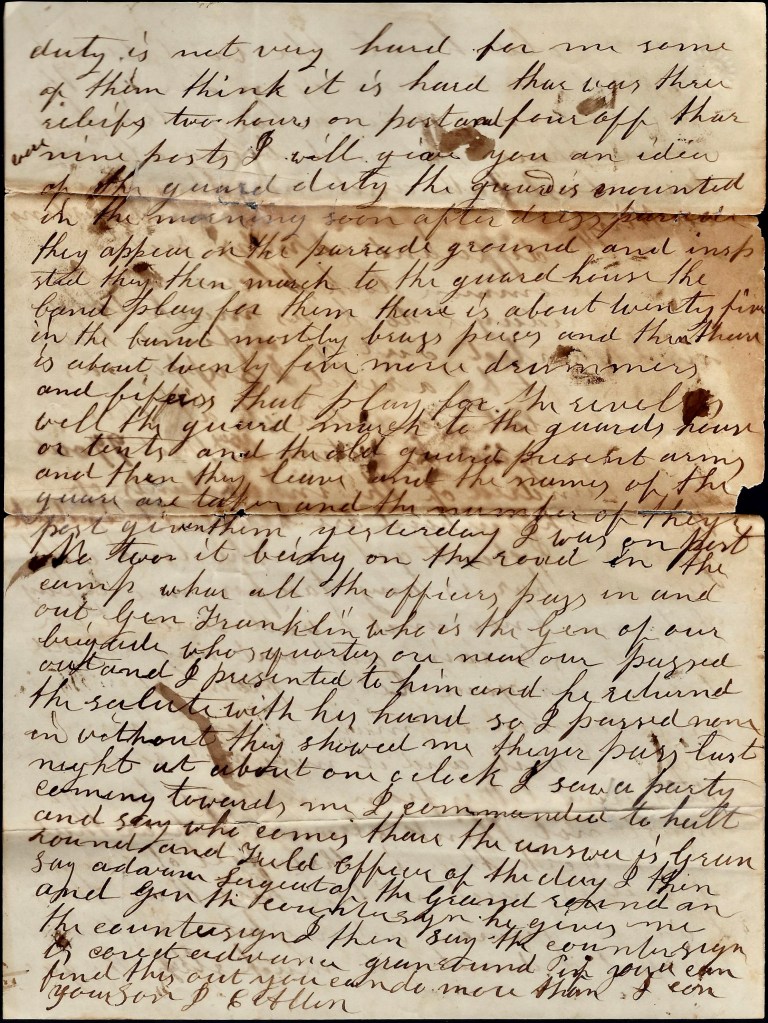
I was on guard last night in the camp. I did not get much sleep. The guard duty is not very hard for me. Some of them think it is hard. There was three reliefs—two hours on post and four off. There were nine posts. I will give you an idea of the guard duty. The guard is mounted in the morning soon after dress parade. They appear on the parade ground and inspected. They then march to the guard house. The band play for them. There is about twenty-five in the band, mostly brass pieces, and then there is about twenty-five more drummers and fifers that play for the reveilles. Well the guard march to the guard house or tents and the old guard present arms and then they leave and the names of the guard are taken and the number of the post given them.
General William Buel Franklin
Yesterday I was on Post No. 2, it being on the road in the camp where all the officers pass in and out. Gen. Franklin, who is the general of our brigade, whose quarters are near ours, passed out and I presented to him and he returned the salute with his hand, so I passed none in without they showed me their pass.
Last night at about one o’clock, I saw a party coming towards me. I commanded to halt and say who comes there. The answer is Grand Round and Field Officer of the day. I then say, “Advance Sergeant of the Grand Round, and give the countersign.” He gives me the countersign, then I say, “The countersign is correct. Advance Grand Round.” If you can find this out, you can do more than I can. Your son, — J. C. Allen
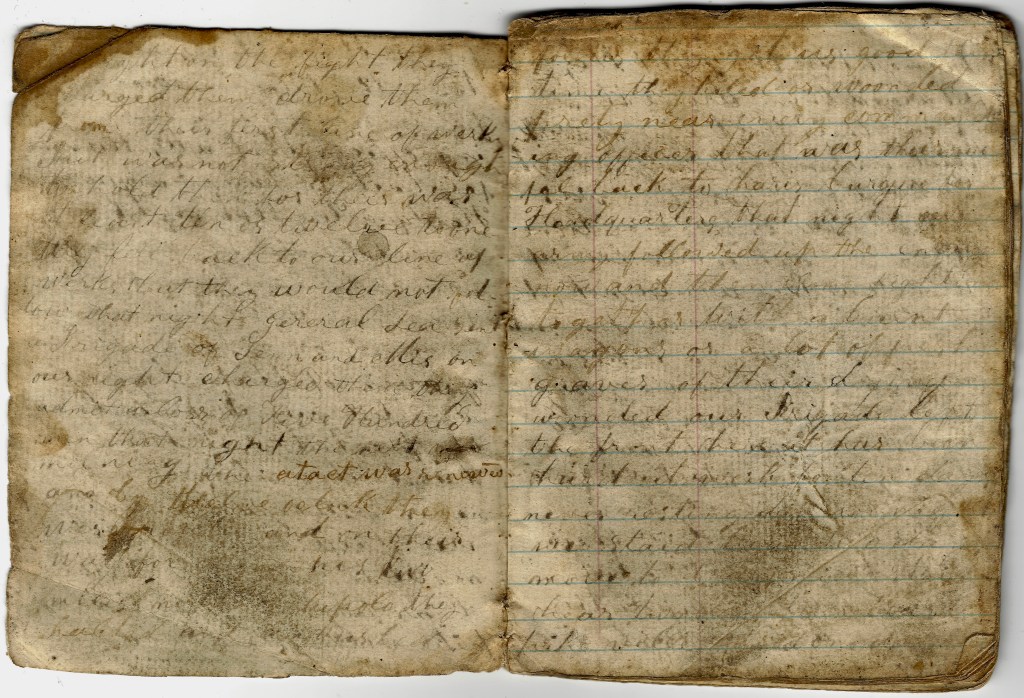
This diary was kept in 1864 by an unidentified Confederate soldier who was probably residing in the vicinity of Clinton, Kentucky where he enlisted in June 1861 to serve the Confederacy and his company was made a part of the 22nd Tennessee Infantry. As he states in his diary, he was with the 22nd Tennessee at the Battle of Belmont which was fought on 7 November 1861. The 22nd Tennessee was one of four Tennessee regiments with the 12th Arkansas and Betlzhoover’s Battery under Gen. Gideon Pillow’s command on the Missouri side of the Mississippi river when the battle began. They were caught in an open cornfield under heavy fire where they suffered heavy casualties.
The diarist apparently deserted his regiment at this point and returned to his home in Kentucky. According to the Goodspeed History of Tennessee, vol. 12, the only company from Kentucky joining the 22nd Tennessee was Co. F (“The Kentucky Braves”). It notes that many men from this company later became members of Co. M, 3rd Kentucky Infantry. While in the 22nd Tennessee, they were led by Captains Francis M. Stewart, William Lindsey, and J. Clay Horne.
Two and a half years later, in April 1864, he informs us that he enlisted a second time in the Confederate service, this time joining Co. M, 3rd Kentucky Infantry which became mounted infantry about that time. They became part of Maj. Gen. Hylan B. Lyon’s Brigade in Gen. Nathan Bedford Forrest’s Cavalry Corps.
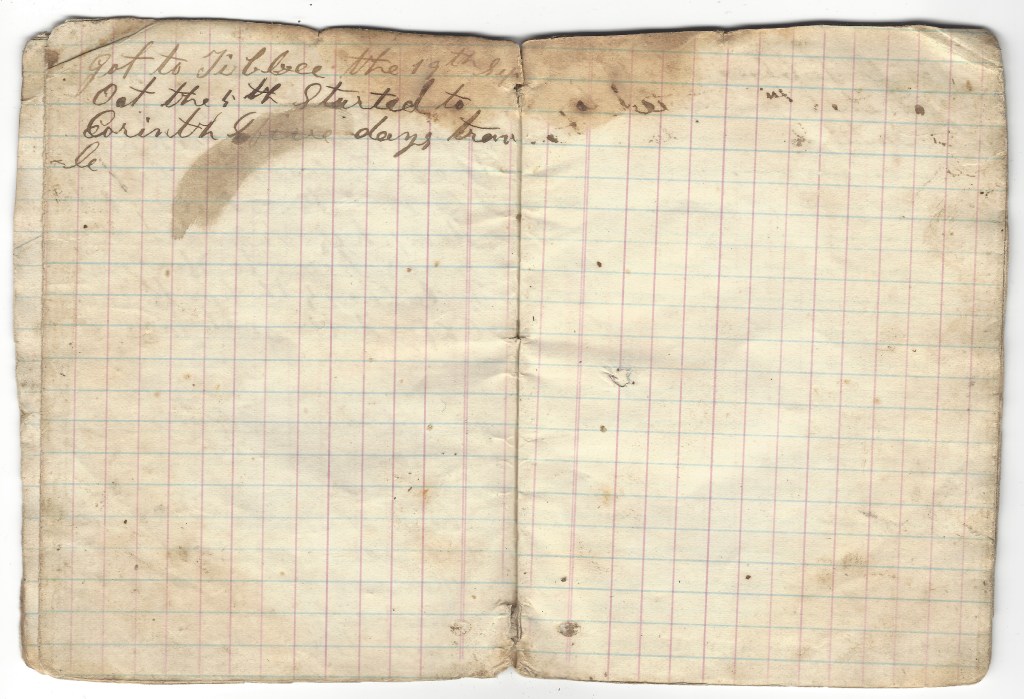
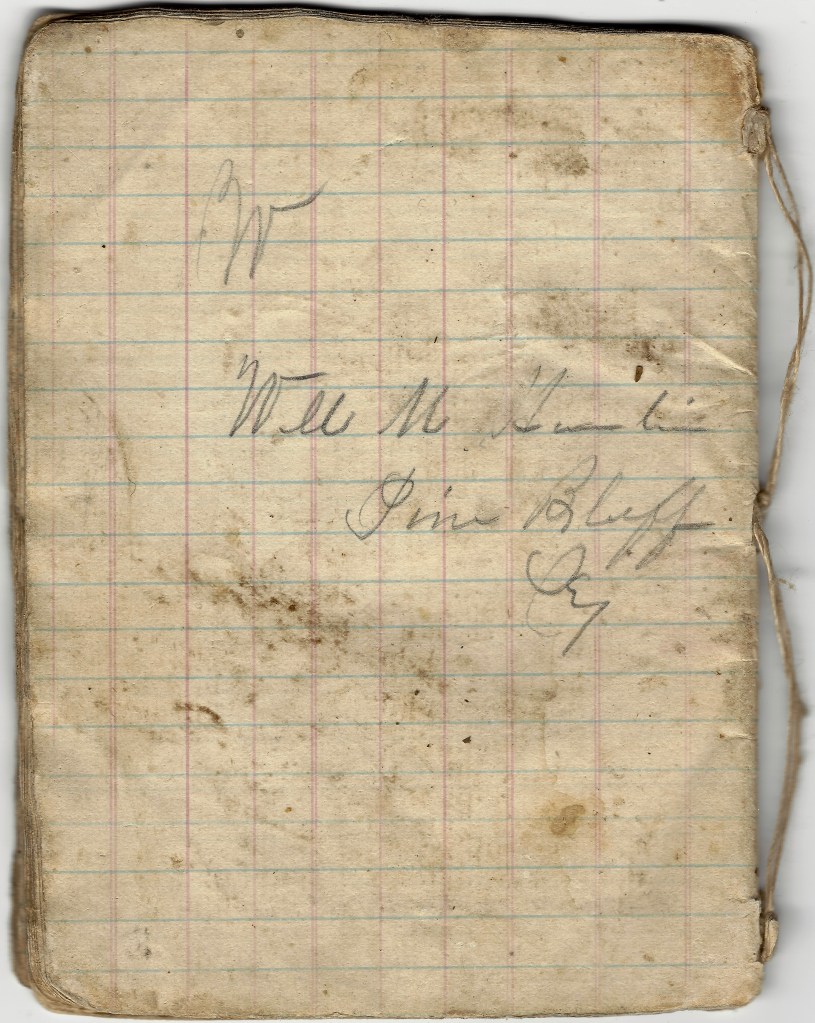
The diary itself is made from a ledger that has been cut into smaller pages and hand stitched with string. Most pages are blank but there are a few pages at the beginning describing the movements of the 3rd Kentucky Mounted Infantry including the mention of the Battle of Brice’s Crossroads and more particularly the Battle of Harrisburg, Mississippi—both attempts by Gen. Forrest to disrupt Gen. Sherman’s supply lines during the Atlanta Campaign. There are a few names of members of Co. M in the diary but I was unable to identify any of them as the author. There is a name on the back cover of the diary with Pine Bluff, Ky. but I could not match possible names against the regimental roster. I do not have the company rosters for both Co. F, 22nd Tennessee and Co. M of the 3rd Kentucky to compare them, however. Perhaps someone else can narrow it down further. The scanned pages of the diary are in the footnotes of this post.
It’s possible that the diarist did not survive the war given that the diary has many pages left unfilled and it ends abruptly in early October 1864. Perhaps he was killed at the Battle of Franklin a few weeks later.
Map Showing the Battlefield of Harrisburg, Mississippi
[Note: This diary is from the personal collection of Greg Herr and was offered for transcription and publication on Spared & Shared by express consent.]
Transcription
Com[pany] M 3 Ky. Reg. The travels of our company.
I joined at Clinton, Ky. 1861. June 15th was organized in 22nd Tenn. Regt. 18th July of the same year at Trenton, Tenn. Moved to Union City the 1st of August and moved to Columbus, Kentucky September 5th, to Matfield the 15th, back to Columbus 22nd, to Camp Beauregard 27th, back to Columbus November the 1st.
Battle of Belmont, Missouri. Two killed and four wounded. Here I left the company and rejoined at Clinton the second time in April 1864, from there to Jackson, Tennessee, and from that to Corinth. Here we joined the Third Kentucky Regiment.
May the 1st, 1864, to Tupelo, back to Corinth the 10th, and the 20th back to Tupelo the 28th. Little Bear River, Alabama, June the 1st. Back to Tupelo the 3rd. Boonville the 7th. On the 10th, the fight at Brice’s Crossroads. 1 killed, 3 wounded. To Guntown the 15th. Baldwin the 20th. Tupelo 23rd. Elizabethtown July the 7th, Pontotoc the 8th before Harrisburg the 13th, 14th, 15th—three days fighting, 1 killed, 2 wounded. Shannon Station 18th, Pikeville the 20th, Egypt Station 21st. Shannon Station 27th.
Review of troops at Okeana August 3rd to Pontotoc the 6th. Sarepta the 10th. Lafayette Springs the 14th, Oxford the 17th, 14 MS back cross the Yocking the 20th. Back to Oxford the 22nd. [Nathan B.] Forrest went to Memphis and returned to us here to Springdale the 25th, back to Oxford the 30th, to Water Valley September 1st. Grenada the 2nd. The 4th started to Verona. Got to Coffeeville the 5th, to Sarepta the 6th, to Pontotoc the 7th, Verona the 8th. The 13th started to Tibbee Station, to Shannon the 14th, to Pikeville 15th, to West Point the 16th. Stayed two days.
Got to Tibbee [Station] the 19th September. October the 5th started to Corinth. Five days travel.
…returned to Guntown and staid until we got the [ ] off of the battlefield. Then went to Baldwin Station and stayed one day and then come back to Tupelo. Staid there [ ] weeks and then Smith wants to try his hand [ ] in the saddle on the Elizabeth [ ] from Tupelo to Elizabethtown that day Smith and [illegible]…
[ ] to the west side of the town [Harrisburg] seven miles and stopped to skirmish with them and tried to bring on a regular engagement but he would not come out. We staid here three days. On the thirteenth we formed a line of battle and started in and soon found that they had left for Tupelo that morning before day. We then too the Verona road that runs about three miles south of the Tupelo road for twenty miles. Then it was who should get to Tupelo first. We had thirty-five miles to make while they had only twenty [illegible] hours the start of us. They was in as big hurry as we was. We run into them five miles southwest of Tupelo causing them to burn twenty of their wagons with one small brigade of Tenn. Bell’s Brigade. Fought their whole army for one hour. Our Kentucky Brigade came up in the time, dismounted and crossed the creek and charged them. They passed by and went to Harrisburg three miles west of Tupelo and made breastworks that night.
The next morning the two brigades—Bell’s Tennessee and [Hylan B.] Lyon’s Kentucky Brigade [carried] on the fight. They charged them, drove them from their first line of works but was not strong enough to hold them for there was at least ten or twelve to one. They fell back to our line of works but they [the Yankees] would not follow. That night General [Stephen D.] Lee’s Brigade of Tennessee and Mississippi on our right charged them. They admit a loss of five hundred men that night. The next morning the attack was renewed and by twelve o’clock there was [ ] and on their way for [illegible]…Tupelo. They halted and ambushed for us. They got us good this time. They killed or wounded pretty near every commanding officer that was there and fell back to Harrisburg for headquarters that night. Our army followed up the enemy now and then some fight to get here with burnt wagons or an awful lot of fresh graves of their dying wounded. Our Brigade left the front here. It has been hard work for tewm days, never resting day or night.
We staid [illegible] move to [ ] Station. Here [illegible]…from Pikeville to Egypt Station.
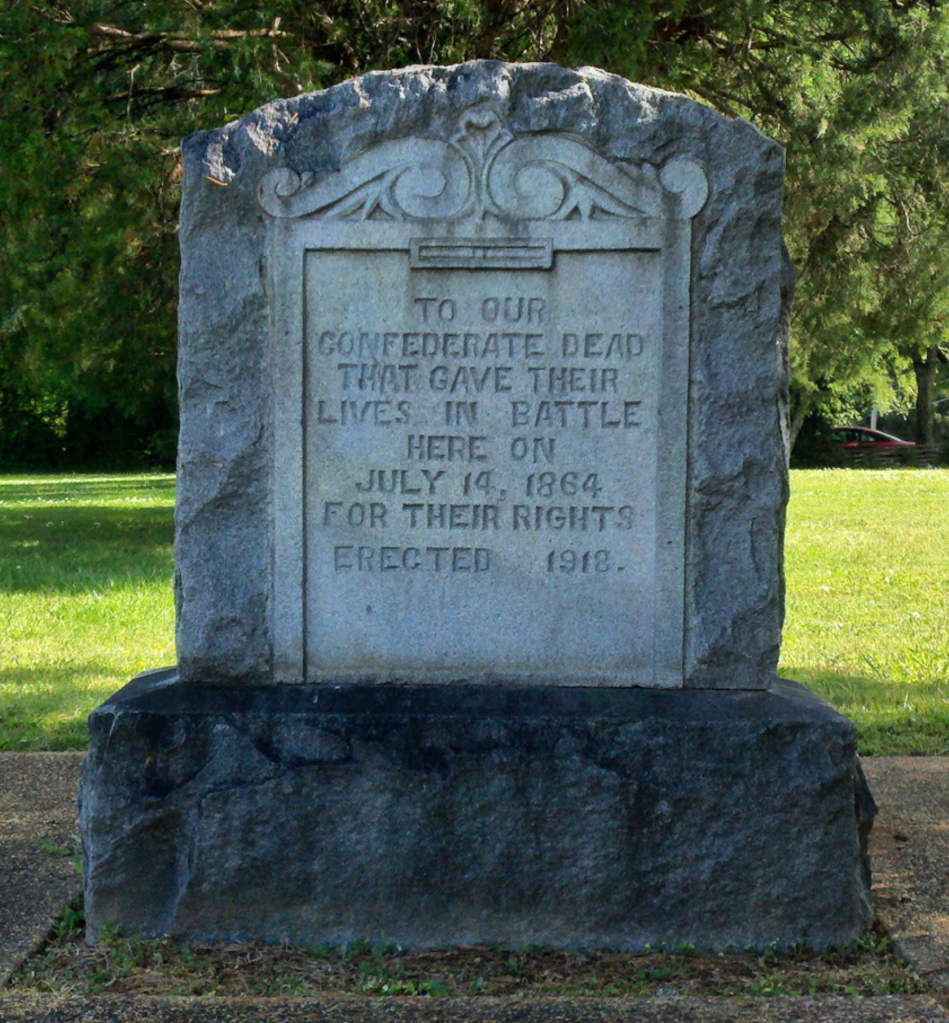
The Confederate Memorial dedicated to the Confederates who died at the Battle of Harrisburg on 14 July 1864. It is in the NPS Park on Main Street in Tupelo.
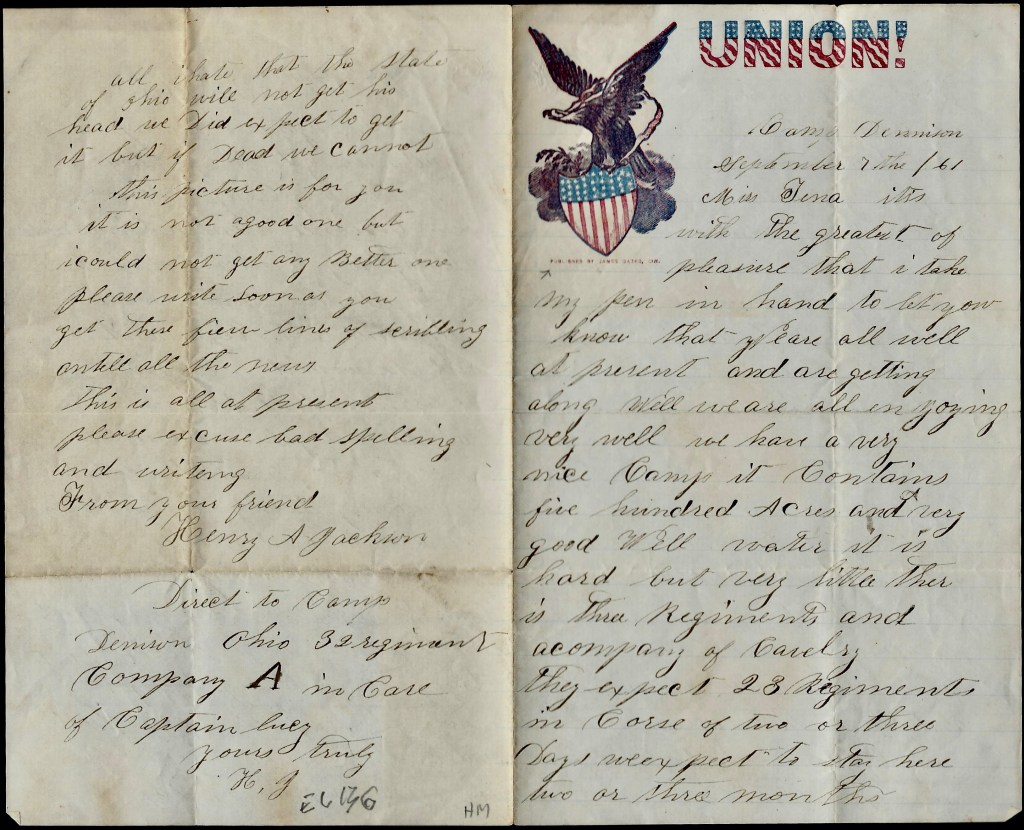
This letter was written by Henry A. Jackson (1841-1862) of Co. A, 32nd Ohio Volunteer Infantry (OVI). Henry enlisted as a private on 12 July 1861 and was killed in action on Bolivar Heights near Harper’s Ferry on 15 September 1862.
I believe that Henry A. Jackson was the son of Isaac and Mary (Manful) Jackson of Augusta, Carroll county, Ohio. See also—1861: Thomas J. Hendrix to Miss Haskey.
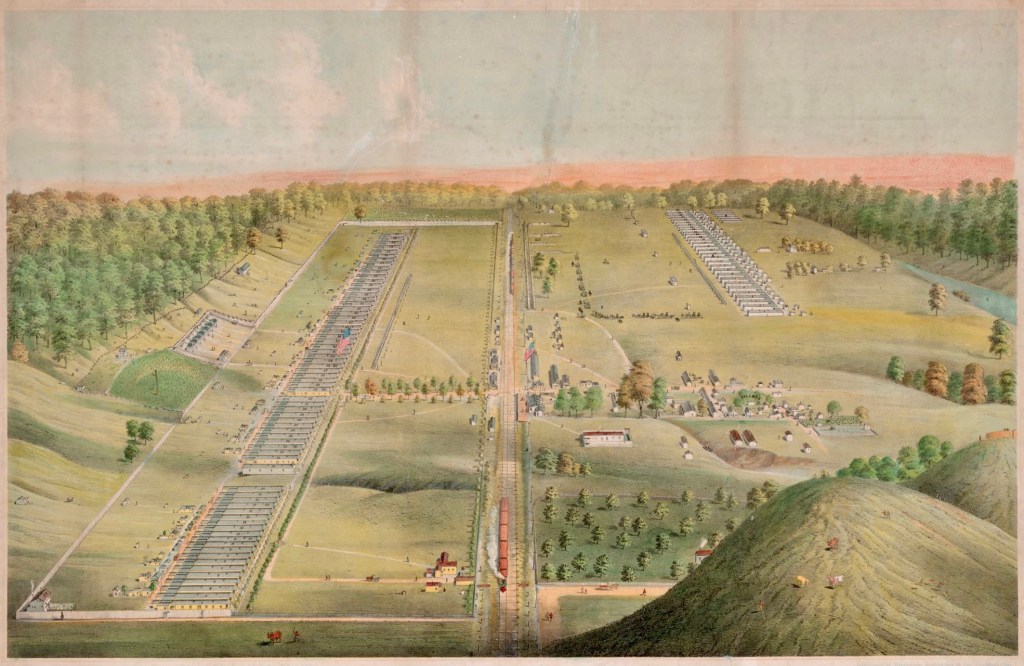
A view of Camp Denison later in the war, showing the railroad and the Little Miami River.
Transcription
Camp Dennison September 7th 1861
Miss Tina,
It’s with the greatest of pleasure that I take my pen in hand to let you know that we are all well at present and are getting along well. We are all enjoying [ourselves] very well. We have a very nice camp. It contains five hundred acres and a very good well water. It is hard but very little. There is three regiments and a company of cavalry. They expect 23 regiments in the course of two or three days, We expect to stay here two or three months. I can’t tell when we can get to come home. Captain has promised to give us a furlough when James Watson comes back but I don’t know whether he can get a furlough yet or not. But he will if possible.
We are not homesick yet but our folks wants me to come home. If it was not for that, would not come for a year. We have good times here. We have made our bedsteads today and I think we will get along a great deal better. We have Mr. [Henry] Chain and Sam McClellan in our mess and they keep us boys straight.
The Miami River runs through our camp and we get to go down to it every day or two. Our Colonel went to Cincinnati yesterday to get our arms but he said that it was an Independent Regiment and he would not give us arms. If he does not after we get drilled, we will go in another state. We are only twenty miles from Cincinnati and only 18 miles from Kentucky. The railroad runs through our camp ground. The cars run through perhaps a dozen times a day.
The latest news is that Jeff Davis is dead and I guess it must be so for the papers say so every day. All I hate that the State of Ohio will not get his head. We did expect to get it but if dead, we cannot.
This picture is for you. It is not a god one but I could not get any better one. Please write soon as you get these few lines of scribbling and tell all the news. This is all at present. Please excuse bad spelling and writing. From your friend, — Henry A. Jackson
Direct to Camp Dennison, Ohio 32nd Regiment, Company A, in care of Captain Lucy. Yours truly, H. J.
This interesting letter was written by Andrew Jefferson Sagar (1830-1900), a son of William C. Sagar, Jr. (1800-1877) and Dolly Wheeler (1803-1880) of Steuben county, New York, who moved with his family to Virginia in the 1850s to farm in Fairfax county. Andrew married Hannah Atta Bentley (1843-1913) on 7 February 1861.
Sagar wrote the letter to Abram P. Pruyn (1836-1918), the son of Henry Pruyn (1812-1893) and Ann Putnam (1816-1888) of Auriesville, Montgomery county, New York.
Andrew’s letter provides us with a civilian account of the Rebel army’s occupation of Fairfax county after the Second Battle of Bull Run in late August 1862. As natives of New York, and Unionists in Virginia, the Sagars were not anxious to suffer through another rebel occupation as they had following the First Battle of Bull Run when there were no less than three rebel encampments on his property [See newspaper clipping below from the New York Tribune of 20 July 1861.] Andrew informs us of the rebel army taking several Unionist citizens as prisoners.
Andrew wrote the letter from Steuben county where he and his wife and parents took refuge for some time among relatives. In June 1863, he was still there when he registered for the draft. Land records show that he purchased the property in Fairfax county from his parents in 1865.
Transcription
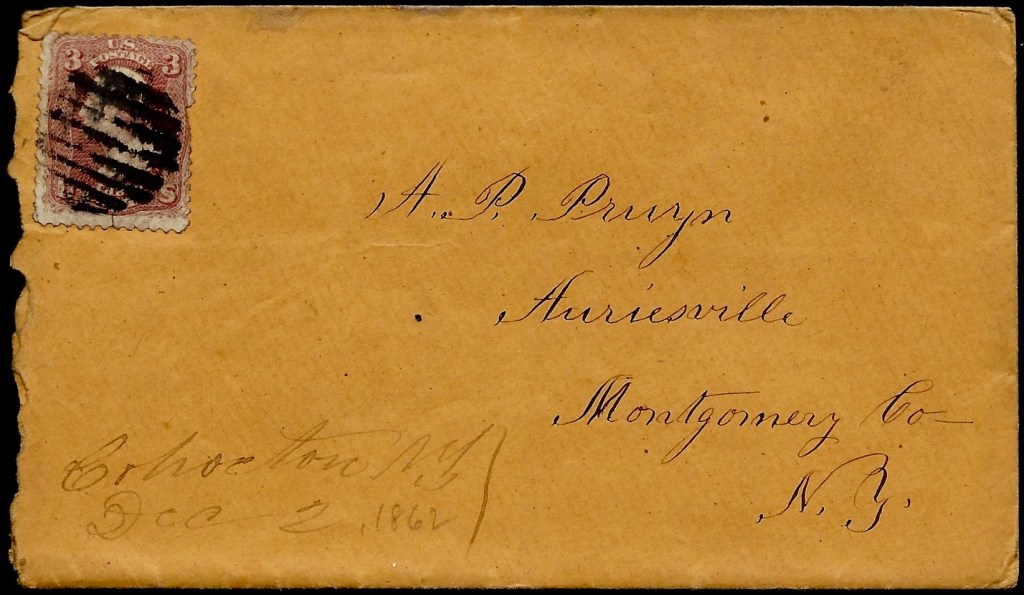
Addressed to A. P. Pruyn, Auriesville, Montgomery county, New York
Cohocton [Steuben county, New York] November 30th 1862
Friend A. P. Pruyn,
You have been anxious undoubtedly to hear of our whereabouts & prospects since our reverse last August & I feel as though I had hardly done right in not writing to you sooner.
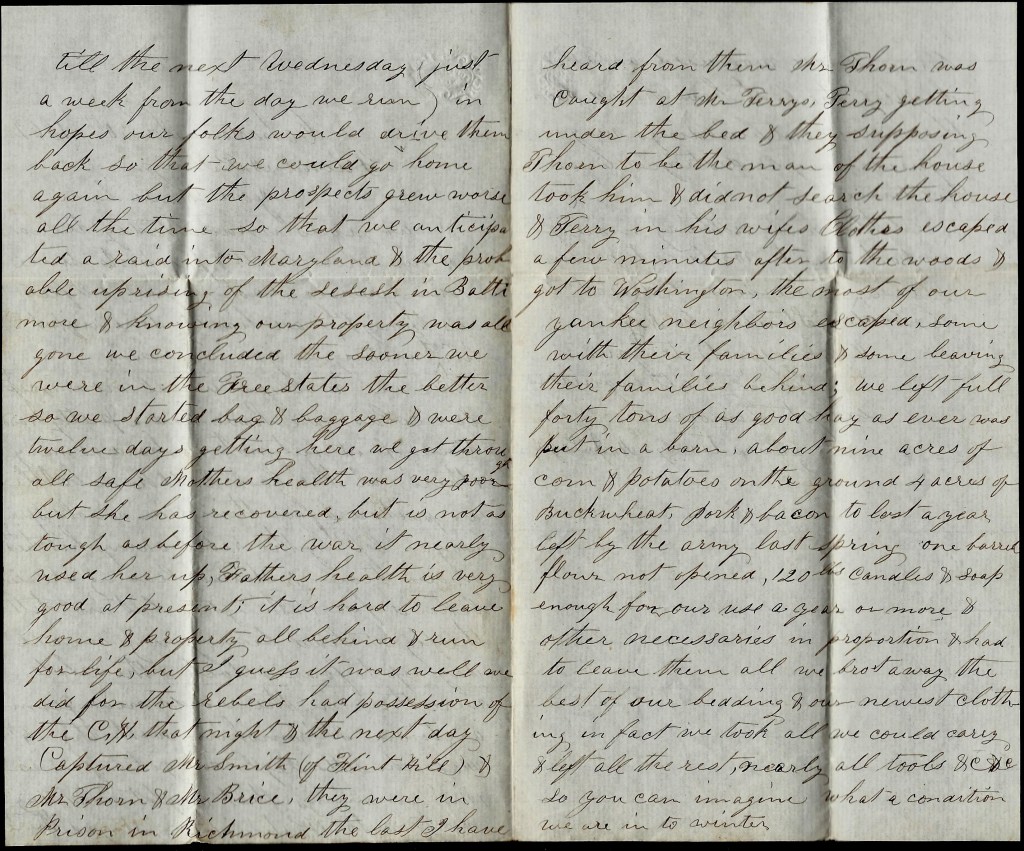
We are all well as usual now except bad color. We have had a pretty hard time of it but not as hard as many others. At the last Bull Run battle we packed a few things in an old spring wagon left by the rebel army, hitched on our team and started leaving all else behind for Washington but not till the fight had been going on all day up to four o’clock & the rebels were then in the woods near Germantown skirmishing with the 13th Massachusetts Regiment. We got as far as Mr. Demmings that night [and] next day went on to Washington & stayed there till the next Wednesday (just a week from the day we run) in hopes our folks would drive them back so that we could go home again but the prospects grew worse all the time so that we anticipated a raid into Maryland & the probably uprising of the sesesh in Baltimore & knowing our property was all gone, we concluded the sooner we were in the Free States the better so we started bag & baggage & were twelve days getting here. We got through all safe.
Mother’s health was very poor but she has recovered, but is not as tough as before the war. It nearly used her up. Father’s health is very good at present. It is hard to leave home & property all behind & run for life but I guess it was well we did for the rebels had possession of the [Fairfax] Court House that night & the next day captured Mr. Smith (of Flint Hill) & Mr. Thorn 1 & Mr. Brice. 2 They were in prison in Richmond the last I have heard from them. Mr. Thorn was caught at Mr. Terry’s, Terry getting under the bed & they supposing Thorn to be the man of the house, took him & did not search the house & Terry in his wife’s clothes escaped a few minutes after to the woods & got to Washington.
The most of our Yankee neighbors escaped, some with their families & some leaving their families behind. We left full forty tons of as good hay as ever was put in a barn, about nine acres of corn and potatoes on the ground, 4 acres of buckwheat, pork & bacon to last a year left by the army last spring, one barrel of flour not opened, 120 lbs. candles & soap enough for our use a year or more, and other necessaries in proportion & had to leave them all. We brot away the best of our bedding & our newest clothing. In fact, we took all we could carry and left all the rest—nearly all tools, &c. &c.—so you can imagine what a condition we are in to winter.
Our house was used as a hospital the last have heard from there & our out buildings very much injured & may be destroyed before this time.
I think of nothing more of importance to write at present. Please write to me soon and direct to Cohocton, Steuben county, New York.
Our respects to your family & all enquirers except Democrats. Yours truly, — A. J. Lagar
In the letter, it is stated that Rebels were in the woods near Germantown which is located at the lower right on the map.
1 Possibly Talmadge Thorne.
2 Matthew Bryce (1807-1863) was Unionist from Oakton, Fairfax county, Virginia. He died a prisoner of war in Richmond, Virginia, on 17 March 1863 at the age of 55.
The following letter was written by someone named “Andrew” who I believe served aboard the USS Maratanza. I was unable to identify him, however. Perhaps someone else can devote more time to discovering his identity.
Transcription
Baltimore, Maryland August 10th [1862]
Dear Sister,
I received your kind letter last week and was much pleased to hear from you once more. Can you realize that brother Bree is dead! I cannot. It seems to me that when I go home again, I shall find him there. Still I know it cannot be and that we shall never see him again. I am glad to hear that the Boys have volunteered from our place, for we are greatly in need of men. They have saved themselves from being branded as cowards. If the men do not come forward now, all those that have died, have died in vain. This is a terrible war and things look dark at the present time. Nevertheless we are bound to conquer in the end.
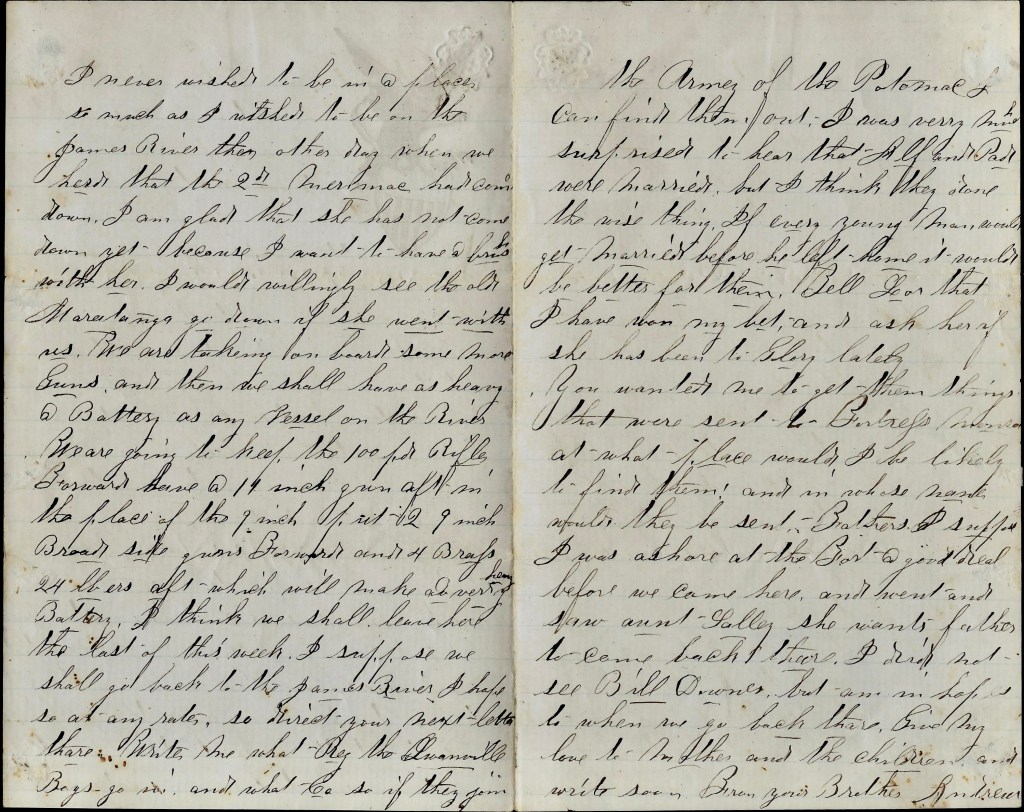
I never wished to be in a place so much as I wished to be on the James River the other day when we heard that the 2nd Merrimac had come down. I am glad that she has not come down yet because I want to have a brush with her. I would willingly see the old Maratanza1 go down as she went with us. We are taking on board some more guns and then we shall have as heavy a battery as any vessel on the river. We are going to keep the 100 pound rifles forward. Have a 19 inch gun aft in the place of the 9-inch [ ] 2 9-inch broadside guns forward and 4 brass 24-pounders aft which will make a very heavy battery. I think we shall leave here the last of this week. I suppose we shall go back to the James River I hope so at any rate so direct your next letter there.
Write me what regiment the Iwanville Boys go in and what company so if they join the Army of the Potomac I can find them out. I was very much surprised to hear that Alf and Pad were married but I think they done the wise thing. If every young man would get married before he left home it would be better for them. Tell Lor that I have won my bet and ask her if she has been to glory lately.
You wanted me to get them things that were sent to Fortress Monroe at what place would I be likely to find them, and in whose name would they be sent. Brothers, I suppose. I was ashore at the fort a good deal before we came here and went and saw Aunt Sally. She wants father to come back there. I did not see Bill Downer but am in hopes to when we go back there. Give my love to Mother and the children and write soon. From your brother, — Andrew
1 USS Maratanza, a 786-ton double-ender, wooden steamer, was built at Boston Navy Yard in 1861, then launched 26 November and commissioned on April 12, 1862. USS Marblehead was an Unadilla-class gunboat launched by G. W. Jackman, Newburyport, Massachusetts on October 16, 1861.
I could not find an image of William but here is one of Sgt. Samuel Hamrick of Co. I, 38th North Carolina.
The following letter was written by William Daniel Henry Covington (1842-1927), a farmer from Cleveland, Rutherford county, North Carolina, who enlisted in late December 1861 to serve in Co. I, 38th North Carolina Infantry. He and Jacob Childers of the same company (mentioned in the letter) were both admitted into Hospital No. 2 at Petersburg on 31 January 1862 suffering from illness. Though Jacob returned to his regiment before the end of March and was subsequently killed in action at the Battle of Ellison’s Mill (Mechanicsville) on 26 June 1862, William was sent home on furlough shortly after this letter (with proper authority). Muster rolls do not indicate when he returned to his company though he was certainly with them by January 1863. He was sent to a hospital again in June 1863 suffering from rheumatism and was absent without leave from 25 July 1863 to 25 October 1863 at which time he returned again to his regiment. Despite his spotty service record, he was promoted to corporal in 1864.
On 8 May 1864, when the 38th North Carolina was fighting in Scales’ Brigade in the Wilderness, he suffered a severe concussion and was admitted to Jackson Hospital in Richmond.
William was the son of William Horace Covington (1775-1861) and Mary Rincie Green (1811-1902).
Transcription
Petersburg, Virginia March 29th 1862
Dear Uncle and Aunt,
It is with pleasure that I drop you a few lines to inform you that I am about well, hoping those lines may find you and family well. I am at Petersburg, Va., in the 2nd N. C. Hospital. There is only 12 of our company here and Jacob Childers just left. Uncle Howell is here. He is getting well. [Francis] Marion Hord is here. He has been very low but he is on the mend. I am going to the regiment in a few days if I don’t get no worse. I can’t get a drop of liquor here by no means at all. I have got use to doing without it and I don’t care now.
Tell Mother that I am about well. I am well treated here. I had rather stay here than anyplace I have been since I left home. I have no more news to write to you at this time. John Lattimore and Dick Wiggins is in the 1st North Carolina Hospital close to us. There is a Divins from the Burnt Chimney Company in the same hospital that I am in. He came here when Walker was at home.
You need not write to me until I get to the regiment for I expect to leave here in a few days. I will write you as soon as I get to the regiment. Then I will thankfully receive a letter from you at any time when you are disposed to send me one.
Your affectionate nephew, — W. D. H. Covington to his Uncle & Aunt.
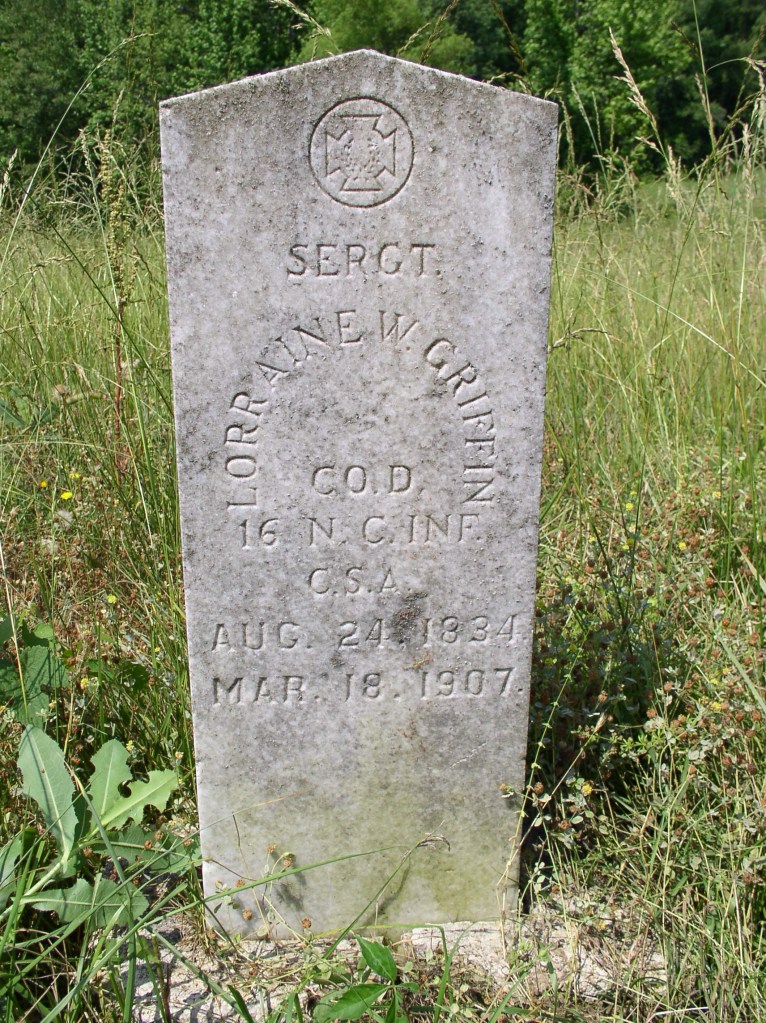
This rare letter was written in pencil by Lorraine Walker Griffin (1834-1907), the son of William Lewis Griffin and Elizabeth Suttle of Forest City, Rutherford county, North Carolina. Lorraine enlisted on 1 Jun 1861 and was mustered into Capt. H. D. Lee’s Company, 6th NC Volunteers. This unit was later designated Co. D, 16th NC Infantry Regt. He was admitted to the Confederate Hospital in Winchester, VA on 1 October 1862 with a gunshot wound to his hand. He was transferred to Chimborazo Hospital, Richmond, VA on 3 Octpber 1862. He was furloughed for 60 days on 19 October 1862. He apparently did not return to duty when his furlough ended and was listed as awol in December 1862. He returned to duty by Feb 1863 and was present and accounted for through July 1863. He was admitted to Chimborazo Hospital again on 13 July 1863 with pneumonia. He was transferred to Camp Winder, Richmond, VA on 15 Aug 1863. He was promoted to 4th Sgt. on 1 October 1864 held the same rank when paroled at Appomattox, Virginia, on 9 April 1865.
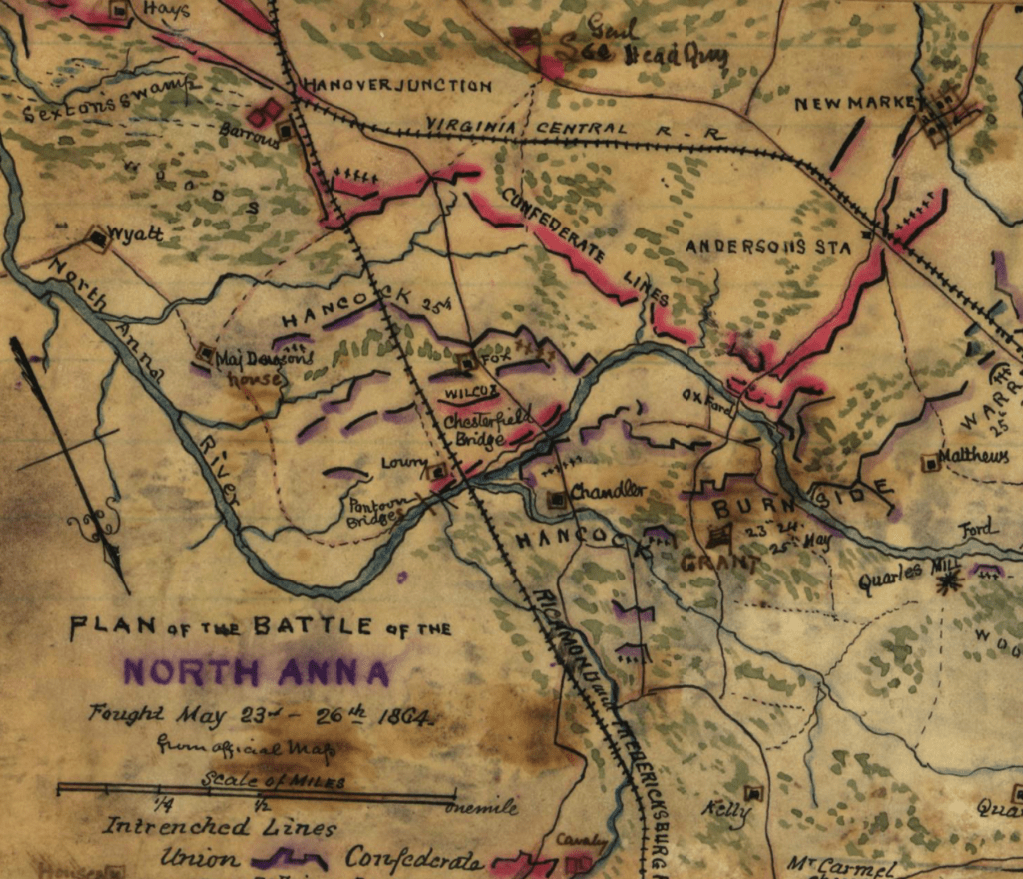
In his letter of 26 May 1864, Lorraine describes the recent action of the fight at North Anna, 23-26, 1864.
Transcription
In Line of Battle near Hanover Junction May 26, [1864]
Dear Sister,
I take my pen in hand to let you know I am still alive but don’t know how long I may be alive for they are [ ] our entrenchments. We are well fortified. I have been in some hard fights and came through safe. I do pray to come through safe. Dear sister, I have never saw Mr. Green yet. He passed me one day and I looked for him but did not see him. His regiment has been in fights since then I can’t hear from him nor brother. They may both be killed.
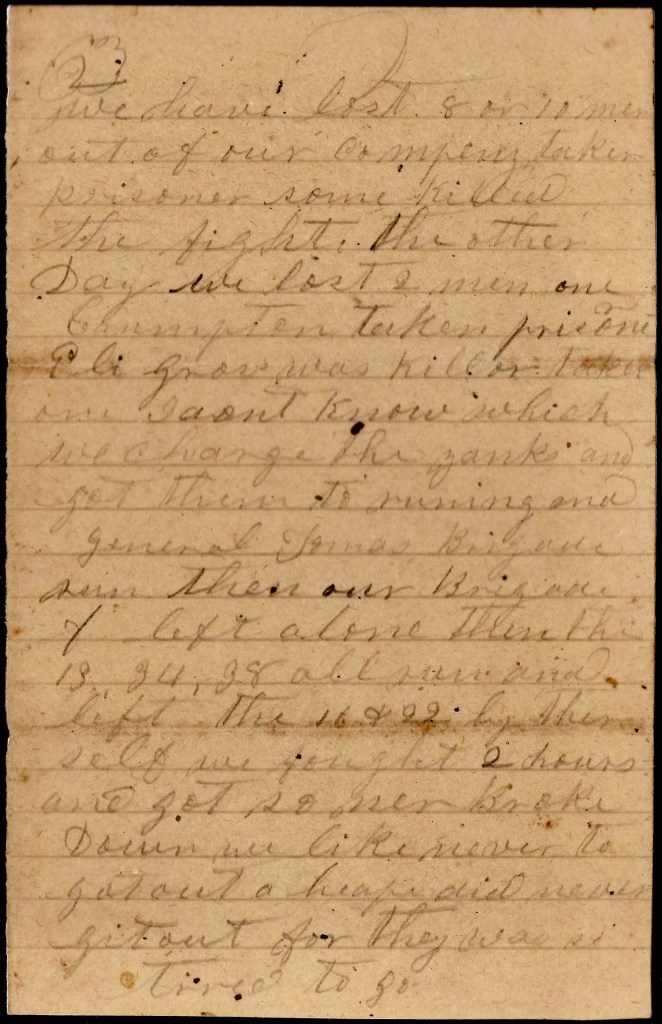
We have lost 8 or 10 men out of our company taken prisoner—some killed. [In] the fight the other day we lost two men, one Crampton taken prisoner. Eli Gross was killed or taken one, I don’t know which. We charged the Yanks and got them to running and General [Edward L.] Thomas’ Brigade run, then our Brigade [Alfred M. Scales’ Brigade] was left alone. Then the 13th, 34th, 38th all run and left the 16th and 22nd by theirself. We fought two hours and go so near broke down we like never to got out. A heap did never get out for they was so tired to go.
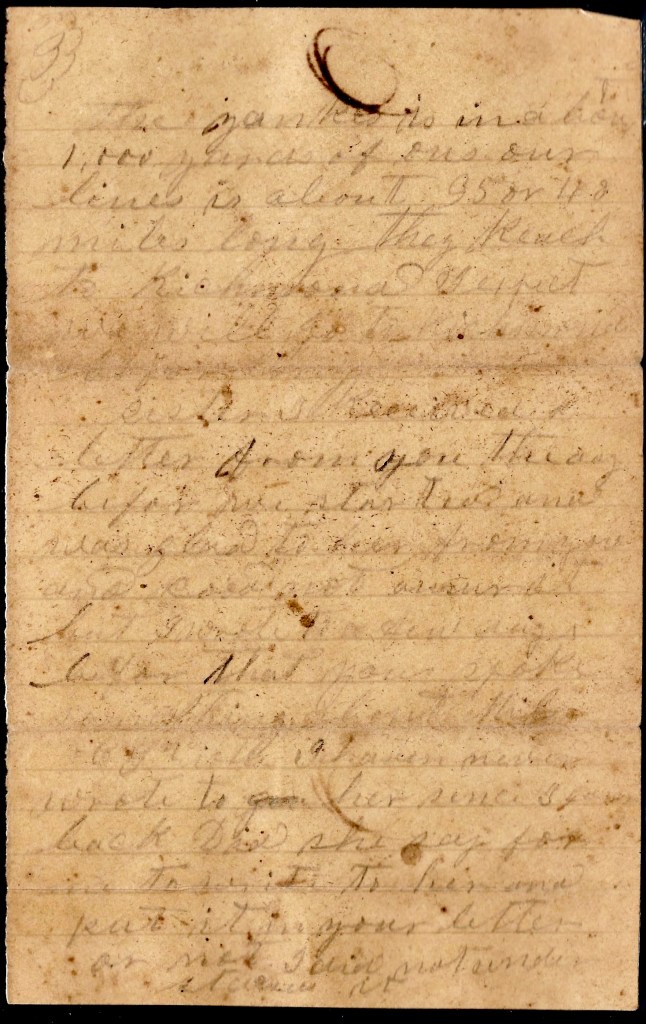
The Yankees is [with]in about 1,000 yards of us. Our lines is about 35 or 40 miles long. They reach to Richmond, I expect. We will go to Richmond [illegible].
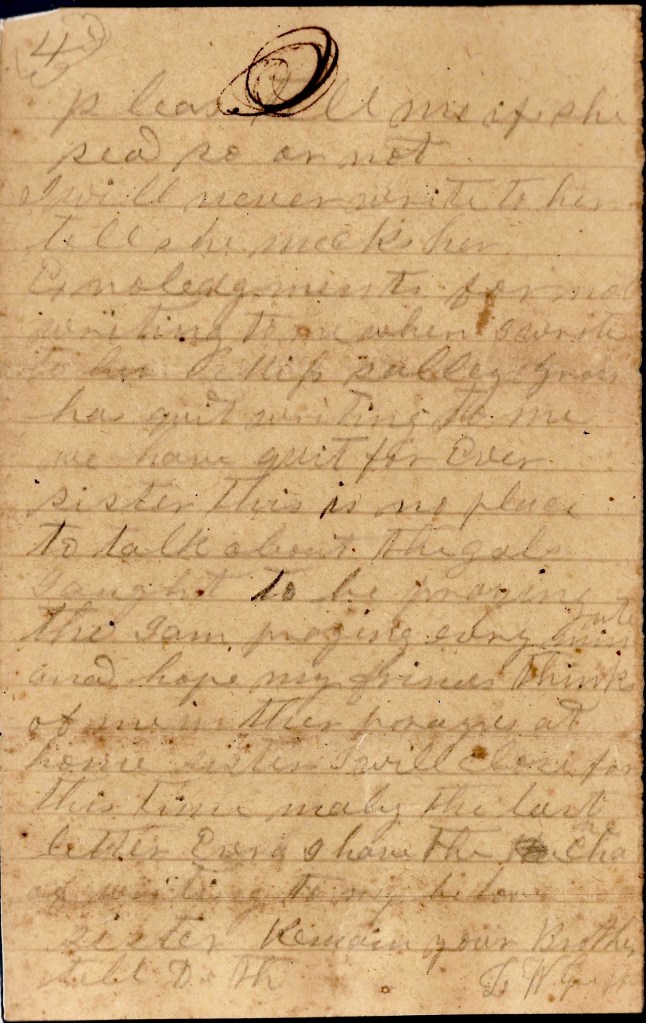
Sister, I received a letter from you the day before we started and was glad to hear from you and could not answer it but I wrote to you a few days before that. You spoke [illegible]… I have never wrote to her since I got back. Did she say for me to write to her and put it in your letter or not? I did not understand. Please tell me if she said so or not. I will never write to her till she makes her acknowledgements for not writing to me when I write to her. Miss Salley Gross has quit writing to me. We have quit forever.
Sister, this is no place to talk about the gals. I ought to be praying though I am praying every minute and hope my friends thinks of me in their prayers at home. Sister, I will close for this time—maybe the last letter ever I have the chance of writing to my beloved sister. I remain your brother till death. L. W. Griffin























 Spared & Shared 23