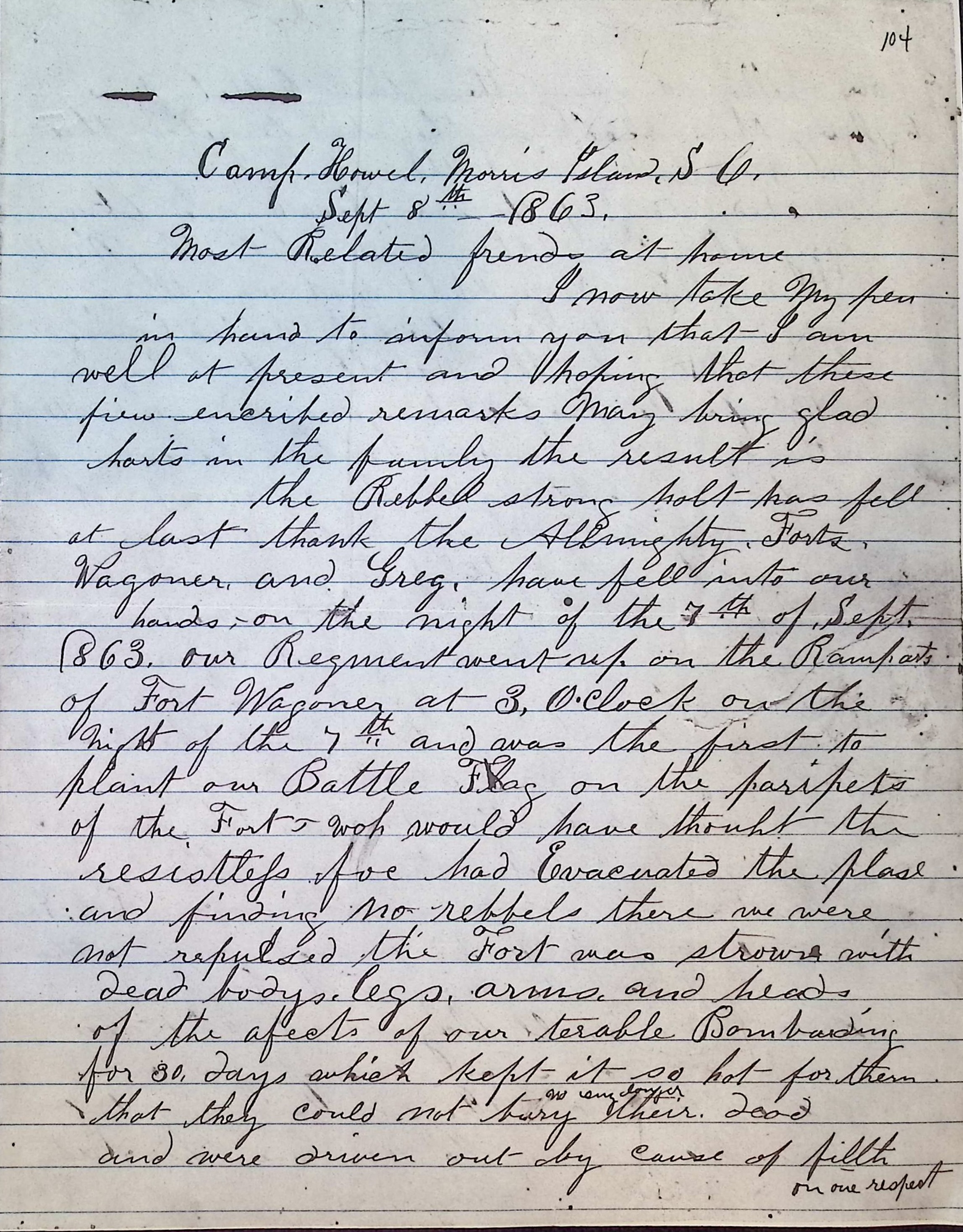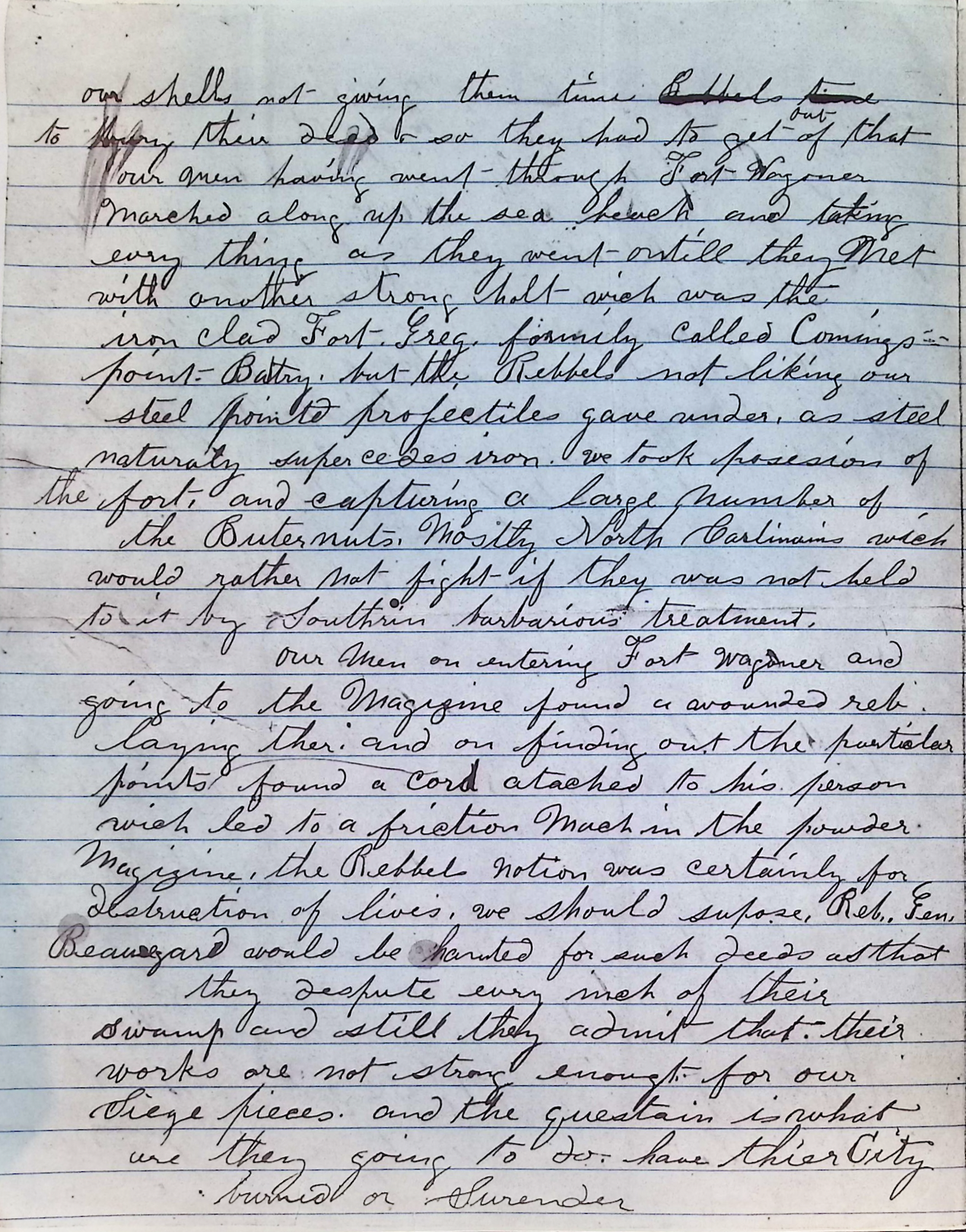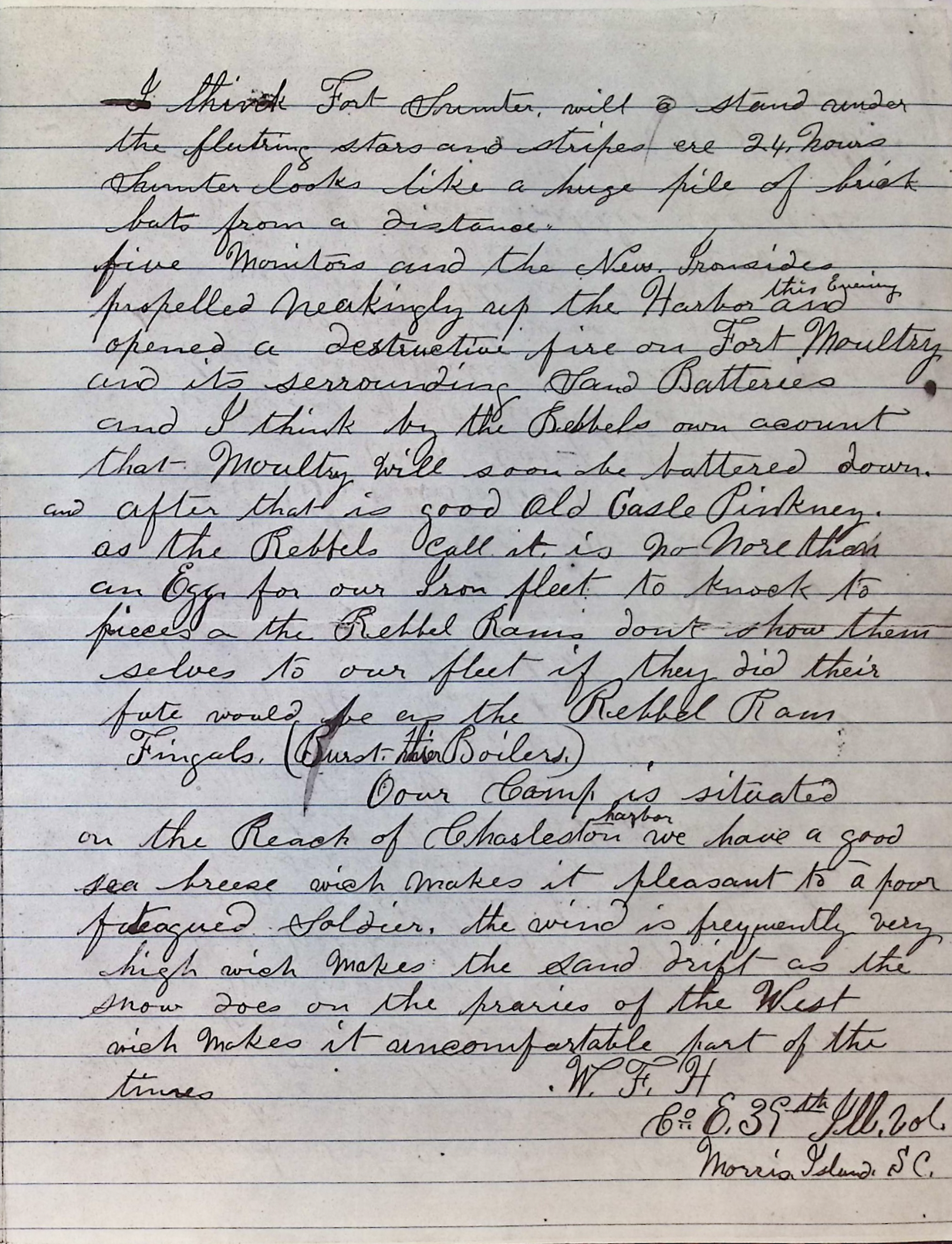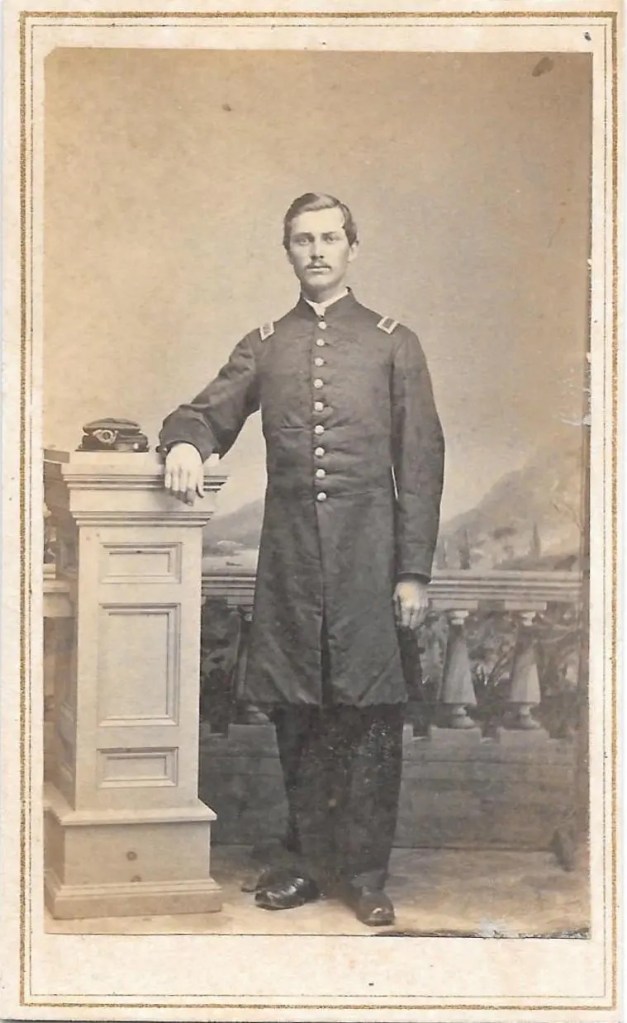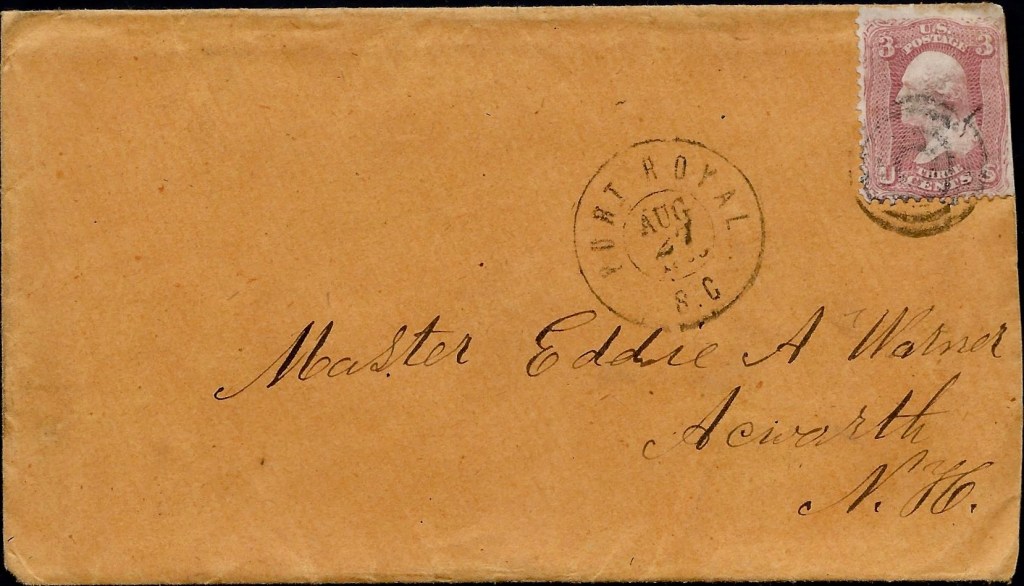
The following letter was written by Pvt. William F. Hertzog (1842-1864) of Co. E, 39th Illinois Volunteers, sometimes called the “Yates Phalanx.” He enlisted at Rockford, Illinois, on 11 October 1861 and reenlisted as a veteran on 25 Janyary 1864. He was wounded in the thigh on 20 May 1864, and killed in the fighting near Ware Bottom Church, Virginia, on 18 June 1864.
Enlistment records reveal that William stood 6 foot 2 inches tall, had light hair, and gray eyes. He was enumerated in 1860 in the household of his father, Charles Hertzog—a farmer in Rockville, Illinois—with his mother, Abigail, and six siblings, one of whom, 23 year-old Charles W. Hertzog, also served with William in the 39th Illinois. The family lived in Pennsylvania until the early 1850s when they relocated to Illinois.
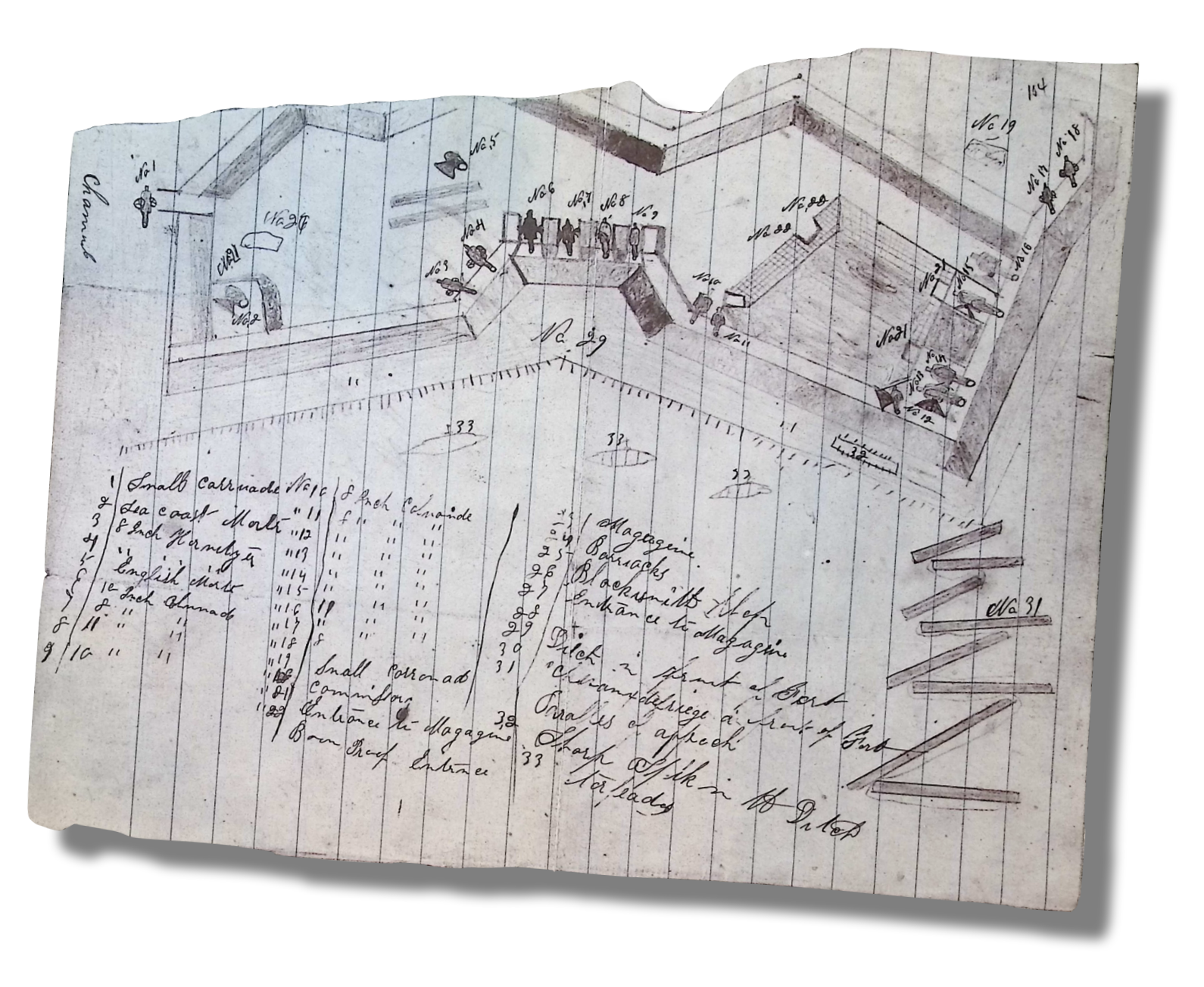
William’s letter contains a description of the evacuation of the rebel Fort Wagner and Battery Gregg on Morris Island on 7 September 1863. The 39th Illinois entered the empty fort, cut hidden explosive fuses set by the retreating enemy, captured the rear guard, and planted their regimental colors on the parapet hours before the official general charge. The letter also includes an incredible birds-eye sketch of Fort Wagner, presumably drawn by Hertzog, which includes a characterization of the pieces left mounted in the fort by the rebels.
This letter is from the collection of Brad Emalfarb and was made available for transcription and publication on Spared & Shared by express consent.
T R A N S C R I P T I O N
Camp Howell, Morris Island, S. C.
September 8th 1863
Most Belated Friends at Home,
I now take my pen in hand to inform you that I am well at present and hoping that these few remarks may bring glad hearts in the family.
The result is the Rebel stronghold has fell at last, thank the Almighty. Forts Wagner and Gregg have fell into our hands on the night of the 7th of September 1863. Our regiment went up on the ramparts of Fort Wagner at 3 o’clock on the night of the 7th and was the first to plant our battle flag on the parapets of the fort. Who would have thought the resistless foe had evacuated the place and finding no rebels there, we were not repulsed. The fort was strewn with dead bodies, legs, arms, and heads, of the effects of our terrible bombarding for 30 days which kept it so hot for them that they could not bury their dead any longer and were driven out by cause of filth, our shells not given them time to bury their dead. So they had to get out of that [place].
Our men having went through Fort Wagner, marched along up the sea beach and taking everything as they went until they met with another strong halt which was the iron clad Fort Gregg, formerly called Cummings Point Battery. But the rebels, not liking our steel pointed projectiles, gave under as steel naturally supersedes iron. We took possession of the fort and capturing a large number of the Butternuts—mostly North Carolinians which would rather not fight if they was not held to it by Southern barbarous treatment.
Our men on entering Fort Wagner and going to the magazine found a wounded reb laying there and on finding out the particular points, found a cord attached to his person which led to a friction match in the powder magazine. The rebels’ notion was certainly for destruction of lives, we should suppose. Reb. General Beauregard would be heralded for such deeds as that. They dispute every inch of their swamp and still they admit that their works are not strong enough for our siege pieces and the question is what are they going to do? Have their city burned or surrender?
I think Fort Sumter will stand under the floating stars and stripes ere 24 hours. Sumter looks like a huge pile of brick but from a distance. Five monitors and the New Ironsides propelled sneakingly up the harbor this evening and opened a destructive fire on Fort Moultrie and its surrounding land batteries and I think by the rebels own account that Moultrie will soon be battered down and after that is good old Castle Pickney as the rebels call it. It’s no more than an egg for our iron fleet to knock to pieces as the rebel rams don’t show themselves to our fleet. If they did, their fate would be as the rebel ram Fingal (burst their boilers).
Our camp is situated on the beach of Charleston Harbor. We have a good sea breeze which makes it pleasant to a poor fatigued soldier. The wind is frequently very high which makes the sand drift as the snow does on the prairies of the West which makes it uncomfortable part of the time.
— W. F. H., Co. E, 39th Illinois Vols., Morris Island