My passion is studying American history leading up to & including the Civil War. I particularly enjoy reading, transcribing & researching primary sources such as letters and diaries.
The following letter was written by Wesley Sever who enlisted 25 June 1862 as a private in the U. S. Marines. He was listed as serving on a number of vessels throughout the war including the Uncle Sam, and the Black Hawk. Nothing more was found.
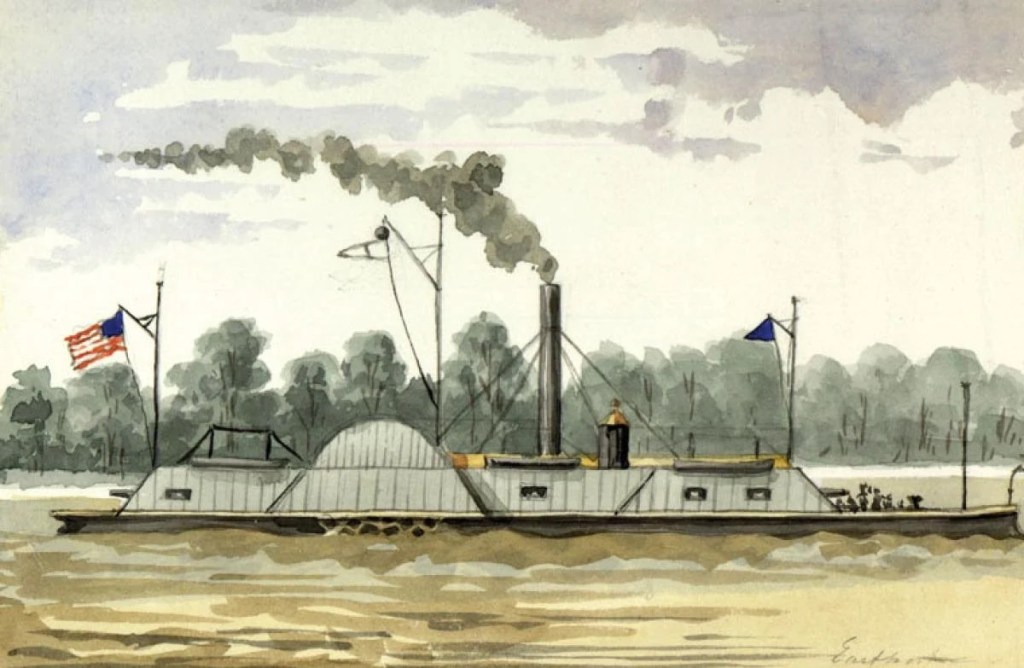
Eastport, a well modeled, fast Mississippi River steamer built at New Albany, Ind., in 1852, was acquired by Navy in January 1862 and underwent conversion to an ironclad gunboat at Cerro Gordo on the Tennessee River prior to duty with Lt. I. N. Brown’s flotilla. Her alterations were about half completed when on 7 February 1862 she was captured by the Union gunboats, Conestoga, Tyler, and Lexington, together with the materials to finish the job.
Eastport was sent in to Cairo, Illinois, and her conversion finished. She then served with the Union Army until 1 October 1862 when the ships of the Western Flotilla were turned over to the Navy and renamed the Mississippi Squadron. There were high hopes for the Eastport when she first joined the fleet but she was so heavily armored, slow and cumbersome, that she was unable to navigate shallow rivers in the Western theater. She steamed on western waters until sunk on 15 April 1864 in the Red River by a Confederate torpedo. Efforts to salvage her failed and she was blown up and destroyed to prevent capture on 26 April 1864.
Transcription
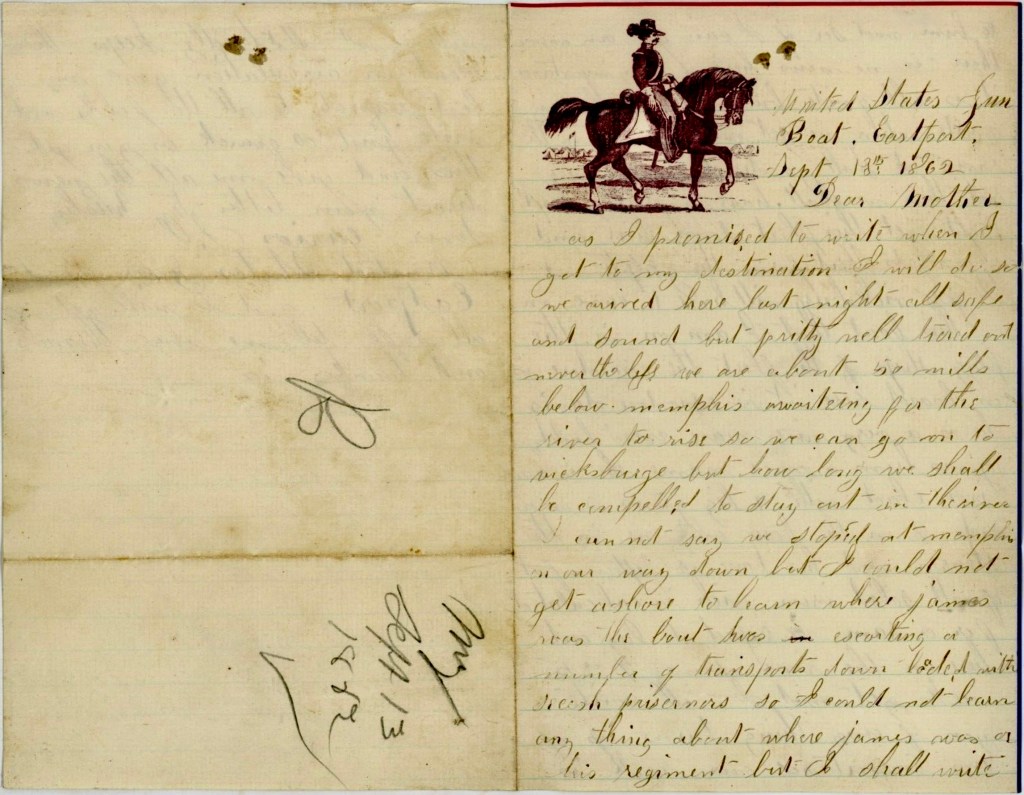
United States Gunboat Eastport September 13th 1862
Dear Mother,
As I promised to write when I got to my destination, I will do so. We arrived here last night all safe and sound but pretty well tired out nevertheless. We are about 50 miles below Memphis waiting for the river to rise so we can go on to Vicksburg. But how long we shall be compelled to stay out in the river I cannot say. We stopped at Memphis on our way down but I could not get ashore to learn where James was. The boat was escorting a number of transports down loaded with secesh prisoners so I could not learn anything about where James was or his regiment but I shall write to him and see if I can get an answer.
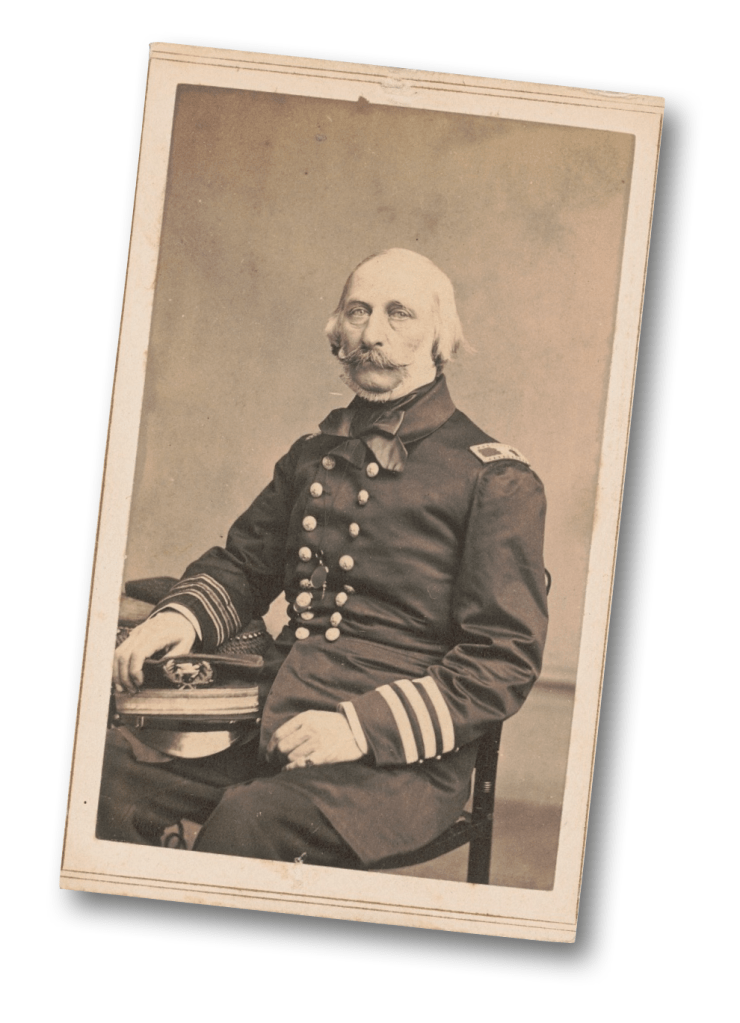
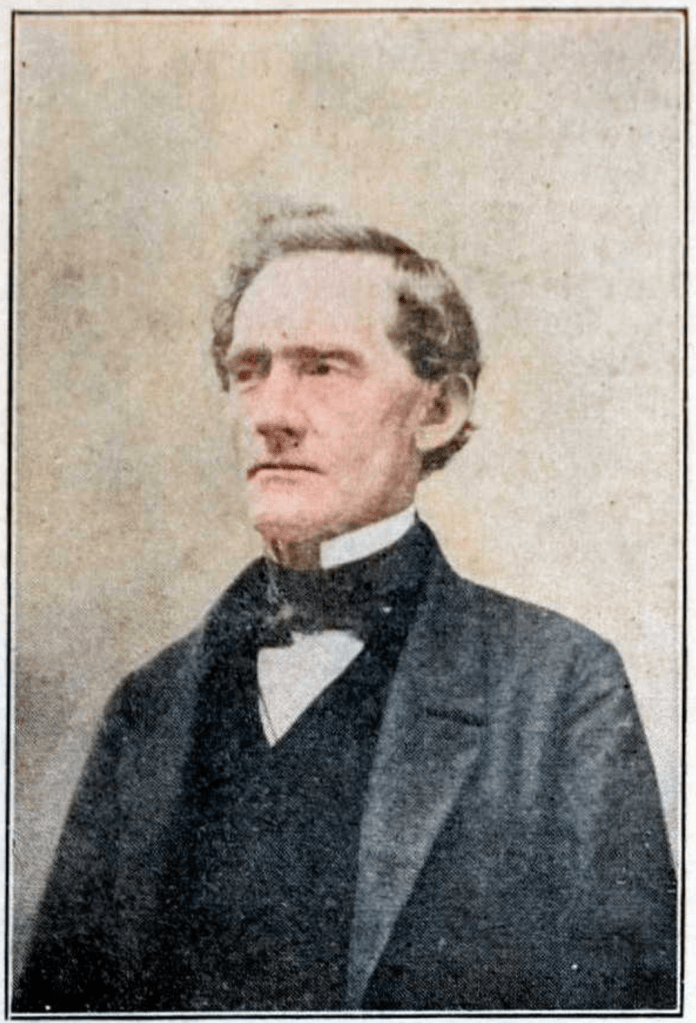
Commodore Charles Henry Davis
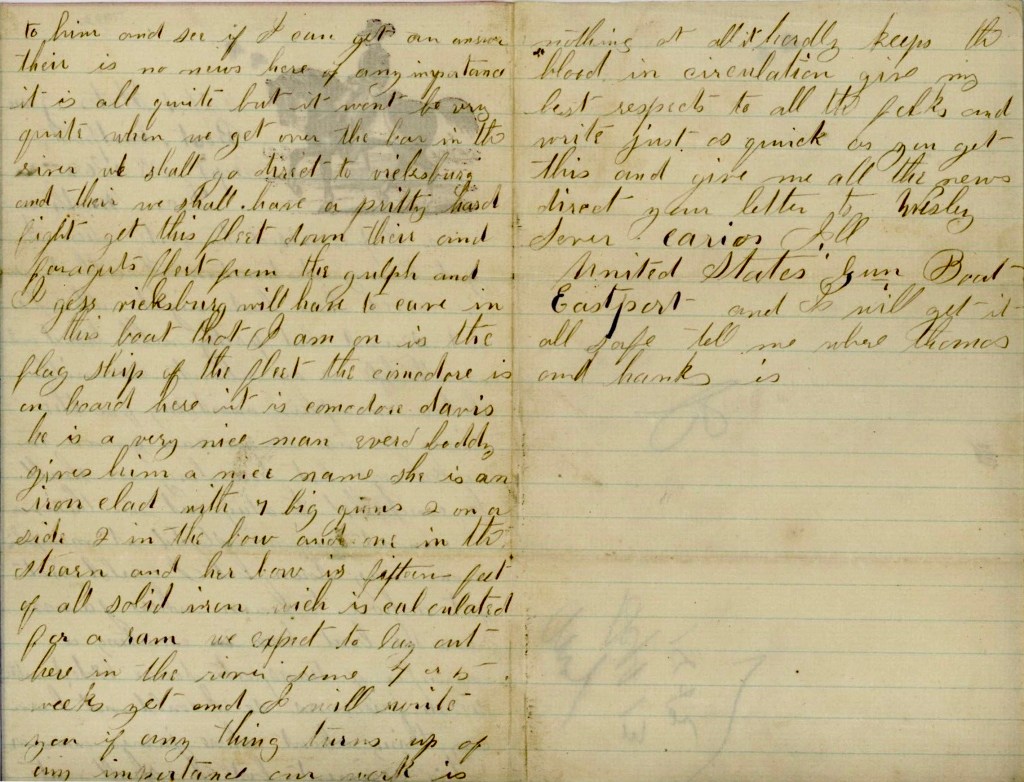
There is no news here of any importance. It is all quiet. But it won’t be very quiet when we get over the bar in the river. We shall go direct to Vicksburg and there we shall have a pretty hard fight. Get this fleet down there and Farragut’s fleet from the Gulf and I guess Vicksburg will have to cave in.
This boat that I am on is the flag ship of the fleet. The Commodore is on board here. It is Commodore [Charles Henry] Davis. He is a very nice man. Everybody gives him a nice name. She is an iron clad with seven big guns, two on a side, two in the bow, and one in the stern, and her bow is fifteen feet of all solid iron which is calculated for a ram. We expect to lay out here in the river some four or five weeks yet and I will write you if anything turns up of any importance. Our work is nothing at all. It hardly keeps the blood in circulation.
Give my best respects to all the folks and write just as quick as you get this and give me all the news. Direct your letter to Wesley Sever, Cairo, Illinois, United States Gun Boat Eastport and I will get it all safe. Tell me where Thomas and Hank is.
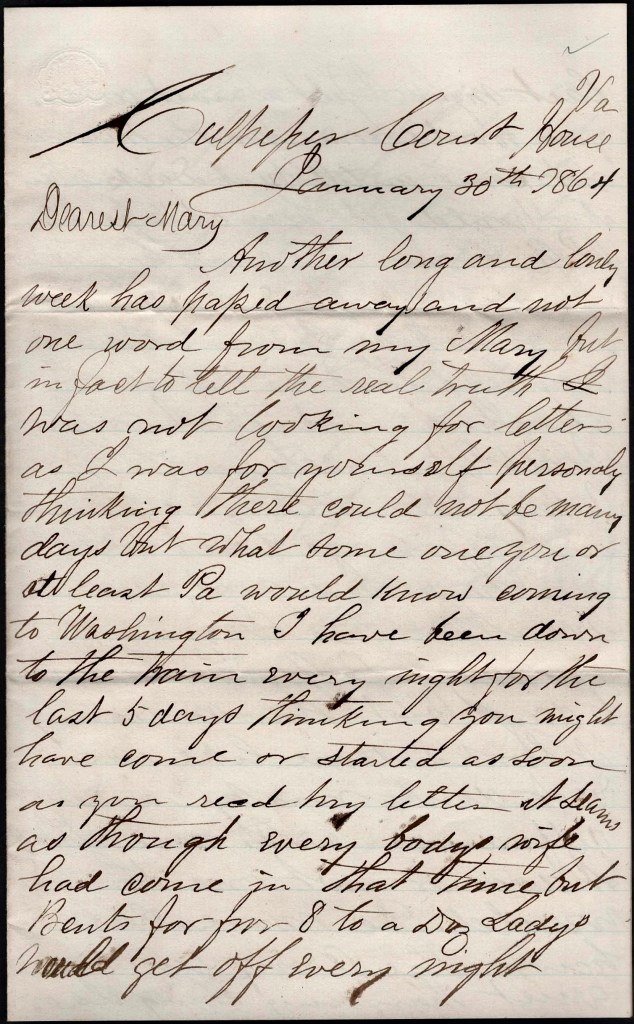
The following letters were written by Thomas Benton (“Bent”) Kelley (1838-1915), the son of David Kelley (1806-1876) and Susanna Dixon Jones (1799-1884). Bent was married to his first cousin, Mary Amelia Kelley (1838-1894), the daughter of Smith Fitzland Kelley (1816-1906) and Seviah Round of Danby, Rutland county, Vermont.
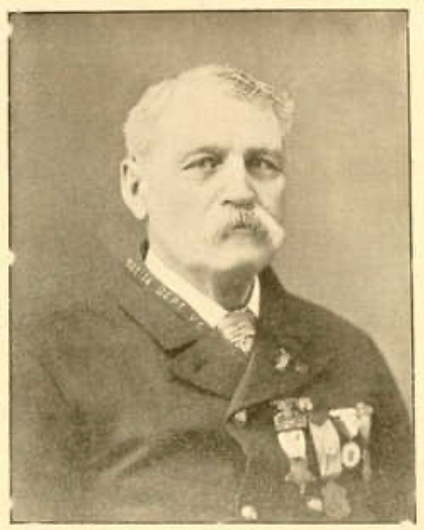
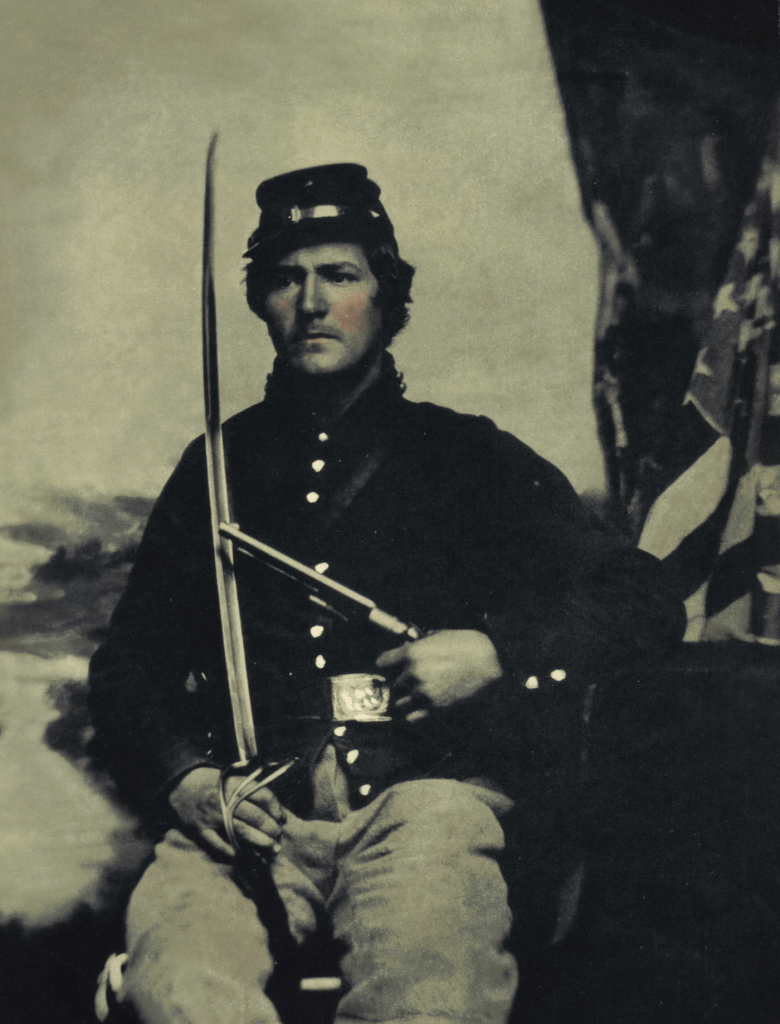
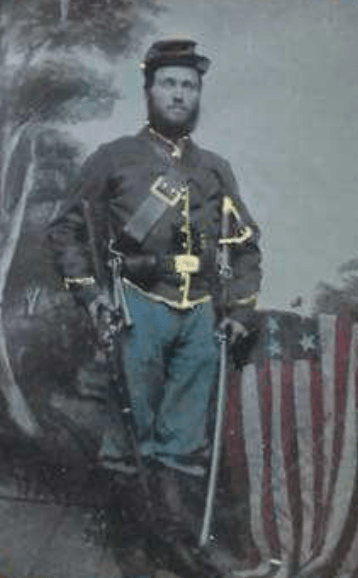
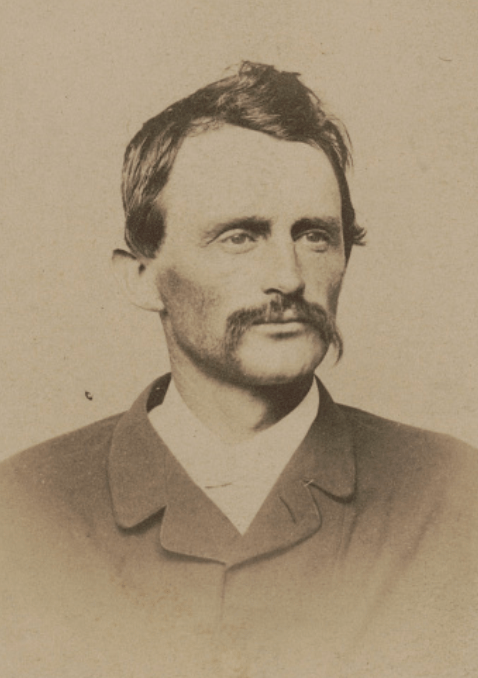
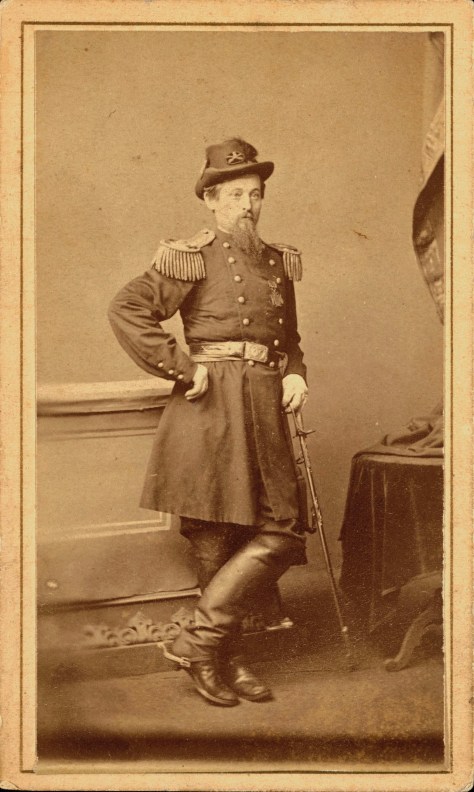
A GAR photograph of Bent Kelley
Bent was mustered in as a private in Co. E, 8th Illinois Cavalry on 18 September 1861 and he was mustered out on 28 September 1864. One source says he was “wounded four times with bullet and three times with sabre; September 15th, 1862, in six sabre charges within 40 minutes, captured seven confederate soldiers, armed, nearly a mile from any Union soldier; lost five horses shot under him in the three years’ service; in a Virginia raid captured a sutler and $5,000 worth of goods.”
A biographical sketch of Bent Kelley is presented in “Men of Vermont,” detailing his birth in Castleton, Vermont, on 10 October 1838. He pursued his education at the district schools in Castleton before attending Wheaton College in Illinois for two years. During his educational pursuits, he aided his father in maintaining records for the post office and railroad station. In 1853, he commenced his professional career with the Chicago Daily Democrat, where he fulfilled the roles of bookkeeper and superintendent of the mailing department, as well as serving as the station and express agent at Danby (now Glen Ellyn). Bent’s obituary, published in the Poultney Journal on 22 January 1915, notes that he was “present at the debate between Lincoln and Douglas in 1858, and he stood in the ‘Old Wigwam’ in Chicago when Lincoln was nominated for president.”
To read letters or diaries by other members of the 8th Illinois Infantry that I have transcribed and published on Spared & Shared, see:
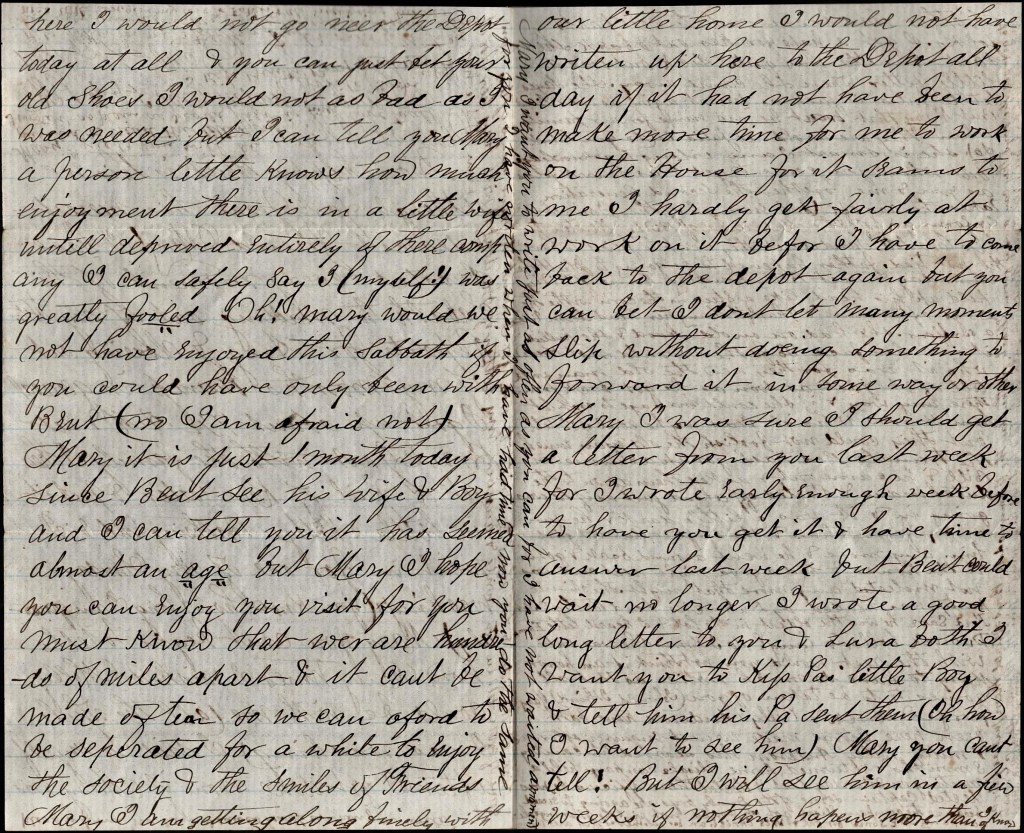
How happy Bent is this eve although far from his merriest & dearest friend Mary! I have devoted every moment of this Sabbath to making out my Ft Reports for August & closing out of my month’s business in general. I got up about 7½ a.m. & eat breakfast with the family. I then got a pail of rain water & put in little Mitty’s bathing tub & I went in for one of my Sunday washing’s (you know how long I am generally). Mary you can’t begin to tell how many times I wished Molly could be with me (all the while I was washing). I said to myself after I got done, now if Mary was here I would not go near the depot today at all & you can just bet your old shoes I would not as bad as I was needed. But I can tell you, Mary, a person little knows how much enjoyment there is in a little wife until deprived entirely of their company. I can safely say I (myself!) was greatly fooled Oh! Mary, would we not have enjoyed this Sabbath if you could have only been with Bent (no, I am afraid not).
Mary, it is just a month today since Bent seen his wife & boy and I can tell you it has seemed almost an age. But Mary, I hope you can enjoy your visit for you must know that we are hundreds of miles apart & it can’t be made often so we can afford to be separated for awhile—to enjoy the society & the smiles of friends. Mary, I am getting along finely with our little home. I would not have ridden up here to the Depot all day if it had not been to make more time for me to work on the house for it seems to me I hardly get fairly at work on it before I have to come back to the depot again. But you can bet I don’t let many moments slip without doing something to forward it on some way or other.
Mary, I was sure I should get a letter from you last week for I wrote early enough week before to have you get it & have time to answer last week, but Bent could wait no longer. I wrote a good long letter to you & Lura both. I want you to kiss Pa’s little boy & tell him his Pa sent them (Oh how I want to see him). Mary, you cant tell! But I will see him in a few weeks if nothing happens more than I know.
Mother has been out to see Mart’s folks. I got a pass for her out & back. She said Annetta was quite sick but was a little better when she came away. She says little Julia is just as smart a girl as ever lived. But Mary, that won’t be no name for our family when they are as old as Julia is (do you think so?). She is smart, I am willing to acknowledge, but when you come to get 2 as smart folks as you & me together, the second generation takes the rag off (but enough of this).
I must inform you of the marriage of Billy Newton to Miss Charlotte Sandercock. They went to Joliet to have the knot tied. Father happened to be going to Joliet the same day & met Billy coming home & Billy held up his head like a steer in the corn with the dogs after him & Charlotte hung her head down like a sunflower. She had on an old hood & she pulled it over her face so father would not know who it was for they new the old man would tell of it just as soon as he got back from there anyway & if she could manage to not let him know who it was so he could not tell. But they could not foolish the old man much. The trundle bed trash got up a shiveree on Bill & he came out & asked them down to the Dutchmans & started off ahead just as if he was going in, & it was a little dark, & he run away from the others & the boys could not find him any more & he went around back & got in to the house & had a good night’s rest and was not molested any more that night. The shiveree party was headed by Dubrock’s head butter packer Fred Sare. He was the oldest in the lot & I heard little Emma Dubrock holler & laugh so I know she was out with the rest. Would you not think it an honor, Mary, to have so much notice as that all comes to be taken of you (I should I think).
Mary, George Dubrock & Billy Anderson have both been here. George made earnest enquiry after you & Mitty. Billy Anderson has served his country three months & returned home. Elisha [Kelley’s] company held a meeting on Saturday last & elected their officers. He was elected Captain. Some of the Danby boys are a going to secede because the company Elisha got up would not join the Bloomingdale company—M[arcellus] E. Jones 1 for one, & Wes Christian for another. And they are trying to get all the boys they can away from Elisha for they say the Bloomingdale Boys offered them just as fair as anyone could ask for & you know Marcel is quick tempered & he says he is going to join the Bloomingdale Co. & Wes too.
Kiss all the Sisters & tell them to write to me for I want to have news often from some of you. Tell Lu to write & answer my letters. If she don’t, I will pay her for it when I see her. Please inform me how Isaac’s health is when you write. Mary I guess you will be puzzled to read this letter but I wrote it as plain as I could [even] if it is fine. Love to all. Kiss Bent’s boy good night. Kiss Mother for me & tell her Bent would like to see her very much. Tell her I hope she will be blessed with a nice little son. Give my love to Father & all enquiring friends. From your husband—Bent
1 The “quick tempered” Marcellus (“Marcel”) Jones would gain infamy for his having fired the first shot at the Battle of Gettysburg on 1 July 1863.
Letter 2
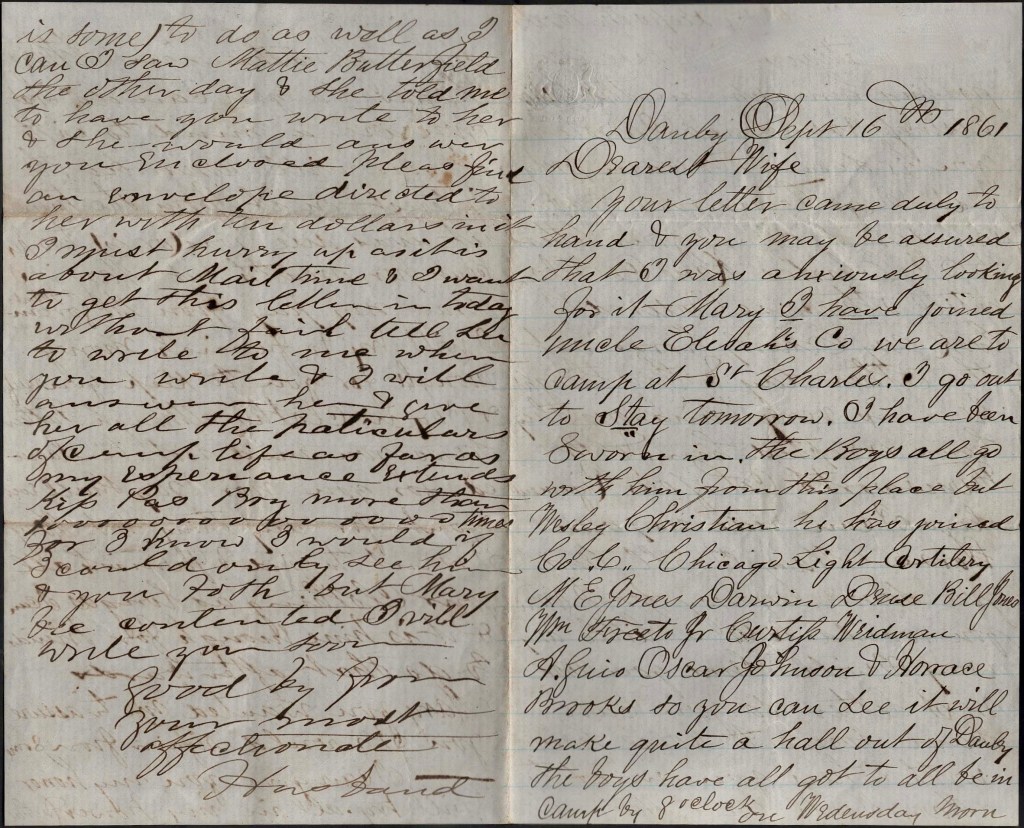
Danby [now Glen Ellyn, Illinois] September 16th 1861
Dearest Wife,
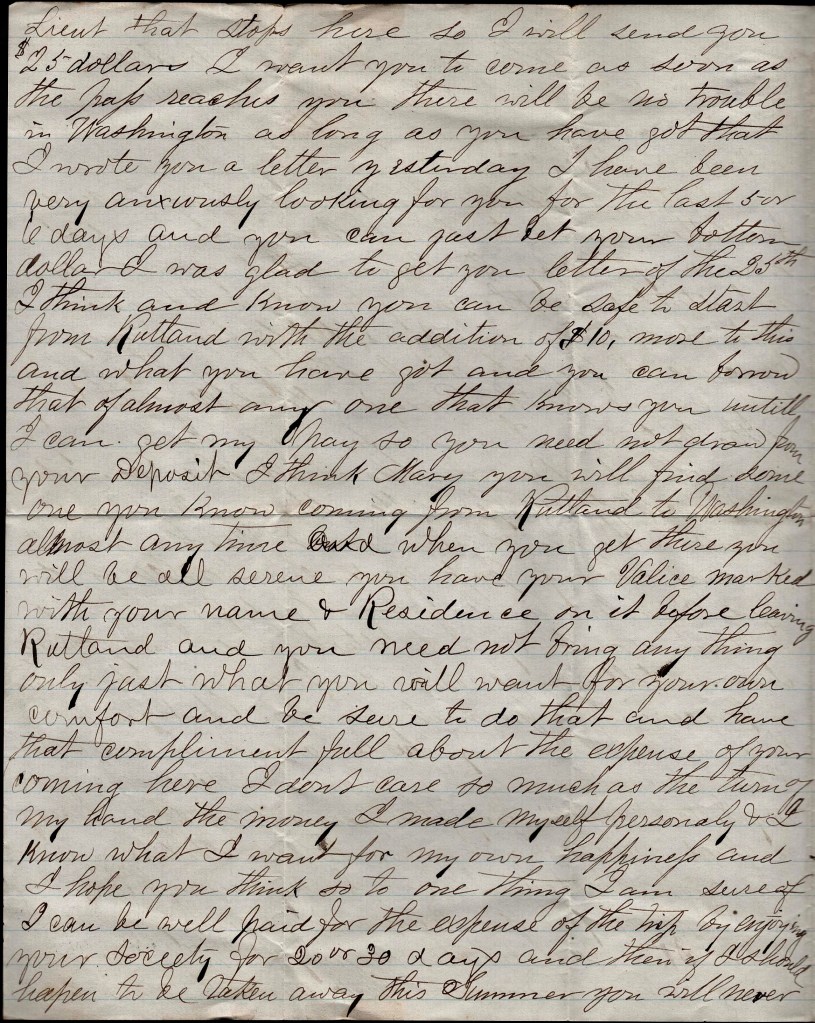
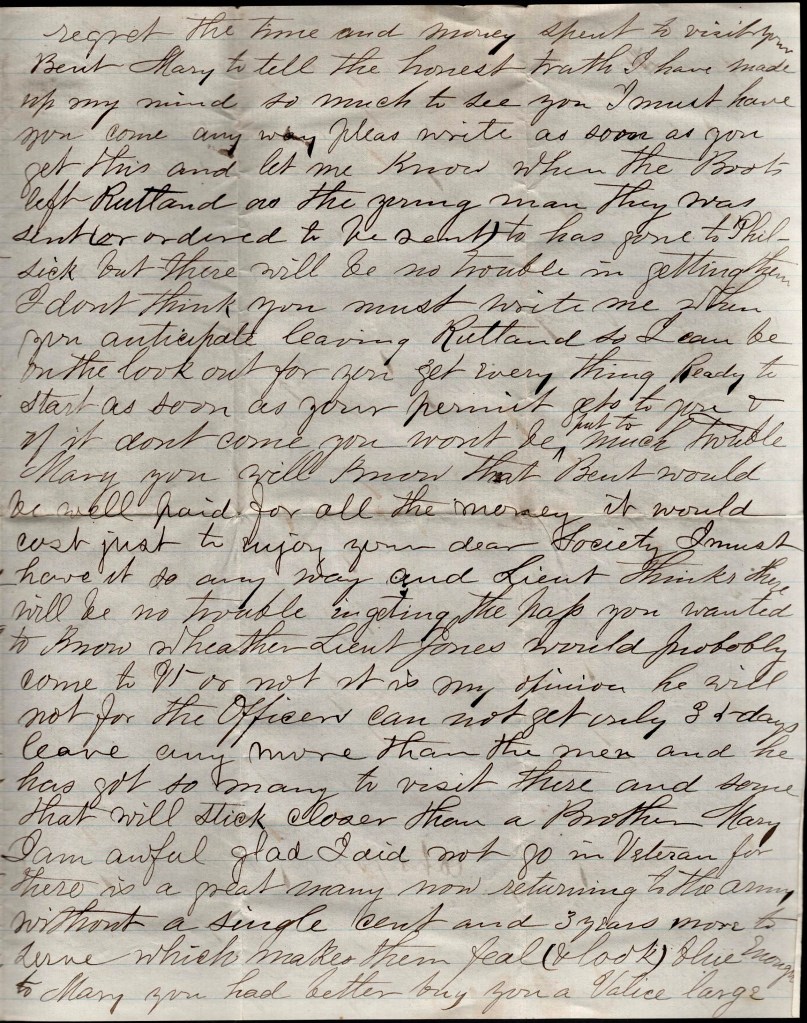
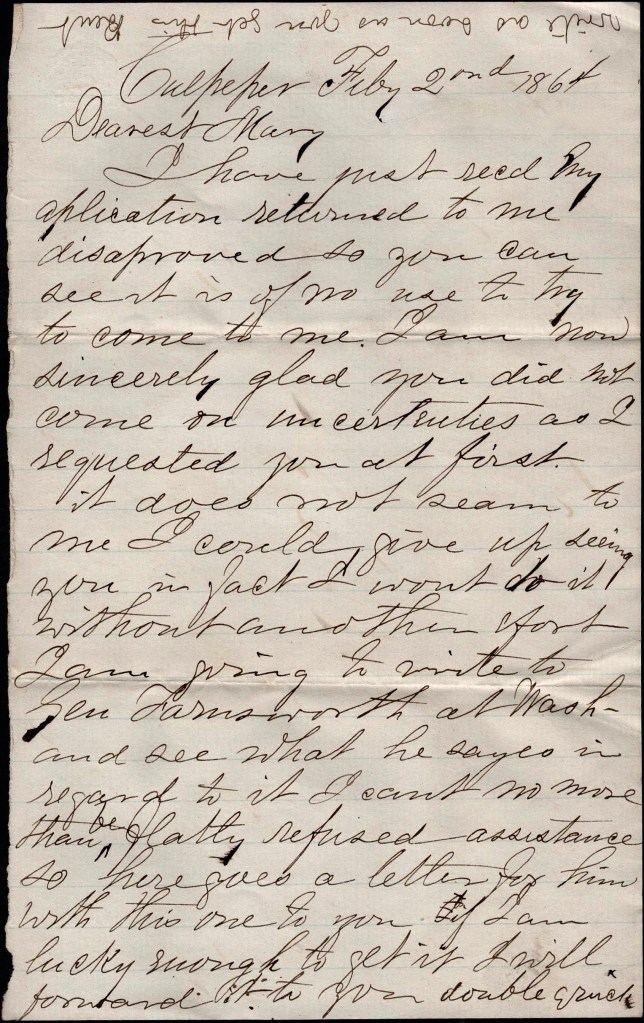
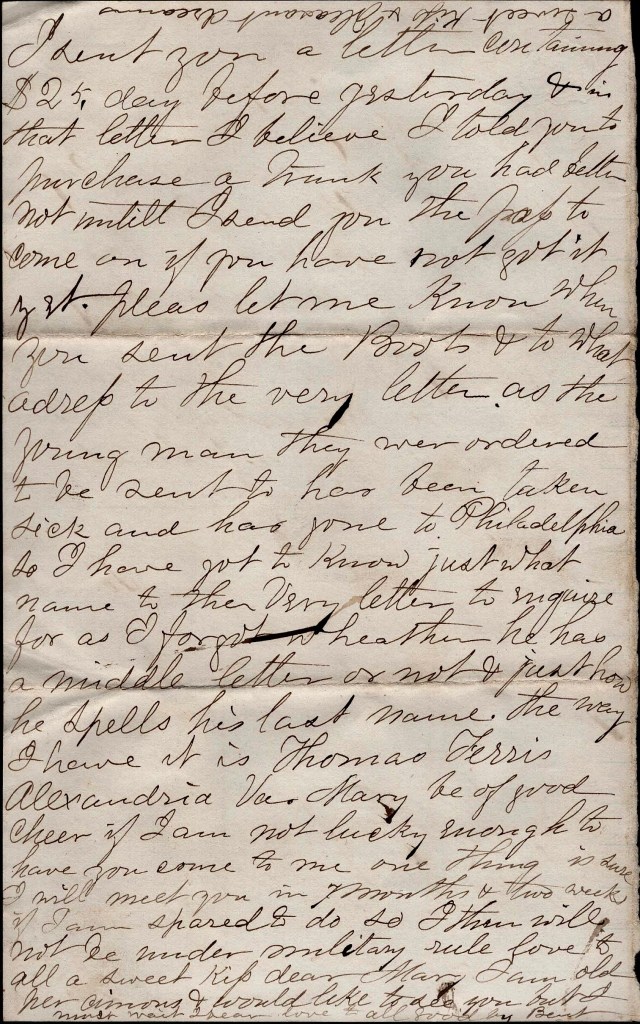
Your letter came duly to hand & you may be assured that I was anxiously looking for it. Mary, I have joined uncle Elisha [Kelley]’s company. We are to camp at St. Charles. I go out to stay tomorrow. I have been sworn in. The boys all go with him from this place but Wesley Christian. He has joined Co. C, Chicago Light Artillery.
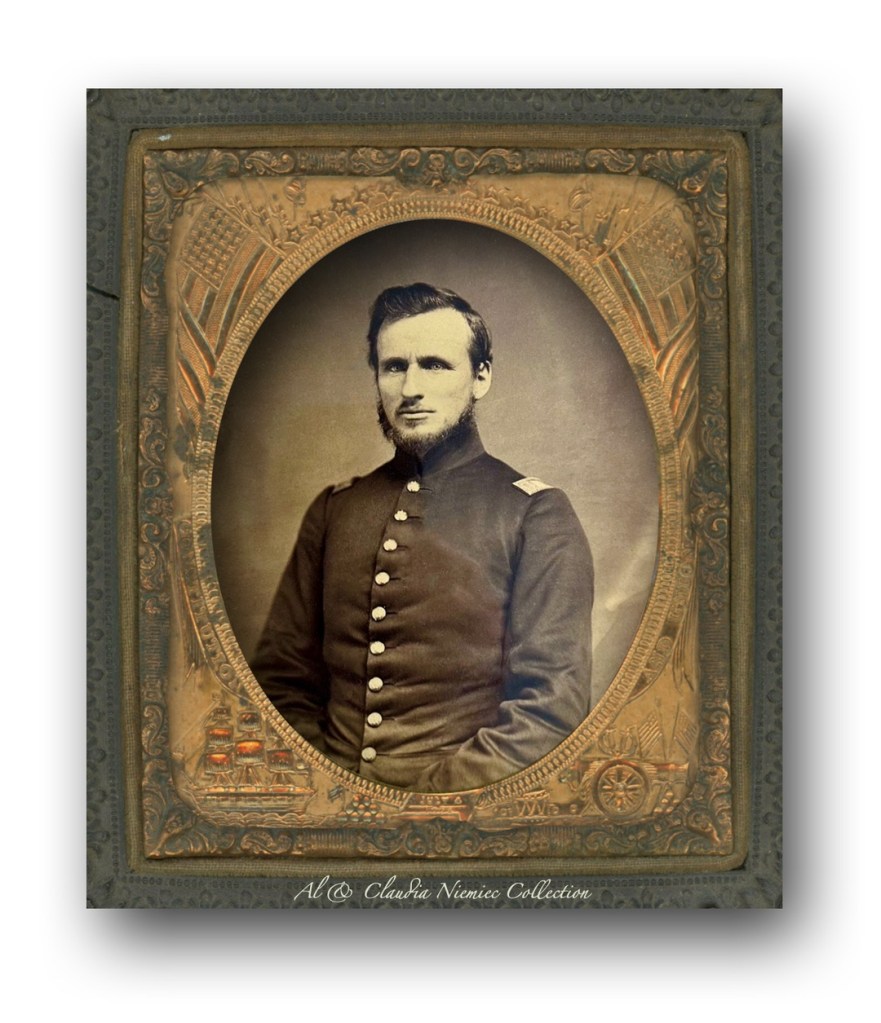
Capt. Elisha Seeley Kelley (1826-1871) of Co. E, 8th Illinois Cavalry. Elisha was a school teacher in Danby (now Glen Ellyn), IL, before the war. He was wounded by pistol shot through his right lung in action at Boonsboro, MD, on 15 September 1862. He recovered from his wound and was promoted to Major of his regiment before resigning on 23 May 1863. [Al & Claudia Niemiec Collection]
M[arcellus] E. Jones, Darwin Dense, Bill Jones, Wm. Freets Jr., Curtis Weidman, A[ugustus] Guio, Oscar Johnson, & [Edwin] Horace Brooks [also joined] so you can see it will make quite a haul out of Danby. The boys have all got to be in camp by 8 o’clock on Wednesday morn. Mary, Judd Templeton keeps the Books at the station now. I have been posting him up in the station business ever since I wrote to you. He seems to learn pretty fast. I go tomorrow so you can direct all of your letters to St Charles, Kane Co, Illinois, until otherwise ordered. I took my Charley horse out the other day & they thought he was very handsome. They have accepted him & Mr. Farnsworth, Colonel of our regiment, says I can ride my own horse.
Mary, I will send you some money for I know would like a little any way. I will send you more next letter so you can have some to come home with when you want to. Mary, I will leave that note of Uncle Jonathan’s in Mother’s hands so you can do what you are a mind to with it. You will remember the interest on it from the time it was due was (or is ) two percent per month. But Mary, if I draw my pay from the Government, I will try to furnish money enough for you to keep yourself & boy in clothes although Father says you need not be alarmed for you nor boy shall ever want for anything. But Mary, I want to find & furnish all your clothing as long as I can & it is time enough for friends to do that afterwards.
Mary, you wanted me to assure you I would refrain from some ______. I can give you my honor, I will try all in my power (& that is some) to do as well as I can. I saw Mattie Butterfield the other day & she told me to have you write to her & she would answer you. Enclosed please find an envelope directed to her with ten dollars in it. I must hurry up as it is about mail time & I want to get this letter in today without fail. Tell her to write to me when you write & I will answer her & give her all the particulars of camp life as far as my experience extends. Kiss Pa’s boy more than 10000000000000 times for I know I would if I could only see him & you both. But Mary, be contented. I will write you soon. Goodbye from your most affectionate husband.
Letter 3
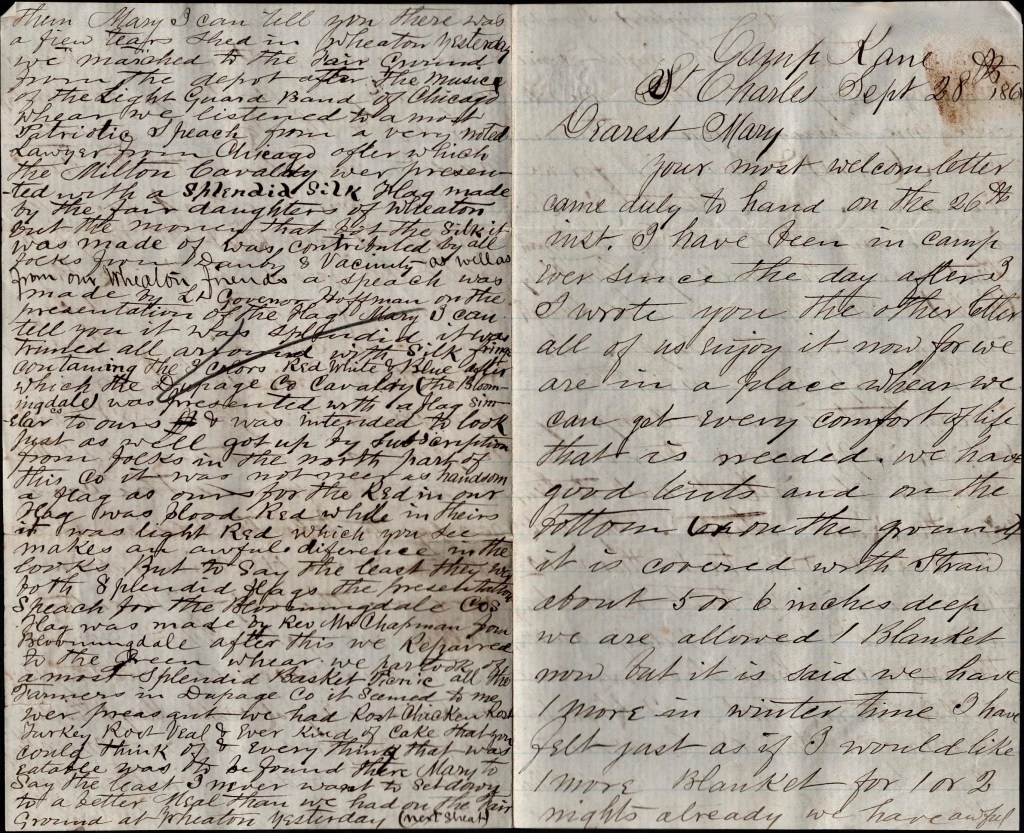
Camp Kane, 1 St Charles [Illinois] September 28th 1861
Dearest Mary,
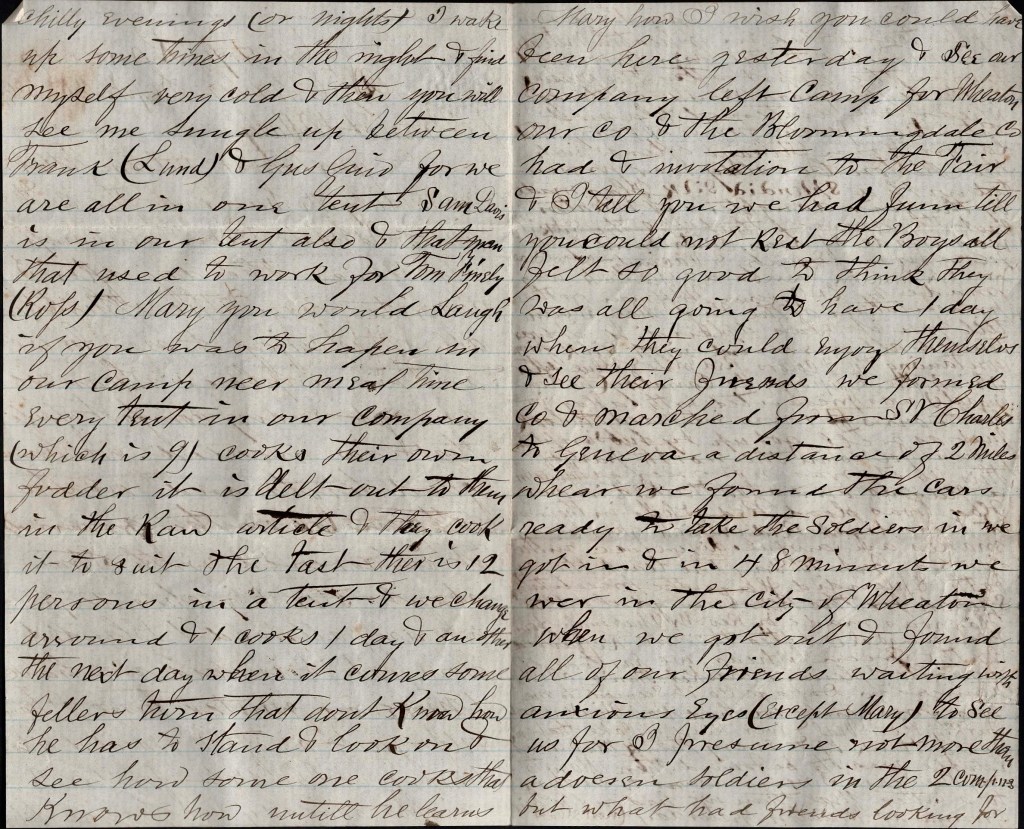
Your most welcome letter came duly to hand on the 26th inst. I have been in camp ever since the day after I wrote you the other letter. All of us enjoy it now for we are in a place where we can get every comfort of life that is needed. We have good tents and on the bottom (on the ground), it is covered with straw about 5 or 6 inches deep. We are allowed 1 blanket now, but it is said we have 1 more in winter time. I have felt just as if I would like 1 more blanket for 1 or 2 nights already we have awful chilly evenings (or nights). I wake up sometimes in the night & find myself very cold. And then you will see me snuggle up between Frank (Lund) & Gus Guio for we are all in one tent, Sam Davis is in our tent also & that man that used to work for Tom Finely (Ross).
Mary, you would laugh if you was to happen in our camp near meal time. Every tent in our company (which is 9) cooks their own fodder. It is dealt out to them in the raw article & they cook it to suit their taste. There is 12 persons in a tent & we change around & 1 cooks 1 day & another the next day. When it comes some feller’s turn that don’t know how, he has to stand & look on & see how some one cooks that knows how until he learns.
Mary, how I wish you could have been here yesterday & seen our company left camp for Wheaton. Our company & the Bloomingdale company had an invitation to the Fair & I tell you, we had fun till you could not rest. The boys all felt so good to think they was all going to have 1 day when they could enjoy themselves & see their friends. We formed company & marched from St. Charles to Geneva, a distance of two miles where we found the cars ready to take the soldiers in. We got in & in 48 minutes we were in the city of Wheaton where we got out & found all of our friends waiting with anxious eyes (except Mary) to see us, for I presume not more than a dozen soldiers in the two companies but what had friends looking for them. Mary, I can tell you there was a few tears shed in Wheaton yesterday. We marched to the Fair Ground from the depot after the music of the Light Guard Band of Chicago where we listened to a most patriotic speech from a very noted lawyer from Chicago, after which the Milton Cavalry were presented with a splendid silk flag made by the fair daughters of Wheaton. But the money that bought the silk it was made of was contributed by all folks from Danby & vicinity, as well as from our Wheaton friends. A speech was made by Lt. Governor Hoffman on the presentation of the flag. Mary, I can tell you it was splendid. Tt was trimmed all around with silk fringe containing three colors—Red, White, & Blue, after which the Dupage Co. Cavalry (the Bloomingdale) was presented with a flag similar to ours & was intended to look just as well, got up by subscription from folks in the north part of this county. It was not near as handsome a flag as ours for the red in our flag was blood red while in theirs, it was light red which you see makes an awful difference in the looks. But to say the least, they are both splendid flags. The presentation speech for the Bloomingdale Co’s flag was made by Rev. Mr. Chapman from Bloomingdale.
After this we repaired to the Green where we partook of a most splendid basket picnic. All the farmers in Dupage county, it seemed to me, were present. We had roast chicken, roast turkey, roast veal, and every kind of cake that you could think of & every kind of cake that you could think of & everything that was eatable was to be found there. Mary, to say the least, I never want to sit down to a better meal than we had on the fairground at Wheaton yesterday (next sheet) [second sheet is missing]
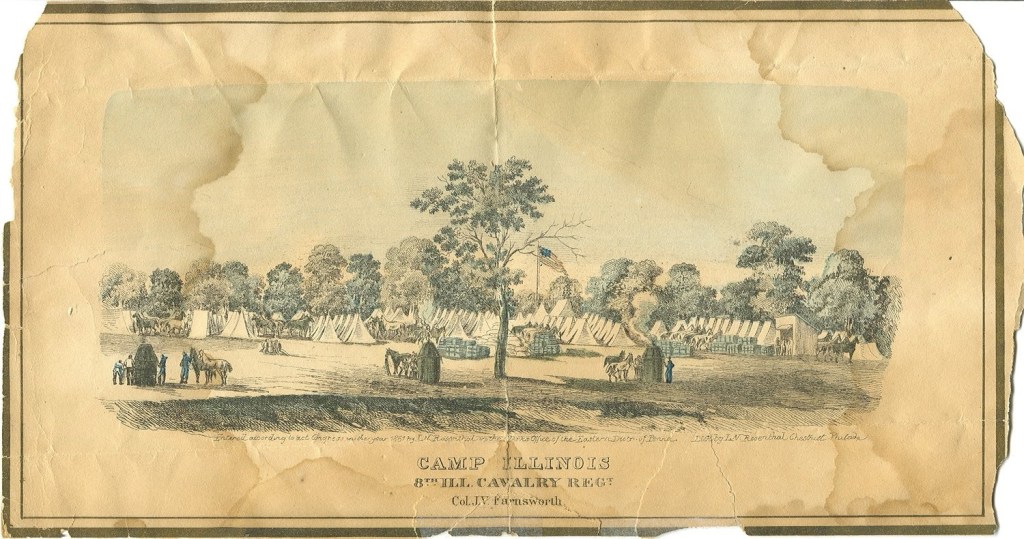
1 “After he start of the Civil War, Congressman and well known abolitionist John F. Farnsworth requested permission from friend, President Lincoln to commission a cavalry regiment and to train them in St. Charles Illinois, on property Farnsworth owned. The commission was approved on August 11, 1861. President Lincoln called the new regiment “Farnsworth’s Big Abolitionist Regiment”. Farnsworth was made Colonel. Colonel Farnsworth was close friends and political allies with Joseph Medill, Chicago Tribune Editor and co-owner. Medill was also an abolitionist and used the Tribune for the cause. Once approval was granted to form the 8th Illinois Cavalry, Medill promoted recruiting in the Tribune. By August 20, 1861 the first company of the 8th Illinois Cavalry was formed and most the members of that company were employees of the Chicago Tribune including William Medill, Joseph’s brother. Camp Kane officially opened for training on September 18, 1861 with 1,164 men who mustered in. It was the only Civil War Training Camp in Kane County. It first became home to the 8th Illinois Cavalry and later the 17th Illinois Cavalry.” Source: Camp Kane.
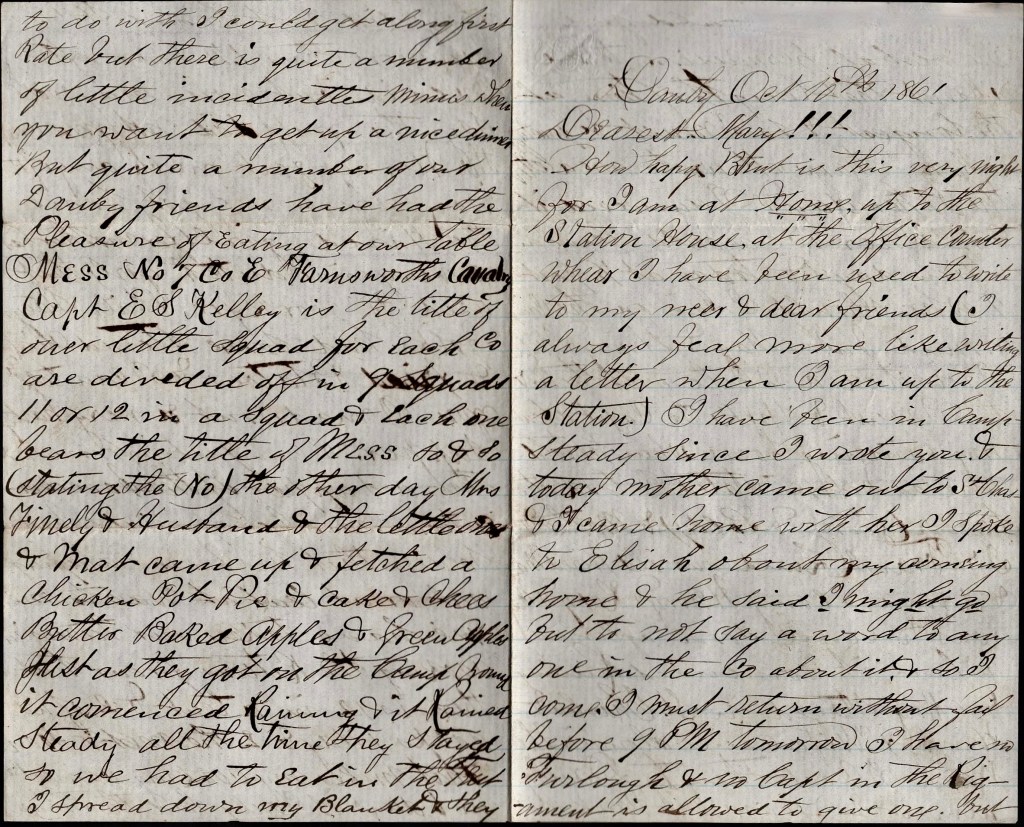
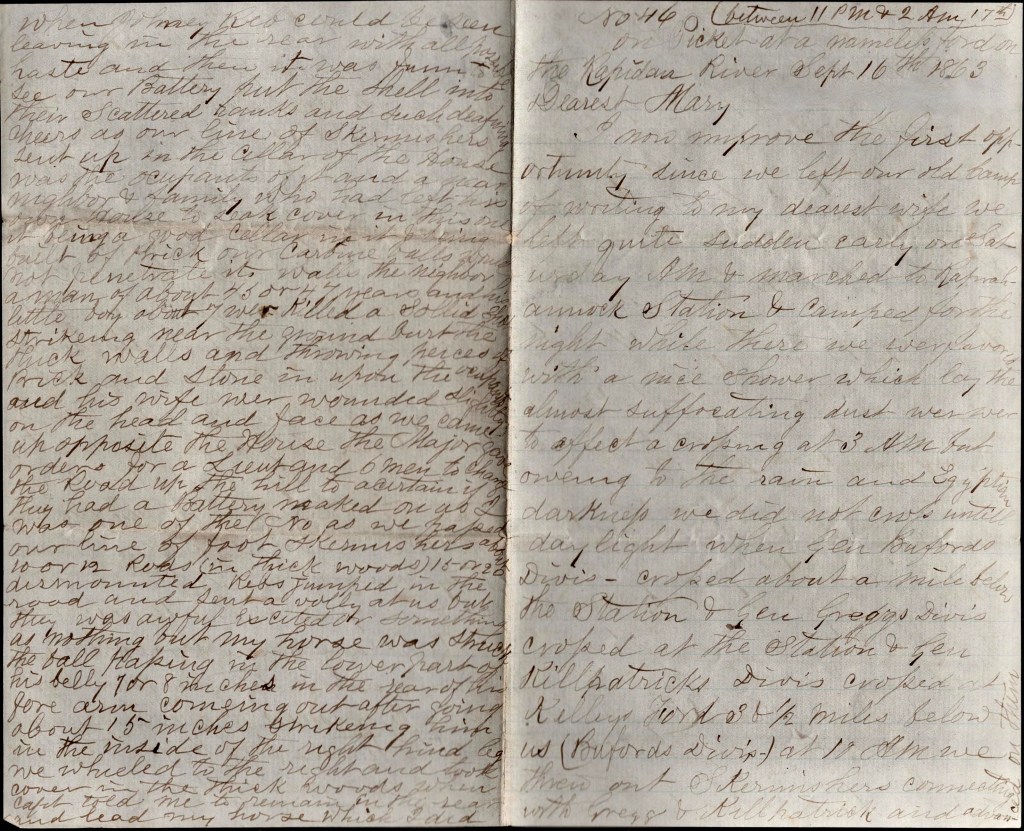
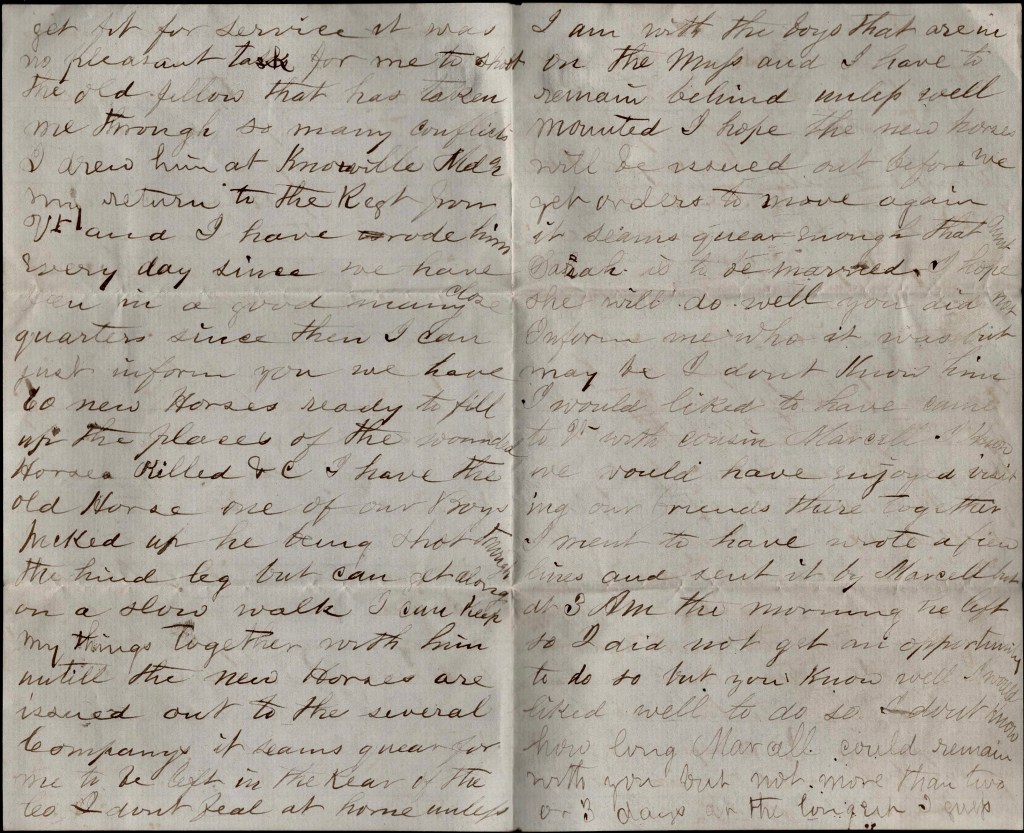
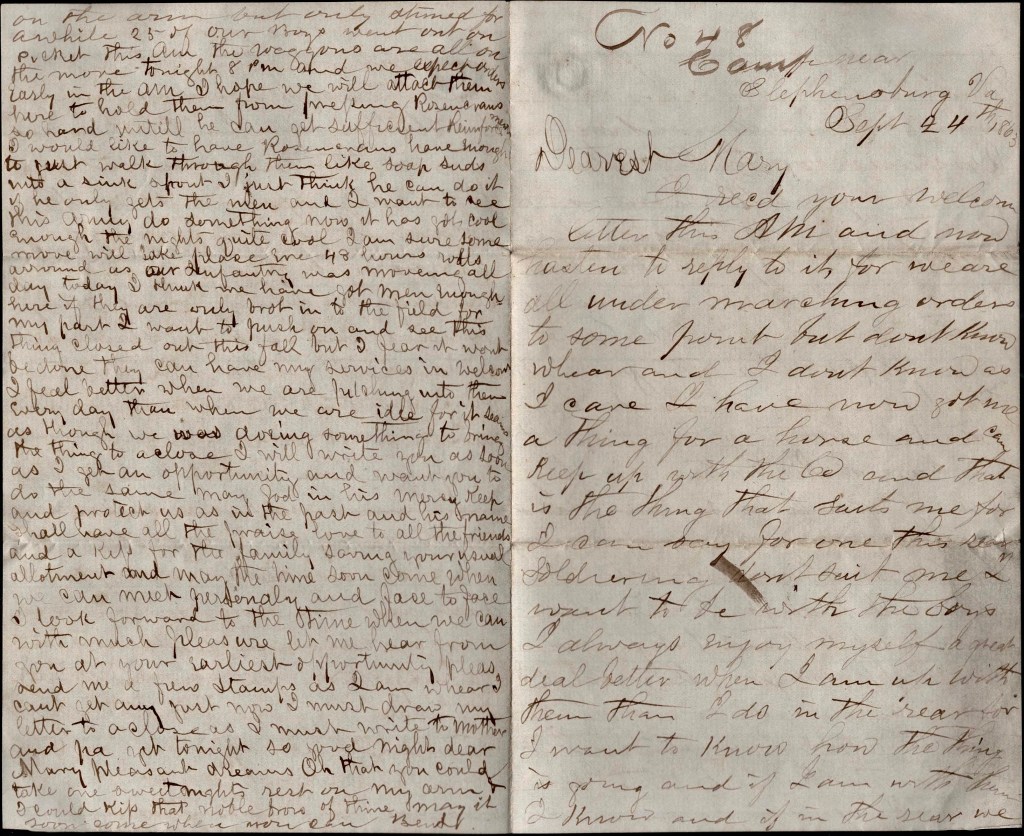
How happy Bent is this very night for I am at home, up to the Station House, at the office counter where I have been used to write to my near & dear friends (I always feel more like writing a letter when I am up to the Station). I have been in camp steady since I wrote you & today mother came out to St. Charles & I came home with her. I spoke to Elisha about my coming home & he said I might go but to not say a word to anyone in the company about it & so I come. I must return without fail before 9 p.m. tomorrow. I have no furlough & no Capt in the regiment is allowed to give one but Elisha said he would give me verbal permission to be absent that length of time at the longest & so I must be punctual.
Mary, Margaret wrote me a letter the other day & I answered it & told her we would leave in a few days & today at ½ past 1, who should I see on the camp ground but Mag & Henry & Wife. I visited a while with them & then I went & spoke to Captain about my coming home when he told me as before stated. I took the team (George & Polly) & Mother & I & Frank Lund—our old hired man—& drove along. Henry & Roxy & Mag was to come soon after us when it commenced raining & Mag stayed in St. Charles, and Henry & Wife came along in the rain. I beat them to Danby—almost 2 hours, but Hank said they did not leave St. Charles for more than 1½ hour after we did. But you may well say the grass did not grow under the horses feet much any of the way. When we got home, the hired girl (for mother has a very nice dutch girl) that used to work for Philo Stacy’s folks had some stewed chickens & fried potatoes & I can tell you, I made out a very hearty supper. I can just inform you that a supper of the above dimensions can be appreciated by a Soldier that has been camping out, or at least it was to me.
Cyrus Harrison Crook of Co. B. 8th Illinois Cavalry
We have taken our turns in cooking the rations for our tent. There is 12 in a tent & 2 of us cooks 1 day & 2 the next & so on. That makes my cooking come once in 6 days. If I only had the things to do with, I could get along first rate, but there is quite a number of little incidents minus when you want to get up a nice dinner. But quite a number of our Danby friends have had the pleasure of eating at our table, Mess No. 7, Co E, Farnsworth’s Cavalry, Capt E. S. Kelly is the title of our little squad, for each company are divided off in squads, 11 or 12 in a squad & each one bears the title of Mess so & so (stating the number). The other day Mrs. Finely & husband & the little one & Mat came up & fetched a chicken pot pie & cakes & cheese, butter, baked apples & green apples. Just as they got on the camp ground, it commenced raining & it rained steady all the time they stayed, so we had to eat in the tent. I spread down my blankets & they spread the victuals on it. Now I can just inform you, if ever a meal of victuals ever tasted good, it was on that memorable day for I can tell you I enjoyed it, [even] if it did rain.
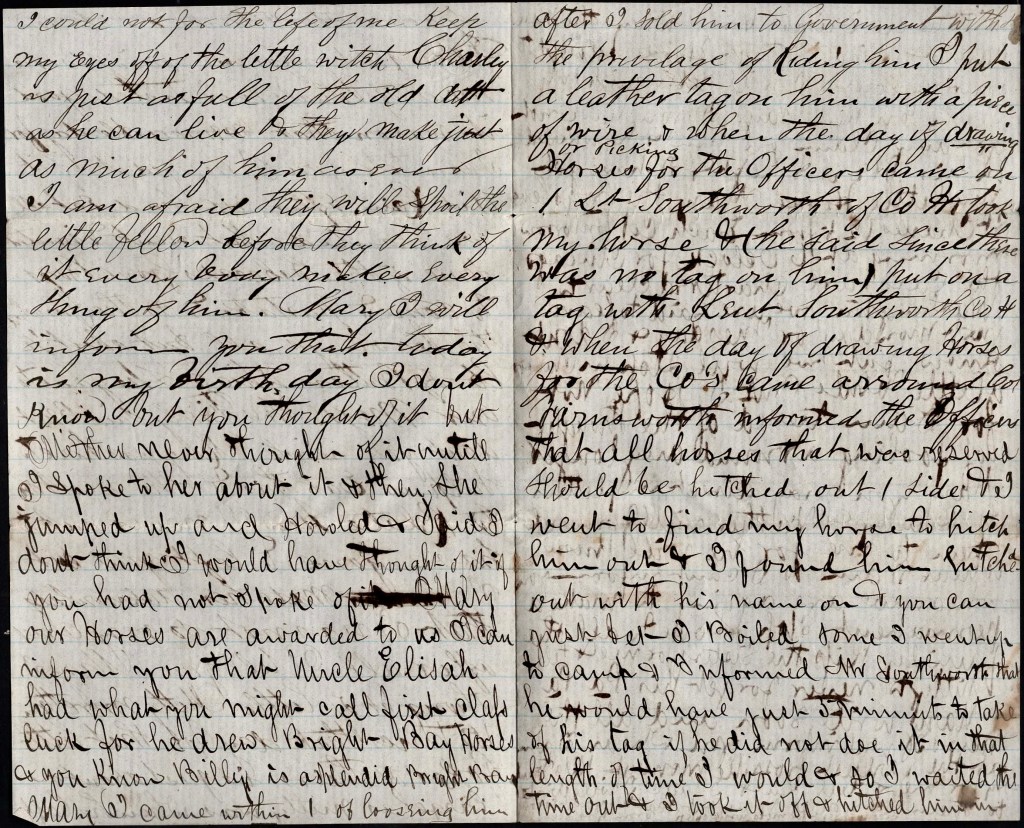
After we had eat all we wanted, Mat went & invited some of the Babcock’s Grove Boys to come & partake & so they finished the leavings—all but about half a pound of butter which she gave to our mess. Mrs Finely said, “Bent, don’t you wish Mary was here to help us eat this?” & she went on to relate how I never ought to have gone & left you. But I made her acknowledge that I was not so very cruel after all. I tell you, Mary, I thought of little Mitty more than 100 times that day for that little joker of theirs is just about as large as Mitty was when he left. I could not for the life of me keep my eyes off of the little witch. Charley is just as full of the old cat as he can live & they make just as much of him as ever. I am afraid they will spoil the little fellow before they think of it. Everybody makes everything of him.
Mary, I will inform you that today is my birthday. I don’t know but you thought of it, but Mother never thought of it until I spoke to her about it & then she jumped up and howled & said I don’t think I would have thought of it if you had not spoke of it. Mary, our horses are awarded to us. I can inform you that Uncle Elisha had what you might call first class luck for he drew bright bay horses & you know Billy is a splendid bright bay. Mary, I came within 1 [inch] of losing him. After I sold him to the government with the privilege of riding him, I put a leather tag on him with a piece of wire & when the day of drawing horses or picking for the officers came on, 1st Lt. Southworth of Co. H took my horse & (he said since there was no tag on him) put on a tag with Lieut. Southworth, Co H, & when the day of drawing horses for the companies came around, Col. Farnsworth informed the officers that all horses that were reserved should be hitched out [to] one side, & I went to find my horse to hitch him out & I found him hitched out with his name on & you can just bet I boiled some. I went up to camp & I informed Mr. Southworth that he would have just 5 minutes to take off his tag if he did not do it in that length of time, I would. And so I waited the time out & I took it off & hitched him in with Uncle Elisha’s horses. When the man came & said if that horse belongs to you, of course I will relinquish my claim on him. Says I, you have not got any claim on him, & he whirled on his heel & left, & I have got my horse.
Mary, the boys leave St. Charles (2 from each company) tomorrow morning at 6 o’clock for Chicago. The cars are chartered clear to Washington. We are said to leave next Monday or Tuesday & I don’t know but we will stop in Chicago a little while. But I hope not for I am tired of the thought of fooling around any longer. Mary, you may direct my letters to Danby & Father will forward them to me for he will know where I am & I can’t inform you where we are going to make a permanent stop.
Love to all the family. Kiss the sisters for me & tell Mitty to never forget his Pa Pa. Mary, write soon and all the news. I will inform you where I am at the earliest possible moment. Kiss Franky for me & tell Lu & Isaac I will write to them as soon as I can but I can tell you it is some inconvenient for me to write often. From your loving, — Bent
Letter 5
Editor’s Note: This letter was penned by David “Martin” Kelley (1837-1862), the brother of Thomas Benton Kelley. Martin was married in February 1858 to Annette Sims (18xx-1908) at Danby (now Glen Ellyn), Illinois. Their son Albert M. Kelley (1861-1937) was born on 23 June 1861. The letter pertains to Martin and Bent’s oldest brother, Isaac Dixon Kelley (1833-1871), who was apparently seriously ill at the time (October 1861). Ironically David died in 1862 and Isaac survived his illness only to be murdered in 1871.
Como Station Empire PO Whiteside, Illinois October 13th 1861
Dear Sister Mary,
Having just received a letter from Benton and it containing some news of a painful character, I hasten to drop a few lines to you as he stated that brother Isaac was quite low (that is) troubled with internal difficulties that might result seriously. It is very bad when friends are sick at home but when not among their immediate friends or not having plenty of means, they are not sometimes cared for in the manner that they should be. But if it is the difficulty that Benton wrote, I am afraid he is past recovery. I am sorry to say that I am unable to render him any aid as far as dollars & cents are concerned at the present time. Benton said he had written to Father for money. I sincerely hope he will arouse at this late hour and render him all the required assistance.
First Annetta has been sick with a fever a good part of the summer that she has not been able to do much and about the first of the month I was sick myself for about a week and my doctor bills, house rent, & [fire] wood has called over $40 out of my pocket within the last few days which leaves me so I would not be able to send him any unless I should borrow it. But Father can send him money and I hope he will do it and that immediately. When you receive this you, will confer a great favor by writing to me and give me all the particulars possible and the prospects of the way his disease may turn. I was glad to hear Benton had sent him $15. I should have sent him some had I known he was sick yet. But I had not heard from him for a long time till Bentons letter yesterday.
You will tell him to not blame me for not writing to him but every day has brought its cares and having so much sickness in my own, I have neglected writing to him when I should have done it. Should he not get any money from Father, let me know and I think my name will be good to borrow and send him, for it is when a person is sick that they need and if ever they do.
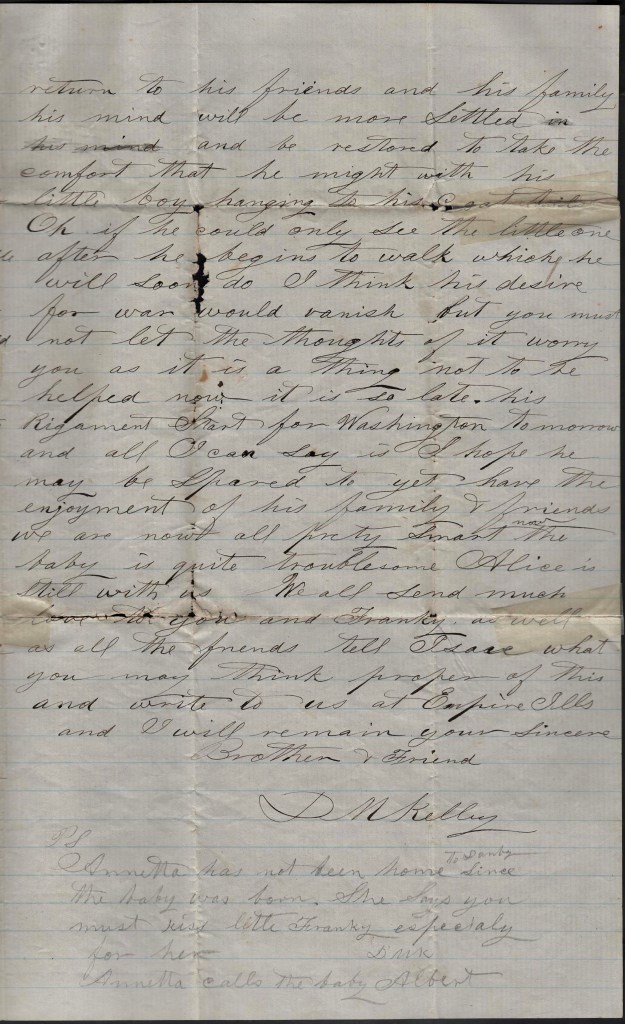
Now, dear Sister, a few words to you. I suppose you are weighed down with grief at the thought of Benton’s going to war, but I suppose that we cannot any of us help or hinder him. I went and saw him and gave him what instructions and encouragement as I could and I sincerely hope that should he be lucky enough to return to friends and his family. His mind will be more settled and be restored to take the comfort that he might with his little boy hanging to his coat tails. Oh, if he could only see the little one after he begins to walk which he will soon do, I think his desire for war would vanish. But you must not let the thoughts of it worry you as it is a thing not to be helped now. It is too late. His regiment starts for Washington tomorrow and all I can say is I hope he may be spared to yet have the enjoyment of his family & friends. We are now all pretty smart now. The baby is quite troublesome. Alice is still with us. We all send much love to you and Franky as well as all the friends. Tell Isaac what you may think proper of this and write to us at Empire, Illinois, and I will remain your sincere brother & friend, — D. M. Kelley
P. S. Annette has not been home to Danby since the baby was born. She says you must kiss little Franky especially for her. Annetta calls the baby Albert. — D. M. K.
Letter 6
Washington D. C. [Late] November 1861
Dearest Mary,
This is the 4th attempt since I wrote you the last letter that I have made to write again and I had to go & l00k up a board to put on my knee to pen these lines. I have sat down three times before to write & the corporal of our tent would come & want something done & I would have to get up & do it & by the time I would get that done, something else would turn up. But this morning I made up my mind I would not quit for anyone for it was my day for regular guard & I could write when I was off duty & I have commenced again. But I can just inform you that the soldiers in this camp don’t have any time to fool away for there is something that needs doing all the time. It is just 3 times the labor for cavalry companies to do their work that it is for infantry for they have their horses to take care of & I tell you, it has to be done up in style too.
Charles Augustus Baker of Co. B, 8th Illinois Cavalry (1863)
I never seen what a change has come over this regiment since we left St. Charles. Comparatively speaking, we was not soldiers at all when we were in St. Charles. An order was issued from the Colonel yesterday that any private or non-commissioned officer absent from roll call at 5:30 a.m., 9 a.m., 1 p.m., 6 p.m., or 9 p.m. twice after that date should be courtmartialed. There has been four in our company absent once since the order came out. The next offense does the thing up in a rag. We drill two hours in the a.m. & four in the afternoon & about every other day we have dress parades or battalion drill which I can inform you is quite fatiguing. When we come to drill four hours without stopping to rest more than 15 minutes in the whole time, it makes my legs ache just like the toothache.
We went through another inspection day before yesterday by the commander of all the cavalry that is in Washington. Not one of the men in the whole regiment was rejected, but some of them expected to be. Clark Corbet thought he would be on account of his arm. It was broken when he was a small boy & was not set right so he can’t turn it clear round. But he passed muster. They made all the soldiers unbutton their jackets & throw their chests out & tried them in many other ways. If their shirts was not clean, he would tell them so. But I happened to have on a clean one. It comes a little unhandy for me to wash & mend my shirts & drawers & stockings. My stockings wear out the fastest of any of my clothes for we are drilling so much that it wears them out fast & I can’t get any yarn that is fit for anything either to darn them with. How I wish I could get 3 or 4 pair of stockings made of the Vermont wool now. I guess that would not suit me much. I wish I could find some way to get them, but I don’t know how I can. Our other clothes are very good & comfortable & warm we got our over coats—or rather cloaks—for they are dark blue with capes on them minus pockets. They are neat. I like them first rate. They are going to be almost an article that is indispensable this cold weather for the nights are awful cold & we don’t get but a little straw to lay on for it can’t be got in Washington.
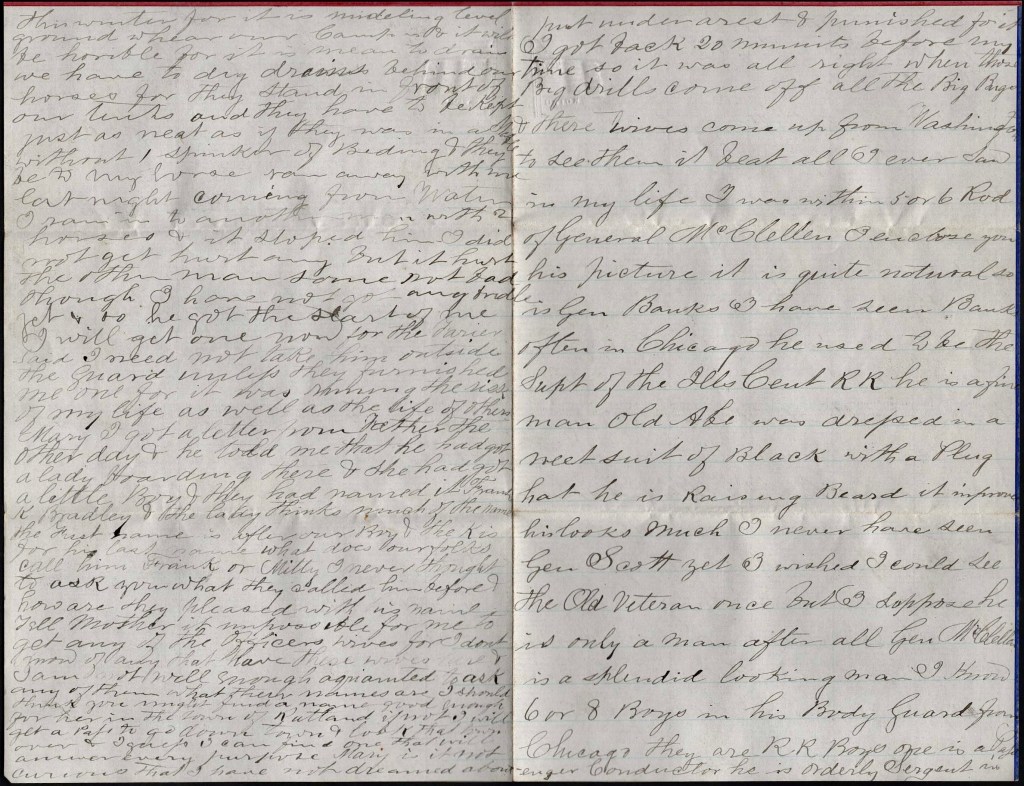
Last week we were out on drill & they had a Brigade drill of infantry accompanied by light artillery. Gen. McClellan & McDowell & many others of great note were present. It was the grandest military spectacle I ever saw. Old Abe was there. Also one or two regiments that was at the Battle of Bull Run. I happened to be on guard that day & when I was off duty, I went to the Officer of the Guard & had him pass me out to go with the Boys to drill so I pretended & I went over where they were having this Brigade Drill. It happened pretty lucky for me I was on guard that day or I never could have seen it. The guard stand 2 hours on & 4 off for 24 hours, & when we are off duty the 4 hours, if we are promptly on hand 15 minutes before the time comes for to go on again, it is all on the square. If not, you will be put under arrest & punished for it. I got back 20 minutes before my time so it was all right.
The Grand Review of the Army of the Potomac was held at Bailey’s Crossroads, Virginia, in eastern Fairfax County on 20 November 1861. Among those in attendance was President Abraham Lincoln. (Harper’s Weekly)
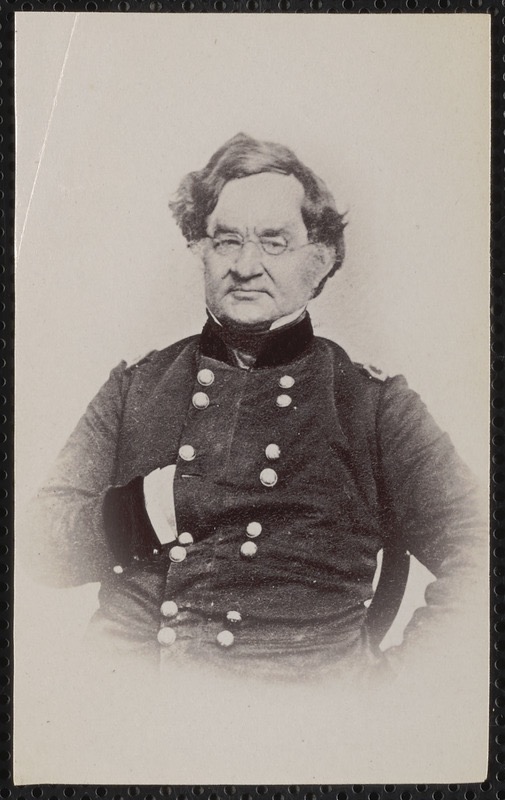
When those big drills come off, all the Big Bugs & their wives come up from Washington to see them. It beats all I ever saw in my life. I was within 5 or 6 rod [@ 30 yards] of General McClellan. I enclose you his picture. It is quite natural. So is Gen. Banks. I have seen Banks often in Chicago. He used to be the Supt. of the Illinois Central Railroad. He is a fine man. Old Abe was dressed in a neat suit of black with a plug hat. He is raising beard. It improves his looks much. I never have seen Gen. Scott yet. I wished I could see the Old Veteran once but I suppose he is only a man after all. Gen. McClellan is a splendid looking man. I know 6 or 8 boys in his bodyguard from Chicago. They are RR boys. One is a passenger conductor. He is orderly sergeant in one of the companies. I had just left the field where they was drilling the other day when I saw McClellan & the rest. I was strolling along afoot & this conductor spoke up & says, “Kelley How are you?” I looked around & I saw who it was that spoke & I did not recognize him the first time that I looked, & I went up towards him & says I, “Is this George Gardner?” and he said it was. He has left his beard [&] mustache grow so it covers his face all up. He was in Western Virginia with McClellan in Barker’s Dragoons at the time Mac got his name up for Mac distinguished himself as a military man since this rebellion broke out in Virginia.
He—this conductor—told me to get a pass from our colonel & come over to his camp some day & he could get a pass from Mac that would take us anyplace in & around this place or any other place. He used to know Mac in Chicago for Mac used to be in the railroad business there & he says he is not afraid to ask a favor of him. I am going to try it someday when I can get away just as well as not but don’t know when that time will come. I have not had the pleasure of seeing it since I have been here for it is fix this & fix that, & do this & do that the whole of the time. I get tired of it. It seems as though we were never going to get regulated in camp in the world but it has been awful muddy all the time since we have been here. It is mud & rain, they say, here all winter instead of snow. If so, I tell you it is going to be awful this winter for it is middling level ground where our camp is & it will be horrible for it is mean to drain. We have to dig drains behind our horses for they stand in front of our tents and they have to be kept just as neat as if they was in a stable without 1 sprinkle of bedding & they be. My horse ran away with me last night coming from water. I ran into another man with two horses & it stopped him. I did not get hurt any but it hurt the other man some—not bad though. I have not got any bridle yet so he got the start of me. I will get one now for the farrier said I need not take him outside the guard unless they furnished me one for it was running the risk of my life as well as the life of others.
Mary I got a letter from Father the other day & he told me that he had got a lady boarding there & she had got a little boy & they had named it Frank K. Bradley & the lady thinks much of the name. The first name is after our boy & the K is for his last name. What does our folks call him? Frank or Mitty? I never thought to ask you what they called him before & how are they pleased with his name? Tell Mother it impossible for me to get any of the officer’s wives for I don’t know of any that have their wives here & I am not well enough acquainted to ask any of them what their names are. I should think you might find a name good enough for her in the town of Rutland. If not, I will get a pass to go down town & look that town over & I guess I can find one that will answer every purpose. Mary, is it not curious that I have not dreamed about you since I have been here & [yet] you are continually on my mind—you & the boy. Oh, how I wish I could see you both. But dearest Mary, that cannot be done very soon I think. But we must not let our correspondence grow cold, for Mary it does me more good to receive a letter from you than all the rest of my friends put together. Mary, do write to me every time you can get a spare moment for you have more spare time than I have. I have to steal all the time I use for this business unless I take someday that I am on guard (as today). If I set down a single moment in the tent, some one of the non-commissioned officers come along & want someone to bring hay, oats, water, or straw, or dig drains, or some extra labor of some kind, & a person has to get up & toddle at their say so as much as they would if one of the commissioned officers called on them.
I have devoted the most of my time helping Uncle Elisha fix his tent so it would be comfortable for him these cold nights for it is awful cold weather nights. The days are mild for this season of the year, but the nights are shocking cold. Oh, Mitty, would I not like to have you lay on my arm once more. How many times I think of it when I get my blanket spread out for the night, how you & Bent used to get in bed together & how you used to think you could not go to sleep unless you laid on my arm. Mary, how do you get along without your good night kiss? I wish I could give you one more. God spare my life to bring me to your welcome bosom. Mary, I have not had as good a night’s rest in the whole three months you have been gone as I did in one week when you was in bed with me & I don’t think I would have a decent night’s rest if I was away the whole three years. I never have shut my eyes to rest a single night since I have been in the service without thinking of my dear Mary & boy. Mary, it would be good for me to have the pleasure of being in your dear society. Sometimes I think I would give all I had in the world if I could see you & talk with you for just 5 minutes. But Mary, I just think that would be only an aggravation for we would have no time at all in 5 minutes, would we Mary? But dear girl, be of good cheer, & try all you can to enjoy life and the society of your friends all you can, for dear girl, I don’t want to think that you are in as limited sphere of life that I am, for I am wholly & totally to the say of others. While you are your own mistress.
Mary, just enjoy yourself in every way, shape, & manner possible for you so to do, for Mary, I know you would say the same if you was situated the same as I am. Mary, you wished to know if you would be allowed to visit me if I was sick. I am sure you would, but Mary, my health is on the gain. I begin to feel in good health & spirits. We are getting better rations than we used to get & we have got a colored cook that cooks for the whole company. He is a very good cook & I have got so I can eat his victuals first rate & I am sure to be around when it comes meal time for we are marched to the table the same as we are out to drill. There is 9 tents in our company & there is 9 corporals, so there is a corporal in every tent. He is boss of all hands. Our little corporal is from Wheaton. He has got the idea in his head that he was cut out for a Capt. or a Lt. or some other great military officer, but if [he] has the best kind of luck, he never will get up as far as that unless he alters his gait for he is of too much importance for the office he now holds. If I had enlisted at the time I wrote to you first about it & not waited for an answer from you, I would have got some little Sh____ office, but it is just as well after all for they don’t amount to a row of pins any way.
You can fix it. I will be just as well off in the long run but some folks look at it if a person holds a little petty office in a company, he is nearly hell, but I am convinced there is a slight mistake in the print about it. I know I feel just as well in my position as I would if I had theirs. Uncle tells me he will let me have something of the kind as soon as the table turns round to it for Capt says some of those fellers won’t come up to the scratch & he won’t have anyone in the company unless they do. But to say the least of it, I am bound to be contented with the position I now occupy & if any other one throws itself in my way, I will take it. But I don’t think it would elevate my stern end as much as it does some of the others.
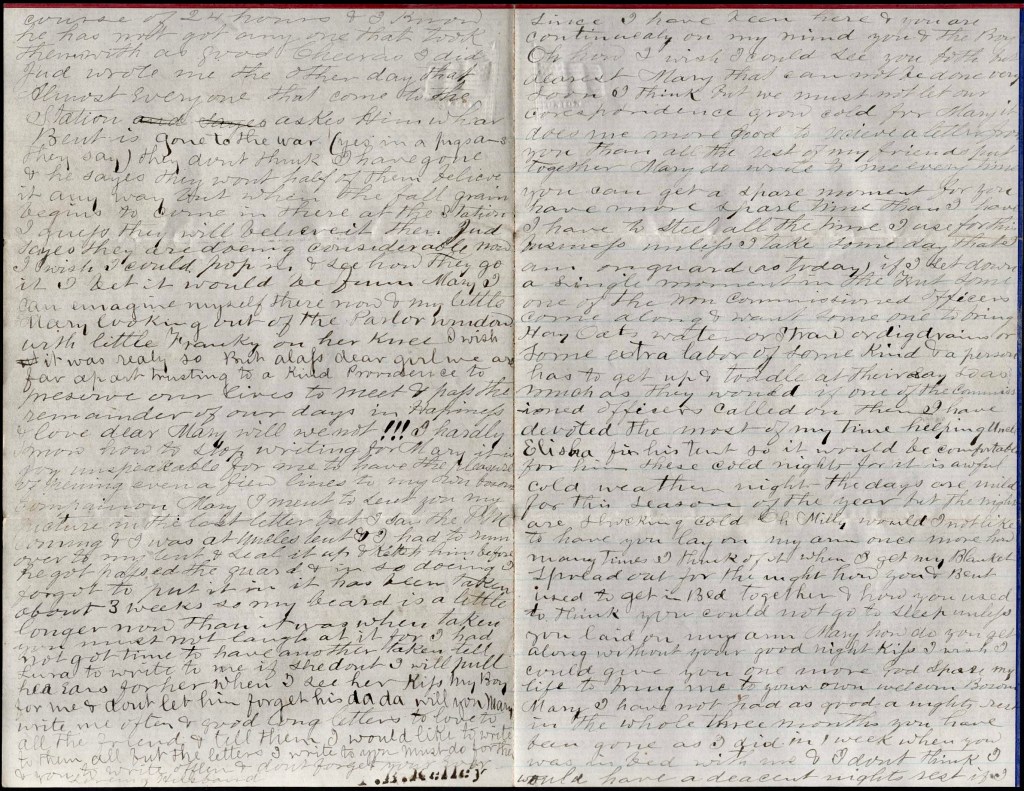
Mary, Father says Mother & him & the cat constitute his family circle. He says he has the blues the tallest kind once in a while. He says he misses Bent more than he thought he would & I guess he don’t lie a word when he says it either for Mary you know many times I was left entirely alone to tend house & Station & all & it was done up in as good style as it would have been done if he had been there himself & took a good many extra steps for him in the course of 24 hours. And I know he has not got anyone that took them with as good cheer as I did. Judd wrote me the other day that almost everyone that come to the Station asks him where Bent is gone to the war (yes in a pigs ass, they say). They don’t think I have gone & he says they wont half of them believe it anyway. But when the fall grain begins to come in there at the Station, I guess they will believe it then. Judd says they are doing considerable now. I wish I could pop in & see how they go it. I bet it would be fun. Mary, I can imagine myself there now & my little Mary looking out of the parlor window with little Franky on her knee. I wish it was really so. But alas, dear girl, we are far apart trusting to a kind Providence to preserve our lives to meet & pass the remainder of our days in happiness & love. Dear Mary, will we not!!!
I hardly know how to stop writing for Mary it is joy unspeakable for me to have the pleasure of penning even a few lines to my own bosom companion. Mary, I meant to send you my picture in the last letter but I saw the postmaster coming & I was at Uncle’s tent & I had to run over to my tent & seal it up & catch him before he got past the guard & in so doing, I forgot to put it in. It has been taken about 3 weeks so my beard is a little longer now than it was when taken. You must not laugh at it for I had not got time to have another taken. Tell Lura to write to me. If she don’t, I will pull her ears for her when I see her. Kiss my boy for me & don’t let him forget his da da, will you. Mary, write me often & good long letters to love to all the friend & tell them I would like to write to them all but the letters I write to you must do for them & you to write often & don’t forget your ever loving husband — B. Kelley
Letter 7
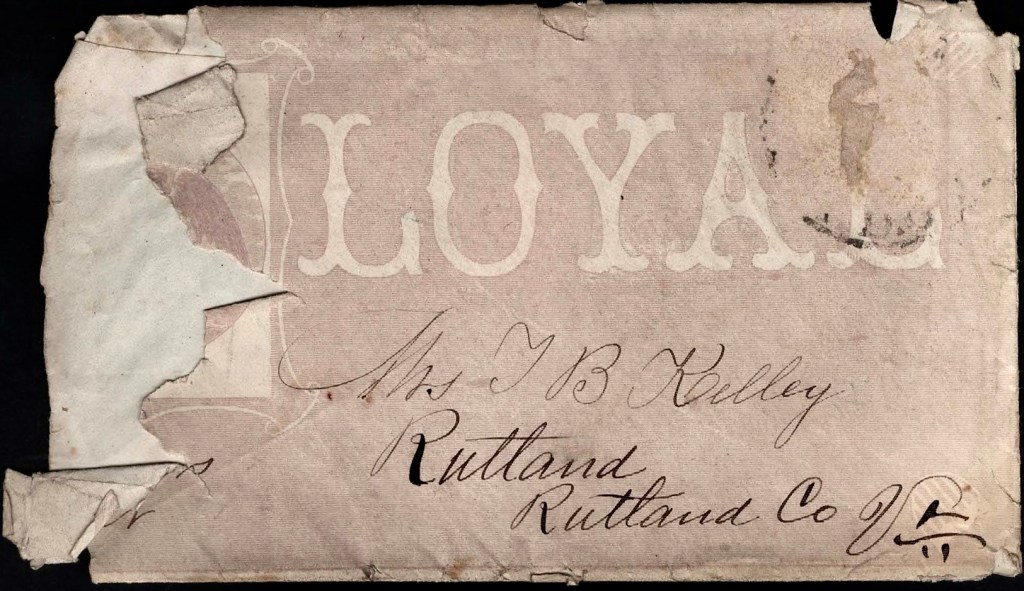
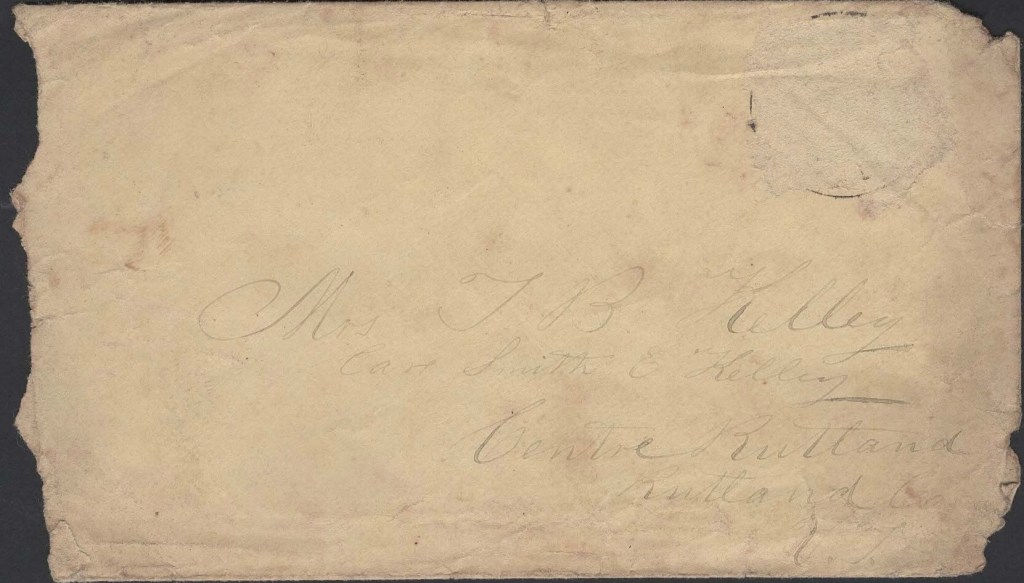
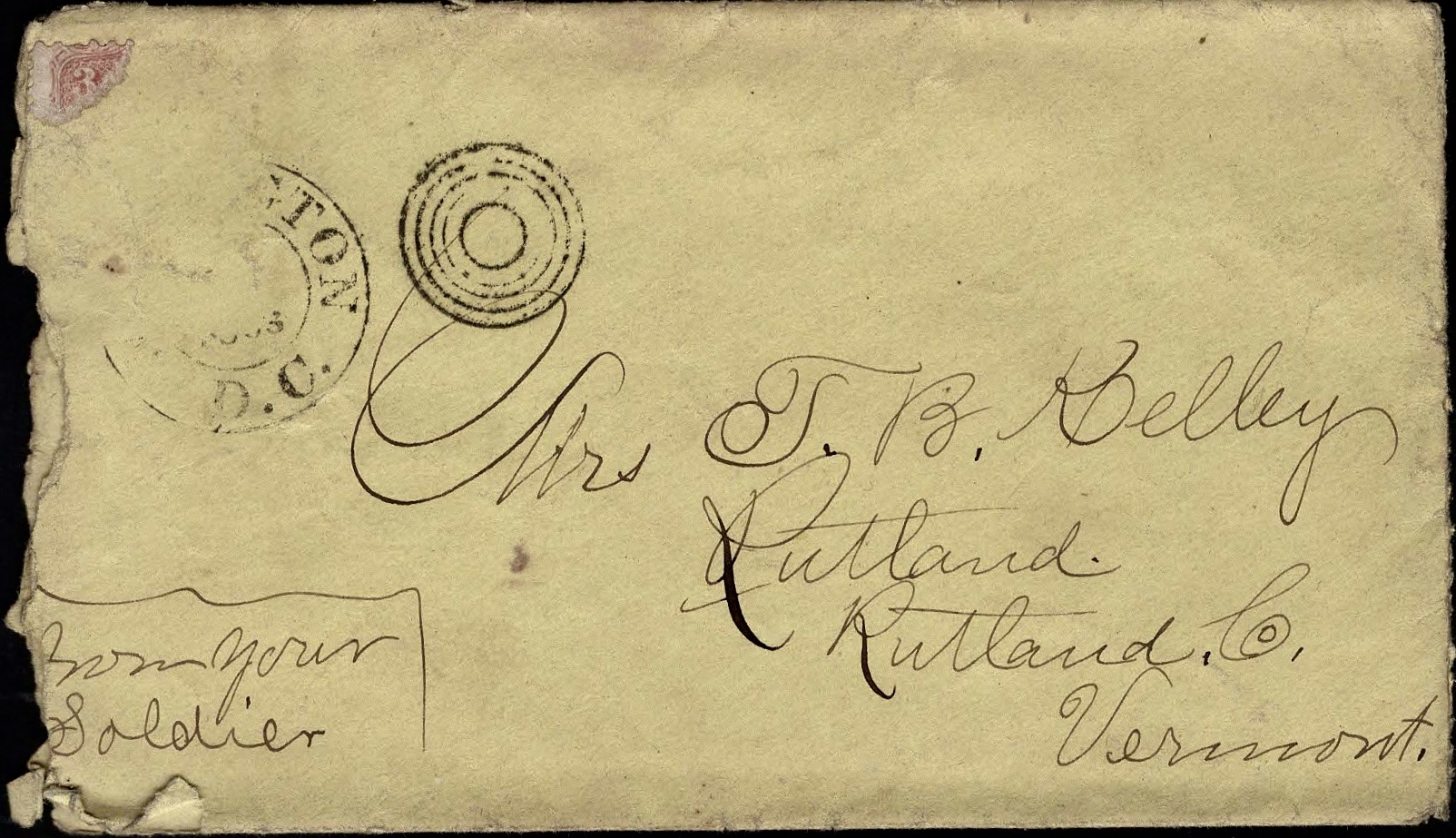
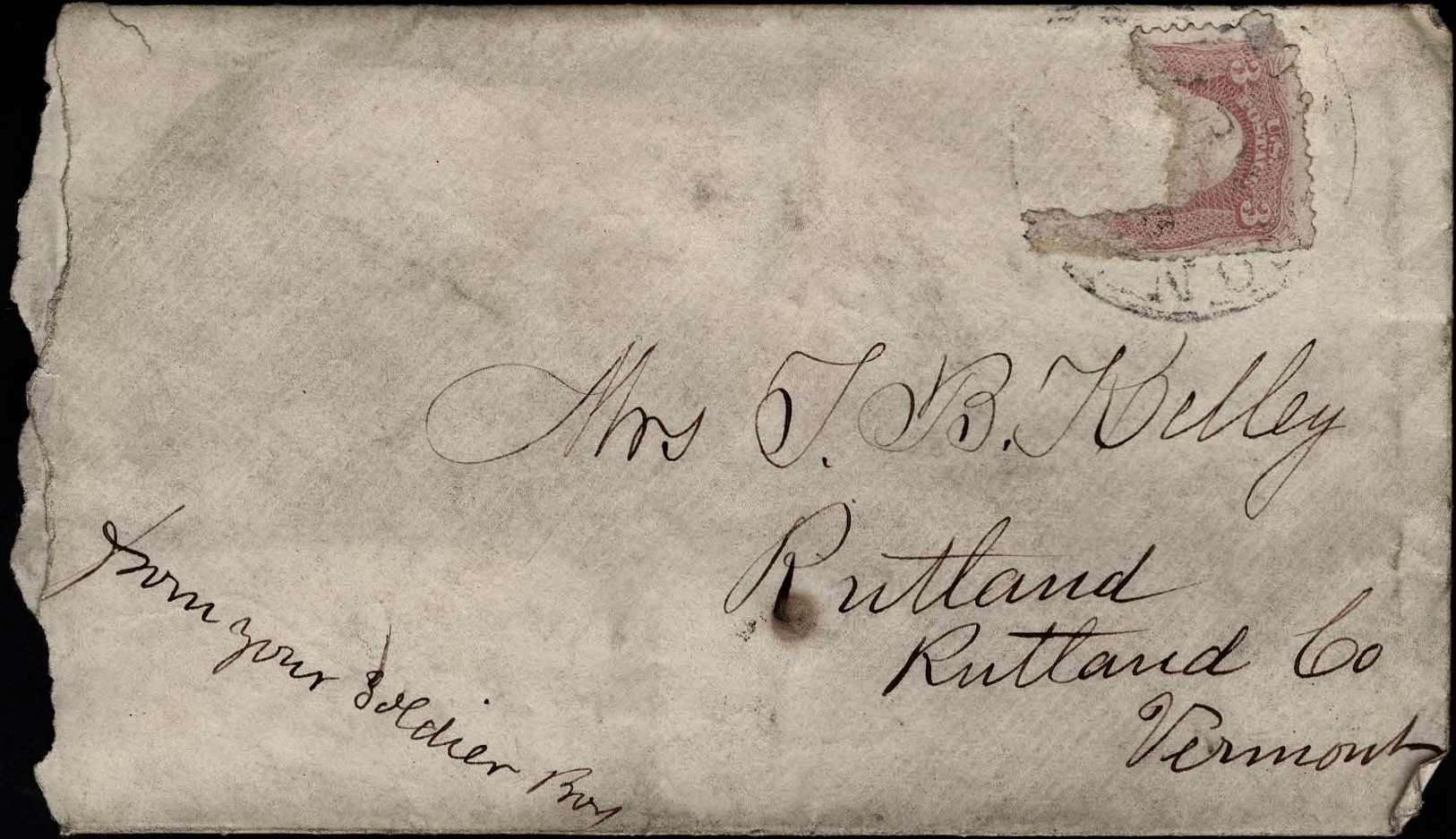
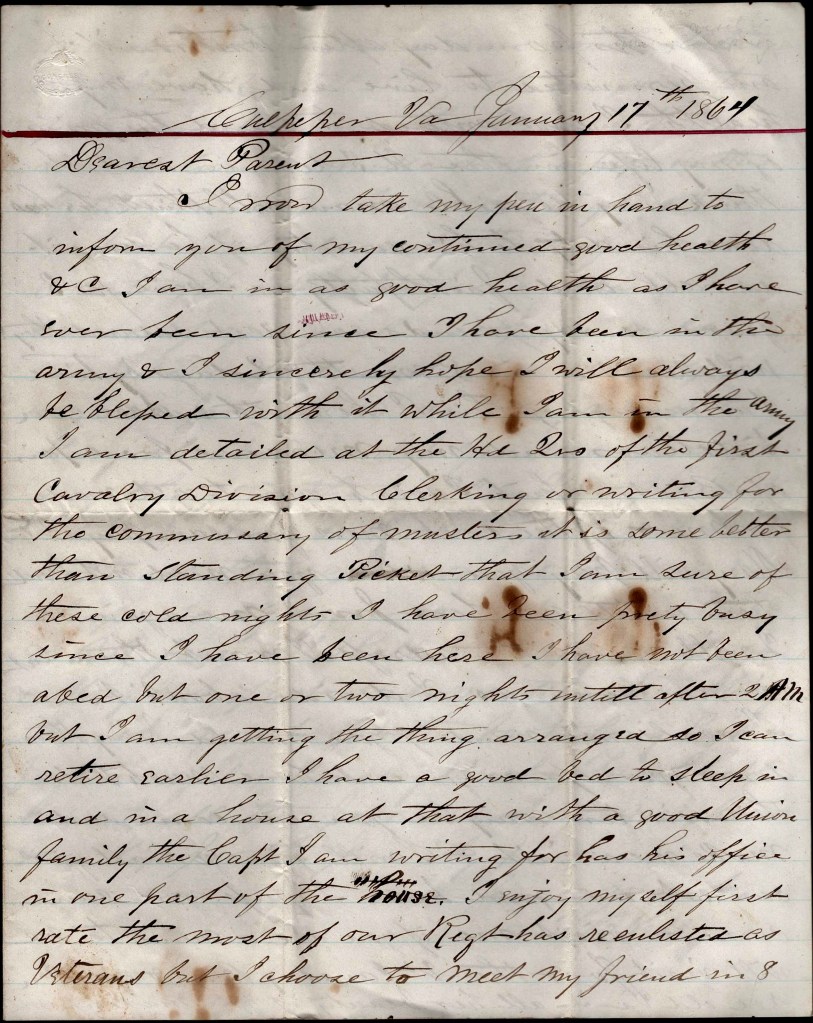
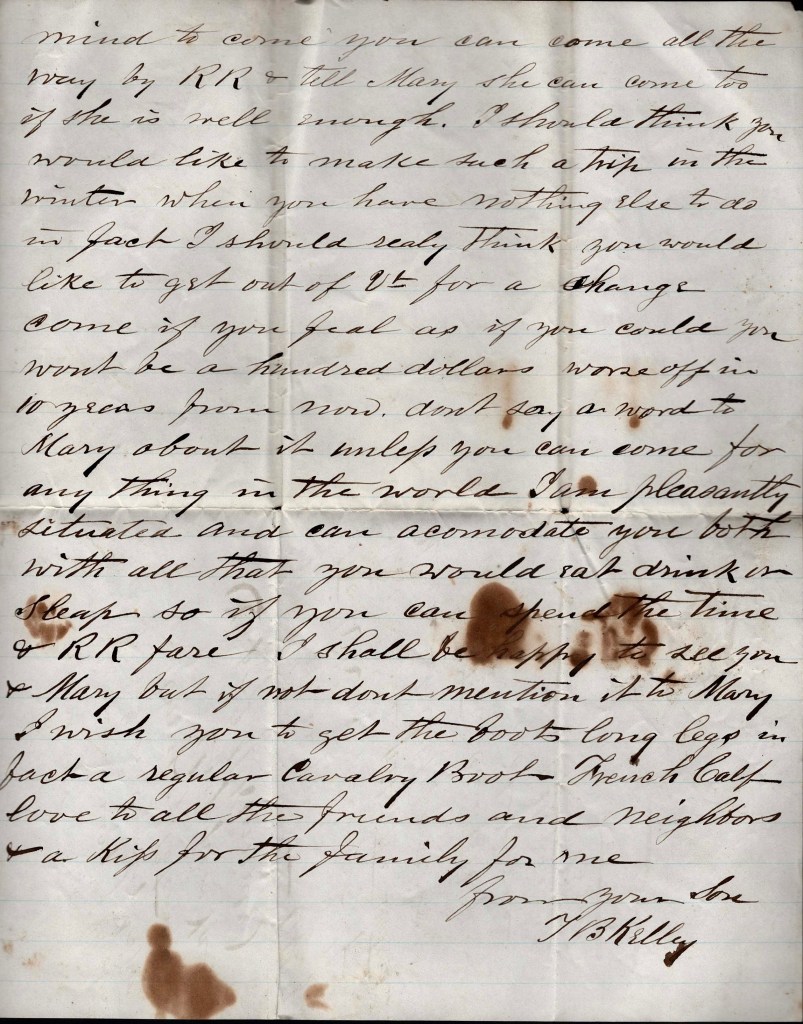
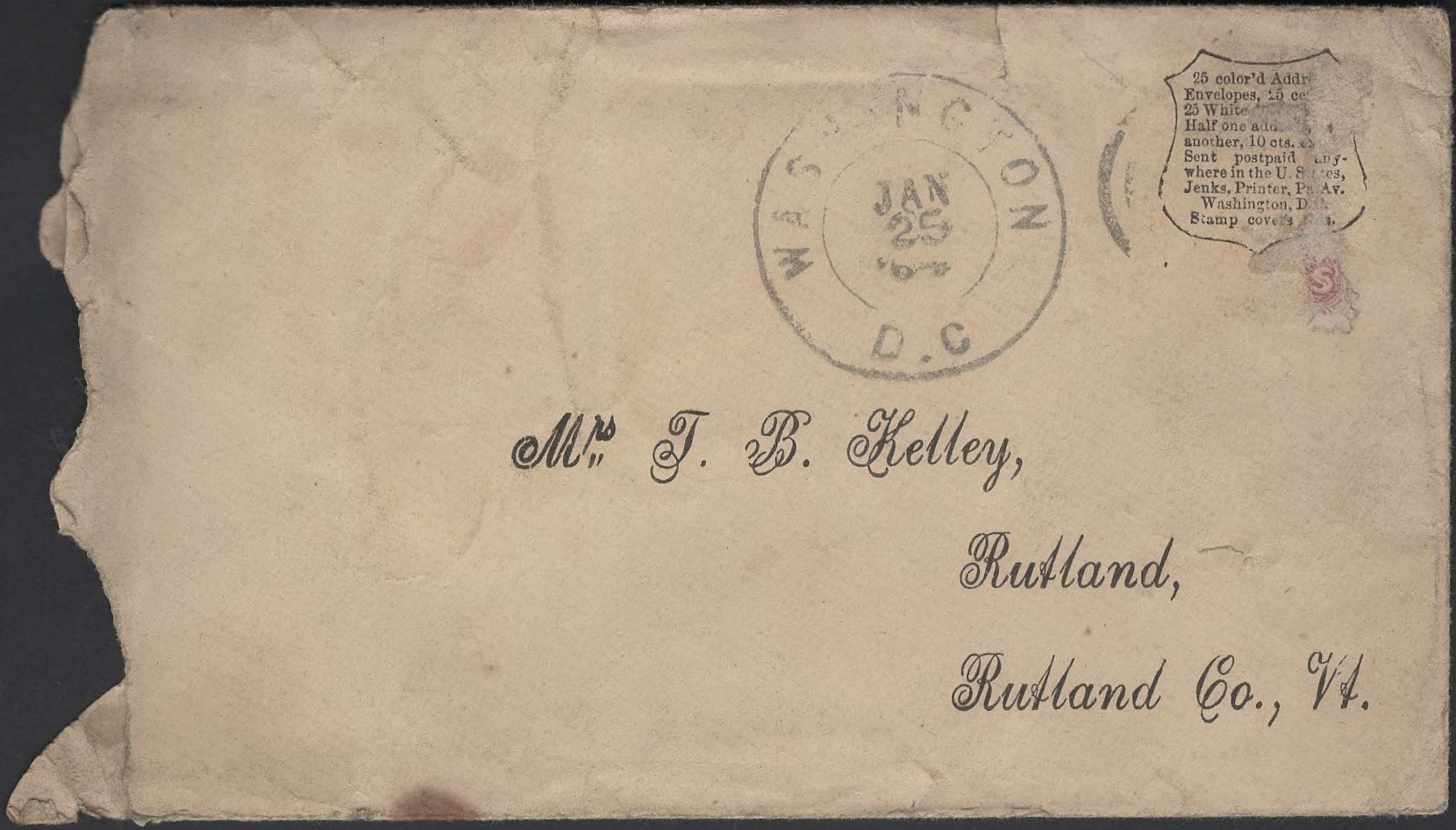
Addressed to Mrs. T. B. Kelley. Rutland, Rutland county, Vermont
Washington D. C. December 4th 1861
Dearest Mary,
I now, according to your request, take my pen in hand to inform you of the receipt of your welcome package which I can tell you will be duly appreciated by me for we are having pretty snug weather at present & I tell you that stockings come in play as much as any one article in a soldier’s life. I had got holes wore through the toes & heels of my last pair of stockings & they were not worth mending & I threw them aside & put on one of them you sent me before I went out on afternoon drill. I tell you, Mary, they felt nice on my feet. I have had awful cold feet every day for a long time until today and they was just as warm as toast today. I will take good care of them & make them last me as long as possible for I don’t know when I can even get any more as good as they be. I went down twice for them & they had not come & I had made up my mind not to go down town for them until I heard they was there & I sent an order down by Henry Huls (he is assistant Quarter Master)—Uncle Daniel’s wive’s brother—& he got it for me.
Father started a barrel of blankets & C&C for different boys in this company sent by their friends some two weeks ago & it has not arrived as yet. I tell you, there is not much regularity in the Express business when it gets near here for the Government have all the say about the railroads & when their business is done, then the Express business comes next. The Agent told me that goods had been 18 days from NY City here & they have often come in 24 hours. I am glad I got the stockings so quick for I think if I had not got them this week that I could have possibly got them until week after next. I tell you, Mary, they are socking us fellers over the road. We have been out on regimental drill every afternoon for the last 8 days, except Sunday.
Amos Rogers Cole, Co. L, 8th Illinois Cavalry
We got our revolvers yesterday & our sabers are ready for us as quick as we can get around to draw them. I wish, Mary, you could see the whole regiment out on regimental drill. I do think they are the best body of men I ever saw together in my life. The boys all try to do the best they can when out for we always have a great many spectators when the whole of us are out, of citizens & soldiers from other regiments. Capt. E. S. Kelley’s Co. is not behind in drill, I can assure you. The little horse just comes right up to the scratch. It seams as though he knew when the bugle sounds just exactly what to do. He will prick up his ears & is ready for a jump. The most of our movements are made on a fast trot or a gallop. I tell you, it was fun to see some of the boys in the regiment get throwed head over heels, some get run away with, & others their horses would get frightened & kick & rear up & then they would get off. But we have had first rate luck in that for not one of our boys have been throwed & only one have got off from his horse on account of his acting bad. The Boys in our company are the most of them well informed boys & have been used to handling horses before they come here. But it is fun to see some of the others.
Mary, Aunt Louisa is here now. She has been here some 10 days. I had a real old fashioned visit with her the other night. I went up to the Captain’s tent & while there, the Major came & wanted the Captain & both Lieutenants to go to his tent to school & they went & was gone till after nine o’clock & Aunt & me just had more than a good visit. I could not hardly think myself a soldier come to get really to visiting with her & talking about our near & dear friends. I tell you, Mary, you was often thought of that eve. I had just saw her before that but only a moment—only to say, “How do you do?” and I have not seen her to speak to her since. She boards about 1/3 of a mile from camp & she don’t get over here often & it is a hard matter to get outside the guard unless something of great importance & I have had 1 good visit with her & that must suffice for a while at least.
I wish I could have just the same opportunity to visit with my dear Mary. Oh, would we not visit fast. Know one knows wow we would enjoy it, do they? Mary, I wish we could but it is impossible for us as yet.
Mary, we are to move into Virginia next week into barracks about 5 miles from the City of Alexandria. Our colonel was over on Sunday last to see the place. We are to get our arms & pay before we leave, or he says he will not move us one peg for it is now almost 3 months since we have been sworn in (just 3 months tomorrow since Capt. Kelley was sworn in) & we have not got a cent from the government yet. Every few days there would be a rumor in camp we will surely get our pay this week anyway & so it has been ever since we have been in Washington. But I guess it is drawing pretty close at hand for our colonel is just as good as his word—or at least always has been. I know we will not be budged from this ground until we get our pay & arms. There has been over 50 regiments of men moved across the Potomac within the last 10 days. Not a single day passes but what we can see some regiment on the march.
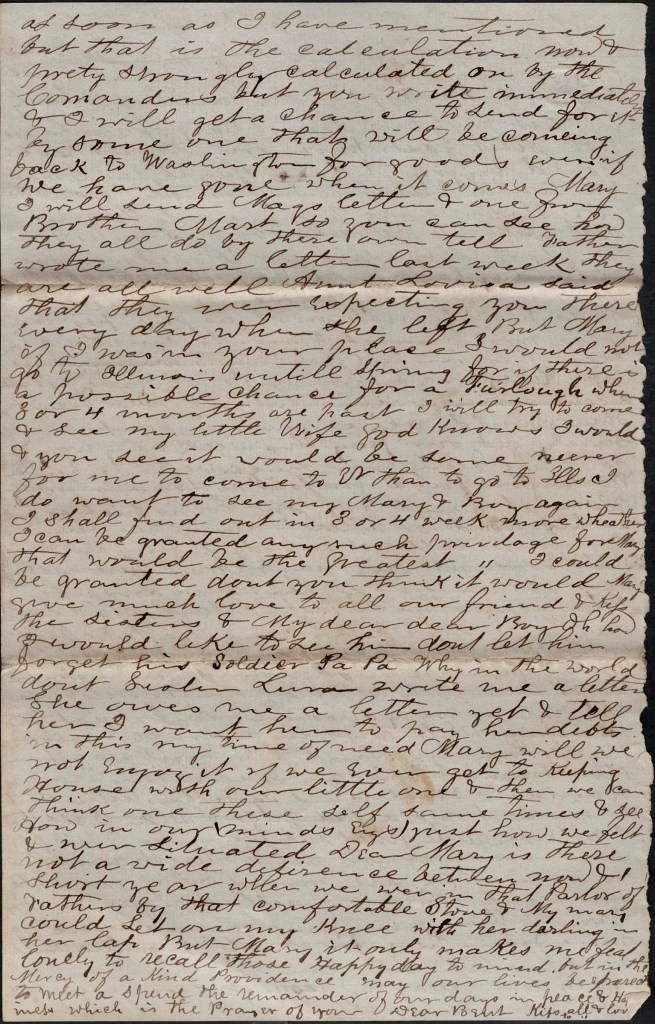
Mary, you have no idea how many men are in & around Washington. The leaves have pretty well fell from the trees & I can see tents in every direction & they look just like so many white cows in a drove & just as thick as they can stand. Last night we got another blanket & I can assure you, I lay much warmer, & I understand by Father’s letter that he has sent me a bed quilt. And when I get that, I will be quite fitted out for winter. I will let you know where you are to direct your letters as soon as we are moved but if you write immediately, which I earnestly hope you will, for I want to hear from you once more before we move from here, for it will be quite a while at the shortest, that I can here from you. Now Mary, don’t delay a moment as soon as you get this. It may be possible that we will not leave as soon as I have mentioned but that is the calculation now & pretty strongly calculated on by the commanders. But you write immediately & I will get a chance to send for it by someone that will be coming back to Washington for goods even if we have gone when it comes. Mary, I will send Mag’s letter & one from Brother Mart, so you can see how they all do by their own tell.
Father wrote me a letter last week they are all well. Aunt Louisa said that they were expecting you there every day when she left. But Mary, if I was in your place, I would not go to Illinois until spring for if there is a possible chance for a furlough when 3 or 4 months are past [and] I will try to come & see my little wife. God knows I would & you see it would be some nearer for me to come to Vermont than to go to Illinois. I do want to see my Mary & boy again. I shall find out in 3 or 4 week more whether I can be granted any such privilege for Mary that would be the greatest I could be granted, don’t you think it would.
Mary give much love to all our friends & kiss the sisters & my dear, dear boy. Oh how I would like to see him. Don’t let him forget his soldier Pa Pa. Why in the world don’t sister Lura write me a letter? She owes me a letter yet & tell her I want her to pay her debts in this my time of need. Mary, will we not enjoy it if we even get to keeping house with our little one & then we can think one these self same times & see how in our (minds eye) just how we felt & were situated. Dear Mary, is there not a wide difference between now & one short year when we were in that parlor of Father’s by that comfortable stove & my Mary could sit on my knee with her darling in her lap. But Mary, it only makes me feel lonely to recall those happy days to mind, but in the mercy of a kind Providence, may our lives be spared to meet and spend the remainder of our days in peace & happy times which is the prayer of your dear Bent. Kiss to all & love.
Letter 8
Camp California 3½miles west of Alexandria, Va, Sunday, December 22nd, 1861
Dearest Wife,
At 12m today, the bugle blowed & the orderly sergeants went to the Colonel’s tents to answer the summons & the Lt. Colonel told them to inform the men if they had any writing or mending to do for a week or two that they had better do it today, & so as soon as general Inspection was over, I came to my tent & commenced my welcome task for Mary, God only knows how I love to take the pen in hand to correspond with you. I keep thinking, well tomorrow I will get time to write to Mary & when that comes, then comes it cares and anxieties & labor, for you can rest assured we don’t get any time to fool away now for we are amongst well-drilled Infantry, that would be called into the field if any were needed. We are within rifle shot of men that have been drilling 6 or 7 months but we are gaining everyday we have had regimental drill every morning from 9 till 11:30 ever since we have been this side of the river.
We are within sight of the Potomac & can see the vessels sailing along nicely. With a spy glass we can see the men on board. Yesterday the Pocahontas went down the river to break the blockade. As you are aware, the shipping is blockaded by the Rebels below here. I know that she will open their eyes. I tell you, she looked noble as she moved down. I can’t say it is certain that she went for that purpose, but it is reported that was what she went for.
We have the handsomest site for a camp I have ever seen since I have been here & we have been where we could see for 8 or 10 miles each way. Our camp is situated on a decline plane or slight hill—the officers tents at the top & each Co’s tents run down to the bottom of the hill to the south. And as we are in Secessia, timber & trees are of no value at all and the pine trees are just as green as they ever was, & so we take the small boughs & cut them up small & put them on the ground for our beds & they are not so coarse after all, and the nice trees from 15 to 18 feet high, we cut down & set in rows in front of our tents & it makes the best-looking camp I ever set eyes on. And we set some large posts along in front of our tents about a rod from the front with a large inch & a half rope put through them so we can hitch our horses in front of our tents. I tell you, if a person stands on a rising piece of ground to the south of us, it is just as pretty a sight as he ever need l00k at. Our horses get more to eat here than they did in Washington & they are looking finely. All the troops this side of the river that have seen us give us the name of being the best looking regiment in the field.
You know I wrote you we had our revolvers when I was in Washington. So we had. But the day we left there they was closely inspected & was rejected & now we have got Colts Navy which can’t be beat in the world. The General told our Colonel to put us through as fast as he could as he did not know what moment we would have to be called on & so we are getting our accouterments as fast as they can be got & of the very best kind. I for one can’t feel thankful enough to our Colonel for rejecting our other revolvers, for if a person has arms that he can depend on, fear is laid entirely aside.
Fifty of our Battalion (the First 1) were called out the other night and we were armed with carbines & sabers & we rode as fast as the horses could run for six miles, to the extreme outposts of our pickets, and when we arrived there, six regiments of our men were drawn up in line of battle accompanied by a Battery of artillery. We were ordered to dismount & put caps on our carbines & we stood at our horses’ heads for a half an hour when we heard nothing from our opposers, after which three companies of infantry were sent out as skirmishers & were gone until 7 o’clock next morning when they returned and stated that the pickets had had a small skirmish & that they had driven the rebel pickets in two miles & had not been opposed & there was no sign of an attack & we waited about ½ an hour longer & rec’d orders from the General to return to our quarters which we did on a walk, which was a little different from the way we went. Lt. Flagg’s brother was one of the boys from our company & he got unhorsed on our way over there but was not hurt much so but what he went along.
Bill Jones & I rode side by side & he said, “Bent, if they do come, we will give them the best turn we have got in the Wheel House,” but we returned without firing off a single carbine. We rec’d an order from the General to have 200 men in rediness to go at a movement’s warning & so there is and of [hand-]picked men too. Although we have a crack regiment, there is some in it that are better than others. Mary, I can safely say fear did not rest in my bosom that night at all for I had perfect confidence in myself & horse both, & I had a carbine that I cleaned & put in order & I knew just what it was & we had about 50 rounds of cartridge & we could given them some fun. But that was not our good luck.
There is 8 or 10 forts in sight of our camp. One fort that commands the Potomac at the entrance of Alexexandria & commands all the country for 4 or 5 miles around. They threw bomb shells into a Rebel camp seven miles from it & drove them out entirely, killing a number of them. That fort is named Fort Lyon after the General that was killed in Missouri & is capable of containing 3 or 4 regiments of men entirely underground. We have a splendid spot of ground to drill on. It is two miles from our camp & we pass by 15 or 20 regiments of infantry on our way there. And they all get in squads to look at us pass & you can often hear the boys say, “Ain’t they fine looking men. Haint they got nice horses! & C & C? What Regiment is that!!!,” some fellow will ask. Answer, “8th Illinois.” “Bully for you, boys.”
Well Mary, to say the least. we do l00k tip top. We got some new pants last week but I did not need any yet for there was not a single hole in my pants although I have worn them every day since I left St. Charles. But the Capt. told me I had better draw another pair as he did not know when we would get any more so I took them. I have not received the box that father sent me yet. I have written for a receipt for it & if they can’t produce the box, they may pay for it. I have not suffered much with the cold yet & I guess I won’t for the folks here say that they generally have the coldest weather from the 1st to the 15th of December. But no one knows what it will be yet. I know I could have made good use of the comforter if I had had it.
Mary, kiss my little boy for me. How I would like to see him. I can imagine him prattling on your knee & trying to tell you his trouble. I send you 10 dollars. I only drew $19.06 but we were only paid up to the first of November. I know of many of the boys that has not sent a single cent home & hain’t got a cent to their name now & single at that, but I gave a dollar towards the Captain’s saber and pistols & I have bought me a pair of gloves & over hauls & we buy syrup sometimes & butter & it takes some of a person’s change & it does seem to me the boys eat 3 times as much butter as they would if they was at home. But I am bound to live as well as I can. I will let you have all that I can & I want you to use it for your & my boy’s comforts.
Faithful forever though my eye May look no more in time Faithful forever though my hand May ne’er again clasp mine!
Though other friends and other loves Make glad my life but still My soul hath one sweet secret niche That though alone cans’t fill.
And weary leagues of hill and dale And treacherous wastes of sea Are vain and weak to keep my heart Apart from love and thee.
And when at evening’s holy hour My soul keep tryst with thine, The pure stars bring from thy far home Sweet messages to mine.
Then near or far forevermore Know that I still will be, In life or death in weal or woe, As true as now to the.
When the dear loves that crown of life Their holiest tendrils twine, I know of one sweet inner room No hand unlocks but thine
— Bent
Kiss my dear boy for me & the little sisters. In fact, all the family. Love to Isaac & tell him to write soon. All of our company were vaccinated today for there is some small pox in one of the troops. I was vaccinated once before but I knew it would do no hurt & I had it again. Write all the news & soon from your soldier, — Bent
1 The 8th Illinois Cavalry was brigaded with the 1st Michigan Cavalry and the 4th Pennsylvania Cavalry in December, 1861.
Letter 9
Alexandria, Virginia February 4th 1862
Dearest Mary,
Your kind & most welcome letter came duly to hand & finds your Bent in tip top health which you may just imagine I am not capable of expressing the thankfulness I enjoy for it, for dear girl, many of noble boys have departed this life since my last letter & still many of them are in great danger. But I still remain healthy and able to eat my regular rations but no one knows how long he will remain so. But I am as careful of myself as I can be under the circumstances. You will see by the heading of my letter that it is dated at Alexandria. Our entire regiment are quartered in this sesesh hole. We got into houses wherever we could find them. Some of our companies made some folks get their things out for they were sesesh buildings & tenants had only moved in to keep possession of them to keep our troops out of them, but wherever we found that they sesesh property, they were taken every time. Our company occupies a 3-story brick next door to the Mayor’s house. 1 He passed me last evening & says he, “You have a very quiet family for so large a one.” I think that was quite a compliment for us considering where it came from. Our horses are in a large brick machine shop. Four companies have their horses in the shop with us so you can have some idea that it is not so small (it is a very nice building of brick). I can tell you, it is a little different from having them in mud up to their knees.
The first night we came here (but only the 1st Battalion came at first—four companies) we had not our quarters looked up. The Mayor opened the new Depot for us that had not been used since last May and I can tell you, it is a nice building and it was a stormy night—snowing & blowing as hard as it has any night this winter. I presume we would have had to stay in the foundry with our horses if it had not been for the kindness of the Mayor. I tell you, we were thankful enough to get any place for a shelter from the storm that night. It has rained lots for the last four weeks, I can tell you. I know we would have all died in our tracks out in camp but we are out of it now & I hope to keep out of it until we go into action. We are kept in our quarters pretty snug for we are expected to be called on at any moment, so the Colonel says.
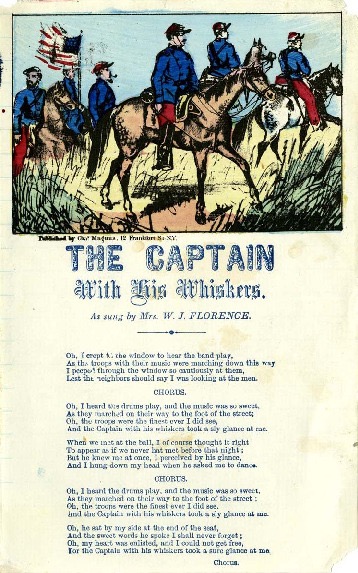
In 1862, the Hutchinson Family Singers performed for President Abraham Lincoln and his guests at the White House, and entertained troops in the Washington, D.C. area and in Virginia. The family’s songs promoted abolitionism, women’s rights, temperance, and workers’ rights.
Capt. Elon John Farnsworth, Co. K, 8th Illinois Cavalry
I have attended two concerts since I have been here. The Hutchinson Family was one. Our Lieutenant took what boys that wanted to go & marched them up where the Hutchinson family sung. The 8th Illinois were pretty well represented. They are nothing but Abolitionists to the back bone. I don’t like a single song they sing but they are tip top singers. There is a little girl in the family—I should think she is 13 or 14 years old [and] the best Alto singer I ever heard in my life. She sang a song entitled, “The Captain with his Whiskers” and “gave a slight glance at me”—that [line] was at the end of every verse. I can tell you the old Shanty rung with the hearty cheers of the boys for the young Capt. [Elon John] Farnsworth sat right in front of her & every time she closed a verse she would point her finger at him saying, “the Captain with his whiskers gave a slight glance at me,” & as the young captain has a splendid pair of them, many of the boys thought it was manufactured for the occasion but I have heard the song spoken of before I ever heard her sing it.
Mary, Uncle Elisha has been very bad off but it is reported he is on the gain. I have not seen him in over two weeks for we have had all we could possibly do & more too. I have neglected to write to you on time for which I earnestly hope you will pardon me this once, but dear girl I was not to blame for I have had my whole time devoted to my duty. I have often told you that you must not feel worried if you did not hear from me for then you might well be assured I was in good health. Oh Mary dear, I cannot be with you on Valentine’s Day as I would like to be but I hope to meet you soon. I will come an visit you at my earliest opportunity. Oh how I wish I could press my Mary to my bosom as I used to. Mary, I know you do not forget how earnestly it came so it would fairly make you hollow out for I was strong & you so tender through your chest you would come up & press your little belly against mine & then is the time you would get squeezed.
Mary, I have not had a chance to see the Dr. that was going to give me those receipts for curing you of the bearing down, 2 or the whites neither. Did you write me whether you were troubled with them much or any? I am glad to hear you are not in the Family way, you may be assured, for I have got the dead open & shut on that when I come home. I got a letter from brother Mart & sister Mag, both in good health. Mag fell down the cellar stairs & made her regular revolutions but did not break no bones. Mart says he never was in better health in his life. He weighs 174 lbs. but he don’t wax me for I can pull up 176. I do pretty well for a soldier as far as health is concerned. Much love & kisses for my boy & the family in general. Tell sister Lu I have not received the letter she promised me. I await it anxiously. From your loving and devoted husband, —Bent
Mary you must excuse me with this brief letter this time & I will try and make it up in my next letter. I believe I have told you all the news of importance. I could not get a chance to write this evening until nearly 9 & I have been & blocks for the Dr to come and see one of our boys—an Irishman from Athens, down where Marcel built that School House. He has drinked Rot Gut whiskey until he has nearly killed himself. He has run away & stayed 3 or 4 days at a time. He was under the Dr’s care for nearly two weeks at camp but not sick abed & since he has been here, he has got out of quarters when we sent him to the foundry to take care of our horses & that would be the last we would see of him until he got his drunk out. I tell you he has suffered awfully for it tonight. You may just bet I actually thought he would not live 13 minutes when I first saw him tonight. I went for the Dr. on the double quick, you may just bet. It is now 12 o’clock & he is a great deal better. The Dr. has just left. He says he will get along now if he tends to himself. Mary, how glad I am that I tend to my knitting. I bet they won’t see me taking any of their sesesh poison for it is nothing else what they get in this town. I must draw my letter to a close as it is very late. I will say kiss my little Boy & tell him his Pa Pa has not forgotten him. Make him kiss my Mary for me. Mary, you can’t tell how much I would like to have been to Wallingford with my Mary.
I will not forget to put in the little sliver of the stairs on which Col. Ellsworth was standing when he was shot. Kiss the sisters and tell them Bent would like to hear from them. Dar[win] Dense is under the weather and so is Sam Davis but not either of them considered dangerous. Give my kindest regards to Grandmother. Also the love of Uncle and Aunt & hoping to hear from my beloved Mary soon, I remain as ever your, — Bent
1 “The regiment having moved into Alexandria was quartered in vacant houses as follows: Companies A and L in fine houses on Duke Street near number 75; Company B near the wharf; Companies C and M corner of Wolf and Fairfax streets; Companies D, G, and K on Wolf street; Company F in the old printing office on Royal street; Company H in Washington street, Methodist church south; Company I opposite the Methodist church, and Compant E on Prince street near the residence of Mayor McKenzie.”
2Mary may have been suffering from pelvic organ prolapse. “The white” is a thick vaginal discharge usually caused by an estrogen imbalance. The amount of discharge may increase due to vaginal infection, and it may disappear and reappear from time to time. This discharge can keep occurring for years, in which case it becomes more yellow and strong-smelling.The more scientific name is Leukorrhea.
Letter 10
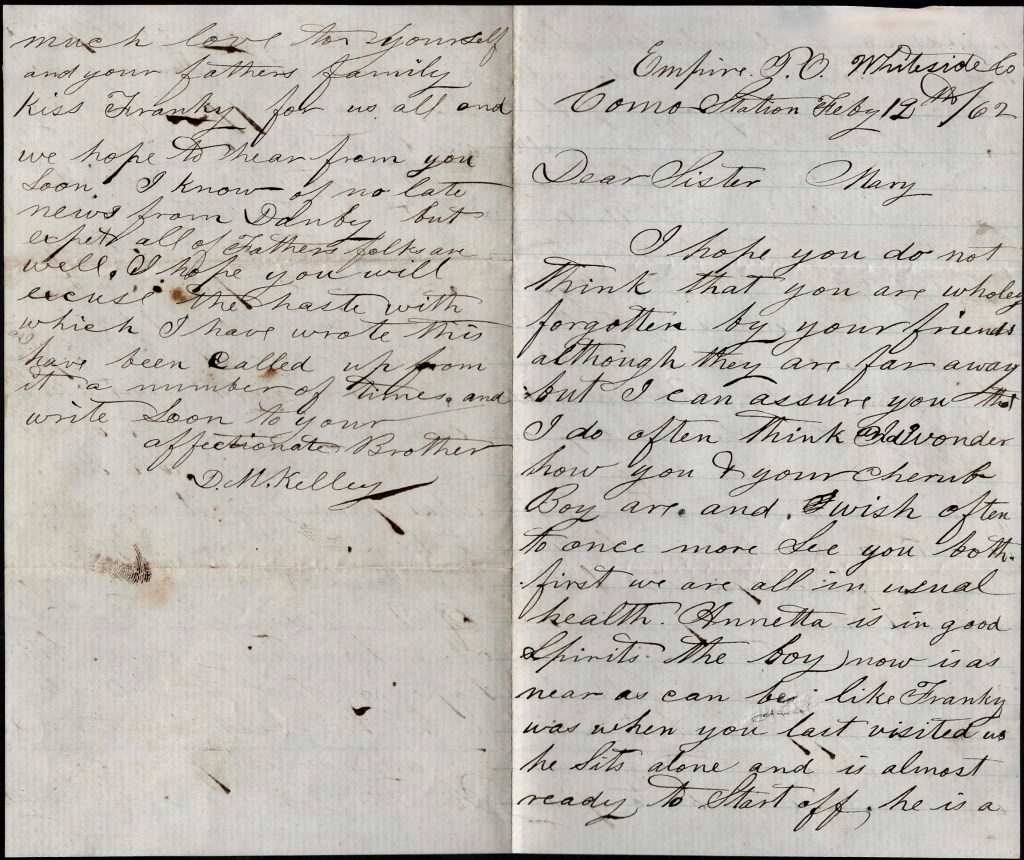
Editor’s Note: This letter was penned by David “Martin” Kelley (1837-1862), the brother of Thomas Benton Kelley. Martin was married in February 1858 to Annette Sims (18xx-1908) at Danby (now Glen Ellyn), Illinois. Their son Albert M. Kelley (1861-1937) was born on 23 June 1861.
Empire P.O. Whiteside Co Como Station February 12th 1862
Dear Sister Mary,
I hope that you do not think that you are wholly forgotten by your friends although they are far away but I can assure you that I do often think and wonder how you & your cherub Boy are, and, wish often to once more see you both.
First we are all in usual health. Annetta is in good spirits. The boy [Albert] now is as near as can be like [your son] Franky was when you last visited us. He sits alone and is almost ready to start off. He is a middling, good natured child—that is, when well tended, and Julia, the romp of a girl, says little Franky can walk now. I want to see little Franky and Aunt Mary but Uncle Bent has gone to war to Washington. She has not got it in her head yet that he has been moved to Alexandria. She often asks Pa, “Has Uncle Bent got a soldier cap on?”
I have had but two letters from Benton yet—the last about a month ago. He then was in fair spirits but I could see by expressions that if at home in the enjoyment of his family, he would be much happier. But so it is, he is now there and all we can do will be to pray that he may be spared to return to the bosom of his once happy family and there be able to be more contented in mind—that is, to settle down and secure the comforts of a dear compassion and family. How I can imagine that he would like to press to his heart that little cunning boy with a fond and devoted wife. Ah yes, what pleasure it would be to him. But dear sister, I can but think of the many sleepless hours I dare say you have had about his being gone. But hoping that it will all be for the best in the end is my earnest prayer.
Annetta joins in sending much love for yourself and your father’s family. Kiss Franky for us all and hope to hear from you soon. I know of no late news from Danby but expect all of Father’s folks are well. I hope you will excuse the haste with which I have wrote this have been called up from it a number of times, and write soon to your affectionate Brother. D. M. Kelley
Letter 11
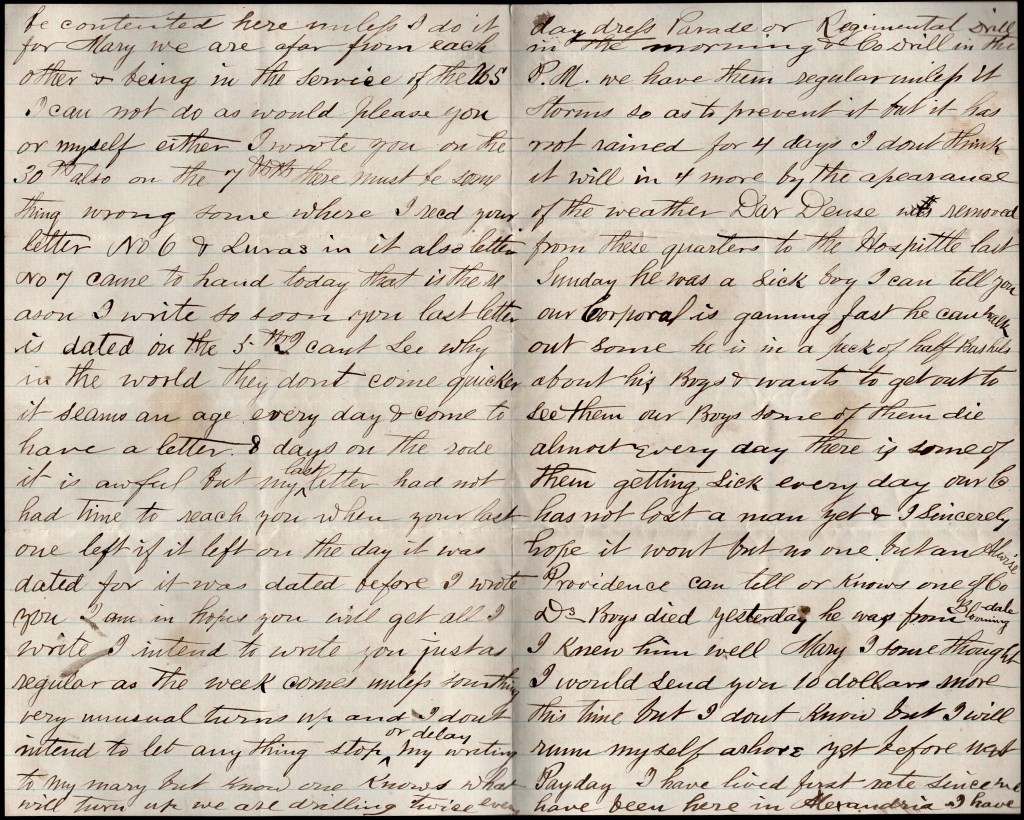
Alexandria [Virginia] February 13th 1862
Dear Dear Mary,
Sorry I was to hear you complain after my telling you time & time & again to not worry about my health for I can say I am as tough & rugged as I ever was in my life & I will here inform you again, if I am sick, you will be the first to know it. Now Mary, as the old saying is, “a contented mind is a continual feast,” and in order to have it so, you have got to strive for it. I know, dear girl, your situation— yes, ah to well I know it, & it has caused me many hours of deep thought and anxiety. But still I knew just as well as anyone it was not the best way and I thought I would not let anyone know what did worry me. But I am done. I shall endeavor to banish all that serves to work upon my mind for I never can be contented here unless I do it, for Mary, we are afar from each other, & being in the service of the US, I cannot do as would please you or myself either.
I wrote you on the 30th—also on the 7th—there must be something wrong somewhere. I receive your letter No. 6 & Lura’s in it also. Letter No. 7 came to hand today. That is the reason I write so soon. Your last letter is dated on the 5th. I can’t see why in the world they don’t come quicker. It seems an age every day & come to have a letter 8 days on the road, it is awful. But my last letter had not had time to reach you when your last one left if it left on the day it was dated for it was dated before I wrote you. I am in hopes you will get all I write. I intend to write you just as regular as the week comes unless something very unusual turns up. And I don’t intend to let anything stop or delay my writing to my Mary. But no one knows what will turn up.
We are drilling twice every day—dress parade or regimental drill in the morning, & company drill in the p.m. We have them regular unless it storms so as to prevent it, but it has not rained for four days. I don’t think it will in four more by the appearance of the weather. Dar[win] Dense was removed from these quarters to the Hospital last Sunday. He was a sick boy, I can tell you. Our corporal is gaining fast. He can walk out some. He is in a peck of half bushels about his boys & wants to get out to see them. Our boys—some of them—die almost everyday. Our company has not lost a man yet & I sincerely hope it won’t but no one but an All-wise Providence can tell or knows. One of Company D’s boys [possibly Emory Osgood Muzzy or Conrad Gilg] died yesterday. He was from Bloomingdale. I knew him well.
Mary, I some thought I would send you 10 dollars more this time but I don’t know but I will run myself ashore yet before next payday. I have lived first rate since we have been here in Alexandria. I have lived on oyster stews, beef stake, & buckwheat pancakes. I knew that you would be glad to see me spend my money for such things as that. I have lived for a long time without those & now I am where I can get them, it seems almost impossible for me to go without them. I know we both will live just as long & I knew you had enough to last you. You will not complain, will you, if I don’t send you any this time. I will do better next time. I know you would not complain if you knew just how I have been situated if I could make my money any comfort to me, to have me do it, & I want you to do the same. I don’t want you to go without anything that will be for the comfort of yourself and boy. Oh, how I would like to see him. I suppose he tries to talk to you and tell you his little troubles and trials for I presume you know they have them as well as grown folks. Oh how I wish I could see you and him, but no one knows when that will be. But God hasten the time that Bent & Mary & Boy can meet to part no more on this earth.
Mary I will send my usual amount of kisses to you & Mitty I am in hopes you will get my letter written you on the 7th although I don’t think of anything in it more than stating that I was well and Uncle Elisha was on the gain [and] so he is—but slowly. I will answer Lura’s letter to go in this if I get time before this goes and I will try I must write to Mother also. Sister Mag wrote me last week she was quite well except falling down the cellar stairs but she is feeling well otherwise than that. Mart wrote me a good letter. I have not heard from Isaac yet. How does he get along & why in the world don’t he write? Kiss the sisters. Love to all the friends & write soon from your ever loving husband, — Bent Kelley, Co. E, 8th Illinois Cavalry
Letter 12
Alexandria, Virginia Sunday evening, February 16th 1862
Dearest Mary,
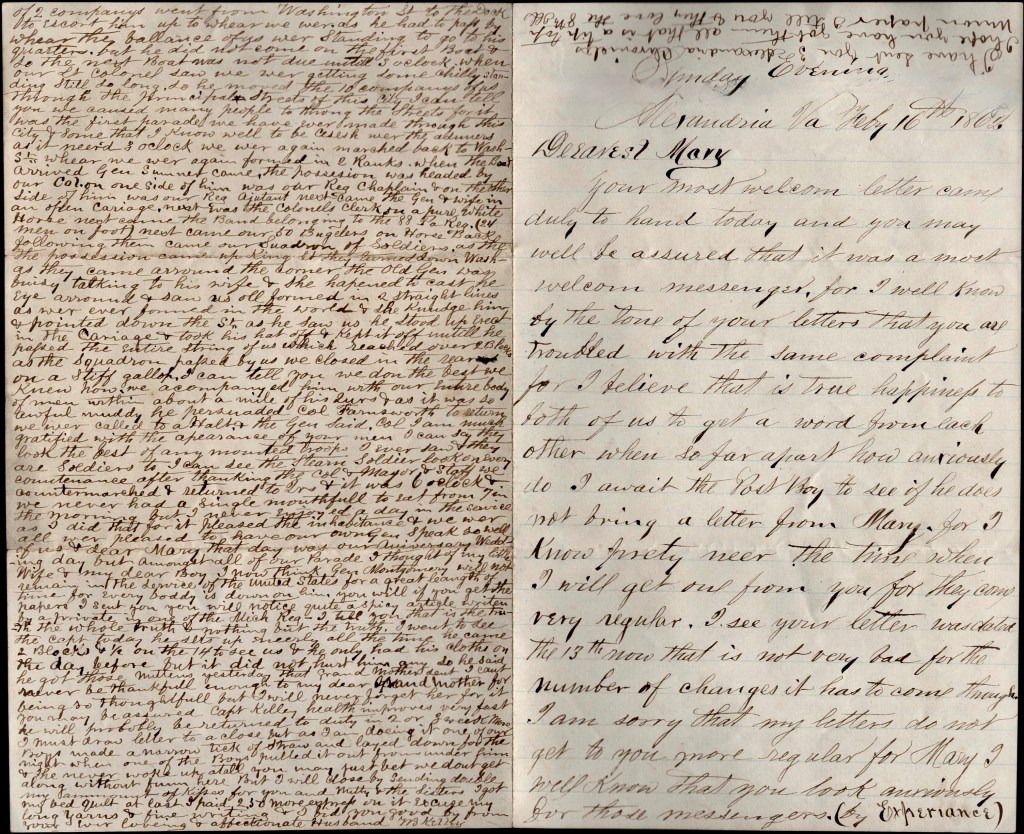
Your most welcome letter came duly to hand and you may well be assured that it was a most welcome messenger for I well know by the tone of your letters that you are troubled with the same complaint for I believe that is true happiness to both of us—to get a word from each other when so far apart. How anxiously do I await the Post boy to see if he does not bring a letter from Mary for I know pretty near the time when I will get one from you, for they come very regular.
I see your letter was dated the 13th. Now that is not very bad for the number of changes it has to come through. I am sorry that my letters do not get to you more regular, for Mary I well know that you look anxiously for those messengers (by experience). Mary, you wanted me to remember our anniversary wedding day. You may well be assured that Mary was in my mind the whole day although we were on dress parade from 12m [noon] until 5 p.m. for the reception of General Sumner. If you get the papers I have sent you, that will tell you something about the movements of our regiment.
Gen. William Reading Montgomery, a 35+ year career Union officer, served as the Military Governor of Alexandria, Virginia in late 1861-early 1862. He drew harsh, unfair, criticism & ridicule for his actions while attempting to carry out his orders. He even survived an assassination attempt by a drunken member of the 63rd Pennsylvania in mid-January 1862.
But I will inform you of the most important one as yet. After our Capt. [Elon John] Farnsworth arrested that minister & he was delivered into the hands of Gen. [William Reading] Montgomery, he was released and of course that did not suit the style of any of the union soldiers here. 1 After that, there was one or two secesh buildings burned and no one knew the cause of the fires, and every arrest that has since been made, Montgomery has set them at liberty. Our Boys—some of them—have caused some Union flags to be raised on secesh buildings and they raised one on the quarters of General Montgomery which was soon taken down and he telegraphed to General McClellan that the 8th Illinois Cavalry were a mutinous & drunken set of beings and if they should happen to be called into immediate action, they could not get ready in a whole day; upon which we received orders from General McClellan to appear mounted and fully equipped with valise’s strapped on our saddles, with our blankets, & 10 rounds of cartridge and be at the Headquarters of General Sumner 3 & 3/4 miles from here in the short space of 1 hour and ½ in which we went to work & were all standing in front of Gen. Sumner’s quarters with our Reg in 1 hour and 25 minutes. Our Lt. Colonel went in & reported our regiment [present] according to order. Gen. Sumner, not being there (Capt. Taylor officiating), said I know nothing of what you are ordered here for, but will telegraph to Gen. McClellan & find out which he did. The General wanted to know what time we arrived, which was told him. He says tell the boys to return to their quarters in Alexandria & you may imagine our surprise when the boys were informed that that was the case for we thought surely we were called out to fight sure, for we were prepared for it & were willing too, little thinking we were put to all our trouble & putting our horses through the mud from 6 to 8 inches deep just to gratify the D—d old sesesh Gen. Montgomery. But we thought we were ordered out to fight & the skirmish was over & we were not needed, so we returned to camp quietly. But you may just bet we were an awful muddy set of fellows.
We got back about ½ past 9, put our horses out & went to rest & on the following morning, we were ordered to be ready for dress parade at 12m. And you may first bet we had to work [hard] to clean our horses, our cloths & saddles, our arms all through, [and] black our boots all before 12, or at least half past 11, but we made time. When we were formed on the street for inspection, we were informed we were to provide an escort [for] Gen. Sumner from the dock to his quarters 3 & 3/4 miles distant. I can tell you, we looked the best I ever saw our boys for we had our plain jackets on & they are trimmed with a bright yellow, had our overcoats—which are a plain black—strapped on the top of our valise’s. We were in our full equipage & armed to the teeth. When it was time for the boat to arrive, the first squadron, consisting of two companies went from Washington Street to the dock to escort him up to where we were as he had to pass by where the balance of us were standing to go to his quarters. But he did not come on the first boat & so the next boat was not due until 3 o’clock. When our Lt. Colonel saw we were getting some chilly standing still so long, he moved the ten companies of us through the principal streets of this city. I can tell you, we caused many people to throng the streets for it was the first parade we have ever made through this city & some that I know well to be secesh were the admirers.
As it neared 3 o’clock, we were again marched back to Washington Street where we were again formed in two ranks. When the boat arrived, Gen. Sumner came. The procession was headed by our Colonel. On one side of him was our regimental Chaplain & on the other side of him was our regimental Adjutant. Next came the General & [his] wife in an open carriage. Next was the Colonel’s clerk on a pure white horse. Next came the Band belonging to the 88th Pennsylvania Regiment (24 men on foot). Next came our 50 buglers on horse back. Following them came our squadron of soldiers. As the procession came up King Street, they turned down Washington Street. As they came around the corner, the Old General was busy talking to his wife & she happened to cast her eye around & saw us all formed in two straight lines as were ever formed in the world, & she nudged him & pointed down the street. As he saw us, he stood up erect in the carriage & took his hat off & kept it off until he passed the entire string of us which reached over 2 blocks. As the squadron passed by us, we closed in the rear on a stiff gallop. I can tell you we done the best we knew how. We accompanied him with our entire body of men within about a mile of his quarters & as it was so awful muddy, he persuaded Col. Farnsworth to return.
General Edwin Vose Sumner (1862)
We were called to a halt & the General said, “Colonel, I am much gratified with the appearance of your men. I can say they look the best of any mounted troops I ever saw & they are soldiers too. I can see the stern soldier look on every countenance.” After thanking the Colonel & Major & staff, we countermarched & returned to quarters & it was 6 o’clock & we never had a single mouthful to eat from 7 in the morning. But I never enjoyed a day in the service as I did that for it pleased the inhabitants & we were all very pleased to have our own General speak so well of us. And dear Mary, that day was our anniversary wedding day. But amongst all of our parade, I thought of my little wife & my dear boy. I now think Gen. Montgomery will not remain in the service of the United States for a great length of time for everybody is down on him.
You will, if you get the papers I sent you, notice quite a spicy article written by a private in one of the Michigan Regiments. I tell you, that is the truth, the whole truth, & nothing but the truth.
I went to see the Captain today. He sits up nearly all the time. He came two blocks & ½ on the 14th to see us & he only had his clothes on the day before, but it did not hurt him any, so he said. He got those mittens yesterday that grandmother sent. I can’t never be thankful enough to my dear grandmother for being so thoughtful, but I will never forget her for it, you may be assured. Capt. Kelley’s health improves very fast. He will probably be returned to duty in 2 or 3 weeks more.
I must draw letter to a close but as I am doing it, one of our boys made a narrow tick of straw and laid down for the night when one of the boys pulled it out from under him & he never woke up at all. You may just bet we don’t get along without fun here. But I will close by sending double my amount of kisses for you and Mitty and the sisters. I got my bed quilt at last. I paid 2.50 more express on it. Excuse my long yarns & fine writing & I bid you goodbye from your ever loving and affectionate husband, — T. B. Kelley
I have sent you 3 Alexandria Chronicles. I hope you have got them all. That is a tip top Union paper, I tell you, & they love the 8th Illinois.
1 The arrest of Rev. K. J. Stewart at St. Paul’s Episcopal Church on Sunday, February 9, 1862, caused quite a stir in Alexandria. The Local News, published by editor, Edgar Snowden, Jr., formerly of the Alexandria Gazette, reported on the incident in his paper under the heading “Arrest of a Minister While at Prayer in a Church—Great Excitement.” The “offense” of the minister was that he refused to recite the prayer for the President of the United States. To read a good article about the entire affair, see: “A Holy Dispute: The Alexandria Gazette Burning of 1862.”
Letter 13
Fairfax Station [Virginia] Friday, March 14th 62,
Dear Mary,
Your kind letter of the 6th came to me by our commissary sergeant yesterday & lucky I was to ask him if he had any mail for our regiment & he said he had & I took the bundle & looked into it & my letter was the first one on the top & it was all I had. I did not have time to write to you on last Sunday for I was orderly for our Colonel & had to be in the saddle all day & I was so tired at 6 o’clock, I could not write, and we had orders to move at 4 a.m. on Monday. We were aroused at ½ past 1 a.m. & got all things in readiness so our boys bid farewell to Alexandria. We came to Gen. Sumner’s Headquarters & found the entire Division under marching orders & the most of them ready. At 8 o’clock the Division headed by the General in person moved forward & it rained nearly all day.
Never in my life did I ever see such destruction of clothing. The infantry boys would open their knapsacks & throw away coats, pants, shirts, stockings, & in fact, some would throw away everything—knapsack & all, even to their overcoats—to lighten themselves so they could keep up with their regiments. Lots & lots of our boys got off their horses & let the infantry boys ride them. The mud was from 4 to 6 inches deep on an average. Many of our wagons were stuck in the mud & the boys would get in & lift on the wheels & help them out. We marched 17 miles the first day & it was eleven o’clock at night before the last men got in & the head of the Division stopped at sunset.
The next day we marched 5 miles (or maybe 7) & put up, the next day 4 [miles] which took us to Mill Creek Station, which is 27 or 28 miles from Alexandria & within four miles of Manassas Junction, & 1 & ½ miles from the battle ground of Bull Run. I came back to Fairfax Station with our commissary sergeant who is to take the cars for Alexandria & get our ammunition. I am to stay here 18 hours or until he comes back.
The Rebels—as they retreated from Fairfax Station—tore up the track & burnt the bridges to impede our forward movement, but our men laid four miles of track & built one bridge 40-feet long yesterday. No one knows how much of the track is torn up beyond Manassas. They have destroyed all the locomotives they could not take & of course all the property that would be of any use to us. But we will follow them. What dastardly cowards they were for evacuating Manassas. They have taken own all their real cannon & put up painted wooden ones in their place. At one large fort, a man residing near there says they would not allow anyone inside the fort for the last two weeks that was not connected with their army & now their having wooden cannon there solves the whole mystery.
The “Quaker” Guns (logs painted black) at Centreville fortifications, left by the Rebel army when they retreated closer to Richmond in late February 1862.
We will now advance just as fast as we can get our stores to keep us alive and our horses. We have six batteries of artillery with us, but it is awful difficult getting them over the roads. If the rebels had stood their ground at Manassas Junction, we would have had the war question settled before this for they have no other fortifications that amount to anything—only there. We have passed lots of their rifle pits & places of rendezvous where they have had their pickets. There is one man who told Gen. Sumner that the last of the rebels left on Sunday a.m. but he can’t bring anyone to swear to it & so the old General kept him we have taken 8 or 9 prisoners since we left Alexandria. Two of them said they were forced into the Rebel army & wanted to enlist in our army & they did. The others are under guard at Mill Creek.
70 of our boys came in from Alexandria yesterday who were left in the hospital when we came away. Dar Dense was improving quite fast. When we left he could walk 7 or 8 blocks so you see his case is very hopeful. Bill Jones is returned to duty & is with us. We have lost only one man in our company by death. Capt. Kelley is with us but is not able to command us or has not yet for it is not any trick at all for our Lieutenants to take charge of us when on the march.
We have been very decently provided for as far as fresh meet is concerned. Our boys have shot three cows & killed three shoats since we have started. I got one nip of the beaf.
Mary, you must not worry if you do not get a letter from me in some time again. I could not have wrote you this if I had not been absent from our regiment. But you may rest assured, I will write you every chance I get. Please write me if you have your turns regular now. I send you a recipe for the cure of the Whites & of Bearing Down, but never to be used when you have your turns [monthly menstrual cycle], or when you feel them coming on. You need not use it all the time—say 3 days on & 2 off, or only when you feel a bearing down. There is nothing injurious about it. 1
Love to all. Write soon. Kiss our boy. From Bent
1 Mary may have been suffering from pelvic organ prolapse. “The whites” is a thick vaginal discharge usually caused by an estrogen imbalance. The amount of discharge may increase due to vaginal infection, and it may disappear and reappear from time to time. This discharge can keep occurring for years, in which case it becomes more yellow and strong-smelling. The more scientific name is Leukorrhea.
Letter 14
Fairfax Station March 19th 1862
Dearest Mary,
Your kind letter came duly to hand yesterday by our Major who had just returned from Alexandria. Our regiment had to return from Bull Run on account of our horses, for the road was so bad we could not possibly get forage for them out there. We are now in camp at the terminus of the railroad & we can get all the forage we want. I wish it could be possible to have fair weather long enough so we could move forward for I am sure one good turn would settle this hash. Six of our companies are out to Manassas on picket duty. Our company is one. The Captain was not well enough to accompany them. The Colonel favors him all he possibly can until he gets able to perform his duty without fatiguing him so much.
I tell you, Mary, I have been in the saddle pretty much all the time except when I was asleep. I have to go to Fairfax Court House every day & sometimes 2 or 3 times a day, for it is now the Headquarters of Gen. Sumner which is nearly four miles from here. The Colonel has got a man to help carry dispatches for he says it is too hard for one man, or horse either, so I have not been quite as busy for the last 2 days. I am so glad that we are camped at the terminus of the road for we get plenty for our horses & I can get my Mary’s letters nearly as regular as I could when in Alexandria & that just suits your Bent, you can just bet. But I don’t know how long it will last. Two of our companies fetched in two secesh prisoners this morning. One was a lieutenant & the other a private. They were taken to Gen. Sumner’s Headquarters for examination. They brought them in without any trouble. They made no resistance whatever.
Mary, it is now impossible to tell you what our destination will be. It is thought we will go down the Potomac in that expedition but it is impossible to know for certain. This war must soon be fetched to terms for there is some very important steps being taken by our Head Generals. I brought 8 sealed dispatches last evening from Gen. Sumner’s Headquarters & he told me to report to Fairfax Station in 20 minutes so they must have been very important for the road is awful muddy but I done it in 19 and spent about 3/4ths of an hour on my horse to pay for it. We are laying very quiet now in camp here. The boys are all in good spirits.
I tell you, Mary, it seems some like home to see the cars & hear the engine whistle. I had a ride on the engine the other day. They are drawing quick sand out of a cut where it had washed in during the late rains. I run the engine down & back a distance of 2 miles. The Engineer was off of the Pennsylvania Central RR and a Yankee at that. He said he had noticed me 2 or 3 days before & had told his fireman he would bet that I was a RR man & he wanted to satisfy himself & he beckoned to me as I stood on the depot steps to come to him. I went & he says, “What part of the country are you from?” I told him from Illinois & he says, “Did you ever railroad it any?” I told him only 9 years & then he told me what he had mentioned to his firemen. I asked him how he knew. He said by my style. He asked me if I would go down in the cut with him & I told him I would go & speak to the Colonel & I did & he said of course you can. When I got on the engine, the engineer says, “You can run her if you choose,” & I took hold. He said he could get me an engine if I was free from soldiering. He said engineers are a scarce article in this part now. I did not tell him but what I was an engineer. He says he gets 80 dollars per month. I would not mind changing with him during the war as far as the salary is concerned or the comfort either, but I am very well pleased with my position now & the Colonel told me to return my carbine as I would not need it any more so I don’t have only my revolver and saber to carry as arms & the revolvers can shoot nearly as far as the carbines anyway. I just suit the Colonel’s style to a cent for I can saddle up just as quick as any man in the world and I am always where he can call me when he wants me. He never has said a word cross to me since I have been with him.
He gave one of our other orderlies a blowing up the night before last on account of his being absent without speaking to him and he blowed the other one up this morning because he had not cleaned his horse properly & told him to clean his horse the first thing in the morning after this & never to leave him when he had fed him in the morning until he had cleaned him. I am up at half past 5 every morning & groom my horse & feed him & then come & cook my breakfast. I mess with the regimental Sergeant Major (Frank Calkins), formerly baggage man for conductor Parmalee of the Galena & Chicago Union RR. He says this morning, “Bent, I am glad you got this position for we have things all right now,” and says he, “the whole staff like you first rate.” I cook for him and me both. I get a great deal better rations here than I used to get when I was in our company for they have ham and fresh beef every morning in the non-commission officer’s mess. The Colonels—both of them—eat first in the morning & then we wash and use the same dishes; all of them except the frying pan. But I tell you, we enjoy eating out of them just as well as if they were [ ] ware. I just wish you could see me cooking my meals here. I will bet you would laugh. I was standing around our fire when the major brought me my letter from you & he says, “Kelley, I have got a letter for you from your sweetheart.” I took it and looked at it & remarked, “You are very good at guessing, but it is from my wife.” “Your wife!!” says he, “you are not married, are you?” Then Adjutant Ludlum told him I was married & had a little boy. The Major said I could not be more than 20 years old & here he was to find I was 23.
Mary, you may direct my letters as usual. There will be no trouble about my getting them. I think I have done very well so far for I think I have not written you a letter with a pencil until now since I have been in the service. But it is almost impossible for me to carry ink with me for I have to carry three blankets & my quilt & overcoat on my horse & I tell you, it is hardly possible for me to carry other things. I tell you, we look (all of us ) as if we had sold out & were moving out West when we get all mounted for a march. Mary, I feel in a great deal better spirits than when we were laying perfectly quiet in Alexandria for we see lots of fun in camp. My present writing desk is a board about [ ] inches long and 5 inches wide laying on the ground & I on my belly, but I can say Mary, I enjoy it as well as if I had all the conveniences in the world. But it makes my wrist ache having to hold the pencil so fast in my fingers.
Please inform me if you have tried that recipe I sent you. I hope you have for I have perfect confidence in it for I know the man well that gave it to me & know his abilities. Inform me please if Isaac has paid you any money. Marcel & Uncle are well & doing well & send much love to all hands. Kiss the family for me & my boy lots of times for his Pa Pa. Tell Lura & Ellen to write & tell Isaac I want him to answer my letter. I some expect by the next letter that I will be on the Potomac somewhere. It is expected so by the most of our officers but don’t let that keep you from writing your regular letters to me for it may not be so. Gen. Sumner is promoted to Major General [and] has the management of 3 divisions. He is worthy of it. Kiss my treasure, Mary, & have him return it for his Pa Pa. Goodbye for this time. From your soldier husband, — Bent
Letter 15
Alexandria [Virginia] April 20th 1862
Dear Mary,
Your kind & most welcome letter came to hand on last Friday p.m. & you may well imagine I was glad to get it for it had seemed an age since I had got one from you. I have got as smart as ever.
After I had finished [reading] your letter, I was strolling quietly along when who did I see coming but little Ike Seely. I knew him when he was over a block from me. Uncle Elisha & him & Sanford Pratt were going down to the wharf for him to take the boat for Washington. He is General Agent for the Riggs Truss & he says he has made [out] very well on them in Washington & is coming down here to make a strike. He agreed to come as early as last Thursday but he has not got along as yet. I did not know Sanford—he has altered so much. I had no kind of an idea how he did look. He appeared very glad to see me. He still stops here but is intending to go into business somewhere near at hand. If he is only a mind to, he can make a heap of money. But I know nothing of his abilities. He appears to be a very nice young man.
On Friday p.m., Edgar Davis & two more boys from Rutland got here. I think they are going out to Manassas & so on looking at the country. Edgar says that Carter is out beyond Manassas building railroad bridges for the government. The boys all look first rate & appear to feel tip top.
I did not expect to be in Alexandria so long when we were ordered in here & I don’t think any of the rest did [either], for our Division that we are connected with are before Yorktown now & why we lay here is more than I can tell, or any one else. But we will go somewhere this week you may just bet, for we have received orders to turn over all surplus saddles, arms, &c., that are not used by the companies & our officers are busy in packing them up today. It seems to me they are not going to let us lay here long for we are of too much value to government to lay on our oars when there is any use for us. It is impossible for me to tell you where we are destined to go now. It seems to me we will not be in the service many months longer now for there is an awful sight of cavalry in the Army of the Potomac since we have been here. They have sent some 4 or 5 regiments of cavalry down the river & they said lots of them had gone previously.
There is lots of Infantry going down every day. [It] seems as if there was no end to soldiers out here. It now looks as though the Battle at Yorktown must decide the fate of this Rebellion. I hope at least it will for there has been many valuable lives lost already and the very neck of the Rebellion is now broken, & they cannot hold out much longer (it is impossible). I hope that the struggle will close ere long so that husbands can return to their homes & make glad their wives & children. I am sure my presence would cause one heart to feel glad (would it not, Mary), but no one knows how long we will be detained. I hope not long after the war is closed, but that is not through with yet, and only an all wise Providence can tell when it will be brought to a final close. The boys from Rutland said they saw you before they came away. I tell you, that was some consolation you can bet. Davis said little Mitty was a pretty boy. You spoke of him looking very slim. He did not think he looked very bad considering the sickness he had had. I think him & you both will be better after you have succeeded in weaning him. I know it will be better for you. I want you to try that recipe that I sent you for I have great deal of confidence in its doing the thing up Brown. I hope your health will improve & Mitty’s also for I want to see you both in good health as you were when I saw you last.
Mary, I have not gone down to the Colonel’s since I have got well. There has been a vacancy in our non-commissioned staff and the Colonel appointed me corporal. The thing of itself is not worth mentioning, but the source it comes from makes it l00k a little different in my mind. There has got to be steps taken in small degrees in the army unless you start with them in the first place. As far as being corporal is concerned, I would rather be a private by a great deal but he put me in & probably for some motive or other if there is anything better coming, it can just as well come from where I am now as from the ranks. I am sure that if the war should last any length of time, I could make it pay me a little better than I have previously. I must close my letter as it is very near roll call & I must go down & take care of my horse.
Father & Mother are quite well as per letter from mother a few days since. They feel very bad in regard to the sudden death of brother Martin. Well they might for Mary, he was an ornament to any society. I have thought a thousand times how differently we were constituted for I was always full of cane & the White Horse & he was always grave & dignified. I little thought when I bid him goodbye that he would be in another & better world for I, it would seem, went even to the very jaws of danger, while he was left in a quite & peaceful home. But Mary, he was a pattern to live by. I can safely say that I don’t think he had an enemy in the world—at least I never heard that he did. But I must draw my letter to a close by sending you my usual amount of love & kisses; for my boy also, kiss the little fellow for me and tell him to be good & wait patiently for my return. Love to Mother, Father & the sisters. Write soon & all the news. So goodbye. Direct as usual. From your own husband — T. B. Kelley to Mary A. Kelley, his little wife.
Letter 16
Alexandria, Virginia April 24th 1862
Dearest Mary,
On board the Geo S Fogg waiting for shipping to Fortress Monroe. We loaded yesterday p.m. & will go down the river as soon as we can get towed down. One steamboat tows eight schooners loaded with horses & men. We have 48 horses on this boat. Capt. [Kelley] is now on shore. Our boys got their pay for 2 months yesterday a.m. I had all I could do to pack up before I came on board so I did not get time to write until now. I would have sent you 5 dollars more if I had not bought me a pair of boots for my others were worn all out. I here enclose ten dollars.
I must draw my letter to a close as I probably can’t get another chance to send it ashore. I am well as ever & hope these few lines will find you enjoying the same blessing. Please accept lots of kisses for yourself & Mitty. Love to all. Write to Alexandria as usual until further orders. From your own husband, T. B. Kelley
Letter 17
Anchored at Ship Point, Virginia 11 miles from Yorktown May 1st
Dearest Mary,
I received yours of the 19th on Sunday last. We got in here Sunday night & the other fleet caught up & the Lieutenant brought us our mail. We have expected to be unloaded every day since we have been here, but it does not now seem any nearer than when we first came here. There has some cavalry been lying here for 10 days or 2 weeks waiting to be unloaded, but the Colonel is doing the best he can. I went on shore the other night with the Lieutenant to get a paper & while there, we saw 16 Rebel prisoners. They were robust-looking fellows, I tell you—full of the old Harry. As our boys was driving down one of the tent pins, one of them was laying near and one of his comrades spoke & said, “Get up you d–d Rebel or he will hit you on the head.”
Marcel [Jones] has been here over three weeks [and] is in the front of Yorktown within a ½ mile of our outside pickets. He says McClellan is not going to fight the battle until he gets ready. When he does get ready, it will be done in a hurry & well done too. Marcel says Gen. Sumner said that all volunteer cavalry would probably be discharged before the middle of June, but maybe he does not know any better than any of us. But I hope he does. We got 26 dollars the other day & as we were going south, I thought I had better get me a new pair of boots & the whole company for that matter, for they all done so. There has been more sickness from that one thing (poor boots) than everything else put together. I got me a very good pair of boots for 5.55 and I had run in debt some. I have 5 dollars left to keep me until pay day. We have 2 months pay due us today, but God only knows when we will get it.
You spoke of my not sending you more money. Mary, I have been as prudent as I could be. I knew you had some 60 or 70 dollars when I enlisted & I knew you would not use it unless it was needed. Mary, I have sent you all I could this time for no one knows when we will get any more & I don’t want to be in a new country without any money. I will say this, use what you have just as free as though you had 10 times as much & I will see that you get some more. Mary, you must know that I can’t go looking as slouchy as the most of soldiers and I have some pride left yet [even] if I am soldiering it. But I hope we will come out right at last. I have sacrificed some, I am sure—all my happiness for one thing—and I have to do the best I can the most of the time. I sent you 10 dollars. I wish you would see Bro. Ike & tell him I have not got my pay yet (which will be no lie) & tell him to let you have that 10 dollars & I guess he will raise it for you, at least I think he will, if possible.
Many think there will not be such an awful battle here for they think the Rebels are preparing to retreat. I hope we can cut off their retreat & lick them & then take the balance prisoners. Then the thing would be pretty near whipped.
Mary, I must bring my letter to a close as I feel tired all out. Let me hear from you often. Kiss Mitty for me lots of times. Tell sister Lu that I read her few lines the other day & put them in the envelope & it slipped out into the water. I have forgotten what was in it but I know one thing that was in it—she agrees to write me a good long letter soon. I am thankful for those few lines for they serve to show that I am not entirely forgotten by my friends. Love to all the friends. Capt. Kelley is well, sends much love to you all. I hope ere this reaches you, our little boy will be quite smart for I want him to be looking well accordingly as he did when you went last. I must close as I am quite tired I have caught an awful cold. I lay abed all day yesterday but am a great deal better today. Lots of kisses for my Mary & Mitty. So goodbye. Write soon. From your ever loving husband, T. B. Kelley
P. S. I herewith enclose you an envelope directed as all had ought to be that come down this direction. Goodbye. From Bent
Letter 18
Onward to Richmond In camp 21 miles from Richmond Friday, May 16th 1862
Dearest Mary,
Your kind and most welcome letter of the 4th just came to hand yesterday and found us in a beautiful clover field as the advance of our army which we have been for the last week. Our company has been the advance picket two turns and only last night we was the only pickets on the right wing and an awful night it was for it rained continually and it was awful dark. I never got one wink of sleep all last night and it comes my turn to come on guard tonight. But I can get along with that for it is now fair and a splendid moon—but I am awful sleepy. The Rebel pickets was about 1 mile from us yesterday. Capt. Kelley advanced our lines yesterday.
This morning one of our gunboats came up the river & stopped even with our lines and a white flag was displayed within the Rebel lines & our craft pulled up & found it was 3 niggers who were kept as prisoners by the secesh, and as soon as our gunboat came around the bend in the river, they all skedaddled and left their prisoners and everything else behind them. The Rebels say now, take our gunboats out of the way [and] they could whip us to death. They say our gunboats have done them more harm than the whole army put together. But I guess that is a Beef Steak for where have we not been more than victorious.
We had an awful battle at Williamsburg, 14 miles from Yorktown on the road to Richmond. Our loss was terrible but theirs is more than ours. I was left in the rear to take charge of the company property so I was not in sight of it but our boys saw it, but was not called into action. It was said if they had been on the field 20 minutes sooner, they would have been in for they was asked for. The 5th Regular Cavalry went in where it was said we was called on to go in, and they was badly cut up. We have not lost but one man out of our regiment since we have been out on the advance & he accidentally shot himself in jumping his horse over a rail fence, the ball entering under his chin & passing near through his head. He was a sergeant [Sidney Smith Sessions (1840-1862) of Sycamore, Illinois] in Co. L. He lived only a few moments—never knew what hurt him. He never fell off of his horse but sat erect until taken off by the boys. (I mean lost by death).
We had four prisoners taken out of our regiment on the day of the battle at Williamsburg. They were out after forage and strayed off too far from our camp. One of them was that red-headed fellow that used to come from Bloomingdale to our place to drive team for Deibert & Bro. His name was Jacob Rickert. I don’t know as you know him but I guess you do. He belongs to Co. D. Our little Co. E is all whole except one man by death except those discharged by disability.
While on duty last Monday, our Captain and five men sent two empty saddles back to secesh. They shot two men while on the retreat but they was inside their lines so we could not get them. Don’t know whether they was killed or badly wounded but they fell from the saddle. That day a flag of truce came in accompanied by a lieutenant & a private in secesh cavalry. I tell you, Mary, the lieutenant was as keen an eyed man as I have seen in many a day. So was the other one but they sent the best they had and it is said they have 2 or 3 waiters apiece & they was brushed up & combed till you could not rest.
This morn, Captain & I took breakfast in a nigger house where the planter had gone into secesh. They gave us all the warm wheat biscuit we could eat and hoe cakes & ham we could eat for 25 cents apiece. Lots of our boys got hoe cake (that is made out of corn meal entirely). I found a china cup and saucer and a plate in the planter’s house but some one of the boys stole the plate today. I have got the cup & saucer in my valise but I don’t know how long I can carry them there. They are very pretty. I should think the world and all of them if I could get them home for we could have it to say I got them in Virginia while in the service of my country, would we not Mary? I seem to imagine myself just setting around a little table with our boy & yourself with them before me. I hope I can bring them safe through. I have packed them as well as I could. I hope I can find the plate. I had just drawed some salt from the quartermaster to put in some beans I was cooking & I put it on the plate & it was gone—salt and all. I had not been away from the tent more than ten minutes but I don’t know but I can get another for there was a whole set of china & silverware and there was a feather bed that could not be bought for 60 dollars if I had it in Illinois. It was the heaviest one I ever saw. I could have got it if I had any way to have sent it to Illinois. But it is an impossible thing, transported, unless it is US fixings. I never saw such sights of things left in one house—a fine splendid piano forte, lots of wardrobes, mirrors, parlor chairs, & sofas bed steads, & sets of crockery, glass platters. I tell you I would have given 1000 dollars to have had what will go to rack & ruin in that house. It made me feel lonesome for I kept wishing I had them home for Mary & Bent’s use for they would all get demolished there. But I might as well have wished in one hand and s—t in the other and see which would have got full first.
You wanted to know how the face of the country looked around here. Since we have left Ship Point, we have been in woods nearly all the time until the last 2 or 3 days [when] we would strike out on to an open piece maybe 4 or 5 miles in length & 2 or 3 in width. The face of the country is more like western New York but the soil is sandy and lots of quicksand at that. I have seen places in the road that look as solid as any other in the whole road and some of the horses would break through and would have all they could do to get out. We have had two very rainy days so it will be awful hard for our artillery to move along. We some expect to have a battle before we go 8 miles further. They say they never will run from the point where they are entrenched. I tell you, Mary, when troops are such awful cowards as to leave such fortifications as Yorktown, they can’t be very Bully fighting men. But they may give us a pretty good fight yet for they have the choice in ground and we have to drive them out. I never in my life saw such fortifications as are at Yorktown. If 50,000 of our men were in there, the entire confederate states could not whip them. They say the reason they left was because our gunboats was a going to cut off their retreat & was going to land troops above them.
Mary, I am sure victory is ours & it will soon be to a close. Some of Co. C boys of our regiment say they see Old Abe at Cumberland Landing 7 miles in our rear. I was very sure we would be ordered on tomorrow or I would not have written you tonight for I was awful tired. I have written you all I could think of now & I don’t know when I can post it now for it is nearly impossible to get our mail at all when on the march. You must keep up good courage & think all will be for the best and it will be. I will write you when I can get a chance to post it. I had a letter from Bro. Ike since he has arrived in Illinois. He paid you that 10 dollars. I herewith send you 5 dollars more. May God bless & keep you & our little treasure & protect me also till we can meet to part no more while on this earth. So goodbye. Love & kisses for all. Write me as before & oblige. Your own husband, — Benton Kelley
Letter 19
In Camp 8 miles from Richmond The 8th Illinois Cavalry in advance of the Grand Army May 23rd 1862
Dearest Mary,
Yours of the 9th came to hand yesterday and I now lay flat on my belly on the ground to acknowledge the receipt of it; also to inform you of my continued good health which is very good—never better—and I tell you what it is, our boys all feel first rate for we have had nearly all the scouting & picketing to do since the Battle of Williamsburg and it is fun to see the Rebs get up and climb when we go out on reconnaissances. We was out scouting day before yesterday (Cos. E & K—the second squadron) & our skirmishers was within 5 miles of Richmond. They could see the spires of the churches very plain. We drove the Reb’s pickets in for 1 & ½ miles. I tell you, they know the 8th Illinois the minute one of them comes in sight and they don’t stand for them either. They are as afraid as death of us. All the prisoners we have taken say they fear us worse than the Regulars for our boys out West have fought better than any other State that has got soldiers in the Army. We go out nearly every day on scouts or reconnaissance’s and it is sport for us to see them scatter. It seems to me as if all fear of them had left our boys for they all pitch in to a man when they are ordered out on such business.
There is a full Brigade of Vermont troops encamped within a half mile of us. Captain saw a young man that used to work for Smith an Alonzo. I do not know his name & the Captain is out baiting his horses on the clover & I will not be able to let you know. One of the boys say that there is two full companies from Rutland in the Brigade. Doubtless there is many you know in there. If I could get away from camp, I would go over there and see some of them and find out something about it. I am informed that Vermont troops get 7 dollars per month extra from the state. I can tell you that makes some difference in the financial department of a soldier. While I write this, four boys from Rutland [from the 2nd Vermont Infantry] are over here. Horace Tower, Sergeant Potter from Clarendon, Young Dyer that used to work for Uncle Moses & a young [George] Ballard, Uncle John Ballard’s boy. They are all well. They say George Eddy is in the hospital as nurse. They are well and look hearty [and] like it as well as could be expected. They think the Quadrille will soon close, but who knows anything about it.
Our gunboats have done some heavy firing off towards Richmond. Have not heard of any damage being done as yet. We heard that the Rebels had concluded to make a final stand at Richmond and vicinity. We heard that they had held meetings there and would never surrender Richmond to the Yankees as long as one man was left. But I guess they will alter their minds in a few fine days longer. I tell you, it is awful hot here now. The thermometer [was] 92 in the shade yesterday. I tell you, it is enough to make a feller wilt. But we will see warmer days than that before we get out of it I am afraid. But I guess we can stand it if it don’t melt us down in our tracks. Prof. [Thaddeus] Lowe with his large silk balloon [Intrepid] accompanies the advance of our army. He was up 4 or 5 times yesterday. Have not learned his report as yet.
Mary, I have learned from Illinois by some of our boys in our company that it is a current report that Cos. E & D were all taken prisoners while on a scout but you must not harken to any reports or to what may be in any of the newspapers unless it is officially confirmed. They say it was in all the western papers to that effect. We have not lost a man from our company & Co. D has not lost but one taken prisoner & that was the one I wrote you about in my other letter. I hope we will get along as well in the future as we have so far but no one knows what the future will determine. I am willing to face the worst, let it be what it will. I never have enjoyed better health in warm weather in my life. I tell you, Mary, if I am spared to meet my little family, we can enjoy the thought that we have done our duty to our country and to our God for I am confident that the Lord is on our side, smiling at our numerous victories that have happened of late. I earnestly hope that this battle will be the final end of this horrid war.
It is rumored that they are evacuating Richmond today but I hope it is false for it will kill off our Northern men like sheep if we get much farther South. Our officers think we will not go any farther than Richmond this summer, whether or no, but Jeff Davis says Richmond will be in ashes before it shall be surrendered to us. But I guess he is bluffing—at least it is my humble opinion. But we will be in possession of the ground if there is not one stone left upon another. If they are fools enough to destroy their own property, let them do so. I will not worry for I know I shall never be a resident in this part of the country if I am allowed to have my own way about it. And I guess I can unless something turns up different from what I know of now. But there is some splendid country residences around here for the big boys of Richmond. I tell you, some are as nice as ever any need be.
Mary I sent you 5 dollars in my last letter and I enclose ten more in this one. I want you to use it as freely as you want to for I don’t expect for you to go without the necessaries of life on any consideration whatever and let you remain in Vermont or Illinois. I expect someday, if my life is spared, to remunerate for your board &c. but it can’t be done now. I will spare you all the money I can as long as I am in the army. I don’t want you to hoard it up but use it for your comfort & the comfort of my boy. You wrote as though I did not know that little Mitty was of some expense. I know from what I have heard men of large families say they had rather furnish a child of 12 years than one of 2 years & from that to five.
Mary, although I am far from you I know you have a great deal of trouble with him for I know well how he acts but probably no worse than thousands of other children of his age. But you must bear up under it as well as possible & when all of these difficulties are brought to a close and I am spared so to do, I will return to comfort and console you in your past trials & tribulations. I must draw my letter to a close by sending my usual number of kisses for my boy and Mary and the sisters. Kiss them all for me. Captain Kelley’s health is bully. [He] sends much love to you all and most especially to his poor old Mother. Kiss grandma for me and tell her I will come and see her when this war is closed. Direct your letters as before. Pleas acknowledge the receipt of the 5 and the enclosed 10 and much obliged. Lots of kisses, dear Mary, for yourself & boy. Goodbye for this time. your own soldier boy, — Bent
Letter 20
Mechanicsville [Virginia] June 7 1862
Dearest Mary,
It is with the utmost anxiety that I have been wishing for an opportunity for to pen a few lines to you for well I know you expect your regular letter at least, but we are on picket duty and scouting all the time and I tell you, we are a pretty tired-looking set of fellows and our horses look pretty well jaded for we have to keep them saddled all the time when on duty. I don’t know but we are a going to do all the picketing for the Right Wing of our Army. We have done the most of it as yet. We can do it if any regiment in the US Service can & with as good cheer.
Your letter of the 22nd & 31st came to hand both in one mail yesterday. I don’t know as I would have got time to have written you today if I had not got excused from duty on account of my horse having a very sore back caused by the saddle remaining on him so long at a time. I tell you, Mary, we have had 2 or 3 awful battles since I wrote you last. It is horrible to think of, I can tell you. So many precious lives brought a sacrifice to this accursed Rebellion, but such has been the case with this on last Saturday and Sunday. It is of no use for me to attempt to give you anything about it for you have probably heard all the particulars, & more correct than I could give them. But such a sight is awful to see. Men lay on the field & many lay there yet, or did yesterday, that could not be buried (Rebels), & they were putting them in piles & laying wood and timber on them to burn them, for that is the only way the stench of their bodies can be extinguished. I tell you, Mary, it is the awfullest sight that can be thought of, to see so many men laying dead on the ground. They smell so, this warm weather, that that you can smell them a full mile distant.
Our loss was awful but theirs was more than ours by odds. They got the best of us on Saturday, but we made them pay interest at 73 percent on Sunday. Gen. Sumner has credit here. I don’t know who has it in the newspapers your way, & he has told McClellan if he had had his 8th Illinois Cavalry with him and the battle commenced two hours earlier in the a.m., he would have been in Richmond at sundown Sunday night & took over 30,000 prisoners. But we are on detached service under Gen. Stoneman who commands the advance. Two of our companies—F & D—are on detached service with Gen. Keyes and was in action two hours on Sunday & only lost 1 man killed & one wounded. It seems as though luck was on our side, but we may get cut up yet. I know we have been in as scaly places as ever any soldiers ought to get in and we have always come out right as yet. Day before yesterday, Company C of our regiment was nearly surrounded & they cut their way through as easy as rolling off a log. One of the boys—a young fellow from Whiteside County, Illinois—his horse stepped in a large rut and stumbled but not enough to throw him and a Rebel jumped over the fence to catch his horse by the bit & he shot him as he came within a foot of him dead as a door nail, & Tommy came on saying, “Boys, they don’t git me alone.” They only had two horses slightly wounded—not enough to play them out for their immediate use. There has been some heavy cannonading on our left today. Don’t know any of the particulars but I guess the Rebels know all of them from the acurate bursting of the shell.
Mary I am glad so much spirit is felt in regard to the enlisting of more men for they can take the places of our drilled soldiers that have been left in the rear to guard cities and forts that are of no danger of being attacked by any force to speak of. I should think the Rebs would begin to think that their light had pretty much burned out but they are spunky and are bound to hold out as long as they can. It is pretty currently circulated in our camp that we—the 8th Illinois [cavalry]—will not go any further than Richmond until after warm weather closes if the war should not be settled before that time. Also, that many of our officers will resign when we get there. Capt. Kelley is troubled quite bad with the rheumatism [and] has been unfit for duty for 4 or 6 days. He has made application for a furlough and the Colonel thinks he can get it too for he can’t stand it if he does not get better soon. I am as tough as a boiled owl.
You wanted to know if I wanted any more stockings. I have got one pair left that have never been on my feet & you could not send me any now & I can do without in hot weather. You said you thought I did not have to stand guard now. I don’t have to stand on post but put the guards on their posts and ride along the lines and see that all is well when my relief is on. It is some scaly now but I don’t seem to think anything about it when I am out & I am glad for many reasons that I don’t think of the danger. But I earnestly hope Bent may be permitted to meet his own dear little family and spend the few remaining years in happiness & joy untold & inexpressible. I am so glad to hear that Mitty’s health is improving. I felt a little afraid he would be a little puny boy by your letters heretofore, but I now think it was more on account of your nursing not agreeing with him. Kiss the little fellow for me and tell him to be a good boy and love his little Mother. I herewith enclose you 10 dollars for which please acknowledge receipt in letter following. I have had tip top luck in sending money to you so far and I am bound to continue this way of sending it to you.
I think this next week will decide the fate of the Rebel Capitol Richmond. Our boys are eager for it, I tell you. I got a letter from Ike and Mother in which letter she informed me of the death of Curtiss Coe who is a member of our regiment in Co D and was left sick in General Hospital Alexandria. He was a son of the Coe’s living just above Kelsey’s. I must draw my letter to a close as the taps are nearly due now & every light must be out then. Love to the sisters & lots of kisses for them, reserving a good supply for yourself & boy. From your own husband, Thos. B. Kelley
Direct as before. Tell Lura to write me a long letter.
Letter 21
Mechanicsville [Virginia] June 15, 1862
Dearest Mary,
Yours of the 7th came to hand yesterday p.m. and I hasten to reply. I tell you, those letters from Mary are welcome messengers I can tell you.
The rumor that “the rebels have got some cavalry and artillery in our rear and captured and burned” provision wagons was true. This raid on the Union supply line on the Pamunky river was carried out by J. E. B. Stuart and 1200 of his best cavalrymen who rode a circle around McClellan’s army on the Peninsula.
Our regiment is still doing picket duty and scouting but on picket the most of the time. I have it pretty rough and in fact, all the non commissioned officers do when on picket for there has to be a non commissioned officer at every post night and day. Our company stayed out on duty 48 hours this last time and it is said all the rest have to do the same. Where we are on picket is 8 miles from Mechanicsville, on the extreme right wing of our army. It is rumored here yesterday and this morning that the rebels have got some cavalry and artillery in our rear and have captured & burned 73 of our provision wagons, all loaded. As they could not take them, they are reported to have destroyed them by fire. It is also reported that they have burned three or four railroad bridges & all of our shipping at the White House [Landing] 22 miles distant, taking many prisoners. I tell you, it is hard to believe such a report but they are up to every game possible, I tell you, and the way they are reported to have accomplished it is an awful shrewd way. There is one thing sure, two rations were issued to this regiment yesterday for this a.m. so the wagons have not arrived for some cause or other. It is the first time in four weeks that we have not drawn full rations.
We came in from picket day before yesterday p.m. and at 5 p.m. the same eve, we were ordered to saddle & pack up & we have remained with saddles on our horses until yesterday p.m. when we were ordered to take off saddles but leave them packed. I suppose we go on picket this a.m. as it is our day. I was bound to write to Mary before we went, so I got up as soon as there was any light & got my horse fed & taken care of & then before getting my breakfast, I seat myself to write a few lines to Mary. I could not possibly get time to write you sooner. You don’t know anything about what we have to do now, Mary, for it is in a pretty critical place we are in & have to be ready for anything at anytime. It was rumored we were to have the assistance of another regiment to do picket duty, but we have not got it as yet. It does seem as though it was going to be forever and a day after before this thing will be closed up. I tell you, it takes us all down when we hear of such news as I have written in the fore part of this letter. If what I have written be true, it is an awful blow to us, I tell you. I hope it is not true.
You may know I was flattering myself that we would have Richmond this week but McClellan is slow and sure. If this report be true, it will hurt his reputation some but not much after all, for this is a good sized machine for one man to run, I tell you. [Marcellus] Jones says, when the ball opens, it will be the grandest one of the season. I hope it will soon open and close to our good. I am sure it will if all goes off as is anticipated. I wish it was over, you may just bet, but we have got to go slow and wait the time for McClellan, and I guess he will fetch it out all right.
You wanted to know if I could get paper enough. I have been a little short once or twice but I can get enough, such as it is. You must not be particular if the paper does not look as clean as it used to or some other failure. I presume to say that I have not lost any of my tidiness by being a soldier. I must bring my letter to a close as it near time for us to go out on picket and I have not had my breakfast yet. I send you 5 dollars. Please acknowledge the receipt of all monies I send you by the date of my letter. Marcellus is well and sends lots of love to you and lots of kisses for you & Mitty. Please accept my usual amount of kisses love &c. I want you to write as often as possible for I get over anxious once in a while waiting for one from you. I hope the report of the rebels in our rear is not as bad as reported at first but all will be for the best. Oh, how Bent would like to press his little wife to his bosom as he used to do but it rests with a kind Providence. Goodbye for now. From your own husband, — Bent
Letter 22
City Point Landing on James River 17 miles from Richmond July 4th 1862
Dearest Mary! Dear!!
How anxious has your own husband been for the last 8 days knowing he could not let you hear one word from him (God only knows Mary how much I have thought about you) for well I knew you were aware that the struggle had commenced, and then not hearing anything from me, & not knowing the circumstances, you would think every hard thing had befallen me. But your own husband is safe as yet. I will now attempt to give you a sketch of the struggle so far. It is a long & tedious job, but I will do the best I can for I know you will rely on my doing it.
On Wednesday, June 25th, Cos. E & K (Second Squadron) were ordered out on a reconnaissance. We went 5 miles outside our picket lines within 1 & ½ miles of where Jackson’s Grand Army were in camp (at Ashland). We drove in his pickets for 1 & ½ miles, killing 4 or 5, & wounding many more, number not known to us. I tell you, we had some sharp skirmishing, but our side suffered only in the wounding of George Ringman of our company—Uncle Jonathan’s hired man—through the leg 2 inches above the knee. The Captain of Co. K had his horse shot through the head & one of his men had his horse shot through the upper part of his hip. Both horses still living. The bullets whistled very brisk for a half hour. When both captains thought it not safe to advance further, we cut and destroyed the telegraph for a half mile & returned to camp.
Being relieved from picket duty by Co. H of our regiment, the following morning all the pickets of Co. H were attacked by the advance force of Jackson, the Captain being shot so he died soon after. Our boys were 8 miles from the main body & so were obliged to fall back, the enemy hotly pursuing. But our retreat was well managed, only losing three men killed & two wounded. As our boys came in on the Mechanicsville Road, the regiment of Pennsylvania Bucktails lay in ambush awaiting their approach. They lay perfectly quiet until their advance came within 15 rods when they quickly jumped up & shot a volley, killing nearly 300 secesh, which I can tell you was so sudden on them that it nearly caused a panic among them. Our boys held their own for 1 hour when they were outflanked by an overwhelming force & 70 men captured, the balance making a successful retreat to their rifle pits where, Mary, they dropped the rebs in astonishing numbers. They held the rifle pits & fortifications from 2 o’clock p.m. until they were ordered to retreat.
The next a.m. at 9 at the Battle of Mechanicsville, our men killed 8 to 1. I tell you, Mary, that battle was an awful one considering our small force—only 15 thousand against 40 as our main body was across the Chickahominy [river]. Our regiment had to get out of their camp pretty sudden as 4 or 5 of the enemy’s shells burst in the camp but did not hurt anyone. As night came on, the battle grew fierce & we were formed in line of battle in the rear of our entrenchments, many of the Generals fearing that they would succeed in gaining entrance, but they did not, [due to] our boys dealing an awful fierce fire amongst them continually. We stood picket in front of the enemy that night but were not troubled to amount to anything. The firing died gradually away between 9 & 10 p.m. At 3 the next a.m., it commenced. Our men not being reinforced, were ordered to fall back to a level piece of ground 4 miles where the bloody struggle of Friday ensued. I cannot give you any of the details of this as our squadron was ordered to go to Dispatch Station to hold it against being destroyed, but the balance of our regiment was on the field all day, only losing two men & wounding three. I don’t know how it was possible for them to be in that galling fire & not suffering more but luck is on our side, or has been so far.
After our battle of Friday our men were ordered to fall back over the Chickahomony [river], leaving only the small force of Cos E & K of the 8th Illinois [Cavalry] on that side but we were well on the alert for anything that might turn up and at Saturday 9 a.m., Rebel cavalry were noticed by our outer pickets emerging from the woods 1 mile distant. Our boys sent for the reserve, eight in number, 5 being on the post, & charged on them, driving them back 3/4 of a mile. We then left videttes to watch their movements & came & cleared two of our hospitals of 260 sick, burying one man, & taking & destroying by fire the hospital stores & hospitals, then holding the entire 1st Virginia Regiment of cavalry & 2 pieces of artillery in check for 2 hours & 40 minutes. We were shot at by the rebel sharpshooters who crept up within 80 & 100 rods of us, but never a single shot took effect.
Our holding them in check so long for was to enable our sick soldiers to walk four miles to Bottoms Bridge, to cross the Chickahomony. Having a dispatch from Gen. Nagle to that effect, we fell back 1 mile & 1/4 to the Station where we had to burn some drugs & stores that was not taken away as we were ordered not to let anything fall into their hands that could possibly be destroyed. While we were doing that, we heard that the rebs were trying to flank us to keep us from falling back over Bottoms Bridge. In order to prevent a flank movement, 4 or 5 picket posts were established leaving us but 18 men to support the pickets. The rebs had probably learned that but one squadron was holding the Station, so they sent two squadrons on the road direct for it. Eight men was on this picket post & our reserve, commanded by Capt. Kelley was 20 rods from them towards Bottoms Bridge. The rebels, seeing but a handful of men, made a desperate attack, but our boys let a volley of carbine into their faces & then fell back on the reserve. They had to come through a small grove 13 rods wide & as the Captain heard the volley, he formed us in an angle position with the road.
Our boys made a good retreat to the reserve & after our boys had passed, we sent a volley of 18 carbine shots into their faces unawares, which did good effect, breaking their ranks & causing them to scatter out so their charge was broken as to its good effect. I was on the right & 8 or 10 feet in the edge of the grove and as they came through, I observed as I was ready to fire one of them who had seen us in line there & was going to be wise enough not to run into our line. He pulled fierce on the snaffle reign of his horse, stopping him nearly instantly. I raised my carbine on him & he fell, being shot through the right breast. I could not start my horse for some 8 or 10 seconds. All the rest of our boys had fell back & 40 or 50 of the rebels had passed me but I was not noticed by any of them. I raised my bridle hand & lifting my carbine & throwing my spurs into my horses flank, caused him to jump 8 or 10 feet. I crossed the point of the grove & I tell you, my little horse done some good running until I caught up even with Capt. Kelley who was surrounded by them. But before I had got entirely to him, he had cut his way out. I tell you, Mary, Captain was in a critical place & he had seen me & thought surely I had been cut off. But the dust flew so that I presume I was not observed by them in time. I was determined if they got Captain, they would have to pay some forfeit. But I tell you, his old Saber made some of their heads ache. I rode by his side until we had got entirely through them. One rebel who had a fractious horse had turned his horse about 20 rods to our right. I noticed him & turned my horse for him for I thought he had discharged his firearms after so long a charge & I was confident I was as good a man as he was. As I came near him, he drew his revolver. I thought that he was trying to scare me with an empty one but he shot and it passed over my head. I kept on & Captain hollered for me to come back, but I kept on until he fired again without effect & I wheeled & came back where Captain was & the other four. Shots whistled around us hurting nothing. Our loss was one killed from Co. K, none wounded. We killed 10 or 11 & got 3 horses, & forded the Chickahomony at Bottoms Bridge as it was cut away as soon as our sick had crossed. We had two boys hurt by their horses falling. One of them has got well & the other nearly so. We killed a lieutenant & the one that killed him got his horse. We received much credit by our action from Gen. Negley who had command at that point. We had a desperate time for a few minutes but got out all right. Our army has fell back to City Point on James River where our gunboats & supplies lay for us.
We have fought nobly & have won nearly every battle. Our loss is very great but theirs is estimated at 3 times more. Our front is well protected. We took 4 pieces of artillery yesterday & 400 prisoners & there has not been any big [ ] today. The Colonel is ready to go & I must accompany him as I am detailed as his orderly now until one of his gets better. Kiss the sisters & pa & ma. Many for you & little Mitty. Write soon. This falling back of our Army is not any sign we are going to be whipped here but to our benefit. I probably will give you a more explicit explanation the next letter. Bad weather prevents our further moving for a few days, at least. You will hear cheering news from this quarter in a few days. We are far from being discouraged. Write soon, dear wife, from Bent
Captain & all the rest of our boys from Danby are well.
Letter 23
Camp near Mechanicsville, Va. Sunday 9 o’clock a.m., August 3, 1862
Dearest Mary,
Yours of the 29th inst. came to hand this a.m. before I got out of my blanket. We were called out last evening at 7 o’clock to report to Gen. Hooker with our regiment. When we joined him, we found the 8th Pennsylvania Cavalry, the 5th & 6th Regular Cavalry, & two batteries of artillery reconnoitering with two days rations for men & horses. We moved out to our picket lines but took the wrong road & had to turn around & come in. It was half past 2 before I got to bed. I thought after we had got fairly started, what if we should happen to be gone 4 or 5 days. Why Mary would be in a peck of half bushels. But as it turned out, it is all right. It is our day to go on picket & I was bound to write to you anyway today, so I got my breakfast & at it I went.
I now think the reconnoitering will be made while we are on picket. I presume it will prove to be very beneficial to us. I would like to have had it went off as it was tempted last evening for continual picket duty is very disagreeable. I had rather run some risk & have a change. I hope we will not have to remain here much longer but the thing don’t look any more like a forward move than it did three weeks ago. We are not getting any reinforcements now. All the troops are going to Pope & up to the Rappahannock. It is awful hot here now but I presume it will be hotter yet before we get started. There is a great deal of sickness in our regiment now—two or three lay at the point of death. I guess you know one of them. His name is Charley Howell—the young fellow that brought the youngest Eldridge girl to the party at Uncle Jonathan’s & I guess you remember the time we had a party at our house and I was taken quite ill & he came in with one of the girls and talked quite a while. I tell you, he is a nice, young fellow but is awful sick far from home & friends. I tell you, Mary, I feel very bad for such young men.
You wished to know if I thought that the war would close this fall. It is impossible for me to tell anything about it anymore than you or anyone else, but I have my opinion that it might be fetched to a close if rightly managed, & they have got a man now that had ought to know enough to manage it. If he don’t, where can one be got that does know anything. It is my humble prayer that peace might once more be restored to our desolate land and then there would be my happy hearts. I know it would be so in my case but an all wise Providence will rule in spite of man or armies. I have made up my mind to not worry or trouble myself in the least for it is the best way. I know many who have brought on their fevers by first getting down-hearted, not eating as much as they ought, & having a great deal of labor to do & so would get sick. Whatever I do, I am bound to keep my spirits up. I often am interrogated thus: “Well Kelley, you seem to feel very well & enjoy yourself (I would go along singing something lively). Well I would say, “What is the use of getting otherwise?” Supposing a man does get down-hearted, he has no cure unless he cures himself. I never have been much down-hearted unless I was sick and then not much.
Mary, I will send you a song I & another young man in this regiment got up. I don’t think it is so coarse for all toe. I must close this letter or I don’t send you the song. Also a splendid air entitled “The cottage by the sea.” Kiss the sisters & my boy. I hope Pa is well by this time. Love to all the friends & your usual amount of kisses from Bent. Mary you may send me 8 more stamps if you are a mind to. Tell Lura to learn this song. Sing it to the cowards of Rutland and vicinity. It goes in the tune of “I’ll Be Gay & Happy Still.” Let me hear from you when you can. Tell the sisters to write to me. How I would like to see my Mary and boy. It is 1 year ago today before yesterday morning since I parted with them. I hope it will not be another long year before I will see them. From Bent
Letter 24
Harrisons Landing, Va. Sunday morning, Aug 10th 1862
Dearest Mary,
I tell you this has been a busy week for Bent. I don’t know but I mentioned in my last letter containing the 20 dollar bill that this regiment was ordered out on a reconnoissance on that eve, but I believe the order did not get here until I had closed the letter. Anyway, we went out & I but just returned last Saturday night, leaving our regiment on duty at rear of Malvern Hills. I tell you, we had quite warm times on last Tuesday—our regiment being in advance, drawing the fire of the rebel artillery. But strange to say, only two men were wounded in the opening conflict. We retired in good order in the rear of our artillery which had opened a deadly fire on them which had caused them to skedaddle.
William Gamble was Lt. Col. of the 8th Illinois Cavalry when he was wounded in the chest while leading a charge at Malvern Hill on 5 August 1862. One of his troopers later termed him the “King of Terrors;” a man with the ability to look through another person, and a man from whom “one good lesson…suffices.” Pvt. Addison Teeple, writing to the Woodstock (Illinois) Sentinel, said of Gamble’s being wounded: “The Lieut. Col. passed to the rear looking very pale, and evidently badly wounded, though he still rode his horse.” The best description of the wound comes from the surgeon who treated him after he returned to Evanston, Illinois, to recover. “A rifle ball struck the lower part of the right breast, passed forward and around the ribs and through the right scapula, and was extracted from the back part of the shoulder. The right lung was seriously injured by the concussion.”
The smoke of our guns lay so close to the ground that we did not discover their retreat until too late to cut off the head of the column but we done our best and succeeded in capturing some 11 or 12 of the rear guard. We would have got them all had they not been under the range of two regiments of infantry, drawn up in line to receive us, which did fire one volley into us, killing two and wounding three of our regiment. Our Lt. Colonel [William Gamble]—who was gallantly leading his men—was shot through the lower part of his right lung. The doctors consider the wound doing as well as possible this warm weather. He has been removed to Fortress Monroe & will probably return to Chicago when he is well enough to travel that far.
Our artillery was following us so close that the noise of our horses feet drowned the rumble of the wheels so our artillery got up within a ½ mile of them & opened one gun on them before they knew where they were. I tell you Mary, if I ever saw skedaddling, that was the time. Our cavalry followed the flying rebels, capturing some 140 or 50 prisoners and a small battery of artillery. We followed them as far as safety would admit & returned to our force at Malvern Hills. Our regiment has been on picket since. I got pretty well worn down with fatigue and heat & came to camp to recruit up. I think an outside position is intended to be held by our general in command. 1
I tell you, Mary, I never suffered as much in my life with the heat as I did day before yesterday & yesterday I had to just quit & play out or it would me & I know it too. I am going to stay in camp until I feel able to join my regiment for duty for I know this, the Dr. will take my word for my not being able as I never have patronized him unless obliged to do so. He told me this a.m. that I needed rest as much, if not more, than medicine. But says he, “Kelley, you have over extended yourself & have been affected by the heat and I want you to keep quiet for a while & you will come out all hunk.” So I am going to follow the request of the Dr. for a while. I tell you, Mary, it perfectly awful to see us exposed to the burning rays of the sun the entire day with nothing but brush to keep the sun off when off duty & nothing at all when on, unless we have the good luck to be stationed in the woods.
Your letter came to hand yesterday acknowledging the receipt of the 10 dollar note. I hope you have got the one containing the 20 dollar note, written on the 3rd. I will send you 30 dollars in this letter as I don’t know as I need it about me, although it pretty well cleans me out. If I want any stamps, I will write to you & you can send them to me. In regard to your going West, keeping house, or any other feat you wish to perform, I want you to do just what you wish to do if you have money enough. If you have not, I will get it for you as I can as well as not. All I want, Mary, is for you to try to make yourself happy, let it cost what it may.
A letter from mother informs me that brother Ike has enlisted. I am sorry he cannot be in cavalry for I am sure he cannot stand it in infantry. I am going to do my best to get him transferred into this or some other cavalry for I am sure he can’t take the knapsack this hot weather. I know the US has not money enough to hire me to go in infantry. I did not want to have Ike enlist anyhow for he is free from draft on account of his eye and his health has been awful poor for the last few years. But he is fairly in & it is played out trying to get out unless by skullduggery & there it has to be played quite fine.
I am happy to hear that our New England states are promptly filling up their regiments to help in this struggle. It seems to me that the rebels must see the point by this time. Now, if the foreign powers will just dry up, we will cool this thing as cool as a cucumber in a short time. All I ask is to have something like equal numbers and then we can show them how to fight and fight honorably. Also things begin to look like fight like here now. We have an awful strong picket line outside our fortifications, 3 or 4 batteries of artillery, 4 or 5 regiments of cavalry, 6 or 8 brigades of infantry, so you can see we are prepared even on our picket lines to stand quite a force.
There will probably be some very important move demonstrated ere long, but who on earth knows what it is or even imagines. I don’t. But you need not be at all surprised at anything at this day and age of wonders. I guess this thing will come to a Whoa! Fan Stopper by and by, but I see I am using up all my paper and saying nothing.
Love to all. Kiss the parents & sisters and be sure to let me hear of the receipt of this money as soon as you get it from Bent Kelley. Kiss my little boy for me and try to break him of talking so naughty for I know he can be broken of it if he is taken in time. How do you like my song? The boys like it first rate. A sweet kiss Mary for yourself. I wish I could give it to you in person (I wait patiently). Tell Lura to write me. Uncle’s health is quite good. So is Marcell’s. They send much love to you & Mitty. Good night, dear Mary.
1 For another account of the action at Malvern Hill on 5 August 1862, see Letter 3; 1862-63: William F. Carman to Emma Carman on Spared & Shared 23. In that letter, William Carman of Co. A, 115th Pennsylvania Infantry informs his wife that his regiment was marched to Malvern Hill on the evening before, expected a fight on the 5th, but that the “artillery and gunboats done all the work.”
Letter 25
Yorktown, Virginia August 24th, 1862
Dearest Mary,
I now take my pen in hand to inform you of our whereabouts. We arrived here day before yesterday after a tedious march in a storm of dry dust for I believe I never saw it as dusty in my life as it was coming here. We left the Rebel pickets 3 & half miles from our breastworks at Harrison’s Landing on Saturday (the 16) eve (as soon as dark), the wagon trains & infantry all having been gone two days. We were not molested on our march in any way, shape, or manner. We moved 17 miles the first night accompanied by two pieces of artillery. I was much surprised to not find them close at our heels. The cavalry all stood on foot as infantry pickets for 3 days previous to our evacuation. We hitched our horses in the woods about a half a mile from the line & went on foot. We was within 10 or 15 rods of them all the time. Not a single shot was exchanged. Some of our boys sung some of our songs for them & they answered them with secesh. Our retreat (or evacuation) was well managed. Not a man lost or a single cent of property fell into their hands. It was a clean thing.
We now lay in front of the great Rebel fortifications here waiting transportation. We got orders to be ready at any moment after tomorrow with 7 days rations so it will be impossible for me to tell when I will be able to write you again. But be assured it will be at my earliest moment. Our destination is Alexandria. I hope we will remain there a while and recruit up for we are pretty well drudged out for we have been in active service ever since we came on the peninsula, & I tell you, both ourselves and horses need rest for a while.
I hear that our Colonel is to meet us at Alexandria with recruits enough to fill up our regiment to its maximum number. I hope he will, for we were a crack regiment when we were full & I would like to see them all together as we were when we left Washington for Alexandria, but that never can be. Some have gone to another & better world and others are disabled for life. Others have been discharged on account of disability. What men we have got are good soldiers & brave ones too. We received the compliments of our General commanding for our brave & glorious conduct at Malvern Hills on the 5th last eve. He thanked us for our promptness in attending to all orders he had issued to us with promptness & dispatch, hoping that we will prove as good in future. He returned his thanks & left.
We are brigaded now with the 8th Pennsylvania & 6th US Cavalries. Connected with us is the Batteries A & B of the 3rd Regiment of Regulars. They are all mounted (Flying Artillery). Our General’s name is Pleasonton—formerly Major in the Regular service, a splendid man & a good soldier. He complimented us very highly on inspection the other day. He said we looked more like Regulars than the Regulars did themselves. I hope we will stay where we are now for we have a good leader & two splendid Batteries with us. In action, we have to support those two Batteries to prevent them being captured. We done it up to the handle at Malvern Hills.
There has not been any mail received since we left Harrison’s Landing. We expect it every day now. We heard it was at Fortress Monroe & have sent there for it but it don’t appear to come as yet. I am anxiously looking for a letter from you & I hope I will not be disappointed. We left our place of encampment where we were when I wrote you the hasty line with a pencil in less than half an hour after I had got it done. I tell you, I was glad I embraced that opportunity for I know you would have been very lonesome before you could have received any if I had not sent that line.
I don’t know whether we will remain in Alexandria long or not but hope we will remain there a month or two at least. They may not let us stop there at all. They may push us through to the Valley immediately, but I hope they will let us rest for a while. I must draw my letter to a close as it is just past retreat roll call, & in a few moments will come the call, Lights Out, & where would I be. I hope the time will soon come when I can see your face, never more to part. Kiss the sisters for me & write me directed as usual. I have not heard from home in 2 weeks. I wish Ike would come & join our regiment for it would be much easier for him than in the infantry but I presume it would be quite difficult for him to get it done unless he could get to some very influential man. It is going quite hard with him, I am afraid, if it is very warm.
Love to all the friends. Uncle’s health is good. So is cousin Marcell’s. They join in sending love to you & friends. Write me soon and all the news. I hope you received the letter containing the 30 dollars sent you while at Harrison’s Landing. Tell sister Julia I will write her when I get to Alexandria. Tell her not to get discouraged. Kiss my little boy and have him return it for his Pa Pa who is far away. I hope I can be spared to meet you ere long, but no one knows how long this struggle will last. But it seems to me they can’t hold out much longer when our forces get in the field. But they will do their worst. I don’t suppose I will ever be permitted to see you until this struggle is at an end, but I am bound to be content with my lot. From your own husband, — Bent Kelley
Letter 26
Editor’s Note: This letter was written nearly a week after the Battle of Antietam and a week to the day following the death of Bent’s only son, Smith Frank Kelley (1860-1862) although he had not yet heard of it. Family records indicate that “Mitty” died on 16 September 1862.
Sharpsburg, Maryland September 23rd 1862
Dearest Wife,
You may imagine this has been an anxious week for Bent for I have not received an answer to the telegraph dispatch I forwarded to you at Frederick, I stayed there myself until after 10 the next morning & then left word with our quartermaster to get it & he laid there until 3 p.m. & it had not come then. I hardly know what to think of it as I requested an immediate answer when I left the telegraph office. I left my address with the operator to have him forward it to me, but Bent has watched in vain. I hope that our dear one is spared us. How could we part with him? But I am prepared to meet the worst intelligence in regard to him for he has been sick so long it does not seem possible for him to endure such hard pain & so long confining sickness. It would hardly seem possible for a grown person to stand it so long. Mary dear, let what will come. Be reconciled to it. I pray God that I may meet you & our darling boy once more on this earth. But should it be so ordered that he should be taken from us, don’t let it be the means of taking you away also. I cannot bear the thought that it is possible for any of us to be taken away. I am exposed to danger every day nearly, but it has been through the Providence of God I have been spared to my family & friends. Mary dear, you & Mitty are continually on my mind. I can’t keep from thinking of you both continually. Oh, if we three could meet once more, Mary, would it not be a happy trio? Pray, dear girl, that we may.
Mary, we have had an awful battle I did not know it had been so bad when I wrote you at Frederick. But it was really the Waterloo of America, resulting in a complete victory for us & routing the Rebels. Gen. Jackson sent in a flag of truce to Gen. McClellan requesting the privilege of burying his dead saying his army should remain where it was, but under his intriguing request, he skedaddled across the Potomac. One thing is sure, McClellan is too honorable a man to fight the Rebels. But if he ever gets them in another such a trap, none of Jackson’s intrigue will falter him. It does seem to me that the war must close before another three months passes. But we cant judge from the past for all has not been of any use—only to serve to concentrate the Rebel force where we could get at them.
Mary, you would not think it possible for such creatures as those Rebels to fight at all, but they fight like tigers. It seems as though they all were possessed. They are half clothed, many bare-footed & bare-headed & nearly all are mere skeletons living on such victuals as they have to flour, they bake themselves, having to mix it with water, no salt or saleratus to put in it. It does not seem as though they could go through another winter in the South for want of food & clothing. They say there is no clothing there now & what must they do when cold weather comes in? when we get all our new volunteers in the field? We must come off victorious. Capt. Kelley was much better last night. He intends starting for Rutland next Monday if he is able to ride. Bill Jones is much better. I wish it was so I could return to Rutland with Captain [Kelley], but it cannot be so.
Mary, one of our boys have got his discharge on account of a tumor on his neck & I sent my cup & saucer home by him. I have carried them in my valise on my saddle every day since I got them & have not broke them. I hope he will have good luck in getting them safe home. Much love to the family & a kiss for all. Kiss our little treasure for me. How I wish I could be permitted to do it myself. Let me hear from you soon as I wait anxiously. From Bent
Direct your letters as usual until otherwise ordered (a sweet kiss, Mary, from Bent)
Letter 27
Knocksville [Knoxville], Maryland October 26, 1862
Dearest Mary,
Today I arrived at the headquarters of the 8th Illinois finding all things lovely. I had to walk quite a number of miles before I could find them but am not played out yet, although feeling some stiff. The Colonel was quite glad to see me. I told him my circumstances and he told me all would be right. Our regiment has gone out on a reconnoissance to Leesburg, Virginia, in force, taking some infantry and artillery with them. Marcell[us Jones] was left in camp in charge of the men that was unable to go out and of those that were able to go, but their horses unfit. Our regiment has used up their horses awfully, since I left, on their chase after Stewart’s Cavalry that was on the raid into Pennsylvania. The boys were all, or mostly all, out on that excursion, but none were hurt. The Rebels fooled them some for they were dressed in our uniforms with our blue overcoats. Our Boys took one prisoner. Marcell cramped on him so you can see our favorite Co. E was ahead, 2 or 3 was knocked out of their saddles & some few were hurt. Many of our boys have wished the Captain was here since I came, but I fear it will be some time before he will join us.
I walked 16 miles today in the rain. I got wet through & through. It is still raining but Marcell & I occupy the Lieutenant’s tent which they just got from government. All the commissioned officers have got them so I am all on the nip up for tonight. I feel some stiff but I guess I will be all hunk when I get my regular sleep and my cloths dry. One thing, I am in good spirits. I stepped onto the scales in New York City and I weighed 178 lbs. Mary, you will please enquire at the Post Office for me for Marcell forwarded some letters to me. They may come to you through Captain Kelley. Please open them & if anything of importance is in them, pleas return them to me. If not, you can burn them.
Mary I have got $5 left me now and I guess I had better keep it for they don’t know when we will get paid & I want some change with me. Mary your dear image has been in my mind every moment since I left you. I can’t keep it from me. I hope your health is improving every day. I want you to be a good strong woman when I get back to you again. Don’t over do nor work enough to hurt you. Now don’t for my sake. I must draw my letter to a close by wishing you all the happiness in the world. Give my love to all the friends and tell them I have got back to my company all right. Kiss the sisters for me, mother and father. I can think of no more to write, but I want to ask you to forget your bereavement, thinking it is God’s will—our dear one being called home from us. Let us look to our heavenly Father and he will guard and protect us in our hour of trial and of danger. So good night dear Mary. How I wish I could drop in and see you but lo & behold, months must pass & maybe years before I will be able to meet you again. Good night, dear Mary. God protect & guard you. From your husband, — Bent
Marcell sends much love to you & tells me to have you tell Lura he is in hopes he will be able to live through this & he will be able to appreciate such a bundle for he says he is in for the kind that hold up their head under all circumstances.
Letter 28
1 & a half miles from Knoxville, Maryland Nov 1st 1862
Dearest Mary,
As we are to leave for the front tomorrow, I thought I would let you know that I was still all right, and not knowing when I could get an opportunity of doing so very soon again, but hope it will not be very long at the farthest.
Our regiment drew 217 new horses today which fills us up once more. Our horses were very badly used up in our chase after Stewart’s Rebel Cavalry when they came into Pennsylvania, but we are all right again—only our horses are green. Our company drew 19 new ones. I probably will have to take one of them but I don’t care. Anything that will go will do me.
The Boys are having fat times in old Virginia now for everything they get is confiscated—especially if it is in the eatable line. And I hear, by the way, that not many horses that are fit for service escape. I don’t know as I can blame them for it is a rotten secesh state—the best way they can fix it. I suppose there are some Union people in it, but they suffered when the secesh army was there and I don’t know but what is meat for the goose, is meat for the gander. I look at it in that light, but may be I am hasty. I can tell better when I get a pull at them again.
I have been in good health ever since I arrived here—all but a cold, & I did not expect to steer clear of that you can bet after living on Vermont foods and sleeping with the fair sex &c. &c. In fact, having a complete change of programme. But I guess I can wear it off in a few days—at least I hope so to do. I should hate mightily to be taken sick now for I never weighed heavier in my life to my knowledge. But I will take care of myself and trust to Providence & keep my powder dry.
We have a very pleasant camp here only 1 & ½ miles from Knoxville—a station on the Baltimore & Ohio RR and 5 miles from Harpers Ferry. The movement of our troops across the River seem to look as if a forward movement would be made soon. Our regiment (that part fit for duty) is over in Virginia 15 miles from the river on picket and now [that] we have got horses, we will join them as fast as possible.
I tell you, Mary, Bent does miss you now. I have caught 2 or 3 of the Boys in my arms in the night when I would be fast asleep thinking it was my Mary. I hope we will not be separated long. I can’t harbor the thought. But let us be separated short or long, let us be content with our lot. Much love to all the friends. Kiss the family for me but save my good night kiss for yourself. From your husband, — Bent
Letter 29
In the Field Nov 9th 1862
Dearest Mary,
I improve the present opportunity in informing you of my continued good health.
We have been on the advance of our army ever since the 26th of October, engaged with the enemy every day, supporting batteries, and acting as skirmishers, and charging upon them when they were least aware of it. We never lost a man out of our regiment until the 2nd & he was killed by a solid shot thrown at a gun we were supporting and it passed over it, striking him in the Bowels, going entirely through him, killing him instantly. He never moved nor he never knew what hurt him. He was from Co. A of our regiment. 1
We have drove the enemy every day since we have advanced we have advanced from 5 to 12 miles every day. We are now at or near a little place called Emmitsville, Virginia—10 or 12 miles from Warrington, & 20 or 25 miles from Culpeper Court House where the enemy are said to be in force. Our squadron made a charge at Barber’s Cross Roads on the 5th inst. which resulted very well although against great odds. There was not only 55 men in our whole squadron & there were 4 or 5 hundred of the enemy & 2 pieces of artillery. We drove them from their position, killing 4 & taking 6 prisoners & wounding 22. Our loss was 2 killed and 8 wounded. Our company was as follows: Killed; John Brown. 2 Wounded; Ben Horner in the arm (will have to be taken off), Charles Plant in leg—bad, George Sager in leg—slight, James McConnell in one finger on left hand. [In] the other Co. B; one Corporal killed & 4 wounded. We received 5 charges of grape & canister but strange to say, only 2 horses were wounded by it.
John Brown’s horse was killed—he went too far. There was a Corporal found dead opposite him. It is thought he was taken prisoner & he shot the corporal, & then he was shot. Everything was found on him except his pistol that was taken. He went too far. I and Marcell[us Jones] & two more from our company & 1 man from Company B stayed on the very ground where the charge was made when all the rest had gone back. I fired 20 rounds of carbine & 18 pistol cartridges before they all got out of range. We got the adjutant of the 9th Va. Cavalry. He was wounded in the thigh—leg had to be amputated. One secesh captain [was] killed. I tell you, Captain Kelley was needed in that charge although the Boys done very well. We had no prisoners taken.
I got your letter of the 25th—only one I have received from you. We are so far from any headquarters, we don’t get mail only once in 2 or 3 weeks. I hope your health is improving all the time. Mary, don’t worry about anything and I think you will get along. The boys all live well or have so far. Our Horses get nothing—only what we forage for them, & the boys pitch in on hens & turkeys, honey, &c., &c. In fact, everything that is eatable & they can get.
Give much love to Captain & all the friends. Kiss the sisters. pa & ma, for me. Boys all say Mary’s picture looks very natural. Marcell joins in sending love. Write me often. From your Bent
Lieut. [Daniel W.] Buck recd a shot in his Rubber Blanket on the back of his saddle. If it had not been for that, he would have been killed.
1 Pvt. Samuel McGonnell of St. Charles, Illinois, was killed at Upperville, Virginia. His pension record confirms that he was “killed in a skirmish…by a cannot shot fired from the guns of the enemy.” Another affidavit says the artillery duel was at Snickersville, Virginia. Samuel was unmarried and had no children. He lived with his widowed mother before the war.
2 Pvt. John L. Brown (1831-1862) of Batavia, Illinois, was killed at Barber’s Crossroads, Virginia, on 5 November 1862. John was the son of John Mason Brown (1796-1843) and Nancy Westcott (1802-1881). He was also the husband of Mary Desire Wood (1839-1918) and the father of Julia Brown (1859-1951). Mary later married Charles Walker Shumway (1827-1913). In 1860, John lived in Winfield. He is buried at Arlington Cemetery, Section 13, Site 10034.
Letter 30
Camp Near Warrington [Virginia] November 16th 1862
Dearest Mary,
Yours of the 6th inst. came to hand yesterday and found us all quiet and well, only doing picket duty. Two companies at a time on duty. We fell back from the advance on the 11th inst., have changed camp two or three times on account of procuring forage for our horses that have got pretty well played out during the last three week’s campaign which I can tell you has been pretty fatiguing for man and beast both. It is impossible for me to tell how long our regiment will lay in camp but I guess not long for we have done very well. While they kept us on the advance, we were engaged nearly every day and never had to fall back a single rod. In our charge at Barber’s Cross Roads, we learned at Little Washington that we wounded 22 Rebels and killed one captain. They made a coffin for him there so you can see that we done very well. Our loss 2 killed and 8 wounded while their loss 4 killed, 22 wounded and 6 prisoners.
The Rebels say they can tell when our regiment is on the advance by our bold and daring way we encounter them. They say if it was not for our regiment, they could whip our cavalry high and dry, but I don’t take stock in all they say for I know there is just as good pluck in other regiments as in ours if they had had as good a chance to show it. There has been some good fighting on both sides in this advance—just as good as we ever fought, but they have to git up & went after all. They hate to sometimes, but discretion is the better part of valor sometimes. We fought on foot 2 or 3 days against their infantry and we made them hunt their satchels for we could load and fire faster than they could.
It is rumored that there will be a general engagement soon how true I am unable to say. But I some think it may be the case as we have large forces of infantry passing here nearly all the time. There is quite an excitement among the troops in regard to the removal of George McClellan but it is quieting down some. As my part, I feel as if I could fight as well as ever if we get a show—at least it looks so from where I sit. All I ask is to get someone at the head that will clean them out so we can (what is left of us) return to our families and homes. It seems as though it might be done sometime or other. If every regiment had done as much as the 8th Illinois [Cavalry], I think it would be pretty well played now, but I don’t see it. Our Company & Co. H of our regiment is in the First Squadron of our Regiment. The boys were all tickled to death when I told them Captain would be here next week. I did not tell them that he intended not to remain. I thought it would be soon enough for them to find that out when he came. I wish it was so he would stay with us, but I fear he will not.
We had quite a sad accident happen in Co. C of our regiment yesterday. One of the men was cleaning his revolver and it went off, shooting him through his brain. He lived some twenty minutes. He was not conscious of anything after he was shot. I cut his name and date on a small piece of board that marked where he [was] laid. 1
Marcell is a little under the weather at present but thinks it is nothing dangerous. I had a dream the other night. I dreamed I saw my little boy as I have heard you and the sisters describe him alive and well as ever, but I awoke only to find it a dream. Mary, I often think of you. I can go about nothing but what you are in my mind. How I sometimes think I can feel your soft hand still on my breast and your fair neck laying on my arm. But I fear it will be many months ‘ere it will be so (if ever), but I trust if not permitted to meet each other in this world, we will meet in another and better world where parting will be no more. Mary dear, let us meet our darling that has gone before to prepare the way for us. I will try. Love to all. A kiss for the family and friends. So goodbye, — Bent
Our chaplain preaches the funeral sermon of all our boys who have fell in our last skirmishes today at half past 10. It is nearly that now. Let me hear from you often, Mary. A sweet kiss, dear girl, for you.
1 The soldier who accidentally shot himself while cleaning his revolver was Pvt. Charles F. Braner (1840-1862), a farmer from Genesee, Whiteside county, Illinois. He was buried in Arlington Cemetery, Section 13, Site 7574.
Letter 31
Liberty Mines, Virginia November 20th 1862
Dearest Mary,
Yours of the 9th inst. came to yesterday and I hasten to reply as I could do it as well now as anytime, and in fact better, for I am at a private house now writing by the light of a Virginia taper made of wax & c (don’t know the other ingredients), but it gives a very good light.
We are on Picket duty at this point waiting until all of our forces which are with us get past. We are on our way to Fredericksburg. The enemy followed us quite close when we started to come this way until after we passed Warrington where I wrote you last. We came over the same ground day before yesterday that we did last spring. It looks desolate enough, I tell you. It is impossible for me to tell where we are going to have another engagement—probably not much this side of Gordonsville. At least that is the opinion of our men now. There is only a small cavalry force following us so we don’t pay any attention to them—only when they get too sausy. [Then] we turn in & drive them back. They have not shown themselves this side of Warrington.
I got a letter from Mother the same day I got the one from you of the 9th. They were quite well & send lots of love to you. Mother says it is lonesome without Bent and Mary around. I should not wonder for one or the other of us was there all the time and now neither one of us is there. I hope ‘ere another winter passes we shall be with her. She says she thinks of me often or nearly all the time [and] a great deal more than she does [brother] Isaac. It is no wonder for I was at home all the time and Isaac was away.
I am happy to hear you are all right. In fact, I was confident you would be, but I could of course not tell for certain. I was careful as anyone could be.
I must draw my short letter to a close as I have to go on duty in 20 minutes and we leave here early in the morning. It has rained steady for 2 days and half without stopping. It is quite uncomfortable standing picket when it rains or when it don’t. We have had a small snow storm of one day. It was some cold & we have had some 10 or 12 cold nights, but that is all. I must excuse myself and write more next time. But this acknowledges the receipt of your letter and lets you know I am in good health. Much love to all. Kiss the sisters for me. The Boys fell some down in the mouth when I informed them Captain was going to Illinois. Goodbye. Awful poor pen & ink too, I tell you. So goodbye from your own, — Bent
A good kiss, Mary.
Letter 32
Camp near Rappahannock River 6 miles from Fredericksburg, Virginia Monday morning, November 24, 1862
Dearest Mary,
Yesterday, my usual day, was passed in the saddle from 8 o’clock a.m. until 5 p.m. when we came to head of navigation of the Rappahannock where we came to procure forage for our horses. Our officers generally think we will remain here until the Rebs are cleaned out of Fredericksburg. We have marched nearly every day since we left Warrington. Have had no trouble in getting here from that point. It has finally cleared up after 3 continual days rain. The ground is very soft and barely passable for our huge trains but we are safe at this point where we are accessible to forage [and] where I hope we can remain until our horses get some recruited for I tell you, they have had a hard time as well as ourselves and I would like to see them well provided for. They have had nothing but what we could pick up for them through this barren country. We have not drawn on the government for one pound of forage since we left Knoxville, Maryland until last night.
I got your letter of the 16th yesterday a.m. and I tell you I was glad to hear from you Mary, but let what will come, don’t you get the blues for God will guard & protect us both if we ask him aright. Mary, dear, I do try to live better than formerly and may I find strength to cary out my frail understanding. I feel as if I could say already that I have received some strength to carry it into effect. Mary, dear, I miss you so much since I have came back. I think of you so much that scarcely a night passes but what I dream of you.
I had a very pleasant dream last night about you. I thought you were with me and we were walking through a piece of nice clover and flowers and I thought we walked through a small town, arm in arm, and many spoke and says, “Bent what woman is that that is with you?” and I told them it was my Mary. I thought you were in bed with me laying on my arm and I thought I was kissing your sweet lips. I fear it will be some time before that will come to pass, if ever. I wish it might speedily come for I know, Mary, that we could enjoy it so well. I do love my Mary so well. It seams hard to be separated so long.
After I had woke up, after I had dreamed about you, I got up and fixed my horse that had got loose. I went to sleep and dreamed I was sent out to our picket lines and the Rebs had come in with a force of infantry and cavalry and cut our line in two, and I rode right into their ranks before I observed my mistake. I was stopped and questioned and I think it was a General stepped up beside me, handed me a letter, and told me to take it to some Brigadier when some prisoner that we had taken and had been exchanged, recognized me as belonging to the 8th Illinois [Cavalry] and let me out (I had passed up to that time as Stewart’s Cavalry attired in Union uniform). I was immediately arrested, my arms taken from me, and I was put under guard. While there I thought Marcell was taken and brought in where I was. I pretended I did not know him and we played that we had deserted from our regiment and came to fight with them when they gave us commissions and we took the field. When we got into an engagement, I thought Marcell privately told me we would slay our company and rush to our men, which was done, and neither of us was harmed. I thought that it was so slickly done that we was cheered for it till our ears were fairly deaf.
I don’t believe in dreams in any way so I think no more of them. I thought you had heard of my being taken and felt very bad. I wrote you a note on the 20th and heard I would get a chance to send it on the next day and I did not get a chance to send it until now & I took it out of the envelope and put it in with this as it saves a 3 cent stamp.
We have not got our pay yet and I don’t know when we will get it. You can tell Dr. Page that as fast as Uncle Sam pays me, just so fast in proportion, he will get his pay. Tell him not to worry, he will get it, if I am spared long enough to earn it. I think his bill is very reasonable all things considered. I got a letter from mother the day I got your last one. She says she has not heard from Mary in some time. Just write her when you get time. I know very well she is lonesome without either of us there. Father is running the station alone as yet. I wish this war were played out so I could go back to my old place for I know I would be just old persimmons. I am bound to wait patiently for the result, let it be what it will.
Lots of love to the friends and family. About my liking our new commander, I can’t say I like him but I don’t fear him. All I do is my duty as a private and mind my P’s & Q’s so as not to let him get the inside track. Marcell sayes he had rather fight secesh every day than to see him commander of the company for he neither loves, fears, nor respects him. Our 2nd Lieutenant is a nice man, a good commander, and a perfect gentleman, and in the short time he has been with us, has won the love of all. Kiss the sisters and the family for me. Your, — Bent
Letter 33
Camp near Bell Plains Landing November 30th, 1862
Dearest Mary,
Yours of the 22nd inst. came duly to hand finding me in the usual health which I am happy to inform you of. I never weighed more in my life than at present. I pull up 180 lbs. with all ease and am in good spirits generally, although not as good as if we were on the move for it seems to me when the 8th Illinois [Cavalry] is idle, that the wheel of time had ceased to revolve, and the war was not being prosecuted with the energy that it ought to be. I am in hopes that we will move forward in a few days at least, but it is impossible to tell whether we will or not.
We have had 4 or 5 days very fine weather. This morning opens finely, the sun shedding its effulgent rays upon us all plainly, telling one and all that it is the Sabbath day. We had general inspection this a.m. and I received the compliments of our 2nd Lieutenant saying I had the cleanest arms in our company and I don’t think he overrated it in the least, for I have spent three full days in getting them in order for I knew we would be called on for general inspection now [that] the Lieut. Colonel had command of us. The day after he came, the Colonel went to Washington and has not returned up to date and he probably will not until he is promoted to Brigadier General—at least it is the opinion of the regiment (at large), and I am sure if it was not for losing him that we would one and all be heartily glad of it for he is a worthy man a good soldier and holds the men of his command under good subjection without harsh or disgraceful punishments. I will here remark our 1st Lieutenant tied one of our Boys to a tree by his hand for cutting down a tree that he had his horse hitched to, the man not knowing it was used for any purpose whatever. The company got together and requested that he be released but all to no purpose. They told him that they had served so long without having any such punishments inflicted upon them and thought they could longer and remarked that the man did not deserve any such rude treatment under the circumstances. He drew himself up on his dignity and said he should punish his men as he saw fit and should not ask anyone how or in what manner he should do it.
There will probably be a petition handed to the Colonel stating the facts of the case as soon as he returns to us and the Boys feel confident that it will have a hearing, it will be unanimously be signed by the Company, and it will probably serve to keep him where he is, in case any promotions do occur which will be the case should Captain be promoted to Major or resign either. The Lieutenant has wished me to take the company clerkship for which I will be excused from camp guard & fatigue duties. I told him I would. It does not excuse me from the picket duty when we are on the march. Our Lieutenant-Colonel paid a visit to General Sumner a few days since and the General gave him the assurance that the 8th Illinois [Cavalry] was the best regiment in the U. S. service and he said that the General was speaking his sentiments also for he has been personally acquainted with him for 20 years.
I must close by wishing you health and prosperity until we meet and I am sure we will have it then. Kiss the family for me. Love to the friends and write me when you can. From your husband, — Bent
Accept my usual imaginary kiss for that is all I can send as we have not got our pay yet. I wrote Brother Ike a good long letter day before yesterday. His address is Co. B, 105th Illinois Infantry, Louisville, Ky.
Letter 34
Camp near Fredericksburg [Virginia] December 19th 1862
Dearest Mary,
Early the next a.m. we were on the ground previously occupied by us the day I wrote you and we staid some half an hour when we were ordered over the river on picket. There we stood within less than a half mile of their fortifications & within 50 rods of their sharpshooters but was not fired on—only when our relief would come around once in 2 hours & when they would see a small squad together, then they would throw a shell at us to see if they could make us skedaddle. But that is played out. We have been under fire too much. We would seperate from each other & let them waste their shot and shell. They threw 5 shell at us at one time but, lucky enough, they did not hit any of us. [This was] as we was nearing the pontoon bridge on our way over. There the rebs noticed us & they had got very accurate range. They came very close. The infantry near began to look for a place to hide. A Major nearby spoke to his men and says, “What are you all afraid of? Why cant you stand fire like those Boys?” We was talking and joking and laughing about their random shots [when] they threw a piece of railroad iron at us, it going end over end, burying itself 2 or 3 foot in the earth.
We stood picket until 2 a.m. on Wednesday when we were ordered to evacuate our position in front of their fortifications. We got away our artillery, infantry, & cavalry. In fact, our cavalry (4 companies) was all there was over at all. The day’s fight I wrote you of was all the hard fighting there was. It was only desperate skirmishing after that, our men holding their position until ordered to evacuate. Our men suffered awfully in the fight. I have not seen our loss in round numbers but know it must have been very heavy owing to their position, and, in fact, everything in their favor. Where we will attack them is now not known to us, but it will probably be in the right flank or rear. They must be wailed out of that position in some other way than by moving on them in front.
We now lay in camp 5 miles on this side of the river but expect orders every moment to move camp. Our 2nd Lieutenant goes to Harpers Ferry today via Washington & Baltimore to look up some express packages for himself & the rest of the boys. The day we was on picket, I was walking through Fredericksburg which was plumb full of soldiers. I espied a pocket book and I picked it up and it contained these two 10-dollar bills, 75 cents in postage currency, & stamps. I waited some time about in that vicinity & heard no inquires in regard to it and I went back to our reserve. I have kept it, since said nothing to anyone about it and have not heard anything, and so I will forward it to you as I don’t need it myself.
Tell sister Lura I got her welcome letter day before yesterday and will answer it as soon as possible. I suppose you have heard all the news in regard to the battle & so I will not spend time & your patience by rehearsing it. Suffice it to say, it was desperately contested on both sides. Love to all and a kiss for the family saving lots for yourself. Write often and all the news. From — Bent
Letter 35
Addressed to Mrs. T. B. Kelley, Rutland, Rutland county, Vermont
King George Court House 23 Miles from Fredericksburg towards the mouth of the Rappahannock river January 3, 1863
Dearest Mary,
Your Bent is aware with what anxiety you are waiting for a letter but it has not been possible for me to pen you even a word until today since my last with the 20 dollars in it. The 3rd day after we moved camp to near Belle Plain Landing and was ordered to put up barracks, we went at work cutting down timber for it and I was consoling myself under the thought that I would have such a nice place to write to my Mary after we had got it done. But long ere we had got it finished, we were ordered to King George Court House on picket with 7 days rations. After we got out there, we did not get any mail until day before yesterday and then, strange enough to say, I did not get any but I heard since two came in that three had gone out for me. I came into camp yesterday after the muster rolls and I have just sat down to pen you a few lines. I did not get in until after 11 p.m. and have st start out just as soon as I write this.
Capt. has not got here yet but we expect him every day. I hope he will be here soon. I have written this in a great hurry as you will see by the scratches so you must forgive me for this time and I will endeavor to be more punctual in future.
Maty, I had the misfortune to lose my pocket book, knife and spoon, and everything that was in my right hand pocket the other day. We are on picket (our company) at a placed called Port Conway on the river opposite Port Royal and I was sentinel on the pier. Everything I had fell into the water and sank to the bottom. I had 11 or 12 dollars in it, I think. I will have you send me 10 dollars and a few good postage stamps in your next letter. I have borrowed five dollars of Marcellus until I can get some from home. It was a mean scrape but our pockets are put in straight with the seam and everything comes out if you lay down or are not careful. But it is the first money I have lost since I have been in the army so you must excuse me this time. Love to all the friends and a kiss for the family and a lot for yourself. I must hasten as it is now late and I have a good ways to go today.
From your own husband, — Bent
I enclose an envelope.
Letter 36
King George Court House, Va. Sunda 12 M, January 11, 1863
Dearest Mary,
Yours of the 1st inst. came to hand on Friday last and a welcome messenger was it too for we are so far from any direct communication that it seems to me we are nearly out of the world. We don’t get our letters more than twice a week. When in camp, we get them every day, and we don’t get papers more than once a week when we got one every morning when in camp.
I heard yesterday that Major E. S. Kelley was at our old camp at Belle Plain Landing. We expect him out here some time today. I hope he will come for we are all very anxious to see that old familiar face. He is Major of our Battalion which consists of Companies A & D from the 5th & [Companies] H & E from the 6th Squadron, which combined form the 3rd Battalion commanded by Maj. E S Kelley. So you will see, he will still be over us. I would like to see him before I wrote you this letter so I could inform you of some of the particulars about his journey &c., but I will not delay my usual day of writing to you on any unusual circumstances.
The Rebels are throwing up earthworks in front of our pickets. They are quite sausy of late, calling us Damned Yankee Sons of Bitches. Abolition Sons of Bitches, Damned Hottentots, &c. &c. We make no reply to any of their abuse but expect they will open fire on us and then they will ketch it hot & heavy—more lead than they will want, I am afraid. Every man in our company has to stand 3 hours in the night & 2 hours in the day time (all but one—he is the Lieut’s waiter). I have to do just as much duty when we are on picket as any man in the company. It is impossible to tell when we will be relieved now. I don’t care, only I would like to have it arranged so we could get our letters more regular. I had as leave stand picket as to be in camp all winter.
We live first rate but it costs something after all. Some of our Boys have spent 10 & 12 dollars apiece since they have been out here. It costs 50 cents to get a chicken roasted & stuffed. I have only had one since I have been out here. I get along as cheap as possible and keep up appearances, as the old saying goes, but it is natural for a soldier to get bread when he has lived on hard tack so long. We have drawn some flour in our rations twice since here & we get bread and biscuit made out of it. The Boys—some of them—get butter, but it cost 50 cents per pound, & my salary won’t afford it, although it would probably taste as good to me as it would to anyone else.
Lieut. Dana (our 2nd Lieut) and cousin Marcell board to a private house and pay $1 per day, so you see that is played out for me, & it ought to be for him for he might save considerable if he would at a salary of $20 per month. But he is his own boss & a single man. But he may see a rainy day after all when he could use some of his surplus funds. Our First Lieut. D. W. Buck is said to have the future Capt. of Co. E & Lieut. A. E. Dana First Lieut. & Orderly Sergt. M. E. Jones 2nd Lieut. The appointments are not made yet but that is the way they are thought it will be. I am sure I don’t care how they arrange matters. I can soldier it as well as any of them—that I am sure of. The officers don’t make much difference to me, only I would of course like to have good men & we have a splendid 2nd Lieut. & I guess Marcell will make a good one. I cant tell, but hope he will.
I got some boards and drove nails in it & fished after my pocket book but all to no purpose. She is played out. Let her rip. I will be all hunk after all. We have a fiddle here & one of our Boys can saw & we have quadrilles, waltzes, schottische’s, varsovianna’s, &c. &c. Lots of fun. There is a banjo in Co. H & one of the Boys can play first rate. So you see we don’t get lonesome.
Attributed to Stanton Allen (William Clements Library, University of Michigan)
But with all our fun & frolic, I don’t forget my Mary dear. I think of you often. I wish I could be where I could keep you warm these cold nights. My heart aches for you sometime. Would we not lay warm if you could sleep on Bent’s arm this winter? But I must banish the thought as it is all to no purpose. You know just how Bent would enjoy it & I guess you know how you would also. But we must be patient & time will determine whether it will be so or not. I hope it may.
I will close by wishing you to kiss the family & give them my love. There has nothing new happened since my last. So goodbye from your own husband. Write me all the news & as often as possible. Send me a few stamps in your next. From your husband, — Bent
Letter 37
Belle Plain Landing, Virginia January 21, 1863
Dearest Mary,
Yours of the 15th inst. came to hand last eve after 8 p.m. and I tell you, I was happy to get it as I had been kind of lonely all day and it had commenced raining. At first the report came in no mail tonight, so I had given up the idea of getting a letter from you last night when Bill Jones came in with two letters for me & be assured, one was from you. Oh how I wish I could pass these lonely hours in your company. Dear Mary, it seems almost too bad that we are separated for so long a time. Oh how pleasantly would these lonely hours pass off in the society of one I so dearly love.
Mary, it seems as if I loved you better every day I live. I long for that blest hour to arrive when I can fold you to my bosom, never more to separate. I cannot bear the thought that it must be for months either when it, by good management & good generalship, this accursed war might be brought to a close. And then how many hearts would be made glad & homes happy. I am sure we would not be left much in the rear of any. I know there could not be two more happy hearts than ours.
I am gaining nicely every day but it costs me something to live. We bought a nice ham this a.m. and paid $1.25 for it. We have to buy our butter at 50 cents per pound and flour 5 cents per pound. It is impossible for us boys to go the hard tack and salt pork already & I for one can’t go it. When I am well, I can eat anything that anyone can, but when I am sick, I like something a little different.
Mary about my keeping a diary, I will do as well as I can although it is hard work to carry one along in my pocket for it gets wet every rain and it looks bad. But I will do as well as I can. I almost forgot whether my last one of the 18th or 19th was No 3 or 4, but I think it was 4, & so I venture to number this 5. If it is not right, you can know this is the next one by the date of it. You need not send me any as I can buy me one off our sutler who has them for sale. I was just thinking of buying one a day or two before I got your letter. I am glad you made me think of it or refreshed my memory in regard to it for I will now do it or do the best I can.
You wanted to know whether I was Company Clerk. I am and when we are in camp, it excuses me from camp guard and all fatigue duties. But when we are on picket, I have to do as much as any of the boys, and the writing besides. I made myself down sick for I over done the last time I was out. I don’t hardly know what to do with myself. I get to lonesome to live, and I want to get at something and I ketch up a pen and write to somebody. I wrote to James & Margaret, Father & Mother & Brother since last Sunday & I wrote to you on Sunday.
Letter 38
Belle Plain Landing, Va. February Ist 1863
Dearest Mary,
Yours of the 25th from Clarendon came in last eve and a very welcome (but an unexpected) messenger. I like to have them come that way. It makes me feel tip top. It is quite warm today. The snow is leaving us very fast and I am very glad to see it for it has got to go sometime and if we had ever so much, we soldier boys could not enjoy it here. I want to see the weather so this Army can go forward or do something. It is awful to think how this weather is [such that] a horse will go in up to his knees every step he takes almost anyplace. It seems to me we will kill off all of the horses before the weather can possibly get good enough to move. I cant bear the thought of laying idle a moment. Every moment seems an age when engaged in soldiering. It may not to some, but it does to me when I know I have got such dear ones at home anxiously waiting for my return.
Mary I wrote in the plural before I thought. When it was done, the thought flashed on my mind [that] only your Mary is left you. I don’t think sometimes that our little Boy is among the departed spirits. I fancy I can see him as he would be if on earth. But it is a sad reality, little Mitty is gone. I think of him more than ever lately. But Mary, to tell the truth, I refrain from mentioning anything about it for I want to get your mind taken off from him. I am sure I don’t want you to forget him entirely, but not to mourn for him so much for I know very well, Mary would not wish him back to this sinful world. But let us meet him in that blest land where parting is no more.
I am quite smart today. I have got my diarrhea stopped and I eat quite a breakfast this a.m. of fresh meat and coffee. I am in hopes I will get along now without any further trouble. How I like to be well. I don’t believe any person in the world enjoys health any better than I do. You too told me not to get down hearted. I will try not to, but it comes tough sometimes to see how everything goes on. All I want is to get out of this thing with a whole hide and I don’t expect much else.
I don’t think the Major will remain with us very long. I know very well he won’t for he can’t ride and it is impossible for him to get Paymaster, and so he will of course go home. A Major’s wages amount to $163 per month. He is going to get a leave of absence for 30 days and go to Illinois and after his leave of absence has expired, he can get it extended if he is not able to return and offer his resignation which they are obliged to accept on the presentation of a Surgeon’s Certificate of Disability. He can draw full wages for the time he had been absent and for all the time he gets a leave of absence. I would of course like to have him remain but I know the service is detrimental to his health for if he should take the least cold, it would settle in the wound & he would, ten chances to one, loose his life. I can’t blame Major for the Dr. was talking with Gen. Pleasanton in regard to procuring a discharge and Gen. Pleasanton said tell the Major not not to be in a hurry about getting out of the service for he was wounded in it and they had ought to recompense him in some way, and if he could manage to get him a leave of absence, he would. I think the General was very fair about it. He was in the charge personally at the time Major Kelley was wounded and he knows the circumstances and he is a man in every sense of the word.
I don’t think the prospect very bright for my getting any better job but let it go as it will. I am bound to be content as contentment will bring forth happiness when it cannot be secured in any other way. I would of course like something that would recompense me better than in the ranks but I shall not complain as I am not the worst off of anyone after all. I know Bent has got near and dear friends that know well my abilities. It is quite a hard matter to get a position that amounts to anything without someone of influence works for you. I want to be spared to my Mary and when our beloved land once more smiles with peace, then I can claim my dear Mary’s hand, never more to leave her, and enjoy those few remaining years in enjoying each other’s society as I know we can. I am nerved up, dear Mary, in my loneliest hour by the thought of our future happiness for dear one, I am well aware never twain loved better. How I would love to pass this winter in your society. But it is impossible. I must here request you, under any circumstance, do not worry in regard to my welfare for it will not avail anything. If I am sick in this regiment, I will get as good care as a soldier can get under the circumstances for both of the surgeons are particular friends of mine.
Last evening two boys from Co. A of our regiment came in quite badly wounded. They were sent out (six in number) to kill a beef four miles outside of our picket lines and on their return to camp they encountered 20 or 25 armed citizens. They (the citizens) rose from behind a ditch fence, firing a volley at them. Our Boys wounded 2 or 3 in their returning fire but they could not capture any of them as they took refuge in a woods near at hand and the ditch fence was between them and our boys. Maj. Beveridge of their Battalion went out in pursuit of the Rebel civilians on the return of the men to camp and had succeeded in arresting some 20 or 30 which must have been some of the guilty party. I would like to see them brought to justice (strung up by the neck). One of our Boys has 7 buck shot in his body and his arm broken. The other is shot with a ball in the cap of the right shoulder.
I am much better today and am sure I will get along now without any further trouble. Mary, I forgot to inform you that I received those postage stamps. I got them all right, five in number. I think I was careless in forgetting to acknowledge the receipt of them at the time I got the money. Mary, I am happy to know that you are ready and willing to lend a helping hand to the sick and afflicted but don’t over do and get down yourself for I want you to enjoy your health when you have it. Give my love to Uncle’s family and tell them one far away is thinking about their welfare. Much love to the friends and a kiss for the family, keeping Mary’s due. Write me soon and oblige. Major E. S. Kelley joins in sending love to the friends and to Mary. I wish I could press my Mary to my bosom as I used to and kiss that noble brow. I know Mary loves me although far away. I want you to keep in good spirits and not worry about me. Write me when you can. From your husband, — T. B. Kelley, Co E, 8th Ills Cavalry
Letter 39
Belle Plain Landing February 9th 1863
Dearest Mary,
Yours of the 30th came in from the regiment to me on Saturday p.m. and letter No 5 dated the 28th came in this a.m. I am glad to learn you are still in good health as I had thought you could not stand it to take care of the sick in your delicate condition without making yourself down sick. I hope you will not get sick yourself I am quite smart at present. Have lost my appetite entirely and got a hogs. I can eat as much as 2 men had ought to and it sits well on my stomach too. Bill Jones has been staying with me—or at least has been eating with me—for the past 3 days and he says he never saw anyone eat as much in his life as I do. I can beat him to death eating. He has gone out to the company today for the first time since his return to the army. He is waiting to go home with the Major who intends to get away sometime next week or at least week after. The Major will visit Vermont on his return to the West.
You did not write whether it was Grandma Kelley or Grandma Round that was so sick but we took it from your letter of the 28th which was received last that it was Grandma Kelley. The Major has not received any letter in regard to her illness and it will serve to get him away from us sooner than he would under other circumstances. I hope she will get better soon. The Major worries a great deal about it and wonders why he don’t get a letter about her being so ill. I don’t think myself she can last a great while longer. Neither did I think so when I was there. I am sorry that it is so sickly in Vermont this winter. You must be very careful of yourself, dear Mary, and not get sick. I don’t know what I should do if you was to get sick. I know you are so feeble you could not stand a hard fit of sickness. You will be careful, won’t you? I know you are among your friends but still I could not bear the thought of your being sick and I not be with you. Mary, I am sure my being with you last fall saved you a long fit of sickness and if you will care for yourself, I guess we can be permitted to meet once more and spend the remainder of our days in each other’s society, which I know there is not any twain living could enjoy it better than Bent & Mary. How I long for the happy day to arrive when I can press my Mary to my bosom, never more to part on this earth. Mary, as you say, I believe our affections cling to each other closer than ever. I am sure it is so with me and I am well aware it is so with you. How I wish I could pass these long evenings in your society. Sometimes I pass them quite alone in my log cabin and sometimes with the Major in his tent reading some story or other. I manage to pass them as pleasantly as possible under the circumstances but how much more pleasant would it be if Bent could be where he could hold his Mary in his lap for hours & hours the long winter evenings and she with her head resting on his shoulder, stealing a kiss once in a while. I have known what it was to enjoy your dear society and I long to have it renewed. And I am sure it would be doubly renewed if we could be permitted to meet each other.
It seems to me this war must close sometime or other but it is played out trying to move [in] such weather as this. It is all the teams can possibly do to get rations to us now [that] we are stationary. And what could they think of if we were on the move? It is no use of thinking, nor I don’t allow myself to presume for a moment we can think of such a thing. But I wish we might move. I want to see something done [even] if it ain’t too pretty. But there is no danger of the Army of the Potomac doing anything over and above nice. There is too much changing commanders to suit me, although I have confidence in Hooker. But I don’t think that he can handle an army as large as this as well as little McClellan. How I wish he would return, and what a different spirit you would see in a short time amongst the men, I tell you. They all want him to return. His presence here would be like the return of a near and dear friend that had been absent for years to a circle of friends at home. But I fear he never will return to us. It is the wish of every soldier I have talked with that he should return. The Major thinks he will have some important command ere long and I hope he may, but I will hope for the best. I can worry my term of service out if they only give me health without much trouble, although it would be more pleasant to be with my friends.
Mary, there is some pretty bad news came from one of the Danby folks to one of the Boys here. It went on to relate that Tid[man] Hull’s wife had had an abortion case not long since and he thinks she is very ill and [he] is trying to get a furlough to go home. He don’t know that she has been in the family way atall. They say one of the boss Bridge builders that put up the Dupage Bridge done it for her under the promise of taking her East to her friends there. Tid does not know nor even mistrust anything wrong about it for if he did, he would not be so anxious to go home. I know I would not if it was my fix. If he succeeds in getting a furlough, I don’t think we will ever see him back here again for he will go to California or Australia or some other part of the kingdom. I knew Tid’s wife well, but I never mistrusted anything wrong about her. I never drempt of such a thing. I feel sorry for Tid and for his little family. I know he never will live with her again and he is of such a temperament he will indulge too free with the intoxicating cup and in a short time, he will be lost. I see him every day 2 or 3 times and I am sometimes almost attempted to tell him about it, but I won’t. I am a going to let it come out some other way. I know he ought to know it before he goes home. I would want to if it was my case. I would not want to return to what I thought was a peaceful and quite home and have such a thing as that fall like a thunder bolt on my ears. No, not I. I feel sorry for Tid for I know just how it will use him when he hears about it. But she got herself into the boat and let her row ashore. I am willing. It is awful to think of. I don’t allow myself to think of it. I don’t see what she could be thinking of. But let it rip—so goes the world. 1
I would like to spend these winter evenings in your company. How happy would we be, I tell you. It makes me laugh for joy when I think of it. But I hope the time will soon come when I can say, Mary come and sit on my knee as you used to. Don’t you remember long before we were married when I would come down from the Station as tired as a dog [and] I would take you on my knee and hold you for hours? And oh, how I enjoyed to. No one knows but Bent & Mary how we enjoyed it, does they? I know we could enjoy as well again if we could be permitted to meet each other. I often wake up in the night and lay thinking of you. Yes, dear Bent longs to meet his Mary once more. Won’t we be two happy persons? Yes, as happy as ever any two ever was in this wide world. I hope I will keep my health as good as it was before I was taken sick. I never weighed more in my life than I did before I was taken sick. I weighed 178 lbs. Now that was just Old [ ]. I felt tip top too and I am in hopes to feel so once more. I think there is no doubt but what I will.
I tell you, Mary, I enjoy writing to you. It seems to me I never could stop for I enjoy it so. But how much better would I enjoy it if I could meet you face to face and spin my yarns personally and throw the pen aside. But still I want the pen here. I don’t know what I should do without it here. It is a great blessing, is it not, Mary? I do so like to get a letter from Mary. It is read with so much interest. You would be surprised to see me—how anxiously every mail is watched for those welcome messengers. Please write whether it is Grandma Kelley or Grandma Round that was so ill and how they are now and all about it for I shall anxiously wait for it. Give much love to the friends and a kiss for all who would accept it. Write how all the sick progress and all the news in general. I got a letter from Mother last night. All well but Isaac. He was quite ill yet—not much expected to recover. Sweet dreams, Mary, and lots of kisses. I do wish I could give you one of the original. Write me, — Bent
1 Tidman (“Tidd”) Hull (1822-1890) was born in New York State and living in Babcock Grove (Lombard), DePage county, Illinois when he enlisted in September 1861 in Co. H, 8th Illinois Cavalry. In 1870 and 1880, Tidd and his wife were living in Syracuse, New York, where he worked as a clerk in a store. A pension for her husband’s service was filed by Tidd’s widow, Helen M. (Blanchard) Hull, on 10 July 1890.
Letter 40
Camp near Hope’s Landing, Virginia March 5th 1863
Dearest Mary,
I have tried my best to pen a few [lines] to you. It is now 5 days since I wrote you & it does seem an age. And guess it seems two ages to you. But Bent has been busy nearly every morning since I came here. I have got very cosy quarters in a tent where there is 6 others. It is quite comfortable. I attempted to make some biscuit for supper and just as I had got them done, I was called upon by the Lieut. to go to the Headquarters and copy some Brigade orders that took two sheets of fools cap paper written quite close, so I had to go without supper until it was all done and my biscuit was cold. The other Boys had them when they was warm with butter on them. They said they were splendid when they was warm but I had to take it by their say when I had ought to have had the pleasure of trying them myself. They was pretty good when cold so they must have been very decent when warm.
Major Kelley left our camp for Washington on his 30 days furlough yesterday a.m. I was glad to see him get it as I would to have went myself for he did anticipate so much on his leave of absence. The first Major leaves tomorrow morning for Illinois on a 15-day furlough. I don’t think I am in for any of them 15-day fellers. I would only just get to living and then have to return to the army again. I do so long for the time to speedily come when I can get one of those everlasting furloughs. That is the one I will make application for. How would it suit your mind? Me thinks I can here you say. “I would like it well.” I know you would so love to get Bent with you once again, never more to leave you. Many of the men that have been granted leaves of absence are staying over their time. We have four marked deserters from our regiment and I am afraid when tomorrow night comes around, Tidd Hull will make five. One of the Boys marked deserter came in while I was there [and] the Colonel asked him why he did not get back day before yesterday and he told him he failed to make his connections and the Colonel told him to go to his quarters. Never said no more to him.
Our Acting Brigadier General is a going to raise this Brigade a little ahead of anything yet. We are to answer to three roll calls every day, and at 5 p.m. we are to have a company inspection of arms and clothing. All the company officers are to be present as well as the privates. And we are to drill every day at least one hour, half on foot or mounted. Every regiment of this Brigade must have a camp guard to consist of one captain for officer of the day, and 1 Lieut. for officer of the guard, 3 non-commissioned officers and 20 or 21 privates. Our picket lines where our horses stand have to be corduroyed and pine boughs put around them and our tents have got to be put up just in line and also a Sunday a.m. inspection of arms, ammunition, &c. The horses, private’s quarters, ambulances, hospitals, &c., and the ambulances, teams & forages shall form on the left of the regiment when inspected. Read this to Major Kelley and see what he will say about it. The orders are issued by Col. Davis, commanding the Brigade. Col of the 8th NY Cavalry, our regiment, and the 3rd Indiana are reported for not having our tents on quarters in line & for not having the company picket ropes up. The company officers have got to see that the horses are watered, fed, & groomed properly, and that the forage is properly taken care of and have to recite tactics at least twice per week to the regimental commander. I cant begin to tell what orders we have not got to do and won’t try any more. Suffice it to say, I am sick of hearing such too often here. I am to the end of my paper and ain’t hardly wrote a word about myself or the folks but I am tip top and so was the folks at home when I got a letter. Mary, you must excuse me if I don’t write you so much tonight as Bent is tired out or nearly so and is now after 10 p.m., all the Boys snoring, and me almost dreading to go to bed for it is quite cold and I sleep alone. Oh, how I wish I could steal into Mary’s nest. Oh, go away fly. There’s no use humming around here, is there. Such thoughts have to come once in a while but just imagine if that could be the case. Would we not be two happy mortals? OK? No!! I’m afraid not. I dreamed you was on my arm last night and when I woke up, it was Charley Howell who gave up his nest and come and slept with me to let one of our Boys sleep with his mess mate. Thought sure it was Mary, & Charley said this morning I kept him awful warm as I kept him close to me all the time.
Mary we have laid so many nights, ain’t we, and I hope we can have the pleasure of repeating them again and again. I can’t but express myself in the language of the favorite poet Byron who said, “Sweet one, I love to muse on thee At this calm and gentle hour When winds go singing pleasant times And Kiss each drooping flower. And bright above the holy stars Are dancing in their glee Then soft as angel whispers come Heart cherished dreams of thee.
Yes Mary, I have enjoyed many a lonely night dreaming of you and it was pleasure beyond description. I know you know what pleasure it is so I will not attempt to rehearse it for fear I must not do it justice. I must draw my letter to a close as my light is nearly burned out and I have not got any more. The 12th Illinois Cavalry went by our camp yesterday and encamped for the night about a half mile from here. Fred Usher, (young) Charley Finch, Steve Ackerman, and 3 or 4 more you don’t know came over and see me. I was glad to see the Boys, I tell you. It was like looking old Danby over for awhile. But I must quit for tonight by wishing you pleasant dreams and lots of love for yourself, our family & friends, & a kiss for our folks. I hope little Jessie is much better ere this. Write when you learn. — Bent
Little Fred Usher sent his regards to Mary. He is a good soldier so his officers say. He looks like one anyway. The rest don’t amount to much.
Letter 41
Camp near Hope’s Landing, Virginia Sunday 1 o’clock p.m., March 8th 1863
Dearest Mary,
I have not been lucky enough to get a letter from Mary since I came here. No. 12 was the last one and that I got on Saturday before leaving Belle Plain on Sunday a.m. one week ago today. I have been very busy since I have been here to get the Books posted up as they have not been touched since we went on picket at King George Court House on Christmas day. I have got them posted up to date I think now.
The very night I wrote the last letter to you I was just fixing for bed when the Headquarters bugler sounded Boots and Saddles. I tell you, I was awfully out of patience for I was very tired. But I woke the balance of the Boys and set about saddling. We drew a new lot of cartridges and three days rations and as luck would have it, we were not ordered out, but we might as well have been on account of sleep for we did not get a wink of sleep. At daylight, or tattoo, we unsaddled and cleaned our horses and saddled up again and remained so all the day. We did not have to go out atall. I was nearly fagged out as I had taken some cold and then being broken of my rest, it came near worsting me. But I am all OK again.
Yesterday and so far today have been very busy with the 8th Ills for our Col (formerly the Lieut. Col.) ordered a Regimental Inspection. Mounted this morning. It was lowery—looking much like rain, and the inspection was deferred. And when the order was given to the regiment, the Boys sent up such a deafening shout that made the woods fairly ring. [But] in less than a half an hour, the regiment was ordered out on inspection. The most of the companies were talked to considerable, but Co E. With the exception of 1 man, not a word was said, and he had a fractious horse that did not need spurs & he had left them off and he was asked why he did not have them on. I think our company looked a little the best of any on the ground. And another little item, I would not have been ashamed to have stood by the side of any man in the regiment either, in looks of horse, equipments, arms or clothing. Our Lieut. gave me the credit of looking tip top every way so you can see I was no slouch. I must say, I took a great deal of pains for we have not had a Regimental Inspection since we have left the Peninsula and I knew what the Colonel was, so I thought I would not give him any chance to speak to me. I am glad the thing is over for once but according to a Brigade order, there has got to be a Regimental Inspection every Sunday a.m.; also of quarters of the several companies. Also a Company Inspection of arms & clothing at reveille roll call (6 pm.) every evening which, taking everything into consideration, does not amount to a row of pins—only to make the Boys trouble. Our Lieut. is not as particular as some, only on Regimental Inspection. Then he makes the Boys come up to the scratch. He gave our 2nd Duty Sergeant (Whittaker) fits this morning before we went on inspection on account of not having his saddle packed properly and when spoken to civilly about it, he answered very abruptly. The Lieut would have put him under arrest if he had not closed his features. But as the whole thing is over, I am very glad for I can now get time to write to my Mary.
I do wish I could get one of your most welcome letters. I know I have got 2 or 3 somewhere on the way, but that is not here where I can enjoy the privilege of perusing them. Mary, no one knows but Bent how much solid comfort I do enjoy perusing your kind and most affectionate letters. It does me so much good. It seems as if I could hear you verbally utter the self same things. I hope we will not long be separated. I do think it too bad that those near and dear friends must be separated so long and especially those who love each other as I know we do. But Mary, we are not alone. I am sure there is thousands who think they love with that same filial devotion but I doubt whether they do or not, nor is it just for me to judge. I know my own heart and know how well I love my own dear Mary and I enjoy the pleasant thought that I do love my companion unsurpassed by none in this wide wide world and I think she is well worthy of it. Mary, how much different I feel towards you to what I know many others do to their companions who were loose, careless, and rude creatures previous to their marriage. Now I am perfectly at ease while they, as it were, are on a nettle. You know well what I mean. Tidd Hull has returned from his leave of absence. He only went to Syracuse, New York. He met his wife there. I don’t think he knows anything about it yet, or he never would have come back. I know I wouldn’t. I have not seen him but Ed Hardy did and spoke to him.
Tell the Major that he must be sure to report himself here as soon as his furlough expires so they can’t get any hook on him as the Orders are very stringent now. No more furloughs will be granted—only to the best soldiers they may grant as many as they are a mind to and won’t accept of any short of 30 days, and then they must pay my expenses. I want one of those everlasting furloughs. Those will just fit me. I wish I could meet my little wife once more. I must draw my letter to a close by sending love to all the friends and a kiss for the family, saving your regular rations. Marcel joins in sending regards to you and the Major. Accept the compliments of Dan Deuse & E. A. Hardy who kindly tender them. Write when you can & I will, — Bent
Letter 42
On Patrol from Dumfries to the Occoquan River Sunday, March 15th 1863
Dearest Mary,
Your Bent is all tired & worn out but he can find an opportunity of writing, but don’t know when he can send it. Our regiment left camp the 11th inst. I wrote you a few lines and left it with one of the Boys to send. I presume you have got it ere this. On the 12th we relieved the 3rd Indiana & 1st Battalion of the 8th New York Cavalry that was on picket & patrol from Dumfries to the Occoquan River—a distance of 12 miles which I can assure you are spread on pretty thick this going. I patrolled on the picket line for 2 days & then I was sent to help 20 of our Boys that was Patrolling to the Occoquan. I went on Patrol at 2 a.m. this morning and I believe I never saw as bad roads in all my born days. For three good miles it was up to our horses’ bellies in frozen mud. But we got back to camp at 9 a.m. and I commenced a letter to you & in fact finished it, but did not have a chance to send it off so I have wrote you a new one bearing the same date. Our patrol when I came here was 1 non-commissioned officer, either corporal or sergeant, and 6 men. The next patrol went out at 10 and back at 4 p.m. and the next departed out at 4 p.m. and were due back at 10 p.m., 1 corporal & 6 men from Co. H belonging to our squadron.
It commenced snowing accompanied by fierce thunder and vivid lighting but the Boys went [and] reported all right to the pickets at the Occoquan and left there for camp at 8. That is the last we have ever heard from them. They were surrounded by dismounted men in a deep cut in the road 4½ miles from here and taken prisoners. We found four sabers. Capt. Farnsworth of Co. K with his squadron was out scouting on Monday (they were taken Sunday night between 9 and 10 p.m.) and took an officer & 2 privates. The officer will not tell what rank he is. One of the privates rode the corporal’s horse that was taken prisoner. They—the Reb officer—offered to give us Co. H’s men, horses, arms, and equipment if we would let them go back, but we could not see it in that light. He probably ranked as a Capt. or Major. If he does, he alone will bring 8 of our men in regular exchange. If a Lieutenant, he will bring 5. So you see, if he is only a Lieutenant, he will exchange all they got from us & more too. We got 4 horses, 6 revolvers, with them. He says there is one horse in this regiment he will have if it cost a squadron of men to get it. He won’t tell whose it is, but all think it is Capt. Farnsworth’s Mustang Pony that has run down 6 or 8 of his regiment on a fair race. I guess they will loose more men than that if they get him. We went over the road twice after the Boys were captured with a non-com & 6 men. The relief I was on took through 4 men, 4 horses, and a yoke of cattle all OK. Never was molested. Now a Lieutenant and from 18 to 25 men have to go over the road once in 8 hours, or 3 times in 24. I have been once today. Left here from 2 a.m. and got back at 8 a.m. and the Lieutenant just came around and says Boys be ready to leave promptly in an hour and a half, which will be 4 p.m. so you can see a plump 50 miles before I can rest any, or my Horse much of any, but I can stand it I guess. I will try it and if my Horse plays out, I can foot it.
Our reason for patrolling this road is the government telegraph runs over it and we have to patrol to keep it in order and from having it cut by the Rebs. If we are not relieved pretty soon, we will have the most of our horses entirely spoiled. We were reported to be relieved in a day or two when we came out here. We were said to stand picket 10 days. I hope we won’t have to stand any longer.
I got your letter on Saturday by one of the Boys who was sent out with the mail. It was No. 16, date the 8th. I never have got No. 14 at all. Do you remember whether you have numbered a letter with that number or have you skipped it? I had began to think you had skipped it.
Very heavy firing was heard all the afternoon of yesterday in a westerly direction from here. You will know long ere this reaches you what it was. I judge our men have run afoul of Stewart or we have found quite a force somewhere. It was heavy cannonading. Some can also be heard north from here. I hope we are warming the Rebs at some point. I don’t think it amounts to much anyway, but hope it will.
I got a letter from Mother day before yesterday and a letter from sister Mag the one from sister Mag was started the 15 of February and closed the 11th of March. She has had sore eyes. She wants me to write to Henry and her also. I wish I could get from here until the roads get good. At least I wish it was so I could, but I don’t see any hopes of it. I must close, get my grub, saddle, & ride 25 miles before I rest. Much love to all the friends and family and a kiss for the sisters and Pa & Ma. Write me when you can. From your own, — Bent
Tell Major Kelley to write me if he is there.
Letter 43
Camp near Hope’s Landing, Virginia March 26th 1863
Dearest Mary,
Nothing of importance has happened since I wrote you last, nor have I received a letter from you since, but I am well aware you are expecting a letter from me and I will try and spend a few moments in conversing with you which, dear one, is a great consolation to me. I can say I do enjoy it more than anything else I can do when I am situated as I am now. We are constantly doing something—either drilling on foot or mounted, or having inspection of some kind or other. I was in hopes we would be allowed to rest a few days after we got in from picket but we were called out on General Inspection the very next day.
Col. Benjamin F. “Grimes” Davis—“an old tyrant and nothing else.” His own Bots fairly hate the sight of him.”
We will have a Brigade inspection in a day or two by our now Acting Brigadier (Col. [Benjamin F. “Grimes”] Davis of the 8th New York Cavalry) an old Tyrant & nothing else. His own Boys fairly hate the sight of him. I wish we was out from under his control entirely or at least had a Brigadier that had some human feeling about him (which he has not got). I do wish it could have been possible for General Farnsworth to have remained in the field but he was not able to stand it. If he could have done so, we would be differently used. All the trouble with us is this Col. Davis as a Regular and he tries to make Regulars of all under his command, and it is just as impossible to make a Regular of a Volunteer as it would to make a new world. And if he is not old enough to know that now, he will find it out before many weeks pass. The Volunteers consist of men in all classes; the Regulars hardly without an exception are the ruff scuff of society—or the lowest grades at least—and when he tries to make Regulars of such as are in the 8th Illinois [Cavalry], he will have to be older than he is now by many years. But I will not criticize on it at present. I am at least sorry we happened to fall into such hands.
If we only had good weather for a few weeks, I would look for a move at some point of the Army of the Potomac. I don’t know but it will snow or rain all the spring. Yesterday it tried to snow, and as I write it is raining quite hard. I wish I could enjoy the pleasure of mingling in your society—at least until the ground became settled enough for the Army to make a move, but I don’t see any prospects of it as yet, nor as I might say, the least hope for it either. How mean it is to keep separated those who would enjoy each other’s presence so much.
Mary you are my all and I am constantly thinking of you. It is too bad we cannot enjoy each other’s society. We have been separated so long, I do wish we could meet again & that quite soon too but I fear many months of hard fighting must intervene ere we can. I must here remark our regiment has turned over all their wagons except two & pack mules are adopted in their place. I can assure you, they are much better while this mud lasts, but after that is played, I think the wagons will be the best. Maybe we will pass this campaign through with the mules but don’t know.
The New York Herald of the 25th has just came in. The Rebel Fort Pemberton has been attacked by our forces. I fear it will be all we bargained for to get her. I hear from Illinois that Bill Jones is quite ill [and] not expected to live. I hope that is exaggerated for it would seem too bad almost to have him taken away when he had passed through what he has and came out all right.
I expect there will be some very important military movements in the South & West within the next 10 days or 2 weeks. I am sure they can’t be decisive in any point. Anything to make this thing get to a close. I want to meet my friends and enjoy their society which I know so well. Sam Smith the sergeant that was in our company from Naperville & married while we were in camp at St. Charles has just returned where he has been absent for 15 days, or at least only 7 days at home. He says, “Bent, you can bet I enjoyed it.” Mary, I thought to myself, how different must be his love from my own, for he never stayed with his wife only one night unless he done it before he married her & I guess he did not. I know he could not commence to love as Bent & Mary does.
But I must close as I must do my chores for night. I hope the next few days will tell in our cause. Love to all the friends and a kiss for the family and lots for my Mary. Pleasant dreams to my lovely wife. How I wish I could have the privilege of letting you dream on my arm as you used to do. Wasn’t those pleasant times, dear one. No one knows but us, does they? I hope little Jessie has fully recovered. Write soon and all the news. I hear furloughs are played out. I guess we will go somewhere. — Bent
Letter 44
In the woods near Beverly Ford on the Rappahannock April 17th 1863
Dearest Mary,
This is the fourth time I have attempted to inform you of my whereabouts since I wrote you last but before I could get it done, or anywhere near it, we would be called upon to march. We left for the picket lines the next morning after I wrote you. We stood picket until the Sunday p.m. following. I went out in company with 19 others & Capt. Southworth of Co. H of our squadron. We went some 15 or 16 miles into the country & run across a squadron of rebels. We charged them, taking 1 man, 2 horses, & 3 revolvers & chasing the others some 3 or 4 miles. My horse was the fastest one in the lot and I got some 100 or 200 rods in the advance of our squad. I fired 10 rounds during the charge & had to stop the chase to reload my revolver when they passed me but the Reb horses was fresh and our Boys could not ketch them so we returned to camp at the lines.
We had not been in more than two hours when we were ordered to saddle and pack up to go to camp. We did and had to stand to horse until 8 p.m. when it commenced raining and it was awful dark. We started to come in and got on the wrong road and one that cannot be equaled for mud and water. For three miles the mud & water was up to our horses’ bellies. We got into camp near Hope’s Landing at half past 2 the next a.m. At 6 o’clock a.m. the bugle sounded Boots and Saddles [and] we were promptly in the saddles and our whole brigade pulled out in the direction of Warrington. We went some 20 miles the first day and a tired set of men never was than the 8th Illinois [Cavalry]. I think I never have been so tired since I have been in the service. But we got some sleep [and] at daylight we were in the saddles again & our squadron was put as rear guard. We moved some 15 miles up to 4 o’clock p.m. and then pickets were put out while the brigade drew three days rations for horses and men.
At 10 o’clock p.m. we were called out and marched all night long, it raining continually. We arrived at Banks Ford on the Rappahannock at 8 the next morning when we halted & fed ourselves & horses and crossed without any interruption. The water was nearly over our horses backs. We went some 5 or 6 miles on the other side when we encountered Rebel pickets across another river called Hazel Run. Our advance promptly supported [and] succeeded in crossing. The Rebs had a Brigade of cavalry on the other side but dare not attack our advance. We took 13 prisoners, killing 4 & wounding quite a number, and turning square to the left, came to Beverly Ford 1 when we crossed the Rappahannock again. The water being so high caused by continual rain, it was over our horses backs, but our Boys all got over safe. A squadron of the 3rd Indiana [Cavalry] which was left for rear guard was charged upon by the Rebs and 1 killed and 8 taken prisoner. The men on this side broke the force of the charge by firing volleys of carbine into them. Some of the Indiana Boys lost their horses in fording but all the men got out safe with one exception.
We went into camp within a mile of the river and put up our ponchos for tents and built fires. Soon the Rebel artillery opened on our camp and we had to limber to the rear another mile, and such another night I don’t want to put in while I am in the service. It rained all day and all night, but we put up our ponchos and laid rails down to keep out of the mud. But we might as well laid plum in the mud. We could not get dry and there was not a dry thread in any of our clothes after being out in the rain all the night before and all day, but I got a board and part of an armful of straw and I pitched in. I got to sleep but that was about all. I could not bare anything on me for I would get so warm my damp cloths would sweat so and then if I left the blanket off, I would get so cold I could not sleep. But I put in the night the best I could and the next morning the sun came out nice and warm & I dried my cloths & blankets.
At 4 p.m. we were ordered to saddle & pack up and mount our horses when we moved back from the river one mile father in[to] a nice oak grove and on high ground. We put up quite comfortable tents today. A forage party was sent out—some from our company & some from Co. H under the charge of Lieut. Russell of Co H. I went and got a full bag of corn in the ear, a piece of bacon weighing 8 lbs. and a chicken, came into camp and got something to eat. And the next thing was to make another attempt to write to you. I have not been interrupted by anyone.
I can’t tell what on Earth we will do next but I suppose we will lay here until the roads get so we can move again, and then I expect we will visit the other side of the Rappahannock and have a muss. I don’t know—either does any of the officers—when the mail will go out. I done the best I could, Mary. I would get a letter started and we would be ordered into the saddle to march. I will write you again when I get an opportunity. You must not worry if you do not hear from me for I don’t know when we can ever get a chance to send any mail off when we are continually on the march. We are so heavily packed, I can’t carry any ink and only a few sheets of paper. But I can carry enough to write you for some time. I do wish it would get good weather and stay so for I want to see this thing brought to a close & it seems just as if when we were laying still, the prosecution of the war was stopped. I must close. So love to all and a kiss for the family and lots for Mary. From your Bent
1 Bent claims the regiment crossed the Rappahannock at Beverly’s Ford and then camped nearby, beyond Rebel artillery fire from the river, but the regimental history states that the regiment crossed at Kelly’s Ford. A squadron of the 3rd Indiana Cavalry, acting as rear guard, sustained casualties attempting to cross the river. The regimental history of the 8th Illinois Cavalry informs us that the 3rd Indiana lost one Lieutenant and 20 men. The 8th New York Cavalry also had one Lieutenant shot trying to ford the river which Bent says was running high from the continual rain.
Letter 45
Camp near Libertyville April 20th 1863 (10 p.m.)
Dearest Mary,
We just got in from a scout of 60 hours today at eleven 30 a.m. and I can tell you we were a tired set of Boys as ever you witnessed. 100 picked men from our regiment and 100 from the 3rd Indiana [Cavalry] under the command of our first Major (Beveridge). We were within a half a mile of our old battleground at Barbee’s Cross Roads [present day Hume, Va.] where we charged last November. We captured the Lieutenant of the Black Horse Cavalry, his Orderly Sergeant, and seven privates, and never lost but one horse—not a man wounded. The Cavalry Corps set out on their way to Rebeldom this morning. We were allowed to wait until morning at 6 a.m., when we will join them. We probably will not stop for wind or weather this time. There is 30 or 31 regiments I hear today going so it will take something of a force to dispute our going just where we please. I hear we are to go in the rear of Lee’s Army and cut his supplies, if possible, and get his force in pursuit of us, and then Old Joe Hooker intends to wallop them. We are to go to the James River on the Peninsula so you see it is going to take some time to do it. We are headed for the Shenandoah Valley and we will probably go by that way.
I got your letters Nos. 27 & 28 this evening—the first I have had in 10 or 12 days and I was afraid the mail would not get in before we had to march. I tell you Mary, I was glad to get them. I must beg off a little tonight about a long letter for we were in the saddle from 5 a.m. yesterday until 3 a.m. this morning and in again at 6 to come to camp. And I had so much to do, I could not get at writing you before this late hour. We are ordered to have our horses groomed and saddled ready to leave at 6 a.m. tomorrow for the raid in the rear of the Rebs (I suppose). Now all I know about what we are a going to do is by hearsay and I place but little confidence in that but I know it is a going to be a big thing, but the point in indiscernible as yet. It will probably be seen ere many days pass by. I hope at least it will not be a failure on our part. I feel anxious that our blows should be decisive and telling in this our first outset of the Summer Campaign.
Mary you must not think it strange if you do not hear from me in sometime for we are going where we can neither get or send mail in a number of days. You can be assured that I will write you every opportunity I can get in the world for dear one, nothing gives me more pleasure than to write you. I got a letter from Ike today. His regiment is at Gallatin as yet and he don’t know where they will move but expects ere long. I received the $1 bill you sent me and the line from Aunt Lib tonight. Tell her I will answer it the first opportunity.
Get little Mittie’s grave stones just as soon as you can. We hear nothing about our pay as yet. Love to all and write me when you can. A kiss for the family and lots for Mary. So good night from Bent. My health is good and I am in tip top spirits so you must not worry about me in case you don’t hear from me as often as you would like to. All will turn out right at last. Pleasant dreams, dear one, and don’t worry about me for I will take good care of myself. Love to all the family and friends & tell Aunt Lib to give you lots of her nice biscuit and new sugar when you got there visiting for — Bent
Letter 46
Camp near Aquia Creek Landing March [May] 12th 1863
Dearest Mary,
I can assure you I am now about to perform one of my most pleasant tasks and that is to converse with you on paper as that is the only way we can communicate our thoughts and wishes to each other. I received your letter of the 3rd, No. 32, the other day, and of the 7th last eve.
Mary, we have in the saddle nearly all the time for the last 20 or 25 days. We have eat, drank, and slept in them and what more could we have done? I don’t know what I should have done if I could not have slept in the saddle. I would have been completely worn out. We came in camp here day before yesterday in the afternoon and the next p.m. we received our pay for Nov., Dec., Jany., & February. We would have got our pay for March and April [too] but our rolls were not made out, so we could not get it. But I suppose it will be forthcoming soon as I worked on the pay roll nearly all night so we could have it ready for the Pay Master to take back with him. We will probably get it in a few days if we stay here, but I hope we will not lay idle long for I feel that our time is very precious about now for I think Stoneman’s Raid hurt them quite bad and they would feel it a great deal worse if they should be crowded on the front. Gen. Stoneman done just what he attempted to do, but would have done a great deal more if Gen. Averill had have connected with him as ordered when he left Kelly’s Ford. We only went to the Rapidan river and we fought all day dismounted against the Rebel sharpshooters who were in rifle pits just across the river some 20 or 30 rods. But we burned the railroad bridge under the galling fire of their sharpshooters before we returned.
We had only three men wounded and only one of them dangerously. He was shot through the neck but was alive the last I heard from him. I tell you, if Gen. Averill had made his connections with Stoneman, we would have accomplished a great deal more than was done, not saying in the least but what he done first rate—the best ever was done by any cavalry general as yet. I would like to have Gen. Hooker have force enough to move off on them and either crush them here or make them hunt their hole in Richmond immediately. Our men feel confident. They were not whipped or even drove this side of the river. But one thing I am sure of, Gen. Sedgwick has saved many lives by capturing their large siege guns and spiking them. They are just as harmless as doves now. We must have killed & wounded three times more men than they did of ours. But Hooker thought it best to retreat this side on account of they being so heavily reinforced, but I hope they will soon renew the attack and make the Rebs to get into two ranks.
We are laying on the ground where our infantry have cleaned all the wood off and it 1s awful hot weather. I am all broke out with the heat. I hope you have got my last letters written to you while on the march. I like your style on the stone ordered for Mitty. I sent you my form. You can act your pleasure about it and have it just as you want it. I send you sixty dollars this time. I would have sent you eighty if I had got my six month’s pay. Much love to all the friends and a kiss for the family and lots for my little wife. I hope I can give them myself ere long. write often. From Bent
Letter 47
Aquia Creek May 30th 1863
Dearest Mary,
Col. Joseph Dickinson
I am now at this point to report to Col. [Joseph] Dickinson of Gen. Hooker’s Staff to act as scout down the neck again. I was notified to that effect last eve but did not have time to write you one word. So I improve the present opportunity for so doing.
Major Kelley left us for Illinois yesterday. He did not know whether he would visit Vermont or not. I gave him a letter with a $100 note in & a revolver and a (Spring Lance) for father so if he did not go further than Washington, he could forward by express the things I gave him.
As I have not got time to write more, I will close by wishing you health and prosperity and my best respects to all my friends. I will answer the letter from Dr. Page & from Lura at my earliest opportunity. So goodbye from your husband, — T. B. Kelley
Letter 48
[Note: The following letter describes the 9 June 1863 Battle of Brandy Station in which the 8th Illinois played a major role. “At first light on the morning of June 9, 1863, the Battle of Brandy Station was inaugurated when General John Buford’s “Right Wing”—comprised of 6,000 troopers and 1,500 infantrymen—approached Beverly’s Ford with orders to “disperse and destroy” enemy troopers situated in Culpeper County. The 8th New York Cavalry led the assault across Beverly’s Ford and a surprised Confederate picket on the southern bank of the Rappahannock River shouted, “Yonder come the Yankees!”
Shouting fiercely and swinging sabers overhead, the New Yorkers slashed across the river and were confronted by a sharp burst of fire from Rebel pickets concentrated on Beverly’s Ford Road. Taking casualties, the 8th New York nevertheless pressed on and forced the 6th Virginia Cavalry troopers back.
Camped the night before around St. James Church, a mile back of the river, General William E. “Grumble” Jones’s Brigade wasted no time in organizing a counter-attack. Three regiments charged north up the ford road and hit the 8th New York Cavalry frontally, and on the right flank. At this point, Col. Benjamin F. “Grimes” Davis was mortally wounded, and matters appeared desperate for the Empire State regiment.
However, the 8th Illinois, a brick of a unit exceeding 500 troopers that a Confederate opponent termed “by far the best Volunteer Regiment of Cavalry in the Federal service,” did not share the observation that the 8th New York was “forced to withdraw.” After crossing the river, the 8th Illinois cantered down Beverly’s Ford Road in a four-man front and shockingly observed that “the New York boys…coming back on the full run…in confusion.”
Wasting no time in filling the vacuum, the 8th Illinois surged ahead and ploughed into the by-now spent 6th Virginia Cavalry, “causing a rapid retreat on our part,” a Rebel acknowledged. Driving forward, the Illinoisans fired on the right flank of the 7th Virginia Cavalry, and soon an 8th Illinois squadron bolted down into the woods west of the road resembling blue wolves after their prey, “shouting as we rushed to the charge…they (the 7th Virginia) took themselves away fast as possible.”
Noting with admiration that the Federals “approached rapidly and boldly,” Major Robert F. Beckham ordered a detached gun to fire into the oncoming enemy—it did so, “doing terrible execution,” and Captain Sandy Forsyth was blasted to the ground, badly wounded. Captain Elon Farnsworth quickly rode up, observed Forsyth lying on the ford road underneath his horse. Captain Farnsworth immediately took command, while Sgt. George Hupp galloped up on his left flank, in the ford road.” (This is the moment depicted in the following painting.)]
Assault on Beverly’s Ford Road: Morning Attack of the 8th Illinois Cavalry at Brandy Station, Painting by Keith Rocco
In Camp at Catlett Station June 12th 1863
Dearest Mary,
I had not had your last letter finished more than 1 hour before we had orders to March with three days rations immediately. We left for this point, came some 23 miles that night, and the next day 3 p.m. brought us here. We lay here until 4 p.m. next day when we saddled & went to Beverly’s Ford & arrived there at 2 a.m. We lay down for 2 hours an then saddled & the 8th New York Cavalry crossed the ford, encountering the Rebels, & pushed them for a while when they broke & came back on us. But the Gallant Old 8th Illinois [Cavalry]—ever true in Battle—never wavered but fought & charged the Rebel cavalry for over a mile during which time our Brigadier—or the Colonel of the 8th New York [Cavalry], acting Brigadier [Benjamin Davis], fell. Also the Captain in command of our regiment [George A. Forsyth] was wounded in two places & had to turn over the command to the next senior Captain who shared the same fate & he turned the command to Capt. [Elon] Farnsworth who led us all day.
Mary, two of our Boys were quite dangerously wounded—Charley Slyter through the top of [his] right lung [and] also J[udson] W[ard] Farrar, struck with a shell, taking his leg off just 3 inches above the knee, never hurting his horse. Many others had their hats & clothes shot through. We lost 3 or 4 horses, had three captains wounded, and some 50 privates & non-commissioned officers, and many horses killed & wounded. The 8th Illinois [Cavalry] never wavered but drove the enemy at every point they tried. And to think of our regiment facing a whole brigade of Rebs when they were in hot pursuit of the 8th New York [Cavalry] which broke and run just like so many sheep is enough to tell what material we are made of. A Rebel captain we took prisoner said if we had not come over just as we had, they would have killed & took all of the 8th New York [Cavalry] as prisoners. The 3rd Indiana [Cavalry] came just in time to support our left flank. We had it hot and heavy all day, but strange to say, all that we had wounded was in the first charge in the a.m. & we were supporting batteries all day. We found out they were getting very heavy reinforcements of infantry & so we were ordered back this side of the river. The most of our cavalry fought well but the 8th Illinois [Cavalry] have the name of being in the hottest place in the whole fight amongst the Generals. I have not seen it mentioned in the papers as so but I think it will come sooner or later. I know we would have it in the New York Herald or Philadelphia Enquirer had the reporter been over where we were, but he did not come over in over 2 hours afterwards.
I got your letter No. 37 today. Our Boys brought [it] from our old camp. The next day after the battle, we came back to camp here. Had not been in more than an hour before Lensey Morgan came over to see me. He looks well & says he feels well. He said Jo would be up in 2 or 3 days. He is 8 miles below me. I am going to try & go and see him before we move again if I can get away. Cousin Marcellus [Jones] has the command of our company and did all day the day of the battle. The 1st Lieutenant Dana has been detailed at Brig Headquarters. Marcell done first rate all day as well as anyone could do. The Captain, I think I wrote you, had gone home on a furlough. When you get the express package, you will find a splendid little gold pin with Bent’s features in it. Maybe that won’t suit you much. I thought it would fit you better than it would me for if I kept it, I might loose it, & if you had it, you would not. I got my pay & I have sold my watches I captured so I can send you 40 dollars. I think that is better than a thump in the back with a sharp stone. I hope Uncle took a receipt of the Express Co. for the money & stuff I sent by him for I would not loose the revolver for a song & then that 100 dollar Greenback is better than nothing these hard times.
I must draw my letter to a close hoping you will try and not worry about me if you should not happen to hear from me just so often but rest assured I will let you hear at my earliest opportunity. It is impossible sometimes. Love to all the friends and a kiss for the family and lots for Mary. Write when you can. From your — Bent (I can’t get ink)
Letter 49
Partial letter [July 1863]
…such is the fate of war—the brave must fall. Many are the ones I have seen which makes me shudder as I think of it, breathing his last on the field of battle. But I can’t say as I have the least fear when in action of being killed and am glad of it too for I know when I take a sober thought of it, it must be a dreadful feeling to feel as if you was going to be the next one to fall. All of Gen. Meade’s forces are here and in line of battle (fortifying I hear), and I heard last night that Gen. Dix was between Frederick & Boonsboro with 40 thousand men. If that is so, we will probably give Rebels a tough one in the next battle. I hope so at least, and hope they will conclude to fight us on this side of the Potomac for our men it seems fight better here than they do in Virginia. But it may be my notion. I hope it is for I hope our men will fight Rebels anywhere they meet them.
Our pickets got to firing so sharp, we had to saddle up twice yesterday and once this a.m. It is now 12M & still raining. If Lee is not over, this rain is not detrimental to us as it keeps him on this side where we can easy find him. Our Gettysburg fight was a complete success and I think one or two more such will wipe out Lee’s gallant secesh. I want to see it done soon for the longer a thing is put off when it can be done, so much longer it gives him a chance for remedies. I know we have got the inside track of them now and I want to keep it. And I think that peace can be brought about this fall as well as to go another year.
I suppose ‘ere this reaches you a great battle will be fought and a decisive one I hope. How happy would I be could I enjoy the society of my little wife this winter after so long a separation. Would we not be happy, dear one? I hope there is happiness in store for us yet. I feel confident there is. Let us look to kind Providence for protection in future as in the past and devotedly ask Him & we will still enjoy the blessed privilege of passing the few remaining days of our lives in each other’s society. If I should not be spared to my Mary. you must not complain, for it has been the lot of thousands who are near and dear. But enough of this.
I am in good health and spirits—never better, but it is awful hot and the flies fairly swarm around one. Mary you must excuse me for not writing you oftener but it is impossible for me to write much oftener, we are on the move so much. Give my best love to all the friends and especially to Dr. Page and family. Had a letter from mother and also one from Ike lately. All well as far as they know. A kiss for the family and lots for my Mary. Hope mother is much better. Write often, — Bent
Letter 50
Camp near Rappahannock Station, Va. [Monday] August 3rd 1863
Dearest Mary,
Your most kind and welcome letter (No. 46) came to hand on Friday eve last and this being the first opportunity since its reception, I now hasten to answer it.
We were up and in the saddle at 2 a.m. on Saturday a.m., came down to the railroad bridge, and dismounted. Some of the boys as sharpshooters on the bank of the river drove off the Reb pickets and lay down a pontoon bridge which took 1 hour & a half. We crossed our Division of Cavalry and reconnoitered to within 1 mile & a half of Culpeper Court House when we were met by heavy columns of Reb infantry when we had to fall back. We encountered the Reb cavalry immediately after crossing and as usual found no trouble in making them skedaddle. They charged one Brigade, or nearly so, on our right flank in the first encounter, but they did not make a march on us for our Boys soon put them tails towards us by sending a few volleys of carbine into them. And when we had got them well to going, they were hurried by our artillery that had splendid range on them and was just more than putting the shell into their scattered retreating mass as good luck would have it the 8th Illinois [Cavalry] was not the boys that were charged upon and it was not in our power to help those that we as they was two strong fences between them and us. But our skirmishers that were in advance charged upon the retreating column and emptied quite a number of saddles.
The loss in the 8th Illinois [Cavalry] is as far as I have yet learned, 2 killed and 7 wounded. Sam Davis of our company was hit just above the heart with a bullet that had struck a tree and glanced. It went through his coat and shirt and just broke the skin. It was like hitting anyone with a sharp-edged stone. It numbed it for the time but he is now all OK.
We came back to within 2 miles of the river and went into camp. We have some infantry on this side of the river but I do not know exactly how much there is, but think it is the First Corps. At least we are sure that Lee has his army massed in the vicinity of Culpeper Court House and along the Rapidan River. But I don’t think we will make any demonstration on him for some little time yet as the most of our army is on the other side yet. I don’t think that the main crossing place will be here. I think either below or above here—either at Beverly or Kelly’s Ford. I don’t suppose it makes much difference where we do cross if we are only victorious and I earnestly hope we may be. And there is no question about it in my mind if the thing is managed right. I don’t want any pull backs at present for we are in splendid spirits for such melting hot weather. I think I never experienced as hot a day as on Saturday last [at Kelly’s Ford]—the day of the fight. I came near petering out with the heat. But I stuck it out. I am now all right and can stand just as much as anyone if it will help to injure the Rebs.
Boots & Saddles have sounded & I must attend to the call immediately.
Went to the front with our Division and stood in line of Battle for 5 hours. You will see the letter is messed up some by hurriedly slipping it in my pocket. We found the Rebs in line of battle some 6 miles in length. We took our position and awaited their coming but for some reason or other they did not make the attack. We stood in line until towards night when we put out double lines of pickets and returned to camp. It is now 8 a.m., 4th of August, and we are not attacked. Our men have got the RR Bridge done and have taken up the pontoons on which we came over here on so I guess our Generals think we can hold this position without any doubt. I must bring my letter to a close by wishing you health and prosperity until death shall separate us. Much love to all the friends and a kiss for the family. I hope mother and Hessie will get along now. They have had a very severe time. Lots of kisses for Mary. Write as often as possible, — Bent
Letter 51
Headquarters Co. E Camp near Catlett Station Sunday, August 6th 1863
Dearest Mary,
I now commence the pleasant task of conversing with my beloved wife and oh! how dear is the thought to me that you are beloved. The thoughts of you in my loneliest hours keeps my spirits up to their highest pitch. The thoughts of the many pleasant hours passed in your dear society since I first came to know you in our quiet home in Illinois. How pleasant were those days to your Bent. Long will they remain on the tablet of my memory. if years should pass ere we should meet, they will ever be fresh in my memory. Could I ever forget them? No! Never. Even before we were joined in matrimony, how dear were you to me. I could forsake everything for your society. When I think of the many pleasant hours pass with you alone without the least vile thought entering my mind, I cannot but enjoy the thought [that] I for one, have a true and devoted companion. Have we not enjoyed dearly those hours, dear Mary? I know well [that] never was hours passed more lovely by any twain in the world.
Who could censure me for wishing to get out of soldiering to meet once again that near and dear companion. May the days pass as a scroll until we are permitted to enjoy each other’s society. It is now but a few days over a year before I will be free to act for myself. If I had never a word from you in regard to re-enlisting, I don’t think I would ever re-enlisted. I know I never would now. So you can rest assured on seeing your Bent if he is spared when his first term of enlistment expires. But Mary, the first thought when they was talking about forming the New Veteran Brigade and then extending an invitation to our entire regiment and seeing all the men so willing, I could not think of being behind. I will say this, if they had re-enlisted us when the first intimations of it came around, they would have got every man, but now that is played out. They could not get one out of every ten now and in fact, I ain’t half as patriotic as I was two years ago. I know if I was out of this, it would take more than Uncle Sam would be willing to give to get me in again.
If my health & life is spared, how happy will be the meeting of those long separated husbands and wives, fathers & children, sons and mothers. I long for that time to come. Can I wait with patience for that time to come? I can but it will be tough. How I wish I could press you to my bosom this morning as I write you. I have got all washed and shaved up and am feeling bully. I have got a tip top tent with a rude table constructed in one side and a bunk in the other. We can sit on the bunk & eat at the table.
Our regiment went down to support Kilpatrick and guard the fords in his rear until he could destroy those gunboats the Rebs got from us. We were lucky enough to be on picket and so got clear of that journey through the dust as it is awful dusty here when we are on the march. We remained on picket just 10 days. I would liked to have stood there all the time as it was a bully place and the Rebs did not offer any hostilities whatever.
I must draw my letter to a close as I have got to write to Pa and Ma. Love to all the friends. A kiss for the family. Lots for you, Oh, how I wish I could give them personally. Write me often and all the news. Lieutenant [Marcellus] Jones commands the ambulance train of our Brigade so he is not with the company. I see him often. — Bent
Letter 52
Camp near Elk Run, Va. August 16th 1863
Dearest Mary,
I now with great pleasure take my pen in hand to inform you of my continued good health and whereabouts, &c. We came here on Saturday (yesterday) to do picket duty & watch the movement of affairs in these parts. We are encamped in a nice piece of woods but I can assure you, it is awful hot and quite uncomfortable for me for we have to wear those thick woolen clothes all summer, where if I was in America, I could have on my thin pants & other clothing to match. I got your note written while at Uncle Moses’ this p.m. I am sure their affliction is acute. Well I know it for Laura was a good girl and a favorite child, no more so than many others who have been called to part with their all by death. We, dear Mary, for one can sympathize with them. But such is the destiny of human beings. All sooner or later must bid farewell to this world and friends to answer to the summons of a just and Holy God. Let us as far as in us lies be prepared to go at the call for in such an hour as ye think no, the son of man cometh.
Mary, if you can possibly comfort our afflicted friends, nothing would give me more pleasure than to hear you are doing it. But remember, your frail body will not stand much. Don’t over do nor go beyond your strength. I wish it was possible for me to come and see you, but I fear many months must elapse ere we can meet each other.
I hear no more about our veteran brigade. Maybe it has all blown over like a fierce hurricane. I don’t care one snap if it has. I don’t want their $402 bounty for 2 years more, after 3 years are out. Far from it. I would only re-enlist out of pure principle because the majority of the regiment would. I heard by one of our Boys that just came from Illinois and saw Gen. J. T. Farnsworth in Washington that he was going to get the regiment out of the field for recruiting service and give us all a furlough of 30 days and he said if it was possible for it to be accomplished, he would bring it about. I am sure he could not please T. B. in a better way than to give him 30 days of pleasure for I am sure it could be nothing else but pleasure to me to be once more with those I love. But I am bound to be content, let the result be what it may. I am not going to get my mind made up for a furlough and then, if we are not lucky enough to get it, we won’t be much disappointed.
I have just accomplished quite a charitable thing for the army this eve. It was this. One of our company—a private who has a wife and 3 children at home, he got his pay and he had no opportunity to send any home or thought he had not for he is not quite as risky as I am in regard to that. But any way, on Saturday as we rode down here, he lost every cent of it. I went to work and got up a petition and took it to the officers who headed it with $200 apiece and the non-commissioned officers gave from 50 cts to 2.00 until every cent was made up. He knew nothing about it until it was all accomplished & I went and handed him the money. I never saw a more expressive countenance of thankfulness than his denoted as I reached it to him saying, please accept the kind regards of the officers and members of Co. E, restoring to you the amount of your loss. It done me good, Mary, to do it.
But I must draw my letter to a close as it is getting late. I got the stamps all ok in two weeks. You may send me 8 more. Love to all & a kiss for the family and our friends. Lots for Mary. Write often, — Bent
Letter 53
[Note: The following letter describes the Battle of Culpeper Court House that was a skirmish fought on 13 September 1863 near Culpeper between cavalry of the Army of the Potomac and that of the Confederate Army of Northern Virginia. The Union victory opened up the Culpeper region to Federal control, a prelude to the subsequent Bristoe Campaign.]
On Picket at a nameless ford on the Rapidan River September 16th 1863 (between 11 p.m. and 2 a.m. 17th)
Dearest Mary,
I now improve the first opportunity since we left our old camp of writing to my dearest wife. We left quite sudden early on Saturday a.m. and marched to Rappahannock Station and camped for the night. While there, we were favored with a nice shower which lay the almost suffocating dust. We were to effect a crossing at 3 a.m. but owing to the rain and Egyptian darkness, we did not cross until daylight when Gen. Buford’s Division crossed about a mile below the Station and Gen. Gregg’s Division crossed at the Station, and Gen. Kilpatrick’s Division crossed at Kelly’s Ford 3 and a half miles below us, (Bufords Division at 10 a.m.) We threw out skirmishers connecting with Gregg and Kilpatrick and advanced on them, never making a halt of over 10 or 15 minutes until we arrived at Culpeper Court House where we arrived at precisely 1 p.m. We captured quite a number of prisoners on our way, but at Culpeper we got 4 pieces of artillery and over 100 prisoners.
I have not seen the official report but these figures are within bounds. We lay at Culpeper about one and a half hours when our regiment were put in the advance on the centre. The first Battalion deployed skirmishers; the balance of us in line of battle closely following. After leaving Culpeper about one mile, we had to pass by fours through a piece of thickly wooded timber coming out on the open land on the brow of a hill sloping towards Johnney Rebs (they had during our halt at Culpeper retreated to the best position they could find). As the head of our column showed itself, Johnney Reb opened a battery at 3/4 mile range, dropping the shell most dutifully in the vicinity of the opening. But we opened ranks and advanced on them, letting our battery through which got in position, throwing 4 or 5 shots, dislodged Mr. Rebs, and they limbered to the rear. Our skirmishers finding it impossible to drive them, were ordered to dismount when we met them on foot.
As they were nearing quite a mountain, they had the position on us, but the Gallant Old 8th [Illinois Cavalry] were true in the hour of conflict [and] went up the wooded side where they were behind trees, walls, &c. and to cap the climax, 10 or 12 of them took refuge in a brick building firing out of the windows on our skirmishers. Our battery being in position, throwed 5 of the prettiest shots I ever saw made at the house, penetrating its walls like so much brown paper when Johnney Reb could be seen leaving in the rear with all possible haste. And then it was fun to see our battery put the shell into their scattered ranks and such deafening cheers as our line of skirmishers sent up. In the cellar of the house was the occupants of it and a near neighbor and family who had left his own house to seek cover in this one, it being a good cellar in it. Being built of brick, our carbine balls would not penetrate its walls. The neighbor [Mr. Curtis]—a man of about 45 or 47 years—and his little boy, about 7, were killed. A solid shot striking near the ground, burst the thick walls and throwing pieces of brick and stone in upon the occupants and his wife were wounded slightly on the head and face.
As we came up opposite the house, the Major gave orders for a Lieutenant and six men to charge the road up the hill to ascertain if they had a battery masked on us. I was one of the number. As we passed our line of foot skirmishers about 10 or 12 rods (in thick woods), 15 or 20 dismounted Rebs jumped in the road and sent a volley at us, but they was awful excited or something as nothing but my horse was struck, the ball passing in the lower part of his belly 7 or 8 inches in the rear of his forearm, coming out after going about 15 inches, striking him in the inside of the right hind leg. We wheeled to the right and took cover in the thick woods when Captain told me to remain in the rear and lead my horse which I did.
This winter 1864 Union Cavalry “picket map” (excerpt) depicts the Inskeep home impacted by the 13 September 1863 attack.
I went into the house, before mentioned, and what a horrible sight—neatly furnished once, but now torn all to pieces. On the front side, everything [was] broken and covered with brick and mortar and dirt. In the cellar lay the poor unfortunates, side by side—a daughter of the deceased parent with brush, keeping the flies from the lifeless forms of her parent and brother. I tell you, Mary, as hard a heart as a soldier naturally has, I could not bear to look on this [and listen to] the cries of the children and of the wounded mother. I talked with the woman of the house and asked her if she could blame our men for firing on the house as long as the Rebels had taken it for shelter. She frankly answered, “I do not blame your men in the least, but I do blame our men for coming in for I bolted the door and told them not to come in but they burst open and come in [anyway].” 1
Our boys succeeded in dislodging them from the mountainous position and drove them within 3 miles of the Rapidan River when we camped for the night. At 9 a.m. next morning, we attacked them, driving them across the river. They are strongly entrenched there and have a beautiful position for their artillery. We were dismounted and commenced sharp shooting across the river which was kept up until night when we were relieved and went into camp to the left of where we struck the river. Our squadron was sent down to the ford and vicinity I speak of in the start of my letter to do picket duty. Last night they attempted to cross on us but a few shots from our carbine told them it was a dangerous undertaking when they retreated and all was quiet until a.m. yesterday [when] they tried to cross on Gregg at the Rapidan Station. But he more than walloped them, sending them back in confusion. They repeated the attack on Kilpatrick and he served them the same sausage. At 2 p.m. we were relieved and went into camp with the regiment 80 or 90 rods in the rear of our reserve.
I was on horse guard and I built up a fire and I now have wrote you by the light of it. I have to get up every 2 minutes and put on brush or I can’t see how to write, but I guess you can make it out. I hear our infantry is coming up. If so, we will hold this position until they come and welt them out of it as it is too strong for us to take with light artillery. I think there will be some hard fighting here for it is a strong place and they have the position on us and they will hold it as long as possible and fools if they don’t.
Mary you would laugh to see me write two or 3 lines and then jump up and put on brush to keep up a blaze as we are not allowed to have a big fire. But after all the trouble it is a great pleasure to your Bent. My thoughts are now with you. One year ago today you had to bid farewell to heaven’s best gift—our darling boy. I can see him in imagination now. A little angel. Mary, we must not wish him back. He is waiting to welcome his parents to that blest abode. I feel it and may God prepare my heart and soul to do it. May we be permitted to meet around that heavenly throne one unbroken family. Mary, dear, there is enjoyment in the thought and let us hope for the best.
One short year and two short days to me (they may seem ages to you) but time flies faster and faster to me the longer I am in the service and if both alive, we will be permitted to meet each other in this world. May a kind Providence that has protected us both still keep us as in the hollow of His hand and may we spend years of happiness in each other’s society. I know well we can, dear Mary, if we are spared to each other for I can now appreciate your society better than ever.
I must close as it is nearly or quite 2 a.m. and I must get some rest. Love to all and a kiss for the sisters and family. I hope little Jessie is much better ere this. Send me some stamps in your next as I am entirely out again. I was going to write a line to send you by Marcell but we moved the morning he left. We was up at 3 a.m. — Bent
1 My historian colleague, Clark Hall, informs me that “the ‘brick house’ was the ‘James William Inskeep’ family home, then located on a northwestern shelf of lower Pony Mountain. The house actually survived the war but was demolished, afterwards. General Longstreet briefly camped in the front yard of this house as his Corps moved northward in the Pennsylvania Campaign.”
Letter 54
Camp near Stevensburg, Va. September 20th 1863
Dearest Mary,
With pleasure I hail the moments that I can spend in conversing with you. I have tried twice before this week to answer your letter of the 13th informing me of the marriage of cousin Ed Seely. I can tell you Mary I would have enjoyed visiting with those cousins after being absent from them so long. I will wait with patience the allotted time.
We are reconnoitering the country nearly every day and bring in small squads of Rebs. I had to shoot my old horse by order of the Major and our company Quartermaster who pronounced him worthless, or thinking he never would get fit for service. It was no pleasant task for me to shoot the old fellow that has taken me through so many conflicts. I drew him at Knoxville, Maryland, on my return to the regiment from Vermont and I have rode him every day since. We have been in a good many close quarters since then. I can just inform you we have 60 new horses ready to fill up the places of the wounded horses, killed &c. I have the old horse one of our Boys picked up, he being shot through the hind leg, but can get along on a slow walk. I can keep my things together with him until the new horses are issued out to the several companies.
It seems queer for me to be left in the rear of the company. I don’t feel at home unless I am with the boys that are in on the muss and I have to remain behind unless well mounted. I hope the new horses will be issued out before we get orders to move again.
It seems queer enough that Aunt Sarah is to be married. I hope she will do well. You did not Inform me who it was but maybe I don’t know him. I would liked to have come to Vermont with cousin Marcellus [Jones]. I know we would have enjoyed visiting our friends there together. I meant to have wrote few lines and sent it by Marcell but at 3 a.m. the morning he left, so I did not get an opportunity to do so. But you know well I would liked well to do so. I don’t know how long Marcell could remain with you but not more than two or 3 days at the longest. I guess he will get his furlough extended if his health does not get fit to rejoin his command without it being detrimental to his health. I hope he will not attempt to return until he is fit for duty for I am sure he can recruit faster amongst his friends than he can in the field, exposed to camp usage. You said we would soon be in the Fall Campaign. It has been pretty freely opened by the cavalry now. I don’t think we can attempt to cross the Rapidan without meeting with a pretty warm reception for they are pretty strongly fortified all along the Rapidan, from Rapidan Station to the Rappahannock River.
Our Boys have just been ordered out to stop the Reb cavalry from making another raid in our rear. The distant roar of artillery denotes they have found something that is on the fight. I must draw my letter to a close by wishing you health & prosperity until we can be permitted to meet and pass our few remaining days in each other’s society. Love to all the friends and a lot of kisses for you & the sisters.
Letter 55
Camp near Stevensburg, Va. September 24th 1863
Dearest Mary
I received your welcome letter this a.m. and now hasten to reply to it for we are all under marching orders to some point, but don’t know where and I don’t know as I care. I have now got me a thing for a horse and can keep up with the company and that is the thing that suits me for I can say for one, this rear soldiering don’t suit me. I want to be with the boys. I always enjoy myself a great deal better when I am up with them than I do in the rear for I want to know how the thing is going, and if I am with them I know, and if in the rear, we have all kinds of rumors. Time passes off much pleasanter than in the rear. I would not wonder if we moved on the Rebs here for to keep them from scooping Rosencrans out for they want to annihilate him if it is a possible thing. But I guess he will be enough for them—at least I hope he will.
Lieut. Dana got a letter from [Marcellus] Jones this a.m. and he is at last report with his Mother quite low under the care of his brother. Now Mary, I want you to be sure to go and see Marcell for I know you would enjoy seeing him first rate. If he gets well enough, he will call on you at Rutland, but for fear he might not get well enough. I wish you would, for it would be a great rest to you after your strict attention to Ma and little Jessie. Now Mary, do go down and see him. You can go on the cars in an hour or two within 7 miles and then get a conveyance from the Station to Aunts. I believe you wrote me you did visit them last spring so you know where it is, so please go as soon as you get this as he has only 20 days furlough and may be well enough to start back or tempt it. I fear his rashness on that act. I don’t think he looks out for himself enough as far as regards his health. Now Mary, you can just as well go and see him as not and I know you would enjoy it so well to. Now say you will and start right off and do it, and you will feel much better.
Our boys came in last eve from a cavalry muss near the mouth of the Rapidan. They left here Monday a.m., returning last eve. None of our company was wounded. Two out of Co. B in our squadron. One of our Boys [was] struck with a spent ball on the arm but only stunned for awhile. 25 of our Boys went out on picket this a.m. The wagons are all on the move tonight 8 p.m. and we expect orders early in the a.m. I hope we will attack them here to hold them from pressing Rosecrans so hard until he can get sufficient reinforcements. I would like to have Rosecrans have enough to just walk through them like soap suds into a sink spout. I just think he can do it if he only gets the men and I want to see this Army do something. Now it has got cool enough—the nights quite cool—I am sure some move will take place ere 48 hours rolls around us.
Our Infantry was moving all day today. I think we have got men enough here if they are only brought into the field for my part. I want to push on and see this thing closed out this fall but I fear it won’t be done. They can have my services in welcome. I feel better when we are pitching into them everyday than when we are idle for it seems as though we was doing something to bring the thing to a close. I will write you as soon as I get an opportunity and want you to do the same. May God in his mercy keep and protect us as in the past and his name shall have all the praise. Love to all the friends and a kiss for the family, saving your usual allotment and may the time soon come when we can meet personally and face to face I look forward to the time when we can with much pleasure. Let me hear from you at the earliest opportunity. Please send me a few stamps as I am where I can’t get any just now. I must draw my letter to close as I must write to Mother and Pa yet tonight. So good night dear Mary. Pleasant dreams. Oh that you could take one sweet night’s rest on my arm & I could kiss that noble brow of thine. May it soon come when you can, — Bent
Letter 56
Camp near Stevensburg, Va. September 27, 1863
Dearest Mary,
As we are still in the same old spot, I find no trouble in finding time to pen a few lines to you. I received your short note containing the 6 postage stamps last eve and they come in play now. I was entirely out but burrowed some of one of our boys so I got my letters off as I wrote them. We have expected marching orders every moment since I wrote you until today and Lieut. W. M. Taylor (formerly of our co but now Corps Commissary of the Cavalry Corps at Gen. Pleasanton’s Headquarters) was over here today, he says there is no talk of a move around Headquarters when he left, so I will await orders without looking every moment for them and you can do the same for if there was any signs of a move, he would know it, I am sure.
Our company are 4 or 5 miles from here on picket (or a detail from our company of 25 men). They are in a bully section of country where they get all the hay they want for their horses and plenty of fresh pork & chickens and sweet potatoes & the old Irish potatoes. I wish I could have been with them. I would have been too if I had not been on duty at the time the detail was made.
George Ringman’s Headstone, Culpeper National Cemetery
George Ringman, the Dutch boy that worked for Uncle Johnt has got back to the company. He came the night before we crossed to occupy this position. He was slightly wounded on the Peninsula in a reconnaissance at Ashland the day before the 7 days fight commenced. He was wounded just above the knee—a flesh wound, and has been absent from the company 14 months. He was detailed in the General Hospital at Philadelphia as guard and orderly for the doctor which detained him there that length of time & he said he could have put in his term of enlistment there if he had been a mind to [but] he told them he wanted to come to the company. He said he had gay old times in Philadelphia and said if he had known just what he now knows, he would have put in his time there. 1
The very next day after George came back, all of our entire Cavalry Corps crossed the River. He only saw a part of it but I can tell you it made him look, for all the while he was with us on the Peninsula, he never saw but 3 regiments of cavalry at any one time. Now we have 3 or 4 regiments, or parts of regiments, in a Brigade, & 3 Brigades in a Division, & there is 3 Divisions in the Corps commanded by Major Gen. Pleasanton who commanded our Brigade—the first Brigade he ever commanded in his life. So you can very plainly see that the 8th Illinois [Cavalry] made him just what he now is—a Major General, and now the Gallant Old 8th Illinois [Cavalry] is the 1st regiment of the 1st brigade, of the first division of the Cavalry Corps of the Army of the Potomac. We was put in the first brigade just before we evacuated Harrison’s Landing with the 8th Pennsylvania Cavalry and the 6th US and now our brigade consists of the 8th Ills, 8th NY, 3rd Indiana, and a part of the 12th Ills Cavalries. So you see the Old 8th holds her position while all the rest have been taken out of the first brigade.
Gen. Pleasanton has made the remark in the presence of Lieut. Taylor 2 or 3 times that the 8th Illinois [Cavalry] was the best regiment of cavalry ever mounted. He ordered Gen. Buford to hold us in reserve after we got to the Rapidan to charge that ford. Gen. Buford told him there was only 340 of the 8th Illinois left and the 8th New York numbered some 7 hundred and if he wanted the 8th New York to be held for that purpose, he would do so. Gen. Pleasanton told him he had rather have the 8th Illinois for job of that kind than the balance of his brigade, but it so happened we were not called upon and I for one can heartily say I am glad of it for what there is left of us are proved material.
Our Boys all like Gen. Buford and he does the regiment, and I can tell you that is what makes the fighting men—is when they have confidence in their leaders in a skirmish. The last Monday or Tuesday, the smallest squadron in our regiment drove over a regiment of Rebs for a mile and a half and took a Lieut. Colonel and 20 or 30 prisoners and never lost a man killed or but 6 or 7 wounded, and those not dangerously. I can safely say luck is on our side.
I hear by letter from Mother that Sally Ann and Aunt Mary Johnt have gone East. I suppose you will see them both. Give my love to them and to all the rest of the friends and acquaintances. A kiss for the family and lots for my Mary. Let me hear from you often as they are welcome messengers when so far from you. I wish I could be with you again on my Birthday, the 10th of next month. I was with you last year and I enjoyed it so well. — Bent
Be sure and see Marcell before he returns and send me 2 under shirts, 2 over shirts & one pair of drawers by him & one pair socks. It is now 10 p.m. and I will retire pleasant dreams, dear girl. My imaginary goodnight kiss. — Bent
1 German emigrant George Ringman (1840-1863) could have stayed in Philadelphia if he “had a mind to” but chose instead to return to Co. E, 8th Illinois Cavalry. Two weeks after Bent wrote this letter, George was killed on 11 October at Morton’s Ford in Culpeper County, Virginia.
Letter 57
On Picket near Bealton Station November 3rd, 1863
Dearest Mary,
Pardon my long silence, dear Mary, for this time only for I will try to do better in future. We have been on the move all the time and we have not had any opportunity to get even a sheet of paper or an envelope for our letters. Have not ben allowed to come up to where we were and now I have had hard work to get it after going through the regiment. In fact, I suppose I could have got a sheet of paper before but in fact, I have not had a single moment I could spare since I wrote you last for we have been at work on the Pay Rolls and I have had all the clothing accounts of the company to post up and foot up. It has all been put on to me this time for our Captain has gone to Illinois on recruiting service with a detail of one man from each company. He left just before we went to work leaving the Orderly Sergeant and me the only ones that knew anything about the company affairs. Our 1st Lieutenant has been detailed on Gen. Buford’s staff and Marcell[us Jones] has been ordered back to the company so he has command of the company now. It has been an awful job to get through with the pay rolls this time for the years clothing account has to be settled on these rolls and many of the Boys were away to the hospital last year when it was settled and their 2 years account has to come in. Also all of the boys that are sick and those that have been killed during the year. We have got it done now and glad am I for it has been an awful tiresome job.
I got a letter from brother Ike this morning. He is at Nashville, Tennessee. He is not able to do duty yet. He has been sick for a long time but is now able to be around the camp. He has not been in a fight yet. I think he is lucky.
Our first Major has just left us this morning to go to Illinois to take the Colonelcy of one of the new Illinois Regiments in the new Brigade you have heard me speak of. We have got to lose the 3rd Indiana Cavalry. They have all re-enlisted for 3 years more & their time would have been out in June next. I can tell you, Mary, we have lost the best and ablest officer in our regiment. The Major I speak of—Maj. Beveridge—has not got a single enemy in the 8th Illinois Cavalry. We are sorry also to part with our old fighting regiment, the 3rd Indiana [Cavalry], but I hear we are to get the 7th Indiana Cavalry in their stead. I earnestly hope they will be as good material as the 3rd, but I fear they won’t.
Marcell [Jones] is now with us & the Boys are all pleased with the idea of having him instead of the other Lieutenant for Marcell is more familiar with them. Mary, you did not mention in your letter of the 27th about getting a letter from me of Oct 18th, wrote with a pencil containing $20. I fear it has been lost. Please inform me by return mail whether you have ever received it or not. I hope little Jessie is better ere this. If Nancy Johnson is alive, give her my regards. Also to our friends & acquaintances. A kiss for the family and friends and lots for Mary. Marcell wants our photographs to put in his album. If that artist has got our negatives, get a dozen more of him. Also get Lura to get her photograph & send one to me and one to Jones to put in his album. Write you soon. — Bent
I hope you have got my letter of the 18th containing the $20 for we have had such good luck I don’t want it to change now. — Bent
Letter 58
Camp near Culpepper Court House November 13th 1863
Dearest Mary,
Last eve brought me your letter of the 8th instant which I can say I was very glad to get on many accounts. First because I had not received a word from you in a number of days & did not know but what you had made yourself down sick watching over little Jessie, and then I had not heard from the last $20 sent you on the 18th instant which you said you had acknowledged the receipt of in a former letter which had never come to hand. And as I had sent the letter to Brigade Headquarters instead of taking it myself, did not know but what it had been opened and the money taken out and the letter destroyed. But I am in luck as yet as your letter of the 8th instant acknowledges the receipt of it all Ok.
You seem to want me to say whether you shall use the money sent you. Now Mary, I want you to use all the money for your comfort and not be so miserly in your young days. If our healths are spared, we have got start enough in the world to get along without being at all dependent on anybody. I want you to get you the 30 dollar furs if they sent you and get better still if you want them and other clothes, dresses, &c. In fact, everything you want to fix yourself for winter for you have not been any expense to me so far and I want to have you dress and look as gay as anybody’s wife. I don’t want you to be in the least way saving because your man is a private in the Army. I want you to dress as good as anybody’s woman. I have got money enough coming from government for clothing allowed me that I have not drawn to amount to 18 or 20 dollars which I will get this pay day & will send you $30 more as soon as we are paid off. I have made nearly $20 on this prize jewelry business within the last 3 weeks. I got one dozen gold pens & cases which cost me one dollar and 15 cents apiece and sold them all but 2 for two dollars & a half apiece. I run ashore for money to get the last half dozen & borrowed $5 of Curtis Weidman and as soon as I sold them, I paid him & had 14 or 15 dollars left.
There is a heap of money to be made on them & I might as well make it as anybody as far as I know. I herewith enclose you $10 which I want you to lay out with the other for your own comfort now. Mary, anything you want, don’t for pity sake ask me for your judgment had ought to be as good as anybodies—at least I am not afraid of it now. Use what you want & if this is not enough, you can borrow some of Pa’s & pay him when we get our pay, or of anybody else you can get it of for a few days. I know one thing, I am capable of supporting myself and little wife if I only have my health in as good style as anyone, and if I am spared to meet you once more, I will endeavor to show some of these sneaks that we can live as independent as them [who are] worth their thousands and enjoy it a great deal better. Mary, dear. you spoke in the little slip of paper as though I might re-enlist. As I told you before, I will not under any consideration whatever, so you can set your heart to rest about that. I will meet you as soon as my first term of enlistment is out if my life and health is spared me. I can endure every hardship for the next 10 months if I can only meet my little wife once more. How I would like to pass this long cold winter in your dear society. Would we not enjoy it? No one knows—only Bent & Mary.
Early on the morning after I wrote you at near Rappahannock Station on the 9th instant, we pulled out passing through Culpeper Court House on the road towards Rapidan Station. After getting about 3 or 4 miles from Culpeper we went into camp. all but our regiment which went out on picket for two days. I tell you it was awful cold. I never slept a single wink the first night but I made it up the next day in the daytime. I built a big fire and lay down beside it, rolled up in two or 3 blankets. I slept for 5 or 6 straight hours. When I got up, I went out in the country & got a nice hog of which I got a hind quarter which is just as gay eating as a soldier need have. The hogs are getting thinned out pretty well but a fellow that is good at it can hunt up a few now and then through this forlorn country.
I never was in better health in my life. I am just as tough as a bear and about as black as a Creole. I am in tip top spirits considering the irregularity of the mail. I want to hear from the absent ones and let them hear from me a great deal oftener than I do. I have had to carry your letters in my pocket 3 or 4 days before I could get a chance to send them off. But Mary, you must not blame me if you do not hear from me as often as you would like to for I write every opportunity. But we are so far to the front that we don’t get our mails or get a chance to send off any with any kind of regularity. I don’t know when this will ever leave here but I had an opportunity to write to you and I always improve it when I can.
Mary dear, I do think there is happiness in store for us yet. Seems to me I can look in the future and see Bent and Mary enjoying each other’s society as we used to. I have to laugh in my thoughts when I think how simple you used to be when we would be sitting together in the parlor when it would get dark enough for a candle. How terrible uneasy you used to get sitting without a light even if it was only twilight. I guess you could trust your Bent now, could you not? One thing is sure, I am not alarmed as far as regards you of ones troubling you. Do you think I am? Nary time. But I must draw my epistle to a close as I must write to Father & Mother and sister Mag. Love to all the friends and neighbors and a kiss for the family. Tell Lura I hope she has got someone for a husband that knows how to appreciate a wife. Tell her I wish her a long and happy life & I will endeavor to call and see her when out of this, if permitted so by kind Providence. A kiss for the family and lots for Mary. Write every opportunity and be careful of yourself. — Bent
Send me some postage stamps in your next letter. I am out. Don’t get down sick for the whole world. I don’t think it is your duty to wear yourself out entirely. Be careful. You will for my sake, won’t you Mary? — Bent
A sweet kiss, dear Mary.
Letter 59
Camp near Culpeper Court House November 21st 1863
Dearest Mary,
Yours of the 15th came to hand last eve and I can tell you I was very happy to hear from you for I had been looking for a letter for two or 3 days and I well know that you can tell just how any one feels when they are so anxiously looking for a letter and don’t get any. But it appears you did not write but once last week. I tell you nothing, can make me feel better here in the army than to hear my name called when the mail comes in. We generally get it about 8 o’clock p.m. and the boys—the most of them—get quieted down so anyone can hear when their name is called. I was nearly asleep in my rude tent as the mail came in but as the Orderly called my name, I jumped up as quick as though I was struck and run down to their tent and found it was from my Mary. Can I ever be thankful enough to you, Mary, for those welcome messengers. I only wish I could get them oftener.
It commenced raining last night in the night and it has kept quite steady at it. It is now half past two and going it like a good fellow. It does get so awful muddy. I hope it will quit soon.
Mary, I am in splendid spirits although far from my friends and many comforts which I might have if with my friends. In fact, deprived of every comfort, I can enjoy my own thoughts of past enjoyments in your dear society and what will be in future if we are spared to each other. One thing, dear Mary, we did not appreciate each other as well as we could now, for we did not either of us know what it was to be separated so long from each other. Mary, I am sure that our love was as pure as the driven snow. I can appreciate it now. But I could not until we were separated. May God in his infinite mercy spare us to meet again and may we live a long and happy life, devoted to His service.
Mary dear, I can’t see what is the matter lately. There is not 10 minutes in the whole time when I am awake but what I am thinking of you. I spoke about it the other day to my mess mate and says there is something going to happen, I fear, for I can’t draw my mind from home. And Mary, you are constantly on my mind. Let me be at what I may, I don’t let it worry me that anything is going to happen of a serious nature, nor I will not think so until I know of something certainly to cause it. I never was in better health and spirits in my life, & in fact, it is so with the most of the Boys. We have got so use to our soldiering, we can do it just as well as a man would go to work and do any job at home he was at daily as far as that is concerned. It don’t trouble me in the least. I want the time to soon come when I can meet the absent friends & mingle in the society of those I love. Mary knows I love those that love me and when I am deprived of that, my all is gone.
I wish I could be with you on the eve of Lura’s wedding. I think Mary, although we have been married nearly 4 years, if we could be there, we could cast a small shadow while the rest was putting us far in the shade. I don’t see as I have grown old in looks or feeling. I am pretty well tanned and tough as a bear, but if I could only drop my carcass into my suit at home, I guess I would look pretty scrumptious.One thing, I guess I would know how to appear as well as any of them. But there is no use in talking. I have got to wait until Uncle Sam can give me my muster out papers and the I will be just Old Persimmons. Tell Sister Lu I wish her all the happiness she is capable of and hope she has got a husband worthy of her and will use her accordingly. And may they live a long and happy life in each other’s society. Mary, there is no use in talking. I can’t quit on this sheet. — Bent
Our darling’s 3rd birthday has just passed but I can assure you, it was not forgotten—Nov 21, 1863—by me. Although I was on picket, my mind was miles and miles from my post. Never can Bent forget those two dates—February 14th and November 16th—let life last as long as it may. They will be fresh on the tablets of my memory. I was thinking of little Mittie. I went to a house where there was quite a smart little boy and I asked the woman how old he was and she said 3 years old & I says right off, my little boy would have been 3 if he had been permitted to live. The lady says, “Then you are married, are you?” and I said I was. She said, “You don’t look over 19 or 20,” and she was perfectly surprised when I told her I was 25 years old. She wanted to know how old you were.I told her just my age. She wanted to know if I did not want to see you pretty often. I told her I should think I did and hoped I could in about 10 months more & she wanted to know if I would not stay in the service after my time was out. I told [her] not a moment until I saw family and then if the exigencies of the case required my personal service, I would give them another 3 years trip. I said it more because we were in Virginia. It would not have been said if I had been talking to some Vermont woman.
Give much love to all the friends and especially to Johnt and wife. Tell them I hope Mary and Bent will be permitted to visit them as we used to do in their Illinois home. Has Jont said anything about that money? I give you the whole management of affairs and you can let him keep it or not just as you think best but I guess on the whole he had better keep it until we need some worse than now. I suppose he could get it any time. A kiss for the family and lots for my Mary. I sent you 10 dollars in my letter before this.
Letter 60
Near Elys Ford on the Rapidan November 28th, 1863, 9 a.m.
Dearest Mary,
A favorable opportunity presents itself and I with great pleasure improve it by penning you a few lines for I well know they will be acceptable as I presume you are aware that our Army is on the move again. We left our camp near Culpeper early on the morning of the 26th and was put in charge of the wagon trains which I can inform you are quite extensive as all the supplies of the army for 10 days are in the wagons and the troops are supplied with 5 days rations in their haversacks.
There has been very heavy cannonading for the last two days and between 3 & 4 yesterday p.m., volleys of musketry could be distinctLy heard, but as to the result, I am in as much ignorance as anyone a thousand miles off. Very heavy cannonading can be heard this morning towards Rapidan Station or near Raccoon Ford above us. It has rained nearly all the morning and our trains are not moving which give me an opportunity of writing to my Mary. I can’t imagine what is going to happen to us for this is the first time our Army ever advanced but what our regiment was put on the advance. I am perfectly satisfied with our part and lot in this matter for I think it no more than fair for us to be in charge of the trains once in a while as long as it has got to be done by somebody. But to say the least of it, it seems queer to me to know the army is advancing and us not to have anything to do with it.
I think, however, we will be successful here for it seems to me we have got men enough to whip them blind. But one thing is against us. We have to assume the offense and they have got some very heavy fortifications on the Rapidan and I hear a continuous line as far back as Orange Court House and Gordonsville. But I hope for the best. There must be some move made with this army to keep them from sending away troops to Bragg. Quite favorable news have come to us from Grant’s Army, but whether they are reliable or not, I have my doubts although I am not altogether an unbeliever. Still I hope they may be true. One thing I am sure of, the Johnney Rebs are bound to fight just as long as there is any show for them and there is no use in talking about bluffing them off or coaxing them. We have just got to get in and knock the spots off of them or they will last just as long as we will. All I want is to have favorable weather and it will probably be decided who is the master of this field.
Our men are in fine spirits as far as I have seen. I saw the most of the 6th Corps night before last and the boys all looked hearty and felt well although loaded down with rations, knapsacks, blankets, overcoats, and 60 or 80 rounds of cartridges, gun, canteen, &c. There was very few stragglers as we passed along the same road and I don’t think I saw to the outside over 25 or 30 men. Nothing gives me more sure signs of success than to not see the men straggling along. I saw the two brigades of Vermont troops. They was looking first rate and was eager to mix in with the Johnneys. The troops of the 6th Corps think a great deal of the Vermont and Maine troops. They say there is no discount on their fighting. I saw the Rutland company pass but did not recognize anyone I knew in it.
Yesterday our regiment took another vote on this Veteran Volunteering. The terms of re-enlisting were to be immediately mustered out for their first term of service and mustered in as Veteran Volunteers and be paid their first bounty and all arrears due on their first term and have a 30-days furlough as soon as the exigencies of the case admits. Co. E did not volunteer a single man, and in fact, not one company in the regiment lost a man that could get a decent livelihood at home. Patriotism is a little thin at present in old regiments for the volunteers are mostly of a class of intellectual men and leaving families and near and dear friends at home and an absence of 3 successive years from them at once will satisfy anyone that is easy to be satisfied on the soldier question. One thing I am sure of, there is plenty of men in the North that are a great deal better able to leave home than the class of volunteers that came out when we did. And I am sure I will not stay in the service and cause chem to stay at home for everyone that remains in the service keeps just so many of the darned slinks out of the service and I for one want to see them have a little bitter with the sweet.
All I want is to enjoy good health and as far as hardships are concerned, I can stand the service very well. I don’t want any of those honorable scars they tell so much about. I for one, and my friends also, will know I have served my country honorably and for one can say faithfully for the term I enlisted for. And I hope and pray can be permitted to meet my friends and spend the flew remaining days of my life in promoting their happiness & those with whom we have to mingle with in society. May this be ours to enjoy, dear Mary, is the sincere wish of your Bent. Mary dear, it seems as though I could not stop writing to you for as the time wanes on, you seem nearer and nearer to me and I can surely say that you are in my mind more and more. I never lay down to sleep on the ground but what that silent prayer goes up for our protection and for the time to soon hasten when I can press you to my bosom and pour out my souls own language of sincere love for you for my pen in unable by far to do it.
I suppose that Lu had a gay old time at her wedding. I could not be with you but my mind was not far away. Let me hear from you as often as possible. Much love to all the family and friends. A kiss for all, not forgetting your regular rations. May success be ours in the coming engagement is my fervent prayer. So goodbye, dear Mary. — Bent
Letter 61
Camp near Culpeper Court House December 3rd 1863
Dearest Mary,
A few leisure moments appear now and I will try and occupy them in informing you where we are &c. Our Army followed Lee’s Army and drove them into their entrenchments around Gordonsville which proved to be more difficult to take than the heights of Fredericksburg and surrounded by marshy low ground & could not be taken by storm. Gen. Meade had massed one Corps in their front and supporting them were 30 or 40 large siege pieces and had sent two more Corps on the flank and by the given signal, they were all to charge the works by storm accordingly. When all were ready, skirmishers were thrown out and when within a few rods of the works, they were up to their middle in mud & water. When the Corps commanders found this out, they had orders that it was an impossibility to gain the works in this way & accordingly fell back to our line previously occupied the evening before, thinking to draw them out but they were too wise to attempt any such move.
On the eve of the first inst., after dark, our Army commenced falling back over the Rapidan and [by] daylight yesterday morning, everything was on this side of the river. It is thought all active operations are done for this winter and our Army is thought will occupy its former position around Culpeper & Brandy Stations. I can see our winter’s work before us—sit on our horses and watch for the Rebels.
The night of the 30th of November was the coldest this fall or winter. I was on picket with three others of our company and I never experienced any colder weather in my life. The ice froze from an inch & ½ to two inches in thickness. I can surely say I have never passed a colder night since I have been in the service. It was all gammon to attempt to sleep for it could not be done. We built up an old sender of a fire but would freeze one side and roast the other. I can tell you, I never was gladder in the world to see daylight come. We will probably have to do picket duty on the right flank of the army this winter which will probably be somewhere in this vicinity. When we have orders to put up winter quarters, you may just bet I will have an old cabin worth staying in. But we won’t put up any thing permanent until we know we are going to stay here long enough to enjoy them. I love to have someplace where I can sit down and enjoy writing to my Mary.
There is a great deal of talk of Gen. John F Farnsworth’s getting the regiment to Illinois this winter, but I don’t think he or any other man can get this regiment out of the field for we done picket duty all last winter & expect to do it this also. One thing is sure, I want to put in these 9 months and 15 days just as quick as they possibly can be put in and then I can join my dear companion. I hope to spend a long and happy life. I do hope that we can get out of doing picket duty for it is so cold to sit up on a horse in the winter time. If we could only go to Illinois for 2 or 3 months, I tell you, could we not pass off this winter lovely. But I don’t imagine or dream there is any such luck for us—nor I don’t allow myself to think of it nor I don’t only when I hear them all talking about it. If we do, you may be assured that you shall come to Illinois to spend the time with me. If not, I will try and have things so I can write you as often as I did last winter from Belle Plain. I do love to get a letter from my Mary. I have not had one of your welcome messengers in over two weeks but we have not had any mail in a long time so I don’t think it strange for I know well enough you have written to me. — Bent
Letter 62
Camp near Culpeper Court House December 7th 1863
Dearest Mary,
At last I have been blessed with your pleasant messengers. Two of them came to me while on picket day before yesterday. They were dated Nov. 25 [and] Nov. 28th—the last one containing 5 postage stamps. I thought I should get 2 or three letters when the mail did come through.
We are now within a half a mile of Culpeper and the cars bring up forage and rations to us every day. We have just came off picket. We got in camp last night. I can tell you it is awful cold to sit on our horses for two hours and a half in the middle of the night, and it is colder along towards morning. I don’t care how warm a person is dressed, his feet and hands are a going to get cold. The last night I stood, it did not seem over an hour for my thoughts were with you, dear one. Mary, it is pleasant for me to think of you and of the many happy hours we have passed so pleasantly together. I am sure we never have had any other than happy ones and for that reason I love to muse upon them. I know well we are just as capable of being just as happy as any twain in this world and when I think how cruel I would have been to have re-enlisted, it makes me feel almost ashamed of myself now. I am just in the prime of life [and] to be away from one that loves me and would try every way in her power to make me happy, I can here acknowledge it would have been as rash a step there has been.
Three men from our company went in as Veteran Volunteers. Two of them are married men with families. I think two children each. They are promised a furlough of 30 days and, if possible, before the Holidays come. Now we will acknowledge they will enjoy themselves well for the 30 days, but when that time is passed, they will come to the army and be confined for the balance of their terms and be used by many worse than slaves. I can safely say there is not Greenbacks enough in the US Treasury to even tempt me to enlist for three years more. [For] one thing, I love my freedom too well to be domineered over by men of not even my equal and half of the Commissioned officers are now made not by ability but from having shoulder strap friends. If it was perseverance and ability that was taken into consideration, it would look far different in my eye but that is not looked at in the least. If the lucky one possesses it, it has to be endured and with patience too. I know I can stand it for these 9 months if I have my health.
I am not in the least throwing insinuations upon [Marcellus] Jones—far from it. He is just as impartial as any man can be, but his hands are tied as it were now. Jones knows me as well as anyone ever knew another and knows I am just as capable of holding any office in a company as any living being, but every non-commissioned place is full in our company and I sometimes think I would not take anything again. But I don’t know but I would to scale the walls of inferiority by which I am surrounded. One thing I am sure of, when I am where I can help myself, then I can get just as good a position as anyone. But enough of this.
I received a letter from sister Mag yesterday and a line from Emma. I will enclose them to you now. Mary, just write sister a good letter and never throw any hints about thinking that she had forgotten you. Mary, I want you to use our money for your happiness and don’t mind anything what anyone says about it. If you can go to Marcell’s mother’s by the cars and stage, don’t wait for any other conveyance. If you can go to Middlebury and visit our friends there, I want you to go around some this winter and not be tied up there all the time. If you want the muff with your fur cape, why of course get it. I want you to get you a full rig. If you don’t get the muff, get you some fur mittens to match your fur.
Love to all the friends and a kiss for all and lots for my Mary. Write often. Go the rounds this winter. I will keep you in soap. I want you to enjoy yourself this winter. You have been tied up so long. A big sweet kiss. Goodbye from your ever loving husband, — Bent
I don’t know what else to do & and so I go to writing. I wish I could see you and stay with you for 4 or 5 weeks until I got real tough and then I could afford to come back and stay for 7 or 8 months without any trouble. But that will not be my lot. You know Bent loves his Mary and would be happy to stay with her but we are separated and it is owing to the management of affairs to when we can be brought together again. I long for the time to come but don’t know when that will come. I don’t hardly know of anything more to write as I wrote you last Sunday. I don’t hardly know what to do with myself. I get so lonesome in the hospital tent all day long. It rained awful hard and blowed also. I thought the tent was coming down once or twice but she stood it until morning. I was glad to see daylight come as ever I was in my life.
We have a newcomer in the hospital from Co. F of our regiment. He was out on fatigue duty cleaning up wheat to take to the mill for to make flour for the company and as he stooped over, his pistol fell out of his holster striking on the barn floor, shooting him in the right side in front, just below the ribs. The ball is in him. I guess it will go rather hard with him. The bullet is in him yet. I hope he will get along all right.
You must keep yourself all right and not get lonely anymore than you can help. Major Kelley got a letter from Louisa. She is well—only tired. She lives alone. Only 1 of Johnts girls are with her. Bill Reese look to things. A kiss for the family and lots for yourself. I wish you could lay on Bent’s arm one more night. From Bent
Letter 63
Camp near Culpeper Court House, Va. December 20th 1863
Dearest Mary,
Although I am just as busy as I can possibly be any way in this world, I will try and inform you how and where I am. We have been busily engaged since we come off picket, putting up our log shanties. Me and my mess mate have got just as cosy a little shanty as can be found in this brigade. We have built a neat little fireplace in it and I can tell you that it is just neat. I would hate to leave it for anything but to come and see my Mary. If I could come and see you by leaving this or anything else, I would do it—and quick too. Since I have got my shanty put up I have been on detail writing for our Adjutant on these Veteran Muster Rolls. There is quite a great excitement in the regiment now in regard to it. I think there is some show for the regiment to go to Illinois yet, or at least the Veteran part of it, for there is an order issued that if 2/3 of a regiment re-enlists as veterans, they will be ordered to their state to recruit & refit. They may think it best to take the rest of us with them. I hope so at least, but under no consideration would I ever reenlist. I would rather stand picket every day this winter and come to my Mary when my first term of enlistment is out than to have 60 or 90 days furlough now and all the Greenbacks there is in the US Treasury. I feel it my duty, Mary, to return to you as soon as my first term is out and I am bound to do it, if I am spared to you.
I don’t want to spend the prime of my life away from my companion. The time will soon roll around when I can join you. It grows nearer and nearer all the time. I would like to go home with the Boys when they go but I presume you had rather not see my face this winter than to see me and have to part for 3 long years again. We got our pay day before yesterday and yesterday two of our Boys run horses and I won $17 on the race. I knew just as well which horse would beat before they run as after so I went in on share and came out $17 in the advance. And this morning I got a $50 Treasury from M. E. Jones and I, with great pleasure, enclose it to you. When I get my money, I want to send it home and then I am not losing it, or having it stolen from me. And I am just as saving as I can be for when I get out of this, we can commence to live on our own hook and in an independent style. I must draw my epistle to a close as I have to work on those Veteran Rolls until they are completed. I will write you just my first opportunity. My regards to all the friends and neighbors. A kiss for the family and lots for my dear little wife. I have bought me a new pocket diary for 1864. I will send you my old one as soon as December is out. Write me twice a week if possible and Bent will do the same. A sweet kiss, dear Mary. From Bent
Letter 64
Camp near Culpeper Court House December 26th 1863
Dearest Mary,
Yours of the 20th inst. came to hand yesterday (Christmas) and I can tell you it was truly a Christmas gift. Your letters seem nearer and dearer to me all the time and I really hope I can be permitted to get them as often while we are separated. As time wanes slowly on, it comes nearer and nearer the terminus of my enlistment and I am cheered up with your most welcome messengers with the pleasant thought that there is surely happiness for Bent and Mary. Sometimes I get to thinking about you and I say within myself for the moment I must fly to your arms to comfort and console you. I know well, dear Mary, that your hours are lonely ones from my own experience and on the account that we love each other so fervently, we feel it more and more the longer we are separated. May the time soon roll around when I can once more meet you and enjoy the pleasure of your dear society. When I think of the many hours I passed so pleasantly in your presence, I say to myself how came I to enlist? But then again, I never can regret the step I took if I am carried through this struggle safely for if I had not enlisted when I did, I probably would have enlisted in some infantry regiment and I would have been all broken down or else killed or wounded & in a crippled condition for life. There is certainly time enough plenty left for all these misfortunes to come yet. I hope the hand that has protected me in the dangers passed will still continue to shield me from danger and from every appearance of evil and bring me safely to my Marys arms.
I have been very busily engaged in making out the Muster Rolls for our Veteran Volunteers for the last week and I am now at Division Headquarters at work writing for the Mustering Officer. I quit business at 9 p.m. and thought I would certainly write you a few lines although I was just as tired and sleepy as I could be for I have not been to sleep a single night for 5 or 6 days until after 12 p.m. But I must not neglect my Mary, let what will come. I had ought to have written you sooner but I was so busily engaged, I could not do it.
I went to one of the veterans this morning—a German who had not got any friends in this country and in fact, had only been in America 2 weeks when he enlisted—and I tried to buy his furlough from him but he could not be bought. I offered him $30 in his fist for it but it was no temptation to him at all. I thought if I could get his furlough, I would go to Illinois and when I got to Washington I would telegraph for you to meet me in Pittsburgh. I lay more than 2 hours and thought over it as I was informed in regard to it just as I was fixing for bed at nearly one o’clock at morning, and I lay & thought how lucky it would be for me if I could only have the privilege of enjoying your dear society for 30 days, would I not give $30. I rather think I would. In fact, I felt a little disappointed. When I came to see the man personally, I found out that he wanted to enjoy the benefits of his furlough personally. Money was not any object to the Dutchman. When I had seen him, I gave up the idea and have fixed my mind up to wait until my term of enlistment expires when I won’t want any furlough.
Mary, you spoke something about teaching school this winter and I could not make out where you went to. I tried all around the letter to make some connection where it would make sense but failed. I don’t think you are healthy enough to attempt it and I don’t want you to attempt it for my part for any object of livelihood, for I think if my life and health is spared me, I can support my family in good style. I don’t want you to attempt to teach for I know it is too much for you. You could not stand it, and I don’t want you tied to a school house. I want you to go around and not work & slave yourself beyond your strength as you have for the past year. You have mentioned two or three times about the cost of your furs &c., and what others said about it. Now Mary, don’t never mention it again for you know I wanted you to use all that and $30 dollars more to clothe you this winter. And if anyone tries to make it any of their business, just inform them that you are Bent Kelley’s wife and you dress yourself to please him—not anyone else.
I sent you $50 on the 20th which I want you to use for your own benefit if you need it and to keep money by you in case you want to go anyplace. I want to have you enjoy yourself if possible & if anyone makes any remarks, you can refer them to me. I will acquit you for any proceedings. I hope you have got the money ere this and Mary, you know my wishes in regard to you and don’t be timid in executing any of them about the invitation to New Years. I would gladly accept it if possible, but don’t see how it can be done. You can eat a piece of turkey for me and it will answer. I hope you had a Merry Christmas—all hands—and I wish you a Happy New Year & many New Years to come. A Happy New Year to all the friends and a kiss for the family and your share kept safe for you. Write me every opportunity and all the news. I was sorry to hear about Father. The habit must have grown on him terribly. I pity him from the bottom of my heart. Poor man. I hope he will turn from the error of his ways ere long. May God have mercy on him.
Now don’t think of Teaching and especially if you are not strong enough. I would not be so fierce against it if I thought you was strong enough to stand it. You ought to know whether you are or not. Now don’t do anything you will be sorry for in future. I’m all tired out & I will retire. Pleasant dreams Mary.
We had to move from our nice winter quarters this morning some 5 miles to the right & front of the Army. There was some swearing done in the regiment when this order came but orders must be obeyed & of course it was done.
Letter 65
Culpeper Court House December 30th 1863
Dearest Mary,
I now improve the first few leisure moments I have had in five straight days in informing you how & where I am. I have got our Veteran Papers for the 8th Ills completed and the Division Mustering Officer wants me to remain with him for a few days as his clerk has gone home on recruiting service and he has no one to help him so I have got consent of our Major to remain here. But I can tell you, it is quite a busy time with him now as all these Veterans Volunteers have to be mustered out of the first term of enlistment and into the next by him and he has to sign all the papers and certify to all besides giving them, each and every man, a separate discharge. Some of our Boys had the misfortune to lose their discharge papers and they could not draw their first $100 bounty.
Some 200 of our regiment left Culpeper this a.m. at 9 o’clock—a jolly set of men as ever was. When I saw the train pull out from Culpeper, I felt some as if I would liked to have went, but I could not even think of re-enlisting for 3 years for the pleasure of a furlough of 30 days. There was a Special Order received by telegraph from the Secretary of War to allow any member of the 8th Illinois Cavalry (that had served with the regiment for 15 months) to reenlist and it will embrace in that time all the new recruits, so you can see that there is something that is thought of us yet, for it is just the same as making the men of our regiment a present of $117 cash or giving them 9 months wages for no other man or men will be allowed to reenlist that is now a soldier (in any other regiment) unless he has served 2 years. I think the Special Order will be apt to take all of our regiment home—or nearly so, but I don’t care one snap if every other man goes. I am bound to stay my little 8 months & two weeks & I will join my little Mary and reenlist for life with her. And I will not ask for money for bounty—only that pure love that I am sure awaits me at home. It seems like a long time to wait but time flies from day to day and it will soon pass off. I long to see the time when I can seat myself by my little Mary’s side and hear that gentle voice once more. It will be too good for Bent, I am sure it will. But I sincerely hope and pray that it may be ours to enjoy.
Mary, I have been glad a thousand times that the government backed the track for if they had let the Boys went in when they first spoke about it, they would have got every man in our regiment & I know they would have got me then, but they never can see the time they can get me again for money or anything else. In fact, money is out of the question entirely. I can’t be hired and money is no more temptation than so many chips. I had rather enjoy the pleasure of your society than all the money in this world and if my life is spared me, I am bound to do it.
Mary, I am awful tired and I must close. But my will is good enough to write for two hours yet but I am awful sleepy. I have not been abed until after 12 for over 10 days and up early every morning. So pleas excuse my short epistle. I have not had a letter from you since date of 17th. Expect there is 2 in camp for me now & I am anxious to hear from there and see. Oh, how I wish I could have my little Mary to sleep on my arm. Would not repose be sweet? I hope the day is not far distant when it can be done. Accept my best respects for all the friends & a kiss for the family and lots for my Mary. I wish I could only let you have about a half a dozen real ones. I hope you have received my letter containing the $50 Treasury. Please write to me soon. From your ever loving husband, — Bent
P. S. Have you received the package of envelopes of mv address printed on them yet? A sweet kiss. I retire tired and sleepy. Pleasant dreams, dear Mary. I wish I could catch you sleeping and dreaming.
Letter 66
Culpeper Court House January 8, 1864, Half past 1 a.m.
Dearest Mary,
I hasten to inform you of the return of our Brigade from Warrington & the welcome receipt of three of your messengers with them—one containing your Ambrotype which I can tell you I was very happy to get. And how much it looks like my dear Mary! To think I have kissed it 20 different times since I have had it & that has only been 24 hours. I should have written you a day or two since but I am writing for the Acting Commissary of Musters and I could not get time. I have not attempted to lie down for the past two weeks until after 12 and many nights until after 2 in the morning. But I was bound to let you know how I was & so at this late hour, I attempt to perform the pleasant task.
I am in good health—never better—but I don’t get as fleshy as I had ought to for the winter. But it is because I don’t get rest enough. I think I will have it some easier after awhile when these Veteran fellows get off out of the way. Our regiment has—or the Vets have—turned in their horses today and in a day or two they will pull out for Illinois. I would love to go but I can’t see no three years service—not voluntarily. I will wait for the Draft first, and I ain’t at all alarmed about that touching my case. I want to enjoy the society of those I love at home.
Mary, how sweet you do look in your picture—just as natural as life itself—just as if you was going to speak to me. I hope you will be always just as healthy as you look. I showed the Captain your picture and he complimented me on my choice for a life companion. By your features, he said you was handsome. I told him I did not boast of your beauty but of your goodness. He said he could see it.
I must not tary on this letter too long for I am awful sleepy and I have got to get up real early in the morning. I will write you in a day or two and more particulars in regard to our regiment going home. I wish it was so I could go to Illinois this winter but I can’t wade in on no three year lick for a 30-day furlough nor all the green backs this side of Calumet. I must close by sending my love to all the friends & neighbors and a kiss for all the family & lots for my sweet Mary. Direct my letters as per written envelopes sent you until otherwise ordered. Write soon and all the news. I expect to get your photograph and Ellen’s almost every mail. My good night kiss dear Mary and pleasant dreams. I hope soon to meet you and then we can quit sending our kisses by mail. Good night. It is just 2 o’clock a.m. January 8th 1863, as I retire. From Bent
Letter 67
Office of the Asst. Commissary of Musters 1st Division Cavalry Corps, Army of Potomac Culpeper Court House January 15th [1864]. 10 o’clock a.m.
Dearest Mary,
I again with pleasure resume my pen to converse with my dear companion and what a great pleasure it is to me too, although I am just as tired and sleepy as I can be. Yes! Dearest, it is a pleasure that I don’t feel capable of explaining with the pen, and should I even tempt it, I fear I would drop the pen in disgust. I will not attempt it now for well I know that you can judge by your own feelings toward me what mine must be.
Mary dear, I feel that I have almost neglected you since I have been down here for I have not written twice this week. In fact, dear girl, I have not shut my eyes until after one & sometimes 2 a.m. and every evening I would think, well I will write to Mary tonight anyway & then I would get so busy at work on the Rolls, time would fly away, and it would be so late & Bent would be so sleepy that I would put it off & at last it has been just one week tonight since I wrote you. And I came to the conclusion I would not let another night pass until I wrote you.
My old chum came from camp to see me yesterday & brought me three of your welcome messengers. In fact, one of them only contained photographs of sisters Ellen & Julia, and another of your letters your own phiz. I know, Mary, you would have laughed to see me when I opened those letters—to see me kiss and re-kiss those images of my friends. It did really seem as though it was your identical self standing before me. At first you looked just as if you was going to speak to me. Ellen’s picture looks very natural indeed. I don’t think she has altered in the least in the looks of the features. Julia has changed considerable. I don’t think I would have known it had it not been with yours & Ellen’s.
There is only 60 men of the 8th Illinois [Cavalry] in the Army of the Potomac. 209 of our men and every commissioned officer we had left Culpeper on the night of the 12th inst. for Illinois under orders from the Governor of the State. I went down to the depot to see them start at about 11 p.m. I can say I did not care the turn of my hand about seeing them go. I do think the boys felt worse to leave me than I did to see them go for nearly all of them had to get out of the car and come and talk with me & give me a goodbye shake of the hand.
Ed Hardy was at last enticed into reenlisting. He was always dead against it and always said he would not re-enlist for all the Greenbacks in the US Treasury, but they won him [over] at last. He talked with me a long time and said he wished I was going home with them for we would have some gay old parties before our return and Ed said he was bound to have a dance at Dave Kelleys if he had to get it up all alone. He said he had soap enough to do it and he has for he had nearly $300. You see they get two months back pay & 100, old bounty and $75 advance bounty, & pay & that makes them quite a snug little pile. Ed had a splendid horse & he traded him off & got $ another one that answered just as well to turn over & got $40 to boot. But to my story, the officers all took their horses home with them. Marcell took home his stallion he got on the Neck. I suppose he will cut a big swell in Illinois with him. I don’t know whether he is broke to the harness or not, but I guess he is. I think the Boys will all have a good time and have lots of fun and I can safely say I don’t begrudge it to them—not in the least, if they come back at all. They will be back here in the course of 2 or 3 months without a cent to lay their jaws to and some of them two or 3 months wages in debt, and if I have good luck enough to live through my first term of enlistment, will have my $100 bounty and some money coming to me and will be free to act for myself which I think more of than all the money in Jerusalem.
Time flies slowly on and only 8 months more, and if our lives are only spared, what a happy couple we will be. I get to thinking so about it sometimes when I am alone and it fairly seems as though it was not possible for me to wait any longer. I must fly to my own dear Mary’s arms to heal the wounded heart which beats for me so pure and sweet. Me thinks I hear you quietly respond how well Bent knows his Mary. Can I help but appreciate that pure love and affection which is for me & me alone. No! dear Mary, should a kind Providence so will it that we never should meet on this earth, I am confident in the love that is bestowed upon me by my dear companion and I am sure it is returned with the same fervor and confident I am that it is appreciated would to high heaven every husband & wife could love as Bent and Mary. I am sure my love grows stronger and stronger the longer we are separated. It seems as though I never could stop writing to you but I must draw my epistle to a close as it is nearly 2 a.m. and a big days work for me tomorrow. I am glad sister Lura and husband have got safely home but sorry to hear of such tidings from my own dear home & my beloved parent. I feel that I could pity him from the bottom of my heart. I know well what makes him get so much so of late. He did not used to be so bad. It is because he has not got a child in the world to help see to anything about the farm, hotel or the station. I feel, Mary, that I can pity rather than censure him. Poor man. May he see the way he 1s destined ere it be too late is the prayer & earnest petition of his child!
I hope you have received my diary for 1863 I sent you for I would not loose it for a great deal. If you have received it, please let me know in your next letter. I received a letter from sister Mag yesterday. She is having all she can do to get along and clothe herself & the children. She is afraid you are out with her on account of her not writing but she tells me it is almost impossible for her to get time to write at all. She works very hard & sends Emma to school & Henry both. I am sure from what she writes that she has all she can attend to. Mary, do one more favor for me and that is write to sister when you get time—one of your good letters—and I guess you will get an answer. There is affection breathed for Bent and Mary both from her & Emma both. She told me she would send me her photograph in her next letter. I hope I will get it soon. I must draw my letter to a close by wishing you pleasant dreams & may they be of your absent husband. Good night, dear girl. Love to all the friends & neighbors and a kiss for the family and Lura for I presume she feels as if she was a family of herself. I only wish I could pass these long nights in my Mary’s arms. May the time soon come when I can. A sweet kiss and I’m off for bed. From your ever loving and affectionate husband, — T. B. Kelley
Letter 68
Culpeper, Va. January 17th 1864
Dearest Parent,
I now take my pen in hand to inform you of my continued good health &c. I am in as good health as I have ever been since I have been in the army & I sincerely hope I will always be blessed with it while I am in the army. I am detailed at the Headquarters of the First Cavalry Division. Clerking or writing for the commissary of musters. It is some better than standing picket, that I am sure of these cold nights. I have been pretty busy since I have been here. I have not been abed but one or two nights until after 2 a.m. but I am getting the thing arranged so I can retire earlier. I have a good bed to sleep in and in a house at that, with a good Union family. The Captain I am writing for has his office in one part of the house. I enjoy myself first rate.
The most of our regiment has re-enlisted as Veterans but I choose to meet my friend in 8 months from day after tomorrow if I am permitted to live and have my health. I don’t intend to spend the prime of my life in the U.S. service and I think any sensible man will think he has done his duty to his country if he serves it as well and faithfully as I have for 3 years. So my friends can rest assured they will see me in 8 months & 2 days by time. But enough of this.
I herewith enclose you 5 dollars and my measure for a pair of boots which I wish you to get made for me & if they cost more, you can pay it & Mary will pay you. You need not send them until you hear from me again as I will send the address. I want them sent in as soon as I decide about it. I would not mind if you would bring them down yourself as you can’t have much to do this winter. Maybe you can come and make me a visit & I will give you all you can eat & a good bed. I guess you can come & visit me if you are a mind to. We will visit Jo & the Vermont Cavalry Boys & you can see old Va in all her beauty. If you make up your mind to come, you can come all the way by RR & tell Mary she can come too if she is well enough. I should think you would like to make such a trip in the winter when you have nothing else to do. In fact, I should really think you would like to get out of Vermont for a change. Come if you feel as if you could. You won’t be a hundred dollars worse off in 10 years from now. Don’t say a word to Mary about it unless you can come for anything in the world. I am pleasantly situated and can accommodate you both with all that you would eat, drink, or sleep so if you can spend the time & RR fare. I shall be happy to see you & Mary but if not, don’t mention it to Mary.
I wish you to get the boots long legs. In fact, a regular cavalry boot, french calf. Love to all the friends and neighbors & a kiss for the family for me. From your son, — T. B. Kelley
Letter 69
Office Asst. Comm. of Musters 1st Division Cavalry Corps. Army of Potomac Culpeper Court House, Va. January 22nd, 1864
Dearest Mary,
Yours of the 17th inst. came to hand last eve & I was quite happy to get it. I was afraid you had not got my envelopes I directed to you ordering my letters sent to these Headquarters but the Headquarters orderly brought me one of them last night and I hope he will keep on doing so. I thought I must write you tonight if I had to sit up all night to do it & it is now just 7 minutes after one o’clock a.m. But to tell the thing just as it is, we have not been abed at all lately but we are getting our writing fixed up so we can see out of the woods. And I am heartily glad of for it has been an awful job. But there is one thing, I am blessed with a bully good bed when I do want to lay down with the son of the family. I am stopping with or where Captain has his office. I have been boarding with them since I have been here. I draw my regular rations and the lady takes them & I eat with them and, take it all around, I am living bully—just as well as anyone could wish. And today Captain went to Division Headquarters and got a permanent detail for me. He thinks all the world of me and well he might for I have just done everything in my power to help him along through his hurry. He says we will have it easy enough to pay for it after awhile.
I would liked to have wrote you twice this week but it was utterly impossible, Mary, without sitting up until 2 or 3 a.m. to do it and I knew you would know I was all serene where I was. But still I know how anxiously those messengers are looked for. I wrote Father a letter the other night enclosing him $5 for a pair of boots. I have got pretty near played out of boots & I thought I would try an eastern pair and see how they would wear me. I wrote for Pa to come & bring them down if he had nothing to do this winter & let you come with him for I knew it would do you both good to get away from home once more in your lives. I would not have you attempt to come here alone for anything for I presume it would be an impossibility nearly for you to get permission to get through to the Army. If Pa can come, have him call on Gen. Jno F. Farnsworth MC of Congress from Illinois in Washington, & he can procure passes for you both. But Mary, don’t you for all the world undertake to come to the Army alone for my sake. I am pleasantly situated here & could get comfortable quarters for you in a Union family’s house with them while the Army lays here and would like to have you come, but not for the world would I have you attempt it alone. I herewith enclose a letter for anyone to Farnsworth. Love to all. Write soon & all the news. A sweet kiss from Bent.
Have Pa send the boots as soon as possible to the address sent him.
Letter 70
Headquarters 1st Div. Cavalry Corps Culpeper [Court House, Va. January 25th 1864
Dearest Mary,
Your most welcome letter of the 21st inst. came duly to hand this eve and I was glad to learn that my order for boots had got through all right, and by the tenor of you letter I perceived you did not have the least intimation of coming to see me. I am just as comfortably situated as I could wish to be [able] to accommodate you for I am with a nice Union family and can get a nice room and I am at work in the same house and you can be with me for 5 or 6 weeks at the least. The lady here says she will do all in her power to make you comfortable and I am sure the Captain I am with would be very happy to have me have the society of my companion.
I did not know but what when I wrote you first that Pa might think he could spend time to come and see me, but I fear he will think it too great a task. You can watch for an opportunity when someone that you know is coming through to Washington and come with them. I sent you a letter to enclose to Col. Farnsworth who will procure the necessary papers for you and anybody else you could have come with you. I don’t want you to run any risks to come to me. I know if you do come, we can enjoy it nearly as well as if we were at home for I am not tied down as when in the company. If you come, you [have] no need to bring over $50 for I have $22 by me now and you must look sharp for pickpockets for they are quiet numerous.
You will be aware I wrote you in regard striking the odd days of the month leaving Washington to come on the train where you would be used well. It is the young man I told Pa to send my Boots addressed to—Thomas Ferris, brakeman on the passenger train—a nice young man dressed in a suit all alike nearly gray but checkered. He comes down on the even dates next month, I think. He will know you, I think, for I have shown him your picture. Don’t run any risk, dear Mary, to come to me. I would not have you for all the world. Anyone you can get can find Gen. Farnsworth at the National Hotel, I think. If not, you can find out by almost anyone. And dear Mary, it will be a great pleasure for him to do anything for Bent’s wife. I know it would for he thinks a great deal of Bent, I assure you.
I don’t know what our folks will think in my having you come down but Mary, we can enjoy 5 or 6 weeks in each other’s society and then if I live to get out all right, I know we never can regret the time we have passed together, No Mary, never. It does seem like a short time—7 months 3 weeks—but if we can pass 5 or 6 weeks of that time together. It will not seem so long to your Bent. I have such a good place for you to stay here that it seems as though I must have you come. Some will say Bent is foolish, but Bent knows his Johney business and what little it will cost will be made up in happiness. And if we live, we won’t be a cent worse off for it 5 years from now. And if I or you do not live, we never will be sorry in this world. So talk enough. If anyone wants to know any particulars in regard to your coming to the Army, just give them my compliments and refer them to me and all will be serene.
You may bring me a pair or two of socks if you are a mind to for my socks are pretty well worn out. When I commenced to write, I thought I would not write much and so I commenced on a piece of a sheet but lo and behold, I could not stop when I had filled that. Let all the Boys go in Vets & have their furloughs for 30 or 40 or even 60 days. If I can only remain in the army and have the society of my Mary for 5 or 6 weeks, you are my all as far as person is concerned although I would like to see all of my friends and a kiss for the family. Write by return mail. A sweet kiss to bid you good night. I hope ere 10 days passes, Mary & Bent will be together and then, dear Mary, how happy will be our hearts, will they not? Pleasant dreams, dear Mary, & may they be of your dear husband who is thinking of you.
Letter 71
Culpeper Court House, Va. January 30th 1864
Dearest Mary,
Another long and lonely week has passed away and not one word from my Mary. But in fact, to tell the real truth, I was not looking for letters as I was for yourself personally thinking there could not be many days but what someone, you or at least Pa would know, coming to Washington. I have been down to the train every night for the last 5 days thinking you might have come or started as soon as you received my letter. It seems as though everybody’s wife had come in that time but Bent’s, for from eight to a dozen ladies would get off every night. Last night I felt almost certain you would come for the train did not come until just dark when it should get here at half past 3 p.m.
I am in good health & splendid spirits & weigh just as much as I ever did in my life—that is 178 lbs. I weighed just that when I left Vermont to return to the Army when I was home one year ago last October. We have had just as nice weather as I ever saw in my life for the last 5 or 6 days, but this morning it looks some like rain & it don’t make a cents difference with me whether it does or not. One thing, it would be more sure to have the Army remain quiet than anything else, so here’s to rain or snow for awhile at least—enough to hold the Army quiet.
Love to all the friends & a kiss for the family. Write me as soon as you get this & direct as ordered. A sweet kiss & I close so as to get it off this morning. Come as soon as possible. From your husband, — Bent
Your kind and long looked for letter of the 25th came to hand last eve and I was very happy to learn that you had not started for the army yet for I learned that it was an impossibility for a lady to procure a pass to visit the army through any one but the Provost Marshall of the Army of the Potomac. I was informed so by my own Lieutenant Dana, who is at Headquarters on the staff of Gen. Merritt, our Division Commander. His sister is at Washington and he sent her a pass yesterday.
I will go to Headquarters and get a pass for you and I don’t want you to start under any consideration until you receive it. I may not succeed in procuring a permit for you, but Lieutenant says there will not be any trouble about it, so do not start even if get a chance until you get my letter containing the permit or pass.
I was so glad when I got your letter stating you had not started. I was lucky enough to get almost all the money I had lent out yesterday and I sold $31 in Confederate money for $7.75 to a man living out in Oregon that came to visit the Lieutenant that stops here. So will send you $25 dollars. I want you to come as soon as the pass reaches you. There will be no trouble in Washington as long as you have got that. I wrote you a letter yesterday. I have been very anxiously looking for you for the last 5 or 6 days and you can just bet your bottom dollar I was glad to get your letter of the 25th. I think and know you can be safe to start from Rutland with the addition of $10 more to this and what you have got and you can borrow that of almost anyone that knows you until I can get my pay. So you need not draw from your deposit.
I think Mary you will find someone you know coming from Rutland to Washington almost anytime and when you get there, you will be all serene. You have your valise marked with your name & residence on it before leaving Rutland and you need not bring anything—only just what you will want for your own comfort and be sure to do that and have that complement full. About the expense of your coming here, I don’t care so much as the turn of my hand, the money I made myself personally, & I know what I want for my own happiness and I hope you think so too. One thing I am sure of, I can be well paid for the expense of the trip by enjoying your Society for 20 or 30 days and then if I should happen to be taken away this summer, you will never regret the time and money spent to visit your Bent.
Mary to tell the honest truth, I have made up my mind so much to see you I must have you come anyway. Please write as soon as you get this and let me know when the boots left Rutland as the young man they was sent (or ordered to be sent) to has gone to Philadelphia sick, but there will be no trouble in getting them, I don’t think. You must write me when you anticipate leaving Rutland so I can be on the lookout for you. Get everything ready to start as soon as your permit gets to you & if it don’t come, you won’t be put to much trouble. Mary, you will know that Bent would be well paid for all the money it would cost just to enjoy your dear society. I must have it so anyway and Lieutenant thinks there will be no trouble in getting the pass.
You wanted to know whether Lieut. Jones would probably come to Vermont or not. It is my opinion he will not for the officers can not get only 35 days leave any more than the men and he has got so many to visit there and some that will stick closer than a brother. Mary I am awful glad I did not go in Veteran for there is a great many now returning to the army without a single cent and 3 years more to serve which makes them feel (& look) blue enough too.
Mary, you had better buy you a valise large or a trunk, either one. It won’t make any difference for there is plenty comes to Culpeper every night—trunks & regular houses at that. I guess you can get anyone to trust you until I can make my connections & not draw on the Bank. If you get a trunk, get a good one and one that suits you for it will come in play. And get your name marked on it & residence. Bring what you want but you need not trouble yourself anything about Bent. He is just old Pie.
Mary you spoke of Laura’s intended feeling so bad I think he must have felt quite bad but not so much as if he had been her husband for he did not know her as his wife & did not more than half appreciate her love only think was it either of us would not the feeling be more acute I think you will endorse my sentiments.
Let me hear from you by return mail and as often as you can. I am not so busily engaged for the last two days. My Capt Kennedy left for Washington yesterday morning to be gone 5 days. He tried to get leave for me but could not do it. Much love to all the friends and neighbors and a kiss for the family and lots for my dear Mary, & pleasant dreams dreams while we are absent. And I am sure when we are together, they cannot help but be pleasant. I long to enjoy your dear society. A sweet kiss for my Mary. From your Bent
Letter 73
Headquarters 1st Cavalry Division Culpeper January 30th 1864
Brig. Gen. R. M. Patrick Prov. Mar. Gen. Army of Potomac
I have the honor to apply for permission for my wife, Mars. Mary A. Kelley, to visit the Army of the Potomac for (20) twenty days. I am very respectfully your obedient servant, — T. B. Kelley, Clerk of Com. of Musters, 1st Cavalry Division
Letter 74
Culpeper [Court House] February 2nd 1864
Dearest Mary,
I have just received my application returned to me disapproved so you can see it is of no use to try to come to me. I am now sincerely glad you did not come on uncertainties as I requested you at first. It does not seem to me I could give up seeing you. In fact, I wont do it without another effort. I am going to write to Gen. Farnsworth at Washington and see what he says in regard to it. I can’t no more than be flatly refused assistance. So here goes a letter for him with this one to you. If I am lucky enough to get it, I will forward it to you double quick.
I sent you a letter containing $25 day before yesterday & in that letter I believe I told you to purchase a trunk. You had better not until I send you the pass to come on if you have not got it yet. Please let me know when you sent the boots & to what address to the very letter as the young man they were ordered to be sent to has been taken sick and has gone to Philadelphia, so I have got to know just what name—to the very letter—to enquire for as I forgot whether he has a middle letter or not, & just how he spells his last name. The way I have it is Thomas Ferris, Alexandria, Va.
Mary, be of good cheer. If I am not lucky enough to have you come to me, one thing is sure—I will meet you in 7 months & two weeks if I am spared to do so. I then will not be under military rule. Love to all. A sweet kiss, dear Mary. I am old persimmons & would like to see you, but I must wait I fear. Love to all. Goodbye—Bent
Write as soon as you get this. A sweet kiss & pleasant dreams. — Bent
Letter 75
Fredericksburg, Va Friday, May 20th 1864
Dearest Mary,
I was very much gratified last evening to receive one of those welcome messengers from yourself personally, this being the first one I have received from my own dear Mary since you left my side at Brandy Station, Virginia. I, of course, got the line from Uncle George as I have acknowledged heretofore, but that is not those I get from my Mary, I can tell you. I have been anxiously looking for it for some days as I knew the mail was coming for Headquarters & could see no earthly reason why I could not get one as well as any one else. At last it has come and am glad to learn you are so comfortable and feeling so smart.
I was awfully worried in regard to your safety until I heard from you. But I think you are just old pie on the shelf now. Mary, you wished me to say I would release you from your promise in regard to being doctored. I must say that was sacredly asked and sacredly given, and nothing no mater what would make me relinquish it on that account. You may feel some delicacy in regard to it but you know Dr. Page well enough to know that you can trust him. I, for one, can say that I have all the confidence in the world in him, and more that he can help you. And if it is only done in season, I think without a shadow of a doubt in my mind. Mary, your Bent is anxious to see you a strong, healthy, robust woman and for that reason exacted the promise from you while we were together. You must not blame me for not giving you off for I do think you can be made a strong, healthy woman. And then we could be so happy.
There is nothing from the front reliable—only the distant booming of the cannon. There has some Reb prisoners passed through here in the last two days—shabby looking fellows, I can tell you. We some expect orders to march tonight but certainly in the morning. Some says one direction & some another. I am sure it is towards Richmond.
Mary, I dream of you often of late. I cannot see what in the world is the cause of it unless it is because you are on my mind so much. How I long for the time to soon come when I can press you to my bosom and say I am free from bondage. May this be ours to enjoy, dear Mary, is the prayer of your dear Bent. I am sorry to hear that Lura is so low. I hope she will soon recover from the attack which so suddenly prostrated her.
There is no news whatever from the front, but one thing—there is reinforcements going through here all the time for the front and they are all heavy artillery, armed with the musket. They have fought one or two engagements and have done it as well as any of the troops.
I am glad to learn that you have got the album and ordered the photographs. I am in no particular hurry for them but as soon as possible. I am in splendid health but it is awful hot here. Love to all the family and friends and a kiss for them. Don’t rob yourself while you are so doing. Write every opportunity and all the news. From your ever loving and affectionate husband, Bent
To his Mary.
Letter 76
Camp near Charles City C. H., Va. June 15th 1864
Dearest Mary,
Your kind and most welcome letter of June 3rd came duly to hand on the eve of the 12th and in a half hour after I got it, the Division had orders to move to Long Bridge on the Chickahomony. We left Old Church at 5 p.m. & arrived at Long Bridge at 9 p.m., a distance of 16 miles. We crossed the 8th New York Cavalry, dismounted, four miles below the bridge. They getting in mud & mire up to their middles & some up to their waists. They followed the river up to near the bridge when they encountered Rebel pickets & only a few shots were exchanged when the Rebels fled precipitously to the rear.
The Pontoons were on the spot and in an hour they were laid and the balance of the Brigade crossed, composing the 3rd Indiana, 1st Vermont, 22nd New York, and 1st New Hampshire Cavalries. It was now after midnight but nothing daunted. Our cavalry advanced out 5 miles & put out pickets [and] awaited the dawn. At 3 a.m., Gen. Warren with the 5th Corps commenced crossing and at 8 a.m. the 5th Corps had crossed, followed closely by the 2nd Corps. They marched for this point where they arrived that eve. The 2nd Brig of Cavalry under the command of Col. Chapman of the 3rd Indiana [Cavalry] opened on the Rebels at daylight and fought them the entire day, driving them over White Oak Swamp towards Savage Station where they encountered Rebel infantry in large force. Co. Chapman dismounted his Brigade and held the enemy in check until the 1st Division of the 5th Corps came up to his support, but even they were not enough for the Johnney Rebs for they were in very heavy force.
Col. Chapman, as soon as relieved by the infantry, fell back into some of McClellan’s old earthworks near White Oak Swamp. Soon our infantry came pell mell back, but Col. Chapman rode along the line and told his men not to give a single inch. When the Rebs came up, our dismounted Boys gave them such a volley they could not face it & they broke and fled to the rear. The infantry, seeing this, rallied and came & fell in with our Boys and held the ground until 10 p.m. when they were ordered to the rear, bringing off all of our wounded.
The 3rd Indiana [Cavalry] fought very gallantly—something after the old sort of fighting when the old Brigade was with Johnney Buford. In front of Co. F, 3rd Indiana, was found 15 dead Rebs and 22 wounded. So you can see they must have done something. Our Brigade, the 2nd, lay at Haxall’s Farm, four miles up the James River from Harrison’s Landing. All the Army lays around in this vicinity but you can rest assured that they will not remain quiet long. No one knows what the future will bring forth, but ere another week elapses, you will find that Grant is on the way for Richmond on the Petersburg rout. I see that Army Headquarters—Gen. Grant’s—are all packing up so I must close this epistle by sending you and friends much love and a Kiss for all the family, and don’t rob Mrs. TB of her share.
I dreamt of my Mary last night—a good dream. Hoping to meet you again in a short 3 months, I remain as ever your most obedient and dutiful husband, –Bent
Tell Lura Bent I will come & see her in 3 months.
Letter 77
Camp near City Point, Virginia Headquarters Ambulance Corps, 3rd Cavalry Division June 23, 1864
Dearest Mary,
Last eve I was greeted with another of your most welcome messengers. I can say that truly they are welcome ones. Nothing in the world gives Bent more pleasure than to get a letter and have the post mark Rutland for well I know it is in nine cases out of ten from my Mary, assuring him that there is one that still loves and with that true love that can come from none but a devoted companion. None but loving, dutiful wife can pour forth those loving strains of true devotion. Mary, imagine the contentment I feel in retiring to my soldiers couch thinking of my own, my true, my constant companion. Is this not bliss beyond description? Yes, dear Mary. And your Bent appreciates it. There is scarcely a single hour in the day but what you are the theme of my thought. And I can assure you they are pleasant ones knowing by the past what must be our future enjoyment. I can safely say if I am permitted to meet my own companion without a scar, I shall never regret the step I have taken for I could have never contented myself at home, seeing all my associates leaving to fight for the maintenance of this blood bought Union, and most prosperous of all Nations on the face of the Globe. I am confident that if I had not come when I did, I should probably have been in some infantry regiment drudging and toiling myself to death under the load and maybe I should have long enough ere this filled a soldier’s unknown grave. I am thankful for myself that I came when I did and look for protection in the future as has been granted in the past. Can we as husband and wife be thankful enough for the many blessing bestowed on us during my absence from home? I for one can truly say never. Mary, when I think of the watchful care that has been over me in the dangers I have passed through, I can truly say I could never repay should I spend the remainder of my life devoted to His service. We have been called to part with all we held near and dear on earth [our son Mittie], but not for a moment would I call Him hence. There he waits to welcome us to that better and happy land where parting is no more. Mary, your own dear Bent is happy—happy in the thought that there is one that loves and prays for him although far away .The months we will be obliged to be separated are now so few the days are counted. If both are spared, it will be only 86 days from today & time flies swiftly away—most especially when my letters are so regular from Mary. How I long for the time to hasten when I can press you to my bosom as of old and imprint that pure burning kiss of love on those lovely lips. When I get so wrapped in the pleasant thought, it seems as though I must fly to my Mary’s arms who is ever ready to receive her own dear Boy.
But I must draw my letter to a close as it is now getting late and I must tell you also that the Division went on a raid this morning, leaving at early dawn. They have gone to cut the communication by rail from Lynchburg to Petersburg and so on South from Richmond. There was one Brigade of cavalry with our Division from Butler’s command, making in the whole about 9 thousand effective men on this raid, with three batteries of artillery. A lieutenant of the 2nd Ohio Cavalry has just come from the command. [He] was cut off from them while waiting to instruct a column moving to the right and could not connect with the main column. They had up to the time he came away burned two stations and was tearing up the railroad with all possible speed, the Rebs close at their heals. We were ordered here to await their return. It is now 10 p.m. and the roar of musketry and awful heavy cannonading from our gunboats can be heard. It is awful hard fighting this eve, the 22nd of June. May God in his mercy crown us with victory is my earnest prayer. From Bent
Aunt Mary is now among the Saints of light that have long been welcoming her there. Poor sufferer while here, but happy there. My good night kiss to my Mary & pleasant dreams. Love to all the family and friends. I only wish I could be where you could lay on my arm. Would not that be rest truly? Write soon and all the news from your own husband, — Bent
I never heard harder fighting in the night since I have been in the service than this very night. Send me photographs every letter now the mail is all OK. — Bent
Send me some PO Stamps — Bent. I wrote a letter to Sister Ellen today hope she will answer it soon. Tell Ella I have not heard from her either since I have been in the army.
Letter 78
Camp near Light House Pt on James River, Va. July 5th 1864
Dearest Mary.
I received your kind and most welcome letter of June 26th day before yesterday but owing to our changing of our camp to the above named place, I could not answer it. And more than that, I have been very busily engaged making out the necessary reports for the Lieutenant. There is some probability that the command will remain quiet for a few weeks for they are both horses and men pretty well played out.
This morning I received your letter of July 1st from Dorsett with a new photo of mine. Was that copied from the one taken when at Rutland when we were married? It looks some like the one and it ain’t so bad a picture after all. I went over and saw Daily and Wooley yesterday. Capt. Kennedy has gone to Washington to be mustered as Major of the 9th New York Cavalry. Lieut. J. K. Malone was there and was glad to see me. Daily still remains with Malone and Wooley with the Captain. I don’t know who will be mustering officer to fill Captain’s place. I hope it will be someone that will keep Wooley for he has got so long to stay yet.
I got your first letter that you wrote after your safe arrival in Rutland from the Army. The Captain had carried it in his pocket until he had worn out the envelope and gave it to Wooley and that is the first time since he has seen me. You wanted to know about how large a force of Rebs hold Culpeper. I think only a party of guerrillas infest that country. I don’t think that they done anything to Mr. Bruce’s folks. I wish I could get a word from them. I hope they are all right. At least I am so glad that you are getting doctored for your complaints for I want you to be a strong, healthy woman, for well I know if your health is good, there is any quantity of happiness for us. I think there is no two persons in the world that can live as happily as Bent and his Mary.
I have no news to write—only heavy cannonading once in a while. I was in sight of the famous town of Petersburg the other evening. There was some shots exchanged. I am in hopes that the hardest of the fighting is through with. I think Richmond must fall by inches. Our Division of Cavalry lost all of the wagons, ambulances, and artillery they took out with them but they run a close chance of losing all their command. They done a big thing. They cut all the Southern communication with Richmond, they burned 5 trains of cars & 5 locomotives. I don’t know exactly how many men were lost but the figures are pretty well to 3000. I am glad so many of them came back as did. 1
This illustration depicts the Wilson-Kautz expedition returning to Virginia. Image Source: Harper’s Weekly, August 6, 1864.
I must close by sending love to all the family & friends. I wrote this letter on my knee, so please excuse its looks &c. My usual amount of kisses and may the time soon come when I can give them personally. From your Bent. I hope all is well. Write soon.
1 Bent is referring to the Wilson-Kautz Raid of late June 1864. Led by Union Generals James H. Wilson and August Kautz, the objective of the cavalry raid was to cut railroads between Lynchburg and the supply center at Petersburg. While the raid had the intended effect of disrupting Confederate rail communications for several weeks, the raiding force lost much of its artillery, all of its supply train, and almost a third of the original force, mostly to Confederate capture. The raid’s partial failure added to frustrations for Grant, Lincoln, and the Northern populace in spite of pinning Lee into a defensive position at Petersburg,
Letter 79
Camp near Light House Pt. on James River, Va. July 8th 1864
Dearest Mary,
I was awaked last eve at 10 p.m. by the cry of the mail boy (“letter for Kelley!”). I got up and hunted all over camp for a light but no one had one. I came back and blowed up a coal or fire & hunted through our mess box and succeeded in finding a small piece. I think I could not enjoy a night’s rest with one of your unbroken letters in my possession. Indeed, I never would like to try it as an experiment. How I love to get those welcome messengers, ever breathing tones of love and prayer for my welfare. How could I think of retiring to my soldier’s couch with one of those precious messengers in my possession still unbroken. I could not sleep one wink, I am sure, for many a night have I lay and thought of my wife until 12 or 1 o’clock before I could or even think of sleeping. I hope soon to be permitted to be with her who so anxiously looks for my return. The time for my term of service to expire slowly approaches. I don’t know whether I ever saw time pass more sluggishly along. I am sure it is all on account of our anticipating so much happiness in each other’s society that makes it so.
You spoke in your letter of the 3rd from Dorsett that you did not like to visit so long away from home because I could not enjoy it with you. I have often told you that I wanted you to visit more and you would enjoy yourself much better than being pent up in the house having nothing but thoughts of past and future destiny running in your mind. Nothing gives Bent more pleasure than to know that Mary has taken it into her mind to visit some of our friends. I have made up my mind to stay in Vermont, certainly until March 1st 1865 unless something happens more than I know of now and you may rest assured that I will enjoy myself in your society, visiting our friends. I am sure that our friends in Rupert would be glad to have Bent and Mary visit them and I am bound to, if I am permitted to be spared to come to Vermont all right. There is many of our relatives I would like to visit that I think would be happy to have us come, that I got no opportunity to visit when was home either the first or second time. I guess we will give them a sweater this winter on the visiting line if we are well and hearty. Now it is only 10 weeks from tomorrow and Bent can say he is free from the soldier bonds. May the time soon roll around. I sometimes get impatient for it to come although I have not fired a shot at a wild Reb this season and am not exposed to much of any danger. But I am tired of being in this business and separated so long from those I love.
I am glad sister Ellen did not get offended at the letter I wrote her for I am sure I done or said no more than I would to anyone I had any respect for in the world. Did she let you see the letter? I feared she would not but I told her considerable truth in it and I related a good deal of experience. Love to all the family and friends and tell sister Lura she owes me a letter & she can’t answer it a moment too quick. Kiss the family and keep your regular rations. Soon, if I am spared, I can give them personally. Write often. — Bent
I am well and hearty—never better. My usual sweet kiss. Write soon. From Bent
Enclosed please find the photo of Lt. [Benjamin F.] Gilbert, 3rd Indiana Cavalry, a friend of mine commands. Capt. Kennedy is now Major of the 9th NY Cavalry and now commands the Regiment as all the senior officers are wounded.
Letter 80
Camp near Light House Point, Va. July 10, 1864
Dearest Mary,
I now take my pen in hand to inform you of my being detailed at Cavalry Corps Headquarters with the Ambulance Officer there—Capt. Myron Hickey—with whom I got acquainted with while at Stevensburg. Major Forsyth of the 8th Illinois Cavalry, now on Gen. Sheridan’s staff, procured the detail for me. Lieut. Boutelle is soon to leave the Ambulance Corps of the 3rd Cavalry Division and there is a new man coming in his place and there would be but a small show for me to keep the place for every strange officer has his own pets and I had got Lieut. Boutelle’s papers all finished up to date. And knowing that I could get this job, I asked Lieut. if he would relieve me and let me accept a detail at Corps Headquarters, and he told me he would with pleasure.
I don’t think I will have as much to do as with Lieut. Boutelle. I don’t care how much there is to do—Bent can do it and won’t quibble for I am not exposed to the fighting part of the army, & it looks as if I might have a chance to meet that lovely face once more if I am not exposed to the leaden missiles. However, I am thankful for any place for two months and 7 days from today.
I have not received any letter since the one I received which I answered on the 6th inst. I hope you did not hurry yourself to leave our friends in Dorsett for I am so sure you enjoy yourself better than when at home, all the time surrounded by one thing day in and day out. I want you to move (out and) around amongst our friends so you won’t be an entire stranger to them (if I am) for I am bound to visit amongst them this winter if I am permitted so to do. Now Mary, if you will only visit Middlebury and let me know when you will leave for there the exact date, I will address your letters for two weeks at that place so you can hear from me just as often as though you were at home in Rutland. Just let me know the exact date you will go there on and I will do the calculating on the mail arrangements for I know by my own feelings how anxious you are to hear from your Bent. And I want to have no failing on my part to have you do it, and as long as I have an opportunity, I will improve it in writing to you or some of the rest of my friends. Mother has been very punctual of late. I have heard from her once in two weeks for the last 8 weeks and such letters as she writes me does my very soul good.
Mary, I get impatient sometimes to have the time pass swiftly by and hasten the time when Bent and Mary will be made the happiest of twain for I am well aware it will be the case when we meet. May a kind Providence guard and protect us and hasten the time when I can press my dear little wife to my breast as in days passed by. How happy was we then and did not know it. This war has learned many a one a lesson by experience.
I wonder how the 8th Illinois Cavalry likes their Veteran operations. I see in last night’s paper they were engaged near Middleton, Maryland and near Frederick. I want them to have some hand in suppressing this Rebellion and now the Johnney Rebs are once more in Maryland, I am sure they will for all the troops that can be spared from the Capitol will be sent out to expel the invader from the sacred soil of the Union. I feel bad for the citizens of Maryland and Pennsylvania on account of they being robbed and plundered every year. But I think a good Rebel Raid up amongst some of the Copperheads of the North would arouse their Union sentiments some and the means of making decent men of them after being robbed of their all and burned out of house and home. I am confident that a good genuine Rebel Raid would do the thing up to the handle for I am sure nothing wound arouse their ire of anyone so quick as to see his own property going to waste in his own face and eyes. I would like to have the Rebs take a turn into Ohio and cool off some of those Copperheads there for there is not many in and along the border of Maryland and Pennsylvania. I am sure that not many of the [Rebel] army that has gone North will ever live to report to Gen. Lee at Richmond. It seems as though I could see every able bodied man seize his musket and come forward for the present time they are wanted—not when the invader is safely in his hole again. I await with calm patience the result of the next few days. May God protect the Right is the earnest prayer of your own husband.
My kind regards to all the friends and kisses for the family. Let me hear from you every opportunity and all the news. Lots of sweet kisses for my dear, dear wife. from your loving husband, — T. B. Kelley
Letter 81
Headquarters Cavalry Corps Camp near Light House Point, Va. July 17th 1864
Dearest Mary,
I well know you are anxiously looking for the arrival of this welcome messenger, but when I inform you that no mail has arrived at or left these Headquarters in four long days, you cannot help but see the reason for the delay. When I understood that no mail came or left, I did not write my usual letter for I would have to carry it about my person for there would be no mail bag to put it in, so I thought I would put off writing until it was resumed again. Last eve the mail came in and I think there will be one going out tomorrow. None left this a.m. but there never does on Sunday. But anyway, I will pen a few lines and run the risk of sending them to my Mary.
The Rebs made sad havoc in my-Maryland in the last few days, but last eve’s paper states they are all safe across the Potomac again. I am in hopes they will all be captured yet. One thing is [certain], the Army of the Potomac is not there or they would not many of them report to Jeff Davis & Co. at Richmond, Va. I don’t think Grant had any idea how many of them there were, or he would have sent some more than he did, for he only sent one Division of the 6th Corps in season to do any good. What he sent away last, did not get there in time to confront the enemy. The 8th Illinois [Cavalry] was engaged from the outset and I understand were cut up some. The man I love so dearly—Lt. Col. D. R. Glendenin—was wounded. I hope he was not seriously for I can get my little satisfaction out of him and let him enjoy the blessings and comforts of life afterward. But enough of this. All will come out right, I hope. I have not heard how Co E got along or what their loss was—if any. Hope not severe. But troops in cases of that kind fight very desperate and inevitably must lose some.
I think the Johnney Rebs euchered all the old fogies in and around Washington on this raid as near as I can learn, for they could not tell how many there was or which way they wanted to go, or when they was making for Baltimore. They was sure Washington was what they was after. I guess there was no scouts that was worth a meal of cold victuals or they would have known more in regard to them. I am not able to say who saved Washington from their grasp but one thing I am confident in my own mind, the old troops saved it, for it is [true, as] some of the Rebs say, the Militia won’t stand unless mixed in with old troops, for the [Rebel] Yell and the charge terrifies them. But it is all passed and our glorious Capitol is safe from the hands of Rebels and I am thankful for it. No matter who done it, it was well done.
You may ask me why is this Army here so quiet. All I can say, we are as far as we can get unless we sacrifice all concerned. Their works have got to be sieged out and in no other way can Richmond fall a prey to our hands. Very heavy cannonading was heard up the river yesterday. I heard out men was planting a Battery on Duval’s [Drewry’s] Bluff in easy range of Fort Darling. I hope it is so. I also hear our line is 7 miles shorter than two weeks ago—the 5th Corps having. been drawn in. I await with patience for 62 days the result if they don’t get into it in that time. I won’t volunteer another day.
The last one from you was dated at Dorsett July 6th. How full of love & confidence are those welcome messengers. Love to all enquiring friends and a kiss for the family and lots for my dear little companion. I enclose two envelopes. Write soon. From Bent.
Letter 82
Headquarters Cavalry Corps Camp near Light House Point, Va. July 19, 1864
My Ever Dear Mary,
I was sweetly slumbering in the arms of Morpheus at 5 a.m. this morning when I was awakened by a noise from the outside of my tent, saying, “Bent, here is two letters for you.” I got up and pulled open my eyes and found them both from my Mary, found them to be dated severally July 11 and 13th. I, of course, read the later one first and finding you were well in that, I opened the other and found two pretty roses. They were pretty well flattened but their fragrance had not all left them. How I love to peruse those messengers. Dear, dear Mary, it makes me almost frantic with joy, and that I can know that all my Mary wants is to have Bent once more restored to her lilly white arms (no flattery whatever) and how long every day and hour seems as my time is drawing near the terminus.
Well, I know I can make my Mary happy. Yes dear, one know it well by the past and I not only hope to make you happy, but by far still happier than ever, heretofore for I am confident we have learned how to prize each other by this separation and I am resolved to profit by the lesson of experience. I have learned, I hope, never to cause my dear little Mary one pang of sorrow in future and I am confident she did not nor does not now think I have ever cause her one because I did not love her.
Mary, I have always known ever since I have come to the years of manhood that I was my worst enemy. I am well aware I have got as many true friends as any young man need to have that has no more money than I have got, but I am not in the habit of purchasing my friends for bought friends cease when the soap runs out. But enough of such.
I am happy to learn that you and Ellen enjoyed the visit so well amongst our friends. It has been a good many years since I saw any of them but still there is many of them fresh in the tablet of my memory never to be erased as long as time shall last. I hope to be able to return to Rutland and after I get everything in readiness, I hope to be able to visit both your friends and mine before returning to Illinois. I am sure—in fact I am confident, they will all be happy to have us call on them and most especially they had ought to be, for they don’t often see twin cousins. Does that hurt your feelings (how are you feeling). I have never had that thing throwed in my face but once since I have been in the army & then it came from a fool and someone that never saw you done it merely because he was mad or vexed at me. Not one of the Danby boys ever said one word about it to me and I would not care a cent if they did. I was one of the parties in the bargain. I could accept or reject at my own pleasure and if I got the worst of it, I want to find it out myself. I think I had ought to know whether I have got the worst end of the bargain. I am perfectly satisfied as yet and I am sure Milly is also. I should think Ellen might make a bargain with Cousin Frank. I don’t know of anyone I would rather she would marry and I really think she would make him a good, dutiful wife. I don’t know anything how far she has carried on her flirtations, but I guess not so far but what she could be made to love such a man as Cousin Frank P. Jones, for I think from all I can glean, he is a good man and an honorable man and one that knows how to use a wife when he gets her. Just find out if there is any show to make a match out of them and I will put the thing a[ ] for I am sure that Ellen has come to the years of understanding and had ought to know that she cannot carry on a flirtation with a married man without creating the worst kind of stories about her. I sincerely hope she has not been the girl thought by many to be. I am sure if she is, your sister there is affection left in her bosom yet and I think it could be all captivated and consumed by one man. I think Frank is the man that could do that and I would not be afraid to propose her to Frank. I want you to find out how Ellen does feel toward him and inform me in your next letter. I just think I can make all necessary arrangements. I would like to have Ellen and Frank make a match. I think she should make him a dutiful wife as well as him a dutiful husband. I wait with patience the answer to this.
I am sorry for Cousin Marcell [Jones]. He has always been a dutiful soldier and was loved and esteemed by all the company if he has been suspended. I don’t know whether they could cashier him or not. I think not without a court marshal, and if they court martial him, he has got to prove himself dutiful in performing the part allotted to him by his superior officers for I am sure he must have been acting under orders or he would not have been there. I hope he can get all back pay and an honorable discharge from the service. I don’t want him to be in service any longer without he wants to be and I am sure he has got gumption enough about him to make as much money out of the service as in it and it has come to the pass that shoulder straps are on everybody and everything now a day. I hope he will get out of it all right yet, but I hope he won’t be foolish enough to spend all he has made out of it trying to get satisfaction for it is hard to be got at the [ ].
I received the letter containing the 2 photos but no writing. Thought it strange at the time but can account for it in my mind now. Give my love to all enquiring friends and a kiss for the family. Tell Ellen to answer my letter if she is not mad. Lots of sweet kisses for my Mary. You spoke of not receiving my letters. You will find at least 3 or 4 in Rutland if they have not been captured. I saw Joe Gurtin day before yesterday. He was well and sent much love to you and the family. Write often. All quiet here now—only once and a while some artillery dueling. From your own, — Bent
Letter 83
Headquarters Cavalry Corps. Army of Potomac Camp near Light House Point, Va July 23rd 1864
Dearest Mary,
Again I seat myself to the pleasant task of writing to you and you may well be assured it is a pleasant one for Bent to perform. I received yours of the 16th inst. last eve and was glad to learn that you had had a good visit with our friends at Dorsett. I hope you did not leave there until you got your visit out for I am sure you had plenty of time to devote to that. I am pleasantly situated in writing you this letter—better than I have to write any one to you since leaving Culpeper. I have been ordered to Clerk for Dr. Dubois, Asst. Surgeon, USA, and Medical Inspector for the Cavalry Corps. I came to work for him this morning. He is a splendid man and the man that detailed me here is a nice man also. I do not know how long I will have to write for Dr. and so I will leave my address as heretofore for the Corps Headquarters are always convenient to each other, whether in camp or on the march, and I can get them from Capt. Hickey’s Office as well as from here. I received the stamps, 8 in one letter and 5 in another all right, and the photographs I have not received but 1 of each since the one taken from our wedding pictures. I will now tell you how many I have received in all—only 4 of each, and I would like certainly 3 more of each to fill all I have promised.
You remarked that you had no money by you. I have borrowed considerable since I left Stevensburg but they have got to wait until pay day for it I will send you $5 to get the pictures and what other stuff you want. I don’t know but I will have to loose the $60. I sold one mule for the quartermaster took it from the man and told him that the man that sold him the mule could not collect anything for it. I saw the fellow last eve and he said he would see me again. It has cost me something to live this summer on account of being in a Mess where we bought all of our extras such as ham, potatoes, pickles, condensed milk, &c. &c. I run the Mess for one month and I have to wait on the boys until they get paid for their share. And unless the army gets paid before I am mustered out, I will have to loose two or 3 of the accounts. We hired a Colored man to cook for us at the rate of $15 per month. We had him ever since we left Stevensburg until I left the train and the Boys had no money and I had to foot the Mess bill and the colored man’s wages and wait on them until they get money. I know it would be all sound if the army got paid before I left but I fear they won’t and I would not give much for a debt after I got away from the army. I will not take on about it for everything may come out all right yet. I know I am money ahead yet and would not feel it if I should have to loose 60 or 70 dollars but a penny saved is as good as one earned and I will have a plenty of use for Green Backs when I get home again and I want all I can get and get them honestly.
You thought you would not visit our friends in Middlebury until my return from the army, you can do as you think best. If it is in the power of possibles, I will come to Vermont before leaving for Illinois. I have heard 3 0r 4 officers say that we would have to go to the state to be mustered out. I don’t know but it is so. If it is, I must abide by it. If not, I will come to you for I want to come to Vermont and spend the fall and winter for I think I can afford to lay on my oars for 1 winter out of 4 and I know so well how welcome I think I would be amongst my friends in Vermont. You may just bet I will play my cards fine to get mustered out of service in Washington. If I think I can’t make it work, I will write you in season or if a letter will not get to you soon enough, I will let you know by telegraph for I am as anxious to meet you when I am a civilian as anyone could be another and if it can’t be done in Rutland, let it be done in Illinois.
Ellen wished in your letter me to inform her what I thought of Dr. Frank P. Jones. I wrote all in my letter previous to this one that I knew about him and wrote her a letter the same day. I would like to have her hitch horses if they could make up their minds to it. I think from what I have heard that Frank is a splendid man and understands his Johnney business up to the scratch and she has seen him personally lately and I have not. I want Ellen to write me and I will answer every interrogatory as well as I can and as near the point as I can. I would like to see them coupled up if they love each other well enough to try it for life.
You appeared some uneasy about Joe Gurtin in your last letter. If you have received my letter previous to this, you have heard he was well. I have been over to his camp, but he was out on picket. I will see him ere I write again if we don’t move. All is perfectly quiet in this region now except occasionally a few artillery shots. On Thursday eve I could hear volleys of musketry accompany the artillery but none since or even to what effect at the time. There is some talk of our moving but where or when is wrapped in a mystery as yet. I do not anticipate anything more than a raid at the most as we can do nothing else now. I can safely say I never saw time drag as slowly since I have been in service. I know it is because my time is so near out. I send my usual amount of kisses for the family and lots for my little wife. Tell Jimmy Post and wife I would like to hear from them. Love to all the friends and write to Bent every opportunity. From your ever loving and affectionate husband, — T. B. Kelley
Letter 84
July 26th 1864
My Ever Dear Mary,
Another of those welcome messengers came to hand last eve bearing date of the 20th and with it came one from Sister Ellen. How I do love to get those welcome messengers from those I love. Pen and ink refrain from proving or divulging the secret of it, but there is no use in trying to tell how happy I am to get them for I am well aware that my Mary thinks just as much of her Bent’s letters and therefore knows how to appreciate them. Soon the time will come when I can be permitted to enjoy the society of my friends and above all, the society of my beloved companion who waits with patience the allotted time. Then will there not be two as happy persons as ever lived? I am sure there will, but I dare not speculate on the time for scarcely is there a day passes but what some old soldier whose time expires this fall is recorded among the deceased in this office for all there descriptive lists are sent here and a Certificate of Death accompany them to the Department at Washington. How true it is that in the midst of life we are in death. Who then is that faithful and wise servant that when his Lord cometh, shall find watching.
Mary, very many I dare say that have thought they loved with the same fervent and pure love that we do and have thought that ere another month should pass would be safely in each other’s arms, that have been called to meet their God. Let us pray for the protection of that Kind Providence that has ever watched and guarded us through the dangers of the past and let our prayers be unceasing and from our inmost souls. Then I doubt not that we may be restored to each other’s arms to spend the few remaining days we have to remain on this earth in the enjoyment of each other’s society. Then, then I am sure we cannot but praise Him for our past blessings. How thankful, dear Mary, I am that I have been protected this far through all the dangers of the field of battle and from the prevailing diseases of a camp life. I sometimes think that were I to devote the balance of my time in fervent supplication to Him who has bestowed this blessing, I could not repay for them. But I trust I may if my life is spared and I am sure Mary will help me to do it (I hear you answer from my very soul).
I must hasten to inform you of the departure of the Cavalry Corps on another raid—the 1st Division and 2nd Division. The 3rd Division is on picket and the picket lines must be kept up at all hazards. I think they will make a demonstration south of Petersburg and Lynchburg over nearly the same route taken by Wilson, but this is only surmising on my part. There is two Div’s going where Wilson only had one and I think they will cut some of the North Carolina railroads. Last eve and in fact all day yesterday was occupied by steady cannonading and musketry and it is thought that Grant has opened the siege on the entire line. And while that is going on, he will send the cavalry to destroy the railroads.
I have been very busily engaged in making the Doctor’s returns for May and June and about 2 hours before the Corps had orders to move, I got them completed for his signature before he left. I do not accompany the expedition but remain in charge of the office and papers. I have a permanent place here now I think and it is a fine place too. Everything is nice—only the eating part our rations are hardtack and salt pork and once and a while potatoes. But I will not complain as long as I have as good as thousands around me. All I want is good health and I can stand the fare. A letter from Mother today informs me that some of the hundred day men have died from sickness and wounds and John Weidmans Curtis’ brother is wounded. Did not state how bad. Bill Newton and George Sandy Esquire Janes, old man Jeimmerson and Cheeny are among the hundred day men.
I hope to be able to visit Vermont before coming to Illinois but I can’t tell as yet. I have got 54 more soldier days to put in from this eve. I wrote Ellen a letter which accompanied letter No. 88 of yours. Tell her I will answer her letter as soon as I get an opportunity. Love to all enquiring friends and a kiss for the family, but don’t rob Mrs T. B. of her share. Write every opportunity. Tell Ellen to frese to Dr. P. Jones if she can. From your true and faithful husband until death, B. K.
Tell Pa I wish I was there to help him through haying. I would not charge him $2 per day. — Bent
Letter 85
Headquarters Cavalry Corps Aug 1st 1864
Dearest Mary,
Last eve I received yours of the 23rd. I had been looking for it for two or three days and it at last came. We have moved our headquarters across the Suffolk Railroad some 12 miles from Light House Point. We left our camp at that Point this a.m. at 7 o’clock. We have got a miserable place out here—nothing but dust and devastation in its worst forms. The general took the two divisions and crossed the James River in conjunction with the 2nd Army Corps. They were engaged for two days. They captured 4 siege pieces & 3 caissons & 80 or 90 prisoners & killed & wounded quite a number more. Our loss was slight in the infantry & cavalry both. The command moved across the river on the eve of the 29th and had a cavalry fight near here & established headquarters and us fellows in the rear got here today at 12M. How long we will remain here is more than I can say but hope not long. It is such a horrible place.
I regret to learn of the Death of Uncle James. I allotted so much on seeing him on my return trip from Vermont to Illinois with you. One after another passes from earth. While here, we all should cherish that pearl of matchless price that when our forms shall perish, can purchase paradise. The heart that knew no trouble has everything to learn for life is but a bubble from the cradle to the urn.
I received a letter from Margaret of the 17th inst. She has as many friends visiting with her as ever.
It’s awful hot and lots to do. Mary you must excuse me for not writing you a long letter this time. I am all tired out and have lots to do before bed time. I will do better next time. Love to all the friends and lots of kisses for Mary and the family. I do not know as you can read these scrambles but you may guess at the most of them. Don’t walk to the village whatever you do. Wait till you get a chance to ride or send. From your own, — Bent
Letter 86
Headquarters 8th Illinois Cavalry August 3rd 1864
Dearest Mary,
One more of those welcome messengers reached me yesterday and happy I was to get it for nearly one week had elapsed without hearing from you. I have got rid of two of my felons and the others do not pain me much. All of our boys were sent to dismounted camp on the 1st inst. and they en mass made application to be mounted and join the regiment so Col. Gamble—our own colonel—sent us horse and equipments and we got to our regiment last night. The regiment has just returned from a raid through Loudon Valley, Virginia, and they will probably remain quiet for the next three weeks. I would not stay in dismounted camp for $5 a day. Capt. Buck told me I should not have to do anything but take care of my horse until my time was out so you can rest assured if I have my health, I will be with you soon. Only 14 more days. If they keep us in the field until our time is out which I know very well they will not, Mary will we not be once more thankful for the kind protecting care that has watched over us in the hour of exposure and trial? I hear a still small voice answer (truly we will).
I did some think of trying to get a discharge when my hands were so bad but Gen. Farnsworth was not here and I would not ask anyone else. And as I have got along first rate, I am very thankful I did not tempt it for I get a full discharge if I wait just 14 days more (2 weeks), and Capt. Buck says he will not expose any of his old men to danger. So you can rely on my seeing you soon if my health is spared. It seems as if I could not wait to wile away the time. I am so anxious to get home to my Mary. How long we have been separated. When we think of it, the very prime of our lives have passed while we were separated. But may a kind Providence still guard and protect us in the future as in the past and may we spend many happy years in each other’s society profiting by the lesson of experience we have learned while we were separated.
My kind regards to all the friends and neighbors and a kiss for the family. Mary if we can only be permitted [to love], in less than three weeks Bent can give you his own good night kiss. Gen. Farnsworth has not returned as yet so I cannot answer you in regard to where we will be mustered out of service but as I said before, I will telegraph if I do not find out in time to let you know by mail. Mary, you must be very careful when you start for Vermont for pickpockets if you are alone because they are very numerous now. Scarcely a day but what someone is robbed. You must take care in addressing my letters hereafter. Viz: T. B. Kelley, Co. E, 8th Ills Cavalry, Washington City.
Love to all and kisses for the family and lots for Mary. From your Bent. Write soon. I hope I can come to Vermont to come West with you.
Letter 87
Camp 8th Ills Cav. Giesboro Point, District of Columbia August 19th 1864
Dearest Mary,
I have heard nothing from you in now over 17 days but it is all owing to my being jaunted from pillow to post. I am sure they have been written and I will get them sometime. I have got a very bad cold and two felons coming on my hand—one on my index finger and one on my left hand thumb—so it makes my writing some inconvenient just at present. I meant to mention in my letter of the 13th that I paid the charges on the package of $50 I sent you by Express on the 12th.
I am now with the detachment left on the Point and will remain with them until I get fully able to take the field. I have got a very bad cold on account of getting awful wet on the p.m. of the 17th. Coming over to camp here, there was not a dry thread in any of my clothing & my satchel was broken into at City Point, Virginia, & all my clothing stolen, so I had to let them dry on me. I would have remained with Corps Headquarters but they had to take the field immediately and all the Boys joined the regiment that was away from it when they got here and I thought I would have some chance to recuperate if I joined the detachment left here. I don’t think that I will have to go out to the regiment anyway for Lt. Jones has charge of the camp here & I can get some job from him I guess. I am not going out until I am able anyway.
I have no envelopes with me but you may have some of those printed ones left. They are all right now. I think, Mary dear, you must excuse this short letter for my finger aches so hard it seems as though I could not write another word. Just as soon as it gets well, I will write you one of my old fashioned ones. Much love to all the friends and a kiss for the family, not robbing yourself. I ever remain your faithful, — Bent
Only 29 days longer a soldier.
Letter 88
Camp Stoneman Giesboro Point, District of Columbia August 22nd 1864
My Ever Dear Mary,
I now through the medium of the pen but in other hands endeavor to let you know how and where I am. My felons are very painful indeed. I have now three on my right hand and one on my left thumb. I think they are some easier today. I have had three of them lanced and they are running nicely. A lady here in camp dresses them for me and makes my poultices for me so you can see I am well provided for in that respect. I have this day turned over my horse, arms and equipments but will remain in this camp as long as I can get such care. If I do have to go to the hospital, I shall receive good care there for I am acquainted with all the doctors and nurses for it is our regimental hospital. You need not give yourself any anxiety in my part for I shall be well provided for under either circumstances. I have not received a letter from you since I left Light House Point but I am sure they have been written. Hoping to hear from you soon ( as you know those messengers are comfort), I remain as ever your own, — Bent
Letter 89
Camp Stoneman Giesboro Point D. C. August 24th 1864
My Ever Dear Mary,
Yesterday brought me two of your ever welcome messengers dated 6th & 12th inst. I can say I was glad I went to the office for I got them as soon as the mail was looked over at the P. O. in Washington, they being directed to Corps. Headquarters. They had to go there and be returned here. I presume long ‘ere this you have got my letters notifying you of my joining the detachment & the money I sent you by express, I suppose, has come to hand long ‘ere this.
I have got all four of my felons lanced and can rest very well nights now. I will do the best I can under the circumstances but my hand gets so tired I can’t write much. I have got three large poultices on my right hand so it is rather bungling work taking it all into consideration. The stamps came all right in the letter of the 12th and as regards my arm ,it has got all right again & the doctor thinks he has got the inside track on my felons. They all discharge nicely & do not pain me near as much as they did. I slept bully last night and night before, so dear Mary, do not worry anything about me for all will come out right at last. Only 24 more days and you can bet Bent won’t see any Rebs unless they come here. They might as well discharge me for I never will be able to serve Uncle Sam any more as a 3-year man for if I should have the best kind of luck, I could not more than get well by the 18th of September.
I have not heard from or seen Farnsworth since I came here. As soon as I can find out in regard to what I wrote him I will let you know for I know you are anxiously waiting to know & I will let you know in time if I have to telegraph you from Washington.
Mary one word in regard to your working. I don’t want you to lift your finger to do anyone’s drudgery. You never had mine to do & you need not do it for anyone else, I am sure. What good is it going to do you to doctor for your health and keep on your feet all the time. Now Mary, won’t you heed me and comply with my request? Your Father is amply able to hire his work done if the other girls can’t do it. You have got money enough to pay for your board if you have not already earned it, and I don’t want you to get all worked down spring poor by waiting on their boarders. Now won’t you stop right where you are and if any questions are asked, just tell them you will pay your board and they must get someone to do the house work. Ellen cannot take much of any interest in the affairs at home or she would help you some. I don’t see how she can do as she does for my part. But enough of this. I have got all tired out and must stop by sending love to all the friends and a kiss for the family and plenty for Mrs. T. B. Write every opportunity & address as per printed envelopes. A lot of sweet kisses for my Mary. Send the photographs as soon as you can and oblige, for Bent will be anxiously looking for them. From your ever loving and faithful husband, T. B. Kelley
Letter 90
Hospital, 8th Illinois Cavalry Camp Relief, Washington D. C. Sunday morning, Aug 28th 1864
My Ever Dear Mary,
How can I pass such a beautiful morning without improving some of it in writing to you? I have had my hand dressed and it does not pain me very much. I came here yesterday noon and the doctor reopened my thumb & the forefinger on my right hand. The other two felons are getting along nicely. He is putting on some kind of salve to heal them. I never will be fit to go into the field before my term of service expires so you need not worry as far as I am concerned for I get the best kind of care. When I am with any of our Boys, they don’t feel it a burden to wait on me. I am in good spirits and am patently waiting for the happy hour when I can meet my dear little wife.
You wished to know what made me write so despondent in one of my letters. I will tell you. I have got to lose nearly all the money I have lent out while I was on the campaign and over $50 it cost me of borrowed money to run our mess from the time we left Stevensburg until about the first of July. And I have borrowed some to keep along with since. And it will take the most of the pay I have coming to foot all the bills. But I don’t care so much for that. I will not leave the army owing anybody a cent if it takes the very last I get. I have got that much honor left. I did not think I should get cheated out of the money I expended in the mess if I did all the rest, but so it appears. The note I wrote you, there is not a shadow of a chance to get it. The man is discharged and gone home. I have quit worrying about it and await the result. All I ask is to get once more in America, if I ain’t only got clothes enough to cover my nakedness.
I cannot get any decisive answer in regard to where we will be mustered out but will let you know as soon as I do. Gen. Farnsworth is in Illinois now and will return some time next month and then I will know just how it will go. I will telegraph you in season to meet us in Illinois if we go there. I want to meet my Mary as soon as anyone when I get home. Do not get discouraged at my ill luck &c. All will come out right at last. If you have it by you to spare, send me 10 dollars in your next letter and have it addressed plain and well sealed. Address as the envelope you sent me with the ½ sheet of paper in. T. B. Kelley, Co. E, 8th Ills Cavalry, Washington City, D. C. and I will get all addressed in that way for the mail carrier knows me well and knows where I am. Love to all the friends & all who enquire. A kiss for the family and lots for Bent’s wife. Write me often. Got your stamps & I think they will last me out of service. From your ever loving and affectionate husband, –Bent
Mary you may think I am asking too much of you to write to Mag & Hank but you certainly have more time than I do. You need not make lengthy epistles. Did mother write you that Dr Potter of Danby was dead. He was killed by a shell while looking for a location for a hospital. Brother Ike has got a Bully job—Sergeant of the Ambulance Corps in his Division. Has a horse to ride. I am very glad of it on his account for he is so very delicate in health since in service. — Bent
Letter 91
On the Potomac Port Tobacco, Maryland September 13th 1864
Dearest Mary,
I came in from a scout last eve of six days down the Potomac looking for deserters and smugglers which infest the shores of the Potomac in great numbers. Port Tobacco is situated on a rivulet emptying into the Potomac two miles from Washington. There is but eight Union men in the town of 300 inhabitants. We live well here but it costs like fury—60 cts. per lb. for butter, 30 cts. for eggs, and 25 cts. per bushel for potatoes. And those are the very necessaries of life when a soldier can procure them.
I received your letter about a ½ an hour before I left on the scout containing the photograph. I would like to get one set more if possible before I left the army but there is no doubt in my mind in the least but what we will be mustered out in Washington, seeing we have been kept here so long. Only four days more—working days—and then your Bent is free from the bonds which bind him here. I only hope we will be mustered out in Washington. I would not begrudge $100 dollars no more than I would a cent if it would be done, although I know that your father and mother want me to come to Illinois as soon as I am clear. But I will stay in Vermont if I get any kind of business that suits me and pays well. I know I can get it if I go to Illinois, but I do want to visit our friends in Vermont before I go there and money is nothing compared with the pleasure we will enjoy in so doing, will we not? I am so sorry I could not write you the two letters in the place of this but soldiering must be done while you are in it & I had to go out. We caught three of the smugglers and seven deserters this trip.
There is a battalion of our regiment here (four companies) and Capt. Buck commander of the whole thing, acting Major. I think this will be the last letter I will write until we go to Washington to either be mustered out or go to Illinois. Col Farnsworth has not got back to Washington yet & so I have not got a definite answer in regard to where we will be mustered out, but our colonel says we will be mustered out and paid in Washington. I only wish I could believe it. I fear I am too anxious to come to Vermont to have the privilege granted. You well know I want to see my father & mother, but my Mary is first and the well beloved of my heart. It is her I now forsake all to love and cherish and I only wait for the blessed moment that will make us the same as before. Is there not pleasure in the thought that if our lives are spared we can once more enjoy the society of each other. You are my all, dear one, and it is for your own enjoyment I want to be spared to you for I know so well I am capable of making you so happy. Much love to all the friends and a kiss for the family and that loving and devoted kiss for my little wife. You only write one more letter and that the next mail, sending 2 more photographs. Your own, — Bent
The following words were written by Jeremiah Brower (“J. B.”) Taylor (1817-1893), a New York City coal merchant from Stamford, Connecticut, who had earlier in his life attended Hamilton Literary & Theological Seminary and graduated from the University of the City of New York in 1848. Although licensed to preach by a New York Baptist church, he continued in his business until 1860. In that year he decided to become a Baptist missionary in Kansas. After conducting an exploratory visit to that state, he purchased land there and returned to Stamford in order to sell his house and prepare to move West with his family. On September 26, 1860 he was publicly set apart and ordained to the work of an Evangelist by a regular council of churches, in the Stamford Baptist Church.
The following is an account of J. B. Taylor’s visit to the Sac [Sauk] & Foxes Reservation in Kansas. I assume the account was written in 1863 but the pages I transcribed were not dated. The reservation occupied a tract of land on the headwaters of the Osage River 20 x 30 miles square, “bounded on the north by the Shawnee Reservation, on the east by the Chippeway and Ottawa Reservations, with the Osage Indians some distance south and the Kaws west at Council Grove.”
Henry Woodson Martin (1817-1901)
During his visit to the village where he found Chief Keokuk, Jr, J. B. Taylor was introduced to Henry Woodson Martin (1817-1901), who was appointed the Indian Agent for the Sac & Fox Tribes on October 1862 by President Abraham Lincoln. Martin was a native of Floyd county, Kentucky but had relocated to Paris, Edgar county, Illinois by 1837 where he married Catherine Morgan McReynolds (1822-1906). In the spring of 1856, he sold out his interest in a mercantile establishment and relocated to Kansas Territory, taking up residence in the fledging village of Tecumseh on the Kaw River—a few miles east of what would later become Topeka. Though there were pro-slavery settlers in their midst, the Martin’s found other like-minded, antislavery settlers who had come to the territory to make it a Free State. One of these families was my g-g-grandfather, Rev. James Sayre Griffing, a Methodist circuit rider who also made Tecumseh his home. No doubt the Martins attended church in the church my ancestor started in Tecumseh in 1856. He became a prominent merchant in Tecumseh and by 1860, he owned real property valued at $10,000 and had a personal estate of $8,000. Martin was a member of the Kansas State Legislature in 1862. In June 1862, he received appointment as a special agent to accompany a U.S. Army military expedition into Indian Territory to ensure the loyalty of the Native Americans in the Civil War and to raise Native American units to serve in the Union Army. Martin served for several months in the First and Second Indian regiments, rising to the rank of major. In October 1862, he received appointment as agent for the Fox and Saux Indians, a position he would hold from December 1862 to 1867.
The pages that I have transcribed below were only four pages out of J. B. Taylor’s diary that was auctioned on eBay. I had hoped to purchase it but it sold on 12 January 2025 for $8,200 and so I was unable to transcribe the 400+ pages. I decided to capture what history I could from the pages that were shared by the owner at the time of the auction.
Henry W. Martin’s Appointment as Agent for the Indians of the Sac and Fox Agency signed by President Abraham Lincoln, 17 October 1862.
Transcription
I left the road and took the Sac Trail through their Reserve and for twenty miles I did not see a farm or a human being. Indians here never travel afoot, The trail is for the most part four paths, three or four feet apart, made by the Indians on ponies by traveling abreast when the Sacs and Foxes go out on a Buffalo hunt. I had never been this way before and when I reached some of their scattered houses, considerable care was needed; once I missed my way in the woods and had to retrace my steps for a quarter of a mile, and then avail myself of the yankee privilege of guessing; and remembering the course I had come and knowing the point of my destination to be about east, I made for a trail on a distant hill, but was not certain that I was right until a half an hour before sunset when I came in sight of The New Agency, a mile off, in a beautiful valley.
Keokuk, Jr., born 1822 in Illinois, about 1860
There are very few white families in this settlement. Some of the Indians have farms under cultivation and comfortable houses. The first house I called at was an Indian’s and you may imagine my surprise, while pointing to a large white frame house and out buildings, I asked, “Who lives there?” when I received the reply, “Keokuk, an Indian Chief.” 1 I went on to the village and met a boy of whom I inquired whether there [were] any christians there? He pointed to the house of Mr. [Henry Woodson] Martin and said that he had heard that he was one. I went there and found Mrs. Martin watering some flowers in front of the house. I also found Mr. Martin and introduced myself as a preacher on my way to Paoli; that I had thought that probably they seldom had preaching and that I had therefore made it in my way to spend the sabbath with them if they wished. He inquired my denomination, said they had a Missionary and preaching regularly, but that their preacher was then absent and invited me to his house. I unexpectedly found him to be the Indian Agent, a gentleman, and a member of the Methodist denomination. He had notice given and I preached in the Mission premises at 11 a.m. and 4 p.m. The congregation were from 30 to 40, half of which number were Indian orphan children who have been taught to read and write. There were also a Lieutenant Long and two of his company; our Government had recently made a payment to this Tribe, through Mr. Martin, and this company came as an escort and remained a month.
The Sac and Fox Tribe numbers about 1,000, and receive $20 apiece semi-annually. But the Agent told me that they were always about six months in arrears so that their money usually goes right into the store keeper’s hands to pay previous indebtedness.
There are 25 orphan children in this Mission School, which is sustained in part by the annuities due the children, and partly by christian benevolence. This school was commenced by Mr. Martin, the present Indian Agent, under great opposition from the Tribe, as they had carefully remembered and followed Black Hawk’s advice, never to adopt any of the customs of the whites. In our worship the children united in singing, “Happy Day” and “I think when I read that sweet story of old.” There was one little girl there whose left arm had been twisted by the Indians lifting her up and down from the pony when quite young. The children were neatly dressed and seemed much attached to their teachers. God has thus made the loss of their parents a blessing to them. What a beautiful illustration of that verse, Ps. 27.10. “When my father and my mother forsake me, then the Lord will take me up.”
The Sac and Fox Indians have no negroes about them. One of the scholars at the school there said that God made the Indian first, and then the white man, and that Satan was standing by and said, I will make one man, and then made the Negro. This he had been taught by the Indians and it shows their strong prejudices. But the Creek Indians sometimes intermarry with the Negroes; as I saw in the evening when Mr. Martin took me five miles to fill an appointment I had made in the afternoon to preach to a Baptist Church of 20 or more [on] Refugee Creek—Indians and Negroes. There may have been 30 of them in all and some of the Colored brethren had Indian wives. They had a colored brother as preacher among them who interpreted to them [each] sentence as I preached. They sang in the Creek language, “Jesus I my cross have taken,” and “Come Holy Spirit, heavenly dove.” The occasion was one of interest to me, and evidently so to them. It reminded me of the pleasing fact, that God understand all languages, and that it is said of the happy throng in the heavenly world, Rev. 5:9 “And they sung a new song, saying Thou art worthy to take the book and to open the seals: for thou wast slain and hast redeemed us to God by the blood out of every kindred and tongue and people and nation.” 2
The Indians are very superstitious. A child died at this school two months since and some of the squaws that visited the child said they knew that there would be a death there, for that they had seen the Fireman there; that the Fireman would poison anyone. That it assumed different forms, sometimes that of a butterfly, therefore the children are taught to chase and kill butterflies; and the Indians held a solemn feast to drive off the Fireman. In this feast the dog is held sacred, on being killed and left for the Great Spirit, and another cooked but not with the other meals; and these Indians are considered most fortunate that get a taste of the dog.
When a husband dies, all his property goes to his near kinsman; the widow has nothing, and she is compelled to mourn at the pleasure of that kinsman. Mr. Martin told me that widows have been known to mourn five years. They black their faces and take no part in the dances. This mourning is terminated by someone presenting the widow with a gift, usually a pony. When one of their tribe does, one of their number addressed the dead body relative to the estimation the tribe have had of him, and as to the soul’s journey to another world; and frequently they send messages to those who have been dead some time telling them many things about their tribe that have happened since their death.
They now tell their children at school that they must learn what the white man teaches and adopt his customs, as the white man is now going to rule, and the Great Spirit has something else for the Indian to do. He is taking them away so fast for some other purpose. When any one of their number becomes fatally diseased, he kills himself rather than suffer pain. Two cases were mentioned to me by the Agent—one, that of a man subject to epileptic fits who, as he saw the intervals lessening, after he came out of one of the fits, shot himself. Also Shaw paw kaw kof, the greatest orator of the Indian Tribes west, by whose influence alone Mr. Martin established his school, when he saw that consumption was fastened on him, made his will, disinheriting his son who was worthless and adopting a nephew, and then killed himself.
My family are in usual health. Pray for your Missionary and his family. Yours in the Gospel of Christ, — J. B. Taylor
My Gospel Pony “Ed” ridden by Rev. Jeremiah B. Taylor in Kansas
1 Probably Keokuk, Jr.—later called Moses Keokuk who became an accepted minister in the Baptist Church. Keokuk, his father, died in 1848.
2 Many of the Negroes living among the Creek Indians were former slaves of tribal members who had lived in the upper and lower Creek territories in the Southeast. Intermarriage was common and there were many mixed-race descendants that found themselves on the reservation in Kansas in the 1860s.
This letter was written by Charles Thompson (1842-1904) of Port Huron, St. Clair county, Michigan, who enlisted at age 19 as a corporal in Co. A, 7th Michigan Infantry. On 1 July 1862 he was commissioned a 2nd Lieutenant and on 6 May 1864 during the battle of the Wilderness, he was wounded and mustered out of the service on 5 October 1864. After the war he resided in Georgia for a time.
Camp Benton, 7th Regt. Michigan Volunteers, Col. J.B. Grosvenor, situated near Edwards Ferry. A. Hoen & Co., lithographer. March 1862.
Transcription
Camp Benton [near Edward’s Ferry on Potomac River] January 14th 1862
Friend Marshal,
Your letter was received some time ago & the only excuse I have for not answering it is “business”—as usual rather poor excuse for me. I will try & not have it occur again. You have likely seen Capt. [Charles J.] Hunt. Do you have all the news. I was out looking at a Secesh battery on the other side of the river—one they have completed & they were at work all of Sunday on the other. You could see them quite plain with a glass from where we were. Their battery is near Ball’s Bluff. I guess it is to command the ferry “Edwards.”
They will have to vacate it before long for there are four 20-pound rifled cannon gone up there. I think there will be an advance movement made before long. Everything is ready for it. The whole army is lying idle except the one in South Carolina. They seem to be doing something. There is some talk of our Division going South but I do not believe it.
You had better enlist & come down with Capt. Hunt. You need not tell “Ettie” and it will be all right. “By the way,” how do you and “Ettie” get along? As well as ever? Now Marshal, take a fool’s advice & leave the girls alone.
There is no news of any importance so I will have to close, Give my respects to all the boys. Ed[mond] Fetchet & Bill Strout send their best respects. Write soon & believe me your friend, — Charlie Thompson
P. S. I am not coming home till the war is over. Ed is not going in February. — C. T.
The following letter was written by Simeon G. Royse (1837-1867), the son of John W. and Mary (Garriott) Royse of Fredericksburg, Washington county, Indiana. Simon enlisted as a private in Co. H, 66th Indiana Infantry on 19 August 1862 and mustered out of the service on 13 June 1865.
I seat myself to answer your kind [letter] which I received at Collierville today. Me and five of our company went down there today to carry a dispatch to the Colonel. The guerrillas had cut the wire and we had to go on foot on the account of the wire being down. We come back on the cars then.
I eat my dinner. Me and Bill Durnill had a pot pie made out of pigeons and squirrels. Then I took my gun and went into the woods to kill another mess but I did not get enough. But I will try again tomorrow. I forgot to tell you that I found a new hat and sold it for a dollar to a negro. I make a little along. I make enough to keep me in tobacco and paper.
It has been a crowding time on the railroad for the last week. We have Simon Potters with us tonight. He belongs to the 49th Regiment. He said that General Logan’s Division come up to Memphis today. We are looking for the 23rd Indiana. They will pass by this way in a few days. The 59th passed by here last week. I seen Paleys and a good many others that I knew. I don’t know whether we will go or not. I don’t think w will go for we have no orders as yet. The boys are all well as far as I know.
William Thompson will write to you today or tomorrow with this. I will close hoping to hear from you soon. I have written 7 or 8 letters to you the 15th of last month and you have not got but one since then. Your son with due regard, — Simeon Royse
The following letters were written by Philip W. Royse (1840-1865), the son of Frederick Royse (1817-1849) and “Marcy” Zaring (1822-1905) of Fredericksburg, Washington county, Indiana. Philip enlisted on 27 July 1861 as a corporal in Co. C, 23rd Indiana Infantry but was later reduced to ranks and mustered out on 28 July 1864 after three years service. Though he survived the war, he died at home on 21 October 1865.
Philip wrote the letter to his cousin, Simeon G. Royse (1837-1867), the son of John W. and Mary (Garriott) Royse of Fredericksburg, Indiana.
Letter 1
Camp Smith Paducah, Kentucky October 31st 1861
Dear Cousin,
I take the present opportunity to write you a few lines in answer to your kind letter which came to hand last Saturday evening (by Mr. Stucker) and I will send this the same way. Your letter found me all well and very well satisfied which we still are. We all were very glad to see one of our old friends from the burg. He brought us all a good many presents and also a great many letters which we were all glad to receive.
We are looking for a new uniform now every day. We hada Grand Review last evening by General Wallace. He said he was going to have our uniform and overcoats for us this week. Then Sim, I am going to get my picture taken and send it home. Then you can see how a soldier looks. 1
I guess we will also get two months more wages the last of this week or the first of next which we will send home by Uncle Davy if he stays till we get it. I expect he will start home a Friday and I want to write a letter apiece to all of you.
I have nothing new to write to you, Sim. It is the same old thing every time. George, the little (shit0 scamp is bothering me so I can’t hardly write. Frank is laying here cutting up too. Since he came out of the hospital, he is as keen as a cut mink. Sim, I think that you and Bailey ought to come and see us this winter. You both are young men and got nothing to hinder you from coming without you want to stay at home and get married while we are gone.
Well Sim, you must not take exceptions to what I say. I heard tht Jane Black had a big Union boy. I want to know whether it is so or not. If it is so, I say bully for her. Give my love to all the pretty girls, Sim, and don’t be jealous. Write as soon as you receive this. Yours as ever, — Philip W. Royse
Camp Smith, Paducah, Kentucky.
[to] Mr. Simeon Royse, Fredericksburg, Indiana
This son I send to you as a present.
1 It would be several more months before “the 23rd were compelled to discard the very handsome cadet gray uniform which the State had provided on their entering the service and assume the blue blouse and “camp-kettle” hat, – very much to the chagrin of the boys, who had always been proud of their natty gray suits.” [Source: History of the 23rd Indiana Volunteer Infantry by Shadrach K. Hooper]
Letter 2
Camp Smith Paducah, Kentucky November 26, 1861
Dear Cousin,
Yours [received] bearing date of November 10th. I was very glad to hear from you. We are still in the land of the living & able for our allowances when we can get them.
Well, Sim, you say that Martin Luther has been tearing up Jack and cutting around as he has a many a time before. I say he ought to go to the penitentiary & he never will get his just dues until he does. I heard that he was going to join the army. All I can say is that if he does, he will not get to do as he pleases. But I want you to get him to go if you can. Then that will be a good way to get rid of him.
Sim, I am very sorry that your girls are both taken from you. Jane & Beck both are taken from you—that is too bad, I do declare. Well, Sim, there is as good fish in the sea as ever was caught out.
Trave Andrew arrived here last Saturday morning. We were all very glad to see him and now I want to see you & Baily for the next ones—you lazy stingy shits you. If you don’t come, I will make you wish you never had seen me. George is about well. He has been discharged from the hospital and is now in camp. Well, good old Simeon of old, the next time you go a courting, remember me and give her a smooch for me right in the mouth.
There was a very bad accident happened at the hospital today. They were hoisting a cannon. It fell and wounded six men. A Zouave had both of his legs broken. He belonged to the 11th Indiana. The others belonged to the 40th Illinois. Three of them will be very apt to die.
I must close now. write soon. Yours as ever, — Philip W. Royse
The following letter was written by Charles (“Charlie”) Frederick Frink (b. 1842), the son of James Frink and Martha Goodhue Prescott of New Haven, Connecticut,
Charles was a 19 year-old clerk in the mercantile establishment of J. E. Wesener & Co. in Akron, Ohio, at the time he enlisted on 22 April 1861 in Co. G, 19th Ohio Volunteer Infantry (OVI)—a three-month’s regiment. He mustered out of the regiment on 31 August 1861.
In the New Haven city directory of 1863, it appears that Charles had returned East and went into partnership in the grover business with his brother, Nathan C. Frink (N. F. & C. F. F.), their establishment located at Green & Hamilton in New Haven.
Charles wrote the letter to his sister, Adelaide A. (Frink) Everit (1831-1910), the wife of William Lyon Everit (1826-1915) who were living in Akron, Ohio, in 1861. The “Mattie” and “Willie” mentioned in the final paragraph were Adelaide’s children.
The Battle of Rich Mountain
Transcription
Camp Buchanan Buchanan, Upshur county, Virginia July 6th 1861
My dear sister,
I received your very welcome letter yesterday and was quite vexed to think that that any of the boys had wrote that I was sick. I never was better in my life than I have been for the last two weeks and if I continue so to be, I shall be perfectly satisfied with my three months service in the Army of the U. S. and the State of Ohio.
We had an inspection of arms yesterday which resulted favorably for the whole regiment and especially for Co. G. The report is that we are to be paid off in a few days. Whether it is true or not, I do not know but think it probable. There was also a trial to see how many men would go for three years or during the war. There was fifteen men out of Co. G., Lieutenant [Gilbert S.] Carpenter heading the list, and I heard the Colonel [Samuel Beatty] remark that there was about 150 or 175 men in the regiment that would probably go for the war.
We have had pretty hard times for the last seven or eight days and the boys are looking forward with a good deal of feeling for the end of their three months and I think will be perfectly satisfied to remain at home for some time to come.
I had a letter from mother at Clarksburg. She wished me to return home as soon as my three months expired and come to think it over, I think it will be the best thing I can do for the present at least for if I returned to Akron, I should not want to go back to J[oseph] E. Wesener & Co. and I cannot see any other chance for the present. I shall write to Will and have him see if he cannot get me some kind of a place in New York.
If you please, you may pack my trunk and somewhere near the time my term expires—say three or four days—you may send it out by Express to New Haven.
If we get paid off and I ever get into any civilized town, I will send you a picture of Charles F. Frink with arms, equipments, and uniform so that you can see what kind of a child he is. Perhaps he would look better if he would have a dried cracker and an old tin cup in his hand but he will dispense with that for the present.
I wish you would ask William to send me a Cleveland and New York paper as soon as he can as we get nothing of that kind here—that is, nothing that is new.
As there is a call for drill, I will close and wishing you to bid goodbye to all Akron folks for me, I remain your affectionate brother, — Charlie
P. S. Love to Mattie & Willie and you must excuse this writing and the mistakes as I am writing on an old tin plate. — Charlie
Beverly July 14th 1861
Dear sister,
I have just received this letter from one of the boys. I sent it from Buchanan by one of Co. H boys and he lost his knapsack on his way home and it was picked up and returned to our camp this morning.
On Thursday morning the 11th of June [should be July] we arose at 2 o’clock and marched about 12 miles across the mountain to the Rebel camp at Rich Mountain. They had it very strongly fortified but we attacked them in the rear and completely routed them taking about 50 prisoners and killing and wounding as many more. We took 4 pieces of cannon and about 100 stand of arms and all their camp equipage. It is valued at about $50,000. [See Battle of Rich Mountain]
I think we will return home very soon now as there seems nothing more to do this side of Richmond. — Charlie
The following letter was written by Elias Prather Musgrave (1844-1864)m the son of Jacob Eli Musgrave (1805-1857) and Elizabeth Flake (1813-1899) of Martinsville, Morgan county, Indiana. Elias and Mattie Evans were married in May 1863. Elias wrote the letter to his mother and siblings but primarily to his cousin George W. Flake (b. 1840) who lived in Martinsville too.
A relative, Walton Musgrave (1828-1874), is mentioned in the letter. In 1860, Walton was a farmer in Warren township, Marion county, Indiana. He was married to Olive Smith (b. 1841) in 1856.
Transcription
Indianapolis [Indiana] January 23, 1862
Dear cousin, Mother, sister, and brothers,
This is to inform you that I am well and I might say I believe I enjoy the best health now that I ever enjoyed and my wish to is that when these lines come to you, that they may find you all in good health which is one of God’s great blessings. Health is good in the city; there has been a few cases of sickness but most of them have [not] proved fatal.
One of Walton Musgrave’s little twin girls has gone to the spirit land. Its remains were deposited in the graveyard last Lord’s day. All of the rest of the folks are well as far as I know.
The small pox has made its appearance just one square from where I live; the subject is a girl of 18 or 20 years of age. It has been some 5 or 6 days since the pox came out and I suppose she will be well in a few days.
I have not written this to give you uneasiness. I just merely thought I would tell you for there are several houses closer than the one in which I stay and it is certain that if it should spread enough to come to where I am, people would think it could not be checked. But this is not so. It is very easy checked and it is not considered as destructive as the measles. I would say there is no danger and you must not give yourselves any uneasiness for it is certain if I stay away from this disease and let it alone, it will let me alone.
I am better pleased this term than I have been since I entered college. The reason of this is I am out from under the teacher in the preparatory department. He is a good teacher but he cannot make the show as a teacher like those who are employed in the regular class of college teachers those to whom I recite this term have been teachers from five to forty years and their experience of course helps them to a considerable degree.
My happy days as a student are just beginning to dawn and if such pleasures as these are just the dawn of student’s life, who could describe scenes that would decorate his life near the close of his college course. If any life will give one joy and pleasure, it is the life spent in college.
George, many thing would I write had I the time but hope these few will serve for the present. But one thing more—that is I do hope that you and I will be permitted to live out our days in college life so far it goes for I do say with some experience there are more beauties in one year in college than in a dozen on the farm, or if you will let e use a figurative expression, the life of a student is as much more pleasant as a nice garden, all covered with flowers is more beautiful that a field covered with briars.
Time is precious. I must come to a close by asking one favor of you and that is this. Ask Michael if he has forgotten to write and if he has, just remind him of his duty. Yours truly, — E. P. Musgrave
The following letter was written by William H. Carr who served in Co. D, 24th New Jersey Infantry—a nine months’ regiment. On Sept. 28, 1862, the regiment was equipped with Belgian rifles and other necessary accouterments for service, and on Tuesday, the 30th, broke camp and departed for Washington, going by steamer to Philadelphia and thence by rail. It was brigaded with the 28th N. J. and 128th Pa. regiments, under the colonel of the former, acting Brig.-Gen. Abercrombie having command of the division, which occupied the extreme right of the brigade on the Leesburg road. It was afterward permanently brigaded with the 4th and 8th Ohio, 14th Ind., 7th Va., and 28th N. J. regiments under the charge of Brig.-Gen. Kimball, in French’s division, Couch’s corps. It participated in the fighting at Fredericksburg, and the loss of the regiment, which behaved admirably throughout, was severe, amounting in all to 160.
According to regimental records, William survived the war. He was mustered out of the service at Beverly, New Jersey, on 29 June 1863. William wrote the letter to Lizzie Brick (1845-1919) who married John C. Thompson (1838-1911) in 1864 and resided in Hurffville, Gloucester county, New Jersey.
View from heights above the Chain Bridge, showing the ruins of a brick chimney (courtesy of Library of Congress). The remnants of the brick industrial building are visible below, to the right of the Chain Bridge.
Transcription
Addressed to Miss Lizzie Brick, Hurffville. Camden county, New Jersey
Camp Oldon near Chain Bridge October 21st 1862
Miss Lizzie,
I am enjoying good health at this present time and hoping you are the same. I received my Father’s loving and kind letter and was glad to hear from home and to hear that you are all well. Mr. Watson wrote on his letter that you wanted me to write you a letter and I thought I would write you one this very day. I have been thinking about writing to you a long time.
We are all well in our company except five or six. For my part, I am well and have been in the army and I am as happy as a bee. We have meetings in the regiment and I think before two months the whole regiment will have religion. It it is so, it will be the greatest regiment that ever was known since the war has broke out.
Lizzie, I like a soldier’s life. I get plenty to eat. We get beef, pork, ham, rice, beans, molasses, coffee, sugar, soft bread. So you see that i get enough to eat. Today the tent is very busy a writing home to their folks to let them know how they are getting along. I have wrote a letter and sent it to Anney Hairtage and she has not sent me an answer. When I don’t get any letters, I shall stop writing. Give my love to Sally and your mother and Jack and tell Jack he must write to me. I must stop writing for the present. I remain your friend. Goodbye. — William H. Carr
Direct your letter to William H. Carr in care of Capt. Ward, Co. D, 24th Regt. N. J. Vols., Washington D. C. Write soon
The following letter was written by a soldier in Co. A, 7th Ohio Volunteer Infantry (OVI). Unfortunately he did not sign his letter or there was, at one time, a second sheet. He wrote the letter to his sister but does not give her name. We only know that she (and probably he) lived in East Cleveland, Ohio.
Transcription
Camp Lookout [West Va.] August 19, 1861
Dear sister mine,
You must excuse me for not answering your letter sooner as I have had so much else to do that I did not know what to do first but as the old saying is better late than never, I take his opportunity to pen you a few lines to let you know that I am well and hope that this may find you and all the inhabitants of East Cleveland in the same good health. I am here and have been ever since I arrived and shall be until I leave.
We expect a fight in the course of time if not before. There is a body of troops under Gov. Wise some twenty miles from here and we have them surrounded on every side and they have got to fight their way out or surrender. And we are the weakest force, it is probable that they will attack us if they do and over power us. We will retreat and fall back and join Cox where the rebels will meet their reward. I hope they will attack us for we are getting tired staying here and not have the fun of one good fight that we may show them what the 7th Regiment is made of.
Capt. Orrin J. Crane, Co. A, 7th OVI
Our company has had three or four skirmishes with the secessionists and killed ten or twelve and took a hundred prisoners at different times. Capt. [Orrin Johnson] Crane returned from a scout this morning and fetched four rebels and two horses with him. We are having fine times here. It [seems] about two weeks to me since we left Camp Dennison but it is nearly two months.
I am keeping a journal of all the doings of the 7th in Virginia which I shall fetch home with me when I come. I would send it if it was not for its getting lost on the road. We can send letters now without paying the postage on them but you will have to pay it when you take them out of the office. Write whether you got the verses that I sent you or not. I shall send you the Star Spangled Banner in this.
Write all the news and how the folks are all getting along. It rains every other day here. It is not very warm here but muddy as it can be. If we are attacked here, we may stay a month. We can’t tell when we are a going to march an hour beforehand,, not where we are going. Col. [E. B.] Tyler says that we will be sent home by Christmas but I don’t care when we are nor when we ain’t. [no signature]