The following letter was written by Rinaldo Hood (1840-1892) on behalf of himself and his younger brother Edgerton F. Hood (1842-1903) who served together in Co. E, 2nd Vermont Infantry. They were the sons of Jonathan Hood (1807-1887) and Persis Folsom (1811-1876) of Chelsea, Orange county, Vermont. A third son, Marcellus F. Hood had also served with them but he was discharged for disability in mid-September 1862.
Rinaldo enlisted as a private and was promoted to corporal before he was wounded on 12 May 1864 at Spotsylvania Court House and was mustered out on 18 October 1864. Edgerton was also wounded on the same date as Rinaldo but mustered out three weeks earlier than his brother.
To read a similar letter written by another soldier in the same company on the same day, see—Philo Emery, 15 December 1862.
[Note: The following letter is from the personal collection of Greg Herr and was made available for transcription and publication on Spared & Shared by express consent.]
T R A N S C R I P T I O N
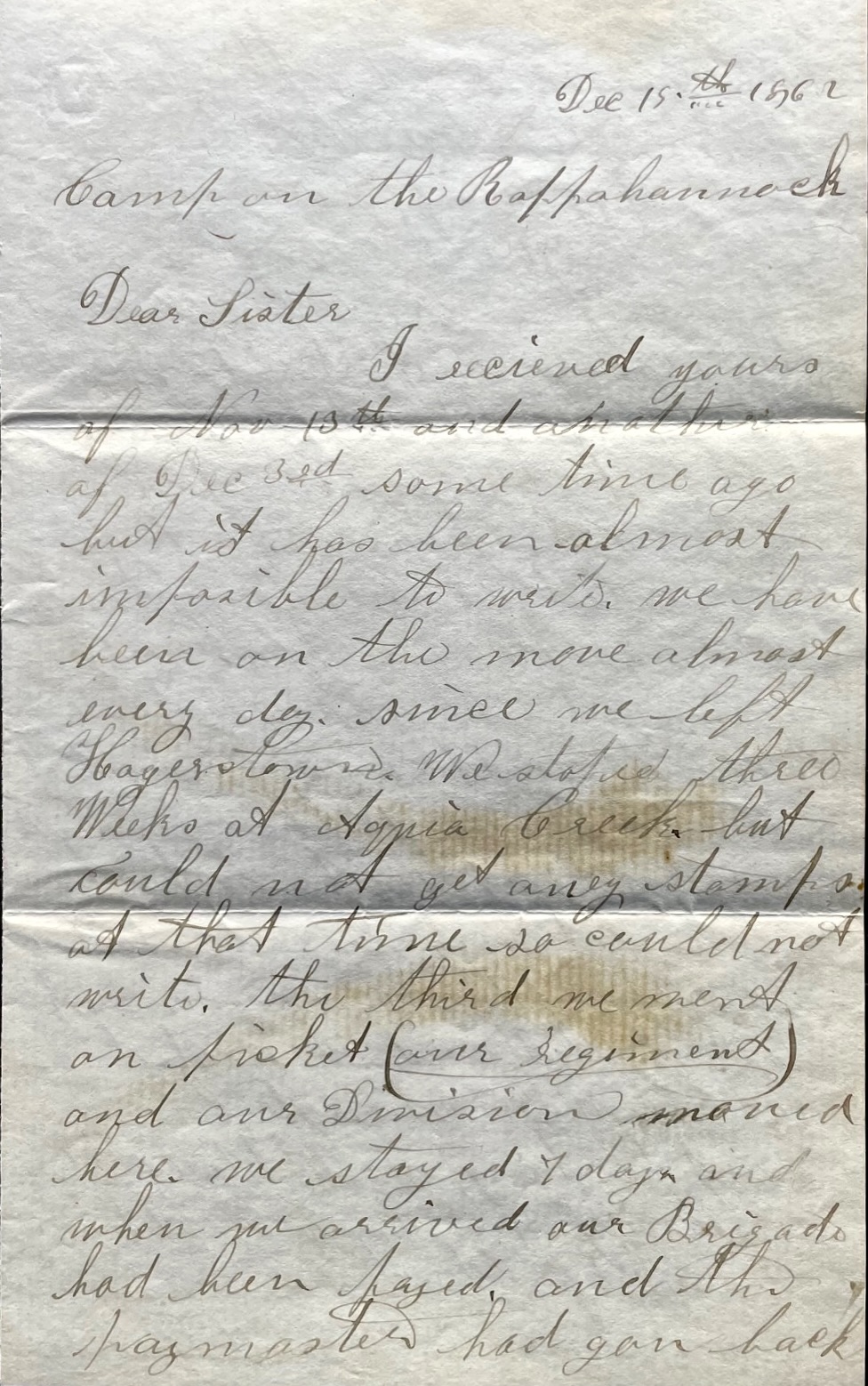
Camp on the Rappahannock [Monday] December 15, 1862
Dear Sister,
I received yours of November 13th and another of December 3rd some time ago but it has been almost impossible to write. We have been on the move almost every day since we left Hagerstown. We stopped three weeks at Aquia Creek but could not get any stamps at that time so could not write. The third we went on picket (our regiment) and our division moved here. We stayed 7 days and when we arrived our Brigade had been paid and the paymaster had gone back so we missed getting any pay for this time. My hopes are good yet for it will come some time if ever.
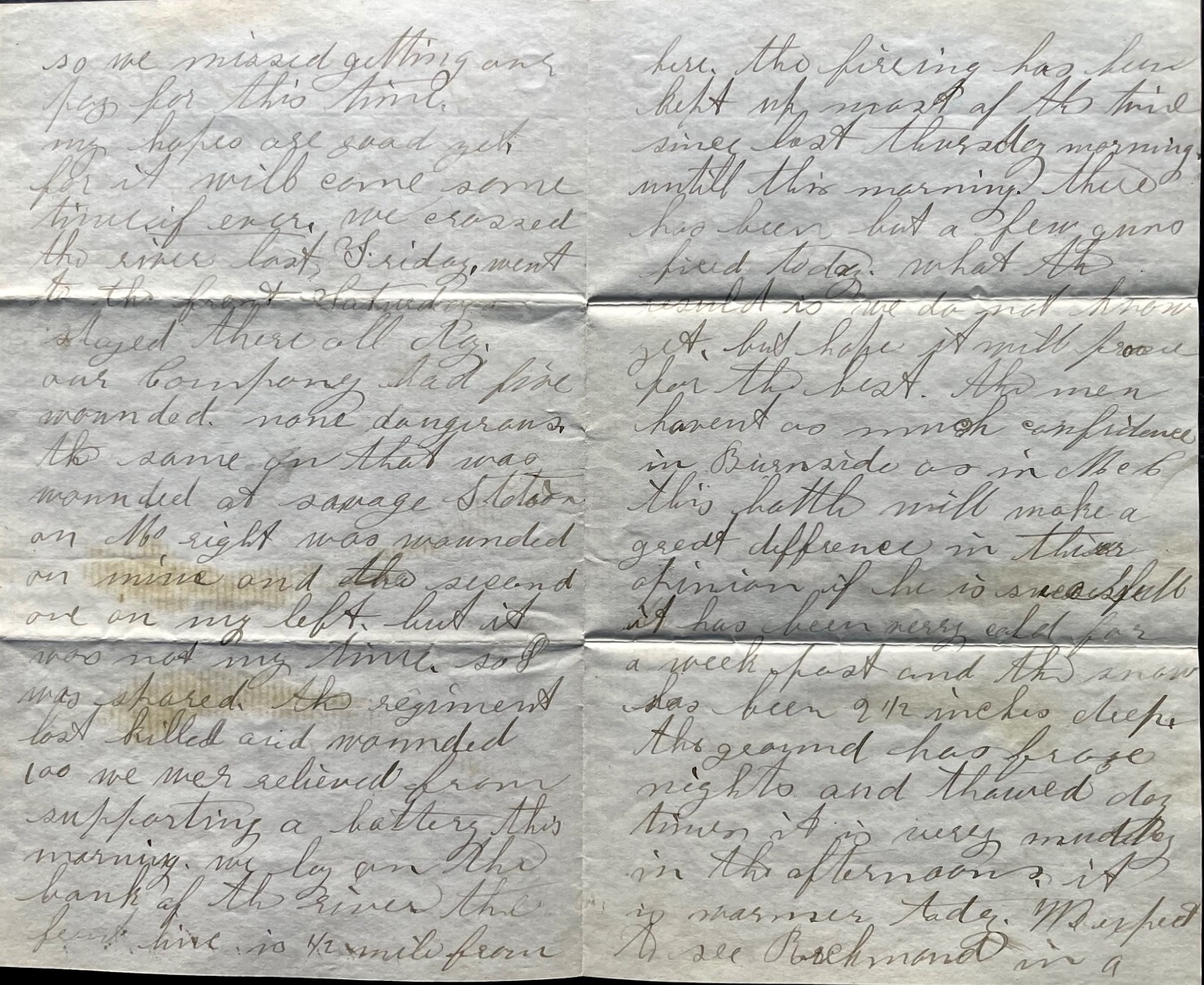
We crossed the river last Friday [12th], went to the front Saturday [13th], stayed there all day. Our company had five wounded—none dangerous. The same one that was wounded at Savage Station on M[arcellus]’s right was wounded on mine and the second one on my left, but it was not my time so I was spared. The regiment lost killed and wounded 100. We were relieved from supporting a battery this morning. We lay on the bank of the river. The front line is half a mile from here. The firing has been kept up most of the time since last Thursday morning until this morning. There has been but a few guns fired today. What the result is, we do not know yet but hope it will prove for the best.
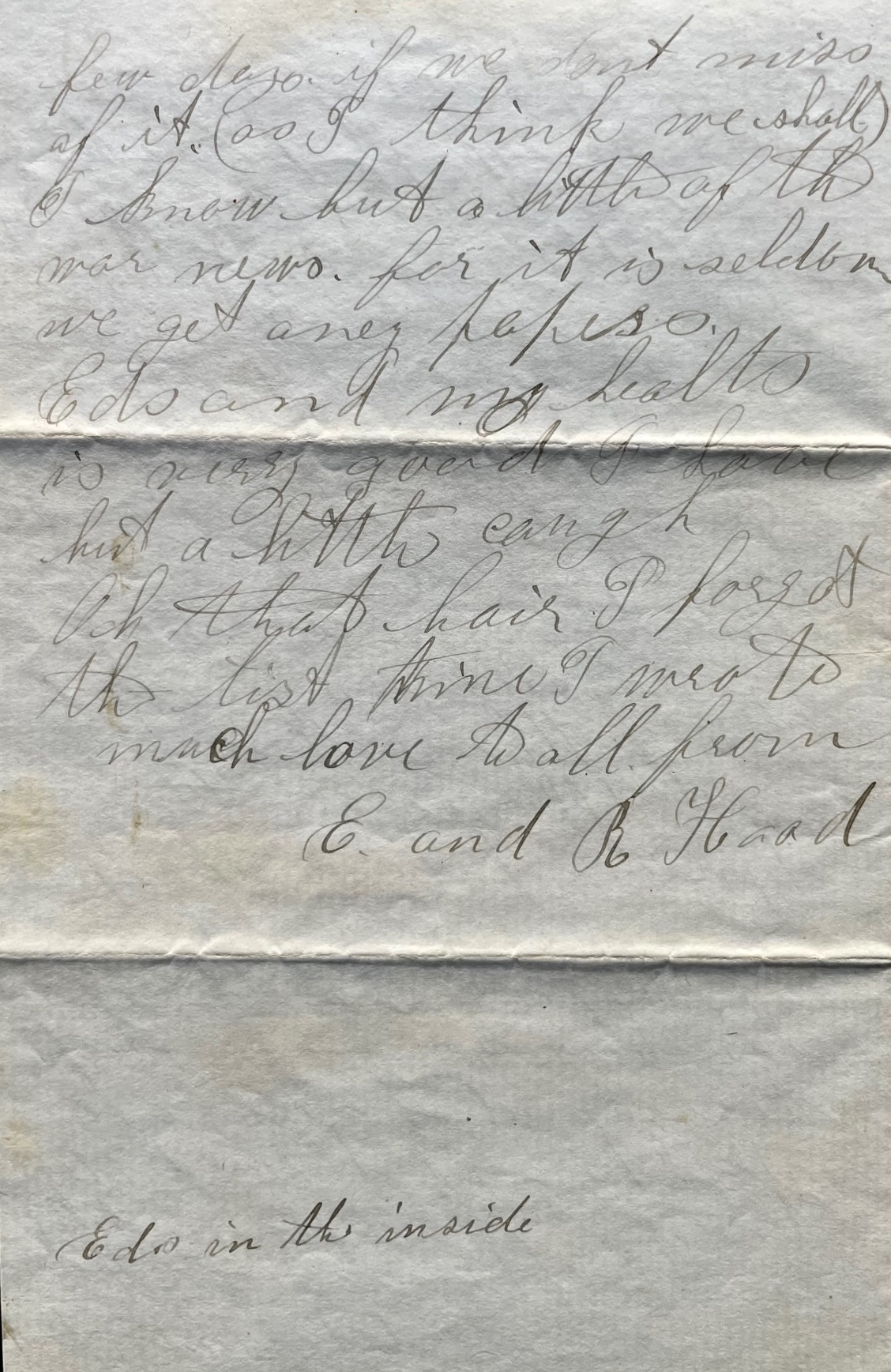
The men haven’t as much confidence in Burnside as in McClellan. This battle will make a great difference in their opinion if he is successful. It has been very cold for a week past and the snow has been two and a half inches deep. The ground has froze nights and thawed day times. It is very muddy in the afternoon. It is warmer today. We expect to see Richmond in a few days if we don’t miss of it (as I think we shall). I know but a little of the war news for it is seldom we get any papers.
Ed’s and my health is very good. I have but a little caugh. Oh, that hair I forgot the last time I wrote, Much love to all. From E. and R. Hood
Warren Smith Leslie was born on 14 December 1841, the oldest son of Cyrus Leslie (1812-1848) and Elvira Smith (1809-1894). Following his father’s death in 1848, he was placed in the home of a farmer in Plymouth, Vermont, and remained involved in agriculture throughout his life. He served in Co. I of the 2nd Vermont Infantry during the Civil War, enlisting in 1861. He was honorably discharged in mid-February 1863 after many months in the hospital. His military records indicate he received a gunshot wound to his left chest though it doesn’t say when. Presumably it occurred in the Peninsula Campaign. He married Alice D. Newman (1847-1914) of Woodstock, Vermont, in 1866 and the couple moved to Kansas. He died in Osawatomie, Kansas, on 16 December 1913.
In this letter to his mother, Warren expresses disenchantment with the war and its officers from his bed in the Haddington General Hospital at Philadelphia.
Haddington Hospital in Philadelphia, PA.
T R A N S C R I P T I O N
Haddington Hospital [Philadelphia, Pa.] December 25th 1862
Dear Mother,
I received two letters from you and one from Henry yesterday. I was glad to hear from all of you once more. I don’t know as I am any better than I was when I wrote before and I have got so far from Washington now that I don’t know as I can get my discharge or a furlough either but I don’t know but they will send me to a hospital in Vermont by and by. I have got so that I don’t care much which way the world goes. They have kept me six months without pay and there isn’t any prospects of getting it for six to come.
I have written to the Captain for my Descriptive List so that I could draw my money and some clothes but he hadn’t never answered it nor sent the list either. The officers if our army are nothing but a set of rascals and thieves. They are making money out of it and that is all they care for. The rebels are bad enough but if they are traitors, they are honest men. What the most of our officers are and unless we have different leaders, the rebellion never will be put down. Now you see if my words don’t prove true. I have spoiled my health and constitution fighting for these money eaters but if I live to get out of this, they won’t catch me again.
You wrote that Warren Walker has got home. I never knew before that he had enlisted. What regiment was he in? An Iowa [regiment], I suppose, for I believe that is where he was when the war broke out. I must close for it is growing dark. Give my respects to all the brothers and sisters and to grandfather’s folks.
These letters were written by Edson Emery (1833-1915) and Philo Emery (1836-1864) of Co. E, 2nd Vermont Infantry. They were the sons of Joel Emery (1787-1860) and Lucy Goddard (1797-1878) of Tunbridge, Vermont. The few letters were once part of a very large collection that had been in private hands for decades and yet had never transcribed and published before. There were 77 letters penned by either Edson or Philo—or both—while serving in the 2nd Vermont Infantry that I published in 2020 on Spared & Shared 19. Most of those letters, like these few, were sent to their brother Leonard who managed the family farm when he was not in the service, or to their mother—a semi-literate widow who saw four sons and one son-in-law go off to fight for the Union. One of her sons and her son-in-law did not survive the war.
The two other sons who served in the Union army were Silas Goddard Emery (1816-1884) and Leonard Emery (1829-1884). Both served in the 12th Vermont Infantry—a 9-month’s regiment organized in the late summer of 1862.
Obituary notice for Philo Emery, Vermont Journal (Windsor, Vermont), dated 9 July 1864:
“At Armory Square Hospital, Washington D. C., Philo Emery, of Tunbridge, aged nearly 28 years. He was a member of the 2nd Regiment of Vermont Vols. When the war broke out, he hastened to offer his services to his country. He passed through all the engagements in which his regiment participated up to the battle of the Wilderness on the 5th day of May. In this battle, he was seriously wounded in the knee. He was carried to the hospital and died June 9th. Mr. Emery was a good soldier, faithful to his duties to the Army and his government. He died as a Christian dies. His last message to his friends at home was, ‘Tell them I die right.’ His ashes repose among his native hills besides those of other members of his family.”
Obituary Notice for Edson Emery:
“Edson Emery was born in Tunbridge July 26, 1833, a son of Joel and Lucy (Goddard) Emery, and was the last of their nine children. He grew to young manhood in his native town, worked on the railroad, engaged in the drover business and interested himself in several pursuits until the Civil War broke out. Then he enlisted in Co. E, 2d Vermont Regiment twelve days after the Fort Sumter was fired upon and saw three years hard service. He was in 22 battles—the first battle of Bull Run, the Yorktown siege of five weeks, Lee’s Mills, Williamsburg, Fair Oaks, Golden’s Farm, Savage Station, White Oak Swamp, Malvern Hill, second battle of Bull Run, South Mountain, Antietam, Fredericksburg, Marye’s Heights, Chancellorsville, Gettysburg, Rappahannock Station, Mine Run, the Wilderness, Spotsylvania, Bethsaida Church and Cold Harbor. When the regiment was in front of Petersburg his term expired and he returned to the North.
He had three brothers—Silas, Leonard and Philo—and a brother-in-law [Jasper Lyman] in the army with him. Philo Emery was wounded and died. Mr. Edson Emery was never seriously hurt in the storms of lead he had so often to face but he bore the scars of a good many flesh wounds. During all his service, he kept a diary which is a faithful story of the stirring events in which he participated and reveals a keen eye and discerning mind.
On May 20, 1866, Mr. Emery married Jennie Gay of Gaysville,” the daughter of Paul W. and Phalina (Abbott) Gay.
Edson Emery’s Civil War Diary and papers, 1861-1863 are housed in the Special Collections of the Universities of Vermont Libraries in Burlington, Vt.
Philo Emery’s two diaries, (1861-1862) and (1863-1864), are housed in the Jack & Shirley Silver Special Collections Library at the University of Vermont in Burlington.
Letter 1
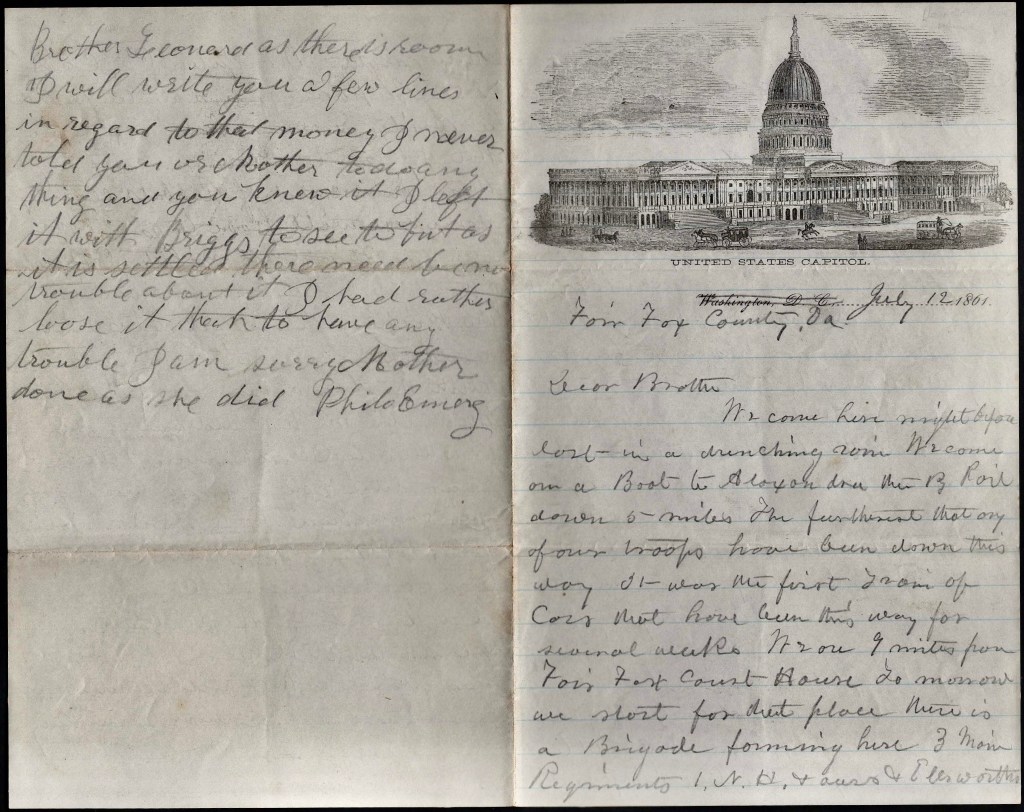
Fairfax County, Virginia July 12, 1861
Dear Brother,
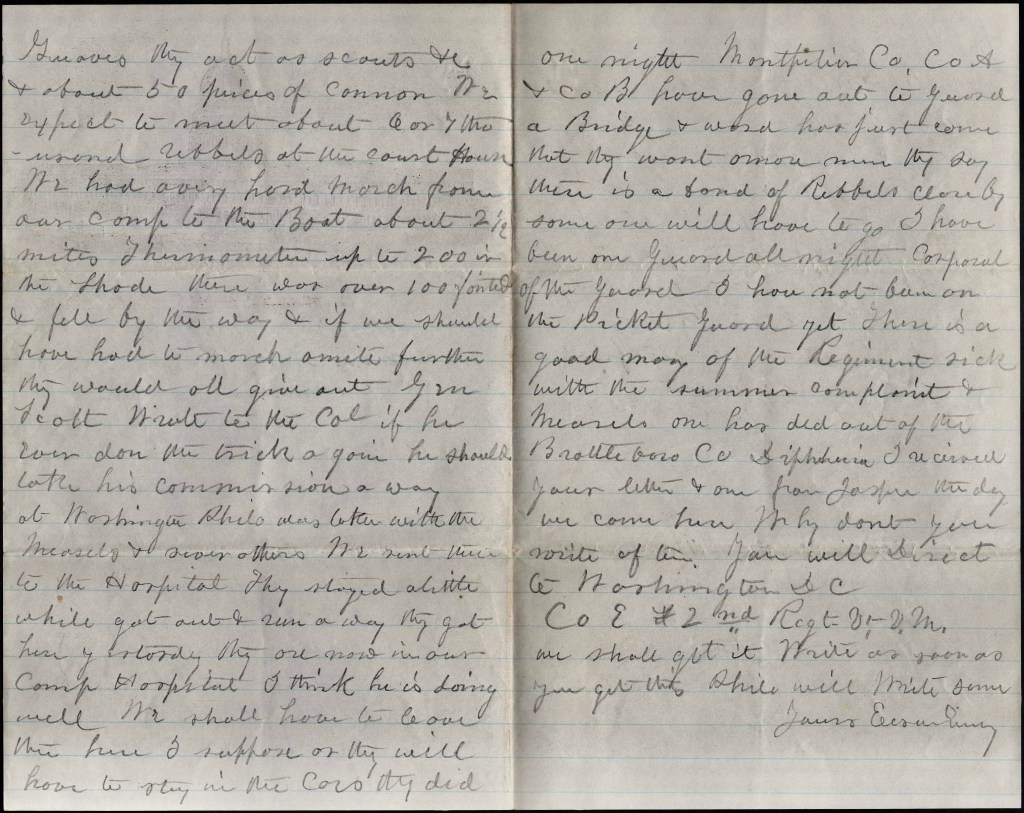
We come here night before last in a drenching rain. We come on a boat to Alexandria, then by rail down 5 miles—the furthest that any of our troops have been down this way. It was the first train of cars that have been this way for several weeks. We are nine miles from Fairfax Court House. Tomorrow we start for that place. There is a brigade forming here—three Maine Regiments, 1 New Hampshire, and ours. Ellsworth’s Zouaves—they act as scouts &c., and about 50 pieces of cannon. We expect to meet about 6 or 7 thousand rebels at the Court House.
We had a very hard march from our camp to the boat—about two and a half miles; thermometer up to 200 in the shade. There was over 100 fainted and fell by the way & if we should have had to march a might further, they would all give out. Gen. Scott wrote to the Colonel if he ever done the trick again, he should take his commission away.
At Washington, Philo was taken with the measles & several others. We sent them to the hospital. They stayed a little while, got out and run away. They got here yesterday. They are now in our camp hospital. I think he is doing well. We shall have to leave them here, I suppose, or they will have to stay in the cars. They did one night.
Montpelier companies—Co. A and Co. B—have gone out to guard a bridge & word has just come that they want more men. They say there is a band of rebels close by. Someone will have to go. I have been on guard all night [as] corporal of the guard. I have not been on the picket guard yet.
There is a good many of the regiment sick with the summer complaint & measles. One has died out of the Brattleboro Company—diphtheria. I received your letter & one from Jasper the day we came here. Why don’t you write often? You will direct to Washington D. C., Co. E, 2nd Regt. Vermont V. M.
We shall get it. Write as soon as you get this. Philo will write soon. Yours, –Edson Emery
Brother Leonard, as there is room I will write you a few lines in regard to that money. I never told you or Mother to do anything and you knew it. I left it with Briggs to see to but as it is settled, there need be no trouble about it. I had rather lose it than to have any trouble. I am sorry Mother done as she did. — Philo Emery
Letter 2
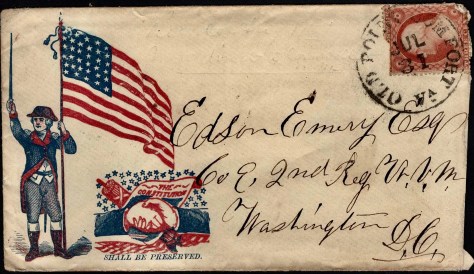
Obviously this envelope did not carry this letter because it’s addressed to Edson (the author of the letter)
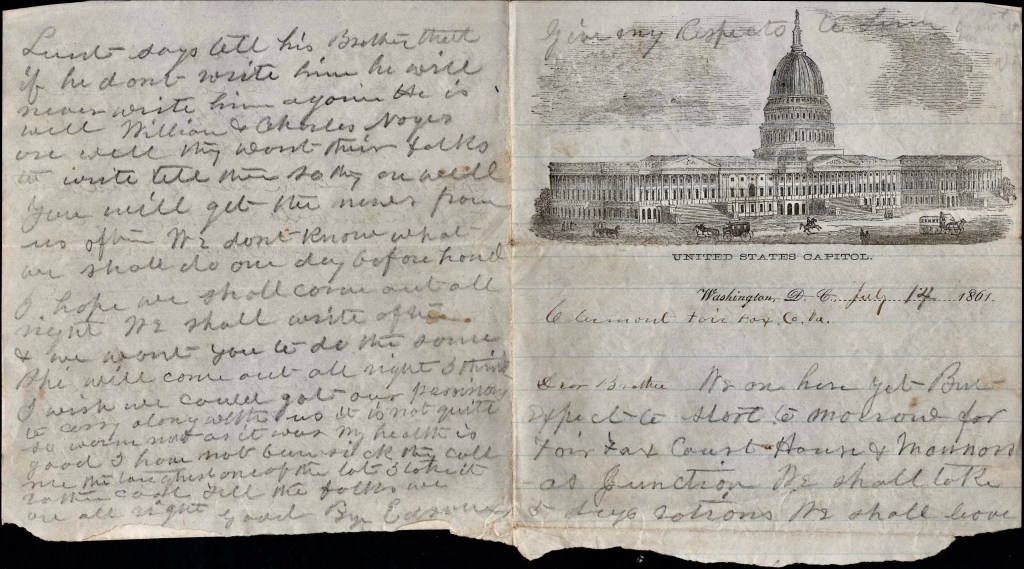
Washington D. C. July 14, 1861
Clermont, Fairfax County, Virginia
Dear Brother,
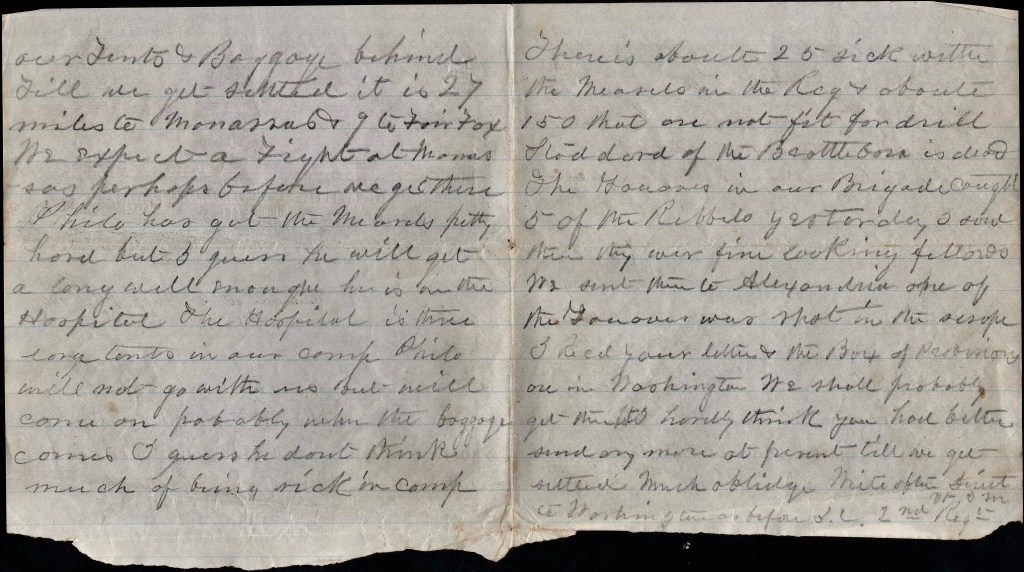
We are here yet but expect to start tomorrow for Fairfax Court House & Manassas Junction. We shall take 5 days rations. We shall leave our tents & baggage behind till we get settled. It is 27 miles to Manassas & 9 to Fairfax. We expect a fight at Manassas—perhaps before we get there. Philo has got the measles pretty hard but I guess he will get along well enough. He is in the hospital. The hospital is three large tents in our camp. Philo will not go with us but will come on probably when the baggage comes. I guess he don’t think much of being sick in camp. There is about 25 sick with the measles in the regiment & about 150 that are not fit for drill.
Stoddard of Brattleboro is dead. The Zouaves in our brigade caught five of the rebels yesterday, I saw them. They were fine looking fellows. We sent them to Alexandria. One of the Zouaves was shot in the scrape.
I received your letter and the box of provisions over in Washington. We shall probably get them. I hardly think you had better send any more at present till we get settled. Much obliged. Write often. Direct to Washington as before. 2nd Regiment Vermont V. M.
Lieutenant says tell his brother that if he don’t write him he will never write him again. He is well. William & Charles Noyes are well. They want their folks to write. Tell them so. They are well. You will get the news from us often, We don’t know what we shall do one day before hand, I hope we shall come out all right. We shall write often & we want you to do the same. Phi will come out all right, I think, I wish he could come along with us. It is not quite so warm now as it was. My health is good. I have not been sick. They call me the toughest one of the lot. I take it rather cool. Tell the folks we are all right. Goodbye, — Edson
Letter 3
Patriotic image on Edson’s Letter
Bush Hill, Virginia August 8, 1861
Dear Brother,
I received your letter last night. George Derrell is going home today & I will send this line by him. Also [Moses] Glines, [Daniel] Pember, and Horace Wills are going home on furloughs. It is very warm weather. We have begun to drill some every day. The boys don’t pick [it] up very fast.
The sore throat prevails some. Some have died and others complain some but I think they will manage it all right.
You say you don’ know where we are. Well, sir, we are about 4 miles south of Alexandria on the line of the railroad & about 14 miles south of Washington. We run the mail to Washington & back every day. The boat runs from Alexandria to Norfolk [?] several times a day. But we talk of leaving this brigade & going up to Chain Bridge above Washington about 8 miles. If we go there, we shall be with the 3rd Vermont Infantry and the others when they come in. [We will] have a Vermont Brigade.
We are now further advanced toward the rebels than any other regiment. We are close by them. Last night the report was that we should be attacked but it proved false as well as all other of the alarms.
Glines will carry that money. George is pretty well loaded down with letters, &c. I wrote you a few days ago & sent you a paper. Write often & direct as before. Yours truly, — Edson Emery
Letter 4
Camp Griffin, Virginia December 6, 1861
Dear brother,
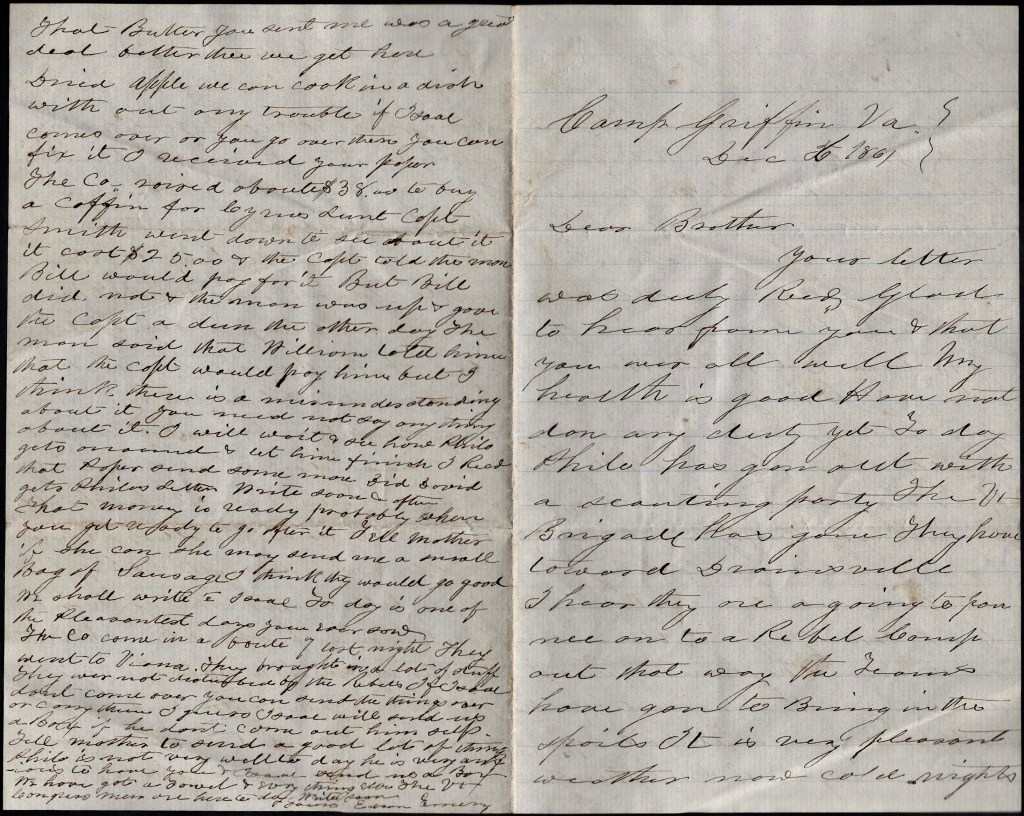
Your letter was duly received. Glad to hear from you and that you were alll well. My health is good. Have not done any duty yet today. Philo has gone out with a scouting party. The Vermont Brigade has gone. They have [gone] toward Dranesville. I hear they are a going to pony [?] on to a Rebel camp out that way. The teams have gone to bring in the spoils.
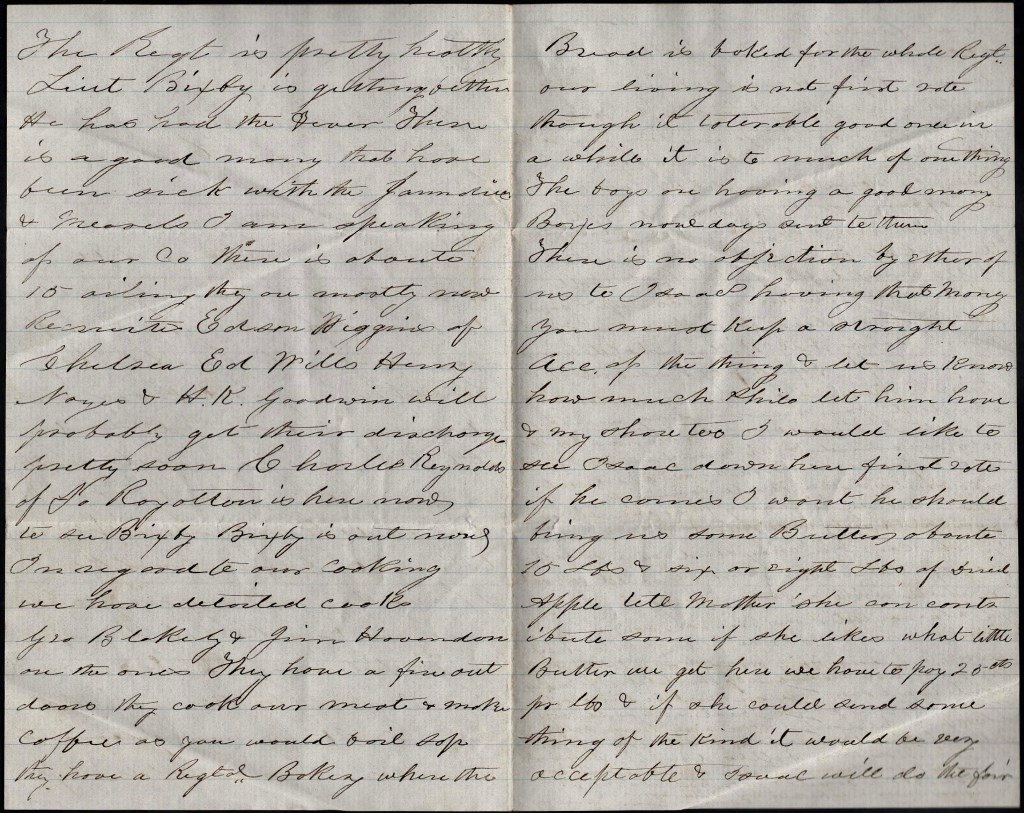
It is very pleasant weather now. Cold nights. The regiment is pretty healthy. Lieut. Bixby is getting better. He has had the fever. There is a good many that have been sick with the jaundice & measles. I am speaking of our company. There is about 15 ailing. They are mostly now recruits. Edson Wiggins of Chelsea, Ed Wills, Henry Noyes, & H. K. Goodwin will probably get their discharge pretty soon. Charles Reynolds of South Royalton is here now to see Bixby. Bixby is out now.
In regard to our cooking, we have detailed cooks. George Blakely & Jim Hovendon are the ones. They have fire out doors. They cook our meat and make coffee as you would boil soup. They have a regimental bakery where the bread is bakes for the whole regiment. Our living is not first rate though it is tolerable good. Once in a while it is too much of one thing. The boys are having a good many boxes now days sent to them. These is no objection to either of us to such an act…
I would like to see Isaac down here first rate. If he comes, I want he should bring me some butter—about 10 lbs. and six or eight lbs. of dried apples. Tell Mother she can contribute some is she likes. What little butter we get here we have to pay 20 cents per pound & if she could send something of the kind, it would be very acceptable & Isaac will do the favor. That butter you sent me was a great deal better than we get here. dried apples we can cook in a dish without any trouble if Isaac comes over or you go over there, you can fix it. I received your paper.
The company raised about $38 to buy a coffin for [Corp.] Cyrus [W.] Lunt. Capt. Smith went down to see about it. It cost $25 & the captain told the man Bill would pay for it. But Bill did not & the man was up and gave the captain a dun the other day. The man said that William told him that the captain would pay him but I think there is a misunderstanding about it. You need not say anything about it. I will wait and see how Philo gets around and let him finish…
Today is one of the pleasantest days you ever saw.
The company came in about 7 last night. They went to Vienna. they brought in a lot of stuff. They were not disturbed by the rebels…
Yours, — Edson Emery
Letter 5
Patriotic Image—“Vermont Soldier” poem.
Headquarters 2nd Vermont Regiment Camp Griffin, Va. December 20, 1861
Dear Brother,
Your letter & two papers was duly received. Very glad to hear from you. This afternoon there is heavy cannonading north of here toward Great Falls & Leesburg. Our regiment & most of the Vermont regiments have just started. Also the batteries & cavalry. Whether they will engage the enemy, I can’t tell. I should think by noise they were having some fighting. It looks some like rain this afternoon. Philo has gone. I did not go—my feet are very tender & I am pretty lame. [See Battle of Dranesville]
The rebels tried to cross the river above here the other day but were driven back. Gen. McCall’s Division went out early this morning. The rebels are closing in upon us. They are anxious for a fight. They want we should chase them down to Bull Run or Centerville. Then they will fight us. But I hardly think they come—that by keeping them where they are is whipping them fast enough.
We received a letter from Briggs last night. Caroline has a very bad eye. They are going down to Isaac’s to Christmas. Philo says he don’t think he will have you send any drawers. He has some. Brigg’s will help toward the box. Tell Mother to send a lot of good things—sausage, butter, &c. &c. You might put in a small piece of fresh pork if it is so cold weather, & some cookies, sweetened doughnuts, and if handy, a piece of cheese. You need not send any wheat bread. We have that here. But send anything good for we don’t get much that is good here. Dried apples goes well. But the sausage, I think I can eat. I wish you would get me a Memorandum Book at the book store at Bethel & have Isaac put it in the box. It will cost about 25 cents & you can charge it to me. Get one about 5 or 6 inches long and about 3 inches wide, well bound, and strap over. The inside to be an almanac, a space for every day in the year, and a cash account. Get a good one for I need one for next year & have none. You or Isaac or someone get it and send it.
Also, tell Ann to get four feet of blue tape about half inch wide. I want it to put on my arm to show the rank which I hold. I am the third corporal now. You can pay her. It will not be much—perhaps five or ten cents. Here it would be six times that.
As to our state money, we have not drawn any but we think we will next payday. Philo and I can draw $84 of state pay. Philo 42 and I the same, and we shall send about $40 of US pay which will make a good sum to let out. We lay up our money to what most of them do but it is dearly earned. Therefore you must do all you can for us. We have taken their lives in their hands. It is no small affair.
I will wait for Philo to come in. Tell Florence we will write her a letter pretty soon. Yours, — Edson
December 21. Philo came in about 8 last night. They went to Dranesille or a most there but did not see the enemy. McCall had driven them back. McCall killed and took 79 of the rebels & any quantity of blankets, overcoats, &c. &c. The boys had a hard march [of] 20 miles. They groaned some when they got back.
P. S. Our next pay will come about the 20th of January. Then we will send all.
The following letter was written by Alonzo Kinsley (1836-1910), the son of Ben Alva Kinsley (1796-1870) and Catherine Montague (1798-1849) of Fletcher, Franklin county, Vermont. He wrote the letter to his old brother, Daniel Kinsley (1829-1923)—messenger for the courts at Worcester, Massachusetts for fifty years—who married Harriett Newell Mudgett (1834-1900) in 1854. Several of Alonzo’s siblings are also mentioned in his letter. They include Rufus Kinsley (1831-1911) who served in Co. F, 8th Vermont Infantry and later as 2nd Lieutenant in the 74th USCT (See, “Diary of a Christian Soldier: Rufus Kinsley and the Civil War“, David C. Rankin, Cambridge University Press, 2004); Jason W. Kinsley (1833-1903) who served in Co. K, 1st Iowa Cavalry; and William Lyon Kinsley (1844-1901) who also served in Co. F, 8th Vermont Infantry. William was wounded at Cedar Creek (Virginia) on October 19, 1864, and promoted to Corporal in January 1865. He was wounded again at Petersburg on April 2, 1865, and mustered out on June 19, 1865.
Alonzo’s father, Ben Alva Kinsley (1796-1870)
Like his brothers, Alonzo Kinsley also served in the Union army. He enlisted in Co. H, 2nd Vermont Infantry, on 20 June 1861 and a month later at Bull Run, he was wounded. The nature of his wound is not given in the regimental history but a letter dated 20 August 1861 by Chester K. Leach, a comrade in the same company, states that, “Alonzo Kinsley has a failing about his lungs he can hardly talk I think his getting hit at Bulls Run in the breast is the first cause & now when he takes cold he can hardly talk, but he will not give up as long as he can stir.” See “Dear Wife, the Civil War Letters of Chester K. Leach“] Alonzo’s health must have plagued him during the war for when he wrote this letter to his brother in December 1863, he was working as a hospital steward at the US General Hospital in Annapolis—a detail typically assigned to soldiers recuperating from wounds or illness and incapable of standing the rigors of the field.
There is little hint of Alonzo’s political views in this letter except to state that he favored Lincoln’s reelection. It’s not clear if he held the same views as his brother Rufus whose diary reveals that he was a dedicated evangelical abolitionist soldier and believed that the war and its consequences were divine retribution for the sin of slavery. He believed that the Civil War was not actually about saving the Union, but about freeing slaves.
[Note: This letter is from the personal collection of Jill Duffy and was offered for transcription and publication on Spared & Shared by express consent.]
Transcription
Addressed to Mr. Daniel Kinsley, Worcester, Massachusetts
U. S. General Hospital Annapolis, Maryland December 15, 1863
Brother Daniel,
I was not a little surprised to receive a letter from you last week, for as I had heard nothing from you since last August, I thought perhaps you had either enlisted, or gone to Canada to avoid the draft.
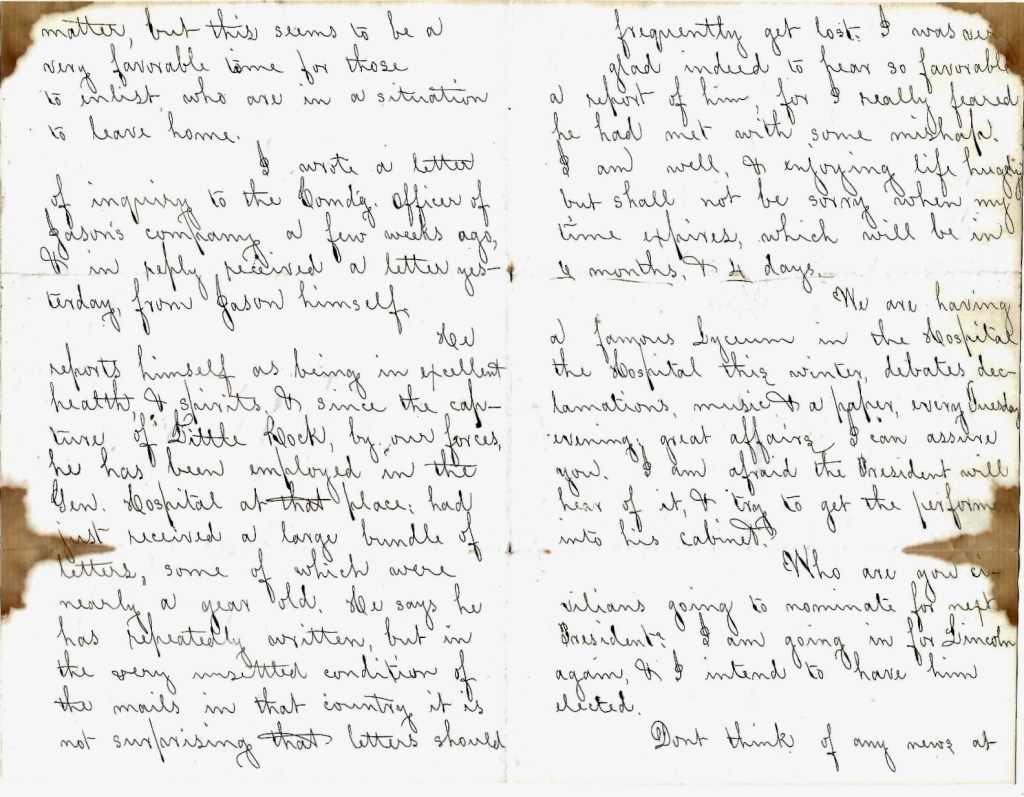
It seems you have some idea of enlisting if the quota is not raised before the time appointed for the draft to commence. Well, act according to your own judgment. I certainly would not undertake to advise you either way in regard to such a matter, but this seems to be a very favorable time for those to enlist who are in a situation to leave home.
I wrote a letter of inquiry to the Commanding Officer of Jason’s company a few weeks ago and in reply received a letter yesterday from Jason himself. He reports himself as being in excellent health and spirits, & since the capture of Little Rock by our forces, he has been employed in the General Hospital at that place, had just received a large bundle of letters, some of which were nearly a year old. He says he has repeatedly written, but in the very unsettled condition of the mails in that country, it is not surprising that letters should frequently get lost. I was very glad indeed to hear so favorable a report of him, for I really feared he had met with some mishap.
I am well & enjoying life hugely but shall not be sorry when my time expires, which will be in 6 months & 4 days.
We are having a famous Lyceum in the hospital this winter—debates, declamations, music, & a paper every Tuesday evening; great affairs, I can assure you. I am afraid the President will hear of it & try to get the performers into his cabinet.
Who are you civilians going to nominate for next President? I am going in for Lincoln again & I intend to have him elected. Don’t think of any news at present except that Dr. Vanderkieft has promised to muster me as acting Hospital Steward from the 1st of November which will increase my pay $8 per month & with the State pay, will amount to $28 a month.
Fine pleasant weather. No snow & no very cold snaps.
Remember me to Mary. Ann Loving, and other friends. Has Josie got well yet? Hope you & Harriet will find time to write a little oftener. — Alonzo
William writes that Rufus has got a commission in a Colored Regt. & that he had declined the offer of a similar commission.
The following letters were written by Charles Carroll Morey (1840-1865) of Royalton, Vermont, who entered the service on 20 June 1861 as a corporal in Co. E, 2nd Vermont Infantry, was promoted to sergeant in February 1862, and was commissioned the Captain of Co. C on 11 July 1864. He was wounded on 21 August 1864 at Charles Town, West Virginia, but was with his company on 2 April 1865 when he was killed in the final battle at Petersburg on 2 April 1865.
Charles was the son of Reuben Morey, Jr. (1809-1868) and Mary Louise Blasdel (1813-1847). After Reuben’s first wife died in 1847, he married Rosetta Morse Brown (1817-1877). Reuben was a merchant in Royalton, Windsor county, Vermont.
Letter 1
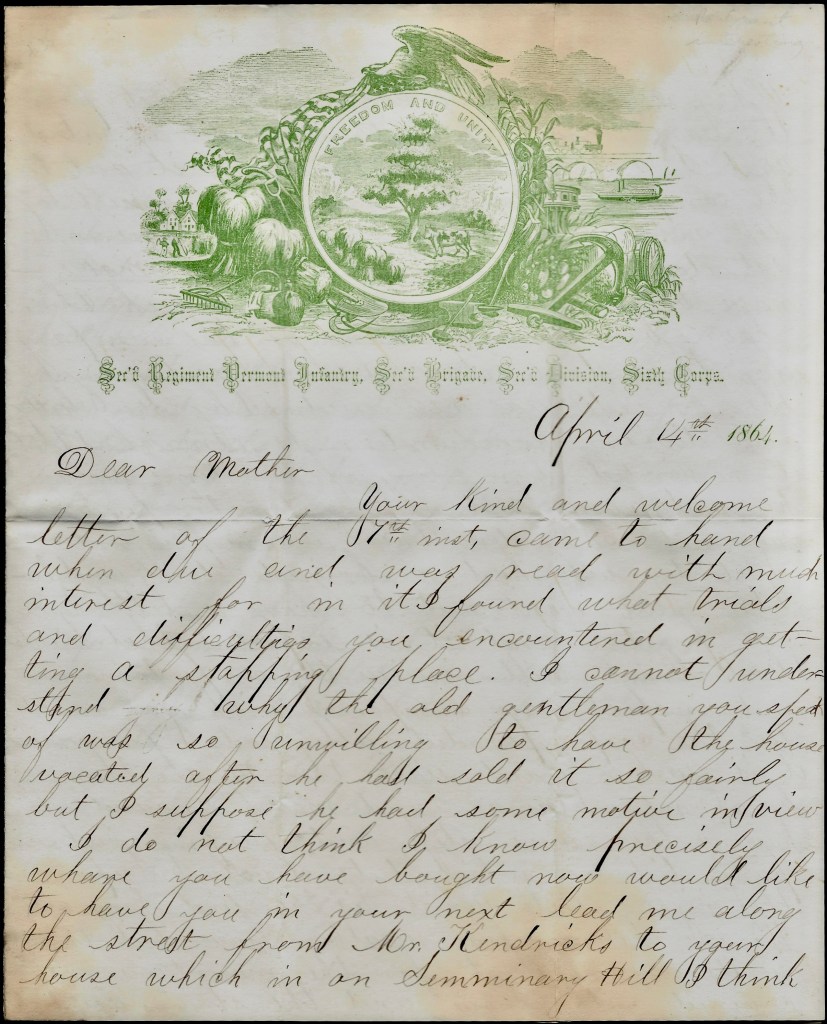
2nd Vermont Infantry Letterhead of Morey’s Letter dated 14 April 1864
April 14th 1864
Dear Mother,
Your kind and welcome letter of the 7th inst., came to hand when due and was read with much interest for in it I found what trials and difficulties you encountered in getting a stopping place. I cannot understand why the old gentleman you speak of was so unwilling to have the house vacated after he had sold it so fairly but I suppose he had some motive in view, I do not think I know precisely where you have bought now. Would like to have you in your next lead me along the street from Mr. Kendricks’ to your house which is on Seminary Hill, I think.
When I got to the bottom of the first page, the team drove up with a load of wood and I was called out to divide it out to the company. The I chopped up a small log for myself, after doing which I came in, sat down, and enjoyed a little smoke. Now I take my pen again to finish this.
Have been in command of the company for three days. Day before yesterday the brigade was reviewed by Gen’l Getty, our division commander. He remarked that it reminded him of the time when he had command of regular troops. Should you not consider this a compliment? Yesterday we had a brigade drill and today we went out to have a little target practice and it is expected that Lieut. Gen. Grant will review the corps tomorrow and inspect our camps. I wish you could see the corps paraded all ready for review. It is such a grand sight then to see them break into column and march around all having the same step and keeping just company distance which duty devolves upon the right guide which is the 1st Sergeant.
We are having fine weather now but the winds are cold. Yet far the mountains are covered with snow and the streams are high. For three days we had no mail in consequence of the bridges across the Bull Run and Rappahannock rivers but there are rebuilt now and the mail comes regularly which I hope it will continue to do so long as we stay in camp.
Did you receive my receipt for my town bounty? And also my order or receipt for the $125 State commutation money and if so, have you received the money? You say you will write soon and answer all my questions. Please do not fail to do so and let me [know] all the turns you are obliged to make, and please tell father he need not hesitate to use my money in his business for I intend to make that my business if I ever return to the quiet life I have left at my country’s call. Please do not keep me in suspense long in regard to my town bounty and state commutation money.
But I think I had better close this uninteresting letter and ask you to excuse me for troubling you this much. How do you like your new home and house? Please write me a long letter telling e all about it. Please remember me kindly to Uncle James. Tell him I should like to hear from him. Remember me kindly to all the family and all enquiring friends. Please write me soon and accept a great deal of love from your son in the army. — C. C. Morey
Letter 2
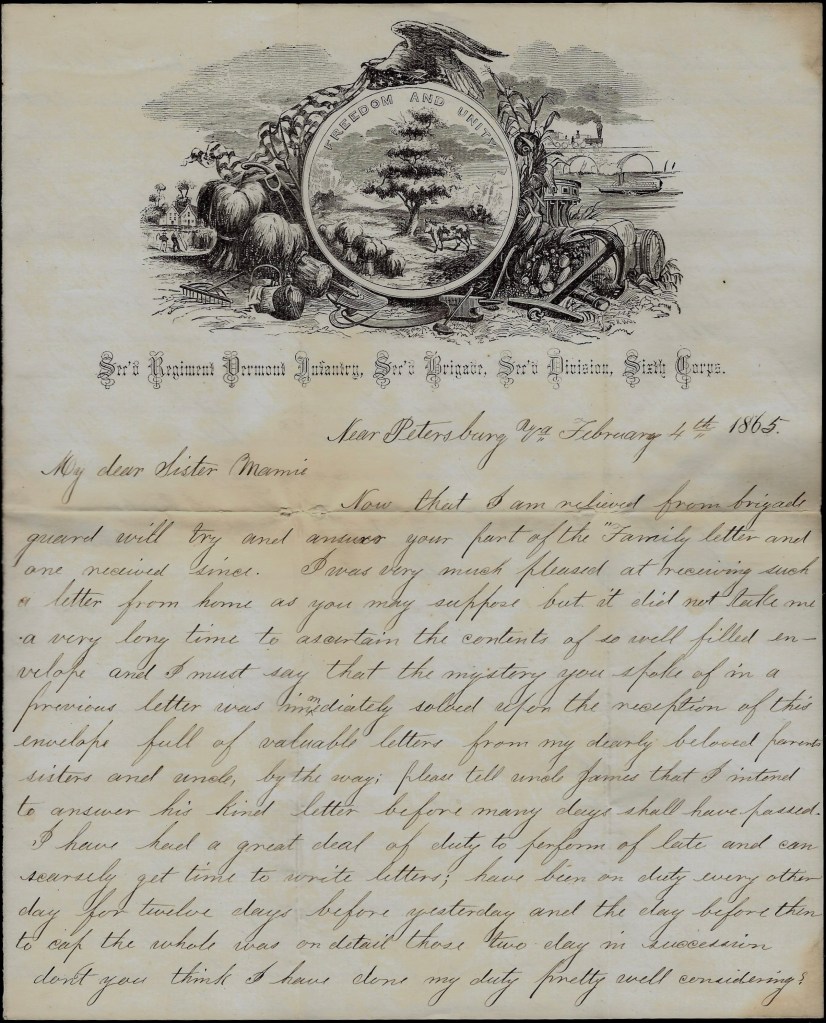
2nd Vermont Infantry Letterhead of Morey’s Letter dated 4 February 1865
Near Petersburg, Va. February 4th 1865
My dear Sister Mamie,
Now that I am relieved from Brigade guard, will try and answer your part of the family letter and one received since. I was very much pleased at receiving such a letter from home as you may suppose but it did not take me a very long time to ascertain the contents of so well filled envelope full of valuable letters from y dearly beloved parents, sisters, and uncle. By the way, please tell Uncle James that I intend to answer his kind letter before many days shall have passed.
I have had a great deal of duty to perform of late and can scarcely get time to write letters; have been on duty every other day for twelve days before yesterday and the day before then to cap the whole was on detail those two days in succession. Don’t you think I have done my duty pretty well considering?
The last letter I hacve received was yours of the 25th ult. Do not know why I have received no more. I suppose, however, that it is because they have not been sent. As you say, it takes our letters a very long time to go from here to Washington. This letterwill probably leave our camp tonight and City Point tomorrow morning will be on the boat from 30 to 35 hours. The will remain in the post office at Washington D. C. at least 24 hours more before it is mailed. This will account for the delay, I think.
Doubtless ere this you have (some of you) received letters from me saying something about orders to march. if so, rest easy for the prospect of a move has all passed and we are now as quiet as ever. What caused the order is that two rebel divisions were seen marching toward our left and we wished to be in readiness to meet them in case they should make a demonstration but they have been seen to return to their old encampments so there is no prospect of an attack at present on either side.
The weather is today very spring like and we are sitting in our tent with the door open. The photograph enclosed with my last letter was one that Lieut. Prouty gave me and i intend to ask you to put it with the others I have at home and I have some more to send which I wish you would place with the others until I come home or give you some further instructions in regard to them. I have received but one letter from Williamsburg friends since my last visit there. Cannot imagine the reason why they do not write. Have written to them two or three times. Hope they are all well and enjoying life as well as usual. I suppose they are anticipating much when the spring comes and they leave the city for our quiet little home in the little town of West Lebanon in the little state of New Hampshire.
Shurb Adams, a sergeant in Co. E, has just received a furlough for twenty days and will visit you before he returns. I have also sent by him a large book which perhaps you may [be] interested. Please keep it for me until I return home. I suppose you are still enjoying life as well as ever and attending those sociables and singing schools and all such pleasant gatherings. Would like to just step into our house just after dark and then go with you to some gathering in the village. Wouldn’t some folks stare and ask, “Who is that soldier that came with Misses Morey?”
We have no news in particular to write except that it has become a settled fact that commissioners from Richmond, Va., have gone to Washington to confer with the President on the subject of that great question Peace or No Peace. Hope they may conclude that we had better have peace instead of prolonged war.
I think of nothing more to write at present; therefore, will close. Please remember me kindly to all the family and our friends in West Lebanon and write as often as convenient. I have not solved the enigmas you sent me yet. Accept much love from your brother in the Army of the Potomac. Please direct all letters to Co. C, 2nd Regiment Vermont Vols.
— Charles C. Morey, 1st Lieutenant
To Muss Mary E. Morey, west Lebanon, New Hampshire
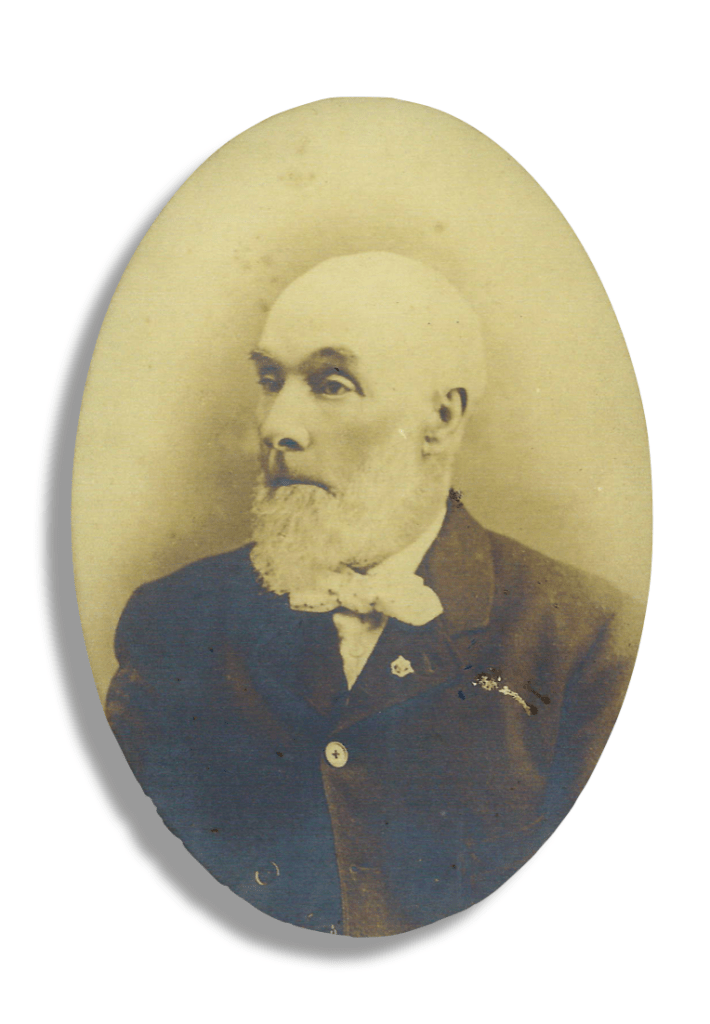
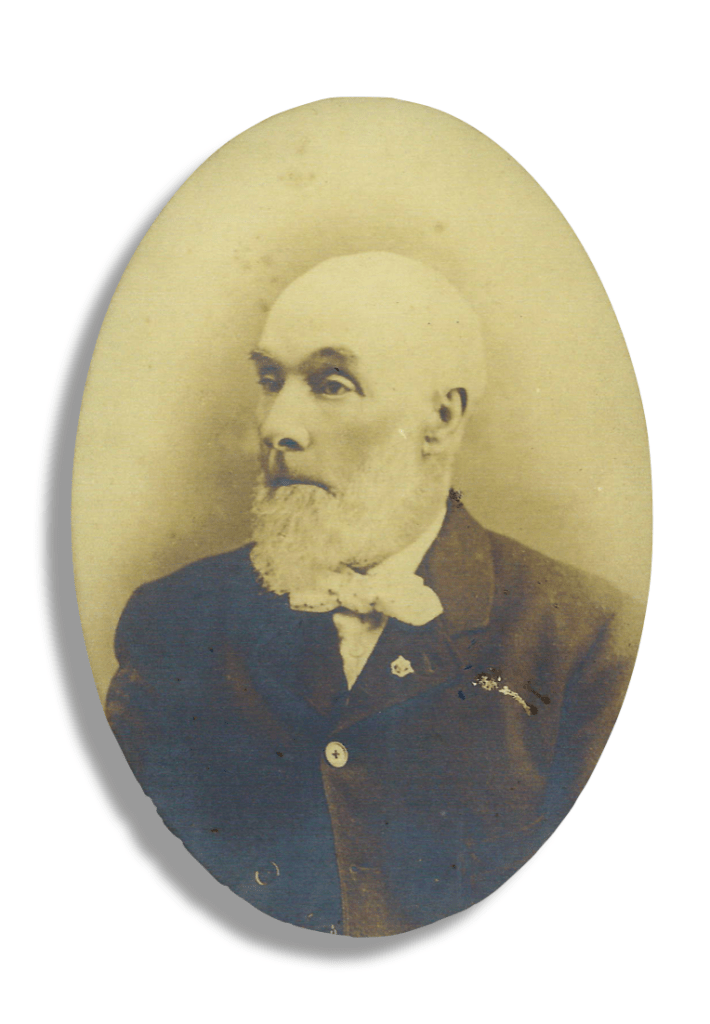
I could not find an image of Edwin but here is one of William Sawin who also served as an Asst. Surgeon in the 2nd Vermont Infantry (Photo Sleuth)
The following letters were written by Edwin R. Brush (1836-1908) who was drafted into the service on 17 July 1863 as a private in Co. H, 2nd Vermont Infantry and three months later was promoted to Assistant Surgeon of the regiment.
Brush graduated from the University of Vermont at Burlington in 1858 and took over the medical practice of his father, Dr. Salmon Brush (1804-1887) in Cambridge, Lamoille county, Vermont. Edwin wrote the letters to his wife, Amy R. Brush (1836-1915).
Edwin was with the regiment from the time they fought at Rappahannock Station in November 1863 through the Battle of Sailor’s Creek in April 1865. In one letter, he describes the mood of the army following the assassination of President Lincoln and shares portions of conversations he’s had with rebel soldiers going home following Lee’s surrender.
Letter 1
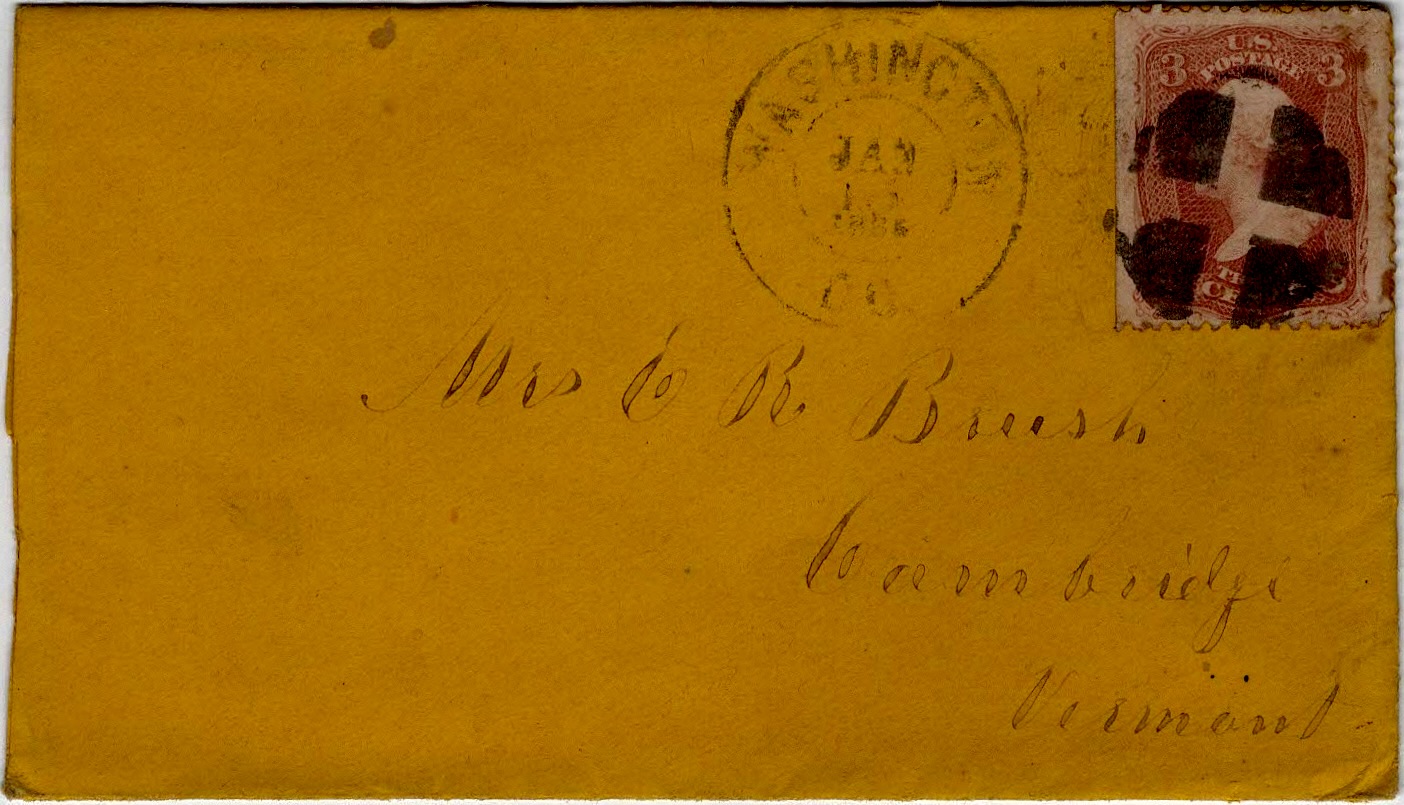
Addressed to Mrs. E. R. Brush, Cambridge, Vermont
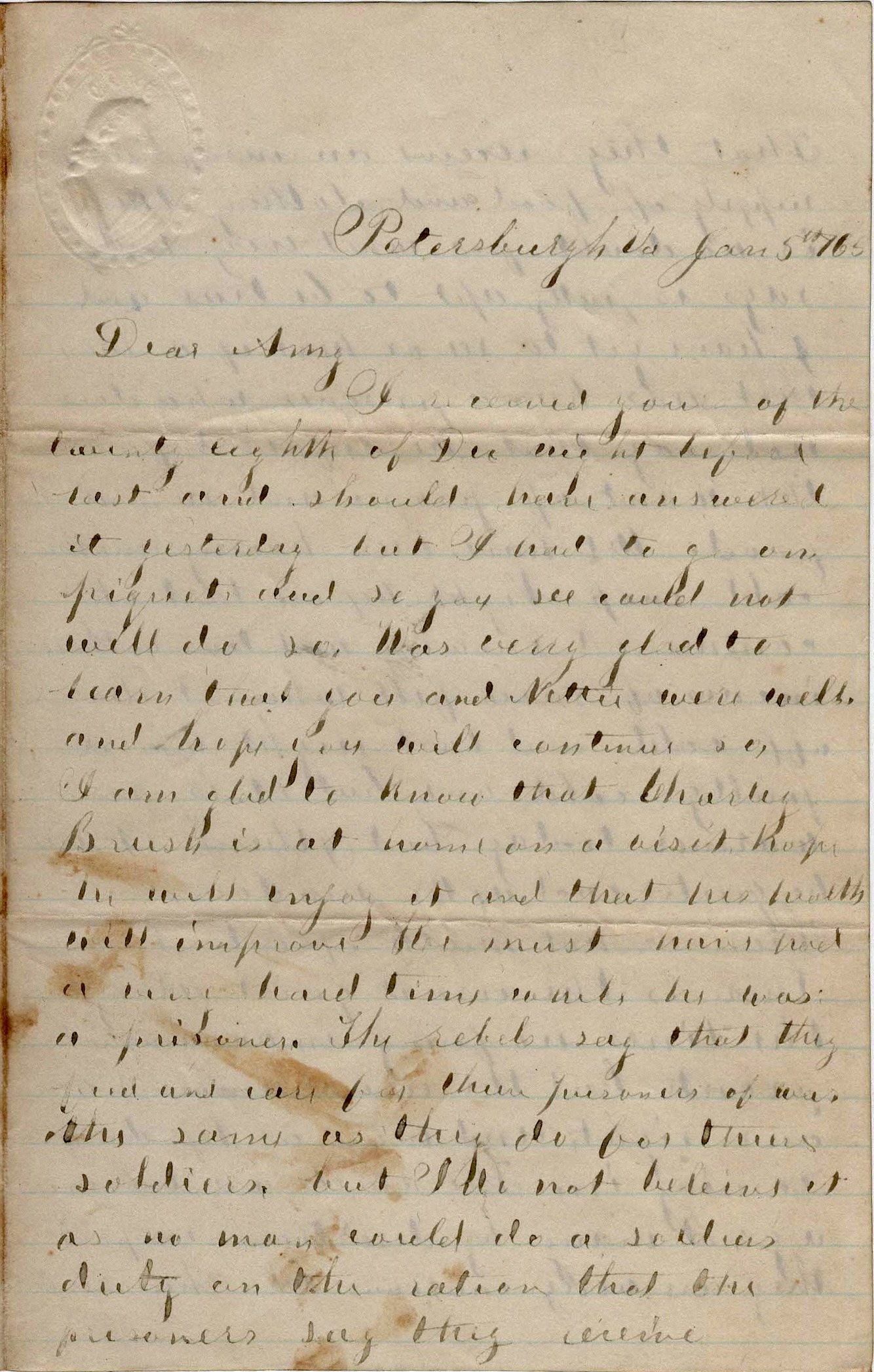
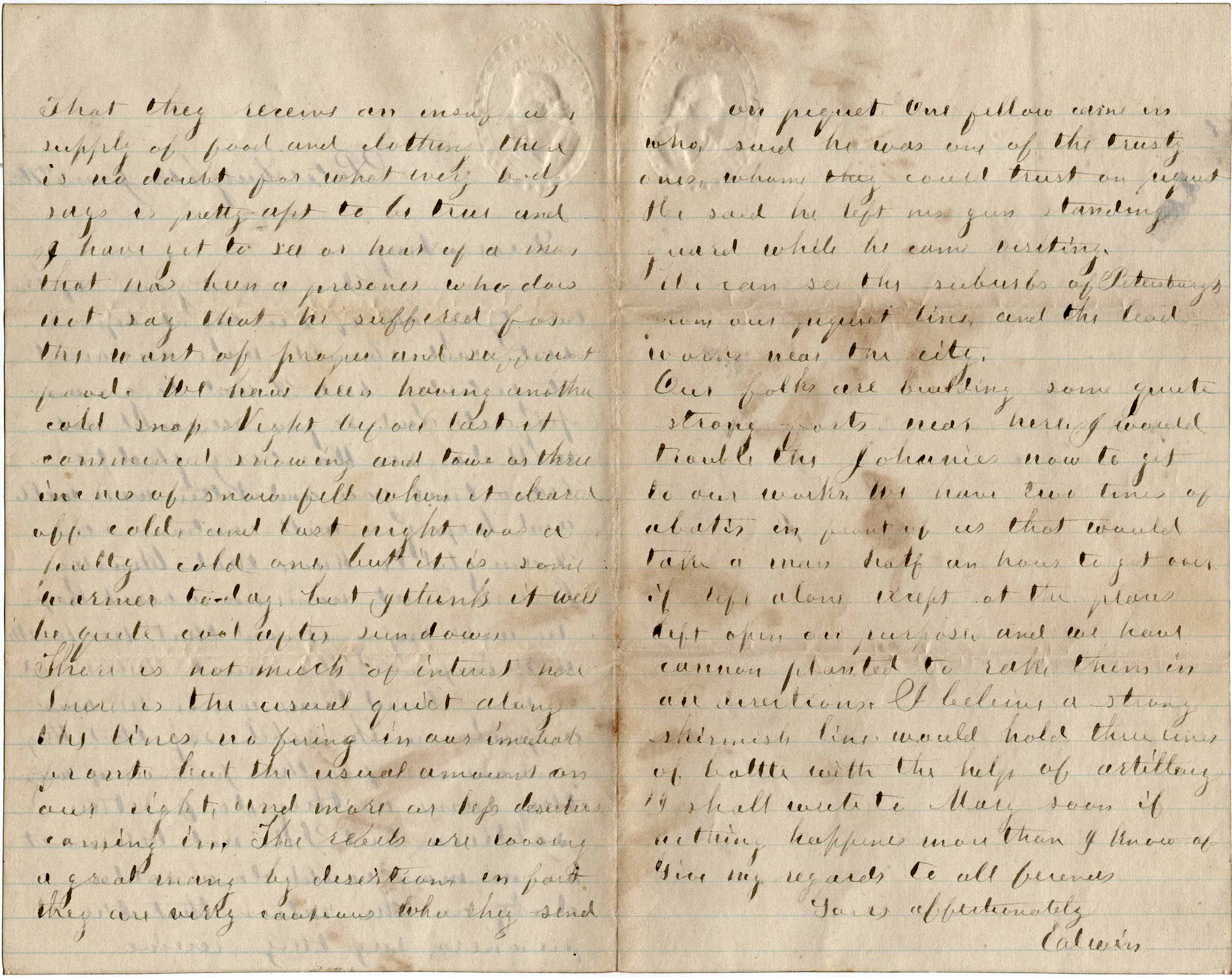
Petersburg, Va. January 5th 1865
Dear Amy,
I received yours of the 28th of December night before last and should have answered it yesterday but I had to go on picket and so you see could not do so. Was very glad to learn that you and Nettie were well and hope you will continue so.
I am glad to know that Charley Brush is at home on a visit, Hope he will enjoy it and that his health will improve, He must have had a very hard time while he was a prisoner. The rebels say that they feed and care for their prisoners of war the same as they do for their soldiers but I do not believe it as no man could do a soldier’s duty on the ration that they prisoners say their receive. That they receive an insufficient supply of food and clothing, there is no doubt for what everybody says is pretty apt to be true and I have yet to see or hear of a man that has been a prisoner who does not say that he suffered for the want of proper and sufficient food.
We have been having another cold snap. Night before last it commenced snowing and two or three inches of snow fell when it cleared off cold. And last night was a pretty cold one but it is some warmer today. But I think it will be quite cool after sundown.
There is not much of interest here. There is the usual quiet along the lines. No firing in our immediate front but the usual amount on our right and more or less deserters coming in. The rebels are losing a great many by desertion. In fact, they are very cautious who they send on picket. One fellow came in who said he was one of the trusty ones whom they could trust on picket. He said he left his gun standing guard while he came visiting.
We can see the suburbs of Petersburg from our picket lines and the lead works near the city.
Our folks are building some quite strong forts near here. It would trouble the Johnnies now to get to our works. We have two lines of abatis in front of us that would take a man half an hour to get over if left alone except at the places left open on purpose and we have cannon planted to rake them in all directions. I believe a strong skirmish line would hold three lines of battle with the help of artillery.
I shall write to Mary soon if nothing happens more than I know of. Gove my regards to all friends. Yours affectionately, — Edwin
Letter 2
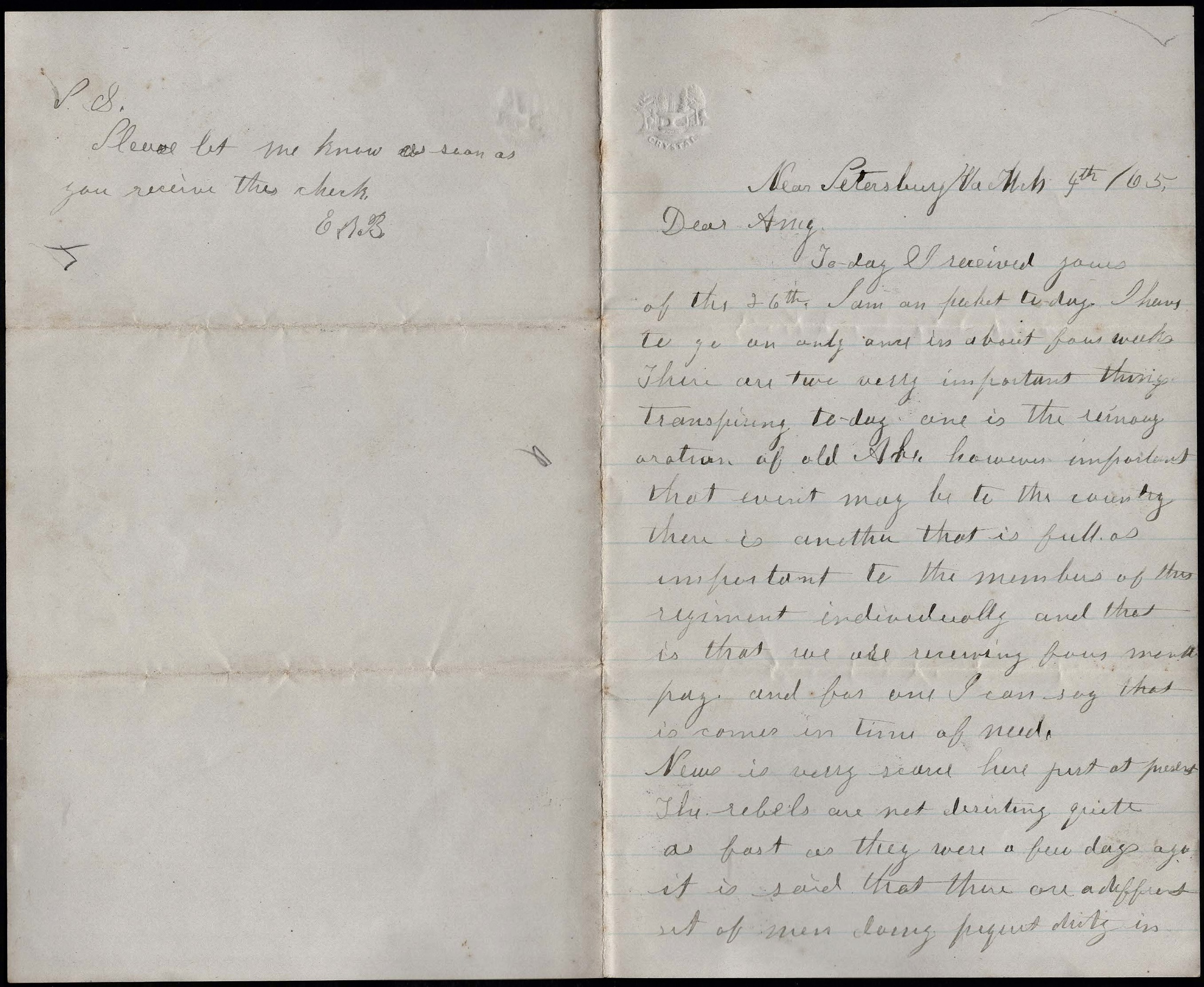
Near Petersburg, Virginia March 4th 1865
Dear Amy,
Today I received yours of the 26th. I am on picket today. I have to go on only once in about four weeks. There are two very important things transpiring today. One is the inauguration of Old Abe [but] however important that event may be to the country, there is another that is full as important to the members of the regiment individually and that is that we are receiving four months pay. And for one, I can say that it comes in time of need.
News is very scarce here just at present. The rebels are not deserting quite as fast as they were a few days ago. It is said that there are a different set of men doing picket duty in our front from what there were a few days ago. It is either that or else the rebels are more particular about the men they send on picket. I am still doing duty at the 6th Regiment. How long I shall have to remain there, I do not know. I am glad that you had so good a visit with Lieut. Buck.
About my horse not carrying double, it is true. He did not propose to carry anything that was secesh and I do not blame him much either, do you? But that time I went two or three miles beyond our picket lines to dress a wounded rebel.
I have just been paid off and shall send a check for a hundred and fifty dollars which I hope will be acceptable to you. I hope you have not suffered for the want of it. I should liked to have sent more but I had to borrow some money to live on and shall have that to pay. I have two months pay now due me but we shall not get that now.
It has been very stormy here for the last week, it having rained almost every day. So I do not think we shall have to move just yet. My health continues good yet, and I hope yours is good also.
I have not heard from Mortimer since I left the Valley. I do not know why he does not write as I wrote him very soon after we got here. I should think he would answer it but perhaps he did not receive it. Give my regards to all enquiring friends. Yours affectionately, — Edwin R. Brush, Asst. Surgeon, 2d Vermont Vols. Washington D. C.
P. S. Please let me know as soon as you receive the check. — E. R. B.
Letter 3
[Note: This letter is from the private collection of Greg Herr and was transcribed and published on Spared & Shared by express consent.]
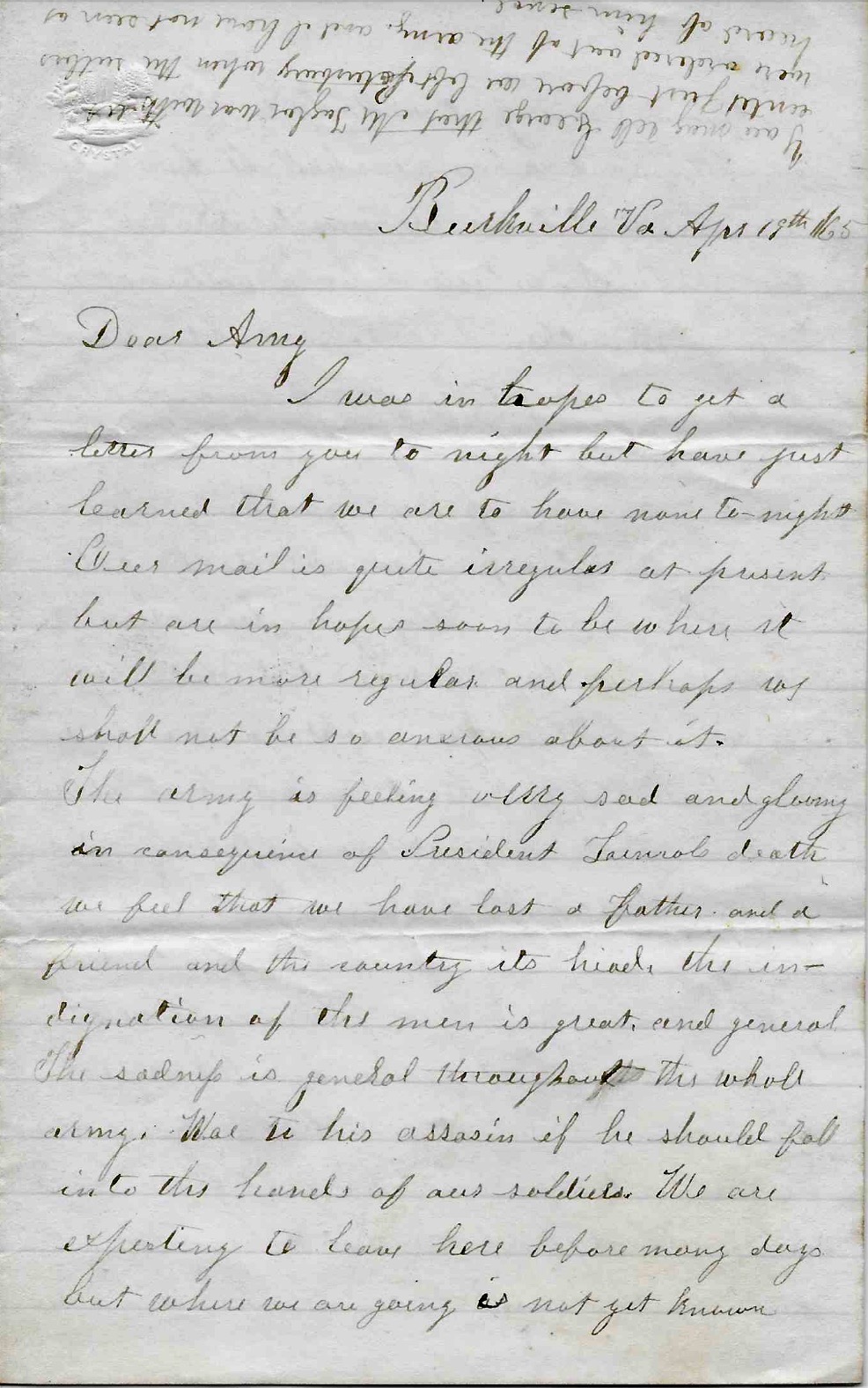
Burkville, Virginia April 19th 1865
Dear Amy,
I was in hopes to get a letter from you tonight but have just learned that we are to have none tonight. Our mail is quite irregular at present but are in hopes soon to be where it will be more regular and perhaps we shall not be so anxious about it.
The army is feeling very sad and gloomy in consequence of President Lincoln’s death. We feel that we have lost a father and a friend and the country its head. The indignation of the men is great and general. The sadness is general throughout the whole army. Woe to his assassin if he should fall into the hands of our soldiers.
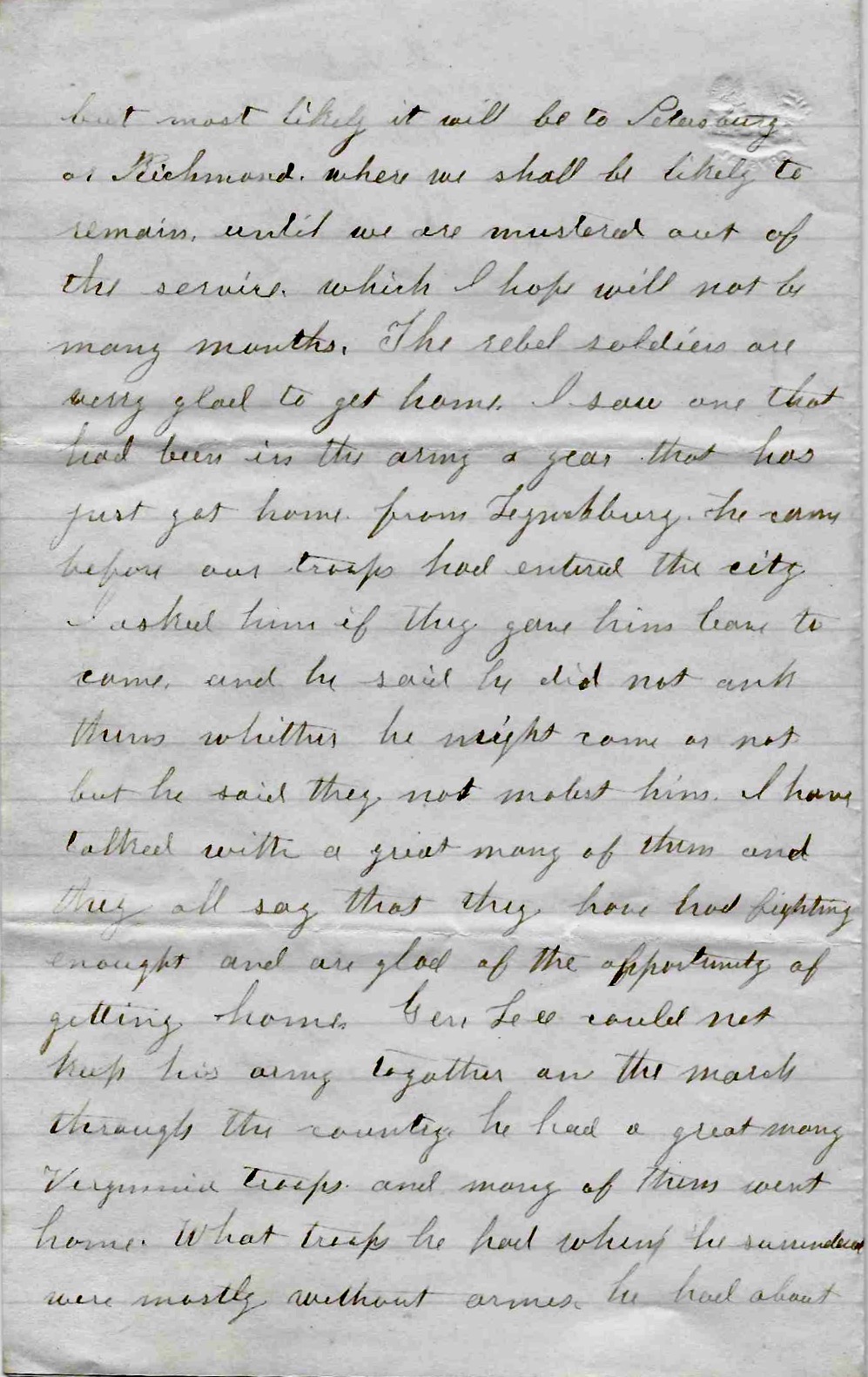
We are expecting to leave here before many days but where we are going is not yet known but most likely it will be to Petersburg or Richmond where we shall be likely to remain until we are mustered out of the service which I hope will not be many months. The rebel soldiers are very glad to get home. I saw one that had been in the army a year that has just got home from Lynchburg. He came before our troops had entered the city. I asked him if they gave him leave to come and he said he did not ask them whether he might come or not but he said they [did] not molest him. I have talked with a great many of them and they all say that they have had fighting enough and are glad of the opportunity of getting home.
“He [Lee] had about thirty thousand men with him when he surrendered and there were only ten thousand of them that were armed.”
Edwin R. Brush, Asst. Surgeon, 2nd Vermont Infantry
Gen. Lee could not keep his army together on the march through the country. He had a great many Virginia troops and many of them went home. What troops he had when he surrendered were mostly without arms. He had about thirty thousand men with him when he surrendered and there were only ten thousand of them that were armed. There were probably many that did not have arms when they left Richmond and Petersburg such as hospital attendants, teamsters, and &c. But taking those out and there must have been many that threw their arms away.
We have been amusing ourselves today in reading Jeff Davis’s last message written at Danville. I think his next will be of a different tune. I have been to the station today to look at some of the captured artillery. I do not know just how many pieces there were there today but yesterday there were one hundred and one and there were more to come. They are sending them North as fast as possible and I hope they will be sent so far that the South will never see them.
I am as well as usual. Affectionately, your husband, — Ed Brush, Asst. Surgeon, 2nd Vermont Vols.
You may tell George that Mr. Taylor was with us until just before we left Petersburg when the sutlers were ordered out of the army and I have not seen or heard of him since.
The following letter was written by James Dion, a native of Quebec who emigrated to the United States and enlisted as a private in Co. D, 2nd Vermont Infantry on 13 August 1862 and served until 21 April 1865.
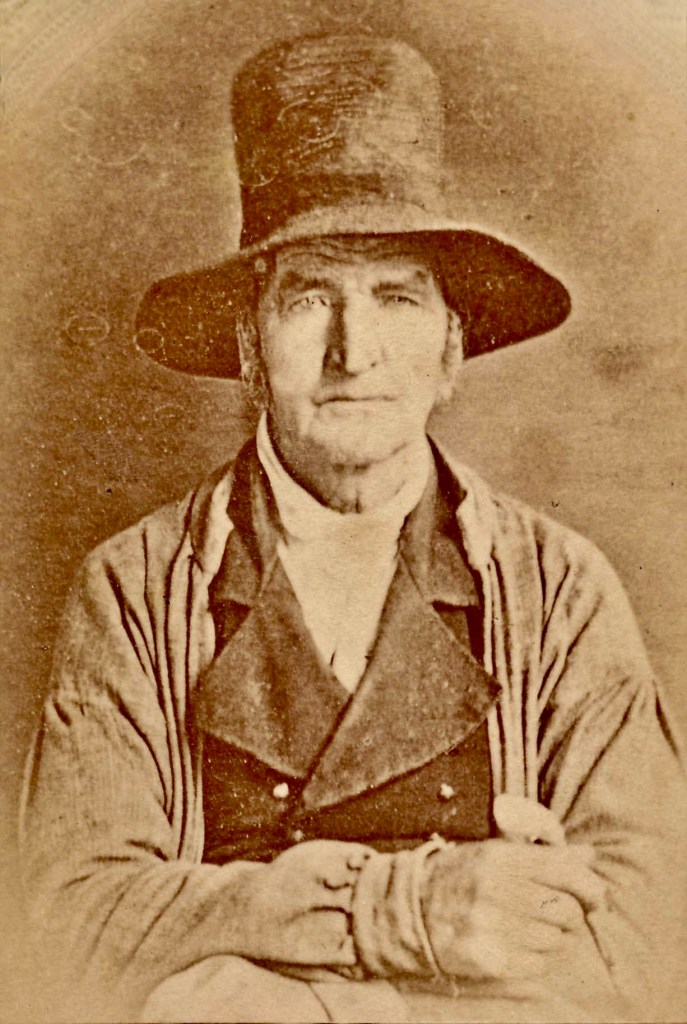
A post war tintype of James Dion
During the Battle of Chancellorsville, the 2nd Vermont was part of the Vermont Brigade led by Col. Lewis A. Grant in Albion Howe’s 2nd Division of John Sedgwick’s Sixth Corps. It was the 6th Corps that drove Jubal Early’s troops from Marye’s Heights on 3 May 1863—the day before this letter was penned. Only two Mississippi regiments, the 18th and 21st, under Brig. Gen. William Barksdale (1,200 men and eight guns) defended the rebel entrenchments.
After attacks on the flanks were repulsed, Sedgwick boldly decided to attack the center of the line—hard and fast—believing the lightly held, though strongly fortified position could be overrun if his men fixed bayonets and did not stop to reload as they charged up the slopes. He arranged for the assault to be made in three lines, the first composed of the 7th Maine, and two battalions of the 21st New Jersey and the 33rd New York. The 2nd Vermont was in the second line along with the 6th Vermont and the 26th New Jersey. The third line included the 3rd Vermont, 6th Vermont, and the rest of the 21st New Jersey.
In fifteen to thirty bloody minutes in the late morning of May 3, Sedgwick’s troops achieved their objective but lost 1,100 men in the process. This letter was written from the camp of the 2nd Vermont the morning after the battle before the regiment was marched out on the Orange Plank Road into the Wilderness where lead elements of Sedgwick’s Corps had met resistance at Salem Church the evening before.
We learn that in taking the rebel works, many of Early’s men left behind their knapsacks that were plundered by the 6th Corps. James’ letter informs us that he recovered the rebel stationery from a “napesaque” left in the earthworks.
Though written in French, fortunately James’ letter is short enough—and simple enough—that I can make out most of it, more or less.
This letter was provided to me for transcription and publication on Spared & Shared by Sherrie Westmoreland, who is his 3x great granddaughter. She informs me that James was married to Mary Ann Monney, a Swiss immigrant. Her father, Pierre (Peter) Monney was shot and killed at the Battle of Spotsylvania where James was also shot—twice—and taken prisoner. He then survived imprisonment at Andersonville.
Transcription
Fredericksburg, Virginia May 4, 1863
Dear woman, I am writing you a few lines to let you know that I am in good health and I hope my letter finds you well as it leaves me. Dear woman, we were in battle four days. Yesterday our regiment charged bayonets on a rebel fort and we took it. They were taken quite quickly without time to take their knapsacks and I found this paper that I took out of a knapsack.
Much respect to all the family. Kiss Emma for me. Farewell. I kiss you with all my heart. I don’t have time to write at length. I don’t have the time. Farewell.
This letter was written by Assistant Surgeon Edwin Ruthven Brush (1836-1908), the son of Dr. Salmon Mortimer Brush (1804-1887) and Seviah Lovegroove (1817-1890) of Cambridge, Lamoille county, Vermont. Edwin married Amy R. Fletcher in 1860 and had 3 children.
Edwin R. Brush was drafted and entered the service on 17 July 1863 as a Private in Co. H, 2nd Vermont. An 1858 graduate of the University of Vermont and a practicing physician prior to his service, Dr. Brush was elevated to Asst. Surgeon in his company on 15 October 1863. He was mustered out on 15 July 1865 at Washington, D. C.
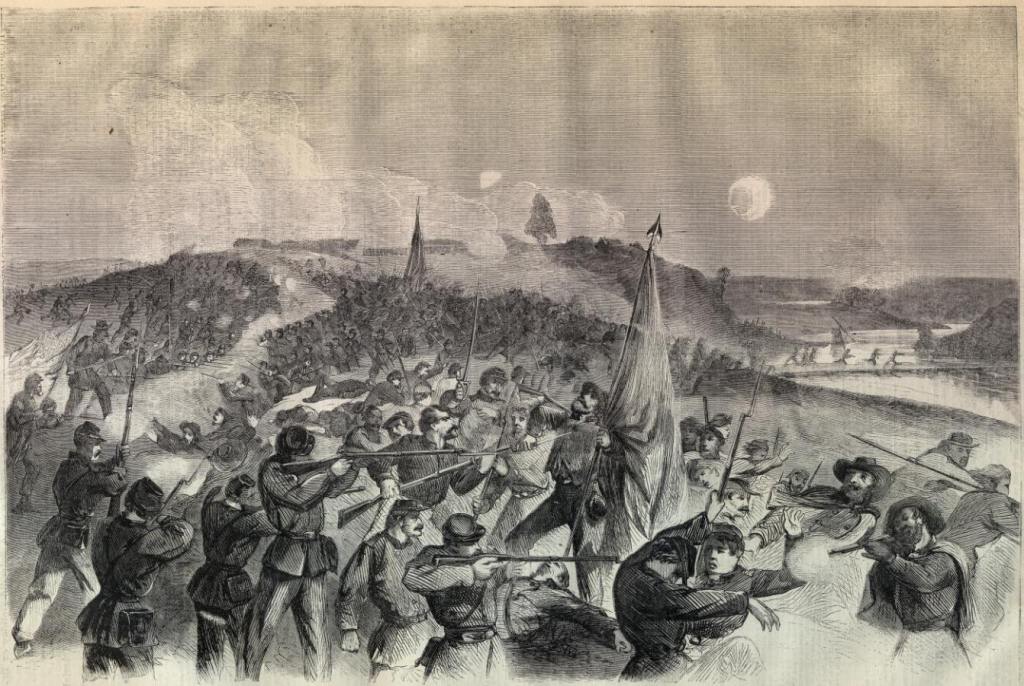
In this letter, Edwin provides his wife with some details of the Second Battle of Rappahannock Station during the Bristoe Campaign—a glorious Union victory. On November 7, the Union army forced passage of the Rappahannock River at two places. A dusk attack overran the Confederate bridgehead at Rappahannock Station, capturing more than 1,600 men of Jubal Early’s Division. Fighting at Kelly’s Ford was less severe with about 430 casualties, but the Confederates retreated allowing the Federals across in force. On the verge of going into winter quarters around Culpeper, Lee’s army retired instead into Orange County south of the Rapidan River. The Army of the Potomac occupied the vicinity of Brandy Station and Culpeper County.
For a great description of this battle, published in 2013, see Edward Alexander’s post entitled, “The Federal Charge at Rappahannock Station, 150 Years Ago.” Edward’s article explains more fully what Edwin meant when he wrote in his letter, “The manner in which our men commenced the attack was about as cool as anything as I ever heard of.”
An artist’s rendering of the Second Battle of Rappahannock Station published in Harper’s Weekly on 28 November 1863
A number of Edwin’s letters have come to me for transcription from multiple sources, his letters to Amy having been sold off separately to different buyers in the last couple of years. Previously I have transcribed five of his letters which may be found here: Edwin R. Brush, Co. H, 2nd Vermont (3 Letters) Edwin R. Brush, Co. H, 2nd Vermont (2 Letters)
[Note: This previously unpublished letter was graciously made available for transcription and publication on Spared & Shared expressly by the Sic Parvis Magna, Gratias Lesu Collection.]
Transcription
Camp at Brandy Station November 9, 1863
Dear wife,
I received yours of November 3rd yesterday while we were on the march to this place. It made me feel very happy to get it. We left Warrenton on the morning of the 7th and arrived at Rappahannock Station at noon when we found ourselves near the Rebels and gave them fight which resulted in their total defeat. Our regiment was in the reserve and did not have any fighting to do but we were in range of the Rebs artillery a few minutes but no one was hurt although one fellow had a narrow escape, a shell having struck the ground right under his feet which knocked him down. We did not stay in that place a great while but moved up the road and got under cover of an embankment where they could not get at us but the shells flew over our heads, striking on a knoll beyond. They were twenty-pound shells.
We took from the rebels about 1,800 prisoners, 7 pieces of artillery, and their pontoon bridges. The 6th Maine, which numbers about six hundred men took 1,600 men at one battle and there were about 200 taken afterwards. Our loss was about 300 in all. How many rebels were killed, I do not know. The same day the 3rd Corps had a fight at Kelly’s Ford where they took quite a lot of prisoners. The manner in which our men commenced the attack was about as cool as anything as I ever heard of. We stopped in an open field in sight of the rebel sharpshooters, we built up some fires, got our dinner just as though we were in camp. After dinner, we started in line of battle with our skirmish line in front. Our line of skirmishers marched up within a short distance of the rebs when they were fired upon by the rebs and they returned the fire along the whole line when the Johnnies run. Our men then went up to the top of a knoll when the artillery opened upon them but the shot did not do much harm. We soon got our artillery in position and played upon them pretty smartly for awhile. They kept up the firing until about dark when the boys made the charge on the fortifications which the rebs had thrown up and took the prisoners which I spoke of. 2
When they made the charge, they were ordered to uncap their gun and go in which they did in good shape. In coming over the field, I saw in one place where the battery was taken, eleven rebels laying side by side dead. It looked rather rough I can tell you. I did not care to look after any more dead rebs although there were more near there and they were burying them. In one corner there was a place that was pretty bloody and our men took seven stand of colors which was the cause of it. There was one fellow that had a bayonet wound through him, another one—a lieutenant—was killed by a blow with a musket. One of the Maine boys did it after ordering him to surrender which he refused to do saying that he would die first. Upon that, the other fellow hit him with the breach of his gun, breaking his skull in.
That night our regiment were out on picket and I slept on the ground without any tent over me. Two of us slept together with a half tent and a rubber blanket under us and two blankets over us, it being a pretty cold night and as we could not have any fire, I did not sleep any too warm. Last night we did a little better. We cut down a tree and built up a good fire which lassted till morning but after all, it was not like being with you to make up a good feather bed for me to sleep in. But after all, I cannot say that I am dissatisfied with the service. I am so much better off than some poor, sick fellows that I know.
I wish you would send me a piece of buckskin gloves. I do not want a very heavy pair. I want them so that I can drive in them and not have them bungling. I am sorry I wrote what I did about your [not] writing as I got a letter from you the same day that I mailed mine and another yesterday, but hope you will not feel bad about it.
About those shirts, the surgeons wear fancy colors a good deal. I do not care if you make mine the same. I was glad to hear that you had got some fine [things] because I think you deserve them, and Amy, you know I want you should have everything you wish for. Amy, I shall try and not get any bad habits in the army and hope you can trust me. When I think of you, how can I get any bad habits after all of your kindness to me when I know how bad it will make you feel. Amy, how I do miss your company. It seems as though I could not wait for the time to come when I shall see you.
Give my love to all and kiss our little darling for me. This from your dearest, — Edwin
1 “The Sixth Maine’s cheer sounded like a ‘terrible panther-like yell’ according to its adjutant. ‘So small a number of men never before made such an uproar… Men were seized with the wildest transports of rage and frenzy. We seemed to be marching against a blind, inscrutable force, which defied all of our efforts to reach it or grapple with it. The only relief seemed our continuous yell, which every man kept up until the fortifications in front of us were reached.’ Once the Union soldiers reached the works, Anderson recalled that now ‘the air was filled with a medley of shouts, shrieks and groans, calls to surrender, yells of defiance, imprecations and curses and through and above all other sounds the increasing crash of musketry.’…”A normally pious and reserved officer in the Sixth Maine known as the ‘praying sergeant’ entered the earthworks ‘with an infuriated yell, and with profanity which was fierce and appalling, he aided with bayonet and clubbed musket in speedily dispersing the enemy around us.’ So ferocious was the fighting that William J. Seymour of Hays’ Brigade believed the Union soldiers were “stimulated by the free use of whiskey,” a claim that reveals a mindset of the defenders but one that is not supported by evidence. ‘The enemy poured in yelling like so many demons, many of them being in a state of beastly drunkeness.’ A Confederate prisoner later told his captors: ‘We all allowed that the whole Army of the Potomac were coming, you’uns kept up such a wicked yelling.’” [Source: “The Federal Charge at Rappahannock Station, 150 Years Ago.”]
2 In all, 1,670 Confederates were killed, wounded, or captured in the brief struggle, more than eighty percent of those engaged. Union casualty figures, by contrast, were small: 419 in all. For the North the battle had been “a complete and glorious victory,” an engagement “as short as it was decisive,” reflecting “infinite credit upon all concerned.” Maj. Gen. Horatio G. Wright noted that it was the first instance in which Union troops had carried a strongly entrenched Confederate position in the first assault. Brig. Gen. Harry Hays claimed to have been attacked by no less than 20,000 to 25,000 Union soldiers—a figure ten times the actual number. The battle had been as humiliating for the South as it had been glorious for the North. Two of the Confederacy’s finest brigades, sheltered behind entrenchments and well supported by artillery, had been routed and captured by an enemy force of equal size. Col. Walter H. Taylor of Lee’s staff called it, “the saddest chapter in the history of this army,” the result of “miserable, miserable management.” An enlisted soldier put it more plainly. “I don’t know much about it,” he said, “but it seems to be that our army was surprised.”
The following letters were written by Edward Ruthven Brush (1836-1908) who came to the 2nd Vermont Infantry with draftees and substitutes in the fall of 1863 and was assigned to company H. Though he entered the regiment as a private, it was not long before Edwin was commissioned an Assistant Surgeon. He was with the regiment until 15 July 1865.
Edwin was the son of Salmon Brush (1804-1887) and Sarah Lovegrove (1817-1890) of Cambridge, Vermont. He graduated from the University of Vermont in 1858 and succeeded his father as a medical practitioner in his hometown. He was married to Amy Fletcher (1835-1915) in 1860.
Letter 1
[Note: This letter is from the private collection of Greg Herr and was transcribed and published on Spared & Shared by express consent.]
Camp Vermont October 7th 1863
Dearest one,
Having arrived at my place of destination, I hasten to write you thinking you would be anxious to hear from me. We left Long Island Thursday evening October 1st on board the U. S. transport Forest City. It was very calm and pleasant when we started and continued so until the next day about noon when the wind commenced blowing and continued to blow until the next day so that we had a pretty rough time that night. But it did not prevent my sleeping that night, except when the ship would come up with an extra jerk when it would wake me up. Some of the boys were pretty sick about that time but strange as it may seem, I was not sea sick in the least.
I got cold on the island and for a day or two my lungs were quite sore. The wind stopped blowing the next day and it was very pleasant again so that I was on deck most all day Saturday. We were going up the Chesapeake Bay. We had to go to Portsmouth to leave some New Hampshire boys off whom I shall speak presently. I was on deck when we went up by Fortress Monroe. It is a very formidable fort. There were quite a number of gunboats laying in the harbor near there. We went by some points of interest on our way up. There was the place where the Merrimack came out from Norfolk and attacked our fleet and sunk some of our boats, and the boys in the fort were expecting she would come down and attack them. But just at that time the Monitor made its appearance and drove the Merrimack back to Norfolk where the rebels blew her up when Gen. Wool took the place. What remains of her lays near the shore above Norfolk in sight of where we were at anchor.
Norfolk and Portsmouth are quite pleasantly situated one on either side of the James [Elizabeth] River, nearly opposite each other. There are some very good buildings in them but they seemed quite deserted. There seemed nothing going on except what government was doing (the effects of war). Amy, when we were coming up the Bay, I could not help thinking how happy I should be if I was on a passenger boat and you with me. If you had been with me, I should have enjoyed myself very much indeed. It was so warm and pleasant.
We landed the New Hampshire boys a little after noon Saturday and started on our way down the bay immediately. We had to go down to the mouth of the Potomac river where we arrived in the night and had to anchor our boat and stay until Sunday morning when we started up the river for Alexandria. There was a cold wind all day Sunday so that I did not go on deck much that day, but was on deck some of the time but did not have a chance to see as much as I should have been glad to see. I just got a glimpse of the tomb of Washington but did not see enough to say anything about it.
I promised to tell you about the New Hampshire boys. Well there were about three hundred and sixty aboard the vessel. Out of them, there were some thirty or forty New York roughs who were taken to New Hampshire by substitute brokers. There were a set of thieves, robbers, and pick pockets and they went into the army for that purpose and we expected to have a pretty rough time when we started from Boston. And we were not disappointed either. They did not meddle with Vermonters as much as they did with Maine and New Hampshire boys for two reasons. First, we did not have much money with us and they knew it. Secondly, we posted a guard in front of our bunks and gave what little money we had to our Captain or took care of it otherwise. But they would [go] to a man’s bunk when he was asleep and rifle his pockets or they would get a crowd around, pull his hat off, pull him around generally, and in the scrape, would take what money they could find. They took one hundred and fifty dollars from one man and from that down to five or ten from others. There was more or less fighting as long as they remained on the boat. But you may be sure of one thing—that men never left a place when those that were left were more pleased than we were when they left us. The boys did not hardly know what to do they were so pleased to get rid of them. I did not write you about them before we left because I thought you might feel concerned about me.
We arrived at Alexandria Monday night where we received our arms and equipments. We stayed in Alexandria over night and the next morning we started for our regiment. We came to Culpeper (which is about sixty miles from Alexandria) on the railroad where we arrived about two o’clock p.m. From there we marched to here which is about 12 or 15 miles from Culpeper. We arrived here a little after dark, hungry and tired. I expected to be pretty lame today but had a good night’s sleep and got up feeling quite well this morning.
The [Vermont] Brigade came here day before yesterday to do picket duty so you see they are pretty well in the front. The country we came through was anything but beautiful—no fences, not much growing except weeds. In fact, if I had not known that I was on the sacred soil of Virginia, I should have thought I was in a wilderness. But then I suppose I am not. We are in sight of the ruins of a house that the boys tore down yesterday to built their tents of. I believe after they had got it nearly torn down, Col. Grant put a guard around it but the guard did not prevent the boys from getting what they wanted to make themselves comfortable. They believe in taking what rebel property they want for their own use. I stayed with Hack last night. As soon as I got back here, he took me to his tent, got me a good supper, and I went to bed. I have been assigned to Co. H. Uncle Joseph is out on picket so I have not seen him yet.
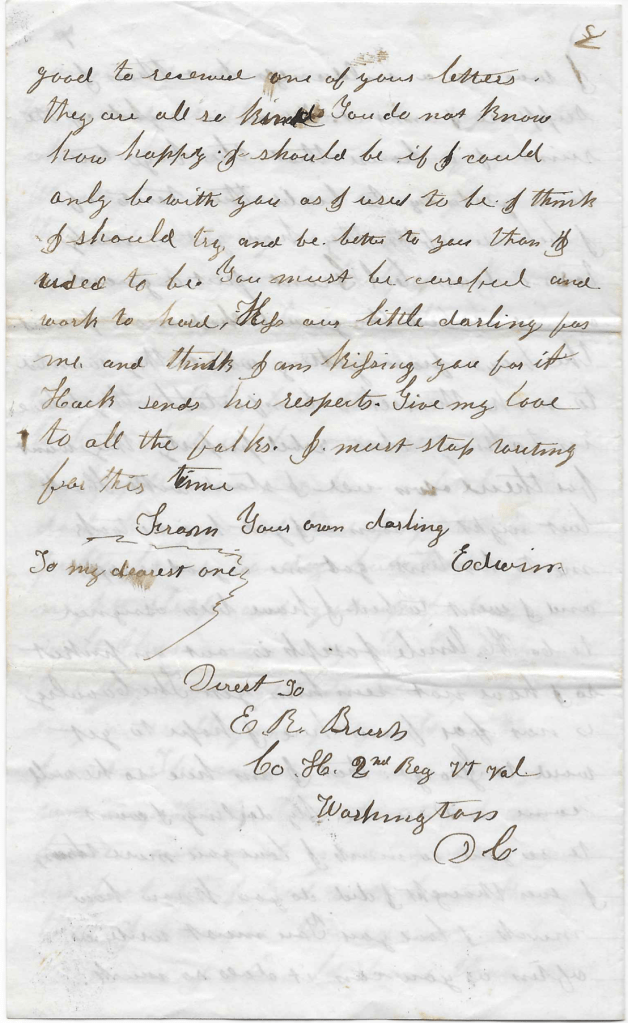
The cavalry is not far from here. I hope to get word to George that I am here so he will come and see me. My darling, I want to see you so much. I love you more than I ever thought I did. Do you know how much I love you> You must write as often as you can. It does so much good to receive one of your letters. They are all so kind. You do not know how happy I should be if I could only be with you as I used to be. I think I should try and be better to you than I used to be. You must be careful and [not] work too hsard. Kiss our little darling for me and think I am kissing you for it. Hack sends his respects. Give my love to all the folks. I must stop writing for this time. From your own darling, — Edwin
To my dearest one.
Direct to E. R. Brush, Co. H, 2nd Regiment Volunteers, Washington D. C.
Letter 2
Camp near Brandy Station December 4th 1863
My dearest one,
You undoubtedly think it is a very long time since you last heard from me. Well, it is but it is not my fault. I would have written if I could but we have been out on an expedition the last week and have neither received nor sent out any mail. So you see that you have had a letter since I have. I am looking for a letter from home today as there is a large mail at headquarters and our post master is getting it as fast as he can.
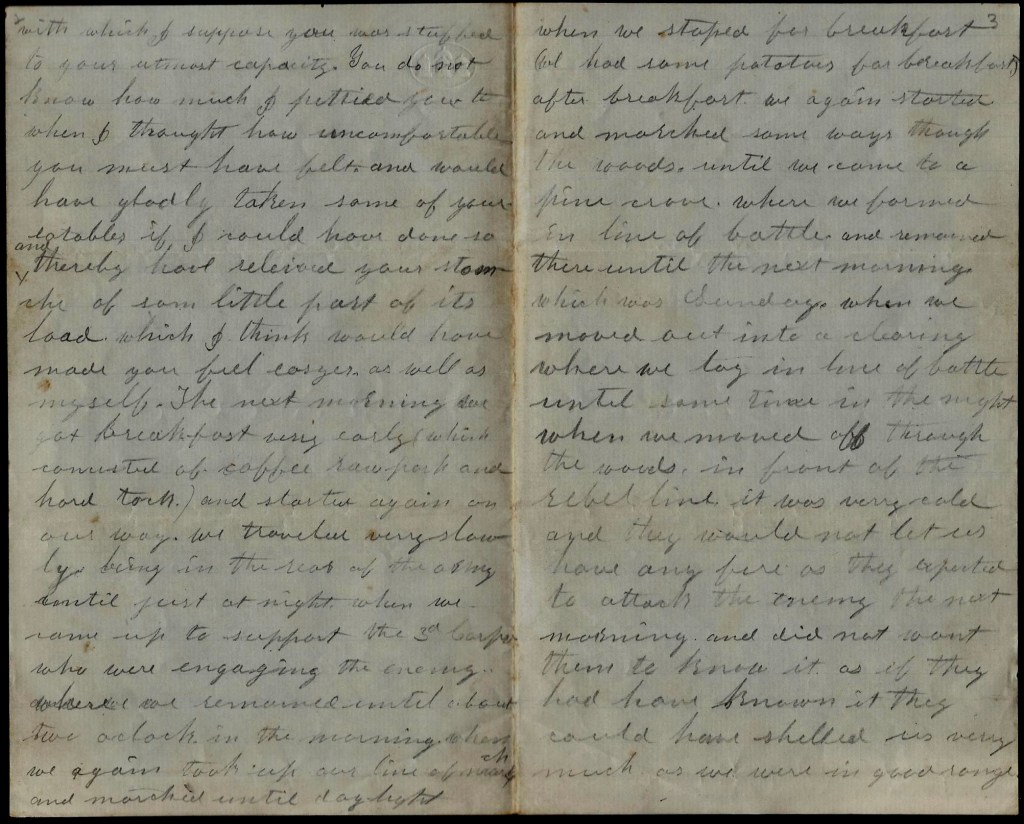
We started from here one week ago yesterday—it being Thanksgiving Day—and crossed the Rapidan [river] that night, both tired and hungry. For my Thanksgiving supper, I had har tack, coffee, and raw pork instead of roast turkey, chicken pie, &c. with which I suppose you was stuffed to your utmost capacity. You do not know how much I pitied you too when I thought how uncomfortable you must have felt and would have gladly taken some of your eatables if I could have done so and thereby have relieved your stomach of some little part of its load which I think I would have made you feel easier as well as myself.
The next morning we got breakfast very early which consisted of coffee, raw pork, and hard tack and started again on our way. We traveled very slowly, being in the rear of the army, until just at night when we came up to support the 3rd Corps who were engaging the enemy where we remained until about two o’clock in the morning when we again took up our line of march and marched until daylight when we stopped for breakfast. We had some potatoes for breakfast. After breakfast we again started and marched until we came to a pine grove where we formed in line of battle and remained there until the next morning which was Sunday when we moved into a clearing where we lay in line of battle until some time in the night when we moved off through the woods in front of the rebel line.
It was very cold and they would not let us have any fire as they expected to attack the enemy the next morning and did not want them to know it as if they had have known it they could have shelled us very much as we were in good range of their batteries and the woods where we were filled with troops. But in the morning they found that they could not get at the rebs without a great sacrifice of life, there being a brook and swamp to cross which the water was five or six feet deep, and after we crossed that, we had quite a distance to go under fire, and as it was not practicable to leave the woods in the day time, we remained there until dark without any fire.
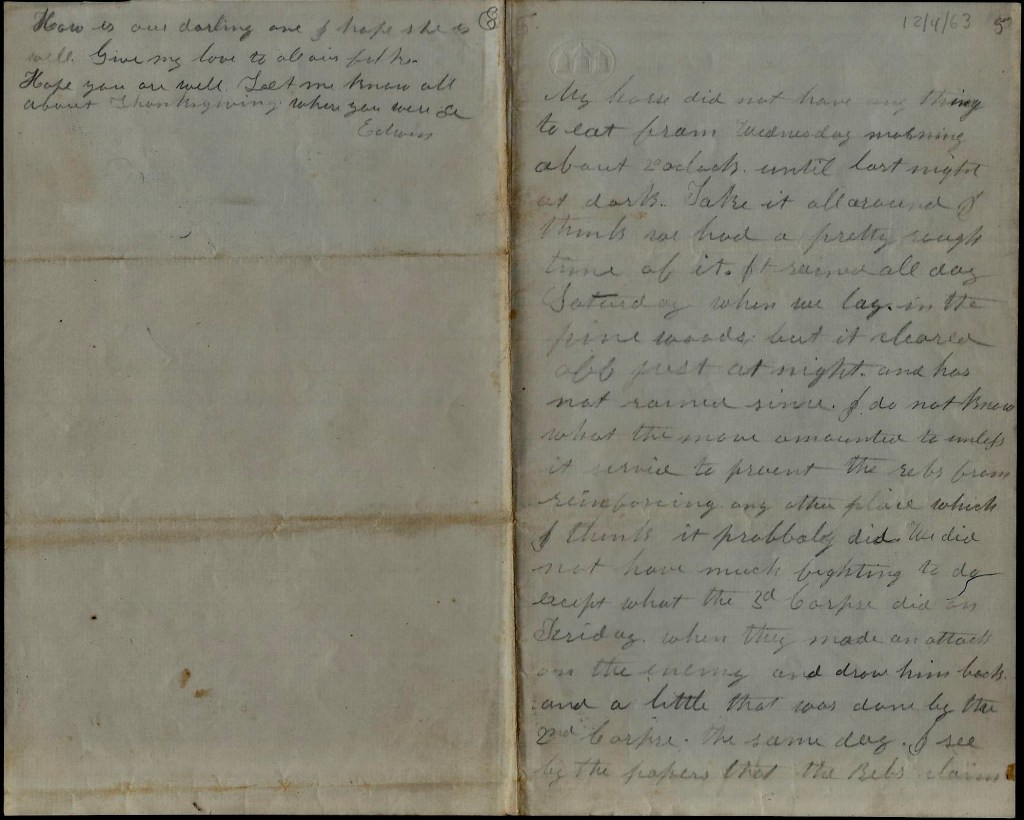
At dark the troops commenced moving off and they all left except the pickets. The 3rd Regiment was on picket and I was with them so I remained until the next morning when we moved about two miles where we remained until 3 o’clock the next morning when we commenced to fall back and reached here yesterday afternoon, tired and hungry. I did not have a hard tack for two days and should not have had anything if they had not have killed a beef as our wagons could not get to us. My horse did not have anything to eat from Wednesday morning about 2 o’clock until last night at dark. Take it all around, I think we had a pretty rough time of it. It rained all day Saturday when we lay in the pine woods but it cleared off just at night and has no trained since.
I do not know what the move amounted to unless it served to prevent the rebs from reinforcing any other place which I think it probably did. We did not have much fighting to do except what the 3rd Corps did on Friday when they made an attack on the enemy and drove him back and a little that was done by the 2nd Corps the same day. I see by the papers that the rebs claim that they drove the 3rd Corps back several miles but the fact is that the rebels left in such a hurry from their entrenchments that they did not even stop to bury their own dead. I saw some dead rebs the next day as we were going along.
The country that we passed through was mostly woods. A good deal of it was second growth pine. The land had evidently been cultivated some time as we could see where the rows had been. They had probably exhausted the land in raising tobacco and then left it to grow up to scrub pine. Vermont farmers would not call that very good farming, I think.
I feel very well today. I find some difference between riding and going afoot and carrying a load on one’s back. We have been having some very cold weather the past week but I have managed to sleep warm, having plenty of blankets. But some of the boys have suffered a good deal and it has been very hard for the sick riding in the ambulances. But all have done as well as could be expected.
Amy, you do not know how much I have thought of you these past few days. If I could see you a little while, how happy it would make me feel. If I could have one good kiss from you every night, I could endure almost anything. I have been afraid you were worrying about me by not hearing from me which makes me feel bad because I do not want you to worry about me at all as I am not in much danger of rebel bullets. I have just got a paper from home. I must close.
From your darling husband, — Edwin
To my dearest wife Amy
How is our darling one. I hope she is well. Give my love to all our folks. Hope you are well. Let me know all about Thanksgiving; where you were, &c. — Edwin
This letter was written by 17 year-old Pvt. Lewis A. Stow (1845-1862) of Co. K, 2nd Vermont Infantry. Lewis enlisted on 20 February 1862 and a couple of months later he participated with his regiment on the Peninsula Campaign. Though he survived that ordeal, he suffered continued ill health, was discharged from the regiment for disability on 2 October 1862 and died at home a week later.
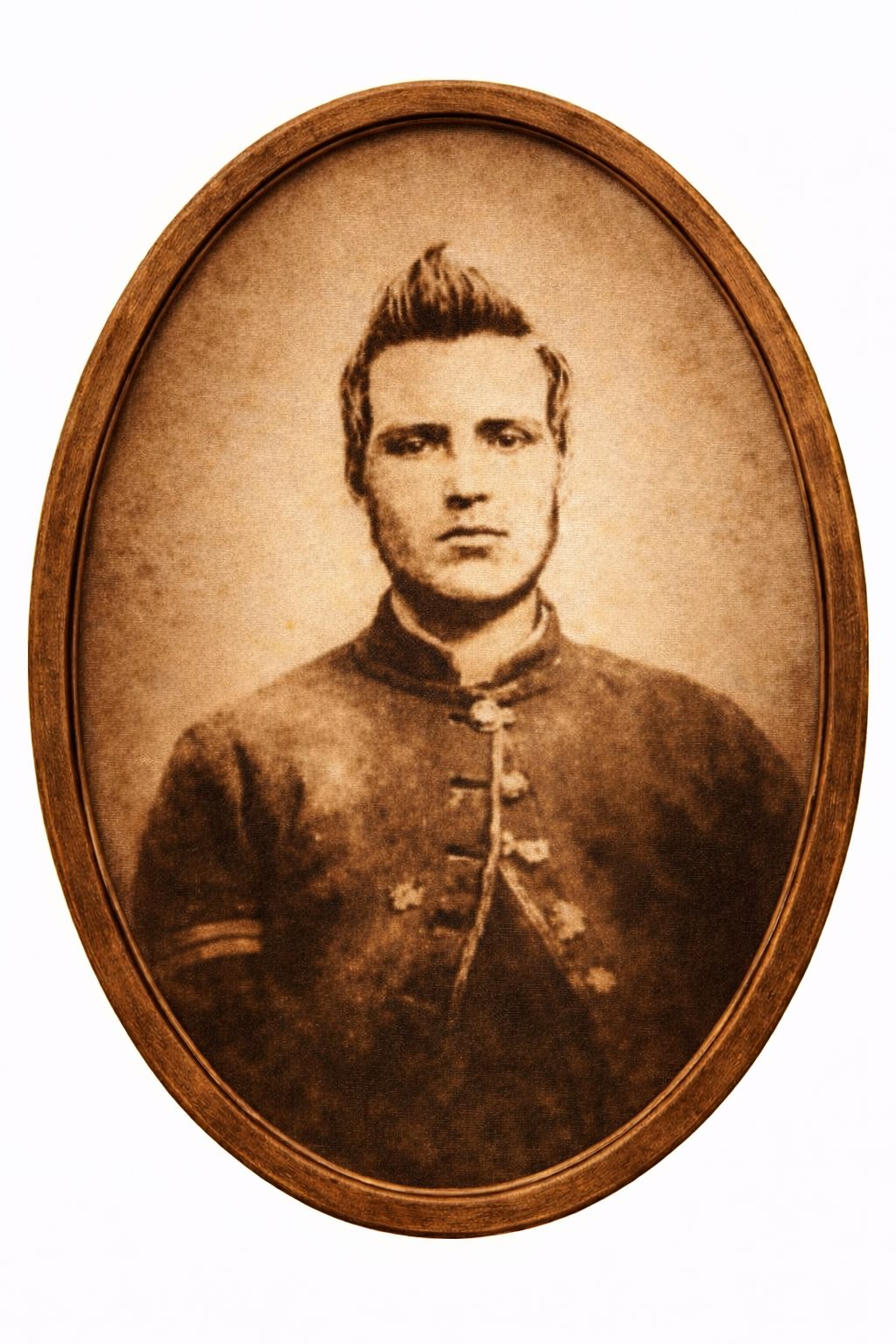
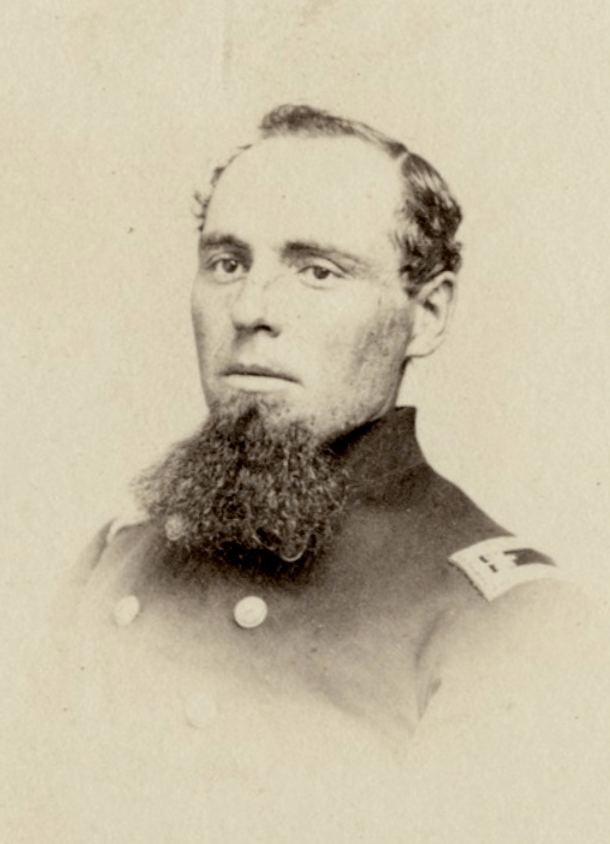
I could not find an image of Lewis but here is one of an unidentified soldier believed to be wearing the uniform of the 2nd Vermont Infantry. His grey state jacket, gray Chasseur-style cap and Vermont seal buttons suggest he was in the 2nd or 3rd Vermont. (Dan Binder Collection)
Lewis was the son of blacksmith Alonzo Stow (1810-1894) and Eliza Hall (1812-1886) of East Calais, Washington county, Vermont. In his letter, Lewis mentions his older brother Theodore Stow (1836-1915) at home who later served in Co. H, 13th Vermont. He also mentions being with “Bill” who was his older brother William Stow (1840-1864). William had enlisted in the 2nd Vermont Infantry (Co. F) when it was originally organized in May 1861. He rose in rank to corporal before he was killed on 5 May 1864 in the Battle of the Wilderness.
Lewis does not mention him but his oldest brother was Lorenzo Stow (1834-1863), a carpenter, husband and father when he enlisted in July 1861 as a corporal in Co. C, 12th Rhode Island Infantry. He died of typhoid fever in January 1863. Thus, Alonzo and Eliza (Hall) Stow was plagued by loss during the war, losing three sons in consecutive years.
While researching this letter, I found that there were a number of Stow family letters at the Jack & Shirley Silver Special Collections Library at the University of Vermont under the title William Stow Civil War Letters.
Transcription
Camp near Williamsburg, Virginia May 8, 1862
Dear Friends,
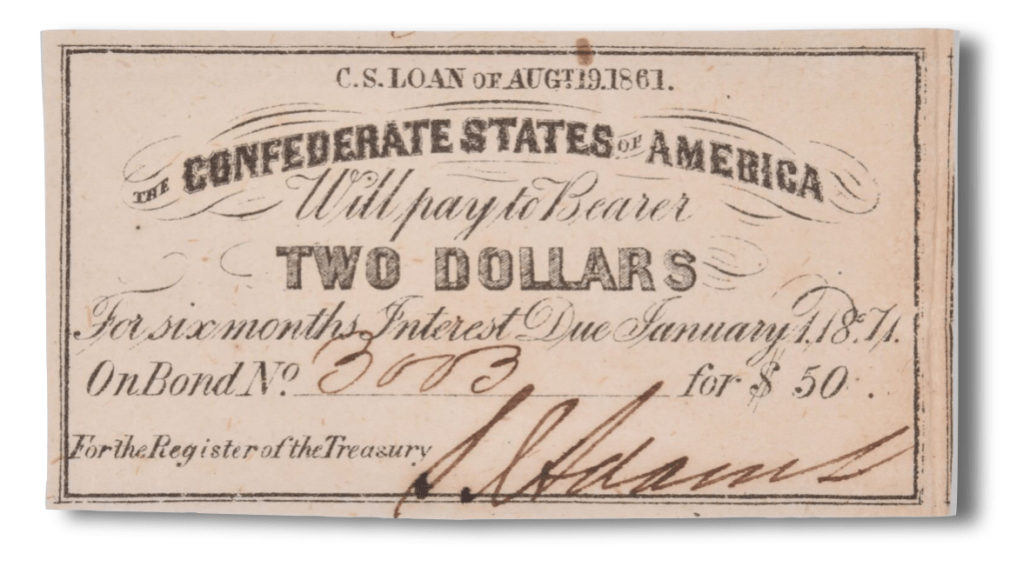
Once more I will try to write a little more home. The 4th we left Camp Winfield Scott. The rebels had left and I had the mumps so the captain told me to get out there the best that I could and I feel in with Hooker’s Division & [on the] 5th we came up with the rebels about 7 in the morning and fought till night. They gave me a gun and I fought about two hours and a half, then I helped carry off the wounded. And I carried off a secesh and gave him some water to drink and he gave me one $2 bill in Southern money. He said that he had got to die and it wasn’t of any use to him. He was shot in the side with a shell. I am a going to send it home.
“And I carried off a secesh and gave him some water to drink and he gave me one $2 bill in Southern money. He said that he had got to die and it wasn’t of any use to him. He was shot in the side with a shell.”
We shall be paid off soon and I can send you fifty dollars and how I shall send it to have it come safe.
Bill says that he is too sleepy to write. I should [have] wrote before but I wanted to look round some. I have got to go on guard now.
They did not use me so I will write some more. I want that you should send a fine comb for if you don’t, the lice will fetch me home. You can send it in a letter & send some stamps for I can’t get them. Tell [my brother] Theod[ore] that pocket handkerchief that he gave me I tied round a man’s leg to stop the blood and they carried him to the hospital.
Did you get my picture and that money that I sent from Burlington? What are they all up to in No. 10? Tell Orville that I hain’t froze my ears lately but I have roasted them some. I can’t think of any more to write now.




























 Spared & Shared 23