Category Archives: 32nd Ohio Infantry

1862: Joseph Penn Marriott to Will. J. Graham

The following letter was signed, “J. P. M.” (I think) and I believe it was written by Joseph Penn Marriott (1840-1863), the son of Henry Thomas Marriott (1807-1875) and Rebecca Penn (1807-1884) of Claibourne, Union county, Ohio. Joseph enlisted as a corporal in Co. B, 32nd Ohio Volunteer Infantry (OVI) and was with the regiment until his death of typhoid fever at Vicksburg, Mississippi, on 20 August 1863.

At the time that Joseph wrote this letter in mid-July 1862, the 32nd OVI was in Piatt’s Brigade, White’s Division, with provost and fatigue duty at Winchester, Va. where they were regularly abused by the women citizens whom he referred to as “she devils.”

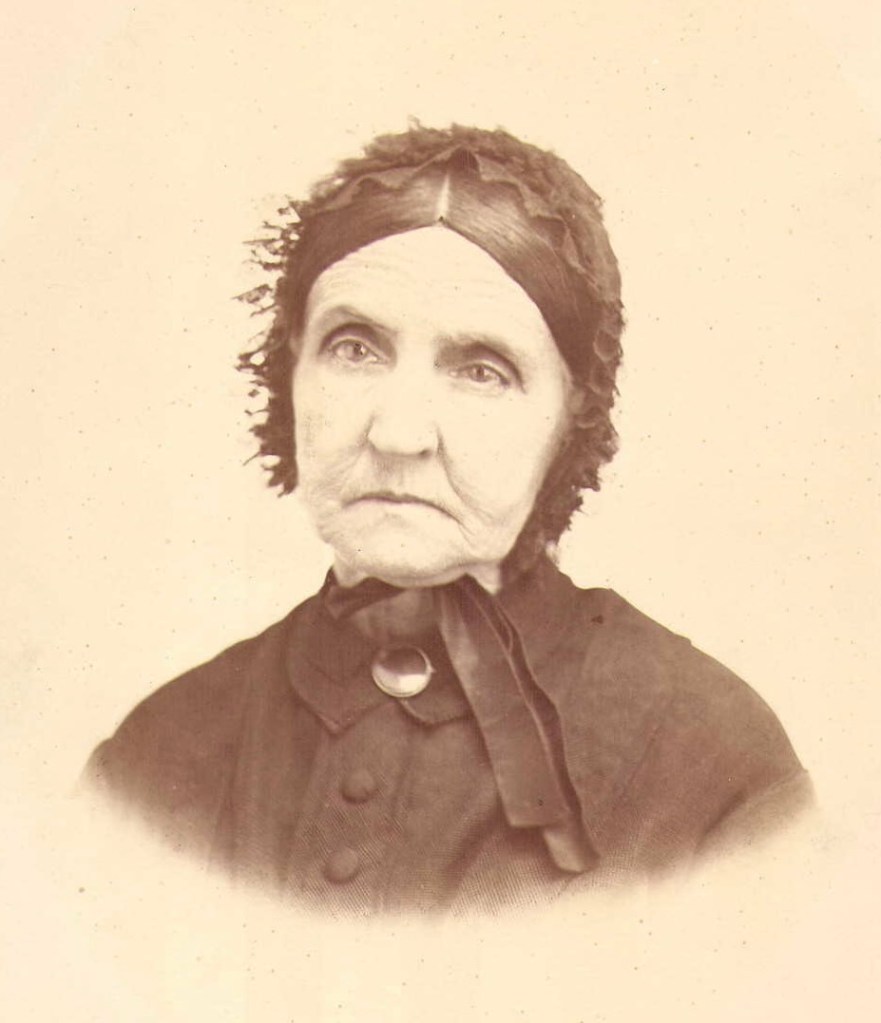
Joseph’s parents.

Transcription

Addressed to Will. J. Graham, Delaware, Delaware county, State of Ohio

Winchester, Virginia
July 11, 1862

Friend Will,

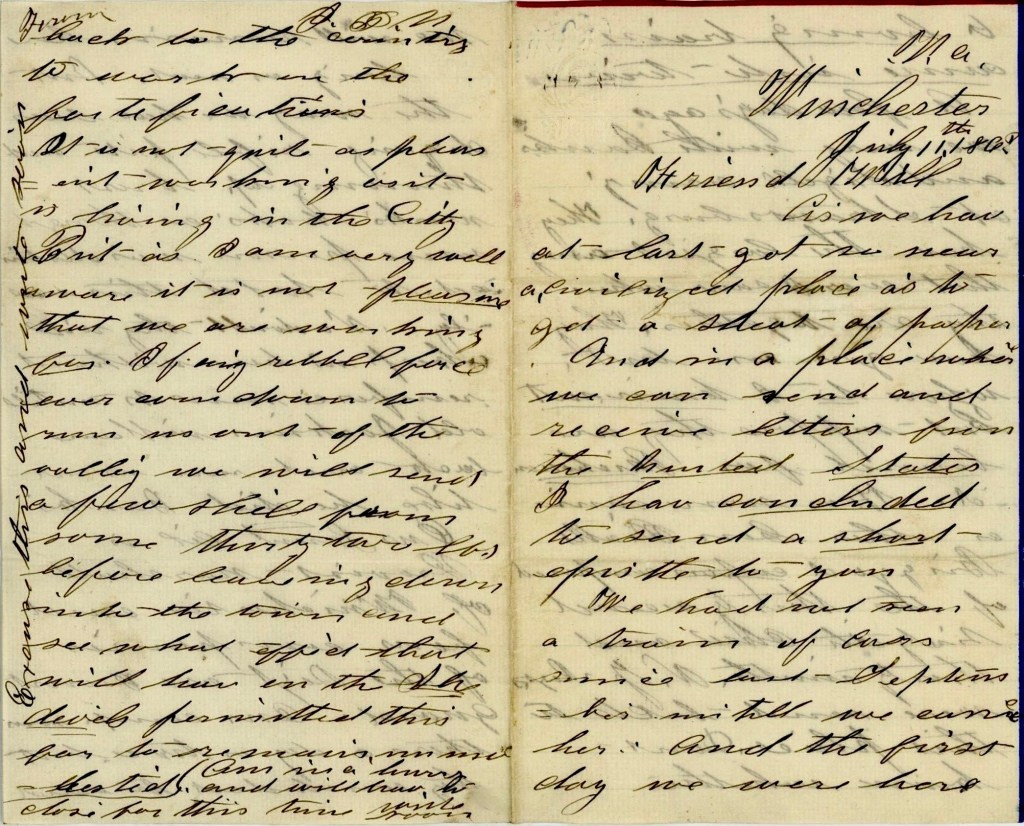
As we have at last go so near a civilized place as to get a sheet of paper, and in a place where we can send and receive letters from the United States. I have concluded to send a short epistle to you.

We had not seen a train of cars since last September until we came here. And the first day we were here, a long train came into town.

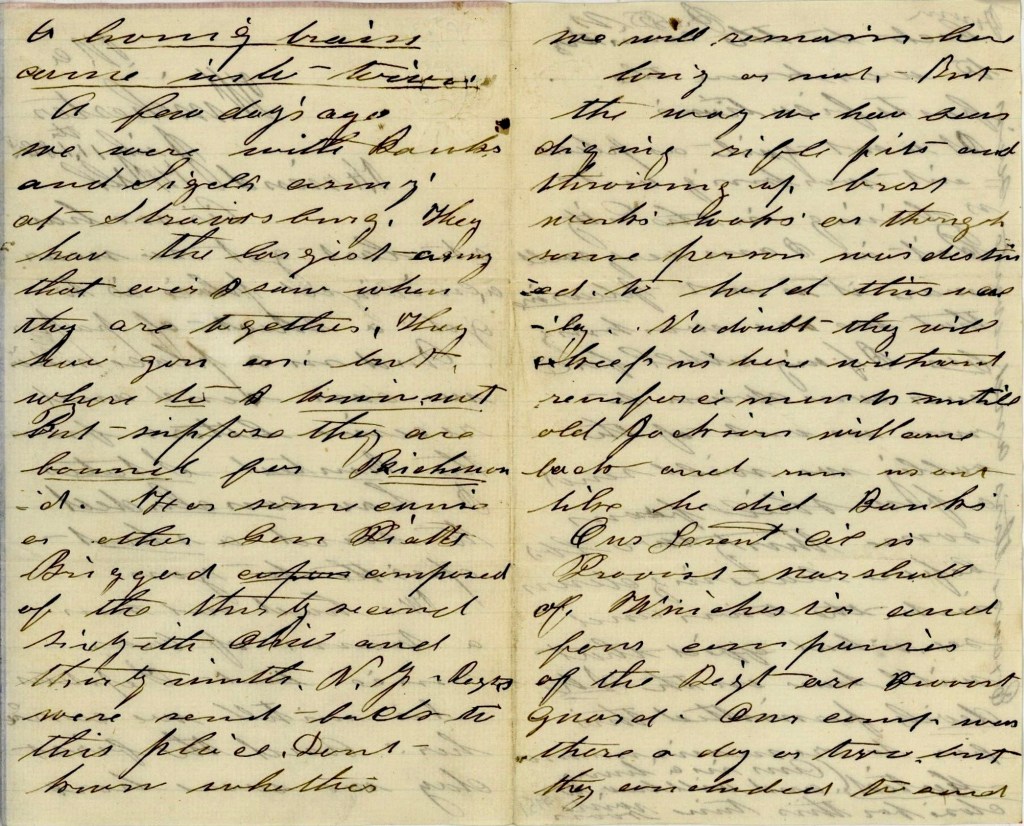
A few days ago we were with Banks and Sigel’s army at Strasburg. They have the largest army that ever I saw when they are together. They have gone on but where to, I know not, but suppose they are bound for Richmond. For some cause or other, Gen. [Abram S.] Piatt’s Brigade composed of the 32nd, 60th Ohio, and 39th New York Regiments were sent back to this place. Don’t know whether we will remain here long or not. But the way we have been digging rifle pits and throwing up breastworks looks as though some person was destined to hold this valley. No doubt they will keep us here without reinforcements until Old Jackson will come back and run us out like he did Banks.

Our Lieut. Col. [Ebenezer H. Swinney] is Provost Marshal of Winchester and four companies of the [32nd OVI] regiment are provost guard. Our camp was there a day or two but they concluded to send us back to the country to work in the fortifications. It is not quite as pleasant working as it is living in the city but as I am very well aware, it is not pleasure that we are working for. If any rebel force ever some down to run us out of the valley, we will send a few shell from some thirty-two pounders before leaving down into the town and see what effect that will have on the she devils permitted this far to remain unmolested.

Am in a hurry and will have to close for this time. Write soon. Excuse this and write soon. From J. P. M.
1861: Henry A. Jackson to Miss Tina

This letter was written by Henry A. Jackson (1841-1862) of Co. A, 32nd Ohio Volunteer Infantry (OVI). Henry enlisted as a private on 12 July 1861 and was killed in action on Bolivar Heights near Harper’s Ferry on 15 September 1862.

I believe that Henry A. Jackson was the son of Isaac and Mary (Manful) Jackson of Augusta, Carroll county, Ohio. See also—1861: Thomas J. Hendrix to Miss Haskey.

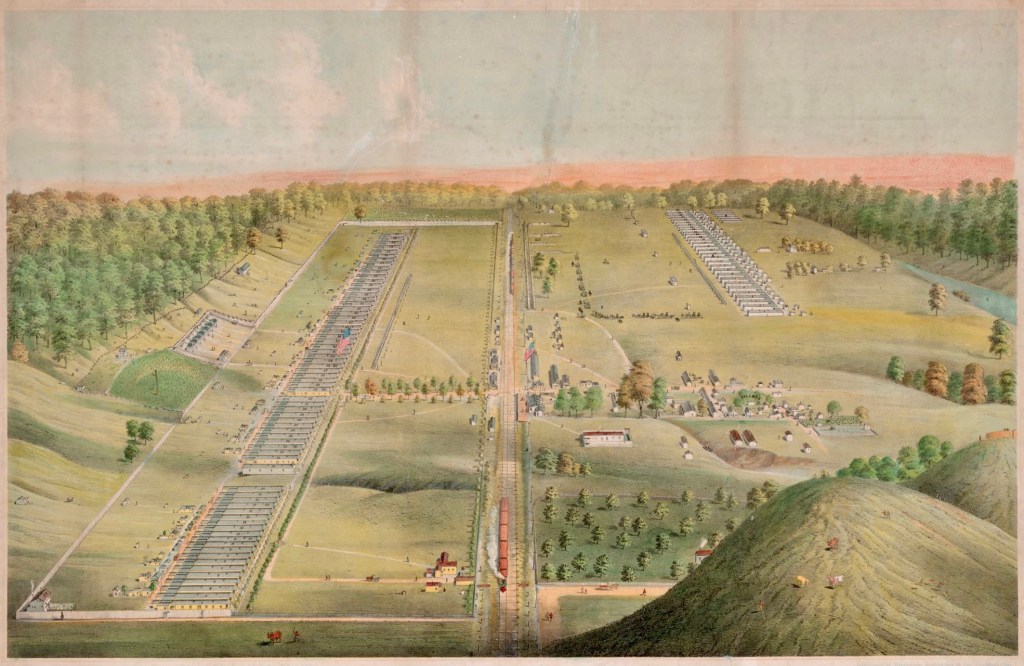
A view of Camp Denison later in the war, showing the railroad and the Little Miami River.

Transcription

Camp Dennison
September 7th 1861

Miss Tina,

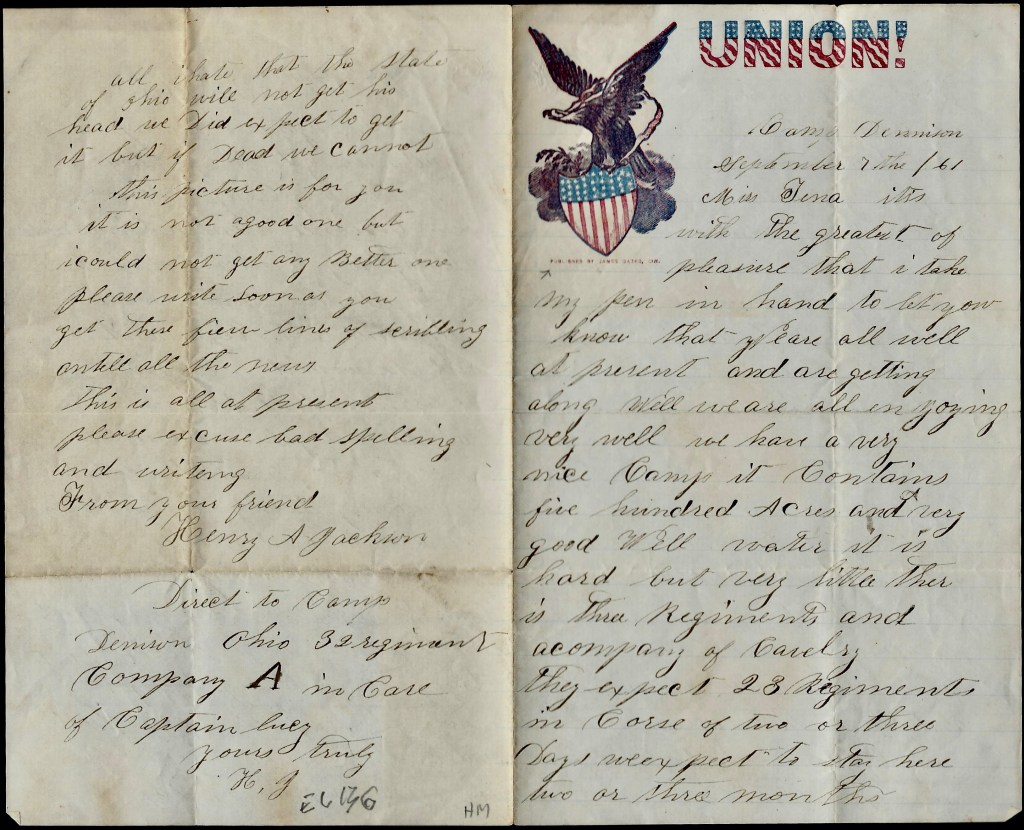
It’s with the greatest of pleasure that I take my pen in hand to let you know that we are all well at present and are getting along well. We are all enjoying [ourselves] very well. We have a very nice camp. It contains five hundred acres and a very good well water. It is hard but very little. There is three regiments and a company of cavalry. They expect 23 regiments in the course of two or three days, We expect to stay here two or three months. I can’t tell when we can get to come home. Captain has promised to give us a furlough when James Watson comes back but I don’t know whether he can get a furlough yet or not. But he will if possible.

We are not homesick yet but our folks wants me to come home. If it was not for that, would not come for a year. We have good times here. We have made our bedsteads today and I think we will get along a great deal better. We have Mr. [Henry] Chain and Sam McClellan in our mess and they keep us boys straight.

The Miami River runs through our camp and we get to go down to it every day or two. Our Colonel went to Cincinnati yesterday to get our arms but he said that it was an Independent Regiment and he would not give us arms. If he does not after we get drilled, we will go in another state. We are only twenty miles from Cincinnati and only 18 miles from Kentucky. The railroad runs through our camp ground. The cars run through perhaps a dozen times a day.

The latest news is that Jeff Davis is dead and I guess it must be so for the papers say so every day. All I hate that the State of Ohio will not get his head. We did expect to get it but if dead, we cannot.

This picture is for you. It is not a god one but I could not get any better one. Please write soon as you get these few lines of scribbling and tell all the news. This is all at present. Please excuse bad spelling and writing. From your friend, — Henry A. Jackson

Direct to Camp Dennison, Ohio 32nd Regiment, Company A, in care of Captain Lucy. Yours truly, H. J.

1863: William Galbreath Snodgrass to Cousin Lib

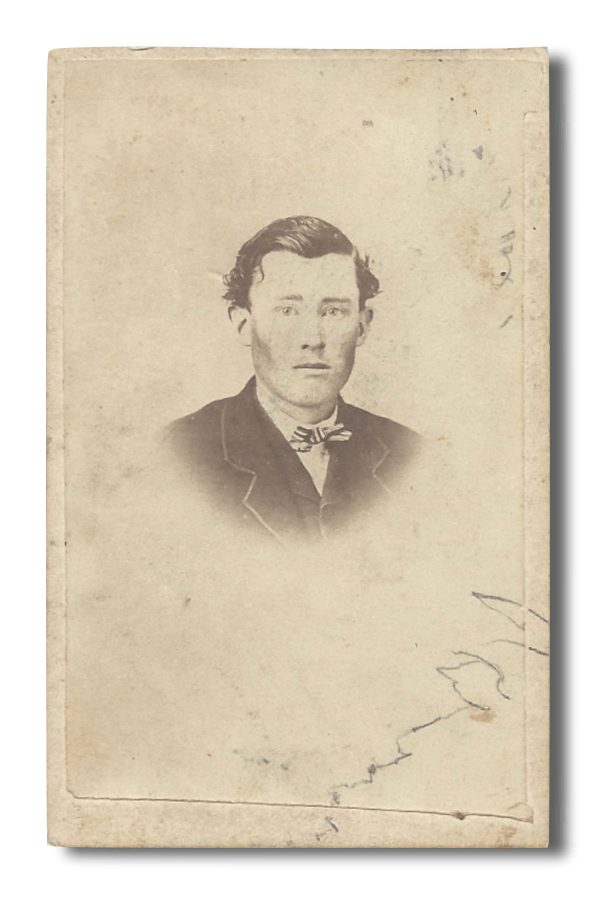
I could not find an image of William but here is one of Gilbert Jedediah Stark who also served in Co. B, 32nd Ohio Infantry (Find-A-Grave)

The following letter was written by Corp. William Galbreath Snodgrass (1838-1915) of Co. B, 32nd Ohio Infantry. At the time this letter was penned from the Union entrenchments near Vicksburg in late May 1863, the 32nd Ohio was brigaded with the 8th & 81st Illinois, and the 7th Missouri in John D. Stevenson’s 3rd Brigade, of John Logan’s 3rd Division, in McPherson’s 17th Corps. William entered the service on 9 August 1861 as a private but was promoted to a corporal by March 1863 and mustered out as the 1st Sergeant of his company when he mustered out as a veteran in July 1865.

William was raised in Union county, Ohio, the son of Samuel Snodgrass (1804-1870) and Agnes Nancy Morrison (1813-1876). He addressed his letter to his cousin “Lib” but she is not further identified and no envelope accompanies the letter. The owner of the letter claims it was purchased in an estate sale in Ohio.

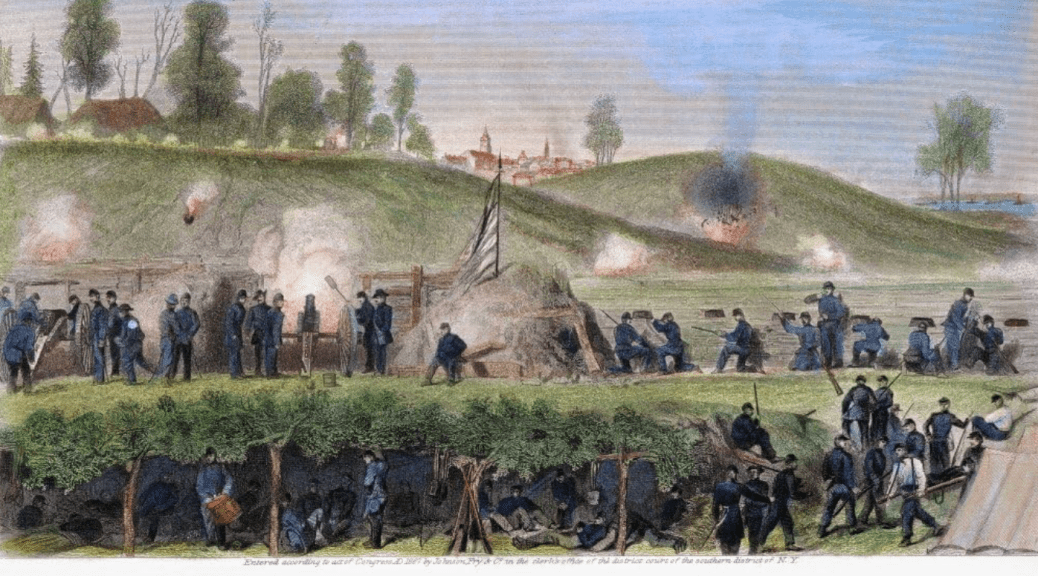
William’s highly entertaining and informative letter chronicles the movements of the 32nd Ohio from the time of their departure from Milliken’s Bend in late April to the end of May when they were laying siege to Vicksburg.

Transcription

Near Vicksburg [Mississippi]
May 28th [1863]

Cousin Lib,

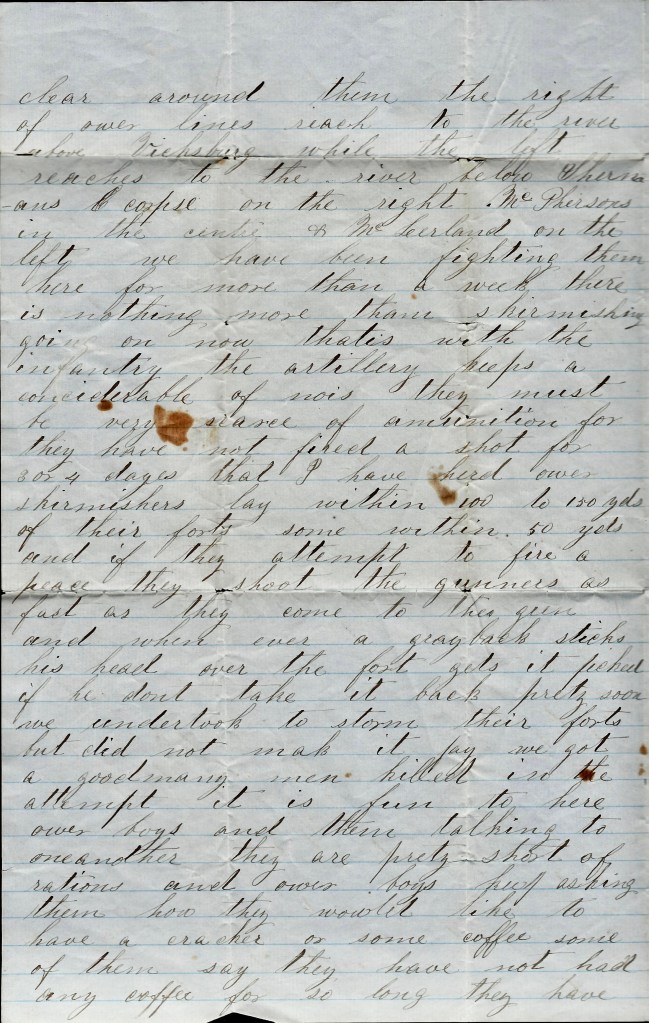
I received your letter a week ago last Sunday. We were on the march then and had stopped to rest and was sitting on the side of the road when the mail was fetched up and distributed. it was the first mail we had received for some time. We left Milliken’s Bend the 25th of April and have been on the move ever since. We have had several fights with the rebs and have whipped them pretty decently every time. I expect you have saw an account of what we have been doing since we left the river. Our Division (that is Logan’s) was in every fight. But we were very lucky We have only had one man wounded in our company yet and that was only a flesh wound. That was Isaiah Hamilton of Logan county. In the rounds, we took over 6,000 prisoners and about 70 pieces of artillery, 8 pieces of which our regiment with the 8th Illinois had the honor of taking.

We have a lot more of the rebs penned up here in Vicksburg which we intend shall not get away. We have a strong force clear around them. The right of our lines reach to the river above Vicksburg while the left reaches to the river below. Sherman’s Corps on the right, McPherson’s in the center, & McClernand on the left. We have been fighting them here for more than a week. There is nothing more than skirmishing going on now—that is, with the infantry. The artillery keeps a considerable of noise. They must be very scarce of ammunition for they have not fired a shot for 3 or 4 days that I have heard. Our skirmishers lay within 100 to 150 yards of their forts—some within 50 yards—and if they attempt to fire a piece, they shoot the gunners as fast as they come to their gun. And when a grayback sticks his head over the fort, gets it picked if he don’t take it back pretty soon.

We undertook to storm their forts but did not make it pay. We got a good many men killed in the attempt. It is fun to hear our boys and then talking to one another. They are pretty short of rations and our boys keep asking them how they would like to have a cracker or some coffee. Some of them say they have not had any coffee for so long they have forgot how it tastes and we ask them how much they would give for a daily paper. I think the Southern Confederacy is playing out pretty fast. Flour here sells at $125 per barrel and there is none hardly for that. There was only one family in Raymond that had any flour and that is a considerable of a place. We got the rebel mail there. Had a heap of fun reading them. I got a couple of rings out of one that some fellow was sending to his sweetheart. There were letters in there from all parts of te rebel army—some from Charleston, S. C., some from Bragg’s army, Vicksburg, Port Hudson, and a great many of them talk very discouraging and the most of them said they were pretty short of rations.

The women here are very sassy when our boys first come in but they generally get pretty humble. We have passed through some of the nicest country that I ever saw. We came past one of Jeff Davis’s plantations. The boys tore everything to pieces. The people here will learn one lesson before they are through with this rebellion—that is, when they are as well fixed as they were when this war commenced, that is to be contented with their lot.

Last Monday the rebs came out with a flag of truce. I do not know the object of it or anything about it but as soon as it came out our boys went up to the forts and the rebs came out and were talking together and joking, but they would not allow us to go inside of the fort. The flag came out about three o’clock and they did not do any fighting that day and some of our boys were over among the rebs until night. The most of them thought we had them. They said we could not take them by storm but we could starve them out. The was 3 or 4 over here in our camp and they offered a dollar apiece for crackers. the boys gave them a few. They say our shells are killing lots of their cattle and mules in there. They said we killed them faster than they could eat them.

The boys are all well. Will Mc 1 is all right. While we were in Raymond, he took possession of the printing office and done a big business while he stayed there. You said you had written two letters since you had got any from me but I never got it. No more. — Wm. G. Snodgrass


1 “Will Mc” was probably William Mosby McLane (b. 1839) who mustered out of the regiment at Chattanooga on 19 August 1864 after three years service. Draft registration records indicate that William was a “teacher” in Champaign county, Ohio, before he enlisted. He returned to Ohio until the close of the war then ventured west to help build railroads. McLain’s last job was with Texas & Pacific Railroad and there he died of heart disease September 8, 1873 in Gladewater, Texas at the age of 35. For a wonderful article on McLain, see “William McLain: On the Subject of Surrendering” appearing on Emerging Civil War, May 1, 2020.

1861: Thomas J. Hendrix to Miss Haskey

I could not find an image of Thomas but here is one of Samuel Taylor McFadden who served in the same company of the 32nd OVI (Ancestry.com)

The following letter was written by Thomas J. Jackson (1840-1862) of Co. A, 32nd Ohio Volunteer Infantry (OVI). Thomas enlisted as a private on 12 July 1861 and rose in rank to corporal before he was killed in the Battle of McDowell (also known as Battle of Sitlington’s Hill) on 8 May 1862 at McDowell, Virginia. In the engagement, the 32nd OVI had six men killed and fifty-three wounded. Thomas was buried at Grafton, West Virginia.

Thomas was the son of Jesse Hendrix (1816-1898) and Mary A. Warren (1815-1891) of Augusta, Carroll county, Ohio. Thomas’s father was a shoemaker by trade. At the time of the 1860 US Census, 19 year-old Thomas will still living at home with his parents and working as a school teacher. Carroll county is in northeast Ohio about 50 miles due west of Pittsburgh, Pennsylvania.

To read letters by other members of the 32nd OVI that I have transcribed and published on Spared & Shared, see:

Abraham M. Crumbecker, Co. A, F&S, 32nd Ohio  (15 Letters)
Francis Marion Hopkins, Co. B, 32nd Ohio (5 Letters)
Francis Marion Hopkins, Co. B, 32nd Ohio (1 Letter)
James F. Johnson, Co. B, 32nd Ohio (1 Letter)
Francis Lewis, Co. G, 32nd Ohio (2 Letters)
William Henry Wilson, Co. G, 32nd Ohio (1 Letter)

Transcription

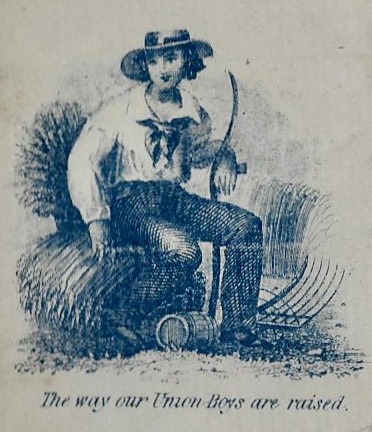
Patriotic stationery used by Thomas for his letter

Beverly, Virginia
December 16, 1861

Miss Haskey,

When I carefully read your last letter, I perceived from the tenor of your writing that it was aggravating to some, for you to write to me. If I thought it would lower you in the estimation of your friends or bring disgrace on your family, I would not write another letter. You did not say whether you was opposed by writing to me or others. I interpreted it to the former. Please enlighten me as to which it is in your next. If it should be from the fact that I am a soldier battling for the rights of our common country, I feel sad for the one that may say so.

As for what other country gossip may say about our writing, I place no stress on it. All the letters I have written heretofore to you have been merely friendship. If this mars their feeling, they will have to recover as best they can. I have met with opposition heretofore. It always has a tendency to excite a person and makes me more attentive to such matters than I otherwise would be. Please state the particulars and then I shall be better prepared in the future to meet emergencies and know how to devise means to escape opposition.

The letter that you and [my sister] Birtha wrote, I read and then showed it to the other boys. It contained some grand suggestions. yet for all you said about us boys having a bother, I do not believe you meant what you said.

You will see from the heading of this letter that I am at Beverly. On yesterday morning three companies from the regiment left the mountain. Also there was nine detailed out of the remaining companies to go along for the purpose of building quarters at the aforesaid place. Jim Watson and myself are the only ones of the Augusta boys that was detailed. We had a very tiresome walk. The woods are extremely bad. It was with difficulty that we made the march. I do not think I ever was as tired in my life. I could hardly navigate. We (five of us) slept in an old saw mill in a small rom the sawyers occupied. Today we set our tent and will probably commence to work tomorrow. The remainder of the regiment will be here in a few days.

I do not think we will stay long. I think we will either go to Buchanan or to Ohio. There are a great many in the regiment that are unfit for duty. Our boys are all well and are in good spirits.

Oh yes! there is one question I want to ask you. Did you write to Hen[ry A.] Jackson before he wrote to you? Some of the boys told him that he wrote first and he denied it. I will make the same request of you that you did of me—that is, to destroy the letters you get from me and not let any person get hold of them.

Sam McClellan has gone home on furlough. Henry Chain is here at Beverly. He arrived on last Monday. All the things that he brought for us boys are at Webster. I suppose you will have some grand times at school this winter. I hope to hear from the school before long. Write as soon as you can conveniently. I shall wait with eagerness to hear from you again.

Direct to Beverly, Randolph county, Va., in care of Capt. [Jackson] Lucy, Company A. With much respect, I subscribe my name as your sincere and lasting friend, — T. J. Hendrix