Category Archives: 4th Rhode Island Infantry

1862: Samuel Francis to his Sister

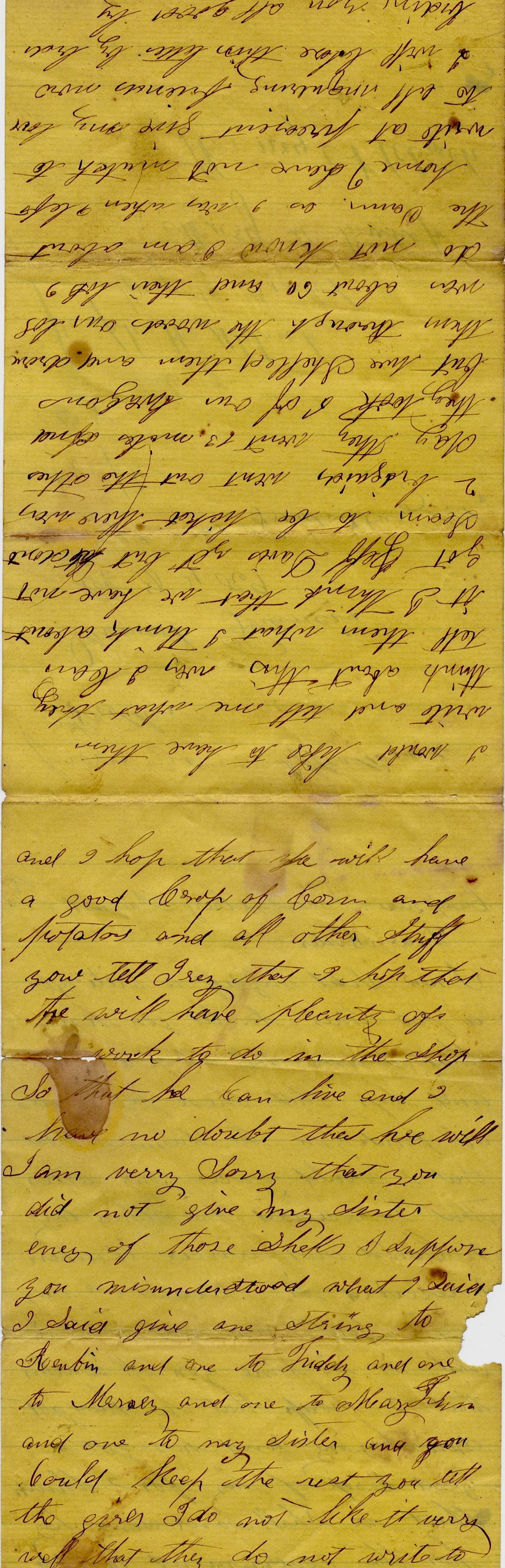
The following letter was written by Samuel Francis (1839-1909) of Burrillville, Rhode Island, who enlisted on 23 September 1861 to serve as a private in Co. D, 4th Rhode Island Infantry. He mustered out of the regiment on 15 October 1864 after three years service. We learn from the 1870 US Census that Samuel was born in England. At that time he was living in Webster, Worcester county, Massachusetts, working in a shoe factory. In 1880, he was living in Oxford, Worcester county, Massachusetts. He was still living there in Oxford in 1890 when the Veteran’s Schedules were completed. He died in Maine at a Soldier’s Home in 1909.
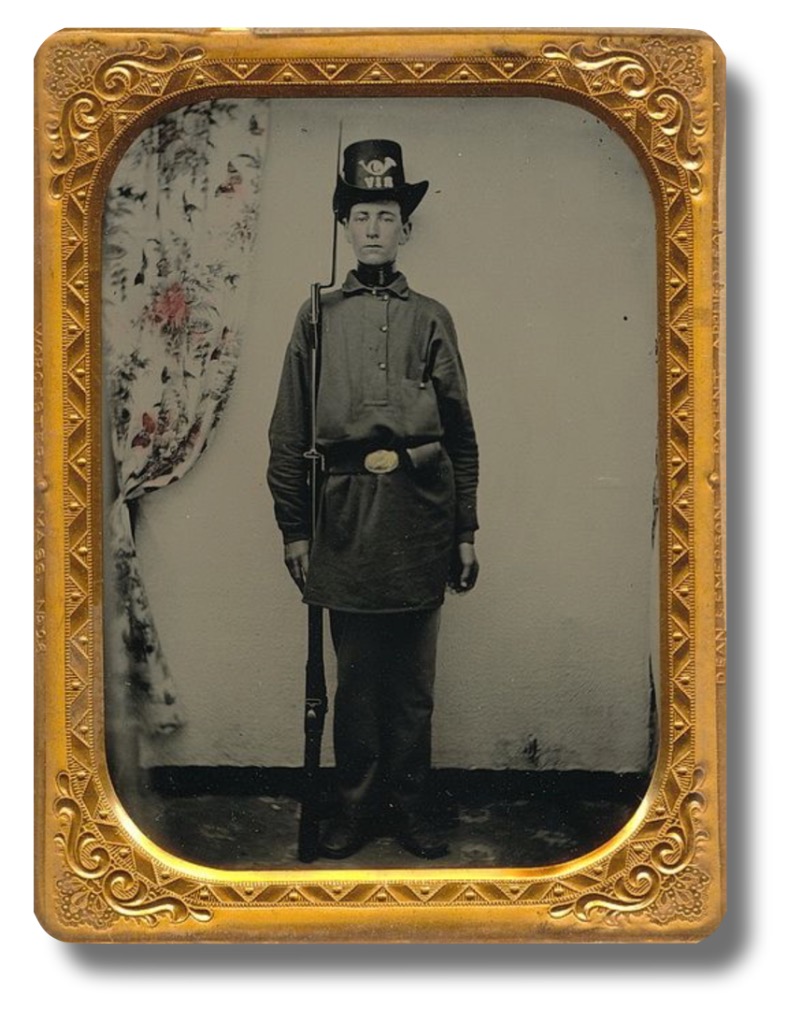
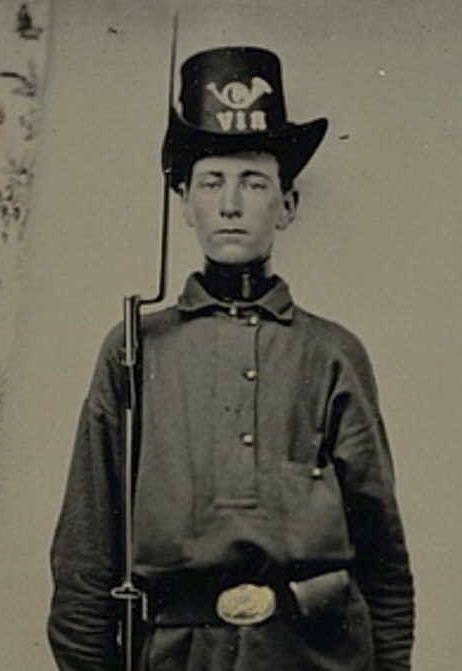
I could not find a photograph of Samuel but here is a tintype of an unidentified private in the 4th Rhode Island Volunteers showing what their uniform looked like.

T R A N S C R I P T I O N

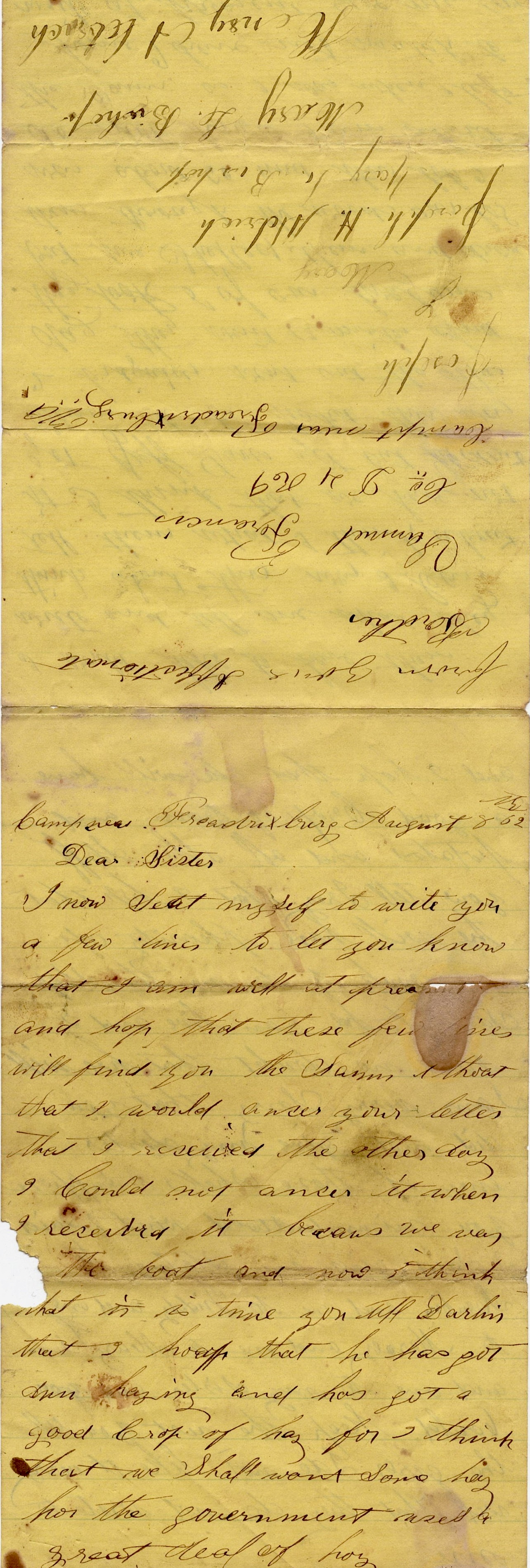
Camp near Fredericksburg

August 8, 1862

Dear Sister,

I now seat myself to write you a few lines to let you know that I am well at present and hope that these few lines will find you the same. I thought that I would answer your letter that I received the other day. I could not answer it when I received it because we was on the boat and now I think that it is time.

You tell Darlin that I hope that he has got done haying and has got a good crop of hay for I think that we shall want some hay for the government uses a great deal of hay. And I hope that he will have a good crop of corn and potatoes and all other stuff. You tell Irez that I hope that he will have plenty or work to do in the shop so that he can live and I have no doubt that he will.

I am sorry that you did not give my sister any of those shells. I suppose you misunderstood what i said. I said give one string to Reuben and one to Freddy and one to Manly and one to Mary [ ] and one to my sister and you could keep the rest.

You tell the girls I do not like it very well that they do not write to me. I would like to have them write and tell me what they think about this war. I can tell them what I think about it. I think that we have not got Jeff Davis yet but he don’t seem to be licked. There was two brigades went out the other day. They went 13 miles and they took 6 of our wagons but we shelled them and drove them through the woods. Our loss was about 60 and their loss I do not know.

I am about the same as I was when I left home. I have not much to write at present. Give my love to all enquiring friends. Now I will close my letter by bidding you all goodbye. From your affectionate brother, — Samuel Francis, Co. D, 4th Rhode Island

to Joseph H. Aldrich, Mary L. Bishop, Henry Aldrich
1861: Henry D. Lincoln to his friend Everett

I could not find an image of Henry but here is David A. Sheldon of Co. B, 4th Rhode Island wearing the classic R. I. blouse and Hardy hat.

The following letter was written by Henry D. Lincoln (1839-1900), the son of Joseph and Sally (smith) Lincoln of Attleboro, Bristol county, Massachusetts, who served in Co. I, 4th Rhode Island Infantry. Henry enlisted as a corporal at Pawtucket on 14 September 1861 and was with his regiment at Antietam where he was wounded and hospitalized for months afterward. The regiment lost 21 men killed and 77 men wounded at Antietam when they were hit in the flank by A. P. Hill’s Division as they attempted to advance though Joseph Sherrick’s 40 acre cornfield beyond Burnside’s Bridge. Henry was eventually discharged on 15 October 1864. He received a disability pension after the war but was able to supplement his monthly payment by employment as a railroad conductor. Previous to his enlistment he had been employed as a “stair builder”—a trade he learned from his father.

This letter was written in late November 1864 while the regiment was still bivouacked at Camp Casey near Washington D. C.

T R A N S C R I P T I O N

[Camp Casey, near Washington D. C.]
November 24th [1861]

Friend Everett,

I have just got through supper and smoking and I thought that I would write to pass away the evening. I don’t know when I shall write again. There is going to be something pretty quick. Friday we got paid off and tonight the guard house is full. All the guards were brought in drunk last night. You had ought to of been here this morning and seen them. There was a squad of them, I can tell you. Last night the Major, the Colonel, and the Doctor detailed 12 men from each company to go on picket dity. They went 8 miles from camp. What they went for, nobody knows but them that went. They had to take an oath of secrecy to say nothing what they went for. One of them that [went] told me that he laid two hours side of the wall and did not dare to speak. His orders were that if he [was to] see a man, to shoot him down. We have two spies in the guard house now. I hope if they be rebels, they will hang them.

Tuesday our Brigade has got to go to the City on a review. There is to be thirty thousand reviewed. Would not you like too see them? The story is that we are going on an expedition. I hope we shall for I want to see Old Jeff and if I see him, I will kill him if I can.

It is very cold here now. It snows a little here now. It has stormed here very near all the time for a week. Newton was down here to see me the other day. He is the same old six pence. He has not altered any. I wish that I had his gun and dog out here. There is something to hunt out here. One of the boys killed two rabbits with a stone. The woods be full of them. Newton says that Uncle Sam pays four shillings a cord and board, clothes. It is a easy way of getting a living but a dangerous one, don’t you think?

So I should like to step in and see you a little while tonight but I guess that I shall see Old Jeff first. If I. do see him, I will try to make him say rip, would not you say. He says that he is going to hoist his black flag in Massachusetts. I guess that if he is there, that will be when he is dead. Think Barnum would give something to have him in his museum. If he will lay low, he will get him by the first of April. Should not you like to see him in a show case? He would look handsome, would not he?

How is Orin? Give my love to him. Tell him to come out here and he can see some fun before long. I wish that I had a little cider. I be gettin’ dry. Well, I shall have to dry up for I hain’t got much more paper. Good night. Write, won’t you, for I like to hear from you. Yours, — Henry

4th Regt. R. I. V., Co. I, Washington D. C.