Category Archives: 6th Virginia Cavalry

1863: Richard Coke Marshall to his Sister

The following letter was written by Richard Coke Marshall (1844-1914), the son of Fielding Lewis Marshall (1819-1902) and Rebecca Frances Coke (1824-1862) of Oak Hill, Fauquier county, Virginia. He was but sixteen years of age at the outbreak of the civil war, and entered the Confederate service as a member of Co. H, 6th Virginia Cavalry when he turned 18. At the battle of Trevillian’s Station between the forces of General Phil H. Sheridan and General Wade Hampton, June 11, 1864, he was shot through the lung, which so disabled him that he was unable to again enter service until near the close of the struggle. In 1865 he became aide-de-camp on the staff of General Thomas L. Rosser, and was at Appomattox Court House, but did not surrender with General Lee and his army for the reason that Rosser’s command was then surrounded and cut off from Lee’s forces. 

After the Civil War, Richard attended the Virginia Military Institute and became a prominent civil engineer and politician.

[Note: This letter comes from the private collection of Greg Herr and was made available for transcription and publication on Spared & Shared by express consent.]
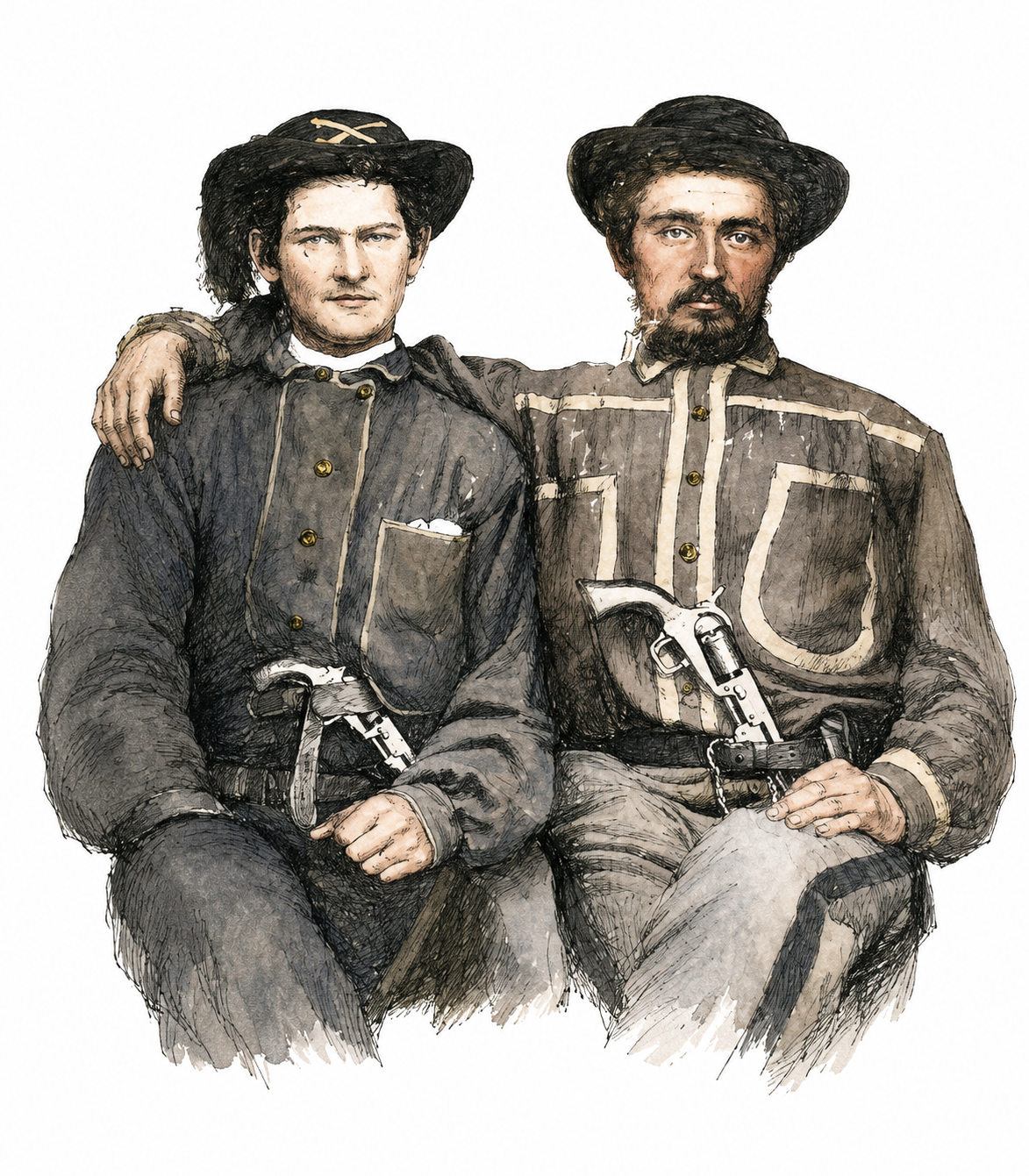
Two members of the 6th Virginia Cavalry—the younger man at left has been identified as Stephen Clinton Adams of Co. K, 6th Virgina Cavalry. He was from Loudoun county, Va.

T R A N S C R I P T I O N

Camp near Culpeper Court House
August 9th 1863

My dear Sister,

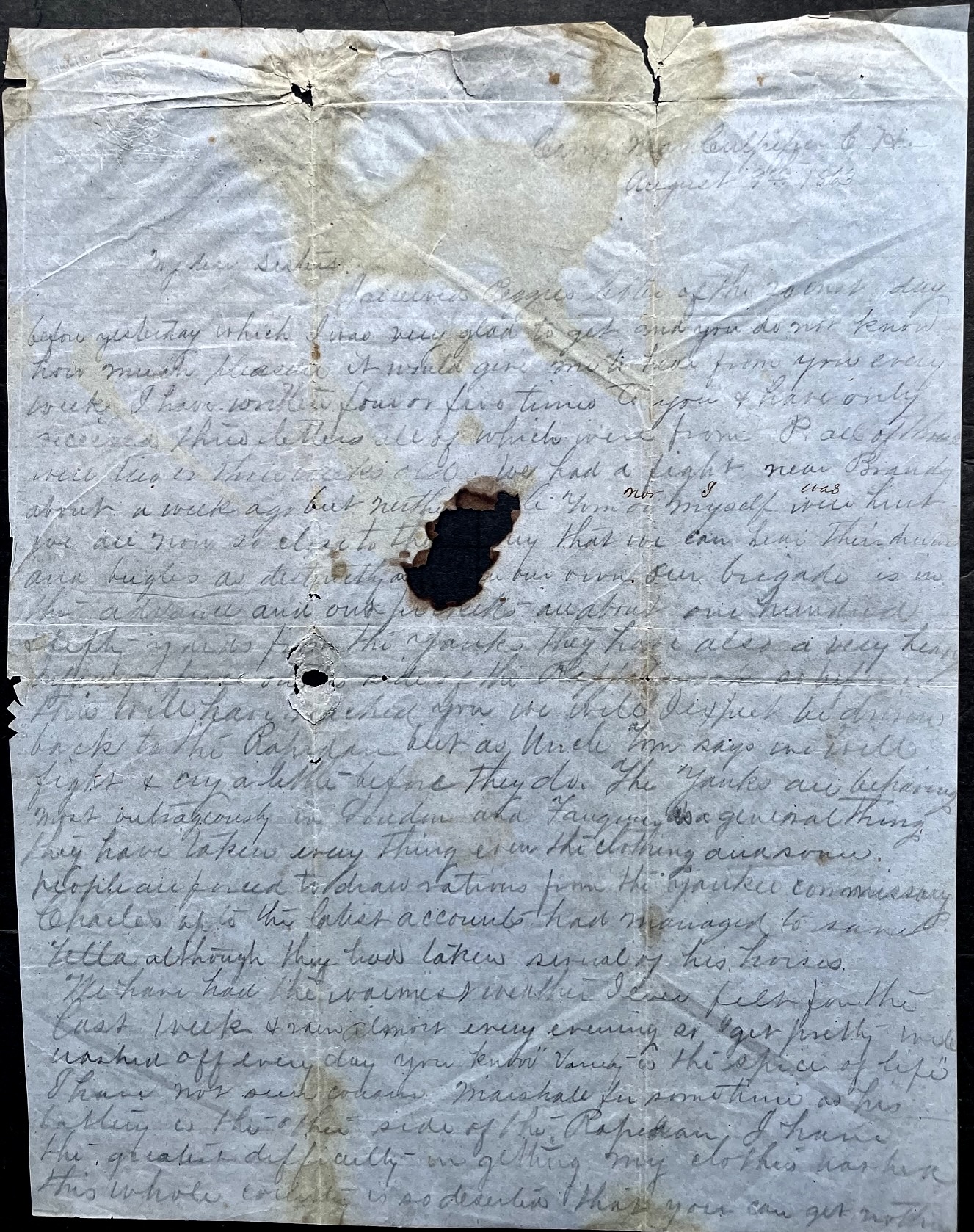
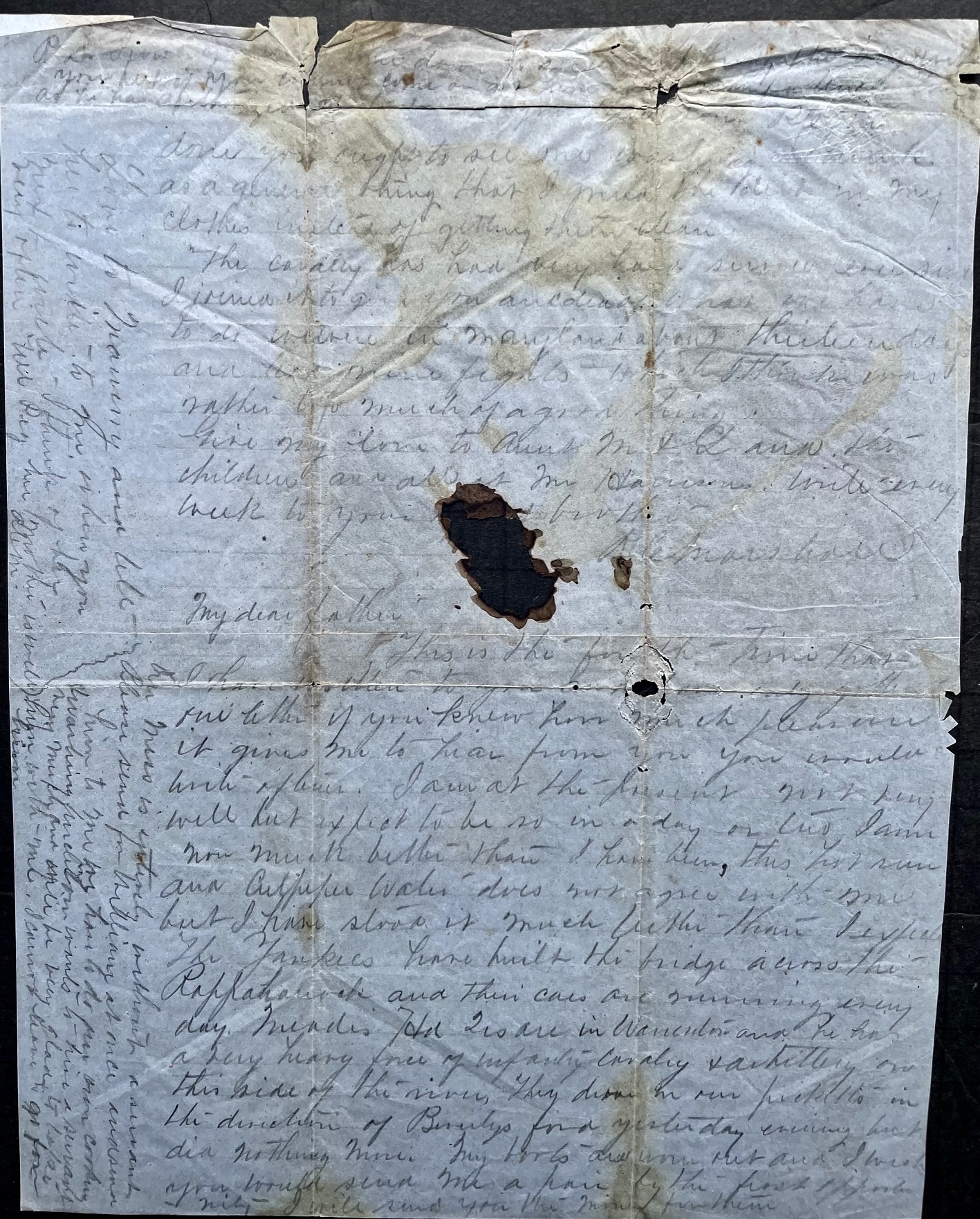
I received Peggie’s letter of the 20th inst. day before yesterday which I was very glad to get and you do not know how much pleasure it would give me to hear from you every week. I have written four or five times to you & have only received three letters, all of which were from Peggie. All of those were two or three weeks old.

We had a fight near Brandy [Station] about a week ago but neither Uncle William nor myself was hurt. We are now so close to the Yankees that we can hear their drums and bugles as distinctly as our own. Our brigade is in the advance and our pickets are about one hundred and fifty yards from the Yanks. They have also a very heavy infantry force on this side of the Rappahannock so before this will have reached you, we will, I expect, be driven back to the Rapidan. But as Uncle William says, we will fight & cry a little before they do. The Yanks are behaving most outrageously in Loudoun and Fauquier [counties]. As a general thing, they have taken away everything—even the clothing—and some people are forced to draw rations from the Yankee commissary. Charles, up to the latest accounts, had managed to save Zetta although they had taken several of his horses.

We have had the warmest weather I ever felt for the last week & rain almost every evening so I get pretty well washed off everyday. You know “variety is the spice of life.” I have not seen cousin Marshall for some time as his battery is the other side of the Rapidan. I have the greatest difficulty in getting my clothes washed. This country is so deserted that you can get nothing done. You ought to see me washing. I think as a general thing that I ground the dirt in my clothes instesad of getting them clean.

The cavalry has had very hard service ever since I joined it. To give you an idea of what we have to do, we were in Maryland about thirteen days and had nine fights, which I think was rather too much of a good thing.

Give my love to Aunt & L Ann, the children, and all at Mr. Harrison’s. Write every week to your affectionate brother, — R. C. Marshall

My dear Father,

This is the fourth time that I have written to you and [ ] letter. If you knew how much pleasure it gives me to hear from you, you would write oftener. I am ay the present not very well but expect to be so in a day or two. I am now much better than I have been. This hot sun and Culpeper water does not agree with me but I have stood it much better than I expected.

The Yankees have built the bridge across the Rappahannock and their cars running every day. Meade’s Headquarters are in Warrenton and he has a very heavy force of infantry, cavalry, and artillery on this side of the river. They drove on our pickets in the dirctio of Beverly’s Ford yesterday evening but did nothing more. My boots are worn out and I wish you would send me a pair by the first opportunity. I will send you the money for them.

Our mess is entirely without a servant. Please send for William at once and send him to me. We have to do our own cooking, washing. Uncle William wants to hire a servant very much and will be very glad to take him with me. I cannot leave to go for him.
1863: William Dickenson Stone to his Sister

Two unidentified members of the 6th Virginia Cavalry, wearing battle shirts and with Colt .36 caliber Navy revolvers

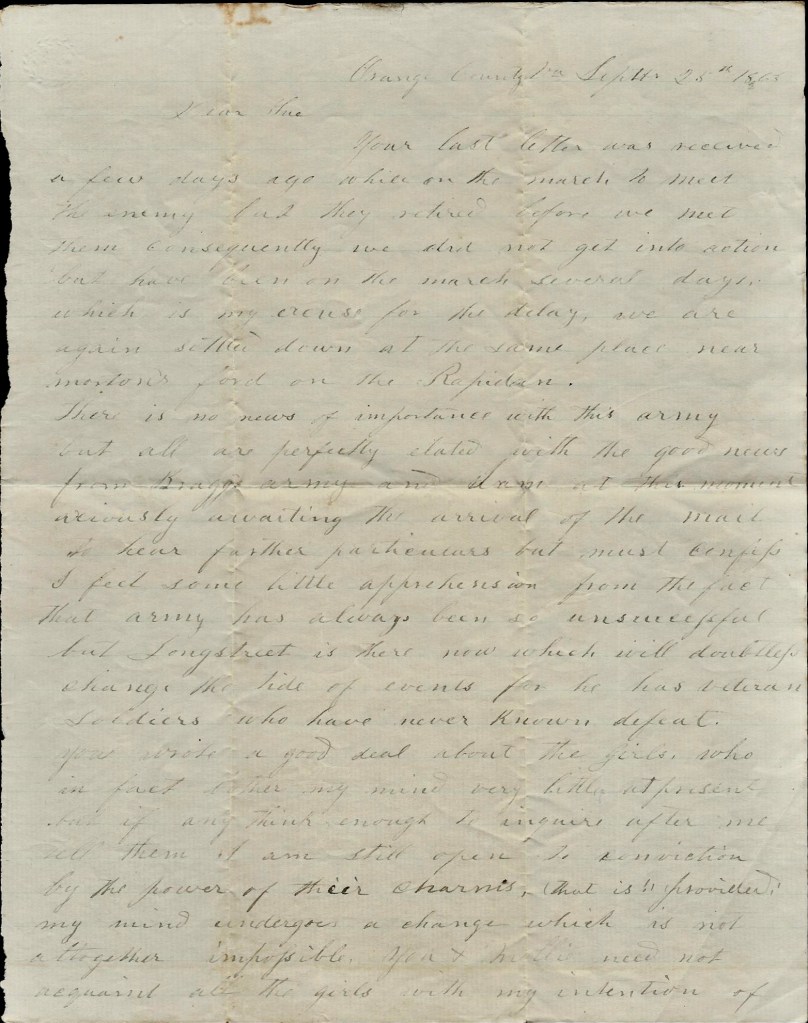
The following letter was written by William Dickenson Stone (1836-1908), the son of Edmund Stone (1805-1840) and Nancy Chapman Dickenson (1809-1854) of Cartersville, Pittsylvania county, Virginia. William did not marry until after the war, in 1867, to Mary Rosa Parker (1848-1931)—12 years his junior. He lived in Franklin county, Virginia, after the war.

During the Civil War, William entered the service as a private on 27 May 1861 in Co. E, 6th Virginia Cavalry. He was commissioned a lieutenant on 20 April 1862 and often signed the pay rolls as commander of his company. The regiment fought in Jackson’s Valley Campaign and in the conflicts at Second Manassas, Brandy Station, Upperville, Fairfield, Bristoe, Mine Run, The Wilderness, Todd’s Tavern, Spotsylvania, Haw’s Shop, and Cold Harbor. The regiment went on to take part in Early’s Shenandoah Valley operations and the Appomattox Campaign.

William’s letter makes a reference to the Confederate victory at Chickamauga in northern Georgia where Bragg’s army turned back Rosecrans’ army, forcing them to retreat back to Chattanooga. “We all are perfectly elated with the good news from Bragg’s army and I am at this moment anxiously awaiting the arrival of the mail to hear further particulars but must confess I feel some little apprehension from the fact that army has always been so unsuccessful. But Longstreet is there now which will doubtless change the tide of events for he has veteran soldiers who have never known defeat.”

Transcription

Orange county, Virginia
September 25, 1863

Dear Sue,

Your last letter was received a few days ago while on the march to meet the enemy but they retired before we met them. Consequently we did not get into action but have been on the march several days which is my excuse for the delay. We are again settled down at the same place near Morton’s Ford on the Rapidan.

There is no news of importance with this army but all are perfectly elated with the good news from Bragg’s army and I am at this moment anxiously awaiting the arrival of the mail to hear further particulars but must confess I feel some little apprehension from the fact that army has always been so unsuccessful. But Longstreet is there now which will doubtless change the tide of events for he has veteran soldiers who have never known defeat.

You wrote a good deal about the girls who in fact bother my mind very little at present but if any think enough to enquire after me, tell them I am still open to conviction by the power of their charms (that is!) provided my ind undergoes a change which is not altogether impossible. You and Mollie need not acquaint all the girls with my intention of living a bachelor’s life. Then they would barely respect me for none but marrying men are popular with them and I don’t care to be kicked out of society entirely before my time comes of my own choice.

Everything is so dull here. There is nothing to write about. Tell Sallie her letter was received yesterday and I will write to her tomorrow or next day. This leaves myself and friends well. Write soon. Direct to Orange County, 6th Virginia, Lamar’s Brigade.

My love to all anxious friends and accept the warmest love of your absent brother, — Wm. D. Stone

1864: John R. Bowles to friend Ned

John H. Burns, Co. D, 1st Virginia Cavalry

The following well-written letter was penned on a cold, wintery, January night in 1864 by John R. Bowles of Co. F, 6th Virginia Cavalry. He wrote the letter while on detached duty “recruiting horses for service” in Nelson and Botetourt counties of Virginia. According to muster records, Bowles enlisted as a private on 15 January 1863 at Mount Crawford. In November and December, 1863, his records state that he was “detailed to attend to horses of Cavalry Division near Ivy Depot.” By the summer of 1864 he had been promoted to a corporal, and by war’s end he was a sergeant. A note on his muster record informs us that he was formerly a resident of Baltimore, Maryland, and that he intended to return there after the war.

What makes this letter unusual is that it was addressed to his friend Ned who was clearly living in the North—probably in Maryland, and the letter had to be smuggled through enemy lines with little or no expectation of a response. Ned isn’t identified but my hunch is that he was a former schoolmate.

Transcription

Rockfish Valley, Nelson county, Va.
January 6th 1864

My Dearest Friend Ned,

By the dim and uncertain glare of my campfire to night, I will attempt to write you a few lines as I have just heard of a good opportunity of forwarding a letter through the lines. Have you thought of me often, old friend? And have you ever wondered whether I reverted to you in my retrospections? If you have, you may case for the future from such uncertain speculations for you are my companion yet—present in mind though absent a long ways and separated by distance and armies.

Just imagine yourself with me tonight in my winter hut of logs and mud with a glowing fire cracking and popping like shrapnel shells around you and three messmates reclining upon beds of the “softest chestnut boards” we could find and a lively conversation upon foxes and fox hunting with rich imaginative embellishments annexed and a pot of rice and boiled rabbit upon the floor and you have our introductory appearance exactly. Well, having made your bow, as I am done my supper, I will monopolize your company so just seat [yourself] by my side upon my blanket and we will talk of old times and present circumstances.

How are you and how are you getting along? Are you in business for George W. H. yet? How do you like your location now and what profits do you realize? What do you think of things in general? When were you in Baltimore? How are the people there and who’s married and who ain’t? Have you read Jeff’s Message and what do you think of it? Uncle Abe seems to be a little weak or very impudent, I don’t know which.

If you could see my jowls and hear our mischief, you wouldn’t conclude my apprehensions of starvation were felt nor suppose that the spirit of our army was broken. I have had a splendid time lately, Ned. I am now and have been for two months upon detached duty recruiting horses for service in this and Botetourt counties. I get good fare, have light duties, not much restricted and plenty of friends, both make and female. Invitations to dinner and evening candy-stews are frequent and our soldier boys stand in high repute. I have some fine lady friends—the first feminines I have conversed with since I have been in the army—and you may suppose that I am “making hay, &c.” quite rapidly in strict accordance with the ancient adage. How I wish often times that you could share their company with me.

We will rejoin our regiment early next spring in ample time for fighting. Well, Old fellow, I have smelt gunpowder very often since we parted and do not care if I never offend my nose again by the scent. I have been in twenty odd engagements during last year and witnessed spectacles such as the battlefield only presents. But such descriptions are woefully frequent in the newspapers so I will not attempt any superfluous representations. I spent a fifteen day furlough in Lynchburg, New Glasgow, & Amherst county recently amongst my relatives and had an old fashioned time of fatness and plenty. Miss Helen Christian is well and spoke kindly of you. We correspond regularly. She writes a good letter and is a fast friend of mine, I believe. I wish I could send you a letter she wrote me a few days since.

I stayed all night at Cousin Martha Staples’ last month, but Cousin Mary is still in Missouri. Do you ever hear from John Trowbridge? What are his sentiments? How is honest Old Zane? I would like to see him. Send him my love. How is John Black? I presume your acquaintance has considerably increased in Zanesville by this time. How do you like them?

I wrote a long letter to Mother & Sisters today 1 which I hope they will get. Your journals still contain accounts of prospective sufferings and ultimate starvation for us, but I will take the privilege of a freeman and contradict any such assertions most unqualifiedly if you please. We laugh at misrepresentation and consider it an evidence of their longing for such results as they cannot obtain upon the battlefield. I was at Gettysburg and much wanted to get home, but our artillery ammunition was exhausted and we had to lose the advantage of success and a gloriously planned campaign, worthy our incomparable commander in chief.

As to our “homespun,” it is very serviceable and does not interfere with a clean sight along a gun barrel at all. The times seem to indicate a prolonged struggle, Ned, but Providence still rules the universe though Lincoln sits in the chair.

The weather has been excessively cold and the New Year came blustering into power like a young giant. May he have good things in store for us. The snow is falling heavily now and rests upon the everlasting mountains around us like locks of hoary-age. The boys are snoring around now and as the fire is going out and the ink too, I must prepare to bid you good night with a hope that you will visit me in my slumbers. I wish you could answer this. Goodbye, Ned. Your sincere friend, — John R. Bowles


1 A photocopy of the 4-page letter Bowles wrote to his mother and sisters in Baltimore, Maryland, on 6 January 1864 can be found in the Library of Virginia. Accession No. 38884. In that letter Bowles states that he had been given a furlough to acquire horses for the company and regiment, that he had been able to visit relatives in Botetourt County, Virginia, and sending news of them home. Bowles comments on the battle of Gettysburg. He also asks how his family and friends in Baltimore are doing and describes some aspects of life as a soldier.