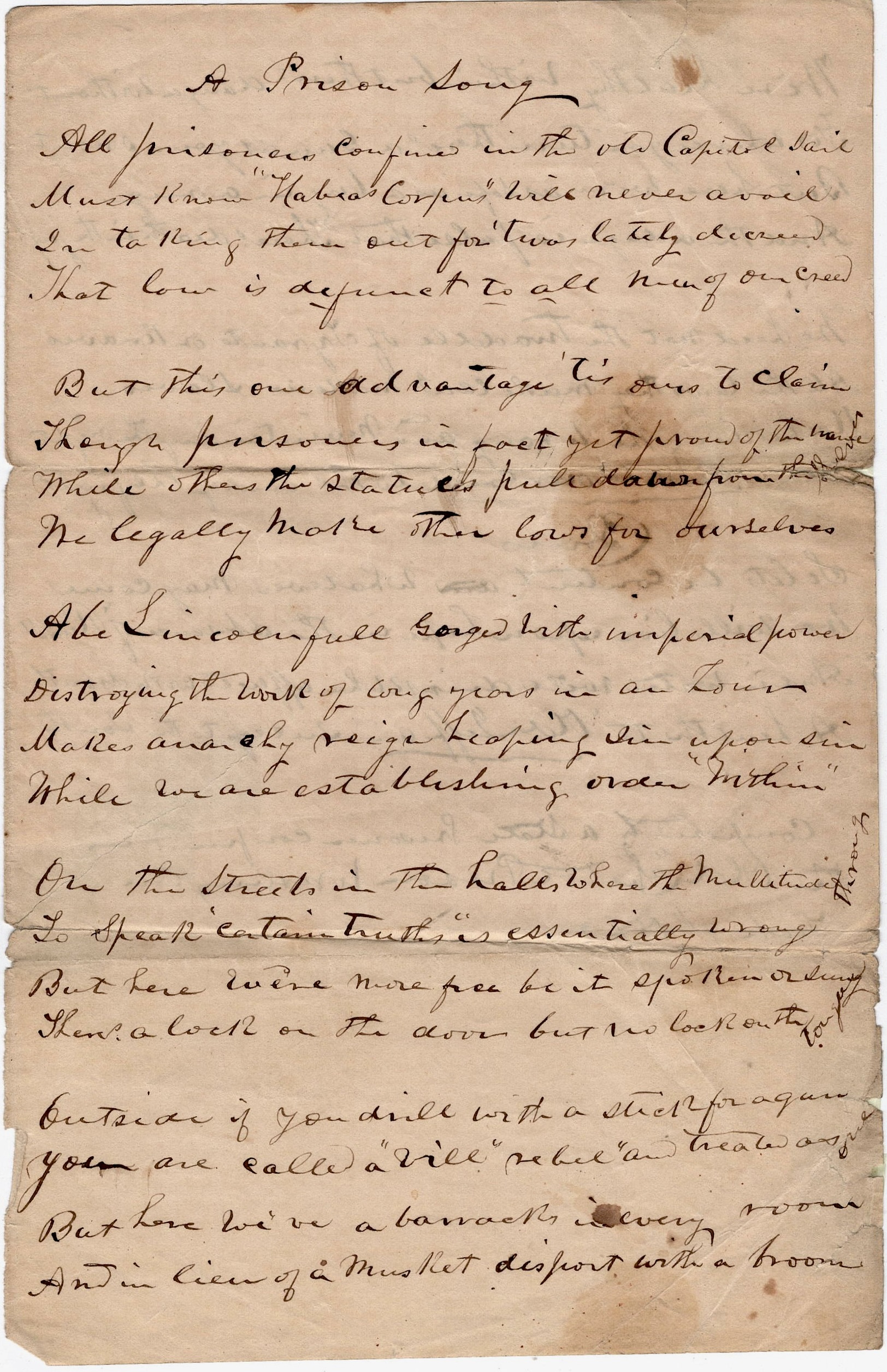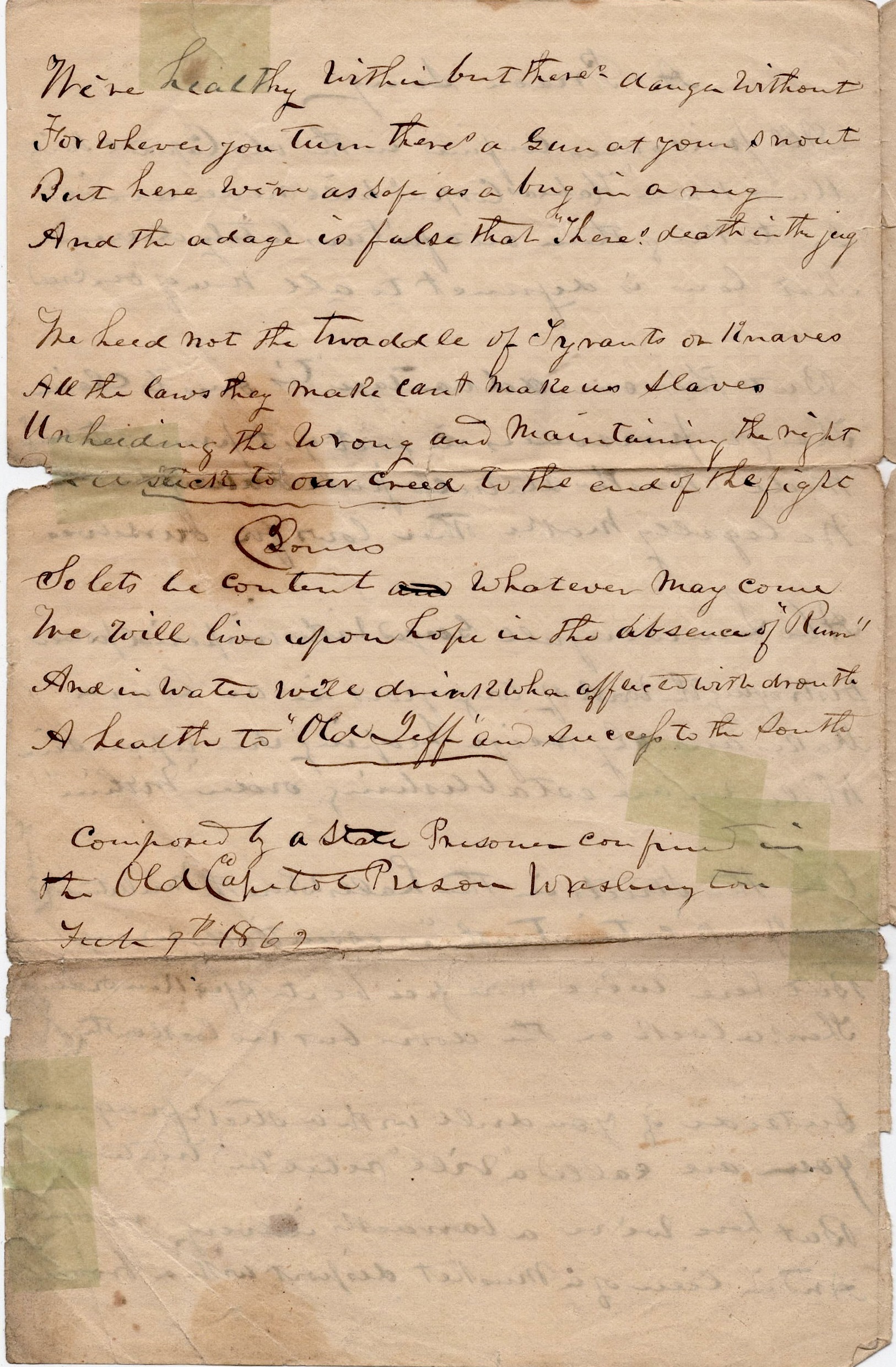
Regrettably there is no signature by the author of this poem entitled “A Prison Song.” Since it contains no strikethroughs or other editing marks, I’m going to conjecture that it was copied from somewhere—perhaps a Baltimore newspaper. If this version was actually handwritten by the author of the poem, it is likely a copy. It was found among the Bestor family papers but I have not yet been able to identify the handwriting.
I searched the internet for a printing of this poem and found it in only one source so far, that being the book published in 1911 by James J. Williamson entitled, Prison Life in the Old Capitol and Reminiscences of the Civil War. It appears on pp. 48-49 in his book with slight variations in the wording and without the final stanza. Curiously the hand written version is actually precisely dated as Feb. 9th 1862. Williamson was not imprisoned in the Old Capitol Prison until 1863 and in introducing it in his book, he states that it had been written before his arrival by someone whose name he did not know.
Because this item was found among the Bestor family papers, I dug deeper suspecting a connection to the family. I discovered that Maria Louisa Bestor (1819-1891) of Harpers Ferry—a relative of the Baltimore Bestors—was married in 1836 to Aaron Amasa Van Camp (1816-1892). Dr. Van Camp was trained in dentistry and when the Civil War broke out, he was practicing dentistry in Washington D. C. He quickly aligned himself with the South, as did many of his Bestor family cousins, and he became a prominent operative in the Rose O’Neal Greenhow Spy Ring. Using his dental office as a cover, he funneled military information across Union lines to Confederate forces. He routinely gathered military information from strategic sources including John Callan, a clerk for the US Senate Military Committee. This spy ring was sniffed out by Allan Pinkerton leading to his arrest and imprisonment in the Old Capitol Prison as a suspected spy, one of his accusers writing that the doctor was “a bitter and dangerous malignant against the government.”
Following his arrest on 31 December 1861, the doctor remained in the Old Capitol Prison until mid March 1862 when he was released after signing an oath of allegiance to the Union. This did not stop him from cooperating with the Confederate Secret Service, however. In 1864, he was discovered to be aiding the Confederacy in the destruction of steamers and foundries in locations between St. Louis and Vicksburg under the guise of being a cotton trader. [Source: Wikipedia]
Given the connection to the Bestor family and the timing of his captivity at the Old Capitol Prison, I’m going to attribute the poem to him but I can’t prove it. Perhaps it was left unsigned intentionally so as to avoid self incrimination as the doctor professed his innocence. He may have been the same “Dr.” whom the Bestor twins credited for having encouraged them to join the Confederate service. See: 1861-65: The Bestor Brothers of Baltimore.
T R A N S C R I P T I O N
A Prison Song
All prisoners confined in the old Capitol jail
Must know “Habeas Corpus” will never avail
In taking them out for ’twas lately decreed
That law is defunct to all men of our creed.
But this one advantage ’tis ours to claim
Though prisoners in fact yet proud of the name
While others the statues pull down from the shelves
We legally make other laws for ourselves.
Abe Lincoln full gorged with imperial power
Distroying the worth of long years in an hour
Makes anarchy reign heaping sin upon sin
While we are establishing order “within.”
On the streets in the halls where the multitude throng
To speak certain truths is essentially wrong
But here we’re more free be it spoken or sung
Here a lock on the door but no lock on the tongue.
Outside if you drill with a stick for a gun
You are called a “vile rebel” and treated as one
But here we’ve a barracks in every room
And in lieu of a musket disport with a broom.
We’re healthy within, but there’s danger without
For wherever you turn, there’s a gun at your snout,
But here we’re as safe as a bug in a rug
And the adage is false that “There’s death in the jug.”
We need not the twaddle of Tyrants or knaves
All the laws they make, can’t make us slaves
Unheeding the wrong and maintaining the right,
We’ll stick to our creed to the end of the fight.
So lets be content, whatever may come,
We will live upon hope in the absence of “Rum.”
And in water we’ll drink, when afflicted with drouth
A health to Old Jeff’ and success to the South.
Composed by a State Prisoner confined in the Old Capitol Prison Washington Feb 9th 1862