The following letter was written by Sgt. Mander Alvan Maynard (1841-1913) of Co. F, 7th Rhode Island Infantry. He mustered into the regiment on 6 September 1862 and transferred into the new organization on 21 October 1864.
He was the youngest son of Moses William Maynard (1805-1894) and Martha Barnes Brigham (1809-1882) of Worcester, Massachusetts. During the winter of 1861-62 he taught school in Burrillville. The regimental history claims he was with the regiment in the Battle of Fredericksburg but contracted typhoid fever in January 1863 and was sent to hospitals at Baltimore and Portsmouth before rejoining his regiment at Lexington, Kentucky in November 1863. [This letter suggests he was still with the regiment in early March 1863, however.] He mustered out of the regiment in June 1865. In 1866 he married Sarah J. Anthony.
In the 1860 US Census, 18 year-old Mander was enumerated in his parents’ household in Ward 8 of Worcester, Massachusetts. Besides his parents, there was 26 year-old Adda and 23 year-old Malcom, both mentioned in this letter.
I promised you a long letter on this sheet of paper and you shall have it now or as soon as I can finish it. It may take more than one day but I will try to answer the questions in your former letters as fully as possible.
Malcom concludes that Albert M. Smith [of Smithfield, R. I.] is the man I helped off of the battlefield. No sir. He was 2nd Sergeant but got scared before we got to the field and left and instead of his belt &c. being shot off, two men in the company say they helped him take them off. He was not wounded in the least but played it and got discharged. Capt. [Lyman M.] Bennett found out what the matter was and reduced him to the ranks. The person I helped off was William H. Russell 1 and he laid beside me when he was struck by a piece of shell.
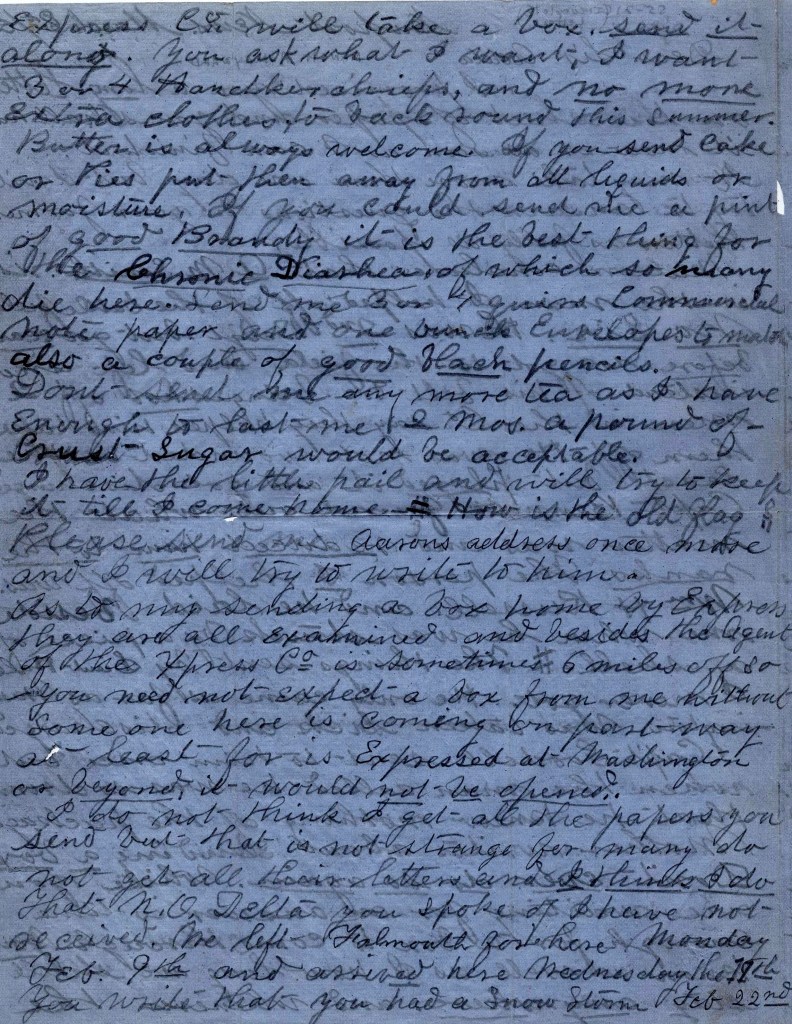
The things sent by Lieutenant Hall, I never got. He only came as far as Washington, was taken sick, and discharged. Capt. Goodell sent to him once but when the man called, he [Hall] was so drunk that he knew nothing of the package. Mother writes about sending a box. Don’t ever do so again. While you are waiting for an answer is time enough for a box to come through. You know as well as I how long we shall stay anywhere and whenever the Express Co. will take a box, send it along. You ask what I want. I want three or four handkerchiefs and no more extra clothes to pack around his summer. Butter is always welcome. If you send cake or pies, put them away from all liquids or moisture. If you could send me a pint of good brandy, it is the best thing for the chronic diarrhea of which so many die here. Send me three or four quires commercial note paper and one bunch envelopes to mail. Also a couple of good black pencils. Don’t send any more tea as I have enough to last me two months. A pound of crust sugar would be acceptable. I have the little pail and will try to keep it till I come home.
How is the old flag? Please send me Aaron’s address once more and I will try to write to him. As to my sending a box home by Express, they are all examined and besides, the agent of the Express Co. is sometimes 6 miles off so you need not expect a box from me without someone here is coming on part way at least for if expressed at Washington or beyond, it would not be opened.
I do not think I get all the papers you send but that is not strange for many do not get all their letters and I think I do. That N. O. Delta you spoke of I have not received. We left Falmouth for here Monday, February 9th, and arrived here Wednesday the 11th [aboard the steamer Georgia].
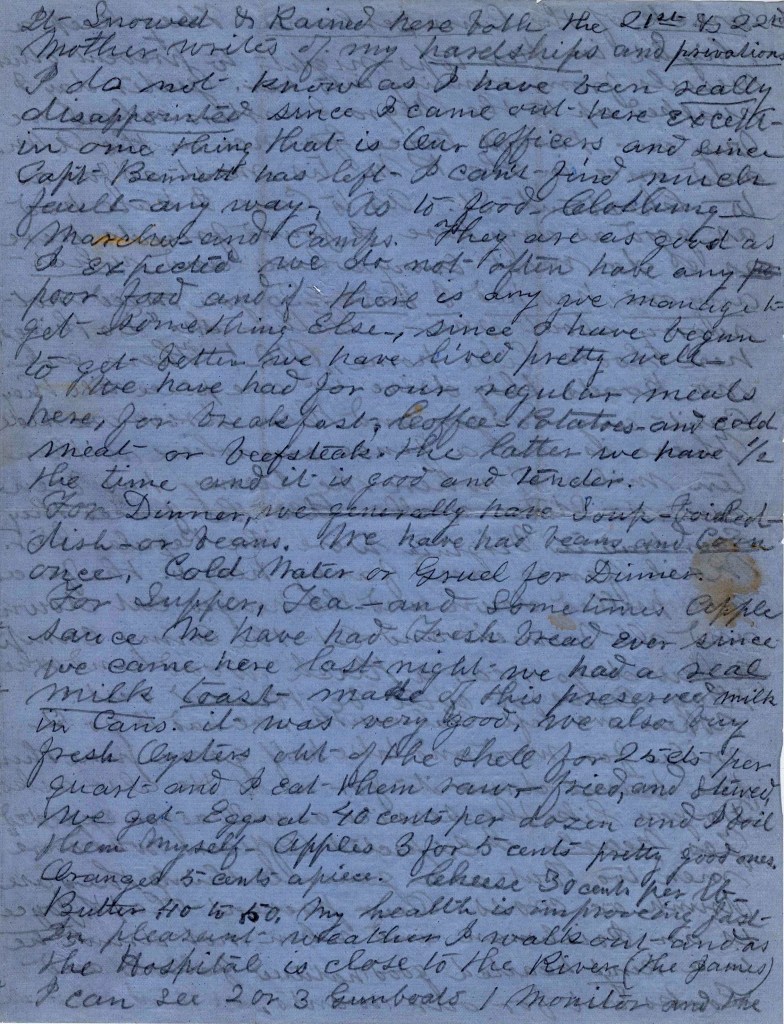
You write that you had a snow storm February 22nd. It snowed and rained here both the 21st and 22nd. Mother writes of my hardships and privations. I do not know as I have been really disappointed since I come out here except in one thing [and] that is our officers. And since Capt. Bennett has left, I can’t find much fault anyway.
As to food, clothing, marches and camps, they are as good as I expected. We do not often have any poor food and if there is any, we manage to get something else. Since I have begun to get better, we lave lived pretty well. We have had our regular meals here; for breakfast—coffee, potatoes and cold meat or beefstake. The latter we have half the time and it is good and enter. For dinner we generally have soup, boiled dish or beans. We have had beans and corn once, cold water or gruel for dinner. For supper, tea and sometimes apple sauce. We have had fresh bread ever since we came here. Last night we had a real milk toast made of this preserved milk in cans. It was very good. We also buy fresh oysters out of the shell for 25 cents per quart and I eat them raw, fried, and stewed. We get eggs at 40 cents per dozen and I boil them myself. Apples 3 for 5 cents—pretty good ones. Oranges 5 cents apiece. Cheese 30 cents per lb. Butter 40 to 50 cents.
My health is improving fast. In pleasant weather I walk out and as the hospital is close to the river (the James), I can see two or three gunboats, 1 monitor, and the wreck of the [USS]Cumberland. They keep a light on her tops nights to prevent other vessels from running into her. Yesterday I walked up to the Negro quarters where we buy our things twice—once in the a.m. and once in the p.m. Tis most as far as Chestnut Street [in Worcester, Mass.]
As to care, I have had as good as any here. I found friends here as I do most everywhere and what anyone has had, I have. So you need not worry about me.
Capt. William Howard Joyce, Co. F, 7th R. I.
Father asks, “Do things here look like home.” No! There are no roads. They drive in one place till they can’t any longer and then drive one side. There is not a fence anywhere within ten miles of where the Army has been and no slatted walls. All the fences they ever had in Virginia were the regular Virginia rail fence and fancy hedges cut down and all burned and let the Army camp a few days near a thick wood and when they leave it, will be thinned out. When we left Falmouth, we had to go two miles for wood and take half green pine then. The teams drew it for us.
He also asks, “Do you like the service as well as you expected?” Yes, nearly. I expected officers who were men too but as a general thing, they are drunk or cross. Our present Capt. [William Howard] Joyce is an Irishman and when not drunk, he is a kind-hearted, good-natured fellow and looks out for our wants. [end of letter is missing]
1 William H. Russell of Dartmouth. Massachusetts, was a private in Co. C. F, 7th Rhode Island Infantry. He was wounded in the Battle of Fredericksburg and transferred to the Veteran Reserve Corps on 12 September 1863. He mustered out of the service in June 1865.
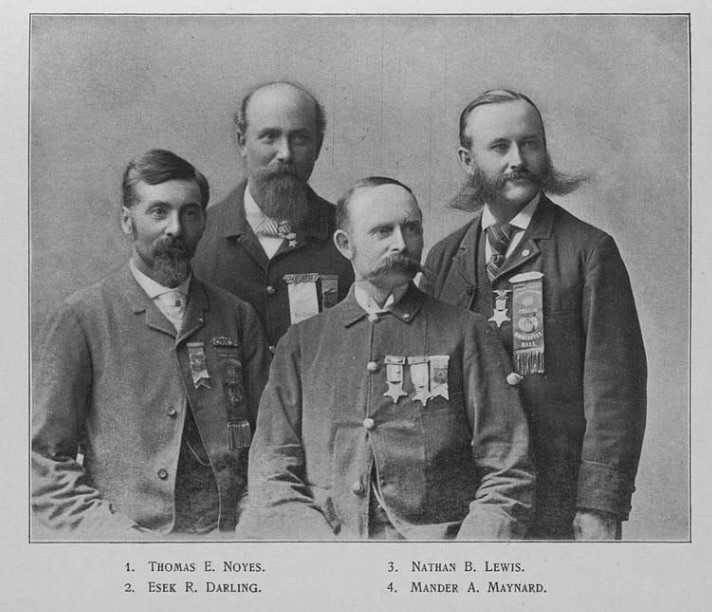
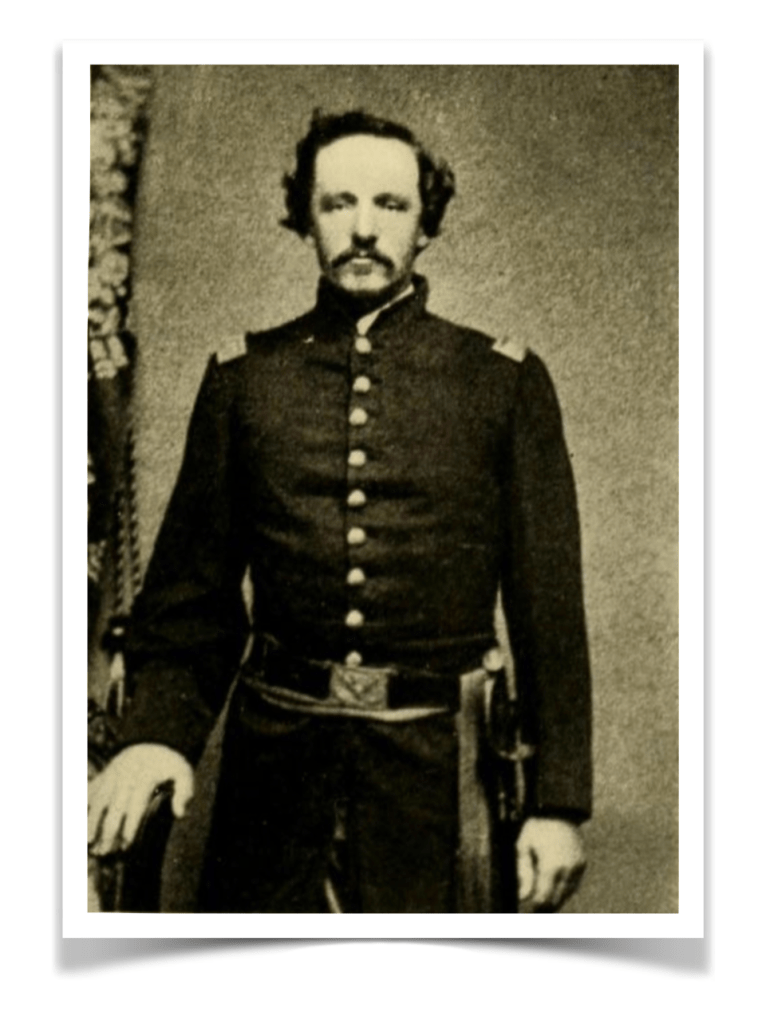
Mander A. Maynard stands at far right in this post war image of veterans.
This letter was written by Lemuel C. Sayles (1845-1898), the son of Stephen Sayles (1805-1867) and Susannah Douglass (1805-Aft1865) of Glocester, Providence county, Rhode Island. Lemuel enlisted in August 1862 in Co. C, 7th Rhode Island Infantry and then was transferred in September 1863 to the 19th Co., 2nd Battalion Veteran Reserve Corps. He mustered out of the VRC in September 1865. He was married in 1866 to Miss Mary J. Durfee but his life came to a tragic ending in 1898 when he was 54, a suicide death by hanging. [Source: Deaths Registered in the town of Burrillville, R. I. for the year ending 1898.]
Lemuel wrote this letter from the Lovell Hospital, a repurposed summer estate with 14 pavilions serving as temporary barracks. It was located in Portsmouth Grove, Rhode Island, and received its first patients in July 1862. In its years of operation, the hospital treated 10,593 patients with a mortality figure of 308. The dead were buried in a cemetery on the site. [Source: Rhode Island’s Civil War Hospitals, Frank Grzyb (2012)]
The hospital was disestablished on Aug. 28, 1865, according to the Rhode Island Historical Cemetery Commission website.
Portsmouth Grove Hospital (renamed Lovell) in Portmouth, Rhode Island. There were some small buildings part of the hospital behind the main building. See Lovell General Hospital.
Your kind letter was received today and I was very glad to hear from you and to learn you were well as this leaves me at present. It is now evening and it has been a very rainy day and is cloudy yet though it does not rain much just now. I thought as I have got through with me work for today, I would answer your letter tonight as I have to get letters from you so will try and be prompt in answering them. I got a letter from Emor Young today and he said that [Harlan] Alonzo Page & Col. Taft had got back with the regiment.
When I was up home, Gilbert Steer was enquiring of me about Henry [Steer]. I wrote to the regiment and found out by Mr. Lawton that he was in the 2nd Battalion Veteran Reserve Corps at Washington. I am sorry to hear that Grandmother has been sick but am glad she is better. Hope her health will continue to mend.
You need not worry about my reenlisting for I have only six months from tomorrow and then I mean to be a free man again. Emor wrote that they had just received news of the fall of Wilmington and they were firing a salute of one hundred shotted guns along our lines at the Johnnies to the pleasure of our men but not so delightful to the rebs, I guess. He says that the rebels were deserting very fast, average about 20, to our Brigade per day. Maybe Col. Taft will get his discharge the same way that Frank Potter did—with a bullet. 1
But I don’t think of much more to write so bidding you a kind good night & hoping to hear from you soon, I will sign my name as ever your affectionate brother. Accept much love, — L. C. Sayles
P. S. After you write to me, go to the post office every other night so as to get the letter I write.
1 Francis (“Frank”) W. Potter of Cranston served in Co. C, 7th Rhode Island Infantry until he was mortally wounded in action at Spottsylvania Court House on 13 May 1864. He died a week later.
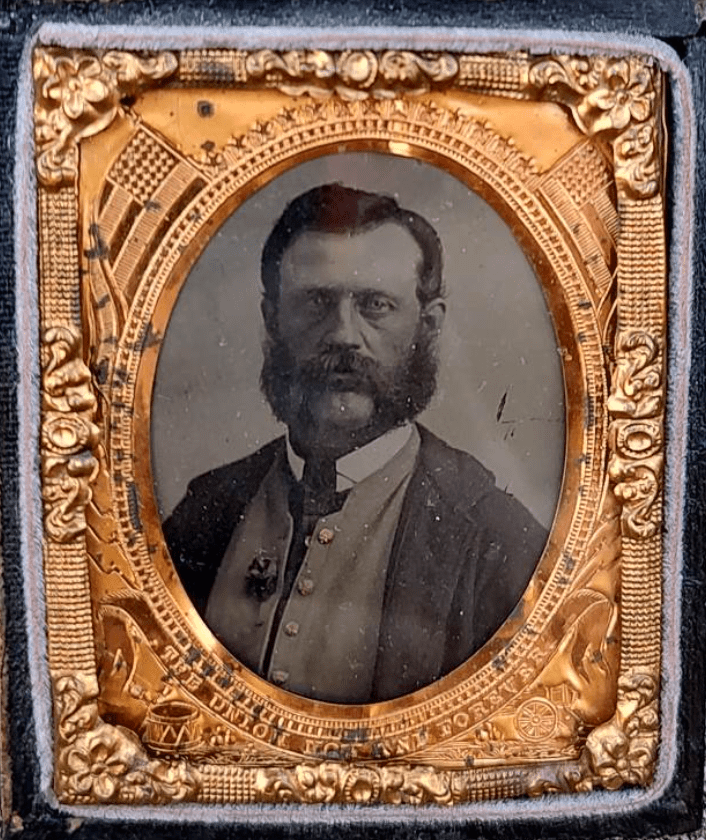
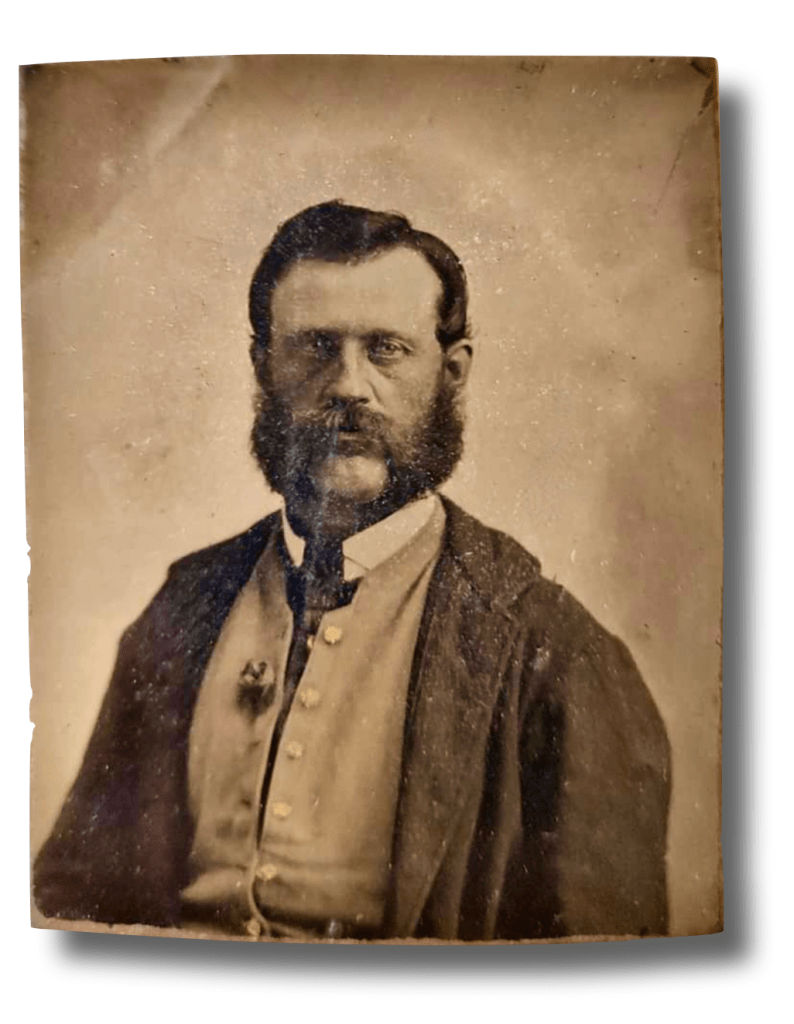
The following letters were written by Emor Young (1823-1869) of Glocester, Providence county, Rhode Island, to his wife, Martha P. (Gleason) Young (1826-1882). Emor served as a private in Co. C, 7th Rhode Island Infantry but spent much of his time detailed as a cook and baker for the regiment. During the Battle of Petersburg, Va. in July 1864, he served in a military hospital in City Point, Va., for several weeks.
In the 1860 US Census, Emor was enumerated in Glocester and employed as a “lumberman.” In the same household were his wife Martha and their two sons, Edgar M. (age 12) and Frederick (age 8).
Mortality records indicate that Emor died at the age of 45 while employed in a cotton mill. The cause of death was attributed to typhoid fever.
[Note: Many more (100+) of Emor Young’s letters are in the private collection of my friend Rob Grandchamp which were published in a limited number under the title, “Write Soon and Give me all the News.” Copies were distributed to libraries in Rhode Island. There are also a large number of Young’s letters (76 altogether) that are housed in the Filson Historical Society Archives in Louisville, Kentucky.]
Letter 1
Lexington, Kentucky November 7, 1863
Dear Wife,
I now take my pen in hand to let you know that I am well and hope this will find you all the same at home. I have received two letters from you—one October 28th, one November 1st, and two newspapers. One was the Pat and the other the Cincinnati Times. Where they come from, I cannot tell. There was no name on either of them.
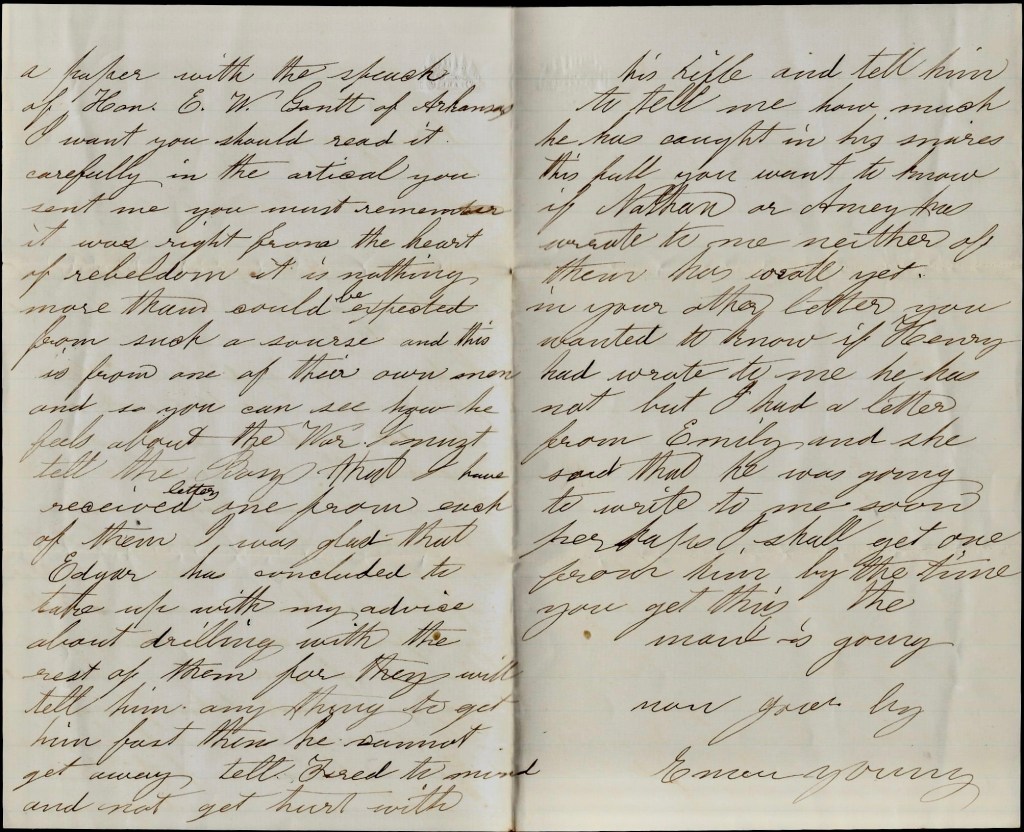
I have no news to tell you for you can see the papers. In one of your letters you sent me an extract taken from a Richmond paper to prove the continuance of this war. I shall now send you a paper with the speech of Hon. E. W. Gantt of Arkansas. I want you should read it carefully. In the article you sent me you must remember it was right from the heart of rebeldom. It is nothing more than could be expected from such a source and this is from one of their own men and so you see how he feels about the war.
I must tell the boys that I have received letters—one from each of them, I was glad that Edgar has concluded to take up with my advice about drilling with the rest of them for they will tel him anything to get him fast. Then he cannot get away. Tell Fred to mind and not get hurt with his rifle and tell him to tell me how much he has caught in his snares this fall.
You want to know if Nathan or Amy has wrote to me. Neither of them has wrote yet. In your letter you wanted to know if Henry had wrote to me. He has not but I had a letter from Emily and she said that he was going to write to me soon. Perhaps I shall get one from him by the time you get this. The mail is going now. Goodbye. — Emor Young
Letter 2
Point Isabel, Kentucky January 10, [1864]
Dear Wife,
I now take my pen in hand to let you know that I am well and hope this will find you all the same at home. You must excuse me for not writing sooner but the day after I wrote you before, we marched for this point. It has been a cold march but I cannot describe it to you. But it appears that our regiment has the times on the mountains this winter. We are upon the Cumberland. Last winter we was on the Blue Ridge. I must tell you where this place is. It is between the two branches, the North and South of the Cumberland [river]. It is now called Burnside Point. It is the route that he took for Knoxville. It is all mountains where we are now. This is the worst place we have ever been in. There is nothing for either man or beast to eat at present. The roads are so bad that they cannot get the teams over the road. The hills are almost straight up and down. It is so cold that I cannot write much this time—just enough to let you know that I am still in the land of the living.
I must tell you what I am up to at present. I am cooking for the teamsters. So you see that I get my knapsack carried instead of backing it. We are going to stay here for awhile. [Zenas] Bliss is in command of the Post here. This is all that I can write this time.
Direct your letter to Point Isabel, Kentucky Now goodbye. Yours truly, — Emor Young
Letter 3
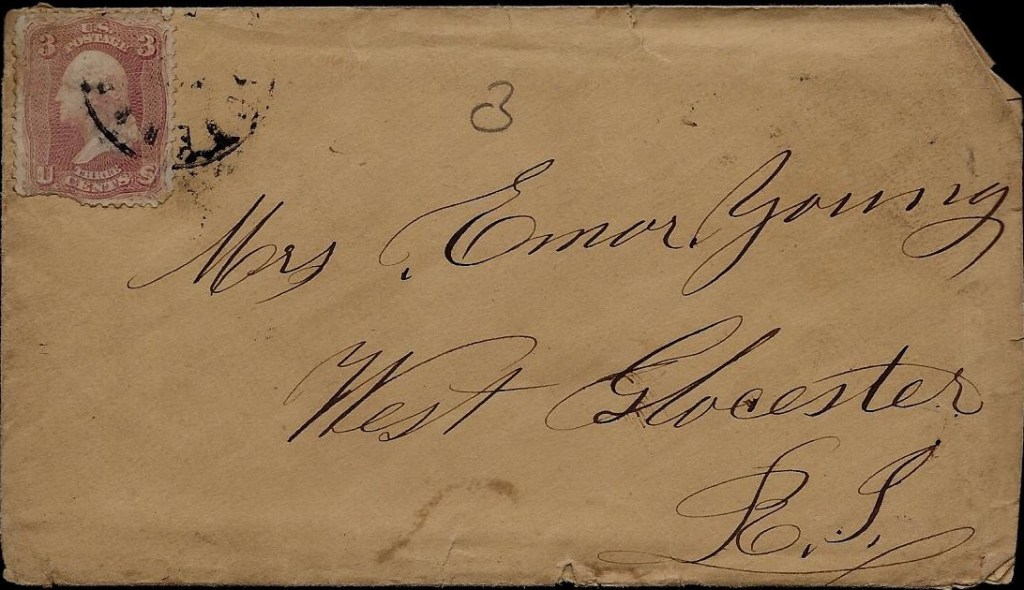
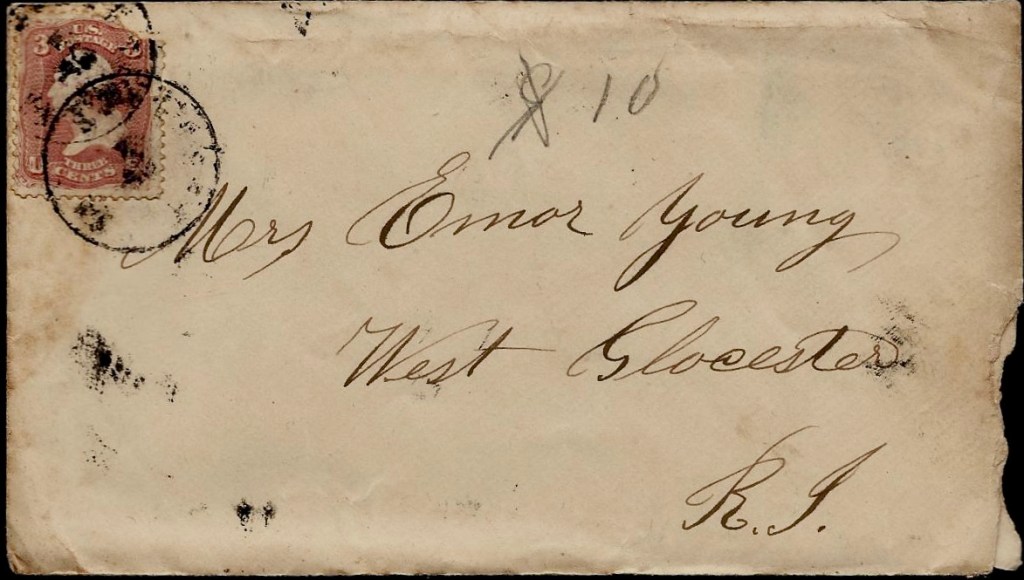
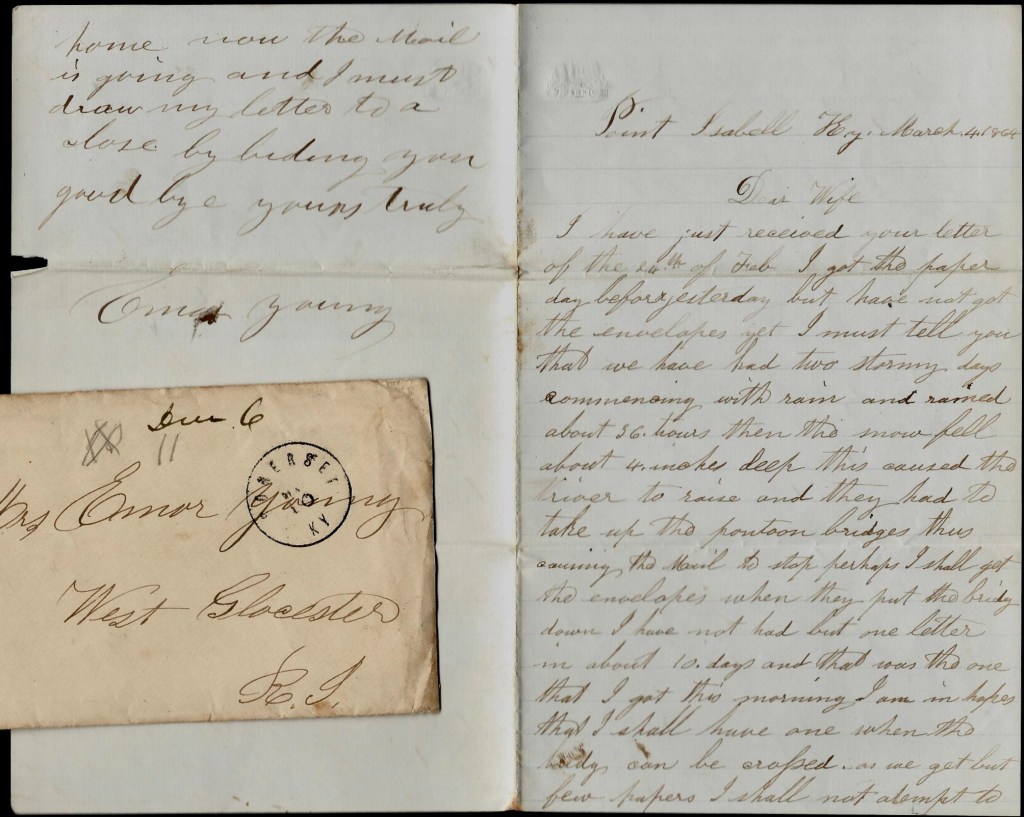
Addressed to Mrs. Emor Young, West Glocester, Rhode Island
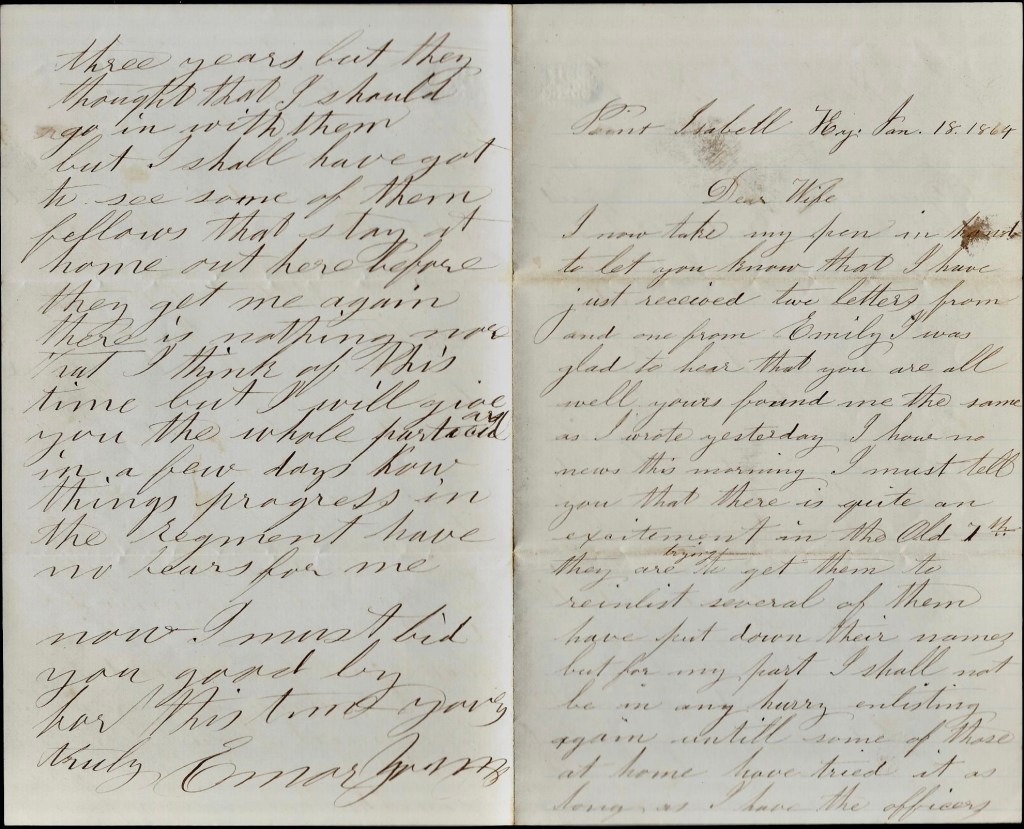
Point Isabel, Kentucky January 18, 1864
Dear Wife,
I now take my pen in hand to let you know that I have just received two letters from you and one from Emily. I was glad to hear that you are all well. Yours found me the same. As I wrote yesterday, I have no news this morning.
I must tell you that there is quite an excitement in the Old 7th. They are trying to get them to reenlist. Several of them have put down their names but for my part, I shall not be in any hurry enlisting again until some of those at home have tried it as long as I have. The officers tell the men funny stories to get them to reenlist but they cannot fool me so I know them too well.
I see by Edgar’s letter that he is afraid that I shall reenlist but he need not fear. He says that he has done the best that he could to help you and is willing to still do so if I will not reenlist but if I do, he can not help me any longer. Quite an encouragement for me. Does he think that I crave this suffering and privation? Is it for me alone or is it for my children that I have suffered and still you know nothing. I have never told you one tenth part of what I have undergone, but still I do not murmur. But Edgar has come to the conclusion not to help me any longer if I reenlist. But that would not make any difference. Has the forgotten the months and years that I and you have toiled for him and what I am still although hundreds of miles from home. Tell him that I shall not reenlist but if I thought it my duty, whether he refused to help me or not, it would make no difference. Now he can do as he pleases about helping you any longer.
Tell both of the boys that they must write as often as they can. You must do the same. The officers have just been round to see how many men are willing to reenlist. I must tell you that there is about three-fourths that will go for three years but they thought that I should go in with them. But I shall have got to see some of them fellows that stay at home out here before they get me again. There is nothing more that I think of this time but I will give you the whole particulars in a few days how things progress in the regiment. Have no fears for me.
Now I must bid you goodbye for this time. Yours truly, — Emor Young
Letter 4
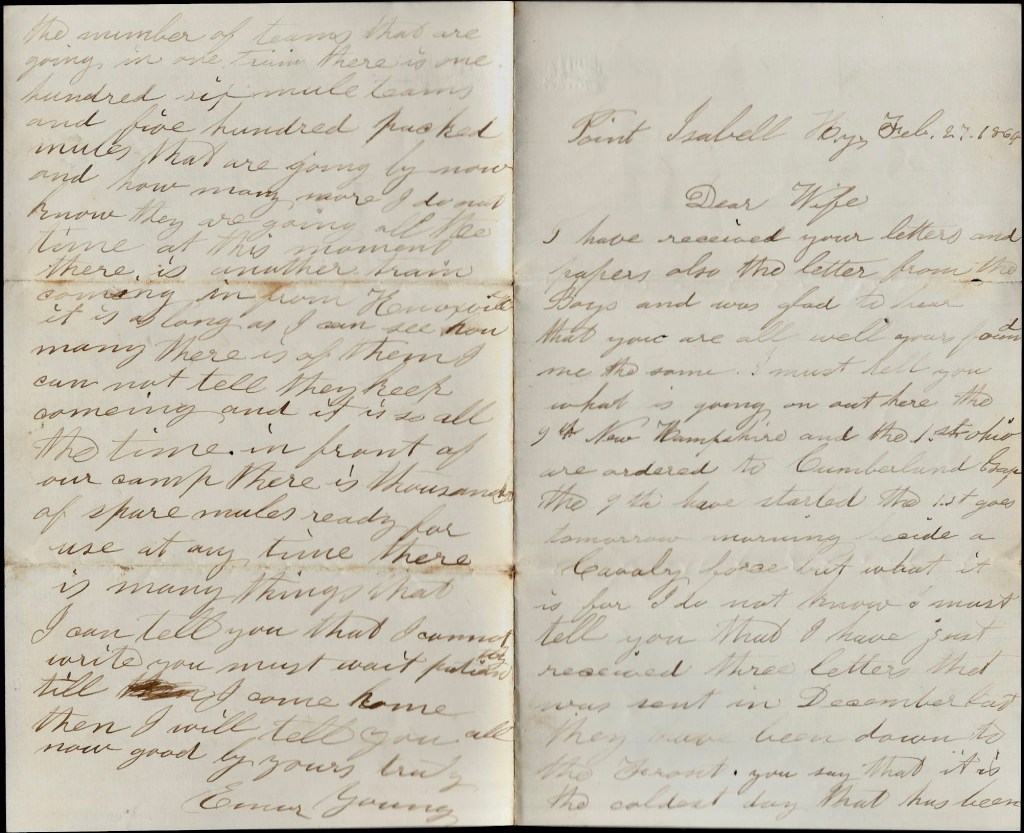
Point Isabel, Kentucky February 27, 1864
Dear Wife,
I have received your letters and papers. Also the letter from the boys and was glad to hear that you are all well. Yours found me the same.
I must tell you what is going on out here. The 9th New Hampshire and the 1st Ohio are ordered to Cumberland Gap. The 9th have started. The 1st goes tomorrow morning beside a cavalry force but what it is form I do not know. I must tell you that I have just received three letters that was sent in December last. They have been down to the front.
You say that it is the coldest day that has been this winter and want to know how it is out here. It is like May at home. I wish you could be here and enjoy the rambles with me. Every chance that I get, I stray off over the mountains. It is very beautiful. I begin to like this place very much now. We have enough supplies, the snow is all gone, and in some places the grass begins to start.
You speak about Mr. Hall. Hill. He come into our camp in Virginia when Nell was with us. I have never seen him since. Ask the boys how they would like to live out here. Tell Fred that some of the teamers are out after wild turkeys and coons and some of them have gone up the river after fish. They have Saturday to do their washing so they wash Friday night, then have all day Saturday. Now how should you like to live out here. There is mountains and plains that extend for miles in length and breadth. Then the broad rivers between making it one of the finest places you ever saw. There is a railroad run out near our camp.
I must tell you that we are making fortifications and it will soon be one of the most important forts between Knoxville and Lexington. It has the advantage of most all the rest. It has the river and it is filled with steamboats loaded with any amount of rations. I will tell you the number of teams that going in one train. There is one hundred six-mule teams and five hundred pack mules that are going by now and how many more I do not know. They are going all the time at this moment. There is another train coming in from Knoxville. It is as long as I can see. How many more of them I cannot tell. They keep coming and it is all the time. In frint of our camp there is thousands of spare mules ready for use at any time. There is many things that I can tell you that I cannot write. You must await the particulars till I come home. Then I will tell you all.
Now goodbye. Yours truly, — Emor Young
Letter 5
Point Isabel, Kentucky March 4, 1864
Dear Wife,
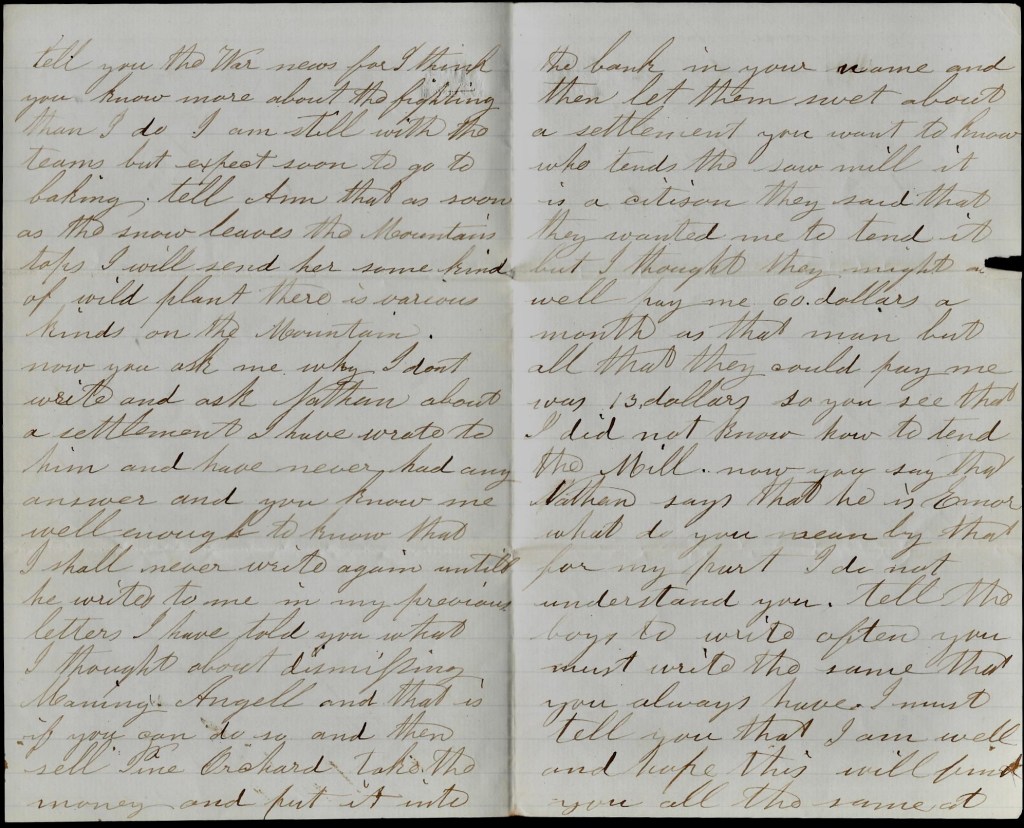
I have just received your letter of the 24th if February. I got the paper day before yesterday but have not got the envelopes yet. I must tell you that we have had two stormy days commencing with rain and rained about 36 hours. Then the snow fell about 4 inches deep. This caused the river to raise and they had to take up the pontoon bridges, thus causing the mail to stop. Perhaps I shall get the envelopes when they put the bridge down. I have not had but one letter in about ten days and that was the one that I got this morning. I am in hopes that I shall have one when the bridge can be crossed. As we get but few papers, I shall not attempt to tell you the war news for I think you know more about the fighting than I do.
I am still with the teams but expect soon to go to baking. Tell Ann that as soon as the snow leaves the mountain tops, I will send her some kind of wild plant. There is various kinds on the mountain.
Now you ask me why I don’t write and ask Nathan about a settlement. I have wrote to him and have never had any answer and you know me well enough to know that I shall never write again until he writes to me in my previous letters. I have told you what I thought about dismissing Manning Angell and that is if you can do so and then sell Pine Orchard, take the money and put it into the bank in your name and then let them sewat about a settlement.
You want to know who tends the saw mill. It is a citizen. They said that they wanted me to tend it but I thought they might as well pay me 60 dollars a month as that man but all that they could pay me was 13 dollars so you see that I did not know how to tend the mill. Now you say that Nathan says that he is Emor. What do you mean by that? For my part, I do not understand you. Tell the boys to write often. you must write the same that you always have. I must tell you that I am well and hope this will find you all the same at home. Now the mail going and I must draw my letter to a close by bidding you goodbye. Yours truly, — Emor Young
Letter 6
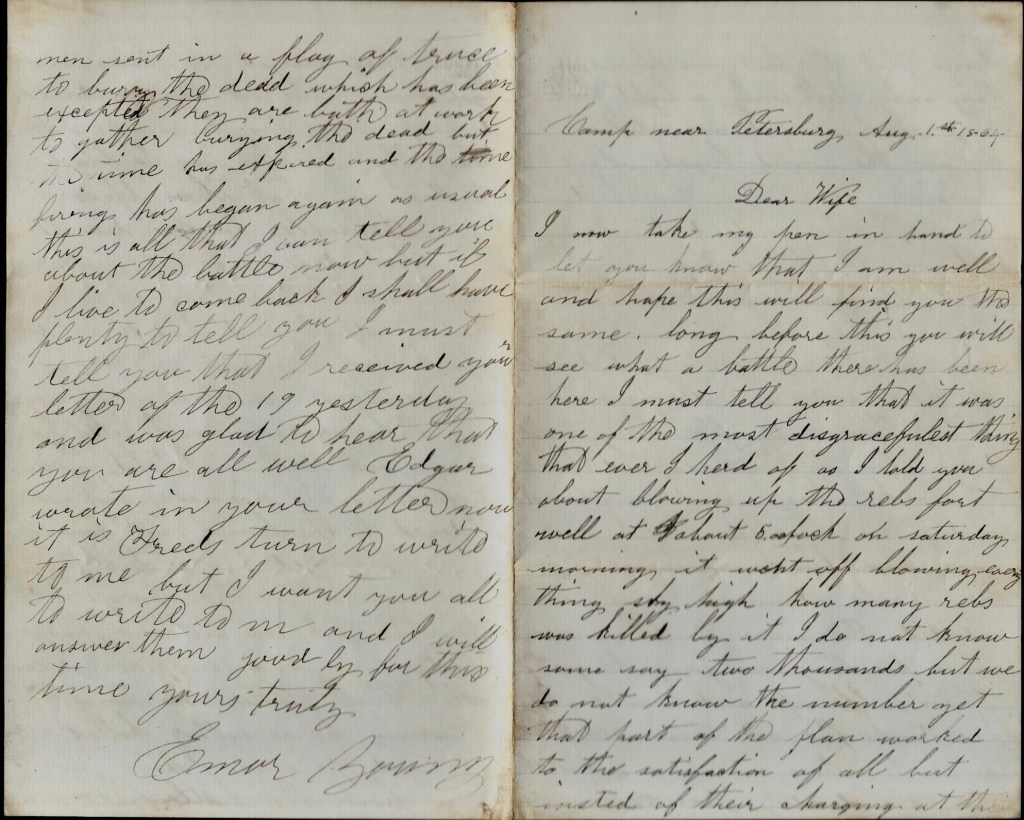
Emor’s letter describes the debacle of the “blowing up of the reb’s fort” on 30 July 1864 (Battle of the Crater)
Camp near Petersburg [Virginia] August 1, 1864
Dear Wife,
I now take my pen in hand to let you know that I am well and hope this will find you the same.
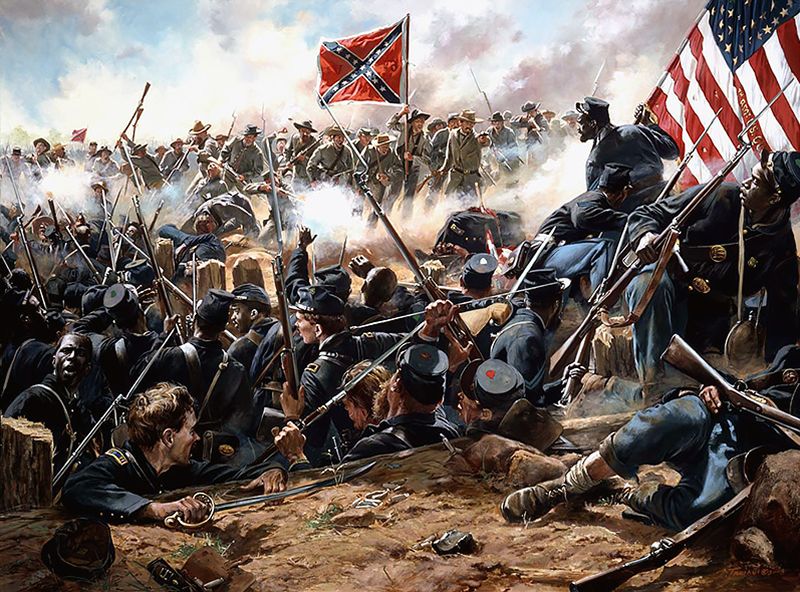
Long before this you will see what a battle there has been here. I must tell you that it was one of the most disgraceful things that ever I heard of as I told you about blowing up the reb’s fort. Well, at about 5 o’clock on Saturday morning, it went off, blowing everything sky high. How many rebs was killed by it, I do not know. Some say two thousands but we do not know the number yet. That part of the plan worked to the satisfaction of all but instead of charging at the time that the fort was blown up, they only left with a light force. They went in and was repulsed. Then this the 2nd Brigade of our Division, the the 4th Division which is the colored troops was ordered to charge. They went in and drove everything before them. They was supported by the rest of the 9th Corps and one division of the 10th Corps—in all, perhaps ten thousand.
After they had drove them to the second line of works, they made a stand and then started towards our men—the blacks still in front as the rebs advanced. The officers ordered the men to let them come for they [the Union officers] was going to give themselves up and would not let our troops fire on them and they came to where our men was, then poured a deadly fire into our men, then charged on them and got them started. They run like sheep. They tried to make out that the blacks was to blame but I say that the officers is responsible for the disaster. The blacks drove the rebs out of their works after the white troops had tried it and had been drawed back.
But I must stop on this subject and let you judge by the papers. I will tell you about our regiment. As I told you before, we are pioneers but was ordered to the front [and] had four or five wounded, none killed. We was not in the charge. The 4th Rhode Island was in the charge [and] lost 71 men and 12 officers, 83 in all. Phil Potter is among the missing, He is either killed or taken prisoner. I have just come from the battlefield. Our men sent in a flag of truce to bury the dead which has been accepted. They are both at work together burying the dead but the time has expired and the firing has begun again as usual
This is all that I can tell you about the battle now but if I live to come back, I shall have plenty to tell you. I must tell you that I received your letter of the 19th yesterday and was glad to hear that you are all well. Edgar wrote in your letter. Now it is Fred’s turn to write to me. But I want you all to write to me and I will answer them. Goodbye for this time. Yours truly, — Emor Young
Letter 7
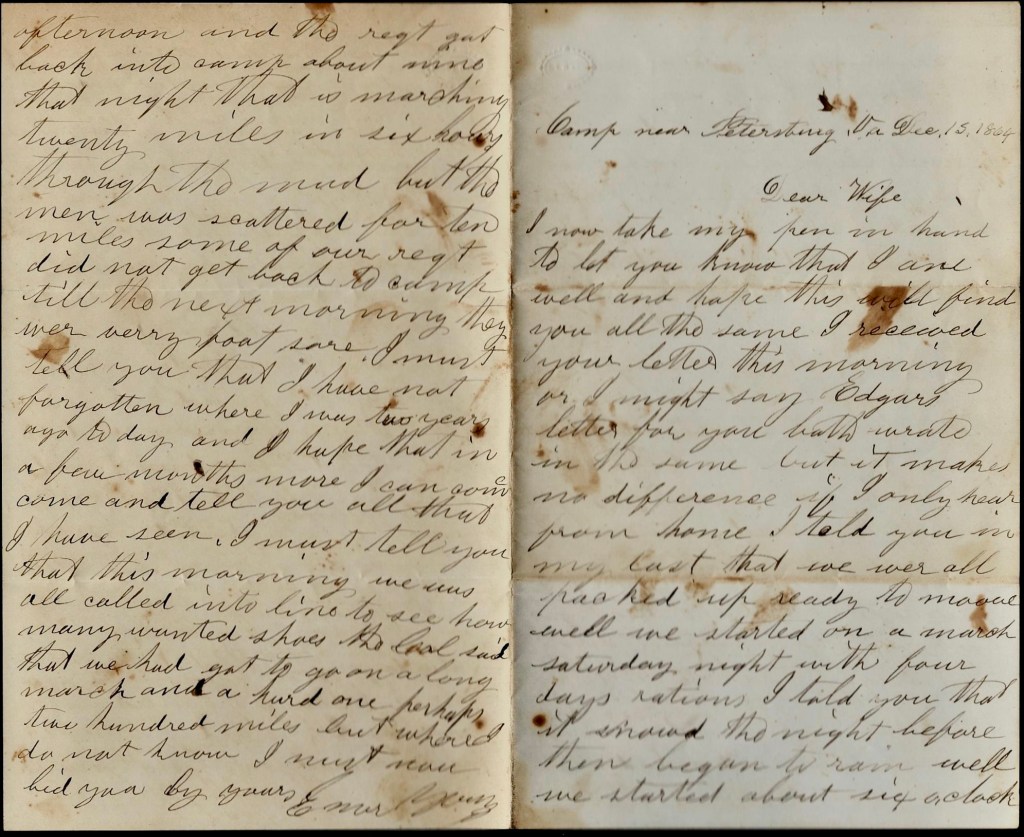
Camp near Petersburg, Va. December 15, 1864
Dear Wife,
I now take my pen in hand to let you know that I am well and hope this will find you all the same. I received your letter this morning—or I might say Edgar’s letter, for you both wrote in the same, but it makes no difference if I only hear from home.
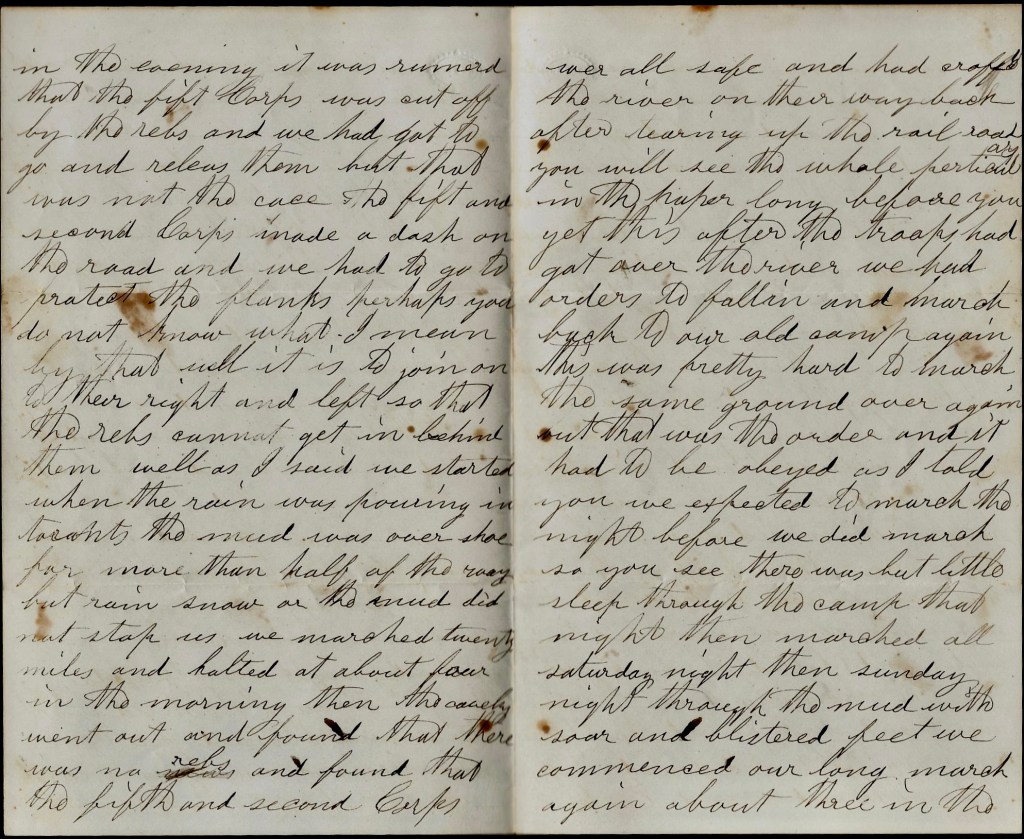
I told you in my last that we were all packed up ready to move. Well we started on a march Saturday night with four days rations. I told you that it snowed the night before, then began to rain. Well, we started about six o’clock in the evening. It was rumored that the 5th Corps was cut off by the rebs and we had got to go and release them but that was not the case. The 5th and 2nd Corps made a dash on the road and we had to go to protect the flanks. Perhaps you do not know what I mean by that. Well, it is to join on to their right and left so that the rebs cannot get in behind them.
Well, as I said, we started when the rain was pouring in torrents. The mud was over shoe for more than half of the way, but rain, snow, or the mud did not stop us. We marched twenty miles and halted at about four in the morning, Then the cavalry went out and found that there was no rebs and found that the 5th and 2nd Corps were all safe and had crossed the river on their way back after tearing up the [Weldon] railroad. You will see the whole particulars in the paper long before you get this. After the troops had got over the river, we had orders to fall in and march back to our old camp again. This was pretty hard to march the same ground over again but that was the order and it had to be obeyed. As I told you, we expected to march the night before we did march so you see there was but little sleep through the camp that night, then marched all Saturday night, then Sunday night through the mud with sore and blistered feet. We commenced our long march again about three in the afternoon and the regiment got back into camp about nine that night. That is marching twenty miles in six hours through the mud. But the men was scattered for ten miles. Some of our regiment did not get back to camp till the nrext morning. They were very foot sore.
I must tell you that I have not forgotten where I was two years ago today and I hope that in a few months more I can come and tell you all that I have seen. I must tell you that this morning we was all called into line to see how many wanted shoes. The Colonel said that we had got to go on a long march and a hard one—perhaps two hundred miles—but where I do not know. I must now bid you goodbye. Yours, — Emor Young
Letter 8
Near Petersburg, Va. December 23rd 1864
Dear Wife,
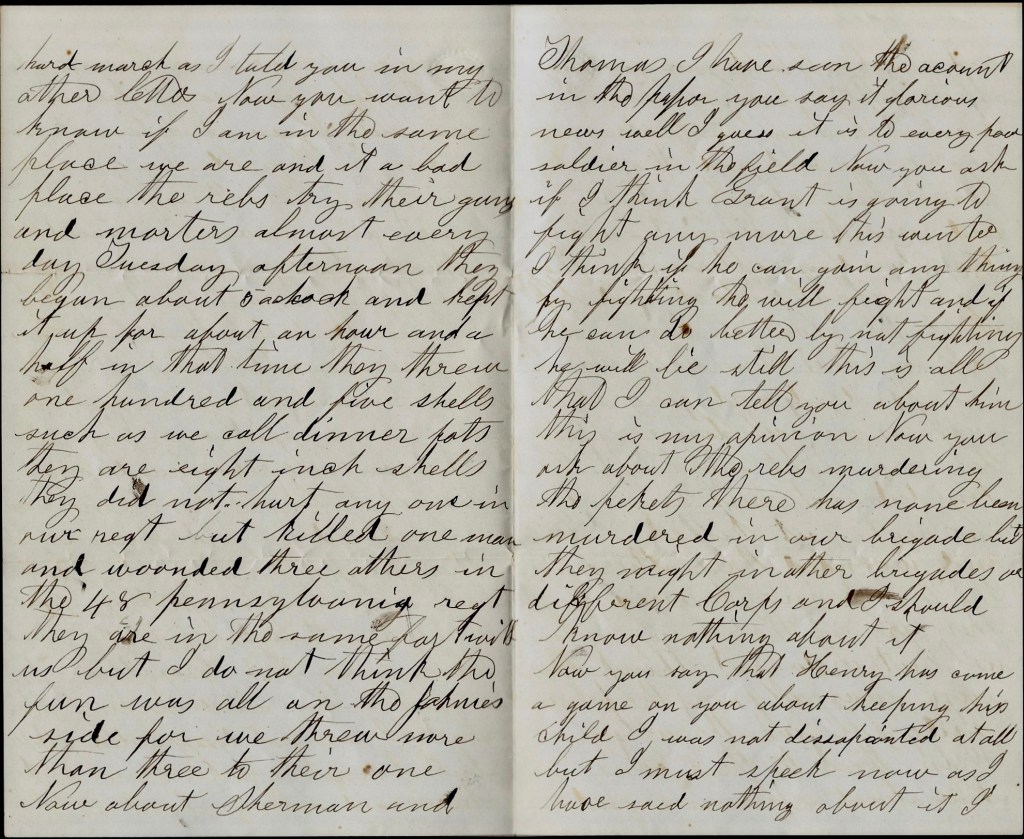
I now take my pen in hand to let you know that I am well and hope this will find you all the same at home. I have just received two letters from you—one dated the 16th and the other the 19th and a sheet from Edgar. You want to know f I was with Warren on his expedition. I told you in my last that our regiment was out with the 5th Corps. There was four regiments went and five stayed to guard the lines in our brigade and of course the 7th Regiment was one that had to go. But never mind that now. We have all lived through it but it was a pretty hard march as I told you in my other letter.
Now you want to know if I am in the same place. We are, and it is a bad place. The rebs try their guns and mortars almost every fay. Tuesday afternoon they began about 5 o’clock and kept it up for about an hour and a half. In that time they threw one hundred and five shells such as we call dinner pots. They are eight-inch shells. They did not hurt anyone in our regiment but killed one man in the 48th Pennsylvania Regt. They are in the same fort with us. But I do not think the fun was all on the Johnnies’ side for we threw more than three to their one.
Now about Sherman and Thomas. I have seen the account in the paper [that] you say is glorious news. Well, I guess it is to every poor soldier in the field. Now you ask if I think Grant is going to fight anymore this winter. I think if he can gain anything by fighting, he will fight. And if he can do better by not fighting, he will lie still. This is all that I can tell you about him. This is my opinion.
Now you ask about the rebs murdering the pickets. There has none been murdered in our brigade but they might in another brigade or different corps and I should know nothing about it.
Now you say that Henry has come again on you about keeping his child. I was not disappointed at all but I must speak now as I have said nothing about it. I must advise you not to do anything rash that will make the child suffer for what the parents have been guilty of consider well. Suppose it was your own child. But do as you think best. Tell Edgar that I am glad that he likes his school. Tell him to try and learn all he can and when I come home, I shall want he and Fred ready to go with me out West where we can live easy. I suppose you will want to go and live with us. We can take comfort but I must not think of that for it is a long time yet. There is nothing more that I think of so I will bid you goodbye.
These letters were written by Ethan Amos Jenks (1827-1901) of Foster, Rhode Island. Ethan was the son of William A. Jenks (1805-1859) and Hannah Phillips (1805-1888) of Plainfield, Connecticut. He wrote both letters to his wife, Sanondess (Tourtellott) Jenks while serving in the 7th Rhode Island Infantry. A biographical sketch from Find-A-Grave follows:
Capt.Ethan Amos Jenks, 7th Rhode Island
Both his grandfathers Amos Jenks and Col. Israel Phillips, of Foster, R.I., were natives of Rhode Island. When but a year old his parents recrossed the border, and, as soon as he was was of sufficient age, he attended the district school three or four months in each year, until nearly seventeen. He was employed almost wholly upon his father’s farm until that father’s death in 1859, when he assumed its care and continued it until the opening of the war. He at once volunteered in Company K, First Regiment Rhode Island Detached Militia, and was mustered out at the expiration of its term of service in 1862. It was his intention to re-enlist in the Fourth Regiment Rhode Island Volunteers, but he was suffering from a lingering disease that continued until the spring of 1862. His next opportunity was with the Seventh. As second lieutenant of Company H he was less noticeable than some of the other officers, but he was anxious to learn all the practical warfare essential to the proper discharge of duties pertaining to his branch of service. It soon became evident to many that sterling patriotism was the controlling motive of his life. He was quiet, pure, and simple. Little did the men think that the comparatively old and somewhat uncouth subaltern, who had spent almost his entire life upon a farm, would become one of the best, bravest, and most conspicuous of their officers, a firm friend to each man; that his integrity and his keen sense of honor would be so often tested and always unfailingly, even at critical junctures, that he could ever be relied upon under all circumstances, and that his reputation to the close of life would remain in every particular, absolutely untarnished. And yet, such today is the glad testimony of those who had ample opportunity to observe him and to weigh him. In January, 1863, we find him in command of a company, but it was not until March 3d that he received his commission and was mustered as captain of Company I. June 29, 1864, he received a major’s commission and was borne on the rolls as awaiting muster thereon until he was mustered out. Ten days prior to its date he was slightly wounded in the shoulder blade while superintending the digging of rifle pits in a ravine across (west of) the Norfolk and Petersburg Railroad, a little to the left of the place where the regiment was accustomed to cross when it passed to and from the main front line, held near the subsequent mine. The night was very dark, the rebel firing was desultory, the blow was sidewise and very light. He was conversing with Sergt. William H. Johnson at the time; the hour was between ten p.m. and one a.m., on the 20th. He was absent fifteen days with leave from Jan. 27, 1865, and again in March as a member of a general court-martial. He was made brevet major of volunteers to date from April 2, 1865, for gallant and meritorious conduct before Petersburg, Va. June 9th he was mustered out.
At various times Major Jenks was in command of the regiment, and at important and critical periods, but he always enjoyed the full confidence of all. They recognized the fact that unflinching devotion to duty was his prominent characteristic, and yet he was careful and considerate of the interests of others and of the sensibilities of those placed under his command. He was always foremost in the hour of danger and conflict. Indeed, he once remarked to Colonel Bliss that he did not like the dress parade business, but he was just the man for a fight. The survivors have testified to their appreciation of his worth by annually re-electing him president of their veteran association from the death of Major Joyce until Aug. 22, 1893, when he positively refused to served longer. After the war Major Jenks completed a course in law and was admitted to the Rhode Island bar. Later he was made a deputy collector in internal revenue in the Providence office, but the position was discontinued Jan. 1, 1894.
In January, 1901, Major Jenks and William P. Hopkins were appointed by Governor Gregory, pursuant to a resolution of the General Assembly passed in May, 1900, commissioners to fix the position occupied by the Rhode Island troops at the siege of Vicksburg. That very month they visited the scene of their former hardships, only to be royally served, and there promptly discharged the duties assigned them. On the ensuing thirteenth of May Major Jenks passed from earth in a sudden attack of angina pectoris, lacking but seventeen days of completing his seventy-fourth year. His funeral was solemnized at his late home on Central Pike, Johnston, Thursday, May 17th. The bearers were Hon. Henry J. Spooner, Hon. Daniel R. Ballou, Maj. James T. P. Bucklin, and Charles W. Hopkins, all of Rodman Post, No. 12, Grand Army of the Republic, of which he was a member at the time of his decease. Among those in attendance were Post Department Commanders Brevet Brig.-Gen. Charles R. Brayton, Capt. Walter A. Read, Lieut. Charles C. Gray, and Lieut. Charles H. Williams. Floral pieces were sent by Rodman Post, General Brayton, and others. The regimental veteran association acted as guard of honor at the house and at Pocasset Cemetery, where his remains were entombed.
[Note: These letters are from the personal collection of Rob Grandchamp and are transcribed & published on Spared & Shared by express consent.]
Letter 1
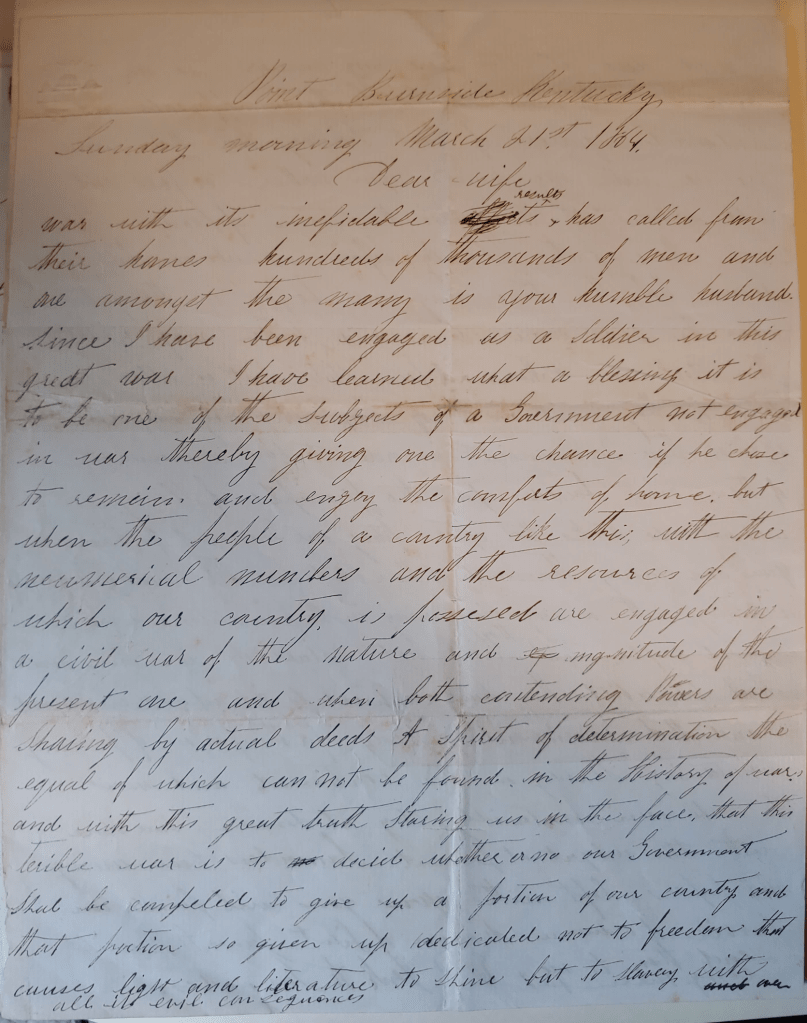
Point Burnside, Kentucky Sunday Morning, March 21st 1864
Dear wife,
War with its inevitable results has called from their homes hundreds of thousands of men and are amongst the many is your humble husband. Since I have been engaged as a soldier in this great war, I have learned what a blessing it is to be one of the subjects of a government not engaged in war, thereby giving one the chance if he chose to remain and enjoy the comforts of home. But when the people of a country like this—with the numerical numbers and the resources of which our country is possessed—are engaged in a civil war of the nature and magnitude of the present one, and when both contending powers are sharing by actual deeds a spirit of determination the equal of which cannot be found in the history of war, and with this great truth staring us in the face that the terrible war is to decide whether or no our government shall be compelled to give up a portion of our country and that portion so given up dedicated not to [a] freedom that causes light and literature to shine, but to slavery with all its evil consequences, [I ask you,] does it stop here? My answer is no.
Read the statement of the southern officials in the Richmond Enquirer of last February. Their words are, “We with our armies upon northern or free soil will dictate to the Yankees the terms of peace.” With these facts plainly before us, who can help but discern that the time may not be far in the future when the slave owner driver and trader may exhibit their stock in northern and free states. It is idle to think they won’t do it if they can. They have retaliated against their government in order to have a government of their own based upon the principle of slavery and now who thinks after fighting our government for three years and losing thousands of their best men, their country laid waste, and they with a conquering army in the free states and we a conquered people, that they will not establish in our midst that for which they have ventured to set up a government and that government expressly for the purpose of permanently maintaining slavery on this continent. And now too, who can contentedly stay at home? I have done with the subject at present.
Sanondess, dear, among my papers left with you, you will find and invoice of ordnance drawn of Lieut. James F. Marit. Then them to me [but] copy them first.
— E. A. Jenks to Sanondess
Letter 2
In the field near Petersburg, Va. June 27th, 1864
Dear Wife,
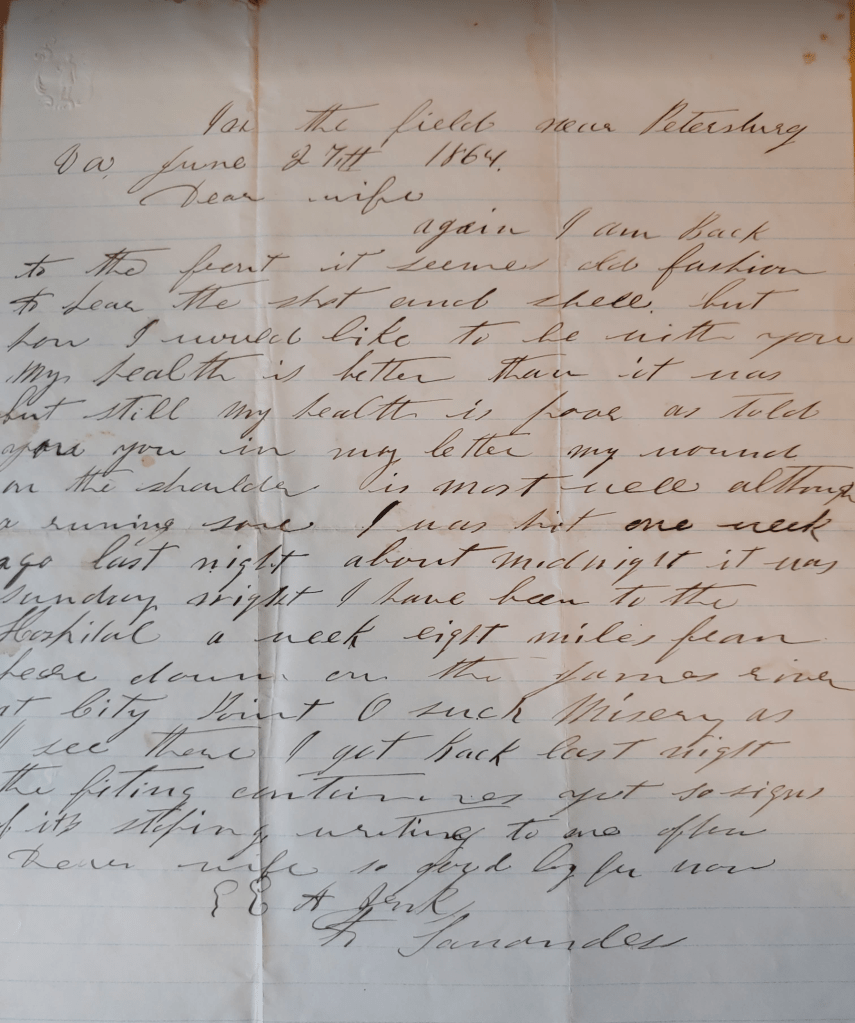
Again I am back to the front. It seems old fashion to hear the shot and shell but how I would like to be with you. My health is better than it was but still my health is poor. As told you in my letter, my wound on the shoulder is most well although a running sore. I was hit one week ago last night about midnight. It was Sunday night. I have been to the hospital a week eight miles from here down on the James river at City Point. Oh! such misery as I see there. I got back last night. The fighting continues yet. No signs of it stopping. Write to me often, dear wife.
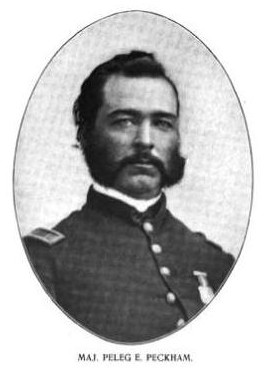
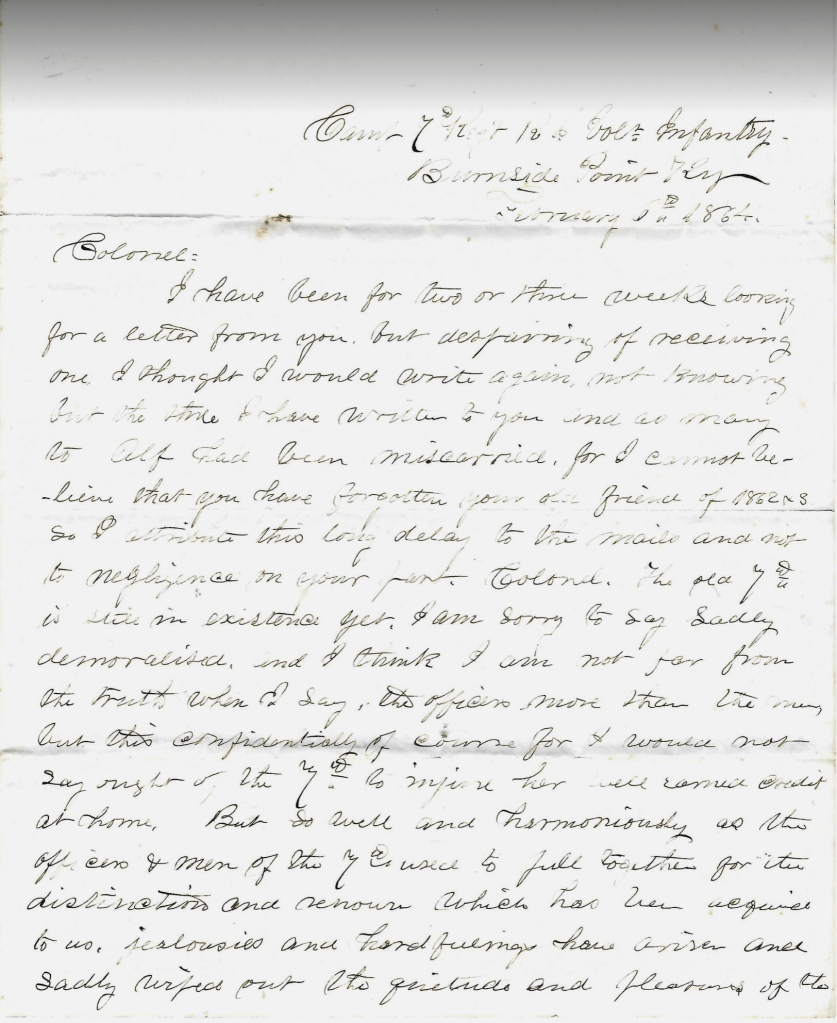
This letter was written by Peleg Edwin Peckham (1835-1865), the son of Rowland and Mary Johnson Peckham of Charlestown, Rhode Island. He married at New York City, Martha Emily Ennis (1834-1892) in May 1860. Aug. 1, 1862, Mr. Peckham enlisted as a private in Company A, but was mustered as fourth sergeant September 4th, commissioned second lieutenant Company E, Jan. 7, 1863; first lieutenant of same March 1st; captain Company B, July 25, 1864, and brevet major of volunteers July 30th. From January, 1865, he served as acting assistant adjutant-general on the staff of his brigade commander, Gen. John I. Curtin, until he was mortally wounded early in the day, April 2d. The brigade staff were lying in the rebel trench in front of Fort Hell waiting for something to eat. There was continuous firing, but a somewhat heavier momentary fusillade caused them to rise, when a bullet struck him over the right ear coming out at the eye. He was taken to the Cheever house which General Curtin had occupied as headquarters, though most of the staff, including Major Peckham, had tented in the yard. He received the unremitting attention of Dr. W. R. D. Blackwood, of the Forty-eighth Pennsylvania, the brigade surgeon, but with little avail. He did recover sufficiently to say to the doctor, ‘Write to my wife and tell her.’ Later he was sent in an ambulance to the City Point Hospital, where he died next day, April 3d.
Peckham wrote the letter to David R. Kenyon (1833-1897) who formerly served as captain of Co. A, 7th Rhode Island Infantry. Kenyon was wounded in the leg at Fredericksburg and resigned in March 1863. Shortly after this, he was commissioned a colonel in the 8th Rhode Island Militia. Peckham also mentions having written to “Alf.” This may have been Alfred Matthews Channell (1829-1884) who served as Captain of Co. D, 7th Rhode Island Infantry.
Peckham’s letter speaks to the malcontent of the officers remaining in the regiment as petty jealousies ripped asunder the esprit de corps of the once proud fighting unit. In this respect, the regiment was hardly alone. By this stage of the war, most foot soldiers shared the following general sentiment (paraphrased), “We volunteered to fight for the Stars & Stripes, the officers for the Stars & Eagles.”
[Note: This letter is from the private collection of Rob Grandchamp and was transcribed and published by express consent on Spared & Shared.]
Transcription
Camp 7th Regiment Rhode Island Volunteer Infantry Burnside Point, Kentucky February 6th 1864
Colonel,
I have been for two or three weeks looking for a letter from you, but despairing of receiving one, I thought I would write again not knowing but the three I have written to you and as many to Alf had been miscarried, for I cannot believe that you have forgotten your old friend of 1862 & 3 so I attribute this long delay to the mails and not to negligence on your part.
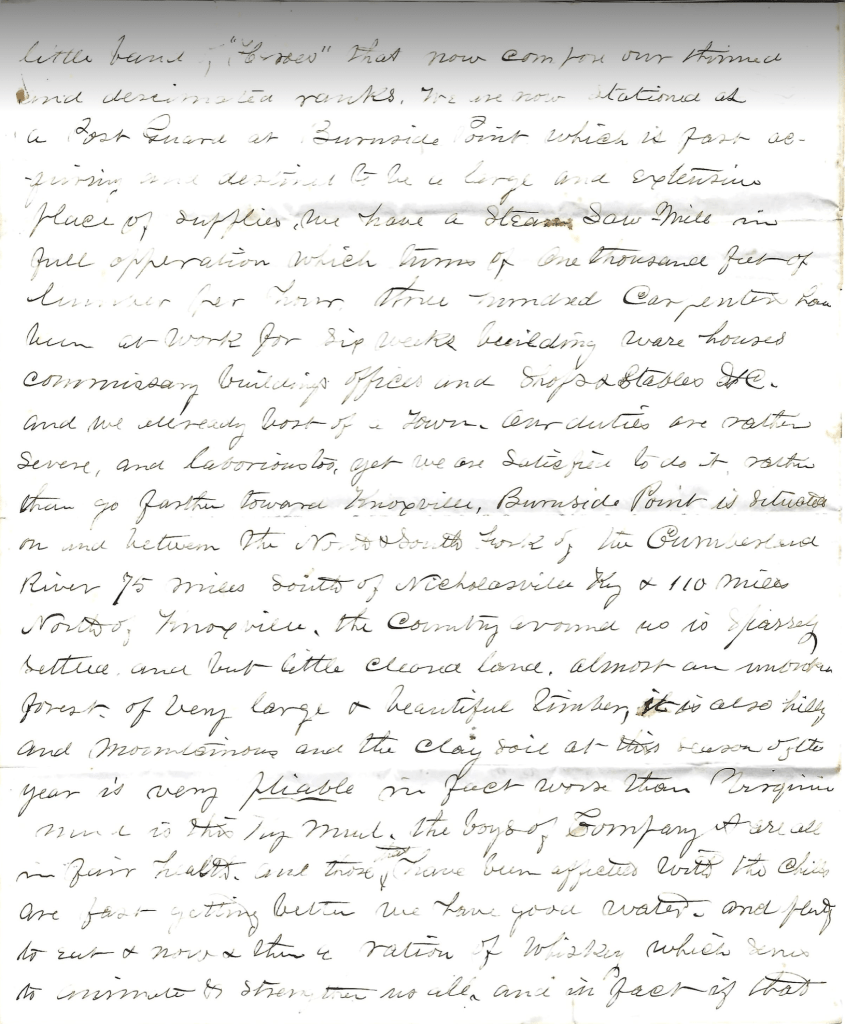
Colonel, the Old 7th is still in existence yet—I am sorry to say sadly demoralized—and I think I am not far from the truth when I say the officers more than the men. But this confidentially of course for I would not say ought of the 7th to injure her well earned credit at home. But so well and harmoniously as the officers and men of the 7th used to pull together for the distinction and renown which has been acquired to us, jealousies and hard feelings now arise and sadly wiped out the quietude and pleasures of the little band. “H_____” that now compose our thinned and decimated ranks ranks.
We are now stationed as a Post Guard at Burnside Point 1 which is fast acquiring and destined to be a large and extensive place of supplies. We have a steam sawmill in full operation which turns off one thousand feet of lumber per our. Three hundred carpenters have been at work for six weeks building warehouses, commissary buildings, offices, and shops & stables, &c., and we already boast of a town. Our duties are rather severe and laborious too, yet we are satisfied to do it rather than go farther toward Knoxville. Burnside Point is situated on and between the North & South Fork of the Cumberland River 75 miles south of Nicholasville, Kentucky, and 110 miles north of Knoxville. The country around us is sparsely settled and but little cleared land—almost an unbroken forest of very large and beautiful timber. It is also hilly and mountainous and the clay soil at this season of the year is very pliable. In fact, worse than Virginia.
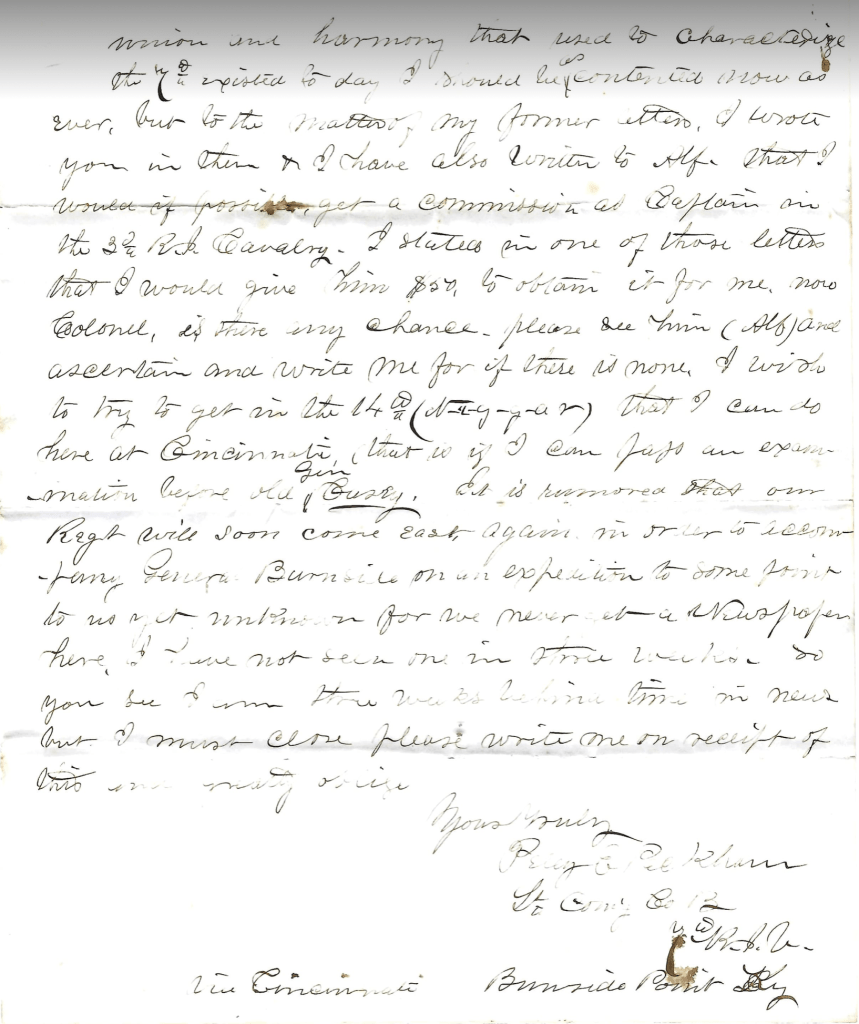
The boys of Co. A are all in fair health and those that have been affected with the chills are fast getting better. We have good water and plenty to eat and now & then a ration of whiskey which seems to animate and strengthen us all. And in fact, if that union and harmony that used to characterize the 7th existed today, I would be as contented now as ever.
But to the matter of my former letters, I wrote you in them & I have also written to Alf that I would, if possible, get a commission as captain in the 3rd Rhode Island Cavalry. I stated in one of those letters that I would give him $50 to obtain it for me. Now Colonel, is there any chance? Please see him (Alf) and ascertain and write me for if there is none, I wish to try to get in the 14th (N-i-g-g-e-r). That I can do here at Cincinnati—that is, if I can pass an examination before Old Gen. [Silas] Casey. It is rumored that our regiment will soon come East again in order to accompany General Burnside on an expedition to some point to us yet unknown for we never get a newspaper here. I have not seen one in three weeks so you see I am three weeks behind time in new.
But I must close. Please write me on receipt of this and oblige.
Yours truly, — Peleg E. Parkham, Lt. commanding Co. B, 7th R. I. V.
Via Cincinnati. Burnside’s Point
1 First named Point Isabel, Burnside was settled in around 1800 by pioneers from the Carolinas and Virginia. During the Civil War in 1863, the Union Army set up a troop rendezvous and supply base here as a prelude to the East Tennessee campaign of General Ambrose E. Burnside. The area then became known as Camp Burnside. Years later, that land is now under water.
















 Spared & Shared 23