Category Archives: Antebellum Mississippi

1852: Rebecca Ann (Gustine) Minor to James Gustine Minor

The following letter was written by 39 year-old Rebecca Ann (Gustine) Minor (1813-1887), the daughter of James Parker Gustine (1781-1818) and Mary Ann Duncan (1790-1863). Rebecca was born in Carlisle, Pennsylvania, but raised in Philadelphia. She married in 1829 Capt. William John Minor (1808-1869) and lived most of the time in Natchez at the family residence they called Concord.

Minor owned three sugar cane plantations: the 1,900-acre Waterloo Plantation in Ascension Parish, Louisiana, as well as the 6,000-acre Southdown Plantation and the 1,400-acre Hollywood Plantation in Terrebonne Parish, Louisiana. However, as an absentee plantation owner, he did not live on those plantations. He hired overseers to make sure the slaves were working on the land. He corresponded via mail with his overseers regularly, sending them precise instructions while living in Natchez himself. Moreover, his sons lived on the plantations part of the time. From 1855 to 1861, his son Stephen lived on the Waterloo Plantation until he joined the Confederate States Army; in 1862, his other son Henry took over.Another son, William, lived at the Southdown Plantation and also managed the Hollywood Plantation.

He served as the second President of the Agricultural Bank in Natchez, Mississippi. He was well connected among the planter elite, and visited planters Duncan F. Kenner (1813–1887) and Henry Doyal as well as the McCollums, the Cages, and the Gibsons. He read De Bow’s Review and kept a diary. Politically, he was a supporter of the Whig Party. He was in favor of tariffs on sugar, which meant more profit for domestic sugar producers like himself.

During the Civil War of 1861–1865, he supported the Union and opposed secession, as he believed that would be bad for the sugar industry. However, he was arrested by Union forces with his son Henry in Houma in 1862; they were released a week later in New Orleans. Meanwhile, Unionists stole sugar and molasses from his Hollywood and Southdown plantations, under the false pretext that it had been deserted, even though overseers and servants were there. Minor was on friendly terms with Union Generals Benjamin Butler (1818-1893) and Lorenzo Thomas (1804-1875), whose forces protected Concord (his Adams County, Mississippi, plantation) on September 29, 1863, and on March 10, 1864. Both during and after the war, Minor asked for reparations for the financial losses he had endured due to the theft of commodities by Unionist forces, to no avail. By 1863, he had realized his slaves had become unwilling to work; they also killed hogs and sheep.

Because of General Order No. 12 imposed by Union General Nathaniel P. Banks, he was forced to pay them wages. Slaves, who had gotten used to working “under the threat of punishment,” were not motivated by their salaries; as a result, Minor tried to reduce their wages if they failed to work. By 1865, Minor paid one third of the crop profit at the Waterloo Plantation to his slaves. He signed a work contract with his slaves at the Southdown and Hollywood plantations whereby they agreed to work ten hours every day except for Sundays and received specific hourly wages as a result. Moreover, Minor agreed to clothe, feed and house them all. Minor was a supporter of Abraham Lincoln, whom he called “the most conservative & ablest man in the Washington Government.” He deplored his assassination, as he believed Lincoln would have been fair to Southern agriculturalists. [Wikipedia]

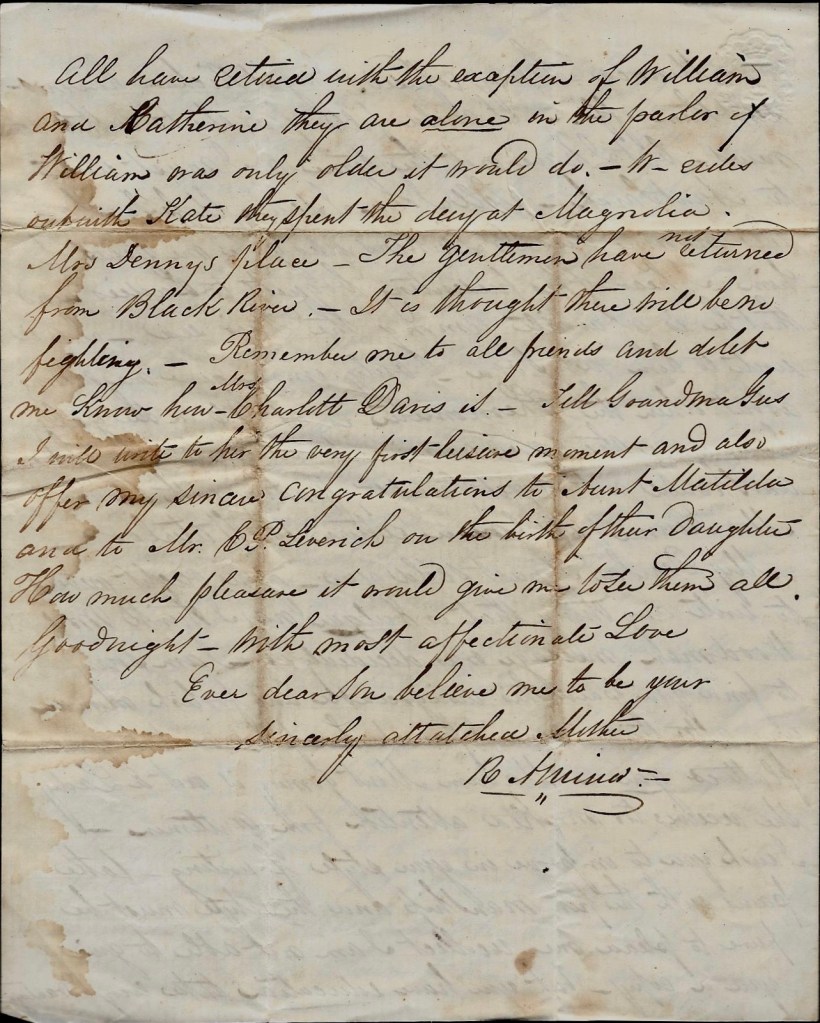
Transcription

Cherry Grove [Plantation] 1
July 13th, 1852

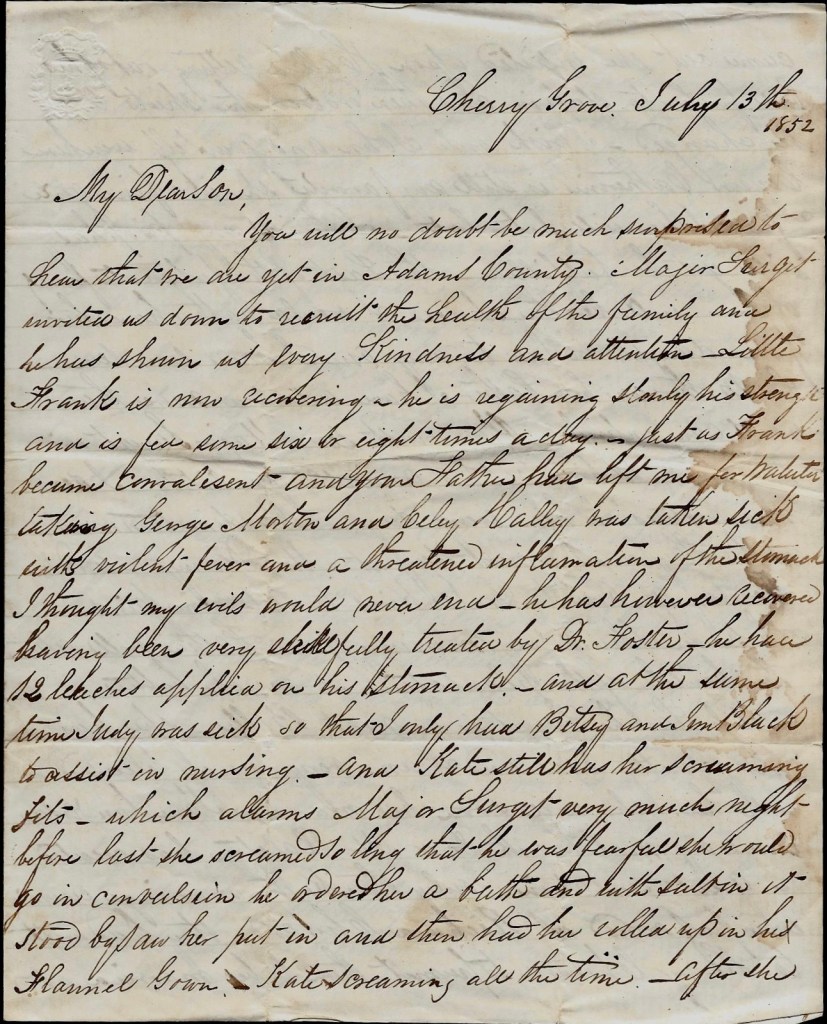
My Dear Son,

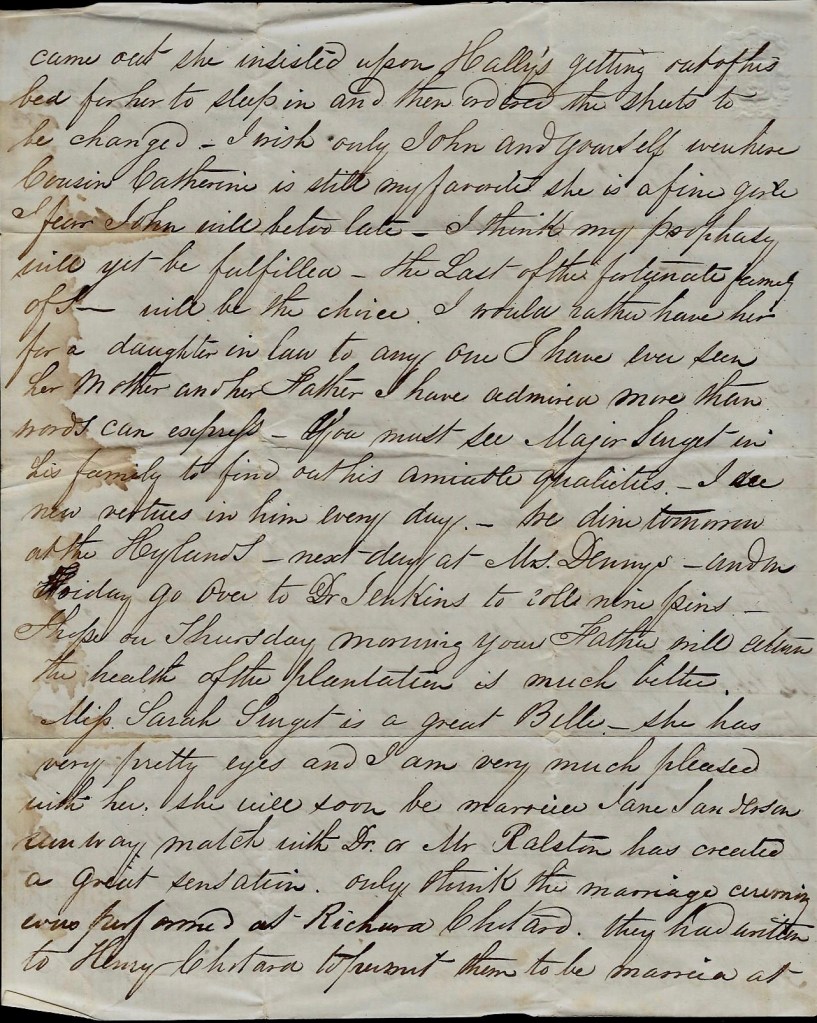
You will no doubt be much surprised to hear that we are yet in Adams county. Major [James Pierre] Surget invited us down to recruit the health of the family and he has shown us every kindness and attention. Little Frank is now recovering. He is gaining slowly his strength and is fed some six or eight times a day. Just as Frank 2 became convalescent and your Father had left me for Waluter [?] taking George Morton, and Celey Halley was taken sick with violent fever and a threatened inflammation of the stomach. I thought my evils would never end. He has however recovered having been skillfully treated by Dr. Foster. He had 12 leaches applied on his stomach and at the same time Indy was sick so that I only had Betsy and Jim Black to assist in nursing. And Kate 3 still has her screaming fits—which alarms Major Surget very much. Night before last she screamed so long that he was fearful she would go in convulsion. He ordered her a bath and with salt in it stood by, saw her put in, and then had her rolled up in his flannel gown—Kate screaming all the time. After she came out, she insisted upon Hally’s getting out of his bed for her to sleep in and then ordered the sheets to be changed. I wish only John and yourself were here.

Cousin Catherine 4 is still my favorite. She is a fine girl. I fear John will be too late. I think my prophesy will yet be fulfilled. The last of the fortunate family of S[urgets]—-will be the choice. I would rather have her for a daughter-in-law to any one I have ever seen. Her Mother and her Father I have admired more than words can express. You must see Major Surget in his family to find out his amiable qualities. I see new virtues in him every day.

We dine tomorrow at the Hylands, next day at Mrs. Denny’s, and this Friday go over to Dr. Jenkins to roll nine pins. I hope on Thursday morning your Father will return. The health of the plantation is much better. Miss Sarah Surget is a great belle. She has very pretty eyes and I am very much pleased with her. She will soon be married. Jane J. Anderson [ ] match with Dr. or Mr. Ralston has created a great sensation. Only think the marriage ceremony was performed at Richard Chitard. They had written to Henry Chitard to present them to be married at Minorca. Henry refused. I regret Richard had not sent them off. I could fill your sheets with much news but I have not the time as I must write to Aunt Sarah.

Tell John I saw Miss Dunbar this morning. Also Dr. Jenkins who gave me the news of him. I hear of his presenting bouquets to Ladies and that he is a favorite among the fair sex. I will write to him very soon. Only imagine me moving about when the thermometer is at 96 on the galley. I am more than ever anxious to return to Natchez and should not regret (excepting parting with Mr. and Mrs. Kenner) that I never return to Waterloo.

My dear son, I must scold you. you ought never to write anything that is vulgar. Now I think Mrs. Woodman’s message was decidedly so. I am sorry to find you paid this disagreeable and foolish woman any attention, and I fear she has paid court to you and flattered you. Madam Montgomery is not a Lady. She received too marked attention from gentlemen. I wish you to improve in your style of writing. Take pains with the penmanship and the style must be pure to please me. Recollect I am not able to give you a copy—but you have education. Take every advantage.

All have retired with the exception of William and Catherine. They are alone in the parlor. If William was only older, it would do. William rides out with Kate. They spent the day at Magnolia—Mrs. Denny’s place. The gentlemen have not returned from Black River. It is thought there will be no fighting.

Remember me to all friends and do let me know how Mrs. Charlotte Davis is. Tell Grandma Gus I will write to her the very first leisure moment and also offer my sincere congratulations to Aunt Matilda and to Mr. C[harles] P. Leverich on the birth of their daughter. How much pleasure it would give me to see them all. Goodnight. With most affectionate love, ever dear son [and] believe me to be your sincerely attached Mother, — R. A. Minor


1 Cherry Grove Plantation is located five miles from Natchez in Adams county on Second Creek. The mansion was built by Pierre Surget (1731-1796), a French planter, in 1788, over 2,500 acres of an English land grant, granted to him by the Spanish government. As such, it is one of the earliest private residences in Natchez. After his death, his widow Catharine (Hubbard) Surget expanded the grounds of the property. By 1850, the house belonged to their son James Pierre Surget (1785-1855), with sixteen house servants in residence. Cherry Grove has been in the continuous ownership of the same family since 1788 and has remained always a working plantation. It remains in the family of Surget descendants. Cherry Grove Plantation is today one of the best preserved and most complete plantation complexes in the Natchez area. The original plantation residence constructed by Pierre Surget and his wife Catharine burned in the mid-nineteenth century, and the present picturesque and architecturally significant residence was constructed about 1865 by Pierre Surget’s grandson James Surget, Jr. The form of the house, which consists of a residence constructed upon a fully raised basement with a central five-bay block and flanking single-bay wings, has the regionally early single-pile plan with rear “cabinet” rooms enclosing each end of a rear gallery recessed under the rear slope of the roof. Likewise, the facade of the central block features a gallery that is recessed under the front slope of the roof. These features suggest the possibility that the present house may have taken its basic form from the earlier house which burned. The original flanking wings with octagonal bays and gable-end balconies represent the concession of the builder to the popular taste of the 1860s. The collection of plantation outbuildings is exceptional and includes an unusual tenpin frame alley building with attached late-nineteenth century gymnasium, smoke house, detached kitchen building, corn crib, stables, privy, sheep stalls, and barns. Hand-hewn cypress troughs for feeding and watering the stock are rare plantation survivals, and the plantation cemetery containing the graves of Pierre and Catharine Surget and their descendants is located within sight of the main dwelling house. The plantation gains added significance from its long history of family ownership. Pierre Surget, originally a seaman by trade, was the patriarch of the Surget family in Natchez, a family that formed one of the largest planting dynasties in the entire South. Pierre’s son Frank was described by one contemporary historian as the most extensive landholder and successful planter in Mississippi.

2 Francis (“Frank”) Octave Minor was born in 1847.

3 Katherine (“Kate”) Lintot Minor was born in 1849.

4 Catherine Surget (1834-1926) was married first to James Gustine Minor (1839-1860) in 1853. She married second John Duncan Minor (1831-1869) in 1855. Catherine’s collection of letters are housed at the University of Michigan.
1832: Walthall Burton’s Statement of Theft

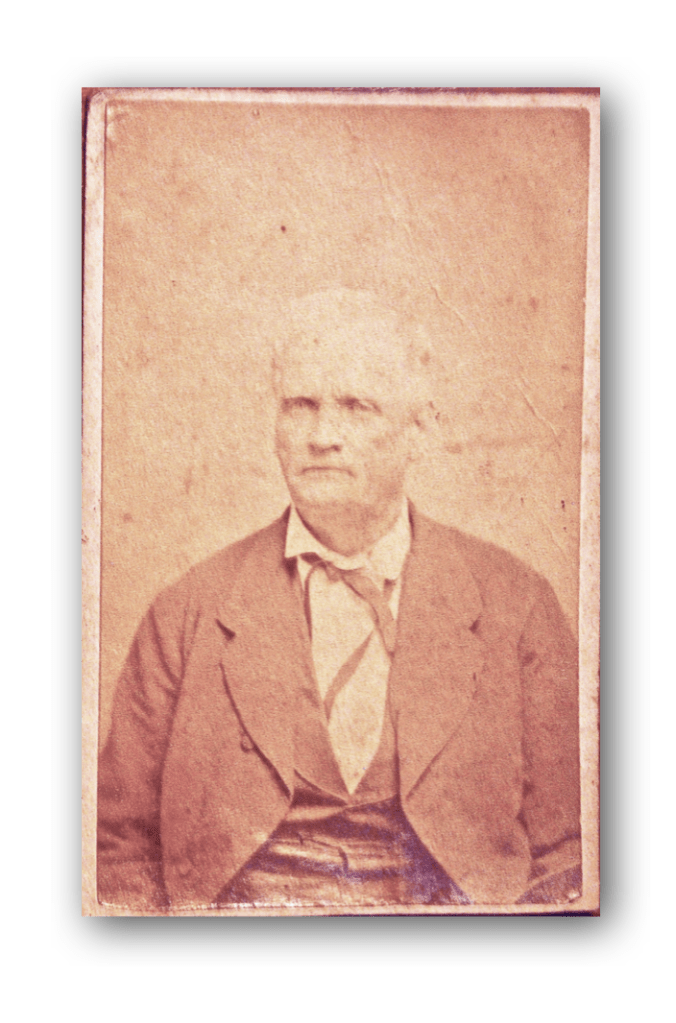
Walthall Burton in post-Civil War years

This unusual statement was written in 1832 by Walthall Burton (1807-1899) a planter residing near Woodville in Wilkinson county, Mississippi, in the early 1830s. Woodville was one of the earliest towns established in Mississippi. It was sited in the rolling hills just north of the Louisiana-Mississippi border in the southwest corner of the state on the Natchez Trace. The planter community centered at Woodville thrived on cotton production from the 1830s until the Civil War.

Burton was born in Nelson county, Kentucky, the son of Wilson Burton (1779-1825) and Eleanor Gray Bruce (1778-1862). He lived there with his parents until 1811 when the family relocated to Wilkinson county, Mississippi. When he was 19 years old, he became the overseer of a plantation near his parent’s home but by 1827 he was ready to start his own plantation near Woodville. It was on this plantation that he wrote the following.

The year following, 1833, he move to St. Helena Parish where he resided until 1849. Following the Civil War, Burton spent his time steamboating on the Atchafalaya river. He was married in 1827 to Theresa A. Terrel of Mississippi.

This statement appears to have been meticulously prepared as if it were intended as an exhibit in a trial, but I can find no record in the Woodville newspapers of either the described incident itself or a trial that might have followed.

[Note: This statement is from the personal collection of Rob Morgan and was transcribed and published on Spared & Shared by express consent.]

Walthall Burton’s Pocket Book, Wilkinson, County, Mississippi—Woodville

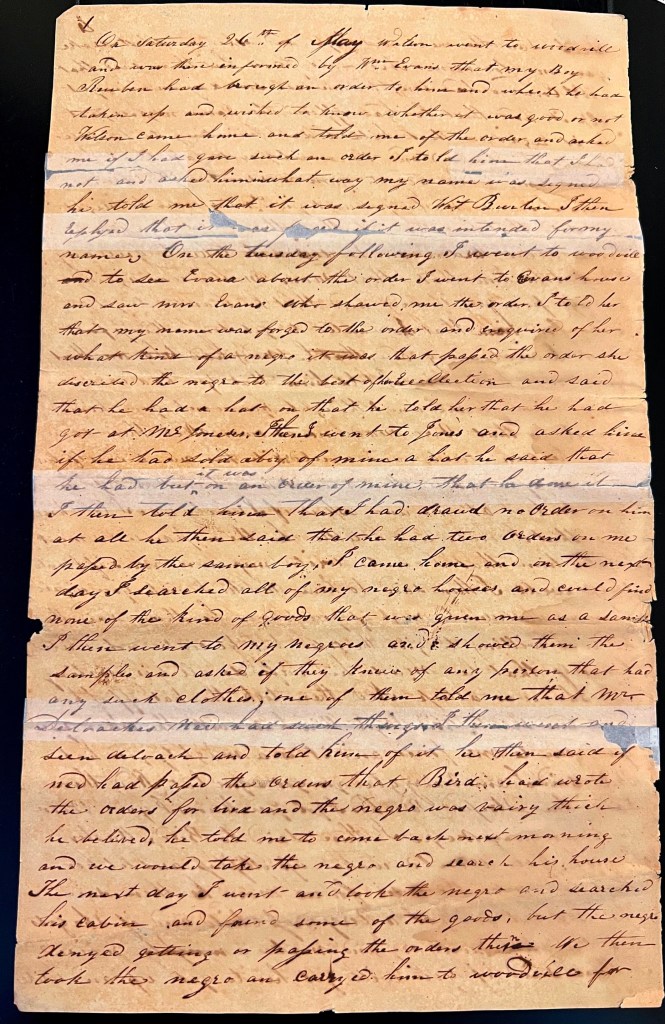
Transcription

On Saturday, 26th of May, Wilson went to Woodville and was there informed by William Evans that my Boy Reuben 1 had brought an order to him and which he had taken up and wished to know whether it was good or not. Wilson came home and told me of the order and asked me if I had gave such an order. I told him that I had not and asked him in what way my name was signed. He told me that it was signed Wat Burten. I then realized that it was forged if it was intended for my name.

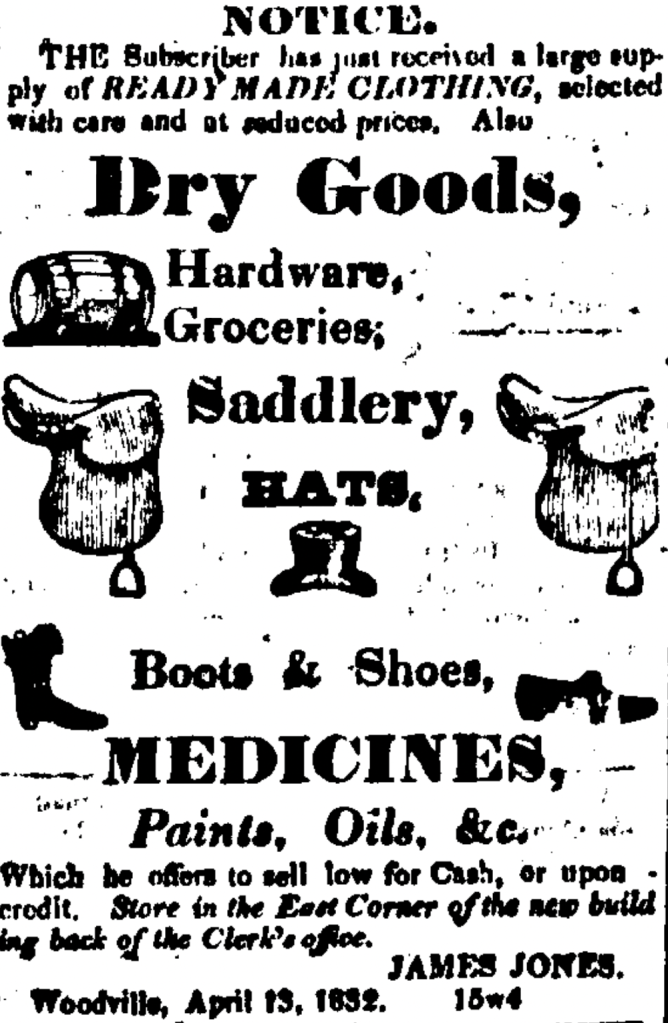
Advertisement for store operated by James Jones in Woodville in April 1832

On the Thursday following I went to Woodville to see Evans about the order. I went to Evans’ house and saw Mrs. Evans who showed me the order. I told her that my name was forged to the order and enquired of her what kind of a negro it was that passed the order. She described the negro to the best of her recollection and said that he had a hat on that he told her he had got at Mr. [James] Jones’s. I then went to Jones and asked him if he had sold a boy of mine a hat. He said that he had but it was on an order of mine that he done it. I then told him that I had drawed no order on him at all. He then said that he had two orders on me passed by the same boy. I came home and on the next day I searched all of my negro houses and could find none of the kind of goods that was given me as a sample. I then went to my negroes and showed them the samples and asked if they knew of any person that has such clothes; one of them told me that Mr. Deloroches’ Ned had such them goods. I then went and seen Delroch and told him of it. He then said if Ned had passed the orders that Bird had wrote the orders, for Bird and the negro was very thick he believed. He told me to come back next morning and he would take the negro and search his house.

“The negro still denying the charge, we then resorted to means to make him confess. He stood out for some time…” Scene from Twelve Years A Slave.

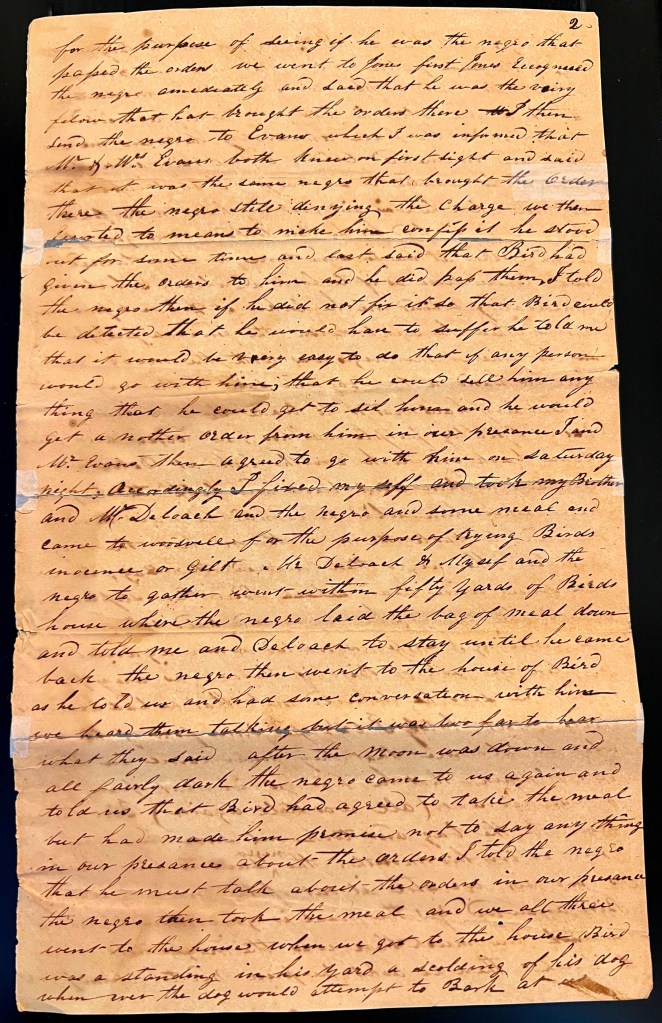
The next day I went and took the negro and searched his cabin and found some of the goods, but the negro denied getting or passing the orders then. We then took the negro and carried him to Woodville for the purpose of seeing if he was the negro that passed the orders. We went to Jones’ first. Jones recognized the negro immediately and said that he was the very fellow that had brought the orders there. I then sent the negro to Evans’ which I was informed that Mr. & Mrs. Evans both knew on first sight and said that it was the same negro that brought the order there. The negro still denying the charge, we then resorted to means to make him confess it. He stood out for some time and [at] last said that Bird had given the orders to him and he did pass them. I told the negro then if he did not fix it so that Bird could be detected, that he would have to suffer. He told me that it would be very easy to do that if any person would go with him; that he could tell him anything that he could get to suit him and he would get another order from him in our presence. I and Mr. Evans then agreed to go with him on Saturday night.

Accordingly, I fixed myself and took my brother and Mr. Deloach and the negro and some meal and came to Woodville for the purpose of trying Bird’s innocence or guilt. Mr. Deloach & myself and the negro together went within fifty yards of Bird’s house where the negro laid the bag of meal down and told me and Deloach to stay until he came back. The negro the went to the house of Bird as he told us and had some conversation with him. We heard them talking but it was too far to hear what they said. After the moon was down and all fairly dark, the negro came to us again and told that Bird had agreed to take the meal but had made him promise not to say anything in our presence about the orders. I told the negro that he must talk about the orders in our presence. The negro then took the meal and we all three went to the house. When we got to the house, Bird was standing in his yard a scolding of his dog whenever the dog would attempt to bark at us.

The negro walked up to the palin and set the bag on the top of the palin & I walked in about 5 or 6 feet of the palin and stopped. Delroch stopped immediately behind me. After he had got the dog reconciled, he stepped to the fence immediately between me and him and commenced looking at me very close. I thought he wanted to see me good. I stepped up close to the fence where he was and laid my hand on the fence close to where he had his. He then looked at me good. He had looked at me for some time. He then turned his head to one side as if to look at Delroch which was immediately behind me. He looked at Delroach for some time. Then he went down the fence a few feet to where the negro was with the meal and laid his hand on the bag and said to the negro it is a very hard matter to trade now. Times is very squally. People watches very close. And then [he[ came back and took another look at Deloach & myself. He then went back and felt the bag. The negro asked him what he wanted. He said that he wanted to taste the meal but the bag was tied. The negro then untied the bag. There was some noise heard. Bird then stepped back against the side of his house and said some person was coming. I sorter squatted down against the paylen and asked Bird if there was any patrol about. He said he believed not—that he had heard no noise about lately. I expressed some fear of the patrol. He told me that they never came in that part of town—that he had got in that part of town on that account (all was still again).

Bird then stepped to the bag and took out some meal and put it in his mouth. The negro said to him the meal is good, sir, we stole it out of the mill yesterday. Bird answered yes, the meal is good. Then he asked how much there was. The negro told him a bushel. Then he asked the price. Ned told him 75 cents. Bird said the meal was high and asked me what Drake gave me for mine. Ned said 75 cents. He then said that Mrs. Conrad had bought some last Sunday morning at 62.5 cents and that he had offered the same negroes 75 cents for it right on that hillside (pointing to the hills east of his house) and he would not take that but went and took 62.5 cents from Mrs. Conrad. Ned then said I suppose Master you won’t give nairy order tonight. He said that he rather not. That there had been some noise about orders and he did not like to give any. Ned told him that that man’s master was a going away (pointing to me) and that he wanted to get an order for him—that he wanted to get some things before he went away and I told him that you had written some orders for me and I thought you would give him one. To that Bird made no answer. Ned then said that he can write and would write one himself but he was afraid. Bird then said it is a bad business. He then looked at me and asked if I could read. I told him yes, that I could read a little. He then paused a moment. I told him that I could write my own orders if I could spell well. I then said to him, Master, I wish you would give us an order tonight, if you please. He then said that he was willing to give the order but he could not write himself—that he made his wife so all his writing and she was asleep.

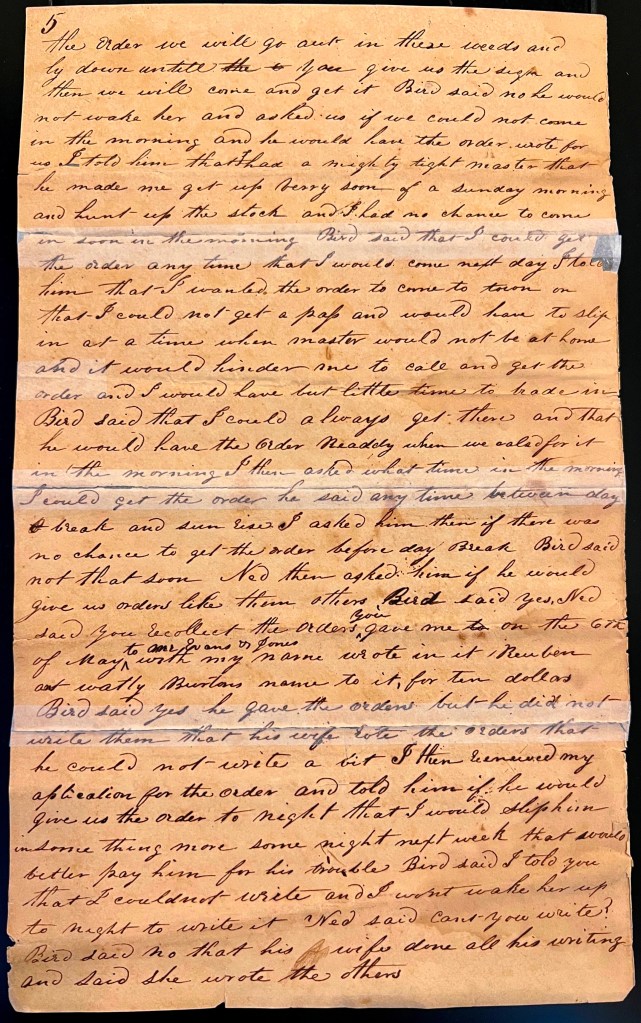
Ned then took the hat off his head and said to Bird. I got this hat with the order you gave me to Mr. Jones and it is a mighty good hat. Bird said I am very glad you got a good hat. Ned then said the stamped britches I got, you know I gave them to a runaway negro. I then said to Bird, Master, I wish you would wake up mistress and let her write the order for us now. He then said she is a bed and got a very cross child and if she gets up, the child will cry and make noise. I then said if you will get her to get up and write the order, we will go out in these weeds and lie down until you give us the sign and then we will come and get it. Bird said no he would not wake her and asked us if we could not come in the morning and he would have he order wrote for us. I told him that I had a mighty tight master—that he made me get up very soon of a Sunday morning and hunt up the stock and I had no chance to come in soon in the morning. Bird said that I could get the order any time that I would come next day. I told him that I wanted the order to come to town or that I could not get a pass and would have to slip in at a time when master would not be at home and it would hinder me to call and get the order and I would have but little time to trade in. Bird said that I could always get there and that he would have the order ready when we called for it in the morning. I then asked what time in the morning I could get the order. He said any time between daybreak and sunrise. I asked him then if there was no chance to get the order before daybreak. Bird said not that soon.

Ned then asked him if he would give us orders like them others. Bird said yes. Ned said you recollect he orders you give me on the 6th of May to Mr. Evans and Mr. Jones with my name wrote in it, Reuben, and Watly Burton’s name to it, for ten dollars. Bird said yes, he gave the orders but he did not write them—that his wife wrote the orders—that he could not write a bot. I then renewed my application for the order and told him if he would give us the order tonight, that I would slip him in something more some night next week that would better pay him for his trouble. Bird said I told you that I could not write and I won’t waker her up tonight to write it. Ned said can’t you write? Bird said, no, that his wife done all his writing and said she wrote the others.

Advertisement for the new store in Woodville run by David Armstrong, May 1832

At this moment we heard some beast cough. Bird said there is somebody a coming and started like as if he was a going in his house and said some person will come presently and I won’t stay here any longer. Ned said as Bird walked a little off we can get the order in the morning, can’t we? Bird said yes and turned and came back and went into the corner formed with a little room that project beyond his house and joins with the corner of the paylon near a door that leads into that rom or just between the room and house. He there leaned back against the wall of his house with his crutches in one hand and a hold on the side of the door with the other hand as if prepared to spring in at the door the moment he should see or hear anything that might affright him. Bird had in the course of our conversation about the orders taken the bag of meal from the fence and put it on a barrel and laid a board on it. We asked him for the bag. He asked us if we could not get the bag in the morning. I told him that master always sent to mill on Sunday morning and that was one of the mill bags and if the bag was not at home ready for mill, that there would be a noise. Bird said he would empty it then and started back from the door where he had so completely fixed himself that Ned then told him to write the order to Mr. Jones. He said yes but he did not like Jones much ad would rather give one to Armstrong [see adjoining advertisement]. He said Armstrong was a very fine fellow and his goods is cheaper. He then took the meal and hopped along with it in at the door above mentioned and emptied out the meal and gave us the bag at a different place from where he got it and gave us some water to drink. We then told him that we would be back in the morning to get the order, bid him farewell, and left him.

June 5th, 1832

— Wathall Burton

1 A Slave book kept by Burton indicates that Reuben & Amy were a couple and together they had the following children: Amstead, b. 1 December 1831; Edmund, b. 15 Jan. 1834; Delphine, b. 4 July 1836; and Mariah, b. 12 October 1842.