Category Archives: Battle of Arkansas Post

1862-63: George Thomas Sifleet to his Parents

The following letters were written by George Thomas Sifleet (1842-1863) who came to the United States from Frindsbury, Kent, England, with his parents in 1854. The family settled in Ulster county, New York, initially but then relocated to Vienna, Grundy county, Illinois.

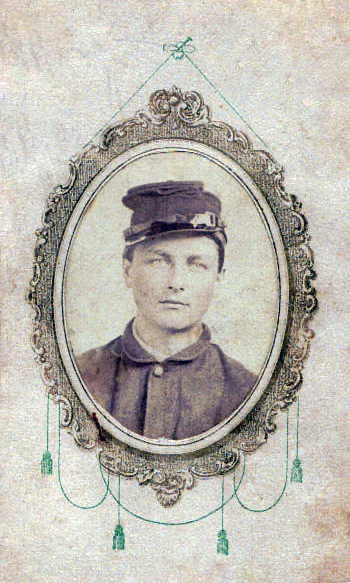
I could not find an image of George but here is one of Robinson Barr Murphy who also served in the 127th Illinois Infantry. He was later awarded the Medal of Honor in the Battle of Atlanta (Julian Burley Collection)

George enlisted in Co. D, 127th Illinois Infantry in mid-August 1863. At the time of his enlistment, he was described as a single farmer, standing just north of 5 foot 2 inches, with grey eyes and light hair. He mustered into the United States service on 5 September 1862 and was with his regiment until 25 April 1863 when he died of disease at Young’s Point, Louisiana.

George had an older brother who served in the 36th Illinois Infantry but was mortally wounded at the Battle of Stones River and died on 8 January 1863.

Here are some other letters by members of the 127th Illinois previous transcribed and published on Spared & Share. One of them includes a diary.

James R. Maxwell, Co. D, 127th Illinois (5 Letters)
Robert Marsden, Co. E, 127th Illinois (62 Letters & Diary)


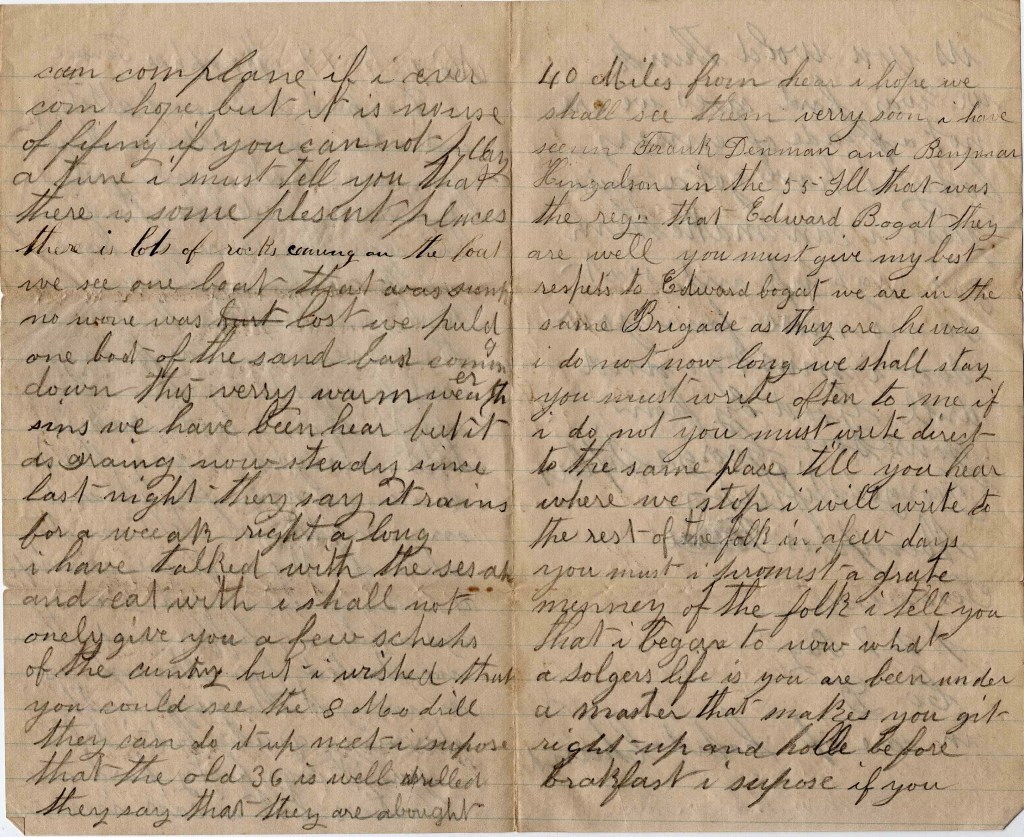
Letter 1

Memphis, Tennessee
November 17 [1862]

Dear Father and Mother and Sister,

I now sit down to let you know that I am well at present and hope these may find you the same.

We have got to a stopping place and that is Memphis & close to the river, We was two days and two nights on the river with two or three hard crackers. Talk about living. That is no name for it. And one night we stopped on the shore of Missouri and we [ ] four hives of bees and two or three hogs and one heifer and then we started for Memphis so we got through with starving quite but I tell you, it was pretty hard us. But I can never complain if I ever come home. But it is no use of fifing if you cannot play a tune.

I must tell you that there is some pleasant places. There is lots of rocks. Coming on the boat we seen one boat that was sunk. No one was lost. We pulled one boat off the sand bar coming down. This [is] very warm weather since we have been here but it is raining now steady since last night. They say it rains for a week right along.

I have talked with the secesh and eat with. I shall not only give you a few sketches of the country but I wished that you could see the 8th Missouri drill. They can do it up neat. I suppose that the Old 36th [Illinois] is well drilled. They say that they are about 40 miles from here. I hope we shall see them very soon. I have seen Frank Denman and Benjamin Hingalson in the 55th Illinois. That was the regiment that Edward Bogat [joined]. They are well. You must give my best respects to Edward Bogat. We are in the same brigade as they are he was.

I d not know [how] long we shall stay. You must write often to me [even] if I do not. You must write and direct to the same place till you hear where we stop. I will write to the rest of the folk in a few days. I promised a great many of the folk. I tell you that I begin to know what a soldier’s life is. You are been under a master that makes you get right up and holler before breakfast.

I suppose if you would see us you would think we was hard cases. We are not afraid of anybody. I have got a nice gun. I can make them get right up and seat. So no more form your son. I must go and drill. Goodbye from your son, — George Sifleet

127th Regiment, Co. D, in care of Capt. Chand, Memphis, Tennessee


Letter 2

On the Mississippi
January 18, [1863]

Dear father and mother,

I now sit down to let you know that I am well and hope these few lines may find you enjoying the same blessing. I received your letter last night and was glad to hear that you was well and sorry to hear that James was sick but I hope he is getting better. We have been on the boat about one month. We are getting tired of it. I suppose John Whybrow is having good times this winter but they are putting us through. We have been in two battles in two weeks—both of them on Sunday. We have started back for there again with a larger fleet.

They say that General Grant’s army is a going there to support us. I hope it is so. I hope we not get whipped but I think we will either whip them or they shall whip us and it will be a hard fight. We are a going within about 30 miles of there and go in camp for a while.

I must tell you that the mail does not go very often. I wrote a letter to Emmy McConnell two or three days but I have not sent it yet. But I will send it with this and you will give it to her. You must tell her that if she will not wait and have a soldier that she must take what she can get—some old bachelor or other.

After we took Arkansas Post we took what we could and tore down the breastworks and burned up all the buildings and went down the White River to the Mississippi river and we went up that about 30 miles to get off a hospital boat which had been there 48 hours. We worked all night getting coal off. Then in the morning we hauled her off and we came back and now have started down the river.

I must go and wash. I can tell you where I spent my Christmas. On the boat. And on New Year’s we left the battlefield for the boat. I tell you, we was still that night and the next day we left. I would like to of be[en] there on New Years and Christmas with you. I would like some sausage meet with you, I tell you that.

I wish that this abolition war was over and the Negroes was with their master for father, they are no account to any man. The better you use them, the lazier they are for we have got a number of them on the boat. They lay under the boilers. You have to drive them or they will not go or do anything. The quicker this war is over the better.

So goodbye from your son, — George Sifleet

To Mr. and Mrs. Sifleet. God bless you all.


Letter 3

Young’s Point, Louisiana
February 17, 1863

Dear father and mother and sister,

I now sit down to let you know that I am well at present and hope these few lines may find you in good health. It commenced raining two days ago and it is a raining yet. It is very muddy so that we cannot hardly getaround to cook anything. Our tents leaked yesterday.

I do not know of much news to write. We have not done anything here yet—only dig on the canal. It does[n’t] seem to amount to much yet.

The mail came in last [night] about dark. I got two letters—one from Lizzy and the other from William Fellingham. I was sorry to hear that John Whybrow was dead. I suppose that you do not see anything about the war a coming to a close.

Our captain is a Major now in this regiment—that is, he is Acting Major. Our Major has gone and left us and so as the Colonel and his son left us that that we have not but a Lieutenant Colonel. We hear lots of reports that we cannot believe. The most of the soldiers are all sick of it. They say they do not care what becomes of the government and the Negroes or anything else. I do not see any more signs of the war a coming to a close than there was one year ago. But I think it will last long. It has been going on long enough [and] I think so do the soldiers.

I do not know what to write about. I do not know how long we shall stay here. The tent is crowded full. The boys are in the tent. I hope we shall leave here soon if it keeps a raining all the time. The boys are not in very good spirits but they are a getting sick of it.

I would like to get a paper once in a while. We have not go any pay yet. We begin to need it. I wish you would send me 50 cents worth of postage stamps in a letter. I write a good many letters and that takes stamps. I would like some of your sausages and bread and butter. I would like it very much. John Whybrow and Alexander Tomson has had a very good place to stay in Otyway [?]. George is well. He is a writing to his brother and sister. I got your letter last night and never was a more glad a boy to get a letter than I was any time.

I must draw my letter to a close. From your only [son], — George Sifleet

To Father and Mother and sister Sifleet

Give my best respects to Mr. and Mrs. Searink [?] and all enquiring friends. From your son, — George Sifleet


Letter 4

[Opposite] Vicksburg
February 21 [1863]

Dear father and mother,

I now sit down to let you know that I am well and hope these few lines may find you well as to say it leaves me at present. I thought I would tell you how I feel this morning. I feel as though I would like to take a few warm biscuits and a few mash potatoes and some eggs and so on. I have just been to breakfast. I had a piece of bread. It was good. We get one loaf every other day and there is about enough in one loaf for one meal if a man is hungry. We get plenty of hard tack and pork and coffee but I do not drink much of that.

I have got a cold now. Tell father I would like to know how his horses get along. I would like to see them.

We do not appear to be making any point here yet. I suppose we are waiting to get good and ready. We fire at them once in a while. I heard some very hard firing. I guess that our gunboats came back. Whenever the boats go by, they fire their best. One of our mortars have been a firing at the City. Our company is out on picket, the most of them. They will come in this morning and it is a raining very hard this morning and it looks as though it was a going to be a rainy day. The boys are a playing cards and dominoes and everything else but George and myself does not know one card from another. Some of the boys begin to need some clothes very soon. My clothes is pretty good yet.

Father, my boots stand it well. Some of the boys paid 6 and 7 dollars for boots and they are about gone. My boots has one little hole in the side. I take good care of them. George is a coming now. I hope you will write a long letter. When you write, tell me what father is a doing and mother, send me a tin of biscuit and a few potatoes and so on.

You must [excuse] my poor writing for I have no place to write, only on my knee. I will write as often as I can. I can’t find much fault now for I get a letter most every time the mail comes. They say the mail is a coming today. I hope to get a letter from [home].

There is so much foul news a going. Some think we are going to Chicago to guard prisoners but I think there is no such good news. The boys is in pretty good health now but this is a muddy hole. George sends his best respects to you. Some seem to think they are evacuating Vicksburg. I do not know what to think of it. Goodbye for this time. From your son, — Geo. T. S.


Letter 5

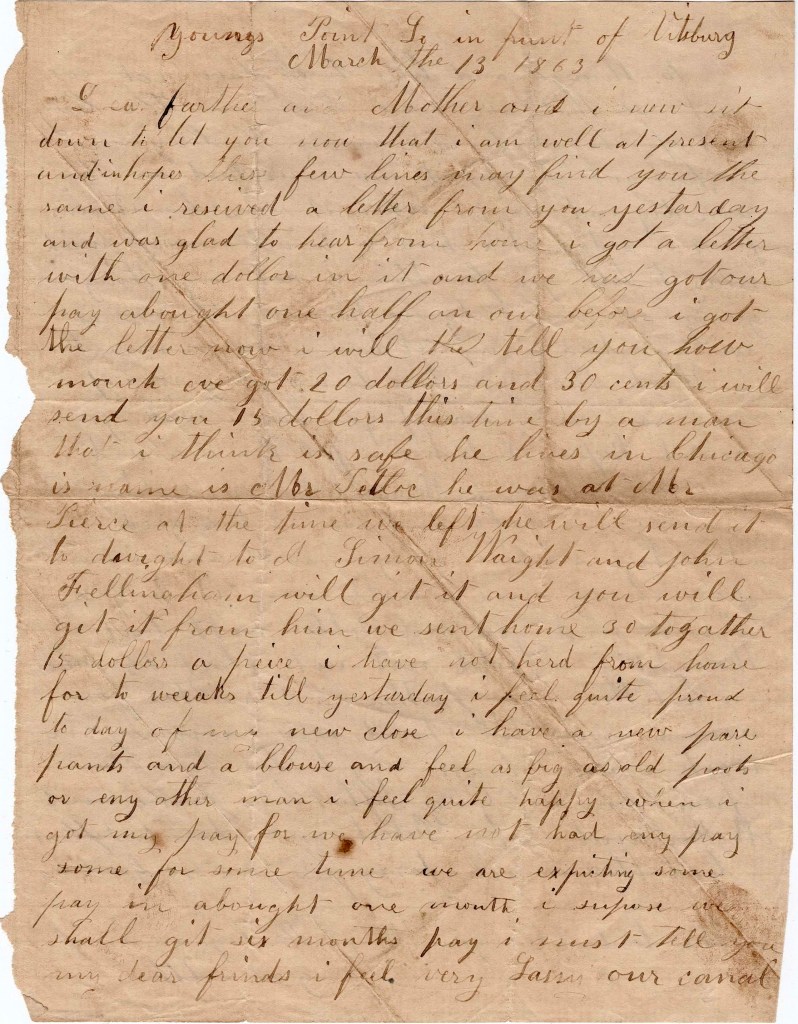
Young’s Point, La. in front of Vicksburg
March 13, 1863

Dear father and mother,

I now sit down to let you know that I am well at present and in hopes these few lines may find you the same. I received a letter from you yesterday and was glad to hear from home. I got a letter with one dollar in it and we had got our pay about one half an hour before I got the letter. Now I will tell you how much we got—$20 and 30 cents. I will send you 15 dollars this time by a man that I think is safe. He lives in Chicago. His name is Mr. Tetloc. He was at Mr. Pierce at the time we left. He will send it to Dwight to Simon Waight and John Fellingham will get it and you will get it from home. We sent home 30 together, 15 dollars apiece.

I have not heard from home for two weeks till yesterday. I feel quite proud today of my new clothes. I have a new pair of pants and a blouse and feel as big as old Poots or any other man. I feel quite happy when I got my pay for we have not had any pay for some time. We are expecting some pay in about one month. I suppose we shall get six months pay.

I must tell you my dear friends, I feel very lucky. Our canal broke through and like to drowned us out so that we had to get on the levy out of the water. We are on the levy now. We have got it stopped now. I worked in the rain day and night. When it rains here, it rains for two or three days at a time.

I do not know of much news to tell you for there is not anything a going on now—only working on the canal. We have had a very wet time for some time. I think that you have been sending some of your rain down here. If you have, I wish you would keep it to home for this is a wet place down [here].

Now father, I hope you will get my money safe and use it to a good advantage which I know you will and [if] I can spare any you any more, I will send it to you. I will send you one dollar with [this] but I thought I would not risk that 15 dollars in a letter. Now Father and Mother, you know I never did spend my money in waste. I must draw my letter to a close.

From your son, — George Sifleet

To his father and mother and sister Robert and Sarah Sifleet. God bless us all. Pray for me. So goodbye. The lord bless you all. The boys are in good health.

Letter 6

Young’s Point, La.
March 23, [1863]

Dear father and mother and sister,

I now sit down to let you know that I am well and hope these few lines may find you the same. It has been a raining all day and night. I got your letter last night the 22nd of March. The regiment are gone on a scout. I went with them up the river [but] I did not feel like marching through mud and water so some of us came back. We are in our tents. The boys went off with only five days rations with them. They have been gone one week. They went up the river about 40 miles and then got off the boats. There was only five boats with them. I do not know what it means without it is to cut off their communications or to fight.

They have been fighting some 15 miles from here. We took it with our gunboats. The place is named Warrington. We are a getting them very near surrounded.

I suppose you have got that money by this time. It is very cold this morning. I must quit for this time.

Now here goes for some more. There has two or three gunboats run the [river] blockade since we have been here. We have stopped digging on the canal. There is a dredge a digging in it and the rebs fire a gun once in a while. Their shot comes within 60 rods of us here.

They are a going to draft but they cannot take Father this time.

I do not know what to think about Vicksburg but Grant takes it slow. Maybe it is the safe way to do it. Father, the old saying is slow and sure. There is not many troops here now. They are all over. Some of them are where we was before.

I write very fast and you must read it fast and then you will understand it.

I saw three Rebels that came over from Vicksburg and they say they do not like our big heavy guns. I am glad they do not. I wish they was all that way. They would soon quit. George and me got five letters between us two. We got one mail while we was on the boat but we could not answer it. I cut out some nice pictures and rolled them up and sent them home. I got them on a big plantation.

Thank you for the stamps and paper but I have paper. I will send it back with some scribbling. It is quite pleasant. I do not know when the mail will leave. Maybe soon.

Al Still has gone on the hospital boat. He was sick but was getting better. Amos Parker is dead. He died—I am not sure what day he died. So no more. From your son, — George Sifleet

To his father and mother and sister. God bless you all. Goodbye.

1863: James M. Higgins to James Emery

Martin Pence of Co. I, 96th OVI also died of disease at St. Louis in February 1863.

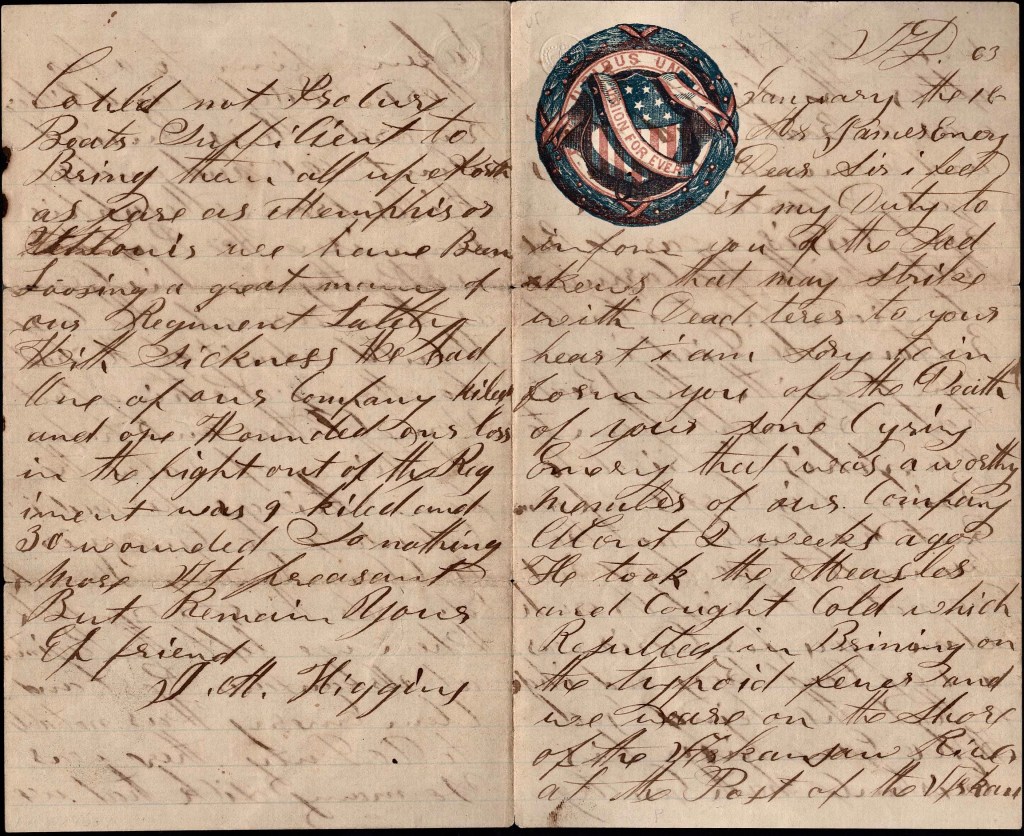
This letter was written by James M. Higgins (1835-1863) of Co. H, 96th Ohio Volunteer Infantry. He wrote the letter to James Emery (1818-1888) of Bellfontaine, Logan county, Ohio, regarding the death of his son, Cyrus Eagle Emery, who enlisted when he was 19 years old on 8 August 1862 to serve in Co. H, 96th Ohio. We learn from the letter that Cyrus died on a hospital boat on the Arkansas River while en route to Memphis. What is most unusual about this letter is that less than a month later, James was also dead. His military record indicates that he died of chronic diarrhea on 15 February 1863 at the Jefferson Barracks Hospital in St. Louis, leaving a grieving wife and child back home in Bellfontaine, Ohio.

T R A N S C R I P T I O N

January 16, 1863

Mr. James Emery—dear sir,

It is my duty to inform you of the sad news that may strike with dead tears to your heart. I am sorry to inform you of the death of your son Cyrus Emery that was a worthy member of our company. Most two weeks ago he took the measles and caught cold which resulted in bringing on the Typhoid Fever [when] we were on the shore of the Arkansas River at the Post of the Arkansas and fight.

Soon after the fight there was a boat load of sick and wounded soldiers was started North but Cyrus was too bad that [even] with the carefullest attention that I could bestow, he died. I was sent with the boat that brought them to Memphis. I tried to bring his corpse up home but he could not be brought so far.

But do not grief overwhelm you for Cyrus was a very good boy and I hope that the kind God who gave him his existence hath gently taken him to a far more peaceful and richer reward. He is buried about 140 miles from Memphis, Tennessee. We put him as neatly in his grave as the nature of the case would admit of. He had no money—nothing but some clothes and paper. Nothing of value. The few things he had I calculate to give over to Clem Emery.

Frank [J.] Edwards was very sick when we left the regiment at Arkansas Post and [John] Clem Emery was not able to do. duty. There was so many sick that we could not procure boats sufficient. to bring them all up North as far as Memphis or St, Louis. We have been losing a great many of our regiment lately with sickness.

We had one of our company killed [possibly James Stanton?] and one wounded [Henry Harbaugh]. Our loss in the fight out of the regiment was 9 killed and 30 wounded. So nothing more at present but remain your friend, — J. M. Higgins

1863: Eliza (Simpson) Russell to Lewis Edward Simpson

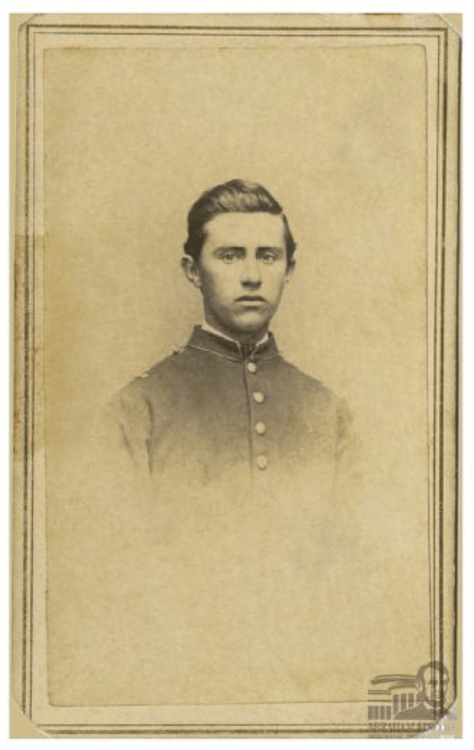
I could not find an image of Lewis but here is one of George J. Gordon who served in Co. C, 77th Illinois Infantry (Lincoln Presidential Library)

The following letter was written by Eliza (Simpson) Russell to her younger brother, Lewis Edward Russell (1846-1924). Eliza was married in 1858 to Willis Russell (18xx-1870). Lewis and Eliza were two of at least 11 children born to Edward Simpson (1799-1887) and Hatta Maria Ward (1810-1899) of Magnolia, Putnam county, Illinois. Lewis had three brothers who died relatively young, leaving him the only surviving son at the time of his enlistment, when only 16 years old, in Co. B, 77th Illinois Infantry on 22 August 1862.

From this letter we learn that Lewis was in the Battle of Arkansas Post on 11 January 1863. The 77th Illinois was in the thick of the fight and later claimed they were the first to scale the fort’s parapets. The 77th suffered six men killed in the battle, with another 39 wounded. Lewis was one of those wounded and was subsequently treated at Lawson Hospital in St. Louis, Missouri. He was discharged from the service on 12 August 1863. Lewis lived near Henry, Illinois, until 1916 when he moved to Hollywood, California.

Transcription

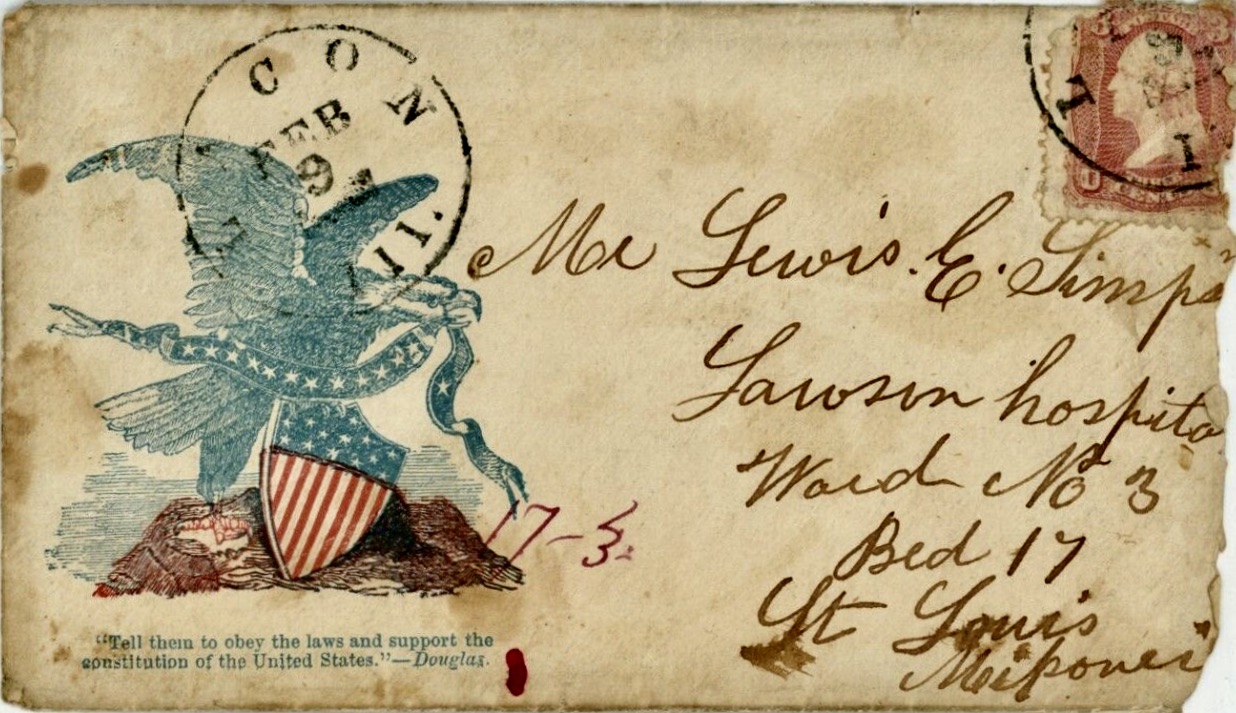
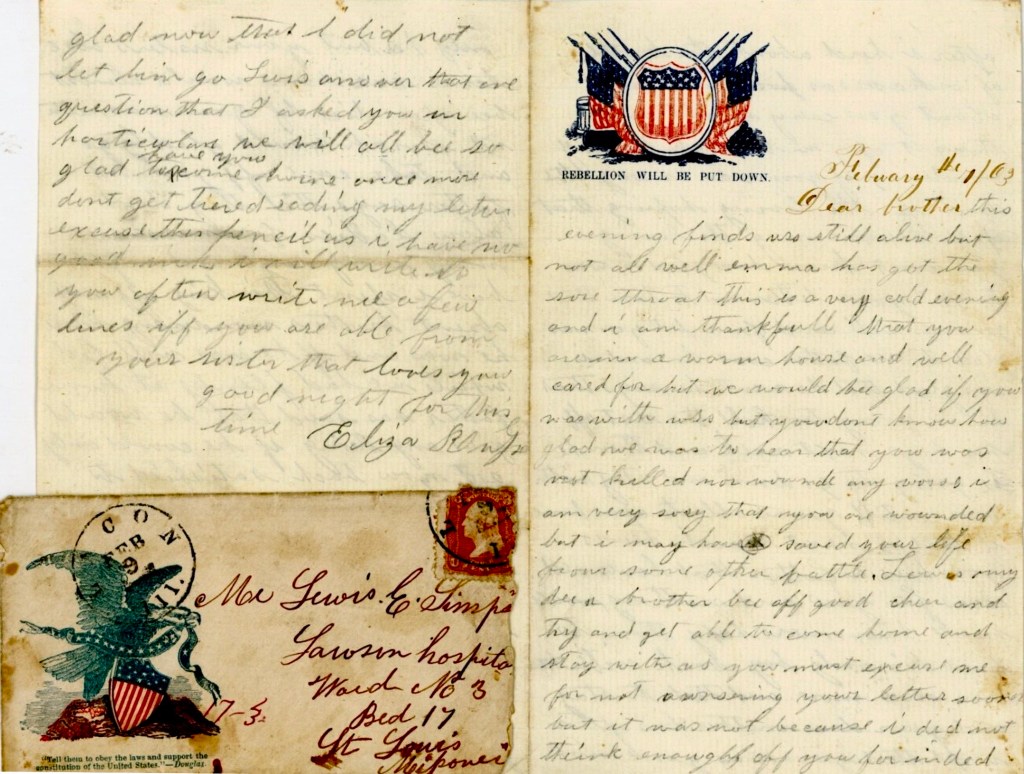
Addressed to Mr. Lewis E. Simpson, Lawson Hospital, Ward No. 3, Bed 17, St. Louis, Missouri

February 7, 1863

Dear Brother,

This evening finds us still alive but not all well. Emma has got the sore throat. This is a very cold evening and I am thankful that you are in a warm house and well care for but we would be glad if you was with us. But you don’t know how glad we was to hear that you was not killed nor wounded any worse. I am very sorry that you are wounded but it may have saved your life from some other battle.

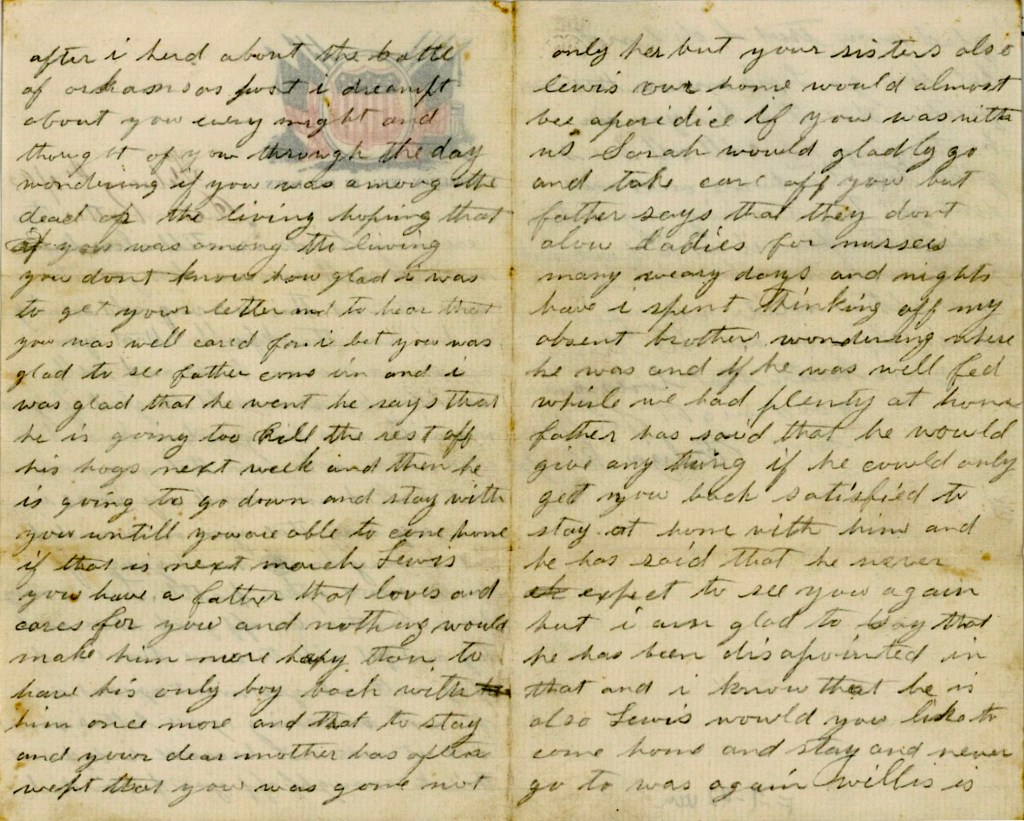
Lewis, my dear brother, be of good cheer and try and get able to come home and stay with us. You must excuse me for not answering your letters sooner but it was not because I did not think of you for indeed, after I heard about the battle of Arkansas Post, I dreamt about you every night and thought of you through the day, wondering if you was among the dead or the living, hoping that you was among the living. You don’t know how glad I was to get your letter and to hear that you was well cared for. I bet you was glad to see father come in and I was glad that he went.

He says that he is is going to kill the rest of his hogs next week and then he is going to go down and stay with you until you are able to come home if that is next March. Lewis, you have a father that loves and cares for you and nothing would make him more happy than to have his only boy back with him once more and that to stay. And your dear mother has often wept that you was gone—not only her, but your sisters also. Lewis, our home would almost be a paradise if you was with us. Sarah would gladly go and take care of you but father says that they don’t allow ladies for nurses.

Many weary days and nights have I spent thinking of my absent brother, wondering where he was and if he was well fed while we had plenty at home. Father has said that he would give anything if he could only get you back satisfied to stay at home with him and he has said that he never expects to see you again. But I am glad to say that he has been disappointed in that and I know that he is also. Lewis, would you like to come home and stay and never go to war again?

[My husband,] Willis is glad now that I did not let him go. Lewis, answer that question that I asked you in particular. We will all be so glad to have you come home once more. Don’t get tired reading my letter. Excuse this pencil as I have no good ink. I will write to you often. Write me a few lines if you are able. From your sister that loves you, good night for this time.

— Eliza Russell

1863: Unidentified Soldier to Polk Pierson

The following letter was written by a Confederate soldier named “Don” or Dan” who I believe served in the 12th (usually called the Eighth) Texas Infantry. He wrote the letter to his cousin, J. Polk Pierson (b. 1846), the son of William Howell Pierson (1816-1869) and Malinda Sharp (1820-1894) of New Salem, Rusk county, Texas. Polk’s brother, Marshall Samuel Pierson (1838-1909) served in Co. C, 17th Texas Cavalry (Moore’s). The 17th Texas Cavalry was dismounted and consolidated with other Texas regiments at the Battle of Arkansas Post (Fort Hindman) in mid-January 1863 where many of them were taken prisoner. Marshall Pierson escaped, however, and made his way back to Confederate lines.

The letter describes the last minute attempt to reinforce Arkansas Post before it was attacked by Union forces under the command of John McClernand. Trans-Mississippi Confederate Commander Theophilus Holmes was blamed for inadequately supplying troops to defend the Post though it was a virtually indefensible position to begin with.

Transcription

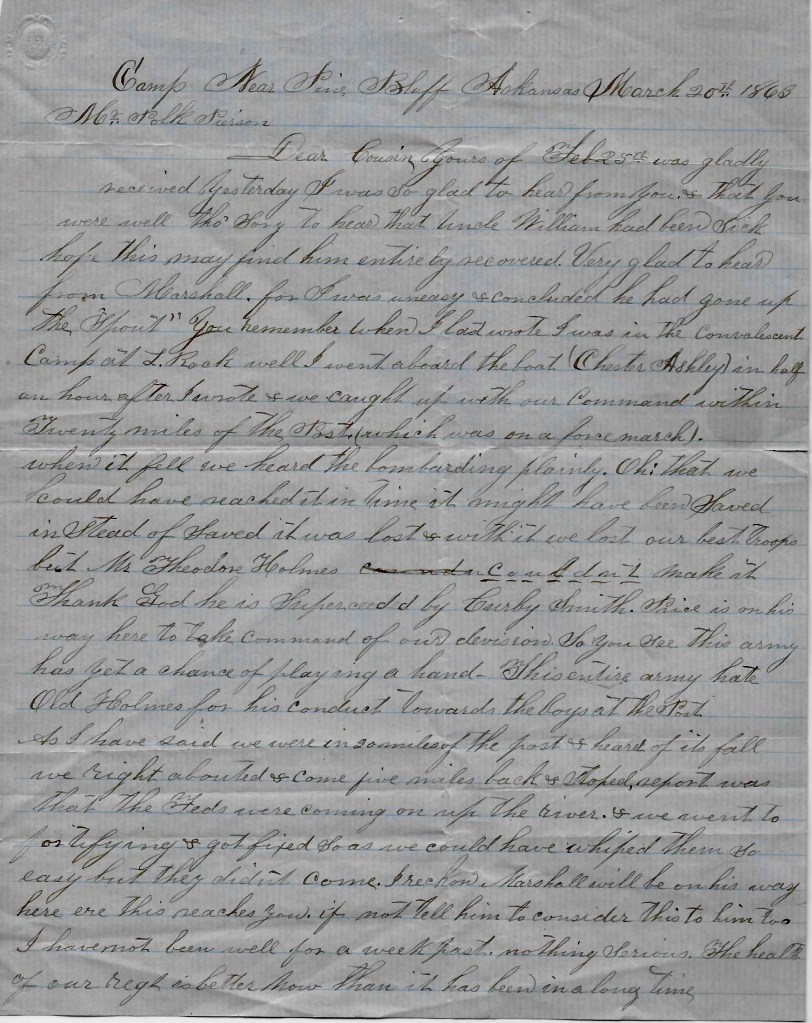
Camp near Pine Bluff, Arkansas
March 20th 1863

Mr. Polk Pierson,

Dear cousin, yours of February 25th was gladly received yesterday. I was so glad to hear from you & that you were well though sorry to hear that Uncle William had been sick. Hope this may find him entirely recovered. Very glad to hear from Marshall for I was uneasy & concluded he had gone up the “spout.”

You remember when I last wrote I was in the convalescent camp at Little Rock. Well, I went aboard the boat (Chester Ashley) in half an hour after I wrote & we caught up with our command within twenty-five miles of the Post (which was on a force march). When it fell, we heard the bombarding plainly. Oh! that we could have reached it in time. It might have been saved. Instead of saved, it was lost and with it we lost our best troops. But Mr. Theodore [Theophilus] Holmes couldn’t make it. Thank God he is superseded by Kirby Smith. Price is on his way here to take command of our division. So you see this army has yet a chance of playing a hand. This entire army hate Old Holmes for his conduct towards the boys at the Post. As I have said, we were [with]in twenty miles of the post & heard of its fall. We right abouted & come five miles back and stopped. Report was that the Feds were coming on up the river & we went to fortifying & got fixed so as we could have whipped them so easy but they didn’t come. I reckon Marshall will be on his way here ere this reaches you. If not, tell him to consider this to him too.

I have not been well for a week past. Nothing serious. The health of our regiment is better now that it has been in a long time. We have nothing new. We have many rumors, none of which are worth relating.

We received the sad intelligence of Ellen’s death the first of this month. In her death we lost an affectionate sister which loss is irreparable. But “Our loss is her eternal gain.” We received letters from home yesterday. All well and getting along as usual.

Last Friday two men were executed by musketry for desertion. We were all marched down & witnessed it. It was a solemn scene. I was about twenty steps from them. They took it calmly—never shed a tear. The old priest was with them & he had humbugged the poor fellows till they thought he would take them right to Heaven. Another one is to be shot tomorrow & seven next Friday the 27th—all for desertion. They are all Dutch & Irish belonging to the artillery companies. We will all go.

Ras 1 in very good health. Col. [Overton] Young is superseded by Brig. General [James Morrison] Hawes (who formerly commanded the cavalry). It causes some dissatisfaction in the brigade. We are living some better than we used to. We get one-third of a pound of pork to the man per day. Same old corn bread. I never wanted to see a biscuit as bad in life. Farmers are planting corn. This is a good corn & cotton country but children here 15 years old who never saw a biscuit. If I had a bushel of biscuits, I could toll this entire army off.

As for peace, I don’t see much chance yet. It is rumored here that Abe has called for 600,000 more troops. Don’t believe it, Polk. I have a slight fever which makes me nervous as you see & I will close this uninteresting letter. My warmest love to all. Ras send love to all. I shall anxiously look for Marshall. Write soon to me, my dear cousin, & I will do the same.

I am, my dear cousin, yours as ever, — Don [Dan?]

P. S. A fire broke out in Pine Bluff a night or two ago and burned several houses. Polk, I have no postage stamps & I will send this without this time, but in the future I will pay on my letters. I have sent to Little Rock for five dollars worth of stamps that will be here tomorrow or next day. Adieu.


1 Believed to be Erastus Smith, Captain of Co. C, 12th Texas Infantry.

The Letters & Diary of Sheldon C. Treat, Co. E, 4th Iowa Infantry

The following four letters and an 1863 diary were written by Sheldon C. Treat whose biographical sketch was included with a large collection of his letters that sold at Cowan’s Auctions in 2012. It reads:

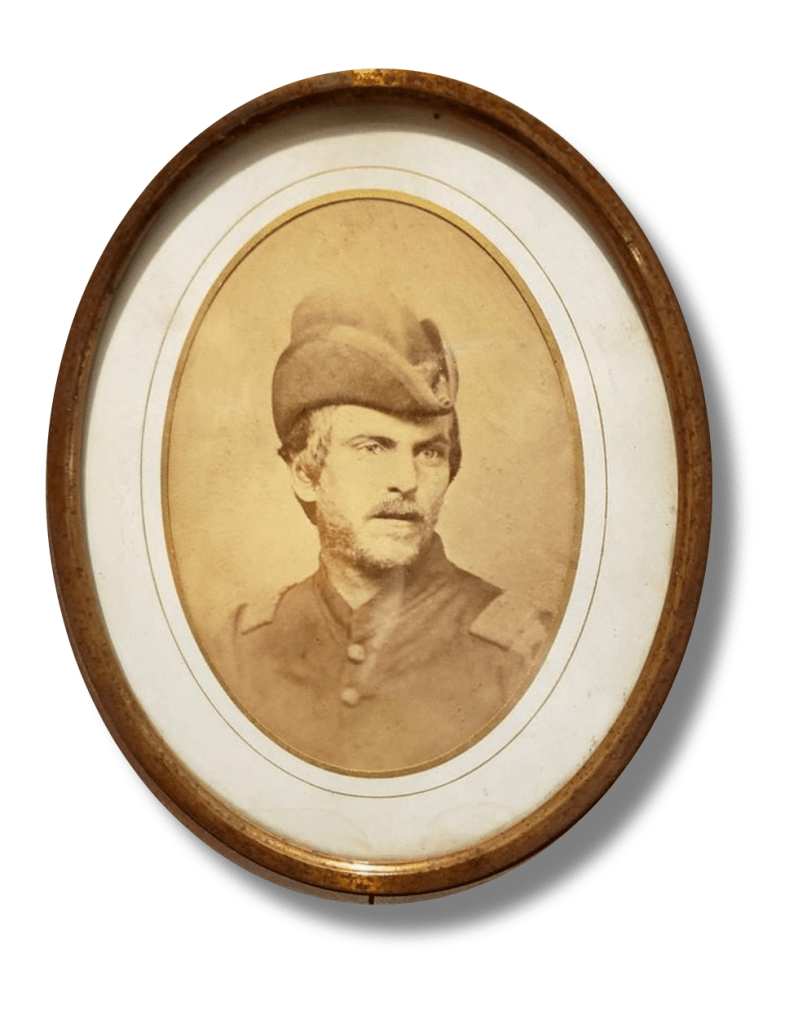
Lt. Sheldon C. Treat

“Born in West Haven, Connecticut, Sheldon Treat emigrated to Missouri in 1859 to find work as a carpenter. Not the best choice. Although he was fully employed, Treat soon found himself on the frontlines of what would become a Civil War. This fine collection documents the transformation of a young easterner looking for work into a Civil War solder.

In some ways, the three pre-war letters are the most interesting of the lot. Written from Forest City, Missouri, a troubled outpost near the Kansas border, the letters provide a glimpse into the drama as war fever rose in an area already engulfed by violence.  On 24 January 1861, Treat described an incident with border ruffians: No law of this state could molest them fellows at all for they had got my on the Kansas side and the only way get it was by force. A fellow from Ohio was with me on the river at the time of the fuss. There was 6 of them they all drawed their knives and one his revolver. We had no arms but one knife to defend ourselves with but we got the boat and got back safe. When we got up town 30 men was ready to go after them. Had we had our revolvers there would have been some shooting done.

By March, the scene grew even darker. The young men of this place are having their hair cut short for the spring fights, Treat reported, They commenced election day to fight and have been at it ever since. Under the circumstances, Treat decided to decamp for the north: I shall leave here next week for some spot unknown. I think of going to Fort Desmoine to work. This state will probably go south soon… this state legislator met the 2 of May and elected all of their officers secession. They have threatened to drive out all the free state…Once there, he wasted little time before enlisting in Co. E, 4th Iowa Infantry, where he proved himself a capable soldier, earning promotion to 2nd Lieutenant by October 1862 and to 1st Lieutenant in January 1863.

Serving mostly in the western theatre, Treat saw action in 17 battles and took part in Sherman’s March to the Sea, reenlisting after a furlough for the duration. His letters reveal a strong pro-unionist as he became accustomed to military life in Missouri, culminating in his first major battle—Pea Ridge. On 18 August 1862, he wrote home to describe the devastation he experienced during one of the year’s most decisive battles, and the way in which his commitment to the cause was growing stronger as he grew from new recruit into a veteran.

Martha says it almost makes her sick to see them poor fellows in the hospital at New Haven. She ought to go over one battlefield and see the sights. It would make her sick for certain. I should liked to had you seen the field at Pea Ridge for I know it would not made you sick but you would not have forgotten it very soon. Man is a curious thing in a fight. People will say fight for honor and glory but I tell you that they fight because they are mad and because they love to fight. You put a company into action and watch them. The first 2 or 3 rounds, they take it very cool. But soon they begin to fall and this one looses a brother and that one a messmate, and blood runs freely. Then just listen and hear the deep curses of revenge, and then see if they fight because they love it. Yes, every shot is dearer than life to them. They don’t think of honors then. And how different is it with them the next time they come into action. They go at it like a day’s work…

Interestingly, Treat’s support for the war seems not to have been shared by his father, and he writes a passionate letter complaining that his father seems to offer nothing in his letters but sarcastic and discouraging comments: I have here some 80 men to associate with and all are getting letters from home, cheering them on the good work. And although I have proved myself as brave as the bravest, yet I get no encouragement from father…(28 August 1862).

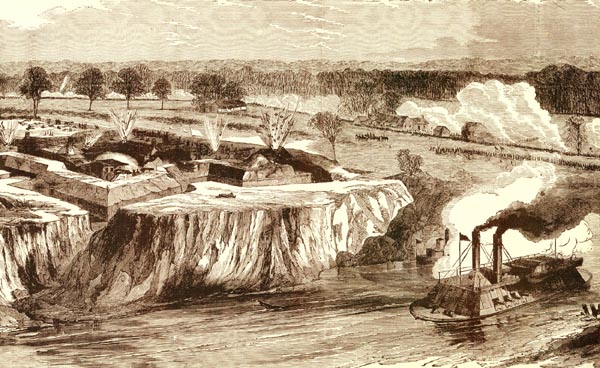
Posted at Helena in latter half of 1862, the 4th Iowa took part in the early maneuvers of the Vicksburg Campaign, and the collection includes a fine description of the fall of Fort Hindman [Arkansas Post], 18 January 1863. Our loss is 500 killed and wounded. Our Regiment lost but 4 men in all. The battle lasted 3 hours when they surrendered the fort to us. They had 1 gun of 100 lbs. and 3 of 68 lbs. all casemated with railroad iron and 6 feet of oak timber… We got 2 field batteries and 2 splendid Parrott guns and 4000 stand of Enfield Rifles, some muskets, plenty of shot guns, revolvers, and pistols of all sorts…

There are also two excellent letters from later in the Vicksburg Campaign, written after the regiment had been circled behind Vicksburg to cut off any possible escape to the east, though at heavy cost to their own ranks. On 24 May 1863, he wrote: We have taken 8000 prisoners and 75 pieces of artillery. Our loss is heavy. My regiment has lost about 50 men. The 9th Iowa lost all but 130. Some regiments have lost all their field officers and some most all their line officers. Jackson—the capital of this state—is burned down. I am in camp on Walnut Hills two miles back of the town. In front is a big fort still in the hands of the rebels… We have got Warenton and Haines Bluffs both with all their guns and have got the rebels where we can tend to them just when it suits us…

A thread running through Treat’s letters is the squabble with his father, and Treat takes every opportunity to lambaste the Copperheads. After the draft riots of 1863, he taunted his father: How much has the Copperheads made by their riots in New York city? I think they will get their fill before long. I rather guess bullets will stop them. It was a pity they used blank cartridges as they had such a nice range for canister in the streets. I guess that Father Abraham who lives in Washington is able to stop such proceedings and if necessary stop some of their winds…After the election later that fall, he poked his father again: The soldiers of the 2nd Brig., 1st. Division fought a bloodless battle yesterday but very decisive victory was gained. Stone the republican candidate for Governor went up, Tuttle and Copperheadism went down. The 4th gave Stone 292 and Tuttle 13…”

Many of Sheldon’s letters are now housed at the University of Alabama Libraries Special Collections and the digitized images have been posted on-line under Correspondence from Sheldon Treat to family before, during, and after the Civil War, 1860-1873.

[The letters and diary of Sheldon C. Treat published here are from the personal collection of Greg Herr and appear on Spared & Shared by express consent.]

Letter 1

Helena, Arkansas
August 15, 1862

Dear Sister,

Your letter of August the 6th has just come to hand and I am glad to hear from home again. I am as well as ever. There is no news of importance here. Our Brigade was reviewed day before yesterday by Gen. Carr. There is some skirmishing around here but it don’t amount to much. The main body of the troops are laying quietly in camp.

You speak of suffering in this army but the worst is for water. On the road from Jacksonport we could not get near water enough to drink and a mud hole where the hogs had wallowed was quite a luxury to all. Provisions is nothing compared to water. You must recollect that we have been in the interior all the while and 200 miles from civilization and could not get provisions. Our suffering are nothing to what we expect to see in times to come if the war lasts.

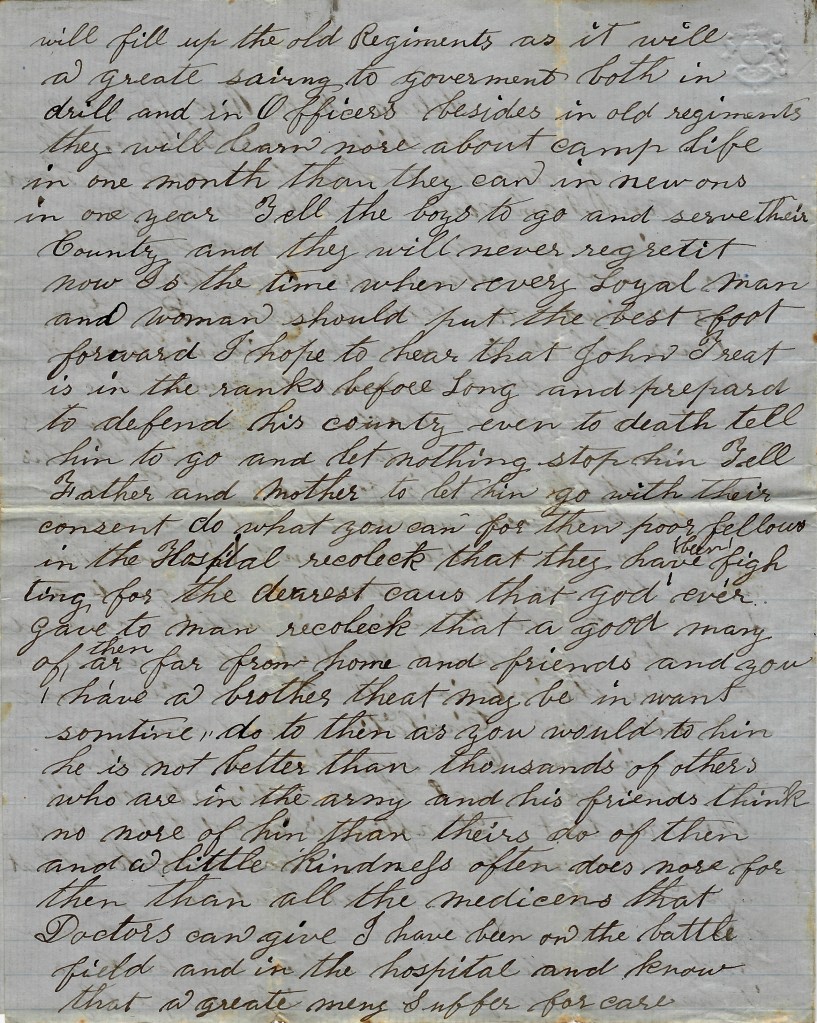
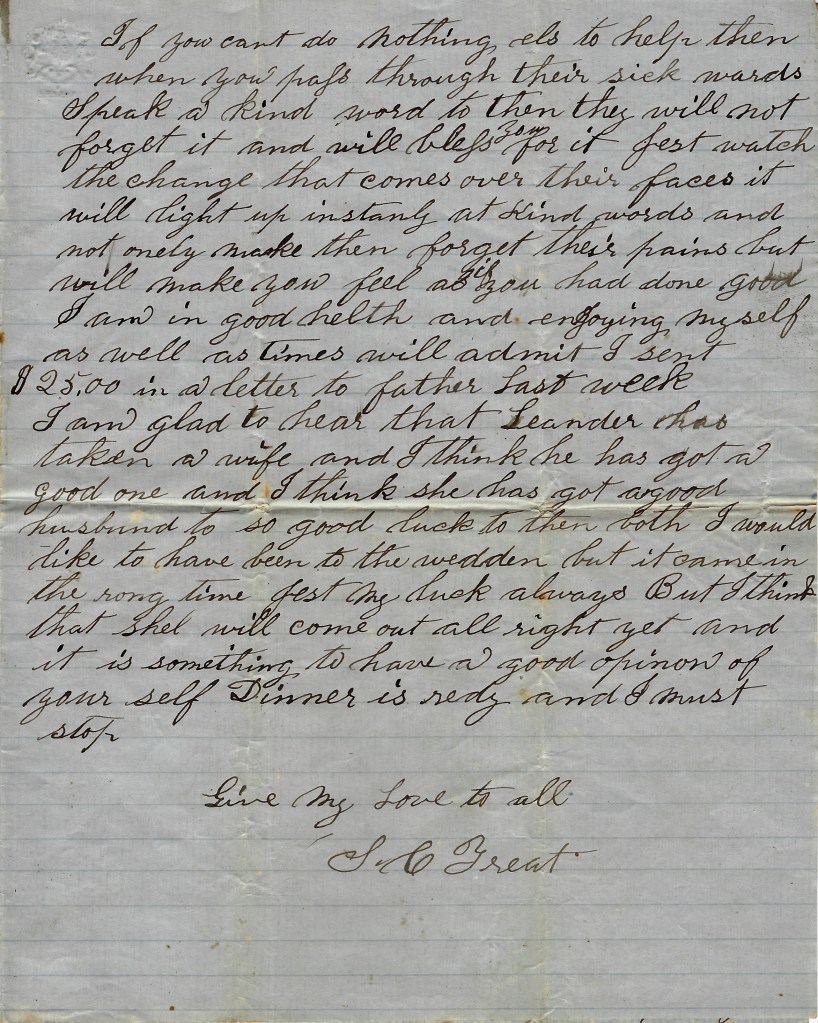
Drafting is a good thing and I was glad our government has adopted that system. Had they gone at that one year ago, the war would have been at end now and that system brings all on the level as it has no respect for a man’s ricjes. I hope they will fill up the old regiments as it will be a great saving to government both in drill and in officers. Besides, in old regiments they will learn more about camp life in one month than they can in a new one in one year. Tell the boys to go and serve their country and they will never regret it. Now is the time when every loyal man and woman should put the best foot forward. I hope to hear that John Treat is in th ranks before long and prepared to defend his country even to death. Tell him to go and let nothing stop him. Tell Father and Mother to let him go with their consent. Do what you can for them poor fellows in the hospital. Recollect that they have been fighting for the dearest cause that God ever gave to man, recollect that a good many of them are far from home and friends and you have a little brother that may be in want sometime. Do to them as you would to him. He is not better than thousands of others who are in the army and his friends think no more of him than their do of them. And a little kindness often does more for them than all the medicines that doctors can give. I have been on the battlefield and in the hospital and know that a great many suffer for care. If you can’t do nothing else to help them when you pass through their sick wards, speak a kind word to them. They will not forget it and will bless you for it. Just watch the change that comes over their faces. It will light up instantly at kind words and not only make them forget their pains, but will make you feel as if you had done good.

I am glad to hear that Leander has taken a wife and I think he has got a good one and I think she has got a good husband too. So good luck to them both. I would like to have been to the wedding but it came in the wrong time. Just my luck, as always. But I think that Shel will come out alright yet and it is something to have a good opinion of yourself.

Dinner is ready and I must stop. Give my love to all, — S. C. Treat


Letter 2

Helena, [Arkansas]
November 7, 1862

Dear Sister,

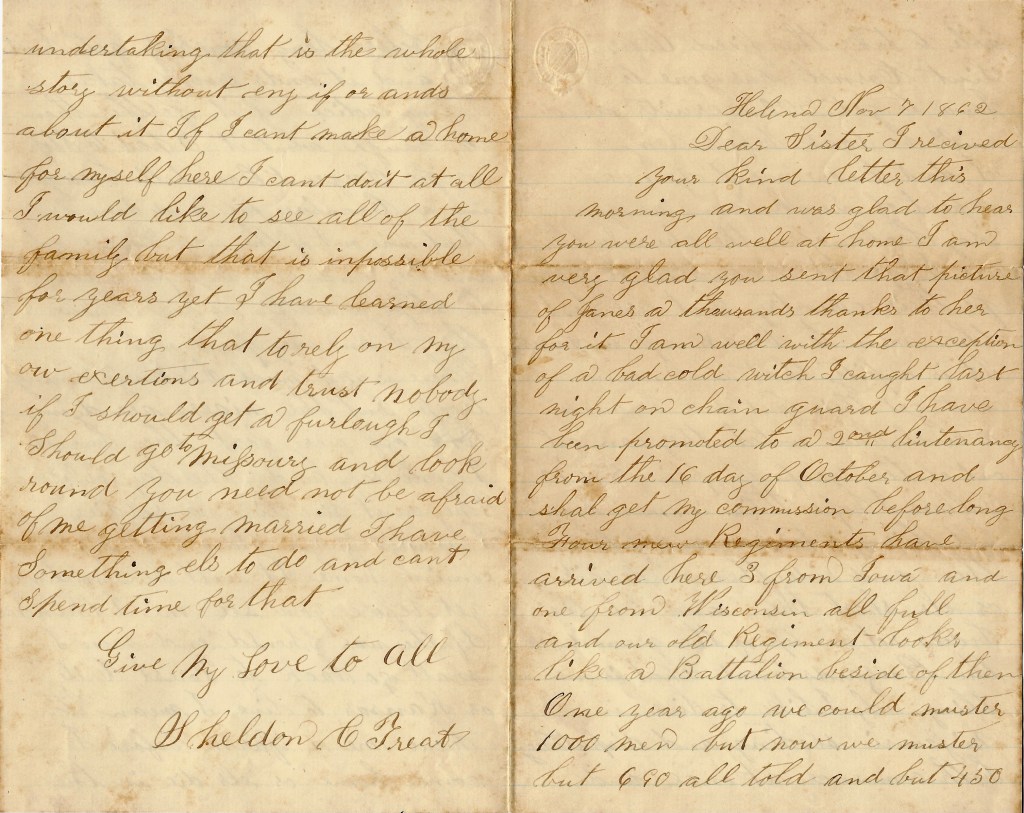
I received your kind letter this morning and was glad to hear you were all well at home. I am very glad you sent that picture of Jane’s. A thousand thanks to her for it. I am well with the exception of a bad cold which I caught last night on chain guard.

I have been promoted to a Second Lieutenancy from the 16th day of October and shall get my commission before long. Four new regiments have arrived here—3 from Iowa and one from Wisconsin—all full, and our old regiment looks like a Battalion beside of them. One year ago we could muster 1000 men but now we muster but 690 all told and but 450 able to take the field. Our Lieut.-Colonel has gone to Iowa to get 300 recruits and will be back before long.

I don’t know what you can expect of such men as you say broke open the church. They are too great a cowards to fight for their country but are just the men to break up a church. It is a pity that such men can’t get their just dues because of a civil law which they can get out of the scrape by paying 5 or 10 dollars. I hope there is men enough left there yet to tar and feather them and ride them on a rail or else shoot them and let their bodies rot on top of the ground for the buzzards to eat. That is one thing why I like to live in Missouri—shooting and disputing both commence at once and before long somebody gets hurt and it ends. Nobody takes any notice of it further than to laugh about it.

I had to stop a[while] for Sergeant Bramhall brought in a cranberry pie and soon as that was out of the way, Houser got another and as I love pie, I had to stop awhile as you know that I am very fond of it.

There is not much of sickness among troops but the niggers are dying off very fast. They buried 9 yesterday and 8 the day before. They can’t live like a soldier.

I wonder if you think of my coming home. It will be sometime yet before you see me. I think if the war should end soon, I shall go back to Forest City [Mo.] or Kansas to live. I mean to have me a farm before I come home or else die in the undertaking. That is the whole story without any if or ands about it, if I can’t do it at all.

I would like to see all of the family but that is impossible for years. Yet I have learned one thing—that [is] to rely on my own exertions and trust nobody. If I should get a furlough, I should go to Missoury and look round. You need not be afraid of me getting married. I have something else to do and can’t spend time for that.

Give my love to all, — Sheldon C. Treat


[insert transcription of 1863 diary here.]

The shelling of Fort Hindman

January 1—Left the Yazoo River on transport John J. Roe. Anchored in the Mississippi 6 miles from the mouth of Yazoo. Sick all day with the ague and fever.

January 2—Got under way at daylight and steamed up the river. Sick.

January 3—Going up the river. Had the ague.

January 4—Received a mail. Got $40 dollars from home. Going up the river.

January 5—Still going upstream. had the ague.

January 6—Lying still for wood and fresh provisions.

January 7—Started up again. Chills and fever still keeps me down.

January 8—Off the mouth of the Arkansas. Steamed up to the cut off from White river. Found the whole fleet here.

January 9—Ran through the cut off into the Arkansas river and up that to the post.

January 10—Landed on the east side of the river 4 miles below the fort [Fort Hindman]. Tried to out flank it but could not cross the bayou. Traveled all night and drove the rebels from their encampment.

January 11—At sunrise found myself asleep on the roof of a log house. Artillery opened on us at 8 a.m. Battle began at 2 and lasted till 4.30 p.m. Camped on the field.

January 12—Our tents got up at 12 noon and we went into camp. Broke up camp at sundown and marched to the lower landing. Rained hard all night.

January 13—Snowing hard this morning. We had no shelter and are taking it harrd. Stormed all day.

January 14—Ordered on board the steamer Hiawatha with the 9th Iowa. Went on board at 12 noon.

January 15—Went down the river to Napoleon, Stopped for mail and provisions.

[January 16-22—no entries]

January 23—Landed near Vicksburg and marched most all night. Camp below the town on the opposite side of the river.

[January 24-February 13—no entries]

February 14—Detailed in the Pioneer Corps of the 3rd Brigade, 1st Division, 15th Army Corps.

February 15—On duty in my company.

February 16—On duty in my company.

February 17—Received orders to organize my corps immediately.

February 18—Getting in my men all day. The 26th Iowa detail not reported yet.

February 19—My detachment all reported for duty. List of non coms, Sergt. Conrad Ditmore, 9th Iowa
Sergt. Joseph McQuiston, 26th Iowa
Corp. Benjamin Vanasdoll, 4th Iowa [Co. E]

February 20—Awaiting orders.

February 21—Awaiting orders.

February 22—Ordered to report to Capt. Klosterman of the 3rd Mo. I went did so and got some tools. Ordered to build log houses for my men.

February 23—Began my houses today. 1st Detachment cutting logs and one preparing the ground.

February 24—Working at the houses.

February 25—Still at my houses. Had teams from our regiment and 1 from the 9th Iowa.

February 26—The boys have been bringing in shakes for the roof.

February 27—Got two of my houses done today. A party stayed to watch our rations.

February 28—Rained all day hard. Roads impassable for teams.

March 1—Finished our houses up and moved in to them.

March 2—Working at the canal, building runs for barrows.

March 3—Working at the canal.

March 4—Still at the canal.

March 5—Building a carpenter shop.

March 6—Got it done in good shape.

March 7—1 year ago today. Fight at Pea Ridge.

March 8—Still at the canal. 1 year ago today, Price retreated to Van Buren with his army from the battleground at Pea Ridge.

March 9—The dam at the mouth of the canal gave away and the water overflowed the bottoms.

March 10—We will have to get out of our houses before long if the water continues to rise.

March 11—Had to move camp up the river to keep away from the water.

March 12—Got new tents for the boys and I will tent for myself.

March 13—Began the bridge from the levy to boats. Myself and Corp. McQuiston in charge.

March 14—Working at the bridge from the levy to the boats. Sergt. Auterburn and Corp. McQuiston in charge.

March 15—Working at the bridge from the levy to the banks. Sergt. Auterburn in charge.

March 16—Finished up the bridge from the levy to the boats at noon. In quarters all the afternoon.

March 17—Ordered to the canal to bridge the break in the levy. Sergt. [Conrad] Ditmore does the job.

March 18—Lieut. [Benjamin F] Darling from the 9th Iowa took the 2nd Detachment to day in place of [Edgar] Tisdale. Promoted to a QM of the corps.

March 19—Sergt. [Conrad] Ditmore and Corp. [Sterns D.] Pratt at the canal with 15 men.

March 20—Sergt. Ditmore at the canal with 15 men and Corp. Pratt.

March 21—Had a party on the canal. The enemy shelled them all day but done them no harm.

March 22—Went to the canal myself and finished up the bridge. Brought up a boat and turned them over to Capt. Smith on steamer Decta.

March 23—Send one party to open [illegible] railroad. Sergt. Auterburn in charge.

March 24—[purchases]

March 25—Not well today. Sent a party to the canal to repair bridge. Corp. Pratt in charge. 1 p.m., sent one part to the canal to repair [ ]. Sergt. Auterburn in charge.

March 26—At the canal myself all day. Levy nearly gone. Pulled several drifts to pieces and used them for breakwater.

March 27—Sent out 3 parties, two to canal and one for Capt. Jenney to out up stabling. Sergt. Authern, Corp. Pratt, & McQuiston.

March 28—Two parties at the canal. Sergt. Auterburn finished his job. Stood guard for the whole corps, 11 men and Corp. McQuiston.

March 29—Got up 7 o’clock and eat my breakfast. Going up to my regiment today. Had a dreadful storm last night. Had the day to myself.

March 30—Sent 1 part of 8 men to the cotton gin. Corp. McQuiston in charge. Paid out 250 for the mess.

March 31—Sent a detachment to the canal to work there myself. Ordered to put up a flag staff at Headquarters 15th Army Corps. Settled up my account with the mess due me for the past month. 80 cents. Richard Ballou detailed to take George Black’s place from Co. K, 4th Iowa. Reported April the 1st. Absent now sick. Abijah Lancaster, Co. J, 4th Iowa with his company at Young’s Point.

April 1—All fools day. Sent out two parties—one at the canal with Sergt. Ditmore and one with Sergt. Autburn for a pole to make a glag staff.

April 2—Sent out two parties—one to the canal and one for the flag staff. Corp. McQuuiston and corp. Pratt.

April 3—Two parties out. One at the canal and one brought in the flag pole and topmast. Staid in quarters.

April 4—Sergt. Ditmore and 8 men at the canal. Corp. McQuiston and 4 men on flag staff . In quarters all day.

April 5—Sunday. All my squad off duty today.

April 6—Turned out at 2 o’clock this morning to cut the railroad and let the water off canal. Levee broken at the upper end near the old levy.

April 7—Done but little all day.

April 8—Went to the canal with a party to fix the ferry boat.

April 9—Had the rheumatism.

April 10—Been over to shop. Up to camp.

April 11—Pole already to put up but the irons.

April 12—[no entry]

[The remainder of the diary is filled with post war notes.]


Letter 3

Camp on Black River, Mississippi
August 25 [1863]

Dear Sister,

It is a very nice cool morning here. Yesterday it was as hot as thunder and this morning overcoats and gloves are in demand. I have not received a letter from home since the 10th of this month and I shall block on this one till I do hear from there. I am a keeping old Bachelor Hall. All the rest have gone home on furloughs. I am the only officer left in the Brigade Corps. My turn will come sometime. It is dreadful lonesome in camp—not much to do—no books to read—nothing a going on to interest a fellow at all but to eat and sleep.

We are getting better rations than this army ever got before and enough of them. It is getting to be quite sickly here. Most everyone has got or had the ague and fever. But a very few die with it.

I hear that the 1st Brigade is losing men by the dysentery—quite a number having died last week. I should like to know whether Doct. is home yet or not and how he had endured the campaign. I don’t think he is tough enough for a soldier. It takes a good constitution to stand this climate. My head is getting gray in the service but my time is short now. I am mustered till 1866 on my last commission but I shall go out with my regiment next July if I live and nothing happens.

It is most dinner time and I am too lazy to write. Give my love to all.

Sheldon C. Treat, 1st Lieut.
4th Iowa Infantry
Commanding 3rd Brigade Pioneer Corps


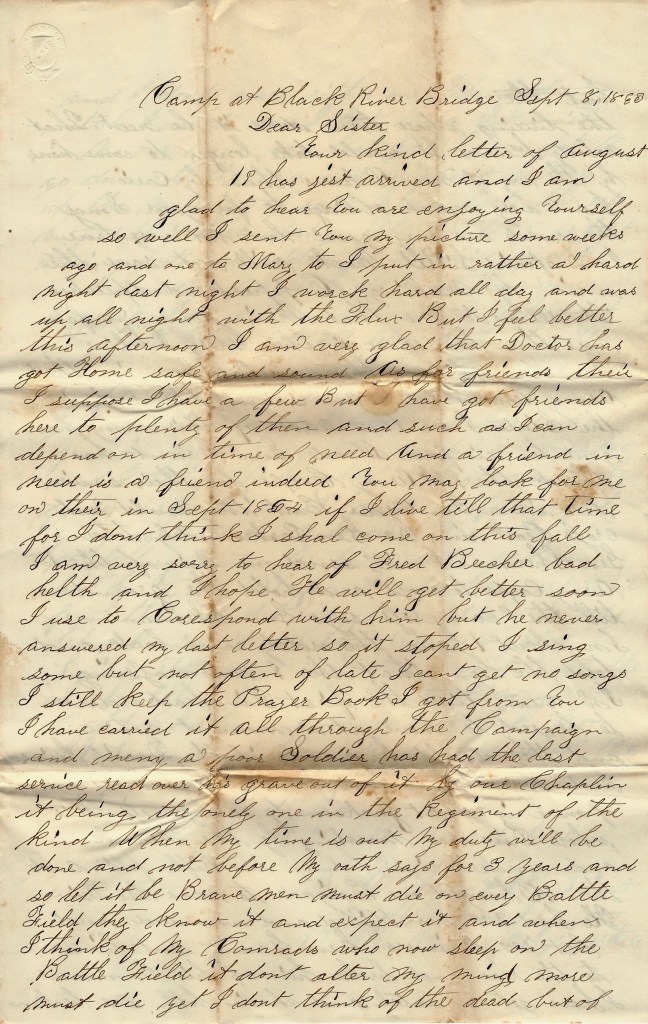
Letter 4

Camp at Black River Bridge
September 8, 1863

Dear Sister,

Your kind letter of August 19 has just arrived and I am glad to hear you are enjoying yourself so well. I sent you my picture some weeks ago and one to Mary too. I put in rather a hard night last night. I worked hard all day and was up all night with the Flux but I feel better this afternoon. I am very glad that Doctor has got home safe and sound. As for friends there, I suppose I have a few but have got friends here too—plenty of them—such as I can depend on in time of need. And a friend in need is a friend indeed.

You may look for me there in September 1864 if I live till that time for I don’t think I shall come on this fall. I am very sorry to hear of Fred Beecher’s bad health and I hope he will get better soon. I used to correspond with him but he never answered my last letter so it stopped. I sing some but not often of late. I can’t get no songs. I still keep the prayer book I got from you. I have carried it all through the campaign and many a poor soldier has had the last service read over his grave out of it by our chaplain, it being the only one in the regiment of the kind.

When my time is out, my duty will be done and not before. My oath says for three years and so let it be. Brave men must die on ever battlefield. They know it and expect it and when I think of my comrades who now sleep on the battlefield, it don’t alter my mind. More must die yet. I don’t think of the dead but of the living. Whose turn will it be next? That nobody knows. It would take longer to come home by the way of New Orleans than by Cairo.

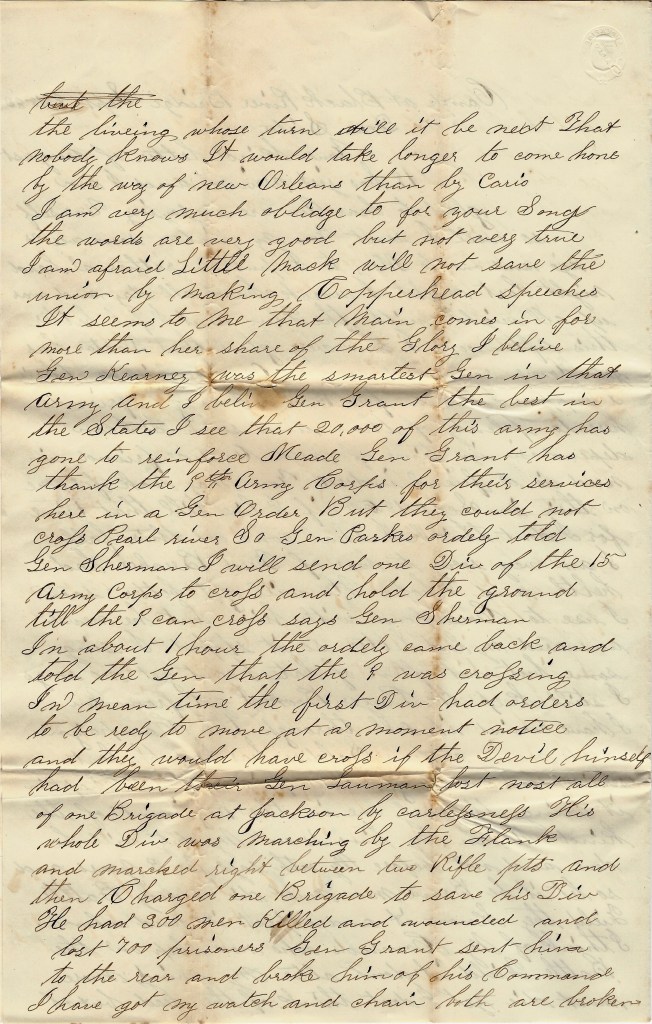
I am very much obliged to you for your song. The words are very good but not very true. I am afraid Little Mac [McClellan] will not save the Union by making Copperhead speeches. It seems to me that Maine comes in for more than her share of the flory. I believe Gen. [Philip] Kearny was the smartest general in that army and I believe Gen. Grant the best in the States. I see that 20,000 of this army has gone to reinforce Meade.

Gen. Grant has thanked the 9th Army Corps for their services here in a General Order but they could not cross Pearl river so Gen. Parkes’ orderly told Gen. Sherman I will send one Division of the 15th Army Corps to cross and hold the ground till the 9th can cross, says Gen. Sherman. In about one hour the orderly came back and told the Gen. that the 9th was crossing. In meantime, the First Division had orders to be ready to move at a moment’s notice and they would have cross if the Devil himself had been there. Gen. Lauman lost most all of one Brigade at Jackson by carelessness. His whole Division was marching by the flank and ,arched right between two rifle pits and then charged one Brigade to save his Division. He had 300 men killed and wounded and lost 700 prisoners. Gen. Grant sent him to the rear and broke him of his command.

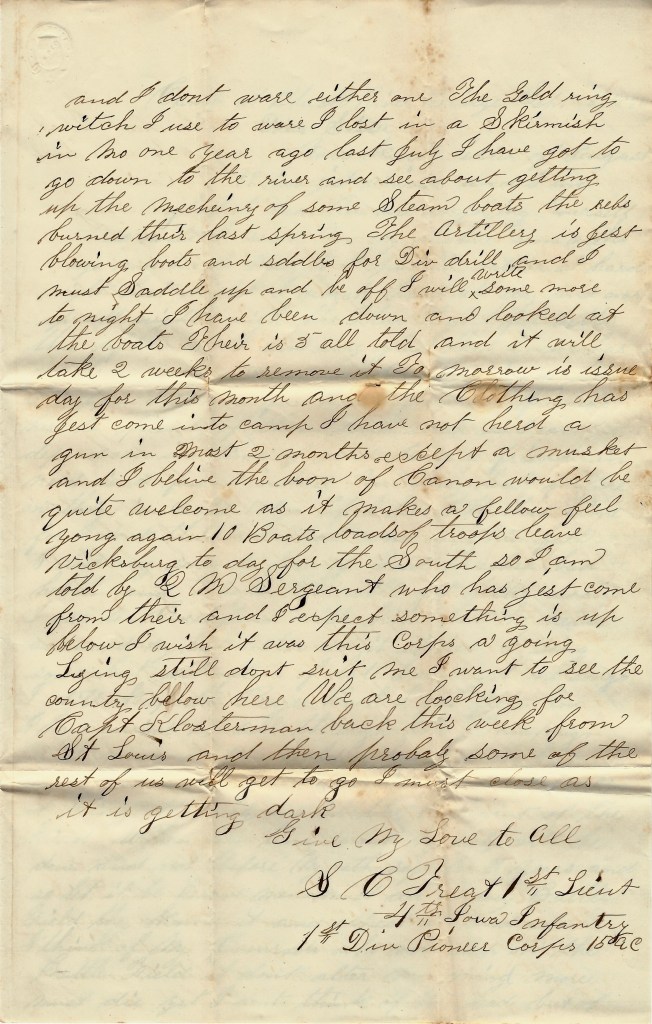
I have got my watch and chain. Both are broken and i don’t wear either one. The gold ring which I used to wear I lost in a skirmish in Missouri one year ago last July. I have got to go down to the river and see about getting up the machinery of some steamboats the rebs burned there last spring.

The artillery is just blowing Boots & Saddles for Division drill and I must saddle up and be off. I will write some more tonight.

[Later]

I have been down and looked at the boats. There is 5 all told and it will take two weeks to remove it. Tomorrow is issue day for the month and the clothing has just come into camp. I have not heard a gun in most two months except a musket and I believe the boom of cannon would be quite welcome as it makes a fellow feel young again. 10 boat loads of troops leave Vicksburg today for the South so I am told by the Quartermaster Sergeant who has just come from there and I expect something is up below. I wish it was this Corps a going. Lying still don’t suit me. I want to see the country below here.

We are looking for Capt. Klosterman back this week from St. Louis and then probably some of the rest of us will get to go. I must close as it is getting dark.

Give my love to all. — S. C. Treat, 1st Lieut., 4th Iowa Infantry, 1st Div. Pioneer Corps, 15th AC