The following letter was written by William Halstead Kipp (1839-1918), the son of Quinby Kipp (1801-1887) and Cornelia Ann Halstead (1807-1883) of Manhattan, New York County, New York. In the 1860 US Census, William was enumerated in his father’s household, laboring with an older brother in his father’s wheelwright shop.
During the Civil War, William served in the 7th New York State Militia (or National Guard). This letter, datelined from Fort Federal Hill in Boston in June 1863, was written during the time his regiment was called out to meet the emergency of the anticipated rebel invasion that culminated in the Battle of Gettysburg less than two weeks later. In his letter, he refers to having been called out and posted at the same fort during Lee’s Maryland invasion in 1862. William’s obituary informs us that he rose steadily in rank from private to sergeant during the war and afterwards, to (State Militia) Colonel in 1895.
Kipp was married to Emily Augusta Hyatt in 1865 and at earned his living as an insurance agent after the war until landing a job in the New York City Police Department. He is credited with having designed the flag of the NYC police department in 1917, one year before his death.
In this letter, Kipp shares the reports of Lee’s invasion and the rumors that Baltimore was the intended target. He observes that the secessionists living in Baltimore were noticeably more prominent and insulting to the soldiers with the news that Lee’s army was approaching. He also speaks of the measures taken to bolster the city’s defenses.
[Note: This letter is from the personal collection of Greg Herr and was made available for transcription and publication on Spared & Shared by express consent.]
T R A N S C R I P T I O N
Fort Federal Hill Baltimore, Maryland June 20, 1863, 10 o’clock p.m.
Dearest Em.
It is not the strangest thing imaginable that we are again located in this old fort. If any person had told ne one week ago that we would again find ourselves here, I should have thought them crazy for I did not dream that such a thing could occur. It is certainly a singular circumstance that now for two years we have started for an entire different locality & finally brought up here.
Our boys are very much dissatisfied with it & yet it cannot be helped. We but obeyed orders in doing as we have done. We left New York with orders to report to Harrisburg but upon arriving in Philadelphia, we were ordered here by General Halleck as you have no doubt seen by the Herald which had all the orders published in full. Although some of our city regiments have gone on to Harrisburg, yet we feel highly complimented by being so far noticed by the War Department as to receive the order bringing us here—for the affair at Harrisburg has proved to be only a feint to cover up the real design of the enemy which has yet to be developed.
It is generally supposed that the main point of attack will be Baltimore. We have received news that the enemy is moving in four columns, one of which has advanced to within 40 miles of this place and is still advancing. So I really think that we will yet see warm work.
Tonight we received orders to drill our men thoroughly in the use of our heavy Columbiads. Tomorrow we send detachments 7 miles out to guard three bridges crossing the Patapsco River. Rifle pits are being dug outside the city & barricades are erected in the streets on the city limits. All is excitement here. Secessionists now speak their mind more freely than ever before & are ten times more insulting. Yesterday we sent a detachment to guard 1200 rebel prisoners on their way to Fortress Monroe & evidences of sympathy with them were openly exhibited by the people in the streets.
Our fort is anything but a pleasant place to live in for we are almost bodily carried off by bed bugs & lice. Yet one must stand it for a little while & are hourly expecting the order to carry us to the front. The boys seem to feel that this time they will not have to return to New York without having a little service & something to remind them that they do not wear a uniform for displaying themselves on Broadway only
I should not be surprised if in a very short time we should find around us heavy reinforcements for certainly if there is any foundation to the news we hear, we wil need a larger force here. The place looks so natural to me that really I cannot realize that it is most a year since I left it as I then thought never to see it again. It seems like a dream to me that will soon pass over. But I guess that the reality will soon convince me that it is not all a dream.
Oh Em, what would I not give just to see you for one moment. The only regret I have in being away is that I cannot have your society. But still we will not be away longer than 30 days, I think, unless this emergency still continues. If the force now advancing should consist of a large number, then Gen. [Robert C.] Schenck might possibly surrender the town & of course take us with them & we might thus have a chance to see Richmond though in a little different style from that which I would prefer.
I would have written you a long letter before this but have not had the chance. Our men have more chance to write than I for I have to drill different squads on the Columbiads. It keeps me busy all the while & when night comes around, I am so tired & sleepy that I go to my quarters & turn in, glad to get a little rest.
After I left you and on our whole journey here, I could only think of the dear one I had left behind. I shall never forget with what pain we separated & I hope never to have such misfortune again. Oh Em, when I left you, I parted with the dearest thing on earth to me—your society. How I miss your kind words, your gentle caress. Yes, even your reproofs I loved to listen to. While writing, I think of how different I now feel from last year. Here in just this place I wrote to you, but then, even though we felt this affection for each other, yet we could not make each other happy by telling it until by one great effort I resolved to break the barrier and trusting everything I held most dear in life, any aim, hope, & ambition to a letter in which I told my love. How anxiously I awaited your reply. And when it finally came, words cannot express the happiness I then experienced.
Since that time we have been together continually & every time I met you, it was only to strengthen my love. The good influence of your society, Em, has its effect in many things, as you know. I always feel it when away from you and rest assured Em that I shall heed it now. When I return, I shall know how to appreciate your [company].
Last night seemed anything but Sunday night to me. I thought of our old seat by the window & wished that I was there [if] only for a moment to rest your head on my shoulder & then if we had any troubles, what pleasure we could talk them over together & they seemed to lighten immediately. Em, those were happy moments. I pray that we may yet meet to have them again.
I cannot write more now. Write soon a good long letter for I am very, very anxious to hear from you. Direct to this place & put on the bottom of the envelope, “or elsewhere.”
My love to all & ever for you the blessing & prayers of your own, — Will
These letters were written by Lt. William Henry Thurston (1838-1924), the son of Isreal Thurston (1809-1888) and Abigail Persing (1817-1892) of Shamokin, Pennsylvania. William worked as a blacksmith before he enlisted and was mustered into service on July 8, 1861 as a private with the Forty-Third Regiment, Battery F, 1st Pennsylvania Light Artillery. He was promoted to 1st Lieutenant on April 22, 1865 and mustered out with the Battery on June 9, 1865.
He wrote the last two letters to his fiancé, Laura Morgan (1845-1928), whom he married in 1865. Laura was the daughter of John Campbell Morgan (1818-1887) and Mary Catharine Weimer (1825-1885) of Sunbury, Northumberland county, Pennsylvania.
At Gettysburg, Capt. Robert B. Ricketts brought 144 men to the field on 2 July 1863 serving six Ordnance Rifles. During the battle they suffered 6 killed, 14 wounded, and three missing. They took a position on Benner’s Hill and at dusk they repulsed a Rebel assault upon the battery in desperate hand-to-hand combat after every round of canister had been fired. The newspaper clipping indicates that Thurston was recognized for his bravery in the action.
Letter 1
[Note: This letter is from the collection of Robert May and was made available for transcription and publication of Spared & Shared by express consent.]
Camp near Rappahannock Station August 6, 1863
My friend Louisa,
Yours of the 1st August came to hand this evening. I am much pleased to hear from you again but I am sorry to hear that you are not well. I hope you will be all right soon. I am well and the men in our company are, in general, healthy. The weather is very warm. We can’t hardly live, water is poor and scarce. I would like to have a goo drink of water from home.
I am thankful to you for sending me the directions to Henry. I will write to him this evening. I have not received any letters from home lately. The last I heard from them they were all well. I suppose you have some fine times having picnics and parties. I would love to see my friends all once more but when, if ever, it will happen.
I suppose you will and have heard of the great Battle of Gettysburg. I received a slight wound in my shoulder but it is almost well and I am doing duty again for which I feel thankful. We expect to have more fights soon. Our men are fighting every day.
I must soon close my poor and short letter and you must excuse me. My paper is poor but the best that I can get so you must excuse it. When you get this, please answer and tell me all the good news. Give my love and best to your family and friends. From your friend, — W. H. Thurston
Direct Battery F, 1st Pennsylvania Artillery, 2nd Army Corps, Washington D. C.
Letter 2
Camp near Petersburg January 8, 1865
My own dear Laura,
I am now writing in Fort Stedman — the battery is moved. Lieut. [John F.] Campbell, Headquarters, is here. ¹ [Lt. Henry] Wireman is in Battery 11 & my section is in Battery 14. I am staying with Lieut. Campbell to spend the evening and tell him of home. I did not arrive in camp until 12 m. today. They thought me lost. I am quite well this evening but my thoughts wander homewards. Months must elapse before I will become of my trip. I wish more to come more than ever. Was it not for the pleasant time I spent with you, I would almost regret coming. Still I must try and forget it and be more content.
The weather is quite cool but no snow. Mud has been abundant until last night when the ground froze solid. Piquet firing has abated to some extent — quiet prevails along the entire line save an occasional shot fired by some sleepless sentries.
I have no news to relate from the Army. [John] F. Campbell has a bad cold. [Henry] Wireman, I think, is writing a letter to Amelia, and poor W. to L. They have asked so many questions that I am tired. I have declined answering until tomorrow. You should have seen the boys flock around me. I was tired shaking hands. All had questions to ask. Poor fellows — how I wish they could all go home and pass a pleasant time. They seemed to think I had seen all their friends when I had no more than seen a few and breathed the pure air in Old Pennsylvania. That seemed to give them some pleasure and to hear me tell what I had seen and done. I could not tell them all. No neither could I tell them what my sad heart experienced when I paced them ever memorable steps toward the depot and when the train hurried me from her who I so tenderly love. The present crowded my mind to such an extent that I could scarcely overcome them when I gave you the parting kiss. No one could tell what I felt. I could not bear it but I was not unprepared to meet its advent. I thought of returning before I came home and knew it required a stout heart and strong mind under circumstances to overcome it. But I am back again and must think of something else part of the time.
I intend going out visiting next week to see Brother ² and Lieut. [Lemuel] Shipman ³ and some more of my friends. I will tell you all about it when I return.
I suppose you have received your New Years gift ‘ere this. I did not know what to send you that might please you. I seen them and thought them pretty. They are called an Indian fan, made at Niagara Falls. Say providing you don’t like it, it will do to look at and think of poor me.
Laura, say, I have been telling the boys what nice times I had when at home. I think I told them I helped to devour one half score of turkeys and gooses and more hens and roosters than I could remember — a pretty story, don’t you think, for me.
Ad in the Daily National Inteligencer for Ford Theatre on Monday, 2 January 1865: Damon & Pythias featuring Edwin Forest played.
I left Sunday, or Monday morning, 2d January 1865. Did not [feel] well. After a tiresome ride, I arrived at Baltimore by 6½ P.M. I immediately looked after a [omni]bus to convey me to Washington Depot. I did not look long when I heard a darkey cry out at the top of his voice, “Did way for Washington!” I soon found myself quite comfortably seated in a stage coach when the driver cracked his whip and soon landed us safe to our awaiting train. I had scarcely seated myself when the train started. The train arrived there 7½ o’clock. I mounted an [omni]bus and went to the United States Hotel. Supper was waiting. I ate some and then started in company with some officers for Ford’s Theatre. The plays were good but I did not enjoy them for reasons I have stated. I went back to the hotel and went to bed but could not sleep much.
After breakfast, I went to the Provost Marshal to procure a pass to join my company when to my surprise I received an order to report to Rendezvous of Distributions and take a detachment of men to City Point. Here my trouble commenced — to be responsible for a lot of men I could not think of but I reported on Tuesday, the 3rd. It was quite dark when I arrived at the camp. Here I met Luther Harrison. He was good company for me. He asked all about you. He told me that you had written a line to him in his mother’s letter which was right that you should so so. Well, I remained that night and the 4th and the 5th until 12 o’clock m. when I started with 88 men for Alexandria to take the mail boat for City Point. We arrived there [Alexandria] at 3 P.M. Here came the tug of war. A____ the mail boat is out of repair and you must wait another day, and since I am getting blind with sick headache, the men helped me back to the Soldier’s Rest. Then I wished for some one to rest my weary head. I was so sick I thought I could not live. One of the men went out and found me a place to sup at the hotel. They put me to bed [and] I soon fell in a stout sleep and did not awake till sunrise when I felt much better.
I had a good warm breakfast. I did not go out much as it rained all day. We remained in the City till 3 P.M., Jan. 6th when we spied the Dictator gliding over the blue waters of the far-famed Potomac [river]. She moored alongside the Quay and soon we were all on board and off she steamed for Dixie. Soon it grew quite dark, fog commenced to hover around us, and the Captain anchored the boat until the fog disappeared. About 11 A.M. we got under way and the next I knew the boat run aground on a sand bar and here we lay till 9½ A.M., 7th January. After strenuous exertions the boat started on its perilous journey. We soon came out in the Bay [where] the winds seemed to be all abroad [and] dashed against the vessels side, shaking her from stem to stern. She reeled and rolled. The passengers became sick. I was compelled to lie down but our little Bark seemingly was destined to outride the storms which threatened to swallow up our noble little ship with so many precious souls and land in safe on shore. We arrived at City Point at 4 A.M. this morning. O, I was so glad.
Monday [January] 9th 1865
I will write a few lines more and close my poor rambling letter. The sun shines warm and bids fair to be a pleasant day. I am so homesick this morning. I wish more for home than when I started but I hope to become more reconciled in a few days. The Boys in my Section are putting me up a house and I must go and superintend the job. Campbell expects to come home soon. He also looks for his Captaincy every day.
I will enclose ten dollars which you will please give to your Papa for me. He paid my subscription for the Democrat and I forgot when I left to pay him. I will write to him soon. Remember me to Grier’s family and yours. The letter you had reference to I found here when I came — also a number of others.
I must now close. Please write soon. Don’t forget to tell me when you received the last billing and anything that could be interesting to me. I still remain yours with much love. — W. H. Thurston
Lieut. Battery F, 1st Pa. Artillery, 2nd Corps, Washington D. C.
¹ Lt. John F. Campbell (1840-1902) succeeded Ricketts as the captain of the Forty-Third Regiment, Battery F, 1st Pennsylvania Light Artillery, in April 1865. He is buried in Augustaville, Northumberland county, Pennsylvania. John Campbell was most likely a distant cousin of Laura Morgan’s whose fraternal grandmother was Charity Campbell.
² Possibly Silas Thurston (1842-1923) who served withe “Bucktails” in the 149th Pennsylvania Volunteers.
³ Lt. Lemuel Shipman (b. 1838) of Sunbury, Pennsylvania, entered the service as first sergeant of Co. D, 3d Pennsylvania Heavy Artillery, 152nd Pennsylvania, in October 1862. He was promoted to lieutenant in May 1864.
Letter 3
Headquarters Battery No. 14 February 25th 1865
Dear Laura,
Yours of the 19th came to hand last night. I was pleased to hear from you again. I am well as usual and will not complain. I wrote to you on the 23rd which no doubt you will get ‘ere this. I had not heard from you in so long and I thought it my duty to write. I still remain in Battery No. 14 and expect to stay some time although we have marching orders. But I think I will not move for some time to come.
I had the honor of firing a shotted salute yesterday in honor of the fall of Wilmington, North Carolina. There were a large crowd of men collected to witness it. I had no accident and it went all well and good. The Army seems to be in good cheer and I think the next fight we make will be a telling blow to the Rebs. We will have some hard fights but I think ’tis safe to say the end is drawing nigh. The Rebels are deserting by hundreds which must soon deplete their ranks. They are without a doubt hungry and tired of fighting. They are also ragged and dirty with forlorn looks and are objects of pity.
Two men had their heads blown off yesterday close here with mortar shells — members of the 51st Pennsylvania. They lay in their tents sleeping at the time which this death monster fell among them. It was a shell 8 inches in diameter which exploded with a great noise. ¹
I am sorry to hear that Becca B. is not so happy as she once was but I suppose ’tis with them like many others — the honeymoon has past into the shades of oblivion and that long expected life of bliss has not been realized. But this generally happens when least anticipated. Those who think they can best agree soonest dispute and live unpleasant, but I hope ’twill not be so with me and some one.
I perceive you don’t like to sit up at a wake. I have a wake all the time. There are plenty of dead buried only a few feet from my tent that fell on the 17th June 1864, but we are used to this and don’t think of it.
Don’t forget to tell Miss Huldah she had better get them teeth and spell me that answer or I will wool her as __ fate.
You say your good old friend Ellen came to see you once, and she talked over my pictures. She must have admired them. What has become of Louisa and John? I did not see them last winter. I seen Ellen at the party at home but had no chance to talk with her. I suppose she is the same as of old.
I must close and go to camp for supper. ‘Tis raining fast and I will get a little wet but no matter. I am used to the storms of Old Virginia.
Remember me kindly to all your family. Also Grier’s. I will look for an answer soon. I remain your best friend and devoted W.
— Lieut. W. H. Thurston, Batty F, 1st Pa. Art.
¹ One of the two soldiers was John Blyler (1845-1865) who enlisted in Co. G, 51st Pennsylvania in February 1864. He was the son of Absalom Blyler (1803-1863) and Catharine Heimback (1812-1857) of Penns Creek, Snyder county, Pennsylvania. A Certificate of Death for Blyler states that he was “killed by enemy by a piece of mortar shell passing directly through his head while in his tent in camp in front of Petersburg, Va. on February 24th 1865.
A double exposure image of Amos C. Plaisted wearing both military and civilian clothes. It was most likely taken just after he was discharged from the service, demonstrating his return to life as a civilian.
The following memorandum of the Battle of Gettysburg was written by Amos Chatman Plaisted (1844-1902) of Co. B, 15th Massachusetts Infantry. Amos was born in Dec 1844 at Haverhill, Grafton County, New Hampshire, son of Elisha Plaisted (1805-1873) and Hannah B. Huntley (1821-1847). At the time of his enlistment in July 1861, Amos gave his occupation as “machinist.” On his way to war, Amos wrote his parents, “We had a first rate time all the way from Worcester. We came through Connecticut, New Jersey, Pennsylvania, Delaware and Maryland — so I have seen many of the largest cities in the union, and now I want to fight and have the war settled! then I shall be contented to settle down in the shop again. But don’t worry about me, for all I want is strength to do my duty, and if I fall — so be it!”
It is my opinion that this memorandum was written some years after the war and for the benefit of his son, Edgell R. Plaisted (b. 1870). My guess would be that it was written about 1890. It was found in a scrapbook kept by Amos and acquired recently by Paul Russinoff who made it available for transcription and publication on Spared & Shared by express consent.
In the mid-1880s, the 15th Massachusetts infantry placed their monument on the battlefield at Gettysburg just south of the copse of trees where its members were fighting at the time that “Picket’s Charge” was ultimately repulsed. It was later determined by the Gettysburg Battlefield Memorial Association that regimental monuments should be placed on the battlefield where the regiments first lined up in battle formation, not where they ended up, so the 15th Massachusetts monument was relocated to a point some 200 yards further south on the Federal line. This ruling did not sit well with some of the veterans of these regiments who helped turn back the Confederate assault near the copse of trees and wished to see their monuments remain at the center of the action. Memoirs such as this by Plaisted may have been written in part to make certain historians did not forget their contribution in winning the day.
A sketch of the Gettysburg Battlefield showing the placement of the 15th Massachusetts, drawn by Amos C. Plaisted of Co. B. This sketch was pasted into his scrapbook.
T R A N S C R I P T I O N
Gettysburg. After the fight we were four men for duty out of 22. Eleven were taken prisoner July 2nd when we fell back from the Brick [Codori] House through Battery A. My face was burned by powder and some of the regiment was killed by our own guns. They fired on many when we were all mixed up together.
John Marsh, Co. B, 15th Mass. Infantry
July 3rd, four were killed, three wounded and [George] Cunningham and I were with Peckham and [Flavel] Leach only were unhurt. We found the body of [John] Marsh near copse of trees with a McClellan medal fastened on his coat that had worn ever since Little Mac left us. We sent it to his father at Bedford, Mass. I marked a board so we left his grave marked and is now known.
As Longstreet’s Division charged upon copse of trees, our line fell back and my Brigade was sent up double quick to close the gap and check further advance. We got into the gap in a huddled mass and as we stood there firing upon the enemy who were now secure behind the wall and cutting us down fast with their flag planted on the wall, Jim Tenny [of Co. B] said to Cunningham, let us charge on them; they cut us all down if we stand here. Then Cunningham called out, “For God’s sake, let us charge on boys!” and we acted on the suggestion at once and as we neared the wall, the rebs broke and run. I was by the side of [Sgt. William Henry] Savage of Co. A when he fell and saw no one else near but in the excitement and smoke it is probable that many were all around near us—at least it is not probable Savage and I were alone or ahead in the charge which was done by at least a very few hundred men.
Col. Norman J. Hall commanded the 3rd Brigade, 2nd Division 1st Corps
Our Brigade was not over 1,000 and the 15th [Massachusetts] flag was the first to advance though Gen. [Norman J.] Hall called out as we started for the wall, “Forward, that there color!” I thought it was one of his regiments and history gives to credit [writing illegible] which is false …of my company and in fact [ ] that I was at the wall myself and that [ ] was with my regiment and brigade and that the 15th [Mass.] flag was first to advance is clear proof that we done that job through a flank fire on the enemy’s right. The continuous [weakening?] all round had much to do towards making our advance to have effect. Yet what must have been had we not charged is uncertain. Surely at that moment it looked very much as though the enemy would hold this ground gained and perhaps win the day.
Certain it is had Hall ‘s men first advanced, I could not possibly [have] got near the wall and the colors and men would not have been near the place where our dead were found after the battle. The fact that your father was at that wall at that time is ever be your pride. It is more valuable than any honor that could be bestowed through at the time I regarded it a mere circumstance in which I happened to be mixed up in.
Col. Ward of the 15th Massachusetts
Additional notes by Amos C. Plaisted:
18 men of Co. B were 18 years of age 19 men of Co. B were 19 years of age. Oldest man 47; youngest boy 17. One quarter (26) of Co. B were brothers. At Gettysburg, July 3rd, everything third man was killed. Of four unhurt (at Gettysburg), I was hit in thigh and bespattered with brains of [George Fergo] Fletcher of Co. H 1 and Cunningham had a mirror smashed by a bullet; thus but two were not hit.
More photographs from Plaisted’s Scrapbook. These include (left to right) a post-war image of him; a photograph of the cannons with his caption, “my retreat July 2nd at Gettysburg was between these guns, powder burned my face;” and several images of his comrades including Flavel Leach (lower left), “one of the four men left for duty after Gettysburg.”
Excerpt from the 1863 Diary of James Hamilton Mills, 11th Pennsylvania Reserves
James Hamilton Mills just before the Civil War
The following excerpt of the Gettysburg Campaign comes from the 1863 diary of James Hamilton Mills (1837-1904) who was a native of new Lisbon, Ohio. He was working in “mercantile and mechanical pursuits” until the Civil War when he enlisted as a private on 27 April 1861 in Co. G (“The Independent Blues”), 11th Pennsylvania Reserves (40th Pennsylvania Infantry). With his regiment he participated in twenty seven general engagements of the Army of the Potomac, and for “gallant conduct on the field” he was promoted to corporal, first sergeant, first lieutenant and captain and for “heroic conduct in the Battle of the Wilderness and Bethesda Church” he was commissioned brevet-major and brevet-lieutenant colonel. He was mustered out of service at Pittsburg on June 13, 1864.
During the Gettysburg Campaign, Mills served as the 1st Lieutenant of his company. Following the battle, on 17 August 1863, he was promoted to Captain. The monument of the 11th Pennsylvania Reserves on the Gettysburg Battlefield is located on the east side of Ayers Avenue just south of Wheatfield Road. On the back of the monument, It reads: July 2nd in the evening charged from the hill in rear to this position and held it until the afternoon of July 3d when the Brigade advanced through the woods to the front and left driving the enemy and capturing many prisoners.
Mills’ 1863 diary is among several diaries of his that are housed at the Montana State Library. It has been digitized recently but apparently never before transcribed and published. I have not shown the images of the diary pages since these can be viewed on line at James H. Mills diary, 1863.
James Hamilton Mills’ 1863 Diary(Montana State Library)
T R A N S C R I P T I O N
Sunday, June 21, 1863—We have been on the qui vive all day. Expecting a fight. Heavy firing from ten a.m. until 7 p.m. in the direction of Aldie. It is likely our cavalry at Thoroughdare Gap. Wrote to Hattie & D. W. Hoppstot. Preaching at 10.30.
Monday, June 22, 1863—Very pleasant today. The roads are in excellent order for marching. The firing yesterday was a cavalry fight. Pleasonton attacked the Rebel Stuart at Middleburg and drove them to Ashby’s Gap, holding the field and capturing 2 guns, 3 caissons, small arms, and prisoners. Our cavalry is beginning to be of service.
Tuesday, June 23, 1863—A little warm. Today we received orders to prepare to march at a moment’s notice.
Wednesday, June 24, 1863—Everything quiet in the forenoon. An inspecting officer from Gen. Heintzelman was around during the day and professed ignorance of our having orders. We were congratulating ourselves on it being a false alarm when at dark an order came to march to Upton’s Hill and so I suppose our play day is over and we are again to go to the front. Letter from Eliza English.
Thursday, June 25, 1863—Left camp at 9 last night and marched to Upton Hill. Reached there at 2 a.m. & camped on the drill ground this morning. It was very uncertain about us moving but about 2 p.m. we fell in and marched up the Leesburg Pike to the crossroad to Fairfax Court House and camped in pine woods. Only the 3rd Brigade is here. The 1st is to join us here tomorrow & the 2nd is to remain at Alexandria. Lucky 2nd.
Friday, June 26, 1863—2nd Brigade joined us at midnight. It rained all the night and only held up this evening. We started a little after 6 this morning and after making a great sound, came on the pike again and marched as far as Broad Run. The march was very severe and the curses of the men were plenty. Received a letter last evening from Hanna & Ramsey. Miss Annie [Jones], the ex-cavalryman is in the Old Capitol [prison] having been caught outside the lines. 1
Saturday, June 27, 1863—Reveille at 4 a.m. Broke camp at 5.30, marched about 4 miles & crossed the Potomac river into Maryland at Edward’s Ferry. Marched some 8 or ten miles up the Potomac and camped for the night. It has rained off and on all day. The roads are not very muddy but the men were very much fatigued. Rumor today that the Rebels have taken Harrisburg. Issued knapsacks and canteens.
Sunday, June 28, 1864—Took a 5 o’clock start this morning. Crossed the Monocacy [river] on a stone aqueduct and marched 10 or 12 miles and camped in the 5th Corps, of which it is supposed we will be the 3rd Division. Gen. Hooker was relieved of the command and Gen. Meade superseded him. Saw R. Townsend. Iti s rumored this evening that we are to march on to Pennsylvania in the morning. A rumor is current that Vicksburg is taken.
Monday, June 29, 1864—Was ordered to be ready to start at daylight this morning. We were up and had tents down just in time to be dry. The rain fell in heavy showers for the remainder of the day. We did not get started until 1.15 o’clock and were delayed until after dark when we made a rush ahead and nearly run ourselves down. Camped for the night at 11 o’clock on top of a range of high hills some 8 miles east of Frederick. Marched through a fine valley.
Tuesday, June 30, 1864—Woke up this morning soaking wet. We did not put up tents last night and the boys were all soaked this morning. Marched very hard today. I was sick and had to ride in the ambulance in the afternoon. Passed through Uniontown, Liberty, and Union Bridge. Camped with 3rd Corps near Uniontown at dark and were mustered for pay at 8 p.m.
Wednesday, July 1, 1863—Left camp at 6 this morning and about 1 p.m. crossed the line into Pennsylvania. Addresses were issued from Division & Brigade commands before crossing and the boys gave three good cheers for Pennsylvania. Stopped five miles south of Hanover. Rations were issued and the wagons sent to the rear. Ammunition inspected and everything in readiness for a fight. There is a fight today at Gettysburg.
Thursday, July 2, 1863—We started at 9 last night and marched until 2 a.m. Men very much fatigued. Turned into a meadow and slept until 5 a.m. Started again and made a hard march to Gettysburg where are now at 1 p.m. Both armies are here and there will be a terrible fight today or tomorrow. 8 p.m. Sure enough we had it today. We arrived in time to save the field. Made a most brilliant charge and drove the rebs as far as the General would let us go. Am on the front skirmishing.
Friday, July 3, 1863—We lost last evening in killed Graves Gallagher. Wounded, S[amuel] L. Potter, Jas. N. Maguire, W[illiam] D. Scott. Held a strong position all day and wanted the rebs to attack us. The great battle was fought today on the right. We gained the day. Took 8,000 prisoners. Made another charge this evening and drove them 1.5 miles. Took many prisoners, one color (15th Georgia) and over 3,000 arms. We are fighting wit hthe 1st Brigade. Are lying tonight a mile in the advance. A very heavy rain after dark. All nearly dead.
Saturday, July 4, 1863—This is a glorious 4th of July. The rebs were whipped all along the lines yesterday and they will have to retreat or be cut to pieces. Gen. Meade is trump with the army and Crawford suits us exactly. We came back to our old position at the stone wall and after standing a most drenching rain, were relieved and taken up on the hill. We lay down on the wet ground and slept soundly.
Sunday, July 5, 1863—Very wet all last night and most of today. We lay quiet until about 5 p.m. when we fell in and marched down around the right flank of the rebs, and halted about 11 o’clock. The roads were terrible but the men are in good heart and kept up well. The rebs are falling back having been completely whipped.
Monday, July 6, 1863—We marched a few miles today and camped. The men are scouring the country in search of extras to eat. I never saw the Army of the Potomac in such good spirits. All are anxious to push on and give the rebs another whipping before they succeed in leaving Pennsylvania. Went to a mill near and got two canteens of old rye for the boys.
Tuesday, July 7, 1863—Started at 7 this morning and made a very rapid march of over twenty miles down the south side of the Blue Mountains. We are heading toward Frederick. The roads are very heavy but I have not heard a grumble from a man. We camped about 5 miles from Frederick and received a mail.
Wednesday, July 8, 1863—It rained all last night and until noon today in torrents. We never made as hard marching go. Crossed the first range of the Blue Mountains and camped near South Mountain and Middleburg. Received official news that Vicksburg was surrendered on the 4th of July. Received supplies of shoes from Quartermaster.
Thursday, July 9, 1863—Left camp at 7 a.m., crossed South Mountain and camped in Boonsboro Valley about 1 o’clock I presume we will lay here long enough to concentrate and then push on. The enemy said to be between Hagerstown and Williamsport. Firing in the evening. Wrote to Hattie.
Friday, July 10, 1863—Broke camp at 5 a.m. and after a little delay, jotted out. Crossed the National Pike and Beaver Run and camped on the west side of Antietam Creek, making about 6 miles. Finding the rebs in force, disposition was made of the forces and a force sent to dislodge them. The dismounted cavalry & a battery of flying artillery did this handsomely. The Bucktails are out and the 11th supports them. There has been a good deal of fighting all along the line today.
Saturday, July 11, 1863—Moved out this morning and formed line of battle expecting the rebs to open on us. Laid en masse until evening and advanced with the entire line about 1.5 miles. The rebs fell back on our advance and did not offer battle. Our artillery is all up now adn we will probably have a fight tomorrow. D. Koons came over to see me. Have not met him for ten years.
Sunday, July 12, 1863—Made a general advance again today about a mile and shifted off to the left. We can see the rebel lines distinctly, having earthworks and barricades erected. Our lines advancing, the rebs fell back from Hagerstown & Funkstown leaving their earthworks. Our troops now occupy them. Very heavy rain in the afternoon. Received letter from S. M. and Hattie.
Monday, July 13, 1863—The 2nd Corps on our left must have worked like beavers last night for they have rifle pits along their entire front this morning. We followed suit and in two hours had formidable earthworks up. Advanced about 2 p.m. until we were under fire of their skirmishers. Fixed up defenses andn expected them to shell us. Heavy skirmishing all along in front, the rebs are obstinate and cannot be driven in. Something is in the wind.
Tuesday, July 14, 1863—Orders to move at 7 a.m. Started forward in column of division en masse and pressed on across the bottom up into the Rebel works. We expected a galling fire but the Rebs were gone—skedaddled. Followed them to the river and caught about 2,000 of their rear guard. They crossed on pontoons, ferries and fords near Williamsport. Camped near the river. Rain in the afternoon.
Wednesday, July 15, 1863—Struck tents at 6 a.m. and marched in the direction of South Mountain. Crossed the old Antietam battle ground at Smoketown and after a rapid march of 22 miles, camped on the southeast side of South Mountain gap. We were very tired and the rear was full of stragglers. Warm and no rain for a wonder.
Thursday, July 16, 1863—Broke camp at 4 a.m. and marched to a camp near Berlin. The pontoons not being here then, will be some delay in crossing the river. Commenced making out the muster and pay rolls. Went to a little rill and had a good wash. The wagons coming up, we got a change of clothing—the first I have had since Vienna.
Friday, July 17, 1863—Very wet today. We just got the rolls finished as orders came to move. We struck tents about 2 p.m. and marched across the Potomac [river] at Berlin. The P. R. C. [Penn. Reserve Corps] was the first one over. Moved out about three miles and camped at Lovettsville with orders to move tomorrow to Purcellville. Wrote to Hattie & Hanna.
Saturday, July 18, 1863—Moved out this morning at 7 a.m. but were delayed in the village for a couple of hours. Finally got off and marched until 12 when we stopped and camped for the day. The Loudon Valley through which we are marching is a fine agricultural country but not equal to the Maryland Valley. The citizens are nearly all women but in buying produce, we find them no so extortionate as in Pennsylvania. The Maryland people are the kindest we have met. Write to Mr. Delo.
The following letters were exchanged between Arthur J. Izenour (1821 – 1892) and his family while he served in Co. F of the 39th Pennsylvania Infantry, commonly referred to by their original designation, the 10th Pennsylvania Reserves. Almost all of the letters are penned from 20 September 1862 to 30 December 1863. There are a total of 112 letters included here, 84 of which were written entirely, or in part by Arthur.Those written by, or in part, by Arthur are identified by an asterisk (*) next to the letter number. Because Arthur wished to return all of the letters written to him back home, he often used the blank space on these letters to send home a return message. Of the thousands of Civil War letters I have transcribed, these are the first I have seen where this became a regular practice. Because my client requested only transcripts of Arthur’s letters, I have included scans of all the letters but only transcribed in entirety those words written by Arthur. I should note, however, that the home front letters sent to Arthur are equally interesting, if not more so, and I could not refrain from transcribing some portions of his daughter’s letters written from Beaver county, Pa.
Arthur was the son of George Philip Eisenhouer (1754-1828) and Elizabeth Bixler (1768-1828) of Mercer county, Pennsylvania. Arthur’s parents were at an advanced age when he was born and as a consequence, he lost both parents before he was ten years old. He married Elizabeth Craig (1823-1900) around 1840 and by the time of the 1860 US Census, Arthur and Elizabeth were residing in Rochester, Beaver county, Pennsylvania, where he labored as a house carpenter and they had five children between the ages of 17 and 2. After he was discharged from the service, the family relocated to Homestead, Allegheny, Pennsylvania.
A carpenter by trade, Arthur was literate but his handwriting suggests he had a limited formal education. Early in his time in the army, he enlisted his messmate William Kettlewood to pen his letters home which he dictated. Despite these reservations, he sent letters home frequently, taking up the pen himself near the end of 1862 after Kettlewood was taken prisoner at the Battle of Fredericksburg. His eldest daughter, Mary (1843-1912), was his most constant correspondent, typically writing on behalf of her mother, Elizabeth Craig Izenour (1823-1900), and the rest of the family in Rochester, Pennsylvania. Mary was curious and deeply observant about her community and the ongoing war. She writes with insight on the Draft, Confederate prisoners, the progress of the war, and much more.
Lt. Col. Benjamin Rohrer and is daughter Ida, 39th Pennsylvania Infantry
Izenour enlisted in September 1862, joining Co. F of the 39th Pennsylvania Infantry. He arrived in camp not long after his new comrades had been bloodied at Antietam. He writes home on 22 September 1862: “Got my uniform and bounty and sent it home to you but I only got 29 dollars instead of 42 but we will get the rest when we get to the regiment.” In the same letter, he gets his first glimpse of the enemy: “We have about 300 Rebel Prisoners here in camp they are a hard looking set of men nearly naked and half starved when they came here I was on guard duty yesterday and last night.”
Moving to Alexandria, he relates the rough nature of camp life: “the night before we left camp at Alexandria a man from new York cut his throat and the night before a man in a drunken [state] was shot 3 times by a Lieutenant and died the next day. That was the hardest place I ever seen in my life I am glad we have got away from it.” (6 October 1862). About a month after the Battle of Antietam, his regiment revisited the battlefield and Arthur wrote home with a vivid account of the scene, especially the fresh graves on both sides: “we are laying about one mile from Sharpsburgh Md it is just on the edge of the Antietam battle ground. I was all over the battle ground yesterday it is a hard looking place for a man that is not used to it. There is 1800 buried in one field of Rebels and 500 in another. They bury the Rebs very poor. Some of them with their feet sticking out of the ground. I seen in one pit there was 180 buried and the most of Union men in one was 14. The Union men are all buried decent—good deep graves and well fixed up. All that I seen were marked with their names and regiments and what state from so their friends can find them.” (12 October 1862).
An astute reader of the papers, Mary wrote presciently on the 1st of December: “But there is to be a battle before long at Fredericksburgh.” Her father, despite being on the front and soon to confront the reality of the battle, writes in response: “you talk about having a [fight] at Fredericksburgh but we don’t think there will be a fight there for it is said that the rebs has left there. We have been lying within 12 miles of that place.” (7 December 1862) His very next letter, however, relates his survival of the Battle of Fredericksburg: “I now set down to let you know that I am still living and well. Kettlewood was taken prisoner. Purvis was wounded. Peifer was wounded. I thank God that I was not hurt. It’s God’s mercy that I was spared for the balls whistled a round me as thick as hail, but thank God they did not hit me. There was 3 killed in our company…” (16 December 1862). Several days later, he writes again with some more details of the battle: “the battle where the bullets flew as thick as hail but I was not touched. I was in the battle 2 hours and twenty five minutes and our division was in the front but was not supported as was ordered so we was compelled to fall back which we did with a loss of nineteen out of 33.”
William “Bill” Kettlewood (ca 1829-1881), a fellow native of Rochester, Pennsylvania, enlisted at the same time as Arthur and was a frequent topic of conversation. Kettlewood assisted Arthur in writing many of his early letters in 1862, but was captured at the Battle of Fredericksburg. During his confinement, Mary shares scandalous news with her father that Kettlewood (referred to as “Bill”) was writing other women in town, despite being married to Ann Kettlewood since 1854: “Mother and I have passed our opinion on Bill Kettlewood long ago. I was a going to tell you about him long ago but mother thought I had better not. Every body knows about him writing to Sal Tracts or Miss Bella Burlington as he directs her letters. Ann suspected something long ago for one day she was taking a letter for Sal to go to Bill she opened it and got Tom Taylor to read it to her for she can’t neither read or write and she broke in Sal’s trunk and got a lot of Bill’s letters he had sent to her when Sal found out what she had done they had a big fight. Sal had on of Bill’s likeness and when she went for it Sal sent it to her with the face half rubbed out so any sent it to Bill out I suppose Bill did not let you see it. I can’t tell you half what is said about Bill but one thing is I don’t think he will ever show his face here again if he does he will have but few friends his folks knows all about him and the way that he has done.” (28 January 1863) Later that month, news broke of Kettlewood’s parole, but Mary speculated: “but I don’t think he will have the face to come back here for every body has something to say about him or her there was.” In May, Arthur noted that Kettlewood had returned to the company and “looks well” (21 May 1863) but was wounded again in a skirmish in October (16 October 1863). Though initially he reported the wound as minor, he wrote on December 20th: “Bill Kettlewood is worse it is thought he won’t get over it. His skull is fractured and his brain is diseased and he is out of his mind it is thought the cause of it is because his wound healed up too fast.”
Arthur and Mary also wrote frequently to each other about Copperheads in their community. Arthur wrote on 15 March 1863: “I hear that there is a band of copperheads out about Boggs’ schoolhouse that has taken an oath to die at home but I think they had better look out what they are about for it is thought that this division will be brought back to the state to enforce the draft and I hope it will for I would like to be one that would steer them out for I think they are worse than the rebs for the rebs think they are fighting for their homes but the copperheads fight against their homes so I say they are worse than the rebs.” (15 March 1863) Mary doesn’t know who he means, but does comment: “there is great talk of resisting the Draft in the Country and it is no doubt but they will try it at least the country people say there will be an insurrection before they will go.” (n.d. March 1863).
News of the draft in Rochester is discussed by Mary as early as 17 October 1862, “There is a great many aching hearts to night for the draft came off yesterday and today these was none taken out of Rochester but there was four out of Rochester township.” In late June 1863, Mary reported that “there was 47 drafted out of Rochester Borough and Township. I will give you a list of all I can remember,” and proceeds to include the names of he drafted.
In late April 1863, Arthur moved with his regiment to Alexandria and then to Capitol Hill in Washington, D.C. where they performed guard duty at the Carrell Prison—an annex to the Old Capitol Prison—where southern sympathizers were imprisoned: “I am guard to day at Carrell prison there is over two hundred prisoners in this prison they are mostly citizens that has been arrested because they was not loyal and would not take the oath some of them has been in here for some time and there are still more coming every day and yesterday there was six hundred prisoners brought in to this city from Fredericksburg and there are a great many more expected today we have whipt them badly. The papers say and I believe it so.”
In June 1863, the regiment reentered the field. During the Gettysburg Campaign, he reports of a skirmish near Manassas Gap (29 June 1863), but does not comment at any length about the Battle of Gettysburg, although his regiment is recorded as being in support of Vincent’s brigade at Little Round Top. He writes on July 16th: “”we have drove the rebels into Virginia again and we give them a good whipping it has rained very near every day for three weeks and the roads has been very muddy but mud is not as bad as dust. We have had some hard marches but I stood it very well and all the rest.” Mary comments on the lack of letters in the aftermath of the battle: “we never got as few letters or as far between as we have since you left Washington but I believe you are excused for you have been on the march ever since the Battle of Gettysburg but it is the general opinion that this cruel war will be over in the three months.” (31 July 1863) In the same letter, Mary writes of Morgan’s Raid, and the proximity it came to their hometown of Rochester: “Well Pop, you may believe we had exciting times last Sunday when Morgan was not more than 18 miles from our homes but I guess he found that the north was strong enough to capture him and his army they had a battle on Sunday morning near Salineville Ohio the report is that there is 5 or 6 thousand more crossed the Ohio but let them try coming up here they will find there is a trap set for them.”
In September, the Izenour family was hit with tragedy when Arthur and Elizabeth’s youngest son Eddie died of disease, possibly whooping cough. Mary writes with the devastating news, as well as family friend James Cross who promises Arthur: “Don’t give yourself any uneasiness about the temporal necessities of your family, they shall not need anything if I know it…Sincerely hoping that this Cruel War will soon end + that you thousands more can return again to your peaceful homes.”
Shortly after, the topic of re-enlistment begins to dominate the conversation. Arthur reports of the offers being made to the hardened veterans: “there is some excitement here about enlisting in the Veteran Corps they are given four hundred dollars bounty to old [soldiers to] reenlist for three years more and let them go back to the state this winter and recruit and a twenty day furlough to go home when you write le know what you think if I reenlist.” (9 October 1863). Mary responds with a shrewd if cynical opinion of the benefactors of the war: “”I just think that as long as they can get men to fight they intend keeping this war in progress I am afraid there is too much money made by this war for it to end soon and it makes me feel angry when I think of it and to think how they will offer great inducement to get men to reenlist and I expect if you to reenlist you will not see Pennsylvania this winter for now they have commenced fighting again they will need all the men they have got for they say there is going to be another Draft in six weeks and what is that for if they don’t need men. I am very sure we would like to see you for you are very much missed as much as when you first left home so you can do as you think best for you have all the hardships to endure you won’t have much longer to stay than if you are consolidated into another Regt.” (18 October 1863) She writes again on October 25th with more resistance to the idea: “”Mother is not agreed to you reenlisting she says the time seems so long for you to be away…Mother is in nettles about you enlisting in the Veteran Corps some times she thinks you might as well reenlist and…that they can Draft the three years men when they come home and then you would run the risk of being drafted so I expect you had better do as you think best but if you can wait until we write again you don’t get the four hundred dollars down…but we do not value the money as much as we do your life.” Though she notes that “Leaf Hamilton says that all the greenbacks Abe Lincoln can make would not induce him to enlist.”
Save for one letter from 1864 and one letter from 1865 (in which news of Booth’s capture is related and Arthur speculates his return home) no further letters are included in the archive from Arthur after his letter dated 30 December 1863. He would continue fighting, with his regiment joining the Overland Campaign fighting at the Battles of the Wilderness and skirmishing at Spotsylvania Court House where he was wounded. Despite this, Izenour would end up re-enlisting, joining the 191st Pennsylvania Infantry in June 1864 and then the 16th Veteran Reserve Corps at the beginning of 1865. He was discharged on 10 June 1865, returning to his family and carpentry business in Rochester, Pennsylvania.
1860 Map of Bridgewater and Rochester, Beaver County, Pennsylvania
I now sit down to let you know that I am well and I pray to God you are all the same. I have put in one night in camp. I don’t know when I will leave here. I can’t tell you how I like a soldier’s life.
This is a very nice country. Troops are coming in every hour. May God bless you all. Pray for me that [God will] protect me with all the rest of the army. So no more but remain yours truly, — A. Izenour
To E. Izenour
Letter 2*
Harrisburg [Pennsylvania] [September] 22, 1862
I give no particulars when I wrote to you. I had not got my uniform yet but I have been to Harrisburg today and got my uniform and bounty and sent it home to you. But I only got 29 dollars instead of 42. But we will get the rest when we get to the regiment. I sent my money and clothes home in the care of S. J. Cross. There is about 1500 troops here in camp and they are arriving here all the time and there is 2500 in Camp Simmons joining Camp Curtin. They have not sent any away from here since I came to camp but expect to send some away in a few days. Maybe I may have to go then and perhaps not for a month, I can’t tell. The Commandant don’t know until he gets the order.
We have about 300 Rebel prisoners here in camp. They are a hard looking set of men, nearly naked and half starved when they came here. I was on guard duty yesterday and last night—the first I had to do. I am well and hope these few lines will find you all the same. Write soon and diret tp Harrisburg, Pa., Camp Curtin, 10th Regt. Pennsylvania Reserves Corps. Co. F, Care of Capt. J. Reed. Goodbye all. — Arthur Izenour
Letter 3
[Home, Rochester, Beaver Co., Pa.] Monday evening, September 29, 1862
Dear Pap,
We received your welcome letter this afternoon and was glad to hear that you were well. We have received these letters and your clothes. We did not get your letter that was written on last Monday until Thursday evening so I mailed one the next day for Harrisburg. We were still in hopes you were in Camp Curtin. The state militia came home last Saturday. Tip Jackson and the rest left for Fort Delaware last Monday. We made twelve gallons of apple butter last week. We cleaned Mr. Cross’s orchard to get the apples. We have not seen any of the folks in town. We are looking very strong for Uncle Bill down. I intend writing to let him know how and where you are. Mother was thinking about coming to see you if you stayed in Harrisburg. Frank is not quite well again. Willie is as good as ever. He sleeps from morning until night and is growing and getting fat very fast.
Mother got the children measured for their shoes today. Billy Bliss 1 is not killed but he got one of his legs shot off and the other it is thought will have to be taken off. You did not tell us what you done with your hat for it did not come in the box. Ann Kettlewood I heard got a letter from Bill last Saturday and it was from Alexandria. I almost forgot to tell you that we are all well and we hope these few lines will find you the same. I guess I have told you all the news for the present so I will bring my letter to a close by sending you our love. Mother is thinking about getting ready to go up to town pretty soon. So no more at present, but ever remain your affectionate daughter. — Mary Ann Izenour
To Arthur Izenour
1 Corp. William Bliss (1825-1862) served in Co. C, 63rd Pennsylvania Infantry. He died on 29 September 1862 from wounds he received in the 2nd Battle of Bull Run on 29 August 1862 and was buried at the Soldier’s home (grave 1913) in Washington D. C.
Letter 4*
[At Camp of Instruction near Alexandria, Va.] September 29, 1862
Dear wife and children,
I now sit down to write to you to let you know that I am well and I pray this will find you all the same. I was out to see the 63rd [Pennsylvania] Regiment [Co. C] yesterday and I saw Charles Reno, Henry Kelley, John Miller, John Stedham and Andy and Frank Graham, and Zay Mussey [?] and J. Duks [?] and John Miller.
This is a hard place. I can’t say I like soldiering but I like it as well as I expected I would, But if God spares me, I will come home. God is my support in this time of trouble. May God bless us all and bless the whole world and save us all and if we never meet in this world, may we meet in Heaven at last is my prayer.
We are in Camp for Instruction. We drilled one hour this morning. The weather is warm and dry. I can’t tell when we will get to our regiment but we would like to be there now if we could her there but we are looking for orders every hour. But we may not leave for some time. They was 12 hundred left this morning.
I now sit down to conclude my letter. I have not heard from you since I left home for the reason we was put into another camp and we can’t get to the office. There is some talk of peace. God send! So no more at present but remain yours till death. From A Izenour
To E. Izenour, October 4th
Letter 5*
Washington D. C, October 6, 1862
My dear wife and children,
I received your letter just as we was leaving Alexandria for this place and was glad to hear from you. It was the first I heard from you since I left home. I was glad to hear that you was all well. I am very well at present.
We are on our way to our regiments, waiting here for transportation. I don’t know when we will get away from here but I suppose tonight. Our regiment is 12 miles from Harpers Ferry at Williamsport. It is in the morning papers here that Gov. Curtin is trying to get all the Reserves into Pennsylvania this winter to recruit. If he succeeds, we have some hopes of getting the 10th near home, perhaps to Camp Howe above Pittsburgh as the Col. Robison lives in Pittsburgh. I hope he may succeed in getting us there. I think when they send us to Camp Howe I will step down some morning to see you before breakfast. Don’t be surprised if I do. But don’t be disappointed if I don’t come. It is hard to tell where we will go to. We can’t tell until we get the orders to march.
The hat you spoke of I kept it here. You did not tell me whether you received the 25 dollars I sent you from Harrisburg by Adams Express in care of S. J. Cross & Co. I sent you the receipt in a letter the same day I sent the money. When you write, let me know about if you got it.
The night before we left camp at Alexandria, a man from New York cut his throat and the night before a man in a drunken [brawl] was shot 3 times by a Lieutenant and died the next day. That was the hardest place I ever saw in my life. I am glad we have got away from it. Let me know when you write how the pigs is getting along. Tell me all the news you know. Let us know how Wash Gordon is. 1 We have never heard whether he died or got better.
I seen John Ward from Birmingham this day week. He had been taken prisoner at Richmond and was paroled. I have not seen anything of Hayes’ Boys or Logan’s nor I don’t know where their regiment is.
We arrived here about 6 o’clock last night and we got supper at the Soldier’s Retreat and then marched out on the commons and had the sky for a roof and the ground for abed. Me and Kettlewood slept together and slept first rate. There was a large frost here this morning when we got up. Bill and me has been partners ever since we left Harrisburg and we are going to be as long as we can stay together. We get along first rate so far. We are not disappointed a bit in soldier’s life.
Give my respects to all enquiring friend and love to you and the children and a kiss for the baby. Nothing more but remain yours truly, — A. Izenour
DIrect to Arthur Izenour, Washington D. C., 10th Regt. P. R. C. Company F, Care of Capt. Reed
1 Washington (“Wash”) Gordon (b. 1834) was a butcher resideing in New Sewickley township, Beaver county, Pa., in 1860. He was married to a woman named Julia and had two young daughters. He apparently enlisted in November 1861 in Battery C, Pennsylvania Light Artillery, but deserted on 27 July 1862. An article appearing in the Beaver Argus on 12 August 1862 reported that “The notorious Wash. Gordon, who escaped from jail some time ago, where he was confined under sentence for “assault and battery with intent to kill,” was recaptured by the Sheriff on last Saturday, at Rochester, and again lodged in jail. After he broke jail he was arrested as a deserter and sent to his regiment; and we presume that he has again desert as he had done several times before. His military records informs us that he deserted again in June 1864 but claims he survived the war and mustered out in June 1865.”
Letter 6
[Editor’s Note: The following letter was written by Mary Ann Izenour to her father, Arthur Izenour. It was datelined 7 October 1862 from Rochester, Beaver county, Pennsylvania. It contains home front news.]
Letter 7*
Sharpsburg, [Maryland] October 12, 1862
Dear wife and children,
I received your welcome letter of the 7th today and was glad to hear from you. I am very well at present and was glad to hear that you was all well at home.
We arrived at our regiment on the 8th and was glad to get here. We are laying about one mile from Sharpsburg, Md., It is just on the edge of the Antietam battle ground. I was all over the battle ground yesterday. It is a hard looking place for a man that is not used to it. There is 1800 buried in one field of Rebels and 500 in another. They bury the Rebs very poor—some of them with their feet sticking out of the ground. I seen in one pit there was 180 buried and the most of Union men in one [pit] was 14. The Union men are all buried decent—good deep graves and well fixed up. All that I seen were marked with their names and regiments and what states from so their friends can find them.
I was on Friday to see the boys in the 139th [Pennsylvania] Regiment. I seen Hayes’ boys. They are both well. Jim Logan andWilson are both sick. Jim has the fever and Wilson has a very bad cold. They are laying about 8 miles from our camp. Boggs’ boys are both well. We are all well here in this company that I know and have hopes of getting into Pennsylvania to winter quarters. We are only 15 miles from the Pennsylvania State line and 12 miles from Harpers Ferry on the Potomac River and 35 miles below Chambersburg and 15 from Hagerstown. The Rebels have got Chambersburg. They crossed 40 miles above here at a place called Hancock. There is only 2,000 Rebel cavalry and6 pieces of artillery.
I will send these two letters back to you. I cannot carry them handy and I don’t want to lose them And this two dollar Confederate note you can keep that for a curiosity. I want you to write and let me know if Ansley is a good boy. I am glad to hear that he has a prospect of getting work.
We had a sermon preached here today by Rev. McClurn from Beaver town. If you see J. J. Anderson, tell him I have made my acquaintance with his son Marion and I find him a very nice man. Write and let me know if Mother is well contented or not. I am much better contented than expected I would be. Nothing more but remain yours affectionately, — A. Izenour
Let Samuel Cross see this letter and tell him to write to us. Wm. Kettlwood wrote to him but got no answer yet. Me and Henry Pfeifer and Kettlewood is messing together and get along first rate. Goodbye but I hope not forever and remember us in your prayers. — A. Izenour
Letter 8
[Editor’s Note: The following letter was written by Mary Ann Izenour to her father, Arthur Izenour. It was datelined 17 October 1862 from Rochester, Beaver county, Pennsylvania. It contains home front news, so of which reads: “there is a great many aching hearts tonight for the draft came off yesterday and today. There was none taken out of Rochester but there was four out of Rochester township. They are lawyer Young that lives below us, Jont Irwin, and the other two is brothers but I have not learned their names. There was one taken out of Freedom, Bill Movell, the yawl builder, and one of new Sewickley township….Wash Gordon is well. Ansley saw him some two weeks ago down at the station. He seen the bullet that shot him. They have got a warrant out for Tachie Gordon but he has cleared himself… Albert French is dead. He died before they got him to the hospital…. The days and nights is very cold. In fact, we have to keep a fire all day as coal is worth 8 cents a bushel and will be ten in less than a week…”]
Letter 9*
Sharpsburg [Maryland] October 23, 1862
My dear wife and family,
After my respects to you all, I take this opportunity of telling you now that I am well at present and in good health and I hope this will find you enjoying the same blessing. I received your welcome letter of the 17th and was glad to hear from you.
We are still in the same place yet and don’t know how long we will stay here. We have got no marching orders yet. I don’t know where we will go into winter yet. Some say at Hagerstown and some say at Chambersburg, while others say we will go to Harrisburg to do Provost Guard in the City. But nobody here can tell anything about. it yet. For my part, I would rather go to Harrisburg this winter. I don’t want to stay here anyhow but we will have to go wherever they send us. But I trust to Providence for everything.
I forgot to tell you in my last letter that I seen George Bails that lived in Birmingham. His family lives up the Monongahela River at Green Springs and he is in the 139th [Pennsylvania] Regiment—the same regiment that Hayes’ boys is in. Ben paid me for the pigs and I forgot to tell you about it. I was over to the 134th [Pennsylvania] Regiment on last Sunday and Calkin and French’s boys are all well, but George Lukens is not very well. Tom Hollenbury is sick but is getting better. Jim Hollenbough and Croxon and all the rest of them are well.
We are all well in Company F that you are acquainted with. [George] Wasin is as well as usual and the whole company as a general thing is well. Wasin sends his respects to all his friends. The next time you write, let me know if Joe Irvin went to Fort Delaware or not and let me know what George Young and Jacob Miller is doing and how they are getting along. And if George has a notion of coming out as a substitute for any of the drafted boys. This company, without exceptions, was glad to hear of Pont Irvin being drafted. We are very well satisfied that we came into an old regiment for we are not half so hard drilled as the new ones and we are not bound down like them. We can leave camp when we please while they have to get a pass to go outside of theirs. We can go out for one mile without one.
I tell you, they are racking the 9 months men through. They are not much more thought of than the militia whilst the Reserves are talked of and praised by everybody and they are the main dependence of Gen. McClellan. There is 15 regiments in the Reserves. I did not get your letter of September 26 until October the 23rd. It came to hand then andI was glad to get it [even[ if it was old. I would like you to write me about two letters to my one that I write as you have a better chance to write than I have. It was 11 days between me getting letters.
Nothing more but remain yours until death. Write soon. Yours affectionately, — Arthur Izenour
Letter 10
[Editor’s Note: This letter datelined from Rochester, Beaver Co., Pa. on 27 October 1862 was written to Arthur by his daughter, Mary Ann Izenour. It contains home front news which includes: “I don’t know what hte people about here will do for coal if the river don’t raise pretty soon. Jim Logan has gone to his long home. I did not hear when he died but he has been dead over a week and Wilson is not expected to live.” Some names of citizens hiring substitutes for $200.]
Letter 11*
October 28, 1862
Dear wife and family,
I now sit down to let you know that I am well and I pray this will find you all the same. We have had a hard march for two days. We are going someplace but we don’t know where. Some thinks we are going into Virginia, but it is hard to tell where we are going to but I thank God that I am well. God comforts me by His love. Pray for me that His grace will be with me and all the army. So no more but remain yours till death. — [Arthur Izenour]
Letter 12*
Camp of Federal Army, Va. October 31, 1862
To my dear wife & family,
After my respects to you, I take this opportunity of letting you know that I am well and very well at present. hoping these few lines will find you all well at home. I have not received any letters from home since the one dated October 17th. I don’t know what is the reason I don’t receive any. I suppose you write often enough but they don’t come here. I penciled a few lines to you on the 29th at Berlin [Maryland] but we have crossed the river since then and made one day’s march and we are now on the Sacred Soil of Virginia on the road to Leesburg but we don’t know where we are going to. Some say to Alexandria and some say other places but nobody knows.
I send you in this letter some buttons to put on Ansley’s coat. They have been through most of the battles. Sarah Barr wrote to William Kettlewood that she was at your house and took dinner with you. She said you was not well but was getting better. She spoke very highly of Ansley. I was pleased to hear a good account of him. I hope to hear of you being reconciled & contented as I feel very well contented myself—better than I thought I would be, And I would be glad to know of you being so. Put your trust in God and pray much. Be often found in prayer. My confidence is placed in God and I think He will bring me through safe. It is my prayer if it should be that we will never meet in this world, I hope my dear to meet you in heaven.
We have got no pay yet but we was mustered in for pay this morning and expect to get it on the 10th of November. And just as soon as I get it, will send it to you. Give my best respects to all enquiring friends. Nothing more but remain your affectionate husband and father, — Arthur Izenour
My address: Mr. Arthur Izenour, 10th Regt. P. R. V. C., Company F, Washington D. C. Then they will follow the regiment wherever we go.
Letter 13*
Hamilton, Virginia Sunday evening, November 2nd 1862
To my dear wife and family,
After my love and respects to you all, I sit down to inform you that I am well at present and in good health and do hope this will find you all enjoying the same blessing.
We left our camp yesterday about 11 o’clock and arrived here last night about 8 o’clock. I don’t know when we will leave here—perhaps tomorrow morning. We are within ten miles of Snicker’s Gap in the Blue Ridge Mountains. I seen Addison Stiles today. His brigade passed here about noon. He looks middling well and I seen Alvin Smith. He is in the same company with Stiles. Smith is well and looks very well. Stiles eat dinner with us at our camp on the road. We had a dainty dinner today—fresh pork stewed and apple pie and bakers bread. I tell you we live high here by times. I am head cook when there is anything good to cook and the Boys think I am a good cook too.
I was at preaching today in a meeting house and heard a very good sermon by the Rev. McClaren, our chaplain. I know how to appreciate a good sermon now, better than I did when at home. Bill [Kettlewood] and me can’t understand what you mean by him corresponding to another lady there. I don’t know [who] unless it is Mrs. Barr & Mrs. Musser. We rather think it is some busy body there at home that is perhaps trying to put hard feelings between us being we are together. If there is anything of that kind, I know nothing of it. We write together and he reads & writes mostly all for me. My dear, don’t let anything that Ella Miller can say trouble you about either you or me. Just consider the source it comes from. She would rather gossip than do anything else. At any rate, I am very sorry that you let it trouble you any at all. You should of known her better.
Nothing more. Goodbye, but I hope not forever. And may God in His mercy, bless and protect you all until I return is my sincere prayer. I still remain your affectionate husband and father, — Arthur Izenour
Give my best respects to Mrs. Sarah Barr and her moter and father. Tell them to remember us in their prayers which I have no doubt they do. Goodbye, — A. I.
November 7th
My dear wife, I wrote the above on the 2nd but could not get it mailed for we was on the march ever since. I am well as ever. It is snowing here today very hard. I don’t know where we are going to. We are at Warrenton, Va., now. I have not received any letters from you since the 30th of October. I will write as soon as we get time again. We are all well here. [George] Wasin is very well. Give my love to all. Nothing more but remain yours, — A. Izenour
Letter 14
[Beaver county, Pa.] November 4, 1862
Dear Pap,
We received another letter from you today. This is the third letter we have got from you in one week and I have answered them all. Ann Kettlewood got a letter today from Bill and she believes the letter of said tract to be false and she is very much mortified about writing that letter but she has forgive him and don’t have anything to do with Traxes. We are all well at present and hope these few lines will find you and your messmates all well.
Pap, I want to tell you me whose brigade and division you are in for I never have heard. Well, Pap, the news is all very scarce. Flour is eight dollars a barrel. The river is still high enough for the boats to run. I am living out for it will take all that I can earn to keep me in calico dresses for it is 18 3/4 a yard. I am living with Lida Gordon but will go home next Monday. I wrote a letter to Aunt Esther last but have not mailed yet. I intend to tell her to Uncle Bill a talking about not writing to you for I think it is as little as he can do to you. Ansley is very much pleased with them buttons you sent him. Well, Pap, this is a very short letter but I will write you a longer one the next time…. Your affectionate daughter, — Mary Ann Izenour
Letter 15*
Warrenton, Virginia November 9, 1862
To my dear wife and family,
I have just received your kind and welcome letter of the 4th and was very glad to hear from you all. I am uncommon well, hearty as can be & Kettlewood is well too. We are still together. We are laying at Warrenton, Virginia. I don’t know how long we will stay here. Things is very dear here. Calico 75 cents per yard, flour 24 dollars per barrel, corn meal 2 dollars per bushel, coarse shoes for men 10 dollars per pair, women’s shoes 8 dollars a pair, and butter $1 per lb. Coffee none to be got—only in the army. The other provisions accordingly.
The weather here is clear and cold—yesterday and today. I will send two of my old letters home. Nothing more but remain your affectionate father and husband, — Arthur Izenour
Letter 16*
Near Stafford Court House, Va. November 21, 1862
My dear wife,
I sit down to write you a few lines to let you know that I am well at present and in good health and I hope this will find you and the children in the same state of health. I have not heard from home since yours of the 4th which I received on the 10th. You need not be uneasy if you have not got any letters from here lately for I was told today that there was not a mail left Corps Headquarters for the last two weeks. 1 But we have wrote several in that time and thought I would write today to let you know where we are.
We are laying about six miles from the Aquia [Creek] Landing and I don’t know where we are going to. In fact, I don’t think anybody in the Brigade knows where we are going to from here. Some say we are going to ship to some place around the coast and others say we are going to Pennsylvania. It is hard to tell. But I will write as soon as we find [out] and let you know. We are about 125 miles from Sharpsburg, Maryland, where we joined the regiment.
Write soon and give my love to all the children and my best regards to all enquiring friends. Nothing more but remain your affectionate husband and father, — Arthur Izenour
1 In an attempt to maintain secrecy regarding his battle plans, Gen. Burnside ordered that the mail written home by the soldiers in his command be held until he released it.
Letter 17
[Editor’s Note: This letter was written by Mary Ann Izenour to her father, Arthur Izenour. It was written on November 23, 1862 from Beaver county, Pennsylvania. It contains home front news, including Mary Ann’s statement that: “I want you to tell Bill Kettlewood that Ann [Kettlewood] came down and got me to write that note about his corresponding with Sal Tracts. I did not want to write it but could not get off nor I did not put half nor as bad language as she wanted me to for I am not use to such talk. And another thing, I was afraid he would have hard feelings toward you for I would not for anything that you would fall out for friends.”]
Letter 18*
[Near Brooks Station, Stafford county, Va.] Friday, November 28, 1862
Dear wife and family,
I now sit down to let you know that I am well at this time. I got your welcome letter last night about nine o’clock and I was glad to hear from you once more for I did not get a letter from you since the one of the 4th and I was very uneasy about it. It relieved me very much. I am much better contented than I expected I would be but I believe the Lord comforts me and I pray that He may comfort you all and bless you all and save us all in his kingdom at last is my prayer.
Jim Hayes was to see us yesterday and he is fatter than I ever seen him and he says Frank is well and all the rest of the boys that you know. You said if I got out of money you would send me some. I thank you for your kindness but I think I will try and get along without calling on you if I can for I think you will need all you have got. Tobacco is very dear here and very hard to get at all but I will try and get it if I can and if I can’t, I will do without. Write and let me know if Mr. Cross is your friend or not. He has not wrote to me nor Kettlewood. We wrote to him. Kettlewood is well and all the rest.
We are lying near Brooks Station, Stafford county, Va. The weather is very pleasant here but it is a very poor country. WE don’t see anybody here but our own men. I sometimes think that I am just arriving at Rochester and I would be glad if it was so for I long to see you all.
I want you to tell March Hayes that I am very much obliged to him answering the letter I sent him but I have not got it yet. I don’t know whether he has answered it or not. I send you some wild holly seed. It is a very nice tree—is green all the year. You may plant it in a box and keep it in the cellar this winter and I think it will come up sooner in spring.
I was washing today. I washed two shirts and two towels and a pair of socks and I am going to get dinner now so I will close. You may send me some thread for what I had is about done. And if you can get me a pair of good mittons, you may send me a pair. I would like to have [them] knit by someone that can knit good ones. I have been getting [Bill] Kettlewood to write for me but I thought I would write this myself. — A. Izenour
To E. Izenour
Brooks Station, Virginia November 28, 1862
Tell Mrs. Izenour that Arthur is well and very well. Him and me is still together and in the same mess. He is the best man in the company to mess with. I am very glad I am with him. Henry Pfeifer got mad and left us and went into another mess and we have got Henry Gull in with us now—tree in one tent six feet long and five feet wide. But we have plenty of room and very comfortable considering things. Arthur is company commissary and he is excused from all guard duty and drill and he has a very good job and the company all like him very well. [– Bill Kettlewood]
Letter 19
[Editor’s Note: This letter was written by Mary Ann Izenour to her father, Arthur Izenour. It was written on December 1, 1862 from Beaver County, Pennsylvania, and contains home front news.]
Letter 20*
Brooks Station December 5, 1862
My dear wife and children.
After my love to you all, I sit down to inform you that I am well at present and in good health, hoping these few lines will find you all the same. I received your ever welcome letter of the 27th of November and was very glad to hear from you all.
We are still laying at the same place that I wrote from on the 21st and don’t know how long we will stay here. The weather has been very fine since we came to this camp, clear and cool. We have had no snow—only one day and that was on the 7th of November. But it is raining here this morning and a very cold rain. The health of the regiment is very good. There has been no deaths in our regiment since we came to it and only three in the Brigade.
I want you to lend me a darning needle. I wrote to you to get me a pair of mittens. If you have not got them yet, get the yarn and get Mother Kettlewood to knit them & tell her to just knit a forefinger and thumb on each hand and the rest mitten and put the darning needle in them and put a wrapper arond them like a newspaper & send them by mail. Two stamps will fetch them, I think.
The report about Smith’s knapsack is this. He was at Camp Curtin when we left & for fear he would not get with us to the regiment, he gave Kettlewood the pistol and package for McWilliams to deliver to Mc. which he did and Smith went with us to Baltimore and the morning we left there he got drunk and when we changed cars, he lost his knapsack. And while he was out buying a gum blanket, he got my knapsack and I had to go without one and he (Smith) got left in Baltimore and when he came to Alexandria, he ad my knapsack. And as for his knapsack, we don’t know anything about it for he left it in the cars at Baltimore. And as for the money, I don’t think he had any to lose. The above statement we can prove by the men that came with us from Rochester. When you write again, try and find out who wrote that and who to. I don’t care anything about the report for we have a clear conscience concerning it.
I have 8 buttons for George that I send you in this letter.
I was over on Monday to see Hayes’ & Boggs’ boys & W. Logan. They are all well & I seen George Bales. They have 4 girls living and little Joe is dead. He showed me the likenesses of Julia and the children. They are fine looking children. Nothing more but remain your affectionate father and husband. — A. Izenour
When you write, let me know all the news you know and how business is on the river and about home.
Letter 21*
Sunday, December 7, 1862
Dear wife and family,
I now sit down to let you know that I got your letter of first and I was glad to hear that you were all well. I pray that God may continue to bless you all with health. I am well and very well and I thank God for it. You talk about having a fight at Fredericksburg but we don’t think there will be a fight there for it is said that the Rebs has left there. We have been lying within twelve miles of that place.
The weather is cold. There is two or three inches of snow here but it is thawing today. We are pretty comfortable fixed but we expect to move tomorrow into another camp where we expect to put up winter quarters.
Bill Kettlewood is well and Marion Anderson is well. He is driving an ambulance wagon now. The health of the army is good, I believe, all around here. I would like to see you all if I could but can’t but trust to God that I will see you all some time. I don’t think the war will last very much longer. I think both sides is tired of it and I think that there will be a compromise against spring.
Give my love to all enquiring friends and keep a large share for yourself. So no more at this time but remain your affectionate father and husband until death. — A. Izenour
Letter 22
Rochester [Beaver county, Pennsylvania] December 12th 1862
Dear Pap,
I take the present opportunity of writing you a few lines in hopes they will find you and your mess mates enjoying good health as it leaves us at present. We received two letters the fifth and the 7th and we was very glad to hear that you was well. Ansley is working every day in the barrel factory. He drsawed five dollars last Wednesday and he is over in Bridgewater getting measured for an overcoat this evening. He expects to be praised in every letter we get from you, but perhaps you have not got the letters with the news in. We have very nice weather this week but last Saturday and Sunday was very windy and cold. The boats could not run for the ice in the river. The creek is froze over. I don’t know of any business news.
The Orphans’s Home out at Zelienople was burned down on last Saturday. Lukens is busy sawing lumber for to build shanties for the orphans. Young is working for him. Oatman is not running his mill now. Mr. Robert Raney came home from the army sick yesterday. Ben Kidd has got his discharge. He has been in thirteen battles and has not got a scrach except the mark of disease. Daddy Moore’s son has got home. He has been a prisoner in Alabama. Mother sent your mittens by Uncle Tom Hayes. It would cost 37.5 or 50 cents to have sent them by mail. She would have sent you some socks but she could not get any good ones in the store.
I got a letter from Rachel yesterday. they was all well except little Flora. I intend writing to Uncle Bill and invite him to come down and bring a roast with him on Christmas. Isuppose he will think that we are very good. Well, Pap, I think I have told you all the news. Give our respects to Bill Kettlewood and reserve a great share for yourself. From your affectionate daughter, — Mary Ann Izenour
Letter 23*
December 15, 1862
Dear wife and family,
I now sit down to let you know that I am still living and well. [Bill] Kettlewood was taken prisoner. [John] Purvis was wounded. [Bill] Pfiefer was wounded. I thank God that I was not hurt. It’s God’s mercy that I was spared for the balls whizzed around me as thick as hail but thank God, they did not hit me. There was three killed in our company—Christ Holland, John Edgar, Henry Gull. 16 wounded and missing.
I got your letter of the 5th on Wednesday night and I was glad to hear that you was all well. So no more at this time but remain yours till death. — A. Izenour
to E. Izenour
Letter 24
[Rochester, Beaver county, Pa.] Monday evening, December 22, 1862
My dear Pap,
I now take the present opportunity….We were very glad to hear of your escape for we were very uneasy until we heard from you. The report is that Bill Kettlewood is wounded and in the hospital. I am very sorry to heat that he was so unfortunate. You are very lonesome, I know, since you lost both of your messmates but we are very thankful that you were so lucky and we hope that you may escape in the next battle. Reno wrote home that you were well. We are all very well at present and in better spirits that we have been for some time….
There is a good stage of winter. There has been a great deal of ice in the river and there is a great many boats a running. I have made the acquaintance of Marion Anderson….Ansley is still working in the barrel factory… Your affectionate daughter, — Mary Ann Izenour
Letter 25*
December 23rd 1862
Dear wife and children,
I now sit down to let you know that I am still living and well and I thank God for it for I was in the battle where the bullets flew as thick as hail but I was not touched. I was in the battle two hours and twenty-five minutes and our division was in the front but was not supported as was ordered, so we was compelled to fall back which we did with a loss of 19 out of 33. I got your letter of the 12th on the 17th and I was glad to hear that you was all well and I am very glad to hear that Ansley is doing so well and that he says he would rather work than play. Be a good boy, Ansley, and so what your boss tells you, and if I live to get home, I will fetch him something nice.
Bill [Kettlewood] was taken prisoner and Hiram Reno, [and] Henry Pfeifer was wounded in the leg. The ball hit him above the knee and went up in his thigh and the ball is still in his thigh.
The mail is just going out and I have not time to write anymore. — A. I.
Letter 26
[Rochester, Beaver county, Penn.] Friday evening, December 26, 1862
My dear Pap,
We received your very welcome letter of the 23rd and we was very glad to hear from you…We were very much pleased to hear that you escaped being hurt [at Fredericksburg] but we would be a great deal happier to hear that you would be home. Ann Kettlewood is very near crazy about Bill for she has not heard from him since the battle except through other people’s letters. Every person has wrote home that he is wounded but you. Jim McWilliams writes home that he is in the hospital and that he gave him a good drink of coffee. In your next letter, send us all you know about it for we woul like to know all the particulars. Grandmother Kettlewood has been sick ever since she heard and John Kettlewood says if Bill is very badly wounded and not a prisoner, he will go and have him brought home if he is so that he cannot go into service for awhile.
Yesterday was a very sad day for it has rained these three days but I believe it is sleeting now. It did not appear like Christmas at all. I did not go out at all but Mother was up to Sproul’s all day. Mrs. Sproul died the night before. Other was there when she died. She was buried in this graveyard. Old Mr. Douglas fell off his feet the other day and broke four of his ribs. I guess he was tight. [1st Lt.] Bob Darragh came home today of [Co. C.] the 63rd [Pennsylvania] Regiment. The report is that he shot himself because they would not let him resign as he was in good health. 1
Mr. Robert Ramsey went clear out of his mind and they have taken him to Dixmont Insane Asylum. He had the neuralgy in his head and home sick together was hte cause.
There is a great many boats a running for there is generally three or four in sight at once. Charlie Watron is on the river. He is at St. Louis. The barrel factory is not running the latter part of this week so Ansley has went to Pittsburgh on last Wednesday to spend his Christmas. He is to be down tomorrow evening. He has drawed ten dollars and left some standing. He bought a new overcoat for four and a quarter, pants at a half dollar per yard and hate, one dollar and a half. We are all well except mother who has a toothache…
Tom Hollenbaugh was taken prisoner about 5 or 6 weeks ago and they have not heard from him since. He with some others were left to take care of some baggage wagons when the rebels captured them. Capt. Vera’s company of 9-month’s men was in the battle. There was four killed, two missing, and twelve wounded. The French’s was not hurt. I will try and get Gen. Burnside’s letter after the battle before Fredericksburg and send it to you for I think it is worth reading. You can send it when you send the old letters….
Ever remain your affectionate daughter, — Mary Ann Izenour
1 Family entries on Ancestry.com claim that Lt. Robert Darragh of Co. C, 63rd Pa., was wounded at Fredericksburg and returned home suffering from fever and ague. He died of typhoid fever in 1865 in St, Louis.
Letter 27*
December 30, 1862
Dear wife and children,
I now sit down to let you know that I am well and in good spirits for the report is that we are going to Washington to guard railroads. We have marching orders and they say that we are going to march to Washington.
I got the box you sent me and I was very glad to get the nice things you sent me. Uncle Tom had a hard time getting the box along. When he got to Washington, he could not get a pass. He was in Washington 4 days. Then he got out with old John Camp. He was coming out as a sutler with the 140th Regiment. I got mittens and the thread you spoke about. I got it and I got the darning needle yarn you sent me.
I got your letter of the 12th & 22nd and 8th and I was glad to hear that you was all well and may God bless you all is my prayer. So no more for my candle is done but remain your father and husband. — Arthur Izenour
To E. Izenour.
Letter 28*
Camp near Belle Plains, Virginia January 2, 1863
Dear wife & children,
I now sit down to let you know that i am well at this time and hope these few lines will find you all the same. The weather is very pleasant here for this time in the winter.
Christmas was very pleasant. I was busy all day building a shanty and on New Years I was down at Belle Plains Landing with the wagons for supplies. I am with te wagon train now all the time as guard and I have a nice time and I will not have to go into a battle as long as I am with the train. And I may be along with it for a long time. I would rather be with the wagons as with the company for I get plenty to eat and some work so the time is not so long. I don’t know when we will leave here but I hope when we do leave, it will be to go back to Washington for I have seen as much of Virginia as I want to see for it is a poor place.
You may tell Bill [Kettlewood]’s folks that they need not write to the company for he is not with it. The Lord still comforts me and my prayer is that He may bless you all and save us all in His kingdom at last.
Ansley, my dear boy, I am very much pleased that you have done so well since I left home. It pleases me very much when I think that you are making as much money as I am and I suppose you get your pay regular and hope you will give mother your money. I have four months pay coming to me now but I don’t know when I will get it. As soon as I get it, I will send it home. We are looking for the pay master everyday now. We was mustered in for our pay on the last of the month. This is the second time we have been mustered in. We are mustered in every two months whether ew get it or not. But I hope we will get it soon for it seems a long time since I have gave your mother any money. But I think I will have a good bit to send her when I get it.
Give my love to all enquiring friends and keep a large share for yourselves. From Arthur Izenour
To Ansley W. Izenour
Letter 29*
Camp near Belle Plains, Va. January 8, 1863
My dear wife and family,
I now sit down to let you know that I got your letter of termination 2nd and I was very happy to hear that you was all well. May God bless you all is my prayer. I am well and in good heart for the report is still that we are going to be taken back to the state again and I hope it’s so for I think I will get home to see you all once more.
You can tell John Stiles that he don’t know anything about a battle or he would not say what he did. A man may sit at home and talk that way but I think if he had been in the one I was, he would be ready to go home. It will not spite me if I never see another although I have seen a great deal of the country. I have marched 150 miles through Maryland and Virginia. I am with the wagons still and I like to be with them. I get plenty to eat and I have plenty to wear and I like soldier’s life pretty well. If I only could get home to see you all some times.
I got a letter from S. I. and I answered it. I am glad to hear that you have got plenty of flour for I think you will not starve. I got the box and we have eat the most of the things. So no more at this time. From your truly, — A. I.
To E. I.
Letter 30
[Rochester, Beaver county, Pa.] Saturday evening, January 10th 1863
We received your very welcome letter of the 30th today. We were very uneasy about you since Christmas. It was written on the 23rd. Uncle Tom Hayes got home on last Saturday, January 3rd but we have never seen him yet and all we have heard about you is what he told other people. I think the Hayes’ is the strangest people anybody ever knew and I think it is about as mean a trick as he could do to come from the army and seeing you and not coming to tell us how you looked, what you was doing, and what you said. But it is nothing more than we expected for he was going off without letting us know. But Mother got wind of it until Saturday afternoon and he was to leave on Tuesday morning so we done the box up in a hurry…
Ann Kettlewood 1 is in very bad circumstances nor nobody will do anything for her for they say it is perfectly good for her for she might have taken care of her money. The storekeepers won’t let her have a thing for Bill went away without paying a debt and there like to have no better luck. The storekeeper told mother if she got out of money, she could get whatever she wants but they have no heart to help Ann for she done so bad. I expect she will be in the poor house the next thing you hear for she has had nothing for to eat—only what was give to her. Mother went up to see her yesterday for she is sick. The doctors say it is trouble that ails her. She told Mother she had not a bite of anything in the house to eat so she sent her a few slices of meat and a little bucket of flour for their supper. I have no pity on her but I am sorry for the children….
There was a wreck up on the railroad today. A freight and passenger train ran into one another by the Beaver Station. It threw some of the cars over the embankment. I believe there was none killed. The ones that was hurt is down at Johnson’s Hotel. We have not heard the particulars yet.
Eli Sheets is to be hung in Beaver on the 10th day of next April. He says there is no man a living can hang him. He has escaped twice but was caught and he abstained from eating anything for four days. The doctor said if he did not eat anything for 48 hours more, he would not live.
John Conway’s store was robbed on Christmas eve of all the silks, flannels, and merinos. The best of the goods was taken. Some little things was found on the commons, some at Stone’s Point, and at Vanport, It is supposed it was done so as they could not track them. The part has not been arrested yet. It is thought it is someone off the canal. Conway is nearly crazy. He has hardly drawed a [ ] breath snce it happened and he was never known to drink before.
Mother is glad you are going to Washington, She thinks you won’t be in so much danger. The report is that the Reserves is going to get home to be reorganized. There was a lot of Pittsburghers came yesterday and we won’t be surprised if you step in some day for Mrs. Camp is looking for her son home. She was up to town to meet him yesterday but he was not along with the rest…. –Mary Ann Izenour
1 Anna Elizabeth (French) Kettlewood (1835-1922) was married to William (“Bill”) Kettlewood (1829-1881) in January 1854. They had two young children at the time of the 1860 US Census. They were Aaaron Watson Kettlewood (1857-1927) and Emma G. Kettlewood (1859-1891). Bill was an English emigrant and came to this country as an infant with his parents. He worked as a boatman in Rochester. After the war, the family lived in nearby Freedom where Bill worked as an engineer in one of the sawmills. He and Annie were still together with their children in 1870 and 1880.
Letter 31*
Camp near Belle Plains January 19, 1863
My dear wife and children,
I now sit down to let you know that I am well and to let you know that I got your letter of the 10th on the 16th and I was glad to hear from you and to hear that you was all well. May God bless you all.
I was very sorry to hear that Ann [Kettlewood] is so bad off but it is not more than I expected for Bill [Kettelwood] was writing to someone the first letter that come for him after the battle. [Since he had been taken prisoner,] I opened it for I thought it was from Sarah Barr but I soon found it was not. You mustn’t say anything about it till I see him again and talk to him about it. He went into another mess in the camp that we was in before the battle. He left me without saying a word to me about it. I thought it was very strange of him but I don’t think strange of it now for he was afraid I would find him out.
I am now messing with George Baker of our company & a man by the name of [Miles] Foreman of Company E of our regiment. We are with the wagons. Marion Anderson is getting his discharge today and he will soon be home. I wish it was me but it is not so I must stay a little while longer. You can pray for me which you do no doubt. I had a letter from Mr. Cross and I answered it and wrote to Uncle Bill.
So no more for it is getting dark. — A. I. to E. I.
Letter 32
[Editor’s Note: This letter was written by Mary Ann Izenour to her father, Arthur Izenour. It was datelined from Rochester, Beaver Co., Pa. on 21 January 1863 and it contains home front news and has not yet been transcribed.]
Letter 33*
Camp near Belle Plains, Virginia Friday, January 30, 1863
My dear wife and children,
I now sit down to let you know that I am well and in good heart for we are going to Washington soon. I got your letter of the 24th today and I was glad to hear that you was all well. I don’t need anything. I got my boots half-soled and they will do me till spring.
John Stiles will pay you 15 dollars for I paid that amount to Clark Hawkens. I only got 22 dollars this time. I will have 52 the next pay day which will be in March. I am sorry I can’t send you all I got but can’t for I got a dollar from Canelor [?] to get my boots mended and I owed some for tobacco and I have a little left for tobacco.
The mud is 4 feet and rising. We have had a snow 10 inches deep but it is melting very fast. I think the next letter I write will be from Washington so you must excuse this short one and I will try and write a long one the next one for I have a very bad pen. So no more but yours till death. — Arthur Izenour
to Elizabeth Izenour
Letter 34*
[Editor’s note: Arthur’s letter was written on the same sheet and a letter written to him by his daughter, Mary Ann Izenour dated January 15th 1863. It contains home front news.]
[Camp near Belle Plains Landing] Saturday evening, January 31, 1863
I had to go to the landing today so I did not get this letter mailed. We are going to Washington on Tuesday or Wednesday. You can tell Mr. Young that it is just such soldiers as he would make that is lousy for they are too lazy to keep themselves clean. The Boys is all well and in good heart. I want to see the Hayes boys tomorrow before we leave. I hope Ansley is still a good boy to you all. — Arthur Izenour
To E. Izenour
Letter 35
[Rochester, Beaver county, Pa.] Saturday evening, January 31, 1863
Dear Pap,
We received your welcome letter of the 25th today at noon and we was very glad to hear that you was well. It found us all well excepting bad colds. Franky is got quite well again. Willie has a very bad cold. It makes him very fretful. I forgot to tell you he sit alone and when we sing to him, he always helps us through. Robert is both fat, ragged and saucy for he has got the toes wore out of his new shoes and had the knees out of his breeches but Mother mended them this evening and he has a question he wants you to answer. All the young hens has laid but his so he wants to know if Ike is not a rooster hen.
There was a hole burnt in the boiler at the barrel factory last Thursday. It threw a great many out of work there two days but Ansley got work at piling staves in the kiln.
Emma got a letter from Bill Kettlewood. He said he was paroled and would be at home in a few days but I don’t think he will have the face to come back here for everybody has something to say about him or her. There was a Mrs. Finley burnt to death in Bridgewater this week. Her little child pulled the lamp off the stand and set fire to her clothing. Yarn is worth twenty cents a cut by the children has good stockings for Aunt Esther brought them a fine lot down.
If you go to Washington, you need not be surprised to see a woman in camp looking for you but I think she will not know you if you are letting your beard grow. If you have never shaved since you left. I don’t a person can tell what you look like if you look as bad as you did this summer when you had it on your upper lip, you must look horrid. I think the men out htere are not any judges of beauty.
Mrs. Cross had quite a compliment for Mother. She said she deserved the greatest of praise for getting along so well when you are away. We heard they were a going to make a compromise soon. I hope they may.
Eddie is very well this morning. He has a very bad cough. Caddie Mones [?] [ ] was not expected to live. On Saturday afternoon he got tight and then got a quart more of whiskey and drank it. The doctor did not know whether he could do anything for him, We have not heard whether he is living or not. I don’t believe George Young has worked two months since you went away. He has been working three or four days in the barrel factory for 50 cents a day.
This is wash day. It is clear and cold. It rained yesterday. George and Missie was over to Bridgewater Sunday School. There is none here. The children sends you a kiss and wishes you were at home. I have told you all the news for the present. We all send you our love. So no more at present. From your affectionate wife and children.
To Arthur Izenour.
Letter 36*
Camp near Belle Plains, Virginia February 4th 1863
Dear Family,
I now sit down to let you know that I am well at this time and I have been well ever since I left home. I don’t know how the word got there that I was sick for I never had better health than I have had since I left home. I received your letter of 28th today and was glad to hear from you but was sorry to hear that Frankey was sick. But I hope he is well now and may God bless you all and comfort you all till I get home which I hope I will sooner or later.
Tell George I will send him a lot of buttons with M. Anderson when he comes home. When you get the money, write and let me know. We have not gone to Washington yet but the news is still that we are going.
I was over to see the 139th [Pennsylvania Infantry] boys last Sunday. They are all well. Saw Anthony Baker 1 and he told me that his wife had paid you one dollar on the pigs that he got from me.
1 Anthony Baker served in Co. H, 139th Pennsylvania Infantry. He was wounded in the Battle of the Wilderness on 5 May 1864.
Letter 37*
[Editor’s Note: Arthur wrote this letter from the vicinity of Belle Plains, Virginia, on the same sheet of paper containing a letter to him by his daughter Mary Ann Izenour dated from Rochester, Beaver County., Pa., on January 28, 1863. Her letter informs her father that she has been invited to work for the Bill Johnson family. It also contains a scandalous story impugning the reputation of Bill Kettlewood.]
Thursday morning, February 5, 1863
I was very glad to hear that Ansley is so manly. I think he is a comfort to you. The mud is all froze up and it is snowing this morning. I am still with the wagons. I don’t need anything now. When I do, I will let you know.
Leaf Hamilton had a letter from Bill Kettlewood the other day. He is at Camp Parole at Annapolis. I don’t know what he said in his letter. M[arion] Anderson is well as usual, He has not got his discharge papers all made out yet but he will get them some of these days and I will send you some little things with him when he comes. I got your letters of the 21st and 24th but I got the one of the 24th before I got the one of the 21st. I get one or two a week when they come direct through. I got the one of the 15th and 21st both on one day. So no more at present but ever remain yours till death. — A. Izenour
To E. Izenour
Letter 38*
Camp near Alexandria, Va. February 10, 1863
Dear wife and children,
I now sit down to let you know that I am well at this time and I hope this will find you all the same. We are now at Alexandria in sight of Washington but I don’t know how long we will stay here. Some says we are going to Washington and some says Georgetown.
I got your letter of the 31st and 2nd on the 7th and I was very glad to hear that you was all well. You said Robert wanted to answer the question about his hen but I cannot unless she is too fat. I have a very poor place to write and the wind is blowing so I can’t write. That woman you speak about coming to camp had better stay at home and not think of coming for it is no place for a woman.
So no more. — A. I to E. I.
Letter 39*
Camp on Minor’s Hill near Alexandria, Va. Monday evening, February 16, 1863
My dear wife,
I now sit down to give you a brief outline of all that has happened to us soldiers since my last letter. At daylight on Sunday morning the 8th of this month, the reveille in its wild sounding alarm woke us all and hurried preparations were made to break up camp and get to the landing before the sun would have a chance to thaw the roads. Accordingly, after a hurried breakfast, we soon packed up everything worth taking along with us and our regiment being soon formed in a little over an hour we were on the landing and the work of putting the troops on board the transports rapidly going on. But as there was two brigades of us, it was near night before we were all on board as we were moved backwards and forwards from the barge to the vessel and our whole brigade was at one time on board one boat where we were crowded so much that it was almost impossible to move or even turn round. At last the vessel signaled for another barge and when it came alongside we had more room and finally got started up the Potomac for Alexandria which place we reached the next day at about 11 o’clock. Here we left the vessel and marching through the town of Alexandria we encamped in sight of it where we slept for two nights on the ground without even putting up our shelter tents which at best are but little better than an umbrella. The weather was quite cool as you might expect it at this time of year but I stood it well and did not even catch a cold.
On the morning of the 11th we started again and marched 8 miles to a place called Minor’s Hill from which this camp derives its name. It is quite pleasant and picturesque as Minor’s Hill commands a wide view of this portion of Virginia. From the top of it you can see in every direction almost as far as the eye can carry. It was one of McClellan’s strategic points as it was near this place the lookout was kept while the troops lay around Washington last summer. We are quite comfortably situated here. This camp was the quarters of the 22nd Connecticut Regiment which left the morning we arrived here. The shanties or quarters are built out of logs and poles in the old log cabin style. The floors is what is called corduroy, being made of poles laid close together on the ground which makes it quite solid and substantial though of course a little uneven. The roofs are mostly made of poles and earthed over to turn the rain through. This one is a board roof. Upon the whole they are quite comfortable and good quarters in any kind of weather. Our mess at present consists of 7 of us—George Baker, Hiram Hendrickson, Jacob Smith, James Jordon, James Beaner, Thomas S. Wray, and myself—quite a smart little family.
There was little or nothing transpired on our trip up here worth writing about. The river and country on both sides of it put me very much in mind of the scenery along the banks of the Mississippi, being wild and but thinly settled.
I wrote a hurried note to you soon after we landed at Alexandria which I suppose you have got before this time. I have been daily looking for a letter from you for a week or more but I have not received one since the 7th of this month. There may be one on the way for me but we have not been permanently settled long enough for our mail to get to us regular. After this, however, we look for a regular mail every day. I am quite hearty and well so you need not think because I am not writing this letter myself that there is anything the matter with me. Today was my turn for guard and I have already stood four hours and have four more to stand tonight yet. Then tomorrow I will have all day to rest. If you received the 15 dollars I sent you through Stiles, write and let me know. The health of all the Boys in Company F is good as indeed it is throughout our division generally. No more at present but remain your affectionate husband, — Arthur Izenour
To Elizabeth Izenour
Letter 40*
[Editor’s Note: The first part of this letter was written by Mary Ann Izenour to her father in mid-February 1863 giving him home front news. Arthur’s response, written on his behalf by his comrade Hiram Hendrickson, was probably written a week or two later on the same sheet and mailed home.]
Tuesday evening, [February] 17, 1863
Dear Pap,
It is with pleasure I write you these few lines to let you know that we are still well and that we received your money through John Stiles today. He did not get Clark Hawkens’ letter until yesterday. The money was not hard to spend for it is all gone but two or three dollars. We pay 25 cents for butter per pound and gets 20 cents per dozen for our eggs. Mother sold two dozen last week and has a dozen that I will take down tomorrow.
Annie Stiles has a young son. She named it Gen. George B. McClellan. I think she will have to make shorter names for if he keeps on, she will not find a name for them all. Tip Chandler is home. Billy Allen has got home. His disease is palpitation of the heart. Old Penny is on a burst. He threatened to kill his wife the other night so she left him. It is the second or third time since you left home.
We had a visitor about eight o’clock tonight. Old crazy Hannah come and knocked but we don’t let people in until we know who they are. I did not go to church tonight for it is a select meeting. They have not room around the alter for all the mourners, the preacher is liked so well.
Kate Anderson and me is going down to Vanport tomorrow to a picnic. This is mean looking writing paper. I let the sheet lid fall on it and tore it all. This rather a short letter for I started one last Monday. We send love to you and a kiss from the little ones. From your affectionate daughter, — Mary Ann Izenour
To Arthur Izenour
This is a piece of Mother’s dress.
[in a different hand, probably late February 1863]
But it may be some time before I get one as there is so many of the old ones wanting to get home on furloughs and I am only a recruit. I will have to wait my turn. I will try here to get one about the 1st of May if you [think] I had better do so. I would like very much to see you all but I don’t like to spend so much money. It will cost me at least twenty dollars to go and come back.
You say you are going to live at Bill Johnston’s but I don’t think you will stay long there as I think they will be very hard on a girl. It gives me great pleasure to know that Ansley is doing so well. He has brought in more money to you than I have sent you. We was mustered in yesterday for two months more pay. I have four months coming to me now but I cannot say when I will get it.
Written by Hiram Hendrixon [on behalf of Arthur Izenour]
Letter 41
[Editor’s Note: This letter was written by Mary Ann Izenour to her father in mid-February 1863 giving him home front news.]
[Home] Saturday evening, February 21, 1863
Dear Pap,
We received your welcome letter of the 10th today. We was very glad to hear from you for it was just a week today since we heard from you. We are very glad you have got to Washington or near it rather. We are looking for you home on a furlough of 30 days. There is a great many getting home. You will not surprise us a bit if you come. George Moore and Tip Chandler and John Purvis is home. John told Ansley that he had not seen you for about two months. He said you looked well and appeared very well contented which we are very glad to hear. You feel very lonesome sometimes, we know. Mother bought Ansley a pair of black cosinette pants for 90 cents per yard. He intends going over to church tomorrow with me. He drawed six dollars last Wednesday. He stopped at Crosses and fetched a shoulder up that 22 pounds at 8 cents per pound. We just eat the last of Annie’s meat this week.
Esther and Frank was down to Mr. Anderson’s this afternoon to play with Harry Tompson and he carried home some ginger cakes down. I am going away next Tuesday to live down at Bill Johnson’s for $1.50 a week. Calico is worth 31 cents per yard. If things get much higher, we may as well live in Rebeldom. When I go away, I don’t know how it will be about writing letters but I will try and get time to write one a week at least. We have had very nice weather this week. Today has been very cold. We are all right well except Mother. She has a very bad cough.
Sunday evening. It has snowed and blowed last night and today Ansley and I did not go to church. We expected it was too blustery. Ansley, George, and Robert has got their bed on the floor tonight for the snow blows in the kitchen and it looks like mountains up in the loft. We carried a great deal of it out today. Ansley goes to Tarravant’s Sunday School. Mr. Kenzer is his teacher. Willie Eddie can shake his head no, no. I wish you could come home to see us for we would like to see you. Willie Eddie is such a pretty and interesting child. Mother says he looks like me but I think he is prettier than me. Esther and George is learning very fast at school.
Your letter of the 16th was very interesting for we wanted to hear how you went and how long it took you and how you like the place you are at. Ansley I think will not have work tomorrow but if he don’t, he will go to school.
Well, Pap, Seven I think is quite a smart family. I would like to call in someday to see you and see what kind of housekeeper you are. You can do the cooking anddon’t have very many dishes to wash. I expect you get better victuals now for Hayes’ boys say they are getting light bread and vegetables now, and Frank in his last letter talked something of their getting to Washington soon. I guess Uncle Tom and the Hayes’ is a going to start for Washington this week with a lot of mules for the government. I think I have told you all the news.
There is going to be another draft this spring…write soon. From your affectionate daughter, — Mary Ann Izenour
To Arthur Izenour
Letter 42*
Camp on Minor’s Hill February 23, 1863
My dear son,
I now sit down to let you know that I am well and that I have never been off duty one day since I left home. It pleases me very much to hear that you are glad that you got work in the factory. I hope that God will bless you with health and strength and make you a good boy. Don’t forget to say your prayers and ask God to take care of you. If you was here you might go a sleighing for there is plenty of snow here now for it is 8 inches deep. But today the sun shines clear and the snow is melting.
As for getting a furlough, I can’t say how it will be. If we stay here, I will see if I can get one but you need not look for me to get one before April or May for there is so many that has been out so much longer than I have. They will get chances before me and it will take some time for to round htem for they only allow two out of a company at a time so it will take some time before it comes my time. But if you think I had better come, I will try and come for I would like to see you all very much for it seems a long time since I have seen you. But i hope I will see you all again some time.
There is one thing, we will not be in so much danger here. We are within 8 miles of Washington and we have to go on picket every six days and stay out two days and nights. So I think I have told you all so I will close by asking you to write soon. — Arthur Izenour
To A. Izenour
Letter 43*
Camp on Minor’s Hill March 6, 1863
Dear wife and family. It is with much pleasure I now sit down to let you know that I received your welcome letter of the 1st and I was very glad to [hear] you say you are all in good health. I weight [one hundred and] seventy pounds. That is more than I ever weighed before. I get plenty to eat and plenty to wear so I can’t complain, I have always done my duty, I believe, and the Lord still is my support. And I hope He is yours too. I am glad to hear that Ansley is still a good boy and that he has done so well since I left home. You said you wanted me to tell you how much cost to fix the house but I can’t tell you for I don’t know what shingles is worth. But I think they will cost 6 or 7 dollars. I think you can easily get it done when I get my pay and send it to you, which I will as soon as I get it. I will only get two months pay this time for they are going to keep two months back.
Marion Anderson is still with the company yet. He is waiting for his [discharge] papers. He is not on duty. His health is poorly. I lent John Purvis a dollar. You had better get it is you can and I lent Jim Phillis two dollars. You may see him and get it from him. So no more at this time but remain your husband and father until death. — Arthur Izenour.
To his wife and family.
Letter 44
Saturday, March 7, 1863
Dear Pap,
I now take my pencil in hand to let you know that we are all well except Eddy and he is some better. I have worked two days this week. I drawed 5 dollars on Thursday. I have got two loads of bark at the factory for to burn in summer. <arch hauled it. Mother went down to get some tobacco to send by [ ] and Mr. Cross told her that he would send you all the tobacco that he would carry and a knife….[Ansley Izenour]
[in a different hand]
Billy Reno leaves here next week to join the regiment. Powell got his feet froze so bad coming down from Oil Creek with oil that he had to have three of his toes taken off by the first joint. Frank Hayes’ wife has been down to Mandy’s sick for a week with the Quinsy. Tomy and Johnny Hayes is sick. I will never say how I like it here. I have not very hard work. I just wash dishes. I have to stand so much I get very tired. I went and ordered a pair of shoes today and I will have to pay two dollars and ten cents for them so that’s the way the money goes. I have not any news of importance to write tonight.
Wash Gordon has had his trial and taken back to jail to pay the court and the fine for Cha___ Smith to kill him. Mother is quilting at Rachel’s quilt yet. This letter is very poorly written for my head aches so that I can hardly see and it is very late too. So no more at present but ever remain your affectionate daughter, — Mary Ann Izenour
To Arthur Izenour
Letter 45*
Camp Minor’s Hill, Va. March 10, 1863
Dear wife and family,
I now sit down to let you know that I am well at this time and I hope these few lines will find you all as well as it leaves me. It is a very lonesome place here. I would like very much to come home and see you all but I can’t come yet. But I trust I will get home someday. You must have patience till I come and I will try and have [too].
I wrote to Mr. Croft and he has not answered it yet. Tell him I would like to hear from him if he would be so kind. The weather is very changeable here. Some days is clear and pleasant and some rain or snow. It snowed this forenoon and it is raining this afternoon and it is a very disagreeable day.
Wednesday, 11th. It snowed last night.
Letter 46*
Camp of the 10th Regiment Pennsylvania Reserves Corps, Manassas, Va. March 13, 1863
My dear family,
I received your letter of the 8th and it found me well but I was very sorry to hear that you were not all well. But I hope this may find you all well as it leaves me.
I was out on a scout yesterday but we did not find any rebels. They are not very plenty around this part. Well, Ansley, I was glad to hear you are going to school. That is much better than running the streets and I hope you will make good use of the time and try and learn all you can. I wrote to Edward last week. Well, I think I told you all I have to say this time. May God bless you all is my heart’s prayer. So no more but remain your husband and father till death.
— A. Izenour
To his family in Rochester
Letter 47*
Camp on Minor’s Hill, Va. Sunday evening, March 15, 1863
I now sit down to pass the time by writing a few lines to you. Today is cold and disagreeable. It is snowing now.
I hear that there is a band of Copperheads out about Boggs’s Schoolhouse that has taken an oath to die at home, but I think they had better look out what they are about for it is thought that this division will go back to the state to enforce the draft and I hope it will for I would like to be one that would steer them out for I think they are worse than the rebs for the rebs think they are fighting for their homes but the Copperheads fight against their homes so I say they are worse than the rebs.
We had very heavy thunder and lightning here this afternoon and it was snowing at the same time. That is something I never heard before when it was snowing.
Monday 16th. I was on fatigue [duty] today. There was a detail made in our brigade of about one hundred men so it come my turn to go. We had to load twenty-five cars with wood. It took us better than half of the day as soldiers don’t work very hard when they go out on fatigue. Some work pretty well and some don’t do anything so it takes them a good while to do a little work. This is a cool day today.
Tuesday 17th—St. Patrick’s Day and I am on guard today and I have just stood my first two hours, Today is very pleasant and the snow is melting away very fast. It is now 12 o’clock and we are going to have dinner. We have had dinner and Billy Reno has got back and he fetched me ten plugs of tobacco and a knife that Mr. Cross sent me. You can give him my thanks for his kindness to me. 5 o’clock. I have just come off guard and I will go on again at1 o’clock again.
Wednesday evening, the 18th and I am disappointed. The mail is in and I got no letter. 19th—I am not disappointed this mail. I got your very welcome letter and I was very happy to hear that you were all well again and I am very well indeed and I am very thankful for it and I hope this will find you all as ell as this leaves me. I have been making bunks for the hospital in our camp today and the regiment goes on picket tomorrow but I will not go for I am not done at the hospital. So me and one of my mess mates, George Baker, will be left in [camp] this time. I think the war will soon be over for the rebs say that starvation is among them so I thin they will soon give up and I hope they will for I would like to get home again to give you all a kiss again and talk with you about what has passed since I left.
So no more at this time but remain yours till death, — A. Izenour
Letter 48*
Camp on Minor’s Hill, Va. March 28, 1863
My dear wife and children.
I now sit down to let you know that I got your welcome letter 25th and I was very happy to hear that you were all well. It found me well and in good heart and I hope this will find you all the same.
We have not got our pay yet but we are looking for it next week. Lief Hamilton left for home this morning on a ten day furlough. He said he would go and see you if he had time. I sent a blouse with him for Ansley. It was too small for me so I thought you could make one for him.
You talk about making garden. I wish I could be home to help you but I cannot so you will have to do the best you can. Marion Anderson I think will be home next week. So no more at this time but remain your true husband & father, — Arthur Izenour
Letter 49*
Johnson House [Hotel in Rochester, Pa.] Monday evening March 1863
Dear Pap,
I take the present opportunity of writing you these few lines to let you know that we are all well at present and hope these few lines will find you enjoying the same blessing. We received your welcome letter beginning with the date of Sunday the 15th and closing with the 18th. You spoke of Copperheads out by Boggs’ School House. I don’t know who they can be unless it is some of the Boggs’ or Wallaces. There is great talk of resisting the draft in the country and it is no doubt but they will try it at least. The county people say there will be an insurrection before they will go.
Ansley is still working in the barrel factory. He drawed four dollars last Wednesday. Esther and eorge is progressing fast in their studies and as for the other little ones at home, I have not seen them since last Sunday a week. Yesterday was a beautiful day. It looked like the middle of summer. In fact, it was too nice to stay in the house.
Henry Pfeifer [wounded in Battle of Fredericksburg] has got able to walk as far as the car factory with the aid of the crutches. His left leg is drawed up a great deal. Henry Fout came home from the army to die. He had been sick for about five or six months. Al Drips has come home wounded. His arm is all withering. I don’t think he will ever use it again. The Government is taking all the steamboats for her own special use. Mr. Lafferties has moved on the street back of them in a white frame by Henry Gardners. Mrs. Ross has a young son. Annie Stiles has moved to New Brighton and is keeping home with her two young ones. Her father has turned her out and Dave Musser says when it is a year old, he is going to take it home and see that it is raised right. He will have to set it a better example, I think.
I seen Hiram Reno the other evening. He said that Billy had got there and found you all well and wanting furloughs. It has begin to rain since I sat down to write and the frogs is ringing. This is Conference. The preachers is all away. We never hear from the folks in town. I don’t know what the matter is unless they are waiting for me to write but I think they will have a long wait for I can hardly get time to write you a few lines.
The news is scarce about here or at least I hear none worth writing. The flowers is coming up very nice but just wait until the garden is made. Then you can imagine you see the potatoes and onions planted as crooked as a dog’s behind leg. We were in hopes you would be home to make it for it troubles Mother a great deal. The four Hollingers that deserted was taken back and put to hard labor. Well, I think I have [wrote] to you all I have to say…But remain your affectionate daughter, — Mary Ann Izenour
Minor’s Hill, Virginia April 1, 1863
My dear wife and children,
I now sit down to let you know that I am well and I hope this will find you all as well as it leaves me now. I got your very welcome letter this evening and I was glad to hear that you was all well. As for Ansley working with the machinery, I don’t know it is or to what part of it he is going to get. Some part of the machinery is not dangerous but Mother can do as she thinks best.
I have no news to write. We had quite a snow storm yesterday. It snowed 4 inches but it has melted today. As for me being a McClellan man, it is a mistake for I think there is something wrong about him or he would not been removed from the Army of the Potomac. As for me trying to get my discharge, it is not so, for I have not ever thought of such a thing for there has not been anything the matter with my back since I left home. So no more at this time but remain yours till death. — Arthur Izenour
Letter 50*
Camp on Minor’s Hill, Virginia April 4, 1863
Dear wife & children,
I now sit down to write you a few lines to let you know that I am well and today is very cold and windy. I came off picket this morning and got a pass and went to a place called Falls Church and got my boots half-soled. They will last we two or three months now. I have plenty of clothes and plenty to eat so that is all I can wish. If the war was over then I could come home but I hope for the best. I think the war will be over this summer.
Sunday the 5th we had the hardest snow storm that we have had this winter. The snow is ten inches [deep] and it drifted very much. In front of our shanty, it was three feet deep.
Well, Mary Ann, I want you to send me your likeness. William Olcott will be home on a furlough soon and you can send it with him for he says he will go and see you. He is a brother of Mrs. Ransom’s and he is a nice man. His wife lives in Bridgewater. Marion Anderson is still with us yet waiting to get his papers. He thinks he will get them soon.
Monday 6th, we got no mail last night on account of the snow storm. Mother can get hers taken and you can put both in one case. I would like to have them as large as the one I got taken when I left home. The snow is melting today very fast and it looks like rain. It is dark and the mail is in and I got your welcome letter of the 2nd and I was glad to hear from you but it did not say that you was all well. But I hope this will find you all well as this leaves me. May God bless you all is my prayer. So no more at this time but remain your husband and father till death. — Arthur Izenour
Letter 51
[Editor’s Note: This letter was written to Arthur from his daughter Mary Ann. It includes an observation of Confederate prisoners on their way to be exchanged.]
Early Sunday, April 5, 1863
Dear Pap,
We received your welcome letter of the 1st instant yesterday. Esther and Frank brought it down to me. We all enjoy reasonable good health at present and we hope these few lines will find you the same. I got a letter last week from Uncle Bill. He intends going back to California before long. He did not tell us his reasons for going but he said he would be down in a short time. We think he is going to get the other children.
Lew Dolby is dead. I did not hear the particulars about his death.
Well, Pap, I seen a sight I never seen before. It was a train of rebel prisoners. They were going to be exchanged. There were a hard set of looking men. They were hardly two dressed alike and they had a hand dog look. They don’t look pleasant like our boys look when they go through for our men is dressed like gentlemen but they look like street scavengers. There is trains of them go through very near every day.
Shepler got whipped last night by a canal boatman for saying he thought more of niggers than he did of a white man. News is very scarce with me and my pen is poor. I did not go home today so I did not hear anything in the form of news. I will have to bring my letter to a close for it is getting late and I will have to get up early in the morning.
I never hear anything about Hayes’ boys since I came down here. Mrs. Johnson gave me 5 colored Easter eggs for the children. I will close by send you our love and a kiss from the children. Give my best wishes to all enquiring friends, if there be any. So no more at present but ever remain your affectionate daughter, — Mary Ann Izenour
To Arthur Izenour
Letter 52*
[Editor’s Note: Arthur’s letter was written on the back sheet of a letter sent to him by his daughter, Mary Ann Izenour datelined from “Johnson House” on 2 April 1863. Mary Ann was working as a hired “girl” or housekeeper for the Johnson’s at the time.]
Camp on Minor’s Hill, Virginia April 8th 1863
My dear wife and children,
I got your welcome letter of the 5th and was glad to ear that you was all well. It found me well and I hope this will find you all the same. I have no news to send you. I wrote a letter to Ansley the other day. Billy Reno send his respects to Mary Ann. We are going on picket tomorrow morning so no more at this [time] but remain your husband and father till death. I have not a stamp so I will send you a soldier’s letter. — Arthur Izenour
Letter 53*
Camp on Minor’s Hill, Va. Sunday afternoon, April 12, 1863
My dear wife and children.
I sit down to let you know that I am well and I hope these few lines will find you all the same.
We got marching orders today and they say we are to go to Alexandria to Provost Duty and I think it is so. William Olcott will be home this week on a furlough and he says he will come and see you. We have not got our pay yet but they say we will get it this week. If we do, I will send you forty dollars as soon as I can. Then I want you to get the house fixed. Get John Cable or Jesse Edmonds to do it if you can.
The mail is in and I got no letter so I am some disappointed but I will have this ready to mail as soon as I get one from you.
The weather is warm and pleasant here now and I suppose you are busy making garden and I would like to be there to help you but I cannot so you will do the best you can. I think I will get a furlough this summer and come home and see you if God spared mu health and strength.
I was at church at 2 o’clock and on dress parade at 5. The mail come and no letter for me so I was disappointed again but I will have patience till I get one from you. I was weighed today and I weighed one hundred and seventy-six lbs. so I have not lost any since I have been in the army for that is more than I ever weighed before. So soldiering agrees with me very well, I think. But still I would rather be home for all that with you and the children. But I have a hope that I will get home safe again. Keep in good heart till I come and then it will be a joyful meeting, I think, to us when we meet again. And may that time soon come.
Monday, 13th at 5 p.m,, and the mail is in and I got no letter so I will have to wait another mail to come.
14th, 3 p.m. I have been on fatigue today. I was loading wood on the cars again and it was a very nice trip. I went five or six miles on the cars and it was a very pleasant day and I got back to camp at 2 o’clock. We are still under marching orders and we are going to Alexandria or Washington to do Provost Duty so we will have nice times, I think.
5 p.m. and I got no letter. 7 p.m. I went to hear a very good lecture on the wickedness of the army and the country and I think that the wickedness of our army is enough to curse the whole Nation. Only for the goodness of God to us and His mercy.
Wednesday 15th. 3 o’clock. I am on picket today and it has rained all day. I come in for the mail but it is not in yet so I will wait till it comes. M. Anderson think he will get his [discharge] papers on next Friday and then he will soon get home. The Boys is all pretty well here and send their respects to you and all enquiring friends, if they be any. The mail [arrived] but I got no letter. I have not had one since the one of the 5th. That was Easter Sunday. So no more but praying when this cruel war is over that we all meet again. — A. Izenour
Letter 54*
Camp on Minor’s Hill April 18th 1863
My dear wife and children,
I now sit down to write you a few lines to let you know how I am and what I am doing. I am on camp guard today. I received your kind and very welcome letter of the 12th and you had better believe I was glad for I had not heard from you for ten days. I received it on the 16th and I mailed one the same day to you. I mailed it in the morning and got yours on that evening.
I have no news of importance to write. We are still under marching orders and they still say we are going to Alexandria.
Well, Mary Ann, if the work is too hard for you, you had better not stay there and if you do stay, I think you ought to have two dollars a week at least. I told you in the last letter I sent you that Wm. Olcott would be home this week but he did not get his furlough on account of us having marching orders. There is no furloughs given until we move. After we get moved, then he will get his furlough. The boys has great times playing ball here. Sometimes the officers take a game too.
I received a letter from Ansley this evening and I was glad to hear that you was all well and getting along so well. I think Ansley is a great comfort to you. He said he has saved 52 dollars. I think that is doing well for a boy of 12 years. I will have 78 dollars due me the first of May. I sent you the Philadelphia Enquirer last week. So no more at this time. I will write to Ansley next week. — A. Izenour
Letter 55*
Washington City April 20th 1863
My dear family,
I now sit down to let you know that I am well and we are taken from the field and we are to do provost guard duty in the city. We are in good business and if our boys does their duty, we will not be taken into the field again and I think we will have a nice time.
I think we marched 7 miles today and we got into the city at 9 o’clock this morning. We started at daylight. I will give you more particulars in the next letter for I am too tired to write today so I will close by sending you my love and a kiss for the balance. So no more at this time but remain your husband and father till death. — A. Izenour
to E. Izenour.
Letter 56*
[Editor’s Note: Arthur’s letter was written on the same sheet of a letter sent to him by his daughter, Mary Ann Izenour, dated 17 April 1863. Mary Ann was employed at the “Johnson House” (hotel) in Rochester, Beaver county, PA. at the time. It contained home front news, some of which read: “There was a very sad accident happened today. Six boys went out on the creek in a skiff and it upset. Three was drowned and one is not expected to recover….I am chief Chief Cook now. The cook left in a big hurry so I have taken her place for the last two weeks for $1.75 per week… We have our pictures ready to send whenever we have a chance. Mother’s is very true. Her mouth is crooked with that big tooth but mine I don’t like at all and if I get time to go, I intend to have it taken over before it goes to the army. My eyes don’t look right to me and people say it is not as good looking as I am. I don’t want it to be handsome but I want it to look natural…]
Washington City, D. C. April 25th 1863
Dear wife and family,
I now sit down to let you know that I received your welcome letter of the 17th on the 22nd and it found me in good health and I was glad to hear that you was the same.
We are now doing guard duty. I am on guard at Carrell Prison today. I can’t tell you much about the city for I have not been out any yet for it has been raining for two days. But it has cleared off and today is clear and pleasant overhead. But it is very muddy under foot and this is the muddiest city ever I have seen—what I have seen of it.
I got my pay yesterday and I will send you 20 dollars in this letter and I will send you 20 in the next one. That will be in a day or two as I think it best to not send all in one. — A. Izenour.
When you get this, let me know ad I will send you twenty dollars more. — Arthur Izenour
Letter 57
[Editor’s Note: This letter was written by Elizabeth Izenour to her husband, Arthur Izenour on 28 April 1863. It has not been transcribed.]
Letter 58*
[Editor’s Note: Arthur’s letter was written on the blank sheets of a letter sent to him by his wife, dated 22 April 1863. On a separate sheet, there was a letter from Mary Ann Izenour to her father enclosed in the same envelope, dated 24 April 1863.]
Camp on Capitol Hill Washington City May 2, 1863
My dear wife and children
I now sit down to let you know that I received your welcome letter on the 27th bearing date of the 24th and one bearing the day of 28th on the first and they found me well and I was glad to hear that you was all well. I have just come off guard this morning. I am on guard every other day at the Carrell Prison guarding the rebel prisoners. I think we will stay here all summer. You can send your pictures by mail and if Mary Ann has not got hers taken over, she can get it taken for I want it to look as well as she does. I will send ten dollars in this. So no more at this time for the mail is going out and I have not time to write more. Your husband and father till death, — Arthur Izenour
To my dear wife and children. P. S. I wrote a few lines in a hurry so as I would get it in the mail but I did not get it done in time so I opened it again and I write a few more lines. Perhaps you would like to know how we stand guard. We stand two hours at a time and then we are relieved for four hours and it was the same way on picket. The probability is that we will stay here all summer but there is no furloughs given now so William Olcott will not be home as I wrote to you. But when Mary gets her picture to please her, you can send them by mail.
The Boys is all well in the company and there is only four or five in the hospital out of the regiment. Give my respects to all enquiring friends if there be any. The weather is warm and pleasant. So no more but praying when this cruel war is over that we all meet again. — A. I.
To E. I.
Letter 59*
Camp on Capitol Hill, Washington City May 5, 1863
My dear wife and children,
It is with pleasure that I sit down to let you know that I am well and I hope this will find you all as well as this leaves me. I am on guard today at Carrell Prison. There is over two hundred prisoners in this prison. They are mostly citizens that has been arrested because they was not loyal and would not take the oath. Some of them has been in here for some time and there are still more coming every day and yesterday there was six hundred prisoners brought in to this city from Fredericksburg and there are a great many more expected today.
We have whipped them badly, the papers say, and I believe it is so and I think the war will be over this summer.
I was out looking around a little and I think this is a very nice country around here. I have not been down in the city. It looks larger than the City of Pittsburgh. Marion Anderson will be home this week and I will send you some little things with him that I have been saving. I have picked them up at different places that I have been and a lot of buttons for my little boys.
May 6th. I got a letter from Henry Piper yesterday. It rained all night last night and is still raining today.
May 7th. I received your welcome letter today and it found me well and I hope this may find you all well as this leaves me. I have sent you 40 dollars. When you write again. let me know if you got it all. I got a letter from Edward Malone today. They was all well on the 3rd. So no more at this time but remain yours till death. — Arthur Izenour
Letter 60*
Wednesday evening, May 6th 1863
Dear Pap,
I now sit down to let you know that we are all well at present and we hope these few lines will find you and your messmates all enjoying the same blessing. We received your welcome letter of the 3rd and the gift you sent me yesterday at noon and we was glad to hear from you for Saturday and Sunday was two very long days to Mother when she did not get a letter from you. I am very much pleased with my gift you sent me. I expect you will send Mother a surprise some day. If you do, send her your pictures in a breast pin for she is always talking about sending for one. She has got a present from you and Ansley. You have sent her thirty dollars and Ansley gave her five which I think is very good. She wants you to send her word if they paid you up to March.
Well, Pap, the war news is favorable for us for they have taken Fredericksburg. Mother is busy reading the evening Gazette and I am listening and writing too and you don’t know how happy we feel to know that you are safe in Washington and may God grant that you may stay there for Mother would be nearly out of her head if you was on the Rappahannock now for she would feel worse than she sis the other battle for she did not know anything about it then.
Hiram Reno has arrived home safe but he looks very poorly. I seen him and had quite a long conversation before he went up home. It has been raining almost steady ever since Sunday evening and it is getting very cool. It is thought that there will be frost after this wet spell. Mother covered the beans and tomatoes. If there is frost, I am afraid the fruit will suffer. Both the plum trees and five of the peach trees is full of blossoms.
Eddie has got five teeth and is creeping into every mischief. He generally makes for the door when it is open. I had Hen Coulter to call on me yesterday. The folks is all well in Manchester. I got home this morning from Johnson’s. I did not wait for my breakfast, I was in such a hurry to get home. I intend to stay two weeks at least. I feel like writing for I could commence before ten o’clock. I think I have written enough for the present. I almost forgot to tell you what we are doing today. We were busy covering the lounge and making Robert a calico waist and Mother made Franky a pair of pants and a waist and he can hardly wait until Sunday for to wear them. He calls his dresses naughty dresses. I made a mistake about the amount of money you sent. It was forty instead of thirty. So no more at present, but ever remain your affectionate daughter, — Nary Ann Izenour
To her father Arthur Izenour
Thursday morning finds us all well and we are getting ready to work. Marion Anderson arrived here yesterday afternoon. His sister Mrs, Thomson brought the little notions you sent before we were all up. The bone ring Ansley claims for it fits him. So no more at present. Goo morning. — Mollie Izenour.
Camp on Capitol Hill Washington City May 14, 1863
My dear wife and children,
I now sit down to let you know that I received your welcome letter of the 11th and it found me well and my prayer is that this will find you all as well as this leaves me.
I was to see Jack Boggs on Tuesday and he is getting along very well, I think, and Jo had went to some other hospital. Hayes’ boys is all right. I am glad to hear that you get along with the garden so well. I would like to be at home with you all but I cannot now. But I hope I will be sometime. Wm. Olcott started home yesterday on a furlough and he said he would go and see you when he got home. You can send your pictures with him. So no more at present but remain yours till death. — A. Izenour
Letter 61*
Camp on Capital Hill, Washington City May 16, 1863
My dear wife and family,
I sit down to let you know that I received your pictures and I think they look very natural. I think mother has fret since I left. Well try and do not fret, my dear wife. I am well and I hope this will find you all the same.
I was in the Capitol today and it is the nicest sight I have ever seen. I seen Mr. Bentle from Freedom last Thursday. He said he seen you about a ewek ago. I am on guard at the same place. I am in the inside all the [time] so I am in the shade and out of the rain.
So no more at this time but remain yours till death. — Arthur Izenour
Letter 62*
Carrell Prison Washington City May 21, 1863
My dear wife,
I received your welcome letter of the 18th and it found me well and I hope this may find you as well as yours found me. I got the likeness and everyone that seen them says they are well taken and I think so too.
Bill Kettlewood has got back to the company and he looks well. I have no news to write. I would like to have all the children’s likenesses without cases on tin. Ansley and George on one and Esther, Robert, & Frank on one. Eddie I suppose you can’t get taken. Give my respects to all enquiring friends. I was to see Jack Boggs on Monday. He is getting along very well, I think. So no more. From A. Izenour
To E. Izenour
Letter 63
[Editor’s Note: Arthur received the following letter from his wife and daughter. It was written from Rochester, Beaver county, Pa., on May 22, 1863. It contained home front news so of which read: “Wash Gordon broke jail this week by digging a hole in the wall with a lot of other prisoners. I think they had better hang him at once for they can’t do anything with him and have him out of the way. He was to stay in one year…”]
Letter 64*
Washington City Tuesday, May 26th 1863
Dear wife,
I now sit down to let you know that I received your letter of the 22nd and it found me well and [William] Olcott got back today and brought me the pictures. I think Frank looks very quite cute and Eddy looks well but Esther I think is not well taken. She don’t look as she was when I left home.
I have no news to write more than you have at home. Vicksburg is taken and I think that is the best thing that has been done yet. I think the backbone of the rebellion is broke. I think we will not have to go into the field again. So no more at this time, but remain yours till death. — A. Izenour
To E. Izenour
Letter 65
[Editor’s Note: This letter was written to Arthur from his wife and daughter from Rochester, Beaver county, Pa., on June 1, 1863. It contains home front news.]
Letter 66*
Camp on Upton’s Hill, 7 miles from Washington Tuesday morning, June 4, 1863
We left Washington on Monday evening. I received your welcome letter bearing date June 1st and I was glad to hear from you. May God bless you all is my prayer.
I can’t tell you what we are a going to do but I think we will stay around here this summer and I hope we will all be home this fall. I would rather be out here as in Washington. I sent my overcoat and blouse and Hiram Henrickson sent his in the same box and Edgar wants the other one. You can keep it. I hope htis will find you all as well as it leaves me. I sent the rings with Ab[ner] Lacock made out of bone. The one like a shield is Ansley’s and the one like a heart is for George. I will send you $15 in this letter. I got $24 this time. I owed the sutler $2. We got two months past last Saturday. So no more this time but remain yours till death. — A. Izenour
To E. Izenour
Letter 67*
Camp near Munson’s Hill June 8, 1863
Dear wife and children
I sit down to let you know that I am well at this time and I hope these few lines will find you all well and in good heart. They say we are to be kept in the fortifications around Washington. We are in a nice green field and I think it is better for us to be out here than to be in the City. I think we will not go to the front. Mrs. Wasin was here and she says Ansley is more like a man than a boy of his age. It makes me proud to hear such good news. It makes my heart rejoice to know that he is a good boy. May God bless you, Ansley, and make you a blessing to all the rest. If I never get home, it will be a great pleasure to me to know that you will try to take care of the family while you live. May God grant that your life may be spared is my prayer and I hope God will spare my life and that I may get home again. And I still think I will—at least I have a hope.
Well, Ansley, I have one [thing] to say to you. Mind what your mother tells you and then you will be right. And I want you to write to me. Well, I think Frank is fat enough. The ring you sent me will very near go round my ankle. I will send three rings in this letter. If the bone one will fit Frank, let him wear it and the other two whoever they fit can wear them. And I will make some other ones sometime when I have time. I pass time on these little things.
Thursday evening, June 11, 1863
I received your kind letter of the 7th and I was very glad to hear from you. But I am sorry to hear that the crops looks so poor. But we must trust in the God. I believe He is punishing us for our wickedness. There has been no rain here for four weeks or more and everything looks very poor here. The corn is not longer than my finger and there is very little planted here. And there is less further out in Virginia and I have not seen any oats here and very few potatoes. And I have seen one little field of wheat and it looks very poor.
So no more at this time but remain yours till death. — Arthur Izenour
To his wife E. Izenour
Letter 68
[Editor’s Note: This letter of June 11, 1863 was written from Rochester by Mary Ann Izenour to her father, Arthur Izenour. It contain home front news which reads in part: “Mrs. M Wasin got home on last Tuesday evening and is quite delighted with her visit to the army. We are pleased to hear that you look so well for she says your face is near as big round as a bucket. I would like to have your picture taken in your uniform sitting down with your cap in your hand. Mother, I believe, would like to see it but she thinks she would not like to see it.”]
Letter 69
[Editor’s Note: This letter of June 15, 1863 was written from Rochester by Elizabeth Izenour to her husband, Arthur Izenour. It has not been transcribed.]
Letter 70*
[Editor’s Note: Arthur’s letter was written on the same sheet of a letter addressed to him by his daughter, Mary Ann Izenour, datelined from Rochester, Beaver county, Pa., on 7 June 1863. It includes the following news: “There has been three fires and three robberies. The Glass House was burnt on Tuesday night and the two houses of Cabel’s over by the starch factory was burnt on Friday. And there was a large fire in New Brighton this week. Ransom’s house now occupied by Mr. Pardy was robbed of clothing and silverware and the shop in Lacock’s orchard was robbed and a man above Freedom was robbed of 120 dollars….We intend sending four of the children’s pictures on tin by Abner Lacock tomorrow a week.]
Camp near Munson’s Hill, Virginia June 16, 1863
My dear wife and children,
I now sit down to let you know that I am well and I hope this will find you all the same. [1st Lt.] Ab[ner] Lacock got back last night and I got the letter and the pictures and I think they look very nice.
We are seven miles from Washington and we have very nice times. We drill two hours every day and dress parade in the evening at 6 o’clock. We are in the 3rd Brigade and [Samuel P.] Heintzelman’s command for the defense of Washington. So no more at this time but ever remain your husband and father until death. — A. Izenour
Letter 71
[Rochester, Beaver county, Pa.] June 19th 1863
Dear Pap,
I have not got very pleasant news to write for I cannot say that we are all well for I came home sick last Tuesday. But I am a great deal better. The doctor said my nervous system was out of order. I am sorry to tell you you that Franky is very sick. We had to call the doctor in this morning. He did not say what ailed him but we think it is something like the diphtheria. The doctor left a prescription to get some powder at the druggists if he got worse. We will write so as you will know how he is. Mother is not very well. The hot weather is setting in and it is not a going to agree with her. I believe we are a going to have more rain for it has been thundering this afternoon and we need it very badl for we have not had enough to reach the potato roots. The bore bugs is eating the peaches. Mother’s beans, peas, and potatoes is in blossom and everything looks well.
The war excitement stopped the Barrel Factory but it subsided so the factory started this morning. I wish you had seen Ansley when he got excited. You would have thought he was going to war right away. He came home and dressed up and said he was a going to enlist and I expected he would be coming home to bid us goodbye. They have had several war meetings and have been drilling the men. They have a company of one hundred and twelve and they nominated the officers last night. George C. Speyerer for Captain and Tip Chandler for 1st Lieutenant. They are still engaged in fortifying the city but the excitement is nearly over for there was not as many of the Rebels as was first supposed.
Franky don’t wear his ring. He says he wants to keep it till you come home. He is a great deal like Ansley when he is sick for he is fat. Everything flies right to his head and he becomes flighty.
I believe I have told you all the news for the present so I will close my letter by sending you our love and a kiss from the children and rest in hopes that you will be home before long for you have been away none months yesterday and Eddie was just ten months old and has eight teeth and Mary Wallace’s baby is one year old and has got but two teeth. I think Grandmother won’t think it is very smart if it don’t soon catch up to yours. So no more at present but ever remain your affectionate daughter, Mary Ann Izenour
To Arthur Izenour.
Letter 72*
Camp near Munson’s Hill, Va. June 20, 1863
Dear wife and children.
I now take the opportunity of letting you know that I got your kind letter of the 15th and it found me well but I was sorry to hear that you was not all well. But I hope and pray that this may find you all as well as this leaves me at this time. I was glad to hear that people is some scared at home for I think it is time they was up and a doing. I wish I was there to help them but I am here and I can only pray for you at home.
We have had a fine rain here and I was on picket yesterday or I would have wrote sooner. We are still in the same camp. I have no news more than you have. We would like to come and help to drive the Rebels out of the state but we cannot so we will do the best we can here. If they come here, we will give them warm work here I tell you. I think they will not come here and if the people at home does their duty, I think the war will come to a close this fall I hope. So no more at this time but remain yours till death, — A. Izenour
To his wife, E. Izenour
Letter 73*
The Battle of Upperville took place on 21 June 1863. Arthur and his comrades heard the cannonading from their camp near Munson’s Hill.
Camp near Munson’s Hill, Va. June 22, 1863
My dear wife,
I received your letter of the 19th and it found me well but I was sorry to hear that you was not all well but I hope this will find you all well as it leaves me. May God bless you all is my humble prayer and take care of you and me till we meet again. You told me about Ansley going to enlist. My advice to him is to stay at home and be a good boy for he is too young for a soldier.
There was heavy cannonading yesterday all day but I have not heard what it was yet. It was 20 miles from here. I think we will stay here this summer and if we do, we will not have to fight much for the rebels will not come here to us and I think we will not go to them.
10 o’clock. I have just come in of drill and I have seen the Morning Chronicle and the news is that the cavalry had a fight yesterday [Battle of Upperville] but no particulars was given. I think Hooker will use them up soon and I hope he will capture them all soon. So no more but remain your husband and father till death. — Arthur Izenour
Letter 74
[Editor’s Note: This letter of June 22 1863 was written from Rochester by Mary Ann Izenour to her father, Arthur Izenour. It contains home front news, so of which reads: “Isaiah Murray 1 died on last Friday morning and was buried with the honors of war yesterday at 3 o’clock. It showed a great deal of respect [even] if he was a drunken and worthless man. He had a very large funeral…”]
1 Isaiah Murrray (1820-1863) served as a private in Co. C, 63rd Pennsylvania Infantry. He died on 19 June 1863 leaving his wife, Sarah (Smith) Murray (1826-1882) and seven children born between 1842 and 1858.Prior to his enlistment, Isaiah was employed as a riverboat pilot on the Ohio river. His pension records indicate that he died of bronchial consumption at home, having been discharged from the service in December 1862.
Letter 75*
Camp near Munson’s Hill, Va. June 24, 1863
My dear family,
I now sit down to let you know that I got your letter of the 22nd and it found me well and I was glad to hear that you were all getting better and I hope this may find you all quite well.
We are under marching orders but do not know when we will go or where. We have the order and that is all we know. Billy Reno sends his respects to you. He is well and he says he wrote home last and has had no answer. He is waiting for them to write to him. So no more at this time but remain yours till death. — Arthur Izenour
to Elizabeth Izenour
Letter 76*
Camp in the woods near Berlin July 16, 1863
My dear family,
I now sit down to let you know that I am still alive and well and I hope this may find you all well and in good heart. We have drove the rebels into Virginia again and we give them a good whipping. It has rained very near every day for three weeks and the roads has been very muddy but mud is not as bad as dust. We have had some hard marches but I stood it very well and all the rest.
We marched 25 miles yesterday and I was pretty tired but we are resting today and we may rest some time but I cannot say how long. So no more at this time. I will tell you more in the next. God has taken care of me and my trust is in Him. May God bless you all in my prayer. — A. Izenour
Letter 77*
[Editor’s note: This letter was written by Arthur on the same sheet of a letter he received from his daughter, Mary Ann Izenour, dated 27 June 1863. It contains home front new, some of which reads: “I believe Pennsylvania is in danger yet. We have not had any telegraph news for the last two days. The stores is all closed in town…the clerks all are busy on the fortifications. They are recruiting a company of 80 men fr Gen. Brooks and Mr. Sam Cross says he is going if Stephen don’t go. If you move, I hope you may move into Harrisburg. You never said what you thought of this Rebel raid into Pennsylvania and if you think it is, let us know what the horros of war is but we know as much as we want to know…”]
Eight miles from Hagerstown, Maryland July 10, 1863
I sit down to let you know that I am well. I received your letter of the 2nd and I was glad to hear that you was all well.
We are looking for to have a fight on tomorrow. If I am spared, I will give you all the particulars. May God bless you all. So no more. Goodbye. — Arthur Izenour
Letter 78*
Camp on Goose Creek, Virginia July 21, 1863
My dear wife and children,
I now sit down to let you know that I got your letter of the 16th and I was glad to hear from you. It found me well. We are in pursuit of the rebels. We have had some hard marches. The weather is very warm.
I am sorry to hear of Uncle Bill and Edward bing drafted but we must have men to put down this rebellion. [Regarding] the overcoats, one is Hardon Hendrickson’s and he will write to his people to get his and the other belongs to Edgar. You can pay for it and keep it but don’t make use of it till you hear whether he comes back or not. I have a very poor place to write so I will close by sending you my love and a kiss for the children.
— A. Izenour
To his family.
Letter 79*
[Editor’s note: This letter was written on the reverse of one written by Mary Ann Izenour to her father, dated 16 July 1863. It contains news of those men drafted in the vicinity of Rochester, Beaver county, PA., and those who were hiring substitutes.]
Camp three miles from the Rappahannock June [July] 24, 1863
My dear family,
I now sit down to let you know that I got your kind letter of the 24th and it found me well and I was glad to hear that you was all well as it leaves me, I have no news to write you as I have not seen a paper for some time. We have had some hard marching. You have heard of Manassas Gap. I have been there and the 3rd Corps had a skirmish with the rebels there and drove them away from it, taken some prisoners, and killing some.
Frank Graham of the 63rd [Pennsylvania Infantry] was wounded in the thigh. 1 Frank Hayes and Jim was well ten days ago. Wils Cogan is well. The Lord is good to me. He has blessed me with health and I will put my trust in Him and may God bless you all and may we all meet again. It will be a happy day to me, I hope. So no more at this time but remain yours till death. — A. Izenour
to E. Izenour
1 Sgt. Frank L. Graham served in Co. C, 63rd Pennsylvania Infantry. He enlisted in August 1861 and was wounded in the Battle of Wapping Heights, Virginia, on 23 July 1863. He died of his wounds on 15 August 1863.
Letter 80
Monday evening, August 3rd, 1863
Dear Pap,
We have received two welcome letters from you—one on Saturday and one today and they found us enjoying good health and we hope this will find you the same.
Well, Pap, we had quite a surprise as we were ready to sit down to supper. Who do you think stepped in but Ben and Betsy. They made us a flying visit for they left the same evening. The came down before the tomatoes got ripe. The folks is all well in their neighborhood. Cul. Soulbys [?] was killed by the Rebels at the time of the Gettysburg fight. He was dispatch bearer and he was riddled with bullets. Old [Robert] Purvis is killed and his son [Robert Albert Purvis] is very badly wounded, This is the first fight the 76th [Pennsylvania Infantry] have been in. Reeves Penny 1 has gone as a substitute for 375 dollars. There is none of the drafted men a going. They either paid the three hundred dollars or was exempt.
We had a nice shower today but yesterday was intensely hot. If it was as hot down where you was as it was here, I don’t think you could stand marching. The date of your letters was the 16th and 29th. Tomorrow is Mother’s birthday. She will be 39 years of age.
We are expecting a train of soldiers through this evening—the ones that was sent to keep Lee from crossing the Potomac but was not there in time. You must not get excited when you see this letter and think that Morgan made us a visit for we are just out of ink and paper. But Mother will go down to the store tomorrow and get some and put you a sheet in. I expect you can hardly make this out for it is getting dark and I am in a hurry and paper poor. Willie Eddie is quite a little man and a pet with us all and I think he will soon walk. And Frank is as fat as butter and is the bully of all the children. Mrs. Warson had a letter from Aron today and it was written on the 29th and he was 5 miles from Hagerstown. Well, I believe I have told you all the news at present and I will close my letter in hopes that we may all see you again before spring. I will close my letter by sending you our love and a kiss from the children. Betsy and Ben send their respects to you and wish you to write when you get time. From your affectionate daughter, — Mary Ann Izenour
To her father, Arthur Izenour
1 Reeves Penny (1833-1912) was a black man who went as a substitute on 17 July 1863 into Co. K, 3rd US Colored Troops. He mustered out of the service on 31 October 1865.
Letter 81*
[Editor’s Note: Arthur’s letter was written on the same sheet of a letter sent to him by his daughter, Mary Ann Izenour, dated July 24th 1863. It contains home front news, some of which read: “There is a fuss expected in New Brighton today or tomorrow as the Copperheads has threatened it. Marsh Hayes and Sproul is exempt [from the draft]. Uncle Bill is exempt because he is the father of motherless children under twelve years of age.”]
Camp 3 miles from Rappahannock River and 6 miles from Warrenton, Va. August 6, 1863
I now sit down before breakfast to let you know that I got your letter of the 31st and it found me well. And I hope this will find you all well as this leaves me. The weather is very warm. We have had rain everyday nearly. I can’t tell what we are going to do but I think we will stay here till the drafted men comes out. When you write, send me some thread and a pair of suspenders for I cannot get them here. Excuse this short letter. I want to get it in the mail. It will go at 6 o’clock. So no more at this time but remain yours till death. — Arthur Izenour
Letter 82*
Editor’s Note: Arthur’s letter was written on the same sheet of a letter sent to him by his daughter, Mary Ann Izenour, dated July 31, 1863. It contains home front news, some of which read: “…It is the general opinion that this cruel war will be over in three months. Well, Pap, you may believe we had exciting times last Sunday when [John Hunt] Morgan was not more than 18 miles from our homes. But I guess he found that the North was strong enough to capture him and his army. They had a battle on Sunday morning near Salineville, Ohio, The report is that there is 5 or 6 thousand more crossed the Ohio but let them try coming up here. They will find there is a trap set for them…”]
Camp near Rappahannock Station Sunday, August 10, 1863
My dear family,
I now sit down to let you know that I got your kind letter of the 3rd and it found me well. The weather it has rained more or less almost every day for the last two weeks. We got paid yesterday and I will send you ten dollars in this letter and I will send you some more in a day or two. I think it is best not to send it all in one. I cannot tell you how long we will stay here. We came here yesterday. We have moved camp none times in two weeks and we are only 10 miles from where we was this day two weeks [ago].
I have no news to write so I will close by sending you my love to you all and may God bless you all is my prayer. — A. Izenour
Letter 83*
Camp near the Rappahannock River, Fauquier County, Va. Friday, August 14, 1863
My dear family,
I now sit down to let you know that I received your kind letter of the 9th and it found me well. And I hope this will find you all as well as this leaves me. I got the suspenders and thread and I think they are very good. And I thank you for your kindness to me and may God bless you is my prayer. And I trust we will meet again in this world and I hope this war will come to a close soon and then we will come home and then I hope we will all be happy again once more.
How much did you pay for the suspenders? They would cost me one dollar here. I think Ansley has forgot me or he would write to me. I hope he is still a good boy to you all. We have had the warmest weather that I ever felt but we did not have to march much this warm weather which is a good thing for us.
I sent you ten dollars in the last letter and I will send you seven dollars in this one and that is all I can send you this time. I must keep some to buy tobacco. [George] Wasin is well and Lacock is well and has command of the company. The Boys is all well and in good heart. I have nothing new to write so I will close by saying goodbye but not forever I hope. Give my respects to all. So no more. — A. Izenour
To his family. God bless you all.
Letter 84*
[Editor’s Note: Arthur’s letter was written on the same sheet of a letter sent to him by his daughter, Mary Ann Izenour, dated August 9, 1863. It contains home front news, some of which read: “Willie Eddie he is very fretful for his mouth is very sore and he is cutting teeth yet. He has ten teeth. He does not walk very well but I think he will again next Saturday. Then he will be a year old…Mr. Smith, the blacksmith. buried one of his sons last Friday and Alvin Greenlee of the 140th [Pennsylvania] Regiment was buried in the Beaver [Cemetery] this afternoon. He was wounded in the Battle of Gettysburg…. The 3-months men went through today. They are going to get their discharge. There is 200 cavalry down at Raccoon about four miles from [here]. They had been through Washington County to help them through the draft as the Copperheads was a going to resist it. They are a coming here to stay a few days. It will be a jolly time if we get the soldiers in camp here. [John Hunt] Morgan and his men was taken through here last night and they was the nicest looking rebel prisoners that have went through…”]
Camp near Beverly, Va. August 18, 1863
My dear wife,
I now sit down to answer your letter that just arrived. It found me well and I was glad to hear you was all and I hope this may find you all as well as this leaves me at this time. I have no news of importance to write you. We are under marching orders and I think we are going back towards Washington. The weather is not so warm as it was. I am company commissary again and I have no guard to stand. I am excused from all duty in camp. So no more at this time but remain yours till death. — A. Izenour
Letter 85*
[In camp near Beaton Station, Va.] August 22nd 1863
My dear wife and children,
I now sit down to let you know that I received your kind letter of the 18th and it found me well and I hope this will find you all well. I was glad to [hear] you got all the money I sent you. You talk about me getting a furlough. I do not see any chance of that now. I would like to come home very much if I could but I see no prospect at present. But I still have a hope that I will get home again some time. It may be when my time is out but it may be sooner and I hope it will. I think the war will be over this fall.
The weather is quite warm and the nights cool. It looks like rain this evening. Is Mary Ann at home or where? I cannot understand her. She talks about Bridgewater but she does not say where she is.
We are still in the same camp yet near Bealton Station. We get soft bread sometimes and we had potatoes once. I have no news to write you. May God bless you all is my prayer. He has blessed me with health and strength for which I feel very thankful. So no more at present but remain yours till death. — A. Izenour
Letter 86*
Camp near Bealton Station, Virginia August 27th 1863
I now sit down to answer your letter of the 24th. It found me well and I hope this will find you all well and in good heart. The regiment is out on picket but I don’t have to go as I am company commissary. I draw the rations and issue them. That is all I have to do in camp. As for the tobacco you speak of, the plugs I got at home for 8 cents is 15 and 20 per plug. You can do as you like about sending. I can get plenty now.
Smith is well and wrote a letter today and he says he gets none from his wife. So no more at this time but may God bless you all and may we all meet again is my prayer. The boys is all well. — A. Izenour
P. S. I sent you two papers and some buttons for the boys. Let me know when you get them.
Letter 87
Editor’s Note: Arthur’s letter was written on the same sheet of a letter sent to him by his daughter, Mary Ann Izenour, datelined from Bridgewater, Beaver county, Pa., on 30 August 1863. It includes home front news, some of which reads as follows: “I am living at George McIlroy’s by the foundry in Bridgewater. He is machinist to Matric Gordon… Everybody thinks this cruel rebellion will be over this fall for they say that Rosecrans will have Chattanooga again the last of September and that Charleston will soon fall …”]
Letter 88*
Editor’s Note: Arthur’s letter was written on the same sheet of a letter sent to him by his daughter, Mary Ann Izenour, datelined from Rochester, Beaver county, Pa., on 23 August 1863. It includes home front news, some of which reads as follows: “Frank Graham is dead. He died in Washington last week.”]
[Camp near Bealton Station, Va.] September 3, 1863
My dear family.
I now sit down to write you a few lines to let you know that I am well and I hope this will find you all the same. I have been away from you almost a year but I hope it will not be another year till I will be at home with you all. And may God grant that we may all live to see one another is my humble prayer.
We are still in the same camp but I think we will soon make a move and I think we will have some hard marching again. It makes my heart glad to know that Ansley has done so well since I have been away and I hope he will continue to do well. And if I never get back, he will soon be able to keep the family. But I have a hope that I will get back. We have 8 months to serve yet. Then we will come home.
I got your letter of the 30th and was glad to hear from you but I was sorry to hear that Frank and Eddie was not well. But I hope they will be spared with you all. Goodbye till we meet, — A. Izenour
This newspaper clipping was enclosed with the letter. It’s a poem entitled, “The Rebel Excursion to the Keystone State.”
Letter 89*
Camp near Bealton Station, Va. September 10, 1863
My dear family,
I now sit down to answer your letter of the 6th. It found me well and I was glad to hear from you for the time seems very long. We got the news today that the army in South Carolina has taken Morris Island and I expect they have Charleston again this time and I think the war will soon be over.
I was glad to hear that Rachel and Edward was to see you and I hope we will all be spared to go and see them. You can sell the coat and I will draw another one. When you write, let me know what butter is worth and let me know how the corn and potato crop is and what they are worth. I get your letters every Thursday. I think I have told you all I have to say. May God bless you all and save us all in His Kingdom at last. So no more at this time but remain yours till death, — A. Izenour
Letter 90
[Editor’s Note: This is Mary’s 13 September 1863 letter to her father informing him of the sickness of Willie Eddie.]
Letter 91*
[Editor’s Note: Arthur’s letter was written on the back side of a single sheet letter sent to him by Edward Malone—a good letter I have not yet transcribed.]
Camp near Culpeper Court House, Va. September 18, 1863
My dear family. I now sit down to let you know that I got your letter of the 13th and it found me well but I was sorry to hear that you was not all well but I hope this may find you all well. I paid Clark Hawkins 27 dollars which he will send to John Stiles for you. It may be two weeks before you get it but I think it is the best way to send it. We was paid last Tuesday and I had $7.50 coming to me on my clothing so I can send you 27 dollars this time.
We are in the reserve of the army so we may not have much to do. So no more. Goodbye. God bless you. — A. Izenour.
Letter 92
[Editor’s Note: The first part of the following letter, dated 18 September 1863, was written by Mary Ann Izenour to her father informing him that his youngest child Willie Eddie was close to death. The second part of the letter was written by Samuel J. Cross informing Arthur of the death of Willie Eddie about 7 o’clock in the morning.]
Letter 93*
Camp near Culpeper, Virginia Sunday, September 20th 1863
My dear family,
I now sit down to let you know that I got your letter of the 15th and it found me well but it had bad news for me. May God grant that my dear child may be spared. But I will try and be resigned to His will and my prayer is that you may be the same.
The mail comes to camp every day so you may write often and let me know how you all are. If mother is sick, get the doctor to send a certificate and I think I can get a furlough and come home. I paid Clark Hokens twenty-seven dollars which he will send to J[ohn] Stiles for you. It may be two weeks before you get it.
I think we will stay here some time so you write and if you can get the doctor to write to the War Department, I think they will grant me a furlough. The Boys is all well and the health of the army is good, I think. So no more but remain yours till death. — A. Izenour
Letter 94*
[Editor’s Note: Arthur’s letter was written on the same sheet as one datelined from Rochester, Beaver co., Pa., on 13 September 1863, by his daughter, Mary Ann Izenour. It describes the illness of Arthur’s youngest child, suffering from flux and whopping cough.]
Camp near Culpeper, Virginia Tuesday, September 22, 1863
I got your letter of the 18th and it found me well but it had sad news for me. But may God grant that it may be all for the best. Put your trust in Him and He will take care of you. Let us try and meet out little ones in heaven at last.
We have 8 days rations and we are waiting for marching orders. When you write, send me a half a dollars worth of stamps. I will send you the children’s pictures for fear I might lose them and I had to get the loan of some stamps. So no more but remain yours till death. — A. Izenour
Letter 95*
Rochester [Beaver co., Pennsylvania] Sunday, September 20, 1863
Dear Pap,
I now seat myself to write you a few lines to let you know that we feel as well as can be expected under this sad bereavement for we laid our little Eddie in the grave yard yesterday. Three o’clock was the hour appointed for the funeral. He had been sick for about six weeks with the summer complaint but Mother still tried doctoring him herself until last Thursday a week when he began passing blood so mother took him over to the doctor and he gave him some medicine and he came to see him every day while he lived. On last Thursday he told her not to give him any medicine until he would see him again and on Tuesday night, just after she went to bed, he took a spasm and then he seemed better all that night for mother could not leave the cradle. But he would call her back.
On Wednesday he had two more and on Thursday he had two and on Thursday evening mother and I laid down and when I awoke at half past twelve, they were feeding him more tea and they said ge was so much better that on Friday they would make him some more beef tea and give him wine and water to strengthen him for he would get well and he wanted to be nursed so I got up and took him in my arms and he took another spasm and he had ten outward spasms from half past twelve until five o’clock and he got so weak that we thought he would never come out of the last one. But after five o’clock, he just laid and moaned until twenty minutes past seven when his happy spirit left this wicked world for a better—just one year from the day you left home.
We were forewarned of this sad event by always thought we would all live until you would come home. We had a hen to crow about four or five weeks ago and mother said she thought something was a going to happen and a short time before that, there was a bird flew in the kitchen to where he and Eddie were a sitting and then flew in the room and mother had to catch it and put it out. And my mind was always uneasy for I was afraid the little dear would take the whooping cough and the doctor had the flux checked but he said he could cure him if he hadn”t the whooping cough. But he was so weak he could not stand the whooping cough and it threw him into convulsion.
Mother got a very nice coffin. It is covered with black velvet and silver handles. We had four little boys to carry him. I will give you the names of the boys—ARvil Drips, Willie Speyer, Clinton Blanchard, and one of the Coe’s boys. We bought a lot on the left hand side as you go in a good little piece down. There is a alley at the head of the lot. Mother and Frank went to see his little grave this morning and Frank, he began lifting little stones out off his grave and he said he would not see the box with little Eddie in, and then he went and gathered some wild flowers and began planting them on his little grave.
Pap. I wish you could have seen him. He was such a sweet child and we just worshiped him because he had no pap at home to love him and he was so much company.
Hymn sung at Willie Eddie’s Funeral
I take thee little lamb, said he And lay them in my breast Protection they shall find in me In my be ever blest.
Death mat the bands of life unloose But can’t dissolve my love Millions of infant souls compare The family above.
HIs words the happy Parents here And shout with joy divine A Savior all we have and we Shall be forever thine.
Camp near Culpeper Court House Friday, September 25, 1863
My dear family. I now sit sown to let you know that I got your kind letter of the 20th and it found me well and I hope this will find you all the same. And may God bless you all is my humble prayer. He has taken little Eddie to Himself and I believe it is all for the best. And let us try to meet him in that bright world above where parting will be no more, and then all will be well with us.
I sent you the pictures before you sent for them for I knew you would want little Eddie’s so I sent them all, and you need not send them back for I may lose them so you had better keep them. When you get the money I sent you, let me know.
There is some talk of us going back to Baltimore but I do not know. It may be so and I hope it is for I would like to get where I could come home to see you all again and I hope I will someday if it is God’s will. You must try and be resigned to His will and He will take care of you.
I cannot give you any news about the war. Give my respects to Mr. Cross and enquiring friends if there be any. I will close by sending my love to you all and may God bless you all is my prayer. And save us all at last in that good world. Writesoon and often. We get the mail every day when we are not on the march. So no more but remain yours until death. — A. Izenour
To his family.
Letter 96*
[In camp near Culpeper, Virginia] Thursday, October 1, 1863
My dear wife and children,
I now sit down to let you know that I got your letter of the 25th and it found me well and I hope this may find you the same. We are still in the same camp near Culpeper, Virginia and I think we will stay here some time from the present appearance. We are comfortably fixed here and there has two Corps left this army and gone to Rosecrans’ army so I think we may stay here for a month and then we will go back to Washington to put in the winter.
Hays’s boys is well. I have not seen them but hear from them. They are seven miles from me. Is Mary Ann at home? You did not say where she was. And has Ansley [at] work now?
Now may God bless you all is my prayer. So no more but remain yours till death. — Arthur Izenour
Letter 97*
Camp near Culpeper, Va. Sunday, October 4th 1863
My dear family,
I now sit down to write you a few lines to let you know that I am well and hope this may find you all the same. I wrote to you on the first and I got one from Mary Ann the same day. This is an answer to it. I was glad to hear you got the pictures.
I have no news of importance to write. We had quite a wet day last Friday. It rained all day and till ten at night but it has cleared up and it is quite pleasant again. The regiment is on picket and I am in camp. I will send you some beans in this letter. They grow like the California pea. I got them in a cornfield here. John Purvis paid me that dollar.
So no more at this time but may God bless you all and save us all at last is my prayer, Goodbye till I hear from you again. From your true husband till death to his wife and children. — A. Izenour
Letter 98*
[Editor’s Note: Arthur’s letter was written on the back of a letter addressed to him from his daughter, Mary Ann Izenour, dated from Bridgewater, Beaver county, Pa., on 26 September 1863.]
Camp near Culpeper Court House October 9th 1863
I now sit down to let you know that I got your letter of the 4th and it found me well and I was glad to hear from you and to hear that you were all pretty well. I have no doubt but you all feel very must lost since Eddie has died, but you must try and submit to the will of God. He does all things for the best and His ways is not our ways and we must submit to Him.
I have not much news to write. There is some excitement here about in enlisting the Veteran Corps. They are giving four hundred dollars bounty to old soldiers to reenlist for three years more and let them go back to the state this winter and recruit and a twenty day furlough to go home. When you write, let me know what you think. If I enlist, I will get to come home to see you if the majority of the regiment will go, the rest of us will be consolidated into another regiment to serve our time out.
I seen Clark Hokens’ clerk today and he told me that Clark was at home. He went home to vote for A. G. Curtin and I suppose he will pay you the money when he is at hoe. I have got his receipt for the money. I was sorry to hear that Ansley got his discharge at factory. Tell me what it was for when you write again.
If you can get along this winter without [him] working, he had better go to school. But if he can get work and you need his help, let him do so. I will send you all I can but that is not much. I believe I have told you all I have to say this time. May God bless you all. So no more but remain yours till death. — A. Izenour
Letter 99*
Camp near Fairfax, Virginia Friday, October 16, 1863
My dear wife,
I now sit down to let you know that I am well and I hope this will find you all the same. I got your letter of the 8th on the 12th and I was glad to hear that you was all well.
We have been on the march every day since last Saturday and we are now fifteen miles from Washington and we have orders to be ready to march at a moment’s notice. The rebels has been fighting with our rear guard all the way from Culpeper. The 2nd Corps was the rear guard and they took 7 hundred prisoners & cannon. They done well, I think. The rebs shelled our division yesterday when we stopped for dinner and killed one in our regiment and wounded three and Bill Kettlewood 1 was one of them but it is a slight wound. The rebels is retreating and we are after them.
1 William “Bill” Kettlewood (ca 1829-1881), a fellow native of Rochester, Pennsylvania, enlisted at the same time as Arthur and was a frequent topic of conversation. Kettlewood assisted Arthur in writing many of his early letters in 1862, but was captured at the Battle of Fredericksburg.
Letter 100
Bridgewater Sunday evening, October 18th 1863
Dear Pap,
I again seat myself to write you a few lines in hopes they will find you safe and well as it leaves me at present. We are very uneasy respecting your safety for it is reported in the papers that you were fighting and that the 2nd Corps were engaged and that there were three of the Reserves killed some time ago. I asked you to tell me what Division, Corps and Brigade you were in so if you were engaged we would know it.
I have not written since we got one from you for I have been parlaying over your letter. Me and Mother feel very badly about it for she does not know what to say or do about it. She has asked the advice of a great many. Mr. Cross thinks it is about as good to reenlist and get the four hundred dollars for he thinks the war will be over before your time expires this time and he says you may as well have something for enduring the hardships from the government as not. Mother will not tell you what to do for fear she will rue it again. You are there and we are at home and do not know anything about it so you can do as you think best. But I can very soon tell you what I think about it. I just think that as long as they can get a man to fight, they intend keeping this war in progress. I am afraid there is too much money made by this war for it to end soon and it makes me feel angry when I think of it and to think how they will offer great inducements to get men to reenlist and I expect if you so reenlist, you will not see Pennsylvania this winter for now they have commenced fighting again. They will need all the men they have got for they say there is going to be another draft in six weeks and what is that for if they don’t need men? I am very sure we would like to see you for you are very much missed as much as when you first left home. So you can do as you think best for you have all the hardships to endure, You don’t have much longer to stay than if you are consolidated into another regiment.
Well, I think I have talked long enough about that question…. You wanted the particulars about Ansley’s discharge at the factory so I will give you all I know about the affair. George Trax and him each put a barrel upon a cold stove to dry and did not know but what there was fire in it and directly someone came along and seem them on and he slapped Ansley in the mouth and wanted him to take them off, but they did not say anything to George Trax about it. I suppose because he had his father to take his part so Ansley got his spunk up and would not take it off so they gave him his discharge. I glory in his spunk for they have put upon him long enough. I was over home a little while and went from there to church.
Willie Eddie Izenour’s headstone
Mother and the children and I were up to the graveyard and Robert and George were making a noise and little Franky told them to be quiet—that they would make little Eddie cry. And Mother too. They go up every day and will be gone for hours and she will ask them where they have been. They will say up to the graveyard.
I did intend writing a letter to Uncle Bill but it is very late and I am tired writing so I will close my letter at present by sending our love and a kiss from the children. I do not know wheter I dated my letter right or not for I have forgot the date of this month. Your affectionate daughter, — Mary Ann Izenour
To Arthur Izenour
Letter 101*
Camp near Warrington, Virginia October 21, 1863
My dear family,
I now sit down to let you know that I am well and I hope this will find you all well as this leaves me, I got your letter of the 11th and I was glad to hear from you.
We are on the march every day and we have been for the last ten days but I think we will go into camp in a day or two and then I will tell you more about the march, We camped one night on the old battlefield at Bull Run. So no more. May God bless you all.
The last letter I wrote I did not get it finished. It was dark when the mail went out so I sent it as it was. When you write, send me some stamps for I got the loan of some and I want to pay them back. I got a letter from Edward but I have not had time to answer it yet. The weather is fine here. — A. Izenour
Letter 102*
[Editor’s note: Arthur’s letter was written on the same sheet of a letter written to him by his daughter, Mary Ann Izenour, from Bridgewater, Beaver County., Penn., dated October 11, 1863. It contains home front news.]
Camp near Warrington, Virginia October 23, 1863
I again seat myself to let you know that I am well and I hope this may find you all as well as it leaves me. I got your letter of the 18th and I was glad to hear that you was all well.
We are in the 6th Corps, 3rd Division, 3rd Brigade, and the 6th Corps is the reserve of the army. We do not go into battle till the last so we have a little better chance than some of the rest. If the rest of the army can whip them, we do not have to go in. I do not think this army will fight any more this fall. I think we will go back to Washington this winter and if we do, I think I will get a furlough and come home.
As for reenlisting, I will not at the present till I see how things go and I do not think that I will enlist again at all.
We have just moved camp this afternoon and got our tents up and everything looks as if we were going to stay here some time. But it be owing to the movements of the rebels. I do not know where they are now but I think they are on the Rapidan. And I think we will watch them and keep them there. They would not fight at Centreville nor at Bull Run so I think they will not try us this fall and I hope there will be peace again spring.
You say you got the money but you did not say how much in your letter. So I think I have told you all I have to say this time. Goodbye. God bless you all. Send me some envelopes by mail. — Arthur Izenour
Letter 103*
[Editor’s note: Arthur’s letter was written on the same sheet of a letter written to him by his daughter, Mary Ann Izenour, from Rochester, Beaver County., Penn., dated October 25th, 1863. It contains home front news and expresses the family’s wish that Arthur not reenlist for the $400 bonus.]
Camp near Warrenton Junction, Va. Tuesday, November 3rd 1863
My dearest wife and children,
I now sit down in my tent to let you know that I am well and I hope this will find you all as well as this leaves me. I got your letter of the 28th and the envelopes and I was glad to get them for there was none in the company and there is no sutler with the army now so we can’t buy anything. We can’t get tobacco nor anything. I wrote you a few lines on Saturday and I did not date it.
I saw Cal Reno yesterday. He has just got back to his regiment. They are one mile from our camp. There is some talk that our division is to go back to the state this winter and I think we will. Our time is out the 15th of April next. We was mustered in for our pay last Saturday and I think we will get paid in ten days or two weeks.
The weather is quite pleasant here yet. We have had some cold nights. I almost forgot to tell you that I saw John [Anderson] Danks yesterday. He is well. He is Major of the 63rd [Pennsylvania] Regiment. So no more. May God bless you all. — A. I.
Letter 104*
[Editor’s note: Arthur’s letter was written on the same sheet of a letter written to him by his daughter, Mary Ann Izenour, from Rochester, Beaver County., Penn., dated October 28th, 1863. It contains home front news.]
Camp near Warrenton Junction, Va. Friday, November 6th 1863
My dear wife and children,
I now sit down to let you know that I got your letter of the first and it found me well and I was glad to hear that you was all well. And I hope this may find you all well as it leaves me. I have no news to write you. The weather is quite pleasant here for this time in the year but I do not think it will last long. It is very windy today and I think we will have rain.
Well I have not time to write much for I must go and draw the rations. I was glad to hear that you got a letter from Wolf Craig. When you write to him, give my love to them all and tell Uncle Jo to write to me. You can give him my address. The Boys is all well in the company and I thank God for His goodness to me although He seen fit to take our dear little boy to Himself. It is all for the best now. May God bless you all. So no more at this time but remain your husband and father till death. — Arthur Izenour
To Elizabeth Izenour
Send me two or three stamps. I have not got one but the one you sent me in your last letter. I cannot write to Edward for I have not a stamp. — A. I.
Letter 105*
[Editor’s Note: Arthur’s letter was written on the back half of a letter written to him by his daughter, Mary Ann Izenour from Bridgewater, dated November 1st 1863. It contains home front news.]
Camp near Kelly’s Ford one mile south of the Rappahannock River Sunday, November 15, 1863
My dear wife and children,
I now sit down to let you know that I got your letter of the 8th and it found me well and I was on picket when I got it and I was glad to hear from you. I was glad to hear that Robert is a good boy at school and I am glad to hear that Ansley is going to school. I hope he will make good use of his time when he has the chance.
We drove the Rebels over the Rappahannock River on last Saturday a week and took seventeen hundred and thirty prisoners and four cannon and a locomotive and a train of cars and four hundred barrels of flour. We were not in the fight. The 6th Corps did the most of it.
I saw Frank Hayes and Wils Logan and Boggs’ boys. They was not in the fight and they are all well. We are in the Rebel’s winter quarters now but we are under marching orders now, Monday the 16th.
We got our pay today. I would have answered your letter sooner but I was waiting till I got paid so as I could send you some money. I will send you ten dollars in this and I will send you some more when I hear from this. When you get this, let me know. I am well and I hope this will find you all hte same. May God bless you all. — A. I.
Letter 106*
[Editor’s Note: Arthur’s letter was written on the same sheet of a letter written to him by his daughter, Mary Ann Izenour from Rochester, Beaver county, Pa., dated November 8th 1863. It contains home front news, some of which reads: “We have a raging snow storm. It has been sprinkling rain all forenoon but it has some appearance of winter now. The river is rising some. It was thought that the river was not a going to rise but the town boats is beginning to bring down coal. The coal down is ten cents per bushel so I suppose the Pittsburgh coal will be worth 17 cents per bushel….”]
Camp near Kelly’s Ford, Va. November 20, 1863
My dearest wife and family,
I now sit down to let you know that I got your letter of the 16th on the 19th and it found me well and I was glad to hear that you was all well and I hope this will find you all well as it leaves me. We are on the south side of the Rappahannock. The weather is quite pleasant for this time a year but I think it will not last long.
I wrote to you on the 16th and sent ten dollars in it to you and I will send five dollars in this. And I will send you more in the next one. I will send you all I can but it costs me so much for tobacco, I cannot send us much as I would like to. Tobacco is two dollars per pound and if you get a chance, you may send me some tobacco. If Uncle Tom [Hayes] comes out, you can send it with him. But do not send it till we are in winter quarters. We may winter in the state yet and I hope we will.
I thank God that he has taken care of me and blessed me with health. I have a hope that I will be spared to see you all again and mat God grant it is my humble prayer. So no more but ever remain your true husband and father till death. — Arthur Izenour
To Elizabeth Izenour.
Letter 107*
[Editor’s Note: Arthur’s letter was written on the same sheet of a letter written to him by his daughter, Mary Ann Izenour from Rochester, Beaver county, Pa., dated November 20th 1863. It reads in part: “We received your letter of the 15th and 16th this morning and you may well believe we were glad for we had not heard anything from you since the battle. We knew that the 6th Corps was enggaed and Mother was very uneasy about you. She thought perhaps you were wounded or killed but she always looks to the Black side of everything…Mother sold your soldier’s coat to Mr. Meaner that lives down below us for eight dollars and they had him arrested for a deserter. They say no man can wear a soldier’s coat unless he can show papers that he is a discharged soldier and it happened he had papers in his pocket to prove that he had been rejected and he said also that he bought the coat and they told him if he got it colored black, he could wear it. They are very ready to arrest men for they get thirty dollars a head.”]
Camp at Warrenton Junction, [Va.] December 7th 1863
I now sit down to let you know that I am well and we are guarding railroad. I [received] three letters from you and this is the first chance I have had to write. We have been on the march so I could not write. Will write to you soon again. I have not time to tell you anything about the march. So no more. — Arthur Izenour
Letter 108*
Camp at Warrenton Junction, Va. December 10, 1863
My dear wife and children,
I now sit down to let you know that I am well and I hope this will find you all the same. We are in winter quarters and guarding the railroad. We have had some pretty hard times. We was short of rations. I paid two dollars for a half a bushel of potatoes and twenty five cents a dozen for turnips. We had a hard march when we crossed the Rapidan and a harder one when we come back for we marched all night and it was very cold. We was four days in line of battle but the rebels was too strongly fortified for us and I think Meade acted wisely by not attacking them for he would have lost a great many men. Then he would not hold what he might have taken.
I was sorry to hear that it is sickly at home. It is healthy in the army. I told you that I would send you more money but I cannot this time for being short of rations and tobacco is so dear that I cannot be as good as my word this time. If Marsh Hays has not started yet, you can tell him it will not be out of his way to come and see me. He will have to pass where I am. He can see our camp from the railroad and I would like to see him.
I have not enlisted nor I will not and not one in the company. They all think they have had enough of soldiering. They say let some of them come and try it three years that has been at home and see how they like it. So no more at this time but remain your husband and father till death. — Arthur Izenour
To his wife, E. Izenour
Letter 109*
[Editor’s Note: Arthur’s letter was written on the back half of a letter written to him by his daughter, Mary Ann Izenour from Rochester, dated November 16, 1863. It contains home front news.]
Camp at Warrenton Junction, Virginia December 14, 1863
I now sit down to let you know that I am well and I hope these few lines will find you all the same. I got your letter of the 8th on the 12th and I was glad to hear that you was well and may God bless you all and keep you all well is my heart’s prayer. This is wash day with me. I have washed two shirts and a pair of drawers and a pair of socks.
I have no news to write. We are quite comfortable here and the weather is quite warm here. There has not been any snow yet. We had some rain on Saturday night and Sunday and today it is very windy.
I came off three days picket this morning. I will tell you who is messing with me. W[allace] W. Fish and J[ames] W. Beaner. We have been together ever since we left Munson’s Hill last July. The Boys is all well in the company.
So no more but remain yours truly till death. — Arthur Izenour
Letter 110*
Camp at Warrenton Junction, Virginia Sunday, December 20, 1863
My dear family,
I now sit down to let you know that I got your letter of the 14th and it found me well and I hope this may find you all well as it leaves me. I was glad to hear that you were all well and that you had got a letter from me for I knew you was uneasy about me but I wrote as soon as I got a chance and I hope I will be able to write regular now.
James M. Morburger has gone home on a furlough and he said he would call and see you. He lives in Bridgewater. His mother was a Marata and if you can, I wish you would send me a pound of tobacco with him. Now I wish you a Happy Christmas and may God bless you all and I hope we may all be spared to meet again is my heart’s prayer. I have not reenlisted nor I will not. Others can do as they like.
So no more but remain yours till death. — Arthur Izenour
To Elizabeth Izenour
Letter 111*
[Editor’s Note: Arthur’s letter was written on the back half of a letter written to him by his daughter, Mary Ann Izenour from Rochester, dated December 8, 1863. It contains home front news.]
Camp of the 10th Regiment at Warrenton Junction Tuesday, December 22, 1863
My dear daughter Mary Ann,
I now sit down to let you know that I got your letter of the 18th and it found me well and I hope this will find you all as it leaves me well. I was glad to hear that Mother was gone to Butler for I think if she has a good visit, she will feel better.
Marsh has not got here yet and if he has no one with him, I think he will have a good time for he is such a calf, he will not know what to do when he would get to Washington. And just as like as not, he will not get any further that Washington and then turn around and go home again.
I think I have told you all I have to say this time. I think Ansley might write me a letter. So no more but remain yours till death. — Arthur Izenour
Letter 112*
[Editor’s Note: Arthur’s letter was written on the same sheet of a letter by his daughter, Mary Ann Izenour, addressed to him and datelined from Rochester on 28 April 1865. In it she writes: “The telegraph news was yesterday that they had killed Booth and captured one of his comrades.”]
In Camp Curtin Harrisburg [Pennsylvania] May 6, 1865
My dear wife and children,
I now write you a few lines in answer to yours of the 28th and also one of the 4th of May which found me well but I was sorry to hear that Mother was sick. But I hope this will find her well or at least better.
I am still cooking. The talk is now that we will be mustered out about the 15th and I think I will be for I made application to Governor Curtin and he will make application to the War Department so I think I will son be home—at least I hope so. So keep in good heart till I come for it will not be long I think. So no more. — A. I.
1st Sergt. Jesse Harrison, Co. I, 143rd Pennsylvania Infantry
The following letters were written by Jesse Harrison (1818-1863), the son of Stephen Harrison, Jr. (1777-1865) and Mary Dodson (1779-1859). He was married to Phoebe Tubbs (1818-1881) and was the father of five children prior to his entering into the service. His children were Daniel W. Harrison (1839-1901), Antrim Byrd (“Brice” or “Bird”) Harrison (1842-1893), Mary Elizabeth Harrison (1844-1935), Martha Ann Harrison (1846-1927), and Samuel Herbert (“Herb”) Harrison (1846-1931).
Jesse was 44 years old when he enlisted on 20 September 1862 to serve three years in Co. I, 143rd Pennsylvania Infantry. He was mustered in as 1st Sergeant on 18 October 1862 under the command of Col. Edmund L. Dana. He remained with his company until he was mortally wounded in the 1st day’s fighting at Gettysburg. He died at Camp Letterman—the field hospital set up near Gettysburg—on 20 August 1863 from the wound of his shattered right thigh. His 19 year-old daughter Mary came to the camp hospital to care for her father but could not save him. Her letter to her mother is the last letter in this collection. Curiously, Mary mentions having become acquainted with Julia Culp of Gettysburg fame while staying in Gettysburg in the weeks following the battle.
Letter 1
[Editor’s Note: The 143rd Pennsylvania Infantry was organized at Wilkes-Barre in October 1862 and left Pennsylvania for Washington, D.C. in November 7th. They served duty in the defenses of that city until January 17, 1863 when they were ordered to join the Army of the Potomac in the field January 1863 following the Battle of Fredericksburg.]
Camp Slocum [northern defenses of Washington D. C.] November 30, 1862
My dear friends, wife, children, father and all,
It is Sabbath morn and very pleasant though it was very cold through the night that is past and gone. Yet we fared tolerable well considering all things. And having performed the duties of the morning, I have seated myself by the side of a board to write a few of my unconnected thoughts to you that you may know of my welfare, my whereabouts &c. &c.
And to commence, I am well—perfectly well, never having enjoyed better health in my life. And our Boys are generally well though some of them complain of colds and I often wonder that we are not all sick, or where sickness never comes. But we have been wonderfully preserved for which we should have been wonderfully preserved for which we should be more thankful than we are. Yet I do try to remember from where the many blessings arise which I enjoy from day to day and from time to time and although many complain of the exposure and hardships to which our regiment has been subject (for which no one can blame them), yet I try to look on the bright side of the picture and to be content with my lot. And I do hope this may find you all enjoying the greatest of blessings—viz, health, prosperity, and contented minds, which rightly appreciated are continual feasts.
I promised to write to Mary some days ago but have not had time untill today and today I am hurried and interrupted so much and often that I shall not be able to write anything interesting for which you must excuse me this time.
I received your kind and thrice letters in due time and there is no use of my telling you that I was pleased and that I would like to answer each one separate and singly, but have not time at present. Perhaps in a few days I may be differently situated and have more time. Then look out, though I think I have done pretty well—at least better than you could expect of me.
Yesterday for the first time since we left Virginia I went out of our camp to visit the Boys who lie in the hospitals in and around the City of Washington. Charles Wm. Betzenberger, a very worthy young man, sergeant of our company, and I left about half past 7 a.m. and in one hour we were in the City, when having to get some blank certificates struck (one of which I enclose) and our motto being business first and then pleasure, we found a printing office and go the blanks, then went to Armory Square in which are encamped the company enlisted under Capt. [Edmund Osborne [Co. F, 149th Pennsylvania]. I soon met Charles Wilson, Wm. & Ezra Zimmer and many others of my acquaintance. Weston [D.] Millard in particular I would mention as he looks remarkably well and appears to enjoy himself well as do all who are reported for duty. They number 56 at present. I stayed a few minutes with them and then Charles Wilson and I left for Emory Hospital to see D. K. Harrison [56th Pennsylvania], some two miles distant where we soon arrived when the surgeon told us that he had just gone to the City. About march was the word and back we came to the camp [of the 149th Penn] which is situated near the centre of the City, only a short distance from the Capitol.
Dinner being ready, I dined with the Boys in Charles Wilson’s tent. Had good fare. I then went to the Armory Hospital where I found Caleb McCafferty. Though not looking very well, yet he thinks that he is improving. Dr. Culver was there also and looks very bad. I then returned to quarters and found [Sergt.] D[aniel] K. Harrison and I don’t have to guess that I was pleased. I was confident of the fact, and if appearances indicate anything he was equally gratified. We were together some two hours during which you may rest assured there was some talking done. He looks very well and expects to go to his regiment this week. He says [our son] D. W. [Daniel W. Harrison, 56th Penn.] was all right when he left but how the poor boy is by this time we know not. Many skirmishes have taken place since he left. I have written to him but have received no answer. If you hear from him, let me know immediately.
At 3 o’clock we parted regretting very much the shortness of the time but such is the life of a soldier—we meet to part, and often to meet no more on Earth. May my God grant that we all may meet in heaven. My friend, Milton Laycock and I then went to the Mount Pleasant Hospital, visited Isaac Tubbs who talks of joining his regiment this week. I took supper with him, about 1,000 of us sitting at one table, the most of whom were unfit for duty. We then returned to our camp. If I had room and time I could write all night but I have neither and consequently must come to a close by subscribing myself your dutiful son, husband, father, brother & friend. The enclosed certificate is for mother. The $100 for Bird. The $20 for Herb. The two Bills cost me five cents.
I had not told you that a man by the name of [George] Platt of our regiment died last Friday night in the hospital. He was much thought of in his company [Co. C].
Letter 2
Camp near Fort Slocum December 5th 1862
My Dear Mary,
Having promised in Frank’s letter of last evening to write an answer to your blessed, kind letter of the 29th ult., I embrace the present opportunity for so doing. And once more, through the mercy of Divine Providence, I can say that I am well and I do sincerely hope this may find you all enjoying the greatest of blessings conferred upon us while in this world. You stated in yours that it was storming. Also that you were all busy. If I could have dropped in just one moment I think we could have had a good time. Don’t you? But that privilege is denied me and I have to be content, though I may disappoint you some of these days and drop in before you are aware. Then we will have a time, won’t we, eating buckwheat cakes & sausage.
You stated that you expected visitors. I received a letter from one of them last night—Sylvina K. She wrote that whe was much pleased with her visit. I answered her letter today. You spoke about your bonnets, the price, &c. Get those that suits you. Otherwise go bare-headed. Don’t stint yourselves in anything though it stands us all in hand to be economical. You ask about Wesley Hoyt. He has seen some hard times with the rest of us but has lived through. He was in this morning and looks very well. The guard house knows him well.
In regard to the beef cattle, I think with father’s consent, they had better be sold if it can be done to advantage. Tell Bird to consult with Hat about it and submit to father’s decision. You say that father has a great deal of trouble about Dan and I. You must take my place. Be all the comfort you can to him. Counsel with the boys and have them try to please him. He will not expect anything unreasonable of any of you. He never has of me and I have lived with him longer than you have. Tell him that I seen Ezekiel’s Dan, that he had week in the hospital on account of rheumatism, but is better now. He says our Dan is fat as a pig, that he enjoys himself well, and that he has a situation as Provost Guard, and consequently is not exposed as much as he used to be.
Frank Koons has not got back yet. Where is he? And where is Will Monroe? Write and tell me everything that I want to know. You can guess some. Tell Bird to keep his fingers in his pocket and he would not get them marked. If you had let me known in time, I would have tried to come up and helped you to eat that Rib. But so it is. I am always behind though I have the advantage in one thing—the coffee line. I don’t have to drink shuck, but have good strong coffee three times a day with plenty of good sugar. Ain’t that Bully. Our company draws more than they can use and we have towards a hundred pound on hand. Don’t you wish you had some of it?
Simon Hubler has not been very well for some days though he is better now so as to be on duty today. Our Boys are generally well though I had ten of them in the hospital today, none of them seriously sick excepting Thomas Devenport who looks bad though I think he is better than he was yesterday. He is not very tough. The jerk of a lamb’s tail you may omit.
It grieved me to hear of the death of our friend Trescott. He was well and hearty when I left. We have lost but one man since we left Camp Luzerne, he belonging to Company C of the 143rd.
You say Ad. Watson has got home. Give him my best respects and tell him to write to me. About your prayers for me and [Warren H.] Crego, if you are sincere, you will be heard. Tell Mat I want her to be a good girl and not to indulge too much in frivolous expressions, and the same to you. You spoke about Matilda’s account. She had ought to pay it is all I can say. One thing more and [ ]. I think I have answered your letter pretty well. You were seriously mistaken when you guessed I would not want any more such letters. I want you to write often and much. I wrote to your Aunt Betsy Bacon and Carrie this week. They will write to father. I want you to see the letter and answer it for him. If he cannot write, sit by him and write at his dictation and send me a copy. You have not answered Crego’s letter yet. Perhaps you had better on my account. He might prove a dangerous enemy though we are on the best of terms.
Well Mary, I have filled my sheet and I hardly know how to quit. Thomas Devenport just came into my quarters have got smoked out of his own. He has a furnace in his and we have a stove which is much better.
My love to all and to some in particular. Write.
Letter 3
Camp near Fort Slocum December 19th 1862
Much esteemed and dear gals,
As I have a few moments leisure I have, after ruminating over many scenes and transactions of my past life, made up my mind that I cannot pass the time in a more profitable way to me than to converse with you, though I may not write anything that will interest you. Yet to think of th many pleasant hours we have passed together in singing and other past times is one of my chief amusements while thus separated from those whom I highly esteem and respect. You may think from my writing so often and the tone of my letters that I am down in the mouth or homesick or something else. But I can assure you that I never—-I was a going to say, but I can safely and truthfully say, that I have not enjoyed life as well in many years as for the past three months. Though as a source of consolation & pleasure I often reflect on many scenes of my past life and it is indeed a pleasure when I can banish unpleasant transactions from my mind to think of the past.
But enough of this, as it brings scenes and pleasures to memory that I may never again enjoy. Though I live in hopes. And you are both old enough to realize and know that hope maketh the heart whole. I enjoy the best of health for which I try in all sincerity to be thankful as it is a hard place here to be sick. Though we try to make them as comfortable as we can, we have 17 of our company on the sick list today—the largest number at any time yet. Three of them are not long for this world according to the opinion of the attending surgeons. Thomas Devenport is also very sick.
My best love to all of you. Remember me to father, Write soon.
Letter 4
Camp near Fort Slocum December—no, January 2, 1863
To Martha,
And 9 o’clock p.m. at that. But as I don’t feel like going to bed yet, I thought I would commence a letter though I am so confused that I hardly know what to write. My mess have gone to bed. All of us are well an I am better, still regaining my health in the superlative degree. We have had our New Year and our Christmas and two busier days I have not had since I came into the army.
I had writing, making and closing up accounts to do, all of both days and between times, and am not done yet though I think I can finish tomorrow. I received yours & Sarah’s letter in due time and was much pleased to hear from you though I wish you had written more. You can’t imagine how much good news from home does me. I hope those that went visiting enjoyed themselves ad I have no doubt they did. Though I had rather been at home with you, I want you and Sarah to be very particular as to what schools you teach. I think if I were you, I would not take a country school on any conditions as the country people are country people are generally very vulgar and sometimes lousy.
You say that you had heard from Dan. He has not written to me yet. Did he send my letter home? Was the cider you drank for me good? And did you go to Shickshinny with Frank? I was glad to hear that father is so smart. Do him all the good you can. You never will be sorry. You may tell your Aunt Matilda that what news and complaints she writes west comes direct back to [me]. I have a telegraph up all the way out. A word to the wise is sufficient. I wrote to Mary last night and I have already forgotten what I wrote and perhaps will write the same again. But here goes. I hope the goose grease will cure your mother’s sore throat and that Bird will get back from Melick’s in time to do the chores. She said Clint was sober from the fact that he had nothing to get otherwise on, just like one of his speeches. Soon as I get time, I am going to write to him. Mary says Dan swears like a trooper about our generals. I don’t blame him if they are as ignorant and tyrannical as some of our officers are, though I have had no trouble with them. But others have. I will tell the particulars some time.
A cdv of Generals Franklin and Hancock contained in Jesse Harrison’s archives.
Remember me to little George Hoyt. I will send him a photograph of generals in this.
Mary said her pen had a coniption [?] jet and I guess by the looks of this scribbling you will think mine is worse. But excuse me this time. Give my respects to Ad Watson and get him to help you sing the tune I have transcribed for you.
I received your kind & good letter mailed January 1st today at 10 o’clock. You spoke about Dan’s having the dropsy. He is well now so I hear though he has not written to me yet. I want you to tell Chris Gramps that I received the apple he sent me and that I thank him kindly for it. I could sell if I was so disposed for 20 cents. Wes Hoyt has been in the Gen. Hospital so much that I have not found out particulars about the Joe Lockard matter yet. I have written so often that I have spun out and I guess you will think so when you read this. I believe I will send grand pap my picture in this and if you are a good girl, you shall have one too if you want it. Write and tell me. Mary spoke about my not writing to mother. I have written three times to her and received no answer and have concluded to drop the correspondence if it has to be all on one side.
I like the style of your dress first rate. I was in such a hurry when I bought those I sent you being afraid of the patrol or I might have done better. But I will close for tonight and finish tomorrow so good night.
I have had a good nights rest. Been out to hear the reveille, called the roll, and have got back to my [writing]. It is now five o’clock in the morning and I would mail this but I want to send Grand pap my picture which is beautiful I expect but I have not got it yet. They could not finish it until today. Tell Bird that I have a splendid sheet of paper and an envelope for him which I will send when he writes to me. I want him to write all the particulars how you all get [along], stock and all. My love to all. The pictures are for father. The other for Phebe. Yours will come soon.
Letter 5
Camp near Fort Slocum Sunday Eve, January 11th 1862 [should be 1863]
To Mary and all from Jesse Harrison
My dear girl, I received your very kind letter this afternoon. It was not dated but it was mailed the 9th. It grieved me to hear that your mother is sick and would to God that I could drop in according to your wish. I feel that I would try to comfort her in her afflictions. You must fill my place. Do all you can for her. She has suffered much for you. And a mother. Oh, Mary, the value of ones’ own mother, we never appreciate. We never realize their worth until we are deprived of their kindness, of their faithfulness towards us, of their oft repeated kindly admonitions, and of the benefits we receive through the many sacrifice, both of health and comfort for us. And now my dear children each and all of you, I ask of you (and I feel that my request will be complied with), be kind to your mother; she hath ever labored faithfully for you, even to the sacrificing of her health which should not have been. But now you have the opportunity of returning those kindnesses and of repaying her for the many hours of toil and suffering for your sake.
And now, to Phebe I would say the image of your pensive face is continually before my eyes and I feel that for your sake I had ought to be with you and had I the wings of a dove, how soon would I use and soar above the pickets and guards with which we are now surrounded, though I would not desert. I would drop back in the morning, but this is only fancy. I know not what to say about my coming home now though I am going to make an effort. If Col. Dana and Capt. Hughes had the authority, I could start tonight. But they are like the boy that you know, neither can thy have anything to say. Even our commissioned officers can very seldom get a pass to go to Washington. Yet I will try to get a furlough for a few days though I have but faint hopes that I shall succeed. But if I do, you will see me early.
And now to close. Cast your burden on Him who is able to sustain you. With patience and resignation, abide the will of heaven, and may the Father of Mercies support you and pour into your bosom the rich consolations of His grace and preserve and strengthen you for your family. May God bless you and breathe into your bosom peace and cheerful resignation is the prayer of your absent one.
I received a letter from Daniel day before yesterday and one from Wm. R. Monroe yesterday and have answered both of them. They said they were both well and enjoying themselves first rate, though they were not anxious to see any more fighting. They are about 2 and a half miles apart. Will said in his letter that on Christmas day, he was over to see Dan and had a good visit. He also said that he had just received a letter from Frank enclosing a dollar bill and that the talk was that the Division in which he is are about to remove to Pennsylvania to recruit and he hoped to God they would.
Did Martha tell you that [Warren H.] Crego was dead? If I wrote anything of the kind, I must have been asleep when I wrote. He is not dead but has been on the sick list for several days. Tell Aunt Patty to do as she agreed to before I left, and if I don’t live to reward her, my prayers are that heaven’s choicest blessings may rest upon her and that she will be rewarded by Him who is a Father to the Fatherless and the Widow’s God. Tell Matilda that I feel grateful for her kindness. Tell Lib Hubler that I consider her extremely lucky. Simon Hubler is getting along fine though he came very near committing a grave error by deserting with Pealer &c, But as luck for him would have it, I had him detailed as Corporal of the Fatigue Party on the day they left. He himself told me the arrangement. I wish Lib would write to him and advise him.
I received Frank’s letter and answered it. Did he receive my answer? Albert says he has answered yours. I have sent each of you my photograph and one to Father. Have you received them? Write to me soon. Write to me often. I will come home if I can but don’t be disappointed if you don’t see me. Did Sarah K M get her ring? I sent it in a letter by Joseph Moss. Write and tell me everything. Remember me to ll enquiring friends, To Dr. Warner and family in particular & to Jarius Hoyt. I would like first rate to see you all just a minute anyhow. I am perfectly well and like the service better every day. Give my best love to grandpap and reserve each of a good share. But I must close. Excuse this scribbling as I wished to send by this evening’s mail which is called for at half past eight. Good night. Good night.
Letter 6
Camp near Fort Slocum February 11th 1862 [should be 1863]
My dear father, wife, children, and all,
Having a little spare time this evening after the confusion and tedious duties of the day, I will improve it in writing to you though I have no news of particular interest to write. But as I know not how soon or how long it may be ere I again shall have the conveniences for writing that I now have, I will improve the present by just saying that I am well. And when I say well, I include the whole, never having enjoyed better health.
I sent father a letter yesterday and I want you in your next to tell me if you or he received it. Be particular. I feel quite an interest in knowing. But oh! dear, I was just called to assist in opening a box in which they said I had an interest and what shall I say in regard to its contents. I have no language with which I can express my thanks or feelings. The large apple received from father was excellent and could I only have sat by his side and divided it with him, giving him the largest share, I should feel—but I cannot tell what my feelings would be. I only know that my prayer to God is that I may once more enjoy that privilege. And I do feel that I shall be heard in my petition. It is only the hopes of seeing you all once more that encourages me and keeps me healthy. Smile if you choose, but I believe it.
And, as for the rest in the box, I know not what to say. It is all good, all acceptable. If we were only allowed to enjoy it. But tomorrow we march and have to leave only what we can carry. I don’t know what to do, tell me, all are in the same fix. I ate a sheep nose, a rusty coat, and a Laubach apple and I hardly know which was the best. The cakes, the chicken, the butter, especially, and the hickory nuts are fine. All is getting our suppers and after eating we shant have so much to pack, at least in our knapsacks, and as I go along, I might as well tell you what I have to carry. Though I must first thank you for your kind wishes expressed in the little notes written and enclosed. And I hardly know how to do it. I have no language to express them. Suffice it to say that I feel that I still have a few friends left in old Huntington and ready as soon as reverses come to dive for the last copper left for the Widow. No, no, I mean those who express a heart felt sympathy when I am in trouble.
But to my object. In the first place (and I am going to write nothing but truth), I have what is already on my back, consisting of 2 shirts, 1 pair drawers, 1 pair pants, 1 vest, 1 dress coat, 1 pair socks, and a noble pair of boots, for which I a also indebted to you. Also my old hat which I wear yet as a general thing, though I have Lieutenant’s cap on tonight. You would smile to see me.
A small, brass, portable stove (4″ in diameter and 5.25 inches high) that might have carried originally some whale oil or kerosene with a wick, and light enough to carry in a knapsack.
But the carrying I want to get at. I have a good Enfield rifle with fixed bayonet and 60 rounds of cartridge, 16 of which will weigh a pound, then cartridge box, cap box, belt, shoulder belt, sword and sword belt, revolver, haversack with five days rations, canteen filled with coffee 3 pints, and last of all that I can carry is my knapsack in which I now have 6 shirts, two pair drawers, a lot of bandages to up wounds if I happen to have courage enough to get close enough to to the enemy to receive them, one woolen blanket—a mate to the one I sent home, one excellent oiled rubber blanket, one blouse, and then paper, ink, pens, plate, knife and fork, and I don’t know but I will take a stove along—we have them that only weights 2 lbs., a patented portable soldiers stove, which answers a very good purpose. In addition to the above, I have my carpet sack which I will enclose in a box and send home. Al[bert] Earls & I in partnership will fill the box. You will find it at Shickshinny.
But I had for gotten to tell you that this is the morning of the 12th of February, half past 4. But that is the very case and the orders received yesterday are countermanded for the present so you see I have been making a lot about nothing. Still our orders are to keep our moveables packed and now I must come to a close as my left eye is still too weak to write much by candle light. Still I hate to pay postage and not have the sheet full so I will scratch a little more.
I attended meeting last Sabbath at the Soldier’s home about one mile from here and a more interesting service I never witnessed though it was rather lengthy, lasting three hours. The denomination is styled the Protestant Episcopal Church [see St. Paul’s Episcopal Church, Rock Creek Parish]. The building was erected in the year 1719 and is still a splendid structure though it was repaired in 1790. The interior is decked with evergreens throughout, crosses, wreaths, and emblems of all descriptions cover the walls. They have an organ from which many beautiful strains of music was drawn and when accompanied by the soldier like voices of our old Colonel [Dana] and Lieutenants [C. C.] Plotz, [Charles W.] Betzenberger, and my humble self, the effect was highly imposing. The oldest marble in the yard to the memory of the departed was dated 1775 [see Robert Cramphin, died April 1775]. The building is situated in a beautiful park, interspersed with evergreens. The Mountain Ash through which the gravel walks wind most beautifully. There are several family vaults in which the coffins of the dead are visible and had I time I would give you an outline of services but I have not as the reveille is beating and I must attend. Hoping this may find you all in health and good spirits, I subscribe myself yours in love & affection, — Jesse Harrison
To all of you.
Ellis [B.] Gearhart & Z[ebulon] S. Rhone deserted last Monday. We had treated them too well though their father are more to blame than them.
Letter 7
Camp Dana King George county, Va. Saturday, February 7th 1863
My dearest friends, father, wife, children and all,
Once more through the mercy of Divine Providence I have the privilege of seating myself by the side of an old valise in an enviable state of mind indeed. Any why, says you. I will answer. I received two letters last night, one from mother dated March 1st, and one from Mary dated February [January] 25th & 26th, and you may rely upon it, I was pleased. If that little word can convey my feelings, and although I just [illegible] indebted to you and will hasten to answer though I have so much to do and so little time to write that I hardly know how to commence. And of the multitude of incidents, transactions, and eventful events of the last two weeks, I hardly know which to relate, or what would be the most interesting to you though as I sit in our little log tent, the dimensions of which are 12 [?] feet by 14 feet and the height 3 and a half feet, on the top of which our canvas is fastened, I feel that the scenes of my childhood, the transactions of my boyhood’s early days, and then the more eventful career of my early manhood almost swallows up and erases all else, from my mind, even so far has it an influence that I forget the rapid flight of time.
It is night, it is morning, and I heed it not. A week seems but as a day, and in this I feel that a blessing is conferred upon me. You will no doubt wonder how I can take things so coolly. And I am often at a loss how to account for the indifference (I know not what else to call it.) I feel not but what I dearly love all, and everything connected with my home. No! far from it. I cherish ever association of the many happy days I have passed in Old Luzerne, and I am perfectly contented when off duty, and have leisure to ruminate and even when on duty, which is almost constantly, I enjoy it seldom getting weary, often relieving my comrades by carrying in addition to my own load, a portion of theirs.
But I commenced this letter intending to answer yours which I shall fail in doing if I continue in this strain. So here goes. To mother, I was glad that you came to the conclusion to answer my letter and as for the interesting portion of it, I perused it over & again and still hold it in my hands. All is interesting except the blank portion of the sheet. I was glad to hear you were getting along so well. As for the box you and Frank sent, Dan or I will never see, the regiment which Capt. Spoce is attached having gone to Alexandria. But it makes but little difference. We have all we can enjoy though if it had come through, no doubt we could have done justice to it, or its contents, and enjoyed ourselves thinking and talking of you. As for my meeting with him, your imagination was correct. It was a happy meeting.
Though one thing I have already written concerning and that is the borrowing of trouble in your despair of ever seeing either of us again. Remember, there is one who hath said that not even a sparrow shall fall to the ground without His notice, and I have confidence in His promises, and also that He will do all things well, and in His confidence, I can enjoy all things both sweet and bitter, and since I have withdrawn from certain influences, and have abandoned bad habits, everything goes well, and it does really seem at times that my cup of blessings is running over. My prayers also coincide with yours. That we may ever be found faithful in the performance of our duty and at the close of this unnatural strife be permitted to return and enjoy the close of life in peace.
I was glad to hear of the prosperity of the livestock and as for the prices of such articles as you may need, in all probability there will be but little change for some time to come. As for Herbert’s watch, it may be a lesson by which he may profit. You get the Old Introduction and have him read the story of Benjamin Franklin buying the whistle. I think it is quite appropriate.
As for Bird, I think he and Herbert had ought and can do as much as I used to, which if they do, you can all have as much of everything as you want and something left. I will write to Bird in regard to it, though I had rather he would write and let me know how he wants to manage. Have him write immediately. And now, I must answer Mary’s letter in this which if I do, I will have to commence soon.
And to commence. There os no use of my telling you I was pleased to hear from you once more. How was it that you neglected writing so long? You ask me if I have seen Wood yet. I have not though I intend to soon if I get time. I wish you would write to him, that you would tell him of my location, and perhaps he has more time to visit than I have and would come and see us.
This post-war cabinet card is a photograph of an original tintype that was taken during the Civil War. The one of the right is identified as Jesse Harrison; the one on the left is not identified but appears to be much younger and could well be Jesse’s son who served in the 56th Pennsylvania. It might have been taken during the winter of 1862-63 when father & sons regiments were camped near each other. This photo was with Jesse’s collection of letters.
As for your parties, you already know my opinion in regard to them. Though I do not wish you to let them interfere with your duties or studies—-but I am called [away]
Sunday afternoon. You will see that I am a good while writing this letter. The reason for which is I was kept in duty yesterday and last night until half past nine, and this morning after roll call, morning reports, and inspection, I went over to see Dan. I met him coming over to see me and as I had not been over to his camp, he turned round and we went over to the camp of the 7th Indiana & 56th [Pennsylvania], who are together. Though Dan’s tent is nearly a half mile farther in to which we went, to give you a description of it would require language of which I am not master. Though as a sample, or to give you a little insight, just imagine a hole dug in the ground about 6 feet long, 5 feet wide, and three feet deep, over which is spread two shelter tents stretch on a pole sustained by two crutches. In addition to this, he has three other pieces of canvas, two stretched so as to lap on the others, the other for the gable end under this last. The earth has not been disturbed and it serves for a table, a shelf, a seat, a closet and many other purposes. Then from the first apartment you will see a hole dug straight out from the bottom near three feet which then turns up and opens on the outside, thus forming both fireplace & chimney and makes it comfortable. He has a good berth.
Most likely exaggerated in size, this Winslow Homer sketch of winter quarters appeared in the January 24, 1863 edition of Harper’s Weekly.
I stayed about two hours, ate some bread and butter, crackers, onions, and drank some whiskey, and then he came over with me and is here now. Though by the way he ready my letters and I read his, he has all he needs—that is, to live on, though he had to pay 50 cents per pound for the butter. But as I must soon close this letter, I would just say that we are both of us well and enjoying ourselves well.
Yesterday there was heavy firing on our picket lines some three miles distant. All was excitement in our camp. Troops of cavalry were passing us all the time. Soon orders came for us to empty out all our cartridges which being done, each man was furnished with 60 rounds of new ones. The firing lasted about two hours. I have not heard the particulars. One thing I know, I had no fear. I still retained my indifference though I know not what my feelings may be when brought before the enemy face to face. But I expect soon to know. Dan says I will be as cool as a cucumber.
I want you to excuse this miserable sheet. You must not expect any more fancy writing from me. I have none of the conveniences or materials.
Letter 8
[Editor’s Note: On the 20th of April, the 143rd Pennsylvania accompanied the division on an expedition to Port Royal, below Fredericksburg, where a feint was made of crossing the river. They did not cross and returned to their camp on the 22d.]
Camp Dana April 23, 1863
My dear friends, father, wife, children and all,
According to a promise made in the two last little notes I wrote to you since my return, I seat myself for the purpose of giving you a little history of my journey from home to this place. As you are all aware, with a sad heart on the morning of the 16th inst., I left the hallowed associations of my early days on an expedition fraught with interest, and the result of which is unknown. I said with a sad heart I left. And you may infer from the expression that I regret the steps I have taken, but I can assure you that knowing what I have already learned, and after the hard experience of the past few months, were I free, I would again enlist. Yes, my friends, I feel that I am in the line of duty from which I would not swerve and my regrets are only the being deprived of the society of my family and friends and of trying to be a comfort to the few remaining days or years, I hope, of one to whom I owe all I have, or am.
But to my sojourn, I left Shickshinny 15 minutes to ten and after a pleasant ride, arrived at Northumberland 15 minutes to 1 p.m. We lay there about one hour and then went over to Sunbury which lay in sight, halted, and soon learned that we would have to remain there until 11 o’clock at night. And what do you suppose were my feelings at that time. One whole day, as it were, lost in my existence. I might have stayed at home and been just as far on our journey on the day following. But I was there and had ample time for reflection. My thoughts were not controllable and tears would flow, though I comforted myself with the maxim or saying, that the brave are tenderhearted, and I suffered them to flow. I only got out of the car for a few moments once, and then to get shaved. Could I find language to tell you what my feelings were for those longest ten hours I ever passed, I would, but language fails me and I must forbear.
At half past 11 we started and arrived at Harrisburg at 3 o’clock morning 17th. Halted a few moments and then on to York where we arrived at the break of day. Thus passing along, we arrived at Baltimore half past 10 a.m. and to Washington at noon. Took dinner, went to the Provost Marshal, got our passes for the Army of the Potomac, which it was said was on the move, but we were there and could not go until the next day. We went to the Carer Barracks Hospital near Fort Slocum and seen our Boys that had been left sick. We found them looking well and anxious to go with us but could not until a regular transfer could be made. Benjamin Belles & Edward Traxler were the only ones you would know. At night we went to the theatre, though I had rather went to bed. Still the Boys insisting so hard, I went. The plays were very good but at times my thoughts would be so engrossed with home, that when asked is not that splendid. I would have to ask what. I will enclose a programme that you may see the names & of the actors.
At 11 we returned to our lodgings, slept until morning, eat breakfast, and at 7.30 o’clock set sail. Touched at Alexandria at half past eight, at Aqua Creek 11 a.m., saw Capt, Tubbs who with many others had been sent to the General Hospital, arrived at Belle Plain Landing at 3 p.m. where if appearances indicate anything, they were as glad to see us as we were to see them. Daniel came over in the evening. Was right well. My trunk I had to leave at the Landing and he said he would come over the next day since which time I have not seen him though he sent word that he would have to march the next day.
And now I must say something about the marching, &c. &c. When I arrived in camp, I found all things packed. Each one having 8 days rations with 60 rounds cartridge. I called on the Colonel and other Field Officers and I never experienced a more cordial or warmer reception than on that occasion. They were all pleased, both officers and men. After reporting myself, I drew my rations and prepared for marching as the orders were to hold ourselves in readiness to form at a moment’s notice. Many regiments had already gone. Deserted camps were on every hand, and the appearance was gloomy indeed. But night came on apace and I had a good night’s rest.
Sunday morning was beautifully warm and pleasant though much here was to do. I had but little time to think of home and no doubt it was all the better for me. But the day passed along. Drill, reveille, inspection, dress parade, all passed along in a satisfactory manner. Night came and we all retired with the expectation of being called, perhaps within an hour. But we were not disturbed and at daybreak the reveille awoke us and we found the rain pouring down in torrents. Still the orders came to us to be in line of battle in half an hour, and at 2 o’clock the regiment started, marched out of camp, and formed Division, composed of 5 regiments, viz—143rd, 149th, 150th, 135th, 151st, marched to our picket lines about three miles and halted a half hour. It being near five o’clock, we started and did not halt again until half past ten at night when we had orders to rest one hour, at the expiration of which we again fell in and marched until half past 3 in the morning. Built fires out of secesh fence and then laid down in the mud until the break of day when we were again ordered to march. We traveled east of south and at 12 noon arrived in sight of Port Royal [below Fredericksburg], having traveled 26 miles of the worst roads I ever saw, the most of the way in the night, raining hard from time to time. We started [halted] until near daylight in the morning. But more of this anon.
The Division formed by regiments sharp shooters were selected from different companies, the command of which was given to Capt. [Chester] Hughes [of Co. I]. I was also placed on the right of the same. The Colonel came to us after we had taken our positions and gave us our instructions which was to protect the pontoon bridge builders from the enemy’s fire by popping off all who should appear or molest us. We were then near three miles distant their flags and signal flags waving gracefully or I should say disgracefully in the hill back of the town. After these dispositions were made, our Colonel rode up to us and says, “Boys, you have an honorable position and a dangerous one though I have all confidence in your courage and have no doubt you will perform your duty. We then started about one mile towards town, halted, built fires of secesh fence, cutting off posts and burning rails, thus destroying miles of fence which enclosed the most beautiful plantation I ever saw. But more of this anon.
The Boys were then ordered to rest and those that wished it to make coffee and it would have done you good to have seen us flying around. We had a good cup of coffee while the Officers reconnoitered. They soon returned. Orders were given to get in ranks and load our rifles which was soon done. We then marched toward the town until we arrived within 30 rods [165 yards] of the bank of the river when we were halted. Skirmishers were thrown out on either side, regiments filed out by divisions and placed in order of battle. Gen. Doubleday then gave notice to the inhabitants that they might have two hours to remove the women and children and you would have smiled to have seen them skedaddle over the hill back of the town. Our little army was all on tiptoe expecting a shell or ball to commence the picnic but none came. We then waved the red flag of defiance which was not answered. Our generals then surveyed the defenses of the town and with the help of glasses soon found that appearances were deceitful. Instead of a town nearly deserted except by women and children, they found that the houses and the rifle pits, besides a battery, were filled with men ready to pour a deadly fire upon us as soon as we undertook to cross the river.
A council of war was held, the decision of which was to keep up appearances until after dark and then to fall back, though we knew it not at the tie. Skirmishers were then thrown out to build fires on each side and in our read and soon a line of fires some [rest of letter is missing]
Letter 9
Camp near Falmouth or Fredericksburg In the woods near the Rappahannock May 12, 1863
My dear son,
I seat myself this beautiful morning to answer your very kind and welcome letter which I received in due time, and you may rest assured I was pleased. I had waited long and anxiously for a line from you and at last it came. But you never will know the pleasure until you are situated just as I am which I pray God may never be. But to answer yours, you spoke of planting potatoes. Be careful and select the best seed as some we have been planting hardly pays. You are full early for corn. But perhaps not too early. I was glad to hear that you got along with your work so well. Don’t work too hard—only be steady and you can so all that is necessary.
You spoke of laying up some stone fence. There is nearly stone enough between Fritz and us for a wall and he told me if I got the stone he would get it laid up. Try him. Hat said the same of the little strip by the same field. If they do anything, you must have the line established between Fritz, Uncle Mat, Williams & us. If you think best you may get some good hand to lay up the strip you spoke of between us and J. E. and along the lane up by the woods as that fence will have to be repaired otherwise.
Telle got with us last Saturday and looks well. He is on picket. I wish you had thought a little sooner about the tobacco though what Herbert sent came first rate, I tell you. About the calf, you know my opinion. I disapprove of raising it as it will fetch more at five weeks of age than one year.
As for your coming down, I should like very much to see you but even if you started, you could not get here now as our sutlers, one of whom is here and the other in Washington, cannot get back and firth. Daniel is here or close by and was here last night. He is right well. I bought him a good ham yesterday for 10.5 cents per lb. he could not get off their commissary. I was glad to hear Ezekiel was better. Give my love to him. I was glad to hear that things look well. You must get the cattle in pasture over by the Mill Brook as early as you can before the wild grass gets tough, If Frank wants to sow the field you spoke of, have him do so. What have you done with the red oxen? I would liked very much to have been at J. Hoyts party but could not come.
Daniel got a letter from William R. Monroe yesterday. I read it. He is well and says he is enjoying himself first rate. As for myself, I feel first rate again though I never was so near used up in my life as I was the few days past, the particulars of which I have already written. Many times I thought of you and would ask the question, what would become of Bird if he was here. Our generals will say that our Brigade has done the hardest marching that has been done since the retreat of the French from Moscow.
The weather is very warm here now, seemingly as much so as our harvest weather. Our camp is situated on a rise of ground on which the Oak [illegible] has been suffered to grow. The leaves of the trees are nearly half size and I seen timothy and clover over a foot high one week ago. This is a beautiful country—no stone, soil rich & loose, though I would rather live in Old Luzerne. Simon Hubler just came and wanted a pass to go and get some tobacco. I gave him one. 39 of our men are out on picket. Capt. Hughes is laying on our bunk. He is not well. Has a touch of the fever and expects to be sent to the general hospital and then what will become of me, I know not. But as you say, my sheet is full and I must close. My best love to you all. Remember me to Grand Pap and read this to him.
Jesse Harrison to Bird & all.
Write soon and write everything.
Letter 10
Camp Letterman near Gettysburg where more than 14,000 Union and 6,800 Confederate wounded were treated after of the battle.
[Note: This letter was written from Camp Letterman near Gettysburg where Jesse Harrison was being treated for his leg wound sustained in the fighting on Day 1 at Gettysburg. His oldest daughter, Mary, wrote the letter to her mother, updating her on her father’s status.]
Gettysburg [Pennsylvania] July 17, 1863
My dear mother,
Again I seat myself to let you know of father’s welfare. And I am happy to state that he is much better. The Doctor said today that his leg was closing much better than he had anticipated. If he keeps doing so well, all will be right. He may take a turn but I guess not though it will take a long time for it to get well and I expect it will be a long time before I can get home & I do not want you to work yourself down before I come. Let the work go until I do get home. Have Mat do her part & if you cannot get along, hire Mrs. Cook. How is Aunt Pattie & Dan and all of the folks? I suppose our Dan is with you. I hope so.
I have it very nice here and wish I could have time to tell you how nice I have it but I cannot tonight. Perhaps I will soon. We have many friends here and form new ones every day—and kind ones too. There is one in particular, her name is Julia Culp. 1 I will tell you more of her next time.
Hattie is sitting before, almost asleep. Telle came to see Father today. They both cried when they met. If I stay, you will have to send by someone me an apron or two, a chemise, &c. One of father’s wounds is beginning to heal. You must not be too flattered for he is not out of danger yet. Byrd is writing some and I guess I will close for tonight. Love to all—Carrie Sue, Dan, Aunt Tilder’s folks, Aunt Pettie. Tell Grand Pap I hope he is better & that I am all right. Now goodbye.
Pap sends kisses to all, Aunt Pettie, you ,Mat, and all. He is in good spirits. Excuse haste this time. From your daughter, — Mary
Men are dying off fast in the hospital. There was one died tonight.
To Herb, Pap said I should tell you to be a good boy. Don’t work too hard. I do not know when Byrd can leave to get home. Give our love to Mat’s folks. — Mary
1 Julia Culp has been forever immortalized in Gettysburg’s history as the sister of John Wesley Culp who hailed from Gettysburg but fought for the Confederacy. 16 year-old Julia was the youngest of the Esaias Jesse Culp family. Her brother, John Wesley Culp, was killed on Culp’s Hill on the morning of July 3, 1863 – fighting for the Confederacy. Another brother, William, fought for the Union but was not present at Gettysburg. Julia and her sister, Annie, lent their aid in nursing the wounded after the battle. Julia spent many hours assisting in amputations and the strong odor of ether, used to render the wounded soldier unconscious, soon made her ill. She also worked with embalming the dead, and that fluid also released toxicity. Julia was one of the Gettysburg women who soon became seriously ill from the effects of both liquids, which affected her nervous system and her circulatory system. She was never in good health after Gettysburg. Julia moved to New Jersey and married John Willever, but died soon afterward, in 1868, at the age of 21. Her death certificate marks the cause of death as “ the effects of embalming fluid that she was exposed to while serving as a nurse after the Battle of Gettysburg.”
The following letters and diaries were written by George Ellis of Warren, Massachusetts. He was married to Sarah Ann Smith on July 8, 1856. At the age of 25, he enlisted from Monson, Massachusetts, leaving behind his occupation as a fabric dyer in one of the town’s woolen mills. With a heavy heart, he bid farewell to his wife and three children as he took up the musket. Regrettably, the scant information we possess about George is derived from the widow’s pension application submitted by his wife.
George enlisted on 21 June 1861 at Springfield to serve three years in Co. E, 10th Massachusetts Infantry, driven no doubt by a deep sense of duty. He was killed in action on 12 May 1864 at Spottsylvania Court House while courageously carrying the colors, a testament to his bravery and commitment to his fellow soldiers and his country. The last words to his beloved wife, scribbled on a piece of paper ripped from a journal the evening before the fateful battle, were filled with reassurance: “Don’t worry for me for I shall come out all right,” a poignant reminder of his unwavering hope and the profound love he held for her amid the chaos of war.
Spottsylvania Court House, May 12, 1864, where George Ellis lost his life. “The Fourth Brigade, to which the 10th Massachusetts was attached” held the rifle pits captured by Hancock’s men early in the morning and the Rebels were “determined to retake at whatever cost, and for 23 continuous hours they were subjected to the most terrific fire of musketry. The tight of the 10th Massachusetts was close to the Rebel right, both fighting over the same works, only a few feet of space intervening. The Rebels charged repeatedlt on the position held by the 10th. Sometimes the fighting was so close that the muskets of the enemy were knocked aside, and in some instances wrenched from their hands….A heavy rain was falling all the time to add to the discomforts of the position, adn all day and all night the 10th was under a murderous fire. Probably there never was a battle where the bullets flew so thick.”
[Note: These letters and diaries are from the collection of Matt Snihur and were made available for transcription and publication on Spared & Shared by express consent.It should be noted that some letters have portions missing due to the removal of patriotic images, and attempts were made to reconstruct incomplete sentences, though not always successfully.]
Letter 1
Medford, Massachusetts July 21, 1861
Dear Wife,
As I am now at leisure, I write you a few lines. We had a good time on the trip from Springfield to Boston. It was 7 o’clock when we arrived in the city & then we had to march 5 or 6 miles to our camp. It was 10 o’clock & very dark when we got in. We had no provision made for us with the exception of our tents. No supper, no straw, no nothing but the bare ground to lay on. About 12 o’clock there came a very heavy shower. We were so tired & sleepy that we lay & took it. You can imagine my feelings but they were no worse than almost all the rest, I assure you.
We got up in the morning & took a view of our situation. All eyes was wandering in all directions. We stayed around on the [camp ground] until 10 o’clock when an enquiry [revealed that] there was no breakfast for [us but] they would give us some [dinner. Not] wishing to wait until noon, [to sit and] suffer, half of the regiment [passed the] guard and scattered in all directions. I went with the rest first to Medford and then to Boston. I saw many sights that I never saw before but what interested me most was Bunker Hill Monument. I went on the top of it.
They sent out officers after them and got most of them back before night. We have now got some wells dug and cooking stand up so we now fare as well as expected. Our situation is a very pleasant one. We are within one mile of Medford in sight of Boston, Charlestown, and many other places. The monument is in plain sight with the Stars and Stripes waving from its top. Our camp is very near the salt water [and it] comes up within 5 rods of our [camp. We] go into it swimming every [ ] day that much. All the fault [I can see] is our tents. They are about large [enough for] 6 men but there are 20 packed in and we have to lay spoon fashion. The Colonel [H. L. Eustis] says if we stay here long he will get some more.
In the tent that I am in, all but five are foreigners—some English, Irish, Scotch, & the rest I know not what they are. I have laughed myself faint to hear them jabber & see them perform. I never knew before what kind of people this world was composed of. We are visited daily by hundreds of spectators. There is another camp about one and a half miles from here. I have not seen it yet but they say it is a pretty hard set. This is said to be the best camp in the State. One thing is certain, we have got the best Colonel [Henry Shaw Briggs]. I have never heard him speak a cross word to a man.
The US Belt buckle worn by George Ellis while serving in Co. E, 10th Massachusetts Infantry.(Matt Snihur Collection)
We are now fully equipped for war. We have got some good [guns] and shall use them when we go [ ]. We are to go just as soon as [they] get a ship to carry us. I should [not] be at all surprised if we [leave in] one week.
I saw a large man of war in Boston that had just come from the South. It looked savage, I tell you. There has two small vessels passed within 100 rods of our camp since we have been here. They are curiosities to us country boys. The band is playing to call us out on drill. What would folks [have] said one year ago to see such a parade of men on Sunday. We know no Sabbath here. I saw Mrs. Green when we came through Palmer.
Ann, rest assured I think of you & children & shall know more fully how to prize a wife and family when I get home.
N. B. Be sure and write as soon as you get this. Direct to Medford, Massachusetts, 10th Mass. Regt., Co. E.
Ever yours, — George Ellis
Letter 2
Washington D. C. July 29, 1861
Dear wife,
I improve hte first opportunity I have in writing to you. Thursday morning, 25th inst., we pulled down our tents and at [ ] p.m. bid farewell to Old Medford. We went by rail to Boston [and] at 4 o’clock we went aboard the steamers, five companies on each boat, and the third boat took a part of our horses. I went on the Ben Deford and a fine boat it was too.
We let the two boats pass us the first night & then we had a race. We got ahead and took the lead and kept it until we arrived here. The first night out I felt first rate & slept first rate. But the next day I felt as though there was something in my stomach that did not belong there. But I laid on my back most of [the day which] kept me from vomiting [ ] voyage I felt as well [ ] but some of the boys [ ] all the way. I feel that [ ] not. There was many boys [and some] men which I saw looking [at their] girls and wives daguerreotypes & [from their] looks I guess they wished themselves back home. I am glad that I did not bring yours & children with me for it would have made me home sick to have seen them.
We were allowed on deck all the time & we saw many sights to attract our attention after we got out of sight of land, such as whales, swordfish, and porpoise, schools of Mackerel, &c. I had a revolver & enjoyed myself much shooting at them. We were out of sight of land two days and that is longer than I ever wish to be again. I shall never make a sailor, I’ll bet. I think I have seen all the salt water I ever wish to see.
[ ] pleasant voyage with the [ ] Saturday afternoon about 4 o’clock [ ] heavy shower. It rained [ ] wind blew a gale. I heard [someone] ask the Captain if he did not think we were in danger of being [capsized]. He laughed at them and told them [it was] nothing but a gentle breeze. [We saw] many suspicious looking sailing vessels on the way but by putting on a full head of steam, we soon left them far behind. We got stopped by a man-of-war in the Chesapeake Bay but as soon as we told them where we were going, they let us pass. It was a U. S. steamer looking for southern pirates.
In coming up the Potomac river, all the officers of the boat expected to be fired into every minute. We went within quarter of a mile of where the rebels had a battery two weeks ago. They have fired into several boats while coming up the river. The river is about three quarters of a mile wide.
We arrived in Washington Sunday p.m. 1 o’clock. We landed at the arsenal about one mile from the Capitol. I have not been to it yet but it is in plain sight. The City of Washington is not as large as I expected. Neither is Alexandria, All the cities are small and old. Every house on the Virginia side looks as though it had been built 100 years.
I am now writing under a tree close to the Potomac exactly opposite on the Virginia side—our troops are camped there—are one hundred and eighty thousand. As far as I can see up the river and down it is nothing but tents, tents, tents. At the last battle [Bull Run] our troops were driven back. They are now digging trenches so that if they have another engagement, they can have these for protection. The enemy is but 4 miles from their camp and we expect an engagement at any moment. Just below us is the bridge into Virginia which [ ] by the northern troops [ ] the right is the Washington Monument. It is not finished yet.
Ann, I can give you but a faint idea of all these things. Everything is so different from Old Massachusetts. When we arrived here it was the same as when we went to Medford. No preparations for us. We got our breakfast in the boat & had nothing served out to until the next day noon. They gave us $2.50 aboard the boat but it being Sunday, it was almost impossible to buy anything. What we did get, we had to pay ten times what it was worth. For just putting a piece of our own bread on top of their stove, they charge ten cents and for one pint of warm water with a little meal the same. It is now 5 o’clock and we are to march.
Tuesday morning 8 o’clock. We started from the Arsenal just after a heavy shower. The streets were knee deep with mud & it was awful hot. We marched two miles & come to a halt with a knapsack of 40 pounds weight on our backs, our clothing was wet through with sweat; many of them were so faint that they had to be carried. We made another halt in front of the President’s House, remained half an hour, and then marched to our camp. It was dark and oh heavens! how it did rain. But we got up our tents the best we could and some got under them & some did not. Some laid out in the rain but it did not get wet much because they were wet through with sweat.
This morning for breakfast we had a small piece of salt pork apiece. Myself and a half dozen others went out & got some wood, built a fire, took our pork on a stick and held it over the fire. I ate all that was allowed to me with a good stomach. It is not the government that is to blame for this. There is plenty of provisions here for us if our officers would get it for us. But as long as they can get all they want, it is all they care. I have just been down to a brook & washed myself. I shall take just as good care of my health as I can. There are some here that will not [survive] if they do not keep themselves cleaner. There is a slave plantation about 8 rods from where I am not writing.
The orders have now come to pull down our tents and go nearer the City of Washington. It is each man for himself & I guess the Devil will have us all before long. Ann, I am not sorry that I came. It is just what I expected. Write to me soon. Direct to Washington D. C., Massachusetts 10th Regt., Co. E. Give my respects to all, — George Ellis
Captain Frederick Barton and the NCO’s of Co. E, 10th Massachusetts Infantry pose with their Newfoundland mascot. This photo was taken at Camp Brightwood, Washington DC in August, 1861. (MOLLUS Collection – Volume 117, Page 6013)
Letter 3
Washington D. C. September 16, 1861
Dear wife,
Yours of the 12th inst. has just reached me. I am glad that you have got moved and are right smart. I was surprised to receive any money from you as we have been paid off and I have sent you $20 by Mr. Wilcox to Springfield and he will send it by Express from there to Warren. Write me when you receive it.
It was the happiest day this regiment ever saw when they were paid. Officers as well as privates could not get three cents to mail a letter or get a paper of tobacco. I hardly expected that I should get so hard up as to hunt around for old segar stubs to smoke but I did it two weeks ago. I reckon I shall keep a little money by me now for such necessities. Before the regiment were paid there was not a peddler that dare come on the ground. The boys arms had grown mighty long and their fingers pretty nimble. But now that we have money, they are plenty enough.
I have no news in particular to write. I see a Republican every week and see that you get the news in Massachusetts before we get it here. We have got our three forts nearly finished. 1 This regiment was at work on one of them when the fight was on the other side of the river. I could hear every discharge of cannon and almost see them. The Colonel told us as soon as we got the forts done we would try and give the Old 10th a chance. We work right smart I reckon on them now. I think there is but little prospect of this regiment ever being called into active service. It has the name of being the best regiment about here and in all probability we shall be kept here to guard the Capitol. It is my opinion that in two months from this date, those rebels will surrender. Two or three more good battles will teach them their folly. With the forces that we have and winter coming on, they cannot resist us. Wonder if Father still thinks this war will last three years?
This month is the sickliest in the year in this climate. Co. I (West Springfield) hae lost three. Co. C (Northampton) one four with a very short time. The hospitals are full. It is the Typhus fever that takes them off.
We had a funeral here day before yesterday. Buried him here on the camp ground. It would be odd for you to go to a funeral out in an open field and see each man armed with a rifle or sword with a brass band and a dozen drums. When he was lowered in the ground, the company fired three round of cartridges. You say that you have got dreadfully tanned and look old. If you could see my old face you would think tanned. The skin on it [is] as thick as on a person’s heel and I guess about as dirty.
My health is good. I presume after cool weather comes, the health of the regiment will be better. There is no use thinking of going home before spring so I keep it out of my mind as much as I can. But I would like to see that little devil Walter and hear him talk. I am glad if he is good to mind you and hope he will grow up to honor and respect his parents. It don’t hardly seem as though I were father or husband it has been so long since I have heard the names called.
Capt. Frederick Barton (1841-1908) of Co. E, 10th Mass Infantry
In regard to the time that I was sworn into the service, I have just been to Capt. [Frederick] Barton. He gave me the enclosed which you can show to certify the time. I have heard that you could receive pay from the State from the 21st of June. Father can find out how much you are entitled to draw and you put him up to it and see to it that he gets every cent of it for it won’t be amiss to have a few dollars laid aside to commence housekeeping again. As I said before, get all you can and I will be as saving as possible. And I dare say, we can commence in the spring in good shape.
This is the greatest country for works and bugs that I ever heard of. We have to sleep on the bare ground and the other night after one of the boys had lain down for the night, he felt something under his head. Thinking it was a rat, the boys got up to catch him. They all got around his knapsack to grab it when on raising it, there lay an Ader two and a half feet long. The other night a bug crawled into one of the boys ears while asleep. It set him crazy and took three or four men to hold him while they turned something in to kill it.
There has adozen or more had their fingers shot off. All have been shot in their hands. They are dreadful careless here and it is a wonder that half of us are not shot before this time. One of the boys got a finger shot off this afternoon. We think nothing of having a bullet shot through our tent. We have got so used to guns and firing that I don’t think the rebels would scare us much. I hope this regiment will have a little brush before we get home and see how we shall perform.
I suppose that you begin to have cool weather in Massachusetts by this time but it is hot enough here yet. We have not begun to think of fall yet. When it comes cold, we shall have to build barracks or move farther south. I have had my photograph taken but have not received it yet. I expect it soon and will send it to you. Keep up good cheer and be right smart and I will take care of myself I reckon. Time passes swiftly with me here and it will be but a short time before I shall be at home. Yours ever, — George
1 The 10th Massachusetts spent most of their time constructing Fort Massachusetts (later renamed Fort Stevens) which was near Camp Brightwood where they camped in the summer of 1861.
October 4 [1861]—Friday. I went on picket at the little store this side of Graves. I was sick in the night with the colic.
October 5—Returned from picket & stayed in my tent in the afternoon.
October 6—I did nothing but stay in my tent as it was Sunday.
October 14—Went on Grand Guard Duty near the fort.
October 15—Went to camp and did nothing till dress parade in the forenoon.
Letter 4
Camp Brightwood Washington D. C. October 23, 1861
Dear wife,
Yours of the 18th inst. came duly to hand. I sent you a view of this camp but it was disfigured by numbers and folding. I will send you another. Keep this choice and I will get it framed when I get home.
We have been under marching orders the past three days and it has rained all the time. Inside our tents it is all mud and our blankets and clothing are all wet. It makes it very unpleasant and unhealthy to have such weather as this. Every little skirmish over the river and we are put under marching orders for three or four days. We came very near going down the Potomac where the Rebels have attempted to blockade. There was fifteen steamers in readiness for this brigade but the government saw where they could use them to a better advantage. The Rebels have got a good place for miles on the river where they could sink every steamer that comes into Washington but they have not done any great damage as yet. It is my opinion they will get almightily troubled if they don’t keep away from the river. We must and will have that open.
It seems to me that McClellan is rather slow in his movements but there are a great many things to be taken into consideration. When I think it all over, I am forced to the conclusion that he knows better how to manage affairs than myself and I for one am willing to be guided by him. It is quite certain that this brigade will remain this side of the river. We may be called out to be away a few days at a time but this ground will be our home. If there is any hard fighting near by, we may see it. But if not, this regiment will have no great victories to brag over when we get home. I still hold to it that we shall see Massachusetts in the spring for I believe that before long McClellan is going to wade in—and deep too. There must be a great deal of fighting and some dreadful hard struggles next month. But how much better to be careful and thus save many valuable lives and be more sure of victory.
You tell me to keep up good courage. I am bound to do that, and to see it through if my services can render any assistance. I am sick of camp life and its rough usages, but still I feel as I always have felt, that it is my duty to be here. As regards the danger of a battlefield, I have no fear in the least. You may perhaps think that I have got reckless and careless but it is the hard usages, the many careless and dangerous positions we are placed in. But still we cherish the same affection for home and friends that we have always had.
If you can get some pictures taken on paper or leather so you can send in a letter, send them. Don’t try to be saving. Anything that will tend to comfort your wants, get them and make yourself as comfortable as you can under present circumstances. I shall probably get some more money the first of the month when I will send you some more. It is amusing as well as provoking to be cooped up 16 of us in a little tent in such weather as this. Sometimes they are all pleasant and laughing, and sometimes all mad and swearing. For a week past, the boys have been raising the very Devil. We have had several fights in camp and the boys have stole pretty much everything they could get their hands on including a barrel of ale from the sutler. He is a Jew and the boys are learning him Yankee tricks. The next letter I hope to hear that you are comfortable and everything as favorable as circumstances will permit. Yours ever, — George
[Editor’s Note: The following scrap of paper is undated but I’m going to presume that it was written at this time while the 10th Massachusetts was at Camp Brightwood. I will change its location chronologically if I discover later that it was written at a later date.]
Dear wife,
Yours of the 18th inst. has been received (p. m.). Here I sit in an old church eight miles from Washington on picket guard. We came out this morn and shall probably get back into camp sometime tomorrow. This is the farthest…..regular and it has also been used for a school house but the pickets have now taken it for their quarters. Notice was given that there would be a meeting here at 4 o’clock p. m. They had gathered from all quarters (as I supposed) to hear a prayer but they were disappointed for no minister came. The congregation consisted of four women…..them here. I would like to give you a faint idea of this old chapel [and] also an imperfect portrait of myself sitting in the pulpit writing on this sheet but it useless for me to attempt. Therefore I will not try.
Lt. [Wallace A.] Putnam is here with us. We had a chicken pie for dinner. He hired a nigger to make us a right smart one for $1.50. She sent it up this evening……quite a play with them and almost wished that I had one at home to play with. One thing is quite certain—if I were independently able—my business would be to run slaves into Canada. I dislike niggers as bad as anyone, but the more I see of slavery, the more I dislike it.
Monday morning. I have been up to a hotel (about two miles) this morn….
Letter 5
Norway Heights Camp Brightwood Washington D. C. January 13th [1862]
Dear wife,
Yours of the 10th instant came to hand. The pictures are in good shape. I am pleased with them, I assure you, We were paid off today and I will send you some money by express as soon as I get a chance to send it to the city (probably this week). I have got well but cannot having the horrors most of the time to see how this war is managed. I have written you a few of y ideas but cannot give you all until I see you. I do not know what this government is coming to. One thing is certain—something must soon turn the scale or we are ruined.
We were paid off in [ ] but they are at a [ ] per cent and it will [ ] for that has no special [ ] and that cannot [ ] demand notes. The inhabitants here are in worse shape than at the North for you have small Bank Notes and here it is a fine for a person to have a Note of smaller denomination than five dollars. These Treasury Notes are not a lawful tender, only for government trade, so you can see in what shape we are as far as money is concerned.
Again, we are no nearer the end of this trouble (comparatively speaking) than we were two months ago and every day is an unnecessary delay and so long as McClellan is nosed around by military officers, we must expect it.
[ ] a glance how [ ] used first all of our [ ] generals are receiving [ ] and it is not for [ ] to push forward and [ ] for they are getting the [ ] they cannot get elsewhere. Not only this, but half of them are in favor of slavery and will not do anything to injure that institution. Until Congress passes an act to abolish slavery, we might as well stop where we are. Again comes the Division and Brigade Generals who receive large pay. It is not for their interest to push forward for by so doing, they will soon cease drawing their salaries. And next there is 600 Colonels who are getting $218 per month. It is not for their benefit to close this up and throw themselves out of a job. And then the thousands of other officers who are now getting $[ ] month who at home [ ] them would get but [ .] Again there are hundreds [ ] friends hanging around [ ] to get a few more favors [ .]
Many a man is making a great fortune by getting government contracts and again we never can prosper so long as there is so many secession spies in our midst. The Rebels have communication with us every day and know all of our movements just as well as we do. They are caught almost every day at it. Some of them get no punishment whatever. Others get shot up and few days and then by taking an oath are let loose to go at it again. Such is the management of affairs. And who can blame a soldier for having the horrors. The boys swear that if [rest of letter missing]
MARCH 1862
March 7, 1862—Missed roll call & got excused by Lieutenant.
March 10—Left Camp Brightwood at 7 o’clock. It commenced raining. Went over Chain Bridge. Encamped with division on Prospect Hill. Laid on the ground. It rained in evening. Cleared off cold. Suffered some.
March 11—7 o’clock, cool but pleasant.
March 12—Wrote to wife. Received letter from wife. One of the Rhode Island Regiment killed. Our provisions came.
March 13—Wrote to Tom. Commenced raining in p.m.
March 14—Left Prospect Hill in morn and marched to Chain Bridge. Encamped. It rained all night.
March 15—Rained all forenoon. Started back to camp 7 o’clock p.m. Went by way of Georgetown. Rained hard. Mud knee deep. Had an awful time. Got into camp about midnight & soaking wet.
March 16—All the boys lame. Went over to [see] Uncle Ned.
March 17—Pleasant in morning. Went over to [see] Uncle Ned.
March 23—Sick. Green took my place [on Provost duty]. Very sick all night.
March 24—Sick. Excused from duty.
March 25—Wrote to wife. Marched just below toll gate. Was ordered back to camp at night. I went and stayed with Uncle Ned. Was sick.
March 26—Marched in morning. Stopped in street near Navy Yard. Embarked on boat 7 at night. Stayed there all night.
March 27—Started & went to Alexandria. Lots of boats here. Started down river at 11 o’clock. Was some sick but staid up on deck.
March 28—We are in Chesapeake Bay, Hampton Roads. Very pleasant. Arrived at Fortress Monroe 1 o’clock p.m. Run boat up to Hampton. Remained until 4 o’clock. Marched four miles and encamped. It commenced raining at dark & rained all night. I slept down in a swamp. Got wet through—this the 29th.
March 30—Got up in morn, cold & stiff. Some of the boys came down and we built up a hut. I wrote to my wife yesterday.
March 31—Felt better this morn. Sent letter to Harvey.
March 31—Captain Fred [Barton] took command of company.
APRIL 1862
April 1 [1862]—Was sick. Got excused from all duty by the doctor. Weather warm and pleasant.
April 2—Weather cool and cloudy. Felt better but got excused from duty by the doctor. Received a letter from wife and one from [ ]ville. It rained hard in the night.
April 3—Sun shone bright in morn.
April 4—Marched in morning at 8 o’clock. went near Newport News. Marched up the river. Stopped to rest at 1 o’clock. Rebels have been here. I found a secesh letter. John Dunn killed a hog. Marched on near Warwick and encamped in pine woods. I was very tired and sick.
April 5—Weather pleasant. Marched out of woods at 6 o’clock. Commenced raining. We now had a forced march. Stopped at 1 o’clock to rest. Marched on one mile and drew up in line of battle. Deployed two companies as skirmishers. In p.m., marched on again near a battery. They are now shelling it 5 o’clock near by. At dark we were ordered to Warwick Court House. Encamped at 10 o’clock. Our regiment went down into the swamp on picket guard.
“Warwick Court House consists of a small brick school house building, for the Courts, a little jail of less size & one other building, perhaps for a bank. There was one old, dilapidated wooden dwelling house nearby. This is what occupies one clearing. The interval lands in that vicinity are beautiful. The apple trees & peaches are in blossom, and the trees are leaving. As soon as the rains are over the ground gets settled. I expect it will be pleasant here…” — Oliver Otis Howard, April 24, 1862.
April 6—Very pleasant in morn. Our regiment went out to build bridges. Came back to jail at 4 o’clock and encamped all night.
April 7—Weather cool. Wrote to wife. Commenced raining in p.m. Gen. McClellan here this p.m. Very cold & rained like hell all night.
April 8—Very cold. Rained all day. The roads are almost impassable. We have nothing to eat. I hear a great deal of swearing. Cold rain all night.
April 9—Weather cold & rainy. Nothing for us to eat.
April 10—Was out on guard yesterday & today. Sun came out.
April 11—Wrote to Daniel Woodworth.
April 12—Warm & pleasant.
April 13—Warm & pleasant. I went off to a house and got six ears of corn. Boiled it. We had no breakfast or dinner.
April 14—Very warm. I wrote to Harvey. I was sick all day. Did not go on dress parade. Received letter from H.
April 15—Weather hot. Went on inspection at 4 o’clock. No music is allowed in any of the camps.
April 16—arched towards the batteries at 9 o’clock. At noon we hear the cannon nearby. Do not feel very well but am bound to go with regiment. Our company went on picket & I came back to camp sick.
April 17—The regiment left camp at 3 o’clock this morn. I did not go. Felt very faint and weak. Got my knapsack carried & went on and joined the company. Got there just at dark. Received a letter from wife. Was up all night on guard.
April 18—Warm & pleasant. Felt much better.
April 19—Went down and saw batteries. Wrote to wife. Felt well. Commenced raining at 4 o’clock. Were called into line of battle at 8 o’clock & stood all night. It rained all night.
April 20—It rains. Am cold and wet in a.m.
April 21—wrote to wife.
April 22—Wrote to Tom Keith. Skirmished in forenoon. Came back to Warwick in our old camp.
April 23—Received a letter from Mrs. Hen[ry] French died. Provision scarce today.
April 24—Worked on corduroy road. Co. E went out on picket.
April 25—Remained in camp. Wrote to father. Our company came in from picket tonight. Commenced raining tonight.
April 26—Rained all day.
April 27—Cloudy all day. Wrote to Harvey. New recruits came.
April 28—Out all day [working] on corduroy [roads]. Pleasant today. Received a letter from wife. Was called out in night. Stack arms.
April 29—Weather very hot. Co. E building corduroy road.
April 30—Weather cloudy & wet. Was on guard. Rhode Island Regiment broke [illegible].
April 31—Rained all day. Mustered this morning. Came off guard this morn.
MAY 1862
May 1 [1862]—Went out on back road on picket with J[ohn] Squires & [Albert] Witherell. Reported flag-of-truce. No firing this afternoon. Post No. 2.
May 2—I came in from picket, Wrote to wife. Received a paper.
May 3—Went over to river with Scott & Cad. Saw lots of rebels. Heavy firing from 4 o’clock all night. Mortars, I guess.
May 4—Sunday. All quiet this morn. 12 o’clock orders to fall in. We are all packed up. Orders countermanded. Reported evacuation. God damn shuck works. I wish the rebels all in hell. Wrote to Jack Morgan. Marched from 4 o’clock until 9 o’clock the whole line rebel batteries. Encamped in a plowed field. The enemy fled just before us destroying ammunition &c. Commenced raining at midnight. Got pretty thoroughly wet.
May 5—Marched at 7 o’clock. Raining. Mud knee deep all the way. Came near a fort. Line of battle. Got down just after surrendered. Saw 150 prisoners. Lots of wounded. Rained all night. A tough time. Rebs held a fort just ahead of us.
May 6—Sun shone warm. Went skirmishing. Saw lots & lots of dead rebs. Went to a fort evacuated last night. They are burying dead and carrying off the wounded this morning. At noon marched down to Fort Magruder & encamped. Went out on the battlefield in afternoon. Horrid. Terrible. Brought in lots of prisoners.
May 7—Went up to Williamsburg to get some tobacco. Streets full. Saw lots of wounded rebels. Very warm and pleasant today. Went out and saw them bury the 8th New Jersey [soldiers]. More prisoners.
The 8th New Jersey entered the battle with 889 men, and approximately 200 were either killed or wounded during the engagement. In the larger context of the battle, Union casualties were estimated at 2,283 (with 456 killed) and Confederate casualties at 1,560, according to the American Battlefield Trust.
May 8—Warm & pleasant today. Wrote to wife and Harvey. Received letter from Tom. Went around and saw the wounded. Orders to march at 3 o’clock with four days rations, Countermanded.
May 9—Called out at 4 o’clock. Marched at 6.30. Very hot. Where the Devil we are tonight, I don’t know. Encamped in a rye field. The road strewed with wagons and horses. The hardest march I ever had. Sick during the night.
May 10—Warm and pleasant. Marched at 7 o’clock. Encamped at 3 o’clock. Very pretty farms all along. Wrote to wife. [ ] all day.
May 11—Out on patrol all day. Saw the lancers. [Probably the 6th Pennsylvania Cavalry or Rush’s Lancers] Warm and pleasant. Boys remained in camp to rest. A great deal of cheering at night.
May 12—Warm & pleasant. Was out on patrol. Went over to a plantation. Lots of niggers. Very tired at night.
May 13—Warm and pleasant. Marching orders. Marched from 7 o’clock until 12.30 at night. New Kent Court House. Got but one hours sleep.
May 14—Commenced raining 10 o’clock. Our regiment went on outpost picket. Rained all the afternoon. Called in 5.30 a.m.. Now waiting. Went back & stayed with reserve. Rained all night.
May 15—Went out on picket. Rained all day. Went up and saw the enemy pickets. Retreated back midnight. Rained all night.
May 16—Signs of clearing off. Raining on picket at reveille. Rebs evacuated their position. We came back 1.5 miles. The division passed us at 9 o’clock. Got rations & marched on to the brigade.
May 17—Warm and pleasant. Felt rather lame & stiff. Twenty miles now from Richmond/ Received a letter from wife. Marched 6.5 [ ]east of main road. Went out skirmishing forenoon. At noon we went on to right. Encamped on a beautiful place.
May 18—Beautiful morning (Sunday). Wrote to wife. Dress parade.
May 19—Warm & pleasant. Rained from 8 until 12. Came up to the railroad & camped. Now ahead of the division. There is a bridge burned just above here so we stop over night. Signal Corps is here.
May 20—Warm & pleasant. Went out to a house on the main road on picket. Started 7 o’clock at night. Rained while we were out. Got into a house for shelter.
May 21—Rainy in morning. Left knapsacks. Went down near river. Was there when the flag went across. Went over on picket. Keyes came. Gen. McClellan came over. Received a letter from Springfield. Was relieved from guard & came back to regiment at 9 p.m.
May 22—Very hot in forenoon. A very heavy shower & hail in p.m. Wrote to Springfield. Pontoon bridges went along.
May 23—Pleasant this morning. Marched with all the division 2 o’clock. Encamped over night.
May 24—Rained all day. Marched down to support artillery. Drove the rebs. Came back.
May 25—Warm & pleasant. Feel like an old man. Marched at 10 o’clock. Stopped to rest where the fight was yesterday. All divisions here in field, 1.30 o’clock moed off to left. Regiment encamped. I went on picket at 4 o’clock. At dark, went down in swamp. Slept cold. Unwell all night.
May 26—On picket in swamp. Received a letter and paper from wife. Rained all night. Very wet.
May 27—Wet and cold. Sick. Came into camp. Sun came out in afternoon. Heavy firing. Musketry at night. Butcher Smith from Palmer Cavalry [Anderson Troop or 15th Pa. Cavalry].
May 28—Warm and pleasant. Our regiment out scouting. Shelled. Rained in afternoon.
May 29—Warm and pleasant in morn. Marched two miles at 7 o’clock. Co. E on picket. I went out on picket in p.m. Wrote to wife.
May 30—Warm and pleasant in a.m. Rained in p.m. Rebs drove in Casey’s pickets 4 and then tried to flank left. A good deal of firing left of me.
May 31—Very wet all night. Fight commenced just after noon. We pickets retreated back before dark. I did hear rifle all night.
JUNE 1862
June 1 [1862]—Came off pleasant. Our regiment in rifle pits at 7 o’clock. Battle commenced just ahead of us. Pretty hot work up there. 9 o’clock fighting stopped afternoon. Gave [Frank] Cadwell $10 to send home. Laid in the fort at night. Got dreadful [ ] at nothing.
June 2—Heavy firing on the right.
June 3—Moved into new pits. Went upon old camp.
[missing pages]
June 18—Sick. Chills all forenoon. Very lame & stiff. A battle at the right in p.m.
June 19—Firing all night. File firing this morn just through the swamp. Felt old. Weather warm. Another company came and relieved us. We went into camp. My head commenced to ache.
June 20—Sick all day [with] headache. Weather very hot. Bill Butterworth came to see me.
June 21—Sworn into service one year. Very hot. Letter wife. Sick headache all day.
June 22—Picket firing at 4 o’clock. A heavy skirmish before dark. Picket firing all night long. I did not sleep any. Sick. Sent to doctor this morn. Inspection this afternoon.
June 23—Felt a little better today. Had a good wash all over.
June 24—Very heavy rain last night. Marching orders this morn. Our pickets advanced. We expected a fight. All quiet.
June 25—Rained hard last night. Our brigade marched up the road. Musketry for two hours. Afternoon heavy artillery. They are at it hot up in front. Our regiment has been into it.
June 26—Our regiment digging rifle pits all night. Firing all night long. Our regiment came in this morn. Received a letter from wife. Wrote to wife. Afternoon firing on the right.
June 27—Firing all day. Heavy. Our regiment to Savage Station. Ordered back and over the railroad. I followed the regiment down to the station & came back to our old camp & stayed over night. Received a letter Springfield & Cadwell.
June 28—Don’t feel any better. George Porter, Lewis & Harris are here. Stayed here until 5 o’clock, then went to Savage Station. Found some of the boys. At 8 o’clck we were ordered to our regiment. Marched to near where we encamped when we crossed the Chickahominy. Did not sleep one wink all night.
June 29—Before light, marched & found regiment. Cavalry had a skirmish just as we got up. Co. E in front of regiment. I joined the regiment towards night. Ordered to march. Marched all night. Never suffered so much in all my life. Awful horrible time. We camped after light.
June 30—Warm & pleasant. But three-fourths mile of James River. Laid out in an open field all day. It is scorching hot. Just before night, our regiment too off knapsacks & went off, I don’t know where. The Captain left me to guard the knapsacks. Am sick.
JULY 1862
July 1 [1862]—Regiment has not got back 6 o’clock. It did not come back today. I laid on the knapsacks sick. The regiment has been in a fight [at Malvern Hill]. [Sgt.] Charles McFarlane is killed. Everybody is on the move. At night, teams all going down river.
July 2—Feel much better. The regiment came to knapsacks at light. Went down river to [Harrison’s] Landing. It commenced raining 6 o’clock morn. The whole army retreated. Such marching, raining, mud. We are all on one field close to the river. It has rained all day long. Oh! such a looking set of men. Mud and sposh. Mud & sposh.
July 3—Very cloudy but no rain. I have just been to the river. Full of vessels and steamers. General movement in all directions. Saw the 32nd Massachusetts. 4 o’clock we were ordered to move. Marched through oh such mud. Went until 9 o’clock, stopped in an open field. Was routed before daylight by picket [firing].
July 4—Warm & pleasant today. Received a letter and paper from wife. A good deal of firing all around. In the afternoon all brigades moved. Our company [too]. I went forward picket. I got up from midnight until light. Chopping to the left of us all night. Did not sleep scarcely any all night.
July 5—Warm & pleasant. Went over to a house foraging. The owner—a Major with the Rebs. Got some meal [for] hoe cakes. A regiment chopping all day. Got relieved by Co. G at 4 o’clock. Our camp moved into woods. Had a small drink of whiskey.
July 6—Routed up at light. Warm & pleasant. Marched around all days and got about one mile. Encamped in a swamp—a very low, mean place. Chopping all day and night up in front of us.
July 7—Routed up at light. [James L.] Scott & [Edward] Potter on fatigue all night. Wrote to wife. Received and answered a letter from [Frank] Cadwell. Very hot today. Went and worked on fort all night. Had a hard night of it.
July 8—Did not get relieved until 7 o’clock. Very hot today. Moved our tents in different position. Very sleepy all day. Washed in brook. Went over to a spring for water.
July 9—Wrote to Springfield. Very hot. Mustered at 5 o’clock p.m.
July 10—Very hot. Had a good wash. Raised our bed off of the ground. Went in search of Bill Butterworth to Kearney’s Division. Did not find him. Commenced raining at five o’clock. Rained all night. Promotion to corporal.
July 11—Rainy all day. Inspection of arms at 4 o’clock.
July 12—Warm & pleasant. Had the shakes last night. Was very sick all night. Very weak today & headache.
July 13—Received a letter from wife. Hot. Feel better today. Did not sleep but little at night.
July 14—Very hot. Had a good wash. Saw a lot of cavalry go out on advance. Feel much better today.
July 15—The hottest day yet. A very heavy shower at dark. Sent a letter home by Wm. Lewis. Inspection at 10 o’clock by Gen. Keyes.
July 16—Dreadful hot. Out to work on a fort all day. Alvy [Alvah] Phillips went home. Fatigue party got whiskey twice. A very heavy thunder shower 5 o’clock.
July 17—Received a letter from Father. Found water in the well. A heavy shower all night. Had a general cleaning of streets.
July 18—Received a letter from Emma Jones. Rained all day.
July 19—Received a letter from [Frank] Cadwell. Cloudy today. General Inspection by [ ] officer.
July 20—Sunday. Warm & pleasant. Received a paper from Springfield.
July 21—I received two papers. Was out on fatigue all day digging sinks and burying hides, &c. Received a letter from Springfield. A box of hospital supplies came.
July 22—Cloudy all day. Did not feel very well.
July 23—Our company went out with F, G, & H on advance picket. Commenced raining at 5 o’clock. My beat was at midnight. Cleared off.
July 24—All routed up at 4 o’clock. Relieved and went to camp at 10 o’clock. Very hot all day. Saw Austin Sholes.
July 25—Hot. Went to the river & washed. Got some molasses. Had some cakes. Received two letters yesterday. One from [ ] and one from Springfield. Also two papers.
July 26—Rained at 5 o’clock. Did not feel very well today.
July 27—Hot today. Inspection at 7 o’clock in morn. Saw Bryson from 15th Regiment. Our regiment went on picket at 5 o’clock.
July 28—Came into camp this morn. Received a letter from wife. Went on cattle guard near river. Had considerable work to do. Very tired at night.
July 29—Went to Landing three times. Went up to camp and drew rations. Got an order yesterday of 1.00 from Lt. on Bryant.
July 30—Very hot.
July 31—Went down to the river three times. Went up to regiment. All under marching orders.
AUGUST 1862
August 1 [1862]—Rained all night. Artillery firing at midnight. Our gunboats quelled them. Wrote to wife.
August 2—Butchered this morn. Received a letter from [Frank] Cadwell & [Tom] Keith & two papers from wife. Got paid off this morn $26. Wrote to Tom Keith.
August 3—Went to General Hospital to carry letters to Charles Hall. Came up by the side of the river. Was on guard last night. Rained most all day.
August 4—Went after cattle. Saw George Burroughs. Got some potatoes & onions.
August 5—Wrote to [Frank] Cadwell. Cannonading up in front. Our brigade went up there.
August 6—Went up to camp. Was on guard at night.
August 7—Troops came back. Got my pants and short washed.
August 8—Wrote letter to Springfield. Received paper.
August 9—Went up to camp. Scott came to see me.
August 10—Marching orders.
August 11—Killed one beef. Teams carrying knapsacks with teams to Landing all day. Went bathing twice today. Expect to march any moment. Drew two days rations.
August 12—Very hot this morning. Went down to landing with teams after rations.
August 13—Drew 8 days rations. Went up to camp in morn. Went carried knapsacks to landing. Wrote to wife. Received paper. Sent $20 to wife by Express.
August 14—Reported back to my company.
August 15—Cloudy and wet this morn. Orders to march. Great fun putting up in ages. Remained in camp all night.
August 16—Marched at 4 o’clock. Very dusty but cool. Marched until 7 o’clock and encamped. Felt first rate at night.
August 17—Cool last night. Routed at 3 o’clock. Marched at 6. Our division scouted towards the Chickahominy. No teams. Many good looking houses. Crossed river on pontoons just before dark. Very dusty. Have marched 20 miles today. Encamped just across the river. All very tired and dirty.
August 18—Up at light. Halted two hours near where slept. Marched through woods. Very slow in the forenoon. All the afternoon most double quick. Very dusty all the way. Came by Grist Mill and Hill. Encamped at 8 o’clock at night. Passed Williamsburg at 5 o’clock.
August 19—Tuesday. Up at light. Marched three miles. Waiting orders. Remained here all day. Troops passing us all day. A court martial in 36th. Stragglers.
August 20—Up at 3 o’clock. Marched at 4. Marched through Yorktown at 8 o’clock. A small & old place. Well fortified. Halted just through the village. Saw the old Revolutionary earthworks. Went on two miles in peach orchard & encamped all day and night. York River nearby. Went bathing. General muster at 6 o’clock. The boys catch crabs, clams and oysters. A beautiful view here of the bay.
August 21—Fished crabs. The boys brought in lots of hens and geese.
August 22—Detailed by Provost. Rained all the morning. Received a letter from wife and Tom [Keith]. Went out on duty to a house three miles. Arrested two colonels 36th arrested [?]
August 23—Slept under a work bench last night & feel first rate this morn. Wrote to wife and Father. Received a letter from wife. Went into camp for rations.
August 24—Rained all night. Slept under the house. Peck’s Division passed this morn. Cold and wet all day. Went to Provost Marshall with teamsters.
August 25—Cold and cloudy. Provost Marshall here. Slept in the house.
August 26—Warm and pleasant. Wrote to Tom Keith. Went hunting this morn. Killed a turkey buzzard. Went into Provost Marshall with two cavalry.
August 28—Rained all night. Cool and cloudy this morn. Ordered to our companies. Left Nottingham afternoon.
August 29—Marched at 7 o’clock a.m. Provost Marshall got rations at Yorktown. Went bathing in river. Went aboard boat just as dark. Remained out in river all night.
August 30—Have not moved this morn. Waiting orders. I feel a little seasick. Started at just 12 o’clock. Got into the Bay at 5 o’clock.
August 31—Sunday. Sailed all night. Rained all day. Passed Aquia Creek at 1 o’clock. Passed Mount Vernon at 6 o’clock. Also Fort Washington, Arrived at Alexandria at dark. Went past and stopped over night. River is full of boats.
SEPTEMBER 1862
September 1 [1862]—Hauled up to wharf and unloaded in forenoon. Marched almost to Fairfax Court House. Rained very hard all the way. Marched until 11 o’clock at night.
September 2—Came back to near Alexandria in forenoon. Marched upon hill. Waiting orders. went back near Alexandria. Started for Chain Bridge 2 o’clock. I marched to Georgetown [and then] fell out. Stopped overnight near Arlington.
September 3—Went on to Chain Bridge. Found regiment in forenoon. Drew rations from Ft. Ethan Allen. Encamped here over night.
September 4—I received letter from wife. Went bathing in Potomac. Dress parade in evening. The rest of the brigade came here.
September 5—Marched in afternoon. Crossed Chain Bridge and through Tenleytown. Encamped at 9 o’clock. Co. E went on picket. Very tired.
September 6—Marched at light. All very tired and lame. Very hot. Marched 6 miles and encamped over night.
September 7—Inspection at 8 o’clock. Got well rested up.
September 8—Wrote to wife. Received a letter from wife.
September 9—Marched at 8 o’clock. A forced march to Seneca Falls [on Maryland side of Potomac]. Halted near Potomac at 1 o’clock. Remained here all night.
September 10—Marched at 8 o’clock. A forced march to Poolesville [Maryland]. Halted at 3 o’clock p.m. Very tired. Went into village. Bought box mustard. An old dilapidated town. Regiment moved nearer [Monocracy] river at dark. Our company went on picket.
September 11—Stole sole potatoes. Boys killed a hog. Rained in afternoon. Rained all night.
September 12—Orders to join the regiment. Started at 7 o’clock. Went through Barnsville. Caught up with regiment. Was sent down to Provost. Got supper and breakfast at house. Firing all day ahead of us [by Stonewall Jackson attacking Harpers Ferry].
September 13—Saturday, Joined regiment at 7 o’clock and marched. Crossed a river. Halted on a hill at 11 o’clock. The prettiest scenery that I ever saw. Firing of artillery [heard.] Received a letter from Tom [Keith]. Moved into woods and remained all night.
September 14—Sunday. Marched at 6 o’clock. Went through Edwardstown. B&O Railroad here. Pretty town & pretty girls. Halted at Jefferson and got rations after dark. Then marched until 10 o’clock. Heavy firing all day long [at Crampton’s Pass of South Mountain]. Caught six prisoners [in] haystack. Got up with teams and artillery and stopped over night. South Mountain just ahead.
September 15—Artillery firing early. Drew three days rations. Regiment marched at 6 o’clock. Our company on ammunition guard. Went through Burkittsville. Saw prisoners & wounded. Halted on side hill three hours. Here the battle of yesterday. Lots of dead and wounded rebs. Went on over the hill. Halted. The regiments gone on. We halted. Remained under hill all night.
September 16—Remained here all day. Artillery firing all day. Marching orders all night. Remained all night, I on guard.
September 17—Started at 5 o’clock through Brownsville towards Harpers Ferry. Teams all in a move. Halted at 10 o’clock. Five miles from Harpers Ferry. Heavy artillery firing this morning [from Sharpsburg]. Went on to within 1.5 miles of Harpers Ferry. Ordered back same way through Brownsville, Rohrersville. Halted three hours. Brigade went ahead. We went in at 8 o’clock. Very dark. One team ran off a bridge. Halted at midnight. A battle [was] raging all day [at Sharpsburg]. Tired almost to death tonight.
September 18—Ordered on at 7 o’clock. Went near battle ground. Saw great many wounded. Saw McClellan on the road. Halted at 10 o’clock. Couch’s Division gone ahead. Recruits came. Con[stantine] Hebert joined us. Stopped over night at Keedysville. I went through the village. Saw a great many wounded. Heavy shower at 4 o’clock.
Keedysville, Maryland (Civil War Trails)
September 19—Artillery firing this morn. Got to Sharpsburg at 3 o’clock. Went over the battlefield. Dead horses by the hundreds. Terrible sights all along road. Went into the houses at Sharpsburg. Every house struck by shells. Help carry two dead rebs out. Got a razor and other things. Rebs left here last night. Encamped here over night.
“The field was strewn with everything that they needed and all anyone had to do was to walk about and help himself. But what an introduction to the embryo soldier that terrible field of Antietam must have been! Had he cherished any delusive fancy as to the romance of war, the rapidly swelling bodies of lately active, thinking men must have reduced him to the hardpan of solid facts with sickening haste.” [Regimental History, page 137]
September 20—Our brigade off at 1 o’clock. We started at 8 o’clock. Went fast and over the battlefield through Bakersville. Teams went up near reb pickets. Loaded teams with hay. Came back and through Fairplay. Went to cross roads. Saw lots of Penn. State Militia. Citizens have been to battlefield. Wrote to wife this morn. We started for division 9 o’clock p.m. Gave them 20 rounds of ammunition. Did not start back until light. Did not sleep any all night. Got back to cross roads at 8 o’clock.
September 21—Sunday, Smith’s and Slocum gone up to reinforce Couch. Hundreds of Pennsylvania State Militia gone down to battlefield. Went up near division. In p.m., ordered back near cross roads. Encamped over night.
September 22—I went to Hagerstown. Did not get any corn. Came back to cross roads at night. Division teams got up here. Got some preserves from Orderly. A present of a towel. Potter came here. Encamped here overnight.
September 23—Received a letter from wife. Moved about two miles this p. m. We camped near our regiment overnight.
September 24—Raining this morning. Unloaded ammunition into new teams and sent the old ones back to Washington. The regiment moved into the woods. We remained here overnight.
September 25—We moved about quarter mile. Mustered [for pay] by Colonel of 36th.
“The 25th was a significant day since then we mustered for pay, and pay certainly was needed. The men were in a woeful plight in the line of clothing. Many were shoeless and shirtless and the officers not much better.”
September 26—Sent for some new clothing. Troops have gone to drilling. Wrote to wife.
September 27—Saturday. Went with Skid off in country. Went up cutting corn in p.m. Some of the boys got pretty drunk. Received a letter from wife.
September 28—Wrote to Lo. Clark.
September 29—Teams were brigaded off. Boys stole lots of apples tonight.
September 30—On ground this morn. Went over to headquarters guard.
OCTOBER 1862
October 1 [1862]—Nothing of any importance.
October 2—Company returned back to regiment. Burial of one of the Artillery.
October 3—Inspection by President Lincoln. Saw him and Gen. McClellan. Strict orders read to us.
October 4—On division guard. Got 1.00 order on Bryan.
October 5—Came in from guard. 37th Massachusetts [Infantry] joined our Brigade.
October 6—Wrote to wife. Received a letter from her & [erased]
October 7—Wrote to [erased]
October 8—Regimental drill in afternoon.
October 9—Nothing of importance.
October 10—Went on guard. Received letter and paper from wife. Rained all night tonight. I was excused from guard.
October 11—Saturday. Came off guard this morn.
October 12—Sunday. Attended religious services. Saw Dwight Parsons in 37th Mass. Rained all night tonight. Weather very cool.
October 13—Cold and rainy. Gave Bidwell Palmer journal. Scott & Skid on guard todsay. Express boxes came tonight. Niggers had a little fight.
October 14—More Express [boxes] this morn.
October 15—Went on guard.
October 16—Came off guard. Got two dollars of tickets. Had a good time all afternoon. Boys had good time generally. Horrid cold night.
October 17—Felt rather blue all day.
October 18—Warm & pleasant. Marching orders 3 days ration. Marched at 6 o’clock p.m. until 2 o’clock [a.m.]. Encamped near Elias Spring. Went through Williamsport.
This image from Harper’s Weekly, November 8, 1862, shows troops passing under the Canal at Hancock. (Hancock Museum)
October 19—Sunday. Pleasant this morning. Marched at 7 o’clock up the Potomac. Halted at 5 o’clock near Hancock. Beautiful scenery along the river.
October 20—Very cold last night. Like to froze to death. Could not sleep. 36th [New York] boys on a drunk [all] afternoon. Went to the lock. Heavy stonework. Many of the boys went into town. Went on guard to Colonel’s headquarters. Marching orders at midnight.
October 21—Marched 1 o’clock this morn. Team overturned. A man killed. I marched until almost light. Lay down under a haystack. Scott [too]. Slept two hours and went on. Soon caught up with regiment. Halted near Fair View Inn. Those left in the old camp joined us. I feel mighty blue this morn. Rested until noon and moved. Went down the river. Baggage and rations came. Received a letter from wife & Clark. Received two papers from Springfield. Very cold & rained tonight.
October 22—Very cold & windy. Scott & Skid over the river on picket. Cavalry captured Reb picket. Fixed up bunk in good shape.
October 23—Marching orders at midnight. Left camp at light this morn. Went up on turnpike & halted. Headed toward Clear Spring. Went back into camp we left. Gave out four days rations. Expected to march in morn. On guard tonight.
October 24—Came off guard this morn. Wrote a letter to wife. Went over to 37th [Mass.] at night with Scott.
October 25—Done some washing today. Went over canal to the river.
October 26—Sunday. Very lonesome today. Received a letter from wife & [erased]. Rained all day. Very cold & disagreeable.
October 27—Marching orders. Left camp at 7 o’clock morn. Went up on [turn]pike, stacked arms. Marched to Indian Spring. Also to Clear Spring. Beautiful scenery at Fair View inn. Got to Williamsport at 4 o’clock p.m. Saw reb pickets just over river. Went just through town & encamped. Very cold. Came near freezing night.
October 28—Inspection and review. Went on guard at Gen. Deven’s Headquarters. Was sick all night.
October 29—Very pleasant today. Marching orders at noon. I went with brigade wagons. Encamped on old ground Downsville. Put up general’s tents. Got some whiskey.
“Some would have liked to know what the ten days’ trip had amounted to, above an object lesson of Washington county geography, with actual observation of the river fords at Williamsport, Cherry Run and Hancock and the excellent breaking in that the new 37th Massachusetts had. .The boys of the latter organization thought we were pacing them as a trial of their speed, but they found out that it was the regular step of the brigade and that they were coming on finely. Nothing could be more cordial than the relations between the two regiments, and well they might be, since we were from the same section of the state and did not Colonel Edwards get his first lessons among the men of the Tenth?” [Regimental history, page 145]
October 30—Got relieved from guard. Received letter from Tom [Keith]. Wrote to him. Marching orders. Give out rations. Was up almost all night.
October 31—Routed up at 3 o’clock. Marched at light down the river. Went through Bakersville. Also Keedysville & Rohrersville. Encamped just outside town.
NOVEMBER 1862
November 1 [1862]—Marched at light. Came over battlefield at South Mountain. Went through Burkittsville. Arrived at Berlin [6 miles below Harpers Ferry] in afternoon. A pontoon [bridge over the Potomac river] here. Also railroad and canal. Can hear artillery firing. [Probably the Battle of Unison in Louden county, Va.] Halted just below town by side of the river. Our company mustered to night. Received a letter from wife. Encamped on side hill.
November 2—Remained here on hill. Artillery firing most all day.
November 3—Marching orders. Marched at noon. One day’s rations. Went through Berlin. Crossed Potomac on pontoon [bridge]. Went through Lovettsville and several small towns. Halted over night 10 miles from Berlin.
November 4—Up before light. Marching orders. Marched at 8 o’clock, Went 15 miles. Artillery firing all day. A beautiful country all the way. Halted over night near Union. Shenandoah Valley just over mountain.
November 5—A pleasant morning. Marched 6 or 8 miles in round about course. Encamped near brook over night. Wet and rainy all night. Our regiment ordered on picket. Went out a ways and was ordered back.
“Well, we got rid of going on picket and it happened this way. There was a long fence near where we stopped for the night and soldiers always like to find a good dry fence, the rails’make such a beautiful fire to cook coffee by. Well, the Second Rhode Island and the 37th Massachusetts got into trouble over the fence and from words they came to blows and had quite a little time for a while. Our Regiment had just got started for picket when the General sent for us to come back and sent the Second Rhode Island instead to pay for fighting.” [Regimental History, page 147]
November 6—Marched at 7 o’clock. Boys rallied on secesh house and gots lots of hens, turkeys, &c. Encamped at night White Plains Station near the Manassas Gap Railroad. Boys rallied in sheep big time. Cars run for the first time.
“Camp was pitched at about 3.00 p. m. and just before dark, in searching for water, these inquisitive Yankees found a large flock of sheep in a cleared field, evidently placed there with the hope that they might escape the eyes of marauding soldiers. It was not to be, for the slaughter began at once. The smell of of blood soon brought other men to the scene and in a very brief time there was nothing of that flock left except their pelts. Though some of the men found a whiskey distillery near and others found certain hogs which were exceedingly tasty, and though the camp may have had some other designation, the prevalence of sheep while here forever fixed it in the memories of the boys themselves as “Camp Mutton.” Perhaps no such general carnival ever was participated in by officers as well as men. Though the irate owners hastened to headquarters to complain and though orders emanated thence to cease the slaughter, it was too late, for the work had been done. It is said that some companies of the Tenth had as many as ten sheep on the coals at one time; the odor thereof filled the air and a man coming over from the camp of the 37th, eating from a full leg of lamb, said that Colonel Edwards had ordered all of his men to grease their guns with mutton tallow. For the first time in three months a train of cars was run up from Alexandria.” [Regimental History, page 148]
November 7—Weather very cold. Commenced snowing. Boys got hold of sheep, hogs, &c. Rations mighty short. Wrote to wife. Snowed all day.
November 8—Weather pleasant. Snow melted today. Mighty hard up for rations. Wrote letter to [erased].
November 9—Marched with teams at 7 o’clock. Went to New Baltimore 6 miles. Encamped on Bull Run Mountains. Can see all God’s creation. A beautiful scenery of country.
November 10—Artillery firing below us. McClellan, Burnside and other generals and staff visited all the regiments.
November 11—The boys are very dissatisfied with the removal of Gen. McClellan.
November 12—Went over to [ ] Regt. Missed roll call at noon. Received two papers from wife.
November 13—Appointed as corporal.
November 14—Very pleasant today. Received a letter from Springfield.
November 15—Saturday. Went to Warrenton. Had a pass. Tried to find 34th. Got back at dress parade.
November 16—Sunday. Marched this morn at 9 o’clock. Encamped at Catlett’s Station in the Orange & Alexandria Railroad.
November 17—Marched at 7 o’clock morn. Came cross lots most of way. Marched about 15 miles. Encamped at 5 o’clock.
November 18—Marched before light. Came cross lots all the way. Marched about 12 miles. Encamped two miles from Stafford Court House. Now about 8 or 9 miles from Aquia Creek.
November 19—Rained all day. Went on as Corporal [of the guard] for the first time. Co. E got court martialed.
November 20—Came of guard in morn. Wrote to Tom Keith. Rained all day. Moved camp up on hill.
November 21—Received paper from wife. Drew rations. Half starved.
November 22—Cleared off this morn. All the regiment went on picket. Moved our position near night.
November 23—Wrote to wife. Weather came off pleasant. Relieved from picket at noon.
November 24—Very cold last night. Went on guard this noon on ammunition train.
November 25—Came off guard this noon. Battalion line at 3 o’clock. The Major [Parker] drilled the regiment. He got balked and dismissed the regiment. Called them out the 2nd line. Gave many wrong orders. Sent home some things by Palmer.
“For the 25th, there is a record of a battalion drill under Major Parker in the afternoon. For some reason matters became so involved that he was obliged to dismiss the exercise with the command, to the several company officers, to take charge of their respective bodies of men. All this, in sight of visitors from all over the brigade, was quite disheartening to many, but the men went off the field in so hilarious a mood that Colonel Eustis was attracted by the sound and, ascertaining the cause, ordered the companies out again and proceeded to put them through a course of drill in which there were no errors whatever. To the list of officers under arrest was added Lieut. Wallace A. Putnam of Company E, whose offense was in having refused to obey the order of the Colonel in regard to certain barefooted men. It appears that Lieutenant Putnam, then in command of the Company, on account of the lack of shoes had excused some of his men from drill; this coming to the ears of the Colonel, he ordered the Lieutenant to take the men and with them bring wood from a pile left by the Rebels, until he directed him to cease. Considering the command as an unreasonable one, under the circumstances, the officer flatly refused to obey and was at once placed under arrest.” [Regimental History, page 152]
November 26—Received a letter from wife. 1st Mass. Cavalry passed here. [William] Birnie from Springfield came [“with boxes of underclothing, etc. from the friends at home”]. Lt. [Wallace A.] Putnam put under arrest. Clough ordered to be broke by Colonel.
November 27—Thanksgiving. Weather pleasant. Received letter [erased]. Formed square & prayers today.
November 28—Birnie went home this morn.
November 29—[erased]
November 30—Sunday. Paid off $46.
DECEMBER 1862
December 1 [1862]—Started for the 36th <ass. at retreat. Laid in pine woods.
December 2—Saw 16th & 11th Connecticut, 36th & 21st Mass. Saw lots of old acquaintances. Got back to camp at 8 o’clock p.m.
December 3—Wrote to wife. Sent $10.
December 4—Marched at 8 o’clock. Came by Stafford Court House and across railroad. Encamped near Potomac Creek. Marched about 10 or 12 miles today.
December 5—Marched at light. Halted at noon in woods. Commenced raining. Ordered to move to a new camp. Went one mile. Commenced snowing. Snowed all night. Horrible cold.
December 6—Slept very cold last night. Moved my tent in better position. Snow did not go off today. Cold.
December 7—Sunday. Built fence around tents. Received letter and paper from wife.
December 8—Very cold.
December 9—Wrote a letter to wife. Buried one of Co. K.
December 10—Had a lot of rations given out. Orders to be in readiness to march.
December 11—Marched at 5 o’clock a.m. Arrived near Fredericksburg at 9 o’clock. Heard artillery all the way. Halted in bank of [Rappahannock] River below Fredericksburg. [2nd] Rhode Island charged across the [lower pontoon] bridge at 5 [p.m. as the sun was setting]. We followed close behind them. Went out a few rods & [formed] line of battle. 2nd Rhode Island [skirmish] picket, we behind them. I was on guard over houses. Got a belly full of delicacies.
December 12—Wednesday. Lots of other troops came over this morn. Picket firing early. Heavy artillery on right in morn. Rebs shelled us hard in afternoon. We moved up our batteries and silenced them and took position of the heights at dark.
December 13—Thursday. Cool and cloudy this morn. Hot artillery and rifle firing [on the] left. 10 o’clock, still hotter on the right. Lots of reinforcements came to us, Got shelled hard. Killed one [of the] 37th. Toward night went out to the left. Got the [damnation?] of all shelling. One of our boys got hurt. Also 7th. After dark came back to hospital. Very hard fighting both right and left almost all day.
This has been a terrible day to the Army of the Potomac. We (i. e., the army as a whole) have been fighting all day and have accomplished nothing, except to lose thousands of men killed, wounded and prisoners. General Sumner commanded on the right. His troops charged the works on Marye’s Heights four times, only to be driven back each time with fearful slaughter. General Franklin commanded on the left and part of his troops and General Meade’s Division from the center (commanded by Hooker) were fighting on the left. * * * About three o’clock in the afternoon, our brigade was sent down to the left to support some batteries there. The Rebels had a beautiful range on our batteries, both in front and left flank. Their shells burst over us, in front and all around us, and struck in the ground around without bursting. * * * About nine o’clock the firing ceased and our brigade fell back and got a good night’s rest. [Regimental History, page 158]
December 14—Got up at light. Moved down to [pontoon] bridges. Received a letter from Tom [Keith]. Laid here all day. Went to bed.
December 15—Routed up at 2 o’clock a.m. Marched up to front at 4. Took position in the road. All quiet until 3.30 p.m. Our battalion shelled. Small pines. The retreat back across commanded at dark. We marched towards the [pontoon] bridge at 10 o’clock. Went down to river and halted. A cavalry fired into our own regiment. Our regiment was the last across. Felt much better after we got over. Went down river 1 mile and laid down. The rain began to pour in torrents. Remained here half hour & up again, Marched up the hill through mud. Encamped in woods at light. Wet through and most tired to death. Laid down in mud to sleep.
December 16—Got up at noon, wet and cold. Received paper from wife. Felt mighty hard this p.m. Put up a tent. Went to bed early.
December 17—Feel rather blue this morn. Write to wife. Sent $5. Weather cold & snowed some.
December 18—Routed up before light. Charles Roberts here to see me. Packed up at 8 o’clock morn. Laid here until 4 o’clock afternoon. Marched two miles. Went on picket. Laid in pine woods over night.
December 19—Got up early. Weather pleasant. Got relieved at dark. Went out in open field. Halted. Got into camp about 9 o’clock.
December 20—Sunday. Taken sick with piles. Lt. Col. Parsons came back, Inspection and Dress Parade today.
December 22—Sick all day & night. Took a walk out to an old lady’s. Hired Hazelton to do washing.
December 23—Sick last night & all day.
December 24—Sick but felt better p.m. William Nelson here today.
December 25—Christmas. Went on guard. Albert Wheeler & Moore here.
December 26—Received letter from wife containing the news of the death of my much loved and respected friend, Tom Keith.
December 27—Nothing.
December 28—Sunday. Jack to see me.
December 29—On guard. Fatigue.
December 30—Jo Clark here. Sent some things to wife.
December 31—Played all day and half the night. This is the close of the old year. Goodbye. Farewell.
The 1863 Pocket Diary of George Ellis, Co. E. 10th Massachusetts
[In camp near White Oak Church]
January 1, 1863—Feel first rate this morn. Received box from this morn. No drill today. Wrote to wife. Received letter from Springfield. Ed Knight took command of company.
Friday 2—Played all day & half the night. Received paper from wife.
Saturday 3—No drill today,
Sunday, January 4, 1863—On guard but worked hard. Built our bunk over anew. Shub[ael] Winslow in with us. Very pleasant all night.
Monday 5—Came off guard at 10 a.m. Bought picture of Wheeler.
Tuesday 6—Went to the 36th Massachusetts & 11th and 16th Connecticut. Saw lots of old acquaintances. Went on river bank to City. [Corp.] Jesse Pricket went with me. Rained in afternoon.
Wednesday, January 7, 1863—Played with Monk [?]
Thursday 8—Very cold this morn.
Friday 9—Went on guard. The regiment out on picket.
Saturday, January 10, 1863. Came off guard this morn. received letter from wife. Wrote to her. Rained afternoon and night.
Sunday 11—On guard today. Sent paper to father.
Monday 12—Came off guard this morn. Regiment came off picket.
Tuesday, January 13, 1863—Nothing of importance.
Wednesday 14—Sent to New York for Harpers weekly.
Thursday 15—Sent diary home to wife.
Friday, January 16, 1863—Marching orders. Very cold tonight. Expect now to go on Monday.
Saturday 17—No drill today. Wrote to Springfield [erased]. Received letter and paper from wife.
Sunday 18—Jack here to see me. Two Northampton gents here. Very cold tonight.
Monday, January 19, 1863—[no entry]
Tuesday 20—Marched at noon. Crossed railroad above Falmouth. Encamped near dark in piece of woods. Rained all night. Almighty tired.
Wednesday 21—Rained all night. Marched before light. Awful going. Mud and rain. Halted near river 10 o’clock a.m. Moved p.m. new camp.
Thursday, January 22, 1863—Rained all night. Encamped on top hill. Packed up at 9 o’clock. Continued. Went over the river. Saw Rebs. Rain. Mud. Mud. Rained all night.
Friday 23—Routed up at 3 o’clock. Marched into open lot. Halted. Each company on piece of a battery. Started back for camp at 10 o’clock. I went to 36th [Mass] & 11th Conn. Got back 5 o’clock. Almost tired to death.
Saturday 24—Fixed up our bunk today. Feel pretty old and stiff.
Sunday, January 25, 1863—Received letter from wife. Wrote to her. Company inspection in morning.
Monday 26—General inspection of Brigade.
Tuesday 27—Stormed all day.
Wednesday, January 28, 1863—Rained all night. Snowed hard all day. Feel discouraged and homesick.
Thursday 29—Nothing of importance.
Friday 30—Snow went off some. Dreadful muddy.
Saturday, January 31, 1863—Got an axe.
FEBRUARY 1863
Sunday, February 1—Scott’s Father came here. Liked him very much.
Monday 2—[no entry]
Tuesday, February 3, 1863—Near froze. Stormy. Went up to citizen’s house eve. Chimney burnt out this eve.
Wednesday 4—Mr. Scott went home. Coldest night this year. Came near freezing.
Thursday 5—Cold. Snowed all day.
Friday, February 6, 1863—Rained all day.
Saturday 7—Built a new bunk. Worked hard all day.
Sunday 8—Went out on picket 9 o’clock. Left Wing as reserve. Very pleasant today.
Monday, February 9, 1863—Very pleasant. Went down on bank [Rappahannock] river. Rebs would not talk with us. Received paper from wife.
Tuesday 10—Went on the road as guard. Very warm and pleasant. Boys got tobacco & letter from Rebs.
Wednesday 11—Commenced snowing this morn. Came in to camp from picket. Rained all afternoon. Received letter from wife. Also one from Springfield.
Thursday, February 12, 1863—Washed clothes this morn. Wrote towife.
Friday 13—Wrote to Springfield.
Saturday 14—[no entry]
Sunday, February 15, 1863—Co. E on camp guard. Rained all day. Received letter from Cadwell.
Monday 16—Wrote to Mumford.
Tuesday 17—Snowed all day and night. Furloughed men got back.
Wednesday, February 18, 1863—Rained all day.
Thursday 19—Never so homesick as today. Have had the horrors. Stormed all day.
Friday 20—Feel pretty blue.
Saturday, February 21, 1863—Snowed all night.
Sunday 22—Washington’s Birthday. Artillery fired a salute. Snowed hard all day.
Tuesday, February 24, 1863—Received letter from wife. On detail for Dr. & Lt. Colonel.
Wednesday 25—Co. E on home guard. Received Palmer paper from home. Weather very pleasant. Wrote to wife. Rained some in night.
Thursday 26—Came off guard. Rained hard.
Friday, February 27, 1863—Went to Hooker’s Headquarters. Weather cloudy. Mud three feet deep. The [Observation] Balloon came here and came down near our camp.
Saturday 28—Mustered this morning.
MARCH 1863
Sunday, March 1 [1863]—Rained. Received letter from wife and Mumford.
Monday, March 2, 1863—Very warm and pleasant. Rained some tonight.
Tuesday 3—Showers today. General inspection 3 o’clock p.m.
Wednesday 4–[no entry]
Thursday, March 5, 1863—Received letter from Springfield.
Friday 6—Sent for my watch by Sgt. Kingsley.
Saturday 7—Boys went home on furloughs. Went out on picket. 9 o’clock. Rained most all day. Went on bank of river at dark. Stayed in a barn over night.
Sunday, March 8, 1863—Rained this morn. Talking all morn with rebs. Got relieved at 12 o’clock. went back. Received paper from wife. Stayed in woods over night. Rained hard in night.
Monday 9—Moved down near river 4 p.m. Very pleasant all day. Moved down to barn at dark.
Tuesday 10—Went back to brook before light. Snowed all forenoon. Got relieved at 10 o’clock a.m. Mighty tired.
Wednesday, March 11, 1863—Stragglers went on guard. Received letter from wife.
Thursday 12—Company E on guard.
Friday 13—Brigade drill afternoon. Cold & windy.
Saturday, March 14, 1863—General inspection afternoon. Received paper from wife.
Sunday 15—Inspection at 10 o’clock. Stormed all night.
Monday 16—Cold and snowy this morn. Visited Potter in the eve. Heard the long roll at 12.
Tuesday, March 17, 1863—Received letter from wife. Artillery firing in afternoon.
Wednesday 18—Wrote to wife. Battalion drill in afternoon. Furloughed men got back.
Thursday 19—Battalion drill afternoon. Received two papers. Visited Potter in eve.
Friday, March 20, 1863—Snow storm.
Saturday 21—Wrote to Sergt. Kingsley.
Sunday 22—Stormy. Co. E on guard.
Monday, March 23, 1863—Came off guard this morn.
Tuesday 24—[No entry]
The 7th Louisiana Infantry, part of Hay’s’ Louisiana Brigade, wore this distinctive uniform and were often called the “Louisiana Tigers.”
Wednesday 26—Half of regiment went on picket. I was on the river bank. 7th Louisiana [of Hays’ Brigade] on the other shore. Rained some in night.
Thursday, March 26, 1863—Got relieved at 10 o’clock by Co. F. Went back in hollow as reserve. Very cold. Snowed some.
Friday 27—Cool but pleasant.
Saturday 28—Rained very hard. Got relieved at 10 o’clock a.m. Received letter from Springfield.
Sunday, March 29, 1863—Very cold and windy.
Monday 30—Received letter from wife.
Tuesday 31—Snowed all night. Rained all day. Wrote to wife.
APRIL 1863
Wednesday, April 1, 1863—[no entry]
Thursday 2—Fast day. Inspected by [Major] Gen. [John] Newton.
Friday 3—Inspection by Jo. Hooker. Warm & pleasant.
Saturday, April 4, 1863—Cold & windy. Dress parade.
Sunday 5—Snowed & blew hard all night. Co. E on guard. Stormed.
Monday 6—Came off guard. Played ball afternoon. One of the 2nd Rhode Island buried. Received paper from wife. Received my watch.
Tuesday, April 7, 1863—Battalion drill morn. Ordered review by President countermanded.
Wednesday 8—Review by the President. Received a letter from wife.
Waud’s sketch of President Lincoln and Gen. Joe Hooker reviewing the ARmy of the Potomac at Falmouth on 8 April 1863.
Thursday 9—Inspection by Gen. [John] Newton. A lady visited with the general.
Friday, April 10, 1863—Wrote to wife & Mumford. On fatigue today. General muster by Col. [William H.] Browne.
Saturday 11—Visited Bent Barrett in morn. Scott & Foster on a pass. Received paper from wife. Division review by a Major General.
Sunday 12—Regiment out on picket. Stationed at the old mill. Rained all night.
Monday, April 13, 1863—Pleasant but cold. Pitched quoits all day. On guard tonight.
Tuesday 14—Warmest day this spring. Marching orders in camp. Received letter from wife. My post in cornfield. Night commenced raining 12 o’clock. Marching orders countermanded.
“The Tenth received orders on the 14th to be ready to advance on the following day with eight days’ rations in knapsack and haversack and with twenty extra rounds of cartridges. Up to this time the weather had been fine, the roads seemed settled and the men were pronounced in their admiration for the new Commander. But on the 15th the windows of heaven were opened and the floods descended. Our Regiment was just coming off picket and the men received a wetting, second to none in their lives. From one o’clock in the morning until late at night, the rain continued to fall and the ensuing mud warned Hooker to suspend his movement till dryer times. The late tour of duty on picket was near or on the old Washington farm, then held by the Fitz Hughs, all of whom except the wife, two daughters, and an eighteenyear old son were in the South, two sons in the army. They claimed to have inherited the plantation from General Washington. Our Massachusetts men were interested in learning that the apple orchard on the place was from a Boston nursery and a northern piano was a source of music in the parlor.” [Regimental History, page 176.]
Wednesday 15—Relieved by 1st. L. I. at 10 o’clock. Rained hard all day and night. Slept all afternoon. Got $2 order of sutler.
Thursday, April 16, 1863—Cloudy. Joe Hooker passed here. Col. [Henry L.] Eustis got back.
Friday 17—Visited Frank Winter in a.m.
Saturday 18—Very warm and pleasant. Match game of ball. Co. E beat Co. K & Co. F.
Sunday, April 19, 1863—Company E on guard. Warm & pleasant.
Monday 20—Great game ball. 36th [New York] and 10th [Massachusetts]. Draw game—20 apiece. Rained most all day.
“In the midst of so much warlike preparation it was a relief to find the boys of the Tenth and those of the 36th New York playing a game of baseball and all must have quit good natured, since the game itself was a draw.” [Regimental History, page 177]
Tuesday 21—Address by Gen. [Charles] Devens. Devens took leave of this Brigade. Weather cold and stormy. Received a letter from wife.
Wednesday, April 22, 1863—Wrote to wife. Expect certainly to march at daylight tomorrow morning. Inspection by brigade inspector.
Thursday 23—Rained all last night. Rained all day. Slept most of the day.
Friday 24—Rained all day. Received paper from wife.
Saturday, April 25, 1863—Pleasant. Signed pay rolls. Match game between 7th and 2nd.
Sunday 26—Brigade dress parade.
Monday 27—Got paid this morn $48.
Tuesday, April 28, 1863—Sent $40 to wife by Express. Broke camp and marched at 3 o’clock. Stayed over night near the [Rappahannock] River [“in a sheltered ravine”]. Rained and very foggy day and night.
Wednesday 29—Picket firing 4.30 [a.m.] We were routed up. Moved down in the road 7 o’clock. Stayed here all day. Saw troops [Brooks’s Division of the 6th Corps] cross [the river at Franklin’s Crossing]. Commenced raining at 4:30 p.m.
Thursday 30—Laid side road all day. Saw artillery duel just before dark. Bridges and troops shelled by rebs. A splendid sight from the hill.
MAY 1863
Friday, May 1, 1863—Laid still until 5 o’clock p.m. Formed line of battle on river. Moved to lower bridge after dark. Came back to old camp 9 o’clock p.m. Received letter from wife.
Saturday 2—Packed up at 7 o’clock morning. Commenced shelling on the left. Both sides kept it up for two hours. All [of the 1st Corps] returned back on left across the river. We moved to left early in morning. Crossed over pontoon [bridge] at 9 in the evening.
Sunday 3—In Fredericksburg at light. Moved a mile above. Got shelled. Heights taken before noon [principally by the 7th Massachusetts and the 36th New York]. The 10th [Massachusetts] engaged the enemy at 3 p.m. Relieved before dark by Col. Dare Devil [Henry L. Eustis]. We [were in the] 2nd line all night. All feel good.
Monday, May 4, 1863—Wrote to wife. Occasional artillery all day. Rebs got all of us surrounded and opened on us 2 hours before dark. We all got out at Banks Ford. Got safely over the river at 2 o’clock a.m.
“Casualties in Company E — Wounded, Corp. James Wm. Turner, ankle, slight; Charles M. Hall, breast and side, mortally; Edmond Dunphv, jaw, severe; Dwight E. Bassett, left arm, severe; James Walsh, leg, slight.”[page 188]
Tuesday 5—Routed up before light. Marched down river and rested. Hottest day this year. Drew rations. Heavy rain came on 5 p.m. Rained hard all night.
Wednesday 6—Rained all day and night.
Thursday, May 7, 1863—Rained all day and night.
Friday 8—Orders to pack up at 8 p’clock morn and marched all over God’s creation & encamped back of and half mile from old camp. Feel tired and blue. Bad news from all quarters.
Saturday 9—Received paper from wife. Wrote to wife.
Sunday, May 10, 1863—Inspection at 10 o’clock a.m. Dreadful hot today. Wrote to NY
Monday 11—Dreadful hot.
Tuesday 12—Dreadful hot.
Wednesday, May 13, 1863—Dreadful hot all day.
Thursday 14—Rained most all day. Received letter from wife. Furloughed men went home. Feel blue and homesick.
Friday 15—Inspection and dress parade. Went over to Corps Headquarters.
Saturday, May 16, 1863—Match game ball. 10th [Mass] & 62nd [NY]. Drew 7 days rations.
Sunday 17—Wrote to wife. Received a letter from wife. Very hot today. Inspection at 8 a.m.
Monday 18—[no entry]
Tuesday, May 19, 1863—Went out on picket. I was at Smoke Hill, our old camp. Went to my old bunk.
Wednesday 20—Very hot all day. Went out on post at 4 o’clock p.m.
Thursday 21—Dreadful hot all day. On post at midnight.
Friday, May 22, 1863—On post at 6 o’clock this morn. Came in from picket. Got into camp at noon. Dreadful not. Received letter from wife.
Saturday 23—Moved into a new camp. Hottest day this summer.
Sunday 24—Inspection this morn. Wrote to wife. Received two papers.
Monday, May 25, 1863—Put up a shade for bunks. Cool and cloudy. Worked hard all day.
Tuesday 26—[no entry]
Wednesday 27—Received letter from wife. Took a walk in evening.
Thursday, May 28, 1863—Went to Falmouth on a pass.
Friday 29—Wrote to Miles Miller.
Saturday 30—On guard today. Officers all on a bumb.
Sunday, May 31, 1863—Came off guard this morn. Regimental inspection. Wrote to wife.
JUNE 1863
Monday, June 1 [1863]—[no entry]
Tuesday 2—Brigade drill in afternoon.
Wednesday, June 3, 1863—Brigade drill in afternoon. Played ball in forenoon.
Thursday 4—Marching orders routed. Up at 3 o’clock. Packed up & stood in line 12 hours. Drill in afternoon. Saw the Governor of Indiana [Oliver P. Morton].
Friday 5—Our artillery [opened] on rebs at 4 p.m. Drove the rebs from rifle pits and 2nd Division crossed at 5 o’clock. Wrote to wife. All quiet all night. We kept packed up all night.
Saturday, June 6, 1863—Very hot. Left camp at 9 o’clock this morn & marched down to bank of [Rappahannock] River. But one division across all day & night. Siege guns threw a few shell across. Heavy shower at 5 o’clock in afternoon.
Sunday 7—Remained on flat all night. Cold and chilly all night. Went across the river after dark. Dug rifle pits until day light.
Monday 8—Came back across river at 4 o’clock. Laid on flat all day. Received letter from wife.
Tuesday, June 9, 1863—Wrote to wife. The rebs shelled us at 5 o’clock p.m. One of Co. G hit in breast. Laid quiet all night.
Wednesday 10—Very quiet all day. Went over the river at 5 o’clock p.m. Went to the front as skirmishers. One of Co. G shot through the leg. Rebs shot at us smartly.
Thursday 11—Got relieved from front at 7. Rebs shot while being relieved. Went down by rifle pit and rested. Received letter from wife. Laid on flat all night.
Friday, June 12, 1863—Moved down to the left in morn. Our position behind [a] stone house. Out in rifle pits all night.
Saturday 13—Got relieved at daylight. Went behind stone house. Wrote to Father. Crossed back over river at midnight. Rested up on the hill. Rained in torrents all the evening. 10th [Massachusetts] last regiment to cross. Not a shot fired.
Sunday 14—All troops got back safely. Marched up near old camp & from there to Stafford Court House. Marched again at 10 o’clock at night. Went all night long. Tired almost to death.
Monday, June 15, 1863—On the march at light this morn. Tremendous hot all day. arrived at Dumfries at noon. Encamped on a hill close to town.
“The day was terribly hot and the long stay in camp had unfitted the men for long and hurried marching, hence the amount of straggling was unusual and the footsore victims, when they did come up were pitiable objects. The hardships of that day are yet discussed by the survivors. Some have said that it was the most trying march of the Army of the Potomac. The ambulances were soon filled with men who were sunstruck or near it ; every available bit of shade was seized upon; nor wras the falling out confined to men from the ranks, since the fierce rays of the sun beat right through shoulder straps that, in some cases,, bore eagles upon them. The sight was appalling, but still the march was onward.” [Regimental history, page 201]
Tuesday 16—Routed up and marched at midnight. Halted at 7:30 in the morning. Halted at Wolf Run Ford [on the Occoquan] at 12 p.m. Arrived near Fairfax Station [18 miles from Alexandria at] 6 o’clock. Suffered much by heat & dust. Laid here all night.
Wednesday 17—Remained here all day. All the 36th New York arrested [claiming their 2-year enlistment period had expired]. Tremendous hot. I am sick.
Thursday, June 18, 1863—Up at 4 o’clock. Marched to Fairfax Court House. Arrived at Fairfax C. H. at 9 o’clock. Hottest day this year. Saw reb wounded & prisoners. Remained here all day and night. Rained most all night.
Friday 19—Received letter from wife.
Saturday 20—Laid quiet all day. Saw a lot of prisoners. Rained all day.
Sunday, June 21, 1863—Sworn into service two years [ago] today. Wrote to wife. Rained all day. Heavy artillery firing.
Letter 6
Fairfax Court House, Virginia June 21st 1863
Dear Wife,
I should have written to you several days ago but we have been on the skedaddle all the time and I have been quite unwell. We left our position on the Rappahannock one week ago last night and all of [us] got across the river safe and sound but it was by the providence of God as he caused it to be very dark and the rain to pour in torrents at the time. I think had it not been so, our loss would have been heavy. I felt greatly relieved when we left that slaughter pen, I assure you, and I hope & pray that we may never see those heights again. Were I at home with a map, I would show to you our zigzag rout that brought us here but I cannot tell you by writing.
I thought that I had seen hard and dusty marching before but I can say with truth that the past week has been the most tedious of my life. But I feel better now and we are having a rain which is doing much good.
As regards the rebs, their movements or ours, you know just as much about it as I do. I wish all the rebs would go into Maryland and Pennsylvania, yes, and into New York and then it would wake the North up to their duty. We (the 6th Corps) are now on the ground where the First Bull Run battle commenced. Two years of hardships and hard fighting and here we are, driven back to the very spot where we commenced. Ann, we are all discouraged out. Who can blame us? No other army but this would ever [have] borne up under repeated failures as we have. Gen. Hooker’s Headquarters are close to our camp. No one cheers him or care to see him around. Everyone speaks very disrespectful of him. How can we fight with any spirit much more to ever gain any victory with an incompetent General at our head. Were it not for you and my children, so help me God, I would desert this service even at the risk of my life. But the thoughts of the little ones at home and their dependence on me is all that restrains me.
Two years ago today this regiment was sworn into service and just one year from today, we are free. But it is a long time ahead. Very many will never see it and those that do will in all probability undergo everything but death. It makes me so mad to see how all the old troops are banged and jammed around while most of the new ones are laying in forts or doing Provost Duty in cities. Lots of regiments are going home now everyday who got $200 for coming out here who have never seen a rebel.
We are now 20 miles from Washington. Why don’t they send out the 34th Massachusetts and all the rest of those $200 men (who never saw a reb) into the field and let some of the old troops rest up? I saw George Burroughs day before yesterday but he had a lady with him so I dar not speak to him. If he had been alone, I should. I have not heard from Miles yet. Your letter of the 14th I have received. I send you back Mrs. Keith’s letter. Glad you sent it me. I supposed she had paid you that money. Please send me in a few dollars as soon as you receive this. Those stamps which you sent I got wet and they are spoiled. I hear sharp cannonading today. There is a battle raging and I am flad I am not there. I expect we shall catch it in a few days. Tell Flora and Walter that I think of them most of the time. Write often, Yours ever, — George
Monday 22—Moved our camp 10 rods. Received a letter from wife.
Tuesday 23—100 of us went to Fairfax Station. Went as guard for railroad trains. Arrived at Gainesville at noon. Enjoyed the ride much. Got back to camp at 7 o’clock. Have rode and traveled 60 miles.
Wednesday, June 24, 1863—Marched at 2 o’clock in afternoon. Arrived at Centerville at 5 o’clock. Encamped very near the town. Pleasant and healthy place here.
Thursday 25—The troops [Hays’s brigade of the 22nd Corps] that have been here all winter are going off this morn. We took one of their old camps. Got fixed up in good shape. Heavy cannonading at dark. Went to bed early. Rained.
Friday 26—Routed up & packed at 3 o’clock. Marched at 7 o’clock in the morn. Crossed the railroad at Herndon’s Station [on the Alexandria & Leesburg railroad]. Arrived at Dranesville 7 o’clock. We have been 20 or 25 miles.
Saturday, June 27, 1863—Routed and marched before light. Crossed Broad Run at 10 o’clock. Crossed the Potomac [on pontoon bridges] at 3 o’clock p.m. at or near Edward’s Ferry. Halted two miles from Poolesville.
Sunday 28—Packed up and marched at 3 o’clock. Went on the old rout through Poolesville. Arrived at Barnestown at 9 o’clock. Halted close to Sugar Loaf Mountain. Passed through Hyattsville 4 o’clock. Halted two miles beyond all night.
Monday 29—Routed up at 3 o’clock. Marched at 10 o’clock as rear guard [for the 6th Corps]. Crossed the Baltimore & Ohio Railroad twice. New Market and half dozen towns. Left the regiment—fell out at midnight. Marched 24 miles.
Tuesday, June 30, 1863—The 36th New York left us at Westminster. Caught up with the regiment at 6 o’clock. Got rations and marched at 7 o’clock. arrived at Westminster 1 o’clock. Pretty towns and country and girls. Reb cavalry here last night. Camp two miles from Manchester and one and a half from Germantown.
JULY 1863
Wednesday, July 1 [1863]—Wrote to wife. Rained most all night. Camped in the woods. Marched at 8:30 evening on the Baltimore & Gettysburg road. Marched all night long.
Thursday 2—Fell out at 3 o’clock this morn. With Provost Marshall guard all day. Got away and found regiment at dark. Laid in line of battle all night. Hard fighting most all afternoon.
Friday, July 3, 1863—Routed up at light. Marched all around 500 times. Acted as a reserve. Terrible artillery & musketry. I saw 5 flags & hundreds of prisoners.
Saturday 4—Routed up before light. Went out on front line battle. Skirmishing but just in front. At night our regiment on skirmish line. Rained hard all night.
Sunday 5—Got relieved at 7:30 o’clock. Rained. Rebs have evacuated. We start on in pursuit at 8 or 9. Came across the battlefield. Horrible. Came past reb hospitals. 6,000. Caught up to rebs. Halted all night. Rained.
Monday, July 6, 1863—Routed up at 3.30 o’clock. Marched half mile. Rested all day. Marched at 6 o’clock through Fairfield. Rested. Marched at 8 o’clock. Passed Emmittsburg [Maryland] at midnight. Halted one and a half mile beyond. Rained all night.
Tuesday 7—Up at light. Drew rations. Passed Stockton Furnace & other towns & went up mountain. Terrible hard march. Rested all night. Top [ ]. Rained all night.
Wednesday 8—Up at light. Wrote to wife. Marched to Middletown. Halted at 1.30 o’clock for rations. Cannonading in mountains. Remained at Middletown all night. Near starved.
Thursday, July 9, 1863—Marched at 7 o’clock this morn. Arrived at Boonsboro 11.30. Halted on top of hill near town. Received letter from Father. Laid here on hill all night.
Friday 10—Up at light. Marched through Boonsboro & five miles on pike to Hagerstown. Halted near Funkstown. Cavalry skirmish all day. Remained in clover all night.
Saturday 11—Received letter & paper from wife. Remained here in lit all day. Packed up to go on picket 6 p.m. Did not go. Remained here all night.
Sunday, July 12, 1863—Marched early in morning. Went through Funkstown. Halted just across river. Hottest day this year. Went on two miles. Joined 5th Corps. Rained. Senator Wilson here. Very sharp skirmish.
Monday 13—37th dug rifle pits all last night. Rains all night & now. Received letter from wife. Wrote to wife. Rained all day. Went on picket at 4 p.m. 46th Mass. came near here.
Letter 7
[Near Williamsport, Maryland] Monday morning, July 13th 1863
Dear wife,
Your letter of July 7th was received this morning. I was not surprised at all to hear of Augusta’s death for I have expected it for some time. I would like to write much concerning her death and give consolation to you and Father and Mother, but the firing of musketry is quite sharp—not more than a quarter of a mile in front of me ad I being in the 2nd line of battle, I know not how soon I shall be called upon. You know where she died and how she was buried, but thousands of soldiers have fallen that their parents know not of their last hours or their resting place. But I must write fast.
I was greatly surprised to hear from Lo[well] among the thousands of dead, wounded and prisoners of rebs I have expected to hear from or see Lowell. I know not why it was but I firmly believed that he was with them. You tell him for me now that he has got home if he don’t stay there, he is a damn fool. And if I ever see him or hear of him out of Massachusetts, I never will own him. Why has he never written home? Is he crazy? He is an odd chap to make the best of him.
But to my whereabouts and situation. I will send you a map I have marked with an “x” a few of the places that we have been at and near Williamsport “xxxxx” are where our corps now are. There are corps to the right and left of us and I have all reason to believe that all the rebs this side of the [Potomac] river are completely surrounded and a more demoralized set of beings never lived that the rebs are—hid in the woods, barns, and every place they could. And we have picked up hundreds and I think thousands. And when we catch up with them, they throw down their guns and run to us by the dozens.
The map that George enclosed with an “x” marking key points along the regiment’s route into Maryland and Pennsylvania to Gettysburg and then back to the Potomac River near Williamsport marked with “xxxxx” (their present location, under the orange diamond).
Yesterday I was on the advance. We drove them out of Funkstown and took our position where we now are. At noon yesterday a part of our troop left us at Funkstown and went up towards Hagerstown. I heard smart fighting but I guess with nothing but reb cavalry. After we got here yesterday afternoon, a part of my brigade went out on picket. They were going through a wheat field when up jumped a lot of rebs and gave them a volley, wounding nine. Our boys charged on them and 42 rebs and two or three officers threw down their guns and gave themselves up. This is about the way they have done all along their retreat. You have no idea of the prisoners and wagons we have taken. All of them this side of the river are in close quarters and I believe would gladly give themselves up if they dared. But a soldier cannot do as he pleases. It is just as their officers say and they may give us a desperate fight yet. If they do, we will give them Gettysburg No. 2 and cause them to cry as they there, “The old Army of the Potomac is after us, run boys run!”
We are all tired out and poor as sharks but we have good news to cheer us up. We have whipped them once and if it is a possible thing, we will annihilate Lee’s army before we get through with them. Vicksburg has fallen and if we are successful here, this rebellion is closed. We have suffered everything mortal man could for a month past but Old Lee must surrender or we will follow him and fight him so long as there is a dozen of us left.
Many of us have not seen our new commander (Meade) yet but all are satisfied with him. I have got so used to the boom of cannon and the bursting of shells and the buzz of bullets that I don’t care anything about them. I had just as leave be to the front as the rear, Occasionally there is a bullet comes buzzing near me as I am now writing, but I have no fear for no man dies until his time comes and mine is not coming yet for many years. Yours, &c. &c. — George
Tuesday 14 [1863]—Acted as a reserve all night. Rebs all gone this morn. All of us gone after them. Arrived at Williamsport 3 o’clock. Rebs have all got across the river. Remained here all night.
Wednesday, July 15, 1863—Up at light. Marched to Boonsboro. Camped just beyond town. It has been tremendous hot.
Thursday 16—Up at 3 o’clock. Took lead of corps. Arrived near Berlin 1 o’clock. Visited the 46th Massachusetts. Remained here all night. Rained all night.
Friday 17—Rained hard. Wrote to Father.
Saturday, July 18, 1863—Remained here all day and night.
Sunday 19—Marched at 7 o’clock morning. Went to Berlin & crossed on pontoons. On same road we ent before. Went 8 miles. Halted for night. Large barn burnt last night. It has been terrible hot today.
Monday 20—Wrote to wife. Marched this morn at 10 o’clock. Co. E rear guard for Brigade. Marched 8 or 9 miles. Halted over night. Boys rallied on sheep. Remained here all night.
Tuesday, July 21, 1863—Rested here all day & night. Officers went home after company inspection. Washed shirts &c. Very nice & cool day.
Wednesday 22—Marched at 1 o’clock afternoon. Went through Union. Halted near stone bridge and the gap in the mountains where we did last year.
Thursday 23—Marched early in the morn. Halted 2 hours at Rectortown. Stayed over night at Barber’s Crossroads. Got in at 10.30 o’clock night. Went 18 or 20 miles today.
Friday, July 24, 1863___Up at light. Marched without breakfast. went to Manassas Gap. Meade’s Headquarters & railroad. Rested here three hours. Hot, hot. Went back to Barbers Crossroads. Halted 9 o’clock on road too Warrenton. Been 18 or 20 miles.
Saturday 25—Up at light. Marched at 7 o’clock. Went through Orleans. Arrived 1 mile from Warrenton at 2 o’clock. Camped over night. It has been tremendous hot.
Sunday 26—Washed clothes & body. Went up on hill and took a view of Warrenton. Boys rallied on beef. Remained here all day and night. Inspection at 6 o’clock.
Warrenton, Virginia, during the Civil War.
Monday, July 27, 1863—On guard today on spring. Received two papers from wife. Rained some—day and night.
Tuesday 28—Relieved from guard this morn. Wrote to wife. Drew pants. Boys brought in lots of beef.
Wednesday 29—Letter from wife.
Thursday, July 30, 1863—Sick. Went to Dr. Excused.
Friday 31—Sick. Went to Doctor. Excused.
AUGUST 1863
Saturday, August 1 [1863]—Feel better today. Wrote to wife for a box. Went to large brook washing.
Sunday, August 2, 1863—It is tremendous hot. Moved camp quarter mile.
Monday 3—Fixed bunk up from ground.
Tuesday 4—A terrible rain in afternoon. Blew all tents flat to ground. Everything sopping wet.
Wednesday, August 5, 1863—Part of our regiment on patrol.
Thursday 6—Received a letter and paper from wife.
Friday 7—Wrote to wife. A detail out on patrol.
Saturday, August 8, 1863—Nothing.
Sunday 9—Nothing
Monday 10—Nothing
Tuesday, August 11, 1863—Nothing
Wednesday 12—Nothing
Thursday 13—Dress parade tonight.
Warrenton, Virginia
Friday, August 14, 1863—Wrote to wife. Went with Gid to Warrenton. Saw soldier in 6th Maine shot. [Probably Thomas Jewett, 5th Maine] Reported capture of Signal Corps. Got back to camp at 4 o’clock.
Saturday 15—Some of the brigades moved. Part of our regiment on patrol.
Sunday 16—[no entry]
Monday, August 17, 1863—Wrote to Father. Received letter from wife. God paid off $69.73. I [was] on guard for paymaster.
Tuesday 18—Went on picket, Signal Corps.
Wednesday 19—Went off in mountains scouting. Went on post at sundown. Took dinner at Gaskins.
Thursday, August 20, 1863—On post all day and night. Went down and washed.
Friday 21—Got relieved at 6 o’clock. Received letter from wife. Received paper from Springfield. Walter is badly hurt.
Saturday 22—Wrote to wife.
Sunday, August 23, 1863—Preaching this afternoon.
Monday 24—Sold pipe to Chase.
Tuesday 25—Very cold & rainy all night.
Wednesday, August 26, 1863—Gt my watch cleaned. Received two papers from wife.
Thursday 27—Went out on patrol. Took dinner at Mrs. Couches.
Friday 28—[no entry]
Saturday 29, 1863—Wrote to Father. Sent $20. Received letter from wife. Stofford.
Sunday 30—Brigade inspection at 10 o’clock. Brigade dress parade.
Monday 31—Wrote to Father. Sent $20. Mustered this morn.
Letter 8
Camp of 10th Massachusetts Vols. August 31, 1863
Dear Father,
Enclosed is $20. I also sent you 20 last Saturday and will send you 10 more in a few days. We have just received marching orders. Don’t know where to go. The guerrillas are among us here all the time and capture some of the boys every day. After taking all things valuable, they release them.
We have not received any conscripts yet. All that come to this army go to the other corps. I have received my box. Everything was good. Hoping you will receive this. I remain your son, — George Ellis
10th Reg. Mass. Vol. Co. E
SEPTEMBER 1863
Tuesday, September 1, 1863—[no entry]
Wednesday 2—Went out beyond picket. Got milk.
Thursday 3—Wrote to father & wife. Sent $10. Received letter from father, $5 and paper from Springfield.
Friday, September 4, 1863—Received a letter from Clark.
Saturday 5—[no entry]
Sunday 6—Reg’t inspection this morn. Received a letter from wife. Wrote to Clark.
Monday, September 7, 1863—Went outside picket for milk. Sent paper to Matilda.
Tuesday 8—[No entry]
Wednesday 9—[no entry]
Thursday, September 10, 1863—Went up to Warrenton.
Friday 11—[no entry]
Saturday 12—Foot race. Hazelton won. Heavy blow and rain in p.m.
Sunday, September 13, 1863—Inspection this morn. Sent a paper to father.
Monday 14—[no entry]
Tuesday 15—Wrote to A. J. Morgan. Broke camp and marched in p.m. Marched to near Sulphur Springs. Camped at 8 o’clock at night.
Wednesday, September 16, 1863—Marched at light. Went past the Springs. Nothing left there but a few houses. The large hotel was burnt. Waded the Rappahannock at noon. Camped on Stone House Mountain at 8 o’clock at night.
Thursday 17—Under arms before light. Received letter & photograph of wife. Commenced in afternoon and rained all night.
Friday 18—Heavy rain storm.
Saturday, September 19, 1863—Went out on picket. Sent $25 to father. My post near Nigger’s house. Had a chicken supper.
Sunday 20—Remained on picket. Went around lots some. Lived high. Plenty potatoes.
Monday 21—Remained on picket. Chased sheep all forenoon. Received letter from Clark.
Tuesday, September22, 1863—Went to citizens with coffee. got relieved from picket in p.m. Feel mighty lonesome in camp.
Wednesday 23—Very cold last night.
Thursday 24—[no entry]
Friday, September 25, 1863—Received letter from wife.
Saturday 26—Wrote to wife.
Sunday 27—[no entry]
Monday, September 28, 1863—Very pleasant today.
Tuesday 29—Went to Culpeper with Gid. Rode back with Bent.
Wednesday 30—[no entry]
OCTOBER 1863
Thursday, October 1, 1863—Had marching orders at dark. Packed up. Left camp at 11 at night. went direct to Culpeper. Marched all night. Took railroad towards Washington.
Friday 2—Arrived at Rappahannock Station at 9 o’clock today. Got breakfast & off at 11. Rained in torrents. Camped below Bealton Station at 3 o’clock. Rained in torrents. Left Wheaton’s Brigade at R [ ].
Saturday 3—Marched at 8 o’clock. Pleasant. Arrived at Catlett’s Station at noon. Left Shaler’s Brigade at Catlett’s. Arrived Bristoe Station at 5 o’clock. Went into camp here.
Sunday, October 4, 1863—Put me up a shanty. The cavalry all left. Went out on picket at noon.
Monday 5—Cold last night. Received a letter from wife.
Tuesday 6—Wrote to wife.
Wednesday, October 7, 1863—Come in from picket at 12. Received a letter from wife.
Thursday 8—Rained today.
Friday 9—[no entry]
Saturday, October 10, 1863—[no entry]
Sunday 11—Sent relics and papers to wife.
Monday 12—Had marching in evening. Have worked on tent all day. Had the toothache all night. Sent paper to Springfield. Sharp artillery near night.
Tuesday, October 13, 1863—Marched at 3 o’clock this ornate. Halted at Catlett’s Station 9 o’clock. Arrived at Warrenton Station noon. Laid here in lines of battle. Commenced to retreat at 3 o’clock p.m. Marched all night.
Wednesday 14—Regiment rested till 3:30 this morn. Got breakfast near Kettle Run. Arrived at Maassas a 10 o’clock. Arrived at Centreville at 4 o’clock. Camped here over night. Sharp artillery firing [ ].
Thursday 15—Marched at 9.30 o’clock. Camped near Chantilly. Hard fighting to left of us. Old man Barton came to see us. On guard tonight. Wet, rainy. Rations came up.
Friday, October 16, 1863—Boys are digging rifle pits.
Saturday 17—Received a letter from wife. Wrote to wife. Pleasant all day. Packed up at dark. Stood in line of battle 2 hours. 38th Massachusetts came to us today.
Sunday 18—Stood in line [of battle] two hours morn.
Monday, October 19, 1863—Tremendous shower at light. Marched at 7 o’clock morning. Arrived at Gainesville at 6 o’clock. Rebs dashed on our cavalry. Good deal of excitement at 8 o’clock. Rested quiet all night.
Tuesday 20—Left Gainesville at 8 o’clock. Passed through Buckland. Arrived at New Baltimore at 3. Went to my old bunk on hill. Left there at dark. Camped near Warrenton at 10.
Wednesday 21—Moved camp this morning. Laid here all night.
Thursday, October 22, 1863—Fixed my tent in good shape. Marched at noon all the Division. Camped on the 7th Mass. old ground. Went out on picket at dark. Post on the Salem Turnpike.
Friday 23—Received letter from wife. Commenced raining near night. Passed a most miserable night.
Saturday 24—Rained all day. Came in from picket at noon. had the toothache all night.
Sunday, October 25, 1863—Inspection this morn. 18 of Co. E went up in the woods at night. Had a big fire.
Monday 26—Put me up a stone chimney. Read two papers from wife. Wrote to wife.
Tuesday 27—[no entry]
Wednesday, October 28, 1863—[no entry]
Thursday 29—[no entry]
Friday 30—Received letter from wife.
Saturday, October 31, 1863—Rained today. Very cold & windy tonight.
NOVEMBER 1863
Sunday, November 1—Birthday today. 28 years old. Brigade inspection. Wrote to Jo Clark.
Monday 2—[no entry]
Tuesday, November 8, 1863—Wrote to wife.
Wednesday 4—Sick today.
Thursday 5—Received letter and paper from wife. Sick all night.
Friday, November 6, 1863—Very windy today. Two of the 4th Vermont here.
Saturday 7—Marched this morn at light. Arrived at near Rappahannock Station 3 o’clock. Formed in 2nd line of battle. Supported two or three batteries. Moved to the right 4.30 o’clock. Had a good view of the charge. [See Second Battle of Rappahannock Station] Laid here all night. Lame and sick.
Sunday 8—Moved to left before light. Halted and got breakfast. Very lame and sore this morn. Troops crossed the river. Went up to railroad bridge and crossed at 2 p.m. Camped in the forts commanding road. Laid here all night.
Monday, November 9, 1863—Co. E on picket at 11 o’clock. Packed up things in afternoon. Went back across the river. Went up to fort & rifle pits today. Went down to Kellys Ford. Laid here all night.
Tuesday 10—Laid here all day. Got some rations here. Feel pretty sick today.
Wednesday 11—Received letter from Jack Morgan.
Thursday, November 12, 1863—Left Kelly’s Ford. Went up to Rappahannock Station. Crossed over the river. Went down four or five miles. Camped near the 3rd Corps.
Friday 13—Wrote to wife. Went over to Corps Headquarters.
Saturday 14—Heavy rain this eve.
Sunday, November 15, 1863—Our troops crossed the Rapidan. Rained hard all night. Cleared off at 10 o’clock.
Monday 16—Brigade inspection 10 o’clock.
Tuesday 17—[no entry]
Wednesday, November 18, 1863—Received letter from wife & Clark.
Thursday 19—[no entry]
Friday 20—Inspection by Russian officers.
Saturday, November 21, 1863—[no entry]
Sunday 22—[no entry]
Monday 23—Got paid off in morning. Wrote & sent $5 to wife. All the regiment drunk all last night and today. Express came today.
Tuesday, November 24, 1863—[no entry]
Wednesday 25—[no entry]
Thursday 26—Marched early morning. Sinner of two hard tack. Teams troubled us. Hitch hike all the evening. Crossed Rapidan at 10 o’clock. Camped near river bank.
Friday, November 27, 1863—Routed up at light. Cold. Guarded the [Germanna] ford all day. Moved in woods near night. Heavy battle two miles from us. [See Battle of Mine Run] Artillery firing until late eve. Camped in woods all night.
Saturday 28—Marched at 2 o’clock this morn. All the corps went down river. Halted for breakfast 8 o’clock. Skirmishing in front of us. Rebs took a position ona bluff. Enemy held us here all day.
Sunday 29—Mount Hope Church. Marched to rear at light. Went clear round on the left flank. Halted at a church near railroad. Cavalry skirmishing front of us. Rebs in our rear shelling train. Firing all around us. Camped 7 o’clock.
Monday, November 30, 1863—Got up before light. Rebs have made a stand in front. Sharp artillery right at 10. Our boys skirmishing. Relieved by 2nd Corps after dark. Rebs shelled us before dark. Never came nearer a fight than today.
DECEMBER 1863
Tuesday, December 1, 1863—Got up this morn near Gov. Warren’s Headquarters. Laid here all day. Very cold. Went out on picket at dark/ 2nd Corps commenced retreating. I was on post from 9 to 12.
Wednesday 2—Left the picket line at 2 o’clock in the morn. Came as rear guard to Rapidan. Crossed at 10 o’clock at Ely Ford. Halted near river for dinner. Marched again at noon. Halted at 7 o’clock. 27 miles today.
Thursday, December 3, 1863—Marched this morn to old camp. All of [us] very still and tired. Bunked on the ground we left.
Friday 4—Received a letter from wife. On guard tonight.
Saturday 5—Wrote to wife. Sent $5. Received letter and two papers from wife. Very cold at night.
Sunday, December 6, 1863—Dreadful cold today.
Monday 7—Wrote to Jo. Clark.
Tuesday 8—Brought logs for a house.
Wednesday, December 9, 1863—[no entry]
Thursday 10—[no entry]
Friday 11—Commenced building a bunk.
Saturday, December 12, 1863—Worked in bunk all day.
Sunday 13—Finished up the bunk. Rained very hard last night.
Monday 14—Received letter from wife.
Tuesday, December 15, 1863—Wrote to wife. Corps review by Russian officers.
Wednesday 16—[no entry]
Thursday 17—Rained all day.
Friday, December 18, 1863—Two soldiers executed. I went and saw them. One of them was not shot dead. Belonged to 2nd and 5th Vermont.
Letter 9
[Partial letter describing the military execution by firing squad of two Union soldiers in the VI Corps. This execution took place on 18 December 1863. The soldiers executed were George E. Blowers of the 2nd Vermont and John Tague of the 5th Vermont. Both of them had been found guilty of desertion.]
…and all of them belonged to the 6th Corps. It is rather tough to dig a man’s grave, sit his coffin near it, and then sit him on it and march a squad of soldiers up to within 10 yards and fire a volley of bullets. I will tell you how this was conducted.
It was out in an open field. They rode on their coffins to the grave, got out and stood erect until their sentences were read. One of them took off his hat, threw it upon the ground very spiteful acted mad. They then knelt upon their coffins. One [George Blowers] appeared much affected and cried but the other [John Tague] was firm and unmoved. A sergeant went up and pinned a badge over the heart of the one that was crying as a mark to shoot at but when he stepped [up] to pin it on the other, he took it and dine it himself. 24 men were then marched in front. Ready! Aim! Fire! The one that was crying fell of his coffin after being shot and cried out so he could be heard by all present, “Oh dear me!” He then put up his hand motioning for them not to shoot him again.
The other one patted his hand on his heart when ready to be shot, the same as to say shoot me, God damn you, and I believe he thought it [but] he did not say it. He was spunky and gritty, I tell you, but he died quick. The other one, I don’t know whether he died of the effects of the bullets or whether the Dr. bled him to death. I saw enough of such shameful actions and went away utterly disgusted. They were not blindfolded nor neither were their hands tied. It is not right to shoot men but I say shoot them in a proper way and not murder them. I long to get home so I can tell you all about such things which I have seen. 1 Yours ever, — George
1 Here’s another description of the execution: “Meanwhile, over in the camp of the 2nd Division, 6th Corps, a dual execution occurred, this one for Private John Tague and Private George Blowers. As always, the division assigned to carry out the killings formed up in a three-sided box facing the graves. The soldiers who observed the execution stood at “order arms” for about one hour until two ambulances drove onto the site, bearing the condemned men and their coffins. One of the soldiers in line, Private Wilbur Fisk, wrote, “It seemed as if some horrible tragedy in a theater were about to be enacted, rather than a real preparation for an execution.” The most alarming thing about it was the behavior of John Tague, who, as the orders of execution were being read, threw his hat onto the ground in bold defiance. Two chaplains stepped to the sides of Tague and Blowers, bade them kneel, and delivered a prayer. After that, the sergeant of the guard conducted them to their coffins and made them kneel again. He put two massive rings around their necks which suspended targets on their chests. (By now, authorities had realized that the firing squads needed to be coaxed into taking a kill shot.) Strangely, this execution contained no reserve. That is, no one expected the prisoners to live beyond the first volley. Two platoons of men faced each prisoner, and the prisoners were not blindfolded. Private Fisk recorded the final moments:
Blowers had been sick, his head slightly drooped as if oppressed with a terrible sense of the fate he was about to meet. He had requested that he might see his brother in Co. A, but his brother was not there. He had no heart to see the execution, and had been excused from coming. Tague was firm and erect till the last moment, and when the order was given to fire, he fell like dead weight, his face resting on the ground, and his feet still remaining on the coffin. Blowers fell at the same time. He exclaimed, “O dear me!” struggled for a moment, and was dead. Immediately our attention was called away by the loud orders of our commanding officers, and we marched in columns around the spot where the bodies of the two men were lying just as they fell. God grant that another such punishment may never be needed in the Potomac Army.
This was Private Fisk’s first execution. Like many who witnessed such tragic scenes, he never forgot what he saw:
I never was obliged to witness a sight like that before, and I sincerely hope a long time may intervene before I am thus called upon again. . . . These men were made examples, and executed in the presence of the Division, to deter others from the same crime. Alas, that it should be necessary! Such terrible scenes can only blunt men’s finer sensibilities and burden them the more; and Heaven knows that the influences of a soldier’s life are hardening enough already. . . . I have seen men shot down by scores and hundreds in the field of battle, and have stood within arm’s reach of comrades that were shot dead; but I believe I never have witnessed that from which any soul shrunk with such horror, as to see those two soldiers shot dead in cold blood at the iron decree of military law.” [Tales from the army of the Potomac (Blog).
Saturday 19—Received letter from Jo. Clark. Received two papers from wife. Bought picture of Hazelton. Done washing. Very cold.
Sunday 20—Inspection in morn. Wrote to wife.
Monday, December 21, 1863—Fixed the chimney. Very cold.
Tuesday 22—[no entry]
Wednesday 23—Very cold all day. Snowed last night.
Thursday, December 24, 1863—Very cold.
Friday 25—Sent paper to wife.
Saturday 26—Monk got canteen. W. went to Corps Headquarters in eve.
Sunday, December 27, 1863—5th Vermont went home. On fatigue duty. Cold and stormy. Received letter from wife. Wrote letter to Jo Clark
Monday 28—Rained hard all night. Wrote to wife. Sent paper to Tilly.
Tuesday 29—Wrote to A. J. Morgan. Received diary from wife. Old Veterans sworn in.
Wednesday, December 30, 1863—Very pleasant today.
Thursday 31—Rained hard all day. Mud, mud 3 feet deep. Officers and men all drunk this eve. A perfect hell here. Resolved this night that whiskey shall never make a fool of me and that I will be temperate and steady in all time to come as I have been the past 14 months. I am utterly disgusted. If whiskey is allowed in this army one year longer, it will be ruined.
Letter 10
Camp 10th Regt. Mass. Vols. April 18, 1864
Dear Wife,
Yours of the 13th inst. was received this evening. I will answer on receipt of all your letters as I have of late. We are having a few days of fine weather but the mountains are covered with snow yet. You have no idea what a beautiful scenery it is. I have looked at them so much that they appear as natural to me as the mountains at home. Every day that is pleasant I wander off in some high piece of ground and gaze all around the country. It makes me feel sad many times but it is the best way that I can pass off the time. I feel very uneasy much of the time. Two months appears a much longer time to me now than eight did last year. I thought when I got to be a 9-month’s man, my time was almost [gone], but it looks long to [me] now, I assure you.
We had a review today by Gen. Grant. It was the first time that I have ever seen him and I like his looks much better than I expected. He rode through our camp this afternoon but no one cheered him. Let Little Mac ride through any camp and the boys would hullo so they could be heard for miles. I have a McClellan Badge which I will send in this. I wish you to keep it as a keep sake. It is my opinion that Grant will find a little smarter general in Lee than he has ever had to deal with before. If the Rebs stand and fight us here, we have got to have twice as many men as they have or it is no use. They have chosen their own positions across the Rapidan and are at work there every day as busy as bees building earth works. They have all the advantage of us. But I hope we shall be successful. But by so being, many a Father and near relative must lay low.
In one week (and perhaps less) you will hear of lively times here. All the surplus baggage has been sent to Washington and everything indicates a movement in a few days. I saw but one lady today—the wife of some big general, I presume. All citizens have been sent off and we are all soldiers here now. Women and citizens have always been a curse to us and I am glad they are gone. I shall carry a pretty light knapsack when we march, I tell you. I don’t intend to worry myself with a big load as I have heretofore. Scott wore my overcoat home on furlough and left it at his Father’s so I can get that when I come home. He showed me a letter that his Father wrote giving his opinion of his marriage. The old man thought the boy little knew of the responsibilities of married life and by what he wrote of war widows, I reckon he has had something to do with them himself. I will tell you the whole story when I get home.
Oh Ann, how I long to tell you of my adventures—where I have been—what I have seen, &c. &c. I know they will interest you. Oh what a comfort we will take together. If some of these Vets who get married don’t wish themselves in hell before three years are out, then I’ll lose my guess. What a fool a man is to leave a wife that he loves. Some of them have told me this already. One of the boys gave me a picture of a wife dreaming of her absent husband. It is a most beautiful representation and never have I seen anything that reminded me of home as that does. Were I not hard-hearted, I know it would bring tears in my eyes. As it is, it makes me feel very sad every time I look at it, so I think that I will send it to you.
In this patriotic print, a northern woman at home dreams of her husband leading a battle charge, waving a large U.S. flag. A companion print to The Soldier’s Dream of Home, the image stresses home front support for the war with a poem at the bottom that reads: “Ever of him who at his country’s call, / Went forth to war in freedom’s sacred name, / She thinks in waking hours: and dreams are all, / Filled with his image, on the field of fame. / She sees her hero foremost in the fight, / Bearing the glorious banner of the free; / Triumphing o’er the traitors boasted might, / Then home returning crowned with victory.”
Here this sheet is written over and I have not answered one word of your letter but I will not write another sheet for the envelope will be too full. Tell Flora that I will answer hers in my next to you. Thank you for the postage stamps. To regards your photograph, I think it a very very poor one. You cannot want anything of it. I can see some of your features in it but your dress looks most miserable. Good night. Yours ever, — George
Letter 11
Near Spottsylvania Court House Wednesday, 2 o’clock, May 11th 1864 1
Dear wife,
I am all right yet. 124 killed & wounded in this regiment & 16 missing.
Bill Skidmore 2 hit in the head but will not die. Don’t worry for me for I shall come out all right.
Fighting is going on now. Keep up good spirits. I will write again in a few days. — George Ellis
1The regimental history informs us that May 11th was spent mostly by Grant’s army in preparing for another battle, There was reconnoitering of positions and attendant skirmishing, more or less, along the whole line. The 10th Massachusetts was relieved on the picket, which “was at the same time the skirmish line, early in the morning, moved to the left and took position that had previously been occupied by General Wheaton, and lay in this position all day. The afternoon was rainy, and the night that followed was dark and dismal, the clouds were thick, and the rain still fell. Preparation had been going on all day and into the night for the battle of the morrow.”
2 William J. Skidmore was listed among the casualties of the 10th Massachusetts during the period of May 5th to May 11th, 1864. His wound was “scalp, slight.”
The following letter was written by 18 year-old Adalaide Barbara Fair (1845-1912), the daughter of Charles T. Fair (1810-1888) and Elizabeth (“Eliza”) Slaybaugh (1815-1887) of Taneytown, Carroll county, Maryland. Adalaide was married in 1869 to Thomas Angell (1838-1906). Adalaide’s husband served in Co. G, 3rd Maryland Potomac Home Brigade from April 1862 to April 1865.
Adalaide wrote the letter to Matilda (“Tilly”) Cline (1836-1922), the daughter of John Kline (1800-1882) and Maria Magdalena Slaybaugh (1804-1866) of Menallen township, Adams county, Pennsylvania. Tilly was married in October 1863 to Jacob Crum (1836-1922).
Adalaide’s letter offers a detailed and poignant account of the movement of Union troops through the village of Taneytown, Maryland, located approximately 13 miles south of Gettysburg. Moreover, she recounts her visit to the Gettysburg battlefield, where she observed the hastily dug graves of Confederate soldiers, their remains partially exposed due to the relentless rains of the past few weeks.
“Oh Union boys, ain’t you happy, as you go marching home?”
T R A N S C R I P T I O N
Taneytown [Carroll county, Maryland] July 18, 1863
Dear Cousin,
I take my pen in hand with the greatest of pleasure to drop you a few lines. We are all well at this present time, I hope that these few lines may find you all enjoying the same rich blessings. I received your welcome letter and was glad to hear from you.
Now I must tell you something about the times here. There was about two hundred thousand soldiers went through Taneytown. They destroyed a great deal of things through here but they didn’t destroy nothing for us. They were Union soldiers. I was in town one whole day looking at them a passing through and I didn’t see the quarter of them. Us girls sang and cheered them. They were all in good spirits and they said that Maryland was the pleasantest state that they ever was in. They said that they loved the very smiles of the women. They said if they didn’t get killed, they were a coming to Maryland to hunt their wives. They all acted like gentlemen. They were as decent a people as ever went through town. They encamped about a mile from our house. They had their guards placed out at our big gate looking for the rebels in every direction. They had their cannons planted between our house and town expecting a fight every minute but the rebels didn’t come closer than Bill Gilden till they were driven back.
There were a hundred and fifty died out of one regiment as they were a coming through here. I was on the battleground on the 18th of July. I saw a wonderful sight. I saw the rebs hands sticking out of their graves, some their heads, some their feet. There was as high as fifty in a grave. I saw some wounded. They had their legs and some had their arms amputated. There was one poor creature was taking the lock jaw when I was there. They expected him to die and the rest of them was all lively.
Now I must tell you something about the weather. We had rain for four weeks that we could not get out harvest off. The farmers grain war___, they had eat all sproted [?] people about here. Han’t more than half done a harvesting. They haven’t got a stack of oats cut yet. We have our hay pretty near all to make yet, our oats to cut, our flax to pull, so it keeps us busy.
Our beaus is to be enrolled tomorrow. The draft is to be made the middle of next month. Pap and mother is going to the battle ground soon. They talk of coming over this fall if nothing comes in the way. Tilly, I want you to take a big sheet of paper and write it full. Tell me everything that is a going on. Tell me whether the boys is gone to the army or not. Tell Polly to write in some for me too in the letter you write. I forgot to tell you that John was pressed in the army to haul provision while they were here but he is clear again. Tell Aunt Maria to write if you please if she is close about there. If she and you needn’t bother yourself. Tell Uncle John that Grandpap was as hard a pebble as ever. Not I must bring this long letter to a close. Gove my love to all inquiring friends. Write soon as you can. Come to see us soon. Our Sinod meets on the 15th day of August. There will be a great time then. No more at present. Remember me. — Adalaide B. Fair
To Miss Matilda Cline
Excuse bad writing, My ped is bad. My hand is bad. My paper thin.
I could not find an image of Thomas Callender but here is one of Franklin W. Lehman of Co. C, 149th Pennsylvania Infantry (2nd Bucktail Regiment)
The following letters, heartfelt and poignant, were penned by Clark Callender (1834-1899), the son of Silas Callender (1805-1880) and Mary Carkuff (1805-1879) from Fairmount, Luzerne County, Pennsylvania. Addressed to his parents, these letters revolve around his younger brother, Thomas Callender (1839-1863), who valiantly served as a private in Co. F. of the 149th Pennsylvania Volunteer Infantry at Gettysburg. Tragically, he was mortally wounded at the railroad cut in front of McPherson’s Barn. Within these letters, Clark recounts the distressing moment when their neighbor’s son, Pvt. Clark Woodworth, was struck down. As Thomas rushed to assist him, he faced the heartbreaking reality that Woodworth felt he could not endure. Thomas himself was then grievously injured, a bullet piercing his sternum and tragically passing through both his body and bronchial tube before exiting through his clavicle. In a somber twist of fate, he was carried to McPherson’s barn by Confederate soldiers.
Later Thomas was carried to the St. Francis Xavier Catholic Church in Gettysburg where Sister Camilla O’Keefe, a member of the Sisters of Charity, wrote, “The Catholic church in Gettysburg was filled with sick and wounded … The soldiers lay on the pew seats, under them and in every aisle. They were also in the sanctuary and the gallery, so close together that there was scarcely room to move about. Many of them lay in their own blood…but no word of complaint escaped from their lips.” Yet another woman, a Gettysburg resident who volunteered as a nurse named Sallie Myers, wrote: “I knelt beside the first man near the door and asked what I could do. ‘Nothing,’ he replied, ‘I am going to die.’ I went outside the church and cried. I returned and spoke to the man — he was wounded in the lungs and spine, and there was not the slightest hope for him. The man was Sgt. Alexander Stewart of the 149th Pennsylvania Volunteers. I read a chapter of the Bible to him; it was the last chapter his father had read before he left home.”
Clark’s letters provide a daily chronicle of Thomas’s fluctuating condition, reveals the brother’s agonizing search across the battlefield, the tension of doctor visits, and the heartbreaking deception he felt compelled to navigate—informing his father that Thomas held no hope of survival, while quietly offering their mother a glimmer of reassurance that he might yet endure. Thomas died on 23 July 1863, over three weeks after he was wounded. Heartbreakingly, Clark Woodworth’s body was never recovered, leaving him listed among the unknowns—a somber reminder of the war’s toll on families.
[Note: Photocopies made from the originals of these letters were provided to me for transcription and publication on Spared & Shared by Wayne Rizor, a descendant of the Callender family.]
Letter 1
Gettysburg [Pennsylvania] Saturday noon
To Mother,
Thomas is sleeping and so I will write a few lines. When he sleeps, the times so long. Yesterday I moved him on another bed where he has a good place. He is more by himself. I wish I could tell you that I thought Thomas would get well, but I do not. He may live some days yet and he may die any hour. He has lived longer than any of the doctors thought he could. I got the doctor to examine him a little while ago and I asked if since he had lived so much longer than any of them expected if there was no chance for his recovery and he said if he would live one month yet, he would not have any more hopes of him. If we can’t have him anymore with us, we ought to be thankful that we have the privilege of being with him to see to his wants and to know that he is a going to a better world where we meet him again. He does not bleed much anymore. Last night I felt of his hands about eleven o’clock and he was cold up to his elbows and his legs and feet up to his knees. I could hardly feel any pulse. I gave him some wine and then rubbed him and got. the blood to circulating again. He is now about the same as he has been for the last two or three days.
There are a good many dying here for the want of care but you. may rest assured that Thomas gets good care. I say candidly, I believe he is better off here than he would be at home. Here he can have everything he can wish for and doctors here all the time to watch every change. His appetite is middling good. He eats bread, dried peaches, and tea and oranges mostly. He sleeps a good bit now. At first I had to give him morphine to make him sleep.
I have just been out to the battleground where he was shot to see if I could find his knapsack but could not. I have got canteen and haversack, or it is the canteen that he has when the Rebels went into the barn where he lay. They took his canteen and left him have theirs. You can form no idea of what property is destroyed where two such armies meet and fight as they did here.
Mr. Harrison is a little better. His son and daughter is here taking care of him—his daughter in the daytime and his son at night. I lay close by Thomas and some nights I can sleep some and some I do not but watch my chance in the daytime when he is asleep and lay down and take a nap so I can do right well.
The Boys was a dirty-looking set of fellows but it is no wonder. They had marched twenty-one days through the dust and then went right into the fight. I have washed Thomas every day since I have been here but he is not clean yet and now he is so weak I do not wash him more than I can help. If I thought none of my folks cared enough for Thomas or me to write, I would not like it but think they have but they have not come. I have not heard from Elizabeth and Johnny nor any of you. And maybe you do not hear from me but if you do not, it is not my fault for I write every day.
There was a man died here this morning with the yellow jaundice. He was as yellow as saffron. Last evening there was one soldier stabbed another in the neck so that he died this morning here in Gettysburg. There is one man in the hospital with nine ball holes in him and he is getting well.
Sunday, 10 p.m. Thomas is no better. I cannot see that he is much weaker this morning. It is strange how he lives as long as he does. The doctors have all of them been disappointed but you may think as he was a strong man he may stand it yet. But I tell you, if he had not of been, he would not lived as long as he has. The constitution must wear out. He bears it very patient. I don’t think I ever heard him complain of anything. When he talks about dying, he is as calm as if he was at home and going out to the barn for something. He told me last night he wanted to be buried in his black clothes and if you have no shirt for him, you can send and get mine for him. He cannot last but a very few days at most. He says he is a going to meet a brother and sister in a better world. He wants Mr. Montgomery to preach his funeral sermon.
I asked him last night if he wanted any of his folks to come and see him and he said he was not particular for they could do him no good. He suffers no pain. I saw a Rebel man die here this morning and there is one of our wounded in here that is crazy. All. that is in here now are badly wounded. The rest have been sent off to a General Hospital.
You need not be uneasy about me. I am well. If Thomas drops off, I will get him embalmed and then you can keep him a month if you wish. The expense of getting him embalmed and the whole expense of getting him home will not reach thirty dollars, my expenses included. I don’t think but he will want a better coffin when I get him home than I can get for him here.
Sunday night, 10 o’clock. I wish I could say to you that there is a change in Thomas for the better but I can see none. At first when I came here, I thought if he would live a week or two, then he would get well, but the longer he lives, the more certain I am that he can’t get well. Last night the Dr. told me he would not live 24 hours and he is alive yet. This evening I got another doctor to examine him and he said he might live two or three days but thought not.
Thomas has got a higher fever tonight than he has had since I have been here. He is comfortable but very flighty. He sleeps a good bit. Dr. Barrett has just been in to see him. He says he can’t get well. I am glad that it has been my lot to be with him and to know that he is a going to a better world where war shall never come. It is a hard sight to see some of our men after they have gave their blood for us and then pass into another world unprepared for eternity. But such is not the case with your son and my brother. We have very kind doctors to take care of him. They do everything I want them to do.
I don’t [see] as you can read what I write. I am sitting close by Thomas and have a little board on my lap to write on and then to help it, somebody has stole my pen and holder and I have a very poor one—one of the soldiers that lay close by Thomas I have took care of since I have been here. Yesterday he was moved off to some General Hospital. I helped him out into the ambulance and then he told me he had left some things that he could not take with him and said I should get them and keep them. I went and this pen and some tobacco and a gum blanket which I feel proud of. I don’t know as he thought of it. I went out to see him but they was gone so I shall keep it.
I don’t know which way I will come home. I heard this evening that there was a bridge broke down between here and Harrisburg and maybe I will have to go by Philadelphia. I hope not. The State will wend Thomas and me home free. I guess Dr. Barrett will stay until I go home. I hope he will.
Every church and school house and court house and a great many dwellings are filled with suffering humanity in and around Gettysburg—a great many to be crippled as long as they live. Some with legs off and some arms off but the greatest number with legs off. It does not seem much like Sunday here. Tell Elizabeth if you see her I am well.
Monday, 5 a.m. I can see no particular change in Thomas this morning. I think I can see that he is failing. He has had another chill this morning. He is got over it now. I think he cannot last long. They are carrying another man out dead now. It beats all. What a sight of men have died in here since I have been here. As fast as one dies, another is brought in. — C. Callender
Monday afternoon. Now father, I will tell you one thing which I did not want to put in the other paper for fear Tommy might want to see it. I do not want to discourage you but suppose you want to know the truth of Tommy’s case. I will tell. you what the doctor told me today. We have got a new doctor and he said his case would prove fatal but I still think he will get well. He is better than he was when I came here. He said the ball had passed through his lungs but I don’t think it is so because if it had, he could not breathe easy and if it did, we often hear of the lungs being decayed.
It is well I did put this on a separate paper for Thomas did ask to see the letter. He knows nothing of this paper. Should he get much worse so that I think he will not get well, then I will tell him but now he is sure he will get well and I am about as sure. I want nothing from home. I don’t think I will be at home until sometime next month. If you can possibly hire somebody to help H. Wolf do my work, do so. Jesse Harrison is no better. I will write again tomorrow, — C. Collender
Letter 2
Hospital Monday afternoon
To folks at home,
I will tell you how Thomas is this afternoon and then I will tell you again in the morning so I can keep you posted as to his condition. I cannot see any change in him except his wound has got to bleeding a good bit when I raise him up. I have called all the doctors to see if it cannot be stopped and they say I need not be uneasy about that. It is good for him. It is kind of blood and water. His appetite is good enough. He could not sleep very well [so] I got the doctors to give me some sleeping powders for him and now he sleeps about half of the time and so I can keep him from taking so much that is not good for him as it tends to weaken hum. You may think I will make him sleep too much but I will not tell Mother. She need not fret about him being here in the hospital. I know it would be a satisfaction to have him at home but he is far better off here. We have good doctors and they are right here and can see him all the time. And we have a good house and good beds and everything for him to eat that you can think of. Oranges, lemon, dried peaches, huckleberries, gruel beef, tea, corn starch, wine, tea, coffee and soups of all kinds. He says he is better of here than he could be at home.
When I sleep, I lay right here and have a string fast[ened] to me and then fast to him so he can waken me without speaking. I think a hospital is the most solemn place a man can go. You can see poor Union defenders suffering in every shape possible. That noise I spoke of yesterday they say was cannon down at Frederick City. I could hear it very plain. It is the greatest place I ever saw. You cannot hear any news at all. I have not saw a paper since I have been here nor saw a man that has as I know of.
Gettysburg is a very nice place. There is but a few buildings in this town that was damaged by the fights when rebels went into them with sharpshooters. Then our artillery would knock the house all to pieces. But the battleground is a hard-looking place, I can tell you. It would be impossible to find where anyone was buried unless someone knew where they was buried as the battleground extends over ten or twelve miles and three-fourths of them are not marked.
I change Thomas’ bed clothes every day and put a clean shirt and drawers on him. I do not know as you can get any letters as the Government has possession of all the roads here and the Post Master told me no mails came in but said they went out every day. But I don’t know as they do or whether he wants to get the postage. But, however, you must write. By the time your letters get here, the road will be open. I do want to hear from home and if you have got anybody to help H. Wolf do my work at home. It is impossible for me to tell when I shall be at home. I will not leave Tommy as long as he keeps as he is now. His life depends on the care he gets. You can do as you please about coming down. I can do all that you could and it would be of no use to him nor me.
We have some women here who are called the Sisters of Charity and well they deserve the name. They are the kindest set of women that I ever saw. But there are so many, they can’t wait on all of them. Some of the poor fellows’ wounds are full of worms, but I can tell you that you can find none on Tommy. His wounds are running some but I change cloths ever half hour. We have plenty of cloths and bandages and lint here so you. can see we have everything we need here. So be contented. All that can be done, will be done.
I have a pretty hard way to write as I have to sit on the floor. Tell Elizabeth if you see her to see that my melons and tobacco is hoed. Tell her that if I get sick or anything, I will let her know. Tell her to take good care of Johnny and that I would like to see him.
I cant account for it but he is very comfortable. He has no pain nor has not had since I have been here nor is not very sore to be moved. He takes nothing to numb it either. He is in good spirits and thinks he will get well. I think there is no use of any of you coming here. You can do no more for him than I can. If anything should happen that he should not live, I will get him embalmed here in this place and then when I get to Harrisburg, I will telegraph to you and you can get Jacob S. Carey to make him a coffin as I cannot get one here but a box. Now don’t think he is worse because I have wrote this. He is no worse than he was when I came here but his life hangs on a slender thread and no knowing which way it will turn. But I do think you must send William here to take care of Tommy for so sire as he is left alone, he will never get well and I do not believe William could stand it in here where they are taking off legs and arms, and wounds of all kinds. I have stood it well all the time but once. I went to help dress a wound on a man’s arm the other night that had commenced bleeding and he was all blood and still bleeding and I got sick and left. But now I could see a man’s head taken off. I am well and bored with Uncle Sam. I want you to be sure and see that my work is done.
Tuesday morning. Thomas is better this morning than he has been since he has been hurt. I told you above what the doctor thinks of him but I tell you candidly, I do believe he will get well. You had better not come here as I can do all that can be done. He is not very pale and has no pain. He says he could walk and I guess he could. His breast bleeds a good bit but the doctors thinks that is good for him. They say it is what gathers in the wound and if it did not come out, it would kill him. Be sure and write, — C. Callender
Letter 3
Gettysburg [Pennsylvania] July 21, 1863
To friends at home,
This evening I will write you a few lines and then in the morning I will tell you how he is then. I don’t wish to encourage you any unless I can see a change for the better this afternoon, but it may be for the worse. I will now tell you the nature of the wound as near as I can, and then you can guess for yourself whether he can live or not.
The ball struck him in the breast in a straight line from one nipple to the other about three fourth of an inch to the right of the center and passed through the breast bone and then through the lungs on the right side, and cutting the bronchial tube which stops the breathing for that long and then came out under his right arm a little back. When his wound is open on his breast, he breathes through it. He is not bothered to breath when we raise him up. The dead blood runs awfully and smells ten times worse than the rotten Rebs that lay on the battlefield. Yesterday I think there was more than two quarts run out so you can judge the state he is in.
Wednesday morning. I was out to the Post Office this morning and they will not mail a letter in time for the Harrisburg mail so you. will not get it tonight. They have been taking letters every morning but I do not know whether they mailed them the same day or not. You can tell by looking at the post mark and the date of the letter. I will tell you what I have wanted ever since I have been here and that is to get a stretcher and cut a hole in it and then sew a bag under the hole with a little cup in the lower end with holes in it large enough to let the blood discharge and not let the flies up and then turn Thomas with his breast over the hole and let him lay on his stomach and then that stuff can discharge as fast as it forms in him. I talked with all the doctors and they all say it is of no use. Barrett said the same. But I believe it is the only thing that can be done to help him and maybe that would not. But I think I will try it this morning. If I thought I could get home, I would start this morning but he is too weak. I do not think he is as low as he was yesterday morning but I do. not think he can get well. But it may be he will, but if he does, it will be the strangest thing I ever saw. He is getting very poor in flesh. His appetite is not very good now. He slept good last night. The doctors are beat out at his living as long as he has but they think he cannot get well. But they may be mistaken. They have said for the last eight days that he could not live 24 hours and have missed it every time.
About ten o’clock a.m. There is a change in Thomas. He has another sinking spell. His hands are cold and his pulse has almost ceased to beat, He may never come to again. I do think it would be a fine thing for him if he did not for death is certain and he is so anxious for it to come. I have just talked with the doctor and he says his time is very short. He says there is not a man in here that could of lived half so long as he has with the same wound. I have just received your letter of the 17th & 6 of 16 and was glad to get them for Thomas wanted to hear from home so bad. You must not expect me to write very good for I have to write with a board on my lap and then fan Thomas with my left hand. You will have to do without my letter today, They have made different arrangements. The letters must be at the Post Office in the evening or else they’re not mailed in time for the Harrisburg train. I did not know it in time but will [ ].
Letter 4
Catholic Church Hospital
Wednesday morning. Tommy is no better. He is failing. His breast continues to bleed so much that he has got very weak. He is very comfortable. He has no pain much. Doctor Barrett & Dr. Erkert from Wilkes Barre was here last evening & they say he is very dangerous. Thomas is sensible of his condition and is calm about it. I asked him if he wanted any of his folks to come and he says he has no choice. They may do as they like. Now you can do as you like, but it is a chance if you can get here in time to see him and if you did, it would do him no good. If it should be that he never gets well, he will add one more to the number of our family circle who have gone to a better world, He is prepared to die. He is very calm and says he is going home.
I do not know which way I will come home if he does not live. If I can’t get anybody to take us to Columbia, I will have to go to Baltimore and them to Philadelphia. I cannot give him up yet but if his lung continues to bleed as it has for a few days, he can’t live. The doctors cannot do anything to stop it. It may be that it will commence healing in time to save him yet. He has everything here to make him comfortable. He could be no better off if he was at home. I do not want anything from home. If I need any more money, Dr. Barrett says I can get it off him. I will write again in the morning. — C. Callender
Letter 5
Gettysburg [Pennsylvania] Wednesday evening
Dear Father & Mother, Brother & Sister,
This evening I will write a few lines to tell you how Thomas is. He is comfortable. I cannot account for his having as little pain as he has had since I have been here—only that he has lost so much blood. This morning his bleeding ceased and I was in hopes it would not commence again but this afternoon it began again and kept on until this evening. It has stopped but I fear it will commence again. I think it is impossible for him to ever be any better. I thought when I saw him first that he would get well but since that time, his lungs has been bleeding so that he cannot last but a short time. I think we ought to be thankful that he was not among the number that died on the battlefield and his body to be covered without a grave and to be dragged around by the harrows. He is very sensible of his condition and is very willing to die. I have not heard him say once that he would like to get well that I know of.
Ten o’clock. Thomas’ breast has had another bleeding spell but has stopped again and he is asleep. He is very weak. I think he could not live one hour if I did not give him wine. Jesse Harrison is very bad off. You can do as you like about coming to see Tommy. I think it is a great chance if you could get here in time to see him alive and if you did, it would be of little satisfaction to your or him unless he arouses up again which I. think he will not. The railroad communications is open now from here to Carlisle and Harrisburg so that I ought to go home from here in one day if we could connect right.
Eleven o’clock. Thomas is very flighty but has no pain. I wish he would not talk.
Twelve o’clock. He is very flighty but if I speak to him, then he is sensible and says he is going home.
Fifteen minutes after twelve. He has gone to sleep. The blood does not run now.
One o’clock. He is still asleep but is weak.
Three o’clock. He is still a sleeping. He seems a little better.
Four o’clock. He is a good deal better. I don’t know how long it will last. He may get well yet but I guess not. He is flighty some yet. You may look for a letter from here every day as long as Thomas keeps as he is now. Last night I fanned him pretty near all the time. W. Roons & Burnard is here. It does seem as if I see the people in the world is here. Some are hunting friends. Others have come to see the battlefield. I wish that was all that brought me here. You must see that my work is being done if my wheat has to be cut before I get home. I want you to see that the seed is by itself. It is out to the end next to M. Gearheart’s. It runs out toward the turnpike as far as to where there is a stake standing against the fence. You can tell by looking for I have cut the rye out and cockle.
There are about seventy patients in this church. I suppose out on the battle ground in those tents the wounded are not half taken care of like they are here. I do not know where Lee’s army are. We can’t get papers in time. Thomas has aroused up a little but is very weak. William wished me to ask Thomas where C. Wadsworth was wounded. He don’t know. He only saw him fall and ran to him and asked him if he could help him and he said no. He was very near gone and the rebs was so close that he could not stay with him one minute. He thinks he must of died and if he did, his body could not be found as they was buried and not many of them marked. If Thomas drops off, then I will go to all the 1st Corps Hospitals and if he was carried in any of them, the last will tell but I think it doubtless if Mr. Wadsworth ever hears anything from Clark. William asked if I wanted anything from home. I do not. We have everything anybody could think of so do not fret about that and as for me getting sick. If I should, I’ll let you know. I could not stand half what I have if it was a stranger instead of a brother. I don’t suppose I have slept one hour at a time since I have been here yet, for I do not think Thomas can last twenty-four hours. Yet he may. But one comfort we have he is prepared to die. He is willing to go if it be the will of God. He fears not death. He never could of died in a better cause than in defending his native State. He fell with his face to the enemy. His wound shows itself.
There is two more men in here that is wounded in the lungs but not so bad as Thomas and the doctor says they must die. One of them coughs blood and the other one can’t speak hardly. Yesterday I could hardly understand what Thomas said but today his voice is stronger. If he drops off so that I can start on a morning train, I guess I can come home in one day. If I can get from Shock___ in to Uncle Edmunds or home or if it is on the right day to met the stage at Bloomsburg.
Thomas suffers very little and I think when he dies it will be an easy death. He is sleeping now. I cannot hear anything from William Bell and as for the rest of our Boys, they was slightly wounded and have been taken away somewhere so I do not know anything about them. I guess from what I can hear, that there is no danger of Gilbert Callender getting hurt unless he should run against something.
The rebel prisoners appear to be a clever set of fellows. They are ragged, dirty, and I guess lousy—some of them bare headed, and a good many without shirts or shoes. If they could put on a suit of Uncle Sam’s clothes, some of them would be good looking men. Yesterday morning I was down on Diamond Corners and I think I saw nearly one hundred ambulances start out to the different hospitals to carry wounded men to the depot. The Catholic priest is here very busy talking to the soldiers this afternoon. Now I will stop until this evening.
Thomas is sleeping. He does not eat anything much. It will make it a little bad for you that the letters must lay in the post office here over night and that makes about twelve hours later news for you. I do not think Thomas will be living when you get this. I think he will not last until the sun rises again but he may last several days. But he is low enough to die any moment. I tell you, Father, you have no idea of a hospital like this. Many wives hearing their husband, mothers, their sons, sisters, their brothers have come from all over the North to take care of them, and when they arrive in here, you may judge the feeling when they learn that their friend is remembered among the dead. I hope I may never be called to witness another battlefield.
There are five men in here now who are lying very low. I was down to the Government Office today to see if I could get a pass to send up for you to come down and the man said he had no authority to give such a one but if I insisted on it, he would give me one to go home if I wanted it. I thought I would send it and then you could do as you liked about coming. You can do no good here. It would be no satisfaction to you nor Thomas now. If he dies, the state will send his body and I home free.
The streets of old Gettysburg. Baltimore Street looking up from the ‘Diamond’ (town square) near the time of the infamous three day battle in July of 1863
The following letter was written by Henry Basye (1835-1916), the son of William Falcon Basye (1790-1846) and Harriet Caroline Deshields (1801-1860) of Northumberland county, Virginia. Henry was married in December 1859 to Annie Ball Harding (1840-1915) and the couple were enumerated in the household of Annie’s father, Washington William Harding, who had a farm near Lottsburg, Virginia.
I could not find an image of Henry but here is one of Pvt. William B. Todd of Co. E, 9th Virginia Cavalry (LOC)
Henry enlisted in April 1861 as private in Co. D, 9th Virginia Cavalry. After a year’s service, he accepted a bounty of $50 to reenlist for three more years. Muster rolls suggest he was present for duty most of the time he was in the service except for the spring of 1864 when he was absent on sick leave and without leave. In this letter, dated early September 1863, he writes considerably about his desire to obtain a furlough to return home but informs his wife that his horse is too lame to make the trip. His muster rolls inform us that he was finally detailed to go home “to get a horse” in late October 1863.
Henry’s letter was datelined from Culpeper, Virginia, where the men and horses were recruiting from their long campaign into Pennsylvania and back. Referring to the Gettysburg Campaign, Henry wrote: “Annie, you say if we were not whipped in Pennsylvania, we did not make [achieve] anything by going over there, but we done them so bad that they would not attack us when we waited for them three days at Hagerstown. Meade has tried to get them to come over here, but he can’t get them to come over. They say they won’t come over here to be murdered, so you may know that a burnt child dreads the fire.”
Considerable information may be found on-line about Henry Basye and his farm at Cherry Point near Lottsburg, Virginia, in the publication, “The Confederate Philatelist,” Vol. 65, No. 3. It was written by Patricia A. Kaufmann in 2020. See Jenkins Express—A New Listing.
Transcription
Addressed to Mrs. Annie B. Basye, Lottsburg, Northumberland county, Virginia, Cherry Point
[Culpeper, Virginia] September 4th [1863]
Dear Annie, I expected to have been home this week but owing to my detail being sent in too late for this time, can’t come. Gus Betts and myself both were to come home together, but our details were disapproved, but we will come the next time I think. I don’t expect to come home before the 15th of October, if then. Our boys ought to have been here last Monday but they are not here yet. That is the reason that we can’t get off no sooner We have got to wait until they come and then wait until the details that were in ahead of us go and come back. They have 20 days so you may judge how long it will be before I can come home. I tell you, I am very sorry that I can’t come home, but [even] if my detail had been in time, I don’t think I could come home now. [My horse] Kate is very lame at this time. I would have to wait until she gets well. She is getting a great deal better than she was a few days ago. We are getting good feed for our horses. We are getting green corn and old corn and hay. Kate is thriving every day. I hope by the time my detail cones in, she will be well, and then I can come home in double quick time.
Everything is quiet up here at this time but I am afraid this is a calm which precedes a great storm. We are in Culpeper yet. Our pickets and the Yankee pickets are in the same field. They talk to each other everyday, exchange papers, trade tobacco for sugar and coffee, and so on.
Annie, I got the letter you sent by Captain Cox. It reads like you would like to see me. I am very sorry that you were disappointed. You must not look for me until you see me. I am looking for our boys to come in every day and I expect to send this letter by one of the detail that is now waiting to go down I am afraid you will not send me a letter by Dick. You say you want my likeness. Well, if the man that takes ambrotypes comes from Orange Court House before we leave here, you shall certainly have it. I have been waiting for him a long time.
Annie, when you write to me, let me know what your Pa has done with his colt and let me know how your colt is coming on. Let me know if Pa has put Isabella to a horse or not. If he has not, he ought to have done so. But he knows best.
Annie, Captain [John F.] Hughlett got a letter from William [J.] Middleton the other day. He was taken prisoner at Hagerstown, Maryland. He said in his letter that he was in Baltimore. He also said that Ben Sanze was there and several others that belonged to the 40th Regiment that was taken the same time that he was. He did not say a word about him. I can’t find out whether be was killed or taken prisoner. He was numbered with the prisoners but I have not heard a word from him. I reckon Missy and Ma are very uneasy about him. 1 Bill says he is doing very well in Baltimore.
Annie, I could have sent & letter to your sister Lucy last week by the Yankees but we don’t talk to them now. The 7th Virginia Regiment went down on picket the other night and took every one of the Yankee pickets [prisoners]. It made General [J. E. B.] Stuart very mad. He won’t let us talk to them now for he wants them to come over the river. If they will come, he is waiting for them.
Annie, you say you have lots of news to tell me when I come home. I want you to write it to me. I am looking every day for Joe and Everett to come up. I would be glad to see them, but I tell you, this is a bad old place to come to. But I hope they may not see as hard a time as we have seen. If they do, they will smart worse than a dog in a mole hole. Annie, some of the 15th have got details and haven’t got but ten days. I don’t expect to get but ten days if I get any but I will come on a 2 days detail.
The Richmond Enquirer states that Thomas Redman died in New York the other day. I am very sorry to hear it. Annie, you say if we were not whipped in Pennsylvania, we did not make anything by going over there, but we done them so bad that they would not attack us when we waited for them three days at Hagerstown. Meade has tried to get them to come over here, but he can’t get them to come over. They say they won’t come over here to be murdered, so you may know that a burnt child dreads the fire.
Annie, when I come home, I will tell you all about the fight over there—[all] that I know about it. Give my love and respects to the rest of the family. Give my love to Ma [ ] and to sister Betsy’s family. Tell me all about everybody and everything else… Annie, you don’t know how glad I would be to see my little children. When you write, you never say a word about them. Who do they look Like? I want you to tell me who Stonewall looks like. I know who Novella looks like. She looks like her father. Joe Moone says Stonewall is a fine looking boy. I would like to see him.
I would like so much to come hone about this time to get some watermelons, peaches, fish, and several other things too numerous to mention. There is no fruit up here nor anything else except (I don’t know that I have a right to partake of the “except”). Annie, our boys details have come. They haven’t got but fifteen days. That is five more than the 15th got. I am going to send in for twenty-five days and maybe I will get twenty, That is little enough for a man to have that has to go from here to the Northern Neck. It will take three days to come home and six to go back. Our boys will start home this morning as their details have come but the others have not come. Goodbye. God bless you. I hope to see you before long. Your affectionate husband, — Henry Basye
1 I believe this is a reference to Henry’s younger brother, Louis Octavous Basye (1838-1895) who served as a private in Co. F, 40th Virginia Infantry and rose to the rank of 3rd Sergeant. He was captured at Falling Waters, Md., July 14, 1863, during the retreat from the Battle of Gettysburg when Lee’s men could not cross the Potomac due to rain-swollen rivers and the loss of a pontoon bridge at nearby Falling Waters to a Union cavalry raid. Octavous was exchanged at Baltimore on March 3, 1864.

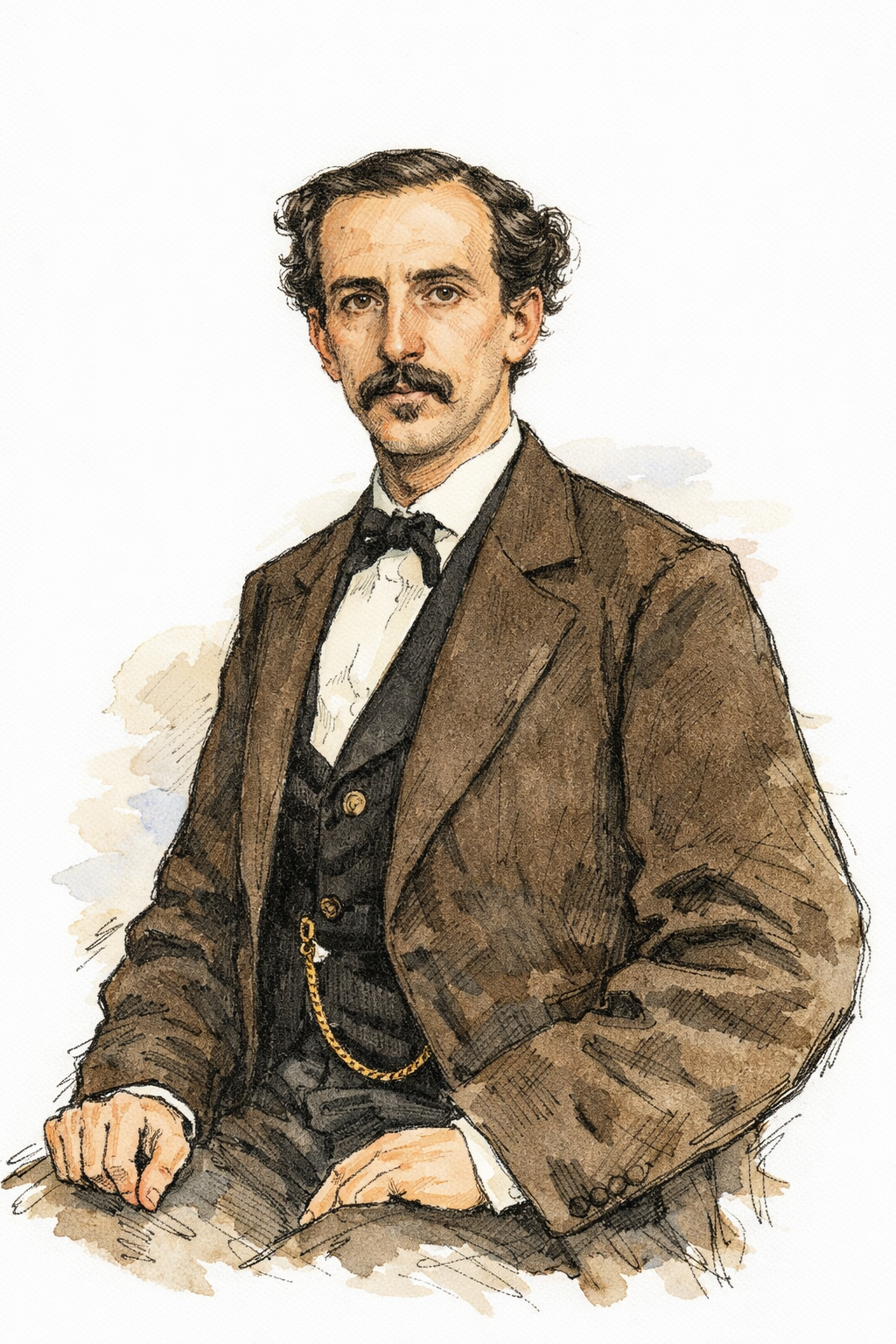
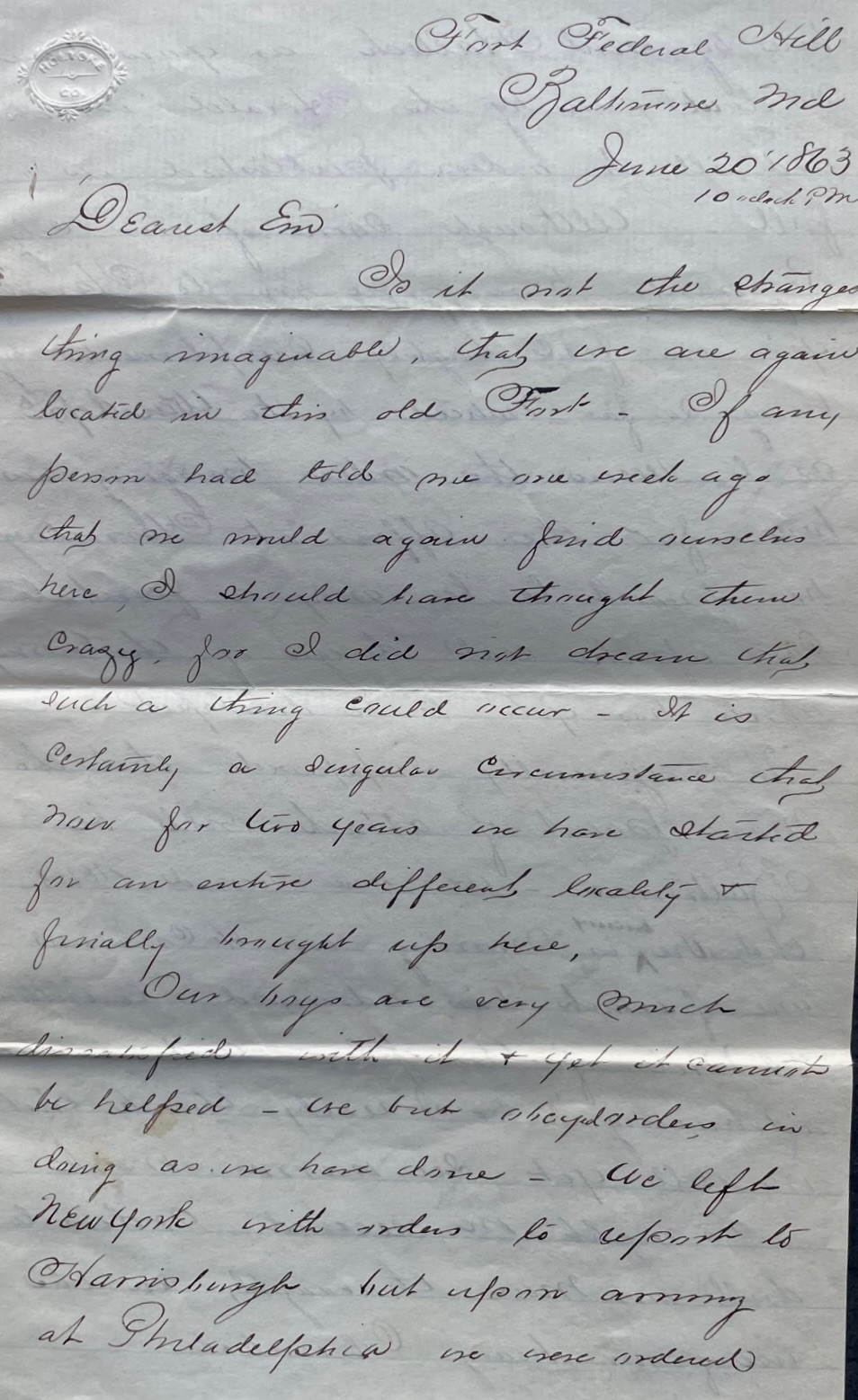
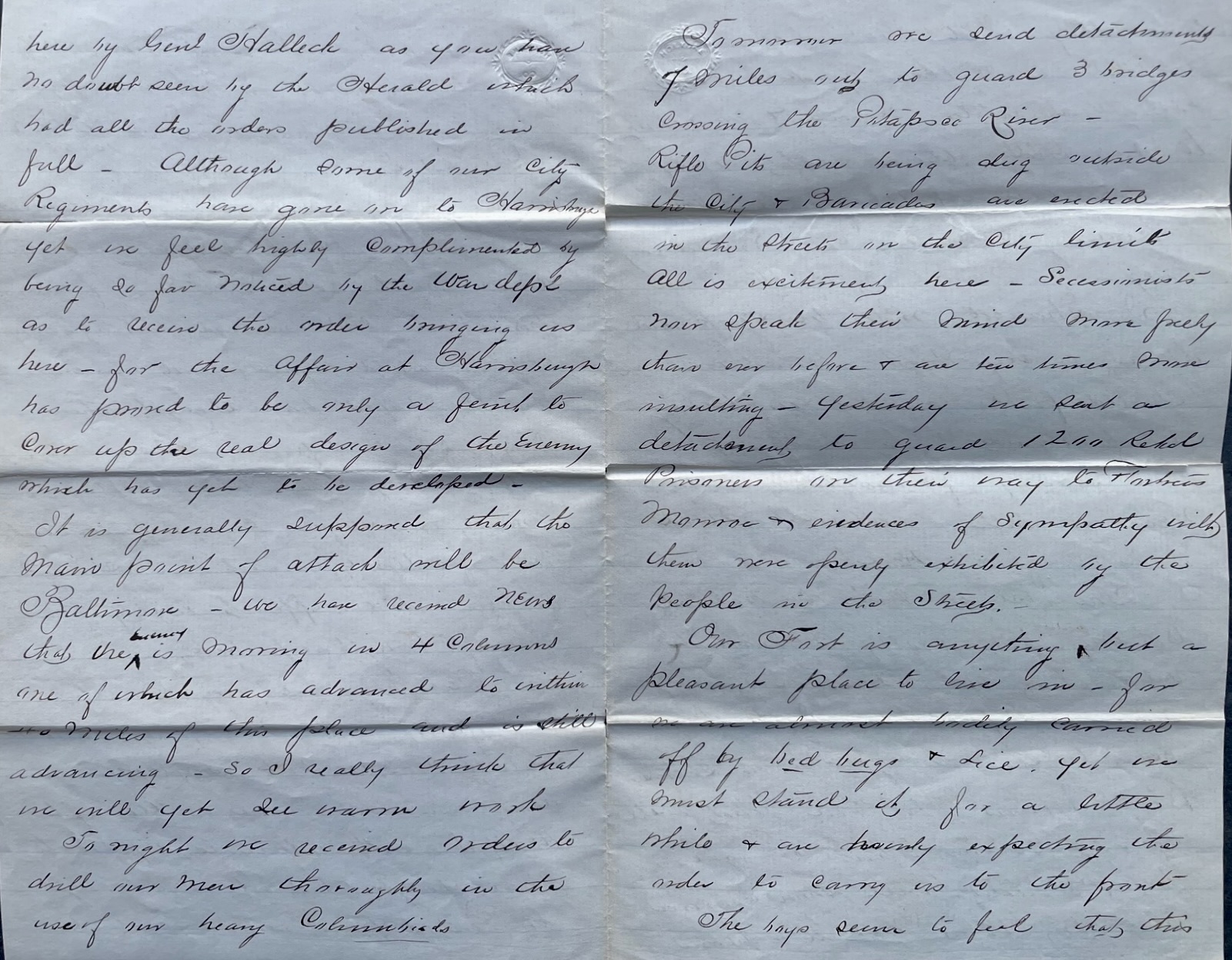
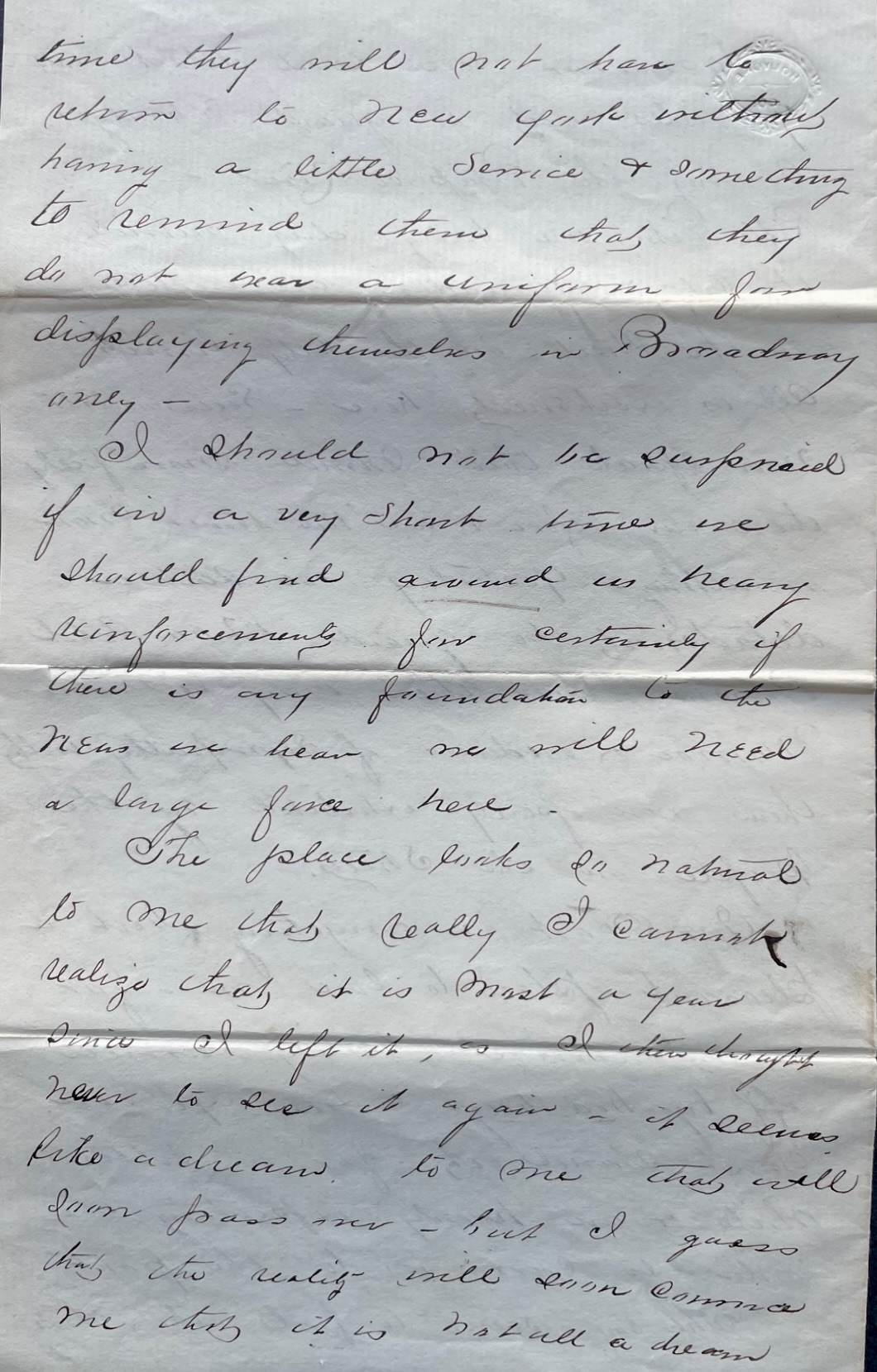
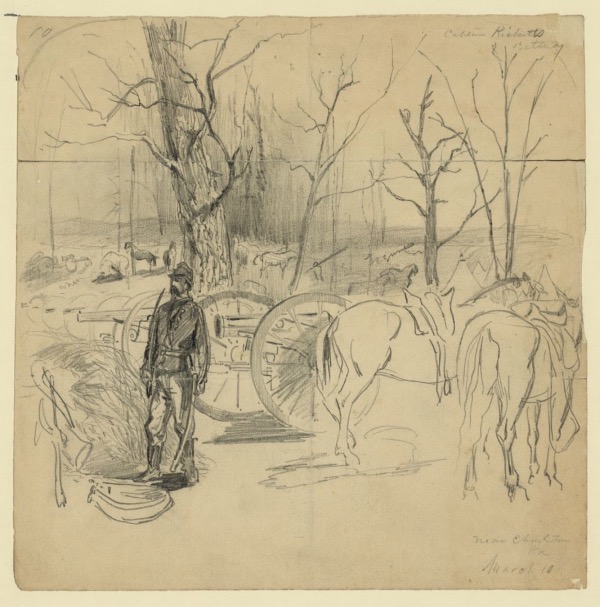
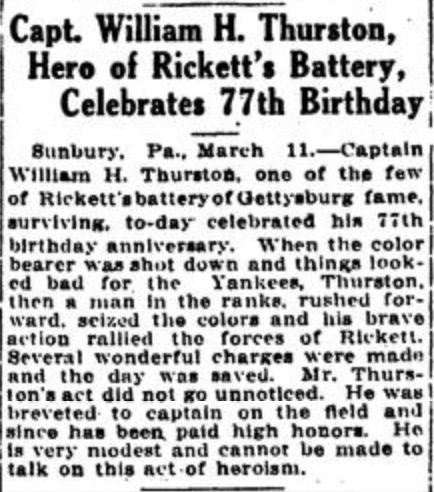
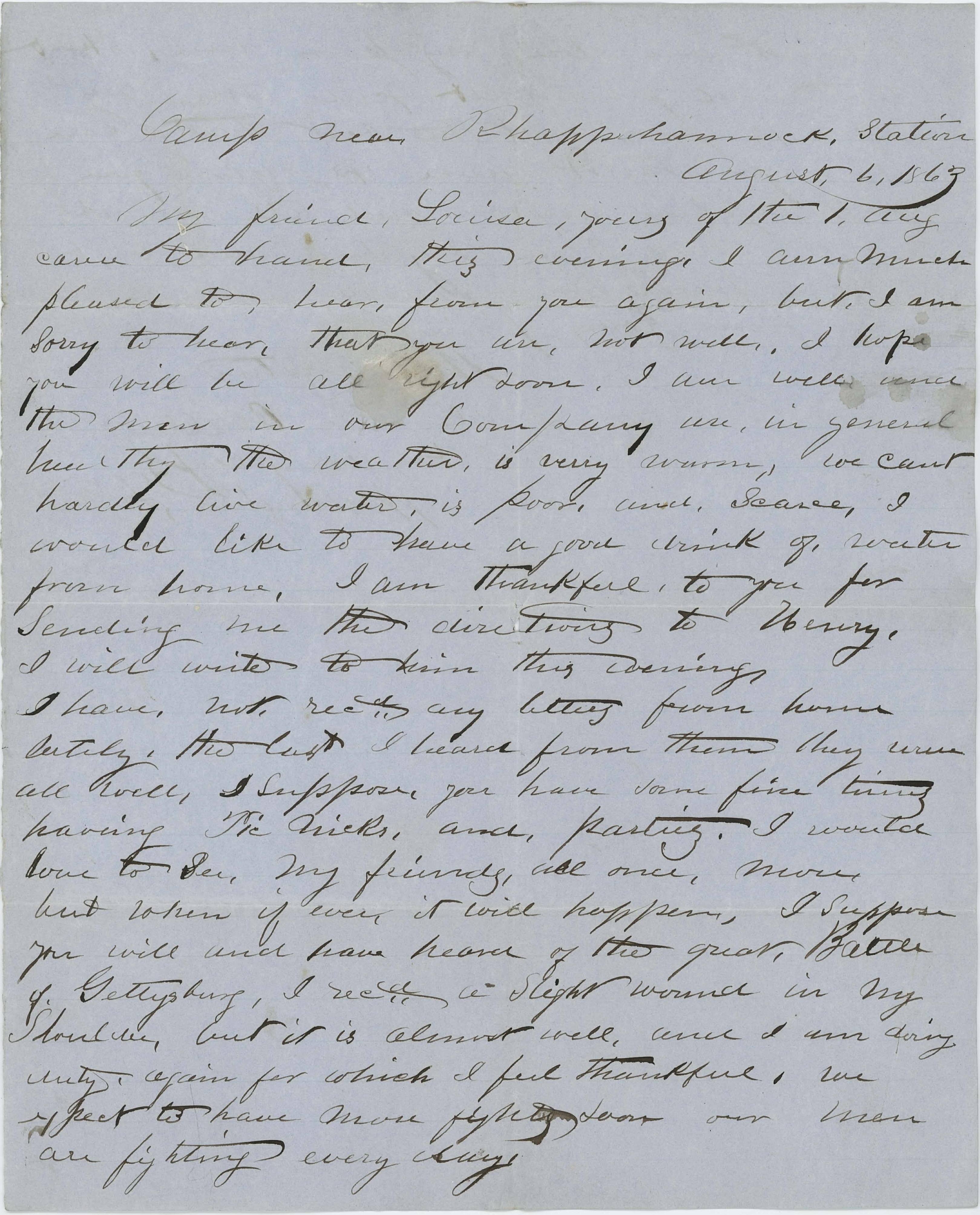
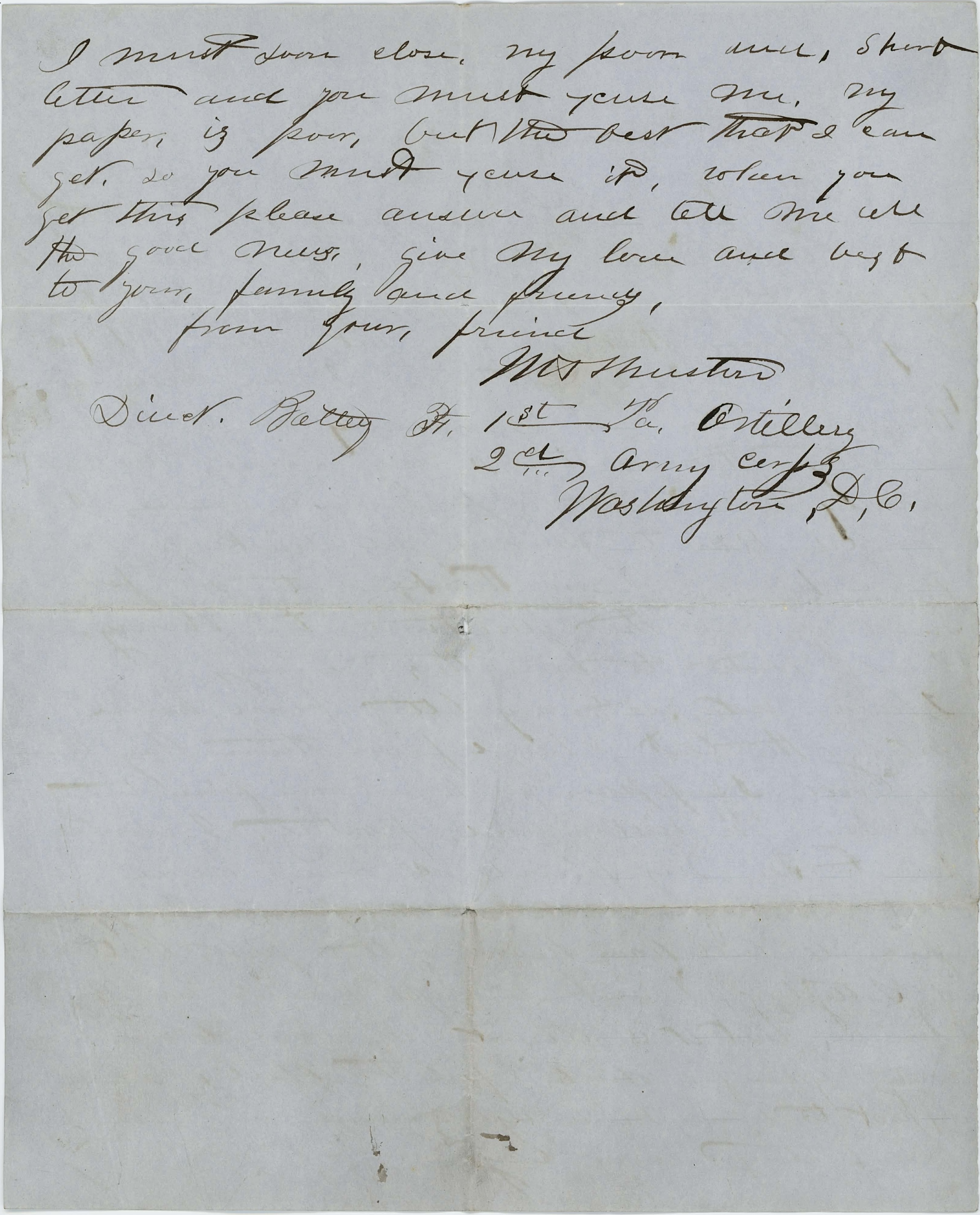
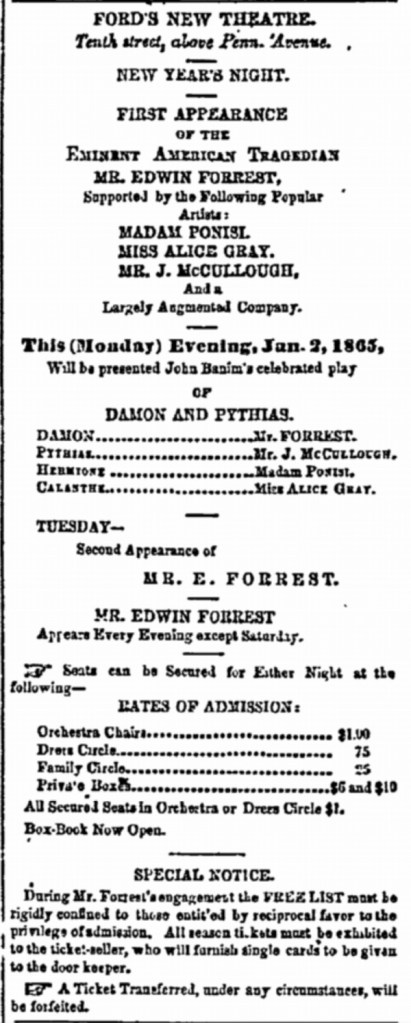
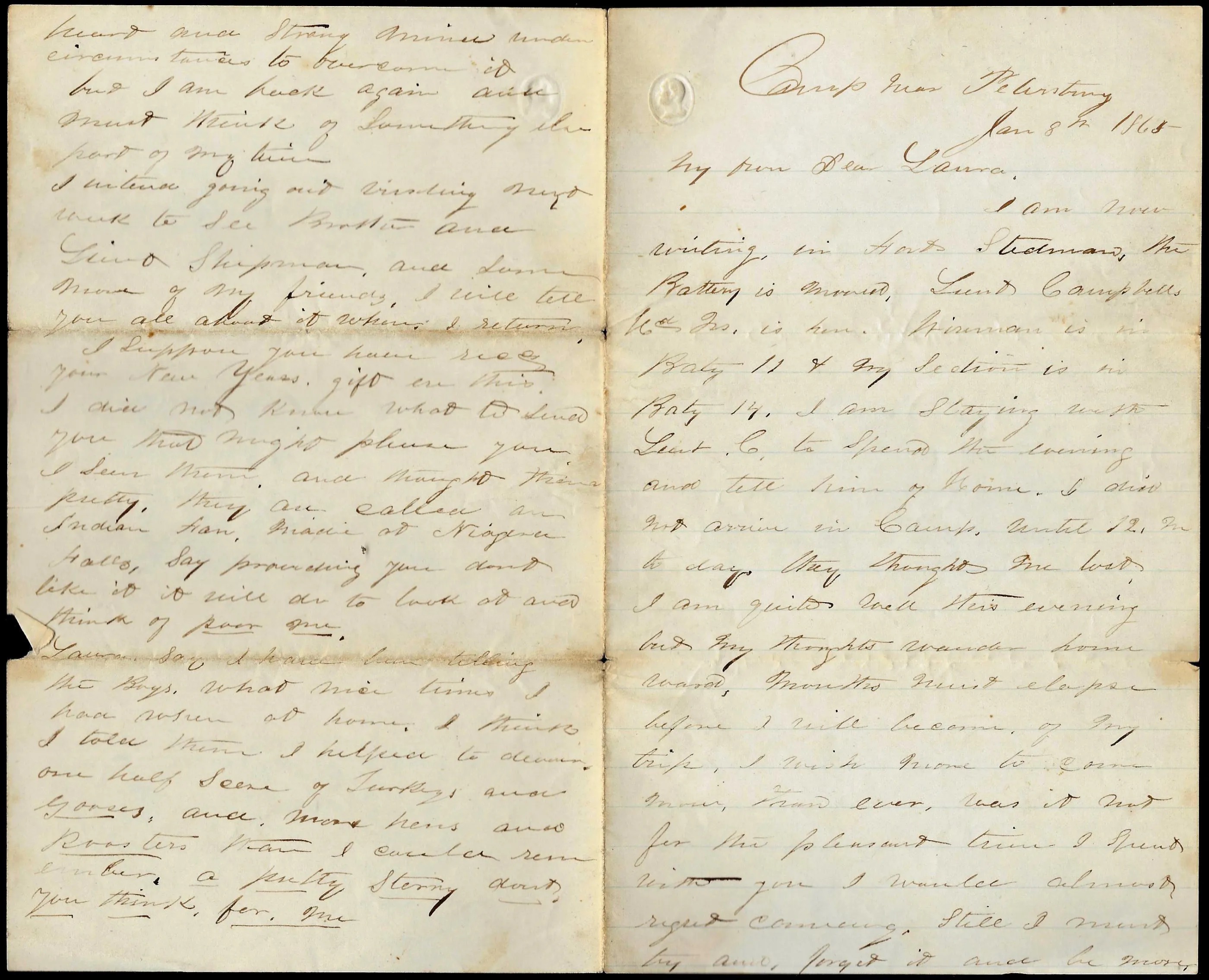
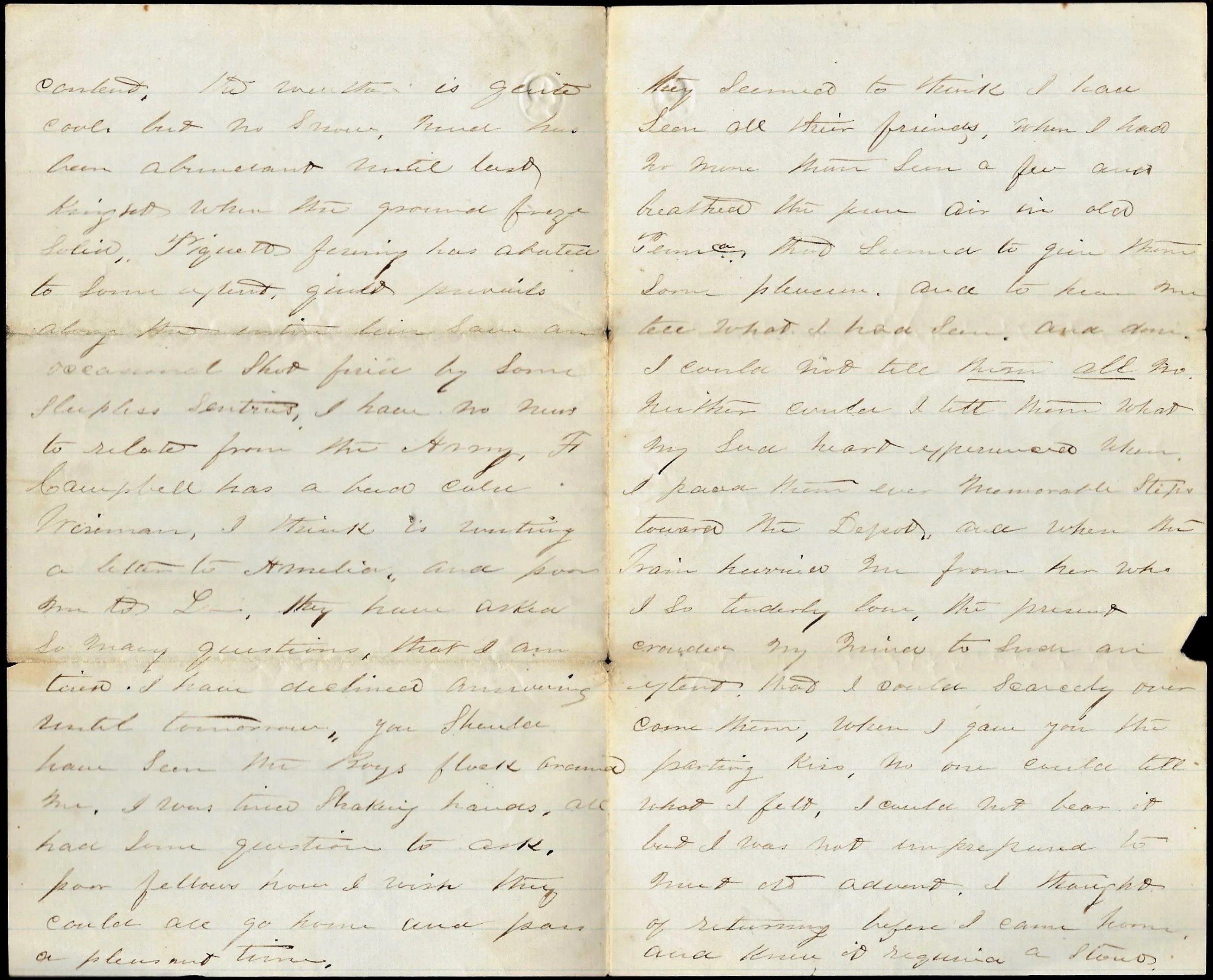
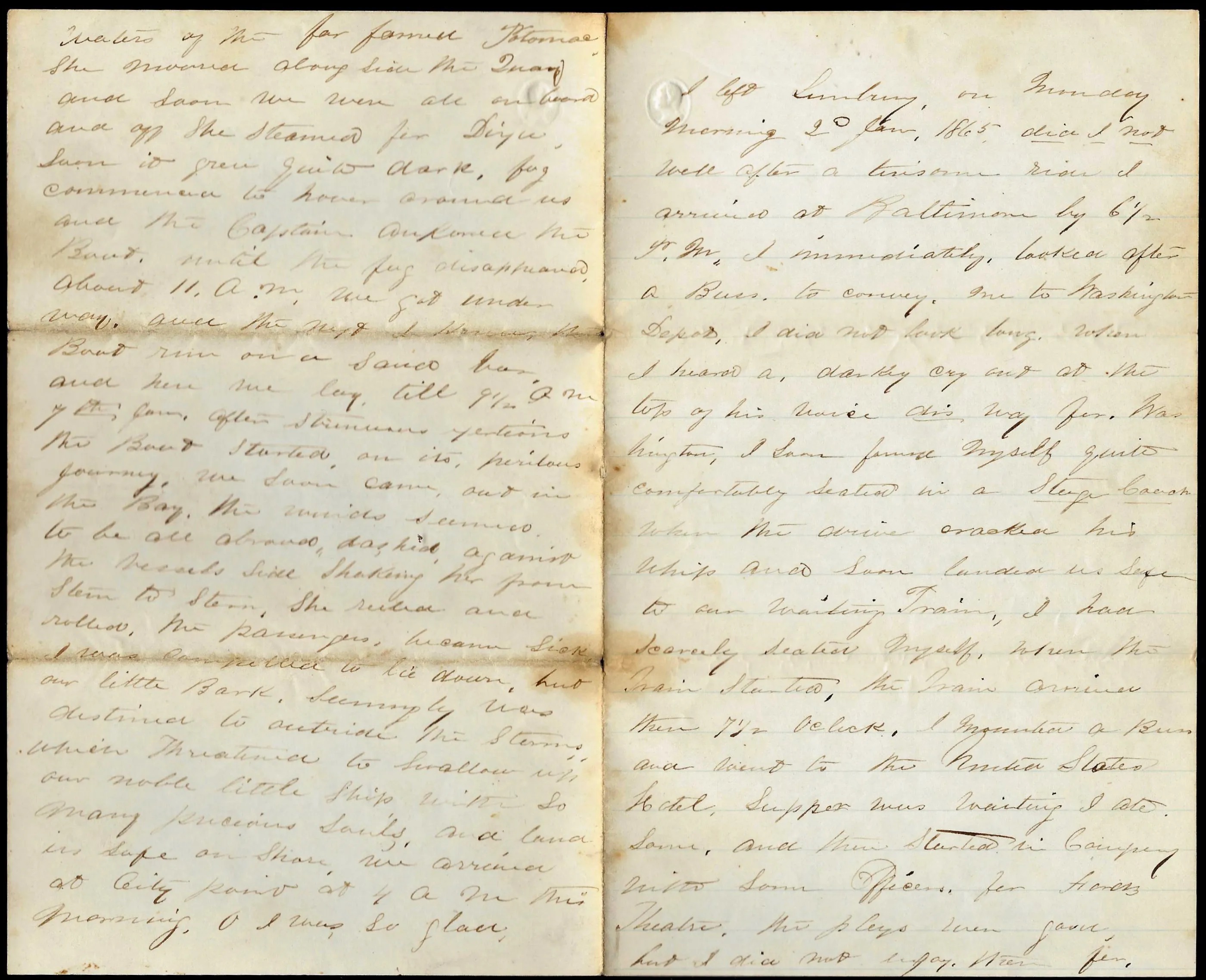
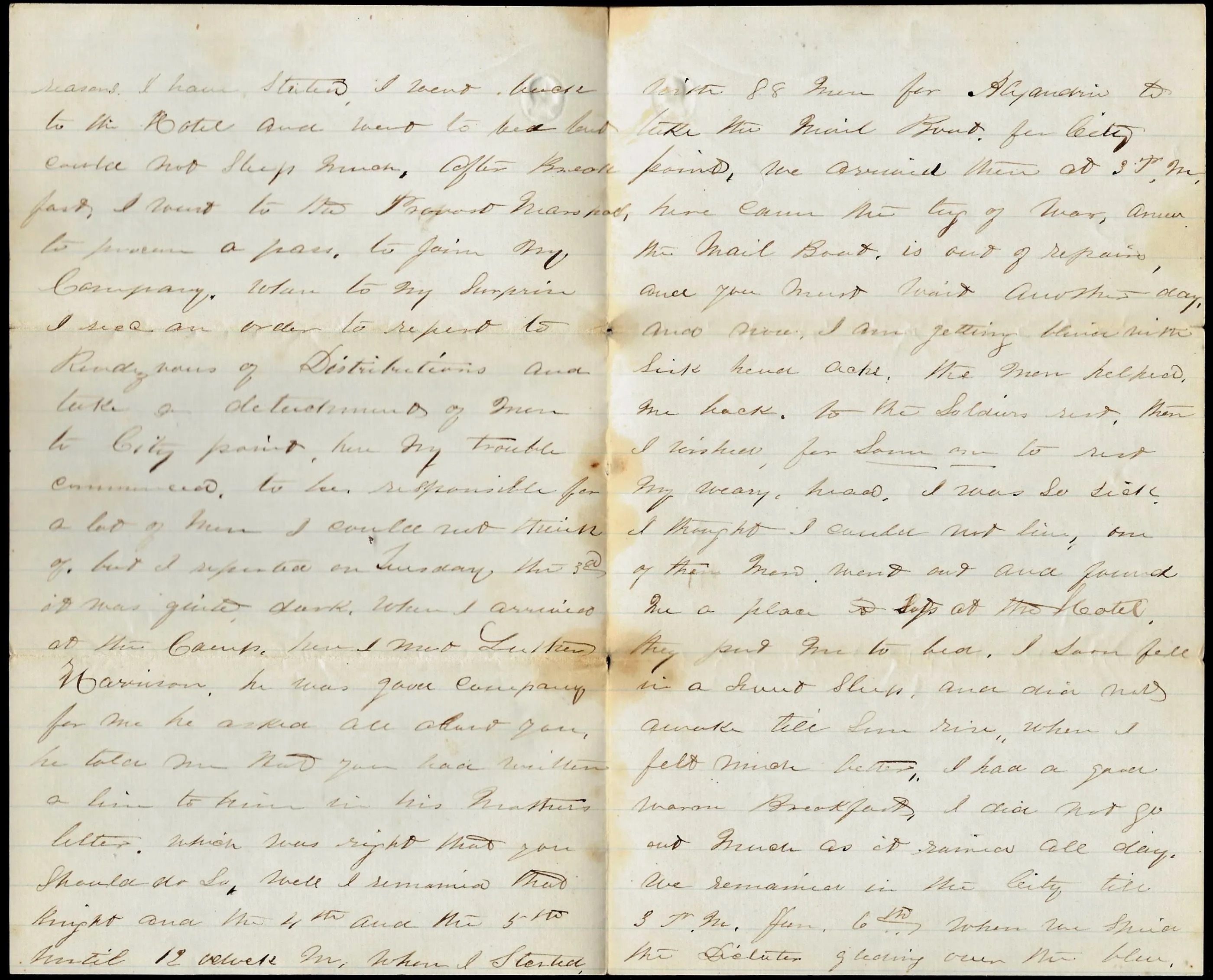
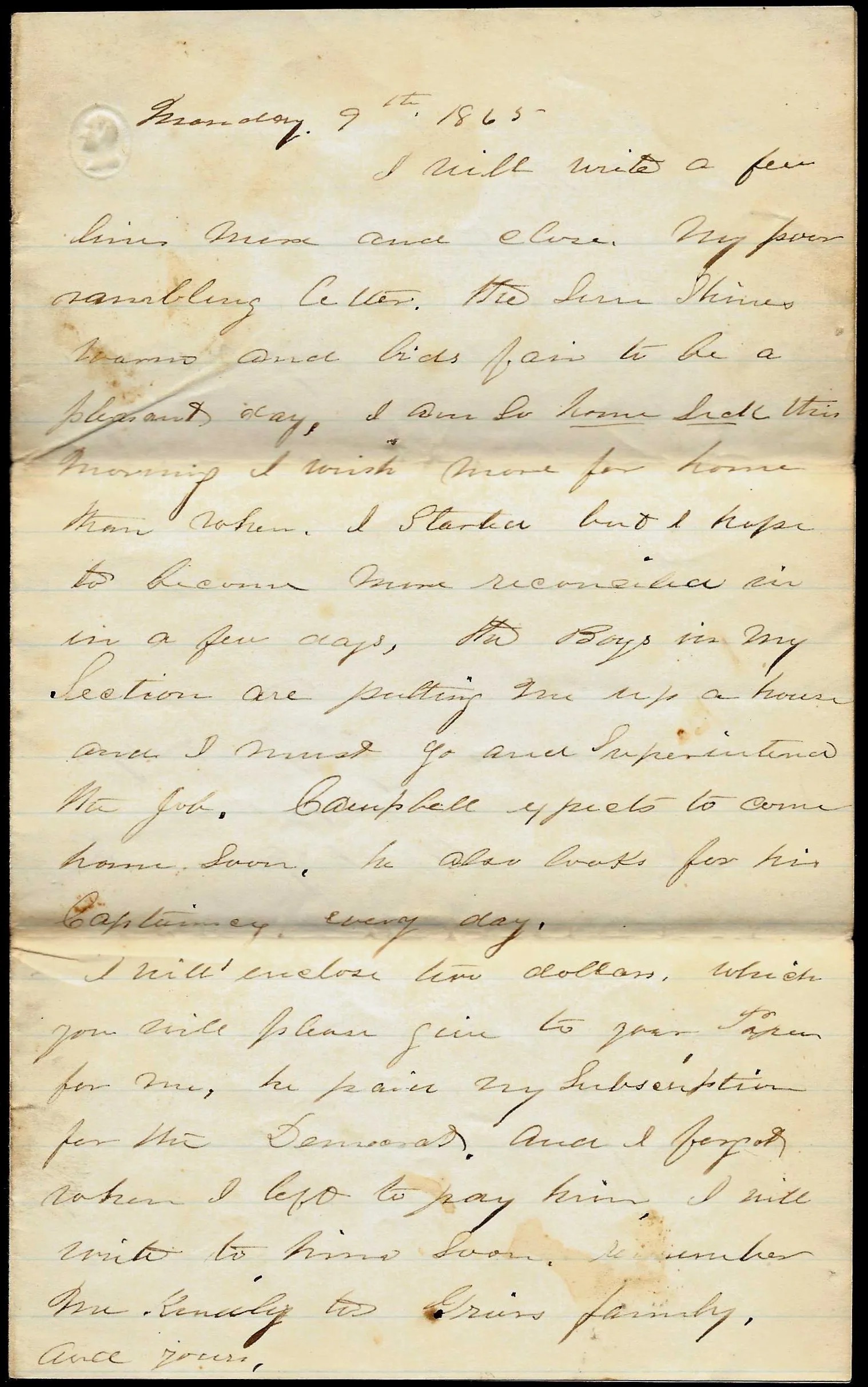
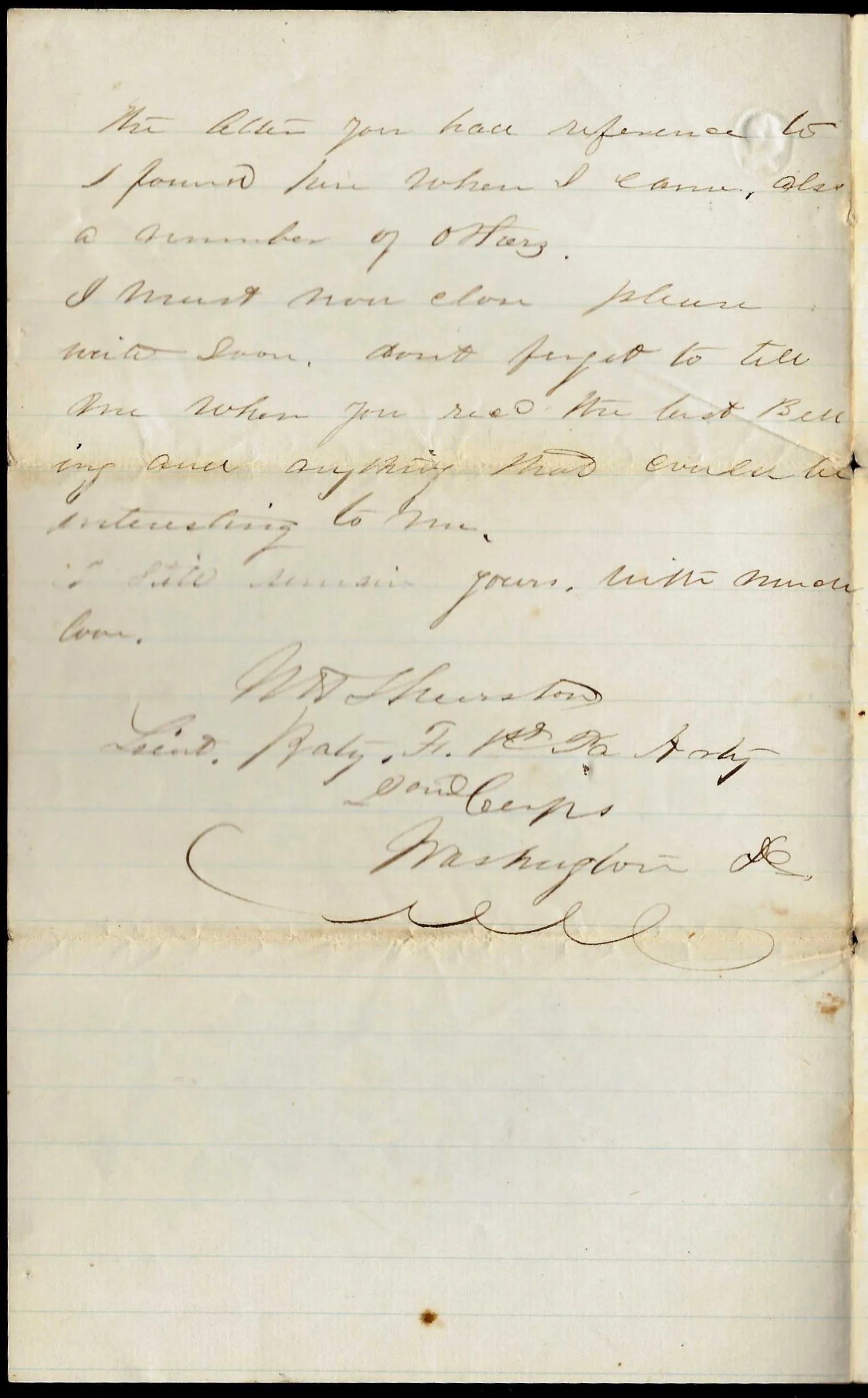
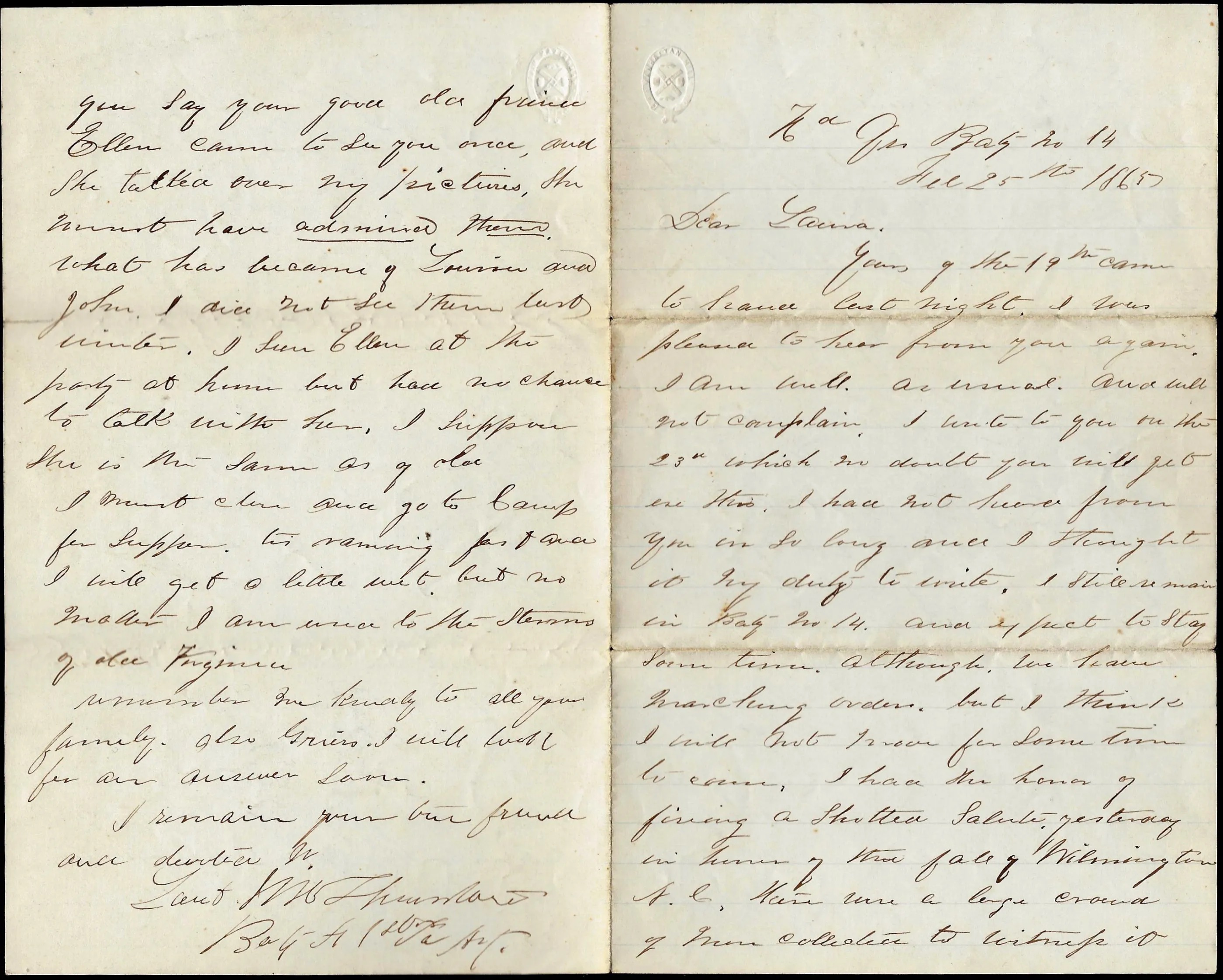
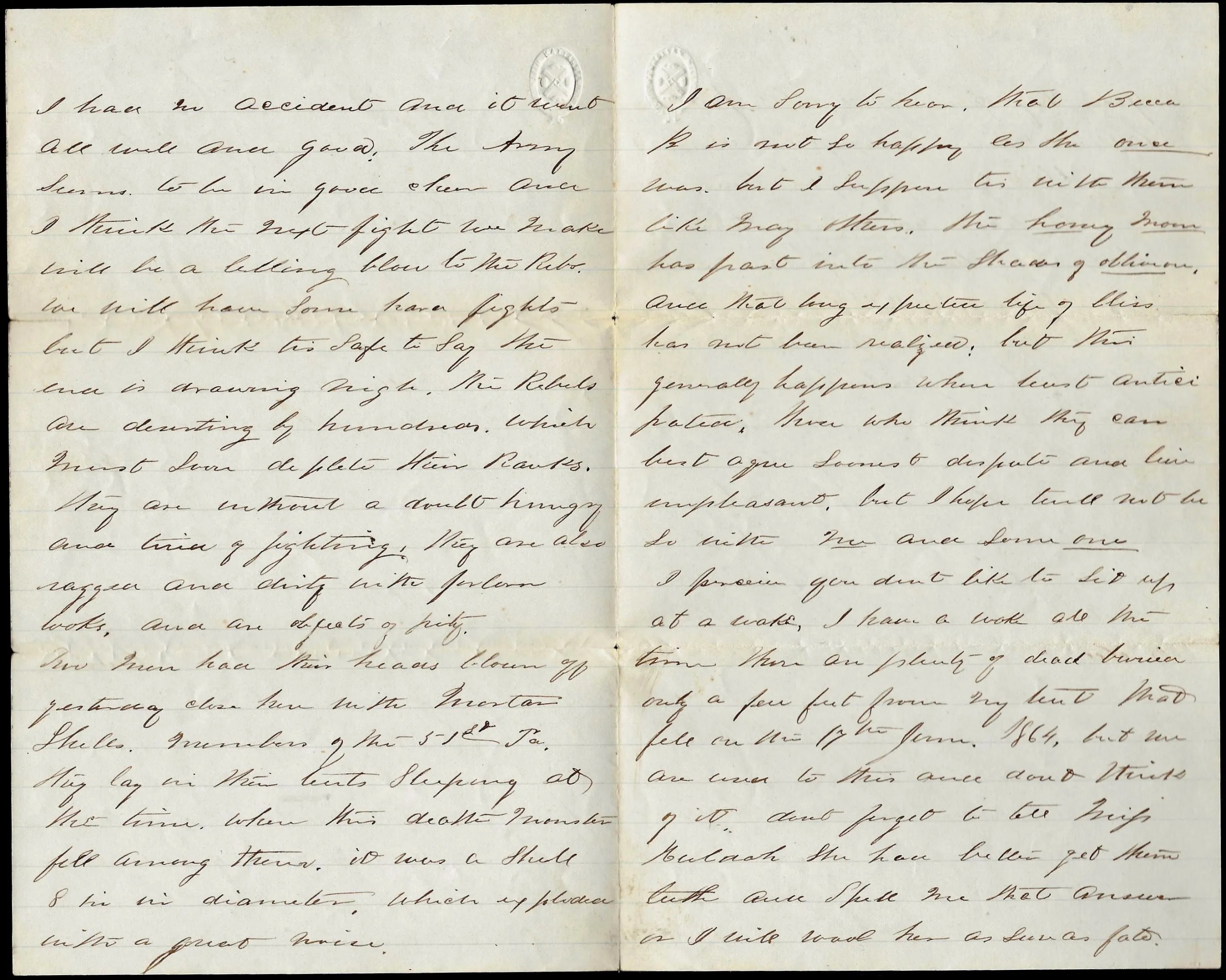
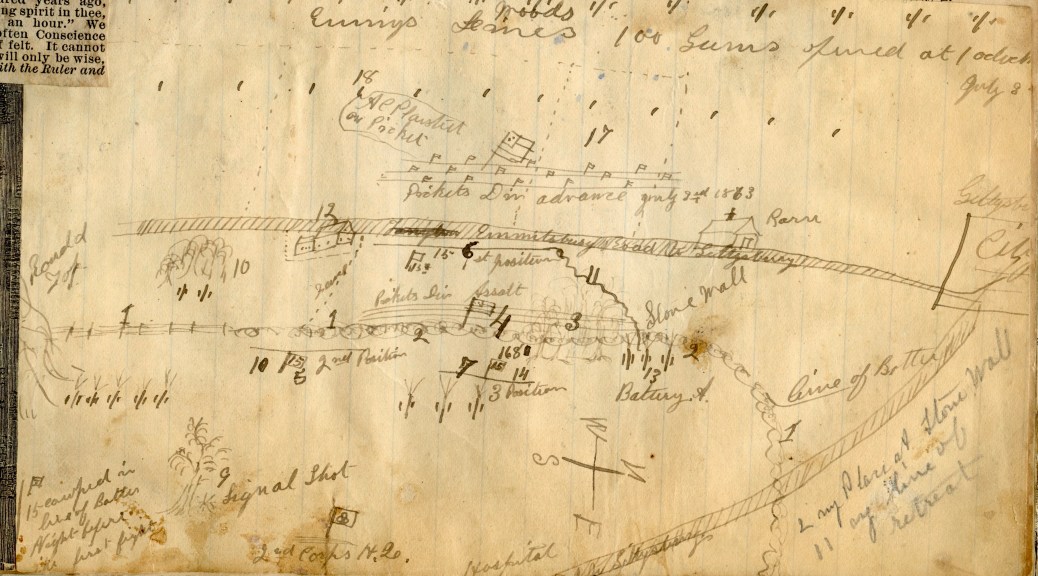
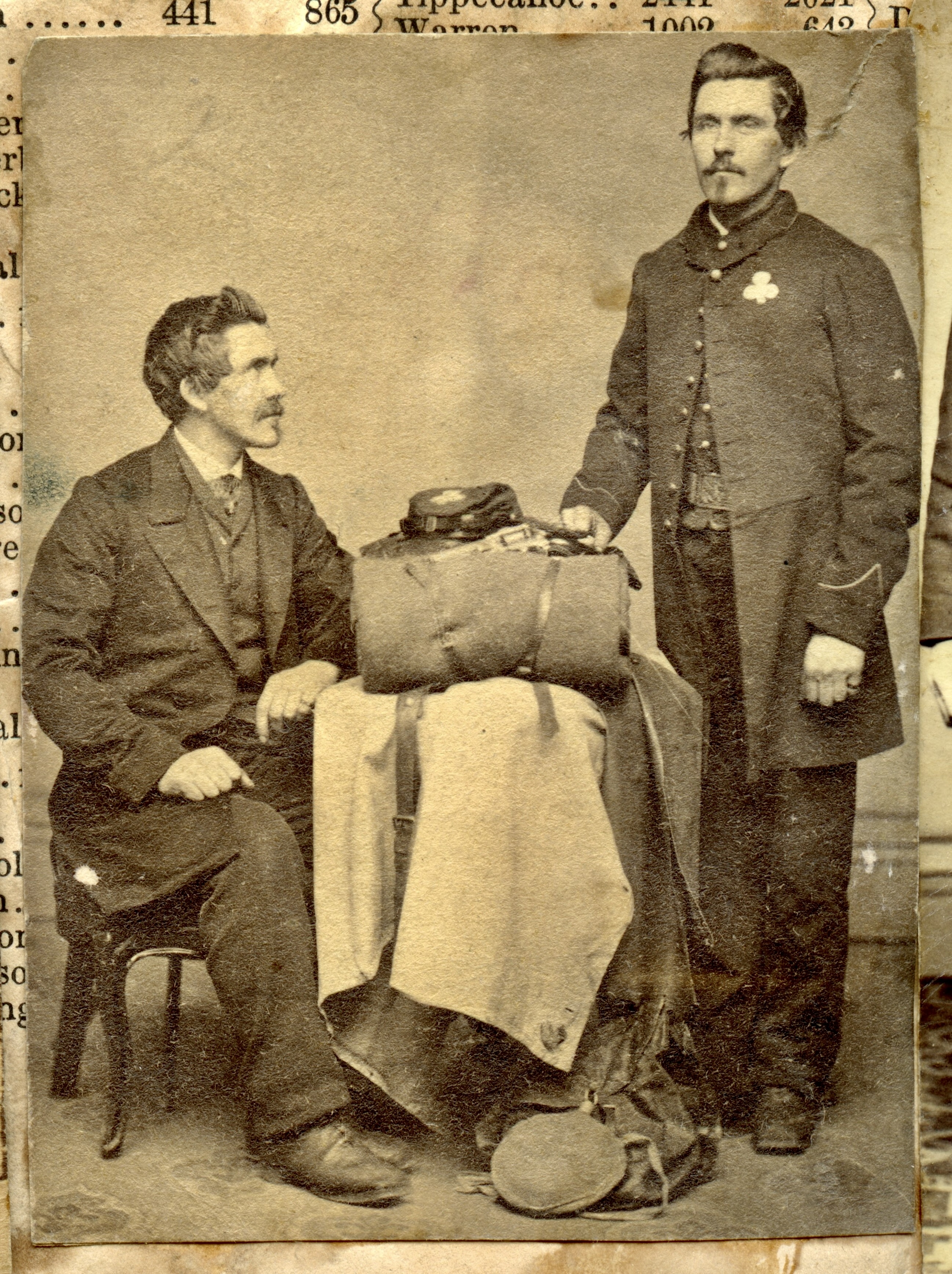
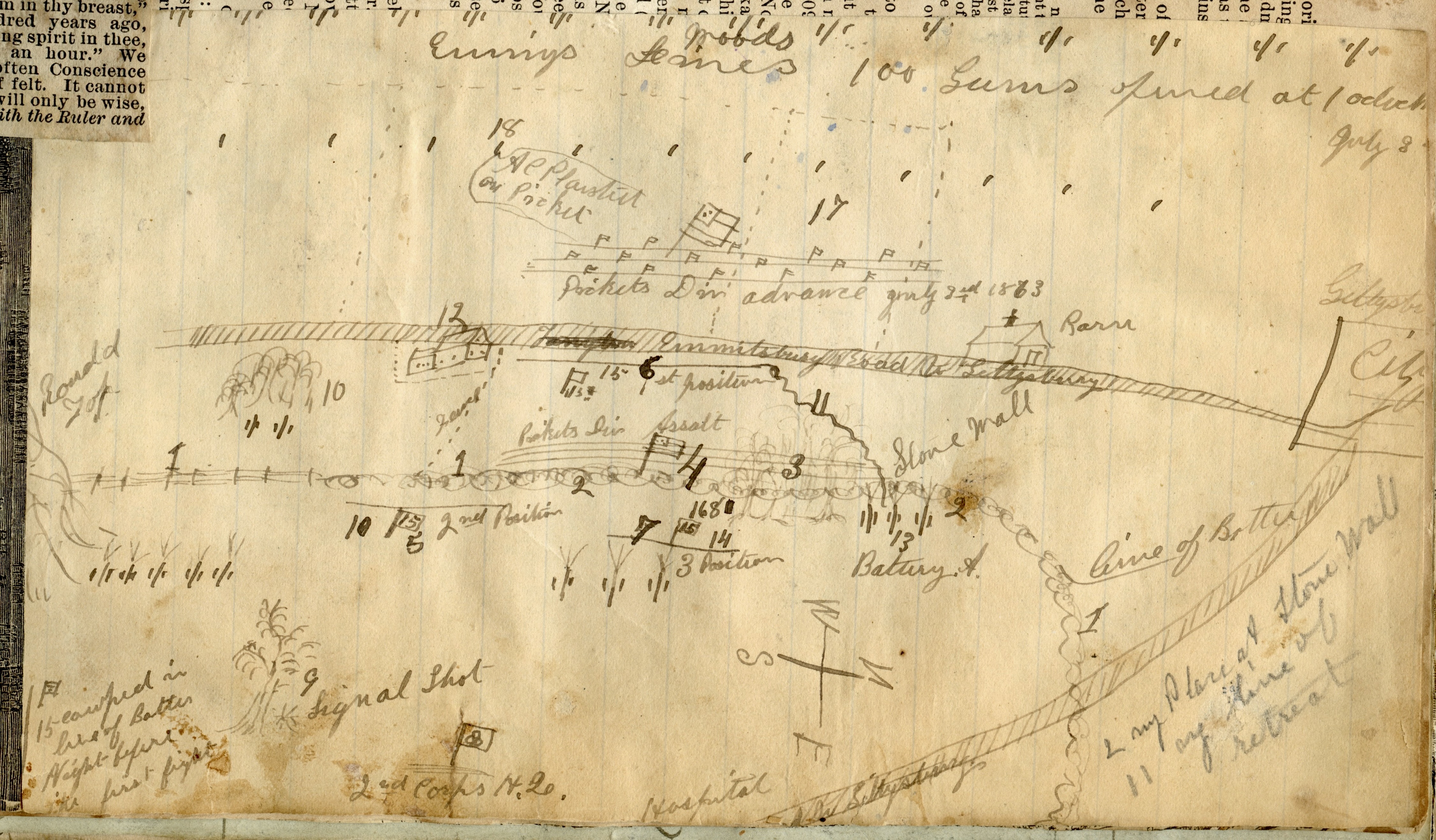
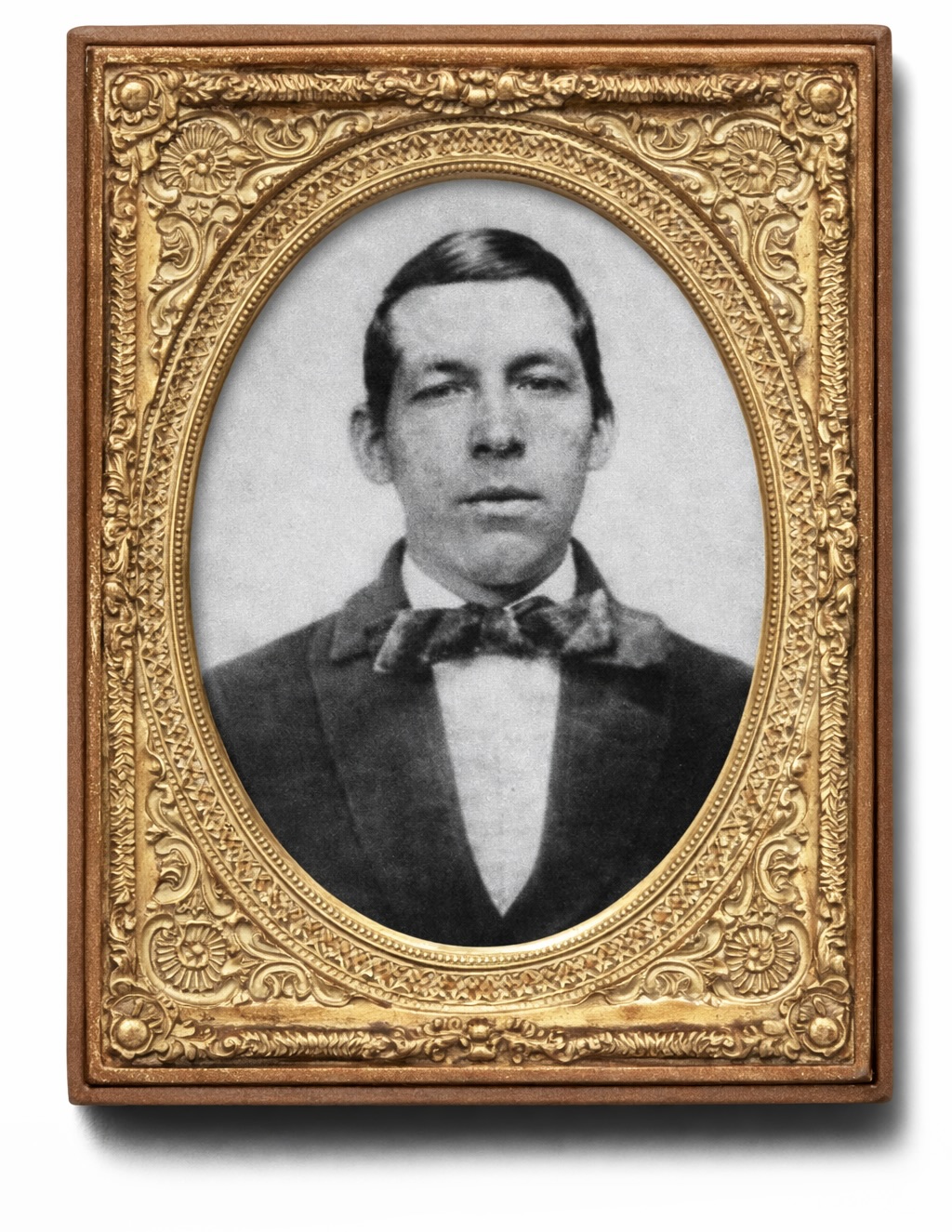
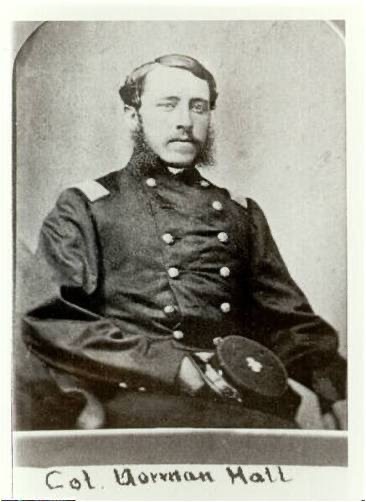
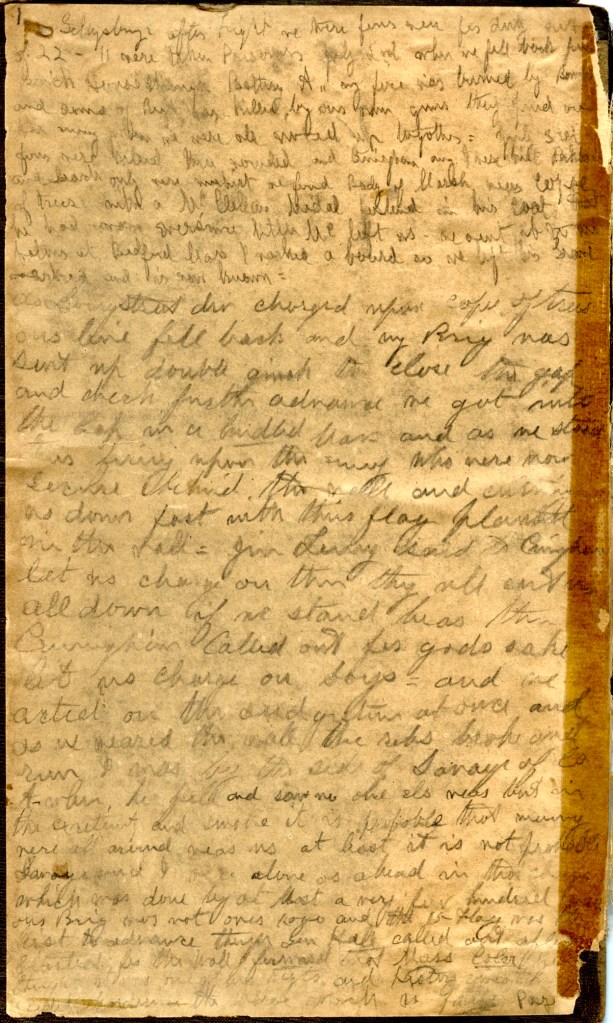
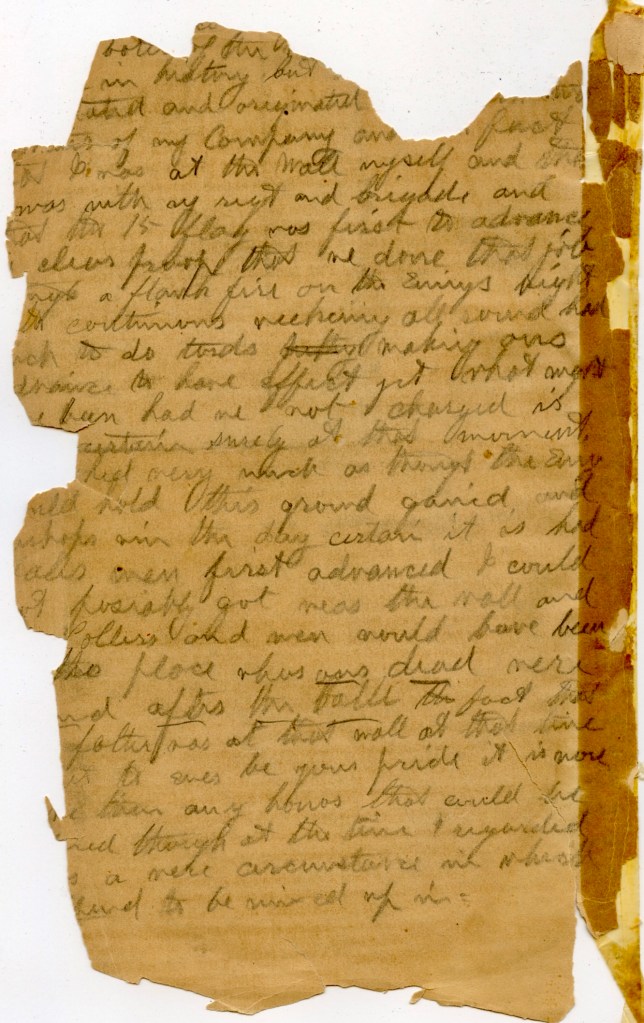
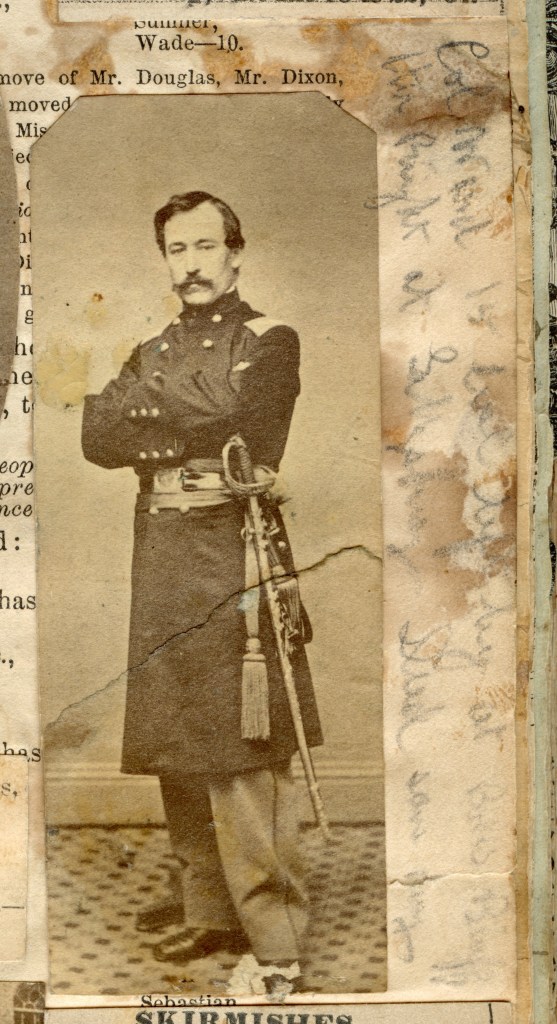
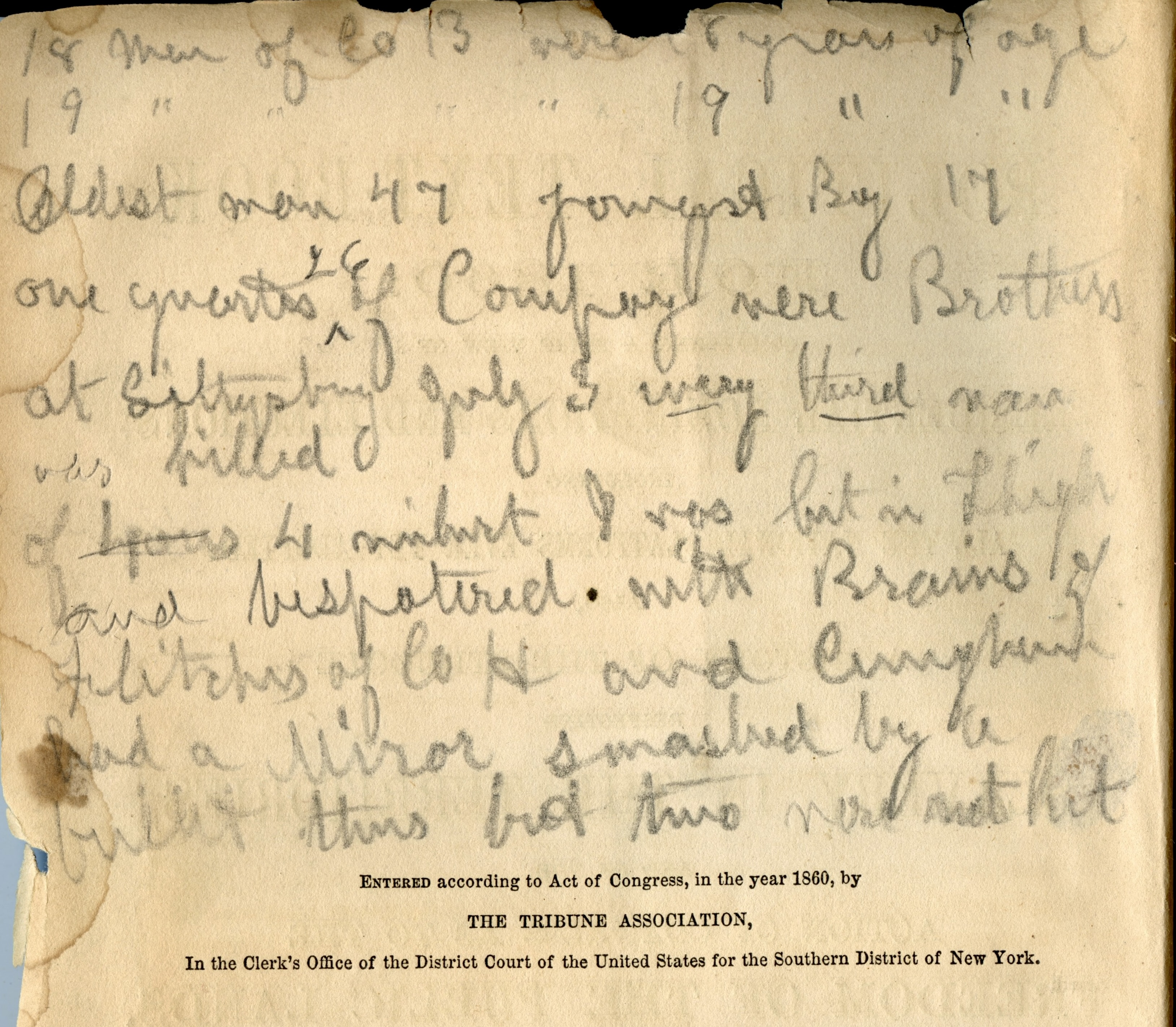
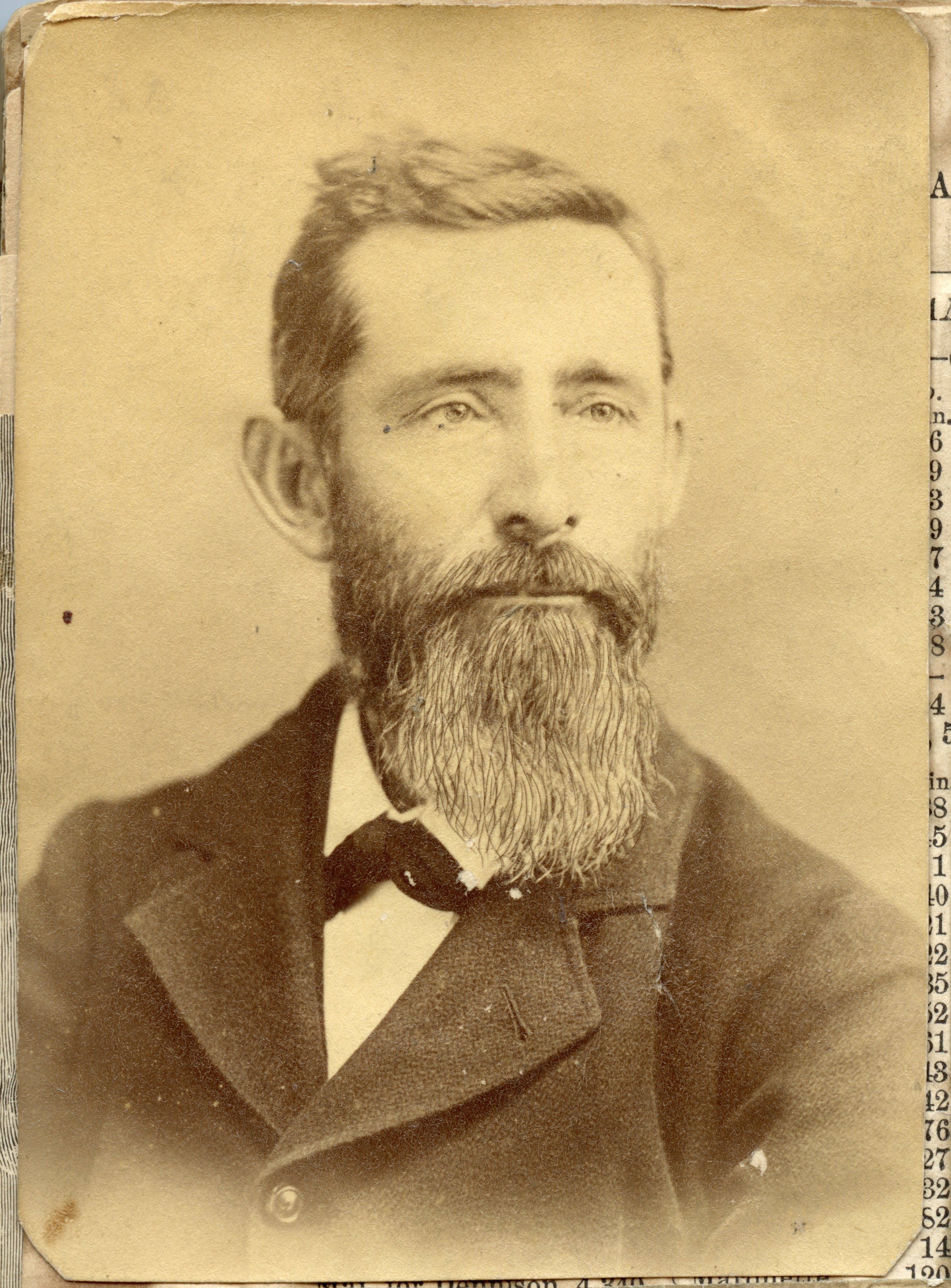
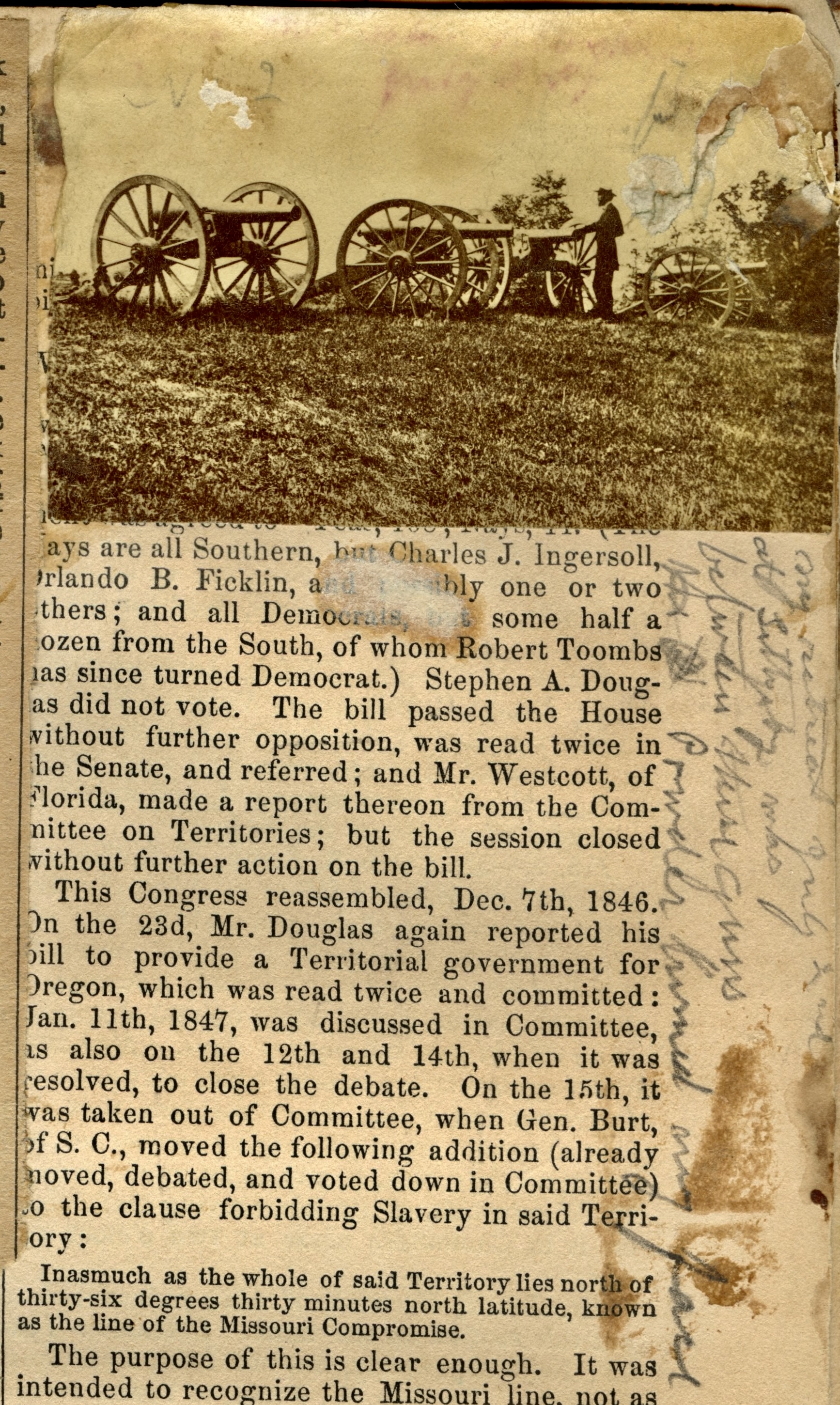
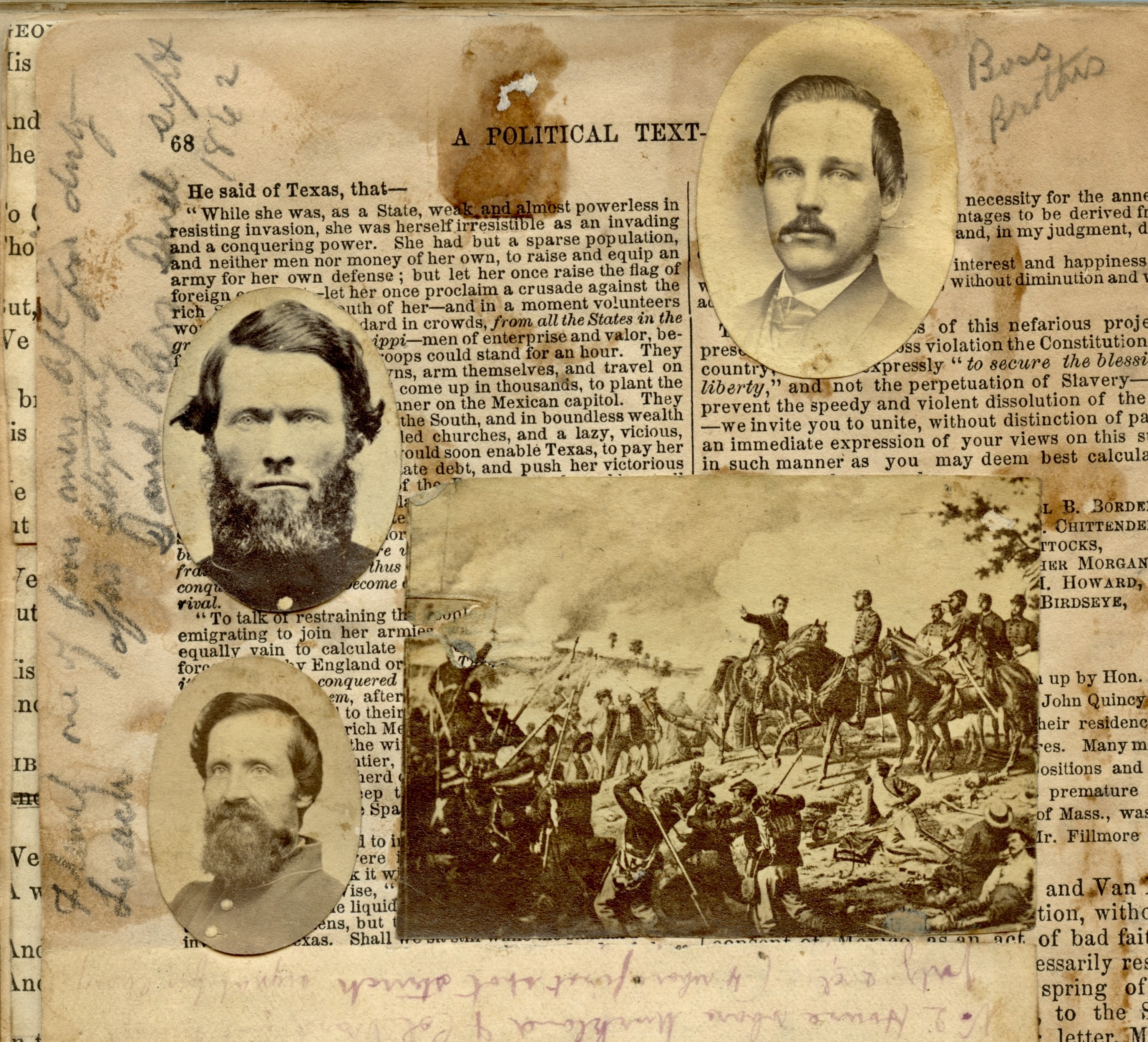


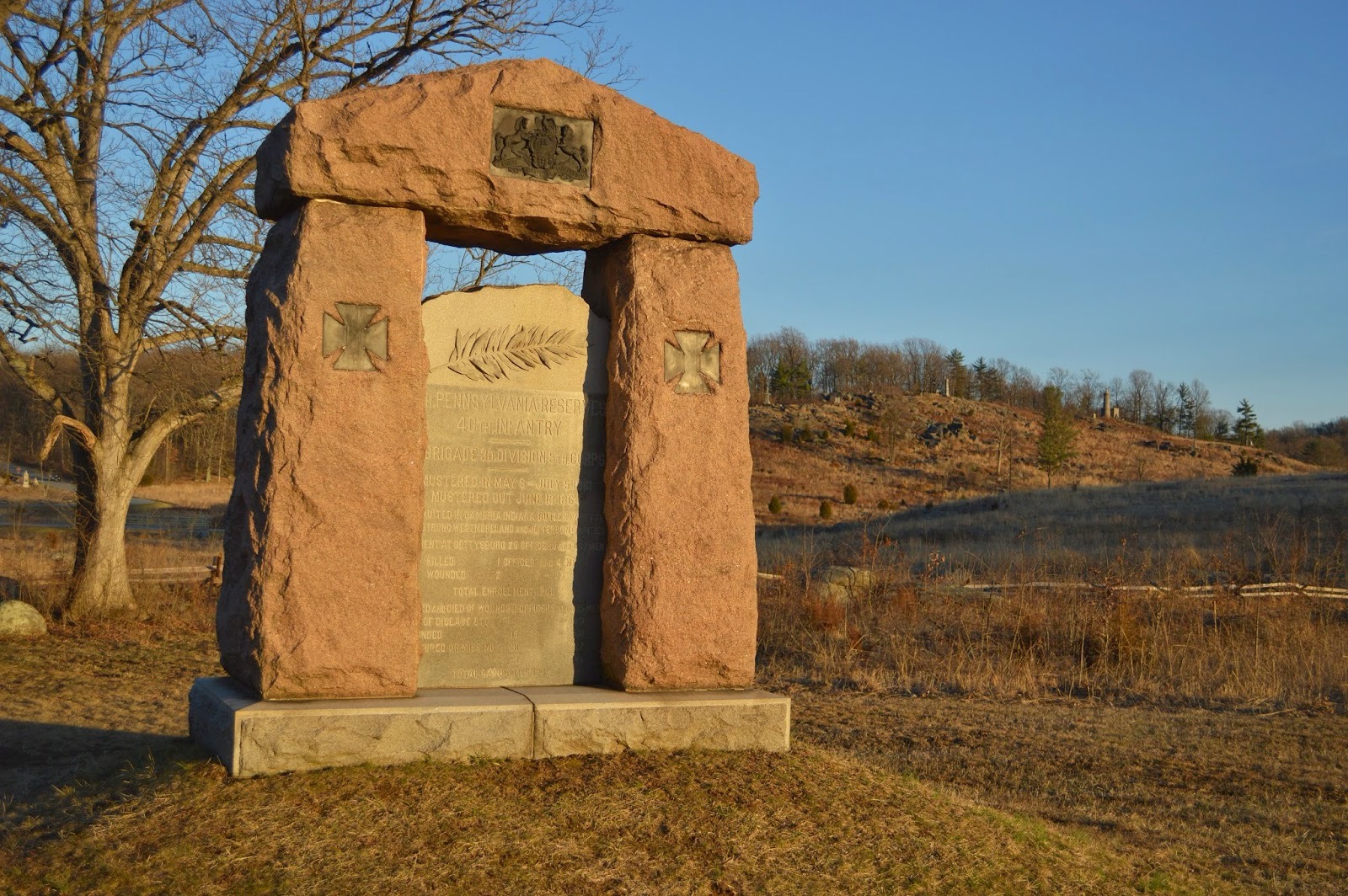


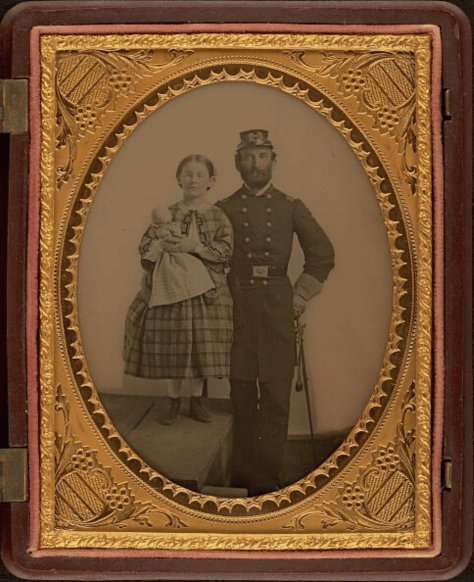


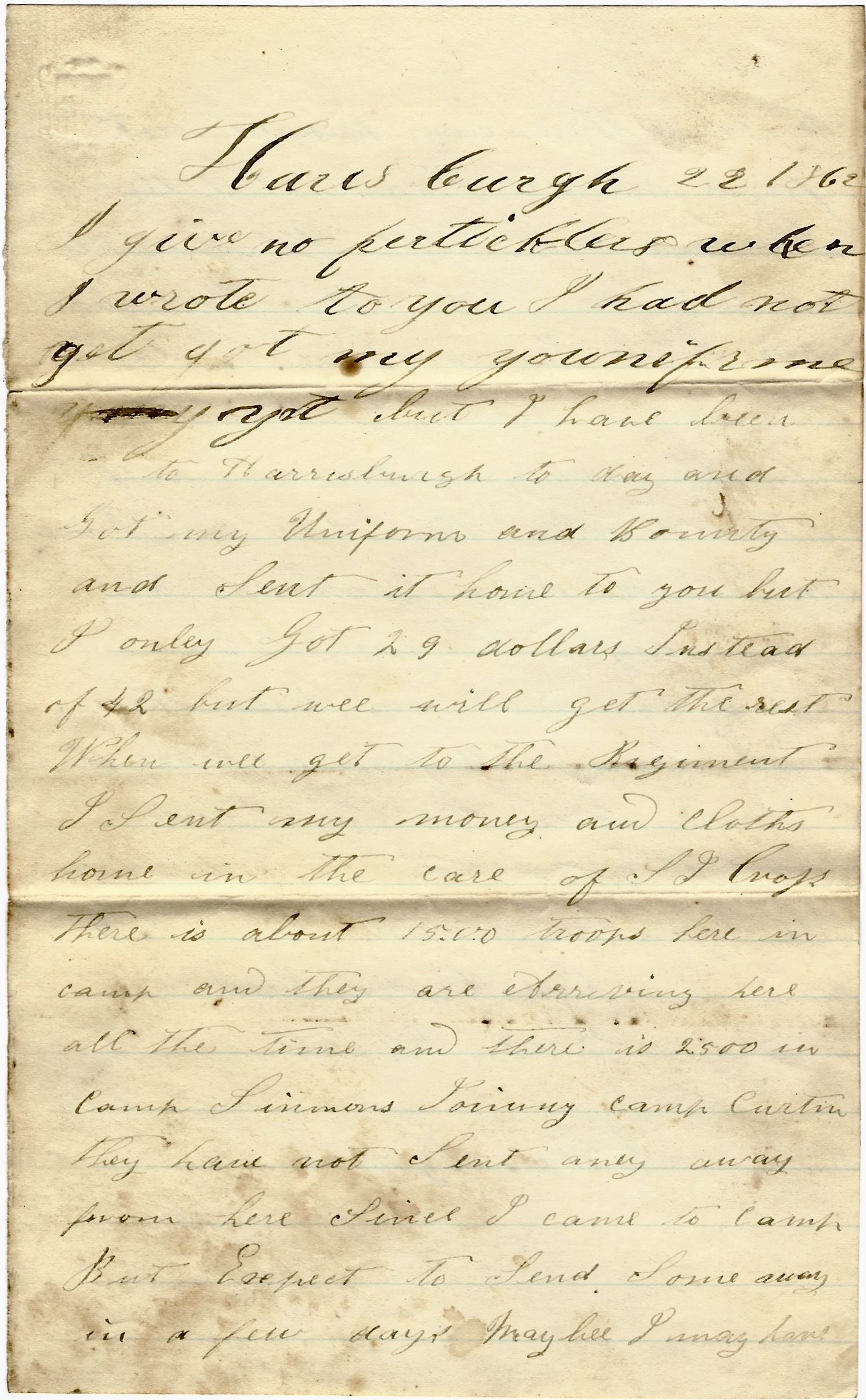


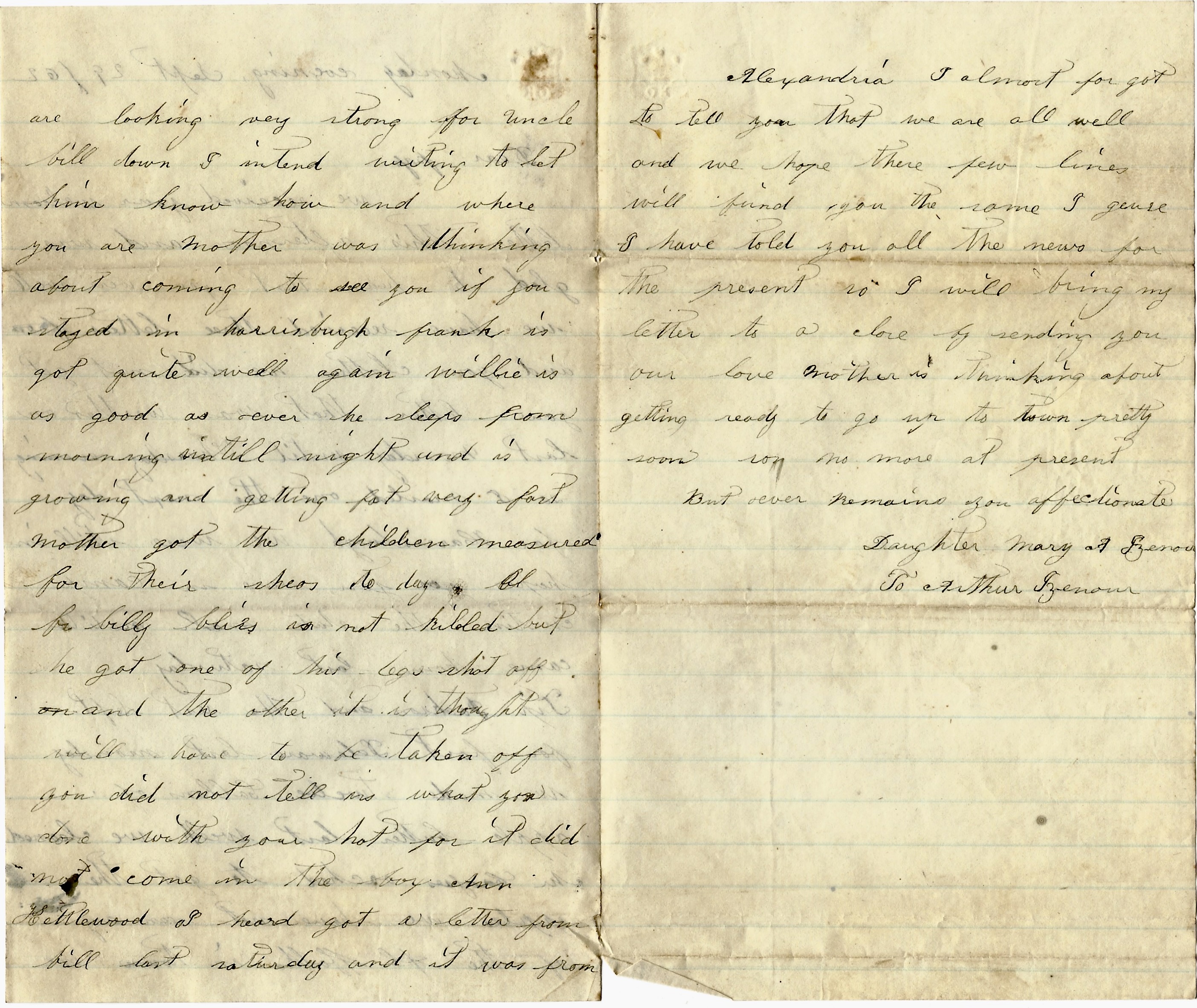

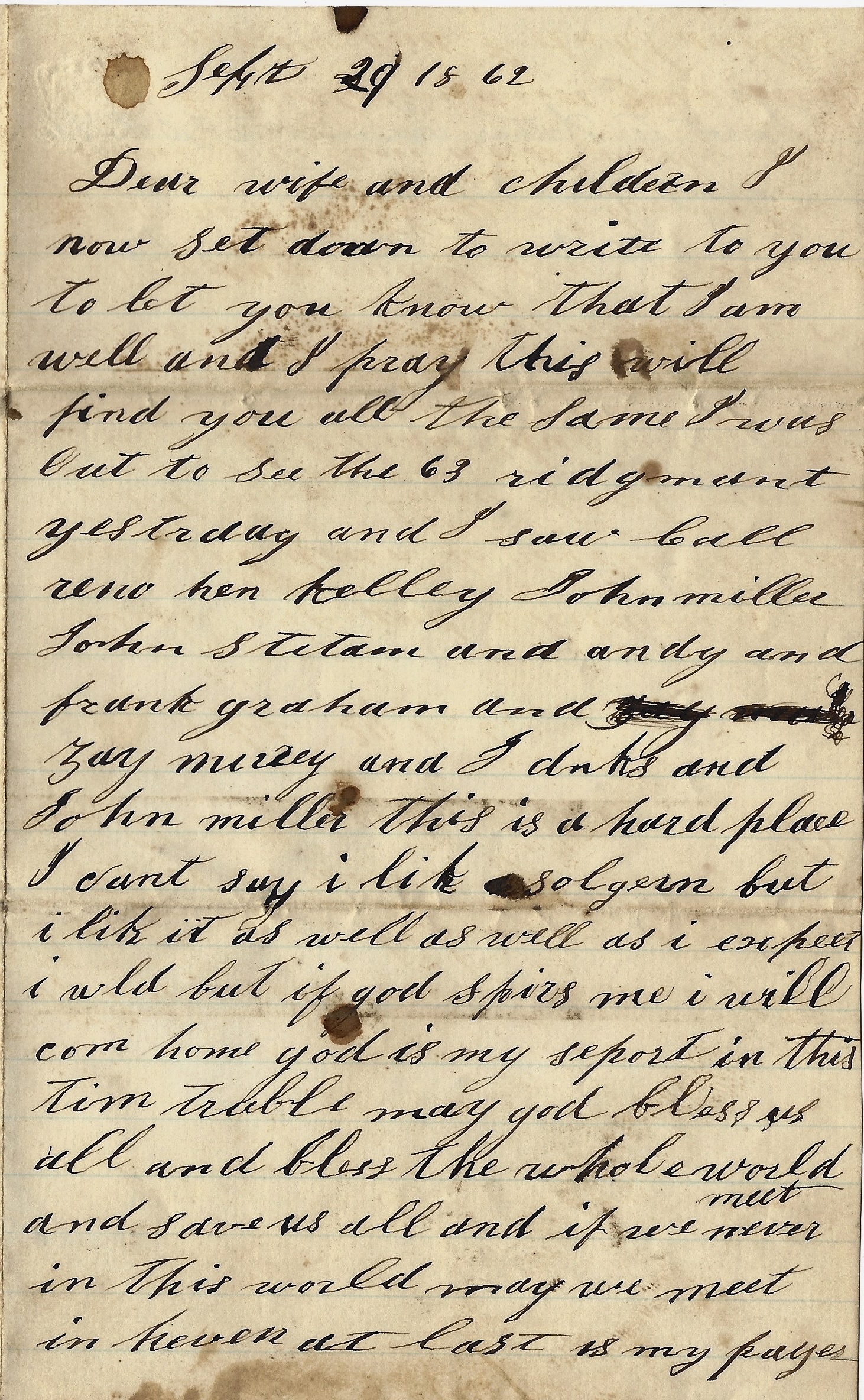
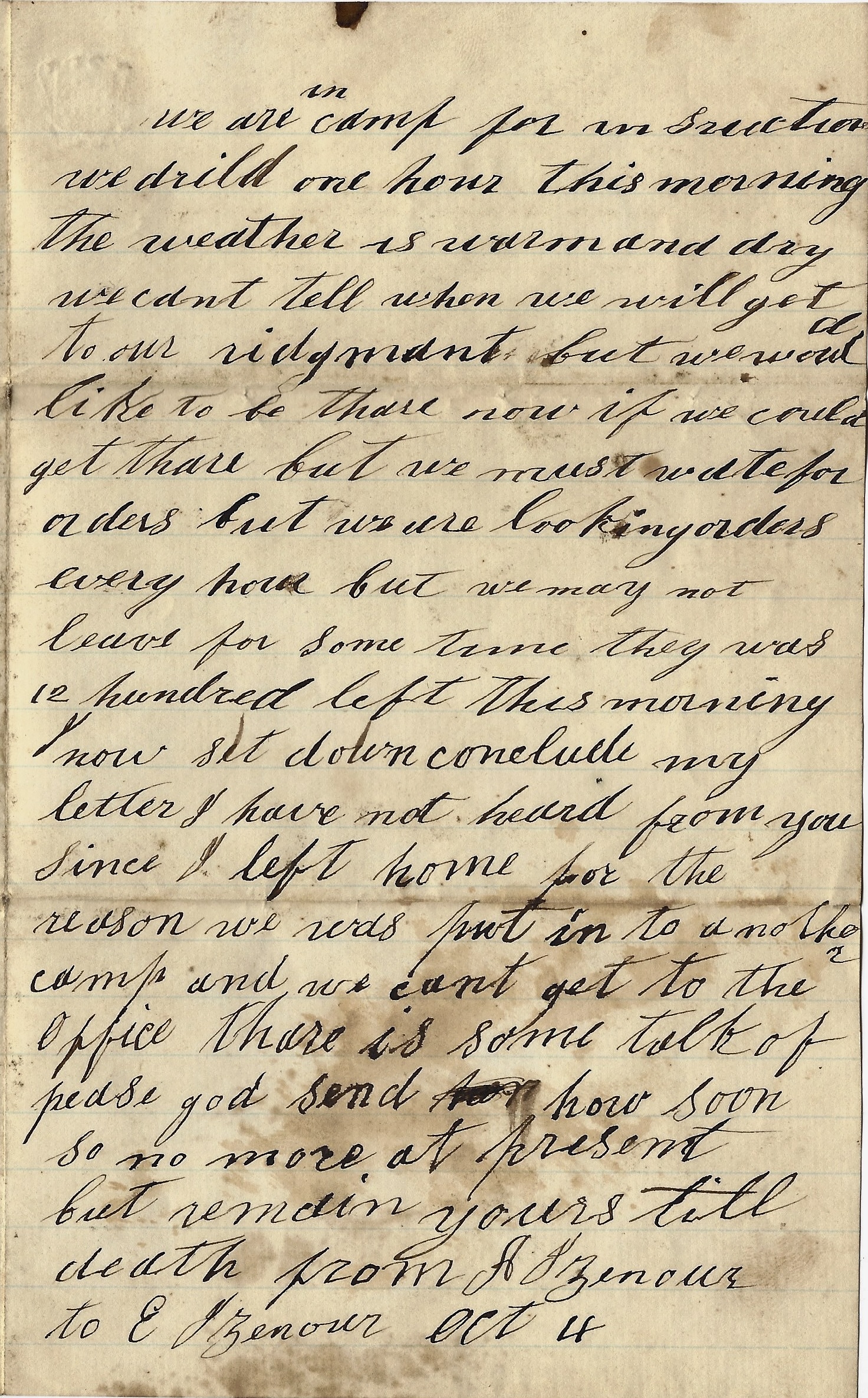
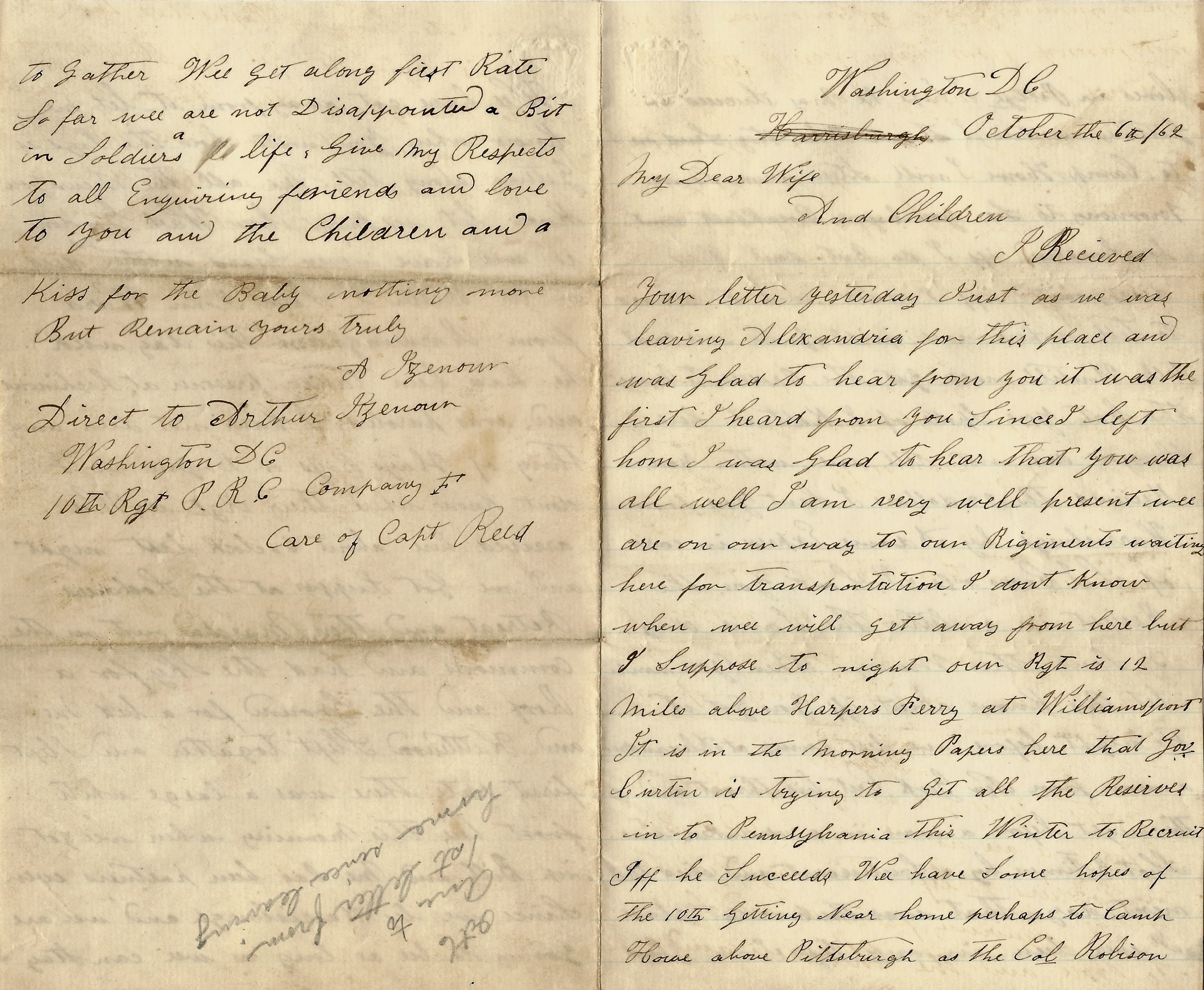


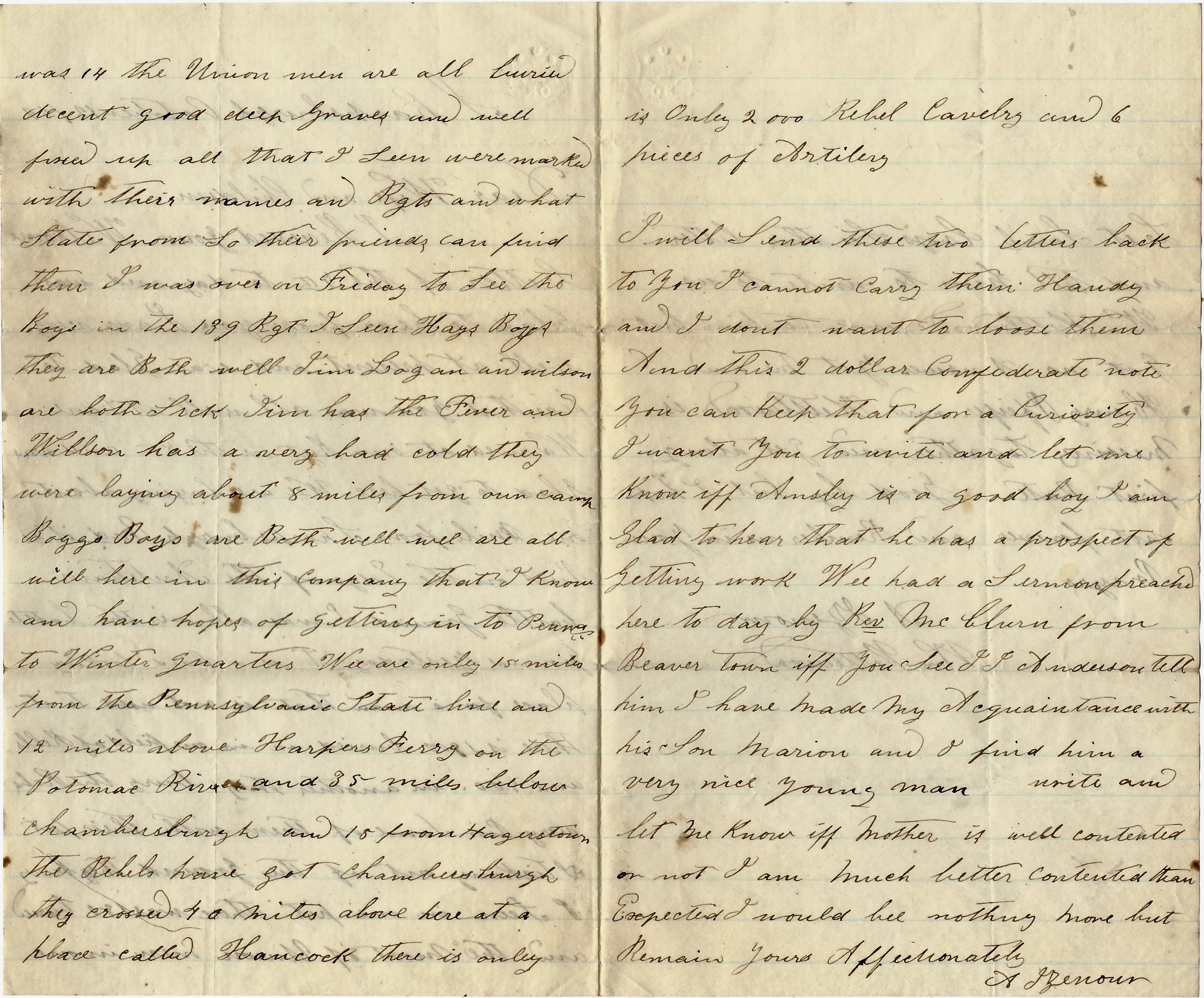
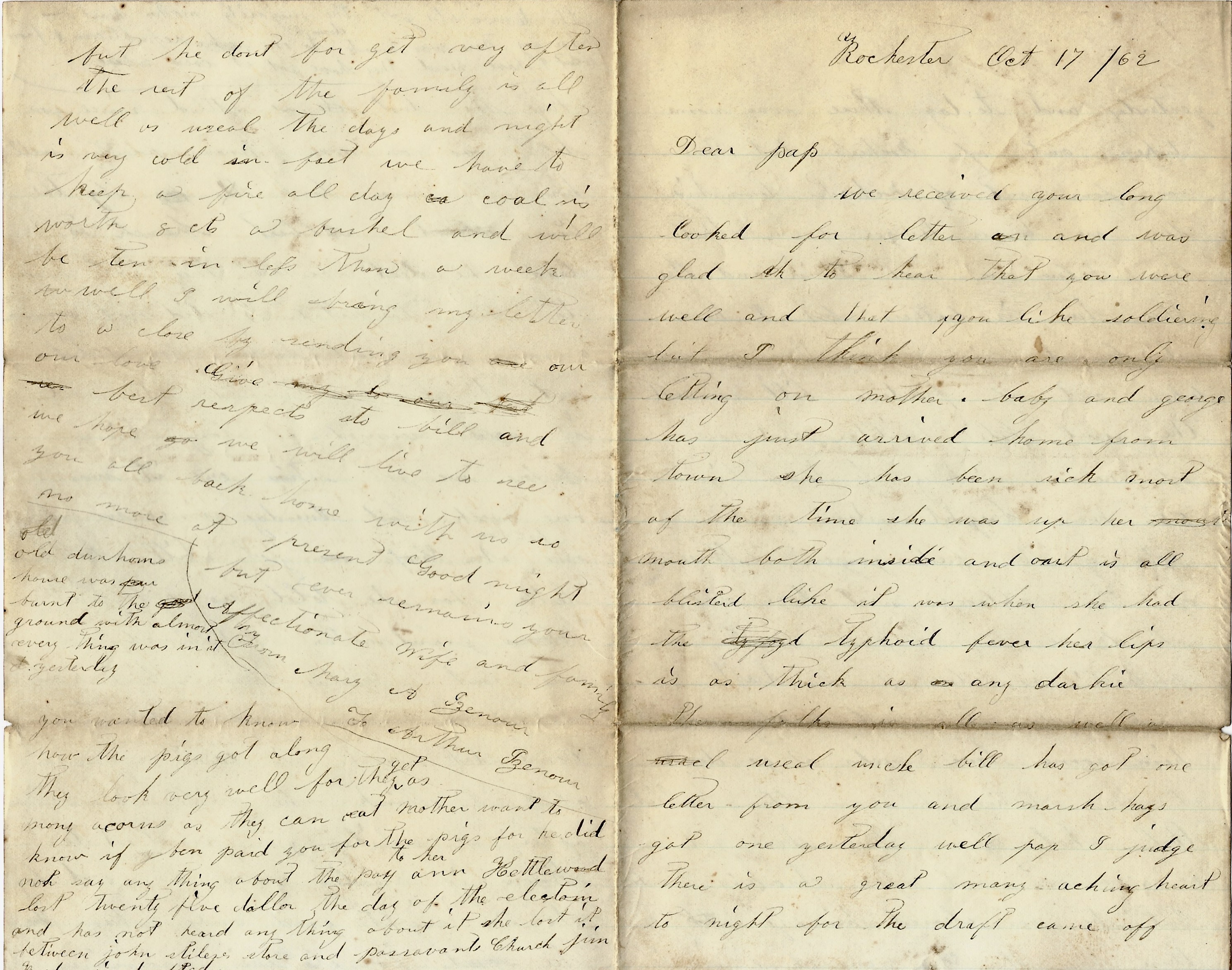
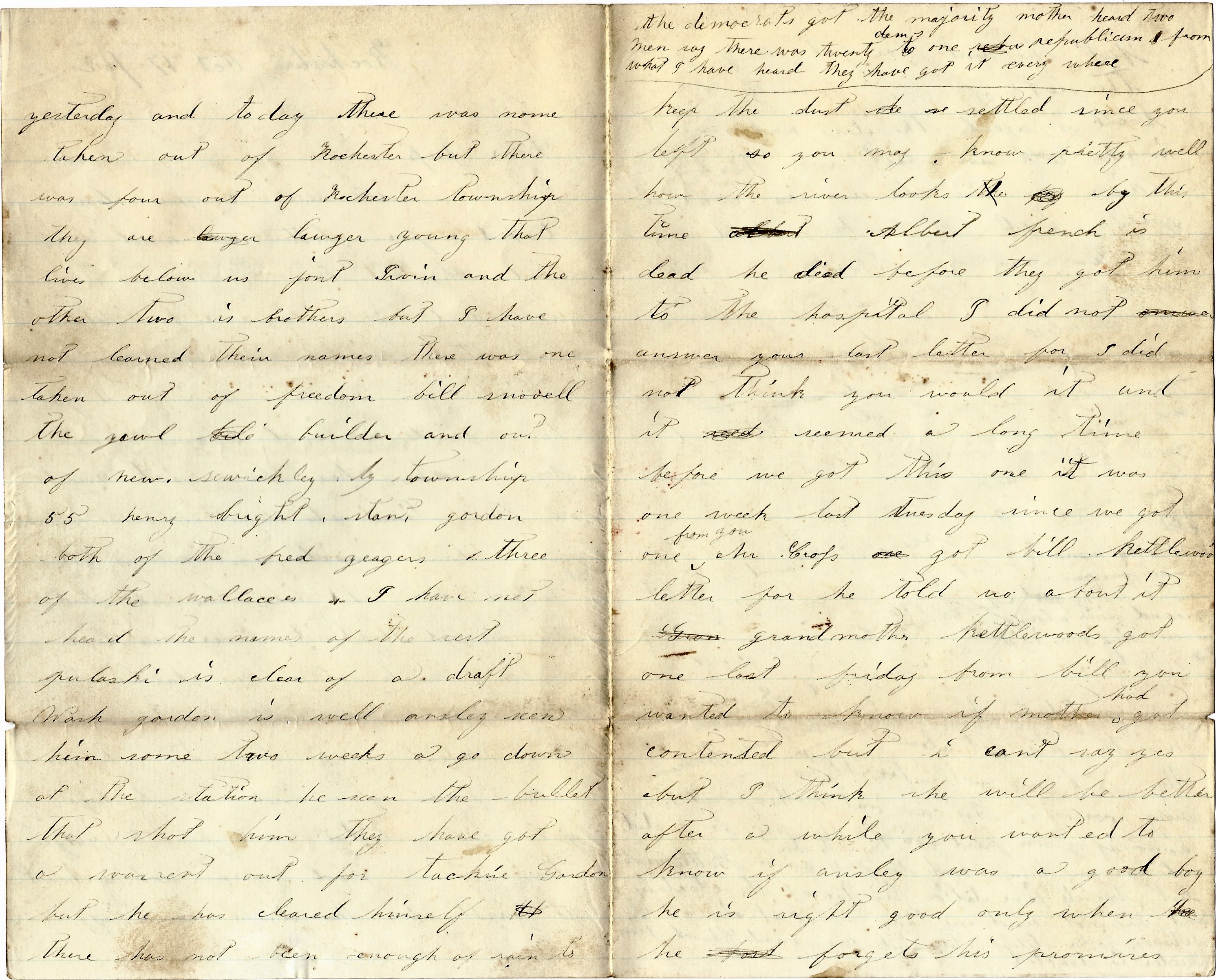
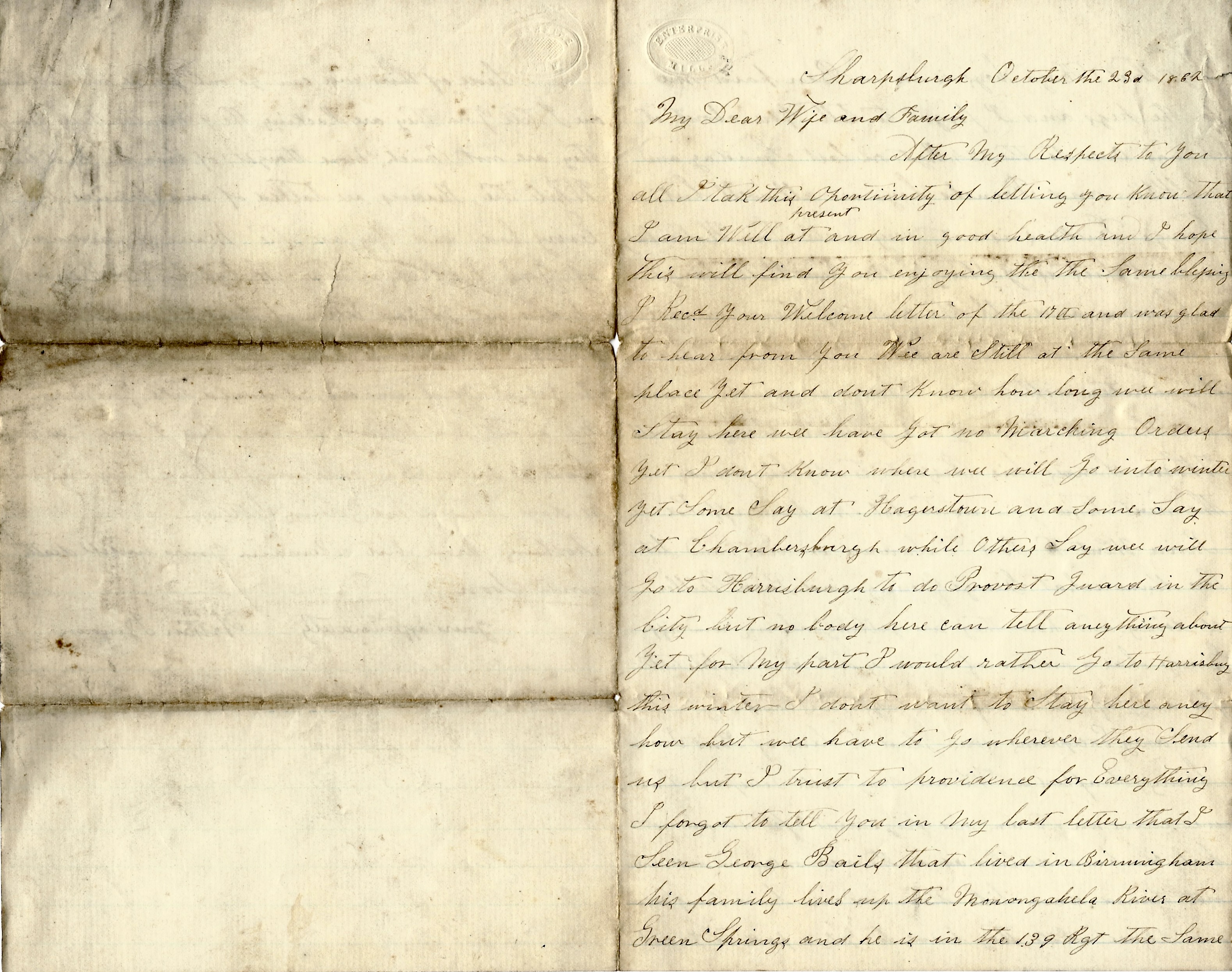


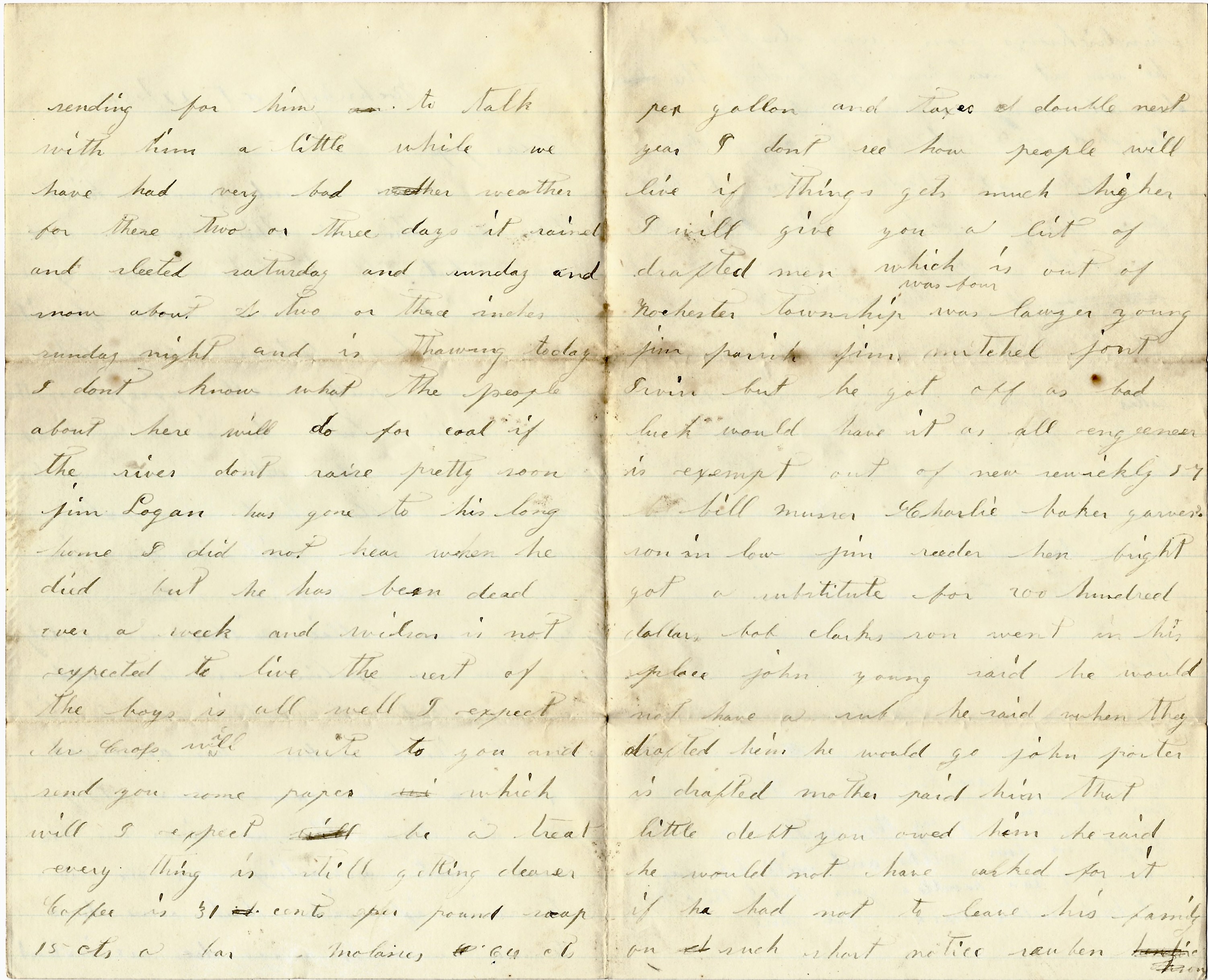

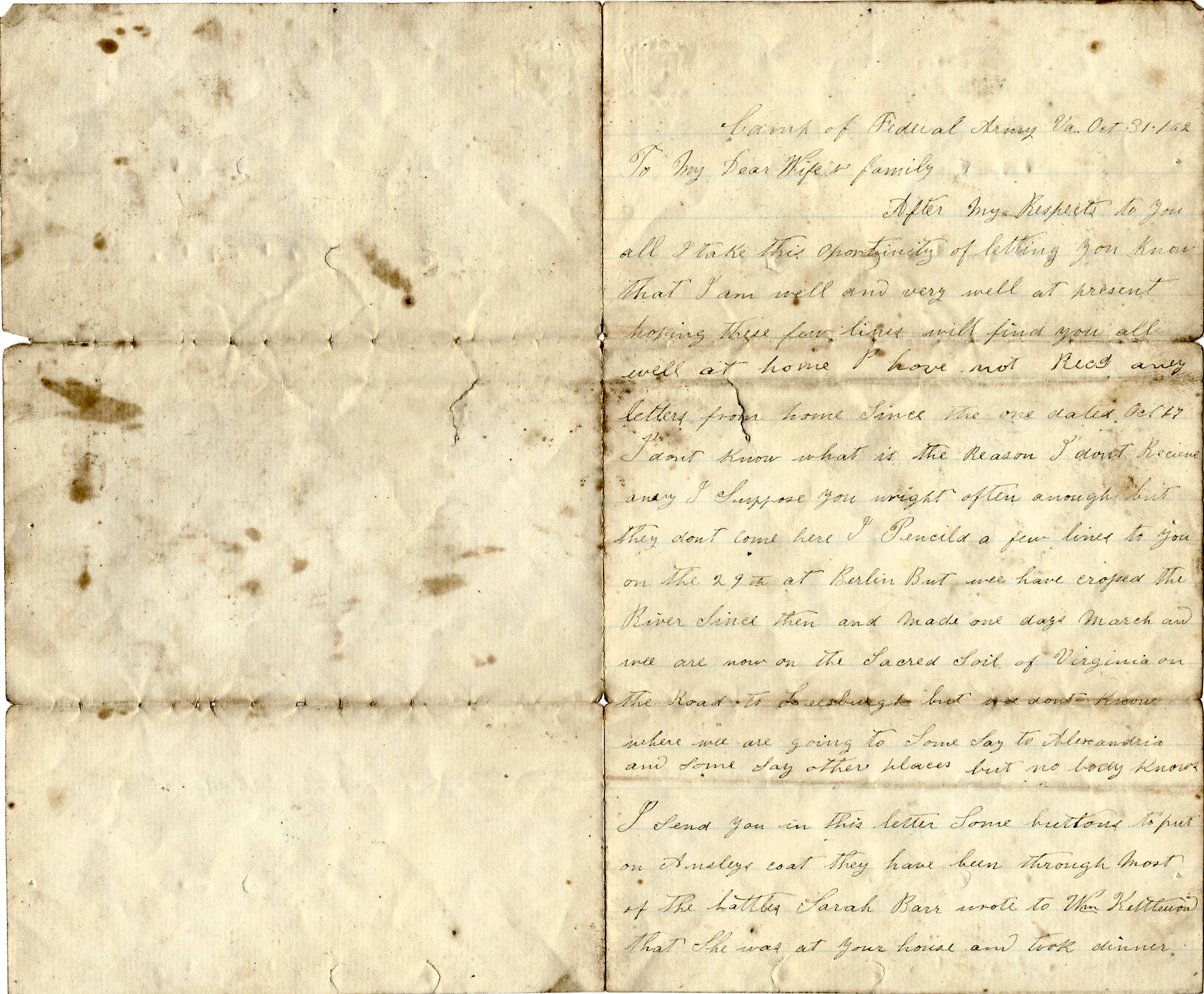

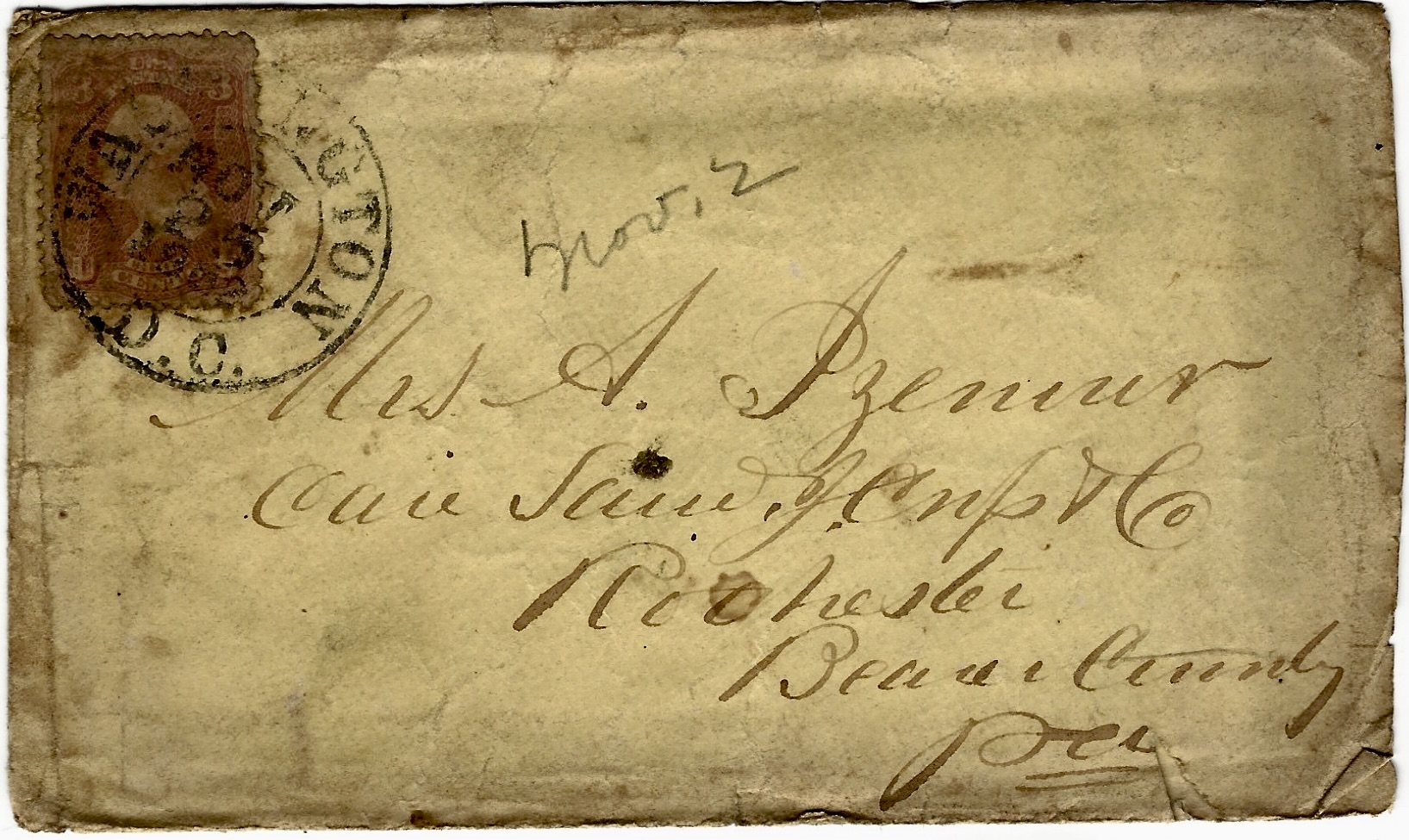

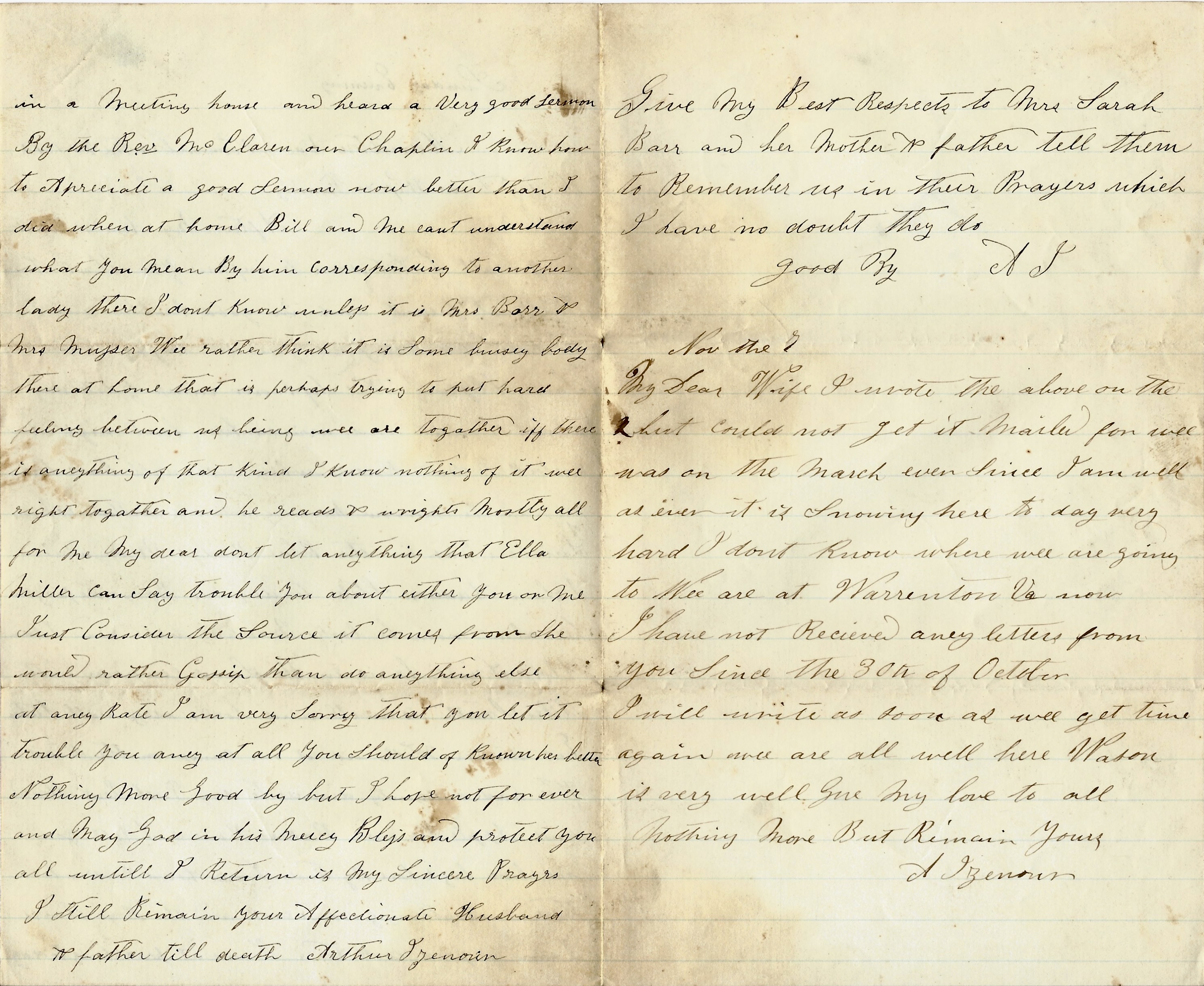






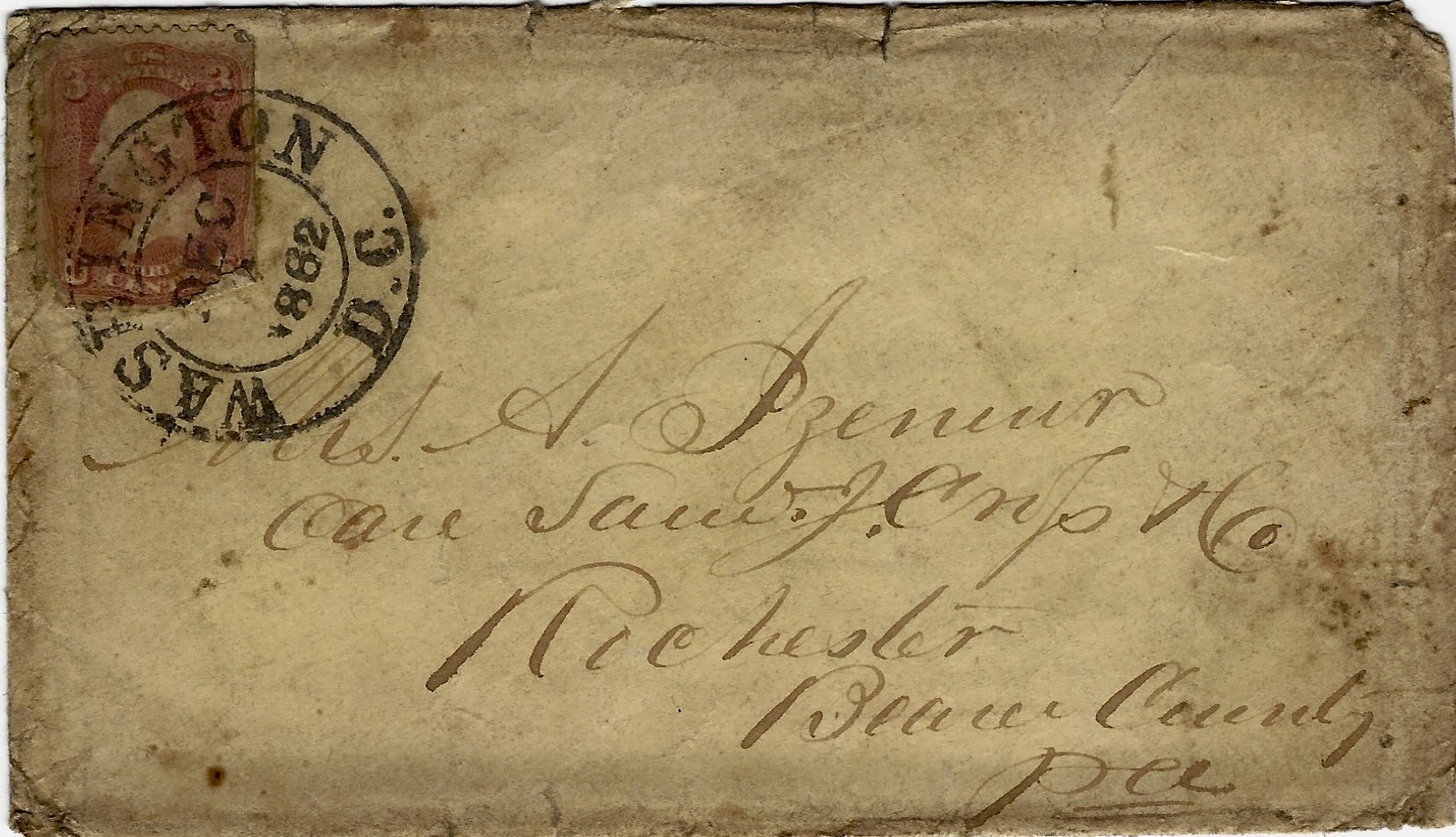


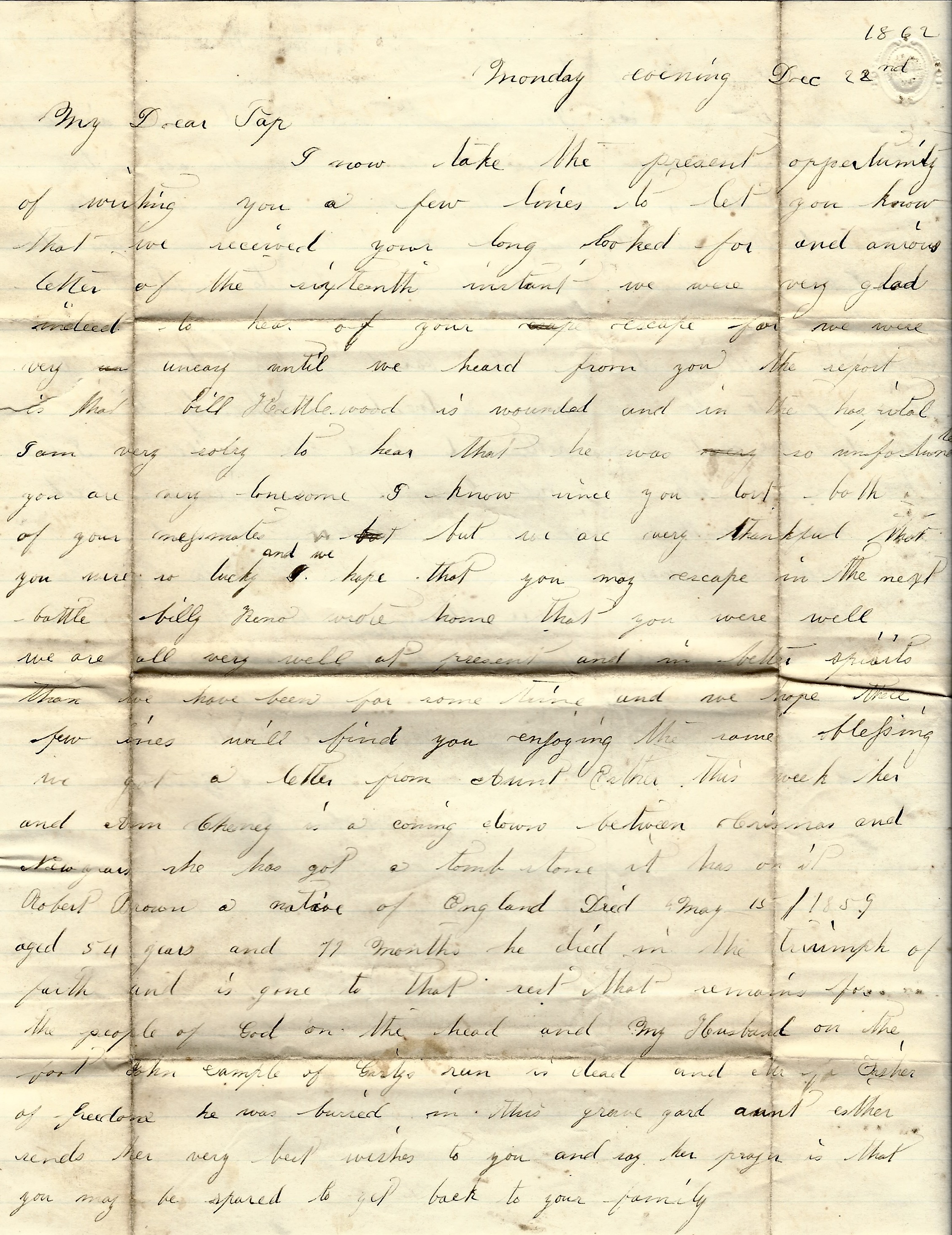


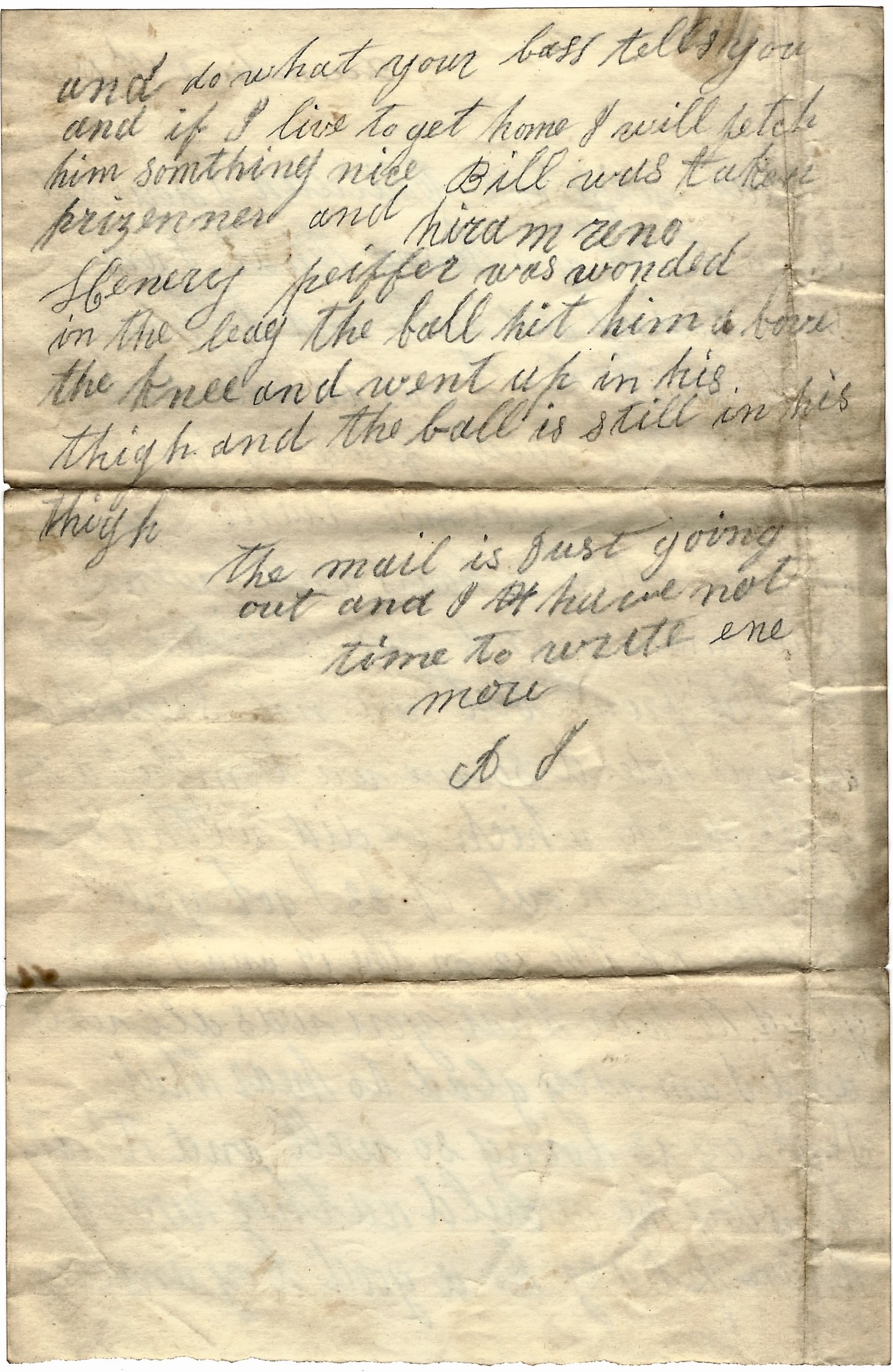
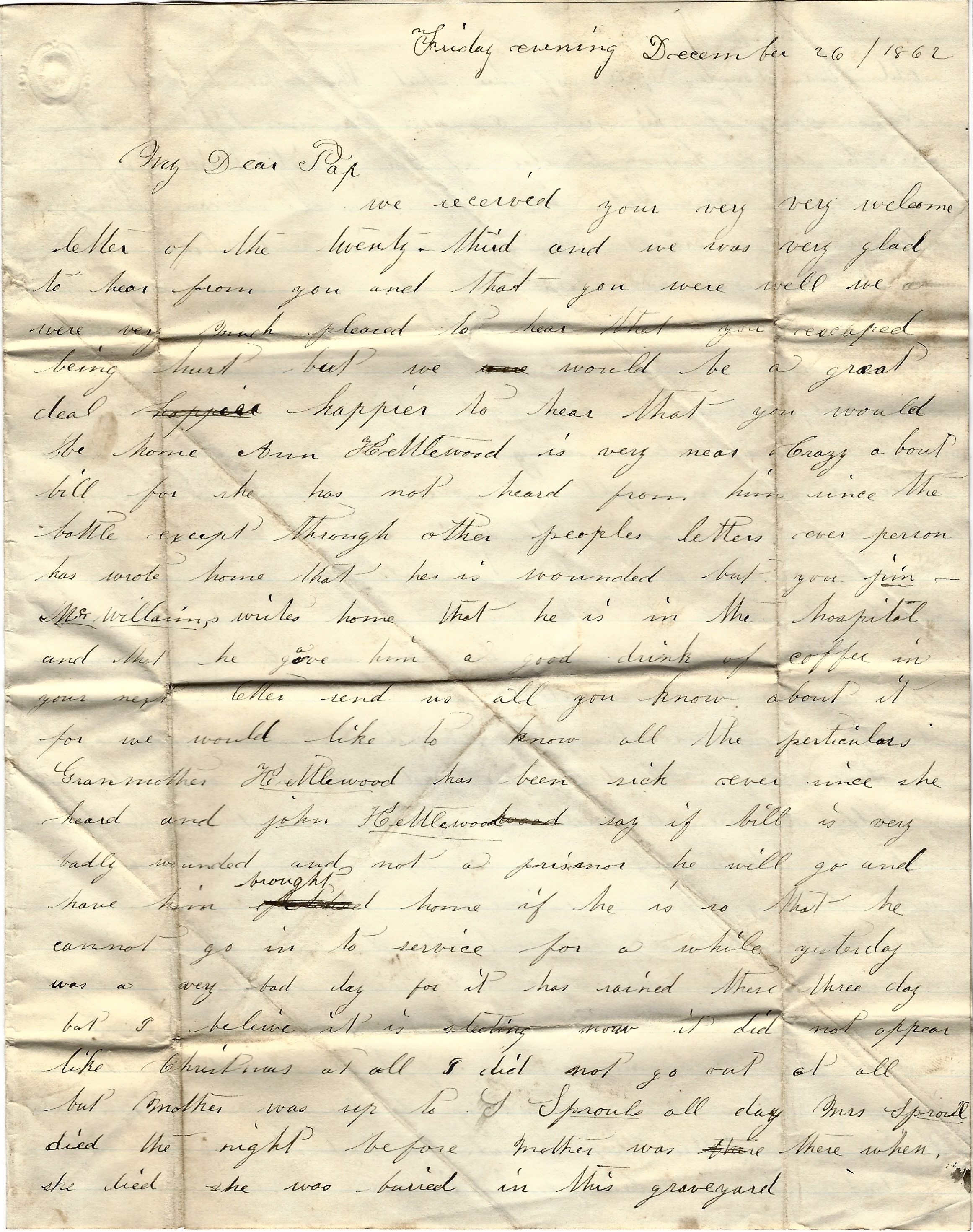




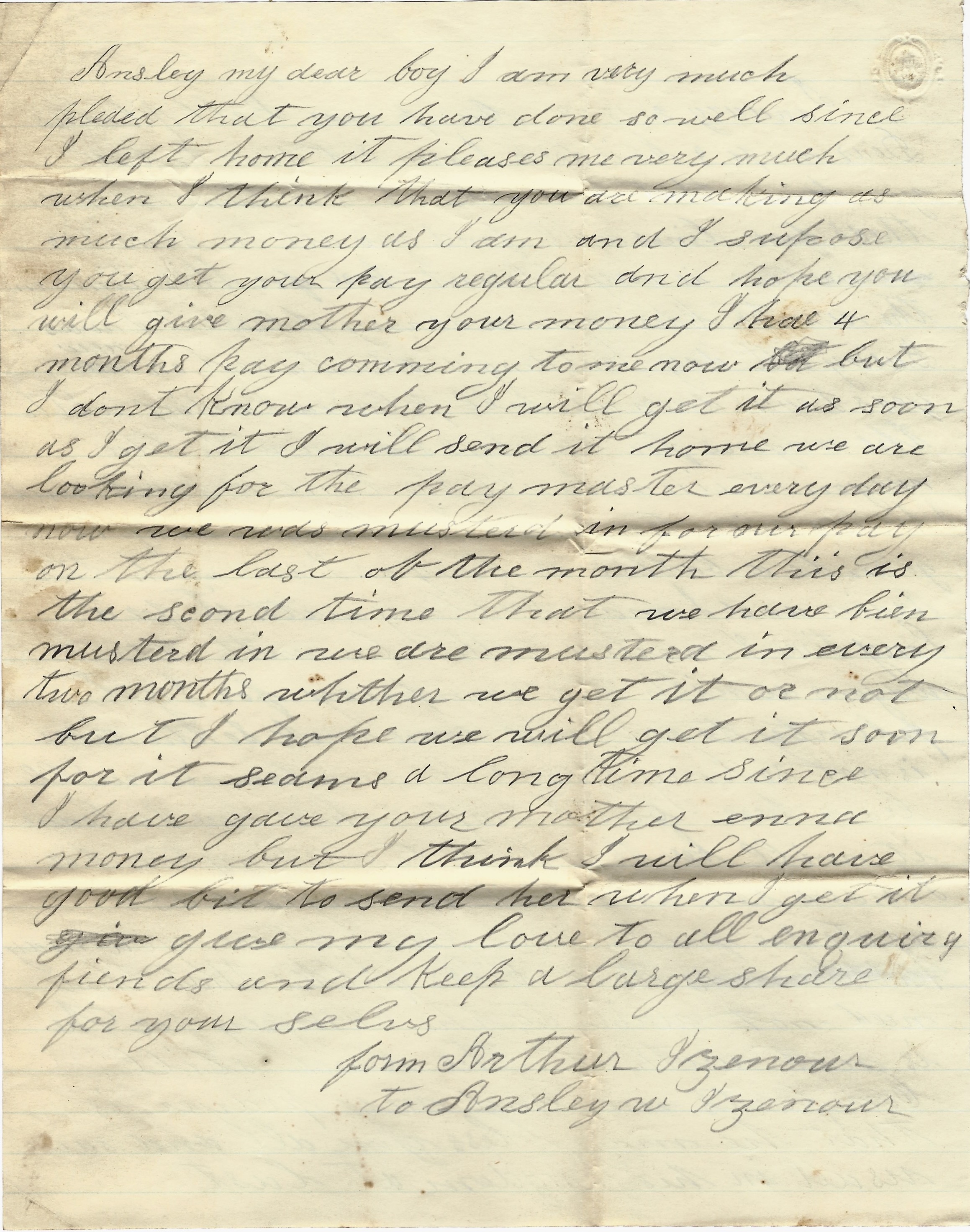
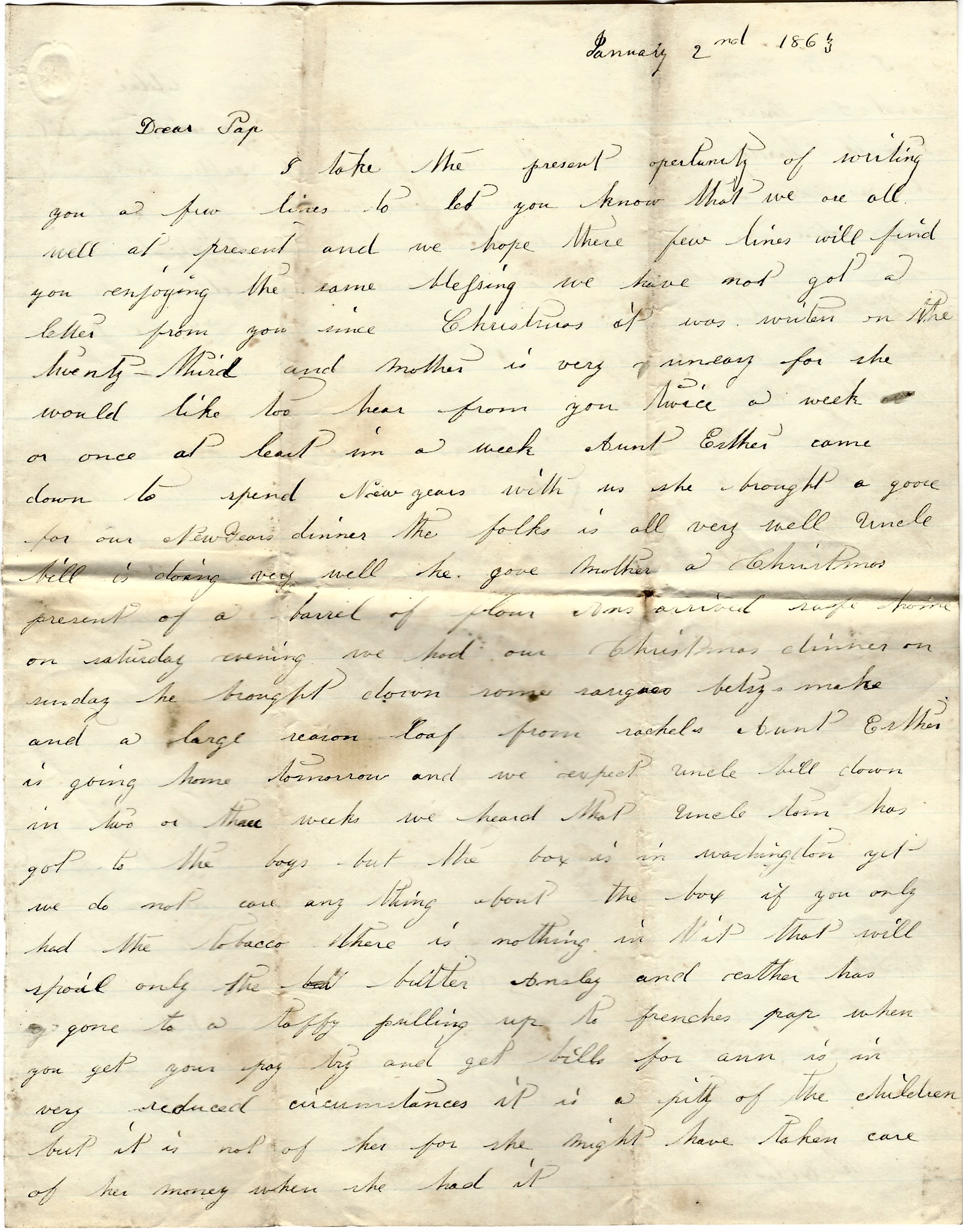
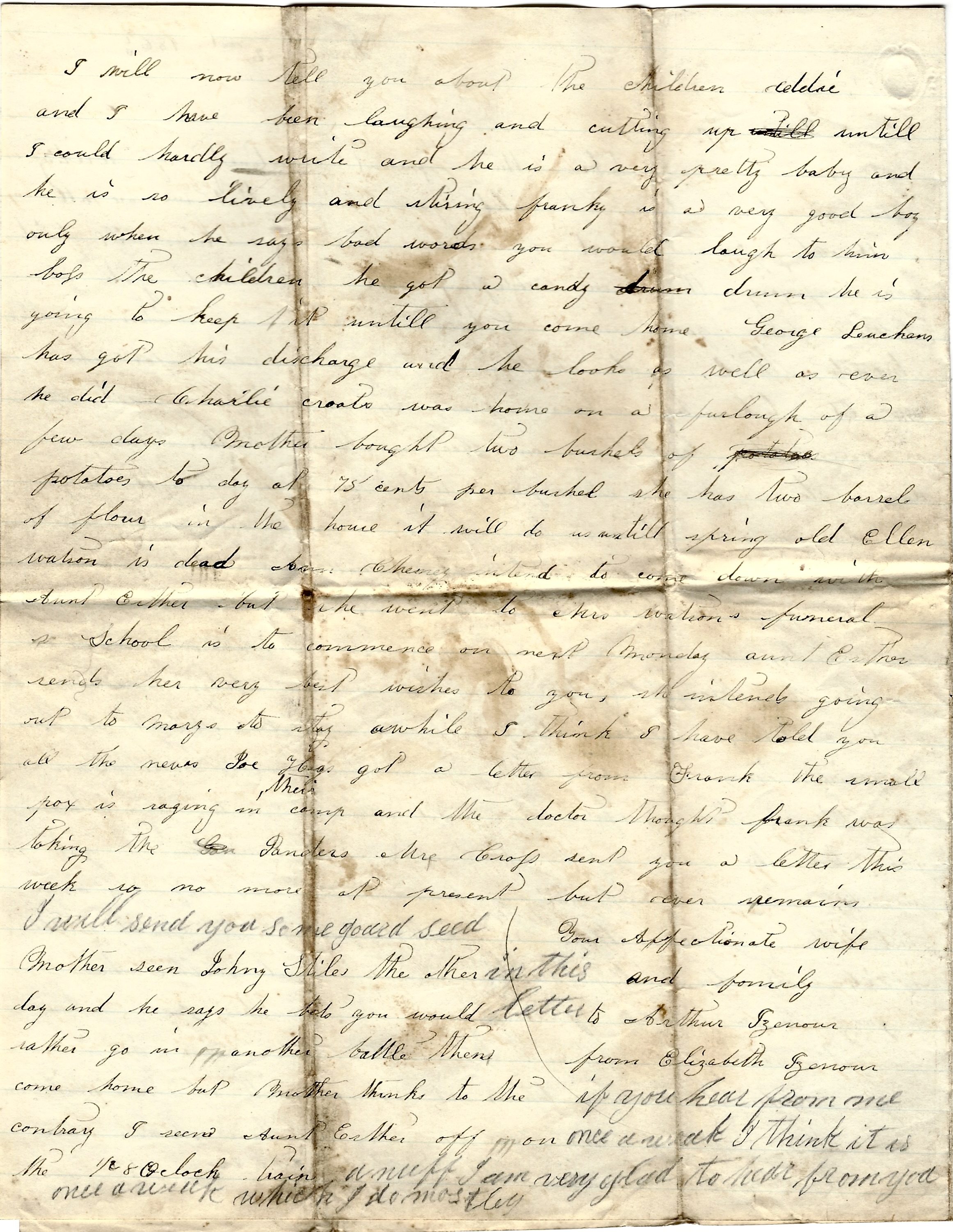


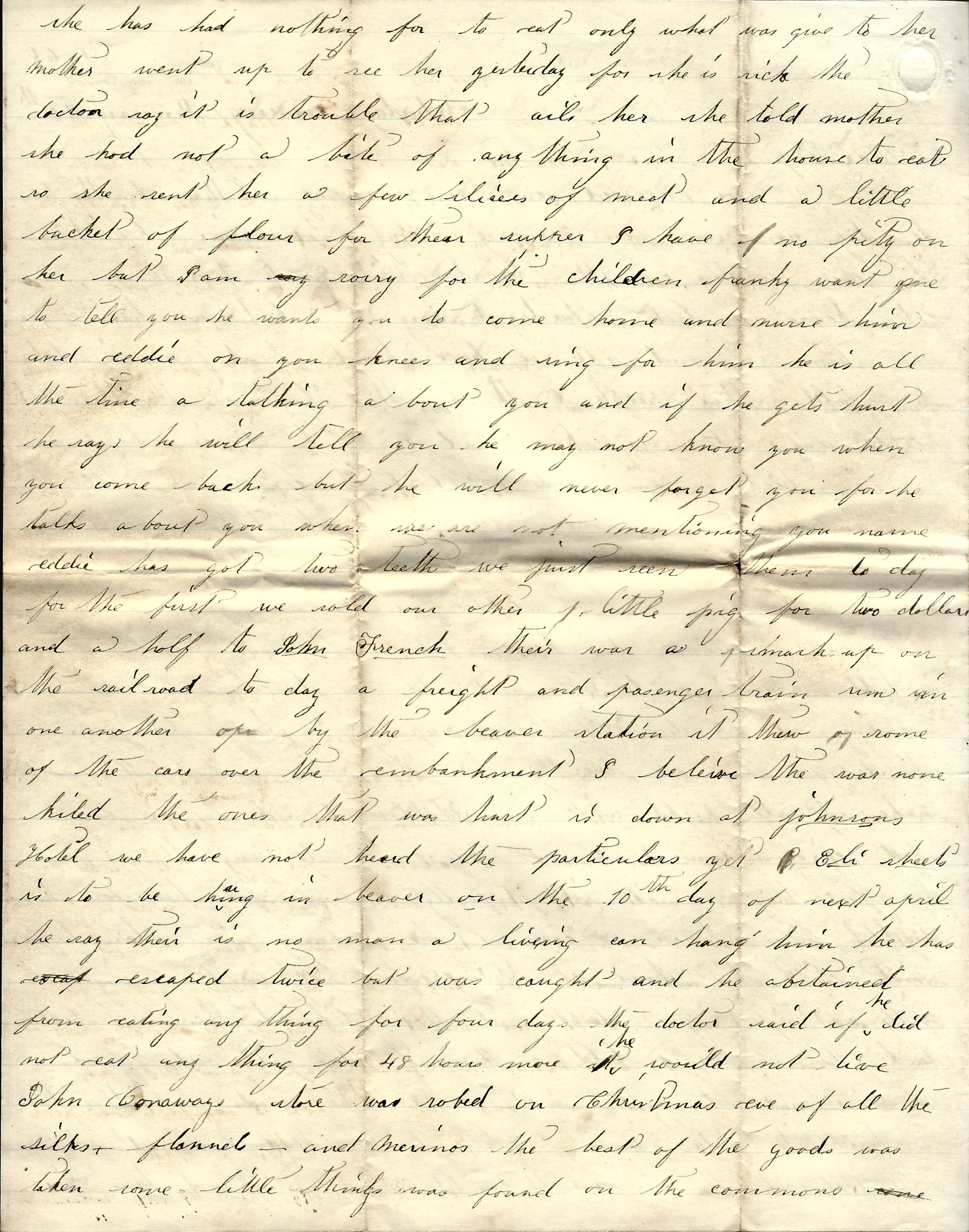


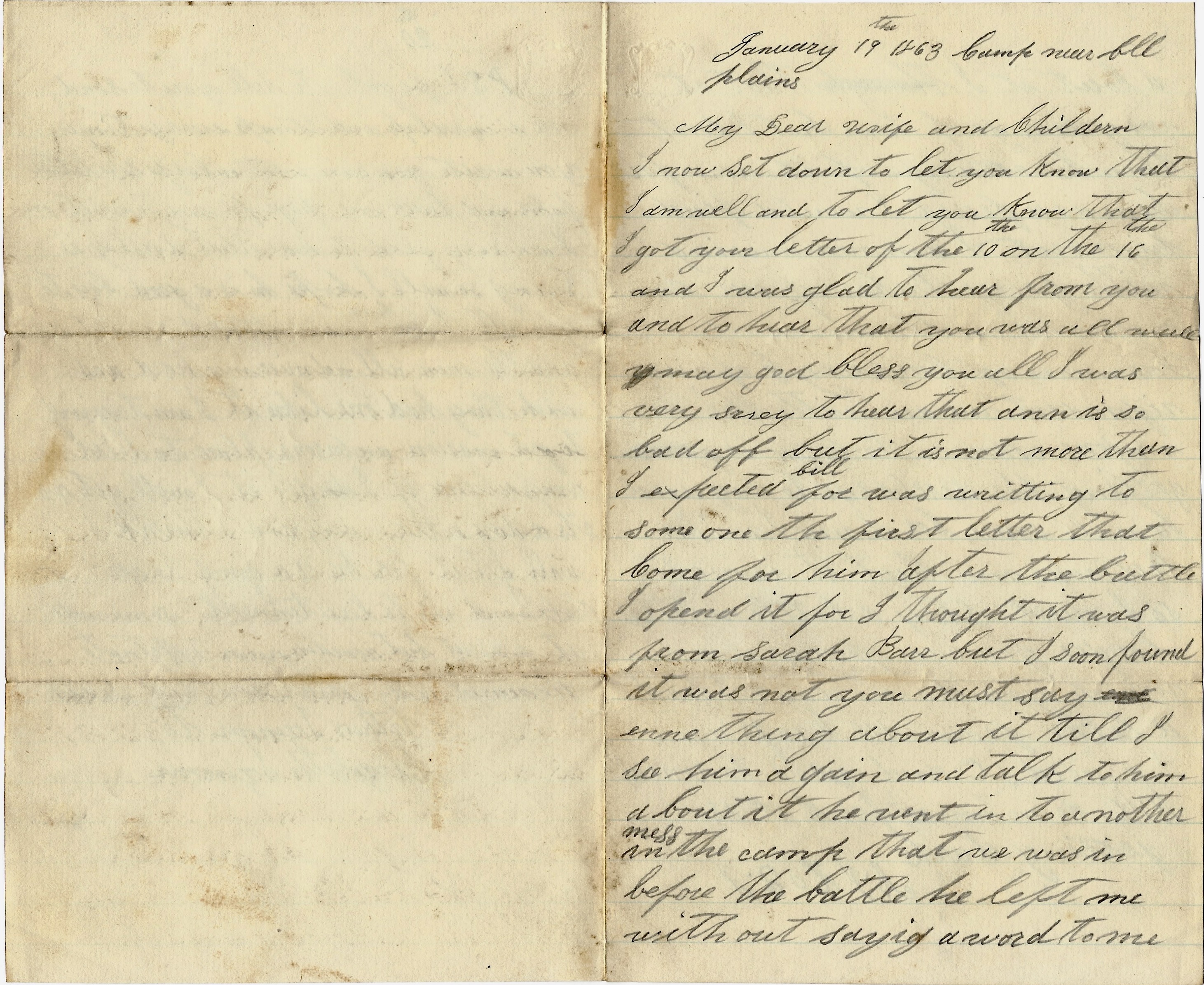


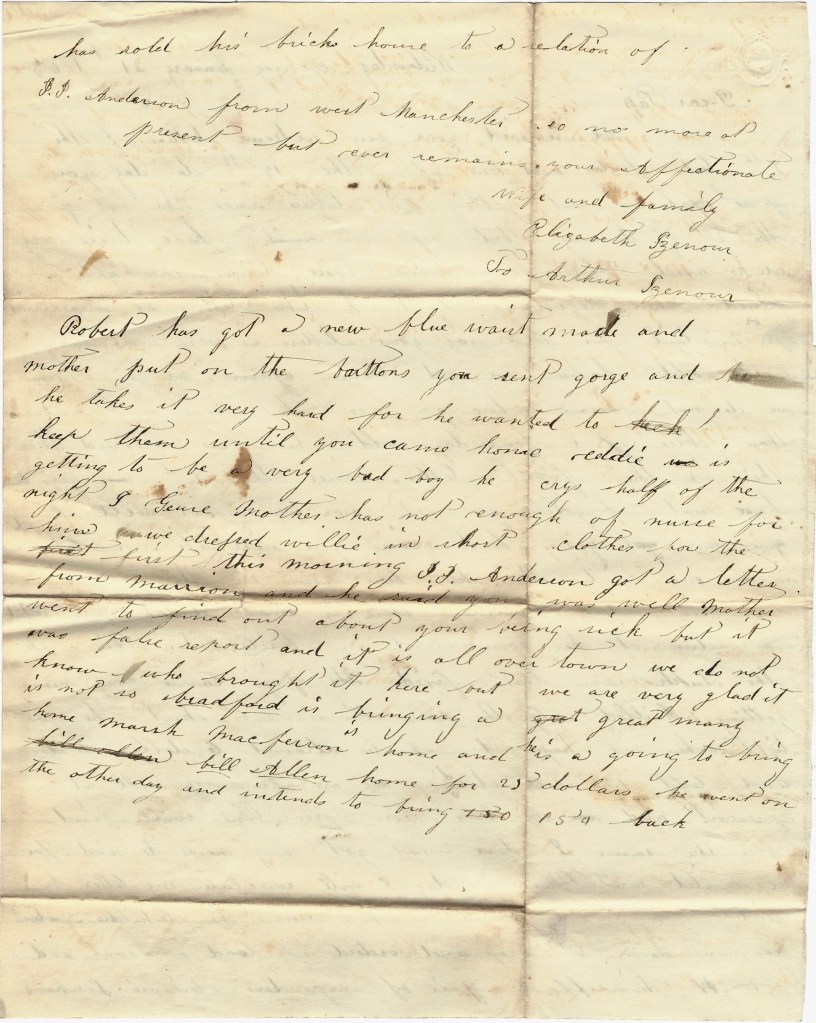
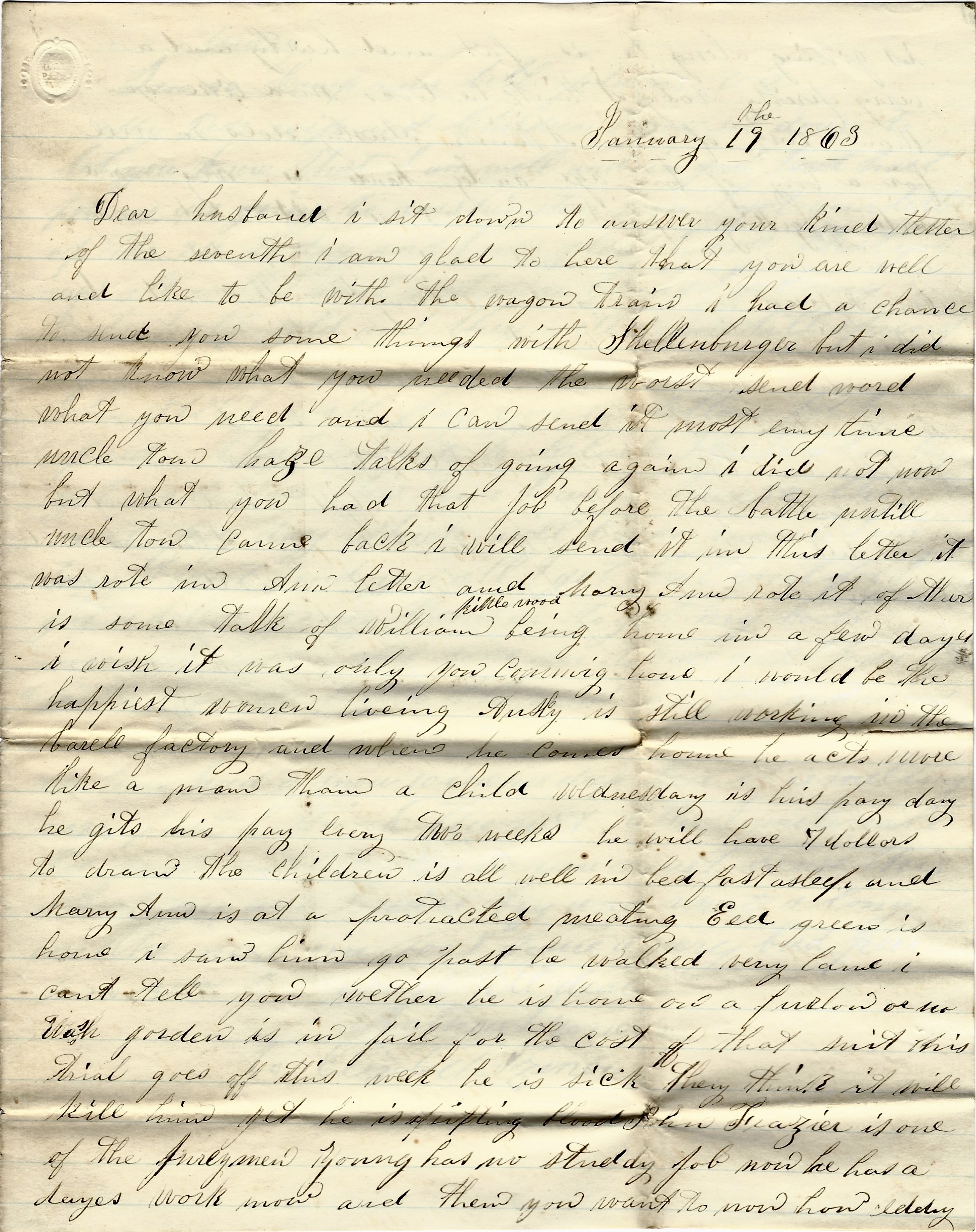


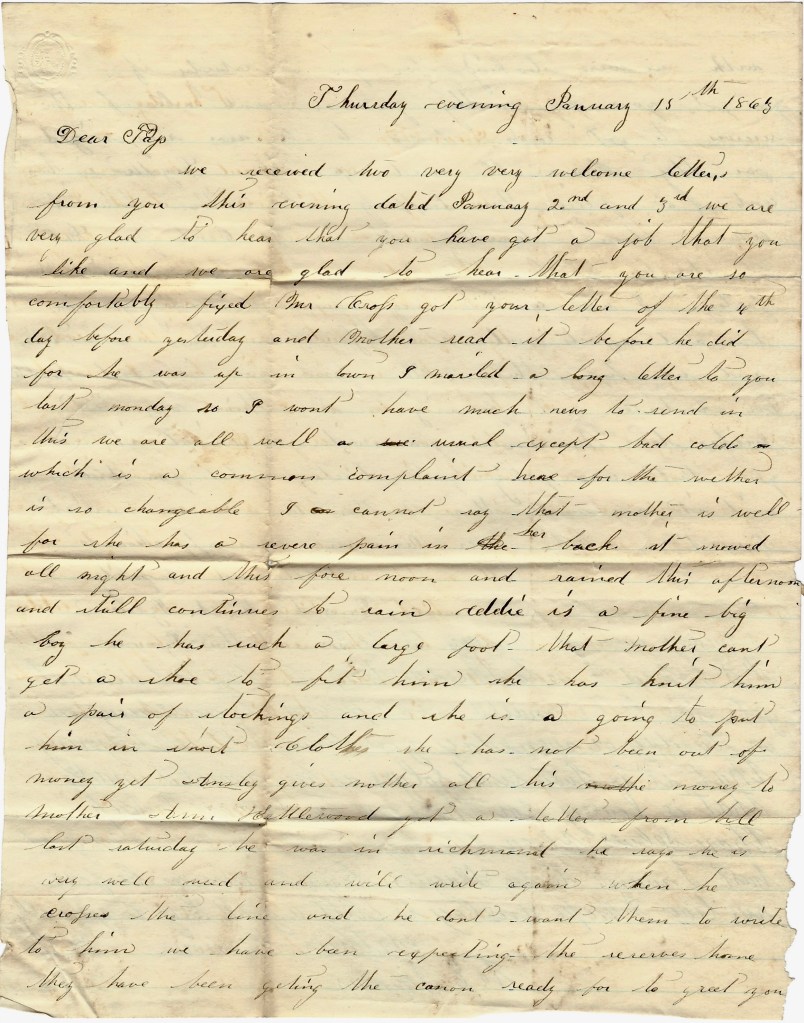
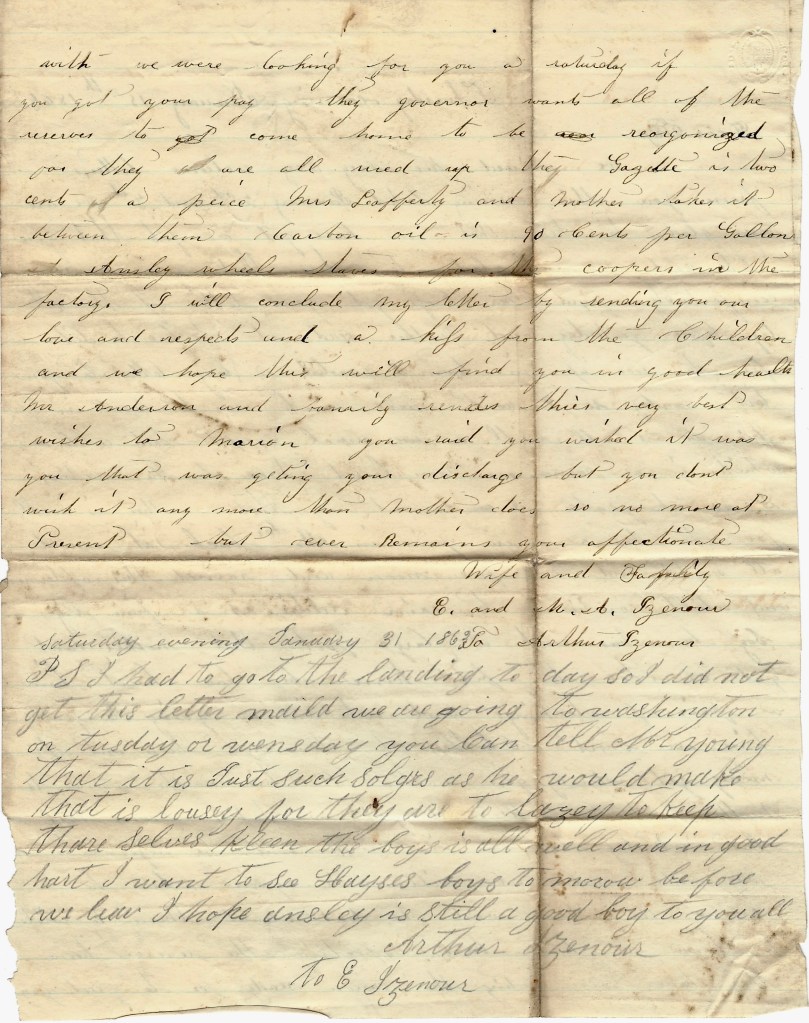


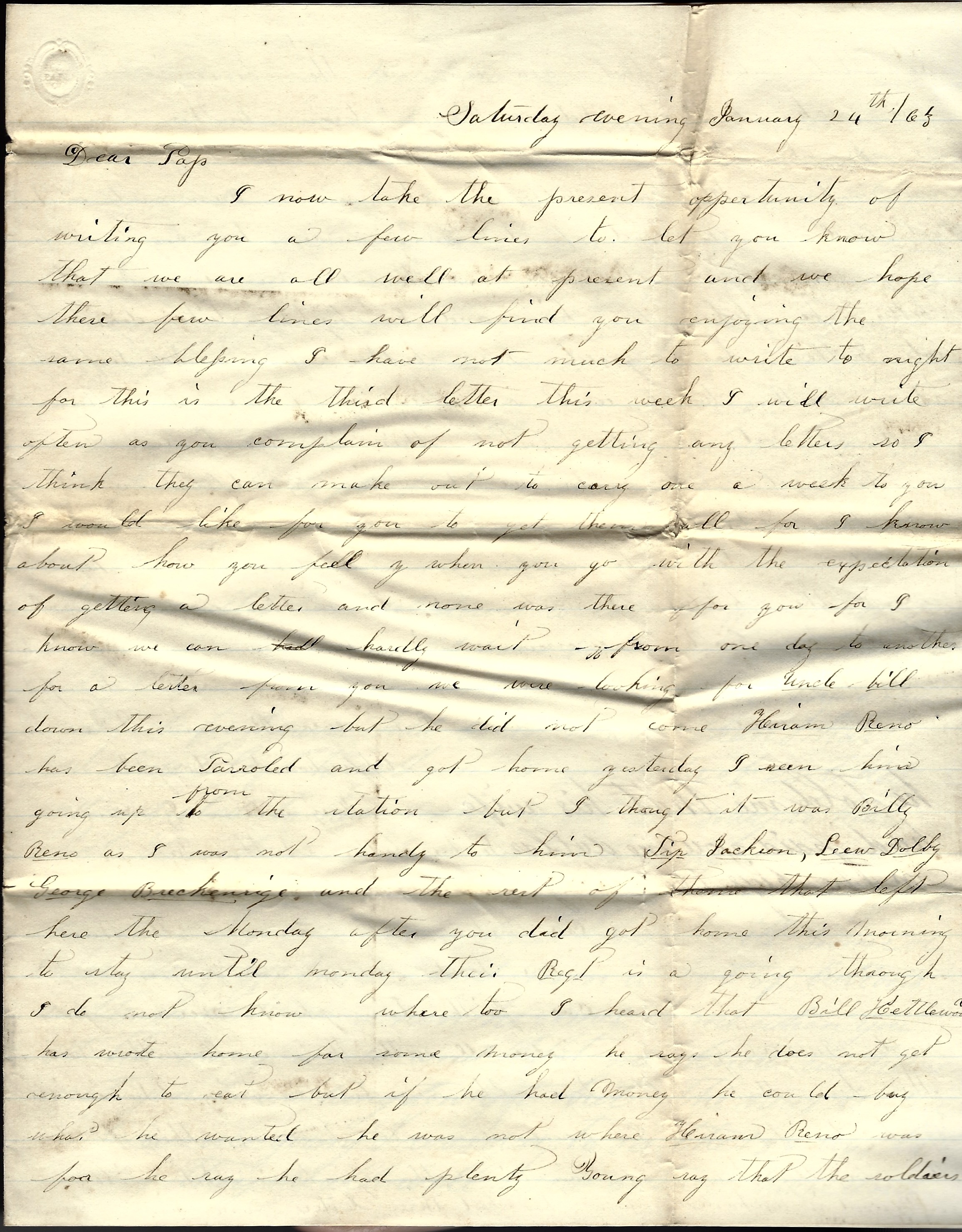


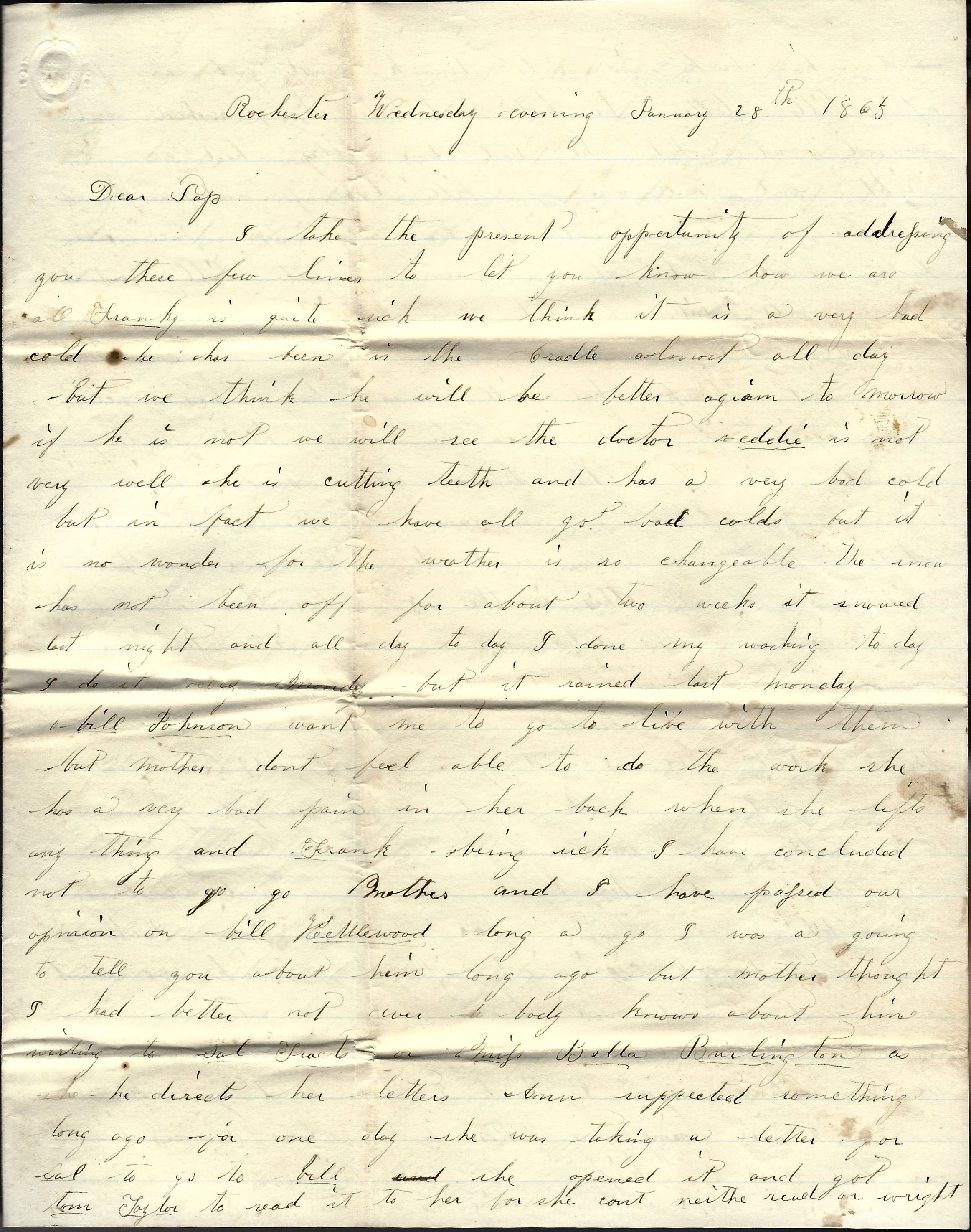
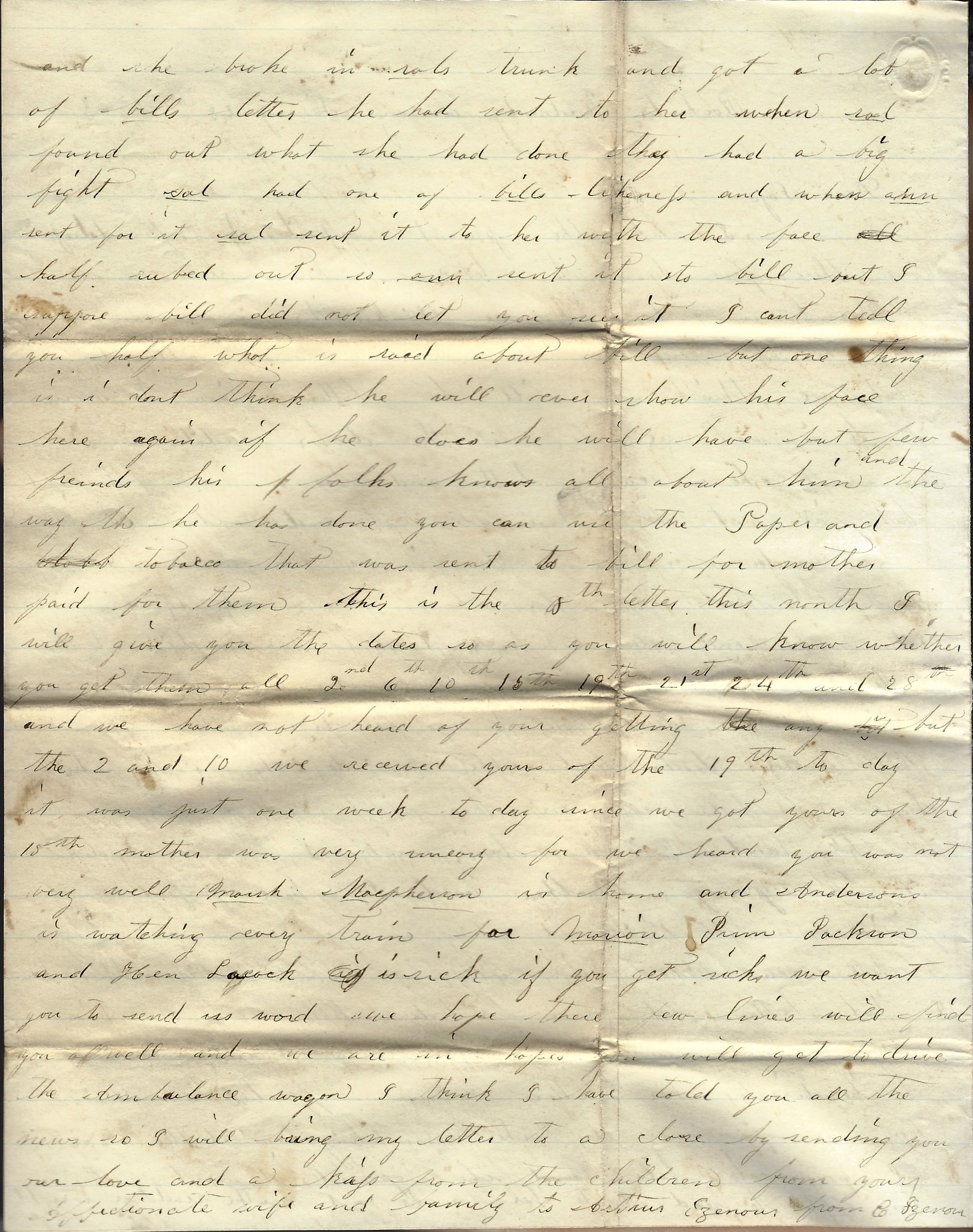




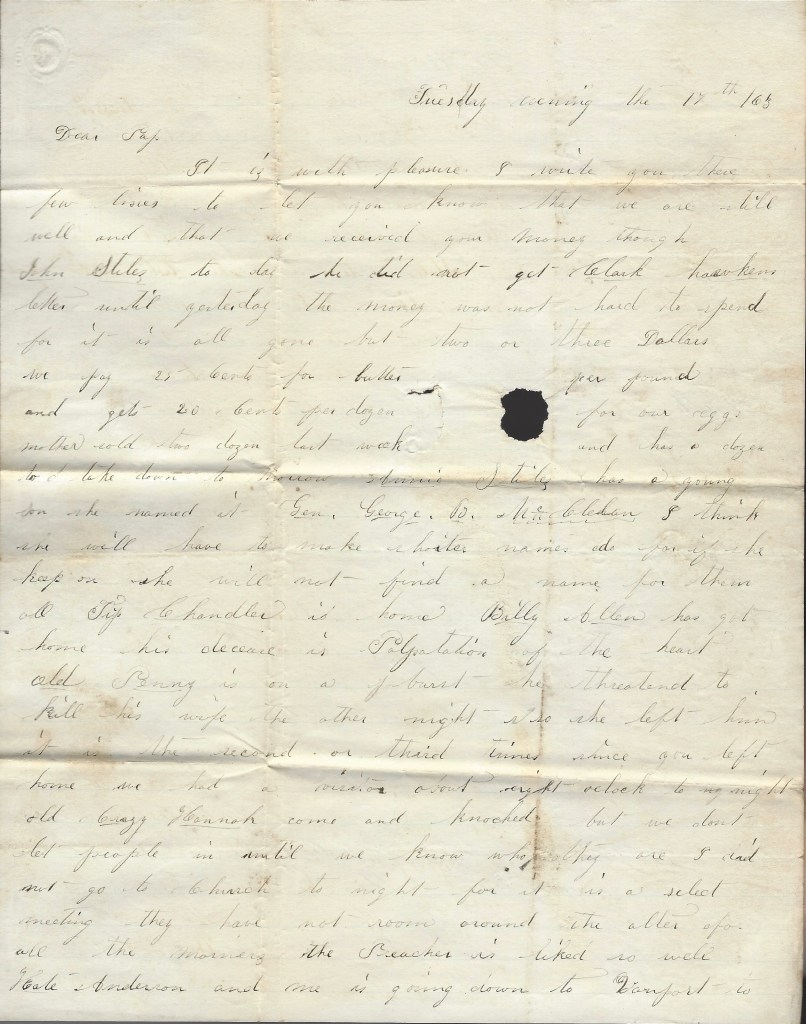
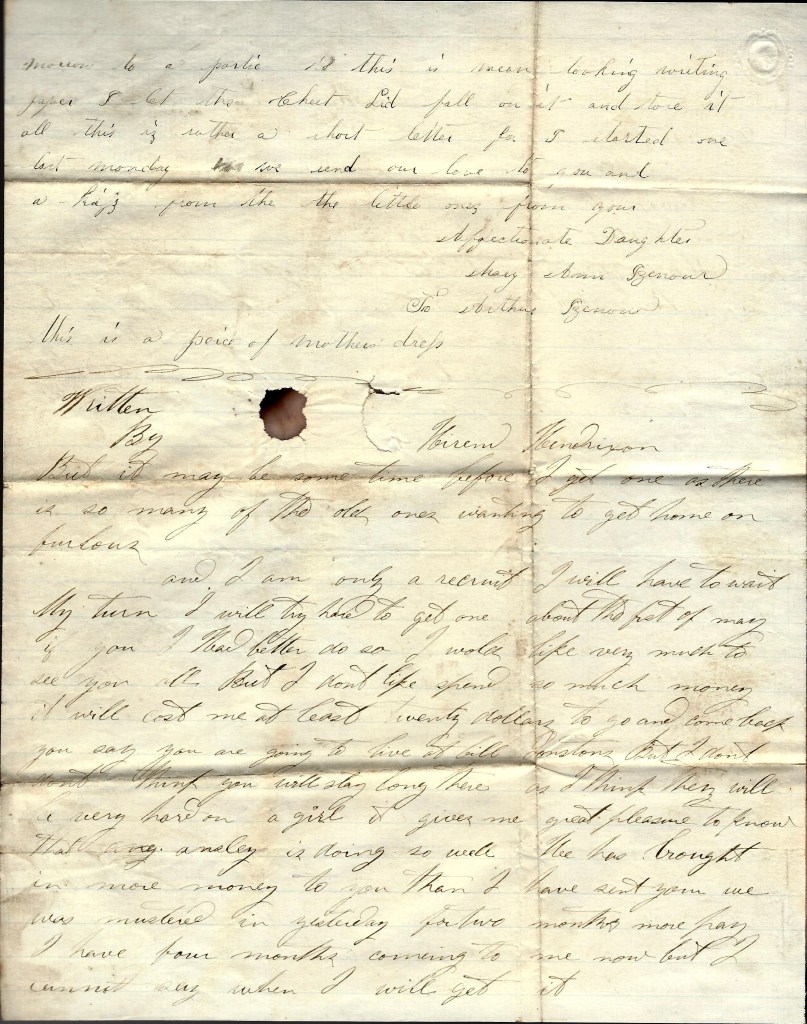


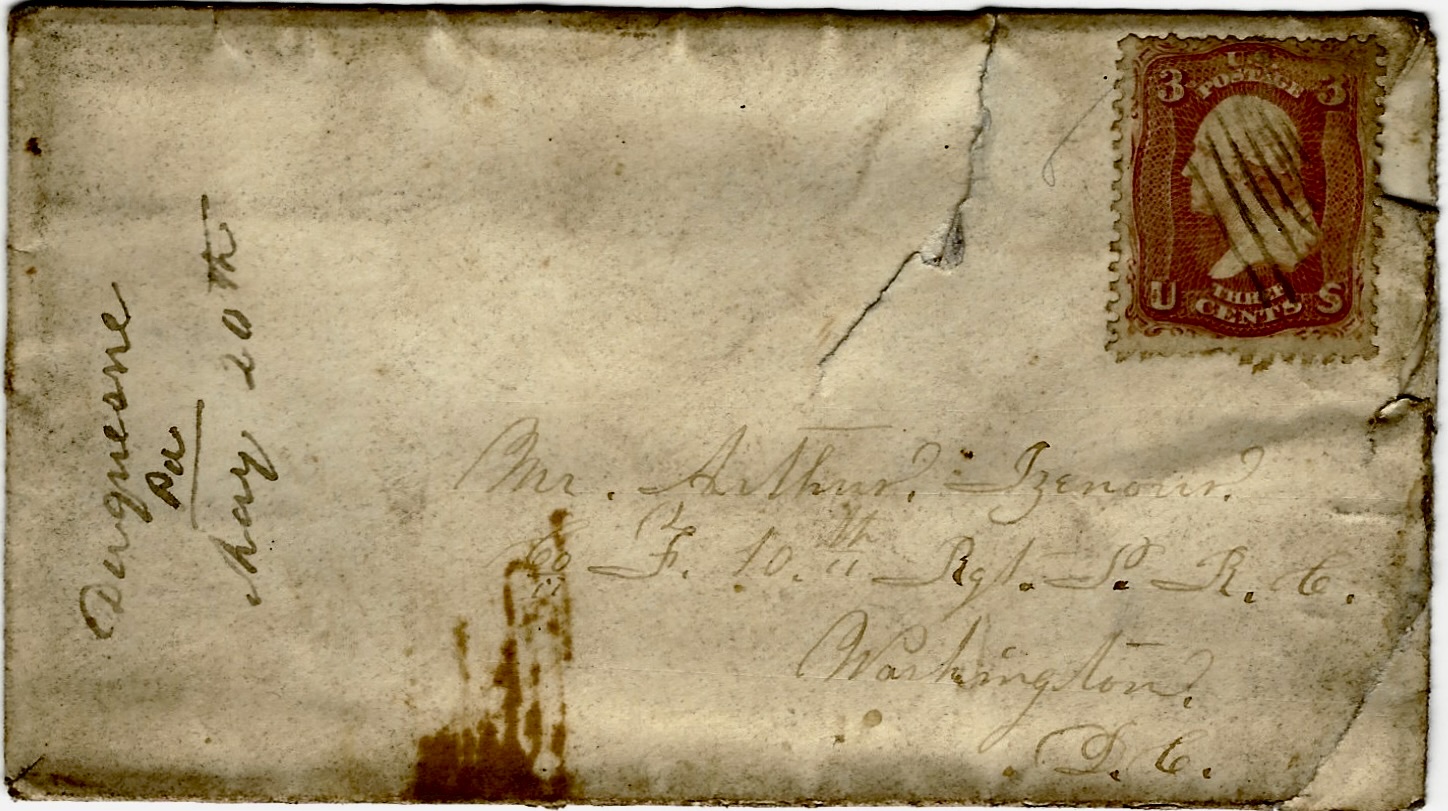
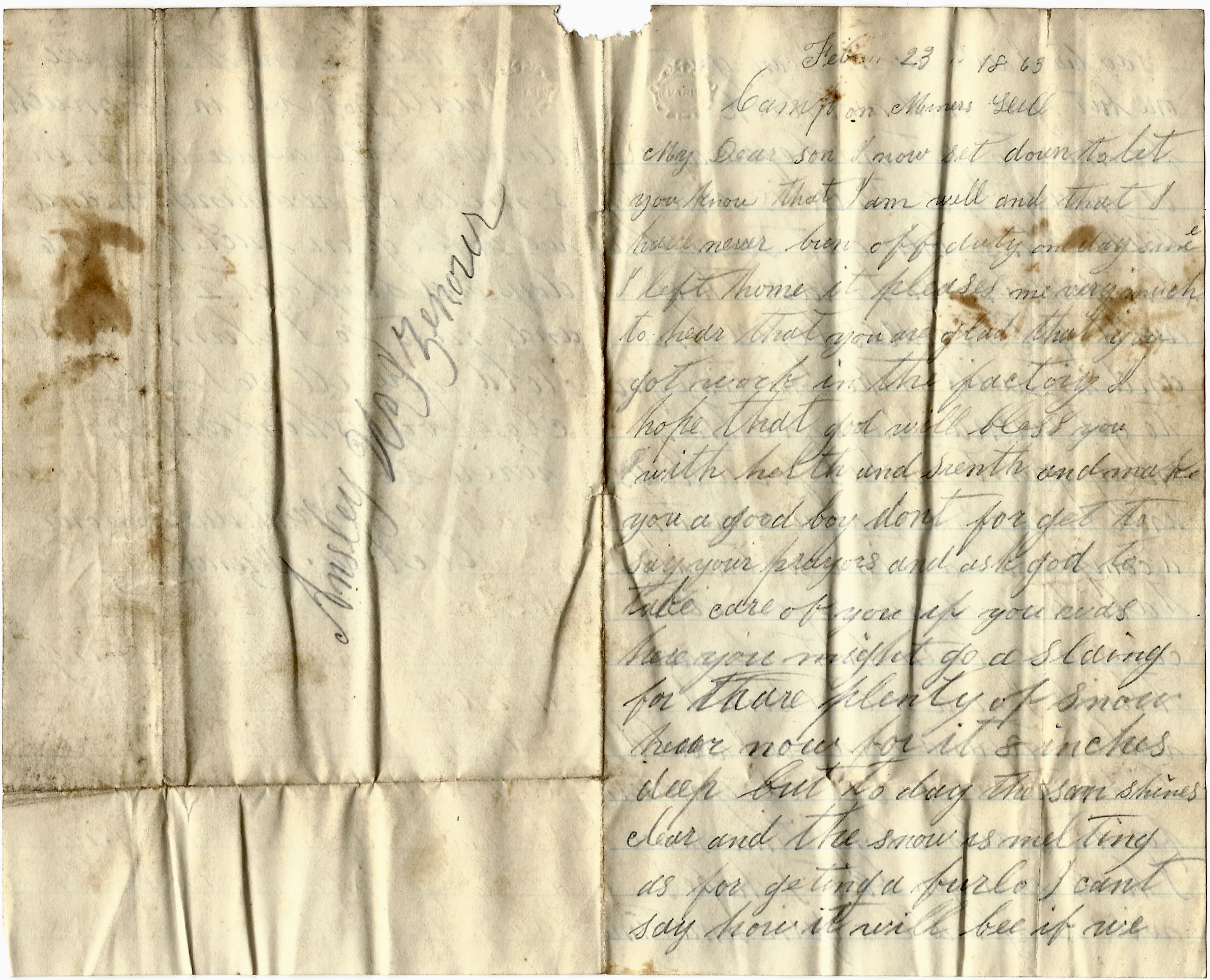
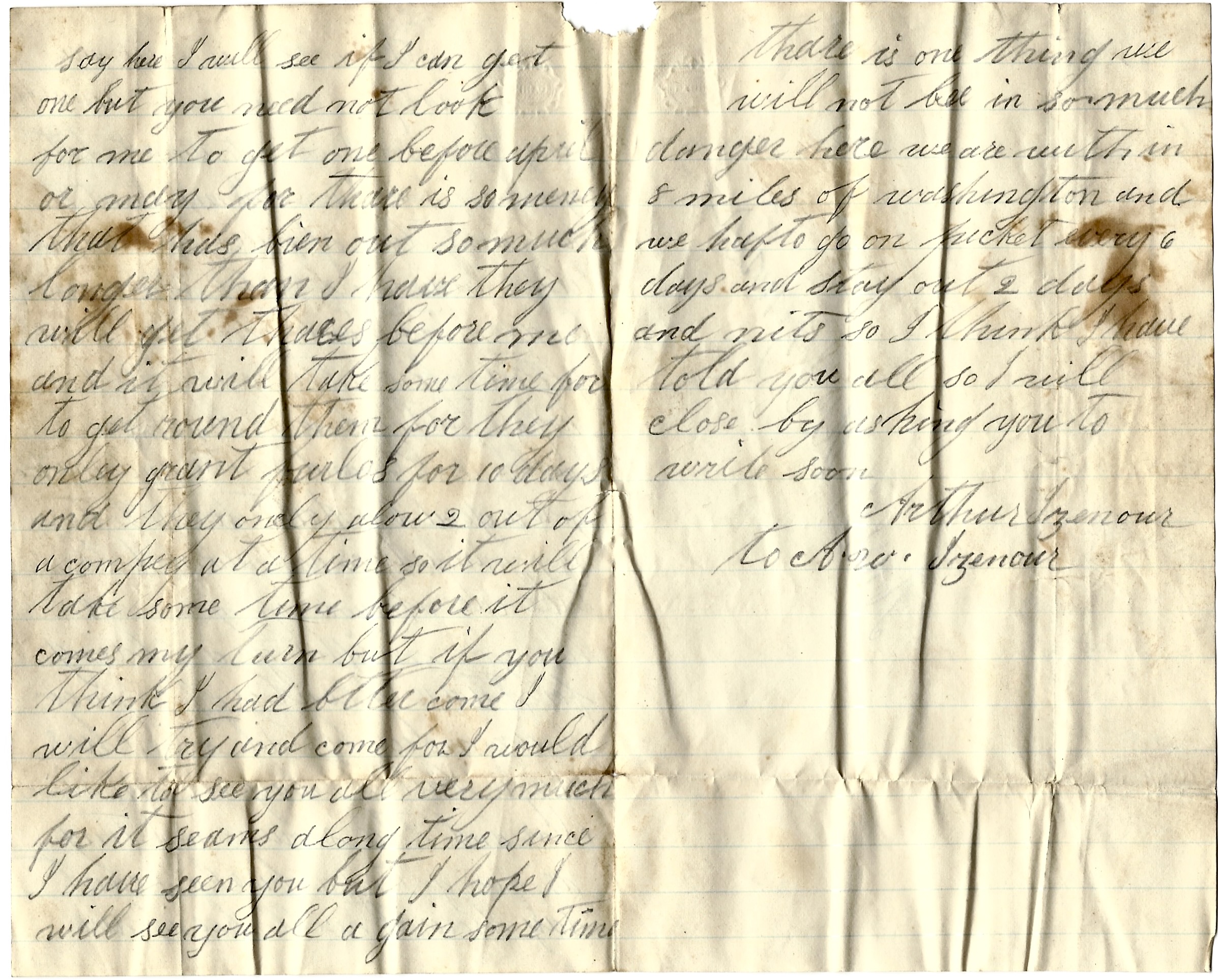
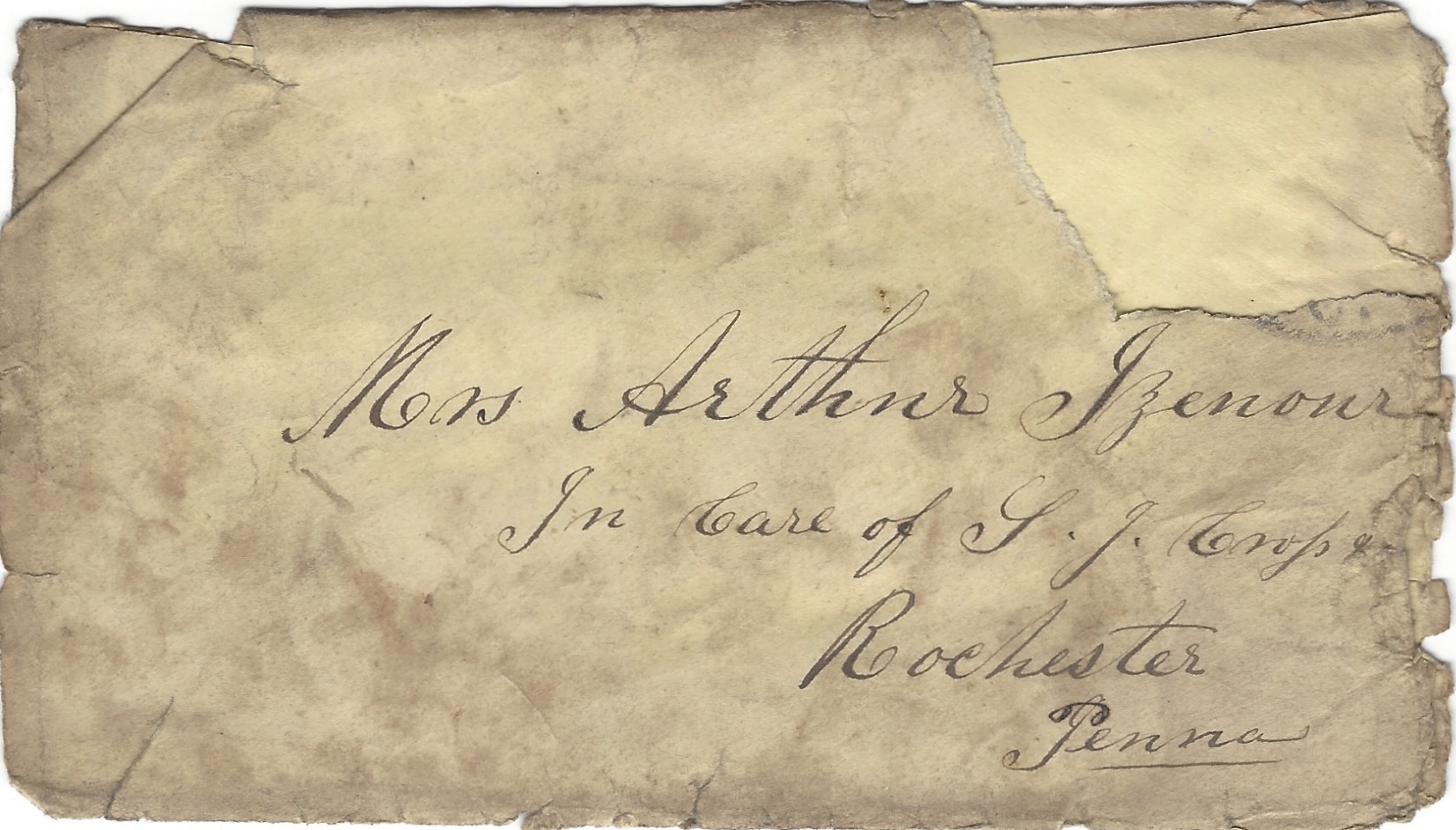

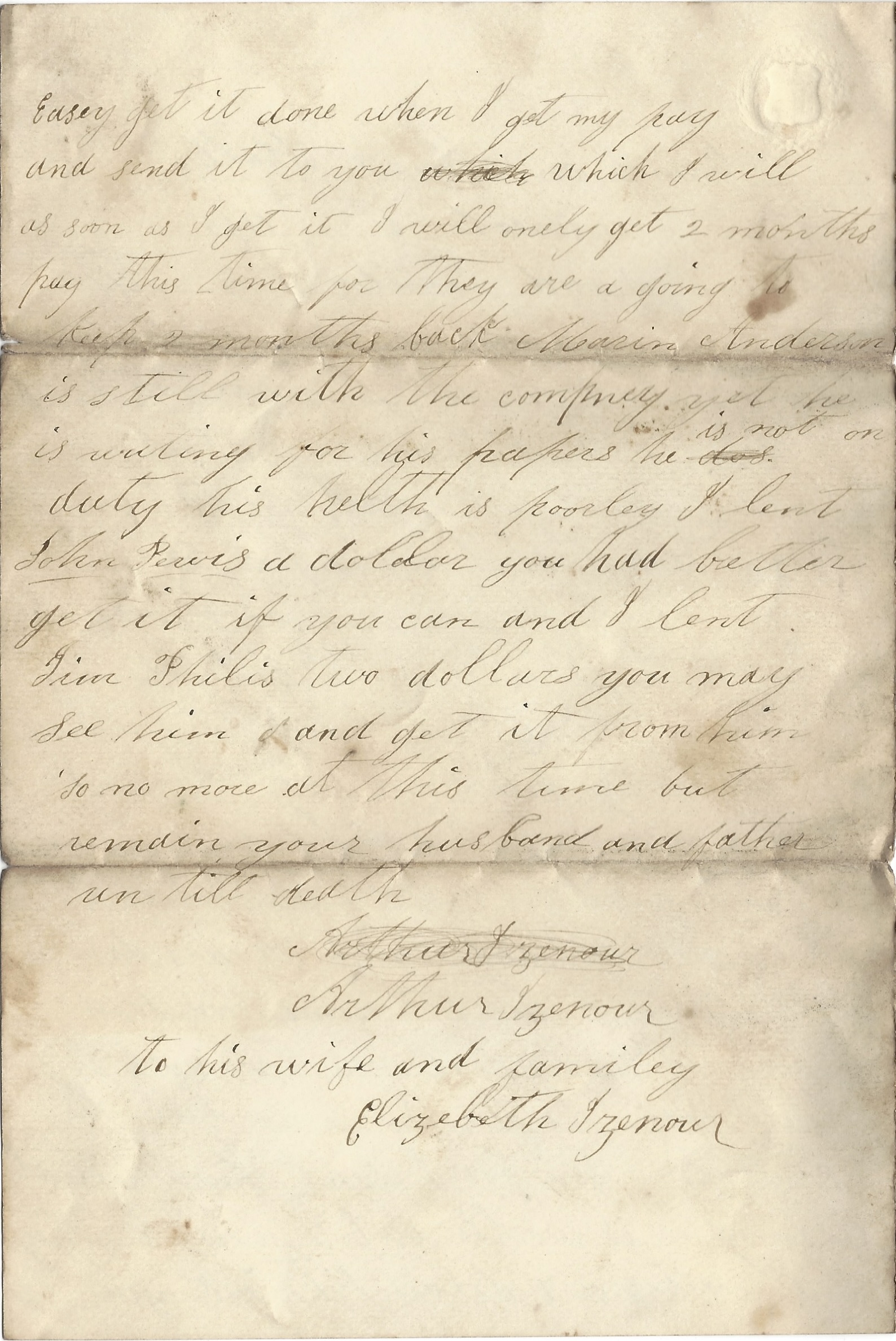


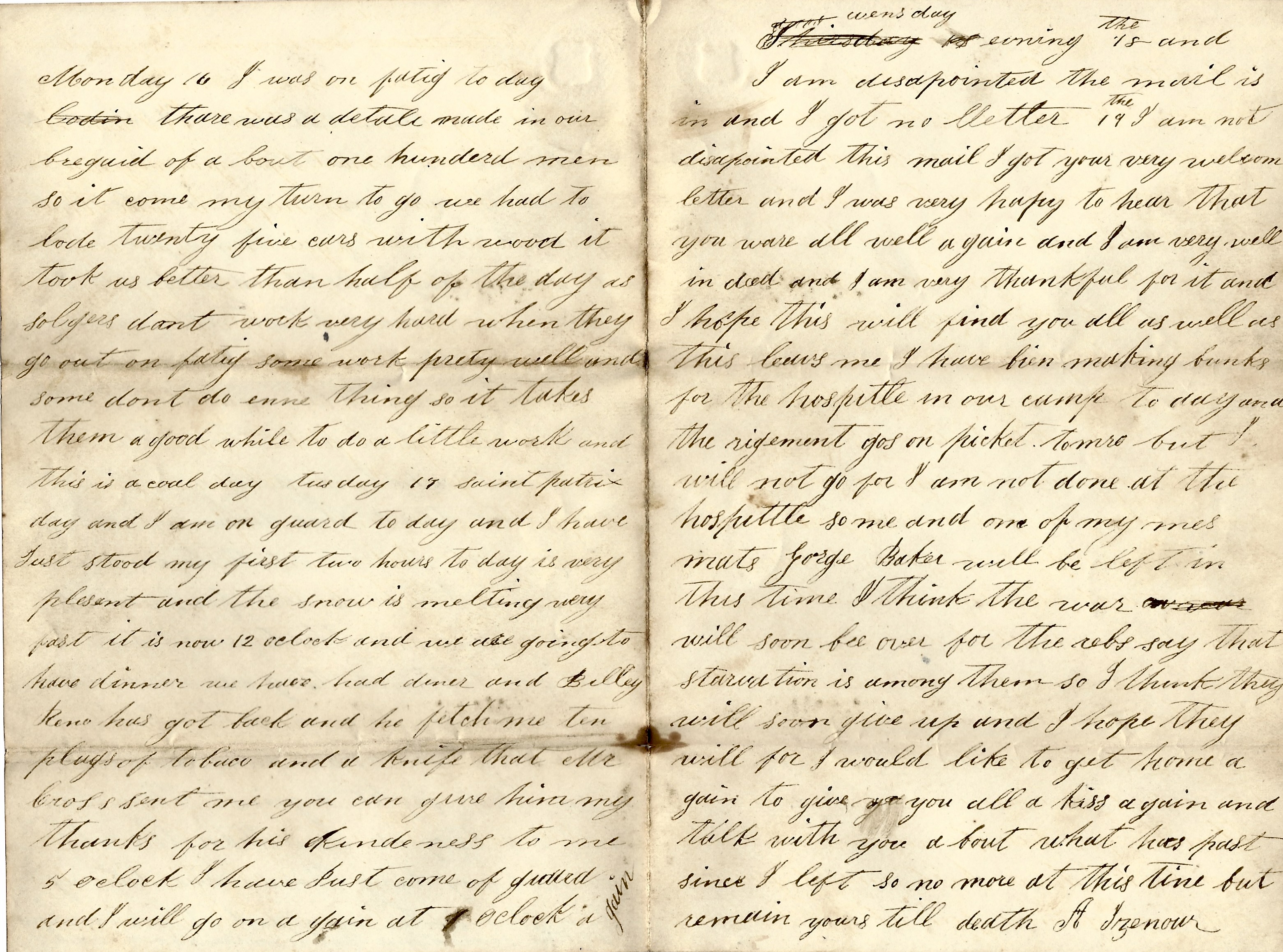






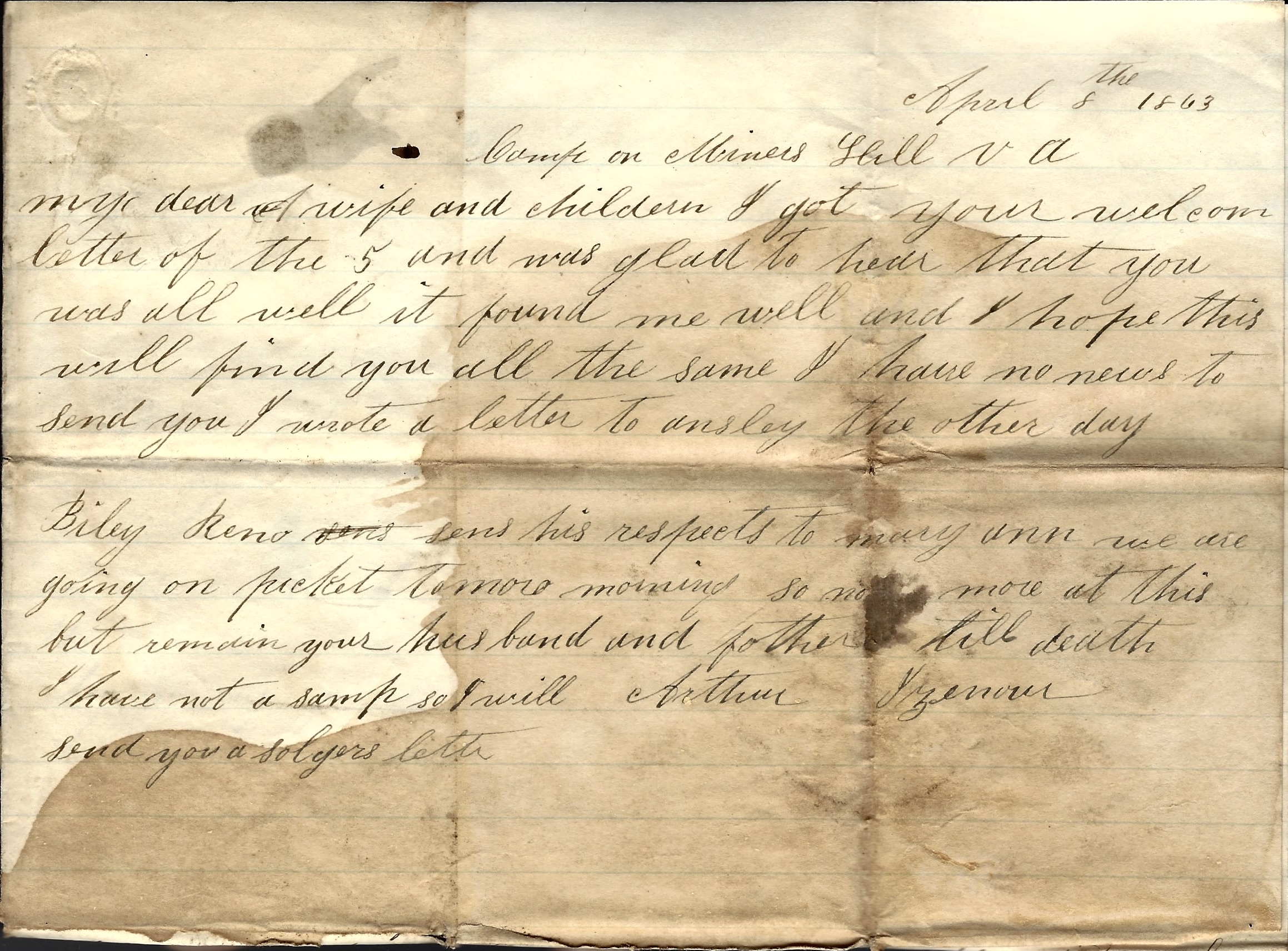

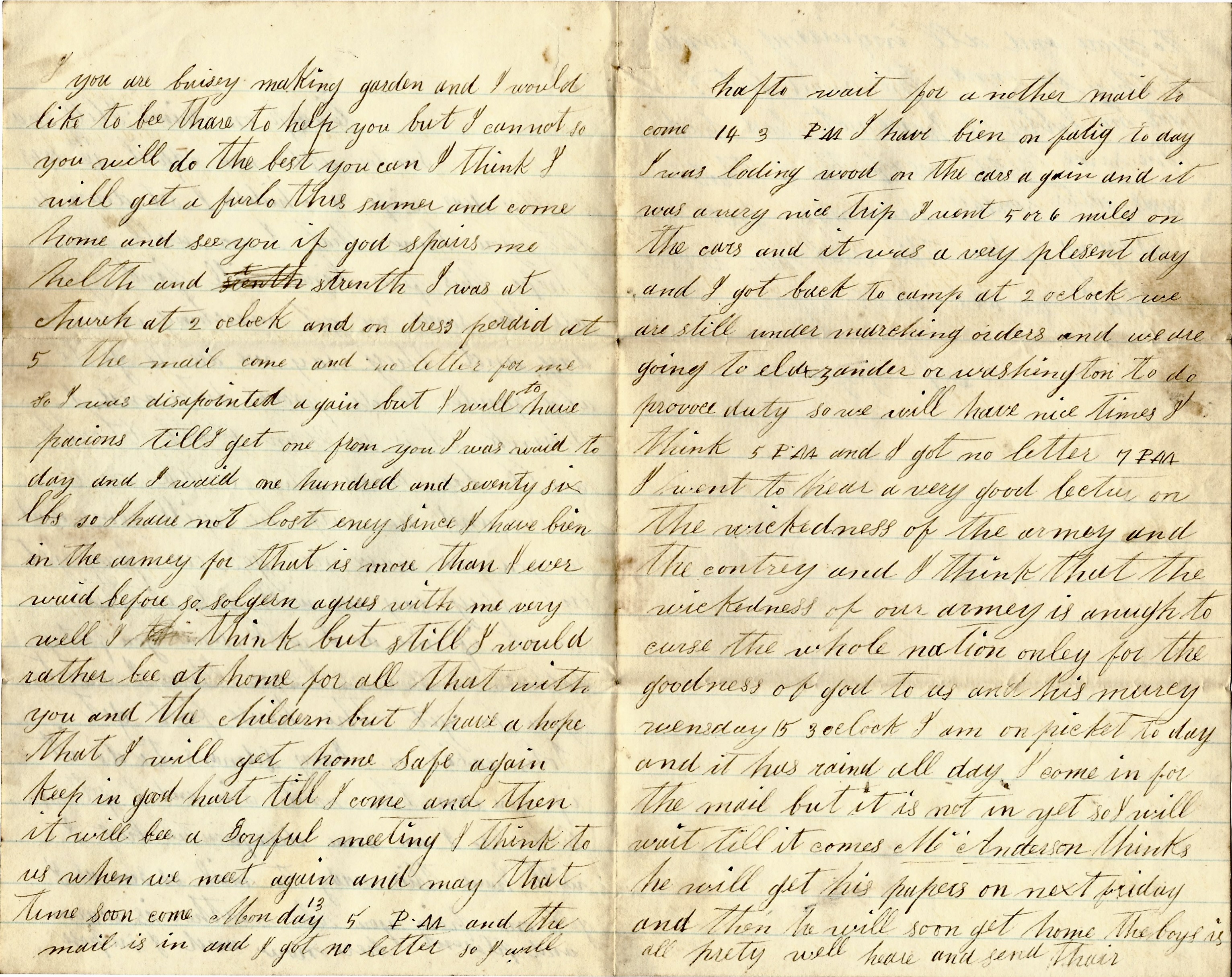



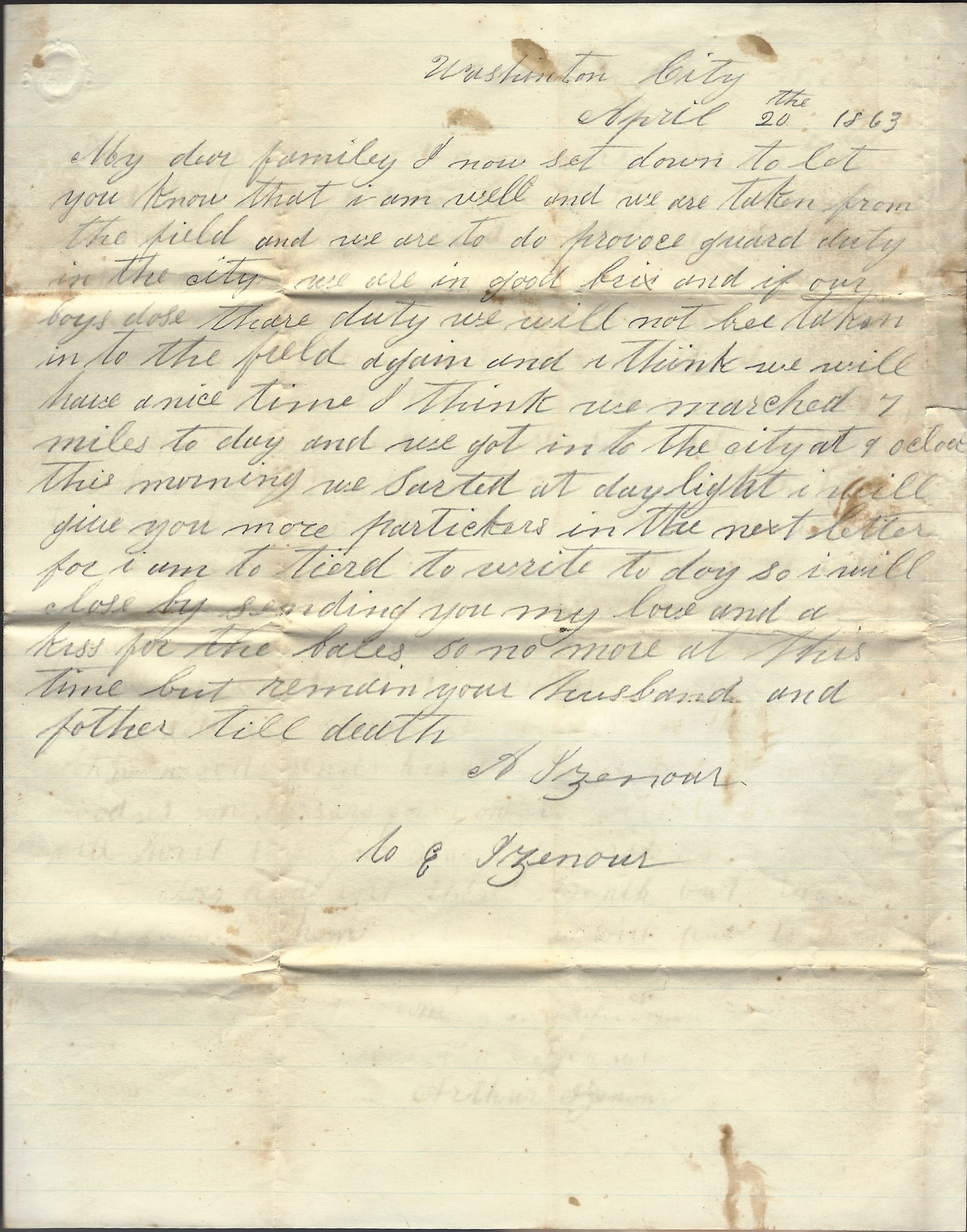


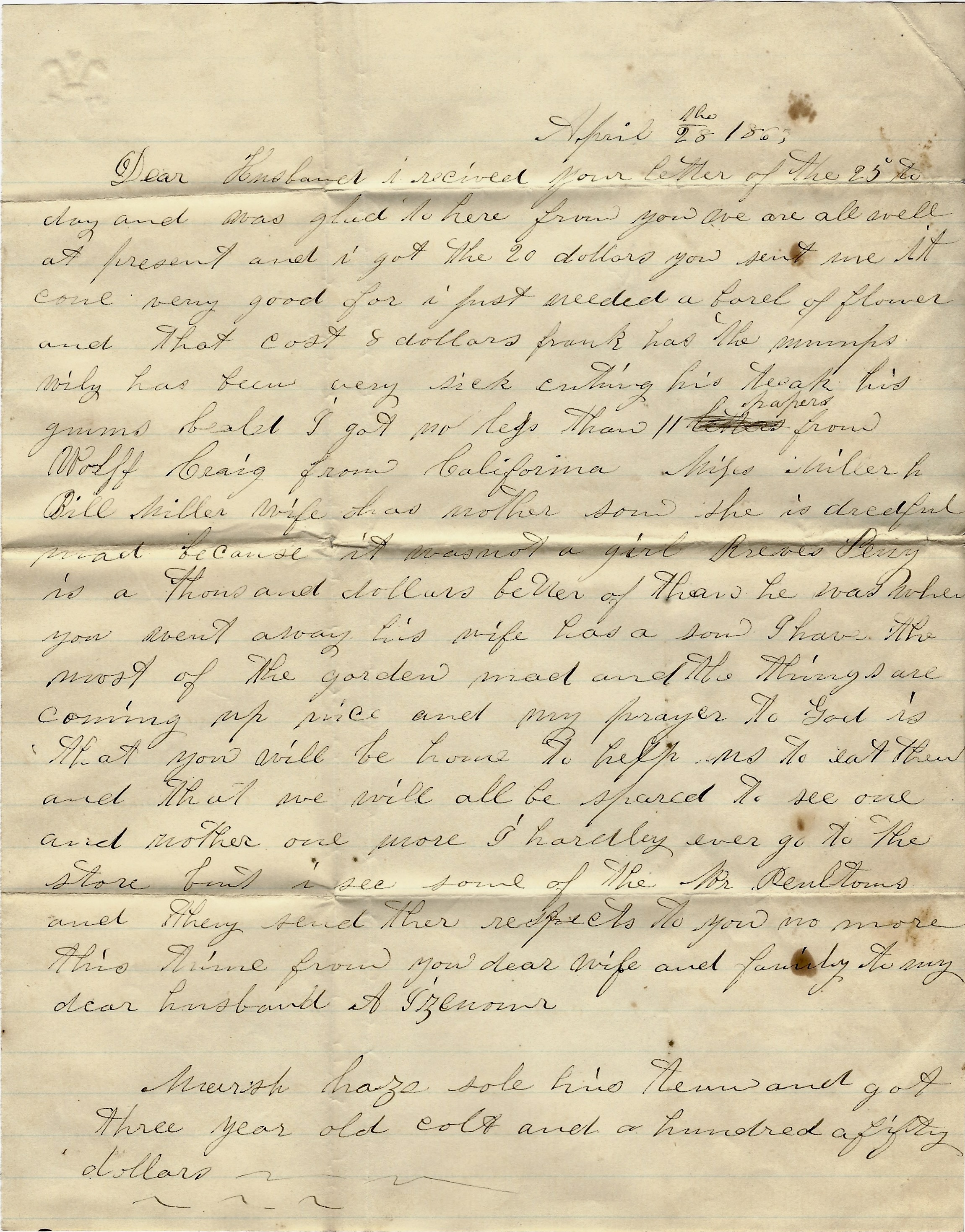
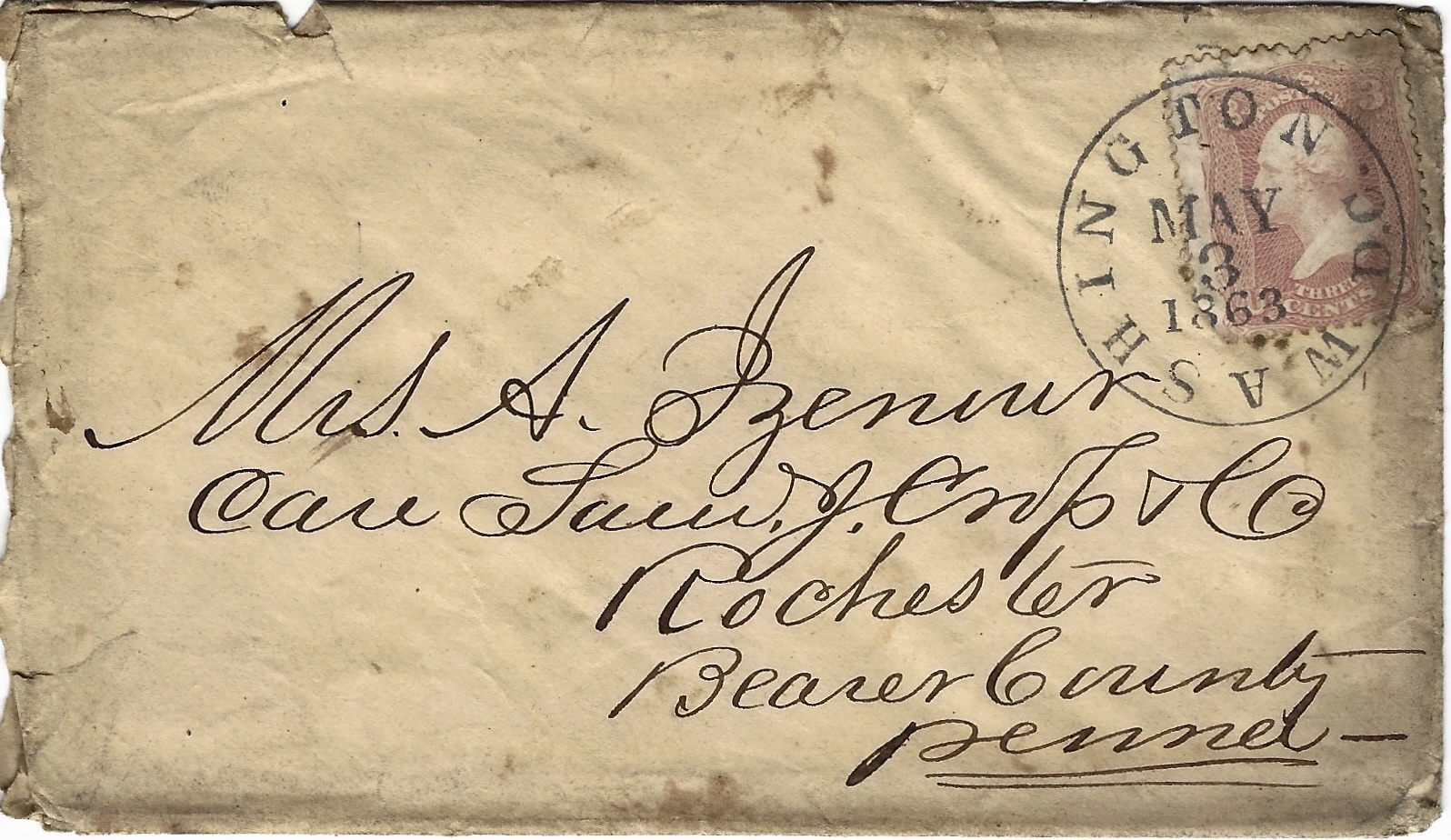


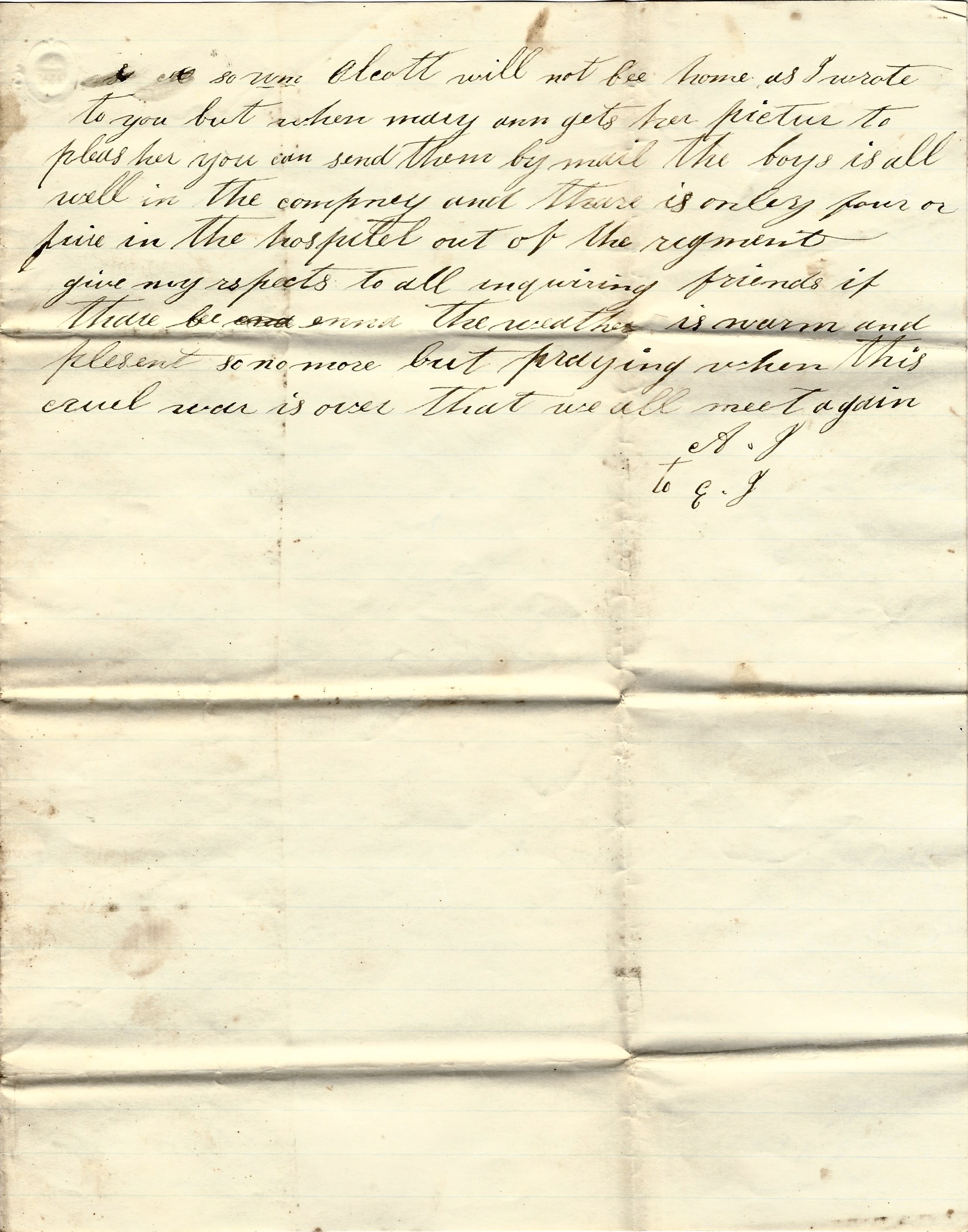

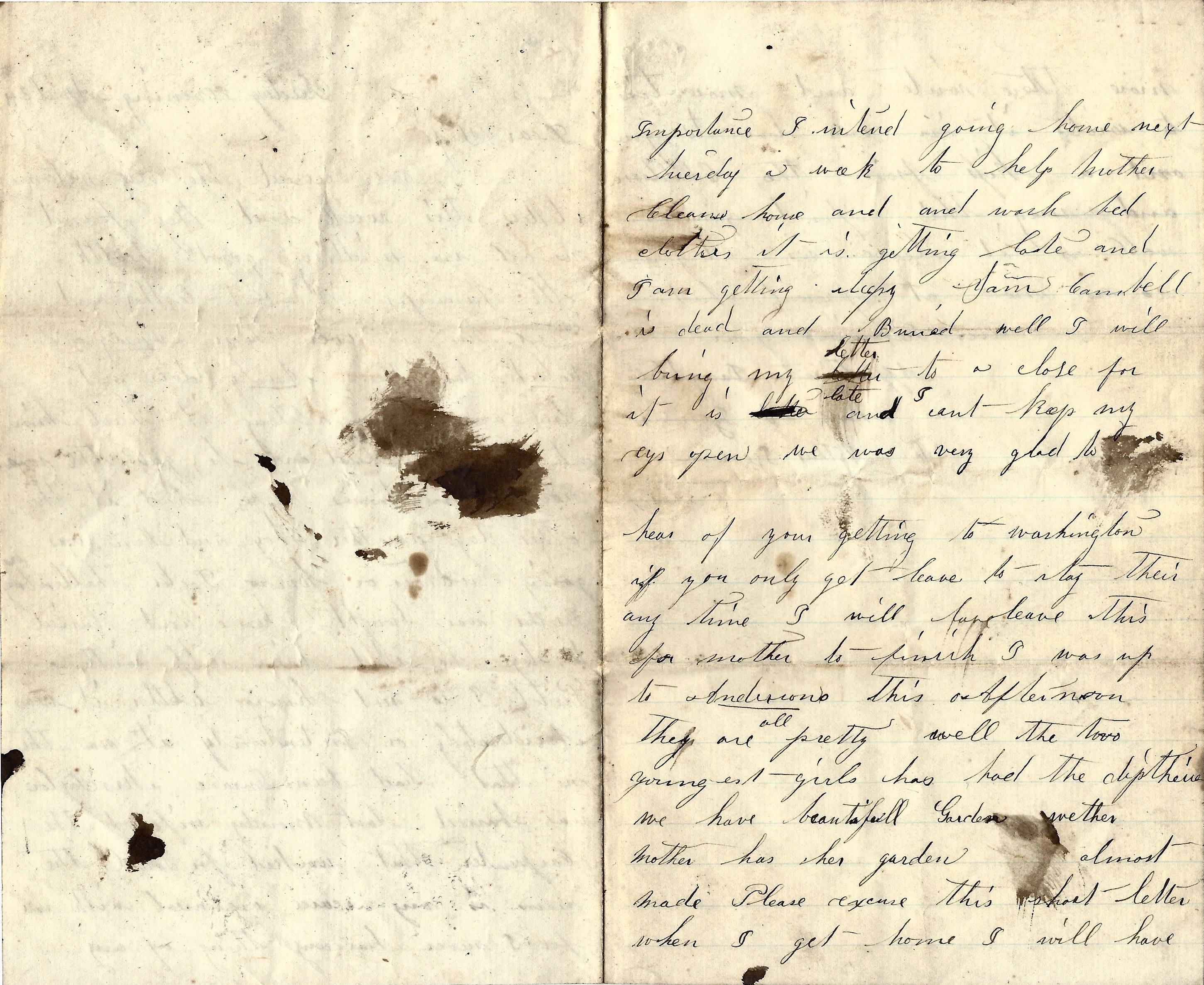
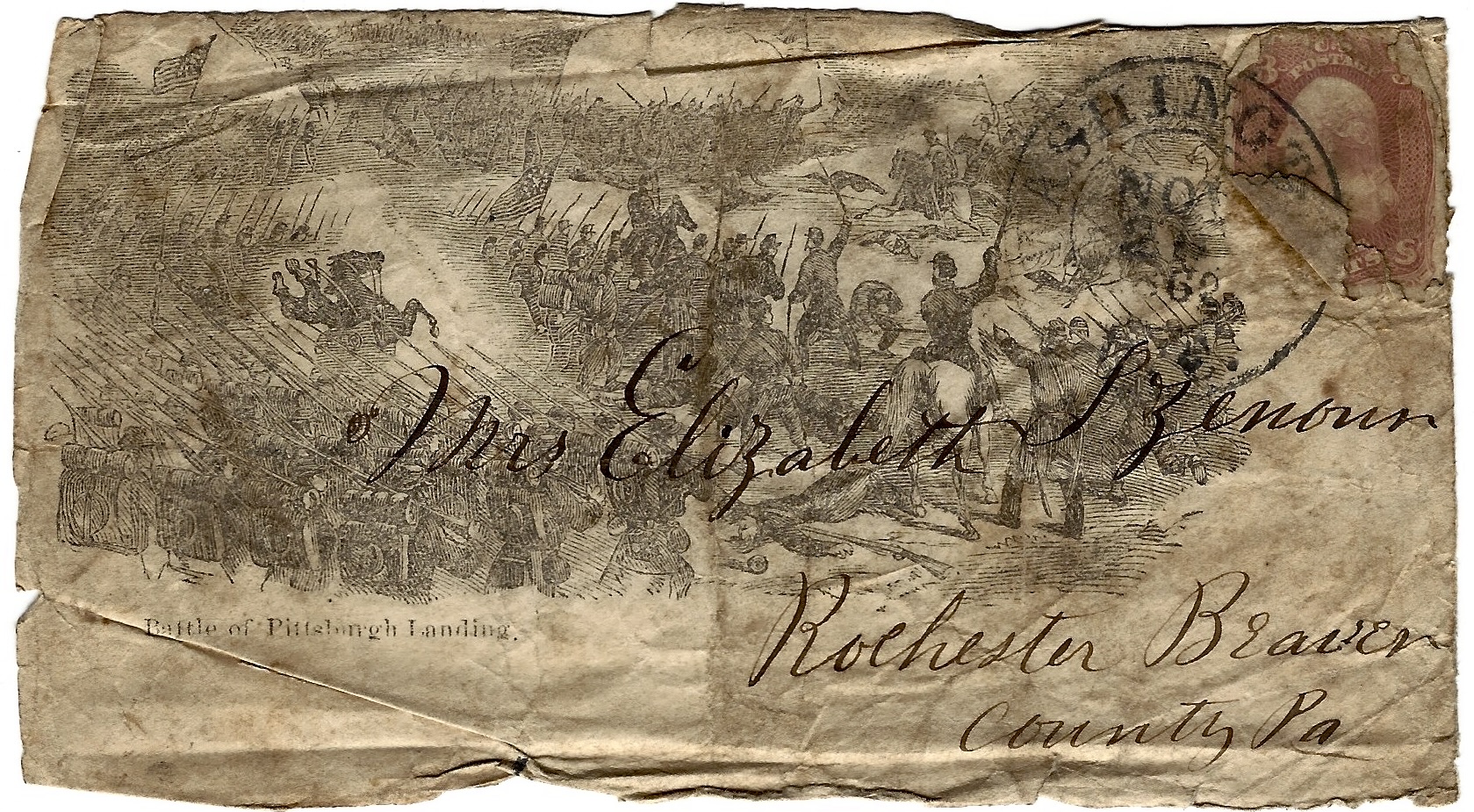


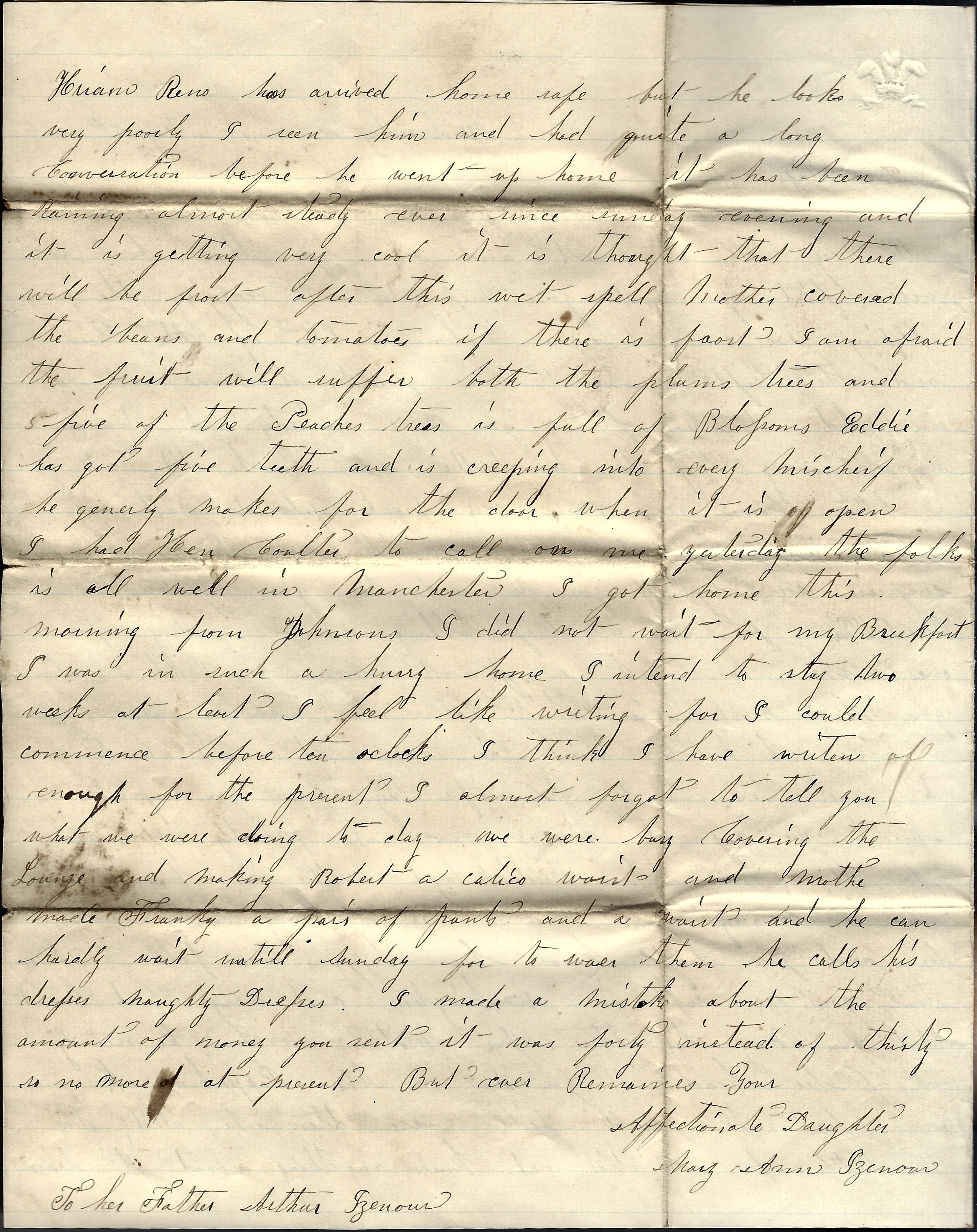


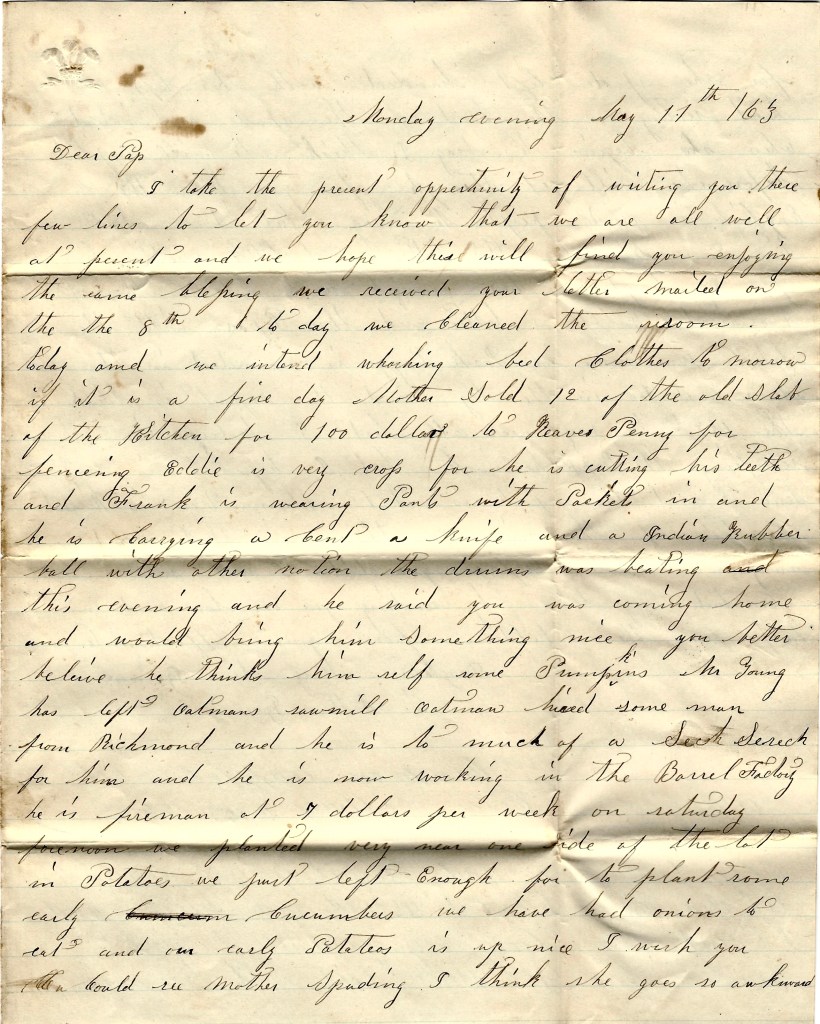
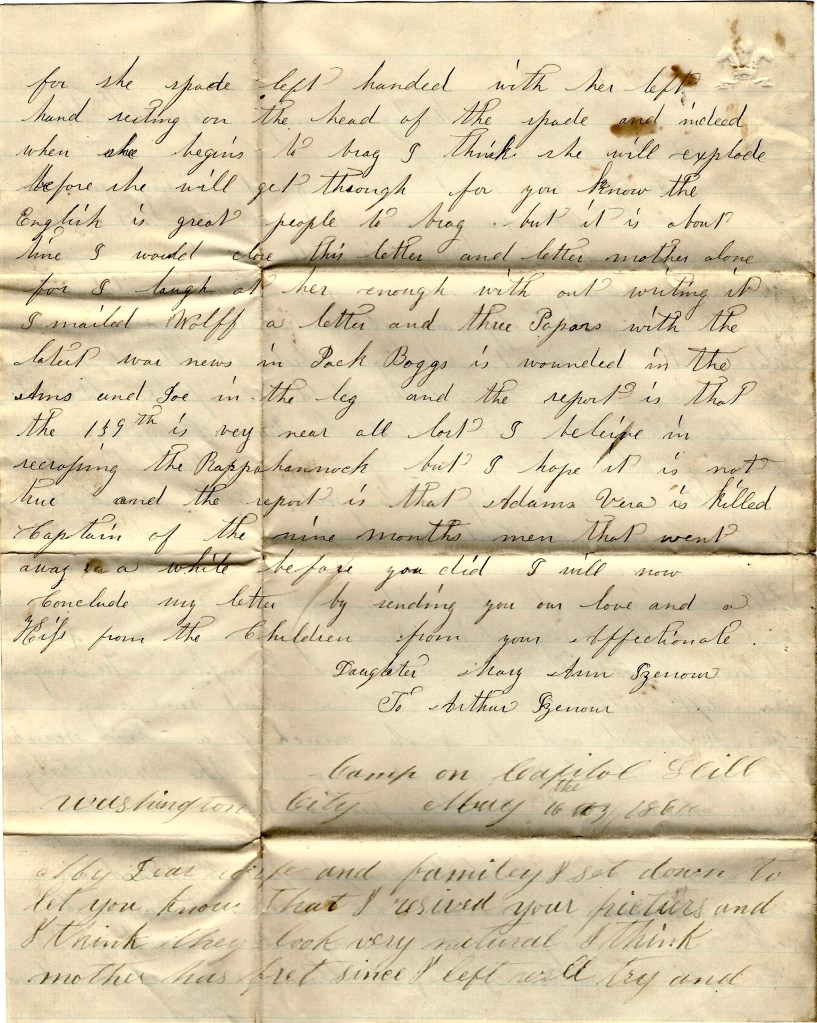
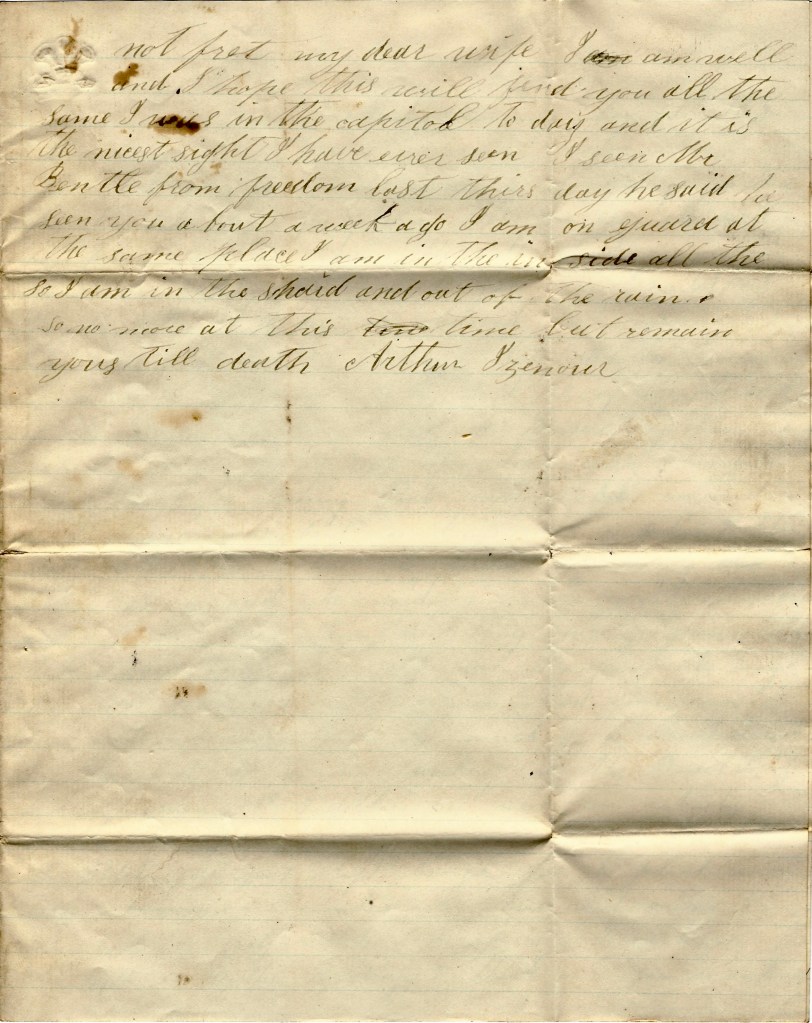


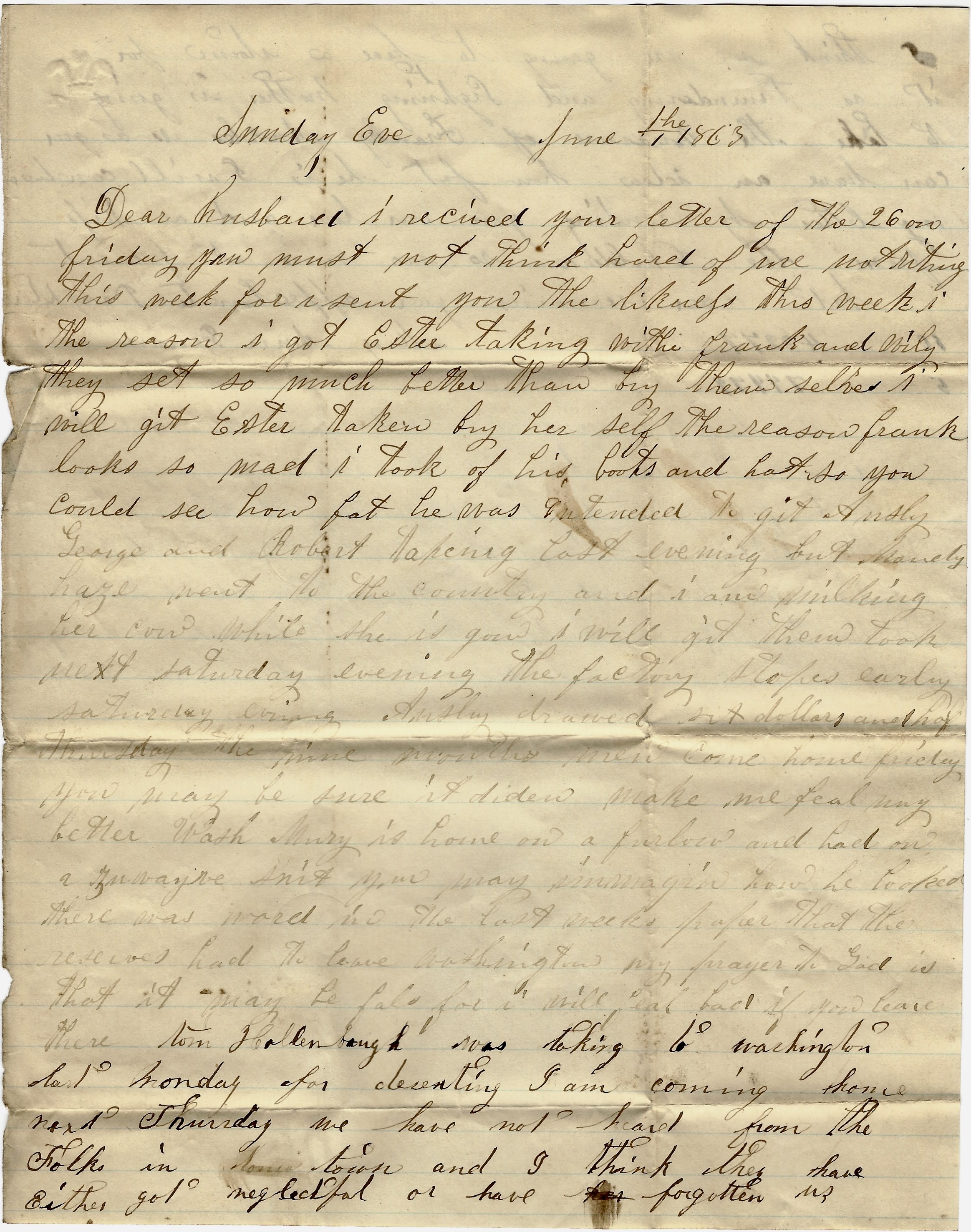


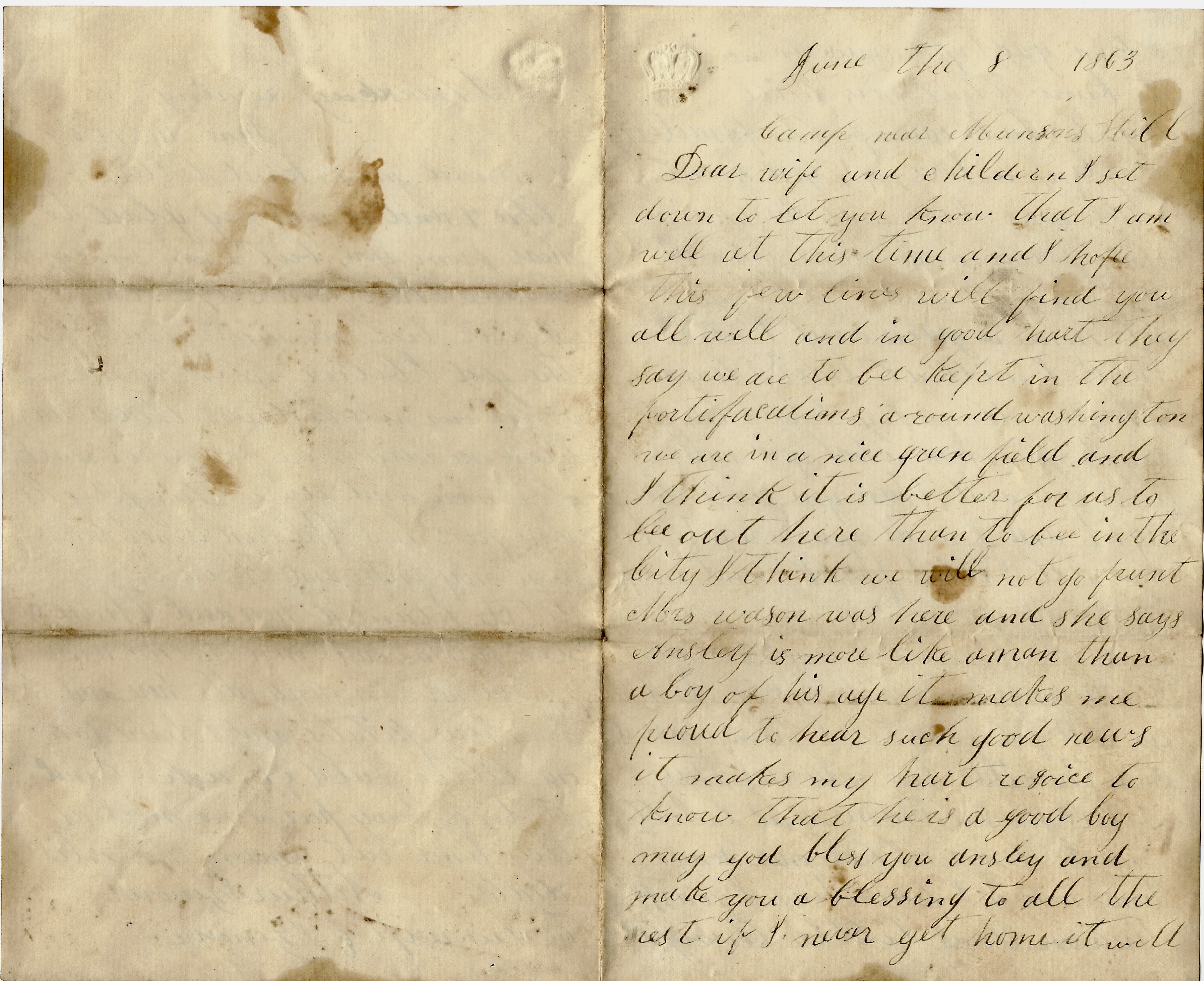

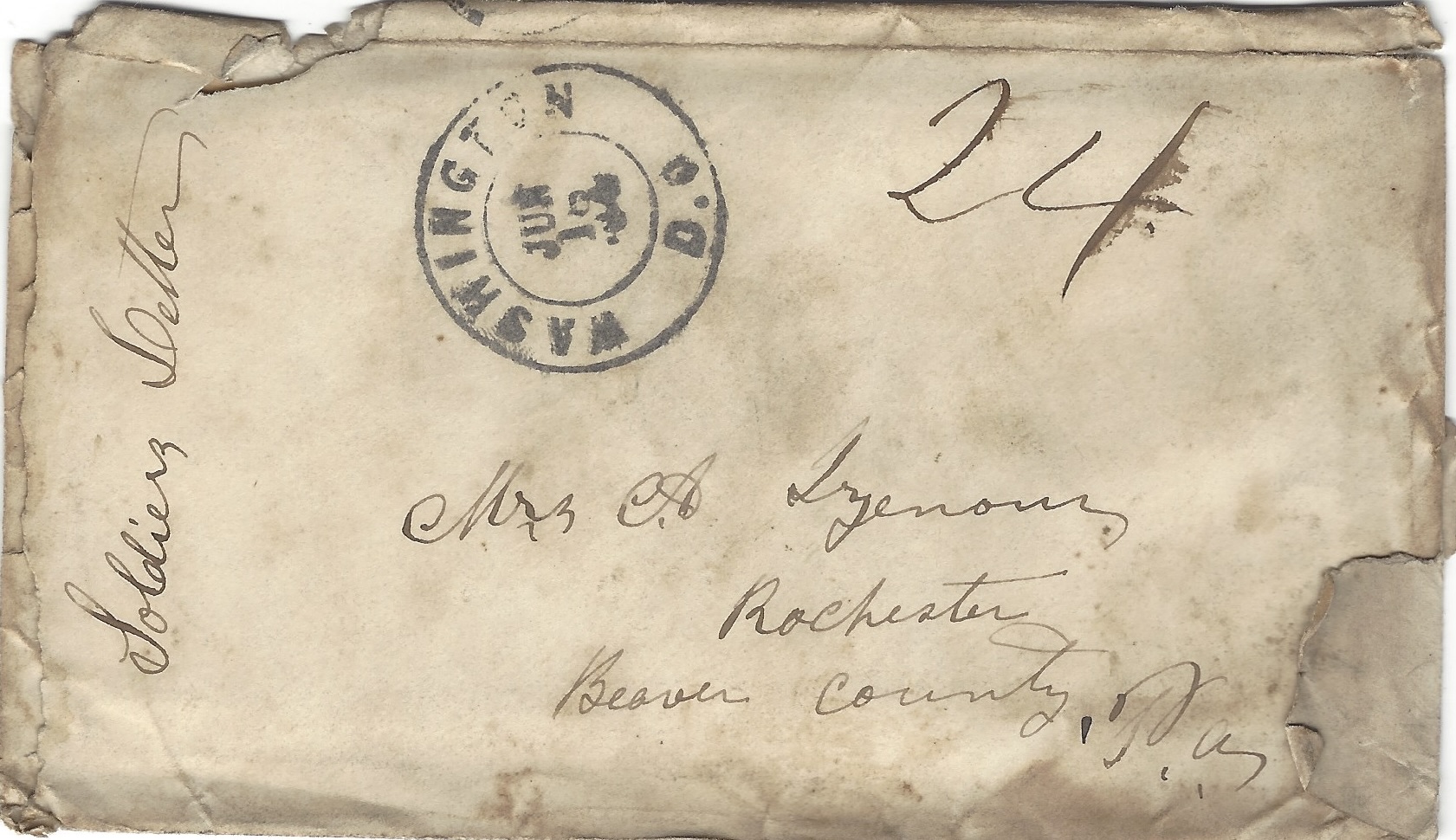


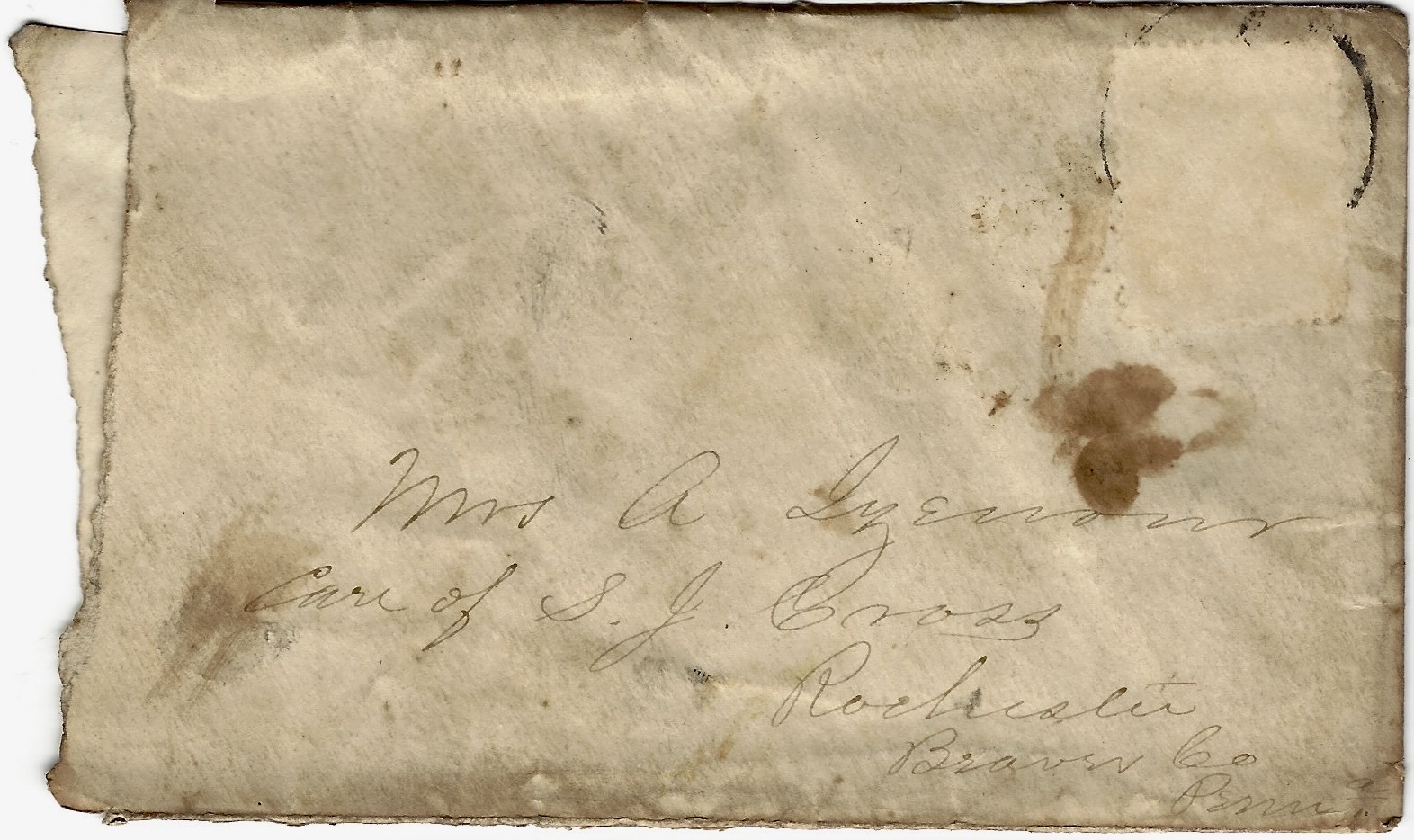


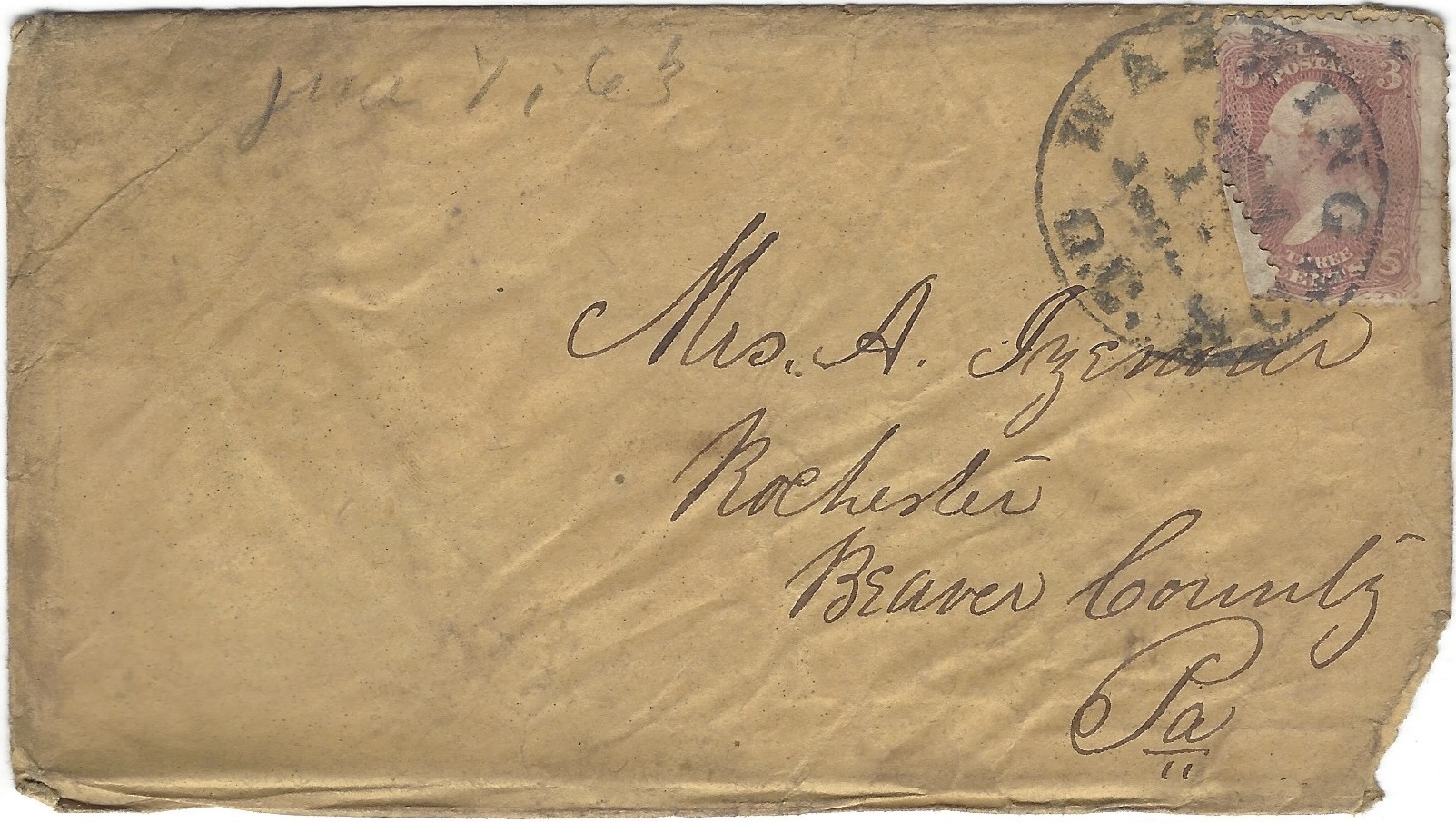

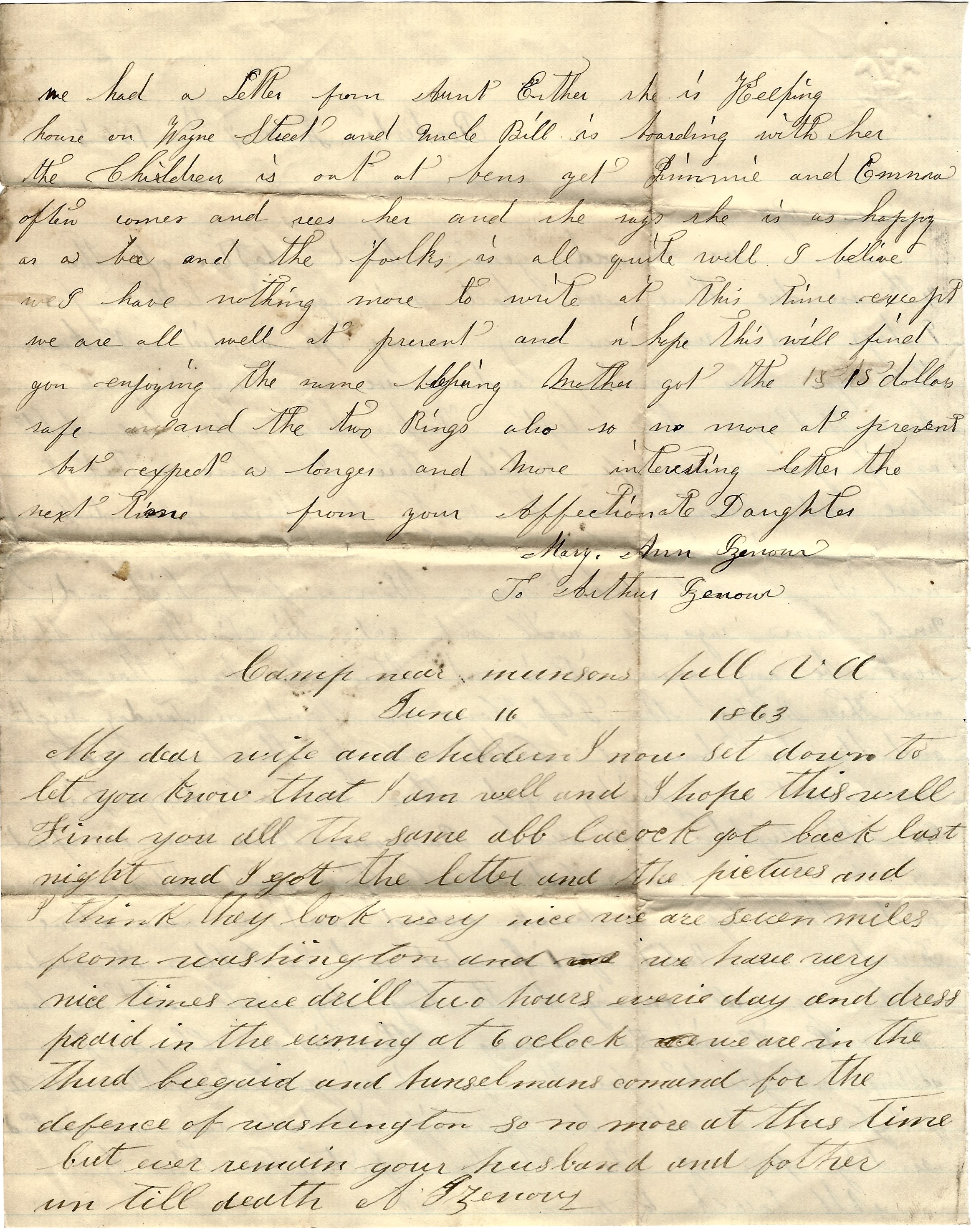



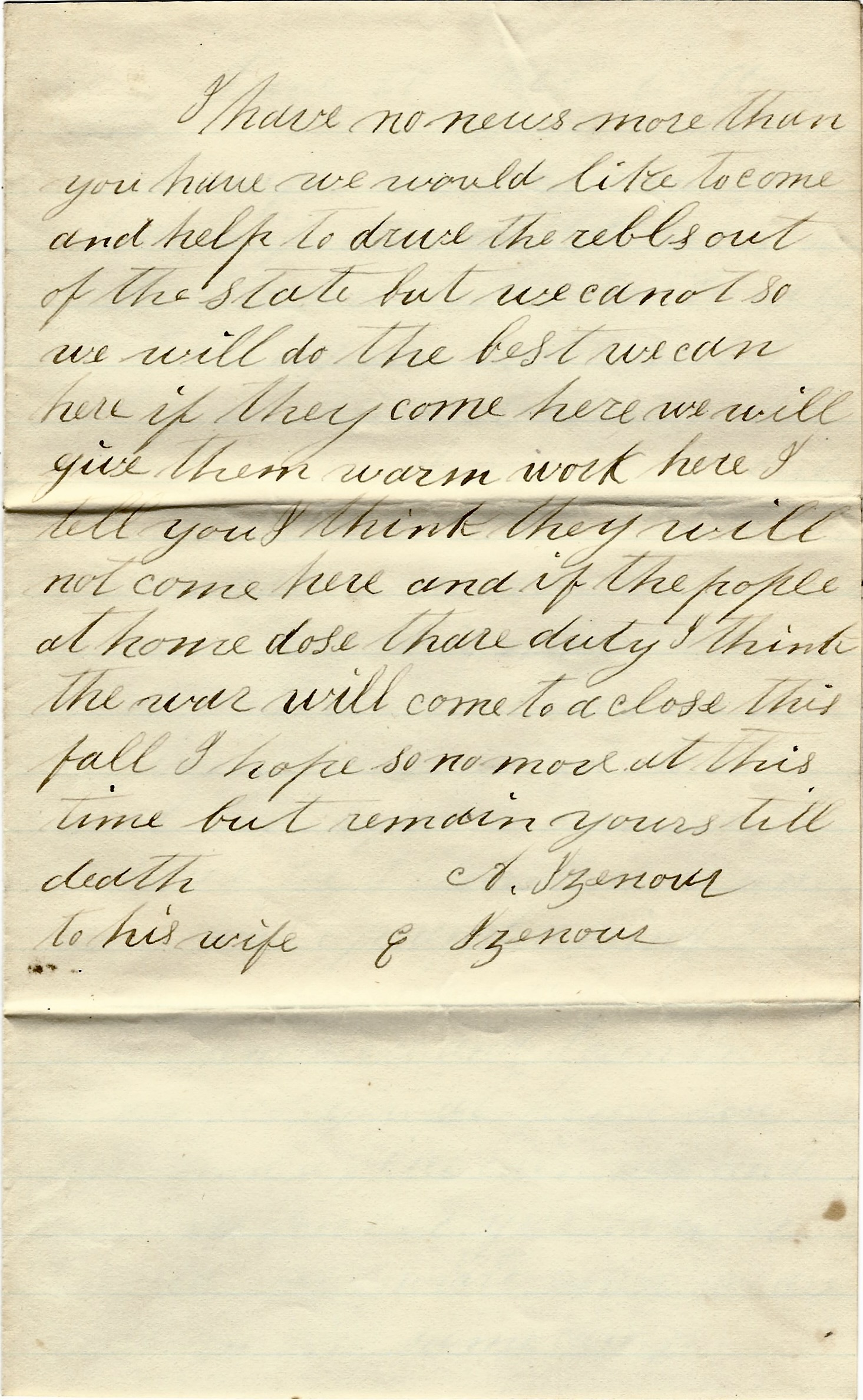
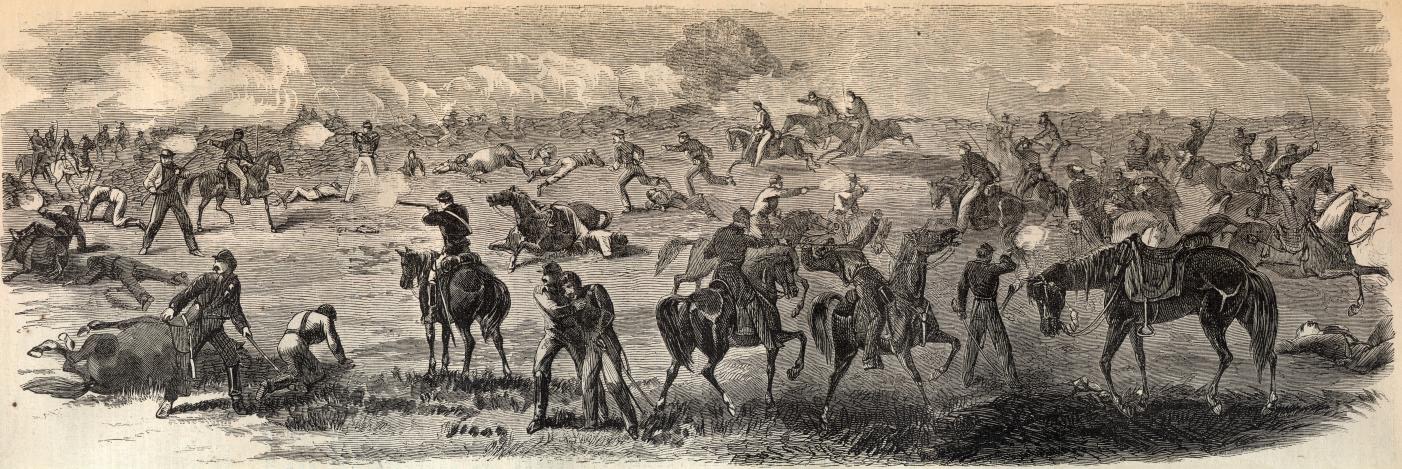

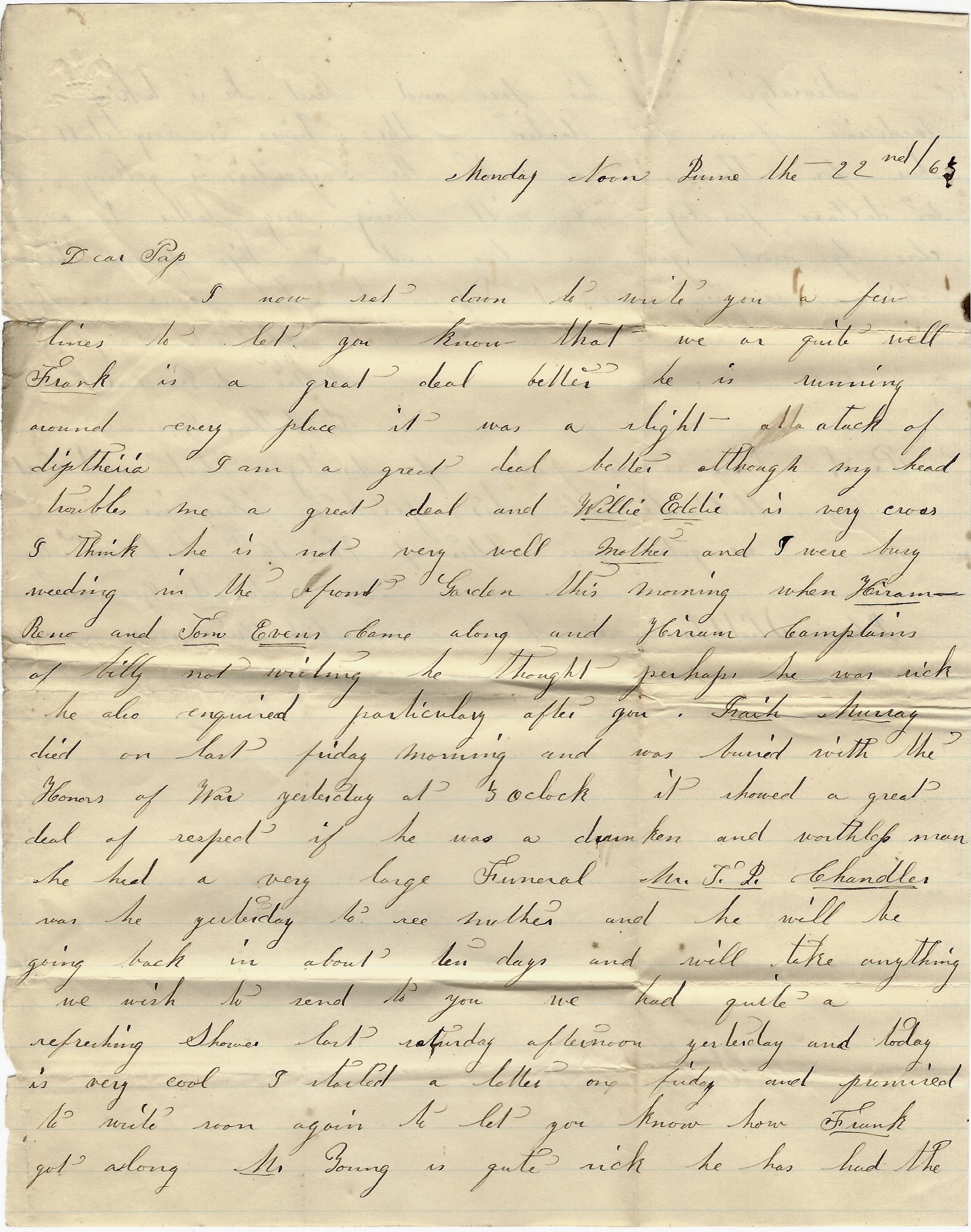
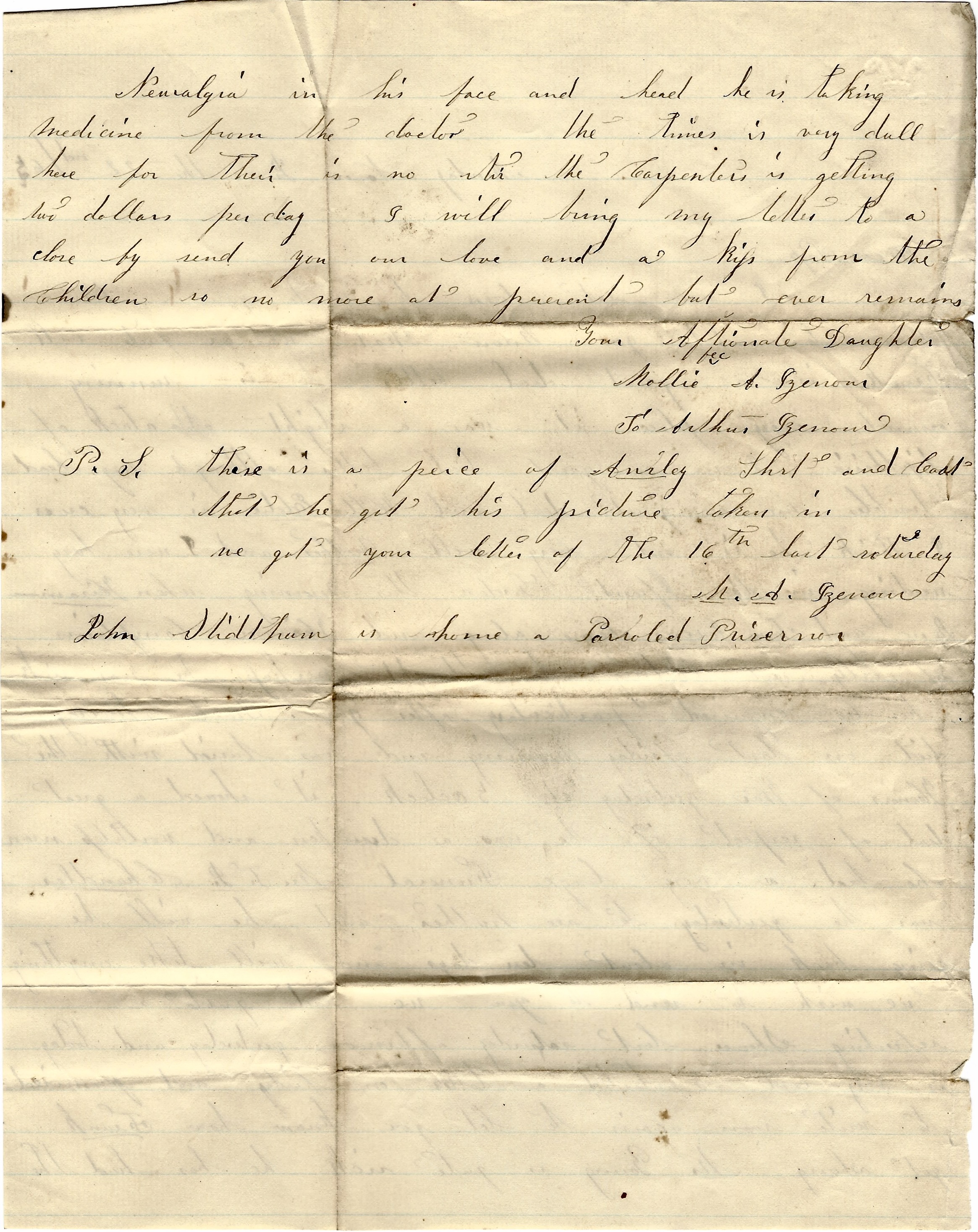


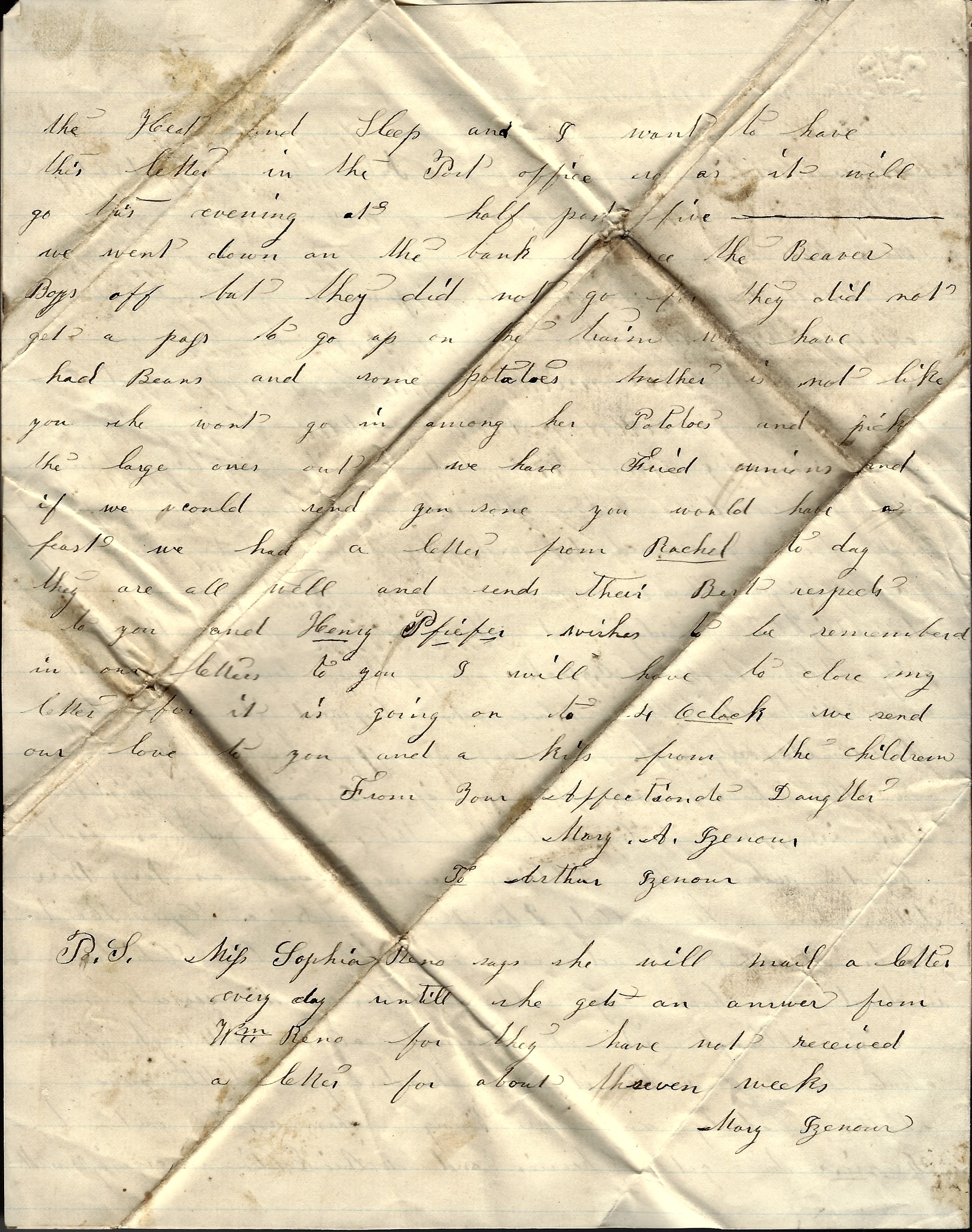


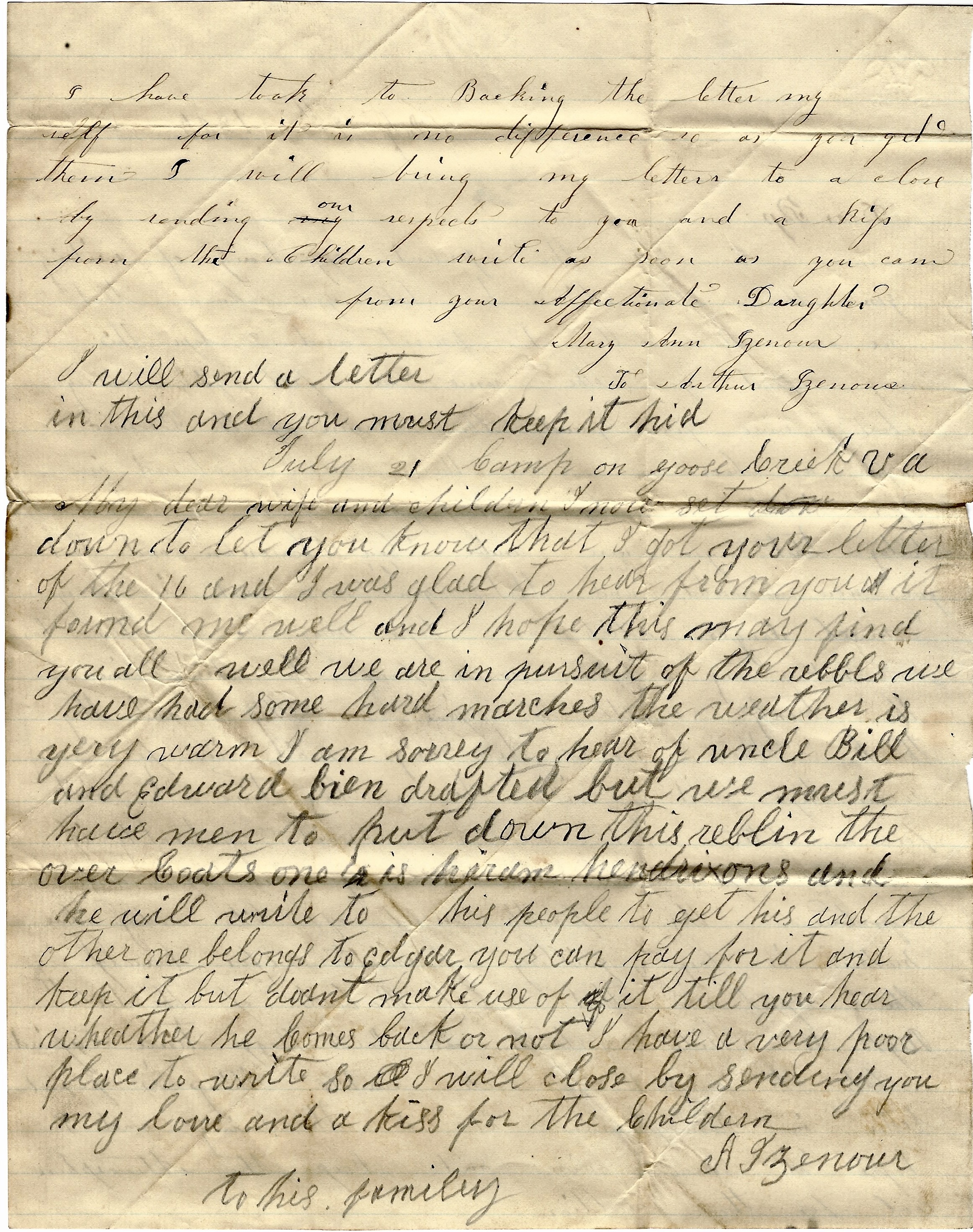
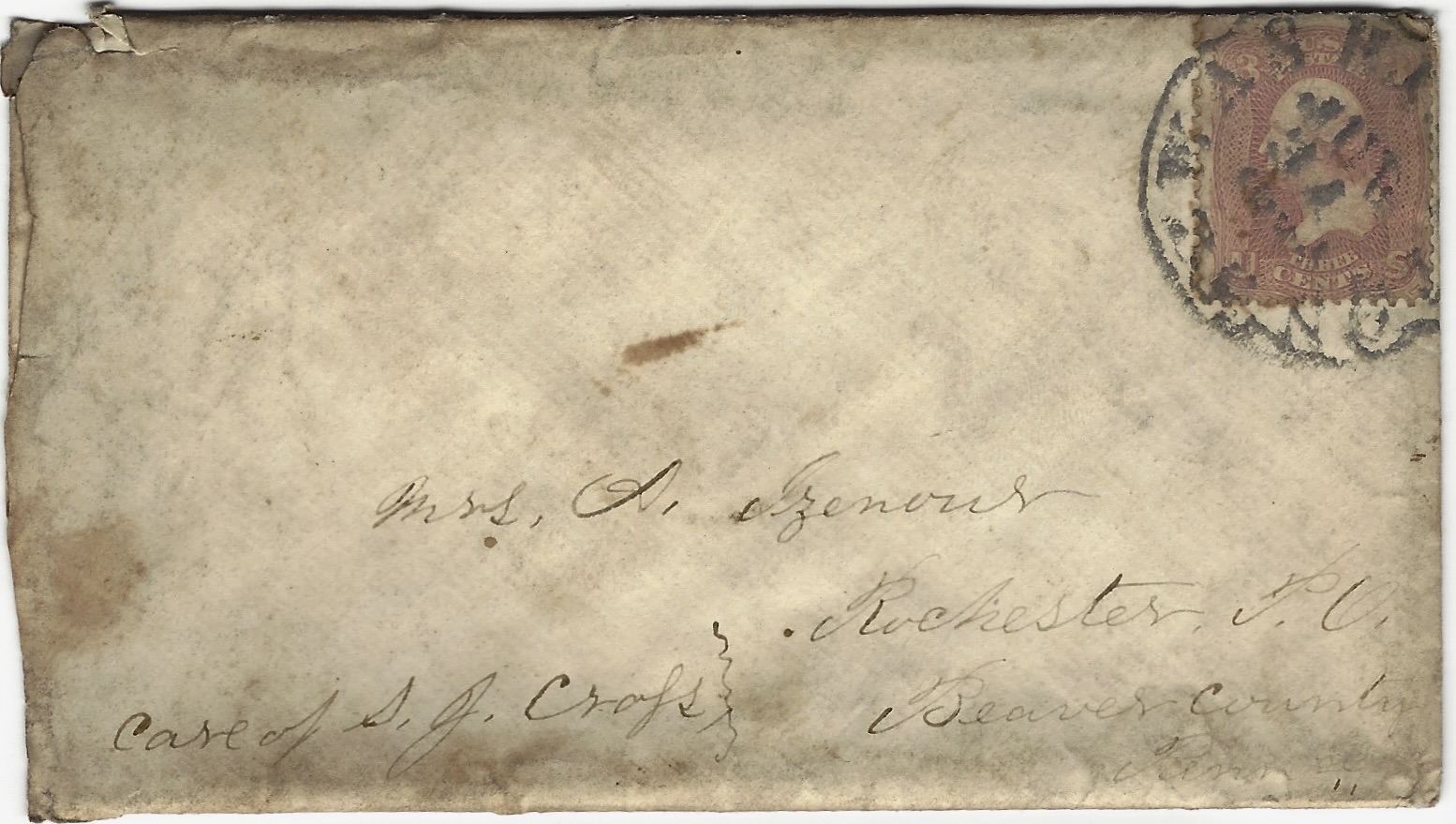

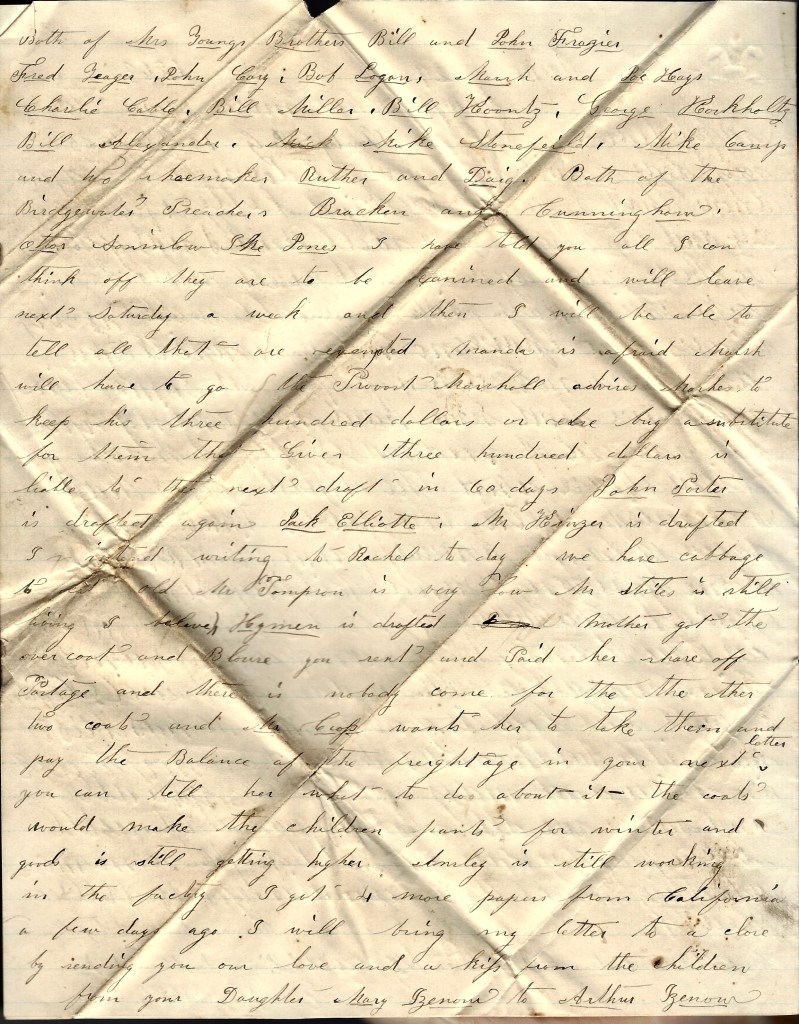


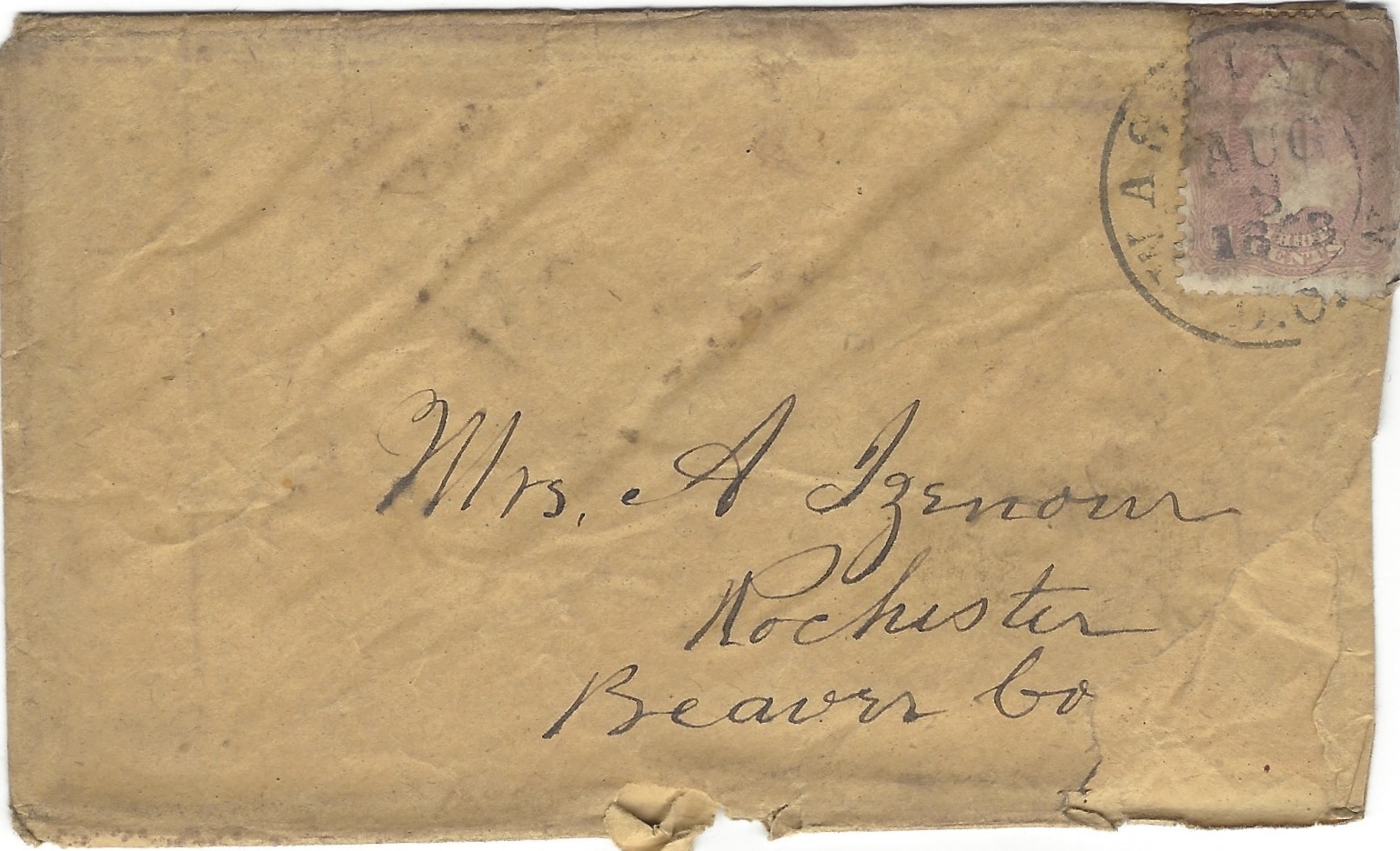


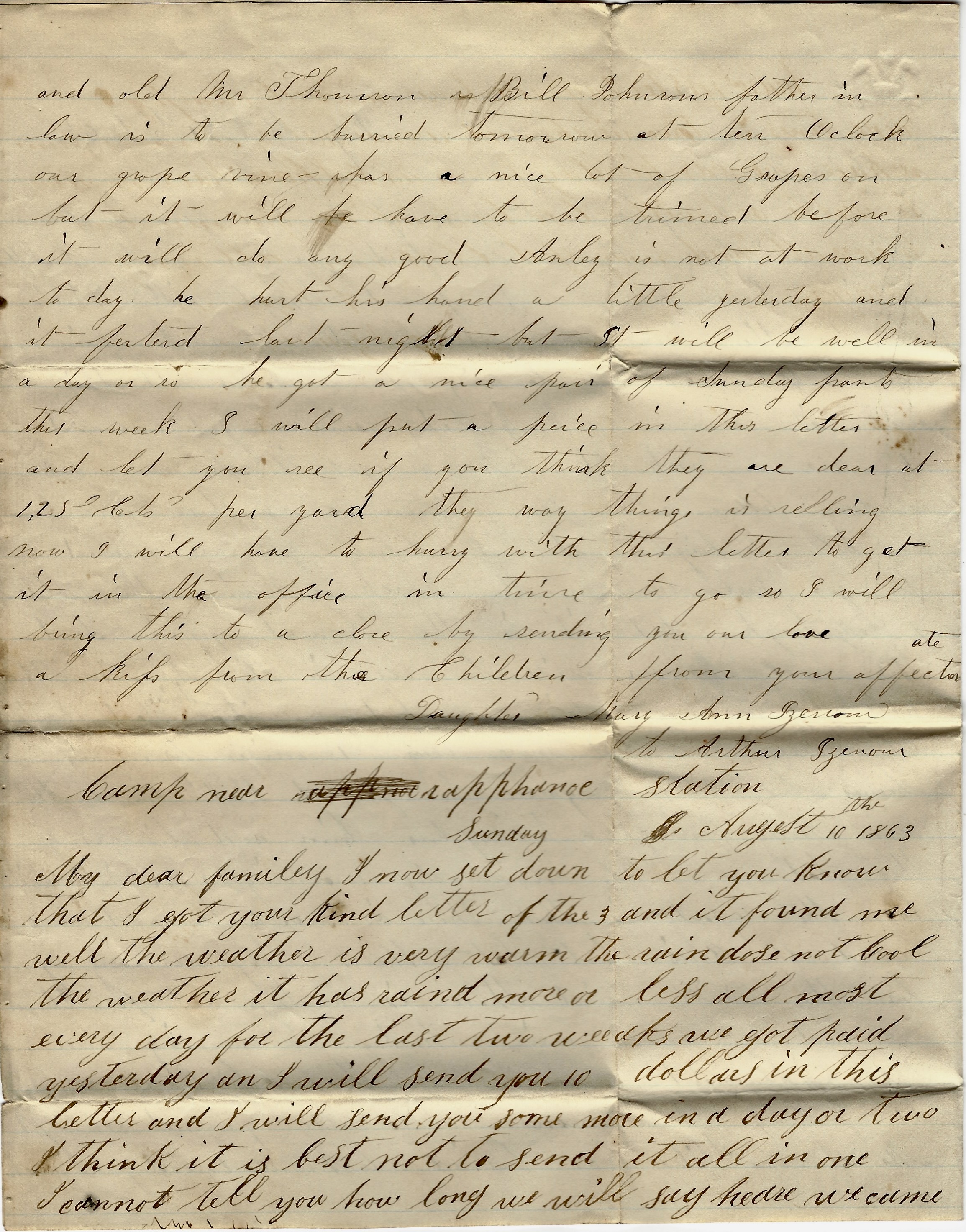

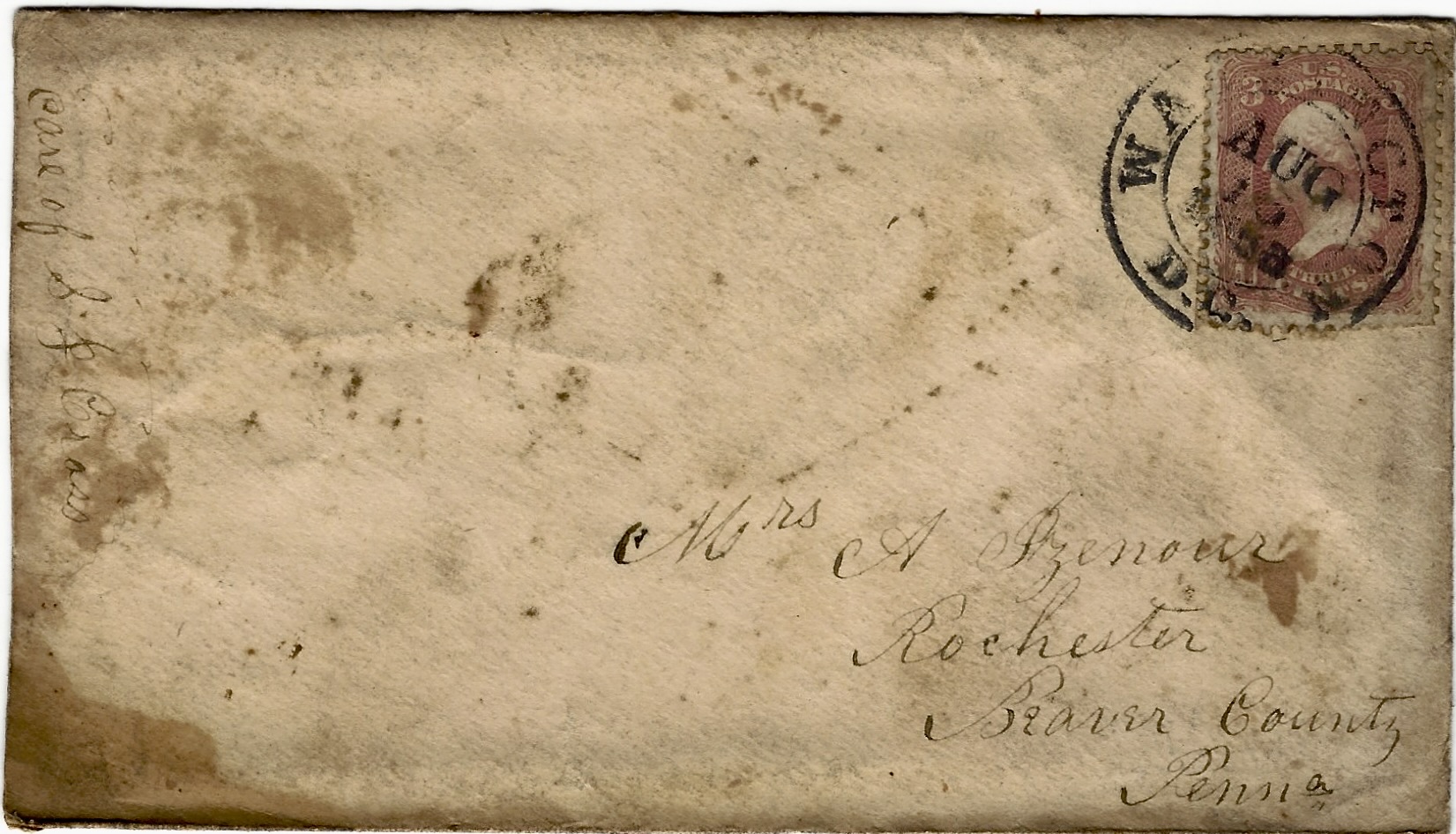

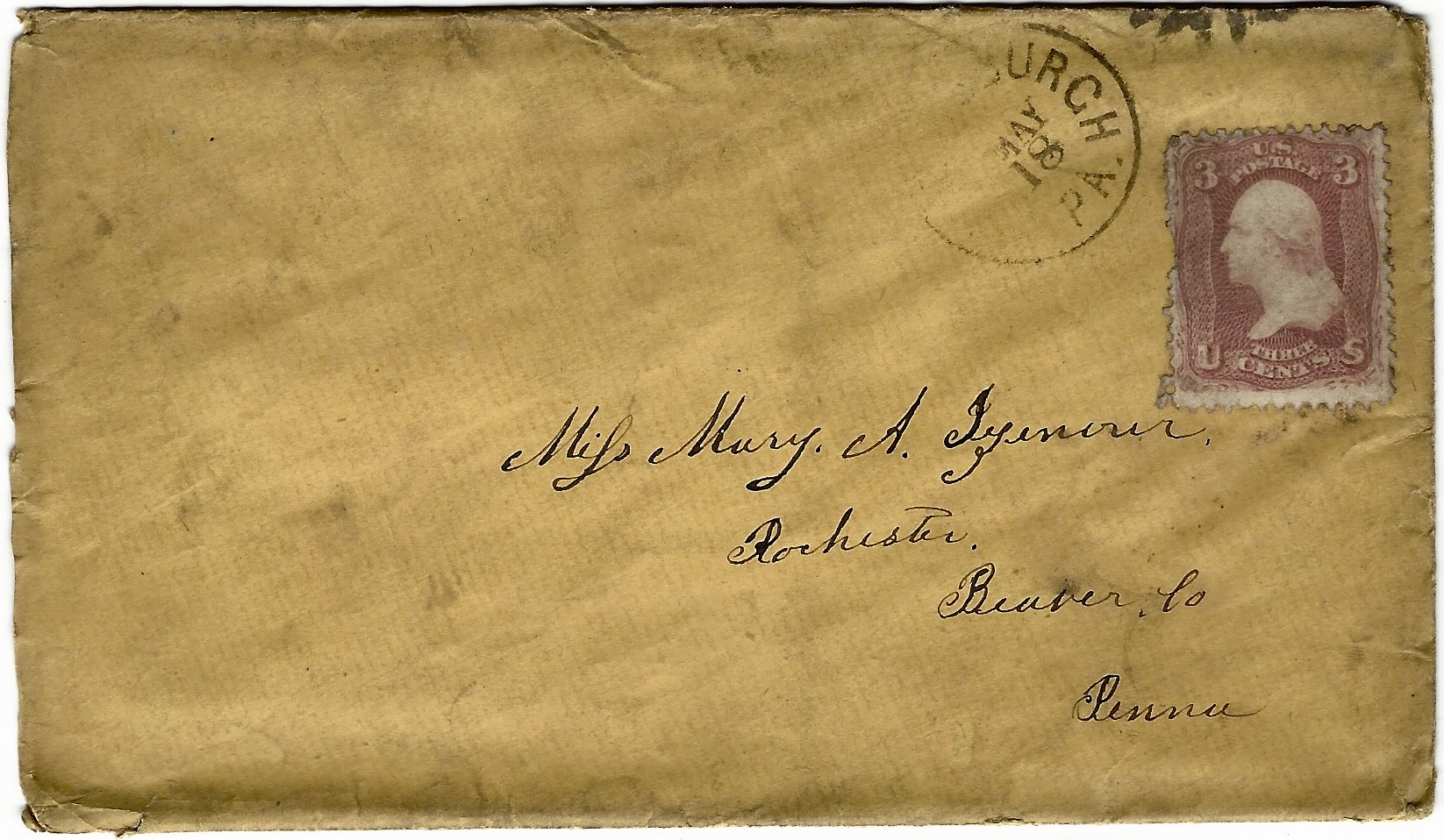


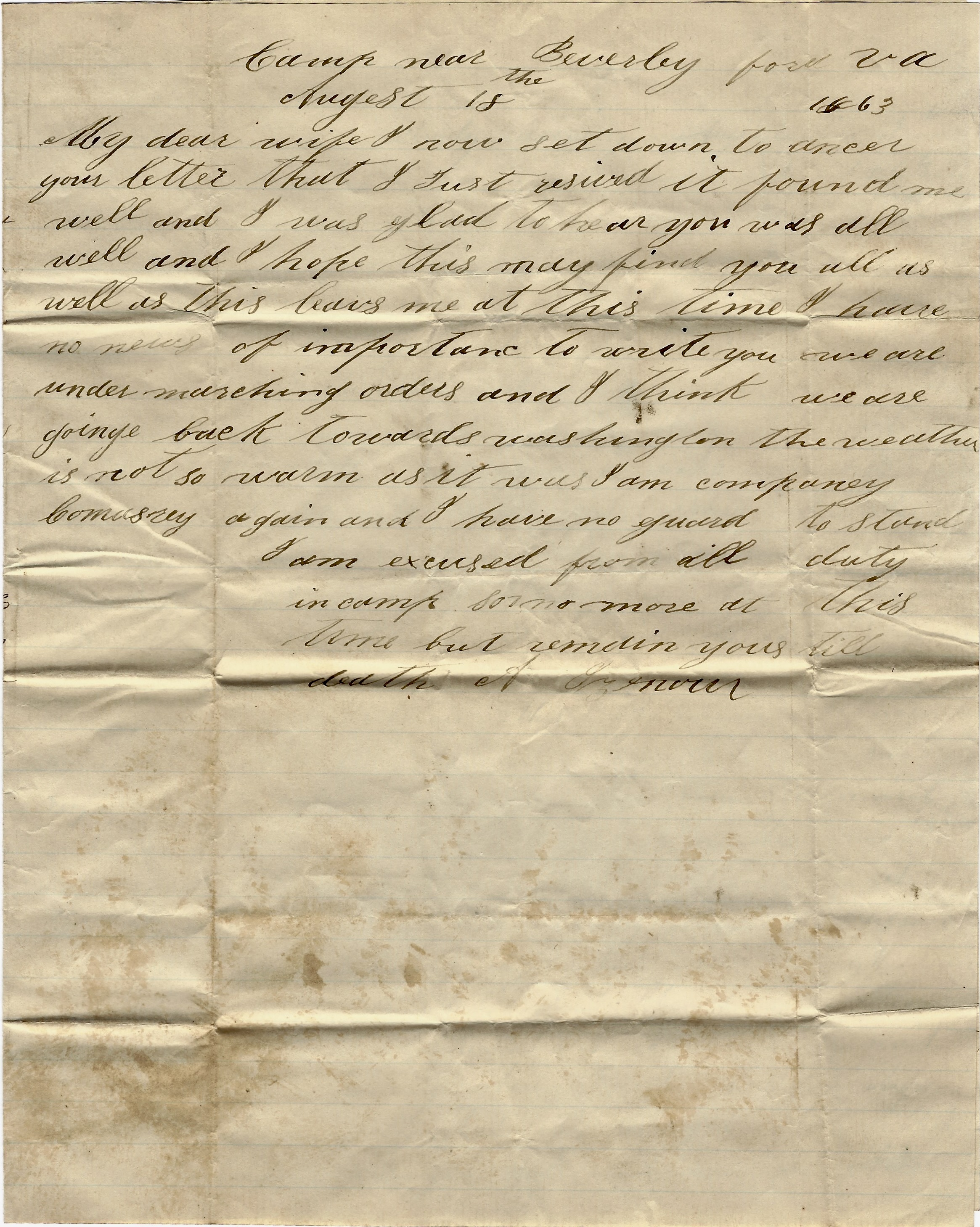
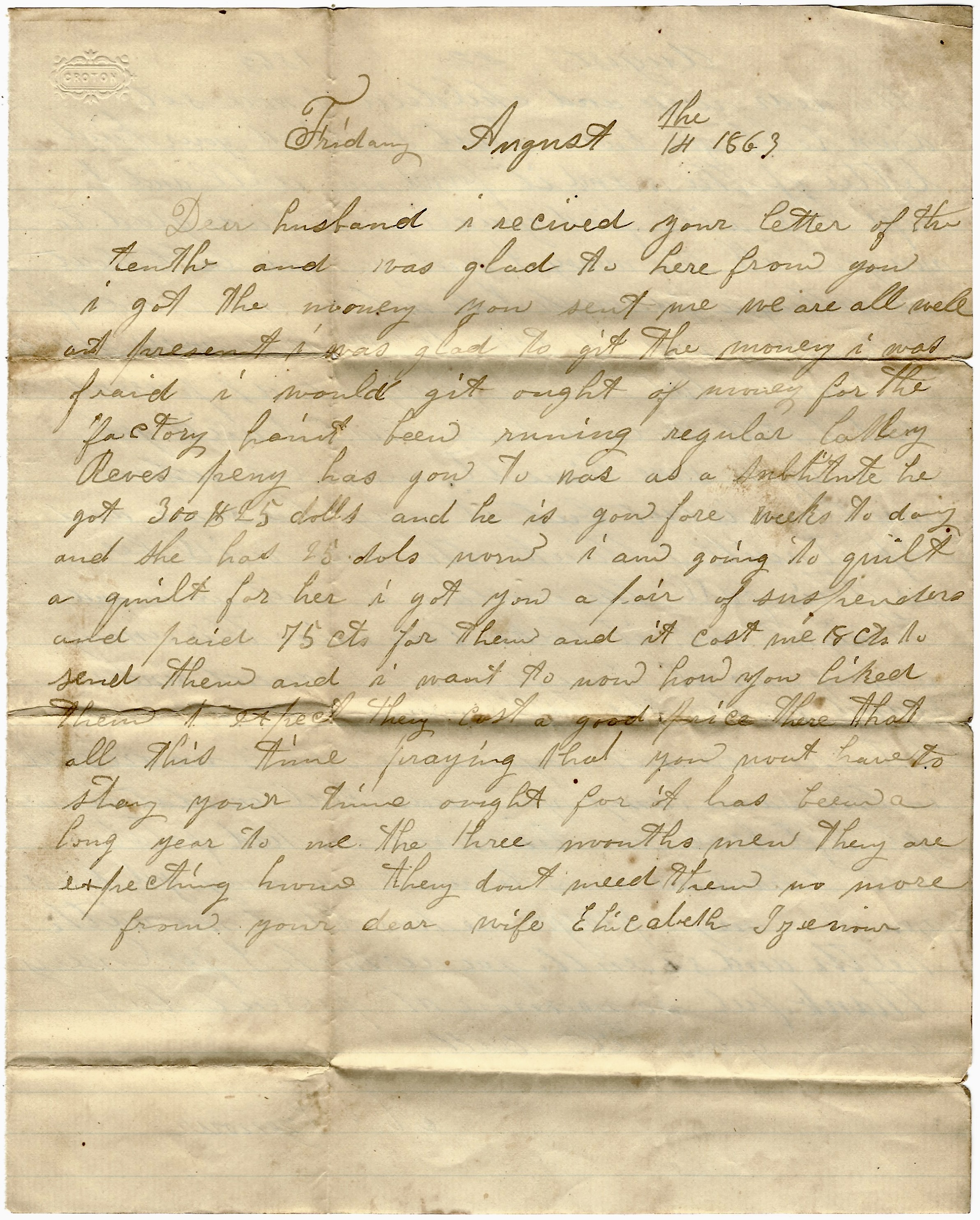
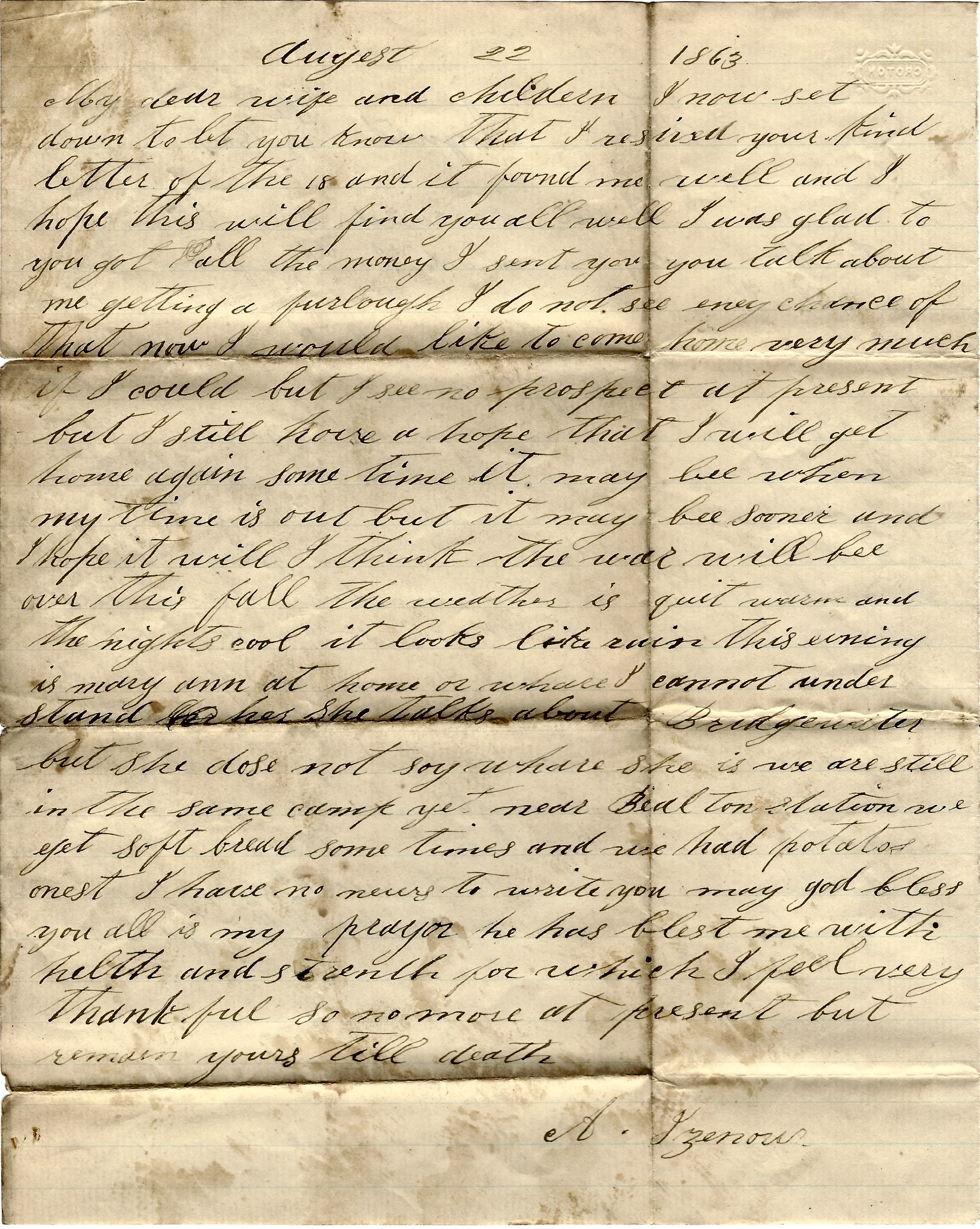




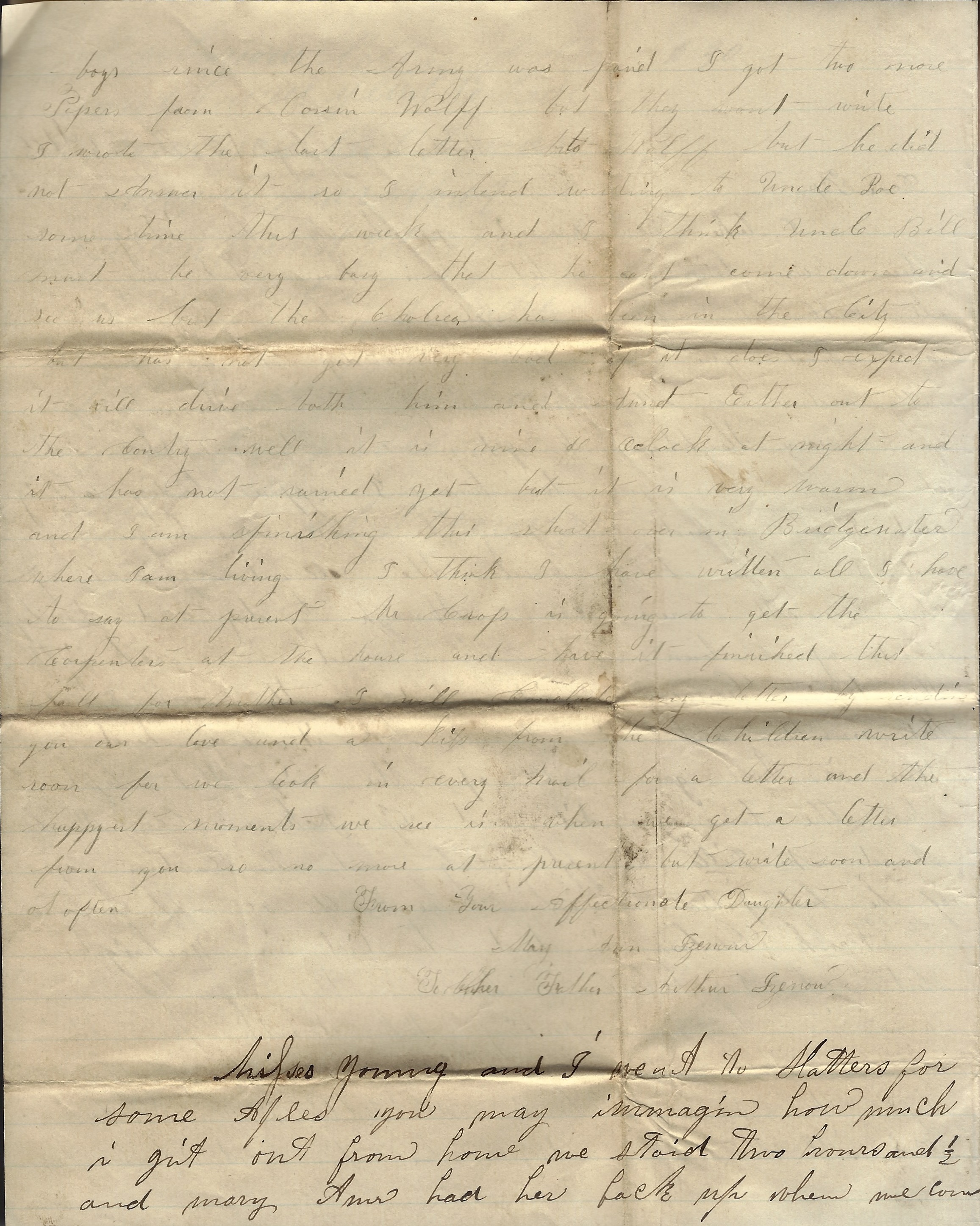

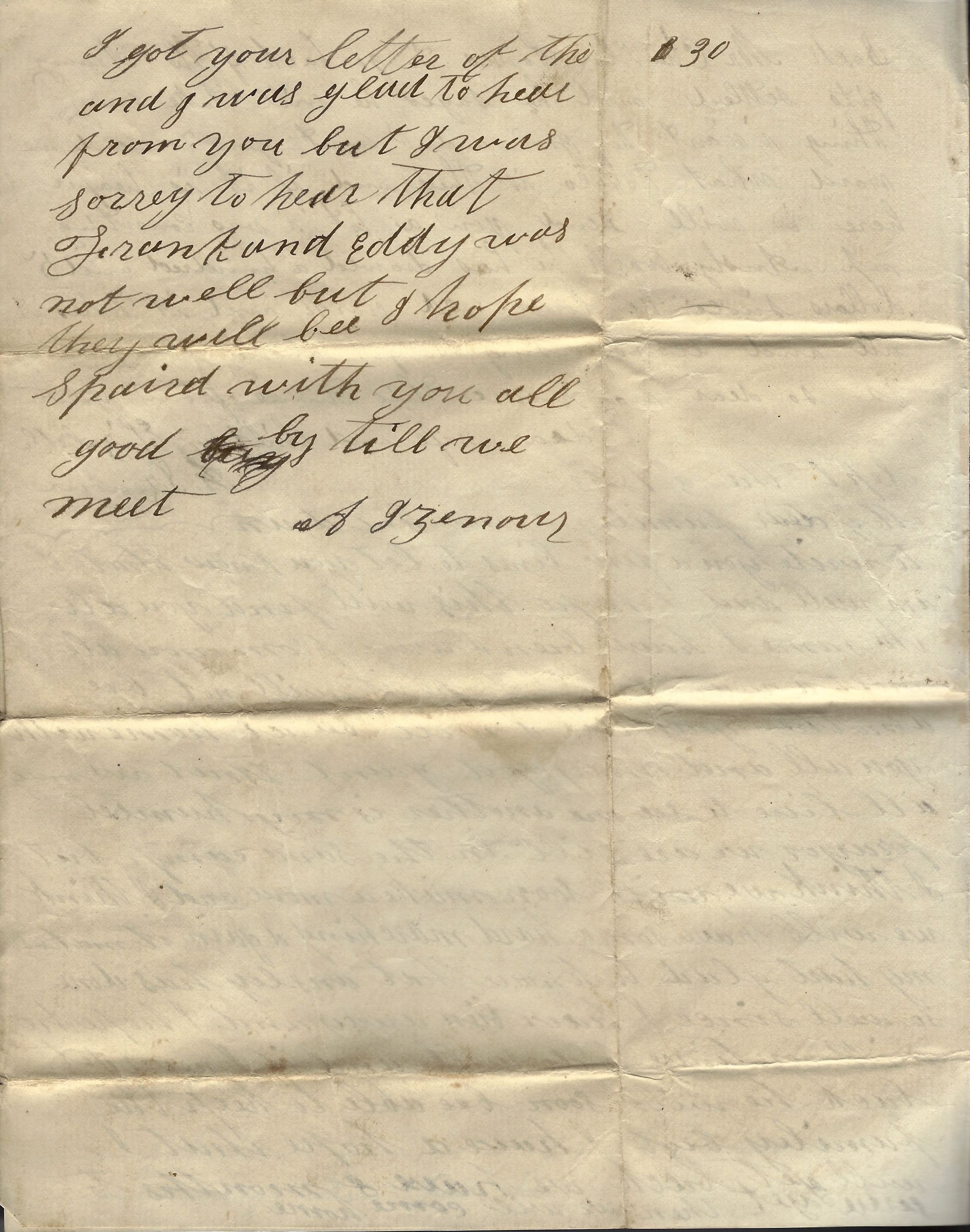


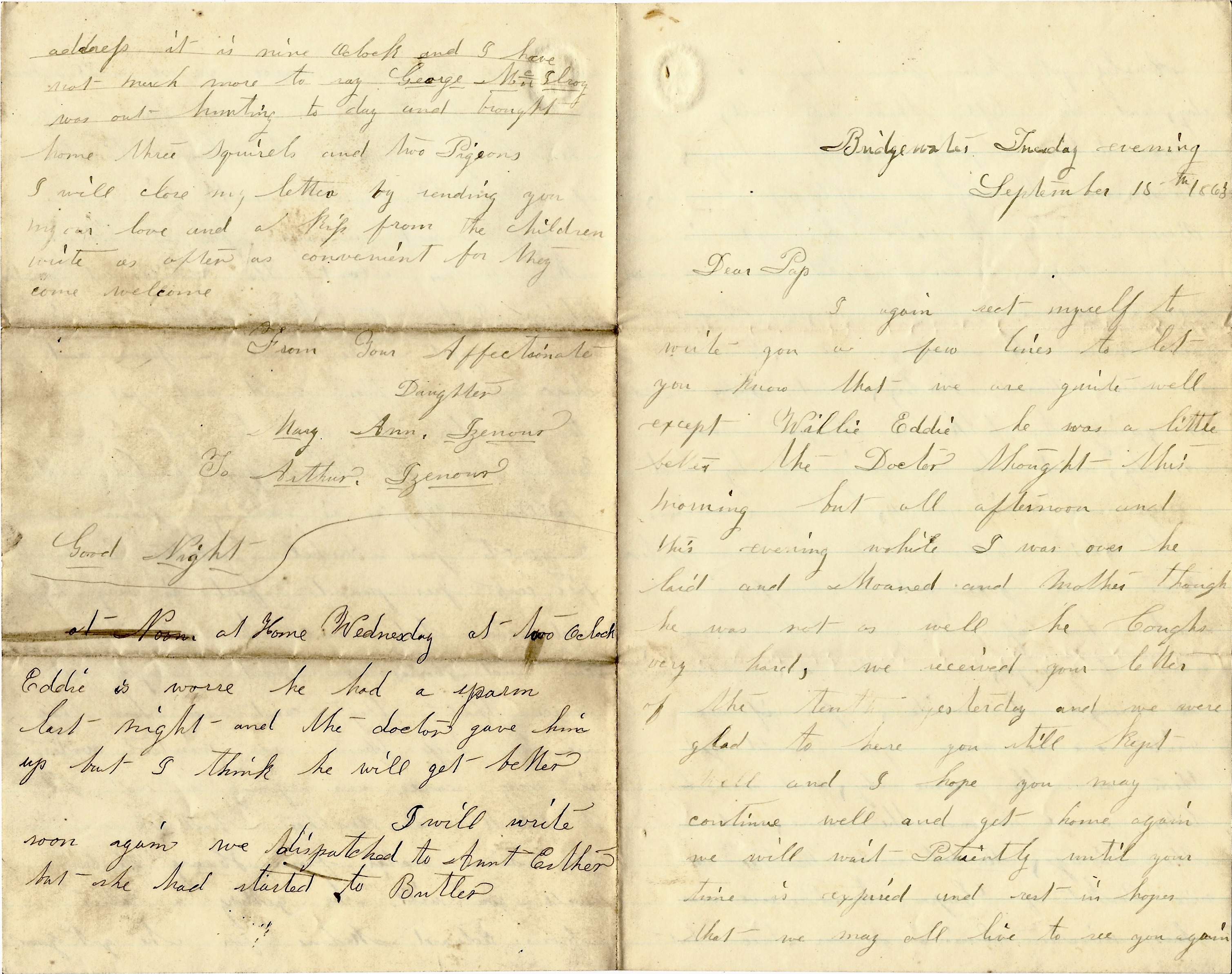




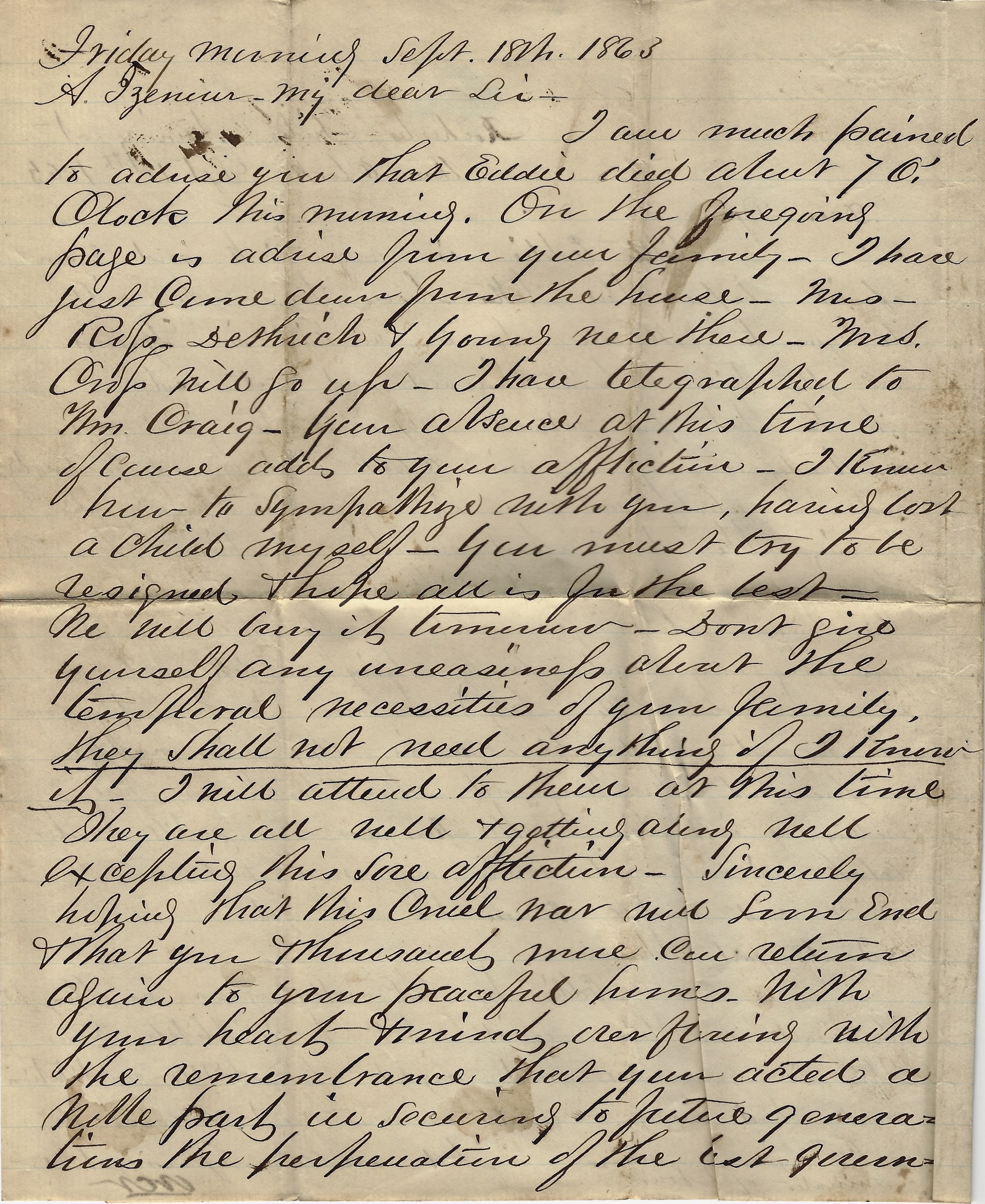


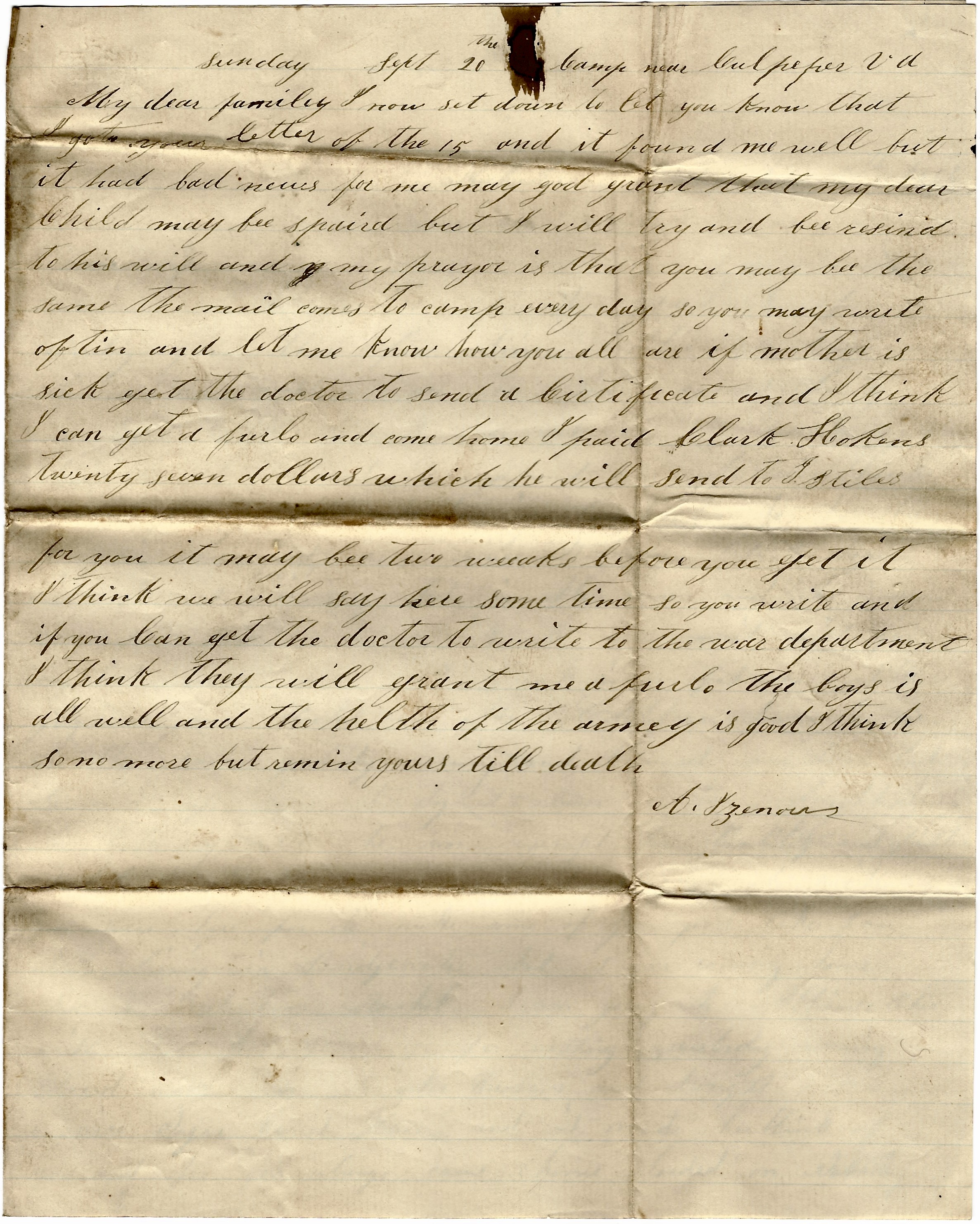
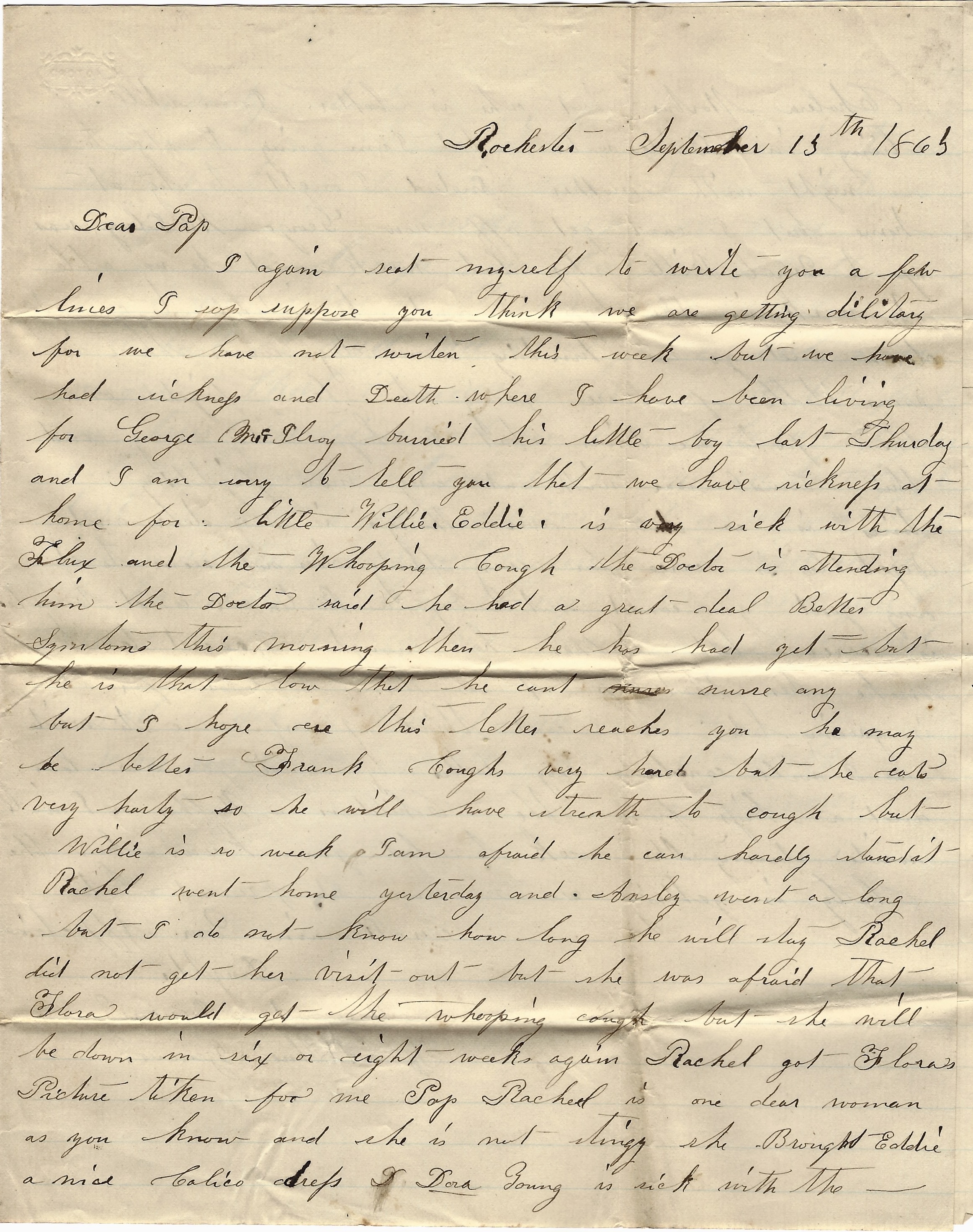
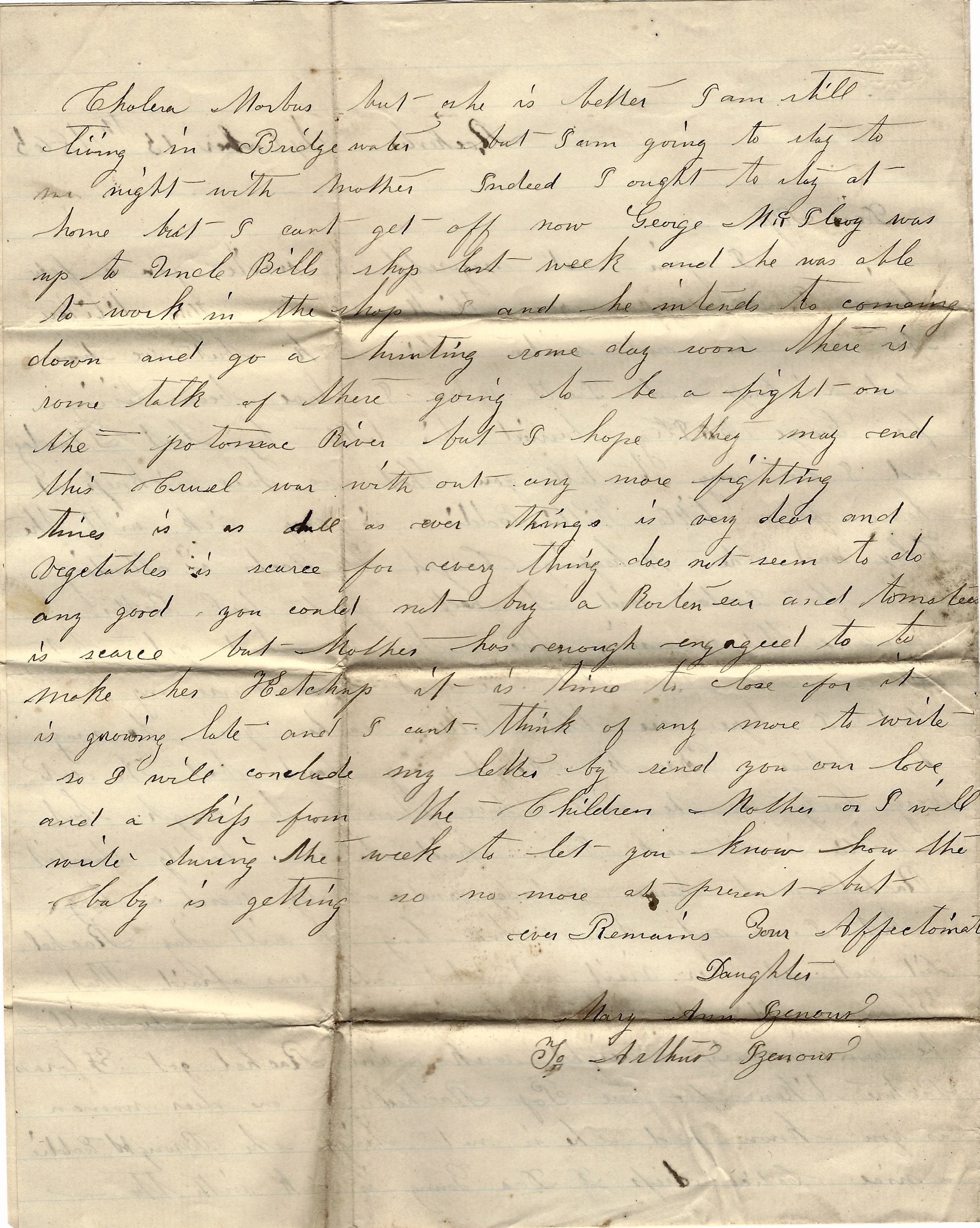


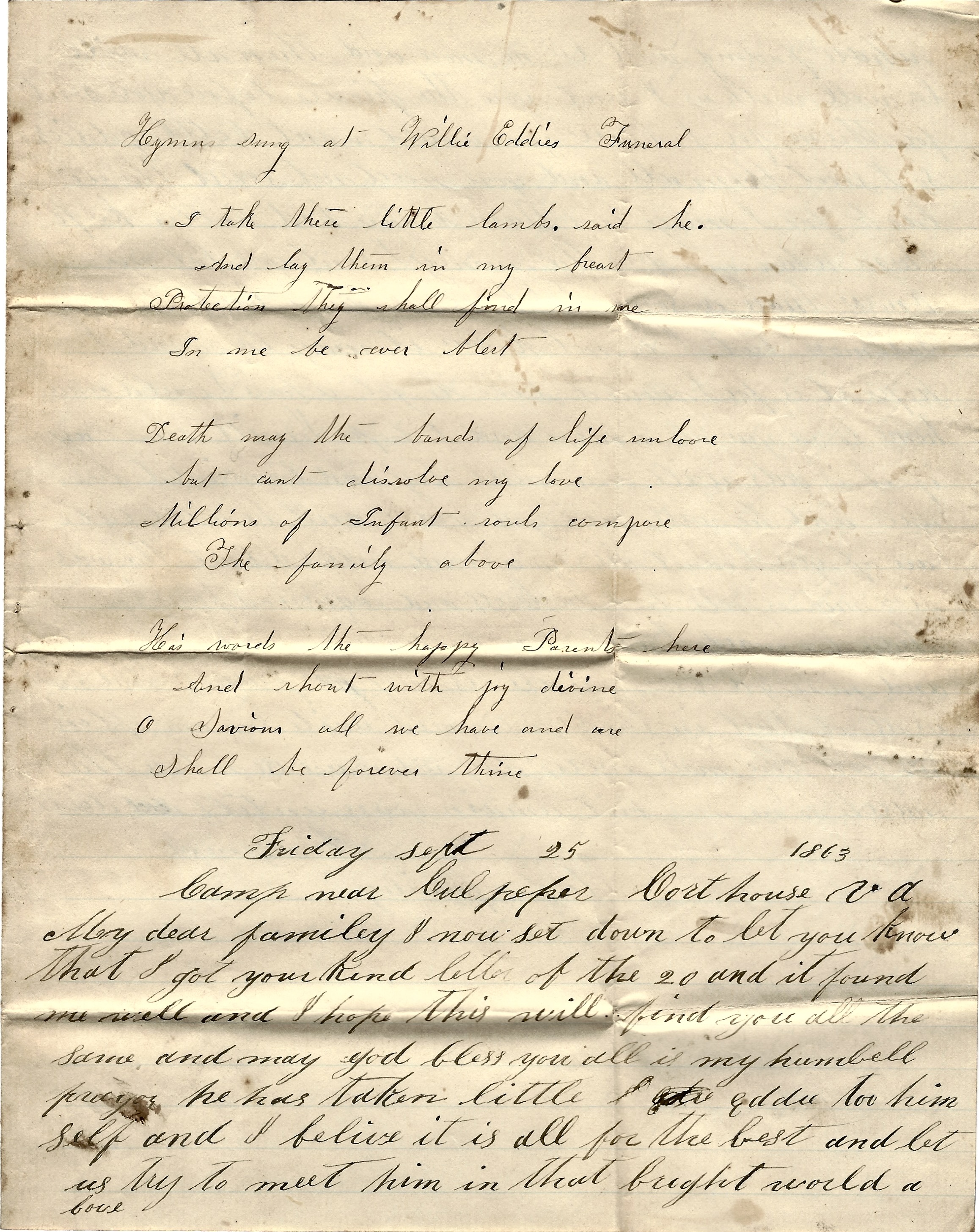

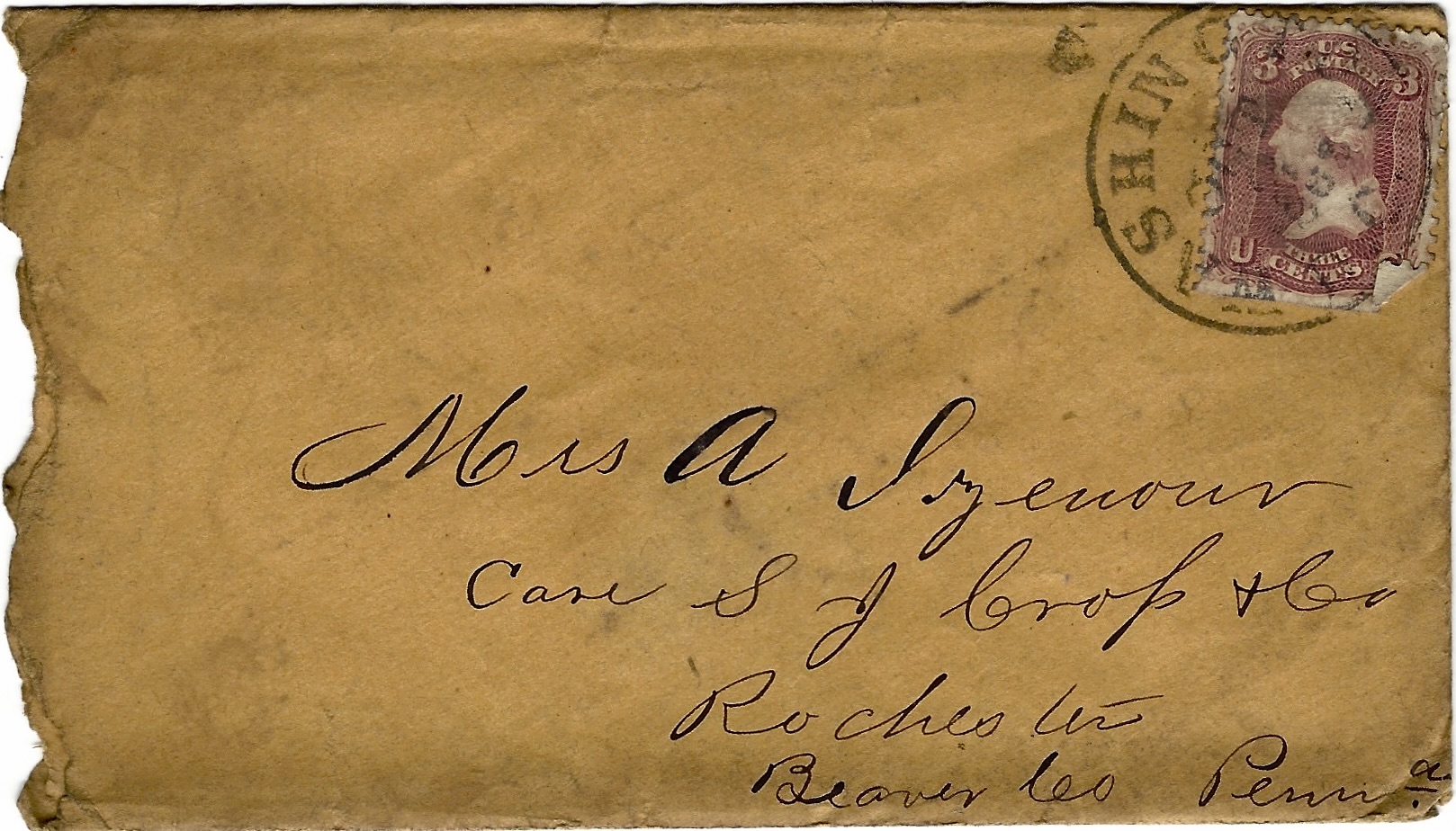

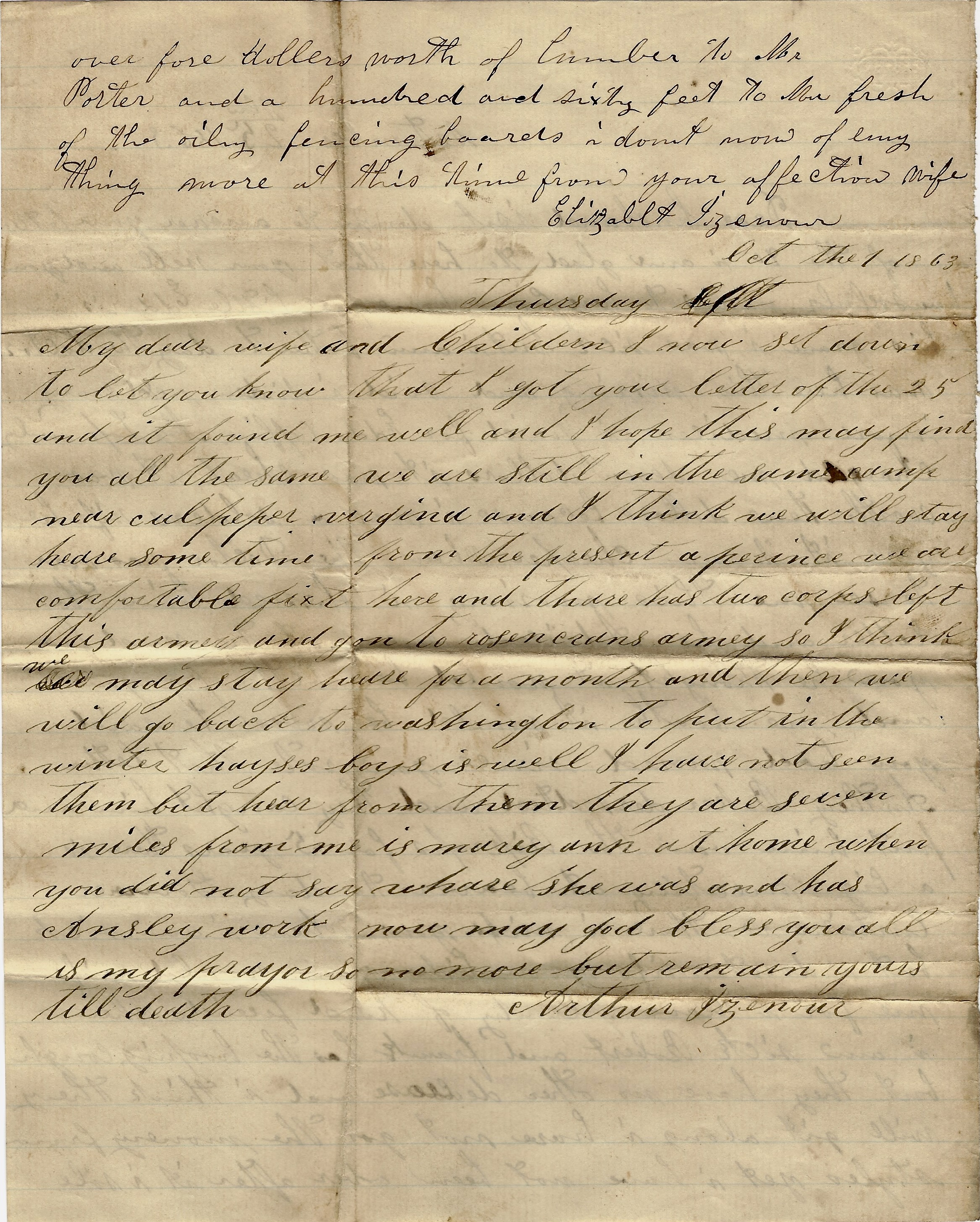


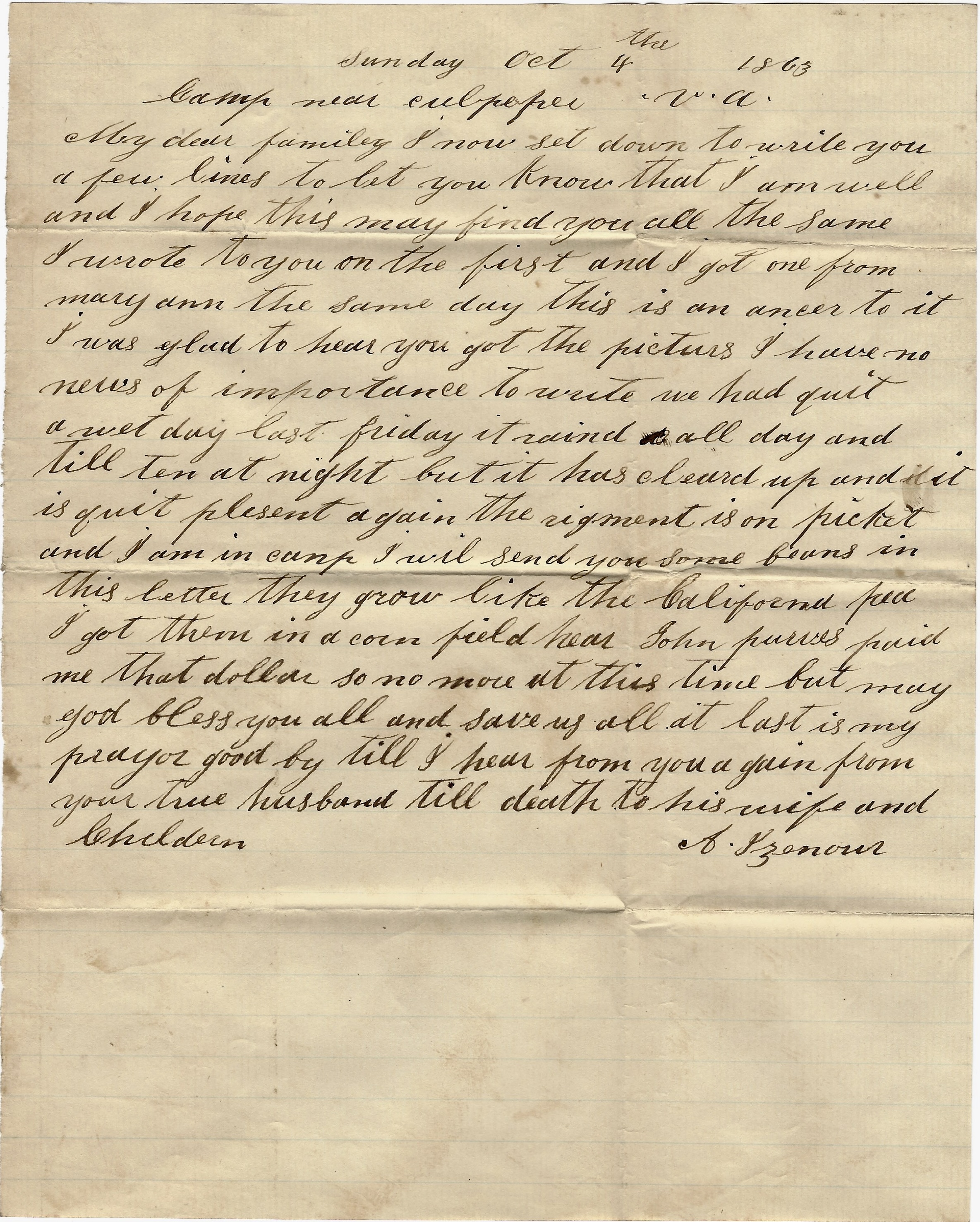
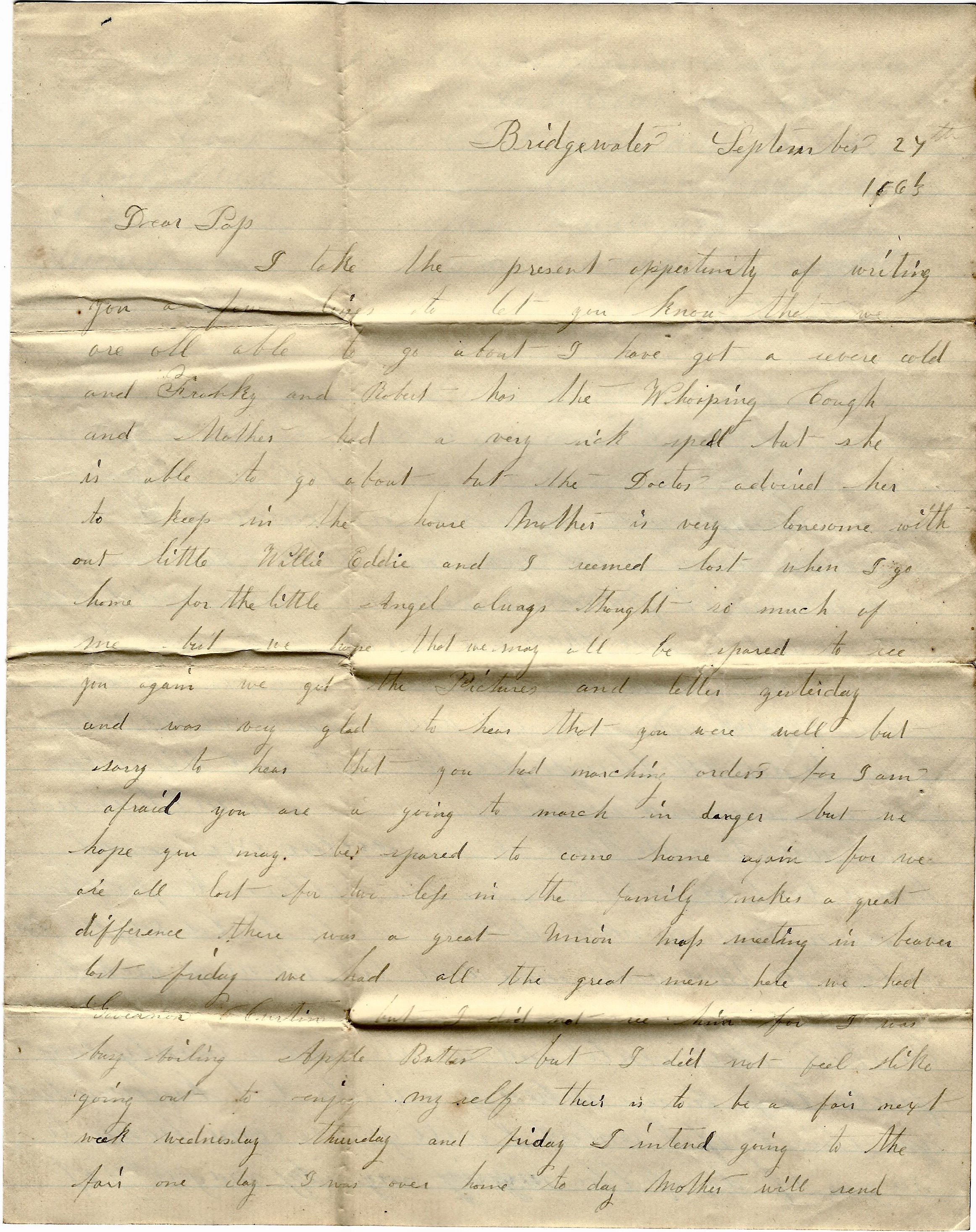
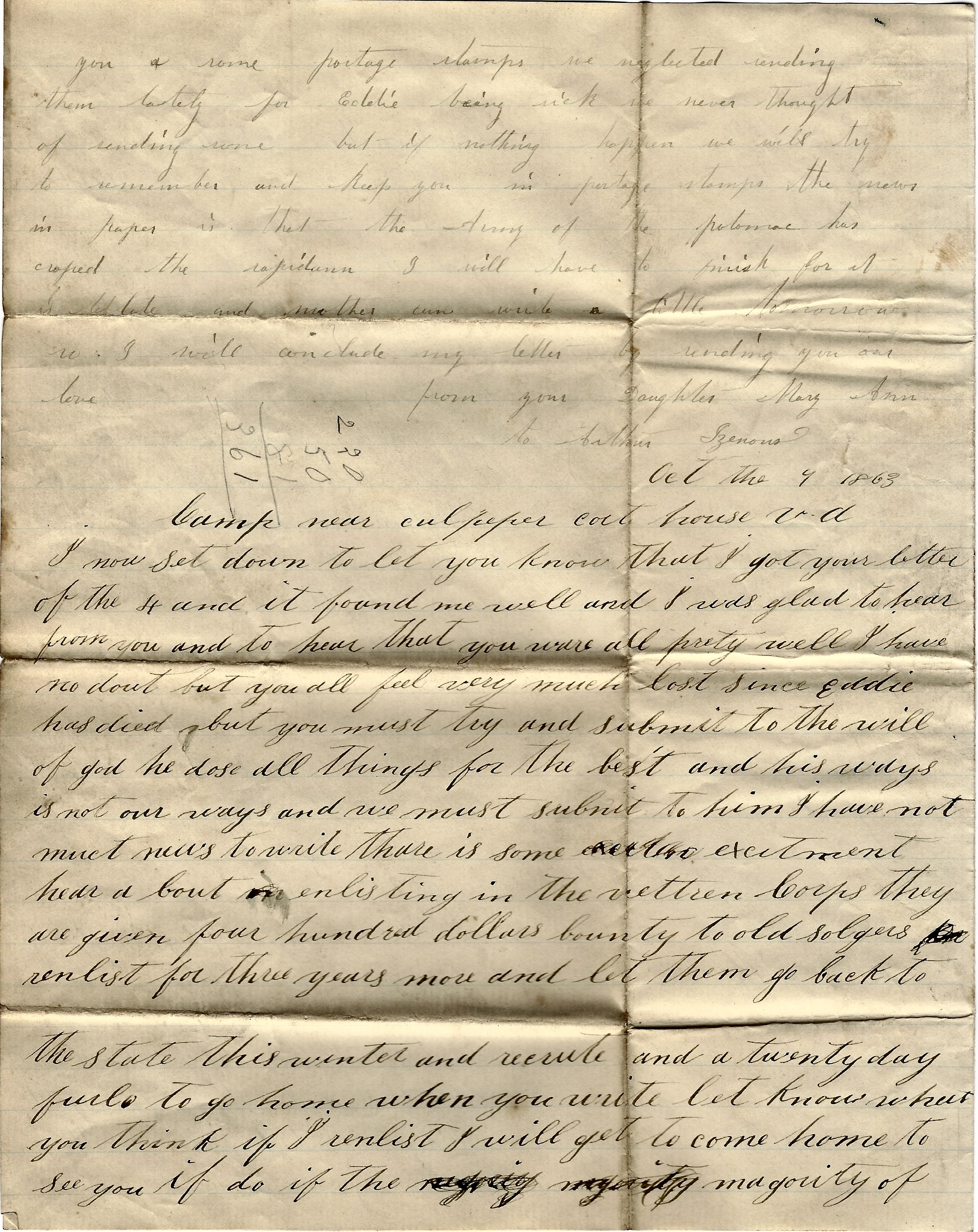
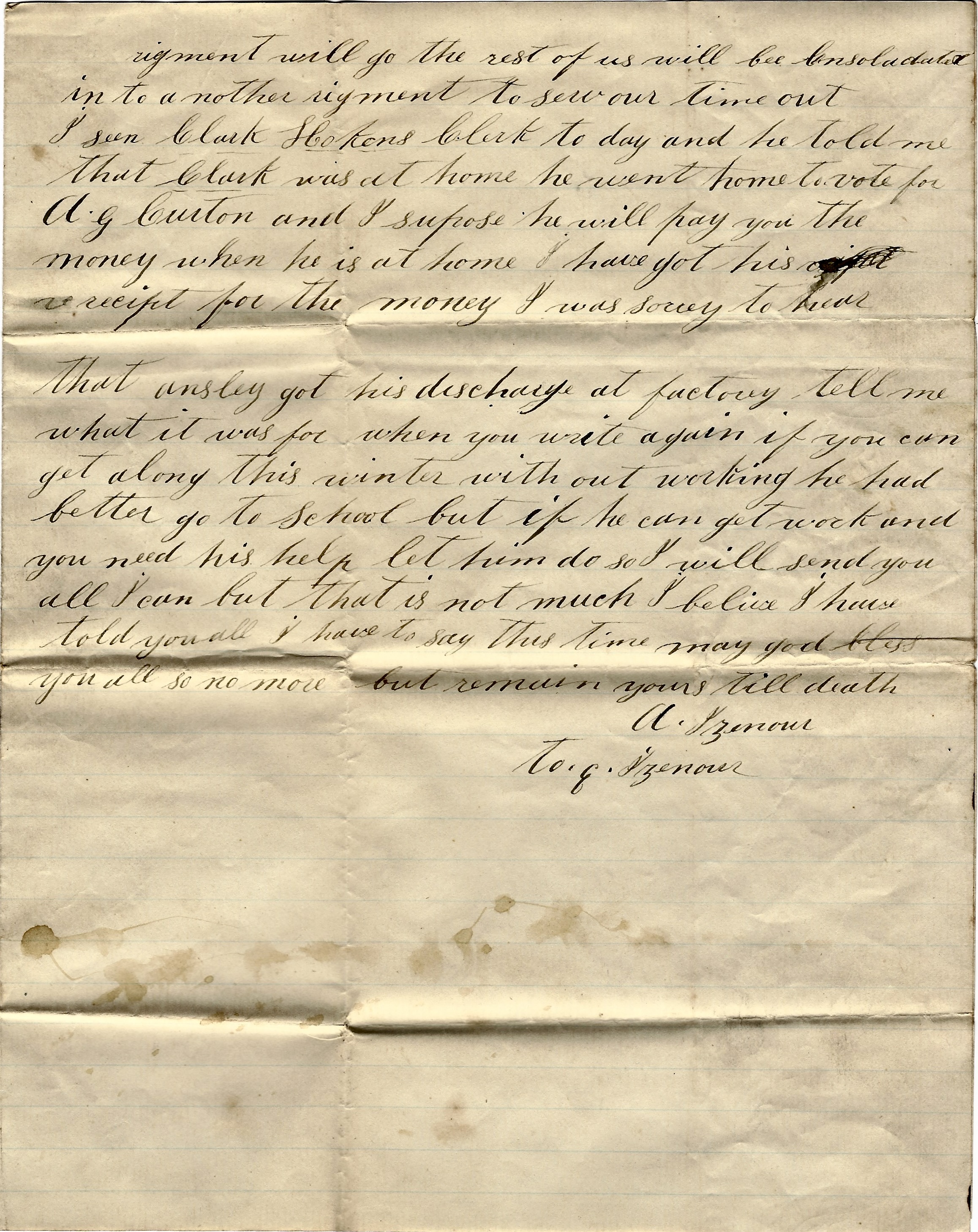


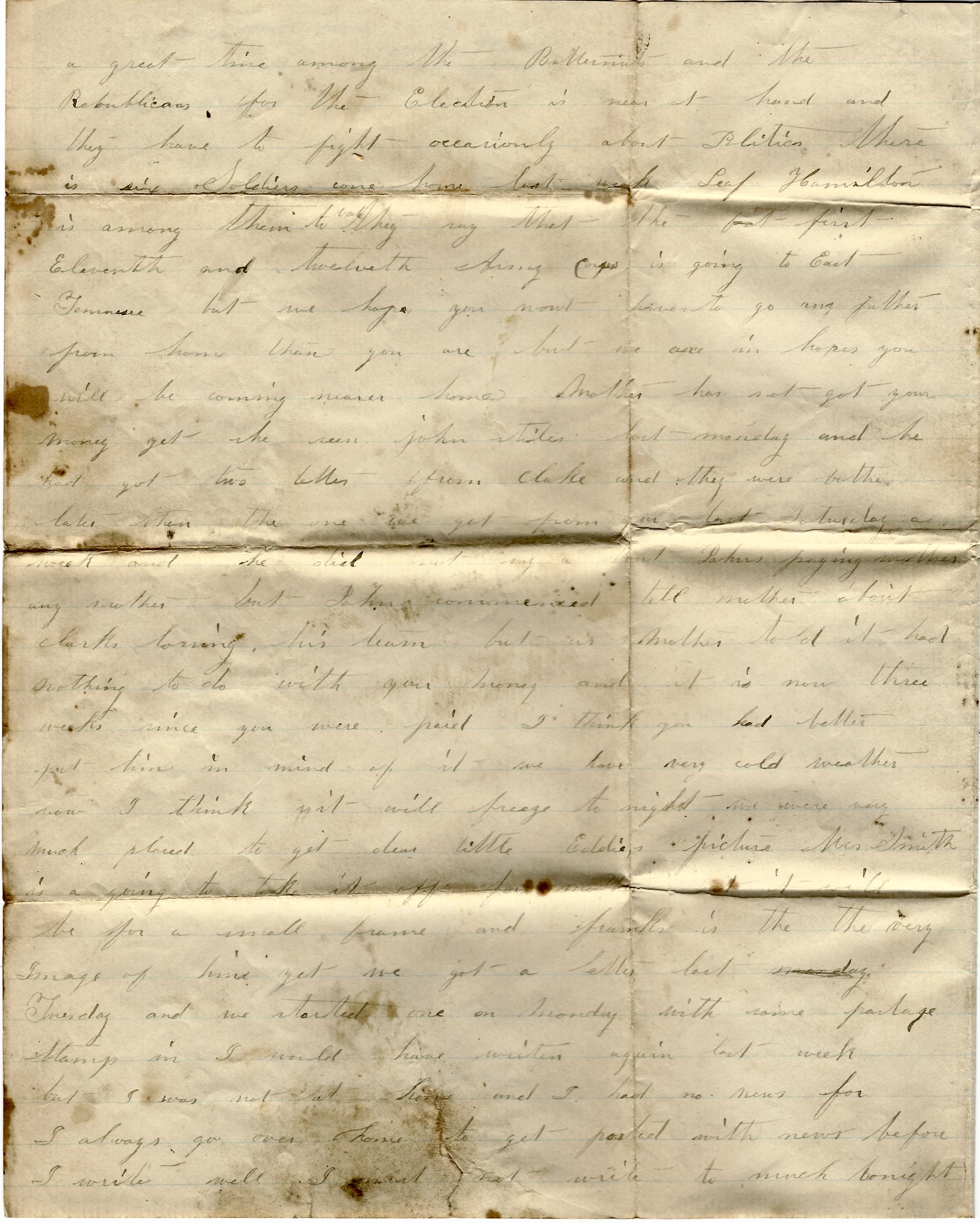

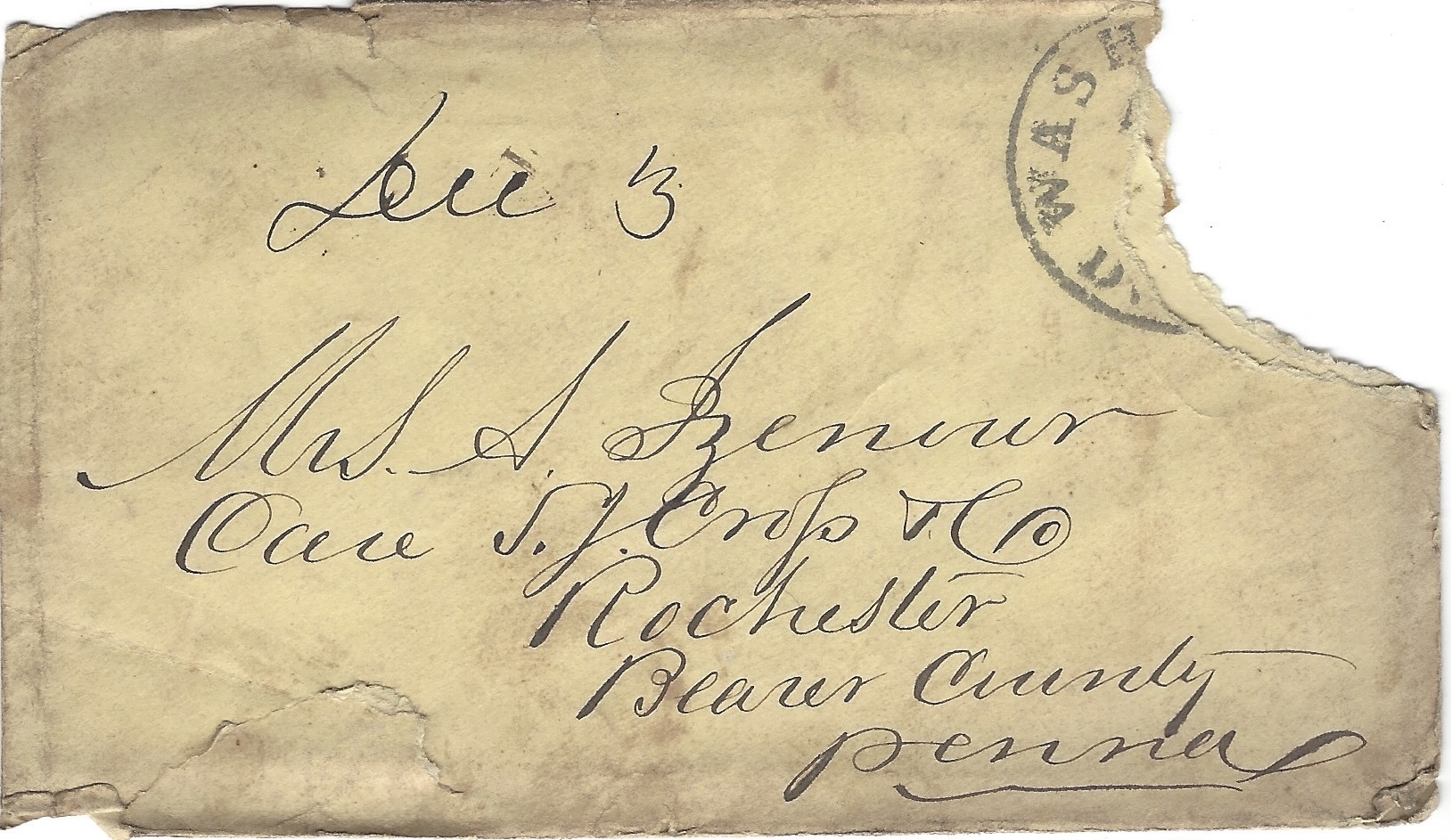
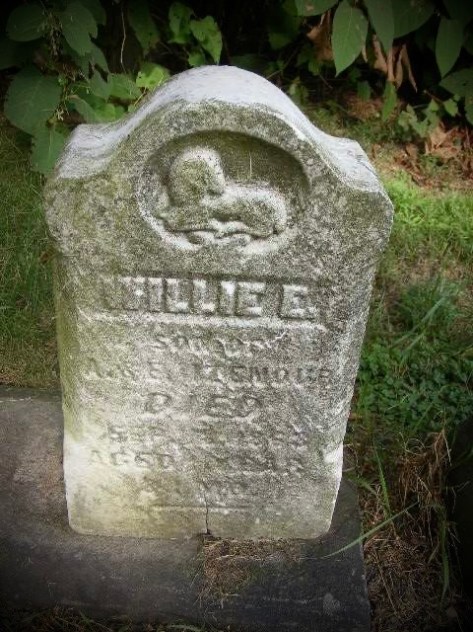


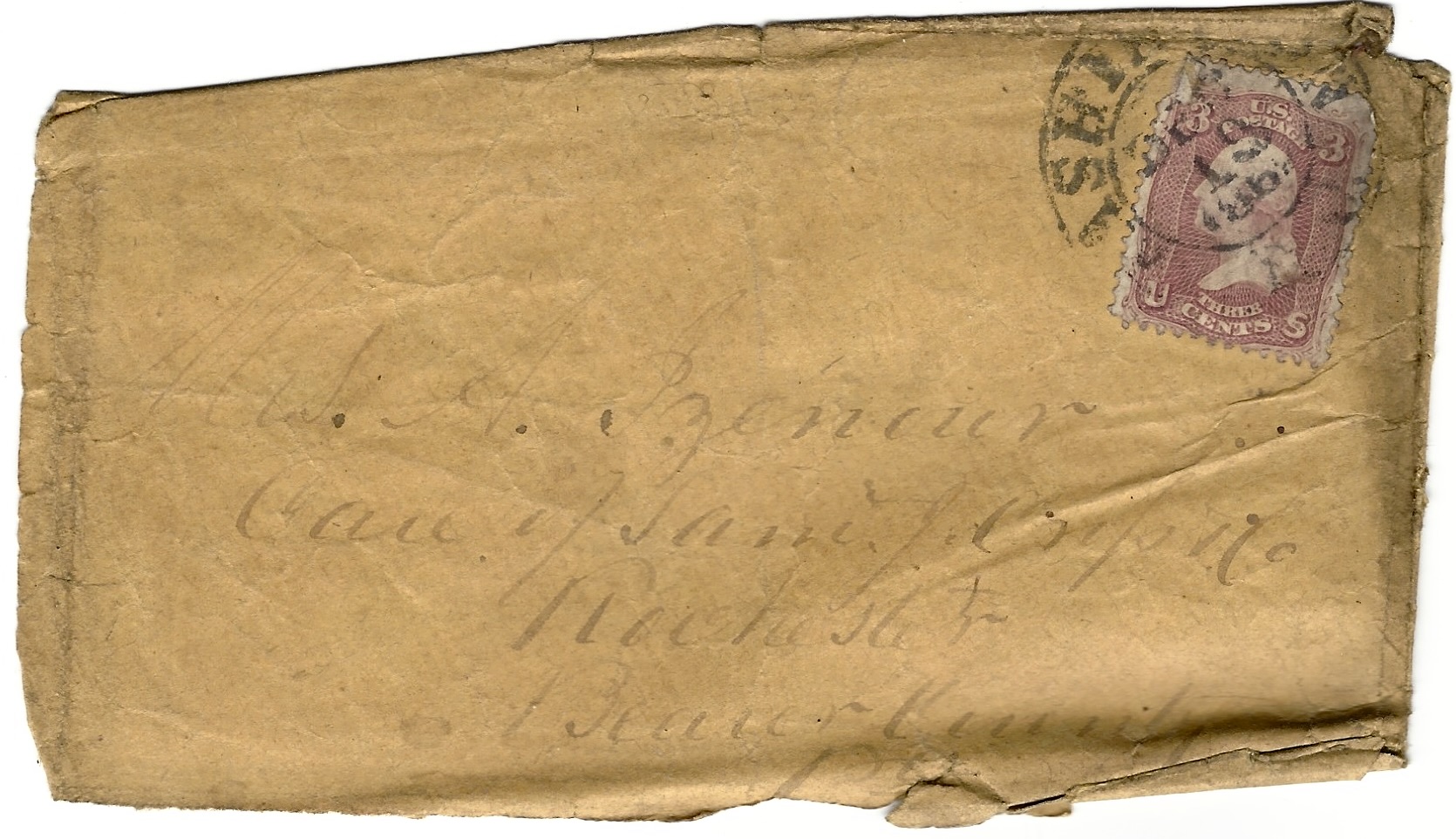
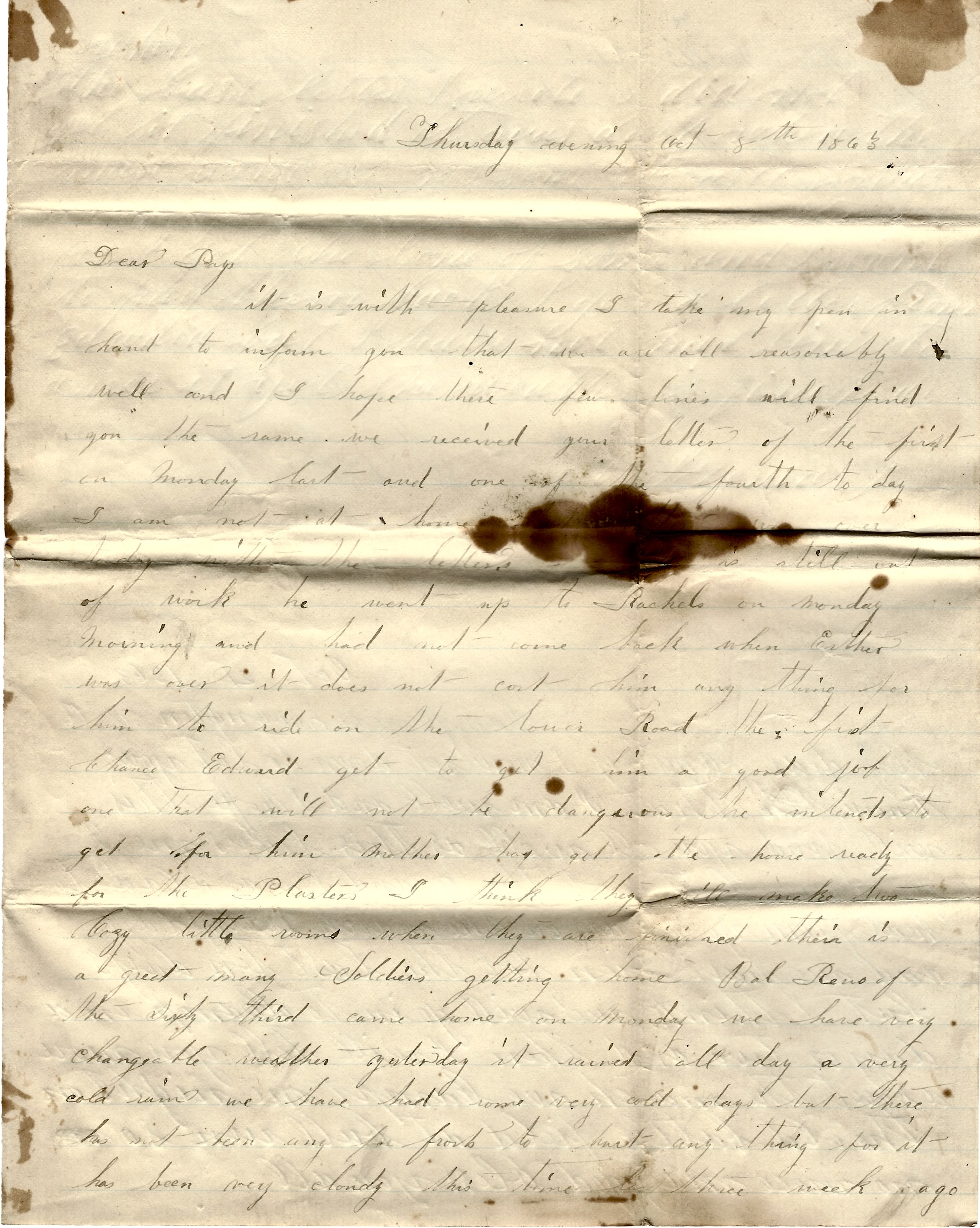
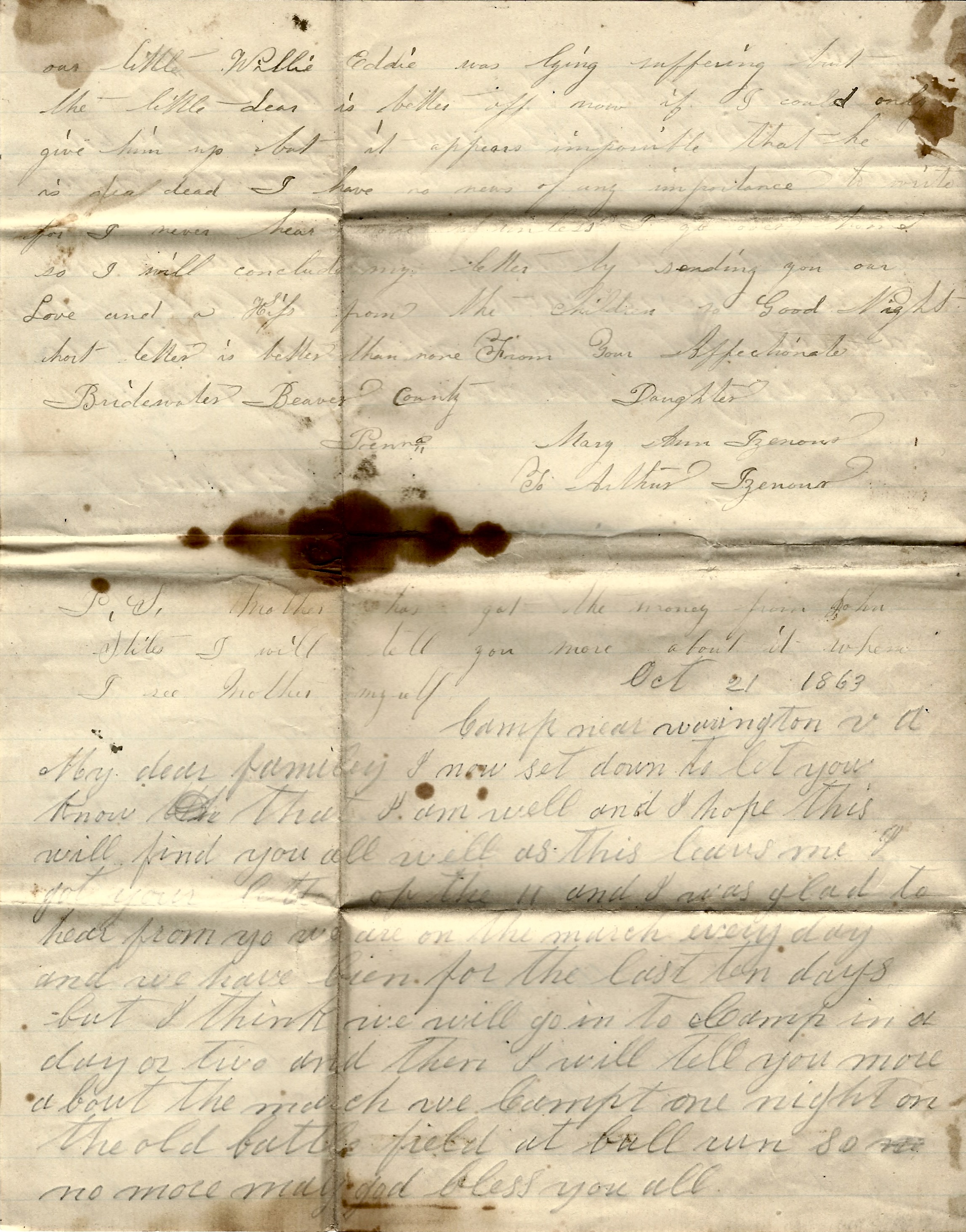
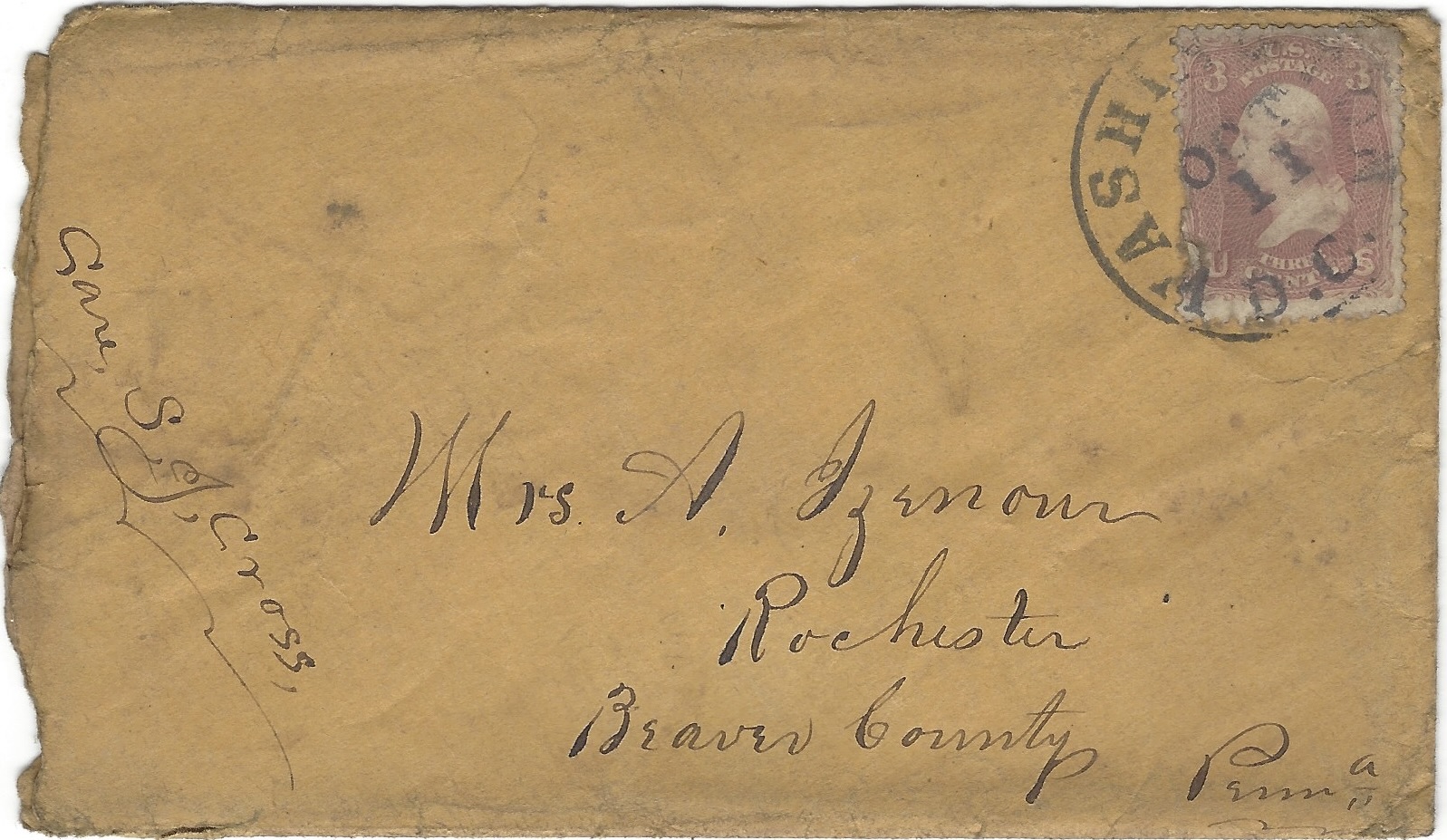


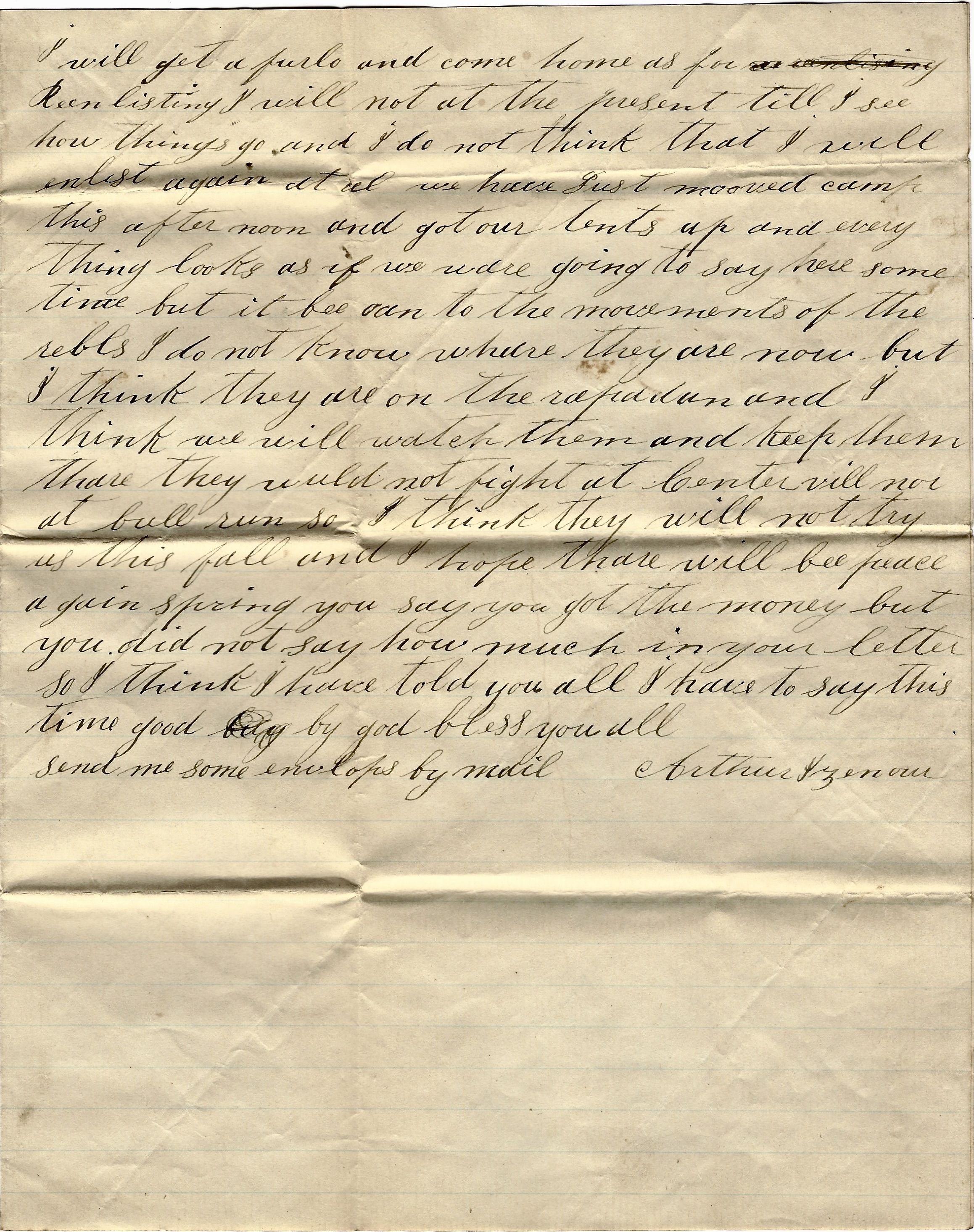




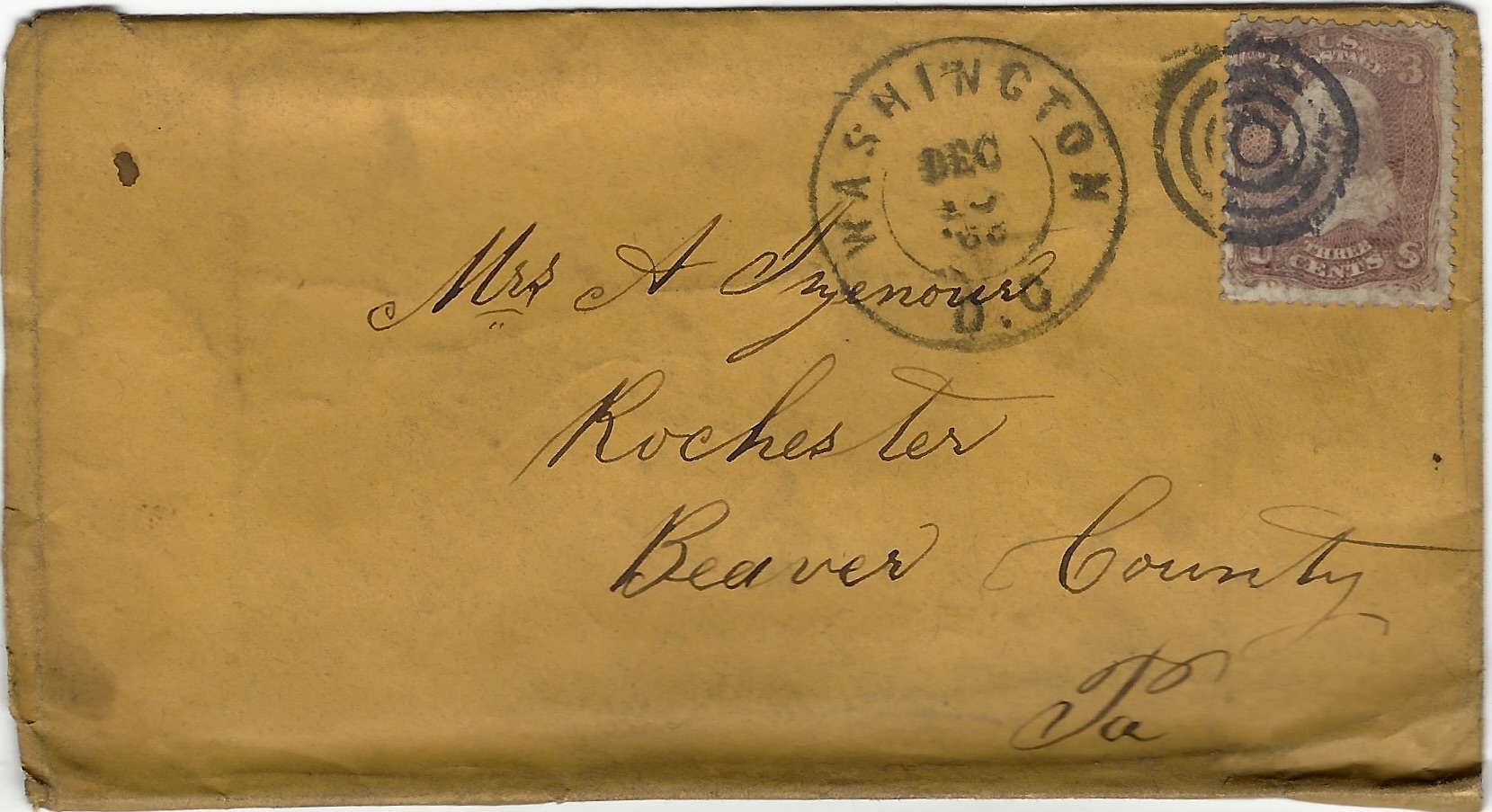
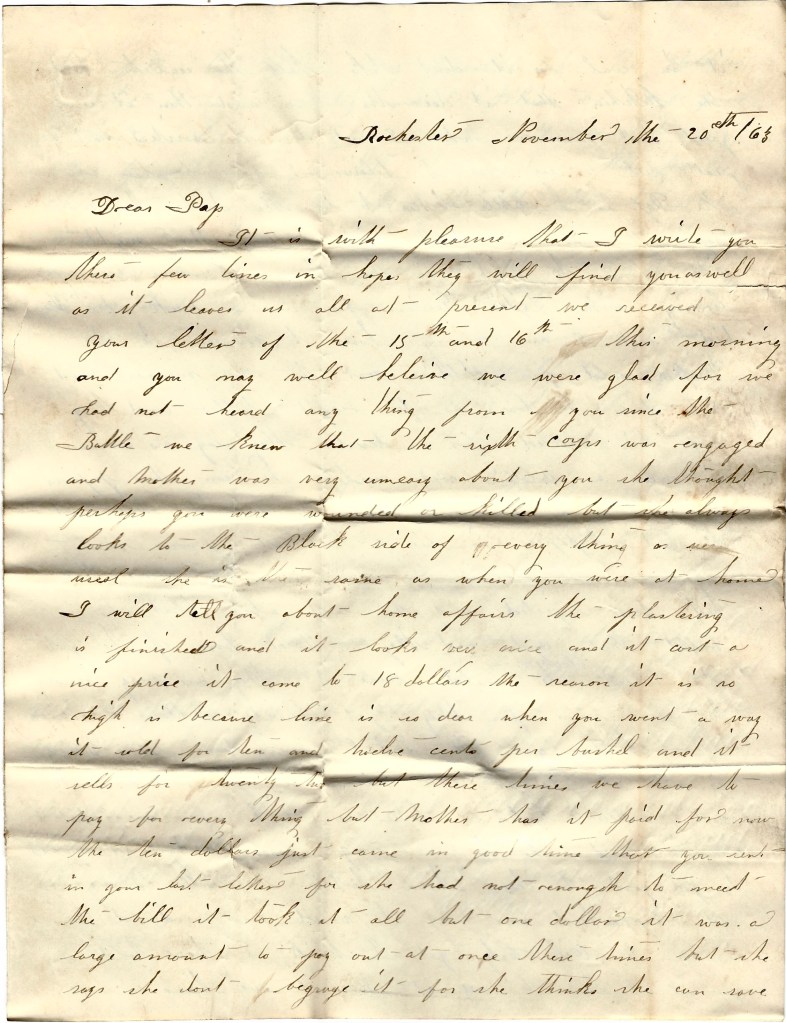

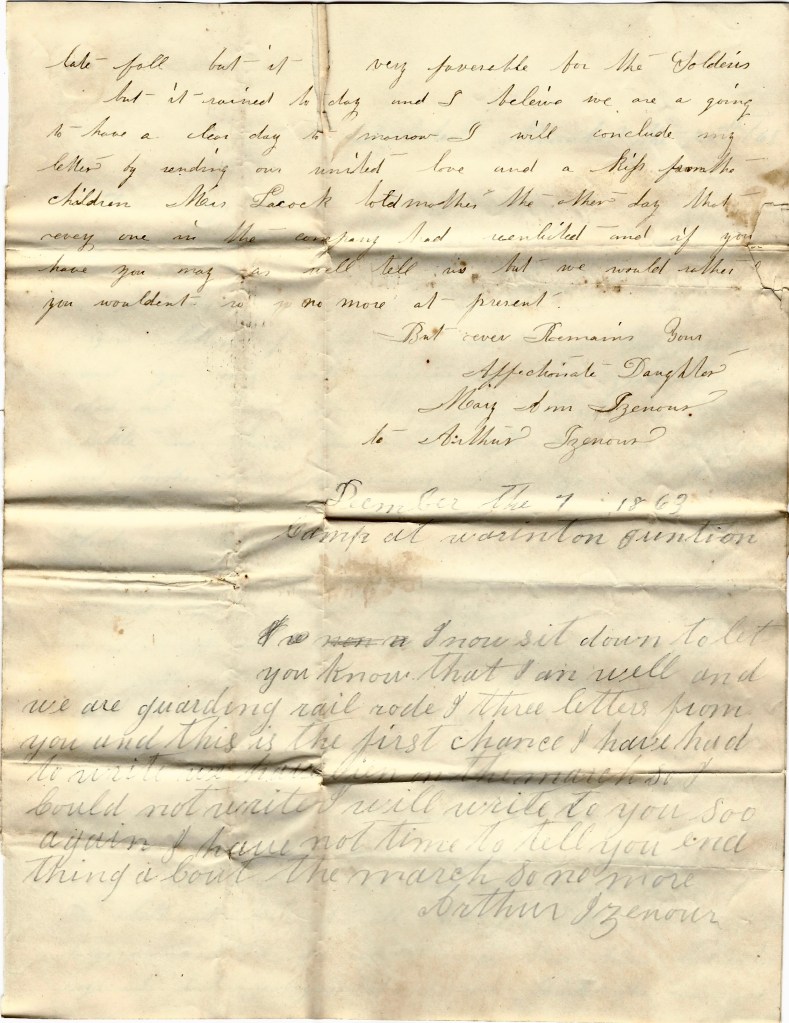


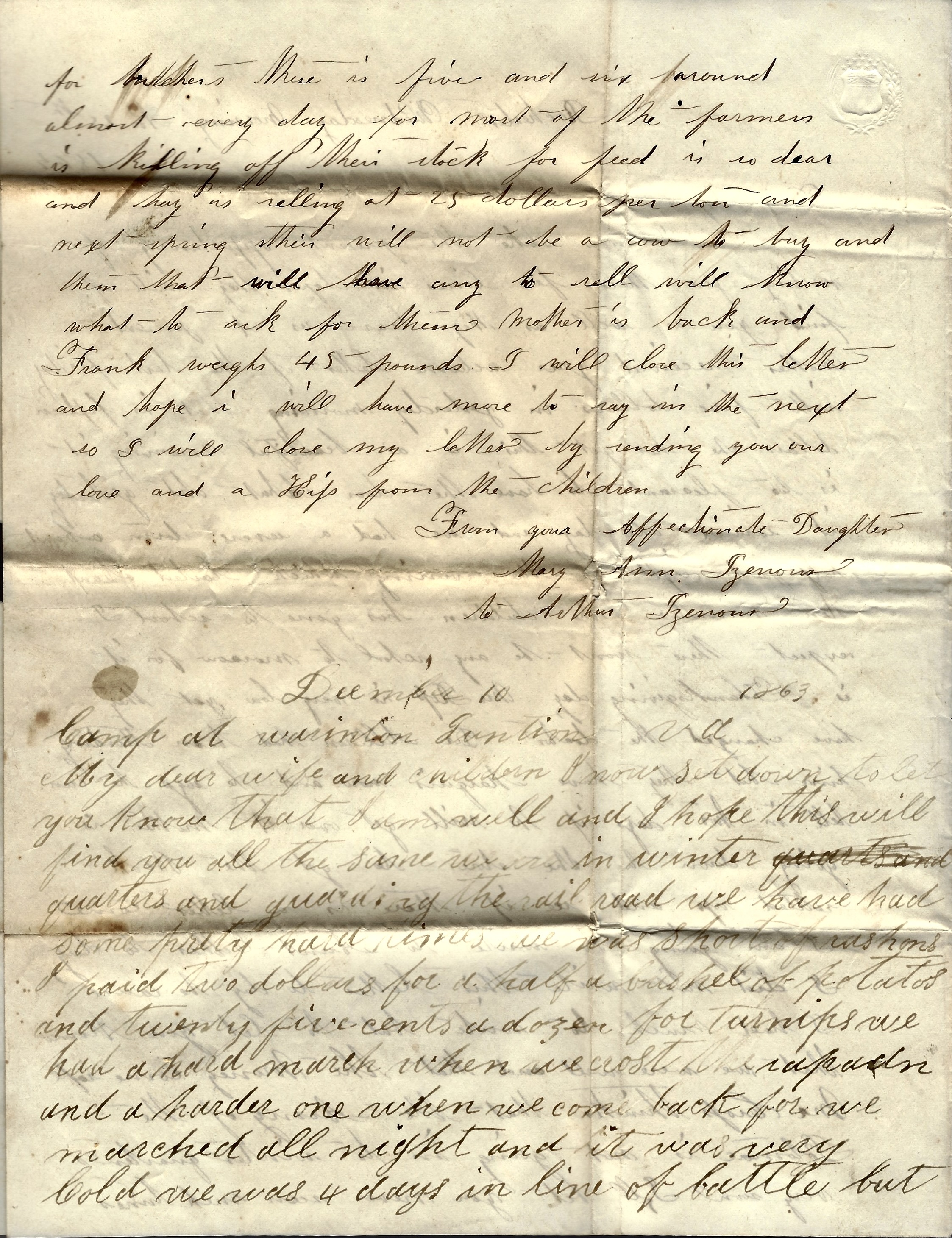
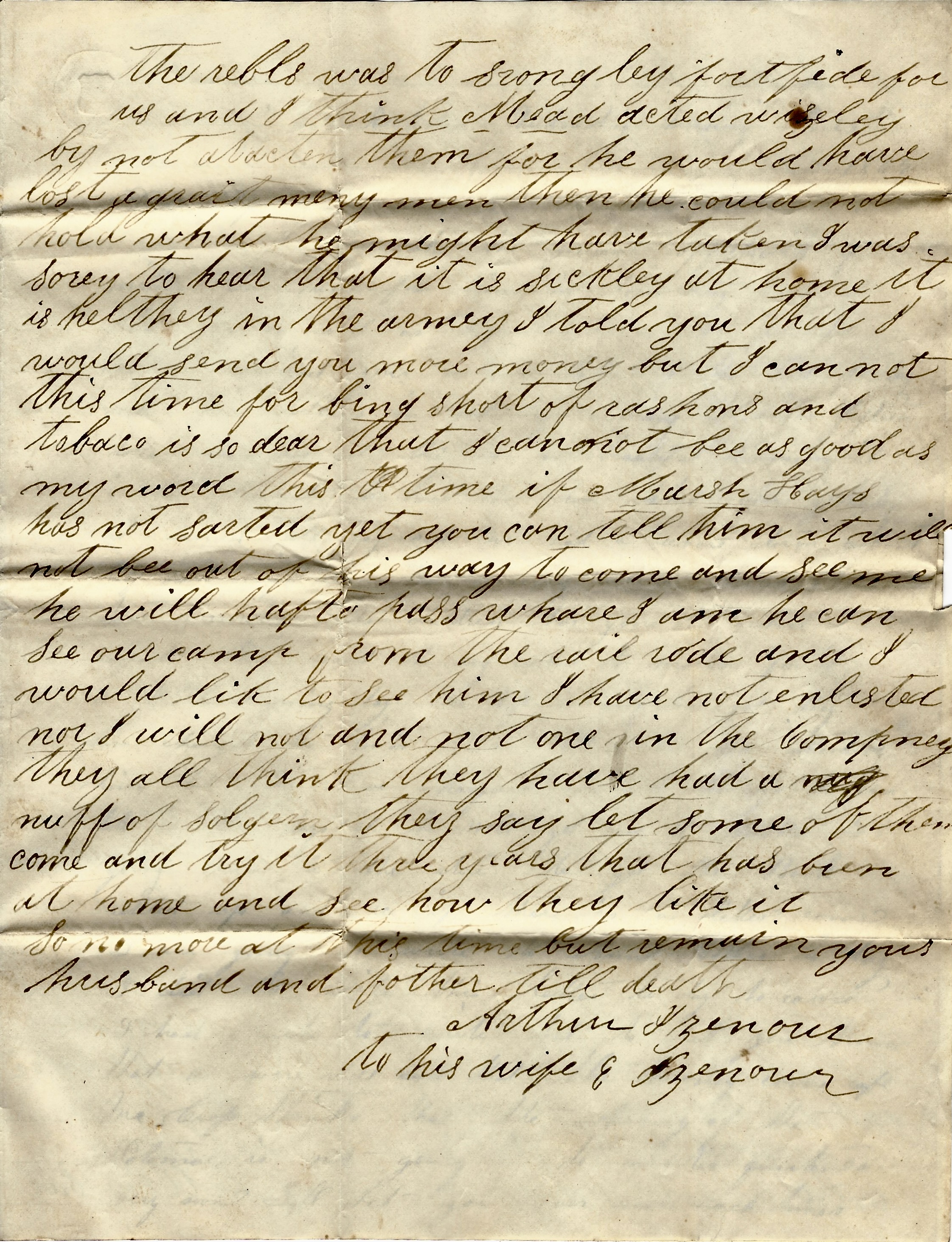

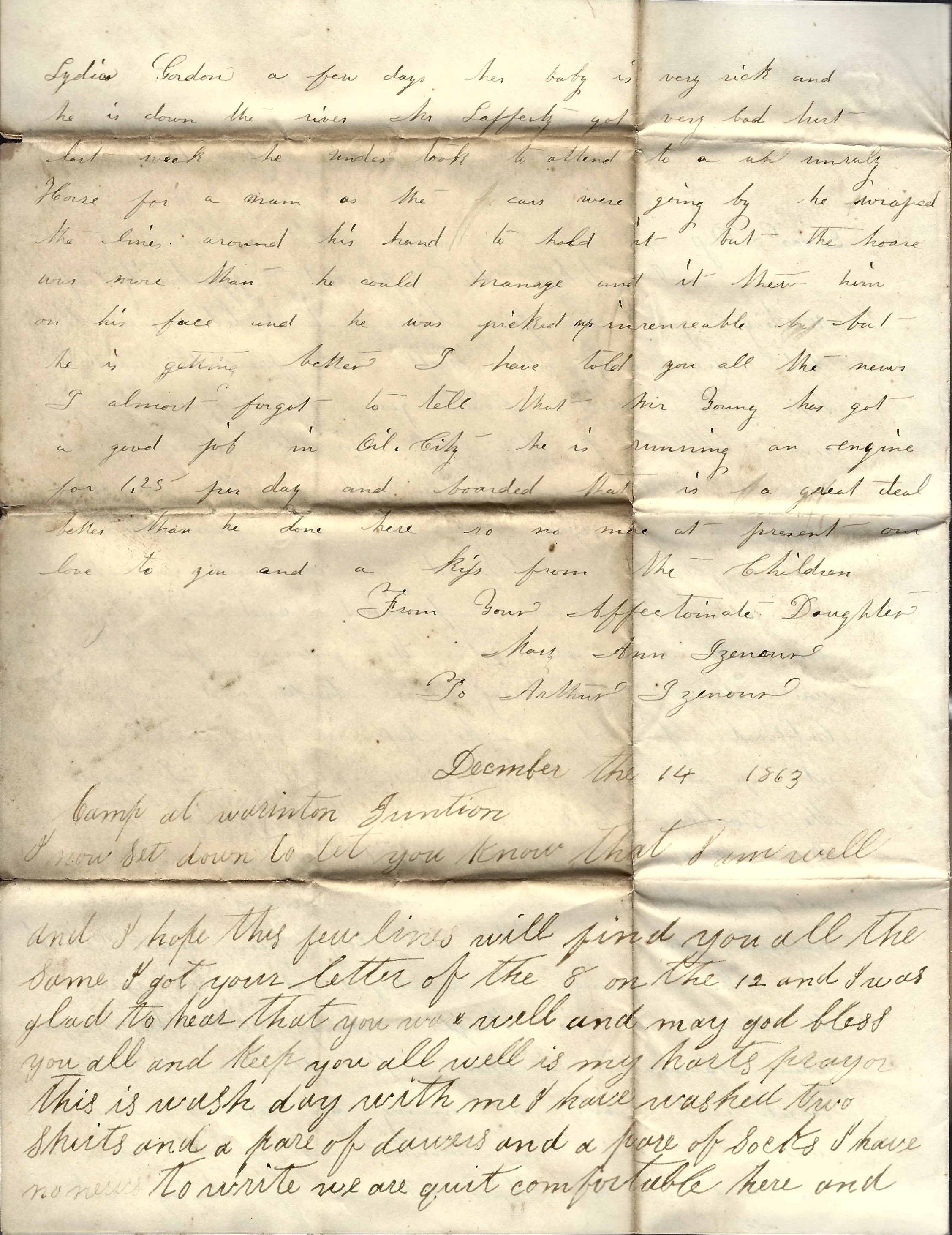


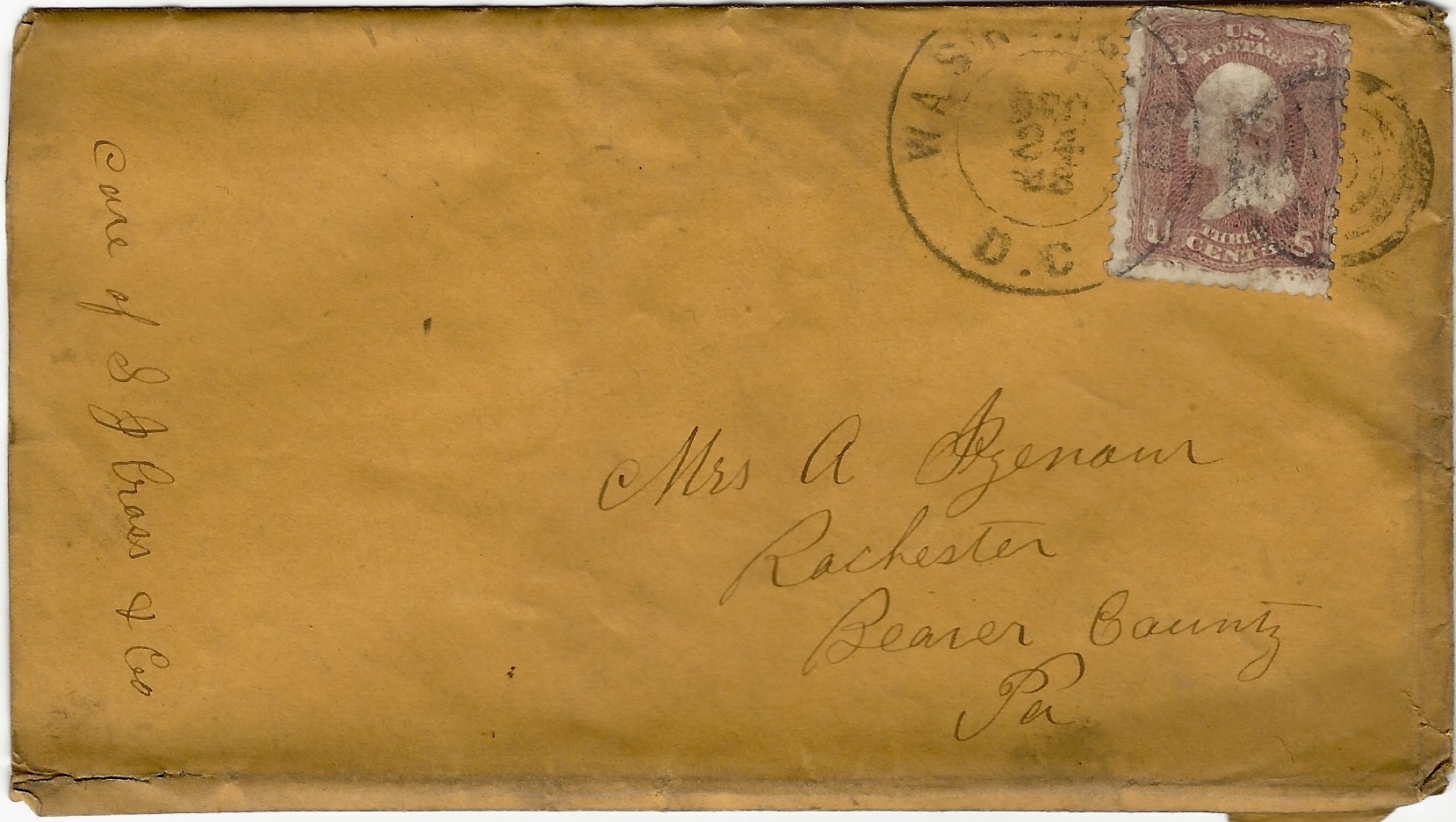

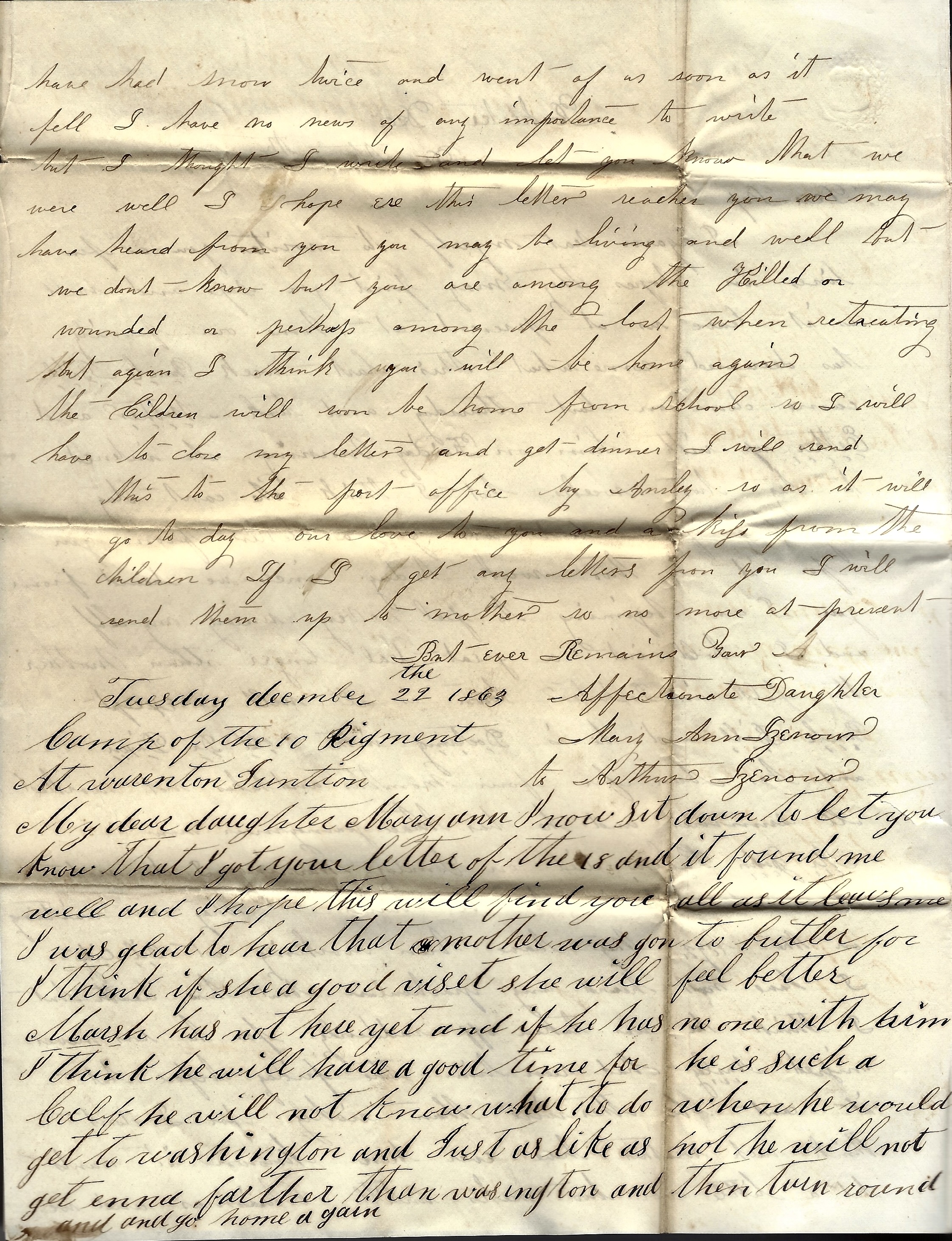


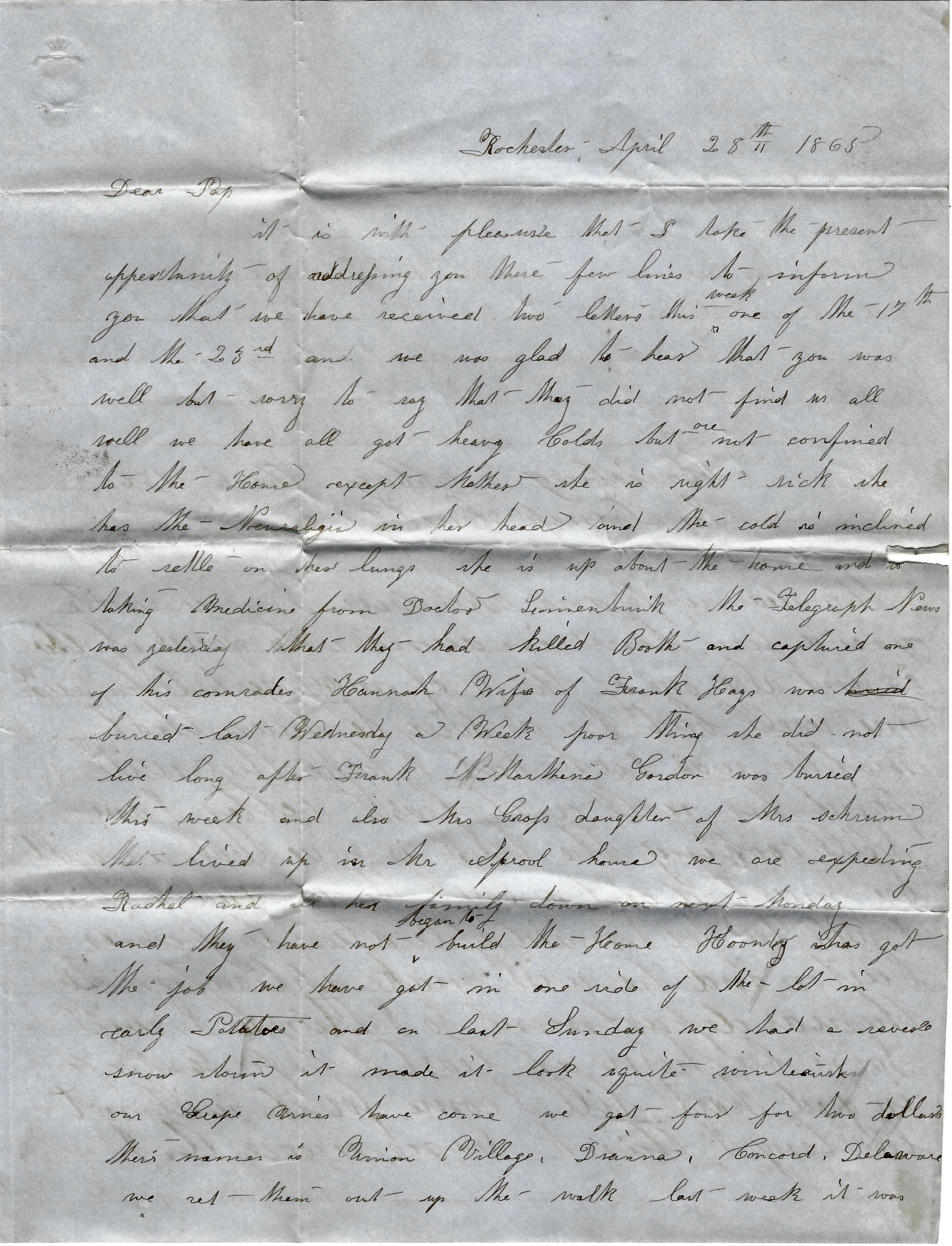
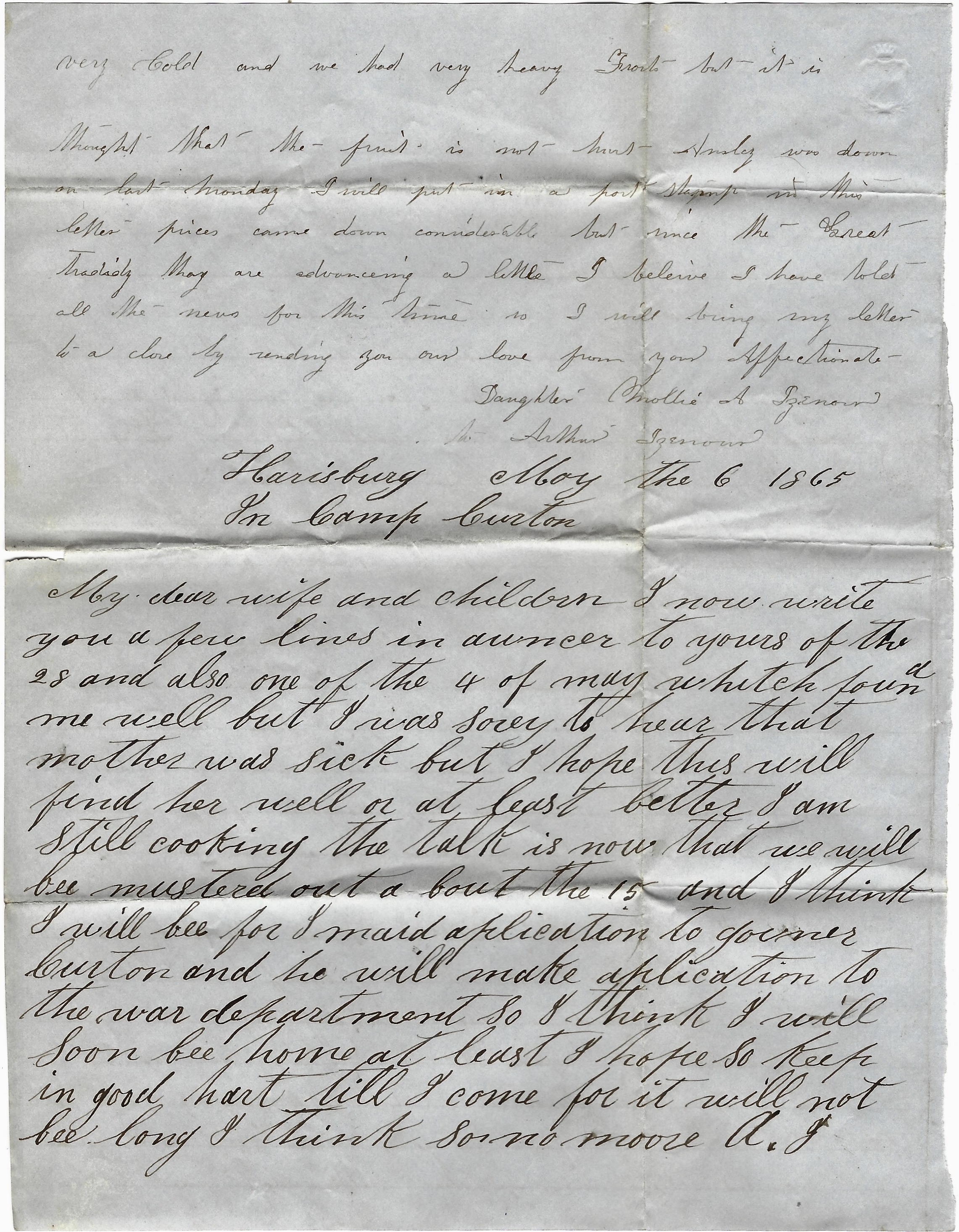


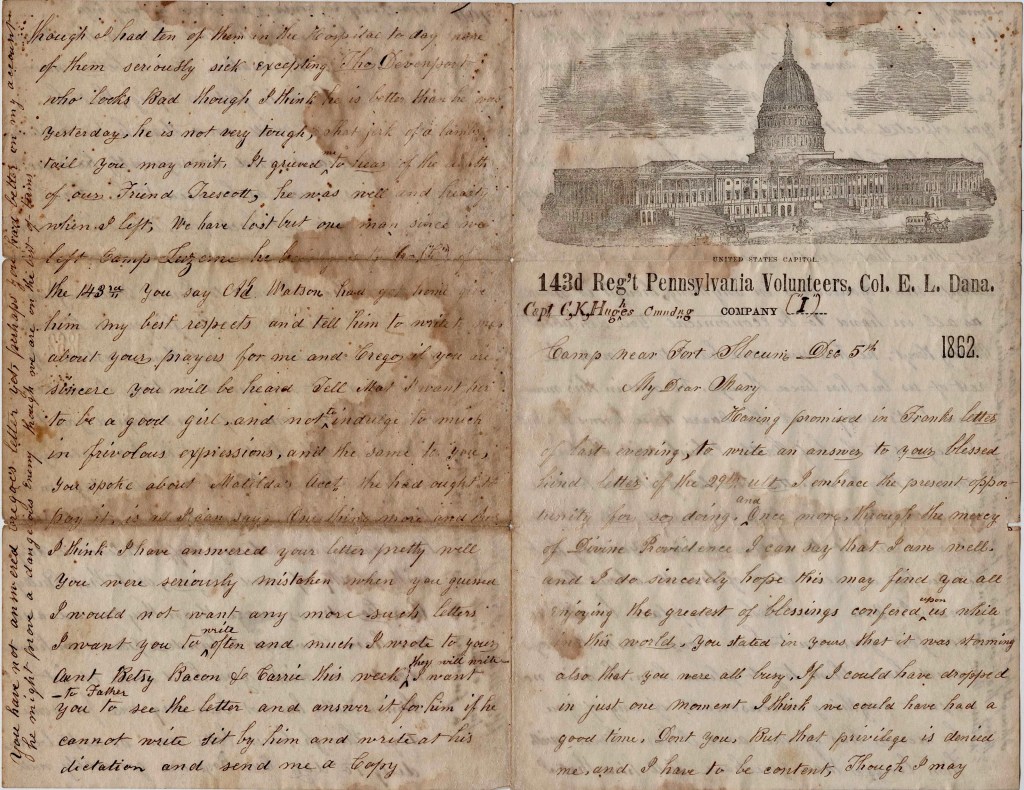







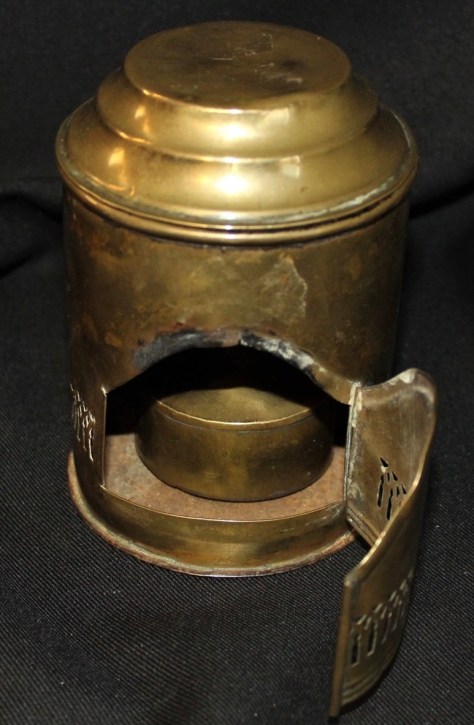
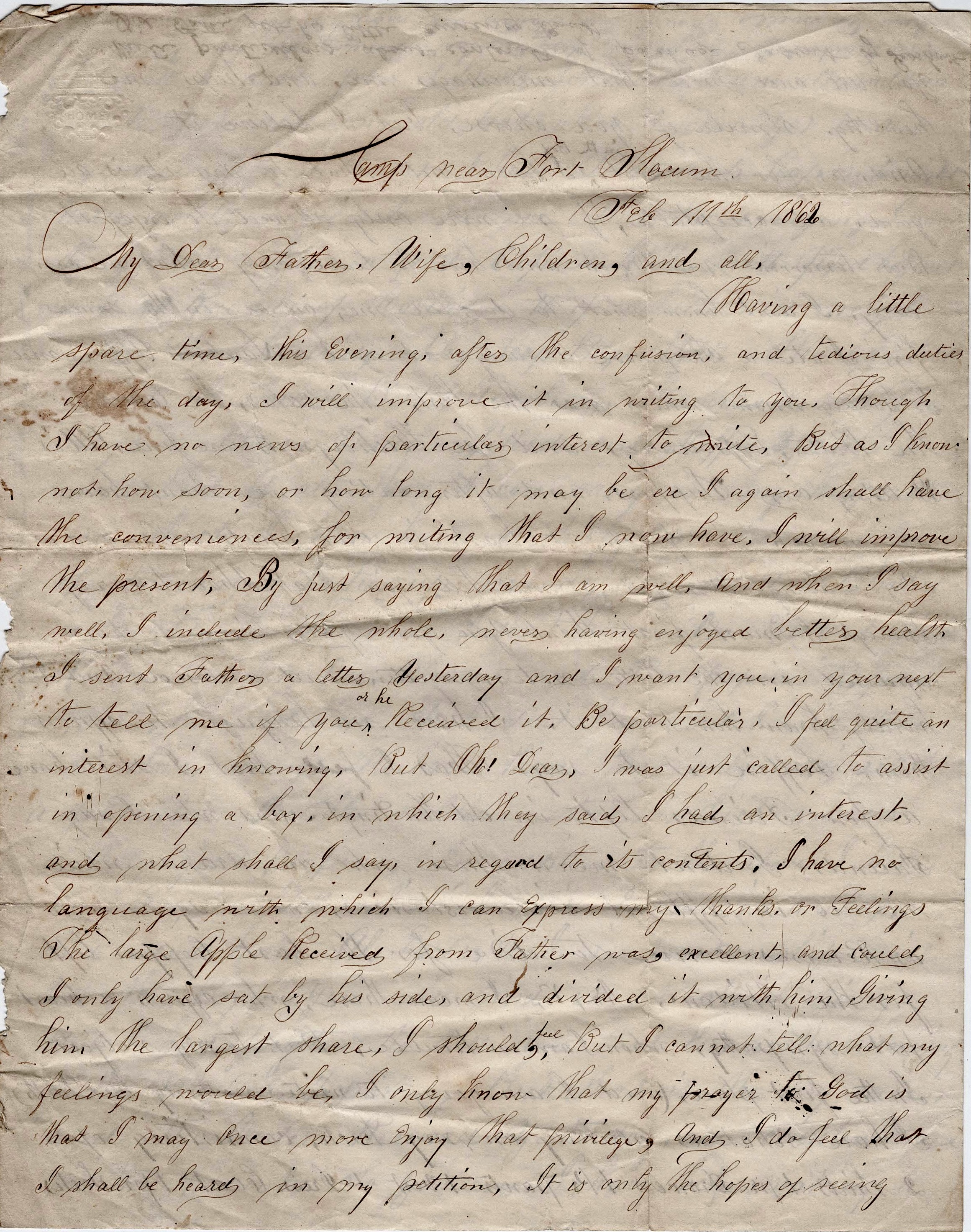


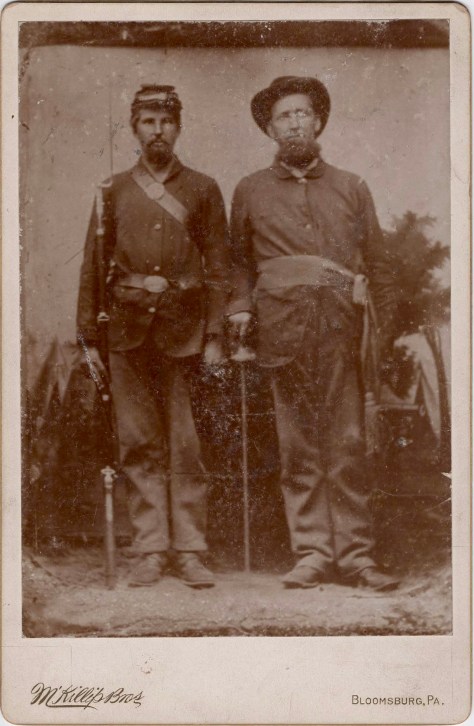

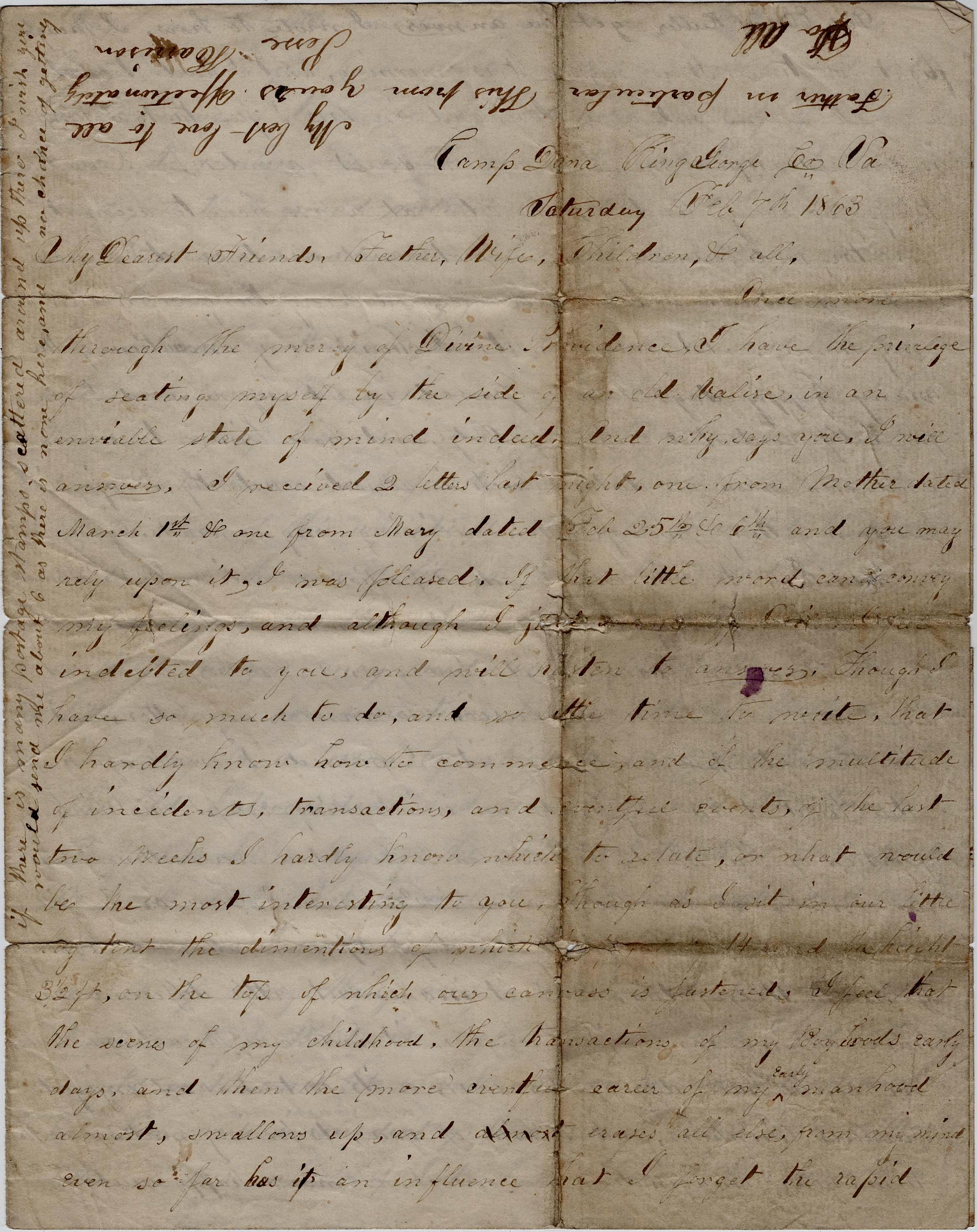




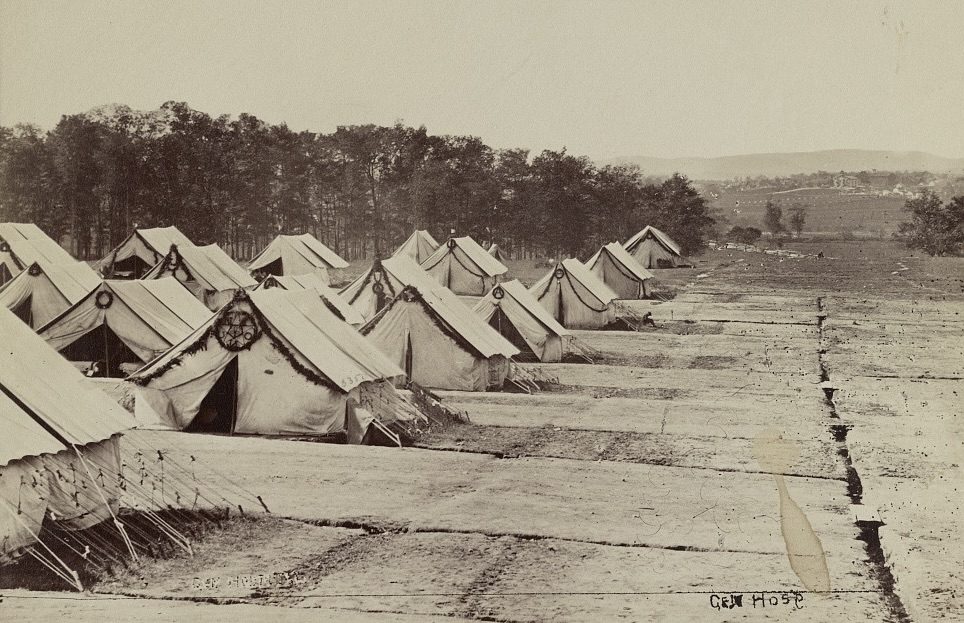
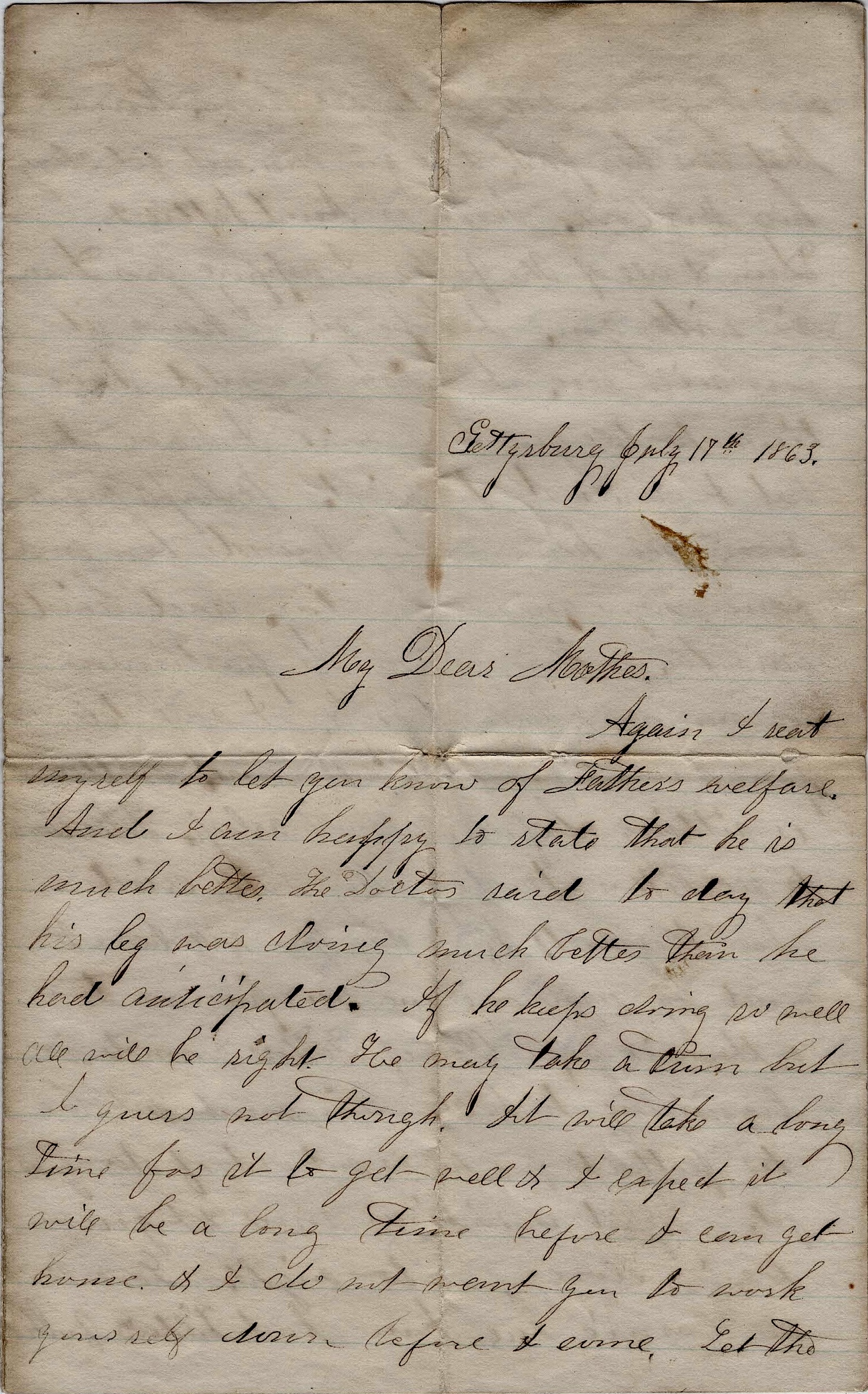
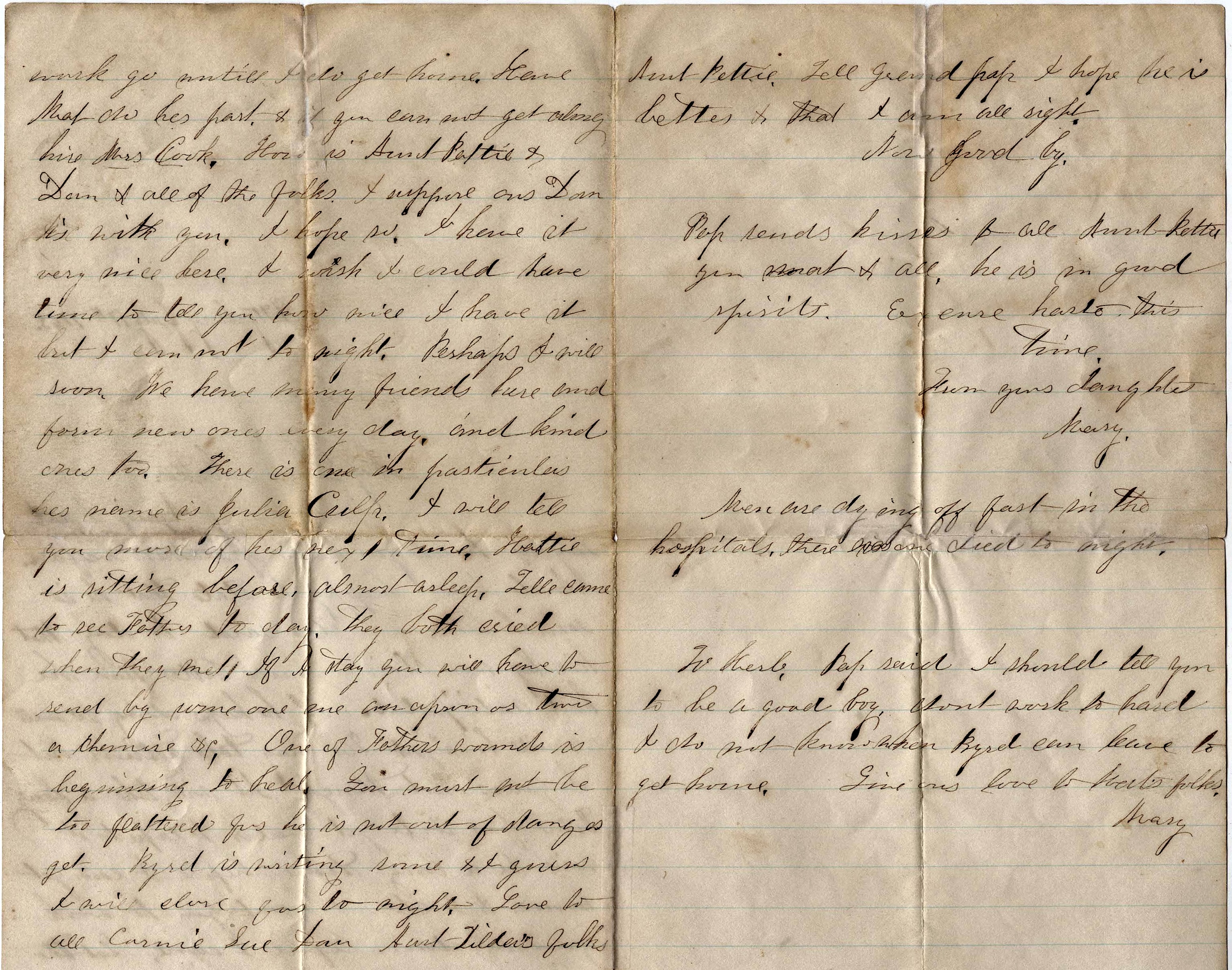


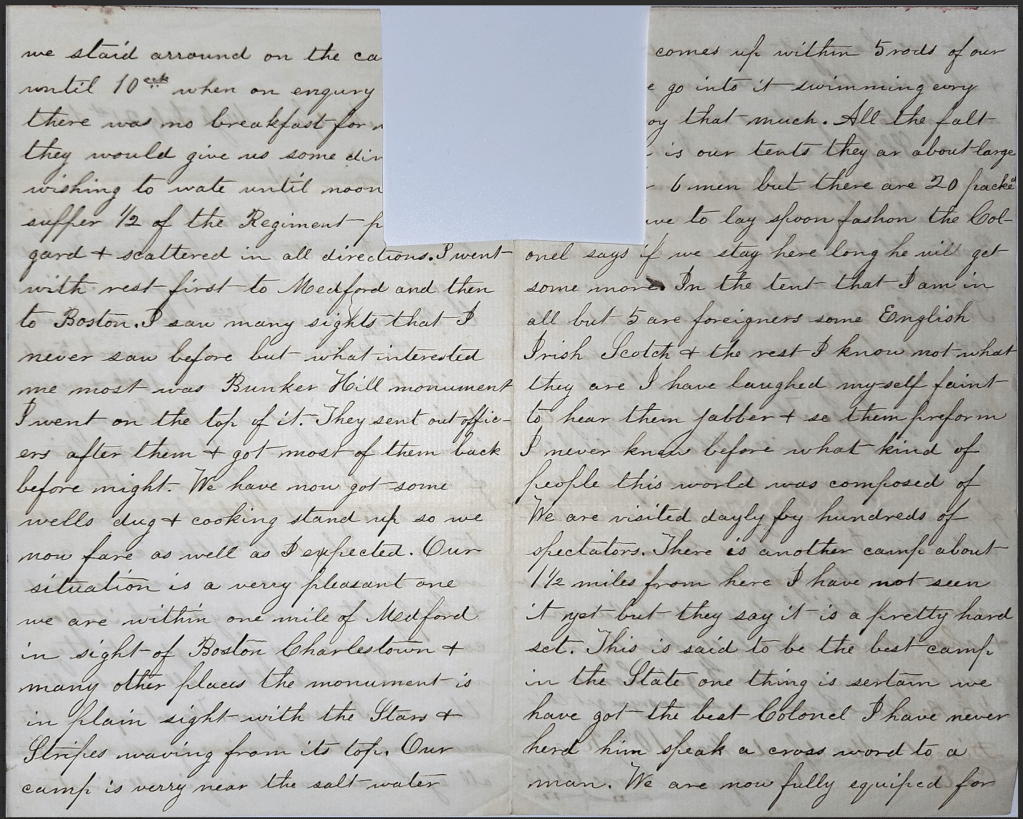





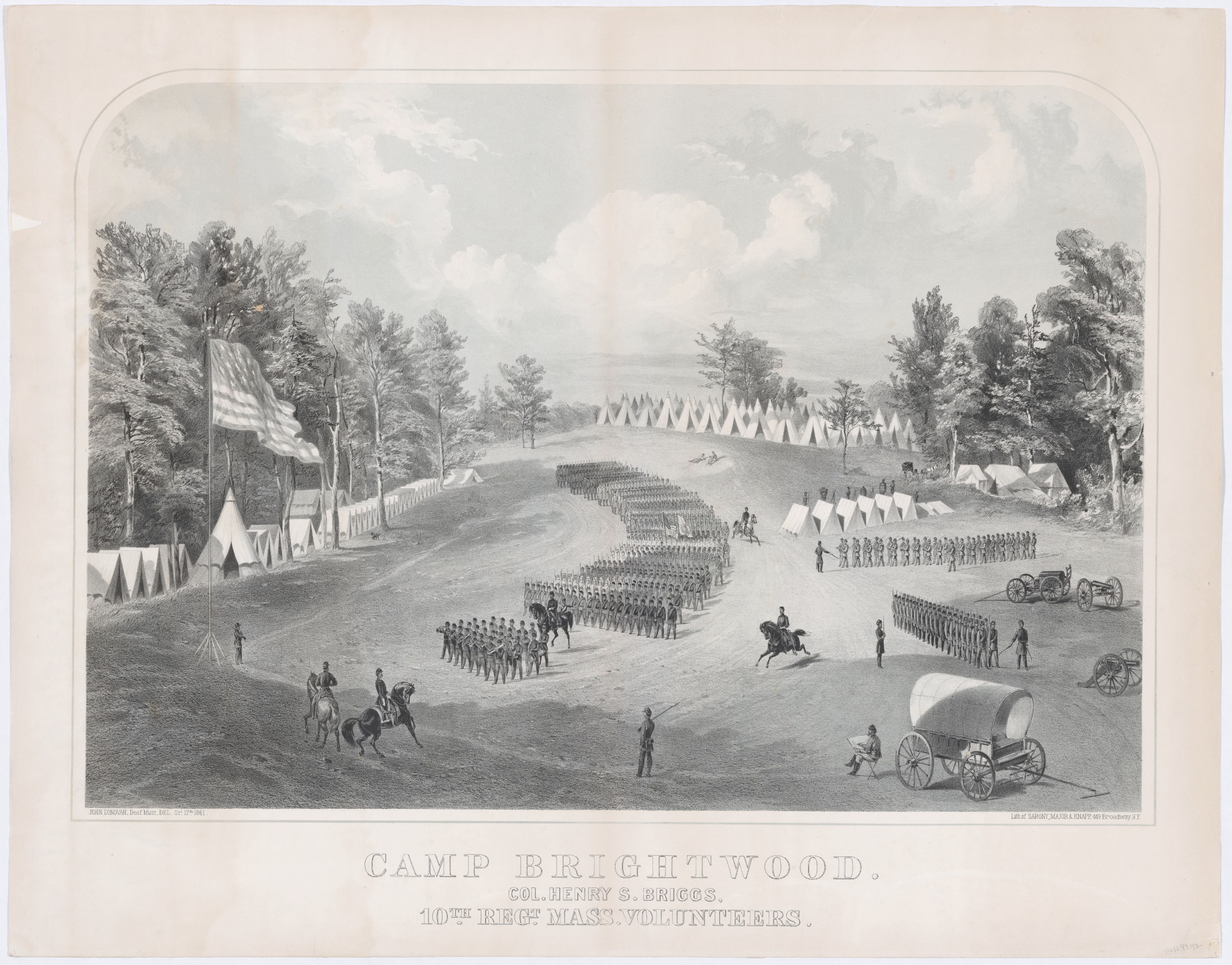

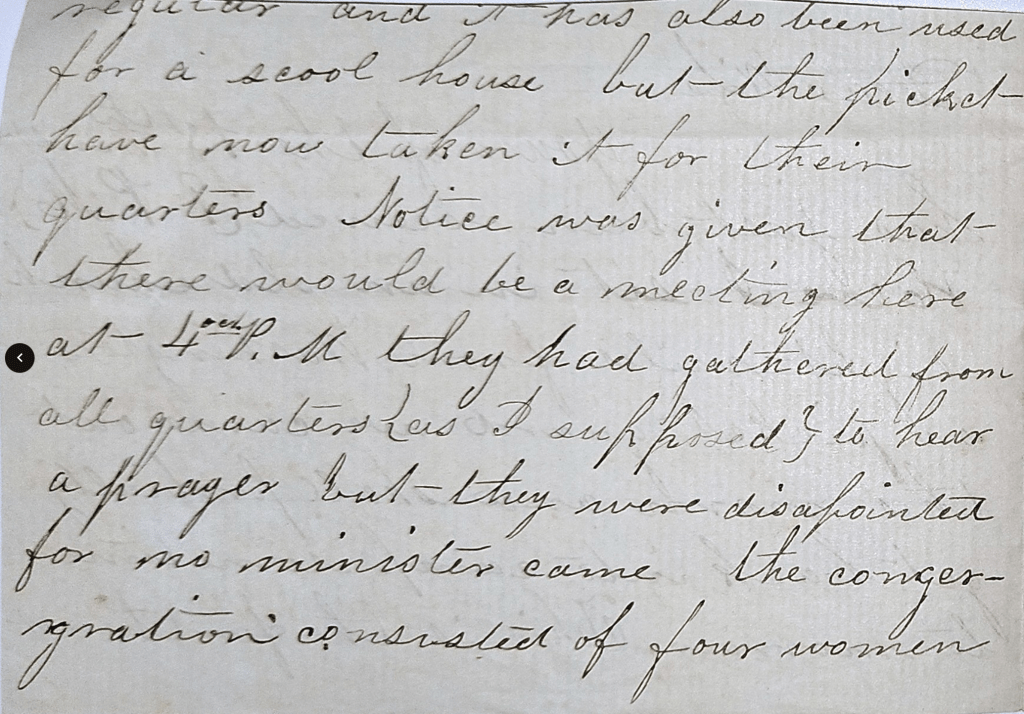


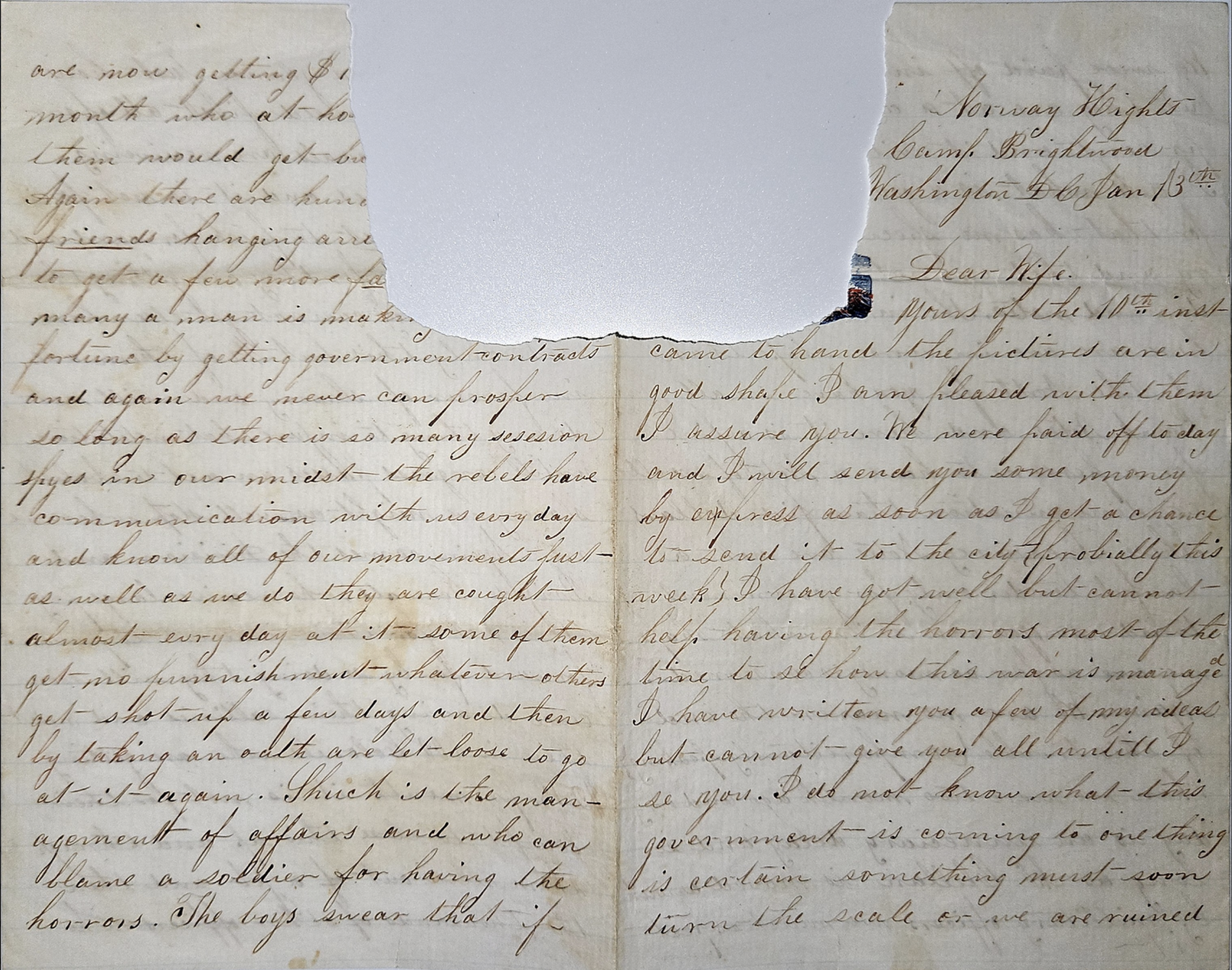
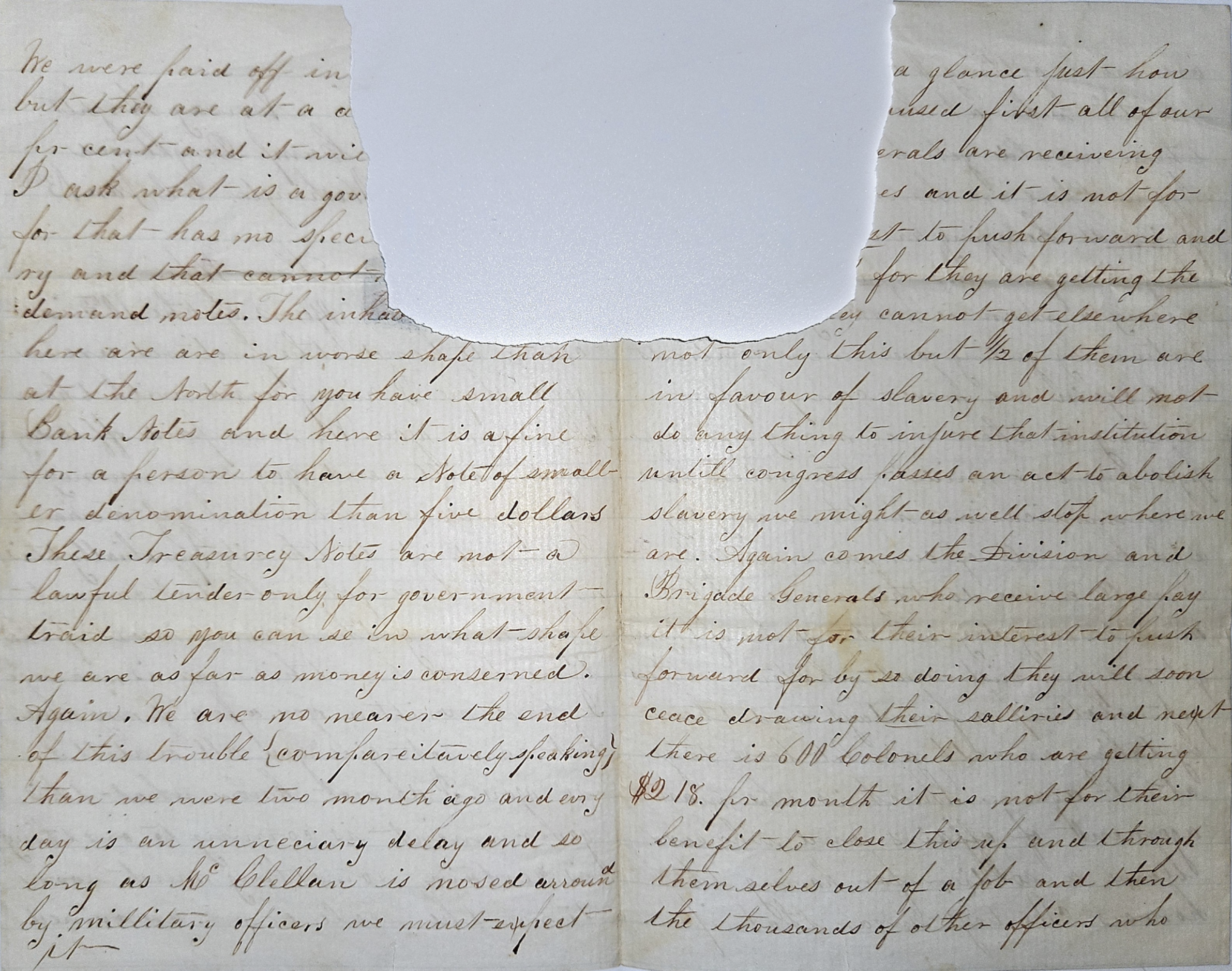

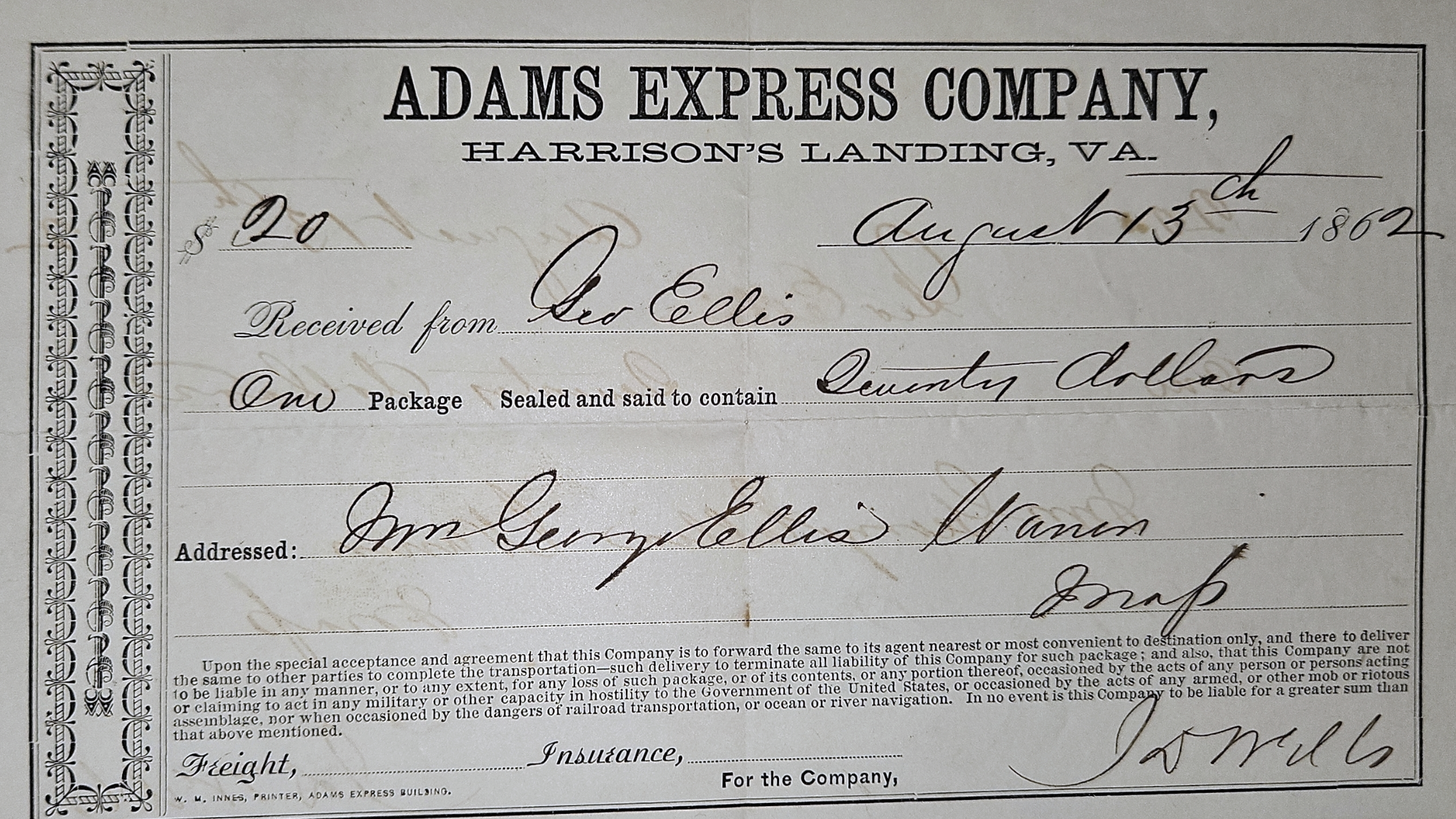


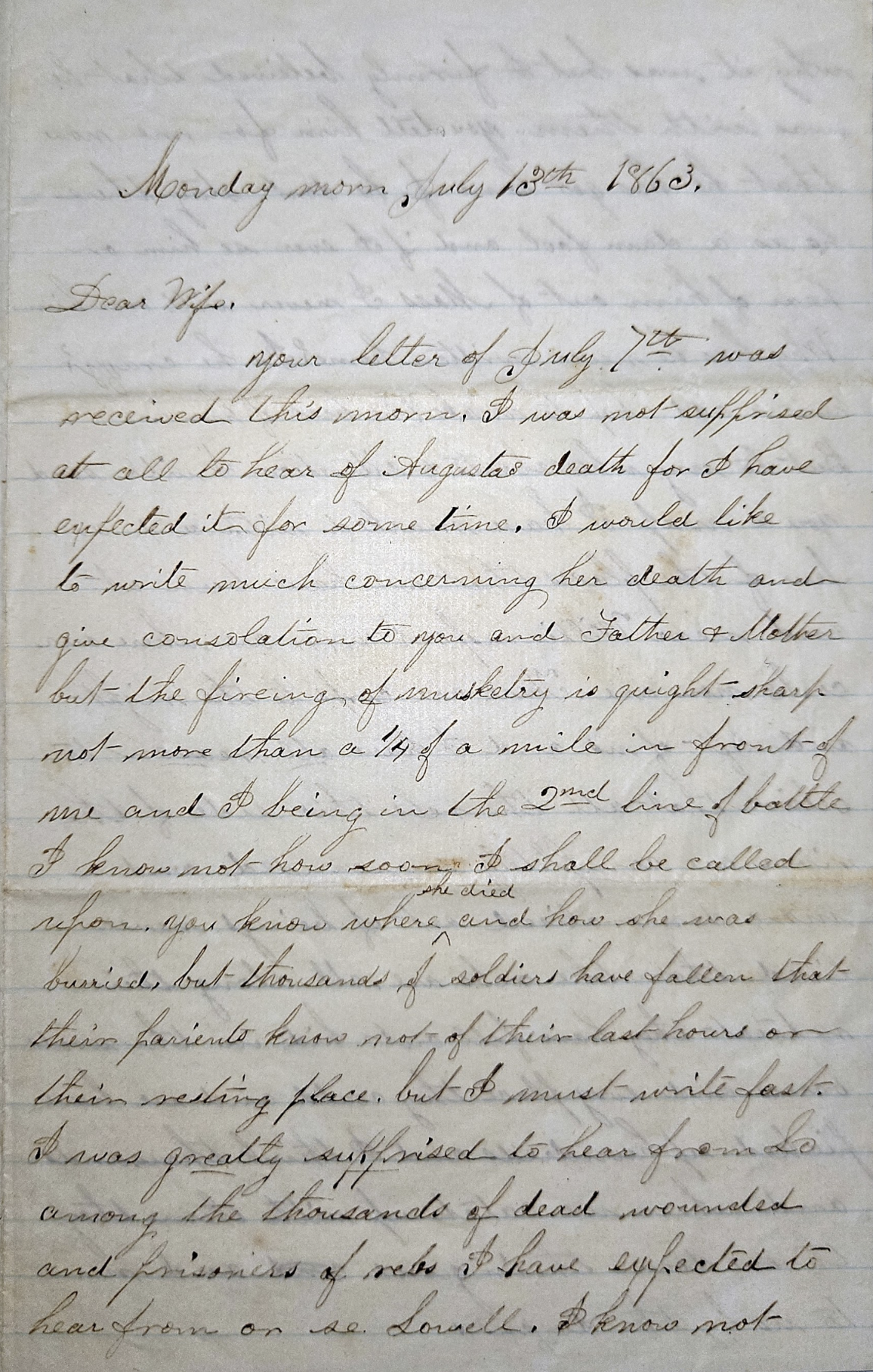

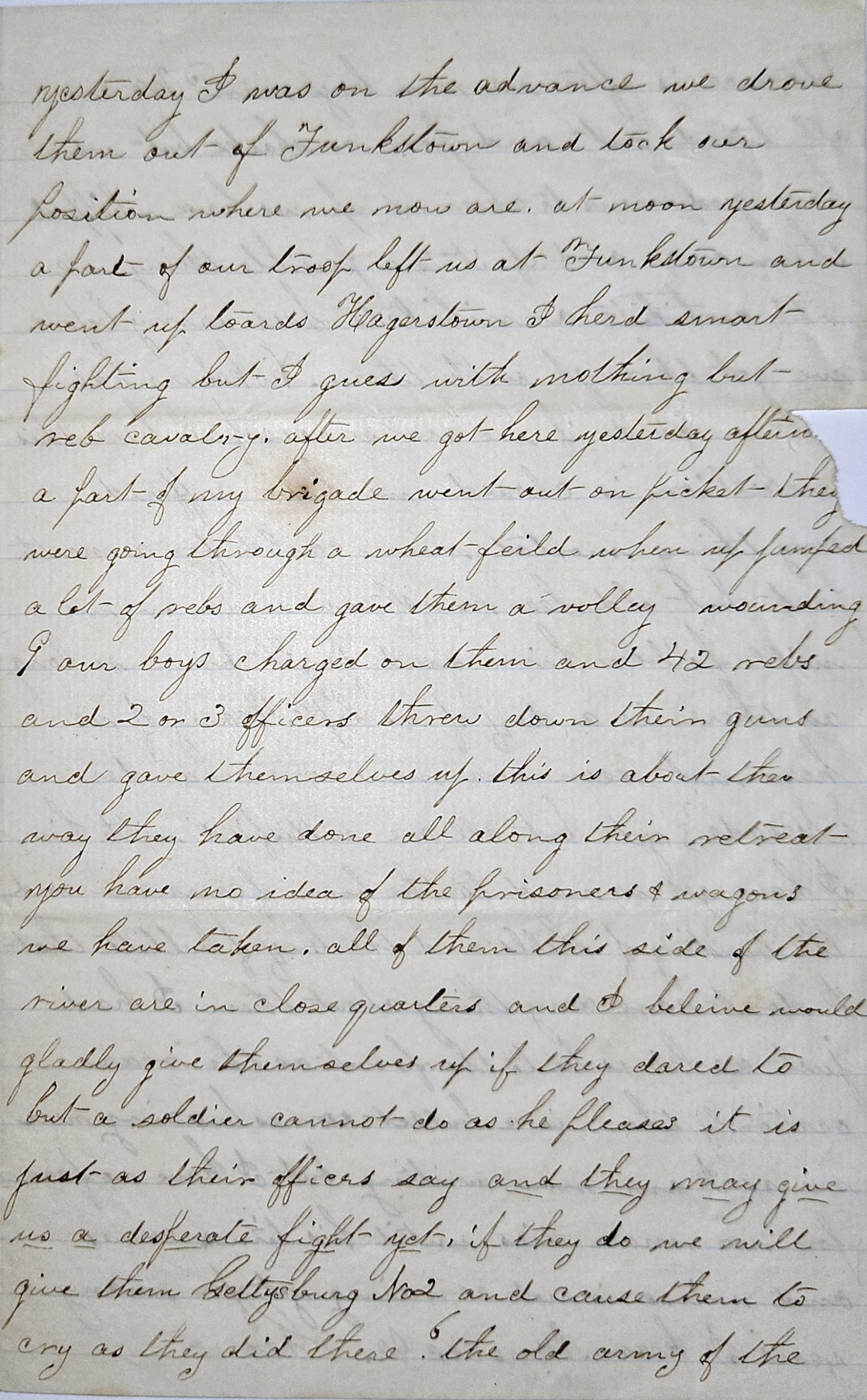
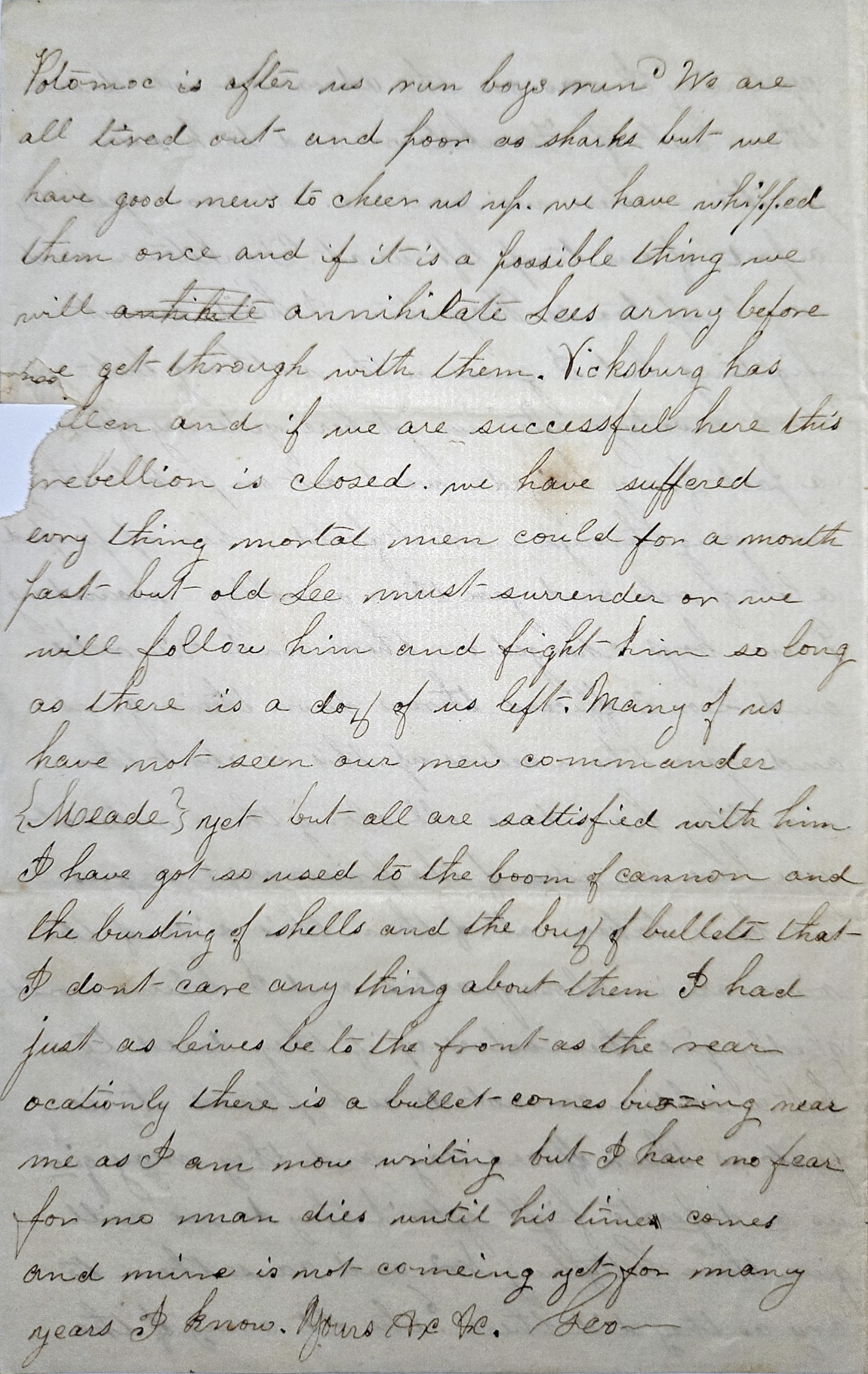


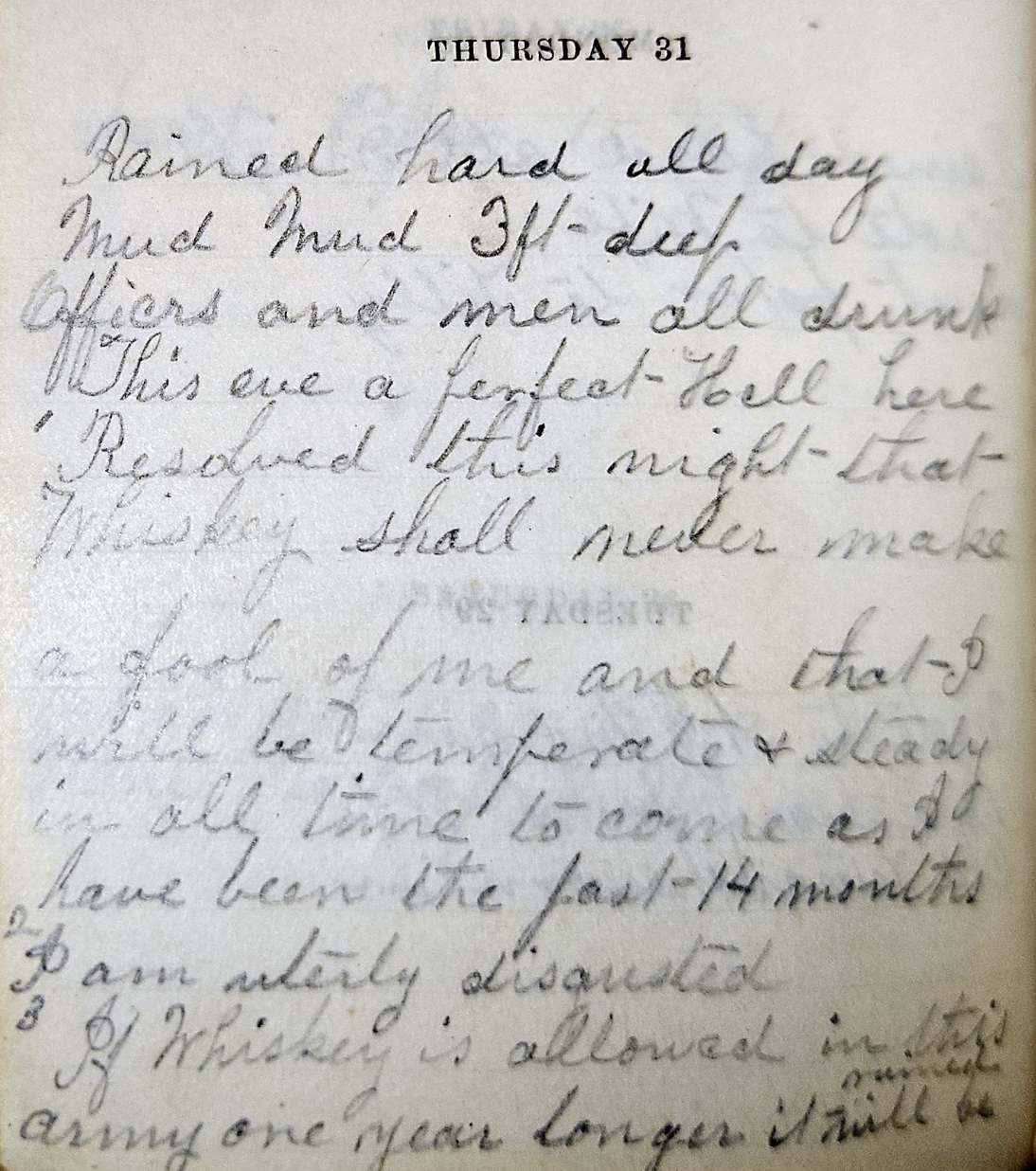
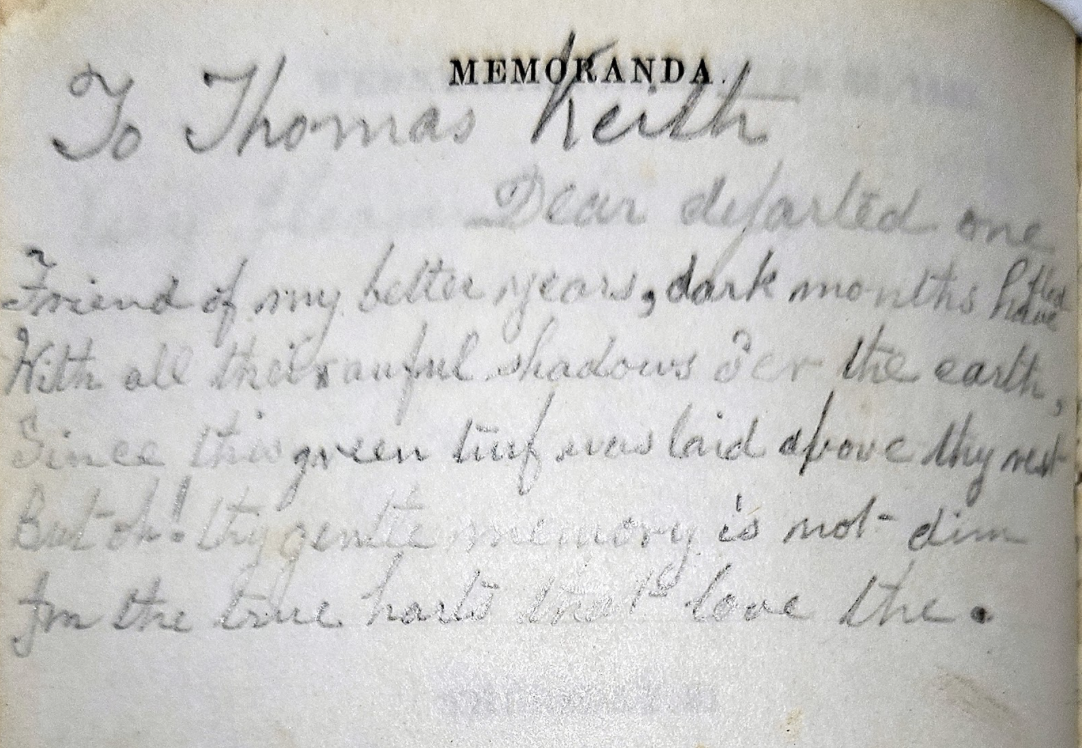


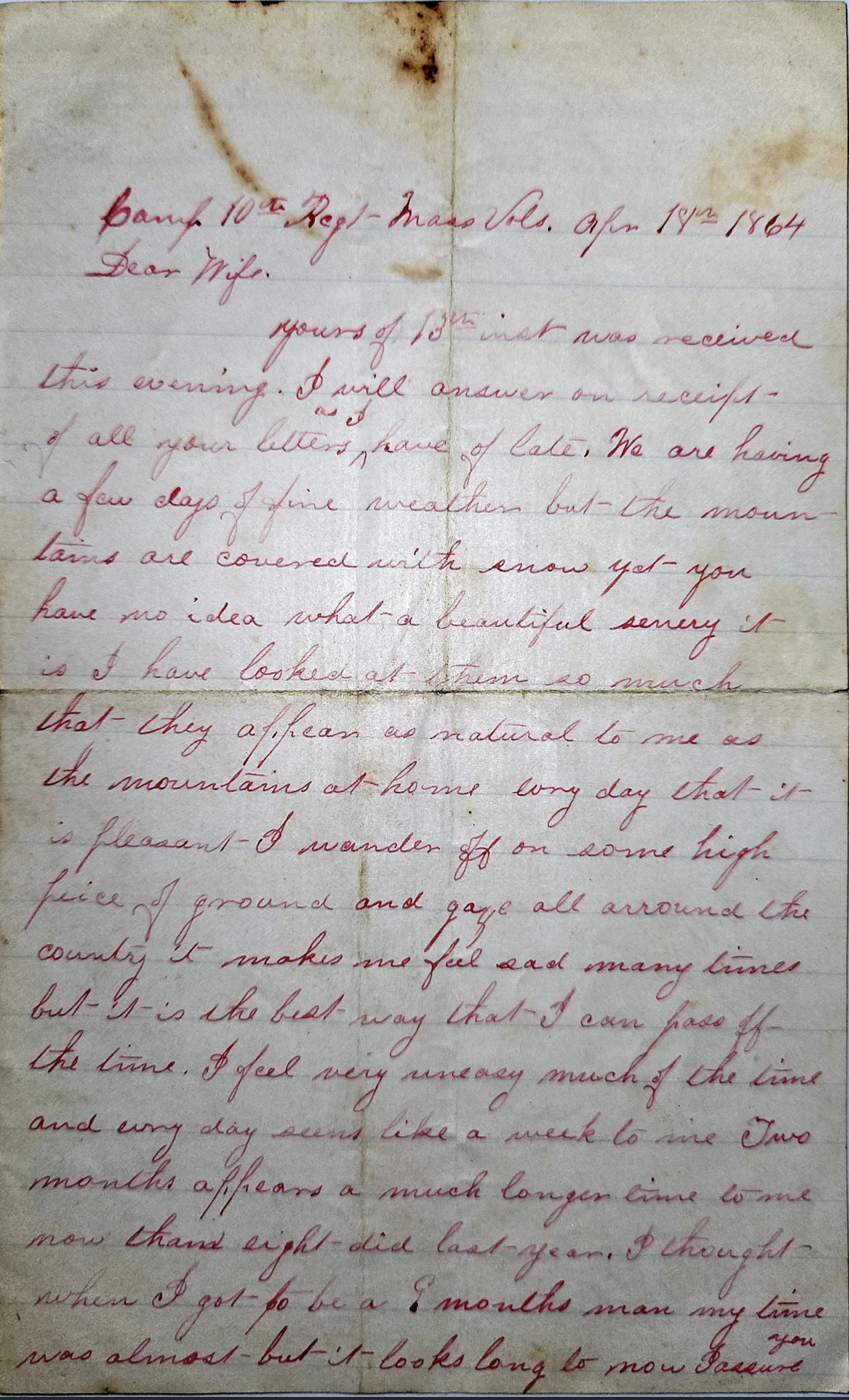


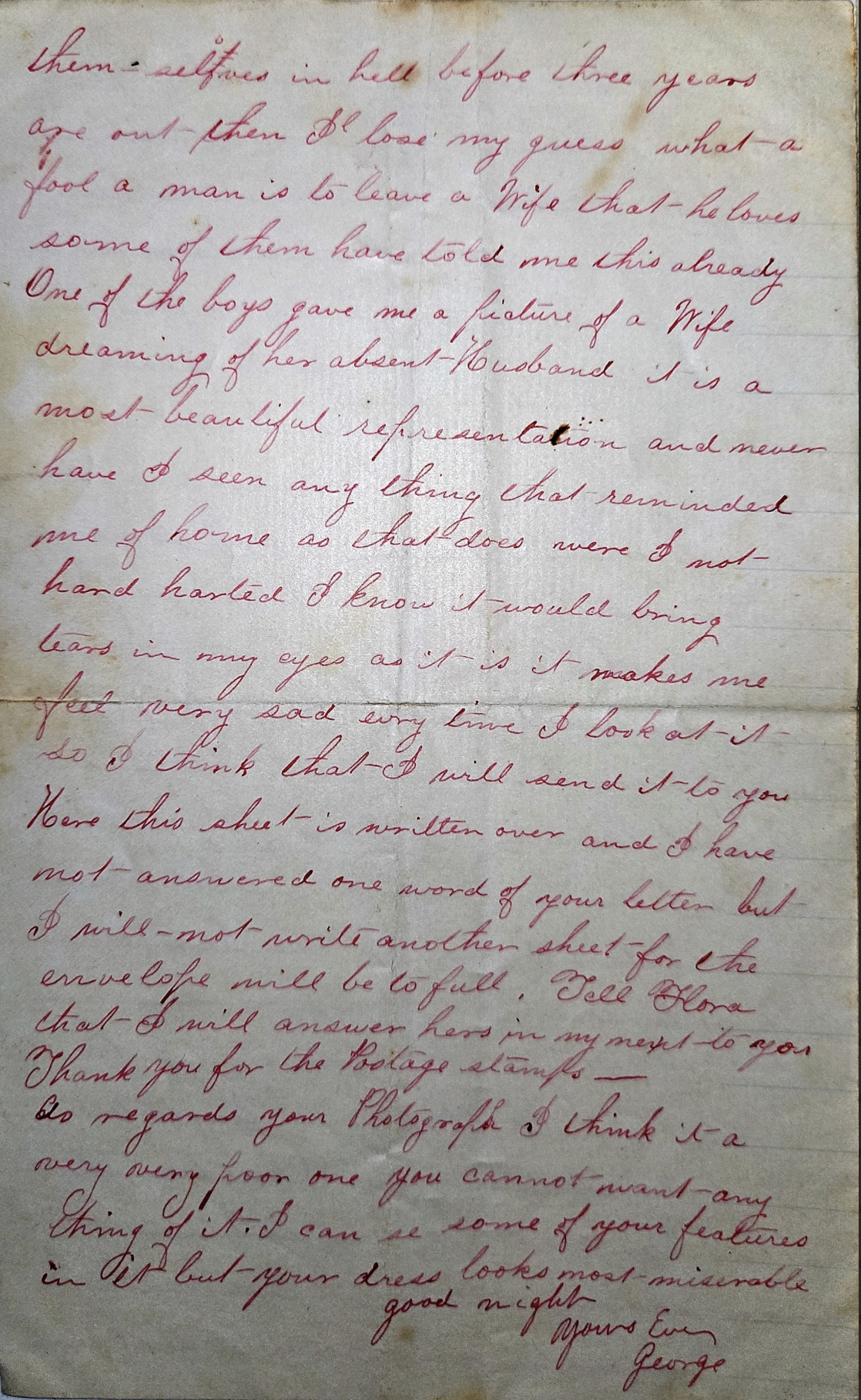


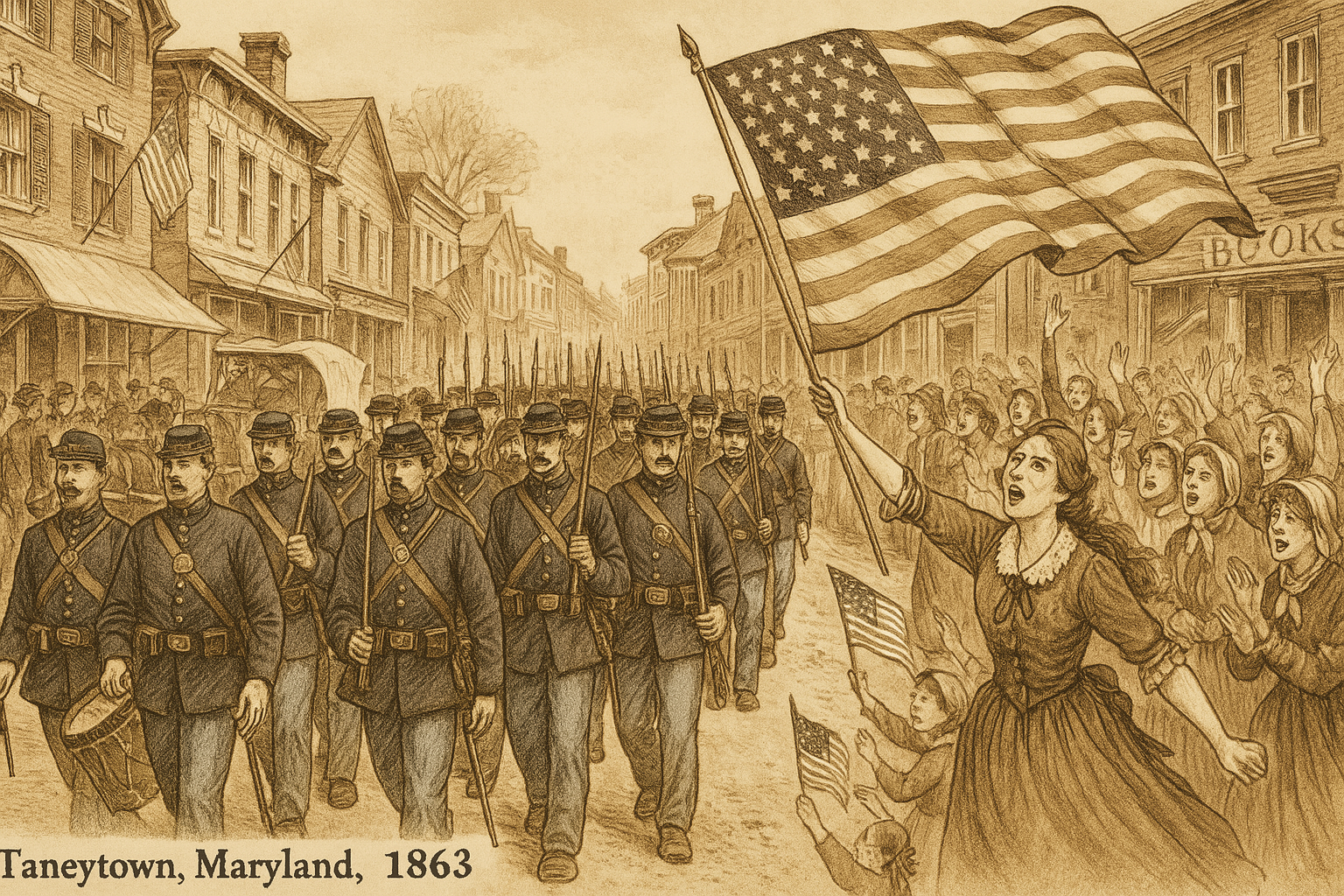

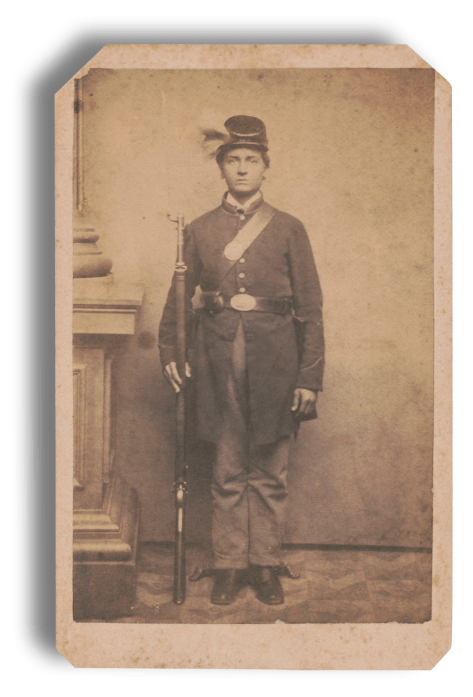





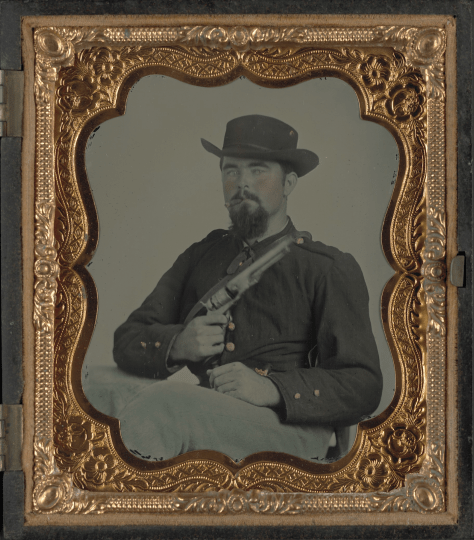
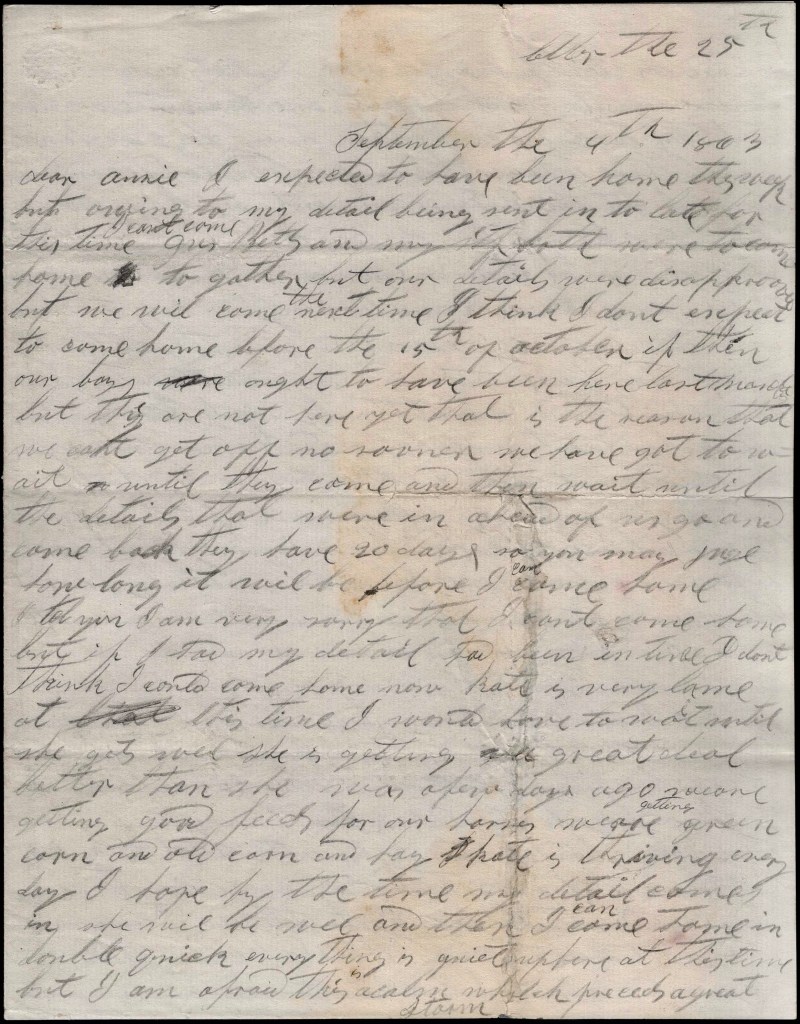


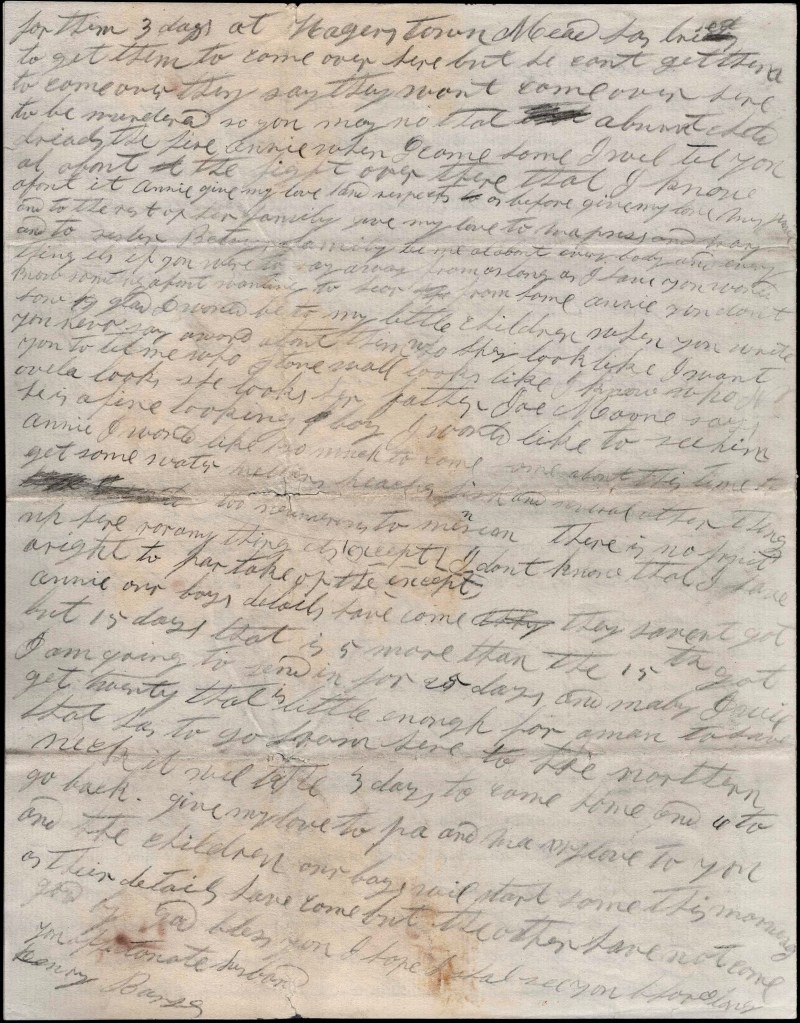
 Spared & Shared 23