Category Archives: Denver, Colorado Territory

1873: Phineas Talcott to Frederick Talcott

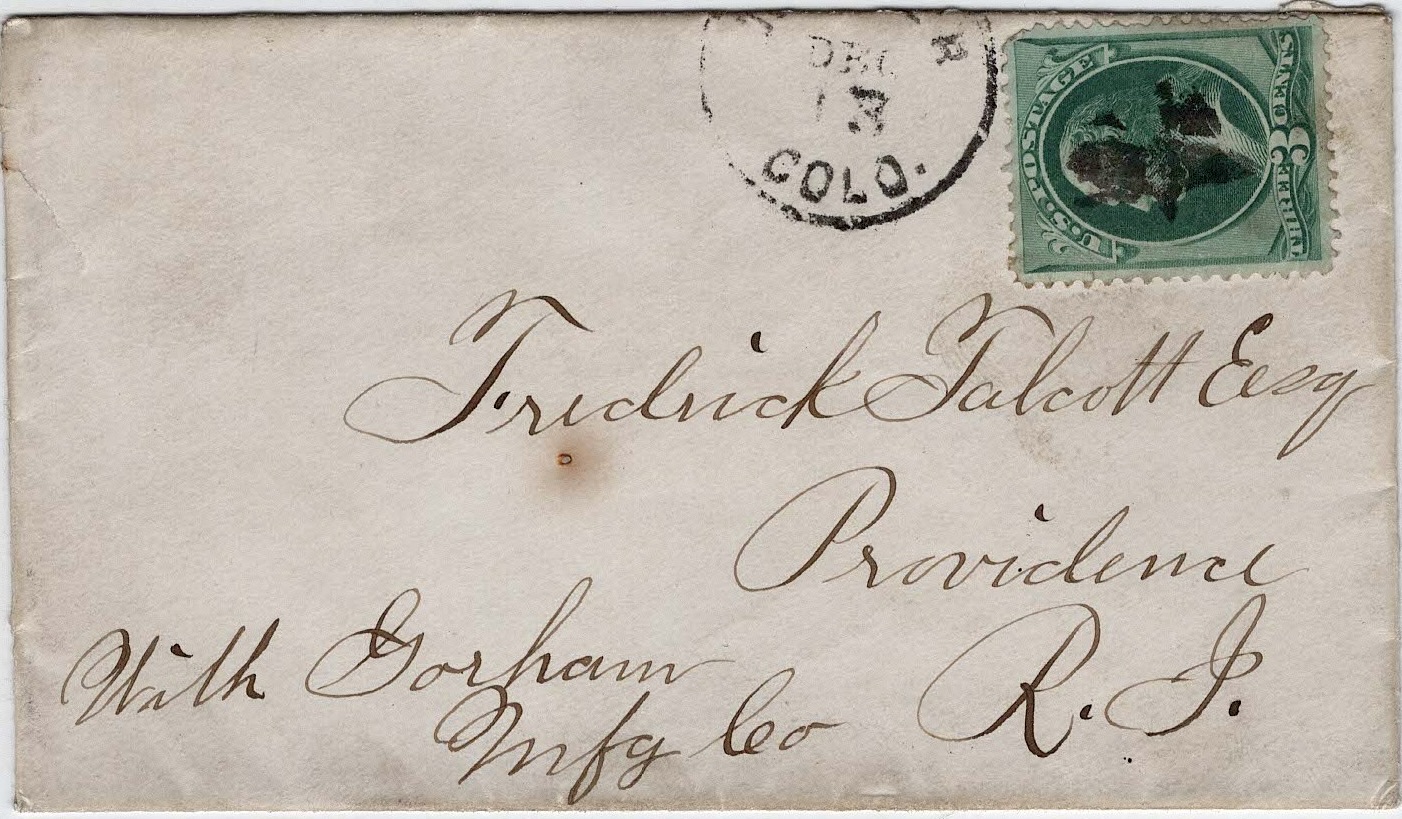
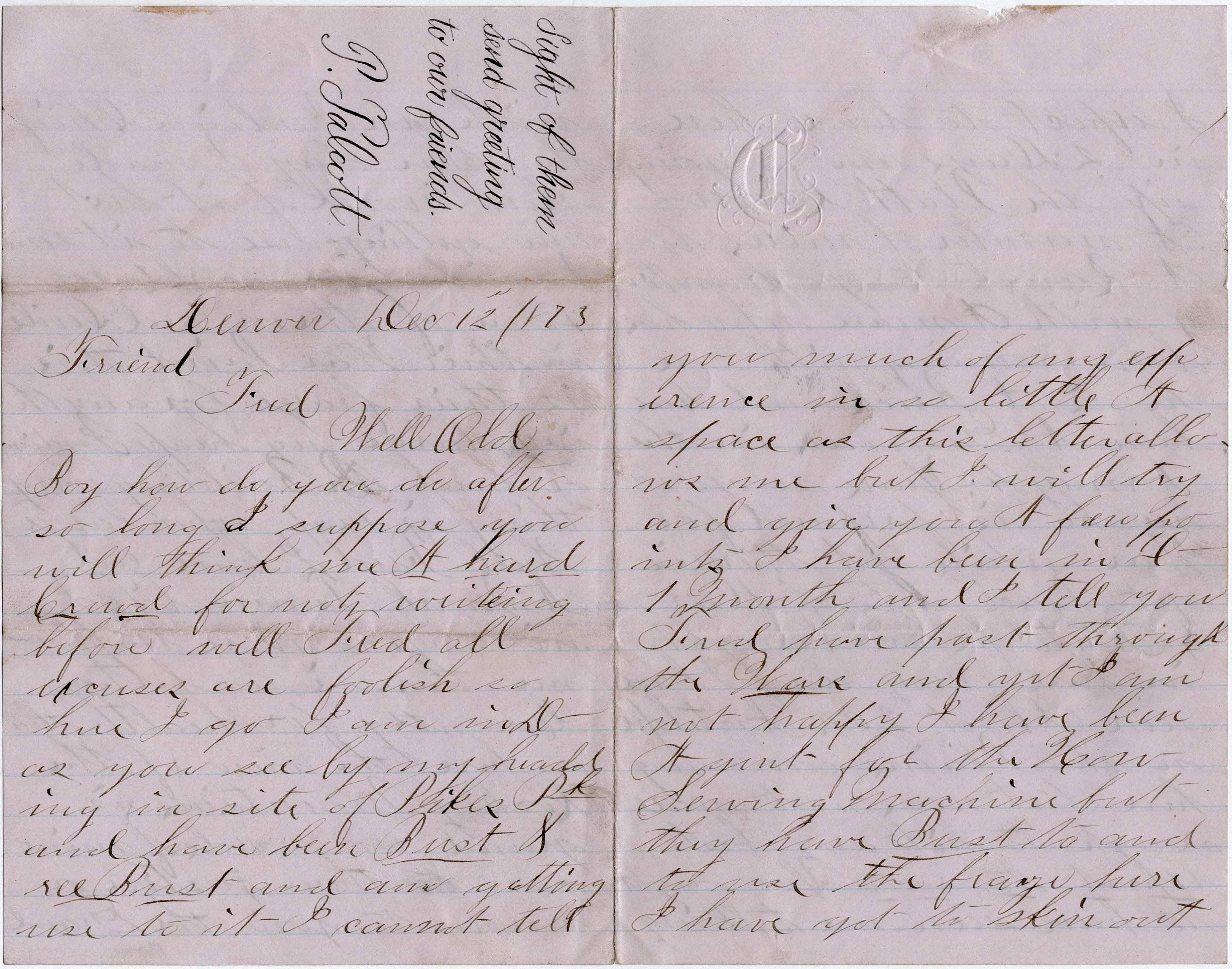
The following letter was written by Phineas Talcott (1845-1940), the son of Allyn Talcott (1800-1863) and Martha Goodrich Robbins (1808-1896) of Vernon, Tolland county, Connecticut. He addressed his letter to “Friend Fred” whom I feel certain was actually his younger brother Frederick Talcott (1850-1919), despite his use of the word “friend.” From the envelope we learn that Fred was working as a clerk for the Gorham Manufacturing Company in Providence, Rhode Island at the time. It was the largest American manufacturer of sterling and silverplate.

Phineas was 28 years old when he wrote this letter, describing his existence as “a Mark Twain Life.” He was likely alluding to the recently published work by Samuel Clemens titled “Roughing It,” which detailed the realities of western mining camps with a comedic lens. Phineas’ challenges as a sales agent for the Howe Sewing Machine Company are treated with a degree of levity, a style characteristic of Mark Twain.

The letter is dated December 12, 1873—just weeks following the Panic of 1873, which instigated a national economic crisis particularly detrimental to frontier enterprises. The loss of his own employment compels him to state, “I have got to skin out,” a phrase that reflects both the urgent necessity to depart swiftly and the prevailing culture of constant movement and activity that characterized many young men on the frontier after the Civil War, who generally bore minimal responsibilities.

Census records inform us that after his western adventures, Phineas returned to Vernon, Connecticut, where he started a dry goods store.
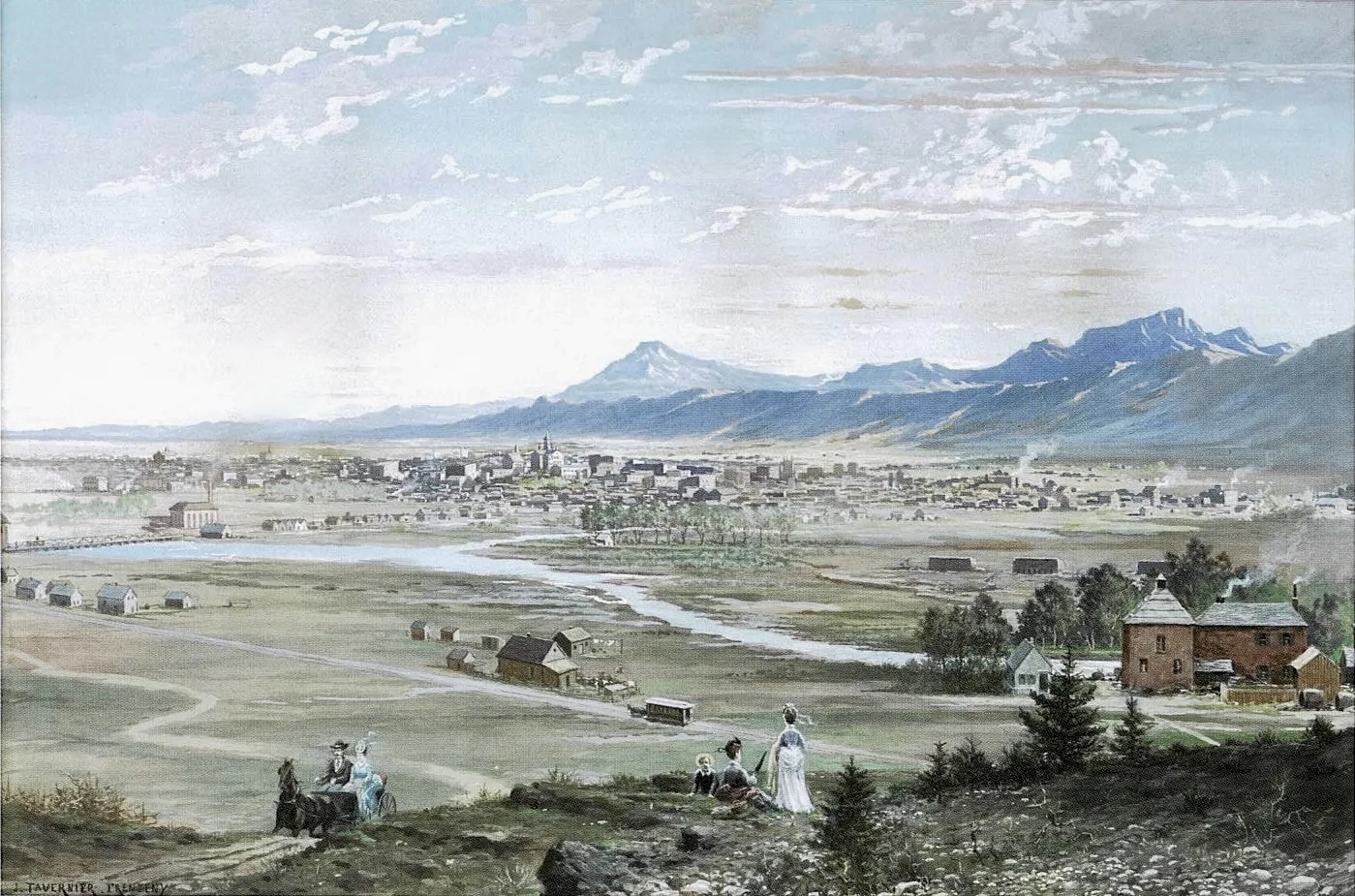
Denver, Colorado Territory, in the early 1870s.

T R A N S C R I P T I O N

Addressed to Frederick Talcott, Esq., Providence, Rhode Island

Denver [Colorado Territory]
December 12, 1873

Friend Fred,

Well Old Boy, how do you do after so long? I suppose you will think me a hard crowd for not writing before. Well, Fred, all excuses are foolish so here I go. I am well. As you see by my heading, in site of Pike’s Peak, and have been Bust and Rebust and am getting use to it. 

I cannot tell you much of my experience in so little a space as this letter allows me, but I will try and give you a few points. I have been in Denver one month and I tell you, Fred, have passed through the Wars and yet I am not happy. I have been Agent for the Howe Sewing Machine but they have Bust too and, to use the phrase [in common use] here, I have got to skin out.

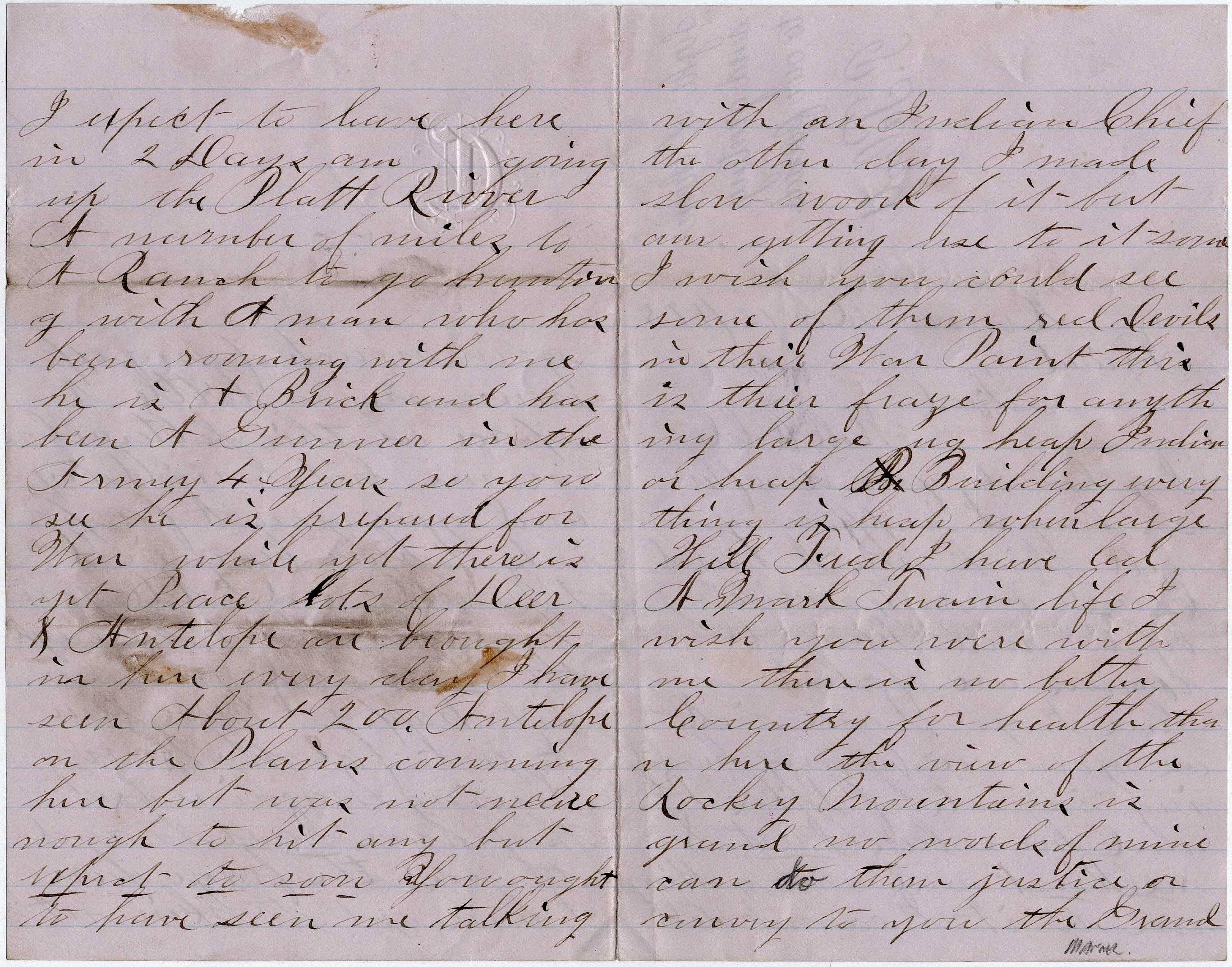
I expect to leave here in two days. Am going up the Platt River a number of miles to a ranch to go hunting with a man who has been rooming with me. He is a Brick and has been a gunner in the army four years so you see he is prepared for war while there is yet peace. Lots of deer & antelope are brought in here every day. I have seen about 200 antelope on the plains coming here but was not near enough to hit any—but expect to soon.

You ought to have seen me talking with an Indian Chief the other day. I made slow work of it. But [I] am getting use to it some. I wish you could see some of them red devils in their war paint. This is their phrase for anything large: “Ug, heap Indian,” or “Heap building.” Everything is “heap” when large.

Well Fred, I have led a Mark Twain life. I wish you were with me. There is no better country for health than here. The view of the Rocky Mountains is grand. No words of mine can do them justice or convey to you the Grand sight of them. Send greeting to our friends. — P. Talcott
1861: DeForest Hedges to Friend Samuel

This letter was penned by DeForest Hedges (1831-1921), the son of Christopher E. Hedges (1801-1883) and Mary Newell (1806-1881) of Waverly, Tioga county, New York. DeForest attended the Charlottesville Seminary in Schoharie county and then in 1859 he drove a freight wagon for Clark & McCormick from Omaha to Denver so that he could get the gold fields of Colorado. He did some placer mining in 1860 but then returned to freighting to make a living, driving the route from Denver to Virginia City, Montana. He eventually got into ranching in Montana.

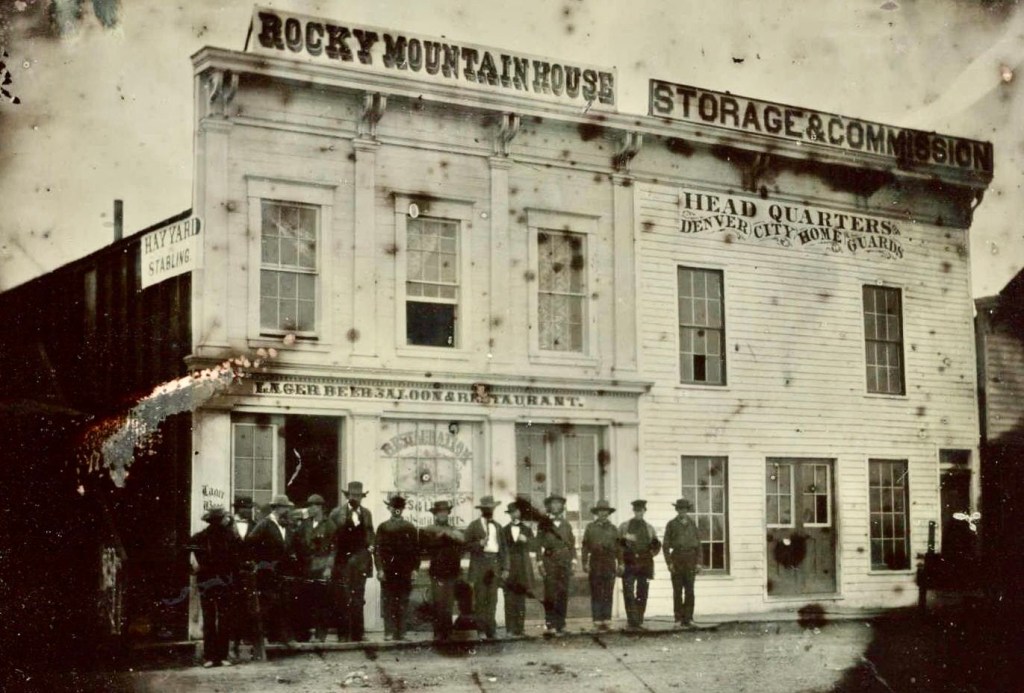
No better place to raise recruits than the local beer hall next door to the “Denver City Home Guards Headquarters” (Denver Public Library)

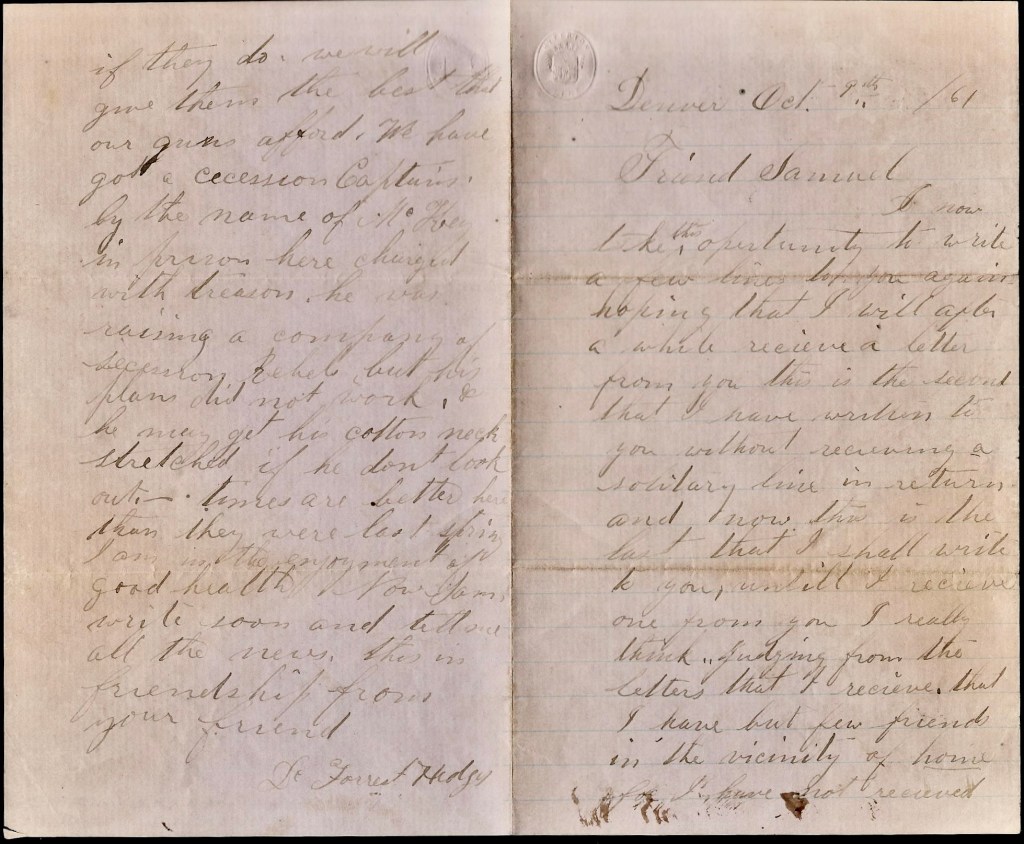
Transcription

Denver [Colorado Territory]
October 9th 1861

Friend Samuel,

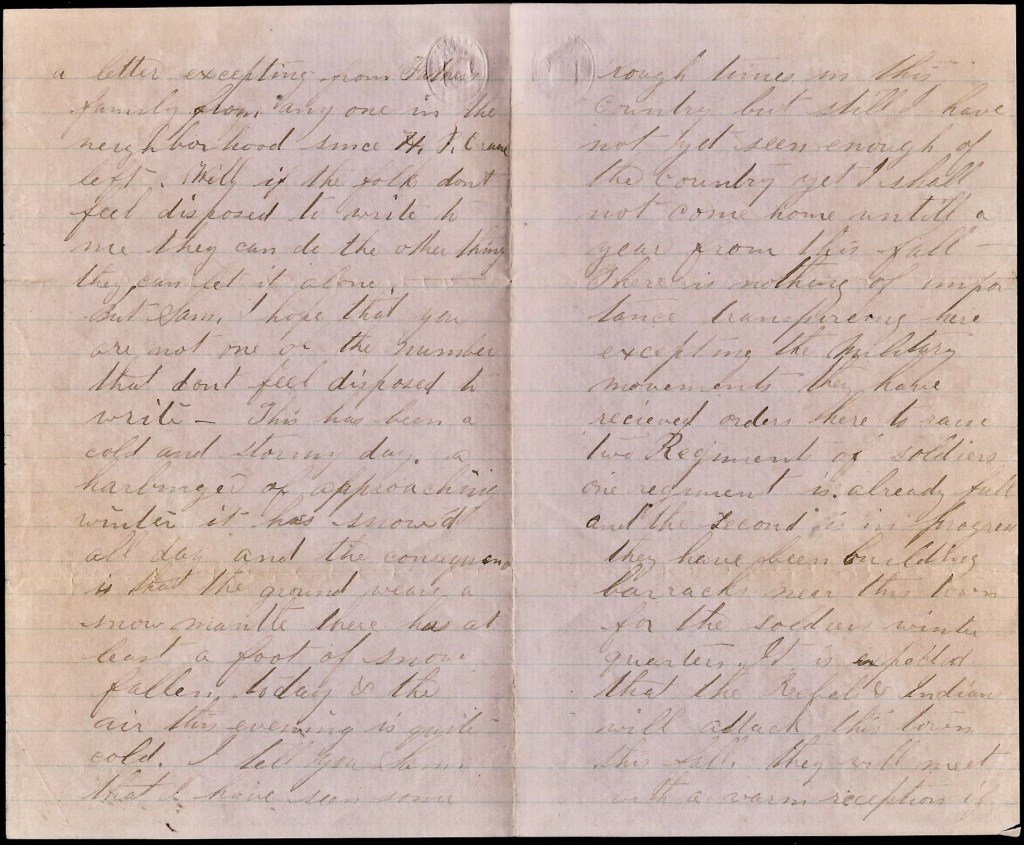
I now take the opportunity to write a few lines to you again hoping that I will after a while receive a letter from you. This is the second that I have written to you without receiving a solitary line in return and now this is the last that I shall write to you until I receive one from you. I really think judging from the letters that I receive that I have but few friends in the vicinity of home if I have not received a letter, excepting from Father’s family, from anyone in the neighborhood since H. P. Crane left. Well, if the folks don’t feel disposed to write to me, they can do the other thing—they can let it alone. But Sam, I hope that you are not one of the number that feel disposed to write.

This has been a cold and stormy day—a harbinger of approaching winter. It has snowed all day and the consequence is that the ground wears a snow mantle. There has at least a foot of snow fallen today & the air this evening is quite cold. I tell you, Sam, that I have seen some rough times in this country but still I have not yet seen enough of the country yet. I shall not come home until a year from this fall.

There is nothing of importance transpiring here excepting the military movements. They have received orders here to raise two regiments of soldiers. One regiment is already full and the second is in progress. They have been building barracks near the town for the soldiers’ winter quarters. It is expected that the Rebels & Indians will attack this town this fall. They will meet with a warm reception if they do. We will give them the best that our guns afford. We have got a secession Captain by the name of McKey 1 in prison here charged with treason. He was raising a company of secession Rebels but his plans did not work & he may get his cotton neck stretched if he don’t look out.

Times are better than they were last spring. Write soon and tell me all the news. This in friendship from your friend, — DeForest Hedges


1 It was Captain Joel McKee that was arrested by order of William Gilpin, Governor of Colorado Territory and placed in jail by Copeland Townsend, US Marshal. Gilpin’s executive order read: “Information having reached me that a Texan named McKee is raising troops within this Territory for an unlawful purpose, I deem it incompatible with the public safety for him to be suffered longer to be at large. You are, therefore, directed to arrest and detain him until further orders.” When McKee petitioned for a Writ of Habeas Corpus, it was denied with the argument by the court that it does not apply to persons who engage in open rebellion or invasion of public safety. According to one source, Joel McKee was born in 1824 in Indiana, father was born in Kentucky, and his mother was born in Pennsylvania. “He was in CO in 1861, described as a “frontiersman” or ” old Indian fighter,” probably mining gold, who was a leader of the pro-South forces around Denver according to the (Yankee dominated) newspapers. They had a secret camp at the ghost town of Russellville in 1861. He led a group of about 45 men toward TX in Oct. 1861. They were captured near Ft Wise, held in Denver, charged with treason. They busted out 28 Feb 1862 and made their way South.” (Civil War Message Board)