Category Archives: Fort Delaware

1864: Frank Prior to Samuel Prior, Jr.

The following letter was sold to a client of mine stating that it was penned by a Union soldier named “Frank Prior” to his father, “Capt. Samuel Prior, Jr.” but I am unable to see a signature and I cannot identify the Prior family correspondents. It’s possible this information was simply made up but on the outside chance it’s true, I pass on the “provenance.”

The letter describes an August 1864 incident pertaining to the Major Reybold, a steamer operating on the Delaware River, in which a number of Confederate prisoners were transported by her from Philadelphia to Fort Delaware. After dropping off the prisoners, it was discovered they were one short which triggered the whole fiasco.

The Major Rebold was built in 1853 in Wilmington, Delaware. She was the first iron vessel to see service on the Delaware, plying between Salem, New Jersey, and Philadelphia until 1906. During the Civil War she was retained on the river on account of Fort Delaware and was for a long time the only steamboat running below Wilmington, carrying thousands of troops and prisoners to the fort.
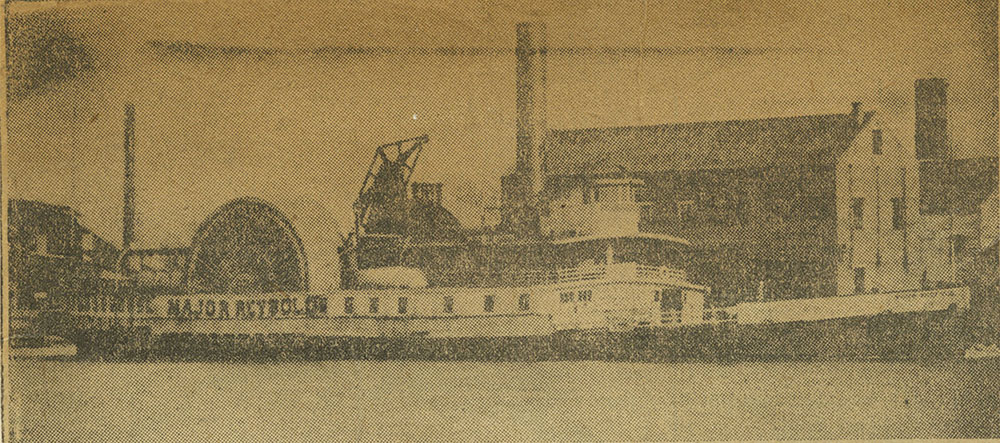
The Major Reybold, ca. 1908. She remained in regular service until 1906.

Transcription

Steamer Major Reybold
August 15, 1864

Dear Pa,

Your very welcome letter was received Friday evening. I was glad to hear you had found the boat so soon. By what Captain Loomis (who was on board of us Friday in Philadelphia) said, I was afraid you would have trouble finding her.

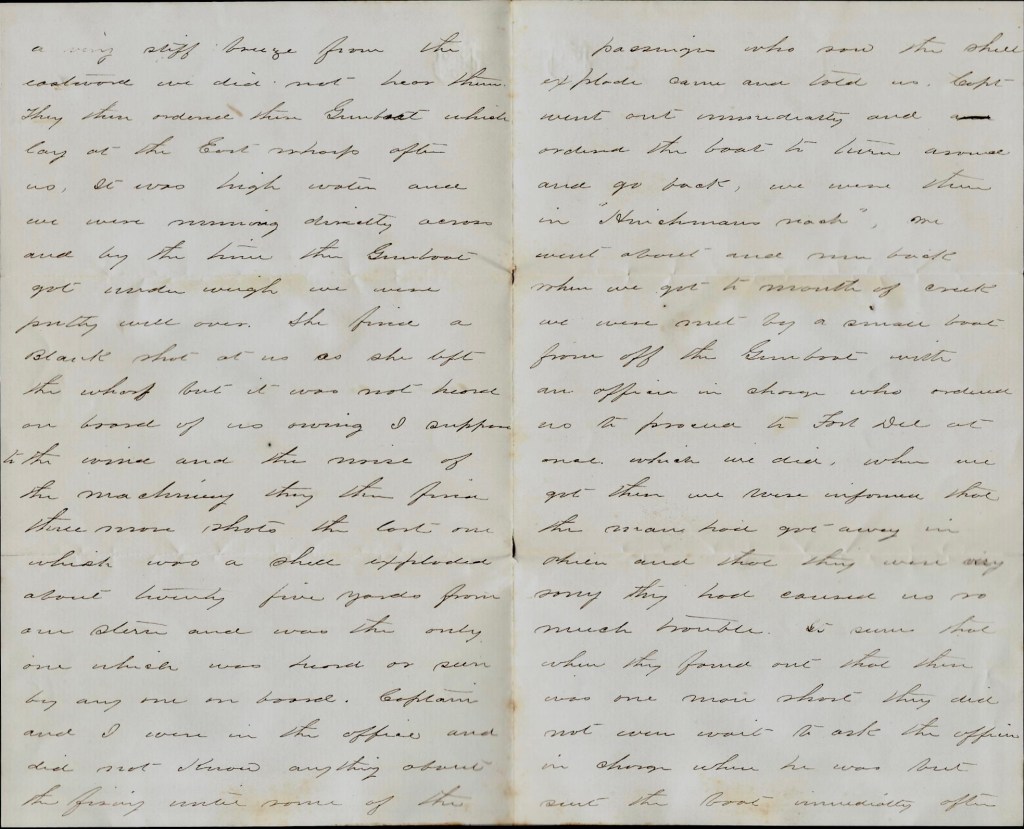
We were fired into by a gunboat from the Fort on Friday evening. The way of it was this. We landed some forty-five prisoners there that evening and after we had left, they found out that there was one short. They fired two musket shots to attract our attention but there being a very stiff breeze from the eastward, we did not hear them. They then ordered their gunboat which lay at the East wharf after us. It was high water and we were running directly across and by the time the gunboat got under weigh, we were pretty well over.

She fired a blank shot at us as she left the wharf but it was not heard on board by us owing, I suppose, to the wind and the noise of the machinery. They then fired three more shots—the last one, which was a shell, exploded about twenty-five yards from our stern and was the only one which was heard or seen by anyone on board.

The Daily State Gazette, 22 August 1864

Captain and I were in the office and did not know anything about the firing until some of the passengers who saw the shell explode came and told us. Captain came out immediately and ordered the boat to turn around and go back. We were then in “Hinchman’s reach,” We went about and run back. When we got to mouth of creek, we were met by a small boat from off the gunboat with an officer in charge who ordered us to proceed to Ft. Delaware at once, which we did. When we got there, we were informed that the man had got away in Philadelphia and that they were very sorry they had caused us so much trouble. It seems that when they found out that there was one man short, they did not even wait to ask the officer in charge where he was but sent the boat immediately after us. After she left, they found out where the man escaped and tried to recall her but could not for the same reason I suppose that prevented us from hearing.

The idea of the boat shooting at us with the intention of hitting us as the Lieutenant in charge of her says he did, is preposterous and should be reported from his actions. When he boarded us, I should say he was drunk and that may have been a reason for his firing at us. If the shell had struck us in the saloon, it would have caused a great loss of life in there at the time.

Thomas Bond has a claim against you of $32 for hay. Shall I settle it? We told John Mulford about it and John told me.

1865: Joseph Stras Peery to his Cousin

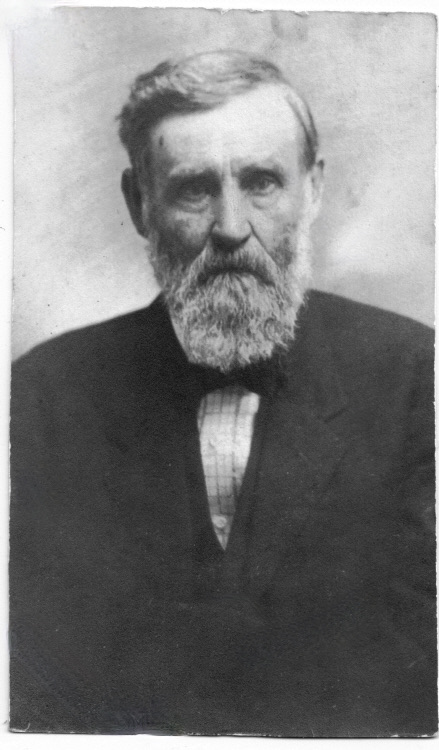
Joseph Stras Peery in old age

The following letters were written by Joseph Stras Peery (1839-1925), the son of Harvey George Peery (1801-1869) and Rebecca Williams (1805-1890) of Tazewell county, Virginia. After receiving an elementary education in Tazewell, he attended Emory and Henry College.

At the start of the Civil War, Joseph enlisted in August 1861 in Co. G, 45th Virginia Infantry at Gauley. He was promoted to sergeant by April 1862 and commissioned a lieutenant by July 1862. He was captured at the Battle of Winchester on 19 September 1864 and sent to Ft. Delaware shortly after. On the date of his release, 17 June 1865, he was described as standing 6 feet tall, with blue eyes and light hair.

In 1868 married Livonia Ravina Brown. His post war occupation was farmer and merchant. He died 7/7/1925 at Glade Spring, Washington County, Virginia at the age of 87.

These letters, like others Joseph wrote from prison, were strictly censored. They were not allowed to discuss what was going on inside the prison nor share their attitude about events occurring outside. Rules required that all letters be written on one side of the paper and they could only be sent to relatives in the North or to relatives in Union-occupied southern states unless under a flag-of-truce. If correspondents were not actually relatives, letters were often addressed as “dear cousin.”

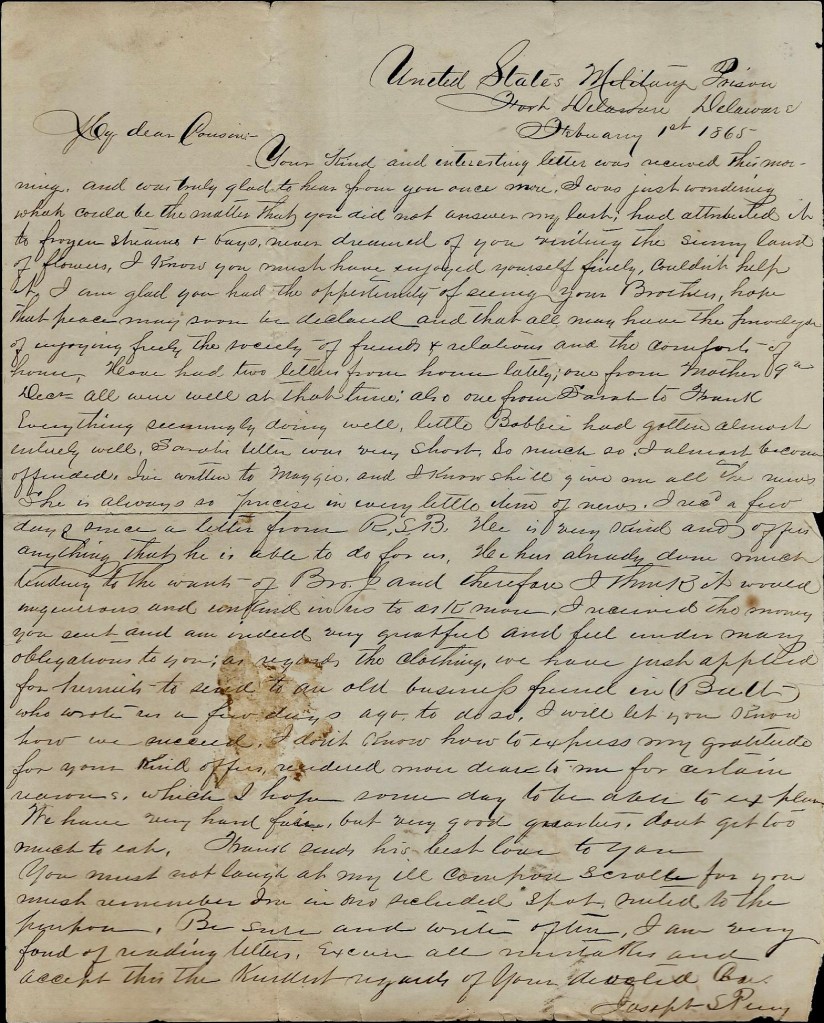
Letter 1

United States Military Prison
Fort Delaware, Delaware
February 1st 1865

My dear cousin,

Your kind and interesting letter was received this morning and was certainly glad to hear from you once more. I was just wondering what could be the matter that you did not answer my last. Had attributed it to frozen streams & bays. Never dreamed of you visiting the sunny land of flowers. I know you must have enjoyed yourself finely. couldn’t help it. I am glad you had the opportunity of seeing your Brothers. Hope that peace may soon be declared and that all may have the privilege of enjoying freely the society if friends and relations and the comforts of home.

Have had two letters from home lately—one from Mother, 9th December, All were well at that time. Also one from Sarah to Frank. Everything seemingly doing well. Little Bobbie had gotten almost entirely well. Sarah’s letter was very short. So much so I almost became offended. I’ve written to Maggie and I know she’ll give me all the news. She is always so precise in every little item of news.

I received a few days since a letter from R. S. B. He is very kind and offers anything that he is able to do for us. He has already done much tending to the wants of Brother J[ames] and therefore I think it would be ungenerous and unkind in us to ask more. I received the money you sent and am indeed very grateful and feel under many obligations to you. As regards the clothing, we have just applied for permits to send to an old business friend (in Baltimore) who wrote us a few days ago to do so. I will let you know how we success. I don’t know how to express my gratitude for your kind offers rendered more dear to me for certain reasons which I hope some day to be able to explain.

We have very hard fare but very good quarters. Don’t get too much to eat. Frank sends his best love to you. You must not laugh at my ill composed scroll for you must remember I’m in no secluded spot noted to the purpose. Be sure and write often. I am very fond of reading letters. Excuse all mistakes and accept this the kindest regards of your devoted cousin, — Joseph S. Peery


Letter 2

Fort Delaware, Delaware
March 29, 1865

Dear Cousin,

According to your request, I write again on the reception of your kind letter. It is pretty much as you said—nothing to do, but you know that no one is apt to be fond of writing unless they get answers equally in number to letters written. Now I think you must be a long time answering my letter—so long I’d given it up—that you did not intend doing so. Consequently I wrote you another and sent you a ring, the workmanship of a prisoner. A very poor thing it was. However, I thought you would value it as it was from your lovely cousin. Well, I was very agreeably surprised this morning with a letter from my dear sister. I’d written home and complained of sister Sarah not writing. She claimed that she was not indebted to me in that respect. One thing I know—that is, I’ve written to her often enough but it may be that she has never received any or but few.

Mr. Brittain had been at home, only for a short time, ten days. Would leave the day she wrote, the 6th of March. All were well. I intend writing soon. Will give them your message. As to me forgiving you for not sending such as you mentioned, I don’t think that there is anything to forgive for I am already indebted to you more perhaps that I’ll ever be able to return. We are all well and getting along as well as usual. Get “hard tack” twice a week for dinner, something new of late.

Frank sends much love to you. Noe I don’t want you to delay answering this letter. Never trouble yourself about those articles mentioned. I received a few lines from a friend at Johnson’s Island. James was well and I expect he was thinking like myself—that you was not very prompt in reply. I shall expect to hear from you soon.

Believe me as ever your devoted cousin, — Jo. S. Peery

1864: Daniel Green Martz to Lydia A. (Sellers) Martz

The following letter was written by Daniel Green Martz (1839-1891), the son of Hiram Martz (1800-1861) and Hannah Asbury Mathews (1803-1861) of Harrisonburg, Rockingham county, Virginia. Daniel was married in April 1860 to Lydia Ann Sellers (1838-1924) and had a young son at the time he enlisted on 3 June 1861 at Lacey Springs, Virginia, to serve as a Lieutenant in Co. H, 10th Virginia Cavalry. After he failed to be reelected, he was discharged from the regiment in May 1862.

Martz later reenlisted as a private in Co. G, 10th Virginia Infantry and was taken prisoner in December 1863 and initially sent to Camp Chase in Ohio; then transferred to Fort Delaware on 15 April 1864 where he wrote this letter three weeks later. He was exchanged on 11 October 1864 and returned to his regiment for the remainder of the war. He was paroled on 20 April 1865 at New Market, Virginia.

Confederate prisoners arriving at Fort Delaware

Transcription

Fort Delaware
May 5th [1864]

Mrs. Lydia A. Martz—dear Lydia,

I have just received your short note of 21st March and was much pleased to hear of your general good health but sorry to hear of you suffering with toothache. I am well—all except a slight sore on my neck coming from diphtheria, an enlargement of the gland. It is much better, nearly well. I have not let you know of my throat being sore on account of its making you uneasy. All danger is now past. Indeed, I hope this may find you entirely well. Also Sissie and all my relations and friends.

Louis Wood is well. Why don’t some of my relations write to me? I think they might. I am sorry to hear of Grandmother’s ill health. Hope she is well before this time. What has taken cousin Mikie to South Carolina? Get Uncle Dorilas 1 to see W. D. Liout and let me know whether I received the position I applied for, Wrote on larger paper and write me longer letters. I hope to see you soon. Be of good cheer. My love to all. Kiss and embrace Sissie for me, Many kisses for you. Affectionately your husband. — Daniel G. Marty

[to] Lydia A. Martz

Direct to Fort Delaware, Division 28.

1 Dorilas J. Martz (1802-1872) served in the 97th Virginia Regiment (Spitzler’s)

1864: John P. Seabrook to Susan Lucy Taylor

A post war image of John P. Seabrook

The following POW letter was written by Lt. John P. Seabrook (1835-1927) of Co. I (“Alabama Grey’s”), 38th Alabama Infantry. Seabrook’s regiment was organized at Mobile in May 1862 and took an active role in the campaigns of the Army of Tennessee from Chickamauga to Nashville. Seabrook was taken prisoner in the fighting at Missionary Ridge on 25 November 1863. He was first taken to Louisville, then Camp Chase in Ohio, and finally to Fort Delaware. According to muster rolls, Seabrook had most of his right arm amputated at the US Hospital in Nashville before being released into the prisoner system in mid-February 1864. Seabrook was finally paroled at Fort Delaware on 14 September 1864 and forwarded for exchange to Aiken’s Landing, Virginia. He returned to duty on 27 September 1864 and was with his regiment at Fort Blakely when it was surrendered on 9 April 1865. He was sent for a few weeks to Ship Island as a POW until exchanged on 6 May 1865.

Seabrook wrote the letter to Susan Lucy (Barry) Taylor (1807-1881), the wife of Col. James Jones Taylor (1802-1883) of Newport, Kentucky—located adjacent to Covington. The couple were wed in 1824 and had at least six children—three of who are mentioned in this letter; James Taylor (1833-1876), John Taylor (1836-1914), and Barry Taylor (1839-1887). Mrs. Taylor was the daughter of Hon. William T. Barry (1785-1835) who was a Kentucky Democratic politician who served as the first Cabinet level Postmaster General under President Andrew Jackson. Susan operated a benevolent society out of Newport, Kentucky, that supplied aid and comfort to Confederate prisoners of war confined in Yankee prisons.

Confederate prisoners arriving at Fort Delaware

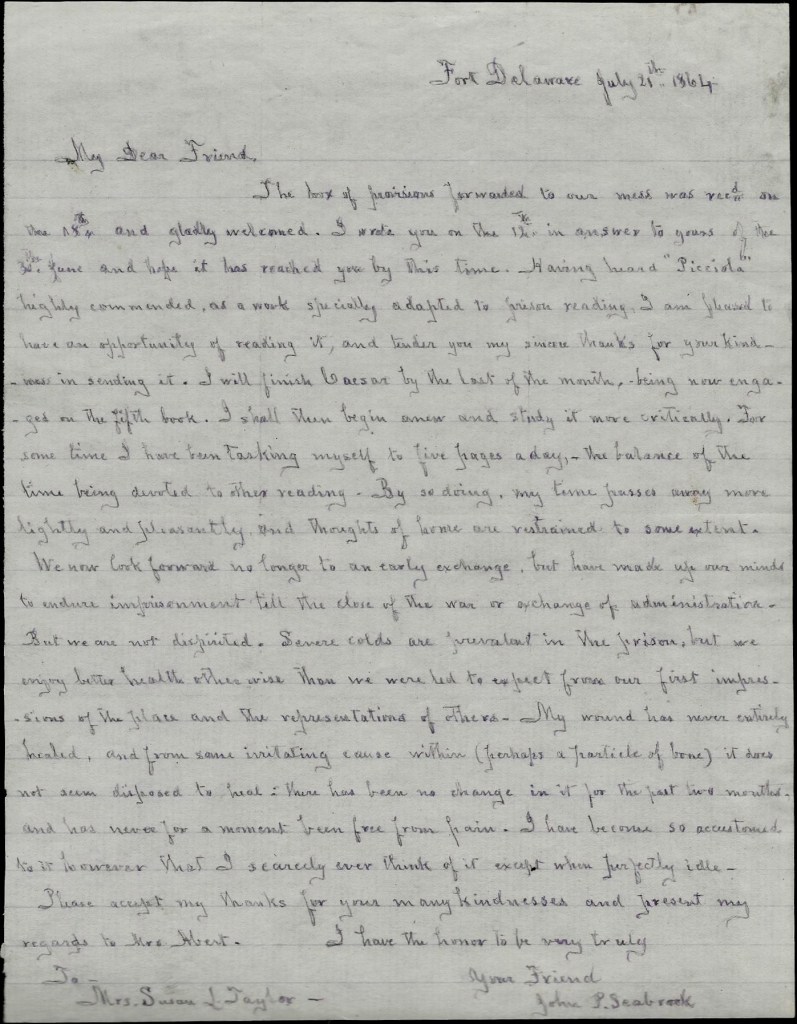
Transcription

Fort Delaware
July 21, 1864

My dear friend,

The box of provisions forwarded to our mess was received on the 18th and gladly received. I wrote you on the 12th in answer to yours of the 30th June and hope it has reached you by this time. Having heard “Picciola” highly commended as a work specially adapted to prison reading, I am pleased to have an opportunity of reading it, and tender you my sincere thanks for your kindness in sending it. I will finish Caesar by the last of the month, being now engaged on the fifth book. I shall then begin anew and study it more critically. For some time I have been tasking myself to five pages a day—the balance of the time devoted to other reading. By so doing, my time passes away more lightly and pleasantly and thoughts of home are restrained to some extent.

We now look forward no longer to an early exchange, but have made up our minds to endure imprisonment till the close of the war or exchange of administration. But we are not dispirited. Several colds are prevalent in the prison but we enjoy better health otherwise than we were led to expect from our first impressions of the place and the representations of others.

My wound has never entirely healed and from some irritating cause within (perhaps a particle of bone) it does not seem disposed to heal. There has been no change in it for the past two months and has never for a moment been free from pain. I have become so accustomed to it, however, that I scarcely ever think of it except when perfectly idle.

Please accept my thanks for your many kindnesses and present my regards to Mrs. Abert. I have the honor to be very truly your friend, — John P. Seabrook

To Mrs. Susan L, Taylor

1864: E. Amedee Dolhonde and Robert Goldsmith to Isabel Goshorn

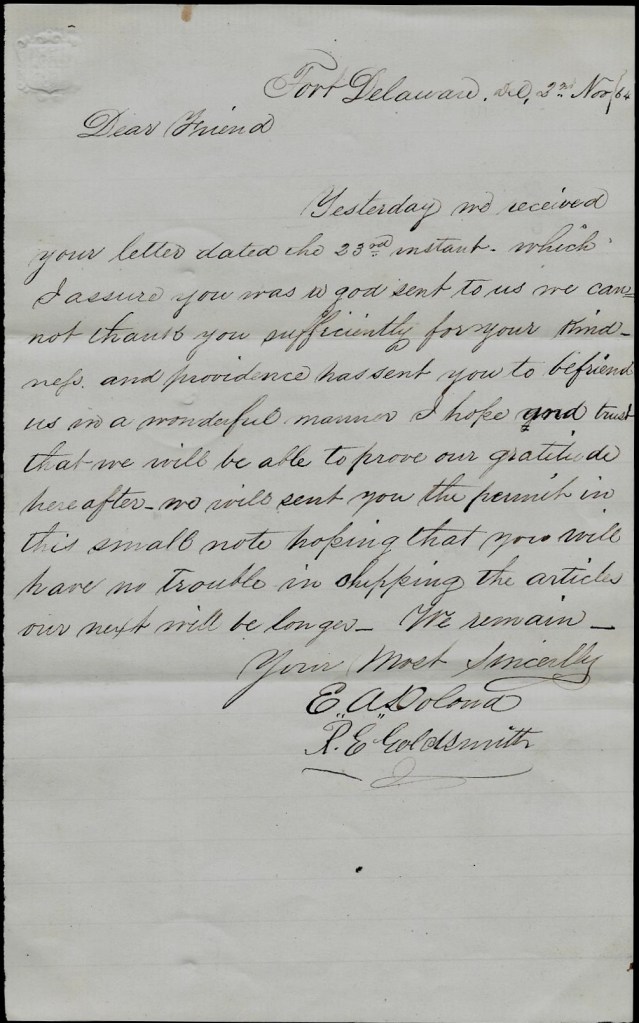
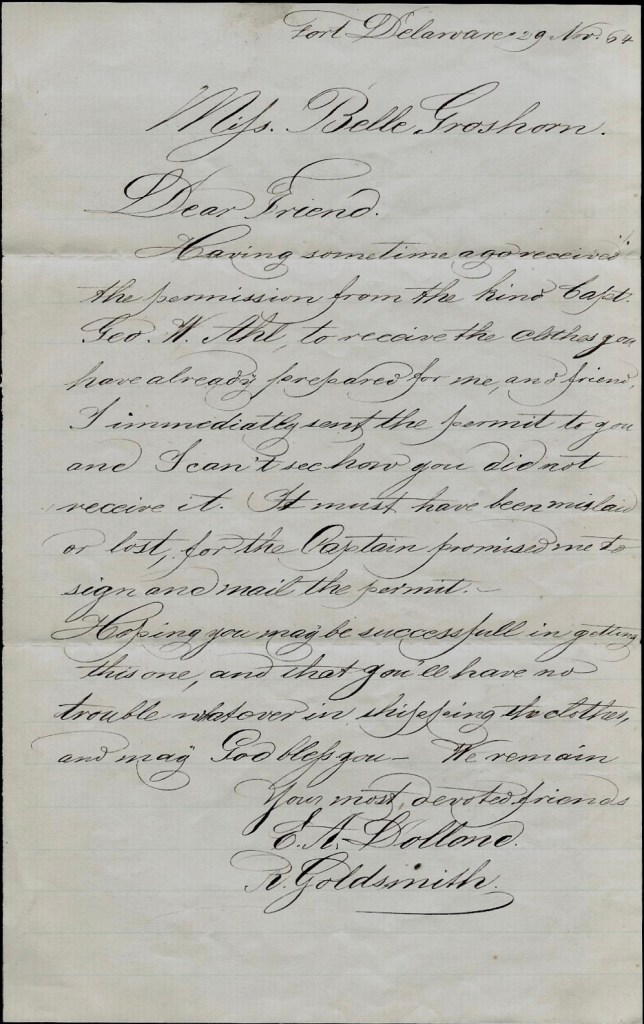
These three letters were written by Pvt. Amedee Dolhonde (E. A. Doland) of Co. B, 8th Louisiana Infantry. Joining him in signing the letter was Sgt. Robert Goldsmith of Co. G, 8th Alabama Infantry.

Confederate Prisoners of War at Camp Douglas in Chicago (Civil War in Tennessee Collection)

Amedee Dolhonde (1840-Aft1880) was the son of Jean Baptiste Dolhonde (1798-1860) and Josephina Carolie de Alpuente (180901869) of New Orleans, Louisiana. Apparently, during the war, Amedee signed the payroll “E A. Doland” to simplify his name. During much of the time he was with the regiment, Amedee served as a clerk, presumably because of his excellent handwriting. He was taken prisoner at Gettysburg on 3 July 1863. His muster records include an unusual notation: “Captured in Penn., never fired a gun, took the oath, a skulker & coward.” Another record indicates that he deserted in Pennsylvania and was captured at South Mountain on 4 July 1863. He was paroled at Fort McHenry, Maryland, and transferred to Fort Delaware on 9 July 1863. It appears that he took the oath of allegiance in December 1864. After the war, Ameede returned to New Orleans where he worked as a fisherman.

Robert Goldsmith enrolled as a private in Co. G, 8th Alabama Infantry at Mobile on 25 May 1861. His muster records indicate he went missing at the Battle of Gettysburg and subsequent records inform us that he was taken prisoner on 2 July 1863 and taken to Fort Delaware. He remained a prisoner there until his release on 10 May 1865.

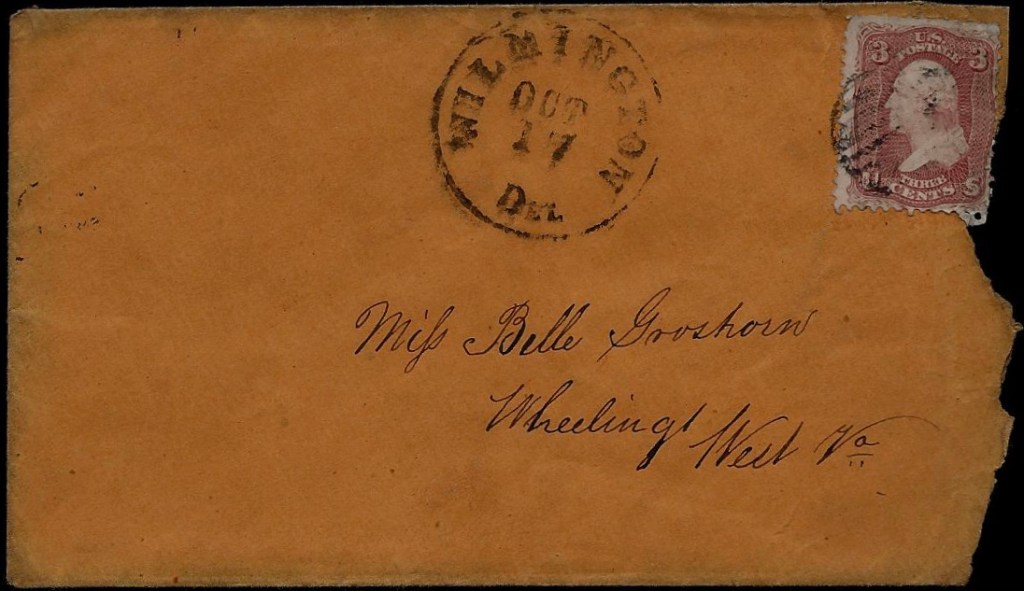
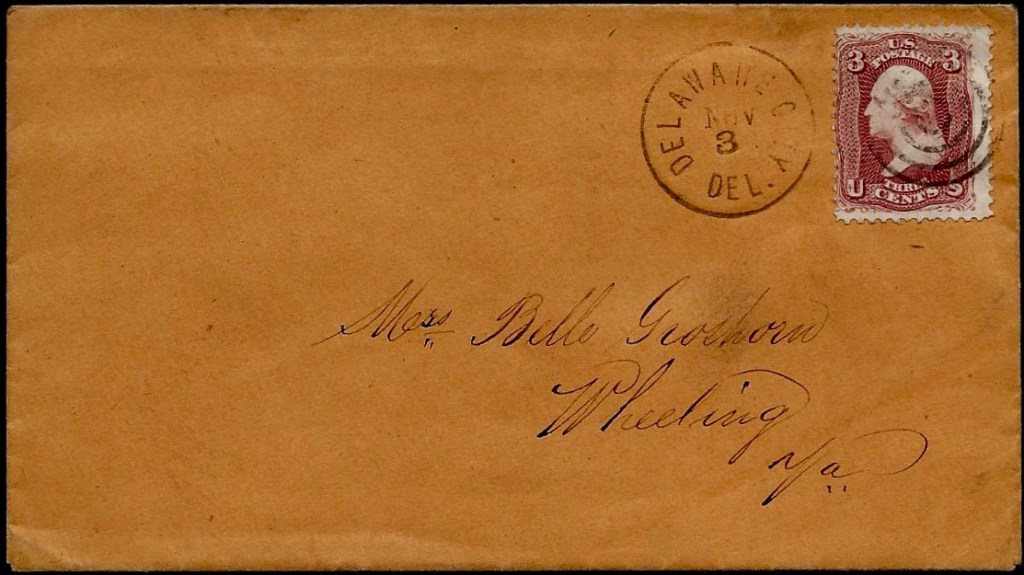
All three of the letters were addressed to Miss Belle Groshorn of Wheeling, West Virginia. Belle’s last name was misspelled; it should have been Goshorn. Isabel Goshorn (1840-1919) was the daughter of a Wheeling dry goods merchant named William Scott Goshorn (1814-1891) and his wife, Priscilla Jane Zinn (1821-1878). Mr. Goshorn was up to the time of the Civil War an Old Line Whig, but afterwards was a Democrat, and through the war his sympathies were with the South. He was a slave owner, and an incident is recalled by his death which made a stir all over the country at the time. A slave woman named Lucinda Johnson (note: her name was Sarah Lucy Bagby) ran away from him and escaped to Cleveland, Ohio. “Mr. Goshorn went after her, reclaimed her and brought her back. Anti-slavery agitators and others in Northern Ohio sought to prevent her return to Virginia and there were exciting scenes in which Mr. Goshorn had a close rub, the populace having been much stirred up by the discussion of the matter and being in a mood to do any slaveholder bodily injury.”

In 1870, Isabel married Joseph S. Irwin (1830-1876).

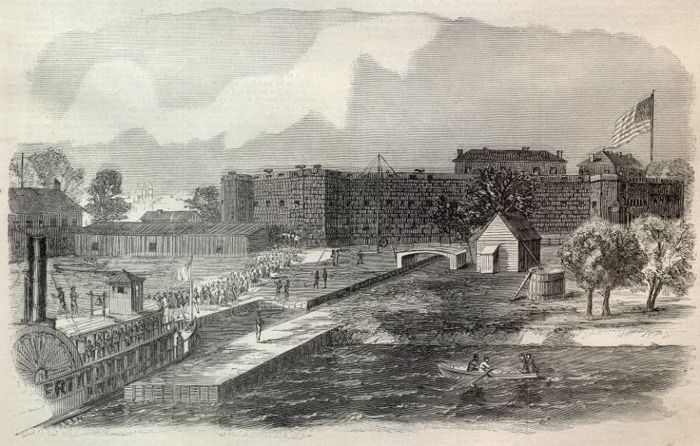
Sketch of Fort Delaware Prison in March 1864 (Boston Athenaeum Digital Collections)

Letter 1

Addressed to Miss Belle Groshorn, Wheeling, West Virginia

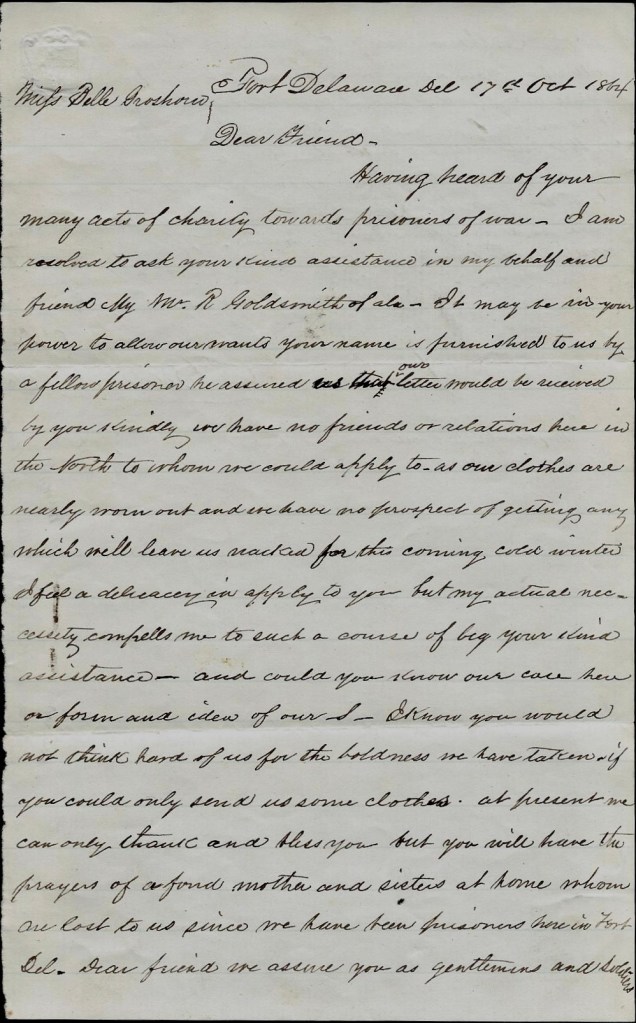
Fort Delaware, Delaware
17 October 1864

Miss Belle Groshorn
Dear Friend,

Having heard of your many acts of charity towards prisoners of war, I am resolved to ask your kind assistance in my behalf and friend, Maj. Mr. R. Goldsmith of Alabama. It may be in your power to allow our wants. Yuor name is furnished to us by a fellow prisoner. He reassured us that our letter would be received by you kindly. We have no friends or relations here in the North to whom we could apply to. As our clothes are nearly worn out and we have no prospect of getting any which will leave us naked for the coming cold winter, I feel a delicacy in applying to you but my actual necessity compels me to such a course of beg[ging] your kind assistance. And could you know our care here, or form an idea of our situation, I know you would not think hard of us for the boldness we have taken.

If you could only send us some clothes, at present we can only thank and bless you, but you will have the prayers of a fond mother and sisters at home whom are lost to us since we have been prisoners here in Fort Delaware.

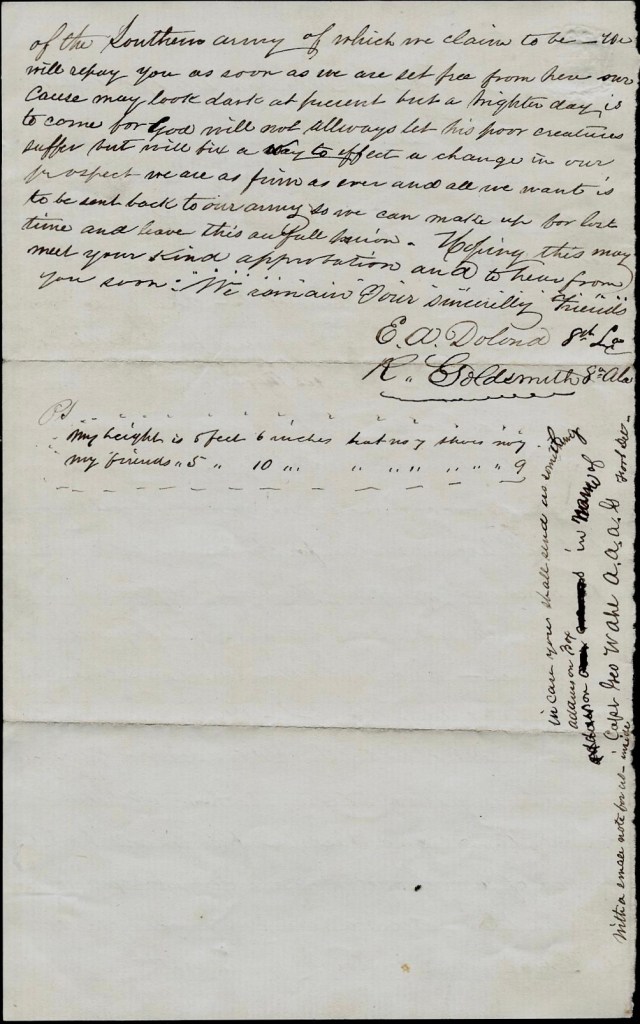
Dear friend, we assure you as gentlemen and soldiers of the Southern army of which we claim to be, we will repay you as soon as we are set free from here. Our cause may look dark at present but a brighter day is to come for God will not always let his poor creatures suffer but will fix a way to effect a change in our prospect. We are as firm as ever and all we want is to be sent back to our army so we can make up for lost time and leave this awful Union. Hoping this may meet your kind approbation and to hear from you soon, we remain your sincerely friends,

— E. A. Doland, 7th Louisiana
R. Goldsmith, 8th Alabama

P. S. My height is 5 feet 6 inches, hat No. 7, Shoes No. 7
My friends is 5 feet 10 inches, hat No. 7, Shoes No. 9

In case you shall send us something, address on box, in care of Capt. George Wahl, A. A. A. G., Fort Delaware with a small note for us inside.


Letter 2

Addressed to Miss Belle Groshorn, Wheeling, Va.

Fort Delaware
2nd November 1864

Dear Friend,

Yesterday we received your letter dated the 23rd inst. which I assure you was a God send to us. We can not thank you sufficiently for your kindness and providence has sent you to befriend us in a wonderful manner. I hope and trust that we will be able to prove our gratitude hereafter. We will send you the permit in this small note hoping that you will have no trouble in shipping the articles. Our next will be longer. We remain, your most sincerely,

— E. A. Doland & R. E. Goldsmith


Letter 3

Addressed to Miss Belle Groshorn, Wheeling, West Virginia

Fort Delaware
29 November ’64

Miss Belle Groshorn
Dear Friend,

Have some time ago received the permission from the kind Capt. George Wahl to receive the clothes you have already prepared for me, and friend, I immediately sent the permit to you and I can’t see how you did not receive it. It must have been mislaid or lost, for the Captain promised me to sign and mail the permit.

Hoping you mat be successful in getting this one, and that you’ll have no trouble whatever in shipping the clothes, and may God bless you. We remain your most devoted friends, — E. A. Doland, R. Goldsmith

1865: Andrew F. Clarke to Sallie M. H. Fulton

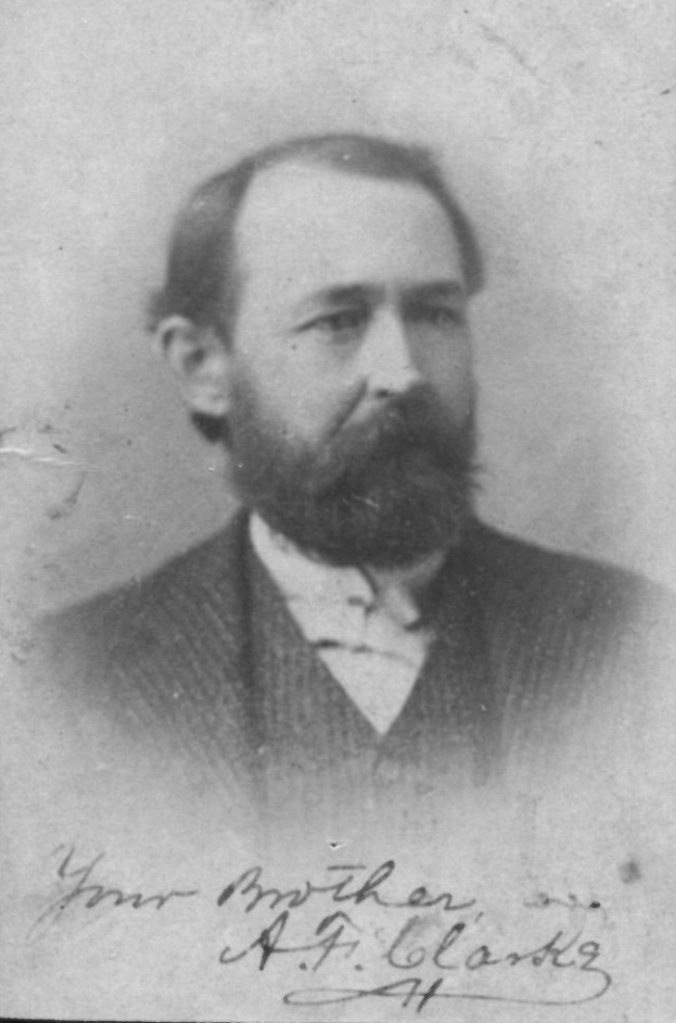
These two Prison of War (POW) letters were written from Fort Delaware by Andrew F. Clarke (1841-1890) who first enlisted in the Confederate service when 19 years old at Corinth, Mississippi in the Newton Rifles, 13th Mississippi Infantry. His enlistment records indicate that his home was Decatur, Newton county, Mississippi and that prior to enlistment he was employed as a teacher. His parents were Rev. Nathan Lytle Clarke (1812-1906) and Evaline Delia Powell (1823-1859).

A post war cabinet card image of Andrew (Find-A-Grave)

Clarke was appointed a 3rd Sergeant shortly after his enlistment and and was promoted to a 2nd Lieutenant of Co. D on 26 April 1862. Less than a year later he was promoted to 1st Lieutenant.

Clarke was wounded and taken prisoner at Knoxville, Tennessee, during the ill-advised assault on Fort Sanders of 29 November 1863. The 13th Mississippi led the assault on the northwest bastion of the fort—the focal point of the overall attack. The men of the 13th were the first into the ditch surrounding the fort and the first to place their flag upon the parapet where it was captured along with two other regimental colors. The attack was star-crossed, furious and short lived. In the twenty minutes of fighting, the 13th’s colonel was killed, and the Confederates lost a total of 813 men: 129 killed, 458 wounded, and 226 missing. The Federals, on the other hand, lost less than 20 men inside the protection of the embattlements. Clarke was one of 17 commissioned officers captured that day. (Source: Earl Hess’s Burnside and Longstreet in East Tennessee)

As a prisoner, Clarke was transported to Louisville, to Rock Island, to Camp Chase, and finally to Fort Delaware in late March 1864. When these letters were written, he had been at Fort Delaware for ten to eleven months. Despite his continued hopes for exchange, he was not released from Fort Delaware until 12 June 1865.

Clarke addressed the letter to 24 year-old Sallie Fulton of Baltimore’s 20th Ward—no doubt a Southern sympathizer who showed compassion for Confederate prisoner’s of war and frequently corresponded with them, occasionally even sending them money to allow them certain luxuries they might not otherwise have access to. Several letters to such correspondents have survived through the years—letters to women unknown to the prisoners except for their generosity. In 1870, 30 year-old Sallie was still enumerated at the 176 Preston Street residence of her parents, John B. H. Fulton—a wholesale Dry Goods Dealer— and Ann S. Wilson. By 1880, Sallie had married John Walter Hoover, a teacher, and lived at 243 Bolton Street in Baltimore.

Letter 1

Addressed to Miss Sallie M. H. Fulton, 176 Preston Street, Baltimore, Maryland

Fort Delaware
January 11th, 1865

Miss Sallie M. H. Fulton
Dear friend:

Your favor of 31st December came to hand on the 4th Inst. and found me in excellent health. The weather has moderated greatly and appears like our springtime in the far South. Our skating has disappeared and in its stead, we wade through the mud. We are getting along very well—have plenty to eat and good fires, so we manage to live comfortably. Rumors of exchange are still current but amount to nothing.

Have you heard from Lieut. Mosely since he went South?  We are expecting a “flag of truce” mail soon and will receive a letter from him, I think. Capt. [Daniel Murray] McRae is quite well today. I know you will consider this letter uninteresting but I can write nothing scarcely when limited,  both as to space and subject. I hope you will continue to write.

Hoping soon to hear from you, I am your friend, — Andrew F. Clarke


Letter 2

Addressed to Miss Sallie M. H. Fulton, 176 Preston Street, Baltimore, Maryland

U. S. Military Prison
Fort Delaware
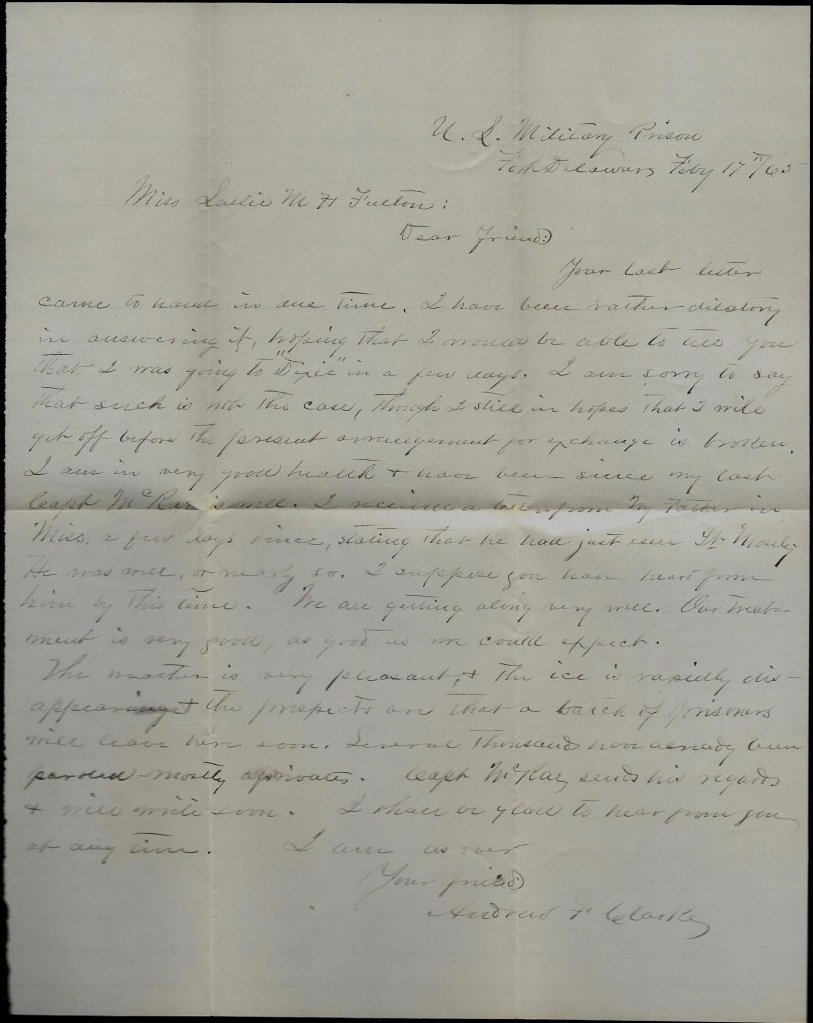
February 17, 1865

Miss Sallie M. H. Fulton
Dear friend,

Your last letter came to hand in due time. I have been rather dilatory in answering it, hoping that I would be able to tell you that I was going to “Dixie” in a few days. I am sorry to say that such is not the case, though I’m still in hopes that I will get off before the present arrangement for exchange is broken.

I am in very good health and have been since my last. Capt. [Daniel Murray] McRae is well. I received a letter from my Father in Mississippi a few days since stating that he had just seen Lt. Mosely. He was well, or nearly so. I suppose you have heard from him by this time. We are getting along very well . Our treatment is very good—as good as we could expect.

The weather is very pleasant & the ice is rapidly disappearing & the prospects are that a batch of prisoners will leave here soon. Several thousand have already been paroled—mostly privates. Capt. McRae sends his regards & will write soon. I shall be glad to hear from you at any time. I am as ever your friend, — Andrew F. Clarke

Andrew F. Clarke’s monument in Covington, Hill county, Texas

1864: Edward Visart to Myra McAlmont

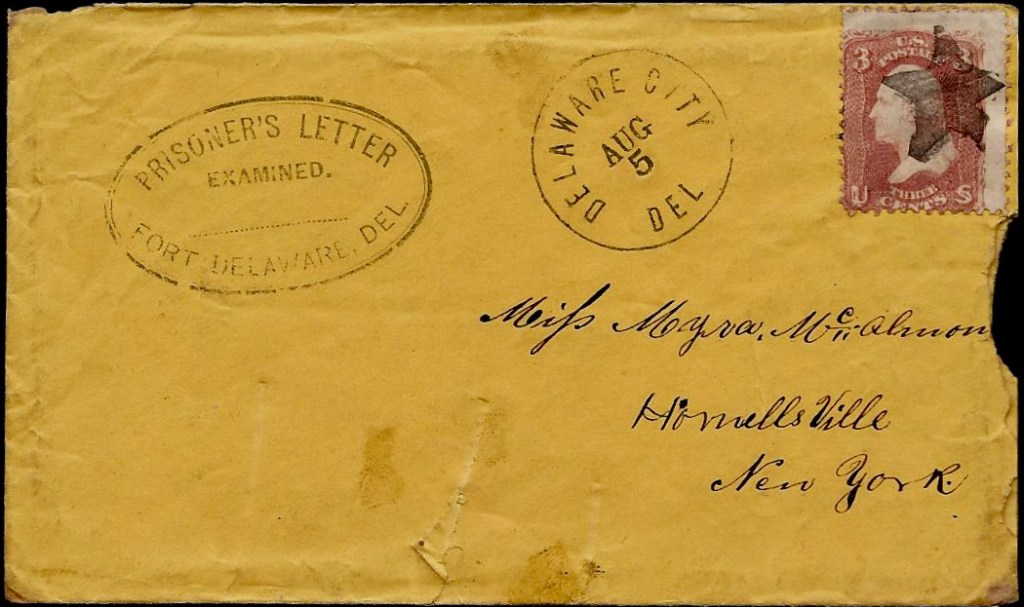
This letter was written by Edward Visart (1839-1893) from Fort Delaware in August 1864 while a prisoner of war. Edward was serving as a 2nd Lieutenant in Capt. Blocher’s Arkansas Battery when he was taken prisoner on 28 October 1863 in Arkansas county, Arkansas, by General Clayton’s troops and held in prison at Little Rock. He was then held at St. Louis for a time but transferred across country to Fort Delaware on 25 March 1864. He was received there two days later and not paroled until 10 April 1865.

Edward began his Confederate service enlisting in the Pulaski Light Artillery at Little Rock in April 1861. He mustered out of that regiment in September 1861 and reenlisted in the Weaver Light Artillery at Little Rock in December 1861. This battery was transferred to Blocher’s Battery in August 1862. Blocher’s Battery served in the Trans-Mississippi Department throughout the war, and campaigned in Arkansas, Louisiana, Missouri and the Indian Territory.  In January 1863 the battery was assigned to Fagan’s Brigade in Hindman’s Division, and fought at Helena, the Little Rock campaign, and Price’s Missouri Expedition. 

During his long imprisonment, Lt. Visart began the study of medicine by reading books and prepared himself for admittance to medical school once he was paroled. He later got his degree from the University of Michigan Medical School and then returned to Arkansas to practice in DeWitt.

Edward wrote the letter to his “friend” Myra McAlmont (1846-1918), the daughter of Dr. John Josephus McAlmont (1821-1896), an 1843 graduate of the Geneva (NY) Medical College. He moved to Arkansas in 1850 and settled in Little Rock in 1852 where he practiced medicine and partnered with Solon Borland in a drug store. Myra married Francis (“Frank”) Terry Vaughan (1846-1916) in 1866. During the Civil War, Frank served in Capt. John G. Marshall’s Battery, Arkansas Light Artillery. He was very seriously wounded at the Battle of Helena, losing his left arm and receiving additional wounds in his right hand and breast. Myra’s uncle, Dr. Corydon Hanks McAlmont (1827-1862) served in Rust’s Brigade during the Civil War but after Corinth, returned to Little Rock where he rendered Confederate service in the hospital.

In September 1863, Union troops occupied Little Rock, Arkansas, and opened up communication and travel for Little Rock residents, such as Mrya, to travel North and visit relatives in Hornellsville, New York, where her parents had come from. Prior to September 1863, such travel would have been difficult and required passes to cross enemy lines.

(left to right) Mrs. John J. McAlmont, her daughter Myra McAlmont, and Miss Julia McAlmont, sister-in-law of Mrs. McAlmont. (ca. 1860)

Transcription

Addressed to Miss Myra McAlmont, Hornellsville, New York

Fort Delaware, Delaware
August 2, 1864

My Dear Friend,

Your welcome letter of the 29th ult., cane duly to hand last evening. Yours and Frank’s letters are always so interesting, so “talkative” of home (I mean Little Rock). I was much amused at yours and Frank [Vaughan]’s dialogue while reading it. I imagined myself there and thought it was “my put in” and spoke out accordingly; was reminded of it by a bystander who asked me if it was “much funny.” Lieut. Halliburton received a letter from his friend J. B. Garrison written at Little Rock; he and Henry Halliburton are prisoners. Were captured at Col. H.’s July 5th. Gulware and Garrison were married on the 15th of May last. I have written to Hal. I did not know Miss Agnes Colter. I will expect you this fall. I believe you will get to come.

Miss Myra, I do not know how to thank you for your kind offer. You offer to do more than I could even ask a relation. I do not yet particularly need anything. I have clothing enough to do me till winter. Lieut. H. received a box of eatables last week from a lady in Baltimore. It was a nice treat being the first thing of the kind we have had since our sojourn North. I will accept the Anatomy. I prefer “Gray’s Human & Surgical.” I suppose it will have to be sent by Express to Lieut. E. Visart, Prisoner of War, Care of Capt. G. W. Ahl, A.A.A. Gen’l, Fort Delaware. If your Aunt will send a “ham” &c. and you some biscuits &c, box them up with the Anatomy. Get Frank to Express them. They will come safely & be very acceptable. I would not have you go to any expense to make up a box. When you write home, remember me kindly to all.

We are again allowed to receive papers. Should you get another Little Rock paper, send again. I may be more fortunate next time. I fear the “Bushwhackers” have interrupted my communication with Miss Georgie. I have not heard from her in some weeks. Lieut. H. joins me in love to you & Frank [Vaughan]. I cannot do your letters justice on one page but it is all I dare write. Write soon. I remain most respectfully, your true friend, — Edward Visart

Heard from Capt. Blocher. All’s well. I was not forgotten in the reorganization. Am now 1st Lieutenant. — E. V.