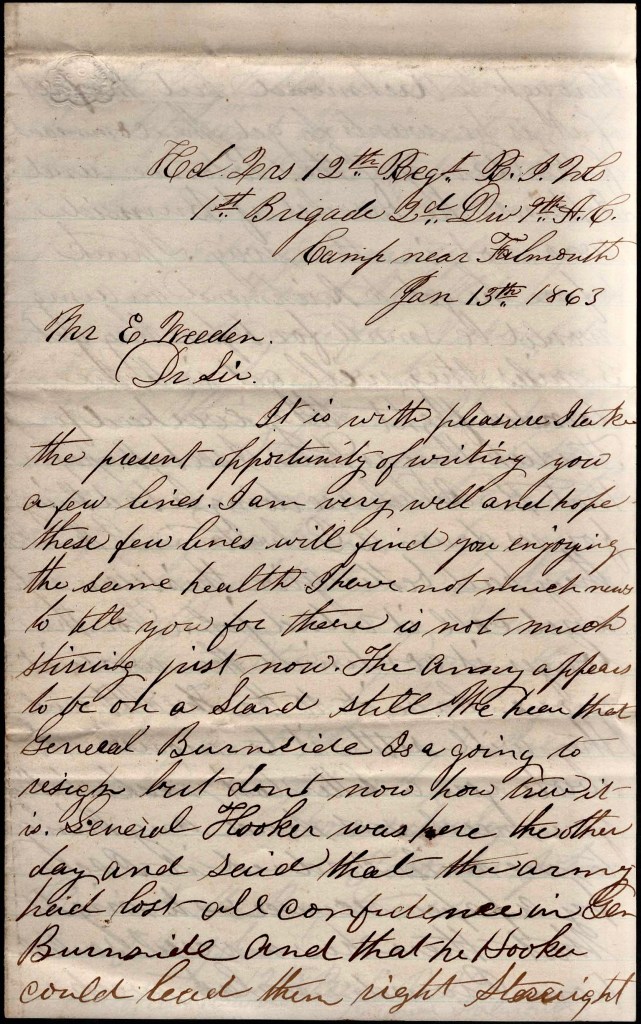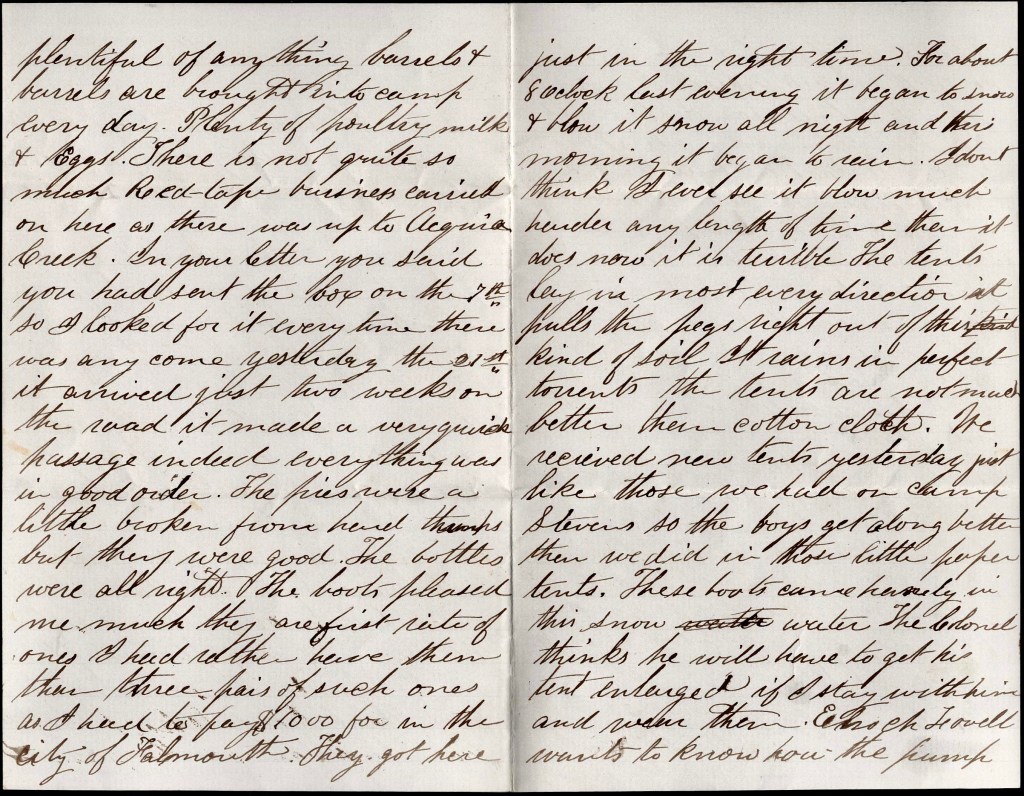
The following letters were written by George Brown Eckert (1840-1899) while serving as an officer in the 3rd US Infantry. His parents were Isaac Eckert (1800-1873) and Judith Hahn (1802-1875) of Reading, Berks county, PA. In 1860 he was a 20 year old clerk living with his parents and sister Rebecca in Reading, PA; his father was a wealthy iron master there. He enrolled in Reading, PA and mustered on 18 April 1861 in Harrisburg as a fifer (musician) in Company A, 25th Pennsylvania Infantry – the Ringgold Light Artillery – for 3 months’ service. He mustered out with them on 23 July. He was appointed 2nd Lieutenant of Co. C the 3rd United States Infantry on 5 August 1861 and was promoted to First Lieutenant on 12 March 1862. He was in command of Co. C during the Battle of Antietam (Sept. 1862) and again in action at Fredericksburg and Chancellorsville. He returned to Trenton, New Jersey, on recruiting duty and resigned his commission as captain on 10 November 1864.
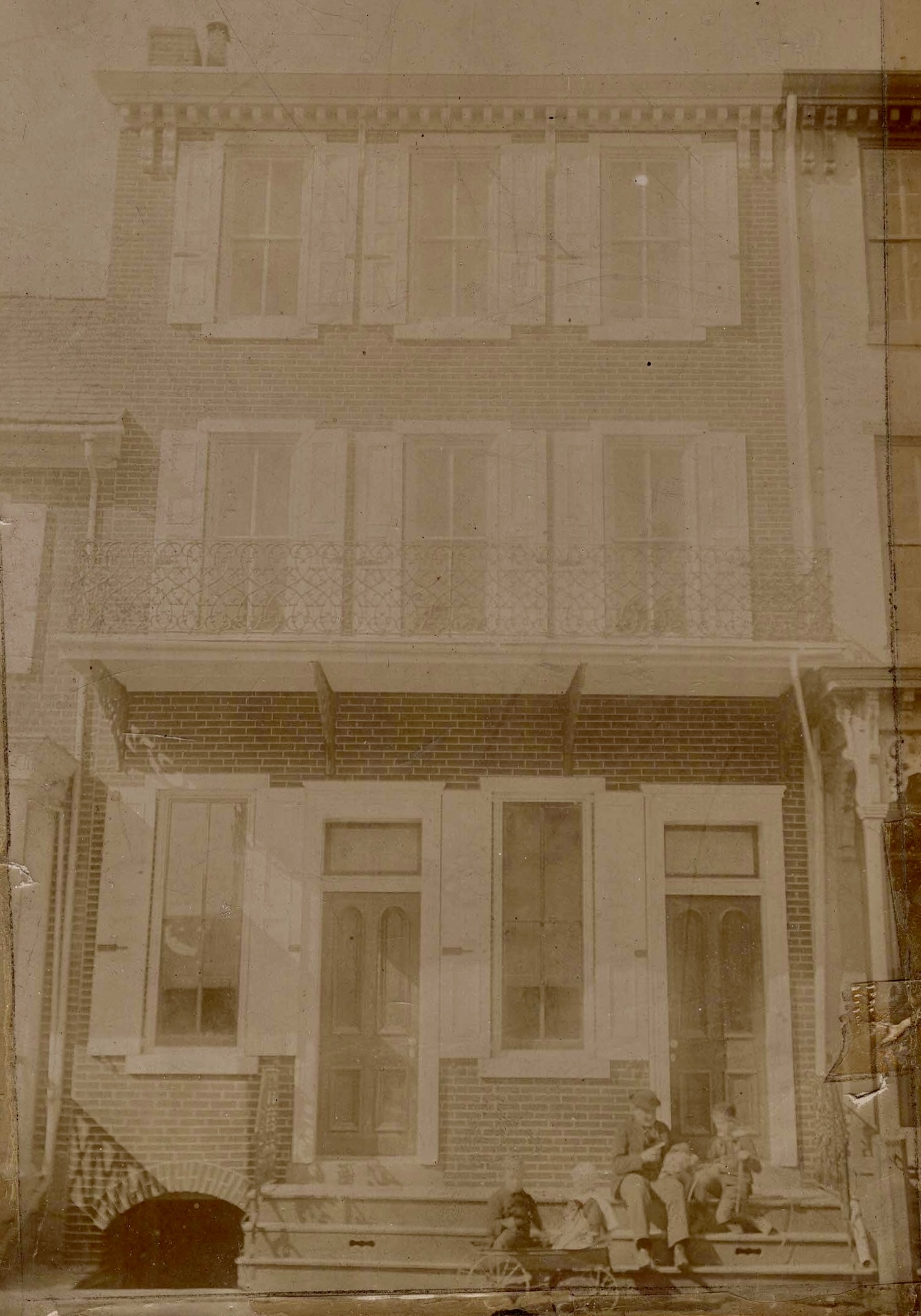
By 1870 he was again a clerk, in his father’s iron works in Reading. In 1873 he became a partner with his brother Henry in Eckert & Brother, and they took over their father Isaac’s iron business in Reading, operating the Henry Clay Furnace and iron mines. He was also a Director of the Farmers National Bank and briefly its President after his brother Henry died in 1894. George was said to be a “millionaire iron master” at his death at age 58 in 1899.
Letter 1
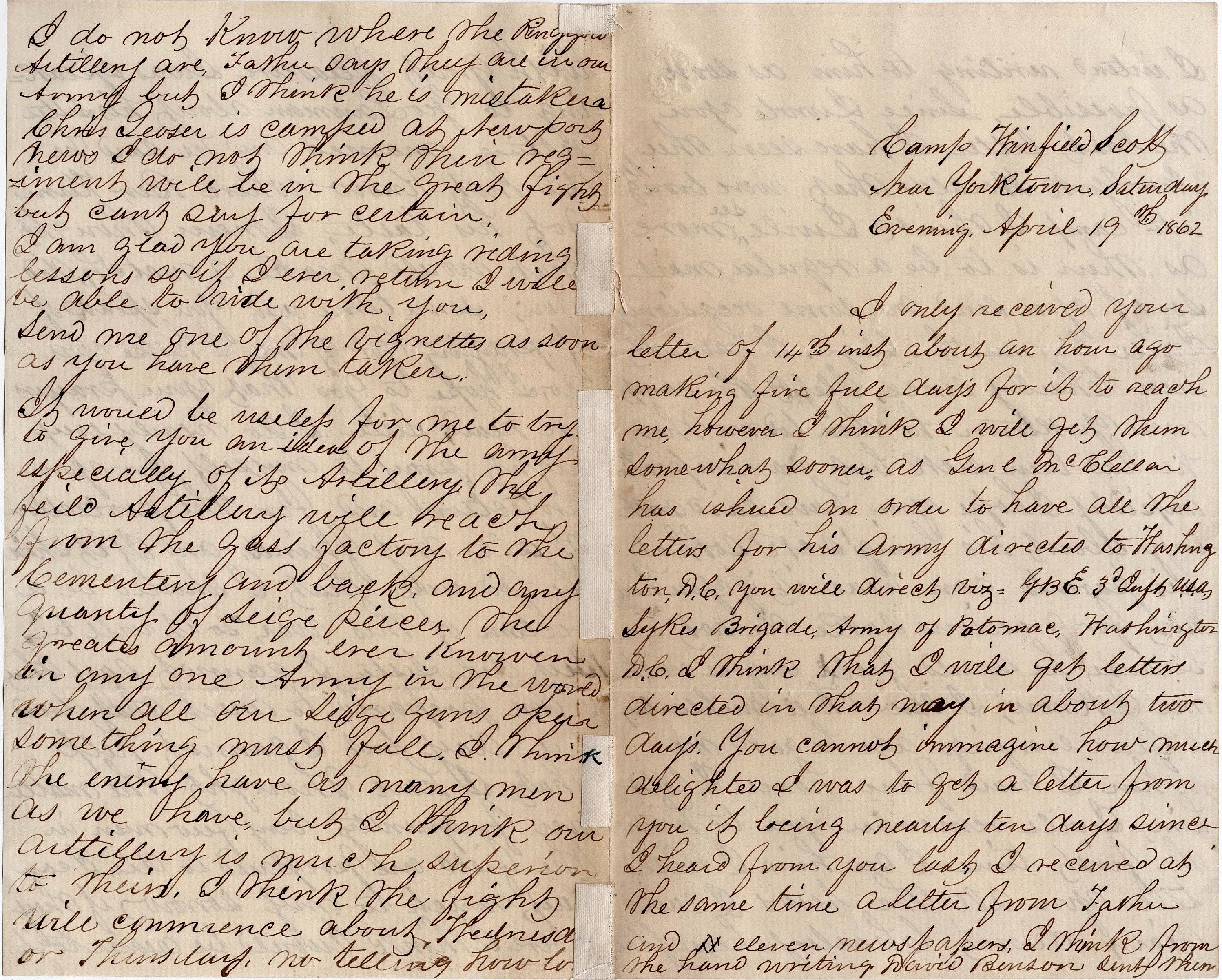
Camp Winfield Scott
Near Yorktown, [Virginia]
Saturday evening, April 19, 1862
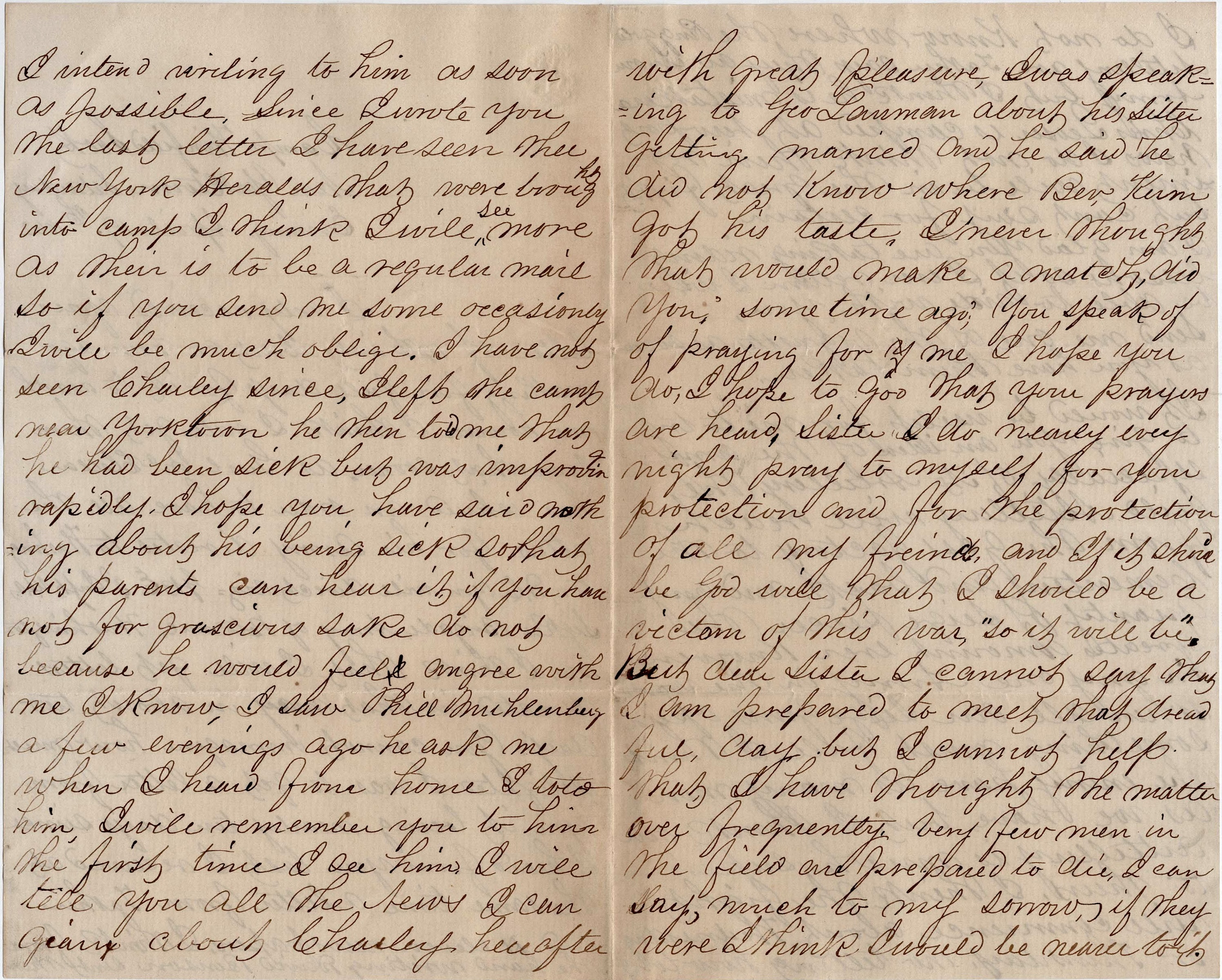
I only received your letter of the 14th inst. about an hour ago making five full days for it to reach me. However, I think I will get them somewhat sooner as Gen. McClellan has issued an order to have all the letter for his Army directed to Washington D. C. You will direct viz: G. B. E., 3rd Infantry, USA, Sykes Brigade, Army of the Potomac, Washington D. C. I think that I will get letters directed in that way in about two days.
You cannot imagine how much delighted I was to get a letter from you, it being nearly ten days since I heard from you last. I received at the same time a letter from Father and eleven newspapers. I think from the hand writing David Benson sent them. I intend writing to him as soon as possible.
Since I wrote you the last letter, I have seen the New York Heralds what were brought into camp. I think I will see me more as there is to be a regular mail so if you send me some occasionally, I will be much obliged. I have not seen Charley since I left the camp near Yorktown. He then told me that he had been sick but was improving rapidly. I hope you have said nothing about his being sick so that his parents can hear it. If you have not, for precious sake, do not because he would feel angry with me I know. I saw Phil McHunberg [?] a few evening ago. He asked me when I heard from home. I told him I will remember you to him the first time I see him. I will tell you all the news I can going about Charley hereafter with great pleasure. I was speaking to George Lauman about his sister getting married and he said he did not know where Bev, Kim got his taste. I never thought that [they] would make a match, did you?
Some time ago you spoke of praying for me. I hope you do. I hope to God that your prayers are heard, sister. I do nearly every night pray to myself for your protection and for the protection of all my friends, and if it should be God’s will that I should be a victim of this war, “so it will be.” But dear sister, I cannot say that I am prepared to meet that dreadful day. But I cannot help that. I have thought the matter over frequently. Very few men in the field are prepared to die, I can say, much to my sorrow. If they were, I think I would be nearer to it.
I do not know where the Ringgold Artillery are. Father says they are in our army but I think he is mistaken. Chris Doser is camped at Newport News. I do not think their regiment will be in the great fight but can’t say for certain. I am glad you are taking riding lessons so if I ever return I will be able to ride with you. Send me one of the vignettes as soon as you have then taken.
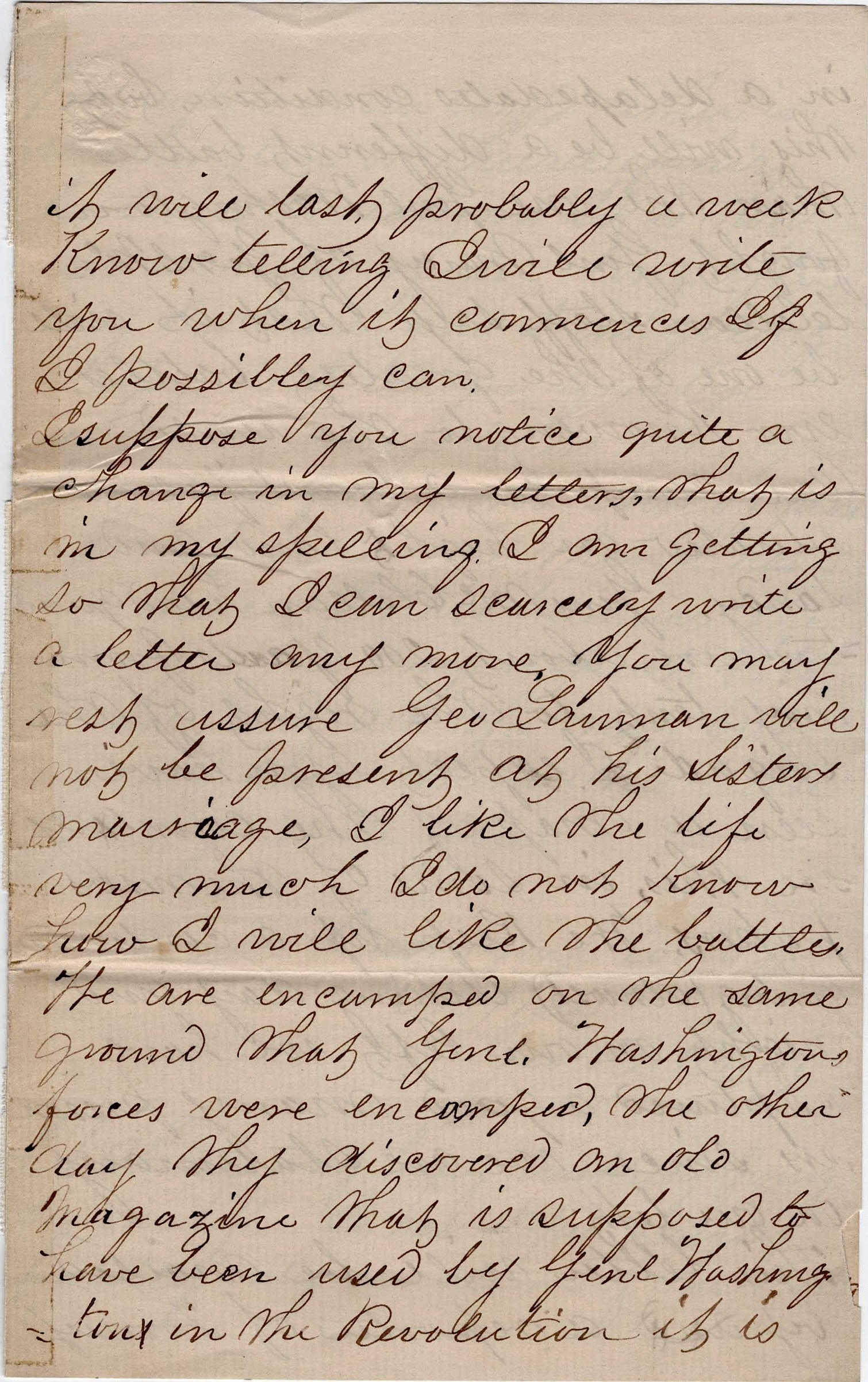
It would be useless for me to try to give you an idea of the army—especially of its artillery. The field artillery will reach from the Gass factory to the Cemetery and back and any quantity of siege pieces—the greatest amount ever known in any one army in the world. When all our siege guns open, something must fall. I think the enemy have as many men as we have, but I think our artillery is much superior to theirs. I think the fight will commence about Wednesday or Thursday. No telling how long it will last. Probably a week, no telling. I will write you when it commences if I possibly can.
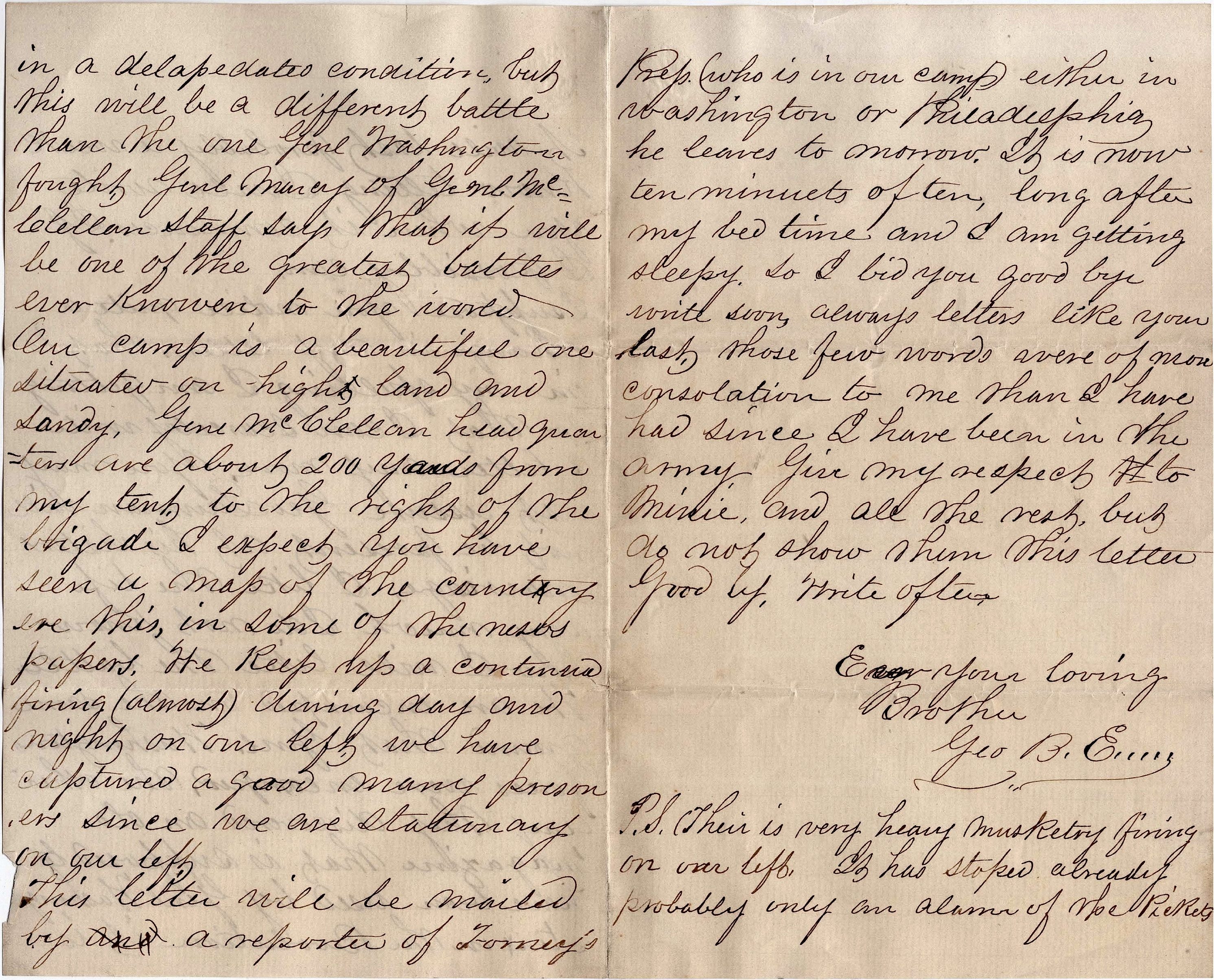
I suppose you notice quite a change in my letters—that is, in my spelling. I am getting so that I can scarcely write a letter anymore. You may rest assured George Lauman will not be present at his sister’s marriage. I like the [soldier’s] life very much [but] I do not know how I will like the battles. We are encamped on the same ground that Gen. Washington’s forces were encamped. The other day they discovered an old magazine that is supposed to have been used by Gen. Washington in the Revolution. It is in a dilapidated condition but this will be a different battle than the one Gen. Washington fought. Gen. Marcy of Gen. McClellan’s staff says that it will be one of the greatest battles ever known to the world.
Our camp is in beautiful one situated on high land and sandy. Gen. McClellan’s headquarters are about 200 yards from my tent to the right of the brigade. I expect you have seen a map of the country ere this in some of the newspapers. He keeps up a continued firing (almost) during day and night on our left. We have captured a good many prisoners since we are stationary on our left.
This letter will be mailed by a reporter of Forney’s [War] Press (who is in our camp) either in Washington or Philadelphia. 1 He leaves tomorrow. It is now ten minutes after—long after—my bed time and I am getting sleepy. So I bid you goodbye. Write soon—always letters like your last. Those few words were of more consolation to me that I have had since I have been in the army. Give my respects to Minnie and all the rest, but do not show them this letter. Goodbye. Write often.
Ever your loving brother, — Geo. B. Eckert
P. S. There is very heavy musketry firing on our left. It has stopped already. Probably only an alarm of the pickets.
1 Forney’s War Press was a newspaper dedicated to carrying Civil War news. Issues were published weekly in Philadelphia, Pennsylvania and contained engravings, news from war correspondents, casualty reports, poetry, and humor. War Press was published by John W. Forney, who was born in Lancaster, Pennsylvania in 1817. His career in publishing began as an apprentice at the Lancaster Journal. In time he became the Journal’s owner and editor. He was Clerk of the United States House of Representatives 1851-1856 and 1860-1861, and Secretary of the United States Senate 1861-1868. Each issue contained eight pages. The masthead of the newspaper was an ornate illustration containing an eagle, warship, cannon, and soldier’s in battle.
Letter 2
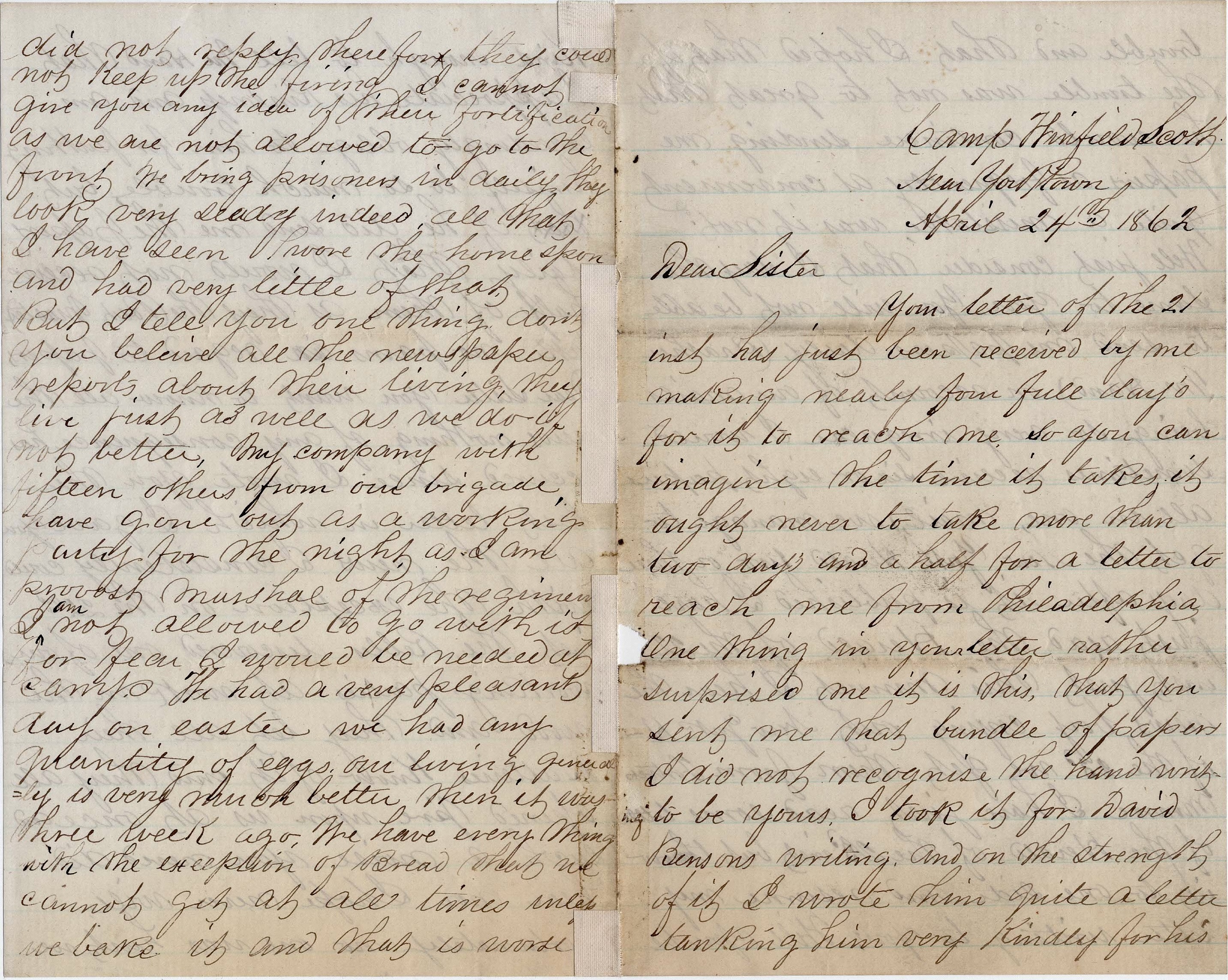
Camp Winfield Scott
Near Yorktown
April 24th 1862
Dear Sister,
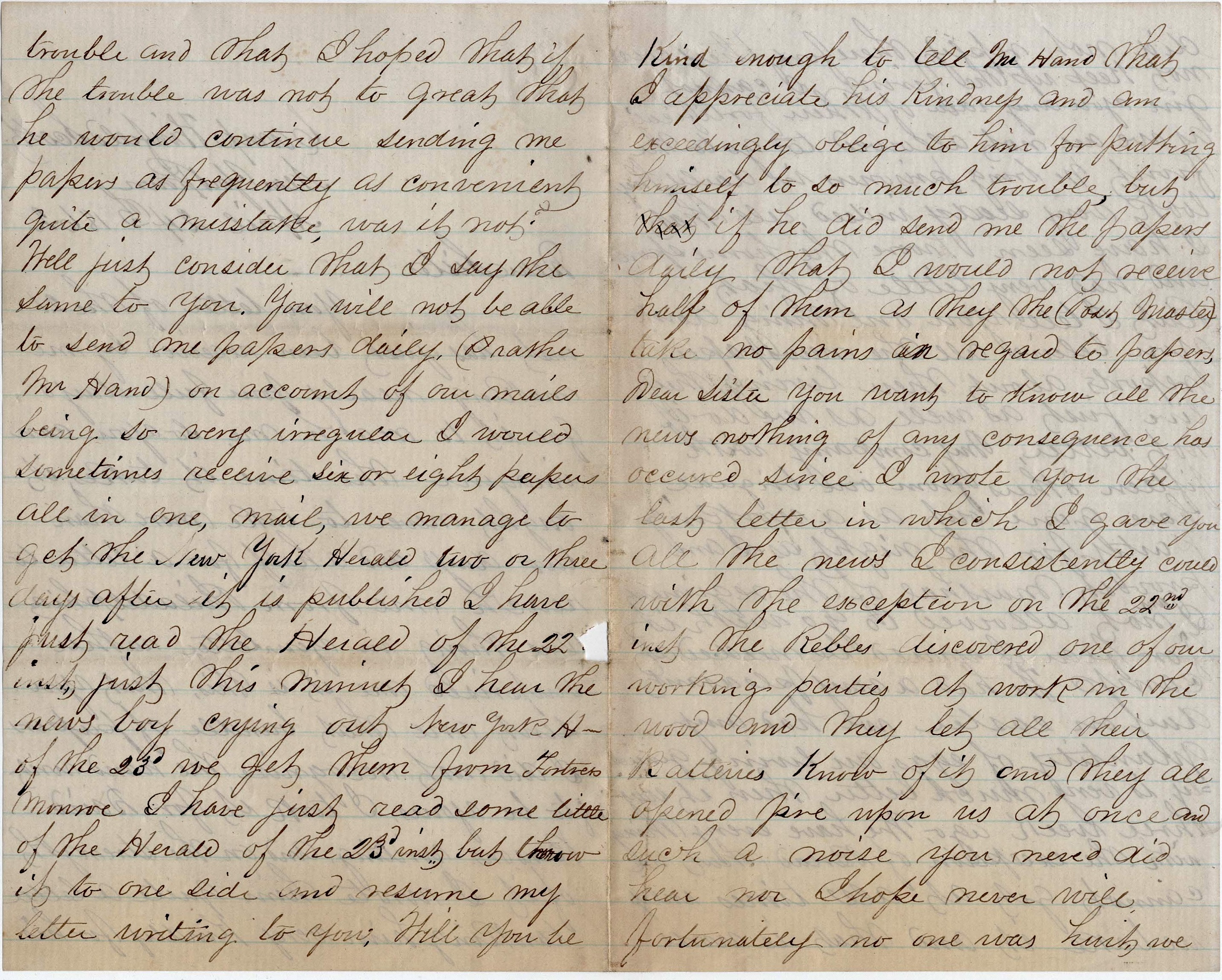
Your letter of the 21st inst. has just been received by me making nearly four full days for it to reach me so you can imagine the time it takes. It ought never to take more than two days and a half for a letter to reach me from Philadelphia. One thing in your letter rather surprised me. It is this—that you sent me that bundle of papers. I did not recognize the handwriting to be yours. I took it for David Benson’s writing, and on the strength of it, I wrote him quite a letter thanking him very kindly for his trouble and that I hoped that if the trouble was not too great that he would continue sending me papers as frequently as convenient. Quite a mistake, was it not? Well just consider that I say the same to you.
You will not be able to send me papers daily (rather Mr. Hand) on account of our mails being so very irregular. I would sometimes receive six or eight papers all in one mail. We manage to get the New York Herald two or three days after it is published. I have just read the Herald of the 22nd inst. Just this minute I hear the news boy crying out New York Herald of the 23rd. We get them from Fortress Monroe. I have just read some little of the Herald of the 23rd inst. but throw it to one side and resume my letter writing to you.
Will you be kind enough to tell Mr. Hand that I appreciate his kindness and am exceedingly obliged to him for putting himself to so much trouble, but if he did send me the papers daily that I would not receive half of them as they—the post master—take no plains in regard to papers.
Dear sister, you want to know all the news. Nothing of any consequence has occurred since I wrote you the last letter in which I gave you all the news. I consistently could with the exception on the 22nd inst. [when] the rebels discovered one of our working parties at work in the wood and they let all their batteries know of it and they all opened fire upon it at once. And such a noise you never did hear not I hope never will. Fortunately no one was hurt. We did not reply, therefore they could not keep up the firing.
I cannot give you any idea of their fortifications as we are not allowed to go to the front. We bring prisoners in daily. They look very seedy indeed. All that I have seen wore the home spun and had very little of that. But I tell you one thing, don’t you believe all the newspaper reports about their living. They live just as well as we do, if not better.
My company with fifteen others from or brigade have gone out as a working party for the night. As I am provost marshal of the regiment, I am not allowed to go with it for fear I would be needed at camp. We had a very pleasant duty on Easter. We had any quantities of eggs. Our living generally is very much better than it was three weeks ago. We have everything with the exception of bread. That we cannot get at all times unless we bake it and that is worse than none at all.
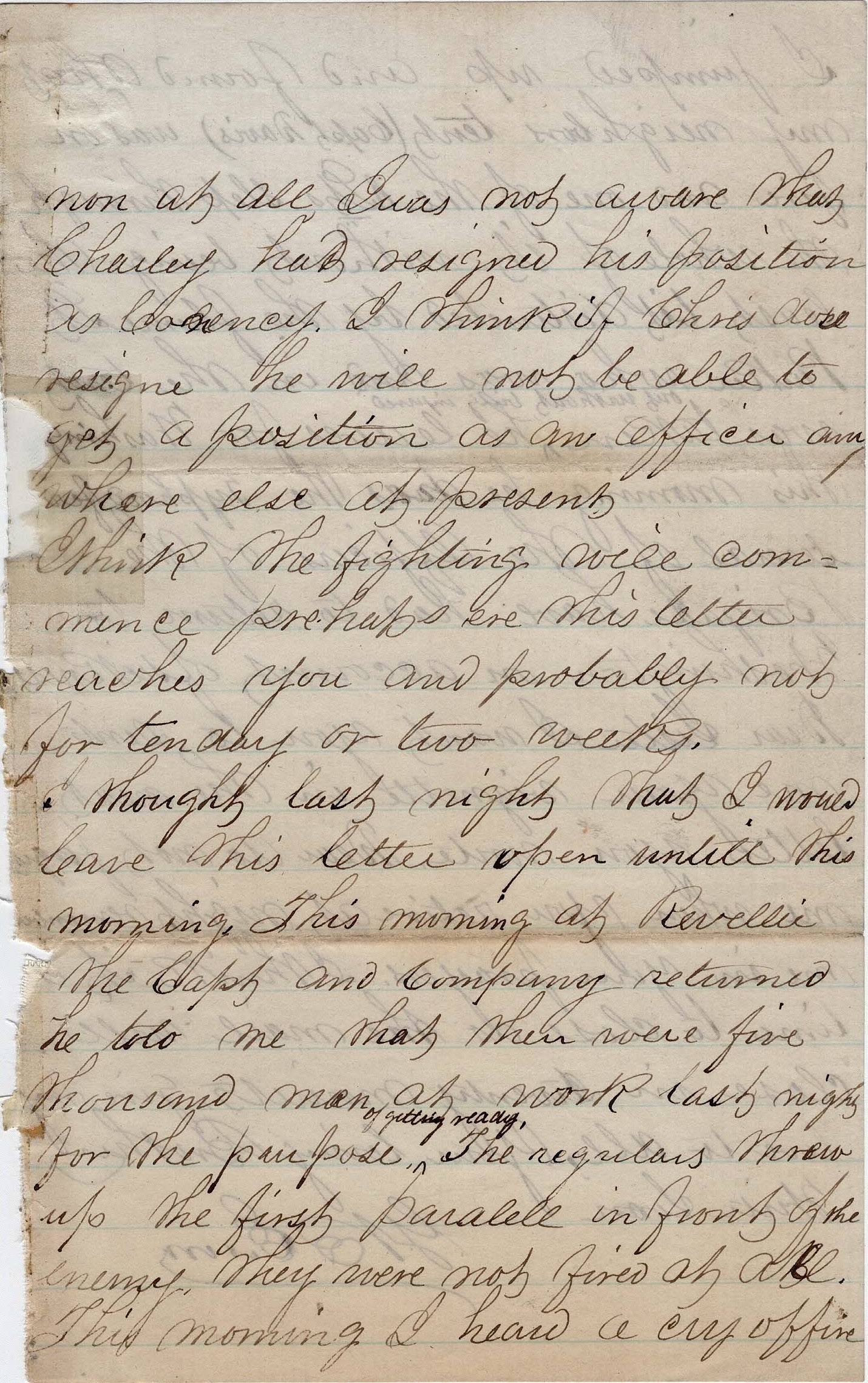
I was not aware that Charley had resigned his position as [ ]. I think if Chris does resign, he will not be able to get a position as an officer anywhere else at present.
I think the fighting will commence perhaps ere this letter reaches you and probably not for ten days or two weeks. I thought last night that I would leave this letter open until this morning. This morning at reveille the Captain and company returned. He told me that there were five thousand men at work last night for the purpose of getting ready. The Regulars threw up the first parallel in front of the enemy. They were not fired at all.
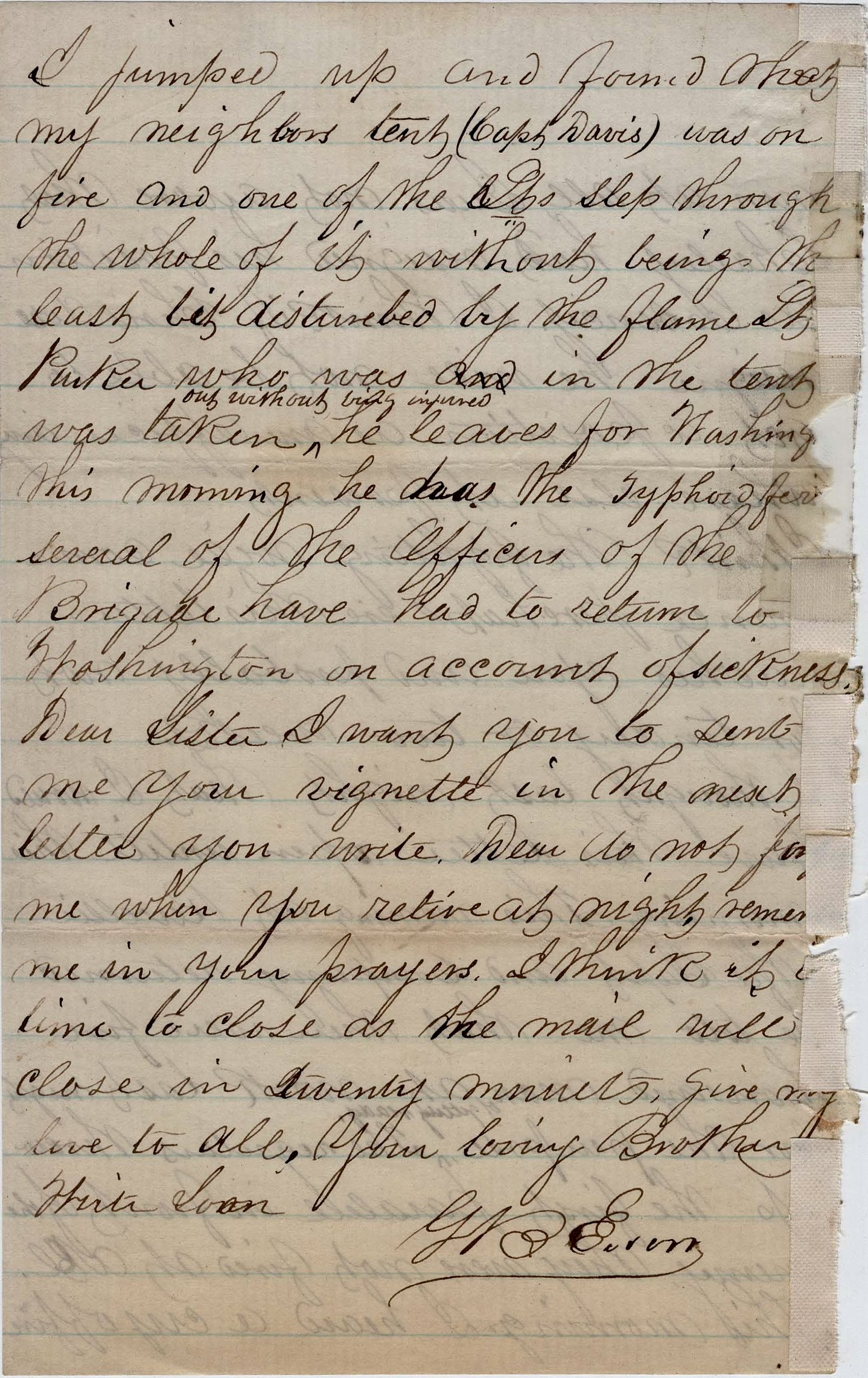
This morning I heard a cry of fire. I jumped up and found that my neighbor’s tent (Capt. Davis’) was on fire and one of the Lieutenants slept through the whole of it without being the least disturbed by the flame. Lt. Parker who was in the tent was taken out without being injured. He leaves for Washington this morning. He has the typhoid fever. Several of the officers of the brigade have to return to Washington on account of sickness.
Dear sister, I want you to send me your vignette in the next letter you write. Dear [sister], do not forget me when you retire at night. Remember me in your prayers. I think is is time to close as the mail will close in twenty minutes. Give my love to all. Your loving brother. Write soon. — G. W. Eckert
Letter 3
Camp near Sharpsburg [Maryland]
October 24, 1862
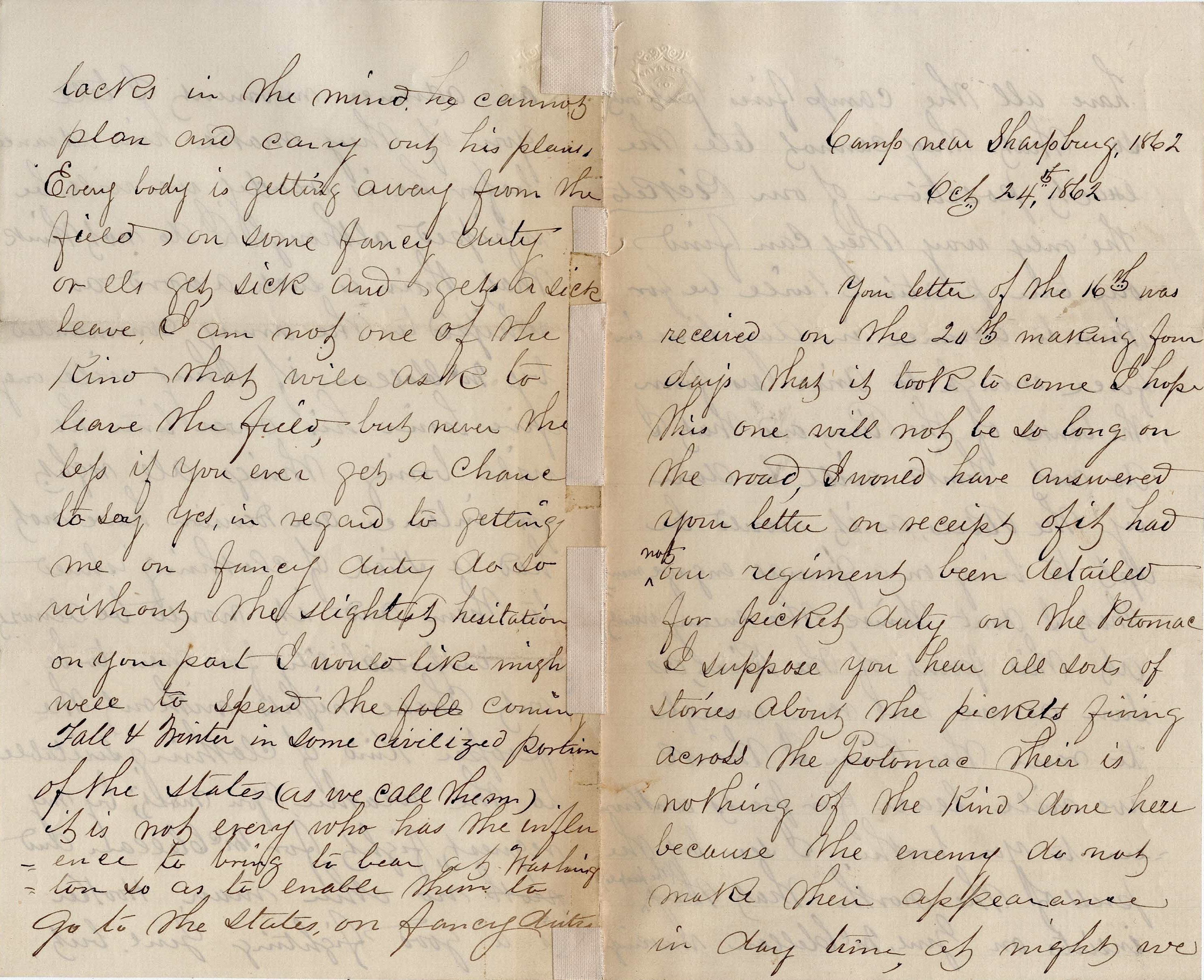
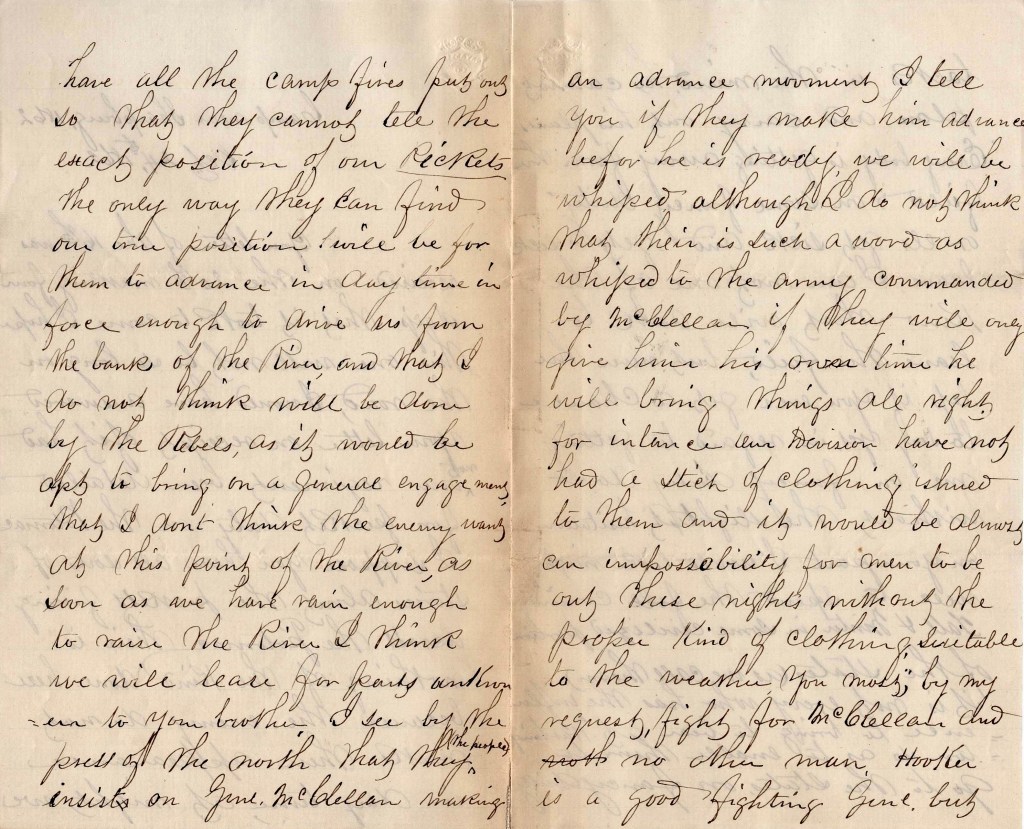
Your letter of the 16th was received on the 20th making four days that it took to come. I hope this one will not be so long on the road. I would have answered your letter on receipt of it had not our regiment been detailed for picket duty on the Potomac. I suppose you hear all sorts of stories about the pickets firing across the Potomac. There is nothing of the kind done here because the enemy do not make their appearance in day time. At night we have all the camp fires put out so that they cannot tell the exact position of our pickets. They only way they can find out our true position will be for them to advance in daytime in force enough to drive us from the bank of the river and that I do not think will be done by the Rebels as it would be apt to bring on a general engagement that I don’t think the enemy wants at this point of the river. As soon as we have rain enough to raise the river, I think we will leave for parts unknown to your brother.
I see by the press of the North that they (the people) insists on Gen. McClellan making an advance movement. I tell you, if they make him advance before he is ready, we will be whipped although I do not think that there is such a word as whipped to the army commanded by McClellan. If they will only give him more time, he will bring things all right. For instance, our Division have not had a stitch of clothing issued to them and it would be almost an impossibility for men to be out these nights without the proper kind of clothing suitable to the weather.
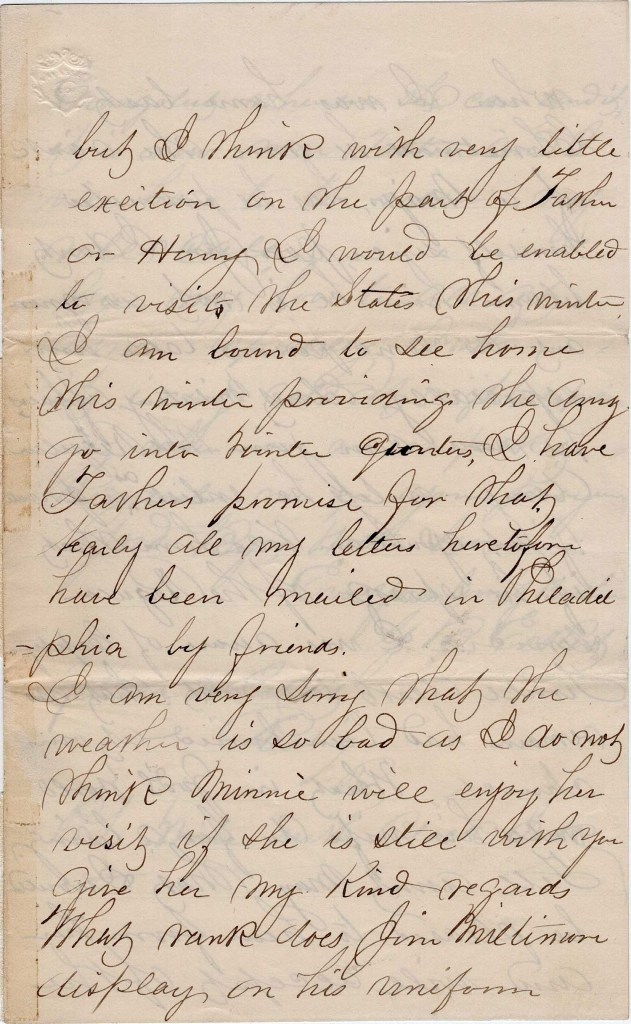
You must by my request fight for McClellan and no other man. Hooker is a good fighting general but lacks in the mind. He cannot plan adn carry out his plans. Everybody is getting away from the field on some fancy duty or else gets sick and gets a sick leave. I am not one of the kind that will ask to leave the field, but never-the-less, if you ever get a chance to say yes in regard to getting me on fancy duty, do so without the slightest hesitation on your part. I would like mighty well to spend the coming fall and winter in some civilized portion of the states (as we call them). It is not every [one] who has the influence to bring to bear at Washington so as to enable them to go to the states on fancy duties, but I think with very little exertion on the part of Father or Henry, I would be enabled to visit the states this winter. I am bound to see home this winter providing the army go into winter quarters. I have Father’s promise for that. Nearly all my letters heretofore have been mailed in Philadelphia by friends.
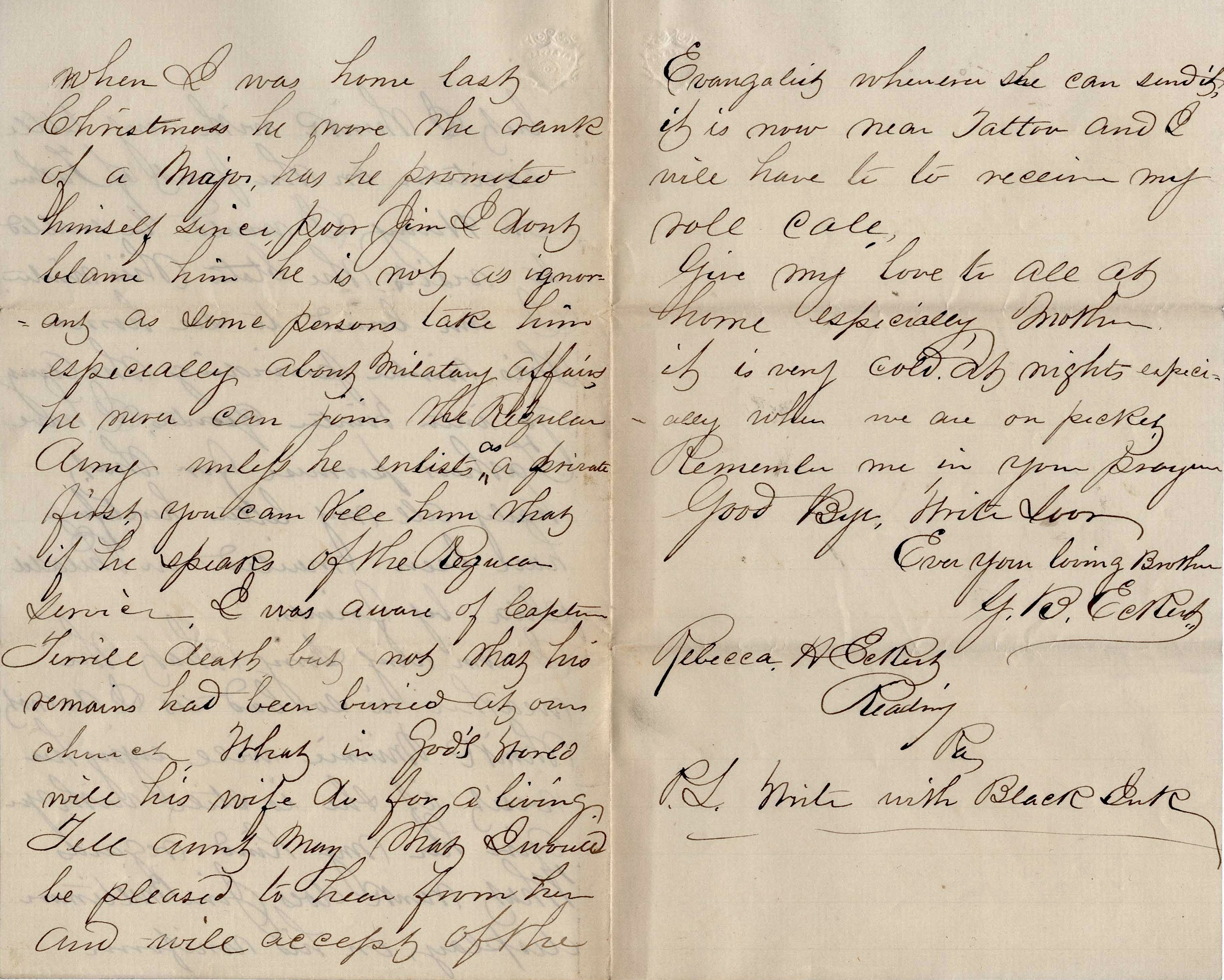
I am very sorry that the weather is so bad as I do not think Minnie will enjoy her visit if she is still with you. Give her my kind regards. What rank does Jim Miltimore display on his uniform? When I was home last Christmas, he wore the rank of a Major. Has he promoted himself since? Poor Jim, I don’t blame him. He is not as ignorant as some persons take him—especially about military affairs. He never can join the Regular Army unless he enlists as a private first. You can tell him that if he speaks of the Regular Service. I was aware of Captain Terrill’s death but not that his remains had been buried at our church. What in God’s world will his wife do for a living? Tell Aunt May that I would be pleased to hear from her and will accept of the Evangelist whenever she can send it. It is now near Tattoo and I will have to receive my roll call.
Give my loveto all at home—especially Mother. It is very cold at nights, especially when we are on picket. Remember me in your prayers. Goodbye. Write soon. Ever your loving brother, — G. B. Eckert
Rebecca A. Eckert, Reading, Pa.
P. S. Write with black ink.
Letter 4
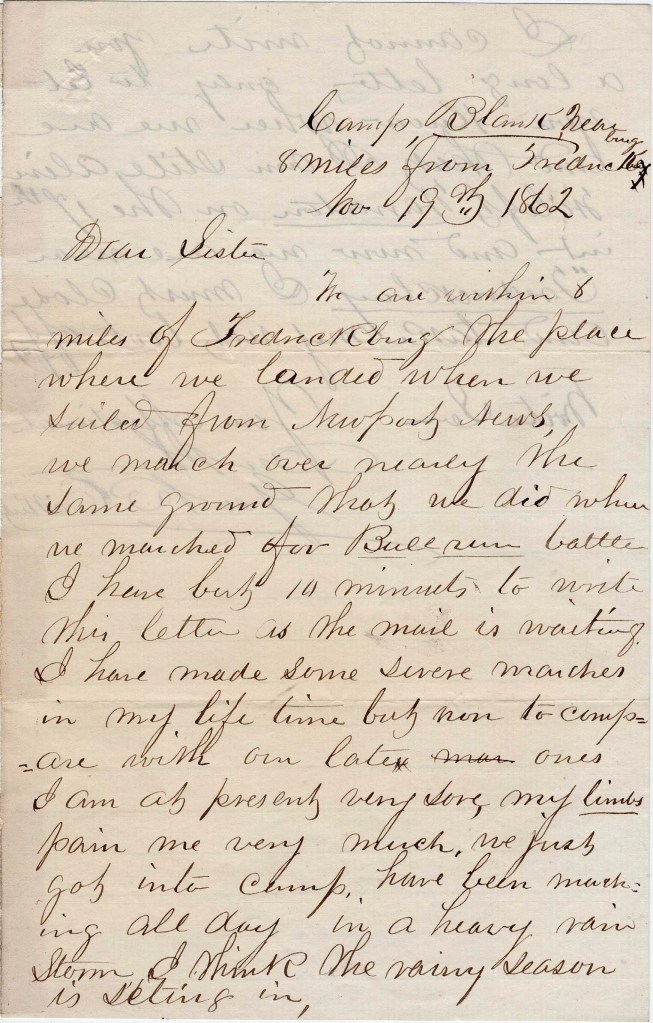
Camp Blank, 8 miles from Fredericksburg
November 19th 1862
Dear Sister,
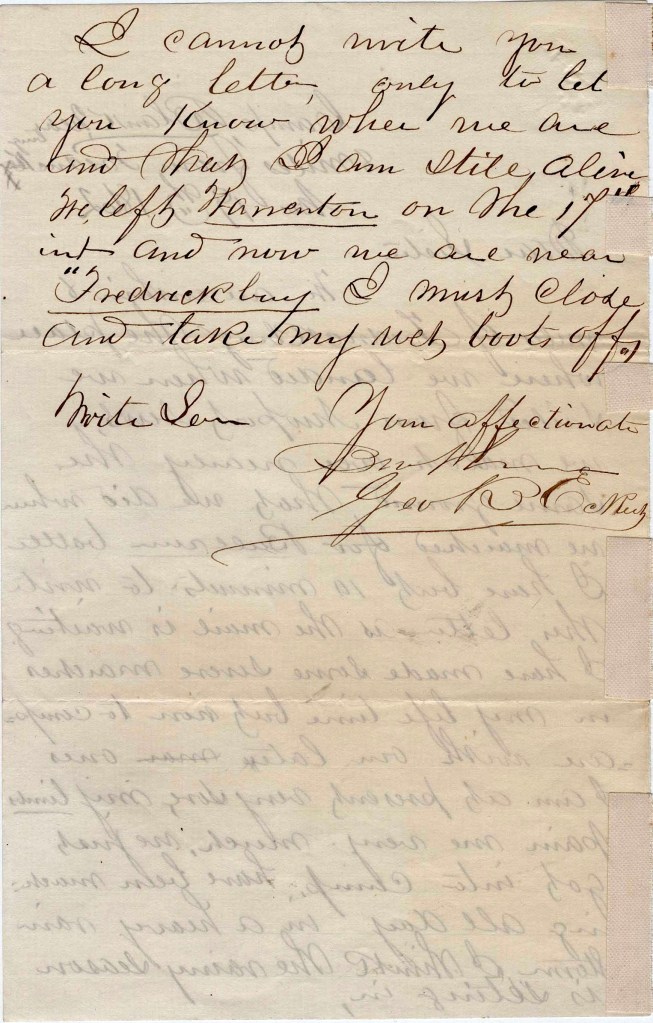
We are within 8 miles of Fredericksburg—the place where we landed when we sailed from Newport News. We marched over nearly the same ground that we did whenwe marched for Bull Run battle. I have but 10 minutes to write this letter as the mail is waiting. I have made some severe marches in my life time but none to compare with our late ones. I am at present very sore. My limbs pain me very much. We just got into camp. Have been marching all day in a heavy rain storm. I think the rainy season is setting in.
I cannot write you a long letter—only to let you know where we are and that I am still alive. We left Warrenton on the 17th inst. and now we are near Fredericksburg. I must close and take my wet boots off. Write soon. Your affectionate brother, — Geo. B. Eckert
Letter 5
Camp near Fredericksburg, Virginia
December 3d, 1862
Dear Sister,
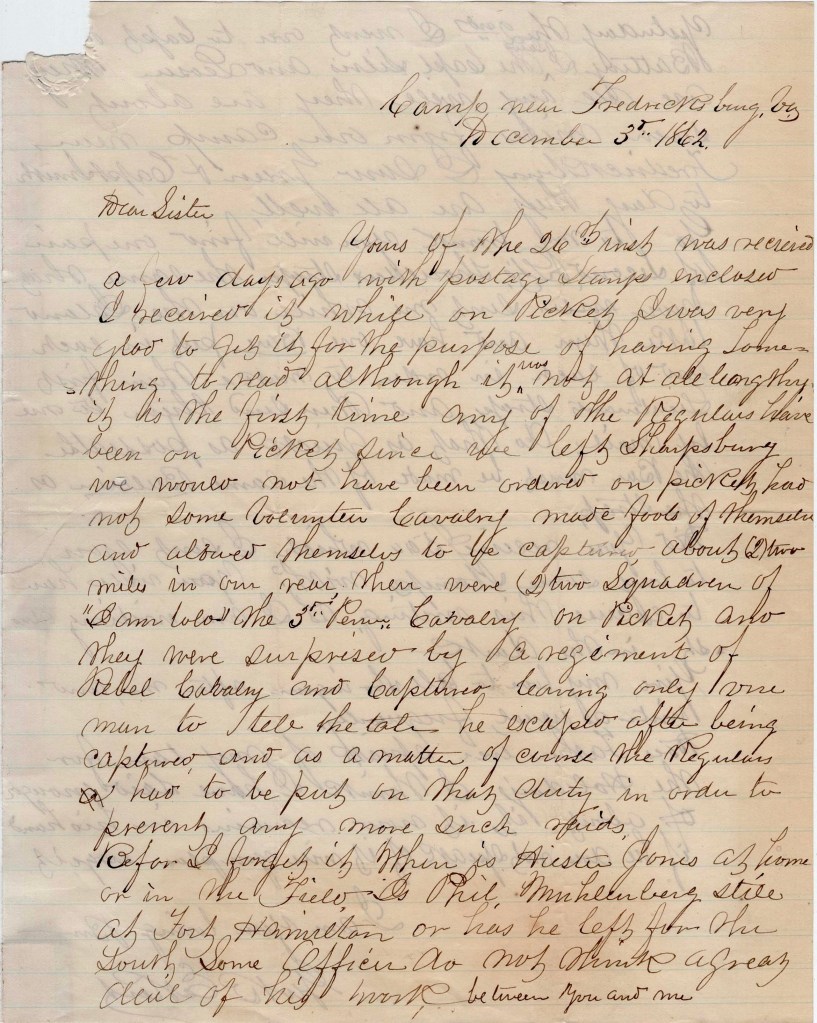
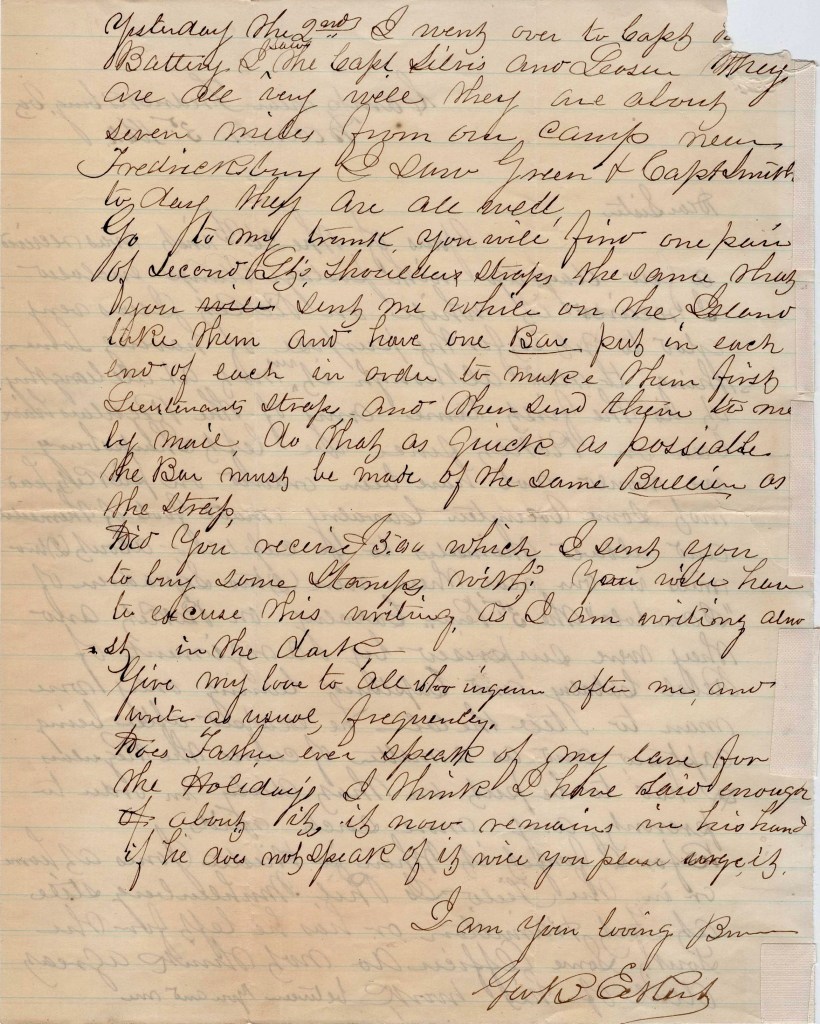
Yours of the 26th inst. was received a few days ago with postage stamps enclosed. I received it while on picket. I was very glad to get it for the purpose of having something to read although it was not at all lengthy. It is the first time any of the Regulars have been on picket since we left Sharpsburg. We would not have been ordered on picket had not some volunteer cavalry made fools of themselves and allowed themselves to be captured about two miles in our rear. There were two squadrons of “I am [ ]” the 5th Penna. Cavalry on picket, and they were surprised by a regiment of Rebel cavalry and captured, leaving only one man to tell the tale. He escaped after being captured and as a matter of course the Regulars had to be put on that duty in order to prevent any more such raids.
Before I forget it, where is Hiester Jones—at home or in the field? Is Phil <uhlenburg still at Fort Hamilton or has he left for the South? Some officers do not think a great deal of his work, between you and me.
Yesterday the 2nd, I went over to Capt. [paper torn] Battery. I saw the Capt. Silvis and Leasure. They are all very well. They are about seven miles from our camp near Fredericksburg. I saw Green & Capt. Smith today. They are all well.
Go to my trunk. You will find one pair of 2nd Lt.’s shoulder straps—the same that you sent me while on the Island. Take them and have one bar put in each end of each in order to make them 1st Lieutenant’s straps and then send them to me by mail. Do that as quick as possible. The bar must be made of the same Bullion as the strap.
Did you receive $5 which I sent you to buy some tamps with? You will have to excuse this writing as I am writingalmost in the dark. Give my love to all who inquire after me and write as usual, frequently. Does Father ever speak of my love for the Holidays? I think I have said enough about it. It now remains in his hands. If he does not speak of it, will you please urge it?
I am your loving brother, — Geo. B. Eckert
Letter 6
Camp near Fredericksburg, Va.
December 18th 1862
Dear Sister,
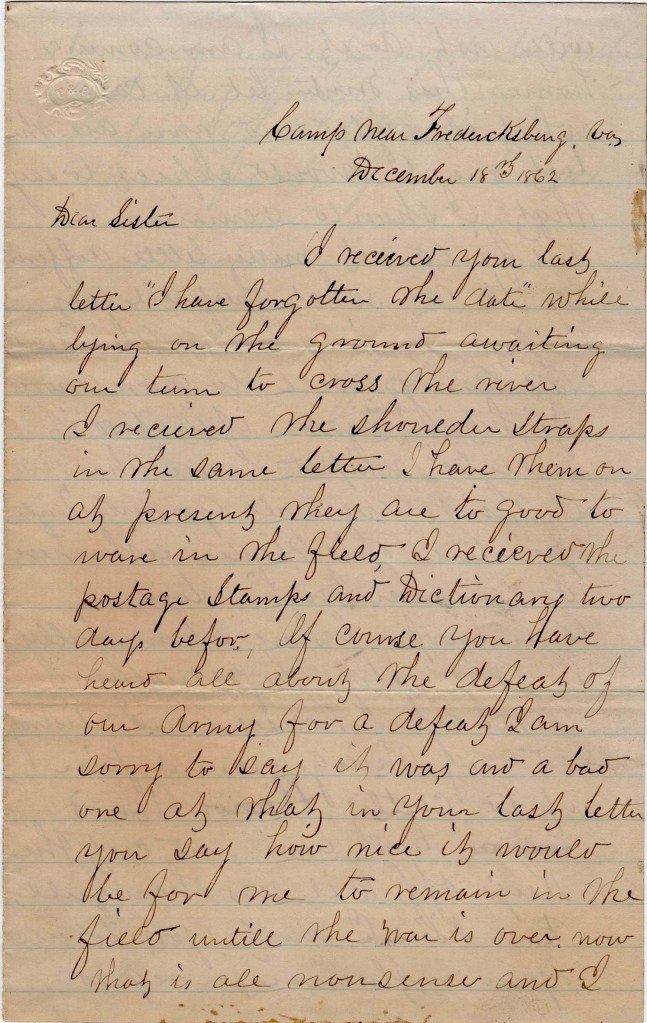
I received your last letter “I have forgotten the date” while lying on the ground awaiting our turn to cross the river. I received the shoulder straps in the same letter. I have them on at present. They are too good to wear in the field. I received the postage stamps and dictionary two days before.
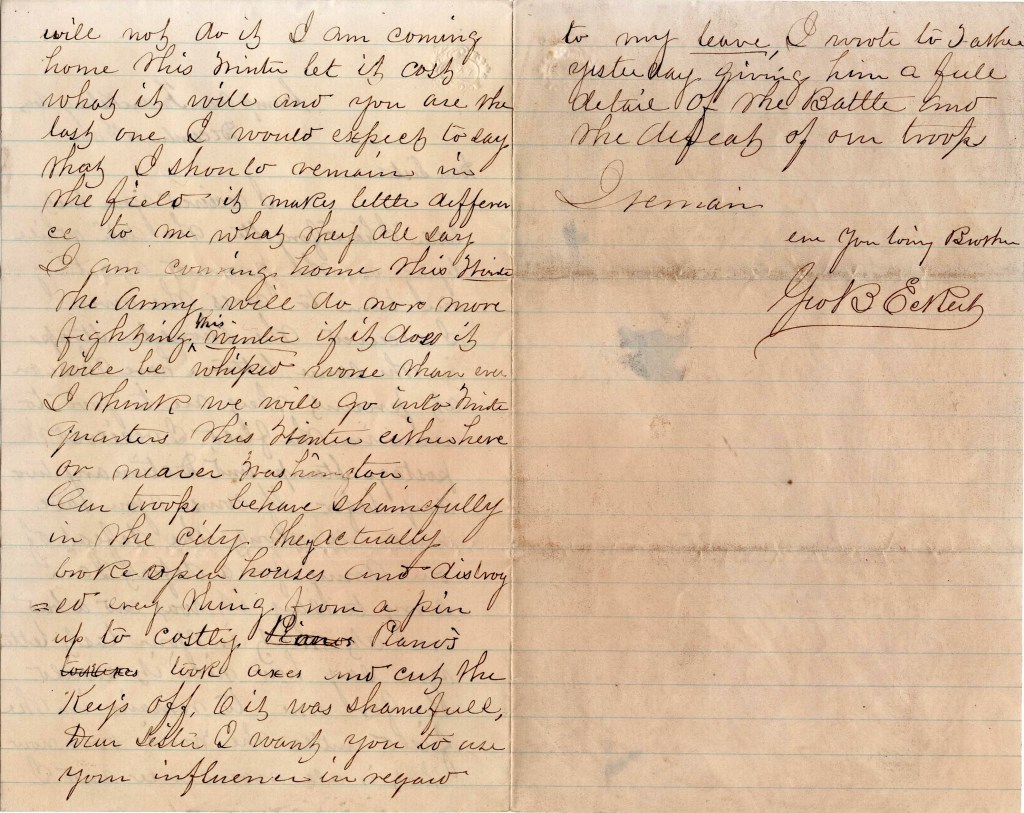
Of course you have heard all about the defeat of our Army for a defeat, I am sorry to say, it was—and a bad one at that. In your last letter you say how nice it would be for me to remain in the field until the war is over. Now that is all nonsense and I will not do it. I am coming home this winter, let it cost what it will, and you are the last one I would expect to say that I should remain in the field. It makes little difference to me what they all say, I am coming home this winter. The army will do no more fighting this winter. If it does, it will be whipped worse than ever. I think we will go into winter quarters this winter either here or nearer Washington.
Our troops behaved shamefully in the city. They actually broke open houses and destroyed everything from a pin up to costly pianos, took axes and cut the keys off. Oh! it was shameful. Dear sister, I want you to use your influence in regard to my leave. I wrote to Father yesterday giving him a full detail of the battle and the defeat of our troops. I remain ever your loving brother, — Geo. B. Eckert
Letter 7
Camp near Fredericksburg, Va.
December 30th 1862
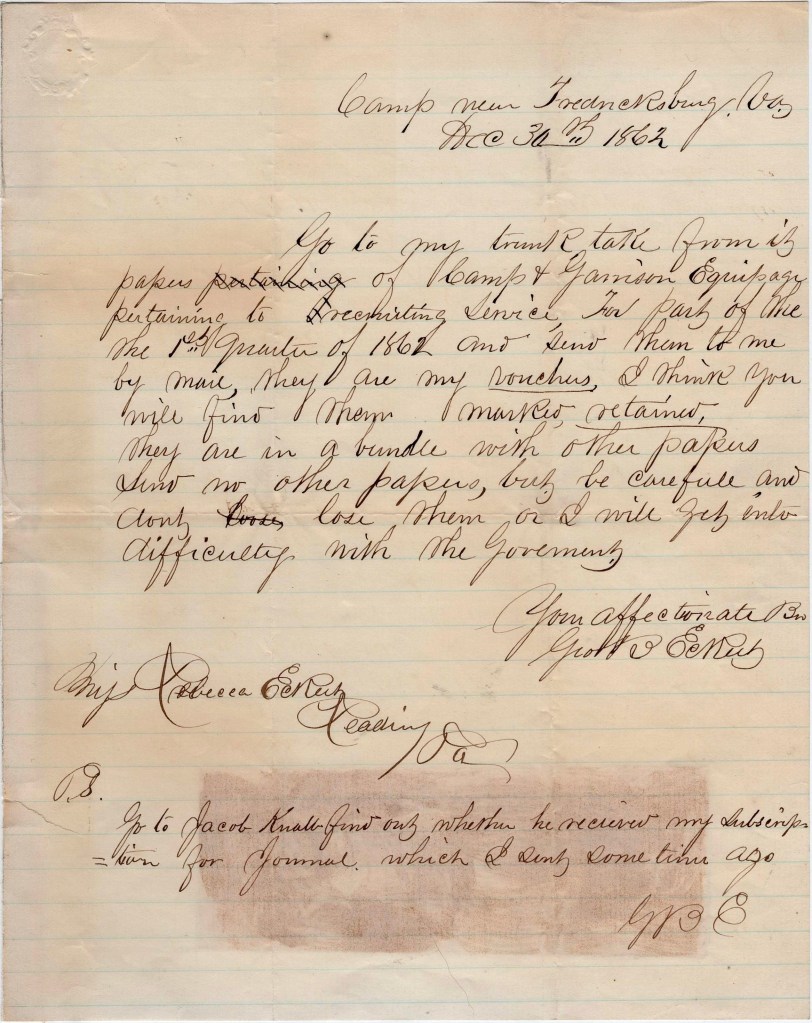
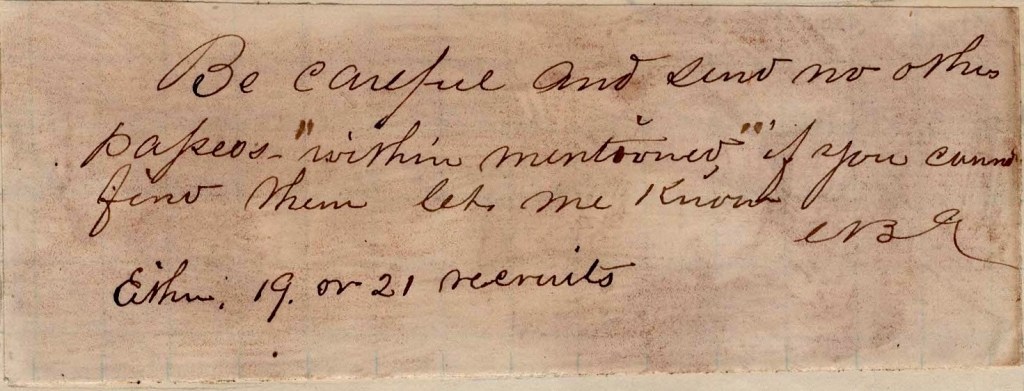
Go to my trunk, take from it papers of Camp & Garrison Equipage pertaining to recruiting service. For part of the 1st quarter of 1862 and send them to me by mail. They are my vouchers. I think you will find them marked retained. They are in a bundle with other papers. Send no other papers but be careful and don’t lose them or I will get into difficulty wit hthe Government. Your affectionate brother, — Geo. B. Eckert
Miss Rebecca Eckert, Reading, Pa.
P. S. Go to Jacob Knalb [and] find out whether he received my subscription for Journal which I sent some time ago. — G. B. E.
Letter 8
Camp near Fredericksburg, Va.
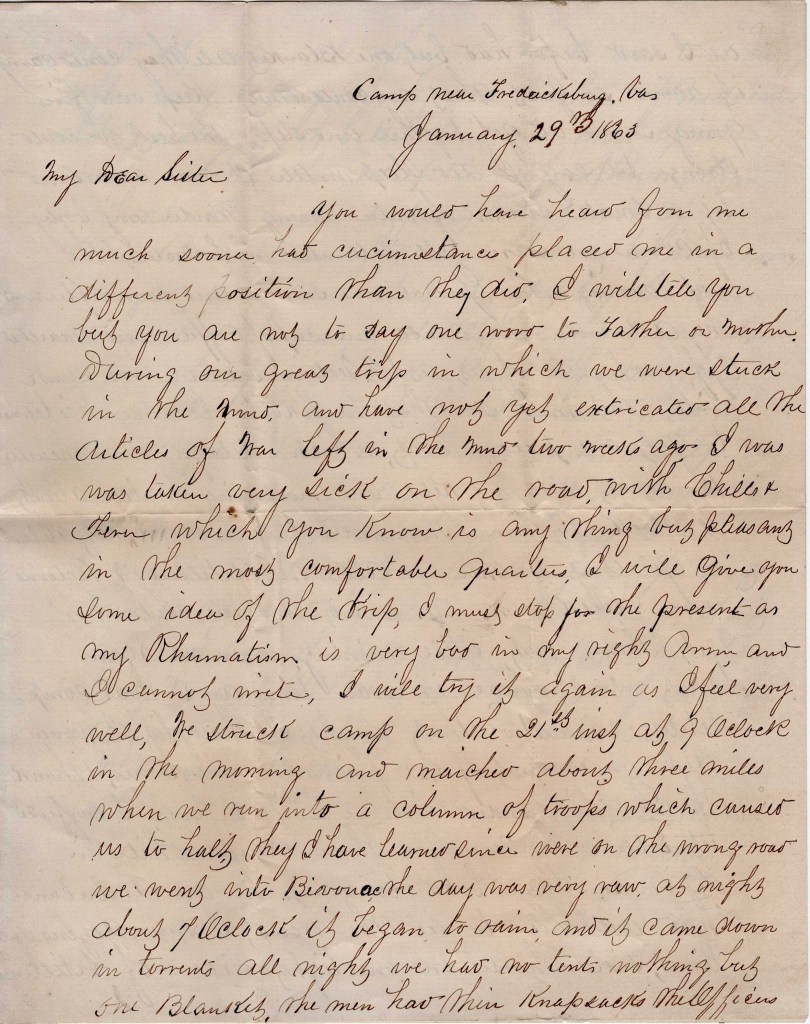
January 29th 1863
My dear Sister,
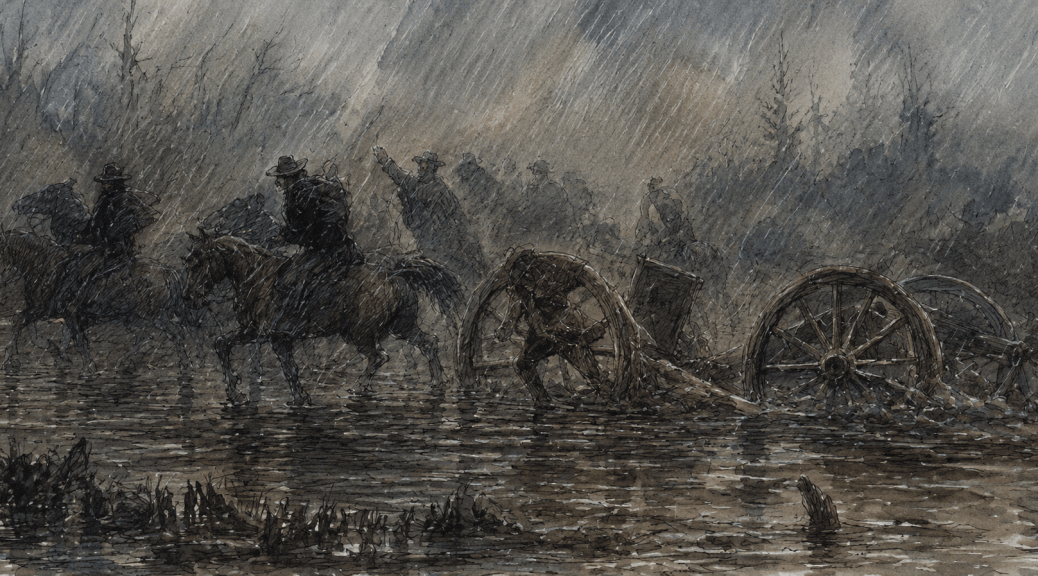
You would have heard from me much sooner but circumstances placed me in a different position than they did, I will tell you but you are not to say one word to Father or Mother. During our great trip in which we were stuck in the mud and have not yet extricated all the articles of war left in the mud two weeks ago, I was taken very sick on the road with chills and fever which you know is anything but pleasant in the most comfortable quarters. I will give you some idea of the trip [but] I must stop for the present as my rheumatism is very bad in my right arm and I cannot write.
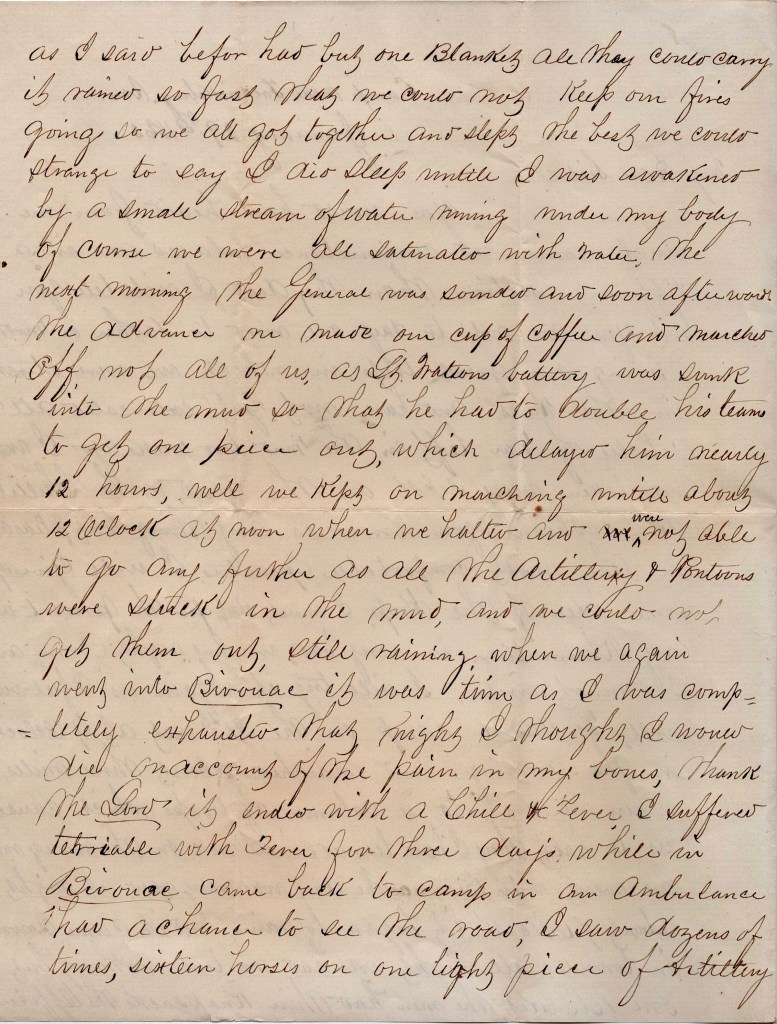
I will try it again as I feel very well [now]. We struck camp on the 21st inst. at 9 o’clock in the morning and marched about three miles when we run into a column of troops which caused us to halt. They, I have learned since, were on the wrong road. We went into bivouac. The day was very raw. At night, about 7 o’clock, it began to rain and it came down in torrents all night. We had no tents—nothing but one blanket. The men had their knapsacks. The officers, as I said before, had but one blanket—all they could carry. It rained so fast that we could not keep our fires going so we all got together and slept the best we could. Strange to say, I did sleep until I was awakened by a small stream of water running under my body. Of course, we were all saturated with water.
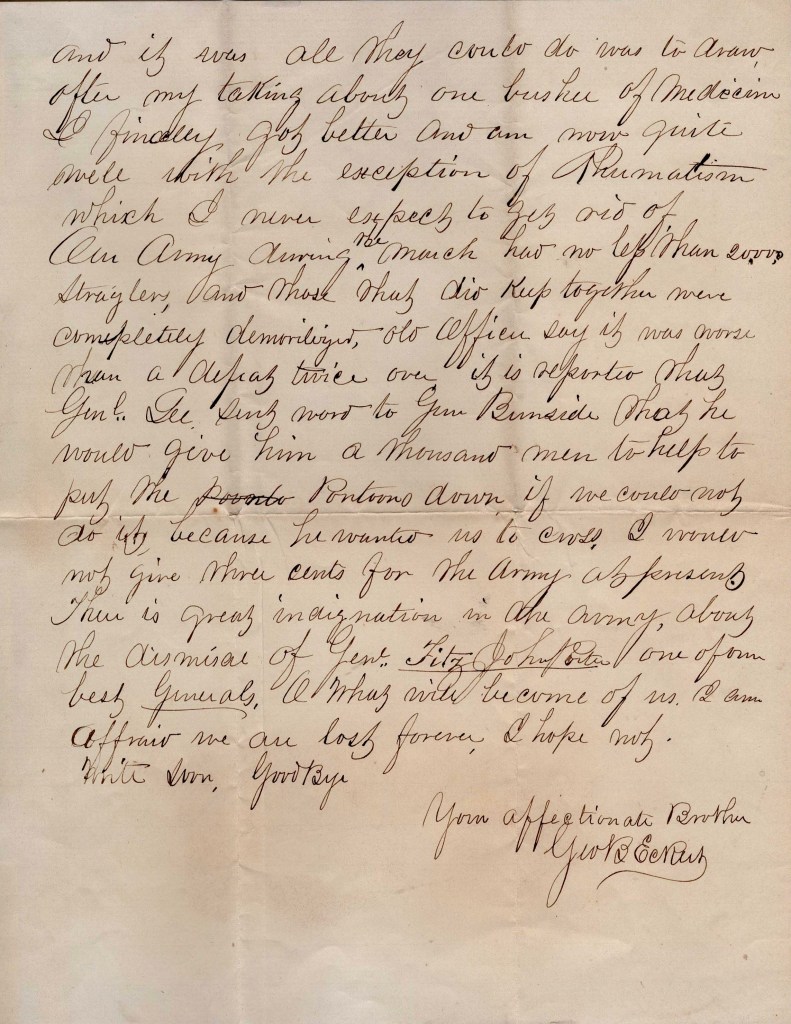
The next morning, The General was sounded and son afterward the advance. We made our cup of coffee and marched off, not all of us, as Lt. Watson’s Battery was sunk into the mud so that he had to double his teams to get one piece out which delayed him nearly 12 hours. Well we kept on marching until about 12 o’clock at noon when we halted and were not able to go any further all all the artillery & pontoons were stick in the mud and we could not get them out, still raining, when we again went into bivouac. It was time as I was completely exhausted. That night I thought I would die on account of the pain in my bones. Thank the Lord it ended with a chill and fever. I suffered terrible with fever for three days while in bivouac [and] came back to camp in an ambulance. Had a chance to see the road. I saw dozens of times sixteen horses on one light piece of artillery adn it was all they could do was to draw.
After taking about one bushel of medicine, I finally got better and am now quite well with the exception of rheumatism which I never expect to get rid of. Our army during the march had no less than 20,000 stragglers and those that did keep together were completely demoralized. Old officers say it was worse than a defeat twice over. It is reported that Gen. Lee sent word to Gen. Burnside that he would give him a thousand men to help to put the pontoons down if we could only do it, because he wanted us to cross. I would not give three cents for the army at present. There is great indignation in the army about the dismissal of Gen. Fitz John Porter, one of our best generals. Oh what will become of us. I am afraid we are lost forever. I hope not. Write soon. Goodbye. Your affectionate brother, — Geo. B. Eckert