The following letters were written by William Johnston (1827-1922) who was employed as a grocer in Newburyport, Essex county, Massachusetts, prior to the Civil War. He was married to Julia French Moody (b. 1832) in December 1857. Their first child, Henry W. B. (“Beta”) Johnston, was born in January 1859 but died young. Their second child (her birth mentioned in Letter 1), was Agnes L. Johnston, born 19 August 1861. William’s brother, John Quincy (“Quince”) Adams Johnston, married Julia’s younger sister, Lucy Stevens Moody (1837-1860). Quince served in Co. A, 17th Massachusetts Infantry (see 1863: John Quincy Adams Johnston to William Johnston). William and Quince were the children of shoemaker William Johnston, Sr. (1805-1881) and Lavina Flint (1806-Aft1860) of Newburyport.
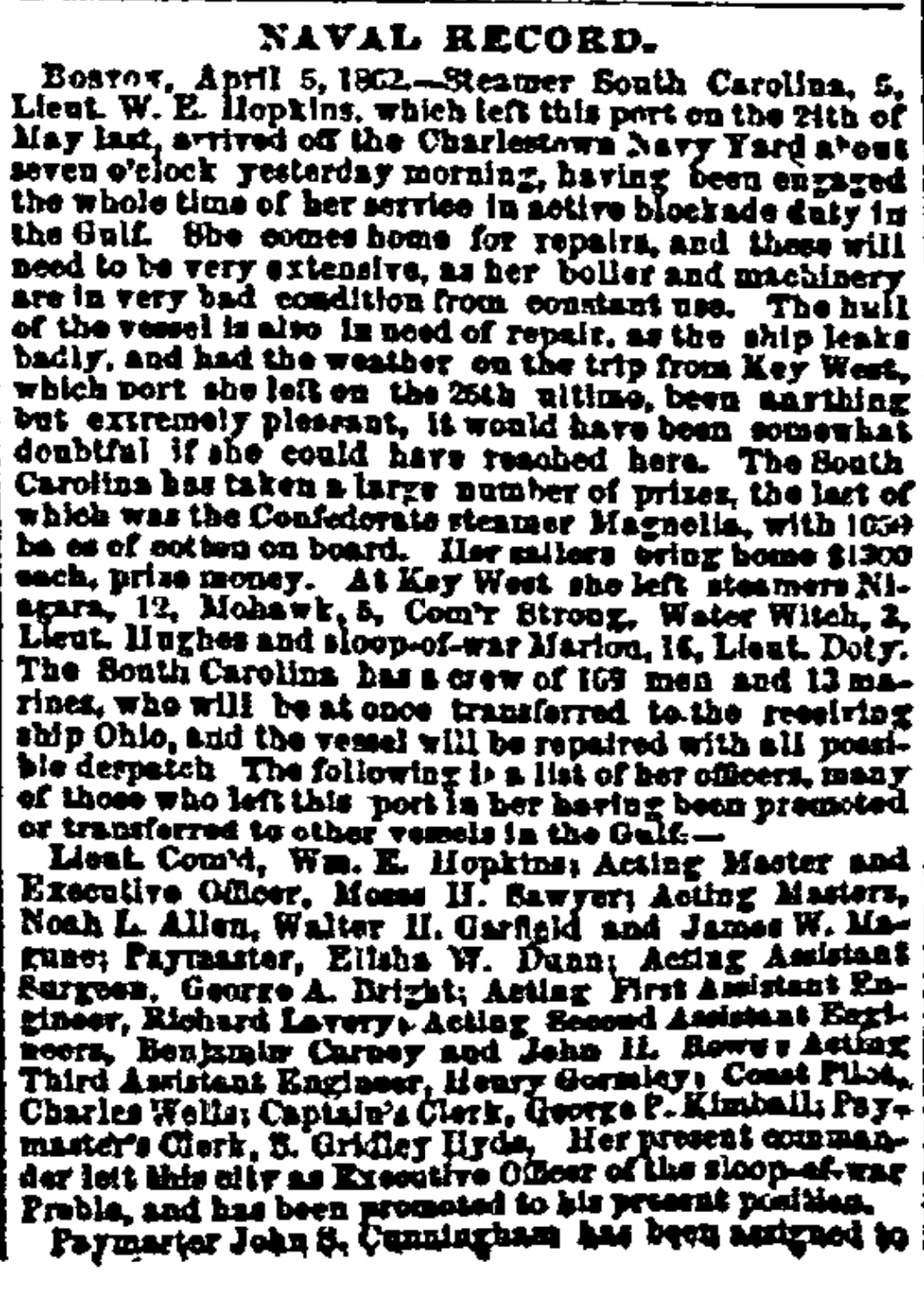
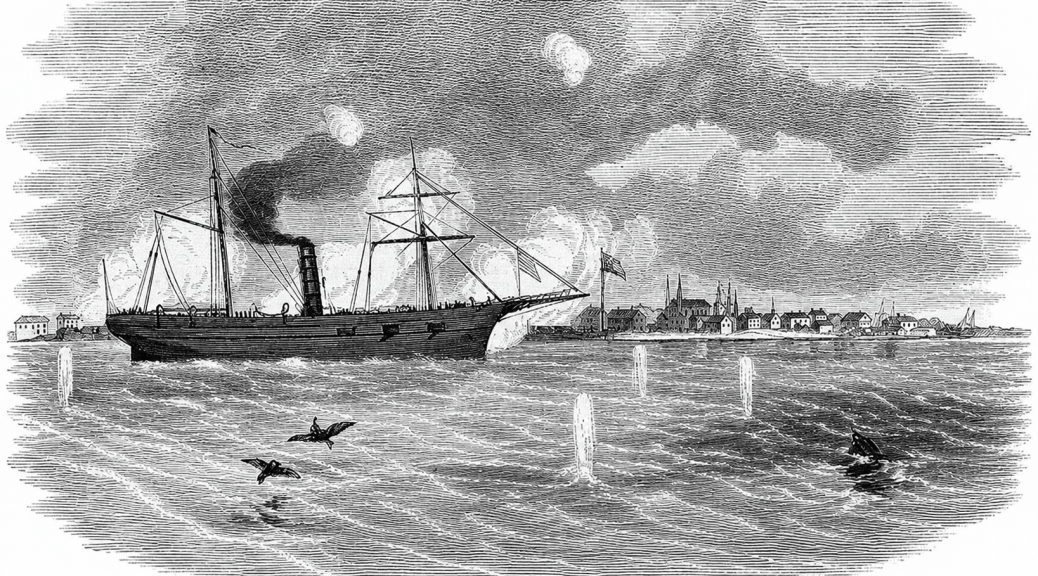
We learn from these two letters that William Johnston enlisted in the US Navy during the Civil War, serving one year aboard the US Steamer South Carolina on duty in the Gulf Blockading Squadron. His first assignment aboard the steamer was as quarter master but he was later reassigned to be gunner’s mate. His letters describe taking blockade runners as prizes, particularly the sidewheel steamer Magnolia out of New Orleans.
Letter 1
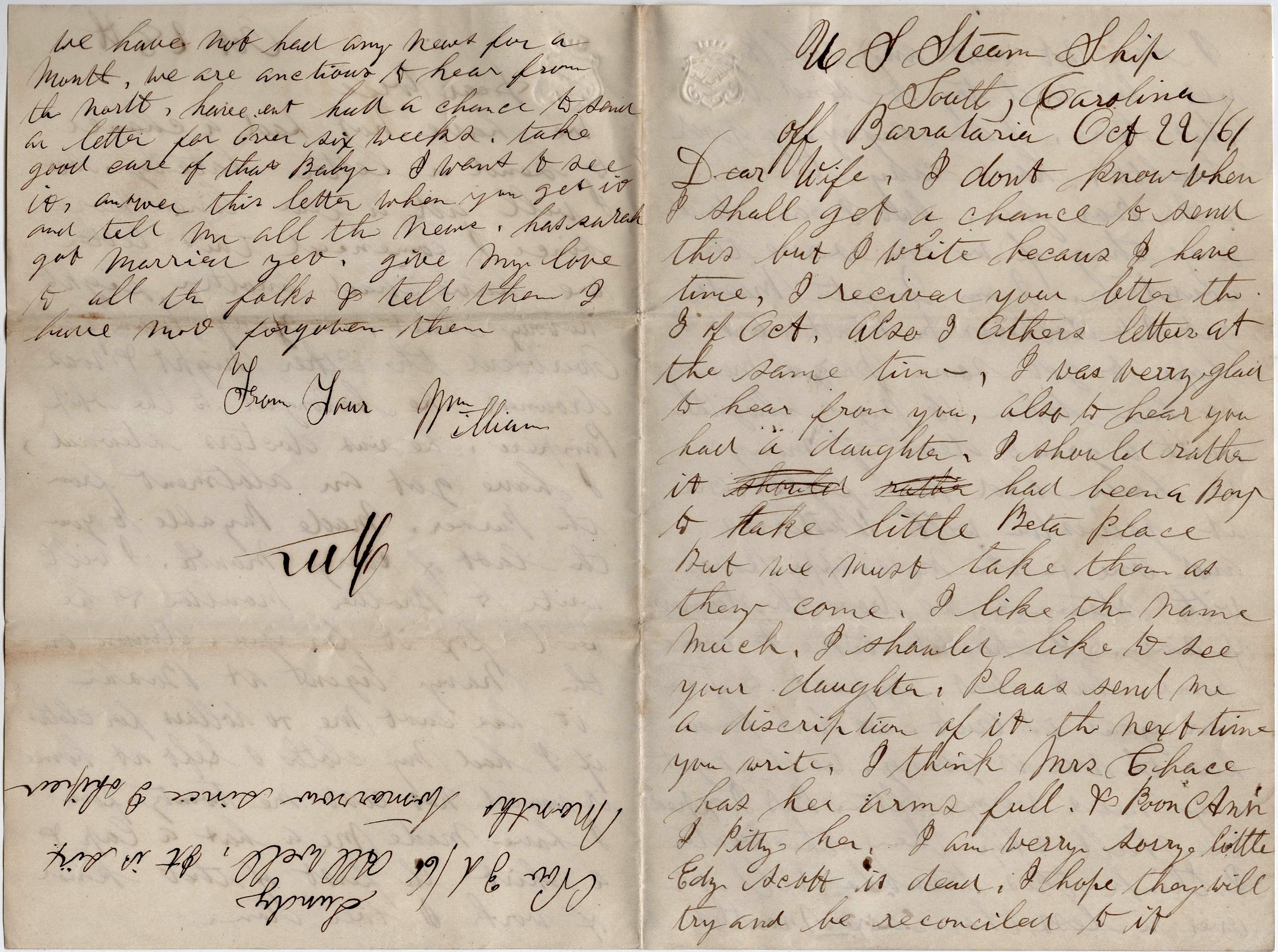
US Steamship South Carolina
Off Barataria
October 22, 1861
Dear wife,
I don’t know when I shall get a chance to send this but I write because i have time. I received your letter the 8th of October. Also two letters at he same time. I was very glad to hear from you. Also to hear you had a daughter. I should rather it had been a boy to take little Beta’s place but we must take them as they come. I like the name [Agnes] much. I should like to see your daughter. Please send me a description of it the next time you write. I think Mrs. Chace has her arms full & Boon Ann, I pity her. I am very sorry little Eddy Scott is dead. I hope they will try and be reconciled to it.
I have not sent any half page yet but will try to send it this time. I am enjoying good health, have easy times, rather poor fare, but I can stand anything if we can save the country. I am quartermaster, get 24 dollars per month, and I hope to get some prize money. We have taken 16 prizes altogether worth a great deal of money. We have had two fights—one at Galveston with batteries, and one in the Mississippi river with steamers. We drove the steamers up river.
I should like to come home but don’t expect to till our year is out. We don’t know how the war is going. We don’t get any news very often. But I expect we shallwhip them this winter. I think this trouble will be over in less than six months.
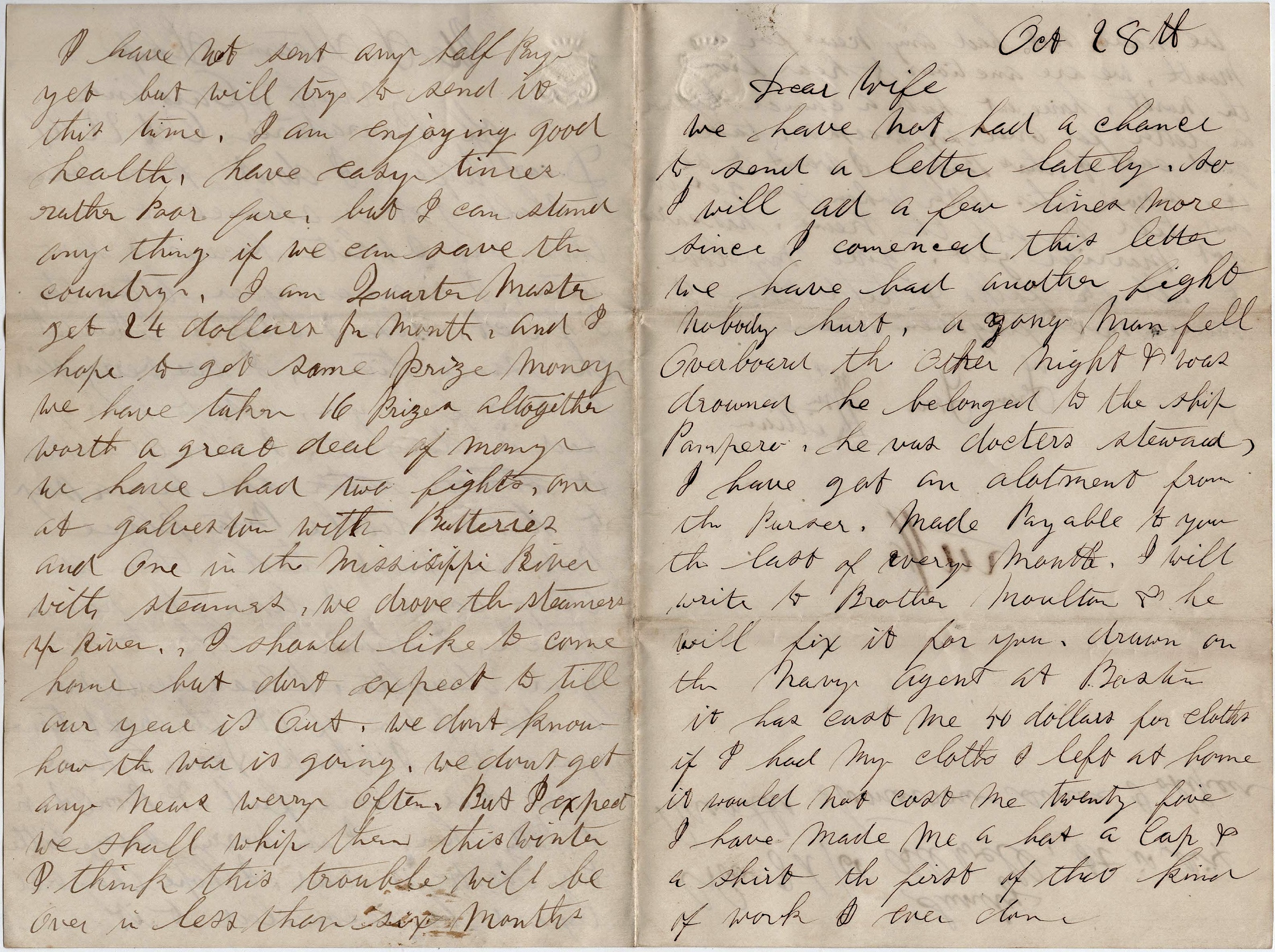
October 28th. Dear wife, we have not had a chance to send a letter lately so I will add a few lines more. Since I commenced this letter, we have had another fight. Nobody hurt. A young man fell overboard the other night and was drowned. He belonged to the [store] ship Pampero. He was doctor’s steward. 1
I have got an allotment from the purser made payable to you the last of every month. I will write to brother Moulton and he will fix it for you, drawn on the Navy agent at Boston. It has cost me 40 dollars for clothes. If I had my clothes I left at home, it would not cost me twenty-five. I have made me a hat, a cap, and a short—the first of that kind of work I ever done.
We have not had any news for a month. We are anxious to hear from the North. Haven’t had a chance to send a letter for over six weeks. Take good care of that baby. I want to see it. Answer this letter when you get it and tell me all the news. Has Sarah got married yet? Give my love to all the folks and tell them I have not forgotten them, From your William
Sunday, November 3rd, 1861 All well. It is six months tomorrow since I shipped.
1 The surgeon’s steward was David Brainard Tilton (1840-1861), the son of Rev. David Tilton (1806-1869) and Mary Felton Bachelder (1806-1848). He fell overboard while attempting to pass from one vessel to another. “every exertion was made to save him, but it was dark, and the sea very rough, he could not be found. He was a young man of much promise, and his sudden death will be deeply felt by his relatives and numerous friends in this city [Lowell]. [Source: Lowell Daily Citizen & News, Monday, November 11, 1861]
Letter 2
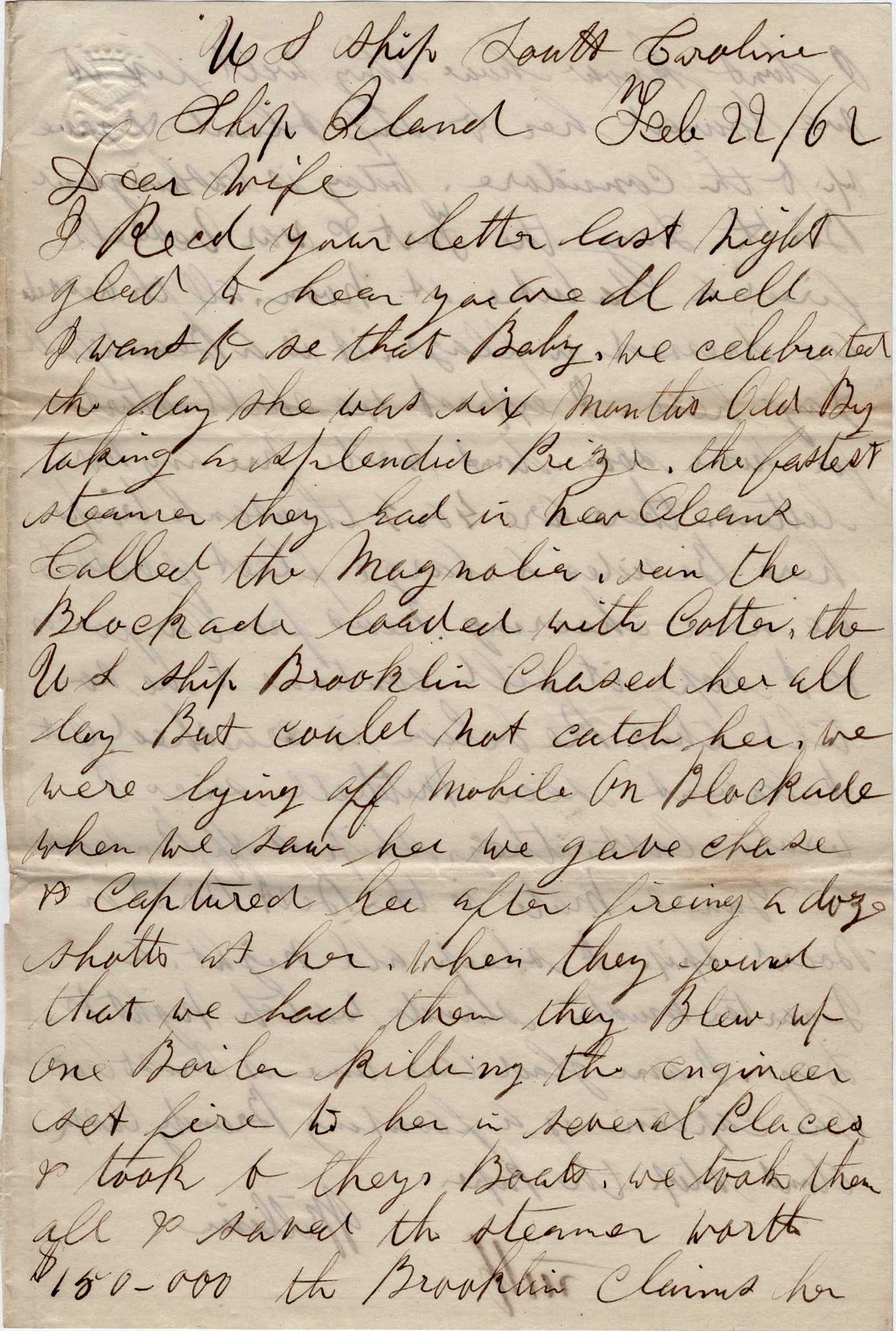
US Ship South Carolina
Ship Island
February 22, 1862
Dear wife,
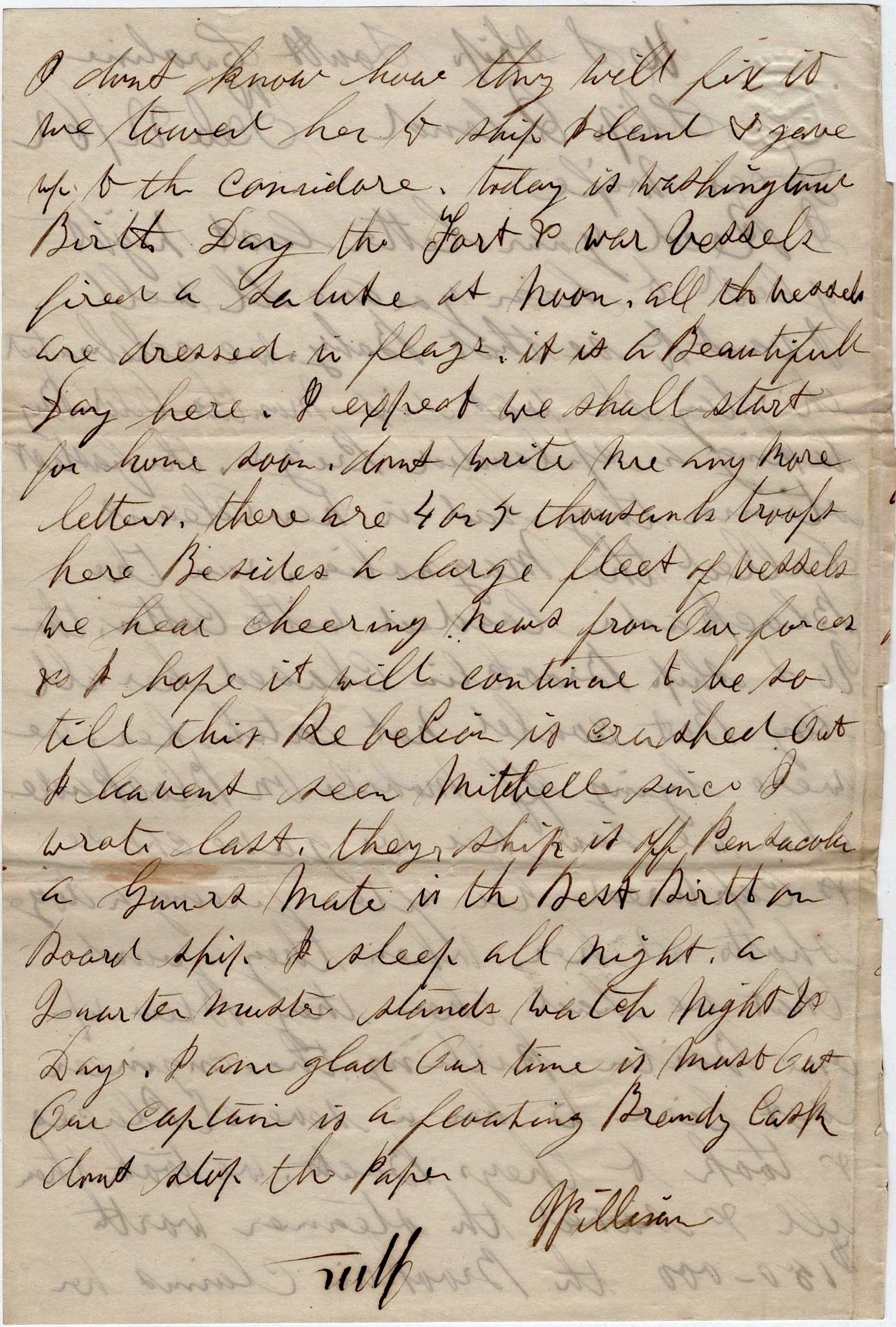
I received your letter last night. Glad to hear you are all well. I want to see that baby. We celebrated the day she was six months old by taking a splendid prize—the fastest steamer they had in new Orleans, called the Magnolia. [She] ran the blockade loaded with cotton. The US Ship Brooklyn chased her all day but could not catch her. We were lying off Mobile on blockade when we saw her, We gave chase & captured her after firing a dozen shots at her. When they found that we had them, they blew up one boiler, killing the engineer, set fire to her in several places, & took to their boats. We took them all & saved the steamer worth $150,000. The Brooklyn claims her. I don’ know how they will fix it. We towed her to Ship Island & gave up to the Commodore.
Today is Washington’s Birthday. The fort & vessels fired a salute at noon. All the vessels are dressed in flags. It is a beautiful day here. I expect we shall start for home soon. Don’t write me any more letters. There are 4 or 5 thousand troops here besides a large fleet of vessels. We hear cheering news from our forces & I hope it will continue to be so till this rebellion is crushed out. I haven’t seen Mitchell since I wrote last. Their ship is off Pensacola. A gunner’s mate is the best berth on board ship. I sleep all night. A quarter master stands watch night and day. I am glad our time is most out. Our captain [Lt. William Evelyn Hopkins (1821-1894)] is a floating brandy cask.
Don’t stop the paper, — William