
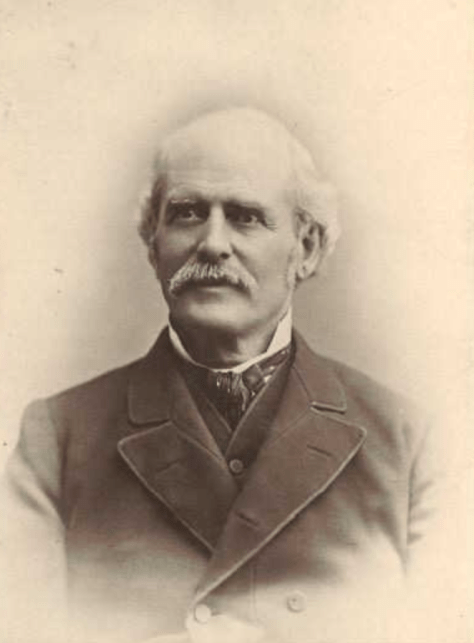
The following letters were written by Capt. Calvin Rogers Johnson (1822-1897), Co. I, 14th Wisconsin Volunteer Infantry, to his wife, Lucy Abigail (Marsh) Johnson Mississippi in 1862 and 1863. The couple were married in 1852 and they had six children. Calvin was a native of Holliston, Massachusetts; his parents were Calvin John son (1793-1826) and Nancy Rogers (1790-1861).
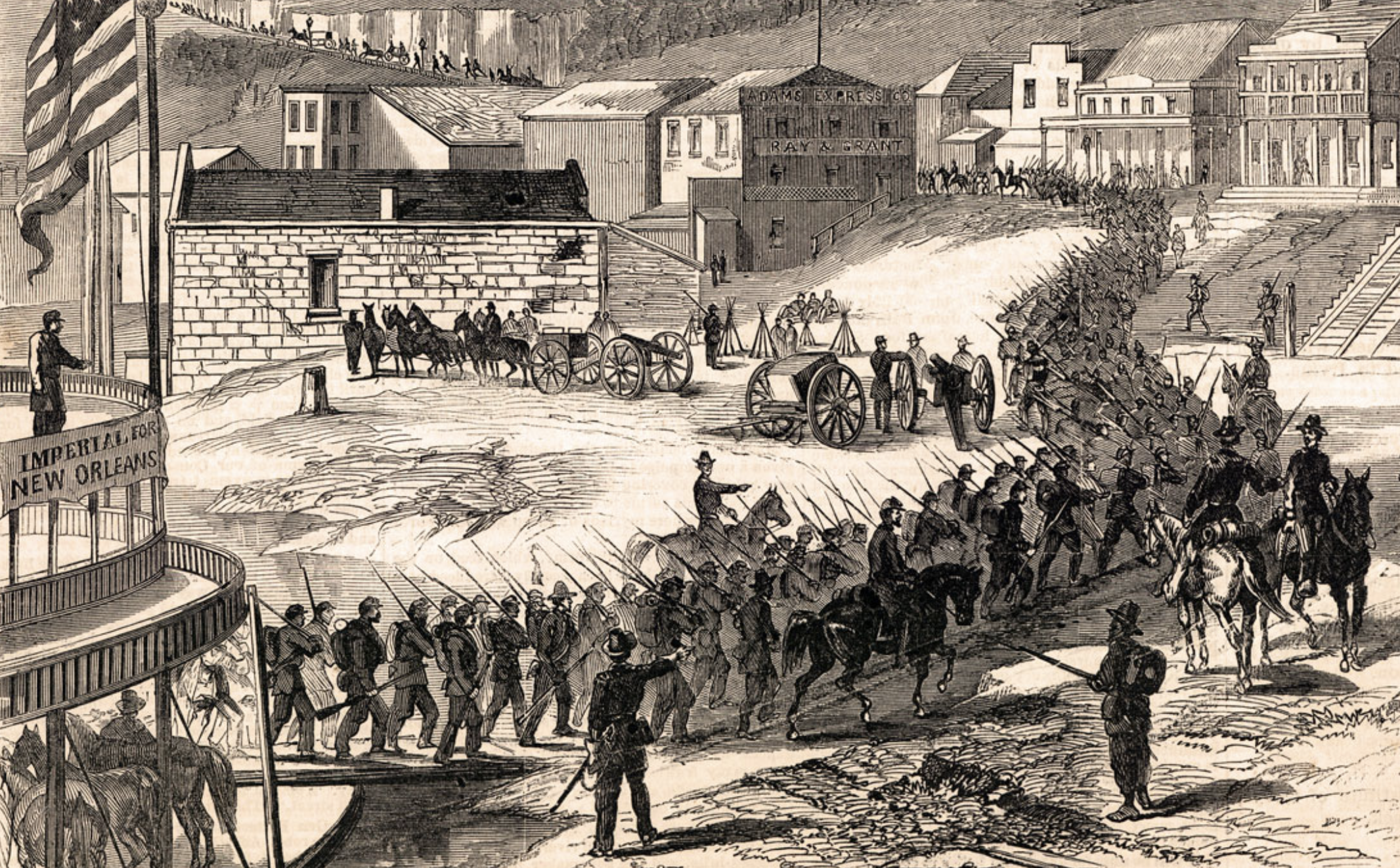
Calvin’s 2nd letter tells of the arrival of the regiment at Natchez with a nice description of the location and citizens. Following the surrender of Vicksburg on July 4th, 1863, the regiment embarked with the rest of the brigade of General Ransom and proceeded to Natchez of which place they took possession on the 14th. They remained at Natchez until the 9th of October. There is a nice railroad embossment on upper left corner of the sheet.
It is noted that one of Captain Johnson’s letter, written from Abbeville, Mississippi on 4 December 1862, that is in the Library of Congress has been digitized and is available on-line.
See also—1864: Andrew Jackson Manley to Calvin R. Johnson on Spared & Shared 23.
Letter 1
[Note: This letter is from the collection of Greg Herr and was offered for transcription and publication on Spared & Shared by express consent.]
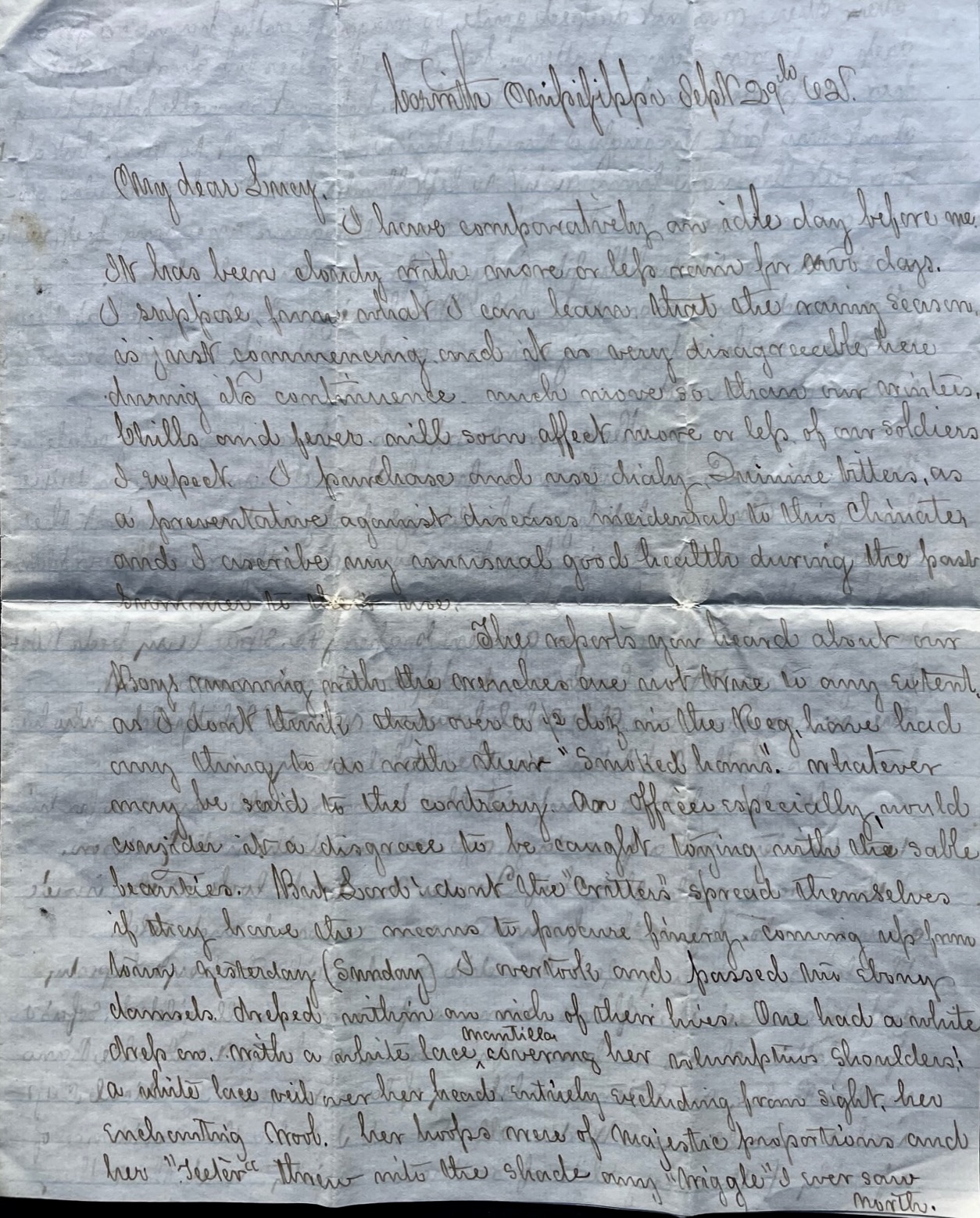
Corinth, Mississippi
September 29, 1862
My dear Lucy
I have comparatively an idle day before me. It has been cloudy with more or less rain for two days. I suppose from what I can learn that the rainy season is just commencing and it is very disagreeable here during its continuance, much more so than our winters. Chills and fever will soon affect ,ore or less of our soldiers, I expect. I purchase and use daily quinine bitters as a preventative against diseases incidental to this climate and I ascribe my unusual good health during the past summer to this use.
The reports you heard about our Boys running with the wenches are not true to any extent as I don’t think that over half a dozen in the regiment have had anything to do with their “smoked hams,” whatever may be said to the contrary. An officer especially would consider it a disgrace to be caught toying with the sable beauties. But Lord! don’t the “critters” spread themselves if they have the means to procure finery.
Coming up from town yesterday (Sunday), I overtook and passed two ebony damsels dressed within an inch of their lives. One had a white dress on with a white lace mantilla covering her voluptuous shoulders; a white lace veil over her head entirely excluding from sight her enchanting wool. Her hoops were of majestic proportions and her “Teeter” threw into the shade any “wiggle” I ever saw North. The other was not dressed quite so magnificently, having on for a dress a fancy lawn pattern, but about 6 inches too short for style. Her hoops were as large as the others but not so well fitted, being about two foot through I should think from front to rear, but about four feet through from right to left flank. Her head was also covered with a lace veil but her shoes were brogans encasing feet which a No. 11 would tightly fit, judging from a casual glance.
The road was crowded with “Black niggers” who gazed at the beauties with admiring glances and no doubt tingling sensations under the waistcoat.
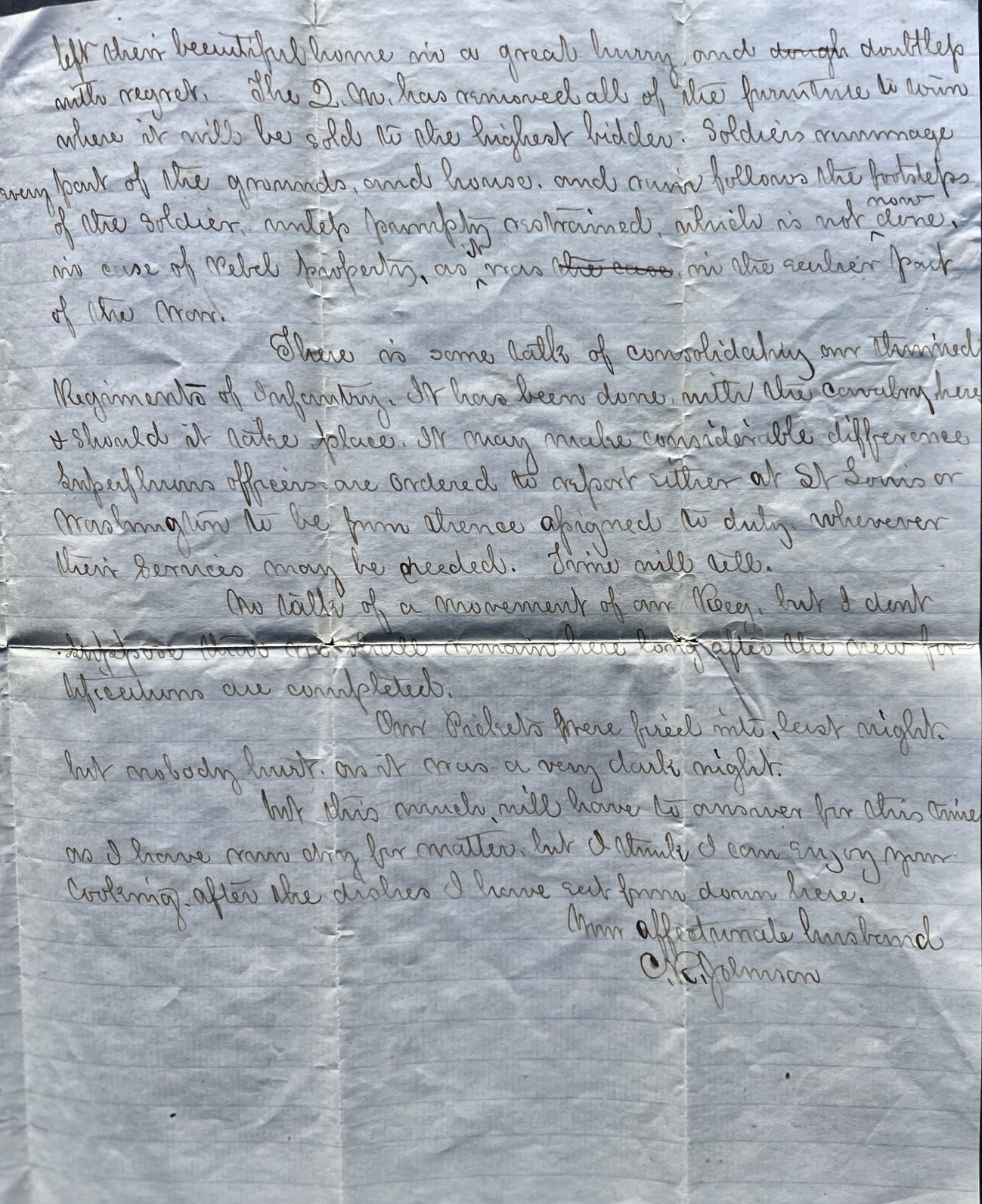
Near our camp is a large two story white house—the best in style and finish that I have seen in “Dixie” thus far. Surrounded by outbuildings, tasty and convenient, the large lawn or yard in front is covered with rare flower plants and shrubbery through which is a grove and walk to the front entrance. In the rear is a garden, grapery, &c. strawberry beds, raspberry bushes, &c. Peach and apple orchards come next. The owner was an old Rebel lawyer name Whitfield who has two sons, both captains in the Rebel army. Gen. Grant has occupied the premises all summer for his headquarters but a few days ago removed them to Jackson. I then went with the Chief Quartermaster to look at the inside arrangements before the furniture was removed and sold. The house was a perfect paradise inside—rich Turkey & Tapestry carpets covered the floors, cornices of the room all gilded, sofa’s and spring bottom chairs in four or five rooms. A large and valuable piano in the parlor. An extensive library of law, religious, medical, classical and miscellaneous works. All showed it to be the residence of a family of the very elite of Southern society and that they left their beautiful home in a great hurry and doubtless with regret.
The quartermaster has removed all of the furniture to town where it will be sold to the highest bidder. Soldiers rummage every part of the grounds and house and ruin follows the footsteps of the soldier unless promptly restrained, which is not now done in case of Rebel property, as it was in the earlier part of the war.
There is some talk of consolidating our thinned regiments of infantry. It has been done with the cavalry here and should it take place, it may make considerable difference. Superfluous officers are ordered to report either at St. Louis or Washington to be from thence assigned to duty wherever their services may be needed. Time will tell.
No talk of a movement of our regiment but I don’t suppose that we will remain here long after the new fortifications are completed. Our pickets were fired into last night but nobody hurt, as it was a very dark night.
But this much will have to answer for this time as I have run dry for matter, but I think I can enjoy your cooking after the dishes I have eat from down here. Your affectionate husband, — C. R. Johnson

Letter 2
Natchez, Mississippi
July 23d 1863
My dear Lucy,
Well, here I am with the Regiment again in the prettiest place I have been in South. Natchez on the bluff is about 100 feet above the river and if there is any air stirring, we catch some of it here. The streets are laid out at right angles with each other and on each side are beautiful shade trees, The houses display great wealth and taste. There never having ben a Rebel garrison here, the city is clean and must be comparatively healthy. Vicksburg fairly reeked in filth and I am glad to be away from it.
Thirteen Rebel companies have been raised here so of course the sympathies of the citizens are with the South and they are rebels of course, but different in many respects from the citizens of almost any place we have been in.
Within three days after our Brigade got here the stores were opened and although the merchants haven’t much to sell yet, they showed their disposition. The market too was opened and now all sorts of vegetables can be procured. Some mammoth water and mush melons a yard long, $3 in rebel money or 50 cents in ours. That’s what they begin to think of their own money. I notice cabbage, cucumber, tomatoes, figs, new potatoes, mutton, pork and beef are plenty. We have captured 6,000 beef cattle and large flocks of sheep.
The Boys are living like fighting cocks, the best pleased set I ever see. Some say that its a good thing the war commenced or they wouldn’t have been here!
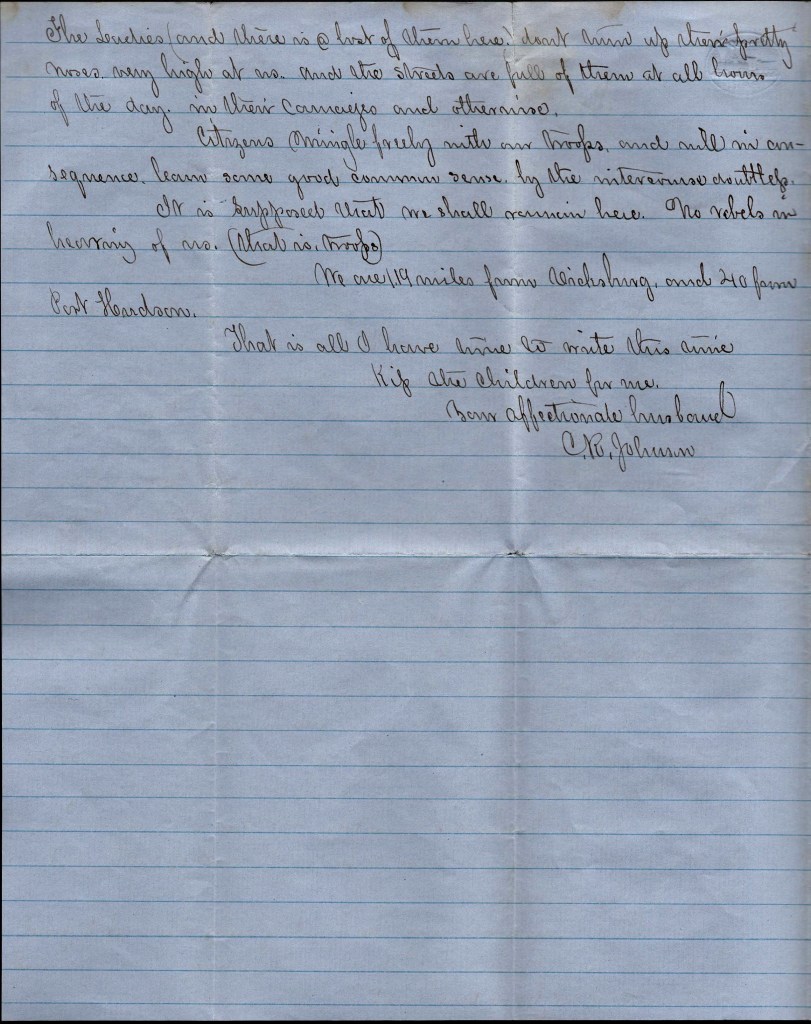
The Ladies (and there is a lot of them here) don’t turn up their pretty noses very high at us and the streets are full of them at all hours of the day, in their carriages and otherwise. Citizens mingle freely with our troops and will in consequence learn some good common sense by the intercourse doubtless. It is supposed that we shall remain here. No rebels in hearing of us (that is, troops). We are 119 miles from Vicksburg and 40 from Port Hudson.
That is all I have tome to write this time. Kiss the children for me. Your affectionate husband, — C. R. Johnson




 Spared & Shared 23