Category Archives: New York Homefront

1861: Edward Chapman to George Robert Adams

The following letter was written by Edward Chapman (b. 1836), the son of Edward Chapman, Sr. (1802-1886) and Elizabeth Burnett (1812-1874) of Utica, Oneida county, New York. Edward parents were natives of England; he was born in Nova Scotia. From his letter we learn that Edward was engaged in the telegraphic business in Albany. The 1855 N. Y. State Census informs us that he had been a telegraph operator for at least five years. By the time of the 1865 New York State Census, he was residing once again with his parents in Rochester, Monroe county, New York, where his occupation was given as “telegrapher.” Noticing that his father was also in the telegraph business, I found that Edward, Sr. had been for many years the secretary and treasurer of the New York, Albany, and Buffalo Telegraph Company which terminated business under that name in December 1863 when it merged with another company and became the Western Union Telegraph Company.

Chapman wrote the letter to George Robert Adams (1840-1915) of Charlotteville, New York, and a student at Wesleyan University, Middletown, Connecticut., at the time. He graduated with a Bachelor of Arts in 1863 and when he was drafted, George hired a substitute to take his place while he served as the principal of the Schoharie Academy. In 1866, George was admitted to the bar in New York State and practiced law in Charlotteville and later Kingston, New York. In a letter that I transcribed in 2020, George’s mother wrote him in November 1862, “The sorrow and anguish that this war is making, no mortal tongue can tell. I am not willing that my friends should be led as sheep to the slaughter. I am willing others should have the glory of the battlefield. It is as necessary that some should remain to other places of importance to the Nation. I hope you will be a blessing to your country in some other way besides going to war.” [See—1862: Julia A. (Goss) Adams to George Robert Adams]
T R A N S C R I P T I O N
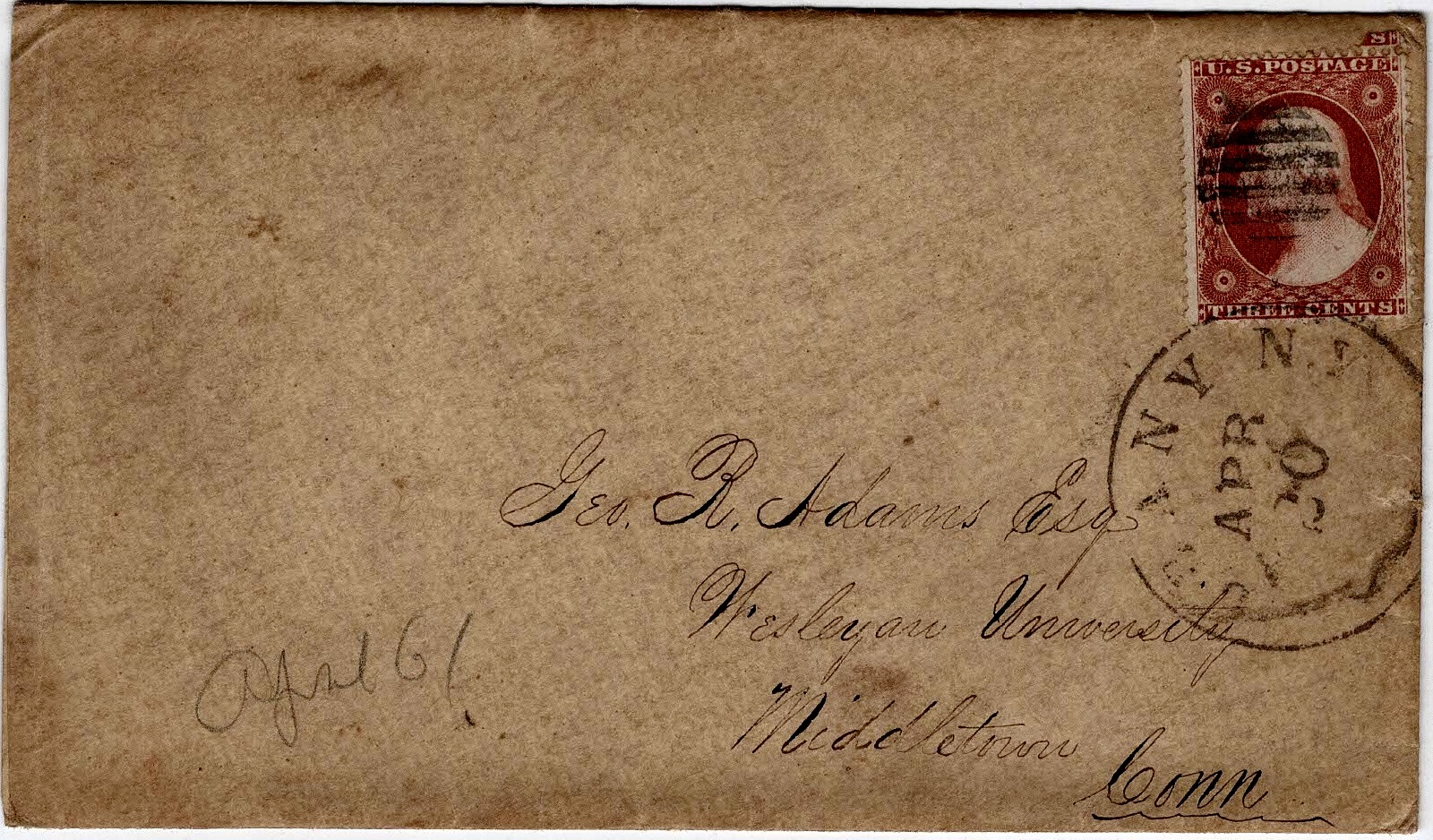
Addressed to George R. Adams, Wesleyan University, Middletown, Connecticut

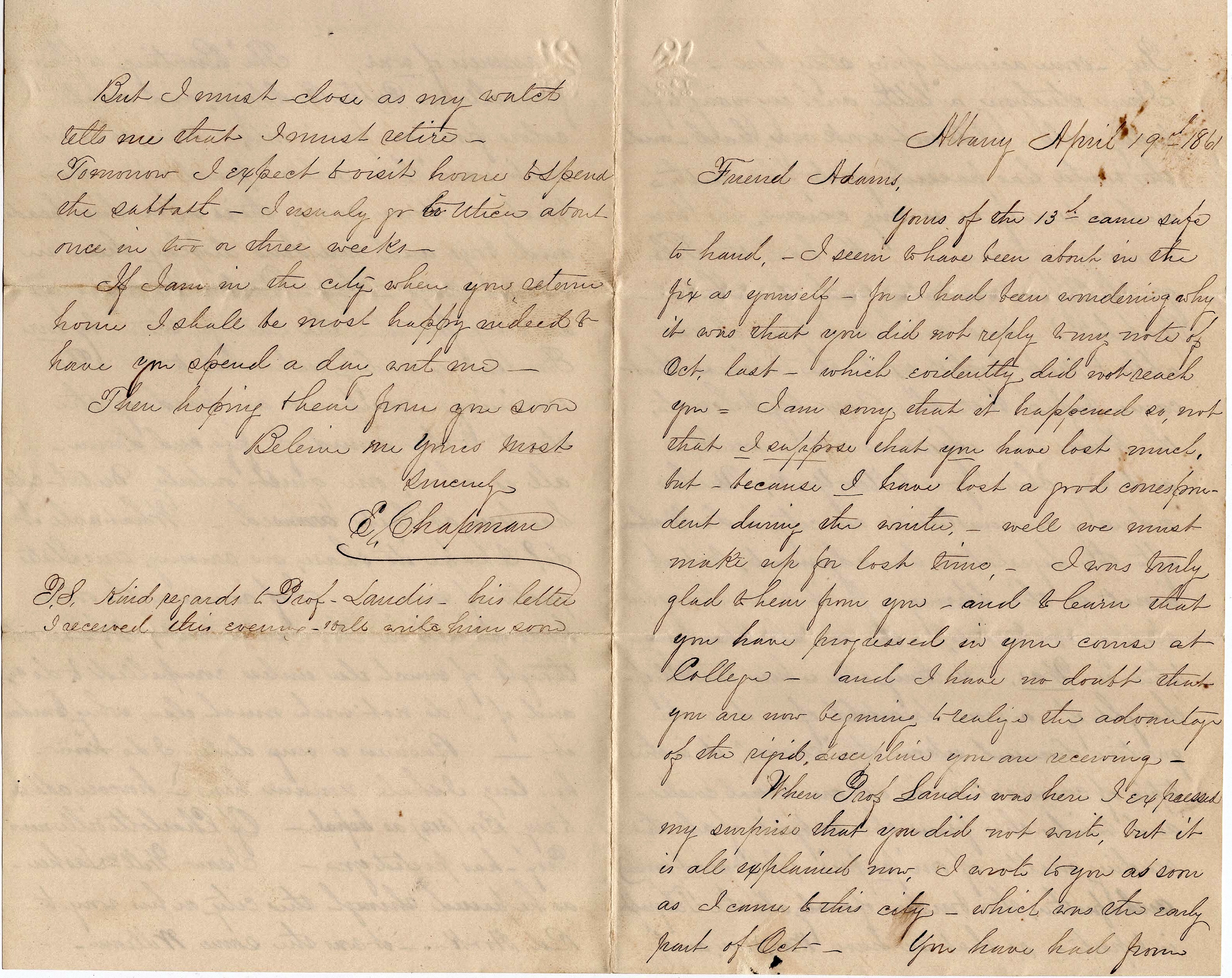
Albany [New York]
April 19th 1861

Friend Adams,

Yours of the 13th came safe to hand. I seem to have been about in the fix as yourself for I had been wondering why it was that you did not reply to my note of October last which evidently did not reach you. I am sorry that it happened so, not that I suppose that you have lost much, but because I have lost a good correspondent during the winter. well we must make up for lost time.

I was truly glad to hear from you and to learn that you have progressed in your course at College. And I have no doubt that you are now beginning to realize the advantage of the rigid discipline you are receiving. When Professor Landis was here, I expressed my surprise that you did not write, but it is all explained now. I wrote to you as soon as I came to this city which was the early part of October. You have had from Professor some account of my stay here. I am studying a little and enjoying life pretty well. I do not work very hard and the winter has passed quite pleasantly and especially so as my cousin has been rooming with me.

We had the telegraph office connected with the House (Capitol) and so through him I was able to keep posted about the business that came before both the Assembly and the Senate. The Houses have adjourned this week and my chum goes to New York. Under ordinary circumstances our city is dull after the Legislature has adjourned, but it is not so this Spring for it is in the highest state of excitement. The one all absorbing topic is War—nothing else is here talked of—thought of—or even dreamed of. It is the question discussed upon the “corners,” it is the topic of conversation in all our social circles, and besides this, forms the subject of all the reading matter in our papers (I. S. News not excepted), and further, the burden of all the telegraphic reports. So [in] short, we have War, War, and rumors of War.

The bunting is flying from all our public buildings and small colors from our private ones. Men that we meet wear “their colors” pinned upon their breast. Horses carry theirs upon their heads and boys and maidens display them in various ways. Several Volunteer companies are being formed. The call for them by our President is readily responded to. This evening, companies are parading the streets to the sound of the fife and drum—all is alive. Our quiet, orderly, Dutch city has been at last aroused. What will it do? I hope its share in raising our State’s quota of men.

I of course with others have shared in the excitement. I have not thought of much else unless compelled to do so, and if I do not write much else, why pardon it. Business is very dull. I do not know how long I shall remain here, however address to my Box (304) as usual.

Of Charlotteville news, Professor has posted you. I saw William Lasher as he passed through this city on his way to Red Hook. It was the same William. But I must close as my watch tells me that I must retire. Tomorrow I expect to visit home and to spend the Sabbath. I usually go to Utica about once in two or three weeks.

If I am in the city when you return home, I shall be most happy indeed to have you spend a way with me. Then hoping to hear from you soon, believe me yours most sincerely, — E. Chapman

P. S. Kind regards to Professor Landis. His letter I received this evening. Will write him soon.
1863: T. B. Rice to Friend John

This letter was written by T. B. Rice, a Brooklyn grocer who obviously looked to capitalize on the Civil War in any way possible. I have not been able to learn much about him except that he kept a store at the corner of Hicks and Atlantic Streets in Brooklyn during the war.

T R A N S C R I P T I O N

Brooklyn [New York]
December 3rd 1863

Friend John,

The Arago came in port yesterday & I was in hopes I should have a letter from you but none have come to hand. I shall expect to hear from you soon & shall rely on you & my friend Mr. Coryell to keep me posted up on matters in South Carolina. I have written you and Mr. Coryell once since you left here. Before I got my arrangements made to go to Hilton Head, I learned that the sale of December 1st was postponed indefinitely so that I shall not think of coming now until I hear from you or Mr. Coryell. If you secure me a position as we talked, I hope you will do so & I will come in at once. Do you think the January sale at Beaufort will be likely to be put over. Please let me hear from you often as man ybe convenient, giving me all the particulars.

I hear from Newbern every few days. Trade remains very dull there. But the government are shipping supplies there very largely which looks as though they designed to send more men there soon. Should this be the case, as a matter of course, trade will revive there & it may be an object to turn our attention in that direction. Now John, as you are on the ground, I hope you will put in your best licks and find a chance for yourself and your humble servant to make some money. You will find me on hand every time at the tap of the drum.
Things remain here much as when you left. We have had some hard fighting at Chattanooga and our army were victorious. The Potomac ARmy have fallen back towards Washington on their old camping grounds where they will probably encamp for the winter so that we need not expect much more from them before another spring. People here had began to hope that Gen. Meade would be able to rout Gen. Lee’s army before they went into winter quarters, but in this we are destined to be disappointed & the Lord only knows when this cruel war will be over.

Judd is here confined to his room [with] the neuralgia. Matters as between us are still unsettled. He makes no proposition nor gives me no statement & what he designs to do in the matter, I am unable to say. I think he cannot fail to understand my views & feelings on the matter. The other boys are here still. Jones expects to remain at C. M. & Co. another year, but I think I have given you all the news that will be likely to interst you so I will close up this epistle.

I shall be glad to hear from you by every steamer if you have time to write. I feel interested in knowing how things are progressing in the land of promise. Please remember me kindly to Mr. Coryell & hoping that you both will make a good pile & find a chance for me to make one by your side, I remain yours very truly, — T. B. Rice

P. S. I have just received a letter from Major Graves (formerly Lieut. Graves) & he informs me that Lieut. [Daniel] Folk of the 3rd New York Artillery is on Morris Island. If you see him, just collect his Bill and receipt him & send me the money. The amount is $6. Mr. Coryell has a list of the accounts against the other men in that vicinity. If you can aid him in collecting them, please do so. You can swear to the accounts if necessary as you drew them off from the books. Yours, — T. B. R.

1865: George Darrah to John Darrah

The following letter was written by George Darrah (1819-1903) of Cadyville, Clinton county, New York. George was born in Canada but came to the United States in 1833 and married Elizabeth Ann Stackpole (1822-1890). Their oldest children, George Darrah, Jr. (1840-1922), and Frederick Darrah (1842-1864) are the principal subjects of this letter, both of them having served as Union soldiers.

George Elizabeth (Stackpole) Darrah of Cadyville, New York (Ancestry.com)

George Darrah, Jr. was working as teamster in Plattsburgh, New York, when he was drafted into Co. H, 83rd New York Infantry. He was wounded—as described in the letter—near the beginning of Grant’s Overland Campaign and was never able to return to his regiment but after regaining some use of his arm, he was transferred into the Veteran’s Reserve Corps to complete his term of service.

Frederick Darrah was working as a teamster in Plattsburgh when he enlisted in September 1864 as a private in 2nd New York Veteran Cavalry. He died of chronic diarrhea at Morganza, Pointe Coupee Parish, Louisiana.

George wrote the letter to his brother John W. Darrah (1818-1900), the husband of Eliza Finch (1825-1906). They were residents of Williamstown, Dodge county, Wisconsin, at the time. Their oldest son, Wallace William Darrah (1845-1864) also served in the Union army. Wallace served as a corporal in Co. B, 10th Wisconsin Infantry, but was wounded and taken prisoner at the Battle of Chickamauga in September 1863. He died in mid-January 1864 while in prison at Danville, Virginia. We learn from this letter that their second oldest son, Charles Darrah (1847-Bef1865) also died but must have been at home and not in the service.

T R A N S C R I P T I O N

Cadyville [Clinton county, New York]
March 19th 1865

Mr. John Darrah, dear brother

I will write a few lines to you to let you know that there is still such a man a living as George Darrah, but it seems to me as though you have forgotten me. But I hope I shall see you again if it’s God’s will. This letter leaves all of us well at present and hoping they will find you enjoying the same blessings. I say all but there is a separation in my family as well as in yours. This cruel war has made almost every house in our land a house of mourning and bereavement excepting some of Big Popular Black-hearted thieves. I was informed of the death of [your sons] Wallis and Charley, but poor Wallis did not have his father and his mother to soothe him in his last of his troubles. We always had letters from him while he was in the service until he was taken prisoner. He sent his photograph and we have got it yet. I suppose he suffered a thousand deaths before he died. There is some Boys here that has been prisoners and they look like death when they get away.

I will tell you about my boys. One year ago last July George was drafted and was taken down to Virginia and was but right front in speaking distance of Mr. Rebs and he skirmished with them until the 1st of last May when Grant made his flank move for Richmond. He was in the battle for ten days. He says that one time there was so many balls struck his knapsack that it cut it to pieces so that all of his things fell out and none of the balls hit his body until he was marching forward when up jumped a Rebel a few feet forward of him and fired at him as he was loading his gun and the ball passed through his left arm below his elbow, stoving one of the bones all to pieces and cut off all of the cords of is arm and he bled almost to death before he got it done up. He got a furlough to come home for thirty days and then he went back, remained in the hospital until election when he came home again. His arm has got so he can use it some now. He is doing picket duty now on the Baltimore & Ohio Railroad near Washington. He was fat and rugged when he was at home last fall in November and he says he is well now. When the Rebel fired at him he [the Rebel] started to run but George’s comrade plunked him in the head.

Now I will tell you about poor Frederick. Last September there [was] no talk of enlistments or [of] being drafted so he made up his mind he would go for one year. I said all I could to him not to go but he said he was sure he would be drafted and go he should for one year. He went from New York to New Orleans and from there to Morganza up the Mississippi River 180 miles above New Orleans and was taken sick with the rheaumatics and chronic diarrhea and on the 23rd day of last January he bid adieu to all of his friends. He had a number of them with him from home and that is the only consolation I have about him. They nursed him day and night to save him but all in vain. His time had come and he had to go. He told his Uncle Joseph Robberts and James Norcross that watched with him the day before he died that he could not live. He had his senses to the last. He said he could see the angels waiting for him. About his last words was he told his uncle to tell all of his friends that he died happy and longed to see the time come when his sufferings would be over. Poor fellow. How many times he must though of my parting words with him but alas, it was too late. He went a long road to meet his death. He lays on the banks of the Mississippi—no friend to view his place of burial. He was a good and smart young man as you would see walking the road. I am sad with his loss. God knows how many more like him will have to go before this cruel and cursed war is over.

All the brothers and sisters here is smart. Lester and Guinup lives out in Franklin county and Mother is with Lester. I had a letter a few days ago from them. They was well at that time. I should be happy to get a letter from you. I got one from Levi Darrah [Co. F, 44th Wisconsin] a short time ago. He was in Nashville, Tennessee, then. I wrote an answer immediately. I had a great many letters from William’s George until lately I have not had any. I would be very happy to know if he is living. If you will answer this, I will write you again and tell you all that is going on here. Elizabeth sends her love to Eliza and a part to yourself. Write and let me know how you get along. So I must close for it is 11 o’clock and go to bed. So good night. — George Darrah

I wish you much joy with your little son and hope when he gets grown up that he will not be destroyed by a cursed negro war.

Eliza Hurlbert, please forward this to brother John Darrah.

1861: David Watson Conkling to Louise L. Randall

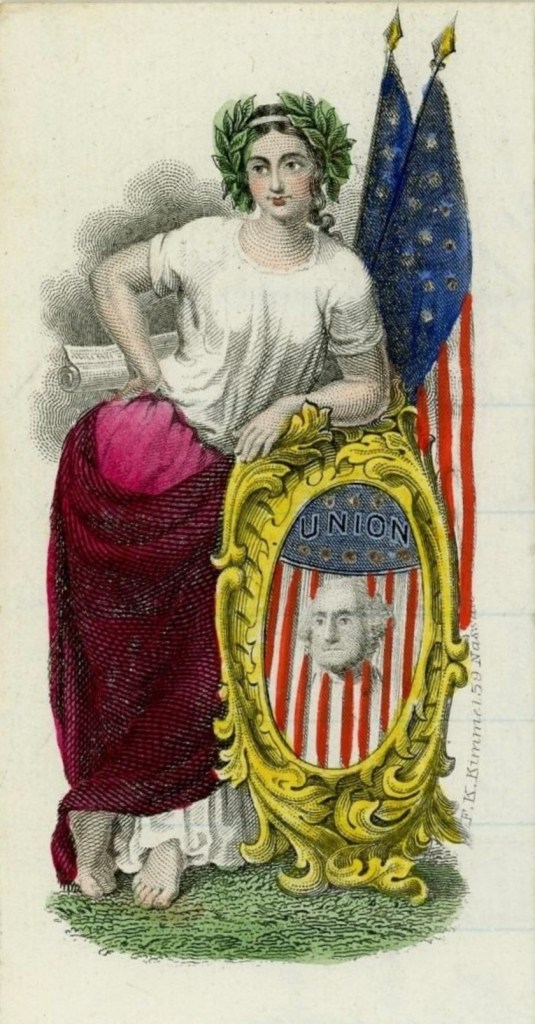
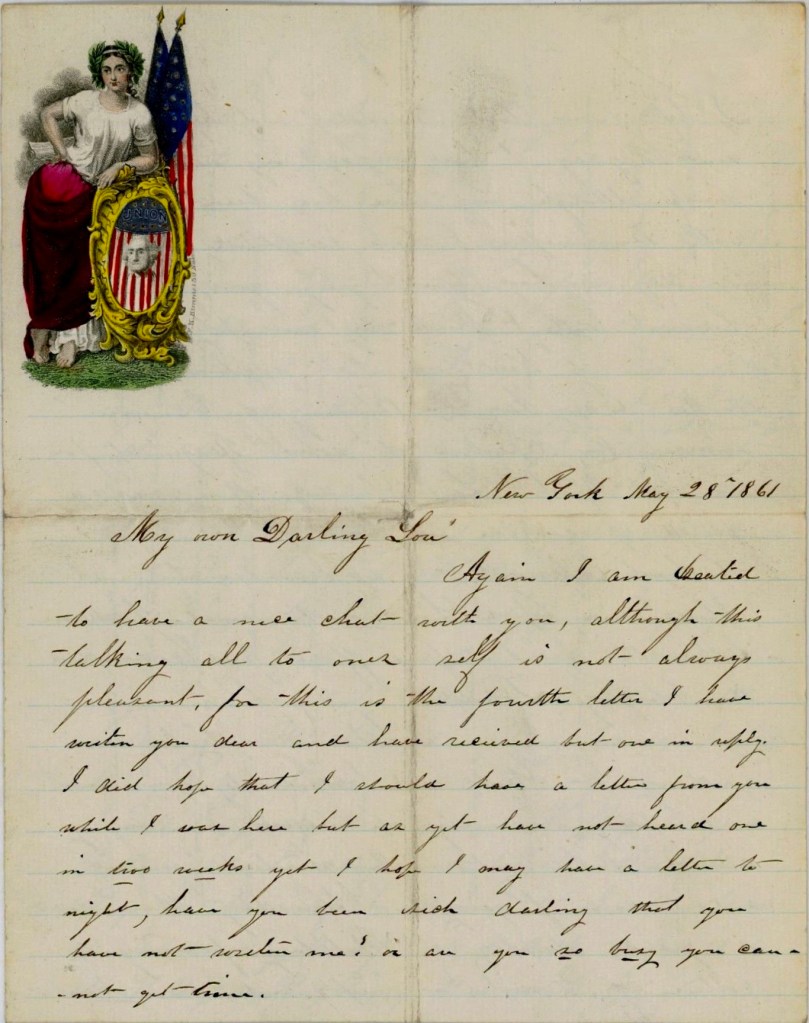
Patriotic letterhead on stationery using by Conkling in 1861

The following letter were written by David Watson (“Wat”) Conkling (1835-1904), the son of David Conkling (1806-1881) and Almira Ann Watson (1810-1865) of Rensselaerville, Albany county, New York. Wat wrote the letters to Louisa (“Lou”) L. Randall (1841-1903), the daughter of Andrew Jackson Randall (1815-1879) and Juliette King (1815-1892) of Union, Monroe county, New York. The letters were written in the days ahead of Wat & Lou’s marriage on 19 June 1861.

Letter 1

New York
May 28, 1861

My own darling Lou,

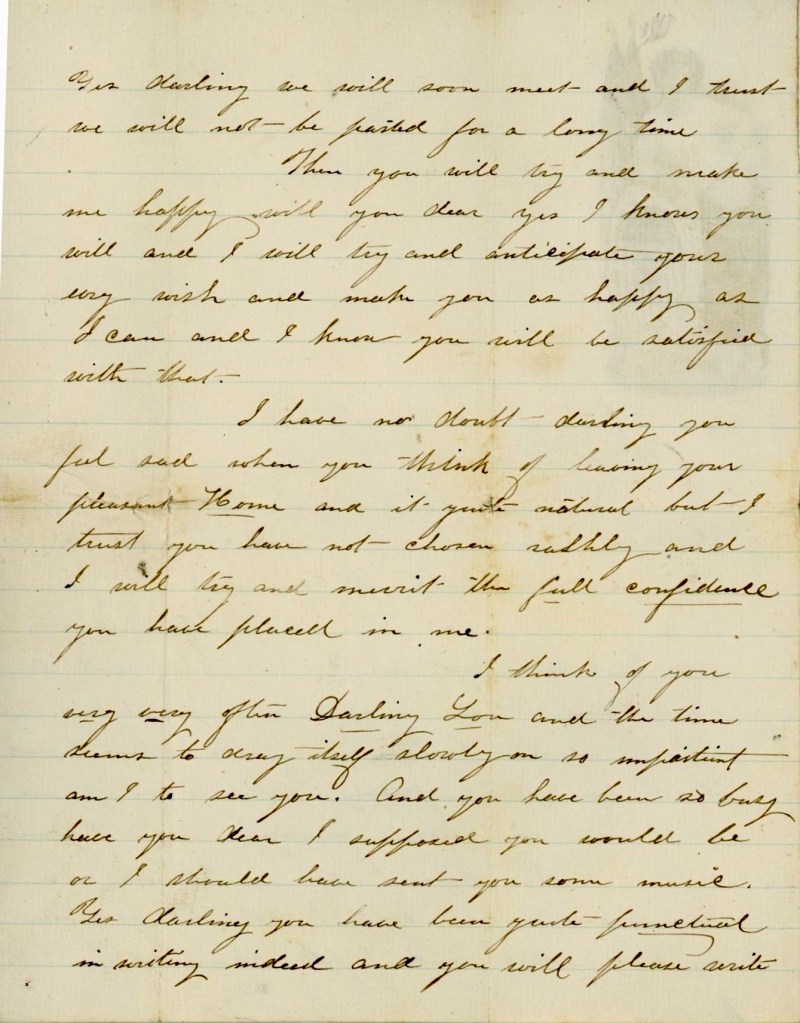
Again I am seated to have a nice chat with you, although this talking all to ones self is not always pleasant, for this is the fourth letter I have written you dear and have received but one in reply. I did hope that I should have a letter from you while I was here but as yet have not heard one in two weeks. Yet I hope I may have a letter tonight. Have you been sick darling that you have not written me! or are you so busy you can not get time.

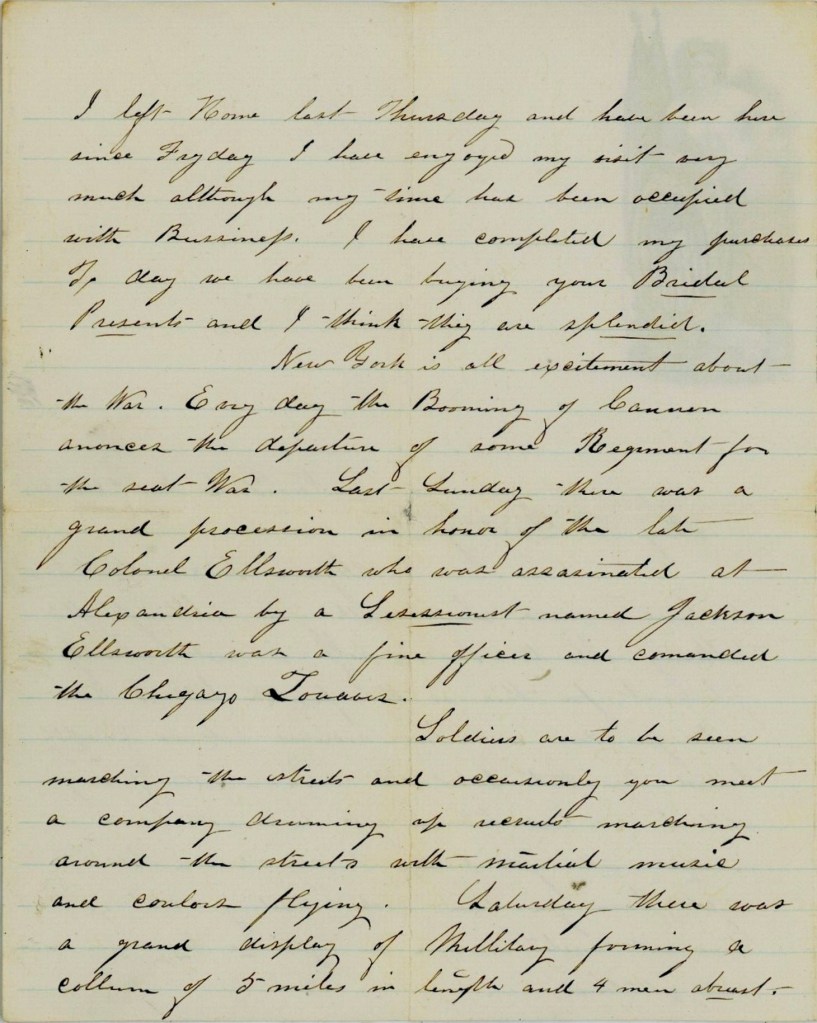
I left home last Thursday and have been here since Friday. I have enjoyed my visit very much although my time has been occupied with business. I have completed my purchases today. We have been buying your Bridal Presents and I think they are splendid.

Col. Elmer Ellsworth

New York is all excitement about the War. Every day the booming of cannon announces the departure of some regiment for the seat of War. Last Sunday there was a grand procession in honor of the late Colonel Ellsworth who was assassinated at Alexandria by a secessionist named Jackson. Ellsworth was a fine officer and commanded the Chicago Zouaves.

Soldiers are to be seen marching the streets and occasionally you meet a company drumming up recruits marching around the streets with martial music and colors flying. Saturday there was a grand display of military forming a column of five miles in length and four men abroad.

The weather is very fine, being just warm enough to be pleasant.

I shall return home tomorrow which is Wednesday and if I do not get a letter from you before I leave here, I hope to find one on my return home. I sent you a list of friends that I wish you to invite [to our wedding] with their mail address and I wish you to mail them. I will send you an extra 50 for your own use. Invite whoever you think best of your friends and neighbors. Uncle S[tephen] V[an] R[ensselaer] Watson and sister Mollie and Aunt Charlotte from Buffalo and Uncle Williams people will be all of my friends that I think will attend the wedding. The Complimentary Cards I will bring when I come out. I will express the cards to Holley to your father and he can send by the Kendall Stage for them if he chooses to. I will express them Wednesday the 29th instead. I think they will be at Holley on Friday of this week.

Only three short weeks will elapse, darling lover, before you will see me again and then we will not be separated, will we darling Lou? The time seems so very long—does it to you, dearest? I have thought of you almost constantly of late. Do not work too hard, darling girl. I should have sent you some music but I know you have not the time to learn it now. I sent you some papers. Did you receive them? And now, goodbye with one sweet kiss. I will write you Monday if I receive a letter from you this week. Good night dearest Louisa.

As ever yours and yours only, — D. W. Conkling

P. S. Write soon!

Letter 2

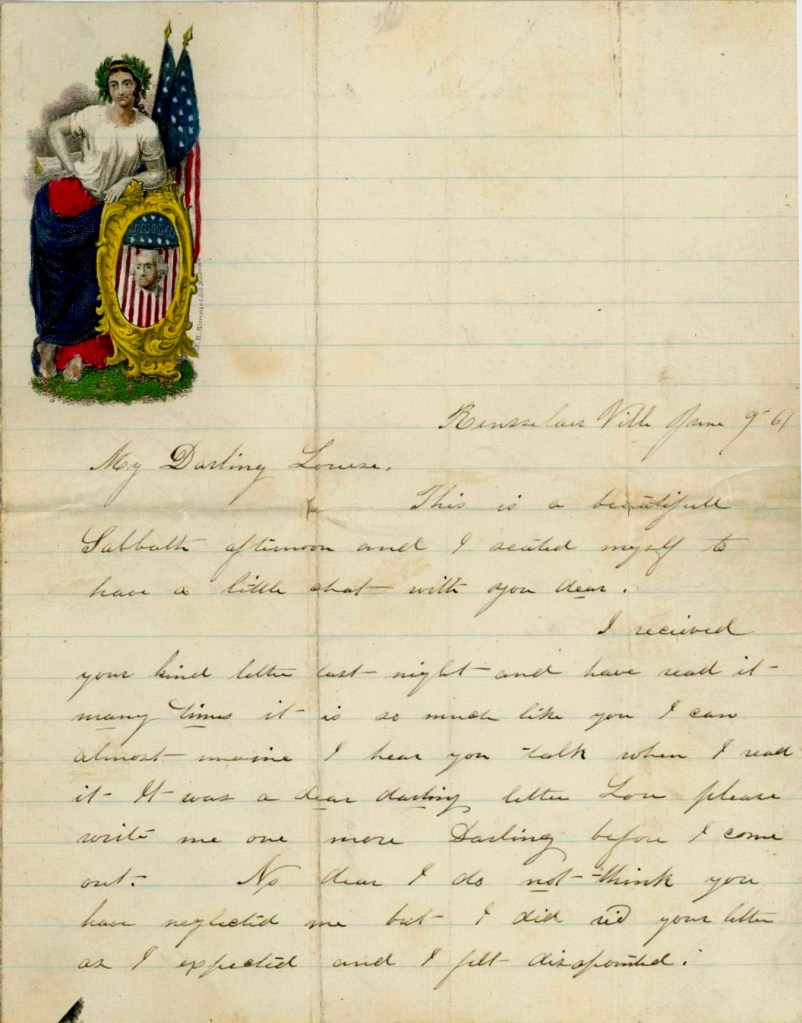
Rensselaer Ville, June 9, 1861—(not transcribed)

1861: Amy A. Rice to George F. Rice

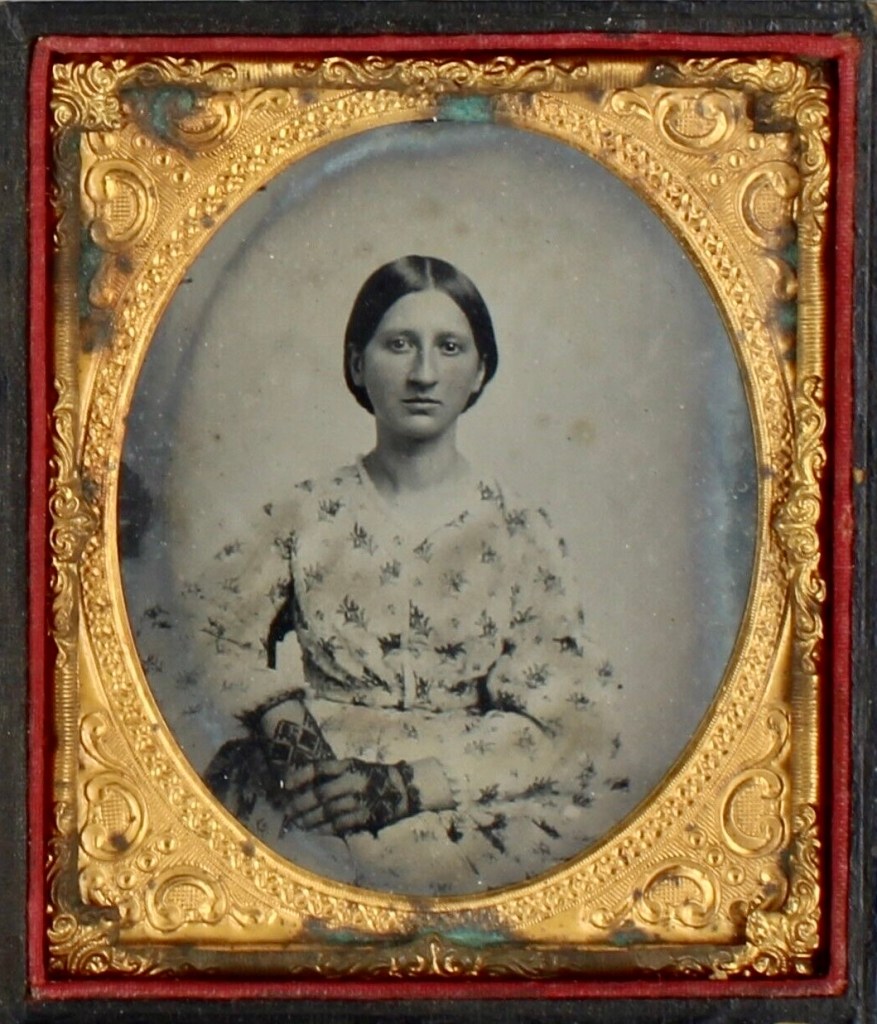
How Amy might have looked

This letter was written by Amy A. Rice (1845-1895) to her brother George F. Rice (b. 1840). Their parents were Luke Rice, Jr. (1800-1877) and Arvilla Shatton (1818-1899) of Elizabethtown, Essex county, New York.

Amy’s letter contains the bitter news that their friend, James Alva Coburn (1836-1899) of Co. K, 39th New York Infantry, had been wounded in the right hip during the Battle of Bull Run and had been taken prisoner to Richmond, Virginia. Muster Rolls show that he was returned to his regiment on 15 January 1862 and finally discharged for disability on 22 April 1862. He and Laura B. Reed (1841-1906) had been married in 1860

Transcription

Addressed to Mr. George F. Rice, Portage Du Fort, Canada East, Postmarked Ogdensburg, N. Y.

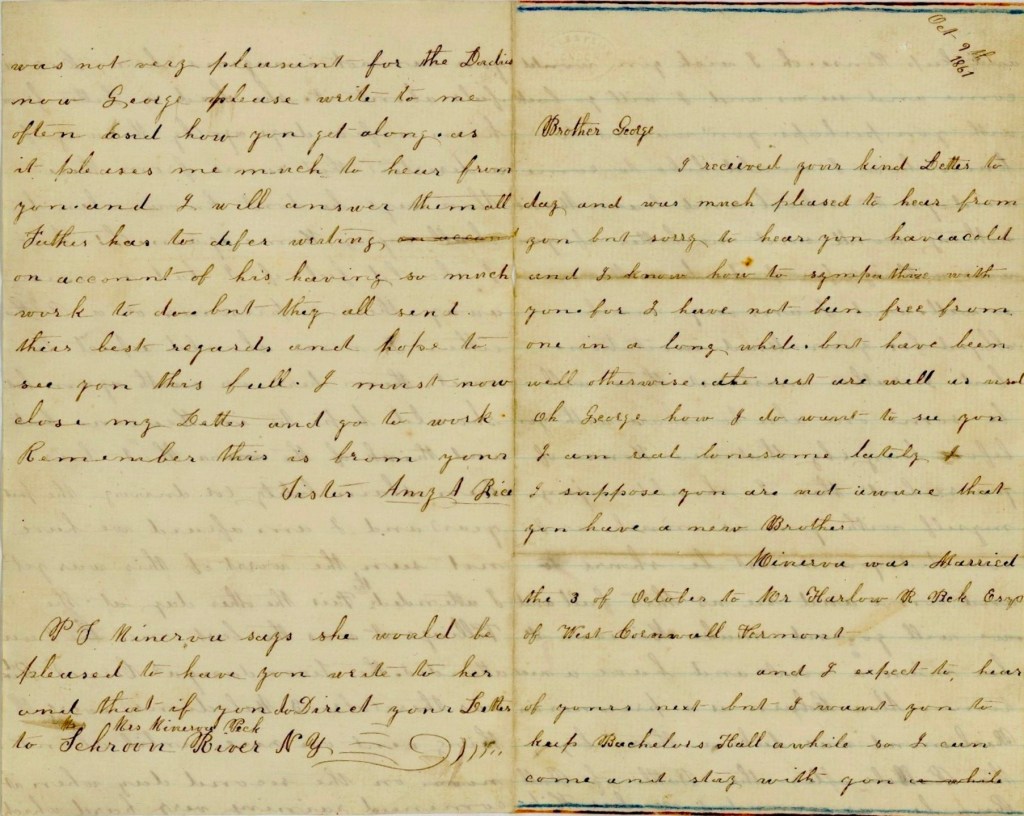
October 9th 1861

Brother George,

I received your kind letter today and was much pleased to hear from you but sorry to hear you have a cold and I know how to sympathize with you for I have not been free from one in a long while, but have been well otherwise. The rest are well as usual. Oh George, how I do want to see you. I am real lonesome lately. I suppose you are not aware that you have a new brother [in-law]. Minerva was married the 3rd of October to Mr. Harlow R[eeve] Peck, Esqr, of West Cornwall, Vermontand I expect to hear of yours next. But I want you to keep Bachelor’s Hall awhile so I can come and stay with you and keep house. Oh, I wish you would come and see us and I will go back with you perhaps.

You wanted to know how I would like to come and go to school and learn Music. Nothing would suit me better if you was willing for I do love music so well and I am very much obliged for your kind invitation. But I rather mistrust there will be some one else to share with you before long (by that new house of yours). But then I should enjoy myself with you as much as I ever did. You must be sure and come and see us this fall and we will go and make Minerva and her man a visit and have a nice time.

Alver Coburn is a prisoner in Richmond. Was taken there by the Rebels after the Battle of Bull Run. He was wounded in his hip. You cannot imagine how Laura feels about it. She had a letter from him a few days ago (by the way of a deserter) that come from there. Alver says he don’t know when he shall enjoy home again. Oh! how I should feel if I had a man away there a prisoner or a brother either. I never should expect to meet them here on earth again, but should hope to in Heaven. And [just] think of the men that has been slain lately (or during the past year) and I am afraid we have not seen the worst of this war yet.

I attended the Fair the other day at the Village. It was the best one I ever attended. The Ticonderoga Cornet Band was there (also 3 Melodeons). Everything went on nice (until about noon on the second day when it commenced raining very hard which was not very pleasant for the D___).

Now George, please write to me often and how you get along as it pleases me much to hear from you and I will answer them all. Father has to defer writing on account of his having so much work to do but they all send their best regards and hope to see you this fall. I must now close my letter and go to work. Remember this is from your sister, — Amy A. Rice

P. S. Minerva says she would be pleased to have you write to her and that if you do, direct your letter to Mrs. Minerva Peck, Schroon River, New York.

1863: Lydia Elizabeth Morrison to Matthias S. Euen

The following letters were written by Lydia Elizabeth Morrison (1832-1904), the daughter of John Bush Morrison (1793-1853) and Sarah Dougherty (1796-1872) of Plattekill, Ulster county, New York. In the 1860 US Census, 25 year-old Lydia was residing in Plattekill with her 64 year-old widowed mother and 21 year-old brother Charles Drake Morrison.

1st Sergeant Charles D. Morrison

The letters pertain to the illness and death of her brother Charles who enlisted as a private in Co. E, 156th New York Infantry in August 1862 and rose in rank to 1st Sergeant before he died of typhoid fever on 18 May 1863 at the Soldiers Hospital in Baton Rouge, Louisiana. He lies buried in Grave No. 2179 of Section 33 at the Baton Rouge National Cemetery. When he enlisted, Charlie was described as a 24 year-old farmer with brown hair and blue eyes who stood 5 feet 10 inches tall.

Lydia wrote the letters to Capt. Matthias S. Euen (1833-1898) of Co. E, 156th New York Infantry. He was wounded at Port Hudson on 14 June 1863 (shortly after the 2nd letter was written) and was later promoted to Major and Colonel of the 156th New York.

Letter 1

Plattekill [Ulster county, New York]
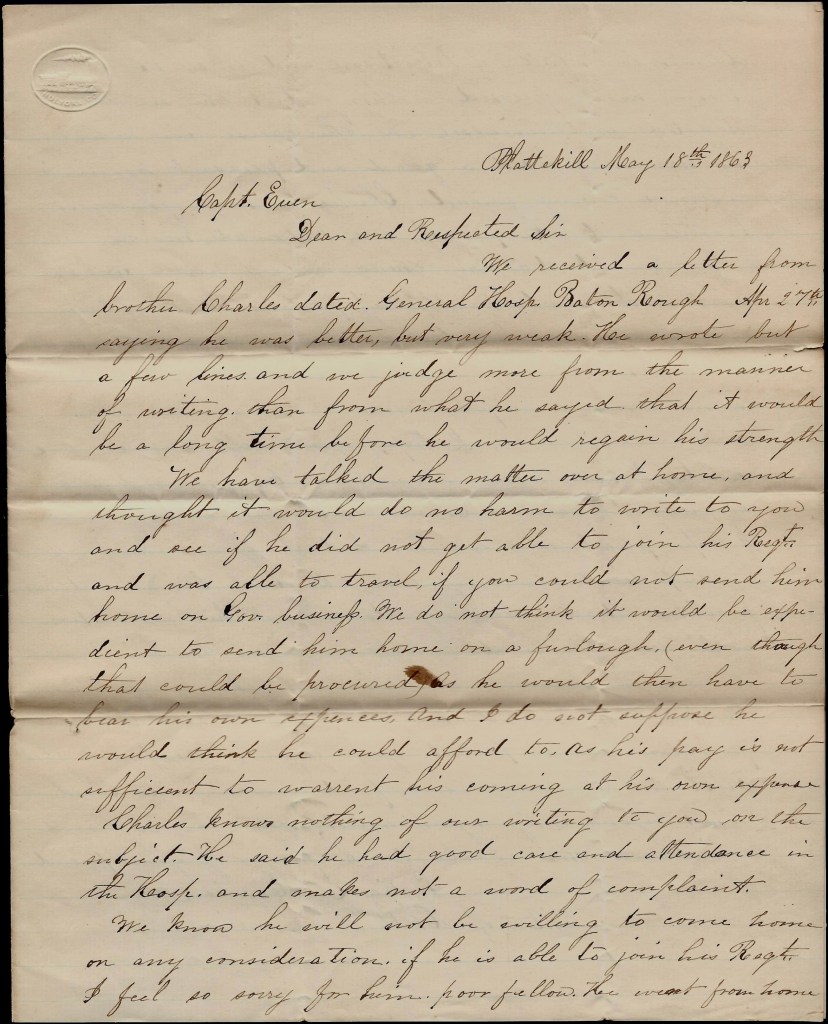
May 18th 1863

Capt. Euen
Dear and respected sir,

We received a letter from brother Charles dated General Hospital, Baton Rouge, April 27th, saying he was better but very weak. He wrote but a few lines and we judge more from the manner of writing than from what he said that it would be a long time before he would regain his strength.

We have talked the matter over at home and thought it would do no harm to write to you and see if he did not get able to join his regiment and was able to travel, if you could not send him home on Gov. business. We do not think it would be expedient to send him home on a furlough (even though that could be procured) as he would then have to bear his own expenses and I do not suppose he would think he could afford to as his pay is not sufficient to warrant his coming at his own expense. Charles knows nothing of our writing to you on the subject. He said he had good care and attendance in the hospital and makes not a word of complaint.

We know he will not be willing to come home on any consideration if he is able to join his regiment. I feel so sorry for him—poor fellow. He went from home brimming full of patriotism and in all his letters home has expressed nothing but the most devoted enthusiasm in the cause in which he has sacrificed a good and pleasant home and warm and loving friends. Charlie is my youngest brother and the pet of my widowed mother. We would do anything in our power to have him restored to health if possible. He complains that he has not heard from home since the first of March although we have written to him some seven or eight times.

I hope you will excuse the liberty I have taken in writing to you and our anxiety to secure Charlie’s return to health will I hope please my excuse. And if you can find it expedient in any way to have him sent home provided it is necessary to ensure his restoration, will you please do what you can for him, and in return receive the warmest thanks of his mother and friends. That an all-wise and kind Providence will protect you from sickness and that Rebel bullets may never find your hearts blood, that you may again meet your family and friends in this world is the prayer of your friend, — Lydia E. Morrison, sister of Charles D. Morrison

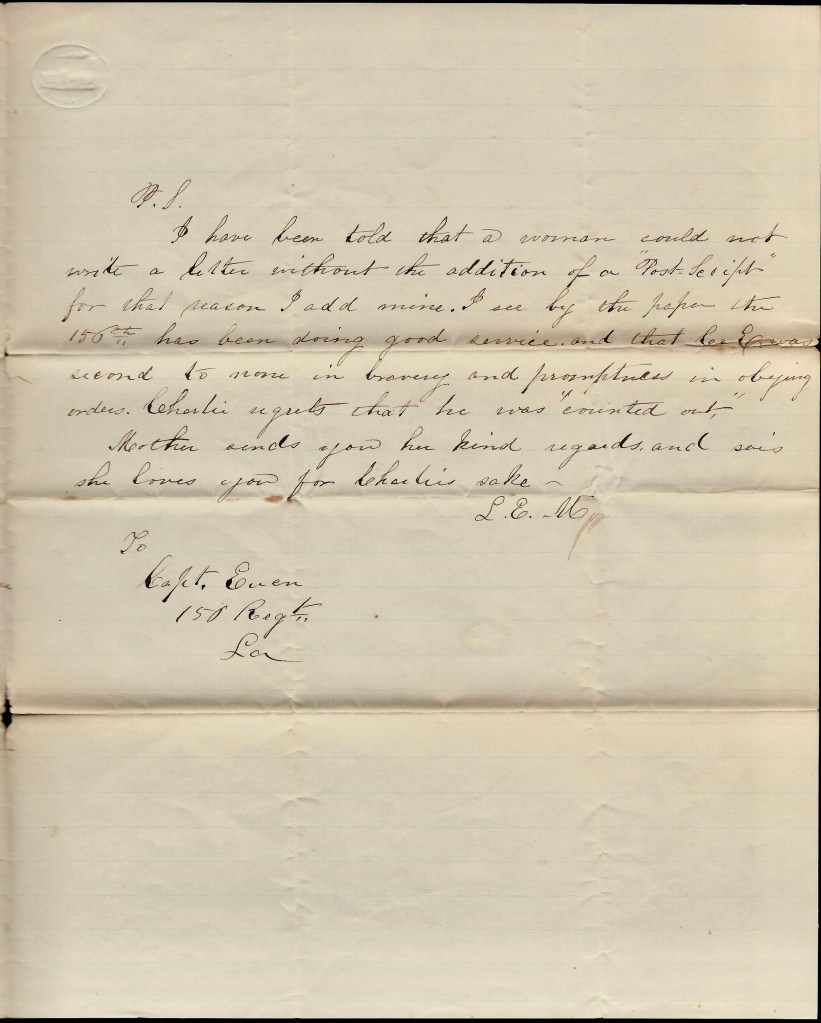
P. S. I have been told that a woman could not write a letter without the addition of a “post script.” For that reason I add mine. I see by the paper the 156th has been doing good service and that Co. E was second to none in bravery and promtness in obeying orders. Charlie regrets that he was “counted out.” Mother sends you her kind regards and says she loves you for Charlie’s sake. — L. E. M.

To Capt. Euen, 156th Regt., Louisiana.


Letter 2

Plattekill, [New York]
June 10th 1863

Dear and respected sir,

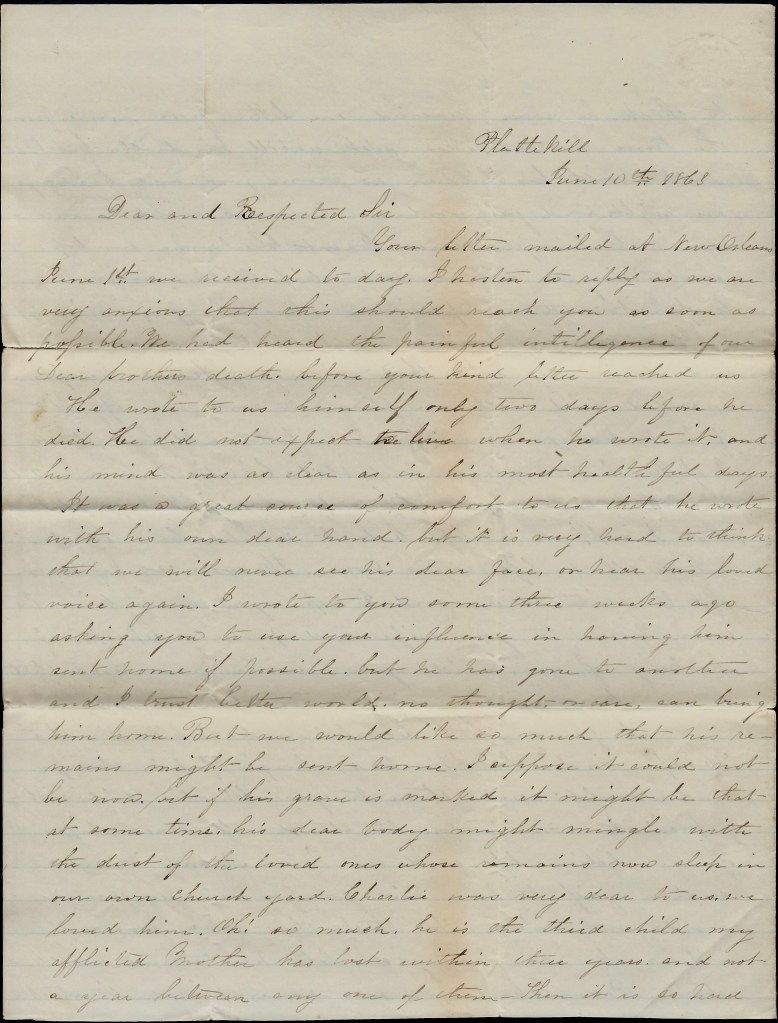
Your letter mailed at New Orleans June 1st we received today. I hasten to reply as we are very anxious that this should reach you as soon as possible. We had heard of the painful intelligence of our dear brother’s death before your kind letter reached us. He wrote to us himself only two days before he died. He did not expect to live when he wrote it and his mind was as clear as in his most healthful days. It was a great source of comfort to us that he wrote with his own dear hand but it is very hard to think that we will never see his dear face or hear his loved voice again.

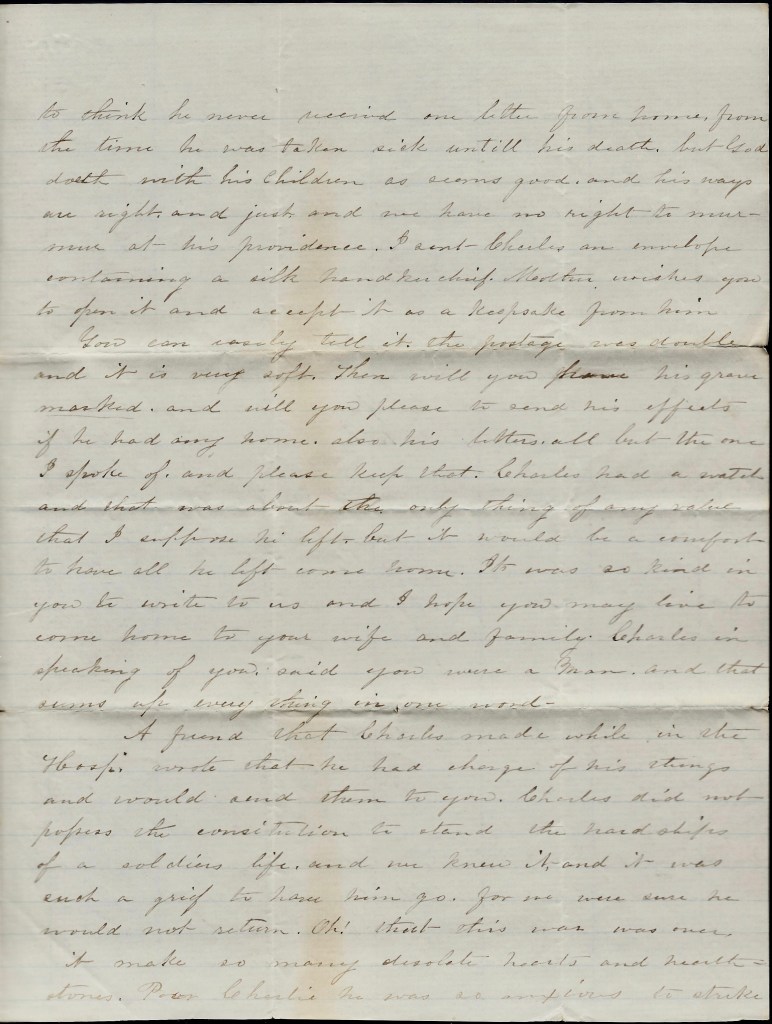
I wrote to you some three weeks ago asking you to use your influence un having him sent home of possible but he has gone to another and I trust better world. No thought or care can bring him home. But we would like so much that his remains might be sent home. I suppose it could not be now but if his grave is marked, it might be that at some time his dear body might mingle with the dust of his loved ones whose remains now sleep in our own church yard. Charlie was very dear to us. We loved him. Oh! so much. He is the third child my afflicted mother has lost within three years and not a year between any of them. 1 Then it is so hard to think he never received one letter from home, from the time he was taken sick until his death. But God doeth with His children as seems good and His ways are right and just, and we have no right to murmur at His providence.

I sent Charles an envelope containing a silk handkerchief. Mother wishes you to open it and accept it as a keepsake from him. You can easily tell it. The postage was double and it is very soft. Then will you have his grave marked and will you please to send his effects if he had any home. Also his letters—all but the one I spoke of and please keep that. Charles had a watch and that was about the only thing of any value that I suppose he left but it would be a comfort to have all he left come home.

It was so kind in you to write to us and I hope you may live to come home to your wife and family. Charles in speaking of you said you were a man and that sums up everything in one word.

A friend that Charles made wile in the hospital wrote that he had charge of his things and would send them to you. Charles did not possess the constitution to stand the hardships of a soldier’s life and we knew it, and it was such a grief to have him go for we were sure he would not return. Oh! that this was was over. It makes so many desolate hearts and hearthstones. Poor Charlie, he was so anxious to strike a blow for his country, but it was not to be.

I will not intrude further on your time—only to say that though you are a stranger to us, yet we are your warm friends. And our best wishes and earnest prayer will follow you that you may come home when your duty as a soldier is performed. And may God bless you is our earnest desire. I am respectfully your friend, — Lydia E. Morrison

Plattekill, New York


1 The other siblings were Isabella H. Morrison (1825-1862) and Mary Caroline Morrison (1838-1861).

Reflecting on the “National Disaster” a Month After Bull Run

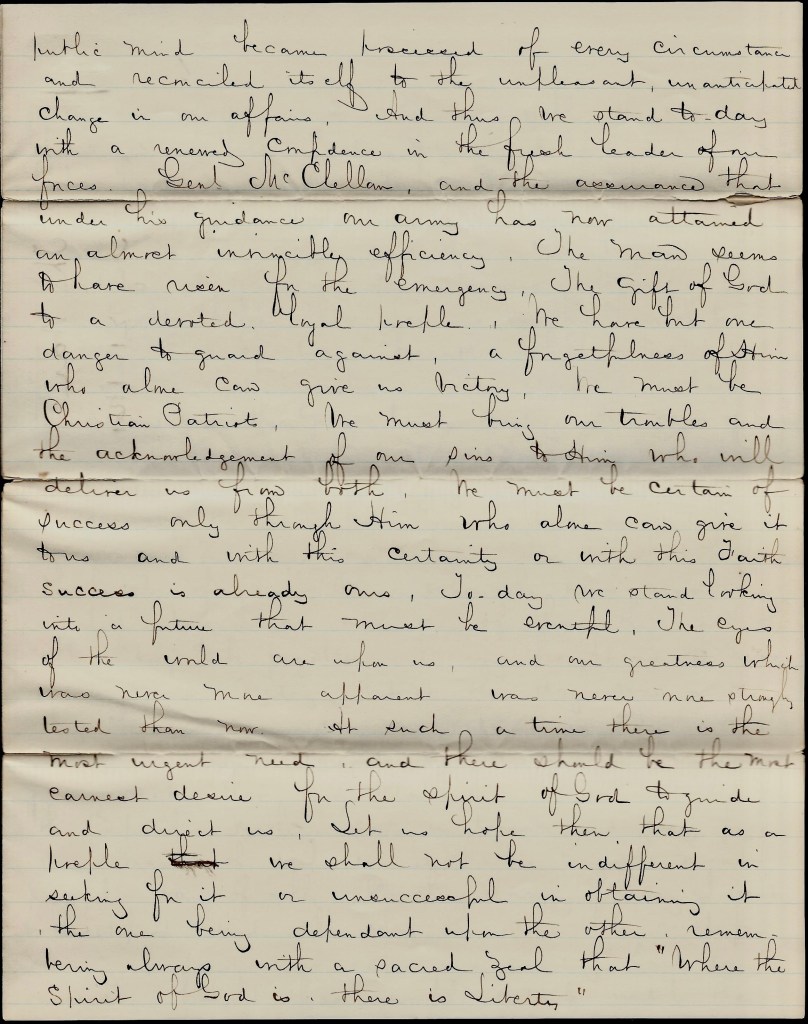
Regrettably, the author’s identity of this unsigned essay remains a tantalizing mystery, with scant clues to piece together even a fleeting guess at authorship. If I had to wager, I’d propose it was penned by a young man from New York City—perhaps in his late teens—who harbored lofty theological ambitions and possibly attending classes in Litchfield, Connecticut. Despite my internet sleuthing, I’ve come up empty-handed; no evidence suggests this piece was ever published in a book or newspaper. My gut tells me it was likely a personal draft, perhaps intended for publication, yet its final resting place remains unknown.

Though it can’t be pinned to a specific hand, this essay vividly encapsulates the turmoil rippling through the Northern states from the moment the shots rang out over Fort Sumter until the rise of Gen. McClellan—who is described as “the gift of God to a devoted, loyal people.” Such language perfectly encapsulates the anxiety and fervor of the times, and invokes the belief that calamity will only befall a Nation that does not place its trust in God.

Transcription

New York [City]
August 21, 1861

One month ago today occurred the battle and the panic of Bull’s Run and in that month thus following so great a national disaster, there has been time and cause for many hours of bitter thoughtfulness. We entered upon this serious crisis in our history with such a confidence in the right of our cause and the stability of our government that the determined effort to crush rebellion and annihilate that treasonable spirit which had been growing in our midst for years did not appear at the outset a formidable work to accomplish. But today, with no less confidence in our ultimate success and no less faith in Him who gave us the precious government for which we are contending, we are awake to the consciousness that God has given us a task to accomplish which we must perform in sorrow and the seed of which we must sow in tears. We know that we are not just passing beneath a cloud the end of which we cannot see, that in its deepest darkness there must be privations, sufferings and painful sacrifices, but we also feel with a conviction the intensity of which is sublimely prophetic that He who gave us so miraculously our existence as a Nation will never desert us in our terrible struggle to preserve that existence and that nationality under the government which He has always blessed to us.

The month just passed has seemed a breathing space in the commencement of a weary struggle. The mind has availed itself of a relief from immediate excitement to review the past few months of our eventful history and call up one by one the incidents that here give it so great an interest.

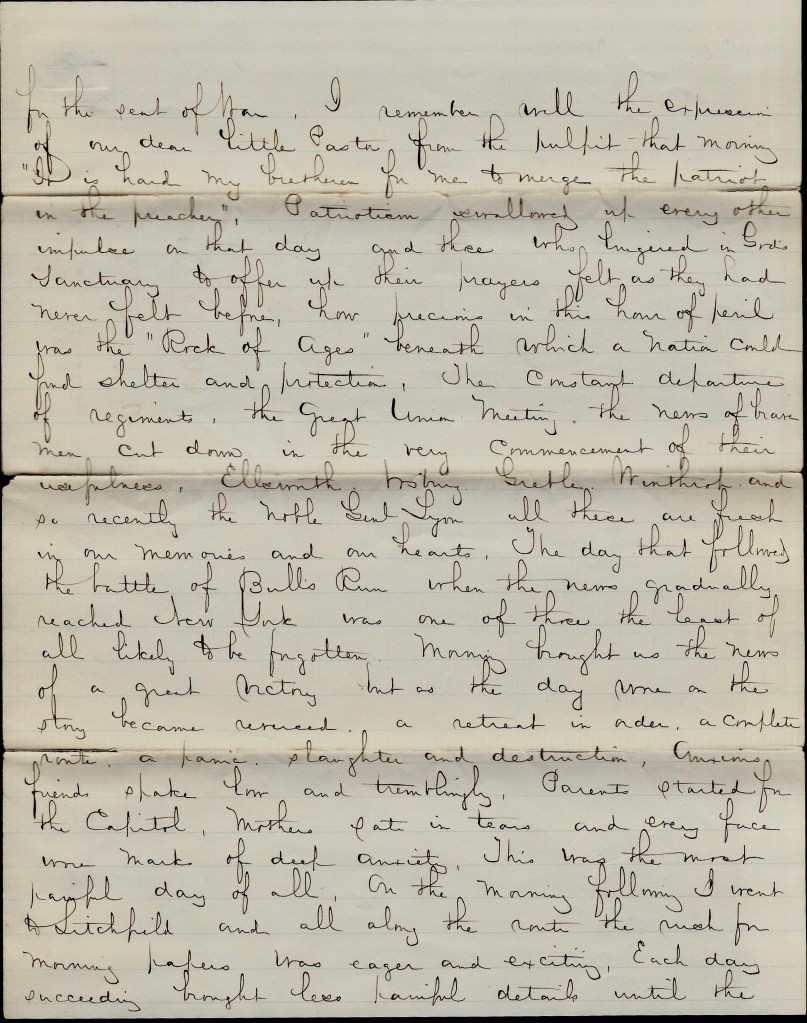
First came that Friday night on the 12th of April last when the scarcely credited intelligence fell on the ear that the bombardment of Fort Sumpter ad commenced. I went down to the news offices between 8 and 9 o’clock in the evening and read the announcement on the different bulletins with feelings strange and new. On the cars in the street, in every place of business, the expression passed from mouth to mouth, “The war has actually begun.” A nation went to a troubled slumber on that Friday night. Then followed the day of wild excitement when almost every home brought some fresh account of the disastrous and uneven siege until night closed in upon the week with the news that the gallant little garrison had been overpowered by besieging thousand and Sumpter had fallen into rebel hands. What a day was that Sabbath which followed the intense excitement of a few preceding hours. What a week did it open to an aroused and patriotic people. What a springing to arms. What an impetus towards Washington and the following Sabbath. Who ever saw a Sabbath like it in the City of New York? When the usual quietude of Sunday was broken by strains of martial music and churches were almost deserted in the eagerness to bid farewell to thousands who embarked that morning for the seat of war. I remember well the expression of our dear little pastor from the pulpit that morning: “It is hard, my brethren, for me to merge the patriot in the preacher.”

Patriotism swallowed up every other impulse on that day and those who lingered in God’s sanctuary to offer up their prayers felt as they had never felt before. How precious in the hour of peril was the “Rock of Ages” beneath which a Nation could find shelter and protection. The constant departure of regiments, the Great Union Meeting, the news of brave men cut down in the very commencement of their usefulness—Ellsworth, [ ], Greble, Withrop, and so recently, the noble Gen. Lyon. All these are fresh in our memories and our hearts.

The day that followed the battle of Bull’s Run when the news gradually reached New York was one of those the least of all likely to be forgotten. Morning brought us the news of a great victory but as the day come on, the story became reversed, a retreat in order, a complete rout, a panic, slaughter and destruction, anxious friends spoke low and tremblingly. Parents started for the Capitol. Mothers sat in tears and every face wore marks of deep anxiety. This was the most painful day of all. On the morning following I went to Litchfield and all along the route the sush for morning papers was eager and exciting. Each day succeeding brought less painful details until the public mind became possessed of every circumstance and reconciled itself to the unpleasant, unanticipated change in our affairs. And thus we stand today with a renewed confidence in the fresh leader of our forces, General McClellan, and the assurance that under his guidance, our army has now attained an almost invincible efficiency. The man seems to have risen for the emergency—the gift of God to a devoted, loyal people.

We have but one danger to guard against, a forgetfulness ofHim who alone can give us a victory. We must be Christian Patriots. We must bring our troubles and the acknowledgment of our sins to Him who will deliver us from both. We must be certain of success only through Him who alone can give it to us and with this certainty or with this Faith success is already ours. Today we stand looking into a future that must be eventful. The eyes of the world are upon us and our greatness which was never more apparent was never more strongly tested than now. At such a time there is the most urgent need and there should be the most earnest desire for the spirit of God to guide and direct us. Let us hope then that as a people we shall not be indifferent in seeking for it, or unsuccessful in obtaining it—the one being dependent upon the other, remembering always with a sacred zeal that “where the Spirit of God is, there is Liberty.” 1


1 “Where the Spirit of God is, there is Liberty.” 2 Corinthians 3:17.

1863: Mary Henrietta Miller to Peter Henry Hulst

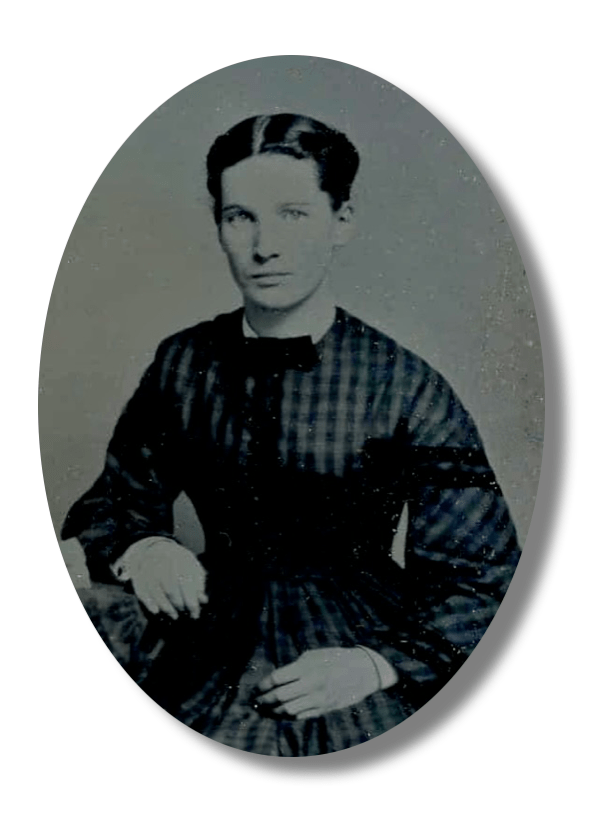
How Henrietta might have looked in 1863 (Megan Kemble Collection)

What a pleasure it is to read the words that spill from the glib tongue of an intelligent young woman. What follows is a letter composed in the midst of the American Civil War by 24 year-old Mary “Henrietta” Miller (1839-1912) of Claverack, Columbia county, New York, the daughter of William Albertson Miller (1813-1872) and Mary Hulst (1816-1883). Henrietta was an 1860 graduate of the Hudson Valley River School in Claverack (later renamed Claverack College).

Henrietta wrote the letter to her cousin, Peter Henry Hulst (1841-1926). Peter “spent his earlier years in Fishkill-on-the-Hudson and at Carthage Landing. He later moved to Jonesville in Saratoga county where he taught school and began the study of medicine (Homeopathy), graduating from the Albany Medical College in 1866. He then practiced medicine in Schuylerville for a short time, moving to Greenwich in 1869.” [Obituary, Glens Falls, The Post Star, 28 October 1926]

In her letter, Henrietta suggests that she and her younger sister Adriana (“Addie”) Miller (1846-1905) had intended to relocate to Kentucky to teach school but decided against it when Addie fell ill. She did eventually move to Kentucky where she met James Solomon Crumbaugh in Scott county and after their marriage in December 1866, they settled in Old Crossing, Kentucky, where James ran a mill and Henrietta taught European Literature. In 1900 they moved to Kaufman county, Texas with their two children.

Henrietta’s letter dares to express her thoughts on politics, a subject rarely broached by women except in private conversation in mid 19th Century. She observes the political nature and consequences of the Conscription Act of 1863 and refers to President Lincoln as the “Republican Autocrat”—a sentiment shared by a great many Americans, particularly New Yorkers.

Transcription

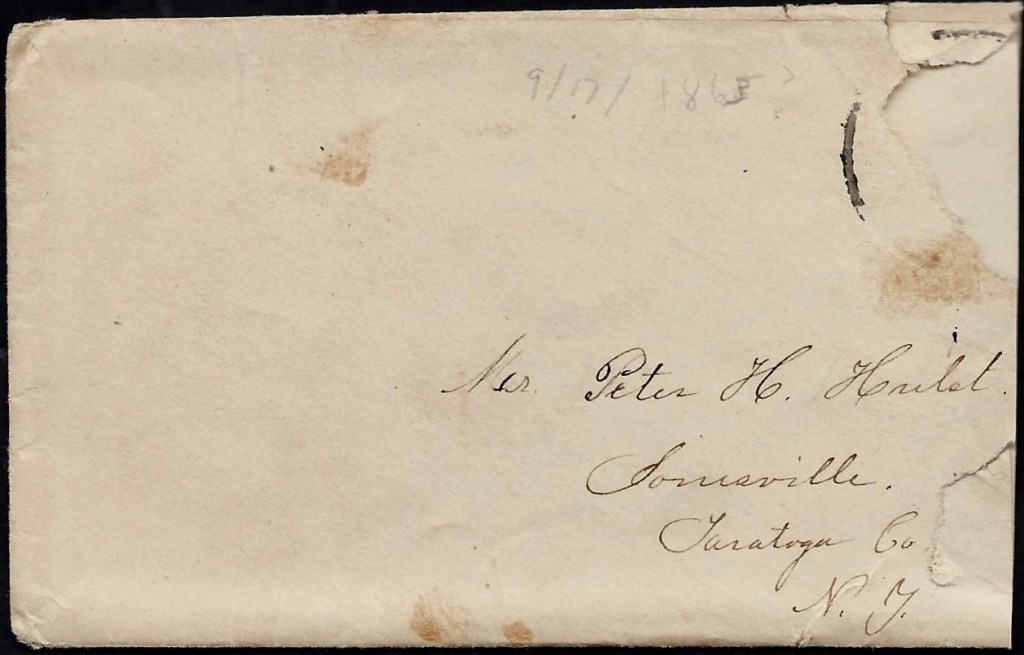
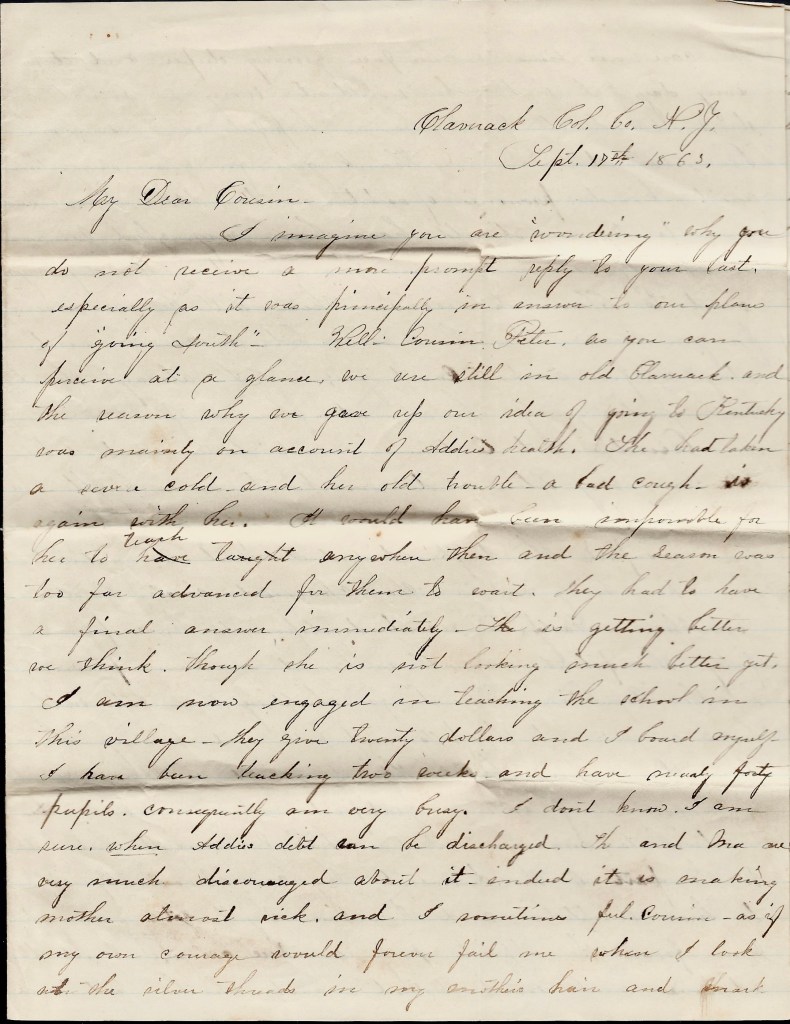
Addressed to Mr. Peter H. Hulet, Jonesville, Saratoga county, New York

Clarverack, Columbia county, New York
September 17th 1863

My dear cousin,

I imagine you are “wondering” why you do not receive a more prompt reply to your last—especially as it was principally in answer to our plan of “going South.” Well, Cousin Peter, as you can perceive at a glance, we are still in old Claverack and the reason why we gave up our idea of going to Kentucky was mainly on account of Addie’s health. She had taken a severe cold and her old trouble—a bad cough—is again with her. It would have been impossible for her to teach anywhere then and the season was too far advanced for them to wait. They had to have a final answer immediately. She is getting better we think though she is not looking much better yet.

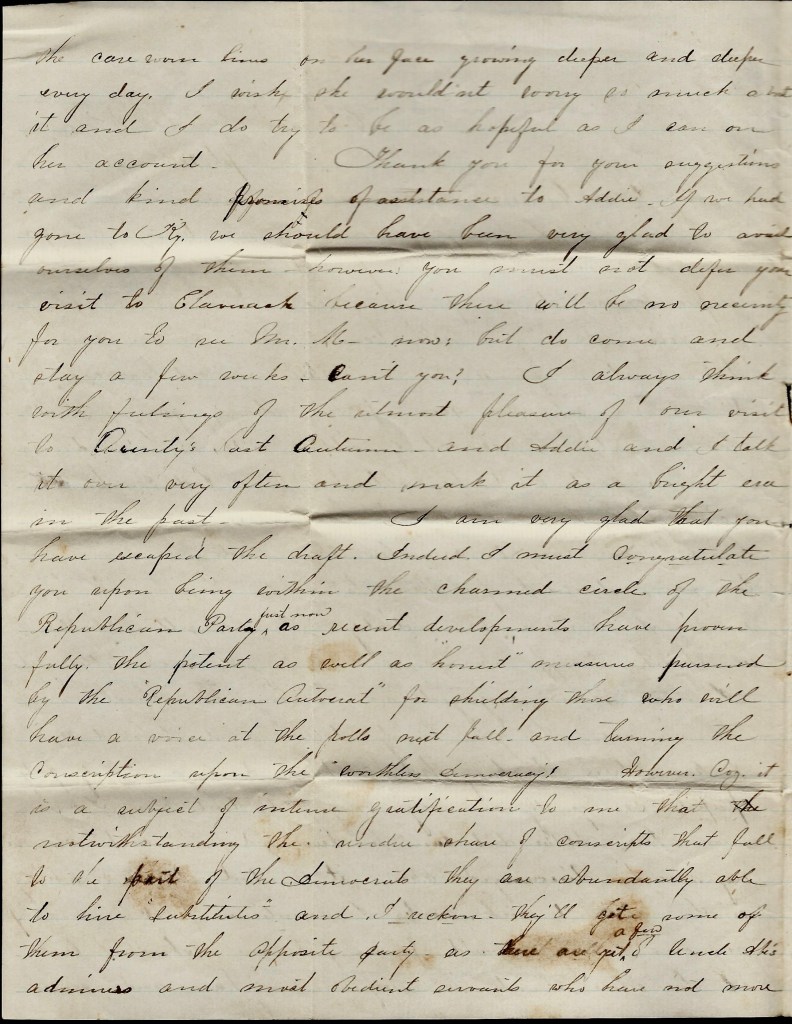
I am now engaged in teaching the school in this village. They give twenty dollars and I board myself. I have been teaching two weeks and have nearly forty pupils; consequently am very busy. I don’t know, I am sure, when Addie’s debt can be discharged. She and Ma are very much discouraged about it. Indeed, it is making mother almost sick, and I sometimes feel, cousin, as if my own courage would forever fail me when I look at the silver threads in my mother’s hair and mark the careworn lines on her face growing deeper and deeper every day. I wish she wouldn’t worry so much about it and I do try to be as hopeful as I can on her account.

Thank you for your suggestions and kind promises of assistance to Addie. If we had gone to Kentucky, we should have been very glad to avail ourselves of them. However, you must not defer your visit to Claverack because there will be no necessity for you to see Mr. M[iller] now; but do come and stay a few weeks, can’t you? I always think with feelings of the utmost pleasure of our visit to Aunty’s last autumn and Addie and I talk it over very often and mark it as a bright era in the past.

I am very glad that you have escaped the draft. Indeed, I must congratulate you upon being within the charmed circle of the Republican Party just now as recent developments have proven fully, the potent as well as “honest” measures pursued by the “Republican Autocrat” for shielding those who will have a voice at the polls next fall and turning the conscription upon the worthless democracy. However, coz., it is a subject of intense gratification to me that notwithstanding the undue share of conscripts that fall to the part of the Democrats, they are abundantly able to hire “substitutes” and I reckon they’ll get some of them from the opposite party as there are yet a few of Uncle Abe’s admirers and most obedient servants who have not more of the “green” currency than they know what to do with. But perhaps you are like some of the gentlemen that I know; “you do not like to hear a lady talk politics.” If no, pardon me and I will change the subject. Nonetheless, “them’s my sentiments.”

Ma has been up to see Grandma this fall. Went a few weeks ago. She made a very short visit as she was expecting us to go to Kentucky. The weather here has been very warm and pleasant. Now it is cloudy and cold. I have to walk about a mile to my schoolroom and I should like it to be pleasant weather all the time if it could be so, but I anticipate many a cold, wet walk this winter. School has just opened at the Seminary and I dare say Mr. [Alonzo] Flack 1 has begin again upon his well beaten track of—I guess I won’t say it after all, for I could not say any good of him so it is better to leave the sentence unfinished.

I am glad your health is improved. Are you taking vocal or instrumental music, or both? Pa and Ella have the whooping cough. They have been very bad but seem to be getting over it now somewhat. Dear cousin, I must beg your kind indulgence for this disconnected and ill written missive. I am not very well nor very much in the mood for writing tonight so I will close. Please write me soon and accept the love & best wishes of your affectionate cousin, — Henrietta


1 Alonzo Flack was born in Argyle, New York on September 19, 1823. While attending Union College (1845-1849), Flack joined the Methodist Episcopal Church and received a license as a preacher. He subsequently studied theology at the Concord Biblical Institute in New Hampshire and was recrutied by Bishop Osman C. Baker in 1854 to serve as principal for a new school at Charlotte. In 1855, Flack became principal of the Claverack College and Hudson River Institute. He later assumed the presidency of Claverack College in 1869. Flack was noted for his deep belief in the reform movements of the period, including temperance reform, the enfranchisment of women and ecclesiastical reform. He was granted a Doctor in Philosophy degree by the University of the State of New York in 1875. Much esteemed by his students, Flack served for thirty years as a teacher and administrator at the school, until his death in 1885. He was succeeded by his son, Rev. Arthur H. Flack, who occupied the position until 1900. The College, located in Claverack, New York, offered academic and classical studies to ladies and gentlemen and was very highly regarded. Alumni included author Stephen Crane, feminist Margaret Sanger, and President Martin van Buren. [sources consulted: Minutes of the annual conferences of the Methodist Episcopal Church: Spring conferences of 1885. (p. 97)]

In 2011 I transcribed a letter by Alonzo Flack and posted it on Spared & Shared 1. See—1842: Alonzo Flack to Nathan Henry Bitely.

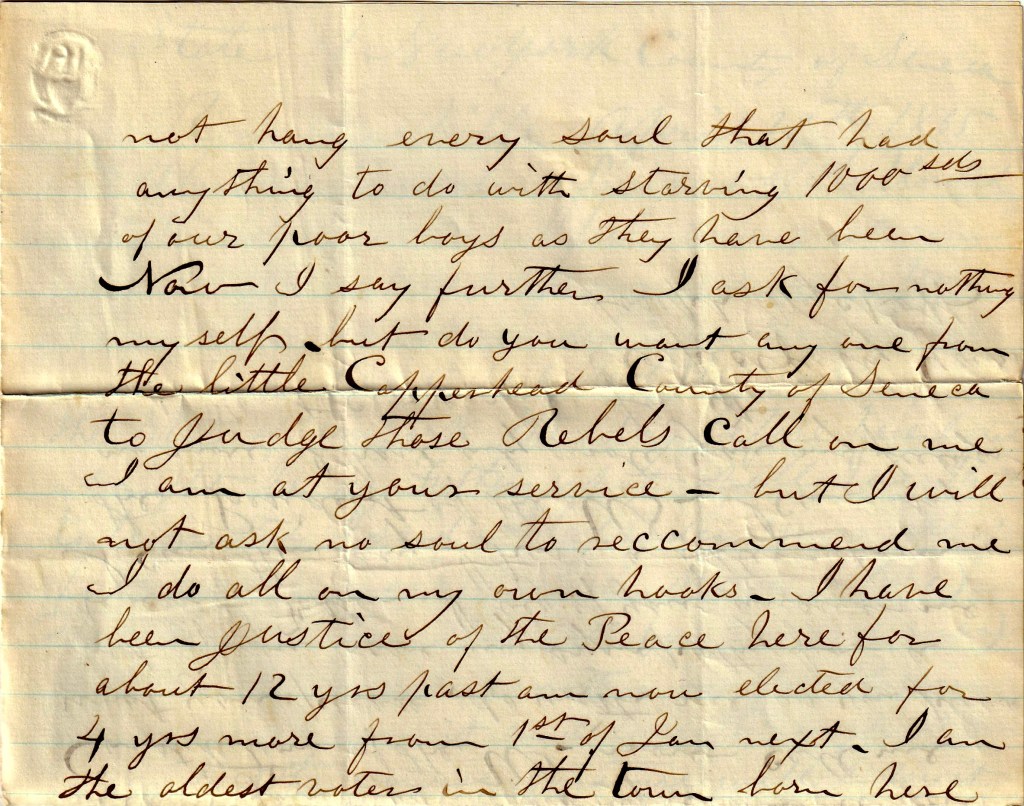
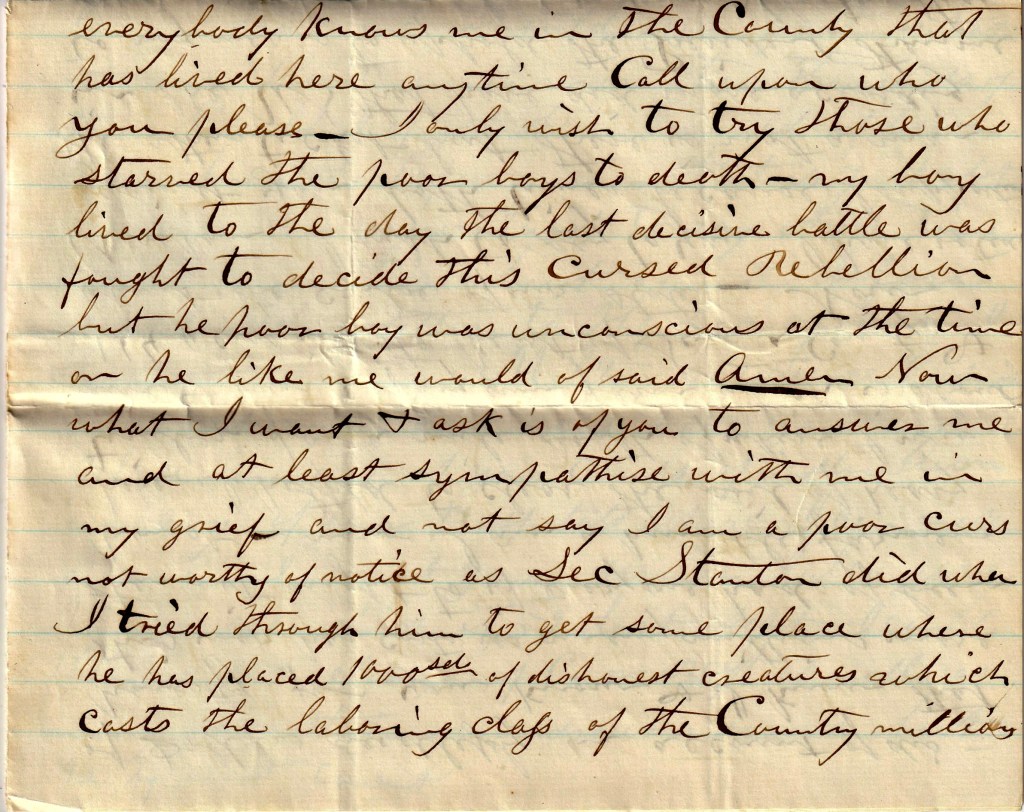
“At least sympathize with me in my grief,” Joseph Wyckoff to Abraham Lincoln

This amazing handwritten letter to President Abraham Lincoln was penned by a distraught father, Joseph Wyckoff (1805-1886), who lost his son as a result of confinement at Andersonville where he was starved to death. The letter was dated 12 April 1865—just three days after Appomattox and two days before Lincoln’s assassination. In his letter, Wyckoff pours out his grief to Lincoln, whom he admits he did not vote for, and, though he asks for the chance to judge those who caused his son’s death, we learn that what he really wants is a chance to vent some anger at—and gain some sympathy from—the Lincoln Administration.

Joseph’s son, Alexander Baldridge Wyckoff (1841-1865), was 21 when he enlisted 4 August 1862 at Varick, New York, as a Private. He was mustered into Co. C, 126th New York Infantry.  On 15 September 1862, just a month after enlisting and before they had hardly been equipped and drilled, Alexander and other members of his regiment were surrendered to Stonewall Jackson’s men at Harper’s Ferry, Virginia, during the Antietam campaign, earning them, through no fault of their own, the unfair sobriquet “Harpers Ferry Cowards.” After their release from a parole camp in Chicago, the regiment worked hard to gain back their reputation, especially at Gettysburg where they sustained 57% casualties in capturing five stands of colors. Alexander was wounded on 10 May 1864 at Po River, Virginia, and on 25 August 1864 he was again captured, this time at Reams’ Station, Virginia. He was sent to Andersonville prison in Georgia, from which he was eventually paroled but died on 2 April 1865 at Baltimore, MD, according to his father, from illness sustained during his imprisonment.

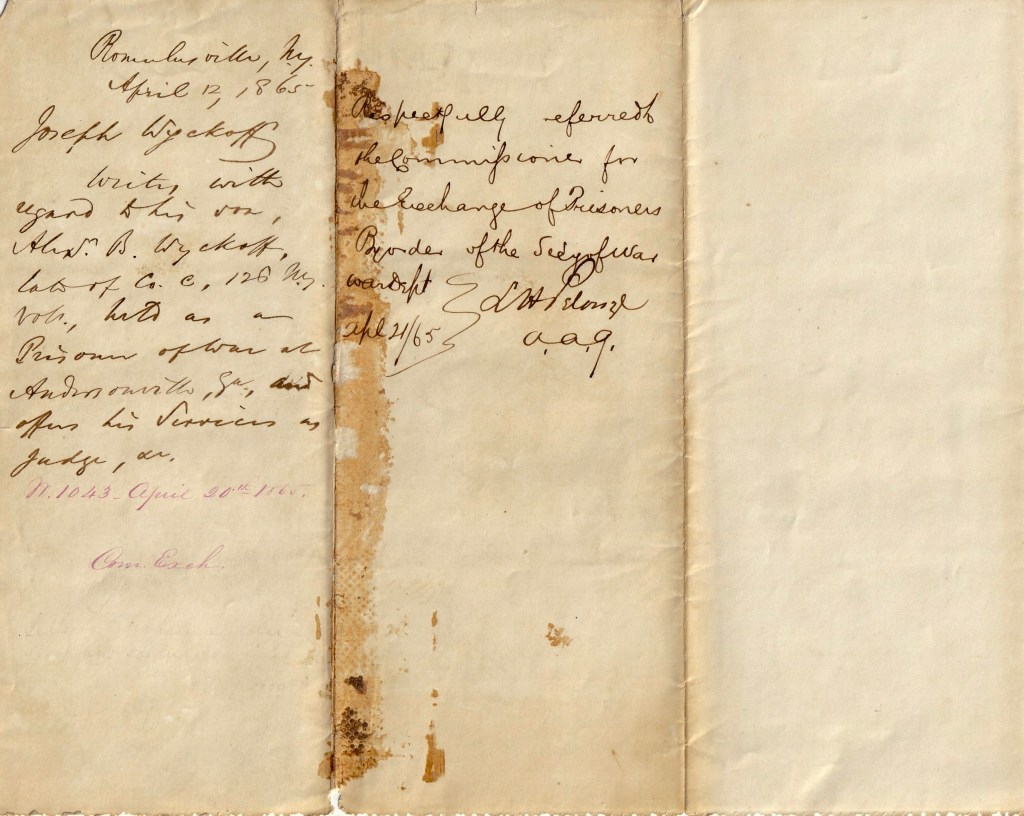
From the timing, it is unlikely that the letter ever got to Lincoln, but rather was processed by the President’s staff in the days following the assassination. The letter does, however, appear to have been read by the Secretary of War, Stanton, who Wyckoff, in his letter, implies might have been soft on corruption, though facts do not bear this out. Docketing at the end of the letter reads “W1043 April/65”  (the President’s staff may have recorded correspondence alphabetically according to the last name of the writer). The letter also comes with a folded piece of ledger paper that reads “Romulusville, NY/ April 12, 1865/ Joseph Wyckoff/ Writes with regard to his son, Alex. B. Wyckoff late of Co. C. 126 NY Vol. Held as a Prisoner of War at Andersonville, Ga and offers his services as judge, etc.”  On the back of the ledger paper it reads “Respectfully referred to the Commissioner for the Exchange of Prisoners By order of the Secy of War, War Dept. April 21/65 – L[ewis] H Pelouze/A.A.G.” 

[Note: This letter is from the private collection of Richard Weiner and was made available for transcription and publication on Spared & Shared by express consent.]

Transcription

State of New York
County of Seneca, Romulusville
April 12th 1865

To Abraham Lincoln, President of the United States,

Dear Sir, I feel sore just now. I can’t help but express my feelings to you. I buried my son Alexander B. Wyckoff (9th inst). He was a member of Co. C ,126 Regt. U. S. Volunteers from the State of New York. The day before he enlisted, at night, he said, Father, what shall I do? I hate to be drafted. I said, Alexander, you are of full age (he was 21 years old in March before). That was under the call for 500,000 men. Our country is good for nothing so, should you go and help save it and live through it, you according to the course of nature will enjoy it longer than me. Should you fall, what is your blood worth more than thousands of others. Could I of got there I would have been there six months before now. That is just what I told him.

Now I wish to say at the time I told him this about six months before I addressed a letter to the Secretary of War. I there gave him my military experience (which was about 12 years) and said, have you any place in any of your camps of instruction, in any of your hospitals, where I can make a man? I am at your service. I also gave him my age which is now 59 last Sept. I could then of took charge of a Company or Regiment as well as many others that never drew a sword but he by silent consent passed by – by a silent nothing. Well, what is the consequence? We are taxed here to pay millions of dollars for some contemptible rouges that was well recommended which he nor you knew nothing of—only the recommend[ation] that accompanied their application.

Now my boy enlisted in the service, t’will be 3 years next August. He was captured in August last 25th. He was starved to death at Andersonville but he got a parole and died at Baltimore, April 2nd instant. His Mother was with him when he died. Now, could I of stooped so low as to ask for any position during the war, I know I could of got all the principle men in our county to of signed a recommend[ation] for me as a suitable person for the position—tis no matter what [position]. But I could not—I would not—and neither would I [even if it] was it to gain the Chief Justiceship of the U. S. But I now say one thing to you, if I had the Judgeship to investigate and try those who starved those poor prisoners to death, if found guilty by evidence, I would hang every soul of them. But to stoop so low as to ask any man or any set of men to recommend me, I will never do it. But I say cursed be the man, or any set of men, that will not hang every soul that had anything to do with starving thousands of our poor boys as they have been.

Now I say further, I ask for nothing myself, but should you want anyone from the little Copperhead County of Seneca to judge those rebels, call on me. I am at your service. But I will not ask no soul to recommend me. I do all on my own hooks. I have been Justice of the Peace here for about 12 years past, am now elected for 4 years more, from 1st of Jan next. I am the oldest voter in the town—born here—everybody knows me in the county that has lived here anytime. Call upon who you please. I only wish to try those who starved the poor boys to death. My boy lived to the day the last decisive battle was fought to decide this cursed rebellion, but the poor boy was unconscious at the time, or he—like me, would of said, Amen.

Now, what I want and ask of you is to answer me and at least sympathize with me in my grief and not say I am a poor cur not worthy of notice as Secretary Stanton did when I tried, through him, to get some place where he has placed thousands of dishonest creatures which cost the laboring class of the country millions of dollars needlessly on account of dishonesty, for you know and I know that this war has cost us many millions more than it ought to if everyone had of been honest. Now I am a humble farmer here. I helped to clear the soil of heavy timber for a mile south of where I now live & over half of my own farm which is about 164 acres in the heart of Seneca County & about the center of our state.

Now, Abraham, I wish to say to you, I have voted against you both times because I supported the other ticket, but there is not a man in the U. S. that have did more according to my means to uphold the President than me because you was elected agreeable to the constitution of the U. S. Now, call me what you please, do with me as you please, but if you have any sympathy for a bereaved Father, I beg of you answer me. I can then say I have a letter from the President of the U. S. I can say no more. I have only wrote you my feelings and do not curse me for it.

Respectfully yours, — Joseph Wyckoff

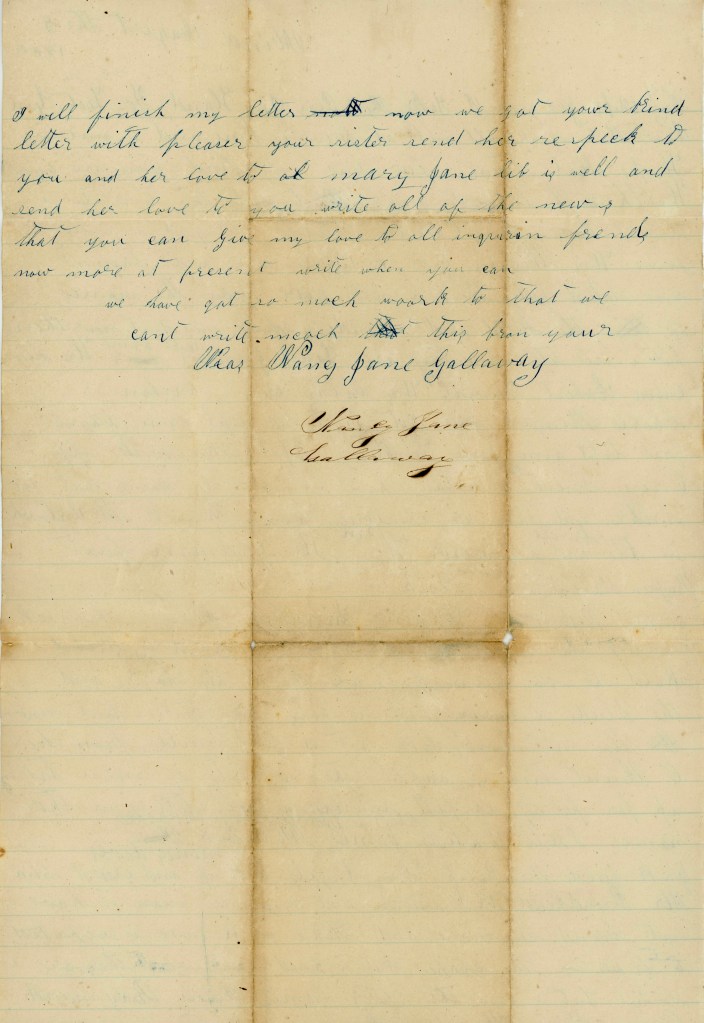
1864: Nancy Jane Gallaway to Mike Johnson

How Nancy might have looked

The following letter was written by 19 year-old Nancy Jane Gallaway of Mina, Chautauqua county, New York. I believe Nancy was the daughter of Martha Gallaway (1817-Aft1880), a widow who lived with her two daughters Nancy and Elizabeth, in the same household as Andrew R. Johnson (1802-1882).

The letter was addressed to Mike Johnson who was most likely Andrew’s son by a former marriage. Martha Gallaway is supposed to have married Andrew in October 1860 but, curiously, her surname appears in later census records as Gallaway so I can’t be certain of the relationships. Instead of cousins, Nancy and Mike may actually have been step-siblings.

Nancy’s letter conveys news of the war casualties of Chautauqua county, New York—particularly from Mina where companies serving in the 111th and 112th New York Infantry as well as the 15th New York Cavalry were recruited. She also speaks of a counterfeit money scandal that took place in the county implicating a number of men. These scandals were not so unusual during the war when paper currency came into widespread use but the government lacked resources to regulate it.

[Note: This letter is from the private collection of Austin Sundstrom and was transcribed and published on Spared & Shared by express consent.]

Transcription

Mina, [Chautauqua county, New York]
August 5, 1864

Now, Mike Johnson, I take my pen in hand to let you know that we are all well at present time and I am in hopes that these few lines may find you in good health. I have not much to write this time but I thought that must write a little. I got a letter from Mr. Wilson July the 14th. He was well then. It was dated July the 9th. I will give you the names of the killed and wounded. I hope you don’t know them but I will tell who they are.

Daniel Johnson, left arm; Mr. Clive’s cousin Robert [Amos] Corbett, 1 hip; Mr. Calvin’s cousin’s husband Charles [H.] Munger, 2 right breast and left arm; Charles Pratt, left arm; James [D.] Findley, 3 left arm broke off; Oren Sweet, 4 arm. They have all been to home but two or three and they are coming home. Frank McIntosh 5 in the knee and a prisoner. Wm. H. Greenman, foot. Rubin Stafford, arm prisoner, death.

James Scidmore 6, Henry [Barber] Findley 7, Ishmer Babcock wounded. The report is that Albert Shinn 8 is killed. He was seen falling off from his horse and the blade a raising.

There is lots of men taking up for passing counterfeit money. I will tell you their names—Doctor Phillips, James McIntosh, Jacob Fields, Mr. Beish. Henry Dugels took up Money Daves and cleared him. Mr. Broadhead, Mr. Busherl and a young man I have not learned his name and three or four more is reported to be in the scrape but I don’t know where they are or not but I can tell their names, Anna Raymond, Orrin Dunn, Henry Schalley.

I will finish my letter now. We got your kind letter with pleasure. Your sister sends her respects to you and her love to Mary Jane. Lib is well and send her love to you. Write all of the news that you can. Give my love to all enquiring friends. No more at present. Write when you can.

We have got so much work to do that we can’t write much. This from your cousin—Nancy Jane Gallaway


1 Robert Amos Corbett (1829-1895) was a 1st Lieutenant in Co. D, 112th New York Infantry. He enlisted at Mina in August 1862 and was wounded in the hip at Cold Harbor on 1 June 1864. He was discharged for disability on 17 October 1864.

Lt. Robert Corbett’s sword

2 Charles H. Munger was 39 years old when he enlisted in Co. D, 112th New York Infantry. He was a corporal when he was wounded in action at Cold Harbor on 1 June 1864. He mustered out with the company at Raleigh, N. C. on 13 June 1865.

3 James D. Findley was 25 years old when he enlisted in August 1862 to serve in Co. H, 112th New York Infantry. He was transferred later to Co. K and was wounded severely on 24 June 1864 near Petersburg, Virginia. He was discharged for disability on 11 September 1865.

4 Oren or Orrin Sweet (1843-1892) served in Co. B, 111th New York Infantry. He was wounded on 29 October 1863 at Wauhatchie, Tennessee, and again on 25 May 1864 at Dallas, Georgia. He was taken prisoner and held until 13 April 1865.

5 Frank McIntosh of Mina enlisted at the age of 19 in 1863 to serve in the 15th New York Cavalry.

6 James C. Scidmore (1838-1864) served as a private in Co. B, 111th New York Infantry. He was wounded at Wauhatchie, Tenn. on October 29, 1863; killed at Culp’s [Kolbs] Farm, Ga. on June 17, 1864.

7 Henry Barber Findley (1846-1864) was a private in Co. D, 112th New York Infantry. He was mortally wounded at Cold Harbor on 2 June 1864.

8 23 year-old Albert Shinn enlisted at Mina in January 1864 to serve in the 15th New York Cavalry. He deserted at Lynchburg, Virginia, on 19 June 1864 according to military records. Albert was born in Germany and was a farmer by occupation.