Category Archives: Ellsworth’s Fire Zouaves

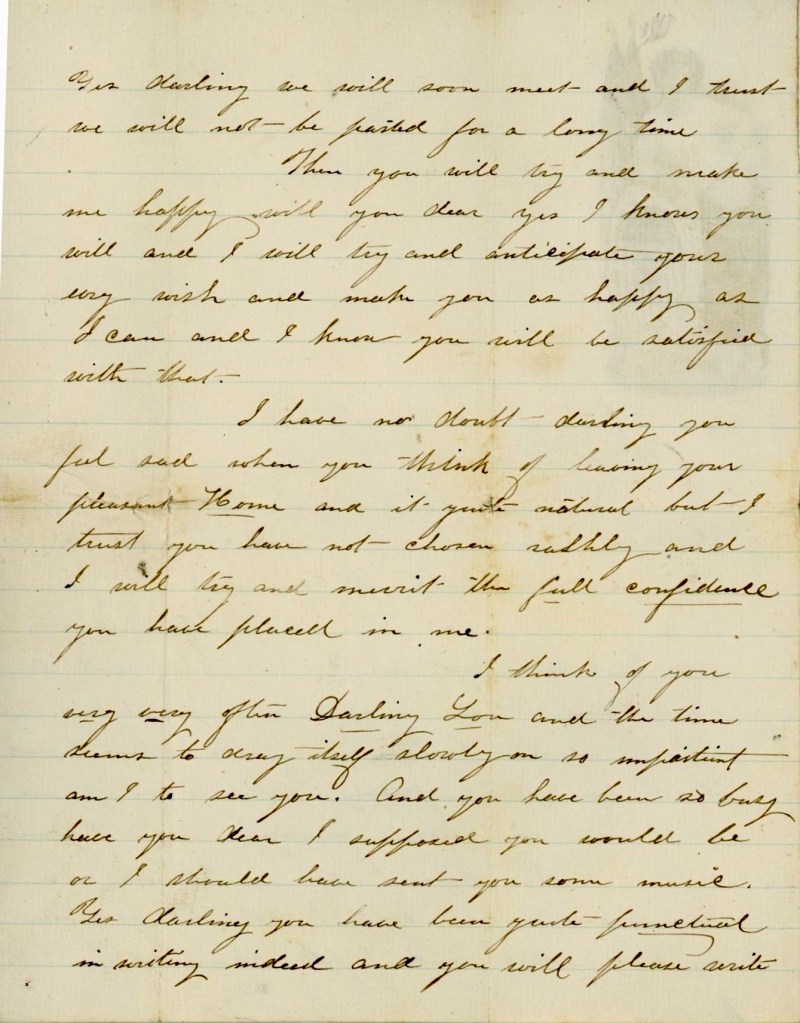
1861: Charles D. Barrett, Samuel Frank Parcher, and Edward M. Gammon to friend Phineas

This letter was begin by Charles D. Barrett (1828-1896) and finished by Samuel Franklyn (“Frank”) Parcher and Edward M. Gammon; Frank doing the writing of the latter two. All three were members of the 5th Maine Infantry. Charles began his service as a private in Co. H but later transferred to the band, joining Frank and Ed who mustered in as principal musicians. The 5th Maine Infantry was formed in Portland, Maine, and were mustered into the service on 24 June 1861 and encamped on Meridian Hill north of Washington City in July. They moved their camp to Alexandria, Virginia, just prior to the Battle of Bull Run. At that time, they were attached to Howard’s Brigade, Heintzelman’s Division. After the battle, they set up camp near Fort Ellsworth in Alexandria.

T R A N S C R I P T I O N

Sunday, July 7, 1861

Friend Phineas,

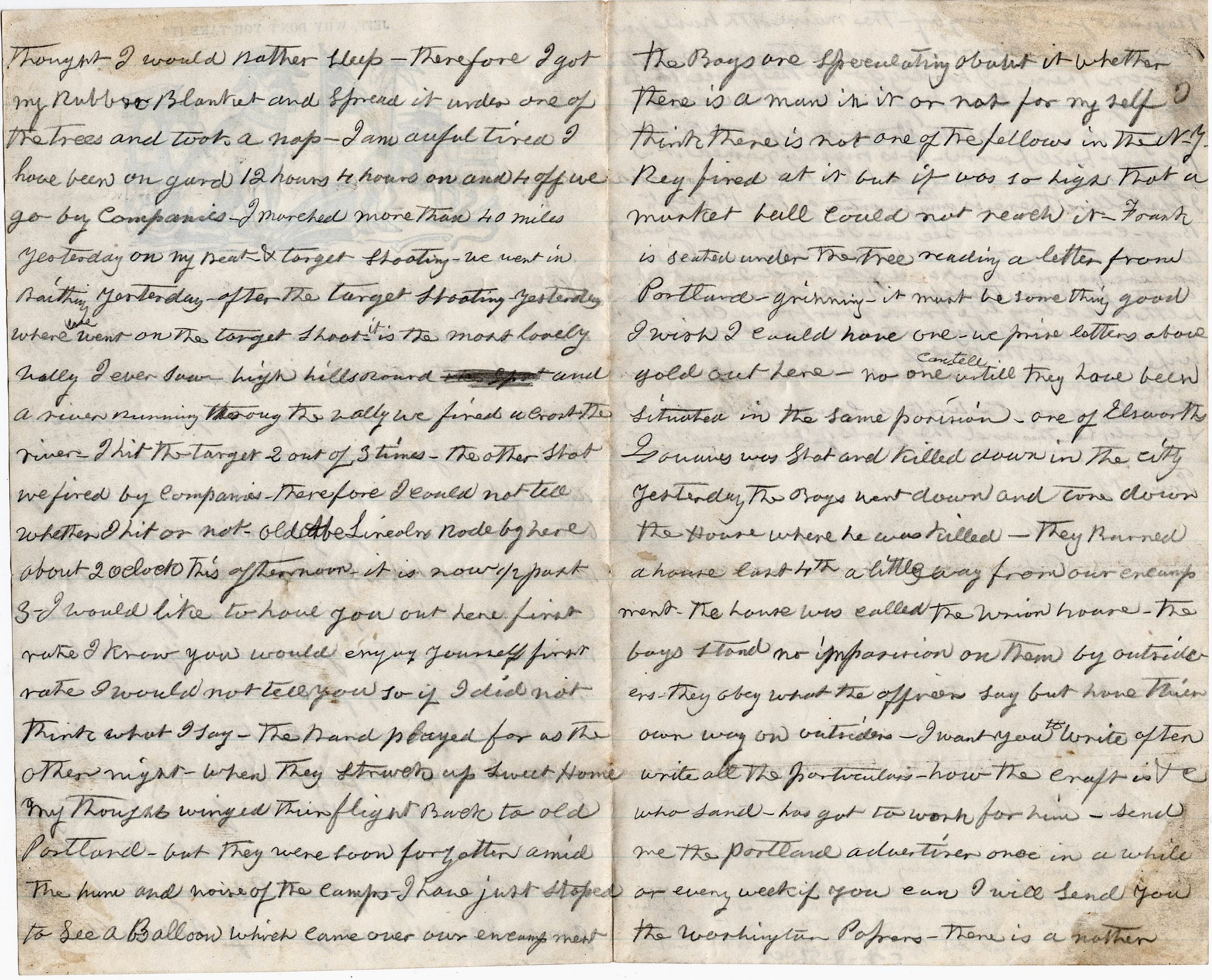
I am now on my knees by the Band tent writing on the bare drum head. I have just returned from the dight of a military funeral—one of te New York soldiers. It is a very warm day but we have got a cool breeze in the shade. The German New York 5th went by here about a half hour ago. They are a hard set of soldiers, you better believe. They are going down into Virginia. 1 There has been 15 regiments left here. When I say here, I mean close by. It is a city of soldiers and you would not miss them any more than you would miss a tree from the forest.

Speaking of trees, we have nice ones here—wide spreading oaks. The band tent is situated under one of these. Frank Parcher and Ed Gammon has just returned from Battery. There was a lot more of the Band went with them. The most of the company that I belong to have gone. I could have gone if I chose but I thought I would rather sleep. Therefore I got my rubber blanket and spread it under one of the trees and took a nap. I am awful tired. I have been on guard 12 hours, 4 hours on and 4 off. We go by companies.

I marched more than 40 miles yesterday on my beat & target shooting, We went in bathing yesterday after the target shooting. Where we went on the target shoot is the most lovely valley I ever saw—high hills round and a river running through the valley. We fired across the river. I hit the target two out of three times. The other shot—we fired by companies, therefore, I could not tell whether I hit or not.

Old Abe Lincoln rode by here about two o’clock this afternoon. 2 It is now half past 3. I would like to have you out here first rate. I know you would enjoy yourself first rate. I would not tell you so if I did not think what I say. The Band plated for us the other night. When they struck up Sweet Home, my thought winged their flight back to Old Portland. But they were soon forgotten amid the hum and noise of the camps.

I have just stopped to see a balloon which came over our encampment. The Boys are speculating about it whether there is a man in it or not. For myself, I think there is not. One of the fellows in the New York Regiment fired at it but it was so high that a musket ball could not reach it. Frank is seated under the tree reading a letter from Portland—grinning. It must be something good. I wish I could have one. We prize letters above gold out here. No one can tell until they have been situated in the same position.

One of Ellworth’s Zouaves was shot and killed down in the city yesterday. The Boys went down and tore down the house where he was killed. They burned a house last 4th [of July] a little way from our encampment. The house was called The Union House. The Boys stand no imposition on them by outsiders. they obey what the officers say, but have their own way on outsides.

I want you to write often. Write all the particulars—how the craft is, &c. Who Sand has got to work for him. Send me the Portland [Daily] Advertiser once in a while or every week if you can. I will send you the Washington papers. There is another regiment just going by, The Maine 4th have just received their new instruments. They are practicing [?] on them. I hardly go to the fence to see the regiments that pass this way there is so many. We are on 14th Street on a farm called Pleasant Hill Farm. It is mightily named. It is a splendid place. 3

I have not been sick a minute since I left Portland. There is any quantity of the 1st Regiment Boys came over to see us. I could think of enough to write to cover the earth but short letters are all the go here. We write short and often and I must keep in the fashion. Therefore, I will close wishing you good health and a long life. From your friend, — Charley B.

Give my love to Abby [ ], your wife, and all the rest of mankind. Tell Seth B. Libby to write to me and I will write to him. Ed Gammon is going to write a line. Let Sandbor & Charley see this and the girls if you want to.

Friend Phin,

We are enjoying ourselves hugely here. We (that is, Meyor [?] and myself) have just returned from a walk in a beautiful brook a short distance from here. Barrett says it is a most romantic place. If you were here, you would never want to go back. Our duties are very easy and we lay in the shade the most of the time. I tell you, Phin, that you would enjoy yourself. There was a German Regiment went by here today that you would have like to see. One of the hardest and toughest regiments you ever saw. Sunburnt and browned, every man looked as though he was good for ten rebels. As they went by on their way to Virginia, they struck up a good old German song. That’s what makes the spirits rise! The 4th Maine will probably leave in a few days. Yours, — Ed [Gammon] & Frank [Parcher]

1 The 5th New York State Militia (also known as the Jefferson Guard) was composed almost entirely of German citizens from New York City. They broke camp on 7 July 1861 to join the forces mustering in Virginia under Gen. Robert Patterson.

2 Lincoln and Sec. Seward spend two hours at Navy Yard. Extracts from Dahlgren Diary, John G. Nicolay Papers, Library of Congress, Washington, DC. [Source: Lincoln Log]

3 In 1861, “Pleasant Hill” was a prominent country estate and farm owned by the Holtzclaw family, situated along the 14th Street corridor in Washington City. As the Civil War began, this rural expanse was transformed by the Union Army into a fortified military position critical for the capital’s defense.
1861: David Watson Conkling to Louise L. Randall

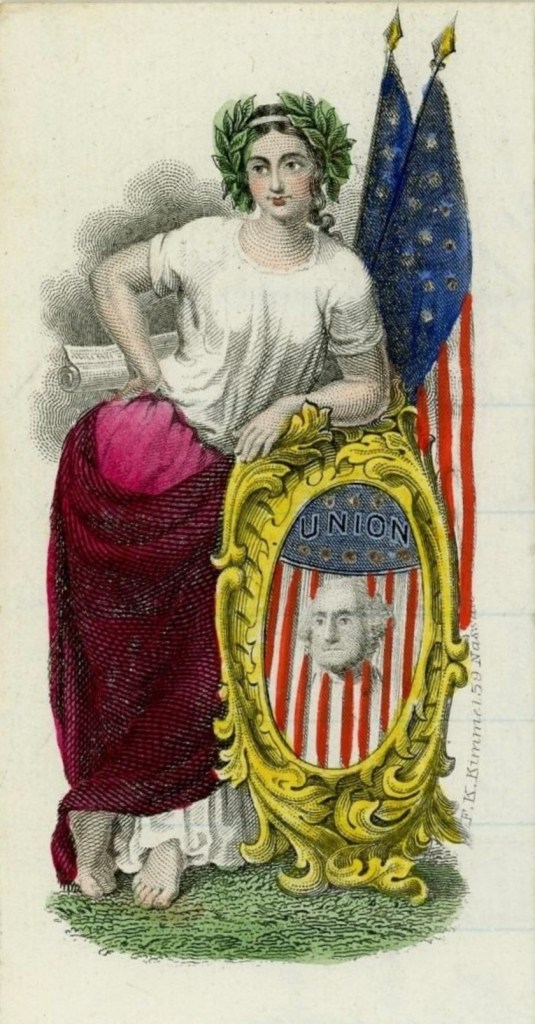
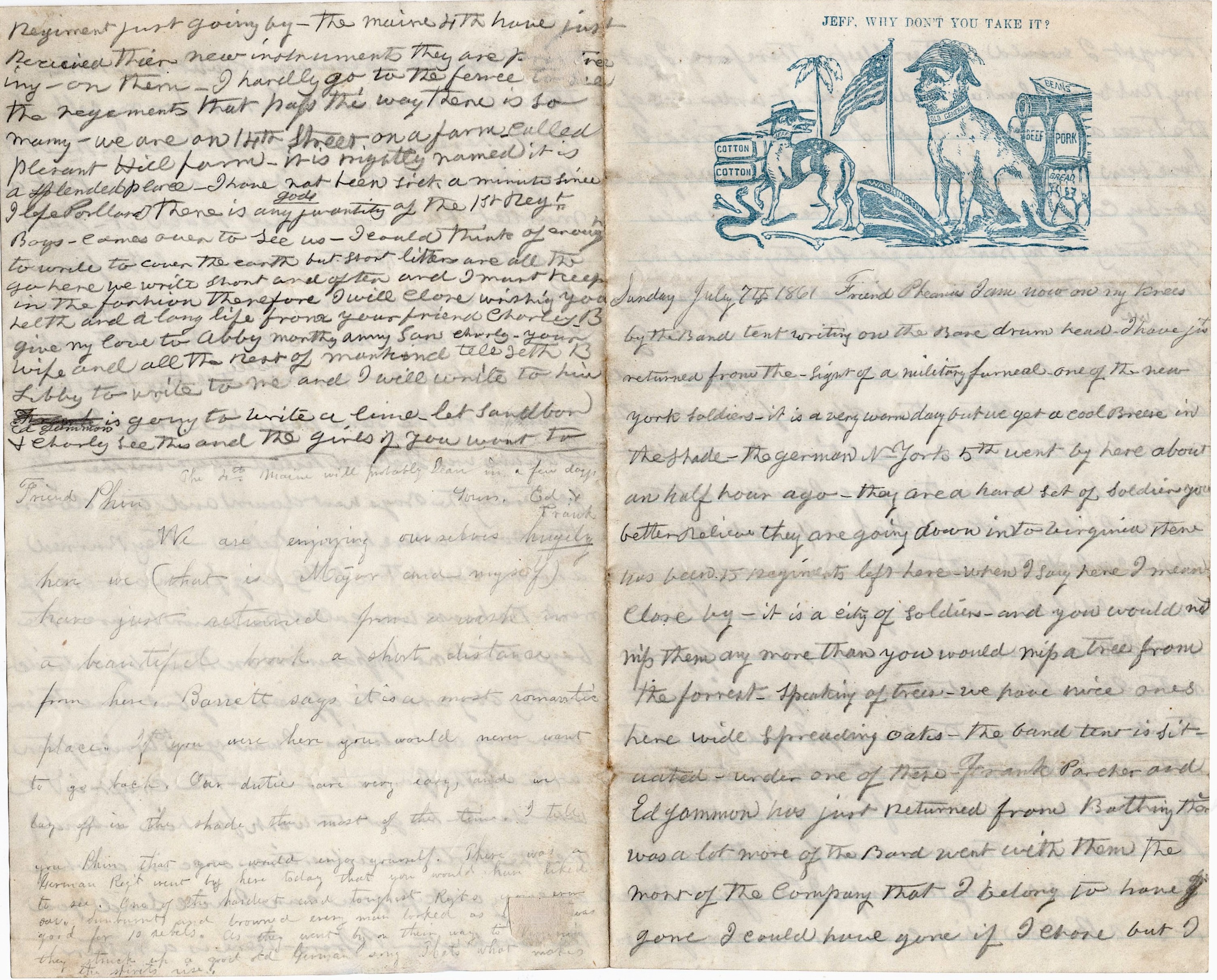
Patriotic letterhead on stationery using by Conkling in 1861

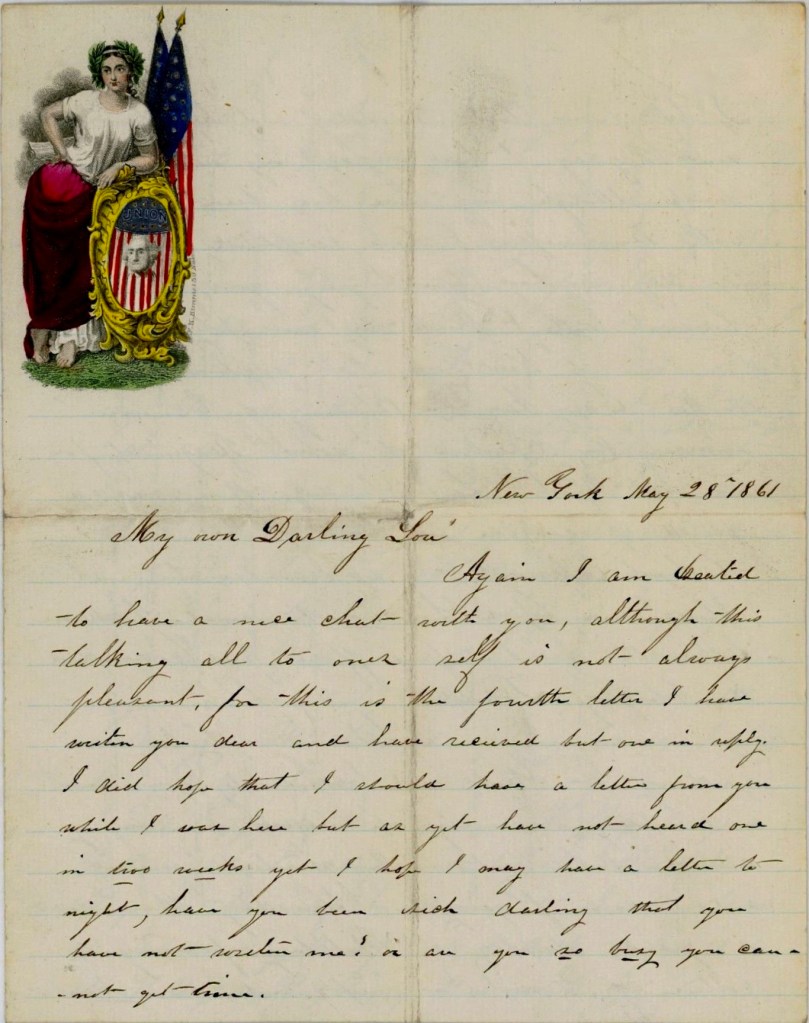
The following letter were written by David Watson (“Wat”) Conkling (1835-1904), the son of David Conkling (1806-1881) and Almira Ann Watson (1810-1865) of Rensselaerville, Albany county, New York. Wat wrote the letters to Louisa (“Lou”) L. Randall (1841-1903), the daughter of Andrew Jackson Randall (1815-1879) and Juliette King (1815-1892) of Union, Monroe county, New York. The letters were written in the days ahead of Wat & Lou’s marriage on 19 June 1861.

Letter 1

New York
May 28, 1861

My own darling Lou,

Again I am seated to have a nice chat with you, although this talking all to ones self is not always pleasant, for this is the fourth letter I have written you dear and have received but one in reply. I did hope that I should have a letter from you while I was here but as yet have not heard one in two weeks. Yet I hope I may have a letter tonight. Have you been sick darling that you have not written me! or are you so busy you can not get time.

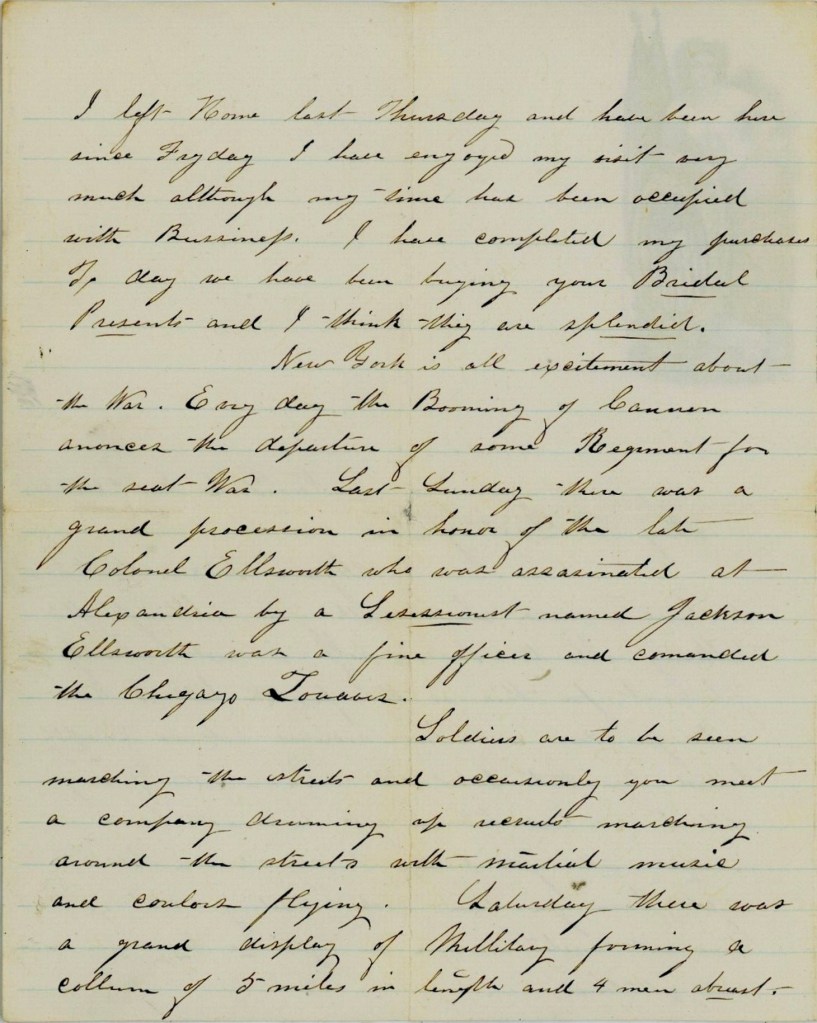
I left home last Thursday and have been here since Friday. I have enjoyed my visit very much although my time has been occupied with business. I have completed my purchases today. We have been buying your Bridal Presents and I think they are splendid.

Col. Elmer Ellsworth

New York is all excitement about the War. Every day the booming of cannon announces the departure of some regiment for the seat of War. Last Sunday there was a grand procession in honor of the late Colonel Ellsworth who was assassinated at Alexandria by a secessionist named Jackson. Ellsworth was a fine officer and commanded the Chicago Zouaves.

Soldiers are to be seen marching the streets and occasionally you meet a company drumming up recruits marching around the streets with martial music and colors flying. Saturday there was a grand display of military forming a column of five miles in length and four men abroad.

The weather is very fine, being just warm enough to be pleasant.

I shall return home tomorrow which is Wednesday and if I do not get a letter from you before I leave here, I hope to find one on my return home. I sent you a list of friends that I wish you to invite [to our wedding] with their mail address and I wish you to mail them. I will send you an extra 50 for your own use. Invite whoever you think best of your friends and neighbors. Uncle S[tephen] V[an] R[ensselaer] Watson and sister Mollie and Aunt Charlotte from Buffalo and Uncle Williams people will be all of my friends that I think will attend the wedding. The Complimentary Cards I will bring when I come out. I will express the cards to Holley to your father and he can send by the Kendall Stage for them if he chooses to. I will express them Wednesday the 29th instead. I think they will be at Holley on Friday of this week.

Only three short weeks will elapse, darling lover, before you will see me again and then we will not be separated, will we darling Lou? The time seems so very long—does it to you, dearest? I have thought of you almost constantly of late. Do not work too hard, darling girl. I should have sent you some music but I know you have not the time to learn it now. I sent you some papers. Did you receive them? And now, goodbye with one sweet kiss. I will write you Monday if I receive a letter from you this week. Good night dearest Louisa.

As ever yours and yours only, — D. W. Conkling

P. S. Write soon!

Letter 2

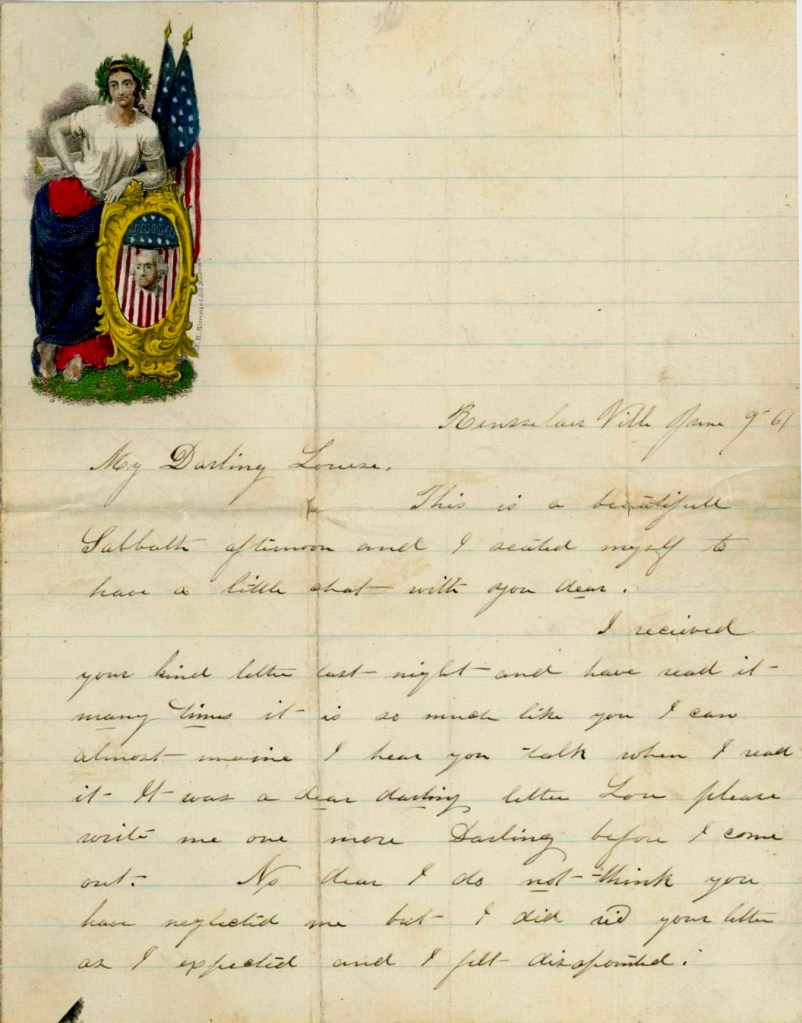
Rensselaer Ville, June 9, 1861—(not transcribed)

1861: Alfred L. Edwards to Philander Merrill

I could not find an image of Alfred but here is Franklin D. Cornish who served in the same regiment. (Photo Sleuth)

This letter was written by Alfred L. Edwards (1841-1918) who enlisted on 26 August 1861 as a private in Co. E, 50th New York Engineers and remained in the regiment until mustering out on 20 September 1864 at Elmira, New York.

Alfred datelined his letter from New York City on 20 September 1861 two days after his arrival. He shares the news with his mother that they were ordered to encamp on the battery overlooking New York Harbor which was still occupied by members of Ellsworth’s New York Fire Zouaves (11th New York Infantry) despite their having been ordered to Fortress Monroe. A newspaper article described the situation as follows:

“The New York Fire Zouaves—the “Pet Lambs”—have again been distinguishing themselves. On Thursday last they were assembled on the battery, New York, where they indulged in a series of free fights, at one time assuming the proportions of a riot. They also tossed in blankets a number of inoffensive laborers, and seizing a reporter of the Times tossed him in a tent cloth, and otherwise maltreated him, and finally robbed him of fifteen dollars. When appealed to Col. Lozier to behave in a more orderly, and to go without further difficulty to Fort Monroe, but twenty-five out of three hundred were willing to go—the others, on various pretenses, utterly refusing to leave New York. It is high time that these cowardly miscreants—the terror of all peaceable and unarmed citizens, the disgrace to the profession of arms, and the butt for the ridicule of the fie—were treated as mutineers or deserters; reduced to order or shot. It is idle to waste more time or more words on them.”The Daily Gazette and Republican, Trenton, NJ 23 September 1861

Alfred wrote the letter to his mother, Rumina (Gates) Merrill (1818-1895). The envelope was addressed to Rumina’s second husband, Philander Merrill (1795-1883) of Ketchumville, Tioga county, New York. Rumina’s first husband, Cyrus Edwards, died prior to the 1850 US Census at which time the widow Rumina was enumerated with her two boys, Alfred and Cyrus, in Maine, Broome county, New York.

To read other letters I have transcribed and posted on Spared & Shared that were written by members of the 50th New York Engineers, see:

Cornelius Van Huysen, Co. A, 50th New York Engineers (1 Letter)
Abner G. Hill, Co. B, 50th New York Engineers (1 Letter)
William H. Lunn, Co. E, 50th New York Engineers (1 Letter)
Halsey Amos Rhodes, Co. H, 50th New York Engineers (1 Letter)

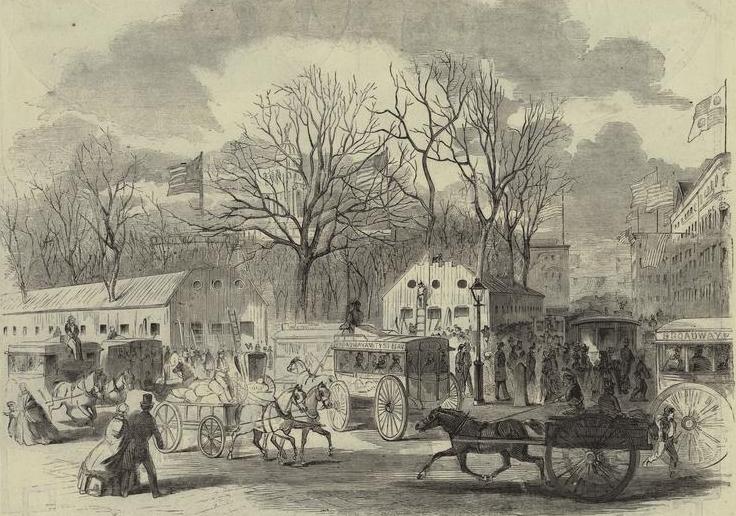
Temporary Barracks erected in Battery Park in NYC in 1861

Transcription

Addressed to Philander Merrills, Ketchumville, Tioga county, New York

Camp Lesley
New York City
[Friday,] September 20th [1861]

Dear Mother,

We started from Elmira [on Tuesday,] the 17th at four o’clock p.m. in a train of 24 cars, 17 with soldiers. We got [here] next day [Wednesday] at 8 a.m. We are camped on the Bay. Last night we slept on our arms. We expected to be attacked by the New York Fire Zouaves. There was some 300 or 400 on the ground when we came here and they were not going to leave. They had been ordered to leave in the morning at six o’clock but swore they would not, but the Mayor sent the police force in the afternoon and they left. We expected they would return but they did not.

We leave here today at two o’clock. Where to I don’t know. We are all well. I have [seen] more here than I ever seen in my life. Ships and boats are moving all the time. I counted two hundred and sixty-three in view. I am laying flat on my belly and nothing to write on but a board and can’t write good. I will let you know where I be in a day or two.

— A. L. Edwards

I will direct my letters after this in this style, — Alfred L. Edwards, Ketchumville