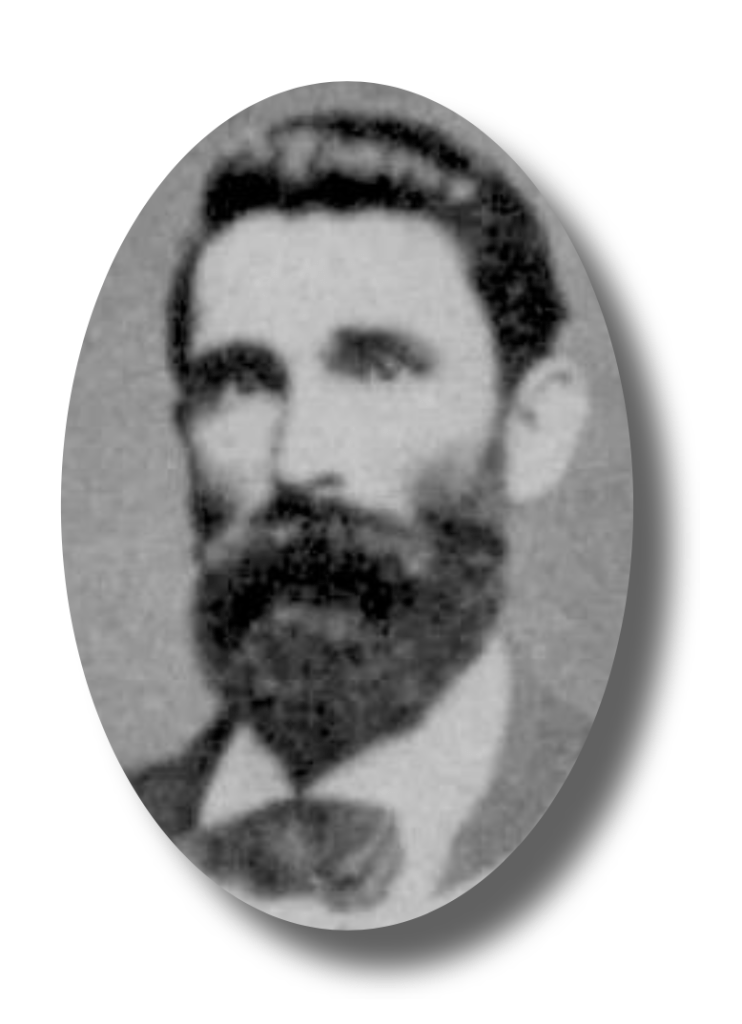
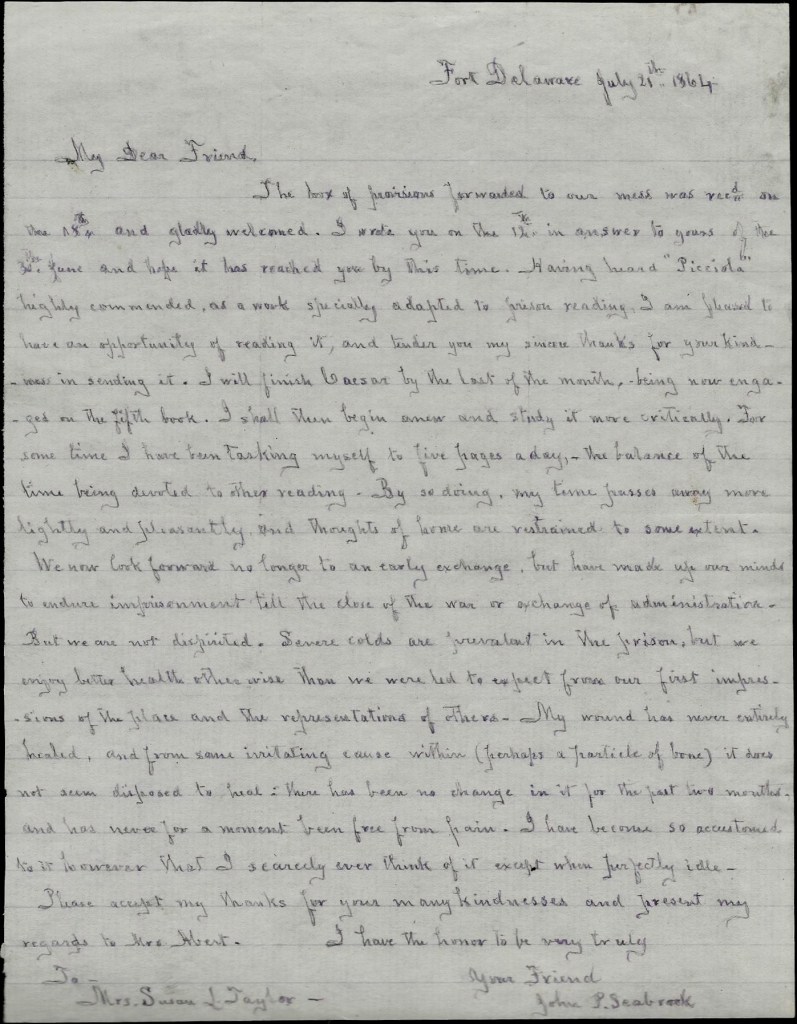
The following POW letter was written by Lt. John P. Seabrook (1835-1927) of Co. I (“Alabama Grey’s”), 38th Alabama Infantry. Seabrook’s regiment was organized at Mobile in May 1862 and took an active role in the campaigns of the Army of Tennessee from Chickamauga to Nashville. Seabrook was taken prisoner in the fighting at Missionary Ridge on 25 November 1863. He was first taken to Louisville, then Camp Chase in Ohio, and finally to Fort Delaware. According to muster rolls, Seabrook had most of his right arm amputated at the US Hospital in Nashville before being released into the prisoner system in mid-February 1864. Seabrook was finally paroled at Fort Delaware on 14 September 1864 and forwarded for exchange to Aiken’s Landing, Virginia. He returned to duty on 27 September 1864 and was with his regiment at Fort Blakely when it was surrendered on 9 April 1865. He was sent for a few weeks to Ship Island as a POW until exchanged on 6 May 1865.
Seabrook wrote the letter to Susan Lucy (Barry) Taylor (1807-1881), the wife of Col. James Jones Taylor (1802-1883) of Newport, Kentucky—located adjacent to Covington. The couple were wed in 1824 and had at least six children—three of who are mentioned in this letter; James Taylor (1833-1876), John Taylor (1836-1914), and Barry Taylor (1839-1887). Mrs. Taylor was the daughter of Hon. William T. Barry (1785-1835) who was a Kentucky Democratic politician who served as the first Cabinet level Postmaster General under President Andrew Jackson. Susan operated a benevolent society out of Newport, Kentucky, that supplied aid and comfort to Confederate prisoners of war confined in Yankee prisons.
Confederate prisoners arriving at Fort Delaware
Transcription
Fort Delaware July 21, 1864
My dear friend,
The box of provisions forwarded to our mess was received on the 18th and gladly received. I wrote you on the 12th in answer to yours of the 30th June and hope it has reached you by this time. Having heard “Picciola” highly commended as a work specially adapted to prison reading, I am pleased to have an opportunity of reading it, and tender you my sincere thanks for your kindness in sending it. I will finish Caesar by the last of the month, being now engaged on the fifth book. I shall then begin anew and study it more critically. For some time I have been tasking myself to five pages a day—the balance of the time devoted to other reading. By so doing, my time passes away more lightly and pleasantly and thoughts of home are restrained to some extent.
We now look forward no longer to an early exchange, but have made up our minds to endure imprisonment till the close of the war or exchange of administration. But we are not dispirited. Several colds are prevalent in the prison but we enjoy better health otherwise than we were led to expect from our first impressions of the place and the representations of others.
My wound has never entirely healed and from some irritating cause within (perhaps a particle of bone) it does not seem disposed to heal. There has been no change in it for the past two months and has never for a moment been free from pain. I have become so accustomed to it, however, that I scarcely ever think of it except when perfectly idle.
Please accept my thanks for your many kindnesses and present my regards to Mrs. Abert. I have the honor to be very truly your friend, — John P. Seabrook
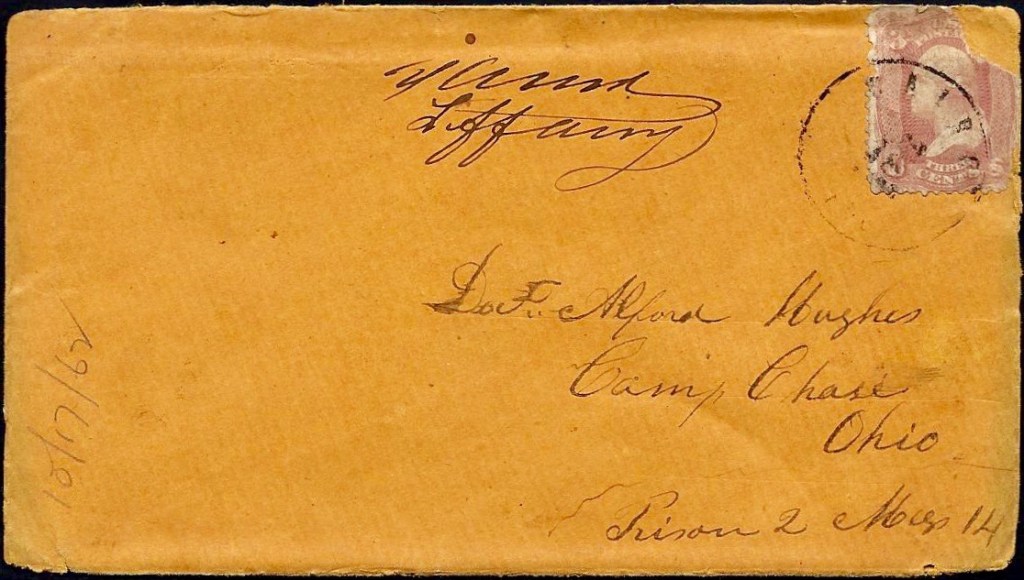
The following letter was written by 29 year-old Samuel Bowman Swats (1833-1908) of Augusta county, Virginia. He was the son of John Swats and Anna W. Hensley. Just prior to the Civil War, Samuel was enumerated at Burkes Mill, Augusta county, Virginia, where he worked as a carpenter. He was married to Virginia Cross (1839-1915) in 1858.
Samuel served the Confederacy originally as a private in 1st Battalion Virginia Cavalry. This company was later consolidated with other companies to form the 11th Virginia Cavalry and Samuel was in Co. F. According to his obituary, Swats was twice captured and imprisoned, once in Camp Chase and again at Point Lookout where he remained a prisoner until after the close of the war. He was described on muster roll records as standing 5 feet 9 inches tall, with blue eyes, and black hair.
According to Samuel’s military record, he was taken prisoner on 7 September 1862 at Darksville, Virginia, and confined first in the Atheneum Military Prison in Wheeling, then at Camp Chase, and finally at Camp Douglas. He was officially exchanged at Vicksburg on 1 November 1862, some two weeks after this letter.
Samuel wrote the letter to Dr. Alfred C. Hughes (1824-1880), a Wheeling physician who was at the time a political prisoner at Camp Chase. Presumably Samuel and Alfred became acquainted when Samuel was imprisoned either at Wheeling, Virginia, or at Columbus, Ohio, or both.
Transcription
Addressed to Dr. Alford Hughes, Camp Chase, Ohio, Prison 2, Mess 14
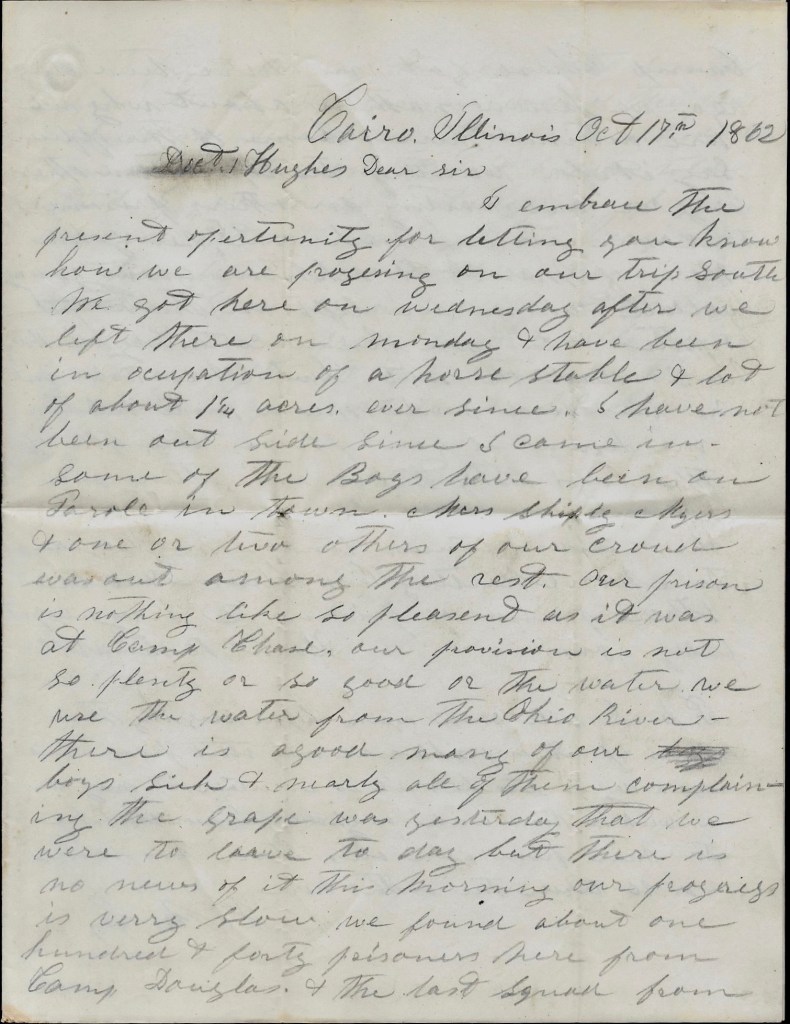
Cairo, Illinois October 17th 1862
Doctor Hughes, dear sir,
I embrace the present opportunity for letting you know how we are progressing on our trip south. We got here on Wednesday after we left there on Monday & have been in occupation of a horse stable and lot of about 1.25 acres ever since. I have not been outside since I came in. Some of the Boys have been on parole in town, Mrs. Shipley Myers & one or two others of our crowd was out among the rest. Our prison is nothing like so pleasant as it was at Camp Chase. Our provision is not so plenty or so good nor the water. We use the water from the Ohio River. There is a good many of our boys sick and nearly all of them complaining. The gripe was yesterday that we were to leave today but there is no news of it. This morning our progress is very slow. We found one hundred and forty prisoners here from Camp Douglas & the last squad from Camp Chase got in here two days ago. We know nothing about why we are detained here. Some of the officers say it is for want of transportation. Others say we are waiting for other prisoners to come in.
I wish you to see John Allen of Mess 8 and ask him about young Wallace whom we left in the hospital & let me know certainly whether he is dead or not. Lieut. Acres told me he was dead. Write me a note and let me know if you please.
Tell all the boys that we are getting on as well as can be expected under the circumstances. Tender my regards to Messrs. Marting, Cox, Strum, & all other friends of Prison 2. Very respectfully yours, — Samuel B. Swats
P. S. I will write again before crossing the lines if it is possible. We may start from here in a day or two but it is uncertain. It may be a week or two. Write anyhow. I would like to hear from you all. There has some 8 or 10 taken the oath here. — S. B. S.
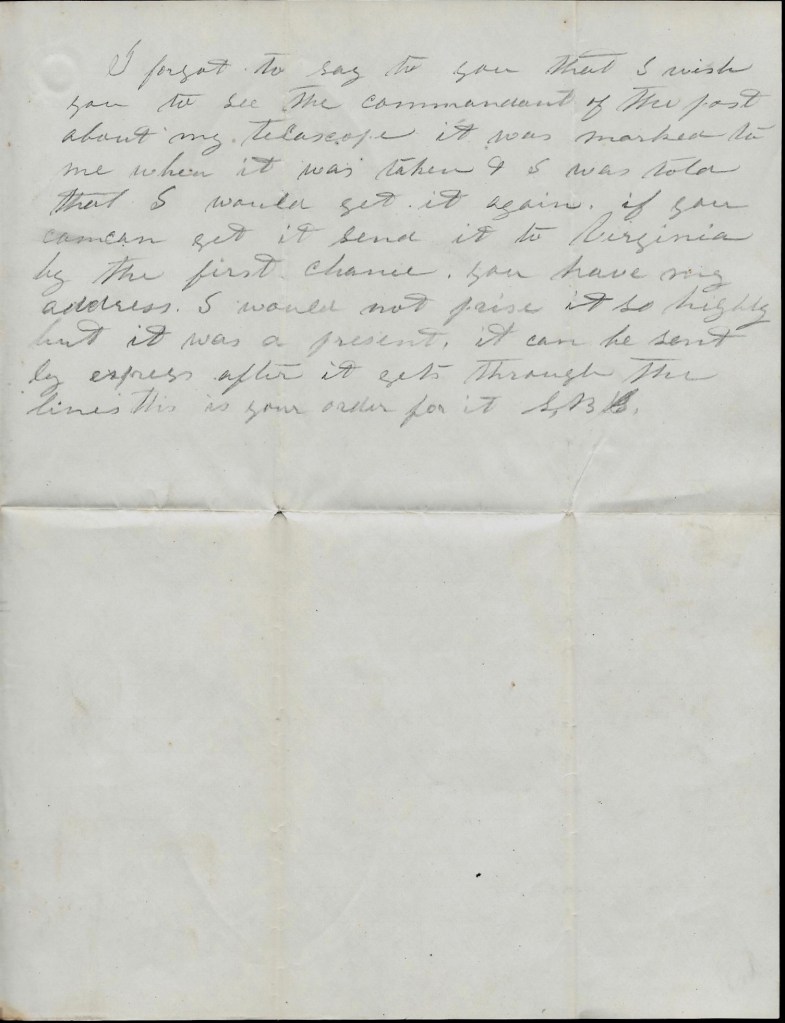
I forgot to say to you that I wish you to see the commandant of the post about my telescope. It was marked to me when it was taken & I was told that I would get it again. If you can get it, send it to Virginia by the first chance. You have my address. I would not prize it so highly but it was a present. It can be sent by express after it gets through the lines. This is your order for it. — S. B. S.
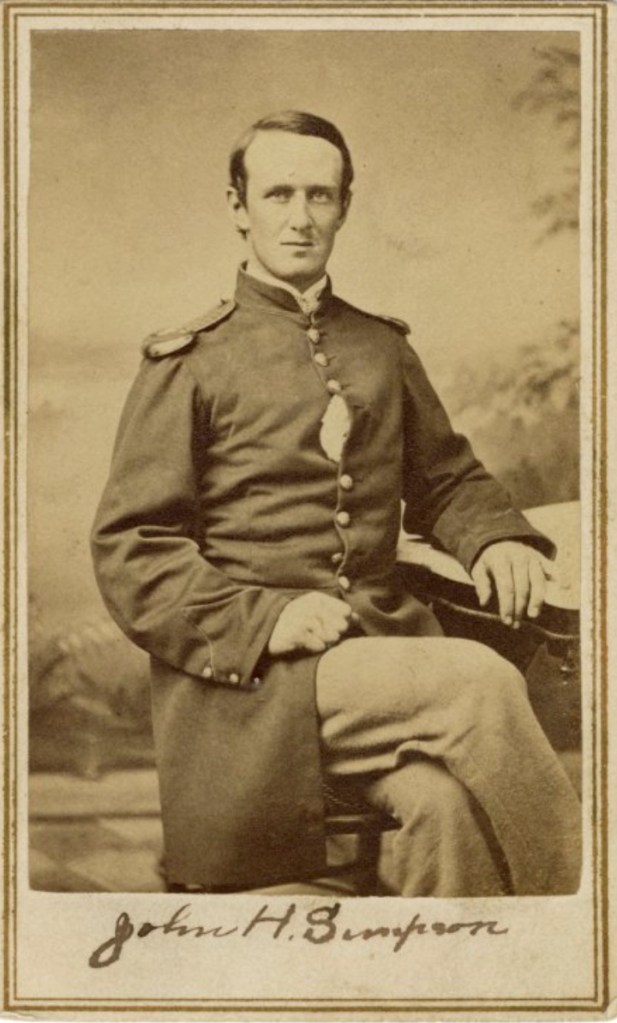
I could not find an image of Jud dating to the time he was in the Civil War but here is one of John H. Simpson of Co. C, 39th Massachusetts Infantry (Photo Sleuth)
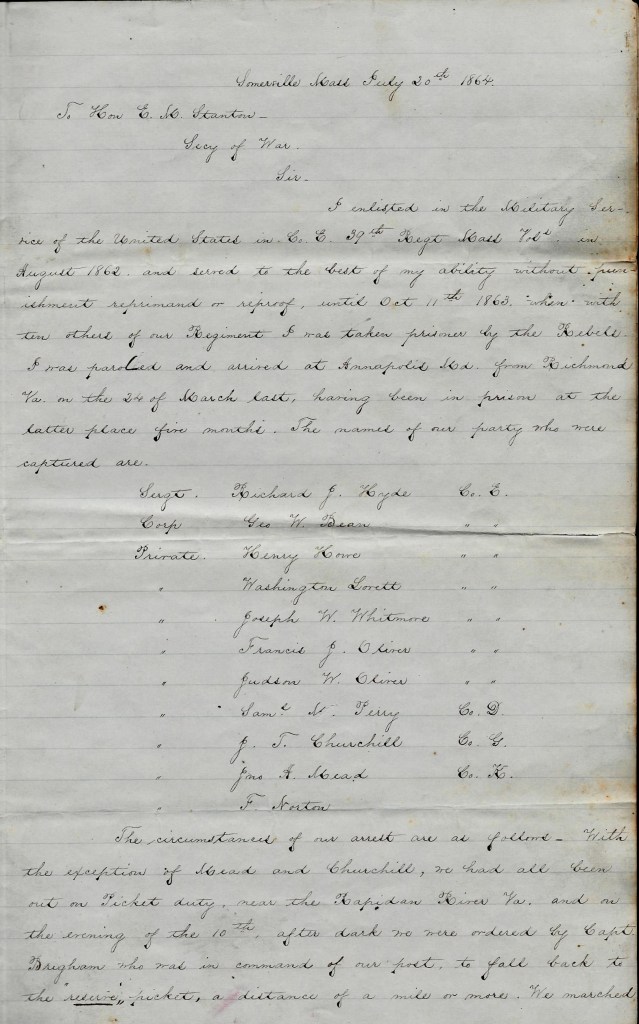
The following letter, addressed to Secretary of War, Edwin M. Stanton, was penned by Judson (“Jud”) Wayland Oliver (1832-1908) of Co. E, 39th Massachusetts Infantry. As he states in his letter, he was taken a prisoner of war near the Rapidan River on 10 October 1863 and held in prison on Belle Island in Richmond through the winter of 1863/64 until exchanged after five months. After more time regaining his health in Union hospitals, he was returned to his regiment where he remained until taken prisoner again in February 1865 at Hatcher’s Run. He was exchanged not long after and mustered out in June 1865.
Judson was the son of William Oliver, Jr. (1795-1880) and Lydia Neagles (1810-1890) of Somerville, Middlesex county, Massachusetts. He was married in 1853 to Sarah Fessenden Hobart (1836-1878) and was the father of two children born before the Civil War began; three more after the close of the war.
Prior to Jud’s capture in October 1863, the 39th Massachusetts had spent the entire previous year performing guard duty in the defenses of Washington D. C., on the upper Potomac River, and near Harper’s Ferry. They were advanced to the Rapidan river and posted there in August and September 1863, but were pulled back to join other commands for the Bristoe Campaign. It was during this retreat from the Rapidan that Jud and the others in his squad were captured by rebel cavalry.
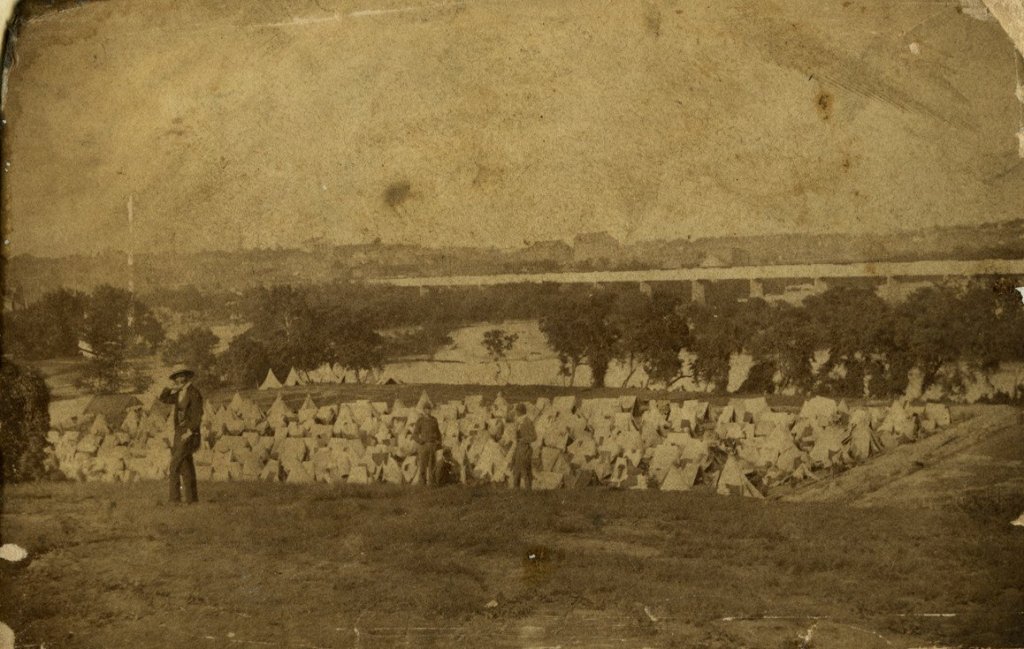
A rare Confederate photograph taken in the field shows tents where Union prisoners of war were housed on Belle Isle, an open-air prison located on an island in the James River across from Richmond. The photographer, Charles R. Rees, took the image from a high point on the island; in the distance, at center left, is the Capitol.
Transcription
Somerville, Massachusetts July 20th 1864
To Hon. E. M. Stanton, Secretary of War Sir,
I enlisted in the military service of the United States in Co. E, 39th Regt. Massachusetts Volunteers in August 1862 and served to the best of my ability without punishment, reprimand, or reproof until October 11th 1863 when with ten others of our regiment I was taken prisoner by the rebels. I was paroled and arrived at Annapolis, Maryland, from Richmond, Va., on the 24th of March last, having been in prison at the latter place five months. The names of our party who were captured are:
Sergt. Richard J. Hyde, Co. E Corp. George W. Bean, Co. E Private Henry Howe, Co. E Private Washington Lorett, Co. E Private Joseph W. Whitmore, Co. E Private Francis J. Oliver, Co. E Private Judson W. Oliver, Co. E Private Samuel M. Perry, Co. D Private J. T. Churchill, Co. G Private Jno. A. Mead, Co. K Private F. Norton
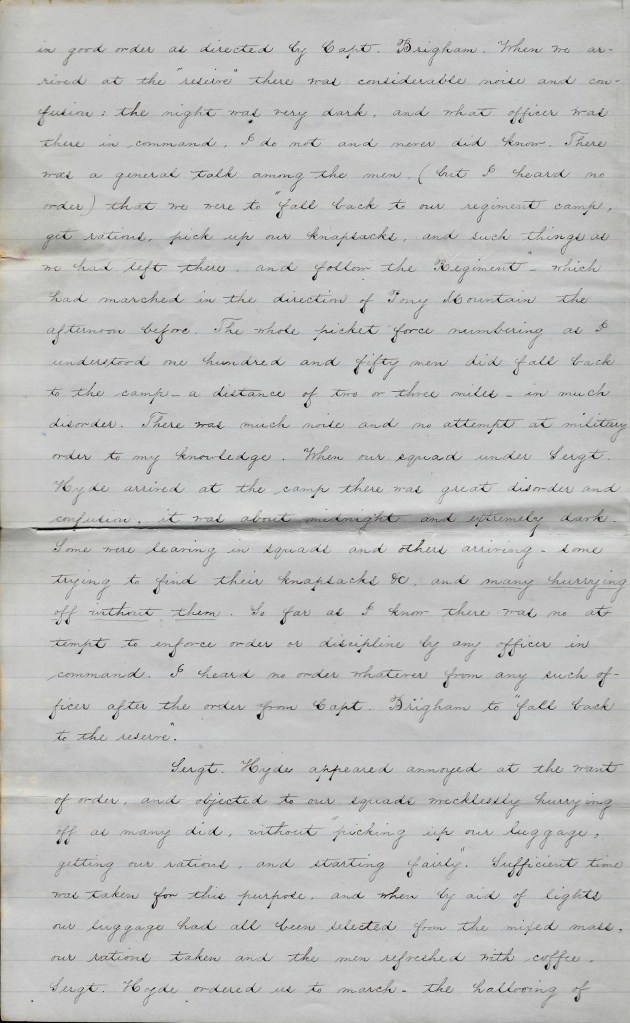
The circumstances of our arrest are as follows. With the exception of Mead and Churchill, we had all been out on picket duty near the Rapidan River, Va., and on the evening of the 10th, after dark, we were ordered by Capt. Brigham who was in command of our post, to fall back to the reserve picket, a distance of a mile or more. We marched in good order as directed by Capt. Brigham. When we arrived at the “reserve,” there was considerable noise and confusion. The night was very dark and what officer was there in command, I do not and never did know. There was a general talk among the men (but I heard no order) that we were to “fall back to our regiment camp, get rations, pick up our knapsacks, and such things as we had left there, and follow the regiment which had marched in the direction of Pony Mountain the afternoon before. The whole picket force numbering as I understood one hundred and fifty men did fall back to the camp—a distance of two or three miles—in much disorder. There was much noise and no attempt at military order to my knowledge.
When our squad under Sergt. Hyde arrived at the camp, there was great disorder and confusion. It was about midnight and extremely dark. Some were leaving in squads and others arriving, some trying to find their knapsacks, &c., and many hurrying off without them. So far as I know, there was no attempt to enforce order or discipline by any officer in command. I heard no order whatever from any such officer after the order from Capt. Brigham to “fall back to the reserve.”
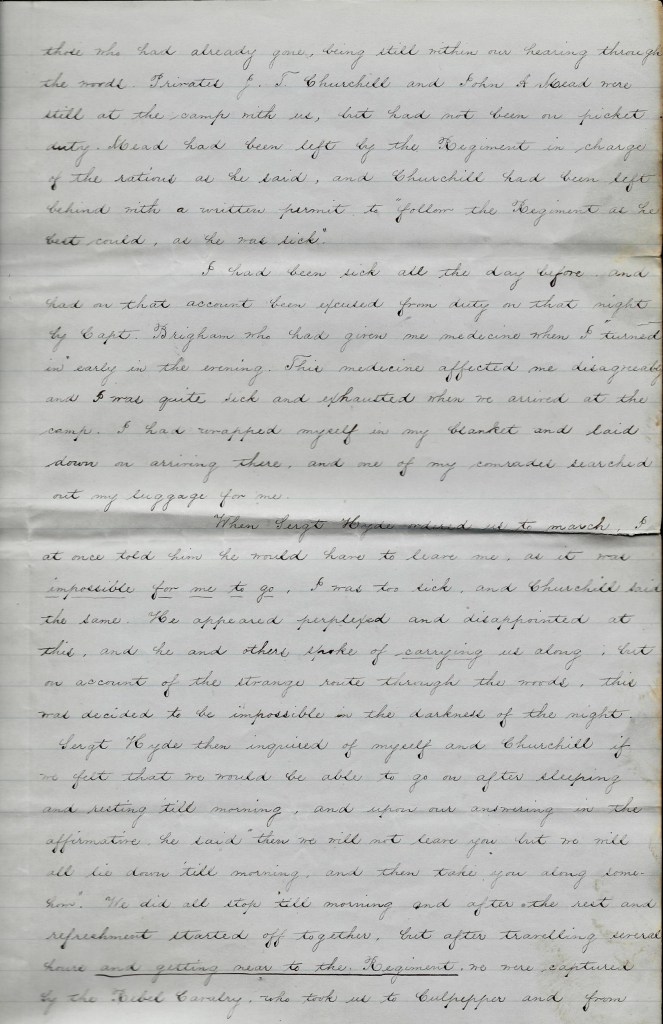
Sergt. Hyde appeared annoyed at the want of order and objected to our squad’s recklessly hurrying off as many did, without “picking up our luggage, getting our rations, and starting fairly.” Sufficient time was taken for this purpose and when by aid of lights our luggage had all been selected from the mixed mass, our rations taken, and the men refreshed with coffee, Sergt. Hyde ordered us to march, the hallooing of those who had already gone, being still within our hearing through the woods. Privates J. T. Churchill and John A. Mead were still at the camp with us, but had not been on picket duty. Mead had been left by the regiment in charge of the rations as he said, and Church had been left behind with a written permit to “follow the regiment as best he could, as he was sick.”
I had been sick all the day before and had on that account been excused from duty on that night by Capt. Brigham who had given me medicine when I turned in early in the evening. This medicine affected me disagreeably and I was quite sick and exhausted when we arrived at the camp. I had wrapped myself in my blanket and laid down on arriving there and one of my comrades searched out my luggage for me.
When Sergt. Hyde ordered us to march, I at once told him he would have to leave me as it was impossible for me to go. I was too sick and Church said the same. He appeared perplexed and disappointed at this, and he and others spoke of carrying us along, but on account of the strange route through the woods, this was decided to be impossible in the darkness of the night. Sergt. Hyde then inquired of myself and Churchill if we felt that we would be able to go on after sleeping and resting till morning, and upon our answering in the affirmative, he said, “then we will not leave you but we will all lie down till morning, and then take you along somehow.” We did all stop till morning ad after the rest and refreshment, started off together. But after traveling several hours and getting near to the regiment, we were captured by the rebel cavalry who took us to Culpeper and from there to Richmond.
While we were at Culpeper, Private Charles A. Spaulding of Co. G of our regiment was brought there a prisoner and was taken to Richmond with us, but where or under what circumstances he was taken, I do not know. He was not on picket duty to my knowledge and he was not of our party till he was brought into Culpeper the day after we were captured.
Our privations and sufferings in Richmond (from which Private Henry Howe died in December) were probably as extreme as those of an of our Union prisoners. I was sick and considered beyond the hope of recovery for some weeks in February and early in March and on getting out of the hospital but a short time before being paroled, I learned that the rest of my comrades of the 39th Regiment except Mead—who was also paroled—had been sent to Columbus, Georgia. Since I was paroled, I have been in the hospital at Annapolis and Annapolis Junction, Maryland, and Mason Hospital [in] Boston, and a furlough and “Pass” till the present time. Myself and unfortunate comrades are branded on the return rolls or “reports” of the regiment as “Deserters” and this as I am informed for the reason that we did not leave the regimental camp and follow the regiment more promptly.
I have nothing to add to what I have already said in regard to those circumstances and the want of military order and command except to declare that insubordination or wrong doing was wholly and entirely foreign from the intent and purpose of anyone of us. From what we heard of the requirement of the picket force (in absence of any actual order), we were fully impressed with the belief that to collect and carry along our knapsacks and spare luggage was but to do our duty and that to recklessly hurry off without taking this property was to violate our duty. This was Sergt. Hyde’s honest feeling in the matter and he so avowed in presence of some who left their knapsacks behind, and I most solemnly declare that I believe he would have started with his squad and followed the regiment that night, after having collected the luggage as before described, but for the impossibility of taking Churchill and myself along with them. I feel that my sickness and that of Churchill was really the cause and the only cause of the others remaining till morning, and that while it was the feeling of humanity which induced Sergt. Hyde to remain, neither that nor any other impulse or motive would have induced him to violate any known military order.
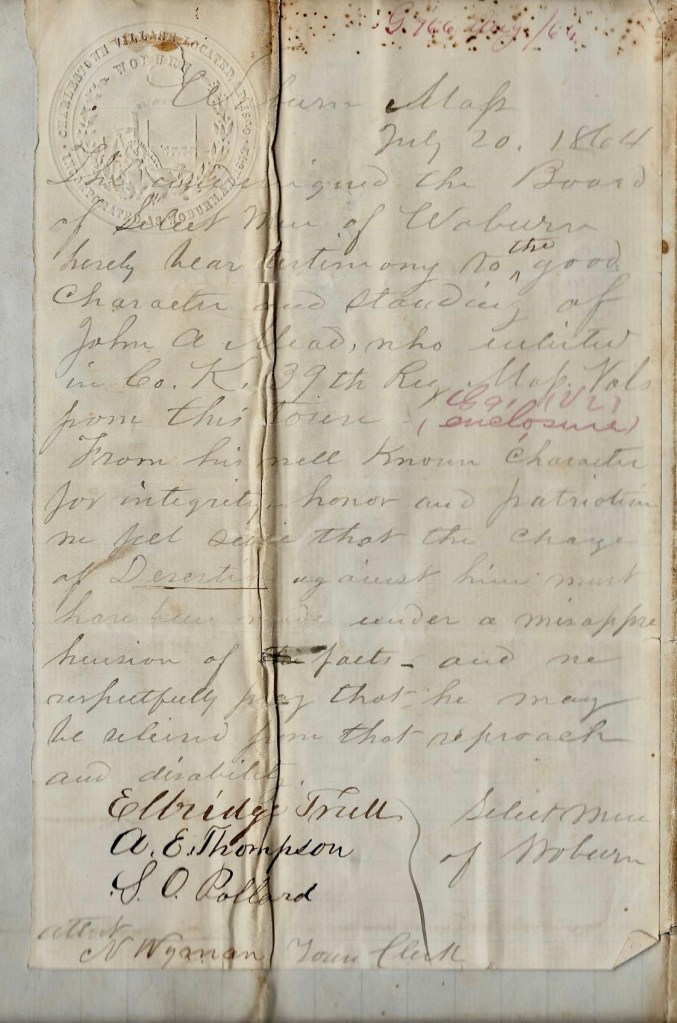
Our hardships, privations, and sickness in Belle Isle prison, grievous as they were, were mild compared with the sufferings of myself and comrades in the feeling that we are branded as the worst of criminals and our dependent families thereby deprived of all legal aid and support. I refer with confidence to my company officers, and to the entire regiment for the previous good conduct of our squad and our standing as dutiful, trustworthy soldiers, and I respectfully pray that we may be relieved from this reproach and disability, and restored to our former standing and position in the regiment, so far as this charge is concerned.
—Judon W. Oliver
In the presence of Charles S. Lincoln [Justice of the Peace, Somerville, Mass.]
The following Prisoner of War letter was written by Pvt. Josiah Lawson Rainey (1832-1905), the son of Thomas Muttor Rainey (1799-1859) and Mary Claiborne Echols (1797-1847) of Maury county, Tennessee. Josiah was married to Nancy Ann Jones (1837-1912) in June 1854 and by the time this letter was written in 1864, the couple had three young boys—William (b. 1857), Josiah (b. 1860), and John (b. 1862).
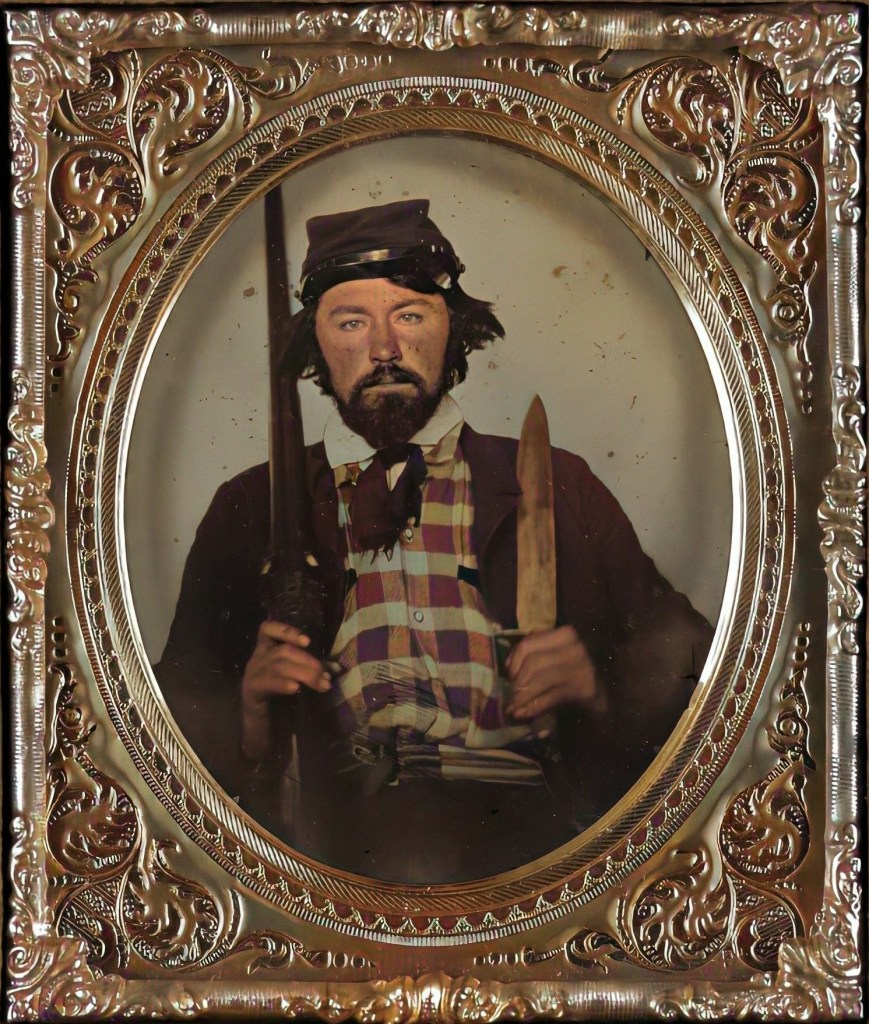
I could not find an image of Josiah but here is one of Hiram Hendley, also of Maury county, who served in Co. A, 9th Tennessee Cavalry(M. Williams Colorizations)
Josiah enlisted in October 1862 in Co. E. of Biffle’s 19th Regiment, Tennessee Cavalry [his name sometimes appearing as Raines on roster]. This regiment—usually known as “Biffle’s 9th Cavalry“—fought at Parker’s Cross Roads, Thompson’s Station, Brentwood, and Chickamauga. Later it skirmished in Tennessee and was then active in the Atlanta Campaign and Forrest’s operations during Hood’s Campaign. I could not find the date of Josiah’s capture but presume it was in 1864.
At the time of his release from prison, upon signing the Oath of Allegiance at Camp Morton on 25 October 1864, Josiah was described as standing 5’10” tall, with brown hair and grey eyes. After the war, Josiah settled in Henry county, Tennessee, where he served his community as a physician.
Josiah L. Rainey’s signed Oath of Allegiance, dated 25 October 1864, Camp Morton(Fold 3)
Transcription
Camp Morton, Ind[ianapolis, Indiana] Sunday evening, July 3rd 1864
My Dear Annie,
This is the 5th [letter] I shall have written you since receiving one from you. My health is much the same as when I wrote last. Mrs. Lawrence’s letter was dated June 3rd but she must have meant 23rd for your last was dated the 5th June. I immediately answered it and am much grieved that you are all sick and particularly that you are sick for when you are not able to wait upon the little children who are sick too, I fear that they and you will suffer for want of nursing. But I do hope that e’re this, you are all better, if not entirely well. I have a letter from Mug stating that sister was packed up and ready to start here to see me and then to go on to Tennessee, if able to travel. But she is in very bad health and I am very doubtful of her being able to go on to see you immediately. but if she is, she will go on without any more than necessary delay. In the mean time if you are able, you had better return home and make such arrangements for her reception and comfort as best you can for she will need all the attention that you will be able to give her. And should anything occur to prevent her going on, I will let you know it if possible. Please write to me immediately for it would seem that you had forgotten that I am intensely anxious always to hear from you and the poor “little ones.” Give them my love and kiss them by sister. Goodbye. Write soon.
Eternally, — Jo. L. Rainey
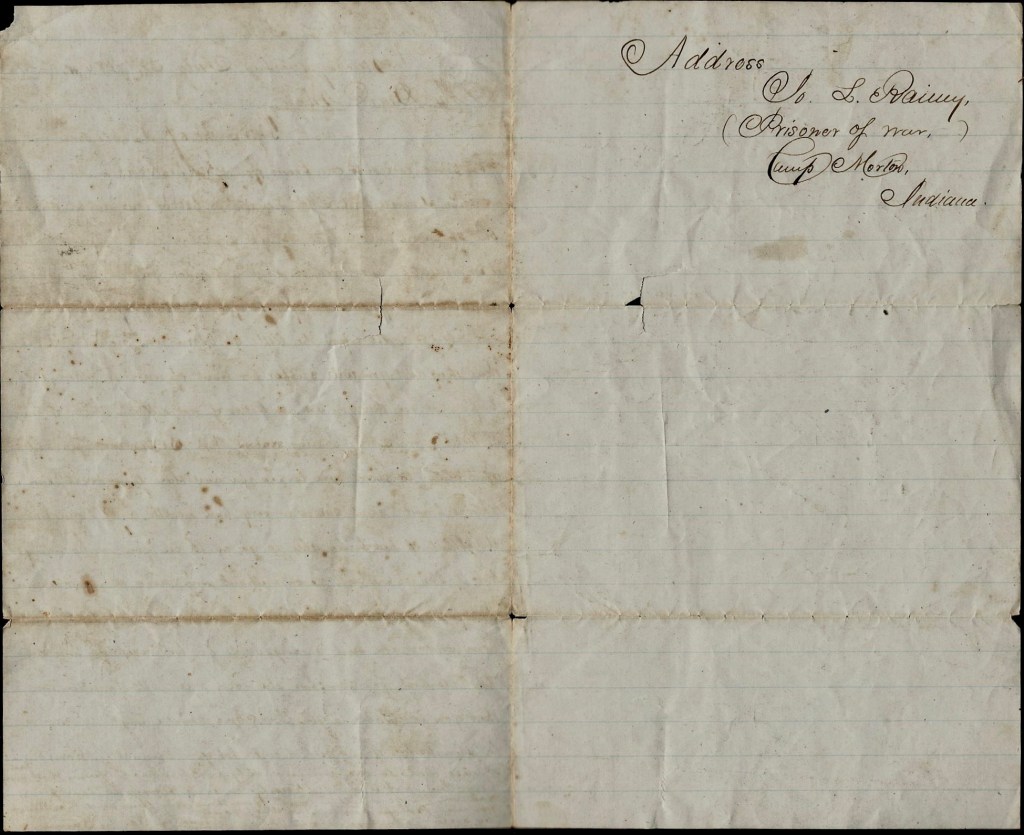
Address Jo. L. Rainey (Prisoner of War) Camp Morton, Indiana
to Mrs. Jo. L. Rainey, Culleoka, Tennessee In care of commanding office of Post
I could not find an image of Alexander or Richard but here is one of Stephen Burkdall of Co. G, 67th Indiana (Photo Sleuth)
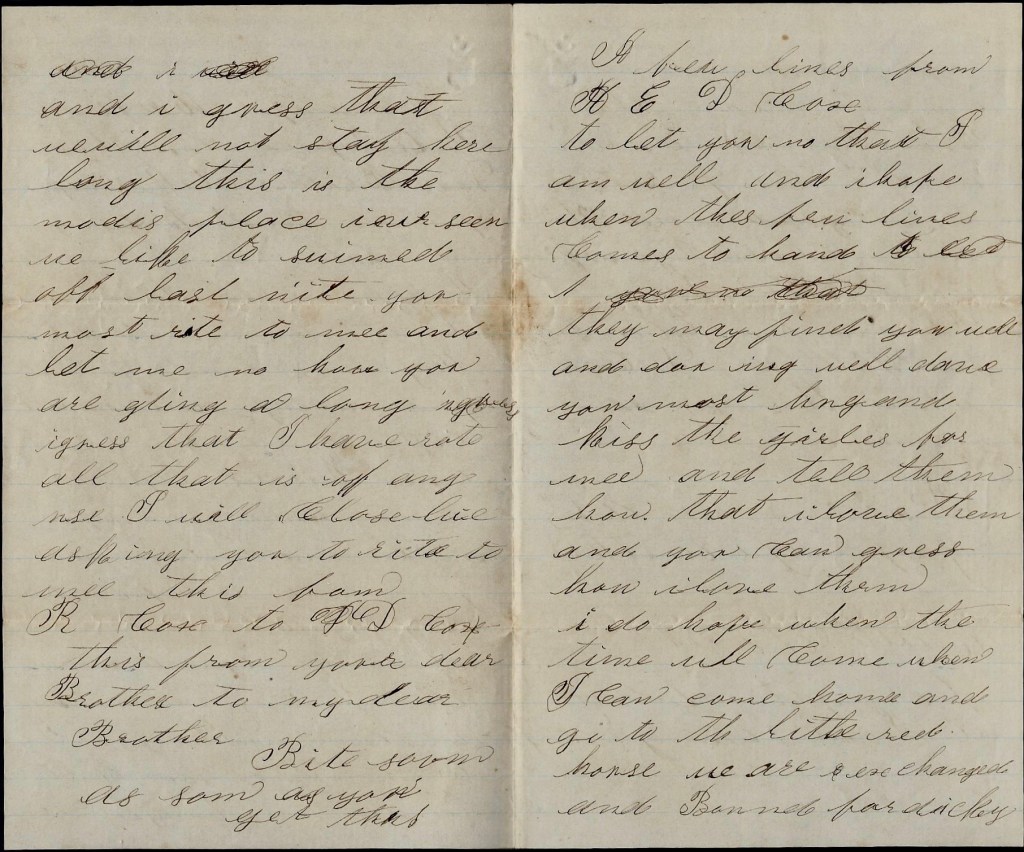
This letter was written by two soldiers serving as privates in Co. H, 67th Indiana Infantry while being held prisoner at Camp Morton near Indianapolis in November 1862. The letter had been previously sold as having been written by Confederate soldiers but the content suggested Union to me which led me to the discovery of their identity. Co. H and most all of the 67th Indiana Infantry—yet raw and untrained—participated in the Battle of Munfordville in Kentucky in mid-September 1862 where they were all captured. Too many prisoners for Confederate military prisons to handle, they were paroled and sent back to Indianapolis to await exchange. That exchange did not occur until early December 1862, when the regiment headed west to the Mississippi River to become part of the Vicksburg campaign.
Co. H. was recruited from Lawrence county in southern Indiana and it was here that I found our two boys. Alexander Edwards (1844-1923) was the son of Henderson Edwards but seems to have been raised by the Cox family. He married Sarah Jane Pipher (1846-1915) in 1874.
Richard Cox (1844-1917) was the son of Alexander and Mary Cox of Spice Valley. Lawrence county, Indiana. This letter was written to Richard’s younger brother, William D. Cox (b. 1846).
Transcription
Camp Morton Indianapolis [Indiana] November 9th 1862
Dear Brother,
I take my pen in hand to let you know that I am well and I hope when these few lines come to hand, they may find you well and doing well. I would like to see [you] the best kind. I would like to come home and spend a few more days with you and I hope when the day will come when I can come home to stay with you.
I can say to you that we are exchanged and I guess that we will not stay here long. This is the muddiest place I ever seen. We like to swimmed off last night.
You must write to me and let me know how you are getting along. I guess that I have wrote all that is of any use. I will close by asking you to write to me. This from R. Cox to D. Cox.
This from your dear brother to my dear brother. Write soon as you get this.
A few lines from A. E. D. Cox to let you know that I am well and I hope when these few lines comes to hand, they may find you well and doing well.
Well, Dave, you must hug and kiss the girls for me and tell them how that I love them and you can guess how I love them. I do hope when the time will come when I can come home and go to the little red house.
We are exchanged and bound for Dixie. I must close. The boys has come in and I can’t write to do no good and I will close by asking you to write. This from Alexander Edward to William D. Cox
When this you see, remember me. Write soon as you get this and don’t forget to write about the girls.
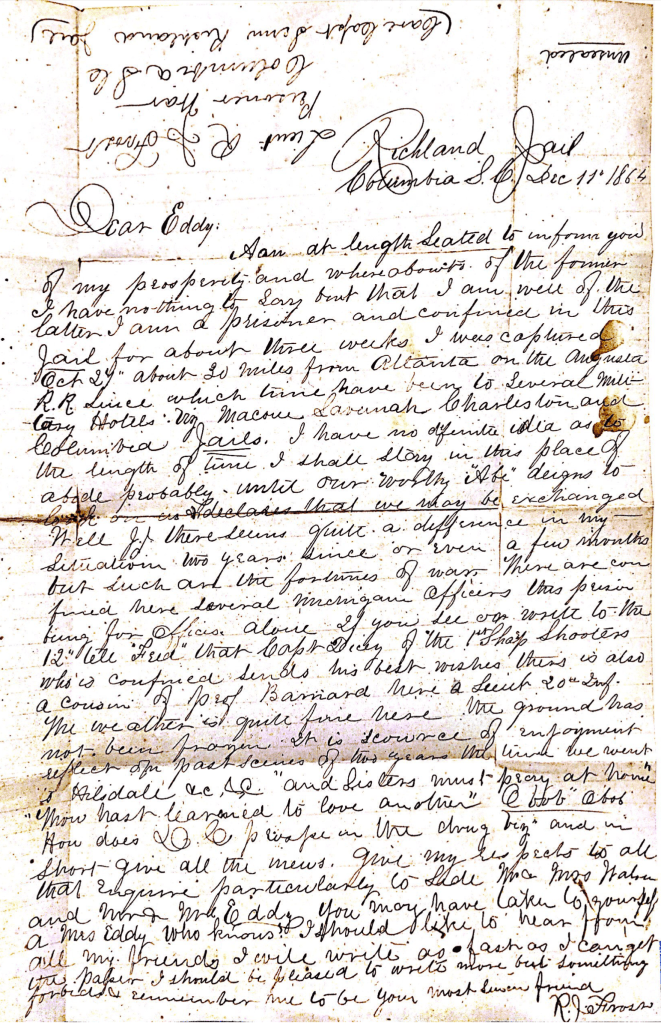
This POW letter was written by Robert Jennings Frost (1842-1923) who served with the 9th Michigan Cavalry, Companies M & G, during the Civil War. He was taken prisoner near Stone Mountain, Georgia, on 27 October 1864, not long after the fall of Atlanta. During this time the 9th Michigan was called upon to scout and serve as a personal escort for General Kilpatrick.
According to Robert’s obituary, Robert first entered the service of his family’s adopted country in 1856, at age 14, as a captain’s boy in the US Navy. After two years, he returned to Michigan where he worked as a clerk in the post office at Albion and taught a township school. During the Civil War, Robert joined the 9th Michigan Cavalry, mustering in as a sergeant in Co. M in April 1863, and discharged at war’s end as a 1st Lieutenant in Co. G.
Robert was born in England and came to the United States just prior to the 1850 US Census with his parents—Robert Frost (1806-1866) and Sarah Leovitte (1811-1879)—settling in Trenton, Oneida county, New York where his father worked in the shoe manufacturing business. By 1850, the Frost family had relocated to Grand Ledge, Eaton county, Michigan, and turned to farming. After the war, Robert married Frances (“Fannie”) Adaline Olcott (1846-1916) and settled in Albion, Calhoun county, Michigan where he owned a shoe store.
Robert wrote the letter to his friend Julius J. Eddy (1844-1907) of Albion, Calhoun county, Michigan. Julius was the son of Samuel Clark Eddy (1823-1878) and his first wife, Elizabeth (1824-1854). After her death, Samuel married Perlina Wade (1823-1892). Julius married Eliza (“Lide”) Ann Watson (1843-1911) in April 1866.
[Note: This letter is owned by and sent to me for transcription by C. J. Frost, great-great-grandson of the officer, with express permission to publish it on Spared & Shared.]
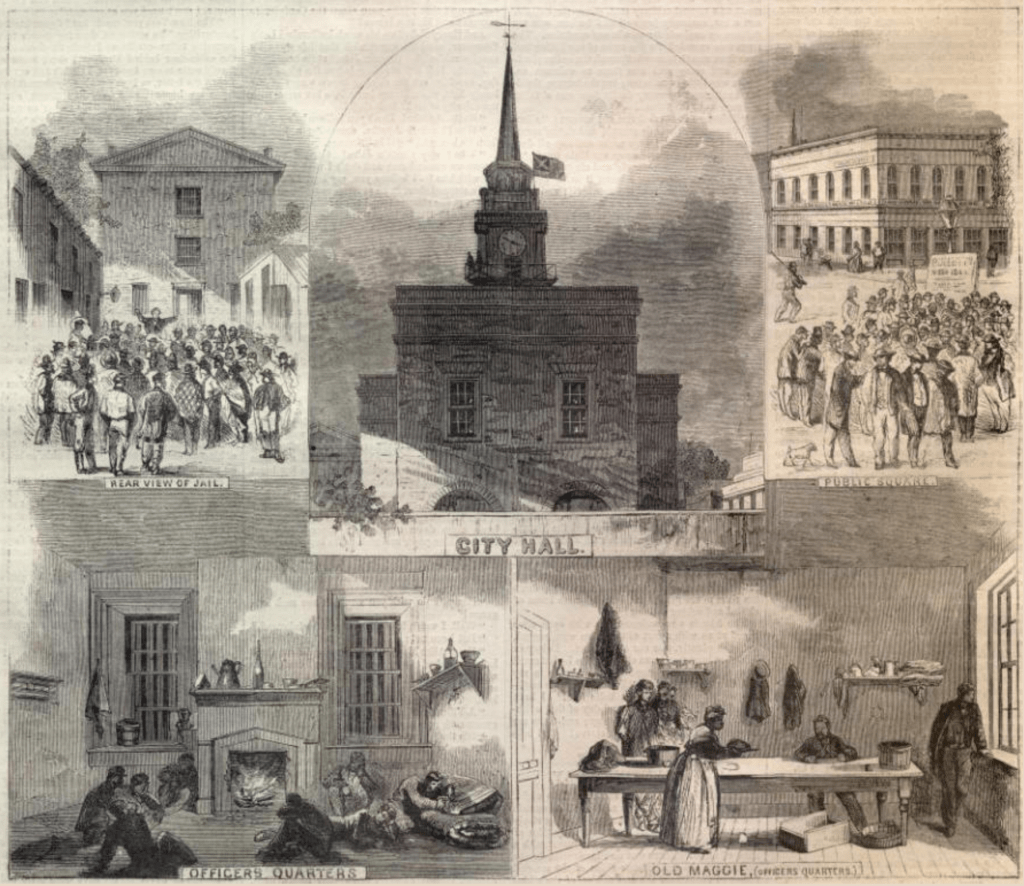
“Scenes In and Around the Richland Jail, Columbia, South Carolina” published in Harper’s weekly, dated 20 February 1864. The view entitled “City Hall” is a view from the east windows of the prison. in the foreground can be seen the high board fence of the jail yard. Another view represents the rear of the prison and a Sabbath service being held in the prison yard.
Transcription
Richland Jail Columbia, South Carolina December 11, 1864
Dear Eddy.
I am at length seated to inform you of my prosperity and whereabouts. Of the former, I have nothing to say but that I am well. Of the latter, I am a prisoner and confined in this jail for about three weeks. I was captured October 27th about 30 miles from Atlanta on the Augusta Railroad since which time have been to several military hotels, viz: Macon, Savannah, Charleston, and Columbia jails. I have no definite idea as to the length of time I shall stay in this place of abode—probably until our worthy “Abe” designs to look on us & declares that we may be exchanged.
Well, J. J., there seems quite a difference in my situation two years since or even a few months, but such are the fortunes of war. There are confined here several Michigan officers, this prison being for officers alone. If you see or write to the 12th, tell Fred that Capt. [Elmer] Dicey 1 of the 1st Sharp Shooters who is confined [here] sends his best wishes. There is also a cousin of Prof. Barnard here—a Lieutenant [in the] 20th Infantry.
The weather is quite fine here. The ground has not been frozen. It is a source of enjoyment [for me to] reflect on past scenes of two years, the time we went to Hillsdale, &c. &c., “and sisters must pray at home,” 2 “Thou hast learned to love another,” 3 “Oh Bob, Oh Bob.”
How does D. C. prosper in the drug “biz” and in short, give all the news. Give my respects to all that enquire—particularly to Lide, Mr. & Mrs. Watson., and Mr. & Mrs. Eddy. You may have taken to yourself a Mrs. Eddy, who knows? I should like to hear from all my friends. I will write as fast as I can get the paper. I should be pleased to write more but something forbids. And remember me to be your most sincere friend, — R. J. Frost
Prisoner of War, Columbia, S. C. (Care of Capt. [E. A.] Semple, Richland Jail)
1 Capt. Elmer O. Dicey of Grand Haven commanded the 1st Michigan Sharpshooters after the 15 July 1864 death of Capt. Levant Rhine until he was taken prisoner during the Battle of the Crater on 30 July 1864.
2 “and sisters must pray at home” is a line in the final stanza of the poem, “Brave Boys Are They, ” written by Henry Clay Work. The Library of Congress has the sheet music.
3 “Thou hast learned to love another” is the alternative name to a song entitled, “My Heart is Lonely Now“, composed by J. C. Beckel in 1853. The song sheet is in the Library of Congress.
These three letters were written by Pvt. Amedee Dolhonde (E. A. Doland) of Co. B, 8th Louisiana Infantry. Joining him in signing the letter was Sgt. Robert Goldsmith of Co. G, 8th Alabama Infantry.
Confederate Prisoners of War at Camp Douglas in Chicago(Civil War in Tennessee Collection)
Amedee Dolhonde (1840-Aft1880) was the son of Jean Baptiste Dolhonde (1798-1860) and Josephina Carolie de Alpuente (180901869) of New Orleans, Louisiana. Apparently, during the war, Amedee signed the payroll “E A. Doland” to simplify his name. During much of the time he was with the regiment, Amedee served as a clerk, presumably because of his excellent handwriting. He was taken prisoner at Gettysburg on 3 July 1863. His muster records include an unusual notation: “Captured in Penn., never fired a gun, took the oath, a skulker & coward.” Another record indicates that he deserted in Pennsylvania and was captured at South Mountain on 4 July 1863. He was paroled at Fort McHenry, Maryland, and transferred to Fort Delaware on 9 July 1863. It appears that he took the oath of allegiance in December 1864. After the war, Ameede returned to New Orleans where he worked as a fisherman.
Robert Goldsmith enrolled as a private in Co. G, 8th Alabama Infantry at Mobile on 25 May 1861. His muster records indicate he went missing at the Battle of Gettysburg and subsequent records inform us that he was taken prisoner on 2 July 1863 and taken to Fort Delaware. He remained a prisoner there until his release on 10 May 1865.
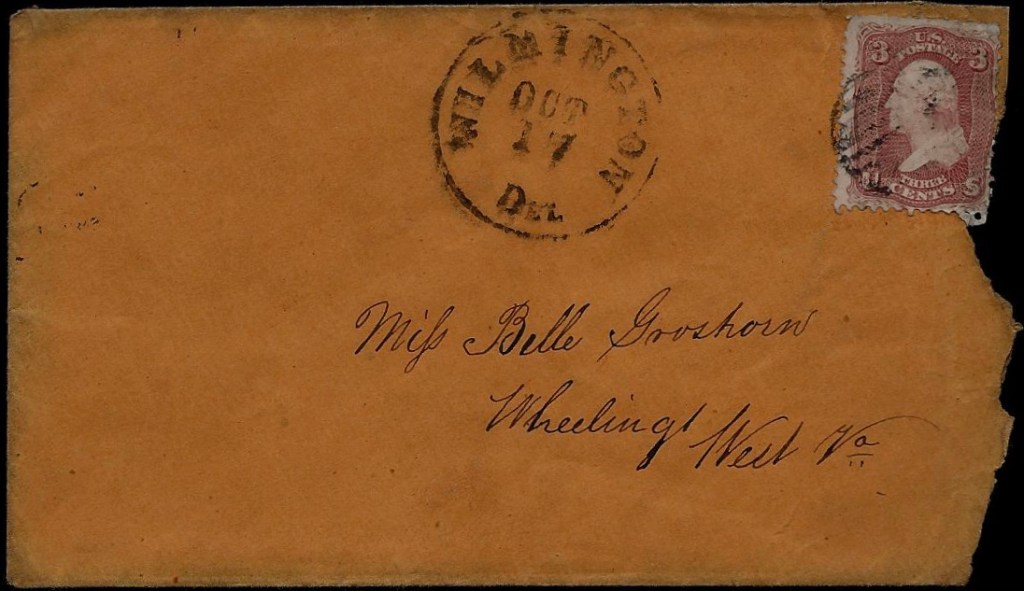
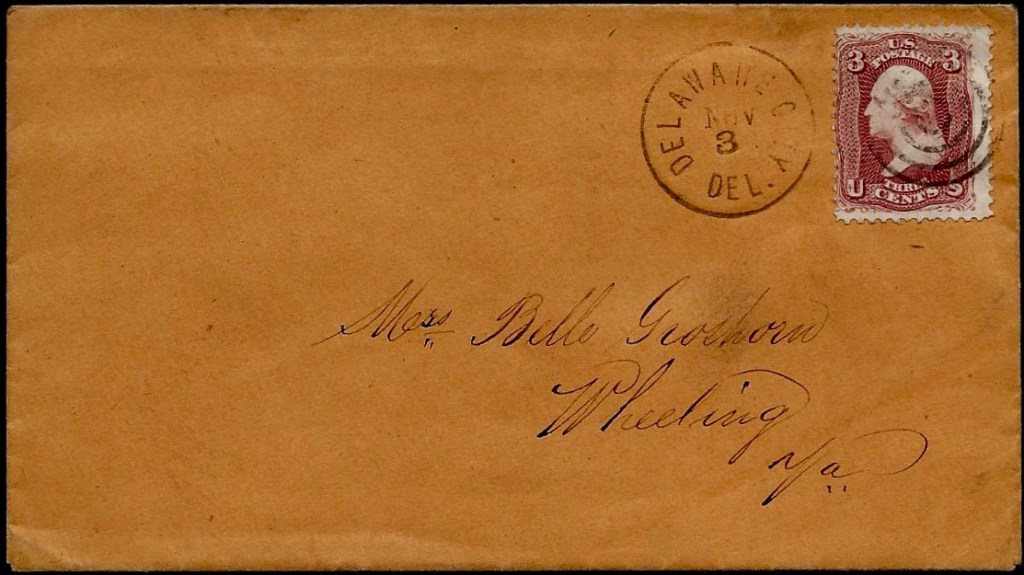
All three of the letters were addressed to Miss Belle Groshorn of Wheeling, West Virginia. Belle’s last name was misspelled; it should have been Goshorn. Isabel Goshorn (1840-1919) was the daughter of a Wheeling dry goods merchant named William Scott Goshorn (1814-1891) and his wife, Priscilla Jane Zinn (1821-1878). Mr. Goshorn was up to the time of the Civil War an Old Line Whig, but afterwards was a Democrat, and through the war his sympathies were with the South. He was a slave owner, and an incident is recalled by his death which made a stir all over the country at the time. A slave woman named Lucinda Johnson (note: her name was Sarah Lucy Bagby) ran away from him and escaped to Cleveland, Ohio. “Mr. Goshorn went after her, reclaimed her and brought her back. Anti-slavery agitators and others in Northern Ohio sought to prevent her return to Virginia and there were exciting scenes in which Mr. Goshorn had a close rub, the populace having been much stirred up by the discussion of the matter and being in a mood to do any slaveholder bodily injury.”
In 1870, Isabel married Joseph S. Irwin (1830-1876).
Sketch of Fort Delaware Prison in March 1864(Boston Athenaeum Digital Collections)
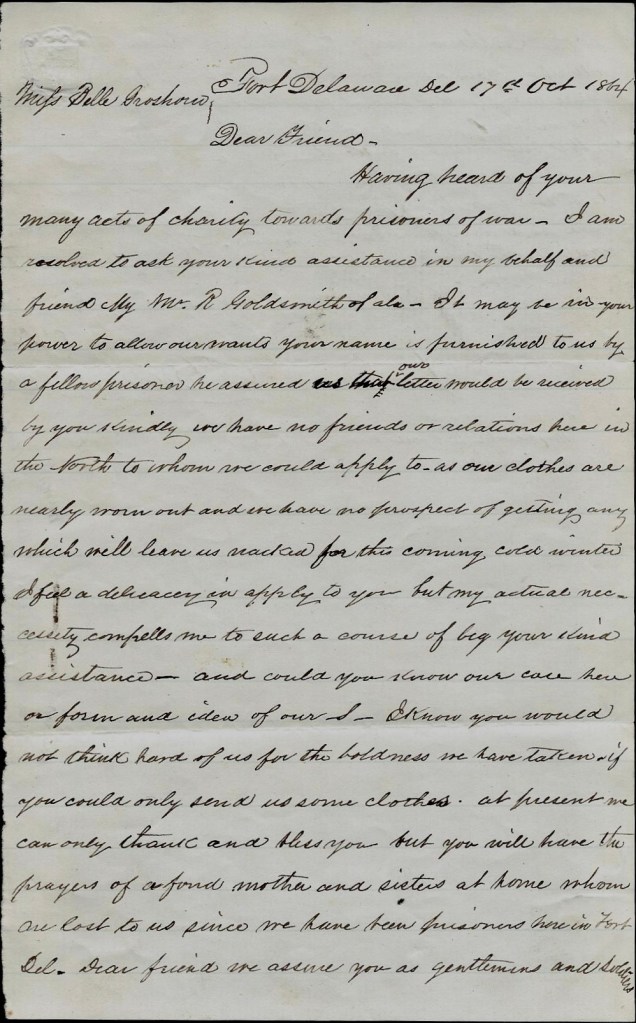
Letter 1
Addressed to Miss Belle Groshorn, Wheeling, West Virginia
Fort Delaware, Delaware 17 October 1864
Miss Belle Groshorn Dear Friend,
Having heard of your many acts of charity towards prisoners of war, I am resolved to ask your kind assistance in my behalf and friend, Maj. Mr. R. Goldsmith of Alabama. It may be in your power to allow our wants. Yuor name is furnished to us by a fellow prisoner. He reassured us that our letter would be received by you kindly. We have no friends or relations here in the North to whom we could apply to. As our clothes are nearly worn out and we have no prospect of getting any which will leave us naked for the coming cold winter, I feel a delicacy in applying to you but my actual necessity compels me to such a course of beg[ging] your kind assistance. And could you know our care here, or form an idea of our situation, I know you would not think hard of us for the boldness we have taken.
If you could only send us some clothes, at present we can only thank and bless you, but you will have the prayers of a fond mother and sisters at home whom are lost to us since we have been prisoners here in Fort Delaware.
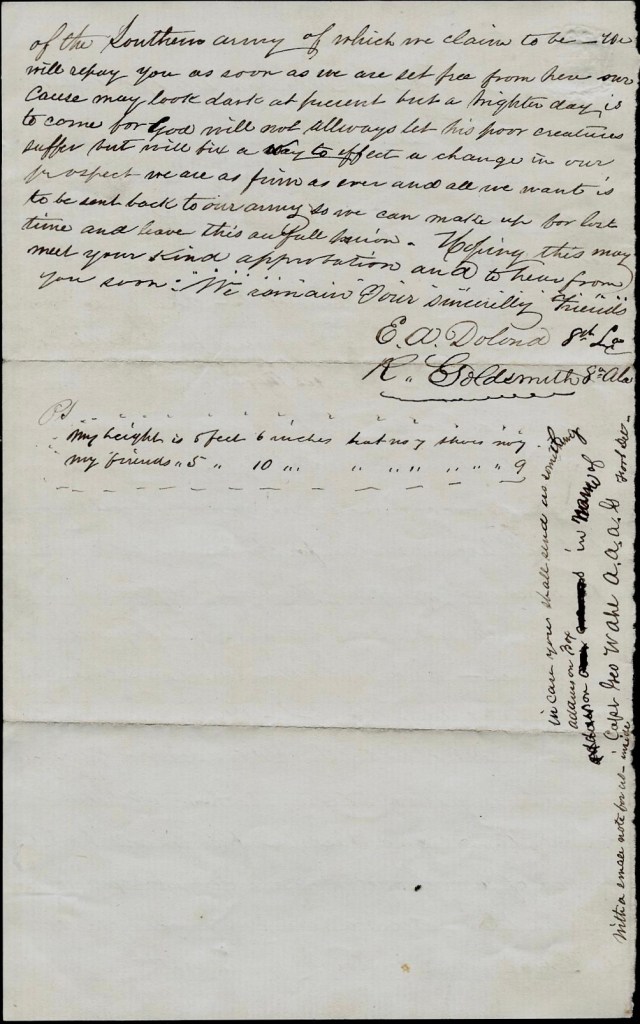
Dear friend, we assure you as gentlemen and soldiers of the Southern army of which we claim to be, we will repay you as soon as we are set free from here. Our cause may look dark at present but a brighter day is to come for God will not always let his poor creatures suffer but will fix a way to effect a change in our prospect. We are as firm as ever and all we want is to be sent back to our army so we can make up for lost time and leave this awful Union. Hoping this may meet your kind approbation and to hear from you soon, we remain your sincerely friends,
— E. A. Doland, 7th Louisiana R. Goldsmith, 8th Alabama
P. S. My height is 5 feet 6 inches, hat No. 7, Shoes No. 7 My friends is 5 feet 10 inches, hat No. 7, Shoes No. 9
In case you shall send us something, address on box, in care of Capt. George Wahl, A. A. A. G., Fort Delaware with a small note for us inside.
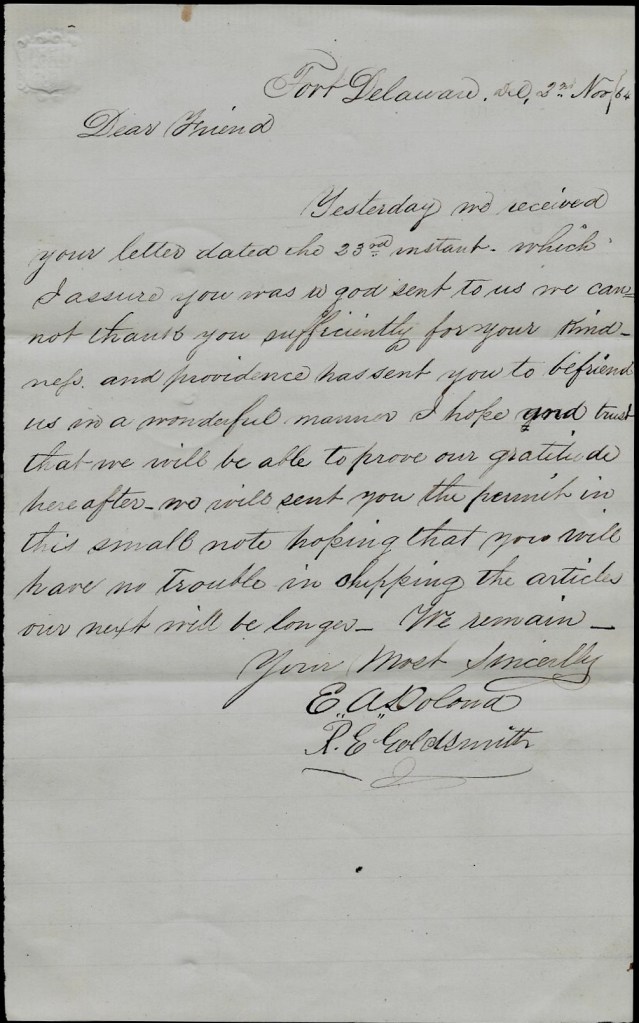
Letter 2
Addressed to Miss Belle Groshorn, Wheeling, Va.
Fort Delaware 2nd November 1864
Dear Friend,
Yesterday we received your letter dated the 23rd inst. which I assure you was a God send to us. We can not thank you sufficiently for your kindness and providence has sent you to befriend us in a wonderful manner. I hope and trust that we will be able to prove our gratitude hereafter. We will send you the permit in this small note hoping that you will have no trouble in shipping the articles. Our next will be longer. We remain, your most sincerely,
— E. A. Doland & R. E. Goldsmith
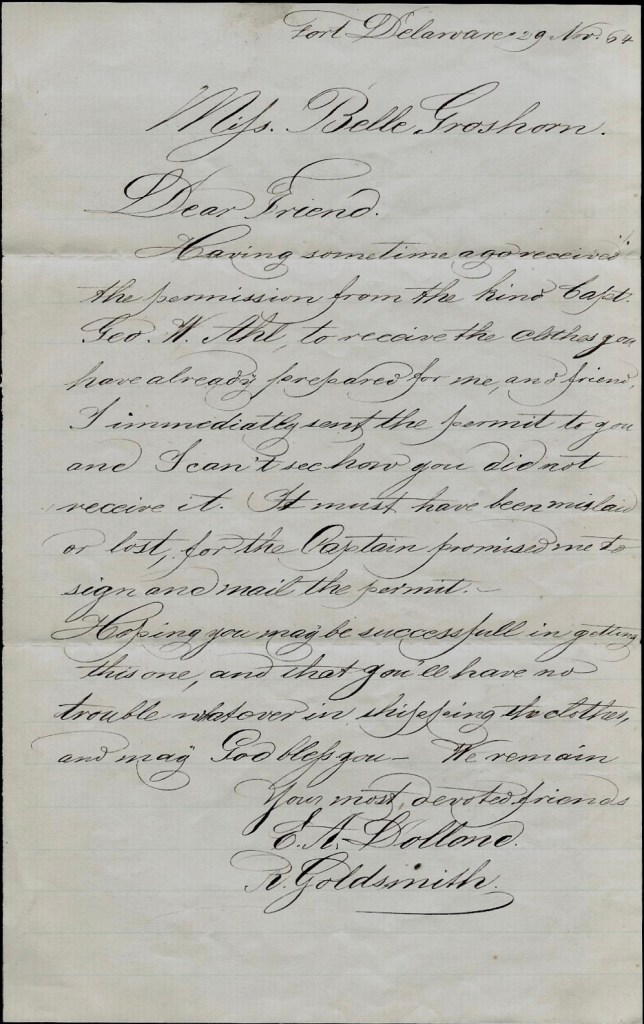
Letter 3
Addressed to Miss Belle Groshorn, Wheeling, West Virginia
Fort Delaware 29 November ’64
Miss Belle Groshorn Dear Friend,
Have some time ago received the permission from the kind Capt. George Wahl to receive the clothes you have already prepared for me, and friend, I immediately sent the permit to you and I can’t see how you did not receive it. It must have been mislaid or lost, for the Captain promised me to sign and mail the permit.
Hoping you mat be successful in getting this one, and that you’ll have no trouble whatever in shipping the clothes, and may God bless you. We remain your most devoted friends, — E. A. Doland, R. Goldsmith
This letter was written by Edward J. Kenney (1809-1874), a Philadelphia clothier, and the father of Lieut. George W. Kenney (1841-1862) of Co. H, 1st California Regiment (71st Pennsylvania Infantry) to whom the letter was addressed, in care of Gen. Winder at Richmond, Virginia, where he was being held as a prisoner of war. A notice of Lt. Kenney’s capture at Ball’s Bluff in October 1861 (he was initially reported as drowned) and recent release from Richmond was published in the Philadelphia Inquirer of 22 February 1862.
Lt. Kenney was taken prisoner by the Rebel army while being treated at the White Oak Swamp Hospital on the 30th June 1862. The Philadelphia Inquirer on 12 August 1862 states that Lt. Kenney died on 2 July 1862 at Nelson’s Farm, Virginia.
A subsequent article appearing in the Philadelphia Inquirer on 15 July 1862 suggests that George died in a Richmond prison after his capture at the White Oak Swamp Hospital. A correspondent for the paper wrote, “He was beloved by all who knew him. Having been associated with him on the battlefield and at home, I had learned to love him for his many good qualities. When in Richmond prison he was the most cheerful of any, strengthened as he was by a firm reliance on the word of God. I saw Major Revere of the 20th Massachusetts who was with Lieut. Kenney at 9 o’clock on Monday evening. His wound having been pronounced mortal all that could be done for him was to lull him to sleep. Dr. Revere of the 20th administered morphine to him. When the Major saw him, the morphine was about taking effect. He only said, ‘tell them that I was ready to die,’ meaning his family.”
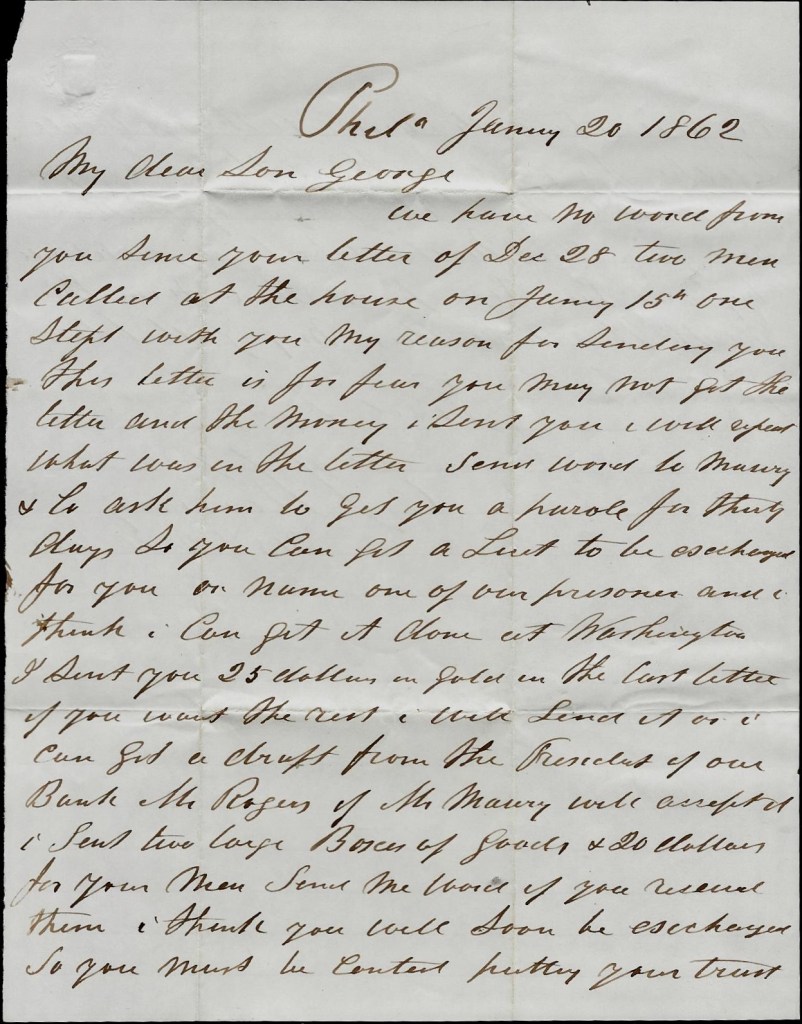
Transcription
Philadelphia [Pennsylvania] January 20, 1862
My dear son George,
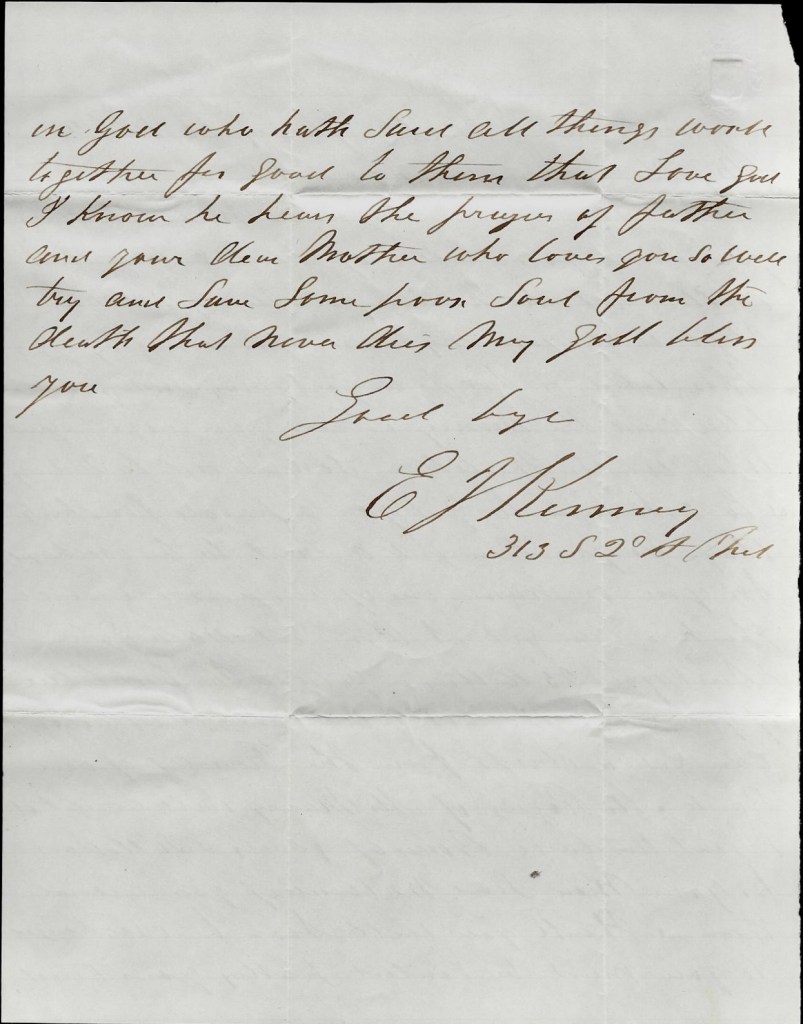
We have no word from you since your letter of December 28th. Two men called at the house on January 15th. One slept with you. My reason for sending you this letter is for fear you may not get the letter and the money I sent you. I will repeat what was in the letter. Send word to Maury & Co.and] ask him to get you a parole for thirty days so you can get a Lieut. to be exchanged for you or name one of our prisoners and I think I can get it done at Washington. I sent you 25 dollars in gold in the last letter. If you want the rest I will send it as I can get a draft from the President of our Bank, Mr. Rogers, if Maury will accept it. I sent two large boxes of goods and 20 dollars for your men. Send the word if you received them. I think you will soon be exchanged so you must be content putting your trust in God who hath said all things work together for good to them that love God. I know he hears the prayer of Father and your dear Mother who loves you so well. Try and save some poor soul from the death that never dies. May God bless you.
Goodbye, — E. J. Kenney, 313 S 2nd St., Philadelphia
This letter was written by John Wesley Daniels (1832-1915) of Grants Lick, Campbell county, Kentucky. Daniels served as a private in Co. C, 1st Kentucky Cavalry (Butler’s). He was married to Cynthia Bryant Colvin (1834-1909) in 1850 and divorced during or soon after the war. He married his second wife, Mary Ann Bravard in 1868.
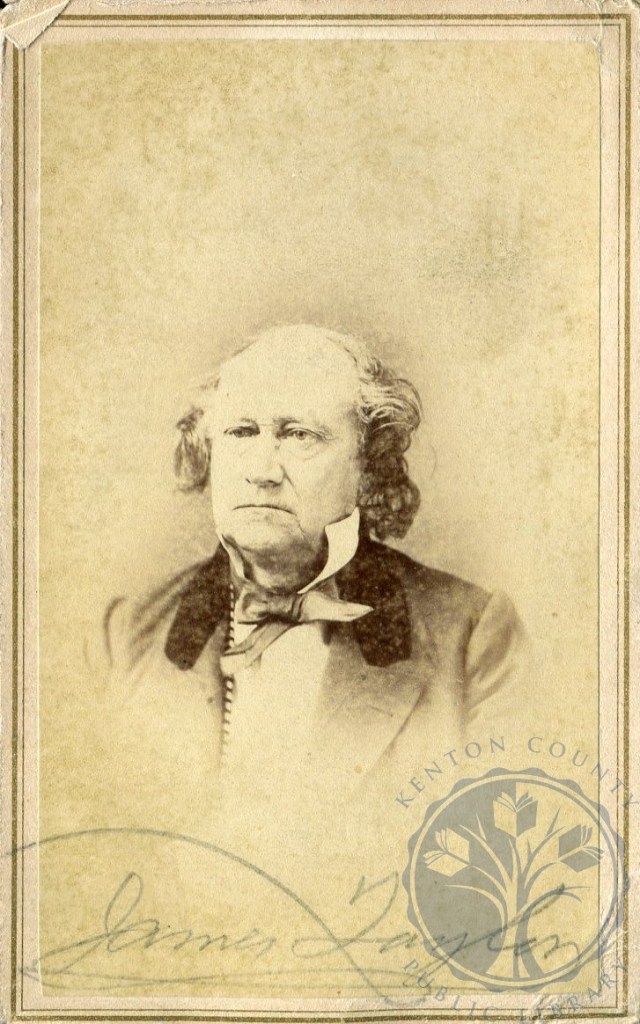
Daniels wrote the letter to Col. James J. Taylor of Campbell county, Kentucky, a wealthy man who may have been sympathetic to his pro-Confederacy neighbors but remained a Union man throughout the war. (Kenyon County Public Library)
Daniels wrote the letter while serving as a prisoner of war at Camp Morton near Indianapolis. The camp was located on a tract of land bordered by 22nd Street, Talbott Avenue, 19th Street and Central Avenue. The land had been established as state fairgrounds. In 1861 it was converted to a military training camp, and named after the governor. In 1862 the facilities were used to house Confederate prisoners of war. Approximately 4,000 prisoners arrived in February of that year. In the summer of 1864 the prisoner population reached nearly 5,000. Weary of fighting many took the oath of allegiance to the United States Constitution and to the Union according to Lincoln’s Proclamation of Amnesty and Reconstruction of 8 December 1863. On 1 April 1865 1,408 prisoners were at the camp. In June 1865 the last of the Confederate prisoners were released. In 1868 the State Fair returned to this location, where it continued to be held until 1892.
Daniels wrote the letter to Col. James Jones Taylor (1802-1883) of Campbell county, Kentucky.
Camp Morton in Indianapolis, Library of Congress
Transcription
Camp Morton, Indiana 19 July 1864
Col. James Taylor Sir,
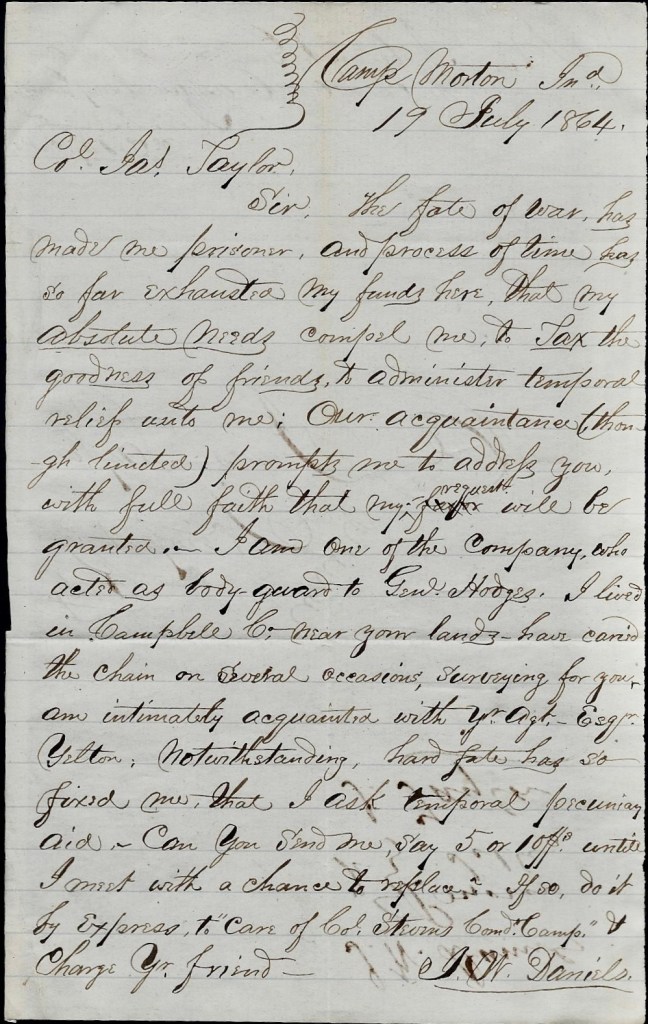
The fate of war has made me prisoner and process of time has so far exhausted my funds here that my absolute needs compel me to tax the goodness of friends to administer temporal relief unto me. Our acquaintance (though limited) prompts me to address you with full faith that my request will be granted.
I am one of the company who acted as body guard to General [George Baird] Hodge. I lived in Campbell County near your lands, have carried the chain on several occasions surveying for you, [and] am intimately familiar with your agent, Esqr. Yelton. Notwithstanding, hard fate has so fixed me that I ask temporal pecuniary aid. Can you send me say 5 or $10 until I meet with a chance to replace? If so, do it by express to “care of Col. [Ambrose A.] Stevens 1 Command & Camp” and charge your friend, — J. W. Daniels
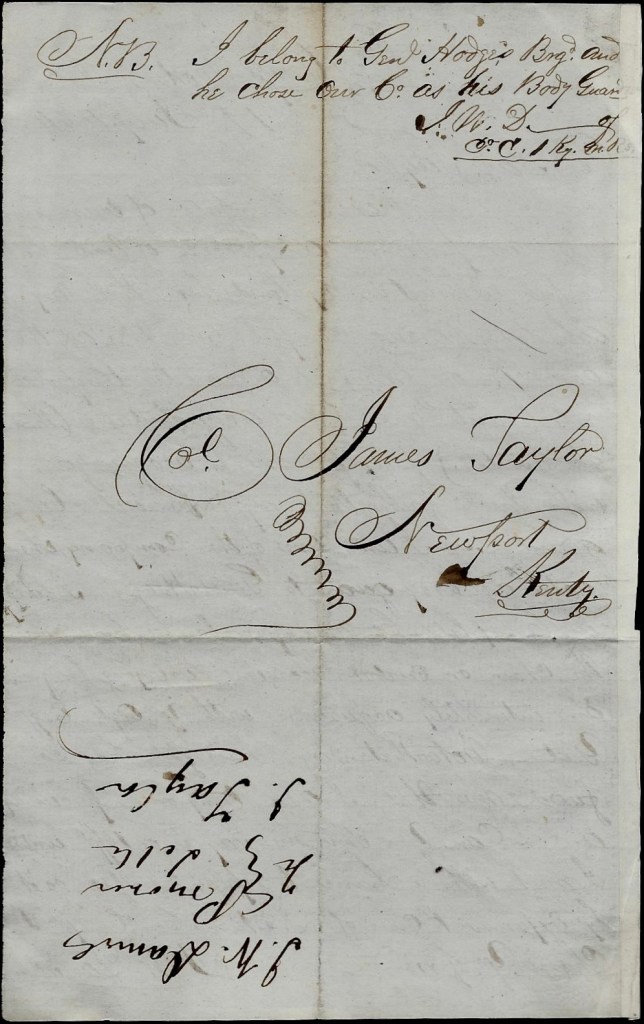
N. B. I belong to General Hodge’s Brigade and he chose our company as his body guard. — J. W. D of Co. C, 1st Ky.
1 Col. Ambrose A. Stevens of the 5th Indiana Regiment became the commandant of the Camp Morton Prison near Indianapolis in November 1863. He found the camp “a disgrace to the name of military prison—filthy in every respect.” Camp Morton had the third highest number of dead for both January and February among Union prisoner of war camps. Almost twenty-five years after the war controversy over the condition at Camp Morton during that winter surfaced again in the form of an article in The Century Magazine written by a former prisoner of war, Dr. John Wyeth. Entitled “Cold Cheer at Camp Morton” the article charged camp officials with deliberate cruelty.
The prison lacked the order, discipline, and cleanliness found among properly managed soldiers. The April 29 inspection report by A.M. Clark, Surgeon and acting inspector of prisoners of war reported that the barracks had been whitewashed and improved through ridge ventilation, but that the sinks were simply open excavations and needed improvement. Rations were sufficient but scurvy was still common due to a lack of vegetables. Over the next three months 2,500 prisoners arrived as Col. Stevens continued to try to improve the camp. In mid May he reported to Hoffman that he had “commenced a thorough cleansing” of the barracks and grounds and planned to build a bathhouse, a laundry and a cookhouse.
An increase in the mortality rate over the summer drew the attention of the federal authorities and on 30 July Charles J. Kipp, Surgeon, U.S. Volunteers, replied to a request for an explanation regarding the number of recent deaths among the prisoners. Dr. Kipp wrote that the lack of vegetables, the overcrowded, poorly ventilated barracks and the crowding of almost 5,000 men into 4.5 acres accounted for the mortality rate. He calculated that the prisoners had approximately 80 cubic feet of air space. The reply is forwarded to the U.S. Medical Director’s office with a note by Tripler that unless these conditions improves “the large mortality of last year will occur again.”
“I find this camp in anything but a favorable condition.” was the conclusion reached by C.T. Alexander in his August 6 inspection report which also determined that the camp was too small with 4,885 men held in less than 5 acres. The barracks were “overcrowded and not sufficiently well policed,” the tents old and worn, and prisoners clothing bad and deficient. He found the hospital in relatively good condition and blamed the 81 deaths (9% mortality) of the previous month on the “crowded state of the camp, quarters, and tents, the want of change in the positions of the tents, the foul condition of the sinks, the want of good police, the want of vegetables…, and is influenced some what by the inevitable nostalgia existing among the prisoners.'” [Indiana Archives & Record Administration]
This letter was written by James Ogburn Norton (1825-1862), a 1st Lieutenant in Co. F, 32nd Tennessee (Confederate) Infantry while imprisoned on board a boat docked at St. Louis. Lt. Norton was among the 528 members of the 32nd Tennessee that were taken prisoner on 16 February 1862. They would eventually be imprisoned at Camp Chase, Ohio, where they suffered through hard times. Though he tried to reassure his wife that he would be alright, Lt. Norton was one of the first officers to die at Camp Chase. His date of death is given as 4 March 1862, less than two weeks after this letter was written.
In the 1860 US Census, Norton was employed as a physician—a profession he learned from his father—at Hawkerville, Franklin county, Tennessee.
Surrender at Fort Donelson, 16 February 1862
Transcription
On Boat, St. Louis, Missouri February 24, 1862
My Dear Wife,
I write you a few lines by Dr. as I learn that he is going to Tennessee. I am well and am getting over hte fatigue of our late Battle Fort Donelson. We were all taken prisoners of war on Sunday morning, February 16th. There were none of our company killed and but three wounded. I was in the fight but did not get a scratch. How long we will be retained, I do not know know. I suppose we will be taken off the boats & be placed in comfortable quarters. We are treated very well by the officers who have charge of us. I can give none of the particulars as our letters will have to come open & be inspected.
I want you [to] bear up under it the best you can under the circumstances. We are in a healthy climate and when we get settled, we will enjoy fine health. My kindest regards to all. I want you all to do the best you can and not grieve about my confinement. I will ty and take care of myself the best I can and return when permitted. May God bless [my] dear wife and children.
From your affectionate husband, — Jas. O. Norton
Capt. [Elijah] Ikard [and] George is still with me.