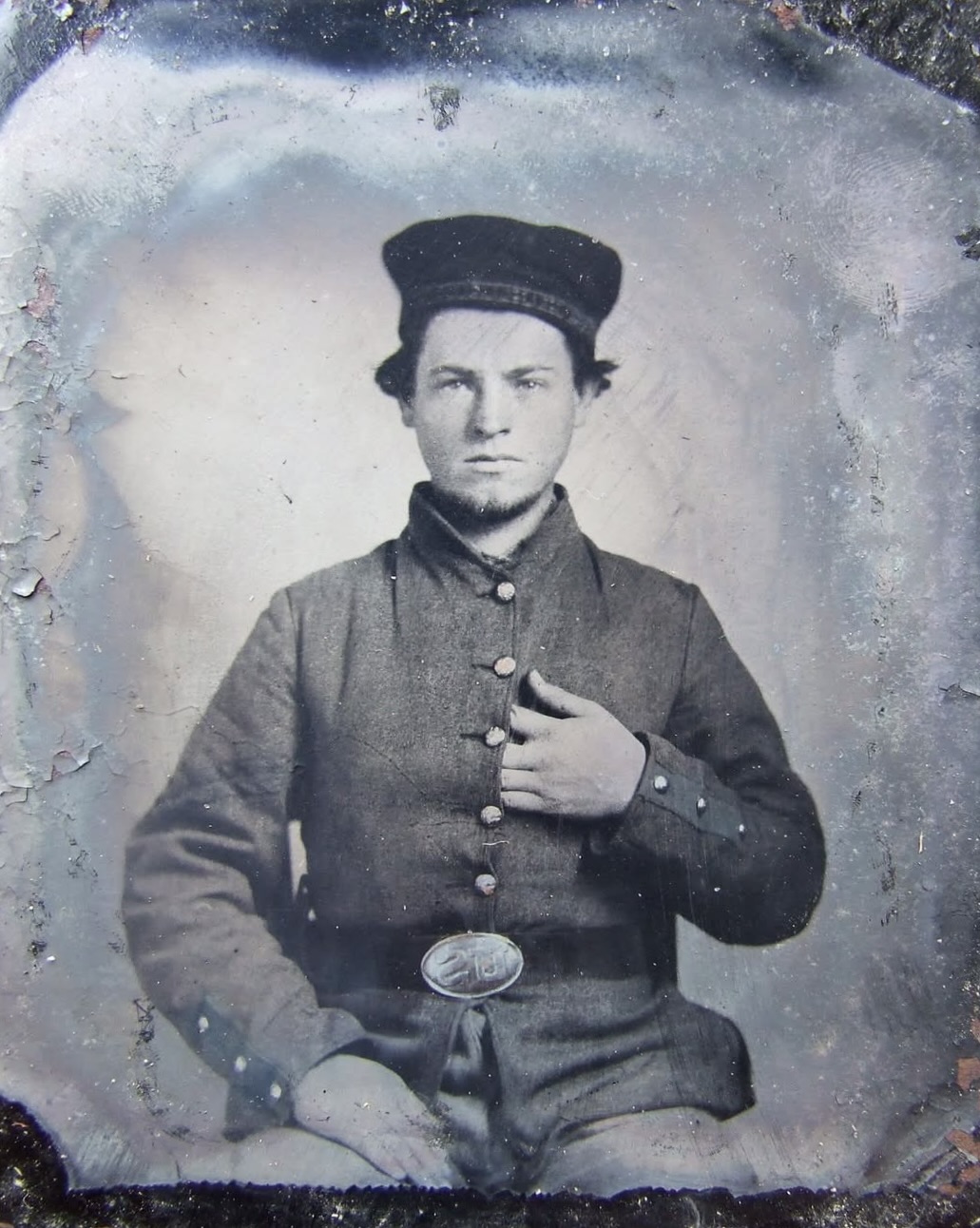
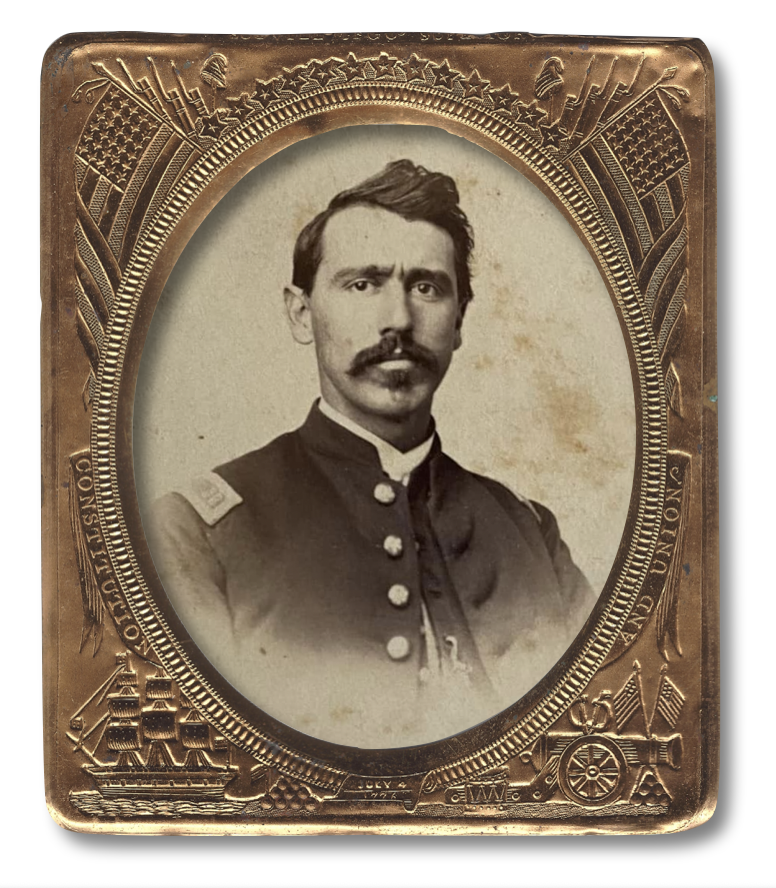
These letters were written by James H. Smith (1835-1909) who enlisted in Co. E, 12th Illinois Infantry on 18 April 1861. Because he had excellent handwriting, he was given duty as a clerk and occasionally detached from the regiment for this purpose. He was commissioned as Adjutant of the 12th Illinois on July 28, 1864 and mustered out on July 10, 1865. During 1863 and 1864, the 12th Illinois Infantry operated in the Western Theater—garrisoning Corinth, Mississippi, and Pulaski, Tennessee, before joining General William T. Sherman’s Atlanta Campaign and the March to the Sea.
James’ Find-A-Grave bio states that “Later he became a school teacher and lived in Aurora, Hamilton county, Nebraska for many years and was admitted to the Veteran’s Home in 1894. The deceased was a fifer in the Home drum corps, a post which he likewise filled when he first entered the regular army. He was well known and liked here. R. M. Smith, a brother of the dead veteran, came from Illinois to attend the funeral which will take place tomorrow, the interment to be made in the Home cemetery. The brother states that there were five boys in the family who fought in the civil war, three of them belonging to the same company.”
James had two brothers who served with him in the same company. They were Robert (“Bob”) M. Smith and Williamson (“Cuff”) Smith.
James wrote the letter to his friend, Annie G. Dudley (1834-1927), the daughter of Franklin Dudley (1799-1870) and Olive Bean (1794-1875) of Raymond, Rockingham county, New Hampshire—the same town where James lived in with his parents in his formative years. Just prior to the Civil War, Annie was residing with a relative in Grandview, Edgar county, Illinois. During the Civil War, Annie was an employee of the Bureau of Indian Affairs in Washington D. C. After the Civil War, she returned to Illinois where she married an Indianapolis lawyer Edwin A. Davis in Paris, Edgar county Illinois, in March 1870. Annie G. Dudley Davis died in Northboro, Mass. Annie kept a diary in Washington D. C. from January 1, 1861 through March 24, 18658 (the original manuscript is preserved at The Huntington Library in San Marino, California. Call # mssHM 58019).
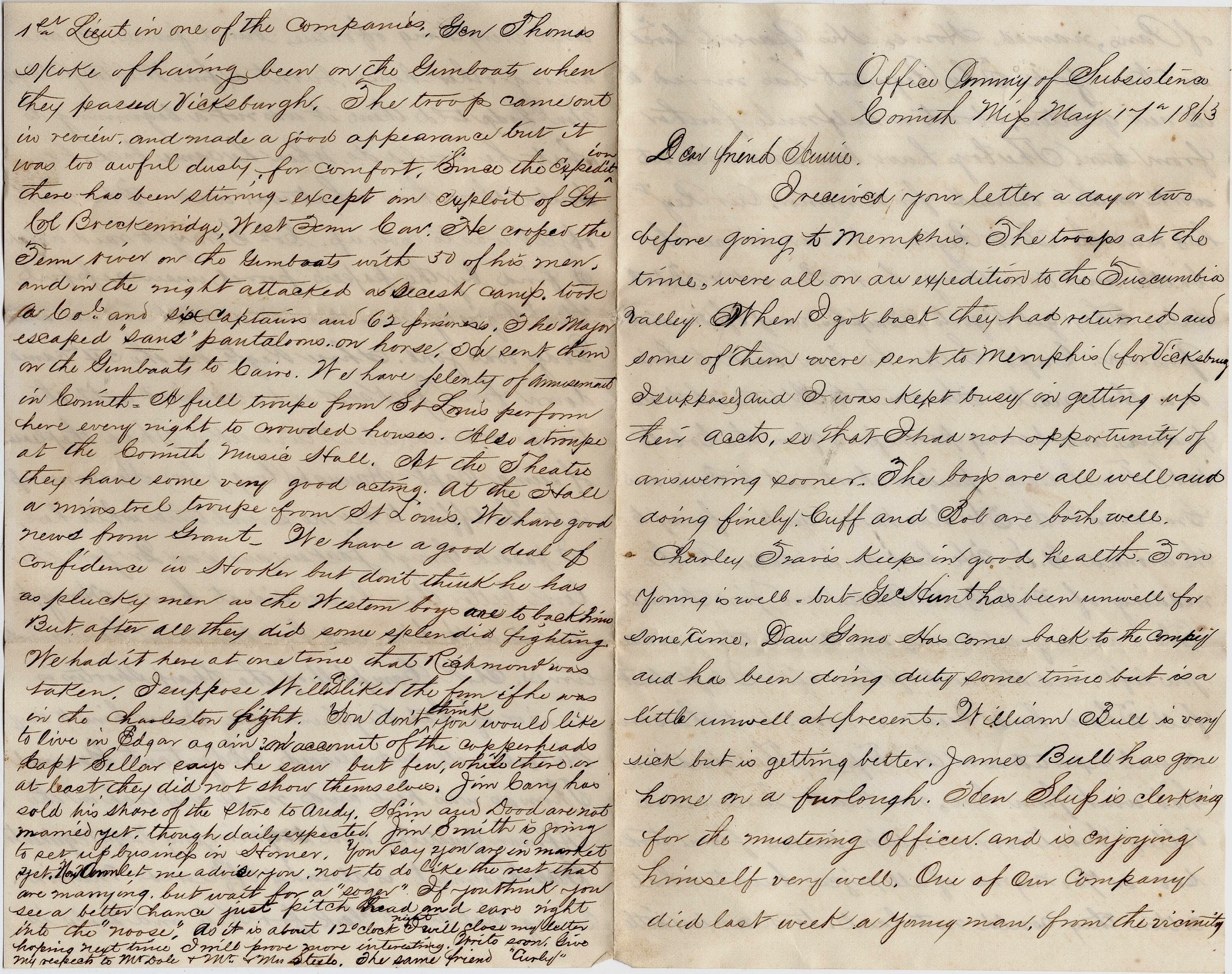
Letter 1
Office Army of Subsistence, Corinth, Mississippi
May 17, 1863
Dear friend Annie,
I received your letter a day or two before going to Memphis. The troops at the time were all on an expedition to the Tuscumbia Valley. When I got back, they had returned and some of them were sent to Memphis) for Vicksburg I suppose), I was kept busy in getting up their accounts so that I had not opportunity of answering sooner.
The Boys are all well and doing finely. Cuff and Bob are both well. Charley Travis keeps in good health. Tom Young is well but George Hunt has been unwell for some time. Dan Gano has come back to the company and has been doing duty some time but is a little unwell at present. William Bull is very sick but is getting better. James Bull has gone home on a furlough. Hen Sluss is clerking for the mustering officer and is enjoying himself very well. One of our company died last week—a young man from the vicinity of Paris named [Chester D.] Howe. His parents lived in New York.
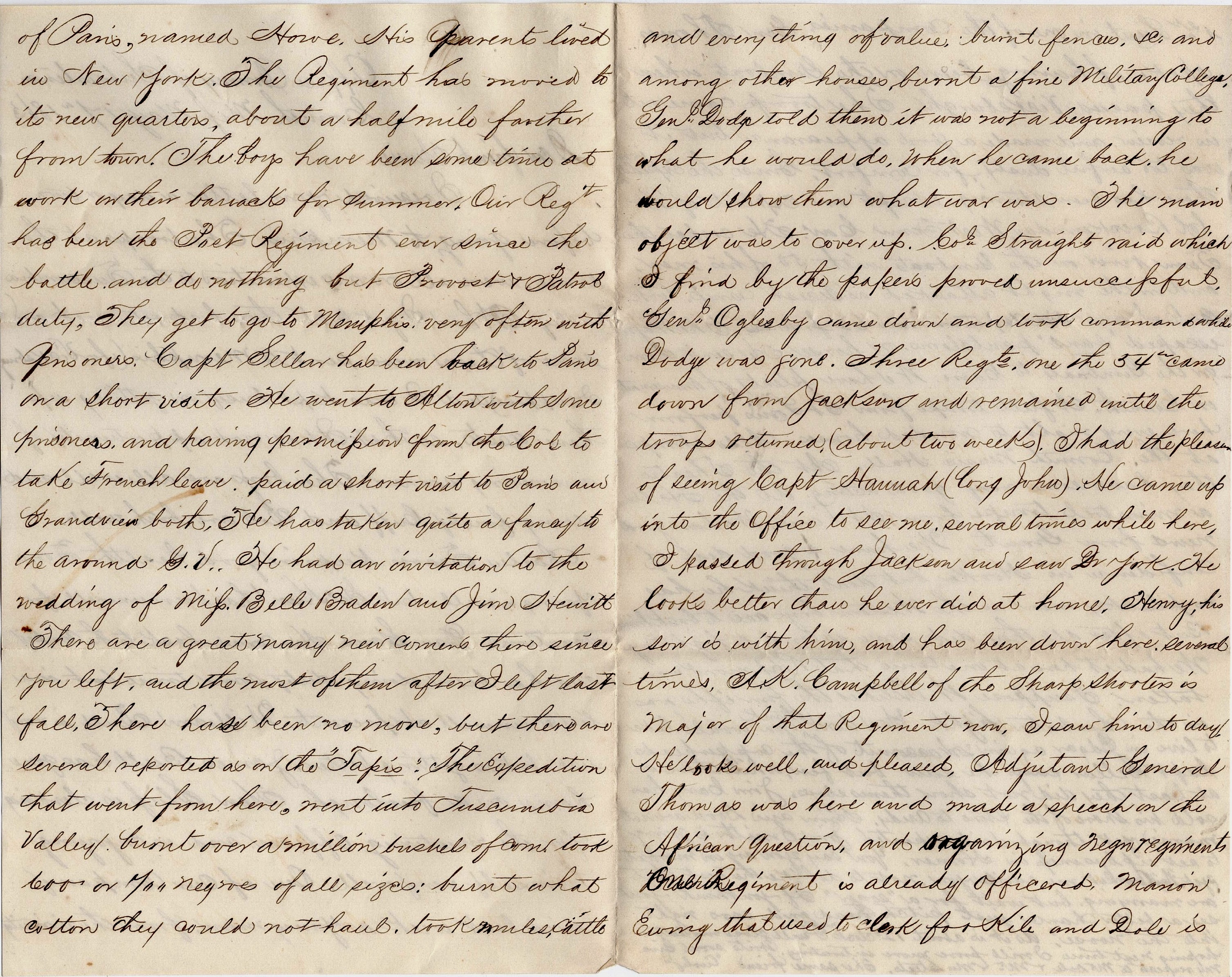
The regiment has moved to its new quarters about a half mile farther from town. The boys have been some time at work on their barracks for summer. Our regiment has been the Post Regiment ever since the battle and do nothing but Provost & Patrol duty. They get to go to Memphis very often with prisoners. Capt. [Henry Van] Sellar has been back to Paris on a short visit. He went to Alton with some prisoners and having permission from the Colonel to take French leave, paid a short visit to Paris and Grandview both. He has taken quite a fancy to the [area] around Grandview. He had an invitation to the wedding of Miss Belle Braden and Jim Hewitt. There are a great many newcomers there since you left and the most of them after I left last fall. There has been no more, but there are several reported as on the “Topis.”
The expedition that went from here went into Tuscumbia Valley, burnt over a million bushels of corn, took 600 or 700 negroes of all sizes, burnt what cotton they could not haul, took mules, cattle, and everything of value, burnt fences, &c. and among other houses, burnt a fine Military College [LaGrange Military Academy]. Gen. Dodge told them it was not a beginning to what he would do. When he came back, he would show them what war was. The main object was to cover up Col. [Abel D.] Straight’s raid which I find by the papers proved unsuccessful. Gen. Oglesby came down and took command which Dodge was gone.
Three regiments—one the 54th—came down from Jackson and remained until the trops returned (about two weeks). I had the pleasure of seeing Capt. [John B.] Hanna (Long John). He came up into the office to see me several times while here. I passed through Jackson and saw Dr. [Shubal] York. He looks better than he ever did at home. Henry [Clay York], his son, is with him and has been down here several times. A. K. Campbell of the Sharp Shooters is Major of that regiment now. I saw him today. He looks well and pleased. Adjutant General [Lorenzo] Thomas was here and made a speech on the African Question, and organizing negro regiments. One regiment is already officered. Marion Ewing that used to clerk for Kile and Dole is 1st Lieutenant in one of the companies.
Gen. [George H.] Thomas spoke of having been on the gunboats when they passed Vicksburg. The troop came out in review and made a good appearance but it was too awful dusty for comfort.
Since the expedition, there has been [no] stirring except an exploit of Lt. Col. Breckenridge, West Tennessee Cavalry. He crossed the Tennessee River on the gunboats with 50 of his men and in the night attacked a secesh camp, took a Lt. Col. and six captains and 62 prisoners. The Major escaped “sans” pantaloons on horse. He sent them on the gunboats to Cairo.
We have plenty of amusement in Corinth. A full troupe from St. Louis perform here every night to crowded houses. Also a troupe at the Corinth Music Hall. At the Theatre they have some very good acting. At the Hall, a minstrel troupe from St. Louis.
We have good news from Grant. We have a good deal of confidence in [Joe] Hooker but don’t think he has as plucky men as the Western boys are to back him. But after all, they did some splendid fighting. We had it here at one time that Richmond was taken. I suppose Will liked the fun if he was in the Charleston fight. You don’t think you would like ot live in Edgar again on account of the Copperheads? Capt. Sellar says he saw but few while there or at least they did not show themselves. Jim Cary has sold his share of the store to Andy. Him and Dood are not married yet though daily expected. Jim Smith is going to set up business in Homer. You say you are in market yet? Now Ann, let me advise you not to do like the rest that are marrying, but wait for a “soger.” If you think you see a better chance, just pitch head and ears right into the “noose.”
As it is about 12 o’clock at night, I will close my letter hoping nest time I will prove more interesting. Write soon. Give my respects to Mr. Dole & Mr & Mrs. Steele. The same friend, — “Curly”
Letter 2
Pulaski, Tennessee
December 13th 1863
Dear friend Annie,
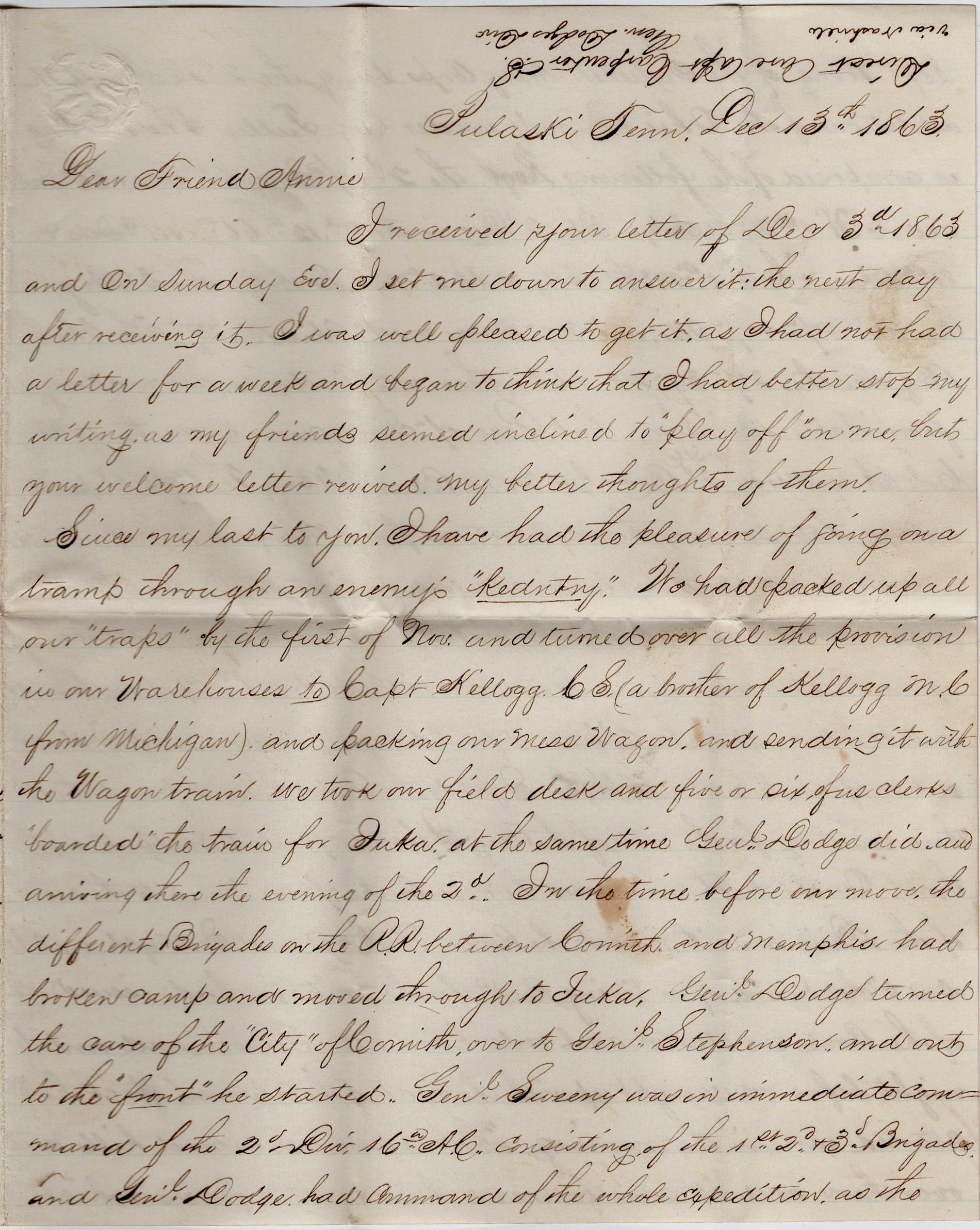
I received your letter of December 3rd 1863 and on Sunday eve I sat down to answer it. The next day after received it, I was well pleased to get it as I had not had a letter for a week and began to think that I had better stop my writing as my friends seemed inclined to play off on me. But your welcome letter revived my better thoughts of them.
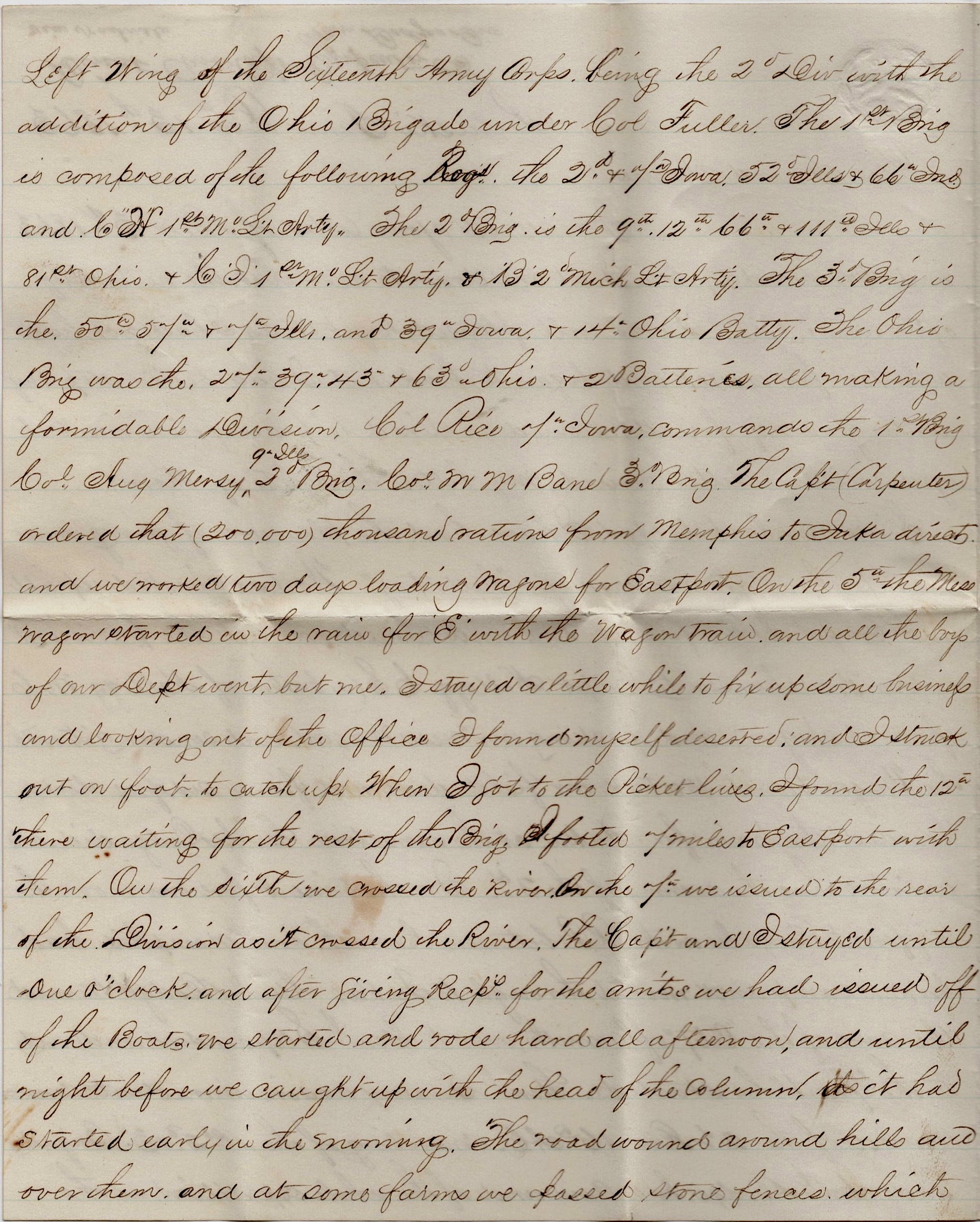
Since my last to you, I have had the pleasure of going on a tramp through an enemy’s “kedntry.” We had packed up all our “traps” by the first of November and turned over all the provision in our warehouses to Capt. Kellogg, C.S. [Commissary Subsistence] (a brother of Kellogg, M. C., from Michigan) and packing our mess wagon and sending it with the wagon train. We took our field desk and five or six of us clerks boarded the train for Iuka at the same time Gen. Dodge did and arriving there the evening of the 2nd. In the time before our move, the different brigades on the railroad between Corinth and Memphis had broken camp and moved through to Iuka. Gen. Dodge turned the care of the “City” of Corinth over to Gen. Stephenson and out to the “front” he started. Gen. Sweeny was in immediate command of the 2nd Division, 16th Army Corps consisting of the 1st, 2nd, & 3rd Brigades and Gen. Dodge had command of the whole expedition as the Left Wing of the 16th Army Corps, being the 2nd Division, with the addition of the Ohio Brigade under Col. Fuller.
The 1st Brigade is composed of the following regiments” the 2nd of Iowa, 52nd Illinois, and 66th Indiana and Co. H, 1st Mo. Light Artillery. The 2nd Brigade is the 9th, 12th, 66th, and11th Illinois & 81st Ohio. and Co. I, 1st Mo. Light Artillery, & B, wnd Michigan Light Artillery. The 3rd Brigade is the 50th, 57th, & 7th Illinois, and 39th Iowa & 14th Ohio Battery. The Ohio Brigade was the 27th, 39th, 43rd, and 63rd Ohio and 2 Batteries, all making a formidable division. Col. Rice of Iowa commands the 1st Brigade, Col. August Mersey, 9th Illinois, the 2nd Brigade, Col. Moses M. Bane the 3rd Brigade. The Captain ([Cyrus Clay] Carpenter) ordered that 200,000 rations from Memphis to Iuka direct and we worked two days loading wagons for Eastport.
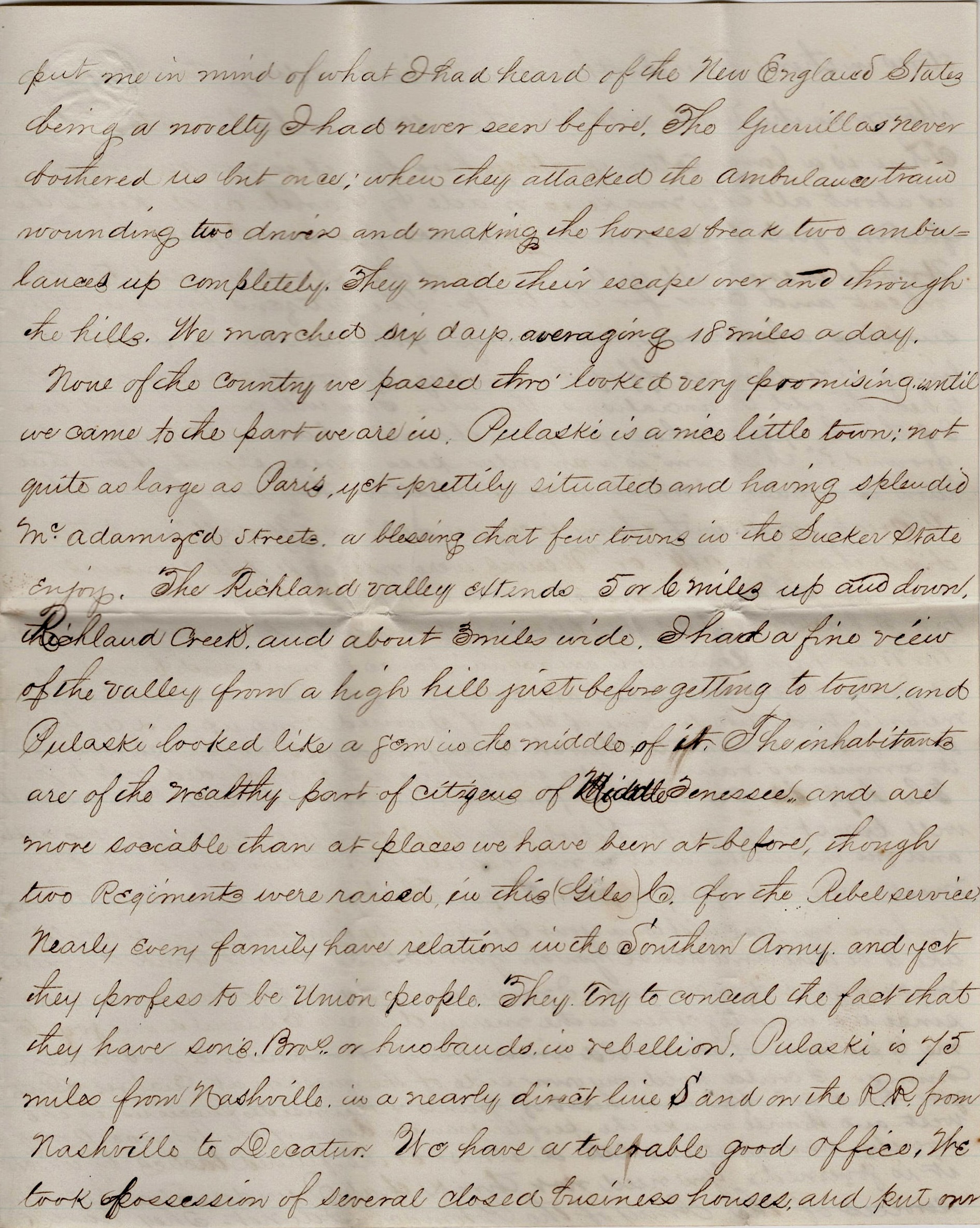
On the 5th, the mess wagon started in the rain for E[astport] with the wagon train and all the boys of our department went but me. I stayed a little while to fix up some business and looking out of the office I found myself deserted and I struck out on foot to catch up. When I got to the picket line, I found the 12th [Illinois] there waiting for the rest of the Brigade. I footed 7 miles to Eastport with them. On the 6th, we crossed the river. On the 7th, we issued to the rear of the division as it crossed the river. The Captain and I stayed until one o’clock and after giving receipts for the amounts we had issued off of the boats, we started and rode hard all afternoon, and until night before we caught up with the head of the column. It had started early in the morning. The road wound around hills and over them and at some farms we passed stone fences which put me in mind of what I had heard of the New England states, being a novelty I had never seen before.
The guerrillas never bothered us but once when they attacked the ambulance train, wounding two drivers and making the horses break two ambulances up completely. They made their escape over and through the hills. We marched six days averaging 18 miles a day. None of the country we passed through looked very promising until we came to the part we are in.
Pulaski is a nice little town, not quite as large as Paris [Illinois], yet prettily situated and having splendid macadamized streets—a blessing that few towns in the Sucker State enjoy. The Richland Valley extends 5 or 6 miles up and down RichlandCreek and about 3 miles wide. I had a fine view of the valley from a high hill just before getting to town and Pulaski looked like a gem in the middle of it. The inhabitants are of the wealthy part of citizens of Middle Tennessee and are more sociable than at places we had been at before, though two regiments were raised in this (Giles) county for the Rebel service. Nearly every family have relations in the Southern Army and yet they profess to be Union people. They try to conceal the fact that they have sons, brothers, or husbands in rebellion. Pulaski is 75 miles from Nashville in a nearly direct line south and on the railroad from Nashville to Decatur. We have a tolerable good office. We took possession of several closed business houses and put our stores in them.
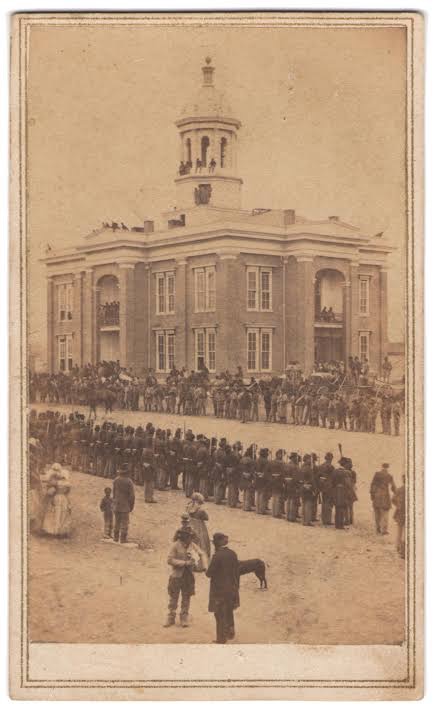
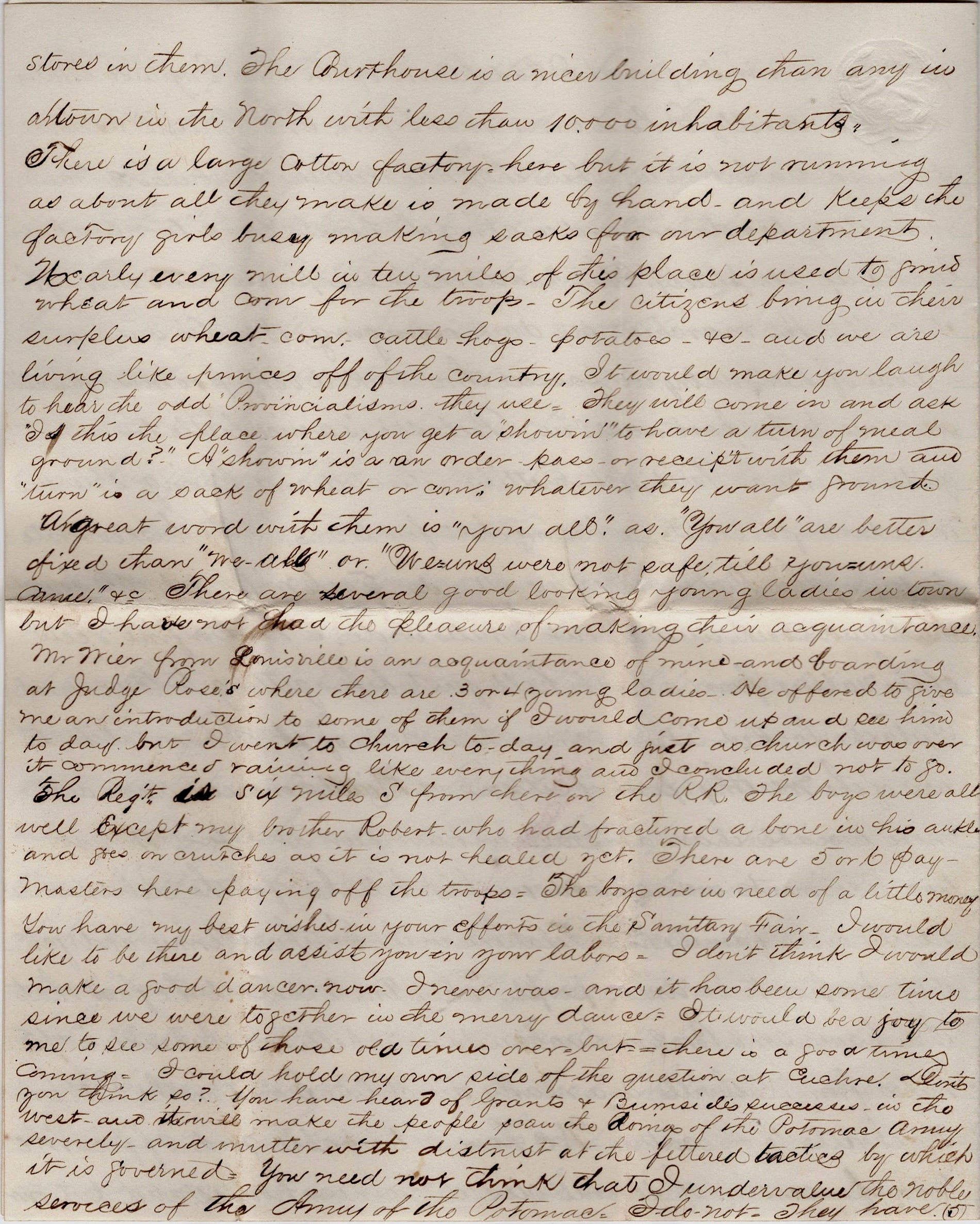
The [Pulaski] Courthouse is a nicer building than any in a town in the North with less than 10,000 inhabitants. There is a large cotton factory here but it is not running as about all they make is made by hand and keeps the factory girls busy making sacks for our department. Nearly every mill in ten miles of this place is used to grind wheat and corn for the troops. The citizens bring in their surplus wheat, corn, cattle, hogs, potatoes, &c. and we are living like princes off of the country. It would make you laugh to hear the odd provincialisms they use. They will come in and ask, “Is this the place where you get a “showin” to have a turn of meal ground?” A “showin” is an order, pass, or receipt with the and “turn” is a sack of wheat or corn—whatever they want ground. A great word with them is “you all,” as “You all” are better fixed that “we all,” or “We-uns were not safe till you-uns came,” &c.
There are several good looking ladies in town but I have not had the pleasure of making their acquaintance. Mr. Wier from Louisville is an acquaintance of mine and boarding at Judge Rose’s where there are 3 or 4 young ladies. He offered to give me an introduction to some of them if I would come up and see him today but I went to church today and just as church was over it commenced raining like everything and I concluded not to go.
The regiment is six miles south from here on the railroad. The boys were all well except my brother Robert who had fractured a bone in his ankle and goes on crutches as it is not healed yet. There are 5 or 6 paymasters here paying off the troops. The boys are in need of a little money.
You have my best wishes in your efforts in the Sanitary Fair. I would like to be there and assist you in your labors. I don’t think I would make a good dancer now. I never was and it has been some time since we were together in the merry dance. It would be a joy to me to see some of those old times over but there is a good time coming. I could hold my own side of the question at Euchre, don’t you think so?
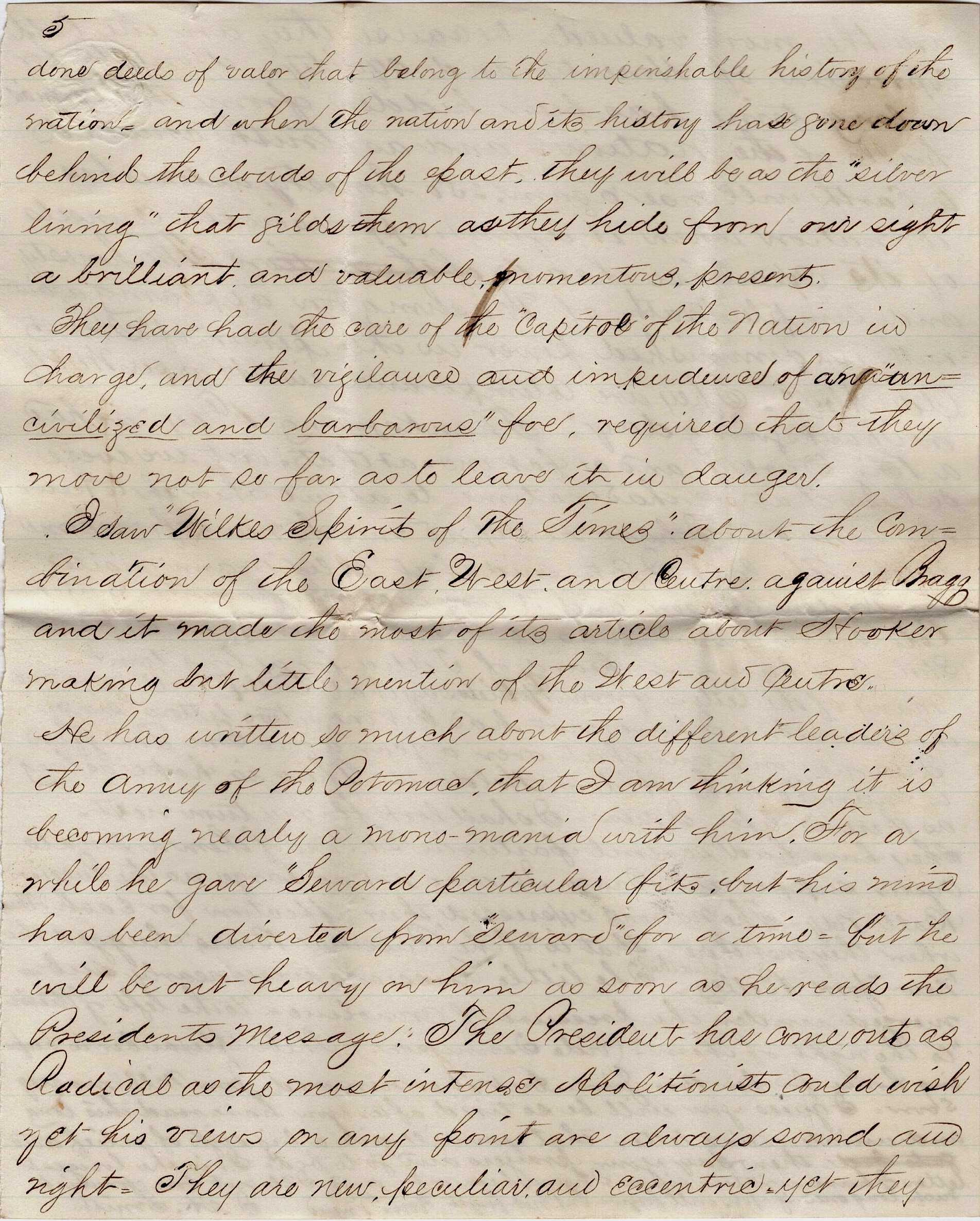
You have heard of Grant’s and Burnside’s successes in the West and it will make the people scorn the Army of the Potomac Army severely and mutter with distrust at the fettered tactics by which it is governed. You need not think that I undervalue the noble services of the Army of the Potomac. I do not. They have done deeds of valor that belong to the imperishable history of the Nation, and when the Nation and its history has gone down behind the clouds of the past, they will be as the “silver lining” that gilds them as they hide from our sight a brilliant and valuable momentous present.
They have had the care of the Capitol of the Nation in charge, and the vigilance and impudence of an “uncivilized and barbarous” foe required that they move not so far as to leave it in danger.
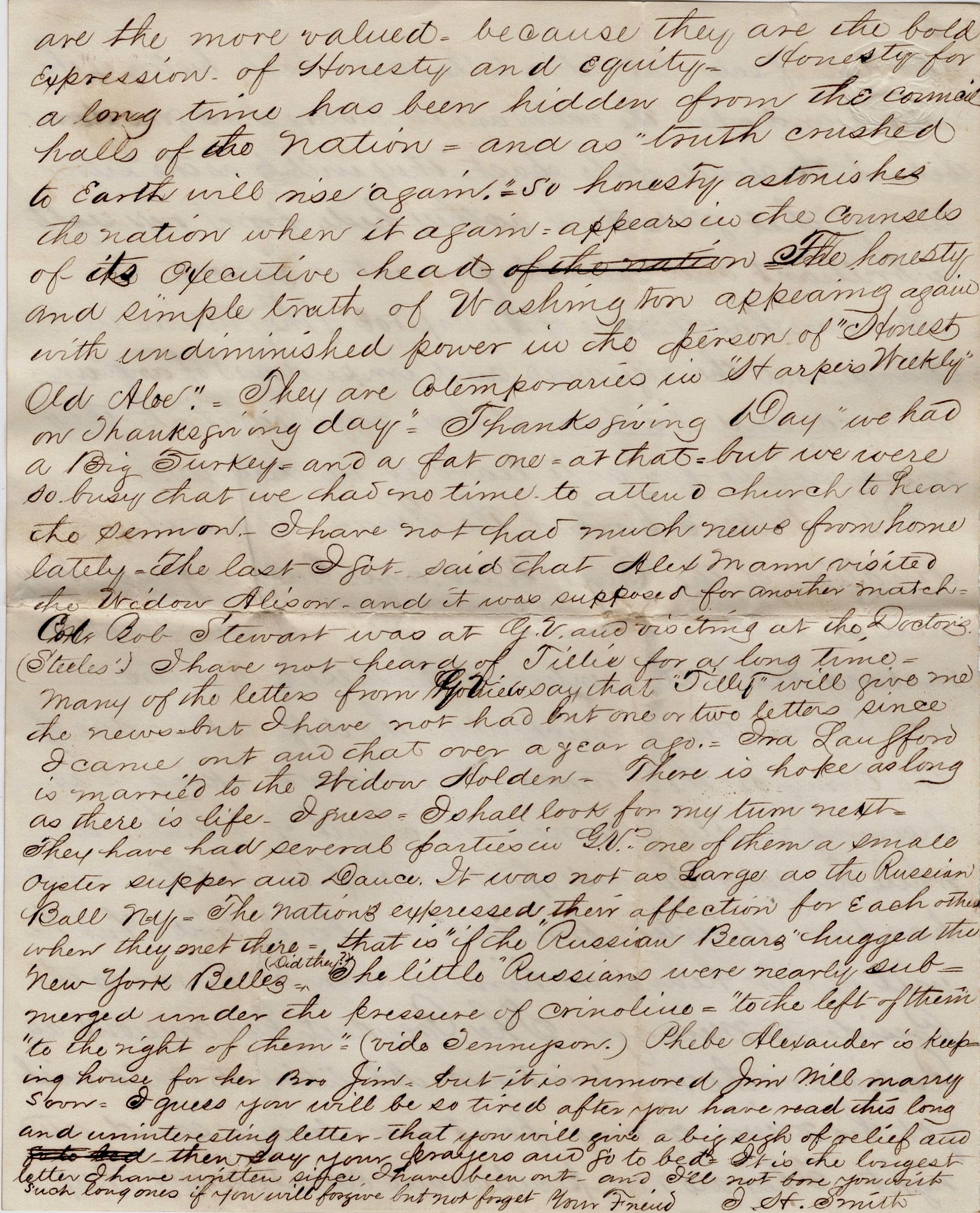
I saw “Wilkes Spirit of the Times” about the combination of the East, West and Centre against Bragg and it made the most of its article about Hooker making but little mention of the West and Centre. He has written so much about the different leaders of the Army of the Potomac that I am thinking it is becoming nearly a mon0-mania with him. For a while he gave “Seward” particular fits, but his mind has been diverted from “Seward” for a time. But he will be out heavy on him as soon as he reads the President’s Message. The President has come out as Radical as the most intense Abolitionists could wish, yet his views on any point are always sound and right. They are new, peculiar, and eccentric, yet they are the most valued because they are the bold expression of honesty and equity. Honesty for a long time has been hidden from the council halls of the Nation. And as “truth crushed to Earth will rise again,” so honesty astonishes the Nation when it again appears in the counsels of its Executive Head—the honesty and simple truth of Washington appearing again with undiminished power in the person of “Honest Old Abe.” They are contemporaries in “Harper’s Weekly” on Thanksgiving Day.”
Thanksgiving Day we had a big turkey and a fat one at that. But we were so busy that we had no time to attend church to hear the sermon. I have not had much news from home lately. The last I got said that Alex Mann visited the Widow Alison and it was supposed for another match. Col. Bob Stewart was at Grandview and visiting at the Doctor’s (Steele’s). I have not heard of Tillie for a long time. Many of the letters from Grandview say that “Tilly” will give me the news but I have not had but one or two letters since I came out and that over a year ago. Ira Laufford is married to the Widow Holden. There is hope as long as there is life, I guess. I shall look for my turn next.
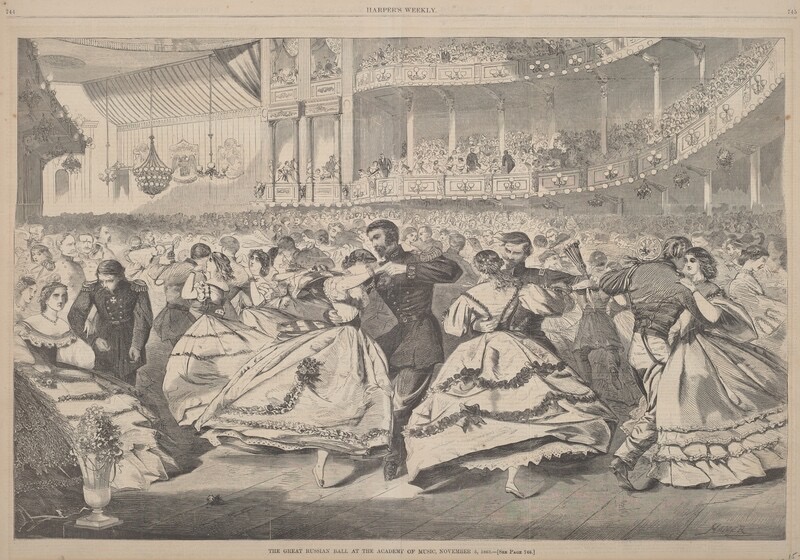
They have had several parties in Grandview. One of them a small oyster supper anddance. It was not as large as the Russian Ball, New York. The Nations expressed their affection for each other when they met there—that is, if the Russian Bears hugged the New York Belles. Did they? The little Russians were nearly submerged under the pressure of crinoline—“to the left of them, [and] “to the right of them.” (vide Tennyson)
Phebe Alexander is keeping house for her brother Jim but it is rumored Jim will marry soon. I guess you will be so tired after you have read this long and uninteresting letter that you will give a big sigh of relief and then say your prayers and go to bed. It is the longest letter I have written since I have been out and I’ll not bore you with such long ones if you will forgive but not forget your friend, — J. H. Smith
Letter 3
Huntsville, Alabama
May 17, 1864
Dear Friend Annie,
I received your letter the last of April but have been so busy and moving so much that I had not time to answer it. I had not received but one or two letters before I received yours for three months when, singular to relate, five came beside yours the same evening. When I received your letter, we were busy packing up for a move which I suppose you have heard of in the newspapers. I had just been up to Pulaski to see the boys the day before I received your letter. I found them well and enjoying themselves the best they knew how. Williamson and Bob were both well but Bob is still troubled with his lame ankle and I doubt his ever getting entirely over it.
Several of the boys that enlisted at the tie that I did were debating whether they should be mustered out in August at the expiration of the first three years of the regiment, or would be held for three years. I am not certain about it myself but I am suspicious the government will hold us three years anyhow. Hen Travis reenlisted and came back with the old company. Jo Hill also enlisted. Bill Jones came back to serve his three years out. He has never had a discharge yet, and is not fit to a day’s duty. He is staying in the hospital as nurse. Capt. [Van] Sellar is somewhat changed since he married. “A change (has come) over the spirit of his dream.” He keeps up almost daily correspondence with “Sallie.” I hope it will not change me (except for the better) to get married. The fact of it is I have no serious thoughts of marrying just now unless I see some “Dixie” girls that suit me better than what I have seen.
On the last day of April, the 2nd Division commanded by Gen. Sweeny, in which the 12th [Illinois] is, left Pulaski and marched across the country to Huntsville. They did not pass near Athens and I did not get to see them. The 3rd brigade of the 2nd Division left Athens where Gen. Dodge’s Headquarters were on the 1st May, and the 4th Division under Gen. [James C.] Veatch left Decatur on the 2nd, all “en route” for Huntsville. The day before I went, I got those flowers I sent you at a Mr. Higgins’. His daughter Kate is a “belle” of the town but she is secesh as thunder. I had some sharp talk with her about “Beast Butler” and others. I told her that Butler would be in command at Fort Monroe and be authority in the exchange of prisoners as long as the war lasted, which she hated very much.
On the 2nd, I went down to Huntsville on the cars with Headquarters clerks and Division Band. When we got to Huntsville the 15th Army Corps had gone. Gen. McPherson was there yet and a host of Brigadiers at the Huntsville House [at the corner of Jefferson and Spring Streets]. The 2nd Division had got there but I did not get up early enough in the morning to see them off. The main clerks of the Quartermaster & Commissary Departments of our Division were left behind to fix up monthly papers. Two other clerks beside myself were left behind to fix up monthly papers. We had paid so many vouchers that it took us two weeks to fix up our papers. We have finished them now and are waiting orders to go to the front.
Athens [Alabama] I found to be one of the most sociable towns to be in, in the South. The people are more sociable and there is more Union feeling in it than any town I have been in South. There is a “Female Seminary” [Athens Female Institute] in full bloom, where some 60 or 70 of the southern ladies and girls attend. The principal of the institute is Mrs. J[ane] Hamilton Childs, formerly from Washington. She keeps a good school and the grounds are fixed neatly around the institute.
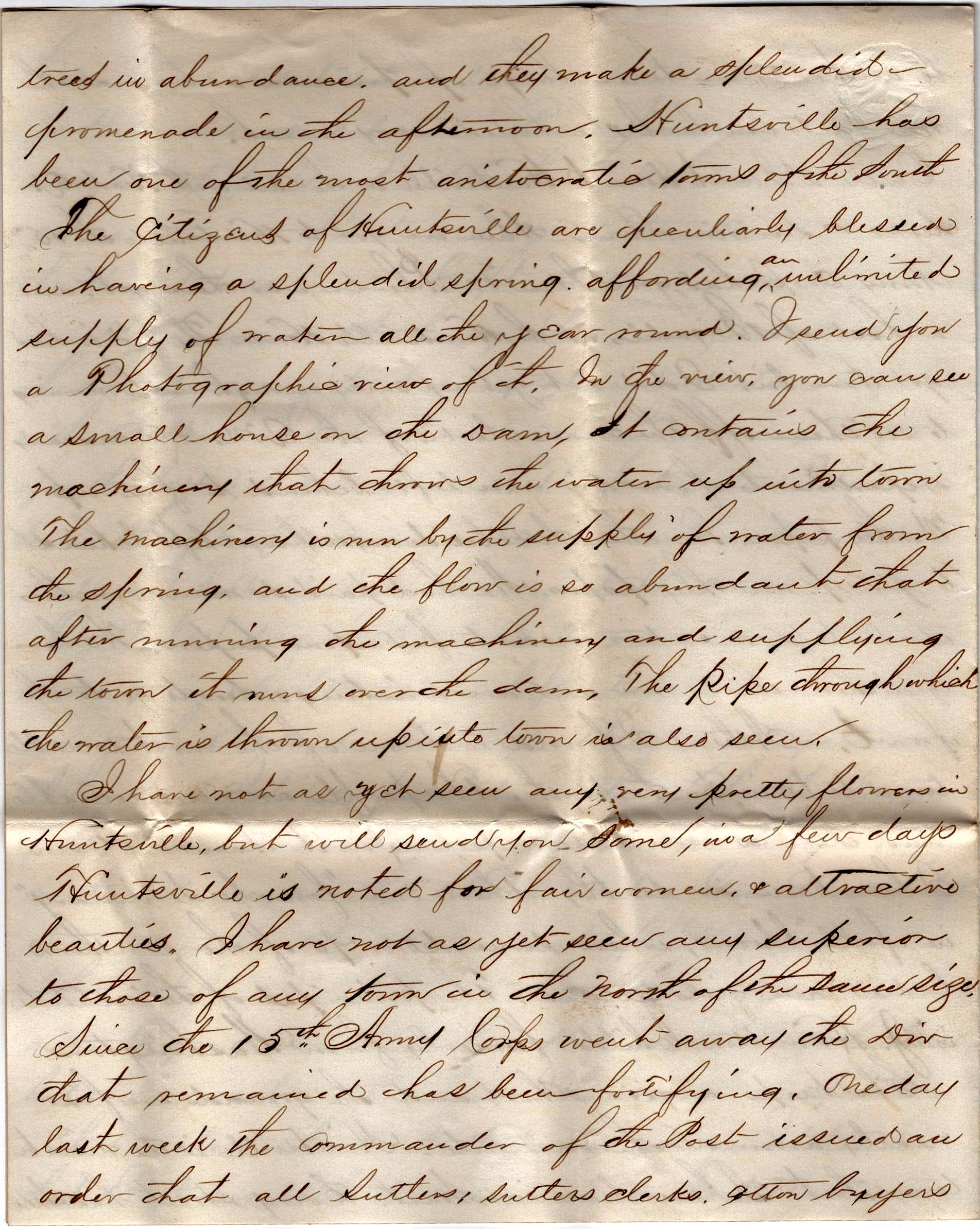
Huntsville is the nicest town that I have been in South. Every street has shade trees in abundance and they make a splendid promenade in the afternoon. Huntsville has been one of the most aristocratic towns of the South. The citizens of Huntsville are peculiarly blessed in having a splendid spring, affording an unlimited supply of water all the year round. I send you a photographic view of it. In the view you can see a small house on the dam. It contains the machinery that throws the water up with into town. The machinery is run by the supply of water from the spring and the flow is so abundant that after running the machinery and supplying the town, it runs over the dam. The pipe through which the water is thrown up into town is also seen.
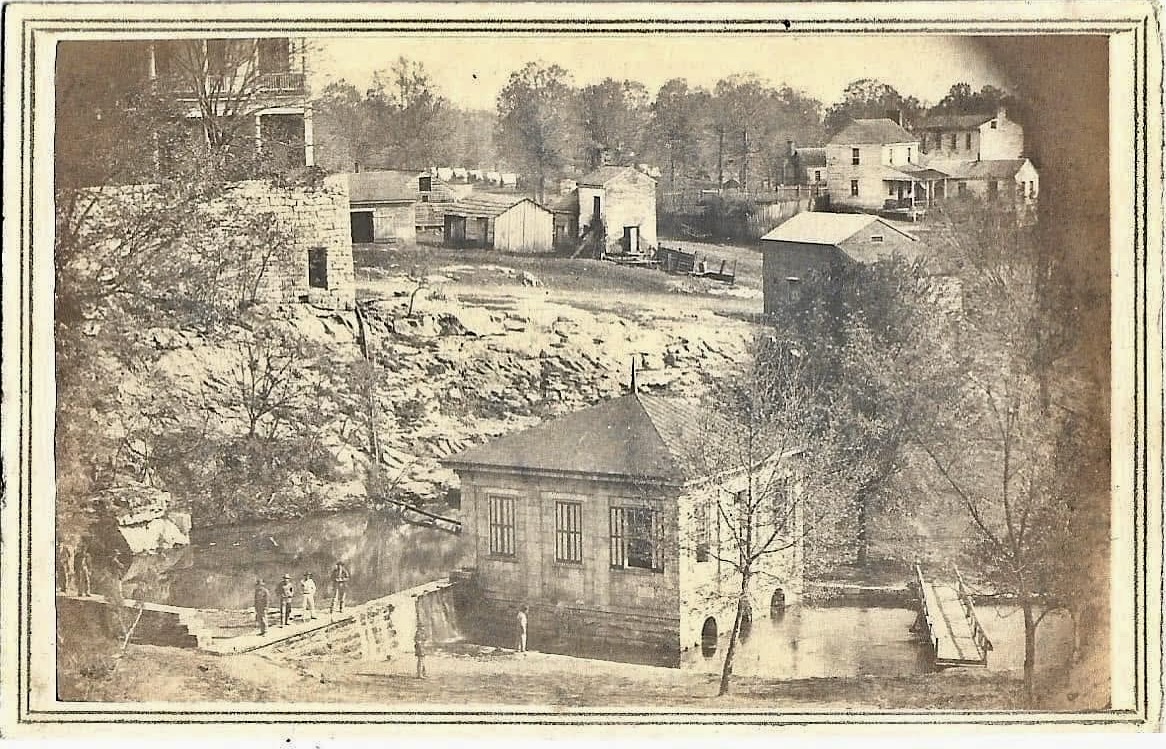
I have not as yet seen any very pretty flowers in Huntsville, but will send you some in a few days. Huntsville is noted for fair women & attractive beauties. I have not seen any superior to those of any town in the North of the same size.
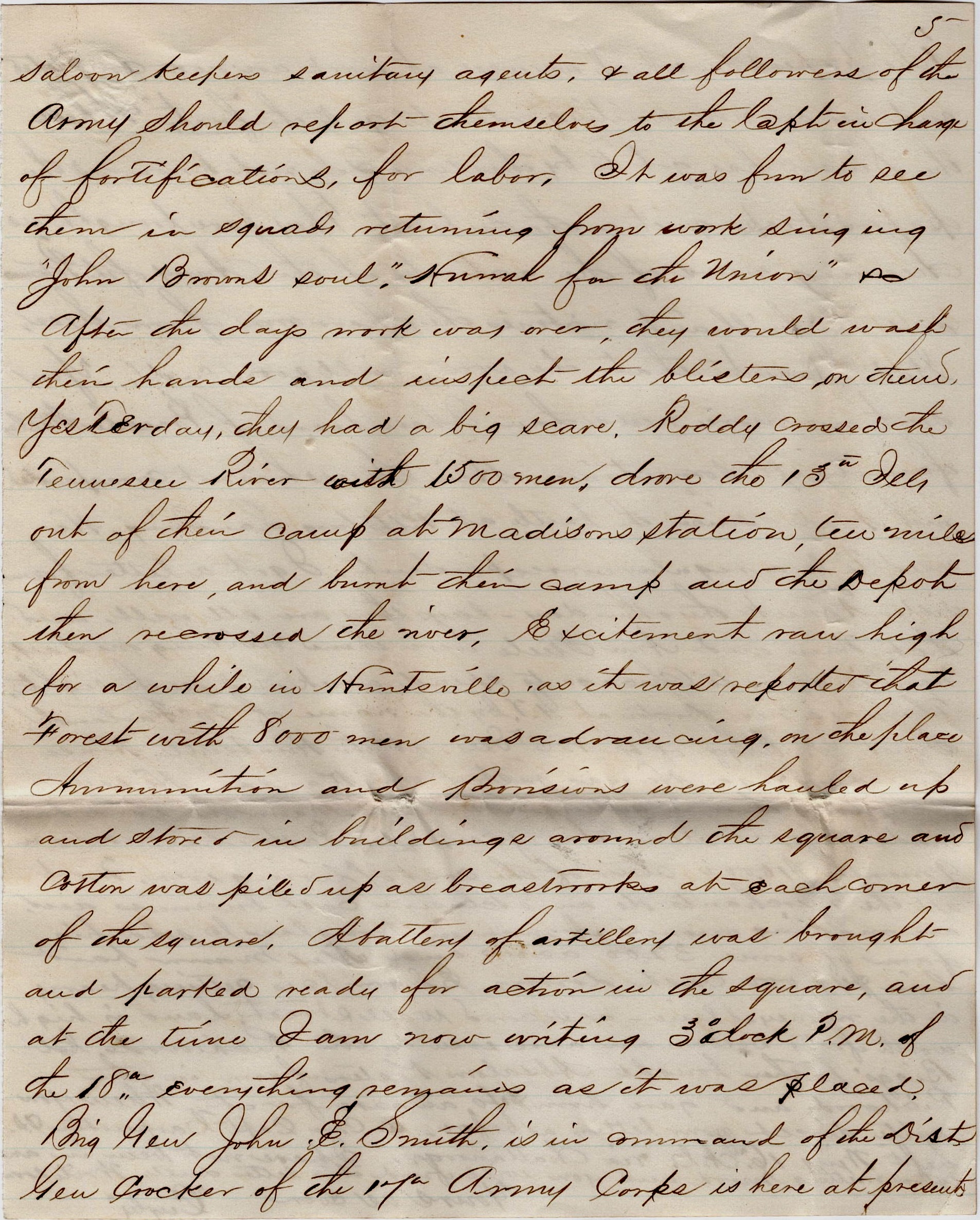
Since the 15th Army Corps went away, the Division that remained has been fortifying. One day last week the commander of the Post issued an order that all sutlers, sutler’s clerks, cotton buyers, saloon keepers, sanitary agents, & all followers of the Army should report themselves to the captain in charge of fortifications for labor. It was fun to see them in squads returning from work singing “John Brown’s Soul. Hurrah for the Union,” &c. After the days work was over, they would wash their hands and inspect the blisters on them.
Yesterday they had a big scare. [Philip Dale] Roddey crossed the Tennessee River with 1500 men, drove the 13th Illinois out of their camp at Madison’s Station, ten miles from here, and burnt their camp and the Depot, then recrossed the river. Excitement ran high for a while in Huntsville as it was reported that Forrest with 8,000 men was advancing on the place. Ammunition and provisions were hauled up and stored in buildings around the square and cotton was piled up as breastworks at each corner of the square. A battery of artillery was brought and parked ready for action in the square and at the time I am writing—3 o’clock p.m. of the 18th—everything remains as it was placed. Brig. Gen. John E. Smith is in command of the District. Gen. [Marcellus M.] Crocker of the 17th Army Corps is here at present.
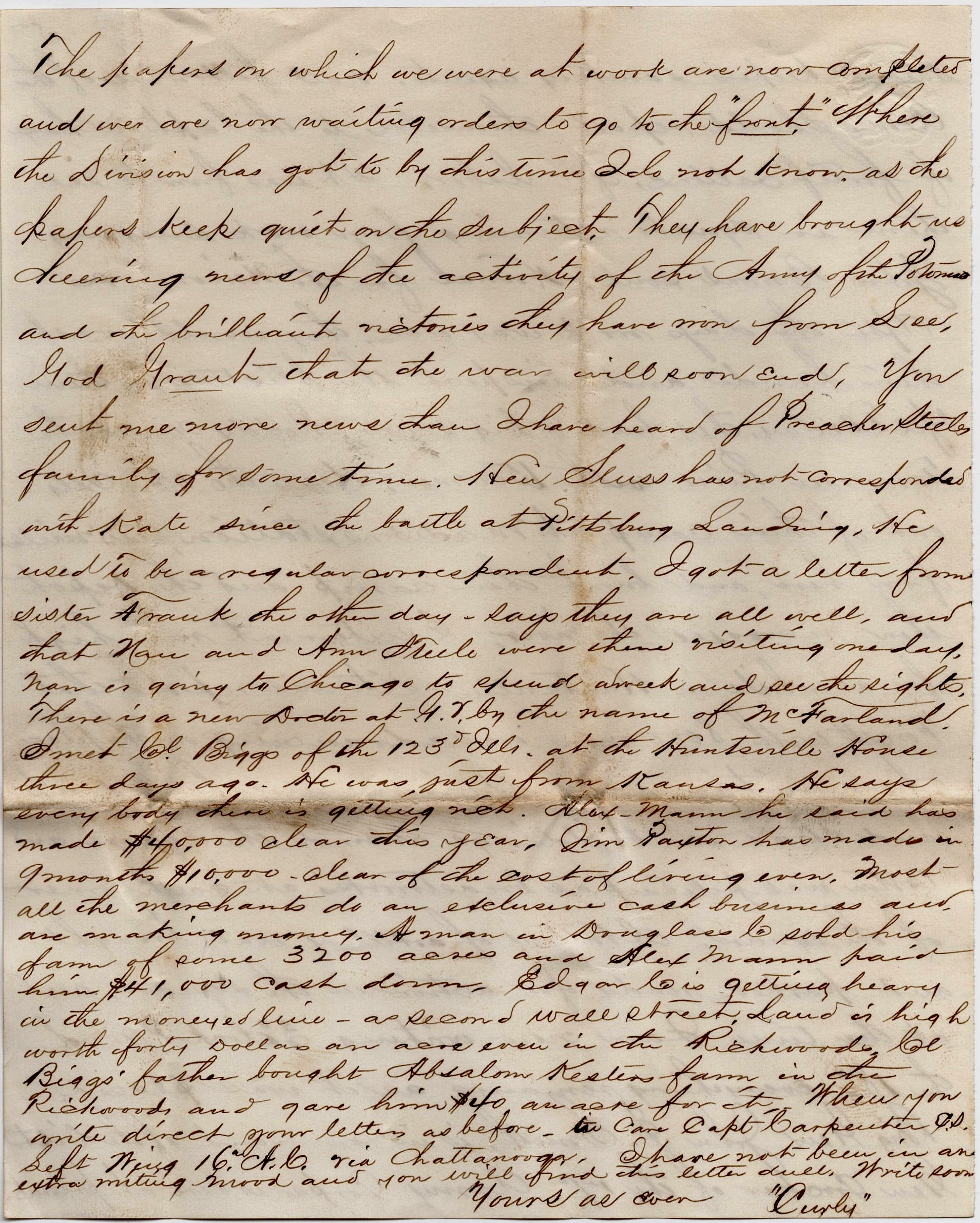
The papers on which we were at work are now completed and we are now waiting orders to go to the front. Where the Division has got to by this time, I do not know as the papers keep quiet on the subject. They have brought us cheering news of the activity of the Army of the Potomac and the brilliant victories they have won from Lee. God Grant that the war will soon end.
You sent me more news than I have heard of Preacher Steele’s family for some time. Hen Sluss has not corresponded with Kate since the Battle of Pittsburg Landing. He used to be a regular correspondent. I got a letter from sister Frank the other day—says they are all well, and that Nan and Ann Steele were there visiting one day. Nan is going to Chicago to spend a week and see the sights. There is a new doctor of Grandview by the name of McFarland. I met Col. [Jonathan] Biggs of the 123rd Illinois at the Huntsville House three days ago. He was just from Kansas. He says everybody there is getting rich. Alex Mann he said has made $40,000 clear this year. Jim Paxton has made in 9 months $10,000 clear of the cost of living even. Most all the merchants do an exclusive cash business and are making money. A man in Douglass County sold his farm of some 3200 acres and Alex Mann paid him $41,000 cash down. Edgar County is getting heavy in the moneyed line—a second Wall Street. Land is high worth forty dollars an acre even in the Richwoods. Col. Biggs’ father bought Absalom Kester’s farm in the Richwoods and gave him $40 an acre for it.
When you write, direct your letters as before, in care of Capt. [Cyrus Clay] Carpenter, Commissary Subsistence., Left Wing, 16th Army Corps via Chattanooga. I have not been in an extra writing mood and you will find this letter dull. Write soon. Yours as ever, — “Curly”
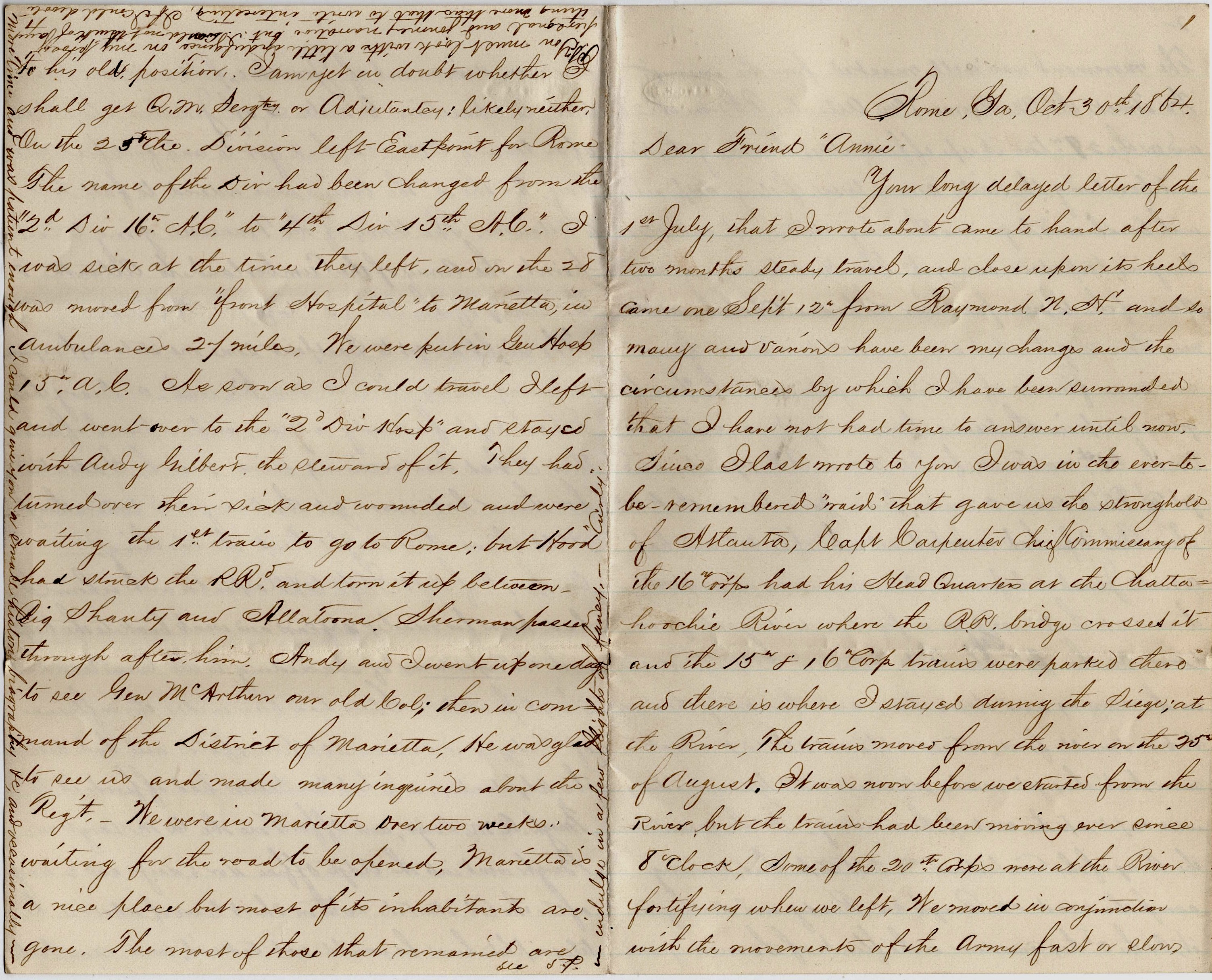
Letter 4
Rome, Georgia
October 30th 1864
Dear friend Annie,
Your long delated letter of the 1st July that I wrote about came to hand after two months steady travel, and close upon its heels came one September 12th from Raymond N. St. and so many and various have been my changes and the circumstances by which I have been surrounded that I have not had time to answer until now.
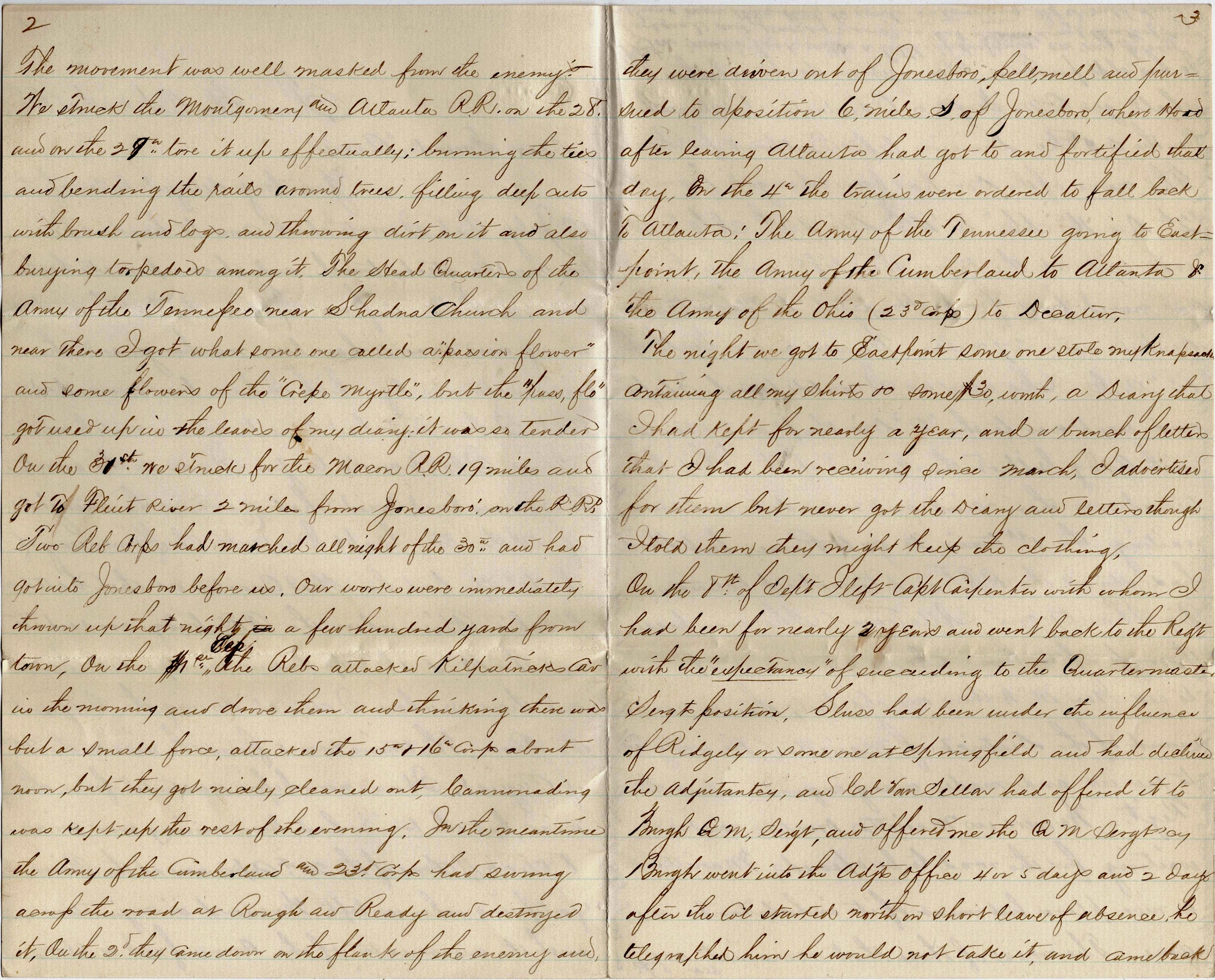
Since I last wrote to you, I was in the ever-to-be-remembered “raid” that gave us the stronghold of Atlanta. Capt. Carpenter, Chief Commissary of the 16th Corps had his headquarters at the Chattahoochie River where the railroad bridge crossed it and the 15th & 16th Corps trains were parked there and there is where I stayed during the siege, at the river. The trains moved from the river on the 25th of August. It was noon before we started from the river, but the trains had been moving ever since 8 o’clock. Some of the 20th Corps were at the river fortifying when we left. We moved in conjunction with the movements of the Army fast or slow. The movement was well masked from the enemy. We struck the Montgomery and Atlanta Railroad on the 28th and on the 29th tore it up effectually. burning the ties and bending the rails around trees, filling deep cuts with brush and logs, and throwing dirt on it and also burying torpedoes among it.
The Headquarters of the Army of the Tennessee near Shadna Church and near there I got what someone called a “passion flower” and some flowers of the “crepe myrtle,” but the “puss flo” got used up in the leaves of my diary, it was so tender.
On the 31st, we struck for the Macon Railroad 19 miles and got to Flint River 2 miles from Jonesboro on the railroad. Two Reb Corps had marched all night of the 30th and had got into Jonesboro before us. Our works were immediately thrown up that night a few hundred yards from town. On the 31st, the Rebs attacked Kilpatrick’s cavalry in the morning and drove them and thinking there was but a small force, attacked the 15th & 16th Corps about noon, but they got nicely cleaned out. Cannonading was kept up the rest of the evening. In the meantime, the Army of the Cumberland and 23rd Corps had swung across the road at Rough and Ready and destroyed it. On the 2nd, they came down on the flank of the enemy and they were driven out of Jonesboro pell mell and pursued to a position 6 miles south of Jonesboro where Hood, after leaving Atlanta, had got to and fortified that day.
On the 4th, the trains were ordered to fall back to Atlanta. The Army of the Tennessee going to Eastpoint, the Army of the Cumberland to Atlanta, and the Army of the Ohio (23rd Corps) to Decatur.
The night we got to Eastpoint, someone stole my knapsack containing all my shirts and some $30 worth, a diary that I had kept for nearly a year, and a bunch of letters that I had been receiving since March. I advertised for them but never got the Diary and letters though I told them they might keep the clothing.
On the 7th of September, I left Capt. [Cyrus Clay] Carpenter with whom I had been for nearly 2 years and went back to the regiment with the expectancy of succeeding to the Quartermaster Sergeant’s position. Sluss had been under the influence of Ridgely or someone at Springfield and had declined the Adjutancy and Col. Van Sellar had offered it to [Martin W.] Burgh, Quartermaster Sergeant, and offered me the QM Sergt’cy. Burgh went into the Adjutant’s office 4 or 5 days and 2 days after the Colonel started north on short leave of absence, he telegraphed him he would not take it and came back to his old position. I am yet in doubt whether I shall get Q.M. Sergt’cy or Adjutancy—likely neither.
On the 25th, the Division left Eastpoint for Rome. The name of the Division has been changed from the 2nd Div., 16th A.C. to 4th Div., 15th A.C. I was sick at the time they left and on the 28th was moved from “front hospital” to Marietta in ambulance, 27 miles. We were put in Gen. Hospital, 15th A.C. As soon as I could travel, I left and went over to the 2nd Div. Hospital and stayed with Andy Gilbert, the steward of it. They had turned over their sick and wounded and were waiting the 1st train to go to Rome. But Hood had struck the railroad and torn it up between Big Shanty and Allatoona. Sherman passed through after him. Andy and I went up one day to see Gen. [John] McArthur, our old Colonel, then in command of the District of Marietta. He was glad to see us and made many inquiries about the regiment.
We were in Marietta over two weeks waiting for the road to be opened. Marietta is a nice place but most of its inhabitants are gone. The most of those that remained are families from the factories at Roswell and in town. Marietta once boasted of a fine Military School modeled after West point and taught once by Wm. T. Sherman who left it and went to the military school at Baton Rouge, Louisiana. There are many of the citizens here remember him.
I did not get to see but little of Atlanta when I passed through it as we did not go through the principal part of it. I did not get to see the famous “Front House” nor the immense railroad depot. I saw many nice private residences but no public buildings. Many of those I saw had their beautiful fronts marred by shot and shell which seemed to have fallen thick everywhere.
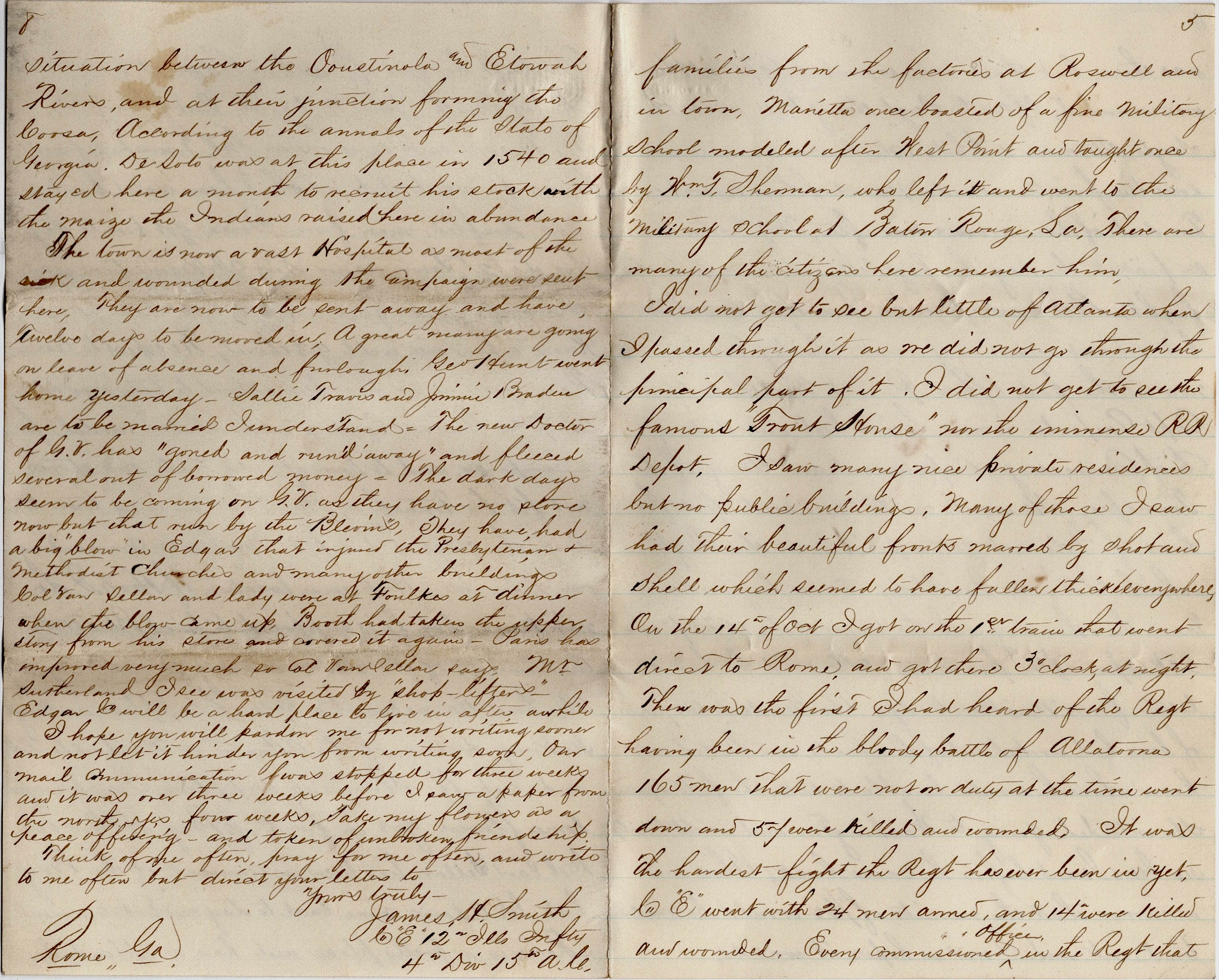
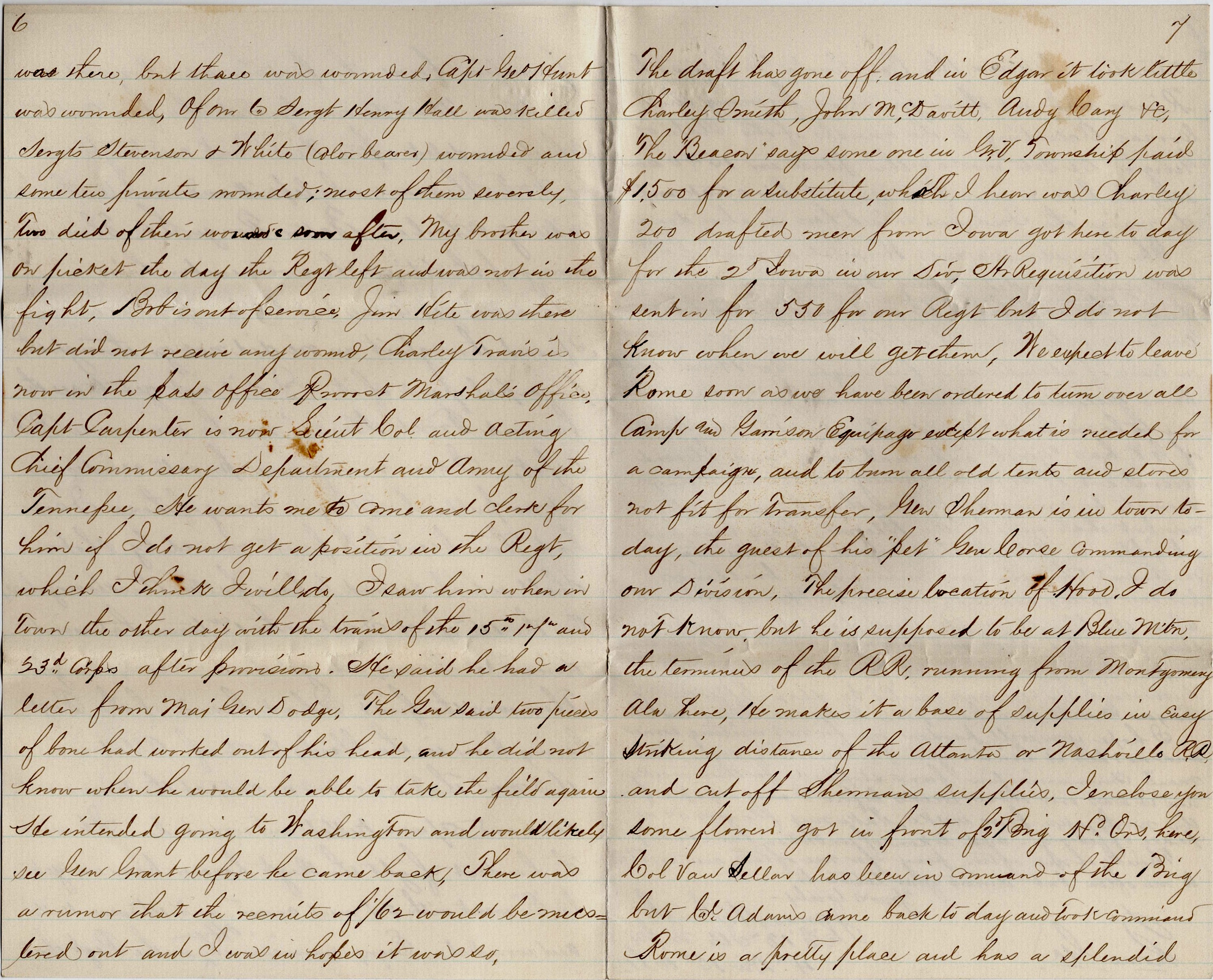
On the 14th of October, I got on the 1st train that went direct to Rome and got there 3 o’clock at night. Then was the 1st I had heard of the regiment having been in the bloody Battle of Altoona. 165 men that were not on duty at the time went down and 57 were killed and wounded. It was the hardest fight the regiment has ever been in yet. Co. E went with 24 men armed and 14 were killed and wounded. Every commissioned officer in the regiment that was there but three was wounded. Capt. George Hunt was wounded. Of our company, Sergt. Henry Hall was killed, Sergts. Stevenson & White (color bearer) wounded and some ten privates wounded, most of them severely. Two men died of their wounds soon after. My brother was on picket the day the regiment left and was not in the fight. Bob is out of service. Jim Hite was there but did not receive any wounds.
Charley Travis is now in the Pass Office, Provost Marshal’s Office. Capt. Carpenter is now Lieut. Colonel and acting Chief Commissary Department and Army of the Tennessee. He wants me to come and clerk for him if I do not get a position in the regiment which I think I will do. I saw him when in town the other day with the trains of the 15th and 23rd Corps after provisions. He said he had a letter from Maj. Gen. Dodge. The Gen. said two pieces of bone had worked out of his head and he did not know when he would be able to take the field again. He intended going to Washington and would likely see Gen. Grant before he came back. There was a rumor that the recruits of ’62 would be mustered out and I was in hopes it was so.
The draft has gone off and in Edgar [County] it took little Charley Smith, John McDavitt, Andy Cary, &c. The Beacon says someone in Grandview Township paid $1500 for a substitute which I hear was Charley. 200 drafted men from Iowa got here today for the 2nd Iowa in our division. A requisition was sent in for 550 for our regiment but I do not know when we will get them. We expect to leave Rome soon as we have been ordered to turn over all camp and garrison equipage except what is needed for a campaign, and to burn all old tents and stores not fit for transfer.
Gen. Sherman is in town today, the guest of his “pet” Gen. [John Murray] Corse, commanding our division. The precise location of Hood, I do not know, but he is supposed to be at Blue Mountain, the terminus of the railroad running from Montgomery, Alabama, here. He makes it a base of supplies in easy striking distance of the Atlanta or Nashville Railroad and cut off Sherman’s supplies.
I enclose you some flowers got in front of 2nd Brigade Headquarters here. Col. Van Sellar has been in command of the Brigade but Col. Adams came back today and took command.
Rome is a pretty place and has a splendid situation between the Oustinola and Etowah Rivers, and at their function forming the Coosa. According to the annals of the State of Georgia, DeSoto was at this place in 1540 and stayed here a month to recruit his stock with the maize the Indians raised here in abundance. The town is now a vast hospital as most of the sick and wounded during the campaign were sent here. They are now to be sent away and have twelve days to be moved in. A great many are going on leave of absence and furlough. Gen. Hunt went home yesterday.
Sallie Travis and Jimmie Braden are to be married, I understand. The new doctor of Grandview has “goned and run’d away” and fleeced several out of borrowed money. The dark days seem to be coming on Grandview as they have no store now but that run by the Blevin’s. They have had a big “blow” in Edgar that injured the Presbyterian & Methodist Churches and many other buildings. Col. Van Sellar and lady were at Foulkes at dinner when the blow came up. Booth had taken the upper story from his store and covered it again. Paris has improved very much, so Van Sellar says. Mr. Sutherland, I see, was visited by “shop lifters.” Edgar county will be a hard place to live in after a while.
I hope you will pardon me for not writing sooner and not let it hinder you from writing soon. Our mail communication was stopped for three weeks and it was over three weeks before I saw a paper from the North—yes, four weeks. Take my flowers as a peace offering, and token of unbroken friendship. Think of me often, pray for me often, and write to me often, but direct your letters to yours truly, — James H. Smith, Co. E, 12th Illinois Infantry, 4th Division, 15th Army Corps, Rome, Georgia