Category Archives: Slavery

1848: Thomas Henry McNeill to Malcom McNeill

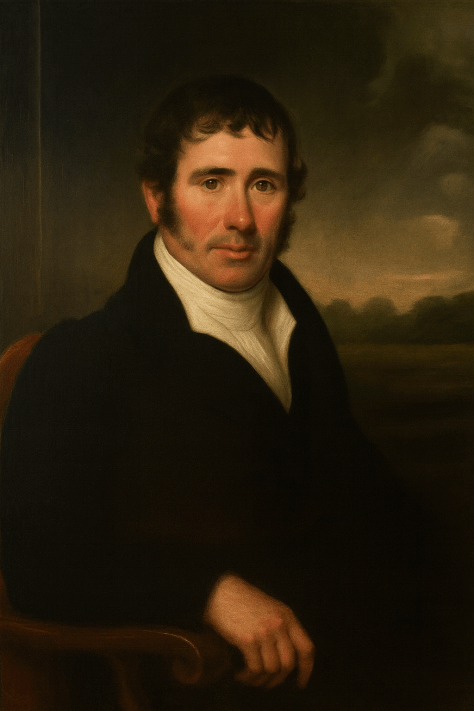
Thomas Henry McNeill

This letter was written by Thomas Henry McNeill (1821-1866), the son of Malcom McNeill (1796-1875) and Martha Rivers. Malcom McNeill began accumulating property in Kentucky where he relocated in 1817, and later bought thousands of acres in Mississippi and within the city of Natchez, which greatly increased in value. An 1884 history of Christian and Trigg counties as “perhaps the richest man in the county, with a large estate and many negroes both there and in Mississippi.”

Thomas Henry McNeill first went to Mississippi to tend his father’s plantations there which were sited along the Mississippi River. He began purchasing his own lands in 1853, initially in the extreme southwestern corner of Coahoma Co. near his father’s plantation in that area. He accumulated 1,945 acres on the Mississippi River there, including a gift from his father of 698 acres. In 1857 he purchased 1,100 acres about ten miles north but still on the River, and sold the southern properties. He called the new plantation “Dogwood” and the Mississippi river now flows over half of that property.

Thomas married first Rebecca Ann Tuck, daughter of Davis Green Tuck and Elizabeth M. Toot, on 26 October 1842 in Christian County, Kentucky. He married second Ann Eliza Arthur, daughter of William Arthur and Susannah Hill Peters on 11 June 1861 in Marshall County, Mississippi. He died at his plantation in Coahoma County, Mississippi at age 45.

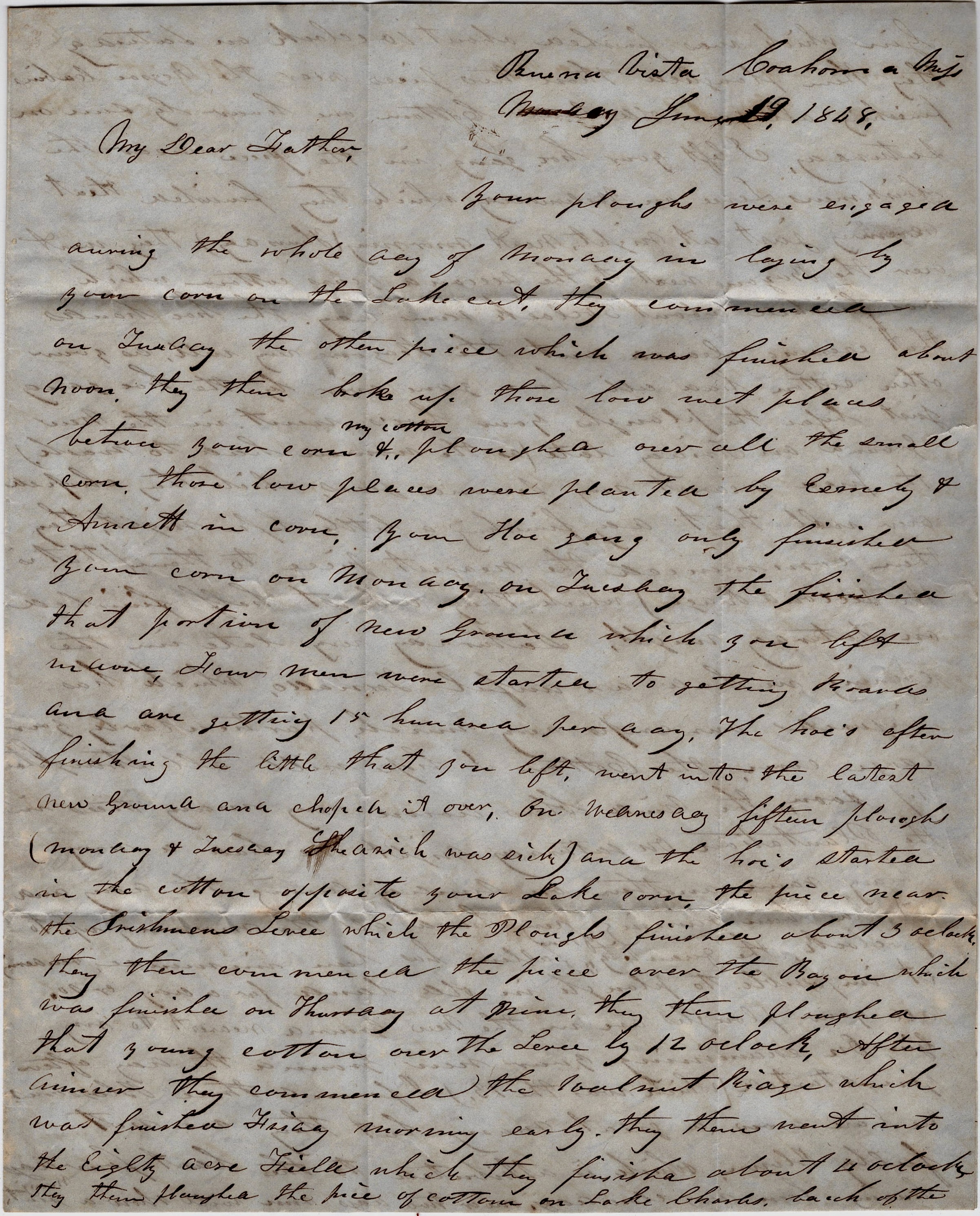
T R A N S C R I P T I O N

Addressed to Major Malcom McNeill, Lafayette, Christian county, Kentucky

Buena Vista, Coahoma, Mississippi
Monday, June 12, 1848

My dear Father,

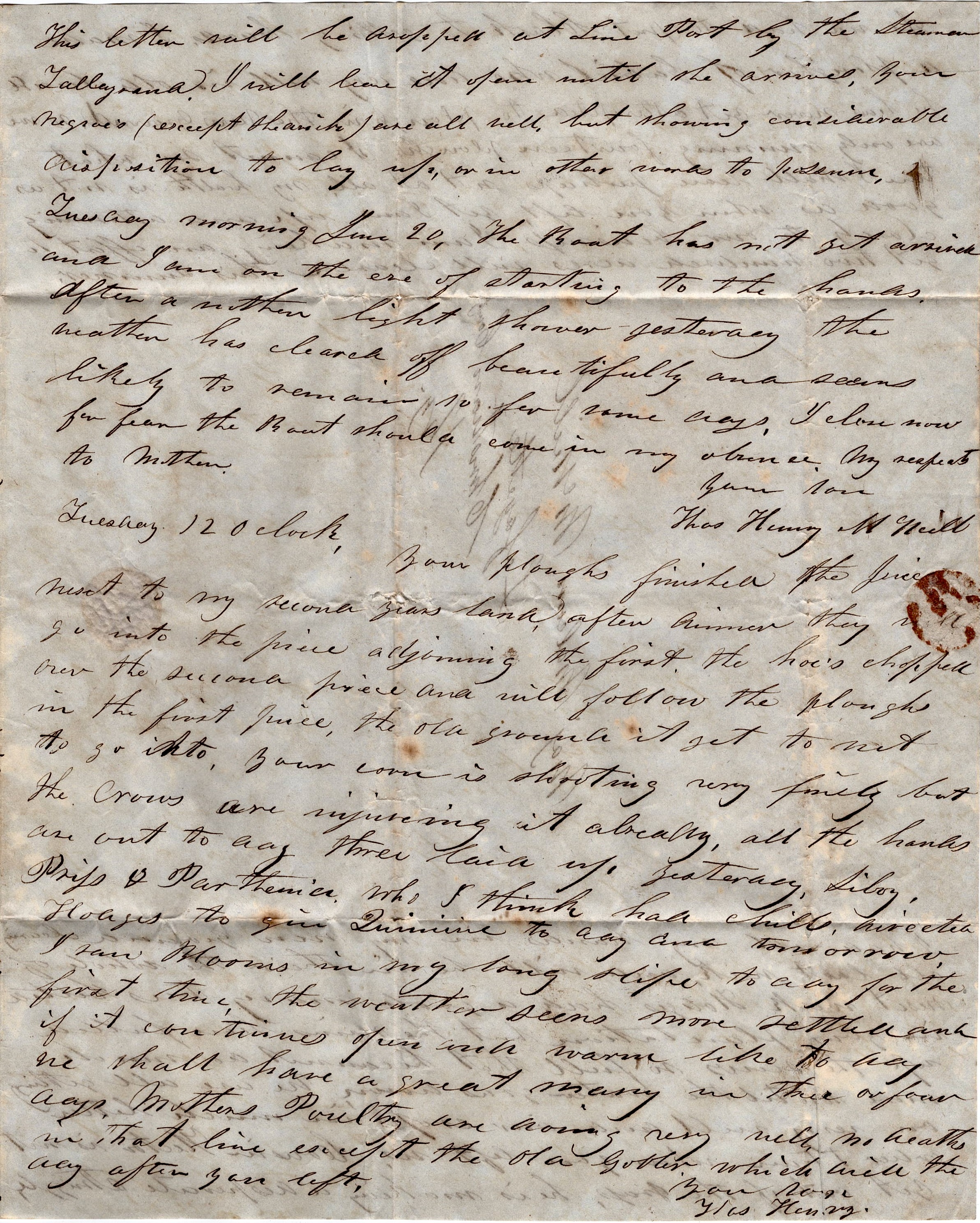
Your ploughs were engaged during the whole day of Monday in laying by your corn on the Lake cut. They commenced Tuesday the other piece which was finished about noon. They then broke up those low, wet places between your cotton and my cotton, plowed over all the small corn. Those low places were planted by Emily & Amrett in corn. Your hoe gang only finished your corn on Monday. On Tuesday they finished that portion of new ground which you left undone. Hoe men were started to getting [ ] and are getting 15 hundred per day. The hoe’s after finishing the little that you left, went into the latest new ground and chopped it over.

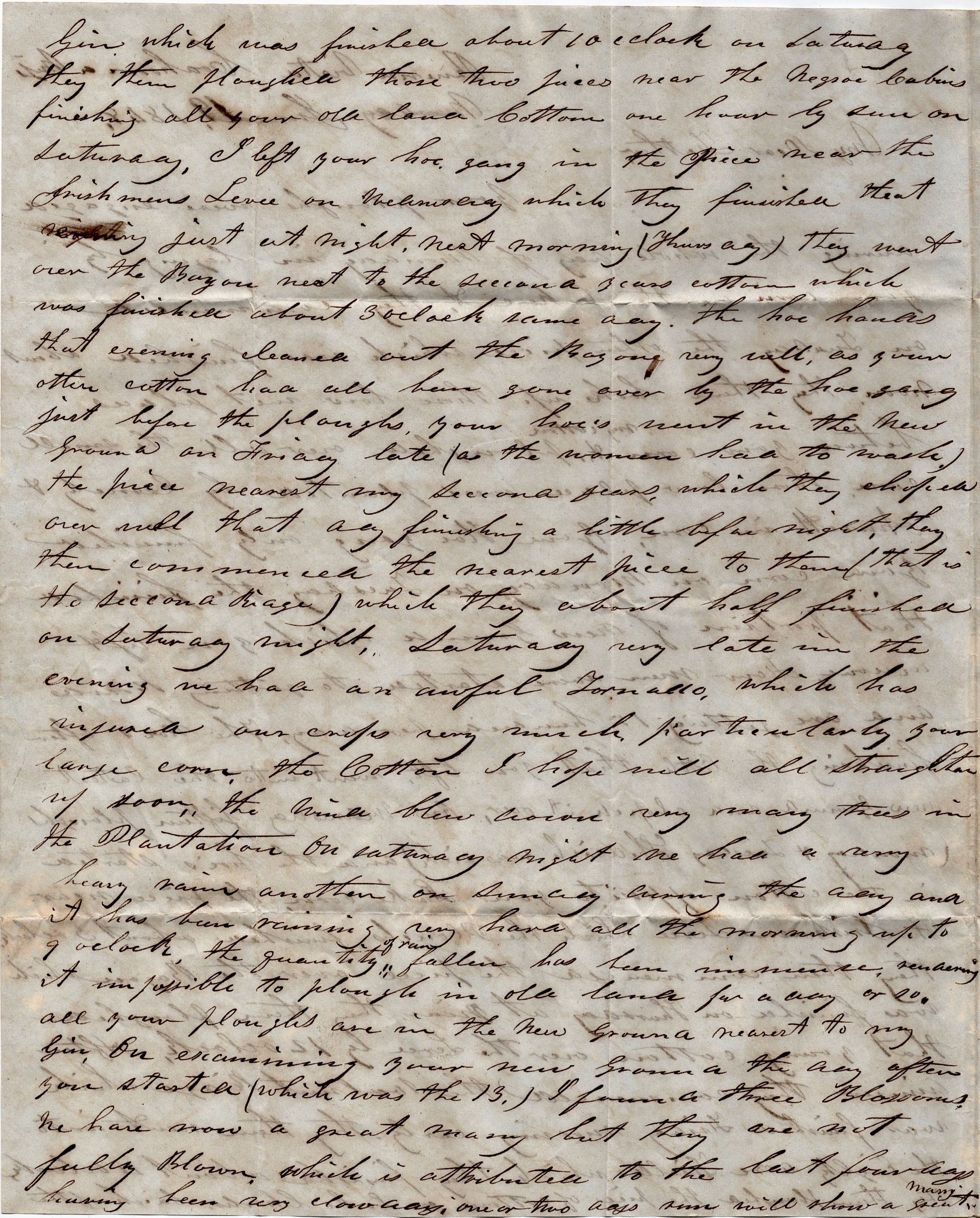
On Wednesday fifteen plows (Monday & Tuesday Harich [?] was sick) and the hoe’s started in the cotton opposite your lake corn—the piece near the Irishmen’s levee—which the plows finished about 3 o’clock. They then commenced the piece over the Bayou which was finished on Thursday at nine. They then plowed that young cotton over the levee by 12 o’clock. After dinner they commenced the Walnut Ridge which was finished Friday morning early. They then went into the eighty acre field which they finished about 4 o’clock. They then plowed the piece of cotton on Lake Charles, back of the gin which was finished about 10 o’clock on Saturday. They then plowed those two pieces near the negro cabins, finishing all your old land cotton one hour by sun on Saturday.

I left your hoe gang in the office near the Irishman’s Levee on Wednesday which they finished that just at night. Next morning (Thursday) they went over the Bayou and to the Second year’s cotton which was finished about 3 o’clock same day. The hoe hands that evening cleaned out th bayou very well as your other cotton had all been gone over by the hoe gang just before the plows. Your hoe’s went in the new ground on Friday late (as the women had to wash) the piece nearest my second years, which they chopped over well that day, finishing a little before night. They then commenced the nearest piece to them (that is the second ridge) which they about half finished on Saturday night.

Saturday very late in the evening we had an awful tornado which has injured our crops very much, particularly your large corn. The cotton, I hope, will all straighten up soon. The wind blew down very many trees in the Plantation. On Saturday night, we had a very heavy rain. Another on Sunday during the day and it has been raining very hard all the morning up to 9 o’clock. The quantity of rain fallen has been immense, rendering it impossible to plow in old grounds for a day or so. All your plows are in the new ground nearest to my gin. On examining your new ground the day after you started (which was the 13th) I found three [cotton] blossoms. We have now a great many but they are not fully blown, which is attributed to the last few days having been very cloudy. One or two days sun will show a great many.

This letter will be dropped at Line Port by the Steamer Talleyrand. I will leave it open until she arrives. Your negroes (except Harick) are all well, but showing considerable disposition to lay up, or in other words, to possum.

Tuesday morning, June 20, the boat has not yet arrived and I am on the eve of starting to the lands. After another light shower yesterday the weather has cleared off beautifully and seems likely to remain so for a few days. I close now for fear the boat should come in my absence. My respects to Mother. Your son, — Thos. Henry McNeill

Tuesday 12 o’clock. Your plows finished the field next to my second year’s land. After dinner they will go into the piece adjoining the first. The hoe’s chopped over the second piece. The old ground is yet too wet to go into. Your corn is shooting very finely but the crows are injuring it already. All the hands are out today. Three laid up yesterday—Libby, Priss and Parthenia—who I think had chills. Directed Hoages to give quinine today and tomorrow. I saw blooms in my long [ ] today for the first time. The weather seems more settled and we shall have a great many in three or four days. Mother’s poultry are doing very well. No deaths in that line except the old gobbler which died the day after you left. Your son, — Thos. Henry

As we had to put Clark to getting boards, I made a plower of Gabriel who does very well in old land. He has never attempred to plow in the new ground so we are only running fourteen plows. I cannot say what time I shall leave. Perhaps not at all. My health is not as good as when you left yet I am up and attending closely to our business. I am making an effort to get two hundred acres well cleared this summer.

I had all my hands in my new ground clearing all last week and will be in there the whole of next week. Hoages had a good many trees belted in your plantation but the rains have filled up the sloughs so full that he cannot as much more until the water goes down, We are all getting on very well and our crops in much better order than when you left us. Cousin Hector is not yet out of the grass. He is making a desperate struggle…

1862: Joseph Wight to his niece Mary

Lt. Joseph Wight of Co. E, 5th Maine Infantry (McDonald Collection, Digital Maine Repository)

The following letter was written by Joseph Wight (1822-1911), the son of Jonathan Wight (1783-1869) and Mercy Harmon (1788-1861) of Cumberland county, Maine. In 1860, Joseph was enumerated in Windham, Cumberland county, Maine, earning his living as a grocer. He was married to Elizabeth Irish of Sebago.

Muster records inform us that Joseph enlisted in June 1861 to serve as a 2nd Lieutenant in Co. E. In June 1863 he was promoted to 1st Lieutenant of Co. A. He mustered out of the regiment on 27 July 1864.

Joseph’s final paragraph tells us much about his personal beliefs: “I am fully satisfied about the question of slavery. I have seen enough to disgust anybody of its evil effect, both with regard to society or wealth. A man may make money by slaves but his farm grows poor and his children ignorant and degraded. But this war has nothing to do with slavery that I know of.”

T R A N S C R I P T I O N

Camp Franklin, Va.
January 1, 1862

Mary,

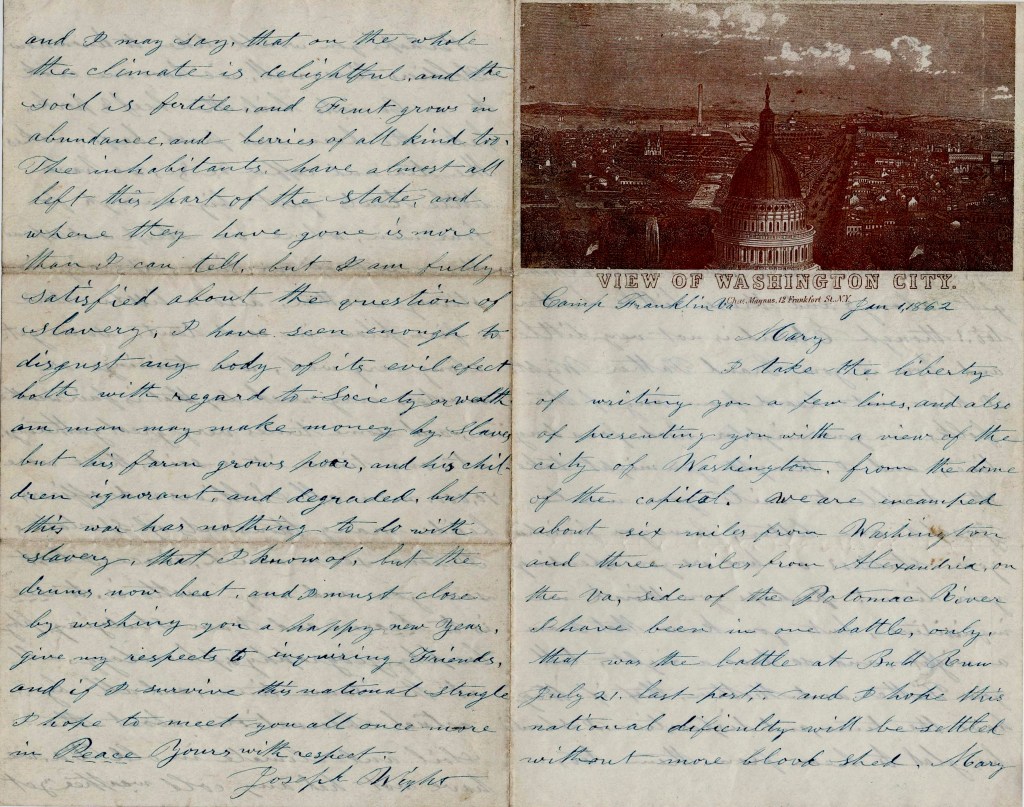
I take the liberty of writing you a few lines and also of presenting you with a view of the City of Washington from the dome of the Capitol. We are encamped about six miles from Washington and three miles from Alexandria on the Virginia side of the Potomac River. I have been in one battle only—that was the Battle of Bull Run, July 21 last past, and I hope this national difficulty will be settled without more bloodshed.

Mary, I hardly know why I should write to you, and certainly, I know of no reason why I should not write to you. I don’t know where you are but I should like to hear from you and how you and Amanda and Mercy prosper temporally & spiritually. And how does your Father and Mother get along? and those little brothers too? though Edward is not very little. And ow is your Grandfather Wight? I have not heard from any of the folks in your neighborhood for a long time and I thought you might take the trouble to write your uncle Joseph one letter. Have you finished your studies? or how are you spending your time? Perhaps you think me inquisitive but you know that I am a Wight and so have a right. Tell your Father and Mother that if they have the time and disposition, I should be glad to hear from them too.

Perhaps you would like to know how soldiers live. Well we have one cook to a company who boils the beef and pork, bakes the beans and fresh beef. makes the tea and coffee, &c. &c. We have little tents just big enough for four men where we sleep and spend the most of our time—especially in stormy weather. Also a little stove or fire place in each tent so we get along very well. We [have] trainings or musters every week day—that is, [in] fair weather, and sometimes very great gatherings at one time. It is said there were 70,000 men, all soldiers and officers, beside many thousands of spectators.

I have seen much since I last saw you and my motto is, to see is to learn. And I am studying philosophy, geography, and phrenology ll at the same time and all by actual observation about the soil and climate in old Virginia. We have not had any cold weather yet and I may say that on the whole, the climate is delightful and the soil is fertile and fruit grows in abundance and berries of all kind too.

The inhabitants have almost all left this part of the state and where they have gone is more than I can tell but I am fully satisfied about the question of slavery. I have seen enough to disgust anybody of its evil effect, both with regard to society or wealth. A man may make money by slaves but his farm grows poor and his children ignorant and degraded. But this war has nothing to do with slavery that I know of. But the drums now beat and I must close by wishing you a happy New Year. Give my respects to enquiring friends and if I survive this national struggle, I hope to meet you all once more in peace. Yours with respects, – Joseph Wight

1836: Lydia (Harris) Pease to Abby (Spaulding) Harris

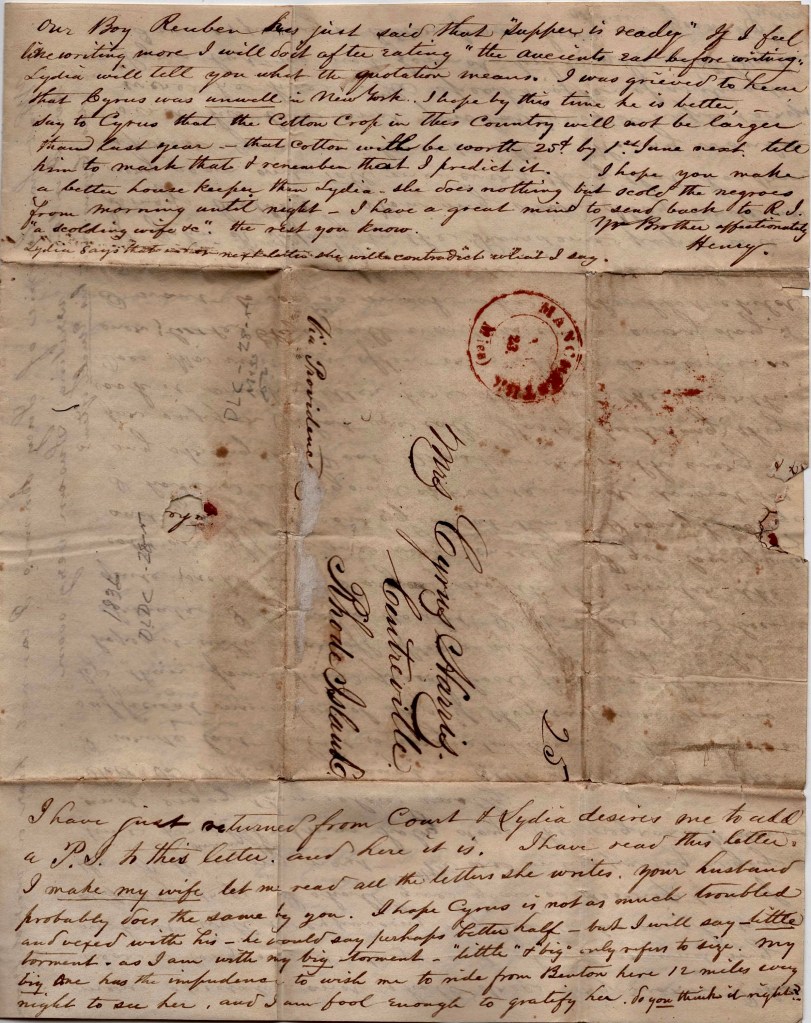
The following letter was written by Lydia Harris (1810-1836), the daughter of Dr. Stephen Harris (1786-1858) and Lydia Greene (1791-1820) of Providence, Rhode Island. Lydia was married to Henry H. Pease (1804-1840). From the letter we know that Lydia was residing in Yazoo county, Mississippi, during the winter of 1836-37. though she apparently spent the hot summers in Rhode Island with her relatives. The letter is datelined from “Woodland” which I assume was the name of the plantation owned by her husband. It seems to have been a few miles outside of Manchester (later renamed Yazoo City) where Henry also had a home.

Though her letter suggests she was suffering from chronic illness, still it was surprising to learn that Lydia died some ten days after this letter was written. Her husband did not live much longer. His obituary reads: “Melancholy Accident.—A letters received in this city, dated Yazoo City, Mississippi, September 15 [1840], states that Mr. Henry H. Pease, formerly of New York, was accidentally killed near the former place, on the previous day. It appears that he was riding with a friend in a barouche; the horses took fright at some cows, ran over one of them, and darted off at full speed. After they had advanced about fifty yards, they brought the carriage in contact with a large stump with so much violence that the vehicle was broken to pieces, and the two gentlemen who were in it were thrown a distance of 36 feet. Mr. Pease fell upon his back and neck and was killed almost instantly. His companion, Mr. George B. Dixon, escaped with some slight bruises and internal hurts. Mr. Pease was 36 years of age, and the son of John B[enjamin] Pease, Esq., [1774-1866] of Utica. His body was interred at Yazoo on the day succeeding th accident, with military honors.”

Lydia wrote the letter to her sister-in-law, Abigail (“Abby”) Spaulding (1816-1888), the wife of Cyrus Harris (1812-1887), and the daughter of Lovewell Spaulding (1780-1853) and Susannah Greene (1788-1869) of Rhode Island.

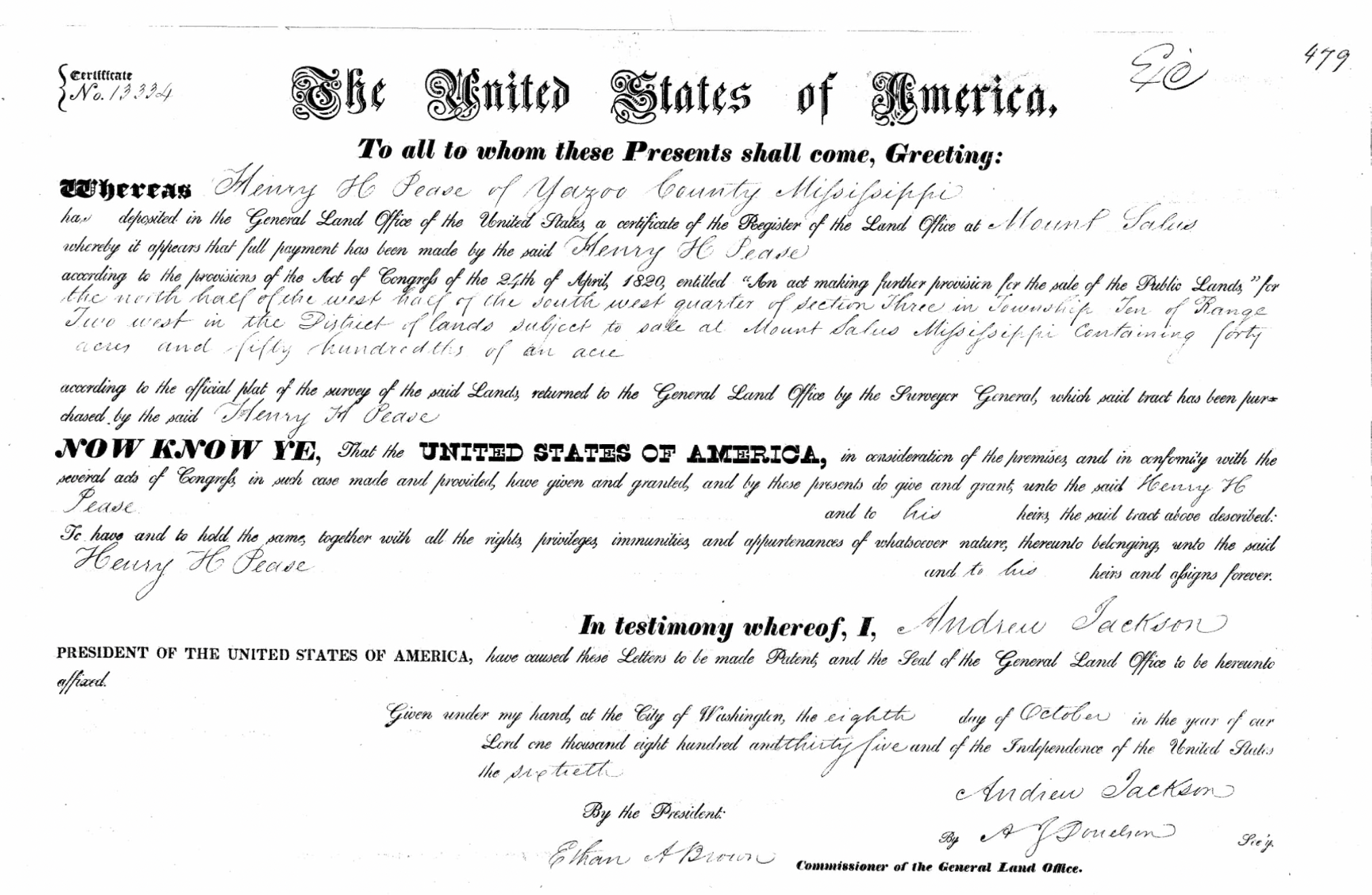
Land Deed in Yazoo County, Mississippi. Approximately 40 acres purchased by Henry H. Pease in 1835.

T R A N S C R I P T I O N

Addressed to Mrs. Cyrus Harris, Centreville, Rhode Island, Via Providence

Woodland
November 21, 1836

Dear sister,

I began to think you had quite forgotten me, Abby, or did not intend to [ ] and had determined the day I received your letter to write you a very scolding one. You very fortunately escaped this time, however, for which you may thank your lucky stars.

Well Abby, how do you like housekeeping? I presume you are comfortably settled at Greenville [Rhode Island] ere this. I almost envy you your nice warm house. A house like yours would be very valuable in this country. I hope you have succeeded in getting a good servant. I should advise you to take little George. You will find him very useful. We at the South have the advantage over you in regard to servants. We can obtain good ones any time by paying for them. They are worth from one thousand to fifteen hundred dollars.

How does Stephen behave? Do you have to scold him every day? I intend taking him home with me another winter. I dream every night of being at home. I expect I shall feel as unpleasantly at leaving home next summer as I did this. I am much better contented now than when I first came. Could I be at my own home in Manchester [Mississippi], I should be quite happy. I find it very pleasant here but rather lonesome. Brother John has been from home this past week. Took his friend D. Pomery with him. Dr. Nesbit is at Vicksburg so that I am quite alone during the day, Henry comes home every evening and returns in the morning. Rides 25 miles on horseback every day to see me. Do you not think him a very affectionate husband? I will not say anything more about him for fear he should read this letter. I might raise his vanity to too high a pitch.

James has not arrived yet. We are expecting him daily. I cannot be lonesome when he is here. What does Eliza Anthony say about him? Have you forgotten “False one I love thee still.”

I expect you have cold weather now. Last year at this time it was very cold at the North. We had snow in November. It is very pleasant here; not much colder than when we came. The thermometer stands at 62 degrees above zero today in the shade. February and March are warm months here. With you they are the coldest and most unpleasant of the year.

They commenced planting their gardens in February. The woods are covered with strawberry vines. I anticipate a great deal of pleasure eating strawberries in the spring. I shall go and gather them if I am not too much afraid of snakes. I have been out but very seldom since I came here.

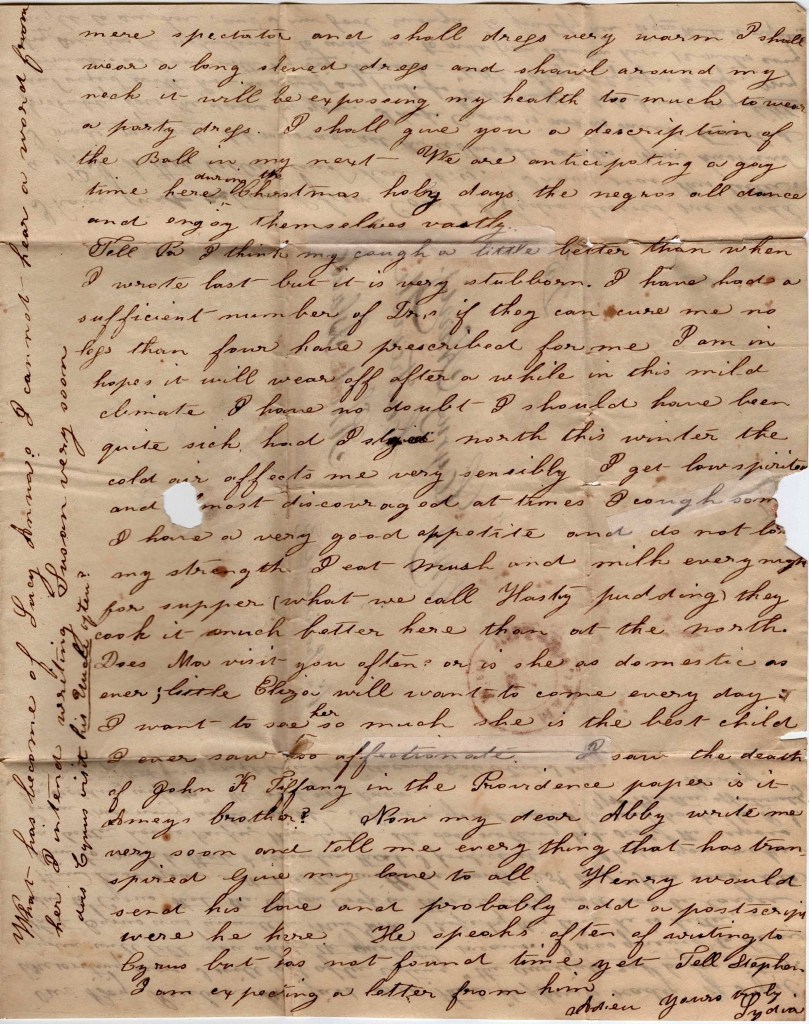
I intend going to Manchester on Thursday to attend a Ball. I received a note from the managers two weeks since. There are fourteen managers. They send invitations to all the ladies and let them get to the Ball the best way they can. It is all the invitations they have. I wish you was here to go with me. I know we should be amused. I have a great curiosity to see the Yazoo Ladies at a Ball. They are five or six years behind the fashion in dress and everything else. I know I shall laugh. I have heard a description of their dancing. Stephen could dance very well with them. I wish he was here. He would enjoy it so much. They use their head and arm quite as much as their feet and make as much noise with them as possible. Tell Pa and Cyrus not to scold because I am going to the Ball. I am going as a mere spectator and shall dress very warm. I shall wear a long-sleeved dress and shawl around my neck. It will be exposing my health too much to wear a party dress. I shall give you a description of the Ball in my next. We are anticipating a gay time here during the Christmas Holy days. The negroes all dance and enjoy themselves vastly.

Tell Pa I think my cough a little better than when I wrote last, but it is very stubborn. I have had a sufficient number of doctors [to see] if they can cure me. No less than four have prescribed for me. I am in hopes it will wear off after a while in this mild climate. I have no doubt I should have been quite sick had I stayed North this winter. The cold air affects me very sensibly. I get low-spirited and almost discouraged at time. I cough some. I have a very good appetite and do not lose any strength. I eat mush and milk every night for supper (what we call Hasty Pudding)/ They cook it much better here than at the North. Does Ma visit you often? Or is she as domestic as ever? Little Eliza will want to come every day. I want to see her so much. She is the best child I ever saw—so affectionate.

I saw the death of John K. Tiffany in the Providence paper. Is it Amey’s brother? Now, my dear Abby, write me very soon and tell e everything that has transpired. Give my love to all. Henry would send his love and probably add a postscript were he here. He speaks often of writing to Cyrus but has not found time yet. Tell Stephen I am expecting a letter from him. Adieu. Yours truly, — Lydia

What has become of Lucy Anna? I cannot hear a word from her. I intend writing Susan very soon. Does Cyrus visit his uncle often?

[In a different hand]

I have just returned from Court & Lydia desires me to add a P. S. to this letter and here it is. I have read this letter. I make my wife let me read all the letters she writes. Your husband probably does the same by you. I hope Cyrus is not as much troubled and vexed with his—he would say perhaps better half—but I will say lttle torment, as I am with my big torment. Little and big only refers to size. My big one has the impudence to wish me to ride from Benton 1 here 12 miles every night to see her and I am fool enough to gratify her. Do you think it right?

Our Boy Reuben has just said that “Supper is ready.” If I feel like writing more I will do it after eating. “The ancients eat before writing.” Lydia will tell you what the quotation means. I was grieved to hear that Cyrus was unwell in New York. I hope by this time he is better. Say to Cyrus that the cotton crop in this country will not be larger than last year. That cotton will be worth 25 cents by 1st June next. Tell him to mark that & remember that I predict it. I hope you make a better house keeper than Lydia. She does nothing but scold the negroes from morning until night. I have a great mind to send back to Rhode Island “a scolding wife, &c.” THe rest you know. Your brother affectionately, — Henry

Lydia says that in her next letter she will contradict what I say.


1 Benton was the county seat of Yazoo County from 1829 until 1850 when it was moved to Yazoo City (formerly named Manchester).

1861: John Russell to C. Sophia Russell

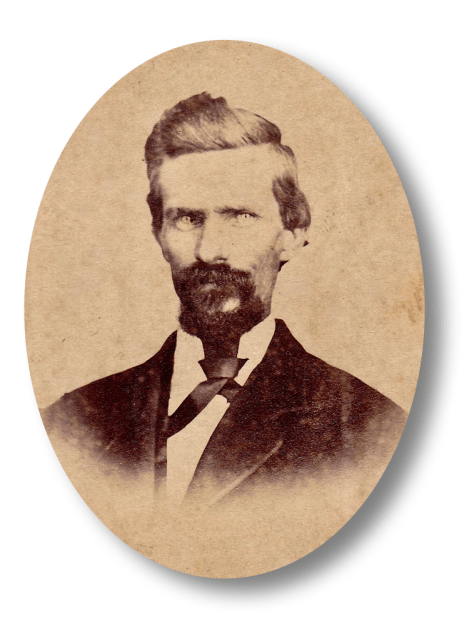
John Russell was 33 years old when he volunteered to serve in Co. G, 21st Illinois Infantry. He was the son of Alexander Russell (1794-1863) and Jane Jack (1797-1873) and was still living and working on his father’s farm in Clay county, Illinois, at the time of the 1860 US Census. Living in the household as well was his younger sister C. Sophia Russell (1840-1934), to whom he addressed his letter.

John Russell, ca. 1875

The muster rolls of the 21st Illinois inform us that John mustered into the company on 28 June 1861 and he was discharged for disability on 24 March 1864. The regiment’s first colonel was Ulysses S. Grant. It was ordered to move to Ironton, Missouri, on July 3, but instead operated on the line of the Hannibal and St. Joseph Railroad until August. Grant was promoted to brigadier general and became commander of the District of Southeast Missouri on 7 August, being replaced by regimental lieutenant colonel John W. S. Alexander. The regiment reached Ironton on 9 August 1861 and saw its first action at the Engagement at Fredericktown in late October. The first major engagement was at Stones River in December 1862 and January 1863. It was shortly after that battle that John wrote a letter to his sister Sophia in which he provided great detail of the regiment’s action. See “Getting Bitten by the Bait: The 21st Illinois at Stones River” by Dan Masters (Civil War Chronicles).

Transcription

Addressed to Miss C. S. Russell, Xenia, Illinois

Ironton, Missouri
November [1861]

Dear Sister,

I take my pen to write you a few lines to inform you of my health which is very good, and there is little else to write. I received a letter from Doc some time since and one from Ann on Saturday and was glad to hear from you all. I have had no time to write for the last two or three weeks, having been in camp but little and on duty all the time. As week ago I expected to be at home now and had my furlough made out but an order was issued forbidding the granting of any more furloughs at present and mine was not signed yet. I could not come but I hope to soon.

We are stationed here for the winter and are at work here now a putting up winter quarters. I have had charge of 20 men for the last 4 days a chopping and hauling logs and only get to write now by getting F. M. Finch to take my place this afternoon. We will get them up in 4 or 5 days more. We have had a fine fall, but it is a little cold now. We had a fine little snow on Friday last, and we are in a hurry to get to our new quarters.

I think the government will soon put forth all its energies which it has been so long gathering to put down this rebellion. We know here that when furloughs are denied, a move is on foot and this denial is now universal and we know there is a general movement of importance contemplated and I hope its success will more than compensate me for the disappointment of not getting to go home.

“I am not waging a war for emancipation but I would seize the slaves of every rebel and set them to work at wages or to fight as most convenient and at the close of the war, give them their freedom…”

John Russell, Co. G, 21st Illinois Infantry, November 1861

There was a feeling of general indignation at the removal of Frémont and still more at the order of General Halleck that all fugitive slaves in our camps or that may come to them hereafter must be driven off. But in all there is a determination to sustain the government hoping that it would be compelled to come around right in time. All that is wanting to a speedy success is a man to hold up the thing square and use the means of success that we possess. I am not waging a war for emancipation but I would seize the slaves of every rebel and set them to work at wages or to fight as most convenient and at the close of the war, give them their freedom, placing them wherever Providence opened up a place. Thus we would get rid of slavery and by having them on hand, it is likely that the best disposition would be made of them that could.

I think the war will be over by the first of May unless there are some serious blunders on our part. I think our troops will occupy Memphis and Nashville in four weeks from this time.

But I must close. I hope this may find you all well. I send enclosed to Pap 25 dollars. I still save enough to bring me home if opportunity occurs. We have a good time here—plenty to eat and plenty to wear and not much to do. Write often and I will as often as I can. Yours, &c. — John Russell

To Miss C. S. Russell

1861: Christopher L. Davis to a Friend

The following letter was written by Christopher L. Davis (b. 1818) who entered Co. G, 29th Indiana Infantry as a private and was commissioned a 2nd Lieutenant on 2 May 1863. He resigned his commission on 14 November 1864. Christopher was born in Virginia but was living in LaPorte county, Indiana by the early 1840s and was married to Jemima Warwick in May 1845. He was enumerated as a farmer with his wife and five children in Springfield township, Laporte county, in the 1860 US Census. After the war, Christopher and his family moved to Chattanooga, Tennessee where he worked as a house carpenter.

The 29th Indiana was organized at Laporte, Indiana, and mustered in August 27, 1861. They were ordered to Kentucky and joined General Rousseau at Camp Nevin October 9, 1861, then attached to Wood’s Brigade, McCook’s Command at Nolin, Ky., to November, 1861; 5th Brigade, Army of the Ohio, to December, 1861.

The regiment first saw action at the Battle of Shiloh. “…People mainly tell me that the Rebels can’t fight. They can fight just as well as we can!” wrote Harvey Grable, a member of Co. E, to his mother a week after the battle. [See John Harvey Grable to Mary F. Grable, letter dated 15 April 1862, Spared & Shared 22]

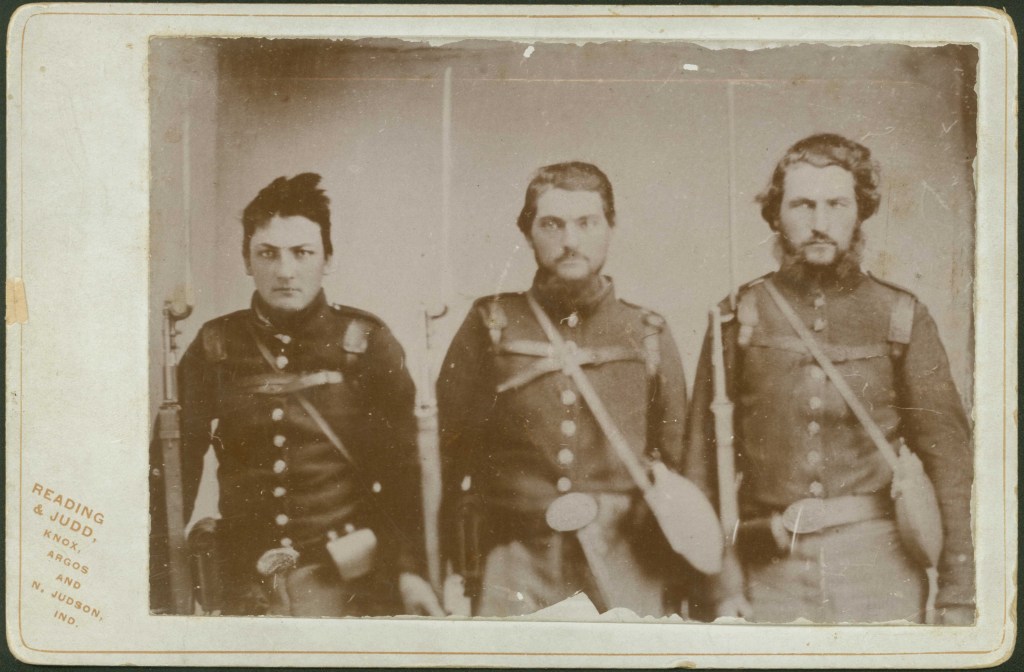
I could not find an image of Christopher but here are the Bascom brothers who all served in Co. D, 29th Indiana Infantry. Jonathan is to the left, then Silas, then Isaac Reece Bascom. They were mustered out at Marietta, Georgia on 2 December 1865, except for Silas who was wounded at Stones Creek, TN, and died from this wounds on 26 March 1865. (Ancestry.com)

Transcription

Camp Wood
December 13, 1861

Dear Friend,

I take my pen up to write you a few lines to inform you where we are and what we are about. We moved on this place last Wednesday and we marched 15 miles farther into secesh. We are now where we can lay down on our back to look up to tops of the hills and eight miles from the secesh and about fifty thousand soldiers around us, with plenty of cannon and ammunition, [and] plenty to eat. But we are in a land that is cursed with the negro and if you could only look on us and the great preparation that is made, you would think that the war would soon come to a close. But [we] are a going have some hard nuts to crack yet.

Where we are now, the secesh burnt the railroad bridge one week ago but now it is built up again and before you get this letter, I think that we will have something to do. We are going to make a move on Monday on to Bowling Green where Buckner is said to be fortified and our men are eager for a fight.

Men that never saw a movement of soldiers have no idea of the scene. Last Wednesday we were more than ten miles long and [as far as] you could see. The barefooted whites and blacks look like they thought that the angel Gabriel was blowing his trumpet, and from the noise you would have thought like an old man that we met on the road when he said that if he was a secesh, he would quit this world and climb a white oak tree. Says where did all of dese foks come from.

We are generally well. All of the boys from our part of the country are well and you will hear a good account of them when they come into a battle. We will give them fits first and then we will give them blue pills and powder to cure them. Where [we] are now, the grain is standing in the shock and the hay is in the cock and everything looks desolate—fences burnt, houses left vacant. But some of the owners are trying to get back. War desolates wherever it goes and I never want it to come any nearer to us that it is.

The weather is good here—pleasant and warm days but frosty nights. But we do not suffer in our cotton houses. Our beds are a bunch of hay out of the cock and a blanket for our cover. And yet we are comfortable and merry as larks. When night comes, you can hear many songs, fiddles and all kinds of noise. It is like building the Tower of Babel.

The boys went out today to get some chickens to eat and they found six at the moderate price of twenty-five cents and took them the [hen?], but when we get home, we want another picnic to make up for this and if you have any secesh up with you, just tell them that we are among their friends and we will clean them out and then come and give them a turn, and I tell you, it will do me good to do it.

B____’s boys 1 sent home twenty dollars to their father and the boys are good boys and I think that it will be a benefit to them if they ever get back. Give my respects to all of my union friends and tell them that I will do my best for my country but the secesh tell them to keep themselves clear for I hate them worse than ever. They are nothing but thieves and bridge burners here and if they had a chance, they would be nothing else as they would not have any sympathy for them.

We have four contrabands with us and some of the regiment get some every day. We make them cook for us. When we get through, we will have more of them [than] we will know what to do with and I think that old Abe ought to begin to send them to someplace now for they are the lowest of all creation. The more I see of it [slavery], the more I hate it. They have cursed all of Kentucky and all other lands where it lives and God speed the end now.

Dear friend, I have wrote you a few lines siting on the ground on a bunch of grass with a board on my lap which is all the desk that a soldier has now. I must close. You must write to me what is going on. Direct your letter as you do B____’s letters and they will come to me. Your friend, — Christopher L. Davis


1 Probably David Meredith Love (1841-1908) and his brother James Love (b. 1838). They were both living in Springfield township when they enlisted in 1861 in Co. G, 29th Indiana Infantry.

1828: Orange Merwin to Daniel H. Gaylord

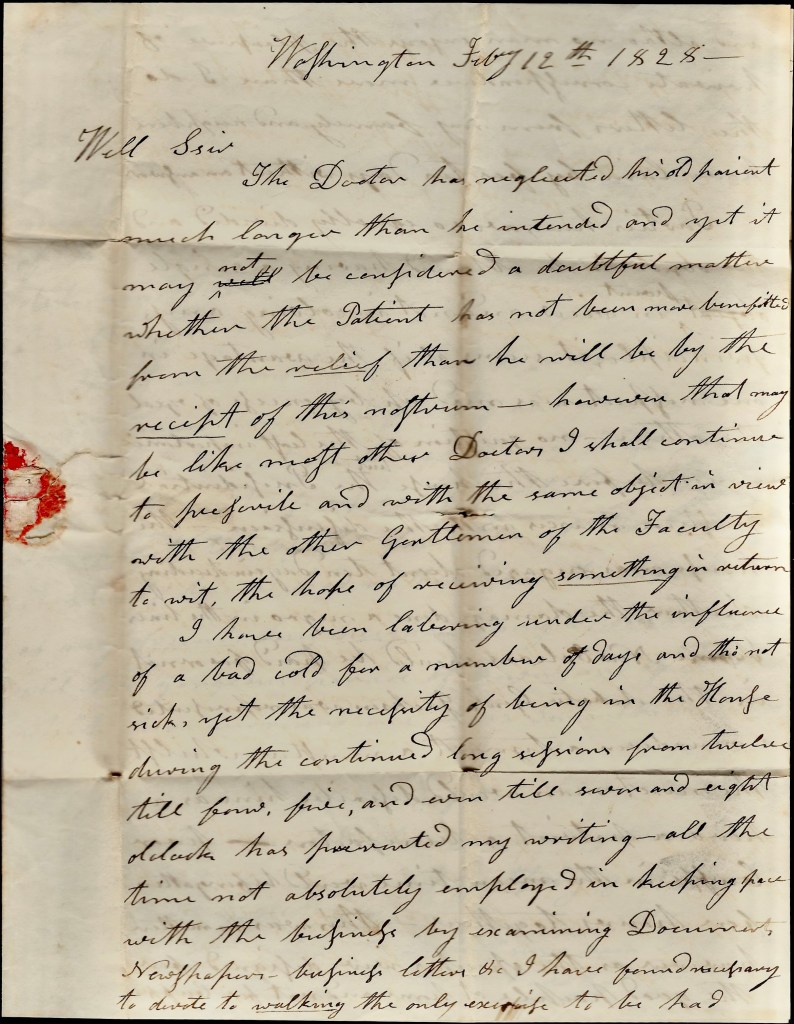
The following letter was penned by Orange Merwin (1777-1853) in February 1828 while serving in the 20th US Congress as a Representative of Connecticut. Merwin was born near Milford, in Litchfield county, where he attended the common schools and “engaged in agricultural pursuits” until 1815 when he won a seat in the State House of Representatives and later in the State Senate. He was a member of the committee charged with redrafting the state constitution during that time. In 1825 he was elected to the 19th US Congress and served through the 20th. After leaving Congress he returned to Connecticut and resumed farming. Merwin wrote the letter to his friend, Daniel H. Gaylord (1776-1831) of Milford, Connecticut.

Andrew Jackson—one man’s “murder, tyrant, or monster,” another man’s “hero, patriot, or benefactor.”

Merwin’s letter expresses considerable frustration by the lack of progress in the business of Congress over the previous ten days occasioned by the political speeches on the House floor by representatives of the two political parties for or against the Democratic candidate Andrew Jackson who would win the Presidential election later in the year against incumbent John Quincy Adams. “A long time was spent in debating whether Congress were bound to pay for a negro slave who was pressed into the public service at New Orleans during the late war [War of 1812] and was injured.” The debate transformed into a spectacle of speeches either eulogizing or vilifying the character of Andrew Jackson, the so-called “Hero of New Orleans,” completely sidelining any meaningful discussion of the bill at hand.

I can’t find any evidence that Congress ever made a decision on the Bill, but even if it had awarded compensation, it’s important to recognize that any compensation would have been awarded to the slave owner for his financial injuries, not to the slave for his physical injuries. Many of the slaves who were pressed into service by Andrew Jackson in the defense of New Orleans were promised their freedom so they fought fiercely and suffered grave injuries or even death. But once victory was secured, Jackson not only ordered the black troops out of New Orleans because they frightened the white residents, he reneged on his offer to free them and ordered them returned to their slave owners. [See Enslaved Soldiers and the Battle of New Orleans by the Tennessee Historical Society.]

In the letter, Merwin refers to the slave as “Cuff,” which was a common ethnic slur referring to a male negro in the early 19th Century.

Transcription

Washington
February 12th 1828

Well Sir,

The Doctor has neglected his old patient much longer than he intended and yet may not be considered a doubtful matter whether the patient has not been more benefitted from the relief that he will be by the receipt of this nostrum—however that may be like most other doctors, I shall continue to [ ] and with the same object in view with the other Gentlemen of the Faculty to wit, the hope of receiving something in return.

I have been laboring under the influence of a bad cold for a number of day and though not sick, yet the necessity of being in the House during the continued long session from twelve till four, five, and even till seven and eight o’clock has prevented my writing—all the time not absolutely employed in keeping pace with the business by examining documents, newspapers, business letters, &c. I have found necessary to devote to walking the only exercise to be had and although no man enjoys the pleasure of private correspondence more than I do, the letters from my family and neighbors have lain by for ten days without an answer.

New York Commercial Advertiser, February 26, 1828

Parties here are so equally divided and the object to be obtained having a single point in view and not involving any principle, it seems as if the vantage in one respect was made up by excess of zeal in the other. No question of the least importance comes before the House but the Presidential question mixes with the discussion. The House was engaged about ten days in deciding whether the damage done a negro in the lines before New Orleans should be paid for or not. In the debate, Gen’l Jackson was represented a murderer, a tyrant, a monster, whilst the next man would describe him as a hero, a patriot, a benefactor. Poor Cuff in the meantime would be forgotten for hours together. This was no matter, however, as the speeches were designed for the good people at home and not for Cuff.

February 13th. This is the third time I have attempted to write you a letter. I think I shall now make out to finish it without interruption as it is scarcely day break and the idle habits as well as visiting formalities of this place will prevent an early call and I am determined not to forfeit my new title even though I sustain it at the loss of some necessary sleep.

What will not ambition do? —voluntarily exile a man from his family and friends that he may have a seat in Congress—not satisfied, not get up late and rise up early to obtain and seek the approbation of his friends. Well, this is just as it should be. I had rather have the approbation of my friends, my neighbors, my townsmen, than all the gorgeous parade of power and of place which have surrounded me—yes sir, and the recollections of this kind will long continue when the offices which I now hold shall cease to exist, and be lost to all value except the manner of their attainment.

Respectfully your friend

P. S. Tell Alvent I hope he has long since been keeping house and riding in the mud and hub to Bridgewater after—council

1839: George Minor Watson to Thomas W. Hunt

The following letter was written by George Minor Watson (1812-1860), the son of David Watson (1773-1830) and Sarah Minor (1781-1849) of Sunning Hill, Louisa county, Virginia. George wrote this letter in 1839 while visiting family and friends in Richmond, Virginia. He appears to have taken up residence in Arkansas sometime prior to this date; he was enumerated in the 1840 US Census at El Dorado, Union county, Arkansas, the owner of as many as 11 slaves. He was still there at the time of the 1850 Census but had relocated to Ward 4 of Washington D. C. by the time of the 1860 census—an inmate of the government hospital for the Insane.

George wrote the letter to Thomas W. Hunt (1820-1862) of Memphis, Shelby county, Tennessee, who married Judith Parsons Mosby (1819-1896) in May 1841. Thomas was the first president of the Memphis Chamber of Commerce, organized in April 1860. He was a partner in the firm, Harris, Hunt & Co. in Memphis.

Richmond, Virginia, in the 1830s

Transcription

Richmond [Virginia]
April 30, 1839

Dear Hunt,

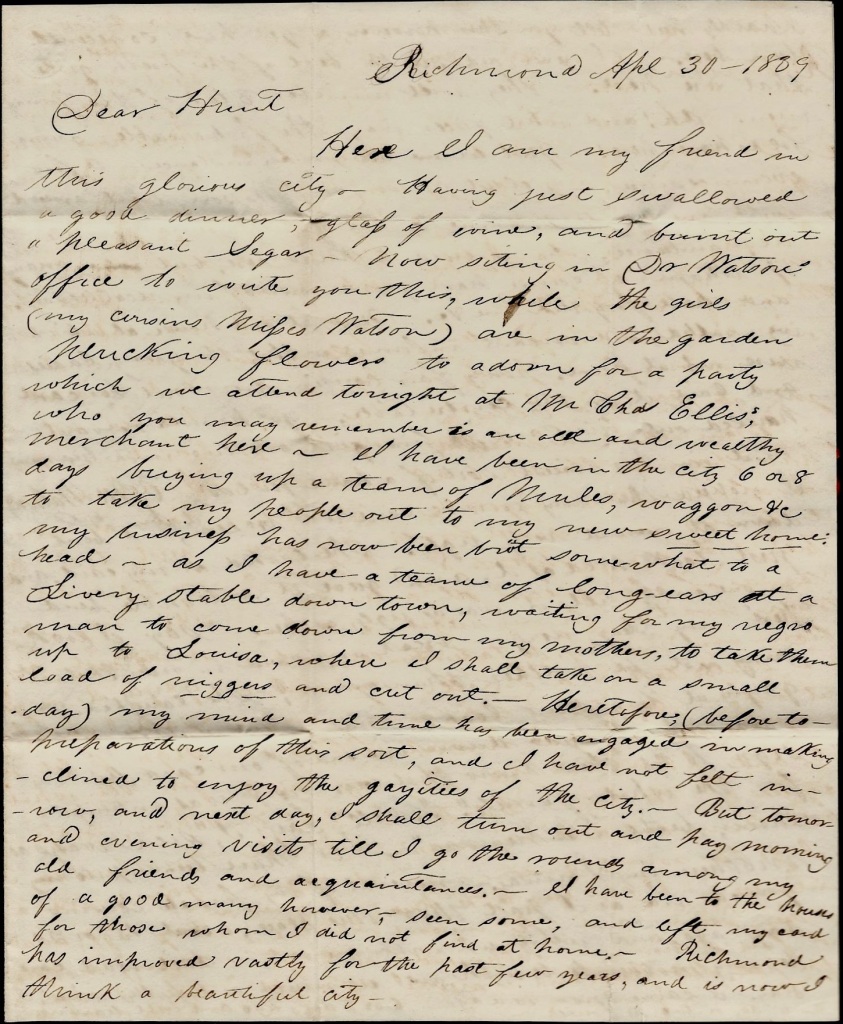
Here I am my friend in this glorious city. Having just swallowed a good dinner, glass of wine, and burnt out a pleasant segar, [I am] now sitting in Dr. Watson’s office to write you this, while the girls (my cousin’s misses Watson) are in the garden plucking flowers to adorn for party which we attend tonight at Mr. Charles Ellis‘s who you may remember is an old and wealthy merchant here. I have been in the city six or eight days buying up a team of mules, wagon, &c. to take my people out to my new sweet home. My business has now been brought somewhat to a head. As I have a team of long-ears at a livery stable down town waiting for my negro man to come down from my mother’s to take them up to Louisa where I shall take on a small load of niggers and cut out.

Heretofore (before today), my mind and time has been engaged in making preparations of this sort and I have not felt inclined to enjoy the gaieties of the city. But tomorrow and next day, I shall turn out and pay morning and evening visits till I go the rounds among my old friends and acquaintances. I have been to the houses of a good many however, seen some, and left my card for those whom I did not find at home.

Richmond has improved vastly for the past few years and is now, I think, a beautiful city. I hardly need tell you of this, however, as you have so recently been here. I never did see the beat of the pretty girls that are here. They will number three to one of the young men. Oh! and what queer ways the fashionable young folks have here! Just let me tell you an instance. A few evenings since, my eldest cousin (Miss Watson) went around with me to introduce me to all of my young female acquaintances who I used to know here, but many of whom of course have grown out of my recollection and had forgotten me, &c. Now at one house at which we called, the servant informed us that the young ladies were not at home. My fair cousin drew out her card and laid it on the centre table. Your humble servant hauled out his card (a fine gilt one too with his name on it in his nicest wort of hand just so, G. M. Watson [signature]). I noticed that my cousin’s card was broken and bent down at one [and] and very ugly. She looked at my card and just took hold of it and gave it a terrible bend on one end till it was as ugly as hers, and says I, “Look here, my dear, do not break my card in order that it may not be prettier than yours.” She laughed very gaily at my sour looks as as we walked off said, “Oh, I bent down one end of your card as a sign to let them know that our visit was intended for the whole family.” “Well,” says I, “sick ways as them beats Arkansas,”

I have been up to my mother’s in Louisa. Several of my female cousins joined me as I passed through this place about 15 or 20 days ago, and went up with me on the railroad cars to my mother’s to be with me as much as possible whilst I stay. I came down here again 6 or 8 days ago and will leave now in a day or two for Louisa. I find boys turned to men and girls to women since I was here a few years ago. Oh, it almost makes me sad to see the changes which have been wrought.

I am often persuaded to abandon my intention of going to the far Southwest and to settle here again among my relations who love me so affectionately. But I can’t go it, Hunt! Arkansas, Arkansas is my home, and it seems to me almost a dream that I am now here. I have seen Mr. Hiram Bragg but have not visited his family yet. Shall do so before I leave. Say so to Sam Mosby. I say Hunt, what you think I did last might? But I won’t tell you. And what you reckon I did today? Well today I paid $20 for a diamond ring and gave it to a gal. “Oh unusual liberality,” you will exclaim. However, I did not give it to one to whom I would like to be married, but to one for whom I cherish a brotherly affection.

I will look in on Mr. Stephen Thompson tomorrow and give your respects. I wrote to Albert last week. I suppose he showed you my letter. And now I must go over to the Female Academy and visit a little girl I’ve got there. Hunt, I can hardly get away from this town. Everything looks so beautiful here now—tis the spring season. I hope to be along through Memphis about 10th or 18th June but don’t know for certain. My best respects to the Missy [Judith] Mosby and ask Sam to stir up those natives that are owing me. Tell Jerry to “go it.”

I hope to get something out of Poindexter’s P. O. from some of you when I return to Louisa. — G. M. Watson

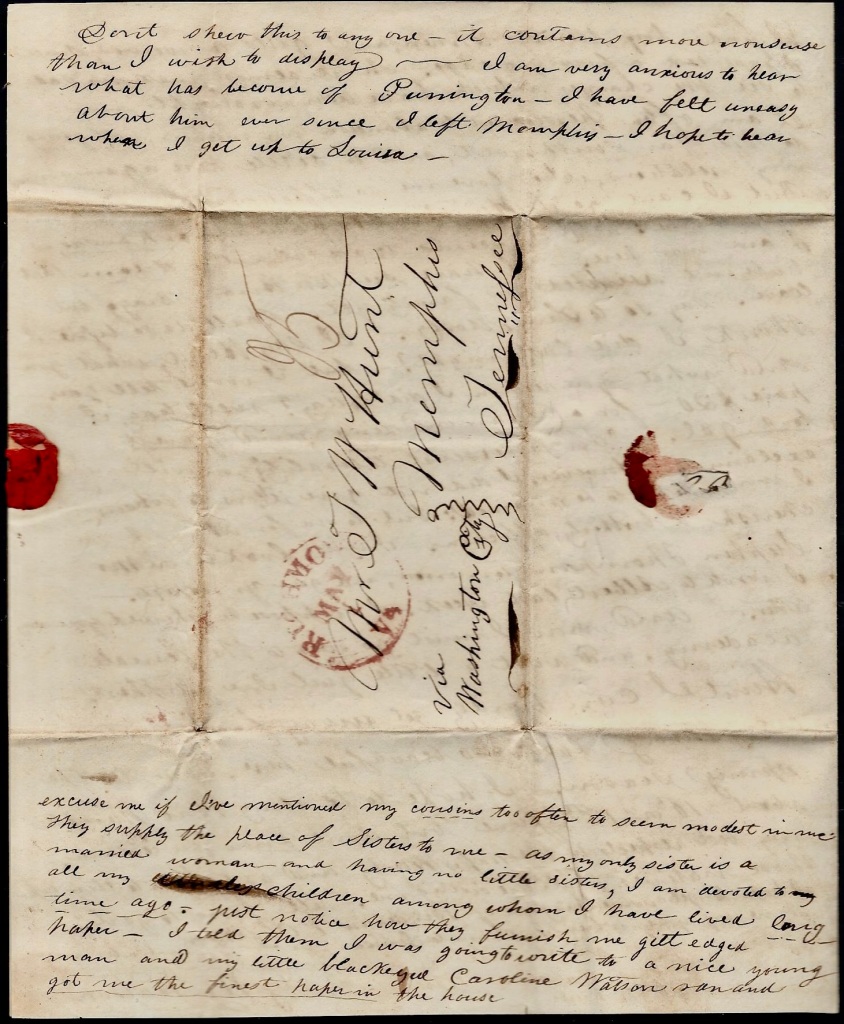
Don’t show this to anyone. It contains more nonsense than I wish to display. I am very anxious to hear what has become of Punington. I have felt uneasy about him ever since I left Memphis. I hope to hear when I get up to Louisa. Excuse me if I’ve mentioned my cousins too often to seem modest in me. They supply the place of sisters to me as my only sister is a married woman and having no little sisters, I am devoted to all my [ ] children, among whom I have lived long time ago. Just notice how they furnish me gilt edged paper. I told them I was going to write to a nice young man and my little black-eyed Caroline Watson ran and got me the finest paper in the house.

1861-63: Perrin Veber Fox to his Wife

Perrin Veber Fox

The following letters were written by Perrin Veber Fox (1821-1910) while serving as Captain of Co. D, 1st Michigan Engineers and Mechanics. This regiment was one of three engineering regiments raised in 1861, the other two being Missouri (August 1861) and New York (September 1861). Engineering regiments are often left off of many Order of Battles, but their contribution to campaigns were vital from a logistics point of view; repairing/building railroads, bridges and blockhouses; and destroying enemy communication lines, railroads and bridges. Engineering units like the First Michigan were often caught up in attacks from enemy guerrillas and cavalry skirmishes.

Perrin was the son of Bryan Benjamin Fox (1787-1865) and Hannah Shepherd (1796-1885) of Antwerp, Jefferson county, New York. At the time of the 150 US Census, Perrin was married to Louisa Maria Newton (1823-1901) and working as a construction carpenter in Ridgeway, New York. Without his family, he was in California for four years attempting to make his fortune but returned to take his family to Grand Rapids, Kent county, Michigan, where the 1860 US Census found him resuming his trade as a master carpenter.

The Bancroft Library at U.C. Berkeley holds three original letters to his wife written during his time in the California goldfields. Other letters written by Fox are held at private and university libraries. Several, including “P. V. Fox to wife, April 13, 1862” are held by the private collection of John Gelderloos, Grand Rapids, Michigan. The Bentley Library at the University of Michigan holds three 1863 letters to his wife. The Stevenson Railroad Museum Depot, Stevenson, Alabama, holds “Letter P. V. Fox to wife, May 29, 1894.” Finally, the “Diary of Captain Perrin V. Fox, original volume dating 1 January 1862 to 10 January 1863” is held by the Ray Smith Manuscript Collection, Special Collections and Archives, Seymour Library, Knox College, Galesburg, Illinois.

Letter 1

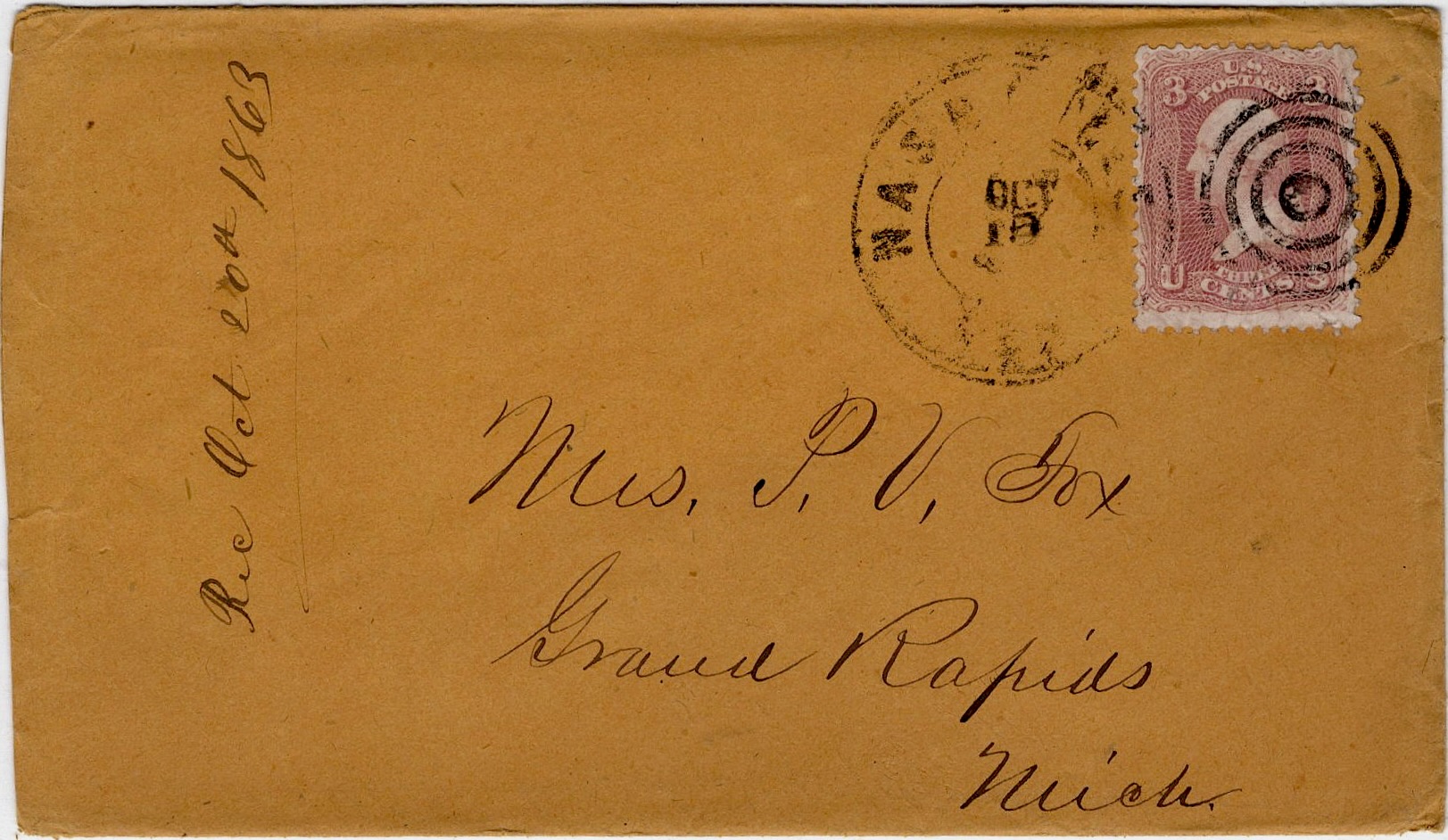
Addressed to Mrs. P. V. Fox, Grand Rapids, Michigan

Lebanon, Kentucky
December 28th 1861

My Dear Ida,

I have not heard from you since I last wrote, nor even since we left Marshall, [Michigan]. I wrote you that our regiment was divided into four detachments. Ours is the 2nd Division and was the first to leave camp. We struck our tents at 5 o’clock a.m. on Christmas & were at the depot with all our effects before seven. The train was not made up & we were delayed in starting but got off between 8 & 9 o’clock. We passed through some very good country & some poor enough. The people look & dress very differently from those of our own state. The conversation is quite as dissimilar. But their buildings are poorest of all—chimneys outside, and no paint on a very large majority of the buildings. The contrabands amuse the boys in various ways & are the subjects of many quaint remarks as they pass on their way to market with ox teams which they ride bare back, & guide with a single rope fastened to the horns. Some drive mule teams from four to six in number, riding the rear wheel mule & guide the whole with a single line on the near leader. Many are on foot & present an interesting picture for those who descant so largely upon the happy condition of the slave.

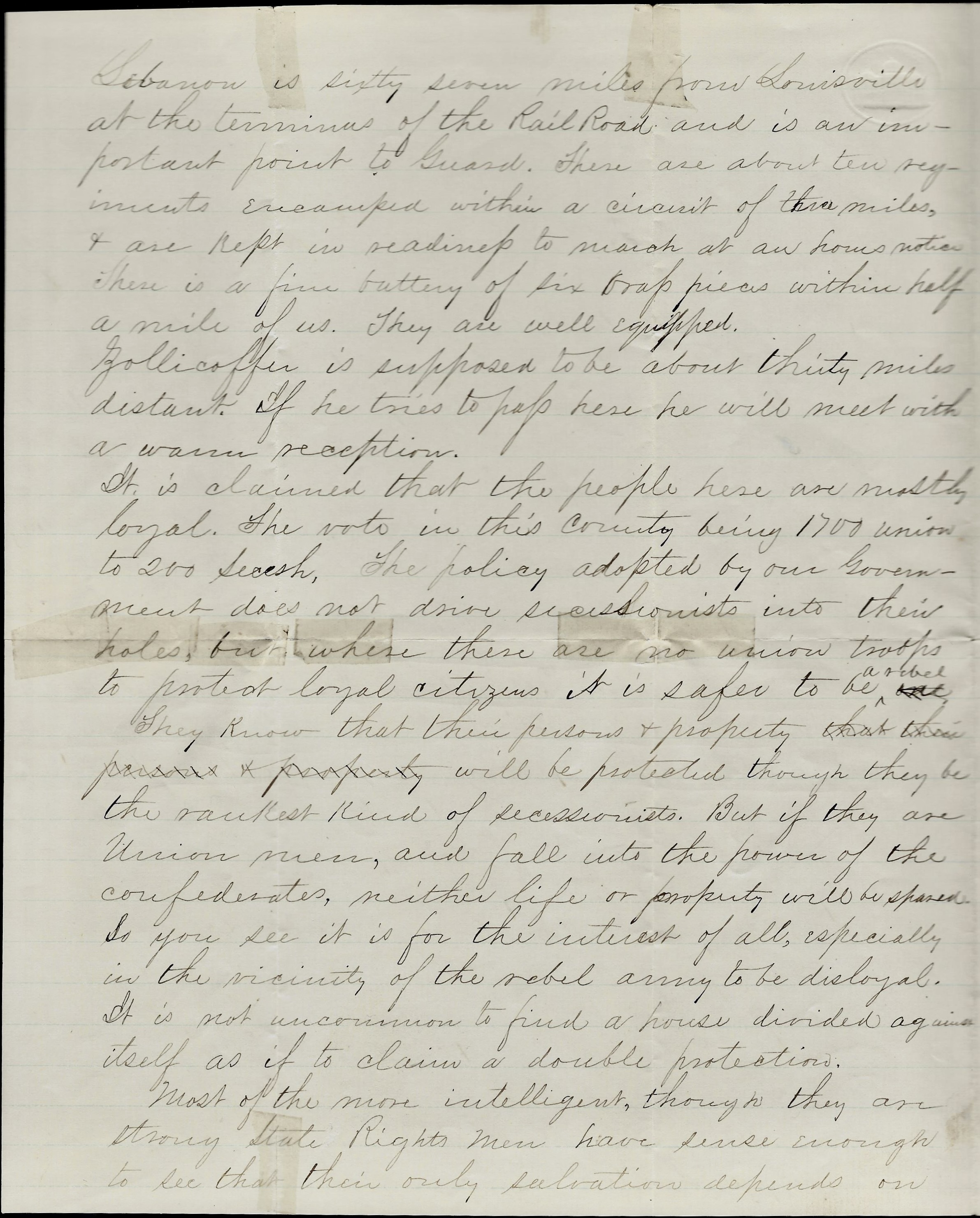
Lebanon is sixty seven miles from Louisville at the terminus of the railroad and is an important point to guard. There are about ten regiments encamped within a circuit of three miles, & are kept in readiness to march at an hour’s notice. There is a fine battery of six brass pieces within half a mile of us. They are well equipped. Zollicoffer is supposed to be about thirty miles distant. If he tries to pass here, he will meet with a warm reception.

It is claimed that the people here are mostly loyal—the vote in this county being 1700 union to 200 secesh. The policy adopted by our Government does not drive secessionists into their holes, but where there are no union troops to protect loyal citizens, it is safer to be a rebel. They know that their persons & property will be protected though they be the rankest kind of secessionists. But if they are Union men, and fall into the power of the confederates, neither life or property will be spared. So you see it is for the interest of all—especially in the vicinity of the rebel army—to be disloyal. It is not uncommon to find a house divided against itself as if to claim a double protection. Most of the more intelligent, though they are strong state rights men, have sense enough to see that their only salvation depends on the maintenance of the Union.

There is a pretty sensitive question to touch with nearly all—viz: the confiscation of slaves. And it is really a delicate one. The laws of Kentucky provide that no slave shall be manumitted on her soil. Now I believe it is desired by the slave owners to have the slaves of secessionists confiscated by governmental authority. What will it then do with them? Give them their liberty here regardless of the laws of this state & the rights of loyal citizens? And would it not materially affect their interest to give a portion their liberty? Then comes the nicest point. If the government interferes with the local interest of a state by depriving some of its citizens of their property even if they are disloyal, is it not bound to protect its loyal subjects in the possession of the same kind of property? And will it not thereby commit itself on the very question so long and so strongly urged by the politicians of the South, that the General Government ought to recognize & protect property in slaves? When this is done let the rebels throw down their arms & claim for the states that have not seceded their rights under the constitution & the great point is gained. The point settled that the government recognizes & protects slave property of course they can take it when they choose.

I hope Congress will not undertake to settle the question but will give the commanders of the several departments liberty to use some discretion & whenever they find disloyal subjects or out & out rebels, make them bear a large proportion of the expenses by calling on them for forages, provisions, stock, &c. to the full amount of their ability, & if necessary for the public good, secure their persons. It is rather hard for the defenders of one country to submit to insults from those they protect without the power to make an example of them.

You perceive I have written at random, giving a hit here, another there, & not much anywhere—which will probably be the case until I get more accustomed to being interrupted every five words more or less. My health is good & the men are generally well. I await with anxiety a letter from you, hope it will come today. We are making out our muster rolls for pay & expect to get some “rino” very soon.

Direct to Louisville, Co. D, 1st Michigan Engineers & Mechanics.

Much love to yourself & the children. Ever yours — P. V. Fox


Letter 2

Murfreesboro, Tennessee
May 20, 1863

Dear Ida,

Yours of the 10th inst. duly came. You fear being disappointed about my getting home since the unfavorable result of the Battle of Fredericksburg. That with the peculiar condition of things, the uncertainty of the position, strength and designs of the evening, together with the large number of our line officers disabled and off duty, make it very certain that if I make an application for leave of absence now, it will be rejected. As soon as Capt. Crittenden returns, I shall try it unless there shall be strong reasons why I had better wait a little longer.

Captain Sligh’s company will probably be without an officer tomorrow. Both lieutenants have been sick—are better now. Lt. White left yesterday for home & Lt. Nevin’s papers went in today. Capt. Grant has been sick and leaves today for home. My health begins to fail and no doubt the warmer weather will so affect it as to make a change of climate necessary to my recovery. The strawberry season would be exceedingly beneficial to me.

Will Tryon tried to get a furlough but with other applications were returned not granted. It is said that the Governor is daily expected, but he has not got here yet.

The work on the fortifications progresses steadily but it will require several weeks to complete them. I will send this by Capt. Grant who will leave in a few minutes. He lives at Sandstone, Jackson county, and is acquainted with Henry’s people. Lt. Herkner sends his love to you but says I won’t write it. Ever yours, — P. V. Fox


Letter 3

Chattanooga, Tennessee
October 2nd 1863

My dear Ida,

Yours of the 20th ult. came to me last night. I read it three times and came to the conclusion that you are growing more sentimental or are improving in the faculty to express happily the emotions of your heart or hearts. It has done me so much good to be reassured that I am all in all to you. It hardly seems possible that I can be so affected by hearing repeated what I so well know. But so it is & I can appreciate your yearning for expressions of love & sympathy.

I do not feel very well today having for the first time since we have been out, a recurrence of pain in my chest with spasmodic action internally. You know Dr. Botsford thought it rheumatic & I think it quite probable for I was out in the rain yesterday considerable getting siege guns across the river and got quite wet. I feel pretty comfortable this p.m. & will probably be all right tomorrow.

I have never been so pleasantly situated as now. Having command of two companies (I expect two more), I am often called to headquarters & consulted in reference to the work. Gen. [William] Rosecrans paid me a very nice compliment by putting me in charge of getting up 100 pontoon boats, giving me a “carte blanch” to take all I could find of material & to call for men and teams on Pioneers or others & they should report to me. There are two sawmills not in good repair to make the lumber [and] the nails, oakum, and pitch to come from Nashville. I have labored faithfully & I believe my efforts are appreciated. I am in a position to be trusted with more consideration than ever before.

Gen. Wagner commanding the Post seems very kind as are all the officers. If strict attention to business will preserve their good opinion, I mean to retain it.

Gen. Rosecrans often summons me to headquarters and has acted upon my suggestions in preference to Gen. Morton and others of higher pretensions than I dare assume. I have a nice little camp convenient to headquarters, work, and water. My tent is in the yard of Mrs. Major Bolling, Quartermaster on Gov. Harris’ staff. She wished me to put it there as a protection to the premises. She has only three children (expects another in a few days) & two servants. She has been with her husband during the war until the evacuation. Her home is in Nashville where she has maintained a high social position, being very wealthy. She is a very pleasant lady and careful not to say anything to wound the feelings of anyone. Gens. [James] Negley & [George D.] Wagner and other officers call on her. I go in and sit awhile occasionally & find it quite pleasant.

In my next, I will try to give you some idea of the scenery and surrounding country. Perhaps you have heard that Capt. Charles Newberry [Co. E, 11th Michigan Infantry] was killed at the Battle of Chickamauga. It was one of the hardest struggles of the war. They had been reinforcing several days & were determined to overpower by weight of numbers. What the next movement will be we may soon know. They cannot attack us successfully in front and it may be dangerous to try flanking. Love to the boys as well as yourself. — P. V. Fox

1815: Frederick A. Schley to George Towers Dunbar

The following letter was written by Col. Frederick A. Schley (1789-1858), the son of John Jacob Schley (1751-1829) and Anna Maria Shellman (1754-1843) of Frederick, Maryland. Frederick’s first wife was Eliza Asbury McCannon (1794-1816) with whom he married in 1812. The “Mrs. McCannon” mentioned in the first paragraph would have been Frederick’s mother-in-law, Anna (1760-1838). Frederick had a long legal career in Frederick and was at one time the law partner of Roger Taney—the Supreme Court Chief Justice best remembered for handing down the Dred Scott decision.

Frederick wrote the letter to George Towers Dunbar, Sr. (1774-1843), the son of Joseph Thomas Dunbar (1818-18010 and Henrietta Carpenter (17xx-1801) of Baltimore county, Maryland. George was married to Frances McCannon (1788-1868), making Frederick and George brothers-in-law.

Frederick’s letter speaks of purchasing a young negro named “Dan” who “is a very smart, active boy, and with a Master who would occasionally trounce him with ‘the cat of nine tails’ would make an excellent servant.” Slavery would not be abolished in Maryland until the end of the Civil War.

Transcription

Addressed to Mr. George T. Dunbar, Howard Street, Baltimore [Maryland]

Frederick [Maryland]
January 4, 1815

My dear Sir,

I have been anxiously waiting to hear from you whether Mr. Betts accepted my proposition or what he has said and done relative to it. Also whether Stewart called & paid you $125 as he promised me he would, And further whether you have succeeded yet in procuring house for Mrs. McCannon or whether you have any prospect of getting one this winter. The old lady is as you well know extremely anxious to settle herself and have her children with her. If you can’t get a house for her, I think she had better rent Doctor Colegate’s for one year during which time a desirable situation may probably offer and you can then purchase for her.

I understand sugar has fallen very much in price. If so, will you be so good as to purchase 150 or 200 lbs. and send me a Bill of it. I will then send by some waggoner for it and forward you the amount of “Saline” paper which I understand is 3 percent above par.

Mrs. Dunbar said something to me about purchasing a negro boy for you. If you want one, I have no doubt I could get one. I, however, think you would do well to purchase “Dan,” who has 15 years to serve from the estate. He is a very smart, active boy, and with a Master who would occasionally trounce him with “the cat of nine tails” would make an excellent servant. If I had not my Jacob who I will never sell, I would purchase him myself. He is worth 40  Henrys. Suppose you take him upon trial for a week or two. Isaac Shriver wants to buy him but I would rather sell him to you.

If my house is not sold and any person will give you $6800 for it, you can sell.

You have no doubt seen and read with the proud and gratifying feelings of an American the treaty dictated by the gallant Decatur to the cruel and lofty Dey of Algiers. There is a sample of Federal Policy for you. What think you? Is it not an improvement [over?] Jefferson’s treaty? The treaties made with [  ] face, Grey-eyes, and the Shooting Tiger excite little interest comparatively speaking. Our “red brethren” however seem to have been completely outmaneuvered by Jackson to the Southward, and to have got much less advantageous terms than the Kickapoos and other Northern tribes. Poor Devils. I wish they were all in a better world for I much fear we shall never be able to keep them quiet in this. 1

My love to Mrs. D. and believe me yours, sincerely, — Frederick A. Schley


1 This is a reference to Commodore Stephen Decatur’s Algerian Treaty which, once ratified, ended the Second Barbary War. The treaty was repudiated by Dey Omar Agha of Algeria, however, and it was several more years before a final treaty was ratified. Frederick contrasts that treaty against the treaties made between the US Government and the Native American Tribes. See Treaties of Portage des Sioux.

1836: Henry Frost Waring to Deborah Frost Chadeayne

Henry F. Waring Grave Marker

The following letter was written by 40 year-old Henry Frost Waring (1796-1874), the son of Thaddeaus Waring (1746-1826) and Deborah Frost (1753-1844). Henry was married in 1818 to Sarah W. Osborn and a second time in 1844 to Amelia Frances Weed. He worked as a merchant in New York City early in his career. By the time of the 1860 US Census, he was working as an “agent” of some kind in Green Bay, Wisconsin.

Henry wrote this letter to his niece, Deborah Frost Chadeayne (1805-1870), the daughter of Mary Waring (1782-1855) and Daniel Chadeayne (1773-1834) of Orange county, New York. Deborah was married on 19 August 1836 to Henry Peter Husted (b. 1804) in New York City.

In this April 1836 letter, written from the City Hotel in Savannah, Georgia, where he had resided for six months engaged in his naval stores business, Henry wrote his niece a few lines about the City of Savannah—the streets, the inhabitants, the climate, and (curiously) of visiting the Jewish graveyard.

A room inside the old City Hotel which was constructed in 1821 in Savannah. The building is occupied today by the Moon River Brewing Company, located as 21 West Bay Street. The original structure had “33 rooms, exclusive of the bar.” It was renovated in December 1832 and the only other hotel in the city in the mid-1830s was the Mansion House.

Transcription

Addressed to Miss Deborah F. Chadeayne, Care of Messrs. Sneden & Hathaway. Newburgh, Orange county, New York

Savannah, [Georgia]
April 17, 1836

My dear girl,

Hards work and sickness has prevented my writing to many of my friends and you have been of the number, but it has not prevented my thinking of you often and being anxious for your health and happiness. I have been here six months and cannot say I dislike the place—indeed, all places would be alike to me situated as I have been for I have no time to fo about to see anyone and it would be the same if all the world lived here. With the exception of one house where I spent some fifteen minutes of a Sunday, I have been in no dwelling except the City Hotel since I have been here.

Savannah, however, is a dull place for those who have nothing to do. If one walks out it is over shoe in sand and no side walks and of an evening no lamp & half a mile from our store will take you into the wood out of sight of a house. Everything being small here, it is handy and we have a market within 200 feet of us where I strolled this (Sunday) morning, it being the morning when the negroes from the country congregate there to sell their little trifles.

As I stood looking at the throng, I began to calculate their value & made up my mind that in the space of 200 square feet, there must have been nearly one million of dollars worth of negroes calculating them at $1000 each which is about their value.

I took a walk into the wood which exceed ours very much in the number and beauty of the flouring shrubs and trees. One place about a mile from the City where in the midst of the forest the Jews have a burying is the sweetest place for flowers I ever saw and the natural flowering vines of their own free will are running on the brick grave yard fence. I almost envied the Jews their last resting place but concluded as they were generally despised above ground, they ought to have a good place under it. 1

“I almost envied the Jews their last resting place but concluded as they were generally despised above ground, they ought to have a good place under it.”

— Henry Frost Waring, 17 April 1836

Here everything is different from New York. For one thing, more than half the population are negroes in winter and nearly all in summer. The seasons are also different as I have seen neither snow or ice this winter when you have had a supply of both. Radishes (which are this year 6 weeks later than usual as are things generally) are now plenty and we will have peas next week.

We have no news here except Indian news 2 and not much of that of late and I think of visiting St. Augustine before I return and if so, can tell you all about it when I see you about July 1st. Many of the places which sound large in the papers are not worth seeing, I suppose, such as Picolata [Florida] which has but one house in it and that a tavern. Thirty hours travel from here would bring me where the contending armies now are, I suppose. Do write me. My love to all your family and believe me as ever your loving uncle, — H. F. Waring

Savannah, April 17, 1836


1 “Established by Mordecai Sheftall on August 2, 1773 from lands granted him in 1762 by King George III as a parcel of land that “shall be, and forever remain, to and for the use and purpose of a Place of Burial for all persons whatever professing the Jewish Religion.”

2 Henry is referring to the Second Seminole War (1835-1842) provoked by President Jackson signing the Indian Removal Act. The Seminole Indians refused to leave Florida and throughout 1836, led by Osceola, the Seminoles attacked plantations, outposts, and supply lines, and they stymied several efforts by the United States to subdue them.

Old Jewish Burying Ground in Savannah, Ga.