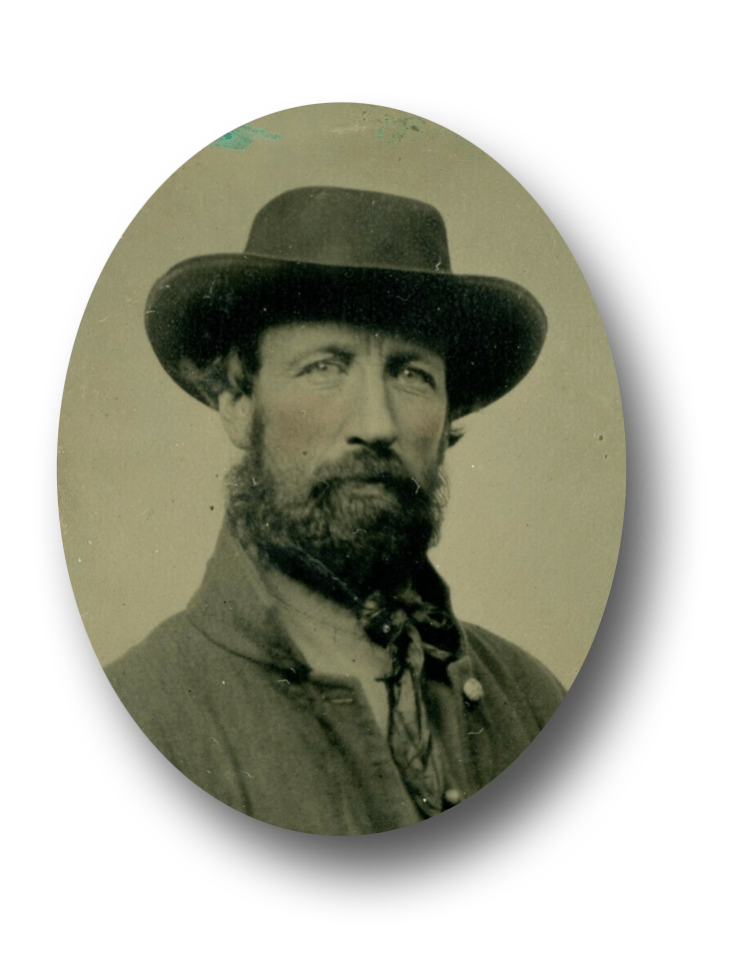
The following letter was written by James King of New York City who wrote the letter to his aunt, Janet Sheppard (1798-Af1865), also of New York City. In the 1855 State Census, I can see that a 20 year-old young woman named Johanna King was enumerated in the household of her Aunt Janet Sheppard of No. 8, 22nd Street in NYC. Johanna was undoubtedly James’ sister. Beyond that, I have not been able to confirm King’s record of service. Neither have I been able to confirm the location of Alexander Bridge which must have been located somewhere near the Cumberland river based on the content of this letter.
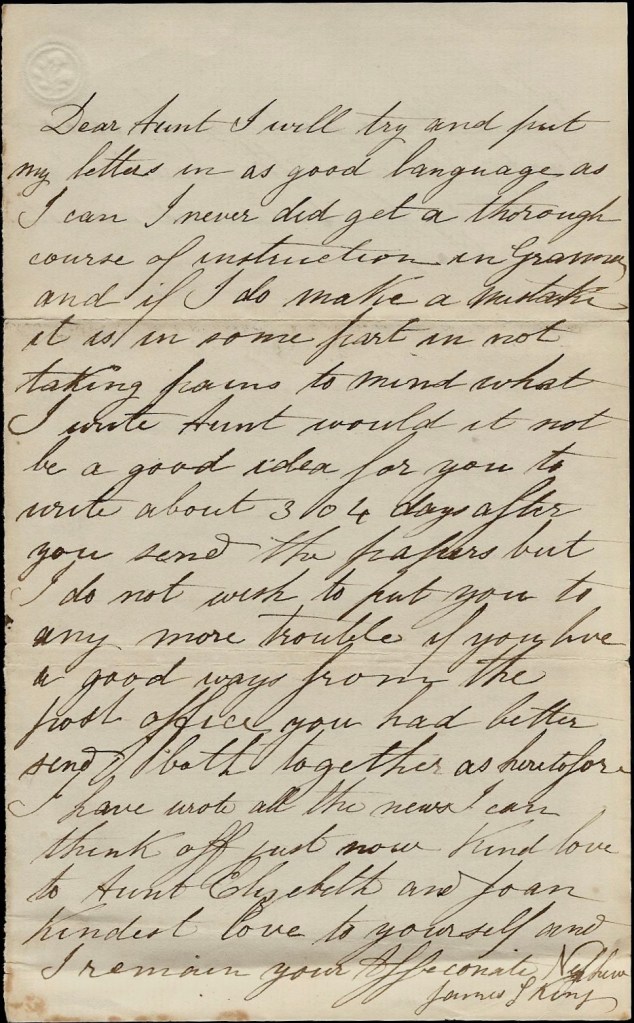
Transcription
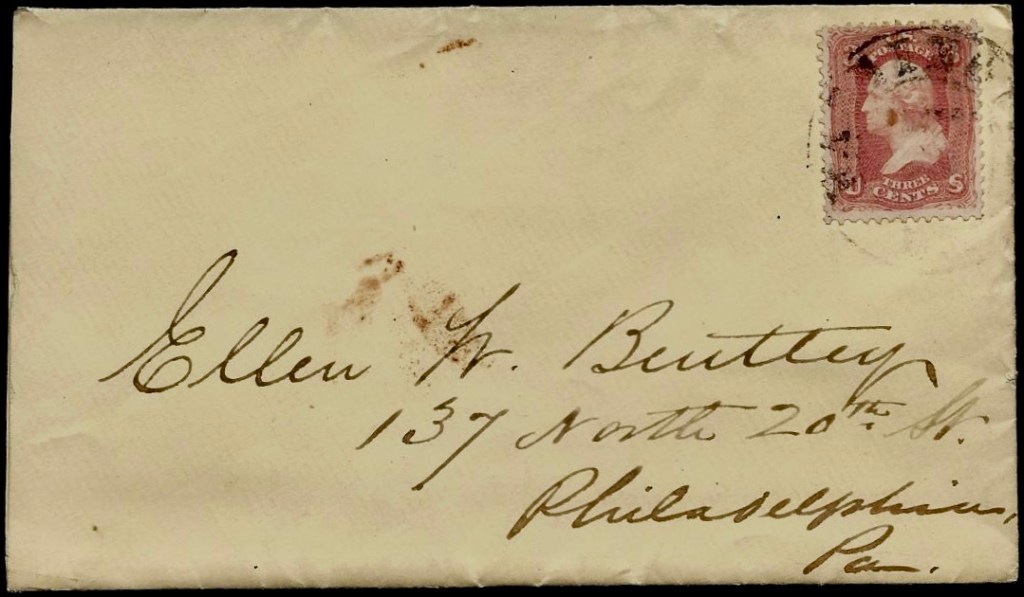
Addressed to Miss J. Sheppard, No. 8 East 22 Street, New York City
Alexander Bridge March 7, 1865
My dear Aunt,
I have just received a bunch of Tribunes and I see by my note book that it is time I was writing you. The Tribunes are dated down to the 28th of February. They are full of the good news. I hope it will continue to tell the end of the Rebels and the war. I had a letter from home the other day. They were all well and I had a newspaper from Father and he told me in his letter that when I got a paper, I was to consider them all well.
We have been having a rainy time of it lately but it has been good weather the past two days. We have not been set to work on the new stockade yet. We expect the Major here today to say where it is to be put and where we are to get the timber. It is to be built strong enough so a shell can’t get inside. The boys do not like the idea of going to work but it will not hurt them. Our duty is light but the stockade will not go on fast as we will have our duty to do as before. But as long as we have our health, we ought not to grumble.
I hope this will find you all in good health as it leaves me at present. The grass is beginning to grow and cattle are out feeding. The planters are very slow about their work. It rains so much here that the ground is not in a fit condition to plough. The men are ploughing today for it has been dry for two days now and the wind has dried up the ground. The Cumberland river is very high. The back water comes up to our bridge and some of the fields are covered with water. The troops are going south at the rate of two or three regiments a day. I do not see how they feed so many men when it takes so much to feed our small squad. I think the Rebels will soon have a hard time to get their rations for when the railroad on our line of communications is cut, the soldiers are put on short rations and I do not see how the Rebels can feed their men except they have a different way of doing than our government has.
Well, I must close for this time. I am expecting a letter so I will wait as the mail has gone for today. I have just received your kind letter of February 28 and was glad to get it. I also received one from Tebeta of the same date as yours. They were all well.
Dear Aunt, I will try and put my letters in as good language as I can. I never did get a thorough course of instruction in grammar and if I do not make a mistake, it is in some part in not taking pains to mind what I wrote. Aunt, would it not be a good idea for you to write about 3 or 4 days after you send the papers? But I do not wish to put you to any more trouble if you have a good ways from the post office [in which case] you had better send both together as heretofore.
I have wrote all the news I can think of just now. Kind love to Aunt Elizabeth and Joan. Kindest love to yourself and I remain your affectionate nephew, — James L. King
This will go out by tomorrow’s post. I received the newspapers on Monday the 6th of March and the letter the 7th.
The following letter was written by Henry Hirst Bentley (1832-1895), the son of Hiram Bentley (1802-1896) and Hannah Swartwout (1803-1863) of Pine Plains, Dutchess couty, New York. Without any money, Henry left his parents home and went to New York City in 1852 when he was twenty years old, landing a job as a reporter for the New York Tribune. He subsequently helped to organize a company to promote the use of printing telegraph machines known as the New York City and Suburban Printing Telegraph Company. When that undertaking failed, he organized a system of depositories for telegraph messages and then established the Madison Square office known as Bentley’s Dispatch.
When his health failed, he took some time off to regain it and then settled in Philadelphia where he joined the staff of the Philadelphia Inquirer and was assigned duty as a war correspondent in 1861—a paper that would earn a well-deserved reputation for reporting military action in an objective manner (unlike other papers). Bentley joined a stable of correspondents that were seasoned and knowledgeable. A good team—so good that a correspondent from a rival newspaper complained to his boss that the “the Inquirer people knew more about the war than did most of the generals.” Henry may have been a bit more haughty than his colleagues, however, as they sometimes referred to him as “The Water Spout Man”—always bragging and babbling.
It was while working as a war correspondent that Henry wrote this letter to his wife, Ellen Widdifield (Penrose) Bentley (1833-1915)—the daughter of a Quaker family—with whom he married in 1860. The date of the letter is unknown. I have suggested 1861 while Henry was much of the time in Washington D. C. though he mentions something about the “Court Journal” which might suggest a later date. I found a reference to the Washington Star being considered Mr. Lincoln’s “court journal” but I don’t know if Henry changed to that newspaper during the war.
Henry’s name appears in the papers throughout the war. In the 19 February 1862 edition of the Philadelphia Inquirer, it was alleged that he and Mr. Schell of Leslie’s Illustrated Newspaper, “entered Fort Huger [on Roanoke Island], after its abandonment by the Rebels, in advance of the army, and hauled down the Rebel flag.” In another issue of the same paper published on 15 April 1862, he was reported as having been taken prisoner at the Battle of Shiloh but subsequently escaped after having been robbed of everything but his “pantaloons and boots.” Legend has it that Bentley hadn’t really escaped so much as the Confederates let him go because “they had grown weary of listening to him talk.”
After the war, Henry organized the Philadelphia Local Telegraph Company and also became head of the Gold and Stock Reporting Telegraph Company and President of the Bell Telephone Company of Philadelphia. He was a close friend of Thomas A. Edison.
Transcription
Washington [D. C.] 21st, 8 p.m. [1861]
My Dear Baby,
Thy sweet little missive arrived this morning and I read it over several times before I could become satiated in the least degree.
There seems but little that is new and that is more suitable for newspaper reading than for a letter to a wife. I am still enjoying excellent health and spirits considering the clouds of dust that once more assail us. Mud or dust is peculiar to Washington’ there is no medium.
I presume thee saw my dispatch yesterday announcing that Mrs. Lincoln would pass through Philadelphia for the East. That was my first “Court” announcement, in advance. Some of them laugh at the Inquirer having suddenly become Court Journal. Well, it merely happened so, she having told me that she intended going to Cambridge 1 in a few days. I asked her to please let me know when she was going as it would be a favor. So the evening before she started, she sent word down to me with her compliments, stating that she would probably be gone 2 or 3 weeks, and that when she returned, they would be pleased to see me at the White House, whenever I chose to call. She told Friend Newton that there was “some difference between the Chevalier Wikoff 2 and Mr. Bentley,” and, that she was “very much pleased wiith Mr. Bentley’s manner.”
As to the depreciation of paper money, of course all bank notes are depreciated the same as Treasury Notes. Gold is the stand point, so for instance, gold is worth today about 130 cents on a dollar—that is, a gold dollar is worth 30 cents more than a one dollar paper note of the best kind. My sweet wife thinks she can see the way clear, therefore I am perfectly willing she shall do just what she proposed about the cloak and dress. I thought it best to call her attention to the matters that appeared before me at that time and now I leave it to you own good judgment.
Should I not come up 7th Day, I will send thee some more funds. My coming, baby knows, depends upon what word I get from her, as however much I might desire to see my sweet child, and hold communion with her in every ordinary social way, she knows her husband’s little failings and he could never bear the comments which his baby might be obliged to impose upon him. Dear me! When shall I have my little wife to fondle on and caress again? Hasten the day—or night.
It affords me some poor consolation that my darling baby dreams of me if she is not permitted to go beyond that. My sleep is sweet and I sink into it with sweet thoughts of my own dear one far away in her couch, snugly stowed away.
By the way, in the course of conversation the other day, Mrs. Lincoln in talking about various people with whom she was perpetually bothered, mentioned one Sweeney of Philadelphia—rather a beau looking gent. I didn’t enter into any particulars but it appears among many others who have axes to grind and wants to get on intimate terms must be the gent I have heard them mention as Beau Sweeney. I was asked if I knew him but I said I had heard of such a person but did not know him. He pesters the life out of them and she says she cannot give audience to everybody, however much she desires to please their constituents.
I am glad Willie gets along well with his recruiting. Give my love to all the family and tell them I am extremely well. I forgot to say before that the Dr. had a slight hemorrhage of the lung last night. He looks very bad. Rachel is quite smart. And now I will close by sending my wife’s untold love and hope I shall hear from her soon and satisfactorily. Thy husband, — Henry
1 Mrs. Mary Lincoln would have wanted to visit Cambridge because her son Robert was attending school there. Robert left for college in 1860, but during the next four-and-a-half years, he became his mother’s traveling companion. Mother and son both loved traveling, and whenever Robert had a break from college (at Harvard) he and Mary were usually on the road somewhere together. Robert met his mother during many of her trips to New York, Philadelphia, and Boston, where the two would not only spend hours together shopping in the most fashionable stores, but also entertaining with social, political, and military leaders. Mary also visited Robert at Cambridge when she could, at least once a year. Every summer mother and son spent one to two weeks traveling around New England on vacation: in August 1861 to Long Branch, N.J. for two weeks; in 1862 to New York City for one week; in 1863 to the White Mountains of New Hampshire for one week; and in 1864 from Boston to New York City to Manchester, Vermont for a total trip of about ten days. [See Lincoln Lore]
2 Chevalier Henry Wikoff (1813-1884) was a charlatan who managed who managed to flatter his way into Mrs. Lincoln’s inner circle. “In almost all things, he was disreputable if frequently charming,” He used his access to the White House to leak information anonymously to a New York newspaper. [See Mr. Lincoln’s White House]
The following diary segments are from an 1874 diary kept by Roland Henry Woolf (1850-1914) who indicated on the inside cover that he was from Eldorado, Fayette county, Iowa. His parents were Henry Woolf (1824-1919) and Amanda Pitcher (1828-1877) who are buried in West Union, Fayette county, Iowa. In the 1860 US Census the Woolf family was enumerated in Jacksonville, Chickasaw county, Iowa. Ten years before that, they were enumerated in Union, Branch county, Michigan where Roland was born.
From Roland’s diary we learn that he was working as a traveling salesman throughout most of 1874, selling crockery. He spend the first two months of the year on a trip to the East coast and then to Florida—a trip that seems to have been part business, part pleasure. By the end of February he has returned to the upper midwest where he resumes his traveling salesman duties. I have only transcribed the first part of the diary describing his travels to the east coast, to Florida, and then his return to Chicago by way of New Orleans. The remainder of the entries pertain solely to sales.
1874 Diary inscribed on inside cover, “Return to R. H. Woolf with Burley & Tyrell, Chicago, Illinois, or R. H. Woolf, Eldorado, Fayette county, Iowa.”
Transcription
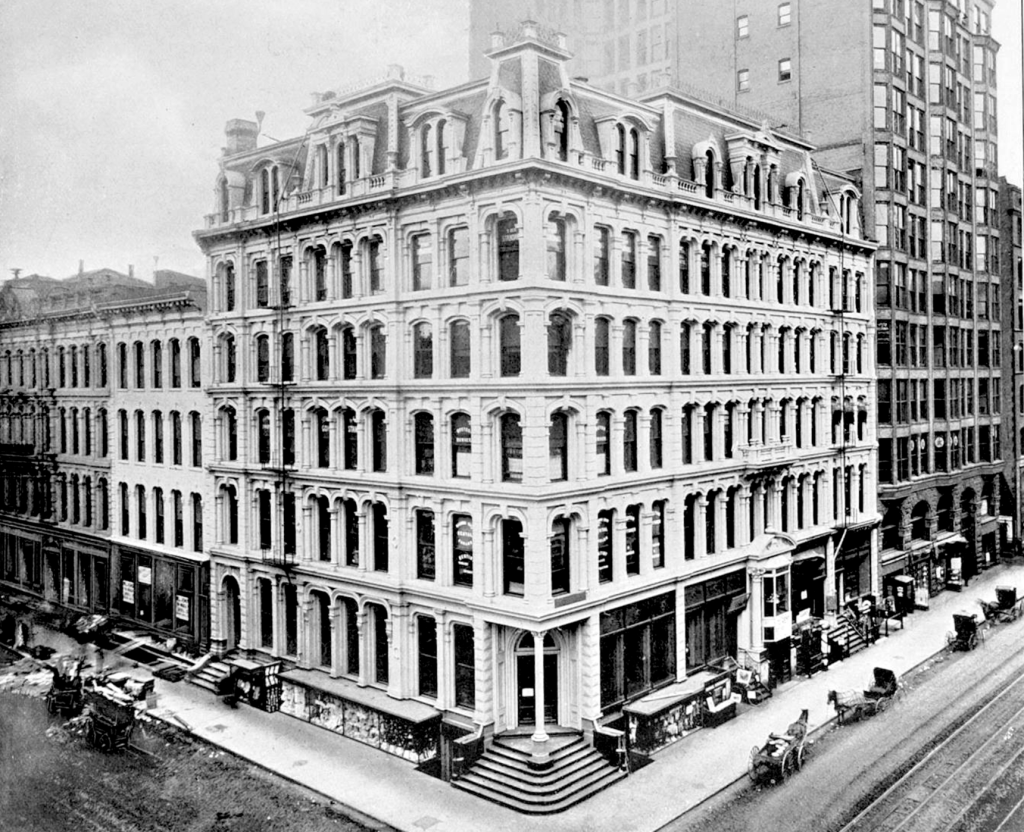
Burley & Tyrrell’s “Crockery, CHina, & Glassware” store on Wabash Avenue in Chicago (1872)
9 January 1874—Made arrangements with John Tyrrell of Burley & Tyrrell for 1874. Also called on Biggs Spencer & Co. and partly made arrangements with them for 1874.
Saturday, January 10, 1874—Cincinnati, St. James Hotel. Called on Tempest, Brockmann, 1 Richmond Street. Manufacturers of WG [white granite] & CC [Cincinnati canners] ware. Called on Frederick Dallas, Manufacturer of WG CC yellow ware, Hamilton Road. 2
Pottery manufactured by Burley & Co., Chicago. Arthur G. Burley and his brother-in-law, John Tyrrell partnered in 1852.
1 The Tempest, Brockmann & Co. was a pottery business established in Cincinnati in 1862 during the American Civil War. Christian E. Brockmann arrived in Cincinnati from Germany in 1848 and started the pottery on Richmond Street in the West End.Their firm was the first to produce commercial whiteware in the Ohio Valley.
2 Frederick Dallas, a native of Scotland, was the founder of the Hamilton Road Pottery in Cincinnati. He came to the United States in 1838 and established his pottery in 1856.Dallas claimed to be the first party in Cincinnati to manufacture a kiln of white granite and C.C. ware. The first definite evidence of this is an advertisement in the 1869 Williams Directory. By 1875, the year after this diary, Dall was no longer producing Rockingham and yellow war—only white granite, C. C. ware, and Parian marble ware, employing 100 hands with a capacity of $100,000 per annum.
Sunday, 11—St. James Hotel. Went to Exposition Building. Also east and west end of city. Also listened to a descriptive sermon in evening at 1st Presbyterian Church on 4th Street by W. F. Johnson, 12 years missionary to India.
Monday, 12—Made arrangements with Frederick Dallas to sell goods on commission in Iowa, Wisconsin, & Minnesota. Also took samples. Hotel expenses St. James Cincinnati from Saturday noon, $8.50. Ticket Cincinnati to Parkersburg, Washington, Baltimore, & Philadelphia on a Pullman Sleeper $10.50
Carl Schurz, US Senator from Missouri, 1869-1875. Circa 1877
Tuesday, January 13, 1874—…after we leave Grafton, follow up the Valley of Cheat River nearly to top of Allegheny Mountains, Grandest scenery in the world. Railroad runs 9 miles top of mountains. Down east side 17 miles, grade averages 122 feet to mile. Then down Potomac River to south side of Harper’s Ferry, cross Potomac, iron bridge, “Point of Rocks”, down north side to Washington.
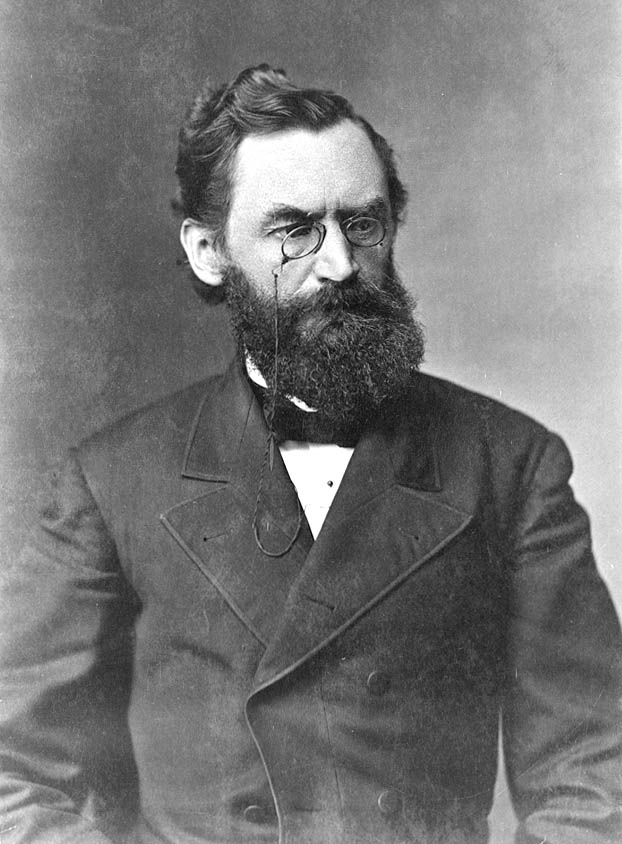
Wednesday 14th—National Hotel $4 Washington City, D. C. Pennsylvania Ave. “Willard’s” Senate chamber speech by [Carl] Schurz of Missouri on Finances & against inflation of the currency. Visited Naval Academy & Capitol grounds. Ford’s Theatre in evening, German actors Janauschek in Shakespeare’s Henry VIII. Hotel expenses National $6.30
Advertisement in “The Capital” of Sunday, 11 January 1874
Thursday 15th—Passed through Baltimore. Continental Hotel in Philadelphia, Pa., corner of Chestnut, $4 per day. Philadelphia to New York. Hotel Continental $3.20.
Friday, January 16, 1874—Sturtevant House, Broadway, New York. $4 per day. Went to Central Park. Took a Central Park car from Sturtevant House north on Broadway & 7th Avenue. A. T. Stewart’s corner Broadway & 10th. J. Vogt & Co., Park Place. Wallack’s Theatre, corner 13th & Broadway. Lester Wallack in “Man of Honor.” 3 [ ] in Trinity Church corner of Broadway and Wall. Broadway runs north and south…
3 John Johnstone Wallack (1820-1888) was an American actor-manager. He used the stage name John Lester until 1858 when he first acted under the name of Lester Wallack. He was the manager of the second Wallack’s Theater from 1861 until 1882.
Saturday 17—Hotel expenses Sturtevant $13.00 Ticket from New York to Jacksonville, Florida [on the [Atlantic & Coach Line $35.50.
Monday, January 19, 1874—Weldon, North Carolina. Passing through turpentine distilleries south of Weldon and rosin factories. Also through the swamps of N. Carolina and moss region. The nNegroes pull it from the trees and put in the water for 6 months, then it turns [into[ Black Moss. Also passed through cotton plantation north of Florence, South Carolina. Monday afternoon, Charleston, S. C.
Tuesday. 20—Savannah, Ga. Situated at outlet of Savannah river. Also a port of entry. W. Gibbs & Co., importer of Guano from Phoenix Islands in the South Pacific ocean. It is a mixture of bones, shells, &c. Savannah is a city of 26,000. Stopped at Pulaski House. $4 per day. Savannah exports cotton in large quantities to Liverpool. Thermometer 60 degrees.
An 1880 stereograph of the National Hotel in Jacksonville, the largest of six hotels in the city in 1876.
Wednesday, 21—Grand National Hotel, Bay Street, Jacksonville, Florida. The G. National is the largest hotel in the city. $4 per day. On St. John’s River. Jacksonville population 30,000. Port of entry.
Thursday, January 22, 1874—Took a drive in the afternoon east on the shell [road]. Went three miles and saw the former residence of Tallary [?]. Made arrangements with Mrs. Mary Barse, Duval Street near ocean for two weeks board at $1260 per week. Met Mr. & Mrs. Van Wick’s of Chicago.
Friday 23—at Jacksonville. Thermometer 80 degree. Took a stroll down town. Ladies promenading the street wearing summer costumes, hats, lawn dresses, carrying fans and parasols. Gentlemen wearing straw hats and carrying umbrellas, also linen coats.
Saturday 24—Started at 9 a.m. in a two [ ] scull for South Point, 5 miles from Jacksonville and returned at 12 noon. Mr. Vanwyck mentioned Marietta, Georgia, 20 miles from Chattanooga as a favorite resort of consumptioners. It is 1200 above sea level.
Sunday, January 25, 1874—Attended 1st Methodist Episcopal Church in morning on Duval Street. The Methodists have two white churches, one a Negro one. Also two colored churches. Attended Sunday School of 1st. M. E. in afternoon. Attended Baptist Church in pm. Thermometer 50 degrees.
Monday 26th—Maj. Samuel Barse, Duval Street near ocean. Mr. Gibbs, manufacturer of stoves. Albany, New York. Mr. & Mrs. Gibbs boarding with Mrs. S. Barse. Mr. & Mrs. Searl, importer Japanese goods. Mr. & Mrs. [George W.] Markens, wholesale grocer, and Mrs. and Mrs. Van Wyke.
Tuesday 27—Trip on the Clifton to “Florida Winter Home,” then up the Arlington River. Water oak—shade tree of Jacksonville. Also Oleander & Palmetto. White Pine. Bought some pineapples & bananas from a vessel from West Indies.
Wednesday, January 28, 1874—At apartments on Duval Street. Saw Sir St. George Gore—a baron from England on a hunting expedition up Indian River. Income $250,000 per annum. 4
4 Sir St. George Gore (1811-1878) was a wealthy Irish nobleman from County Donegal who came frequently to the United States to hunt and fish. His favorite animals to hunt were the American bison and he claimed to have personally killed 2,000 of them, and almost as many elk. Gore’s hunting expeditions were legendary and drew loud protests from US officials who claimed he was killing game that the Indians needed to survive.
5 “On the recommendation of Secretary of the Treasury Salmon P. Chase, Francis Elias Spinner was appointed by President Lincoln as Treasurer of the United States and served from March 16, 1861, until his resignation on July 1, 1875. Within 60 days of his assuming office, the expenditures of the federal government increased dramatically due to the Civil War. He was the first to suggest the employment of women in government offices. During the Civil War, many of the clerks of the Treasury Department joined the army, and Spinner suggested to Secretary Chase the advisability of employing women. After much persuasion, his suggestion was taken up, and he carried it into effect successfully, though not without much opposition. The women were first employed to count money, and later took up various clerical duties. He eventually hired over 100 women, paid them well, and retained them after the war was over. Spinner’s signature on an 1862 issue United States Note. He signed the different series of paper money in a singular handwriting, which he cultivated in order to prevent counterfeiting. His signature on the “greenbacks” of the United States was the most familiar autograph in the country.”
Thursday 29—At apartments on Duval Street, “Parepa Rosa“, the songstress died the 24th. Boarded a schooner from Nassau, Braham Islands and bought pineapples & bananas.
Friday 30—At apartments on Duval Street. Met Mr. and Mrs. Dickinson from Chicago. “Live oak” a tree that remains green all the time. David Livingston, the African explorer. died June 1873. Saw dispatch in NY Herald of 27th. Took a stroll up St. Johns. Over to Brooklyn with J. N. Searl. importer Japanese goods.
Saturday, January 31, 1874—Mr. Searl gave me a Bamboo watch chain made by the Japanese from bamboo reed, each link separate. Met M. Fullam and family from Chicago—a lumber merchant 12th Street. Call on Mr. White, McCormick Block, Mrs. Van Wyck’s brother-in-law.
Sunday, February 1—Attended church 1st Methodist South 11 a.m. Also Presbyterian in evening.
Monday, 2—Mr. and Mrs. Van Wyck, Mr. & Mrs. Dickinson, Mr. & Mrs. Gibbs, Miss Lewis & R. H. W. took a 6 seat scull and went up St. Johns [river] to Brooklyn and across the river. Recrossed river one mile in 10 minutes. Temperature 68 degrees.
Tuesday, February 3, 1874—Apartments on Duval Street. Mr. and Mrs. Van Wyck, Mr. & Mrs. Gibbs, left for Mellonville, 210 miles on “Star Light.” Mr. White, Mrs. Van Wyck’s brother-in-law, McCormick’s Block. Call on him.
The McCormick Block, Dearborn and Randolph Streets in Chicago.
Wednesday, 4—Ticket to Polatka and return.
Thursday, 5—Paid Mrs. Barse 2 1/4 weeks board $27. Left cash at D. G Ambler Bank on Houghton $100. Ticket Jacksonville to New Orleans via Cedar Keyes.
Friday, February 6, 1874—Gainsville 68 miles from Cedar Keyes. The country between Baldwin & Cedar Keyes is a low flat country. Sandy & covered with yellow pines. Principal export, cotton, turpentine & rosin. Col. Sturgeon, U. S. A.
Saturday, 7—Cedar Keyes, Florida. Made one of a party to visit [J. Eberhard] Faber’s Cedar Mills. Met Mrs. Com[modore Foxhall Alexander] Parker, USN. Also Mr. Jabez Sparks [1819-1884] and daughter [Julia Frances Sparks (1847-1912)—the future wife of Hiram Parker (1841-1918], Pottsville, Pennsylvania.
Sunday, 8—Left Cedar Keyes on Emily for the Wm. P. Clyde, 9 miles out with Ex-Gov. [Samuel T.] Day of Florida, Dr., wife [Celeta Cook Weeks], son and two daughters. All for Austin, Texas. 6
6 Ex-Governer Samuel T. Day moved to Caldwell county, Texas, and died there on 26 December 1877.
Monday, February 9, 1874—On board the Wm. P. Clyde, Gulf of Mexico. Clyde, Capt. Livingstone, commander, length 210 feet, burthen 580 tons. Propellor & 2 masts. Thackara, Purser.
Tuesday, 10—On boat Clyde—New Orleans, Key West, and Havana Steamship Company. Saw two sharks following the ship. Also a school of porpoise. Clyde bound from Havana to New Orleans. East Pass, the bar at outlet of Mississippi, 110 miles from New Orleans.
Wednesday, 11—Arrived at New Orleans 10 a.m. H. Cassidy European Hotel opposite the St. Charles on Gravier, corner Carondelet.
Thursday, February 12, 1874—Ticket on Henry Ames7 for St. Louis, $20. Visited all the principal parks of New Orleans. went to the southern limits of the city. Canal Street, principal street of city. Royal Camp of Common. Gratiot Levee.
7 The steamer Henry Ames may have been the same vessel that factored into the story of the sinking of the Sultana a decade earlier. She finally met her demise later in 1874 when she hit a snag at Waterproof, Louisiana, and went down with the loss of three lives and a cargo valued at $130,000.She was one of the ships in the Merchants’ Southern Line Packet Company established in 1870. Her captain was J. West Jacobs who had formerly captained the steamer Ira Stockdale on the Quachita River.
Advertisement for the Henry Ames
Friday, 13—On board Henry Ames. Memoranda of Florida—production of Florida, south of frost line on St. John’s and Indian [Rivers]. Pineapple, orange, lemons, grapes, banana, coconuts. mulberries, sweet potatoes. Exports to North, vegetables, oranges and lemons, pecans, & moss.
Saturday, 14—On boat Henry Ames. Thermometer 65 degrees, Cloudy. Memoranda of New Orleans. Visited principal points of interest. Steam ships from Liverpool, Genoa, Hamburg, Cork, Havre, West Indies. Saw preparation for Mardi Gras on 17th [Fat Tuesday].
Sunday, February 15, 1874—On board Henry Ames off Baton Rouge. Sugar plantations in sight from bank. Stopped at Port Hudson to take on board sugar for St. Louis. Casks containing 1,224 f.
Monday, February 16—On board Henry Ames off Natchez, Mississippi. Heavy fog. Boat stuck in mud. Four hours on sand bar.
Tuesday, 17—On board Ames. Capacity 1,800 tons. Length 280 feet. Time from New Orleans to St. Louis, 6 days.
Wednesday, February 18, 1874—Henry Ames off Vicksburg, Mississippi. growing colder 46 degrees.
Thursday, 19—On board Henry Ames.
Friday, 20—Memphis, Tennessee on board H. Ames.
Saturday, February 21, 1874—On board Henry Ames.
Sunday, 22—Mark Twain was writing funny pieces on boat when 1st Mate called out “Mark Twain”=12 feet so Samuel Clemens called himself Mark Twain. He used to be clerk on boat with Captain Jacobs of Henry Ames.
S. Clemens, pilot on Mississippi with Capt. J. W[est] Jacobs, now of Henry James.
Tuesday, February 24, 1874—Southern Hotel, St. Louis, Mo. on 5th Street. $4 per day. Called on crockery houses. Frederick Dallas will be here 25th, so says Manning & Co. Viewed the St. Louis Bridge–3 span iron. Ticket to Chicago $11.
Wednesday, 25—Woods Hotel [Chicago]. Received letters from M. F. I., M. T., etc.
[Roland is back in Chicago before the end of February 1874 and this is when some of his entries are shorter but also some long. He doesn’t stay long in Chicago and it’s on to Waukegan Illinois, Racine Wisconsin, Union Grove, Burlington, Elkhorn, Freeport, Evansville, Madison, Palmyra, Janesville, Oshkosh, and more. He’s taking “teams” so I’m assuming horse teams. He’s back home in Eldorado by the 1st of April and travels all over Iowa. On July 5th he boards the steamer “Miniapolis” and heads to McGregor on the Mississippi River. Then he writes this entry on July 15, 1874:]
Wednesday, July 15, 1874—Last night was the great fire in Chicago. Burning 60 acres between Vanburen St. and Clark St. and Mich Ave. Loss estimated at 5,000,000. Buildings, homes, Mich. Ave. St. James, Woods and hotels.
The following letter was written by 39 year-old Jonathan Hersey Ayres (1824-1887), a private in Co. B, 14th Virginia Infantry. He wrote the letter to his older brother, William Buford Ayres (1820-1892). They were the sons of John Wesley Ayres (1787-1848) and Mary C. Powers (1788-1859) of Bedford county, Virginia. They had two brothers who fought for the Confederacy but did not survive the war. Elijah Quarles Ayers (1823-1862) served in Co. K, 28th Virginia Infantry. He was mortally wounded at the Battle of Seven Pines. Richard Pleasant Ayres (1827-1864) served in Co. I, 58th Virginia Infantry. He was taken prisoner at the Battle of Gettysburg and died the following year at Point Lookout, Maryland.
In this letter, Jonathan informs his brother that he had returned safely to Richmond just in time to witness a huge fire of the Public Warehouse used to store government supplies. This fire took place on March 10th in spite of a torrential rainstorm. By the time he wrote this letter, Jonathan had been in the service for more than 21 months. His muster rolls indicate that he went into the hospital sick at Richmond on 29 June 1862 and that he was still there through December. Beginning in January 1863, he was detailed as ward master in Hospital K 20 in Richmond. On 2 March 1863, he requested a 7 day leave of absence from Surgeon V. W. Harrison so that he might visit his home in Bedford county and make some arrangements for his “two motherless children there.”
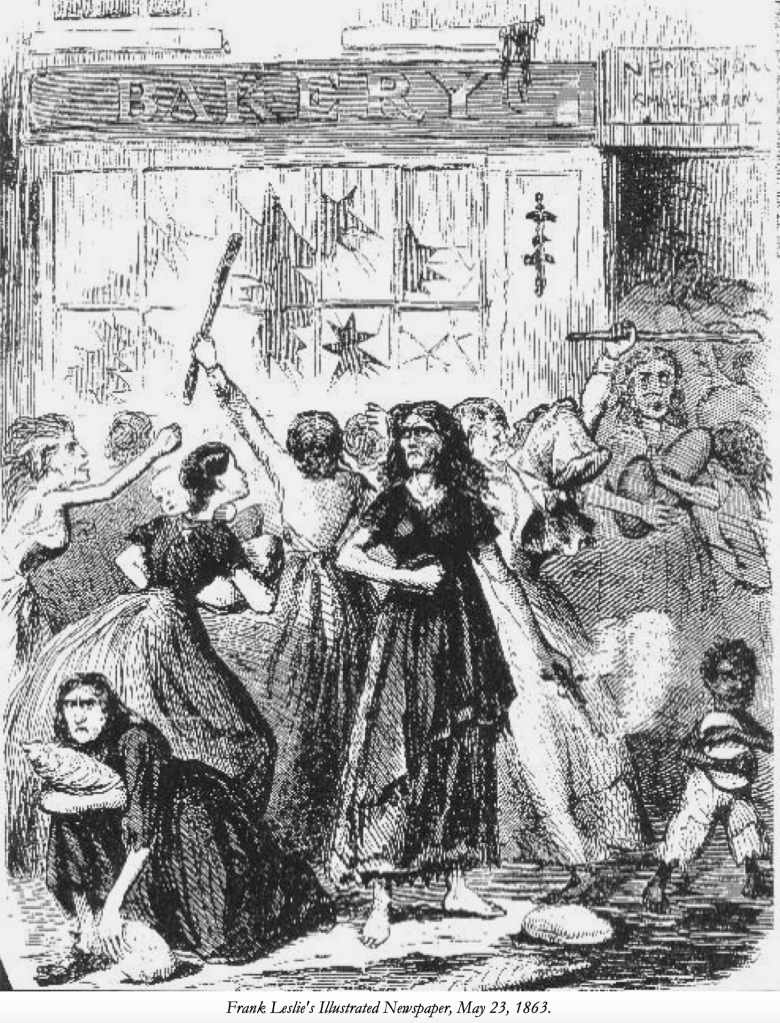
This letter was written just two weeks before the Richmond Women’s Bread Riot (see image below) of April 2, 1863. The situation in Richmond in the spring of 1863 was the result of an unusual sequence of bad luck. A massive snowstorm struck the city in March, and the melting snow turned roads into muddy paths, which made it difficult to transport what little food was being grown on nearby farms into town. In addition, the city’s proximity to the war and the continued influx of wounded soldiers, civil servants, and government staff placed further stress on an already overburdened system.
After the war, Jonathan returned to Liberty, Bedford county, Virginia where he earned his living as a miller/farmer.
Transcription
Hospital No. 20 1 [Richmond, Va.] March 16, 1863
Dear brother,
I this evening take my pen in hand to let you know that I returned to Richmond on Tuesday night safe & found all things right at the hospital though there was the largest fire burning when I arrived I ever saw. One side of the Petersburg Depot was on fire. Loss very heavy. One thousand hotheads of tobacco burned with corn & an immense quantity of other articles. 2
We have not received any patients as yet though it will not be long. First the hospital was reported for duty this morning. I have no news which would interest you on the war subject. There is no new moves making as yet that we are apprised of.
After returning to Gran’s, he told me that I ought to collect a debt that I hold against Old big Billy Creasy Estate. That it could be gotten & I will get you to attend to it. You will find it. either in the wallet on big Pocket Book. It is an order from Wm. J. Creasy to me on Wm. Creasy excepted & W. T. Nichols witness to it. The Principal near 40$. You can carry it to court & Gran can tell you who is the Administrator & collect it, &c. & let me know about it.
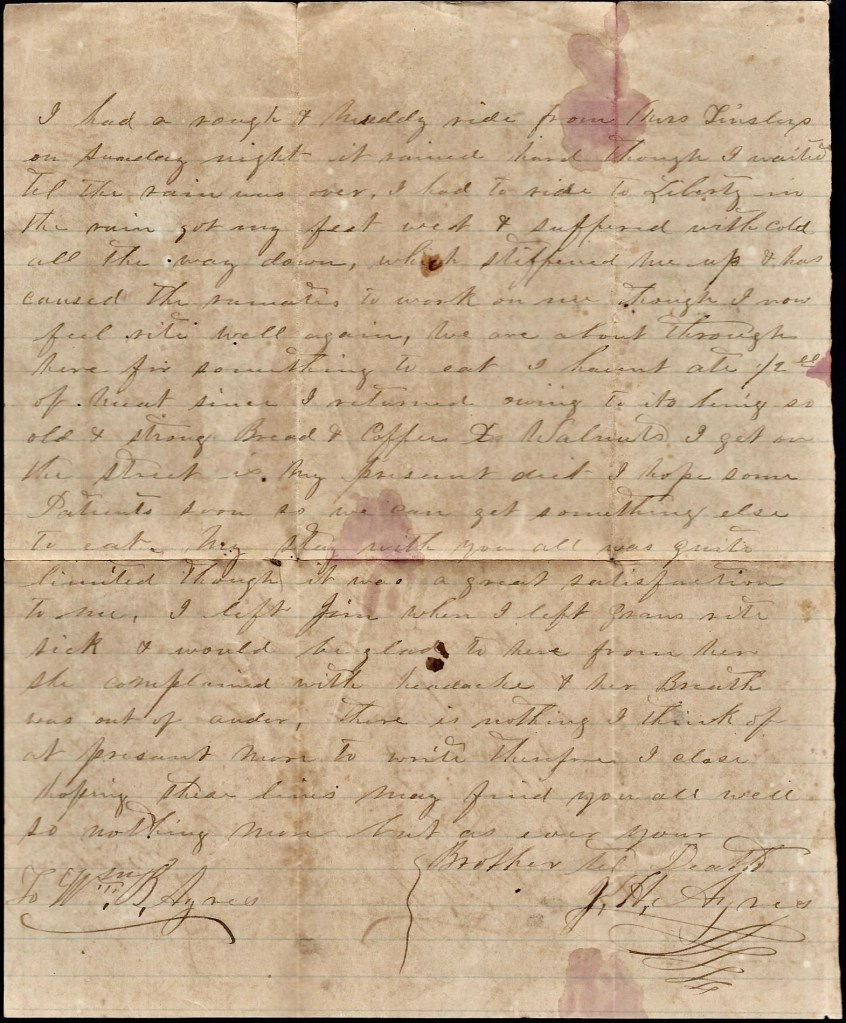
I had a rough & muddy ride from Mrs. Tinsleys on Sunday night. It rained hard. Though I waited till the rain was over, I had to ride to Liberty in the rain, got my feet wet & suffered with cold all the way down, which stiffened me up & has caused the rheumatism to work in me though I now feel right well again. We are about through here for something to eat. I haven’t ate a half pound of meat since I returned owing to its being so old and strong. Bread & coffee & walnuts I get in the street is my present diet. I hope [for] some patients soon so we can get something else to eat.
My stay with you all was quite limited though it was a great satisfaction to me. I left Jim when I left Grans right sick & would be glad to hear from her. She complains with headaches and her breath was out of order. There is nothing I think of at present more to write. Therefore, I close hoping these lines may find you all well. So nothing more but as ever your brother til death, — J. H. Ayres
To Wm. B. Ayres
1 General Hospital #20 was also called Royster’s Hospital and First Alabama Hospital. It was formerly the tobacco factory of J. B. and A. L. Royster for Royster Brothers and Company. The First Alabama Hospital was first located in Manchester, Virginia. After 1862 it was at 25th and Franklin Streets in Richmond and became General Hospital #20. It opened before June 1862. A report of June 4, 1862 lists 44 patients but the building had a very large capacity.
2About half past 12 o’clock on Tuesday night that part of the Public Warehouse known at Brown’s Addition, fronting 20 feet on Canal street, opposite the packet landing, and 130 feet on 8th street, was discovered to us on fire in the upper stories, occupied for past for storage purposes by the Confederate Government. Owing to the combustible nature of the contents of the upper story the flames soon enveloped the whole building. (which was of brick,) and extending downwards set fire to many hundred hogsheads of tobacco, the property of individual citizens and firms both in the Confederacy and foreign countries, but for which the State of Virginia is responsible. When the fire got well started nothing could stop it but the exertions of the Fire Brigade, with the steam engine and other help, which was vigorously applied on the occasion, preventing the spread of the fire to the other property adjoining and on the opposite side of the street. By the failing of the wells of Brown’s addition to the Public Warehouses, some of the sheds under which tobacco was stored in hog heads several tiers deep, they were set on fire, but luckily at this point a surplus of water prevented the damage that seemed likely to ensue. A number of bales of cotton, belonging to the James River Manufacturing Company and Manchester Cotton Factory, were stored on 8th street, in front of the burning building, and caught fire several times, but being quickly deluged with water were not materially injured — The loss by this fire is computed at two hundred thousand dollars. It was certainly the most destructive conflagration with which our city has been visited for some years, and whether caused by accident or design is to be equally deplored. We heard yesterday evening the rumor that the State of Virginia intended to institute a strict investigation, so that the blame of the calamity might be determined. The part of the warehouse destroyed was probably worth forty thousand dollars. Eight hundred hogsheads of tobacco were burned, which, at present prices, ($500 per hhd,) would amount to $400,000; but the state paying only the original valuation, will only lose in this item about $160,000. Two hundred hhds, of the tobacco belonged to the Rothschilds, of Paris, and were at one time the subject of a suit in the C. S. District Court, when they were sought to be sequestered as the property of August Belmont, of New York, and alien enemy. The above enumeration comprises most of the loss accruing to the State. The Confederate States Government lost $3,000 bushels of shipstuff, 1,000 bushels of bats, 300 bushels of corn, and 100,000 empty cotton grain bags, besides other property of which no list could be obtained. The loss of grain etc., can be determined by the present market value. The from this fire Illuminated the whole horizon for miles, and the best was most intense. Even at 1 o’clock yesterday the smouldering remnants were emitting fitful glares and the most uncomfortable odor. There were very few persons present, considering the extent of the conflagration. The rain fell during the while in torrents. — The Daily Dispatch: March 12, 1863. Richmond Dispatch. 2 pages. by Cowardin & Hammersley. Richmond. March 12, 1863. microfilm. Ann Arbor, Mi : Proquest. 1 microfilm reel ; 35 mm.
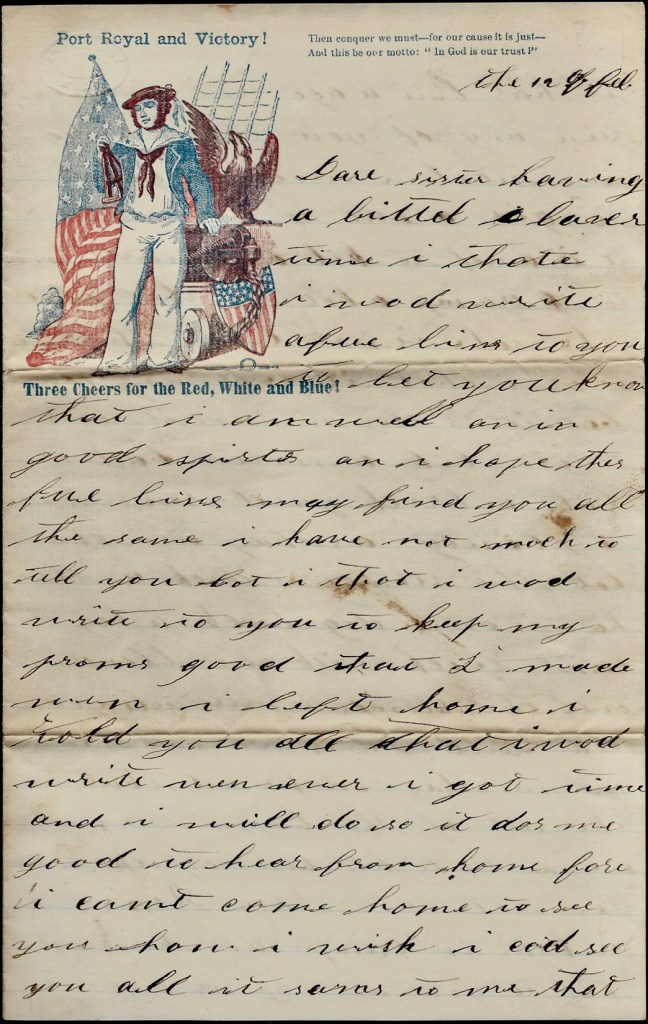
I have not been able to learn the identity of this soldier who signed his name Lewis Moore. He mentions two other soldiers in the letter who were probably in the same company but these names didn’t help me much. Based upon the content, my assumption that is that this letter was written in February 1862 from the Federal encampments in northern Virginia defending Washington D. C.
Transcription
12 February 1862
Dear sister,
Having a little leisure time, I thought I would write a few lines to you to let you know that I am well and in good spirits and I hope these few lines may find you all the same. I have not much to tell you but I thought I would write to you to keep my promise good that I made when I left home. I told you all that I would write whenever I got time and I will do so. It does me good to hear from home for I can’t come home to see you. How I wish I could see you all. It seems to me that it has been an age since I have seen any of you.
[If] this thing was settled, I would be glad to get out of this war. It is enough to kill any mighty man to tramp a lot in this place. The soil is not like I thought is was. It is clay and when it rains it gets like a mortar [ ] or like a brickyard. Stones is not so plenty as they are there. The stumps is thick as the hairs is on a dog’s back. A boy can’t walk without tripping over the stumps.
I must tell you that Bill Davis was over here on Monday and he said that the rest of the boys were well and he sends his best respects to you all. And Lou Romer is here in camp and he sends his respects to you and he has got to go out on picket with us tomorrow. This picket is on our camp ever five days and we can’t say it’s too stormy or rainy to go but we have to go, let it be as it will.
I must tell you that I can’t get home without there is some of you sick and then i must get a telegraph dispatch from the doctor from you to show the general and [there is] no other way I can get home until my three years is up. So you know what to do if any of you get sick, you must telegraph to me and I will get to come home to see you. I thought I would tell you so you could let me know if any of you got sick.
No more at present. From your little brother, Lewis Moore
Unfortunately the letter and the envelope it was mailed in became have become separated in the past making it impossible to identify the author of this letter who signed it only as “your affectionate son, Henry.”
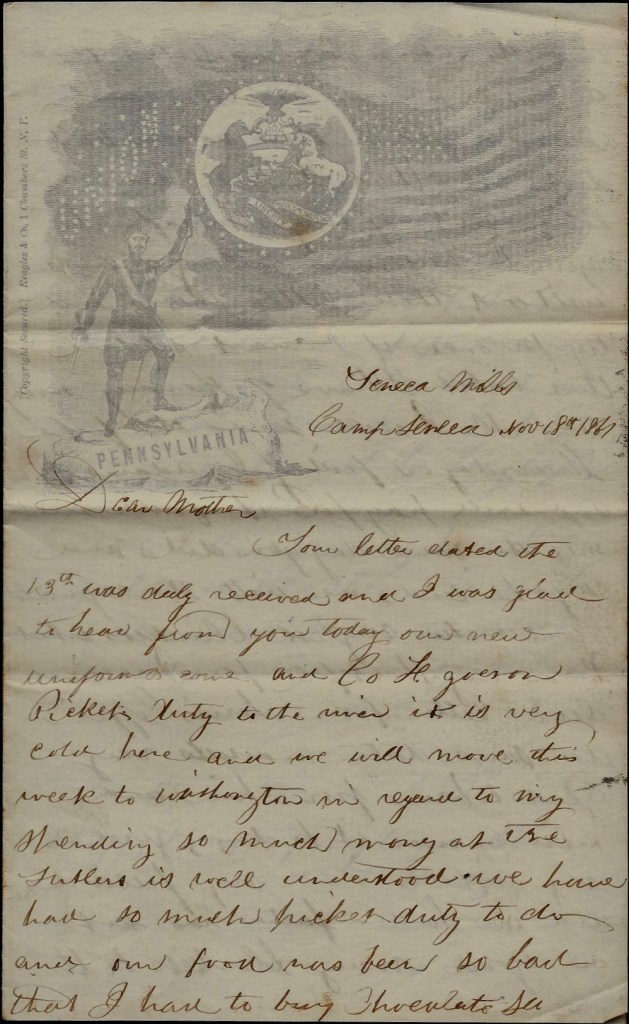
Because it was written on “Pennsylvania” patriotic stationery and given that he author mentions Company H in the letter, my assumption is that he served in that company in a Pennsylvania Infantry regiment but I have not been able to identify the regiment that was posted at Seneca Mills, Maryland, on that date.
Perhaps a Spared & Shared reader will be able to figure it out and let me know. We know his parents were living, that he had a brother named Al, and probably some sisters.
Transcription
Seneca Mills [Maryland] Camp Seneca November 18, 1861
Dear Mother,
Your letter dated the 13th was duly received and I was glad to hear from you. Today our new uniforms come and Co. H goes on picket duty to the river. It is very cold here and we will move this week to Washington.
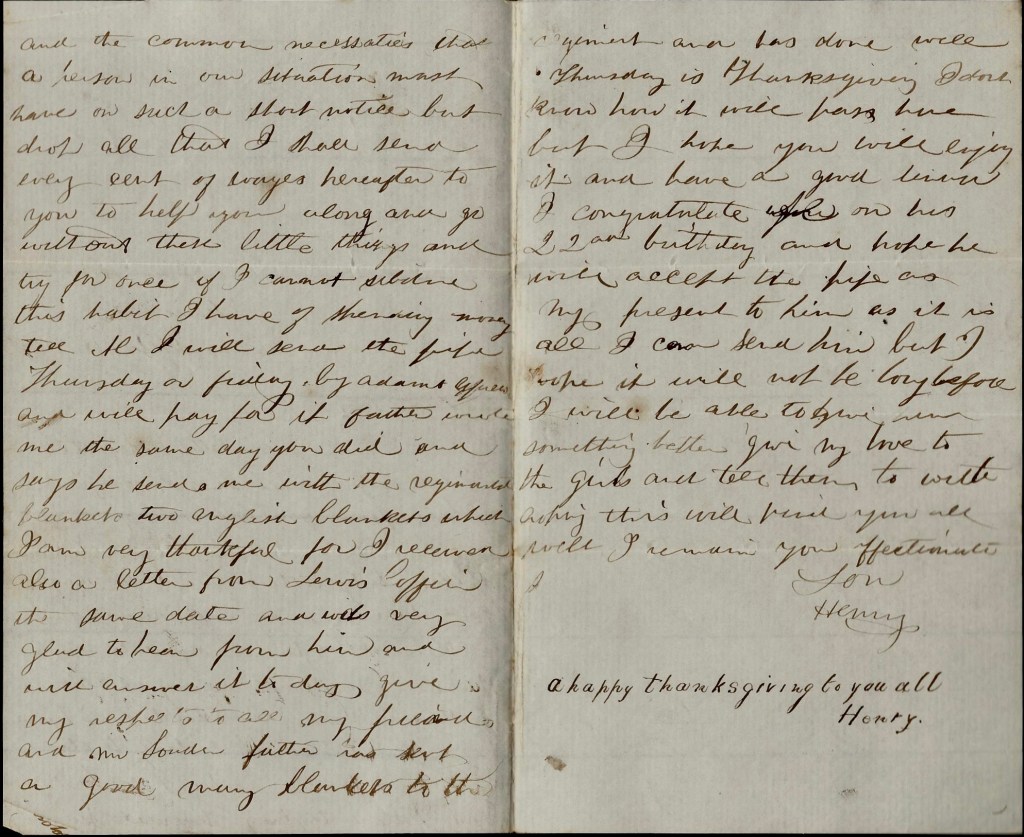
In regard to my spending so much money at the sutlers is well understood. We have had so much picket duty to do and our food has been so bad that I had to buy chocolate and the common necessities that a person in our situation must have on such a short notice. But drop all that, I shall send every cent of wages hereafter to you to help you along and fo without these little things and try for once if I cannot subdue this habit of spending money.
Tell Al I will send the pipe Thursday or Friday by Adams Express and will pay for it. Father wrote me the same day you did and says he sends me with the regimental blankets two English blankets which I am very thankful for. I received also a letter from Lewis Coffin the same date and was very glad to hear from him and will answer it today. Give my respects to all my friends and Mr. Souder. Father has sent a good many blankets to the regiment and has done well.
Thursday is Thanksgiving. I don’t know ho it will pass here but I hope you will enjoy it and have a good dinner. I congratulate Al on his 22nd birthday and hope he will accept the pipe as my present to him as it is all I can send him but I hope it will no be long before I will be able to give him something better.
Give my love to the girls and tell them to write. Hoping this will find you all well, I remain your affectionate son, — Henry
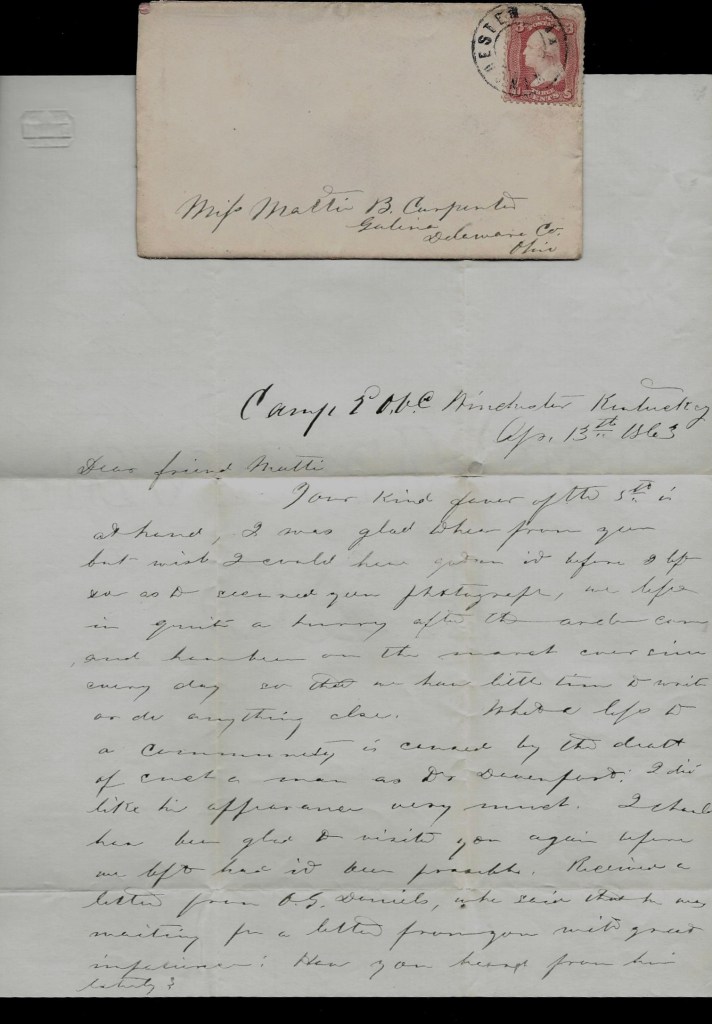
I have not been able to nail down the identity of the soldier who wrote these letters though I believe he served in the 2nd Ohio Volunteer Cavalry and that he was either from or had spent time prior to the war in Delaware county, Ohio.
He wrote most of the letters to Martha J. Carpenter (1837-1921), the daughter of David Cooley Carpenter (1805-1886) and Sarah Cleveland (1809-Aft1880) of Berkshire, Delaware county, Ohio. Martha married Charles Pierson (1831-1901) in McLean County, Illinois on 10 February 1869. They resided in Decatur, Macon county, Illinois.
Letter 1
Camp 2nd O. V. C. Winchester, Kentucky April 13th 1863
Dear friend Mattie,
Your kin favor of the 5th is at hand. I was glad to hear from you but wish I could have gotten it before I left so as to seen your photograph. We left in quite a hurry after the orders came and have been on the march ever since every day so that we have little time to write or do anything else.
What a loss to the community is caused by the draft of such a man as Dr. Davenport. I dislike his appearance very much. I should have been glad to visit you again before we left had it been possible. Received a letter from O. G. Daniels who said that he was waiting for a letter from you with great impatience. Have you heard from him lately?
Where we go from here I do not know but have orders to report to Stanford if it is not countermanded before we get there. We seem to be a desirable regiment to have as we have had orders to report to no less than 5 generals since we got to Kentucky.
Our mail will reach us if directed to Lexington to follow the regiment. Shall I not hope to get another from you soon containing a photograph of you? My greatest regards to your people and Charles when you write. Excuse haste and write soon to your true friend, — Ernest.
Letter 2
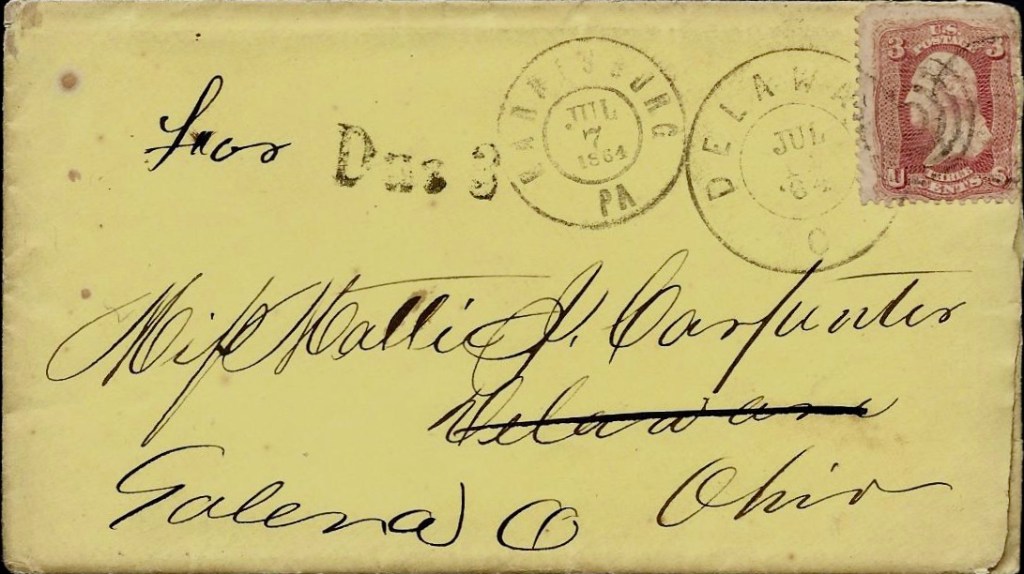
Addressed to Miss Mattie J. Carpenter, Delaware, Ohio
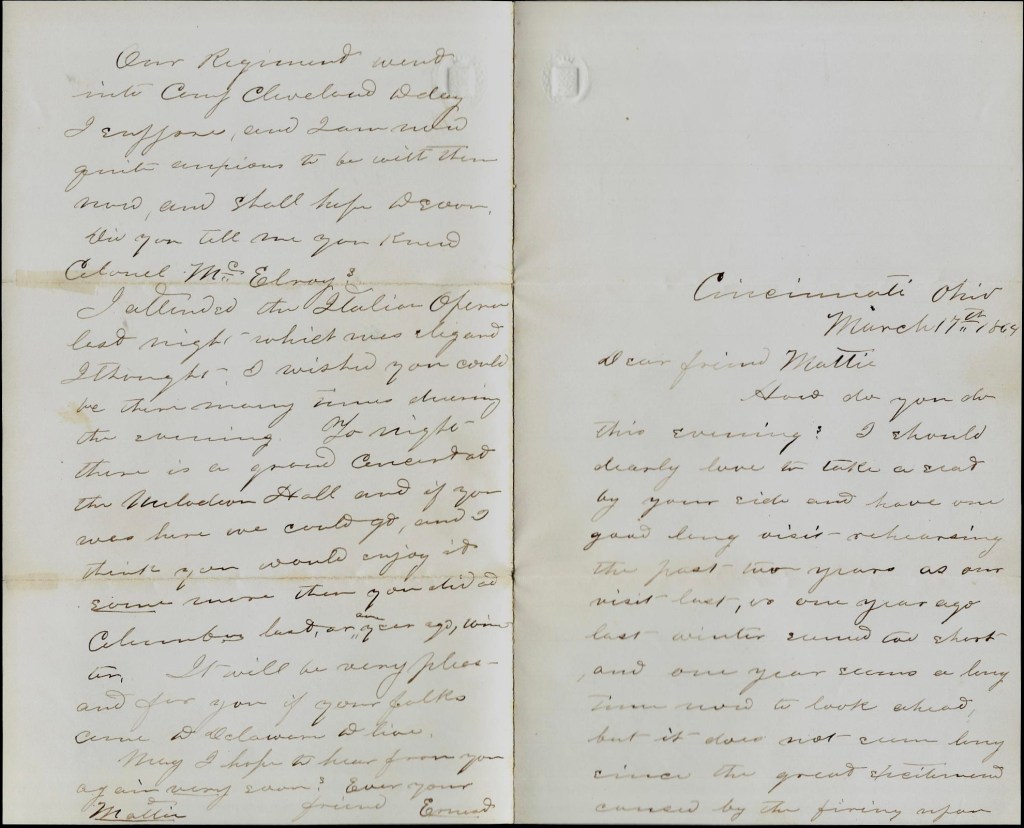
Cincinnati, Ohio March 17th 1864
Dear friend Mattie,
How do you do this evening? I should dearly love to take a seat by your side and have one good long visit rehearsing the past two years as our visit last, one year ago last winter seemed too short and one years seems a long time now to look ahead. But it does not seem long since the great excitement caused by the firing upon Fort Sumter, and yet at that time if we had thought that this war would have been protracted three years, we would have been almost discouraged, and perhaps would not have felt like entering upon the great work of human slaughter with the same eagerness with which the heart of the Great American People seemed to have been inspired. I think it is well in this case as it is in many, and I might say almost all that we did not know for now success seems to be almost certain which with a less hearty cooperation would have been the cause of the downfall of our great and beloved Republic. I think all have reason to feel encouraged for if the rebels could not advance upon us while so many of our troops were home, what will be their fate when our Veteran Soldiers get back to the front? They are en who have been often tried and seldom found wanting.
We have been very busy this week but are not quite as near through this case as I had hoped we would be by this time when I last wrote you. Probably will not close the whole case this week, but certainly must finish at first of next, I think from present appearances.
Our regiment went into Camp Cleveland today, I suppose, and I am now quite anxious to be with them now and shall hope to soon. Did you tell me you knew Colonel McElroy?
I attended the Italian Opera last night which was elegant, I thought. I wished you could be there many times during the evening. Tonight there is a grand concert at the Melodeon Hall and if you was here, we could go and I think you would enjoy it some more than you did at Columbus last, or one year ago, winter.
It will be very pleasant for you if your folks come to Delaware to live. May I hope to hear from you again very soon? Every your friend, — Ernest
Letter 3
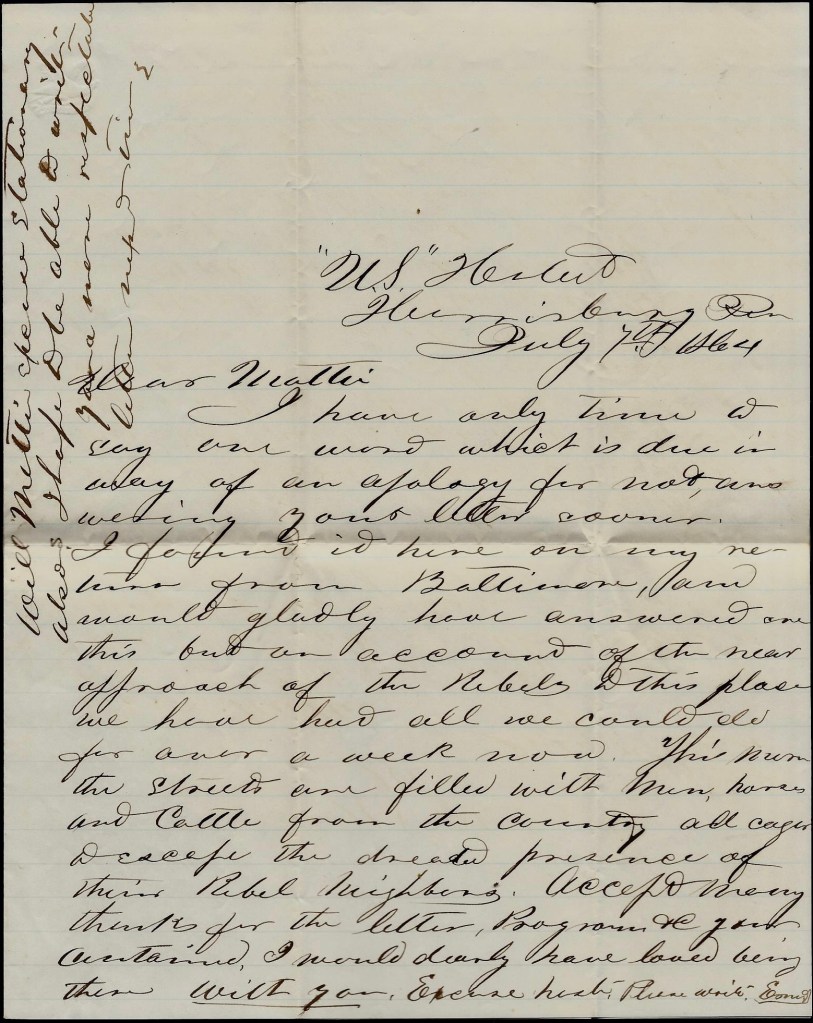
“U. S.” H___ Harrisburg, Pennsylvania July 7th 1864
Dear Mattie,
I have only time to say one word which is due in way of an apology for not answering your letter sooner. I found it here on my return from Baltimore and would gladly have answered ere this but on account of the near approach of the Rebels to this place. We have had all we could do for over a week now. This morn the streets are filled with men, horses and cattle from the country all eager to escape the dreaded presence of their Rebel neighbors.
Accept many thanks for the letter, Program, &c. you contained. I would dearly have loved being there with you. Excuse haste. Please write. — Ernest
Will Mattie excuse stationery. Also I hope to be able to write a more respectable letter next time.
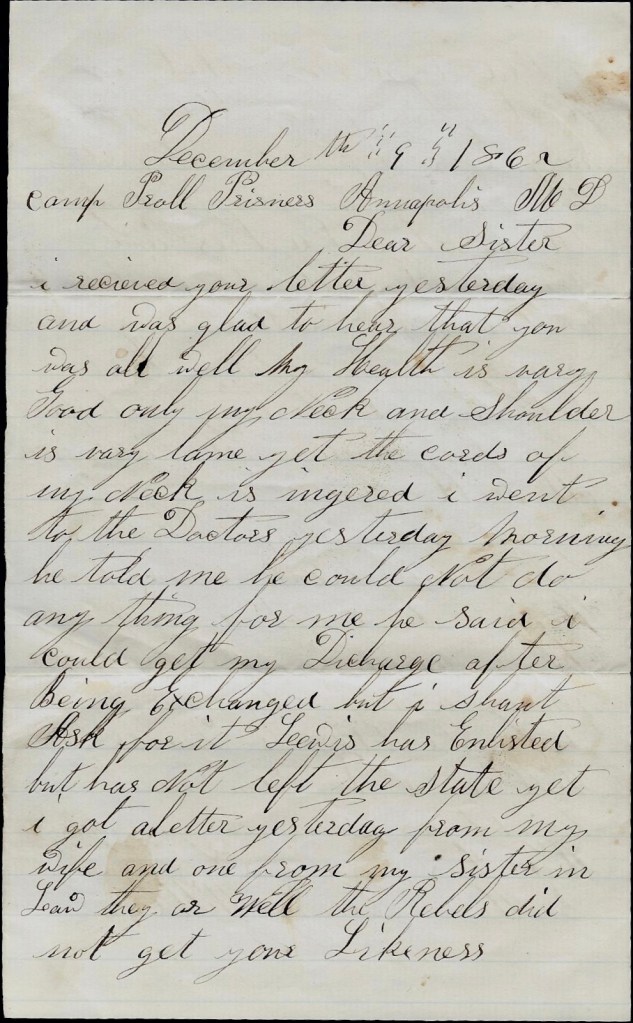
Unfortunately I was not able to identify this soldier quickly. There are some 30 soldiers by the name of Henry Wilber in the Civil War Soldiers database and it would take a while to winnow the list down. I attempted to identify him through Ancestry.com records by tracing the relationship to his sister, “Mrs. Amy Wright” of Lower Lockport, New York, but was unsuccessful.
Transcription
Addressed to Mrs. Amy Wright, Lower Lockport, Niagara county, New York
Camp Parole Prisoners Annapolis, Maryland December 9th 1862
Dear Sister,
I received your letter yesterday and was glad to hear that you was all well. My health is very good—only my neck and shoulder is very lame yet. The cords of my neck is injured. I went to the doctor’s yesterday morning. He told me he could not do anything for me. He said I could get my discharge after being exchanged but I shan’t ask for it. Lewis has enlisted but has not left the state yet.
I got a letter from my wife and one from my sister-in-law. They are well. The Rebels did not get your likeness. I had it in my pocket. I expect a letter from Oba and Mary every day and I expect their likeness too.
When you write, tell me where Lee lives and write all of the particulars.
We have nice weather here. It is very warm. I have just got through washing. I hope these few lines will find you all well. My wife writes me a great many kind letters. She wants me to come home.
Amy, I have got a good, kind woman. I have enjoyed many a happy hour with her. She likes to dance as well as I do. You must write as soon as you get this.
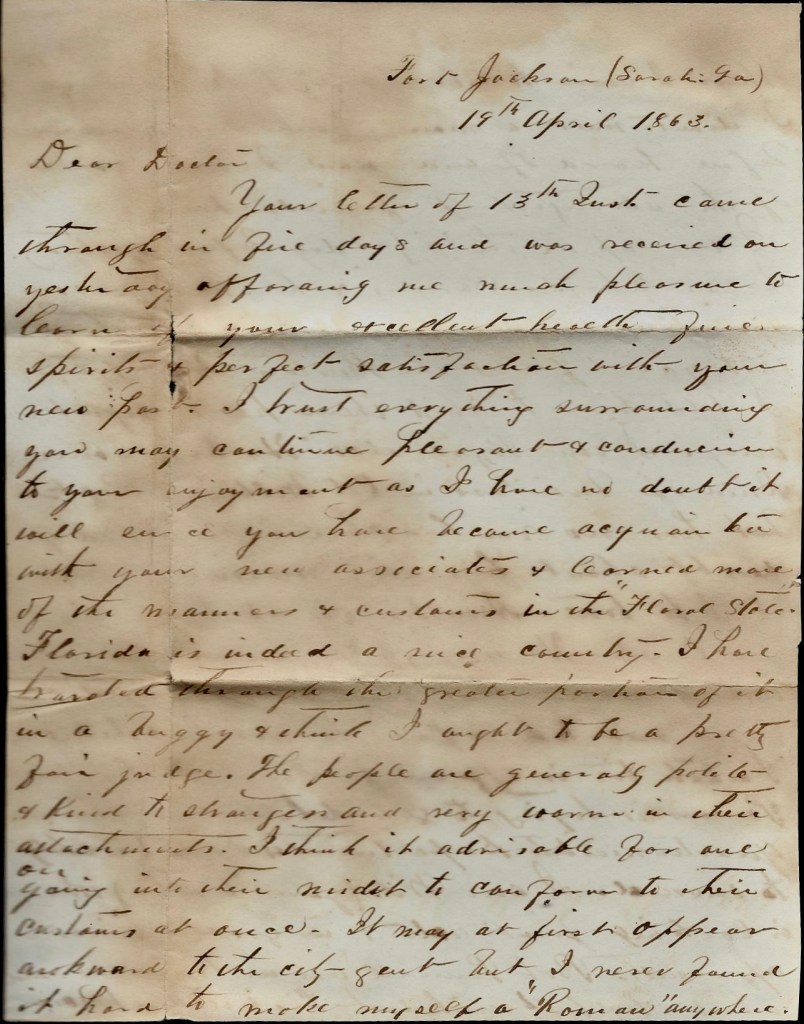
The following letter was written in mid-April 1863 by Assistant Surgeon Thomas (“Tom”) Wesley Newsome (1835-1874), formerly a lieutenant in Co. H, 49th Georgia Infantry. Tom was ordered to report to Surgeon H. V. Miller at Savannah in the spring of 1863, his appointment to rank from November 1862. His records indicate that he first entered the service on 4 March 1862 as a 2nd Lieutenant in the 49th Georgia (“Cold Steel Guards) and was promoted to 1st Lieutenant on 7 July 1862. A month later he was wounded in the fighting at Cedar Run and transferred to the Medical Department in December 1862. The last entry for medical requisitions indicates he was still at Savannah in June 1864.
Tom’s letter was datelined from Fort Jackson which was located on the Savannah River three miles east of the city. It served as the headquarters for Savannah’s river defenses after the fall of Fort Pulaski. It had to be evacuated late in 1864 as Federal troops closed in on the city.
Tom was the son of Lorenzo Dye Newsome (1810-1840) and Maryanne Ellafair Brown (1814-1862). Tom was married prior to the war but his first wife, Lonora (Ragland) Newsome, died prior to the date of this letter and their child, Thomas, Jr., born in 1862, was raised by an aunt.
There is nothing in this letter to indicate who it was addressed to but the provenance states that it was mailed to his friend, Dr. Horatio N. Hollifield (1832-1895), of Sandersville, Washington County, Georgia. Hollifield was born in Maryland but came to practice Allopathic medicine in Sandersville in 1856. His Confederate military records indicate he was posted at Bartow Hospital in Savannah early in the war and that he was a “Surgeon for Negroes” in Savannah in October 1862. He was stationed with two companies of the 2nd Florida Cavalry in May 1863 and later attached to Finnegan’s Middle District of Florida. He resigned in February 1865 at Columbia, S. C.
It should be noted that Tom Newsome and Horatio Hollifield collaborated in the authorship of a book first published in 1860 entitled, “Georgia Medical and Surgical Encyclopedia.”
Transcription
Fort Jackson Savannah, Georgia 19th April 1863
Dear Doctor,
Your letter of 13th inst. came through in five days and was received yesterday affording me much pleasure to learn of your excellent health, fine spirits, and perfect satisfaction with your new post. I trust everything surrounding you may continue pleasant and conducive to your enjoyment as I have no doubt it will since you have become acquainted with your new associates & learned more of the manners & customs in the “Floral State.” Florida is indeed a nice country. I have traveled through the greater portion of it in a buggy & think I ought to be a pretty fair judge. The people are generally polite & kind to strangers and very warm in their attachments. I think it is advisable for me on going into their midst to conform to their customs at once. It may at first appear awkward to the city gent, but I never found it hard to make myself a “Roman” anywhere.
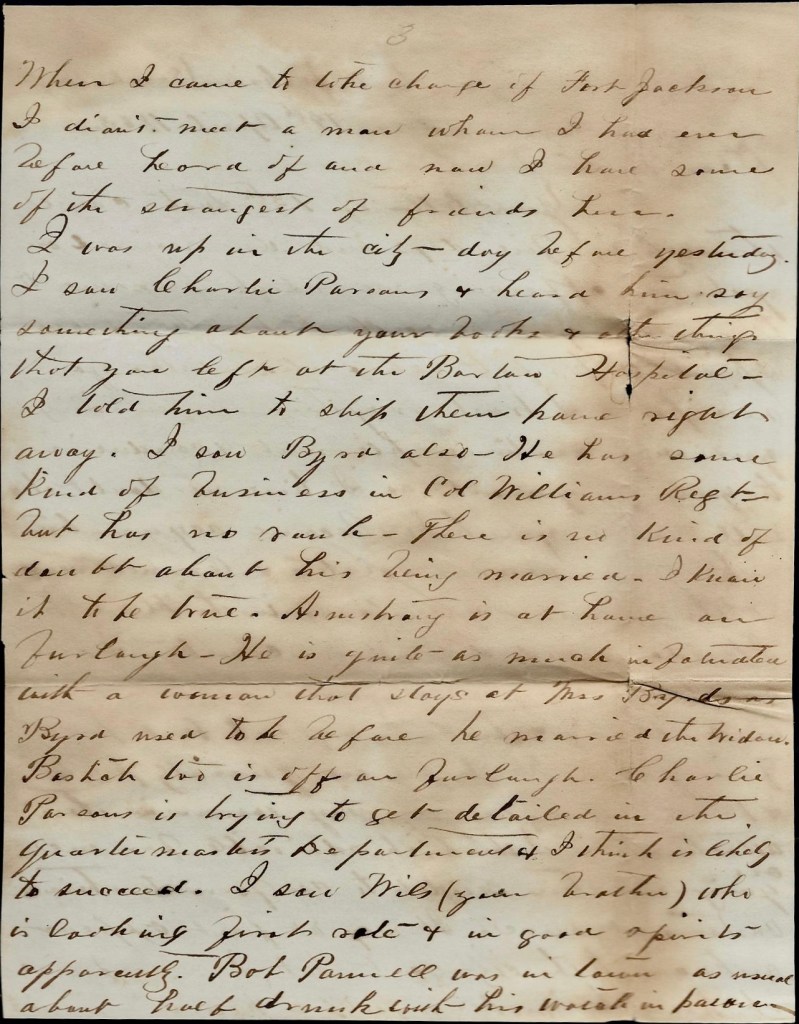
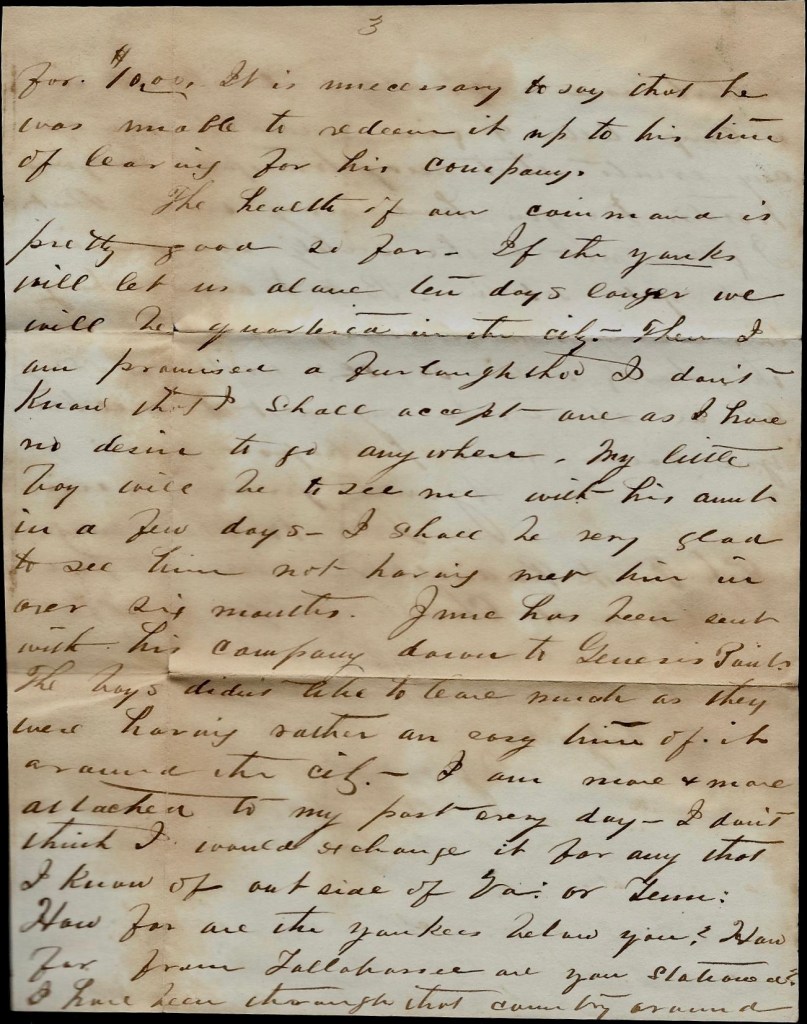
When I came to take charge of Fort Jackson, I didn’t meet a man whom I had ever before heard of and now I have some of the strongest of friends here. I was up in the city day before yesterday. I saw Charlie Parsons & heard him say something about your books & other things that you left at the Bartow Hospital. I told him to ship them home right away. I saw Byrd also. He has some kind of business in Col. Williams’ regiment but has no rank. There is no kind of doubt about his being married. I know it to be true. Armstrong is at home on furlough. He is quite as much infatuated with a woman that stays at Mrs. Byrds as Byrd used to be before he married the widow. Bastick too is off on furlough. Charlie Parsons is trying to get detailed in the Quartermaster’s Department & I think is likely to succeed. I saw Wils (your brother) 1 who is looking first rate & in good spirits apparently. Bob Parmell was in town as usual about half drunk with his watch in [ ] for $10.00. It is necessary to say that he was unable to redeem it up to his time of leaving for his company.
The health of our command is pretty good so far. If the Yanks will let us alone ten days longer, we will be quartered in the city. Then I am promised a furlough though I don’t know that I shall accept one as I have no desire to go anywhere. My little boy will be to see me with his aunt in a few days. I shall be very glad to see him, not having met him in over six months. June has been sent with his company down to Genesis Pauls. The boys didn’t like to leave much as they was having rather an easy time of it around the city.
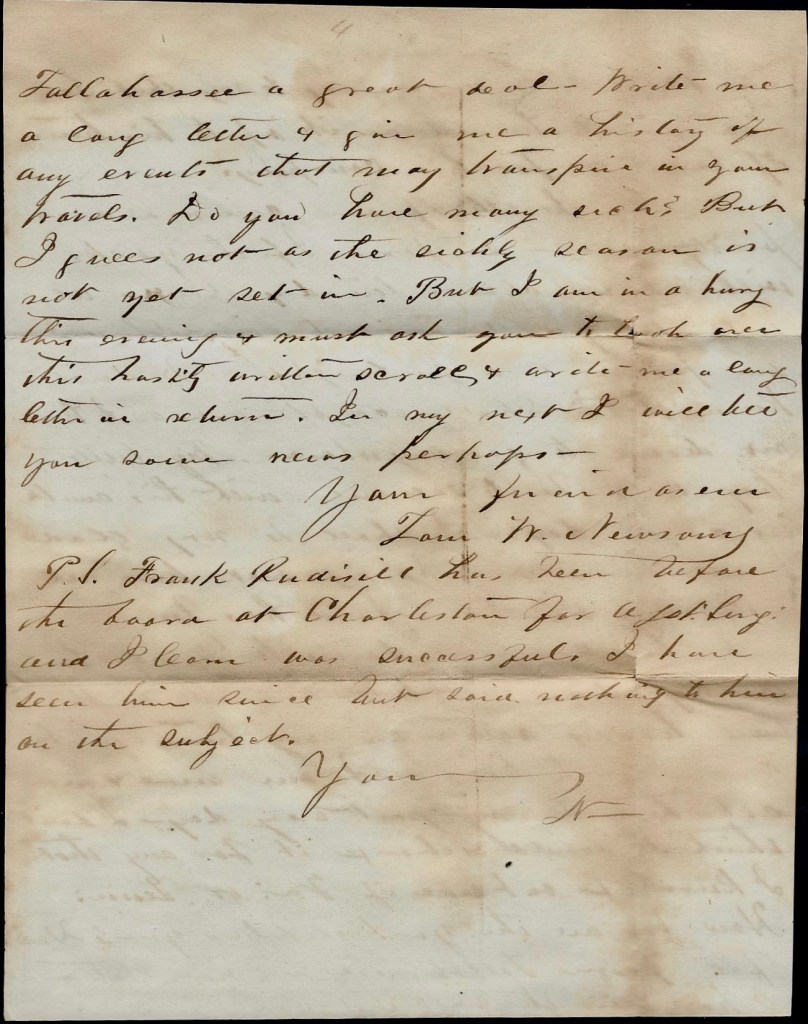
I am more and more attached to my post everyday. I don’t think I would exchange it for any that I know of outside of Virginia or Tennessee. How far are the Yankees below you? How far from Tallahassee are you stationed? I have been through that country around Tallahassee a great deal. Write me a long letter & give me a history of any events that may transpire in your travels.
Do you have many sick? But I guess not as the sickly season is not yet set in. But I am in a hurry this evening & must ask you to look over this hastily written scroll & write me a long letter in return. In my next I will tell you some news perhaps.
Your friend as ever, — Tom W. Newsome
P. S. Frank Rudisill 2 has been before the board at Charleston for Asst. Surgeon and I learn was successful. I have seen him since but said nothing to him on the subject. Yours, — N
1 Possibly W. T. Hollingsworth, a surgeon in the 3rd Georgia Infantry.
2 Probably Benjamin Franklin (“Frank”) Rudisill of the 12th Battalion George Light Artillery who served as staff assistant surgeon.
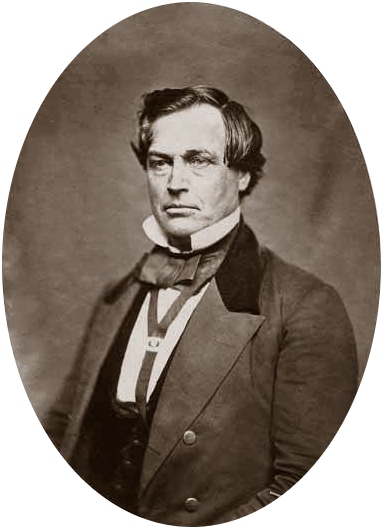
These letters were written by James William Denver (1817-1892), the son of Irish emigrant Patrick Denver, Jr. (1787-1858) and Jane Campbell (1794-1874) who lived in Winchester, Virginia, at the time of James’ birth but settled on a farm near Wilmington, Clinton county, Ohio, in the 1830s. Denver studied civil engineering, briefly taught school in Missouri, and then studied the law, graduating from the Cincinnati Law School in 1844. He practiced briefly in Xenia, Ohio, also purchasing and editing a newspaper, the Thomas Jefferson. In 1845, Denver returned to Missouri, where he practiced law at Platte City. In March 1847, he organized Co. H of Missouri’s Twelfth Infantry Regiment, serving as captain until the close of the Mexican War in July 1848.
James William Denver (1850s)
Not long after the war, Denver moved to California. He was elected to the State Senate in 1851 and appointed California State Secretary in 1852. In 1855, he was elected as a Democrat to the 34th US Congress as a representative from California, serving from March 4, 1855 – March 3, 1857. He was not a candidate for renomination in 1856. Rather, he returned to Ohio where he married Louise Catherine Romback in 1856 and not long after, on 17 April 1857, President James Buchanan appointed him as Commissioner of Indian Affairs.
On June 17, 1857, Denver was appointed by Buchanan as Secretary of the Kansas Territory. In December 1857 he was appointed as Territorial Governor. On the day that Denver assumed the territorial governorship, citizens in the territory voted on the Lecompton Constitution, which opened the territory to slavery. The vote offered a choice only between full slavery and limited slavery in the territory and was thus largely boycotted by Free-Staters who were in favor of abolishing slavery. The pro-slavery constitution passed by an overwhelming margin. Later it was discovered that several thousand votes were cast fraudulently by “Border Ruffians” who had crossed into the territory from Missouri in order to cast pro-slavery ballots (The vote was overturned by a subsequent election in August 1858, and Kansas was later admitted to the Union, in 1861, as a free state. See Bleeding Kansas for details.).
In November 1858, while Denver was still serving as territorial governor, William Larimer, Jr., a land speculator from Leavenworth, planted the townsite of “Denver City” along the South Platte River in Arapaho County in western Kansas Territory (the present-day state of Colorado). Larimer chose the name “Denver” to honor the current territorial governor with the intention that the city would be chosen as the county seat of Arapaho County.
Denver retired as territorial governor in November 1858 and was reappointed Commissioner of Indian Affairs, serving until his resignation on March 31, 1859.
A few months after the start of the American Civil War in early 1861, President Abraham Lincoln commissioned Denver a brigadier general in the volunteer army on August 14. In November 1861, he was ordered to report to Fort Scott in Kansas and in December, he assumed command of all Federal troops in Kansas. During March and April 1862 he commanded the District of Kansas until he was transferred to the District of West Tennessee. On May 16, 1862, Denver assumed command of the 3rd Brigade/5th Division under Maj. Gen. William T. Sherman in the midst of the Siege of Corinth. The very next day Denver’s brigade participated in the fight for Russell’s House. Though his brigade suffered no casualties in this engagement it was nonetheless one of the two brigades leading the attack. On May 27 General Sherman again selected Denver’s brigade to be one of the leading units in an attack against the Double Log House. Denver and Morgan L. Smith’s brigade successfully stormed the log cabin turned block house. During this engagement Major General Ulysses S. Grant was present on the battlefield and indicated his approval of the handsome manner in which the troops behaved. After the fall of Corinth Denver continued in command of his brigade, serving on garrison duty in Mississippi. During the early stages of the Vicksburg Campaign Denver was in command of the 1st Division, XVI Corps, until his resignation from the Union Army on March 5, 1863.”
Letter 1
This letter was written just nine days after President James Buchanan appointed Denver as Commissioner of Indian Affairs.
Addressed to Mrs. L. C. [Louise Catherine] Denver, Wilmington, Ohio
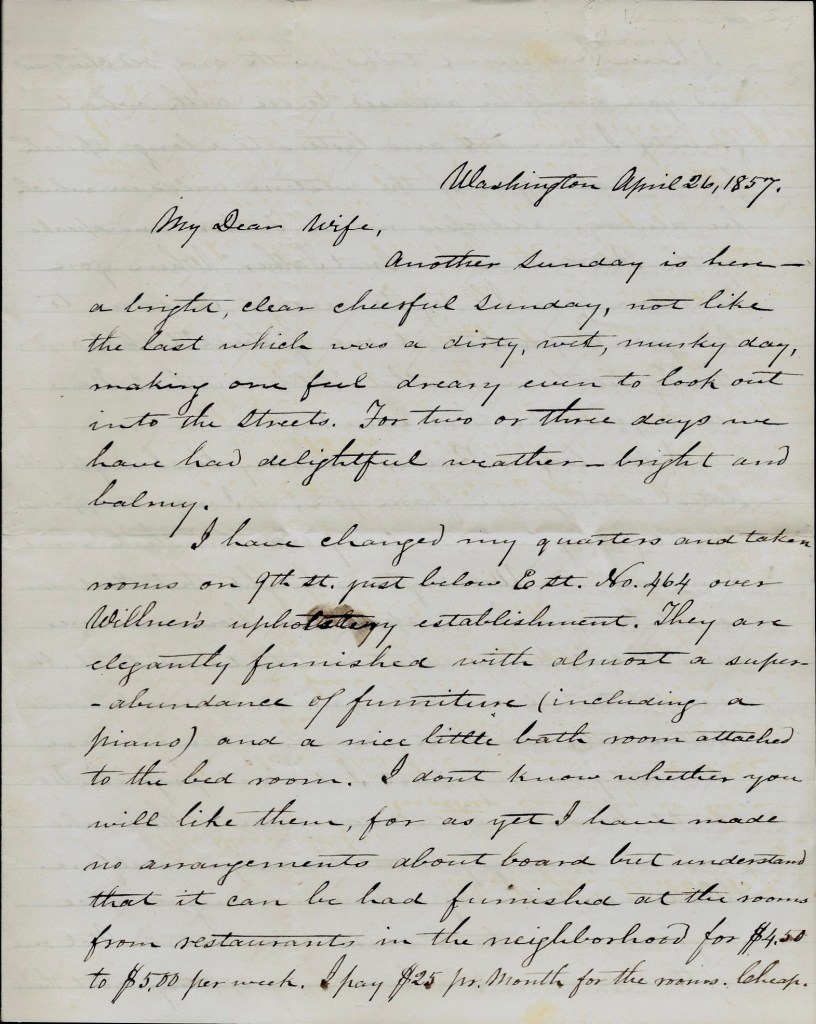
Washington April 26, 1857
My Dear Wife,
Another Sunday is here—a bright, clear, cheerful Sunday, not like the last which was a dirty, wet, murky day, making one feel dreary even to look out into the streets. For two or three days we have had delightful weather—bright and balmy.
I have changed my quarters and taken rooms on 9th Street just below E Street—No. 464—over Willner’s upholstery establishment. They are elegantly furnished with almost a superabundance of furniture (including a piano) and a nice little bath room attached to the bed room. I don’t know whether you will like them, for as yet I have made no arrangements about board but understand that it can be had furnished at the rooms from restaurants in the neighborhood for $4.50 to $5.00 per week. I pay $25 per month for the rooms. Cheap.
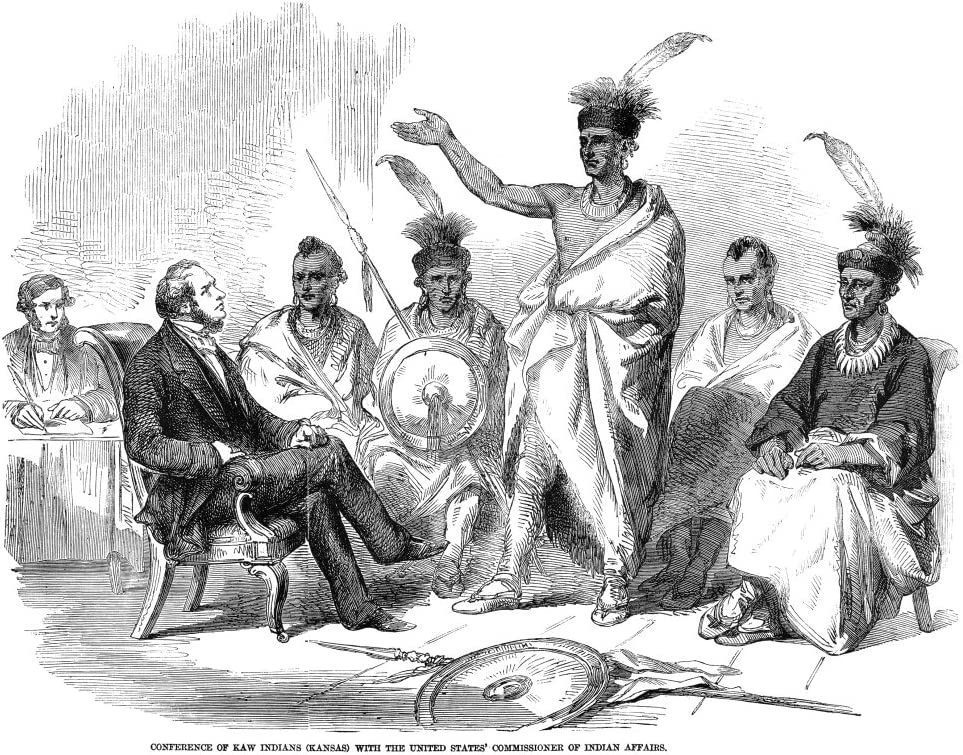
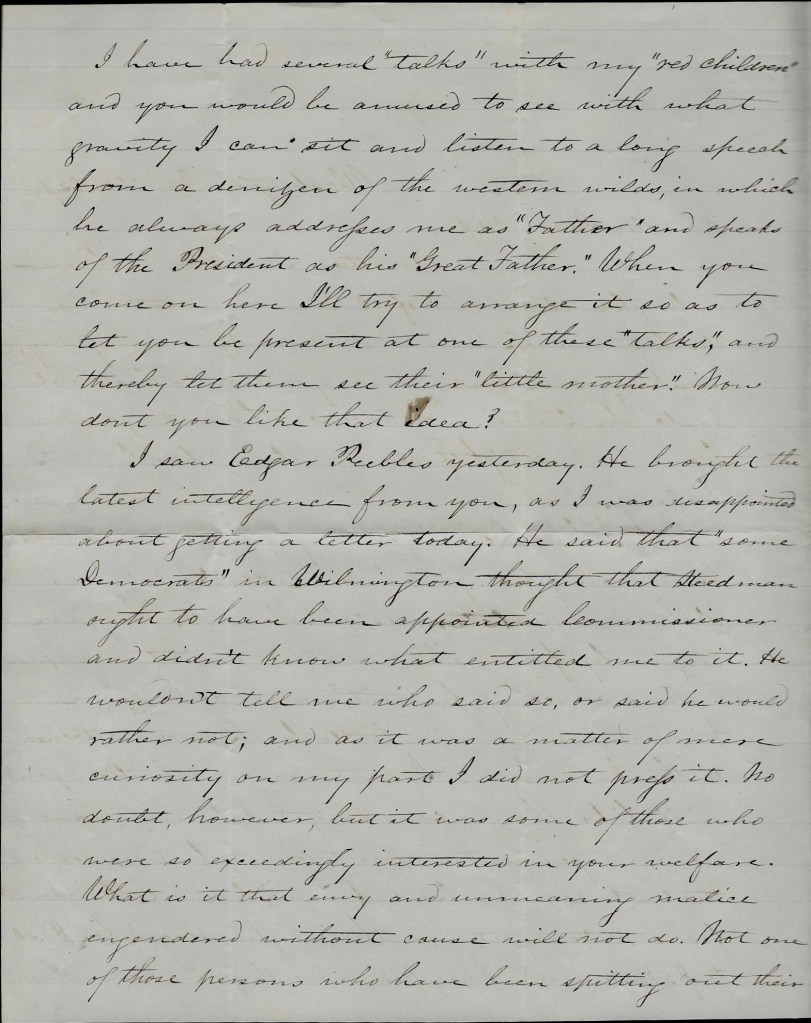
I have had several “talks” with my “red children” and you would be amused to see with what gravity I can sit and listen to a long speech from a denizen of the western wilds in which he always addresses me as “Father” and speaks of the President of the United States as his “Great Father.” When you come on here I’ll try to arrange it so as to let you be present at one of these “talks,” and thereby let them see their “little mother.” Now don’t you like that idea?
Delegation Of Kaw (Kansas) Native Americans At Conference With The Commissioner Of Indian Affairs George W. Manypenny Under President James Buchanan At Washington DC March 1857—just weeks before Denver became the Commissioner.
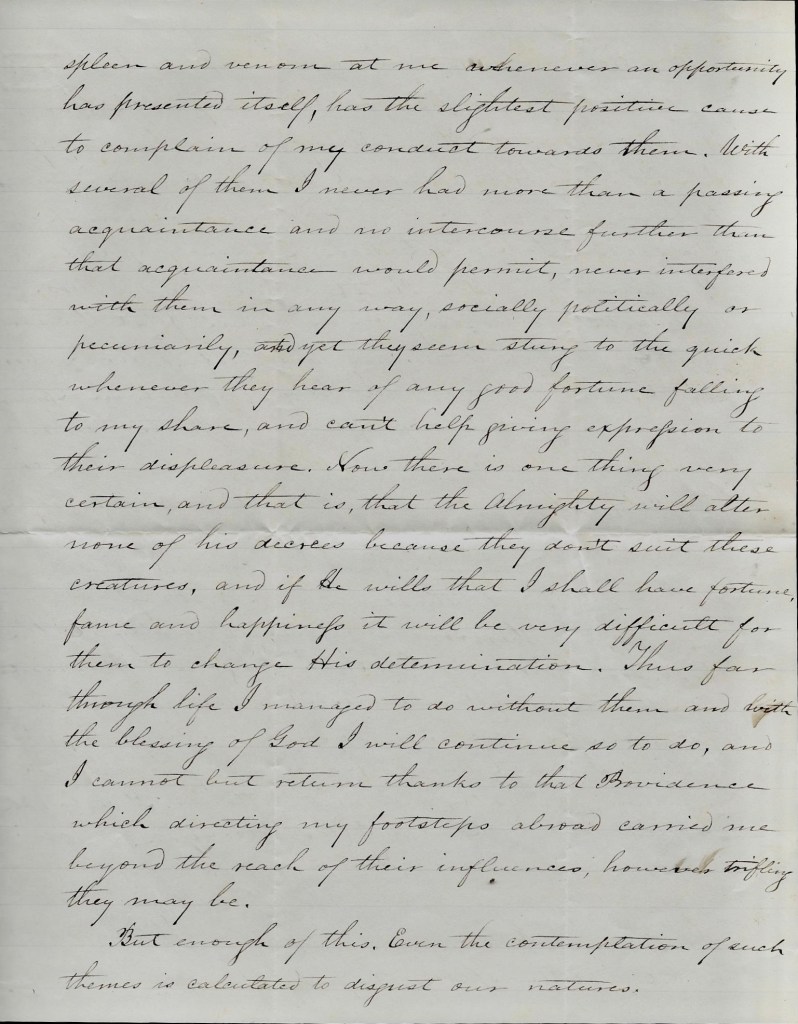
I saw Edgar Peebles yesterday. He brought the latest intelligence from you, as I was disappointed about getting a letter today. He said that “some Democrats” in Wilmington [Ohio] thought that [James] Steedman 1 ought to have been appointed Commissioner [of Indian Affairs] and didn’t know what entitled me to it. He wouldn’t tell me who said so, or said he would rather not; and as it was a matter of mere curiosity on my part, I did not press it. No doubt, however, but it was some of those who were so exceedingly interested in your welfare. What is it that envy and unmeaning malice engendered without cause will not do. Not one of those persons who have been spitting out their spleen and venom at me whenever an opportunity has presented itself, has the slightest positive cause to complain of my conduct towards them. With several of them I never had more than a passing acquaintance and no intercourse further than that acquaintance would permit, never interfered with them in any way, socially, politically, or pecuniarily, and yet they seem stung to the quick whenever they hear of any good fortune falling to my share, and can’t help giving expression to their displeasure. Now there is one thing very certain, and that is that the Almighty will alter none of His decrees because they don’t suit these creatures, and if He wills that I shall have fortune, fame and happiness, it will be very difficult for them to change His determination. Thus far through life I managed to do without them and with the blessing of God, I will continue so to do, and I cannot but return thanks to that Providence which directing my footsteps abroad carried me beyond the reach of their influences, however trifling they may be.
But enough of this. Even the contemplation of such themes is calculated to disgust our natures.
Miss [Jennie] Holman is still here but expects to leave on the 1st prox. for Texas in company with Com[mander Edwin Ward] Moore, late of the [Republic of] Texas Navy, an old friend of her father’s. Her Campbell speculation [romance] is understood to have bursted up and vanished in smoke. She seems to have taken a fancy of late to the handsome Gen. Rust of California.
Mr. and Mrs. Walworth are holding on as usual. Just the same—half laughing, half sneering, dissatisfied air, on her part, and the chuckling laugh, uncertain expression, and semi-genteel language on his part. Mr. and Mrs. Fuller are as usual. She has been all over the City to find rooms but can’t please herself & he doubts whether it is better to —-“give up present ills and fly to those we wot not of” 2 or not, and therefore is inclined to stay at the Kirkwood. Your friend Ross Fish has gone to Minnesota. Gen. Anderson (Von Alderson) is here and has been very kind and clever, as know he always is.
Well, I must wind up. Give my love to all relatives, and do try and write oftener. It is horrible to be so long without a letter from you. Believe me as ever your own, — Will
Mad Lupton & J. Campbell will be out West this spring, they say. Doubtful.
1 James Steedman was an Ohio businessman, editor and politician who, like Denver, sought a political patronage job from the Buchanan Administration. He was given the post of Public Printer of the United States instead of Commissioner of Indian Affairs.
2 Denver has paraphrased a line from Hamlet, Act 3, Scene 1 which reads: “And makes us rather bear those ills we have Than fly to others that we know not of?”
Native American (Ponca, Pawnee, Potawatomi, and Sac & Fox) men pose with white men near the White House in Washington, D. C. The Native American men wear leggings, blankets, bead necklaces, fur pelts, hats, feather roaches, and headdresses. 31 December 1857 (Digital Collections, Denver Public Library)
Letter 2
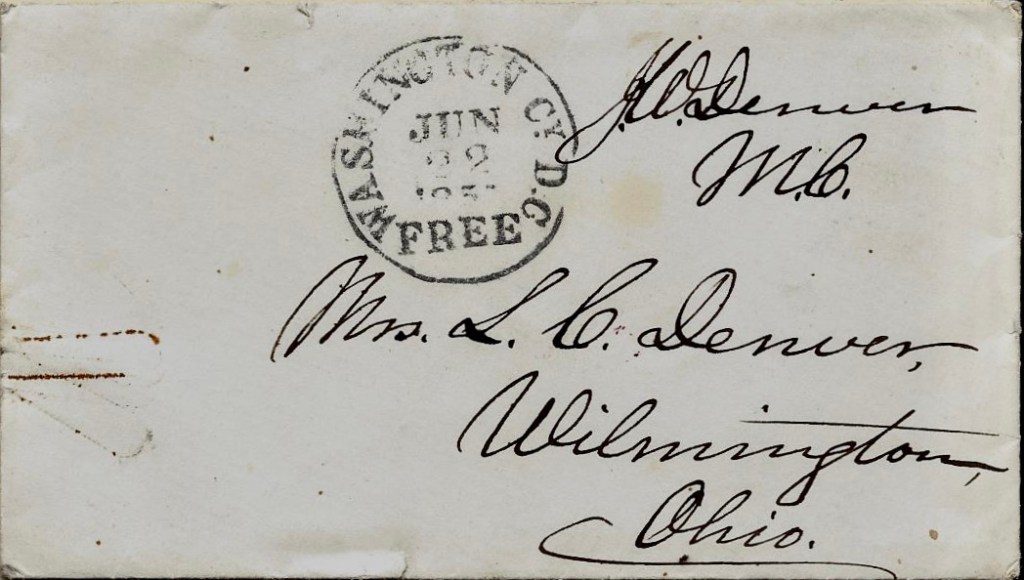
Addressed to Mrs. L. C. Denver, Wilmington, Ohio
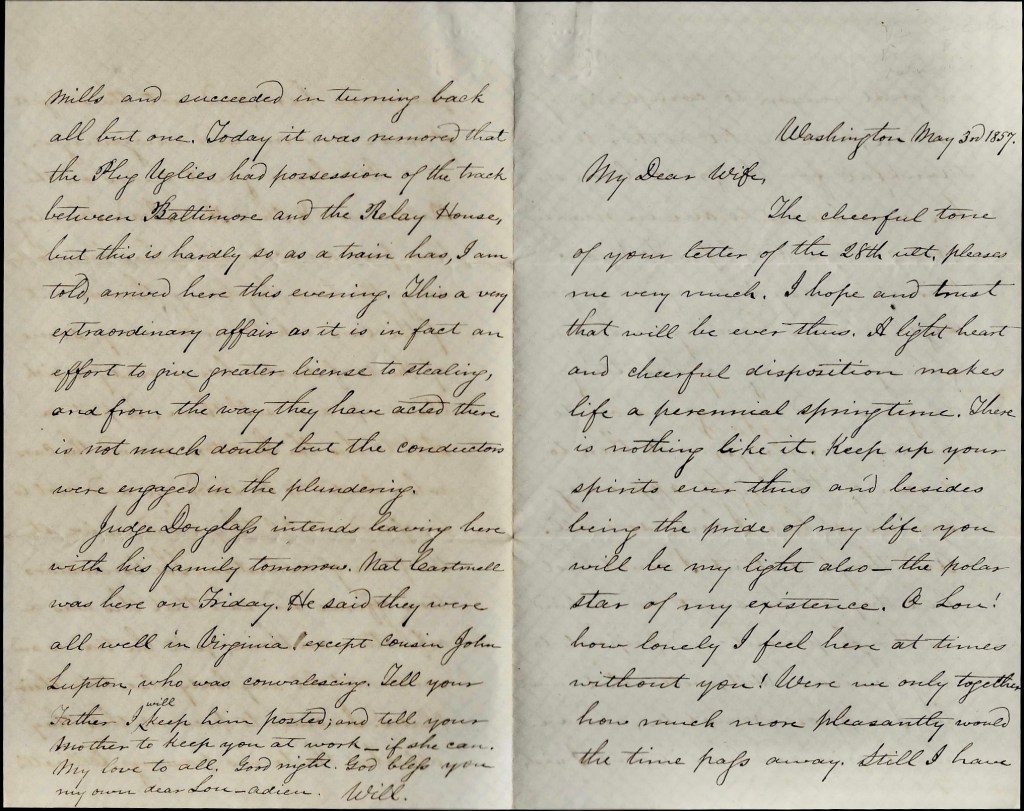
Washington May 3rd 1857
My Dear Wife,
The cheerful tone of your letter of the 28th ult. pleases me very much. I hope and trust that will be ever thus. A light heart and cheerful disposition makes life a perennial springtime. There is nothing like it. Keep up your sprits ever thus and besides being the pride of my life, you will be my light also—the polar star of my existence.
Louise Catherine (Rombach) Denver—“the polar star of my existence,” J. W. Denver
O Lou! how lonely I feel here at times without you! Were we only together, how much more pleasantly would the time pass away. Still I have no great reason to complain of fortune, but ought rather to be thankful for the great boon she has vouchsafed to me in making you mine for life. To know this, it is easy to imagine a good angel always hovering near me, giving warning of besetting dangers and urging me on to greater usefulness, and then to dream of the bright approving smiles of her I love so well. And though distant, I doubt not but they are as sweet and as kind as though present and palpable to my vision. Well, well, what must be, I suppose, must be, and we must grin and bear it; but I wish you were here, and not the subject of mere dreams and imaginings.
Lowell Daily Citizen & News, 4 May 1857
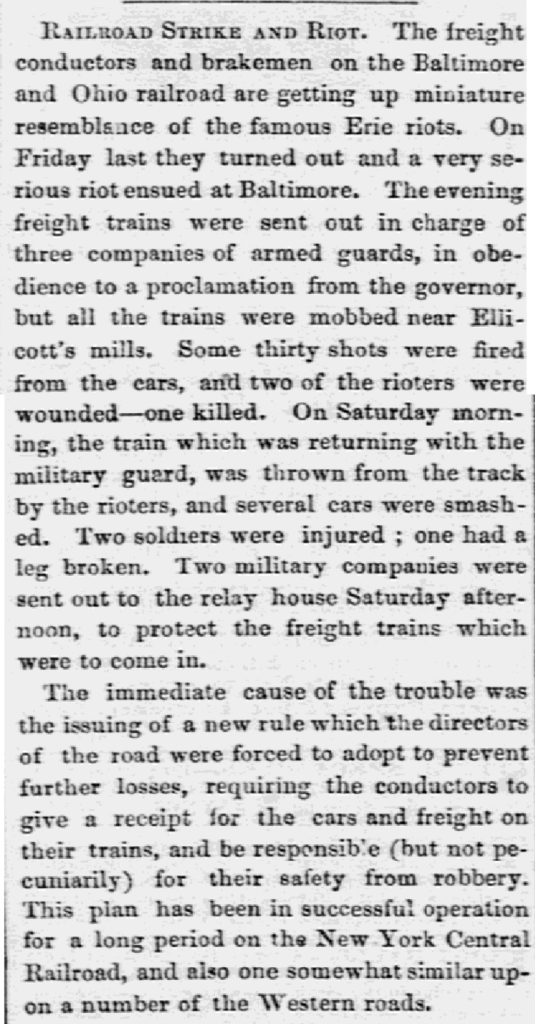
We have great times on the Baltimore & Ohio Railroad. For a long time past, merchandise has been lost along the line, by being thrown out of the cars while under way, some of the confederates being ready to pitch them up and sell them. To put a stop to this, the Directors ordered the cars when loaded to be sealed up and not to be opened until they should arrive at the place of destination. The conductors took offense and said that this was a reflection on them, quit the trains and would not let anybody else take their places. In order to prevent this, they attacked the trains passing Ellicott’s Mills and succeeded in turning back all but one. Today it was rumored that the Plug Uglies had possession of the track between Baltimore and the Relay House, but this is hardly so as a train has, I am told, arrived here this evening. This is a very extraordinary affair as it is in fact an effort to give greater license to stealing, and from the way they have acted, there is not much doubt but the conductors were engaged in the plundering.
Judge [Stephen A.] Douglass intends leaving here with his family tomorrow. Nat Cartmell was here on Friday. He said they were all well in Virginia except cousin John Lupton who was convalescing. Tell your father I will keep him posted, and tell your mother to keep you at work—if she can. My love to all. Goodnight. God bless you, my own dear Lou. Adieu. — Will
Letter 3
Addressed to Mrs. L. C. Denver, Wilmington, Ohio
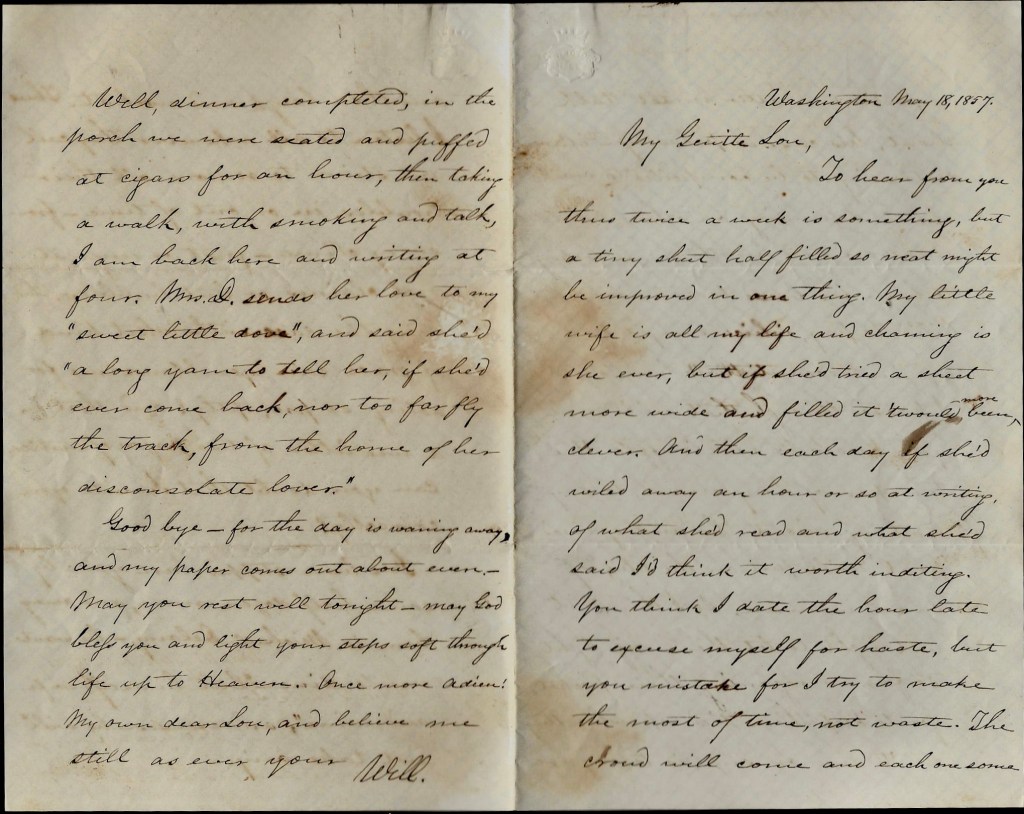
Washington May 18, 1857
My Gentle Love,
To hear from you thus twice a week is something, but a tiny sheet half filled so neat might be improved in one thing. My little wife is all my life and charming is she ever, but if she’d tried a sheet more wide and filled it, t’would been more clever. And then each day if she’s wiled away an hour or so at writing of what she’s read and what she’s said, I’d think it worth indicting.
James William Denver
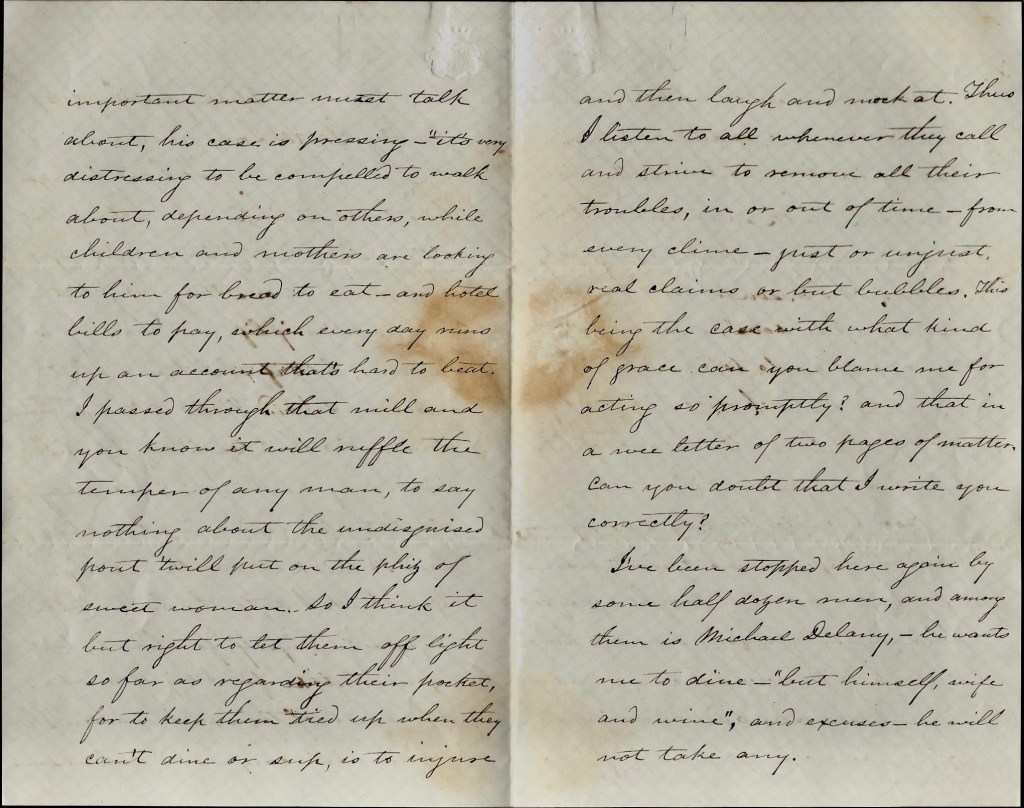
You think I date the hour late to excuse myself for haste, but you mistake for I try to make the most of time, not waste. The crowd will come and each one some important matter must talk about, his case is pressing—“it’s very distressing to be compelled to walk about, depending on others, while children and mothers are looking to him for bread to eat—and hotel bills to pay, which every day runs up an account that’s hard to beat. I passed through that mill and you know it will ruffle the temper of any man, to say nothing about the undisguised pout t’will put on the phiz. of sweet woman. So I think it but right to let them off light so far as regarding their pocket, for to keep them tied up when they can’t dine or sup, is to injure and then laugh and mock at. Thus I listen to all whenever they call and strive to remove all their troubles, in or out of time—from every clime—just or unjust, real claims or but bubbles. This being the case, with what kind of grace can you blame me for acting so promptly? and that in a wee letter of two pages of matter. Can you doubt that I write you correctly?
I’ve been stopped here again by some half dozen men, and among them is Michael Delaney. He wants me to dine—“but himself, wife and wine,” and excuses—he will not take any.
Well, dinner completed, in the porch we were seated and puffed at cigars for an hour, then taking a walk, with smoking and talk, I am back here and writing at four. Mrs. Delaney sends her love to my “sweet little dove,” and said she’d “a long yarn to tell her, if she’s ever come back, nor too far fly the track from the home of her disconsolate lover.”
Goodbye, fr the day is waning away, and my paper comes out about even. May you rest well tonight. May God bless you and light your steps soft through life up to Heaven. One more adieu! my own dear Lou, and believe me still as ever your, — Will
Letter 4
Addressed to Mrs. L. C. Denver, Wilmington, Ohio
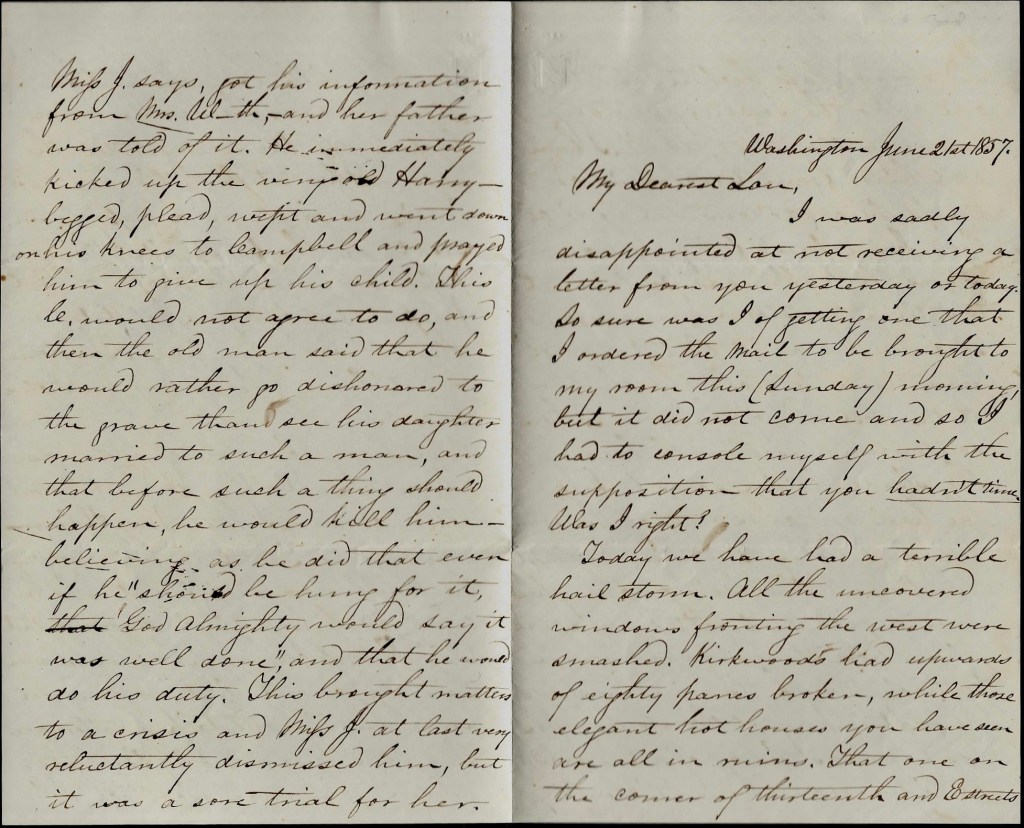
Washington June 21st 1857
My Dearest Son,
I was sadly disappointed at not receiving a letter from you yesterday or today. So sure was I of getting one that I ordered the mail to be brought to my room this (Sunday) morning, but it did not come and so I had to console myself with the supposition that you hadn’t time. Was I right?
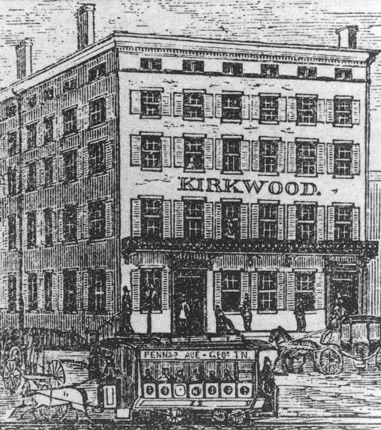
The Kirkwood House was a five-story hotel on Pennsylvania Avenue at 12th Street in WDC.
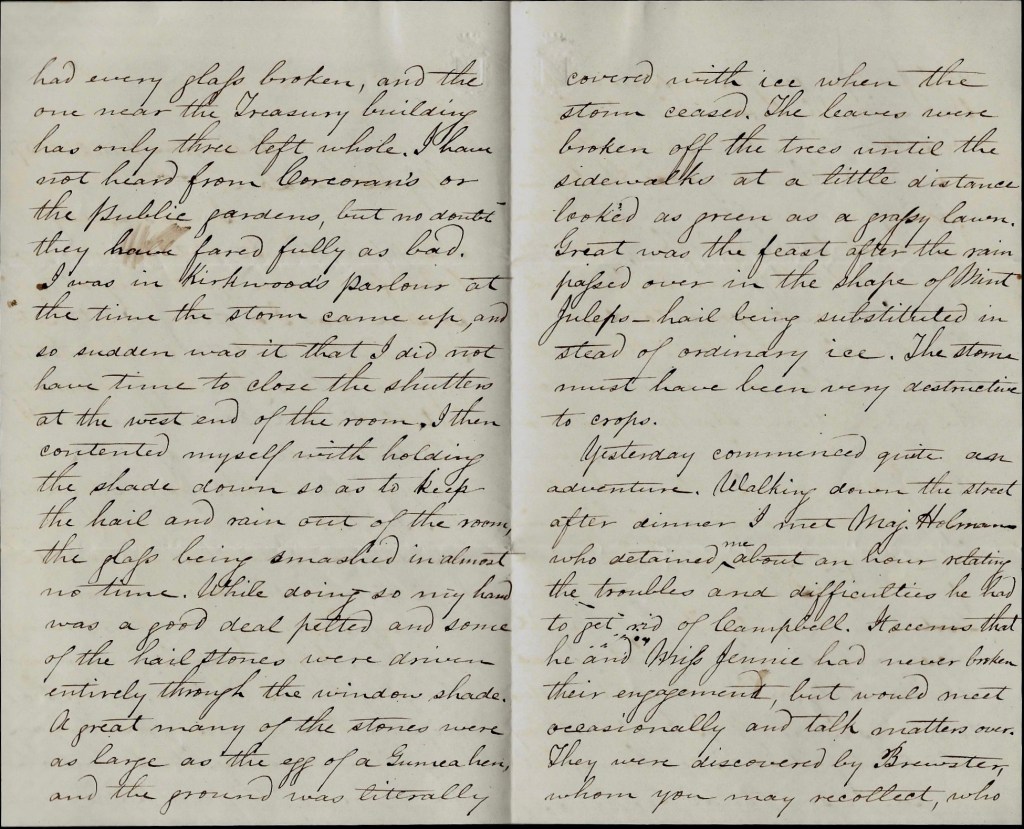
Today we have had a terrible hail storm. All the uncovered windows fronting the west were smashed. Kirkwood’s [Hotel] 1 had upwards of eighty panes broken, while those elegant hot houses you have seen are all in ruins. That one on the corner of thirteenth and E streets had every glass broken, and the one near the Treasury Building has only three left whole. I have not heard from Corcoran’s or the public gardens, but no doubt they have fared as bad. I was in Kirkwood’s parlor at the time the storm came up and so sudden was it that I did not have time to close the shutters at the west end of the room, I then contented myself with holding the shade down so as to keep the hail and rain out of the room, the glass being smashed in almost no time. While doing so, my hand was a good deal pelted and some of the hailstones were driven entirely through the window shade. A great many of the stones were as large as the egg of a Guinea hen, and the ground was literally covered with ice when the storm ceased. The leaves were broken off the trees until the sidewalks at a little distance looked as green as a grassy lawn. Great was the feast after the rain passed over in the shape of mint juleps—hail being substituted instead of ordinary ice. The storm must have been very destructive to crops.
Yesterday commenced quite an adventure. Walking down the street after dinner, I met Maj. Holman who detained me about an hour relating the troubles and difficulties he had o get rid of Campbell. It seems that he and Miss Jennie had never broken their engagement, but would meet occasionally and talk matters over. They were discovered by Brewster, whom you may recollect, who Miss. J. says, got his information from Mrs. W—th, and her father was told of it. He immediately kicked up the very Old Harry—begged, plead, wept, and went down on his knees to Campbell and prayed him to give up his child. This Campbell would not agree to do, and then the old man said that he would rather go dishonored to the grave than see his daughter married to such a man, and that before such a thing should happen, he would kill him, believing as he did that even if he “should be hung for it, God Almighty would say it was well done,” and that he would do his duty. This brought matters to a crisis and Miss J. at last very reluctantly dismissed him, but it was a sore trial for her.
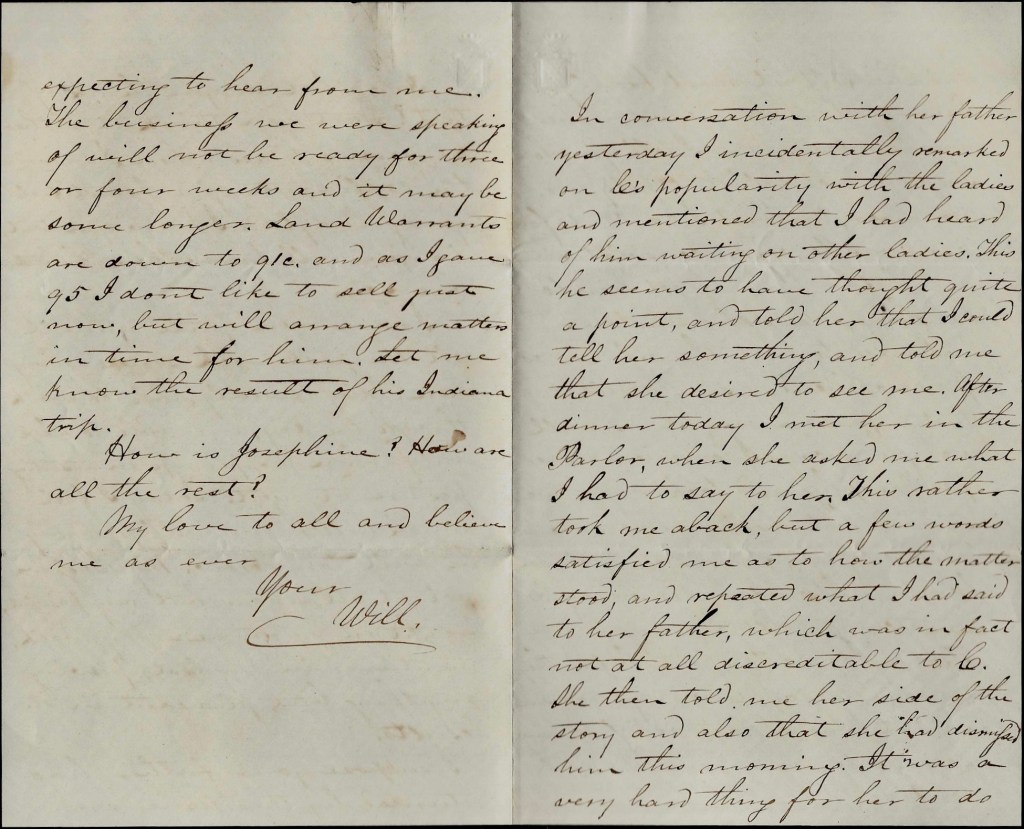
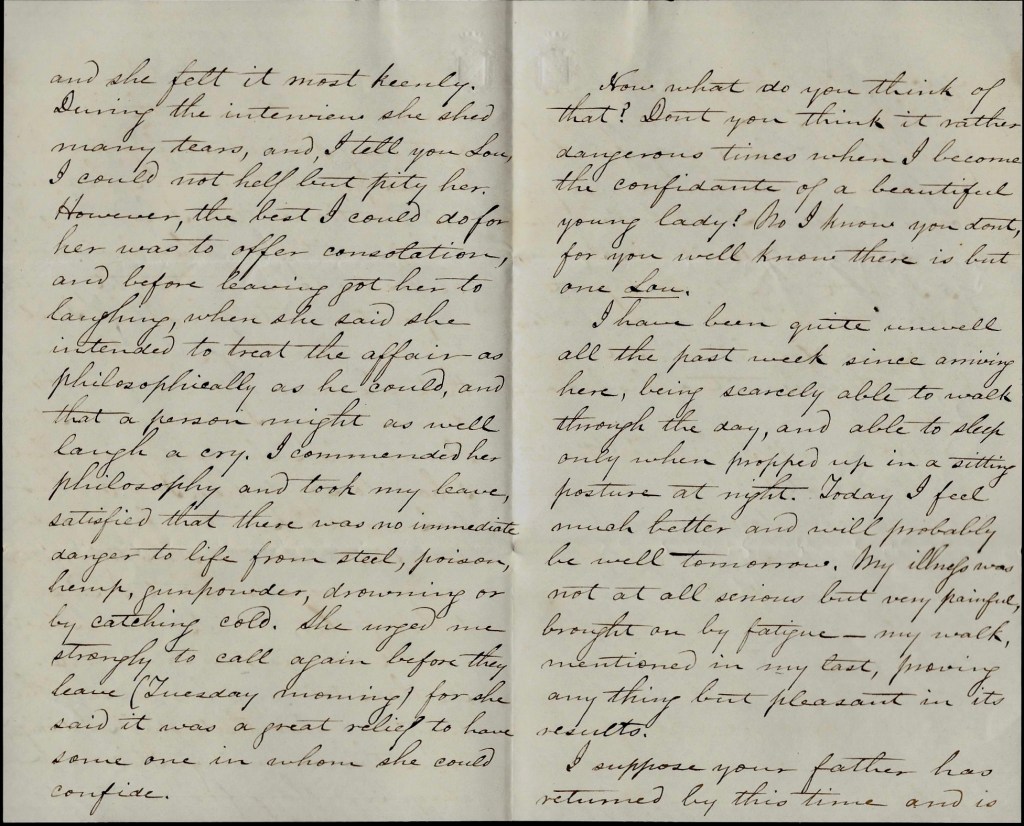
In conversation with her father yesterday, I incidentally remarked on Campbell’s popularity with the ladies and mentioned that I had heard of him waiting on other ladies. This he seems to have thought quite a point, and told her that I could tell her something, and told me that she desired to see me. After dinner today, I met her in the parlor when she asked me what I had to say to her. This rather took me aback, but a few words satisfied me as to how the matter stood, and repeated what I had said to her father, which was in fact not at all discreditable to Campbell. She then told me her side of the story and also that she had dismissed him this morning. It was a very hard thing for her to do and she felt it most keenly. During the interview she shed many tears, and, I tell you Lou, I could not help but pity her. However, the best I could do for her was to offer consolation, and before leaving got her to laughing, when she said she intended to treat the affair as philosophically as she could, and that a person might as well laugh as cry. I commended her philosophy and took my leave, satisfied that there was no immediate danger to life from steel, poison, hemp, gunpowder, drowning, or by catching cold. She urged me strongly to call again before they leave (Tuesday morning) for se said it was a great relief to have someone in whom she could confide.
Now what do you think of that? Don’t you think it rather dangerous times when I become the confidante of a beautiful young lady? No, I know you don’t, for you well know there is but one Lou.
I have been quite unwell all the past week since arriving here, being scarcely able to walk through the day, and able to sleep only when propped up in a sitting posture at night. Today I feel much better and will probably be well tomorrow. My illness was not at all serious but very painful, brought on by fatigue—my walk, mentioned in my last, proving anything but pleasant in its results.
I suppose your father has returned by this time and is expecting to hear from me. The business we were speaking of will not be ready for three or four weeks and it may be some longer. Land Warrants are down to 91 c. and as I gave 95, I don’t like to sell just now, but will arrange matters in time for him. Let me know the result of his Indiana trip.
How is Josephine? How are all the rest? My love to all and believe me as ever. Your Will.
Letter 5
Addressed to Mrs. L. C. Denver, Wilmington, Ohio
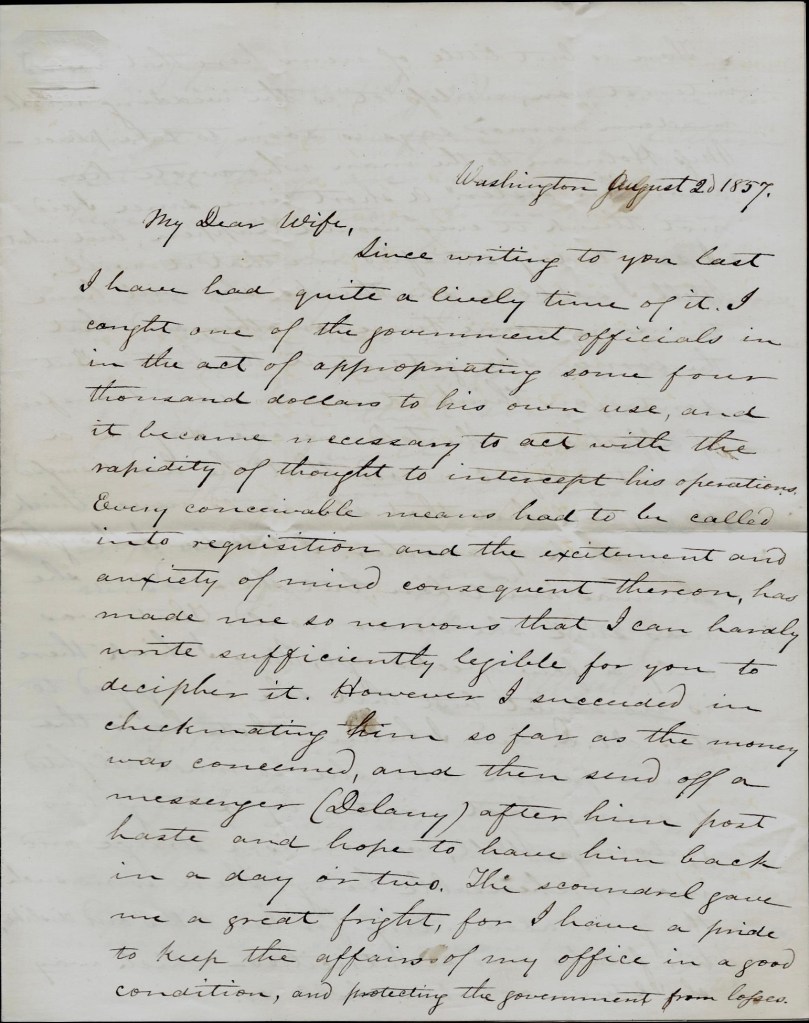
Washington August 2nd 1857
My Dear Wife,
Since writing to you last, I have had quite a lively time of it. I caught one of the government officials in the act of appropriating some four thousand dollars to his own use and it became necessary to act with the rapidity of thought to intercept his operations. Every conceivable means had to be called into requisition and the excitement and anxiety of mind made me so nervous that I can hardly write sufficiently legible for you to decipher it. However, I succeeded in checkmating them so far as the money was concerned and then send off a messenger (Delaney) after him post haste and hope to have him back in a day or two. The scoundrel gave me a great fright for I have a pride to keep the affairs of my office in a good condition and protecting the government from losses.
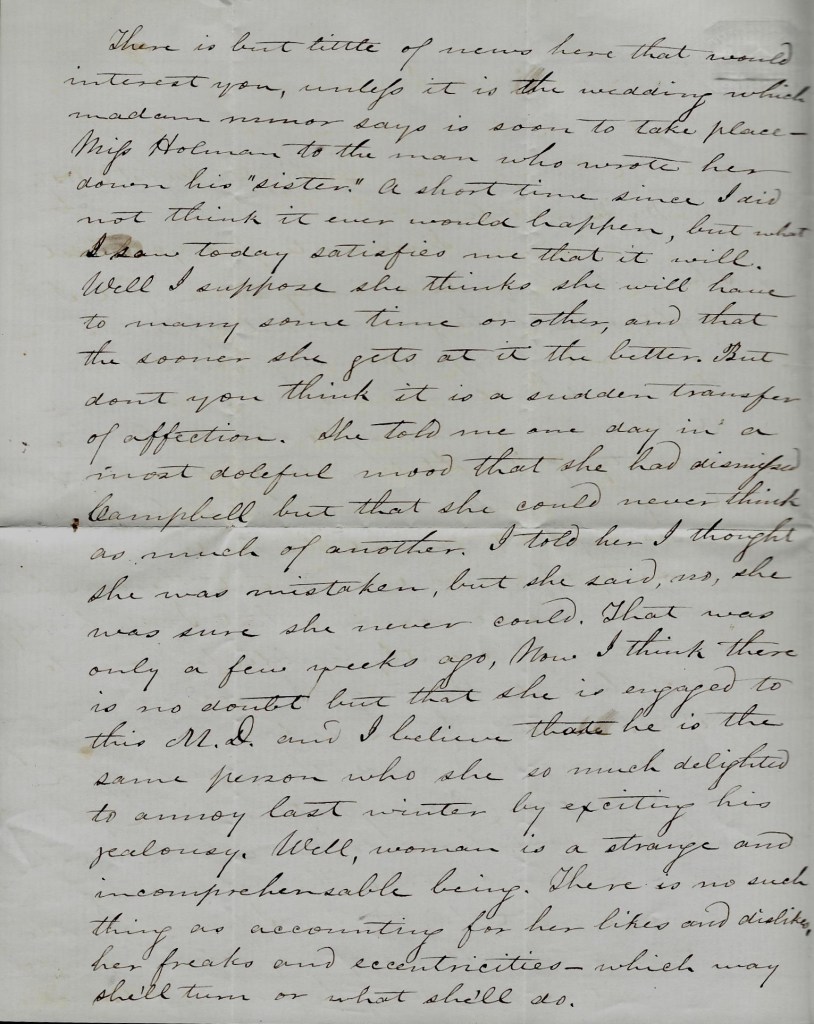
There is but little of news here that would interest you unless it is the wedding which madame rumor says is soon to take place—Miss Holman to the man who wrote her down his “sister.” A short time since I did not think it would ever happen, but what I saw today satisfies me that it will. Well, I suppose she thinks she will have to marry some time or other, and that the sooner she gets at it, the better. But don’t you think it is a sudden transfer of affection? She told me one day in a most doleful mood that she had dismissed Campbell but that she could never think as much of another. I told her I thought she was mistaken, but she said no, she was sure she never could. That was only a few weeks ago. Now I think there is no doubt but that she is engaged to this M. D. and I believe that he is the same person who she so much delighted to annoy last winter by exciting his jealousy. Well, woman is a strange and incomprehensible being. There is no such thing as accounting for her likes and dislikes, her freaks and eccentricities—which way she’ll turn or what she’ll do.
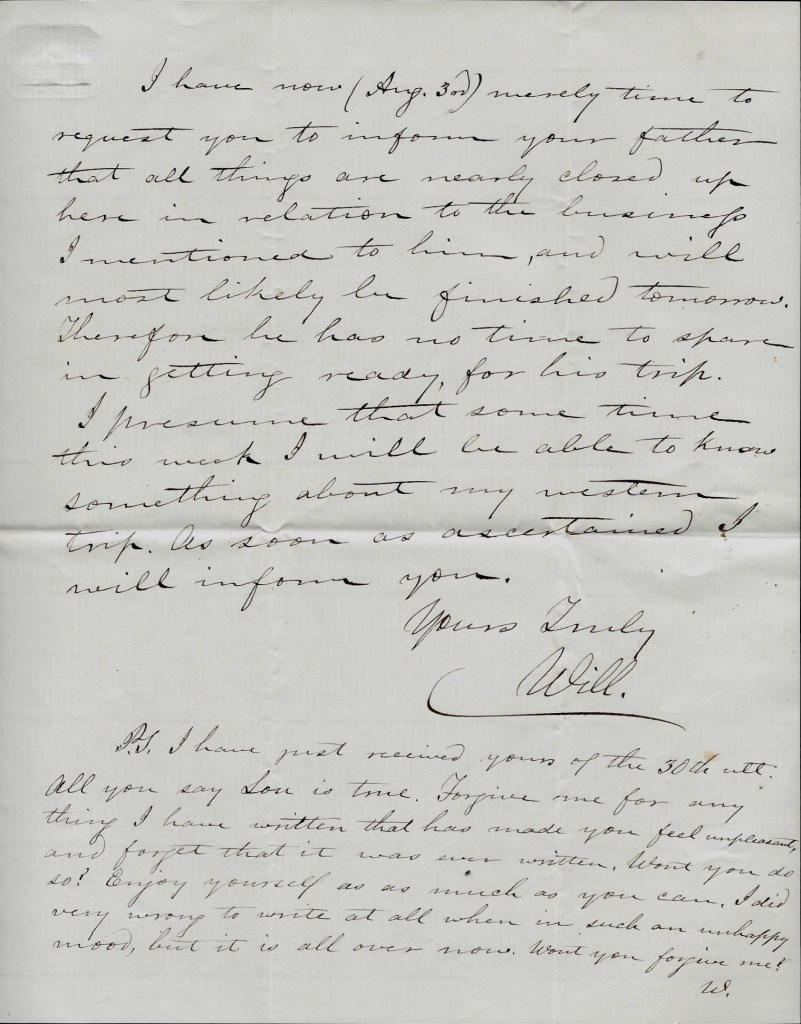
I have now (August 3rd) merely time to request you to inform your father that all things are nearly closed up here in relation to the business I mentioned to him and will most likely be finished tomorrow. Thereforre, he has no time to spare in getting ready for his trip.
I presume that some time this week I will be able to know something about my western trip. As soon as ascertained, I will inform you.
Yours truly, — Will
P. S. I have just received yours of the 30th ult. All you say Lou is true. Forgive me for anything I have written that has made you feel unpleasantly and forget that it was ever written. Won’t you do so? Enjoy yourself as much as you can. I did very wrong to write at all when in such an unhappy mood, but it is all over now. Won’t you forgive me? — W
























 Spared & Shared 23
.jpg)