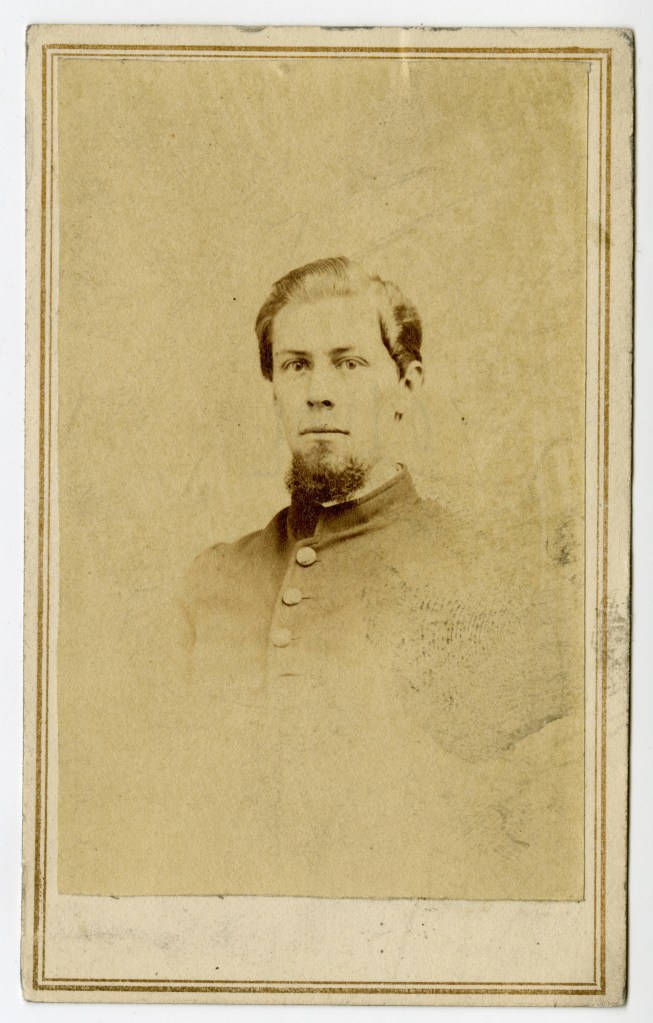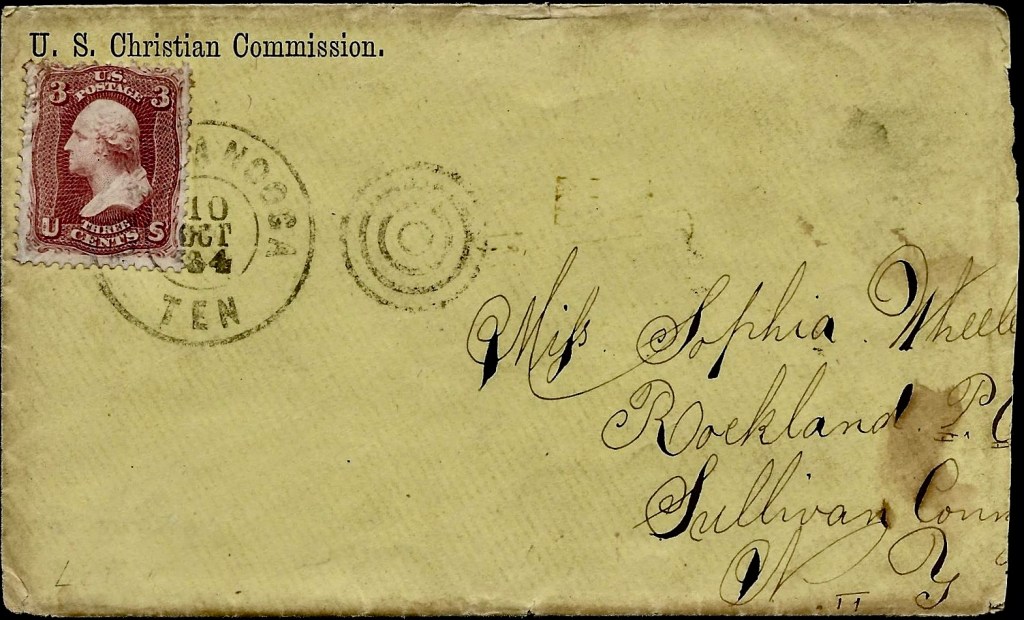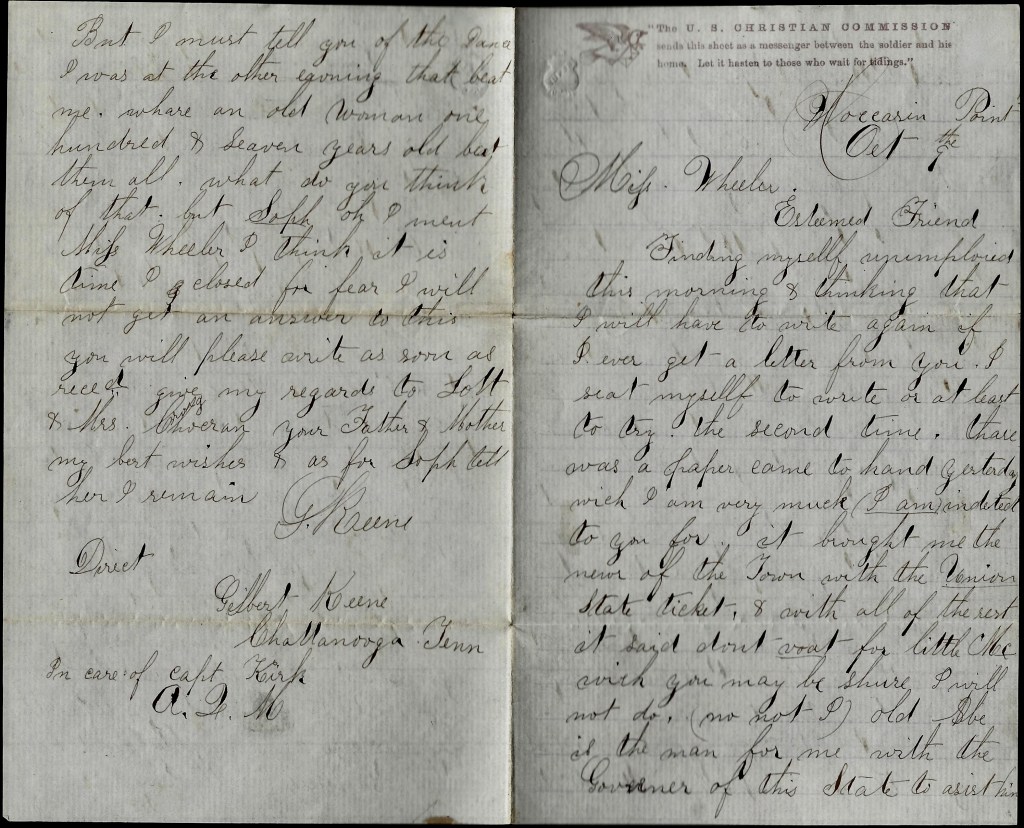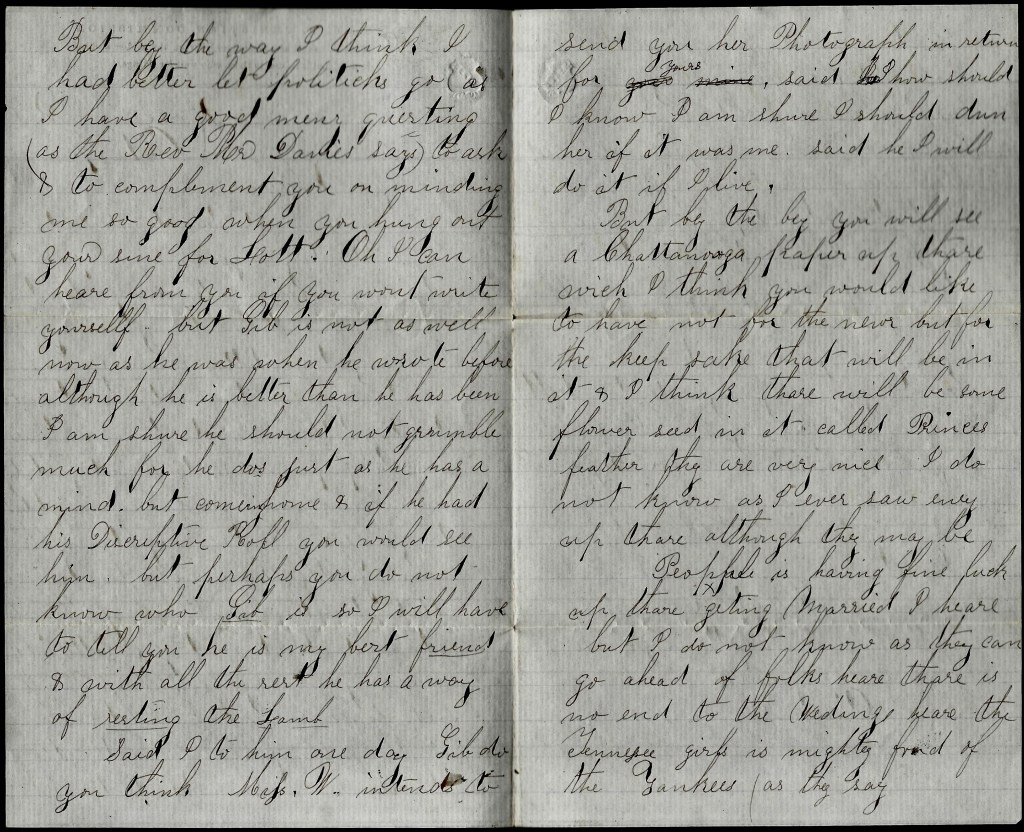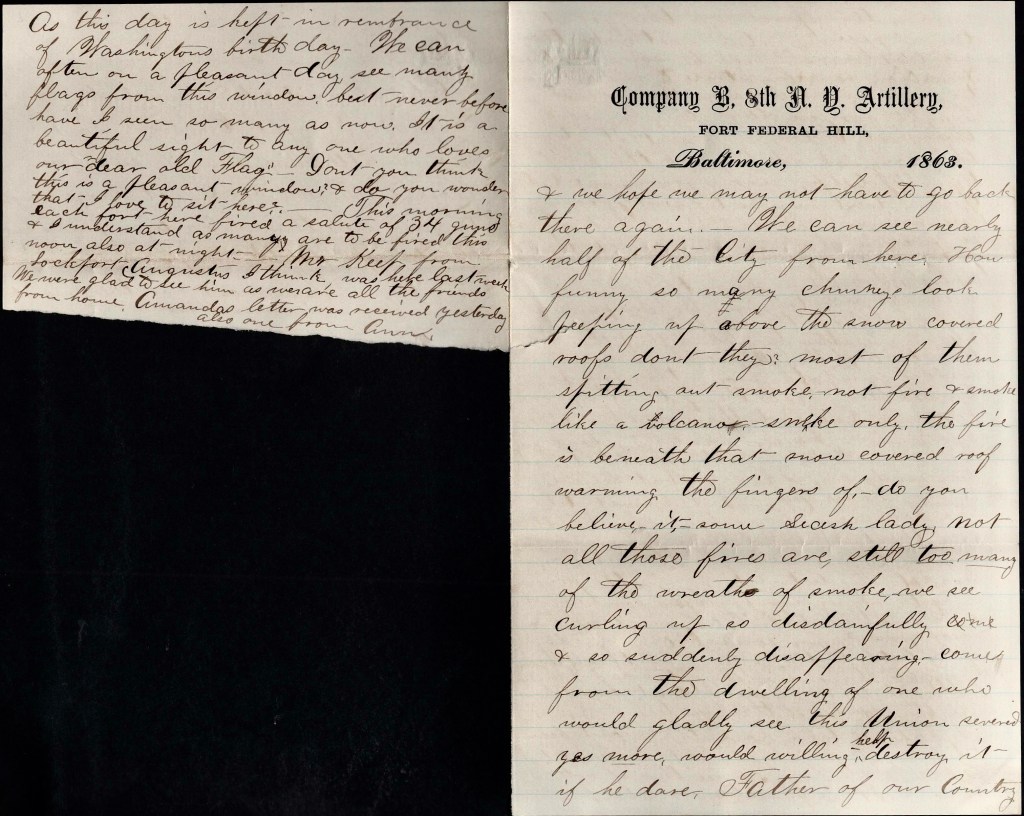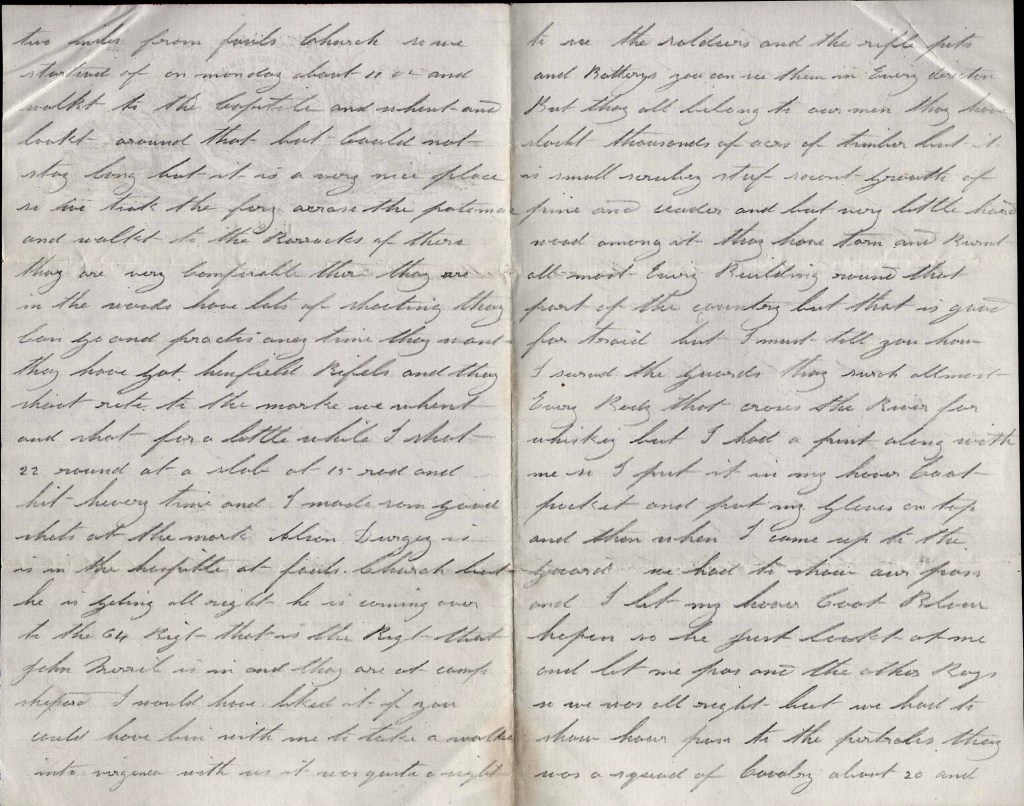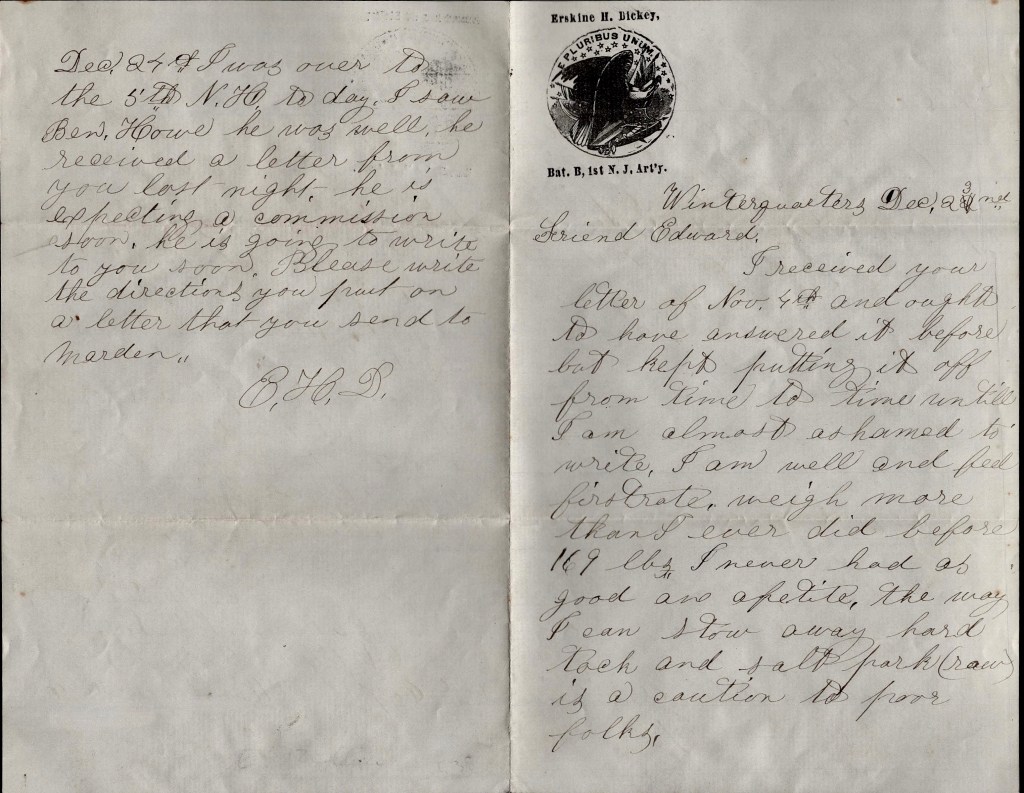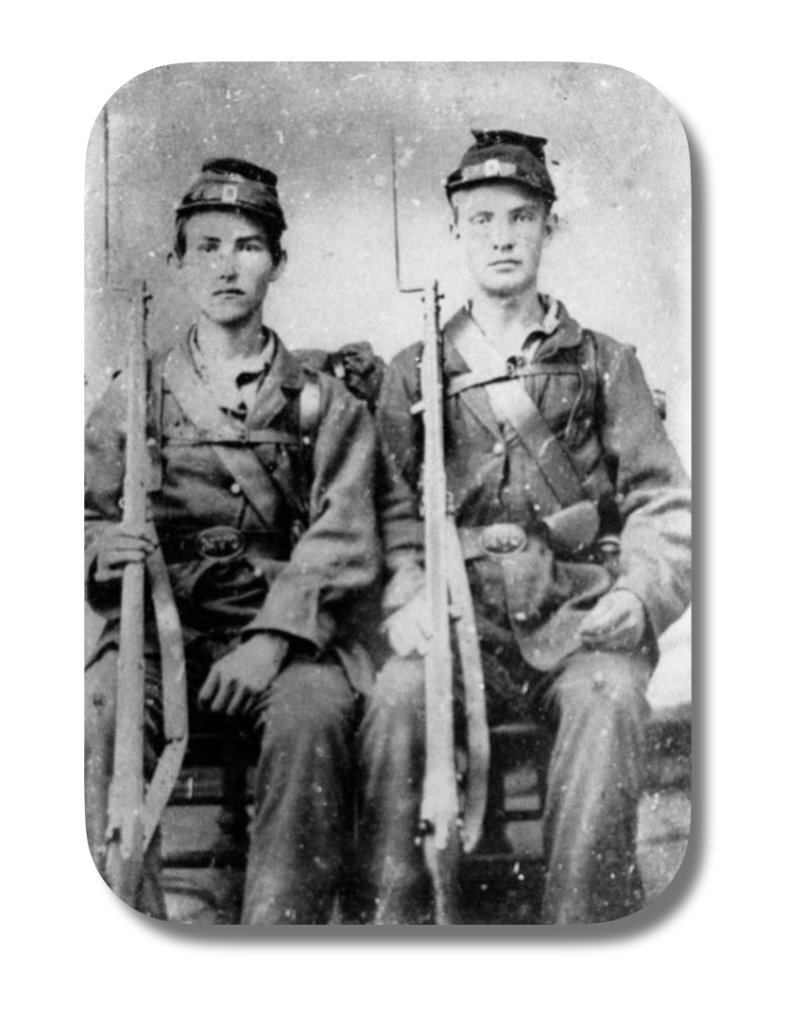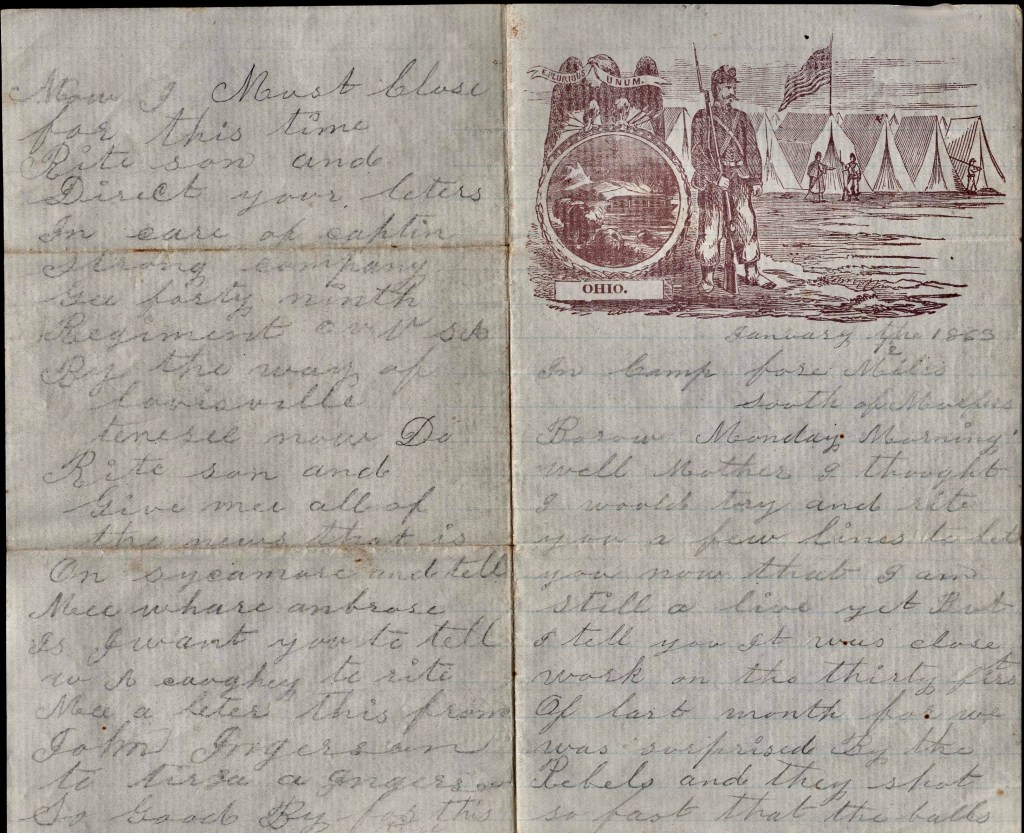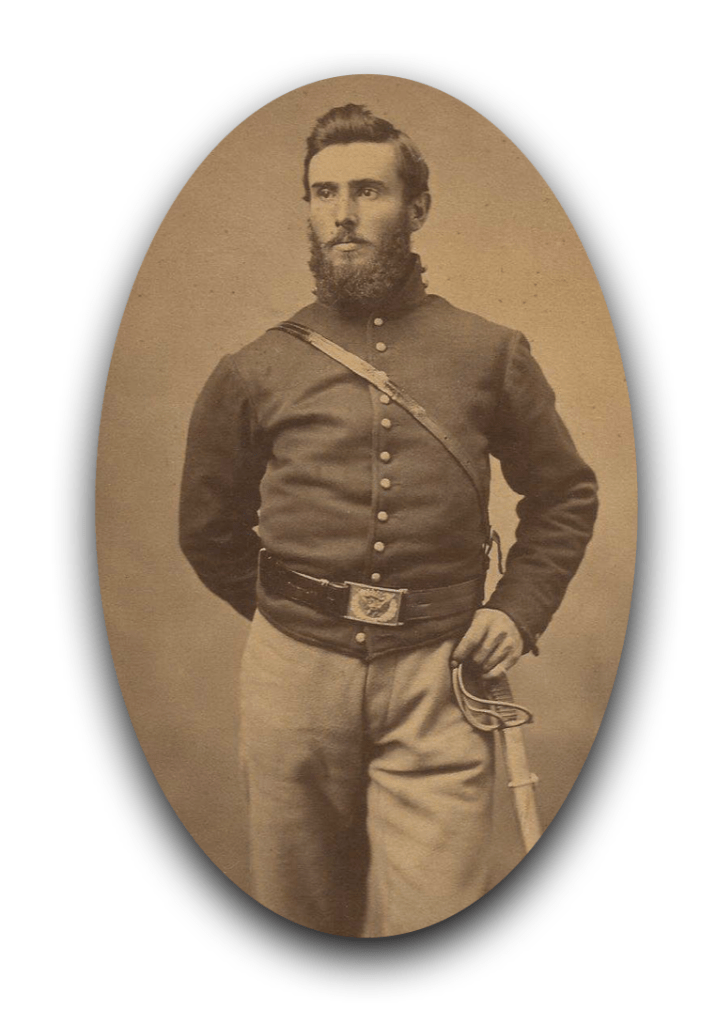
I can safely attribute the following letter to Samuel “Otis” Sawyer (1839-1908), a carpenter in Cambridge, Massachusetts, at the time of his enlistment on 2 July 1861 as a private in Co. A, 16th Massachusetts Infantry. He mustered out of the regiment on 27 March 1864 after nearly three years service. The letter mentions another soldier—John Wilson—who also served in the same company from Cambridge.
Otis was the son of Samuel James Sawyer (1816-1854) and Eleanor Dodge Morgan (1816-1890) of Exeter, New Hampshire. He wrote the letter to his younger brother James “Monroe” Sawyer (1841-1863), a clerk living with their widowed mother in Cambridge at the time. As a matter of curiosity, Otis survived the war as a soldier but his younger brother James, who never enlisted, was fatally stabbed on 18 August 1863 by Edward Owens and James Farris while defending two women in August 1863. He died of his wounds three days later. Otis married Mary E. Marston (b. 1845) in December 1866.
Otis and Monroe (who were both called by their middle names) had a younger sister named Lucy Ann Sawyer (1845-1900) who married George Henry Foster (1844-1906) of Cambridge. Lucy’s first-born, Lilliam Monroe Foster (1867-1945) kept a family photo album that included the pictures below of her mother and two uncles, Otis and Monroe.
This remains the only Samuel Otis Sawyer letter I have found via an internet search. In his recent book, “The Men of the 16th Massachusetts: A Civil War Roster and History,” Alden Ellis, Jr. informs us that the 16th Massachusetts was “one of a few Massachusetts regiments whose history was not recorded. From 1861-1864, it was deeply embroiled in the operations of the Army of the Potomac. Suffering from a lack of skilled leadership and later from horrific living conditions, the 16th saw heavy casualties. Of more than 1300 men, 112 were killed in battle, 360 were wounded and 52 died from their wounds. Disease claimed 115 and 65 were taken as prisoners of war, 32 of them dying in Confederate prisons. Another 344 went home afflicted with wounds or disease as disability discharges.”
Otis SawyerMonroe SawyerLucy (Sawyer) Foster
See also some letters by Asa Smith of Co. K, 16th Massachusetts that I transcribed and published just last month on Spared & Shared. 1862: Asa Dennis Smith to his Family.
Transcription
The camp of the 16th Massachusetts at “Camp Hamilton” near Fortress Monroe in the winter of 1861-62.
Camp Hamilton, Fortress Monroe January 17, 1862
Dear Brother,
I received the box that you sent me and found everything in good condition. I gave John Wilson the things that you told me to and he told me to tell you that he was much obliged to you and he sent his best respects to you.
Tell Mother that I am much obliged to her for the quilt and the rest of the things. I shall send 15 dollars in this letter for you to do as you think best with it. I would send more but I bought a pair of boots from one of the boys that sent home for them and some other to pay out so I could not send any more this time. I wish that if you get a chance you would send me some tobacco for it hard to get it here and when we do get it, we have to pay 60 cents a pound for it. Perhaps you can find someone that is going to send a box that you can put it in.
The expedition started away from here last Saturday night about midnight and we did not hear from it till today. There is a rumor about here that they are in the rear of Norfolk and that they have given the women and children 24 hours to leave the city before they make a strike. I hope it is true. If it is, we shall see some of it for Norfolk shore we can see from our camp through a glass. It is about 18 miles across the water.
There was a vessel come in here with 500 troops for the 29th [Massachusetts] Regt. at Newport News. They come from Boston so they said. I wrote a letter to Hattie Baker last Sunday and I expect she will answer it. I had another letter from William Estes and he is enjoying himself as well as he can. He said that he did not think that he would go home this winter.
I cannot think of much more to write this time so goodbye from your brother, — Otis
You must write soon. I sent two pictures that was taken out of Hampton the night of the fire and a cotton ball by the Captain. I wish you would let me know if you got them [when] you write.
Miles Leroy Storrs, Co. Founder, 1st Nebraska Regiment (Infantry/Cavalry) Michael Huston Collection
The following letters were written by Miles Leroy Storrs (1842-1866) and his brother Eugene Orange Storrs (1844-1908). They were the sons of Nelson Colomor Storrs (1818-1903) and Phoebe Ann Porter (1820-1896) of Clarinda, Iowa who enlisted together on 15 June 1861 to serve in Co. F, 1st Nebraska Regiment (Infantry/Cavalry). Surprisingly, the boys’ father also enlist a couple months later in Co. K, 4th Iowa Infantry, when he was 44 years of age. He found the rigors of a soldier’s life too difficult to endure, however, and mustered out on 1 February 1862.
Apparently Miles did not have a robust constitution either for muster rolls show that he was discharged for disability on 29 March 1863 after little more than a year and a half of service. Eugene, however, carried on until the expiration of his term of service in November 1864.
There are only eleven brief letters in this collection—most of them written by Eugene. Neither of the boys were particularly gifted in writing nor inclined to write lengthy or detailed letters. The collection was sold recently at an auction in Ankeny, Iowa. It’s not known whether there are any other extant letters. I have not found any in on-line bibliographies or archival catalogues. I would have to say that letters by Nebraska soldiers are rare. In the 15,000 or so letters I’ve transcribed in the last 15 years, these are the first letters by Nebraska soldiers sent to me for transcription. I wish to thank Michael Huston who now owns these letters for sharing them on Spared & Shared.
I will again write you a small letter. I guess you cannot grumble by this time for not receiving any letters from me. This makes the third letter I have written to you without receiving any answer. We are very well at present. My leg is almost well. There is some talk of leaving our winter quarters hastily. I know not where for. Tell me, father, when you think this trouble will be ended. I want to hear from mother. I think you do not quite fulfill your duty as concerns writing. I have completely given up all hopes of receiving any letters.
Johnny Pierce, R. Gibbs, & the rest of the boys.
I think there is no danger of Europe interfering since we have given up Mason & Slidell. You must write me one more letter father.
It is very disagreeable weather here at present—cold & sleety. I received a letter from Darius & Melissa yesterday. They are well but no news of importance. I will now close my letter. Goodbye, — Eugene O. Storrs
Letter 2
Memphis, Tennessee June 22, 1862
My beloved parents,
I sit down alone on picket to answer a letter we got from Mother last night. I was glad to get your letter but very sorry that Mother is so uneasy about us. Mother, your good advise I will follow so be contented until we get home again and if you want to buy anything, use my money that I sent to you and have not heard whether you got it or not. It was $30. I sent it to A. Lorens in Clarinda so that you could get it by going there. We both get letters from you only once in a great while. Miles writes pretty often and so I don’t write very often.
It is said that Jeff Thompson was baptized here yesterday in disguise. I have no more to write—only that my health is very good and stand the marching very well. Excuse my short and hasty letter, — Eugene S. Storrs
Letter 3
Quincy, Illinois November 13, 1862
Dear Parents,
I received your letter dated the 8th November his morning. I am quite well except a cough. I don’t know whether I can get my discharge or not but I will see if I can. I don’t know where the regiment is unless at Little Rock, Arkansas. If you know, let me know and I will write to the captain. If I go to the regiment and hant well, I can get a discharge there for our doctor said that I never would be fit for duty. I don’t think I can get it here.
The weather is good here. We have had one snow. I have not wrote to Miles yet. If he had done right, he would been here. As soon as I found that they were sending me to the Barracks, I took my knapsack and went back to the hospital.
Mother must not be discouraged for I am in good spirits. There is some men and nurses that is acquainted with father when he preached in Clay county away in the Yankee school house. — Eugene O. Storrs
Letter 4
Eminence [Shannon county, Mo.] February 14th 1863
Dearest parents,
I have once more an opportunity of writing you a few lines today. We received our pay. Eugene came to the company yesterday. We both drew 6 months pay. I and Eugene send you $100 by our chaplain. We will express it from St. Louis to you. Eugene is not very stout. I am doing no duty now. I tell you, we see rough times now—barefooted, starved on half rations. There is some talk of our regiment on the left wing of our regiment going to the Knob to guard a provision train that takes our company. We are now about 60 miles from the Knob & the same from Rolla. I will be anxious to hear whether our money comes safe or not. Please to answer as quick as you receive this. The weather is quite pleasant today.
Mother, I received those rations you sent me. I tell you I had a good cup of tea. We were down pretty near to Batesville, Arkansas. I tell you, this is an awful rough country. I am tired of these Ozark Mountains. I have not seen a newspaper for over a month. I don’t hear any war news whatever.
I will leave room for Gene but he says he don’t want to write. He wants me to do it all as usual. I showed him Mother’s and his niece’s picture. He says, “Shaw.”
This is an awgul wierd country for to get mail. You must excuse this poor writing. I have nothing more to write so I close. Remaining your son, — M. L. Storrs
E. O. Storrs
Letter 5
Arcadia, February 24th 1863 Pilot Knob, Ironton [Mo.]
Dewar Parents,
I have written a letter today to you & while going to the Post Office, I lost it. I tell you, I do not feel much like writing. Eugene is doing no duty. Neither do I. I am so worthless I do not know what to do. I see in today’s paper they commenced fighting at Vicksburg the 21st. I hope they will do the thing up this time.
Father, I will not quarrel with you on the question of slavery but I am decidedly opposed to abolitionism, Horace Greeley & co.
We have marching orders in the morning. I do not think we will go far. Write and tell me if you get the money expressed to you. I am not going to write much. Melissa, you must excuse me for not writing & answering your letter. I am glad to hear from Daring. Tell me if he went in the Vicksburg fight. I close.
— Miles L. Storrs
Excuse this. I am so tired. The one I wrote this morning was quite a lengthy letter. — M. L. S.
Letter 6
Cape Girardeau, Missouri April 29th 1863
Dear Brother,
I improve the time in writing you a few lines. I am well & the rest of the boys are well. THe regiment is out on White Water after Old Marmaduke. We had a pretty good fight Sunday. Pretty hot times but not much loss on our side. A. B. & P. R. Wagar is on Provost Guard in town so they are not on a scout. I and Mr. Franklin is left to guard the camp. — E. O. Storrs.
Letter 7
Pilot Knob [Missouri] June 13th 1863
Dear Brother [Miles],
I received your letter yesterday and was very glad to hear that you are getting better & that Father was well. You wanted to know what I thought about improving Father’s land in Page county. Well, if Father wants to put improvements there, I think it is as good thing as we can do with our money, to make a home there first. And if I get a land warrant, I can do as I like about improving the land if I could get any. But I don’t believe I will get a warrant. Let father go ahead with it and so what he wants to do.
Miles, we have got Solomon Knight in the guard house for a deserter and of Sam Ford [?] that went at Shiloh. I guess we will stay here until Davidson goes below and then we will go with him. — Eugene O. Storrs, Co. F.
To M. L. Storrs, Citizen
Letter 8
Pilot Knob, Mo. July 2nd 1863
Dear Father,
I had the pleasure of receiving a letter from you and Miles a few days ago that I did not answer on account of being sick. I am getting along pretty well now. The weather has been hot but if you can make any use of the money I sent to you, do it. We are to be paid today but I can’t send any money this payday for I owe some for clothing that I have to settle for.
We are building a fort on the hill where we used to drill and shoot at the target. Miles knows where it is. It is called Fort Davidson. 1 It has 6 fronts. It is said that we are a going to leave here before a week. I hope it is so. Mr. Fickling went to the post hospital this morning. Excuse this short letter. — E. S.
1 Fort Davidson was a six-side earthwork fort built to protect iron mines and furnaces near Pilot Knob, Missouri. It was built on an open plain in Arcadia Valley southwest of Pilot Knob. Each of the hexagonal sides was 150 feet long and made of packed earth with planks on the inside 5 to 9 feet high. There was a dry moat surrounding the fort 6 to 8 feet deep and ten feet wide. There were four 32-pounder siege guns, three 24-pounder howitzers, and a half dozen Woodruff guns mounted in the fort.
Letter 9
Pilot Knob, Missouri July 4th 1863
Dear Father,
I received a letter from you yesterday. My health is good as could be expected in this place. You said I did not write often enough. Well father, when I am not sick, I am on duty of some kind, either on guard or on the fort. There is nothing going on here but firing the National Salute from the fort at Arkada [Arcadia] two miles below from the 32-pounder Sigel guns that Co. C is manning. I would think that Miles—as he can’t do any hard work—would go to studying book keeping and then he would have something to work at that he could do, but I guess Miles hant a going to get married in Page county for Hapy J don’t want to marry, I guess, & she is all be corresponded with there.
Mother, I wish you would write some to me when Father does. Is Melissa’s school out yet in town? I got a letter from Darius that I must answer so I must close. — Eugene S. Storrs
Letter 10
St. Louis, [Missouri] October 30th 1863
Dear Mother,
I got your letter the 29th on my return from Vicksburg. I was glad to hear from you but sorry to hear that you think I don’t want to hear from you and don’t like to write to you. I would answered your letter yesterday but it was such a cold, wet, rainy day, you must remember that I don’t have a house and table & everything to write with when I want to write like I did at home.
I was gone to Vicksburg one month. The regiment went on a scout to Jefferson City while I was gone and all got arrested for cheering for Jim Lane & to punish the boys they put us in our tents. [rest of letter missing] 1
— [Eugene O. Storrs]
1 The cheers for Jim Lane may have been in reaction to his speech given in 1863, while the 38th United States Congress was debating a bill that would confiscate land from rebelling southerners, Lane said, “I would like to live long enough to see every white man in South Carolina in hell, and the Negroes inheriting their territory. It would not wound my feelings any day to find the dead bodies of rebel sympathizers pierced with bullet holes in every street and alley of Washington. Yes, I would regret this, for I would not like to witness all this waste of powder and lead. I would rather have them hung, and the ropes saved! Let them dangle until their stinking bodies rot and fall to the ground piece by piece.”
Letter 11
St. Joseph, Missouri September 30th 1864
Dear Father,
I sit down to inform you that I am on my way to Omaha to be discharged. I left the bluffs on the 14th September and arrived here 4 days ago. We are waiting for a boat to go up. A good many of the boys have gone home to Page County. Mr. [Jabez] Fickling went yesterday. If you lived in Amity, I would be home before long. I expect it will be a month yet before we can be mustered out. I have been sick a great deal. That is the reason I have not wrote before. — E. O. Storrs
The following letter was written by Elvira Cole (1805-1886), the 57 year-old unwed daughter of Alva Cole (1774-1846) and Rosemond Freeman (1787-1847) of Cattaraugus county, New York. Elvira lived for twenty-five years or so in Avon, Fulton County, Illinois. She died and was buried there in 1886.
Elvira wrote these letters to her younger sister, Ruba Eloise (Cole) Merrill (1816-1887) who later lost both her husband, Barzilla Merrill and her son, Alva Merrill, in the Battle of Chancellorsville in May 1863 when they were serving in Co. K, 154th New York Infantry.
Transcription
Addressed to Mrs. Ruby C. Merrill, Cottage P. O., Cattaraugus county, New York
Avon, [Fulton county, Illinois] August 14, 1862
My dear sister and brother,
My health is very good but somehow I feel dull and bad this morning. I have been out two evenings to war meetings and last night went to the depot to see the volunteers start off. Quite a number went from this place and among them the most prominent members of the church. The recruiting officer had been down the road gathering up his men to go to Chicago on the night train and be sworn in today. There were three or four cars full. This we were told is the winding up of volunteering. Next comes the draft. Rev. Richard Haney, our former presiding Elder is to be Chaplain of the regiment and his son James Haney is expected to be Captain of the company. These men go in so it is believed the moral and spiritual interests of the soldiers will be care for.
When we started to come home last night, a friend told me that he saw brother Samuel 1 in the cars and spoke with him. He had enlisted and had not time to come to see but I think I shall see him yet before they move from Camp Douglas. Those that have left home suddenly without settling up their business have encouragement of coming home on a furlough of eight or ten days soon after being organized into companies and regiments.
I am going to send Uncle Stephen’s letter to you. He has been unfortunate again in losing his wife for I think he had a very good one. I believe he did not live with her quite two years. I suppose the Ophelia he speaks of to be a niece of his last wife but am not sure. The grandson is Melissa’s son by her first husband.
The prospects here are dubious—war so near and maybe much nearer. Guerrilla parties have done some mischief in Missouri within five hours ride from us. We have martial law throughout the State I suppose to prevent men from running away from being drafted. I don’t know what will be next but enough of this. You will think I am getting the blues but there is no such thing. When I think I am in danger of that, I get the Book and read the 91st Psalm and claim the protection there promised though I don’t know as I have a right to.
Our friends were all well when last heard from. I have not seen Samuel since January nor many of the rest of them. Peter called often during the spring and forepart of the summer but has not for the last month. I thought of filling out the sheet but I can’t see and it is almost train time so I must stop. My love to all. Goodbye, — E. Cole
Do write. I want to hear if I don’t very often. You can both see better than I.
Ebenezer Sanford’s second son was killed in the Pittsburgh [Landing] battle [Shiloh].
These letters were written by Matthew Hasbrouck (1828-1879) who was 34 years old when he enrolled on September 6, 1862, at Marbletown, Ulster county, New York, to serve three years in Co. D, 156th New York Infantry. He was promoted from private to quartermaster sergeant by late 1863 and was commissioned 1st Lieutenant of Co. I on 9 March 1864. He mustered out with his company on October 23, 1865, at Augusta, Ga.
Matthew was wounded at the Battle of Winchester on September 19, 1864. His wound was mentioned in Colonel Neafie’s report, October 12, 1864, “I cannot close without expressing my appreciation of the bravery and good conduct of the officers and men of my command. To mention one the officers would seem to impute that others did not do their whole duty, which was not case; but I cannot close without expressing my thanks to Lieut. M. Hasbrouck, Acting Quartermaster, who volunteered his services, and rendered me efficient aid. I regret to state that he received a severe wound from a piece of shell during the last charge, which disabled him temporarily.”
When Matthew enlisted, he was described as a blue-eyed, brown-haired, 5 foor 8 inch tall merchant of Marbletown. According to Dutch Reformed Church Records, Matthew was the son of Isaac S. Hasbrouck and Matilda Barnes of Marbletown. Matthew was married to Jane Catherine Hardenberg (1830-1883) prior to 1850 and had at least five children before enlisting.
Matt’s letters were addressed to Captain (later) Matthias S. Euen of the 156th New York Volunteers.
This quarter plate tintype shows some of the boys of Co. B, 156th New York Infantry around the tent of Lt. Jacob Dubois Hasbrouck—a cousin of Matthew Hasbrouck who served in the same regiment. Soldiers are sporting New York state jackets and fatigue blouses others, pipes, predominantly forage caps and kepis, and boots and brogans. The rifles are p1853 Enfields, with haversacks, knapsacks, and an officer’s style bag tucked underneath the stack. Lt. Hasbrouck enjoys a pipe while reading on an improvised barrel chair. Other soldiers are pointing out the news of the day, while soldiers stand at “Shoulder Arms,” perhaps a cell of soldiers off to guard duty and picket. A large officer’s tent sits open for a rare glimpse inside.
Letter 1
Baton Rouge [Louisiana] 23rd September 1863
Friend Rip,
Your letter was received in due and succinct form and I was much pleased to hear that you had been at my house &c. although I expected to have a much longer letter from you in relation to your trip. However, I have made up my mind to excuse you just for that once if the next is big enough to fill a wheelbarrow.
We are still at Baton Rouge although we have moved our camp nearer to the Penitentiary. We have an excellent camp ground and expect to have some fighting very soon. The rebs have made their appearance outside in force, some say from 10 to 12,000. That woud give our brigade, 4th Wisconsin Cavalry, and 21st Indiana Artillery a dusty hunt, although all rebeldom couldn’t take the fortifications if we could get enough to eat. If they ever drive us inside as they may, then goodbye Baton Rouge. If those old “Bull dogs” [cannon] don’t level this place in no time, my name ain’t Mat. What will yours be?
The Ironclad USS Essex at Baton Rouge (LOC)
Everybody is on guard and picket tonight—cooks and all. I tell you, things look kinder squally. They have been trying to kick up a muss at Donaldsonville again, but the Essex with the small number we had in the fort just sent ’em kiting. Our expedition to Texas by way of Sabine Pass was brought up with a short turn, losing the Clifton and obliged to come back to New Orleans and start again across lots by way of Brashear. Old Bisland is in the way thus again, the “gray backs” having increased the fortifications at that point to a great extent and I suppose have made a very strong place of it as you know could easily be done. If the 156th could only be there now and take the whole dam[n] army prisoners (you remember they took about all that were taken by our brigade the other time), wouldn’t it be glorious.
That order from the War Department offering a bounty of $400 for re-enlistments either in cavalry, infantry, or artillery I am afraid will play the devil with our regiment. At first it seemed as though about five-fourths of it was going in cavalry, but matters look better now and I guess will come out all straight after a little. Hurry up the conscripts.
Your papers are all ready to go in and would have been on the way two weeks since but [Lt. Alfred] Cooley has not been well and I didn’t want to sign too many names. Dr. Smith says he is afraid he [Cooley] may have an attack of the typhoid fever but thinks he is better able constitutionally to stand it than before. I hope so certainly but fear the worst. Your clothing account is short only one cap. Ain’t that good? The rest will all be right of course. Capt. Vaughn & Lieut. Gould have gone home discharged. You will probably see them. Col. Sharpe told me yesterday that in a day or two, he would forward my name for promotion and wished me to write to my Democratic friends to have it pushed through.
I wish I had held a commission a few days since. Our Brigade Commissary has been taken away and there was no one who dared to take hold of the machine and run it. If I wouldn’t have made that salt junk howl, then take me for a ‘orse. If my commission comes, I will want a uniform of course and I wish you would write to me stating what your folks will charge to send me a coat, vest, pants, cap and what measurements they want in order to come somewhere near fitting me. I also want you to tell me what a sword, belts, sash and pistol will cost. Now I want them all first rate. I don’t care about fancy but I know low priced goods are not the cheapest. I want just what you would get for yourself. I wish you would write to me immediately on receipt of this and when my commission comes, it come it do, I will send my order to your firm direct (if you will give me their direction) and enclose a draft together with a note to yourself. In haste.
Yours fraternally, — M. Hasbrouck
Letter 2
Baton Rouge 8th March 1864
Say Mat, Capt. Rip, Major Euen, Lord what a tail our cat has got and then too what a string of titles and how euphonious. I just tell you, there are lots of fellers in the 156th N. Y. Vols right smart glad from Col. Sharpe down, down, down to your humble servant. I wish I was satisfied in regard to my kettle of fish. They don’t cook right. When I received my 2nd Lt. commission and was discharged, I then told Col. Sharpe my wish was to leave. He was opposed to that and although I could do much better outside, I deferred to his wishes and remained, but nearly 3 months have traveled “down the corridors of time” (whew! I feel better I couldn’t think what ’twas bothering me) and I am still nobody. I have been very busy however auditing accounts with the Government and now have only Capt. Mack’s to look after. You will have received yours ‘ere this reaches you. You will see that you want to fill up a letter of advice, sign the papers, and let ’em slide, forwarding the invoices to Johan [Lefevre] unless you can get away very soon yourself. He will have to begin his returns with October and I hope he will be able to close them up before we leave htis place. Cooley is left with the month of September on his hands and good for him. If he had shown a very little disposition to oblige, I would have worked him out but I thought he acted very much as though he would like to see you in a scrape with your returns and I let him go for just his actual value—nothing.
Military movements in this section are kept very still you know, but judging from appearances are likely to mover ere long. We have been ordered to see that every man is provided with all the fixings necessary for a light order march and yesterday the 38th [Mass.] & 156th [N. Y.] were taken down the river about 7 miles to practice march. On the way back, the 156th had a race with the 38th doing 5 miles in an hour. The result as obtained from the most reliable sources is as follows—first, 156th—-38th not to be seen. Very good for the boys and if we do get on a march again together, there will be fun.
My warmest thanks (you wouldn’t like to hear a fellow say “love” would you) to Mrs. Even for kindness in enclosing that music. I think they are first rate—especially “When old friends were here.” It carries me back to the days of individual and national peace, happiness, and love, when each one could enjoy the blessings of a kind Providence under his own vine & fig tree. But God’s ways are not as our ways and while they are often inscrutable, they are just. In this is our hope and consolation. While our National is passing through this bloody ordeal, may we as individuals be so influenced by His Holy Spirit that we too may be refined.
If my commission comes before I leave the regiment, I intend to express about $125 to Messrs. Brooks Brothers for an outfit consisting of cap, coat, vest, pants, sash, sword, pistol, belt and gauntlets. If this reaches you before you leave the City and you have time and know anything of the probability of my commission reaching this place in two or three weeks, it may perhaps be doing me a favor as well as expediting matters if you will leave my name with your house as a friend of yourself requesting them to make the investment for me. Tell [Isaac L.] Signer I have been obliged to sell my mare. She is so heavy with foal that she couldn’t stand a march of two days. I suppose you will bring about 400 recruits for the 156th with you when you come. I would like to see the boys all back again with a regiment right up to maximum. Tell Sigel (so Ellis calls him) that an application has gone on to Washington to enable him to get mustered there and that he must bring all his law books with him as Independent Advocates are in good demand in this country. With kind regards to all, I am as ever your friend and brother, — Mat
Letter 3
Smithville, North Carolina On board Steamer Ashland 9th March 1865
Dear Major,
We are again on the wing with our destination unknown. We left Savannah on the morning of the 6th installment. for Hilton Head when we received orders to go to sea. Orders opened said to go to Wilmington, report to Gen. Schofield, in his absence to Gen. Terry, if both were absent to Gen. Grant in the most expeditious way. Reported by letter to Gen. Terry. Have received no orders. Learn that the steamer Delaware which proceeded us with a part of our brigade went up to Wilmington (by the by, we are 30 miles below). Troops went ashore, were ordered on board again, and ore laying in the stream at Fort Fisher waiting orders. Our division is so broken up at present that it really seems to me as though we might be used as cloating capital for the balance of our period of service, filling up such little holes as may occur. I am tired of shifting the scene of our operations so often. I don’t like being shut up on board transports laying for days within a stones throw of shore and yet not being allowed any communication. Lt. Col. Richardson of 38th Massachusetts has been in command of our brigade since we left Winchester till just as we left Savannah when Col. Day of the 131st New York was transferred from 2nd Brigade to the command of this Brigade. Rather a cooler on Col. R., I think. I hardly expect to receive more than two letters now from home while in the service as we are gadding around so much that by the time a letter gets where we are, are not there. If ever a poor devil was sick and tired of a anything, I am of this service and sacred forever will be the 17th November 1865 if I live to see it.
A party of our prisoners have just come down from Salisbury (now in our possession) who have been paroled and are now on their way to Annapolis to be exchanged. They are a sorry-looking lot of mortals and say that out of 11,000 prisoners at that point, over 5,000 died. I learned no particulars in regard to those of our regiment captured the 19th October [at Cedar Creek, Va.]. James Elmendorf of your company is dead and Moses Daly is here. That is all the news from your company.
I wish you would ascertain if any of the colors of a regiment have found their way to Albany. When Alex[ander] Eltinge went home, he took the old National Colors of the regiment promising to use it in drawing out funds from Ellenville to buy a new one and then send the old one to Albany. He raised over $40 and that is the last we have heard from the money or flag, either new or old. When Capt. Hoyt returned from furlough, he brought a very fine one with him with our battles nicely embroidered on it. This flag together with the State Colors stripped from the staff by Capt. Cooley on 19th October after the color bearer had been shot was taken home by Col. Niafie when he left on furlough about 1st January 1865. That is the last we have heard from them. I fear that some of these days when our friends would like to refer to them as evidences of our patriotism & suffering, they will be wanting. Please find out through the Adjutant General of they have been received. It would be quite a relief to the officers of this regiment to know that they have been properly disposed of.
With kind regards to all friends, I am as ever yours sincerely, — Matt H.
Letter 4
Goldsboro, North Carolina 10th April 1865
My dear friend,
We have made another move on the checker board of our military existence. I believe the 2nd Brigade of our Division now in North Carolina are to be known as the 1st Division, Tenth Corp. at least so say non official report. Capt. [Isaac L.] Signer [of Co. F] just came in and showed me the order for the above from Gen. Schofield. Capt. Signer sends his regards to you. I am glad to get away from Morehead City. The sand there was insufferable. This place is about as large as Ellsworth and before war torn down all fences and destroyed all improvements, no doubt rather pleasant. Sherman’s grand army is leaving and has been for the last 24 hours with 20 days rations and well equipped with all the “materiel” of war. If Johnston don’t move rapidly, Sherman will gobble him up. Sheridan with his gallant cavalry in the van of Lee will no doubt disperse his forces and I look for a speedy dissolution of the rebel armies.
Report says Sam Coykendall is Captain & C[ommisary] S[ergeant]. He either is or his resignation will no doubt be accepted shortly. In either case, the position of Regimental Quartermaster will be vacant and I would like to have it. Please direct your letters to Lieut. instead of Capt. It looks too much like a slur at my want of success in that direction. If the regiment had the requisite numbers, I would take Capt. Jake’s vacant place, but as it is, expect to pass off military life allotted to me with one bar. It is well. Since Grant taught Lincoln, Stanton & Co. to keep their advice and appointments as regards generals in obeyance to his orders, these political hacks have been obliged to turn their attention to scrutinizing the complexion (politically of course) of those whose only recommendation was from their commanding Generals and duties done, and give an unlimited number of appointments of those sneaking devils whose great points were that they stood afar off in civil life and cried Praise God Barebones.
You may remember some controversies we had at Port Hudson in regards to the course of the administration in the conduct of the war. Now I am willing to take the doctrine that to the victor belongs the spoils and fill all civil offices in the control of any administration with its friends, bu I claim under the same law that all military appointments in a time of war should be made from military men exclusively, so long as those in military life possessed proper abilities. I am disappointed tis true in not getting my [Captain’s] commission but would not accept it now under any conditions. I only wait for the 17th November to throw off—no. shake off all claims which A. Lincoln, Esqr. & Co. have on me. Till then and forever, remember me as your friend, — Mat
Cooley says you ask him about second shipments of reading matter. If more reached us. Owing I suppose to our migratory life. — Mat
The following missive addressed to the captain of the transport steamer MenemonSanford, appears to be in the original handwriting of Major General Nathaniel P. Banks who headed the expedition to Louisiana in December 1862. It requests the captain allow the men of the 156th New York to be able to cook their breakfasts aboard ship while en route to New Orleans. The vessel never completed the trip, however. It hit a reef and was sunk in the Florida Keys while being steered through the treacherous waters by the morning pilot, who was arrested for sabotage. Luckily the regiment and the crew were saved from drowning by two Union ships that were nearby.
Major General Nathaniel P. Banks with clipped signature.
Signature on document
For more on the shipwreck of the transport steamer MenemonSanford, readers are referred to Letter 3 of those written by Philip J. Miller of Co. I, 156th New York published by Spared & Shared on a website entitled Staten Island Soldiers.
Transcription
To the Captain of the Transport Steamer Sanford 1
Sir,
I desire that you will take such measures as may be necessary to secure to the troops on board an opportunity to cook their rations for the morning. If it be necessary, orders will be given thus to remove any difficulty that may exist.
I am, Sir. very respectfully your obedient servant, — N. P. Banks, M. G. C. [Major General Commanding]
December 3, 1 o’clock a.m. 1862 by M .S. Ewen, Capt. Co. E.
1 The 26 December 1862 issue of the New York Times published the following description of the wreck of the steamer Menemon Sanford on Carysfort Reef 1.5 miles south of the Turtle Harbor Lighthouse: “The steamer M. Sandford, it is feared, will be a total loss, although the agent of Underwriters, Capt. WELCH, with commendable zeal, has sent a steam pump and all necessary assistance to do whatever can be done in saving the vessel and stores.”
KEY WEST, Monday, Dec. 15, 1862. The Banks expedition has met a serious loss in the wreck of the transport steamer M. Sandford, on Carysport Reef, coast of Florida, near the Light of that name, on the morning of the 10th inst., just before daylight. She had on board the One Hundred and Fifty-sixth Regiment N.Y.S.V., and from one of the officers I learn the following particulars: That at a very early hour in the morning the pilot, a Mr. RICHARDSON, of New-York, was heard to order the ship to be headed S. W. by W., which attracted the attention of some one, who immediately notified the Captain of the steamer, whereupon he came at once upon deck and consulted the pilot, who assured him that all was safe and right, and the water being deep all around her quieted all apprehension, when in less than two minutes the steamer was hard on the perpendicular reef in nine feet of water, drawing eleven feet. She was bilged and immediately filled to the water level. Fortunately there were other transports in sight, which at once tendered assistance. These were the propellers Curlew, George’s Creek and City of Bath, which took off on to their already over-crowded decks about 300 of the troops, and landed them here on the 11th. The balance of 500 arrived here this morning, the 12th, on the naval transport steamer Blackstone and gunboat bark Gemsbok, in tow of the steamer. The Blackstone had left here on the morning to the 10th with Rear-Admiral LARDNER, bound home of New-York, carrying our mails; and the promptness and self-sacrifice manifested in this case calls for our warmest commendation. She is now taking in another supply of coal, and will leave again as soon as that shall be completed, having rendered a very important service in thus relieving this large body of men from the discomfort and destitution of a sunken ship and a consequent tedious trip to this place. The troops are all being very comfortably housed in the extensive barracks here and in the fort, where they will await transportation, which can soon be obtained in sailing vessels now here discharging coals. More than fifty large vessels have been seen passing to the west during the past three days, and no disaster has been reported here except that of the Sandford. We bespeak for them fair weather and prosperous gales to their haven, and then may the fate of war give them a glorious victory in the cause of freedom, unity and good government.”
The following letter was written by Wilbur B. Case (1831-1912) of Milan, Dutchess county, New York. Wilbur was married to Mary Elizabeth Allendorf (1835-1911) in 1860 and the couple had their first child Herman Husted Case in 1866. As required, Wilbur enrolled for the draft in 1863, identifying himself as a 30 year-old farmer, but he was apparently never drafted or, if he was, paid for a substitute to go in his place.
In the 1860 US Census record, John Killmer (b. 1803) was enumerated at a residence next door to Wilbur Case. I did not find him in the 156th New York Infantry so I can’t be certain whom Case is referring to in his note.
Though not named, Case wrote the note to Major Matthias S. Euen of the 156th New York Volunteers. The $400 was undoubtedly a bounty payment for a recruit that had just joined the regiment but the recruit is also not named. We only know that he was a “fatherless boy” who resided with the Case family for a few years before he enlisted in 1865. Most likely Major Euen retained the receipt as proof that he had delivered the bounty to the recruit’s guardian.
Transcription
Lafayetteville [Dutchess county, New York] March 17th 1865
Sir,
With pleasure I acknowledge the receipt of your note of the 11th and must say that I am obliged to you for your punctuality and kindness in preserving the check which is worth the face of it to a fatherless boy who has gone to the field to take up arms in defense of our National flag and hope he may live to enjoy the above sum in time to come. He has been with me for several years and I have a interest in his welfare. If he is in your command, please inform him that it’s all right now. His money is safe. If you see Killmer, tell him I would like to have his address. He can get some friend to send it to me [if] he can’t write himself. Again, I thank you for your kindness and sign myself your friend and well wisher, — Wilbur Case
[docketed on reverse, “Acknowledges the receipt of the $400 check and returns thanks.”]
The following letter was written by James Paltridge (1839-1927) of Ulster county, New York, who enlisted on 2 September 1862 when he was 25 years old to serve three years in Co. E, 156th New York Infantry. He mustered in as a private and was promoted to Corporal on 14 June 1865, and to Sergeant on 1 May 1865.
James’ younger brothers, Edmund (1842-1926) and Samuel (1844-1924) also served in the same company. They were the three of at least eight sons and one daughter born to Richard O. Paltridge (1812-1881) and Hannah D. Elmendorf (1813-1880) of Moderna, Ulster county, New York.
James survived the war and returned to Modena where he married Josephine Babcock (1847-1922) in 1867 and labored as a carpenter.
James’ letter was addressed to his captain, Matthias S. Euen, Co. E, 156th New York Volunteers. Captain Euen had been wounded at Port Hudson in June 1863 but was sent East in the winter of 1863-64 to gather conscripts for the regiment.
Transcription
Baton Rouge [Louisiana] February 16th 1864
Most Esteemed Captain,
With delight your favor of the first was read. We were very happy to hear from you & to hear you was so well. The most of the boys would be delighted to see you once more at our head. We miss your presence & am sorry to part with for so long a time. We can only hope for your speedy return. Many of us are willing to follow you to victory or death.
Gov. Seymour’s message is in our possession. Have you read it? It has been read by many of us & considered one of the most insulting pieces of abuse of the age. It not only abuses the Administration but all engaged in the sacred cause of human liberty & justice—too base to think of. [But as] he is my superior, must therefore hold my peace come what may. 1
Sir, allow me to thank you for your confidence in one so unworthy as myself as you say my temper too often rages too high & say many things before thinking for which sorrow is my only recompense. Captain, the sound of your voice is often wished for. You are talked of daily. To you we owe the many thanks for our reputation as a company. We are willing to follow you over the plains where deadly hail is sweeping many to an untimely grave. I for one will follow the Stars & Stripes to victory or beneath its ample folds fill the rude grave of a soldier. Down with treason—North or South; a crime abhorred by God & true men.
The appearance of the company is as usual. We have clothes & food plenty, are doing Provost Duty, and having good times. James Jansen & [Jabez H.] Crookston started for home today on a furlough. We have no others sick in E Company.
You will please pardon my other note for I had many things on my mind. If I have caused any trouble, am sorry for it and hope you will forgive me with very many wishes for your speedy return. Will close. If you deem this worthy of answer, your letters will be gladly received. The boys, one & all, send their compliments. You may think mine included for they are. Believe me, Sir, to be your subordinate and friend, — James Paltridge
P. S. Shall be very happy to receive your carte-de-visite. There was a mass meeting here yesterday. It was listened to by many of the people of this State. [They] hold their election on the 22nd. The meeting was addressed by Mr. [Michael] Hahn of this state, & a gentleman from Massachusetts.
1 New York Governor Horatio Seymour’s speech was critical of the Lincoln Administration’s prosecution of the war and strongly aligned with the Copperheads in the North who opposed the continuation of the war.
Alfred Cooley after his promotion to Captain of Co. G, 156th New York Infantry
The following letters were written by Alfred Cooley (1839-1899) of Ulster county, New York, who was 28 years old when he enlisted to serve three years in the 156th New York Infantry. He was mustered in as 1st Lieutenant of Co. E on 20 September 1862 and was promoted to Captain of Co. G on 26 January 1864, replacing Capt. John Donaldson who died of disease in September 1863. Alfred survived the war and mustered out with his company at Augusta, Georgia, in October 1865.
Cooley commanded his company in the fight at Cedar Creek where the regiment lost 92 killed, wounded and missing. It was in this engagement, after several of the color-guard had fallen, that the regimental colors were narrowly saved from capture by the bravery of Capt. Alfred Cooley, who stripped the colors from the staff and brought them safely off the field.
Alfred was the son of Charles E. Cooley (1808-1860) and Margaret Ann Esterly (1811-1882) of Modena, Ulster county, New York.
Both letters were addressed to his captain, Matthias S. Euen, Co. E, 156th New York Volunteers. Captain Euen had been wounded at Port Hudson in June 1863 but was sent East in the fall of 1863 to gather conscripts for the regiment.
Letter 1
Headquarters Provost Guard 156th NY Baton Rouge, La. October 13, 1863
Capt. M. S. Euen Dear friend,
Since you left Baton Rouge, I have received three letters from you—one written at New Orleans, one at Memphis, Tenn., and the other in old Ulster. The one written at home of course was the most interesting. It was almost like being there myself to know of your visiting my home & friends. I received a letter from Lydia Morrison a few days since. She seemed very much pleased with your call and also remarked that she thought you was a very kind and good man.
Well, Capt., I will now relate to you some of my troubles. I have had another very severe attack of remittent fever. The doctor said I would have brought about 2/6 at one time. But I am happy to say I would not sell myself very cheap at present. I have recovered very rapidly the last week. I was confined to my bed twenty days which was sufficiently long to make me very weak. Col. Sharpe came to see me twice whilst I was the sickest. He recommended to the doctor that I should go North on a leave of absence. The doctor accordingly drew up the documents and I understand it is going through all right. The doctor thinks I have not been well since I was sick in New Orleans and that a change of climate is the only thing that would permanently rid me of the fever.
When our company was inspected and mustered for pay, Capt. [Alfred] Neafie said Co. E too the shine off of any company in the regiment. I had just procured then new clothes and they had taken great pains in cleaning their guns and accoutrements and it was my opinion that the company never looked better.
Lt. [Johannes] Lefevre returned to duty in the company about three weeks since. He is the same old Lt.—no alteration.
We are having beautiful weather here at present—just cool enough to be pleasant. How do you like waiting for conscripts? Rather dull music I guess. I suppose it is quite cold in New York as it is getting quite late in the fall. Since you left there has been quite a good many deaths in the regiment. Capt. [John] Donaldson died about three weeks since. He was buried in the Soldier’s Cemetery. George Armstrong died very suddenly in New Orleans about two weeks since and a number of others in the different companies.
Give my respects to all enquiring friends—Pete Elting in particular. Yours respectfully, — A. Cooley
Letter 2
Modena, Ulster county [New York] November 20, 1863
Capt. M. S. Euen Dear friend,
I have just arrived from New York. Would have written you whilst there but for want of time and opportunity. The reason I did not meet you at the Hotel (as per arrangements) at the appointed hour is a very plausible and excusable one. There was no trains down that day until evening on account of an accident on the road the day before near Albany. Consequently, I did not arrive in New York until late in the evening. I had not time to visit you on the Island as my Mother was with me and she had made arrangements to return home the next day. I was very sorry not to meet you that evening as I anticipated having a good time. If you do not return to Dixie before I do, we may perchance have another opportunity of meeting in the City. I wish you could visit me at home before we return.
It is the report here that the officers of the 156th are all resigning. We are credited with the Honor of setting an example. I think it is very strange how such reports get started. I saw 1st Sergeant Hines of Co. F in Newburgh a few days since. He said that “Billy” had left the day before to take his command as Lieut. Colonel in the old 156th. I suppose he will be warmly received. I know of no greater insult to our glorious old regiment than to have associated with its history the name of that (“Black Leg”) William Van Wagenen. 1
Capt., my health is very good with the exception of a light cold which I hope soon to get better of. It has been very unpleasant weather since my arrival home. I have not visited any place but New York so you can judge how close I have kept.
I received a letter from Sergeant [Peter M.] Halwick and two (old) letters from Lieut. [Johannes] Lefevre since my arrival. Sergt. [Philip T.] Decker is on the gain and will soon start for the North. I did not receive any particular news. Please write me on receipt of this. Give my regards to all inquiries. Brother John wishes to be remembered. Whilst I remain yours very respectfully, — Alfred Cooley
1 William Van Wagenen was 40 years old when he was mustered into the 156th New York Infantry as captain of Co. C. He was courtmartialed in March 1863, found guilty of numerous charges and fellow officers resisted efforts by Van Wagenen to be reinstated by his political allies. Later in the year he was found guilty of making false statements under oath connected with “a false muster” of himself as Major of the 156th Regiment. He was even arrested and thrown in jail for defrauding recruits from their bounty. See 1863: Evert D. Keator’s Deposition.
Alfred Cooley’s Commission as 1st Lieutenant in Co. E, 156th New York Volunteers
Lt. Johannes Lefevre of Co. E, 156th New York Infantry. He was later seriously wounded in the battle of Cedar Creek and died three weeks later. [Historic Hugenot Street]
The following letters were written by Johannes Lefevre (1837-1864) who enlisted at the age of 26 in Ulster county to serve three years in Co. E, 156th New York Volunteers. He was mustered in as second lieutenant on September 20, 1802; as first lieutenant of Co. B on October 31, 1863; and as captain of Co. E, December 19, 1863. He was wounded in action on October 19,1864, at Cedar Creek, Virginia, and died of his wounds on November 9, 1864, at Winchester, Virginia.
Johannes was the son of Josiah P. Lefevre (1811-1893) and Elizabeth Lefevre (1815-1899) of New Paltz, Ulster county, New York. Johannes attended the New Paltz Academy and then graduated from Claverack Academy in 1860. He followed this with scientific and engineering studies at Union College before entering the service.
All four letters were addressed to his captain, Matthias S. Euen, Co. E, 156th New York Volunteers. Captain Euen had been wounded at Port Hudson in June 1863.
To read other letters by members of the 156th New York Infantry I’ve transcribed and published on Spared & Shared, see: John Stamford Thompson, Co. G, 156 New York (1 Letter) Phillip J. Miller, Co. I, 156th New York (21 Letters)
Letter 1
Headquarters Provost Guard from 156th Regt. N. Y. Infantry November 2, 1863
Dear Captain,
Yours of October 18th was received last night. I was most happy to hear that you had so far recovered your health. I had once heard that you was very sick and it looked as though some fatality had possessed the officers of Co. E—two sick and the third unfit for active duty in the field. Now, however, things look much brighter, Lieut. [Alfred] Cooley has recovered very fast. He started for home last Thursday. I hope the bracing northern air will restore him permanently to health and strength.
Lieut. Peter Eltinge [Co. D] arrived here last Friday. I think his trip North has improved him very much. I never saw him looking better. I hope to see you looking well when you return. He has been mustered in as 1st Lieutenant & assigned to Co. D. My brother [Peter]’s commission as captain [of Co. H] came last evening and also [Charles B.] Western’s as 2nd Lieutenant [in Co. K] & [Edward Openshaw’s as 1st Lieutenant [of Co. E]. I understand that the Colonel has received notice that Cooley has been commissioned Capt. in Capt. [John] Donaldson’s place [in Co. G]. I think that news will help to restore Cooley’s health.
This looks as though the “deadlock” at Albany in regard to the granting of commissions in our regiment had given way. I hope it has so that other deserving officers may be promoted. The political news from Ohio, Pennsylvania, and Iowa is indeed encouraging. I hope that New York will speak out tomorrow in no less decided and patriotic tones, and say to rebellion of the South & treason or Copperheadism at the North, “Thus far thou hast come, but no farther & here let thy haughty waves be staid.”
Standing on a barrel for a length of time was one form of punishment during the Civil War.
I am proud to be able to say that Co. E continues to sustain her former character and good name. We had two or three cases of some of the old soaks getting a little tight just after payday but I invariably found out about it and forced them to tell me where they got their liquor & then punished them besides. I had [44 year-old] Robert Wylie on a barrel one day for being drunk. It hurt his feelings awfully. In fact, it did mine too to have to punish so old a man. But it did the company good. He did not repeat it. I have seized upon & shut up a couple houses for selling liquor to soldiers. We have a new Provost Marshall here—a Lieutenant Colonel of an Ohio Regiment. He is very strict and severe on such places.
They have got up quite an alarm tonight on account of an expected attack upon this post. The outposts have all been withdrawn. The heavy rumbling of artillery wagons is heard and they are planting cannon in every street while heavy squadrons of cavalry go dashing through the streets. All this preparation must mean something. I can’t say that we are “Spilin’ for a fight,” but all this preparation does not produce the peculiar sensation it did last spring.
Captain, if you have time to visit Ulster county again, I wish you would call upon my people. I know they would be very glad to see you. Remember me to all my acquaintances & believe me ever sincerely yours, — J. Lefevre
Letter 2
Quarters Co. E, 156th Regt. N. Y. Vols. Baston Rouge, La. November 8th, 1863
Dear Captain,
It is only a few days since I wrote last but Sergt. [Philip T.] Decker wishes me to write to you again to account for his not writing. Sergt. Decker has been very sick for the last two months. At one time we did not expect him to recover. He is gaining quite fast now though he has a furlough and will go home [to Shawangunk] as soon as he gets a little stronger. He received your letter of September 29th a few days ago. He wanted to write to you very much but was not able yet. I am afraid he will never do much duty as a soldier again.
Jimmy Jansen is sick yet too. I have not heard from him lately. I learn Sparks has died on his way home. [Fred] Latting has been discharged [for disability] and the two drummer boys [James A Ferguson and John H. Moe] are about being discharged. [George N.] Bedford is in New Orleans yet. [Samuel] Kimbark we have lost track of. [James] Flanegan and [Henry] Bunton are quite sick in their quarters. The rest of the company are present and doing well. They speak of you often & wish that you were back again. I have just drawn forty-five dress coats for those who are fit for duty. They look splendid with them on. I wish you could see them.
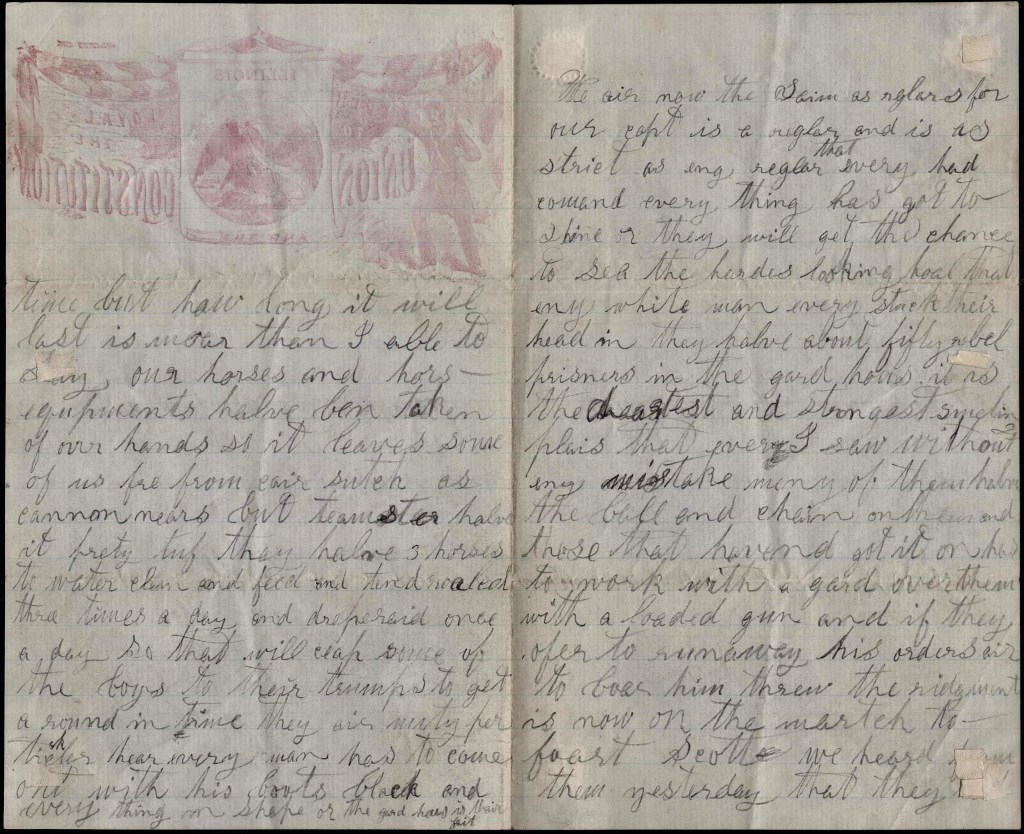
I am expecting to be superseded shortly in the command of the company as I understand that Openshaw has been promoted to 1st Lieutenant in this company, vice Cooley promoted to Captaincy of Co. G. Openshaw is not mustered, however, and can’t be till Cooley is mustered out, so he can’t take the command over me unless I have a mind to yield it to him till Colley comes back.
Had I known last fall when I was in New Orleans that I was going to be “jumped” quite so soon, I don’t think I would have taken as much trouble as I did to get relieved & be ordered back to my regiment. I thought then that perhaps I would be sorry afterwards for doing it, but my pride in the company connected with your expressed wish overcame my better judgement. And now I see that I was a damed fool for doing it. I thought then that I would rather be a 2nd Lieutenant in Co. E than to have a much higher position elsewhere & I am prouder of the company today than ever. But I will never again decline a good offer.
Is there any likelihood of your being ordered to recruit if you can’t get conscripts? I should think that the prospect of another draft under the recent proclamation of the President would make recruiting quite brisk again. We would like to see you bring some recruits for our regiment but we would be glad to see you back even if you had to come alone.
Hoping to hear from you soon, I remain yours truly, — J. Lefevre
to Capt. M. S. Euen
Letter 3
Quarters, Co. E, 156th N. Y. Vols. Baton Rouge, La. January 10th 1864
I see by my memorandum that it is over a month since I wrote to you last. I did not intend that it should be so long between my letters but then it is very dull & monotonous in camp and with the exceptions of the recent promotions, there is very little to write about.
You seem to think that I was disappointed. I don’t think I said I was. I did not expect any promotion—at least till you got yours—and therefore I was not disappointed much at not getting it then. But I was surprised at least when I was told that there was a commission in the camp for me. True, Col. [Jacob] Sharpe had told me that he had recommended me but I did not expect that I would get it for a while yet.
It is too bad that all those who have been promoted to 2nd Lieutenant lately can’t get mustered. I hope the folks at home will hurry and fill up the regiment so that they can all get mustered. As it is, I don’t know what to do. It is rather expensive supporting the dignity of an officer without the pay. [Jacob S.] Eckert is mad and is trying to get home. I guess he has vented some of his passion onto you as he read me a part of a letter he was going to send to you. I told him he was wrong, for whatever you had said to him, you meant it for his good and he should take it so. He is very hasty and often abuses his best friends.
I should mention that I have been assigned to Co. B but have been left in command of Co. E & I hope I may be permitted to stay there. I took Co. E out on dress parade with the regiment the other evening at the request of Capt. [Alfred] Neafie (or Lieut. Colonel Neafie. It was the first they have been on dress parade for over five months. The Colonel who was present said the company looked very fine. Capt. Neafie (or Lieut. Colonel Neafie now, I suppose, I should say) wants me to bring the company over & join in parade with the regiment whenever I can. But it is not very often that our men are off duty at that time of day.
Corp. [Samuel] Kimbark who you know has been missing so long, died at the Barracks Hospital at New Orleans on the 24th of November.
When do you think you will get back here? The returns of the company are getting very much behind hand. I believe Mat. Hasbrouck has been doing something at the Clothing returns for last summer but they are still nearly six months behind & the ordnance returns are nearly a year behind hand.
If you are not likely to get back in some months, would it not be better to have an inventory taken ad have the things turned over to me, or whoever is put in command of the company? I have a list of what property there was on hand when Cooley left. I expect that Cooley will be back shortly and don’t know whether he will take command of this company again or not. But I hardly think he will. They will want him in Co. G as [William J.] Purdy has resigned. We have scarcely as many officers as companies in the regiment now. Only one captain present and he has offered his resignation. Write often and believe me ever yours truly, — J. Lefevre
Letter 4
Headquarters Co. E, 156th N. Y. V. Baton Rouge, La. March 1, 1864
Captain, dear sir,
Your favor of February 1st was received some days ago just before I was ordered to proceed to New Orleans in charge of about fifty Confederate prisoners so my answer has been delayed longer than it would have been otherwise. And since returning from New Orleans I have had the pay rolls & other matters which come at the end of the month to attend to.
You were not quite correctly informed about returns by Capt. Cooley. I don’t think it was intentional, however, on his part to deceive you about it, but only that his memory was a little affected by his recent severe illness. Your returns for clothing, camp & garrison equipage, were made out by Mat [Hasbrouck] up to the first of September & are all right of course. I took command of the company about the first of October & will receipt to you for all camp and garrison equipage your last return shows as on hand, & will date the receipts of the 1st of October if you wish it. Of course whatever I have drawn since that, I am responsible for.
The Ordnance is not quite straight. Your ordnance return for the 1st Quarter of ’63 was made out by yourself (judging from the handwriting) but for some reason or other seems never to have been forwarded to Washington—at least I found all three copies in your desk some months ago, before Cooley went home & spoke to him about it. He replied by saying he guessed it was all right & that I must not muss with your papers so I said nothing more about it.
Mat. [Hasbrouck] says he will fix it out for the next two quarters of ’63 in a few days. For the last quarter of ’63, I will make out the returns, if I can get you invoices of the stuff which was on hand when I took command of the company. I might have taken it up as “found in the company.” but I preferred to wait till I could get your invoices. Of course we are a considerable short on ordnance, &c., but I don’t think it will be very difficult to account for that that as lost during the summer campaign which was actually the case as none of the guns which were taken to the hospitals by those men who died or were discharged there ever came back to the company except six which I got a couple months ago form the hospitals in this town & then some of the plates and small equipments were gone.
Those guns which Holwick tells me were delivered to the Quartermaster of Port Hudson never came back either. I heard once that Co. F got some.
We have now within twelve guns as many as your return of March 31st shows on hand & about the same as to bayonets and cartridge boxes & a few more wanting of belts and plates. I have written out for Mat. [Hasbrouck] a short statement as to where I thought the losses had occurred but I suppose you can tell him better about that than I can. You remember four men of our company were taken prisoners at Brashear City, La. There were wounded on the battlefield of Port Hudson & a great number were sent to hospitals from the march. As to how many of thm lost their guns at these places, I can’t say. I do know that the five who died at New Orleans, we never got any guns or equipments back for the simple reason that we could not send after them.
An 1864 image of Capt. Johannes Lefevre
Sergt. [George] Grim has had charge of the surplus ordnance on hand & I have had him or Holwick take frequent inventories of it to see that nothing was lost. I will let Mat. forward to you his statement as to what is on hand & if you will send me invoices for it, I will give you receipts & date them back to the first of October too, thus relieving you from all responsibility after that date. As to any before that, of course I could not go as I was absent from the company entirely. So much for business!
I am very much obliged to you, Captain, for your suggestion that I be retained in Co. E! for although it is not exactly my company any longer, still I prefer it to any other. Col. Sharpe told me that I should reain here till you come back at least, and perhaps longer.
The spring campaign is opening with very little probability of our being moved from here. We hear of Sherman’s operations about Mobile but as yet have nothing definite. The health of the company and of the regiment is very good. Have got all of sick Shawangunkites home on furloughs. I don’t know whether they will ever come back or not. I have sent to have [George] Crans arrested. I expect his folks will pitch into me for it but I can’t help it & what is more, I don’t care much if they do. I shall recommend his being reduced to the ranks the moment he gets back here.
I suppose you have heard that Corp. [Longinus] Bates has gone home on recruiting service with Capt. [Orville D.] Jewett [of Co. I] & several noncoms. I have two sergeants and two corporals for duty with the company. The rest are all detailed away or sick. Corp. Bates, I believe, is to be appointed Commissary Sergeant, vice [Samuel H. B.] Schoonmaker who has just received a commission as 1st Lieutenant in an artillery regiment [15th Artillery] of the Army of the Potomac.
Henry Hess has been transferred to the Invalid Corps. Robert Terwilliger is detailed in charge of the guard at the government sawmill in town. Write when you can. Respectfully yours, — Johannes Lefevre
The following letters were written by Lydia Elizabeth Morrison (1832-1904), the daughter of John Bush Morrison (1793-1853) and Sarah Dougherty (1796-1872) of Plattekill, Ulster county, New York. In the 1860 US Census, 25 year-old Lydia was residing in Plattekill with her 64 year-old widowed mother and 21 year-old brother Charles Drake Morrison.
1st Sergeant Charles D. Morrison
The letters pertain to the illness and death of her brother Charles who enlisted as a private in Co. E, 156th New York Infantry in August 1862 and rose in rank to 1st Sergeant before he died of typhoid fever on 18 May 1863 at the Soldiers Hospital in Baton Rouge, Louisiana. He lies buried in Grave No. 2179 of Section 33 at the Baton Rouge National Cemetery. When he enlisted, Charlie was described as a 24 year-old farmer with brown hair and blue eyes who stood 5 feet 10 inches tall.
Lydia wrote the letters to Capt. Matthias S. Euen (1833-1898) of Co. E, 156th New York Infantry. He was wounded at Port Hudson on 14 June 1863 (shortly after the 2nd letter was written) and was later promoted to Major and Colonel of the 156th New York.
Letter 1
Plattekill [Ulster county, New York] May 18th 1863
Capt. Euen Dear and respected sir,
We received a letter from brother Charles dated General Hospital, Baton Rouge, April 27th, saying he was better but very weak. He wrote but a few lines and we judge more from the manner of writing than from what he said that it would be a long time before he would regain his strength.
We have talked the matter over at home and thought it would do no harm to write to you and see if he did not get able to join his regiment and was able to travel, if you could not send him home on Gov. business. We do not think it would be expedient to send him home on a furlough (even though that could be procured) as he would then have to bear his own expenses and I do not suppose he would think he could afford to as his pay is not sufficient to warrant his coming at his own expense. Charles knows nothing of our writing to you on the subject. He said he had good care and attendance in the hospital and makes not a word of complaint.
We know he will not be willing to come home on any consideration if he is able to join his regiment. I feel so sorry for him—poor fellow. He went from home brimming full of patriotism and in all his letters home has expressed nothing but the most devoted enthusiasm in the cause in which he has sacrificed a good and pleasant home and warm and loving friends. Charlie is my youngest brother and the pet of my widowed mother. We would do anything in our power to have him restored to health if possible. He complains that he has not heard from home since the first of March although we have written to him some seven or eight times.
I hope you will excuse the liberty I have taken in writing to you and our anxiety to secure Charlie’s return to health will I hope please my excuse. And if you can find it expedient in any way to have him sent home provided it is necessary to ensure his restoration, will you please do what you can for him, and in return receive the warmest thanks of his mother and friends. That an all-wise and kind Providence will protect you from sickness and that Rebel bullets may never find your hearts blood, that you may again meet your family and friends in this world is the prayer of your friend, — Lydia E. Morrison, sister of Charles D. Morrison
P. S. I have been told that a woman could not write a letter without the addition of a “post script.” For that reason I add mine. I see by the paper the 156th has been doing good service and that Co. E was second to none in bravery and promtness in obeying orders. Charlie regrets that he was “counted out.” Mother sends you her kind regards and says she loves you for Charlie’s sake. — L. E. M.
To Capt. Euen, 156th Regt., Louisiana.
Letter 2
Plattekill, [New York] June 10th 1863
Dear and respected sir,
Your letter mailed at New Orleans June 1st we received today. I hasten to reply as we are very anxious that this should reach you as soon as possible. We had heard of the painful intelligence of our dear brother’s death before your kind letter reached us. He wrote to us himself only two days before he died. He did not expect to live when he wrote it and his mind was as clear as in his most healthful days. It was a great source of comfort to us that he wrote with his own dear hand but it is very hard to think that we will never see his dear face or hear his loved voice again.
I wrote to you some three weeks ago asking you to use your influence un having him sent home of possible but he has gone to another and I trust better world. No thought or care can bring him home. But we would like so much that his remains might be sent home. I suppose it could not be now but if his grave is marked, it might be that at some time his dear body might mingle with the dust of his loved ones whose remains now sleep in our own church yard. Charlie was very dear to us. We loved him. Oh! so much. He is the third child my afflicted mother has lost within three years and not a year between any of them. 1 Then it is so hard to think he never received one letter from home, from the time he was taken sick until his death. But God doeth with His children as seems good and His ways are right and just, and we have no right to murmur at His providence.
I sent Charles an envelope containing a silk handkerchief. Mother wishes you to open it and accept it as a keepsake from him. You can easily tell it. The postage was double and it is very soft. Then will you have his grave marked and will you please to send his effects if he had any home. Also his letters—all but the one I spoke of and please keep that. Charles had a watch and that was about the only thing of any value that I suppose he left but it would be a comfort to have all he left come home.
It was so kind in you to write to us and I hope you may live to come home to your wife and family. Charles in speaking of you said you were a man and that sums up everything in one word.
A friend that Charles made wile in the hospital wrote that he had charge of his things and would send them to you. Charles did not possess the constitution to stand the hardships of a soldier’s life and we knew it, and it was such a grief to have him go for we were sure he would not return. Oh! that this was was over. It makes so many desolate hearts and hearthstones. Poor Charlie, he was so anxious to strike a blow for his country, but it was not to be.
I will not intrude further on your time—only to say that though you are a stranger to us, yet we are your warm friends. And our best wishes and earnest prayer will follow you that you may come home when your duty as a soldier is performed. And may God bless you is our earnest desire. I am respectfully your friend, — Lydia E. Morrison
Plattekill, New York
1 The other siblings were Isabella H. Morrison (1825-1862) and Mary Caroline Morrison (1838-1861).