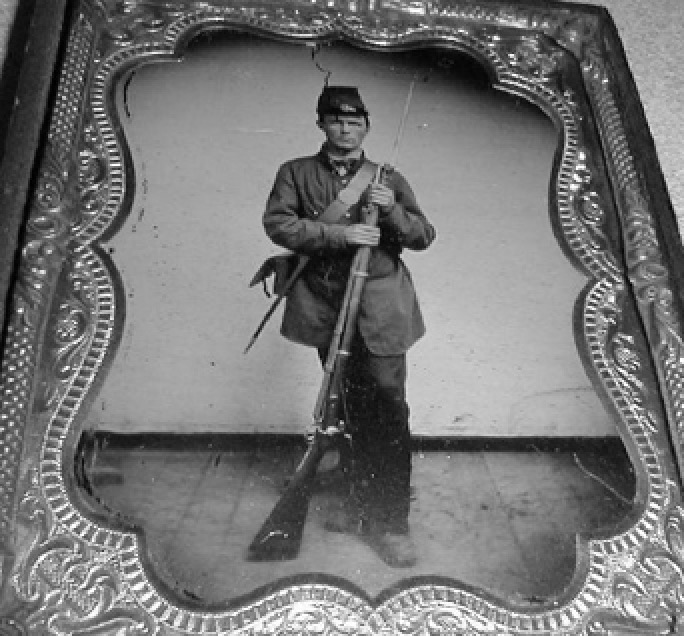
I could not find an image of Michael but here is a tintype of Edwin Eugene Tubbs who served in Congress. D, 117th New York Infantry (Al & Claudia Niemiec Collection)
This letter was written by Michael G. Gephart (1842-1926) of Ava, Oneida county, New York. Michael enlisted on 21 August 1862 to serve three years in Co. I, 117th New York Infantry—sometimes called the “4th Oneida Regiment.” He was promoted to a corporal on 20 August 1862; was wounded in action, 16 May 1864, at Drewry’s Bluff, Va.; returned to the ranks on 20 January 1865; was promoted sergeant on 1 March 1865; and mustered out with his company on 8 June 1865, at Raleigh, N. C.
In the 1860 US Census, Michael was enumerated in the household of John C. Flint of Ava, New York, working as a farm laborer. Emma, to whom this letter was addressed, was John’s daughter and wound have been 15 when this letter was written in March 1863. The 1900 US Census informs us that Michael’s parents were immigrants from Germany.
TRANSCRIPTION
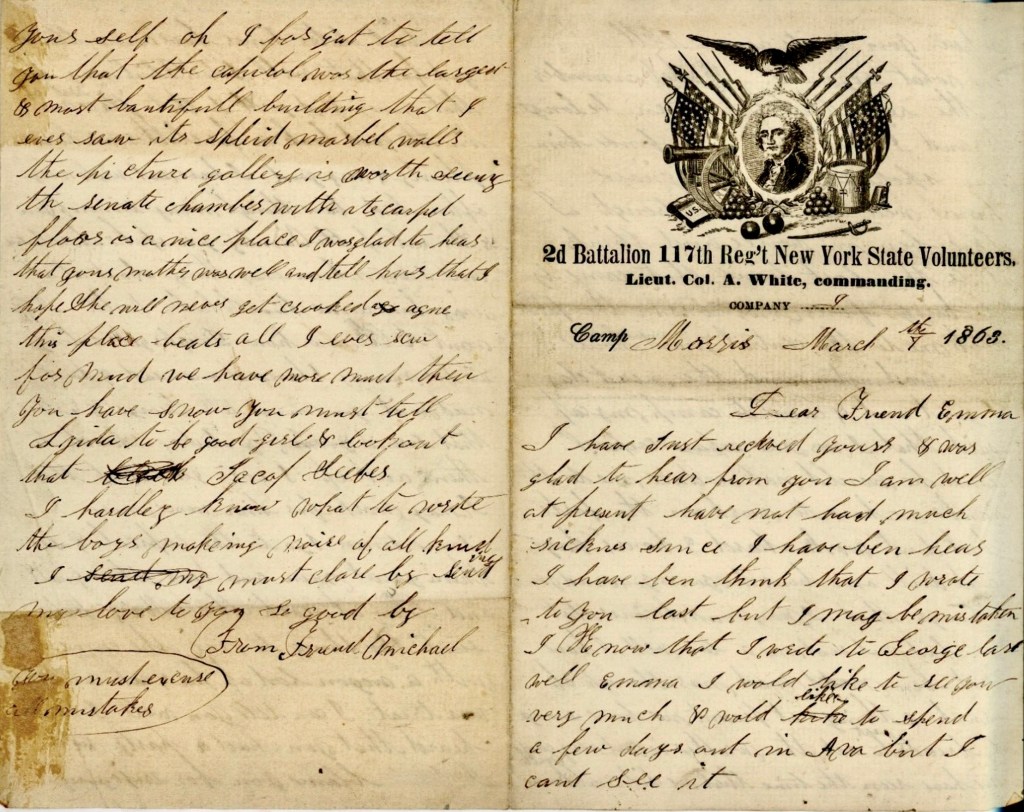
2nd Battalion, 117th Reg. New York State Vols., Co. I Camp Morris [Near D. C.] March 7th 1863
Dear Friend Emma,
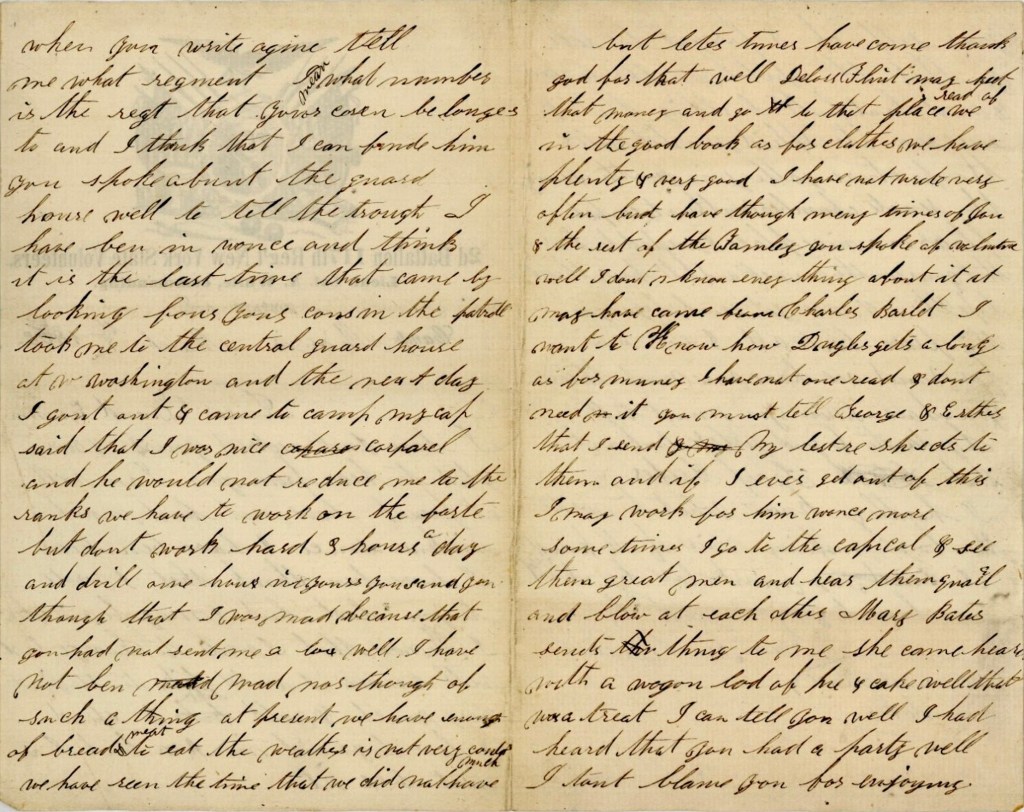
I have just received yours & was glad to hear from you. I am well at present. Have not had much sickness since I have been here. I have been thing[ing] that I wrote to you last but I may be mistaken. I know that I wrote to George last. Well, Emma, I would like to see you very much & would like to spend a few days out in Ava but I can’t see it. When you write again, tell me what regiment—I mean what number is the regiment that your cousin belongs to and I think that I can find him.
You spoke about the guard house. Well, to tell the truth, I have been in once and I think it is the last time. That came by looking for your cousin. The patrol took me to the central guard house at Washington and the next day I got out & came to camp. My captain said that I was a nice corporal and he would not reduce me to the ranks. We have to work on the fort but don’t work hard—three hours a day. And we drill one hour.
In yours you said you thought that I was mad because you had not sent me a box. Well, I have not been made nor thought of such a thing. At present, we have enough meat to eat. The weather is not very cold. We have seen the time that we did not have much but better times have come, thank God for that.
Well, Delos Flint may keep that money and go to that place we read of in the good book. As for clothes, we have plenty of& very good. I have not wrote very often but have thought many times of you and the rest of the family. You spoke of valentine. Well I don’t know anything about it. It may have come from Charles Barlet. I want to know how Douglas gets along.
As for money, I have not one red [cent]. I don’t need it. You must tell George & Ester that I send my best respects to them and if I ever get out of this, I may work for him once more.
Sometimes I got to the Capitol and see them great men and hear them quarrel and blow at each other. Mary Bates sends things to me. She came here with a wagon load of pies and cakes. Well that was a treat, I can tell you. Well, I had heard that you had a party. Well, I can’t blame you for enjoying yourself. Oh! I forgot to tell you that the Capitol was the largest and most beautiful building that I ever saw [with] its splendid marble walls. The picture gallery is worth seeing. The Senate Chamber with its carpet floor is a nice place.
I was glad to hear that your mother was well and tell her that I hope she will never get crooked again. This place beats all I ever saw for mud. We have more mud than you have snow. You must tell Lida to be a good girl & look out that Jacob Seefer. I hardly know what to write, the boys making noise of all kind. I must close by seng my love to you, so goodbye. From friend, — Michael
The following letter was written by Gerard Lindsley McEntee (1847-1913), the son of James Smith McEntee (1800-1887) and Sarah Jane Goetchius (1805-1883) of Kingston, Ulster county, New York. Gerard had several notable siblings—Jervis McEntee (1828-1891), a Hudson River School Landscape Artist; Mary Swan McEntee (1830-1892), the wife of Calvert Vaux, Landscape architect of NYC who worked with Frederick Law Olmstead in the design of NYC’s Central Park; Lt. Maurice Wurts McEntee (1836-1883), 20th NY State Militia, and later Acting Master in US Navy.
When he was only 13 years old, Gerard signed on as a drummer boy in Co. F of the 20th New York State Militia for three months. This was the same unit that his brother Maurice was in. This unit served from 23 April 1861 to 2 August 1861. Gerard’s letter was written just 10 days after the Battle of Bull Run—referred to as the “sad news” within the letter.
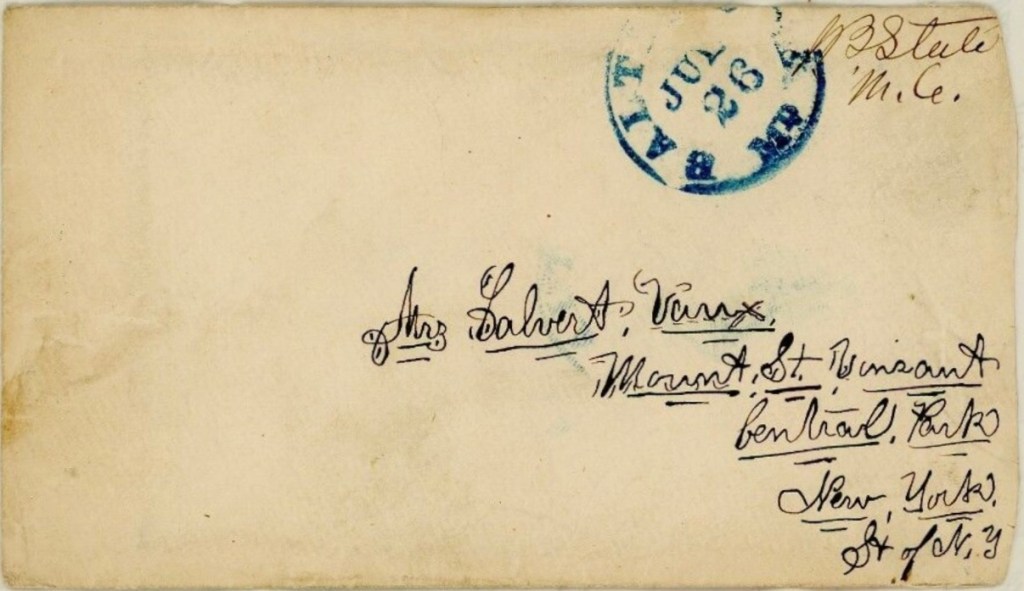
Addressed to Mrs. Calvery Vaux, Mount St. Vincent, Central Park, New York, State of NY
Transcription
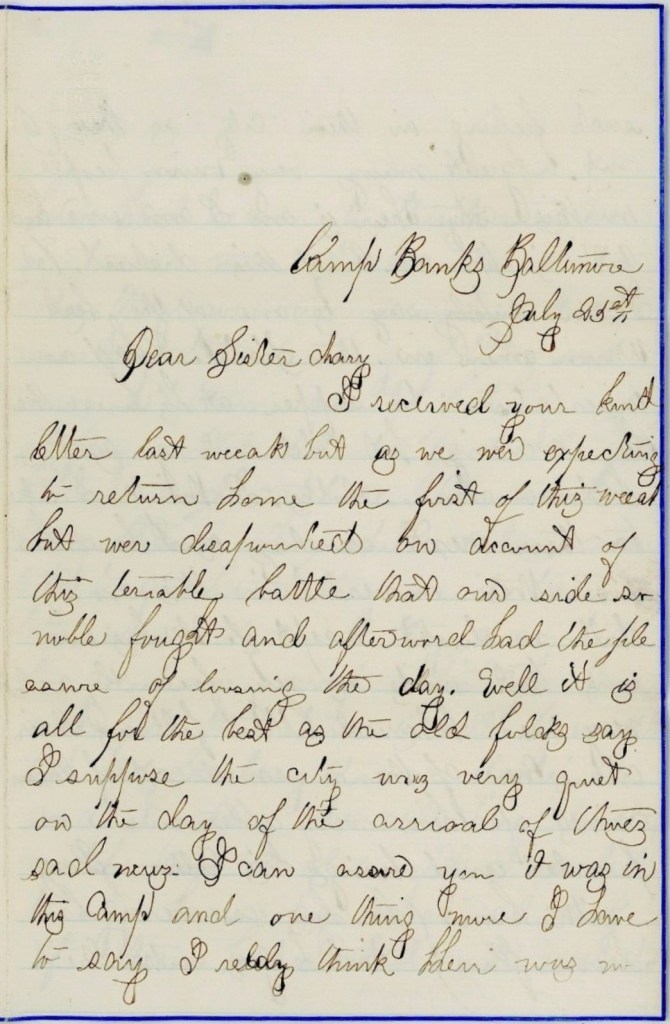
Camp Banks Baltimore, [Maryland] July 31st [1861]
Dear Sister Mary,
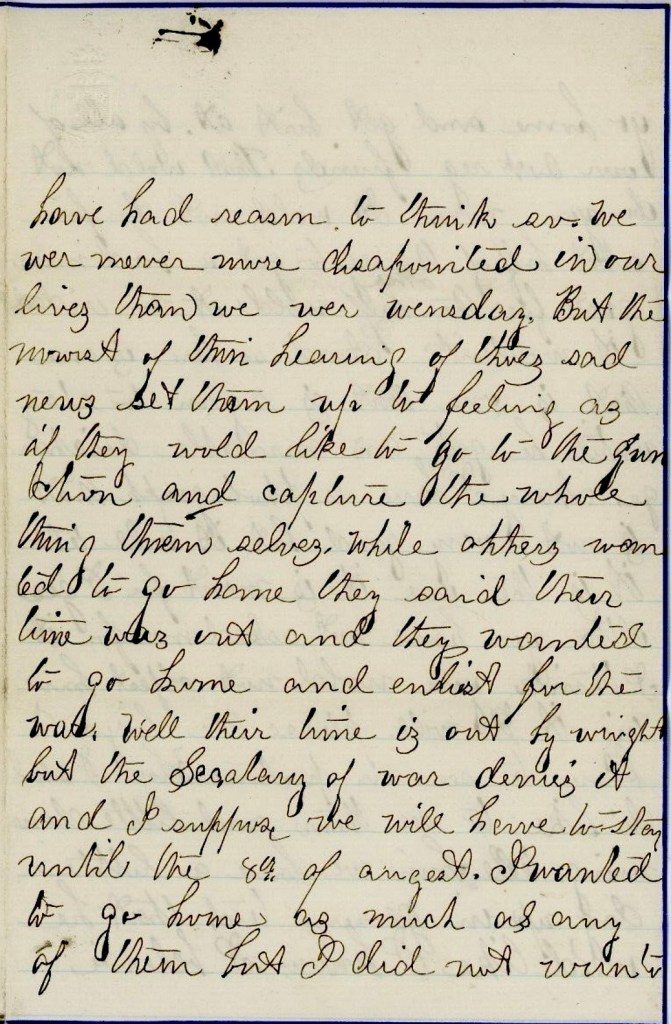
I received your kind letter last week but as we were expecting to return home the first of this week, but were disappointed on account of this terrible battle that our side so noble fought and afterward had the pleasure of losing the day. Well, it is all for the best as the old folks say, I suppose. The city was very quiet on the day of the arrival of the sad news, I can assure you. I was in the camp and one thing more I have to say, I really think there was no [page missing]….have had reason to think so. We were never more disappointed in our lives than we were Wednesday. But the worst of them, hearing of this sad news, set them up to feeling as if they would like to go to the [Manassas] Junction and capture the whole thing themselves while others wanted to go home. They said their time was out and they wanted to go home and enlist for the war. Well their time is out by right but the Secretary of War denies it and I suppose ew will have to stay until the 8th of August.
Gerard Lindsley McEntee
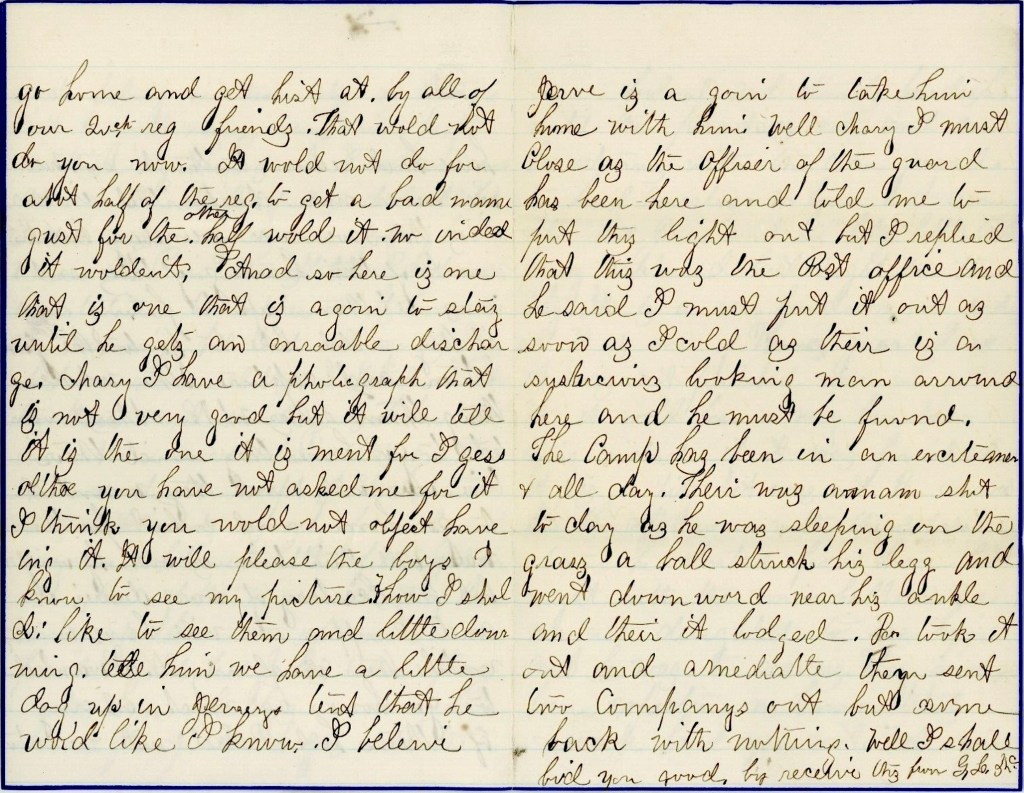
I wanted to go home as much as any of them but I did not want to go home and get hissed at by all of our 20th Regiment friends. That would not do, you know. It would not do for about half of the regiment to get a bad name just for the other half, would it? No indeed it wouldn’t. And so here is one that is a goin’ to stay until he gets an honorable discharge.
Mary, I have a photograph that is not very good but it will tell. It is the one it is meant for I guess. Although you have not asked me for it, I think you would not object having it. It will please the boys, I know, to see my picture. How I should like to see them and little Downing. 1 Tell him we have a little dog up in Jervy’s tent that he would like, I know. I believe Jerve is a going to take him home with him.
Well Mary, I must close as the officer of the guard has been here and told me to put this light out but I replied that this was the Post Office and he said I must put it out as soon as I could as there is a suspicious looking man around here and he must be found.
The camp has been in an excitement all day. There was a man shot today as he was sleeping on the grass. A ball struck his leg and went downward near his ankle and there it lodged. Dr. took it out and immediately they sent two companies out but came back with nothing. Well I shall bid you goodbye. This from G. L. Mc.
1 Downing Vaux was born in 1857.Downing’s brother Calvin was a couple years older.
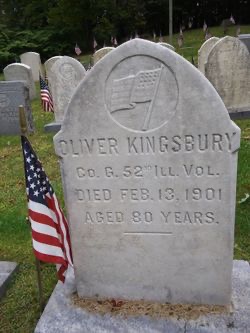
The following letter was written by Oliver Kingsbury (1821-1901) of St. Charles, Illinois, who married Almira Oratt (1832-Aft1900) in Kane county in 1858. The letter was written to his daughter Juliette who was born in 1848 so she must have been a daughter by a former marriage. In the 1860 US Census, Oliver was employed as an auctioneer.
When Oliver was 40 years old, he enlisted in Co. G, 52nd Illinois Infantry. He remained in the service until 25 November 1864 when he mustered out at Springfield, Illinois. We learn from this letter that he was detached from his regiment and working as a nurse in the soldiers’ hospital at Jeffersonville, Indiana, and prior to that at the one in Paducah, Kentucky. His duties in preparing drugs at the hospitals gave him the experience and qualifications to hold out his shingle as a druggist in Lee Center, Oneida county, New York, after he was discharged from the service. By 1880, however, he had moved on to photography with a studio in Rome, New York.
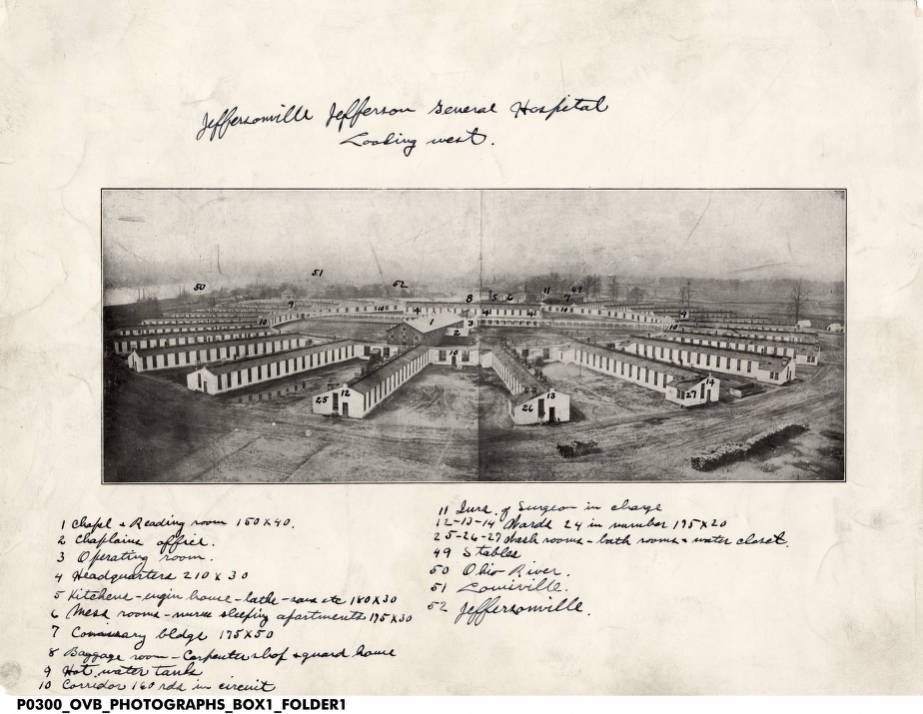
Indiana Historical Society. The first military occupation at Jeffersonville, Indiana during the Civil War was in 1862 when two area regiments established a camp on a farm owned by Blanton Duncan. Lovell Rousseau, the organizer of the regiments, christened the camp “Camp Joe Holt.” The name was retained when it ceased to be a camp and became a hospital, called “Joe Holt Hospital.” Jefferson General Hospital, built to replace the one at Camp Joe Holt, opened 21 February 1864 and closed in December 1866. Located near Jeffersonville on land obtained from U.S. Senator Jesse D. Bright, the acreage reached down to the Ohio River, facilitating patient transfer from riverboats to the hospital. The health facility had 24 wards each radiating out like spokes on a wheel and all connected by a corridor one-half mile in circumference. Each ward was 150 feet long and 22 feet wide, and could accommodate 60 patients. Female nurses and matrons were quartered separately from the men.
Transcription
Joe Holt Hospital Jeffersonville, Indiana July 22d 1864
Dear daughter,
I received your kind letter dated the 17th and while I have a little leisure, send a few lines in answer. I do not know what you mean by Almira’s telling all the news concerning you for she seldom says a word about you. I suppose it is because she does not often see you. Sometimes she says she has not heard from you in some time and I do not know of anything she has written of you for perhaps six months—only that you was working this season and one year ago she hinted something about you having a beau by the name of Smith but knew nothing of it as I could find out. But as for information about you or anyone else, there is not much in most of her letters. Once in a while I hear something what is going on in town but I do not hear as much of you as I could wish. You have never said a word whether you was at work or how you get along with your work. I am not aware of anything meddling or out of the way in that time and she has never said anything as though there was any ill feeling between you. You surprised me by saying as you did about news, but it is all right perhaps. I hope you will write often and tell all that is worth telling. Give my respects to Peter and wife.
“We have so many doctors, some know something, and others know but little.”
Oliver Kingsbury, 52nd Illinois, Joe Holt Hospital, 22 July 1864
I have a good time here. I do nothing but make pills, put up powders, bitters, &c. half of the time and most of my leisure is spent studying medicine. There are plenty of books here. We have so many doctors, some know something, and others know but little. One doctor next door has hired a piano and we have plenty of music among us men, and as to women, we do without them as there are but 8 or 10 ill-looking Irish wash women, but they do not even eat when I do, but at the common table. They wash on the bank of the river where I have not been yet, as it is not on my route to bathe or to dinner. Two old maids boss the cooking for the low diet patients—nice women for all any of us know, but they hardly come out of their kitchen. Three or four soldiers help them. I think they are from St. Louis and sent by the sanitary commission. One Dutch [German] doctor has his wife and the doctor I was under at Paducah has his wife here. The balance—over six hundred—are soldiers and perhaps 20 men building and fixing about.
Have you seen the shawl I sent to St. Charles from Paducah? I did not know but you would like to have it, so I told Almira that if you wanted it, to let you have it as it was a relic of the battle of Paducah. She talks of selling it and I did not know whether you had seen it or not.
I could not find an image of Henry but here is one of Oscar S. Holcomb of Co. H, 8th NY Heavy Artillery )Photo Sleuth)
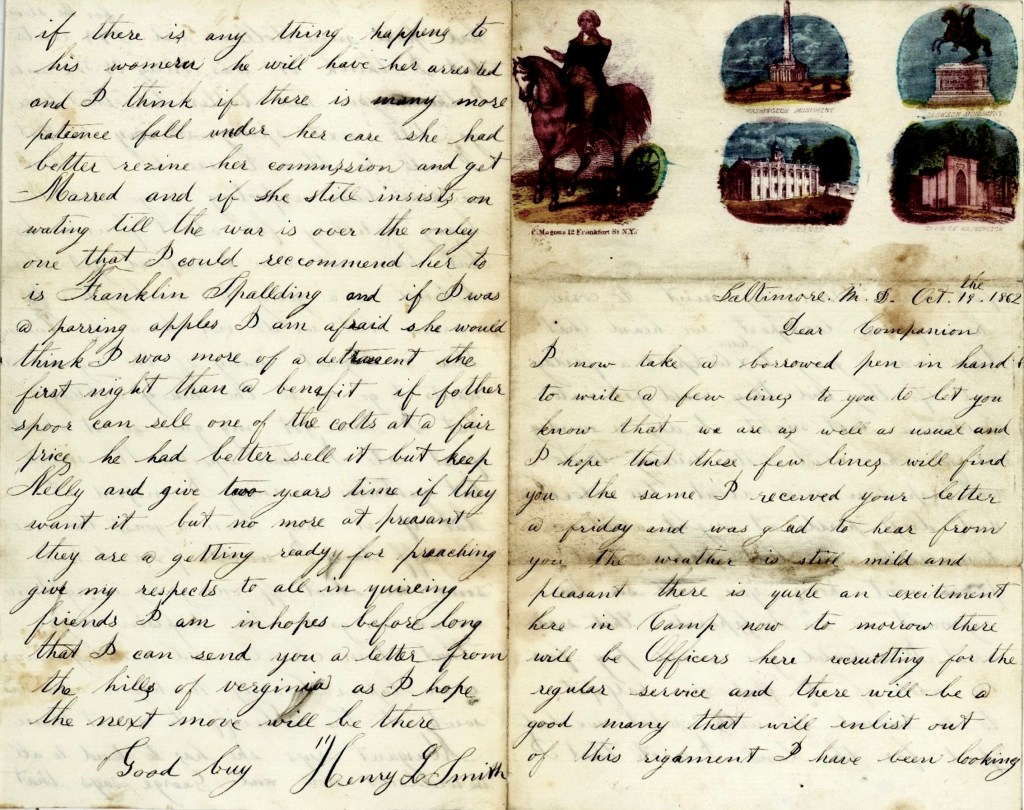
This letter was written by Henry L. Smith (1833-1864) of Hartland, Niagara county, New York. He enlisted on 4 August 1862 at Lockport, New York, as a private in Co. D, 129th New York Infantry. On the very day that Henry wrote this letter, the regiment was designated the 8th New York Heavy Artillery. He served in the defenses at Baltimore until 1864 when his regiment was sent to the Virginia battlefront and used as infantrymen. He was seriously wounded in the Battle of Cold Harbor on 3 June and died of his wounds on 16 June 1864 at Lincoln General Hospital in Washington D. C.
Henry was born in Le Roy, New York. When he enlisted, he was described as a 31 year-old farmer, who stood 5 foot 8 inches tall, with black eyes and dark hair. He was married to Ruth Ann Spoor and had two daughters, Celia and Melva, when he enlisted.
Transcription
Baltimore, Maryland October 19, 1862
Dear Companion,
I now take a borrowed pen in hand to write a few lines to you to let you know that we are as well as usual and I hope that these few lines will find you the same. I received your letter a Friday and was glad to hear from you. The weather is still mild and pleasant.
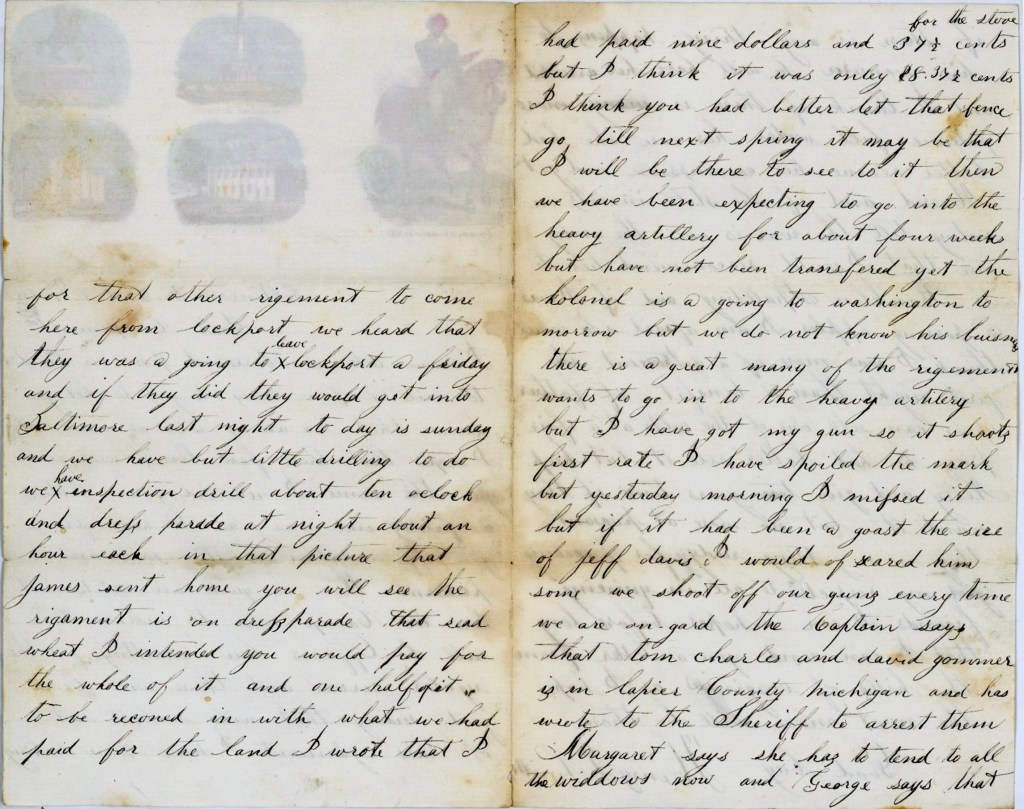
There is quite an excitement here in camp now. Tomorrow there will be officers here recruiting for the regular service and there will be a good many that will enlist out of this regiment. I have been looking for that other regiment to come here from Lockport. We heard they was a going to leave Lockport a Friday and if they did, they would get into Baltimore last night. Today is Sunday and we have but little drilling to do. We have inspection drill about ten o’clock and dress parade at night about an hour each.
In the picture that James sent home you will see the regiment is on dress parade.
That seed wheat I intended you would pay for the whole of it and one half of it to be reckoned in with what we had paid for the land. I wrote that I had paid nine dollars and 37.5 cents for the stove but I thin kit was only $8.37 and a half cents. I think you had better let that fence go till next spring. It may be that I will be there to see to it then.
We have been expecting to go into the heavy artillery for about four weeks but have not been transferred yet. The Colonel is a going to Washington tomorrow but we do not know his business. There is a great many of the regiment wants to go into the heavy artillery but I have got my gun so it shoots first rate. I have spoiled the mark but yesterday morning I missed it. But if it had been a ghost the size of Jeff Davis, I would of scared him some. We shoot off our guns every time we are on guard. The Captain says that Tom Charles and David [D.] Ganmer is in Lapeer county, Michigan, and he has wrote to the sheriff to arrest them.
Margaret says she has to tend to all the widow’s now and George says that if there is anything happens to his woman, he will have her arrested and I think if there is any more patients fall under her care, she had better resign her commission and get married. And if she still insists on waiting till the war is over, the only one that I could recommend her to is Franklin Spalding. And if I was a paring apples, I am afraid she would think I was more of a detriment the first night than a benefit. If father Spoor can sell one of the colts at a fair price, he had better sell it. But keep Nelly and give two years time if they want it.
But no more at present. They are a getting ready for preaching. Give my respects to all enquiring friends. I am in hopes before long that I can send you a letter from the hills of Virginia as I hope the next move will be there. Goodbye, — Henry L. Smith
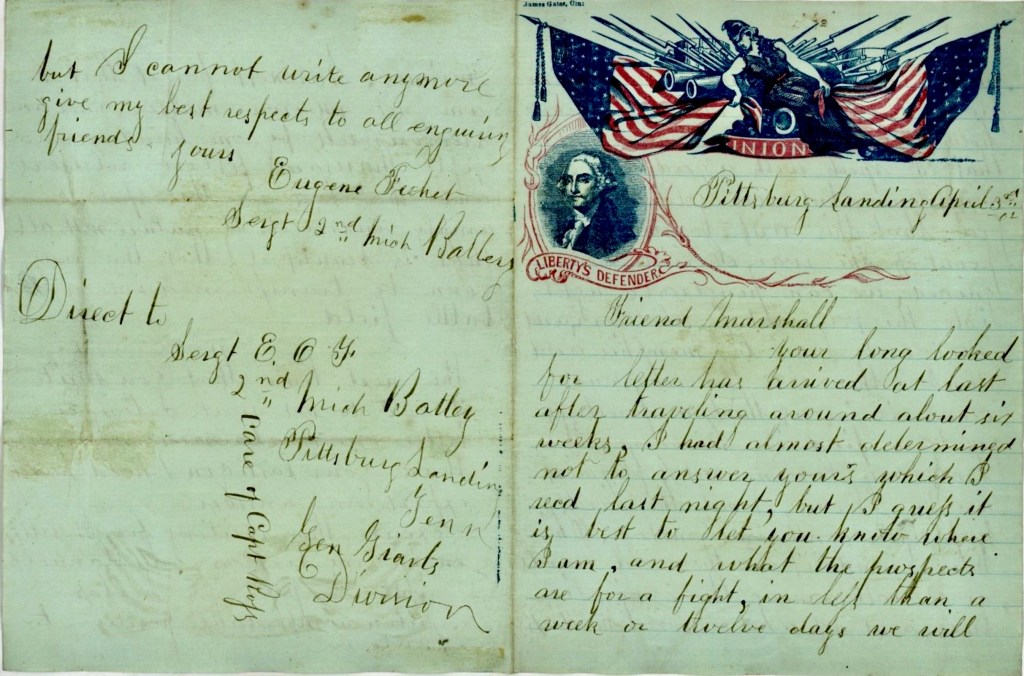
This letter was written by Eugene Oscar Fechet (1846-1925), the son of Alfred Edmont Fechét (1817-1869) and Mary de Garmo Buel (1823-1905). At the start of the Civil War, Eugene’s father raised a unit that became Battery B, 1st Michigan Light Artillery. Eugene enlisted as a Corporal in the unit on 10 September 1861; his regiment departed to St. Louis, Missouri on 17 December 1861. Battery B performed duties in the District of West Tennessee till March 1862 until it was attached to General Stephen A. Hurlbut’s 4th Division, Grant’s Army of the Tennessee to April, 1862. The Regiment moved to Pittsburg Landing, Tenn. During the Battle of Shiloh on 6–7 April, the Battery was heavily engaged at the south end of Sarah Bell’s peach orchard and later at Wicker Field where they were surrounded and captured at about 5:30 p.m. by the 1st Mississippi Cavalry. Five of the six cannons were claimed by the Confederates and Eugene was one of the artillerists taken prisoner on April 6, 1862. The prisoners were later exchanged in November 1862.
From this letter we learn that Eugene was promoted to Sergeant prior to the Battle of Shiloh. He reenlisted in a Veteran Volunteer Regiment as a First Sergeant on 23 December 1863 until he was discharged on 10 April 1864 to attend the United States Military Academy at West Point (Class of 1868).
Though Eugene states he was in the “2nd Michigan Battery,” he was actually in Captain William H. Ross’ Battery B (or “Second Battery”), 1st Michigan Light Artillery
Transcription
Pittsburg Landing April 3rd 1862
Friend Marshall,
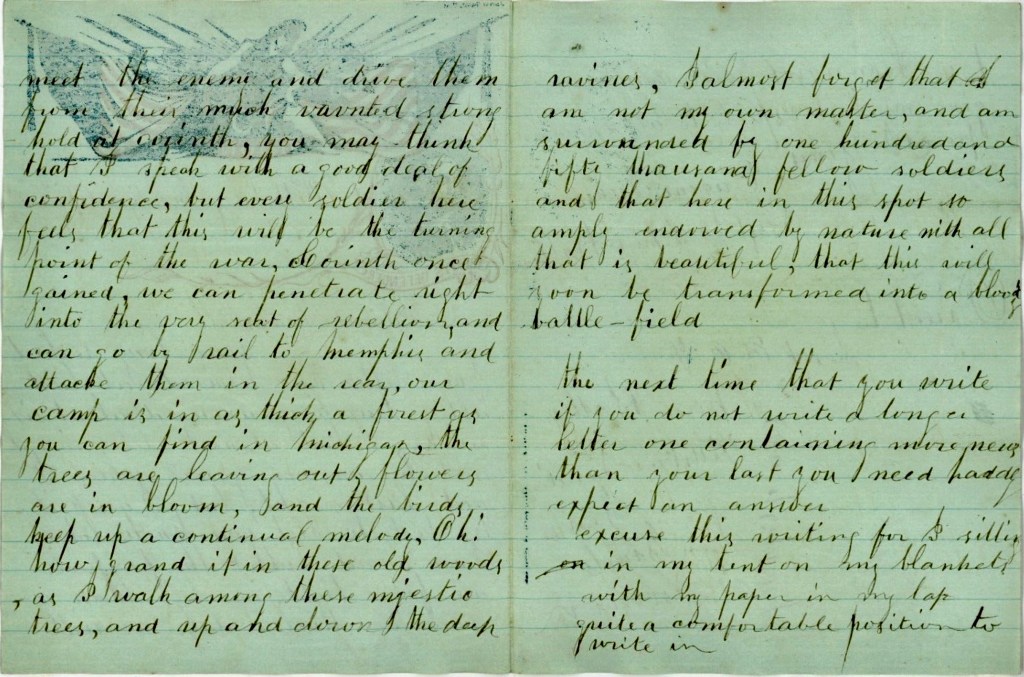
Your long looked for letter has arrived at last after traveling around about six weeks. I had almost determined not to answer yours which I received last night, but I guess it is best to let you know where I am, and what the prospects are for a fight. In less than a week or twelve days we will meet the enemy and drive them from their much vaunted stronghold at Corinth. You may think that I speak with a good deal of confidence, but every soldier here feels that this will be the turning point of the war. Corinth once gained, we can penetrate right into the very seat of rebellion, and can go by rail to Memphis and attack them in the rear.
Our camp is in as thick a forest as you can find in Michigan. The trees are leaving out, flowers are in bloom, and the birds keep up a continual melody. Oh! how grand it is in these old woods as I walk among these majestic trees and up and down the deep ravines. I almost forget that I am not my own master, and am surrounded by one hundred and fifty thousand fellow soldiers, and that here in this spot so amply endowed by nature with all that is beautiful, that this will soon be transformed into a bloody battlefield.
The next time that you write, if you do not write a longer letter—one containing more news than your last, you need hardly expect an answer. Excuse this writing for I [am] sitting in my tent on my blanket with my paper in my lap. Quite a comfortable position to write in. But I cannot write anymore. Give my best respects to all enquiring friends. Yours, — Eugene Fechet, Sergt. 2nd Michigan Battery
Direct to Sergt. E. O. F., 2nd Michigan Battery, Pittsburg Landing, Tennessee, General Grant’s Division. Care of Capt. [William H.] Ross
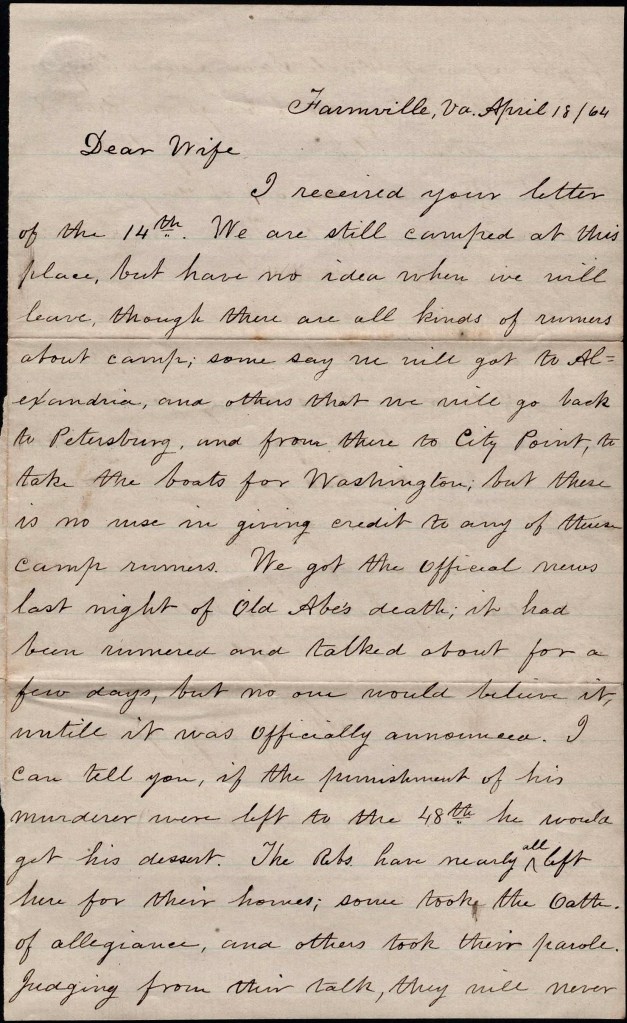
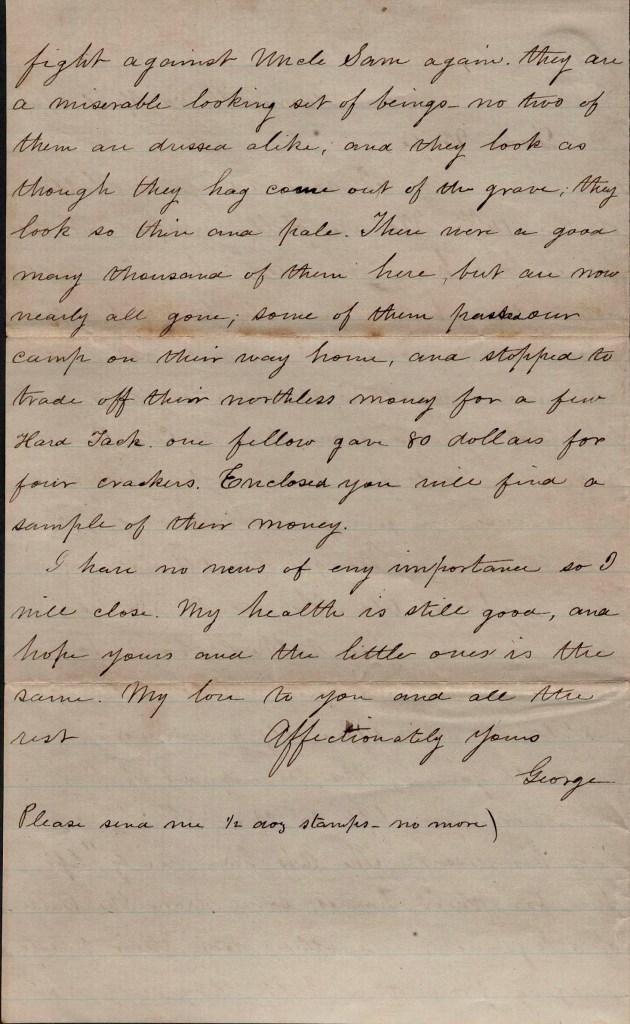
The following letter was written by a soldier named “George” from Farmville, Virginia, in April 1865 following the surrender of Gen. Lee’s Army of Virginia. He was most likely in the 48th Pennsylvania Infantry but there were far too many George’s in that regiment to narrow his identity down further without more clues or an envelope. We know that he was married and had some “little ones” at home so he was probably in his late 20s at least.
The 48th Pennsylvania—the “Schuylkill Regiment”—was best known for its role in constructing the mine underneath the Confederate works near Petersburg where explosives were placed directly underneath Elliott’s Salient (see Battle of the Crater).
Transcription
Farmville, Virginia April 18, 1864 [should be1865]
Dear Wife,
I received your letter of the 14th. We are still camped at this place, but have no idea when we will leave, though there are all kinds of rumors about camp; some say we will go to Alexandria and others that we will go back to Petersburg, and from there to City Point and take the boats for Washington; but there is no use in giving credit to any of these camp rumors.
We got the official news last night of Old Abe’s death; it had been rumored and talked about for a few days, but no one would believe it, until it was officially announced. I can tell you, if the punishment of his murderer were left to the 48th, he would get his dessert.
The Rebs have nearly all left here for their homes; some took the Oath of Allegiance, and others took their parole. Judging from their talk, they will never fight against Uncle Sam again. They are a miserable looking set of beings—no two of them are dressed alike, and they look as though they had come out of the grave. They look so thin and pale. There were a good many thousand of them here, but are now nearly all gone, some of them passed our camp on their way home and stopped to trade off their worthless money for a few Hard Tack. One fellow gave 80 dollars for four crackers.
Enclosed you will find a sample of their money.
I have no news of any importance so I will close. My health is still good and hope yours and the little ones are the same. My love to you and all the rest.
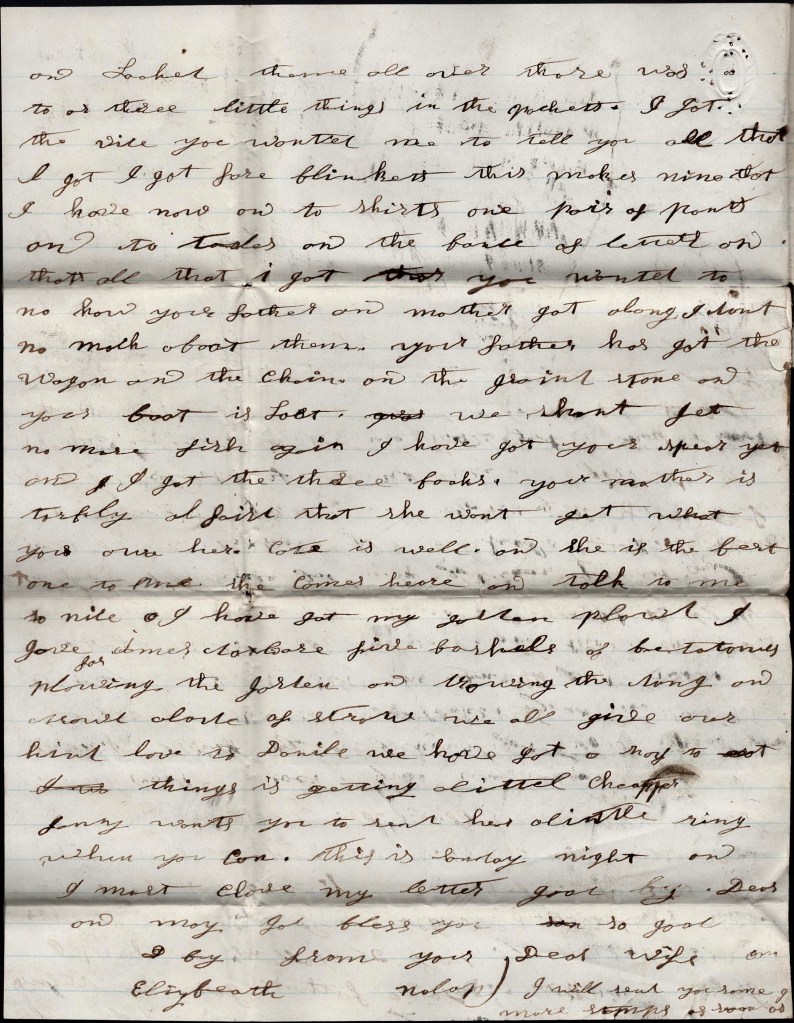
The following letters were written by Elizabeth (Gard) Nolop (1834-1909), a native of England, who married Henry Nacey Nolop (1834-1916) in 1854. At the time of her letter, the Nolop’s had five children—Fannie (b. 1855), Carrie (b. 1857), George (b. 1859), Harriet (b. 1861), and Alma (b. 1863).
Also writing was Henry’s father, George Nolop (1804-1886), a native of Germany, who lived for a time in Canada and then came to Hixton, Jackson county, Wisconsin, about 1861. The letters were written to Henry Nolop near the end of his term of service in the 4th Wisconsin Cavalry Co. I. He mustered out in August 1865. After the Civil War, he returned home and was a farmer and a blacksmith.
Henry and his brother Daniel George Nolop (1844-1925) both served in the 4th Wisconsin Cavalry. Another son, “John” George Nolop, Jr. (1838-1922) served in Co. I, 14th Wisconsin Infantry from January 4, 1865 to October 9, 1865.
It is with pleasure that I can sit down to write a few lines to let you know that we are all well at home and I hope these few lines will find you the same. I got a letter from you last night and I was glad to hear that you was so well. [It was] the letter that you put the candy in and the children was all so pleased to get it. There was none for the baby [but] they parted it. I was sorry to hear that you was so near the fighting and [though] you told me in your letter that I must not fret so much, but I can’t help it. I fret more now that you have gone where you are but I hope the Lord will speed the time when you can come home again. There was so many that went from here that got killed and wounded and I don’t know when I shall hear the news myself. William Curran was wounded in his hip and had to have his leg cut off.
Abraham Lincoln is dead. He was shot.
I have got my cow from Mr. Curran. I had to pay 25 dollars for her. I got the clothes. Your father got the things and looked them all over. There was two or three little things in the pockets. I got the vile. You wanted me to tell you all that I got. I got four blankets. This makes nine that I have now, and two shirts, one pair of pants…
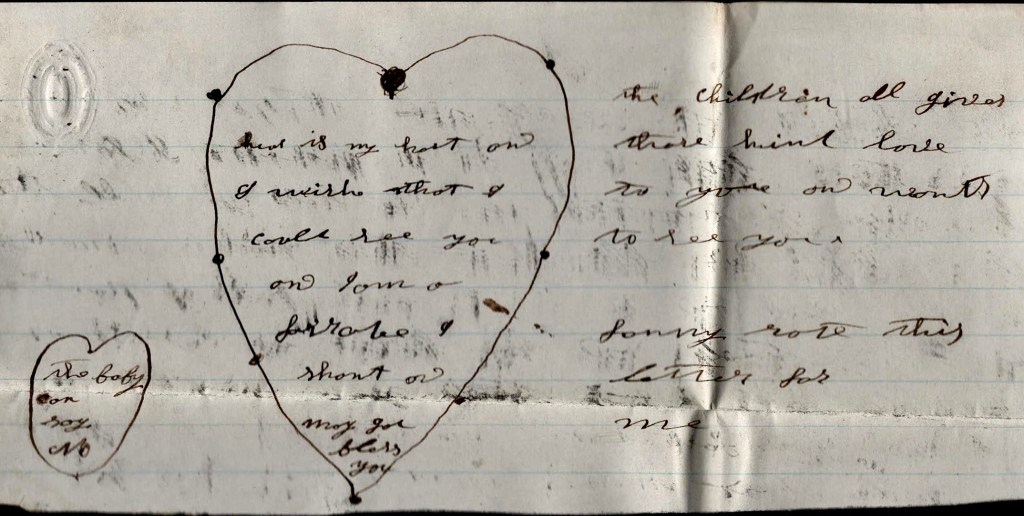
You wanted to know how your father and mother get along. I don’t know much about them, Your father has got the wagon and the chain and the grind stone and your boot is lost. We shan’t get no more fish again. I have got your spear yet and I got the three hooks. Your mother is tolerably afraid that she won’t get what you owe her. Cate is well and she is the best one to me. She comes here and talks to me. Tonight I have got my garden plowed. I gave [ ] five bushels of [ ]. The Jordans are mowing the [ ]. We all send our kind love to Daniel. We have got enough to eat. Things is getting a little cheaper. Fanny wants you to send her a little ring when you can. This is Sunday night and I must close my letter. Goodbye dear and may God bless you. So goodbye. From your dear wife, — Elizabeth Nolop
Letter 2
Hixton, Jackson county, Wisconsin April 23, 1865
Dear Henry,
I hope these few lines will find you and Dan in good health. Your family is all well. We have news that the war is over. Mobile gave up. So far so good. But the news of the murder of Abe Lincoln is not so good.
William Curran, Co. G, 5th Wisconsin Infantry. Had a leg amputated from wound received at the Battle of Sailor’s Creek on 6 April 1865
Poor William Curran has lost his leg at Richmond. Old Mr. [John H.] Curran is going down to him tomorrow. When he gets the bad news that his Mother died, he will feel bad enough. 1
We have the worst of weather here this spring. We done nothing yet on the land, On the 21st it began to snow and now we have plenty of snow on the ground. I have heard from Gerry Martin. He is in St. Louis, Mo. Maybe he will be sent to the plains to keep the Injens quiet. Enlisting and drafting is stopped altogether.
I wish you would let me know how the soldiers felt when they heard that the President was killed. Wonder what they would do if they had that fellow that fired the pistol. I don’t think that the leading Rebels will fare so well with Andy Johnson as they would with Old Abe. But we shall find out.
We had a good laugh about Dan not finding bottom in the camp at Carrollton. I hope he has got dry footing now and is in good spirits. I think you all will be home soon. Tell Dan that Mother is going to save lots of eggs and butter for him against he comes home. Dr. Negus sends his best love to you both. He is at Mrs. Martin’s for a day or two. The fact is, he is weather bound. The road is too bad to travel. He is bound for Sparta.
Mr. Coles’ son got clear but they took him again and now they have him in Milwaukee. It will go pretty hard with him.
Mother and me send our love to you and Dan. Write soon—that is, when you get a chance. And tell Dan to write. So no more at present. From your father, — G. Nolop
To Mr. Henry Nolop, 4th Cavalry, Co. I, Wisconsin Volunteers, Baton Rouge, La.
1 John “William” Curran (1840-1915) served in Co. G, 5th Wisconsin Infantry. He was badly wounded on 6 April 1865 at the Battle of Sailor’s Creek and had to have his left thigh amputated. William was the son of Rev. John H. Curran (1805-1881)—a blacksmith and local Methodist minister—and Elizabeth McKinney (1808-1865). Elizabeth died on 14 April 1865, just a few days after her son was wounded.
Letter 3
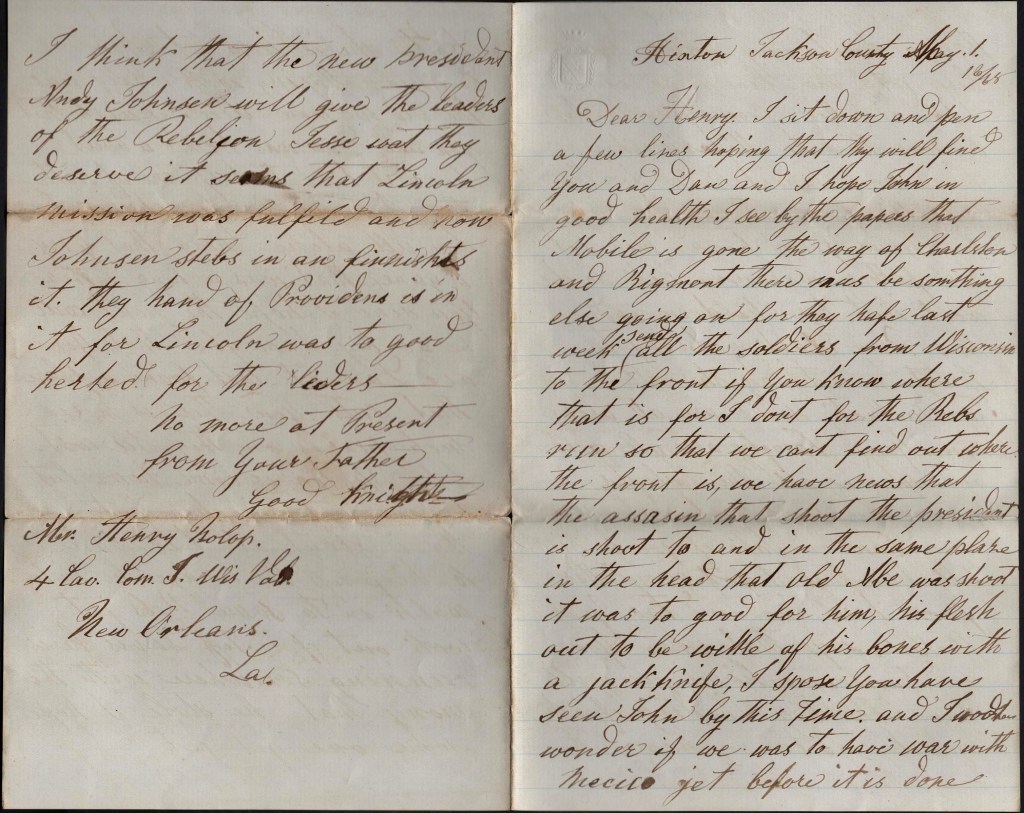
Hixton, Jackson county, [Wisconsin] May 1, 1865
Dear Henry,
I sit down and pen a few lines hoping that they will find you and Dan, and I hope John, in good health. I see by the papers that Mobile is gone the way of Charleston and Richmond. There must be something else going on for they have last week sent all the soldiers from Wisconsin to the front. If you know where that is for I don’t, for the Rebs run so that we can’t find out where the front is.
We have news that the assassin that shot the President is shot too and in the same place in the head that Old Abe was shot. It was too good for him. His flesh ought to be whittled off his bones with a jackknife.
I suppose you have seen John by this time and I wouldn’t wonder if we was to have war with Mexico yet before it is done.
There is hardly any sowing done here yet—the land is so wet. I had a letter from Gerry Martin. He was then in Missouri. Where he is now, I don’t know for they marched from there. His wife had news from Fond-du-lac that her father was very sick so she went with her children adn Mrs. Perry Clark yesterday to Sparta and today she will be in Fond-du-lac so we are all alone now. Your family are all well and so are all the neighbors. Your mother sends her love to you and Dan and John. If you see him, tell him that I got one letter from him and sent two. Your mother says that when you and Dan come home, we will have the big pudding—if it can be got anyhow.
Kate she is now at Mr. Curran’s stopping with Mary since the Old Woman died. I wish that you and Dan was home about harvest time to help me off with the harvest for you know I am all alone now that Gerry is gone. That was a long letter you sent, I hope the next will be as big. I am glad that you and Dan at last found a place that suits you. There is more such places on the seacoast. John Ashton is coming home but I have not see him yet.
This is about all. Tell Dan to keep up his courage yet. Look out for Jeff Davis. He is running somewhere with the money that he stole. I hope someone gets it. I think that the new President Andy Johnson will give the leaders of the Rebellion just what they deserve. It seems that Lincoln’s mission was fulfilled and now Johnson steps in and finishes it. The hand of Providence is in it for Lincoln was too good-hearted for the leaders.
No more at present. From your Father. Good night.
to Mr. Henry Nolop, 4th Cavalry Co. I, Wisconsin Vols. New Orleans, La.
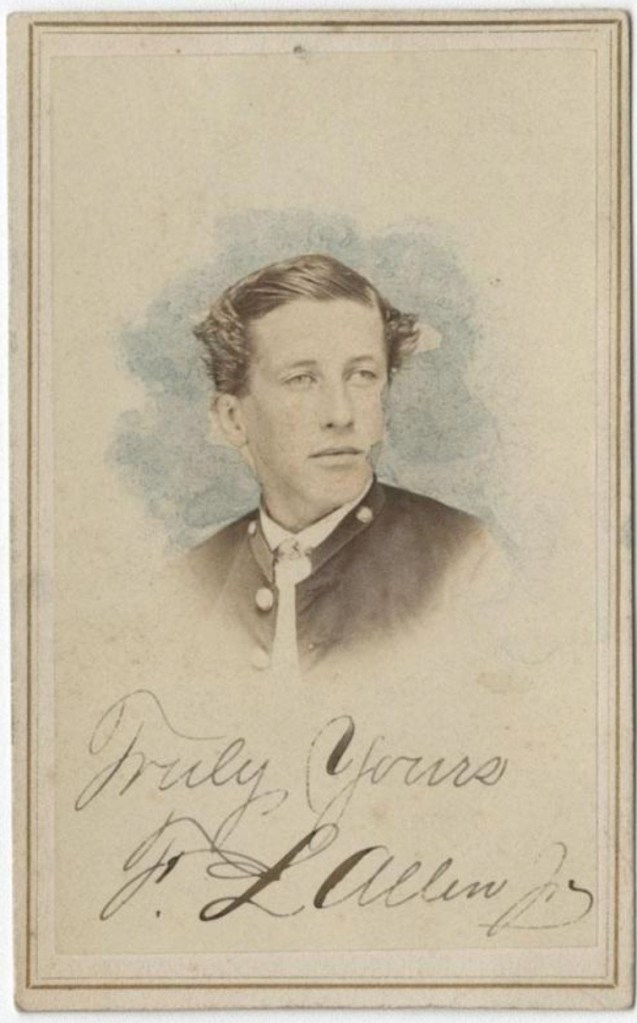
Frederick L. Allen of Co. A, 23rd Connecticut Infantry (Photo Sleuth)
The following partial letter was written by a soldier in Co. C, 23rd Connecticut Infantry. There is no accompanying envelope nor second sheet with the author’s signature to help us further in his identification though he seems to refer to himself in the 3rd person at times as “Tom.” If his name was Thomas, there were only three in the regiment named Thomas—Thomas Gavon, Thomas Colopy, and Thomas Milnes. If I were to guess his age based on the content, I should think he was about twenty or less.
The letter provides us with a good description of the voyage to Louisiana from New York City aboard the Che Kiang steamer, and of the regiment’s occupation of Brashear City.
Transcription
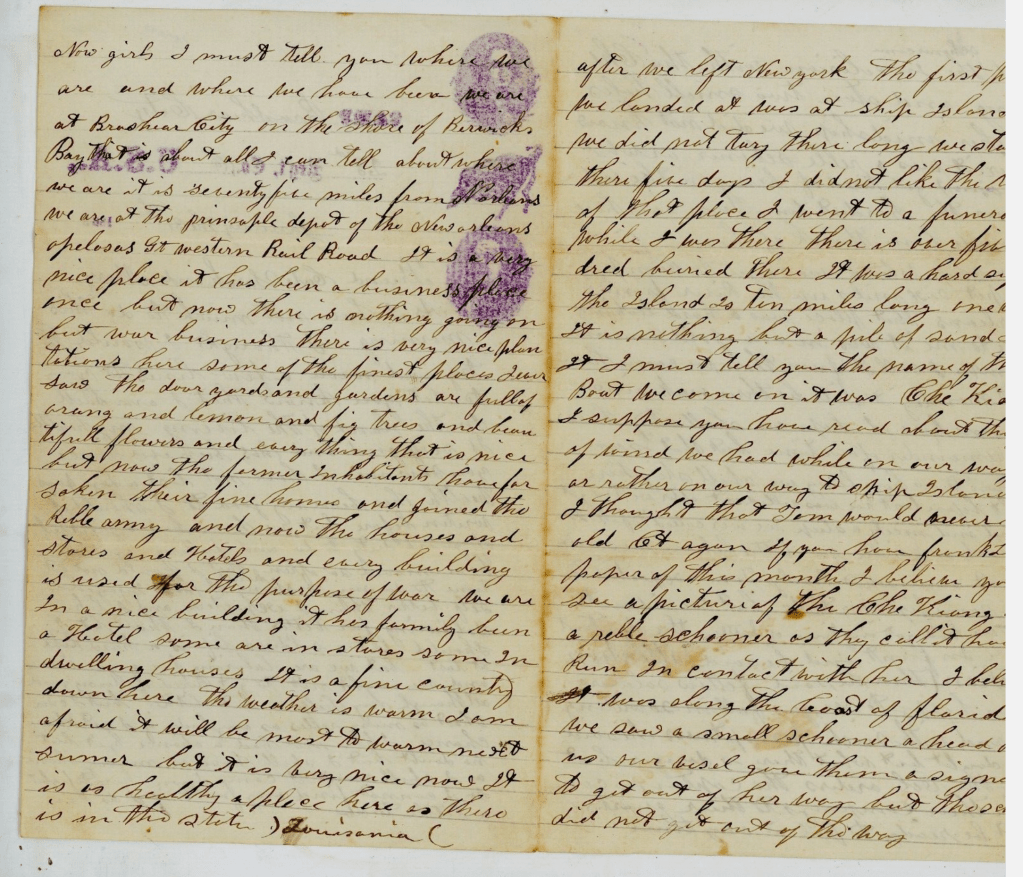
Camp Brashear City 23rd Regiment, Co. C January 31, 1863
Friends Cate, Sarah and Mary,
As I have not much to do this morning, I thought I would try and write a few lines to you to let you know that I am still in the land of the living. My health is very good and has been ever since you saw me. I have not lost a day. J__’s health has been good too. I should have written before but we have had a great deal of guard duty to do and drilling and we have moved so often that I could not get time to do my washing hardly. I have enjoyed myself better than I expected and I like soldiering far better than I thought I should but a soldier’s life is a hard life at last. But we are laboring for a good cause and we ought not to get tired of doing good although my help is but little. But I can shoot as many rebels as anybody if I get the chance. I have not had a chance yet but no doubt but I shall have as many shots as I shall want. I came down here to fight so I cannot find any fault if I do have a little to do.
Now girls, I must tell you where we are and where we have been. We are at Brashear City on the shore of Berwick’s Bay. That is about all I can tell about where we are. It is seventy-five miles from New Orleans. We are at the principal depot of the New Orleans, Opelousas, Great Western Railroad. It is a very nice place. It has been a business place once but now there is nothing going on but war business. There is very nice plantations here—some of the finest places I ever saw. The door yards and gardens are full of orange and lemon and fig trees and beautiful flowers and everything that is nice. But now the farmer inhabitants have forsaken their fine homes and joined the rebel army and now the houses and stores and hotels and every building is used for the purpose of war. We are in a nice building. It has formerly been a hotel. Some are in stores, some in dwelling houses.
It is a fine country down here. The weather is warm. I am afraid it will be most too warm next summer but it is very nice now. It is as healthy a place here as there is in the state (Louisiana).
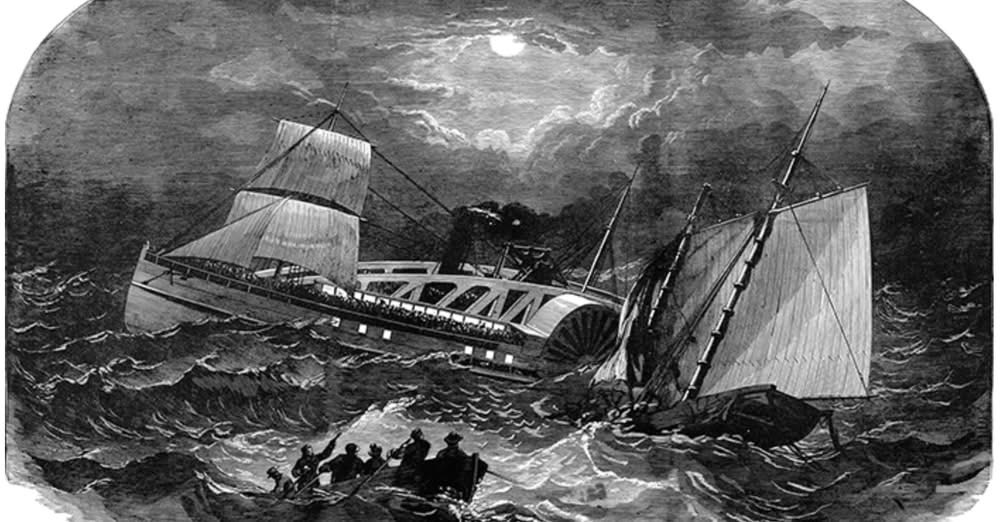
After we left New York, the first place we landed was at Ship Island. We did not tarry there long. We stayed there five days. I did not like the look of that place. I went to a funeral while I was there. There is over five hundred buried there. It was a hard sight. The island is ten miles long, one wide. It is nothing but a pile of sand. I must tell you the name of the boat we came on. It was the Che-Kiang. I suppose you have read about the gale of wind we had while on our way here, or rather on our way to Ship Island. I thought that Tom would never see old Connecticut again. If you have Frank Leslie’s paper of this month, I believe you will see a picture of the Che-Kiang after a rebel schooner, as they call it, had run in contact with her. I believe it was along the coast of Florida. We saw a small schooner ahead of us. Our vessel gave them a signal to get out of her way but the schooner did not get out of the way and the schooner came in collision with the Che-Kiang and stove two small hopes in her midship. We did not know whether it was a rebel schooner or what it was. I got tired of being on the water. It was the hardest time Tom ever had. It made him think of home.
The Ship Che-Kiang collides with a Confederate schooner off the Florida Reef resulting in the sinking of the schooner.
From Ship Island we come to Camp Parapet six miles up the river from New Orleans. That place was a hard looking place to me. It was in one of the old Louisiana swamps, I call it. From there we came here. Next Monday it will be three weeks since we came here. I hope we shall stay here the remainder of our time but that is unknown to us how long we shall stay here. Night before last we was called out after we had got to bed and nicely asleep. We were called to fall in as quick as possible. You better believe we scrambled out somewhat lively. Tom expected to have some fighting to do but we did not. After we had got in line of battle, the Adjutant came in front and he said, “Attention Battalion.” Then he said, “Fellow soldiers. I am happy to see you fall in so willingly and with such promptness.” He said, “No doubt but what there is danger but by the Colonel’s orders the captains can take their companies to their quarters but be ready to fall in at any time.” [2nd sheet of letter is missing]
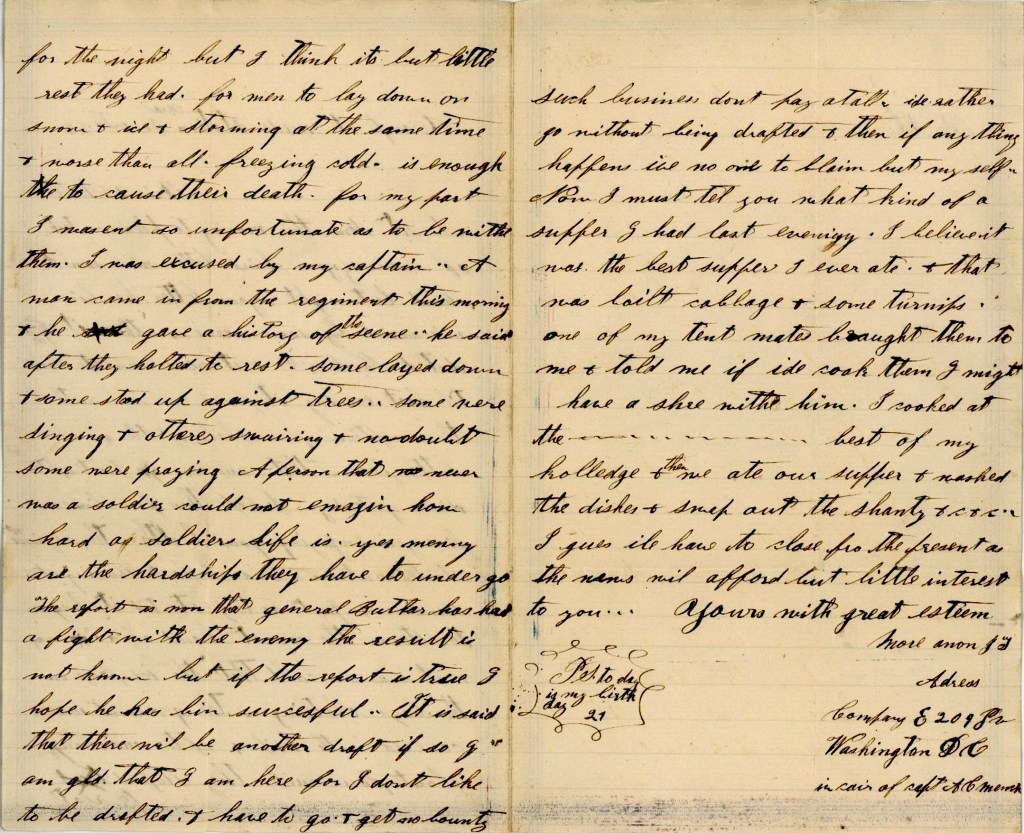
The following letter was written by Jacob E. Travelpiece (1844-1908), the son of Jacob Dreibelbis (1799-1874) and Mary Magdalena Everett (1804-1867) of Orangeville, Columbia county, Pennsylvania. Jacob wrote the letter while serving in Co. E, 209th Pennsylvania Infantry. According to the 1890 Veteran Schedules, Jacob enlisted in September 1864 and mustered out in late May 1865 after 9 months service. After the war he married Celestia Stiner (1847-1931).
Transcription
Addressed to Miss Sallie France [?], Orangeville, Columbia county, Pa.
Camp at Meds Station, Va. December 10th, 1864
Friend Sallie,
I sit down this morning to pleasure task of answering your kind letter which came to hand last night. Your letter has been miscarried by some means or other. It is dated November 15th and it never came to hand till last evening. It found me well with the exception of a shake of the ague & a little fever that came on just after dinner yesterday. I hope these few lines will find you enjoying good health.
The regiment started out on a march last evening at sundown & just as they started, it began to storm the worst kind of a way & it was so cold that the ice froze on the boys clothing. The ground was covered with hail and after marching about four miles, they stopped to rest for the night but I think it’s but little rest they had for men to lay down on snow & ice and storming at the same time & worse than all, freezing cold is enough to cause their death. For my part, I wasn’t so unfortunate as to be with them. I was excused by my captain.
A man came in from the regiment this morning and he gave a history of the scene. He said after they halted to rest, some laid down & some stood up against trees. Some were singing and others swearing & no doubt some were praying. A person that never was a soldier could not imagine how hard a soldier’s life is. Yes, many are the hardships they have to undergo.
The report is now that General Butler has had a fight with the enemy. The result is not known but if the report is true, I hope he has been successful. It is said that there will be another draft. If so, I am glad that I am here for I don’t like to be drafted & have to go & get no bounty. Such business don’t pay at all. I’d rather go without being drafted and then if anything happens, I’ve no one to blame but myself.
Now I must tell you what kind of a supper I had last evening. I believe it was the best supper I ever ate & that was [ ] cabbage and some turnips. One of my tent mates brought them to me and told me if I’d cook them I might have a share with him. I cooked at the ——- best of my knowledge & then we ate our supper & washed the dishes and swept out the shanty, &c. I guess I’ll have to close for the present as the news will afford but little interest to you. Yours with great esteem. More anon. — J. T.
Address Company E, 209th Penn. , Washington D. C. in care of Capt. A[ndrew] C. Mensch
The only picture I could find of a member of the 84th OVI in uniform. This was William D. Mather of Co. E. (Photo Sleuth)
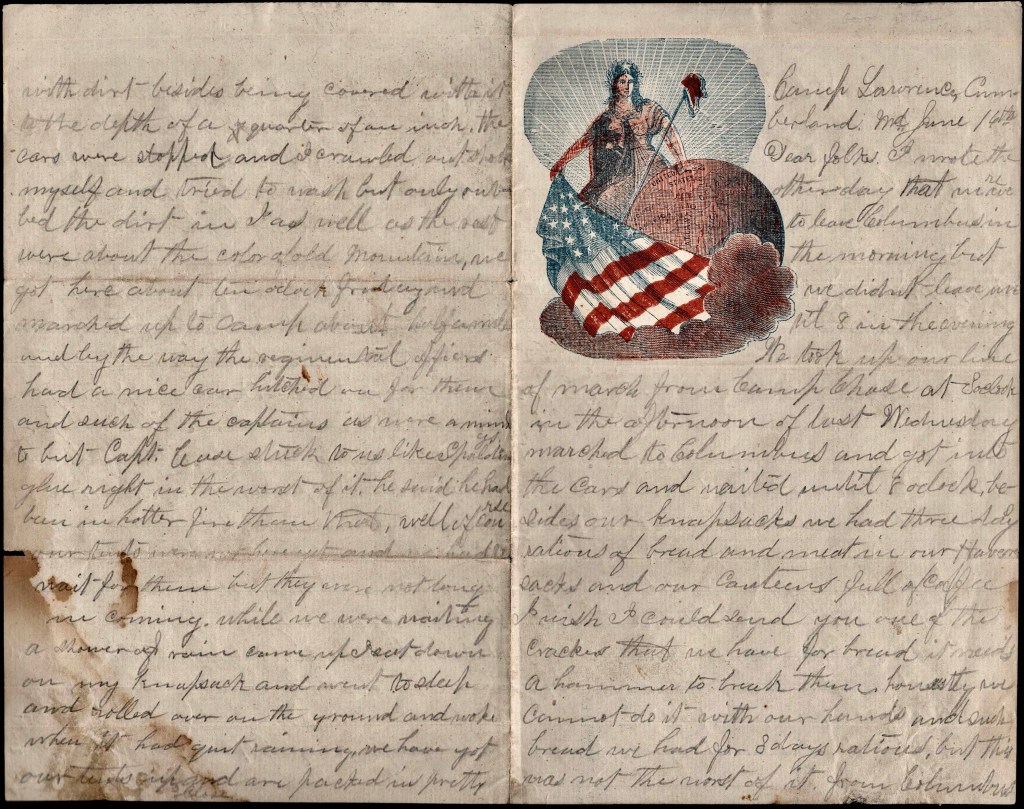
The following partial letter was written by a soldier serving in Co. C, 84th Ohio Volunteer Infantry (OVI)—a three months’ regiment that was ordered to Cumberland, Md., June 11, and performed provost duty there till September. They were attached to Railroad District, Dept. of the Mountains, to July, 1862, and 8th Army Corps, Middle Department, to September. They moved to New Creek September 13 to repel an attack on that point by Jenkins and Imboden. They then moved to Camp Chase, thence to Camp Delaware, and mustered out October 14, 1862.
Co. C was recruited principally in Miami county, Ohio, but there were some members from Trumbull and Mahoning counties as well. The only name mentioned in the letter was that of Halbert Brigham Case (1838-1914) who served as captain of Co. C. Case had previously served as 1st Sergeant in Co. H, 7th OVI when it was a 3-months regiment and when it was reorganized as a 3-year’s organization, he was commissioned a Lieutenant and served in the campaigns of West Virginia. He resigned his commission to raise the company in the 84th OVI.
Unfortunately the envelope that carried this letter home has not survived or has been separated from it so that we don’t know who the soldier’s folks were. And there was likely a second sheet to this letter at one time that included the soldier’s signature, but it too is gone.
Transcription
Camp Lawrence, Cumberland, Maryland June 16th [1862]
Dear folks,
I wrote the other day that we were to leave Columbus in the morning but we didn’t leave until 8 in the evening. We took up our line of march from Camp Chase at 3 o’clock in the afternoon of last Wednesday, marched to Columbus, and got into the cars and waited until 8 o’clock. Besides our knapsacks, we had three days rations of bread and meat in our haversacks and our canteens full of coffee. I wish I could send you one of the crackers that we have for bread. It needs a hammer to break them. Honestly, we cannot do it with our hands and such bread we had for 3 days rations, but this was not the worst of it. From Columbus we went to Bellaire on the Ohio river 4 miles below Wheeling. Got there about noon of Thursday, were ferried across the river and put on the cars immediately and such cars!
Uncle Sam has got me for three months and he may make the most of it for he will have to whistle after that. I expected to be treated half way decent but we have not been treated as well as hogs. At Bellaire we were put on open coal cars at noon and wheeled out into the sun and left there until 4 o’clock when we started. Our seats were made of rough boards. This was what we had to ride on for 240 miles. I don’t complain but thought I would tell you how it was. The smoke and cinders from the locomotive blew right on us which was enough to blind a man in 15 minutes but we tied our handkerchiefs over our heads and started and went through the darndest country that mortal man ever beheld.
We followed the Ohio river for a short distance and such hills I never saw before. In many places the road was cut a hundred feet through the solid rock and we passed through tunnels without number. One was said to be three miles long. I was asleep when we went through it but I know that we went through some mighty long ones and lots of them. The road is crookeder than any turnpike in Ohio. It is on a curve one way or the other all the time besides lots of square corners. In some places it is cut from 50 to a hundred feet and fill as many on the other Lots of places it was down perpendicular as much as 100 feet and a little brook quietly working its way among the rocks at the bottom.
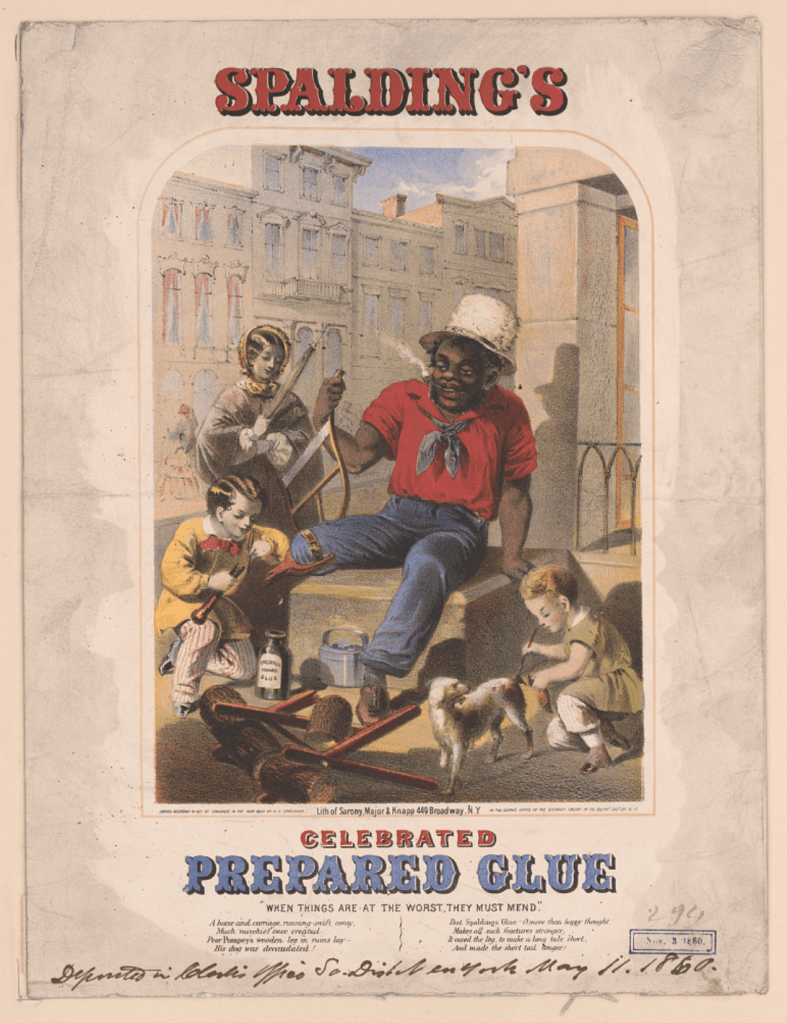
Print shows a young boy using “Spalding’s Celebrated Prepared Glue” to repair the broken peg prosthetic for an African American man who broke it while sawing wood; also shows a young girl attempting to glue the tail back on a small dog that may have been cut off in the woodcutting accident. (LOC)
To sleep we had to crawl down in the bottom of the car, cover up heads, and sleep away. I slept from midnight until daylight and when I awoke, my mouth, nose, ears, and eyes were filled with dirt, besides being covered with it to the depth of a quarter of an inch. The cars were stopped and I crawled out, shook myself, and tried to wash but only rubbed the dirt in. I as well as the rest were about the color of old mountain. We got here about ten o’clock Friday and marched up to camp about half a mile and by the way, the regimental officers had a nice car itched on for them and such of the captains as were a mind to but Capt. [Halbert B.] Case stuck to us like Spalding’s Glue right in the worst of it. He sad he had been in hotter fire than that.
Well, of course our tents were not here yet and we had to wait for them but they were not long in coming. While we were waiting, a shower of rain came up. I sat down on my knapsack and went to sleep and rolled over on the ground and woke when it had quit raining. We have got our tents up and are packed in pretty close… [rest of letter missing]