This letter was written by Granville Griffith (b. 1835), the son of Joseph Robinson Griffith (1806-1849) and Caroline Guthrie (1806-1850) of Edgar, Illinois. Granville addressed the letter to his sister, Ann Katherine (Griffith) Lawrence (1830-1915) and her husband, James Lawrence (1825-1869) of Lincoln, Logan county, Illinois. James and Ann were married in Edgar County, Illinois, in 1849 and had relocated to Topeka, Shawnee county, Kansas by 1860, but then returned to Illinois during the Civil War.
Mentioned in the letter are Granville’s brother, Columbus Griffith, and Thomas Lawrence (presumably a relative), both of whom served in Co. I, 2nd Kansas Cavalry. Thomas’ enlistment papers inform us he was born in Edgar county, Illinois in 1836. His Find-A-Grave biographical sketch confirms his enlistment in the 2nd Kansas Cavalry on 25 August 1862 but it states that he was “killed in action at the Battle of Prairie Grove” on 7 December 1862 and that he was “buried as an unknown soldier.” This information is inconsistent with the letter, however, that claims he survived the battle but received a severe leg wound that was probably mortal and had been taken to a hospital in Fayetteville. The “John T.” who journeyed to Fayetteville to attend to Thomas was probably John Thomas Lawrence (1830-1876) who was married in Edgar county, Ohio, in 1854 to Margaret M. Matthews and was living in Ottumwa, Kansas in 1863.
Addressed to James Lawrence, Lincoln, Logan county, Illinois
Hartford, [Lyon county] Kansas January 7th 1863
Dear Brother and Sister,
I received your letter a few days ago and should have answered it sooner but have been so busy that I have not had time. We are well and I hope by the time this reaches you that you will be all well again.
I was very sorry to hear of poor little Eddie’s death 1 but one great consolation—he is better off than we are.
I heard last week that Columbus had the small pox but I am in hopes that is not so. He is still at Fort Scott in the hospital. Thomas Lawrence was wounded at Prairie Grove—shot through the knee and I heard that he would have to have his leg taken off. John T. has gone to him. He is at Fayetteville, Arkansas.
I don’t know that I have anything to write that would interest you. The health of the country is good. Our college 2 in Hartford is nearly completed. I want you to write to me as soon as you get this. Tell me how you are getting along, what you think of doing, &c.
Mary joins in sending her love to you all. From your brother and sister, — G. and M. E. Griffith
Tell Joseph when you write to me he must write soon.
1 Edwin Lawrence was born in 1859. He must have died in late 1862.
2 The old Hartford Collegiate Institute was built in 1863 by John Griffith and Richard How. The Hartford Collegiate Institute was a branch of Baker University, and served to prepare students for entrance into the Methodist university in Baldwin City, Kansas (southeast of Lawrence).
The old limestone building that was once the Hartford Collegiate Institute still stands at 315 College Boulevard i nHartford. It was placed on the National Register of Historic Places in 1972.
I could not find an image of George but here is one of Corp. Benjamin Moore of the 5th Massachusetts Infantry (Kevin Canberg Collection)
The following letter was written by George Whitefield Dow (1831-1882), the son of Joshua Dow and Miriam Watson of Plaistow, Rockingham county, New Hampshire. He was married first, in September 1850, to Maria Ann Sanborn (1834-1852). He then married Olivia A. Smith of Salisbury, Massachusetts, in May 1853, and in the 1860 US Census, he was enumerated in Salem, Essex county, Massachusetts, working as a Railroad Repairman. The couple had a 6 year-old son named George.
It was on 19 April 1861 that George enlisted as a private in Co. H (“Salem City Guards”), 5th Massachusetts Infantry. He was with the regiment at the Battle of Bull Run on 21 July 1861 where he was taken prisoner. He was confined at Richmond on 23 July 1861 and at New Orleans on 24 September 1861. He was paroled at Washington, North Carolina, on 2 June 1862 and mustered out of the regiment at Boston on 24 June 1862.
The Fifth Regiment Massachusetts Volunteer Infantry charges up a hill in Washington D.C. during training, May 1861, the U.S. Capitol is shown in the background.
Transcription
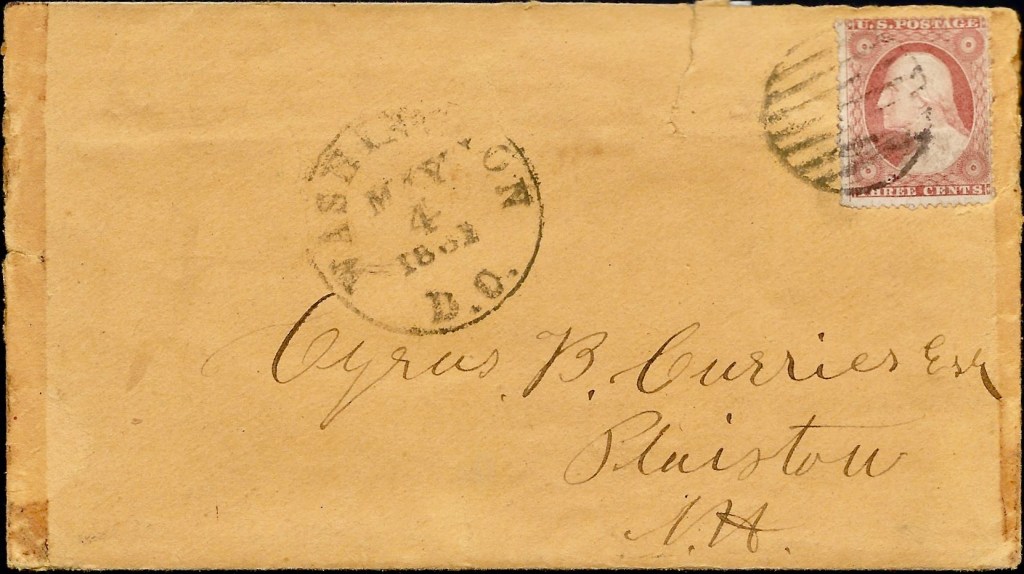
Addressed to Cyrus B. Curries, Esq., Plaistow, New Hampshire
Washington [D. C.] May 4th 1861
Cousin Cyrus,
Having a few minutes to spare, I thought that I would write you a few lines—the last perhaps that you will ever hear from me. I am enlisted in the 5th Regiment Massachusetts Volunteers to fight for my country. We arrived here a week ago today. We had a hard time in getting here. I shot my first man in Maryland 2½ miles below Annapolis Junction. We had quite a brush with the suckers about daylight, but we have drove them to cover the same as we shall Jeff Davis. You can have no idea of a skirmish in woods at daybreak. I felt as though I should s[hi]t at first, but I soon was as crazy as a Bed Bug & on the whole, I rather like to put consute [?] out of the suckers.
Col. Samuel Crocker Lawrence, 5th Massachusetts Infantry
Last Thursday night, I was on guard on the Bridge that leads across the Potomac River. I saw a sucker sneaking along & hailed him when he rose up & fired at me, but did not hit me. And in about 2 jerks of a sheep’s tail, I put a plum hole chuck through his heart, & Col. [Samuel Crocker] Lawrence—my colonel—said I was a good boy & that I done just right. But cousin, I suppose my time will come soon. I feel just as though & should never see old Plaistow again. But I have got just as good pluck for all of that & when I do fall, I shall fall at my post. I think that I am on the right side & shall fight just as long as I can draw a bead on a Southerner.
I know that I shall have the sympathy of all my friends & all true Yankees. I would [be] willing [to] face the cannon’s mouth but I can’t help thinking of my poor wife & boy. If I should fall, they will be left to the cold world & it makes my heart ache to think of it some times. But I would not come home now if I could. New England Blood has been spilt on southern soil & it shall be avenged a gallon for every drop. I hate the sight & smell of a southerner. I have got 24 rounds of ball cartridges in my box & I don’t mean to throw a single one away. When I draw a bead on a southerner, he is mighty apt to fall.
I want you show this letter to Luke & Mary & any body else that you are a mind to. Tell George Sumner that there is room for him out here. We want all good shots out here for the sneaking murder[er]s have got to fall.
Give my love to all & if you never see me again, remember that I leave a wife & boy that is very dear to me. I cannot write any more now. I sent a kiss enclosed for cousin Margaret & you will please deliver it immediately. Goodbye, perhaps forever, but I hope not. — George W. Dow
To C. B. Curries, Plaistow, N. H.
P.S. I have got a good revolver & know how to use it. It was given to me in Faneuil Hall by the Eastern R.R. boys.
Elisha Hiatt Newton (1831-1893) of Medora, Jackson Co. , Indiana. Served three years in Co. G, 25th Indiana Infantry
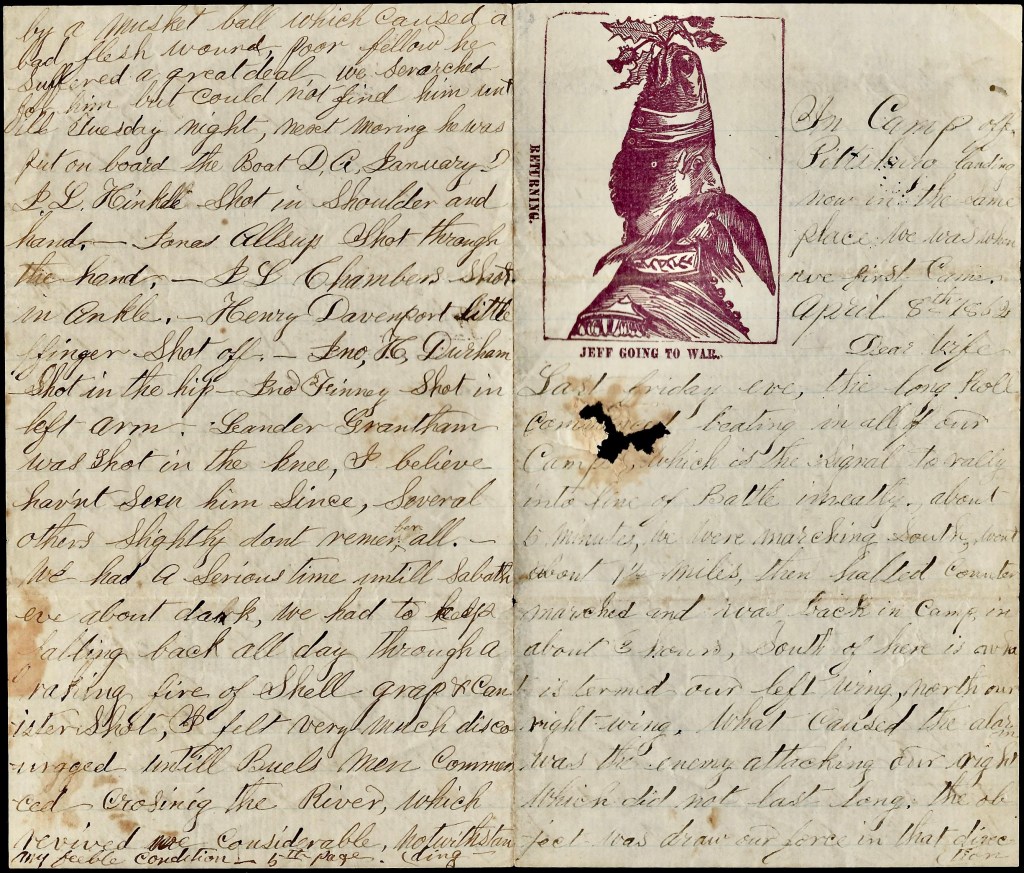
The following partial letter came to me for transcription and although it is unsigned and without an accompanying envelope, I have been able to place him in Co. G, 25th Indiana Infantry. We know that he was married and given the residences of several comrades mentioned by name in the letter, we can surmise that he was likely a resident of Medora, Jackson county, Indiana—a small village in Carr township of the East Fork White River valley. A listing of all of the soldiers in Co. G can be found on the Jackson county website and the author is undoubtedly one of these men, but after several hours of going through the list, my best guess is that it was written by Elisha Hiatt Newton (1831-1893)—a farmer from Medora. Elisha and Amanda Adelia Westfall were married in September 1852. He enlisted in Co. G, 25th Indiana Infantry on 19 August 1861 and mustered out on 18 August 1864.
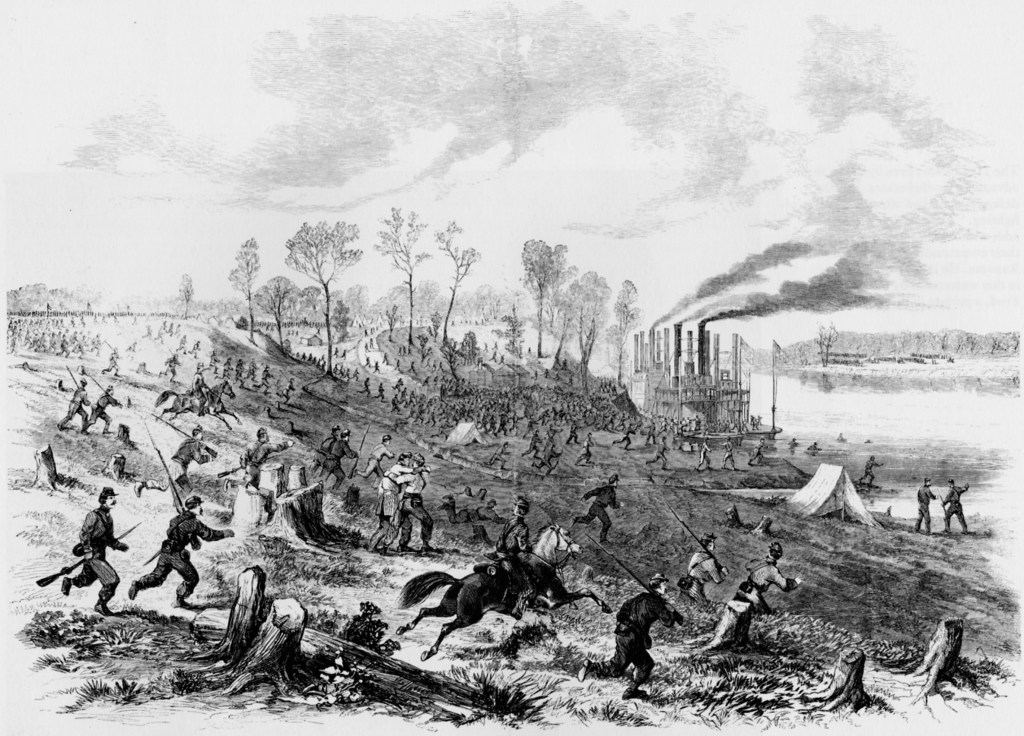
The 25th Indiana Regiment was organized at Evansville on 17 July 1861 and was mustered into three years service in August. It left the state Aug. 26, and was in camp at St. Louis until Sept. 14, moving from there to Jefferson City and thence to Georgetown. It marched to Springfield with Fremont’s forces and back to Otterville, 240 miles, in 16 days. It remained in the vicinity of Otterville until December, when it moved with Pope’s division south of Warrensburg, forming part of the force that captured 1,300 of the enemy at Blackwater. The 25th guarded the prisoners to St. Louis and went into Benton Barracks until Feb. 2, 1862. It was sent with the expedition against Fort Donelson and joined in the first attack, losing 16 killed and 80 wounded. It was part of the force which stormed and captured the outer works the next day and occupied the fort after its surrender. It left for Pittsburg landing on Mar. 5, reaching there on the 18th, and in the battle of Shiloh, lost 27 killed and 122 wounded. This letter describes the Battle of Shiloh and provides the names and nature of wounds received by members of his own company.
For a good history of the remainder of the regiment’s service, see This Mighty Scourge by Michael Noirot. See also the Biography and Letters of Private Joseph Saverton of Co. C, 25th Indiana Infantry. I’ve included an excerpt of a letter that Ingram wrote in 1862 following the Battle of Shiloh that is housed in the Indiana Historical Society Archives.
“I guess you hav herd before this time that I hav see the monkey dance. I did not enjoy the 6 of April as much as I have enjoyed some Sundays as we had to brake the Sabath by shooting and shooting at men. Becids that wasont all they, they could shoot darn nigh a fast as we could. So that was a too handed game. Well they had more men than we did and took a running dart at us and you know if a small man runs at a big man the big man will sorter give back. We they got a bull dart at us and we hat to give back, well they took that kind of darts at us all Sunday and bout 5 o’clock Sunday evening they could not dart us any more for we had no ground to dart back on if we had went back much further. We would went in Tenn. River but Buels forces was on the opposite side of the River and the gun boats let loose and socks another time of cannonading. Yeu never herd but the darn dare devils had to crawfish and we laid on our arms all night—well we dident lay much for we had to stand up to keep from getting washt off. I never seen it rain harder in my life than it did that night—I thought day light never would come. I was hungry enough to eat a man off his horse. We had nothing to eat cince Sunday morning and got nothing until Monday evening.
We got back and had Roll Call Monday night. On Sunday when the secesh was getting the beter of us they would holer Bull Run. The old 25 [Indiana] had to face the Alibama Souazes but we hav bin drilled in the Souazee drill as much as any other. We let loose one voly and laid 123 low and we lost 23 men but they was but Six Regt deep and we had no support and we was obliged to fall back. Well darn the fight. I will quit writing bout the fight but it aint the thing it is cracked up to be.”
April 6, 1862, Battle of Shiloh
Transcription
In camp off Pittsburg Landing now in the same place we was when we first came April 8th 1862
Dear wife,
Last Friday eve, the long roll commenced beating in all of our camps which is the signal to rally into line of battle immediately. About five minutes we were marching south. Went about one and a half miles, then halted, countermarched, and was back in camp in about three hours. South of here is what is termed our Left Wing, north our Right Wing. What caused the alarm was the enemy attacking our right which did not last long. The object was [to] draw our force in that direction.
The 25th Indiana Infantry monument at Shiloh is sites at the position it took on Sabbath morning April 6th and held it against a fierce assault of the enemy for two hours. Being flanked fell back 100 yards again it fell back 100 yards. Here Regiment was furiously assailed by infantry and artillery, which caused it to fall back slowly to the right of the siege guns, where it rested Sunday night.
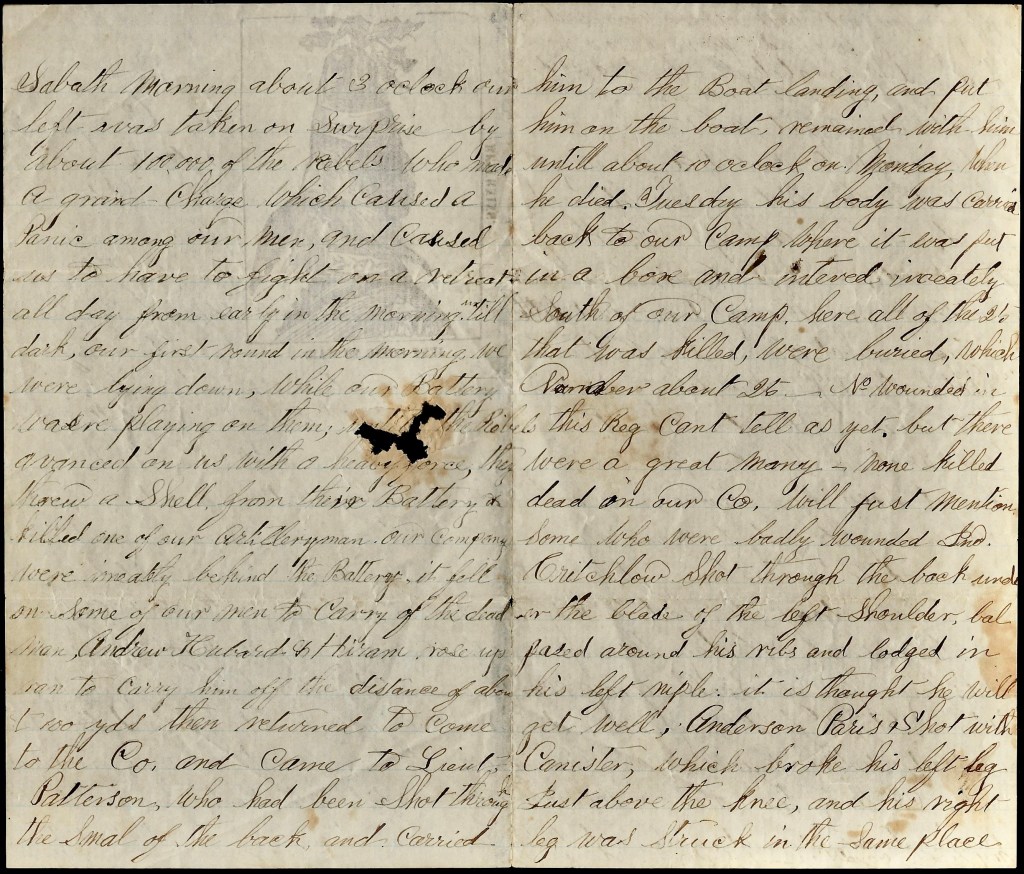
Sabbath morning about 3 o’clock our left was taken on surprise by about 100,000 of the rebels who made a grand charge which caused a panic among our men and caused us to have to fight on a retreat all day from early in the morning until dark. Our first round in the morning, we were lying down while our Battery was playing on them; until the Rebels advanced on us with a heavy force, they threw a shell from their Battery & killed one of our artillerymen. Our company were immediately behind the Battery. It fell on some of our men to carry off the dead man. Andrew Hubbard 1 & Hiram [Huntsucker] 2 rose up, ran to carry him off the distance of about 100 yards, then returned to come to the company and came to [1st] Lieut. [Jesse] Patterson who had been shot through the small of the back and carried him to the Boat landing and put him on the boat, remained with him until about 10 o’clock on Monday when he died. Tuesday his body was carried back to our camp where it was put in a box and interred immediately south of our camp. Here all of the 25 that was killed were buried. which number about 25. Number wounded in this regiment, can’t tell as yet but there were a great many. None killed dead in our company. Will just mention some who were badly wounded.
Jno. Critchlow 3 shot through the back under the blade of the left shoulder, ball passed around his ribs and lodged in his left nipple. It is thought he will get well.
Anderson Parris 4 shot with canister which broke his left leg just above the knee and his right leg was struck in the same place by a musket ball which caused a bad flesh would. Poor fellow. He suffered a great deal. We searched for him but could not find him until Tuesday night. Next morning he was put on board the boat D. A. January.
The Hospital Ship, D. A. January
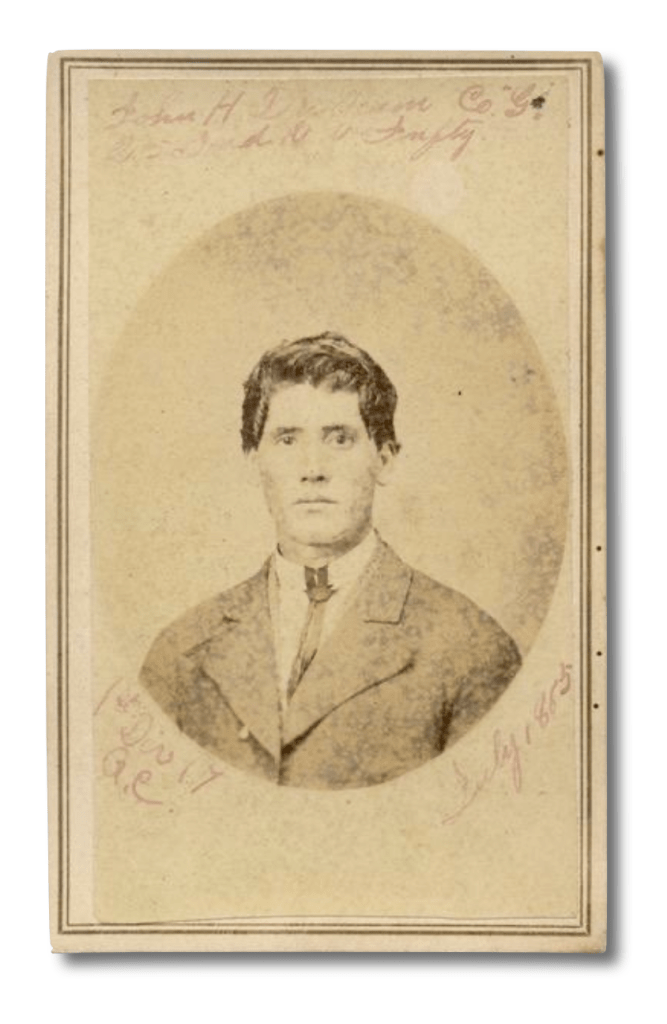
John Hardin Durham (1842-1926), Co. G, 25th Indiana (lost a leg and an eye at Shiloh)
J[acob] L. Hinkle 5 shot in shoulder and hand. Jonas Allsup 6 shot through the hand. J[acob] L. Chambers 7 shot in ankle. Henry Davenport, 8 little finger shot off. Jno. H. Durham 9 shot in the hip. Jno. Finney 10 shot in left arm. Leander Grantham 11 was shot in the knee, I believe. Haven’t seen him since. Several others slightly—don’t remember all.
We had a serious time until Sabbath eve about dark. We had to keep falling back all day through a raking fire of shell, grape, and canister shot. I felt very much discouraged until Buell’s men commenced crossing the river which revived us considerable, notwithstanding my feeble condition. [remainder of letter missing]
1 Andrew Hubbard (1836-1915), was the son of George and Martha Ellen (Farris) Hubbard of Medora, Carry township, Jackson county, Indiana. Andrew enlisted on 19 August 1861 in Co. G, 25th Indiana Infantry and mustered out on 17 July 1865 as a veteran.
2 Hiram Weddle Hunsucker (1832-1909), was the son of John and Rosamond (Weddle) Hunsucker of Medora, Carr township, Jackson county, Indiana. Hiram enlisted on 19 August 1861 in Co. G, 25th Indiana Infantry and mustered out as 1st Sergeant of the regiment on 17 July 1865 as a veteran.
3John W. Critchlow (1840-1862), was the son of Edwin L. and Salina (Tanner) Critchlow of Medora, Jackson county, Indiana. He enlisted in Co. G, 25th Indiana Infantry in August 1861, was wounded on 6 April 1862 in the first day’s fight at Shiloh, and died of his wounds on 15 April 1862.
4 Anderson Parris (1844-1917) was the son of John and Mary (Pounds) Parris of Medora, Jackson county, Indiana. He enlisted in Co. G, 25th Indiana on 19 August 1861, was wounded on 6 April 1862 in the first day’s fight at Shiloh, and was discharged for his wounds on 28 February 1863. He married Arvilla Ursula Blythe in 1874. The 1880 US Census indicates that he was a farmer in Carr Township and notes that he was “wounded in army” but does not state if he was handicapped.
5 Jacob Lawson Hinkle (1838-1924) was the son of William and Susan C. (Day) Hinkle of Mooney, Owen township, Jackson county, Indiana. He was a carpenter prior to his enlistment in Co. G, 25th Indiana Infantry. He later became a lieutenant in Co. G.
6 Jonas Allsup (1843-1862) was the son of Jesse and Salina (Blackwood) Allsup of Sparksville, Jefferson township, Washington county, Indiana. He enlisted on 31 July 1861 to serve in Co. G, 25th Indiana Infantry, and died at home on 14 June 1862 from wounds received in the Battle of Shiloh.
7 Jacob L. Chambers (1842-1939), the son of Charles and Martha (Jacob) Chambers of Carry township, Jackson county, Indiana. Jacob enlisted on 19 August 1861 in Co. G, 25th Indiana Infantry and was wounded in the first day’s fight at Shiloh. He was discharged for his wounds on 27 September 1862.
8 Henry K. Davenport (1844-1865) was the son of Benjamin and Margarite (Abell) Davenport of Jefferson county, Kentucky. He gave his residence as Medora, Jackson county, Indiana, however, when he enlisted on 19 August 1861 in Co. G, 25th Indiana Infantry. He died of disease in Andersonville Prison on 18 March 1865.
9 John Hardin Durham (1842-1926), enlisted on 19 August 1861 to serve in Co. G, 25th Indiana Infantry, giving his residence as Medora, Jackson county, Indiana. He apparently did not muster out with the service until 1865. though his Find-A-Grave biographical sketch states that he lost one leg and one eye in the war.
10 John Finney (1845-1864), was the son of Alexander Finney of Spaksville, Jefferson township, Washington county, Indiana. He enlisted on 19 August 1861 in Co. G, 25th Indiana Infantry and died of disease on 28 May 1864.
11 Leander Grantham (1838-1909) was the son of Garretson and Esther (Wilson) Grantham of Graysville, Sullivan county, Indiana. He enlisted on 19 August 1861 to serve in Co. G, 25th Indiana Infantry giving is residence as Mooney, Indiana. He mustered out of the regiment on 18 August 1864.
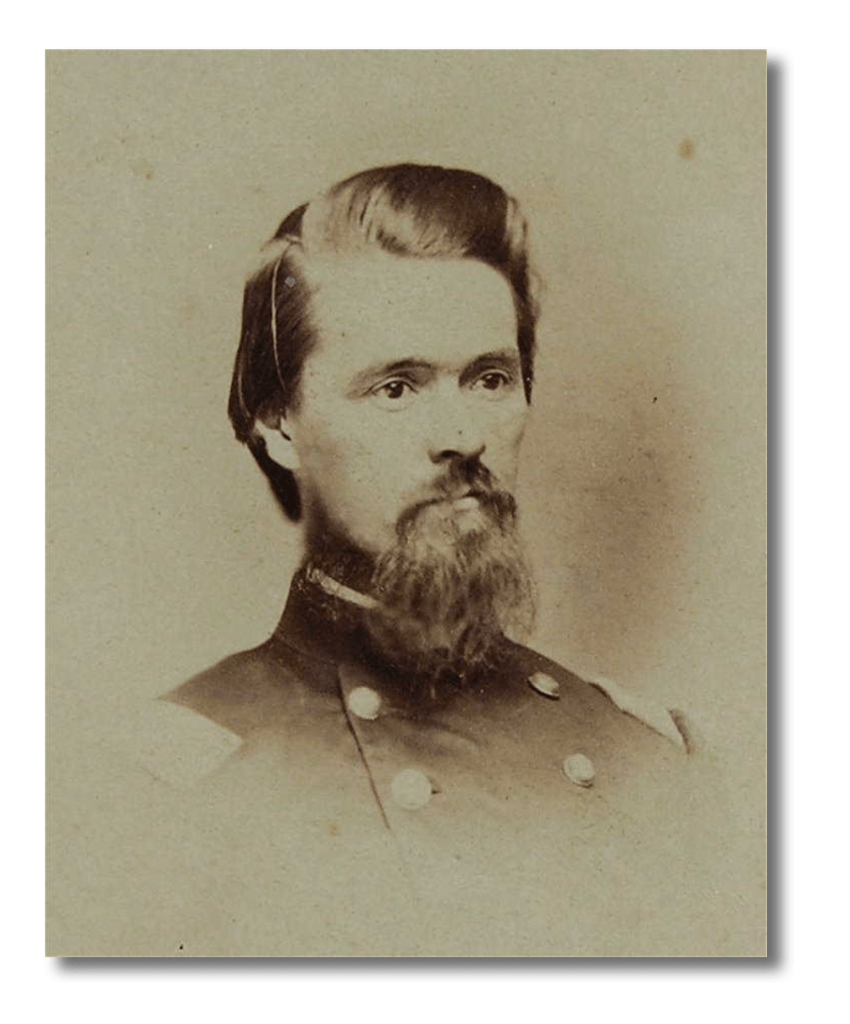
Capt. John W. Poole, Co. G, 25th Indiana Infantry2nd Lt. Mahlon E. Williamson, Co. G, 25th Indiana Infantry
I could not find an image of Lewis but here is one of Sergt. Benjamin F. Smith of Co. B, 52nd Virginia (LOC)
The following letter was written by Lewis F. Burns (1834-1895), a private in Co. K, 52nd Virginia Infantry. Lewis enlisted in April 1862. He was sent to a hospital on 1 November 1862 and the muster rolls from the fall of 1863 show him to be “away without proper authority.” The rolls then indicate that he “returned 19 December 1863 from absence without leave since 12 February 1863 and sentenced by Regimental Court Martial to forfeit one month’s pay in addition to the time of his absence. He was absent without leave from the 10th of May 1862 to the 15th of September 1862 as remarked on tolls of 31 October 1862.”
The muster roll of October 1864 shows Lewis to be “absent wounded since October 19, 1864.” His Find-A-Grave biographical sketch confirms that he was wounded in action (gunshot, right hip joint) in the Battle of Cedar Creek. He was taken prisoner at that time.
Lewis was born in Burnsville, Bath county, Virginia. He was the son of John Strauther Burns, Sr. (1802-1893) and Polly Kincaid (1807-1884). He wrote the letter to his sister who must have been Malvina Gay Burns (1849-1907).
Desertion was clearly a problem for the regiment throughout the war.
Transcription
Camp Rhapadann [Rapidan] Summerville Ford December 23, 1863
Dear sister,
I take this opportunity of writing you a few lines. My health is very bad. I have a very bad cold and sore throat for ten days. Me and Venable 1 arrived in lynchburg on Wednesday the 2nd. We reported to Maj. Proctor. He said that he would have me detailed. Then me and Venable taken a drove of horses 40 miles west of Lynchburg.
When we came back, Maj. Proctor had gotten orders that all detailed men that was fit for field service must be taken out & put in the field. Then I went before the board [and] the doctors examined me for two or three days & pronounced me fit for field duty at last. Then I started to my command and was arrested on the road and they have me in the guard house. Lieut. Gillett says I will get out in a few days. I had a hard time after I left Lynchburg. I come very near starving. I spent 75 dollars since I left home.
Tell Mother I want her to send me a box of something to eat—some sweet cakes & fruit and a canteen of honey, a chicken or two, some apples. Tell Charley to send me a bottle of bitters. Send some sausage. It will come in a few days. Just direct it like you was directing a letter. It comes free of charge. You may tell Mother to not send that box at this time. Lieut. Boon expects to get home after New Year’s and she ccan send it by him.
There isn’t any news here. I believe the enemy’s pickets are on the opposite side of the river from us. They have got into winter quarters. I haven’t seen any of the 31st yet. They ain’t very close. Tell Till to take good care of Mick and tell him to save me his pistol if he has it yet. I have heard that the Yankees has been all around since I left. Hill’s Corps has gone out to the Valley and Caulsey’s command.
There’s a great dissatisfaction in camp. Some of the men are getting letters from home stating they are suffering—can’t get flour for love or money—and they say that they ain’t going to suffer it any longer. I will close for the present hoping those few lines may find you all enjoying good health. I hear that Mary Waters is dead. I suppose it is so for James Gordon got a letter stating she was nothing more. But [I] remain your brother until death, — L. F. Burns
Co. K, 52nd Virginia, direct to 4th Brigade, Early’s Division, Ewell’s Corps
1 This must have been William George Venable who also served in Co. K, 52nd Virginia Infantry.
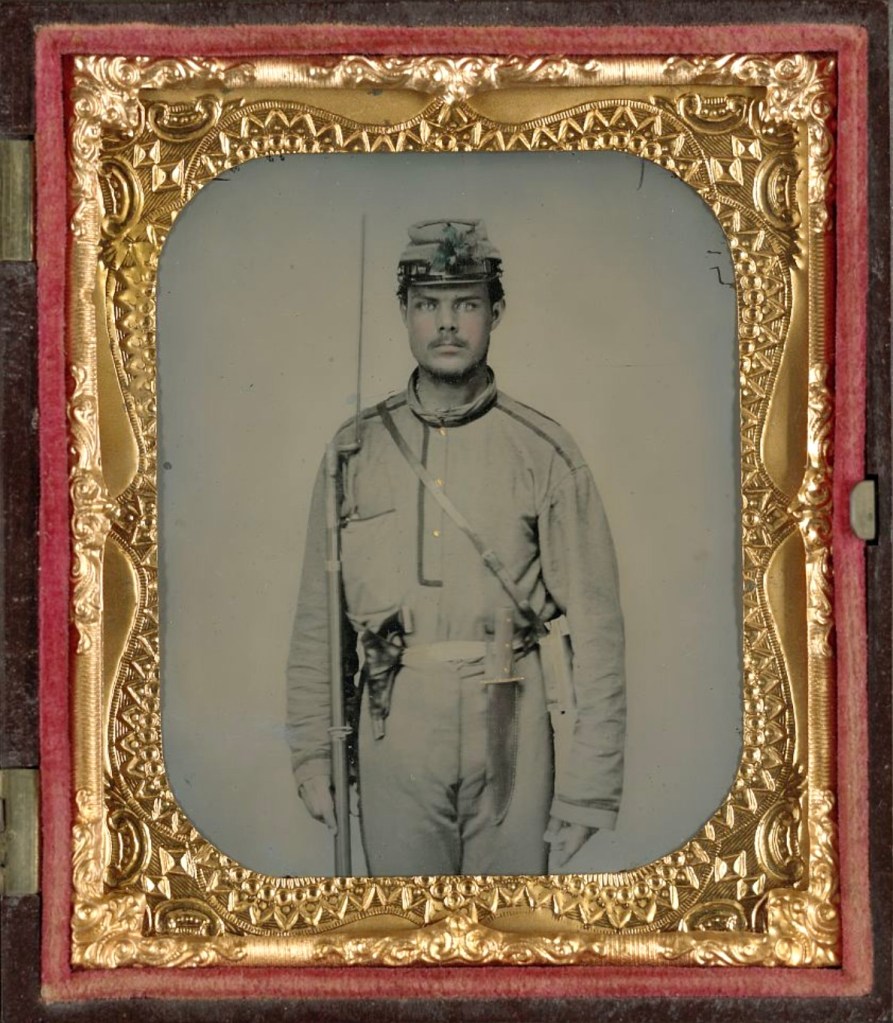
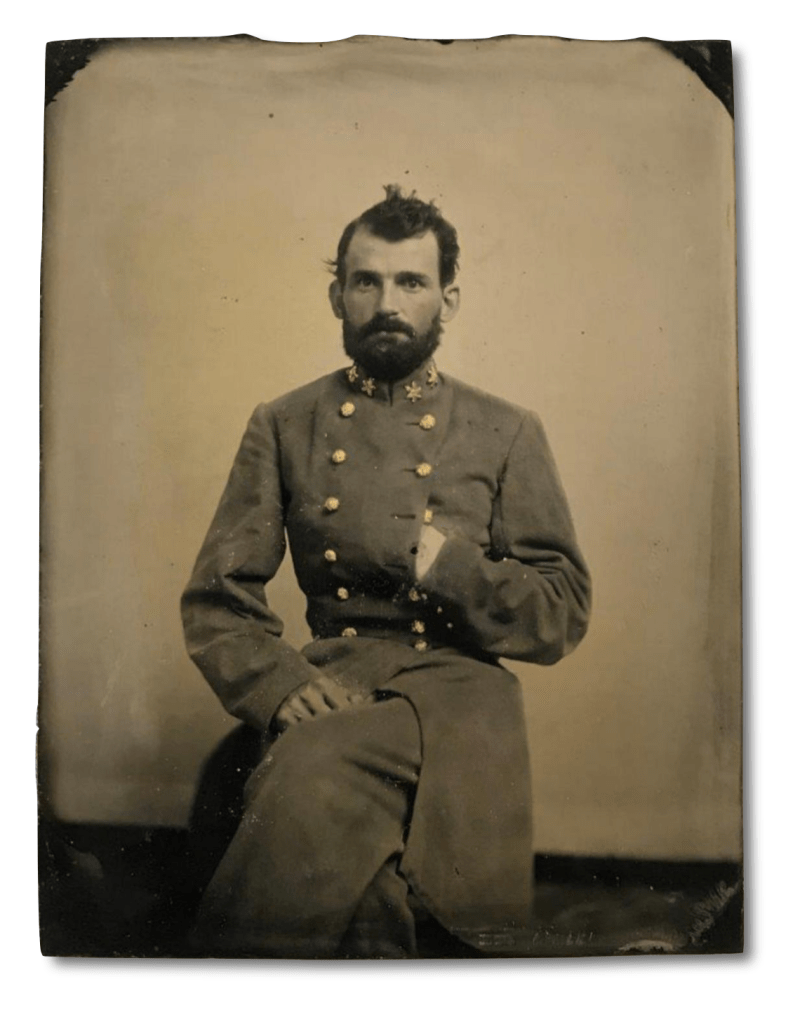
I could not find an image of Samuel, but here is one of 2nd Lieutenant James W. Millner of Co. K, 38th Virginia Infantry who was wounded on July 1, 1862, at Malvern Hill, Virginia, and on April 1, 1865, at Five Forks, Virginia, and imprisoned on April 3, 1865, at Fairgrounds Hospital, Petersburg, Virginia; knife he carries may have been manufactured by Boyle & Gamble or Burger & Burger of Richmond, Virginia. (LOC)
The following letters were written by Samuel Allen Swanson (1838-1862), the son of John Swanson (1802-1882) and Julie B. Cook (1802-1868) of Swansonville, Pittsylvania county, Virginia. Samuel enlisted in Co. D (“Whitmell Guards”) 38th Virginia Infantry, in June 1861 and he was elected 2nd Lieutenant. He was killed in the Battle of Seven Pines near Richmond on 31 May 1862. A comrade in Co. D wrote the following lines in honor of the fallen lieutenant.
“Here in the firm embrace of death Young Swanson calmly, sweetly sleeps— The soul its earthly home has left, Forever flown from mangled heaps. Farewell! you’re gone, but not forever; In Heaven Death’s hand cannot us sever— In that bright home we’ll live together, Where love nor friendship does.”
Samuel wrote these letters to his younger sister, Mary Henrie Swanson (1843-1904).
Letter 1
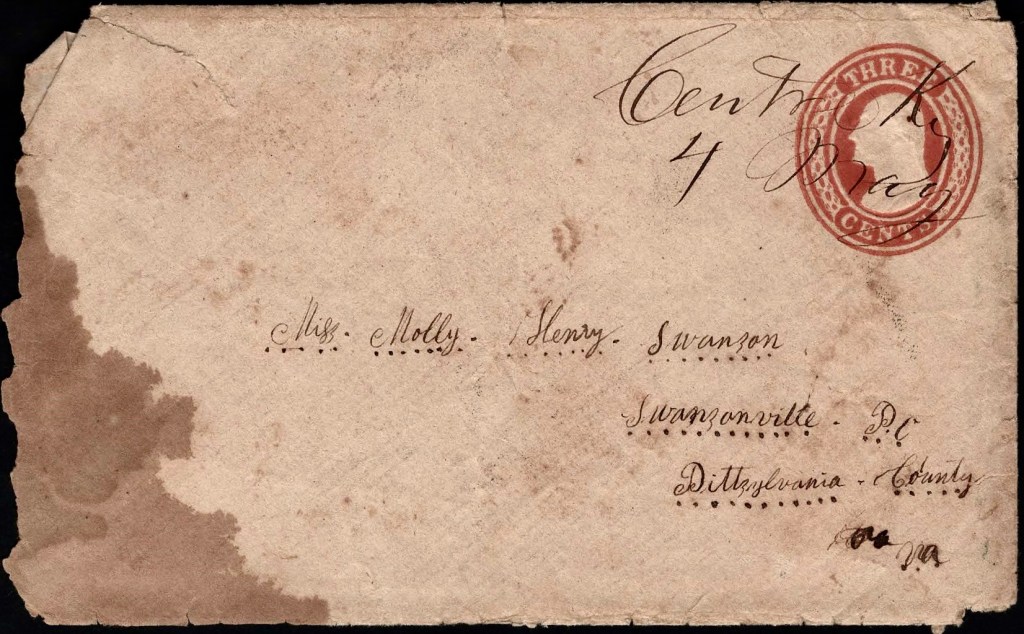
Addressed to Miss Molly Henry Swanson, Swansonville P. O., Pittsylvania county, Va.
Camp Edmonds near Centre[ville] October 5th [1861]
Sweet Sister Mollie,
It is with unfeigned pleasure I assure you that I acknowledged the reception of your highly interest[ing] letter of the 28th ult. which came to hand a few days ago and to which I hasten to reply. I am surprised to hear that you do not get any letters from me as I have written punctually once and often twice a week to some of you, and had commenced grumbling considerably myself because I did not receive any letters from home. But I suppose that it was owing to Capt. Hall’s being here and you heard from me through his letters. You doubtless have received the letters which I sent by him. I also wrote to you and Bettie the 2nd of this month. I have received no answer to the letter I sent Frank by Jim Tarpley. Did he get it or not? And if he did, why does he not answer it?
I did not get the shoes he sent by Jack Day so I cannot tell whether they fitted or not. Jack lost his knapsack on the way. The things I wrote to bro. Cook for had better be sent by Oliver as I do not suppose Col. Edmonds will get them. You can also send me a thick bed quilt, but I reckon you had better [wait] until we get into winter quarters before you send it. Tell Oliver not to forget that book I told him to get in Richmond as he came back—William’s Principles of Medicine. Tell Miss Pat not to wait too long before she sends some papers. My love to her and sister. I received a very nice box from cousin Bet Milliner and cousin Pat last week. How strange does such liberality appear when contrasted with the selfishness of some other relations of ours.
I suppose captain has told you all where are encamped. We have not moved since he left although we are daily looking for orders to leave. There has nothin new occurred since I last wrote down this way.—everything being very quiet down this way. Men generally seem in very fine spirits owing to our recent victories in Missouri and western Virginia. I am in very good health now—better than when the captain left as I had a very bad cold then.
When you write, give me all the news. Love to all and tell them to write. Write soon yourself to your affectionate bro., — Sam
Letter 2
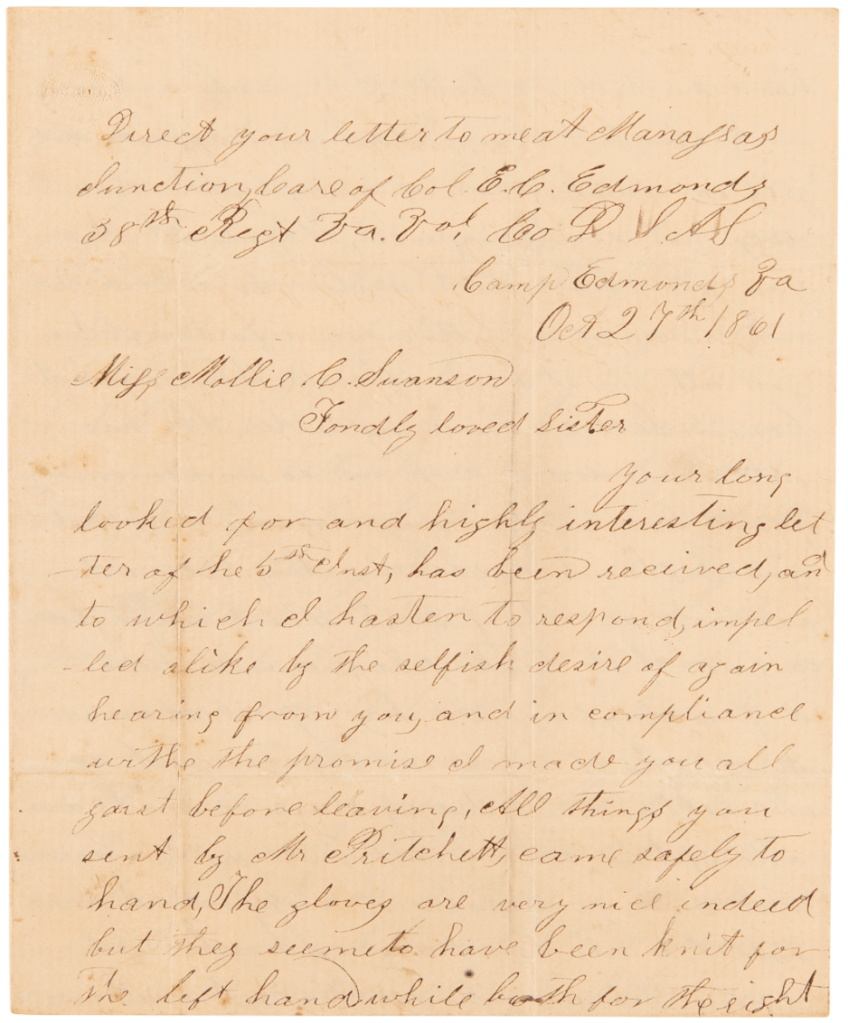
Camp Edmonds, Va. October 27, 1861
Miss Mollie C. Swanson, fondly loved sister,
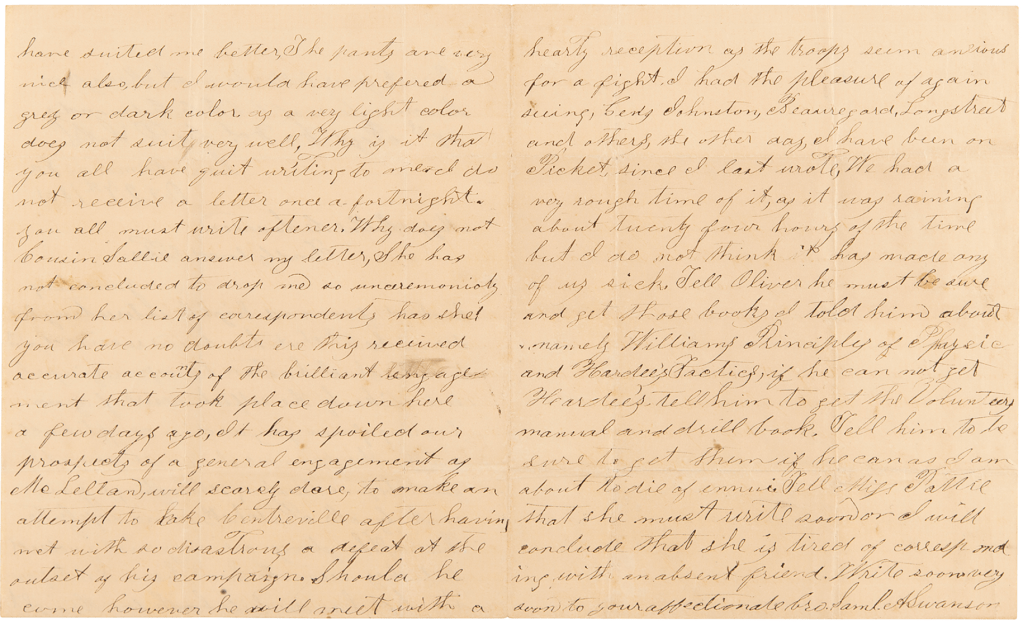
Your long looked for and highly interesting letter of the 5th inst. has been received and to which I hasten to respond, impelled alike by the selfish desire of again hearing from you, and in compliance with the promise I made you all just before leaving. All things you sent by Mr. Pritchett came safely to hand. The gloves are very nice indeed but they seem to have been knit for the left hand while both for the right have suited me better. The pants are very nice also but I would of prefered a grey or dark color as a very light color does not suit very well. Why is it that you all have quit writing to me? I do not receive a letter once a fortnight. You all must write oftener. Why does not cousin Sallie answer my letter? She has not concluded to drop me so unceremoniously from her list of correspondents, has she?
You have no doubt ere this received accurate accounts of the brilliant engagement that took place down here a few days ago. It has spoiled our prospects of a general engagement as McClellan will scarcely dare to make an attempt to take Centreville after having met with so disastrous a defeat at the outset of his campaign. Should he come, however, he will meet with a hearty reception as the troops seem anxious for a fight.
I had the pleasure of again seeing Gen. Johnston, Beauregard, Longstreet, and others the other day. I have been on picket since I last wrote. We had a very rough time of it as it was raining about twenty-four hours of the time but I do not think it has made any of us sick.
Tell Oliver he must be sure and get those books I told him about, namely Williams’ Principles of Physics and Hardee’s Tactics. If he cannot get Hardee’s, tell him to get the Volunteers Manual and Drill Book. Tell him to be sure to get them if he can as I am about to die of ennui. Tell Miss Pattie that she must write soon or I will conclude that she is tired of corresponding with an absent friend. Write soon, cery soon, to your affectionate brother, — Sam’l A. Swanson
Letter 3
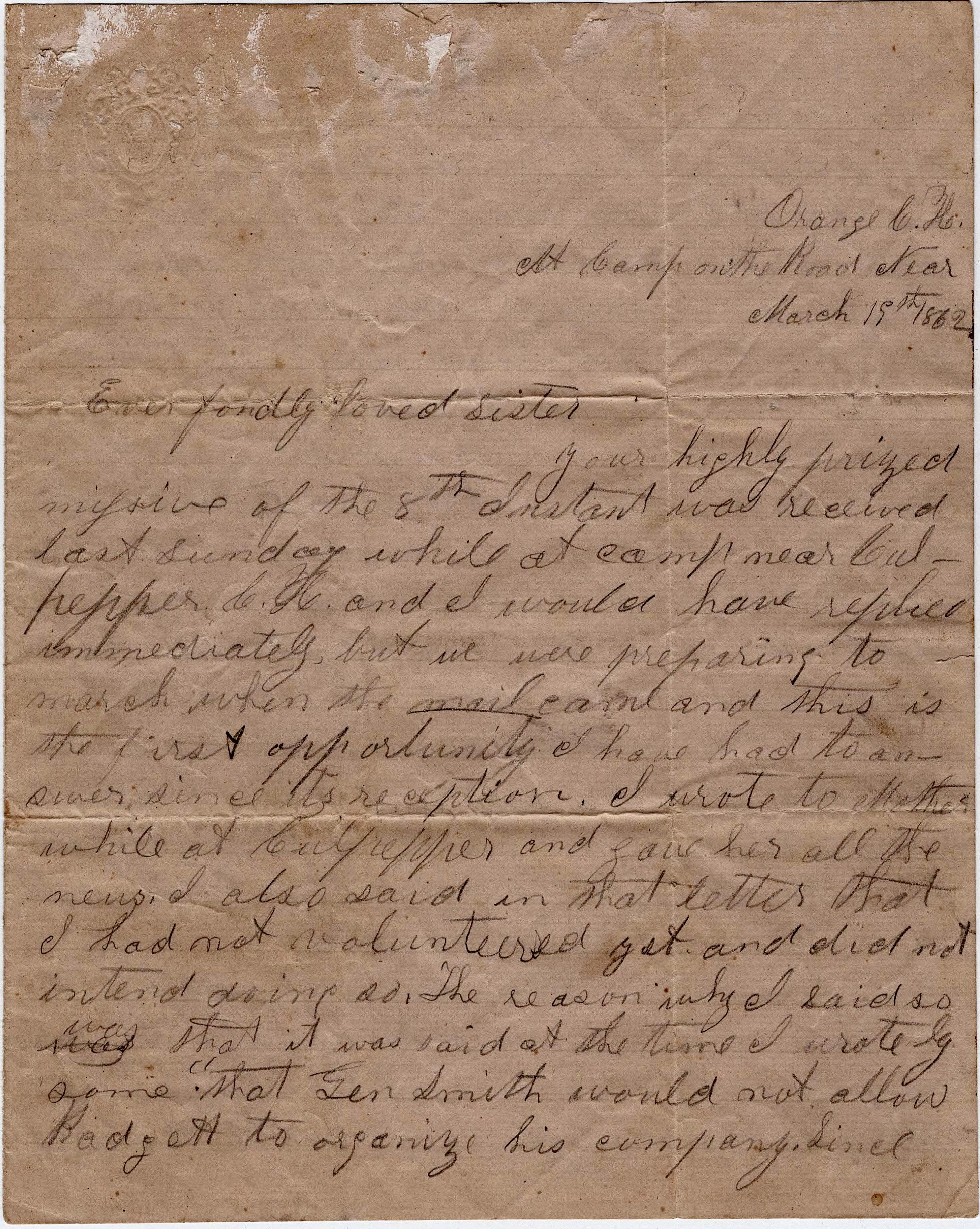
At camp on the road near Orange Court House March 19, 1862
Ever fondly loved sister,
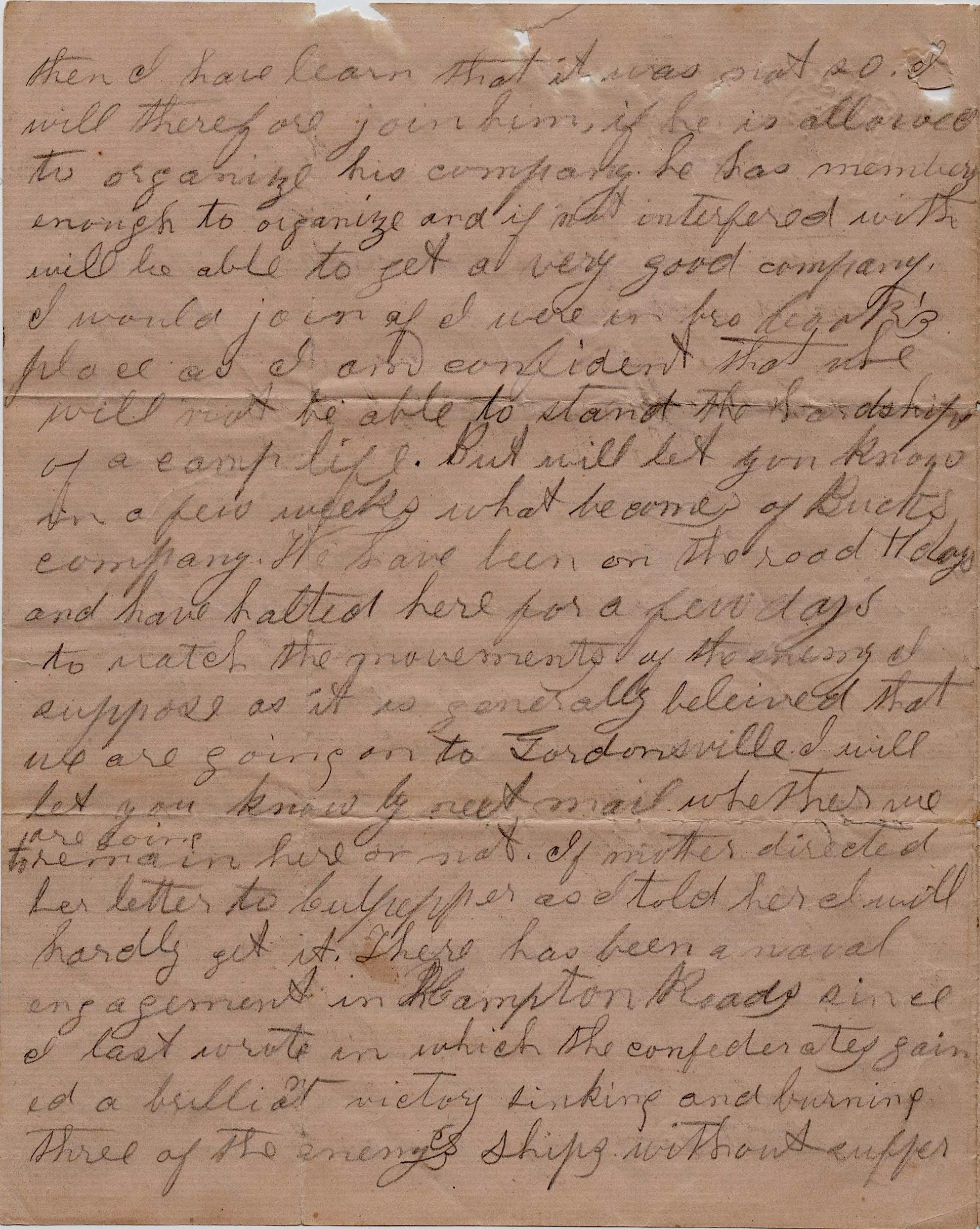
Your highly prized missive of the 8th instant was received last Sunday while at camp near Culpeper Court House and I would have replied immediately but we were preparing to march when the mail came and this is the first opportunity I have had to answer since its reception. I wrote to Mother while at Culpeper and gave her all the news. I also said in that letter that I had not volunteered yet and did not intend doing so. The reason why I said so was that it was said at the time I wrote by some that Gen. Smith would not allow Badgett to organize his company. Since then I have learned that it was not so. I will, therefore, join him, if he is allowed to organize his company. He has members enough to organize and if not interfered with, will be able to get a very good company. I would join if I were in brother Cook’s place as I am confident that he will not be able to stand the hardships of a camp life. But will let you know in a few weeks what becomes of Buck’s company.
We have been on the road 11 days and have halted here for a few days to watch the movements of the enemy, I suppose, as it is generally believed that we are going on to Gordonsville. I will let you know by next mail whether we are going to remain here or not. If Mother directed her letter to Culpeper as I told her, I will hardly get it.
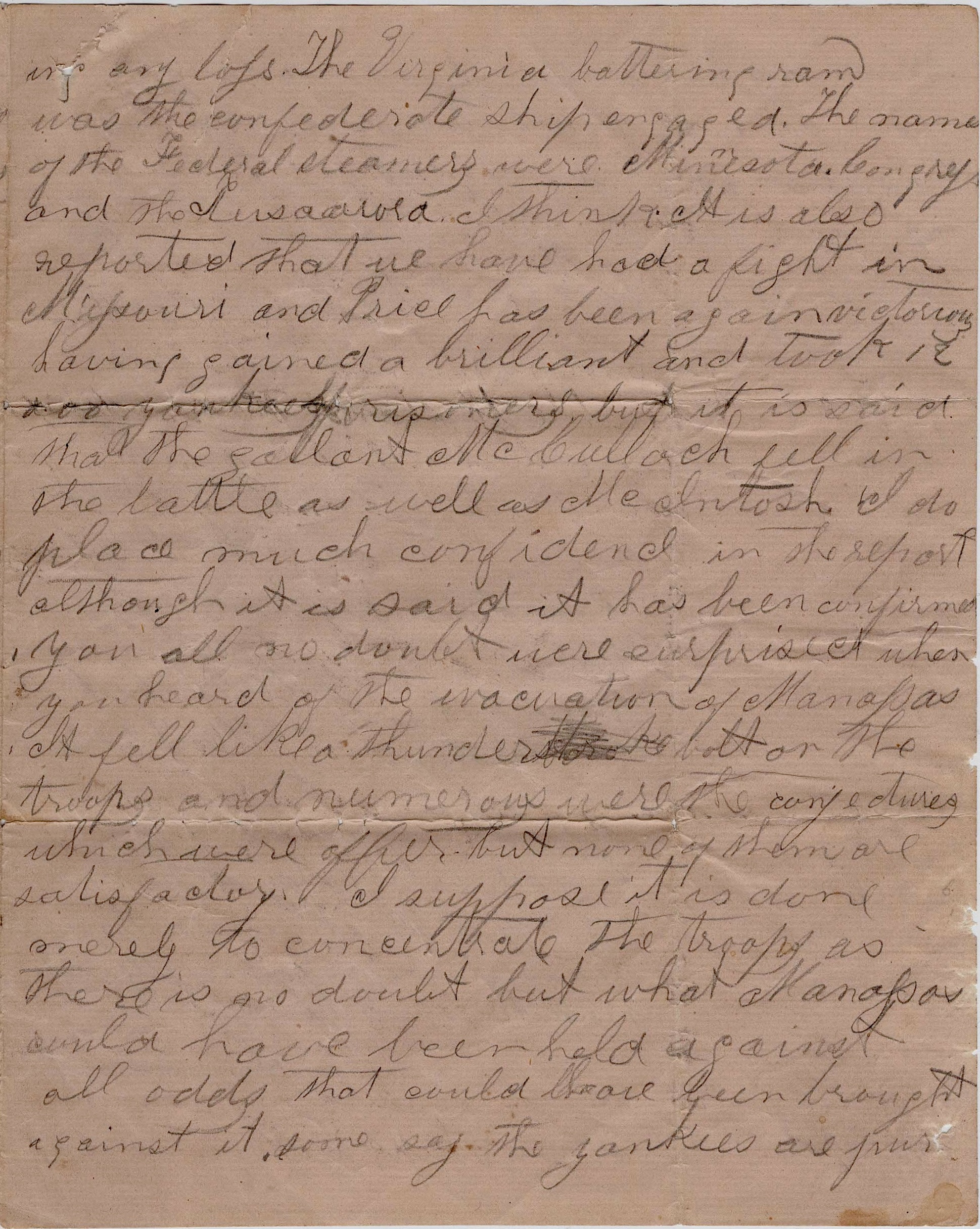
There has been a naval engagement in Hampton Roads since I last wrote in which the Confederates gained a brilliant victory, sinking and burning three of the enemy’s ships without suffering any loss. The [CSS] Virginia battering ram was the Confederate ship engaged. The name of the Federal steamers were Minnesota, Congress, and the [Cumberland], I think. It is also reported that we had a fight in Missouri and Price has been again victorious, having gained a brilliant [victory] and took 12,000 Yankees prisoners. But it is said that the gallant McCulloch fell in the battle as well as McIntosh. I do [not] place much confidence in the report although it is said it has been confirmed.
You all no doubt were surprised when you heard of the evacuation of Manassas. It fell like a thunder bolt on the troops and numerous were the conjectures which were offered but none of them are satisfactory. I suppose it is done merely to concentrate the troops as there is no doubt but what Manassas could have been held against all odds that could have been brought against it. Some say the Yankees are pursuing us but I do not believe it. You can hear all the news very near or as soon as I do.
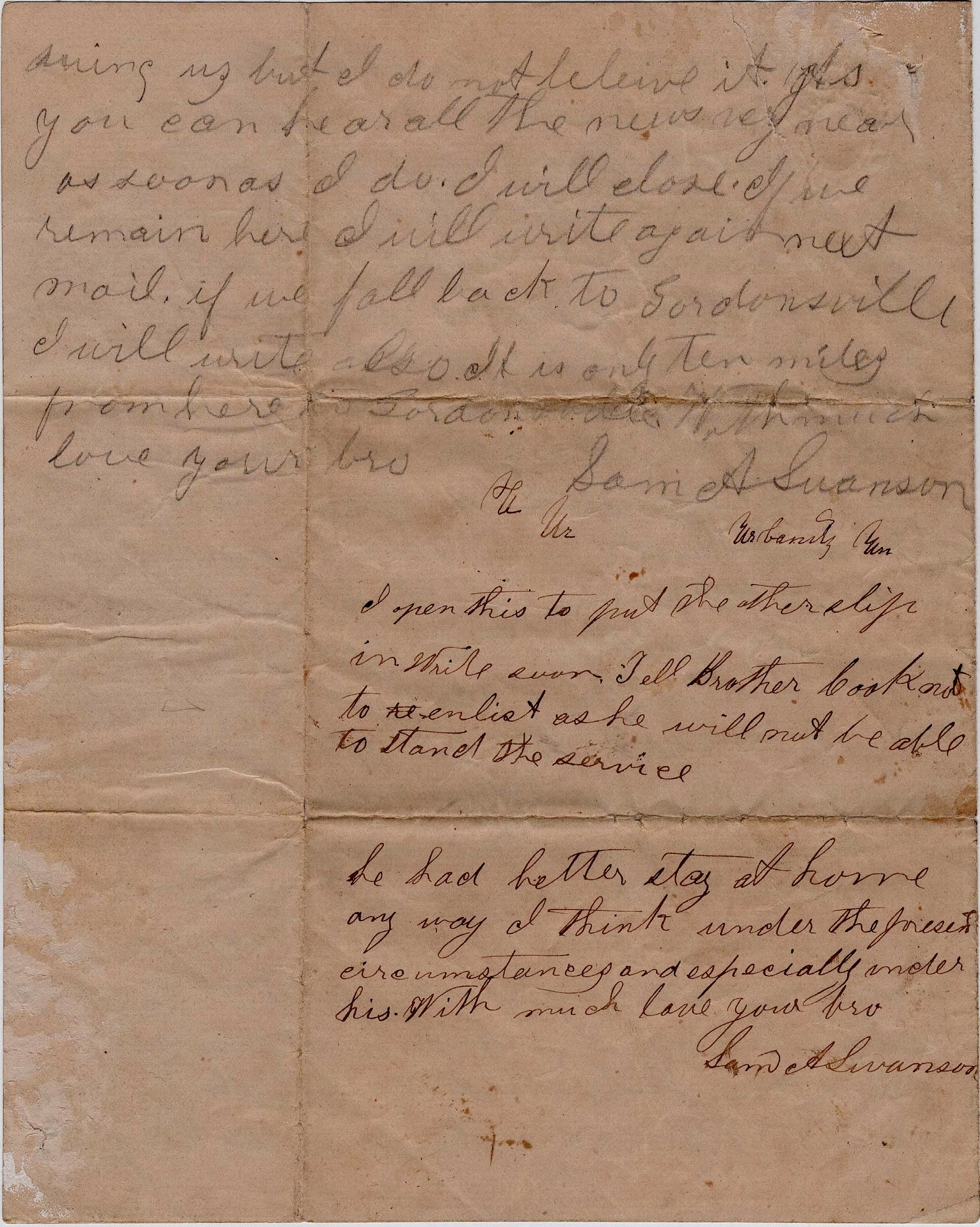
I will close. If we remain here, I will write again next mail. If we fall back to Gordonsville, I will write also. It is only ten miles from here to Gordonsville. With much love. Your brother, — Sam A. Swanson
I open this to put in the other slip in. Write soon. Tell Brother Cook not to enlist as he will not be able to stand the service. He had better stay at home anyway, I think, under the present circumstances and especially under his. With much love. Your brother, Sam. A,. Swanson
Col. Wharton Jackson Green, dated 1861. “Wharton J. Green originally organized the 2nd North Carolina Battalion at Richmond, Virginia. Green had received authority to raise a regiment for Brigadier General Henry A. Wise’s Legion, to be known as Colonel Green’s Independent Regiment.” The battalion’s original commander, Wharton J. Green, was born in St. Marks, Florida, on February 28, 1831. Private tutors instructed him before he attended Georgetown College, Lovejoy’s Academy (in Raleigh, North Carolina), and West Point. He studied law at the University of Virginia and Cumberland University (in Lebanon, Tennessee) before being admitted to the bar and commencing practice in Washington, D.C. He began agricultural pursuits in 1859 in Warren County, North Carolina. He had served as a private in the 12th North Carolina until he was approached by Brigadier General Henry A. Wise to raise an independent regiment. He was appointed a lieutenant colonel on December 24, 1861, but was not reelected at the reorganization of the battalion at Drewry’s Bluff. After January 1, 1863, he served as a volunteer aide-de-camp on the staff of General Daniel.”(Invaluable Auctions)
The following letters were written by Wharton Jackson Green (1831-1910), the son of General Thomas Jefferson Green and Sarah Angeline Wharton. In 1846, Wharton entered Georgetown College as a boarding student. From 1847 to 1848 he attended the classical and English academy in Raleigh, N.C., and in 1849, Stephen M. Weld’s select preparatory school near Boston, Mass. Green’s appointment to the U.S. Military Academy at West Point was approved simultaneously with the admission of California as a state (September 1850), at which time his father’s address was given as Sacramento. After three years at West Point, where the alumni records list him as Jackson Wharton Green, he studied law at the University of Virginia (where he was a member of the Jefferson Literary Society) and at the newly established Cumberland University at Lebanon, Tenn. On admission to the bar in 1854, he began practicing in Washington, D.C.; he was admitted to practice in the United States Supreme Court, and became a junior partner with the law firm of Robert J. Walker (former secretary of the Treasury) and Louis Janin.
After Green’s marriage—at Montmorenci, Warren County, on 4 May 1858—to Esther Sergeant Ellery, the only child of his stepmother, he and his bride spent over a year traveling in Europe and Africa. Upon their return, they went to their country place in Jamaica Plain near Boston where their oldest child, Sarah Wharton, was born on 19 July 1859. When they settled at Esmeralda, their North Carolina home, with their one-month-old baby, Green engaged in agricultural pursuits and bred racehorses.
At the outbreak of the war, Green enlisted in the Warren Guards, Company F, Twelfth Regiment, North Carolina Troops, C.S.A. (Second Regiment, North Carolina Volunteers), which was one of the first three companies to report to the camp of organization in Raleigh. In two months he was appointed colonel in General Henry A. Wise’s legion and raised and equipped a regiment. On 8 Feb. 1862, he was captured on Roanoke Island and paroled at Elizabeth City the same day. He later served as a volunteer aide on the staff of General Junius Daniels and as lieutenant colonel of the Second Battalion of North Carolina Infantry. Green was wounded at Washington, N. C., and again at Gettysburg where he was captured and detained at Johnson’s Island, Ohio, until within a week of the surrender.
Letter 1
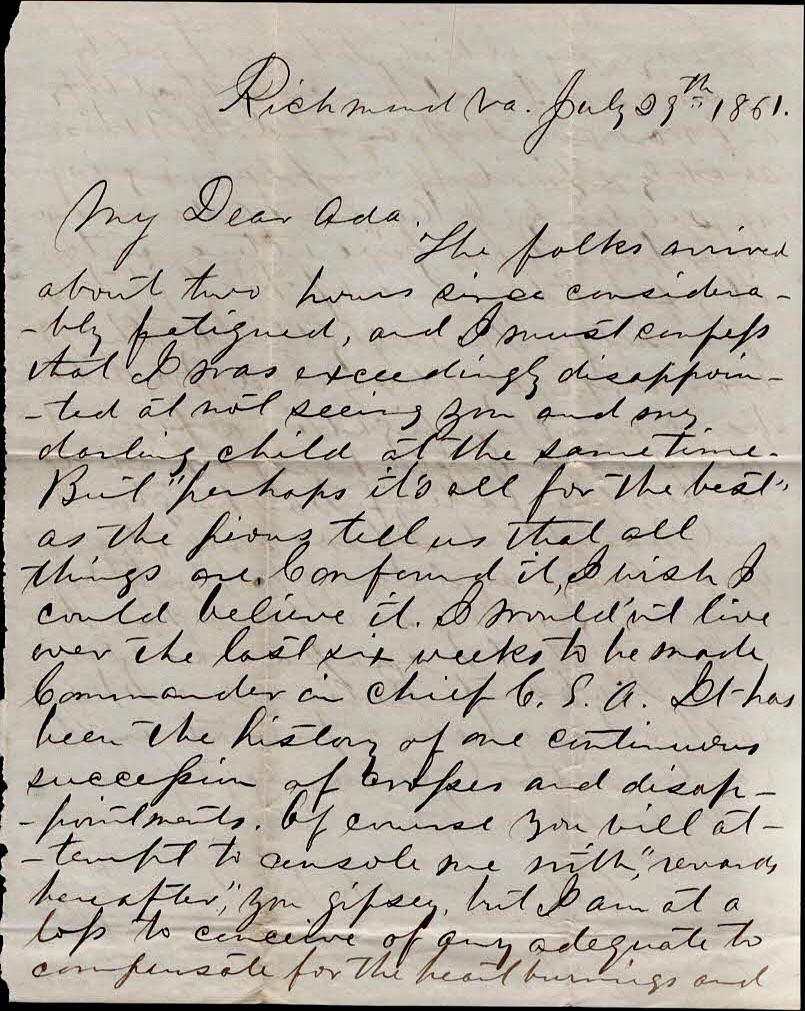
Richmond, Virginia July 29, 1861
My Dear Ada,
The folks arrived about two hours since considerably fatigued and I must confess that I was exceedingly disappointed at not seeing you and my darling child at the same time. But “perhaps it’s all for the best” as the pious tell us that all things are. Confound it, I wish I could believe it. I wouldn’t live over the last six weeks to be made Commander in Chief, C. S. A. It has been the history of one continuous succession of crosses and disappointments. Of course you will attempt to console me with “rewards hereafter,” you gypsey, but I am at a loss to conceive of any adequate to compensate for the heart burnings and annoyances which I have had to endure. I trust, however, that they are now about at an end. But this sickly spirit of complaining is unsoldierly. Believe me, Ada, no one ever heard me give utterance to it except yourself. Keep it to yourself.
I really think the war virtually at an end. We will have another fight in a few days at Arlington House which decides the fate of Washington and Maryland. If we win, the war closes and can you doubt success! I feel miserable when I reflect that Manassas was won and I absent. Believe me, I had rather have been a private in the ranks on that glorious day than a Colonel and not have been there. But I never had any luck as you know. A thousand kisses to my angel. Take care of her and yourself is the injunction of your kinsman truly, — Wharton J. Green
Letter 2
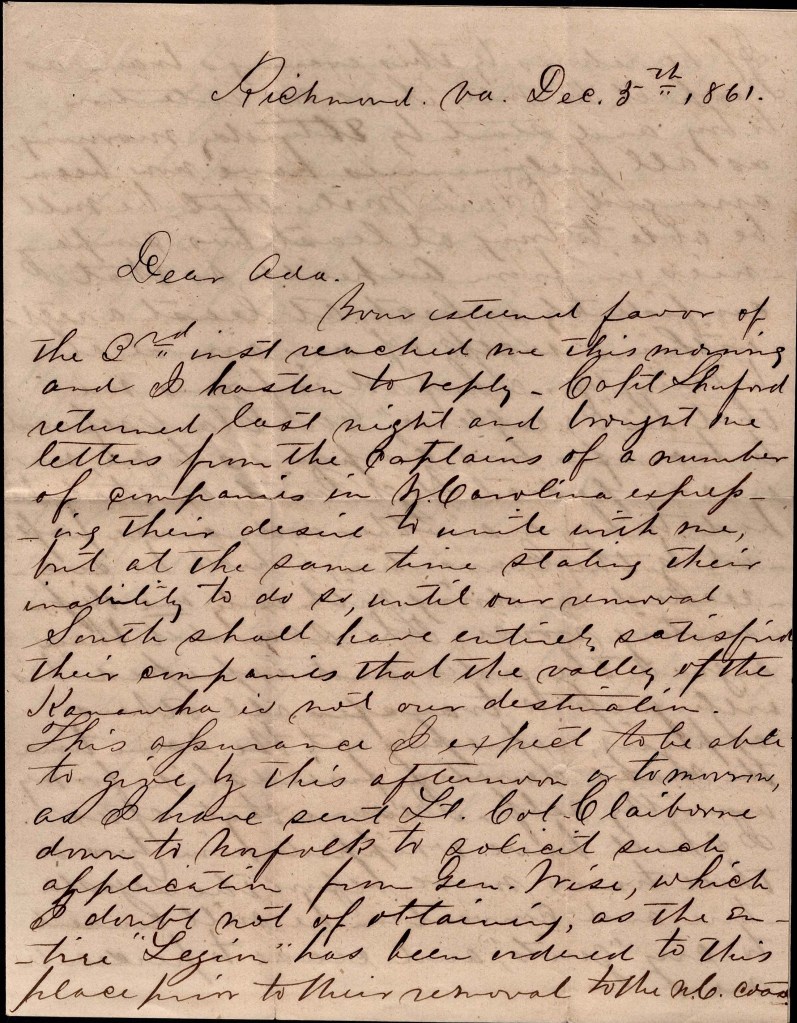
Richmond, Virginia December 5th 1861
Dear Ada,
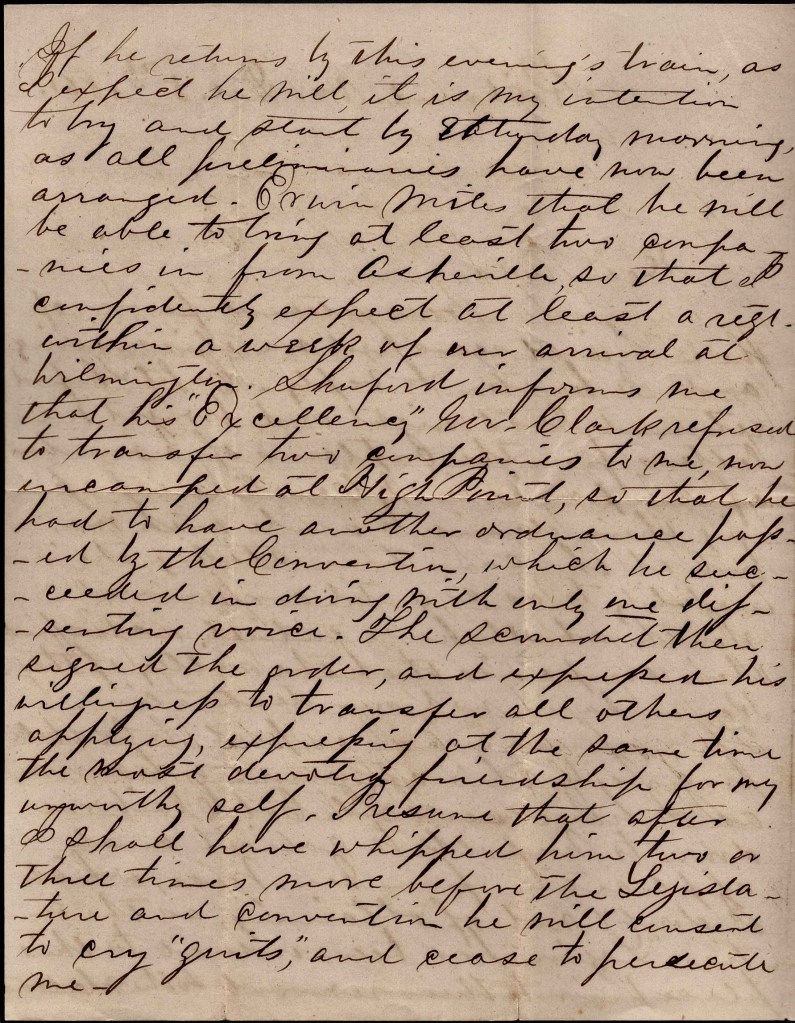
Your esteemed favor of the 3rd inst. reached me this morning and I hasten to reply. Capt. [Andrew H.] Shuford returned last night and brought me letters from the captains of a number of companies in North Carolina expressing their desire to unite with me, but at the same time stating their inability to do so until our removal South shall have entirely satisfied their companies that the valley of the Kanawha is not our destination. This assurance I expect to be able to give by this afternoon or tomorrow as I have sent Lt. Col. Claiborne down to Norfolk to solicit such application from Gen. Wise, which I doubt not of obtaining as the entire “Legion” has been ordered to this place prior to their removal to the N. C. coast. If he returns by this evening’s train, as I expect he will, it is my intention to try and start by Saturday morning, as all preliminaries have now been arranged.
Erwin writes that he will be able to bring at least two companies in from Asheville so that I confidently expect at least a regiment within a week of our arrival at Wilmington. Shuford informs me that his “Excellency” Gov. [Henry Toole] Clark refused to transfer two companies to me now encamped at High Point so that he had to have another ordnance passed by the Convention which he succeeded in doing with only one dissenting voice. The scoundrel then signed the order and expressed his willingness to transfer all others applying, expressing at the same time the most devoted friendship for my unworthy self. Presume that after I shall have whipped him two or three times more before the Legislature and Convention he will consent to cry “quits” and cease to persecute me.
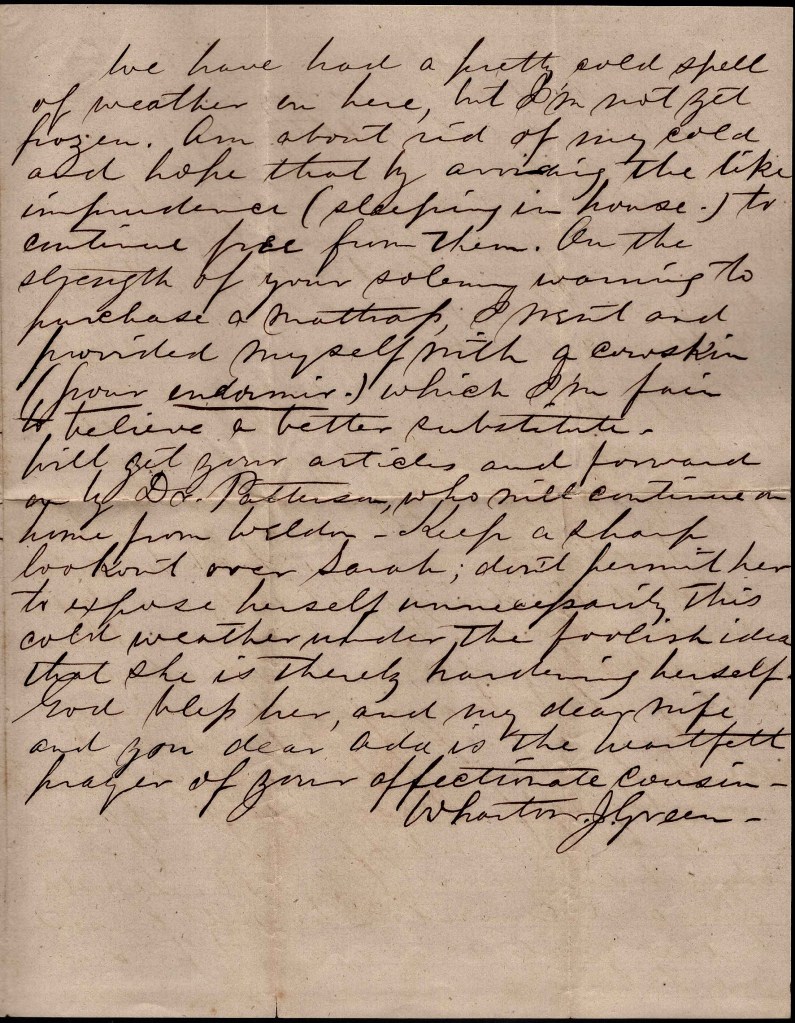
We have had a pretty cold spell of weather in here but I’m not yet frozen. Am about rid of my cold and hope that by avoiding the like impudence (sleeping in house) to continue free from them. On the strength of your solemn warning to purchase a mattress, I went and provided myself with a cowskin (pour m’endormir 1) which I’m fair to believe a better substitute.
Will get your articles and forward on to Dr. Patterson who will continue on home from Weldon. Keep a sharp lookout over Sarah; don’t permit her to expose herself unnecessarily this cold weather under the foolish idea that she is thereby hardening herself. God bless her and my dear wife and you, dear Ada, is the heartfelt prayer of your affectionate cousin, — Wharton J. Green
1 French to English translation, “to go to sleep.”
Letter 3
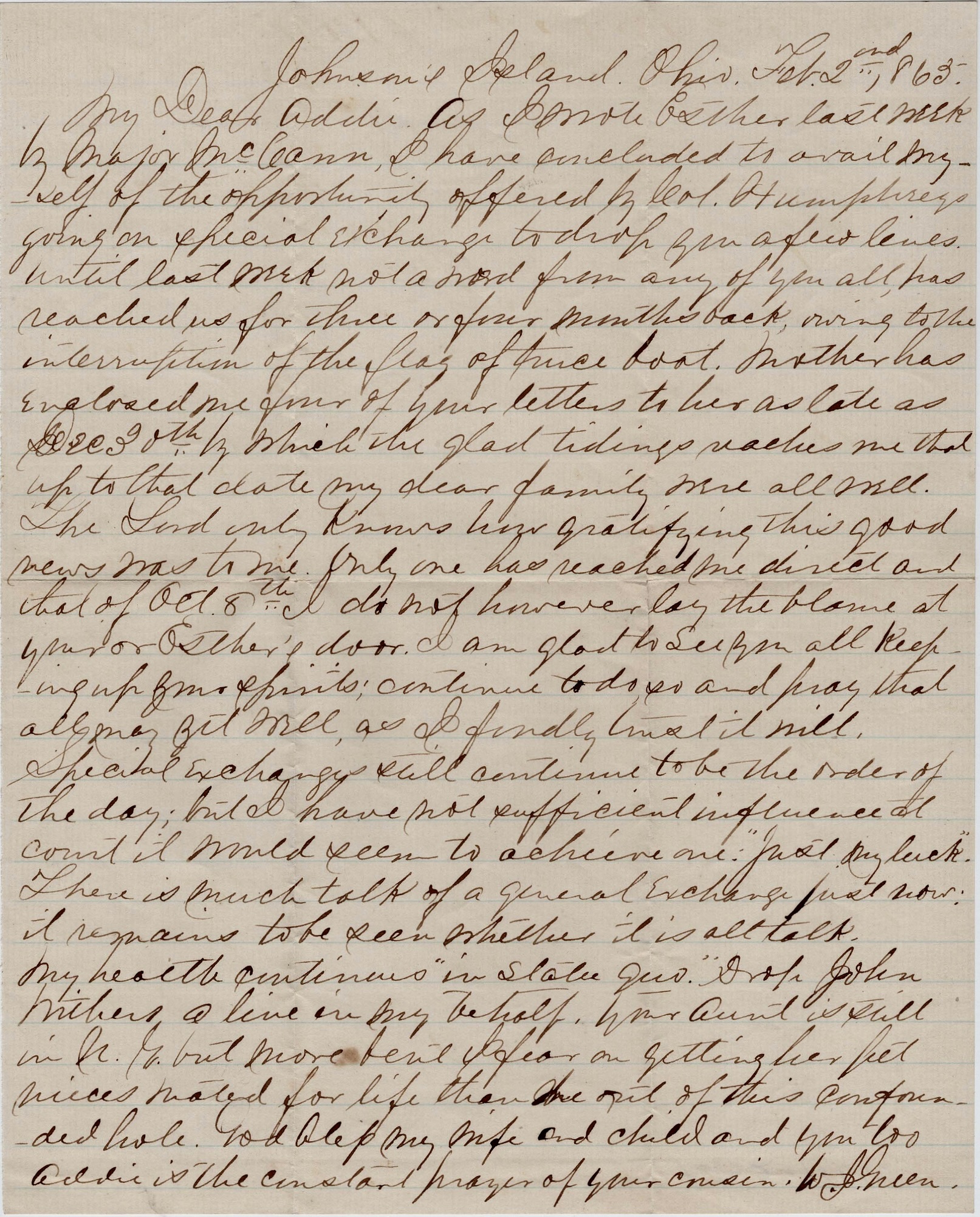
Johnson’s Island, Ohio February 2, 1863
My dear Addie,
As I wrote Esther last week by Major McCann, I have concluded to avail myself of the opportunity offered by Col. Humphreys going on special exchange to drop you a few lines. Until last week, not a word from any of you all has reached us for three or four months back owing to the interruption of the flag of truce boat. Mother has enclosed me four of your letters to her as late as December 30th by which the glad tidings reaches me that up to that date my dear family were all well. The Lord only knows how gratifying this good news was to me. Only one has reached me direct and that of October 8th. I do not, however, lay the blame at your or Esther’s door. I am glad to see you all keeping up your spirits; continue to do so and pray that all may get well as I fondly trust it will.
Special exchanges still continue to be the order of the day; but I have not sufficient influence at court it would seem to achieve one. “Just my luck.” There is much talk of a general exchange just now; it remains to be seen whether it is all talk. My health continues “in status quo.” Drop John Withers a line in my behalf. Your Aunt is still in N. Y. but more bent, I fear, on getting her pet nieces mated for life than me out of this confounded hole. God bless my wife and child and you too, Addie, is the constant prayer of your cousin. — W. J. Green
The following letter was written by John Leander Jamison (1827-1904), a farmer from Mecklenburg county, North Carolina, who enlisted in July 1862 to serve as a private in Co. F, 5th North Carolina Cavalry. He was married to Sarah Alexander (1831-1913) in 1849 and had at least four children before he entered the Confederate service.
The 5th North Carolina Cavalry was formed at Garysburg, North Carolina. The men were from the counties of Cumberland, Lenoir, Greene, Sampson, Rockingham, Chatham, Randolph, Guilford, Davie, Mecklenburg, Lincoln, and Catawba. With more than 1,000 men, the unit skirmished in North Carolina around Washington and Plymouth. Later it moved to Virginia and served under Generals Robertson, L.S. Baker, James B. Gordon, and Barringer. The 5th Cavalry fought at Brandy Station, Middleburg, Upperville, Fairfield, Auburn Mills, Brooks Turnpike, The Wilderness, Spotsylvania, Black’s and White’s, Hampton’s Cattle Raid, Boydton Plank Road, and Five Forks. This regiment had 458 effectives during the Pennsylvania Campaign and surrendered only 5 at Appomattox.
John Leander Jamison and Sarah (Alexander) Jamison in later years (Ancestry.com)
Transcription
Camp near Stony Creek, [Sussex county] Virginia September 26, 1864
Dear Sister,
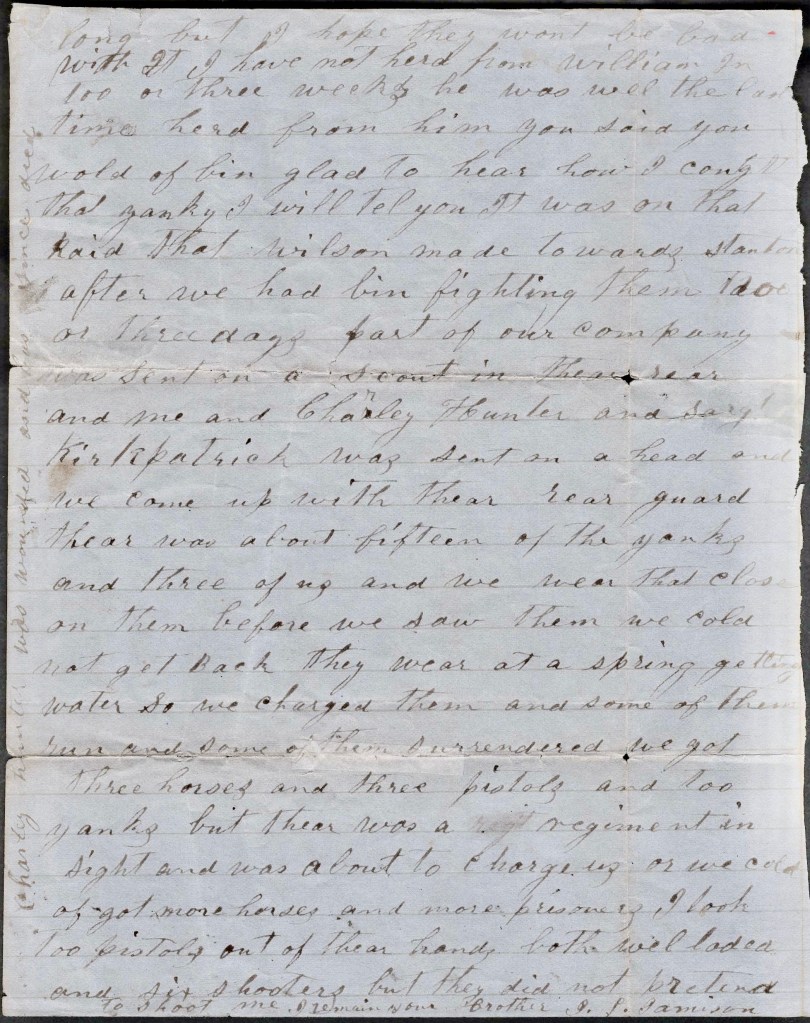
I seat myself to answer your very welcome letter which I received a few moments ago. I am glad to hear that you were all well. I am in good health at this time and hope those few lines will find you and all well. I have not much now to write to you, We have had a few weeks of rest but I don’t think it will last long. We had a General Review today and we always have some move in a short time after that. We have drawed a full suit of clothes today. I am mighty well clothed now but if you had seen me some time ago, I know you would of laughed at my old hat and ragged clothes.
I heard from home the 18th. They were all well except the cold, but I see from your letter that it may be the whooping cough that my folks has. I thought very strange of them having the cold so long but I hope they won’t be bad with it. I have not heard from William in two or three weeks. He was well the last time [I] heard from him.
You said you would of been glad to hear how I caught that Yankee. I will tell you. It was on that raid that Wilson made towards Staunton [see The Wilson-Kautz Raid]. After we had been fighting them two or three days, part of our company was sent out on a scout in their rear and me and Charley Hunter and Sergt. [Jonathan R.] Kirkpatrick was sent on ahead and we came up with their rear guard. There was about fifteen of the Yanks and three of us and we were that close on them before we saw them. We could not get back. They were at a spring getting water so we charged them and some of them run and some of them surrendered. We got three horses and three pistols and two Yanks. But there was a regiment in sight and was about to charge us or we could of got more horses and more prisoners. I took two pistols out of their hands, both well loaded and six shooters, but they did not pretend to shoot me.
I remain your brother, — J. L. Jamison
Charley Hunter was wounded and has since died. 1
1 Muster Rolls of the regiment inform us that Charley died of a gunshot wound on 12 September 1864.
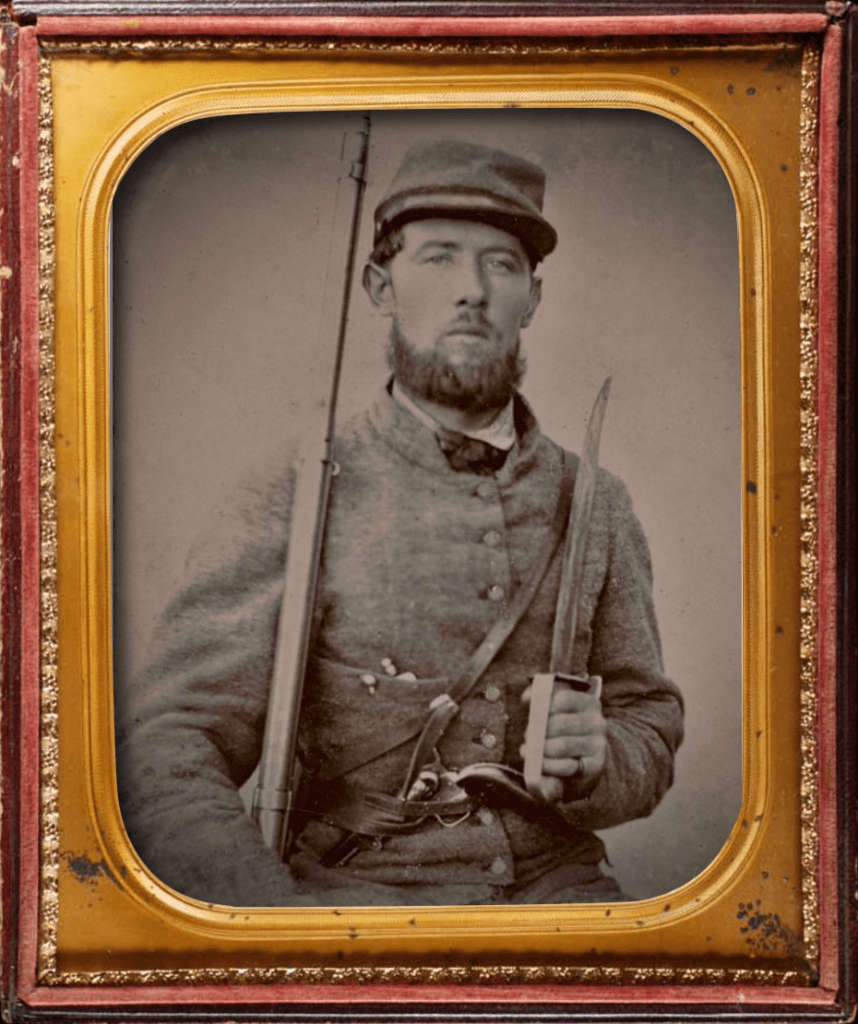
I could not find an image of John but here is one of Addison J. Bowman who also served in Co. K, 57th Virginia Infantry (LOC)
The following letter was written by John Dill, a 35 year-old farmer from Old Hickory, Botetourt County, Virginia, when he enlisted on 18 July 1861 at Jackson, Virginia, as a Private in Co. K (“Botetourt Guards”) of the 57th Virginia Infantry, Pickett’s Division. He was wounded at 2nd Manassas and slightly wounded at Gettysburg on 3 July 1863. He was captured at Five Forks on April 1, 1865 and paroled from Johnson’s Island on June 18th of the same year.
Dill was promoted to Corporal on May 10, 1862 and to 2d Lieutenant on May 10, 1864. He was described as 5′ 6″ tall, dark complexion, hazel eyes and dark hair. He died in 1914. He was married to Eliza Jane Peck (1834-1912) in 1856. The “Mollie” mentioned in the letter was probably John’s younger sister, Mary Hester (“Mollie”) Peck (1841-1926).
There is another of Dill’s letters archived at the Library of Virginia. It was dated 6 September 1861, just a few days before this letter. In fact, it is the very letter John wrote to his father mentioned in this letter. It discusses his trip to Richmond, their encampment at the fair grounds in Richmond and life in the camp. Dill also discusses the large number of Confederate soldiers stationed around Richmond and the building of breastworks near the city. He also mentions large numbers of Union soldiers being held as prisoners of war in the tobacco factories of Richmond and the poor conditions in the local hospitals.
Transcription
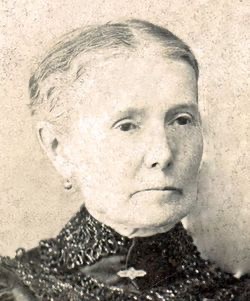
Eliza (Peck) Dillin later years
Camp of Instruction Richmond, Virginia September 11, 1861
Dear Eliza,
I received your letter yesterday evening. I also received the first letter you wrote a few days since. I was very glad to hear that you were all well and getting along well. I would like very well to come home and see you all but alas: there is poor hopes of that soon. I am not home sick. I stand it a great deal better than I expected. I have not been able to drill any for a few days on account of a very large bile [boil] on the side of my neck, It is very painful indeed.
Tell Mollie she must try to do the best she can with you and the children when she comes down until I come back and then I will keep things right. I expect you will need some correcting too. Tell Mollie I was very glad to get a letter from her. She must write to me often. I wrote to Wm. Haythe [?] the other day. I suppose he will answer it soon.
I do not know how long we will stay here. The captain wanted us to take flintlock muskets but the majority of the company would not have them. If we can get suitable guns, I suppose we will go on to Manassas Junction in a few days. I do not know what is going on out that way. They are moving the sick away from there and I understand they are moving some of the prisoners from here to South Carolina. From the way things are working, I think there will be some fighting done before long if they are not at it now. I do not know whether we will be in it or not. We are not well enough drilled even if we had guns.
I understand from some of the letters that come to some of our company that some of the girls wants to know what is the matter with some of the boys that got off from our company. I think they would better not marry them for if they are not able to stand a Yankee, they can’t stand a woman. I think some of them that got off are just as able to make the trip as I am, but you must not say anything to them about it. Just let them rip. Some of the men that know the doctor said if the mean old doctor had of examined them, half of them would not have gotten off. I do not try to get off myself. If I can just have my health all the time as well as I have it now is all I ask. I have an excellent appetite and I got plenty to satisfy it. When a man has good health and plenty to eat, he should be thankful.
You must think of me often. I both think and dream of you. Sometimes I dream I am with you but I soon find my mistake.
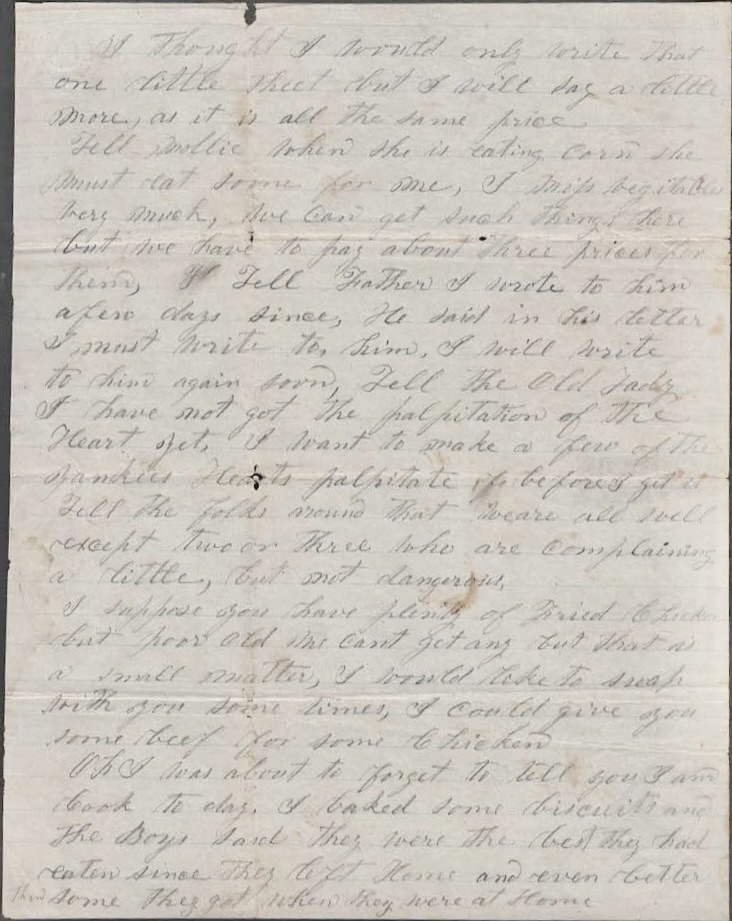
I thought I would only write that one little sheet but I will say a little more as it is all the same price. Tell Mollie when she is eating corn she must eat some for me. I miss vegetables very much. We can get such things here but we have to pay about three prices for them. Tell Father I wrote to him a few days since. He said in his letter I must write to him. I will write to him again soon. Tell the Old Lady I have not got the palpitation of the heart yet. I want to make a few of the Yankees hearts palpitate before i get it. Tell the folks around that we are all well except two or three who are complaining a little, but not dangerous.
I suppose you have plenty of fried chicken but poor old me can’t get any. But that is a small matter. I would like to swap with you sometimes. I could give you some beef for some chicken.
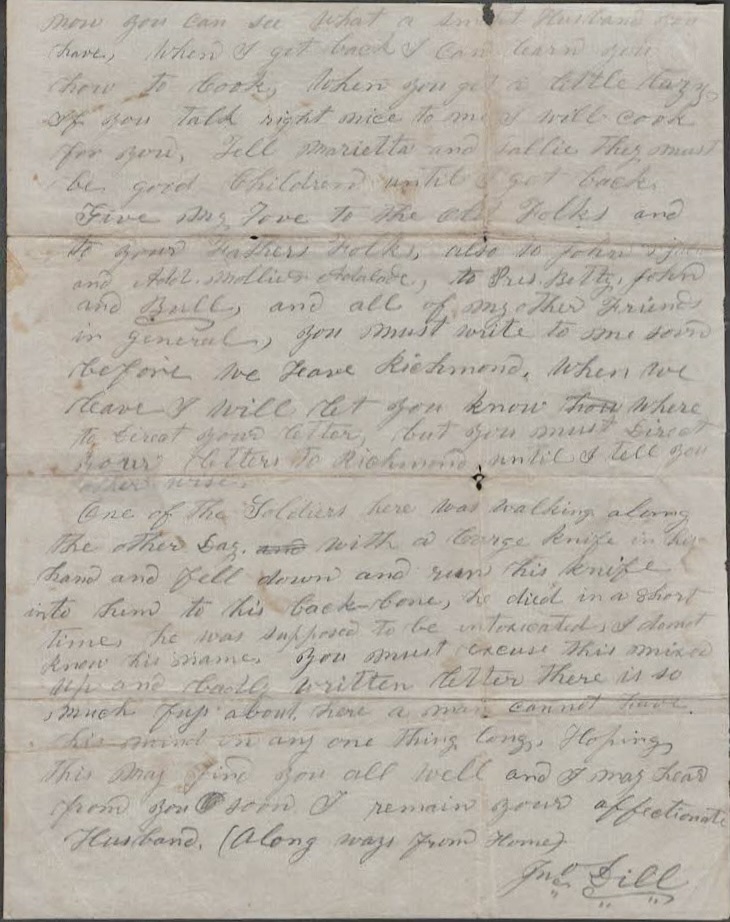
Oh, I was about to forget to tell you I am cook today. I baked some biscuits and the Boys said they were the best they had eaten since they left home and even better than some they got when they were at home. Now you can see what a smart husband you have. When I get back, I can learn you how to cook when you get a little lazy. If you talk right nice to me, I will cook for you. Tell Marietta and Sallie they must be good children until I get back.
Give my love to the old folks and to your Father’s folks. Also to John & Fala [?] and Add., Mollie & Adalade, to Pres, Betty, John & Bull, and all of my other friends in general. You must write to me soon before we leave Richmond. When we leave, I will let you know where to direct your letter, but you must direct your letters to Richmond until I tell you otherwise.
One of the soldiers here was walking along the other day with a large knife in his hand and fell down and run his knife into him to his backbone. He died in a short time. He was supposed to be intoxicated. I do not know his name.
You must excuse this mixed up and badly written letter. There is so much fuss about here a man cannot have his mind on any one thing long. Hoping this may find you all well and I may hear from you soon, I remain your affectionate husband (a long ways from home), — Jno. Dill
I could not find an image of Andrew but here is a cdv of Frederick L. Barker, Co. K, 3rd Michigan Infantry (LOC)
Though he only signed his name “Andrew,” I feel confident this letter was written by Andrew Nickerson (1834-1864), the son of Elihu Nickerson and Mary Winegarden. The family from Cattaraugus County, New York to Lake County, Indiana, about 1840 where they remained until sometime around 1848 when the family moved to Michigan. “By 1850 Elisha was running a hotel in Prairieville, Barry County, where Andrew attended school with seven of his younger siblings, including his brother Edwin who would also join the Third Michigan. By 1860 Elisha or Elihu had moved the family to a farm in Leighton, Allegan County where Andrew worked as a farm laborer (along with his younger brother Edwin) and was living with his family. He was 27 years old and probably still living in Allegan County when he enlisted as 4th Sergeant in Co. E on May 13, 1861; his younger brother Edwin would join Co. E the following year.
It is quite possible that Andrew enlisted in the Hastings Rifle Company in April of 1861. That company was disbanded shortly after it arrived in Grand Rapids to join the Third Michigan infantry then forming at Cantonment Anderson south of city and its members distributed to other companies of the Regiment. Andrew was promoted to 1st Sergeant on July 19 or July 23, 1861, at Hunter’s Farm, Virginia. He was subsequently promoted to 2nd Lieutenant and transferred to Co. H on August 12, 1862, at Harrison’s Landing, Va., replacing Lieutenant Thomas Waters.
In October Andrew was transferred to Co. K and promoted to 1st Lieutenant on October 20, replacing Lt. Fred Stowe. He was home in Michigan during the winter of 1863, and rejoined the regiment in early March of that year. He was charged with neglect of duty, in that he reportedly forged discharge papers for a private, but nothing came of this apparently and he was never court-martialed. Andrew was then appointed acting Regimental Quartermaster from July 13, 1863, through September, and in December he was on detached service in Michigan, probably recruiting for the Regiment. Although he was still reported detached in Grand Rapids in January of 1864 (since December 28, 1863), he was promoted to Captain on January 18, 1864, and commissioned to date November 1, 1863. He eventually returned to the Regiment before the spring campaign of 1864, and was killed in action on May 6, 1864, at the Wilderness, Virginia.
According to Dan Crotty of Co. F, Nickerson was killed on May 7. Some years after the war Crotty wrote that during the engagement at the Wilderness, “The fearful butchery commences on the morning of the 7th, and charge after charge is made on both sides,” and at one point the Regiment had driven the rebels back inside their works. “They reform and drive us back. We take shelter in some temporary works thrown up by themselves, and here hold them in check for awhile. But they come down on us with superior numbers. We keep them on the other side for awhile, and a hand to hand fight takes place. Here is where Captain Nickerson, of Co. K, was killed by a bayonet thrust.” Andrew was buried in Fredericksburg National Cemetery: grave 3550 (old 191).
[Note: The following letter is from the private collection of Greg Herr and was offered for transcription and publication on Spared & Shared.]
Transcription
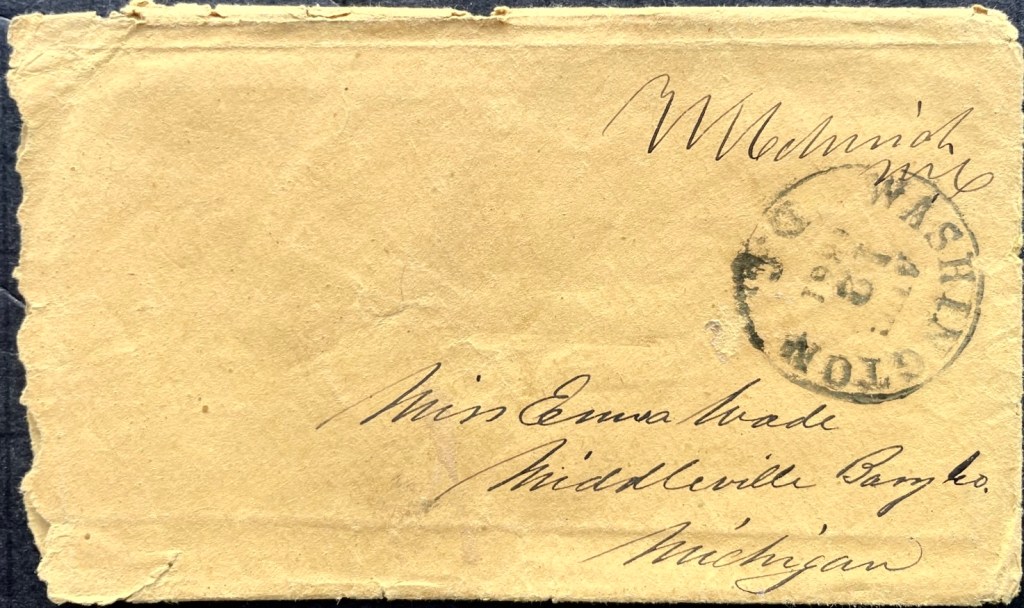
Addressed to Miss Emma Wade, Middleville, Barry county, Michigan
Washington D. C. August 10th 1861
Friend Emma,
Today I received your kind letter and perused it with great pleasure. You seem to have a wrong impression in regard to the battles up at Bull Run. We were in the battle on Thursday [at Backburn’s Ford]. There was not so much close fighting as on Sunday but the cannon balls and shells fell all around us and there we stood without any chance to shoot back. To be sure, our cannon kept firing all the time and did great execution among the rebels.
The next day, and the next, and the next we laid on the field of battle and on Sunday when the fight was raging upon our right, we were on the field in reach of the enemy’s cannon and sometimes some of their musket balls would come whizzing over our heads. It was more good luck than anything else that saved us from half being killed, or being half killed I should say.
Then you think that Ell Felton and Jim Drew are about to make their beds together. Well “long may they wave.” Ell is a very pretty girl and makes a very good appearance. As for Jim, I do not know much about him, not being much acquainted with him.
Then you don’t think much of the courage of Barrell family, eh? I thought you used to think considerable of one of the boys, didn’t you? But I suppose you don’t like the way he runs over west do you. I don’t believe I should like it either.
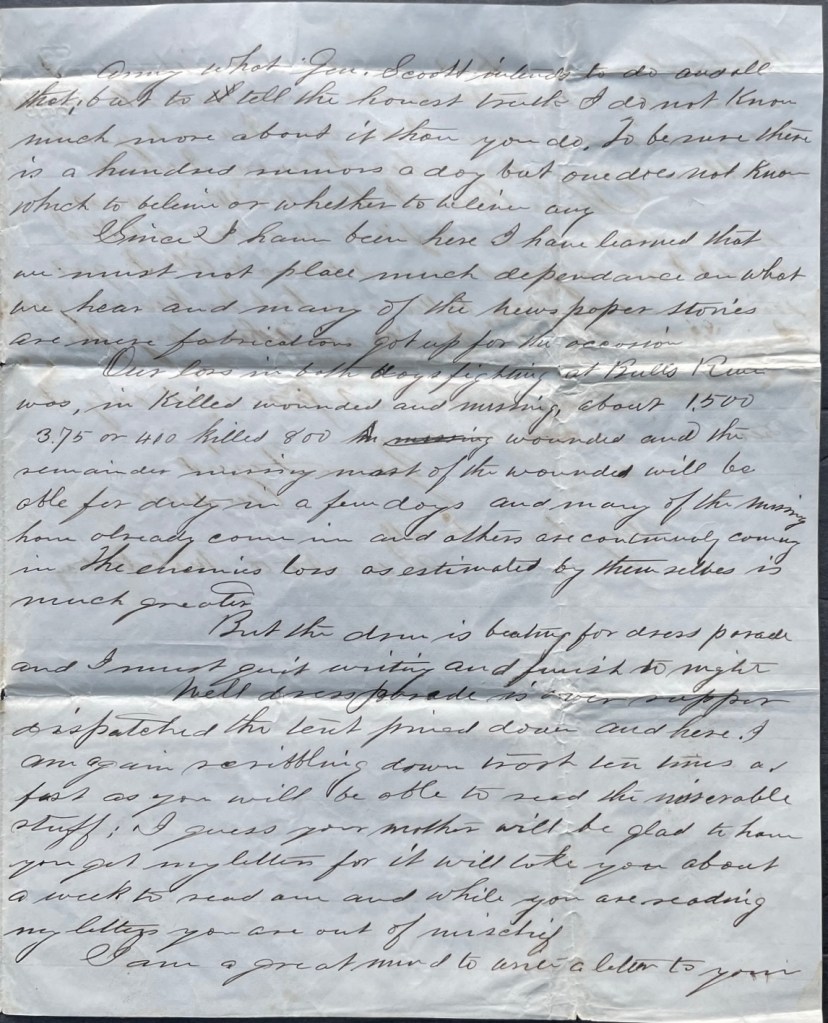
Now I know you want me to write a long letter and tell you all about the movements of the army, what Gen. Scott intends to do, and all that, but to tell the honest truth, I do not know much more about it than you do. To be sure, there is a hundred rumors a day but one does not know which to believe or whether to believe any.
Since I have been here, I have learned that one must not place much dependence on what we hear and many of the newspaper stories are mere fabricationsm got up for the occasion.
Our loss in both days fighting at Bulls Run was, in killed, wounded and missing, about 1,500; 375 or 400 killed, 800 wounded, and the remainder missing. Most of the wounded will be able for duty in a few days and many of the missing have already come in and others are continually coming in. The enemy’s loss as estimated by themselves is much greater.
But the drum is beating for dress parade and I must quit writing and finish tonight.
Well, dress parade is over, supper dispatched, the tent pinned down, and here I am again scribbling down traash ten times as fast as you will be able to read the miserable stuff. I guess your mother will be glad to have you get my letter for it will take you about a week to read one and while you are reading my letters you are out of mischief.
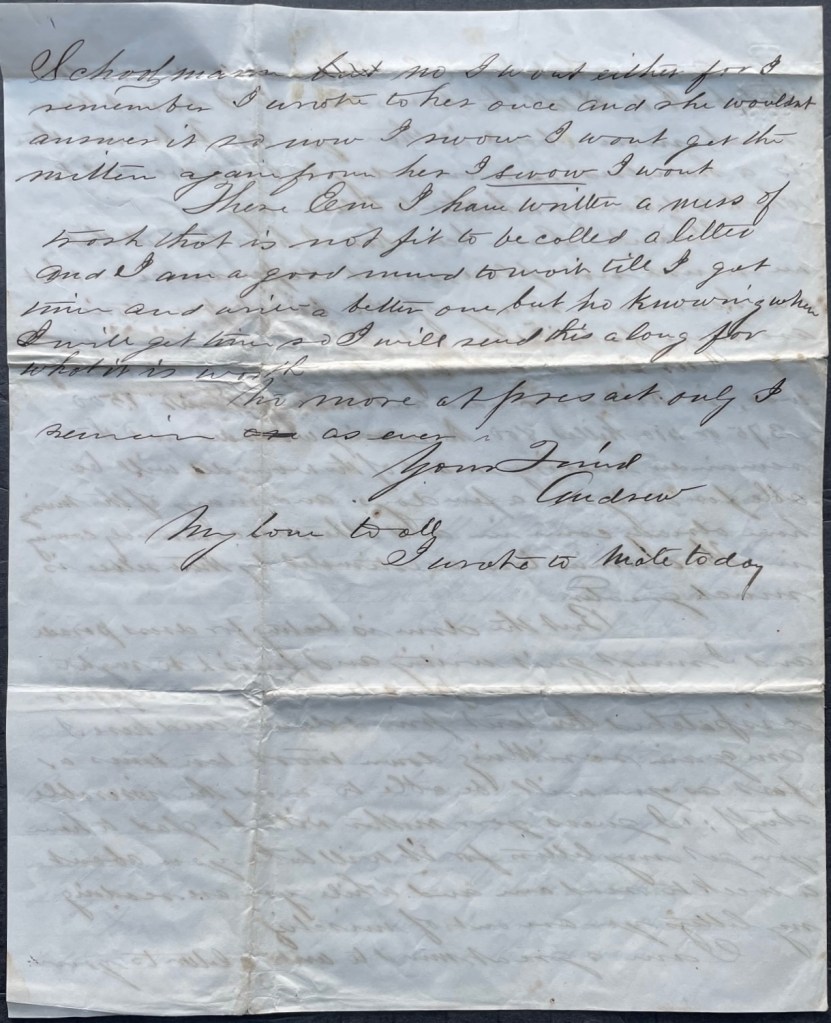
I am a good mind to write a letter to your school marm. No, I won’t either for I remember I wrote to her once and she wouldn’t answer it so now I swear I won’t get the mitten again from her, I swear I won’t.
There Em, I have written a mess of trash that is not fit to be called a letter and I am a good mind to wait till I get time and write a better one but not knowing when I will get time so I will send this along for what it is worth. No more at present, only I remain as ever your friend, — Andrew
I could not find an image of George but here is one of Landsman Peter Depray featured recently in the Spring Issue of Civil War Navy by Ron Field
The following letter was sent to me for transcription by my friend Gina Denham. It was extracted from the pension file of British-born George Morecraft (1840-1913), who made his way to the United States around 1859. On 19 February 1861, as Gina’s thorough research reveals, George enlisted in Co. M, 2nd US Artillery, stating his previous occupation as “miller” and his birthplace as Winslow, Buckinghamshire. Just over a year later, on 10 March 1862, George deserted the army, and the subsequent month, he volunteered for the US Navy using the alias, Eugene Howard. While he claimed in the letter that he adopted the alias to keep his enlistment a secret from his parents, the desertion record implies a deeper motivation. And it didn’t stop there. It led to marital desertions as well.
After he was discharged from the US Navy, George stayed on in Baltimore until April 1900 when he returned to London. He began the process of filing for a pension in 1905 and in 1908 he married Matilda Harriett Phipps, a widow half his age. They had two children together when he was in his sixties. Gina also uncovered the fact that wile living in the United States, George had married a woman named Letitia White—twice! The first wedding took place in May 1865 under the name George Eugene Howard; their union producing two children, Estrella and Harry. Having the roving spirit of a sailor, however, George was not content to stay put and it wasn’t long before Letitia had to place the following advertisement in a Baltimore paper, “Left Suddenly, October 1st, 1868, GEORGE EUGENE HOWARD, of Baltimore, aged 30 years, 5 feet f inches high, light hair, cut short, fair complexion, stout built, Englishman by birth, talks fast. Any information of his whereabouts will be thankfully received by his sorrowing wife—Letitia Howard.” George returned to Baltimore and revealed to Letitia (and her parents) that he had married her under a false name and they were married once again under his given name in September 1869. Three more children were born to the couple following this date, George, Cora, and Carolina. But George would once again abandon Letitia and live with another woman for a time before returning to England. In 1910, the Pension Bureau received a claim from Lydia seeking a pension for George’s service in the Civil War. When the Bureau contacted George to validate her claim, George admitted freely that he had been married to her and that they had never divorced because he believed her to be dead.
Transcription
Name—George Morecraft, alias Eugene Howard—Reason of alias—For family reasons, not wishing parents, &c. to know that I had joined “U.S. Navy.” Now known by George Morecraft.
Ships number—Don’t remember numbers—only on board two (2) ships—Flagship Hartford and Winona No. 2.
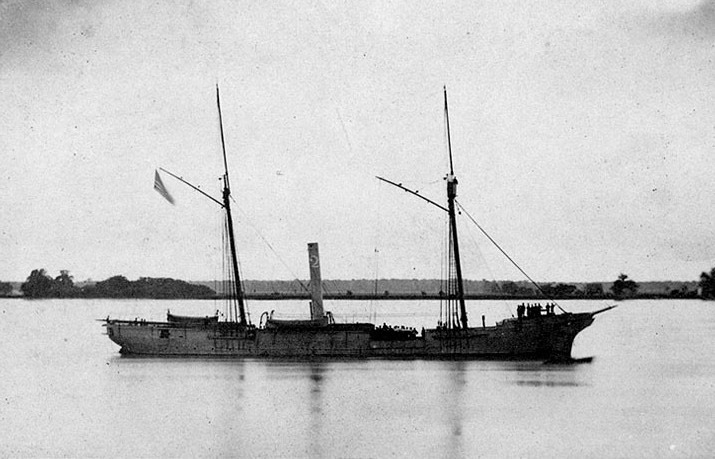
USS Winona (1861-1865) in the Mississippi River off Baton Rouge, Louisiana. Note the identification number “2” painted on her smokestack.Winona’s hull was wooden, built from white and live oak, yellow pine, and locust. She was rigged as a two-masted schooner and could sail, but her primary propulsion was provided by a single propeller 9 feet (2.7 m) in diameter. This was powered by two coal-fired steam engines, each with a 30 inches (0.76 m) bore and an 18 inches (0.46 m) stroke. Steam was provided by two boilers which consumed 9 tons of fuel per day. Winona’s machinery was built by the Allaire Iron Works.
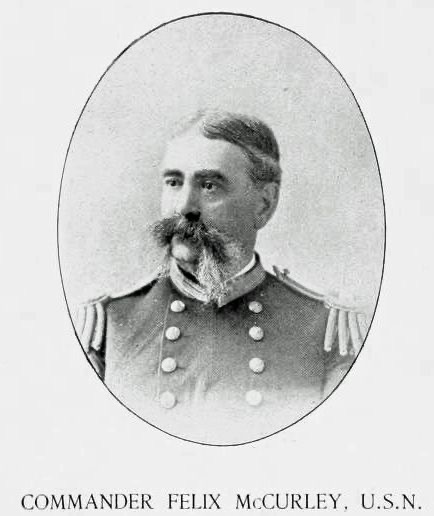
Names & Ranks of Officers: Captain W. H. Dana, Executive Officer W. S. [Winfield Scott] or S. W. Schley (now Admiral); Sailing Master Phelise [Felix] McCurley; Doctor Mr. Little; Purser Mr. Dixson; Chief Engineer Mr. Purdy; Asst. Engineer’s Lewis Warmling, Charles Warmling, Montgomery P. Griffiths; Doctors Steward, Albert, Ritter’ Master-at-Arms James Palmer; Firemen John Cane or Kane; John Kearns, Cranky Burns, and Edward Burnett; Quarter Masters James Smith, Edward Parker, James Whitly or Whitely; Landsmen John Kincart or Kinkart; John Wheeler, James Stubs; Barney Hagan was Boatswain and Captain of 11-inch gun.
Disabilities—None in Service.
Present application—Failing eyesight, old age, and general disability. Original to 52.717.
Transferred to U. S. Flagship Hartford, Admiral D. G. Farragut (Western Gulf Blockading Squadron). Was appointed Yeoman by Admiral Farragut, [on] Sunday (either June or July 1862) between 10-11 a.m. Confederate Ram Arkansas or Arkinsau came out of Yazoo river (rear of Vicksburg, Miss.), steamed down the river, firing several shots. Some taken effect on the Hospital boat, &c. Fleet not having steam up, impossible to slip cables. Confederate Ram came to anchor under the guns of Vicksburg some three (3) miles below. Flagship signaled fleet to get under way and proceed down river; ordered to “Ram and sink the Rebel ram if possible.” When abreast of batteries, the various vessels poured a terrific fire. Admiral Farragut (stationed in Mizzen rigging)—“Damn them, let them have it!;” We could hear the rebels crying for mercy. 7:30 p.m. [we] anchored some three (3) miles below Vicksburg, each vessel giving three (3) cheers. About 9 or 10 killed and wounded. I was stationed No. 11 gun (port side). 1
Capt. James Shepard Thornton (1826-1875)
I was then transferred to Winona No. 2 with Captain [James Shepard] Thornton. Flagship steamed to Pensacola Navy Yard, Florida, Winona in company. [In late August 1862, the] Winona was ordered on blockade off Mobile to intercept blockade runner Oreto [later renamed Florida]—cargo valued at 1,000,000 pounds. Captain Thornton having D. T.’s [delirium tremens], was ordered to Washington D. C. 2 Lieut. Commander [Winfield Scott Schley] from the Flag took temporary command.
Winona received orders to proceed up Mississippi river [in early December 1862], lying below Port Hudson in company with Iron Clad SX [Essex]. On a Sunday morning [28 June 1863], Lieut. Colonel Green’s Confederate battery opened fire on the Winona. She received twenty-one (21) shots in her side, One (1) officer was wounded in the right thigh. As far as I can remember, his name was Wainwright. The following morning dispatches came for the Winona to proceed at once to Donaldsonville to bombard the above town. After firing several shells, the enemy surrendered. We took 126 prisoners, 50 of which was taken on board Winona, Lieut. Colonel Green being one of them. I was ordered to assist Master-at-Arms to put them in irons, &c. Afterwards the prisoners were sent to Fort Tortuga.
Winona‘s condenser being out of order was repaired. Winona was ordered [on 30 July 1863 to return] to Baltimore, Maryland, to be overhauled, &c., USS Kineo No. 3, taking us in tow (called in Key West for coal) [17 August 1863]. 3 Then the Winona was towed to Henderson’s Wharf [Baltimore] to undergo final examination with engines, &c. Winona having received crew on board, &c. was ordered to Admiral John A. Dahlgreen, for duty (South Atlantic Blockading Squadron). Was sent to Assabau [Ossabaw] Sounds (south of Charleston). Through Gunner Barney Hagan putting his revolver belt &c. on the breech of 11-inch gun, wind blowing a gale, caused belt to flap, revolver going off, the contents of which entered a man named McGlochlin. He expired in a few minutes. Same week were ordered to Ogeechee river. Blockade runner New London was up river some time. Same night a volunteer crew (Phelise [Felix] McCurley in command) went to capture the New London but failed to succeed, returning on board Winona. 4
President Lincoln’s term of office having expired and his reelection being contested by Gen. George B. McClellan, I was called down in cabin in presence of Captain W. H. Dana &c. and asked for my vote. I voted for Abraham Lincoln. Winona was ordered to George’s Creek, north of Charleston, S. C. about the latter end of March or beginning of April 1865. My term of service having expired on or about the 19th or 21st of April 1865, was put on board dispatch boat Acacia, landed in Philadelphia, Pa., on Saturday 29 or 30 April 1865. Received my discharge onboard the USS Princeton, receiving ship.
— George Morecraft, alias Eugene Howard
1 “Once above Vicksburg, Winona and her colleagues settled into a more or less routine schedule supporting the first Vicksburg campaign and attempting to blockade the Confederate ironclad, Arkansas, in the Yazoo River. On 15 July, however, the Southern warship bested a three-gunboat expedition sent up the Yazoo River after her, disabling USS Carondelet in the river and chasing USS Queen of the West and USS Tyler back down the river.Arkansascontinued out of the Yazoo and into the Mississippi River to begin a bold dash through the 33-ship Union fleet of which Winona remained a unit. Firing as she went, the Confederate warship hurtled through the startled Northern squadron, briefly engaging Winona as she raced past her. Winona responded briefly, but the Confederate ship passed through the gauntlet safely and moored under the protection of the Vicksburg batteries. Soon thereafter, Winona, undertow of USS Wissahickon, re-passed Vicksburg with the rest of Farragut’s force and went back to New Orleans.” [Wikipedia, USS Winona]
2 According to the diary of Montgomery P. Griffis who served on the USS Winona at this time, “Capt. Thornton started on a ‘bust’ all to himself on leaving Pensacola which culminated in a fit of delirium tremens on the 21st [September 1862]. We had to station a man at the cabin door to keep him from coming on deck as he would probably have fallen overboard if he had.” (p. 72, “This Jolly Little Gunboat, Edited by Patrick E. Purcell, 2014)
3 The Kineo left the Mississippi river on 16 August 1863 and reached Baltimore on the 25th.
4 According to U. S. Naval Records, Felix McCurley (1834-1896), a native of Baltimore, Md., had served in the merchant marine service before he enlisted in the US Navy in November 1861. He was appointed as Acting Master, Nov. 13, 1861; ordered to Winona; attached to W. G. Squadron, 1861-62; engaged in the attacks on Forts Jackson and St. Philip, April 24, 1862; in the attack and passage of Vicksburg batteries, June 28, 1862; engagement with ironclad Arkansas, above Vicksburg; attack and passage of Vicksburg batteries, July 15, 1862; skirmishes on Mississippi river; 1863-64, attached to steam sloop Lackawanna; attack and passage of Forts Morgan and Gaines; engagement in Mobile Bay with the ironclad Tennessee and other vessels of the Confederate fleet; promoted Acting Vol. Lieutenant, Nov. 9, 1864; attached to Chocura, W. G. Squadron, 1865; continued in regular service, and subsequently commissioned as Lieutenant, Lieut.-Commander and Commander.
Purcell, Patrick E. (ed.) This Jolly Little Gunboat: The USS Winona On the Gulf Coast and Mississippi River, 1861-1863. Iowa City IA: Camp Pope Bookshop Press, 2014. 190 pp.






















 Spared & Shared 23