1864-65: Sidney Humphrey Hayden and Albert Hayden Letters

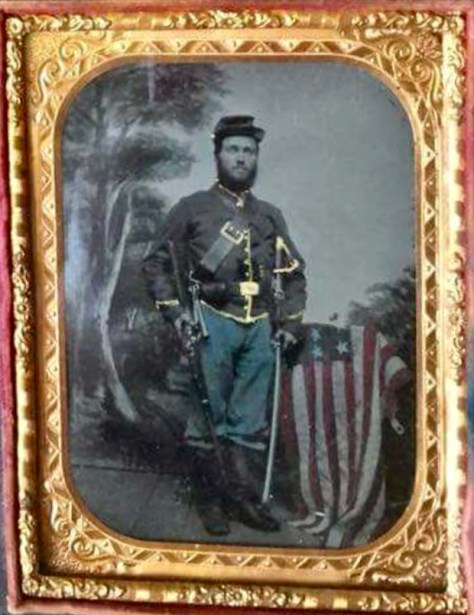
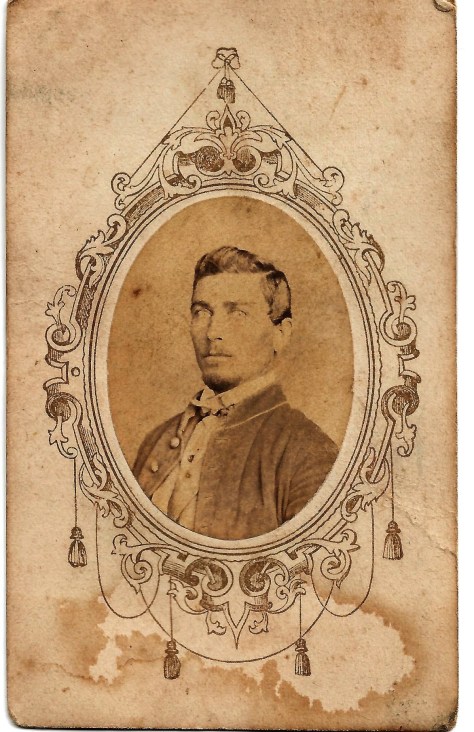
An archive comprising 10 letters, including 4 authored by Sidney Humphrey Hayden (1813-1890), spanning 2 October 1864 – 3 March 1865, written from Alexandria, VA at the US Military Railroad station and Harper’s Ferry, Virginia. His son, Albert “Bert” Hayden (1844-1918) authors the other 6 letters in the archive, each of which are written from the same railroad depot in Alexandria, where he was employed, spanning 21 February 1865 to 11 April 1865. Most letters in the archive bear a cancel stamp from the US Military Railroad, which was created after the federal government captured and occupied the Orange & Alexandria Railroad depot in 1861. It acted as the main Union Army supply depot during the first half of the Civil War.

Sidney and Bert’s letters, most written to (Sidney’s) wife and (Bert’s) mother, Florilla E. Miller (1814-1868), contain many details about the goings-on at the railroad station, thoughts on politics, and war updates. 

The archive’s earliest letter is authored by Sidney, Sr., dated 2 October 1864, and addressed to his youngest son, Sidney (“Sid”) Hayden (1857-1907). He offers a trove of details about the depot and soldiers traveling nearby. He describes the stockade surrounding the railroad depot and offices, purposed to protect the building and their inhabitants from Confederate soldiers. He seems disturbed by the idea of being “shut up in such a pen,” therefore he and an acquaintance rent a room in a private house a short distance away to sleep in. 

He then describes the young African Americans that pass by the office door every day with pails of water and baskets they carry on their heads “without touching them with their hands. They seem to stick to the wool.” He also describes the way both black and white soldiers are outfitted, each with a knapsack, blanket, canteen, and “a big ugly gun and bayonet on their shoulder.” Many of them look rough even with blue clothes and brass buttons.” 

Hayden’s observations continue, as he describes the mule teams that pull wagons for the soldiers as they travel: “Then again we see long lines of army wagons each with about 6 mules driving it, and a nigger riding one of the hind mules and driving the others with but a single line. These wagons carry things that the soldiers cannot carry on their backs. Soldiers and mules have to do most of the hard work in the army.”

We get a glimpse into Hayden and his family’s politics as he uses a reference to a satirical political pamphlet produced by Copperheads depicting Abraham Lincoln as Abraham Africanus, a character who makes a pact with the devil to secure monarchical rule over the United States, in another letter to his wife. The letter is dated 9 November, the day after the presidential election. He writes, “Well the 8th has passed and this morning the streets of our city are full of rumors as to the results. The general opinion is that the dynasty of A.A. – (Abrahamus Africanus) is to be perpetuated. If it be the will of heaven, we must submit…” 

In his only letter written from Harper’s Ferry, 3 March 1865, Sidney writes of having visited the “the termination of our road,” and of a trip to see Sheridan’s headquarters at Winchester, “before he [Sheridan] started on his late raid.” He was taken to the headquarters by an ambulance and military guard, as “The whole of that section is one infested with guerrillas that it was thought unsafe to send one ambulance alone.” When he reached Winchester, he found a Masonic Lodge, and was invited to address its members as a Mason himself. Reviewing his trip, he writes, “I should not fancy a life on the borders. It is rough and dangerous. Neither would I like to be stationed here. Alexandria is a paradise to this place.”

Also from Harper’s Ferry, Sidney writes of a military execution of a “young man shot for desertion. I did not go out to see it for I am sick of the thought of bloodshed.”

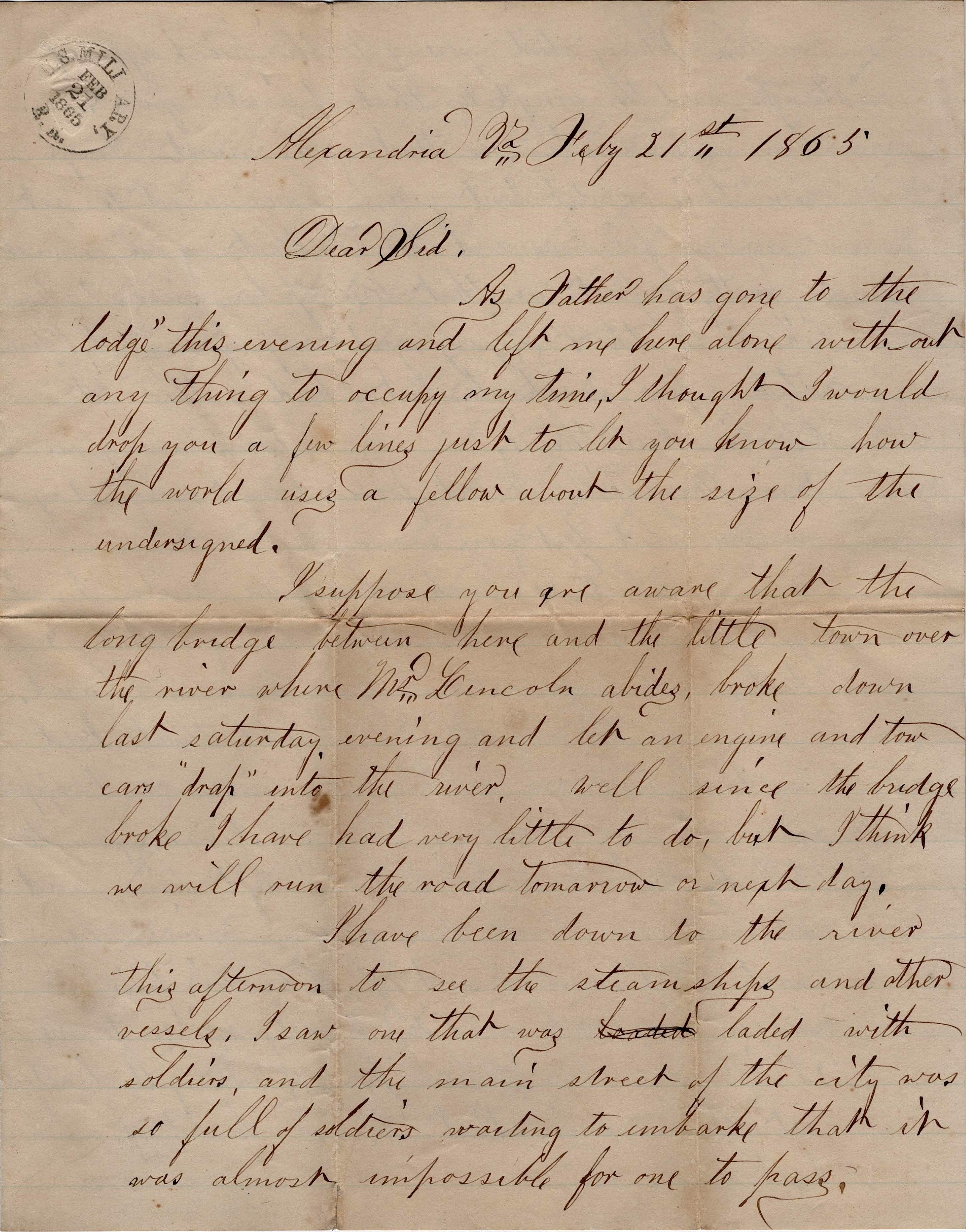
Albert Hayden’s first letter featured in this archive is addressed to his younger brother Sidney (“Sid”) Hayden (1857-1907), dated 21 February 1865. He reports that the “long bridge between here [Alexandria, VA] and the little town over the river where Mr. Lincoln abides, broke down last Saturday evening and let an engine and two cars drop into the river.” 

In a letter to his mother dated 4 April 1865, Bert reports felicitations over the capture of Richmond, with astonishment at the way some white folks were interacting with Black people. “There were great times here and in Washington over the capture of Richmond; and some of the people made cursed fools of themselves, for over on the steps of the Metropolitan Hotel in Washington they would stand and hug some great black beastly niggers; but everyone to their liking.”

In his next letter to his mother, dated 2 days later on 6 April, Bert notes that he “was over to see the illumination a few nights ago, and I never saw such crowds of niggers as there were in the streets.” In this racist remark, he refers to the illumination of the capital city to celebrate the news of the fall of Richmond and Robert E. Lee’s surrender. The public buildings along with participating businesses and homes were lit up in a unified display of elation. 

Bert’s remaining letters include a few scattered details about soldiers, including the unloading of wounded soldiers at the wharves, including a soldier who “had both arms and legs shot off.” 

Sidney Humphrey Hayden was a prominent Mason, businessman, and family man, who was remembered in an obituary in the Athens, Pennsylvania Daily News as “one of the most conspicuous figures in Northern Pennsylvania.” His surviving sons are listed in the article, including Bert, who is a “freight agent of this division of the Lehigh Valley road…” Sidney served as a master mason at the Rural Amity Lodge of Free and Accepted Masons, being very involved in the affairs of the lodge, attending encampments, contributing to masonic publications, and even producing his own work in 1866, George Washington and his Masonic Compeers.
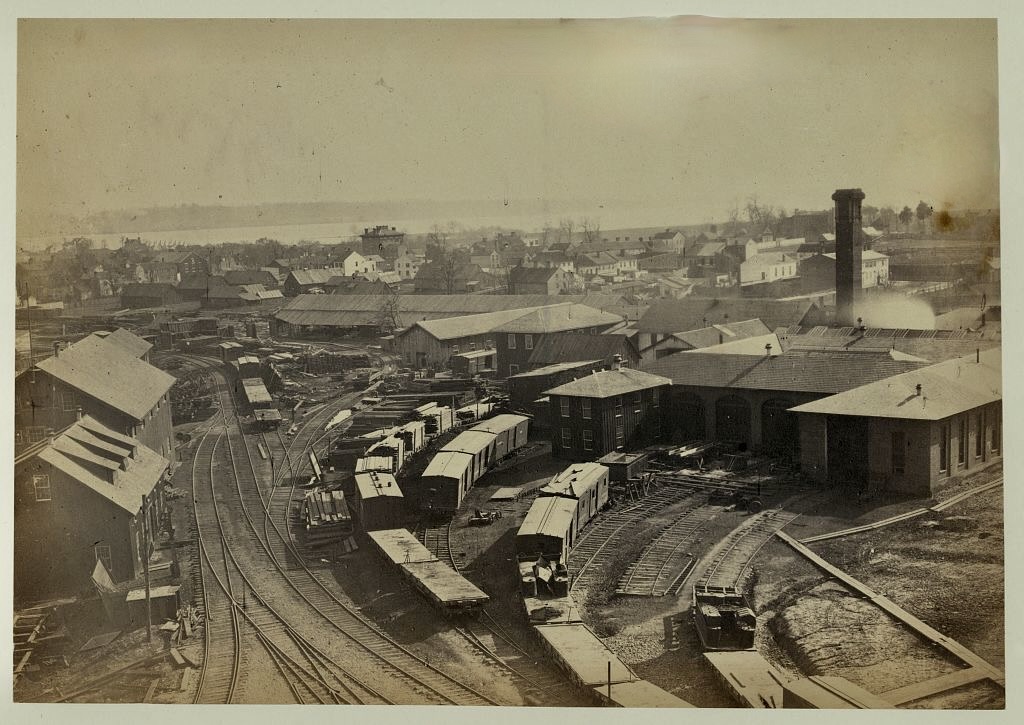
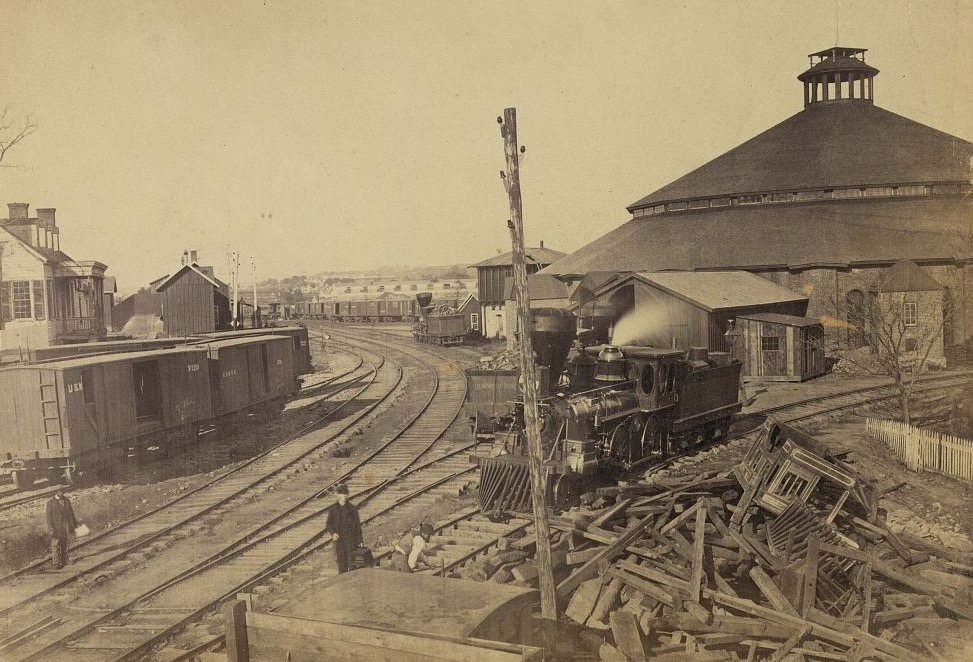
Bird’s eye view of machine shops, with east yard of Orange & Alexandria Railroad Summary: Photograph shows a railroad yard of the Orange & Alexandria Railroad in Alexandria, Virginia. Photograph taken from the top of the roundhouse. (LOC)

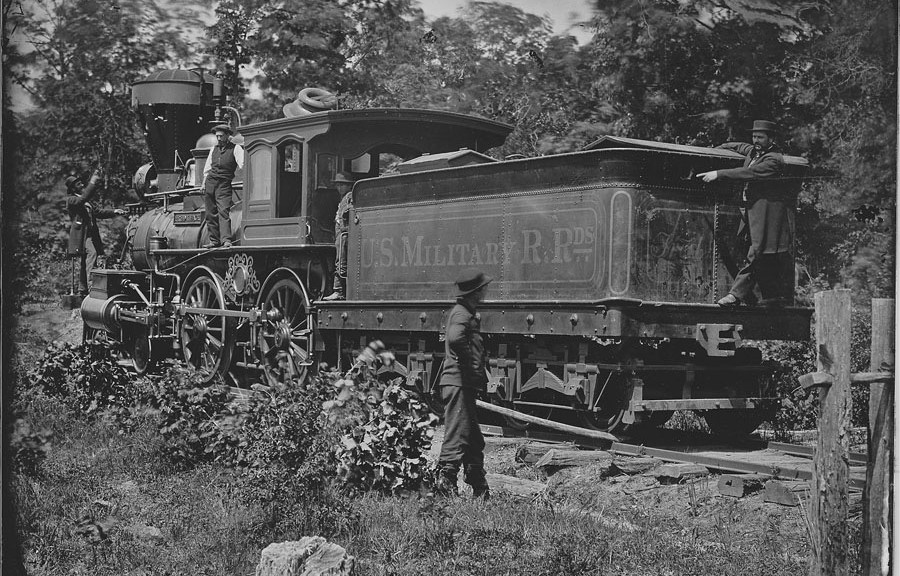
The Federally-controlled roundhouse and depot of the Orange & Alexandria Railway in Alexandria, with U.S. Military Railroad cars. (LOC)

Letter 1

Alexandria, Virginia
[2 October 1864]

Dear Sidney,

You can see that my letter is written on the 2nd of October without my dating if you are right smart. You can also see that it is written from the ticket of the United States Military Railroads if you look sharp.

Well how do you think it looks about here? I can hardly tell you, I fear, so that you will understand it. Our depot is at the west end of the city about three quarters of a mile back from the river. The cars from Washington come and go four times in a day and pass right by the door of the office. All round the railroad ground and railroad offices and buildings, is a high, straight fence about ten feet high called a stockade. It is made by first digging a deep, narrow ditch, and then cutting trees 6 or 8 inches through and 14 or 15 feet long and setting them in rows on end in the ditch, and then filling up the ditch with dirt pounded down. This makes what is called a stockade fort. It is made to keep out the rebs and has holes made to shoot rifles through. There are large gates to go out and in at. How would you like to be shut up in such a pen as this? Well as big a piece of land as John Mills brought of Spring is here surrounded with such a stockade and our office is in it. Jule and I do not sleep in it nights though many do, but we go to a private house a short distance out and have a good room and bed there.

You would laugh to see the little nigger cubs we see here. They pass by the office door every day with pails of water and baskets of truck on their heads which they carry without touching them with their hands. They seem to stick to the wool.

Another thing we see is soldiers—both black and white—with a knapsack and blanket strapped on their backs and a canteen of water by their side, and a big ugly gun and bayonet on their shoulder. Many of them look rough even with blue clothes and brass buttons.

Then again we see long lines of army wagons each with about 6 mules driving it, and a nigger riding one of the hind mules and driving the others with but a single line. These wagons carry things that the soldiers cannot carry on their backs. Soldiers and mules have to do most of the hard work in the army.

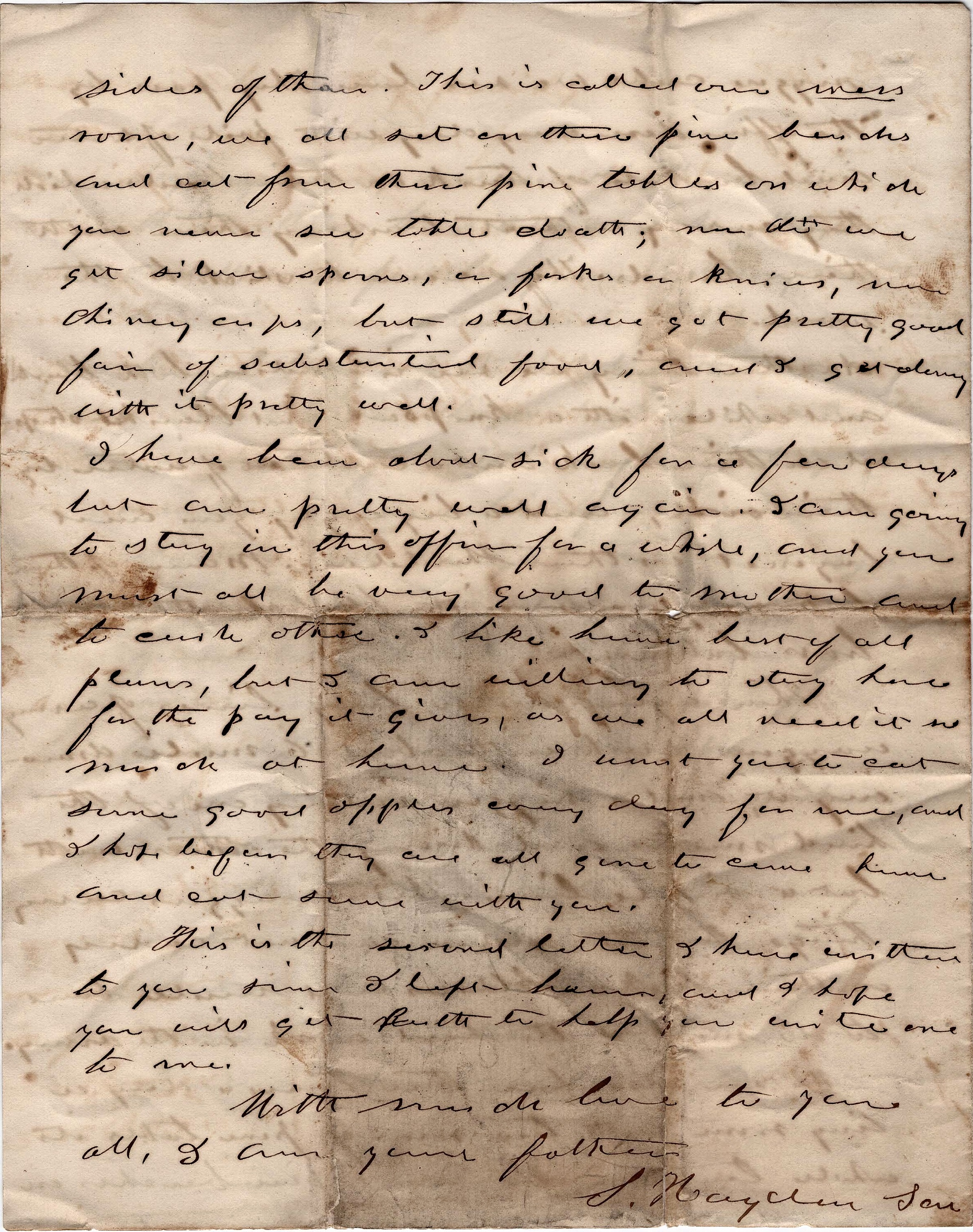
We see also here three times a day a long room with two rows of pine tables it whole length and a row of pine benches on sides of them. This is called our mess room. We all sit on these pine benches and eat from these pine tables on which you never see table cloths, nor do we get silver spoons or forks or knives, nor dining cups. but still we get pretty good fare of substantial food and I get along with it pretty well.

I have been about sick for a few days but am pretty well again. I am going to stay in this office for a while and you must all be very good to me there and to each other. I like home best of all plans but I am willing to stay here for the pay it gives, as we all need it so much at home. I want you to eat some good apples every day for me, and I hope before they are all gone to come home and eat some with you.

This is the second letter I have written to you since I left home and I hope you will get Ruth to help you write one to me. With much love to you all, I am your father, — S. Hayden, Sr.


Letter 2
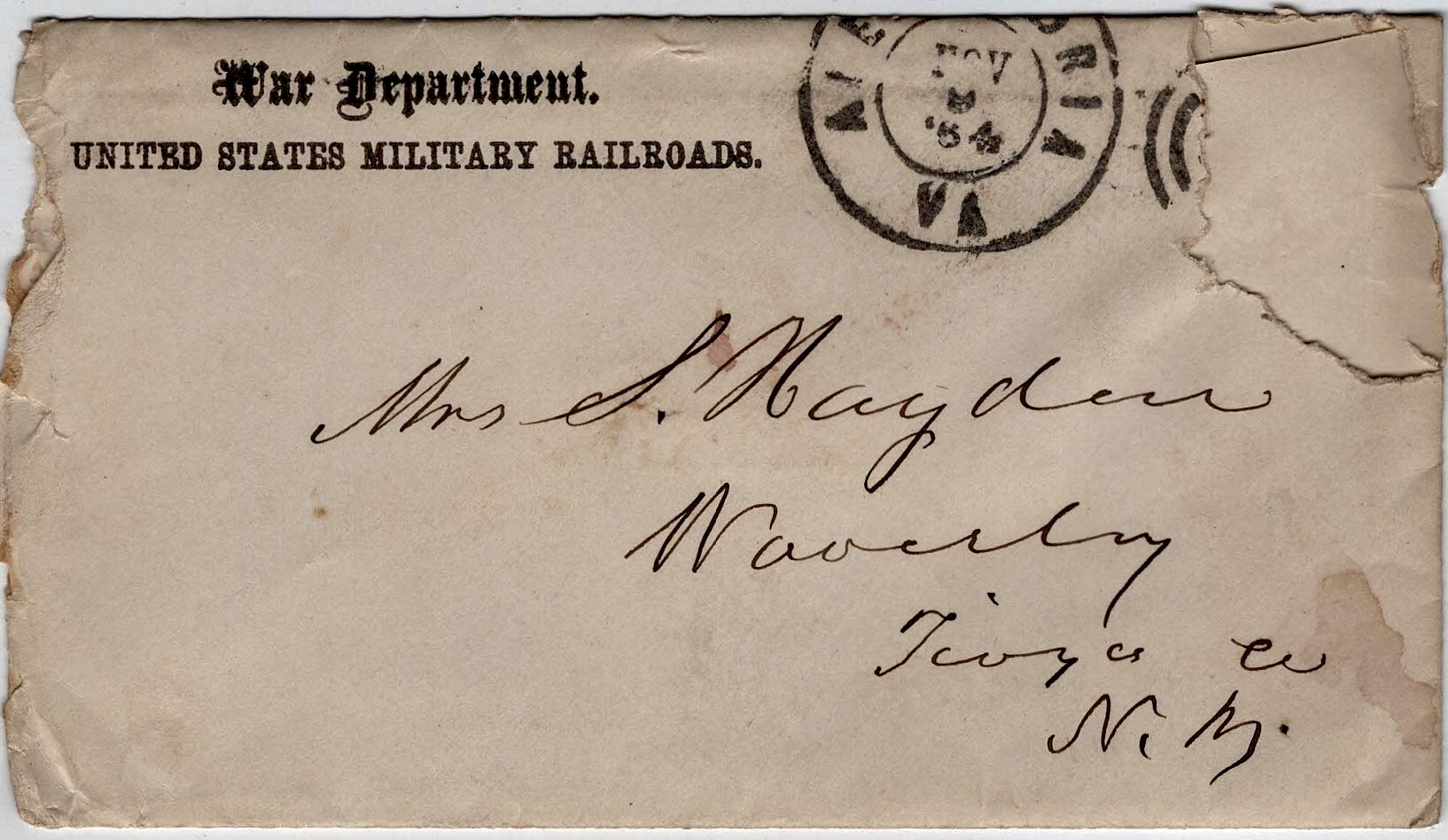
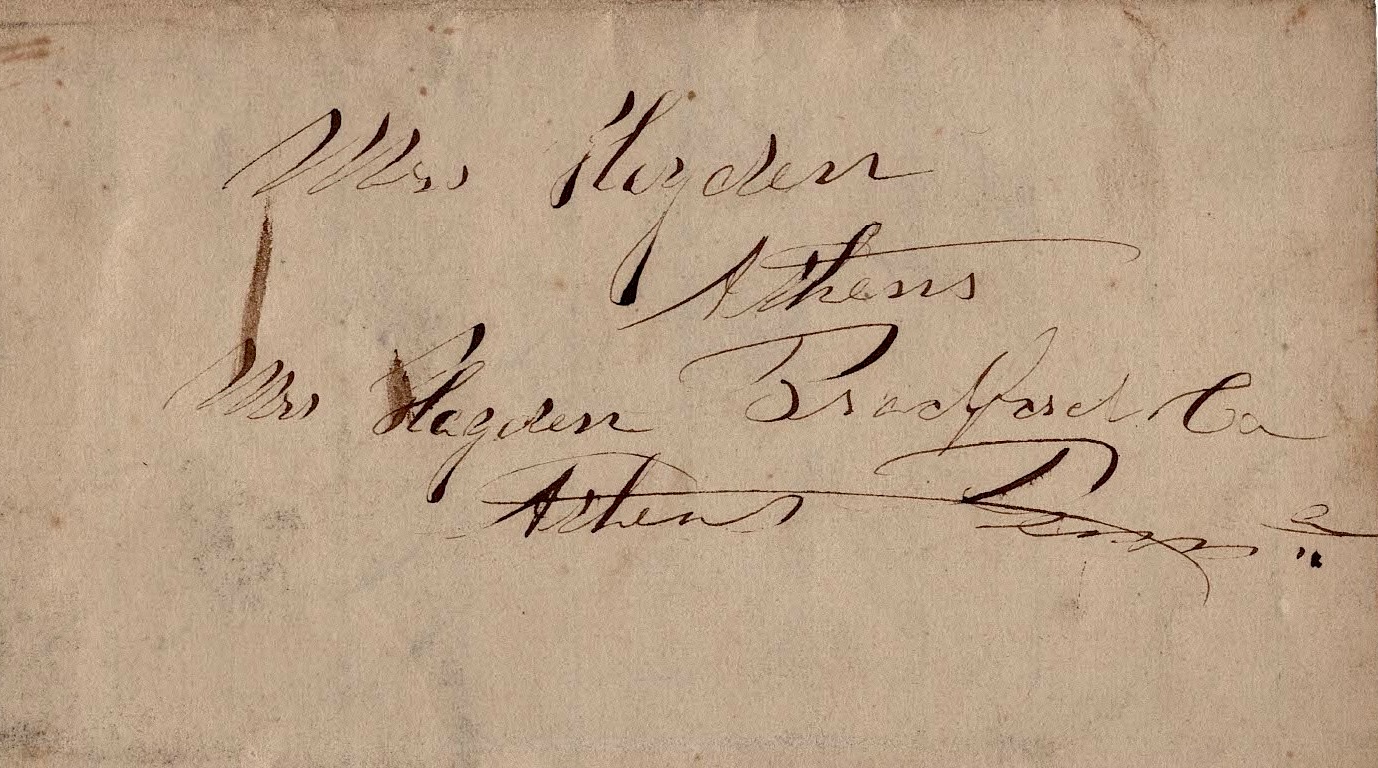
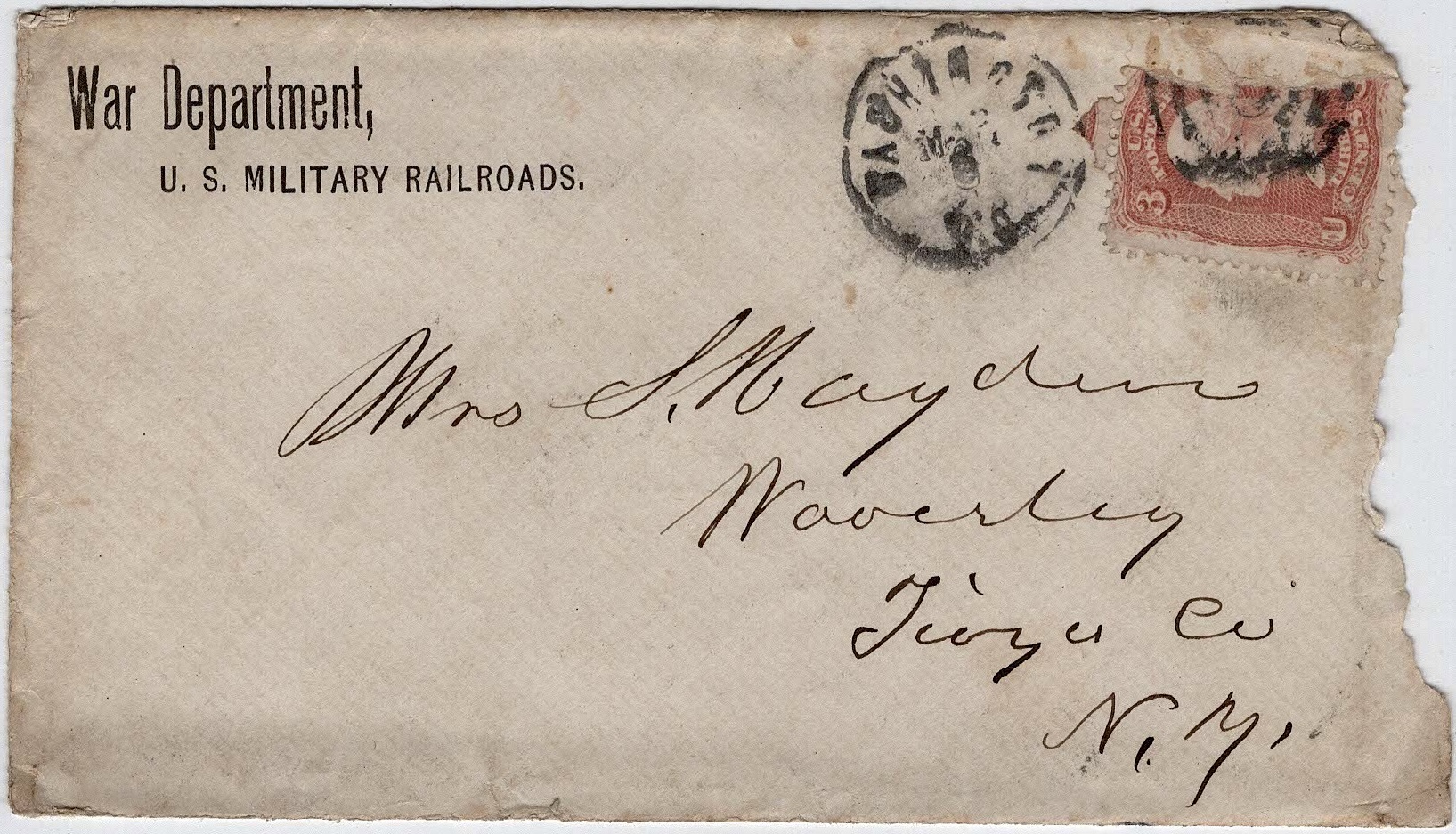
Mrs. S. Hayden, Waverly, Tioga county, New York

Alexandria, Virginia
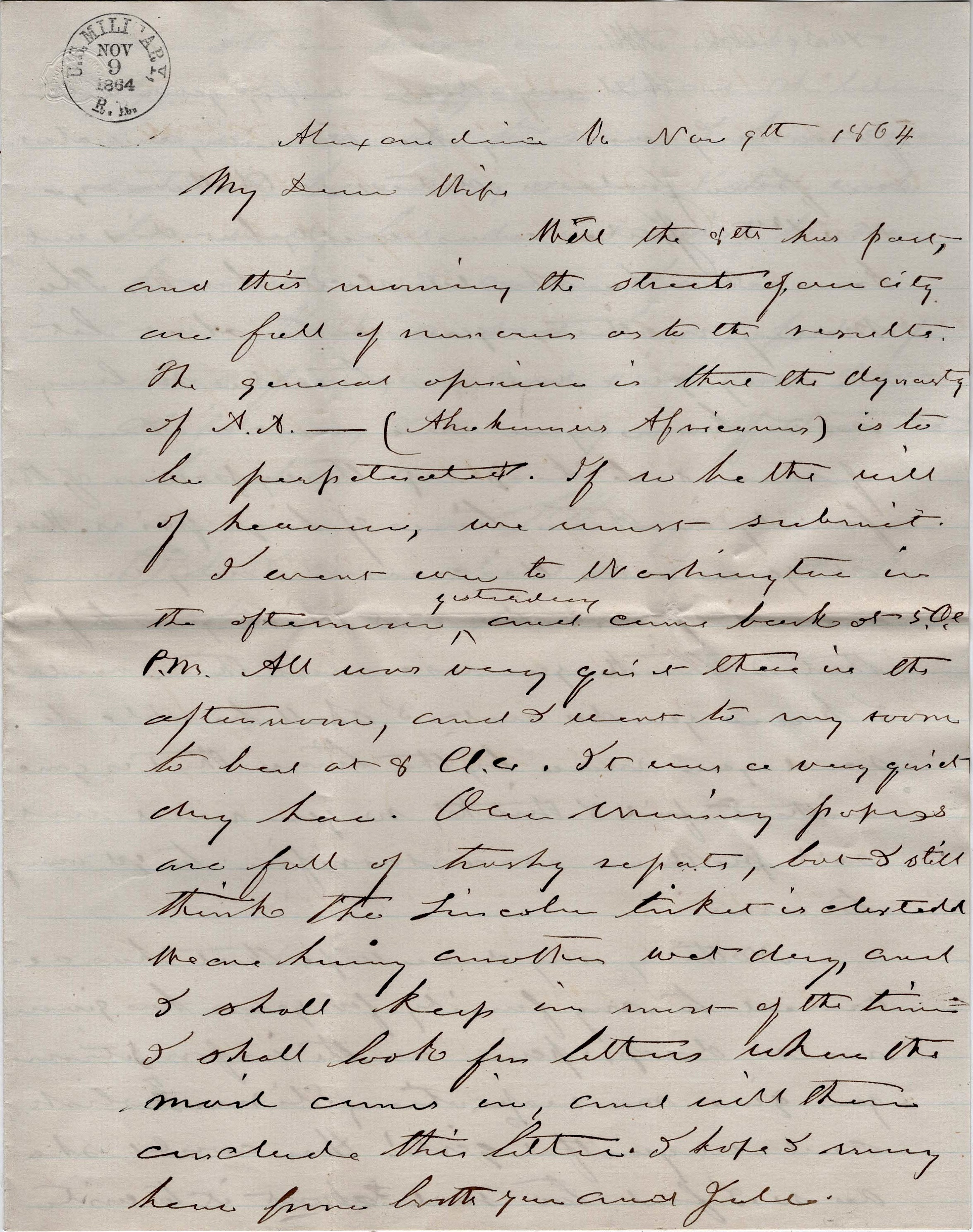
November 9th 1864

My dear Wife,

While many Northerners supported the war against the Confederacy and opposed the enslavement of African Americans, there was a vocal minority popularly known as “Copperheads,” who opposed the war and, especially, the suspension of habeas corpus and the Emancipation Proclamation. Copperheads believed that Lincoln was acting like a dictator by ignoring the Constitution when he issued these edicts.  Opponents flooded the north with handbills about “race mixing.” One such attack was Abraham Africanus I, which depicted Lincoln making a pact with the devil to become the monarchical ruler of the United States. 

Well the 8th has passed and this morning the streets of our city are full of rumors as to the results [of the election]. The general opinion is that the dynasty of A. A. (Abrahamus Africanus) is to be perpetuated. If so be the will of heaven, we must submit.

I went over to Washington in the afternoon yesterday and came back at 5 o’clock p.m. All was very quiet there in the afternoon and I went to my room to bed at 8 o’clock. It was a very quiet day here. Our morning papers are full of trashy reports but I still think the Lincoln ticket is elected.

We are having another wet day and I shall keep in most of the time. I shall look for letters when the mail comes in and will then conclude this letter. I hope I may have [one] from both you and Jule.

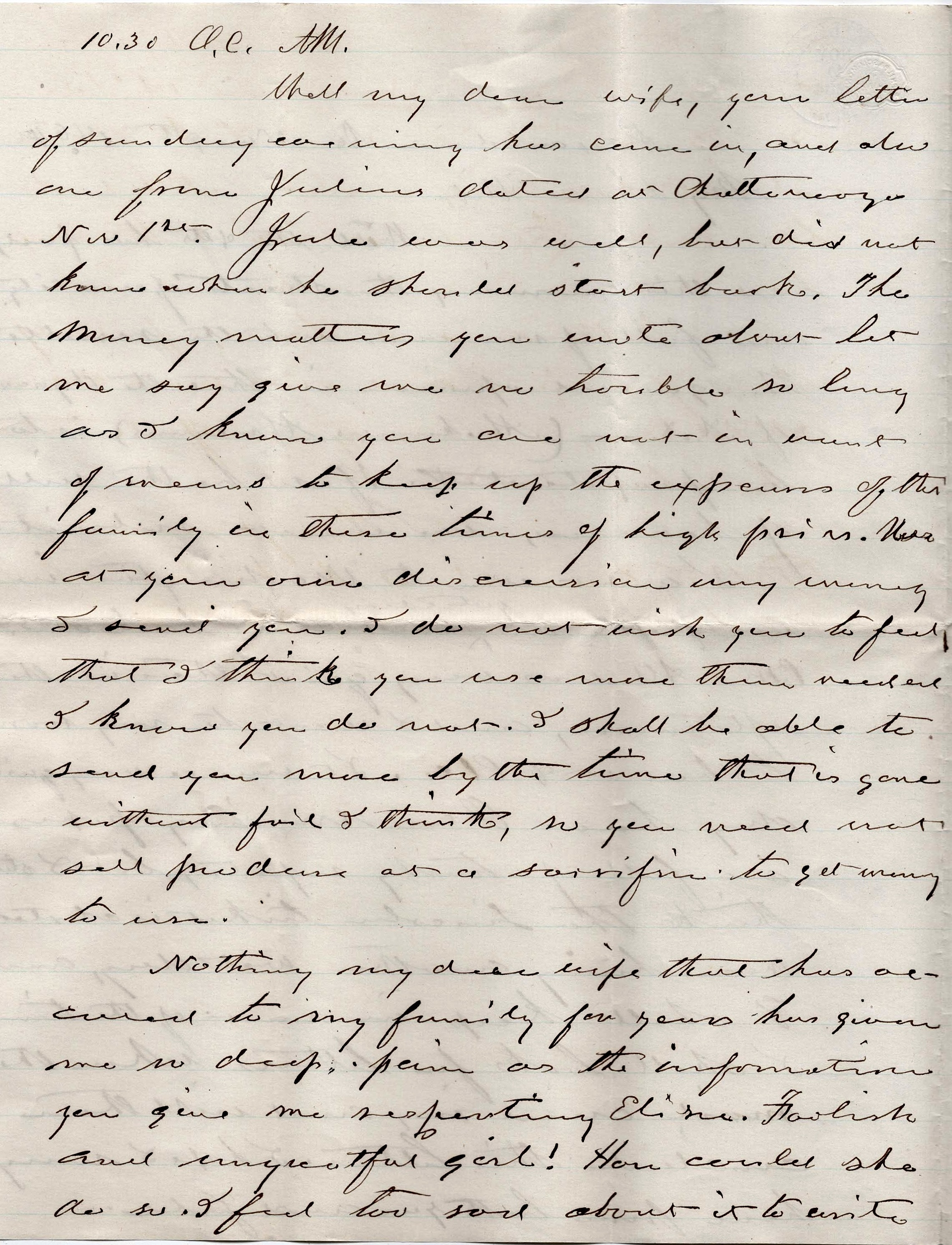
10.30 o’clock a.m. Well, my dear wife, your letter of Sunday evening has come in and also one from Julius dated at Chattanooga, November 1st. Jule was well but did not know when he should start back. The money matters you wrote about let me say give me no trouble so long as I know you are not in want of means to keep up the expenses of the family in these times of high prices. Use at your own discretion any money I send you. I do not wish you to feel that I think you use more than needed. I know you do not. I shall be able to send you more by the time that is gone without fail, I think, so you need not sell produce at a sacrifice to get money to use.

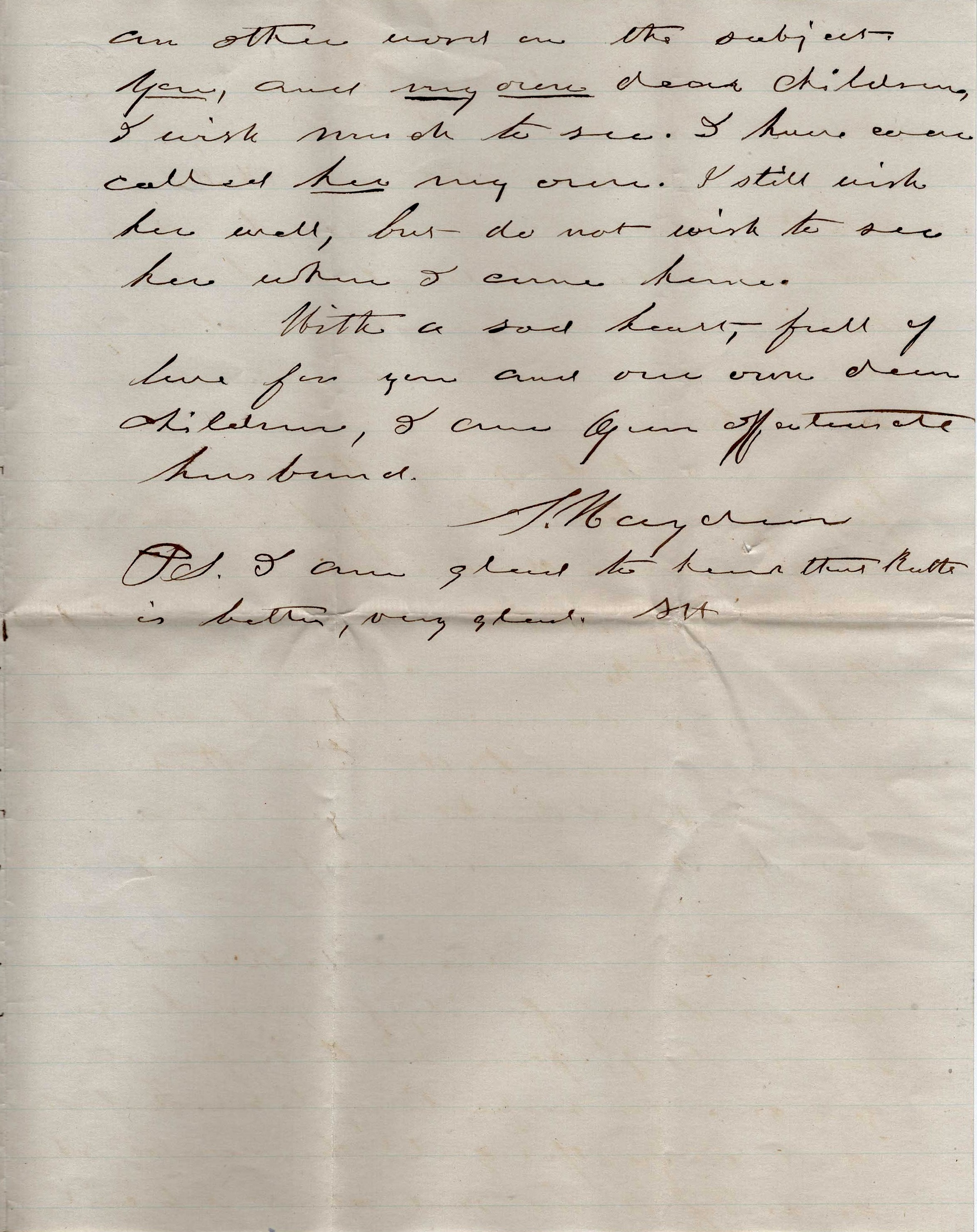
Nothing, my dear wife, that has occurred to my family for years has given me so deep pain as the information you give me respecting Elise [?]. Foolish and ungrateful girl! How could she do so? I feel too sad about it to write another word on the subject. You, and my own dear children I wish much to see. I have ever called her my own. I still wish her well, but do not wish to see her when I come home.

With a sad heart, full of love for you and our own dear children, I am your affectionate husband, — S. Hayden

P. S. I am glad to hear that Ruth is better, very glad. — S. H.

Letter 3

Alexandria, Virginia
January 21, 1865

My dear Wife,

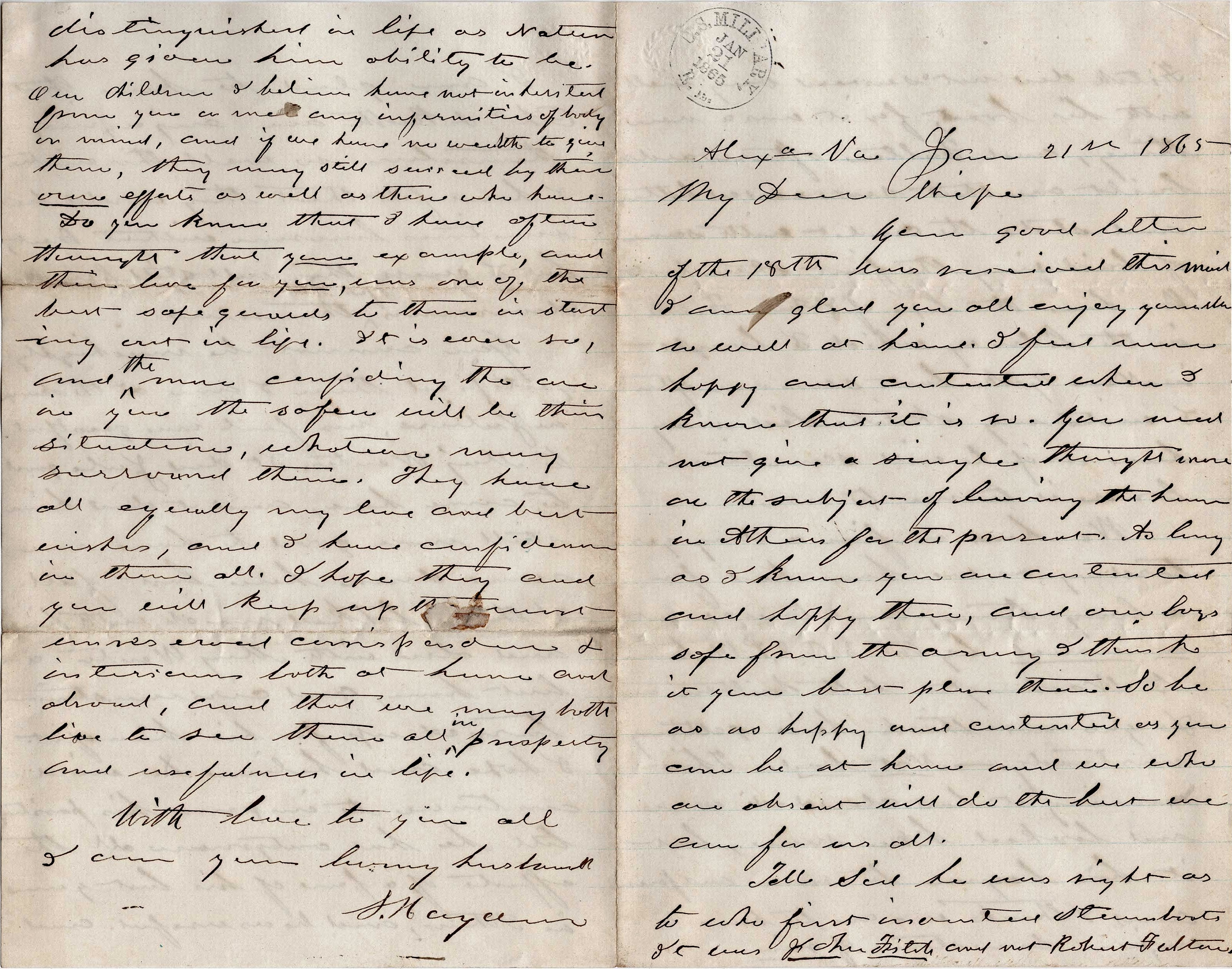
Your good letter of the 18th was received this morn and I am glad you all enjoy yourselves so well at home. I feel more happy and contented when I know that it is so. You need not give a single thought more on the subject of leaving the house in Athens for the present as long as I know you are contented and happy there, and our boys safe from the army. I think it your best place there. So be as happy and contented as you can be at home and we who are absent will do the best we can for us all.

Tell Sid he was right as to who first invented steamboats. It was John Fitch and not Robert Fulton. Fitch did not succeed very well with his boat for it was a new thing, and Fulton afterwards built one that succeeded better and stole the credit with some of building the first steamboat. We have the Life of John Fitch in the library which I bought in New York last summer after I wrote my sketch. Sid may have it if he will sometimes loan it to me to use.

We had as fine a day yesterday as we have had for a long time, and Bert went as usual by the 3 o’clock p.m. train to Washington to the Smithsonian. Do you not think he is getting unsteady? Not bad. This morning it had clouded over and looked like snow, but it has begun to rain and [ ] and I think we are to have a Virginia snowstorm of rain.

I am glad to hear that Charles & Ruth are enjoying themselves so well this winter. I have felt that they would be sometimes lonesome without Bert but I guess they will still find diversions for themselves.

You cannot be more highly gratified than I am at the change in Julien. We feel more gratified to Maj. [Erasmus Livingston] Wentz. It did Jule good to come here and it did him still more good to have me come down here last fall. I then talked much with him and also with Maj. Wentz about him, and circumstances turned up for his benefit. I hope and believe he will continue to improve his position till he has [ ] all the efforts of a few of his last years in Athens, and be as useful ad distinguished in life as Nature has given him ability to be. Our children, I believe, have not inherited from you or me any infirmities of body or mind, and if we have no wealth to give them, they may still succeed by their own efforts as well as them who have.

Do you know that I have often thought that your example and their love for you was one of the best safeguards to them in starting out in life. It is even so, and the more confiding they are in you, the safer will be their situation, whatever may surround them. They have all equally my love and best wishes, and I have confidence in them all. I hope they and you will keep up the most unreserved correspondence & intercourse both at home and abroad, and that we may both live to see them all in prosperity and usefulness in life.

With love to you all, I am your loving husband, — S. Hayden

Letter 4

Alexandria, Virginia
February 21, 1865

Dear Sid,

As father has gone to the “Lodge” this evening and left me here alone without anything to occupy my time, I thought I would drop you a few lines to let you know how the world uses a fellow about the size of the undersigned.

I suppose you are aware that the Long Bridge between here and the little town over the river where Mr. Lincoln abides broke down last Saturday evening and let an engine and two cars “drop” into the river. Well since the bridge broke, I have had very little to do but I think we will run the road tomorrow or next day.

This scene of March, 1864, suggests some of the difficulties which confronted the superintendent of military railroads during the war. Long Bridge, from the railroad-man’s viewpoint, was not a very substantial structure. J. J. Moore, chief engineer and general superintendent of military railroads of Virginia, reported to Brigadier-General D. C. McCallum, under the date of July 1, 1865, that he experienced great difficulty in keeping it secure for the passage of trains. On August 22, 1864, the draw at the south end of the bridge was nearly destroyed by a tug, with a schooner in tow, running into it, and February 18, 1865, an engine broke through the south span of the bridge, the entire span being wrecked. The rescue of the “Vibbard,” which weighed 59,000 pounds and cost $11,845, was apparently effectual; the same report states that it ran 5,709 miles at a total cost of $4,318.78 in the fiscal year ending June, 1865. (The Photographic History of the Civil War in Ten Volumes, 1911)

I have been down to the river this afternoon to see the steamships and other vessels. I saw one that was loaded with soldiers and the main street of the city was so full of soldiers waiting to embark that it was almost impossible for one to pass.

Mr. Wherry, did you get the package of stamps and the song &c. that I sent you? Seems to me that you must trap some this winter, don’t you? you used to set so many for hens and mice that you must be pretty expert in that line of business. I should like to be three myself and help you and Charlie catch a few muskrats, but I had rather let Charlie skin them. I reckon you draw Mary Mills to and from school every day on your sled, don’t you?

Now Mr. Sppok when you write, I want you should tell me how many lambs & turkeys and pigs and girls you have on hand. By the way, Sid, I believe that Fred and Luther are visiting you now, so I suppose you all have some gay times. I want you to tell Luther to have Charlie lift him and see how much he has grown since he went to Candor and if Charlie tries to plague him (as he used to) to just write to me & I will give him (Charlie) one of the goll beastedest slaruxings that he ever heard of when I get home.

Jackson, you and Fred spend some of these long evenings in company with Miss Mary Mills or Miss Ruth Knapp or some other young lady of your acquaintance but I know that Luther would not do any such thing as that for he and I don’t care anything about the girls.

I guess that Protagorous must have quite a nice lot of kittens by this time, hasn’t he? You must keep good watch and not let Charlie get hold of them for if he does, he will cut their tails off surer than thunder.

Sid, I want you should remember me when you have any apples and eat about one peck a day for me. Please give my love to Mother, Ruth, Charlie, Aunt Martha, Fred, Luther, and to remember me to Miss Mary & Mr. Lew Mills. You must excuse all mistakes in this poor epistle and answer it as soon as your business will admit. Yours affectionately, — Bert Hayden

Letter 5
Harper’s Ferry, Virginia
March 3d 1865

My dear wife,

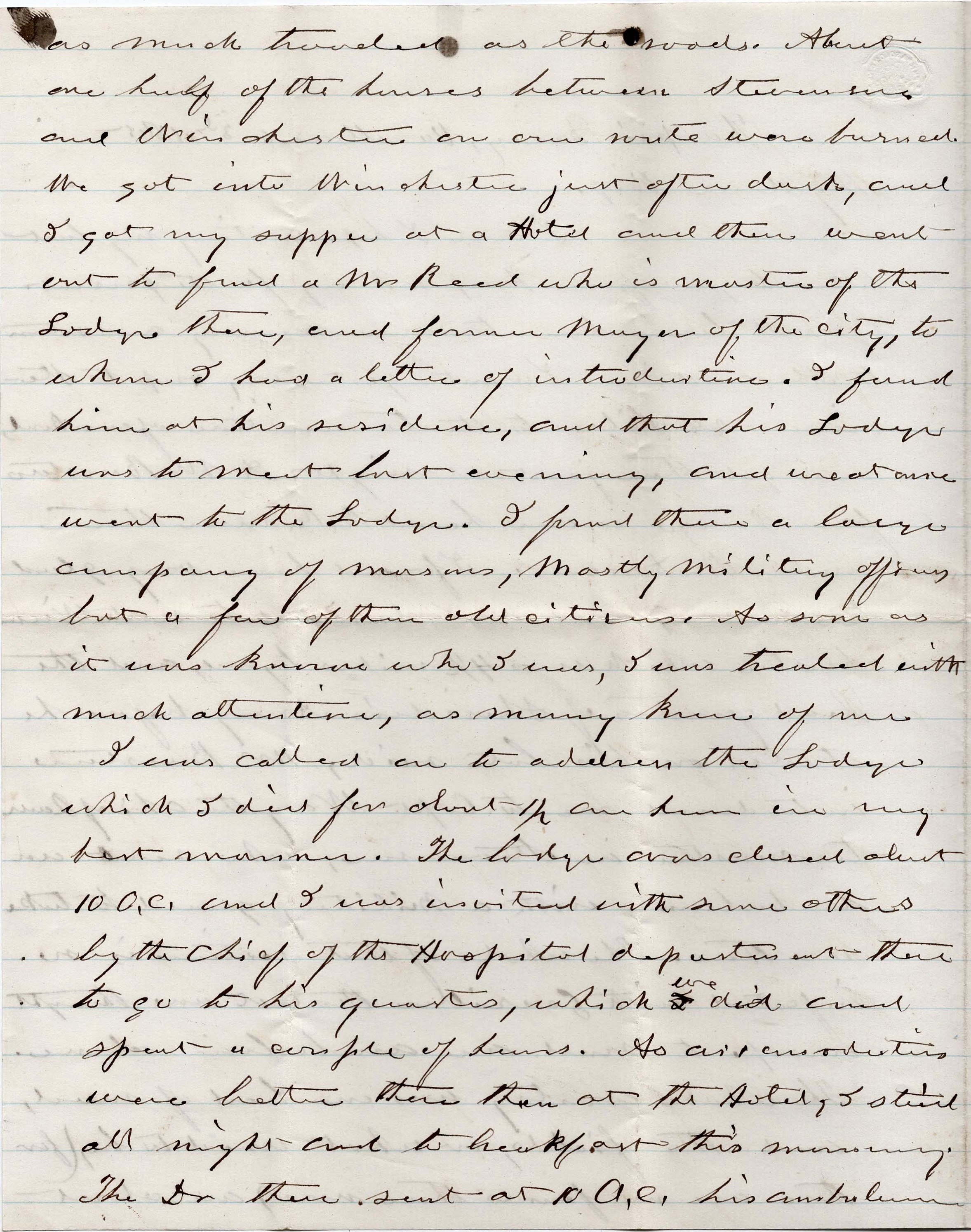
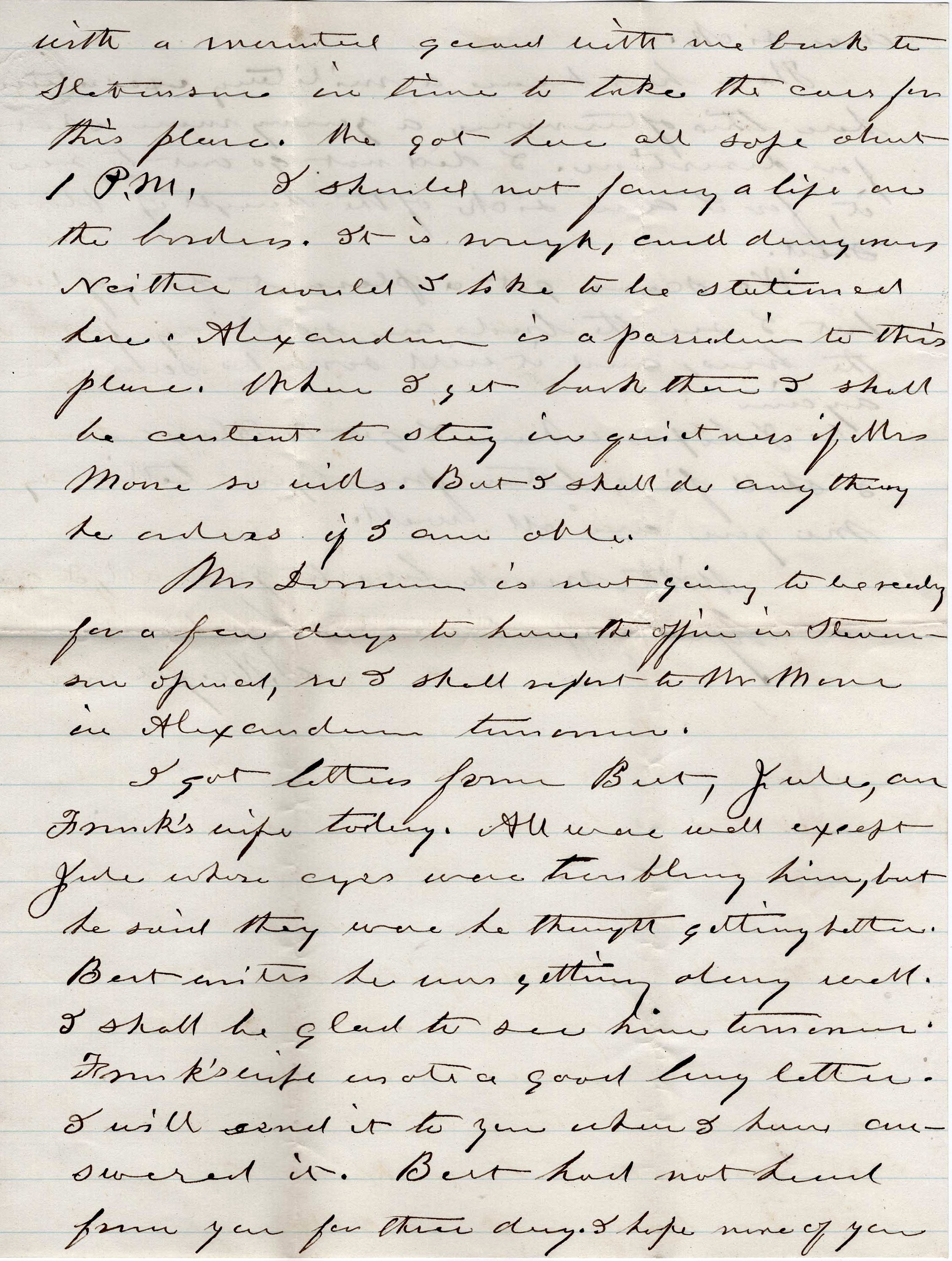
I am I hope writing my last letter to you from Harper’s Ferry for the present. I shall leave here tomorrow morning and return to Alexandria. I went yesterday up to Stevenson 28 miles to the termination of our road and got there just at night. A Mr. Barstow from Owego is our head railroad man there under Mr. Devereux. I found him very glad to see me and as I desired to visit Winchester which was 4.5 miles beyond, and the headquarters of Sheridan’s Army before he started on his late raid, Mr. Barstow introduced me to Capt. Way, the Chief Quartermaster in Stevenson who sent an ambulance with a military guard to take me there. The whole of that section is one infested with guerrillas that it was thought unsafe to send one ambulance alone. The whole country was one bed of mud and the fields—or what used to be (for there are no fences there now)—are about as much traveled as the roads. About one half of the houses between Stevenson and Winchester on our route were burned.

We got into Winchester just after dark and I got my supper at a Hotel and then went out to find a Mr. [John Bell Tildon] Reed who is master of the [Mason’s] Lodge there and former Mayor of the city to whom I had a letter of introduction. I found him at his residence and that his Lodge was to meet last evening and we at once went to the Lodge. I found there a large company of Masons, mostly military officers but a few of them old citizens. As soon as it was known who I was, I was treated with much attention, as many knew of me. I was called on to address the Lodge which I did for about half an hour in my best manner.
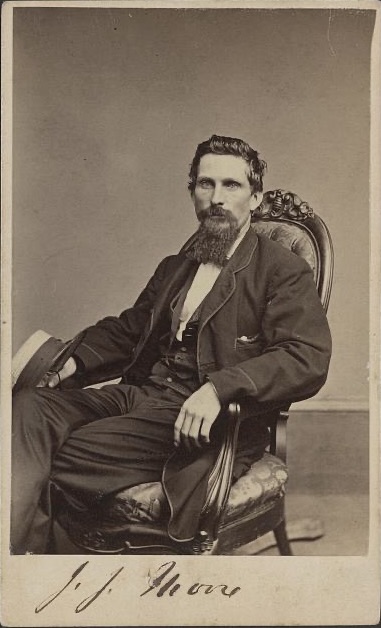
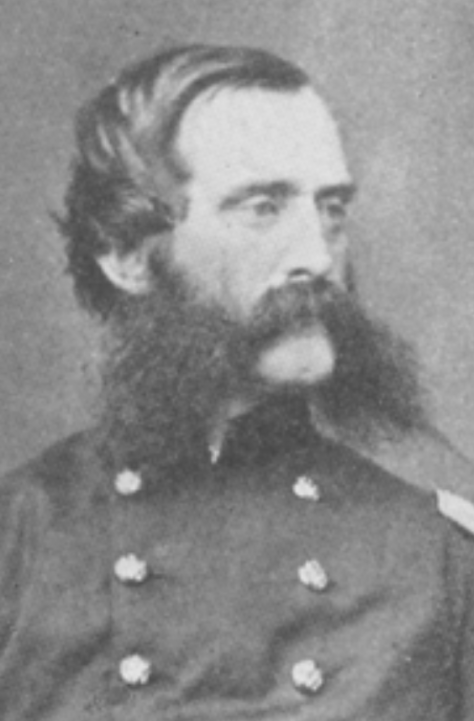
James J. Moore, engineer and superintendent of military railroads in Virginia. (LOC)

The Lodge was closed about 10 o’clock and I was invited with some others by the Chief of the Hospital Department there to go to his quarters which we did and spent a couple of hours. As accommodations were better there than at the Hotel, I stayed all night and to breakfast this morning. The Dr. there sent at 10 o’clock his ambulance with a mounted guard with me back to Stevenson in time to take the cars for this place. I should not fancy a life on the borders. It is rough and dangerous. Neither would I like to be stationed here. Alexandria is a paradise to this place. When I get back there, I shall be content to stay in quietness if Mr. [James J.] Moore so wishes. But I shall do anything he orders if I am able.

Mr. Devereaux is not going to be ready for a few days to have the office in Stevenson opened so I shall report to Mr. More in Alexandria tomorrow.

I got letters from Bert, Jule, and Frank’s wife today. All were well except Jule whose eyes were troubling him, but he said they were he thought getting better. Bert writes he was getting along well. I shall be glad to see him tomorrow. Frank’s wife wrote a good long letter. I will send it to you when I have answered it. Bert had not heard from you for three days. I hope none of you are sick.

There has been a military execution here this afternoon. A young man shot for desertion. I did not go out to see it for I am sick of the thought of bloodshed.

We scarce get a pleasant day of late but I see the birds are swelling forth in the trees and it will soon be summer again. I hope when I get to Alexandria I shall find letters from you telling me you are all well. With much love to you all, I am your affectionate husband, — S. Hayden

Letter 6

Alexandria
March 18, 1865

Dear Mother,

Your welcome letter of the 13th was received yesterday and I was right glad to hear from you. Those flowers that you sent looked as if they had been poorly used on their way here, but they were nonetheless welcome for all that. I reckon the reason is a little farther advanced here than it is in Athens for many of the people here have made garden and in some of the yards the flowers are in full bloom and they were not raised in a hot house either.

I believe Father wrote to you yesterday what time he thought it best for you to come on here. I hope nothing will occur between now and then that will hinder your coming at the appointed time.

I think Charlie did first rate of he gets twenty shillings for the beans, but i would hurry and get shut of them and the potatoes if I could get any kind of a price for them for I think all such things will be very cheap before they bring more.

Charlie Hull is stationed in Alexandria now and he has been in our office and I have been up to see him. I tell you, he looks rather sickly but he says that he is better now than he has been for a long time.

I reckon George Edminster is not coming down here; if he had, or does come, I think we could get him in as a carpenter at $2.40 per day, but there are a few tools that he would need that he could get here. But I don’t think I will write anything to him about it for perhaps he could not get the place after all. But I have been told that he could have it.

I went to the theatre the other night with Hen Parks and had a jolly good time.

My health has been splendid since I came here. I haven’t been troubled with those beastly sore throats that I used to have at home. Tell Father he must keep watch of Fred and Sid and not let them go over to see Miss Mary Mills nor than 10000000001 times a day as they used to. I don’t think I will try to go home with you this spring but will send my clerk for my business is such that I don’t think I can leave. But my clerk is not of much use to me anyway and I can spare him just as well as not.

Ask Charlie if Miss Mary Turner could not spare him just long enough to write a few lines to me. I don’t want to ask anything of her that is unreasonable but I think she requires more of his attention than is for his health. I wonder if she didn’t go up to Owego with him to sell his beans.

With much love to all at home, I remain ever your affectionate son, — Bert Hayden


Letter 7

Alexandria [Virginia]
April 4, 1865

Dear Mother,

I believe that I have received a letter from you which I have never answered but I have written so many letters lately that I can’t hardly tell which I have answered and which I have not. There were great times here and in Washington over the capture of Richmond and some of the people made cursed fools of themselves for over on the steps of the Metropolitan Hotel in Washington they would stand and hug some great black beastly niggers—but everyone to their liking.

I think I shall be able to send home some money when I get my next month’s pay and if I do, you may take it and anymore I send home afterward to buy a horse and such other things as you like. I don’t think it was a very great loss when Old Jim died for he was not fit to drive in the streets. Neither was he able to do the work of the farm. If I were in your place, I would not buy Lozer’s Old Fan for although she has been a first rate horse, I don’t think she is worth over 75 dollars now and I should buy a better and a younger horse.

I am very healthy indeed this Spring and think I can stand the heat of the summer first rate. I suppose Jule will be here sometime this month and I presume Father will go North with him when he goes. Our duties are very light here now and we can leave anytime after 3.05 p.m. which we would think was pretty early to quit work at the North. I generally get on the evening train and go over to Washington and get back at five o’clock which is just half an hour before supper time.

One of the laboring men was run over and killed yesterday morning. It seems they were moving some cars and he went to jump on while they were in motion but fell in front of them and they run over him, killing him instantly. J[ames] J. More has gone to City Point so I reckon our places will not be changed for a while to come.

Well, Mother, I am about run out of news so I will close with love to all and hoping to hear from you often. Yours affectionately, — Bert Harden


Letter 8

Alexandria [Virginia]
April 6th 1865

Dear Mother,

Your welcome letter of the 2nd has just been received and I was glas (as I always am) to hear from you. I am sorry to learn that you are having trouble about that lane fence and I hope she will see that she is in the wrong and that you will settle it peaceably. I presume that Father will go home the latter part of this month or the first of the next, but I don’t think I will leave until sometime next summer when it is hot and disagreeable here and pleasant in the country. I should like very much to be home when they have their public and examination at the Institute.

Charlie Hull is stationed in the City and I see him every few days. I have not seen Ben Eglin since I came here. Don’t you think it queer?

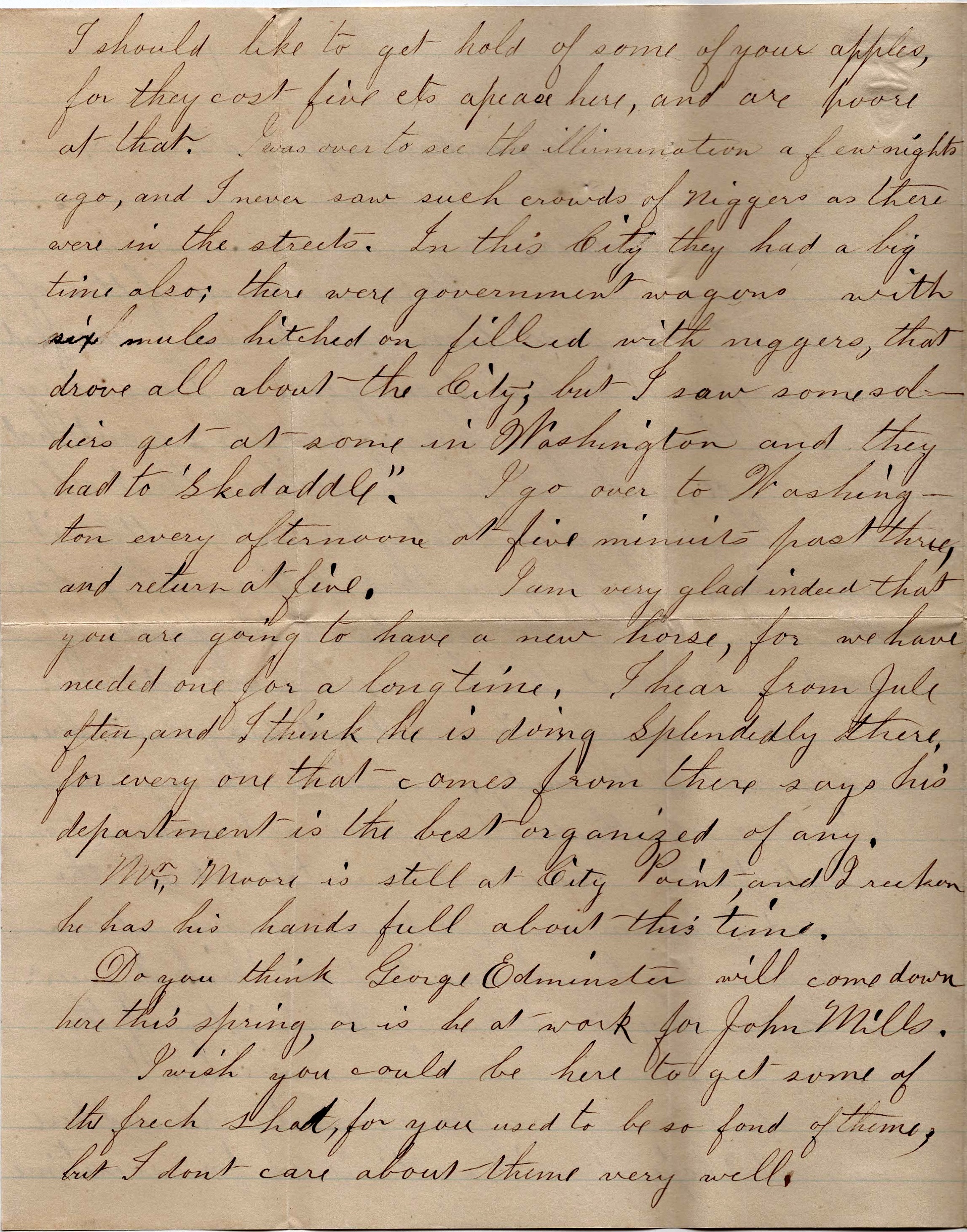
I reckon there is a fellow in Washington by the name of Jessie Turner but I have never been to see him yet. The weather is perfectly splendid here now and I hope it will continue so for some time. I should like to get some of your apples for they cost five cents apiece here and are poor at that.

I was over to see the illumination a few nights ago and I never saw such crowds of niggers as there were in the streets. In this city, they had a big time also. There were government wagons with six mules hitched on filled with niggers that drove all about the city, but I saw some soldiers get at some in Washington and they had to “skedaddle.” I go over to Washington every afternoon at five minutes past three and return at five.

I am very glad indeed that you are going to have a new horse for we have needed one for a long time. I hear from Jule often and I think he is doing splendidly there for everyone that comes from there says his department is the best organized of any.

Mr. [James J.] Moore is still at City Point and I reckon he has his hands full about this time.

Do you think George Edminster will come down here this spring or is he at work for John Mills? I wish you could be here to get some of the fresh shad for you used to be so fond of them. But I don’t care about them very well.

Tell Charlie not to let the old widow whip him when they have their battle. By the bye, why don’t Charlie ever answer any of my letters nowadays? I think Miss Cuyler must occupy a great deal of his time.

I was up in the Capitol yesterday but didn’t see anything new except that the grounds are covered with violets.

I reckon Sid must be a pretty big boy by this time and I wish he could be here about a week or so. Tell him that I took a little boy over to Washington with me the other day by the name of Mr. Pendleton Bruin, 1 Esq., but I think Sid could handle him.

Well, I have written about enough of my nonsense for one day. Please remember me to all at home and write soon. Direct to Bert Hayden, Alexandria, Va., Box 130.

Ever your affectionate son, — Bert Hayden

1 Ryland Pendleton Bruin (1859-1925) would have been almost six years old when Bert accompanied him to Washington City. Pendleton was the son of the widow Sallie Rebecca Rose (1838-1922). Sallie’s husband, Cola Bruin, died in Alexandria in 1860. He was most likely a relative of Joseph Bruin, the slave trader and keeper of the notorious slave pen on Duke Street in Alexandria. The building was the inspiration for Harriet Beecher’s Stowe’s Uncle Tom’s Cabin.


Letter 9

Alexandria [Virginia]
April 8th 1865

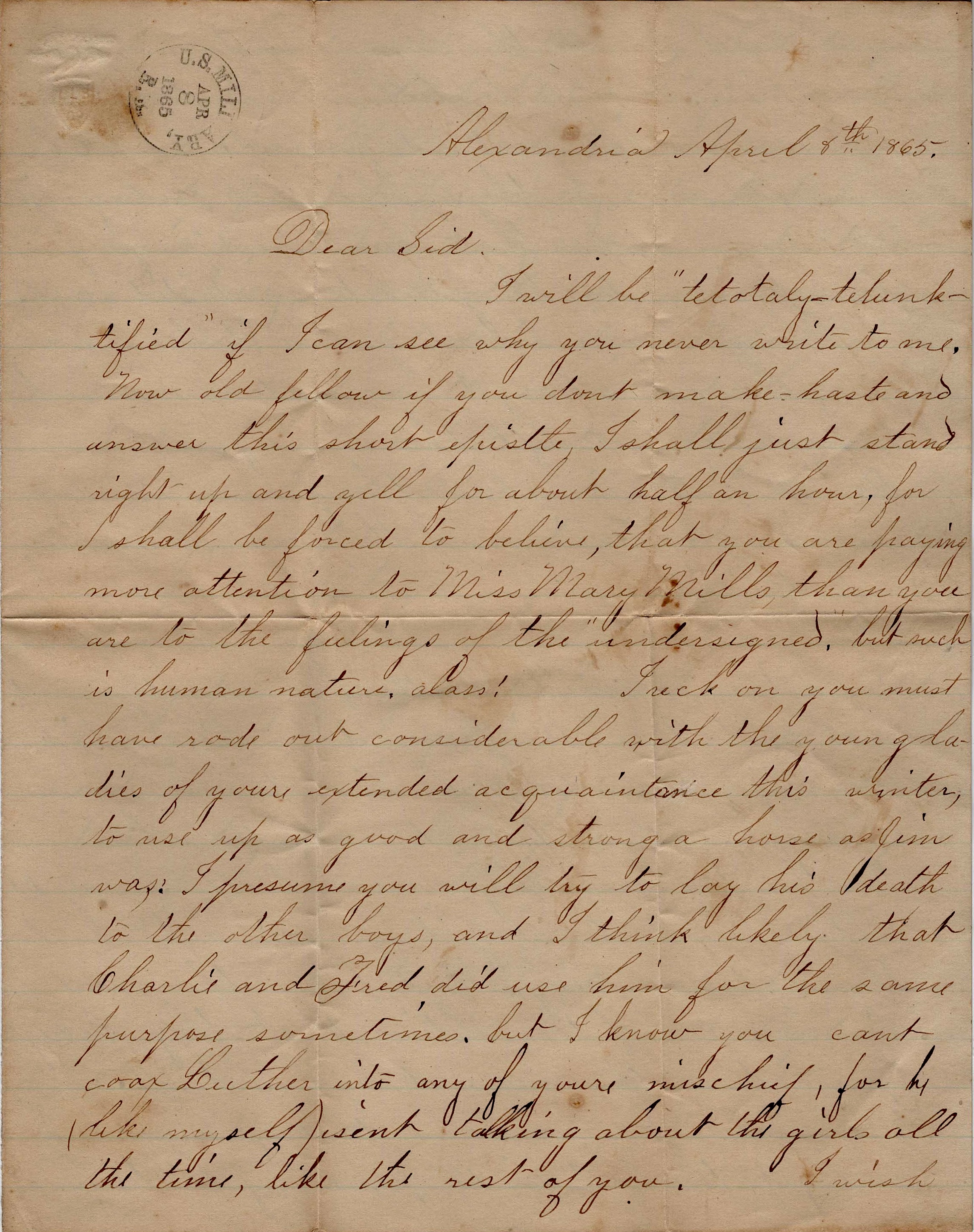
Dear Sid,

I will be “teetotally telunktified” if I can see why you never write to me. Now old fellow, if you don’t make haste and answer this short epistle, I shall just stand right up and yell for about half an hour, for I shall be forced to believe that you are paying more attention to Miss Mary Mills than you are to the feelings of the undersigned—but such is human nature, alas!

I reckon you must have rode out considerable with the young ladies of your extended acquaintance this winter, to use up as good and strong a horse as Jim was. I presume you will try to lay his death to the other boys, and I think likely that Charlie and Fred did use him for the same purpose sometimes. But I know you can’t coax Luther into any of your mischief for he (like myself) isn’t talking about the girls all the time like the rest of you.

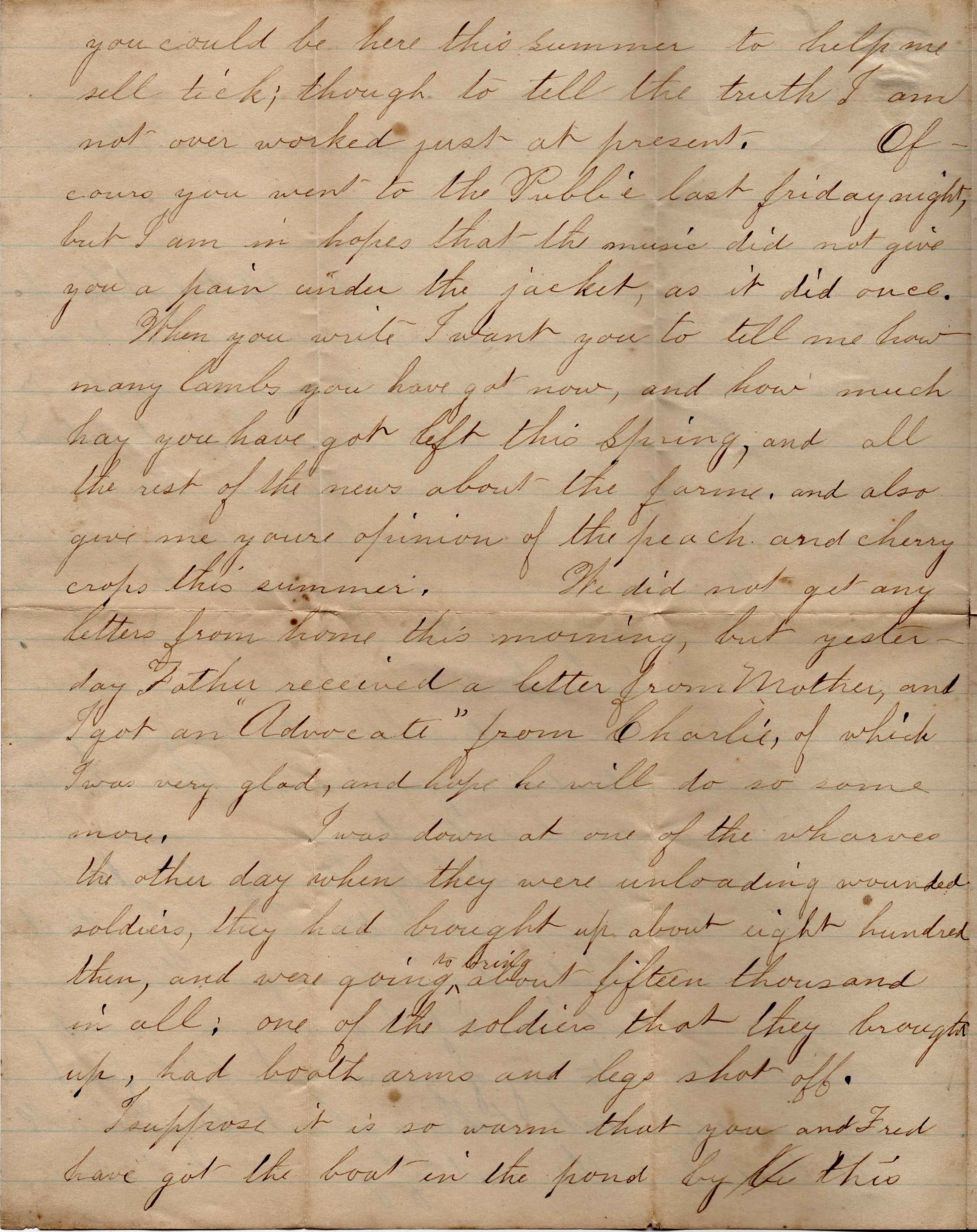
I wish you could be here this summer to help me sell tick; though to tel you the truth, I am not over worked just at present. Of course you went to the Public last Friday night, but I am in hopes that the music did not give you a pain under the jacket as it did once.

When you write, I want you to tell me how many lambs you have got now, and how much hay you have got left this Spring, and all the rest of the news about the farm. And also give me your opinion of the peach and cherry crops this summer. We did not get any letters from home his morning, but yesterday Father received a letter from Mother and I got an “Advocate” from Charlie of which I was very glad, and hope he will do so some more.

I was down at one of the wharves the other day when they were unloading wounded soldiers. They had brought up about eight hundred then and were going to bring about fifteen thousand in all. One of the soldiers that they brought up had both arms and legs shot off.

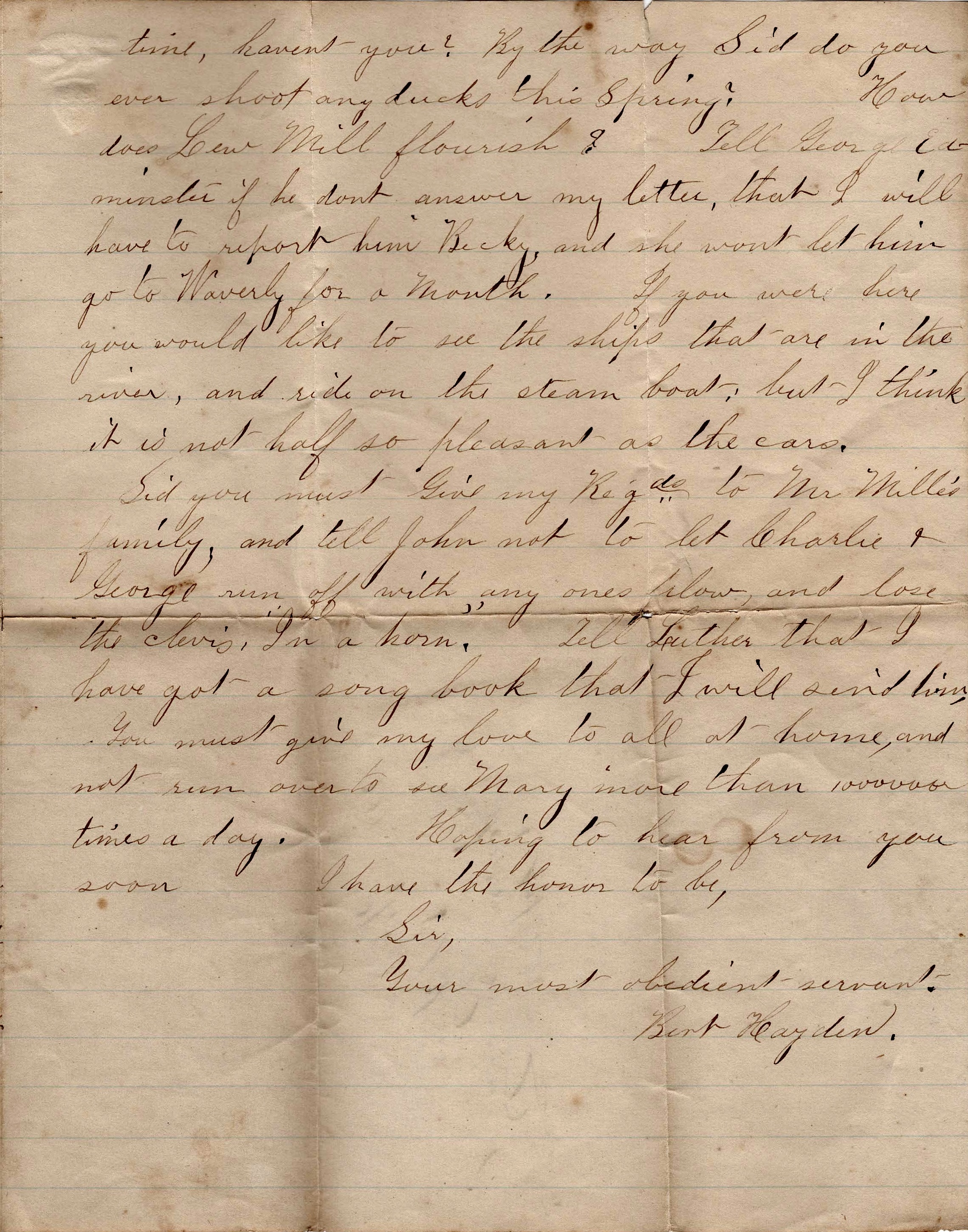
I suppose it is so warm that you and Fred have got the boat in the pond by this time, haven’t you? By the way, Sid, do you ever shoot any ducks this Spring? How does Lew Mill florish? Tell George Edminster if he don’t answer my letter, thast I will have to report him to Becky and she won’t let him go to Waverly for a month.

If you were here, you would like to see the ships that are in the river and ride on the steamboats. But I think it is not half so pleasant as the cars.

Sid, you must give mt regards to Mr. Mills’ family and tell John not to let Charlie & George run off with anyone’s plow and lose the clevis in a horn.

Tell Luther that I have got a song book that I will send him. You must give my love to all at home and not run over to see Mary more than 10000000 times a day. Hoping to hear from you soon. I have the honor to be, sir, your most obedient servant, — Bert Hayden


Letter 10

Alexandria [Virginia]
April 11, 1865

Dear Mother,

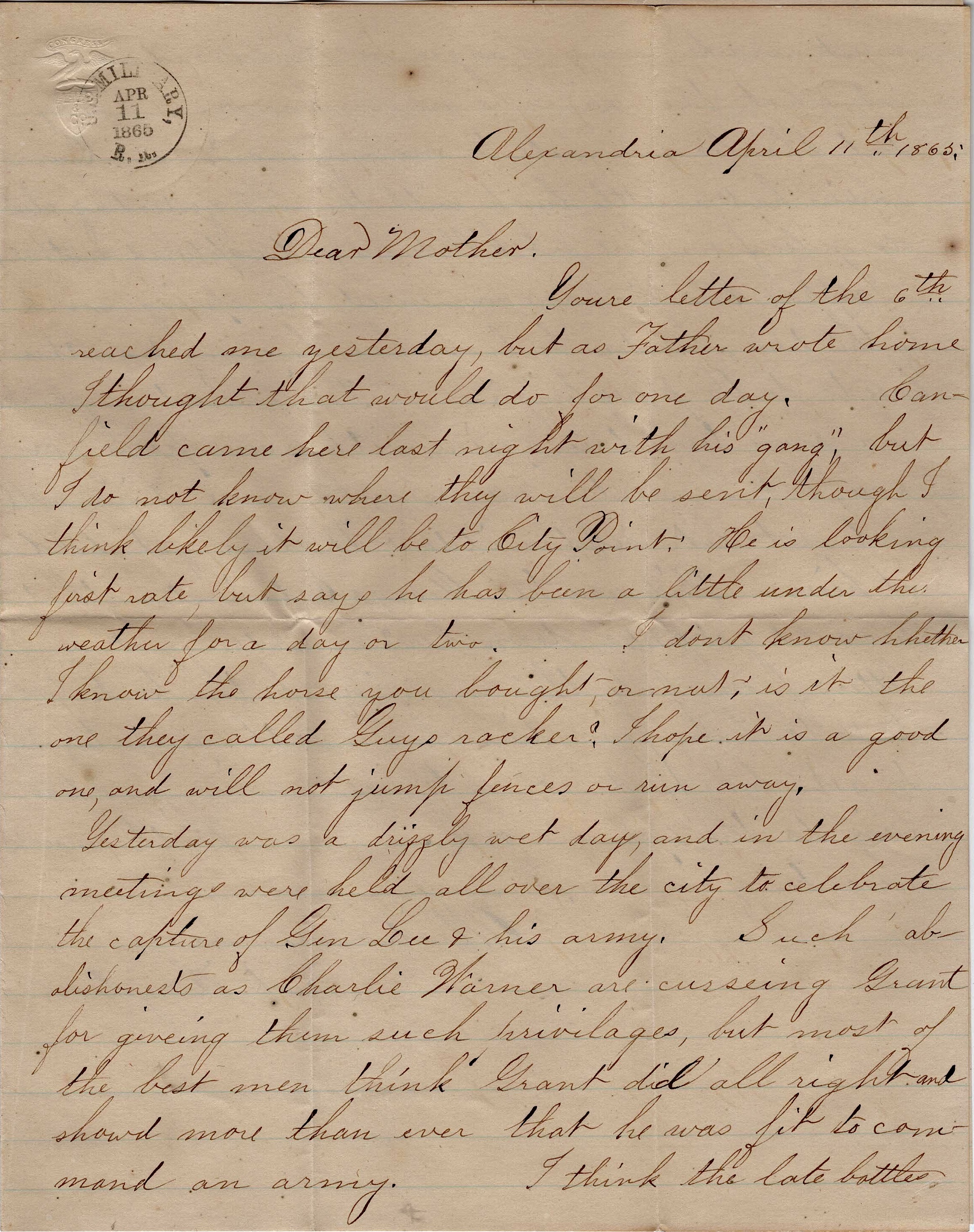
Your letter of the 6th reached me yesterday but as Father wrote home, I thought that would do for one day. Canfield came here last night with his “gang” but I do not know where they will be sent, though I think likely iy will be to City Point. He is looking first rate, but says he has been a little under the weather for a day or two.

I don’t know whether I know the horse you bought or not. Is it the one they called Guys Rocker? I hope it is a good one, and will not jump fences or run away.

Yesterday was a drizzly wet day and in the evening meetings were held all over the city to celebrate the capture of Gen. Lee and his army. Such abolitionists as Charlie Warner are cursing Grant for giving them such privileges but most of the best men think Grant did all right and showed more than ever that he was fit to command an army.

I think the late battles must make some changes in railroad matters but what they will be, no one knows.

Why don’t Charlie ever write to me anymore?

Our soldiers had a little brush with the “rebs” yesterday about six miles from here and killed one and captured another.

I suppose Charlie has commenced his spring work by this time, but does he know where we can get another horse to do the plowing? I will send my clerk home some time this spring with some pens for you, but I want you should use him well and not let old widow Miller get hold of him. Did you tell George Edminster that he could get $240 down here? Father got a letter from Jule this morning. He thinks it too bad to have Jim die when Father was trying to get him fat so as to sell him and have him to do the spring work.

With much love to you all, I remain your affectionate son, — Bert Hayden

1864: George W. Fellows to Mag (Fellows) Cook

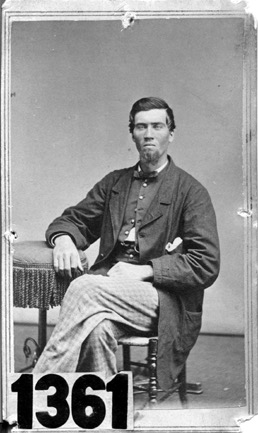
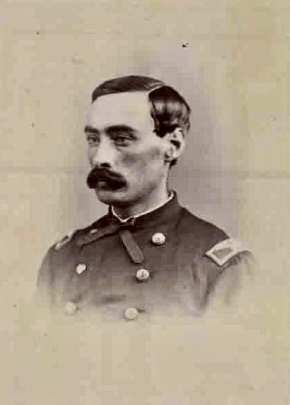
I could not find an image of George but here is one of Amos Rogers Tunison of the 8th Illinois Cavalry (Ancestry.com)

The following letters were written by 16 year-old George W. Fellows (1847-1890) who was recruited into Co. K of the 8th Illinois Cavalry on 29 February 1864. He remained with the regiment until 17 July 1865 when they were mustered out of the service at Benton Barracks, Missouri. George hailed from Plainfield, Illinois, where his parents, George Warren Fellows (1811-1901) and Phoebe Morenus (1818-1904) farmed the rich prairie of Will county. When he enlisted, George claimed to be 18 years old. He stood but 5′ 4″ tall and had sandy hair and blue eyes.
Both letters were sent to George’s older sister, Margaret (“Mag”) Elizabeth (Fellows) Cook who was married to Thomas Cook (1838-1917) in August 1863. In 1864, I believe the Cooks were residing in Will county but by 1870, Thomas was farming in Pilot township, Kankakee county, Illinois. They took their mail at Chebanse.

[Note: These letters are from the personal collection of Ryan Martin and were made available for transcription and publication on Spared & Shared by express consent.]

Letter 1

Washington D. C.
April 8, 1864

Dear friend,

I take my pen in my hand to write you a few [lines] to let you know that I am well and happy. I hope this will [find] you the same. I received your letter. I was glad to hear from you. It is fine weather here now.

I was in Washington the other day. It is a nice city. I was in the Capitol. This part of the country is hilly and woods.

I am on guard now but I am a guarding the horses and they are in the stalls so I thought I would answer your letter. You said that you went home on the cars. I wish that I could have been there so that I could have went home with you. We had a [hard] time [coming] here. We had a first class hog car to ride on.

We are a going to stay here this summer. I can’t think of anything more to write now. It is about time for [them] to relieve me so I will close for this time. So goodbye. — George W. Fellows

[to] Mr. [Thomas] Cook


Letter 2

The 8th Illinois Cavalry, Co. K
Washington D. C.
July 20, 1864

I now take my pen in my hand to write a few lines. I am well and hope you are the same.

I was in the fight and come out all right. Me and some of the rest of the Boys was out from the company and we rode in the rear of the rebels for 40 miles as fast as our horses could go and if we had been 15 minutes later, we would all [be] marching South.

Mag, I want you to [write] to me. I hain’t heard from home for a month. Tell Tom to write to me. Mag, I want you to send me your likeness and tell [Tom] to send his to me. I must fetch my letter to a close so goodbye. I give my respects to all. — George W. Fellows

to [Mrs. May Cook]

1862-63: Jacob H. Fellows to Margaret Fellows

I could not find a war-time image of Jacob Fellows but here is one of William Stonerock of the 100th Illinois Infantry (Bobby Green Collection)

The following letters were written by Jacob H. Fellows (1834-1863) of Co. D, 100th Illinois Infantry. He enlisted in the regiment on 30 August 1862 and died of disease (small pox) at Louisville, Kentucky on 13 December 1863. His brother John Fellows (1838-1906) also served in the same company and was wounded in the Battle of Stones River and later discharged for disability. The letter was written to Jacob’s sister, Margaret Elizabeth Fellows (1840-1905) of Plainfield, Will county, Illinois.

Jacob Fellows was described in the muster rolls as a 27 year-old farmer with light hair and blue eyes when he enlisted in 1862. He was married just one week prior to his enlistment to Esther Phillips.

[Note: These letters are from the personal collection of Ryan Martin and were made available for transcription ad publication on Spared & Shared by express consent.]

Letter 1

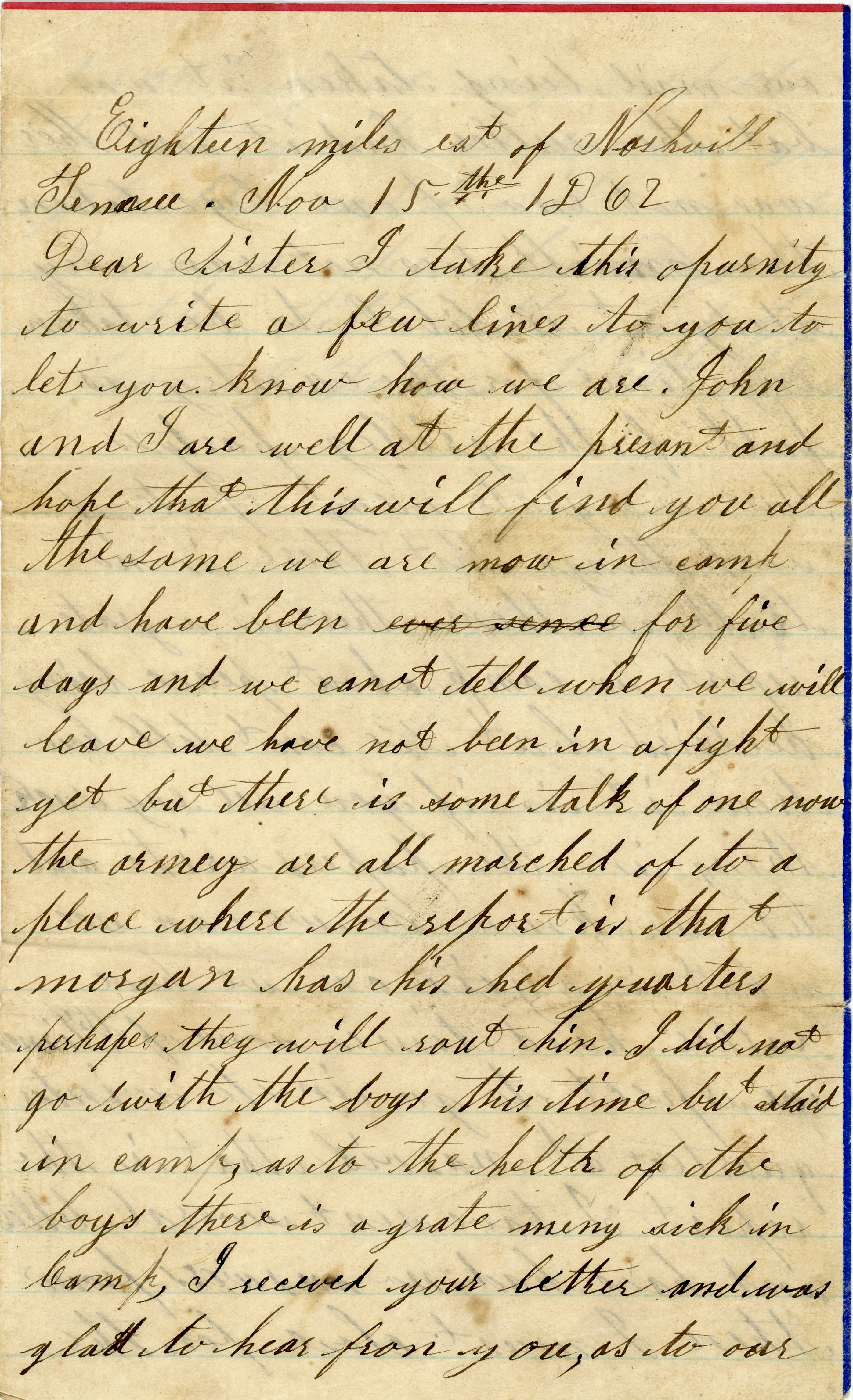
18 miles east of Nashville, Tennessee
November 15, 1862

Dear Sister,

I take this opportunity to write a few lines to you to let you know how we are. [Brother] John and I are well at the present and hope that this will find you all the same. We are now in camp and have been for five days and we cannot tell when we will leave. We have not been in a fight yet but there is some talk of one now. The army are all marched off to a place where the report is that Morgan has his headquarters. Perhaps they will rout him. I did not go with the boys this time but stayed inn camp.

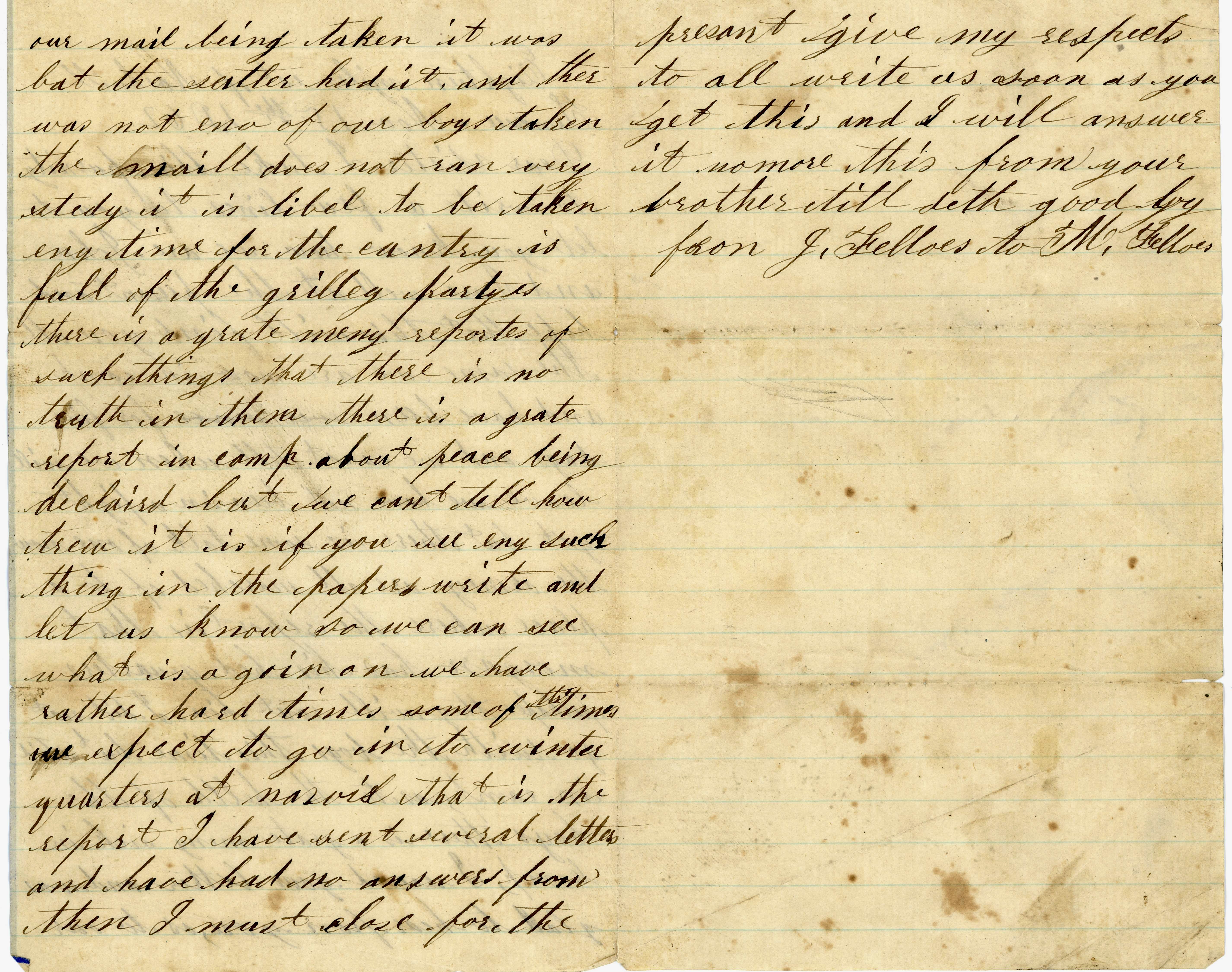
As to the health of the boys, there is a great many sick in camp. I received your letter and was glad to hear from you. As to our mail being taken, it was, but the sutler had it and there was not one of our boys taken. The mail does not run very steady. It is liable to be taken anytime for the country is full of the guerrilla parties. There is a great many reports of such things that there is no truth in them.

There is a great report in camp about peace being declared but we can’t tell how true it is. If you see any such thing in the papers, write and let us know so we can see what is a going on. We have rather hard times some of the time. We expect to go into winter quarters at Nashville. That is the report.

I have sent several letters and have had no answers from them. I must close for the present. Give my respects to all. Write as soon as you get this and I will answer it. No more. This from your brother till death. Goodbye from J. Fellows

to M. Fellows


Letter 2

Hospital Number 8, Ward No. 4
Nashville, Tennessee
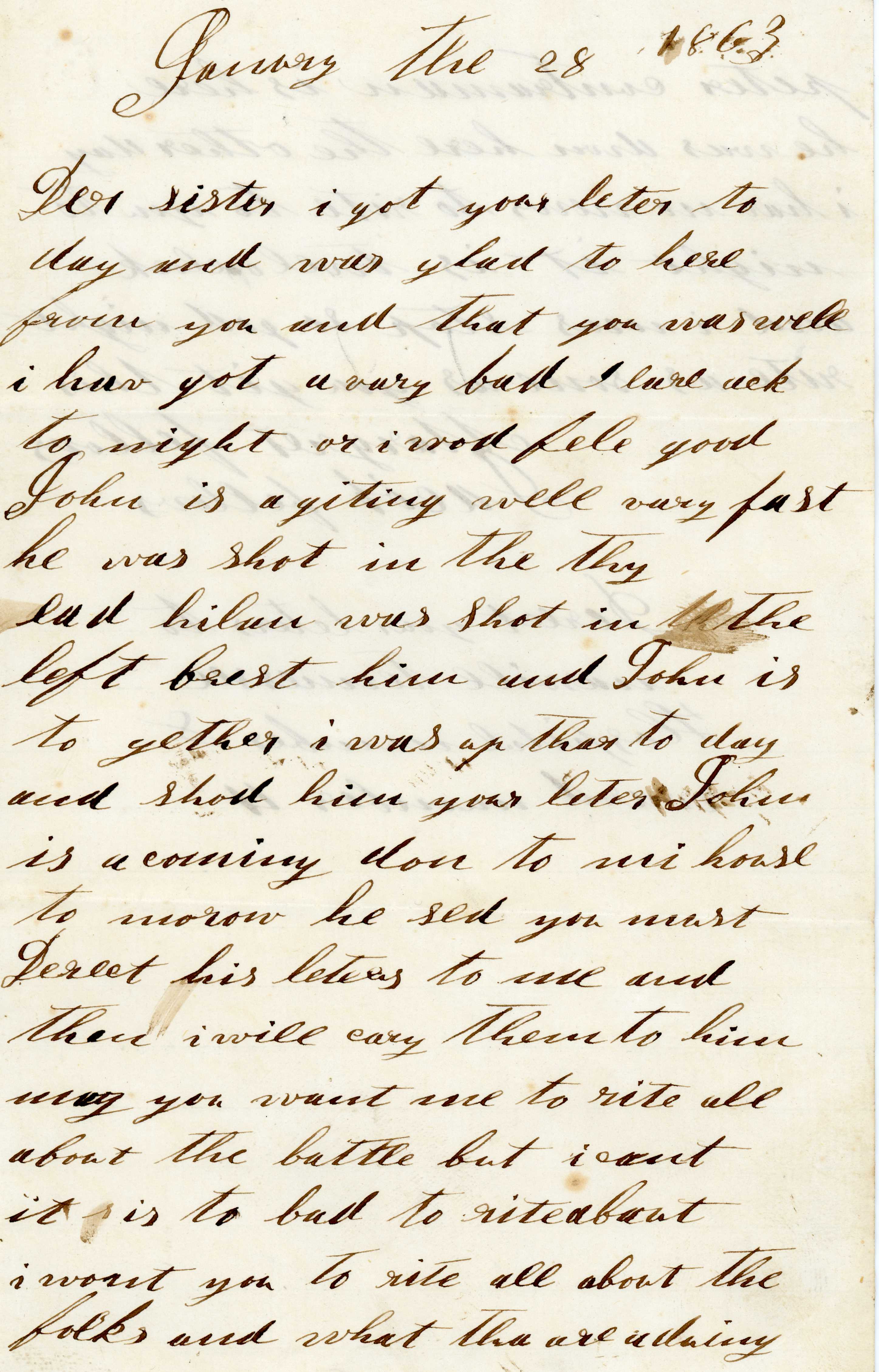
January 28, 1863

Dear sister,

I got your letter today and was glad to hear from you and that you was well. I have got a very bad earache tonight or I would feel good. [Brother] John is a getting well very fast. He was shot in the thigh. Ed F. Hyland was shot in the left breast. Him and John is together. I was up there today and showed him your letter. John is a coming down to my house tomorrow. He said you must direct his letter to me and then I will carry them to him.

Maybe you want me to write all about the Battle [of Stones river] but I can’t. It is too bad to write about. I want you to write all about the folks and what they are a doing.

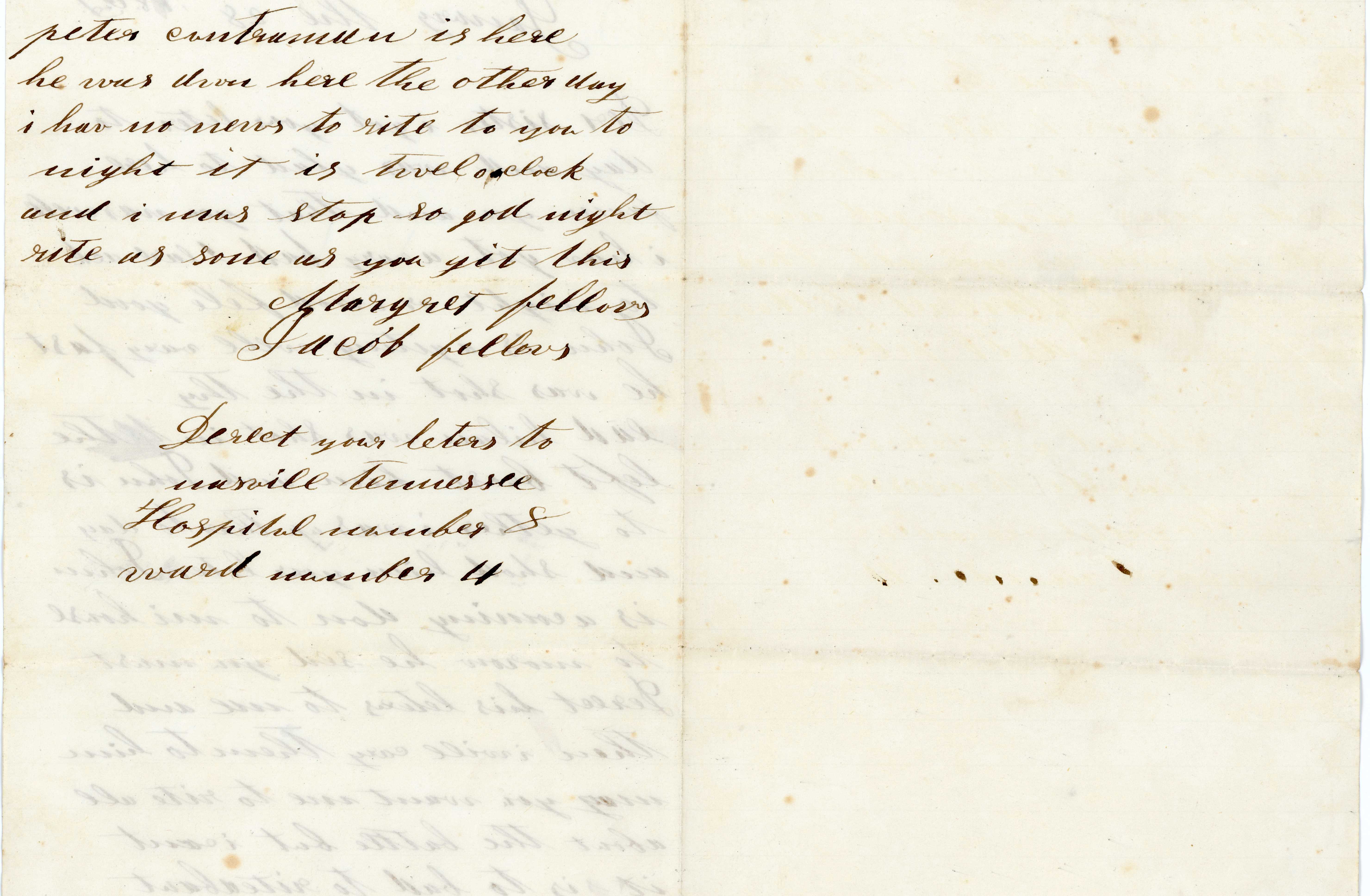
Peter Countryman is here. He was down here the other day. I have no news to write to you tonight. It is twelve o’clock and I must stop. So good night. Write as soon as you get this. — Jacob Fellows

To Margaret Fellows

Direct your letters to Nashville, Hospital Number 8, Ward Number 4.

1863: Louis W. Shiffer to Margaret E. Fellows

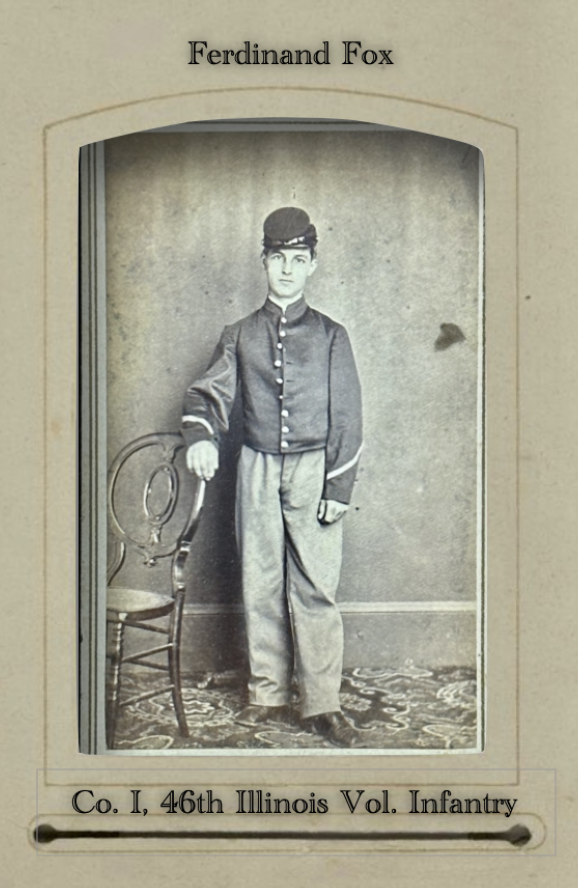
No war time photo of Louis Shiffer but here is one of Ferdinand Fox who also served in Co. I, 46th Illinois.

The following letter was written by Louis W. Shiffer (1835-1911), the son of William Shiffer (1810-1889) and Catherine E. Near (1812-1892) of Plainfield, Will county, Illinois. Louis enlisted as a corporal in Co. I, 46th Illinois Infantry on 1 December 1861. He mustered out of the regiment on 30 November 1864. His brother Solomon Andrew Shiffer (1841-1929) served in the same regiment and rose in rank to 1st Sergeant of Co. I before mustering out on 20 January 1866. Solomon was wounded during the siege at Corinth. Another brother, Robert Wray Shiffer (1843-1919) also served in the same company and was wounded at Shiloh.

[Note: This letter is from the collection of Ryan Martin and was made available for transcription and publication on Spared & Shared by express consent.]

T R A N S C R I P T I O N

April 18, 1863

Memphis, Tennessee

It is with pleasure that I take the present opportunity to answer your kind letter which I received last evening. It found me in [ ] good health. I hope these few lines will find you enjoying good health. Maggie, I wish I were sitting by your side in the parlor. I could talk to you much better than I can write and tell you how I have suffered since I have been in the service. But I enlisted to fight for my country and I have seen many of my fellow soldiers lie on the bloody field of battle and I thank the good Lord that he has spared my life for I have two brothers in the same company with me and they have both been wounded. The youngest one was wounded at Shiloh April 6, 1862. I have not seen him since. He is in Kentucky. He is sick. And one brother is in Virginia.

I do not feel at any discouraged but I do not like the idea of fighting for the negro and did not enlist for that. But it has come to that and I will not be called a coward.

— Louis W. Shiffer, Co. I, 46th Illinois, 18 April 1863

I do not feel at any discouraged but I do not like the idea of fighting for the negro and did not enlist for that. But it has come to that and I will not be called a coward. I have stood where the balls have passed me as thick as hail but I was none of the number that was to fall. There was 33 wounded and two killed in the last battle in a very few minutes and one Colonel was killed.

I was sorry to hear that your brother was sick and the other wounded. So Mary J. Folston wanted to know where I was. You can tell her that I am in Dixie land doing what little I can do to save our glorious Union and liberty which our forefathers bought with their precious blood. I should like to see some of them Rebel sympathizers—or Copperheads as they are called—down here. I should like to get behind them with my old gun and make them fight or shoot them down like Rebels. If they would hold their tongues, the secesh would not say that the North was dividing and they would soon gain their Confederacy.

Maggie, I should like to help you wash the dishes once more. I know you are willing to do good duty but don’t work too hard. I have often thought of you and the pleasant times we have had in this country where I have to suffer for this country does not agree with me for my health has been very poor ever since I am down here. I must close for this time. I am yours truly, — Louis Shiffer

to Miss Margaret E. Fellows. Write soon. Direct to Adams Hospital No. 3, Ward 4, Room H

1864: Edward Gookin Parker to Samuel Badger Neal

The following letter was written by Edward Gookin Parker (1841-1864) of Kittery, York county, Maine who enlisted when he was 21 years old in Co. K, 17th Maine Infantry on 18 August 1862 as a private. He was killed in action on 12 May 1864 at Spotsylvania Court House during the Overland Campaign after having risen to the rank of sergeant.

Edward was the son of William G. Parker (1798-1882) and Lydia Hall (1808-1857). He wrote the letter to Samuel Badger Neal (1842-1901), the son of John Robert and Anna Maria (Badger ) Neal. He was born in Portsmouth, New Hampshire, on 29 April 1842 and fitted for college at Phillips Exeter Academy. He graduated from Harvard College in 1864 and the following year entered the NH National Bank of Portsmouth as a cashier. He then went to New York as a salesman in the coal business, to Boston as a bookkeeper, and then as a coal salesman. He suffered from ill health and lived with his parents in Kittery for a while, managing his father’s coal business. He lived until 1901. He was found dead in his stable, having been knocked down and trampled by his horse.

See also—“Rambles About Home,” Stories of Kittery, Maine, Recorded by Samuel Badger Neal.

T R A N S C R I P T I O N

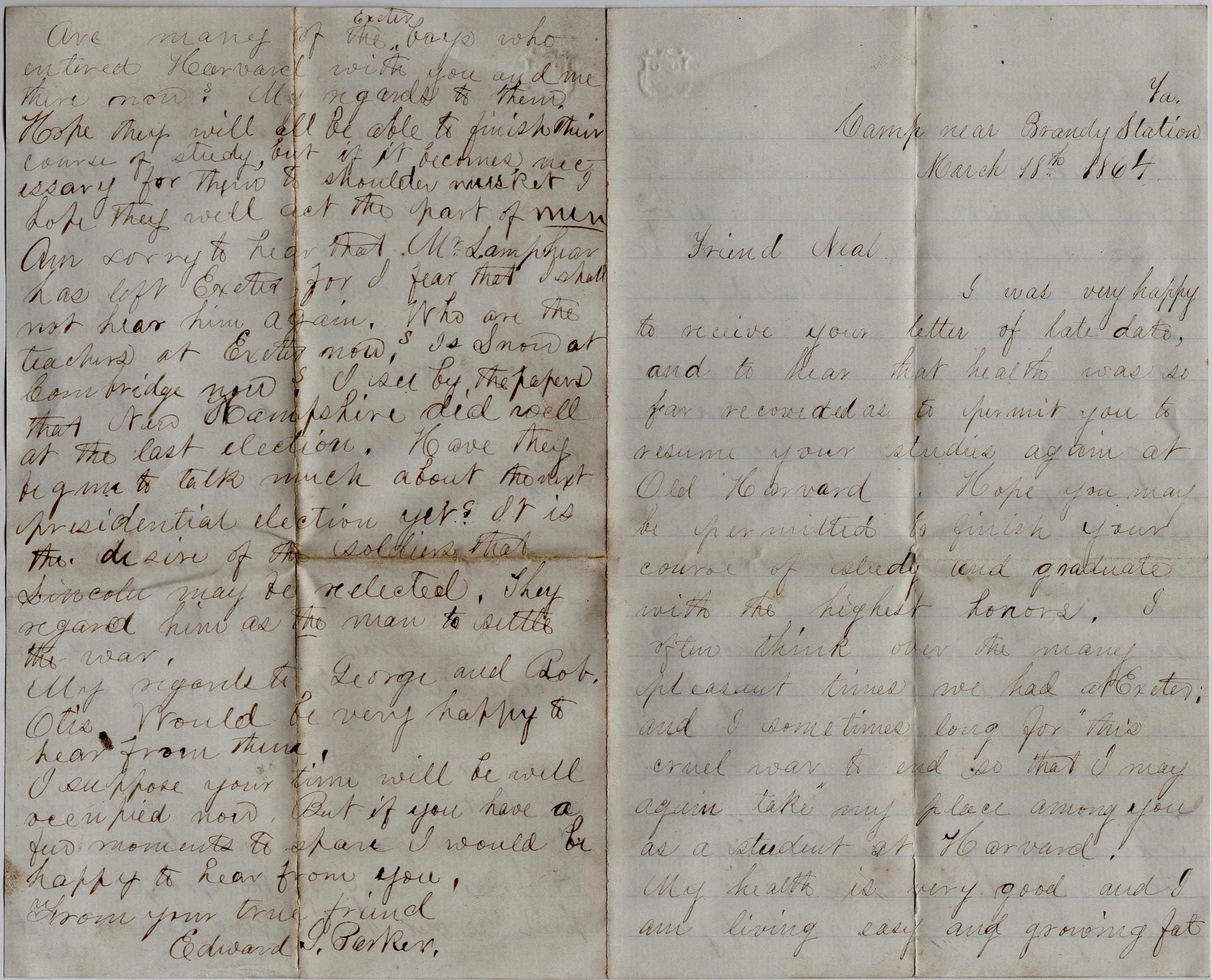
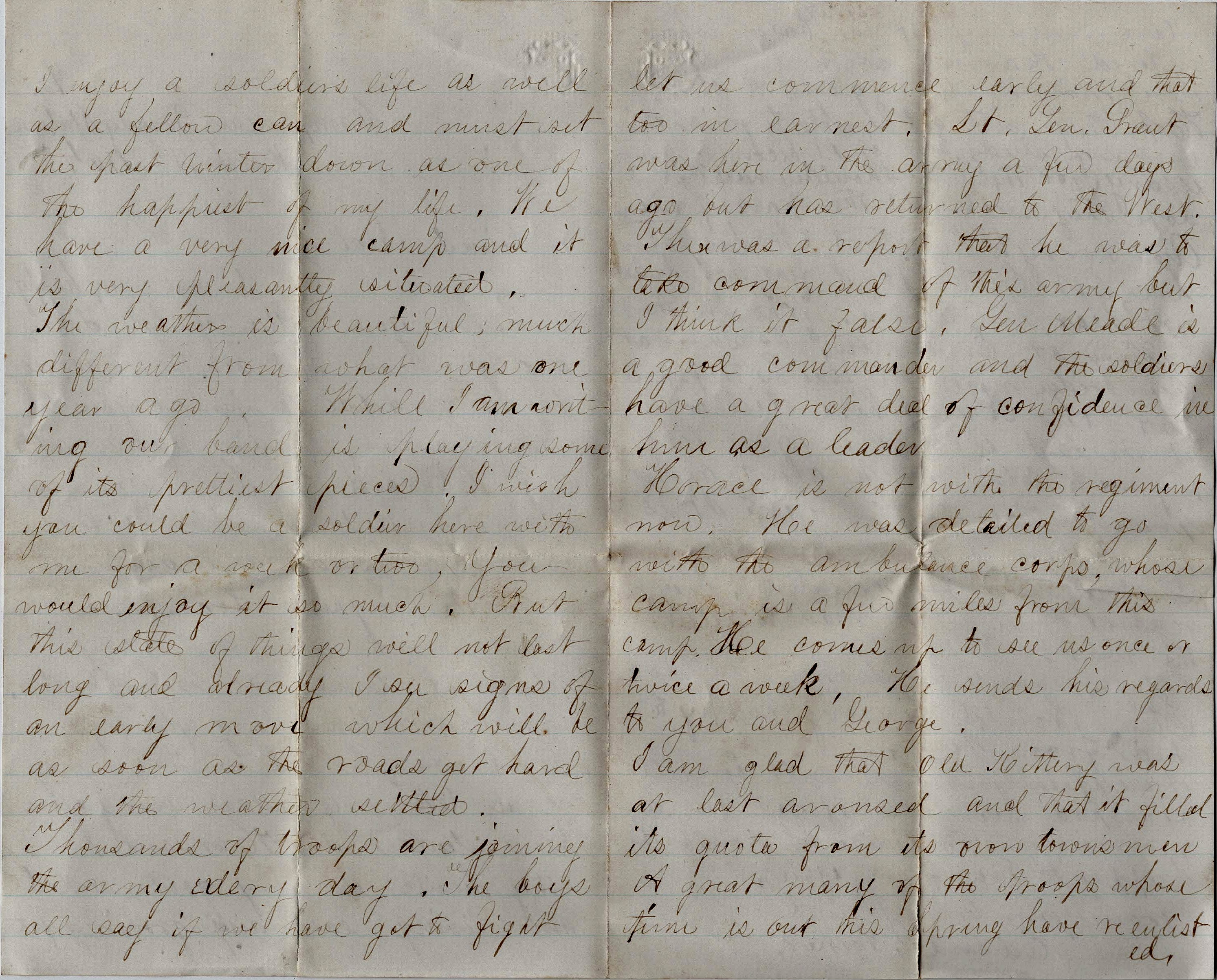
Camp near Brandy Station, Va.
March 18, 1864

Friend Neal,

I was very happy to received your letter of late date and to hear that health was so far recovered as to permit you to resume your studies again at Old Harvard. Hope you may be permitted to finish your course of study and graduate with the highest honors. I often think over the many pleasant times we had at Exeter and I sometimes long for this cruel war to end so that I may again take my place among you as a student at Harvard. My health is very good and I am living easy and growing fat. I enjoy a soldier’s life as well as a fellow can and must set the past winter down as one of the happiest of my life. We have a very pleasant camp and is it very pleasantly situated.

The weather is beautiful—much different from what was one year ago. While I am writing, our band is playing some of its prettiest pieces. I wish you could be a soldier here with me for a week or two. You would enjoy it so much. But this state of things will not last long and already I see signs of an early move which will be as soon as the roads get hard and the weather settled.

Thousands of troops are joining the army every day. The Boys all say if we have got to fight, let us commence early and that too in earnest. Lt. Gen. Grant was here in the army a few days ago, but has returned to the West. There was a report that he was to take command of this army but I think it false. Gen. Meade is a good commander and the soldiers have a great deal of confidence in him as a leader.

Horace is not with the regiment now. He was detailed to go with the ambulance corps whose camp is a few miles from this camp. He comes up to see us once or twice a week. He sends his regards to you and George.

I am glad that Old Kittery was at last aroused and that it filled its quota from its own townsmen. A great many of the troops whose time is out this spring have reenlisted. Are many of the Exeter Boys who entered Harvard with you and me there now? My regards to them. Hope they will be able to finish their course of study but if it becomes necessary for them to shoulder musket, I hope they will act the part of men.

Am sorry to hear that Mr. Lamphear has left Exeter for I fear that I shall not hear from him again. Who are the teachers at Exeter now? Is Snow at Cambridge now? I see by the papers that New Hampshire did well at the last election. Have they begun to talk much about the next Presidential election yet? It is the desire of the soldiers that Lincoln may be reelected. They regard him as the man to settle the war.

My regards to George and Bob Otis. Would be very happy to hear from them. I suppose your time will be well occupied now. But if you have a few moments to spare, I would be happy to hear from you. From your friend, — Edward G. Parker

1861: Nathaniel Peyton Young to Thomas Carroll

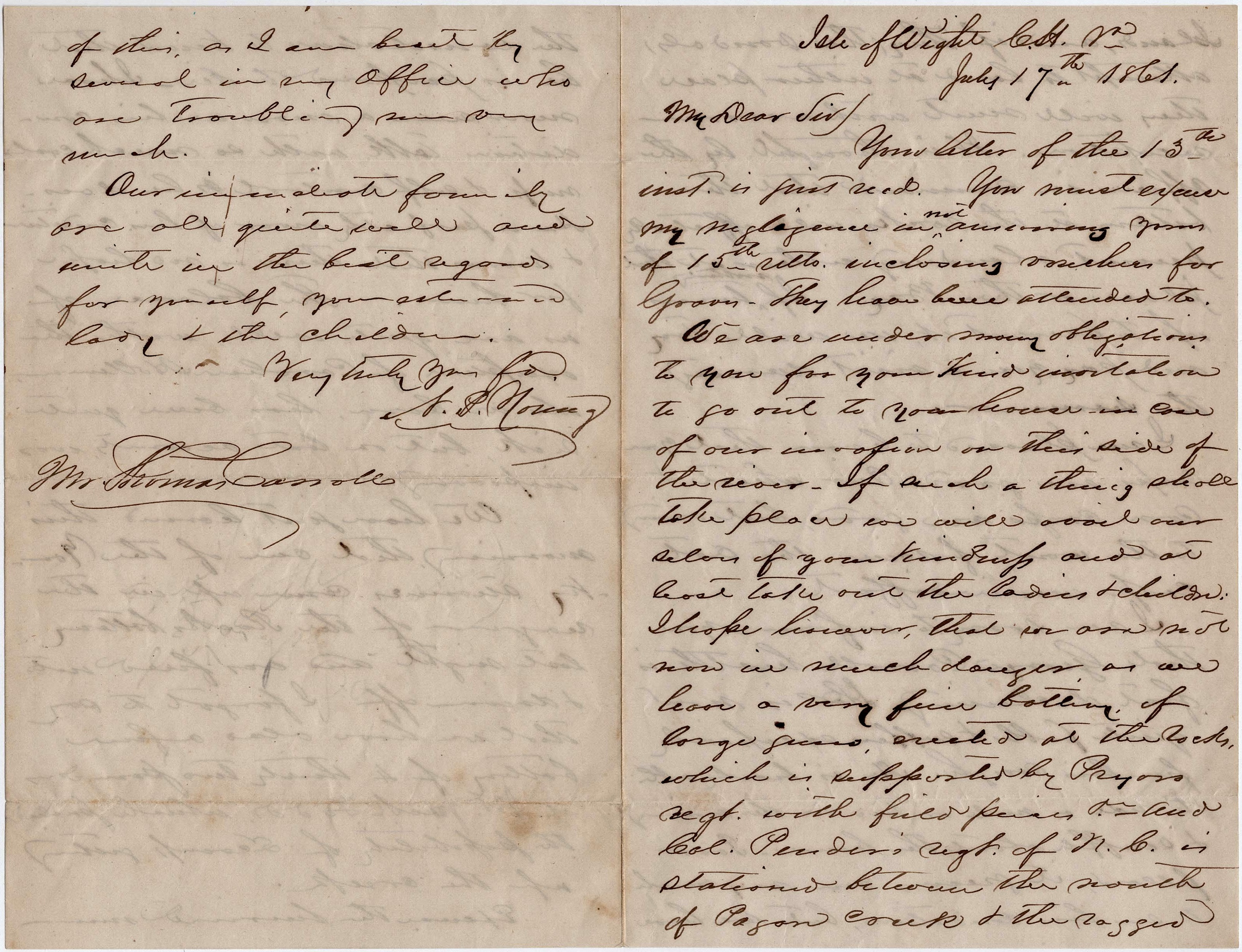
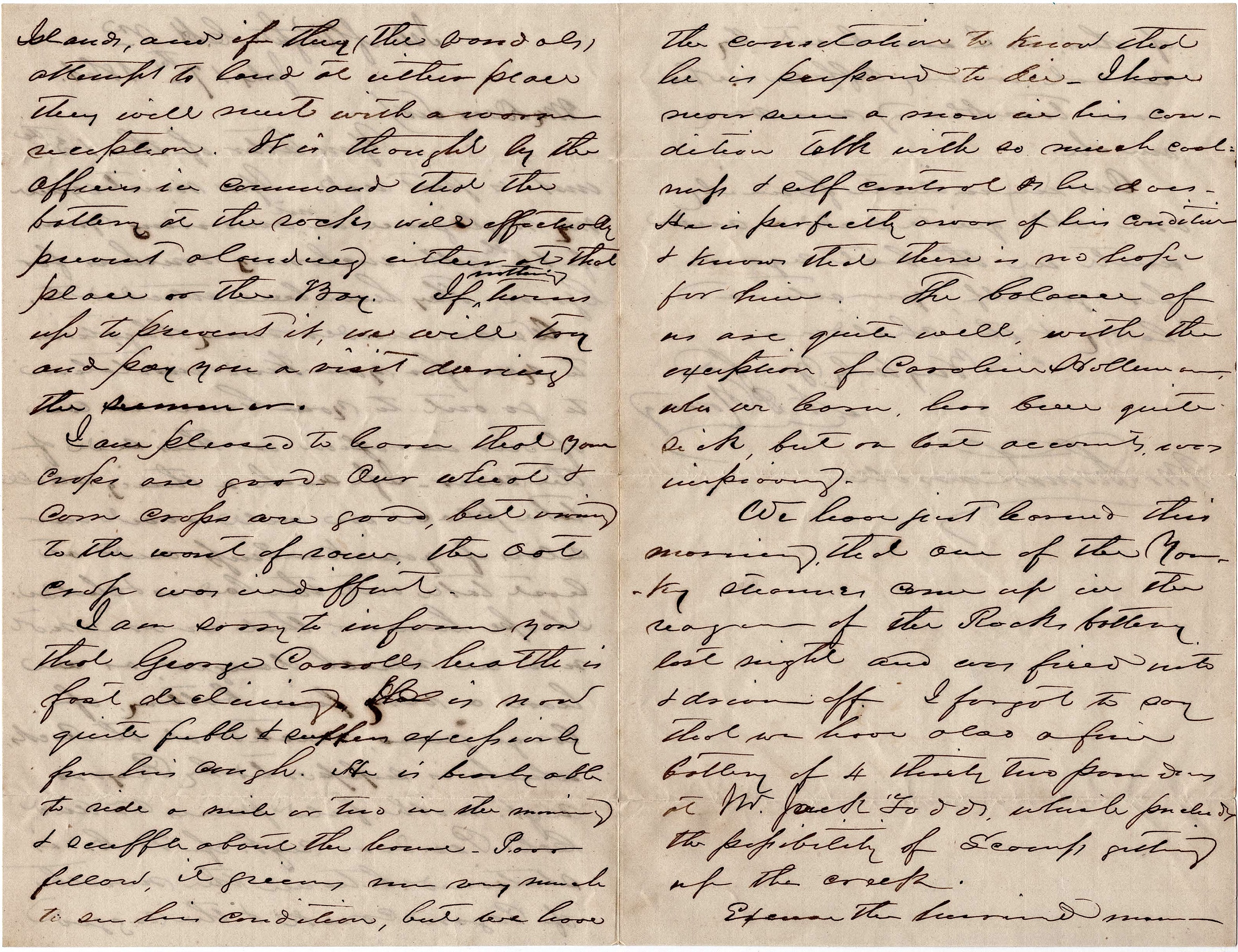
The following letter was written by 45 year-old Nathaniel Peyton Young (1816-1896) of Smithfield who was the county clerk of Isle of Wight county, Virginia, at the time of the 1860 US Census. The letter was penned on 17 July 1861 just prior to the battle of Bull Run and at a time when Virginian’s lived in fear of a Yankee invasion. To protect the record books of the Isle of Wight county from theft or destruction during the Civil War, Young had his manservant, Randall Booth, transport the books to the western part of the state for safekeeping.

Nathaniel was married to Sarah Virginia Carroll (1822-1875) and when the war began, they were the parents of four daughters, born between 1845 and 1852. Sarah was the daughter of Gray Carroll (1773-1843) and Polly Wheadon (1785-1840). He wrote the letter to his brother-in-law, Thomas Carroll (1805-1888), a farmer in Ridgeway, North Carolina, who cultivated his plantation with 24 slaves ranging in age from 21 to 72 in 1860.

T R A N S C R I P T I O N

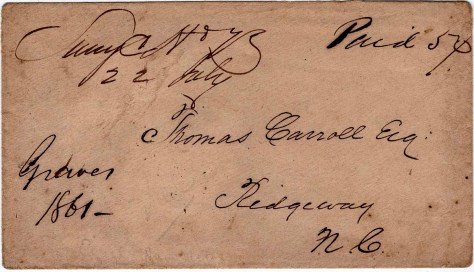
Addressed to Thomas Carroll, Esq., Ridgeway, North Carolina

Isle of Wight Court House, Virginia
July 17, 1861

My dear sir,

Your letter of the 13th inst. is just received. You must excuse my negligence in not answering yours of the 15th ulto. enclosing vouchers form Graves. They leave here attended to.

We are under many obligations to you for your kind invitation to go out to your house in case of our invasion on this side of the river. If such a thing shall take place we will avail ourselves of your kindness and at least take out the ladies & childrren. I hope, however, that we are not now in much danger as we leave a very fine battery of large guns erected at the rocks which is supported by Pryor’s Regiment with field pieces &c. and Col. Pender’s Regiment of North Carolina is stationed between the mouth of Pagan Creek 1 & the ragged Islands, and if they (the vandals) attempt to land at either place they will meet with a warm reception. It is thought by the officers in command that the battery at the rocks will effectually prevent a landing either at that place or the Bay.

If nothing turns up to prevent it, we will try and pay you a visit during the summer. I am pleased to learn that your crops are good. Our wheat & corn crops are good, but owing to the want of rain, the oat crop was indifferent.

I am sorry to inform you that George Carroll’s health is fast declining. He is now quite feeble & suffers excessively from his cough. He is barely able to ride a mile or two in the morning & shuffle about the house. Poor fellow. It grieves me very much to see his condition but we have the consolation to know that he is prepared to die. I have never seen a man in his condition talk with so much coolness & self control as he does. He is perfectly aware of his condition & knows that there is no hope for him. The balance of us are quite well with the exception of Caroline Holleman who we learn has been quite sick, but on last accounts, was improving.

We have just learned this morning that one of the Yankee steamers came up in the region of the Rocks battery last night and was fired into & driven off. 2 I forgot to say that we have also a fine battery of four 32-pounders at Mr. Jack Todd’s which precludes the possibility of scamps getting up the creek.

Excuse the hurried manner of this as I am beset by several in my office who are troubling me very much. Our immediate family are all quite well and write in the best regards for yourself. Your esteemed lady & the children.

Very truly yours, — N. P. Young

Mr. Thomas Carroll


1 Pagan Creek is a tributary of the James River in Isle of Wight county, Virginia.

2 The Yankee steamer may have been the USS Harriet Lane. The Pagan River enters the James River at the location of the town of Smithfield, Virginia. In the early stages of the Civil War, Union naval forces based at Fort Monroe maintained a blockade of the James River and conducted reconnaissance missions and skirmishes against Confederate shore batteries. The Harriet Lane was an active participant in these early actions. 

1864: David H. Barber to Andrew Branch

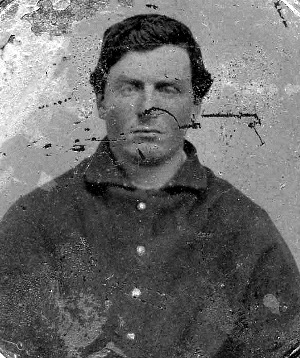
I could not find an image of David but here is one of George Higgins of Co. K, 6th New York Heavy Artillery

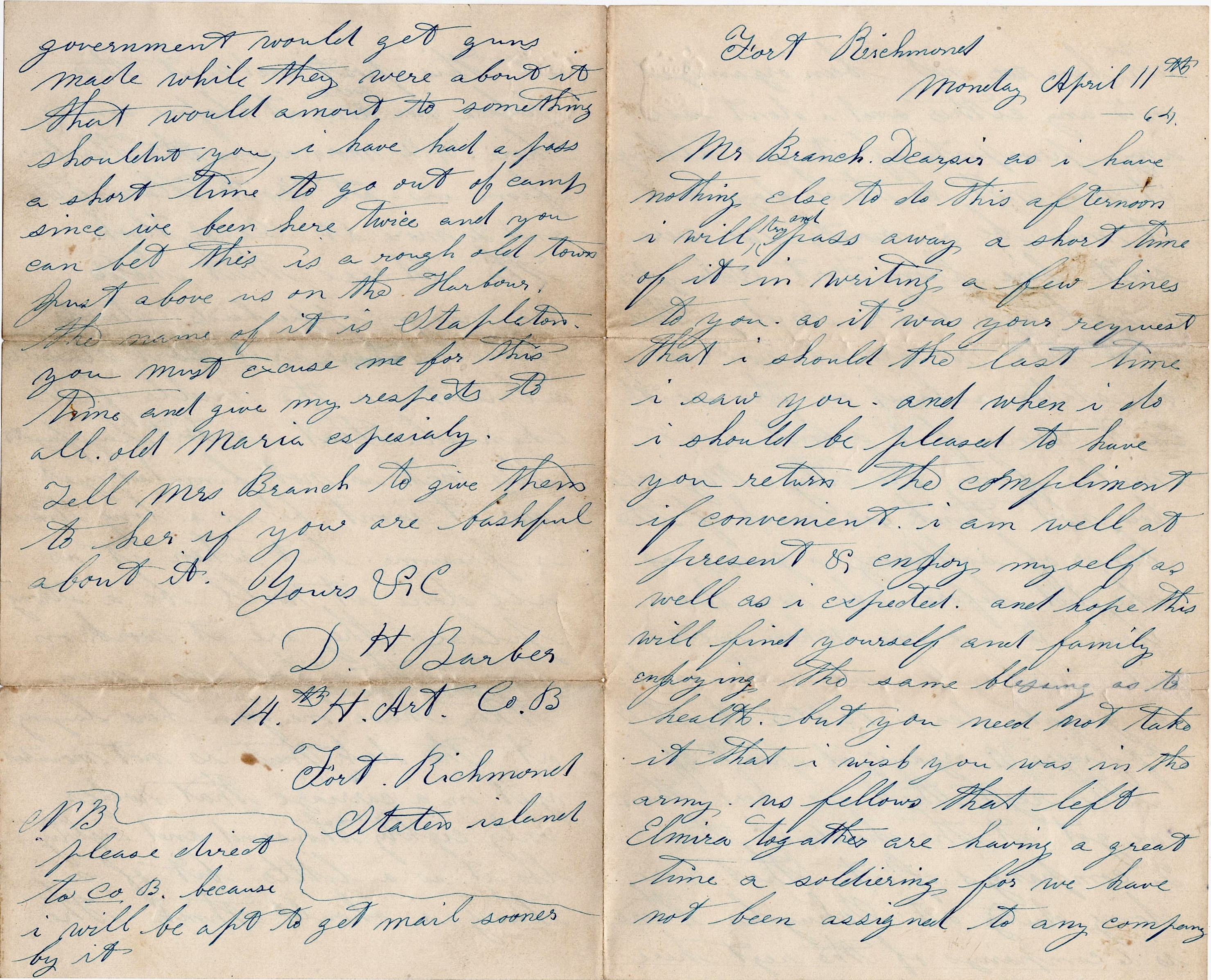
The following letters were written by David H. Barber who enlisted in December 1863 as a private in the 14th New York Heavy Artillery and was transferred to Co. L, 6th New York Heavy Artillery on May 10, 1864. He was transferred to Co. C on June 27, 1865 and mustered out with company, August 24, 1865, at Washington, D. C.

David was born in Onondaga county, New York in 1841. On the muster rolls, at the time of his enlistment, he was described as a 5′ 3″ farmer with black eyes and black hair.

Letter 1

Fort Richmond
Monday, April 11th 1864

Mr. Branch,

Dear sir, as I have nothing else to do this afternoon, I will try and pass away a short time of it in writing a few lines to you as it was your request that I should the last time I saw you. And when I do, I should be pleased to have you return the compliment, if convenient.

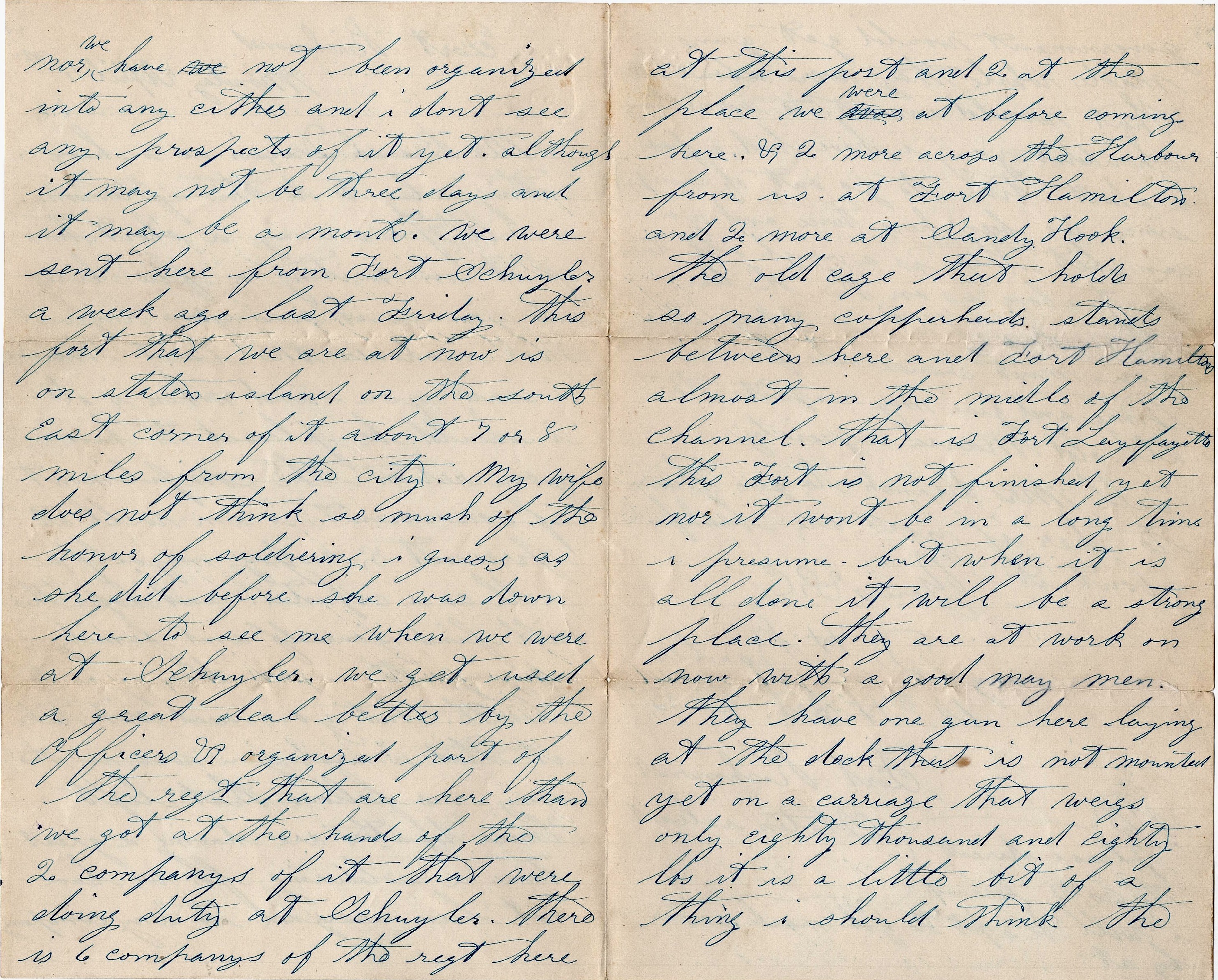
I am well at present & enjoy myself as well as I expected. And hope this will find yourself and family enjoying the same blessing as to health. But you need not take it that I wish you was in the army. Us fellows that left Elmira together are having a great time a soldiering for we have not been assigned to any company nor have not been organized into any either, and I don’t see any prospects of it yet although it may not be three days and may be a month.

We were sent here from Fort Schuyler a week ago last Friday. This fort that we are at now is on Staten Island on the southeast corner of it, about 7 or 8 miles from the City. My wife does not think so much of the honor of soldiering I guess as she did before she was down here to see me when we were at Schuyler. We get used a great deal better by the officers & organized part of the regiment that are here than we got at the hands of the two companies of it that were doing duty at Schuyler. There is six companies of the regiment here at this post and two at the place we were at before coming here. And [there are] two more across the Harbor from us at Fort Hamilton and two more at Sandy Hook.

The old cage that holds so many Copperheads stands between here and Fort Hamilton, almost in the middle of the channel. That is Fort Lafayette.

This fort is not finished, nor it won’t be in a long time, I presume. But when it is all done, it will be a strong place. They are at work on it now with a good many men. They have one gun here laying at the dock that is not mounted yet on a carriage that weighs only eighty thousand and eighty lbs. It is a little bit of a thing. I should think the government would get guns made while they were about it that would amount to something, shouldn’t you?

I have had a pass a short time to go out of camp since we been here twice and you can bet this is a rough old town just above us on the harbor. The name of it is Stapleton. You must excuse me for this time and give my respects to all—old Maria especially. Tell Mrs. Branch to give them to her if you are bashful about it. Yours, &c. — D. H. Barber, 14th H. Artillery, Co. B, Fort Richmond, Staten Island

N. B. Please direct to Co. B because I will be apt to get mail sooner by it.


Letter 2

Camp near Petersburg on or near the James River, Va.
Monday, June 20th 1864

Mr. Branch,

Dear friend, as I now have an opportunity, I will try to write you a few lines and let you know where I am and what I am doing. But first I must beg your pardon for not writing to you as I agreed when I saw you last, And now I will tell you the reason.

When we left New York Harbor, I was put into the 6th New York Heavy Artillery and sent right into the field and have had to march and fight ever since, night and day, so you see that I could not even get a chance to write to my own home as often as would have done. But for the past two weeks, I have been detailed to help drive cattle & butcher so I can have a little better chance to write once in a while.

After I got to this regiment, we started right out on the march from a place called Brandy Station and marched 3 days and 2 nights when we got out to where the Battle of the Wilderness was, in time to get into that the second day of the fight. And we have been right in the front line of battle about all the time up to this place where we now are. If not in one battle that was going on, it was on the skirmish line in another. So you can judge for yourselves whether I have seen and realized any of the hardships of this summer’s campaign.

And now, while I am writing this morning, our batteries are shelling the City of Petersburg in sight of where I am. But I am in the rear with a herd of cattle and close by the ammunition train of the 5th Army Corps. That is what we are in. So you see that I am not in a very dangerous position just at present. This is the 4th day they have been fighting at this place and all around where I am now I can go in the field and pick up a musket or cannon ball at any place almost.

Our regiment was out on the extreme skirmish line all day yesterday and day before yesterday our Corps made a charge on the Johnnies and drove them from their breast works and drove them away from the railroad that runs into Petersburg. And we hold it yet.

I was in the Battle of Bethesda Church and all through where we happened to be along the line of Lee’s army up to this place. We crossed the James river last Thursday about noon so we are now nearly south as near as I can judge from Richmond.

I have seen Charlie Beers once since we have been down here. Andrew, you people at home can form no kind of an idea of this war by what you read at home. It is awful to look upon. It is far different from what I thought it was before I had had the experience myself—to see men all shot and mangled to pieces in every way you can think of. But thank God I have been spared so far. The other day I witnessed the explosion of one of the enemy’s shells that was sent at us in the Battle of Bethesda Church. We were in the first line of battle at the time and our Brigade—that is, our Regiment and the 15th New York Heavy Artillery that constitutes it—were in a little piece of woods and it burst in the 15th and tore both legs and one arm off a poor fellow and a great many others just about as bad I have seen with my own eyes.

But if I was sure of staying where I am now in this business, I should feel quite contented. But I am here and it’s no use for a man to flinch from his duty or what is called by some shoulder strapped men. They—some of them—know other men’s duty as a soldier but they don’t know their own. But dear friend Branch and family, one and all, enough of this for the present. I should like to hear from you all as soon as you get this and tell me all the news for it is the only consolation a poor soldier gets here in his letters from his home or some friends of his for we can’t get any papers to read or anything of the kind here unless it is sent to us. I have lately got a letter from my wife about every time.

[no signature]


Letter 3

Camp near Petersburg, Va.
Monday, July 18th 1864

Mr. Branch,

Dear sir, I received your letter a week ago yesterday & have neglected to write again until now. But an old saying is you know, better late than never.

I am now about a mile or a little over perhaps from where we were camped when I wrote to you last. We are camped now about a mile from the Norfolk & Petersburg Railroad. This road is not used any now at this end of it nor it has not been since we came up to this place. We had our camp right alongside of it for a couple of weeks back until one day last week we were ordered to move back a little farther to keep out of the way of the Johnnies’ shells which they throwed once in a while pretty close to our ammunition & commissary trains and cattle herds.

I am with our Brigade herd yet but how long I will be kept on this duty, I can’t say, but hope it will be the remainder of this campaign. I have to go out to the front and help to butcher every other day. That is about as often as I care about unless I go up one in a while to my company and get my letters for they shoot right at our fellers, you know, with their cannons.

Our regiment has been in the front line of battle all the while since we came to this place with the exceptions of two days [when] they were relieved by another Brigade. They are laying behind breastworks and our line of works is not more than 80 or 100 rods from the rebel breastworks at this place. I have been outside of the works once to see a man that was on picket. The pickets do not fire at each other here where our Brigade lays at all. They are within a stone’s throw of each other and sometimes go to a spring about halfway between them to get water at the same time.

But they get to playing ball once in a while about every day with their batteries and that makes the men keep their heads below the top of the breastworks when they get at that. There has not been very many killed out of our regiment since we got into the breastworks. There was one struck last week one day with a solid shot and tore all to pieces, but he was a man that I was not acquainted with. He did not belong to our company. We have not had any killed here out of Co. L since we have been in these works or had not the last time I was up to them which was last Saturday afternoon. But there has been a good many wounded with pieces of shells.

The Butcher has just got orders to go out and butcher now but we won’t go till just before sundown. I saw Frank Sparks & Abe Decker yesterday. They are camped near us now. They are at work in the woods near us now for a few days. Frank says tell the folks when I write that he is well. They look tough and healthy. I was in this camp an hour or so yesterday. I saw Delos Green too. He is in the same company with them.

You will have to excuse me for this time so I will bid you goodbye for the present. This leaves me in good health and I hope it will find you and family enjoying the same blessing. Yours truly, — D. H. Barber, 6th New York Heavy Artillery, Co. L, Washington D. C.

1864: Simon B. Wait to Lucy P. Waite

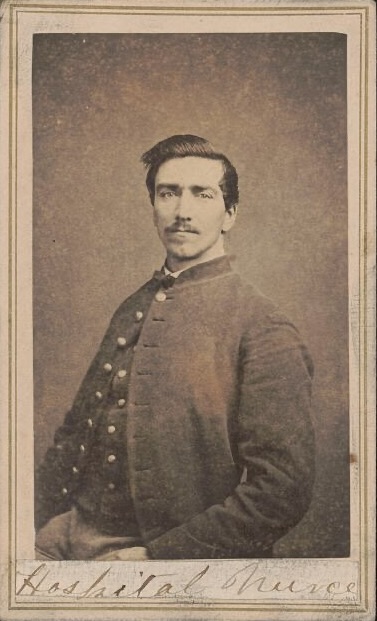
Unidentified Civil War male nurse at Mt. Pleasant Hospital, Washington, D.C., in uniform (LOC)

The following letter was written by Simon B. Wait of Canton, St. Lawrence county, New York, who enlisted at 19 years of age on 9 August 1862 as a private in Co. K, 106th New York Infantry. He was almost immediately transferred to the 23rd Co., 2nd Battalion, Veteran Reserve Corps (VRC), apparently judged by a surgeon to be unable to withstand the rigors of life in the field. He remained in the service until 31 August 1864 and was detailed to serve as a hospital nurse or aide.

Simon wrote the letter to his cousin, Lucy P. Waite (1844-1909), the daughter of farmer Benjamin Waite (1812-1875) of Canton, St. Lawrence county, New York. Lucy never married.

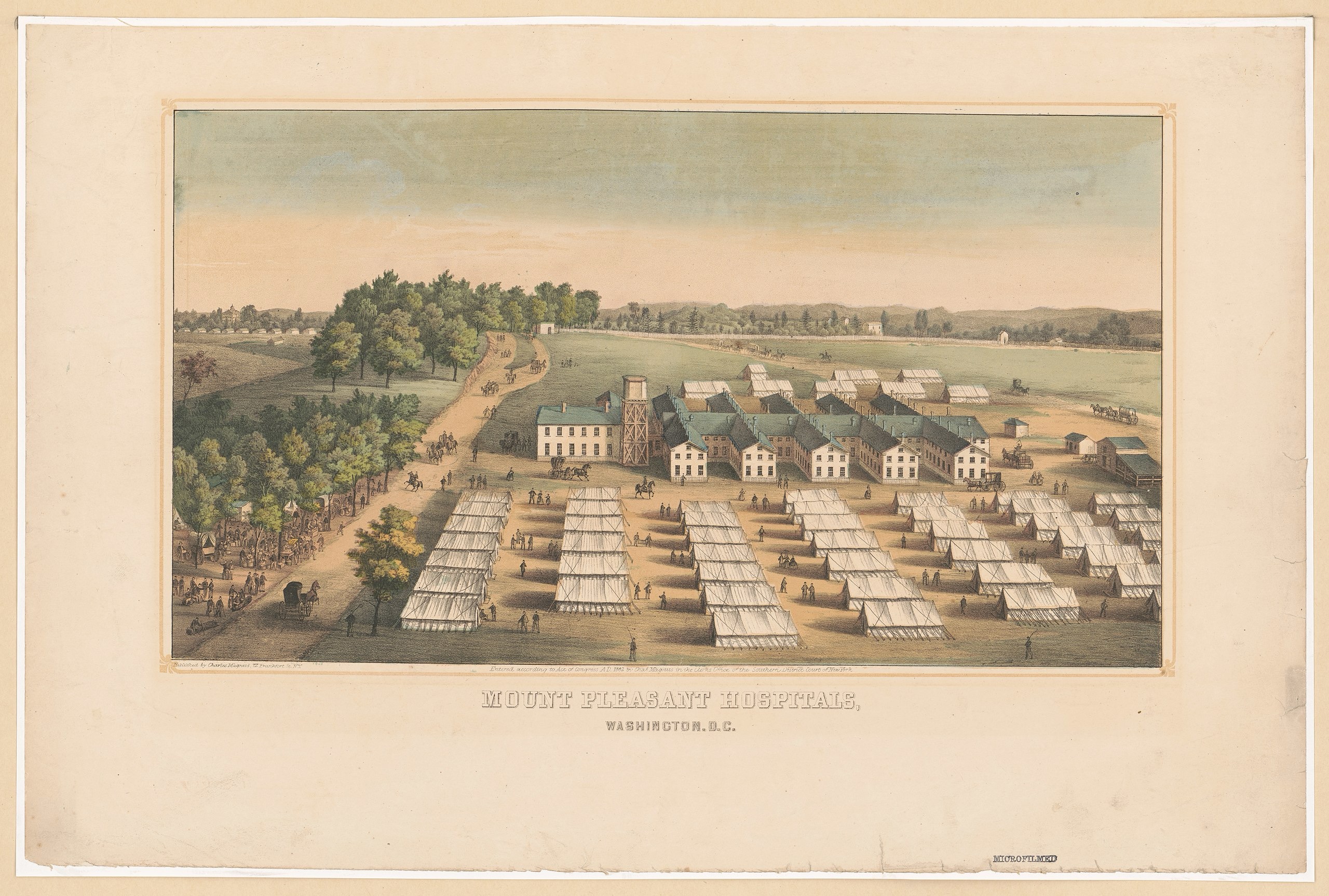
Simon informs us that he was working in the Mount Pleasant General Hospital (pictured below) which was a purpose-built hospital raised in the winter of 1861-62 on Meridian Hill in the District of Columbia. During construction the buildings were guarded day and night by 9 soldiers under the orders of General Sykes to prevent attempts of incendiarism. It was based on plans provided by P.B. Wight, Esq. of New York and built under the approval of the Sanitary Commission.

It covered about an acre and a half and contained ten wards along with a kitchen and an administration building two stories high on the south side, 80 feet long and connected to the back via a 275 feet long corridor to the wards (five on each side of it). A 27 feet wide yard was added between each building to introduce light and ventilation to the wards. The wards were 87 feet long and 28 feet wide and had both gas and water. The surgical room will be at the end of the corridor on the north side. It was fitted with the necessary equipment found in hospitals at the time. The kitchen laundry and other supporting services were on the east side of the administration building.

[Note: This letter is from the personal collection of Nick Kaup and was offered for transcription and publication on Spared & Shared by express consent.]

T R A N S C R I P T I O N

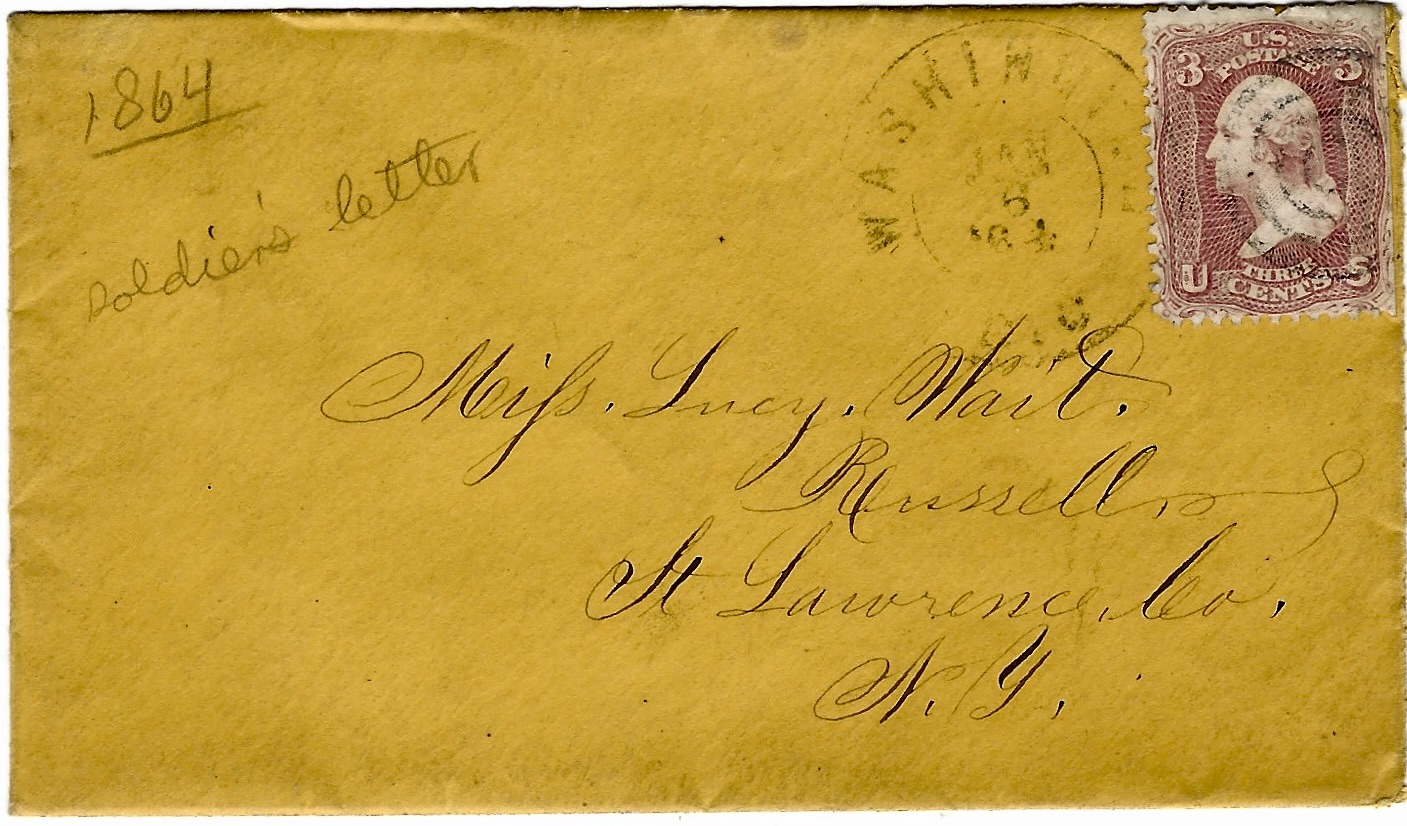
Addressed to Miss Lucy Wait, Russell, St. Lawrence Co., New York

Mount Pleasant General Hospital, D. C.
January 5, 1864

Cousin Lucy,

Perhaps you will think this is a late hour to write but I have been some busy for the last two weeks. I have not had time to write home. It being the last of the year, they took an inventory of everything in the hospital and many other things that took some time.

We had a snow storm here yesterday for the first time this year. The ground is all covered here now. It seems like home to look out of the window and see the sleighs go past, I have not been out yet but I think I shall have a snow ball tonight. We don’t have to go out of doors for anything here. There has been two weeks at a time that I never was out of doors so when I do go out, the cold weather makes some difference to what it used to at home.

Now what for a time did you have New Years? For my part I had a very good time. I worked all day and at night had a pass to go to the theatre. They played the Iron Mass so that is the way New Years went with me. I expect you had a very nice time. I expect you had a very nice time. I expected to of been there but as bad luck would have it I could not come very well so I do not know when I shall come now. It is so cold I can’t think of coming this winter but I shall have to come when I can the best.

There is not much news to write here now so you will not expect a very long letter. I had a letter from cousin Isadore yesterday. She is well and all the rest. Mary has gone to Canada to live this winter with her sister so Isadore is alone now. She sent me her picture and Mary’s. I think very much of them. I hope you will be able to send yours when you write again for I should think so much of it. I send my best respects to Uncle Ben and Aunt Lucy & all the rest, taking a share for yourself.

I am in the best of health now, hoping this will find you all the same. I shall have to close for this time as I have got out of writing tinder and you will get sick of reading this before you get through reading it. Write as often as you get time for you always tell me all the news. You spoke of going to Canton to school in about three weeks when you last wrote, so as it has been nearly four of them, I think there will [be] no danger of directing your letter there.

I must close for this time. Please answer this and I will try and so better next time and not wait so long. Goodbye from your cousin, — Simon B.

I will direct this to Russell.

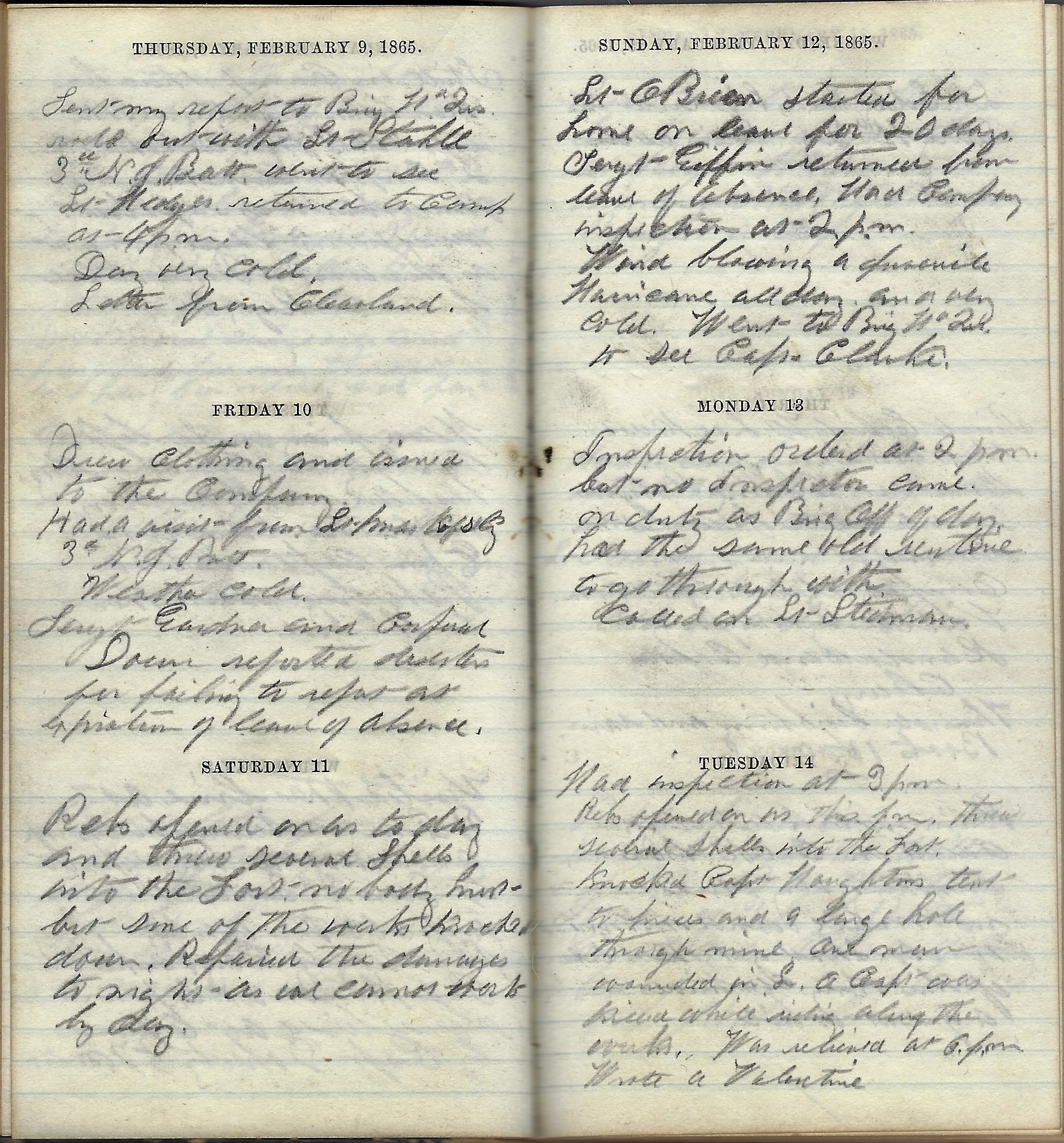
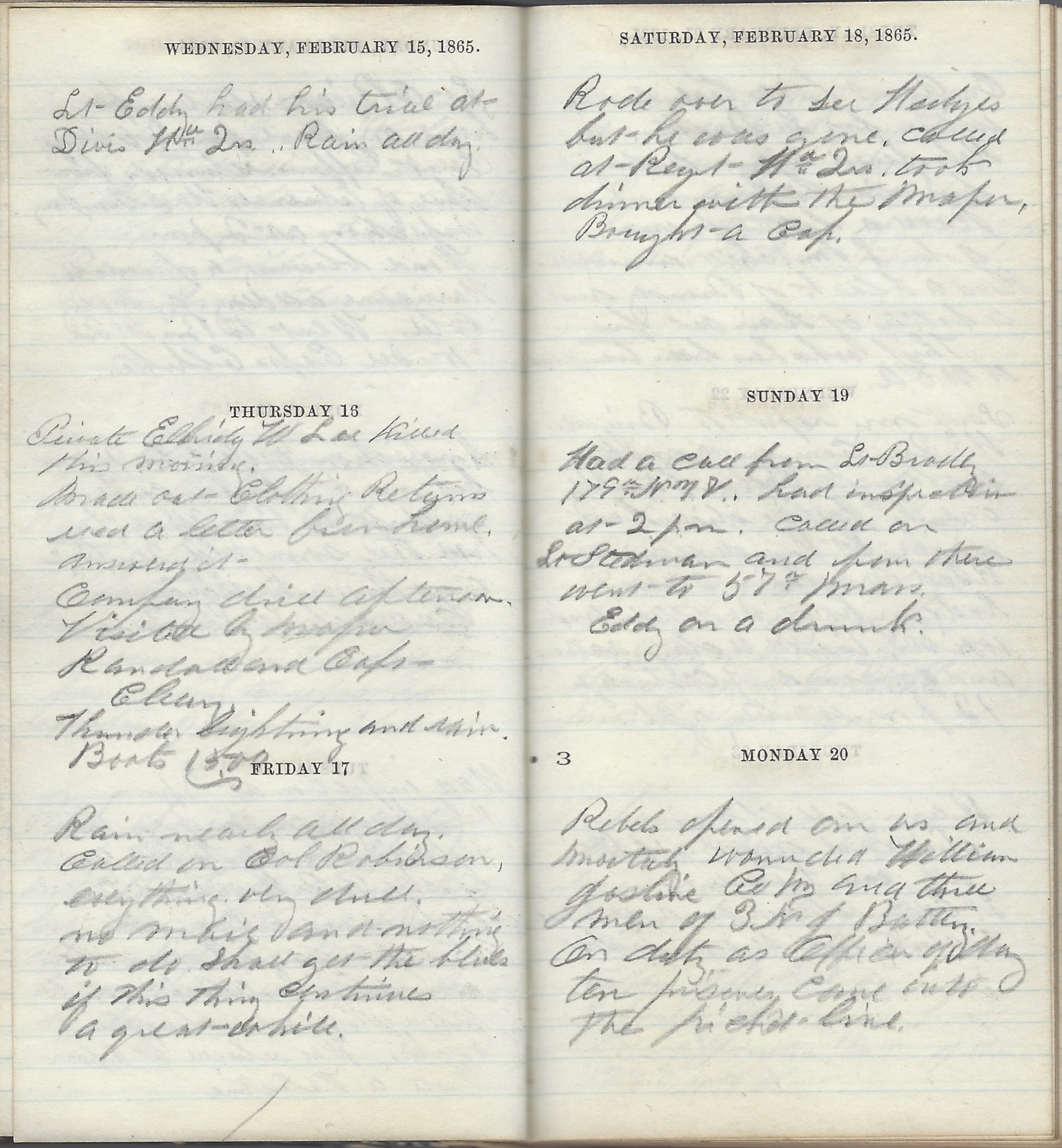
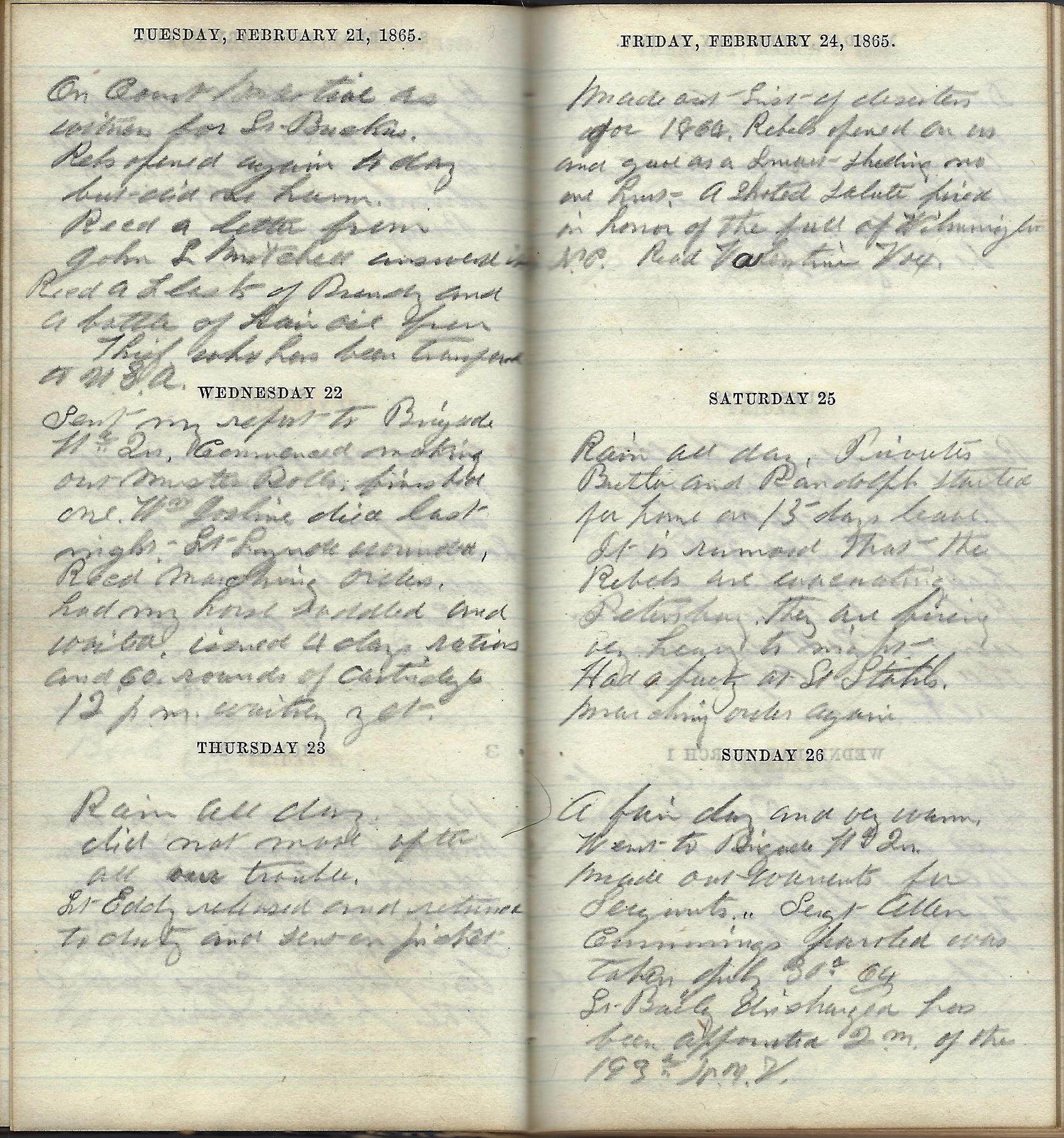
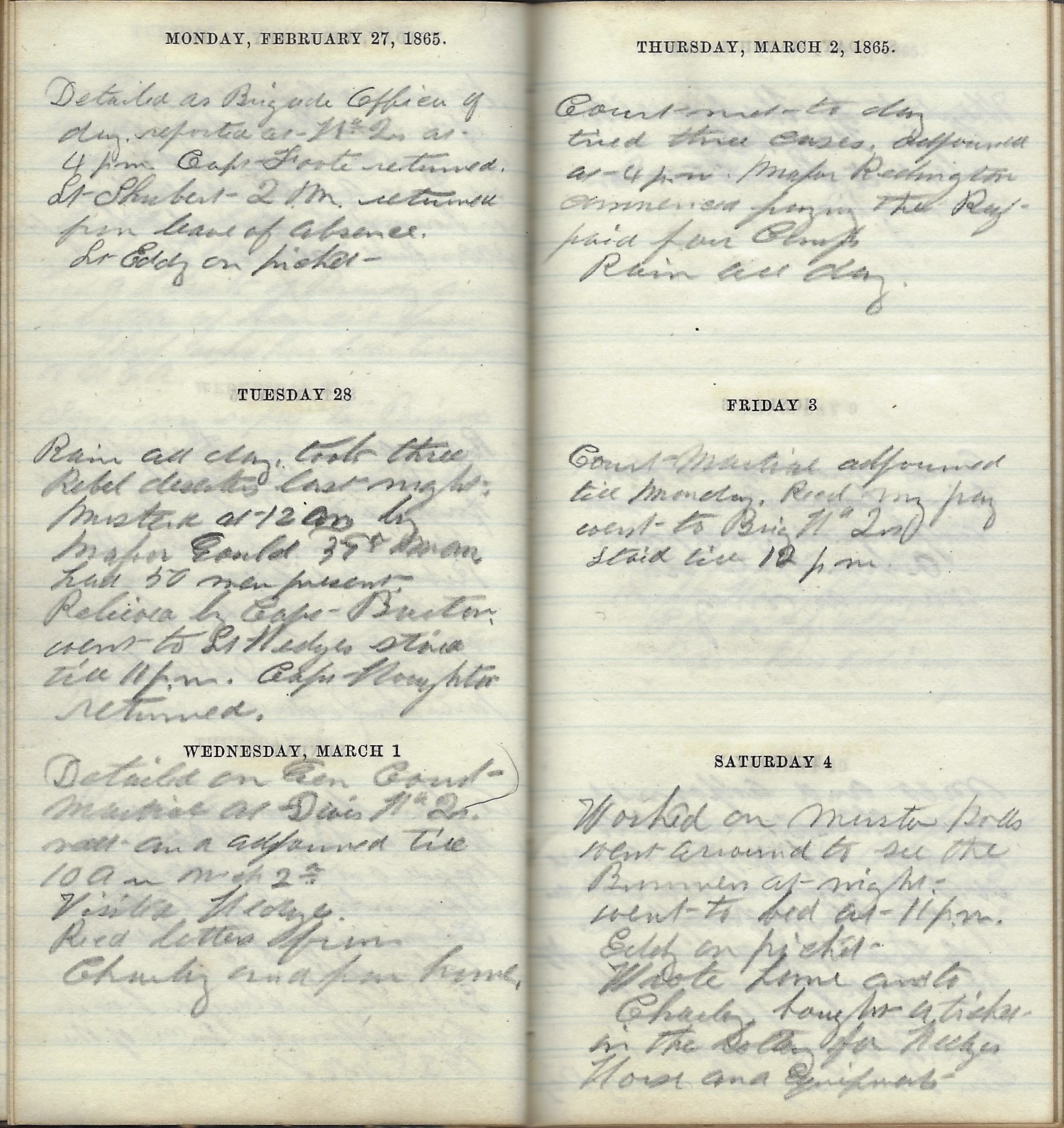
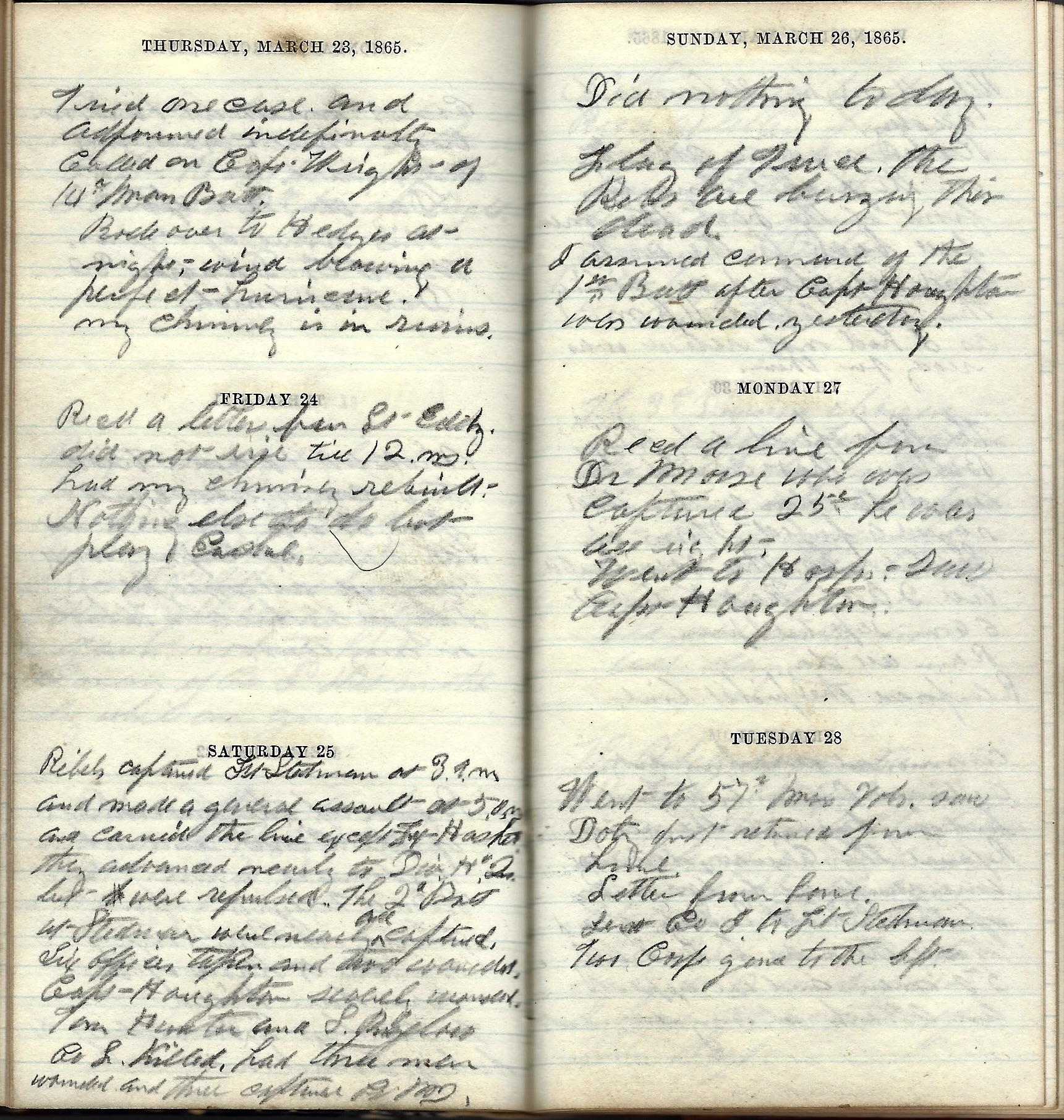
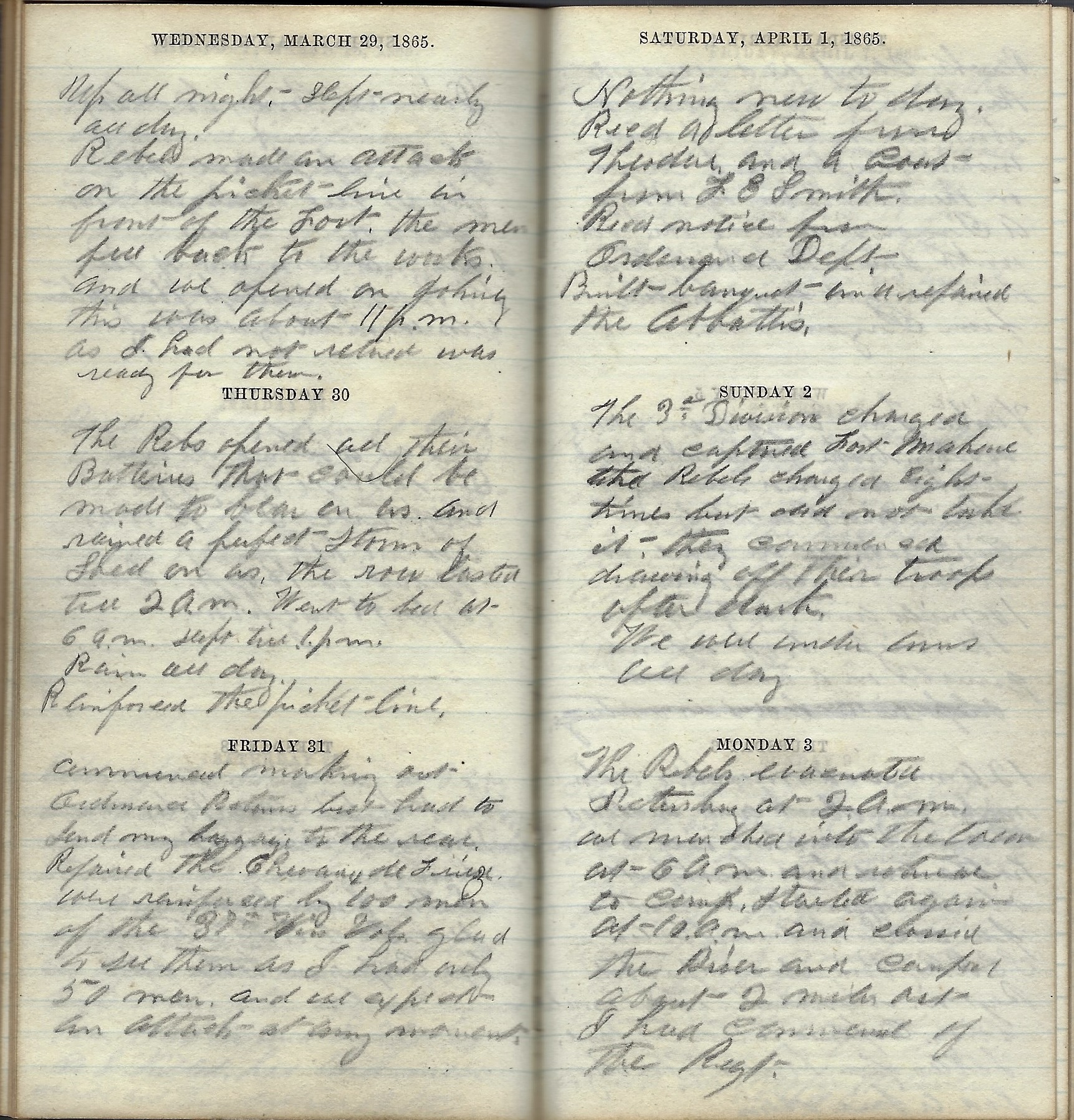
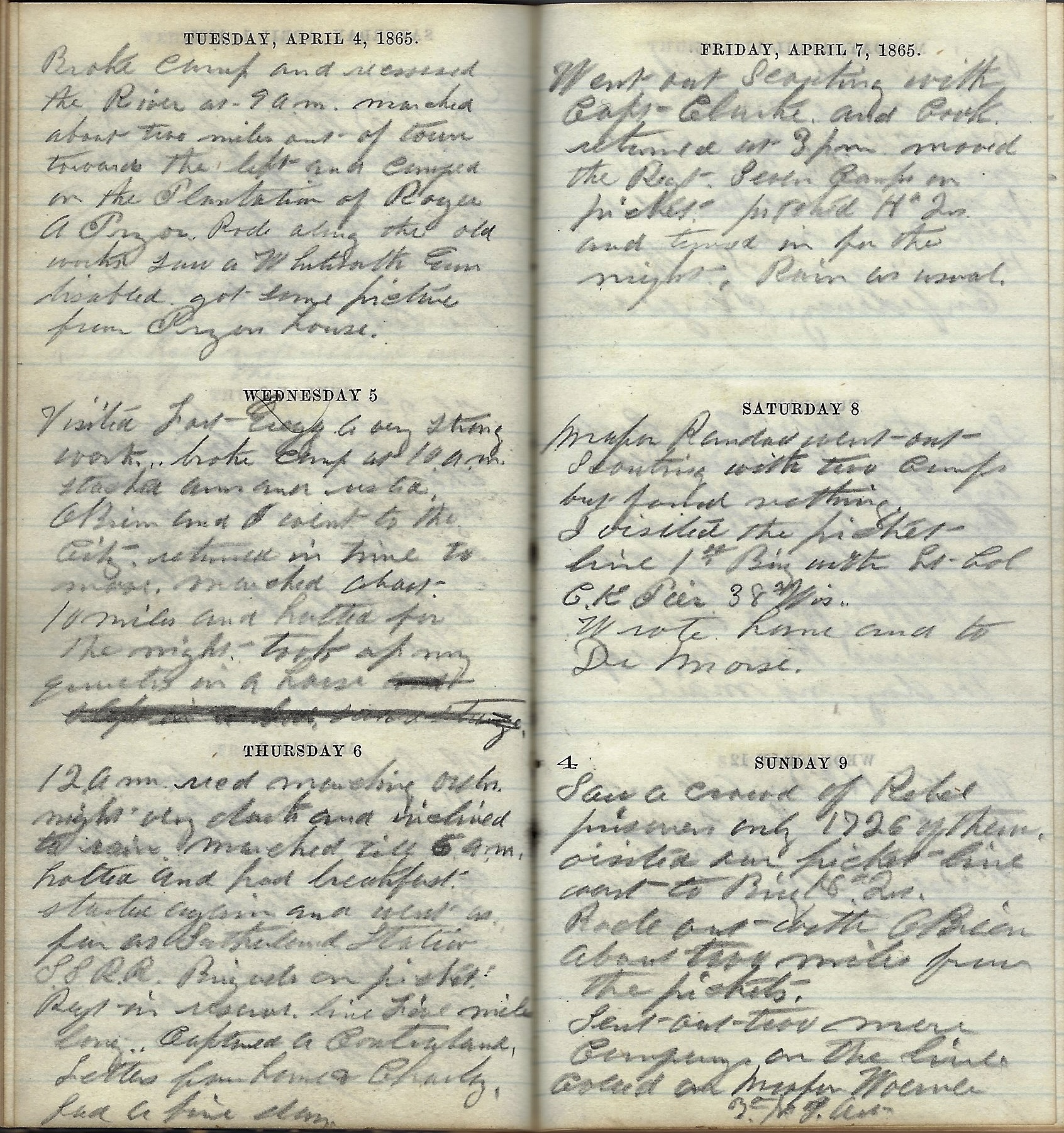
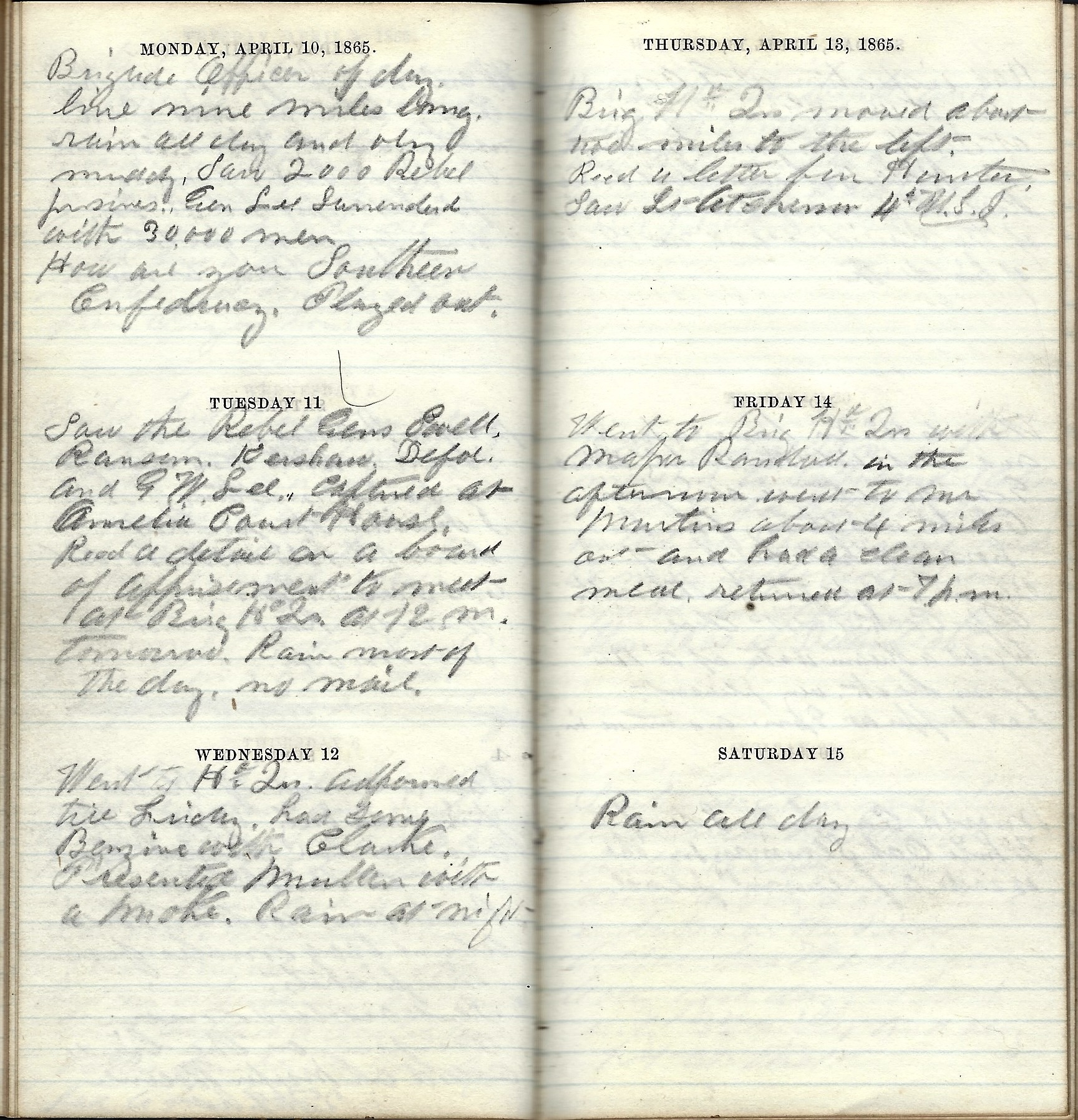
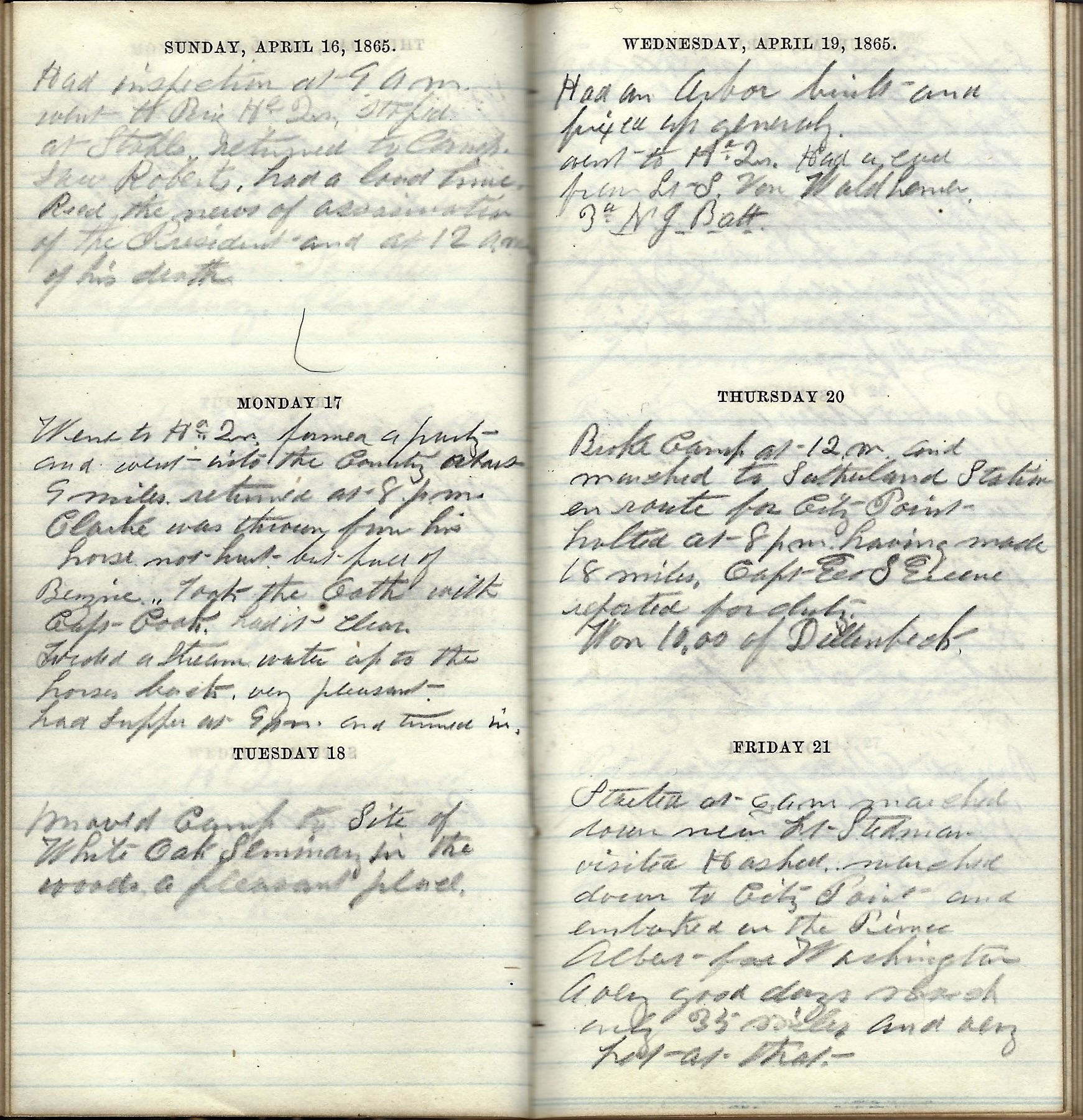
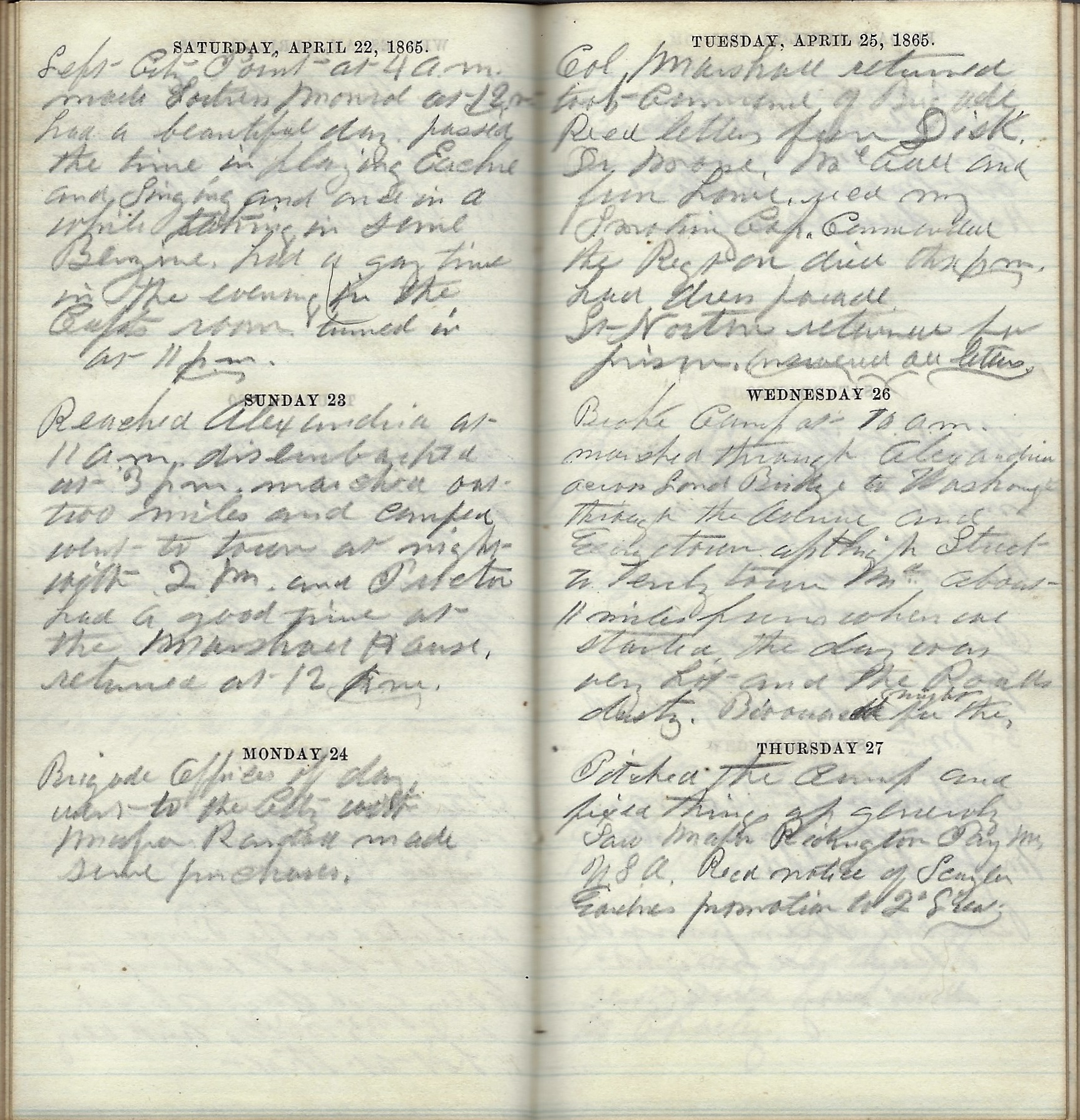
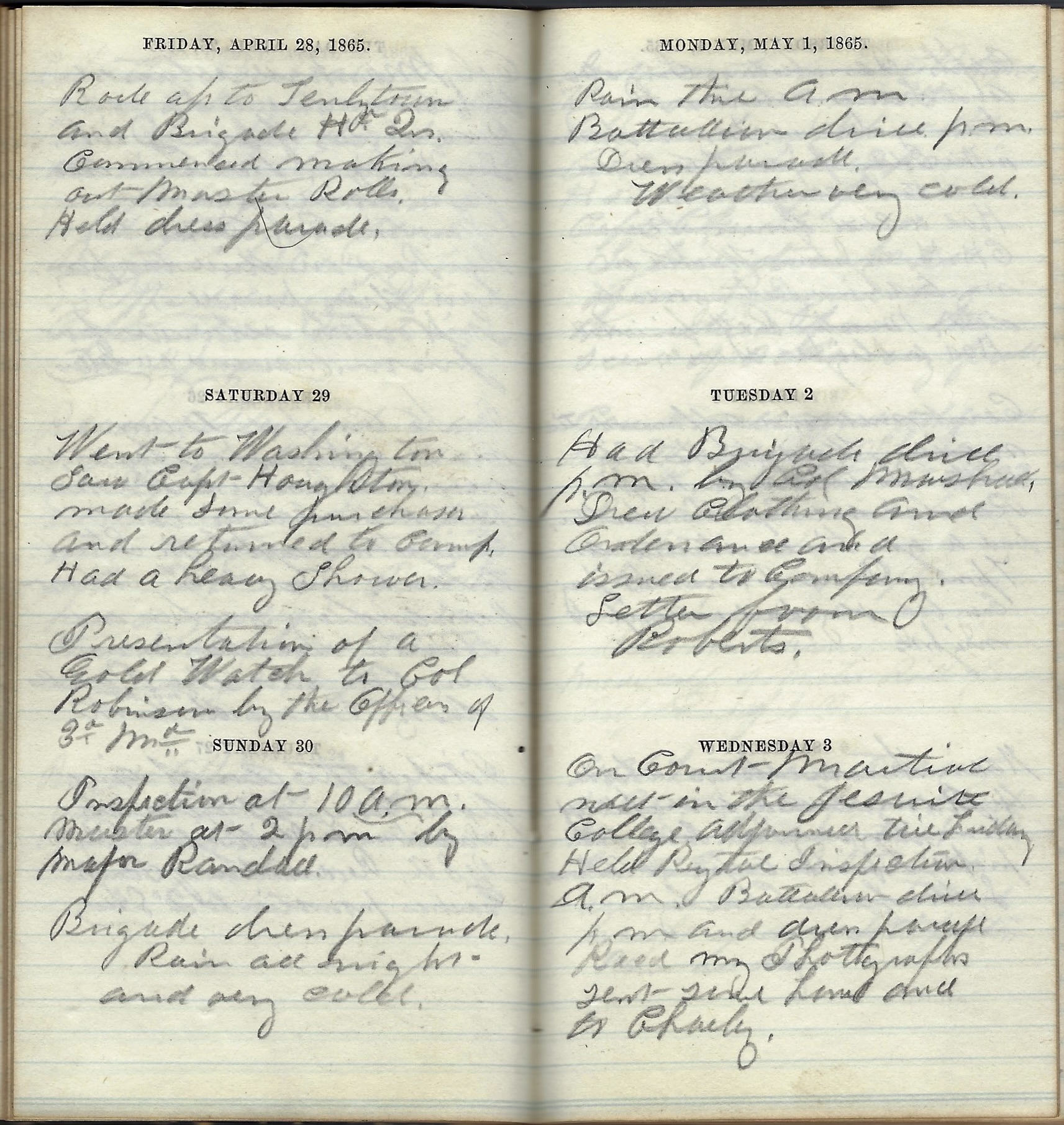
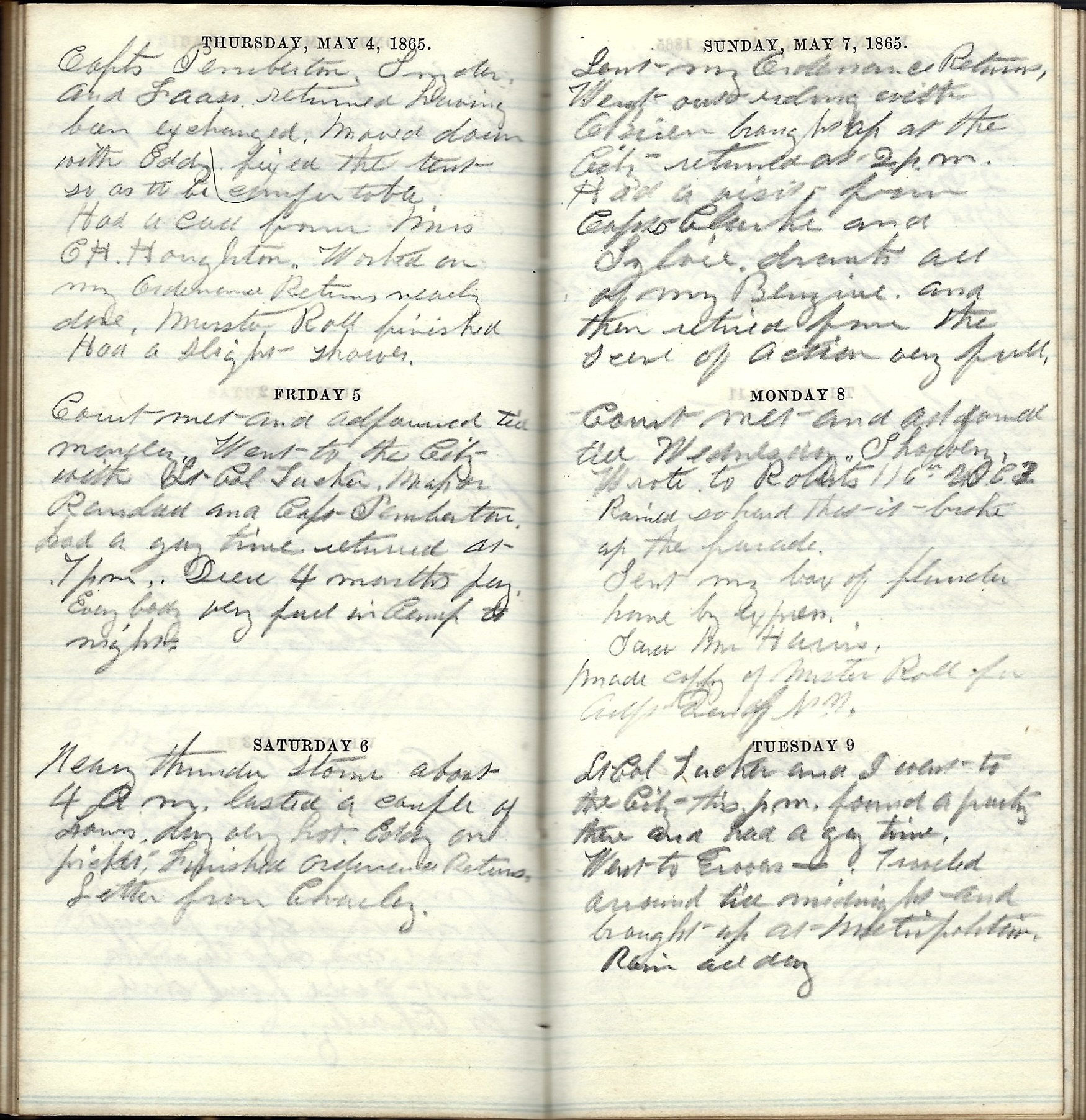
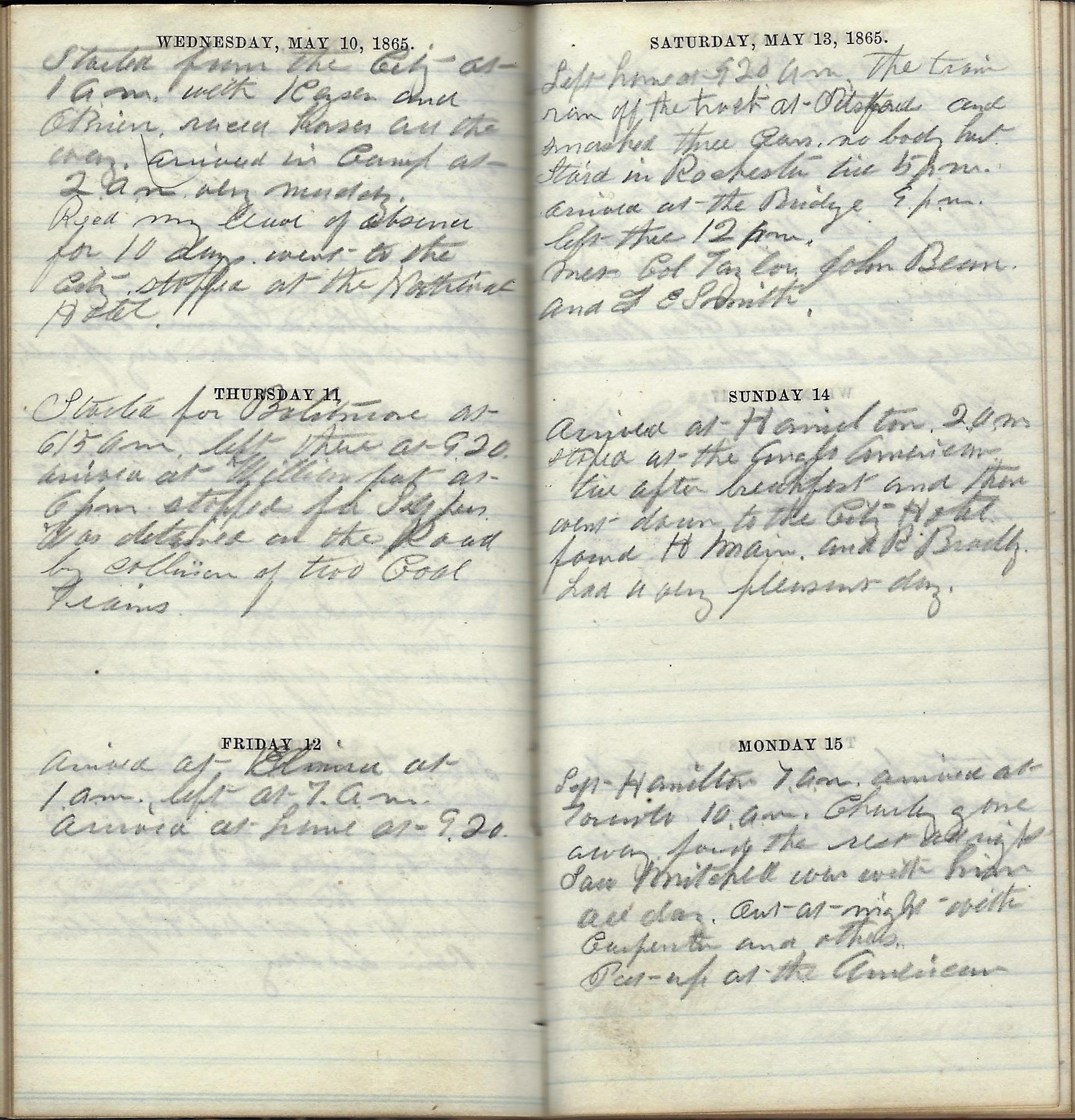
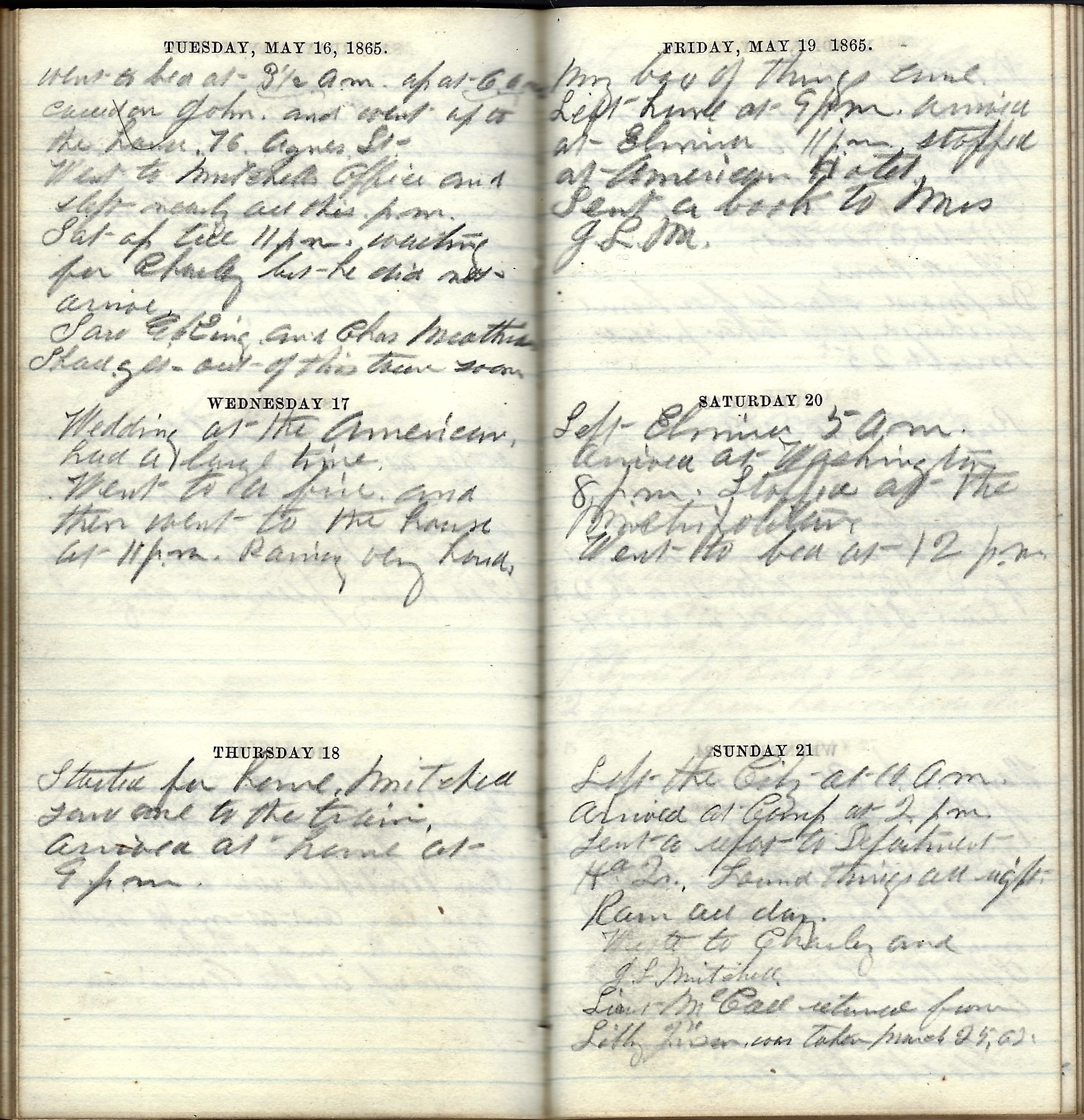
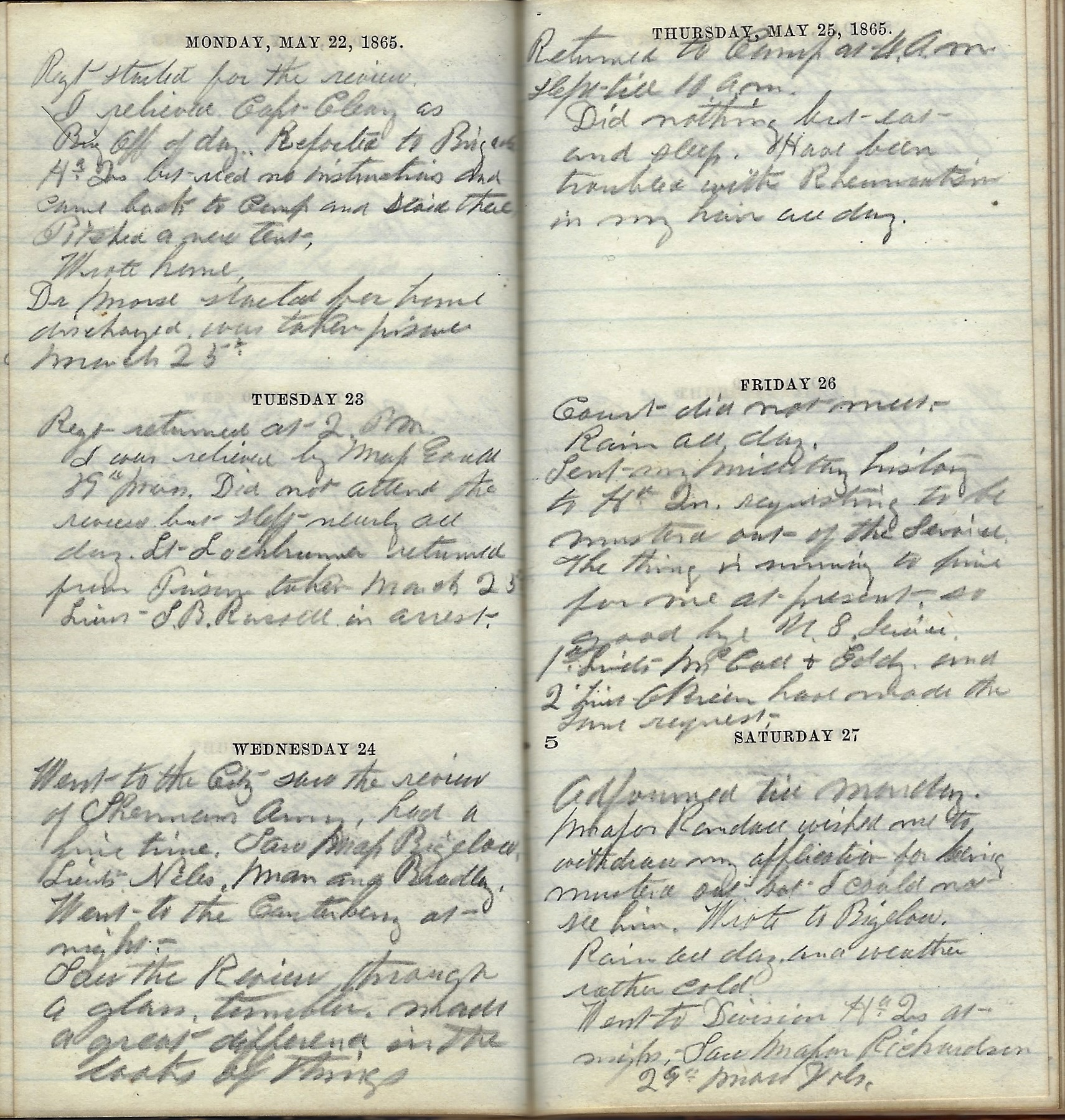
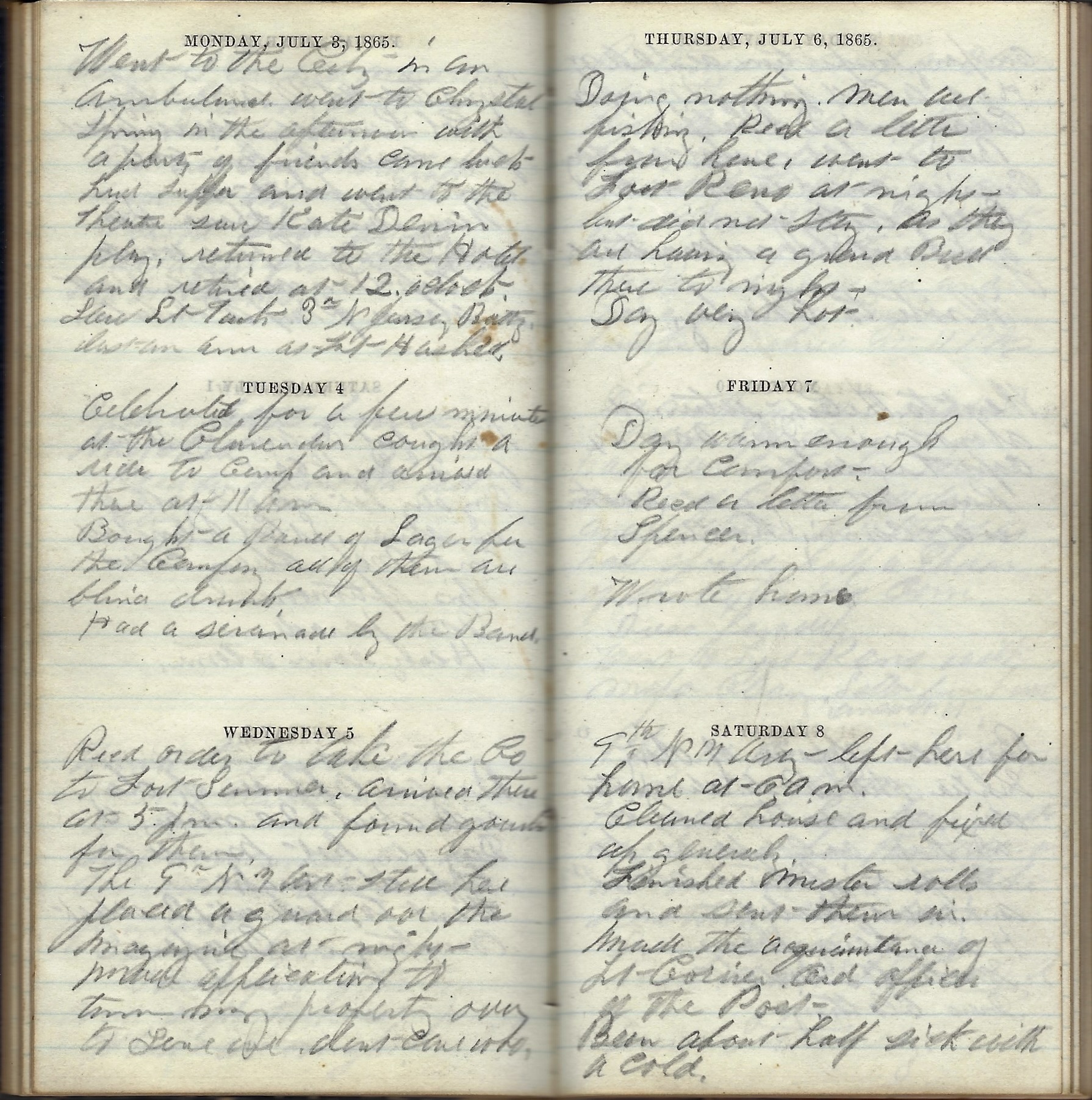
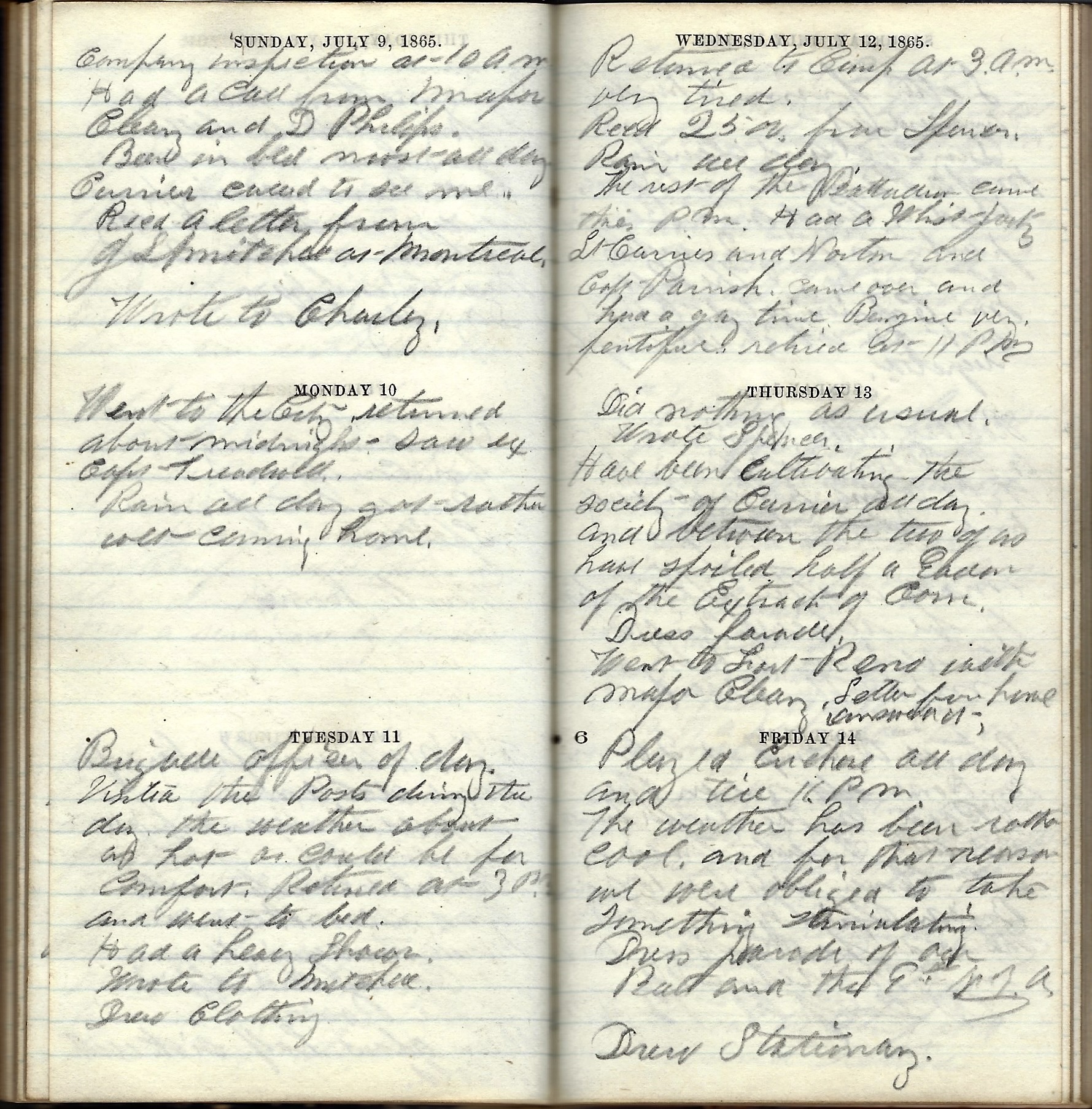
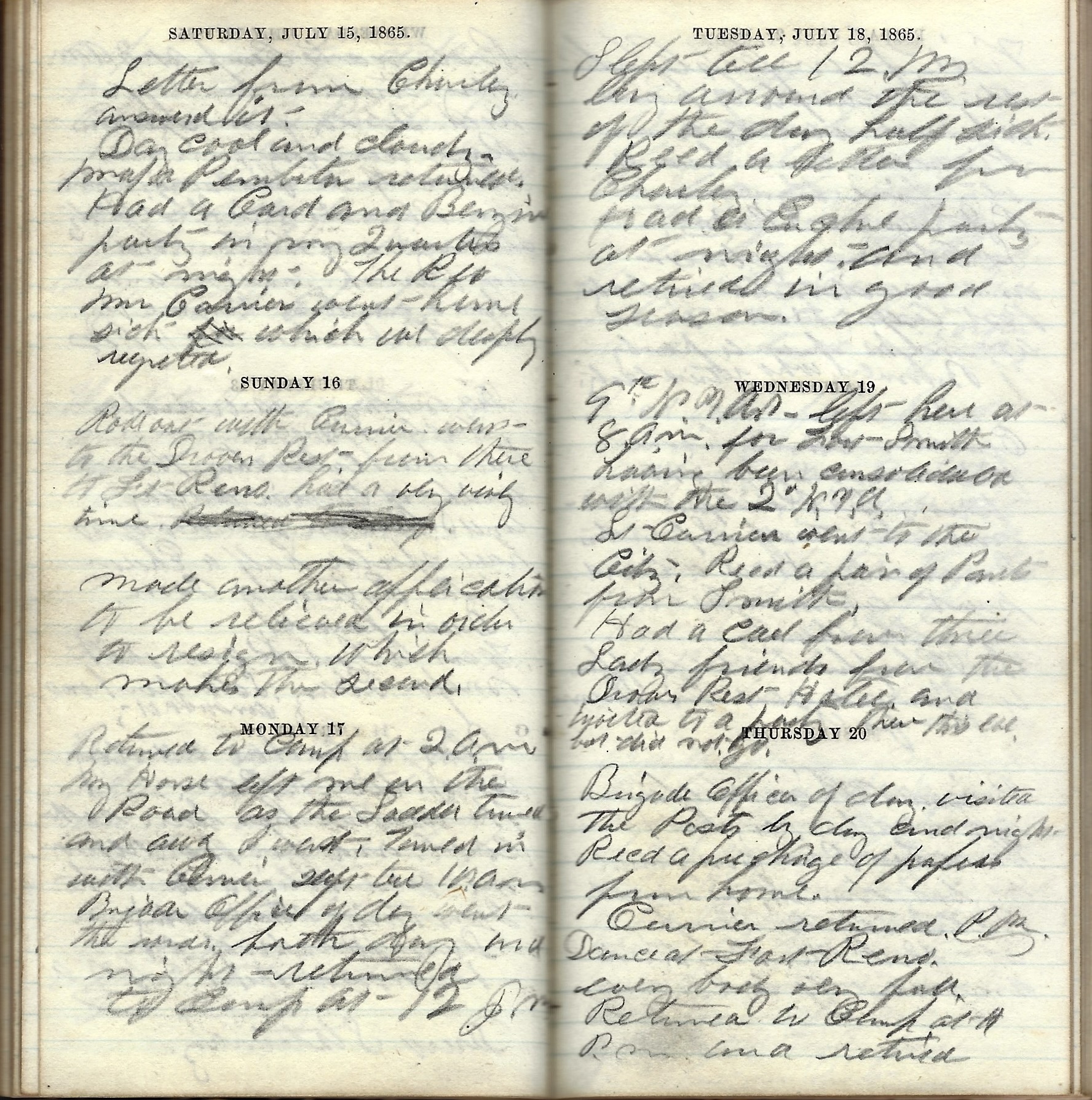
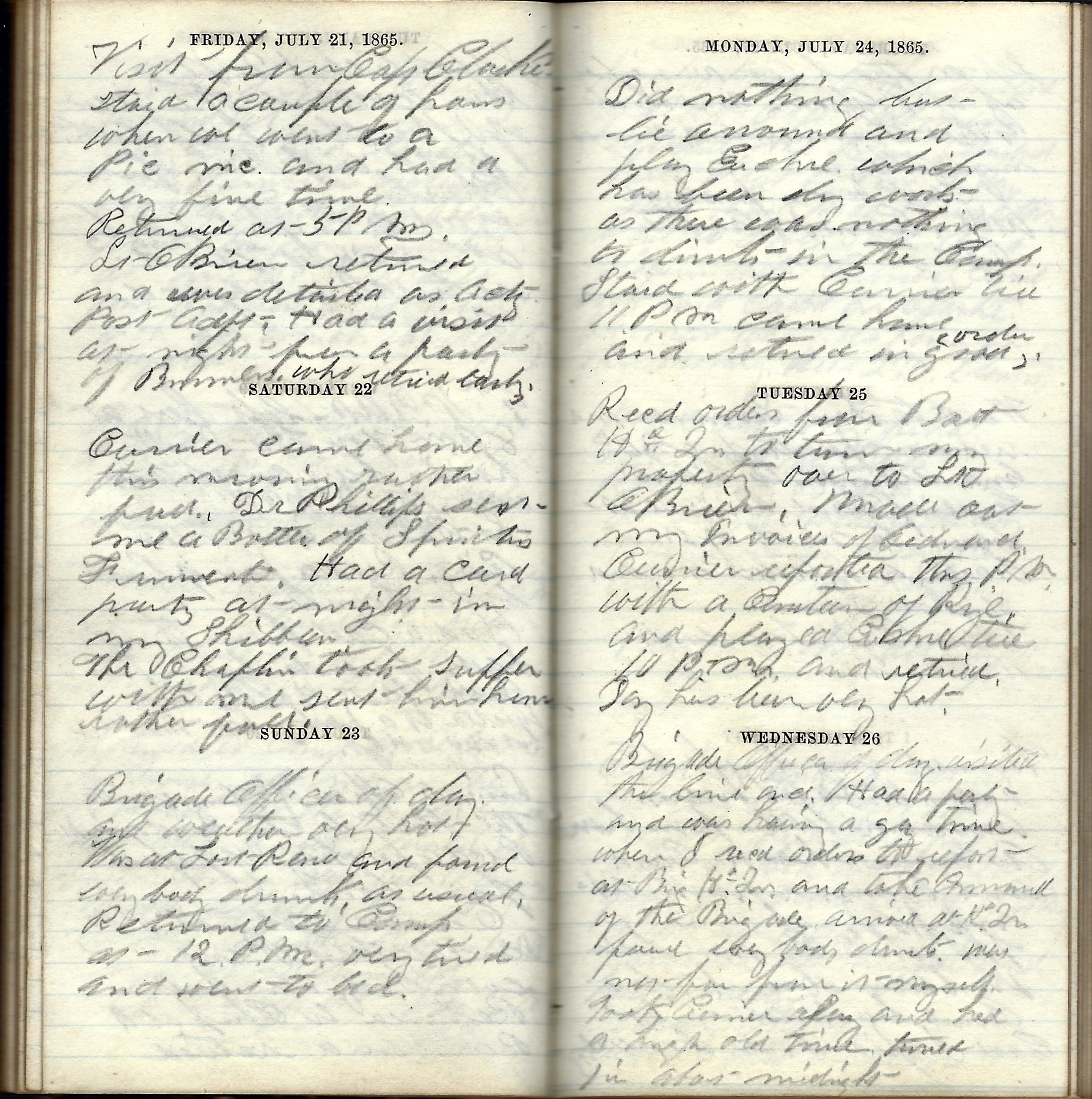
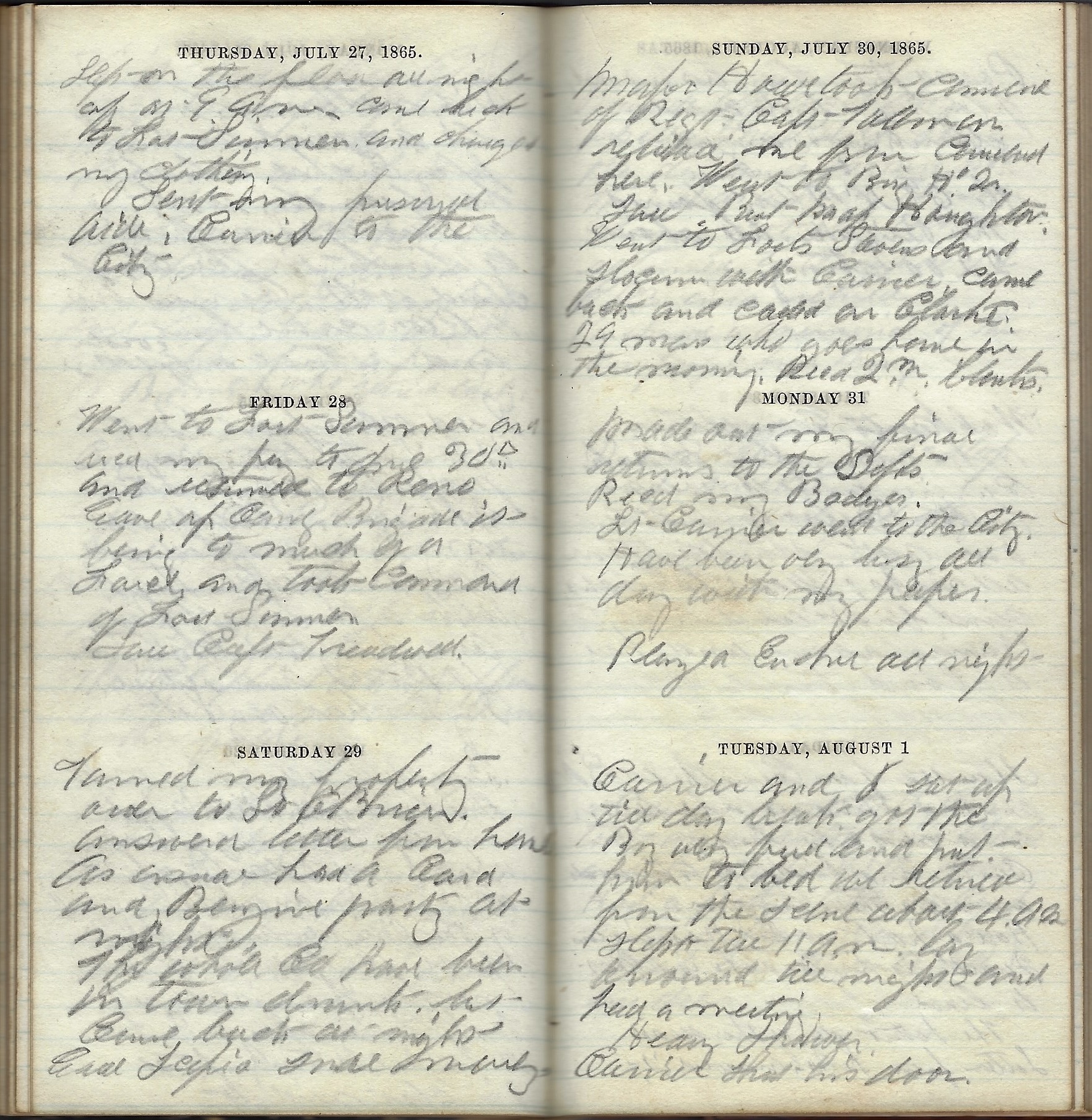
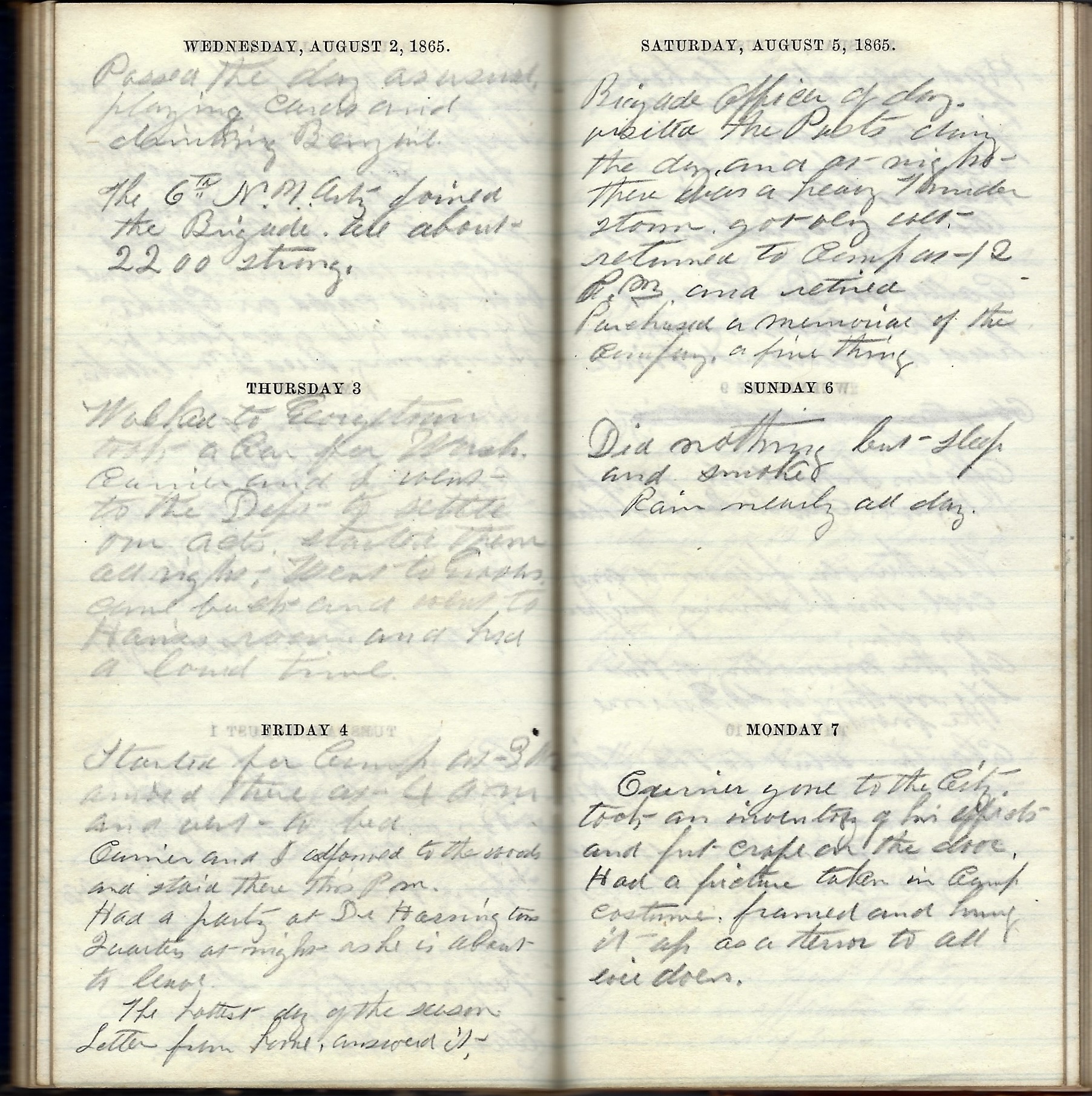
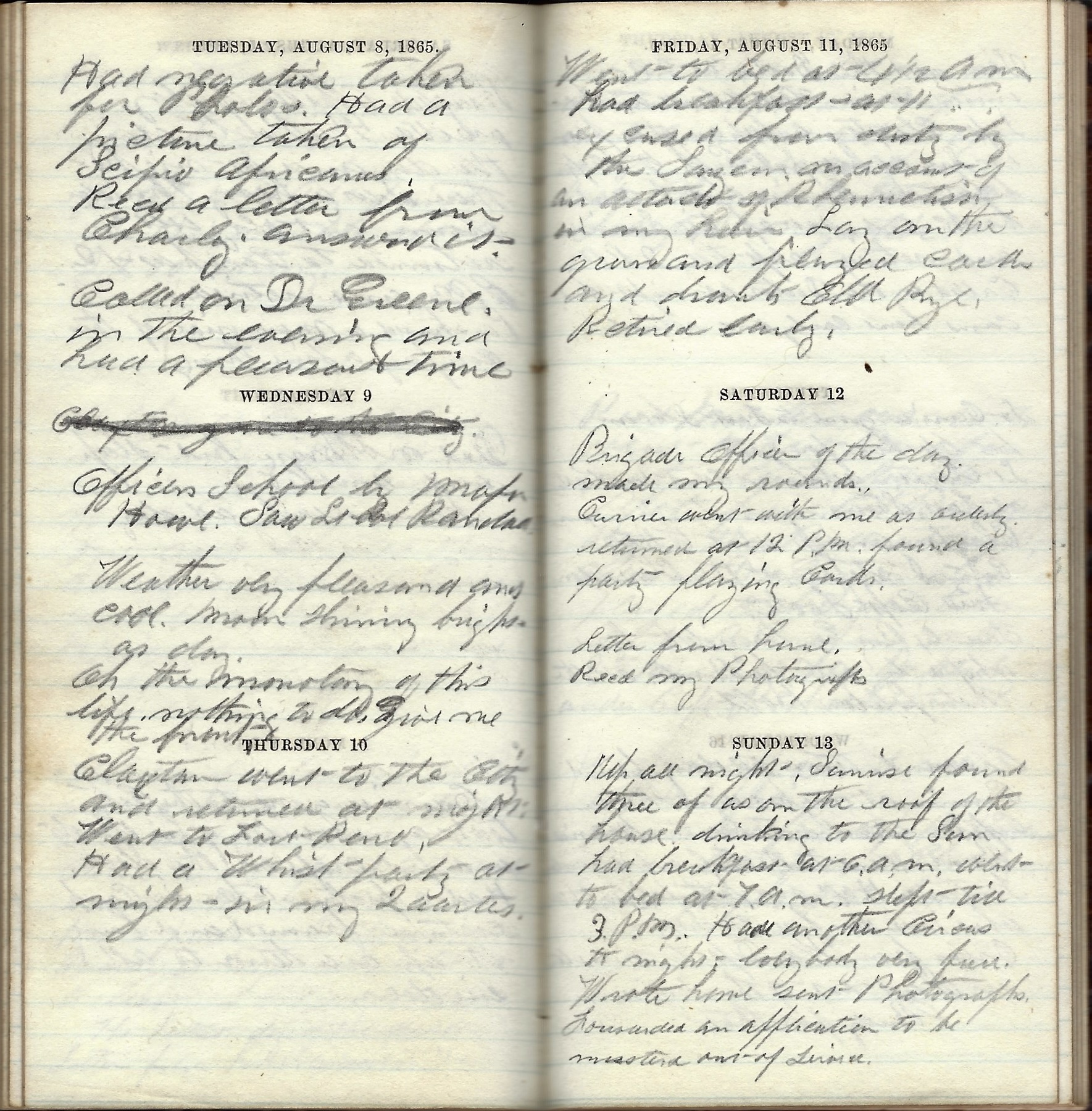
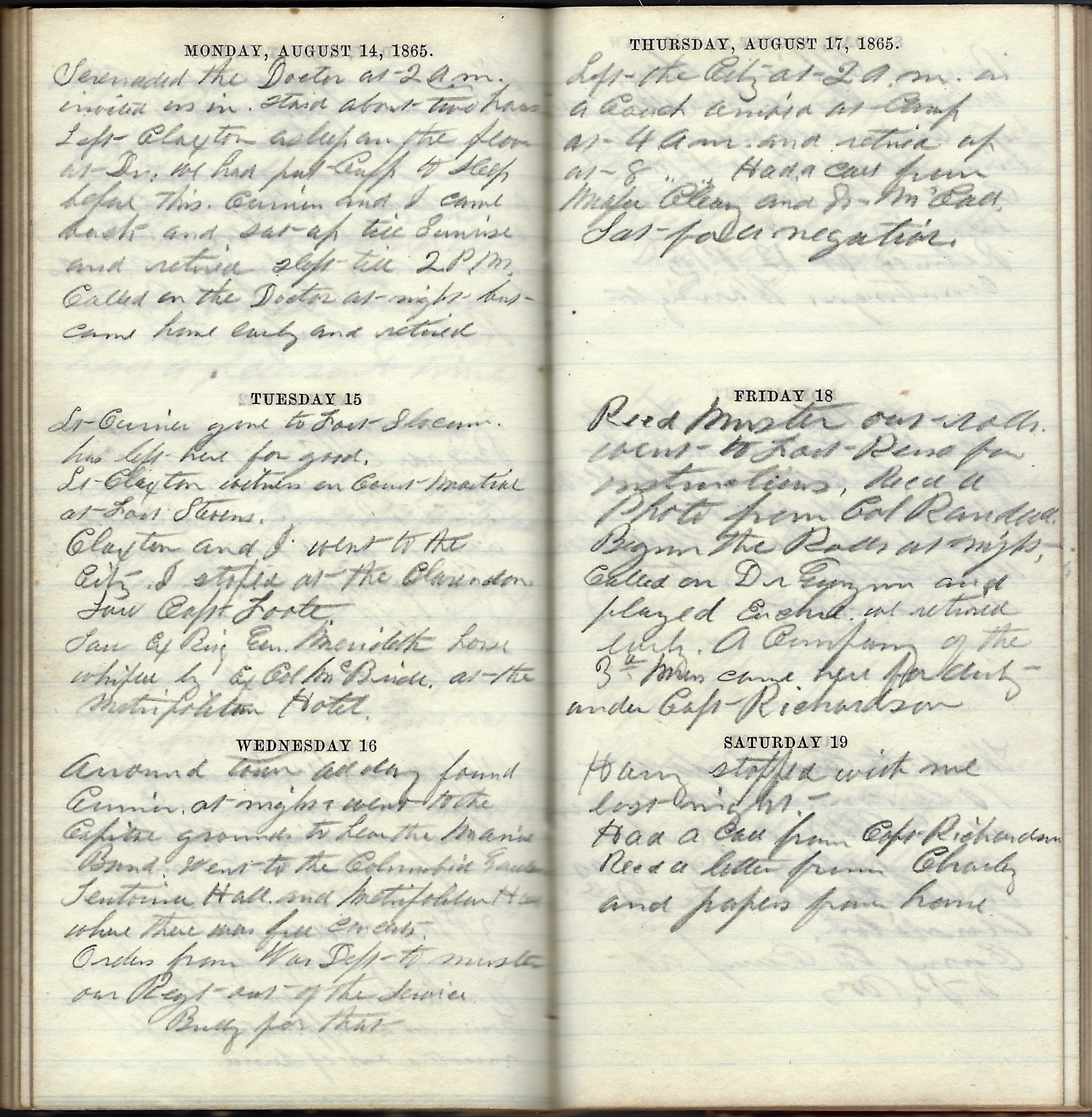
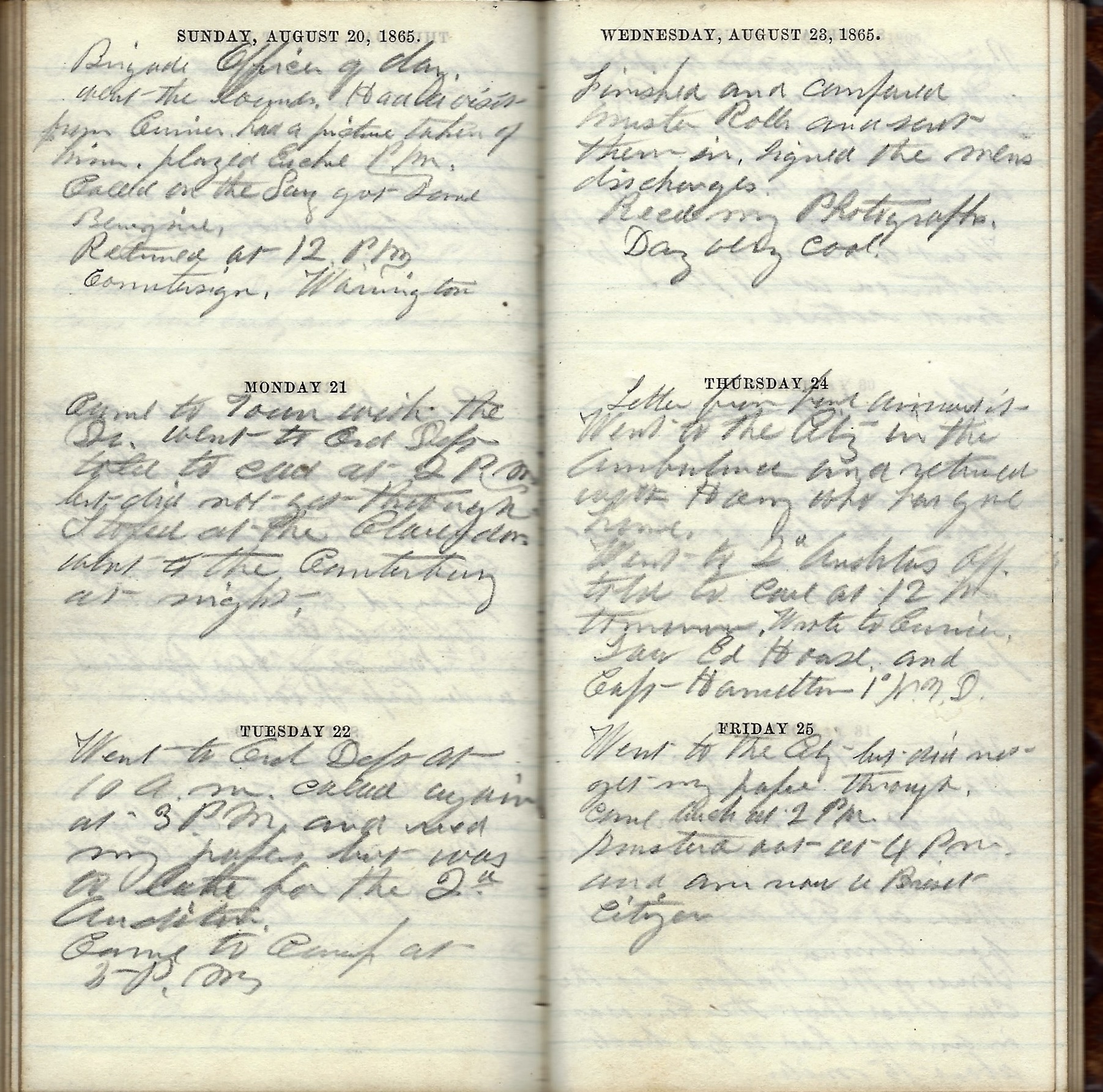
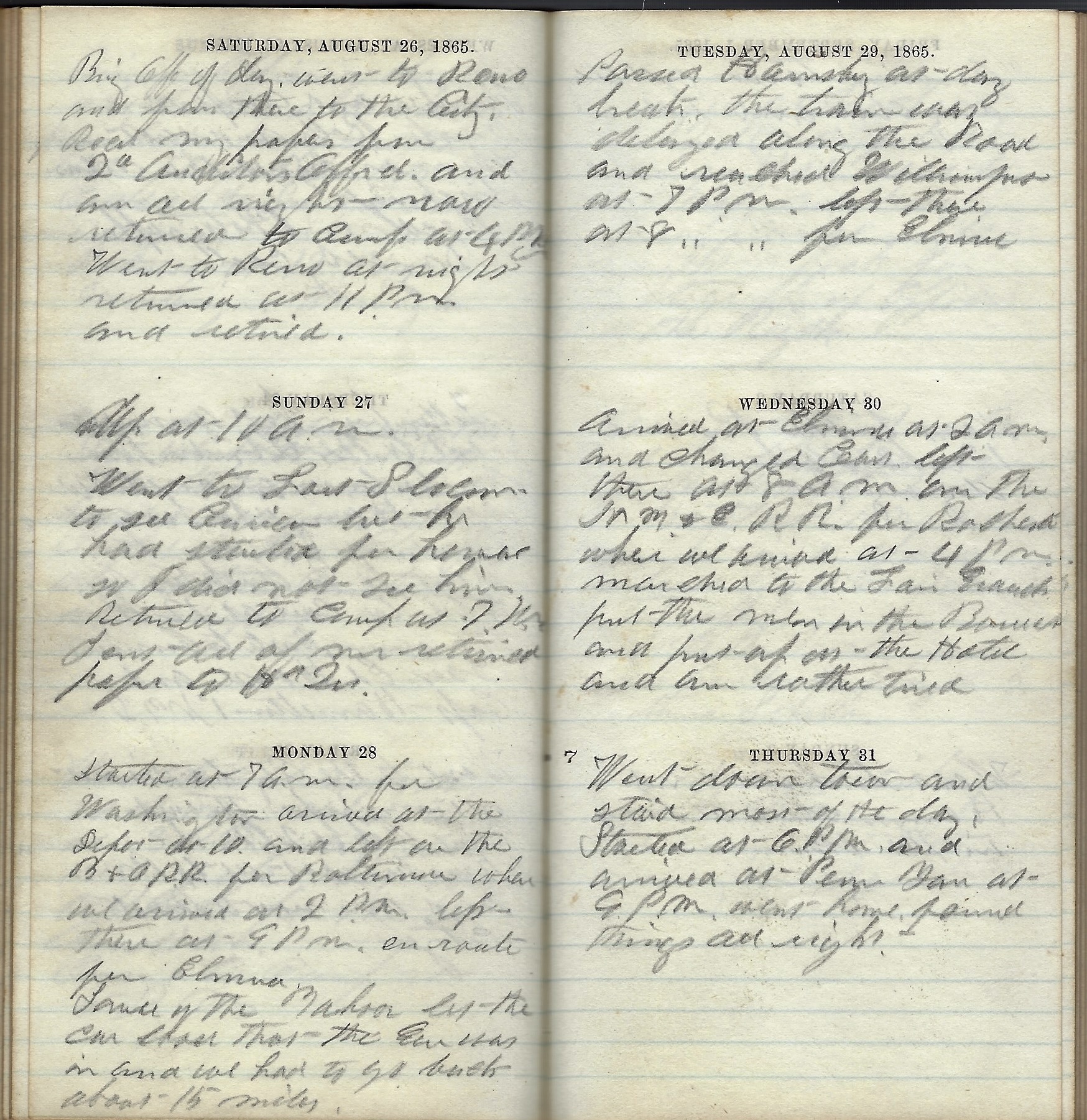
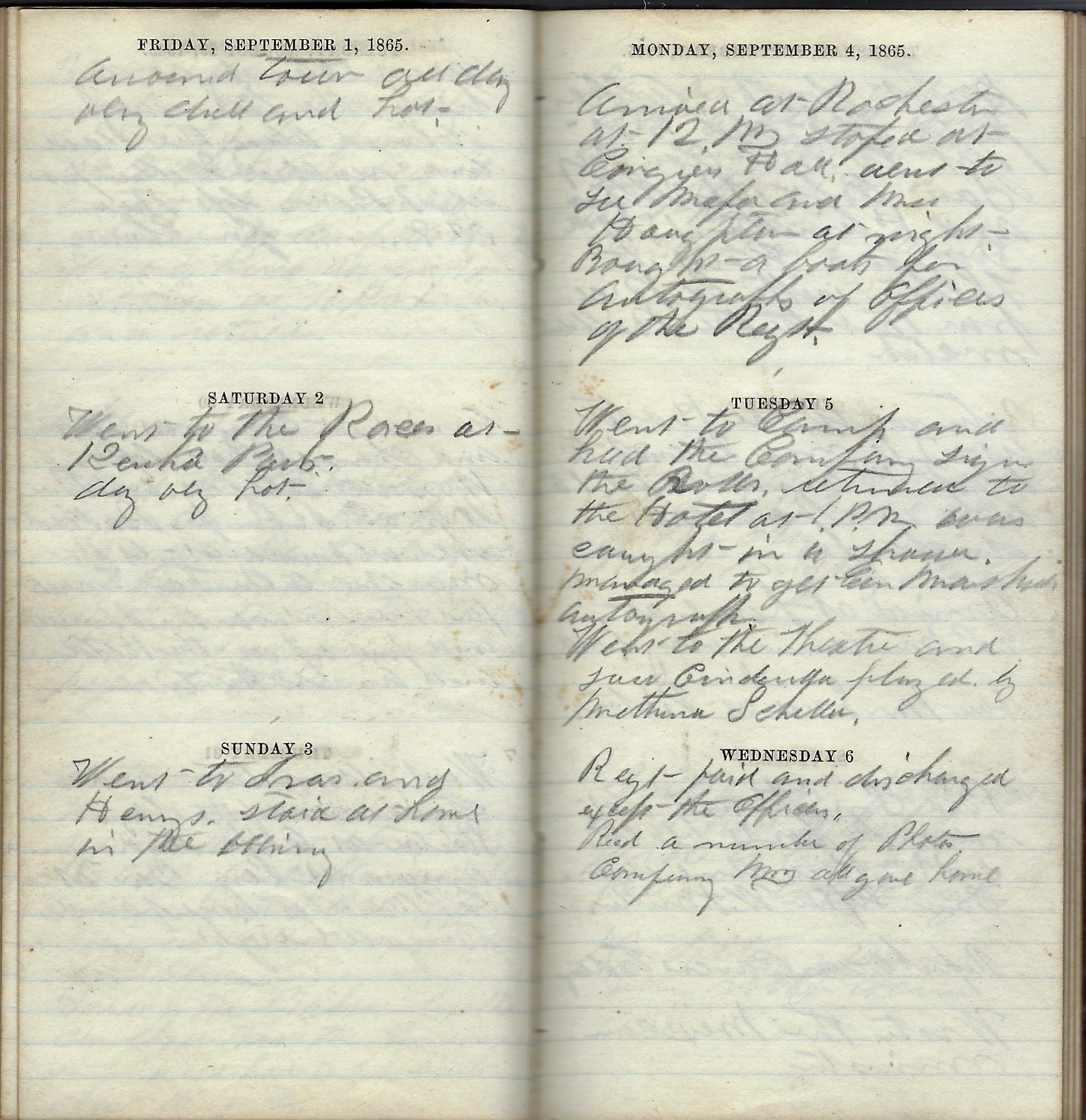
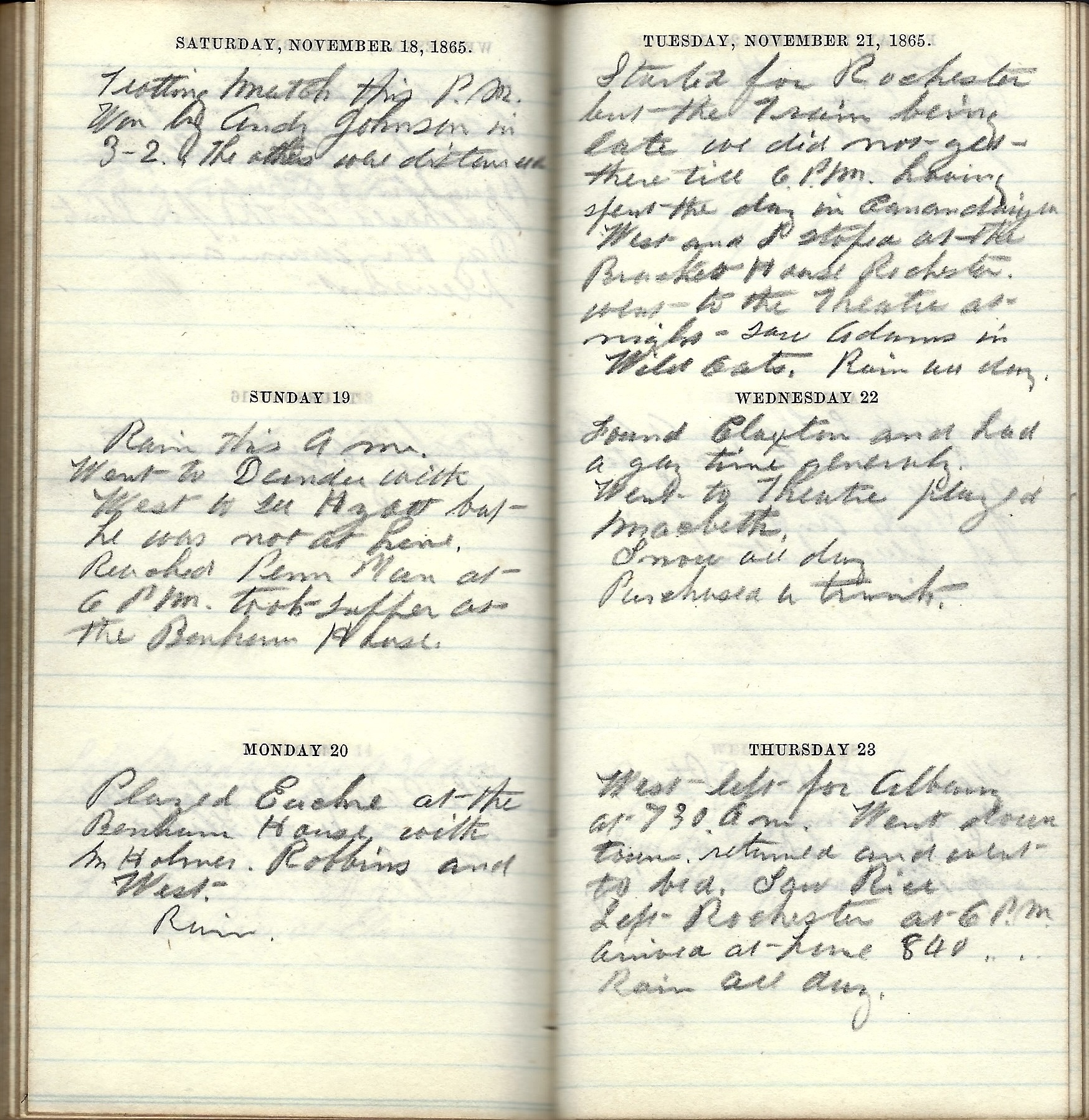
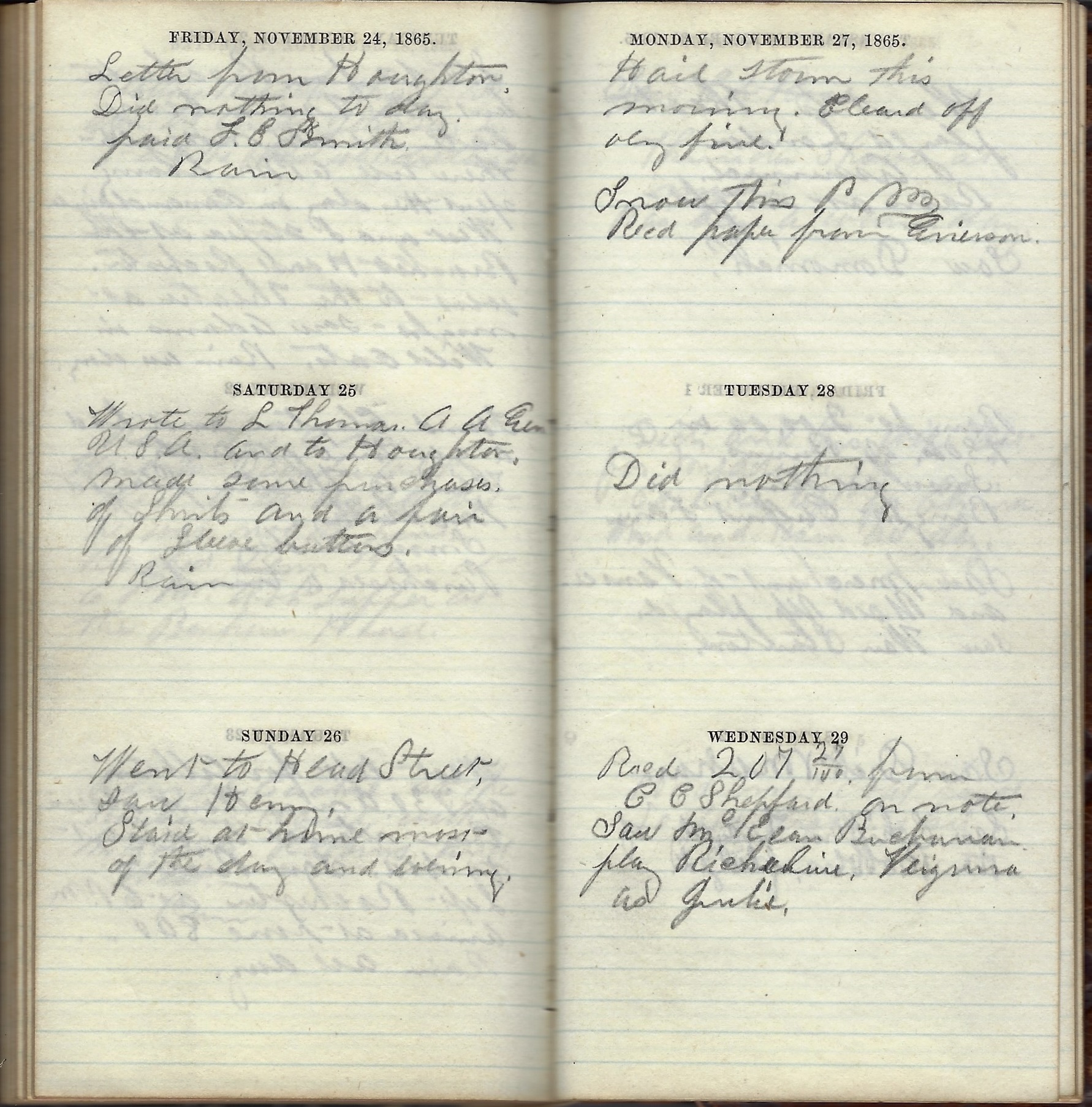
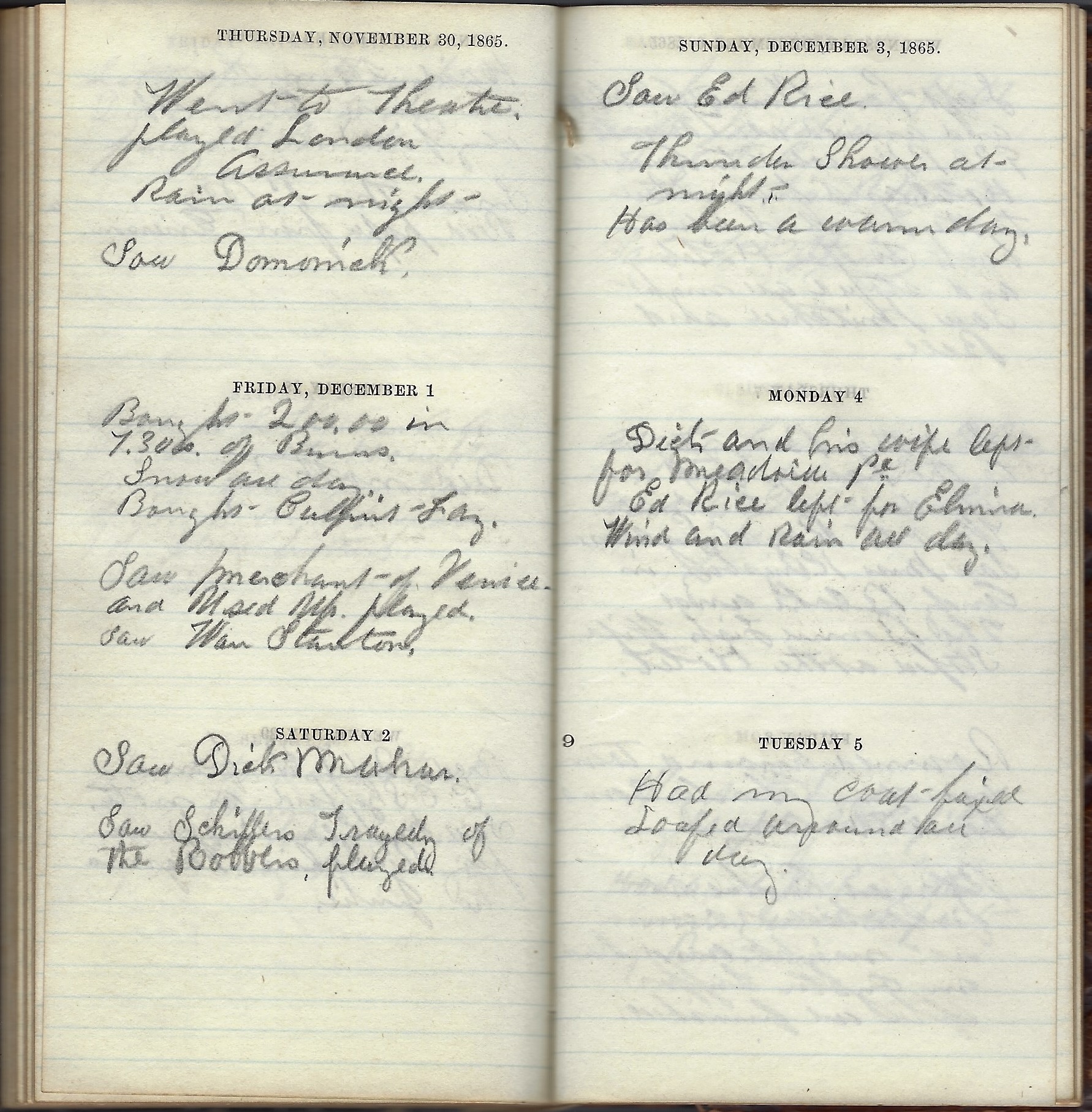
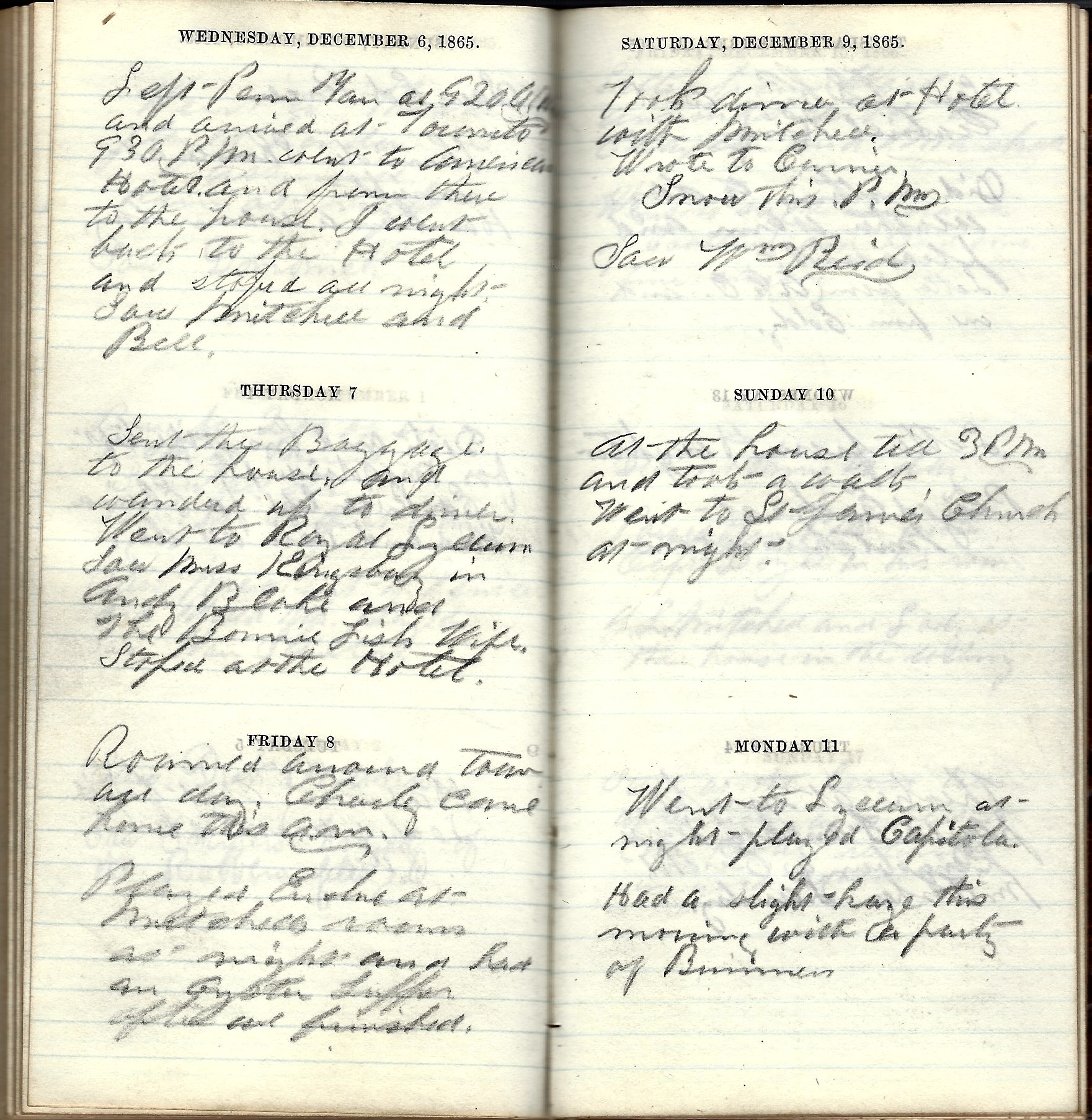
1865 Civil War Diary of George Brennan, 14th New York Heavy Artillery

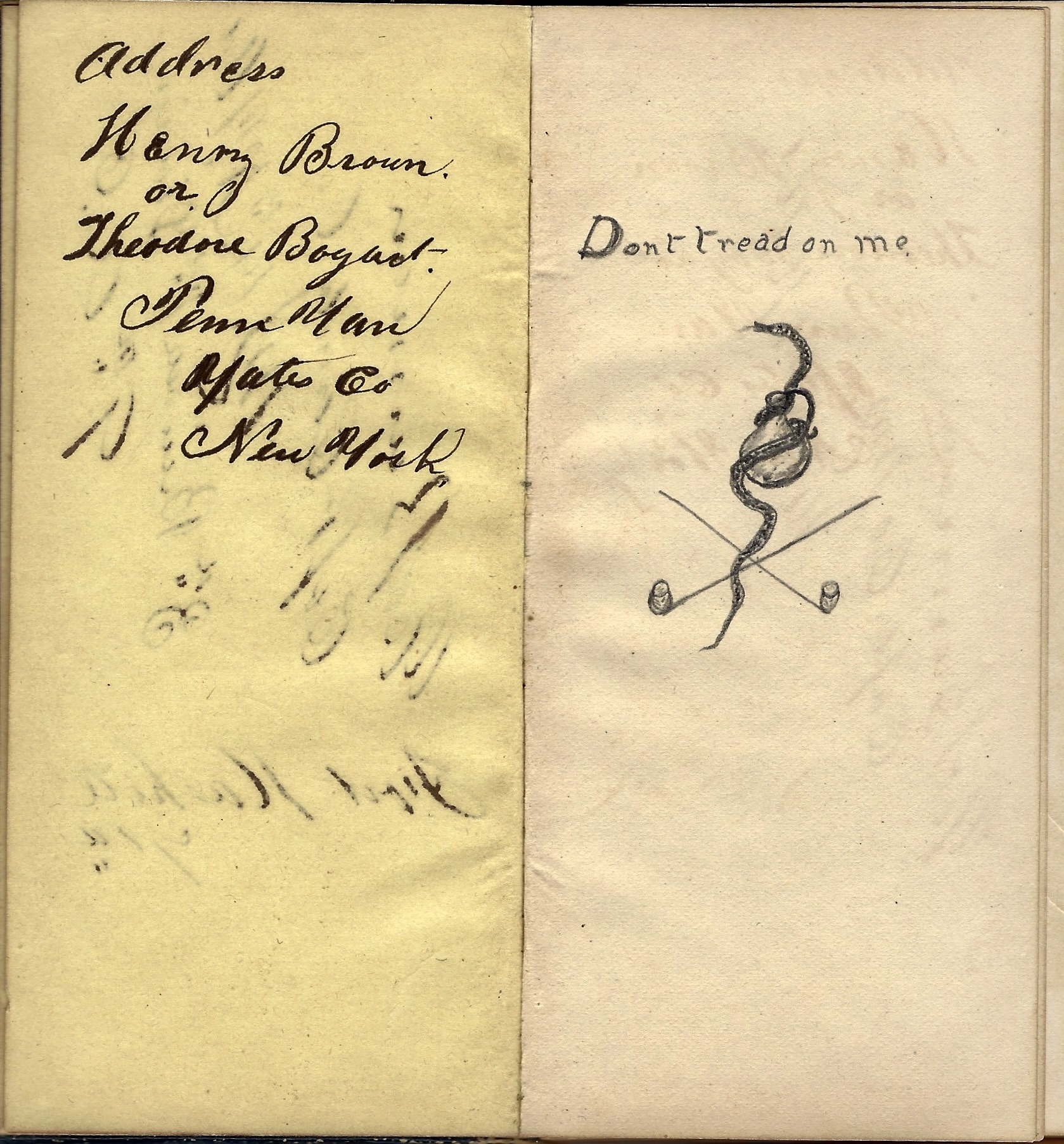
The following diary was kept by George Brennan (b. 1838), the son of Irish emigrant, Daniel P. Brennan (1804-1864) and Canadian-born Mariah Mills (1803-1890) of Milo, Yates county, New York. George’s older brother Charles (b. 1831) was a boatman and his older sister, Mary Ann (1836-1876) was married to Theodore Bogart (1828-1895) of Penn Yan, Yates county, in 1863. George’s father died of consumption on 1 October 1864.

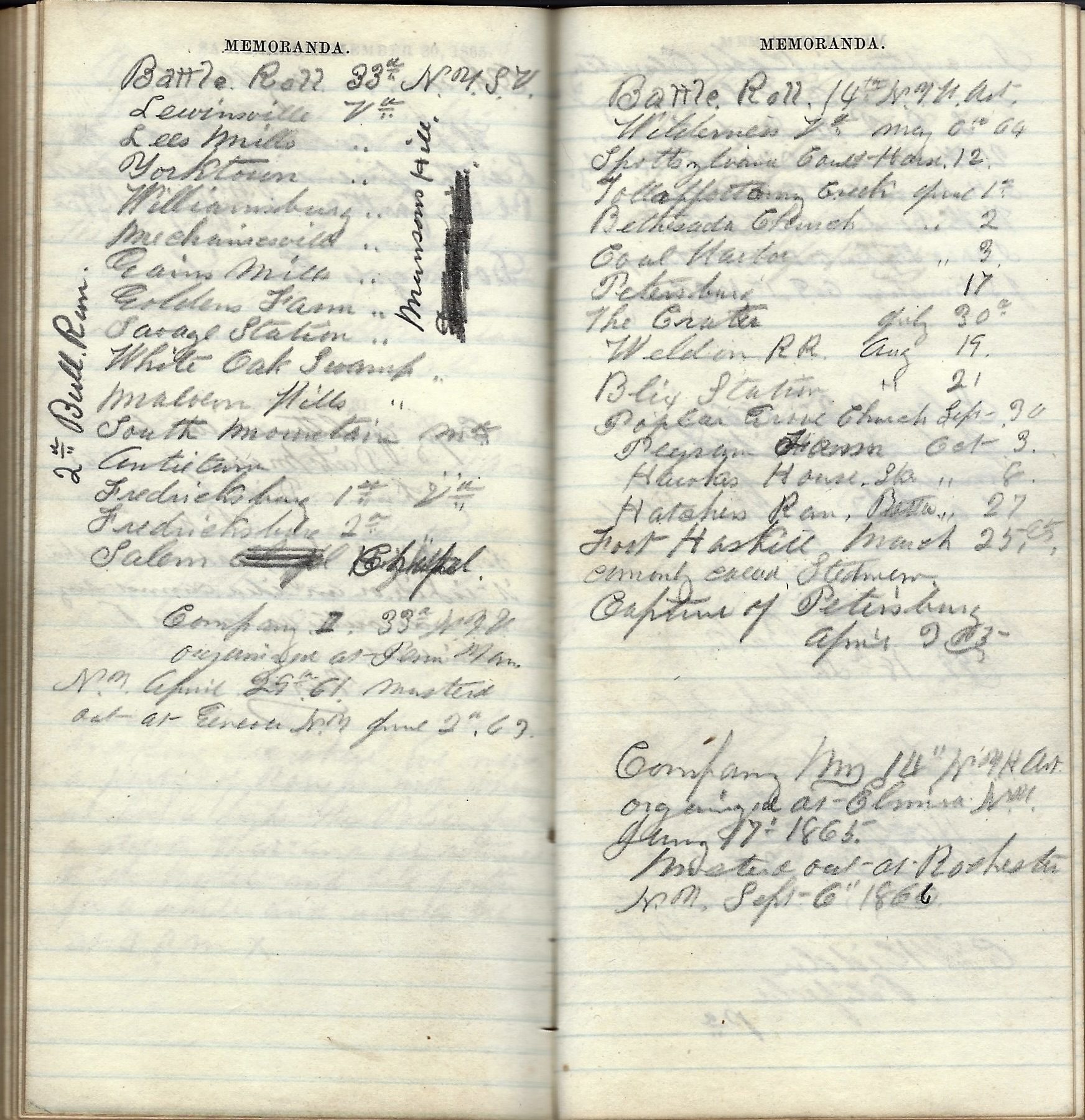
The 1860 Federal Census indicates that George Brennan was a 22-year-old painter residing in Milo, Yates, New York. Only a month after the Rebels fired on Fort Sumter, George joined other young men from Penn Yan as a private in Co. I, 33rd New York Infantry. Three months later he was promoted to sergeant and before the close of 1862 he was made the 1st Sergeant of his company only to be commissioned a 1st Lieutenant a couple months later. He mustered out of the 33rd New York Infantry on 2 June 1863 after two years’ service. In the back of his 1865 Diary, George enumerated the various battles he had participated in while in the 33rd New York Infantry. These included, “Lewinsville, Lees Mills, Yorktown, Williamsburg, Mechanicsville, Gaine’s Mills, Golden’s Farm, Savage Stations, White Oak Swamp, Malvern Hill, South Mountain, Antietam, Fredericksburg, Fredericksburg 2nd [Chancellorsville], Salem Chapel, and 2nd Bull Run.”

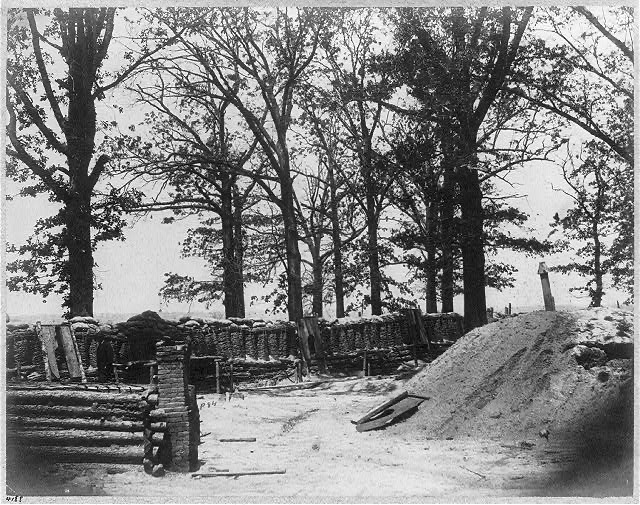
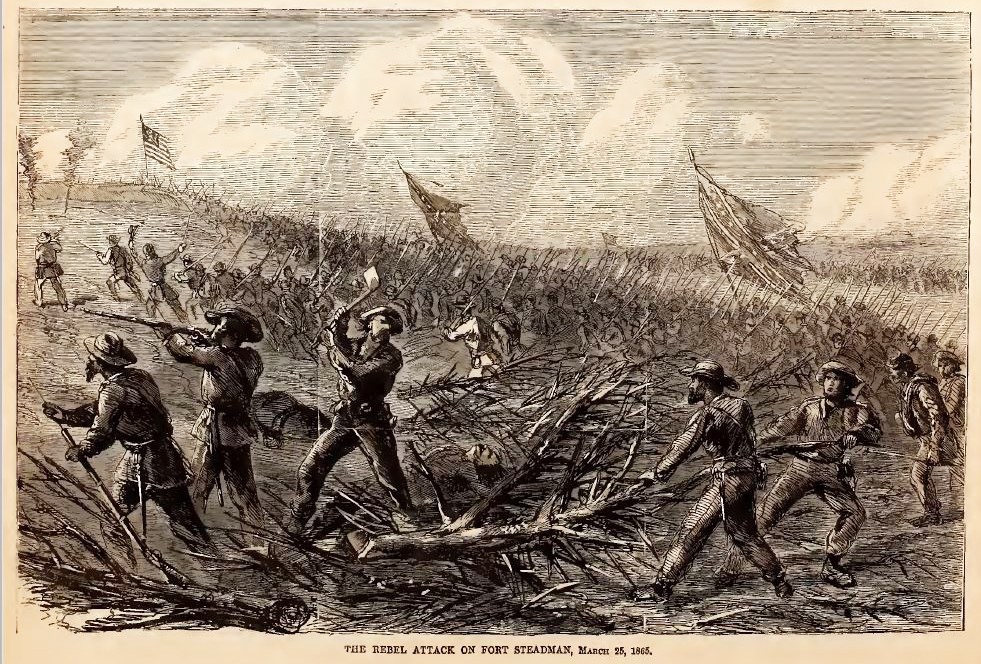
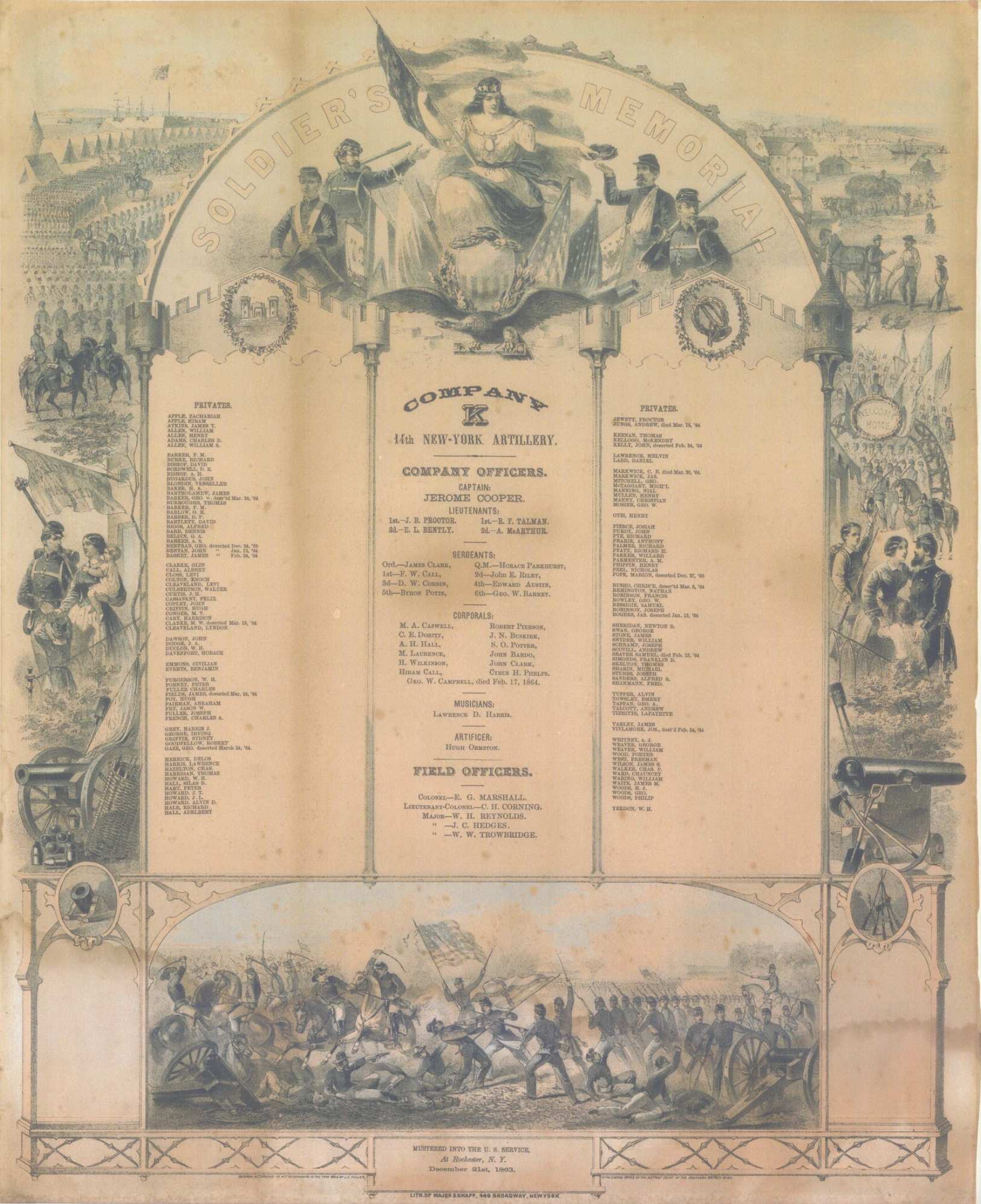
After a few months at home, George offered his services again as a 1st Lieutenant, and was commissioned into Co. M, New York 14th Heavy Artillery. One year later, on 5 December 1864 he was promoted to Captain. He was mustered out of the service on 26 August 1865 at Washington, D.C. The 14th NY Heavy Artillery was heavily engaged during Grant’s Overland Campaign, and the Appomattox Campaign. The regiment participated in Battle of the Wilderness, Cold Harbor, the Siege of Petersburg, Boydton Plank Road, and Fort Stedman, among other engagements.

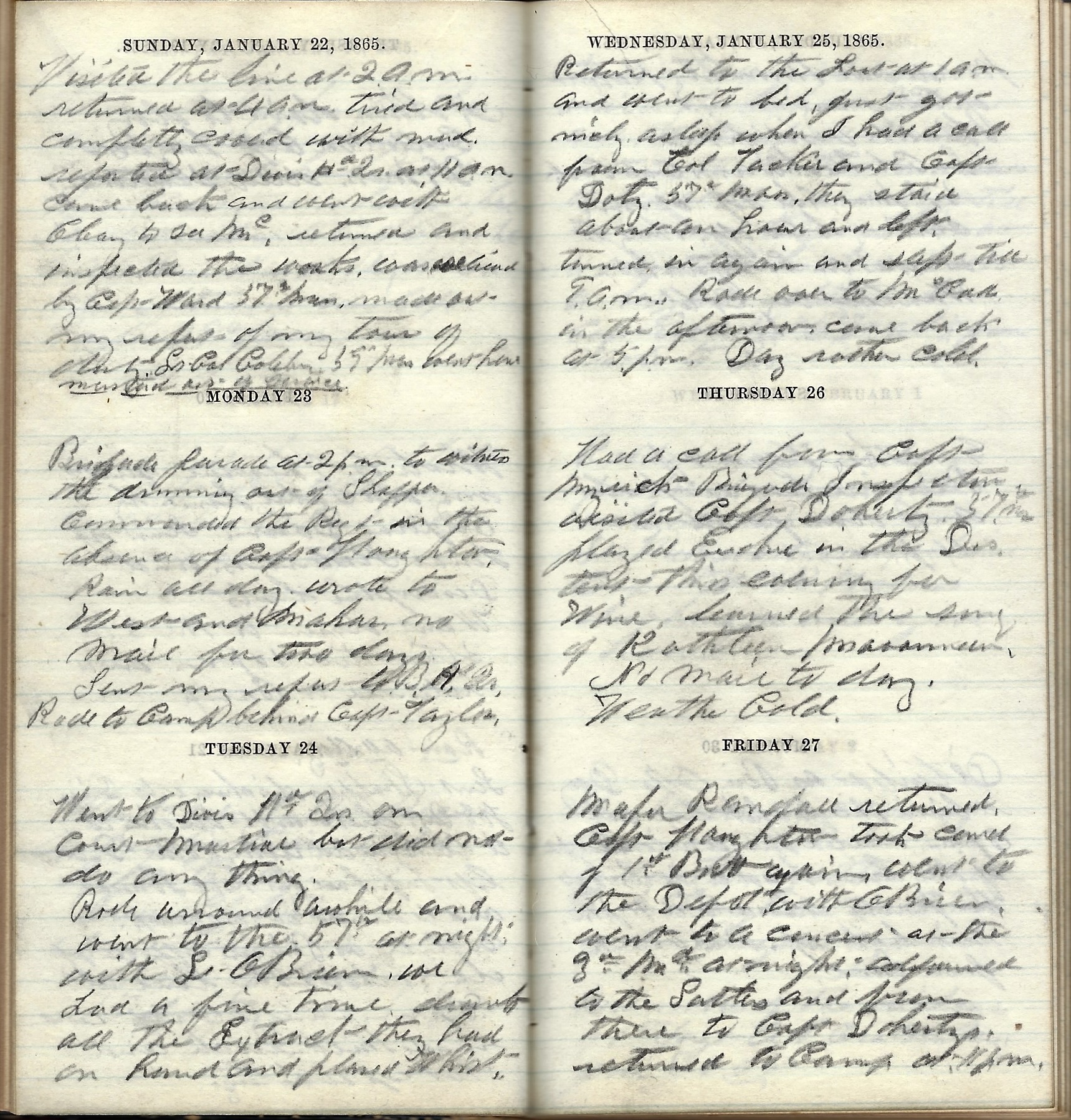
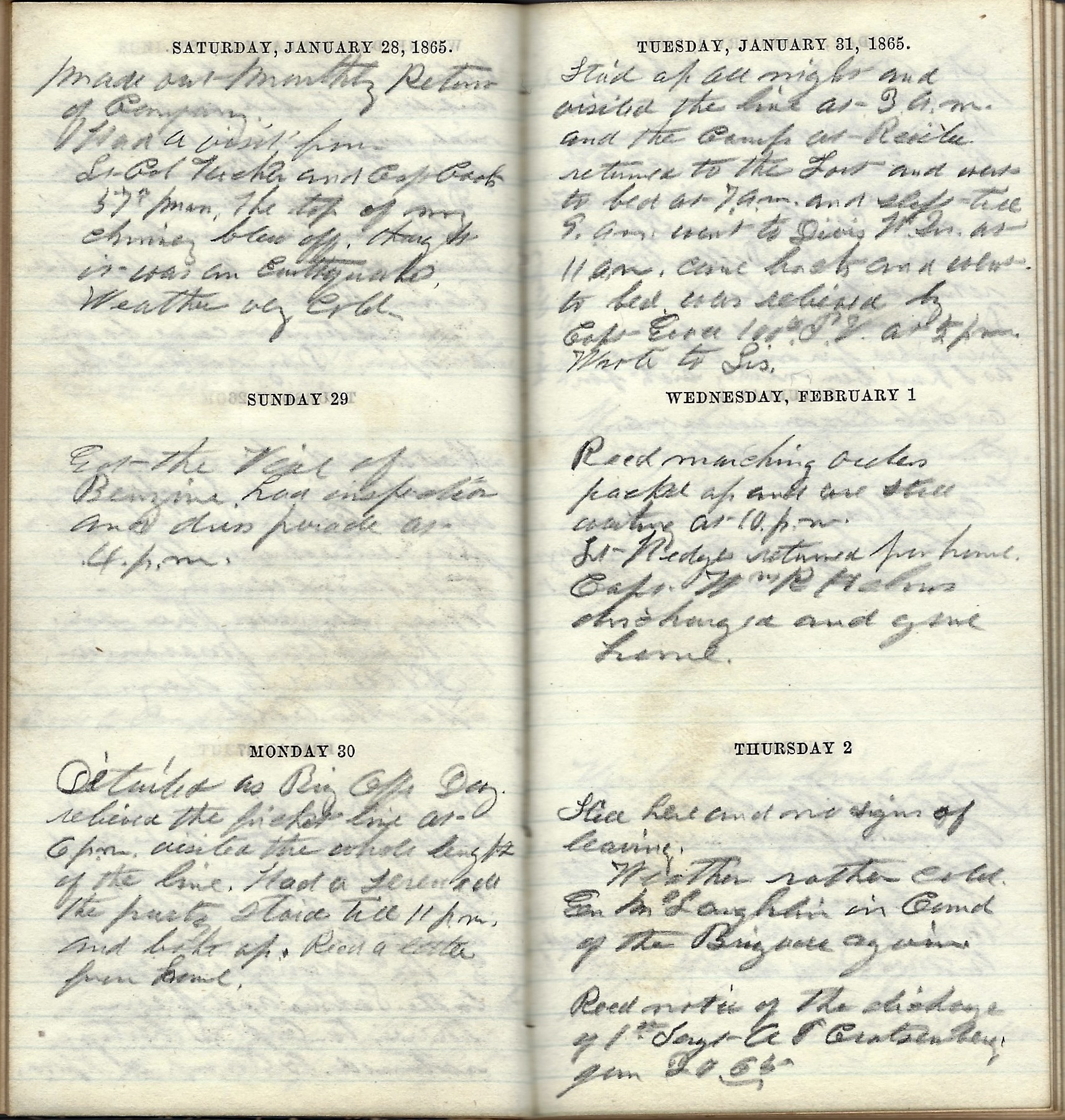
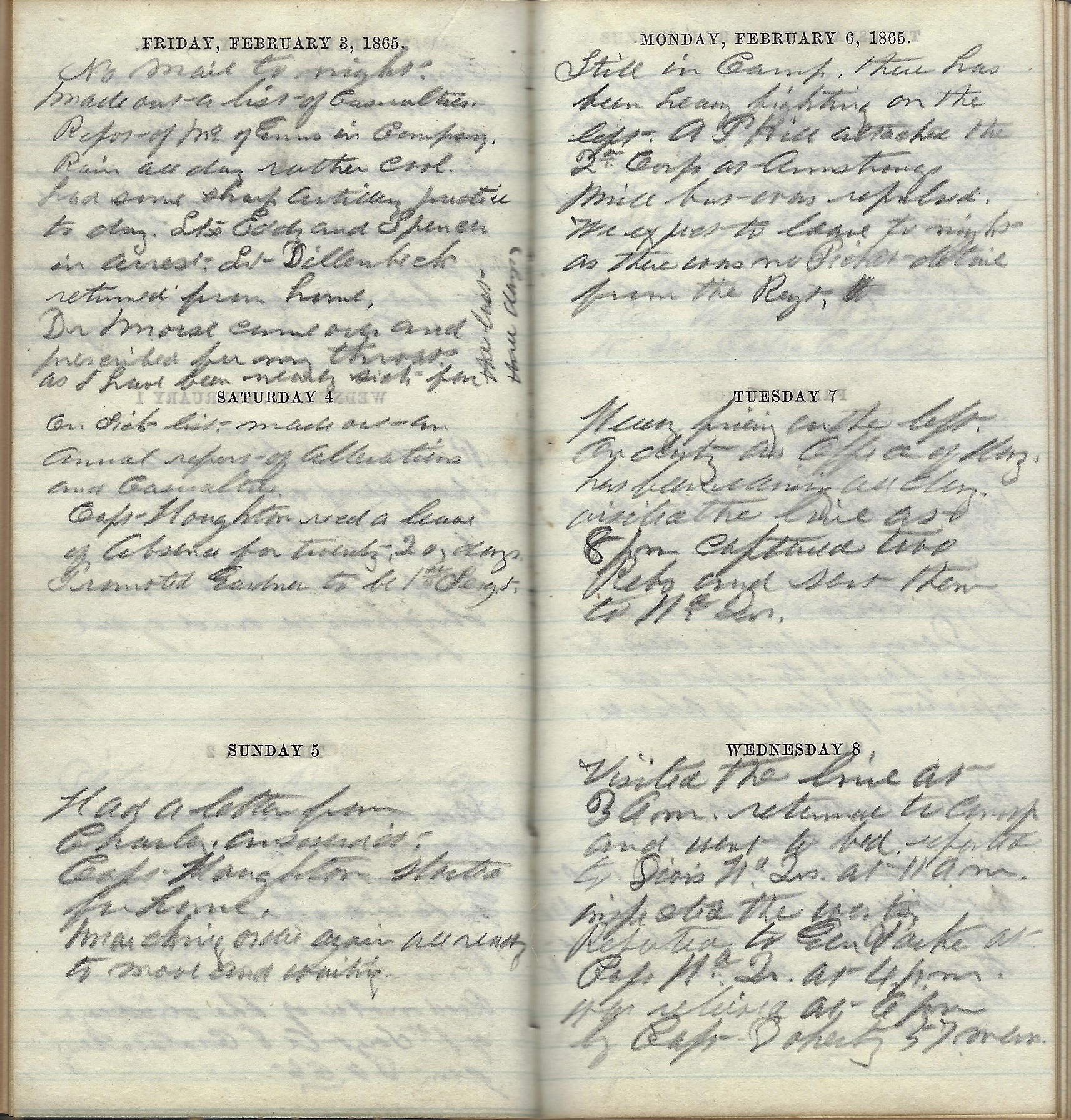
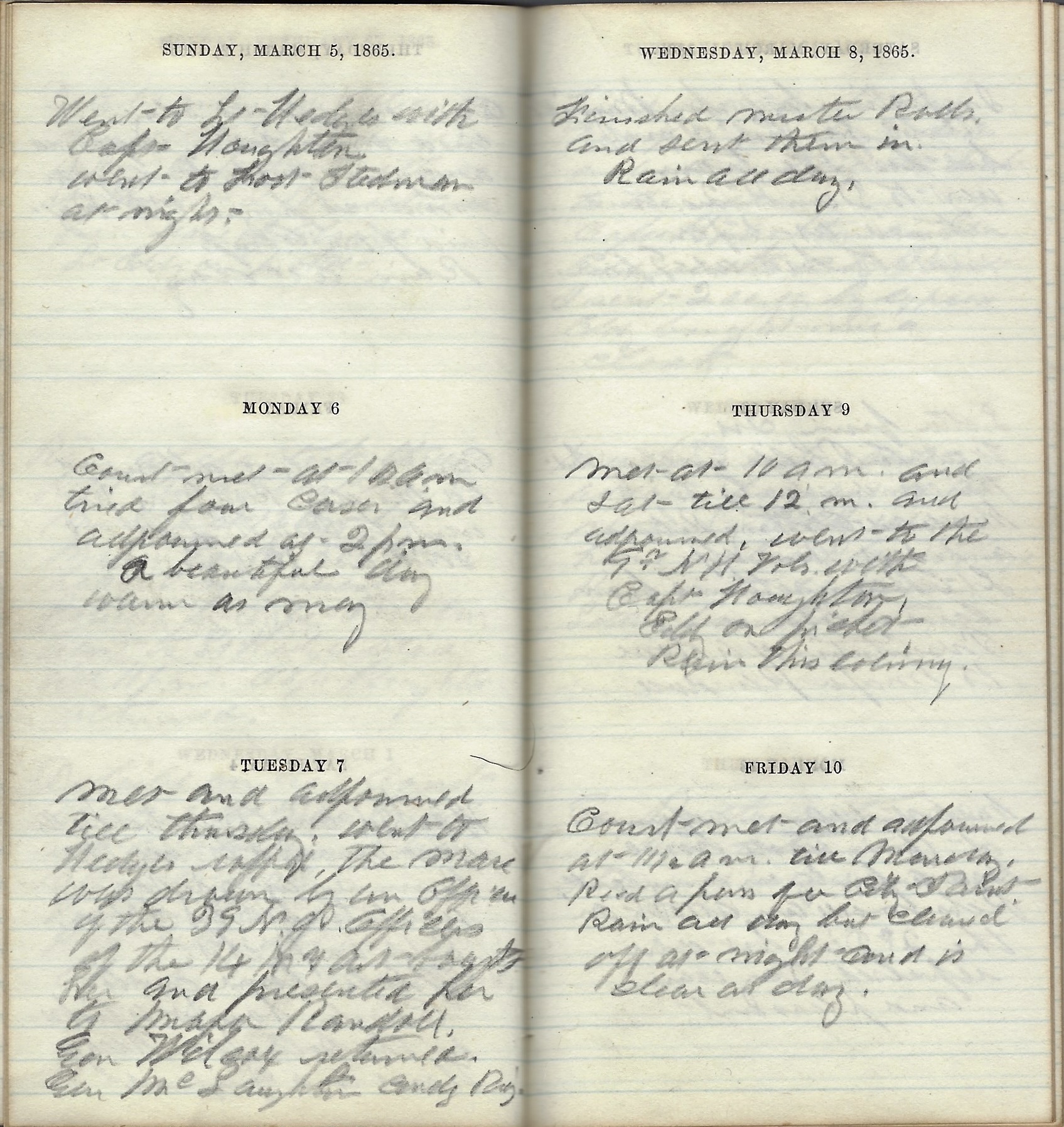
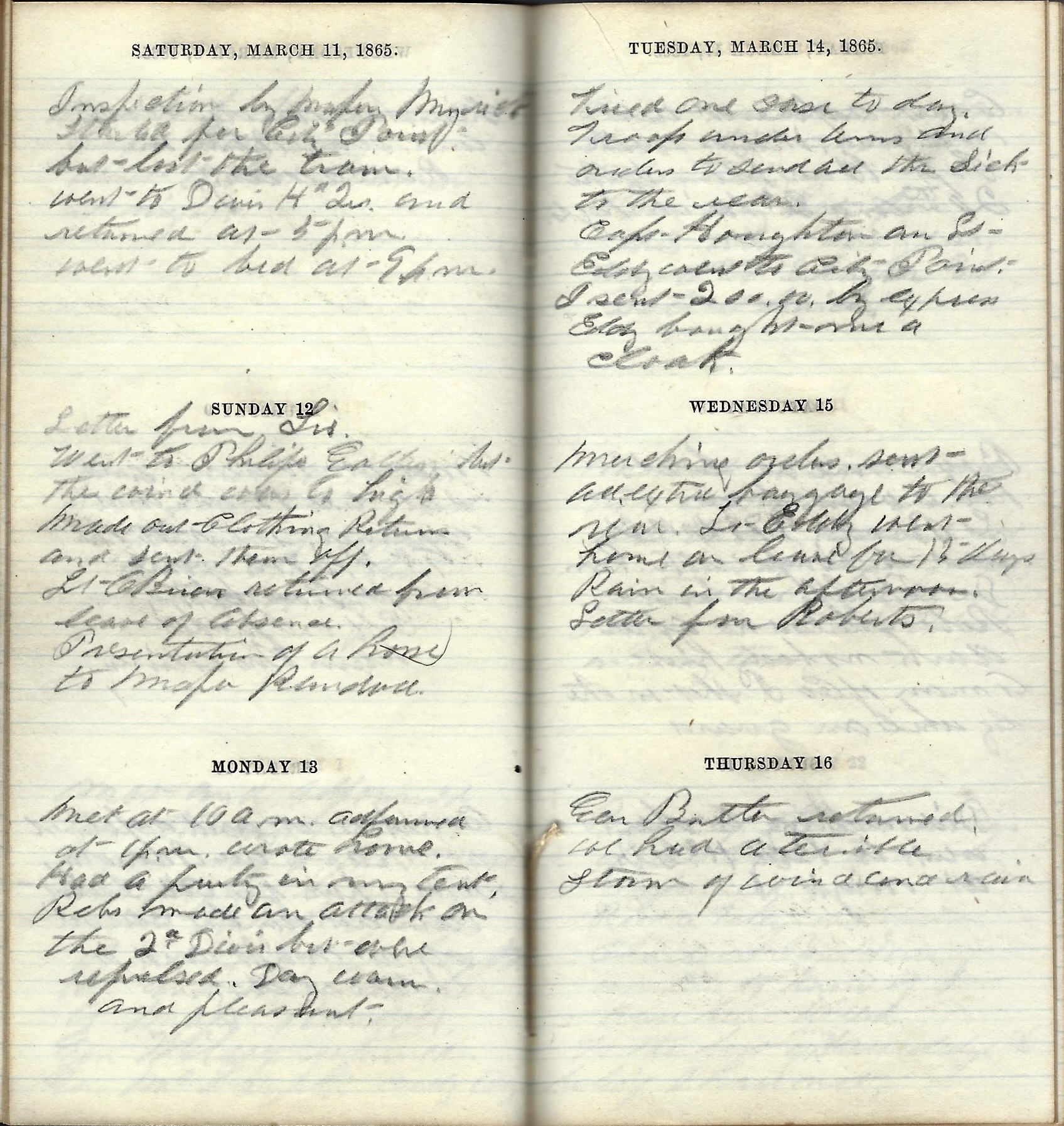
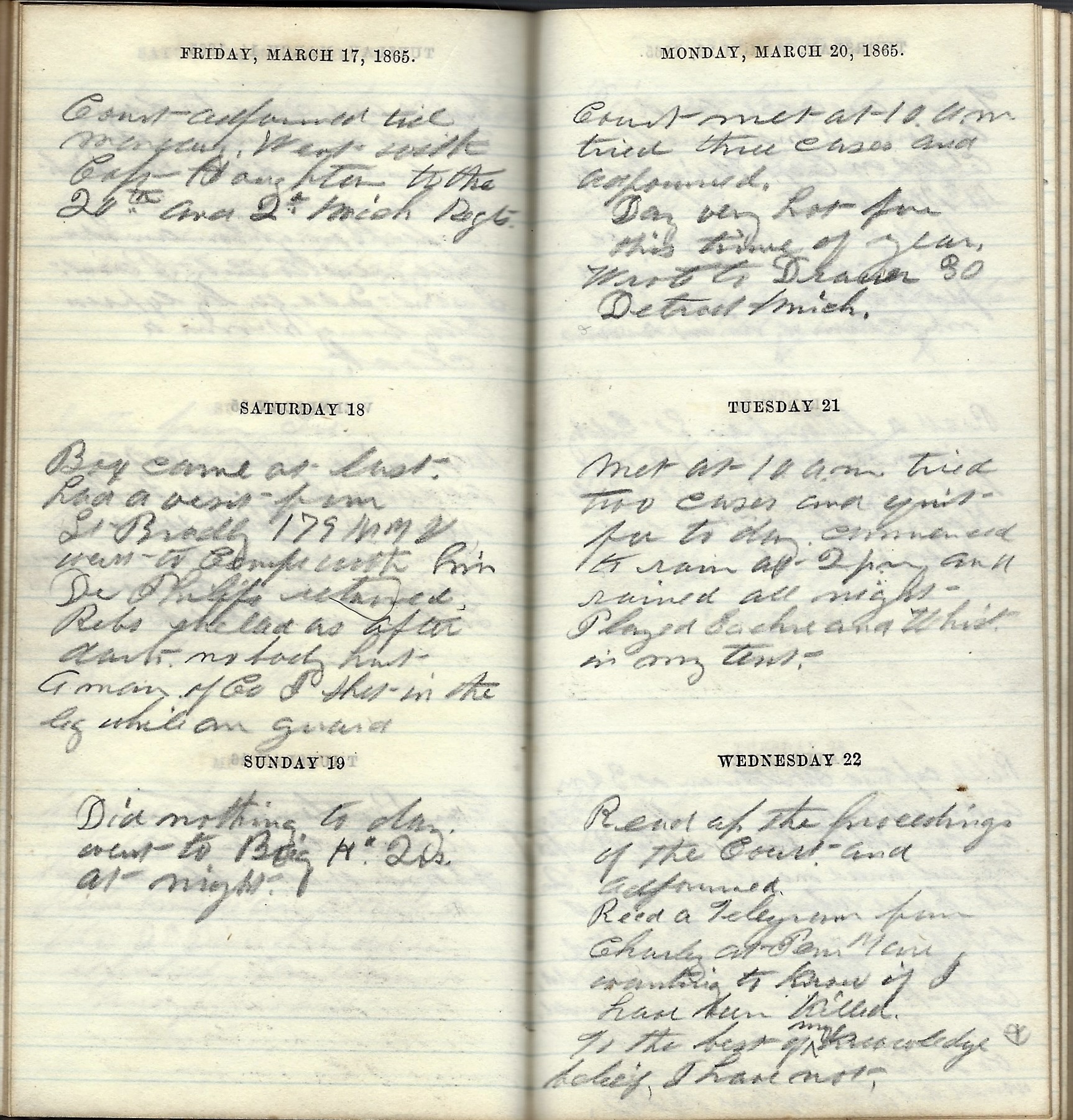
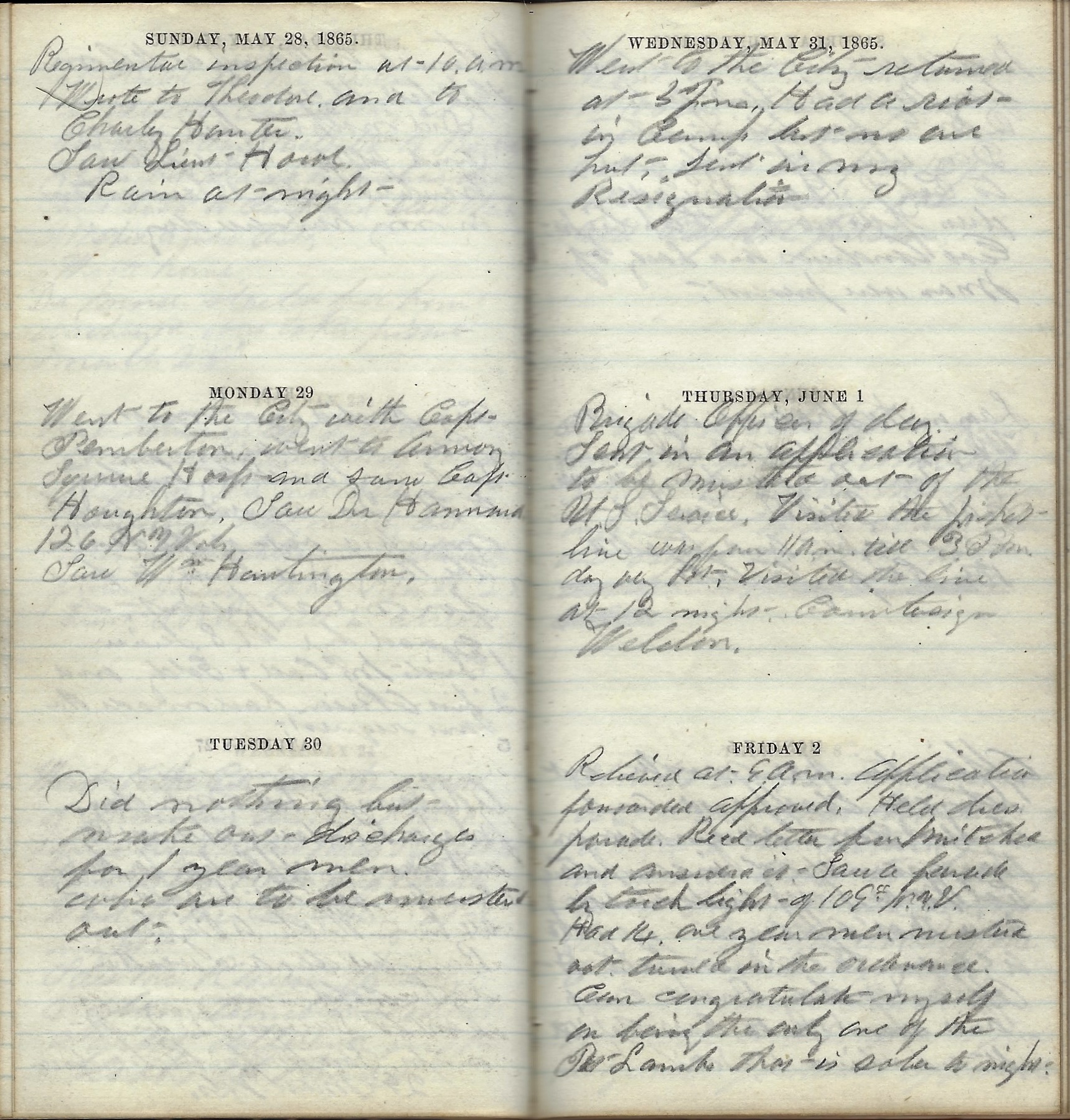
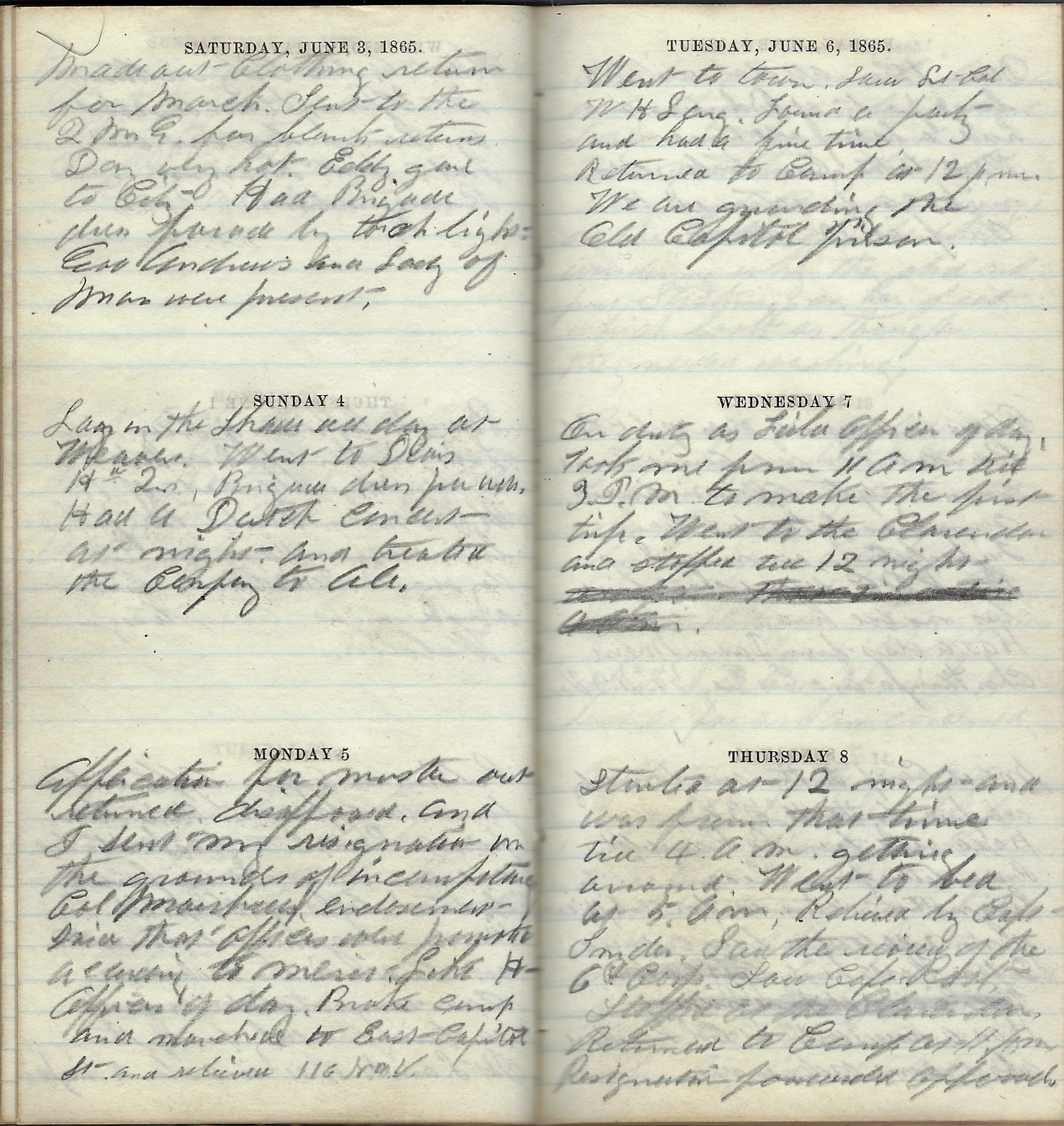
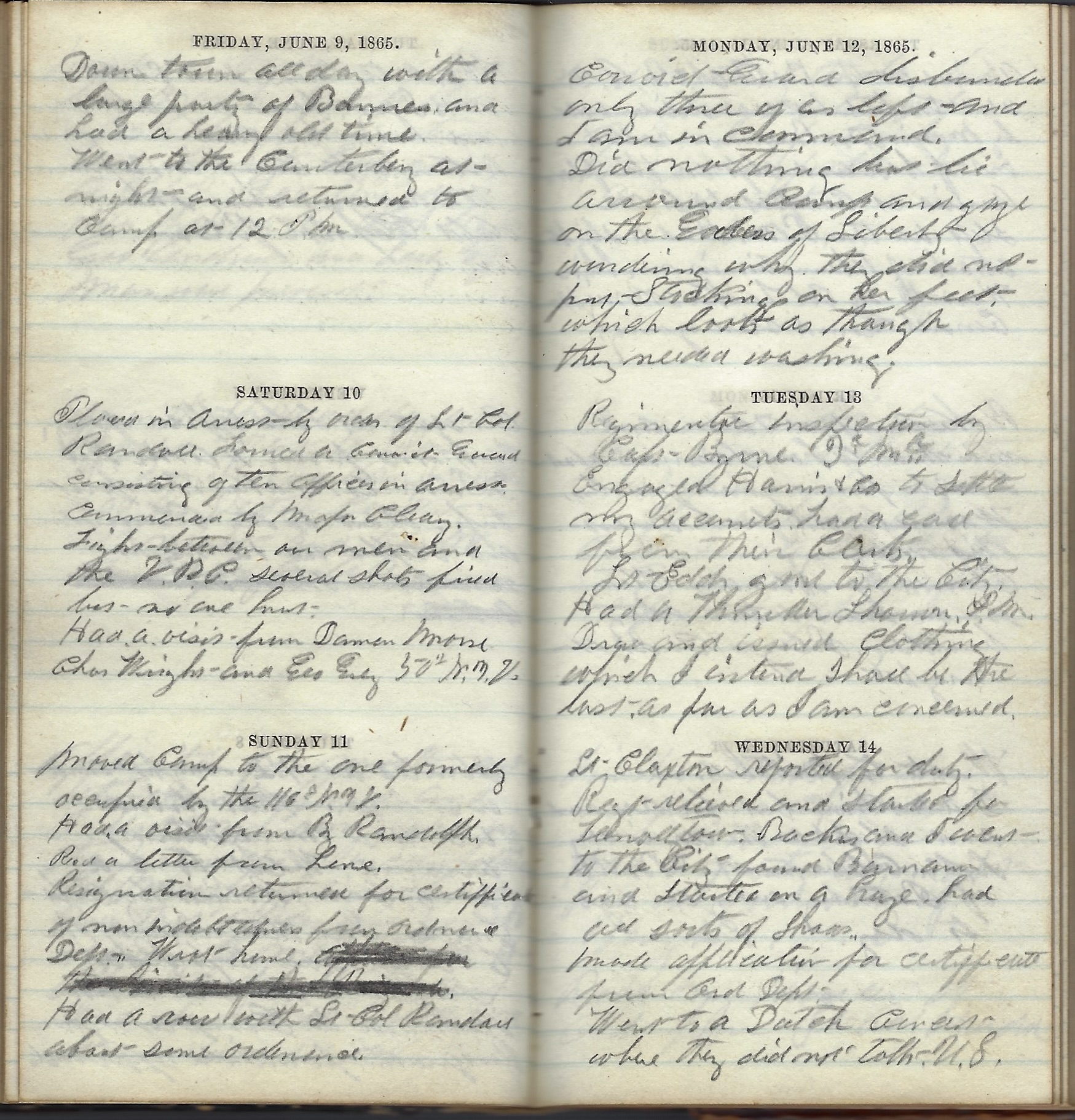
After initially garrisoning New York Harbor, like other Heavy Artillery regiments, the 14th New York “Heavies” were ordered to join the Army of the Potomac to participate in Grant’s Overland Campaign as infantrymen. The diary has been transcribed through mid-October, some six weeks after he was discharged from the service after which he visited his brother Charley in Toronto and then returned to Yates county, New York. I did not transcribe the last couple of months though there are scans of those diary pages posted which describe visits to friends, theater performances attended, &c. The last notice of him I can find in census records was in 1865, residing in his brother-in-law’s home in Milo with his Mother and sister. He was employed once again as a painter. It’s suspected that his abuse of alcohol as the war drew to a close may have caused a premature and tragic ending to his life.

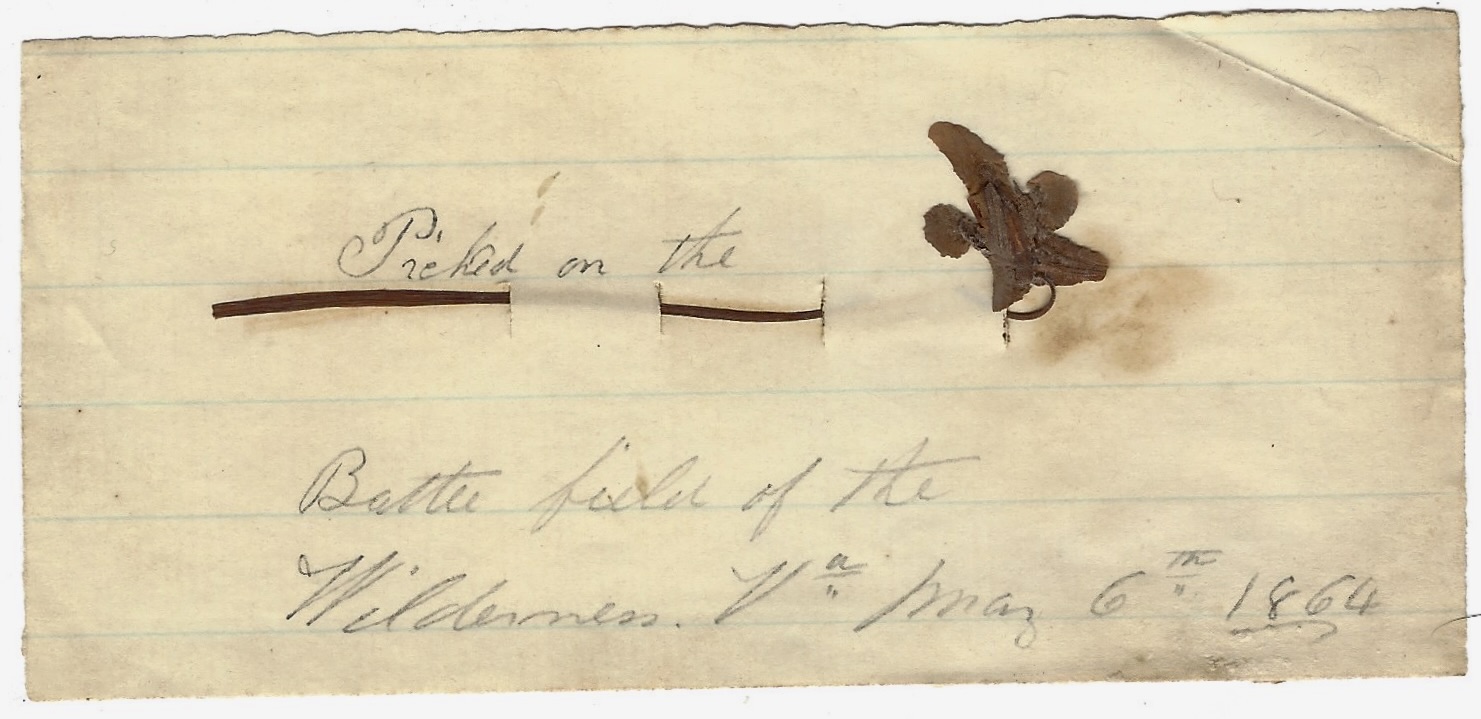
Inserted into the back pocket of the diary was this slip of paper with a wildflower picked on the Battlefield of the Wilderness on May 6th 1864.

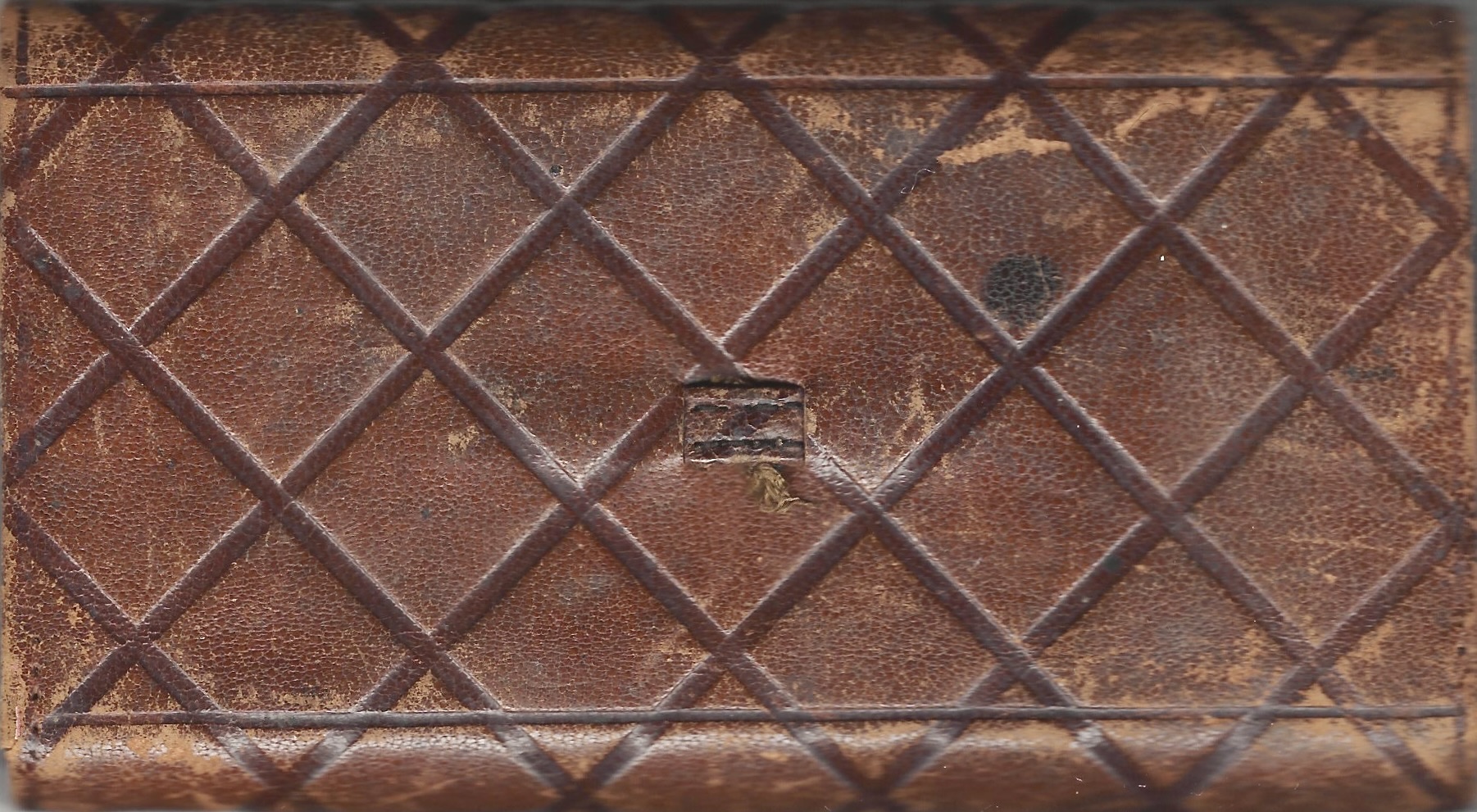
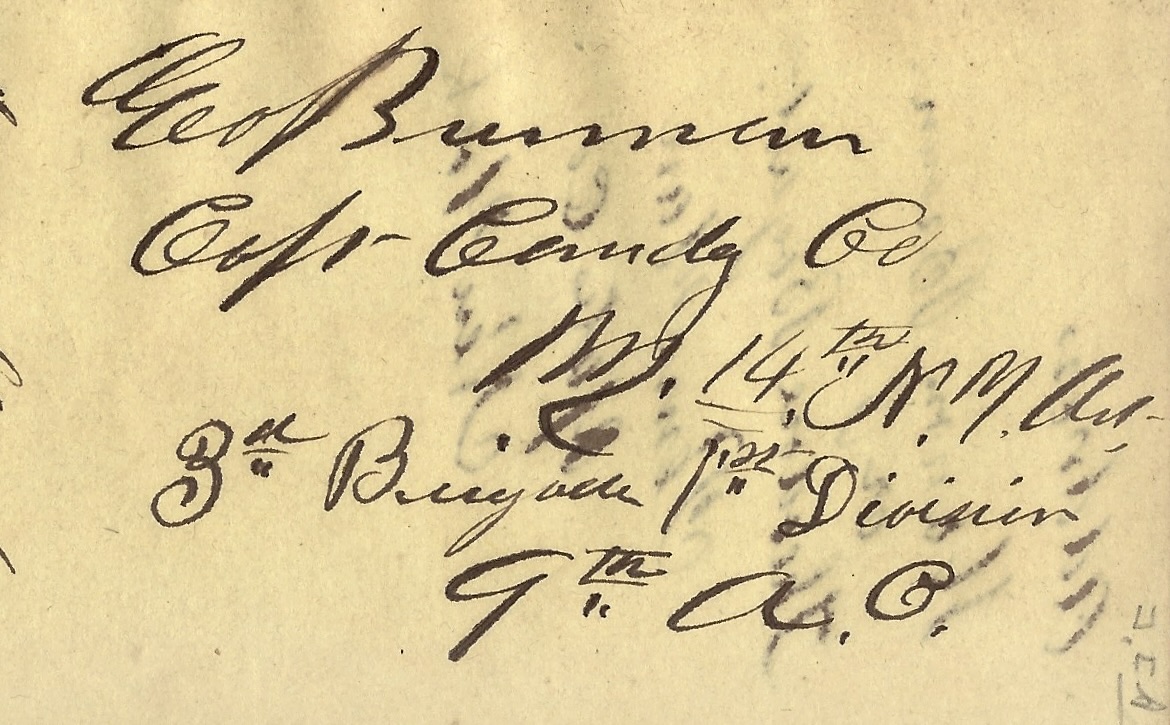
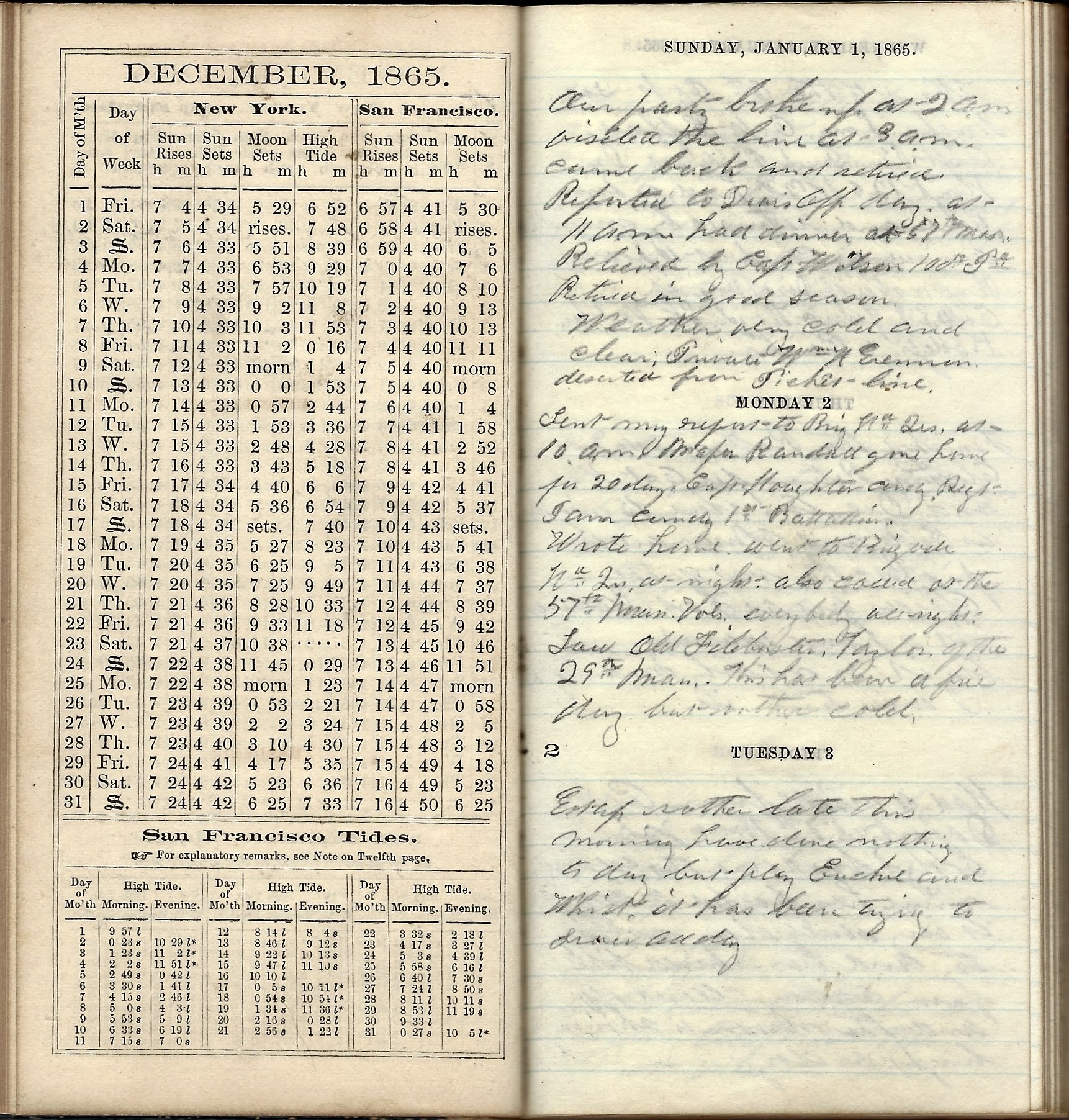
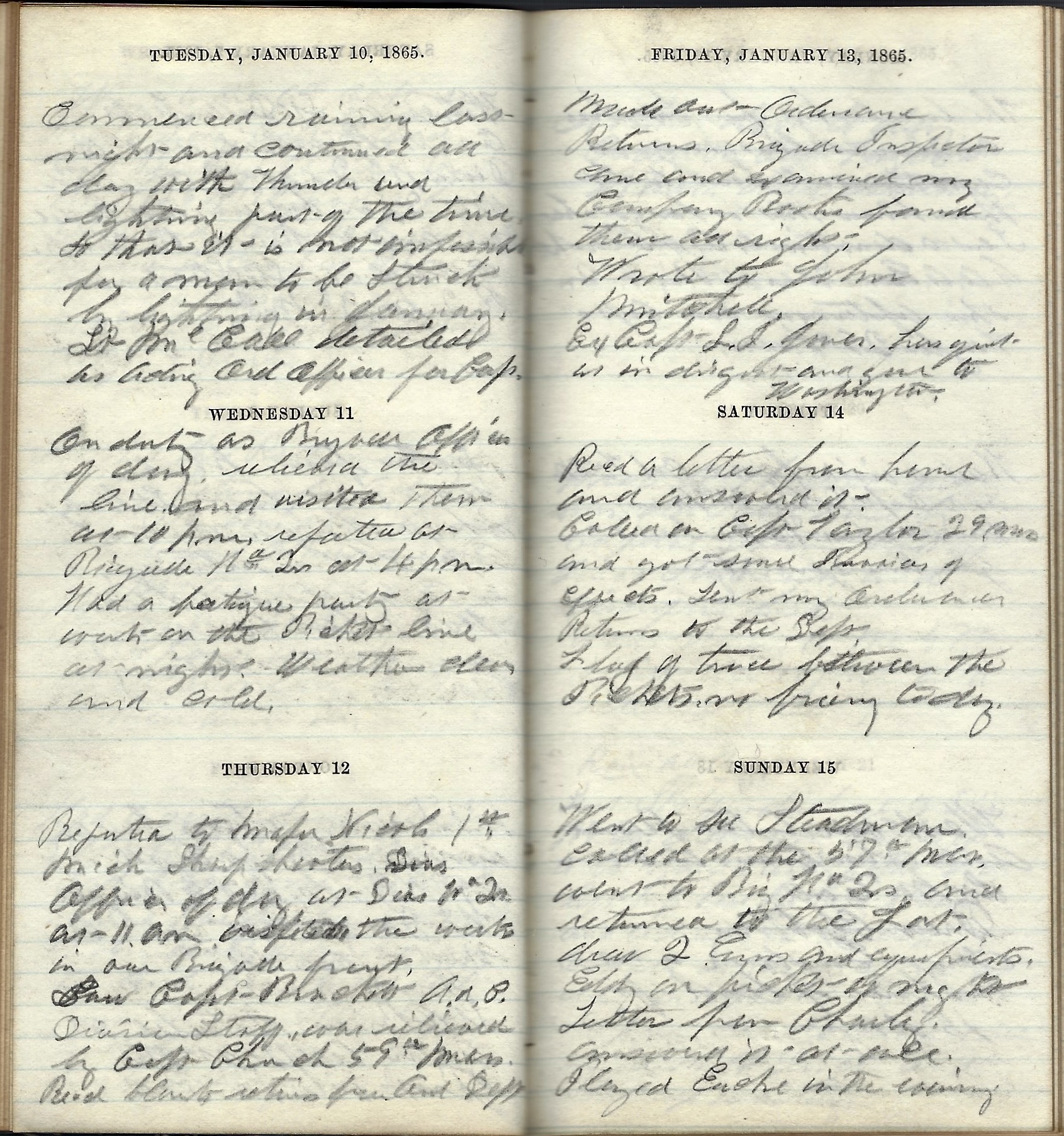
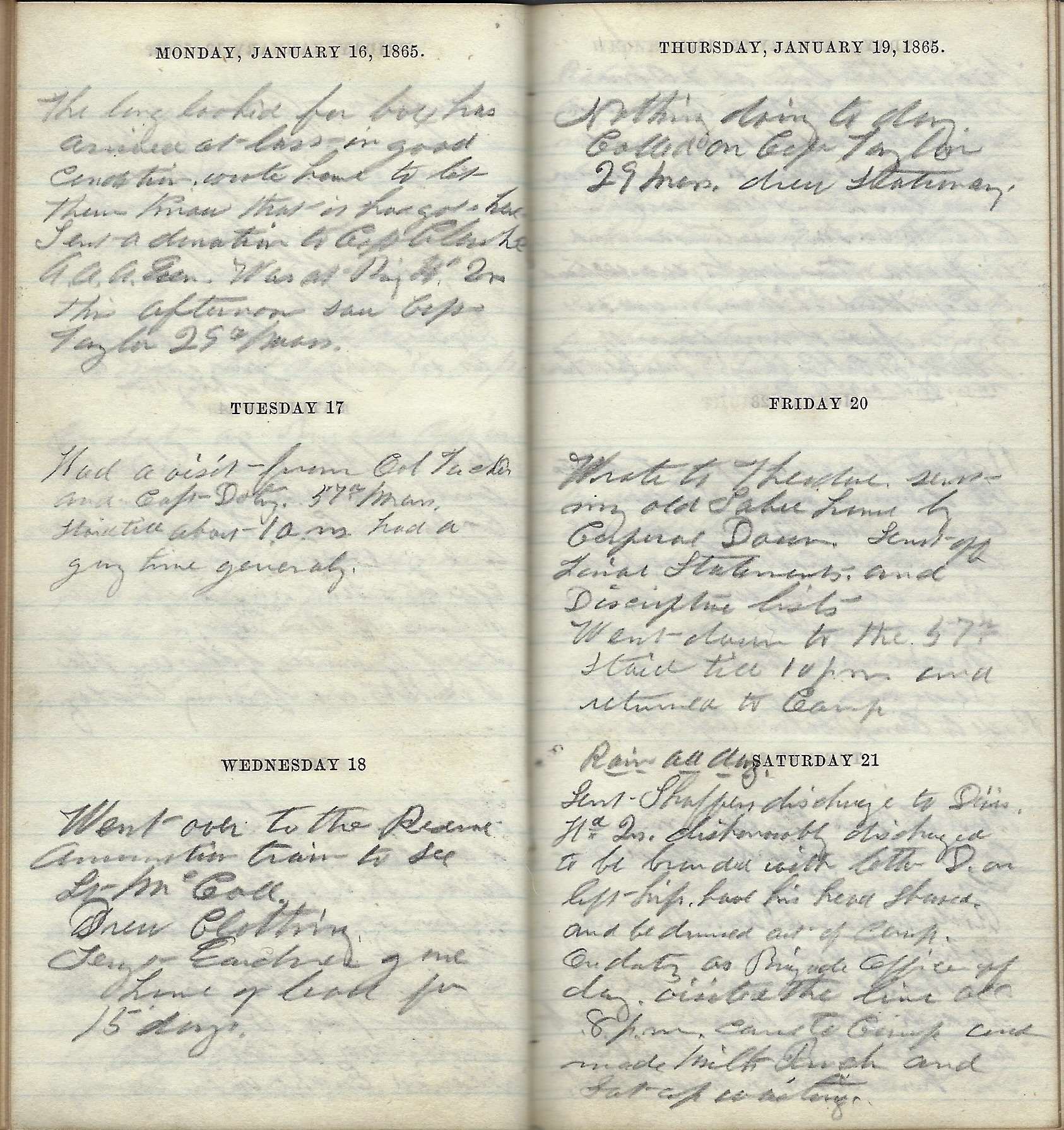
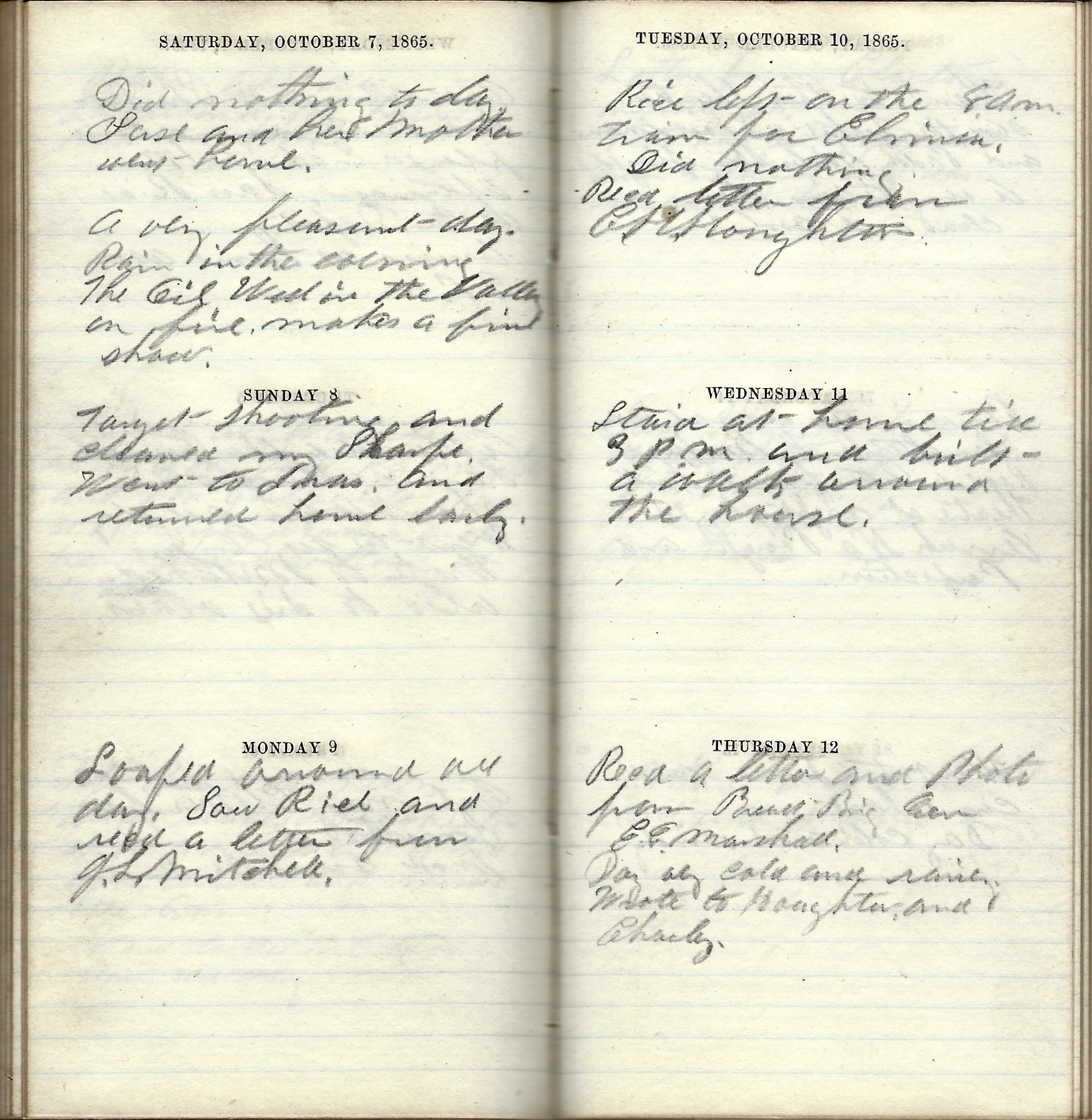
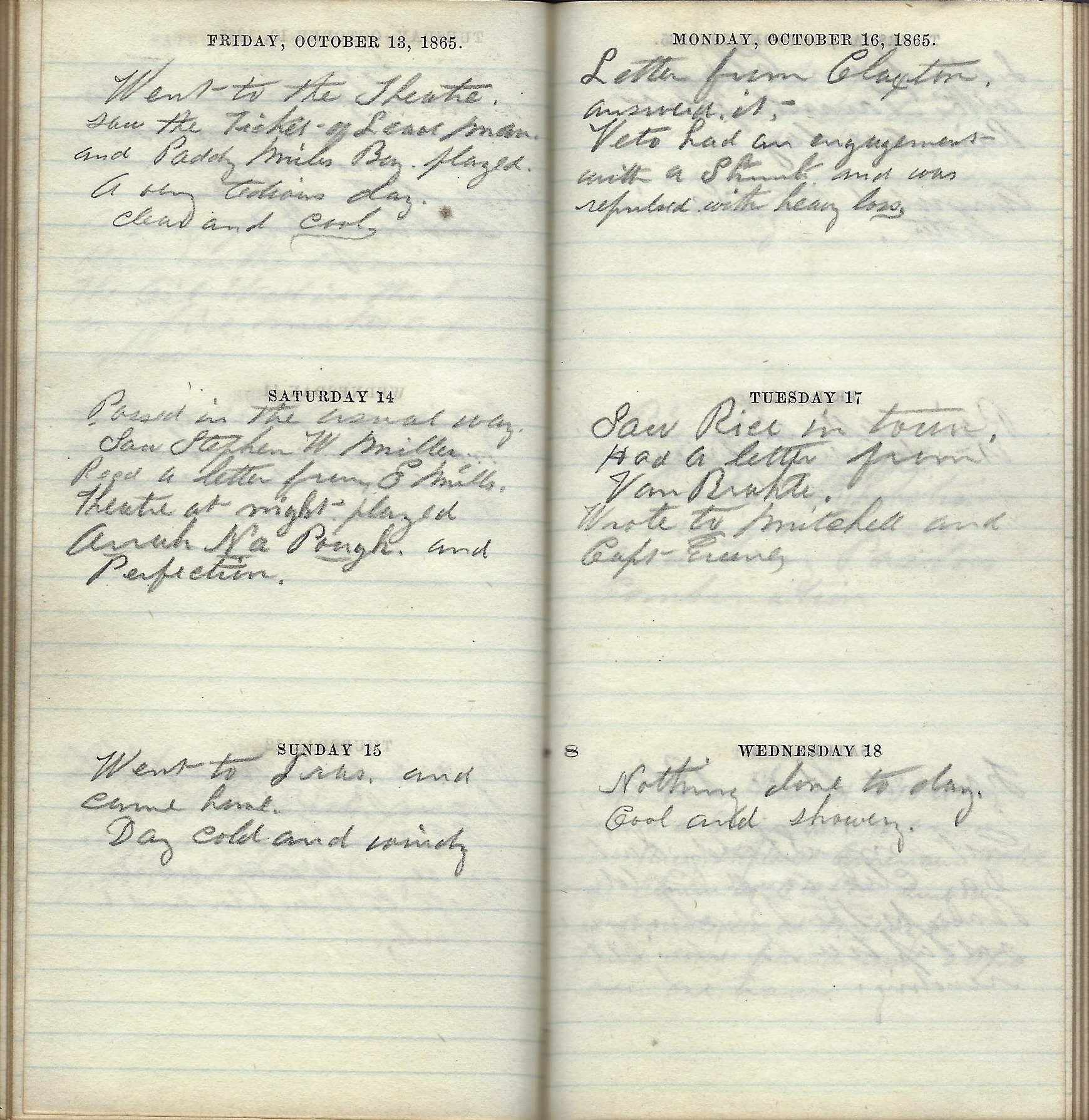
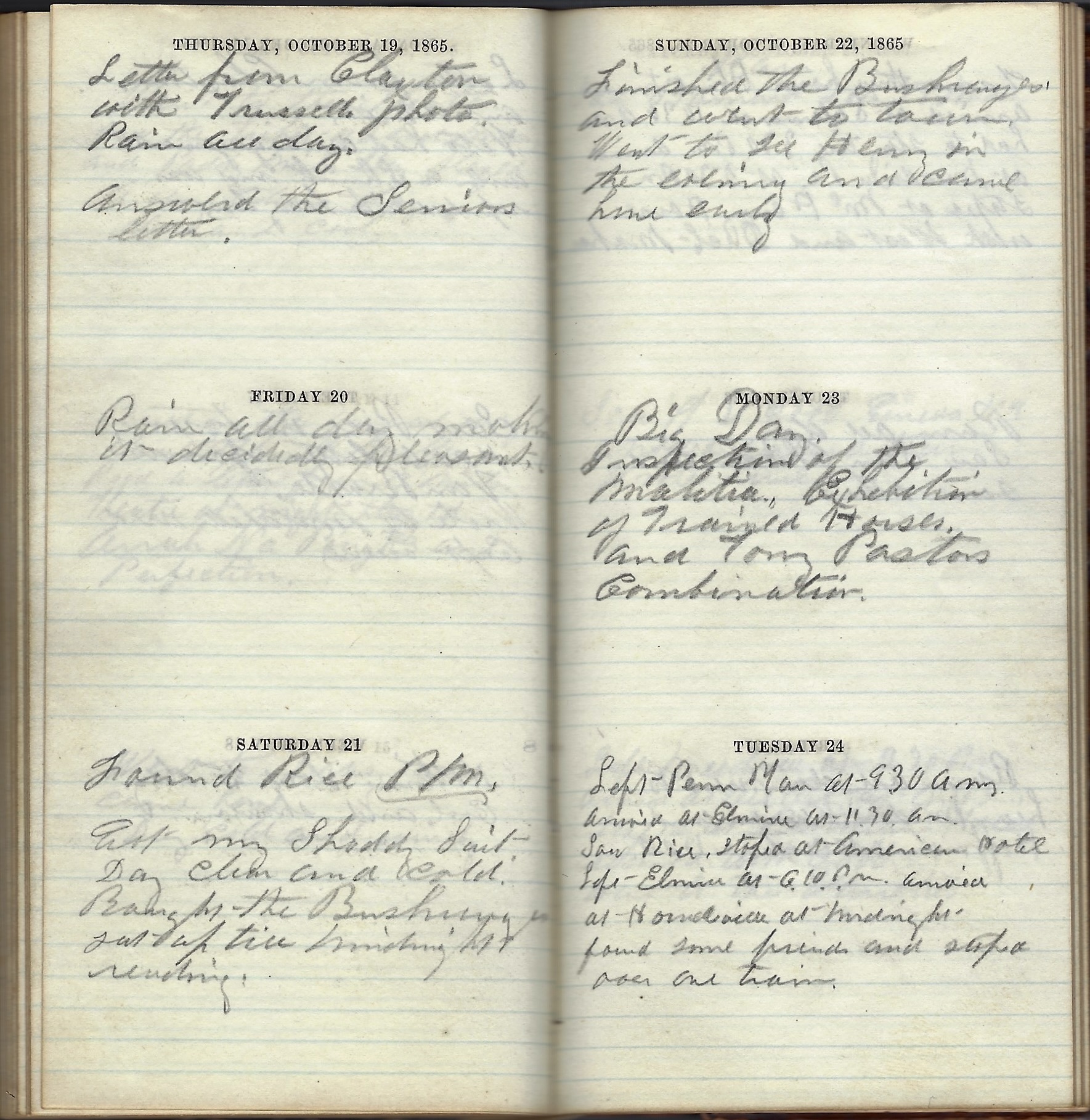
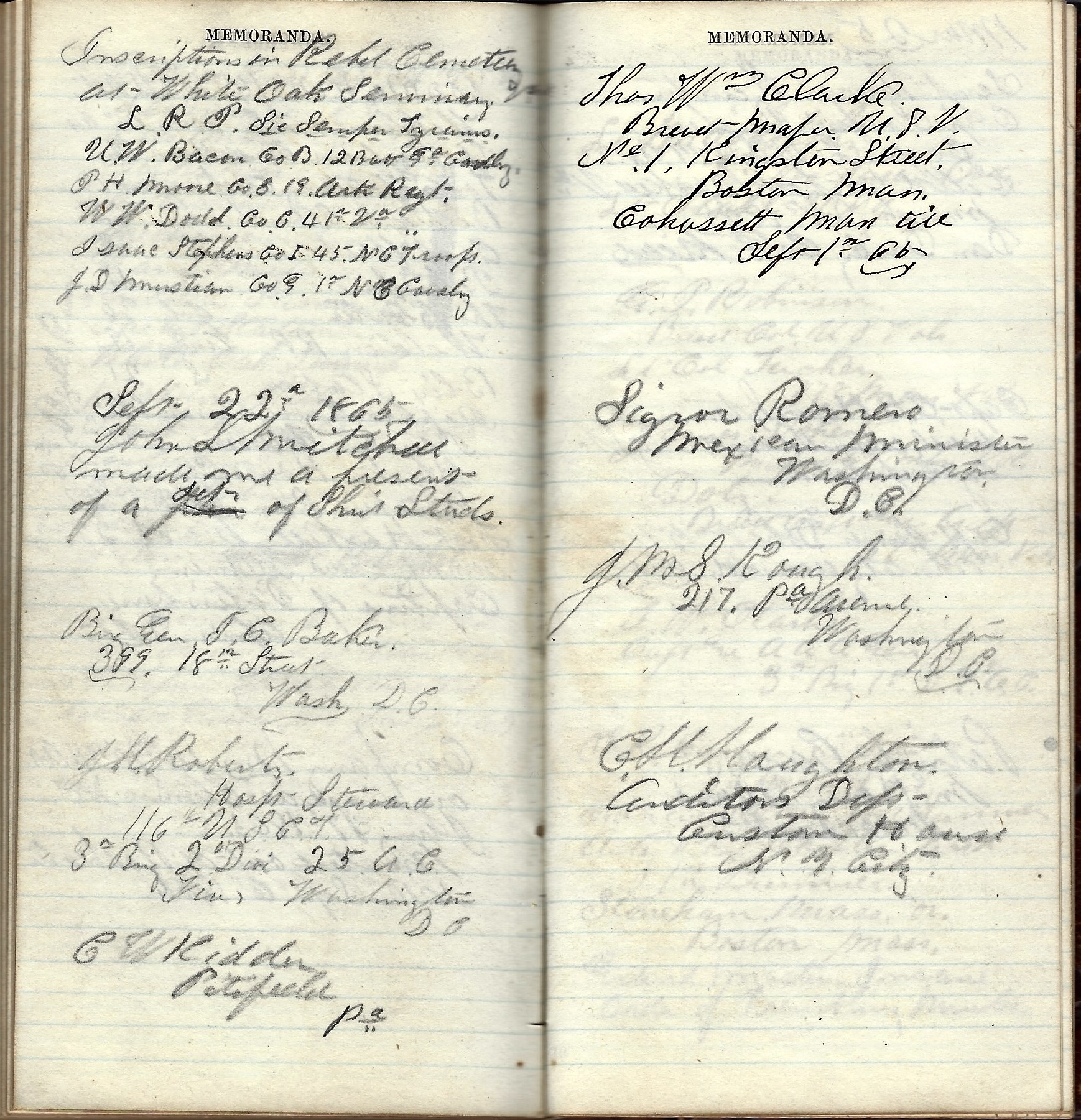
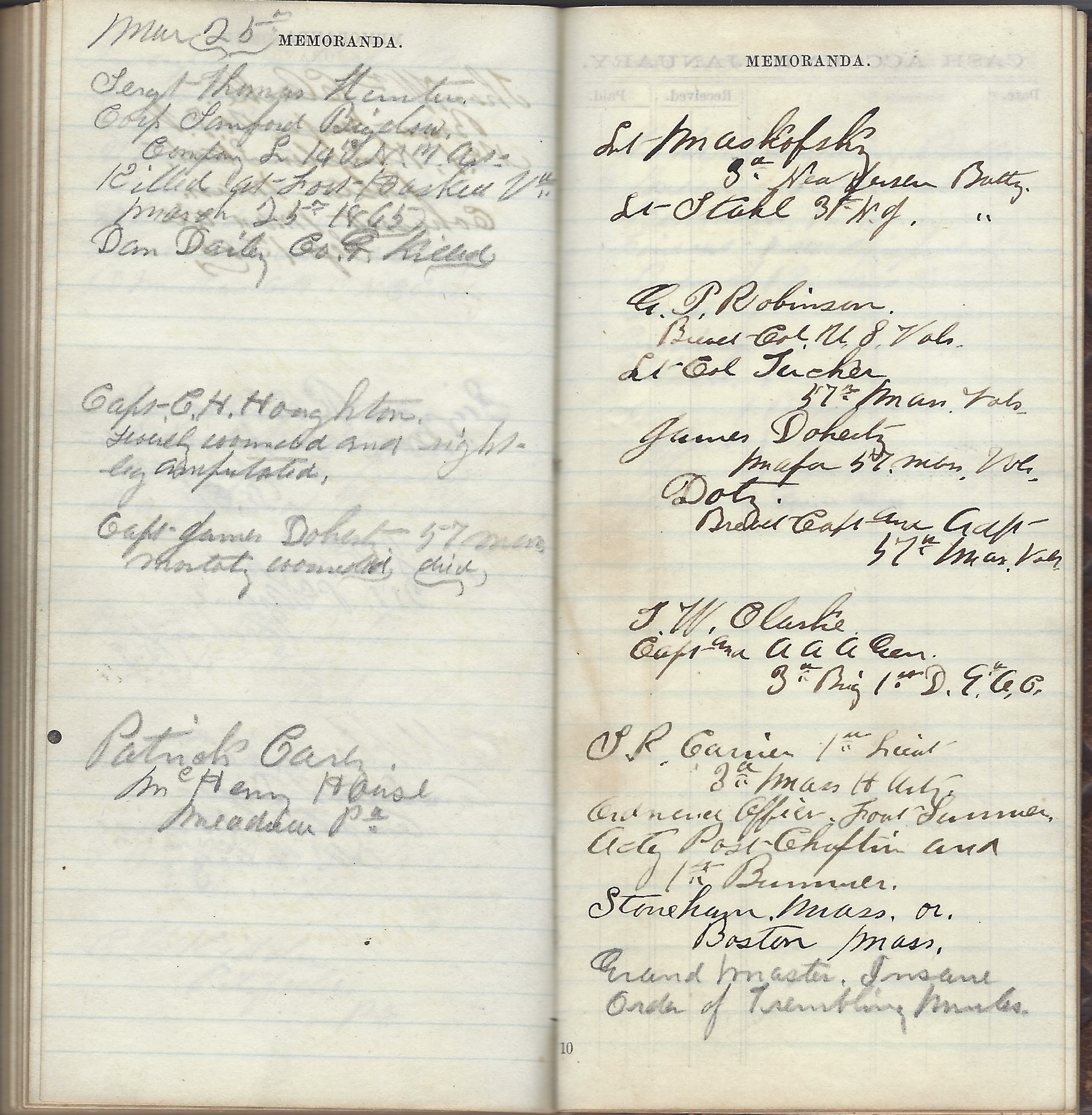
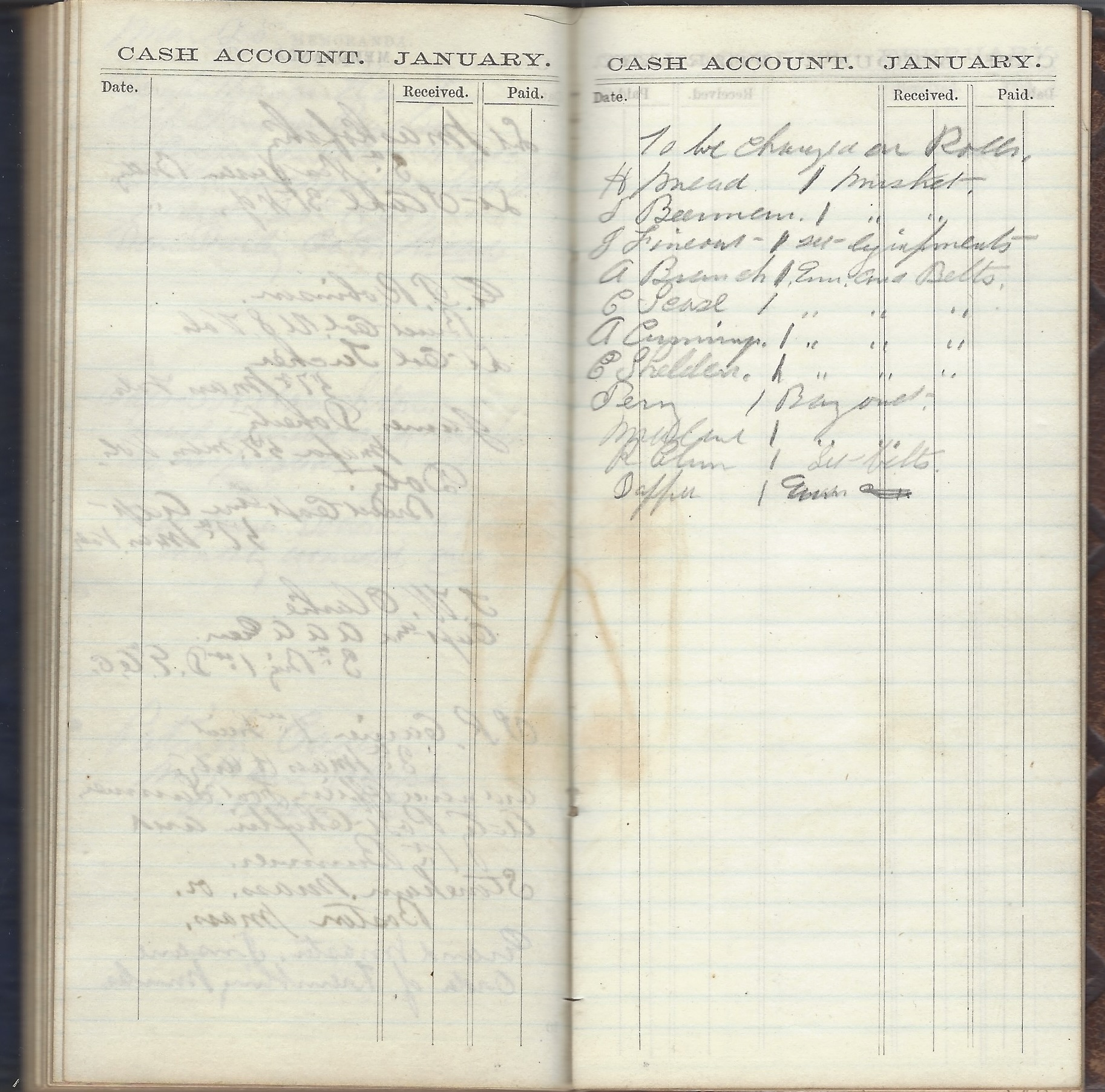
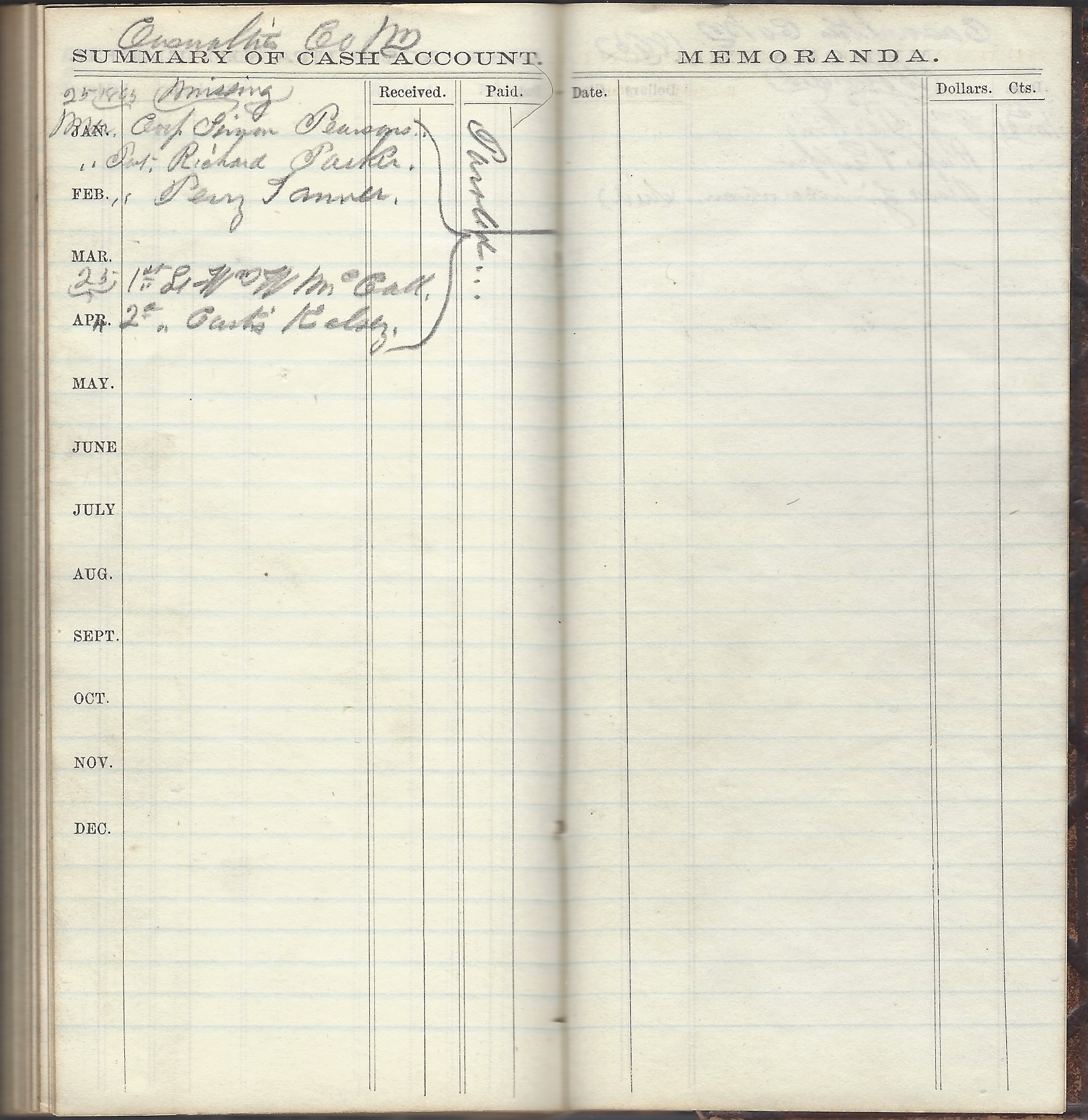
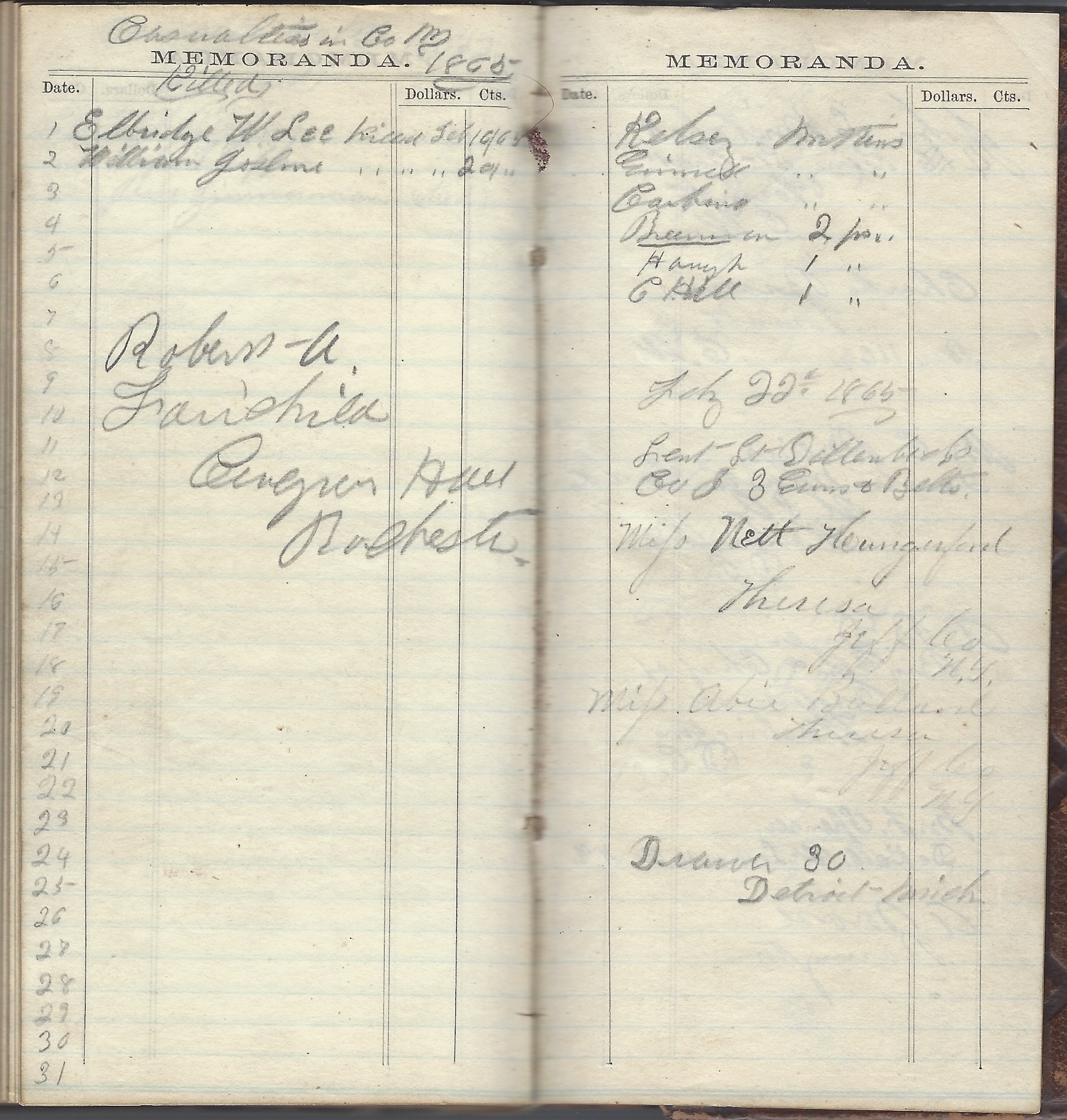
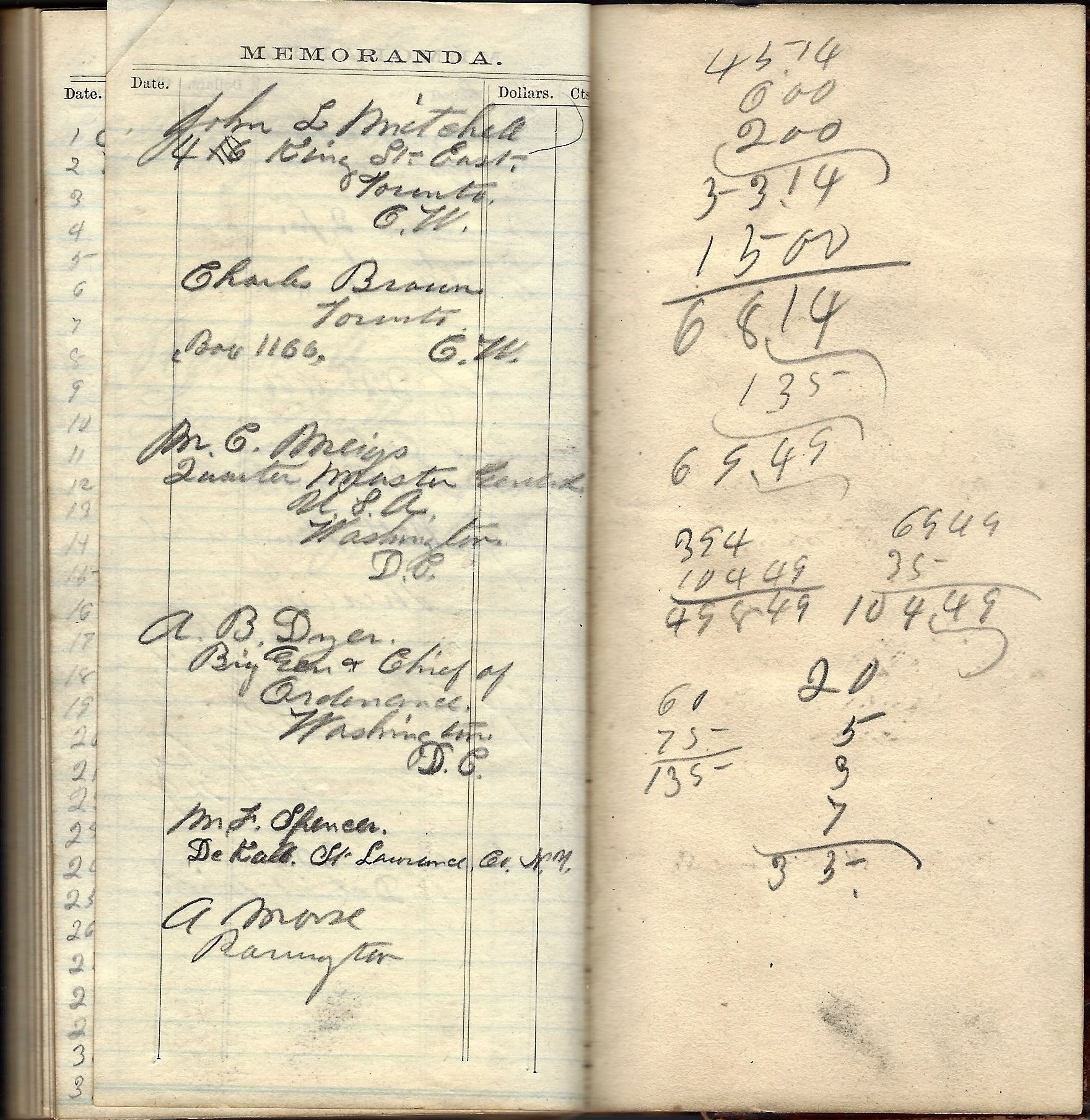
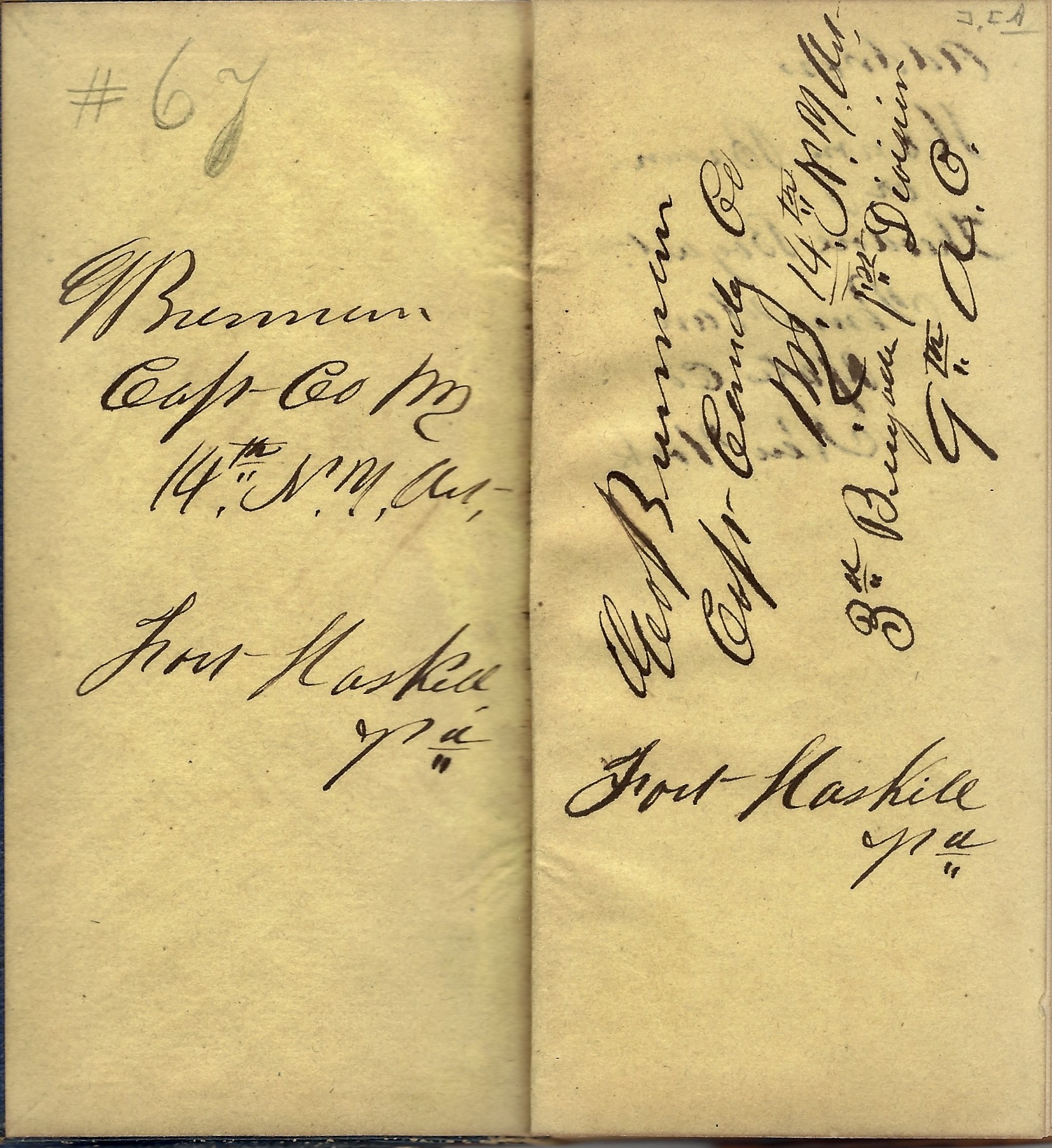
Brennan’s 1865 diary is bound in leather and was published by John O’Hara, No. 27 Beekman Street, New York. It is identified in multiple instances to George Brennan, Captain Commanding Co. M, 14th N.Y. Artillery. 6 x 3 1/4 in., approx. 133pp, pencil entries in 3 days per page format (light wear to leather, pencil occasionally light or smudged but overall very legible and clean). Daily entries from 1 January 1865 – 31 December 1865, plus Memoranda and Cash Account notations.

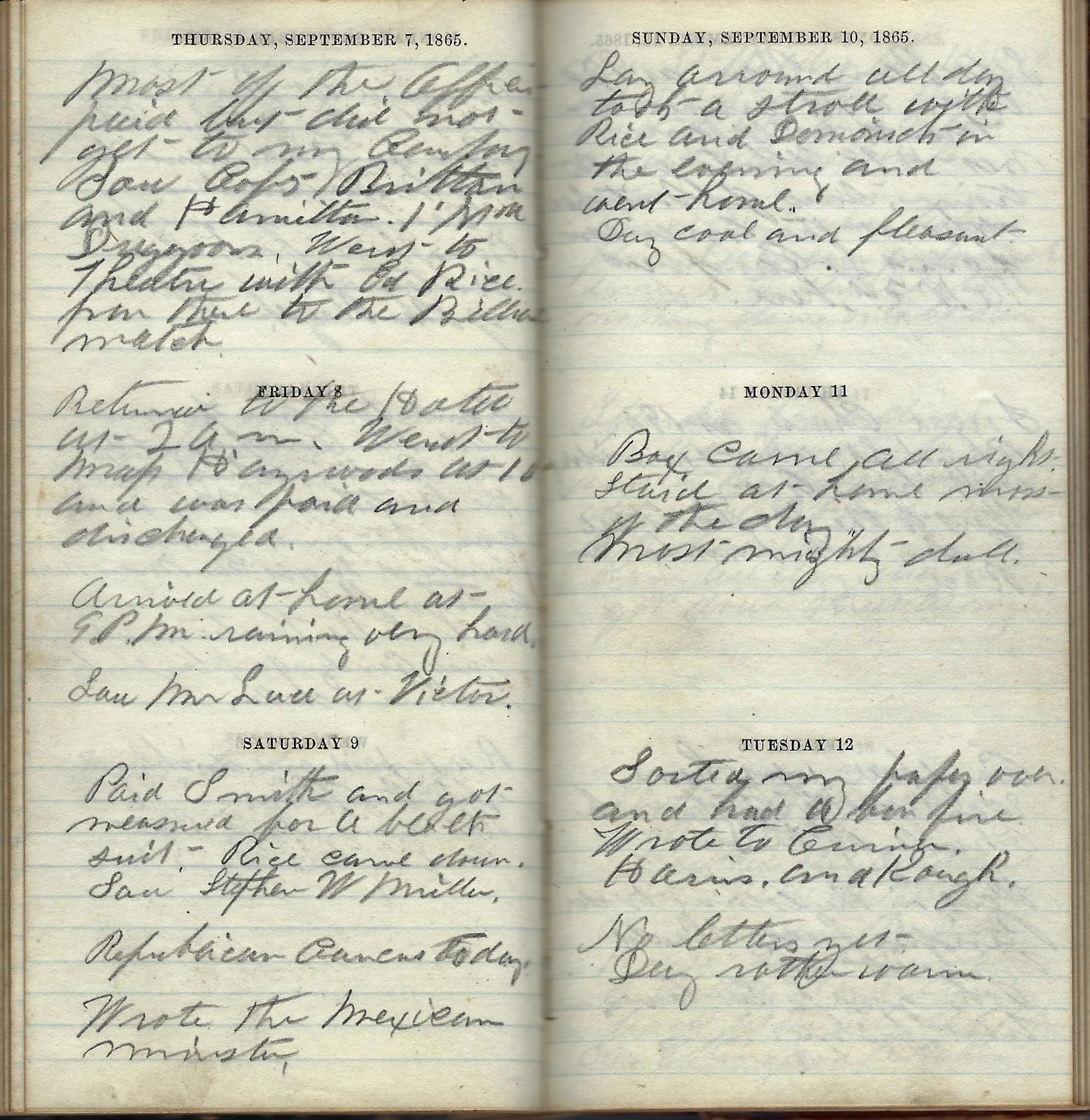
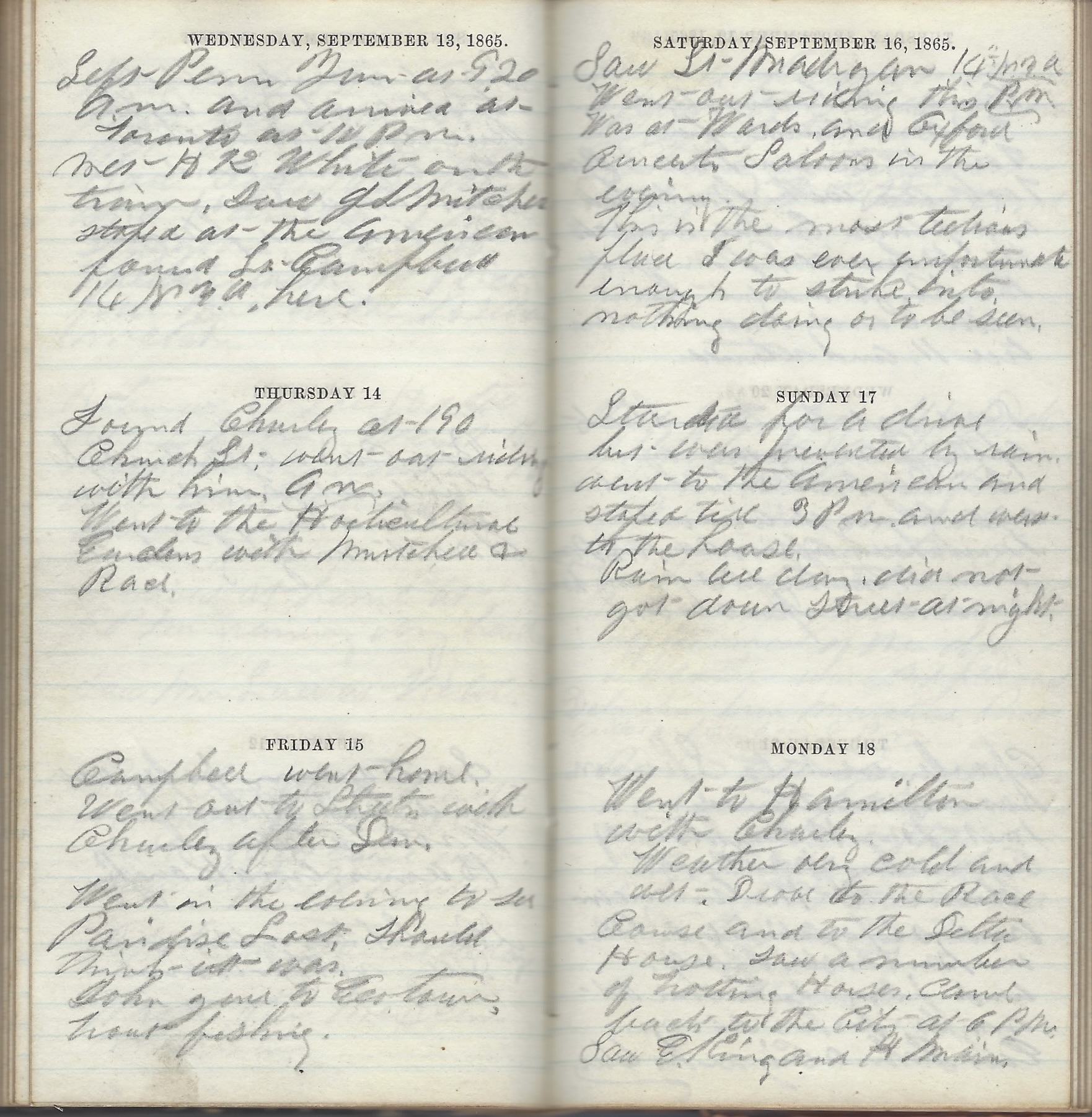
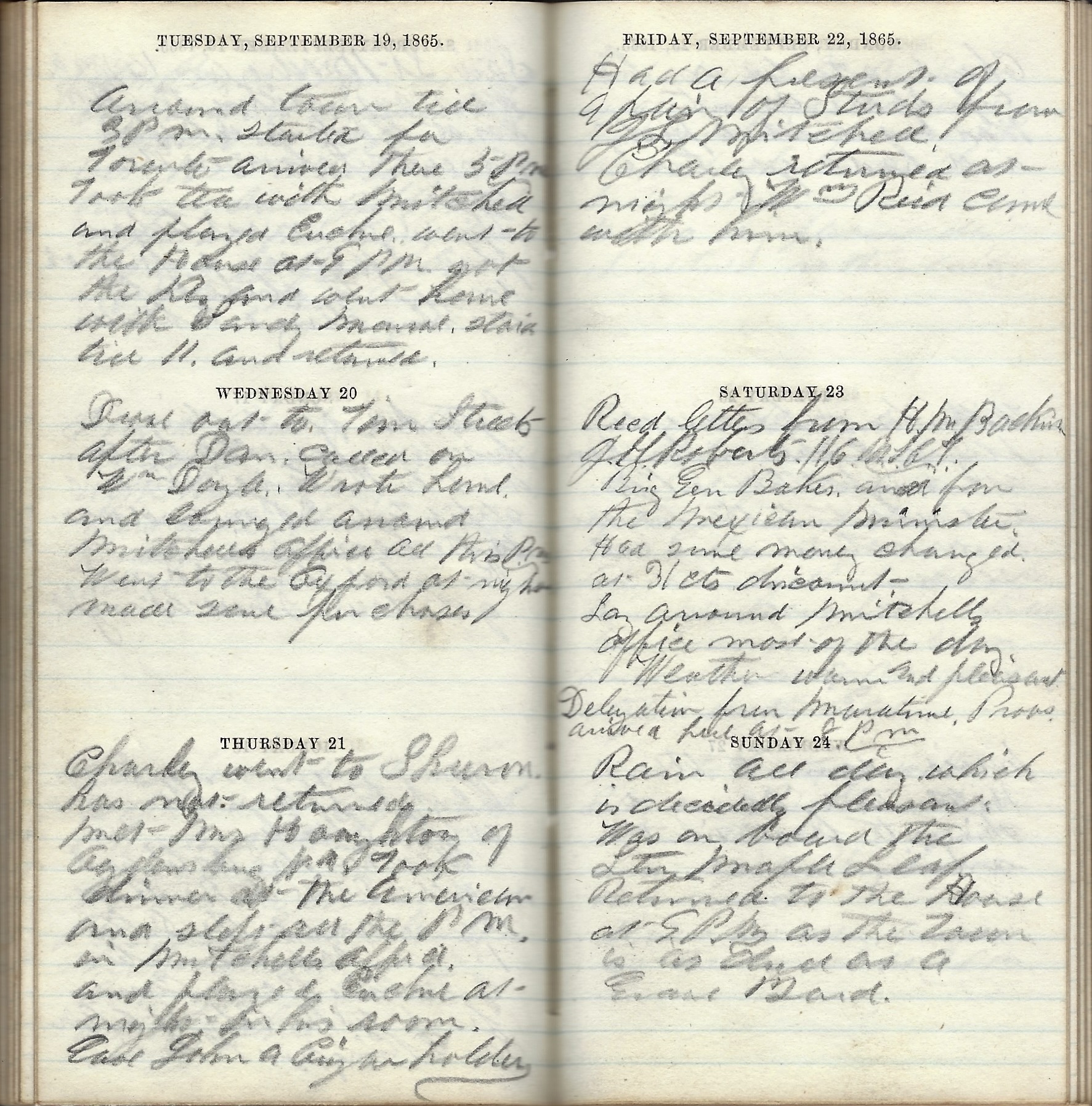
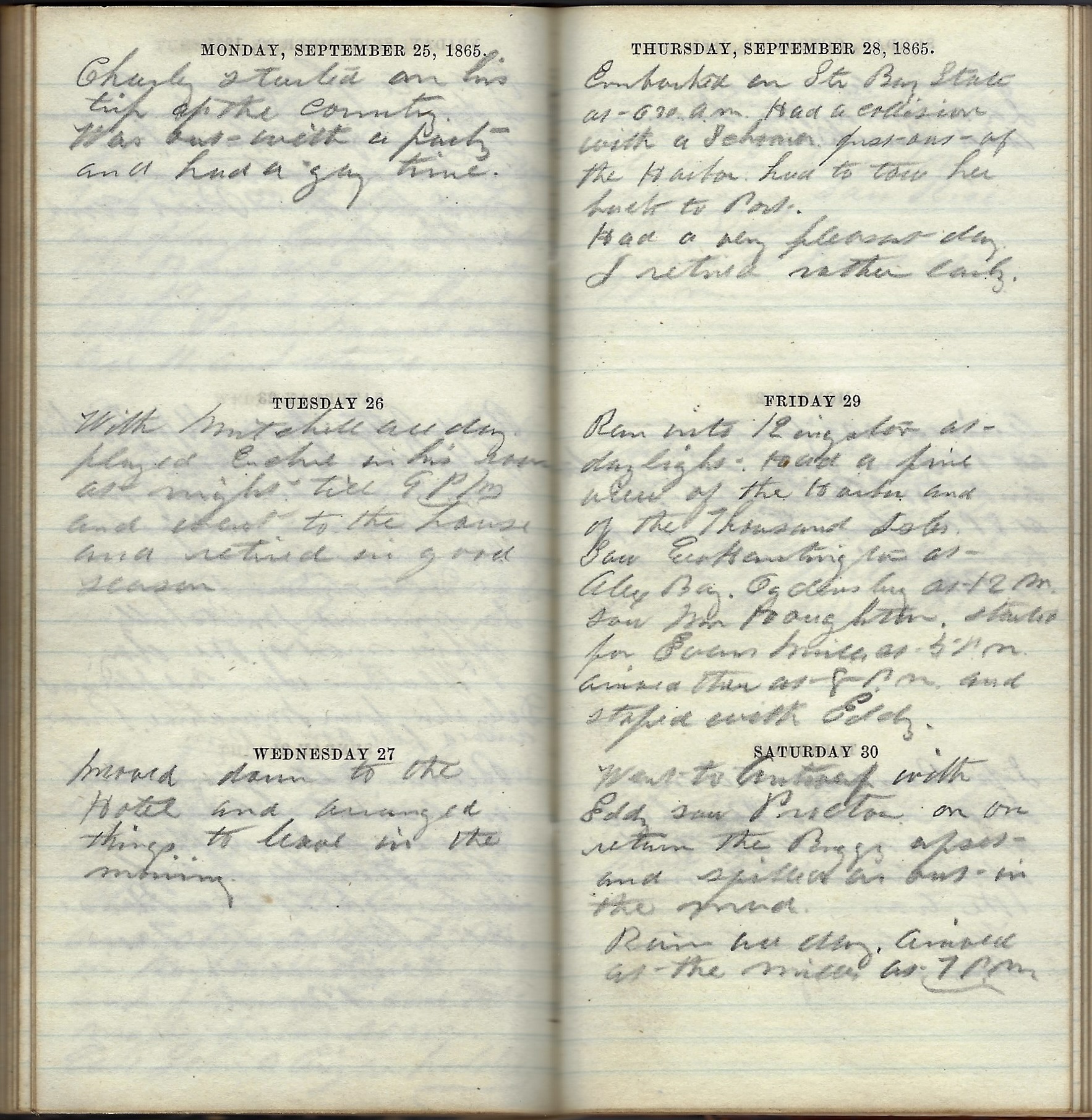
George Brennan’s 1865 Diary

T R A N S C R I P T I O N

1865

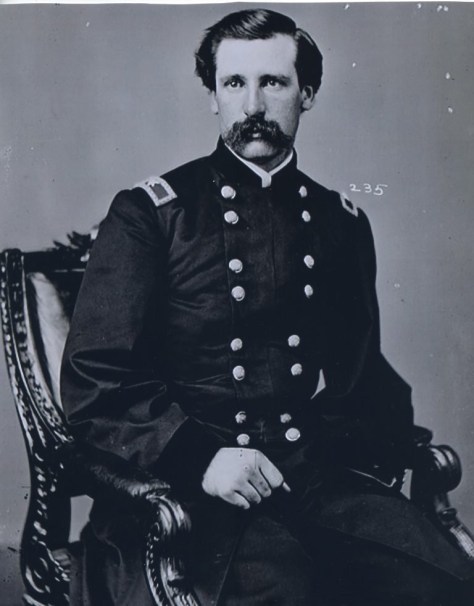
George Morton Randall

Sunday, January 1, 1865—Our party broke up at 2 a.m. Visited the line at 3 a.m. Came back and retired. Reported to Division Officer of the Day at 11 a.m. Had dinner at 57th Mass. Relieved by Capt. [Charles] Wilson 100th Pa. Retired in good season. Weather very cold and clear. Private Wm. H. Grinnon deserted from picket line.

Monday, 2—Sent my report to Brigade Headquarters at 10 a.m. Major [George Morton] Randall gone home for 20 days. Capt. Houghton commanding Regiment. I am commanding 1st Battalion. Wrote home. Went to Brigade Headquarters at night. Also called at the 57 Mass. Vols. Everybody all right. Saw Old Filibuster [George H.] Taylor of the 29th Mass. This has been a fine day but rather cold.

Tuesday, 3—Got up rather late this morning. Have done nothing today but play Euchre and Whist. It has been trying to snow all day.

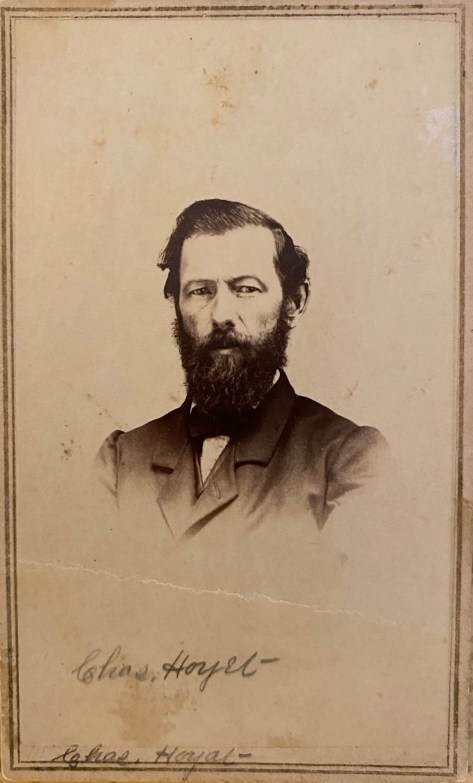
Dr. Charles S. Hoyt, 126th New York Volunteers

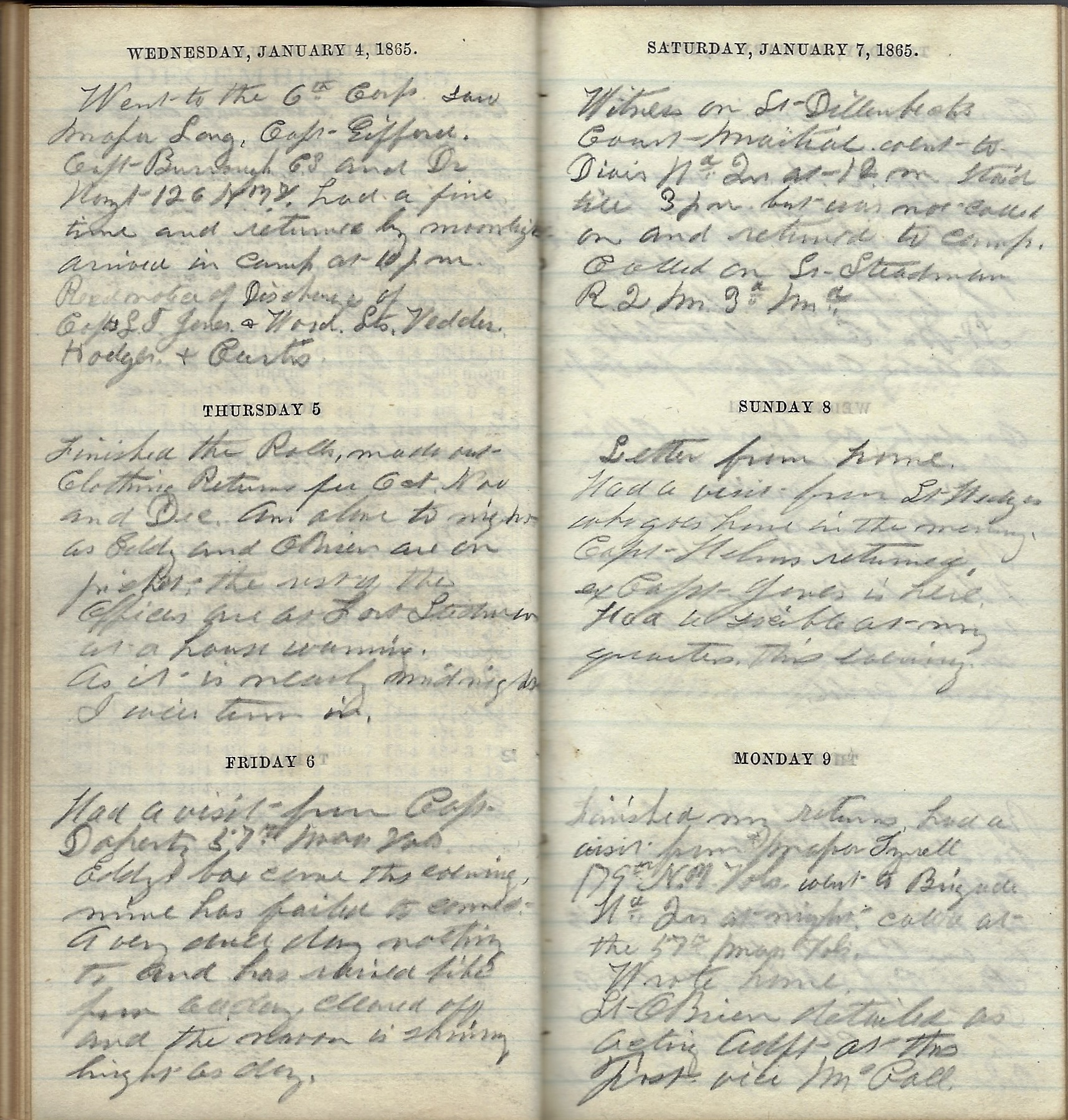
Wednesday, January 4, 1865—Went to the 6th Corps. Saw Major Long, Capt. Gifford, Capt. Burrough, 63rd, and Dr. [Charles S.] Hoyt, 126th N. Y. V. Had a fine time and returned by moonlight. Arrived in camp at 10 p.m. Received notice of discharge of Capts. Lorenzo I. Jones & Ward, Lieutenants [Charles A.] Vedder, [Henry L.] Hodges, and [Henry R.] Curtis.

Thursday, 5th—Finished the rolls. Made out clothing returns for October, November, and December. Am alone tonight as [Charles C.] Eddy and [Charles A.] O’Brien are on picket. The rest of the officers are at Fort Stedman at a house warming. As it is nearly midnight, I will turn in.

Friday, 6th—Had a visit from Capt. Doherty, 57th Mass. Vols. Eddy’s box has come this evening. Mine has failed to come. A very dull day. Nothing to do and has rained like fun all day. Cleared off and the moon is shining bright as day.

Saturday, January 7, 1865—Witness on Lt. [Jerome] Dillenbeck’s Court Martial. Went to Division Headquarters 12 M. Stayed till 3 p.m. but was not called on and returned to camp. Called on Lt. Steadman, R2, M 3rd, Md. [?]

Sunday, 8—Letter from home. Had a visit from Lt. [Henry L.] Hodges who goes home in the morning. Capt. [William R.] Helms returning. Ex-captain [Lorenzo I.] Jones is here. Had a sociable at my quarters this evening.

Monday, 9—Finished my returns. Had a visit from [ ] Tyrell, 179th New York Cols. Went to Brigade Headquarters. In at night. Called at the 57th Mass. Vols. Wrote home. Lt. O’Brien detailed as Acting Adjutant at this post, vice McPall [?].

Tuesday, January 10, 1865—Commenced raining last night and continued all day with thunder and lightning part of the time so that it is not impossible for a man to be struck by lightning in [ ]. Lt. McCall detailed as Acting Ord. Officer for Co.

Wednesday, 11—On duty as Brigade Officer of Day. Relieved the line and visited them at 10 p.m. Reported at Brigade Headquarters at 4 p.m. Had a fatigue party at work on the picket line at night. Weather clear and cold.

Thursday 12—Reported to Major [Asahel W.] Nicols, 1st Michigan Sharpshooters, Division Officer of the Day at Division Headquarters at 11 a.m. Visited the works in our Brigade front. Saw Capt. [Levi Curtis] Brackett, A. A. G., Division Staff. Was relieved by Capt. Church[?], 59th Mass. Received blank returns from [ ].

Friday, January 13, 1865—Made out ordnance returns. Brigade Inspector came and examined my company books. Found them all right. Wrote to John Mitchell. Ex-Capt. Lorenzo I. Jones has quit us in disgust and gone to Washington.

Saturday, 14—Received a letter from home and answered it. Called on Capt. Taylor, 29th Mass. and some [ ] of effects. Sent my ordnance returns to the Department. Flag of truce between the pickets. No firing today.

Sunday, 15—Went to see Fort Stedman. Called at the 57th Mass. Went to Brigade Headquarters and returned to the fort. Draw two guns and equipments. [Lt.] Eddy on picket tonight. Letter from Charley. Answered it. Played Euchre in the evening.

Monday, January 16, 1865—The long looked for box has arrived at last in good condition. Wrote home to let them know that it has got here. Sent a donation to Capt. Clarke, A.A.A. Gen. Was at Brig. Headquarters this afternoon. Saw Capt. Taylor, 29th Mass.

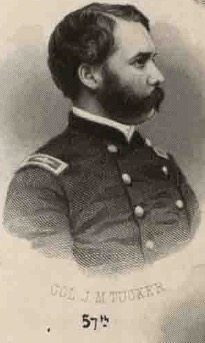
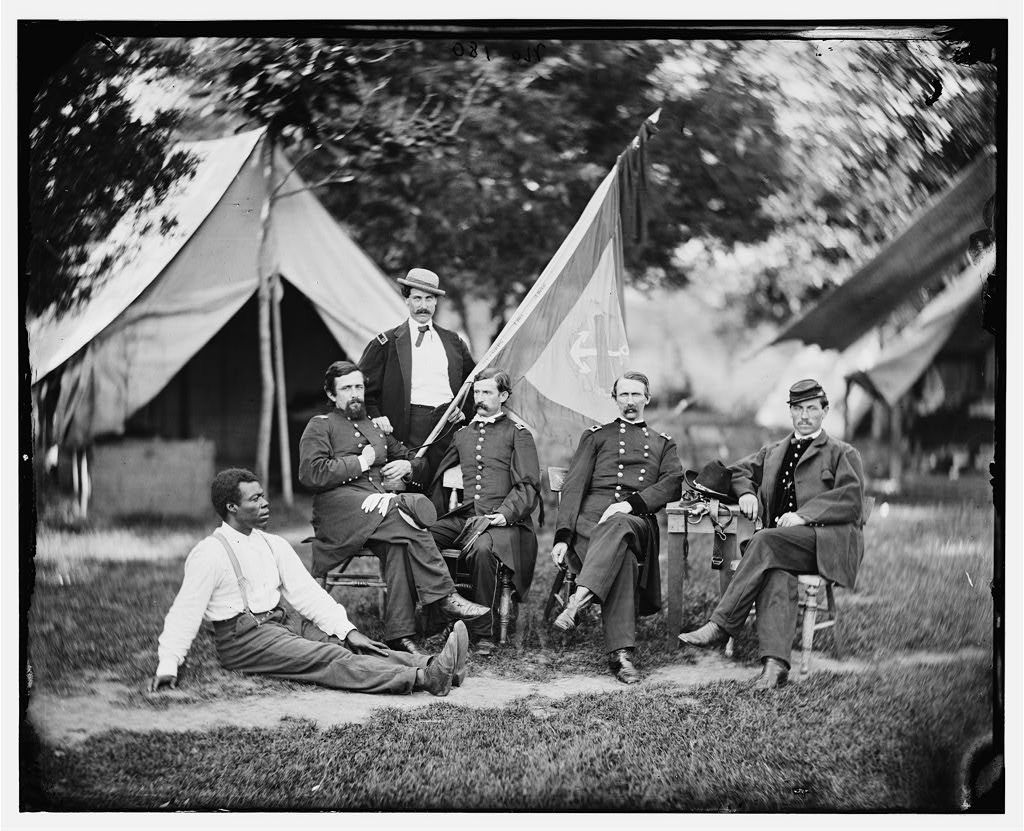
Col. Julius M. Tucker, 57th Mass. Vols.

Tuesday, 17—Had a visit from Col. [Julius M.] Tucker and Capt. [Albert] Doty, 57th Mass. Staid till about 1 a.m. Had a gay time generally.

Wednesday, 18—Went over to the reserve Ammunition Train to see Lt. McCall. Drew clothing. Sergt. [ ] gave me line of lead for 15 days.

Thursday, January 19, 1865—Nothing doing today. Called on Capt. Taylor, 29th Mass. Drew stationery.

Friday, 20—Wrote to Theodore. Sent my old saber home by Corporal [William H.] Down. Sent off Final Statements and Descriptive Lists. Went down to the 57th [Mass. and] staid till 10 p.m. and returned to camp.

Saturday, 21—Rain all day. Sent [Charles] Shaffer discharge to Division Headquarters, dishonorably discharged to be branded with letter D on left hip, have his head shaved, and be drummed of camp. On duty as Brigade Officer of the Day. Visited the line at 8 p.m. Came to camp and made milk punch and sat up writing.

Sunday, January 22, 1865—Visited the line at 2 a.m. Returned at 4 a.m. tired and completely covered with mud. Reported at Division Headquarters at 11 a.m. Came back and went with Chas. to see Mc. Returned and inspected the works. Was relieved by Capt. Ward, 37th Mass. Made out my report of my tour of duty. Lt. Col. [Joseph] Colburn, 59th Mass. went home, mustered out of service.

Monday, 23—Brigade parade at 2 p.m. to witness the drumming out of [Charles] Shaffer. Commanded the regiment in the absence of Capt. Houghton. Rain all day. Wrote to West and Mahan. No mail for two days. Sent my report to Brigade Headquarters. Rode to camp behind Capt. Taylor.

Tuesday, 24—Went to Division Headquarters on court martial but did not do anything. Rode around awhile and went to the 57th [Mass.] at night with Lt. O’Brien. We had a fine time. Drank all the extract they had on hand and played Whist.

Wednesday, January 25, 1865—Returned to the fort at 1 a.m. and went to bed. Just got nicely asleep when I had a call from Col. Tucker and Capt. Doty, 57th Mass. They stayed about an hour and left. Turned in again and slept till 9 a.m. Rode over to McCall in the afternoon. Came back at 5 p.m. Day rather cold.

Thursday, 26—Had a call from Capt. [ ]. Brigade Inspector. Visited Capt. [James] Doherty, 57th Mass. Played Euchre in the Division tent this evening for wine. Learned the song of Kathleen [Masander?]. No mail today. Weather cold.

Friday, 27—Major Randall returned. Capt. [Charles H.] Houghton took command of 1st Battalion again. Went to the Depot with [Lt.] O’Brien. Went to a concert at the 3rd Maryland at night. Afterward to the sutler’s and from there to Capt. [James] Doherty’s. Returned to camp at 11 p.m.

Saturday, January 28, 1865—Made out monthly returns of company. Had a visit from Lt. Col. Tucker and Capt. C___[?], 57th Mass. The top of my chimney blew off. Thought it was an earthquake. Weather very cold.

Sunday, 29—Got the vial of benzine. Had inspection and dress parade at 4 p.m.

Monday, 30—Detailed as Brigade Officer of the Day. Relieved the picket line at 6 p.m. Visited the whole length of the line. Had a serenade. The party stayed till 11 p.m. and [ ]. Received a letter from home.

Tuesday, January 31, 1865—Stayed up all night and visited the line at 3 a.m. and the camp at reveille. Returned to the fort and went to bed at 7 a.m. and slept till 9 a.m. Went to Division Headquarters at 11 a.m. Came back and went to bed. Was relieved by Capt. [James W.] Bard, 100th Pennsylvania Vols. at 5 p.m. Wrote to Sis.

Wednesday, February 1, 1865—Received marching orders. Packed up and are still waiting at10 p.m. Lt. Hedges returned from home. Capt. Wm. R. Helms discharged and gone home.

Brig. Gen. Napoleon McLaughlin (seated second from right) with staff and camp servant. (Library of Congress)

Thursday, 2—Still here and no signs of leaving. weather rather cold. Gen. [Napoleon B.] McLaughlin in command of the Brigade again. Received notice of the discharge of 1st Sergt. Adam I. Cratzenberg, January 20th 1865.

Friday, February 3, 1865—No mail tonight. Made out a list of casualties. Report of [ ] in company. Rain all day. Rather cool. Had some sharp artillery practice today. Lts. [William] Eddy and [Robert H.] Spencer in arrest. Lt. Dillenbeck returned from home. Dr. [Sherman] Morse came over and prescribed for my throat as I have been nearly sick for the last three days.

Schuyler Gardner, 14th NY Heavy Artillery, Co. M.

Saturday, 4—On sick list. Made out an annual report of alterations [?] and casualties. Capt. Houghton received a leave of absence for twenty days. Promoted [Schuyler] Gardner to be 1st Sergeant.

Sunday, 5—Had a letter from Charles. Answered. Capt. Houghton started home. Marching orders again. All ready to move and waiting.

Monday, February 6, 1865—Still in camp. There has been heavy fighting on the left. A. P. Hill attacked the 2nd Corps at Armstrong’s Mill but was repulsed. We expect to leave tonight as there was no picket detail from the regiment.

Tuesday, 7—Heavy firing on the left. On duty as Officer of the Day. Has been raining all day. Visited the line at 8 p.m. Captured two rebs and sent them to Headquarters.

Wednesday, 8—Visited the line at 3 a.m.. Returned to camp and went o bed. Reported to Division Headquarters at 11 a.m. Inspected the works. Reported to Gen. [John Grubb] Parke at Corps Headquarters at 4 p.m. Was relieved at 6 p.m. by Capt. Doherty, 57th Mass.

Thursday, February 9, 1865—Sent my report to Brigade Headquarters. Rode out with Lt. Stahll, 3rd New Jersey Battery. Went to see Lt. Hedges. Returned to camp at 4 p.m. Day very cold. Letter from Cleveland [?].

Friday, 10—Drew clothing and issued to the company. Had a visit from Lt. M___, 2rd New Jersey Battery. Weather cold. Sergt. Gardner and Corporal Down reported deserters for failing to report at expiration of leave of absence.

Saturday, 11—Rebs opened on us today and threw several shells into the Fort. No [one] badly hurt, but some of the works broken down. Repaired the damages tonight as we cannot work by day.

Inside Fort Stedman, LOC

Sunday, February 12, 1865—Lt. O’Brien started for home on leave for twenty days. Sergt. [David H.] Giffin returned from leave of absence. Had company inspection at 2 p.m. Wind blowing a perfect hurricane all day and very cold. Went to Brigade Headquarters to see Capt. Clarke.

Monday, 13—Inspection ordered at 2 p.m. but no inspection came on duty as Brigade Officer of the Day. Had the same old routine to go through with. Called on Lt. Stedman.

Tuesday, 14—Had inspection at 3 p.m. Rebs opened on us this past.m. Threw several shells into the fort. Knocked Capt. Houghton’s tent to pieces and a large hole through mine. One man wounded in [ ]. A captain was killed while riding along the works. Was relieved at 6 p.m. Wrote a valentine.

Wednesday, February 15, 1865—Lt. [William] Eddy had his trial at Division Headquarters. Rain all day.

Thursday, 16—Private Elbridge W. Lee killed this morning. Made out clothing Returns. Received a letter from home. Answered it. Company drill in afternoon. Visited by Major Randall and Capt. [Joseph P.] Cleary. Thunder, lightning, and rain. Boot $15.

Friday, 17—Rain nearly all day. Called on Col. Robinson. Everything very dull. No mail and nothing to do. Shall get the blues if this thing continues a great while.

Saturday, February 18, 1865—Rode over to see Hodges but he was gone. Called at Regimental Headquarters. Took dinner with the Major. Bought a cap.

Sunday, 19—Had a call from Lt. Bradley, 179th New York Vols. Had inspection at 2 p.m. Called on Lt. Stedman and from there went to 57th Mass. [Lieutenant William] Eddy on a drunk.

Monday, 20—Rebels opened on us and mortally wounded William Josline, Co. M, and three men of 4rd New Jersey Battery. On duty as Officer of the Day. Ten prisoners came into the picket line.

Tuesday, February 21, 1865—On court martial as witness for Lt. Backus. Rebs opened again today but did no harm. Received a letter from John L. Mitchell. Answered it. Received a flask of brandy and a bottle of hair oil from thief who has been transferred to USA.

Wednesday, 22—Sent my report to Brigade Headquarters. Commenced making our Muster Rolls. Finished one. Wm. Josline died last night. Lt. [ ] wounded. Received marching orders. Had my horse saddled and waited. Issued 4 days rations and 60 rounds of cartridge. 12 p.m. waiting yet.

Thursday, 23—Rain all day. Did not move after all our trouble. Lt. [William] Eddy released and returned to duty and sent on picket.

Friday, February 24, 1865—Made out list of deserters for 1864. Rebels opened on us and good as a smart shelling. No one hurt. A shotted salute fired in honor of the fall of Wilmington, N. C. Received Valentine box.

Saturday, 25—Rain all day. Butler and Randolph started for home on 15 days leave. It is rumored that the Rebels are evacuating Petersburg. They are firing very heavy tonight. Had a party at Lt. Stahl’s. Marching orders again.

Sunday, 26—A fair day and very warm. Went to Brigade Headquarters. Made out warrants for Sergeants. Sergt. Allen Cummings paroled. Was taken July 30th, ’64 [in Battle of the Crater]. Lt. [Charles H.] Bailey discharged. Has ben appointed Quartermaster of the 193rd New York Volunteers.

Monday, February 27, 1865—Detailed as Brigade Officer of the Day. Reported at Headquarters at 4 p.m. Capt. [Homer] Foote returned. Lt. [Adolph] Shubert, Quartermaster, returned from leave of absences. Lt. Eddy on picket.

Tuesday, 28—Rain all day. Took three rebel deserters last night. Mustered at 12 a.m. by Major [Ezra Palmer] Gould, 39th Mass. Had 50 men present. Relieved by Capt. Boston. Went to [see] Lt. Hedges. Stayed till 11 p.m. Capt. Houghton returned.

Wednesday, March 1, 1865—Detailed on Gen. Court Martial at Division Headquarters. Roll and adjourned till 10 a.m. March 2nd. Received letter from Charley and from home.

Thursday, March 2, 1865—Court met today. Tried three cases. Adjourned at 4 p.m. Major Redington commenced paying the regiment. Paid off our camp. Rain all day.

Friday, 3—Court martial adjourned till Monday. Received my pay. went to Brigade Headquarters. Stayed till 12 p.m.

Saturday, 4—Worked on Muster Rolls. Went around to see the [ ] at night. Went to bed at 11 p.m. Eddy on picket. Wrote home and to Charley. Bought a ticket in the battery for [Seth N.] Hedge’s horse and equipments.

Sunday, March 5, 1865—Went to Lt. Hedges with Capt. Houghton. Went to Fort Stedman at night.

Monday, 6—Court martial at 10 a.m. Tried four cases and adjourned at 2 p.m. A beautiful day. Warm as May.

Tuesday, 7—Met and adjourned till Thursday. Went to Hedges [ ]. The mare was drawn by an officer of the 39th New York. Officers of the 14 N. Y. Artillery brought her and presented her to Major Randall. Gen. Wilcox returned. Gen. McLaughlin commanding Regiment.

Wednesday, Mach 8, 1865—Finished Muster Rolls and sent them in. Rain all day.

Thursday, 9—Met at 10 a.m. and sat till 12 M. and adjourned. Went to the 9th N. H. Vols. with Capt. Houghton. Eddy on picket. Rain this evening.

Friday, 10—Court met and adjourned at 11.30 a.m. till Monday. Received a pass for City Point. Rain all day but cleared off at night and is clear all day.

Saturday, March 11, 1865—Inspection by Major Myrick. Started for City Point but lost the train. Went to Division Headquarters and returned at 5 p.m. Went to bed at 9 p.m.

Sunday, 12—Letter from Sis. Went to Philip’s earthworks. The wind was too high. Made out clothing returns and sent them off. Lt. O’Brien returned from leave of absence. Presentatio of a horse to Major Randall.

Monday, 18—Met t 10 a.m. Adjourned at 1 p.m. Wrote home. Had a party in my tent. Rebs made an attack on the 2nd Division but were repulsed. Day warm and pleasant.

Tuesday, March 14, 1865—Tried one case today. Troops under arms and orders to send all the sick to the rear. Capt. Houghton and Lt. Eddy went to City Point. I went $200 by Express. Eddy bought me a cloak.

Wednesday, 15—Marching orders. Sent all extra baggage to the rear. Lt. Eddy went home on leave for 15 days. Rain in the afternoon. Letter from Roberts.

Thursday, 16—Gen. Butler returned. We had a terrible storm of wind and rain.

Friday, March 17, 1865—Court adjourned till Monday. Went with Capt. Houghton to the 20th and 2nd Michigan Regiments.

Saturday, 18—Box came at last. Had a visit from Lt. Bradley, 179th N Y. Vols. Went to camp with him. Dr. [Luther] Phillip returned. Rebs shelled us after dark. Nobody burt. A man in Co. I shot in the leg while on guard.

Sunday, 19—Did nothing today. Went to Brigade Headquarters at night.

Monday, March 20, 1865—Court met at 10 a.m. Tried three cases and adjourned. Day very hot for this time of year. Wrote to Drawer 30, Detroit, Michigan.

Tuesday, 21—Met at 10 a.m. Tried two cases and quit for today. Commenced to rain at 2 p.m. and rained all night. Played Euchre and Whist in my tent.

Wednesday, 22–Read of the proceedings of the court and adjourned. Received a telegram from [brother] Charley at Penn Yan wanting to know if I had been killed. To the best of my knowledge & belief, I have not.

Thursday, March 23, 1865—Tried one case and adjourned indefinitely. Called on Capt. [Joseph W. B.] Wright of 14th Mass. Battery. Rode over to Hedges at night. Wind blowing a perfect hurricane. My chimney is in ruins.

Friday, 24—Received a letter from Lt. Eddy. Did not rise till 12 M. Had my chimney rebuilt. Nothing else to do but play Euchre.

Saturday, 25—Rebels captured Fort Stedman at 3 a.m. and made a general assault at 5 a.m. and carried the line except Fort Haskell. They advanced nearly to Division Headquarters but were repulsed. The 2nd Battalion at Stedman were nearly all captured. Six officers taken and two wounded. Capt. Houghton severely wounded. Tom Hunter and S. [ ], Co. L killed. Had three men wounded and three captured in Co. M.

Sunday, March 26, 1865—Did nothing today. Flag of Truce. The rebs are burying their dead. I assumed command of the 1st Battalion after Capt. Houghton was wounded yesterday.

Monday, 27—Received a line from Dr. Morse who was captured on the 25th. He was all right. Went to Hospital. Saw Capt. Houghton.

Tuesday, 28—Went to 57th Mass. Volunteer. Saw Doty, just returned from home. Sent Co. I to Ft. Stedman. Two companies gone to the left.

Wednesday, March 29, 1865—Up all night. Slept nearly all day. Rebels made an attack on the picket line in front of the Fort. The men fall back to the works and we opened on Johnny. This was about 11 p.m. As I had not retired, was ready for them.

Thursday, 30—The Rebs opened all their batteries that could be made to bear on us and rained a perfect storm of shell on us. The row lasted till 2 a.m. Went to bed at 6 a.m. Slept till 1 p.m. Rain all day. Reinforced the picket line.

Friday, 31—Commenced making out Ordnance Returns but had to send my baggage to the rear. Repaired the Cheveaux de Frise. Were reinforced by 100 men of the 37th Wisconsin Vols. Glad to see them as I had only 50 men as we expect an attack at any moment.

Saturday, April 1, 1865—Nothing new today. Received a letter from [brother-in-law] Theodore and a coat from F. E. Smith. Received notice from Ordnance Dept. Built banquet and repaired the abatis.

Sunday, 2—The 3rd Division charged and captured Fort Mahone. The rebels charged eight times but did not take it. They commenced drawing off their troops after dark. We were under arms all day.

Monday, 3—The Rebs evacuated Petersburg at 2 a.m.. We marched into the town at 6 a.m. and retired to camp. Started again at 10 a.m. and crossed the river and camped about 2 miles out. I had command of the regiment.

Tuesday, April 4, 1865—Broke camp and recrossed the river at 9 a.m. Marched about two miles out of town toward the left and camped on the plantation of Roger A[tkinson] Pryor. Rode along the old works. Saw a Whitworth Gun disabled. Got some picture from Pryor House.

Wednesday, 5—Visited Fort Gregg—a very strong work. Broke camp at 10 a.m., stacked arms and rested. [Lt.] O’Brien and I went to the City. Returned in time to move. Marched about ten miles and halted for the night. Took up my quarters in a house.

Thursday, 6—12 a.m., received marching orders. Night very dark and inclined to rain. Marched till 5 a.m., halted and had breakfast. Started again and went as far as Sutherland Station, Southside Railroad. Brigade on picket. Regiment in reserve line five miles long. Captured a contraband. Letters from home & Charley. Had a fine day.

Friday, April 7, 1865—Went out scouting with Capt. Clarke and Cook. Returned at 3 p.m.. Moved the regiment. Pitched headquarters and turned in for the night. Rain as usual.

Saturday, 8—Major Randall went out scouting with two companies but found nothing. I visited the picket line, 1st Brigade, with Lt. Colonel C[olwert] K[endall] Pier, 38th Wisconsin. Wrote home and to Dr. Morse.

Sunday, 9—Saw a crowd of Rebel prisoners—only 1,726 of them. Visited our picket line. Went to Brigade Headquarters. Rode out with O’Brien about two miles from the pickets. Sent out two more companies on the line. Called on Major [Christian] Woerner, 3rd New Jersey [Light] Artillery.

Monday, April 10, 1865—Brigade Officer of the Day. Line nine miles long. Rain all day and very muddy. Saw 2,000 Rebel prisoners. Gen. Lee surrendered with 30,000 men. How are you Southern Confederacy? Played out.

Tuesday, 11—Saw the Rebel Generals Ewell, Ransom, Kershaw, Defoe, and G. W. Lee, captured at Amelia Court House. Read a detail on a board of apprisement to meet at Brigade Headquarters at 12 M tomorrow. Rain most of the day. No mail.

Wednesday, 12—Went to Headquarters. Adjourned till Friday. Had some Benzine with Clarke. Presented Mullen with a smoke. Rain at night.

Thursday, April 13, 1865—Brigade Headquarters moved about two miles to the left. Received a letter from Hinton. Saw Lt. Atchison, 4th US Infantry.

Friday, 14—Went to Brigade Headquarters with Major Randall. In the afternoon, went to Mr. Martin’s about 4 miles out and had a clean meal. Returned at 7 p.m.

Saturday, 15—Rain all day.

Sunday, April 16, 1865—Had inspection at 9 a.m. Went to Brigade Headquarters, Stopped at Stables. Returned to camp. Saw Roberts. Had a loud time. Read the news of assassination of the President and at 12 of his death.

Monday, 17—Went to Headquarters. Formed a party and went into the country about 9 miles. Returned at 8 p.m. Clarke was thrown from his horse, not hurt but full of Benzine. Took the oath with Capt. Cook. Had it clean. Forded a stream of water up to the horses back. Very pleasant. Had supper at 9 p.m. and turned in.

Tuesday, 18—Moved camp to site of White Oak Seminary in the woods—a pleasant place.

[Editor’s note: At the end of this diary, George records the names of some Confederate soldiers buried in the cemetery at the White Oak Seminary.]

Wednesday, April 19, 1865—Had an arbor built and fixed up generally. Went to Headquarters. Had a card from Lt. S. VanWaldhamer [?], 3rd New Jersey Battery.

Thursday, 20—Broke camp at 12 M and marched to Sutherland Station en route for City Point. Halted at 8 p.m. having made 18 miles. Cpt. Geo. S. Greene reported for duty. Won $10 of Dillenbeck.

Friday, 21—Started at 6 a.m. Marched down near Ft. Stedman. Visited [Ft.] Haskell. Marched down to City Point and embarked on the Prince Albert for Washington. Only 35 miles and very hot at that.

Saturday, April 22, 1865—Left City Point at 4 a.m. Made Fortress Monroe at 12 M. Had a beautiful day. Passed the time in playing Euchre and singing and once in a while taking in some Benzine. Had a gay time. In the evening in the Captain’s room. Turned in at 11 p.m.

Sunday, 23—Reached Alexandria at 11 a.m., disembarked at 3 p.m., marched out two miles and camped. Went to town at night with Quartermaster and Prictor [?]. Had a good time at the Marshall House. Returned at 12 p.m.

Monday, 24—Brigade Officer of the Day. Went to the City with Major Randall. Made some purchases.

Tuesday, April 25, 1865—Col. Marshall returned [and] took command of Brigade. Received letters from Dick, Dr. Morse, McCall, and from home. Received my smoking cap. Commanded the regiment on drill, the p.m. had dress parade. Lt. [William H.] Norton returned from prison. Answered all letters.

Wednesday, 26—Broke camp at 10 a.m. Marched through Alexandria across Long Bridge to Washington, through the Avenue and Georgetown, up High Street to Tenleytown, Maryland, about 11 miles from where we started. The day was very hot and the roads dusty. Bivouacked for the night.

Thursday, 27—Pitched the camp and fixed things up generally. Saw Major Redington, paymaster USA. Received notice of Schuyler Gardner’s promotion to 2d Lieutenant.

Friday, April 28, 1865—Rode up to Tenleytown and Brigade Headquarters. Commenced making out Muster Rolls. Hold dress parade.

Saturday, 29—Went to Washington. Saw Capt. Houghton. Made some purchases and returned to camp. Had a heavy shower. Presentation of a gold watch to Col. Robinson by the officers of 3rd Maryland.

Sunday, 30—Inspection at 10 a.m. Muster at 2 p.m. by Major Randall. Brigade dress parade. Rain at night and very cold.

Monday, May 1, 1865—Rain this a.m. Battalion drill p.m. Dress Parade. Weather very cold.

Tuesday, 2—Had Brigade drill p.m. by Col. Marshall. Drew clothing and ordnance and issued to company. Letter from Roberts.

Wednesday, 3—On Court Martial. Met in the Jesuit College. Adjourned till Friday. Held Regimental inspection in a.m. Battalion drill p.m. And Dress Parade. Received my photographs. Sent some home and to [brother] Charley.

Thursday, May 4, 1865—Capts. [Henry V.] Pemberton, [John] Snyder, and [Louis] Faass returned, having been exchanged. Moved down with [Lt.] Eddy. Fixed the tent so as to be comfortable. Had a call from Miss C. H. Houghton. Worked on my Ordnance Returns. Nearly done. Muster Rolls finished. Had a slight shower.

Friday, 5—Court met and adjourned till Monday. Went to the City with Lt. Col. Tucker, Major Randall, and Capt. Pemberton. Had a gay time. Returned at 7 p.m. Drew 4 months pay. Everybody very full [drunk] in camp tonight.

Saturday, 6—Heavy thunder shower about 4 a.m. Lasted a couple of hours. Day very hot. Eddy on picket. Finished Ordnance Returns. Letter from [brother] Charley.

Sunday, May 7, 1865—Sent my Ordnance Returns. Went out riding with O’Brien. Brought up at the City. Returned at 2 p.m. Had a visit from Capt. Clarke and Sylvie. Drank all of my Benzine and then retired from the scene of action very full.

Monday, 8—Court met and adjourned till Wednesday. Showery. Wrote to Roberts, 116th [?] Rained so hard that it broke up the parade. Sent my bag of plunder home by Express. Saw Mr. Harris. Made copy of Muster Roll for [ ].

Tuesday, 9—Lt. Col. Tucker and I went to the City this p.m. Found a party there and had a gay time. Went to Grover’s [Theatre]. Traveled around till midnight and brought up at Metropolitan [Hotel]. Rain all day.

Wednesday, May 10, 1865—Started from the City at 1 a.m. with [ ] and O’Brien. Raced horses all the way. Arrived in camp at 2 a.m. very muddy. Received my Leave of Absence for 10 days. Went to the City. Stopped at the National Hotel.

Thursday, 11—Started for Baltimore at 6.15 a.m. Left there at 9.20. Arrived at Williamsport at 6 p.m. Stopped for supper. Was detained on the road by collision of two coal trains.

Friday, 12—Arrived at Elmira at 1 a.m. Left at 7 a.m. Arrived at home at 9.20.

Saturday, May 13, 1865—Left home at 9.20 a.m. The train ran off the track at Pitsfords [?] and smashed the cars. Nobody hurt. Stayed at Rochester till 5 p.m. Arrived at the Bridge 9 p.m. Left there 12 p.m. Met Col. Taylor, John Bean, and F. E. Smith.

Sunday, 14—Arrived at Hamilton 2 a.m. Stopped at the Anglo American till afterr breakfast and then went down to the City Hotel. Found H. Main and R. Bradley. Had a very pleasant day.

American Hotel in Toronto, Canada

Monday, 15—Left Hamilton 7 a.m. Arrived at Toronto 10 a.m. Charley gone away. Found the rest alright. Saw Mitchell. Was with him all day. Out at night with Carpenter and others. Put up at the American.

Tuesday, May 16, 1865—Went to bed at 3.30 a.m. Up at 6 a.m. Called on John and went up to house—76 Agnes Street. Went to Mitchell’s Office and slept nearly all this p.m. Sat up till 11 p.m. waiting for [brother] Charley but he did not arrive. Saw [ ] and Chas. Meatherian [?] I had got out of this town soon.

Wednesday, 17—Wedding at the American. Had a large time. Went to a fire and then went to the house at 11 p.m. Raining very hard.

Thursday, 18—Started for home. Mitchell saw me to the train. Arrived at home at 9 p.m.

Friday, May 19, 1865—My box of things came. Left home at 9 p.m. Arrived at Elmira 11 p.m. Stopped at American Hotel. SEent a book to Miss J. L. M.

Saturday, 20—Left Elmira 5 a.m. Arrived at Washington 8 p.m. Stopped at the Metropolitan [Hotel]. Went to bed at 12 p.m.

Sunday, 21—Left the City at 10 a.m. Arrived at camp at 2 p.m. Sent a report to Department Headquarters Found things all right. Rain all day. Wrote to Charley and J. L. Mitchell. Lieut. [William W.] McCall returned from Libby Prison. Was taken prisoner Mach 25, 1865.

Monday, May 22, 1865—Regiment started for the review. I relieve Capt. [Joseph P.] Cleary as Brigade Officer of the Day. Reported to Brigade Headquarters but received no instructions and came back to camp and stayed there. Pitched a new tent. Wrote home. Dr. [Sherman] Morse started for home discharged. Was taken prisoner March 25 [at Fort Stedman].

Tuesday, 23—Regiment returned at 2 p.m. I was relieved by Major Gould, 59th Mass. Did not attend the review but slept nearly all day. Lt. [Charles A.] Lochbrunner returned from prison. Taken March 25th [at Ft. Stedman]. Lieut. [Stephen B.] Russell in arrest.

Wednesday, 24—Went to the City. Sw the [Grand] Review of Sherman’s Army. Had a fine time. Saw Major Bigelow, Lieutenants Niles, Man and Bradley. Went to the Canterbury [Theatre] at night. Saw the Review through a glass tumbler. Made a great difference in the looks of things.

Thursday, May 25, 1865—Returned to camp at 4 a.m. Slept till 10 a.m. Did nothing but eat and sleep. Have been troubled with rheumatism in my hair all day.

[Editor’s Note: Ingestion of Benzine can cause joint or muscle pain and also result in rheumatic diseases.]

Friday, 26—Court did not meet. Rain all day. Sent my Military history to Headquarters requesting to be mustered out of the service. The thing is running too fine for me at present so goodbye US Service. 1st Lieutenants McCall and Eddy and 2nd Lieutenant O’Brien have made the same request.

Saturday, 27—Adjourned till Monday. Major Randall wished me to withdraw my application for being mustered out but I could not see him. Wrote to Bigelow. Rain all day and weather rather cold. Went to Division Headquarters at night. Saw Major Richardson, 29th Mass. Vols.

Sunday, May 28, 1865—Regimental inspection at 10 a.m. Wrote to [brother-in-law] Theodore and to Charley Hunter. Saw Lieut. Howe. Rain at night.

Monday, 29—Went to the City with Capt. Pemberton. Went to Armory Square Hospital and saw Capt. Houghton. Saw Dr. [Fletcher M.] Hammond, 126th New York Vols. Saw Wm. Huntington.

Tuesday, 30—Did nothing but make out discharges for 1 year men who are to be mustered out.

Wednesday, May 31, 1865—Went to the City. Returned at 5 p.m. Had a riot in camp but not one hurt. Sent in my resignation.

Thursday, June 1—Brigade Officer of the Day. Sent in an application to be mustered out of the US Service. Visited the picket line. Was from 11 a.m. till 3 p.m. Day very hot. Visited the line at 12 night. Countersign “Weldon.”

Friday, 2—Relieved at 9 a.m. Application forwarded approved. Held Dress Parade. Received letter from Mitchell and answered it. Saw a parade by torchlight of 109th New York Volunteers. Had 14 one-year men mustered out. Turned in the ordnance. Can congratulate myself on being the only one of the pet lambs that is sober tonight.

Saturday, June 3, 1865—Made out clothing return for March. Sent to the Quartermaster General for blank returns. Day very hot. Had Brigade Dress Parade by torchlight. Gov. Andrews and Lady of Massachusetts were present.

Sunday, 4—Lay in the shade all day at Weaver’s. Went to Division Headquarters. Brigade Dress Parade. Had a Dutch [German] Concert at night and treated the company to ale.

Monday, 5—Application for muster out returned disapproved and I sent my resignation on the grounds of incompetency. Col. Mansfield endorsement said that officers would be promoted according to merit like Officer of the Day. Broke camp and marched to East Capitol Street and relieved 116th New York Volunteers.

Tuesday, June 6, 186—Went to town. Saw Lt. Col. W. H. Lang. Found a party and had a fine time. Returned to camp at 12 p.m. We are guarding the Old Capitol Prison.

Wednesday, 7—On duty as Field Officer of the day. Took me from 11 a.m. till 3 p.m. to make the first trip. Went to Clarendon * and stopped till 12 night.

* The “Clarendon” referred to a hall in Washington, D.C. that hosted performances, including minstrel shows and men’s club frolics. It was one of several performance venues in the city’s theater district, located near the White House, that offered a variety of entertainment alongside more traditional theaters.

Thursday, 8—Started at 12 night and was from that time till 4 a.m. getting around. Went to bed at 5 a.m. Relieved by Capt. Snyder. Saw the review of the 6th Corps. Saw Capt. Rost [?] Stopped at the Clarendon. Returned to camp at 11 p.m. Resignation forwarded approved.

Friday, June 9, 1865—Down town all day with a large party of Bummers and had a hearty old time. Went to the Canterbury [Theatre] at night and returned to camp at 12 p.m.

Saturday, 10—Placed in arrest by order of Lt. Col. Randall. Formed a Convict Guard consisting of ten officers in arrest commanded by Major [Joseph P.] Cleary. Fight between our men and the Veteran Reserve Corps. Several shots fired but no one hurt. Had a visit from Damen Morse, Charles Wight, and George Esty, 50th New York Volunteers.

Sunday, 11—Moved camp to the one formerly occupied by the 116th New York Vols. Had a visit from B. Randolph. Received a letter from home, Resignation returned for certificate of non indebtedness from Ordnance Department. Wrote home. Had a row with Lt. Col. Randall about some ordnance.

Monday, June 12, 1865—Convict Guard disbanded. I am in command. Did nothing but lay around camp and gaze on the Goddess of Liberty wondering why they did not put stockings on her feet which looks as though they needed washing.

Tuesday, 13—Regimental inspection by Capt. Byrne, 3rd Mass. Engaged Harris & Co. to settle my accounts. Had a card from their clerk. Lt. Eddy gone to the City. Had a thunder shower p.m. Draw and issued clothing which I intend shall be the last as far as I am concerned.

Wednesday, 14—Lt. Claxton reported for duty. Regiment relieved and started for Tenleytown. Backus and I went to the City. Found Bymann and started on a huge. Had all sorts of [ ]. Made application for certificate from Ordnance Department. Went to a Dutch [German] Concert where they did not talk U. S. [English].

Thursday, June 15, 1865—Arrived at the hotel at 2 a.m. Went to bed but was driven out by mosquitoes. Brennan rolled out of bed and slept on the floor. Arrived at camp at 10 a.m. Slept till the p.m. Had a slight attack of rheumatism in my hair. Went to see Col. Tucker at night. Convict Guard still going.

Friday, 16—Broke camp at 7 a.m. and marched to Fort Simmons about two miles. Found good quarters. Was released from arrest this morning. Cleaned house and settled down. Have a two story building. Played cards at night.

Saturday, 17—Wrote to Mitchell. Did nothing but lie around and sleep as the day is very hot. Celebrated the Battle of Petersburg one year ago today.

Sunday, June 18, 1865—Did nothing today but make out returns for April. Inspection by Brigade Inspector. Day very hot.

Monday, 19—Commenced returns for May. Did not finish them. No drill. Thunder shower p.m. Co. I sent to Fort Foote. Co. G sent to Fort Mansfield. Slept all the afternoon.

Tuesday, 20—Finished returns for May and played cards all the rest of the day. Had a party at night. Had a quantity of Benzine. Received my invoices of Ordnance from Lt. Col. Randall.

Wednesday, June 21, 1865—Artillery Drill at 11 a.m. Inspection at 12M in artillery. Officer’s School at 8 p.m. Dress parade.

Gen. Martin Davis Hardin, ca. 1865

Thursday, 22—Artillery drill in a.m. Saw Harris. Held Dress Parade. Was introduced to Gen. [Martin Davis] Hardin, commanding 1st Division, 22nd Corp. Saw Lt. Col. Randall. Day has been very hot.

Friday, 23—Went to the City on business and pleasant [ ]. Saw Capt. Brittan, 1st [ ]. Went to Canterbury with Maj. Pemberton. Had a gay time after the show was out.

Saturday, June 24, 1865—Left town at 2 a.m. Arrived in camp at 3.30 a.m. Received a letter from home and answered it. Lt. Eddy received notice of his discharge and immediately filled up with Benzine.

Sunday, 25—Company inspection at 10 a.m. Lt. Eddy received his discharge from US Service by order of Major Gen. Parke, Commanding Dept. of Washington, Special Order 148, dated June 23rd 1865. Dress Parade. Played Euchre and Whist at night.

Monday, 26—Lt. [Charles C.] Eddy went to Washington. Day cool and showery. In arrest again by order of Major Pemberton. Only the 2nd time this month. Eddy started for home taking his small boy [ ] African with him. Capt. Snyder in arrest. Lt. Van Bushkirk ditto.

Tuesday, June 27, 1865—Sergt. S[chuyler] Gardner mustered as 2nd Lieutenant in Co. C. Drew hats for company. Received one dozen photographs form the City. Played Whist all day. Had a visit from Capt. [ ] and Lt. Backus.

Wednesday, 28—Received a letter from Mitchell. Read and smoked all day.

Thursday, 29—Wrote to Mitchell. 2nd Lt. S. Gardner assigned to Co. C. Sent in recommends for non-commissioned officers to be promoted. Day very hot. Read part of the time and slept the rest. Played Whist at night.

Friday, June 30, 1865—Mustered at 10 a.m. by Lt. Col. Randall. Was released from arrest by him and am sorry for it. Heavy thunder shower p.m. Nights cool for a wonder. Capt. Snyder commanding Battalion in absence of Maj. Pemberton.

Saturday, July 1—Made our Ordnance Returns for 2nd Quarter 1865. Day very hot. Not a breath of air stirring. Lt. Col. Randall and Major Cleary called this afternoon. Dress Parade. Heavy rain storm.

Sunday, 2—Brigade Officer of the Day. Rode about 20 miles. Day very hot. Made a trip at night. Went to bed at 12 o’clock. Countersign, “Cowpens.”

Kate Denin (1837-1907), American stage actress. She appeared at the Washington Theatre (corner of 11th and C Streets near Pennsylvania Avenue on 3 July 1865. She played the Widow Cheerly in the comedy, “Soldier’s Daughter.”

Monday, July 3, 1865—Went to the City in an ambulance. Went to Crystal Spring in the afternoon with a party of friends. Came back, had supper, and went to the theatre. Saw Kate Denin play. Returned to the hotel and retired at 12 o’clock. Saw Lt. [ ], 3rd New Jersey Battery. Last saw him at Ft. Haskell.

Tuesday, 4—Celebrated for a few minutes at the Clarendon. Caught a ride to camp and arrived there at 11 a.m. Bought a round of lager for the company. All of them are blind drunk. Had a serenade by the band.

Wednesday, 5—Received orders to take the company to Fort Simmons. Arrived there at 5 p.m and found quarters for them. The 9th New York Artillery still has placed a guard over the magazine at night. Made application to turn my property over to someone—we don’t care who.

Thursday, July 6, 1865—Doing nothing. Men are fishing. Received a letter from home. Went to Fort Reno at night but did not stay as they are having a Grand Ball there tonight. Day very hot.

Friday, 7—Day warm enough for comfort. Received a letter from Spencer. Wrote home.

Saturday, 8—9th N. Y. Artillery left here for home at 6 a.m. Cleaned house and fixed up generally. Finished muster rolls and sent them in. Made the acquaintance of Lt. Coriner [?], Ordnance Officer of the Post. Been about half sick with a cold.

Sunday, July 9, 1865—Company inspection at 10 a.m. Had a call from Major Cleary and D. Philips. Been in bed most all day. Farrier came to see me. Received a letter from J. S. Mitchell at Montreal. Wrote to Charley.

Monday 10—Went to thr City returned about midnight. Saw ex-Capt. Treadwell. Rain all day. Got rather wet coming home.

Tuesday, 11—Brigade Officer of the Day. Visited the posts during the day. The weather about as hot as could be for comfort. Returned at 3 p.m. and went bed. Had a heavy shower. Wrote to Mitchell. Drew clothing.

Wednesday, July 12, 1865—Returned to camp at 3 a.m. very tired. Received 25.00 from Spencer. Rain all day. The rest of the Battalion came this p.m. Had a Whist party. Lt. Carnes and Norton and Capt. Parrish came over and had a gay time. Benzine very plentiful. Retired at 11 p.m.

Thursday, 13—Did nothing as usual. Wrote Spencer. Had been cultivating the society of Currier all day and between the two of us have spoiled half a gallon of the extract of corn. Dress Parade. Went to Fort Reno with Major Cleary. Letter from home. Answered it.

Friday, 14—Played Euchre all day and till 11 p.m. The weather has been rather cool, and for that reason we were obliged to take something stimulating. Dress parade of our Battalion and the 9th New York Artillery. Drew stationery.

Saturday, July 15, 1865—Letter from Charley. Answered it. Day cool and cloudy. Major Pemberton returned. Had a card and Benzine party in my quarters at night. The [ ] Mr. Carrier went home sick which we deeply regretted.

Sunday, 16—Rode out with [ ] to the Drover’s Rest [Hotel]. From there to Ft. Reno. Had a very [ ] time. Made another application to be relieved in order to resign which makes the second.

Monday, 17—Returned to camp at 2 a.m. My horse left me on the road as the saddle turned and I went…

Tuesday, July 18, 1865–Slept till 12 M. Lay around the rest of the day half sick. Received a letter from Charley. Had a Euchre Party at night and retired in good season.

Wednesday, 19—9th New York left here at 8 a.m. for Fort Smith having been consolidated with the 2nd New York Artillery. Lt. Carrier went to the City. Received a pair of pants from Smith. Had a call from three lady friends from the Drover rest Hotel and invited to a party there this eve but did not go.

Thursday, 20—Brigade Officer of the Day. Visited the posts by day and night. Received a package of papers from home. Currier returned p.m. Dance at Fort Reno. Everybody very full [drunk]. Returned to camp at 11 p.m. and retired.

Friday, July 21, 1865—Visit from Capt. Clarke. Stayed a couple of hours when we went to a picnic and had a fine time. Returned at 5 p.m. Lt. O’Brien returned and was detailed as Acting Post Adjutant. Had a visit at night from a party of Bummers who retired early.

Saturday, 22—Currier came home this morning rather full [drunk]. Dr. Phillips sent me a bottle of spirits [ ]. Had a card party at night in my shebang. The chaplin took supper with me. Sent him home rather full [drunk].

Sunday, 23—-Brigade officer of the Day. Weather very hot. Was at Fort Reno and found everybody drunk as usual. Returned to camp at 12 p.m. very tired and went to bed.

Monday, July 24, 1865—Did nothing but lie around and play Euchre which has been dry work as there was nothing to drink in the camp. Stayed with Currier till 11 p.m.. Came home and retired in good order.

Tuesday, 25—Received orders from Battalion Headquarters to turn my property over to Lt. O’Brien. Made out my invoices of ordnance. Currier reported this p.m. with a canteen of Rye and played Euchre till 10 p.m. and retired. Day has been very hot.

Wednesday, 26—Brigade Officer of the Day. Visited the line and had a party and was having a gay time when I received orders to report at Brigade Headquarters and take command of the Brigade. Arrived at Headquarters. Found everybody drunk. Was not far from it myself. Took [ ] and had a high old time. Turned in about midnight.

Thursday, July 27, 1865—Slept on the floor all night. Up at 9 a.m. and rode to Ft. Simmons and changed my clothes. Sent my personal aide Currier to the City.

Friday, 28—Went to Fort Simmons and drew my pay to April 30th and returned to Reno. Gave up commanding Brigade, it being too much of a farce and took command of Fort Simmons. Saw Capt. Treadwell.

Saturday, 29—Turned my property over to Lt. O’Brien. Answered letter from home. As usual, had a card and Benzine party at night. The whole company had been in town drunk but came back at night [ ].

Sunday, July 30, 1865—Major Howe took command of the regiment. Capt. Tallman relieved me from command here. Went to Brigade Headquarters. Saw [ ] Houghton. Went to Forts Stevens and Slocum with Cainer. Came back and called on Clarke. 29 men who go home in the morning. Received quarter mster blanks.

Monday, 31—Made out my final returns to the Departments. Received my badges. Lt. Currier went to the City. Have been very busy all day with my papers. Played Euchre all night.

Tuesday, August 1, 1865—Carmin [?] and I sat up till day break. Got the boy very full [drunk] and put him to bed. We retired from the scene about 4 a.m. Slept till 11 a.m. Lay around till night and had a meeting. Heavy shower. Carmin shut his door.

Wednesday, August 2, 1865—Passed the day as usual playing cards and drinking Benzine. The 6th New York Artillery joined the Brigade. All about 2200 strong.

Thursday, 3—Walked to Georgetown. Took a car for Washington. Carmin and I went to the Dept. to settle our accounts. Started them all right. Went to Groovers. Came back and went to Hane’s [?] room and had a loud time.

Friday, 4—Started for camp at 3 a.m. Arrived there at 4 a.m. and went to bed. Carmon and I [ ] to the woods and stayed there this past.m. Had a party at Dr. Harrington’s Quarters at night as he is absent to leave. The hottest say of the season. Letter from home. Answered it.

Saturday, August 5, 1865—Brigade Officer of the Day. Visited the posts during the day and at night. There was a heavy thunderstorm. Got only wet. Returned to camp at 12 p.m. and retired. Purchased a memorial of the company—a fine thing.

This is the Soldier’s Memorial for Co. K of the 14th New York Artillery. George would have purchased one like it for Co. M with the names of all the officers and enlisted men in the company.

Sunday, 6—Did nothing but sleep and smoke. Rain nearly all day.

Monday, 7—Curnier gone to the City. Took an inventory of his effects and put crepe on the door. Had a picture taken in camp costume framed and hung it up as a terror to all evil doers.

Tuesday, August 18, 1865—Had negative taken for photos. Had a picture taken of Scipio, Africanus. Received a letter from Charley. Answered it. Called on Dr. Greene in the evening and had a pleasant time.

Wednesday, 9—Officer’s School by Major Howe. Saw Lt. Col. Randall. Weather pleasant and cool. Moon shining bright as day. Oh the monotony of this life. Nothing to do. Give me the front.

Thursday, 10—Clayton went to the City and returned at night. Went to Fort Reno. Had a Whist party at night in my quarters.

Friday, August 11. 1865— Went to bed at 4.30 a.m. Had breakfast at 11. Excused from duty by the Surgeon on account of an attack of rheumatism in my hair. Lay on the ground and played cards and drank old Rye. Retired early.

Saturday 12—Brigade Officer of the Day. Made my rounds. Carmin went with me as orderly. Returned at 12 p.m. Found a party playing cards. Letter from home. Received my photographs.

Sunday, 13—Up all night. Sunrise found three of us on the roof of the house drinking to the sun. Had breakfast at 6 a.m. Went to bed at 7 a.m. Slept till 3 p.m. to add another circus tonight. Everybody very fun. Wrote home. Sent photographs. Forwarded and application to be mustered out of service.

Monday, August 14, 1865—Serenaded the doctor at 2 a.m. Invited us in. Stayed about two hours. Left Clayton asleep on the floor at Dr. We had put [ ] to sleep before this. Carmin and I came back and sat up till sunrise and retired. Slept till 2 p.m. Called on the Doctor at night but came home early and retired.

Tuesday, 15—Lt. Curnier gone to Ft. Slocum. Has left here for good. Lt. Clayton witness on Court Martial at Fort Stevens. Clayton and I went to the City. I stopped at the Clarendon. Saw Capt. Foote. Saw ex-Brig Gen. Meredith. Horse whipped by Ex Col. McBride at the Metropolitan Hotel.

Wednesday, 16—Around town all day. Found Curnier at night. Went to the Capitol grounds to hear the Columbia Guards. Tentonia Hall and Metropolitan Hotel where there was free concerts. Orders from War Department to muster our regiment out of the service. Bully for that.

Thursday, August 17, 1865—Left the City at 2 a.m. in a coach. Arrived at Camp at 4 a.m. and retired at 8. Had a call from Major Cleary and McCall. Sat for a negative.

Friday, 18—Received muster out rolls. Went to Fort Reno for instructions. Received a photo from Col. Randall. Begun the Rolls at night. Called on Dr. [ ] and played Euchre. We returned early. A company of the 3rd Mass, came here for duty under Capt. Richardson.

Saturday. 19—Harry stopped with me last night. Had a call from Capt. Richardson. Received a letter from Charley and papers from home.

Sunday, August 20, 1865—Brigade Officer of the Day. Went to rounds. Had a visit from Curnier. Had a picture taken of him. Played Euchre p.m. Called on the [ ]. Got some Benzine. Returned at 12 p.m. Countersign, “Warrington.”

Monday, 21—Went to town with the Doctor. Went to Ordnance Department. Told the [ ] at 2 p.m. but did not get through. Started at the Clarendon. Went to the Canterbury at night.

Tuesday, 22—Went to Ordnance Dept. at 10 a.m. Called again at 3 p.m. and received my papers but was too late for the 2nd Auditor. Came to camp at 5 p.m.

Wednesday, August 23, 1865—Finished and [ ] muster rolls and sent them in, Signed the mens discharges. Received my photographs. Day very cool.

Thursday, 24—Letter from home. Answered it. Went to the City in the ambulance and returned with Harry who has gone home. Went to 2nd [ ] Off. told to call at 12 M tomorrow. Wrote to Curnier. Saw Ed House and Capt. Hamilton, 1st New York D.

Friday, 25—Went to the City but did not get my paper through. Came back at 2 p.m. Mustered out at 4 p.m. and am now a private citizen.

Saturday, August 26, 1865—Brigade Officer of the Day. Went to Reno and from there to the City. Received my papers from 2nd Auditor’s [ ] and all night. Now returned to camp at 4 a.m.. Went to Reno at night. Returned at 11 p.m. and retired.

Sunday, 27—Up at 10 a.m. Went to Fort Slocum to see Curnier but he had started for home so I did not see him. Returned to camp at 7 p.m. SEnt all of my returns papers to Headquarters.

Monday, 28—Started at 7 a.m. for Washington. Arrived at the Depot at 10 and left on the B&O RR for Baltimore where we arrived at 2 p.m. Left there at 9 p.m. en route for Elmira. [ ] and we had to go back about 15 miles.

Tuesday, August 29, 1865—Passed Harrisburg at daybreak. The train was delayed along the road and reached Williamsport at 7 p.m. Left there at 8 for Elmira.

Wednesday, 30—Arrived at Elmira at 2 a.m. and changed cars. Left there at 8 a.m. on the [ ] RR for Rochester where we arrived sat 4 p.m. Marched to the Fair Grounds, put the [ ] in the [ ] and put up on the Hotel and am rather tired.

Thursday, 31—Went down town and stayed most of the day. Started at 6 p.m. and arrived at Penn Yan at 9 p.m. Went home. Found things all right.

Friday, September 1, 1865— Around town all day. Very dull and hot

Saturday, 2—Went to the races at Kenka Park. Day very hot.

Sunday, 3—Went to Ira’s and Henry’s. Stayed at home in the evening.

Monday, September 4, 1865—Arrived at Rochester at 12 M. Stopped at Congress Hall. Went to see Major and Miss. Houghton at night. Bought a book for autographs of officers of the regiment.

Tuesday, 5—Went to camp and had the company sign the rolls. Returned to the hotel at 1 p.m. Was caught in a shower. Managed to get Gen. Marshall’s autograph. Went to the theatre and saw Cinderella played by Methena Scheller.

Wenesday. 6—Regiment paid and discharged except the officers. Received a number of photos. Company M all gone home.

Thursday, September 7—Most of the officers paid but did ot get to my company. Saw Capt. Britton and Hamilton, 1st Mass Dragoons. Went to theatre with Ed Rice. From there to the billiard match.

Friday, 8—Returned to the hotel at 2 a.m. Went to Maj. Hayward’s at 10 and was paid and discharged. Arrived at home at 9 p.m. raining very hard. Saw Mr. Luce at Victor.

Saturday, 9—Paid Smith and got measured for a [ ] suit. Rice came down. Saw Stephen W. Miller. Republican causus today. Wrote to Mexican Minister.

Sunday, September 10, 1865—Lay around all day. Took a stroll with Rice and Dominick in the evening and went home. Day cool and pleasant.

Monday, 11—Box came all right. Stayed at home most of the day. Most mighty dull.

Thursday, 12—Sorted my papers over and had a bon fire. Wrote to Curnier, Harris, and Kough. No letters yet. Day rather warm.

Friday, September 13, 1865—Left Penn Yan at 9.20 a.m and arrived at Toronto at 10 p.m. Met H. K. White on the train. Saw G. S. Mitchell. Stopped at the American [House]. Found Lt. Campbell, 14 N. Y. Artillery here.

Thursdaym 14—Found [brother] Charley at 190 Church Street. Went out riding with him and went to the Horticulture Gardens with Mitchell & Rad [?].

Friday, 15—Campbell went home. Went out to station with Charley after dinner. Went in the evening to see Paradise Lost. Should think it was. John gone to Georgetown trout fishing.

Saturday, September 16, 1865—Saw Lt. Madegan, 14th N. Y. Artillery. Went out riding this past.m. Was at Wards and Oxford Concerts Saloon in the evening. This is the most tedious place I was ever unfortunate enough to strike into. Nothing doing or to be seen.

Sunday, 17—Started for a drive but was prevented by rain. Went to the American [House] and stopped till 3 p.m. and went to the house. Rain all day. Did not go down street at night.

Monday, 18—Went to Hamilton with Charley. Weather very cold and wet. Drove to the race course and to the Delta House. Saw a number of trotting houses. Came back to the city at 6 p.m. Saw E. King and H. Main.

Tuesday, September 19, 1865—Around town till 3 p.m. Started for Toronto. Arrived there 5 p.m. Took tea with Mitchell and played Euchre. Went to the house at 9 p.m. Got the [ ]. Went home with Sandy M____. Stayed till 11 and returned.

Wednesday, 20—Drove out to Tim [?] Streets after Da. Called on W. Doyle. Wrote home and laying around. Mitchell’s office all this p.m. Went to the Oxford at night. Made some purchases.

Thursday, 21—Charley went to Sharon. Has not returned. Mr. Houghton of Ogdensburg, N. Y. Took dinner at the American [House] and slept all the p.m. in Mitchell’s office and played Euchre at night in his room. Gave John a cigar holder.

Friday, September 22, 1865—Had a present of a pair of studs from G. L. Mitchell. Charley returned at night. Wm. Reid came with him.

Saturday, 23—Received letters from H. M. Backus, J. H. Roberts, 116th N. Y., Brig. General Baker, and from the Mexican Minister. Had some money changed at 31 cents discount. Lay around Mitchell’s office most of the day. Weather warm and pleasant. Delegation from Maritime Provs. arrived here at 8 p.m.

Sunday, 24—Rain all day which is decidedly pleasant. Was on board the Steamer Maple Leaf. Returned to the house at 9 p.m. as the town is as dead as a graveyard.

Monday, September 25, 1865—Charley started on his trip up the country. Was out with a party and had a gay time.

Tuesday, 26—With Mitchell all day. Played Euchre in his room at night till 9 p.m. and went to the house and retired in good season.

Wednesday, 27—Moved down to the Hotel and arranged things to leave in the morning.

Thursday, September 28, 1865—Embarked on Steamer Bay State at 6.30 a.m. Had a collision with a schooner just out of the harbor. Had to tow her back to port. Had a very pleasant day. I retired rather early.

Friday, 29—Ran into Kingston at daylight. Had a fine view of the harbor and of the thousand isles. Saw Geo. Huntington at Alex. Bay, Ogdensburg at 12 M Saw Mr. Houghton. Started for Town [?] Mills at 5 p.m. Arrived there at 8 p.m. and stopped with Eddy.

Saturday, 30—Went to Antwerp with Eddy. Saw Proctor and on return the buggy upset and spilled us out in the mud. Rain all day. Arrived at the Mills at 7 p.m.

Sunday, October 1, 1865—Rain all day, Lay around the house and smoked.

Monday, 2—Arrived in Watertown at 10 a.m. Saw Van Broke and McCaiton [?]. Left there at 8 p.m. Found Gardner on the train. Arrived at Rome at 12 p.m.

Tuesday, 3—Left Rome at 5 a.m. and reached Rochester at 10 a.m. Went to bed after dinner and missed the train. Went to see The Octoroon. Rain all day.

Wednesday, October 4, 1865—Out riding with Shules. Broke the carriage of course. Played Euchre in the afternoon. Saw Rice at the Depot. Arrived at home at 9 p.m.

Thursday, 5—Attended the County Fair. Rather a slim show. Rain all day. Went to see Eliza. Wrote to Mitchell. Also to six others.

Friday, 6—Got my clothes from Smith’s. Made some calls.

Saturday, October 7, 1865—Did nothing today. [ ] and his mother went home. A very pleasant day. Rain in the evening. The oil well in the valley on fire. Makes a fine show.

Sunday, 8—Target shooting and cleaned my Sharpe. Went to John’s and returned home early.

Monday, 9—Loafed around all day. Saw Rice and received a letter from J. L. Mitchell.

Tuesday, October 10, 1865—Rice left on the 8 a.m. train for Elmira. Did nothing. Received letter from C. H. Houghton.

Wednesday, 11—Stayed at home till 3 p.m. and built a walk around the house.

Elisha G. Marshall

Thursday, 12—Received a letter and photo from Brevet Brig. General E[lisha] G. Marshall. Day was cold and rainy. Wrote to Houghton and Charley.

Friday, October 13, 1865—Went to the theatre. Saw the tickets of Lead Man and Paddy Miles Boy played. A very tedious day. Clear and cool.

Saturday, 14—Passed in the usual way. Saw Stephen W. Miller. Received a letter from E. Mills. Theatre at night played Arrah-na-Pogue and Perfection.

Sunday, 15—Went to [ ] and came home. Day cold and windy.

Monday, October 16, 1865—Letter from Clayton. Answered it. Veto had an engagement with a skunk and was repulsed with heavy loss.

Tuesday, 17—Saw Rice in town. Had a letter from Van Bruht. Wrote to Mitchell and Capt. Greene.

Wednesday, 18—Nothing done today. Cool and showery.

October 18, 1865 through November 5, 1865

November 6, 1865 through November 23, 1865

November 24, 1865 through December 11, 1865

December 12, 1865 through December 29, 1865

List of battles in which the 33rd New York Infantry was engaged as well as those in which the 14th New York Heavy Artillery was engaged.

Inscriptions in Rebel Cemetery at White Oak Seminary [in Confederate records, called the “White Oak Hospital” in Petersburg.
L. R. P. Sic Semper Tyranus
U. W. Bacon, Co. B, 12 Batt. Georgia Cavalry
P. H. Moore, Co. E, 19th Arkansas Regt. [died at White Oak Hospital in Petersburg 28 July 1863]
W[illiam] W. Dodd, Co. C, 41st Virginia [died at White Oak Hospital in Petersburg 22 July 1863, cause of death Anasarca.]
Isaac Stephens, Co. I, 45th North Carolina Troops [50 y.o. from Caswell Co.]
J. D. Mustian, Co. G, 1st North Carolina Cavalry

1862: William Lowndes Yancey to Jefferson Davis

William Lowndes Yancey

William Lowndes Yancey (1814–1863) was a prominent American politician in the Antebellum South and a “Fire-Eater” who vigorously defended slavery and advocated for Southern secession in light of Northern antislavery movements. Initially critical of John C. Calhoun during the Nullification Crisis, he later became a staunch supporter of Calhoun’s views, opposing the Compromise of 1850. Known as the “Orator of Secession,” he played a key role in dividing the Democratic Party at the 1860 Convention. During the Civil War, he was appointed by Jefferson Davis to seek European recognition of the Confederacy but met with frustration. Yancey subsequently served in the Confederate Senate, where he often criticized the Davis Administration. He was bludgeoned with a glass inkstand on the floor of the Senate during a heated argument with Benjamin Hill of Georgia over differences in a bill intended to create a Confederate Supreme Court, and he passed away in July 1863 at age 48, never fully recovering from his injuries.

In this personal letter to President Jefferson Davis, Yancey offers some advice on the means of obtaining arms from Europe. Yancey’s letter refers to Capt. Caleb Huse, the agent sent by Jefferson Davis to go to Europe for the purpose of purchasing arms. Huse was an 1861 West Point graduate. His decision to serve the Confederacy rather than to remain in the US Army is extensively explored in an excellent article by Ron Maness appearing in Military Images Magazine, March 2024.

Davis responded to the letter by annotating a short message to his Secretary of War on the reverse side, and signing with his initials.

T R A N S C R I P T I O N

Richmond [Virginia]
6th April 1862

Sir,

I have had occasion very recently to examine with some care the instructions of the War Department to Capt. Huse and the letter of that officer to the Secretary of War. Having a full personal knowledge of the views of Capt. Huse and of his operations in Europe, and of the capacities of European manufacturers to supply arms, I beg leave to submit for your considerations the following.

The finished military education of Capt. Huse naturally incline him to contract for and buy none but the most superior rifled arms. The instructions of the Government strengthen him in that inclination. The markets of Europe, at this time, can afford but few rifled muskets. Many very fair smooth bore muskets may yet be bot in Europe if pains is taken to find them.

The appointment of at least two additional officers to make different sections of the continent of Europe the sphere of their operations would facilitate the acquisition of such arms. Instructions to each to confine his operations to the section allotted to him, would prevent conflict in securing purchase & consequent rise in prices.

The manufacturers of the riffled, as well as other muskets & carbines, are now pretty much open to be monopolized by our contractor. But to this end, a large amount of cash in hand is absolutely necessary as forfeit money is required to be deposited at time of contracting. Cash also is absolutely necessary to be paid at time of delivery under contracts which is monthly.

I notice in Mr. Memminger’s statement of amounts of money sent to the agents of the War Depatment that in the most critical period of our contacts in England, that between 25th September and 19th January— near 4 months—he only sent $1,031.00. The consequence was that he—Capt. Huse—had to beg an advance from S. Isaac Campbell & Co. to amount of half a million dollars. Had this house not have generously aided us, we should have lost every contract and with them some 50,000 muskets delivered in that period & since.

The funds sent up to 7th March will only pay for deliveries under old contracts which do not, I believe, amount to over 10,000 muskets a month. If we are to arm 200,000 additional men—or rather obtain 2 or 300,000 more muskets by fall, not only will you be compelled to send additional officers imbrued fully with your ideas but a million of dollars a month in advance.

Pardon me for these suggestions. They are dictated by a solemn sense of duty. I address them to you because I believe that from the immense pressure upon you of every interest, you cannot comprehend all unless with the aid of some plain spoken friends. I have spoken of which I know and submit it for what it is worth to your consideration.

Respectfully, your obedient servant, — W. L. Yancey

[To] His excellency Jefferson Davis, President

[annotated on reverse in another hand]

Offers suggestions as to the means of obtaining arms from Europe. See President’s endorsement on other side.

[in Jefferson’s hand]

Secretary of War. For attention and conference with Secretary of Treasury with a view to consultation, &c. — J. D