The poignant letter was penned by Robert Wilson Sherrod (1827-1887), a native of Virginia, but a physician practicing in Raleigh, Saline county, Illinois prior to the Civil War. As stated by himself in this letter, Robert volunteered and was offered a commission as surgeon on the US Gunboat Tyler—a “timber-clad”—which saw lots of action in the western waters early in the Civil War. By early 1864 he had resigned his commission in the Navy and volunteers as a hospital steward in Co. D, 29th Illinois Infantry. Later that same year he was commissioned a 1st Lieutenant in his company.
The letters bears intelligence of the death of Sherrod’s first-born child, Susan Anneliza Sherrod (1853-1862), who was born in Medora, Macoupin county, Illinois, but died at the age of 9 in Rockbridge county, Virginia in July 1862—two and a half years before this letter was received. Sherrod’s wife—the mother of Anneliza—was the former Susannah P. Hileman, the daughter of Daniel & Clerinda (Trevey) Hileman of Centreville, Rockbridge county. Susannah died in December 1853 when Anneliza was but 9 months old and Sherrod returned her body to Virginia to be buried, at the same time delivering Anneliza to be raised by her grandparents (a customary practice in those days).
The Hileman family were avid supporters of the rebellion and two of Susannah’s brothers—Daniel J. Hileman and Phillip C. Hileman served in the “Bloody” 27th Virginia Infantry of Stonewall Jackson’s Brigade. As might be expected, the stoppage of the mails between family members who were on opposite sides of the war made communication difficult, if not impossible, particularly if one was not inclined to correspond with in-laws who held political views that were diametrically opposed. [See A House Divided: The Civil War Letters of a Virginia Family, by W. G. Bean published in 1951, The Virginia Magazine of History & Biography, pp 397-422]
Sherrod wrote the letter from Kennerville, Louisiana, where the regiment remained a few days before marching off to New Orleans and then on to Mobile Bay.
The timber-clad US Gunboat Tyler
Transcription
Kennerville, Louisiana—18 miles Above New Orleans January 30th 1865
Dear Brother,
I have just received a letter from Mrs. Housh enclosing one from you, in which was the painful and heart-rending intelligence of the death of my child. This blow falls heavily upon me and breaks one of the strongest ties that bound me to this world. But it becomes us as intelligent beings to submit to the Devine will of our Maker without a murmur, however hard it may seem. And I can do so the better feeling confident as I do that she has gone to join her sainted Mother in that abode of peace and happiness prepared for the righteous from the foundation.
I have not heard from any of you before in some three years and upwards. I have been in the U.S. Navy and Army ever since the rebellion began. I was surgeon of the U.S. Gunboat Tyler for a long time. I have been in several hard-fought battles—viz: Fort Henry, Fort Donelson, Shiloh, Corinth, Haines Bluff, Vicksburg, & Helena—and so far it has pleased God to let me escape unhurt. At this time I am 1st Lieutenant of Co. D, 29th Reg. Illinois Vols. If I live, I will likely remain in the service until the close of the war.
I am sorry that you and I do not see this wicked rebellion in the same light, but be that as it may, I hope the time is not far distant when the sweet harbinger of Peace will spread his golden wings over our entire country. I want you to remember me kindly to your Father and family. Also to your brother Phillip. Tell him to write to me. And I wish you to write as soon as you receive this, Please let me know what is the date of Anneliza’s death and if she had a protracted illness and all the particulars of the sad occurrence.
Hoping to hear from you soon, I subscribe myself your brother, — R. W. Sherrod
William Henry Straw was a 33 year-old farmer from Hill, Grafton county, New Hampshire when he voluntarily enlisted on 14 August 1862 to serve as a corporal in Co. D, 12th New Hampshire Infantry. His father, Sargent Straw (1783-1871) was still living at the time, but his mother, Priscilla Bennett Sanborn (1794-1858) had already passed on. Staying home to tend the farm and their two young children was William’s wife, Caroline (“Callie”) (Thorne) Straw (1833-1889).
William wrote this letter to his hometown friend, Wilbur Henry Morrill (1836-1908) who was married in 1859 to Ann Woodford in August 1859 and had a young son of 18 months. It was datelined from the regiment’s camp opposite Georgetown in Virginia where they had recently arrived. In less than a week they would receive orders to move to Point of Rocks, Maryland, and then see their first action at the Battle of Fredericksburg.
Sometime during the winter 1862-63, William fell victim to typhoid fever and he died on 20 June 1863 at Alexandria, Virginia—his singing voice silenced forever.
William Henry Straw and Caroline Leighton (Thorne) Straw of Hill, Grafton Co., N. H.
Transcription
Addressed to W. H. Morrill, Hill, New Hampshire
12th New Hampshire [In camp opposite Georgetown in] Virginia October 12, 1862
Friend Morrill,
I will write you a few lines to let you know how I am prospering. It is Sunday but don’t seem much like Sunday in New Hampshire. We have meeting here, however. One service at 11 o’clock, & prayer meeting in the afternoon, & one every evening through the week.
We have moved three times since we got into Washington. We are in camp now near Georgetown on the opposite side of the Potomac but are under marching orders & expect to move every day but don’t know where. It is quite cool here today—need an overcoat and mittens. I have seen some very warm weather within two weeks. Our boys are quite sick—a number of them. Two have been shot since we went into camp, one by accident, one supposed by a rebel. And another shot one of his hands off himself by accident. He was in our company—Prescott Y. Howland 1 from Sanbornton, a first rate fellow. Had to have his right arm cut off. I saw it done and it looked pretty hard, but nothing to what I expect to see.
I will resume my writing now. I stopped to go to meeting though don’t have to go far—only two or three rods. Elder Dunbar preached—a Methodist preacher, a private soldier, a young man, or rather not very old. I wish you could have heard him though I suppose you are hearing something like it for he is about such a preacher as Burden, only he has a voice like a lion. He is a grand singer. He is the one that composed the sheet music that we have at home—some of it at least.
I should like to be there today but I should hate dreadfully to have to be back here if I was once at home, though I am quite contented & am well & hearty as a bear. Give my respects to all your singers. I should like to see them all. Tell them I have sung so much that my throat is most worn out though I mean to save it to sing with you when I get home—if I should be lucky enough to ever come there.
It is one o’clock & am going to meeting again. Will write a few lines more perhaps. Got home again. We have 4 or 5 ministers in our regiment. One tents with me. Five men tent together. R[obert] Martin tents with me. He has had the shakes but is some better now. It is 2 o’clock and is raining. A cold northeast storm.
I hear you are getting ready to draft in Hill, or rather getting ready not to be drafted. I want you to write me when you can. Don’t know if you can read htis. Give my respects to Mrs. Morrill & all the rest of your folks. Morrill, stay with your wife and child while you can & as long as you can.
I have seen Hattie Knox’s brother twice since we got here. Saw him last Friday in Washington. He was going to his regiment Saturday. He had a slight wound in the finger. Have seen quite a number from our way. Don’t many of them think much of the war. Hope you will excuse this poor writing for haven’t anything to write on or sit on. We live just like pigs and if dirt will make us happy, we shall all enjoy good health. From your friend, — W. H. Straw
[P.S.] Tell Gusta Marshall that [James] Frank [Marshall] is well & hearty now & is growing fat. It is Monday now—cold and stormy. It rained all night. Some of the boys woke up and found themselves swimming around like ducks. Please write all the news about drafting &c. Ed Cilley was here Friday and Saturday. Looks well & hearty. I sent a letter to Cally yesterday. I have sent 4 since I left Concord. I got one from home Wednesday. Some of the boys have a letter from Hill most every day. Direct your letter o Wm. H. Straw, Co. D, 12th Regiment N. H. Vols., Washington D. C.
1 Prescott Young Howland (1828-1876) was 33 years old when he enlisted as a corporal in Co. D, 12th New Hampshire Infantry. We learn from Straw’s letter than Howland accidentally shot his own hand off which necessitated an amputation of his right forearm. As a consequence, he was discharged from the service on 22 November 1862.
A post war cabinet card of Lawrence B. Worth (Ancestry.com)
The following letter was written by Lawrence B. Worth (1834-1891), the son of Alexander Worth (1803-1875) and Adeline B. Vermilya (1811-1842) of Mooresville, Morgan county, Indiana. In 1854, Alexander Worth—an early day merchant in Mooresville, moved with his second wife and family to Indianapolis where he became Secretary of the Indianapolis, Cincinnati, and Lafayette Railroad. At the time or shortly after his father moved to Indianapolis, 21 year-old Lawrence struck out on his own and settled in Indianola, Warren county, Iowa. The 1860 Census enumerates him employed as a carpenter in Oskaloosa, Mahaska county, Iowa, with a wife of two years, Zerilda (Kinsey) Worth (1841-1893) and a one year-old son Frederick (1859-1935).
At the age of 26, Lawrence volunteered in July 1861 and was mustered into Co. C, 7th Iowa Infantry as a private. He was promoted to a corporal in January 1862, and mustered out of the regiment as a sergeant in July 1865 after four years service.
In his letter of 11 April 1862, Lawrence gives a detailed account of the 7th Iowa’s experience at the Battle of Shiloh from the time their encampment was overrun on Sunday morning until their retreat over a mile to the very heart of the Hornet’s Nest where they fought valiantly until after dark when the position could no longer be held. Although Gen. Grant had previously praised the 7th Iowa for its gallant service at Belmont and Donelson, Lawrence was less than impressed with Grant’s leadership. “General Grant should be courtmartialed for allowing himself to be surprised. He was notified time after time that the enemy were near his lines in strong force & intended to attack him. He hooted at the idea of them attacking him & for two days suffered things to go on in this way & his army to be surprised. I have always disliked the man & worse now than ever. He is not fit for a military man,” he wrote his father.
Transcription
Addressed to Mr. A. Worth, Indianapolis, Indiana
Pittsburg Landing April 11th 1862
Dear Father,
I take a few moments to write you to let you know that I am still alive. You will receive word of the tremendous battle fought here on last Sunday & Monday and a great many more minute events than I will be able to write you.
The enemy attacked us on Sunday morning at day [break] & they whipped us badly during the day. Their attack was a complete surprise & they over powered us. Our forces were camped on too much ground & the line of battle was too large for our forces to defend. They attacked the two outer divisions first & early in the morning & before the forces could be brought to their assistance from the other 3 divisions, their lines were cut up & broken—the soldiers flying in consternation by our lines which discouraged many of our men who had yet to come up the work. But our men fought valiantly—stood their ground well for several hours & did not retreat till in the evening when they bore down on the weak & wavering portions of our line, causing them to fall back. And then began a flanking movement on the part of the enemy. We were ordered to retreat which was done in good order for some distance, but the enemy bore down on them so strong that soon all became confusion, & then became a general stampede equal to Bull Run, I suppose.
We retreated back, formed a line running along up & down the river near the landing & out for some distance. There was a howitzer (64 pounder), three or four 24-pound siege pieces placed on the hill near the landing [and] with these & one of the gun boats, they rained such torrents of shot & shell into the enemy that they dare not advance. This was kept [up] for one hour or more when Buell’s forces began to come up over the hill from the landing just in time to save us. Had it not been for the reinforcements of Buell, we would have [been] entirely annihilated, killed, or taken prisoners.
During the night the reinforcements were disposed of in the best manner possible for action in the morning. Our guns kept throwing shell all night every half hour into the lines of the enemy till they had to fall back during the night over a mile. How they did it, I do not know, but some that were taken prisoners & wounded say that every shell was thrown during the night [landed] immediately into their lines.
On Monday morning at daylight, the fight commenced again. This day the battle turned the other way. The enemy were routed entirely & driven back. All the guns they took from us were retaken & a number of theirs were also taken. The loss on both sides was great. They took a great many prisoners the first day & we took some of them prisoners the second day. How many, I do not know. I suppose they took 2,000 of our men on Sunday. On Monday we took, I think, near 1,000 of them prisoners.
The enemy is about seven miles from our lines & the supposition is they intend attacking us again soon. Johnston & Bragg were killed & Beauregard is wounded in the arm. The enemy lost some of their best officers & they had the flower of their army here—most of the Manassas troops.
John Wesley Pierson, 7th Iowa Infantry, ca. 1862; Worth described him as a “man of iron will and determination.”
Two of our Belmont prisoners came to us yesterday—one of our company by the name of John W. Pierson. He is a man of iron will & determination. He escaped from them [for] the second time. He left them the first time at Memphis [but] was retaken at Jackson [and] was on the way to Tuscaloosa, Alabama. When they arrived at Corinth Monday evening in company with other prisoners, they had him in a house where they were to remain for the night. He slipped upstairs unnoticed by the guard, made a rope of carpet, fastening it to a bed rail which reached from one house to the other. Letting themselves down (he & his comrade) made their escape through the guard lines, passed on their way the retreating portion of the secesh army, shunned their camp & came into our lines safe. 1
General Grant should be courtmartialed for allowing himself to be surprised. He was notified time after time that the enemy were near his lines in strong force & intended to attack him. He hooted at the idea of them attacking him & for two days suffered things to go on in this way & his army to be surprised. I have always disliked the man & worse now than ever. He is not fit for a military man.
The 7th Iowa Regiment lost 10 Killed & 12 wounded, the 8th, 12th, and 14 Regiments of Iowa Volunteers were taken prisoners. They were cut off, surrounded, saw there was no chance of escape, laid down their arms & surrendered. I was in the fight, tried to do my duty, did not run like some others, but rallied on our colors with others, obeying the commands of my superior officers. Laid in line Sunday night in a drenching rain & am yet alive & safe for which I thank God for I am nearly sick from the exposure of 3 days but feel better this morning.
I remain as ever, your son, — L. B. Worth
The enemy did not destroy any of our camp more than plunder knapsacks & tents for Beauregard told them they would have all themselves.
1 An excellent article by Ron Coddington entitled, “The Great Escape” chronicles the saga of Pierson’s capture at the Battle of Belmont and weeks of captivity until he made good his escape.
The following letter was written by John Milton Richard (1843-1864), the son of Samuel Richard (1800-1882) and Christiana Denniston (1809-1891) of Buffalo township, Butler county, Pennsylvania. John and his younger brother, Robert Quillan (“Quill”) Richard (1845-1864) both enlisted in August 1862 to serve in Co. H, 139th Pennsylvania Volunteers. Neither survived the war. Robert was killed on 5 May 1864 in the Wilderness, and John was killed at Fort Stevens two months later. The Rolls of the Adjutant General inform us that Orderly Sergeant John M. Richards was killed on the skirmish line before Washington D. C. on 12 July 1864—his loss most assuredly felt deeply not only by grieving parents but by Susan (Schuster) Richard who had married John on 31 July 1862, just before he marched off to serve his country.
This letter was datelined from the encampment of the 139th Pennsylvania near White Oak Church some two weeks after the Battle of Chancellorsville where the regiment suffered heavy casualties—123 men killed and wounded. They went into the fight on the Union left as reserve elements, waiting and watching as other regiments overran the Confederate entrenchment above Fredericksburg, and then were brought into the fierce fight at Salem Church. They were finally forced back across the Rappahanock river at Banks Ford on the night of 4 May 1863. Their failure of success, he wrote his mother, appeared to be leadership. “I’m sorry to say that our leading officers (generals) cannot win laurels of fame and distinction on this so called Grand Army of the Potomac for they have the means & also the men to do it if they only will.” [See also—1863: Jacob W. Strawyick to Andrew Strawyick]
It should be noted that John spelled his surname “Richard” but he was carried on the muster rolls as “Richards.” His headstone in Battleground National Cemetery (stone #40) also bears the name Richards.
A company of the 139th Pennsylvania Infantry (LOC)
[Note: This letter is from the private collection of Bryan A. Cheeseboro and was made available for transcription and publication on Spared & Shared by express consent.]
Transcription
Camp near White Oak Church, Virginia Sunday morning, May 17th 1863
Dear Mother,
It has been some time since I wrote to you. But this morning I seat myself in the attitude of a fellow on the ground floor of my tent, to let you know that we are both in excellent health. The weather here is very warm now. Part of our company is out on picket. Quill nor I did not go as it was not my turn, and I do not go now for I have enough to do in camp.
I have been looking for a letter from home for several nights back. The last we received was one that Martin wrote which I answered. I have not had one from Lee for near two weeks but still look earnestly every mail for a letter from someone from home. You cannot imagine how bad we feel without getting any letters from home. I lost all my things over on the other side of the river.
Matthew Greer of the 137th Regiment Pennsylvania Volunteers, ate supper with us last night. He is well. They expect to leave for home this week. John Allen—Lizzie Atkinson’s man—has been here several times. William Bickett also. They are all hearty but tired of soldiering. I am not. I never got at anything that I enjoyed so well or rather that enjoyed with my health as the life of a soldier. I do not like the way that some of our leading officers use us and arrange things sometimes, but all in all, I am proud to say I am a soldier of this grand army—the Army of the Potomac. But [I’m] sorry to say that our leading officers (generals) cannot win laurels of fame and distinction on this so called Grand Army of the Potomac for they have the means & also the men to do it if they only will.
I will put a couple of small cards in this for Allie and Mary. You can see how they are directed for each one. I wrote George a letter yesterday. I want him to answer it. I hear that James Sedgwick is dead. Is it true or not? I received a letter from John McClosky a few days ago. I also received one from his sister in Clarion. She sent me John’s address in a letter that Sue Delo wrote for I asked Sue to get it for me and the next day she got a letter from John stating he was in Pittsburgh. So she sent me his address. It was a very nice, polite, as well as an interesting letter and she appeared to think that I had done a great deal for John for he wrote to her to that effect. I will close with my love to Father, Mother, Sisters, Brothers, and all inquiring friends. From your Son, — J. M. Richards
Co. H, 139th Regiment Care of Lieutenant [James J.] Conway 1
Direct the letters in that way, or if the “H” is made plain, you need not put Conway’s name at all. Write soon. — J. M. Richards
1st Sergeant, Co. H, 139th Regiment Penna. Vols. 3rd Brigade, 3rd Division, 6th Army Corps, Grand Army of the Potomac
Write soon. Farewell for this time. Goodbye. Kiss Allie for me.
1 James J. Conway was promoted from Lieutenant to Captain of Co. H, 139th Pennsylvania on 21 July 1863 shortly after the Battle of Gettysburg where the 139th helped turn back the Confederate assault on Little Round Top. He was later wounded in the Battle of Cold Harbor on 2 June 1864—a severe wound of the thigh which kept him out of action for a time.
This incredible letter was written by John Fales (1841-1918), the son of John Smith Fales (1800-1861) and Charlotte Leland (1807-1850) of Sherburn, Middlesex county, Massachusetts—both parents dead by the time this letter was written in September 1861. He wrote the letter to his older sister, Charlotte Adelaide Fales (1832-1908), mentioning too a younger brother, Charles Leland Fales (1843-1902) who was serving in Co. B, 16th Massachusetts Infantry. From enlistment records we know that John stood 5′ 9″ tall, had brown hair, light eyes, and a fair complexion.
John wrote the letter while serving in the 3rd Light Artillery, Battery E, of the US Artillery (Regular Army)—commonly referred to as “Sherman’s Battery.” His enlistment was recorded as 17 April 1861 and his battery was mobilized and placed in a defensive position near Arlington Heights in late May. At least two of the guns were stationed at Pearl’s farm “north of the wagon road, half a mile east of Ball’s Crossroads” by early July. They were attached to William T. Sherman’s Brigade 1 of McDowell’s Army at the time of the Battle of Bull Run—their participation described by Captain Romeyn B. Ayres, who commanded the Battery at Bill Run, in the following after action report:
LIGHT COMPANY E, THIRD ARTILLERY,
Camp Corcoran, Virginia, July 25, 1861.
SIR: I have the honor to report the part taken in the battle of the 21st instant by this battery.
The battery advanced in the morning with the brigade to which it was attached—Col. W. T. Sherman’s—on the center route upon the front of the enemy’s position. The battery operated from this position at times upon the enemy’s batteries and troops as occasion offered. About noon I started with the brigade, as ordered, to cross the open ground, the run, and to rise the bluff, with a portion of the battery, one section being detached at this time, operating upon a battery to the left. On arriving at the run it at once was apparent that it was impossible to rise the bluff opposite with the pieces. I sent an officer immediately to report the fact to Colonel Sherman and ask instructions. I received for reply that I should use my discretion.
I immediately returned to the central position. I remained at this point, operating upon the enemy’s guns and infantry, till ordered by General Tyler to cover the retreat of the division with the battery.A body of cavalry at this time drew up to charge the battery. The whole battery poured canister into and demolished them. The battery moved slowly to the rear to Centreville.
I will add, that the coolness and gallantry of First Lieut. Dunbar R. Ransom on all occasions, and particularly when under fire of three pieces, with his section at short range, when the battery was about to be charged by a large body of cavalry, and also when crossing a broken bridge in a rough gully, and fired upon in rear by the enemy’s infantry, were conspicuous. The good conduct of First Lieut. George W. Dresser, Fourth Artillery, was marked, especially when threatened by cavalry, and at the ravine referred to above. Second Lieut. H. E. Noyes, cavalry, was energetic in the performance of his duties.
I lost four horses killed on 18th; two horses wounded on 18th; seven horses on 21st; three caissons, the forge, and a six-mule team and wagon (excepting one mule), on the 21st. I sent all these caissons, &c., ahead when preparing for the retreat, to get them out of the way. The fleeing volunteers cut the traces and took the horses of the caissons.
Very respectfully, your obedient servant, — R. B. AYRES, Captain, Fifth Artillery, Commanding Company E.
Battery E, 3rd US Artillery (“Sherman’s Battery”) as it appeared on its return from the Battle of Bull Run (New York Historical Society Museum)
John datelined his letter from “Arlington Heights” on 5 September 1861. He indicates that the battery was near Fort Corcoran. More precisely the battery was positioned a quarter of a mile soutwest of W. Ross’ farm Rossyln.
Before the Civil War ended, John would enlist twice more in his country’s service. After his three years in Battery E, US Artillery, he reenlisted in Co. E, 60th Massachusetts Infantry on 16 July 1864 and served until 30 November 1864. Following that he reenlisted again in the 3rd Massachusetts Artillery and served until 1868. His military records indicate he was wounded once—at the Battle of Olustee (Florida) on 20 February 1864. In his later years, John worked in Boston as a locomotive fireman—a job that no doubt gave him the cataracts that plagued him in his later years, not to mention his loss of hearing.
[Note: This letter is from the personal collection of Megan Lynn and was transcribed and researched by Griff for publication on Spared & Shared with Megan’s consent.]
Transcription
Addressed to Adelaide Fales, South Framingham, Massachusetts
Arlington Heights [Thursday] September 5th 1861
Dear Sister,
As I have a little time today, I thought I would write & let you know that I am safe & well. We are here in the same place but we have just got orders to get ready to move. I do not know where we are going but I expect we are going to advance on to Fairfax.
Mr. Lincoln reviewed us last Monday 2 & after the review he came to our camp & examined our rifle cannons. 3 He thanked us very kindly for our gallant conduct at the battle of Bulls Run & when he went away he went up to where our cook was getting dinner & took a brand of fire & lit his cigar & sit down and had a long talk with our captain. 4 He is a very pleasant talking man. Anyone would not think he was President of the United States if they did not know who he was.
One of the 24-pounder guns in Fort Corcoran (LOC)
The 18th Massachusetts Regiment came over here from the city. 5 The Massachusetts soldiers are the best looking soldiers here. All the regiments here are at work every day. They are throwing up breastworks here in all direction & mounting heavy guns. Fort Corcoran has 8 guns which carry a 68 lb. ball & four 24-pounders. This fort commands the road from Georgetown to Fairfax & the Potomac. You can see all over the city of Washington. Our battery is about a quarter of a mile from this fort. It is large enough to hold 1500 men. I have got a picture of this fort but it does not look exactly as it does now.
I have not heard from [brother] Charlie yet. I do not know whether his regiment is in the city or not. We have got a large balloon here in our camp. He went up yesterday to take a look at the rebels. He could look right down onto them & see what they were doing. After he had been up a little while, the rebels fired a cannon ball at him but they could not reach him. He had ropes fixed to a large tree so that he would not blow away. 6
I have not anymore to write now. Remember me to all the folks. I am your affectionate brother, — John Fales
Footnotes
The Cecil Whig, 17 August 1861
1 The celebrated Battery E of the 3rd US Regulars was led during the War with Mexico by Thomas West Sherman and it was often referred to as “Sherman’s Battery,” even when it was lead, as it was at Bull Run, by Capt. Romeyn B. Ayres. Adding greater confusion, the Battery was assigned to the command of Col. William Tecumseh Sherman just prior to the Battle of Bull Run.Ayres was at Old Point, Virginia, until 7 July 1861 when he was ordered to Washington to take command of “Sherman’s Battery.” His was the only artillery unit to save all of his guns from the battlefield and even brought off two others. Ayres was transferred to Philadelphia to recruit for the 5th US Artillery shortly afterward. [Daily National Democrat, 20 September 1861]
2 “Last Monday” would have been 2 September 1861. According to the Lincoln Log, Lincoln and Secretary Seward reviewed the 2nd & 5th Wisconsin Infantry Regiments of Gen. Rufus King’s Brigade [NY Times, 3 September 1861].
3 Sherman’s Battery went into the fight at Blackburn’s Ford and Bull Run with four smoothbore cannon—two 6-pounders and two 12-pounder field howitzers, as well as two 10-pounder Parrott rifles as a reserve. The Parrott rifle was still somewhat of a novelty in 1861. It was developed in 1860 and were easily recognized by the wrought-iron reinforcing band wrapped around the breech. They were simple for the gun crews to operate and could be mass produced inexpensively.
Capt. John H. Hamilton(1823-1900)
4 Though it was Capt. Romeyn B. Ayres of the 5th US Artillery who temporarily commanded the battery at Bull Run, by early August 1861 the battery was commanded by Capt. John H. Hamilton, West Point Class of 1847. Hamilton had received his promotion to captain in late April but he was in San Francisco at the time and he did not arrive in Washington D. C. until after the Battle of Bull Run. In short, it would have been Capt. Hamilton who enjoyed a cigar with President Lincoln, not Capt. Ayres.
5 The 18th Massachusetts was mustered into federal service on 27 August 1861 with eight companies. They were ordered on the 3rd of September to cross the Potomac and report to Gen. Fitz John Porter. They set up their camp near Fort Corcoran on ground previously occupied by the69th New York. Later in September they were moved to Hall’s Hill, then the outpost of the Union army.
6 Thaddeus Lowe’s newly created Balloon Corps was quite active prior to and after the Battle of Bull Run. On the day of the battle the balloon was accidentally ripped on the way to the battlefield so they were foiled in their ascension that day, but three days later, Lowe made an ascent at Fort Corcoran to look for an indications of a march on Washington by the Rebel army. Later that same day, he ascended again to check the Confederate bivouacs at Manassas and Centreville. To gain higher altitude for a better view, Lowe asked for the tethering cables to be released and the balloon drifted toward Alexandria where he was actually fired upon by Union troops thinking the Rebels were attacking by air. A number of ascents were made near Arlington Heights during August 1861 to keep an eye on the Rebel army’s movements. It was on August 29th at Ball’s Crossroads when Lowe’s balloon “Union” was fired on by a Rebel cannon commanded by Lt. Thomas Rosser of the New Orleans Washington Artillery from their position on Munson Hill. Though Fales could not have known it at the time, the Confederates attempted to send up its own “spy balloon” at Munson’s Hill on September 4th but the bag ripped before it could get off the ground. On September 5th, the date of Fale’s letter, it was reported that Union generals Irvin McDowell and Fitz-John Porter went up in Lowe’s balloon, and McClellan did likewise on September 7th. [See Arlington and Fairfax Counties: Land of Many Reconnaissance Firsts, by Dino A. Brugioni, published in Northern Virginia Heritage]
A map of the area and localities mentioned in the letter and footnotes.
The following letters were written by Perrin Veber Fox (1821-1910) while serving as Captain of Co. D, 1st Michigan Engineers and Mechanics. This regiment was one of three engineering regiments raised in 1861, the other two being Missouri (August 1861) and New York (September 1861). Engineering regiments are often left off of many Order of Battles, but their contribution to campaigns were vital from a logistics point of view; repairing/building railroads, bridges and blockhouses; and destroying enemy communication lines, railroads and bridges. Engineering units like the First Michigan were often caught up in attacks from enemy guerrillas and cavalry skirmishes.
Perrin was the son of Bryan Benjamin Fox (1787-1865) and Hannah Shepherd (1796-1885) of Antwerp, Jefferson county, New York. At the time of the 150 US Census, Perrin was married to Louisa Maria Newton (1823-1901) and working as a construction carpenter in Ridgeway, New York. Without his family, he was in California for four years attempting to make his fortune but returned to take his family to Grand Rapids, Kent county, Michigan, where the 1860 US Census found him resuming his trade as a master carpenter.
The Bancroft Library at U.C. Berkeley holds three original letters to his wife written during his time in the California goldfields. Other letters written by Fox are held at private and university libraries. Several, including “P. V. Fox to wife, April 13, 1862” are held by the private collection of John Gelderloos, Grand Rapids, Michigan. The Bentley Library at the University of Michigan holds three 1863 letters to his wife. The Stevenson Railroad Museum Depot, Stevenson, Alabama, holds “Letter P. V. Fox to wife, May 29, 1894.” Finally, the “Diary of Captain Perrin V. Fox, original volume dating 1 January 1862 to 10 January 1863” is held by the Ray Smith Manuscript Collection, Special Collections and Archives, Seymour Library, Knox College, Galesburg, Illinois.
Letter 1
Addressed to Mrs. P. V. Fox, Grand Rapids, Michigan
Lebanon, Kentucky December 28th 1861
My Dear Ida,
I have not heard from you since I last wrote, nor even since we left Marshall, [Michigan]. I wrote you that our regiment was divided into four detachments. Ours is the 2nd Division and was the first to leave camp. We struck our tents at 5 o’clock a.m. on Christmas & were at the depot with all our effects before seven. The train was not made up & we were delayed in starting but got off between 8 & 9 o’clock. We passed through some very good country & some poor enough. The people look & dress very differently from those of our own state. The conversation is quite as dissimilar. But their buildings are poorest of all—chimneys outside, and no paint on a very large majority of the buildings. The contrabands amuse the boys in various ways & are the subjects of many quaint remarks as they pass on their way to market with ox teams which they ride bare back, & guide with a single rope fastened to the horns. Some drive mule teams from four to six in number, riding the rear wheel mule & guide the whole with a single line on the near leader. Many are on foot & present an interesting picture for those who descant so largely upon the happy condition of the slave.
Lebanon is sixty seven miles from Louisville at the terminus of the railroad and is an important point to guard. There are about ten regiments encamped within a circuit of three miles, & are kept in readiness to march at an hour’s notice. There is a fine battery of six brass pieces within half a mile of us. They are well equipped. Zollicoffer is supposed to be about thirty miles distant. If he tries to pass here, he will meet with a warm reception.
It is claimed that the people here are mostly loyal—the vote in this county being 1700 union to 200 secesh. The policy adopted by our Government does not drive secessionists into their holes, but where there are no union troops to protect loyal citizens, it is safer to be a rebel. They know that their persons & property will be protected though they be the rankest kind of secessionists. But if they are Union men, and fall into the power of the confederates, neither life or property will be spared. So you see it is for the interest of all—especially in the vicinity of the rebel army—to be disloyal. It is not uncommon to find a house divided against itself as if to claim a double protection. Most of the more intelligent, though they are strong state rights men, have sense enough to see that their only salvation depends on the maintenance of the Union.
There is a pretty sensitive question to touch with nearly all—viz: the confiscation of slaves. And it is really a delicate one. The laws of Kentucky provide that no slave shall be manumitted on her soil. Now I believe it is desired by the slave owners to have the slaves of secessionists confiscated by governmental authority. What will it then do with them? Give them their liberty here regardless of the laws of this state & the rights of loyal citizens? And would it not materially affect their interest to give a portion their liberty? Then comes the nicest point. If the government interferes with the local interest of a state by depriving some of its citizens of their property even if they are disloyal, is it not bound to protect its loyal subjects in the possession of the same kind of property? And will it not thereby commit itself on the very question so long and so strongly urged by the politicians of the South, that the General Government ought to recognize & protect property in slaves? When this is done let the rebels throw down their arms & claim for the states that have not seceded their rights under the constitution & the great point is gained. The point settled that the government recognizes & protects slave property of course they can take it when they choose.
I hope Congress will not undertake to settle the question but will give the commanders of the several departments liberty to use some discretion & whenever they find disloyal subjects or out & out rebels, make them bear a large proportion of the expenses by calling on them for forages, provisions, stock, &c. to the full amount of their ability, & if necessary for the public good, secure their persons. It is rather hard for the defenders of one country to submit to insults from those they protect without the power to make an example of them.
You perceive I have written at random, giving a hit here, another there, & not much anywhere—which will probably be the case until I get more accustomed to being interrupted every five words more or less. My health is good & the men are generally well. I await with anxiety a letter from you, hope it will come today. We are making out our muster rolls for pay & expect to get some “rino” very soon.
Direct to Louisville, Co. D, 1st Michigan Engineers & Mechanics.
Much love to yourself & the children. Ever yours — P. V. Fox
Letter 2
Murfreesboro, Tennessee May 20, 1863
Dear Ida,
Yours of the 10th inst. duly came. You fear being disappointed about my getting home since the unfavorable result of the Battle of Fredericksburg. That with the peculiar condition of things, the uncertainty of the position, strength and designs of the evening, together with the large number of our line officers disabled and off duty, make it very certain that if I make an application for leave of absence now, it will be rejected. As soon as Capt. Crittenden returns, I shall try it unless there shall be strong reasons why I had better wait a little longer.
Captain Sligh’s company will probably be without an officer tomorrow. Both lieutenants have been sick—are better now. Lt. White left yesterday for home & Lt. Nevin’s papers went in today. Capt. Grant has been sick and leaves today for home. My health begins to fail and no doubt the warmer weather will so affect it as to make a change of climate necessary to my recovery. The strawberry season would be exceedingly beneficial to me.
Will Tryon tried to get a furlough but with other applications were returned not granted. It is said that the Governor is daily expected, but he has not got here yet.
The work on the fortifications progresses steadily but it will require several weeks to complete them. I will send this by Capt. Grant who will leave in a few minutes. He lives at Sandstone, Jackson county, and is acquainted with Henry’s people. Lt. Herkner sends his love to you but says I won’t write it. Ever yours, — P. V. Fox
Letter 3
Chattanooga, Tennessee October 2nd 1863
My dear Ida,
Yours of the 20th ult. came to me last night. I read it three times and came to the conclusion that you are growing more sentimental or are improving in the faculty to express happily the emotions of your heart or hearts. It has done me so much good to be reassured that I am all in all to you. It hardly seems possible that I can be so affected by hearing repeated what I so well know. But so it is & I can appreciate your yearning for expressions of love & sympathy.
I do not feel very well today having for the first time since we have been out, a recurrence of pain in my chest with spasmodic action internally. You know Dr. Botsford thought it rheumatic & I think it quite probable for I was out in the rain yesterday considerable getting siege guns across the river and got quite wet. I feel pretty comfortable this p.m. & will probably be all right tomorrow.
I have never been so pleasantly situated as now. Having command of two companies (I expect two more), I am often called to headquarters & consulted in reference to the work. Gen. [William] Rosecrans paid me a very nice compliment by putting me in charge of getting up 100 pontoon boats, giving me a “carte blanch” to take all I could find of material & to call for men and teams on Pioneers or others & they should report to me. There are two sawmills not in good repair to make the lumber [and] the nails, oakum, and pitch to come from Nashville. I have labored faithfully & I believe my efforts are appreciated. I am in a position to be trusted with more consideration than ever before.
Gen. Wagner commanding the Post seems very kind as are all the officers. If strict attention to business will preserve their good opinion, I mean to retain it.
Gen. Rosecrans often summons me to headquarters and has acted upon my suggestions in preference to Gen. Morton and others of higher pretensions than I dare assume. I have a nice little camp convenient to headquarters, work, and water. My tent is in the yard of Mrs. Major Bolling, Quartermaster on Gov. Harris’ staff. She wished me to put it there as a protection to the premises. She has only three children (expects another in a few days) & two servants. She has been with her husband during the war until the evacuation. Her home is in Nashville where she has maintained a high social position, being very wealthy. She is a very pleasant lady and careful not to say anything to wound the feelings of anyone. Gens. [James] Negley & [George D.] Wagner and other officers call on her. I go in and sit awhile occasionally & find it quite pleasant.
In my next, I will try to give you some idea of the scenery and surrounding country. Perhaps you have heard that Capt. Charles Newberry [Co. E, 11th Michigan Infantry] was killed at the Battle of Chickamauga. It was one of the hardest struggles of the war. They had been reinforcing several days & were determined to overpower by weight of numbers. What the next movement will be we may soon know. They cannot attack us successfully in front and it may be dangerous to try flanking. Love to the boys as well as yourself. — P. V. Fox
I could not find an image of Austin but here is another member of the 75th New York named George F. Smith who was KIA at the 3rd Battle of Winchester. He was born in 1846 too and would have been about the same age as Austin when these letters were written.
The following letters were written by Austin Case (1846-1921), the son of Lewis Case (1817-1891) and Mary Jane Terbush (1824-1904) of Navarino, Onondaga county, New York. Austin enlisted in Co. G, 75th New York Infantry in late November 1861, giving his age as 18 when in reality he was only 14 years old! In March 1864 he was transferred to Co. K. He was captured in action on 19 September 1864 at the Third Battle of Winchester, Virginia, and, according to his obituary posted in the Albany Evening Journal on 28 January 1921, he was held in Libby Prison for three months before he was paroled. While this confinement in Libby Prison for three months may have been a good story he told his friends after the war, we learn from the following three letters that he was actually serving as a nurse at the Naval School Hospital at Annapolis, Maryland, during that time.
By the time Austin returned to his regiment in 1864, he had been transferred (on 19 November 1864) as a private from Co. K to Co. C by consolidation of the regiment. He mustered out at Savannah, Georgia, on 31 August 1865.
Letter 1
Annapolis, Maryland October 24, 1864, Midnight
Dear Parents,
I take my pen in hand to write you a few lines to let you know that I am well & to pass away the night. I am on watch tonight. It is about two o’clock now. I hope these few lines will find you all well & enjoying good health.
There is no news of any importance. One thing that makes me write is that I want you to send me a military vest when you send my box. It is middlin’ cold nights here & we hain’t got any stoves yet. Probably we will get them this week. I hope so. We are in tents and have to have them open so as to tend to the whole ward but now there is two of us up at a time—two in the former part of the night and two in the after part of the night. There was one man died in my ward last night about ten o’clock with wounds & there is another one I don’t think will live to morning. There is from fifteen to twenty dies every day now since the last boat load came in from Aiken’s Landing. We have got three in our ward now that the Doctor says they can’t live but a few days.
Gen. Philip H. Sheridan
The news came in day before yesterday of another victory by Sheridan in the Valley. At first it seemed to be a disaster, but proved to bee one of the greatest victories won since the commencement of the rebellion. The enemy at first surprised our men and drove them some four miles when Sheridan arrived from Winchester on his way back from Washington, reformed his lines, and rode along the whole line of his army where in every place he was greeted with cheers, & at three p.m., he made a general attack on the enemy with great vigor and succeeded in capturing some forty-five pieces of cannon and two thousand prisoners besides caissons, ambulances, wagons, &c., and drove the enemy back beyond Fisher’s Hill.
General Grant gives Sheridan great praise and believes him to be one of the ableist of generals. General Wright of the Sixth Corps was wounded. General Grover, our Division Commander, was wounded. The loss in the 19th Army Corps is stated to be heavy and in the other corps also. I must stop writing and go and give a couple of men their medicine.
Well, I have got back to my writing. It has been two hours since I stopped and I have been to work every minute. The bugle has just sounded for five o’clock. I shall haft to close in a few minutes and go to work doing my mornings chores.
Get me a dark blue military vest and send when you do the boots & some needles & thread and a small ball of yarn. And if you can, send me a couple pounds of butter as I would like it first rate. It is getting daylight now and I must close for this time. Answer this the first opportunity. If George Annoble has sent back my pen, I want you to send it right off because I need it right off. I cant get a pen that is worth anything. If the pen is not there, send me a couple of steel pens—those small fine steel pens. Write & let me know all the news and what is going on around there….
From your son—Justin Case
Annapolis M.D.
Letter 2
Annapolis, Maryland November 11th, 1864
Dear Parents,
I take my pen in hand to answer your letter of date November 9th, which I just received not fifteen minutes ago. It found me well & enjoying good health. There is no news of any importance. Everything is quiet here. All the news here is the reelecting of Abraham Lincoln for President of the U.S.A. & I am glad to hear it too. He is the right man & in the right place. He was elected by a large majority. I saw the returns in this morning’s paper Baltimore American & Washington Chronicle. The majority was very large for Lincoln here in the hospital but the town of Annapolis, Maryland, went for McClellan.
You said you had got the boots but thought they were too large. I hope I want large sized eight or middlin’ small sizes nines. The vest wants to be a middlin’ size. Send it as quick as you can, if you hain’t sent it before you get this. Who did Pa vote for? Did Albert vote? If he did, tell me if he voted for Mac or Abe. Did Pa vote for Horatio Seymour for Governor of the state? If he did, I think hanging would be to good for him. If it had not been for him, I should have been home this fall on a twenty day furlough for to vote. I could not vote but could come home to stay for a few days. He would not allow it, nor allow the soldiers to vote in the field & any man that voted for him is not one half as good as a rebel. I don’t care who he is. He was so afraid he would get defeated. I don’t know but I guess he has the way it is with the most of the men that has always voted the democrat ticket would vote for Mac because he seen on that ticket that would make know difference which party I belonged to, it would make know difference, I would vote for the man I thought was most capable & according to the platform he went on. It is not that I think Mac is not smart a’nuff. It is the platform he run on. Look at Vallandigham & [ ] Seymour & others. Did you ever read his platform? He was to have peace at any terms at earliest practical moment & the rebs will not accept any terms unless their independence. I will give ten years longer but what I would whip them back. All the hopes they had was to have Mac elected.
I talked with a rebel colonel & he was a smart fellow. He allowed himself all the hopes they had was to have the North elect Mac. He says the war would not last six months after the Presidential election. You can’t hear a word out of any of the Mac men. A good many wore McClellan’s photograph but I see they have taken them off & hid [them] & I don’t hear nothing out of them. I shall have to close & go to dinner. We expect the truce boat New York today with five or six hundred paroled prisoners. Then we will be busy again for a week or so. Give my best respects to all. Send me some stamps right off. This is the only stamp I have got. This you sent me in this letter.
From your son– Austin Case
I shall try and get a furlough in the course of a couple of months. I am pretty sure I can.
Letter 3
Annapolis, Maryland December 9th, 1864
Dear Parents,
The SS Baltic was a wooden-hulled sidewheel steamer built for transatlantic service. She was leased for use as a transport ship in the Civil War for $1,500/day.
I received your letter of date Navarino, November 30th, this morning December 9th. It found me well & enjoying good health at the present & hope that these few lines will find you the same. We have been receiving a vary large number of sick from Savannah. The Baltic came in day before yesterday with some seven hundred & one boat came in this morning with some five hundred more, & there is still more to come. We are chuck full. We have got one more than we have beds so one of the nurses will have to sleep on the floor or where[ever] he can catch it. But there will be a plenty of beds in a few days because there is a good many that can’t live long. There was 26 deaths on the boat coming from Savannah on the Baltic. The papers state that Sherman is within 40 miles of Savanah making for that point.
I received a letter from Russ the other evening. He was at City Point driving team. I haven’t answered it yet but I shall in a few days as an opportunity presents itself. I received a letter from George G. Annable yesterday. They was in camp six miles south of Winchester, Virginia, on the Winchester & Strasburg Pike & was building winter quarters. The regiment [75th New York] had been consolidated into five companies and the most of the officers had been mustered out with the vets. He says that George Beeks & Ed Earll had to say from the time they was mustered into the U.S. Service which was at Staton Island N. Y. at the same time I was. I feel sorry for them because I think they ought to have their discharge as quick as any of the rest.
I cannot answer any letter because I have not got any stamps nor money. I wish you would send me a dollar or so so I can get me some or send me the stamps. I have not got any to put on this so I shall send it without. Write as quick as you get this. We have to work considerable now. Write often & I will the same. I have got to sit up tonight & take care of 39 patients, most of them bad. I will try and get a furlough after the first of January.
Direct to Austin Case, Naval School Hospital, Annapolis, Maryland, Ward G, Set 5, Div one, or as you have directed, makes no difference, which[ever] comes handiest. Let me know what the folks are doing. — Austin Case
Edward Henry (1836-1899) was born on July 28, 1836 in Pottsville, Schuylkill County, Pennsylvania. He was living in his father’s household when he mustered into service as a private in Co. D, 96th Pennsylvania Infantry. He served three years, from 1861 to 1863. After the war, he worked as a carpenter in the south, married Mary Speacht (1843-1906), and fathered five children: William E., Robert C., Frank W., Caroline M., and Mary E. Henry.
“There seems to be a fatality attached to this army. We have now fought them for two years and today we find ourselves back in our old position.”
— Pvt. Edward Henry, Co. D, 96th Pennsylvania Volunteers, 17 Oct 1863
“This remarkable series of letters by a Pennsylvania private covers almost the entire period of the Civil War, every major phase of the war in the Eastern theater, and the three typical arenas of the common soldier’s experience–camp, battlefield, and hospital. Together, they reflect the changing rhythms of the war felt by the Army of the Potomac, from eagerness to disillusionment, excitement to boredom, blithe optimism to weary determination.
Edward Henry grew up in Schuylkill County, in the Allegheny coal-mining country of central Pennsylvania. On September 3, 1861, he joined the 96th Regiment Pennsylvania Volunteer Infantry, commanded by Colonel Henry L. Cake, and was assigned to Co. D, whose Captain, John Boyle, and First Lieutenant, Zaccur Boyer, are frequently mentioned in his letters home. The regiment formed part of Slocum’s Brigade, Franklin’s Division at this time, later being incorporated into the Second Brigade, First Division, Sixth Corps. In the first week of May, the regiment joined McClellan’s ill-fated Peninsular Campaign, skirmishing with Rebel troops below West Point. Private Henry’s letter of the 13th of June reflects McClellan’s unruffled confidence as his forces settled down south of Richmond to await the arrival of Fremont and MCDowell before laying siege to the city. Fremont and McDowell, harassed by Stonewall Jackson in the Shenandoah Valley, never arrived, and on June 26, Lee attacked the Federals at Mechanicsville, opening the Seven Days Battles. On the 27th, the 96th Pennsylvania was heavily engaged at Gaines’ Mill, charging the Rebel batteries that menaced the left flank of the federal line; its losses were 13 killed, 59 wounded, and 14 missing when, at nightfall, it crossed to the southern shore of the Chickahominy with the rest of Porter’s battered V Corps. Captain Boyle of Co. D was among the wounded. Successive engagements at Glendale and Malvern Hill took a further toll on the 96th, bringing their combined casualties, according to Henry’s letter of July 5th, to 130 killed and wounded in four days of fighting. In these battles the regiment was armed only with the heavy Austrian-made muskets that had been issued to the men before they left Pennsylvania; only when they finally reached the Union encampment at Harrison’s Landing were they issued the lighter and more accurate Enfield rifles. Thus ended what Edward Henry was later to refer to as “the grand skedaddle from Richmond.” (letter of Nov. 2, 1862).
In August, the 96th Pennsylvania was transported back north to Alexandria along with most of McClellan’s troops, and on August 30th reached the vicinity of Fairfax Court House just in time to take part in the Union army’s crushing defeat at Second Bull Run at the hands of Lee and Jackson. Returning to Alexandria with Pope’s army, the regiment soon set out—under McClellan again, this time–to embark on the Maryland campaign, an attempt to repel Lee’s invasion of that state. On September 14 it took part in the Battle of South Mountain, forcing its way through stiff Rebel resistance at Crampton’s Gap, one of two approaches to Harper’s Ferry; in this action the regiment lost twenty killed, 85 wounded, out of an effective force of 400. [See “We Gave Then Hell”—Company G, 96th Pennsylvania in the Battle of South Mountain, Wynning History Blog] Three days later, the 96th helped shore up Hooker’s decimated corps in Miller’s cornfield at the horrific engagement of Antietam.
Meanwhile, at or about the time that his regiment was battling for control of Crampton’s Gap, Private Edward Henry was sent back to a hospital near Washington, suffering from what appears to have been some form of rheumatic fever, possibly contracted in the pestilential marshes of Harrison’s Landing. On September 17th–the bloodiest single day’s fighting of the entire war, with combined Union and Confederate casualties of 27,000 men–he wrote his sister a letter from his sickbed, passing along rumors of a Union victory in Maryland. Though his report of 15,000 captured Rebels proved wildly exaggerated—McClellan claimed about 6,000—the Maryland campaign was construed as a Union victory after Lee quietly withdrew his forces back across the Potomac the following day. From the many photographs of Harewood Hospital that survive, Henry’s description (Oct. 9, 1862) can be seen to have involved no empty reassurances—the place was large, clean, airy, and offered a degree of comfort and a standard of care exactly comparable to the best civilian hospitals of the period. Volunteer nurses flocked to these permanent hospitals from all over the Union; one of these, future authoress Louisa May Alcott, spent part of her nursing career at Harewood during this period and may well have been one of the “hundred ladies” mentioned in Henry’s letter of September 9th. Under the supervision of Dr. Jonathan Letterman, the North poured tremendous energies into the construction and expansion of those hospitals; by late 1864, Washington alone boasted two dozen of them.
Such places were needed as Union casualties mounted. Though the “coming Battle…across the Potomac” mentioned by Henry on November 2nd never occurred—much to the dismay of Lincoln, who replaced the timidly overly-cautious McClellan with Burnside on November 7th—the Battle of Fredericksburg on December 13th left thousands of dead and wounded Union troops strewn thickly on the slopes below the impregnable Rebel position on Marye’s Heights. Edward Henry’s angry prayer “that we may not lose thousands of men again for nothing” (letter of Dec. 15th) echoed the bitterness and despair that gripped the Army of the Potomac in the winter of 1862-63.
The spring and early summer of 1863 found the 96th Pennsylvania—now once again including Private Edward Henry—engaged in the hardest marching and fiercest fighting of its three-year term of service, struggling its way out of an ambush on Bowling Green Road at Chancellorsville and pushing back Rebel advances on Little Round Top at Gettysburg. After that battle, it joined the rest of Sixth Corps in pursuit during the second week of July, a pursuit that involved the crossing of Cotocin Mountain at night in the middle of a thunderstorm punctuated by burst of artillery fire from the rear-guard of Lee’s retreating army. Later that month, the regiment was detached to New Baltimore for routine picket duty, leaving there in mid- September to take part in Meade’s Rapidan Campaign—a series of hard marches and skirmishes between Chantilly and the Rapidan. Henry’s letter of the 17th of October probably refers to the engagement at Bristoe Station on the 14th, in which two brigades under A. P. Hill were cut to pieces by three Union divisions under G. K. Warren, a miscalculation that earned Hill a stinging rebuke from Lee the next day, while Henry was “expecting the enemy on us any minute,” Lee was already moving his troops on a muddy march away from Chantilly, south along the railroad line to Brandy Station. The 96th finally went into camp for the winter at Aestham Creek near the banks of the Rappahannock.
The following spring the regiment would join the Wilderness Campaign under Grant, and would show its mettle at the Bloody Angle at Spotsylvania. What part, if any, the rifleman-turned-carpenter Edward Henry played in that campaign is unknown. Happily, we do know that he returned to Schuylkill County with his regiment to be feted by the good citizens of Pottsville on September 26, 1864, and that, on the 21st of October, in West Philadelphia, he and his comrades were paid and officially mustered out of service.” — Patrick Leary
[Note: Pertinent excerpts from 19 of Edward Henry’s letters that were sold as an entire collection back in 1980, save the one appearing below, are included in the footnotes below. There are an additional 8 transcripts of Edward Henry’s Letters that appear on Private Voices (eHistory of University of Georgia)]
More letters from the 96th Pennsylvania published by Spared & Shared:
Lt. Col. Wm. H. Lessig (4th from left with his arm on a tree) and members of the 96th Pennsylvania Vol. Infantry at camp near Dranesville, Va., June 1863.(Shared by Doug Sagrillo on Civil War Faces)
Letter 1
Lithograph of George McClellan from letterhead
Washington D. C. November 28th 1862
Dear Sister,
I received your welcome letter today. Also one yesterday and was happy to hear you were well with the exception of father. I am sorry to hear he is no better and hope he may speedily recover. In your first letter you mentioned a needle case you had sent but I have not got it yet. Perhaps it is laying in the post office. I will look after it this evening and if I get it, will let you know. I got the dollar you sent in your last letter but could have done without it as I will get two months pay today. Nevertheless I am much obliged. The notes of Miners Bank are taken here in preference of government money which the people are getting rather dubious about.
The only news from the front today is the capture of five hundred government wagons by the rebs but the report is not confirmed. Yesterday being thanksgiving day, we were treated to a handsome dinner got up by the ladies of the different relief associations of the city. It seemed a little natural to sit down to a good table and waited upon by the ladies. In fact, I hardly knew how to behave myself or how to act and reached more than once into a dish with my fingers without thinking. But I suppose we could be civilized again with practice.
Mrs. Quinn pities the poor soldiers as she calls them. Perhaps it seems a little rough to persons coming from a comfortable home out here but she has made it a little tronger that it really is. Coming from the field as we have, it’s a paradise compared with what we have gone through such as no other troops have gone through with. I did have a slight cold lately but am entirely rid of it now and my rheumatism has almost entirely left me.
Our tents have been furnished with stoves and are very comfortable. You need not be uneasy on my account as I am doing very well and would not keep anything from you. I received a letter from home. I wrote to Charley but got no answer. I will write again in a few days. Give my respect and love to all while I remain as ever your brother, — E. Henry
P. S. Give my love to Miss Spacht and Miss Hartline and excuse comments. — E. H.
Letter 2
Chantilly, Virginia October 17th 1863
Dear Sister,
I received your welcome letter and was pleased to hear you were all well as this leaves me at present. You will perceive by this that we are back to our defenses again. Like birds of passage we are thrown from one point to another, advancing today and retreating tomorrow. We left the Rapidan last Saturday and reached here two days ago. We had two days heavy fighting and are now laying under arms expecting the enemy on us at any minute. We have entrenched ourselves and are prepared to meet them on fair and equal footing. There seems to be a fatality attached to this army. We have now fought them for two years and today we find ourselves back in our old position. There is a report that Lee is going to invade Maryland and Pennsylvania but I do not think he will undertake it at this late season of the year for should he be defeated the roads would be in such a condition as to make a retreat impossible.
Our army has been weakened by reinforcing other points and we must act on the defensive until reinforced. We do not get any papers at present but by report, Governor Curtin has been reelected by a large majority. I do not trouble myself about politics enough at present to care much who is elected but I say Andrew Curtin is and always was the soldiers friend, but I despise the party he belongs to. We here in the field have enough to do to watch the enemy on our front without dabbling in politics.
You wrote about reenlisting. I will not do so if father is opposed. I will serve my present term, if God spares my life, and if I am needed then, it will then be time enough. We have had no news from other departments and are ignorant of what is transpiring outside of our own lines.
Dear sister, I received the two dollars you sent but can make little use of them at present. The sutlers have been sent to the rear and we cannot even buy an ounce of tobacco. There is nothing I want you could send me at present until we get settled. I may then want some shirts but do not make them until I let you know. I received two letters for William but as he is in the rear, I cannot deliver them. I must close as my candle is nearly gone. I will close with my love to father, Matilda and family, Liza & family, to Lue [Lucretia] and all inquiring friends. With my love to you, I will close. Direct as before. — Edward Henry
“I have got old abe nailed up to the head of my Bunk,”—the title of a brief biographical sketch of Pvt. Jeremiah Downs prepared by historian Patrick Leary decades ago after perusing and taking notes on eight of Jeremiah’s war time letters. Leary’s sketch reads:
Pvt . Jeremiah Downs
A self-described “mariner” from Newburyport, Mass., Jerry Downs enlisted in the Eleventh Regiment Massachusetts Volunteer Infantry on November 1, 1861, aged 25. Barely three months before, the “Boston Volunteers”—as the regiment was locally known—had lost 8 men at the first Battle of Bull Run, where Union forces had been ignominiously routed. After spending the winter of 1861-62 on picket duty along the Potomac south of Washington, the regiment moved south to join the forces being gathered under General McClellan at Fortress Monroe on the tip of the peninsula formed by the James and York Rivers. McClellan’s plan was to move up the peninsula with an overwhelming body of men and lay siege to Richmond, capturing the Confederate capital and ending the war in one bold stroke. Beginning the march on April 2, the Union army had got only twenty miles along when it was checked at Yorktown by a force of 13,000 men under Confederate General John B. Magruder. By skillfully deceiving McClellan as to the size of the city’s garrison, Magruder prompted his opponent to settle down for a careful siege, thus tying up the 53,000-strong Union forces for an entire month. On May 3, under command of the newly arrived General Johnston, the Rebels evacuated the city, pursued by the Yankees. After brisk skirmishing before Williamsburg on May 4—described by Private Downs in his letter of that date, written in the middle of the all-day artillery exchange—the Union divisions of Generals Hooker and Smith attacked the Confederate earthworks the following morning. Hooker’s division, of which the 11th Mass. was a part, was then attacked by a large force of Rebels; holding its position alone under constant fire for the rest of the day, the division was finally relieved by General Kearny’s division, after having suffered 1,700 casualties and the capture of five pieces of artillery.
After the Battle of Williamsburg, the Confederate forces moved northwest behind the Richmond defenses, while McClellan deployed his forces north and south of the Chickahominy, with his headquarters at West Point, at the head of the York River. Seeing the Union forces thus split, straddling the Chickahominy, Confederate General Johnston attacked the 19,000 Yankees south of the river at Fair Oaks with a Rebel force of 32,000 men. This battle—mentioned by Private Downs in his letter of July 24—lasted two days (May 31-June 1), ended in a draw after Union reinforcements arrived, and cost each side about 6,000 casualties. The rest of that remarkable letter describes in graphic detail the Seven Days’ Battles—Mechanicsville, Gaines’s Mill, Glendale, and Malvern Hill—in which Robert B. Lee’s army, beginning its attack on June 26, pushed the Union forces down the peninsula in a series of ferocious encounters that ended with McClellan’s retreat to the fever-ridden marshes of Harrison’s Landing. Jerry Downs calls it, simply, the “hard times we had coming from Fair Oaks.” The particular battle he describes is probably Malvern Hill on July 1, where Union batteries and infantry repulsed wave after wave of Rebel charges. One of the most severe artillery barrages of the war left 5,000 Rebel dead and wounded lying on the slopes—“sawed ends out” like stacks of wood, in Downs’ painfully graphic phrase.
Jerry Downs was one of many Union soldiers of the Peninsula Campaign to survive fierce combat unscratched only to be felled by malaria and dysentery at the Harrison’s Landing camp. He was eventually moved to the large Federal hospital at Alexandria near Washington; he was discharged from the army for disability on December 5, 1862, and returned home.”
Jeremiah Downs was the son of Jeremiah (b. ca. 1815) and Abigail L. Downs (b. ca. 1809). According to the 1850 Census, he had one brother, George (b. ca. 1840) and two sisters, Sarah Smith (b. ca. 1832) and Mary Colton (1827). It should be noted that there are other letters by Downs written while he was in the service. Several of his letters appear on Private Voices under Authored Letters although they are transcripts only.
Transcription
Camp near Harrison’s Landing, Va. July 24th 1862
Dear sister and mother,
I received your letter this morning & was glad to hear from you and that you are well as it leaves me at present. But I have been very sick with the slow fever. I have been in the hospital but now I am in the company and well. I was sick for one month and that since the Battle at Fair Oaks. I have not told you what hard times we had coming from Fair Oaks. We had our position on the left of the whole army till the right of our army got in our rear and then we fell back slowly and the Rebs came after us thinking to drive us, but we whipped them dreadfully. They were so drunk, they came up 1,000 at a time to the mouth of our cannon and we poured grape and canister into them that they were piled up sawed ends out. But now we are in a better place to receive them. We have got forts for nine miles around and the gunboats on the river to protect our flanks and if they come here, they will get a whipping [like] they never had yet since the commencement of the war.
Dear sister, we have fought over the same ground that our forefathers fought and the forts are still here that they made. President Harrison’s house is on the James River where we camped the first day we got here. It has a beautiful view up and down the river, is the house that [Edmund] Ruffin lives in—the first man that fired the first gun against Fort Sumter.
You ask me who wrote the last letter. Well, it was a man by the name of Wordell in our company.
You say give your love to David and William. Well, I will, and they send their love to you and the rest of the family. Also you say that you wish you coulda been here to take care of some of the soldiers. 1 I guess you would get sick of it and go home again. Tell George to stay at home if he can’t earn but 4 cents a day. Tell him not to enlist in the army anyhow if he wants his health. Tell him that the weather agrees with us so we do not mind it now. This is a very healthy place where we are so do not be worried of me being sick. I am just as well as I was six months ago. I have got the letter and paper that you sent me Monday. When you send the box, put anything in that you have a mind to. Please do put in a salt fish and some whiskey.
Ask the expressman to be sure. That is all that I can think [of] now. I will close. Give my love to all. Goodbye. Write soon. From your brother, — Jeremy Downs
1 Jeremiah’s sister, Sarah E. (Downs) Smith volunteered her services as a nurse during the Civil War. She began her nursing early in 1862. Her husband, George, had died in 1854 in St. Thomas, so at 32 yeas of age and a widow, she was readily accepted into the nursing corps. She became a matron in the Trinity Church Hospital in Washington D. C. She eventually died of tuberculosis at the age of 42 which she probably contracted during the war.
Notes from Patrick Leary’s perusal of all eight of Downs’ letters.
The following letters, written in pencil from the breastworks before Petersburg in the summer of 1864, were composed by 38 year-old David Hopkins of Buffalo who mustered in as a sergeant in December 1862 to serve in the 27th New York Battery. He was discharged in early February 1865 to accept a commission as 2nd Lieutenant of Co. C, the 13th Heavy Artillery Colored Troops, joining the regiment at its post in Smithland, Kentucky.
David’s letter informs us that the 27th Battery, New York Light Artillery was in Burnside’s IX Corps, Ledlie’s 1st Division, and joined by two other batteries—the 2nd Maine Light Artillery and the 14th Massachusetts Light Artillery. The 1st Division black troops were the 56th, 57th, and 59th Massachusetts Regiments.
These two letters, in combination, make interesting reading. One was written roughly a month before the Battle of the Crater and the other a few days after that “big fizzle” as he termed it. The contrast in attitudes toward the Black soldiers is evident and unfortunate as they the USCT were made the scapegoats for the poorly executed battle plan of the Union leadership.
US Colored Troops at Petersburg (1864)
Letter 1
Addressed to Mrs. W. W. Hopkins, West Andover, Ashtabula County, Ohio
In the field June 23rd 1864
Dear Sister,
I am now lying in the breastworks of our front lines, beside of my gun & occasionally firing a shot at the enemy & keeping my head out of sight as much as possible when not necessary to otherways. The sharp shooters are busy on both sides and make it very unpleasant, to say the least about it, for one dare not stir outside of the breast works.
We came into the present position at two o’clock this morning. How long we shall have to lay here is hard to tell. Our breastworks are within about three hundred yards of the Petersburg & City Point Railroad which constitutes our skirmish line. The rebel works are about the same distance beyond the railroad. Consequently we are firing over our own skirmish line. This is the second time we have been in the front line. The night of the 16th inst., we were in a warm place about two miles in rear of this place & lost three men wounded—one of whom has since died. Two more have been slightly grazed since we came here—all by sharp shooters. It is rumored that there is to be a charge made tonight & an attempt made to drive the enemy from his present position in front of us. If we are successful, it will leave us in the rear once more where we can hold up our heads.
“The knowing ones say that the colored troops are to make the charge. All former prejudice against the colored man has given way to words of praise. Every man is now willing that the negro should be a man & enjoy the rights of man with themselves.”
David Hopkins, 27th N. Y. Battery, 23 June 1864
The knowing ones say that the colored troops are to make the charge. All former prejudice against the colored man has given way to words of praise. Every man is now willing that the negro should be a man & enjoy the rights of man with themselves.
I trust you will excuse anything wrong in writing or composition in this sheet, for to be honest, I am not any cooler than I ought to be to sight a gun properly, for whilst I am writing, some of our own guns are firing which shakes the ground so that I can feel it very sensibly, and then a Mass. Battery which lays on our left & a little in the rear of us is sending her compliments to the enemy in the shape of rifled shell which scream like mad as they pass over our heads.
But I must close as the company clerk is around gathering up the letters of the men for mail. Please write often. Remember me in your prayers. I feel that I have great need of help from above at this time more than ever before. Much love to all the family. I have not time to write all separately. They must take will for the deed & consider this a family letter and all answer it. A little tin, if you can afford it, of black pepper in each letter or paper will be very thankfully received as I can’t get such things here in such quantities as are needed. Tea I cant get at all at any price.
Address 27th New York Battery, 1st Division, 9th Corps. There is a band playing national airs at the present time about one mile in the rear but we can hear it very distinctly & no doubt the Rebs can too, which must be anything but pleasing to them. But I don’t suppose that Grant intends to do anything to please them if can avoid it. But I must close. Goodby & may God bless you all, — David Hopkins
Letter 2
Monday, August 1, 1864
Dear brother Charley,
Yours of the 26th came to hand in due season. Also the fourth paper containing tobacco which many thanks. Also for the postage stamps which were just on time.
You have no doubt ere this read an account of the big fizzle which came off here the 30th ult. & whilst I think of it I wish you would send me a full account of the affair as you can obtain, for although we were within long range of a good deal of the fighting, we know nothing about [it] and never shall unless we can get it from home. My private opinion is that the whole affair was very badly planned and worse executed. One thing is entirely certain, the execution was disgraceful & would have been so considered if nothing but schoolboys had been engaged in it. I sincerely hope for the sake of the cause that General Grant can find some hole to get out of for it would not do to have him fail.
We never left our park. We were ordered to turn out at 2 o’clock a.m. & hitch up and pack ourselves in readiness to march at a moment’s notice, & that was just as near as we came to moving. In the afternoon we unharnessed again and pitched our tents. The story has got around amongst the soldiers that the colored troops were the cause of the whole disaster. I hope this will not prove true. There’s plenty of white officers, however, who will leave nary stone unturned to make it so appear. If this rumor should go uncontradicted through the army, it will injure the Union cause more than a dozen such defeats produced in any other way. Men who were naturally prejudiced against the colored man & who had just begun to come to respect him, are now more bitter than ever. The Copperheads have got a new hold & mercy knows when they will cease to howl.
But enough of this. Just send me the best accounts of the affair you get. I will try & make good use of them.
Speaking of my letters not being directed in my own hand requires that I ought to have mentioned the cause. I have not always had ink & I have asked the officers to direct and mail my letters for me. As a general rule I shall direct my own but in any event, try and give yourself as little uneasiness as may be about. Be sure I shall not expose myself needlessly & if I fall to rise no more here, I hope to live in that other & better world wherewars will not trouble me.
My health is still poor & I am only half able to do duty & in fact, don’t pretend to do anything. I have not even energy enough left to wash my own shirts. And unless some important change takes place, I shall not write many letters for some days to come. But don’t you stop.
I wrote to Brother W. W. yesterday at West Andover. He may be gone before it reaches there but no matter. I shall slaim one ahead all the same. Goodbye, — David


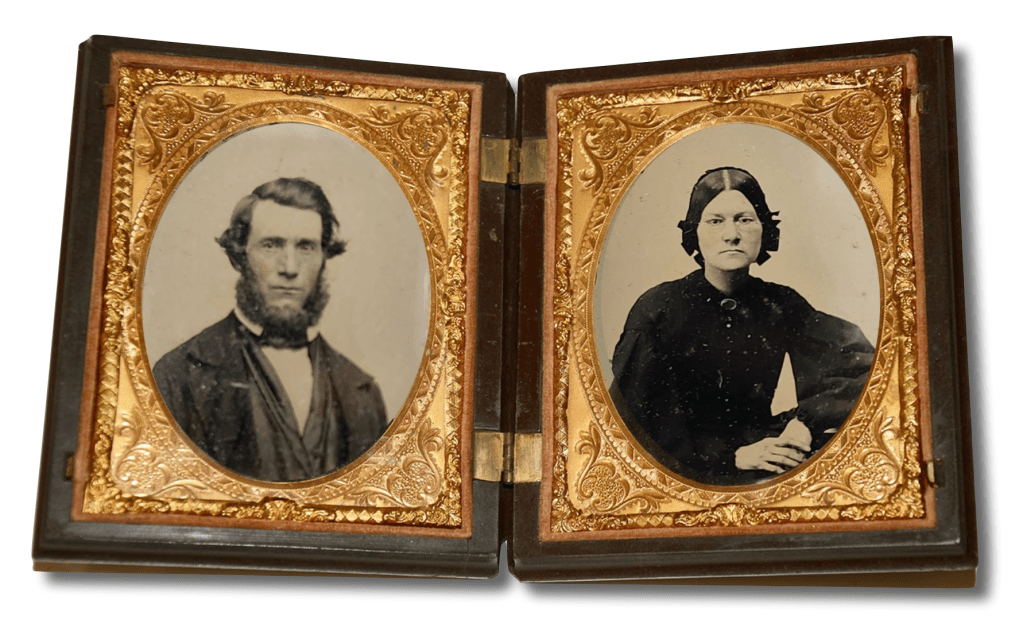

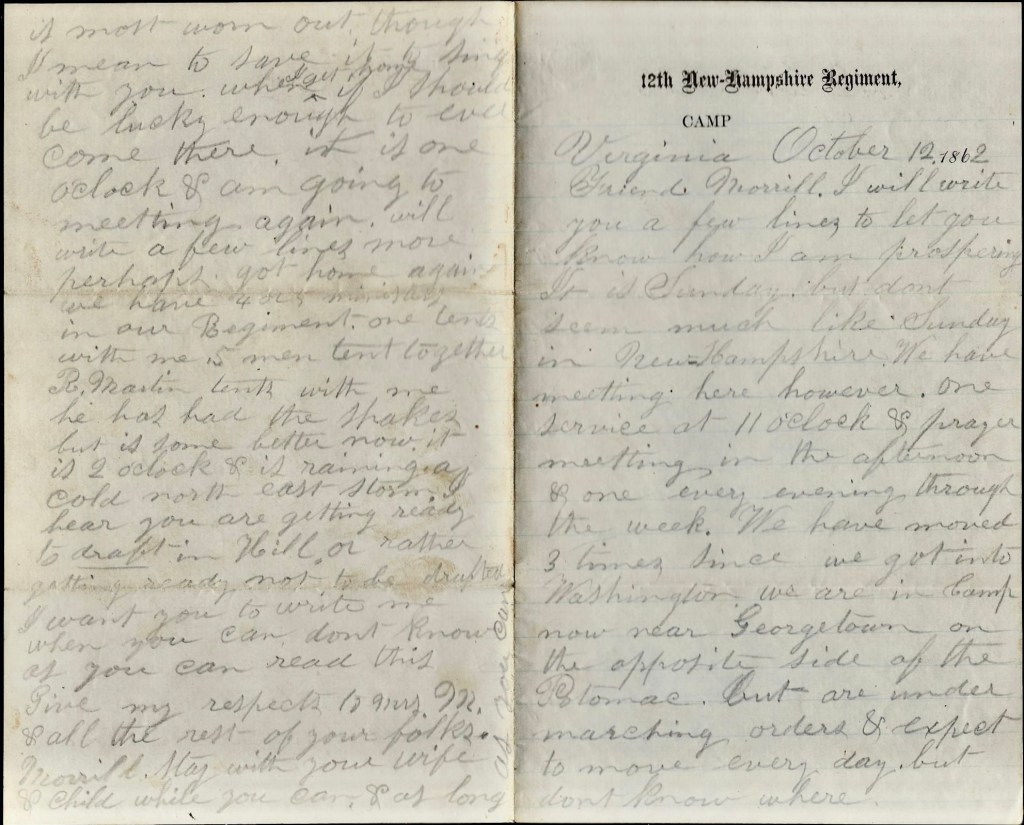
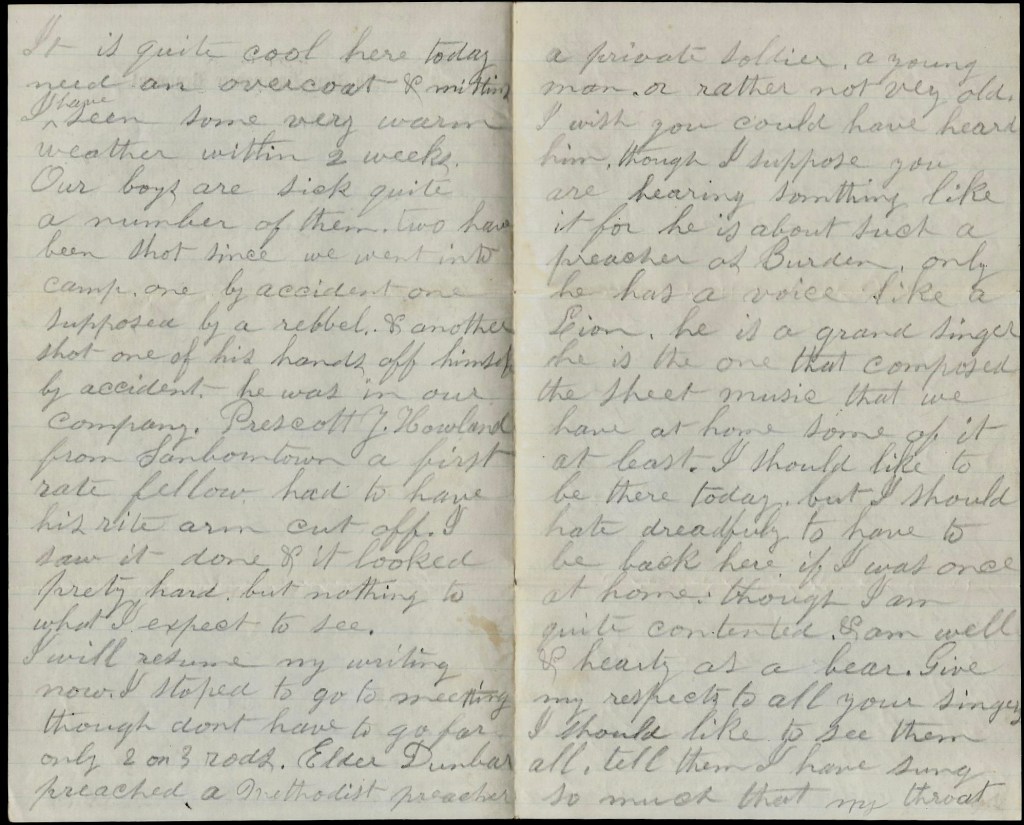


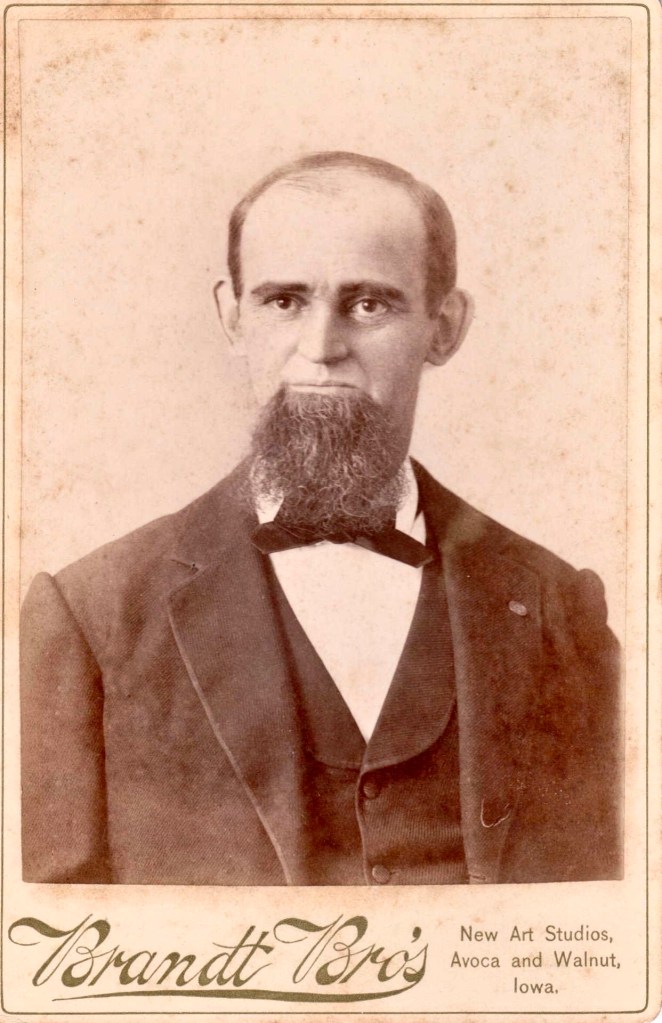

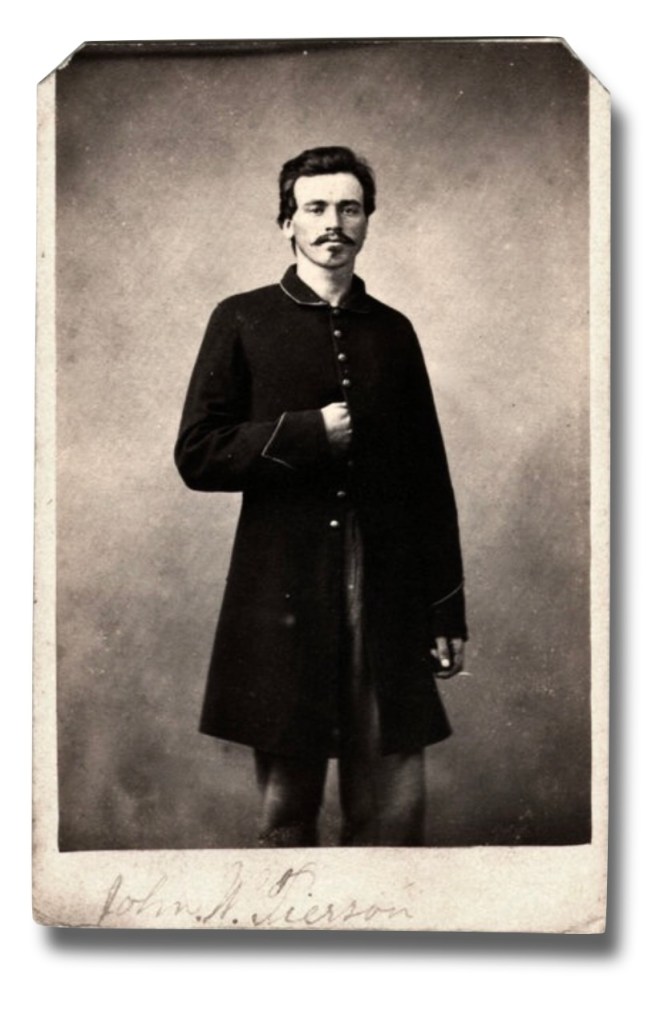
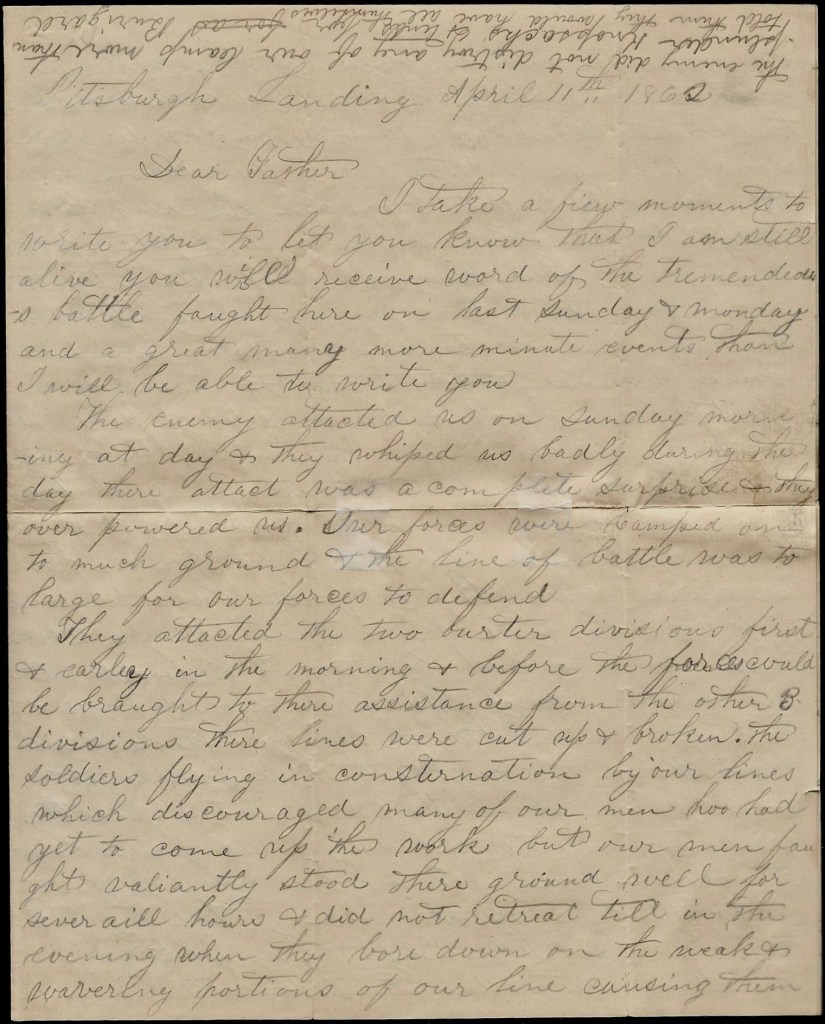


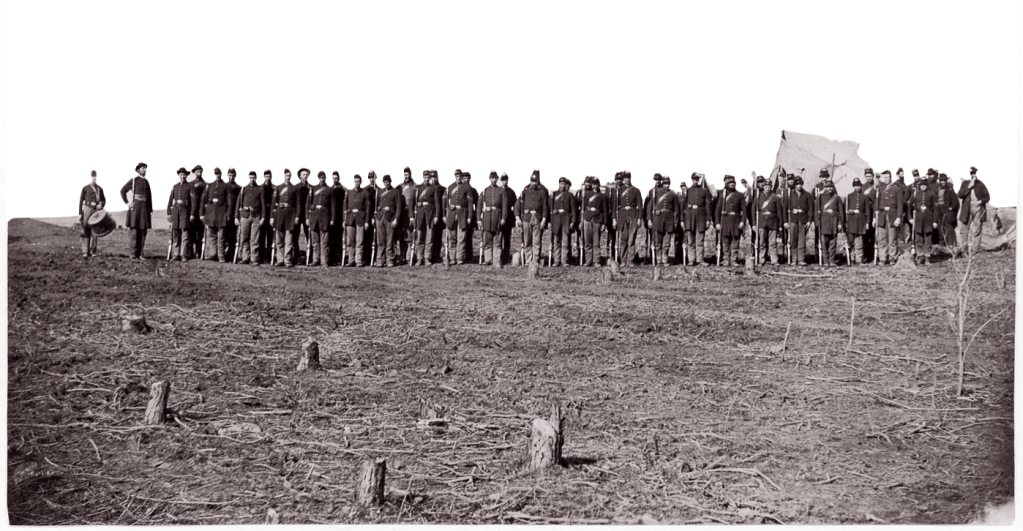
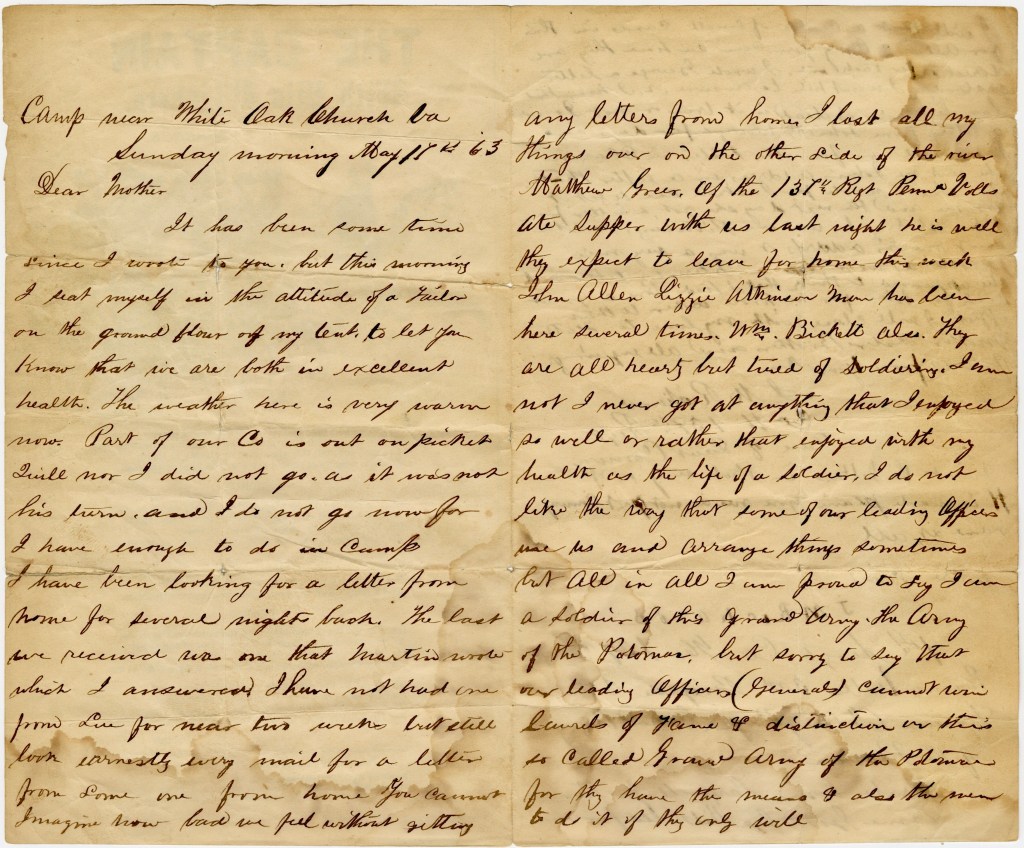


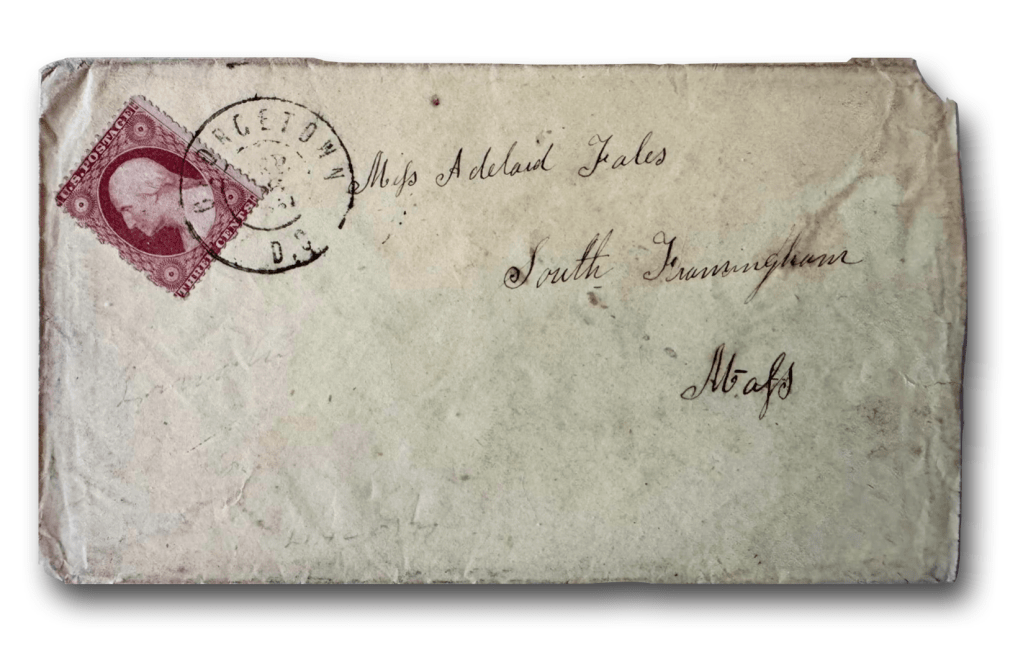
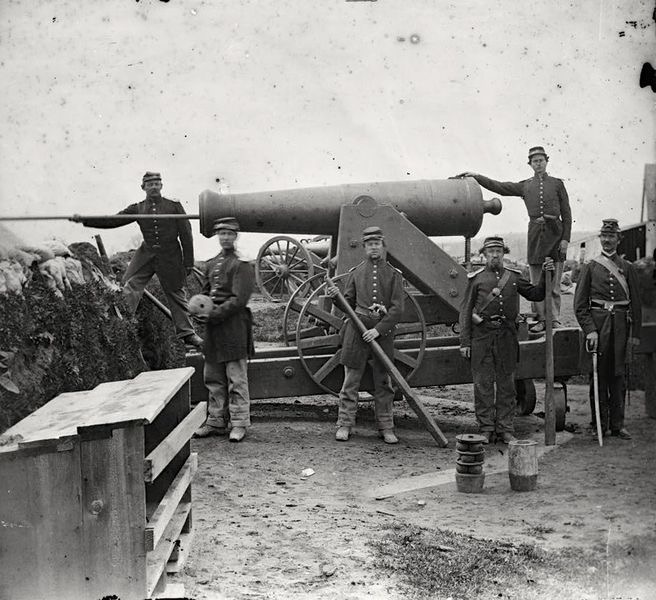
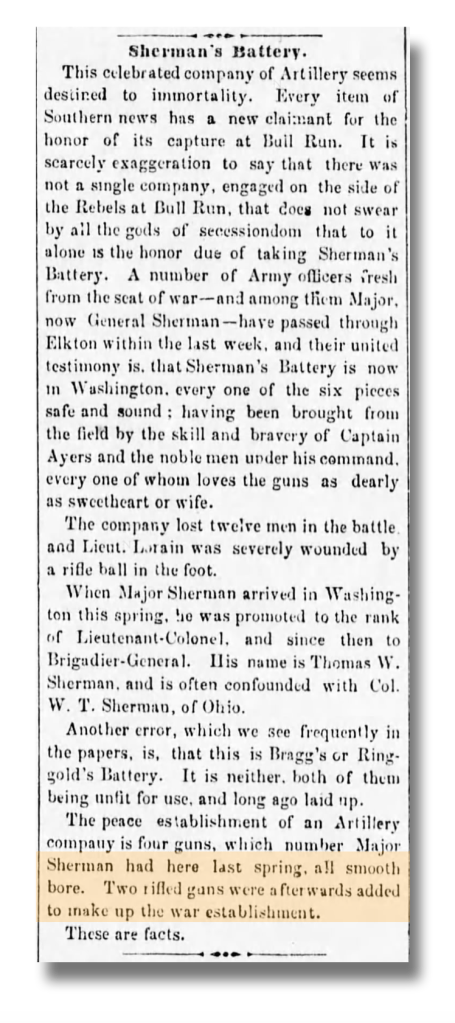
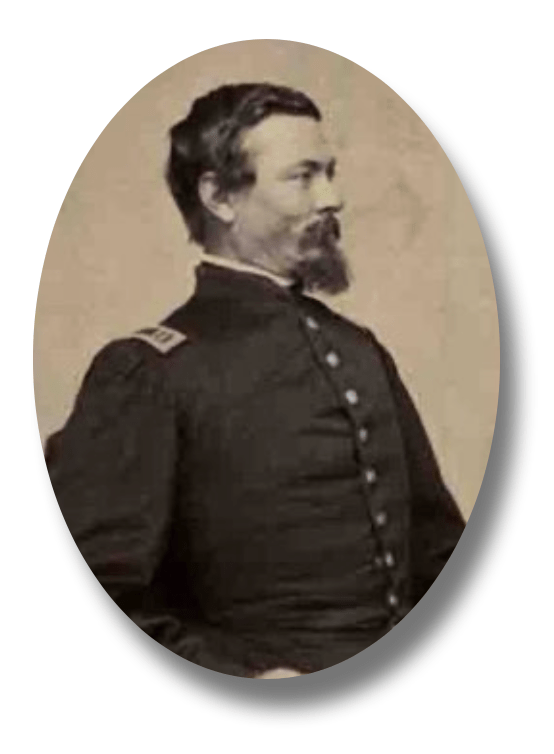
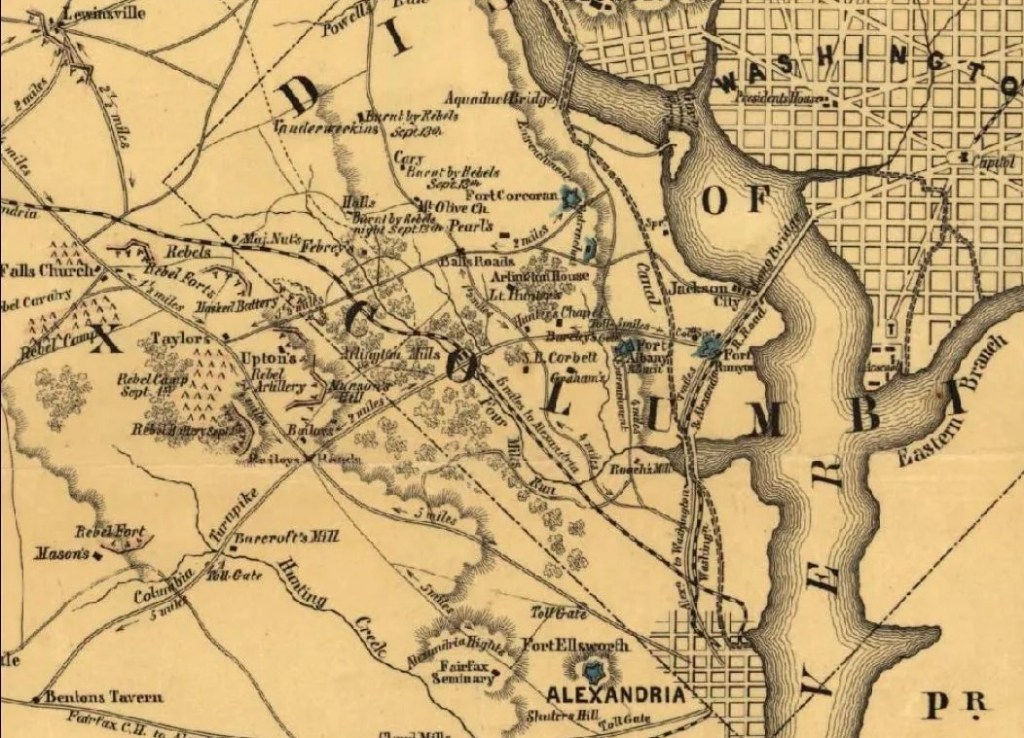


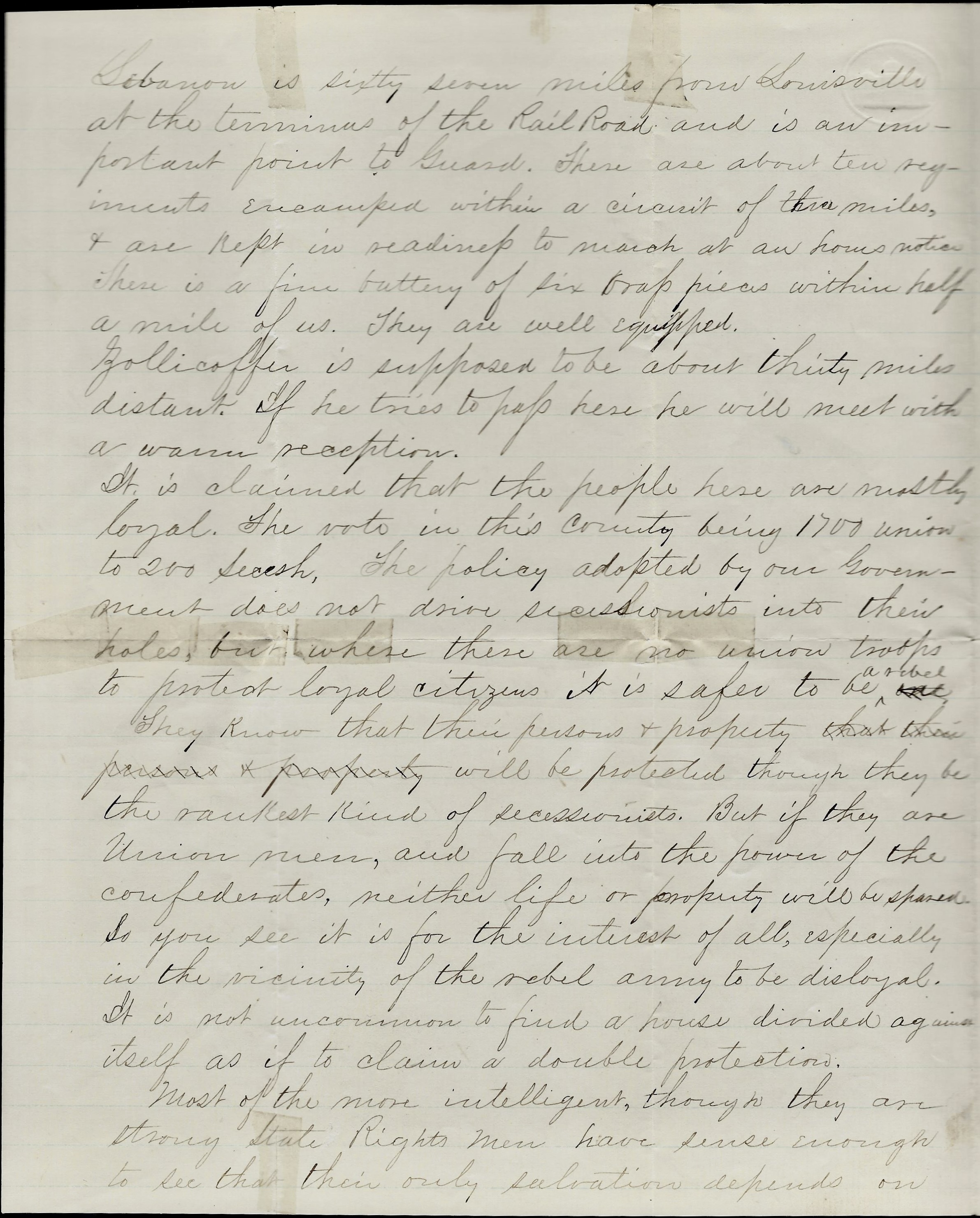


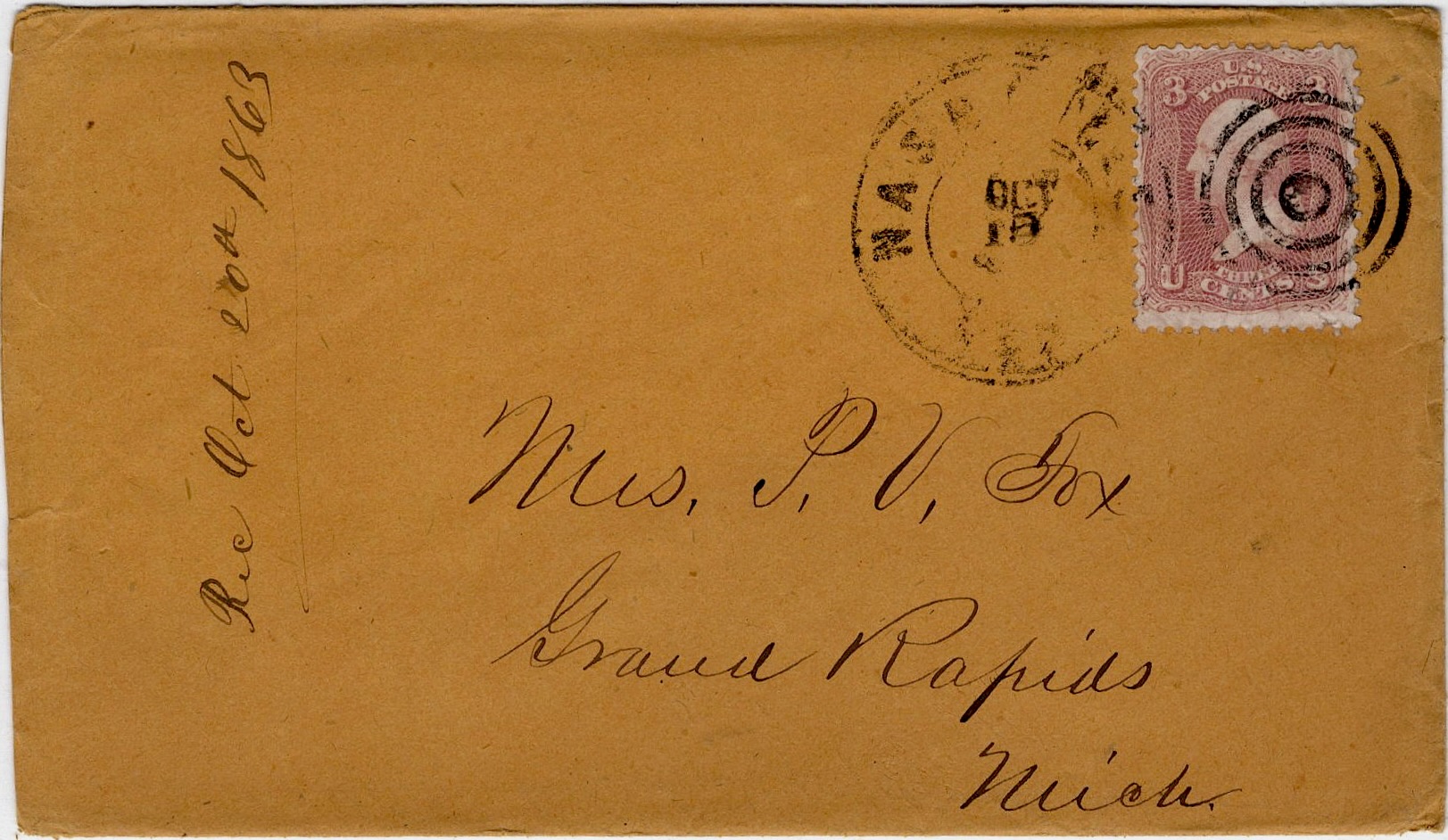


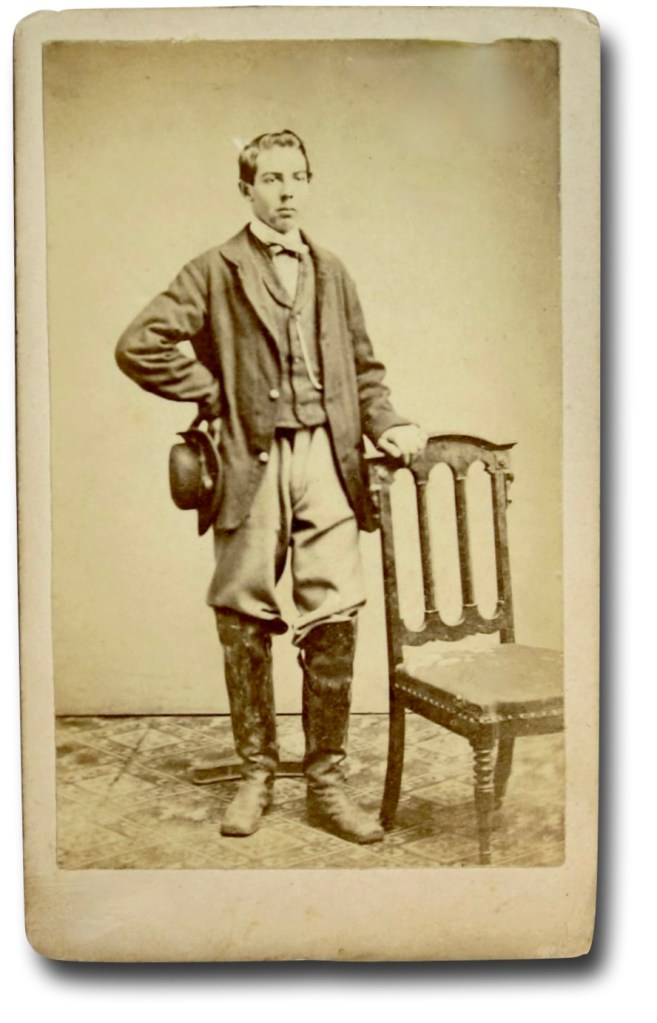
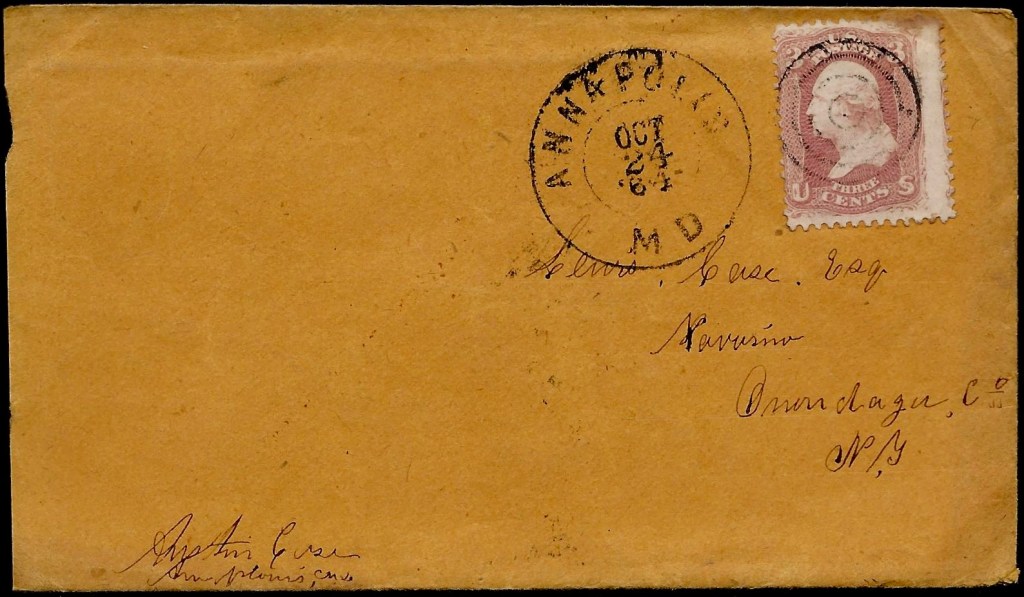
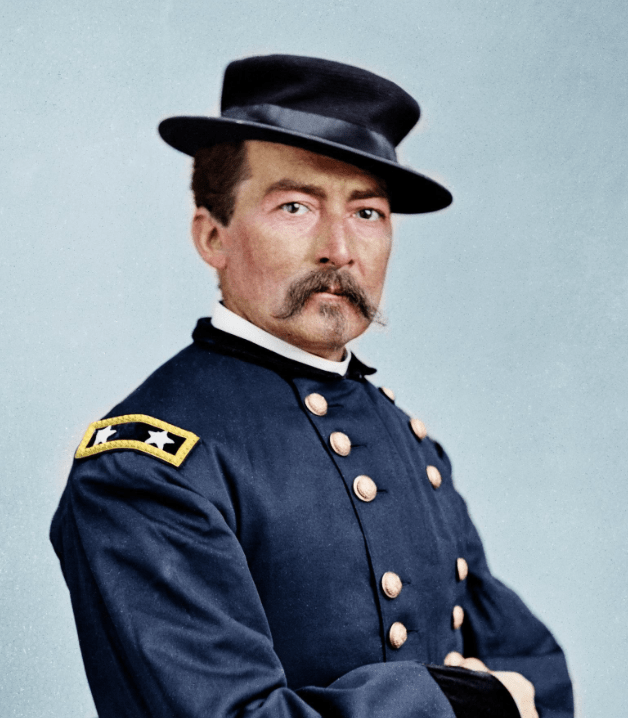
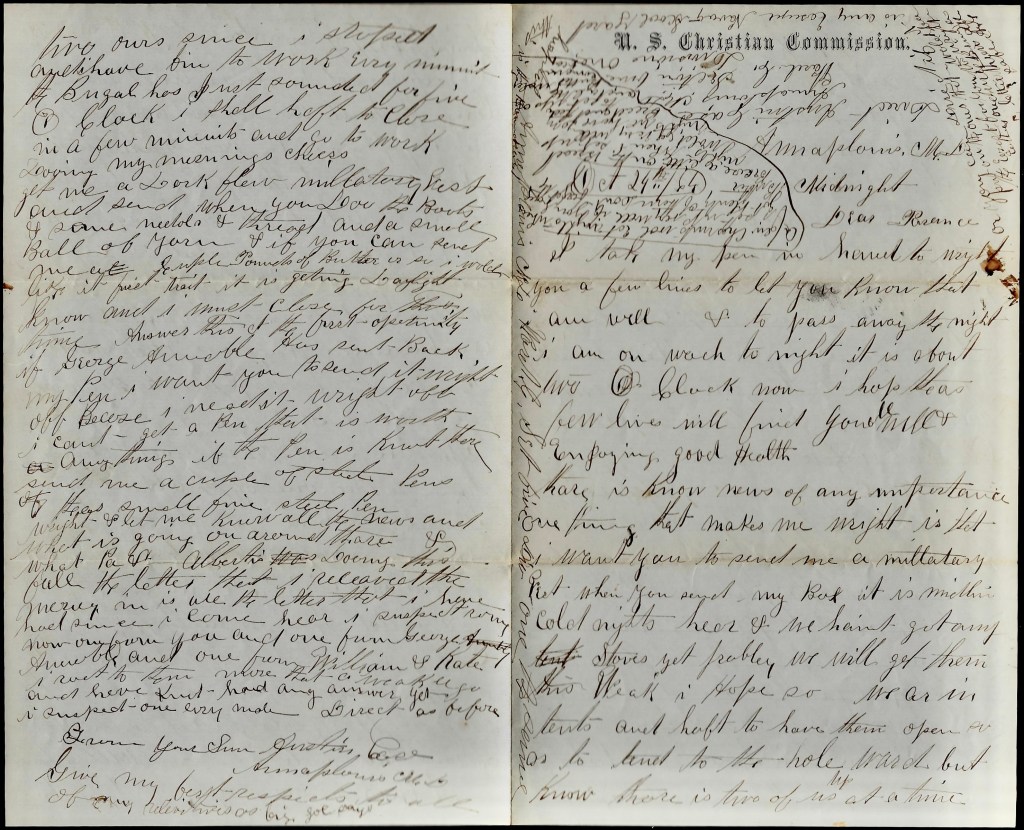
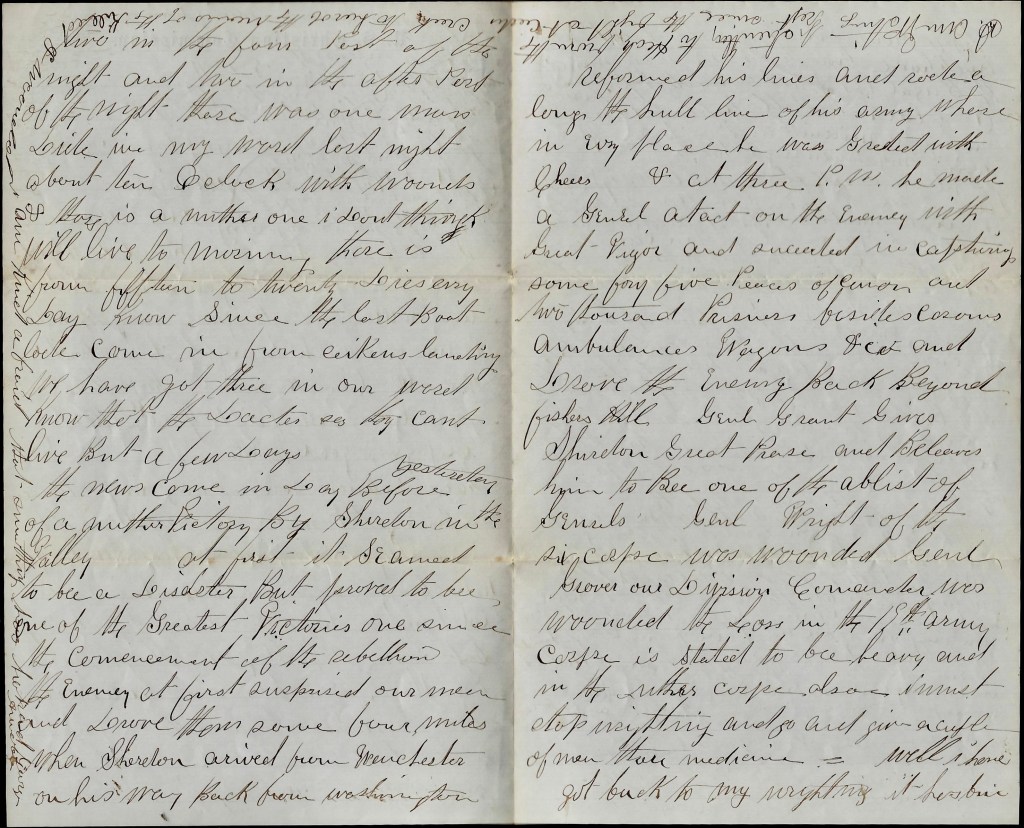
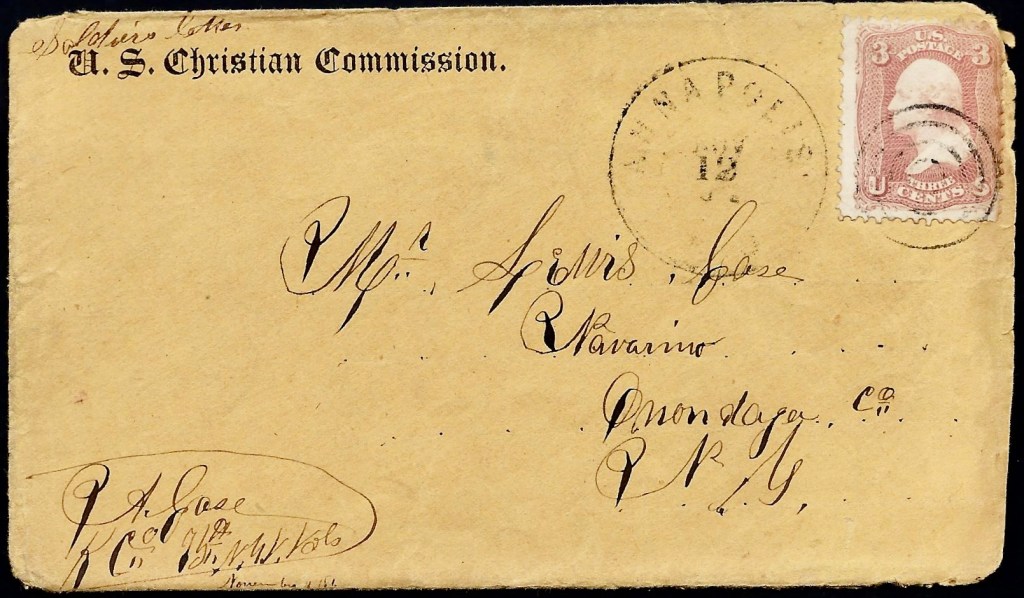
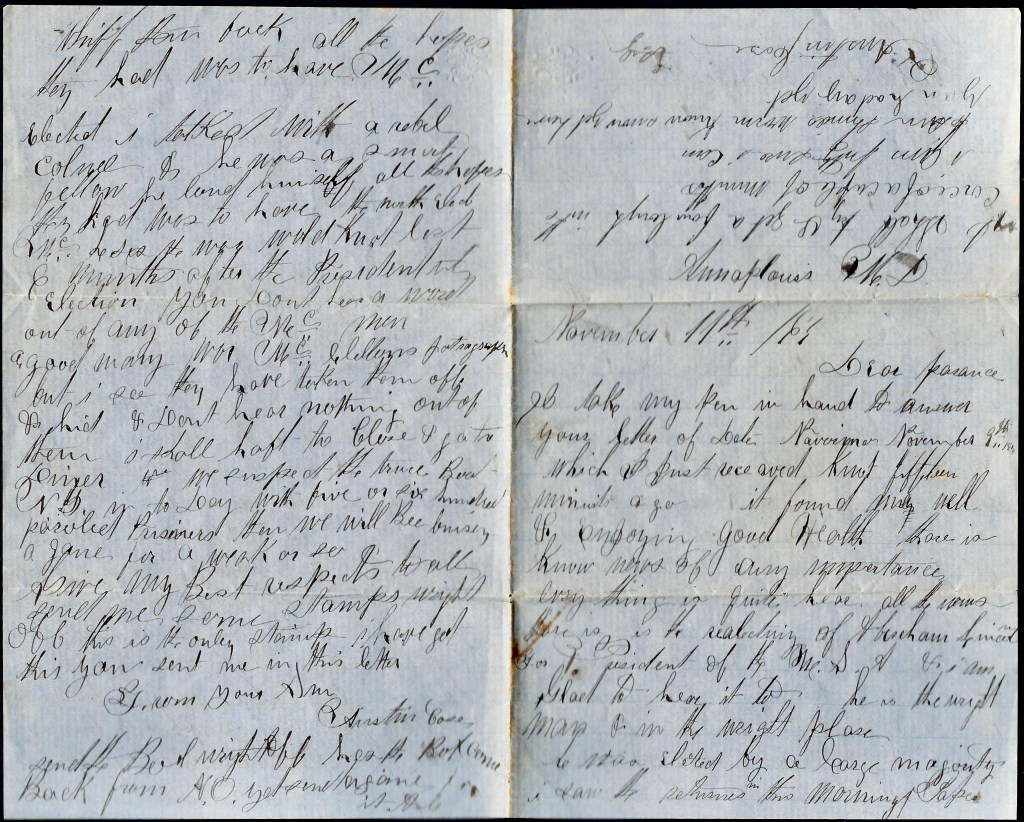
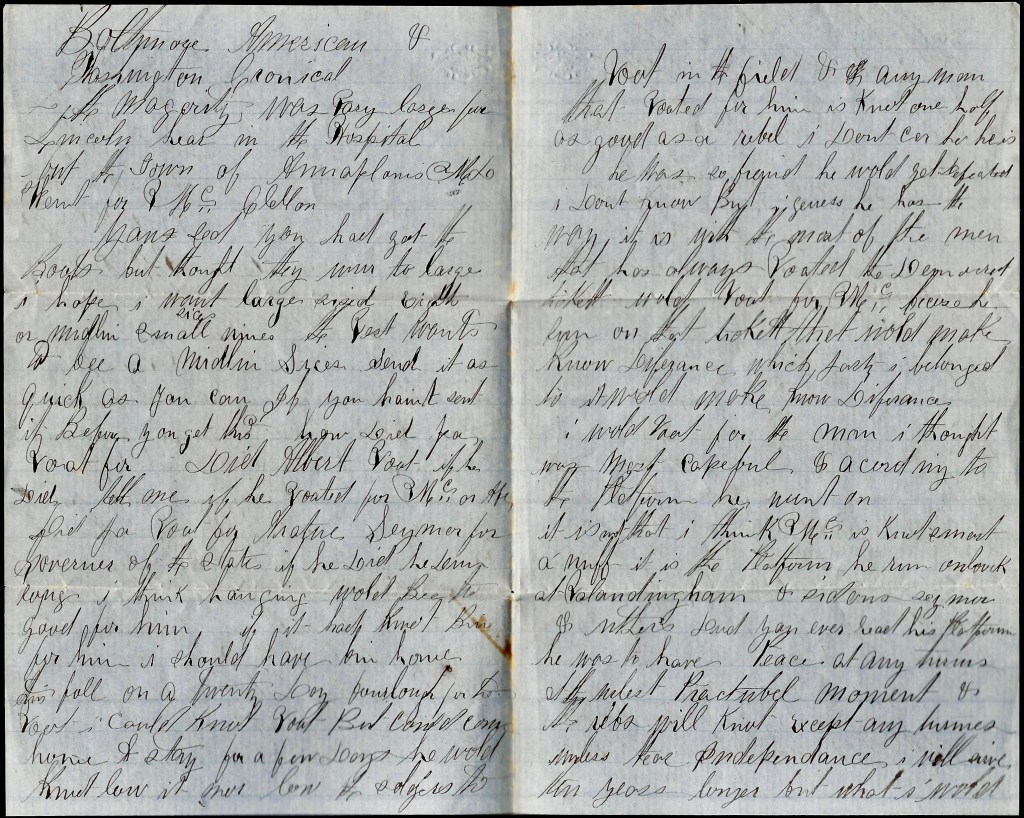
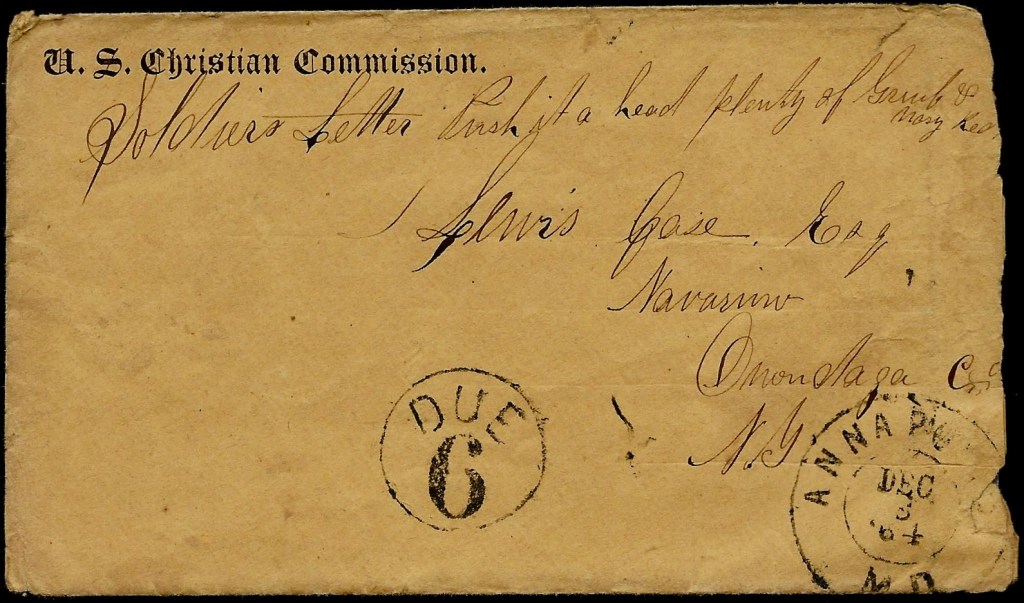
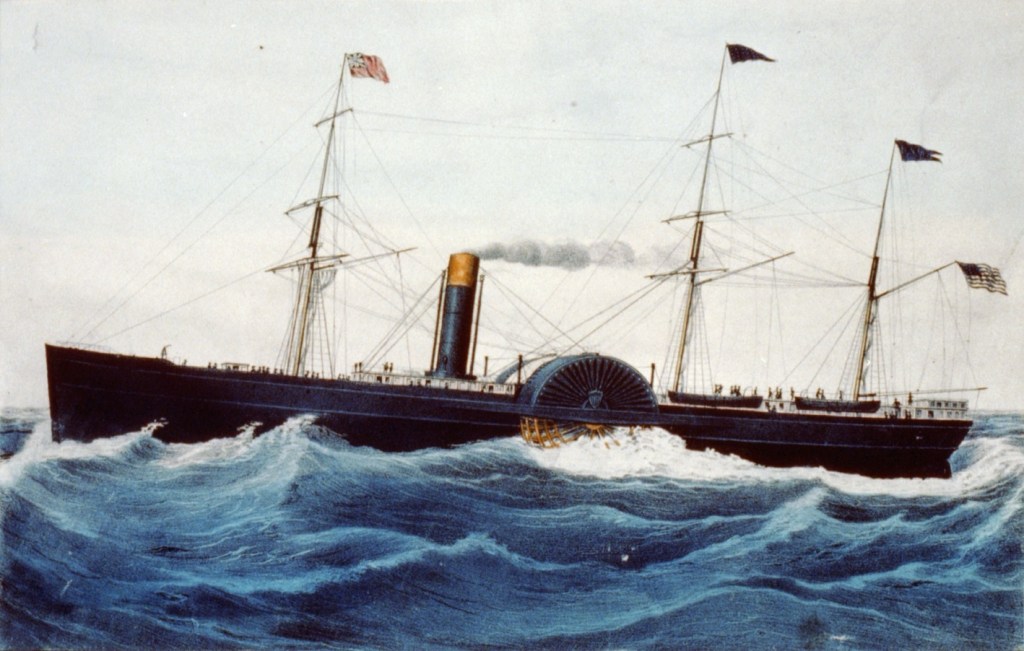
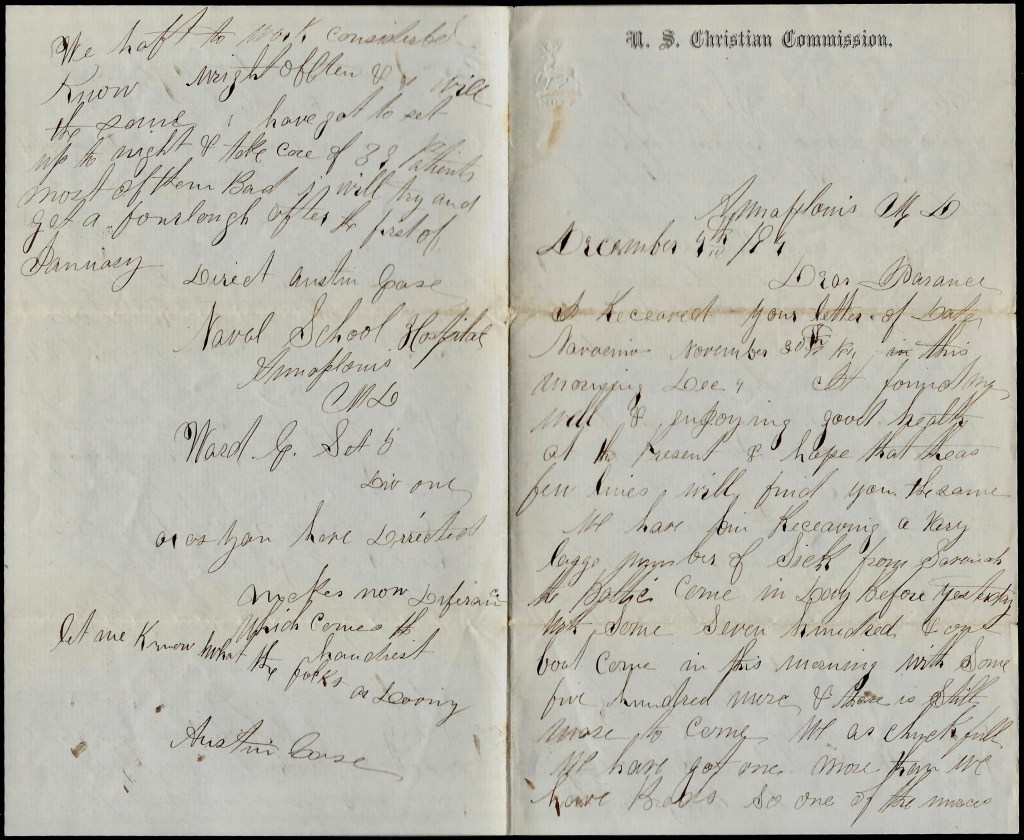
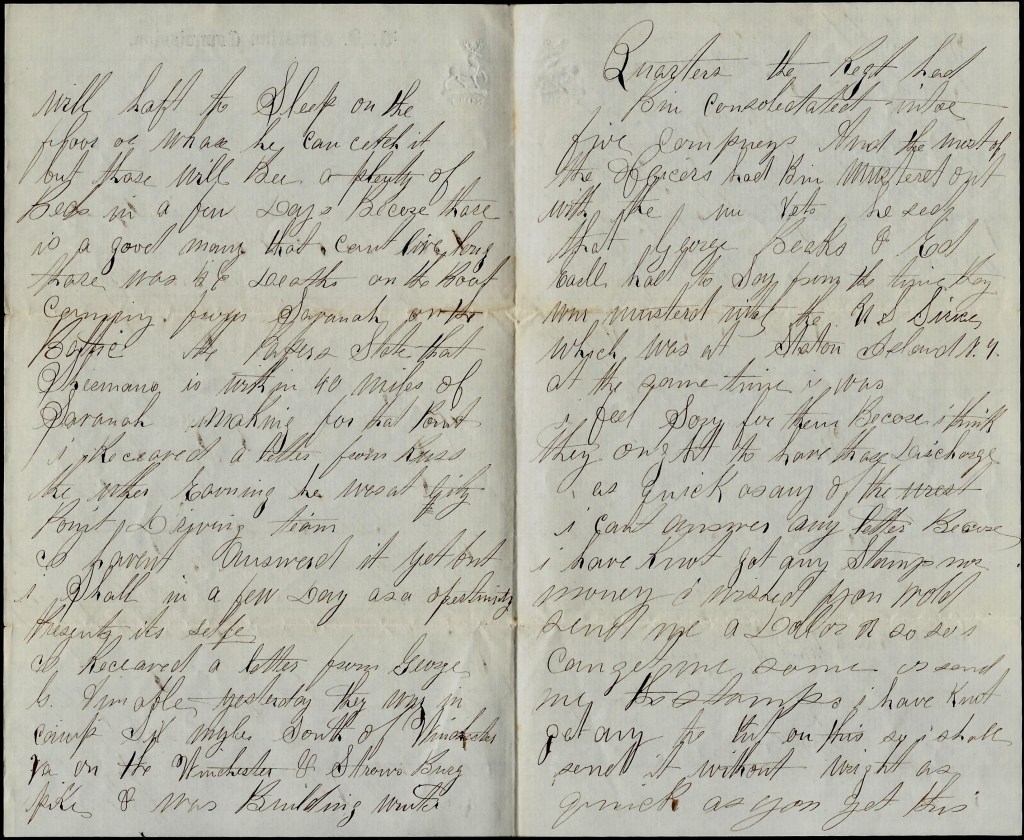

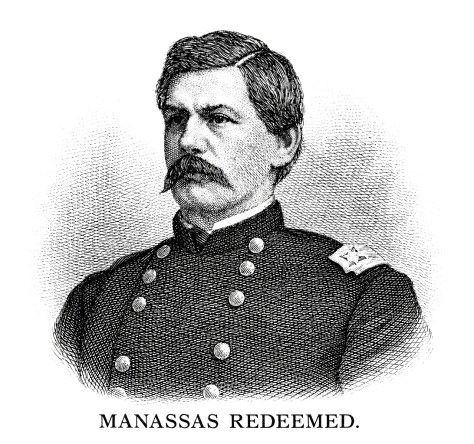
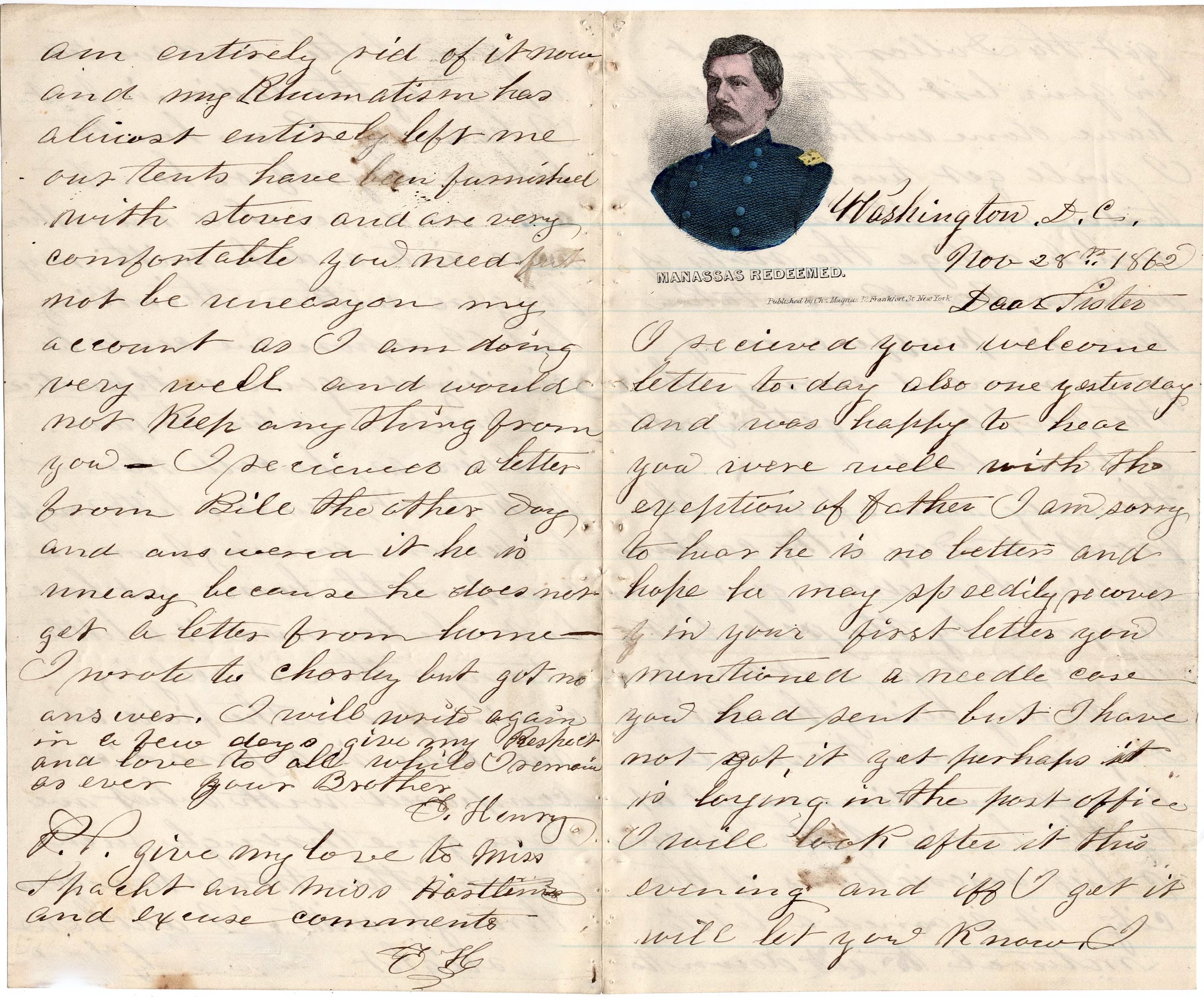
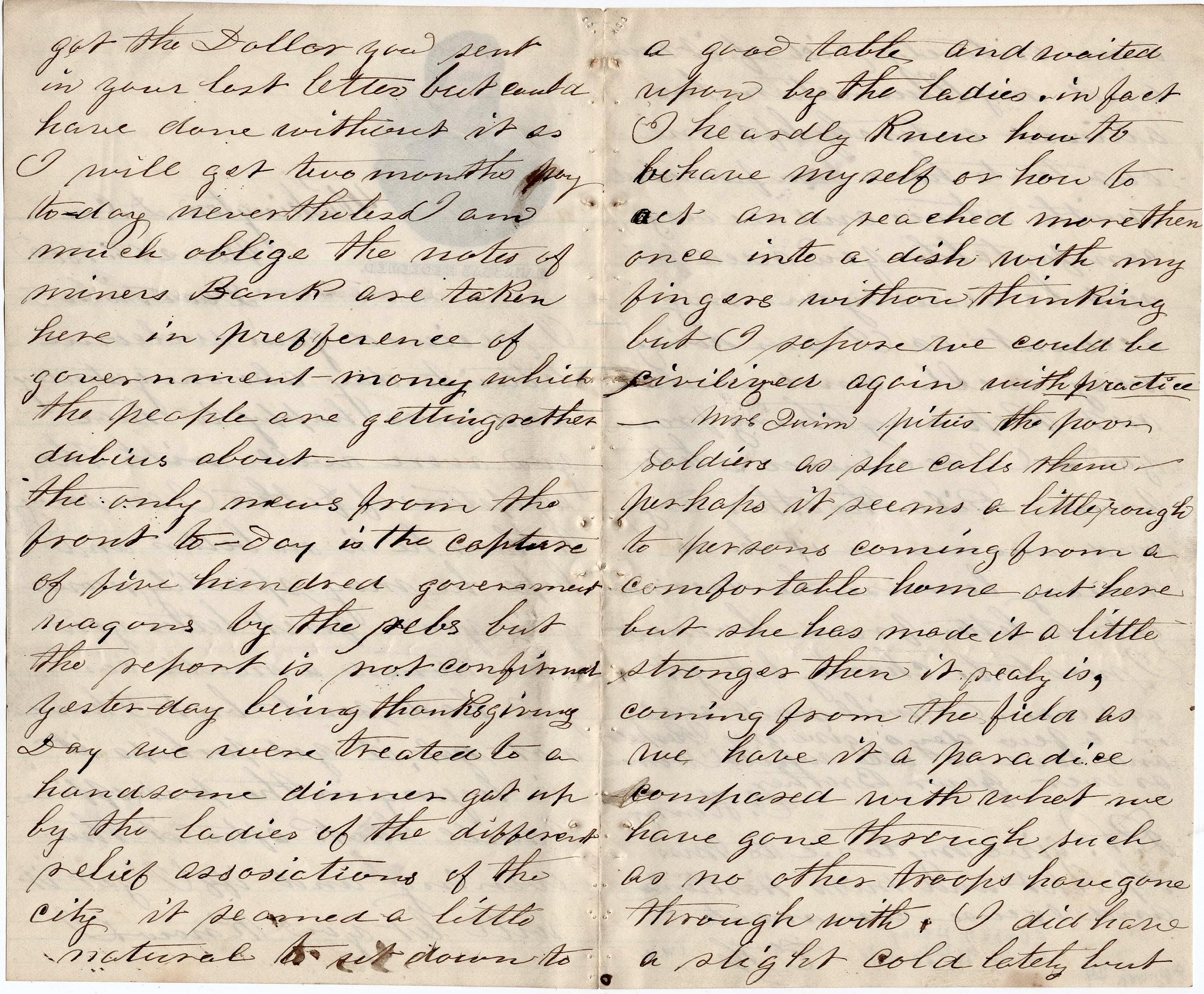
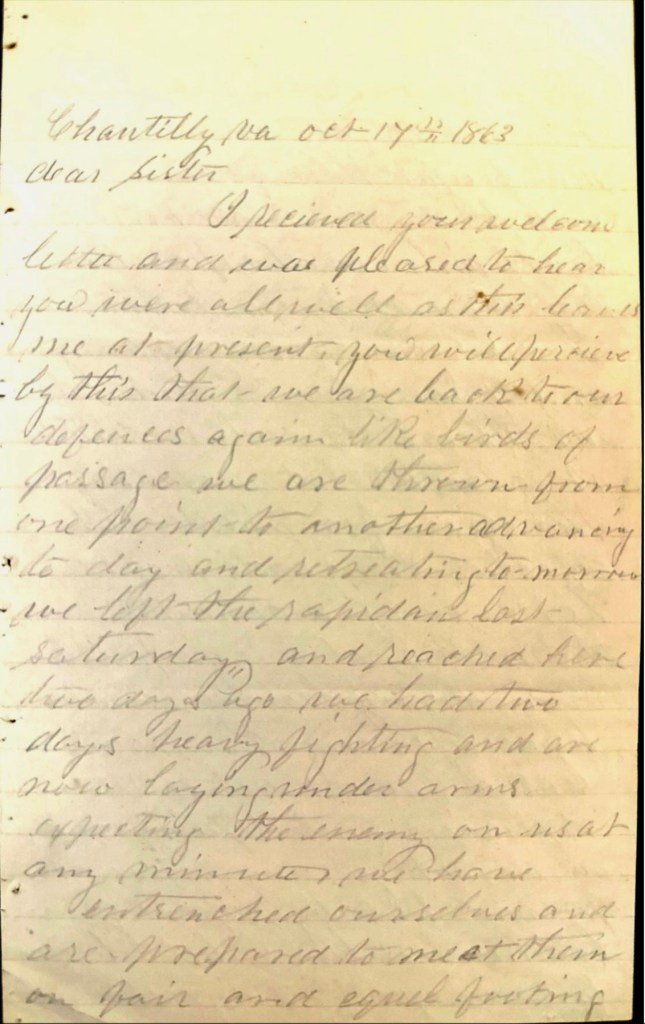


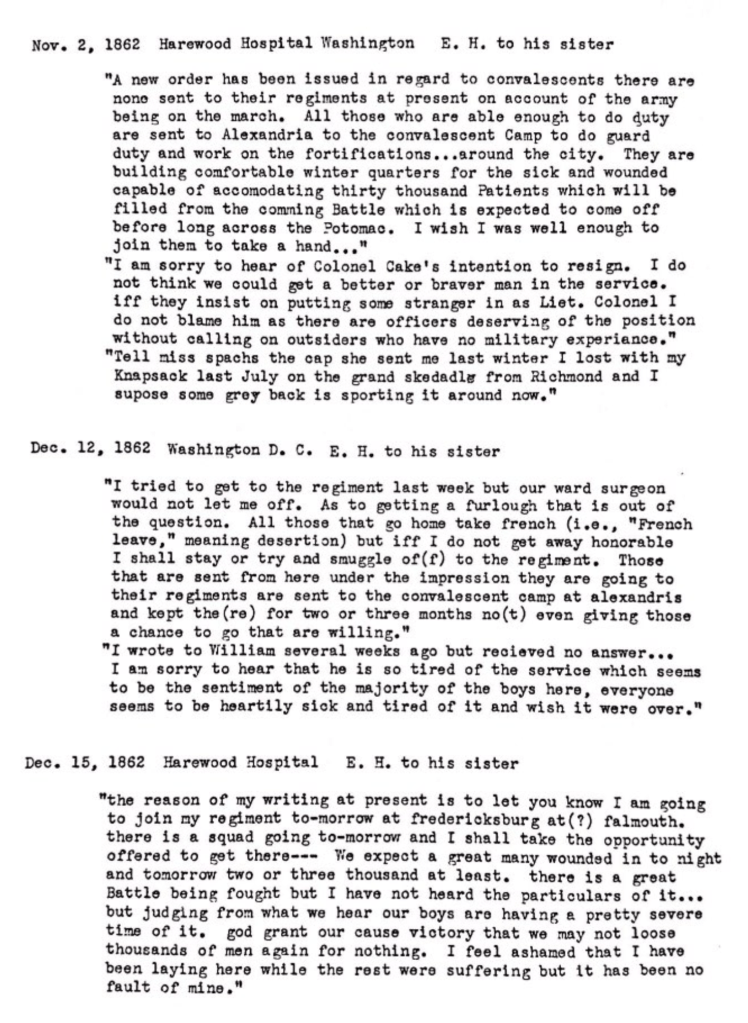
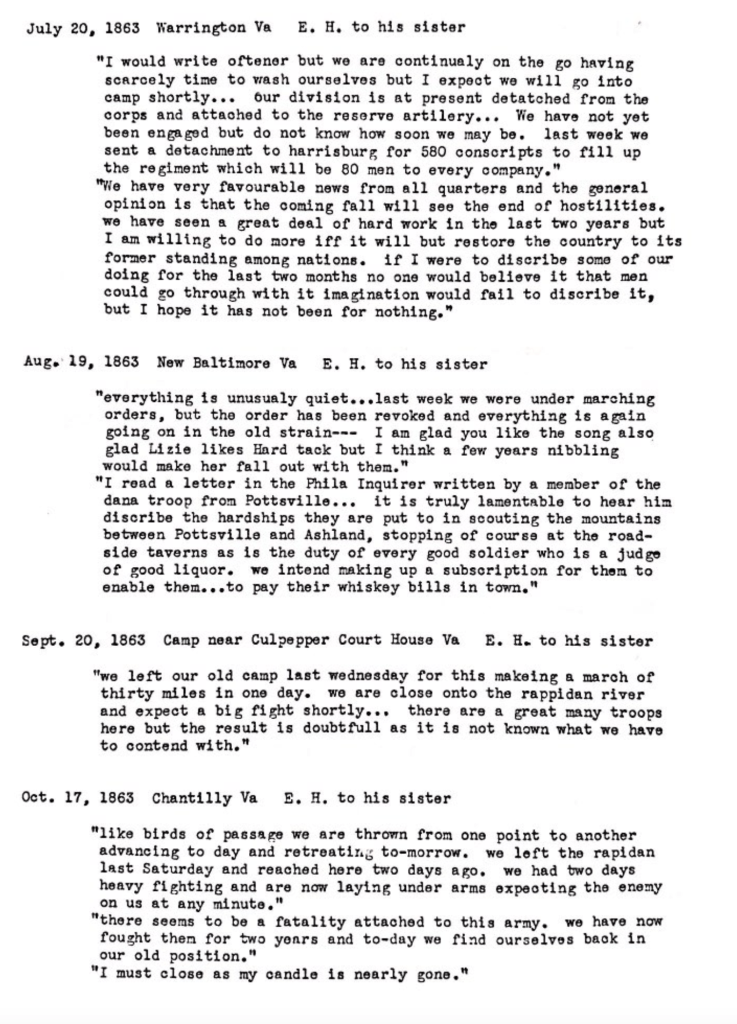

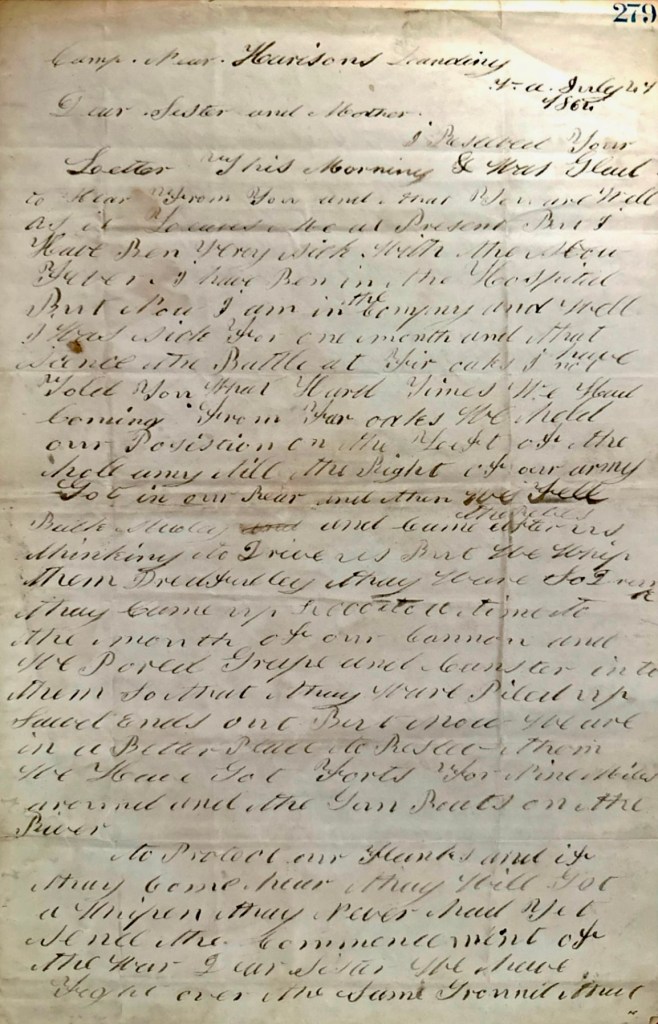
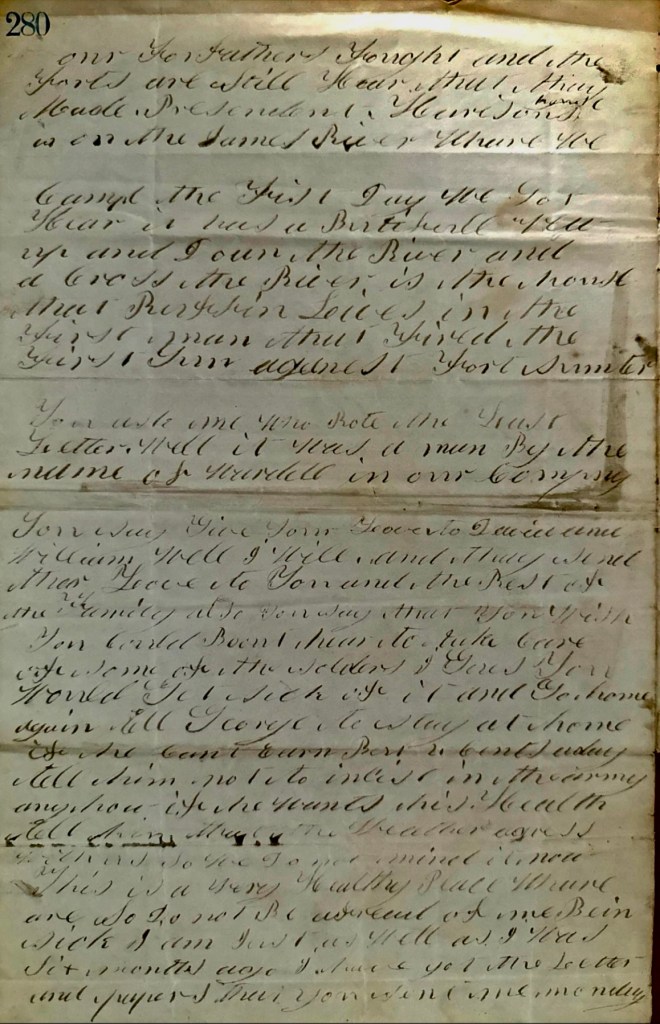

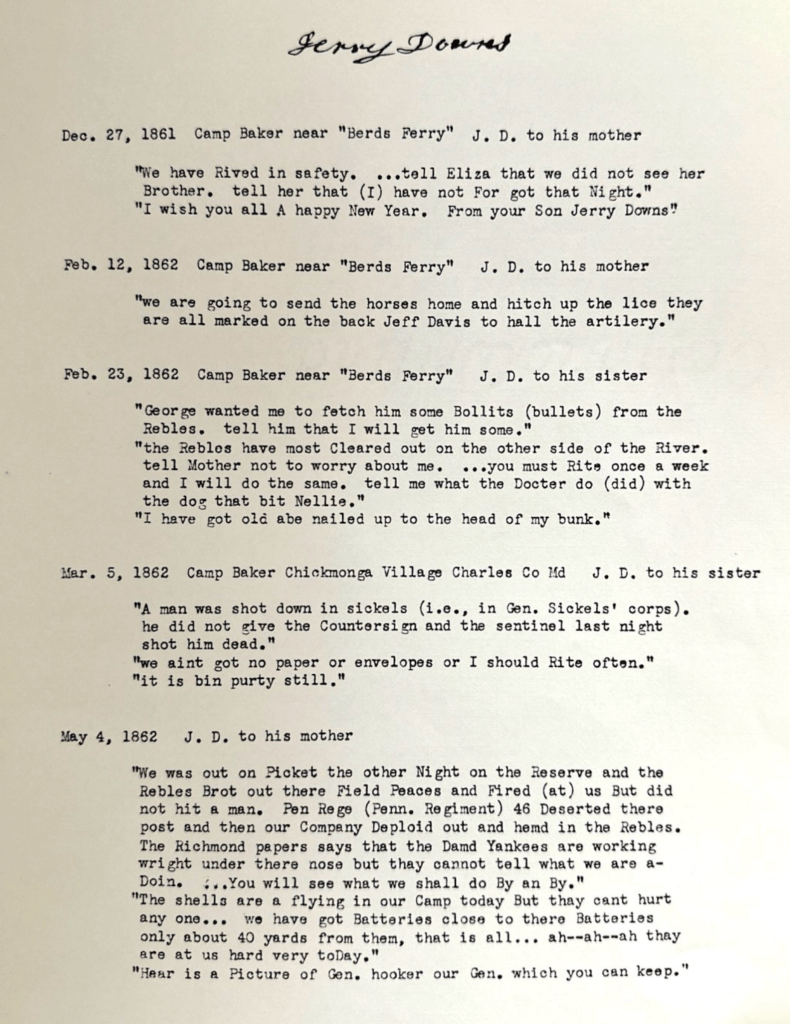


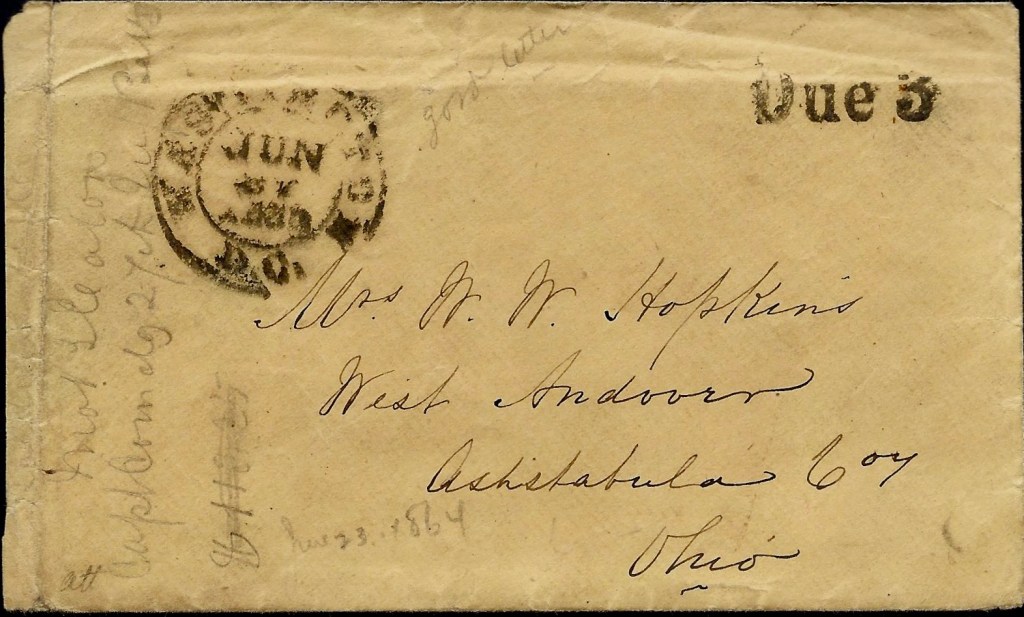

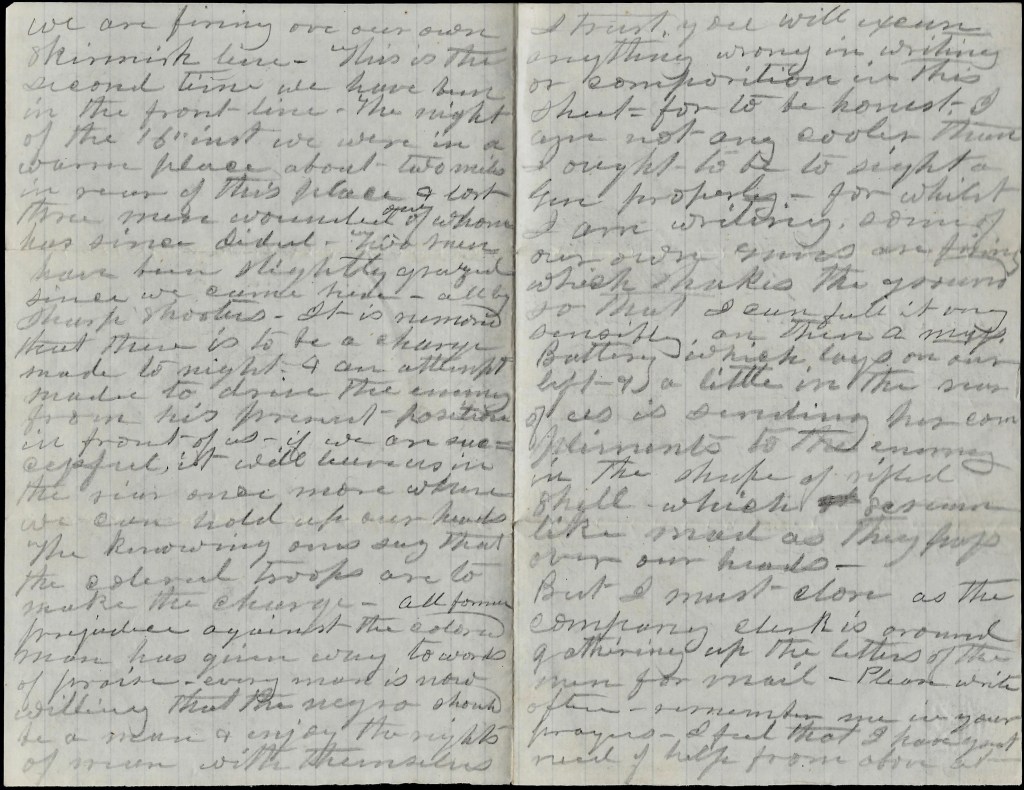


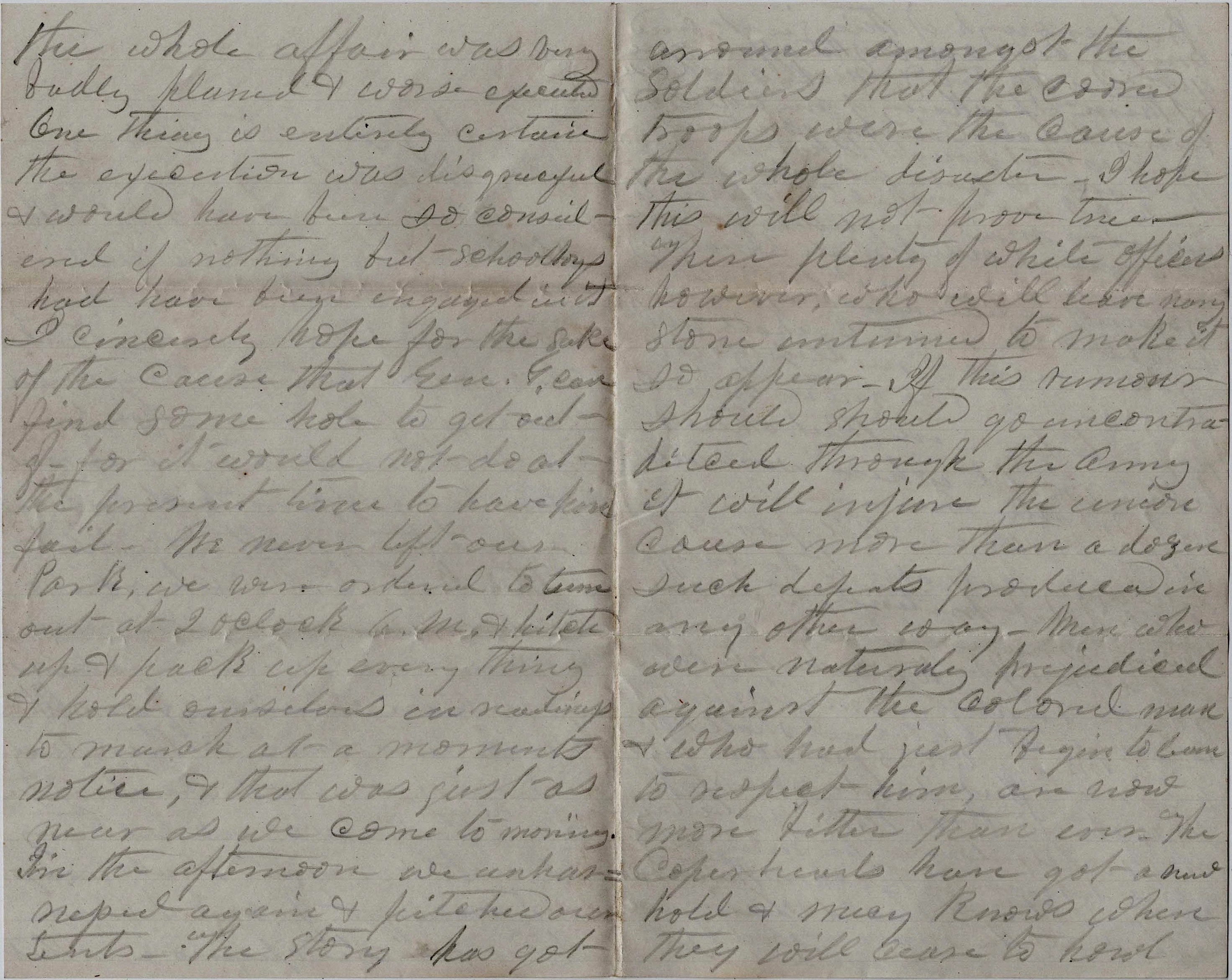
 Spared & Shared 23