
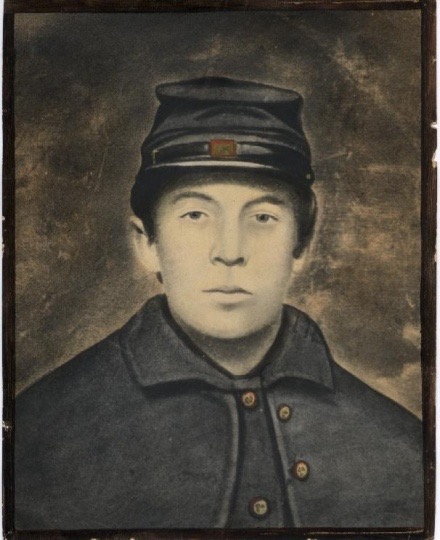
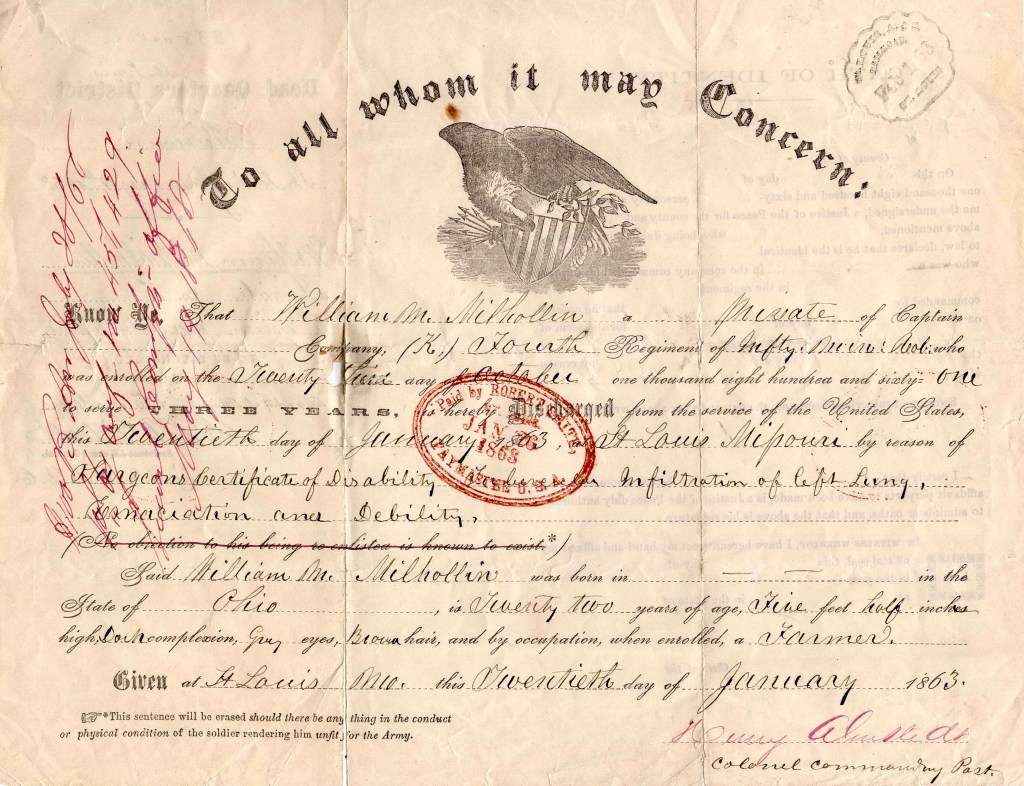
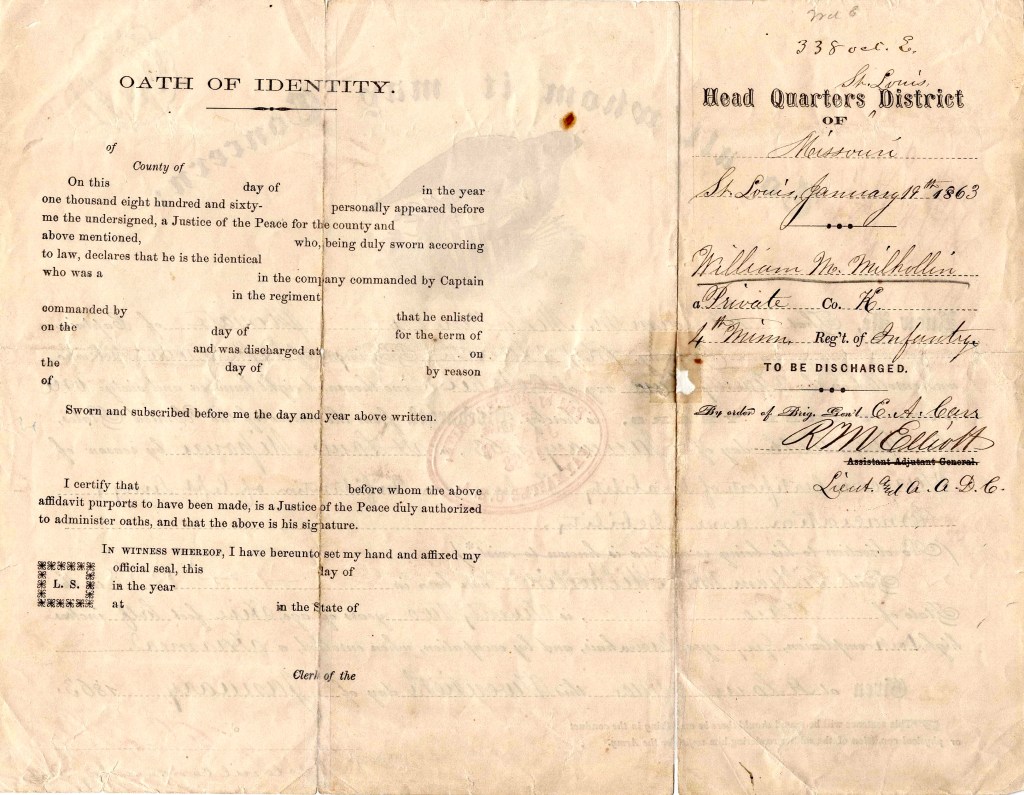
The following letters were written by William W. Milhollin (1839-1864), a native of Ohio, who enlisted in Ramsey county, Minnesota, as a private in Co. K, 4th Minnesota Infantry. He was discharged for disability on 30 January 1863. William (“Billy”) died on 24 May 1864 at Champlin, Hennepin county, Minnesota, and lies buried in Champlin Cemetery.
Serving in the same company with William were his older brothers, Jonathan McClintic Milhollin and Saul M. Milhollin. Though not signed, I believe the second letter to have been written by Saul who died in December 1862 at Quincy, Illinois.
The brothers were the sons of William Milhollin (1796-1871) and Rebecca Ann Henkler (1816-1906) of Champaign county, Ohio. The Milhollin’s moved from Ohio to Minnesota in 1853.
Letter 1
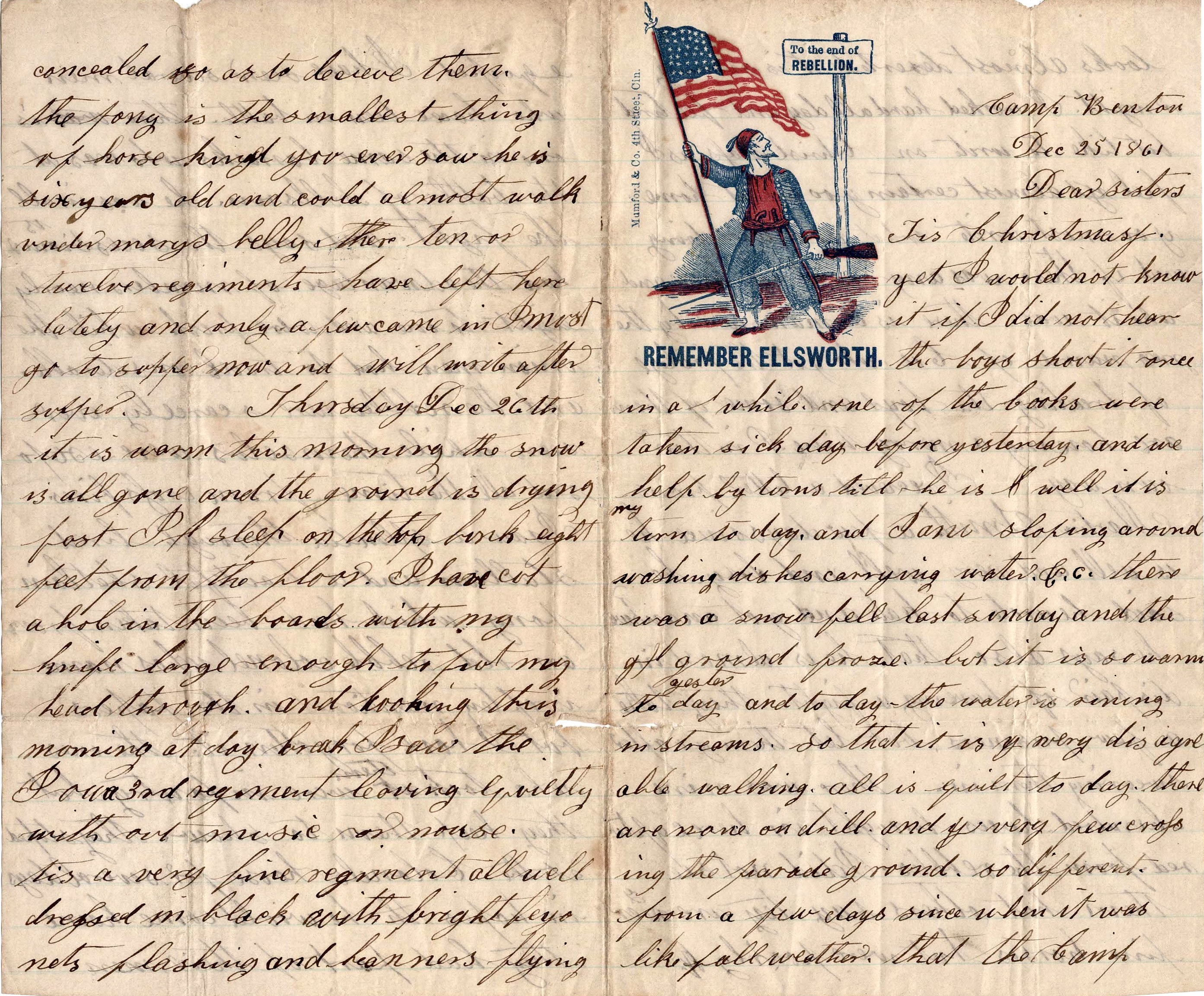
Camp Benton
December 25, 1861
Dear Sisters,
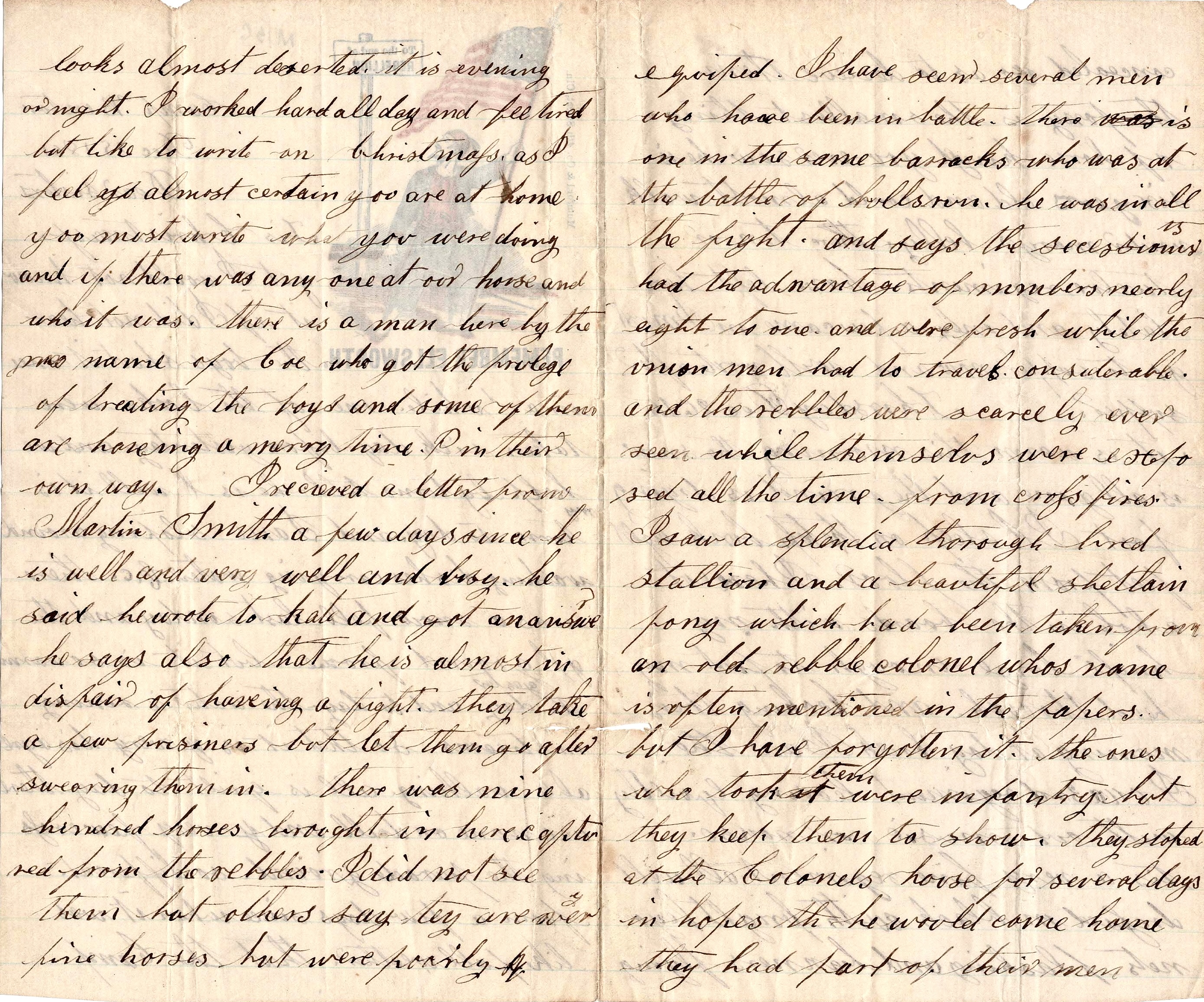
Tis Christmas yet I would not know it if I did not hear the boys shout it once in a while. One of the cooks were taken sick day before yesterday and we help by turns till he is well. It is my turn today and I am slopping around washing dishes, carrying water, &c. There was a snow fell last Sunday and the ground froze, but it is so warm yesterday and today the water is running in streams so that it is very disagreeable walking. All is quiet today. There are none on drill and very few crossing the parade ground. So different from a few days since when it was like fall weather that the camp looks almost deserted. It is evening or night.
I worked hard all day and feel tired but like to write on Christmas as I feel almost certain you are at home. You must write what you are doing and if there was anyone at our house and who it was. There is a man here by the name of Coe who got the privilege of treating the boys and some of them are having a merry time in their own way.
I received a letter from Martin Smith a few days since. He is well and very well and busy. He said he wrote to Kate and got an answer. He says also that he is almost in despair of having a fight. They take a few prisoners but let them go after swearing them in. There was nine hundred horses brought in here captured from the rebels. I did not see them but others say they are very fine horses but were poorly equipped. I have seen several men who have been in battle. There is one in the same barracks who was at the Battle of Bull Run. He was in all the fight and says the secessionists had the advantage of numbers nearly eight to one and were fresh while the Union men had to travel considerable and the rebels were scarcely ever seen while themselves were exposed all the time from crossfires.
I saw a splendid thoroughbred stallion and a beautiful shetland pony which had been taken from an old rebel colonel whose name is often mentioned in the papers but I have forgotten it. The ones who took them were infantry but they keep them for show. They stopped at the colonel’s house for several days in hopes he would come home. They had part of their men concealed so as to deceive them. The pony is the smallest thing of horse kind you ever saw. He is six years old and could almost walk under Mary’s belly.
Ten or twelve regiments have left here lately and only a few come in. Must go to supper now and will write after supper.
Thursday, December 26th. It is warm this morning. The snow is all gone and the ground is drying fast. I sleep on the top bunk eight feet from the floor. I have cut a hole in the boards with my knife large enough to put my head through and looking this morning at daybreak, saw the Iowa 3rd Regiment leaving quietly without music or noise. Tis a very fine regiment—all well dressed in black with bright bayonets flashing and banners flying. 1
1 The 3rd Iowa Infantry moved from Quincy, Illinois, to Benton Barracks in late November 1861. They marched out of St. Louis on 26 December 1861 to perform guard duty at Mexico, Missouri, and along the Northern Missouri Railroad where they remained until March 1862. They were then ordered to Pittsburg Landing, Tennessee, prior to the Battle of Shiloh.
Letter 2
[Editor’s Note: The regiment moved from the siege lines around Corinth (which ended May 30) to camp at Clear Creek, Mississippi, which is roughly 6 miles south of Corinth. During this period, they were tasked with protecting the railroad and scouting the area for Confederate activity.]
Camp 6 miles south of Corinth
June 6th 1862
Dear Mother,
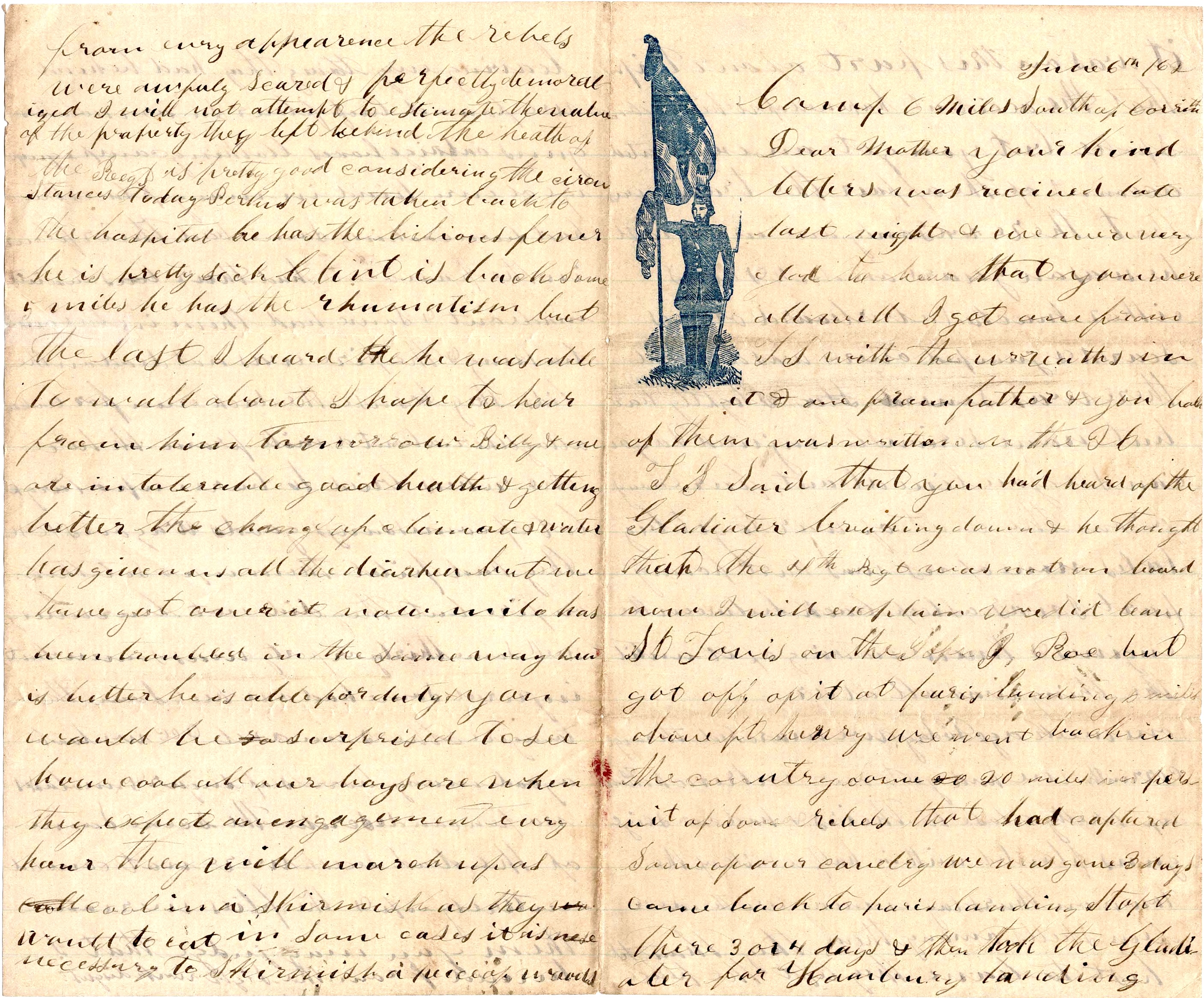
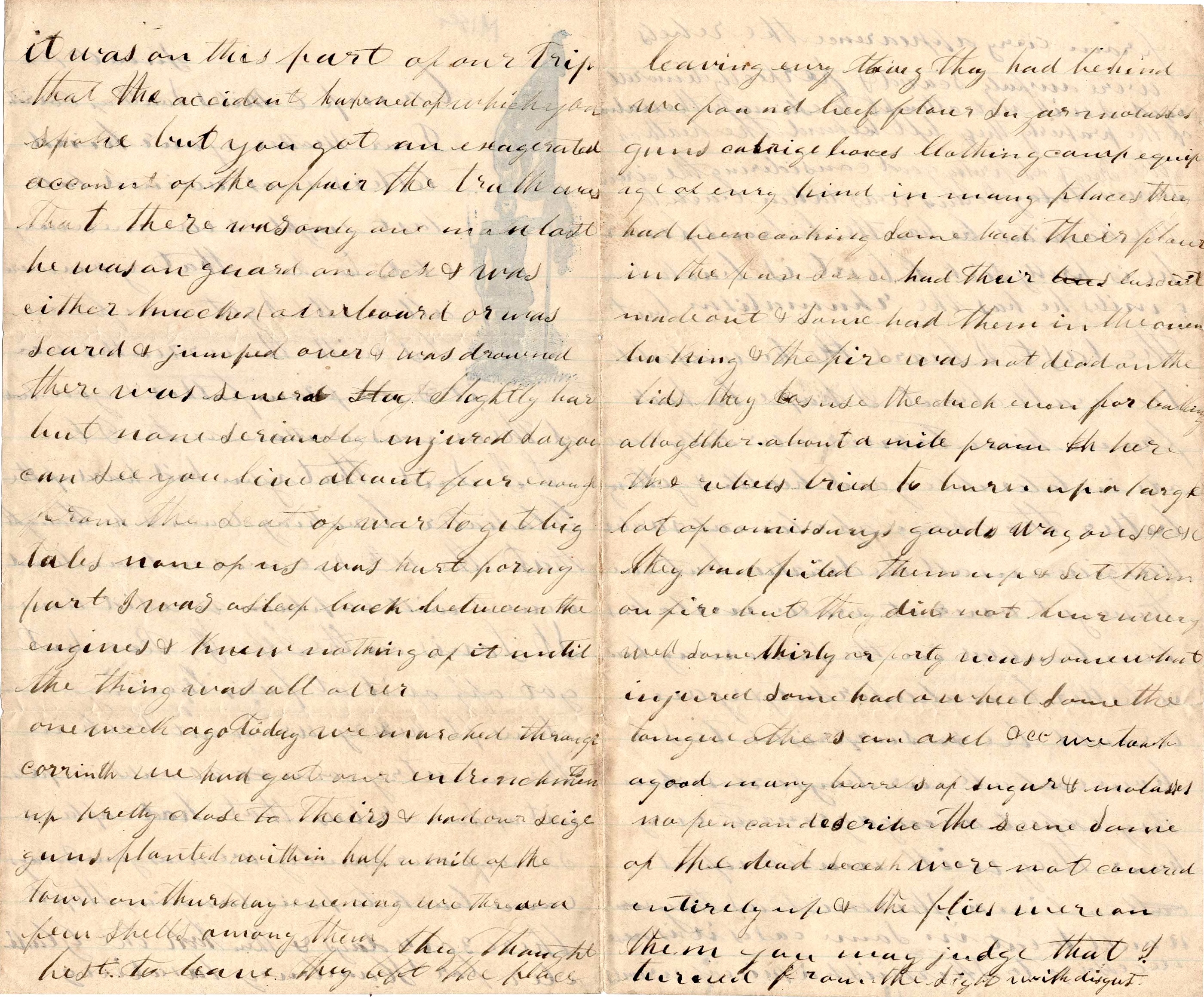
Your kind letters was received late last night & we were very glad to hear that you were all well. I got one from T. S. with the wreaths in it & one from father & you. Both of them was written on the 26th. T. S. said that you had heard of the Gladiator breaking down & he thought the 4th Regiment was not on board. Now I will explain. We did leave St. Louis on the John J. Roe but got off of it at Paris Landing 10 miles above Fort Henry. We went back in the country some 20 miles in pursuit of some rebels that had captured some of our cavalry. We was gone 3 days, came back to Paris Landing, stopped there 3 or 4 days, and then took the Gladiator for Hamburg Landing. It was on this part of our trip that the accident happened which you spoke of but you got an exaggerated account of the affair. The truth was that there was only one man lost. He was on guard on deck and was either knocked overboard or was scared and jumped over and was drowned. There was several slightly hurt but none seriously injured so you can see you live about far enough from the seat of war to get big tales. None of us was hurt. For my part, I was asleep back between the engines & knew nothing of it until the thing was all over.
One month ago today we marched through Corinth. We had got our entrenchments up pretty close to theirs & had our siege guns planted within half a mile of the town. On Thursday evening, we threw a few shells among them. They thought best to leave. They left the place leaving everything they had behind. We found beef, flour, sugar, molasses, guns, cartridge boxes, clothing, camp equipage of every kind. In many places they had been cooking. Some had their flour in the pan and had their biscuit made out & some had them in the oven baking & the fire was not dead on the lids. They use the dutch oven for baking altogether.
About a mile from here the rebels tried to burn a large lot of commissary goods, wagons, &c. They had piled them up and set them on fire but they did not burn very well. Some 30 or 40 was somewhat injured. Some had a wheel, some the tongue or an axel. We took a good many barrels of sugar & molasses. No pen can describe the scene. Some of the dead secesh were not covered entirely up & the flies were on them. You may judge that I turned from the sight with disgust. From every appearance the rebels were awfully scared & perfectly demoralized, I will not attempt to estimate the value of the property they left behind.
The health of the regiment is pretty good considering the circumstances. Today [Robert S.] Perkins was taken back to the hospital. He has the bilious fever. He is pretty sick. [Brother] Clint is back some 5 miles. He has the rheumatism but the last I heard he was able to walk about. I hope to hear from him tomorrow. Billy & me are in tolerable good health & getting better. The change of climate and water has given us all the diahhrea but we have got over it now. Milo has been troubled in the same way. He is better. He is able for duty & you would be surprised to see how cool all our boys are when they expect an engagement every hour. They will march up as cool in a skirmish as they would to eat. In some cases it is necessary to skirmish a piece of woods…


The first letter is puzzling. The 4th Minnesota had not yet left their home state in December 1861. They would go south in April 1862. As far as I can tell, there is no signature on the first letter either. The 1857 Minnesota and 1860 Federal censuses just show one sister in the Milhollin household. I’m wondering if this letter might have been written by another relative or a close friend of the family, perhaps.
LikeLike