This letter came to me for transcription attributed to the pen of a soldier in the 105th Pennsylvania Infantry but that is clearly erroneous. The 105th Pennsylvania did not garrison Fort Reynolds in May 1865 and it is my believe the author was in a unit that was raised or drafted late in the war to man the fortifications about Washington D. C.
The signature looks like “John Lay” to me but I can’t be certain of that.
Whoever wrote the letter believed that President Johnson was better equipped than President Lincoln to lead the Nation forward. “I do not say that he was not a great man,” speaking of Lincoln, “but he was good and that he why he was great.”
Transcription
Fort Reynolds, Virginia May 4 [1865]
Dear Sister,
Being on guard I could not forego the pleasure of writing to you a reply to your best of letters that I received from you. I thought that I would commence this morning so that I might have plenty of time to write you. This is a splendid morn—one of the best that I have seen since we have been out here. Oh would I not like to be with some that I could name this beautiful morning to enjoy their kind smiles and loving words. What thinks my sister? Well, I would love it very much. But I can’t find any fault, can I sister? No, not any. To look at the Nation as it was and as it is—my heart fills with grateful emotions to think that God has removed the cloud that has so long rested upon our country. All praise be unto His holy name for He has done it. The Nation feels it, I think, and their hearts are full to overflowing. Oh the many hearts that are beating with hope that one month ago were all anxiety now are cherishing the hope of seeing their long absents at home again. And who has done all this? No one but the God of our Father. Thanks to His name.
One month ago they were raising men and money and the front looked as defiant as ever since the war began. But now no more men, no more money, and thank God, no front. Who has done all this—God.
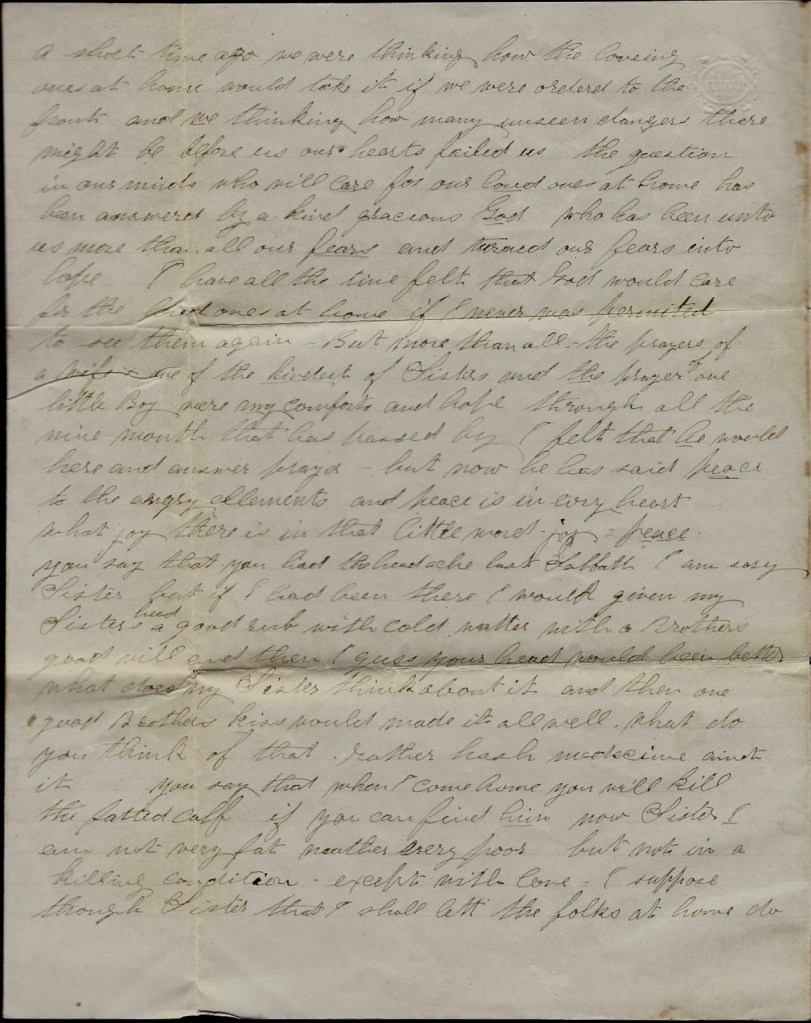
A short time ago we were thinking how the loving ones at home would take it if we were ordered to the front and we thinking how many unseen dangers there might be before us. Our hearts failed us. The questions in our minds—who will care for our loves ones at home has been answered by a kind, gracious God who has been unto us more than all our fears and turned our fears into hope. I have all the time felt that God would care for the loved ones at home if I never was permitted to see them again. But more than all the prayers of wife & one of the kindest sisters and the prayer of one little boy were my comforts and hope through all the nine months that has passed by. I felt that He would hear and answer prayer—but now He has said Peace to the angry elements and peace is in every heart. What joy there is in that little word joy=peace.
You say that you had the headache last Sabbath. I am sorry, sister, but if I had been there I would given my sister’s head a good rub with cold water with a brother’s good will and then I guess your head would’ve been better. What does my Sister think about it? And then one good brother’s kiss would’ve made it all well. What do you think of that? Rather harsh medicine, ain’t it?
You say that when I come home you will kill the fatted calf if you find him. Now, sister, I am not very fat. Neither very poor. But not in a killing condition—except with love. I suppose though, sister, that I shall let the folks at home do as they are a mind to if they do right.
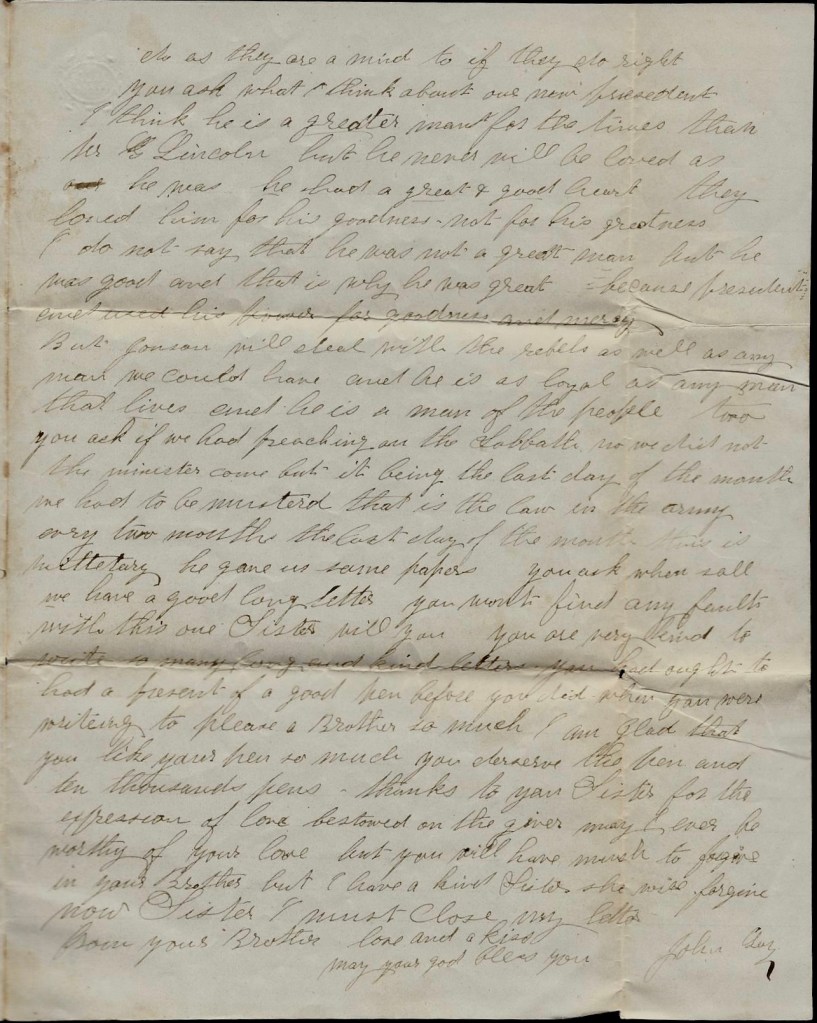
You ask what I think about our new President. I think he is a greater man for the times than Mr. Lincoln but he never will be loved as he was. He had a great & good heart. They loved him for his goodness—not for his greatness. I do not say that he was not a great man but he was good and that he why he was great. Because [as] President, [he] used his power for goodness and mercy. But Johnson will deal with the Rebels as well as any man we could have and he is as loyal as any man that lives and he is a man of the people.
You ask if we had preaching on the Sabbath. No, we did not. The minister came but it being the last day of the month, we had to be mustered. That is the law in the army every two months, the last day of the month. This is military. He gave us some papers….
I must close my letter. From your brother. Love and a kiss. May God bless you. — John [ ]
These two letters were written by Joseph Appleton Sanborn (1814-1877), the son of Peter and Sally (Fifield) Sanborn of East Readville, Kennebec county, Maine. Joseph was married to Lucy Ann Briggs Upham (1821-1888) and the couple had at least four children, the eldest of which is mentioned in this letter: Gustavus (“Gussy”) A. Sanborn (1845-1879).
Joseph wrote the letters to his niece, Sarah Frances Sanborn (1843-1927), the daughter of Peter Fifield Sanborn (1810-1884) and Desdemona Hunt (1819-1864) of Readville, Maine. Sarah was a graduate of the Maine Wesleyan Seminary and Female College and in 1864 was attending the Hudson River Institute in Claverack, New York. One or more of Sarah’s letters to her father may be found at, “Away at School: Letters Home,” by Candace Kanes.
Letter 1
East Readfield Sunday p.m., May 29, 1864
My dearest Sarah,
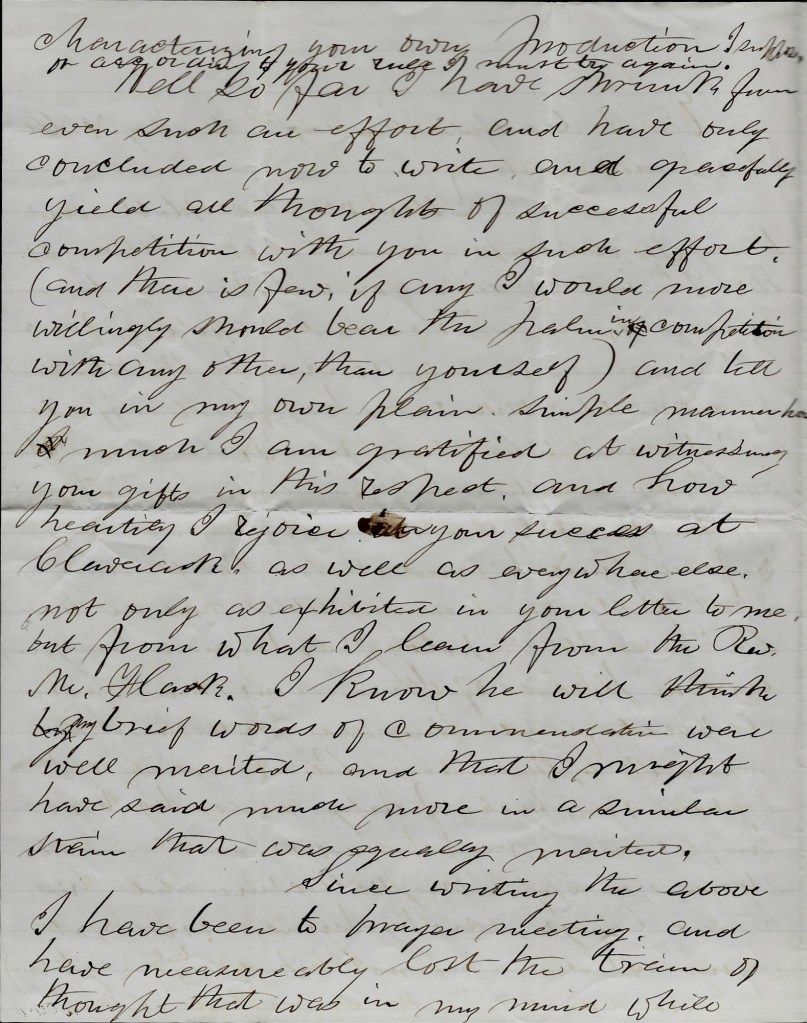
Your very acceptable, and to my poor comprehension, good letter of the 9th inst. which you pleased to characterize as a “miserable apology for a letter” measured of course by the standard of some of your own happiest efforts in that line, was duly received and it it was my intention to have answered it forthwith. But I did not immediately find time to undertake the writing of what I deemed a suitable answer to even the “miserable apology” (so termed by you) and in process of time, another more elaborate and finished production has made its appearance, the reading of portions of which fairly made my blood tingle in my veins and almost made me do as you say Gough’s lecture 1 did his hearers laugh and cry by turns, and yet I am expected (no, not expected, but only to try) to answer such a letter with somewhat of the ability characterizing your own production. I suppose, or according to your rule, I must try again. Well, so far I have shrunk from even such an effort and have only concluded now to write and gracefully yield all thoughts of successful competition with you in such effort (and there is few, if any, I would more willingly should bear the palm in competition with any others than yourself) and tell you in my own, plain, simple manner how much I am gratified at witnessing your gifts in this respect, and how heartily I rejoice in your success at Claverack as well as everywhere else, not only as exhibited in your letter to me, but from what I learn from the Rev. Mr. Flack. I know he will think my brief words of commendation were well merited and that I might have said much more in a similar strain that was equally merited.
Since writing the above, I have been to prayer meeting and have measurably lost the train of thought that was in my mind while writing the above, and as it is now half past seven, I will not pursue it further but proceed to tell you of some home affairs, &c. &c. as that is really about all I can do both for the want of time to write more, and also for the want of ability for I feel that I should need about a week at least to do full justice in answering according to my poor ability your lengthy and most interesting letter, so much so that I could not refrain from perhaps violating your confidence & with, by the reading portions of it to Rev. Mr. Brownold—who pronounced your deli____tions of Gough’s efforts admirable, not to say “splendid” and far better than he himself could give, though he thinks him up to the standard of excellence which you assign him as an orator.
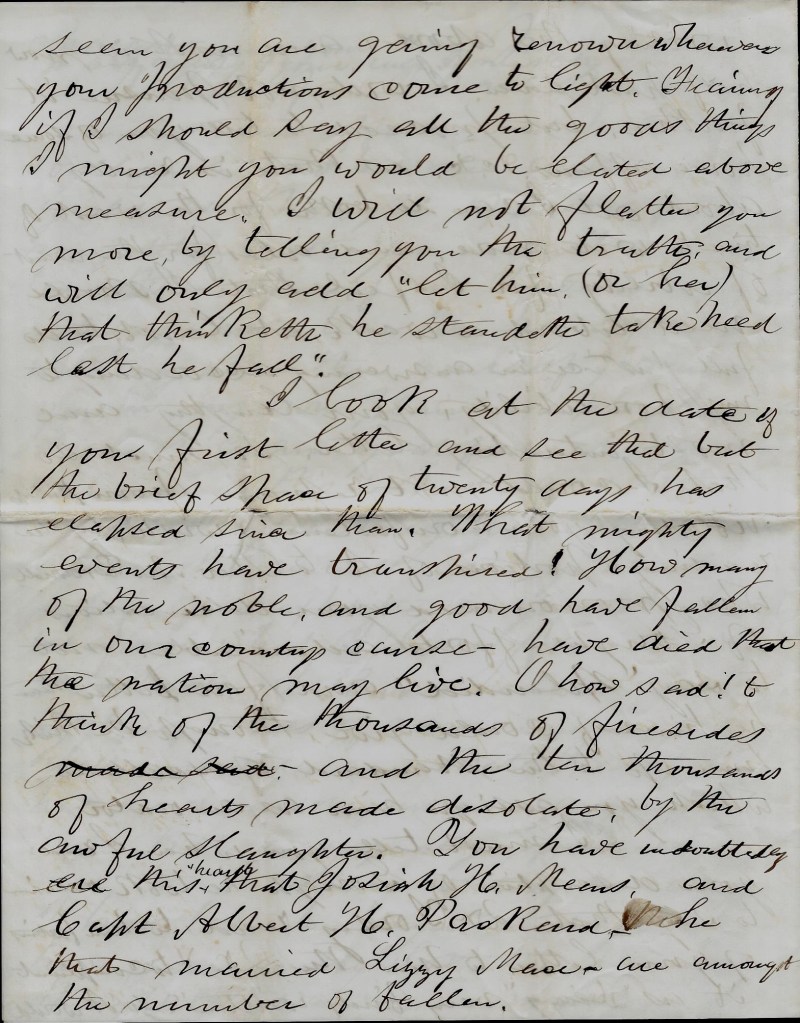
I must tell you when I read your description of Gough, he took occasion to say that Dr. Yorsey read to him portions of your letter to him the Dr. & to compliment it as being “very finely written.” So it would seem you are gaining renown whenever your “productions” come to light. Fearing if I should say all the good things I might you would be elevated above measure, I will not flatter you more by telling you the truth and will only add, “let him (or her) that thinketh he standeth take heed lest he fall.”
I look at the day of your first letter and see that but the brief space of twenty days has elapsed since then. What mighty events have transpired! How many of the noble and good have fallen in our country’s cause—have died that the Nation may live. Oh how sad! to think of the thousands of firesides and the ten thousands of hearts made desolate by the awful slaughter. You have undoubtedly ere this heard that Josiah H. Means and Capt. Albert H. Packard 2—he that married Lizzy Mase—are amongst the number of fallen.
[unsigned]
1 John B. Gough (1817-1886) was a temperance lecturer.
2 Capt. Albert H. Packard served in Co. A, 4th Maine Vol. Infantry. He was mortally wounded in the Wilderness in May 1864 and died of his wounds at Washington D. C.
Letter 2
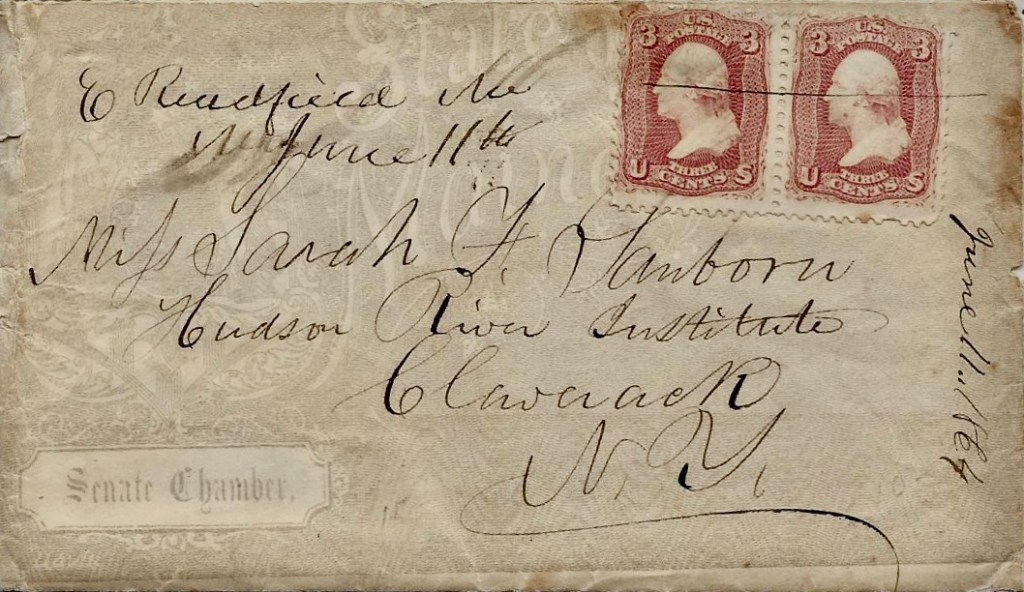
Addressed to Miss Sarah F. Sanborn, Hudson River Institute, Claverack, New York
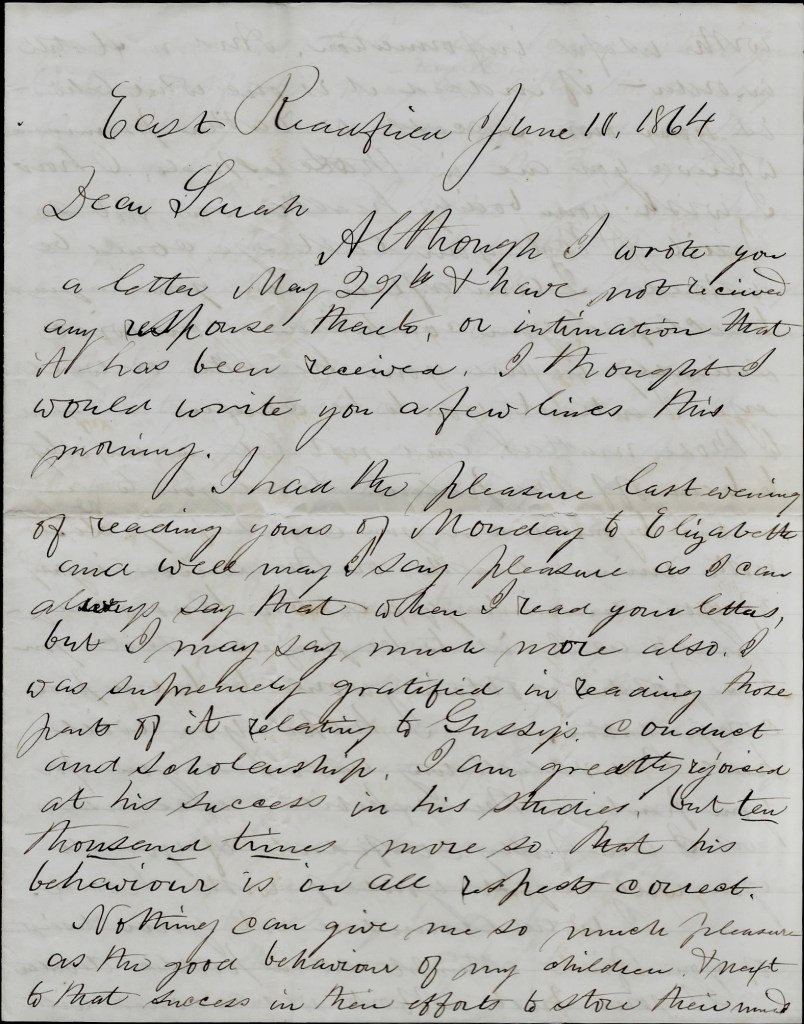
East Readfield June 10, 1864
Dear Sarah,
Although I wrote you a letter May 29th & have not received any response thereto, or intimation that it has been received, I thought I would write you a few lines this morning.
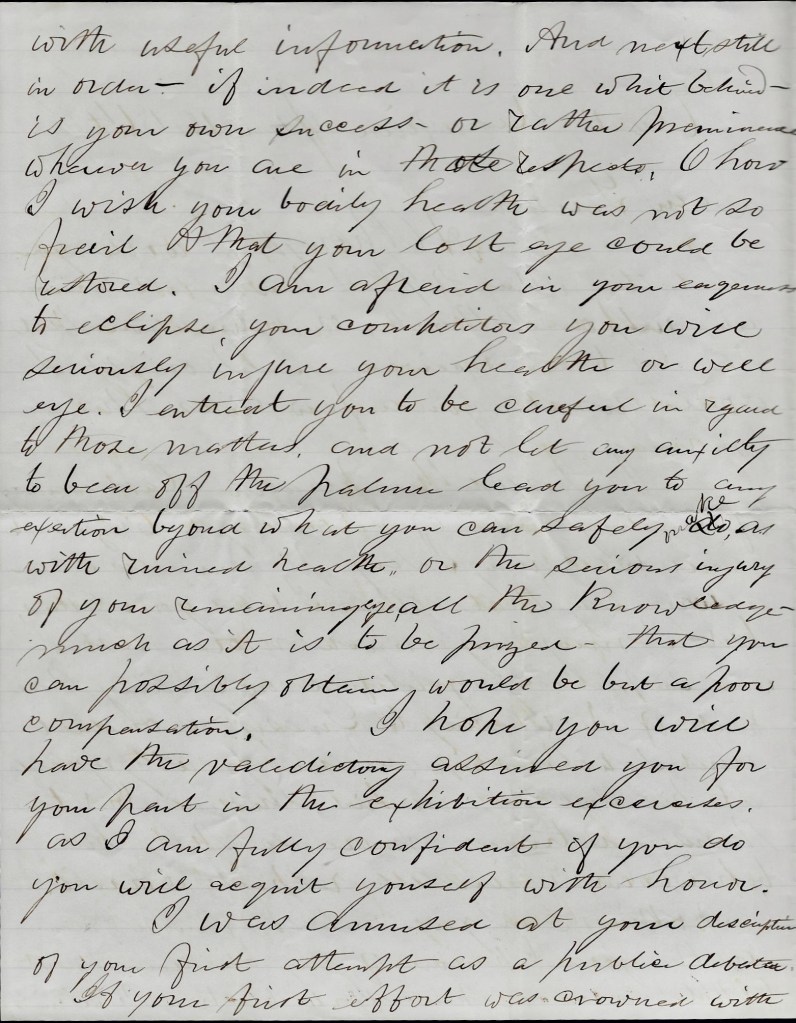
I had the pleasure last evening of reading yours of Monday to Elizabeth and well may I say pleasure as I can always say that when I read your letters, but I may say much more also. I was supremely gratified in reading those parts of it relating to Gussy’s conduct and scholarship. I am greatly rejoiced at his success in his studies but ten thousand times more so that his behavior is in all respects correct. Nothing can give me so much pleasure as the good behavior of my children & next to that success in their efforts to store their minds with useful information. And next still in order—if indeed it is is one whit behind—is your own success, or rather preeminence, wherever you are in those respects. Oh how I wish your bodily health was not so frail & that your lost eye could be restored. I am afraid in your eagerness to eclipse your competitors you will seriously injure your health or well eye. I entreat you to be careful in regard to those matters and not let any anxiety to bear off the palm, lead you to any exertion beyond what you can safely make as with ruined health, or the serious injury of your remaining eye, all the knowledge, much as it is to be prized, that you can possibly obtain, would be but a poor compensation.
I hope you will have the valedictory assured you for your part in the exhibition exercises as I am fully confident if you do you will acquit yourself with honor.
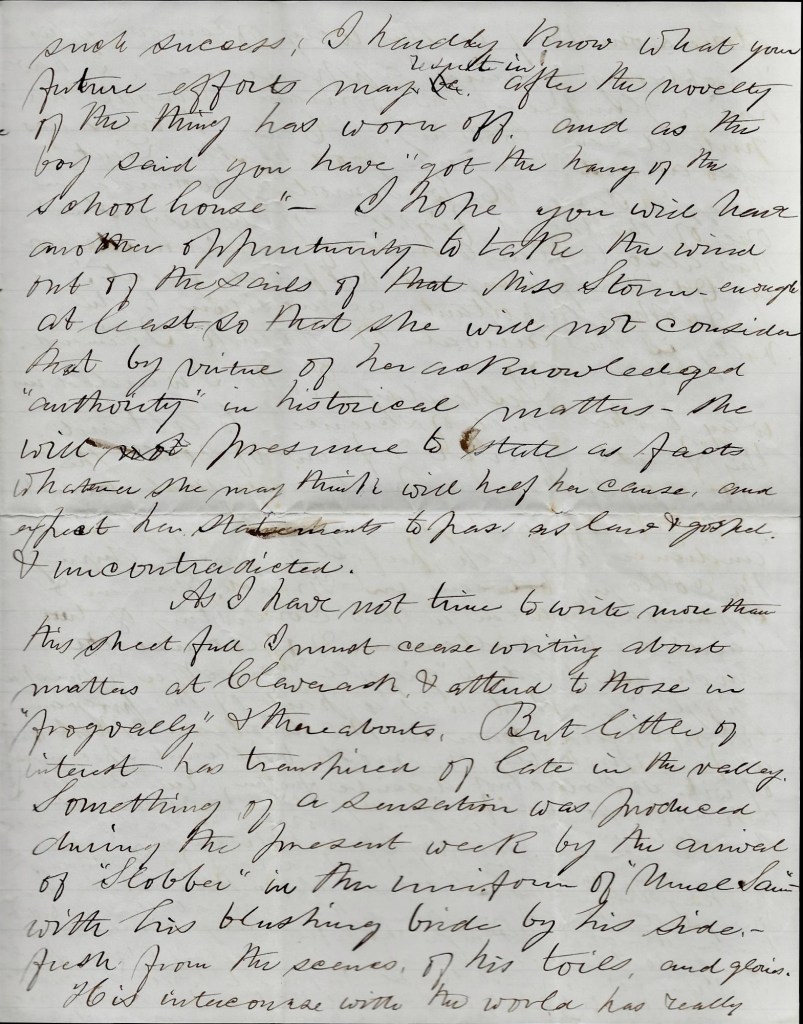
I was amused at your description of your first attempt as a public debater. If your first effort was crowned with such success, I hardly know what your future efforts may result in after the novelty of the thing has worn off and as the boy said, you have “got the hang of the school house.” I hope you will have another opportunity to take the wind out of the sails of that Miss Storm—enough at least so that she will not consider that by virtue of her acknowledged “authority” in historical matters she will presume to state as facts whatever she may think will help her cause, and expect her statements to pass as law & gospel & uncontradicted.
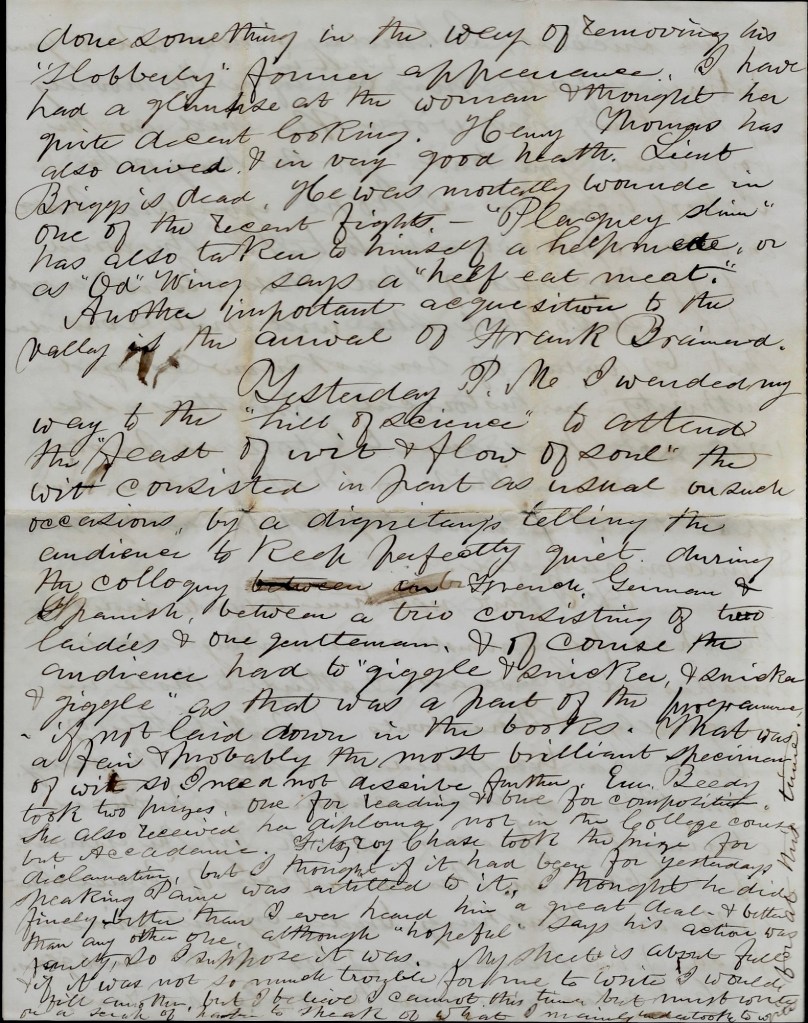
As I have not time to write more than this sheet full I must cease writing about matters at Claverack & attend to those in “Frog Valley” & thereabouts. But little of interest has transpired of late in the valley. Something of a sensation was produced during the present week by the arrival of “Slobber” in the uniform of “Uncle Sam” with his blushing bride by his side, fresh from the scenes of his toils and glories. His intercourse with the world has really done something in the way of removing his “slobberly” former appearance. I have had a glimpse at the woman & thought her quite decent looking. Henry Thomas has also arrived & in very good health. Lieut. Briggs is dead. He was mortally wounded in one of the recent fights. “Plaguey Slim” has also taken to himself a helpmate, or as “Od” Wing says, a “help-eat-meet.” Another important acquisition to the valley is the arrival of Frank Brainard.
Yesterday p.m., I wended my way to the “hill of science” to attend the “feast of wit & flow of soul.” The wit consisted in part as usual in such occasions, by a dignitary’s telling the audience to keep perfectly quiet during the colloquy in French, German, and Spanish, between a trio consisting of ladies & one gentleman, & of course the audience had to “giggle and snicker, * snicker and giggle” as that was a part of the programme—if not laid down in the books. That was a few & probably the most brilliant specimen of wit so I need no describe further. E,. Beedy took two prizes—one for reading and one for composition. She also received her diploma not in the college course but academic. Fitzroy Chase took the prize for declamation but I thought if it had been for yesterday’s speaking, Paine was entitled to it. I thought he did finely and bettter than I ever heard him—a great deal & better than any other one, although “hopeful” says his action was faulty so I suppose it was. My sheet is about full and if it was not so much trouble for me to write, I would fill another but I believe I cannot this time but must write on a scrap of paper to speak of what I mainly took to write for at this time.
In your letter to Lizze you spoke of having some idea of visiting the Catskill Mountains but expressed the opinion you should not so so on account of the cost. Now what I want to say is that I want you to go if you would like to and I will pay the expense. Say nothing to the “Old fellow” about it but when you get ready to go, up & start. I sent Gussy $50 yesterday and I will write him to hand you over enough for your expenses in making the trip, and if gentlemen are permitted to go, & Gussy is one of the favored ones, I want him to go with you and I shall write him the same. So don’t fail to go in account of the expense as I want you to enjoy yourself while you can for the time may come when neither your father nor I can do anything for your enjoyment.
What is right and proper for you to have, I want you should have & I think that would be both right and proper. It is so cold here today as to be uncomfortable. It rained more or less all day yesterday & quite hard a portion of the time in the p.m. and cleared off in the night cold and windy. We are all as well as usual. With much affection, I am ever thine, — J. A. Sanborn
P. S. Only six weeks from tomorrow & we may expect to see you in the “Valley” again. I would like very much to see you sooner at Claverack but think it doubtful if I do as every day brings its cares and labors & the days and weeks roll rapidly away & I doubt if I find it convenient to visit Claverack & the cost too would be considerable. Still I may conclude to go, but I do not want you to make any particular calculation that I shall. I sent you today two papers giving an account of a sad accident at Lewiston resulting in the drowning of three little girls and the funeral services of the occasion. I pity the grieving parents & friends, — J. A. S.
This letter was written by 48 year-old John Atherton III (1769-1824), the son of John Atherton II (1747-1825) and Mary Adams (1751-1843)—the 2nd cousin of President John Adams— of Stoughton, Norfolk county, Massachusetts. John Atherton III was married to Sally Bird (1778-1818) and the couple had at least eight children, two of which are mentioned in this letter as having accompanies John to Savannah, Georgia. They include his sons John Atherton IV (1799-1826) and Lemuel Bird Atherton (1804-1860).
John’s letter briefly describes Savannah, Georgia, in 1817 and speaks of the enormous cotton trade already dominating the city business. We gather from John’s letter that he has relocated to Savannah on account of his health, looking for a warmer climate. He also speaks of the militia being called out to fight Indians—probably a reference to the Seminole Wars.
Transcription
Addressed to Mr. John Atherton, Stoughton, Massachusetts
Savannah [Georgia] December 29th 1817
Honored Father,
I take this opportunity to inform you that we are well & hope you and yours are so. I left home the first of November—the wind being southerly. Did not start from Newport till the 21st & got to this place on the 1st of December about 2 o’clock in the morning. I hired a room and chamber & moved into it the 3rd of December. I have hired a stall in the market & buy hogs that are brought to market dressed and cut them up & sell & what is unsold at 9 o’clock, I bring home & salt & then go to making cigars. I have five boarders at $4 per week. Lemuel cooks while John and I go to market. Then John cooks & Lemuel & I makes cigars. So we go on.
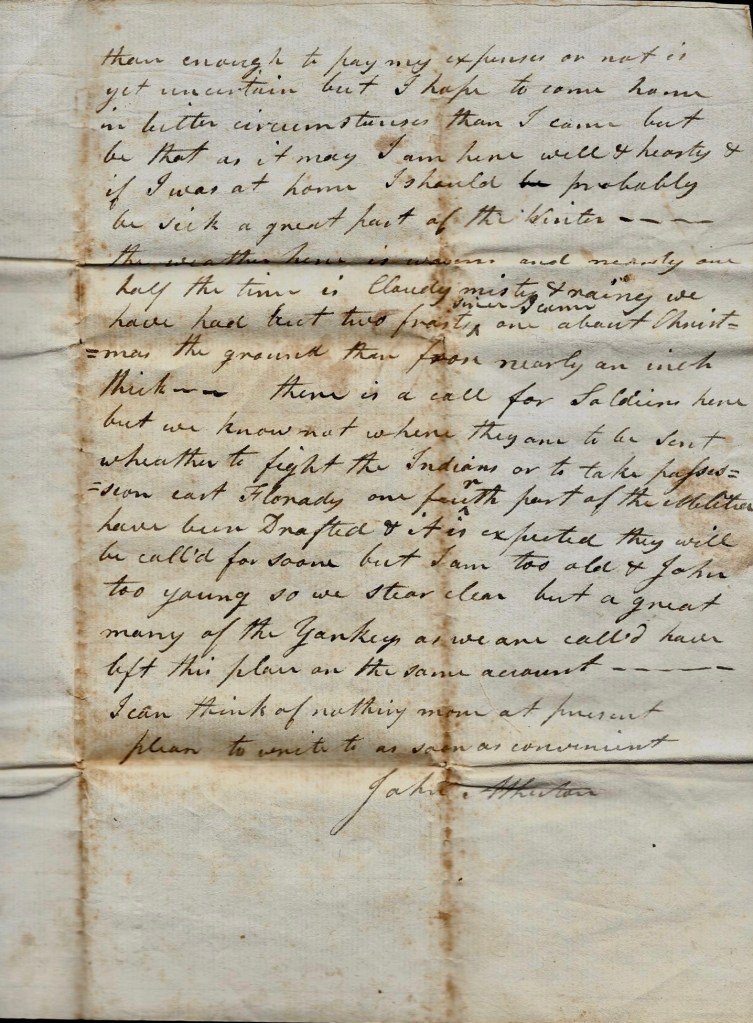
Savannah is a small place and the buildings in general are very poor. You house & Mr. Osgood’s, were they here, would be quite elegant. But there is a great deal of business done here. You have no idea of the quantity of cotton brought here for sale. I believe I have seen bags enough to cover your farm. The whole business of the State centers here. Consequently labor and provision is very high. Whether I shall earn more than enough to pay my expenses or not is yet uncertain but I hope to come home in better circumstances than I came. But be that as it may, I am here well & hearty & if I was at home, I should probably be sick a great part of the winter.
The weather here is warm and nearly one half of the time is cloudy, misty and rainy. We have had but two frosts since I came—one about Christmas. The ground then was froze nearly an inch thick.
There is a call for soldiers here but we know not where they are to be sent—whether to fight the Indians or to take possession of East Florida. One fourth part of the militia have been drafted and it is expected they will be called for soon but I am too old and John too young so we steer clear. But a great many of the Yankees—as we are called—have left this place on the same account. I can think of nothing more at present, Please to write as soon as convenient. — John Atherton
This letter was written by Andrew Jackson Clark (1837-1927) who served in Co. H, 23rd Massachusetts. Andrew was the son of Melzar Wentworth Clark (1812-1895) and Sabina Hobart Lincoln (1820-1906) of Hingham, Plymouth, Massachusetts. He was married in 1869 to Evelina M. Caine (b. 1847). Prior to the war, Andrew worked as a painter and as a volunteer fireman. After the war, he worked for a time as a painter, as a laborer in a rope factory, as a peddler, and as a janitor. He also spent 40 years as a fireman in Hingham.
According to his obituary, Andrew enlisted at President Lincoln’s first call for troops, stepping into the ranks of the Lincoln Light Infantry (Co. I, 4th Massachusetts Infantry) that served for three months. After that unit was discharged, he reenlisted in the 23rd Massachusetts and served until mustering out on 13 October 1864. “He was never wounded nor absent from duty on furlough.” He claimed to have participated in “the River and Sound Expedition; the rescue of Little Washington, N. C.; the battle of Portsmouth, Va.; the siege of Petersburg and the Battle of the Crater. Throughout Andrew’s letters are references to their suitability for publication in his hometown paper, the Hingham Journal, but I was not able to locate any on-line publications from that newspaper.
This partial letter came to me for transcription as an “unidentified author” but having transcribed several other letters by Clark in July, 2020 [see 1861-64: Andrew Jackson Clark to his Family], I was able to safely attribute the letter to him.
Transcription
Headquarters Camp at Newbern March 25, 1862
Dear Brother,
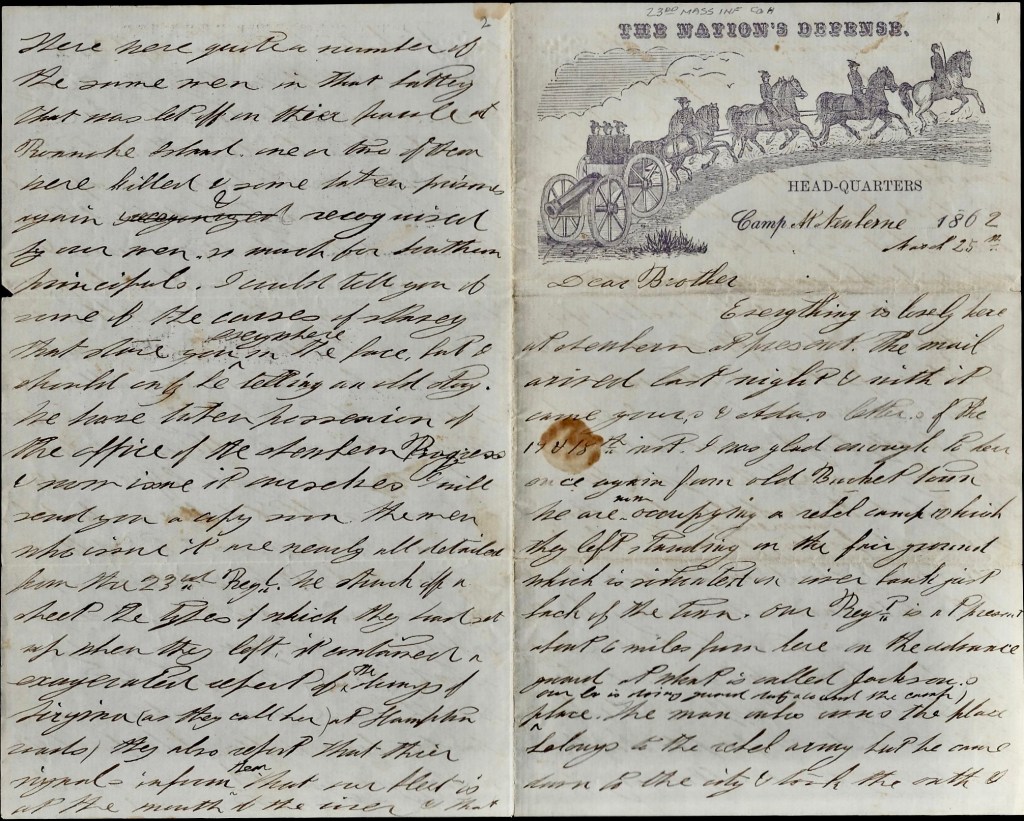
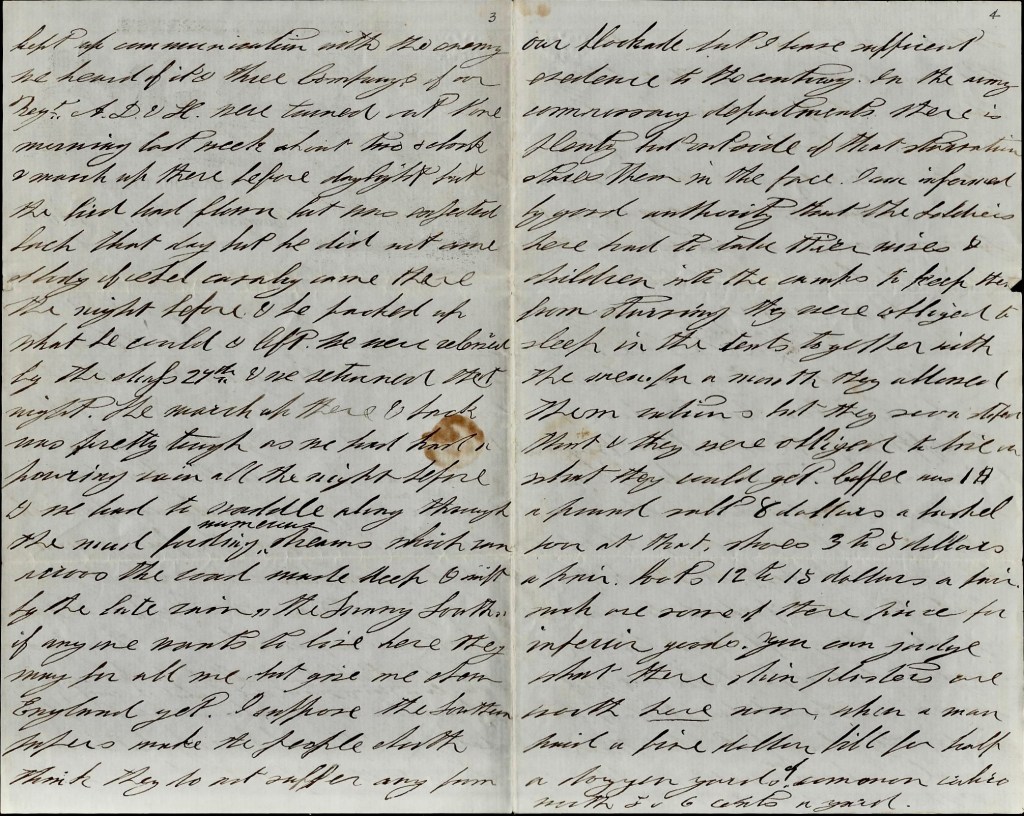
Everything is lonely here at Newbern at present. The mail arrived last night & with it came yours & Ada’s letters of the 17th and 18th inst. I was glad enough to hear once again from Old Bucket Town. We are now occupying a rebel camp which they left standing on the fair ground which is situated on river bank just back of the town. Our regiment is at present about 6 miles from here on the advance ground at what is called Jackson’s place. Our company is doing guard duty around the camp. The man who owns the place belongs to the rebel army but he came down to the city & took the oath and kept up communication with the enemy. We heard of it & three companies of our regiment—A, D, & H—were turned out lone morning last week about two o’clock & marched up there before daylight but the bird had flown but was expected back that day but he did not come. A body of rebel cavalry came there the night before & he packed up what he could & left. We were relieved by the Mass. 27th & we returned that night. The march up there and back was pretty tough as we had had a pouring rain all the night before & we had to waddle along through the mud fording numerous streams which ran across the road waist deep swollen by the late rain. The Sunny South—if anyone wants to live here, they may, but give me New England yet.
I suppose the southern papers make the people North think they do not suffer any from our blockade but I have sufficient evidence to the contrary. In the army commissary departments, there is plenty but outside of that, starvation stares them in the face. I am informed by good authority that the soldiers here had to take their wives and children into the camps to keep them from starving. They were obliged to sleep in the tents together with the men for a month. They allowed them rations but they soon stopped that and they were obliged to live on what they could get. Coffee was $1 a pound, salt 8 dollars a bushel—poor at that, shoes 3 to 5 dollars a pair, boots 12 to 15 dollars a pair. Such are some of their prices for inferior goods. You can judge what their shin plasters are worth here now when a man paid a five dollar bill for half a dozen yards of common calico with 5 or 6 cents a yard.
There were quite a number of the same men in that battery that was let off on their parole at Roanoke Island. One or two of them were killed & some taken prisoners again & recognized by our men. So much for southern principles. I could tell you of some of the curses of [ ] that stare you everywhere in the face, but I should only be telling an old story.
We have taken possession of the office of the Newbern Progress & now issue it ourselves. I will send you a copy soon. The men who issue it are nearly all detailed from the 23rd Regiment. We struck off a sheet the types of which they had set up when they left. It contained an exaggerated account of the Army of Virginia (as they call her) at Hampton Roads. They also report that their signals inform them that our fleet is up the mouth of the river and that….[rest of letter missing]
This letter was written by Harry Miller (b. 1844) who enlisted in late July 1862 to served as a private in Co. A, 131st Pennsylvania Volunteers—a 9-month’s regiment that served from August 1862 to 23 May 1863 and participated in Burnside’s Mud March and the Chancellorsville Campaign.
Transcription
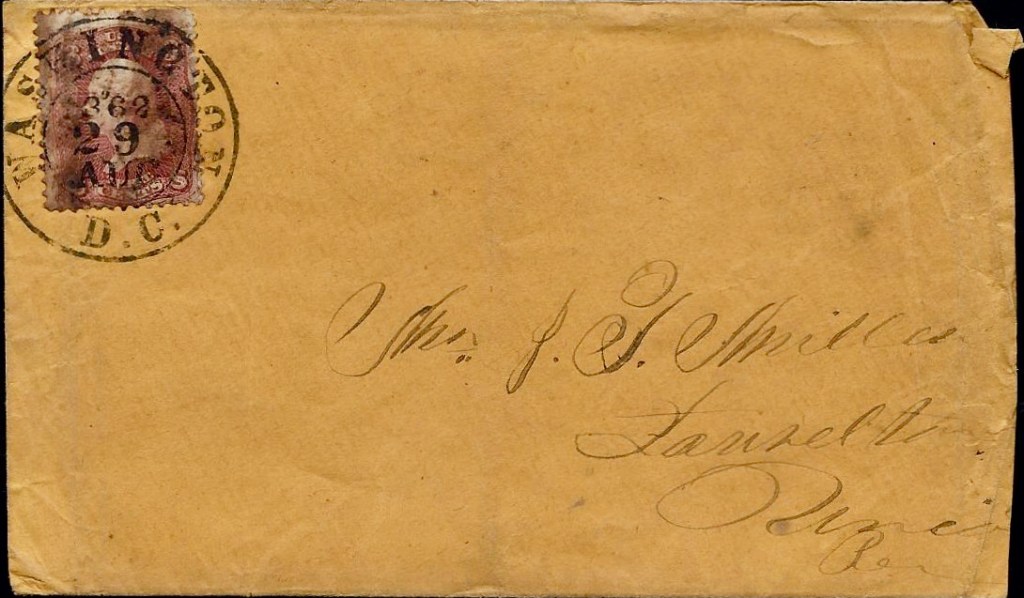
Addressed to Mr. J. T. Miller, Laurelton, Union county, Pennsylvania
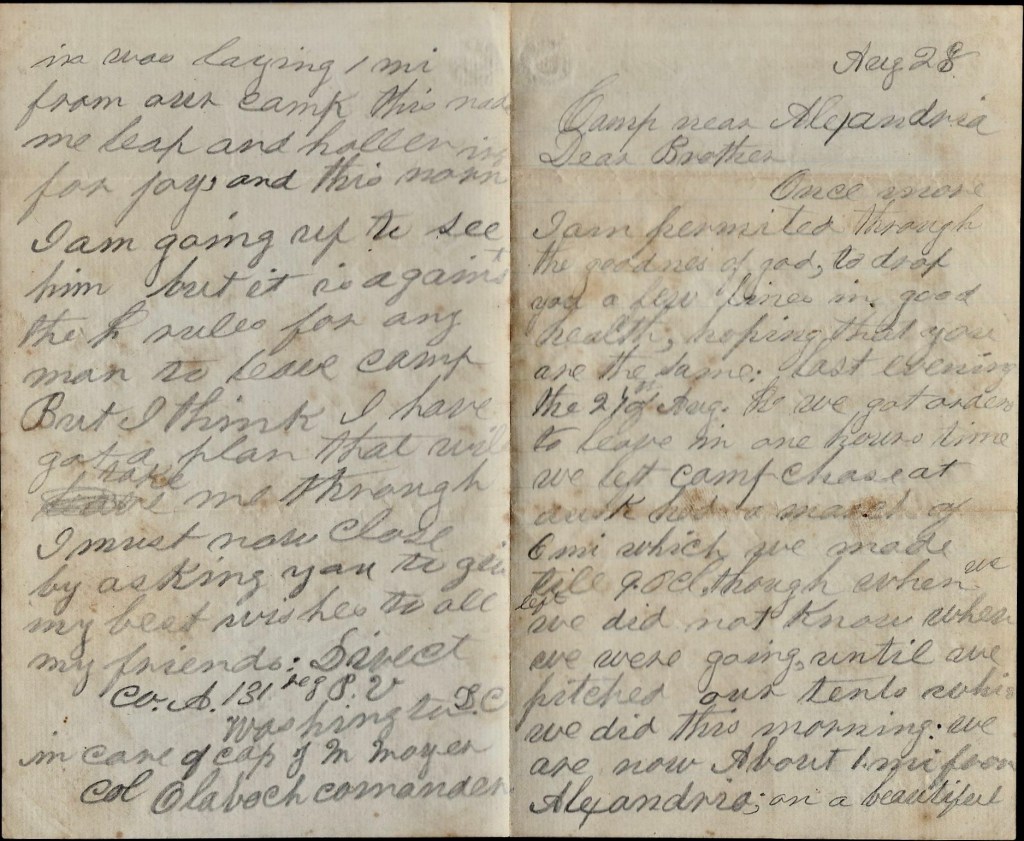
Camp near Alexandria [Virginia] August 28, [1862]
Dear Brother,
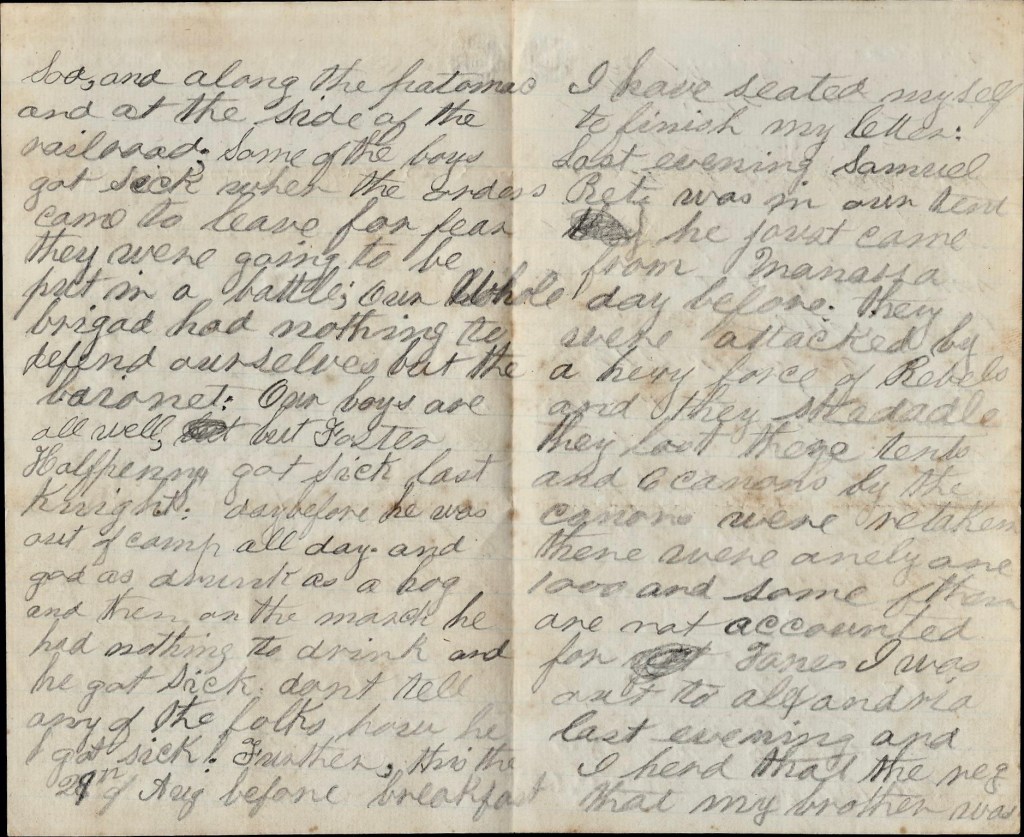
Once more I am permitted through the goodness of God to drop you a few lines in good health, hoping that you are the same. Last evening the 27th of August, we got orders to leave in one hours time. We left Camp Chase at dusk, had a march of 6 miles which we made till 9 o’clock, though we did not know where we were going until we pitched our tents which we did this morning. We are now about 1 mile from Alexandria on a beautiful sod and along the Potomac and at the side of the railroad.
Some of the boys got sick when the orders came to leave for fear they were going to be put in a battle. Our whole brigade had nothing to defend ourselves [with] but the bayonet.
Our boys are all well but [Sergt.] Foster Halfpenny got sick last night. Day before he was out of camp all day and got as drunk as a hog, and then on the march, he had nothing to drink and he got sick. Don’t tell any of the folks how he got sick.
Further, this is the 29th of August before breakfast. I have seated myself to finish my letter. Last evening Samuel Betz was in our tent. He just came from Manassas day before. There were attacked by a heavy force of rebels and they skedaddled. The lost their tents and 6 cannons but the cannons were retaken. There were only one thousand and some of them are not accounted for.
Taner, I was out to Alexandria last evening and I heard that the regiment that my brother was in was laying one mile from our camp. This made me leap and holler for joy and this morning I am going up to see him. But it is against the rules for any man to leave camp but I think I have got a plan that will take me through.
I must now close by asking you to give my best wishes to all my friends. Direct to Co. A, 131st Regt. Pennsylvania Volunteers, Washington D. C. in care of Capt. J[acob] M. Moyer, Col. [Peter H.] Allabach, Commander
This letter was written by Pvt. Benjamin F. Wright (1836-1917) of Co. K, 42nd Illinois Infantry. Benjamin—a native of Fairfield Township, Lycoming county, Pennsylvania—was living in DeKalb, Illinois, in the fall of 1861 when he enlisted on 4 August. He was with the regiment until 20 September 1863 when he received a gunshot wound to the spine during the Battle of Chickamauga. He was hospitalized at Springfield, Illinois, until he mustered out on 28 September 1864.
Following his discharge, he returned to Pennsylvania for a time but then relocated to Indiana and then to Kansas in 1876 where he homesteaded in Reno county.
Benjamin’s letter describes the expedition in October 1861 in which Union troops under the command of General John C. Fremont, perceiving Warsaw, Missouri, to be a “treasonous” city, fairly devastated the town, taking over its supplies and homes for their own needs. During the following month, as Union Army stragglers followed Fremont’s troops, they burned much of what had not already been destroyed.
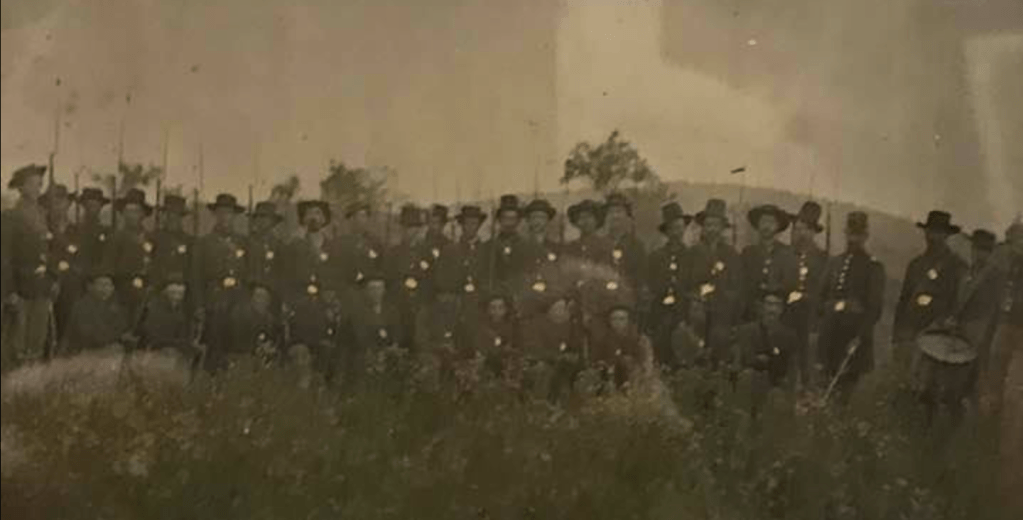
Image of Co. H, 42nd Illinois Infantry taken in Nashville 1863. Image belonged to James Reese of the company. (Ronn Palm Collection)
Transcription
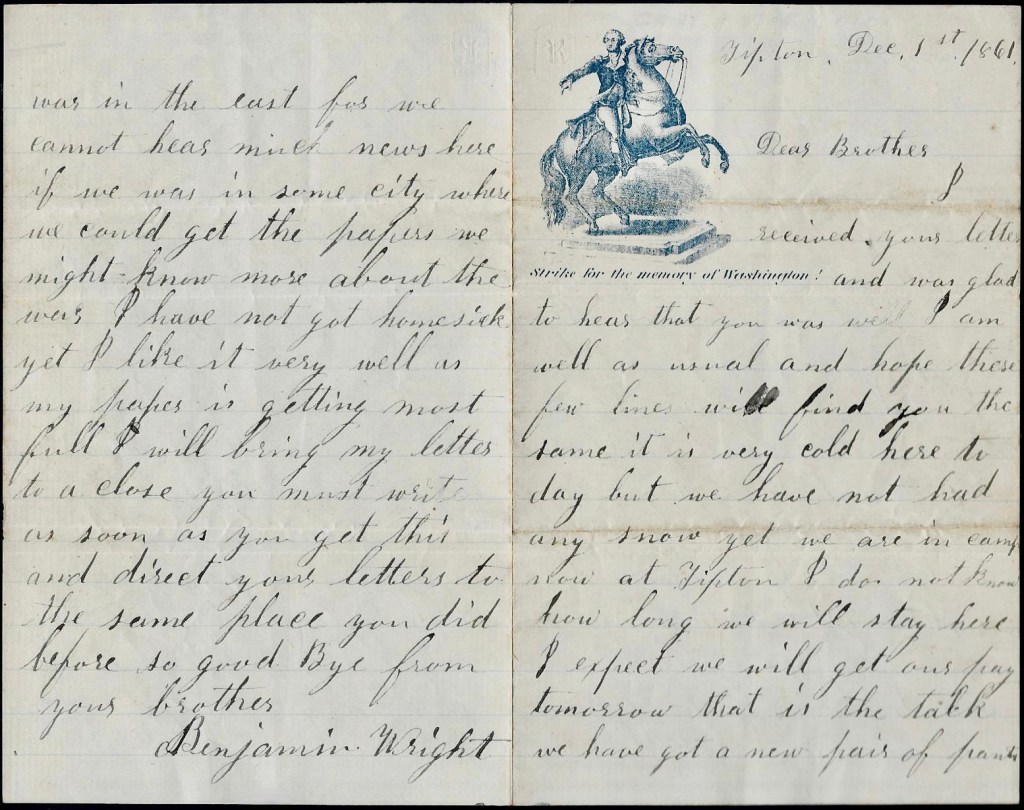
Tipton, [Missouri] December 1st 1861
Dear Brother,
I received your letter and was glad to hear that you was well. I am well as usual and hope these few lines will find you the same. It is very cold here today but we have not had any snow at Tipton. I do not know how long we will stay here. I expect we will get our pay tomorrow. That is the talk. We have got a new pair of pants and a new cap.
We left St. Louis the ninth of October and went to Jefferson City about one hundred and fifty [miles] up the river and from there we went to Warsaw on the Osage River about 100 miles from Jefferson City. Then we was ordered on a forced march to Springfield eighty-five miles. From Warsaw we started about ten o’clock on Friday night and on Monday night we was in Springfield. We had to live on hard bread and meat and had the ground to lay on and the sky for covering.
Artist’s Sketch of Fremont’s army marching to the Osage River in Missouri, 1861
We would of had a fight with Price if it had not been for General McKinstry. He was acting the traitor and communicating with Price and letting him know our movements. He is now in prison at St. Louis. 1
I expect we will go to St. Louis the next time we march and so on down into Kentucky. Write and let me know how my folks are and how you are getting along. Send me the news about the war in the East for we cannot hear much news here. If we was in some city where we could get the papers, we might know more about the war. I have not got homesick yet. I like it very well.
As my paper is getting most full, I will bring my letter to a close. You must write as soon as you get this and direct your letters to the same place you did before. So goodbye from your brother, — Benjamin Wright
1 While it is true that Justus McKinstry was arrested on 11 November 1861, his biographical sketch on Wikipedia does not imply that he was being charged as a traitor. He was eventually convicted of graft, corruption and fraud in the quartermaster’s office at St. Louis.
This letter was written by 23 year-old bootmaker, Joshua H. Tower of Hopkinton Massachusetts. Joshua enlisted on 4 August 1862 as a private in Co. F, 1st Massachusetts Heavy Artillery. This regiment began its service as the 14th Massachusetts Volunteer Infantry and garrisoned Fort DeKalb (later renamed Fort Strong) on Arlington Heights from August 1862 to June 1863.
I could not find an image of Joshua but here is one of William Full who served in Co. G of the 1st Mass. H. A. (Michael Gordon Collection)
Co. F remained on duty at forts in the Washington D. C. area until May 15-16 1864, when the regiment was ordered to Belle Plain, Virginia. From there they fought as infantrymen at Spotsylvania Court House, North Anna, Totopotomoy, Cold Harbor and Before Petersburg and Siege of Petersburg, beginning on Jun 16 1864, where Tower was taken prisoner.
Tower did not survive the war. He died of disease as a prisoner of war on 10 October 1864 at Savannah, Georgia. He had been taken prisoner on 22 June 1864 at Petersburg.
Joshua’s wife, Philena M. (Knowlton) Tower (1835-1908), filed for a pension (Certificate 62,413) but it was annotated that her surname was “now Nichols”—she having married Roswell Nichols sometime prior to 1870. Her parents were Marshall Knowlton and Mary Holmes.
Transcription
Fort DeKalb 1 December 13, 1862,
To my sister Kate,
I received a letter from you and was very glad to learn that you were all getting along so well in point of health. I too am in good health and weigh one hundred and sixty pounds which is about my usual weight when at home. I got a letter from wife last night and she writes me that she had a sore throat, but it is getting better of it now and is going to Tom’s as soon as she can. I expect that you are having a taste of winter at home but it is warm and pleasant here now. We had it cold enough the fore part of the week. The Potomac is frozen over above the aqueduct bridge, which don’t happen every winter. It snowed here a week ago last Friday, but it is all gone now. I think the weather is a great deal warmer here than at home, but it is as hard to bear as winter in Massachusetts. The changes are as great which makes it seem colder than it really is.
Monday the 15th. It is warm and pleasant as summer today, and we sit in our tents with the doors open. Quite different from the weather a week ago last Saturday. At the convalescent camp near Alexandria, six soldiers froze to death. They have got no fire nor means of getting any. Sam Bicknell 2 was there and came up to our fort and stayed a week. Said he should have died if he had stayed much longer. He went back yesterday. People may talk about the sufferings of the soldiers of the Revolution and one of these days they will tell about the soldiers of 1862.
“The Union forces under Gen. Burnside have got possession of Fredericksburg and are driving the rebels out of their fortifications but it will cost seas of blood to do it…”
— Joshua H. Tower, 1st Mass. Heavy Artillery, 15 December 1862
There is a battle being fought at Fredericksburg about sixty miles from here and about half way between here and Richmond. The papers say it will be the bloodiest battle of the century. Already there are five thousand sick and wounded in the hospitals from that fight. The Union forces under Gen. Burnside have got possession of Fredericksburg and are driving the rebels out of their fortifications but it will cost seas of blood to do it and then they will retreat into other fortifications to be still driven, unless some fortunate circumstance shall give us Richmond while Burnside is engaging the rebels at Fredericksburg.
17th. Since writing the above, news has arrived that Gen. Burnside has retreated across the Chickahominy [Rappahannock] and abandoned the fight after losing ten thousand men killed, wounded and missing. Burnside, in his dispatch to the general government, says he felt that the enemy’s works could not be carried and that a repulse would be disastrous to his army. Finally, I can’t tell anything about it when the war will end or which will come off victorious, but hope we shall come [out] top of the heap.
Give my love to all and write often and not wait for me to write every time you do. This from your affectionate brother , — J.
1 Fort DeKalb was constructed at the northern end of Arlington Heights for the purpose of guarding the roads and approaches to the canal aquaduct bridge (near present-day Key Bridge). The fort was three-quarters of a mile west of Fort Corcaran. It was a lunette with stockaded gorges. Rifle pits were dug outside the fort. It was later named Fort Strong.
2 Samuel Barrett Bicknell was a corporal in Co. B, 16th Massachusetts Infantry.He was a carpenter from Hopkinton, Middlesex, Massachusetts.
This letter was written by Isaac S. Starbird (1840-1911) of Freeman, Franklin county, Maine. When he was 21, Isaac enlisted in the fall of 1861 in Co. L, 1st Maine Cavalry. He was mustered in as a private and mustered out three years later as a corporal on 1 November 1864. He was wounded at Charles City, Virginia on 28 July 1864 where he received a gunshot wound to the right knee but not so disabled that he could not return to his occupation as a sawyer in Lewiston, Maine.
An unidentified Trooper (Rob Morgan Collection)
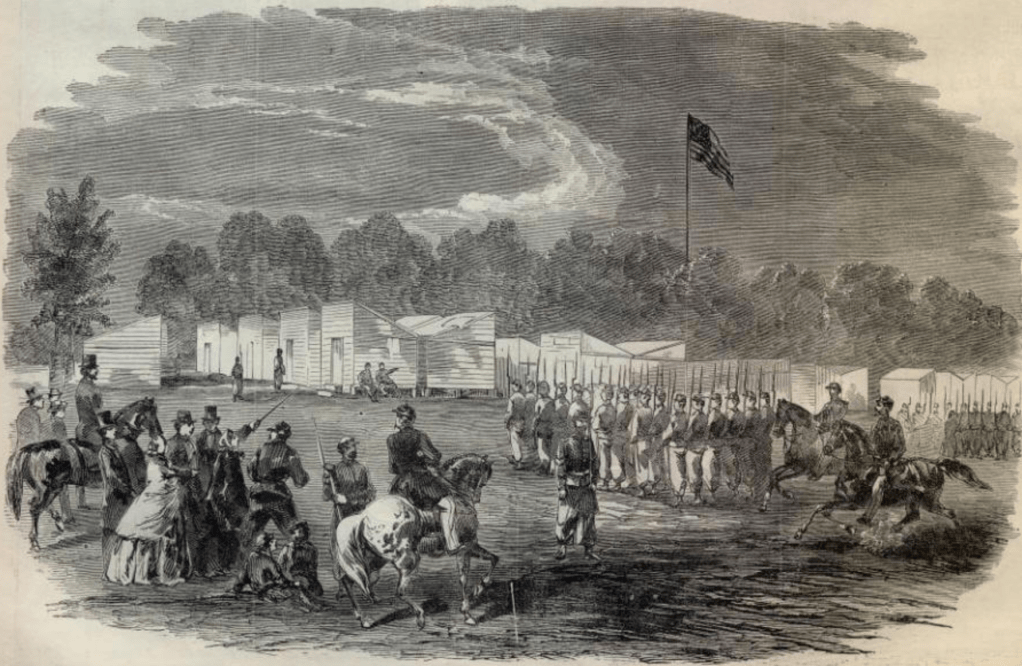
The 1st Maine Cavalry had high standards for its recruits and the quality of its mounts. Recruiters were to enlist “none but sound, able-bodied men in all respects, between the ages of eighteen and thirty-five years of correct morals and temperate habits, active, intelligent, vigorous, and hardy, weighing not less than one hundred and twenty-five or more than one hundred and sixty pounds” While the average United States Infantryman was 26 and 5′ 8.25″ tall and 155 pounds, the average United States Cavalryman was the same age but slightly shorter at 5′ 7″ and lighter at 145 pounds). It encamped at Augusta at the State Fairground, renamed Camp Penobscot, where recruits initially learned military discipline and drill. Horses would arrive in December. It is unclear whether the 1st Maine received either the 1854 cavalry shell jacket or 1857 sack coat or both. The army did issue all ranks the same standard sky-blue double-breasted winter overcoat with attached cape and a rubberized poncho for rainwear. They also received the special sky-blue wool cavalry trousers with the reinforcing double layer in the seat and inside leg due to the expected extended time in the saddle.
Isaac was married to Mary Elizabeth Clark (1848-1917) in November 1866.
[Note: This letter is from the private collection of Molly MacDufus and was transcribed and published in Spared & Shared by express consent.]
Transcription
Augusta [Maine] October 13, 1861
Friend Amanda,
It is now Sabbath morn and I will seat myself for a few moments to inform you of my good health and likewise my camp life. We arrived here one week ago yesterday in good spirits and health. We have pitched our tents of which I will give you a description. Our tents are large enough for twelve to sleep in by stowing close together. Our tents are round with center pole in the center. We all lay our heads to the outside of the tent with our feet to the center pole. We lay as close as a passel of pigs and bear a slight resemblance of them.
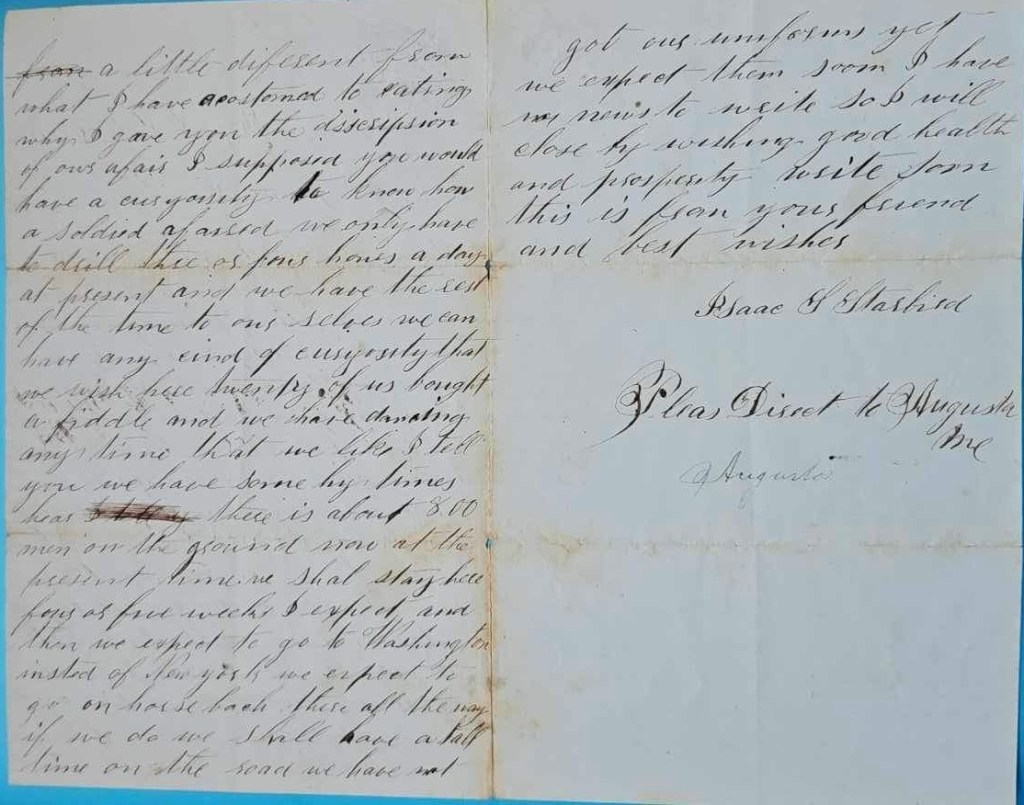
Our living is good enough although a little different from what I have [been] accustomed to eating. Why I gave you the description of our fare—I supposed you would have a curiosity to know how a soldier fared.
We only have to drill three or four hours a day at present and we have the rest of the time to ourselves. We can have any kind of curiosity that we wish here. Twenty of us bought a fiddle and we have dancing any time that we like to. I tell you, we have some high times here.
There is about 800 men on the ground now at the present time. We shall stay here four or five weeks, I expect, and then we expect to go to Washington instead of New York. We expect to go on horseback there all the way. If we do, we shall have a tall time on the road. We have not got our uniforms yet. We expect them soon.
I have no news to write so I will close by wishing good health and prosperity, Write soon. This is from your friend and best wisher, — Isaac S. Starbird
The following letters were written by J. M. Wilson, a volunteer in the 12th New York National Guard (or State Militia)—nicknamed “the Independence Guard.” This unit was sent for immediate service to Washington D. C. in April 1861 to guard the Nation’s Capitol. While in Washington they were encamped and drilled at Camp Anderson.
The 12th New York State Militia at Camp Anderson in June 1861
The regiment remained in Washington until the 7th of July, when, ordered to join the army of the Shenandoah, it proceeded by railroad to Baltimore, and thence to Harrisburg and Hagerstown, arriving at the latter place on the evening of the 8th. Left Hagerstown on the 9th, marched to Williamsport, forded the Potomac and marched all night; arriving at Martinsburg, Va., early on the morning of the 10th, having accomplished 80 miles without a pause. Colonel Butterfield, there reported to Major-General Patterson, and was immediately appointed an acting Brigadier-General, his brigade consisting of the Fifth and Twelfth N. Y. S. Militia, and the Nineteenth and Twenty-eighth N. Y. S. volunteers.
Wilson wrote the letters to his friend, an insurance agent for whom he probably worked in New York City named Henry Thayer Drowne (1822-1897).
[Note: These letters are from the private collection of Greg Herr and were transcribed and published on Spared & Shared by express consent.]
Letter 1
Camp Anderson Once More Washington June 4th 1861
Dear Sir,
Your letters of the 2nd and 3rd inst. were received this morning and gave me great pleasure to hear from you. The regiment is once more in Washington after an absence of a week and two days. I wrote to you in the last that we were under marching orders and that I would be unable to call and see Mr. Arnold. We were reviewed by Secretary Seward the same evening of the day I wrote you. The regiment looked fine. We were dressed in full uniform with white gloves. After the review we were drilled in loading and firing which was splendidly executed by the whole regiment.
After the dress parade was over, our captain gave us orders to take off our dress suit and to put on our fatigue dress ready for a march. About nine o’clock we had orders to fill our canteens and pack up our knapsacks and at 10 o’clock we got our rations of bread and preserved meat for one day. Soon after we went to bed and about 12 o’clock when we were all to sleep, we were aroused out of our shanties and ordered to fall in with out knapsacks and belts on and with our muskets and in about ten minutes time we were on our march to the Sacred Soil of Virginia. The moon shone bright and the air was cool and bracing. It was a night long to be remembered by all the regiment and those that witnessed our departure.
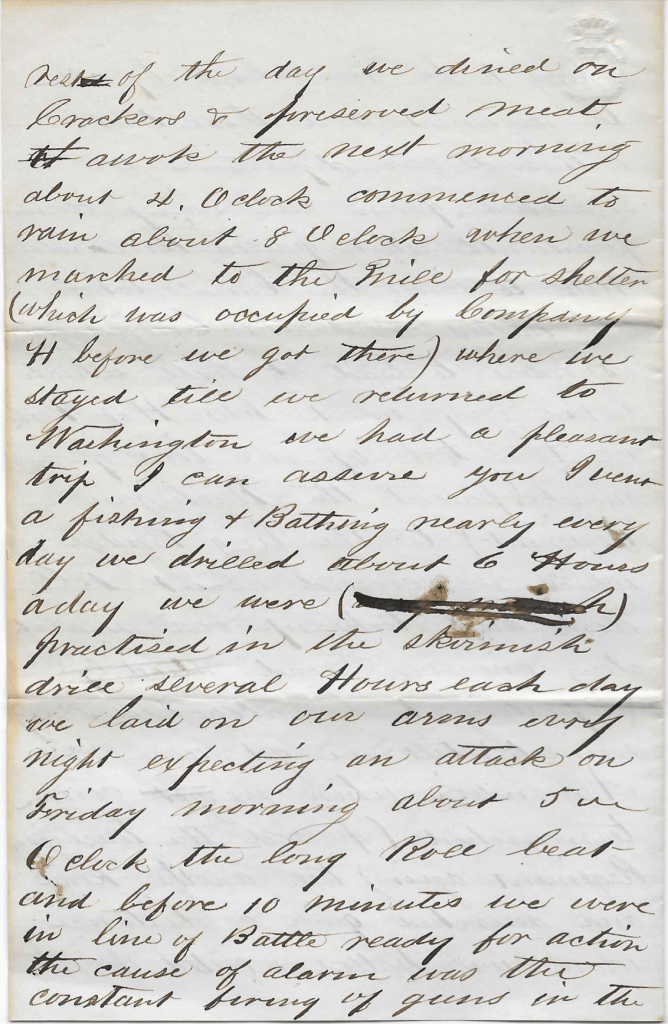
We marched from our camp down Fourteenth Street past Willard’s Hotel, across the canal when we halted and the Colonel gave us orders to load at will which looked very much like hot work. We then took up our line of march (past the Michigan Regiment) to the Long Bridge which we crossed about 1 o’clock and took up our march along an even road (expecting to be attacked every minute) till we got near Alexandria when we countermarched (passed the Michigan Regiment again), took another road, and marched quite a distance when we halted and rested for the rest of the day. We dined on crackers and preserved meat.
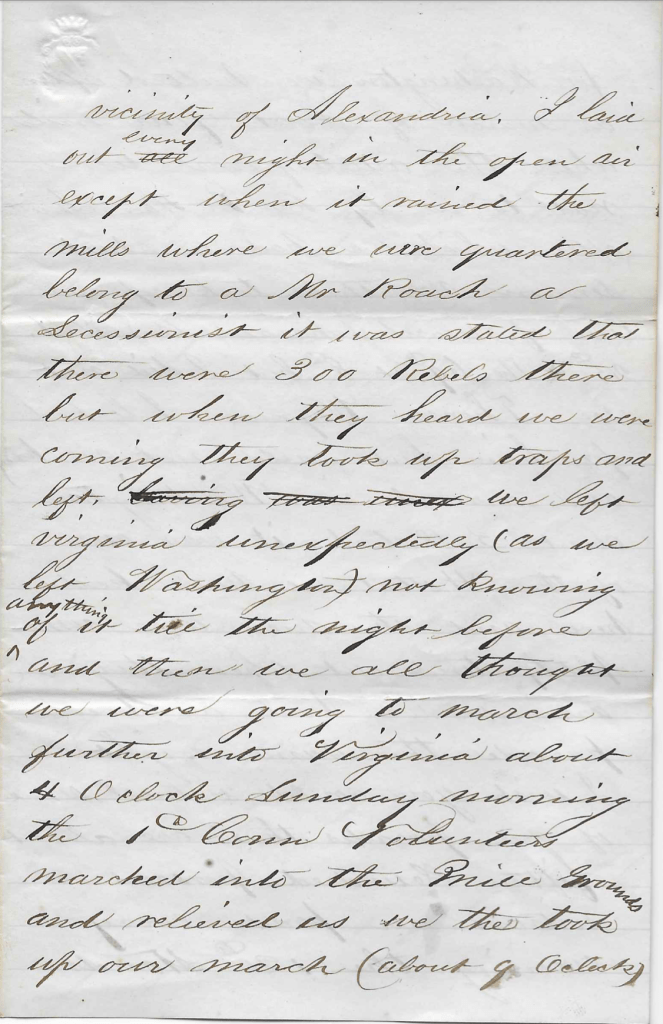
Awoke the next morning about 4 o’clock, commenced to rain about 8 o’clock, when we marched to the Mill for shelter (which was occupied by Company H before we got there) where we stayed till we returned to Washington. We had a pleasant trip, I can assure you. I went a fishing and bathing nearly every day. We were practiced in the skirmish drill several hours each day. We laid on our arms every night expecting an attack. On Friday morning about 5 o’clock, the long roll beat and before 10 minutes we were in line of battle ready for action. The cause of the alarm was the constant firing of guns in the vicinity of Alexandria. I laid out every night in the open air except when it rained. The Mills where we were quartered belong to a Mr. Roach—a secessionist. It was stated that there were 300 rebels there but when they heard we were coming, the took up traps and left.
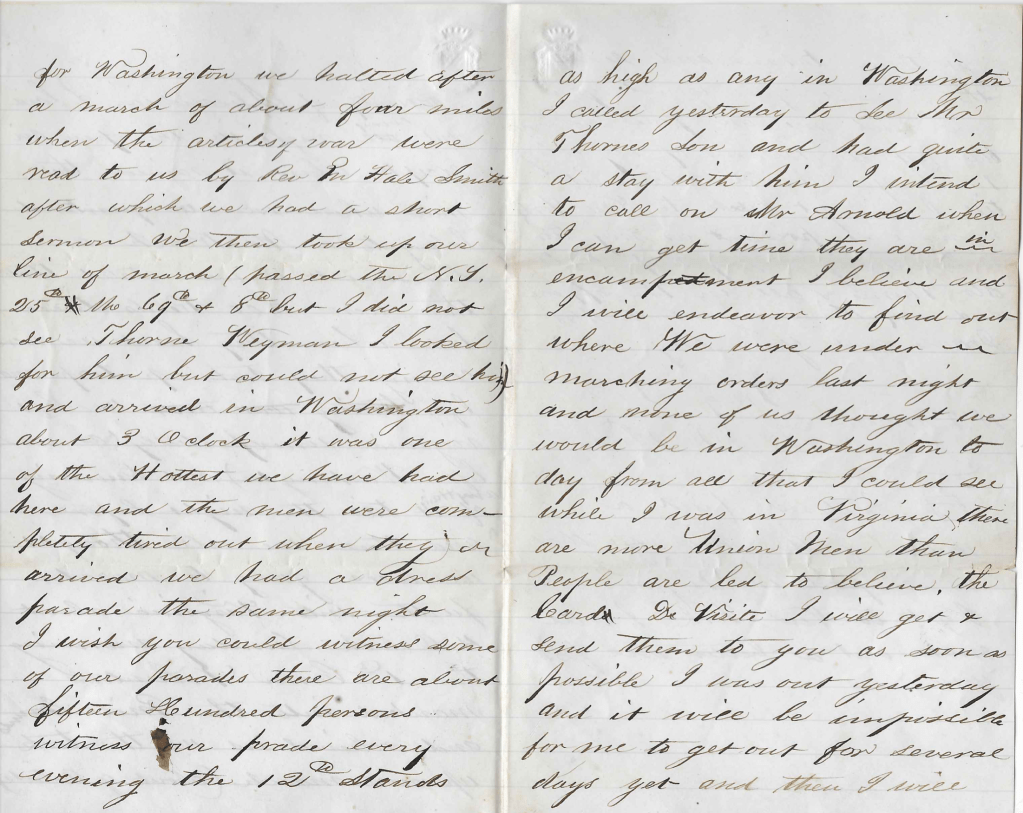
We left Virginia unexpectedly (as we left Washington) not knowing anything of it till the night before and then we all thought we were going to march further into Virginia. About four o’clock Sunday morning the 1st Connecticut Volunteers marched into the Mill grounds and relieved us. We then took up our march (about 9 o’clock) for Washington. We halted after a march of about four miles when the articles of war were read to us by Rev. [ ] Hale Smith after which we had a short sermon. We then took up our line of march (past the New York 25th, the 69th, & 8th but I did not see Thorne Weyman. I looked for him but could not see him, and arrived in Washington about 3 o’clock. It was one of the hottest [days] we have had here and the men were completely tired out when they arrived.
We had a dress parade the same night. I wish you could witness some of our parades. There are about fifteen hundred persons witness our parade every evening. The 12th stands as high as any in Washington. I called yesterday to see Mr. Thornes’ son and had quite a stay with him. I intend to call on Mr. Arnold when I can get time. They are in encampment, I believe, and I will endeavor to find out where.
We were under marching orders last night and none of us thought we would be in Washington today. From all that I could see while I was in Virginia, there are more Union men than people are led to believe. The carte-de-visite I will get and send them to you as soon as possible. I was out yesterday and it will be impossible for me to get out for several days yet and then I will get them taken and send them on. If you would, you can send me on five dollars. The rest of the balance of my salary I wish you would retain it till I can get back to New York.
No more at present as my time is limited. Give my respects to Mr. Thorne and all in the office and my kind regards to Mrs. Drowne and your boy.
Truly yours, — J. M. Wilson
Enclosed find a sketch of the Mill that we occupied in Virginia. When I get to New York, I will make out a better one for you.
Letter 2
Hagerstown, Maryland July 9th 1861
Dear Sir,
I now take the opportunity of writing you a few lines to let you know how I am getting along. The last time I wrote you I was in Washington but last Saturday night we received marching orders and everything was got in readiness for to march. Our dress uniforms we packed up and directed with our names on to it to our residences in New York which looked as if we had bid farewell to Washington during our term in this war.
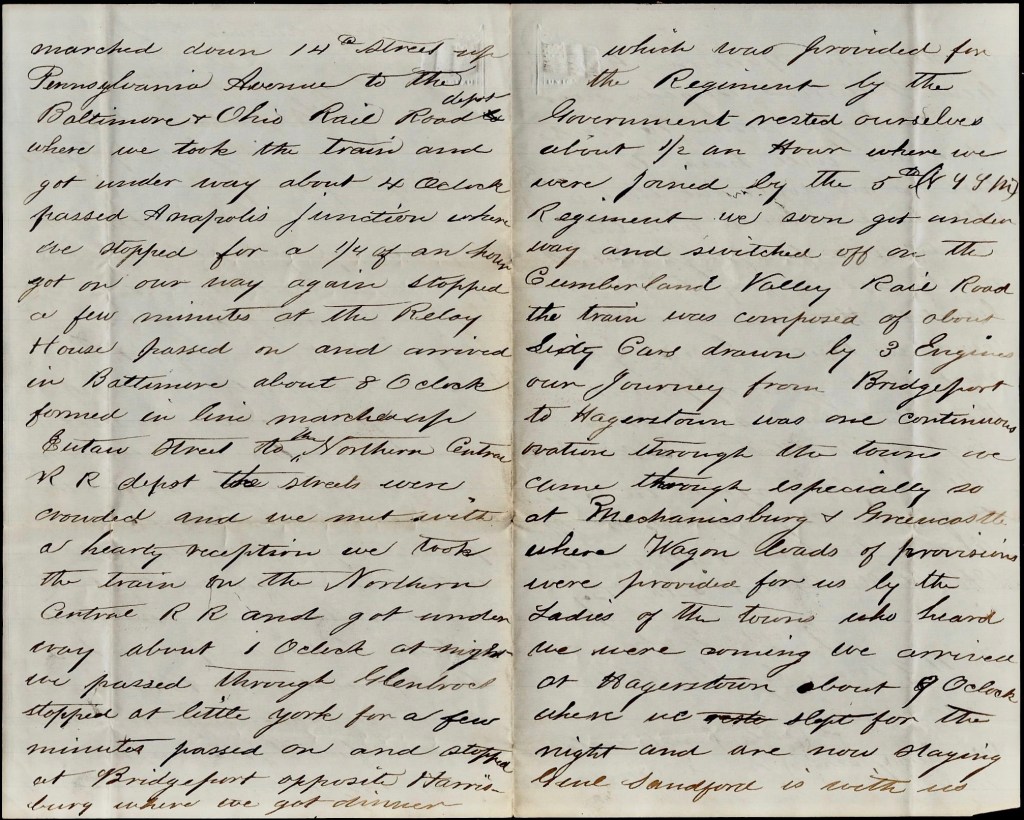
We started from our camp in Washington Sunday afternoon [7 July] about 2 o’clock, marched down 14th street, up Pennsylvania Avenue to the Baltimore & Ohio Rail Road Depot where we took the train and got underway about 4 o’clock. Passed Annapolis Junction where we stopped for a quarter of an hour. Got on our way again, stopped a few minutes at the Relay House, passed on and arrived in Baltimore about 8 o’clock, formed in line, marched up Eutaw Street to the Northern Central RR Depot.
The streets were crowded and we met with a hearty reception. We took the train on the Northern Central RR and got underway about 1 o’clock at night. We passed through Glenbrock, stopped at little York for a few minutes, passed on and stopped at Bridgeport opposite Harrisburg where we got dinner, which was provided for the regiment by the government. Rested ourselves about half an hour where we were joined by the 5th (NYSM) regiment.
We soon got underway and switched off on the Cumberland Valley Railroad. The train was composed of about sixty cars drawn by three engines. Our journey from Bridgeport to Hagerstown was one continuous ovation through the towns we came through—especially so at Mechanicsburg and Greencastle where wagonloads of provisions were provided for us by the ladies of the towns who heard we were coming. We arrived at Hagerstown about 9 o’clock where we slept for the night and are now staying.
[Maj.] Gen. Sandford is with us. We start this afternoon to join Gen’l. Patterson’s Brigade near Martinsburg some 16 miles which we will have to march. There is no doubt but that we will have a brush with the rebels in a few days but I must close as my time in limited. Did the carte-de-visites I sent you meet with your approval? Those that have seen them say they are taken well. I will write you again in a few days. Give my regards to Mr. Thorne, Mr. Craig, and all in the office, to Mrs. Drowne and the boy.
Yours Truly— J. M. Wilson
To HT Drown, Esq.
We have two contrabands with us (runaway slaves)—one in Co. F and one in Co. G.
Direct your answer to J. M. W., Camp Anderson, Washington D. C. or elsewhere.
The following letter was sold to a client of mine stating that it was penned by a Union soldier named “Frank Prior” to his father, “Capt. Samuel Prior, Jr.” but I am unable to see a signature and I cannot identify the Prior family correspondents. It’s possible this information was simply made up but on the outside chance it’s true, I pass on the “provenance.”
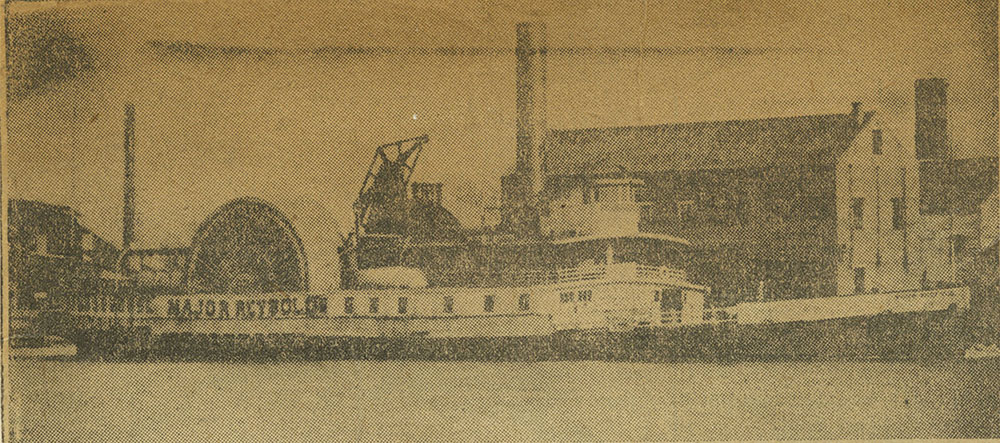
The letter describes an August 1864 incident pertaining to the Major Reybold, a steamer operating on the Delaware River, in which a number of Confederate prisoners were transported by her from Philadelphia to Fort Delaware. After dropping off the prisoners, it was discovered they were one short which triggered the whole fiasco.
The Major Rebold was built in 1853 in Wilmington, Delaware. She was the first iron vessel to see service on the Delaware, plying between Salem, New Jersey, and Philadelphia until 1906. During the Civil War she was retained on the river on account of Fort Delaware and was for a long time the only steamboat running below Wilmington, carrying thousands of troops and prisoners to the fort.
The Major Reybold, ca. 1908. She remained in regular service until 1906.
Transcription
Steamer Major Reybold August 15, 1864
Dear Pa,
Your very welcome letter was received Friday evening. I was glad to hear you had found the boat so soon. By what Captain Loomis (who was on board of us Friday in Philadelphia) said, I was afraid you would have trouble finding her.
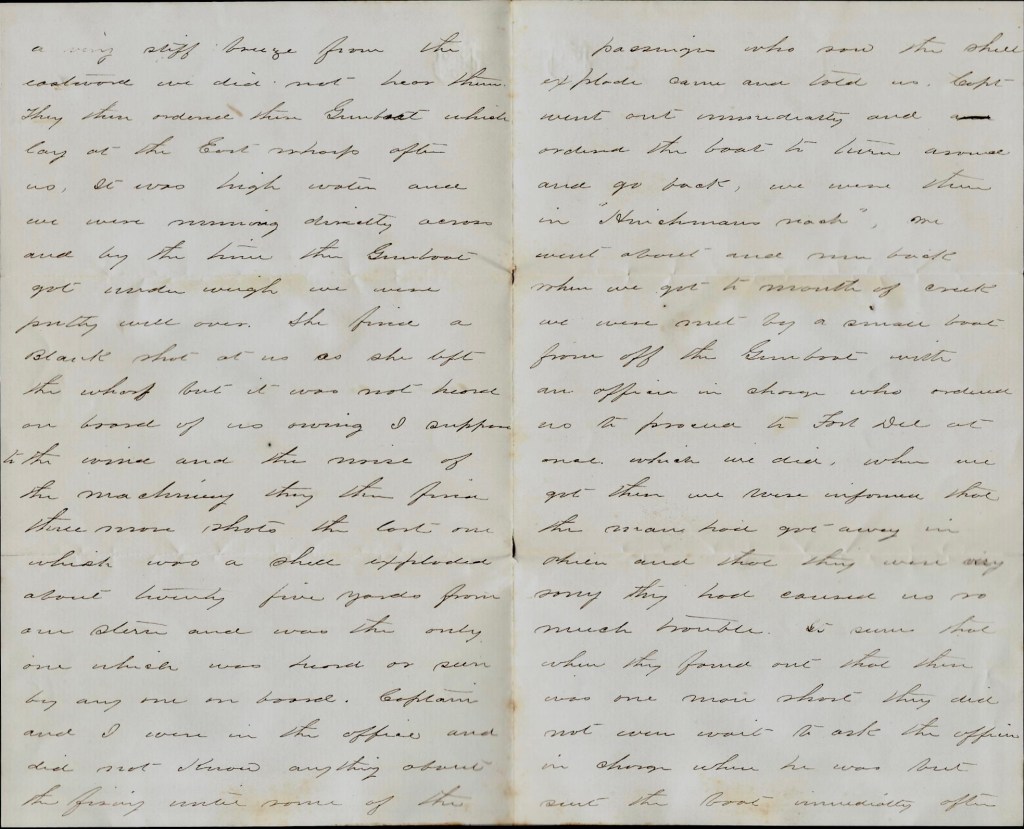
We were fired into by a gunboat from the Fort on Friday evening. The way of it was this. We landed some forty-five prisoners there that evening and after we had left, they found out that there was one short. They fired two musket shots to attract our attention but there being a very stiff breeze from the eastward, we did not hear them. They then ordered their gunboat which lay at the East wharf after us. It was high water and we were running directly across and by the time the gunboat got under weigh, we were pretty well over.
She fired a blank shot at us as she left the wharf but it was not heard on board by us owing, I suppose, to the wind and the noise of the machinery. They then fired three more shots—the last one, which was a shell, exploded about twenty-five yards from our stern and was the only one which was heard or seen by anyone on board.
The Daily State Gazette, 22 August 1864
Captain and I were in the office and did not know anything about the firing until some of the passengers who saw the shell explode came and told us. Captain came out immediately and ordered the boat to turn around and go back. We were then in “Hinchman’s reach,” We went about and run back. When we got to mouth of creek, we were met by a small boat from off the gunboat with an officer in charge who ordered us to proceed to Ft. Delaware at once, which we did. When we got there, we were informed that the man had got away in Philadelphia and that they were very sorry they had caused us so much trouble. It seems that when they found out that there was one man short, they did not even wait to ask the officer in charge where he was but sent the boat immediately after us. After she left, they found out where the man escaped and tried to recall her but could not for the same reason I suppose that prevented us from hearing.
The idea of the boat shooting at us with the intention of hitting us as the Lieutenant in charge of her says he did, is preposterous and should be reported from his actions. When he boarded us, I should say he was drunk and that may have been a reason for his firing at us. If the shell had struck us in the saloon, it would have caused a great loss of life in there at the time.
Thomas Bond has a claim against you of $32 for hay. Shall I settle it? We told John Mulford about it and John told me.
















 Spared & Shared 23