Joel John Tew (or John Joel Tew) of Co. K, 51st North Carolina Infantry (Civil War Faces)
The following letters were written by Joel John Tew (1836-1914), the son of John Lewis Tew (1807-1882) and Sylvania Godwin (1811-1875) of Sampson county, North Carolina. He wrote the letter to his sister, Francis Matilda Elizabeth Tew (1838-1916), and refers to a younger brother, Sampson M. Tew (1841-1864) who served as a private in Co. H, 20th North Carolina Infantry (Iverson’s Brigade) during the Civil War. Sampson was taken prisoner at the Battle of Gettysburg on 1 July 1863 and died of diarrhea and small pox while in captivity at Hammond Hospital at Point Lookout, Maryland on 15 January 1864.
Joel was 25 years old when he enlisted in April 1862 as a sergeant in Co. K, 51st North Carolina Infantry. He was promoted to a 2nd Lieutenant on 17 September 1862 and was wounded in the left arm on 31 May 1864 in the fighting at Cold Harbor. He returned to his regiment in January 1865.
The first document is a letter. The second is a copy of an enlistment paper signed by J. J. Tew. The enlistment record was for John Cager Williford though there are several discrepancies such as the spelling of his surname, his age and date of enlistment. Cemetery records indicate John C. Williford was born in 1834 and died in 1910. He was buried at Mingo, Sampson county, North Carolina. Williford was employed in the turpentine business before the war.
Letter 1
Addressed to Miss F. M. E. Tew, Draughon’s Store, Sampson City, N. C.
Camp Florida Near Wilmington May 9th 1863
Dear Sister,
I can inform you that we are back in Old North Carolina again at last & is tolerable well. Hoping these lines may early reach & find you in the best of health. We reached Wilmington on Sunday night at ten & you can not imagine how glad the men was to get back. We are now 25 miles from the City on Topsoil Sound in the nicest camp we have been since we have left old Fort French & the rest of our Brigade is at French now.
I can inform you that I received a letter from you & Father Monday before we left town & I was glad to hear that you were all well but very sorry to hear of the accident that had happened to Mother. I hope that she will soon be well & not happen to such another.
I have not got anything interesting to write to you at this time—only we are highly spoken of by the commanding generals of Charleston & I am glad to think that so worthy a man as General Beauregard thinks something of us. But I fear it will occasion us to go to Virginia soon.
There has been a battle at Fredericksburg but I have not heard from it more than we gained the victory & drove the enemy back across the [Rappahannock] River. I have heard of two Brigades that was in the fight & Iverson’s was not mentioned in it & I hope it was not in the fight at all. I think if it had been & they did not all get killed, they would have written before now. But I shall patiently wait the result of the battle knowing that if Samson is killed or wounded, there is one above to protect him in his troubles.
You can tell Father that I am going to write to Gent. — Strickland this week or this evening about that money & if he does not pay it, proceed as I directed. Give case to Smith & not show my letter to Mr. Strickland any more. I never got the letter that he sent to me in Georgia. You may tell the gent plainly that I will not let him off at what it is now at. He sunk me & blew at least one thousand dollars. The suit will be damage. I am yours as ever, &c. — J. J. Tew
to Lewis Tew
Letter 2
State of North Carolina County of Sampson
I, John C. Willifoot [Williford], born in Sampson County in the State of North Carolina, aged 18 years and by occupation a farmer, do hereby acknowledge to have voluntarily enlisted this the 24th day of July 1863 as a soldier in the State troops of North Carolina for the period of the war unless sooner discharged by proper authority; do also agree to accept such bounty pay, rations, and clothing as also may be established by law, and I, John C. Willifoot [Williford], do swear that I will be faithful and bear true allegiance to the State of North Carolina and to the State of North Carolina and to the Constitutional Power and authorities which are or may be established for the government thereof, and maintain and defend the Constitution of the said State; and I do further swear that I will obey the orders of the Governor of the said State and the orders of the officers that are or may be set over me according to the rules and discipline of war, so help me God. — John C. Willifoot [Williford]
Sworn to and subscribed before me. — James C. Dougherty
Enlisted by William S. Blue, 51st Regt. N. C. Troops
J. J. Tew, 2nd Lt., Co. K, 51st Regt. N. C. Troops, November 1st 1863
The following diary was kept by 29 year-old Benjamin Linton (1835-1864) during the opening phase of Grant’s Overland Campaign. Benjamin was a sergeant in Co. F, 4th New Jersey Infantry. He died at the Division Hospital on 14 May 1864 from wounds he received fighting at the Bloody Angle (or “Muleshoe”) on the 12th in the Battle of Spotsylvania Court House. He was buried on the battlefield. His term of service was due to expire on 15 August 1864.
From the inside page of Benjamin’s diary, we learn that he was related to “Mrs. Hannah R. Linton, of Franklin Street in Philadelphia.” Hanna R. Wittshire was married to Dr. James D. Linton (1838-1898), a graduate of Jefferson Medical College, and an Asst. Surgeon in the 2nd Pennsylvania Heavy Artillery and later in Co. D, 124th Pennsylvania Infantry. Benjamin and James were brothers—their parents being Benjamin Linton (1772-1849) and Abigail Ann Wert (1800-1839) of Philadelphia.
The 4th New Jersey Infantry entered the Battle of the Wilderness as part of the Jersey Brigade (1st, 2nd, 3rd, 4th, 10th, and 15th New Jersey Regiments) under the command of Col. Henry W. Brown. The Jersey Boys were the 1st Brigade of Brig. General Horatio Wright’s 1st Division and Major General John Sedgwick’s VI Corps.
The cdv that came with Benjamin’s diary. An annotation on the reverse side claims that Benjamin is on the left though the face has been altered considerably. The image would have had to have been taken before December 1861 when he was still a private. The backmark indicates it was taken at Weitfle’s Photograph Gallery in Newark.
In the battles of the Wilderness and Spotsylvania of the Overland Campaign, the VI Corps encountered the hardest contested fighting of its experience. At the Wilderness, the Vermont Brigade—Getty’s Division—lost 1,232 men out of the 2,800 effectives that crossed the Rapidan River on the previous day. At Spotsylvania, the Jersey Brigade of Wright’s 1st Division was engaged in a deadly struggle, the percentage of killed in the 15th New Jersey being equaled in only one instance during the whole war. General Sedgwick was killed by a sniper’s bullet at Spotsylvania on May 9, which caused great distress to the soldiers of the corps, who loved and admired their “Uncle John.” General Wright succeeded to the command of the corps, Brig. Gen. David A. Russell succeeding Wright in the command of the 1st Division. On May 10, Col. Emory Upton led a storming party of twelve picked regiments selected from the VI Corps; they carried the Confederate works in the “Mule Shoe” after a hand-to-hand fight in which bayonet wounds were freely given and received. On May 12, the entire corps fought at the “Bloody Angle,” where the fighting was among the closest and deadliest of any recorded in the Civil War. The casualties of the corps at the Wilderness were 5,035 (719 killed, 3,660 wounded, 656 missing); and at Spotsylvania, 4,042 (688 killed, 2,820 wounded, 534 missing).
[Note: This diary is from the personal collection of Greg Herr and was transcribed and published on Spared & Shared by express consent.]
Inside Cover of Benjamin’s Pocket Diary
1864
A page from Benjamin’s diary showing his handwriting in pencil. The entries were made without regard to the pre-printed dates in the 1863 pocket Diary.
[Excerpts in parenthesis and italics are quotations from the book, “First New Jersey Brigade,” by Camile Baquet, 1910]
May 4—started at half past 4 to the front. [“It was getting well on towards dusk before the Jersey men arrived at the halting place for the night…The Jersey Brigade camped about a mile from German Ford They had crossed earlier in the day), along the side of the road. Little sleep visited the men who sat around their small campfires in groups, talking in low tones, smoking, some writing letters by the lights of the campfires, and many repacking their knapsacks (lightening their loads).”]
May 5—Went through the Wilderness and there engaged the enemy at 15 minutes past three. Relieved the 6th Maine by a charge on them which was just in time as they were giving away by a half flank movement. This morning started about sunrise. Had a tedious time getting into line as we were going from an early hour in the morning until 3 p.m. , we being then on the road 11 hours. All that night, laid on the skirmish line. At daybreak the ball opened again. Our boys made another charge in the evening and drove them for the 4th time. The morning passed very slowly, being up so early to the work of death. But Lo! William, amid the excitement which always exists more or less human [ ily] in such occasions, one don’t fear or have such a thought to enter his mind hardly although he may think of it when off duty or even on duty but at a different time or in another place. One more charge with the same success driving the Johnnies clean into their rifle pits. [“The regiments of the Brigade had difficulty keeping in touch with each other and the Fourth Regiment was entirely separated from it….Some firing was done by the Brigade but as no enemy could be seen, it died down to now and then a shot, as the men fancied they saw moving objects or caught sight of sharpshooters. The line advanced several times during the day to not only keep the lines intact, but to take advantage of the enemy retiring, to secure the abandoned positions. It was only after advancing several hundred paces that dead Confederates were found, indicating where their line had been….About 5 o’clock (p.m.) a charge was made by the enemy…The Confederates came on with great dash and spirit, charging right up to the low breastworks the Jersey men had thrown up, and which were on fire in several places. The first line held their ground adn pured a hot fire into the rebel ranks, causing great confusion and disabling many of them…The deadly fight lasted twenty minutes or more, when the enemy…retired.”]
May 6th—About 8 o’clock a.m., we were relieved by the 1st [ ] New York when we went back in the 3rd line. Towards noon we were allowed to make small fires to cook coffee. In the afternoon about 4 o’clock the enemy made a flank movement on our right which was a weak point. The enemy found it out and came up close. [“The wierd rebel yell accompanied the discharge (of musketry) and the men of the Jersey Brigade saw a vast crowd of Confederates pouring over the half-built breastworks in front of Seymour’s Brigade on which they were at work when the enemy charged….A wild scramble for the rear ensued, and the rebels, pursuing, kept up a fierce fire on the retreating troops…”] The enemy got in their position very nicely and gave us a severe shelling of balls along the line for 3 or 400 yards, our men giving way slowly. On the right here the enemy got in the rear so we had to vacate our position. [“The right of the Jersey Brigade was broken and forced back by the stampede and the men backed off towards the left and rear so as to present a decent front to the enemy.”] So about 12 o’clock p.m., took up the line of march towards Fredericksburg.
[May 7th]—On the morning of the seventh, got out in the neighborhood of Chancellorsville Heights. The enemy followed us. About daylight we stopped [and] got a little to eat. Capt. [Samuel Mayhew] Gaul is in command of the company. We got a little coffee and fried pork but had to leave to take our position in line. Heretofore we couldn’t use our artillery but they got every grape in this case after which they were a little slow to come so close. In the meantime, we threw up a line of breastworks along the whole line. That night the enemy made another attack on us but received a galling fire and fall back. We intended to evacuate this evening (Sat. 7th) at 8 but did not move until 10 Saturday evening on account of the attack. We set out this evening [and] took up our line of march [on the Germana Plank Road] for this place—Spotsylvania, but the road was so stopped up that we moved very slowly going all night and then again all day nearly. [“The night was very dark and warm and the men, tired out with little sleep and food and much hard work, staggered along the road, some falling asleep while marching, awakened only by the shock of their fall.”] Arrived at this place on the 8th instant late in the afternoon. the sun was very warm, roads dusty.
[May 8th]—The 1st Division of the 5th Corps had drove the enemy a short distance back to a line of rifle pits. We were a little rested by this time, unslung our packs, went forward but this time we were in the 2nd line. The 10th and 15th [New Jersey] regiments were in the 1st. On the right of the 5th Corps men, [were the] Pennsylvania reserves. They fought well, driving the enemy out of the rifle pits. Now it was dark, Sunday evening the 8th. The fighting ceased about half an hour after dark when our men fell back to their original position. Our turn coming to go on picket, [we] went and laid out front all night, sleepy as we were. Were there until 8 this morning.
[May 9th]—Monday. There is some little skirmishing along the line but don’t amount to anything. It is near 9 o’clock, [when we] moved in and to rear to partake of coffee. From that position we moved towards the left in support of [5th United States] Battery M. [“Being about a half a mile from the enemy’s line, the men could see plainly their movements and the disposition of their troops behind the breastworks which appeared very formidable. While resting here, …they were horrified to see (Gen. Sedgwick) straighten up with a jerk and fall backward. He was caught before he struck the ground and was immediately surrounded by his staff and orderlies, who, after some delay, secured a stretcher and had the General carried past the rear of the Jersey Brigade towards the field hospital.”] Laid there the night of the 9th and all day the 10th. Towards night, orders came to be ready to move at a moment’s notice. When there, the centre broke.
May 10th—Afternoon, ready to go forward on the grand charge. Went forward about 3 o’clock. Made a grand rally on the enemy, took the rifle pits, and two pieces of artillery. Held the ground part of the line until about 2,000 prisoners were captured and brought in safe after which the enemy made a flank movement. [“Wright’s 1st Division, including those regiments of the Jersey Brigade not with Colonel Campbell, with the 3rd Division (6th Corps), made a charge as a column of assault under Col. Upton, which, while one of the most gallant of the war, was also at all points successful.”]
Hand to hand fighting in the Muleshoe at Spotsylvania in 1864
I could not find a wartime image of Wilber but here is an image of Sgt. Edgar A. Merchant of Co. E, 44th New York Infantry. Edgar was killed at the Battle of Gettysburg (Photo Sleuth)
The following letters were written by Wilber H. Merrill (1840-1925), the son of Leonard J. Merrill (1816-1899) and Eliza J. Judd (1815-1887) of Cattaraugus county, New York. Wilber enlisted on 15 September 1861 at the age of 21 to serve in Co. H, 44th New York Infantry (People’s Ellsworth Regiment). He was quickly promoted to corporal and again to Sergeant in mid-December 1862, just after the Battle of Fredericksburg. He survived his term of service and mustered out with his company on 11 October 1864 at Albany, New York.
“The 44th New York was an extremely battle-hardened unit, whose effort had been depended upon in many prior battles, and which would play a significant role two months after Chancellorsville at Gettysburg where it was heavily involved in the defense of Little Round Top. As noted in the letter, the 44th was supposed to be in the forefront of the battle at Chancellorsville, but the Confederate disruption of the Union plans led to their sustaining only modest losses. It turns out that their most significant action at Chancellorsville took place around the time this letter was written, when, as noted above, they were called upon to protect the retreat of the defeated Union troops. Hooker’s 130,000 troops faced Lee’s 60,000 at Chancellorsville, with the battle leaving a total of nearly 30,000 killed, wounded, or missing. The burning alive of Union wounded by the Confederates, described emotionally in this letter, has in fact been corroborated by historians.”
Wilber’s letter praises Hooker for his planning and execution of the campaign against Lee’s army but expresses a personal belief that “some of the generals got a little scared about the rear” and also shares a rumor that President Lincoln may have actually precipitated the retreat due to his concerns that the Nation’s Capitol might be vulnerable should his army be annihilated. I have not found any evidence that this was the case. Hooker kept his battle plan for the Chancellorsville fight closely guarded from even his Corps Commanders. Lincoln knew only vaguely what Hooker had in mind and wrote to him, “While I am anxious, please do not suppose that I am inpatient, or waste a moment’s thought on me, to your own hindrance, or discomfort.” [Lincoln to Hooker, 28 April 1863, in Basler et al., eds., Collected Works, 6:189-190.] The consensus of opinion among scholars today is that Fighting Joe Hooker lost Chancellorsville simply because he lost confidence in himself.
To read letters written by other members of the 44th New York Infantry that I have transcribed and published on Spared & Shared, see the following list. The letters by Anthony Graves are particularly detailed and interesting. His letter of 7 May 1863 gives an account of the Battle of Chancellorsville that is also excellent.
[Note: The following letter was found for sale on The Excelsior Brigade and was presumably transcribed by them so I cannot verify the accuracy of the transcription.]
Camp near Fredericksburg, VA November 25, 1862
Dear Parents,
I once more take a few spare moments to converse with you. I feel it a great privilege to take my pen to write to you. Although I cannot sit myself by you and converse with you but pen, ink and paper is next [best].
Well, we have been on the march nearly every day for the last month although we have not had any very hard marches. Imagine yourself packing up at three o’clock in the morning. Remember you are to take your whole kit of things—bed and bedding, crockery and eatables enough to last you three days—and then sit around in the cold November winds until perhaps 12 o’clock before you get started. And then you will have a little insight into a soldier’s chance of having his patience tried. Well here we are down near Fredericksburg where we were soon after we left Harrison’s Landing. The rebels occupy the town in force.
The report is that Burnside has given them fourteen hours to remove the women and children. They say that they are busy at it now. I don’t believe that they will stand and fight here but they may. I don’t pretend to know. Only sunrise will tell.
I received your letter of the 3rd. It found me well as usual. I had just written to you one before I received it and that is the reason that I have not written before. I am feeling tolerably well now and hope this may find you all the same. Mother, you wanted to know when I heard from Jane Austin. Well, I can tell you when I had the last letter from her. It was last spring. Just after we left Hall Hill. So you see I have not heard from her very lately.
I am glad to hear that Adelbert is a going to board at Normend this winter and go to school for I think that will be an easy plan for him. It seems that your family is going to be rather small this winter but it will make it all the easier for you too. Tell the boys for me that they must learn fast and improve their time for they don’t know the worth of a good education until they leave home and take up business for themselves. I have never seen or noticed the worth of a good education than I have here since I have been in the army.
Mother, the next time you see Mrs. Austin, please thank her for me and give her my best regards. And tell her that tea made me a quart of good tea and you better believe that it tasted good. I wrote in my other letter that you need not send me any money but we have not gotten any pay yet. I don’t know as they ever intend to pay us again. I tell you, we are seeing pretty hard times for tobacco. And I wish you would send me a dollar or two in your next. There is not much danger but that I would get it all right. Direct your letters as usual. It is always the same. They first come to Washington and then to the regular wherever it may be.
I have just gotten a letter from Dayton and I tell you, it done me lots of good. E. A. Nash has just received his commission papers as Captain of Co. D and so we have lost one of our best officers. He is one of the best officers in our regiment and I am glad to see him promoted for he deserves it. We are now under command of Lieutenant Colonel Conner. He has lately been promoted and I tell you, it makes a perfect fool of him. We don’t like him a bit. He is so awful strict. I wish that Colonel Rice would come back. He is just a whole solid man and we all like him first rate. I must close for this time. Please give my love to all of the friends and accept them yourself. Write soon. Yours truly, — Wilber H. Merrill
Letter 2
Camp near Falmouth [Virginia] December 25th 1862
Respected & much loved Aunt,
I wish you happy Christmas. I thought that you would like to hear from me after the battle so here goes. I have passed through another awful shower of lead & iron & escaped unharmed while many of my comrades have been mangled & torn in pieces by my side. This makes the 6th battle that I have been in & I think that I have great reason to be thankful that I have thus far escaped unharmed.
The 154th Regiment lays about three miles from here. Last Sunday Alva was over here to see me. I tell you, I was glad to see him & to see him looking so tough. He stayed all day & we had a first rate visit. He seems to like soldiering first rate. Yesterday morning as I was standing by the cook fire, someone came up behind me and slapped his paws on my neck with the power of an elephant. On looking around, who should I see but Uncle Barzilla. Maybe you think that I wasn’t some tickled & he seemed to be in the same fix. I believe that I never was as glad to see anyone as to see him. He stayed most all day with me & I tell you, we kept up a pretty brisk chatting. He looks as tough as I ever saw him. He looks a little black & smoky but that is not unusual for a soldier. He is just as full of his times as ever and says he like soldiering first rate.
They have not been in any battle yet & I hope they will not be obliged to for it is anything but a pleasant place to be on a battlefield & see the mangled forms and hear the dying and wounded. To hear them calling for water or to be carried off from the battlefield—it is enough to melt the hardest of hearts. We lay on the battlefield amongst the dead and wounded 36 hours & I tell you, we had to hug the ground pretty tight to keep our skulls whole.
Well, Aunt, today is Christmas & I presume you will have some nice fixing up. Now what do you suppose I am going to have for a Christmas supper? I am a going to have some fried beef & some potatoes, and some apple sauce and hard bread, and I think we shall enjoy that full as well as some would the best of suppers for it is something unusual with us. We can’t afford to live as high as that every day. I wish that it was so that I could call in and have a chat with you & help you eat a pan of green apples or take a piece of pie & cheese, but that is impossible now.
I don’t know but you will have to find you another man for I don’t know but what Uncle B. will fall in love with some of these quadroons down here. I can’t see what possessed him to come off down here and leave everything comfortable at home. He had just got things all fixed up comfortable.
In the last fight we lost about 50 killed and wounded. Our Lieutenant Colonel [Freeman Conner] had his right arm broken and out of the Dayton boys was John Mayer shot through the leg. The rest of the boys are usually well excepting [Charles] Hart Blair. He is not very well.
I wish you could peep into our little tent. We are fixed up pretty comfortable. We have got a little fireplace fixed in one side of our tent which makes us quite comfortable. I suppose you would take us to be as sorrowful a lot of fellows as there is on the face of the earth, but instead of that we enjoy ourselves first rate—only when we get sick and then things look and go pretty blue. Health is a great blessing to soldiers. And finely to anyone, if you think this worth answering, please write soon. Please give my love & best wishes to all & save a large share for yourself. I remain as ever, your most affectionate nephew, — Wilber H. Merrill
Address: W. H. Merrill, Co. H, 44th Regt. N. Y. S. V., Washington D. C.
Letter 3
Camp near Falmouth, Va. January 12th 1863
Dear Aunt,
Your letter of the first came to hand last evening & most gladly did I receive it & was glad to hear that you were all usually well. My health never was better than at the present & I am enjoying myself as well as could be expected under present circumstances. We are fixed up very comfortable now & would be very glad if they would let us stop here all winter. But we don’t expect any such good luck.
The weather here is very pleasant now. We have not had but very little rain this winter & but little snow. But there has been some pretty cold nights which pinches the soldiers up some. I have not been over to see Uncle B[arzilla] since I wrote. Alva was here New Year’s afternoon. We had just got into camp from a three days reconnaissance. We were tired and hungry and did not have much chance to visit. I think I shall go over and see them before many days.
Now, Aunt, I am going to tell you just what I think of this war. I think if the War Department would let the generals in the field have their way a little more and not do all the bossing themselves, I think the war would progress a great deal faster. Washington shelters some of our worst enemies. I think to burn Washington & hang some of the leaders would be a blessing to our country. I don’t think that all of our officers are true blue but I do think that we have some that would like to finish up the muss. I think the war might of been settled before this time had we had the right men in the War Department and also had true generals to lead us on to victory. Tis not the soldiers fault. They fight brave enough & are faithful enough. But I will tell you one thing, there is some that are getting their nest feathered pretty well & they don’t care how long the war lasts nor how many homes are caused desolate by its power. What care they for the sufferings & privations of the poor soldier as long as they get good salaries & good quarters furnished them.
I think as I always did about McClellan. He is the man who had ought to command the army and that is what every soldier will tell you here. They all have confidence in him and when he leads them into battle, they know that he is not leading them into a trap where slaughter is needless & where there is some chance for their lives. Look at Burnside’s Great Battle of Fredericksburg. What did it all amount to? I will tell you—the slaughter of 8 to 10 thousand men while their loss must of been light. He must of been very near sighted or else his judgment must of been very poor. Burnside is a good man in his place, but not to command as large an army.
The President’s [Emancipation] Proclamation I don’t think amounts to any certain sum for how is he a going [to] set the slaves free before he has them in his hands? Then the first place, he has got to catch them before he can free them. I say if we are fighting to free the slaves—as it seems that we are, [then] take them as fast as we can get them and arm them and let them help free themselves. Their blood is no better to be spilt than mine. I think things look rather dark now but I hope it will look brighter soon. I allow myself to think so at any rate. I can’t tell how soon we may be called on to fight another battle for you know that a soldier don’t know one day what will happen another. I don’t think there will be another fight right here but can’t tell.
I found John Mayer about 9 o’clock at night & helped carry him off from the field. He was shot through the leg just below the knee. They thought they could save his leg. [Israel] Luce and [Sylvanus] Markham have not been with us since we left Harrison’s Landing. Markham has been in Philadelphia since. I learn that he is a going to get his discharge. Luce is at Alexandria in the Convalescent Camp. Wall Johnson returned the 2nd of this month. The Dayton boys are scattering here now. Please [accept] my love & best wishes. Remember me to the children & friends. I remain as ever your affectionate nephew, — Wilber H. Merrill
Letter 4
[Note: The following letter is from the personal collection of Richard Weiner who provided the following description and authorized me to transcribe it and publish it on Spared & Shared.]
Headquarters 44th Regt. New York State Volunteers Camp near Falmouth [Virginia] May 6th, 1863
Remembered Parents,
You will see by the heading of this that we are back in our old quarters. We have met with another defeat. I received a letter from sister Jane & Mariett last evening & was very glad to hear that they were enjoying themselves as well as they appear to write. But I can’t say that I feel quite as well as common but I think I shall soon feel better. You need not worry any about me.
Well now I must tell you something about the battle. The fighting continued 3 or 4 days. Saturday and Sunday were the two hottest days of the fight. It raged very hard & the 11th Corps broke and caused pretty sad havoc. They did not fight worth a snap. The 154th [New York] Regiment are in that Corps. They lost about half of their regiment. Them that have seen them tell me that [Harvey] Inman, [William] Blair, [Horace N.] Darbee—Strickland Blair’s son-in-law, Barzilla, 1 Alva, and a good many more that I don’t think of now, they are missing—perhaps taken prisoners. I hope nothing worse. You need say anything about it for they may turn up yet. Perhaps they have got around to their regiment by this time.
Tuesday night, May 5th, the whole army recrossed the [Rappahannock] river, not because we were whipped there but because Sedgwick, commanding the 6th Army Corps, he crossed down below Fredericksburg & took the heights and then left one Brigade there to hold them and started up the river where we were fighting. The rebs turned his flanks and obliged him to retreat across the river so you see the rebs had possession of the heights. They say that orders came from Abe not to fight & endanger the capitol. If that is so, I would not care a bit if the capitol was burnt to the ground.
There was a great stand on both sides. I think it was a great deal heavier on the rebs than ours. We must of taken all of 5,000 prisoners. How many they took of us, I don’t know. The two-years men and nine-months men are leaving as fast as they can carry them away on cars. We think here that the army were not whipped but that some of the generals got a little scared about the rear. I never saw the army so eager for a fight as they were when they had thrown up breastworks. There were lots of them that wanted them to attack us but now things look rather dubious. I begin to think now if they put in a general smart enough to whip the rebs, they will do something to foil his plans. I never saw plans laid out better and carried out better than Hooker’s were as far as I know anything about it.
“Sunday, when the battle was raging the hottest, the rebs set the woods afire I suppose thinking that they could drive us out in that way. But think of the poor wounded lying there without the least chance of help. Can such men have any souls in them?”
Sgt. Wilber H. Merrill, Co. H, 44th New York Infantry, 6 May 1863
Sunday, when the battle was raging the hottest, the rebs set the woods afire I suppose thinking that they could drive us out in that way. But think of the poor wounded lying there without the least chance of help. Can such men have any souls in them? I don’t believe they have and they also fired a large brick building 2 and burnt some of our wounded there. Oh war—cruel war—when will it cease—inhuman worse than the savages dare be.
We were very lucky in this fight. We were put every time where they thought the rebs would come but were not engaged at all. Our pickets fired some, had one killed & five wounded in our regiment. There was not one touched in Co. H.
I sent my likeness a few days before we marched. I would like to know if you had received it & I also sent Heman $40. Please let me know if he has got that—that is, if you should happen to know. Tell Uncle Hiram that I don’t know any such man. Wall & Hart have gone over to the 154th Regiment. Probably I shall know more about them when they get back. If you can’t read this, I shant wonder any. If you can’t, send it back and maybe my nerves will be a little steadier then & I will try it over again. Tell the girls that I will write them a good long letter when I get a little leisure time. Please write soon. Write all the news. My love and best wishes to all & may God see fit to soon close this terrible, terrible rebellion. It almost makes my blood curdle to think of the battlefield.
Good afternoon. From your ever affectionate son, — Wilber H. Merrill
An artist’s rendering of the Chancellor House prior to the Battle of Chancellorsville
1 The roster of the 154th New York Infantry includes Barzilla Merrill who enlisted at the age of 44 as a private, and his son Alva Cole Merrill who enlisted as a private at the age of 18. Both served in Co. K together. According to a newspaper article, Barzilla was shot twice and died lated in the day on 2 May 1863. His son Alva was killed the following day. The Dayton Historical Society has a copy of the original letter written by Asst. Surgeon C. C. Rugg to Mrs. Merrill dated 30 May 1863 informing her of the death of both her husband and son.
Wilber Merrill as an old man
2 The Chancellor House was burned during the Battle of Chancellorsville. About mid-morning on May 3, General Joseph Hooker was standing on the porch of the Chancellor House when an incoming projectile struck a pillar which broke and knocked the general out. At the climax of the battle on May 3, Federal soldiers tried to crowd into the basement, where the Chancellor women were hiding, to escape the fighting. Lt. Col. Joseph Dickinson of Hooker’s staff routed them out and, later, conveyed the women to safety when the house caught fire. A letter written by an unidentified oficer in Hancock’s Division to the New York Times and published on 11 May 1863 mentions the Chancellor House as follows: “A large red brick house stood in the front and on the crossroads where our line of battle was formed which was used as the headquarters of Gen. Hooker, but afterward as a hospital. This they shelled and unfortunately set it on fire, causing a fearful scene. However, we succeeded in renoving our own men, The wounded rebels made piteous cries for help, but we were obliged to take care of our own men first.“
Letter 5
Headquarters 44th Regt. N. Y. S. V. Camp near Falmouth, Va. May 14th 1863
Remembered Aunt,
Thinking perhaps that you would like to hear from me & perhaps you have not heard from the 154th Regiment, I thought I would give you what little information I can about Uncle B[arzilla] & A’lva]. Giles Johnson was over here today & he says that they lost over half of their regiment. He said there was only 17 left in Co. K. All of the Dayton boys are missing but George Newcomb, George Hubbard, and Fred Wiegand—a Dutchman from the swamp. Giles says that some of the boys saw Uncle Barzilla fall and thought that he was killed. He saw Alva after they had fell back into the woods and he was all right then. He thinks he must of been taken prisoner. I hope nothing worse has befallen him & I hope that Uncle Barzilla may [be] nothing more than wounded. And I trust it may be so yet.
How many homes this war has caused to be homes of mourning—homes that were once happy are now homes of sorrow. They were in a pretty warm place. They were flanked & the troops ahead of them made it a great deal worse for them. It came near being the ruin of the whole army but the 9th Army Corps were sent in and stopped the bloody rebs. This was Saturday night that they broke through. So Sunday morning we were sent out near where the 11th Army Corps broke and we held the lines till the army recrossed the river. Our brigade were not engaged at all. We lost some 9 wounded in our regiment by shell and stray bullets that came whistling over our heads. We were gone from our camp about 10 days. We started with 8 days rations & 63 rounds of cartridges & I tell you, that made a pretty hard load for us to march under.
I presume that up north that you think that we have met with an awful defeat but we don’t feel so here. We think that the rebs have paid pretty dearly for their victory. We were not compelled to fall back up where we were fighting, but George Sedgwick who took the heights & also Fredericksburg was compelled to fall back across the river & I suppose that Hooker thought it best to recross for fear of his communications being cut off. I think the army has full confidence in Hooker as they ever had & that is considerable. I think things look full as favorable for closing the war as they ever have.
I wish that President Lincoln would draft 200 thousand & full up the old regiments to their full standard & just crowd this thing right ahead. If I have got to fight, I wish I could do it everyday till I get through. The ambulances went out across the river day before yesterday and I hope and trust that they may get some tidings of those that are missing. I can’t help but think of the folks at home that have friends missing. My heart aches for them but there is one thing to comfort them & that is to sustain a government that our forefathers fought to hold and sustain.
Hoping this may find you all enjoying good health, I will close by asking you to write soon. Please accept my love and best wishes. Also the rest of the friends. I remain as ever your affectionate nephew, — Wilber H. Merrill
The following letter was written by 46 year-old John Holman (1803-1872) to his wife Elizabeth (Henderson) Holman (1807-1849) of Wilbraham, Hampden county, Massachusetts. John and Elizabeth were married in December 1829 and lived in the Boston area for a time before pursuing farming and stock raising in Wlibraham.
This clipping provides the names and home towns of the members of the Suffolk Mining Company
John wrote the letter in April 1849 from Rio de Janiero, Brazil, while enroute to the California gold fields as a member of the Suffolk Mining Company. The members of this company included “a clergyman, physician, lawyer, carpenters, tailors butchers, &c.” Newspaper notices pertaining to the company claim that the “company go on strictly temperance principles and pledge themselves to abstain from gambling and labor on the Sabbath.” The 21 member company was lead by Rev. Hiram Cummings (1810-1887)—an anti-slave lecturer. Other members included: F. E. Baldwin, E. A. Kendall, J. R. Carr, L. Cleaves, Joseph A. Whitmarsh, Humphrey Jameson, Hiram W. Colver, Amasa Bryant, Edwin Faxon, John Gregory, Jr., J. W. Gay, Thomas Emery, A. Sigourney, Leonard F. Rowell, Henry Soule, Peletiah Lawrence Bliss, S. W. Grush, W. H, Tupper, John Holman, S. N. Fuller, M. Bruwer, H. M. Adams, Enoch Burnett, Jr., H. E. Gates, James Gibbens, G. A. Hall, R. C. M. Boynson, F. Z. Boynson, B. White, A. 0. Lindsay, C. T. Mallett, E. B. Kellogg, Henry Hancock, George C. Cargoll, Henrick Cummings, Joseph C. Trescott, G. W. Colby, Albert Cook, Francis S. Frost, Albert Merriam, John Hancock, D. C. Smith, J. Lindsay, S. A. Stimpson, R. G. French, and G. J. Lindsay
The company booked passage aboard aboard the 210-ton barque Drummond which departed Boston on 1 February 1849 and arrived in San Francisco on 1 September 1849 (210 days). John claims to have been keeping a journal though I have not found a record of it. Another passenger, Charles T. Mullett, kept a journal also which has survived and is in the Peabody/Essex Museum in Salem. The enties are brief but mention celebrating Washington’s birthday with a 13 gun salute on 22 February, singing, prayers, and an address by Mr. Lindsay, and a dinner of roast pig, chicken, plum pudding and pies. He lists 21 passengers in the forward cabin, most of whom were members of the Suffolk Mining Company, and 22 passengers on the after cabin. [Forty-Niners Round the Horn, page 319]
John’s letter informs us that the Drummond was in port at Rio de Janiero for some two or three weeks making repairs and that the Captain hoped to sail without stop around the horn all to way to San Francisco. Another member of the Mining Company named Peletiah “Lawrence” Bliss wrote a letter [in the Mass. Historical Society] describing the ships voyage that informs us the Drummond had to make another stop at Lima, Peru, before sailing on to San Francisco. His letter also states that the Drummond departed Rio de Janiero on April 19th “to the spirited song of the generous sailors.”
I could not find any record of John in California or of his success in finding gold once there. I believe his experience turned out to be like so many other 49ers—the journey was not worth the cost, financially or emotionally. He mentions his wife and children but I could not find any children that survived his first marriage to Elizabeth. All of them appearing in census records died young, including the child that Elizabeth was bearing at the time of his departure for California. That child died three days after her birth in mid-July 1849 while John was still enroute, and Elizabeth died in early October the same year. If John had any surviving children by the time he heard the news after his arrival in California, he may have immediately booked passage to return home. He was remarried in March 1851 to his second wife and took up farming once again.
The only obituary notice I could find for John was the following: “John Holman, a well-known citizen of Wilbraham, died in his chair while eating his breakfast, Sunday morning. He exclaimed, “How dark it is growing!” and was dead before assistance could reach him. He was 58 [68] years old.” [The Boston Herald, 21 March 1872]
Transcription
Rio de Janiero 16 April 1849
Dear Elizabeth,
I sent two letters—one to you & one to Mother B. the first opportunity I had after our arrival here two weeks tonight since we arrived in this port. Capt. [Thomas G.] Pierce thinks he shall be ready to leave on Wednesday next, the 18th, but I very much doubt whether he will. He has overhauled all of the rigging, is now a corking & painting. Has some carpenter work to do yet. I believe he intends to have everything in good order before he leaves for the old Horn. He told me yesterday that he did not intend to put in to any port again after leaving this until he arrives at San Francisco. I hope for one that he will not, even if he has to put us on allowance for water. I know he has a plenty of salt junk aboard to last us a year, & a plenty of hard bread. I think sometimes that it is rather hard fare but it is harder where there is none.
I have great reason to be thankful that I enjoy so good health. I have not yet had a sick hour since we left Boston. There is but few on board that can say this. Should we all live to arrive at the gold region, the climate may agree with others better than myself. I think if we all arrive there in the enjoyment of good health, that there is some prospect of our doing well. There was a whaler arrived in this port yesterday from San Francisco. They bring good news from the gold regions. They were there three months. The Captain had 50,000 in gold dust, one of the sailors 7000, & the remainder of the crew had about 5000 each.
I cannot think of much to write by way of news. Our company are all in good health except three or four gormondisers that have eaten so much fruit, it has given them the dysentery. The Wilbraham Boys will write for themselves.
Slaves in Brazil carrying “heavy burdens on their heads.”
I must give you a little sketch of what I have seen since I arrived here. I have seen the Emperor & Empress & Mr. Gorham Parks, the U. S. Consul. I have been several miles out into the country, have seen a number of very fine plantations. The trees are loaded with oranges. The coffee tree looks very fine; likewise the banana trees. I will give you a good description of Rio in my Journal if I live to return home to old Wilbraham. Likewise of the natives & slaves. The poor slaves have a hard time of it. They are compelled to carry heavy burdens on their heads. They will take a barrel of flour & a large bag of coffee & run through the streets. I suppose there are more than a thousand persons in this harbor bound for the gold regions, but enough of this.
I keep the two letters you sent me before I left Boston. It affords me much pleasure to read them occasionally. I thank you kindly for the good advice you gave me in them. I hope you will keep your promise you make in them—that is, to pray for me daily. I will do the same for you & our dear children. Please give my love to them & tell them that although I am far away, they are not forgotten by me daily. I hope if I live to arrive at San Francisco I shall hear from you & them. I am well aware of your situation. I hope you will be well provided for during my absence. I hope you will try & make yourself as happy as you can till we meet again. Please give my love to Father & Mother & all enquiring friends & accept the largest share for yourself.
Your best friend on earth and ever affectionate husband, John Holman
The following War of 1812 letter was written by Patrick R. Wybault, Deputy Assistant Commissary General—a British agent dispatched by Sir George Prevost, Governor General of Canada, to observe and report on the treatment of British officers being held as Prisoners of War in Pittsfield, Massachusetts, and elsewhere.
Maj. Thomas Melvill, Jr. (1776-1845)
Wybault’s letter was addressed to Major Thomas Melvill, Jr. (incidentally also uncle of Herman Melville) who was the Deputy Marshal and Agent for Prisoners in Pittsfield, Mass. In the letter, dateline 23 December 1814 from Pittsfield, Gen. Wybault, profusely thanks Melvill for his multiple kindnessess to his British prisoners. This is not surprising, given that Melvill purposely strove to be hospitable to his prisoners, e.g., even letting them go off the prison grounds at times to work as paid employees around town. For that matter, his efforts were so successful that some British military leaders were concerned that some of their captured officers would prefer staying in America rather than return to their military duties.
The conditions Wybault found at Pittsfield were considerably at odds with those found at Greenbush (see footnotes). The captured POWs were initially kept in a barracks at Pittsfield, then in two barns at the rear of the Cantonment on North Street. Expecting another 1,500 prisoners, Melville, workin with little or no funds from the national government, enlisted Captain Hosea Merrill, a lumber dealer and builder, to construct new quarters. Until they were ready, measures were taken to maintain the prisoners in Cheshire and Stockbridge.
[Note: This letter is from the personal collection of Richard Weiner and was transcribed and published on Shared & Shared by express consent.]
Transcription
Pittsfield [Massachusetts] 23rd December 1814
Sir,
Having been informed by several of the British officers stationed at Cheshire on their parole, that there is no longer any accommodation for them in that village, they have inconsequence applied to me to be removed to Stockbridge where there are only a few stationed at present. I have in consequence to request you will allow the seven British officers whose names I have mentioned to you this morning, to proceed and take up their quarters at Stockbridge, should it not interfere with your public arrangements and am led to suppose it will not as Captain Free of the Indian Department has obtained your permission to proceed to Stockbridge in consequence of there being not sufficient quarters at Cheshire.
The British Prisoners of War here now in this depot have expressed to me the many obligations they all feel under for the humane and kind treatment they have received since they were placed under your charge and beg to assure you, I shall not fail to make it known on my return to Canada to his Excellency, Lt. General Sir George Prevost.
I have been particularly requested by the British prisoners to beg you will permit one of their officers to visit them in the prison once a fortnight, which will contribute in a great measure to their comfort and happiness, and , have therefore to request on your receiving Mr. Commissary General Mason’s answer on this subject. You will be pleased to make it known to the Senior British Officers at Stockbridge and Cheshire.
I beg leave to return you my most sincere thanks, as also to Col. [Simon] Larned for the permission you have granted to British Prisoners in allowing them to march into the country once a week a few miles for the benefit of their health. Your allowing them to keep their fires two hours longer than usual will also add much to their comfort. I have the honor to be, sir, your most obedient servant, — P. R. Wybault, D. A. C. Gen’l
The following letter was written by 35 year-old Philip Schmucker (1811-1885), the son of Rev. Johann Nicholas Schmucker (1779-1855) and Catharine Heller (1780-1846) of Shenandoah county, Va. Philip datelined his letter on 7 August 1846 from his residence in Fishersville, nestled between Waynesboro and Staunton in Augusta county, Virginia, where he dealt in real estate and served as post master of the local office. In the 1860 US Census, Philip was listed as a slave holder in Augusta county, owning five slaves ranging in age from 42 to 5.
Philip’s letter refers to the return of local soldiers from the War with Mexico. He also speaks of the Whigs nominating Zachary Taylor as their nominee in the upcoming Presidential election. It was a desperate move by the Whigs to select Taylor who did not share all of their political views but it enabled them to win the White House.
Philip wrote the letter to his friend John Elder (1785-1851), who was born in Harrisburg, Pa., the son of a Presbyterian minister of the same name. He early became involved with the planning and construction of houses, public buildings, and bridges. He worked on the Juniata division of the Pennsylvania Canal. After a brief period in Florence, Alabama, he moved to Indianapolis in the early 1830s. He married Margaret Ritchey of Harrisburg. Her mother, Margaret Ritchey, later lived with the Elders and moved West with them.
In the period 1833-1836, Elder was proprietor of the Union Inn in Indianapolis. He designed several important public buildings, including the headquarters and Indianapolis branch of the State Bank; the Palmer House in Indianapolis; Henry Ward Beecher’s Home; Indiana School for the Blind; the courthouses at Lebanon, Columbus, Connersville, and Rushville; and the First Presbyterian Church (second building, 1843) on Monument Circle in Indianapolis. He was also interested in the construction of the Madison and Indianapolis Railroad, and built a lock on the Wabash Canal at Covington. Never a good financial manager, he got into difficulties on the building of the Rushville courthouse. In an effort to recoup his fortunes, he went to California in 1850, but fell sick and died there.
Transcription
Addressed to Mr. John Elder, Indianapolis, Indiana
Fishersville, Augusta county, Virginia August 7th 1848
Dear Friend Elder,
It is some time since I heard from you and I must make some apology for not writing to you sooner, hoping that you will not think hard of my neglect. It was not for any reasons that I had not done so but mere neglect from time to time.
We are well and are doing well and hope that these lines will find you and your kind old mother-in-law and all the family enjoying the blessings. We would like to see you all very much but we must be satisfied by waiting as we are so great a distance apart—trusting to the ruler of all things.
Our soldiers returned last week, There was a great parade made and on next Friday there will be a public dinner given in Staunton. This is a strong Whig country and there is a good deal said about politics but it is here like in other places, the Whigs only take Taylor for his availability. They think better him than none. But they cannot come it in this state by a long ways. There will be a Whig meeting in this place this day.
The crops are better in this Valley than they ever were. There is more wheat made in this valley this year than there has been in any two years heretofore. Corn crops never were better.
We have a Presbyterian Church in a mile of this place where there is preaching every Sabbath, The most of our people belong to that church in the neighborhood but if I were to judge, I would say there was more pride here than religion. Each one tried to out dress the other and so it goes. I hear in that case our young western states exceeds this country. There is more religion in the western states than in here where they should set an example for the young western states but I can assure you it is to the reverse. I have heard more swearing here since I am here than I have heard in all the time I lived in the West. And drinking liquor is nothing thought of by professors for they indulge in the same.
Money is very plenty in this country. Everybody aspires to have some black and white. I have taken in nine hundred in about 10 months and will bring it to one thousand till the year is out. I have bought some property in this place and have built the finest stable in the Valley of Virginia, so I’m told. Twenty horses and mules now riding to my house. My house can be seen 8 miles [away]. There is not a handsomer place in the Valley. I intend to move to it in about a month and a half. The stage contractors talk of making my house a stopping place. If they do that, I won’t do better for there is an immense travel in the stages in the spring season. From two to a dozen pass here every day. Two mules a day the year round—Sunday not excepted.
My daughter does not live at home. She is 12 miles from here going to school and bids fair to make a very intelligent girl. She is boarding at a Mr. Brown’s house—the pastor of the Stone Church (an Old [School] Presbyterian known here by that name) in Misses Brown’s care who superintends the school. She comes home to see us sometimes. The people are generally well with the exception of the measles. They have proved very fatal here this summer. A good many people have died with them and they are still raging. I think they are more than the common measles.
As it regards the wife you was speaking about, you will have to make your bargain. I will bind myself to show you plenty but you must make your own bargains. I take your [Indiana] State Sentinel, but could not see your marriage recorded in it and take it for granted you are still without a better half. So come in and try for yourself. Nothing more but our respects to you all. — P. Schumucker
Write to me soon.
Go it cup and butter, Taylor and his second best Abolitionist can’t come it.
The following letter was written by Francis (“Frank”) Ball (1841-Aft1865), the son of Horatio Ball (1796-1873) and Adelia Cornell (1797-1878) of Albion, Orleans county, New York. He wrote the letter to his older brother Horatio Amberelius Ball (1835-1873) whom he referred to throughout the letter as “Raish.”
I could not find an image of Frank but here is one of James Newton who served with Frank in the 105th New York Infantry. Corp. Newton was wounded at Fredericksburg on 13 December 1863 (Robert May Collection)
Frank enlisted in January 1862 to served in Co. F, 105th New York Infantry—a regiment that was organized during the winter of 1861-62, and mustered mustered into the U. S. service in March for three years. It left the state on April 4, was stationed for a month at Washington; then as part of the 1st brigade, 2nd division, 3d corps, Army of Virginia, it participated in its first battle at Cedar mountain, where 8 were wounded. A week later it moved on Gen. Pope’s Virginia campaign, culminating in the second battle of Bull Run, its loss in the campaign being 89 killed, wounded and missing. In the ensuing Maryland campaign under McClellan, it fought in the same brigade and division, but the corps was now called the 1st and Hooker had succeeded McDowell in command. The regiment had slight losses at South Mountain, but suffered severely in Miller’s Cornfield at Antietam, where the 1st corps opened the battle, losing 74 killed, wounded and missing. [See “The 105th New York in Antietam’s Cornfield: The High Price of Achievement”]
The regiment was also prominently engaged at Fredericksburg, where Gen. Reynolds commanded the 1st Corps, the 105th losing 78 killed, wounded and missing. After assailing the Confederate right at the point of bayonet and overrunning the Confederates position, when they were not reinforced, they were counterattacked and grappled in hand-to-hand combat before yielding the hard-earned ground. The “gallant old 105th New York was annihilated,” according to their commander Isaac S. Tichenor. “Captain Abraham Moore [Co. F] tried to rally the surviving members of the regiment. He failed. One soldier explained, “The 105th New York Volunteers was literally killed in action.” [See “The Fredericksburg Campaign: Winter War on the Rappahannock” by Francis A. O’Reilly, page 241] A great number of the surviving members of the 105th New York were taken prisoner, including Feank Ball, as he states in the following letter.
Being much reduced in numbers, in March, 1863 the 105th New York was consolidated into five companies, F, G, H, I and K, and transferred to the 94th N. Y. Infantry. It had lost during service 2 officers and 48 enlisted men killed and mortally wounded; 45 enlisted men who died of disease and other causes, a total of 95. Its gallant Lieut.-Col. Howard Carroll was among the mortally wounded at Antietam.
Transcription
Addressed to Mr. Horatio Ball, Esq., Albion, Orleans county, New York
December 30th [1862]
Friends,
I received your letter and was glad to hear from you. We are well down [here in ] Dixie. There is no prospects of any fighting. All quiet along the Rappahannock since the last slaughter. Now and then a thirty-two [pounder] wakes up to let the Confederates know we are still here.
Raish, you spoke in your letter of several things true. This thing is carried on under a cloak. We have many changes here. Sumner and Franklin and Burnside all left us. You wanted to know my Corps and Division at the fight of Antietam and South Mountain. My regiment was in Hooker’s Corps and [James B.] Rickett’s Division, [Abram] Duryée’s Brigade. Like everything else, we’ve been changed. We are in Reynold’s [1st] Corps, Robinson’s [2nd] Division, Root’s [1st] Brigade. We was in Gibbon’s Division, General Franklin’s Grand Left at the Battle of Fredericksburg, Va. You can guess it’s hard to keep track.
Raish, we want Little Mac back. He is the only man that can handle this army. See how quick he made the Rebs dust out of Maryland? Between me and you, the Army of the Potomac is on the point of [ ]. Raish, if a [ ] tomorrow.
Capt. [Abraham] Moore starts for Brockport on furlough. We got a small regiment—about 200 men. Many of them is detailed on extra duty. There is some talk of consolidating my regiment with others and making one of three. Raish, this is hard when a regiment has been cut up. Of course the absent commissioned officers will take command and we will have probably strange officers.
My Brigade comprises the following regiments—viz: the 104th New York, 16th Maine, 94th New York, 107th Pennsylvania. This is the Brigade that drove the Rebs at Fredericksburg in Franklin’s left on a bayonet charge. Raish, I held trumps that day but when I went in, I as leave [had] been out. But thank God, I come out all right. But many that was my comrades lies over the river filling soldiers’ graves. Raish, I seen many sights [as] I walked over the dead and dying. I’ve been to Rebeldom. I was there two weeks and exchanged. I was in the same tobacco house that Hank Hewitt was and Alf Raymond. From there to Fortress Monroe. From there to Annapolis, Maryland. I seen the Monitor and the sunken Cumberland and the Congress sunken by the Rebel Merrimack of Newport News.
Raish, a soldier sees many things. I seen enough. Now I want to see York State. I got 8 months pay coming. If I had that, I have some hopes of settlement this summer. The Rebs gets plenty fresh meat and that makes them savage. Raish, you can guess the rest. Give my love to all and a bigger share yourself. Raish, heavy artillery are in front of the enemy. Lizzy’s man is as safe as at home. Rasch, you must write often and I will do the same. Send me the news of Albin and oblige, — Frank Ball
Capt. Solon Augustus Carter (Dave Morin Collection)
The following letter was written by Solon Augustus Carter, a native of Leominster, New Hampshire. In 1859 he removed to Keene, New Hampshire; and in September, 1862, he was appointed Captain of Co. G, 14th New Hampshire Volunteers. He was in command of this company until July, 1863, when he was assigned to recruiting duty in Concord, N. H., acting as Assistant Adjutant-general on the staff of Brigadier-General Hinks; and in April 1864, he was made acting Assistant Adjutant-General of the Third Division, Eighteenth Army Corps (colored). This body of troops was organized at Fortress Monroe by General Hinks.
In July, 1864, Mr. Carter was commissioned Assistant Adjutant-general with the rank of Captain; but he continued to serve with the colored division from the time of its organization till the close of the war. He was in the campaign before Petersburg and Richmond during the summer and autumn of 1864, in both expeditions to Fort Fisher, and in the campaign from Fort Fisher to Raleigh. Receiving his discharge July 7, 1865, he returned to Keene, N.H., and was employed there as a clerk until June, 1872. In 1885, on the organization of the Union Guarantee Savings Bank of Concord, he was elected President.
The clue to identifying the author of this letter was the discovery of the following paragraph published in an article about Fort Pocahontas by Ed Besch which read: “Brigadier General Edward A. Wild’s 1st Brigade (1st, 10th, 22nd, 37th Infantry Regiments, USCT), part of Brig. Gen. Edward W. Hinks’ 3rd Division, 18th Corps, Army of the James, seized Wilson’s Wharf and Fort Powhatan, seven miles upriver, while Hinks’ 2nd Brigade of USCT landed at City Point, further upriver. Butler chose Colored Troops to seize key points along his James River line of communications since he knew they would fight more desperately than white soldiers because Confederate policy denied prisoner-of-war status to black Union soldiers and their white officers, if captured. At Fort Pillow, Tennessee on 12 April 1864, a disproportionate number of black Union soldiers were killed or badly wounded, many while trying to surrender. Captain Solon A. Carter, on Hinks’ staff, wrote his wife on 1 May: “We must succeed. Failure for us is death or worse.”
Searching Capt. Carter’s ancestral record, I was able to learn that his wife’s maiden name was Emily A. Carter and that their young daughter’s name was Edith. This combined with his biographical sketch clinched the identity.
Transcription
Weitzel’s Map of 18th Corps Line near Petersburg, dated 30 June 1864
Headquarters Third Division, 18th Army Corps Office, A. A. A. General July 19th 1864
My darling Em,
We have been having a delightful ran today—the first for many weeks—and everybody seems to be feeling the better for it. It was getting to be terribly dusty and everything was loaded with it. I was not very busy this afternoon so I got under my fly net and had a nice nap till supper time.
I received your letter no. 31 yesterday morning. I am always glad to get letters from home and to hear of the safety of the loved ones there.
Everybody seems to be feeling nicely after the rain and the rebs seem disposed to stop the fun on this side of the [Appomattox] river, and for the past two or three hours have kept up a continuous fire from their batteries. The 6th Corps which went from here to Washington at the time of the scare there, I hear tonight is landing at City Point. We are expecting to see the 19th Corps here too, but nobody seems to know who or what is coming, and it is best so I suppose. Gen. Smith, who has been on a short leave of absence, is expected back tonight.
Brig. Gen. Edward Winslow Hinks (Dave Morin Collection)
I have not heard directly from Gen. [Edward Winslow] Hinks 1 since the 8th. I have written to him two or three times and yesterday the letters all came back here unopened. I hear indirectly that the General has gone home on a ten days leave of absence. I had a letter from Capt. White saying that Mrs. [Bessie] Hinks had started for Washington to see him. This letter was written the 12th. I don’t know what to think that I don’t hear a word from him.
I don’t feel a bit like writing tonight somehow or other. I am sort of blue about my present position and a little mad withal at some things that I can’t help a bit. Lieut. Verplanck who went away sick about the time the General left, came back last night and reported for duty. I sometimes wish that I could get a bump or something that would give me a few days with you and baby. When I read in your leters about Edie 2 and her short clothes and you talk about her like she was such a big girl, I can hardly realize that you are talking about the little tottie that I saw last in Mary’s arms in Mrs. Balche’s yard with her little cloak hood thrown over her head. And when I read in your letters about her, I do want to be with you so that I hardly knew what I am about. It seems too bad, doesn’t it, that I can’t be at home now—just when the little darling is so interesting.
I shiould dearly love to help you take care of her now and teach her to know her papa. I am afraid that she will be afraid of me, and if I should go home for a little while only, that she wouldn’t get acquainted with me. But I wouldn’t stay away on that account if I got the chance to go home.
I’m glad you received the money all safe. I didn’t know but the rebs had got hold of it. I will send you a sheet of five cent currency in this letter, I guess, for curiosity.
It is raining again quite hard and I have got something of a headache so I will not try to fill out the sheet this time, but will try and give you a longer one next time. Write often please. Give love to all. Believe me your own [ ] ever.
1 Edward Winslow Hincks (1830-1894) was a career Army officer who served as a Brigadier General during the American Civil War. His names was spelled “Hincks” but during the war he went by “Hinks.” He began the war as Colonel of the 19th Massachusetts Infantry. He was wounded at the Battle of Glendale and again at Antietam, after which he was promoted to Brig. General. He spent the next two years on court martial and recruiting duty. In March through May 1864 he commanded the prison camp at Point Lookout, Md. Afterwards he was assigned to command the 3rd Division of the 18th Army Corps composed entirely of Black regiments led by white officers. The corps took part on the first unsuccessful assault at Petersburg but then settled into the siege. The Division was eventually merged into the 25th Corps.
2 “Edie” was Edith Hincks Carter, the daughter of Solon and Emily Carter. She was born on 1 January 1864 and died in 1940.Apparently Solon thought so much of the General, his daughter was named after him.
Fort Lafayette had served as a U.S. military prison since July 15, 1861, [when] Edward D. Townsend, assistant adjutant general, ordered Major General Nathaniel P. Banks to take prisoners captured by General McClellan in West Virginia. Townsend then advised, “A permanent guard will be ordered to the fort in time to receive the prisoners.” The first POWs arrived July 22. Prior to this, the fort had served as one of the first Northern coastal fortifications to hold Federal political prisoners.
The fort was built on a small rock island lying in the Narrows between the lower end of Staten Island and Long Island, opposite Fort Hamilton. All POWs en route to Fort Lafayette arrived at Fort Hamilton first, where they were searched, had their names recorded, and were placed on a boat for the quarter-mile trip to the offshore island prison. Erected in 1822 and originally named Fort Diamond, Fort Lafayette was an octagonal structure with the four principal sides much larger than the others, making the building appear somewhat round from the outside and square from the inside.
The fort’s walls were 25 to 30 feet high, with batteries commanding a view of the channel in two of its longer and two of its shorter sides. Two tiers of heavy guns were on each of these sides, with lighter barbette guns above them under a temporary wooden roof. The two other principal sides were occupied by two stories of small casemates, ten on each story. The open area within the fort was 120 feet across with a pavement 25 feet wide running around the inside, leaving a patch of ground 70 feet square in the center.
Long before the Civil War this fortress was renamed Fort Lafayette, in honor of the Marquis de Lafayette, the young French general who had aided the American cause in the Revolutionary War. By the second year of the Civil War, however, it would be hatefully referred to by many simply as “that American Bastille”. . .
The prisoners were confined in the fort’s two principal gun batteries and in four casemates of the lower story that had all been converted into prison rooms by bricking up the open entrances. . . .
The enclosures were lighted by five embrasures measuring, about 2Y2 by 2 feet, which were covered with iron gratings. Five large doorways, 7 or 8 feet high, opened upon the enclosure from within the walls but were covered by solid folding doors. . . .
The four casemates were nothing more than vaulted cells measuring 8 feet at the highest point and 24-by-14 feet wide. Each was lighted by two small loopholes in the outer wall and one on an inner wall. Large wooden doors of the casemates were shut and locked at 9:00 Pm. and remained so until daylight. Although these rooms remained dark and damp most of the time, they did have fireplaces, which the batteries lacked. Later, stoves had to be installed in the battery rooms to combat the cold.
Neither location had furniture except for a few beds. . . .
In immediate command over the Fort Lafayette prisoners was Lieutenant Charles 0. Wood, who was described as “brutal” by many of the prisoners. He had been a baggage handler on the Ohio and Mississippi Railroad before the war and had received his commission, it was said, from President Lincoln as a reward for successfully smuggling Lincoln’s baggage through Baltimore prior to his inaugurations
When originally converted to a prison, the fort was believed capable of holding up to fifty POWs. From the very beginning, however, twenty were held in each battery while nine to ten were held in each casemate. Before long there were often thirty-five to a battery and up to thirty in a casemate. . . .
When the prisoners arrived at Fort Lafayette, they were escorted to the office of Lieutenant Wood where, again, they were searched and had their names recorded. All their money was confiscated; they were given a receipt and then shown to their quarters.
Some of the first inmates included those who had done nothing more than express sympathy for the South: members of the Maryland legislature; Baltimore’s police commissioners; James W Ball, a New Jersey Democrat who was later elected to the U.S. Senate; and Francis K. Howard, editor of a Baltimore newspaper and grandson of Francis Scott Key. In addition, all officers who had resigned commissions in the U.S. Army to accept Confederate commands were, if captured, automatically sent there.
Although the privateers transferred from the Tombs were originally kept in shackles and confined both day and night in the lower casemates of the fort, the regular prisoners of war and political prisoners were allowed to exercise in the open area of the compound two times each day-from six to seven in the morning and from five to six in the evening. The exercise usually consisted of individuals simply walking along the pavement around the inside of the fort several times. As the prison became more crowded, these walks were limited to one half hour twice a day and then, finally, eliminated altogether. At dark the prisoners were confined to their rooms and all candles were extinguished at nine. Later, candles were also eliminated and, according to one prisoner’s account, “the night to us now is nearly 15 hours, counting from lock-up time to the opening of the cell in the morning. . . .” [to read more, see: Fort LaFayette Prisoner of War Camp]
This handwritten list may have be the original document prepared by Hillary Cenas, one of the original prisoners, and given to David Reno who was recently discharged from Fort Lafayette. See the following newspaper article appearing in the Daily Constitutionalist (August, GA) and other papers on 13 September 1861:
Transcription
Prisoners in Casement No. 2, Fort Lafayette, New York Harbor (Harper’s Weekly)
List of Prisoners at Fort Lafayette
Room No. 1
E. S. Ruggles, 1 Fredericksburg, Va., Arrested July 20, 1861 James E. Murphrey, 2 Portsmouth, Va., Arrested July 31, 1861 John H. Cusick [or Kusick], 2 Woodville, Md., Arrested July 31, 1861 Charles M. Hagland [Hagelin], Baltimore, Md., Arrested July 31, 1861 John W. Davis, 3 Baltimore, Md., Arrested July 31, 1861 George Miles, 4 Richmond, Va., Arrested August 22, 1861 James G[arnett] Guthrie, 4 Petersburg. Va., Arrested August 23, 1861 J. R. Barbour, Lake Providence, La., Arrested August 24, 1861 D. C. Lowber, New Orleans, La., Arrested August 25, 1861 R. F. Grove, New York City, Arrested September 1, 1861
Room No. 2
Charles Howard, 3 Baltimore, Md., Arrested July 31, 1861 William H. Gatchell, 3 Baltimore, Md., Arrested July 31, 1861 Samuel H. Lyon, 2 Baltimore, Md., Arrested July 31, 1861 Richard H. Alvey, 2 Hagerstown, Md., Arrested July 31, 1861 Austin E. Smith, 5 San Francisco, Cal., Arrested August 3, 1861 John Williams, 6 Norfolk, Va., Arrested August 11, 1861 James G. Berrett, Washington D. C., Arrested August 25, 1861 Samuel J. Anderson, N. York City, Arrested August 27, 1861 J. L. Reynolds, Mobile, Ala., Arrested September 1, 1861 Frank E. Williams, Choctaw, Arrested September 1, 1861
Room No. 3
Dr. Edward Johnson, 2 Baltimore, Md., Arrested July 29, 1861 Robert Mure, Charleston, S.C., Arrested August 14, 1861 Charles Kopperal, Carroll County, Miss., Arrested August 18, 1861 J. [ ] Serrill, New Orleans, La., Arrested Aug. 18; Discharged Sept. 6. Pierce Butler, Philadelphia, Penn., Arrested August 20, 1861 Louis deBibian, Wilmington, N. C., Arrested August 20, 1861 F. H. Fisk, New Orleans, La., Arrested August 25, 1861 W. H. Ward, Norfolk, Va., Arrested August 31, 1861 Capt. J. A deSannel (CSA), Alexandria, Va., Arrested August 31, 1861 J. C. Rohming, New York City, Arrested September 3, 1861 James Chapin, Vicksburg, Miss., Arrested September 5, 1861
Room No. 4
Samuel Eakins, Richmond, Va., Arrested August 26, 1861 David Reno, Columbia, S. C., Arrested August 26; Discharged Sep. 4 Robert Tansill (Capt. U. S. M. C.) Virginia. Arrested August 28, 1861 Thomas S. Wilson, (Lieut. U. S. M. C.) Missouri, Arrested August 28, 1861 H. B. Claiborne (Midshipman USN) N. Orleans, Arrested Aug. 28, 1861 Hillary Cenas (Midshipman USN) N. Orleans, Arrested Aug. 28, 1861 William Patrick, Brooklyn, Arrested August 28, 1861 Ellis B. Schnabel, Penn., Arrested August 29, 1861 U. B. Harrold, Macon, Ga., Arrested August 30, 1861 Richard S. Freeman, Macon, Ga., Arrested August 31, 1861 H. A. Reeves, Greenport, Long Island, Arrested September 4, 1861 Robert Elliot, Freedom, Me., Arrested September 7, 1861
Crew of Privateer Schooner York of Norfolk, Va., taken from Schooner George G. Baker of Galveston, Texas, by U. S. Gunboat Union, August 9, 1861
Patrick McCarthy James Reilly John Williams Archibald Wilson
Crew of Privateer Schooner Dixie taken from Schooner Mary Alice of New York, by U. S. Steam Frigate Wabash, August 3, 1861
John A. Marshall George O. Gladden John Joanellie Charles Forrester J. P. M. Carlos
1 “A boy 17 years of age, named E. S. Ruggles, son of Col. Ruggles late of the US ARmy and now commanding a body of the rebels at Fredericksburg, Va., has ben arrested in New York as an emissary of Jeff Davis.” [Daily Evening Standard (New Bedford, MA), 1 July 1861]
2 All civilians who were taken on board the steamship Joseph Whitney.
3 All civilians, some police commissioners, who were facing charges of treason.
4 George Miles of Petersburg and John Garnett Guthrie of Richmond, agents of tobacco houses, and had collected $170,000 in Baltimore, Philadelphia, and New York, were arrested and confined in Fort Lafayette. A large number of letters were found upon them addressed to persons in the South.
5 Austin E. Smith was the “late Navy agent at San Francisco.” He was the son of Extra Billy Smith (CSA).
6 John Williams was an agent of the Merchants and Milners Transportation Company’s Steamers at Norfolk. “Known” secessionist.
This letter was written by Melzar Wentworth Clark (1812-1895) of Hingham, Plymouth county, Massachusetts. Melzar was married to Sabina Hobart Lincoln (1820-1906) in 1837 and was working as a baker in Hingham when his oldest son Andrew Jackson Clark (1837-1927) enlisted to served in Co. H, 23rd Massachusetts in 1861.
I could not find any evidence that 50 year-old Melzar was serving in any official military capacity at the time he wrote this letter in September 1862. My assumption is that he was at the Hammond General Hospital as a civilian volunteer, or perhaps as a government paid work in the hospital bakery. In any event, we learn from this letter that he was at the hospital assisting the medical staff with the treatment of the wounded soldiers who were “from the late battlefields” near Washington D. C. These would have been, of course, the battles at Groveton, 2nd Bull Run, and/or Chantilly.
Transcription
Hammond General Hospital (spoke-like structure at lower left) on Point Lookout, MD. This artist’s rendering is from later in the war. Melzar was probably quartered in the two-story structure that looks more like a house at right center facing the ocean. The wharf can be clearly seen at the left or sheltered side of the peninsula.
Ward B, Hammond General Hospital Point Lookout, Maryland September 14, 1862
Dear Daughter
It is now 3 oclock P.M. I have just shaved me & sat down for the first time since I got up. Four hundred wounded soldiers arrived here yesterday afternoon in the J. R. Spaulding from Washington. They are from the late battlefields in that vicinity. Quite a large number are Massachusetts men. Tell Lyman Whiten there is one man from Captain [Cephas C.] Bumpus’ Company named Hiram Nickerson 1 who lost his right middle finger by a minié ball here. He says he is the only one in the 32rd regiment harmed. There are some from the 18th Regiment, some from the 29th (Barnes’) and other regiments. They are wounded in all parts of their limbs, hips, and shoulders. It was a sad sight to see them come hobbling up from the boat—which lands close by here—with crutches, canes, &c. so exhausted as to sink down upon the floor as soon as they could get a chance.
We have had a hard time of it ever since they arrived getting their beds up and the linens ready for them and for themselves, to say nothing about providing it for all the other patients. This morning Dr. Stearns and Lombard, with me for an assistant, as soon as breakfast was over, went through with what there was in Ward B. It took them till noon removing the bandages, probing and otherwise examining their wounds and redressing them. They bore all with great fortitude. We suffer none from the heat although it is quite hot in the sun. I never saw so much difference anywhere at the North as there is here between being in the shade and in the sun. The suns rays penetrate just like the heat of an oven, while at the same time it is delightfully cool and balmy in the shade.
The Philadelphia Enquirer, 25 November 1862
I found it so in Baltimore in a peculiar manner and, also, on my way down the Chesapeake on board the Major Belger. This is owing to the sea breeze that is constantly blowing from all quarters here. As the ward I am in is in upper story of what was a spacious hotel which embraces three large houses attached to one another, we feel the full force of it through the long corridors which extend north and south, east and west, between the rooms, with windows opening at the top and clear down to the floor.
As we look across the mouth of the Potomac, the sacred soil of Virginia is in full view 8 or 10 miles distant. We can see it some ways up the river, and down to the light at the mouth of the Rapahannock.
This is the third letter that I have written home. I have received nothing as yet but hope to before long. Mary Hobart said she would see that the Boston Journal was sent me. I have not got one yet. If you have found that large map Andrew had at Fortress Monroe that came out of that big book, I wish it put in an envelope newspaper fashion and forwarded to me by mail. His is Papa’s little humming bird and the baby? From your father, — M. W. Clark
1 The only Nickerson I can find in the 32nd Massachusetts Infantry was listed on the roster as William T. Nickerson (1838-1867) of Plymouth in Co. E.

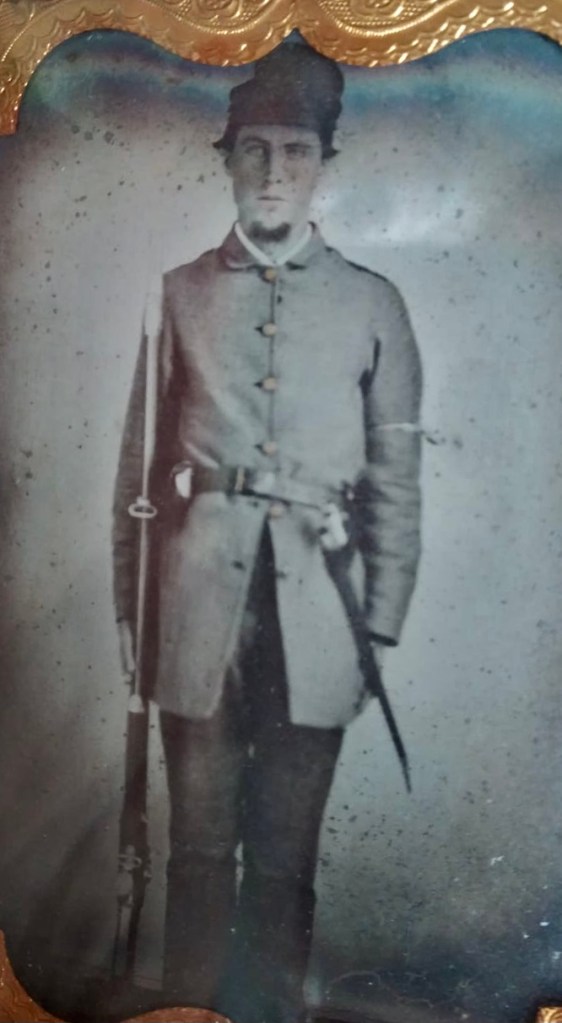
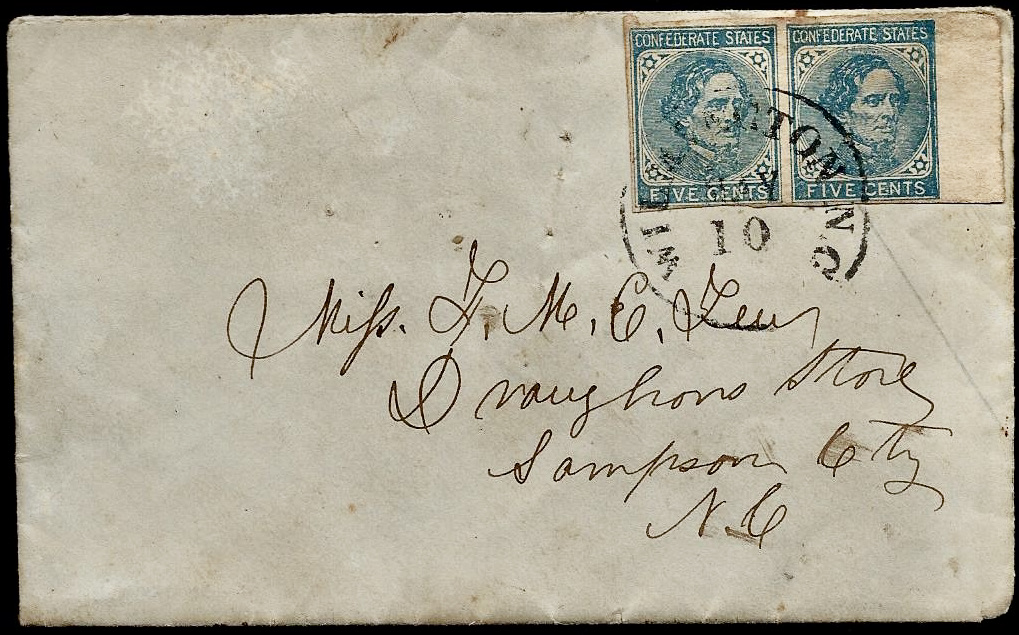
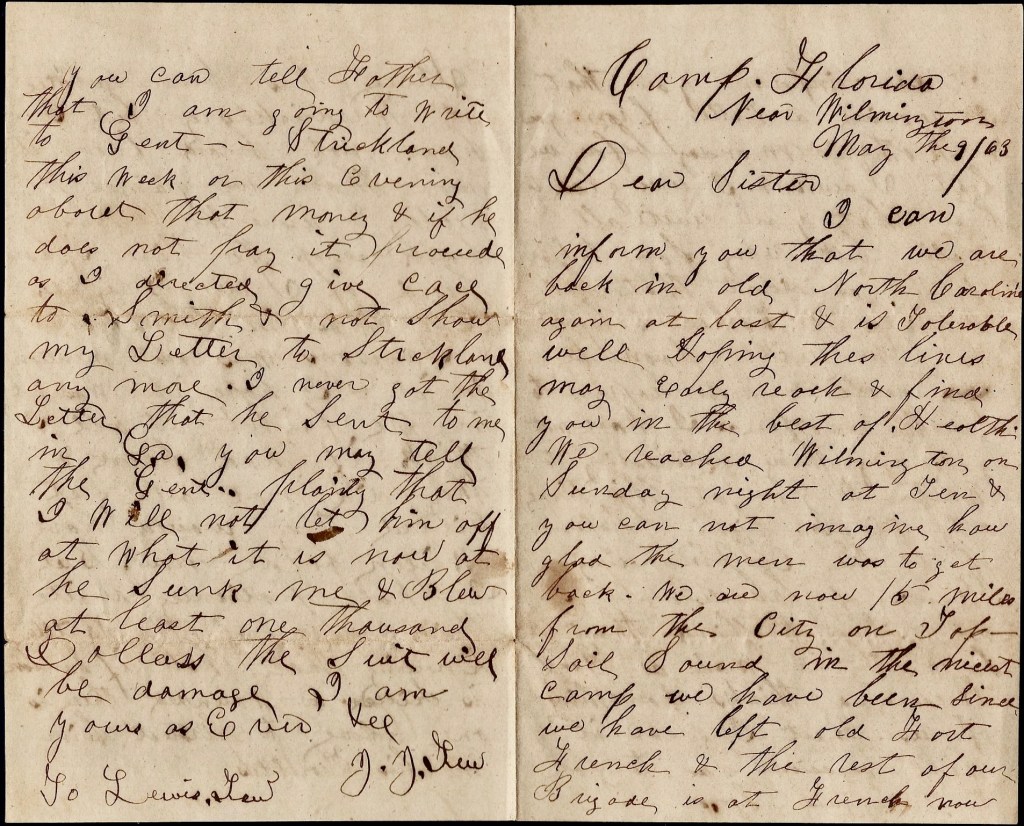
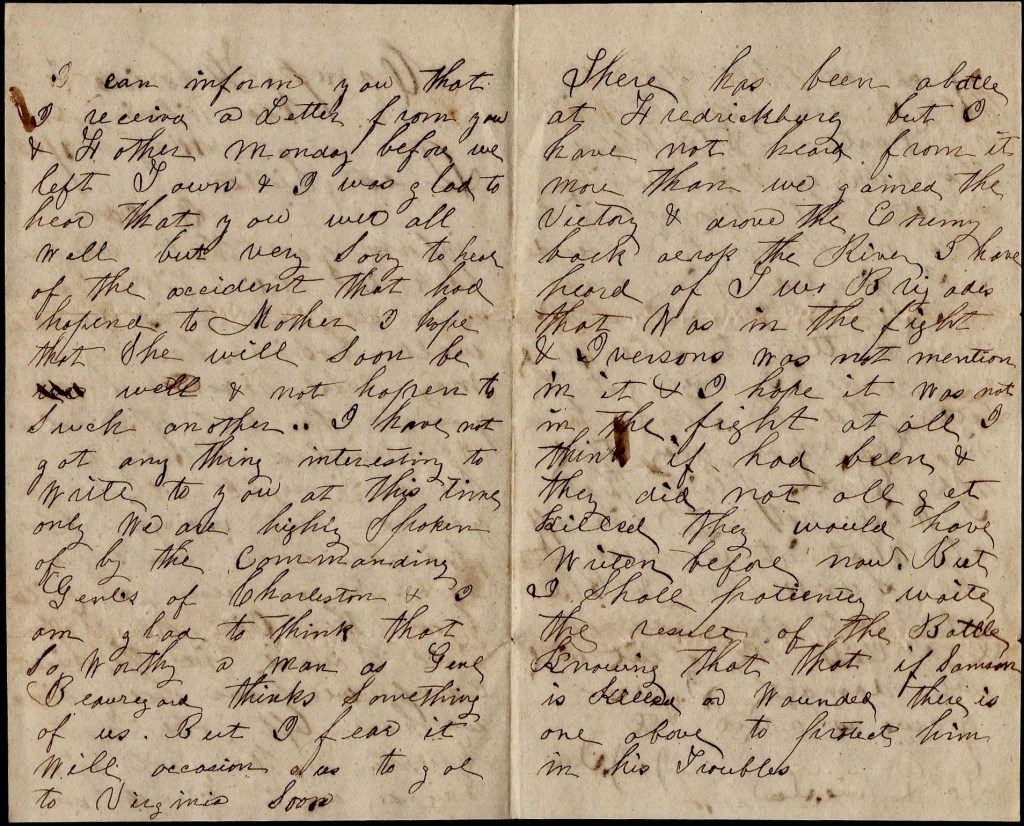
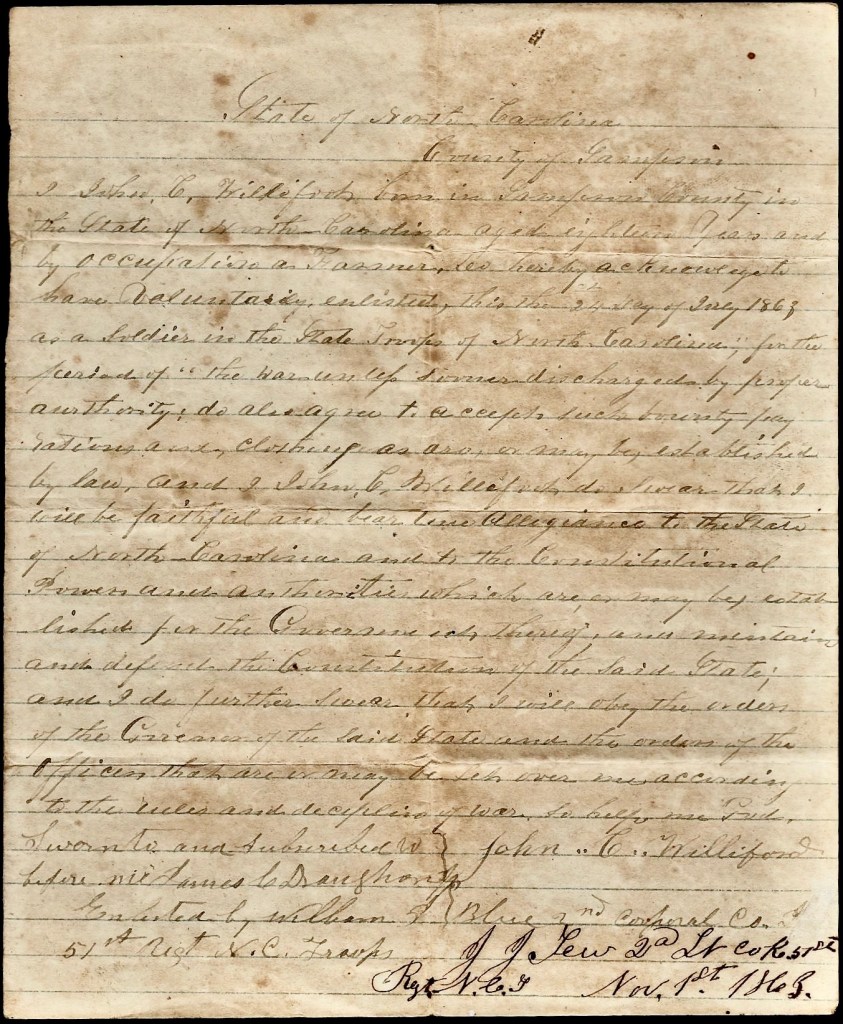

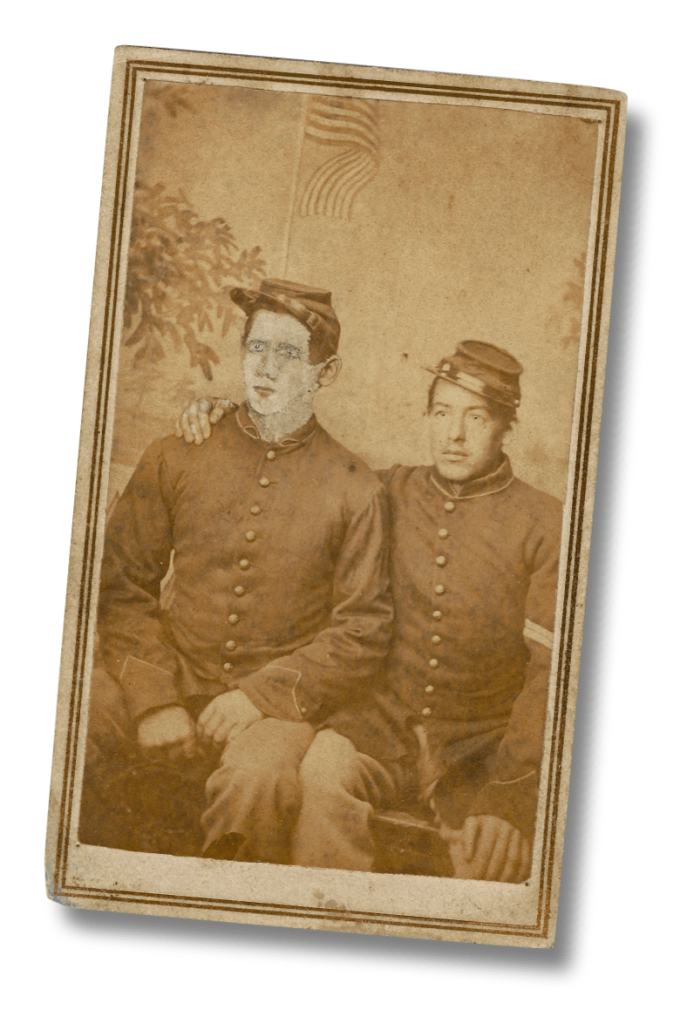

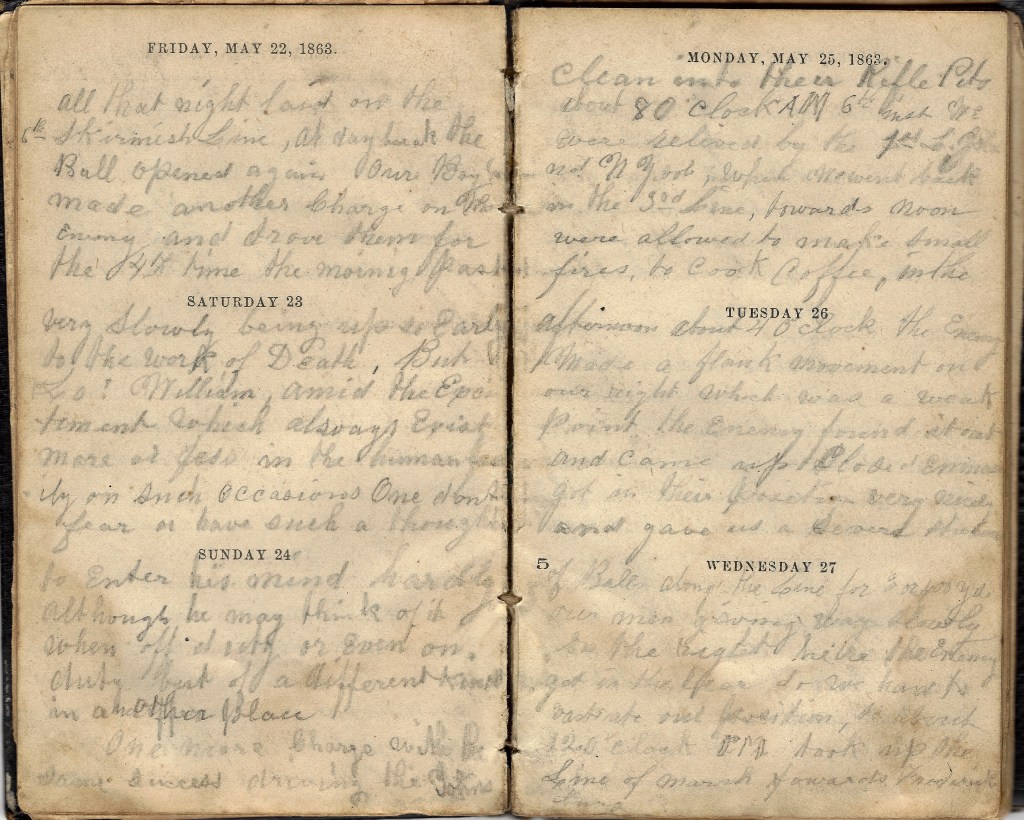
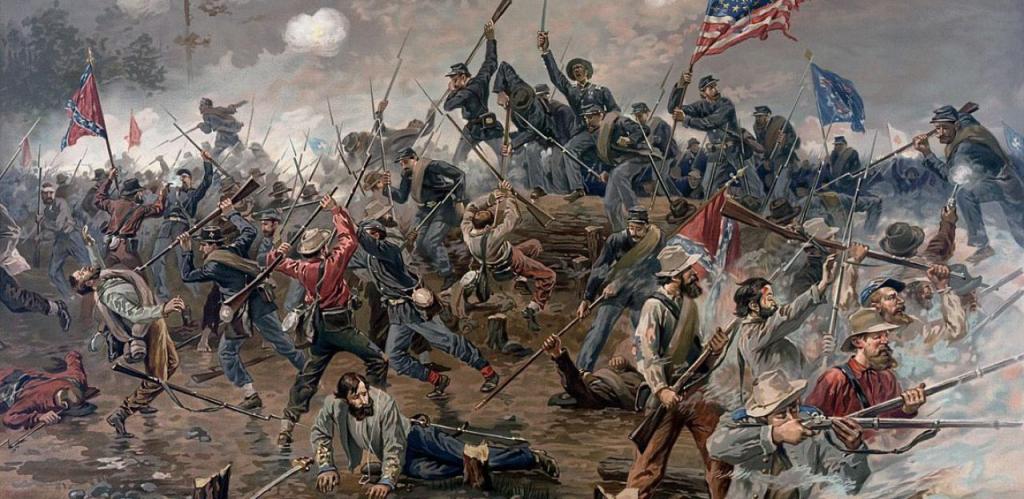


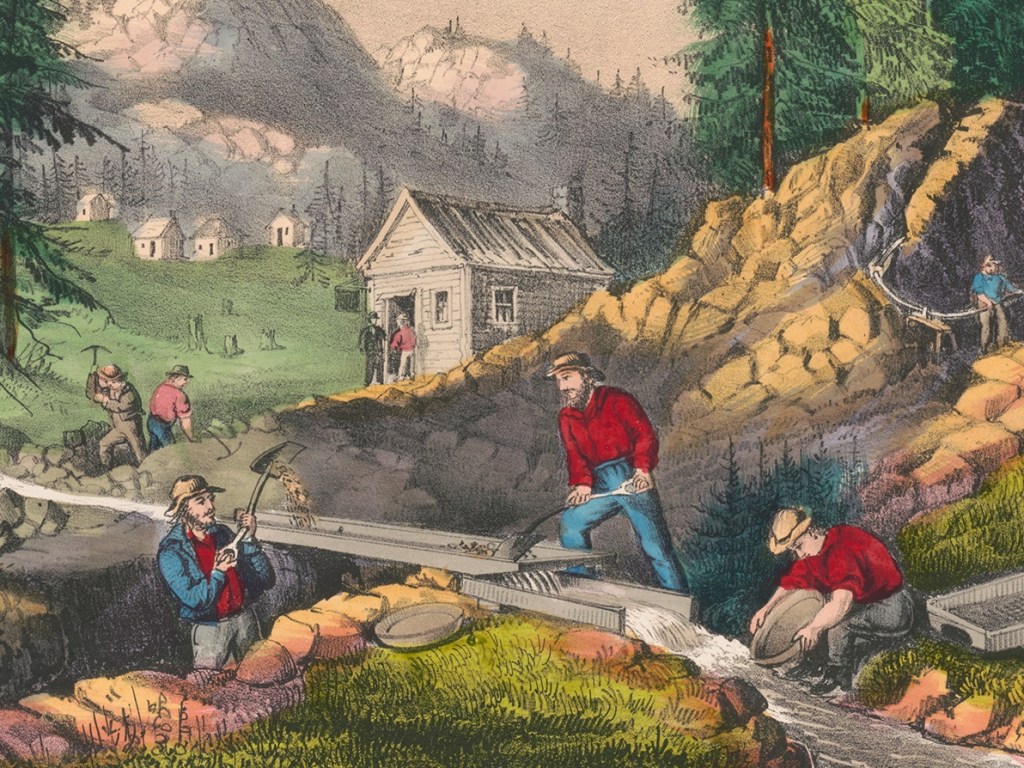

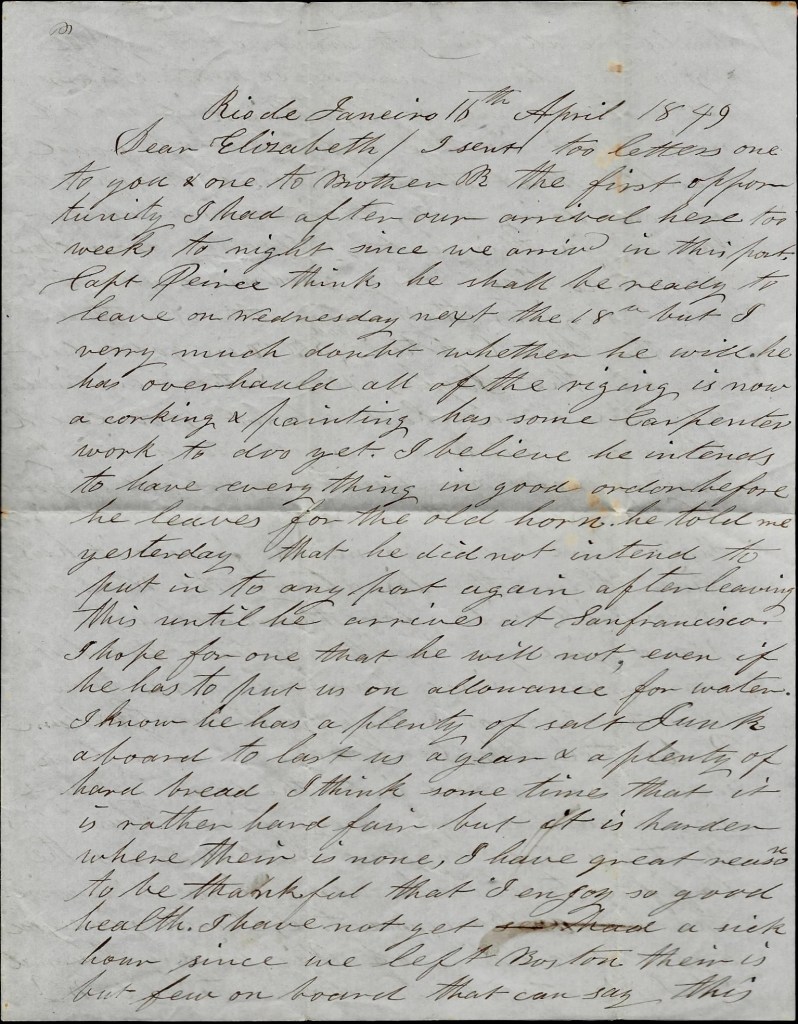
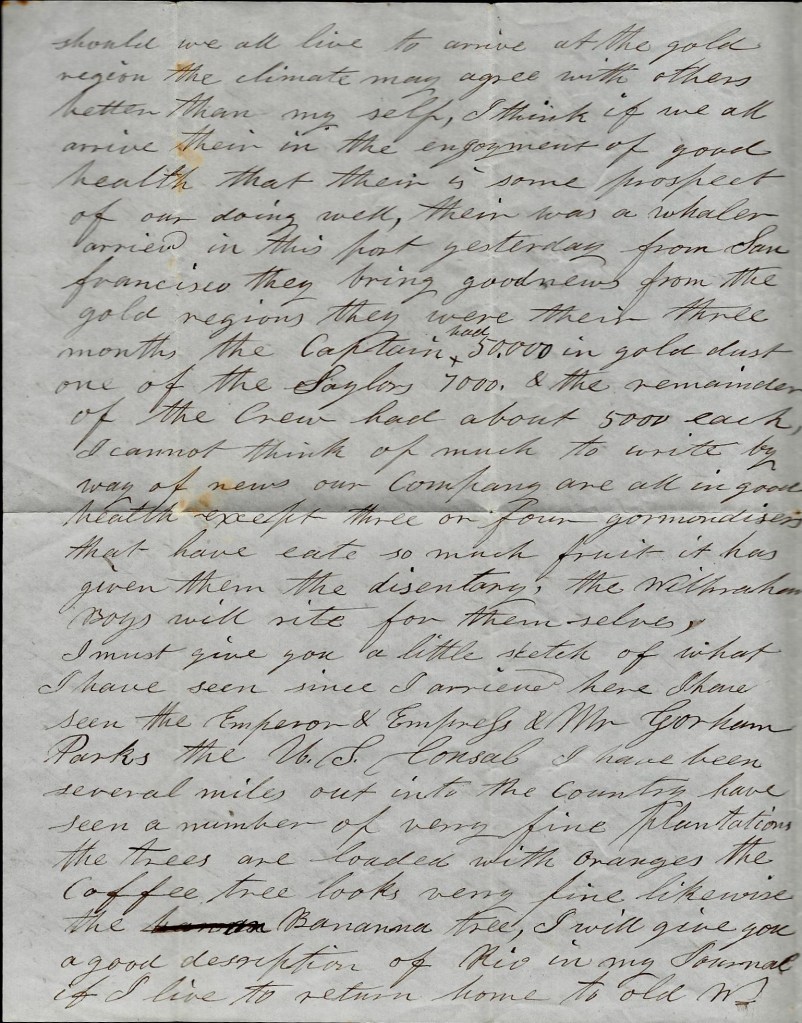


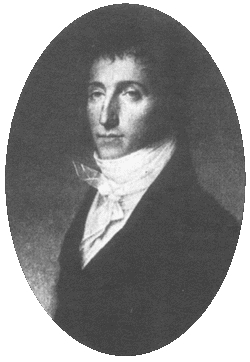
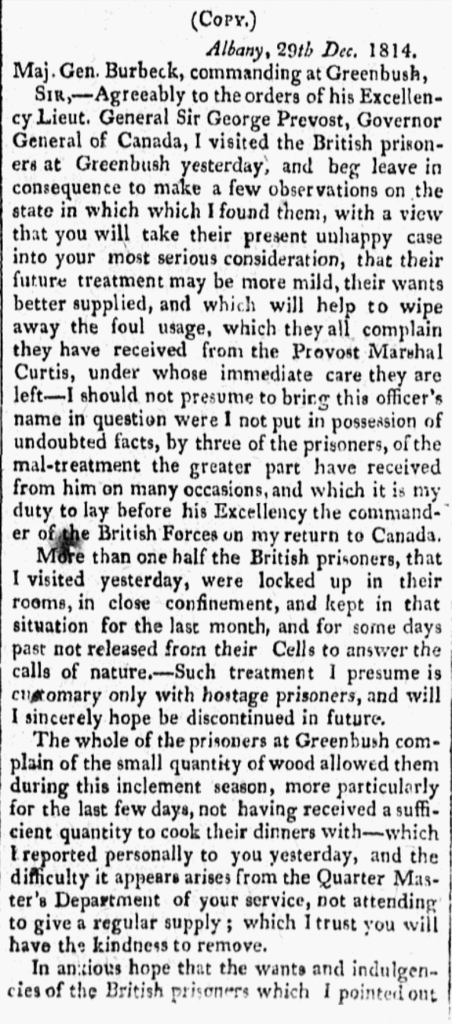


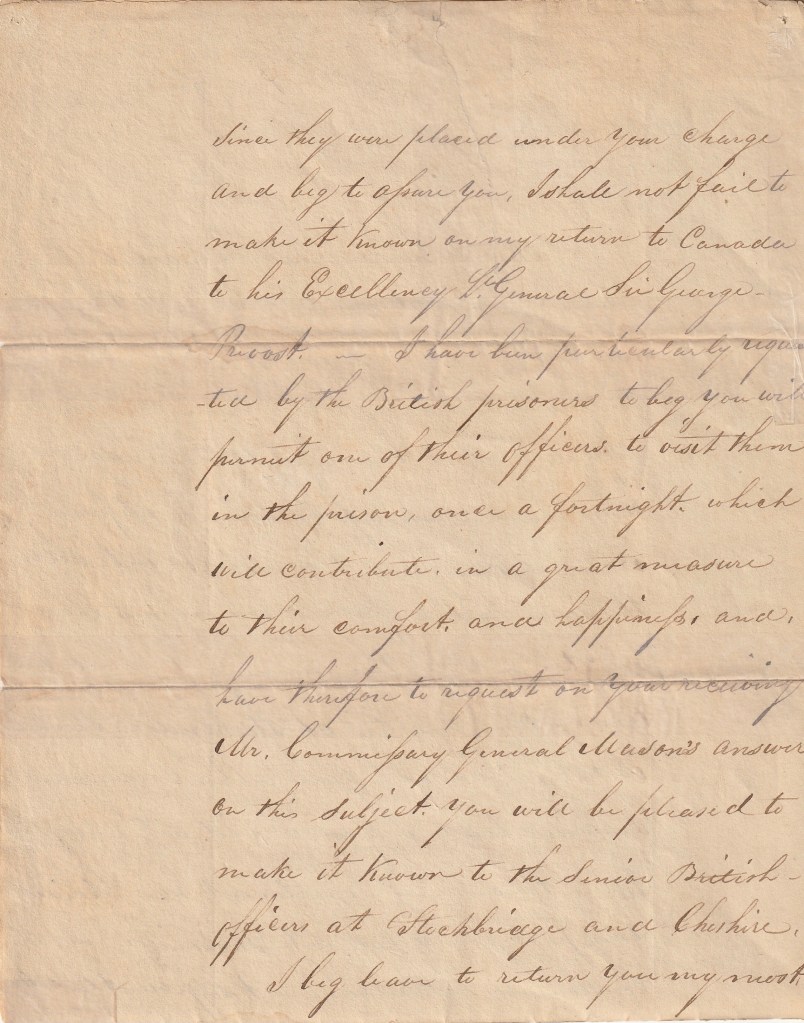

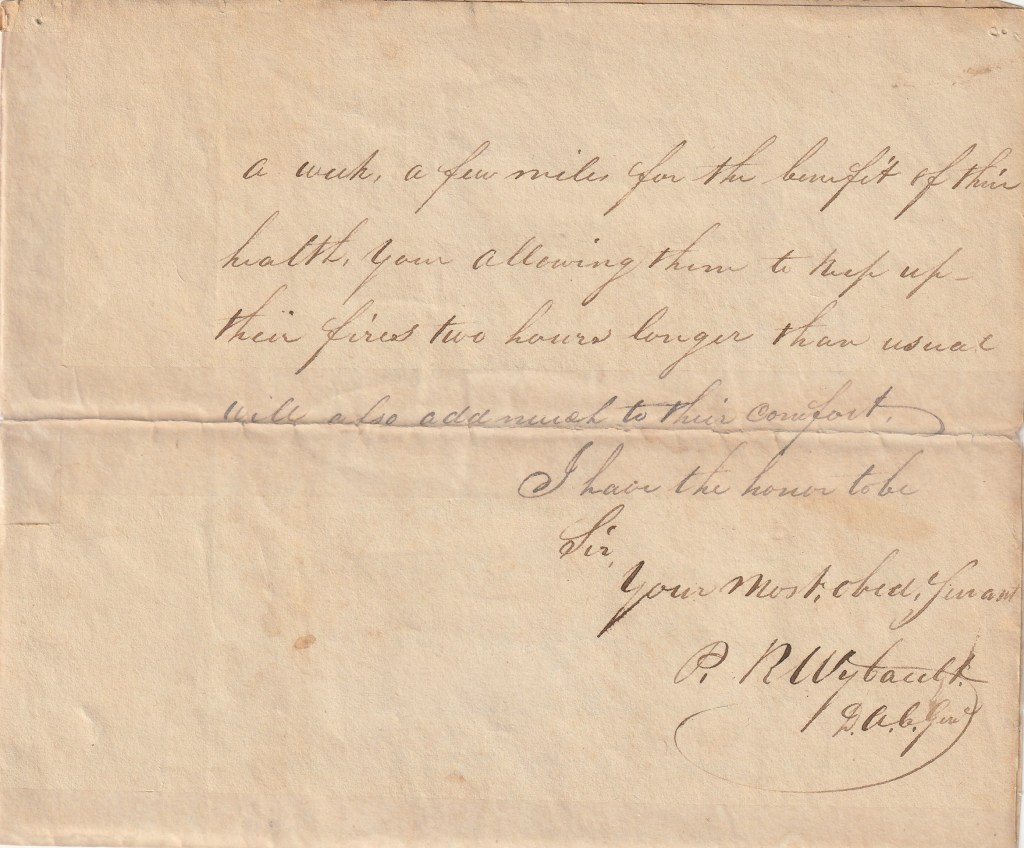


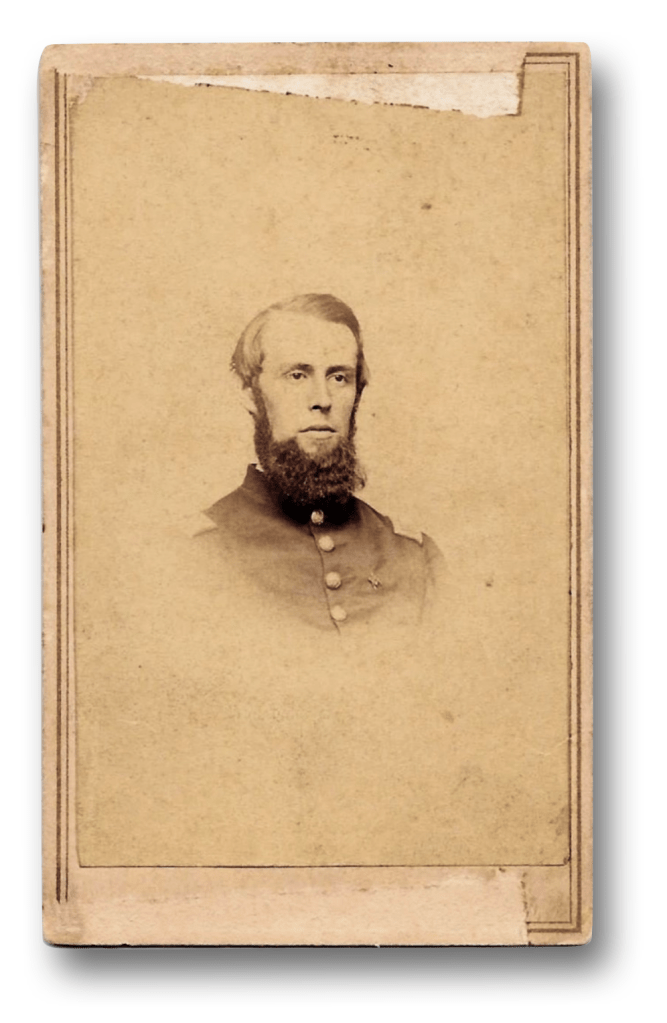
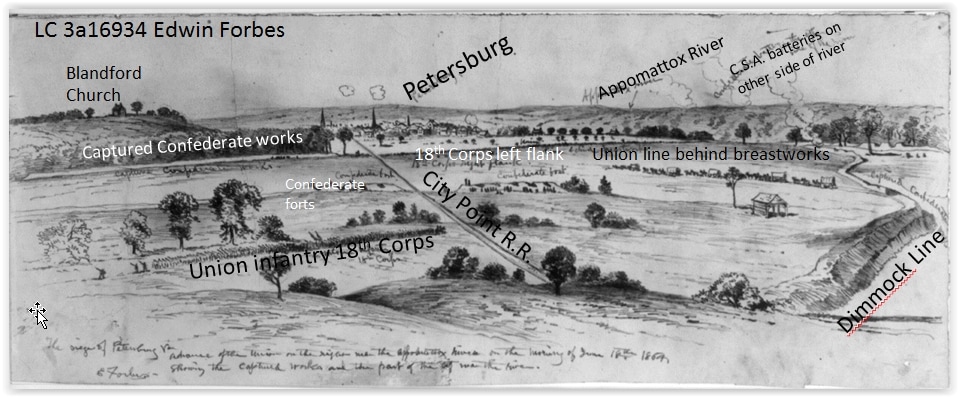
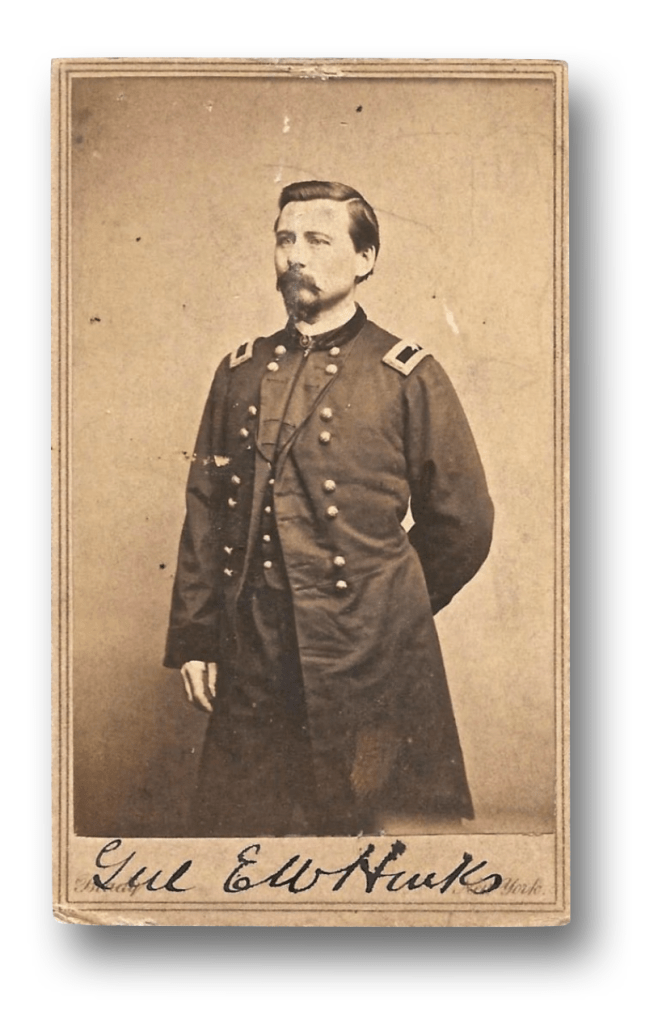
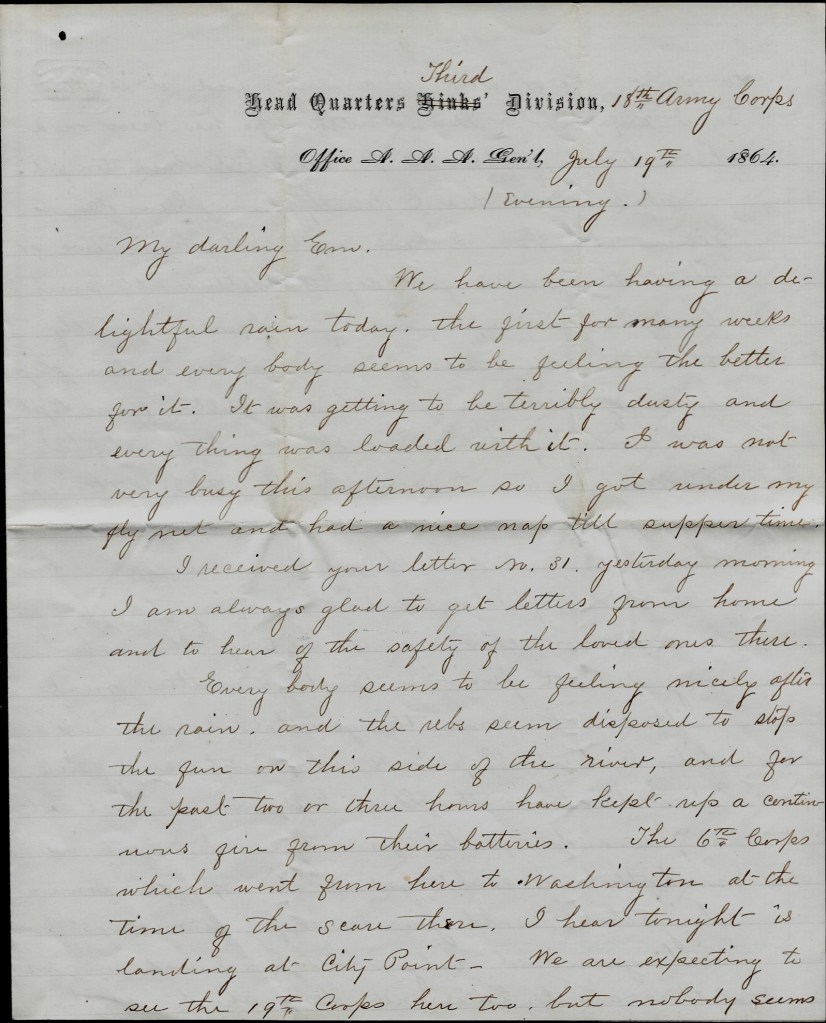
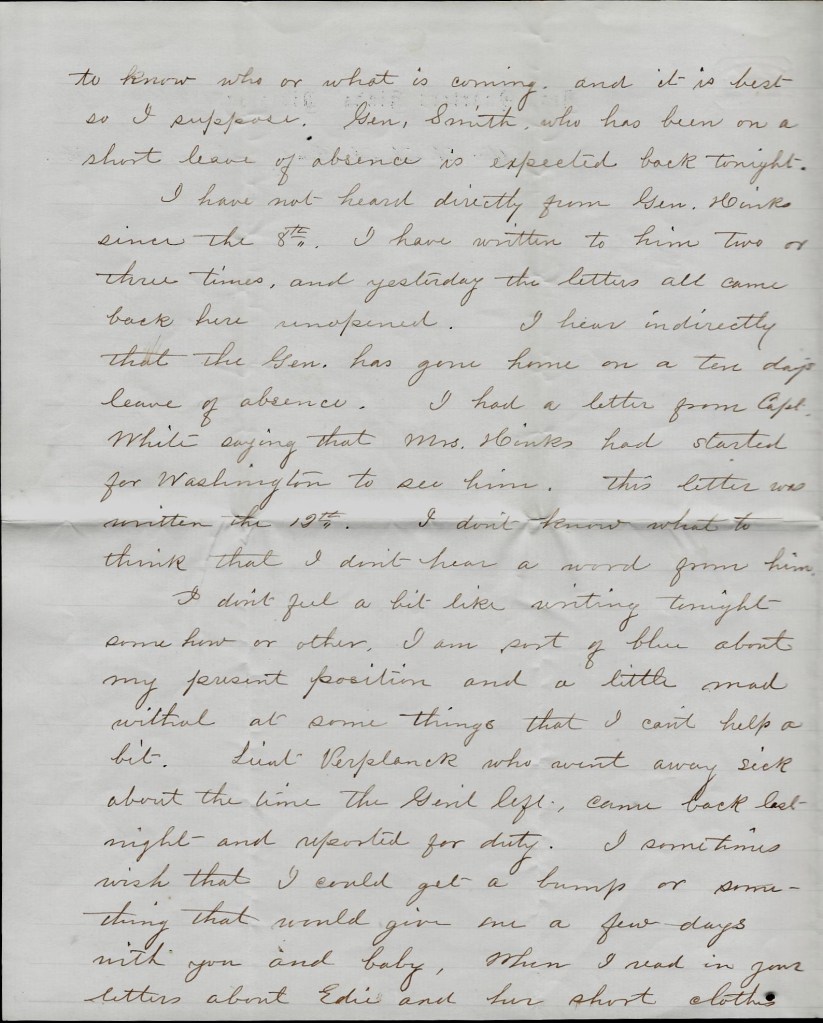
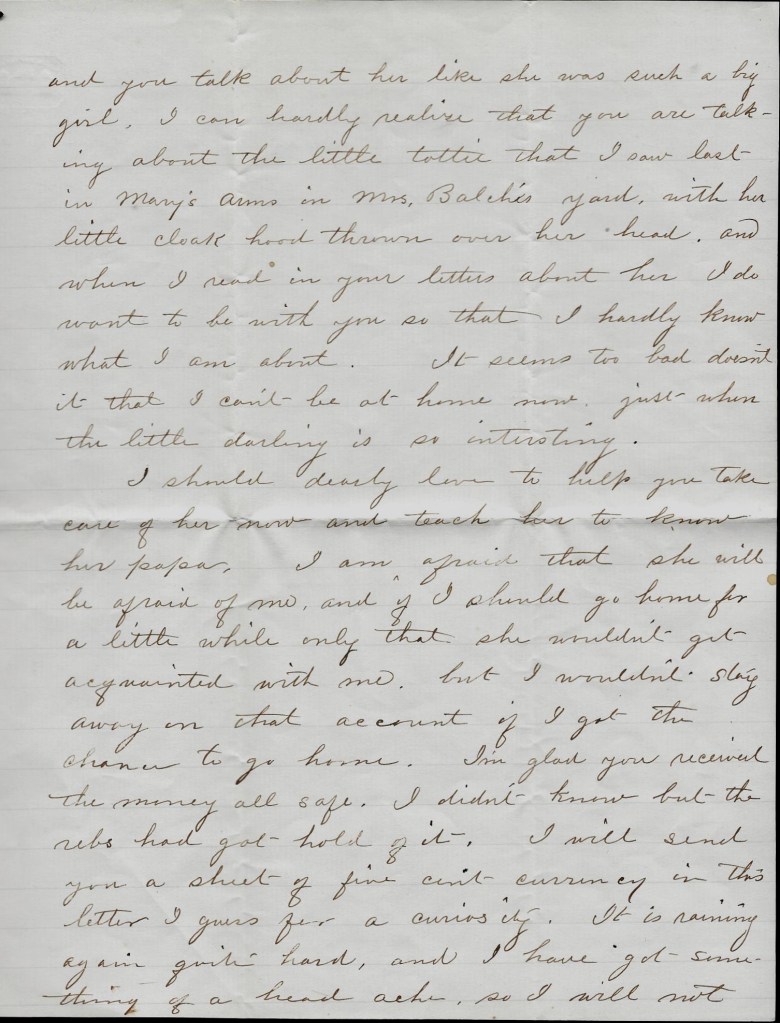
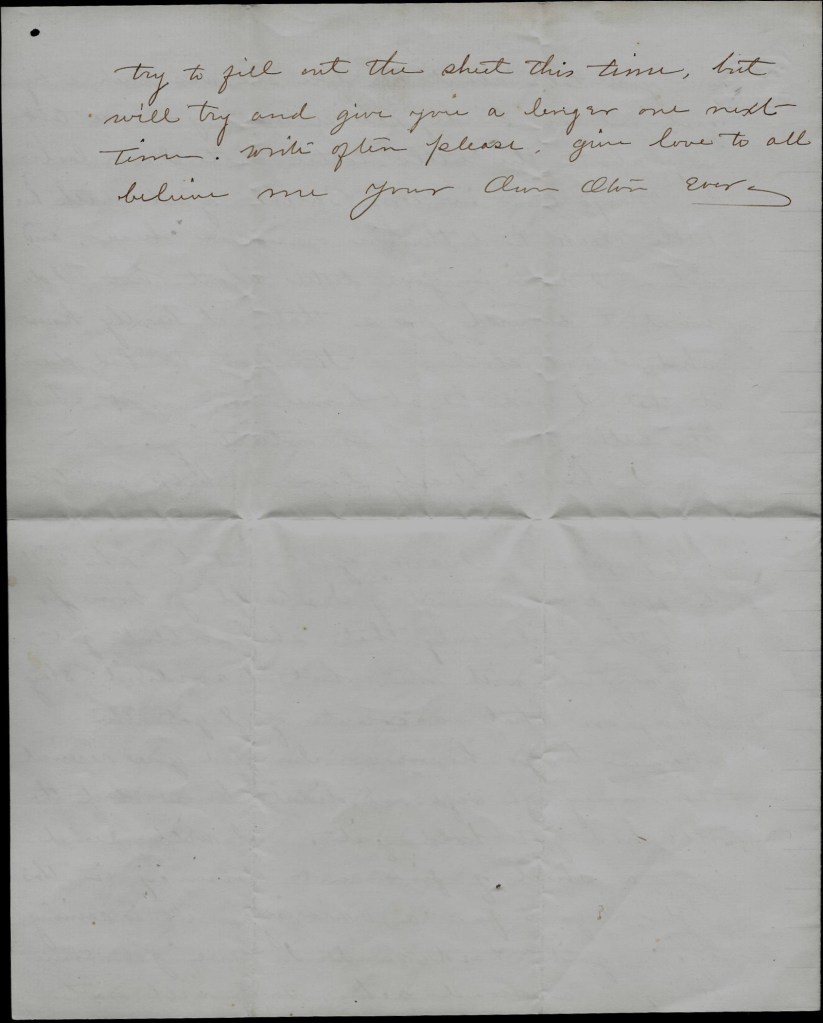
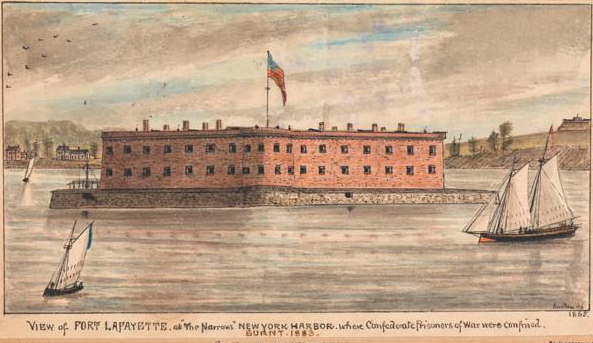


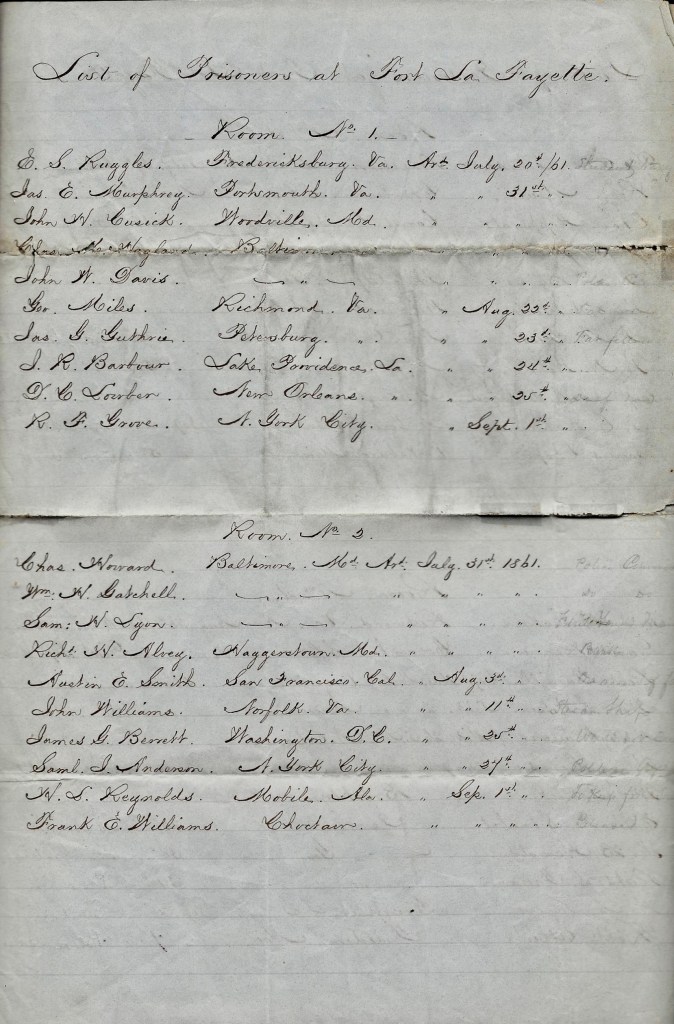
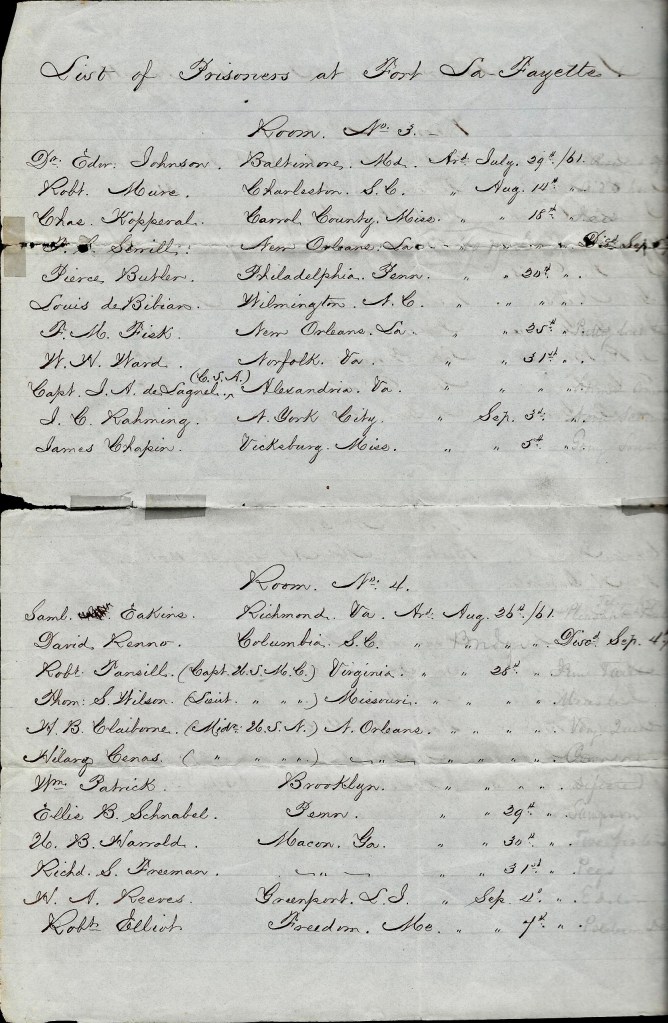
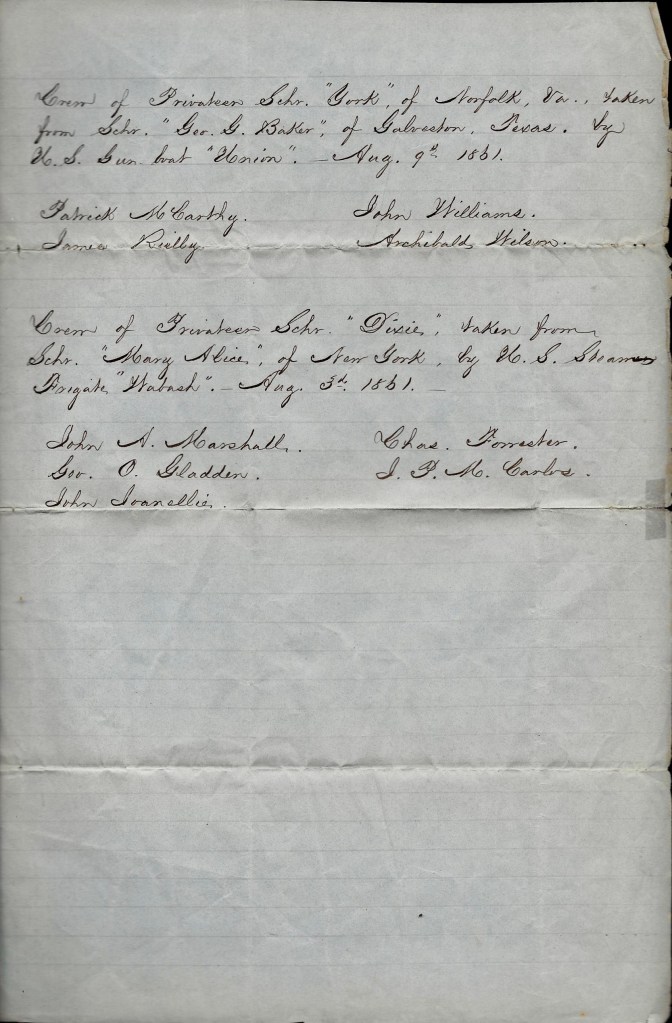


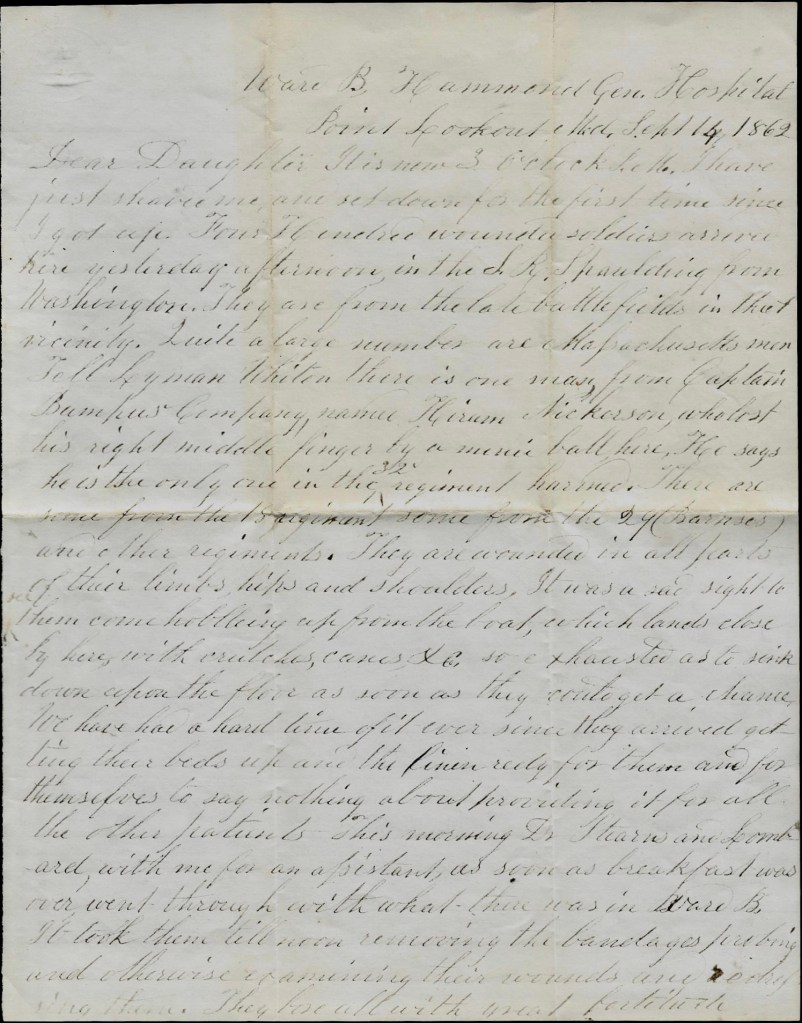

 Spared & Shared 23