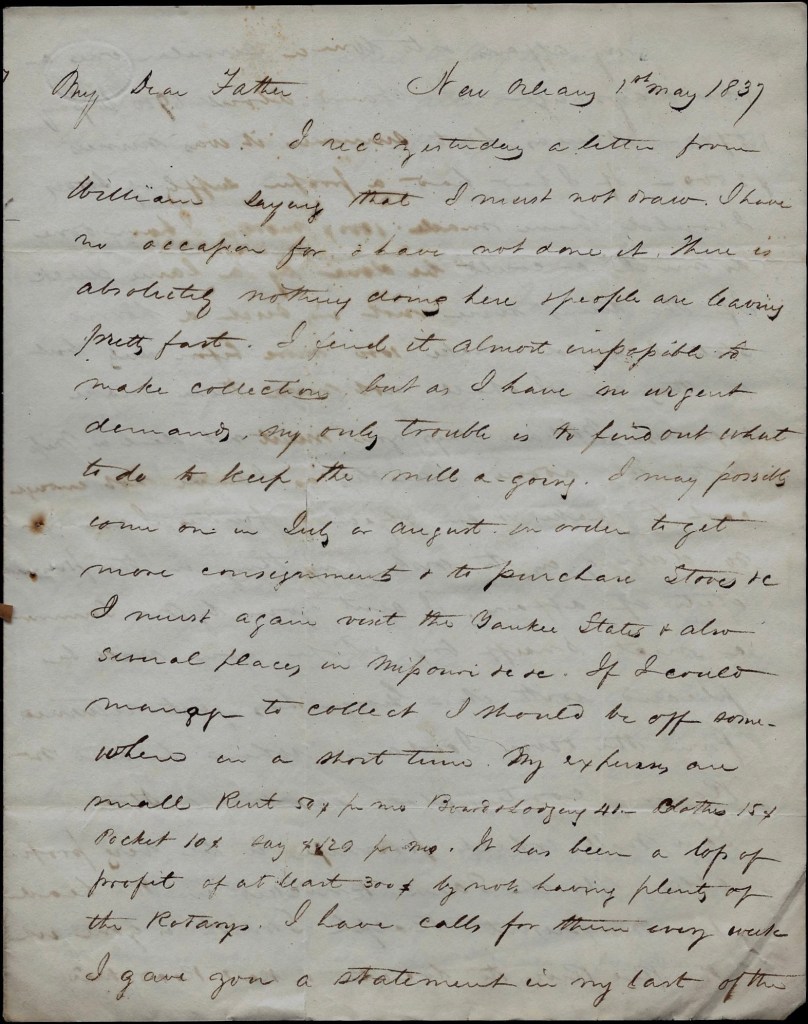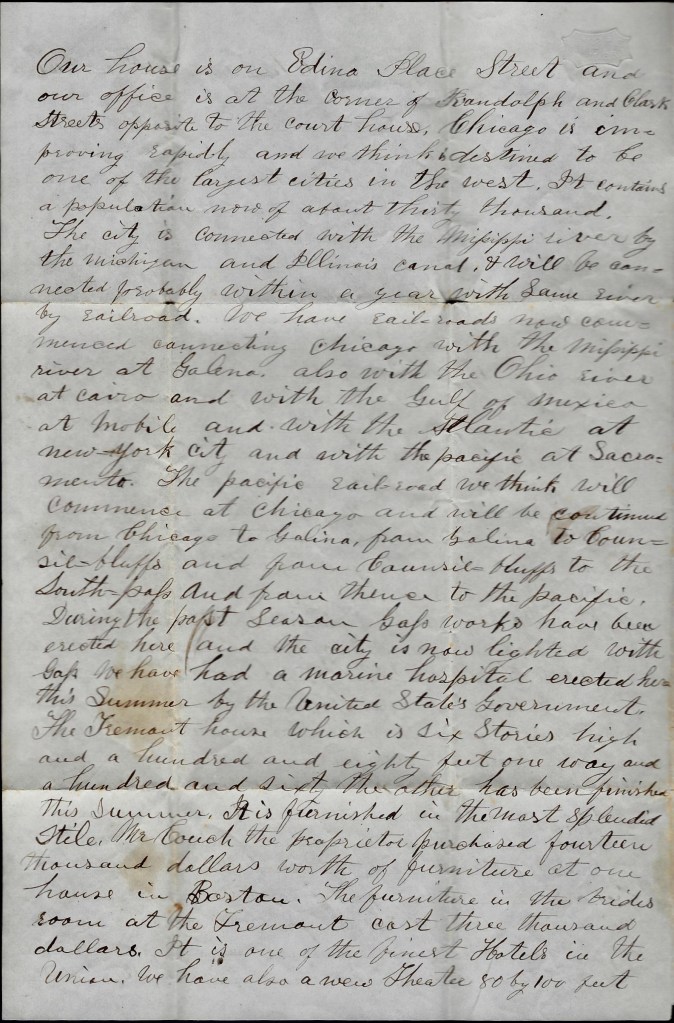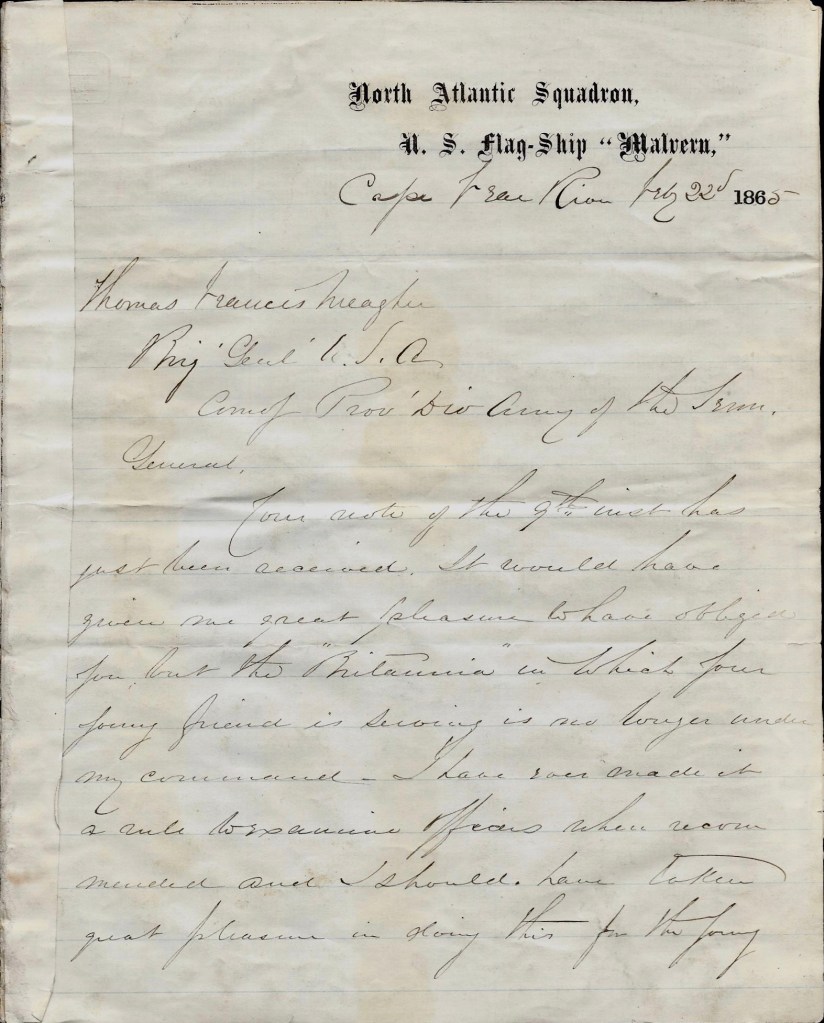
The following letter was written by Jeremiah Woolston Duncan (1810-1854), the son of John Duncan (1776-1852) and Elizabeth Woolston (1778-1851). He wrote the letter from New Orleans in February 1844 to his older brother, John A. Duncan (1806-1868) of Wilmington, Delaware.
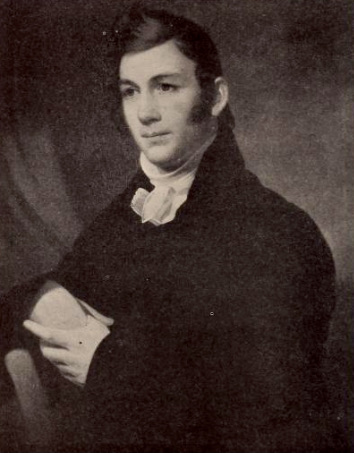
Jeremiah Woolston Duncan
Jeremiah was married in 1833 to Elizabeth Strode Brinton (1810-1859) and the couple had two children by the time of this 1844 letter. They would have at leasts four more children, the last two after the family moved to the fledgling city of Chicago in 1849.
“Jeremiah was born in Baltimore, Maryland in 1810. He received, in common with all the other members of his father’s family, a good English education, but his active and enterprizing nature early asserted itself, and while still but a boy in years, he proceeded of his own volition to Philadelphia, where he became a clerk in a hardware store, remaining till he was twenty years of age. He then went into partnership, in Wilmington, with his brother, John A. Duncan, in the hardware business. In 1830 he withdrew from the firm and went into the lumber business with Baudy Simmons and Company, of Wilmington. He afterwards retired, also, from this firm and went into the West India trade and wholesale grocery business, in partnership with Matthew and Andrew Carnahan, in the same place. He next erected a steam saw mill on the “Old Ferry” property. In 1850 he removed to Chicago, where he engaged extensively in the lumber business. He owned large tracts of land in Michigan, near the straits of Mackinaw, and the town of Duncan, in that vicinity, was named in his honor. But the life he now led subjected him to frequent and severe exposures, and carried away by his activity and energy, he paid too little regard to his health. It thus happened that in the prime of his vigorous and most valuable life he contracted a fatal sickness. He returned to Wilmington and died, December 31, 1854. Mr. Duncan was a man highly respected in all his wide circle of acquaintance, and warmly regarded among his friends. His activity and energy were remarkable, and the results proportionate.” [Source: History of New Castle County, Delaware]
The St. Charles Exchange Hotel in New Orleans in 1847 (Courtesy of Fred Diegel)
[Note: This letter is from the private collection of Richard Weiner and was transcribed and published on Spared & Shared by express consent.]
Transcription
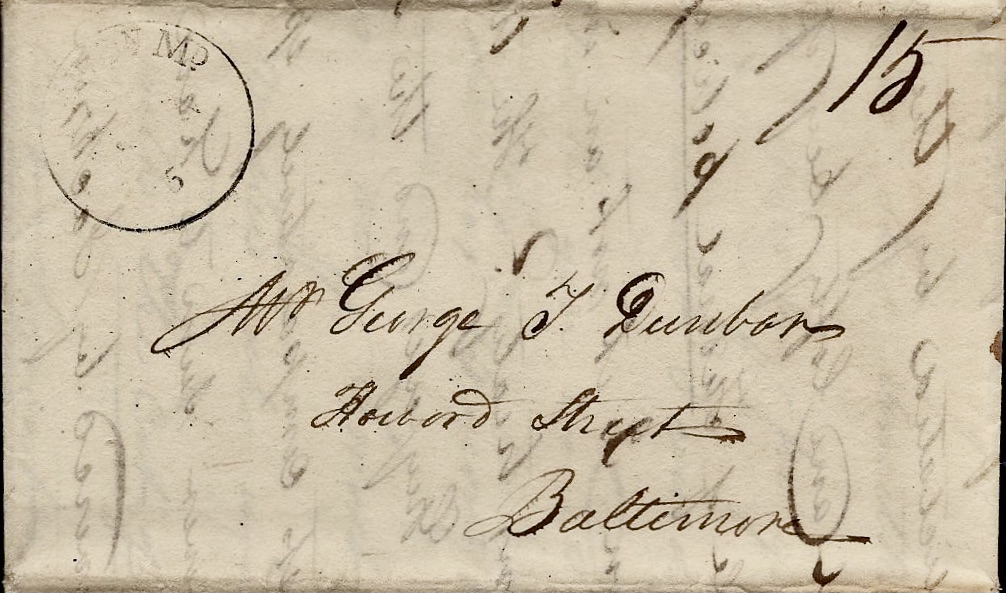
Addressed to Mr. John A. Duncan, Wilmington, Delaware, via Philadelphia
St. Charles Exchange Hotel 1 New Orleans February 22, 1844 2
Dear John,
Having a little leisure before dinner, I thought I would improve it by writing you a few lines. Today here you will observe by a paper I mailed to you this morning, is a busy one. There is a great gathering of the Whigs of Louisiana beside a grand military parade, sham battle, &c. about going on at this moment—2 o’clock—and most of the business is stopped on account of it. Many stores closed.
The Daily Picayune, 22 February 1844—“All will be life, marching, music and animation”
Yesterday was another gala day being Mardigra [Mardi Gras 3] on which occasion carriage of men and women ride about the city in mask & all kinds of grotesque forms imaginable & form a procession the B[ ] throwing dust and flour in their faces at the corners (and by the way, you never saw a dusty city—it is here about ankle deep—and as far as flour, until yesterday we had a little rain which reversed the matter into mud half shoe deep). The citizens consider the turn on yesterday pretty near a total failure—nothing much but ordinary women & rowdies whereas heretofore respectable people used to parade. Old Harry stay much of his time at [illegible] & is to be here tomorrow & hold a sort of Levee in our spacious dining room. 4
This is the finest hotel I ever was in—much ahead of the Tremont or Astor House but, O Harry, how they plaster it on $3 per day or $15 per week if you stay a week at a time. This city is like all other cities—plenty of people here for the business at this time but the prospect for a lively spring trade is pretty good. The wharves look beautiful today. The immense number of ship with all their flags displayed—ships of many nations. It is really a pleasing sight. Steam boats by dozens a belching like volcanoes. I must say I really hate these high pressure boats. With all I had heard about the immense boats on the Mississippi, I am disappointed. The Empire on the North River would eat one of the largest for a breakfast. But there is a great quantity of them going & coming all the time and full of freight.
The substance of Prentiss’s speech The Daily Picayune, 23 February 1844
February 24. I had to knock off for dinner. I have not found time sure to get at it again until this morning at 7 o’clock. If you ever saw a swarm of bees, this house has been one for three days past. I was at a great Whig gathering last night & they began to call for [Seargeant Smith] Prentiss of Mississippi who addressed the convention the day before & one continual cry for at least one hour.
I have ridden out round the city, down the Shell Road & Cr & taken a general survey. Went on the Parade [ground] after the Battle had been fought & see company after company of Frenchmen—all small men and all commanded in French—not a word in English. These French here are great military men. The 2nd Municipality, you could not be from New York in which most of the business is done & in the 1st and more in the 3rd. you will hear all the negroes talk French. I had not been down in the 3rd before the afternoon of the parade the whole of which I spent in that part of the town as it was a complete holiday.
The idea I had formed of the levee was a very enormous one. It to be sure is much higher than the rest of the city, but a stranger may land on it and walk into the city & not observe it. I could write you an hour more but must close. I have some other writing to be done this morning. Give my love to my dear wife & little ones & all your folks & to all my friends my best respects.
From your affectionate brother, — Jeremiah W. Duncan
P. S. Shall have much to talk [about] when I see you. T. H. Larkin is here. Old Mr. Handy of Chil & the 2 McMain Boys & sundry others.
1“The St. Charles was the first large building erected above Canal Street. Within its walls, over the next hundred years, half the business of the city was to be transacted and half the history of the state of Louisiana was to be written. The hotel was designed by noted architect James Gallier. It was the grandest hotel in the South, in fact, the first of all great American hotels. Oakey Hall, who later became the mayor of New York, said of it, ‘Set the St. Charles down in St. Petersburg, and you would think it a palace; in Boston, you would christen it a college; in London, it would remind you of an exchange; in New Orleans, it is all three.’ Mr. Hall was unable to contain his surprise at finding in the city of New Orleans something far grander than anything New York could boast of. The hotel had a magical effect upon the quarter of the city in which it stood. It rapidly built up the First District, known as the American sector. Around it, as a center, gathered the traffic and trade of the city. Churches sprang up near it; stores and dwellings spread out in every direction. St. Charles Street, which did not extend far above the hotel, became the most animated thoroughfare in the United States.”
2 Jeremiah’s visit to New Orleans in February 1844 was just prior to a fire in the summer of 1844 which destroyed about seven blocks of buildings between Common and Canal Streets, near the Charity Hospital.
3 After decades of suppression (under Spanish rule) the Mardi Gras parade was reinstated in New Orleans in 1837 (at least the first recorded). It remained popular until the early 1850s when it began to wane, but then was reinvigorated in 1857.
4 “Old Harry” is often an alternative name for the Devil but in this case it is referring to Henry Clay, the Senator from Kentucky, who was being nominated again by the Whig Party as their choice for President in 1844.
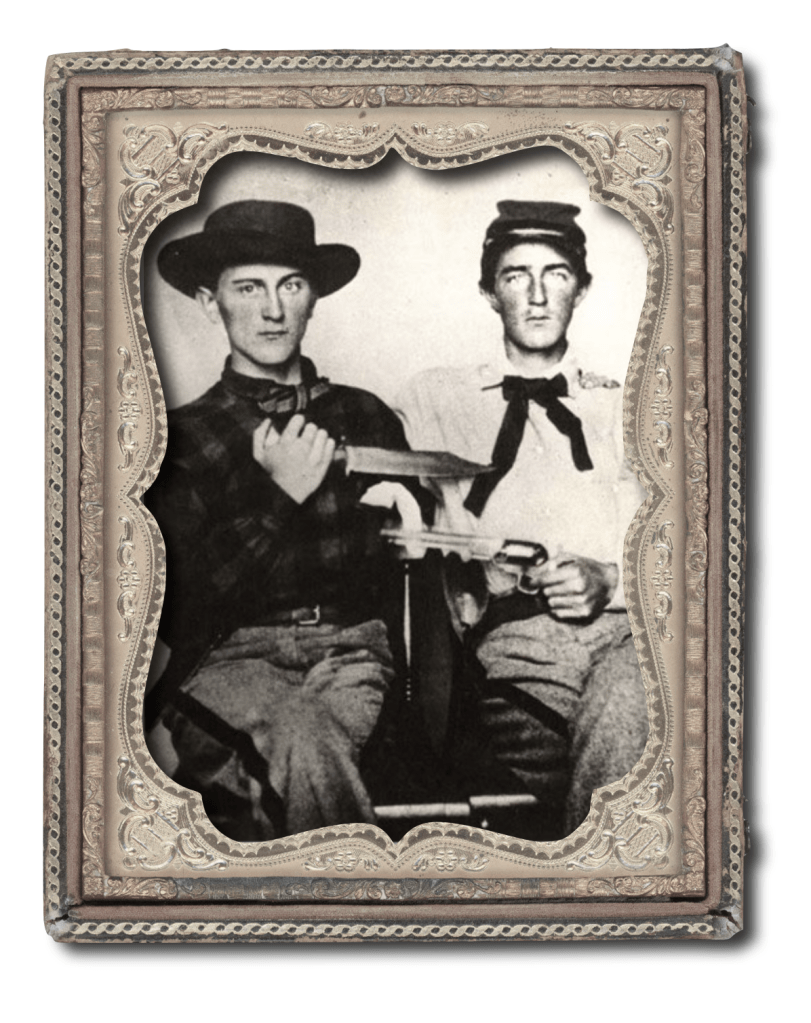
I could not find an image of John Sowers but here is one of John “Conrad” Grimm of Co. B, 28th Pennsylvania Infantry(Ancestry.com)
This letter was written by John Sowers, who enlisted in August 1861 in Co. N, 28th (“Goldstream” Regiment) Pennsylvania Infantry. The extra companies in this regiment, including Co. N, were transferred into 147th Pennsylvania Infantry when it was organized in October 1862. John Sowers entered Co. C of the 147th P. V. as a private but was later promoted to corporal. The regiment participated in the Battles of Chancellorsville and Gettysburg before fighting in Tennessee at the Battle of Lookout Mountain and during the Chattanooga-Ringold Campaign. The 147th also participated in the Atlanta Campaign advancing through Northwest Georgia during June and July 1864. Sowers was wounded at Pine Knob, Georgia on 15 June 1864. He died from his wounds in Nashville on 6 July 1864 and was buried in the National Cemetery there (Section I, Grave 367) under the name John Sower.
John was the son of Henry Sowers (1797-@1875) and Sophia Reicheldeofer (1806-Aft1851) of Carbon county, Pennsylvania. John had an older brother who also gave his life in the Civil War. Penrose Sowers (1831-1864) served in Co. K, 81st Pennsylvania Infantry, the “Fighting Chippewas.” He was killed on 12 May 1864 at the Battle of Spotsylvania.
Transcription
Berlin, Maryland November 28, 1861
Respected Father & Mother,
I seat myself down to drop a few lines to you. I am well, hoping and wishing that these few lines may find you and mother enjoying the same state of health. I must say, father, the army has become quite a home to me. I must say, father, I like it much better than I thought I would.
Our company is still out on picket duty along the Potomac river and our enemy is still on the other side of the Potomac river. We can see the Rebels every day.
Our regiment at the present time consists of 1,711 men. You can think, father, we have quite a regiment. This is the largest regiment that Pennsylvania has out for the campaign. Our regiment has good health at present, and our company has extra good health so far.
The weather here at night is very cold along this river and through the day the weather is quite fine. And further I must say our living is not as good as it might be for this present time. But our quarter master don’t attend to his business like he ought to. My weight at present is 184 lbs. That is not bad for your son John. I hope the Lord will give me such good health at all times. I further wish he will give me health and strength to return back home again.
I don’t think we will lay here long. The talk is we will go further south. That part would suit me very well. I would be pleased to go away from this state. I was in Virginia on a scouting party last week, but we could not catch any Rebels. They were as smart as we was on this day. I am in this regiment three months and nine days. Father, we have received no pay yet, but as we get paid, what money I don’t want, I will send it home to you for safe keeping. We expect the paymaster every day. So father, I will bring my letter to a close.
From your son, — John Sowers
Direct Point of Rocks, Maryland Co. N, 28th Regiment P V., in care of Col. [John] Geary
The following letter was written by Isaac Newton Montgomery (1843-1883), the son of James Montgomery (1800-1882) and Mary Crees (1815-1890) of St. Thomas township, Franklin county, Pennsylvania.
Isaac’s letter refers to the death of Nicholas M. Bowers (1841-1863) who was mortally wounded in the leg on 3 May 1863 at the Battle of Chancellorsville when his regiment, the 126th Pennsylvania Infantry, was assaulted by a superior force on the Union right, near Ely’s Pond. They held their position until the last of their ammunition was gone but were finally forced to yield ground and retire. Fifty-eight men in the regiment were killed or wounded, some of them left on the field to be taken captive. Nicholas’ leg wound was so severe, he could not leave the field and he was held by the Confederates for 12 days before he was exchanged, his wound untreated. He died the day following his release. Nicholas served in Co. H.
Isaac addressed the letter to his friend, David Hafer (1837-1921) who served as a private early in the war in Co. I, 79th Pennsylvania, but later in Co. D, 158th Pennsylvania. David was married in 1858 to Sarah Ann Bowers (1836-1904), the sister of Nicholas.
Transcription
Addressed to Mr. David Hafer, Co. D, 158th Regt. Pa. Infantry, Care of Col. D. B. McKibble, Little Washington, North Carolina
St. Thomas [township, Franklin county], Pennsylvania May 24, 1863
Mr. David Hafer—my dear friend,
I am sorry to inform you that our friend and brother, Nickolas M. Bowers is no more. He was but a short time with his regiment when it was ordered into battle and at Chancellorsville, on Sunday May 3rd, he fell wounded in the leg below the knee. The leg was very much shattered and after repeated trials he was left in the hands of the enemy and was not brought over until the 15th. His wound had not been attended to and he died on the 16th. Thus my friend, we today mourn the loss of one most dear, and our only consolation is that we know he died peacefully and is now in glory.
The family are deeply troubled as you may imagine—better than I can describe it.
Your wife requests me to say that she, together with your little ones are all well. And in conclusion, I can only say to you, take good care of yourself for the sake of your family. Give my respects to Ames and all the rest of the boys and believe me truly your friend. — I. N. Montgomery
The following letter was written by Rev. Edward Brown Furbish (1837-1918), the son of Dependence Hart Furbish (1806-1882) and Persis H. Brown (1803-1872) of Portland, Cumberland county, Maine. Edwards was married in October 1862 to Grace Harrison Townsend (1840-1914).
Rev. Edward Brown Furbish
An 1860 graduate of Yale College, Edward was 25 years old when he volunteered to serve as the chaplain of the 25th Maine Infantry in September 1862. Organized at Portland, Maine, the regiment was mustered for nine months service and sent to Washington D. C. in mid-October. The regiment served garrison duty in the defenses of Washington, D.C., October 18, 1862, to March 24, 1863. Moved to Chantilly, Virginia, March 24, and on picket duty there until June 26. (Temporarily attached to XII Corps, Army of the Potomac.) Moved to Arlington Heights June 26, then ordered home June 30. The 25th Maine Infantry mustered out of service July 10, 1863.
Among the duties an army chaplain was frequently called upon to perform was to write letters informing loved ones at home of the death of their husbands, sons, brothers or fathers. In this letter, Edward refers to the death of “Mr. Kimball.” This was no doubt Isaac Kimball (1839-1862) of Casco, Maine, who enlisted on 29 September 1862 at the age of 23 to serve in Co. F, 25th Maine Infantry. Isaac died of typhoid fever in the regimental hospital on 24 November 1862. Isaac worked as a boatman just prior to his enlistment, probably in the lumber business.
Transcription
Addressed to Mrs. E. B. Furbish, New Haven, Connecticut
Arlington Heights Camp Tom Casey December 1, 1862
My own Gracie,
No one would think it was the first day of December here who has lived in New England. It is warmer & milder here than it can be with you. We keep a little fire in our tents, but only a little. It is like our early Spring or Fall days. The grass about my tent has looked quite green, but I will think not thrive much longer. I am now in the Chapel Tent among the sick. There are but two who are dangerously sick here, and one may die. That is why I am here tonight. Do not know how long I shall remain. I am very well indeed. Have never felt more healthy & think I am gaining every day. But some of these poor fellows are failing sadly, yet we hope they will come out of it. Think we shall after all lose two or three of those now sick, but it may not be so.
Have not done much of anything today—not even in visiting. This morning wrote a letter home yo Mother and told her I hoped she would be able to stop and see you, but I should not be surprised if they should be in such haste to see Father that they should conclude to come down and see you sometime after they have been settled, but I hope they will be able to stop as they come on. After writing her, I laid down—or rather reclined—and read the papers which have been sent me. This took till dinner time. Took Lilly out a little while to try her and see how her lameness appeared. It does not show now—only a little when turning. Think is a very little while she will be entirely over it. Hope so at least.
Then I wrote a letter to one of Mr. Kimble’s friends telling all I could about him. He was not married but had a little child. As soon as he found that he was to have one, he took the Mother to his home & acknowledged the child, but yet I do not think he ever had married the Mother. It will be very hard indeed for her. He had on his finger a ring with her name on it & all seemed to think he was attached to her. I wrote her a letter as though she had been his wife without in any way alluding to the fact which I have told you & yet I have half thought there was another whom he loved more perhaps than the Mother of his child which may have deterred him from marrying. He had no relatives other than a brother’s wife. All the rest of the family had died as suddenly as he. The notice in the paper was that he had no relatives & yet he left a child & the mother. What a comfort it would be if she could only bear his name & feel that the one she loved was in the sight of the world her husband. She will have a hard path to walk in this life. Hope she may meet her lover in heaven, or at least may here be comforted.
There are a good many sad hearts here in this world who do not know enough to seek comfort from the Source of all blessings, but it is given unto us. Dr. True asked me tonight if I would have come out here had I known I should not return. He said he would not. He has left a wife & children behind. The more I see of men, the more I feel our love is peculiarly strong & precious to us. I do love you my Gracie, more than I can begin to tell you. May Notre Pere [Our Father] be near us & keep us safely. Can but feel anxious about your health & long to hear from you. Until yesterday have not written you on Sundays because I was too tired & had too much to do, & sometimes did not finish in season for Monday morning’s mail, then you would be without a letter from Monday morning until Wednesday morning, but they never ought to be detained longer than that. I write every day & have excepting Sunday’s so you ought to receive six letters a week. Last week I think I only sent five letters. Will it do if hereafter I only send them once in two days or four a week? Think after all it will be difficult to refrain from writing as it will be for you to do without them & so the letters will come to you as usual I presume.
Do not know why letters the first of the week are detained unless it is that they mail last of all the soldier’s letters & only then when there is time & as there are more letters written Sunday than on any other day. Presume that our mails are laid over in Washington one day sometimes. When I can, [I] send the letters to you by a friend going to the city & he drops them in & then they go in the mail first sent & do not wait to be distributed until the last. Feel quite confident your letters have all reached [me].
The Second & Third Brigades of Casey’s Division have been ordered to go into winter quarters. The First will doubtless be removed. All whom I see think our regiment very highly favored in every respect. These opinions come to me out of the regiment.
There is nothing new to write. Everything goes on well. I do hope [General] Burnside will not go into winter quarters till he has Richmond & slain enough Rebels to make it pay to rest a while. It has taken a great burden off my mind in coming out here. I envy no one at home while the war lasts. Of two evils, we must choose the least. It is better to fight to the death than let these Rebels conquer. Their abode is I feel quite confident in the darkest regions & the sooner they find their homes, the better I think. This of the leaders—not of the rank & file. I hope the most desperate measures will be adopted & I much prefer their slaves should cut their throats & send them to their own abode than that they should slay our soldiers & destroy the Union. If we are not soon successful, I shall be most thankful when the slave take the knife for the extermination of every rebel at all hazards. We must see to it that this war is not ended until every rebel is crushed, humbled, or hung. The more hung the better if they will persist in their way, chosen so deliberately.
But enough of this. They are in the hands of the One who hates them more than I do. It is a comfort to think so. Now I am going to read the President’s Message & will say my own darling child, “good night.” Give much love to Mother. Think you will be able to see your boy this winter & more than once too. It would be novel for you to see me in New York & then you could ride in the cars and come to your home. I may be able to fix it so you can come out here and stay awhile with me. Good night my own true. Your husband, — Edward
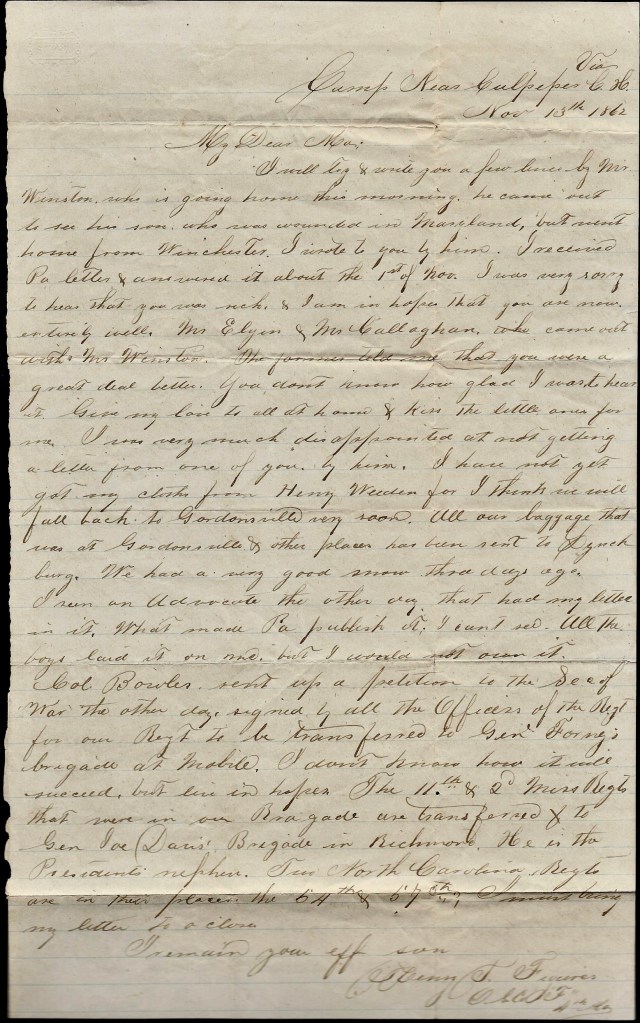
The following lengthy letter was written by 48 year-old Amanda (Angle) McPherson (1815-1887), the wife of Peter McPherson (1814-1891) of West Milton, Saratoga county, New York. She wrote the letter to Colonel James B. McKean of the 77th New York Infantry, pleading the case of her son Edwin L. McPherson (1837-Aft1910)—a member of that regiment—who was arrested for violating his parole by returning home rather than to remain in the convalescent camp after he he had been released by the Confederates following his capture during the Second Battle of Fredericksburg on 5 May 1863. Sent to the convalescent camp while awaiting his exchange, Edwin believed he could go home since he had to remain a noncombatant until properly exchanged but his absence from the camp without a furlough resulted in his being declared a deserter.
The 77th New York Infantry, known as the Saratoga Regiment, was mustered into service in November 1861 and Edwin, aged 24 at the time of his enlistment, entered as a private. The regiment was a hard fought regiment which lost heavily at Antietam before the fight at Fredericksburg.
Where Edwin went after he deserted from the army is not known but he showed up in Adrian, Lewanee county, Michigan after the war, married there and remained there the balance of his life. Amanda and her husband Peter relocated to Adrian as well and were buried there in Oakwood Cemetery.
Transcription
West Milton, Saratoga County, New York August 10th 1863
Dear Sir,
I should not have troubled you with this letter was it not for something that lays near my heart, and that the Colonel in his letter which you will see, saying let your husband call on Adjutant General Sprague, relate the facts to him & money is wanting with him to come and see you. I told him I would write & tell you just as it is, and I thought your kind heart would lead you to render assistance to your fellow beings. A friend in need is a friend indeed.
Col. James Bedell McKean, 77th NY Infantry
Now I will tell you in the first place how I came to write to Colonel McKean. The next night after we came from visiting our sick son in Albany, while I was praying for our bleeding country & that the Lord would take care of our son and preserve him still from death, or anything that blame could be attached to him, he has often wrote that did not approve of desertion. It seemed as if something said to me, write to Col. McKean & tell him how he is situated & about his health & his eye & he will help you to [obtain] a discharge for your son. So the next day I sit down to write him & here is his answer.
Now I will give you my son’s history from the time of his enlistment—two years it will be this fall. He enlisted in the 77th [New York Infantry] & left his friends & home to fight for & preserve the Union as far as laid in his power. He has stayed with his regiment, been through all the hardships and perils and long marches & has faced death while his comrades have been cut down on every side. Still the Lord has seen fit to spare him.
At the Battle of Fredericksburg, he with 1700 others were taken prisoners, were marched a hundred and thirty miles—I think he said it was—through Richmond to Belle Island where they were paroled & then marched back with a cruel man for a driver. They came to Annapolis, stayed there four days, then the New York soldiers were sent to Camp Convalescent. My son as well as others was anxious to come home and make a visit, seeing they could be of no service until they were exchanged. I do not know whether he asked for a furlough or not, but he said some of the boys asked for one & the commander told them he could not give them one, but said if they was not smart enough to get home without a furlough, they wasn’t much of a soldier. So they took it for granted that if they could get out of the lines, they might come home. So my son and another fellow got a pass to Washington & came home.
He got here Saturday & on Monday or Tuesday, he sat down & wrote to the commander at the Convalescent Camp giving him the name of the place & post office address saying, “Please let me know when we are to be exchanged & I will be on hand,” or something like that. I am not positive just the words, but I think those were the words. His father and he thought being he was a prisoner and under that man’s control that that was the place he ought to report to. But imagine our feelings & surprise when a week from the next Friday, on come the Deputy Provost Marshal and arrested my son for a deserter.
I shall leave to your honor to say if you think he meant to desert to come home & stay openly & boldly & write back, which he would not have done if he had meant to have left for good. Well, they took him to Albany & from there to Schenectady & locked him up. How it starts the tears from my eyes when I write this—to think that our only son—all the son we have—should enlist without those large bounties that some have got since he enlisted, & go for the defense of our country & go through what he has, & I think his health is ruined for life. He has such a pain in his right side & when he had been home a day or two, has spoke of his stomach swelling. When I come to look at him, it was swollen near as large as a quart bowl. His father asked him how long it had been so. He said some 5 or 6 months. I think those long marches & those straps across his breast is the cause of it. He said he has had his feet wet for ten days and nights & not had his boots off in the time. All those things has tended to undermine his health.
As I was going to say, when I think of what he has went through, and to think he was took off like a felon & put in jail. Do you think I could tell you how we felt? If you have an only son, you can imagine better than I can, I tell you. But there is a day a coming when all that do right will be treated accordingly. A private there will receive as much praise for his good behavior & honesty & for doing to others as he would wish others to do to him, as though he were a king. It is that alone that keeps us from sinking beneath our feelings now.
To continue, his father went with him when they took him away. Mr. Butler told him he would leave Schenectady Monday afternoon so on Monday a.m. we went to see him & carry him some clothes. When we got there, we found him sick. His father stayed with him that night to see what the doctors thought of him. He said he was a going to have a run of fever & he must be taken to a hospital. So Mr. Butler wrote a letter to Major Townsend & Mr. McPherson took it to him. He read it, wrote another, sent the two to Major Wallis which he read, then told my husband to fetch him to the hospital for two weeks. He was very sick. Then he began to mend. We went to see him twice while he was there. When we were there the last time, which will be three weeks tomorrow, we talked with the clerk, Mr. Cogswell, to see if he could not be taken into the Invalid Corps. The ward master took his name for that the week before but the clerk said he would have to go back to Convalescent Camp. He told him he wasn’t able to go then so when we left him from the camp, I told him we should look for a letter from him on Saturday or Tuesday at the farthest.
We sent to the [post] office Saturday & no letter. And on Monday, Tuesday, Wednesday, & Thursday—by that time I go to uneasy about him, I was afraid he had gone on and was taken worse. So on Friday I wrote a few lines to the lady of the hospital telling her we wee afraid he was down sick again seeing we had had no letter from him since we were there. The next Tuesday, which is last Tuesday, I received a letter from her saying that his health had continued to improve since we were there and that last Wednesday he left there & they had not seen him since. It was three days then.
I think he had not the least idea of leaving in such a way when we were there for if he had, he would have said something or hinted it to us. But if there is any truth in man or woman, I can assure you that we had not the least nor distant thought of his leaving—only to go to the camp. We would be very glad to know how he came to leave. The only thing that I can bring up in my mind is this. When we went to Schenectady to see him while his Pa had gone after the doctor, he said to me, “Now you can see how a man is used for reporting and trying to do the fair thing.” “Never mind it,” I said, “Perhaps the Lord has taken this way to fetch it about so you will get a discharge or be put in the Invalid Corps.” That was all the conversation that passed between us on that subject, except he said, “What do the neighbors say about their taking me off?” “They think,” said I, “that the commander at the camp might have wrote to you as long as you was honest enough to tell him where you was and then if you had not have went, they then could have sent for you.”
I will assure you, he is marked where he is known for his truthfulness & steady habits & I think if you wanted any proof of his habits or character, more than taking my word for it, if you would draw up a paper & send it to us, if we don’t get 10 signers enough to it here ot to his regiment to satisfy you of what I have written to be true, then I will ask help of no one.
When I spoke to my husband about writing to you, he said it was of no use, it will not do any good. I must confess my faith has wavered until Friday all at once, while I was at work, it came to me like a flash. Why should I doubt. The Lord is not slack concerning His promises as some men count slackness but is not willing that any should perish—that all should come to the knowledge of truth. Said I to my daughter, “I believe if I should write to you & tell you that that our hope & trust is in God & you to contrive some way that [our son] may be honorably discharged, I cannot bear the thought that he should leave in such a way but think probably after we came away he thought like this.
Now I came, it’s true, like a great many others and reported as I thought to the right place & must I be arrested when I told him where I was, took and locked up, then have a bill of twelve dollars and a half sent in for taking me when perhaps there will be two or three more sent for taking me back, which will take four or five months of my wages to pay while the other fellow that came with me is taken in the Invalid Corps, when three cents [the price of a stamp] would have saved all this? Or perhaps he seen others taken off handcuffed & chained together. I have heard that’s the way they do it. But remember, I only guess at this. But I have no doubt but what those were his thoughts & that he had no way to remedy it now. But his feelings were hurt to the quick for it was something he wasn’t expecting.
Now, for our part, I would like to ask your excellency this. Is there an honorable way that you can devise or cause to be done so that my son could be discharged provided we could by any means get a clue to where he is and have him come back to Albany. If you can & will assure us that he shall have a discharge, he is deserving of it, don’t you think so? For one, he has but one eye & that is his left one. If you can, please let us know and how long a time you will give us to find him. It will probably take some time & money for we can form no idea where he is now or in what direction he has gone. I think his health would not admit of his going far on foot. He has friends living in different states. He might have taken the cars and we should have to write & get an answer. But if you can do it, you shall be paid for your trouble for we all do something for the pay if it cost us 50 dollars or a hundred to have him to…P. S. If I have written any[thing] that is not becoming or has any sound like disloyalty, I take it all back.
N. B. If he should have been out in the Invalid Corps, he would have been satisfied. I heard him say so when he was first taken sick & I think perhaps Major Wallace would have done it if my husband could have seen him while he was sick at Albany.
…home once more as he once was. We are patriotic, I’ll assure you. My husband offered himself last fall but they would not take him & was my son, what he was 18 months ago & subject to military duty, I should not plead so for him. I have wearied your patience long before this time so I will close hoping and praying for the result.
The following letters were written by William Hervey Coffin (1835-1927), the son of Hervey Coffin (1810-1873) and Rachel Mills (1808-1873) of Pipe Creek, Madison county, Indiana. William was married to Rachel Luzena Shelley (1839-1927) in September 1857 and had his own farm in Adel, Dallas county, Iowa by the time of the 1860 US Census.
William Hervey Coffin, Co. C, 39th Iowa Infantry
William enlisted on 9 August 1862 and mustered into Co. C, 39th Iowa Infantry as a private on 27 August 1862. He mustered out of the regiment on 5 June 1865 at Washington, D. C.
The 39th Iowa Regiment was organized at Des Moines and Davenport and mustered in November 24, 1862. Moved to Cairo, Ill., December 12-14; thence to Columbus, Ky., December 16. Attached to 3rd Brigade, District of Corinth, 17th Army Corps, Dept. of Tennessee, to January, 1863. 3rd Brigade, District of Corinth, 16th Army Corps, to March, 1863. 3rd Brigade, 2nd Division, 16th Army Corps, to September, 1864. 3rd Brigade, 4th Division, 15th Army Corps, to August, 1865.
Defense of Jackson, Tenn., and pursuit of Forest December 18, 1862, to January 3, 1863. Parker’s Cross Roads December 30-31, 1862. Moved to Corinth, Miss., January 6, 1863, and duty there till November, 1863. Dodge’s Expedition into Northern Alabama April 15-May 8. Great Bear Creek and Cherokee Station April 17. Tuscumbia April 22-23. Town Creek April 28. March to Pulaski, Tenn., November 2-12. Guard duty at Reynolds Station and along railroad till January 21, 1864, and at Pulaski till March 12. Moved to Athens, Ala., March 12, and to Chattanooga, Tenn., April 30. Atlanta(Ga.) Campaign May 1 to September 8. Demonstration on Resaca May 8-13. Snake Creek Gap and Sugar Valley May 9-10. Battle of Resaca May 13-14. Ley’s Ferry, Oostenaula River, May 14-15. Rome Cross Roads May 16. Kingston May 19. Moved to Rome May 22 and duty there till August 15. Expedition after Wheeler August 15-September 16. Moved to Allatoona October 4. Battle of Allatoona October 5. Moved to Rome October 9. Reconnoissance and skirmishes on Cave Springs Road October 12-13. Etowah River October 13. March to the sea November 15-December 10. Ogeechee Canal December 9. Siege of Savannah December 10-21. Campaign of the Carolinas January to April, 1865. Salkehatchie Swamps, S. C., February 3-5. South Edisto River February 9. North Edisto River February 12-13. Columbia February 15-17. Lynch’s Creek February 25-26. Battle of Bentonville, N. C., March 20-21. Occupation of Goldsboro March 24. Advance on Raleigh April 9-13. Occupation of Raleigh April 14. Bennett’s House April 26. Surrender of Johnston and his army. March to Washington, D. C., via Richmond, Va., April 29-May 30. Grand Review May 24. Moved to Louisville, Ky., June. Mustered out August 2, 1865.
[Note: I transcribed only a half dozen of the roughly 140 letters that are in this archive which I learned had been previously transcribed and published in a book entitled, Love Letters from the Civil War, a work that was edited by John B. and Donna L. Chapman (a descendant) and published in 2000. Although they subsequently sold the letters after publishing the book, they claim the material is copyrighted and I do not wish to infringe upon their work, which can be purchased at Amazon for $15. Neither do I wish to waste my time transcribing material that is already available to researchers. The letters that follow are a fair representation of the quality and content of the letters in the collection and which may be found in the aforementioned book.]
A less flattering image of William Coffin, 39th Iowa
Letter 1
Addressed to Rachel L. Coffin, Pleasant Plain, Jefferson Co. Postmarked Cairo, Illinois January 11, 1863
Jackson, Tennessee January 5th 1863
Dear wife & children,
I now seat myself for the purpose of writing you a few lines to let you know that I am well at present and hope these few lines will find you well. There han’t been any chance to send or get letters since we come down here on account of the railroad being tore up It was tore up & some bridge burnt the next day after we got here. They have got it all fixed but about 12 miles. We got a mail last night for the first time since we left Iowa. They run a coach across where the track ain’t finished. We had a large mail destroyed when Trenton was taken by the rebels. That was in a few days after we got here.
Our regiment was in the battle of Parker’s Cross Roads or Red Mound as some call it, except our company was left up at Huntington on picket through neglect of the officer of the day or we would have been in it too. We got in sight just as the yaller breeches was making a blue streak. I han’t found out what our loss was but not near as heavy as the enemy. Our regiment lost 3 killed and 40 wounded & there was 9 of our company give out on the road & was taken prisoner. There was 106 from the regiment give out and stopped & 102 of them was taken.
Tommy Ashton was driving a team and was taken. They are all paroled. [Issacher J.] Zeke Davis & [Aaron] Hense Cowger and Joe Early was taken. That is all that you knowed. I stood the march as well as any of them. I never had better health in my life. We are living on what they call half rations but we generally have all we want.
We camped the night after the battle on the field. I saw several dead men on both sides. We buried our dead and left the rebels for their friends to bury at their request. We have been moving so much that I can’t hardly tell where all we have been. We have had pretty easy times except when was was marching which was just a week. I don’t know whether we will stay here long or not. We are very comfortably situated in little log cabins built for the purpose.
This is a very pleasant place in the winter. I don’t know how it will be in the summer. It looks as though people would starve out here before summer come. The citizens of this place are on rations the same as soldiers & they say there ain’t but 10 days rations in the place. They took from the rich and divided with the poor. There is plenty in the country back apiece from town but there won’t be long if they tear up the railroad much more for there is a good many soldiers here and they will have something to eat if the country affords it.
I han’t seen [Wesley] Krysher for over a week. He’s at Trenton. He stays with our things that we can’t take with us on a march. When we started, we was at Trenton. I left my blanket and shirt & drawers there. I keep the old quilt. It is better than a blanket.
I want you to write & let me know how you are getting along for I am very anxious to know. Write and let me know whether you got the money I sent you and how much you have on hand, &c. We didn’t get any the last payday and not likely we will if we stay down here. It ain’t safe for a man to try to come here with money. I suppose you have been some uneasy about me. I wrote a letter to you 10 days ago but couldn’t send it. About the time they get the road fixed in one place, they tear it up in another.
I got a letter last night from Jim Jones but he didn’t say anything about you. I suppose there is nothing serious the matter or he would have wrote. O. C. Macy got a letter from home stating old Ab Davenport’s had lost their baby and Steve VanCleve was dead. Tell your father we have some good bates of persimmons which would make him think of old times if he was here. We get a little of most everything to eat. We ain’t choosy—we take it as it comes. We do our own baking now all together. Sometimes we have meal & sometimes flour. We have beef, bacon, pickle, pork & bacon, and once in awhile a glorious mess of seet potatoes. We ain’t bothered with pie peddlers like was was at Davenport.
We have over 300 prisoners here. They talk some of sending our regiment to Cairo with [them]. We would like to get the job of guarding them through. They are a motley looking set of fellows. They are all dressed well enough but they have no uniform. There is nary two dressed alike. Even the officers have no uniform. The privates we took seem to be very tired of fighting. They say it is bringing lots of families to starvation. They most of them say they was pressed into the service.
I am on picket guard today. There is 16 of us together—four watches at a time. The rest do what they please. I would rather be on picket than at camp. There ain’t so much confusion & we have a nice place to stay. We have a shelter fixed up to sleep under.
The niggers are having a jolly time today cutting down the timber close to us so as to give the cannons a good range if this place is attacked. Niggers are pretty plenty here but white folks are scarce except soldiers. Once in awhile we see a butternut slipping around as though he had been killing sheep. I han’t seen any snow since I left Iowa. It has been cold enough to freeze a little three or four nights. I will quit for this time. I won’t get to go in till tomorrow morning. Maybe I will write some more then.
This the 6th [January]. We came in and found the regiment in line ready to take the cars for Corinth. We will start in a little while. We had a good time on picket last night. We sent out & got a ham of meat & some sausage & corn meal and borrowed an oven and had the best supper & breakfast we have had in Tennessee. I will have to quit for this time.
Write soon and tell me how you and the children are getting along. Tell Dick to write. I allowed to write some to him this time if I hadn’t been hurried off.
So farewell for this time. Direct your letters to Co. C, 39th Iowa Infantry, Cairo, Illinois
That is the general distribution office for sll army mail matter. This from your affectionate husband, — Wm. Coffin
Letter 2
[Corinth, Mississippi] Tuesday, March 10, 1863
Dear wife,
It is with pleasure that I take my pen for the purpose of writing you a few lines. I am well with the exception of a cold. I hope this will find you and the children well.
We have a good deal of rain lately. It rained hard nearly all night last night adn looks as though it wasn’t over yet. We had the hardest hail storm last Sunday evening I ever saw. There was lots of hail as large as a prairie chicken’s egg and the ground was completely covered with hail. It rains for keeps when it does rain lately. We hain’t had any cold weather for some time.
Health is still improving some in our regiment. Weir Couch is getting pretty stout. Krysher is confined to the hospital with his leg. I have my doubts about him ever being able to do duty as a soldier. W. J. Davenport is getting better and I think he will get well. I am cooking this week. It don’t suit me very well. It is too confining. We cook in our tents yet but will have cook sheds by the last of this week.
We got word that all the prisoners from this regiment was exchanged and on their way here. There is about 150 of them which will help the looks of our regiment considerable. I guess there is some of them that would rather been excused from coming back.
We hain’t got any money yet and I guess it is uncertain about us getting any soon. I want you to write and let me know how you are getting along. I hope Anderson will send you some money. I hain’t heard yet what he has done in regard to the wheat and corn. I want you to write and let me know what you have concluded to do about keeping house and all about it. If you still want to keep house, I will try to make some arrangement to get you some money to fix up with. Tell Williams’s folks if you see them that I was over to Jess last Saturday and he was well and hearty. He looks about as well as he ever did. Tell Henry & his I would like to see them and tumble them around awhile. Tell them they must learn their books so that they can spell for me when I come home.
I feel in hopes this war won’t last much longer. The prospect is that they will have Vicksburg in a few weeks at farthest and when that is done, I think they will feel their holds slip pretty fast. There is lots of people here that will have to starve or eat weeds before long.
Well, I must quit and go to getting dinner. After dinner I will try to finish my letter. It is raining some and looks like being a rainy time. I hain’t had any letters since yours of the 11th of February—only father’s of the 21st. I begin to want to get some letters pretty bad. We didn’t get any mail last night and I don’t expect we will for 2 or 3 days on account of the railroad being damaged by water between Jackson and Columbus.
Our regiment have [not] been away from here in a good while. I hope we won’t have to make any trip till it quits raining. There is some kind of bushes that are getting pretty green here now and the grass is beginning to start up considerable. I have seen peas where they have grown scattered around camp up 2 or 3 inches. I guess that if they were let alone, we could have green peas in a month or 6 weeks. I don’t know of anything more that will interest you so I will bring my letter to a close by requesting you to write often. I would be glad if you would write as often as once a week anyhow and oftener when you can. I never get tired of reading letters. No more. Yours as ever. — Wm. Coffin
Letter 3
The following is a description of Dodge’s Expedition into Northern Alabama April 15-May 8.
Corinth, Mississippi May 3rd 1863
Dear Wife,
As it has been some time since I have had an opportunity of writing, I will now try to write you a few lines giving a description of our trip.
We started from here the 15th of April, went to Burnsville and camped, 16th went to Iuka and took dinner. Went on to Clear Creek and camped. 17th, all our forces but a company of our regiment and the trains, which we were left to guard, went on to Bear Creek where the rebs were said to be in considerable force and in a strong position. Our batteries were planted on a high hill on this side where they commenced shelling to woods on the other in order to find where the rebs were. Fortunately about three of our first shells lit right in their camp killing three and the rest skedaddled. Our cavalry followed them some 5 or 6 miles and had some sharp skirmishing.
In the evening we moved up with the train. 18th, our cavalry, some infantry, and some artillery followed the rebs and had a sharp skirmish—some killed on both sides. We lost two pieces of artillery and about 40 men taken prisoners. 19th, we got our guns back & [took] several prisoners. Were reinforced by another brigade in the evening which fetched our mail to us. I got a letter from you that you wrote the day you left father’s, one from Dick write the 12th, and one from Thol and Abigail.
20th, more soldiers coming. Fetched us more mail. I got a letter from you wrote I believe the 13th and one from father and mother. 21st, all quiet. 22nd all quiet. 23rd, marched and crossed Buzzard Roost, Cane Creek &c. and camped in the woods by a large farm which afforded plenty of rails for fires. 24th, went on to Stinking Bear Creek where the rebs was said to be fortified. Got there, found a few rails piled up for them to hide behind but none of them there. Went on to Tuscumbia expecting a big fight there certain but instead of fighting, they run as though their shirt tails was afire. Camped all round town. Our cavalry followed the rebs and took in 80 of them.
They now took a position about two miles from us. The first was a mile and a half. They only had one gun that would reach us from this place. We had several that would reach them. It was a nice thing to look at. we could see our shells burst around them and see the smoke from their gun. Both forces were on an open field. A lot of us was on a high point looking at them and they commenced on us. The first shell they throwed lit close enough to throw dirt in some of our boys eyes. We could see them coming in time to dodge them, They were so near spent by the time they go to where we were that we could run out of the way. They have a whiz that I don’t like the sound of. They can’t be seem when it is clear.
About 10 o’clock our men commenced making a bridge to cross over on. The rebs tried very hard to shell them back from the creek but all in vain. They wounded three of our men slightly was all the damage was done to our forces all day. About one o’clock the shelling ceased and the 1st Brigade crossed over on the railroad bridge which they had been afraid to do before for fear of the rebs having guns that would rake the road. About three, they got the other bridge fixed so our Brigade crossed. There was skirmishers throwed out and we advanced in line of battle a mile. The skirmishers got a few shots at them a good way off as they run. We commenced killing hogs and chickens for supper when we were ordered back to where we camped the night before. We got back a little after dark, found our quartermaster with 50 head of sheep ready butchered for us, cooked our supper, and roasted a sheep leg apiece for next day.
29th, started back, burnt the railroad bridge which I think was the main thing we came for. I will just say we had the 1st Alabama Cavalry with us which was a great extent made up tight in this part of Alabama. When they left for to keep from being pressed into the rebel service, the rebs burnt their houses and took their property of all times and now they thought was their time although very contrary to General Dodge’s orders. Before daylight, Old Town—as it is called—was in flames. It is two big planters live close together. They had had so many negroes that their shanties made it look like a town. From that on we could see houses burning all the time, no difference which way we looked.
We got to Tuscumbia about noon. Don’t think there was a dozen houses in five miles of the road on either side but what was burnt. Went on to Stinking Bear Creek and camped. I forgot to say that the citizens had all fled to the mountains with their mules, horses, negroes, bacon, &c. All that stayed at home saved their houses and all that left got them burnt. They didn’t burn any houses where the people was at home. This valley clear from Big Bear to Old Town is very good country…
No more this time, as ever, — Wm. Coffin
Letter 4
[Corinth, Mississippi] Friday evening, May 29th 1863
Dear Wife,
I take the present [opportunity] to inform you that I am well at present and hope those few lines will find you and the children well. I received the socks you sent last night. They are just the kind I wanted. I hope to be able to do as much for you sometime.
Health is about like it was when I wrote last. Oliver is complaining today but nothing serious. Weir Couch has a felon on his finger which is hurting him some. Not to its worst yet. We have had some very warm weather lately. We drill a half hour every morning and three quarters in the evening skirmish with the gray backs and wood ticks. The balance of the time we live well and have as good times as soldiers could expect to have. O. C. Macy and I have divided blankets. The non-commissioned officers have to all live in one house. Oliver being a sergeant, he had to go in with them. He is a good fellow for a partner.
I aim to go up to the 16 mile water tank in the morning to see Jess Williams, go a fishing, get some eggs, butter, onions, &c. if I can get a pass.
We got good news from Vicksburg last night which I hope will prove true. Our negro soldiers are learning to drill very fast. They turn their whole attention to it. They are keen to get to try the rebs a hitch. They have great confidence in theirselves. I don’t know how they will do but I believe they will do good fighting.
I sent you a paper a few days ago. There is some prospect of us having to do post duty here. I don’t like the idea much though it will exempt us from going on marches, &c. If we get the position, our works will be guarding the stockade where the prisoners are kept, the general’s headquarters, the post commissary, &c. &c. I would rather do picket duty.
Weir got a letter from Dallas stating that Andersons had started to Jefferson. I suppose they are gone back before this time. I don’t get any news from old Johnny yet about our wool. I want you to write what you want doe with it. I don’t know of anything more. This from your affectionate husband and friend, as ever, — Wm. Coffin
To Rachel L. Coffin
Letter 5
[Corinth, Mississippi] July 7th 1863
Dear wife,
I now take my pen to write you a few lines in answer to yours of the 1st which I have just read. I am well as common and I hope when this reaches you it will find you and the children well. Tell them Copperheads when they are calling us all thieves that we are proud of the name in the place of being called Copperheads. We are working to put down the rebellion and if taking their property will weaken them, I say go in on it. I have never done anything yet that I am ashamed of. I have took in a few hogs and sheep and once in awhile a chicken, and I wouldn’t think I was a loyal man if I didn’t do all I could to starve them out.
It is a little cooler today than it has been for a few days. There was two of the Kansas 7th [Regiment] shot yesterday while gathering berries about two miles from camp and this morning just at daylight Co. H was attacked where they were stationed 3 miles east of here guarding the mule corral. There was about 550 of the rebs and they had them completely surrounded before they knew they were there. The pickets fired at them but they dashed in and the pickets was so close to camp that it didn’t hardly give our boys time to get their clothes on till the rebs was right among them. Still the company formed in lines and give them a round or two when the rebs surrounded them and was closing i non them. Capt. Loomis told his boys to take care of themselves the best they could—that it was impossible to get out of there all together. Some ran half a mile across an open field and made their escape but 27 men and the captain surrendered. The captain had his wife with him and they was staying in a house close by. He put on his soldier pants, a bluish coat and an old white hat and took a gun instead of his sword to fight with so it is hoped he will be paroled as a private as he had nothing on to show that he is an officer. He is a splendid captain and spunk to the backbone but he had no chance to fight—he was so completely surprised. The rebs took all the miles out of the corral which amounted to three or four hundred but they was run down mules, put there to be recruited up.
Our boys killed one lieutenant and one private and wounded one lieutenant and three privates. they had one man wounded pretty severe in the calf of his leg. We don’t know how many wounded they carried away. Two of their wounded was found 2 miles from camp. All the cavalry force that was here was after them in an hour after they left. Mules have been coming back all day which signifies that our men are crowding them. Probably we will hear something about how they come out by morning and I will write it then.
Clark Bringham was taken is all the one that you was acquainted. I guess there was one of Swallow’s boys taken. I don’t know much about the furlough business. It is reported that Vicksburg is taken and I reckon they will give furloughs again. Our Captain has a very polite request to resign his office. He has 30 days to fix up things in and I don’t expect we will get much favors while he has command. We are going to give him a chance to resign and if he don’t do it, we will find some other way to get him out. We don’t like him any too well at best, but the trouble is he has been drunk several times in the last three weeks. The Fourth he was so drunk he couldn’t navigate. We don’t propose to patronize such conduct at the company expense. If we should ever get into an engagement with the rebs and him drunk, it might be a dear thing to us. Price will take his place. The Capt. never drunk any of any consequence till lately.
Tell granny I would like to see her very well. Tell her I would like to send her a present but I don’t know of anything that I could get that could be sent in a letter. I will quit for this time and write some to father and mother. I remain your husband as ever, — Wm. Coffin
Letter 6
[Three miles north of Kingston, Georgia] May 20, 1864
Dear Wife,
I this evening take my pen to write you a few lines. I am well at present and hope this may find you all well. I wrote some to you yesterday but we have to move before I got through writing and as I have a chance today, I thought I would write a little more for fear I don’t get a chance soon again.
We are now camped three miles north of Kingston on the railroad. The cars have been running through here today. They have been running bridge timber, railroad hands, &c., down below to repair the road ahead. We are laying over here today to work and clean up a little. I think we will take Atlanta in less than a month if we have no bad luck. Everything looks to be working as well as could be desired.
You wanted to know what I thought of the war. I can tell you I think we will clean them out pretty soon. I don’t think they can stand two months more like the last two weeks has been. The prisoners say that they hain’t any as strong places as some they have lost. It looks to me as though they had got discouraged and afraid to risk a general engagement anymore. They have Georgia, South Carolina, and Texas troops to cover the retreat. They don’t dare to put Tennessee, Kentucky, or any of their northern troops in the rear for fear they will come over to us.
What dead and prisoners I have seen seem to be pretty well clothed and their haversacks well filled with corn bread and meat (their turds along the road looks like coon turds in roasting ear time. There is a good deal of brand mixed in).
I wrote to Anderson to send you your part of the wool the first opportunity. I want you to keep the children going to school. D all you can on interest in their teacher. Tell granny I am glad to hear that she is well. I would be very glad to see her once more. I still feel in hope it won’t be long till we all get to go home. We may have to serve our time out but I don’t think so at the present. I will quit for this time and write some to mother. I remain your ever well wishing husband, — Wm. Coffin
I could not find a war time image of Henry but here is a gemtype of Cyrus C. Gibbs who served in Co. C, 40th Wisconsin Infantry (Jim Rivest Collection)
The following letter was written by Henry Clark Alverson (1843-1920), the son of William Alverson (1811-1898) and Rhoda Snow (1820-1888) of Beloit, Rock county, Wisconsin.
Henry served as a private in Co. B., 40th Wisconsin Infantry—a 100 days regiment organized in the summer of 1864. Henry enlisted on 17 May 1864 and was promoted to commissary sergeant on 8 August 1864. He mustered out of the service on 16 September 1864 at Milwaukee. After the war, Henry relocated to Des Moines, Iowa, where he got into the insurance business.
The duties of the regiment included garrison, railroad guard and picket duty around Memphis. They did participate in repulsing the Confederate attack on Memphis in late August 1864.
Transcription
Addressed to Mrs. Rhoda Alverson, Beloit, Rock county, Wisconsin
Headquarters 40th Regiment Wisconsin Vols. Camp Ray [Tennessee] July 14, 1864
Dear Mother,
I thought I would wile away a few moments in writing to you . I am as well as usual and so are all of the men in our company except a very few who are troubled with the summer complaint which is as common as negroes. We had lost one man when I wrote you before and we lost another the same night that I wrote to you, and there are a good many that are pretty sick now and some of them are dangerous. But for our company, they are the best appearing company in the regiment and they can stand more duty than a great many companies for some reason or other.
Our detail for guards and pickets is very near half of our effective force. I think there is not much danger of our moving away from here at present for we are doing just what we enlisted for. But it makes a good many of the boys growl to have to be on picket every other day and night. If they won’t give us anything to do than what we have done so far, I think there is not much cause to complain.
Mother, I tell you that they have a right smart chance for women down here in this God forsaken country. They way these women can just get up and curse a Yankee is a caution to Northern soldiers. They will take a stick and bottle and have the bottle filled with snuff, dip the stick in the snuff, and then chew it, and spit worse than old Goodwin. 1 Oh! deliver me from ever living in this country after this war is over, which I think is not closed yet by a great many dozens.
We have very bad news from Maryland and thereabouts. Charlie got a letter from Ira last night. Ira is having a tip top time and wrote Charlie a large letter of advice and so forth. A good many of the boys are getting boxes from home and I thought if you got a chance to send a little dried fruit, it would be very acceptable. We have a good many blackberries now but they charge the awfullest price for everything to buy. But I must close for it is most time to deliver the fresh beef to the regiment.
Regards to all, — H. C. A.
Ask George Haight if he ever got my letter and if he did, why he don’t write. I will just boot him when I get back. I have heard from Nelson and from Madison and from York State and from several in the neighborhood and they all seem to be having a good time as well as we.
Did you get the picture I sent of cousin Ellen Snow and the enrolled men of our company? If you did, I wish you would just state it for my benefit. Please answer this as soon as you receive and oblige your son, — H. C. Alverson
to Rhoda Alverson
1 “According to numerous observers of the time, the most distinctive characteristic that set apart many Southern women from their Northern sister’s was their fondness for tobacco. Time & again, Federal soldiers commented about encounters with snuff-dipping or pipe-smoking women & girls in the Confederacy, & the habit occasionally prompted remarks from regional sources as well.” [Source: The Social Dip: Tobacco Use by Mid-19th Century Southern Women]
The following postwar letters were written by George M. Alverson (1847-1876), the son of William Alverson (1811-1898) and Rhoda Snow (1820-1888) of Beloit, Rock county, Wisconsin. Being too young to serve in the Civil War, George enlisted in the US Regular Army on 19 June 1866 when he was 19 years old. He served three years in the 1st Infantry and was mustered out of the service in June 1869 at Fort Wayne, Michigan.
George’s overtly racist remarks will be difficult for many Americans to read today but he merely expressed what was felt by an overwhelming majority of white Americans who had been raised with the widely held belief that blacks could not be anything but ignorant “mokes”—as George called them—and therefore incapable of assuming the roles of American citizenship. His letters remind us how wide the breach was between harmonious race relations in the post-war era.
After his stint in the army, George relocated to Eureka township, Greenwood county, Kansas, where he took up farming. There was one black family that lived in the same township as George in 1870 which is surprising given his vow to “go where I will never see another nig if I have to go to China or Iceland.” The racial diversity in Eureka township remains 100% white to this day (though there are only 264 inhabitants).
Letter 1
One of the many important rights that African Americans pursued after emancipation was voting, seen in this image during the 1867 election in New Orleans. The streets are filled with African American men of varying statuses as they utilize their new found freedoms at the ballot box. African American men maintained that their manhood and military service during the Civil War justified their rights as citizens, including and especially the right to vote. Even with the passage of the 14th and 15th amendments that secured African Americans’ status as citizens and black men’s right to vote, the post-Reconstruction era challenged and briefly negated the gains that has been made for black rights after the war.
Sailors Home New Orleans May 21st 1867
Dear Folks at home, dear Mother,
I received your kind letter in due time and was glad to hear from you. I am well and feeling first rate as my picture will indicate to you. I want you to understand that is a “Yankee Soldier”—all the way from the North. Well, I had 3 or 4 of them taken just for the fun of the thing to see how they would look. I will have some taken in July with a different tog on altogether. Perhaps you will like them better, but then this one that I send you “is me all over.”
Since I last wrote you we have had a grand display of military. They got the 1st Regiment all together and G Co. of the 6th Cavalry and Battery K, 4 pieces of artillery, and then we marched through the City in full uniform—infantry in front, cavalry next, and then the artillery next. “Splendid display.”
Arthur Goss is well as usual & lazy, &c. like myself.
It is astonishing to a white man to see how things are carried on here in this city. They have erected a stand in the center of Lafayette Square where they have speaking by these nigger-loving pups from the North. They come here and get up there and tell them—the nigs—that they are just as good as a white man, Mr. [William D.] Kelley 1 of Pennsylvania told them if they was not white men enough for office, elect the colored white man, and so on—the “black louse.” And there is Senator [Henry] Wilson [too]. 2 He is another one of the speakers. There will be fun here yet, I hope. The next thing that will be up will be to get the white man equal to the black man. Such is life. I’ll tell you one thing, when my time is out, I am going where I will never see another nig if I have to go to China or Iceland. So much, so good.
Charlie Stoddard seems to be raising in the world. Does Willie Harner stop with him yet? Well, I have wrote you a long letter so I will close. Regards to enquiring friends. Yours as ever. — G. W. Alverson
Co. A, 1st US Infantry, New Orleans, La.
Be careful not to let any of the girls fall in love with my picture. It would be a great catastrophe.
Published in the Southwestern, Shreveport, Louisiana on Wednesday, 22 May 1867
1 William Darah Kelley (1814-1890) was an abolitionist, a friend of Abraham Lincoln and one of the founders of the Republican Party in 1854. He advocated for the recruitment of black troops in the American Civil War, and the extension of voting rights to them afterwards. He served as a Republican member of the US House of Representatives for Pennsylvania’s 4th Congressional District form 1861 to 1890.
2 Senator Henry Wilson’s opposition to slavery drove him to enter politics. “Freedom and slavery are now arrayed against each other,” he declared in 1844. “We must destroy slavery, or it will destroy liberty.” In 1855 the Massachusetts legislature elected Wilson to the Senate where he joined the new Republican Party. Wilson influenced Civil War legislation as chairman of the Military Affairs Committee and continued to call for the abolition of slavery. In April 1862 Congress passed and the president signed the DC Emancipation Act, originally written by Wilson, freeing slaves in the nation’s capital. Wilson introduced the first post war civil rights bill in 1865 and influenced Congress’s passage of constitutional amendments to guarantee citizenship rights to African Americans. Elected vice president in 1873, he became ill shortly after taking office and died on November 22, 1875.
Letter 2
Sailors Home New Orleans June 16, 1867
Dear Folks at Home,
Sunday! It is so quiet and raining, I thought I would scratch a few lines home. I am well as usual at present. I got those papers you sent me. The Beloit paper looked like home and to read over the advertisements it was very interesting to me. I would like to get some more of them when it comes convenient to you.
One year ago today, where was I? “That’s whats the matter—and more too.” When I think of it, it don’t seem as though it had been a year [since I enlisted] but then it must be. I wished the other two years were in but I don’t know but that I am just as well off here as anywhere. There is 14 men that will be discharged in July out of my company. It will make our company look different. They are all old fellows that have served 8 to 13 years and as high as 18 years.
Well, there is not much news here. The nigs have quieted down some. They have got about a dozen on the police. I saw one or two. They are as black as the “ace of spades.” They are putting on a good deal of style. There was 8 or 10 going around yesterday with clubs picking up goats in the streets for the pound. They was coming down by our quarters with about 40 boys a pelting them with stones and as they got under my window, I let a pailful of water on to their heads—the nigs—to cool them, and such hollering I never heard by the citizens. The best of it was no one knew who it was.
I will draw this letter to a close. Yours as ever, — G. M. Alverson
Co. A, 1st US Infantry, New Orleans
Love to Carrie. Write soon and papers.
Letter 3
Addressed to Mrs. R. Alverson, Beloit, Wisconsin
Sedgwick Barracks Greenville [Louisiana] July 6, 1868
Dear Mother,
I received your kind letter in due time and was glad to hear from you again. I am enjoying as good health as I ever did in my life. I think now that I would have just as good health here as anywhere in the world.
We have been on the stir for the last week all the time. We were called out to quell a riot (or would have been if’n we had not went down there) at the Mechanic’s Institute where the Legislature and Senate are sitting. They did not like the looks of the Lieut. Governor [Oscar Dunn] 1 of the State. He is as black as a pot. Half of the members are niggers. Just think of having an old moke that ought to be on a plantation over you.
We have to furnish two (2) companies of our US every day to guard them so they will not get disturbed by citizens while they—the mokes—are making laws for the state. Oh! it is awful. I never thought that I would ever see such things. I have heard Mr. Chreiton and Father talk of such things but I didn’t think it would happen.
The Fourth of July is over once more. We paraded the streets of New Orleans and were reviewed by Gen. Buchanan and returned home. Had a very good dinner. I think I shall have a better one next fourth if I have my health. I should think Mr. Potter was crazy of moving his family to California. By the way, I wish that I would get discharged there. I think I should stay there awhile.
You were speaking about Nathan Brazier’s being dissatisfied when he enlisted. I know that he was and so is every man in the service excepting those that have always been in the service and always expect to be in it. If father had used me right the winter before I left home, I would not be here—that is certain. But it is past now. It rains every day.
Your affectionate son, — G. M. Alverson
Co. A, 1st Infantry, Greenville, Louisiana
1 Oscar Dunn (1822-1871) was born into slavery in New Orleans. Though his father was freed by his owner in 1819, because his mother was a slave, so too were all of her children. Running for lieutenant governor, Oscar Dunn beat a white candidate for the nomination, W. Jasper Blackburn, the former mayor of Minden in Webster Parish, by a vote of fifty-four to twenty-seven. The Warmoth-Dunn Republican ticket was elected, 64,941 to 38,046. That was considered the rise of the Radical Republican influence in state politics. Dunn was inaugurated lieutenant governor on June 13, 1868. He was also the President pro tempore of the Louisiana State Senate. On November 22, 1871, Dunn died at home at age 49 after a brief and sudden illness. He had been campaigning for the upcoming state and presidential elections. There was speculation that he was poisoned by political enemies, but no evidence was found. According to Nick Weldon at the Historic New Orleans Collection, Dunn’s symptoms were consistent with arsenic poisoning: vomiting and shivering. Only four out of the seven doctors who examined Dunn signed off on the official cause of death, suspecting murder. No confirmation was made because Dunn’s family had refused an autopsy.
From an article published by Nick Weldon entitled “Political poisoning?”
Letter 4
Sedgwick Barracks Greenville [Louisiana] August 4, 1868
Dear Mother,
I received your kind letter in due time and was very glad to hear from you again. I am enjoying good health at present—as good as I ever did in my life. The weather is quite cool. Yesterday the thermometer at 3 o’clock a.m. was 81. That is about the average. It rains every day and that is what keeps it cool I suppose.
A Democratic Party Campaign Ribbon from the Presidential Election of 1868
This new drink they have got up is a good thing they say. It is called “Butler’s Punch.” You stir it up with a spoon, squint one eye, drink it down, put the spoon in your pocket, and you go. Refreshing! 1
Since I wrote you, another affair took place which resulted in the death of another one of our number. July 24th I was on guard. On the main guard there was some difficulty between two of the prisoners and finally one of them was stabbed in the side so that he died from the wound. As yet there is no sickness among us this summer.
Potter, I think, done very foolish in undertaking a trip to California. Uncle John will be a rich man in a few years if he keeps on. Tell Aunt Becky I hope I shall see her inside of another year….
From your affectionate son, — G. M. Alverson
Co. A, 1st Infantry, Greenville, La.
Hurrah for Seymour & Blair—the White Man’s Choice!
1 More likely a popular New Orleans joke than a new drink. Those familiar with the cross-eyed “Spoons” Butler will appreciate the humor. Others will not.
The following letters were written by 21 year-old Detroit native Henry Martyn Duffield (1842-1912), the son of Rev. George Duffield (1794-1868) and Isabella Graham Bethune (1799-1871). Henry attended public school in Detroit, the University of Michigan and Williams College. He married Frances Pitts (1844-1906) on December 29, 1863. It was to his wife “Fannie” that he wrote both letters.
Duffield entered service in the Civil War on September 10, 1861 as a private. He was soon promoted to the post of Adjutant in the 9th Michigan Infantry. He was made acting Assistant Adjutant General of the 23rd Brigade on March 18, 1862. Duffield was taken prisoner at Murfreesboro, Tennessee on July 13, 1862. He was exchanged on December 3, 1862 and returned to his regiment. He commanded the mounted Provost Guard for the 14th Army Corps from June to August, 1863. Duffield was wounded in action at Chickamauga, Georgia on September 30, 1863. He was made acting Provost Marshal General from February to May, 1864 and Assistant Provost Marshal General for the Department of Cumberland from May to October, 1864. He was discharged at the end of his service on October 14, 1864.
Duffield returned to Detroit and his law practice. He was an active Republican and took part in politics at every level but did not seek office. In 1898, Colonel Duffield volunteered for the military service and was commissioned Brigadier General. During the Spanish American War, he participated in the siege of Santiago. While in Cuba, he contracted yellow fever and recovered after many months of nursing care. In 1903, he was brevetted the rank of Major General.
Both of Duffield’s letters describe surviving not one, but two separate train accidents while returning from a Veteran’s furlough to the battle front in February 1864 reminding us of the uncertain and precarious state of 19th century transportation.
An 1864 image of rolling stock and roundhouse at Atlanta, Georgia
Letter 1
Addressed to Mrs. Henry M. Duffield, Care of Samuel Pitts, Esq., Detroit, Michigan
I take advantage of a short stay here to drop you a line lest the papers should contain an exaggerated account of the accident we met with here and you might be anxious.
As we nearing the town and only a few rods from the round house, the axle tree of one of the baggage cars broke throwing that car and the two in the rear of it off the track and also breaking the truck of the passenger car in the rear of it, tearing it up pretty badly and smashing the seats and furniture generally. It is a great wonder that no one was injured as we run with three cars off the track for two or three rods the entire length of our very long train. I felt nothing of it but slept right through although the others in the car said they were jerked pretty severely.
Mrs. Bangs and Hull are with us intending to go as far as Nashville, I believe. Sometimes when I look at them, I am selfish enough to wish that my darling was with me but when I think of leaving you alone in such a bleak, miserable hole as Nashville to [ ] backwards, weary, lonely, and down-hearted, I cannot but think that I was right, and that it would be sacrificing your comfort and health to have brought you along with me. You know my sweetest how dearly I should love to have you with me and how desolate and cheerless every place is without you. Notwithstanding, the cheerfulness I tried to put on while parting with you, it seemed as if the light of my life was gone and I went back to my lonely room to pack up feeling as if I must take the next train and again see you. Our time on the cars was so hurried that it cut short our adieus and they did not seem like a real goodbye.
I suppose you must have learned ere this that we did not go on Friday but marched down and were met with orders not to go until Saturday. Saturday morning at 11:00 we started, making very good time. But they have sent for me, and I must go. Goodbye my own sweet wife. May God bless and keep you safe, well, and contented, and soon return me to your loving arms is the prayer of your own, — Harry
Tell mother I received her letter and will answer soon. Did not get the ring.
Letter 2
Mrs. Henry M. Duffield, Care of Samuel Pitts, Esq., Jefferson Avenue, Detroit, Michigan
I fully intended writing to you at Louisville but we passed directly through, not stopping any time at all. I was going to telegraph you of our second railroad accident but the cars ran into the telegraph pole and broke the communication which was not repaired until we got to Jeffersonville and there I telegraphed General Robertson knowing he would publish it and you would feel no anxiety about your waif. It is a wonder that none were killed and so few injured seriously. Seven cars were all broken including the car in which I was which finally brought up on its side sliding us all down into one indiscriminate huddle after jerking and jumping about at a fearful rate. The boys were crowded up with the cars that were overturned and some of which the floors were all stove out and the seats shattered to pieces and yet with two exceptions, neither of which was fatal, there was no one seriously injured. The wreck of the cars though gave me the idea that the majority of those in the car were killed or badly injured.
I thought of you my darling the first idea I had on feeling the car jump and bolt like a vicious horse and was so thankful that you were not in the car with me. I had been feeling lonely all the day and night (the break occurred about 12 at night on the 21st) and wishing I had brought you along with me as Bangs and Hull had their wives. But when I felt the danger we were in, my selfish wishes fled away and I hardly felt the danger we were in. The glad consciousness that you at least were safe at home and that come what might, my darling would not suffer thereby, and much better still be left to me, for the only way I can endure your absence is by recollecting that soon I will no longer be a soldier and separated from you, but a citizen and my own master with no one to tear me away from you and home where you know, my darling wife, my heart longs to be and remain.
Recollect one thing though, my Pet, that if you need me—if circumstances make my absence unendurable, all you need do is send me word and I come. You have the right now to ask of it of me and I have the wish to grant it. Your family may break up or scatter and the now pleasant home circle grow lonely and cheerless, and then it is your husband’s duty to come to you and [ ] you from your loneliness. And you know, my darling, that he will gladly fly to you at your call for his heart is always with you…God knows I would give anything to be with you save the one thing that keeps me away—that is a feeling of duty.
I dined today with Mrs. Irwin and her husband. We shall leave here for Chattanooga tomorrow or the day after. I will let you know of our arrival thre by letter. Give my love to all the family, mother, sisters, and Tom. Keep a brave heart, my darling and trust for the best. you can be assured of one thing to comfort you and that is that I love you if possible better more truly than ever. — Harry
The following letter was written by Andrew Clarkson Dunn (1834-1918), the son of Nathaniel Dunn (1808-1889) and Charlotte Leonard Tillinghast (1798-1838). Andrew’s father was for forty years an eminent educator, being the first principal of the Wilbraham Academy of Massachusetts, and for many years Professor of Chemistry in Rutger Female College in New York city.
Andrew was educated by his father, and commenced reading law at an early age, under the instructions of Edward Sanford, Esq., and also Judge Campbell, of New York city, and for some time taught school at Fordham, New York. In April, 1854, he came to Minnesota, and was admitted to the bar in the autumn of that year, at a term of Territorial Supreme Court held at St. Paul. He practiced his profession for a few months at Sauk Rapids, and then located in St. Paul, where he was in practice for nearly two years.
In the 1860 US Census, Andrew was enumerated in Verona, Faribault county, Minnesota, making a living as a lawyer. He was married on 1 January 1859 to Diana Jane Smith (1836-1913) and they had an 8 months old daughter named Mary born in late 1859. He was living in Winnebago, Faribault county in 1900, enumerated as a 65 year-old lawyer. According to State history, Andrew is credited with having been the founder of the town of Winnebago. He served as Clerk in the House of Representatives (1864-1866) and as a State Representative (1881-1882. His home in Winnebago is on the National Register of Historic Places.
The 1857 Minnesota Territory Census for the County of Faribault. Andrew C. Dunn is enumerated as a 25 year-old White Male, born in New York, and a lawyer by profession. You’ll notice he was also identified as the Assistant Marshall at upper right.
Transcription
Addressed to Nathaniel Dunn, Esq., No. 74 East 23rd St., New York
Benton county, Sauk Rapids, M. T. June 14th 1854
My Dear Father,
I was just lying down here on a lounge in this wild northwest country when the thought struck me that as the ail went out on Friday (day after tomorrow), that I would write you a few lines, thinking doubtless that you would be glad to hear from me. You will see by the above that I am in “Sauk Rapids” now. “S.R.” be it known to you is as yet merely a town in name—a few houses & few people, and the noble Mississippi flowing at our very feet. S. R. is about 100 miles above St. Paul and about 90 above the Falls of St. Anthony by the course of the river, but somewhat nearer by land as the river is very circuitous in its course.
I am now truly in a new country, 90 miles from a doctor, no stores of any consequence, and nothing but log houses with the exception of one. There is, however, and excellent water power formed by the Mississippi falling some 6 feet in a few rods. This water power is what attracted me hither as it is about to be improved, &c. to the amount of $25,000. A hotel, church, &c. built, and fair prospects of a town growing up around. This is also the county seat of Benton county—a rich agricultural county, &c.
I have been at work today at manual labor. I find that I have to take hold with my hands as well as with my profession to succeed in this new country. I am going to help lay out the town here and in return to receive a good building lot worth little now but may be valuable in time. I hope it will. I am in hopes to get some law business to do here, however. Indeed, I have had one suit here already to [ ] before a county justice for which I will receive] 2 or 3 dollars—better than nothing however. I shall have to work here at all kinds of work—harvesting, building, carpenter’s work, &c. I am bound to make it go somehow.
Fort Ripley
I received a letter from Mary & write her by this mail. I wish you would get a late map of Minnesota and I will write you as I think that which will interest you about my trips over the country. The other day I went up to Fort Ripley, the last post on this frontier. It is about 60 miles further up the river than this place. It is built entirely of logs & only intended to awe the Indians. I am within 2 miles of Indian ground & see plenty of Indians of the Winnebago tribe. They disturb no one unless drunk.
While at Fort Ripley (which is in Chippewa country), I enquired about “Copway.” They say he is not a chief of the Chippewa tribe & they don’t acknowledge him as such. They all know him, however. A war party of 30 canoes & seventy warriors passed here in their canoes this a.m. to take “Sioux” scalps. They will not return without them, I know, as the “Sioux” took four of theirs last week.
There is to be a government payment to the Indians (Winnebagos) four miles above here in the course of a week or two. I shall attend it & will write you an account of the proceedings. I have seen 2,000 Indians together in their lodges at their villages 40 miles below here on the Elk River. They are a dirty, miserable race, take them together. The men won’t do a hand’s turn & make the squaws go after & cut wood & do all the labor. I have see the squaws loaded down with tent equipage &c. and the men with their guns or bows and arrows walking leisurely along & seeing them put to it. What a contrast between civilization and barbarism.
Court sits here next week. I may get something to do then. After I have been here six months, I can get some little offices which will help me o live. I want to get Charley out here as soon as I get well started. If I can afford it, I shall come to New York next summer to try and purchase a few law books. Ask Charley if he has done as I requested relative to law books for me. I need some very bad.
Early Benton County Maps gave the town’s name as “Watab” but it was later changed to Sauk Rapids.
Now father, do write me often as I take such pleasure in receiving letters from you. Make them as cheerful as you can as I want encouraging letters so far from home. Tell Mary to get the son, “Do they miss me at home?” & sing it for me. I sing it sometimes here and it makes me sad to think I am so far from home. But all young men that come here do well and I think I can. If you get the map, you will find on it instead of Sauk Rapids “Watab” but it is a late one. You may find Sauk Rapids laid down.
Direct me at Sauk Rapids, Benton county, M. T. Now goodnight, fear father. My love to mother, Lotty, Ginny, and all. Bless them and keep them for me. Write soon. I never have received the letter with the money in it as yet. I fear it is lost.