The following Prisoner of War letter was written by Pvt. Josiah Lawson Rainey (1832-1905), the son of Thomas Muttor Rainey (1799-1859) and Mary Claiborne Echols (1797-1847) of Maury county, Tennessee. Josiah was married to Nancy Ann Jones (1837-1912) in June 1854 and by the time this letter was written in 1864, the couple had three young boys—William (b. 1857), Josiah (b. 1860), and John (b. 1862).
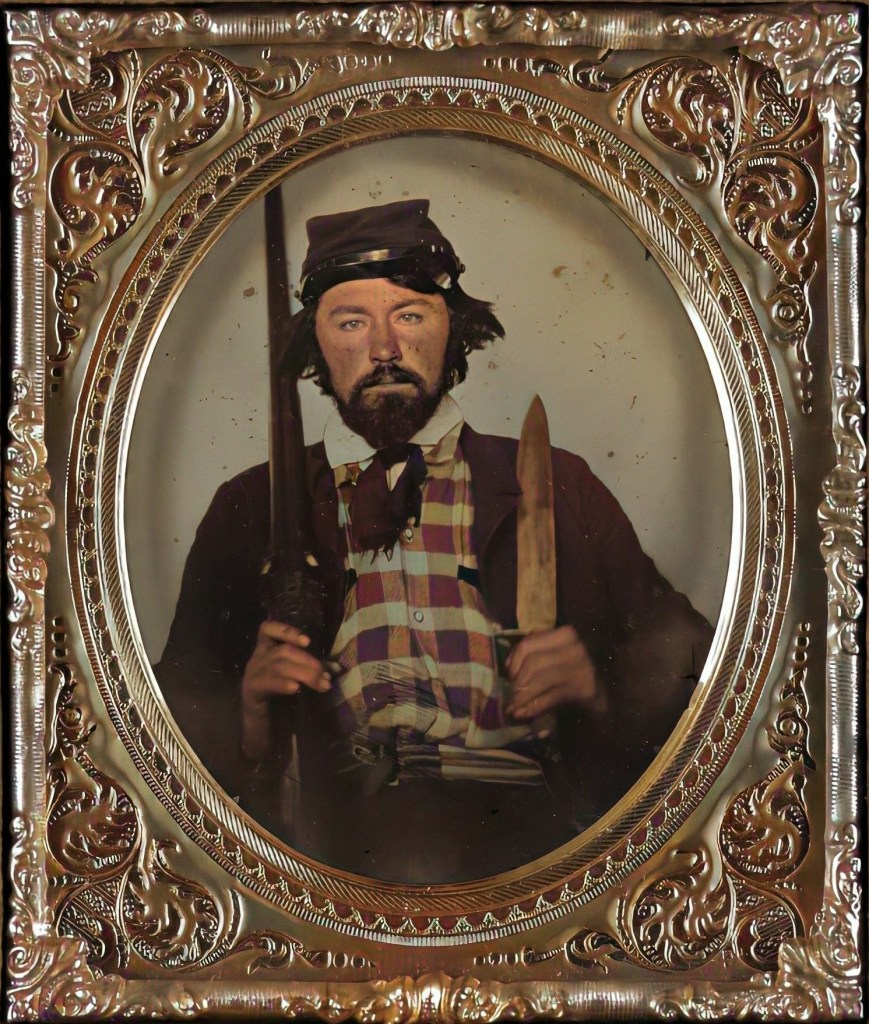
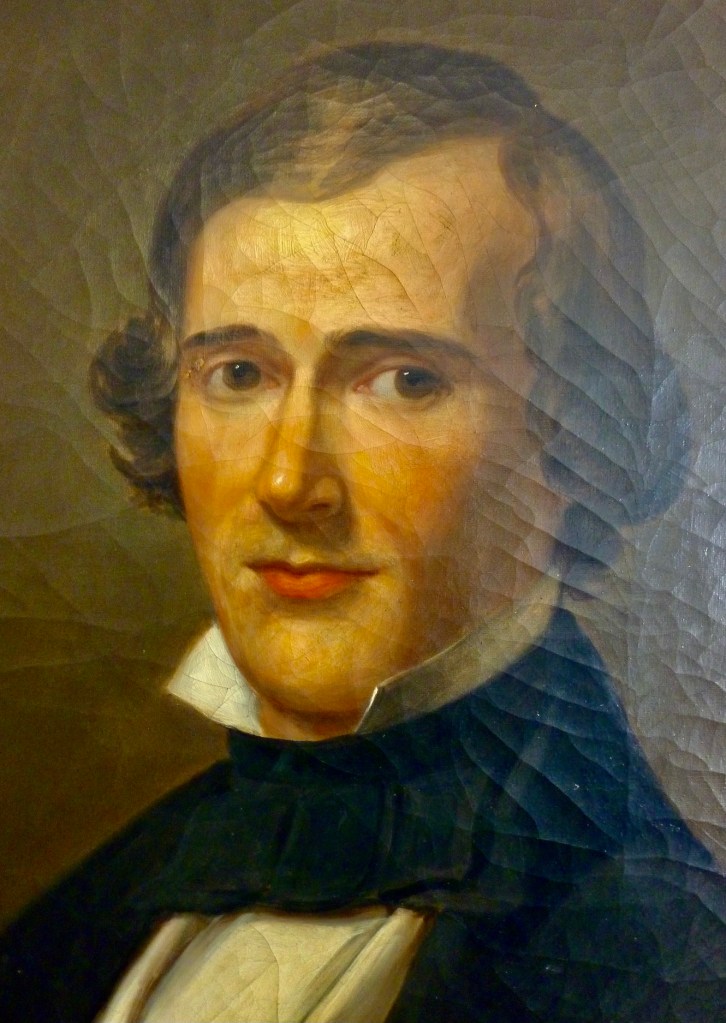
I could not find an image of Josiah but here is one of Hiram Hendley, also of Maury county, who served in Co. A, 9th Tennessee Cavalry(M. Williams Colorizations)
Josiah enlisted in October 1862 in Co. E. of Biffle’s 19th Regiment, Tennessee Cavalry [his name sometimes appearing as Raines on roster]. This regiment—usually known as “Biffle’s 9th Cavalry“—fought at Parker’s Cross Roads, Thompson’s Station, Brentwood, and Chickamauga. Later it skirmished in Tennessee and was then active in the Atlanta Campaign and Forrest’s operations during Hood’s Campaign. I could not find the date of Josiah’s capture but presume it was in 1864.
At the time of his release from prison, upon signing the Oath of Allegiance at Camp Morton on 25 October 1864, Josiah was described as standing 5’10” tall, with brown hair and grey eyes. After the war, Josiah settled in Henry county, Tennessee, where he served his community as a physician.
Josiah L. Rainey’s signed Oath of Allegiance, dated 25 October 1864, Camp Morton(Fold 3)
Transcription
Camp Morton, Ind[ianapolis, Indiana] Sunday evening, July 3rd 1864
My Dear Annie,
This is the 5th [letter] I shall have written you since receiving one from you. My health is much the same as when I wrote last. Mrs. Lawrence’s letter was dated June 3rd but she must have meant 23rd for your last was dated the 5th June. I immediately answered it and am much grieved that you are all sick and particularly that you are sick for when you are not able to wait upon the little children who are sick too, I fear that they and you will suffer for want of nursing. But I do hope that e’re this, you are all better, if not entirely well. I have a letter from Mug stating that sister was packed up and ready to start here to see me and then to go on to Tennessee, if able to travel. But she is in very bad health and I am very doubtful of her being able to go on to see you immediately. but if she is, she will go on without any more than necessary delay. In the mean time if you are able, you had better return home and make such arrangements for her reception and comfort as best you can for she will need all the attention that you will be able to give her. And should anything occur to prevent her going on, I will let you know it if possible. Please write to me immediately for it would seem that you had forgotten that I am intensely anxious always to hear from you and the poor “little ones.” Give them my love and kiss them by sister. Goodbye. Write soon.
Eternally, — Jo. L. Rainey
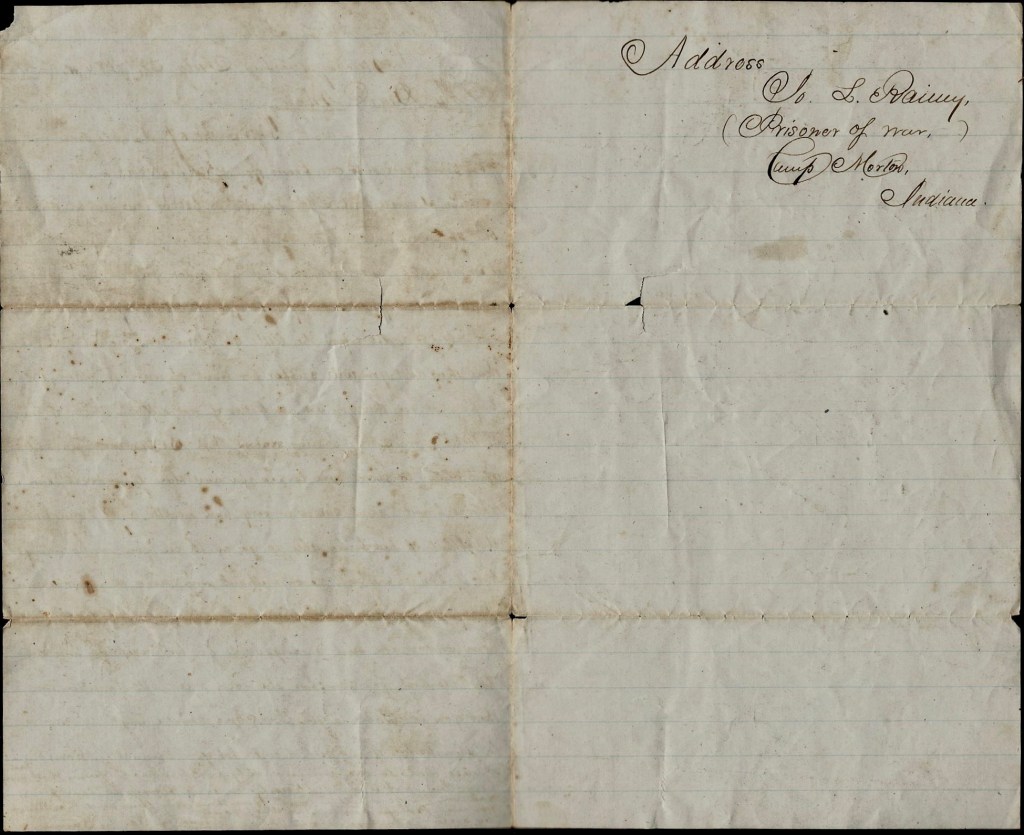
Address Jo. L. Rainey (Prisoner of War) Camp Morton, Indiana
to Mrs. Jo. L. Rainey, Culleoka, Tennessee In care of commanding office of Post
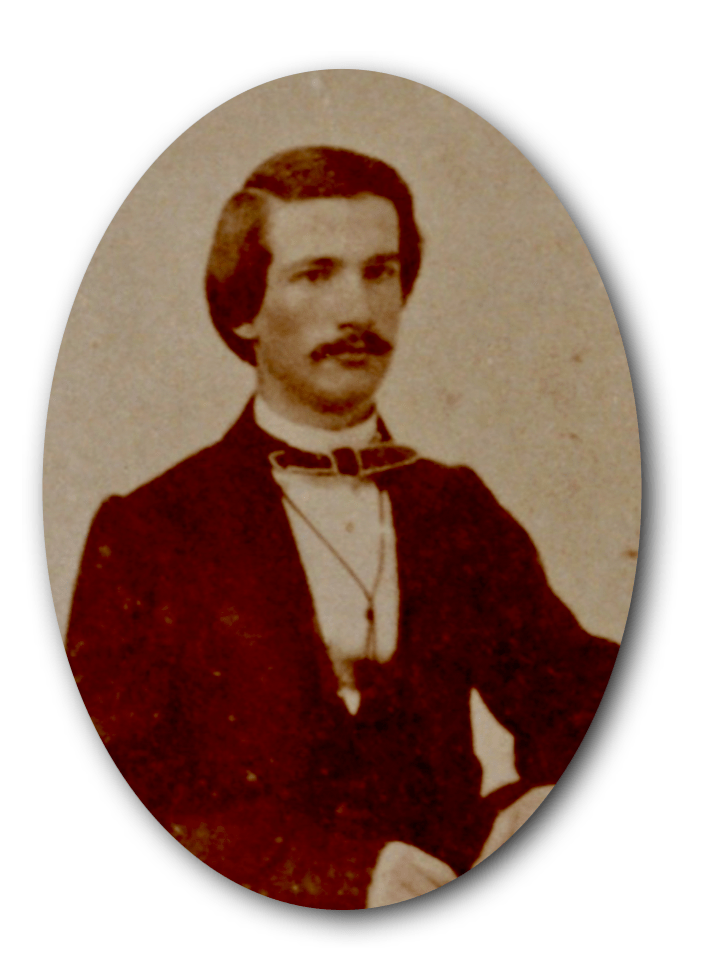
I could not find an image of Alexander or Richard but here is one of Stephen Burkdall of Co. G, 67th Indiana (Photo Sleuth)
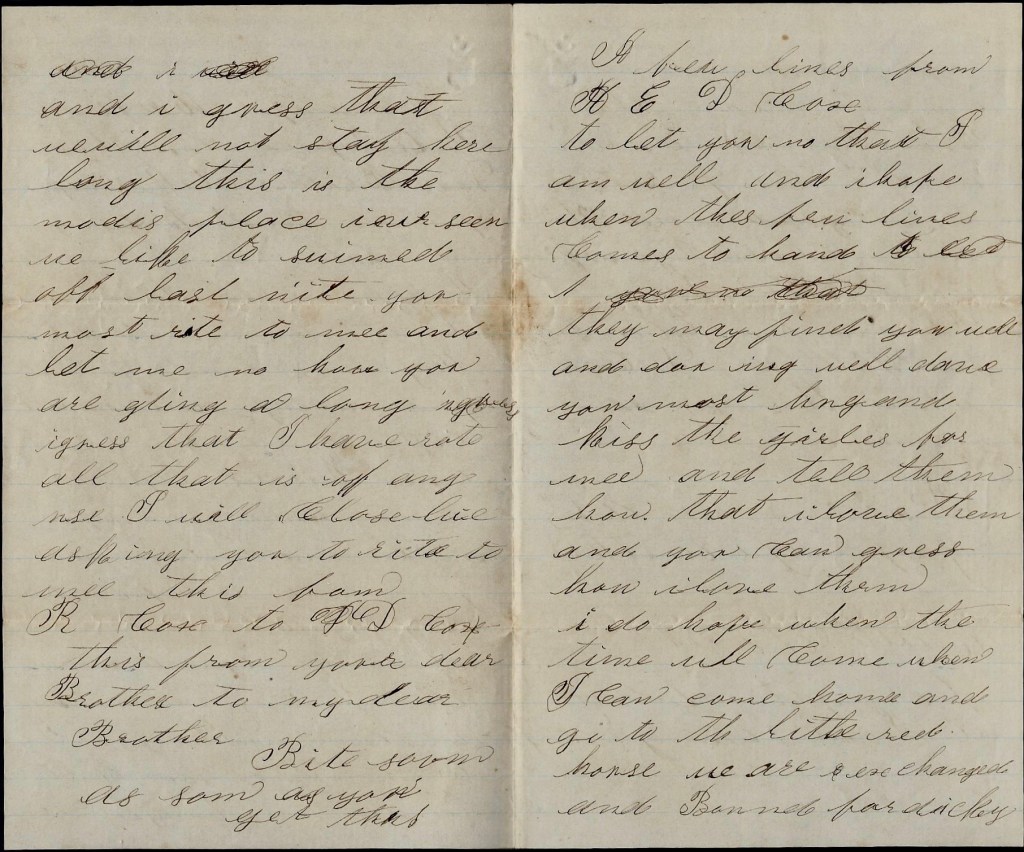
This letter was written by two soldiers serving as privates in Co. H, 67th Indiana Infantry while being held prisoner at Camp Morton near Indianapolis in November 1862. The letter had been previously sold as having been written by Confederate soldiers but the content suggested Union to me which led me to the discovery of their identity. Co. H and most all of the 67th Indiana Infantry—yet raw and untrained—participated in the Battle of Munfordville in Kentucky in mid-September 1862 where they were all captured. Too many prisoners for Confederate military prisons to handle, they were paroled and sent back to Indianapolis to await exchange. That exchange did not occur until early December 1862, when the regiment headed west to the Mississippi River to become part of the Vicksburg campaign.
Co. H. was recruited from Lawrence county in southern Indiana and it was here that I found our two boys. Alexander Edwards (1844-1923) was the son of Henderson Edwards but seems to have been raised by the Cox family. He married Sarah Jane Pipher (1846-1915) in 1874.
Richard Cox (1844-1917) was the son of Alexander and Mary Cox of Spice Valley. Lawrence county, Indiana. This letter was written to Richard’s younger brother, William D. Cox (b. 1846).
Transcription
Camp Morton Indianapolis [Indiana] November 9th 1862
Dear Brother,
I take my pen in hand to let you know that I am well and I hope when these few lines come to hand, they may find you well and doing well. I would like to see [you] the best kind. I would like to come home and spend a few more days with you and I hope when the day will come when I can come home to stay with you.
I can say to you that we are exchanged and I guess that we will not stay here long. This is the muddiest place I ever seen. We like to swimmed off last night.
You must write to me and let me know how you are getting along. I guess that I have wrote all that is of any use. I will close by asking you to write to me. This from R. Cox to D. Cox.
This from your dear brother to my dear brother. Write soon as you get this.
A few lines from A. E. D. Cox to let you know that I am well and I hope when these few lines comes to hand, they may find you well and doing well.
Well, Dave, you must hug and kiss the girls for me and tell them how that I love them and you can guess how I love them. I do hope when the time will come when I can come home and go to the little red house.
We are exchanged and bound for Dixie. I must close. The boys has come in and I can’t write to do no good and I will close by asking you to write. This from Alexander Edward to William D. Cox
When this you see, remember me. Write soon as you get this and don’t forget to write about the girls.
This letter was written by William Hazzard Wigg (1809-1875), a South Carolina native who worked in the District of Columbia prior to and during the Civil War as a government worker. He was married in July 1853 to Emma Maria Stevens (1825-1899) of Connecticut—the sister of Admiral Thomas Holdup Stevens, Jr., U. S. Navy. By his first wife, Margaret Euphemia Patterson (1809-1848), Wigg had at least three children before she died in 1848, one of which was Samuel Patterson Wigg (1842-1862) who met his death on the battlefield at Sharpsburg in September 1862 carrying the regimental banner in Co. H, 1st South Carolina Infantry. Wigg recovered his son’s remains from the battlefield the following January though his final resting place remains unknown.
William was the son of William Hutson Wigg (1777-1827) and Sarah Galt Martin (1783-1809). He was sometimes referred to as “Capt.” or “Maj.” Wigg though I’m unaware if he was ever in the military. Clearly the Civil War tested his loyalty and he may have, indeed, clandestinely done all in his power to aid the Southern cause. Newspaper notices from the period indicate he was frequently harassed and arrested by the military authorities and he was the object of derision by loyalists who knew of his southern heritage and family connections. He was still working for the Internal Revenue Service as late as 1870.
Charles Jones Colcock Hutson
Wigg wrote the letter to his relative, Lieut. Charles Jones Colcock Hutson of Co. H, 1st South Carolina Infantry, who was Adjutant of the regiment when he was taken prisoner at Harper’s Farm, Virginia, on 6 April 1865 and sent to Johnson’s Island on 17 April 1865. He was released on Oath of Allegiance on 6 June 1865. At the time of his release from prison he was described as 23 years old and a resident of Pocotaligo, South Carolina. Charles’ father was Richard Woodward Hutson. Readers will notice that Charles served in the same regiment and company as Wigg’s son, Samuel P. Wigg.
Wigg’s letter conveys $50 to his young relative, Charles Hutson, for his use with two other officers from South Carolina, to make their way from Johnson’s Island Prison, as soon as they were released, to Alexandria, Virginia, where he would meet them, give them lodging and the means to make the rest of their journey home to South Carolina. He advises them to make sure their papers are in order and to go immediately to the Provost Marshal’s office in Alexandria when they arrive, not taking time “to kick a dog out of your path” in order to show their papers and avoid arrest.
Transcription
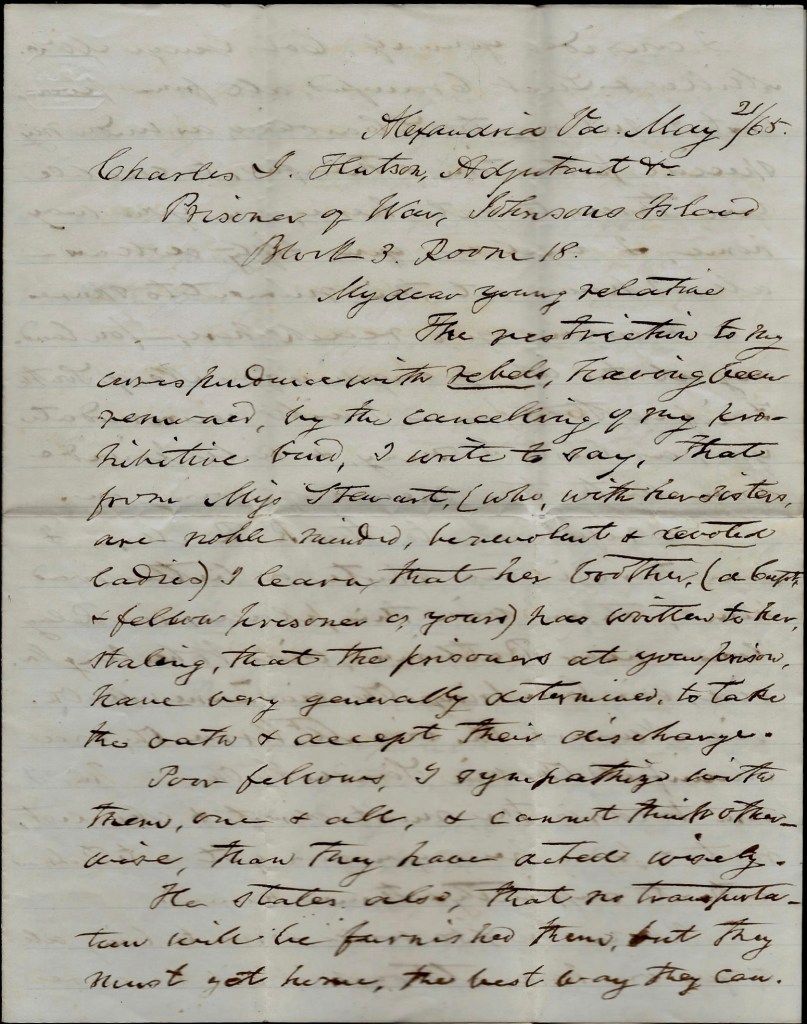
Alexandria, Virginia May 2, 1865
Charles J. Hutson, Adjutant & Prisoner of War Johnson’s Island, Block 3, Room 18
My dear young relative,
The restriction to my correspondence with rebels having been removed by the cancelling of my prohibitive [ ], I write to say that from Miss Stewart (who with her sisters are noble-minded, benevolent & devoted ladies), I learn that her brother (a Capt. & fellow prisoner of yours) has written to her stating that the prisoners at your prison have been generally determined to take the oath [of allegiance] and take their discharge.
Advertisement for rent of home placed by W. H. Wigg in the Alexandria Gazette on 8 July 1865
Poor fellows. I sympathize with them, one and all, and cannot think otherwise than they have acted wisely. He states also that no transportation will be furnished them but they must get home the best way they can. I consider yourself, Col. George W. C. Miller, & Lieut. Crawford all from poor, lost, and subjugated South Carolina as under my special protection & therefore, to enable you three to get here on your way home, I enclose you fifty dollars—all I have at this moment to share. And when you reach here (on landing at the wharf, enquire for No. 9, South Fairfax Street), I will accommodate you as best I may & will provide you with the means of going on.
On reference to the railroad map, I find there is no shorter or better road home than via this place, via Relay House near Baltimore, via Wheeling, Va., via Cambridge, OH, via Zanesville, OH, via Newark, OH, via Mt. Vernon, OH, via Mansfield, OH, via Sandusky, OH. This I am told is the most direct and cheapest rout & from here you can get on to Richmond without difficulty and thence home.
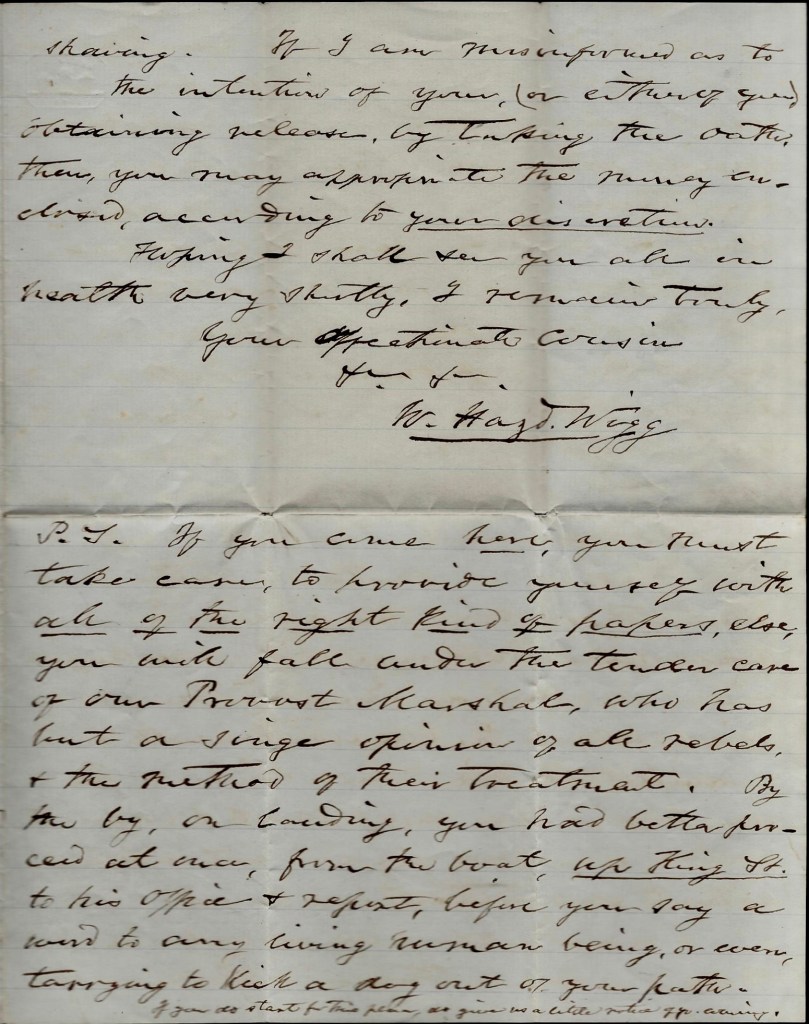
I hope the $50 will serve to bring all of you on here although it will be close shaving. If I am misinformed as to the intention of your (or either of you) obtaining release by taking the oath, then you may appropriate the money enclosed according to your discretion.
Hoping I shall see you all in health very shortly, I remain truly your affectionate cousin, &c. &c, — W. Haz. Wigg
P. S. If you come here, you must take care to provide yourself with all of the right kind of papers, else you will fall under the tender care of our Provost Marshal who has but a single opinion of all rebels & the method of their treatment. By the by, on landing, you had better proceed at once from the boat up King Street to his office & report before you say a word to any living human being, or even tarrying to kick a dog out of your path. If you do start for this place, do give us a little notice of your coming.
These letters were written by Alexander Hamilton Phillips (1804-1880), a native of Montgomery county, New York, who graduated from Union College in 1826, studied law until 1830, and then taught in the Lawrenceville, New Jersey, prep school for boys. He came to Texas in 1837, was admitted to the Texas Bar the following year and practiced law in Houston and Galveston. From 1839 to 1841 he was in partnership with Milford Phillips Norton. After both men visited Refugio County in the interests of a client, Phillips settled in Lamar, where he married Susan B. MacRae. He represented Refugio County in the Eighth Congress of the Republic of Texas, in 1843–44. He moved to Victoria and served the district after annexation as a senator in the first three state legislatures, 1846–50. From 1852 to 1861 Phillips practiced law in partnership with John McClanahan. The 1860 census listed him as owning $35,000 in real and personal property, including seven slaves. After the Civil War he served as a delegate to the Constitutional Convention of 1866. He was an incorporator of the Central Transit Company Railroad, chartered in November 1866 and intended to connect Texas with the Pacific coast but never built. He formed a partnership with Samuel A. Neville in 1868 and in 1870 joined the firm of Samuel C. Lackey and future Texas Supreme Court chief justice John William Stayton; the firm was renamed Phillips, Lackey, and Stayton. In the 1870s Phillips was senior member of the Victoria bar, whose members claimed that “his was a name to conjure by.” Phillips was an elder of the Presbyterian church at Victoria for thirty years and was one of the founders and incorporators of Aranama College. He died in Victoria on June 24, 1880.
Two sons, Alexander H. Phillips, Jr., and William Phillips, both served the Confederacy as officers in the Sixth Texas Infantry. Alexander served as major of that unit until his death in Montgomery, Alabama, on June 4, 1863. William was captured at Arkansas Post in 1863 and taken to the notorious Camp Chase, Ohio, where he died. [Source Handbook of Texas]
Letter 1
Addressed to Master A. H. & Wm W. Phillips, Lawrenceville, New Jersey
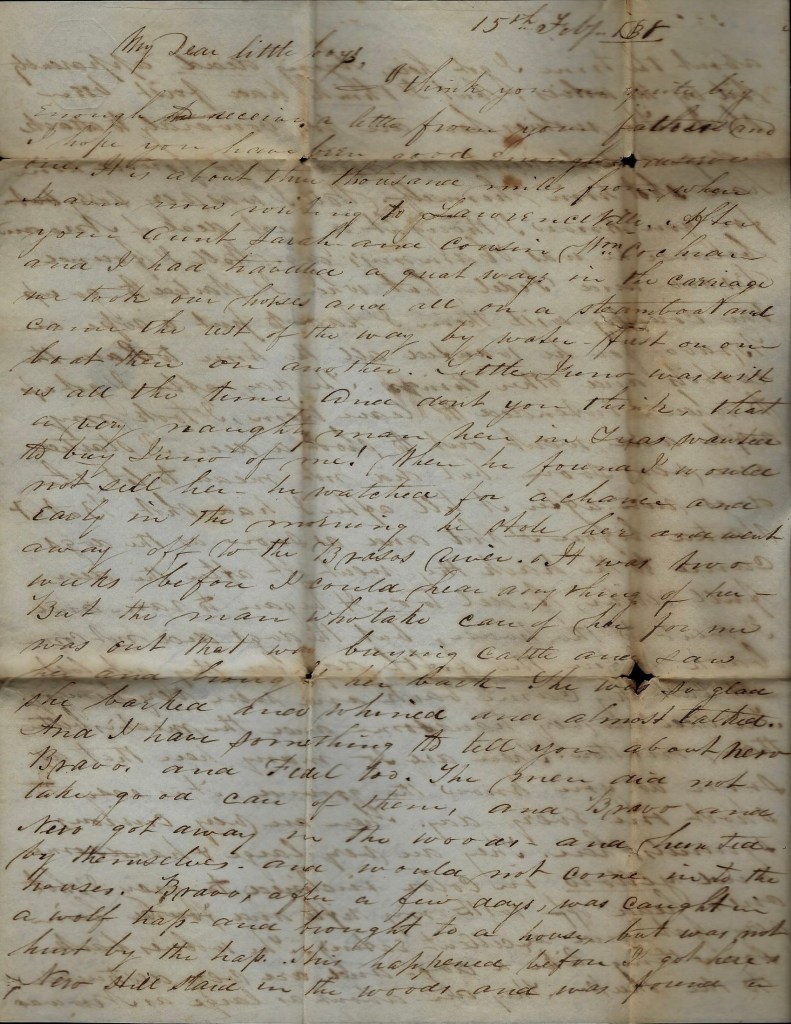
[The Republic of Texas] 15th February 1838
My dear little boys,
I think you are quite big enough to receive a letter from your father. It is about three thousand miles from where I am now writing to Lawrenceville. After your Aunt Sarah and cousin William Cochran and I had traveled a great ways in the carriage, we took our horses and all on a steamboat and came the rest of the way by water, first on one boat, then on another. Little Juno was with us all the time and don’t you think that a very naughty man here in Texas wanted to buy Juno of me! When he found I would not sell her, he watched for a chance and early in the morning he stole here and went away off to the Brazos River. It was two weeks before I could hear anything of her. But the man who take care of her for me was out that way buying cattle and saw her and brought her back. She was so glad she barked and whined and almost talked.
And I have something to tell you about Nero, Bravo, and Fidel too. The men did not take good care of them and Bravo and Nero got away in the woods and hunted by themselves and would not come into the houses. Bravo, after a few days, was caught in a wolf trap and brought to a house but was not hurt by the trap. This happened before I got here. And Nero still stayed in the woods and was found in about the time I got here, lying dead, apparently bit by the wolves. But I think had just been short. The wolves here are too coward to attack a dog and I think the man who found him had shot him himself. Well, I was very sorry for you know I thought a great deal of Nero and because he was Hammy’s dog. Well, I found Bravo and Fidel but when I started to go up the country with them, I had to put a rope on Bravo for he wanted all the time to chase the rabbits and other things.
The day after I got up to where I intended to leave them, I took my rifle and went out to shhot a deer. I started one very soon but did not mean to let the dogs run after it till after I had shot. But they started before I shot and as soon as the dogs came to the track, they went off after the deer full drive—Fidel too.
It began to rain and I went to the house but the dogs did not come back before the fifth day for they got lost. At last they came back and were very hungry. The deer are very handsome and the meat is better than mutton. There are so many here that as soon as you know the grounds, it is easy to shoot one every day. There are very curious squirrels here. They are very large & handsome and yellow in color, inclined to grey. I shot one’s head off with my rifle and found him very fat and excellent eating. The wolves bark something like a dog and are very destructive to the sheep. They are about as large as Nero was. Some black like Don and some are grey. I chased one in the prairie with my horse and got quite near him but the ground became too soft for the horse, and so the wolf got away.
Elias shot a raccoon that was very fat. The raccoons and bears and squirrels often destroy the corn very much so that the people have to watch the fields and keep a great many dogs to keep them off. Many people lost their dogs during the War [of Texas Independence] and good ones now are very scarce. A man offered me fifty dollars for Little Juno but I knew you would not want me to sell her. I told him he could not have her.
The people here travel altogether on horseback in the winter because the roads are bad and there are no bridges yet to cross the creeks, In the summer, they ride in wagons and some have carriages. They have no schools and churches yet but by next fall they will have schools. And now they have preaching in private houses. In cold weather, many people cut a hole in a blanket big enough to put their heads through and so keep warm. Some of them are Mexican blankets and are very handsome. The Indians here shoot deer, turkeys, and squirrels for the white people but they spend most of their money for whiskey and get drunk.
You might let your little sister read this letter too and when she gets one, she must let you and Willy read hers too. You must let Cousin Emily keep your letter for you. Remember and be very good children and then when I come home, I will tell you a great many more things about Texas. You must tell Mr. Johnes Boerly that I mean to write to him after I return from San Antonio.
Adieu, — A. H. Phillips
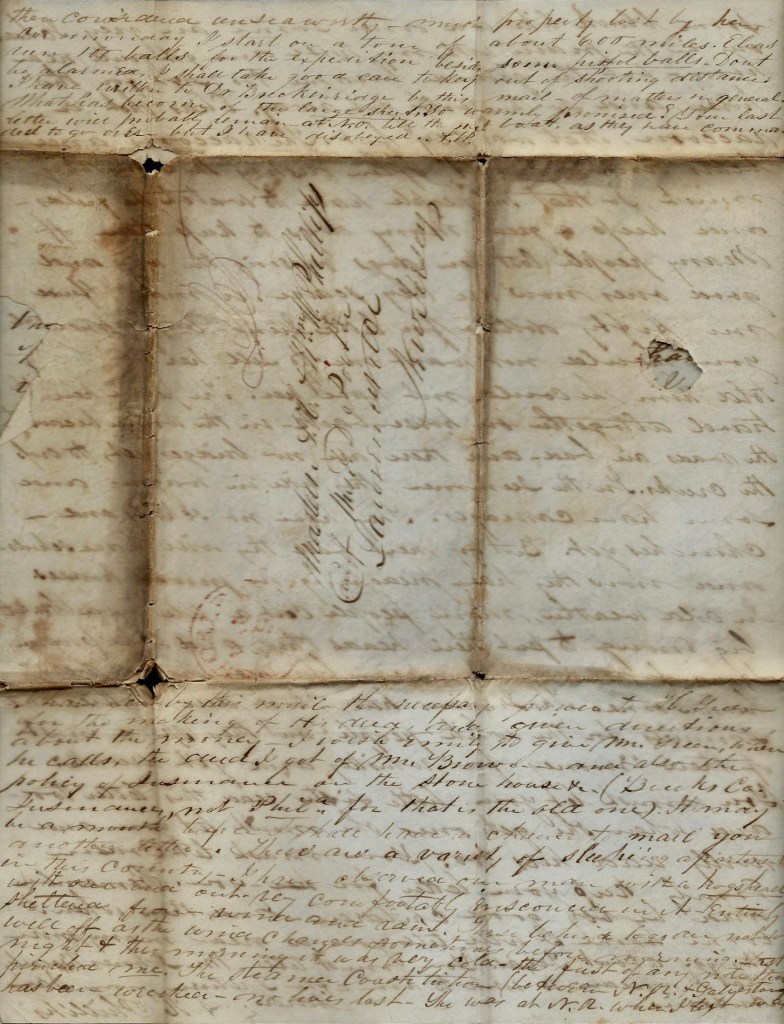
I have sent by this mail the necessary payment to H. Green for the making of his deed and given directions about the money….There are a variety of sleeping apartments in this country. I have observed one man with a hogstand sheltered from winter and rain. Those behind logs are not so well off as the wind changes sometimes before morning. This morning it was very cold—the first of any note that pinched me.
The steamer Constitution (between N. O. and Galveston) has been wrecked. No lives lost She was at N. O. when I left was then considered unseaworthy. Much property lost by her.
On Monday I start on a tour of about 600 miles. Elias run 100 balls for the expedition beside some pistol balls. Don’t be alarmed. I shall take good care to keep out of shooting distance. I have written to Dr. Breckinridge by this mail of matters in general. What has become of the large sheet so warmly promised? Your last letter will probably remain at N. O. till the next boat as they have commanded to go over but I have been disobeyed. — A. H. P.
Letter 2
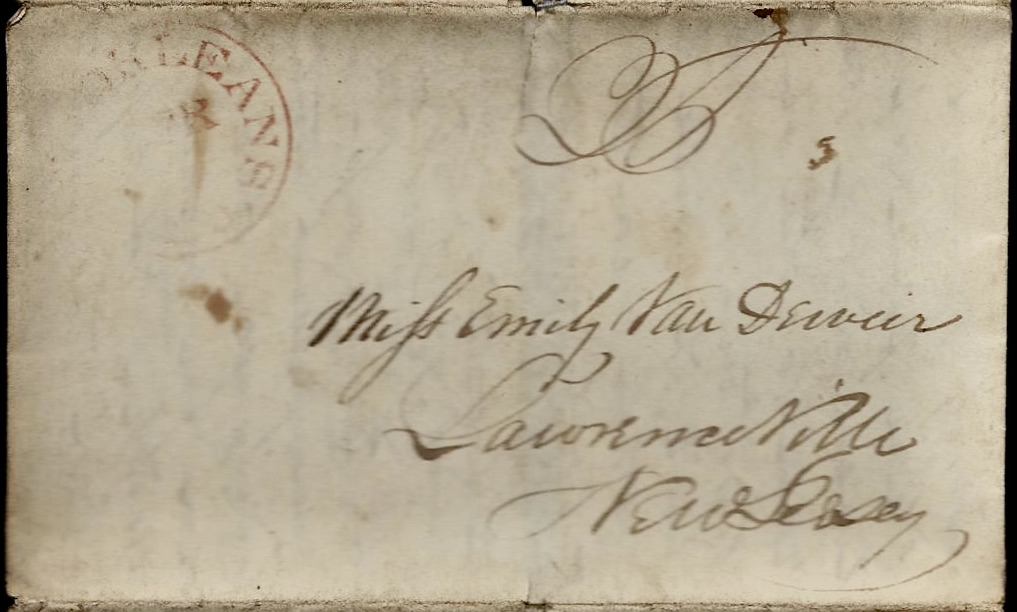
Addressed to Miss Emily Van Dervier, Lawrenceville, New Jersey
Bexar [Republic of Texas] March 8, 1839
My Dear Emily,
Before I left Houston two months ago, I wrote to Cochran to detain your letters at New Orleans till I apprised him of my return to Houston. This accounts for my not having heard from you in a long time as well as for your not receiving letters from me lately with as much regularity as usual. At this place, the population is mostly Mexican. I have been much amused here in learning the manners and customs of the people. I have devoted all my leisure hours to the Spanish grammar and have advanced so far in the acquisition of the language that I can understand the run of their conversation generally and can so far speak it as to make myself understood with regard to anything I wish to communicate. Some few of them understand a little English or American as they universally call our language. The Spanish is the easiest language I ever undertook to learn. The greatest difficulty is the pronunciation though when you hear it hourly this may be mastered in a very short time. The vowels have one invariable sound, whatever their position with regard to other letters. The consonants are altogether different in pronunciation from any and vary according to their position. The vowels are sounded differently from ours but having always the same sound are easily mastered.
I will not occupy my paper in details about the people. This will answer us when we have nothing else to talk of during the summer.
I have about completed the several objects of my coming here and have some idea of leaving for Houston in the course of two weeks. I have two surveys to make before I can go. As the excitement of speculation begins to wear off by the completion of my business, I begin to feel the first movings of the excitement so natural and unavoidable to one who has so long been absent and is about making preparations to meet all that is dear to him on earth/ I don’t know yet how soon I shall be able to leave for the States but we have limited ourselves to the 1st of May—if circumstances will permit.
Swett writes me that our notes are not paid punctually but that business is very good. I don’t wish to start home with less than four thousand dollars, This will be of but little account of the loan obtained by Texas does not help to enhance the values of Texas money. If it does not, I shall not sacrifice it at the value it has had in the States during the winter. I am satisfied that the time is not far distant when there will be more silver & gold in circulation in Texas for the population it contains, than in any other country. Here are the mines and these have only to be opened and worked to enrich the country and to furnish a source of currency.
An expedition is now getting up against the Indians and as soon as they are thoroughly whipped, capital will be inverted to develop the resources of these tremendous mountains. The Mexicans were at one time exclusively engaged in these operations as is clear from report not only but from actual remains of their labor. Our plan, we have located on, still had a ladder in it. Another has been worked to an extent which it would take our men a whole year to effect the work. Copper & Coal mines are also so abundant & Lead, that they are not considered worth locating.
If we leave the first of May, we shall probably be at Philadelphia about the 3rd week to rig up. You would be amused to see our present style of living. Sometimes we live well and at others we have parched corn for bread & meat, and corn coffee for drink. It depends on where we are. For the last two months I have twice undressed and went to bed. we sleep in our blankets. I have, however, had all along clean under clothes and shirts, but my stockings sometimes are rather sorry, showing more toe than is altogether “agabable” as the Mexicans say. Make me a few shirts with ruffles.
Kiss the children for me. There is a little boy here (American father & Mexican mother) whom looks so much like Hammy that the first time I saw him, I followed him about the streets for an hour. I could not leave him. Adieu “Señorita” — A. H. P.
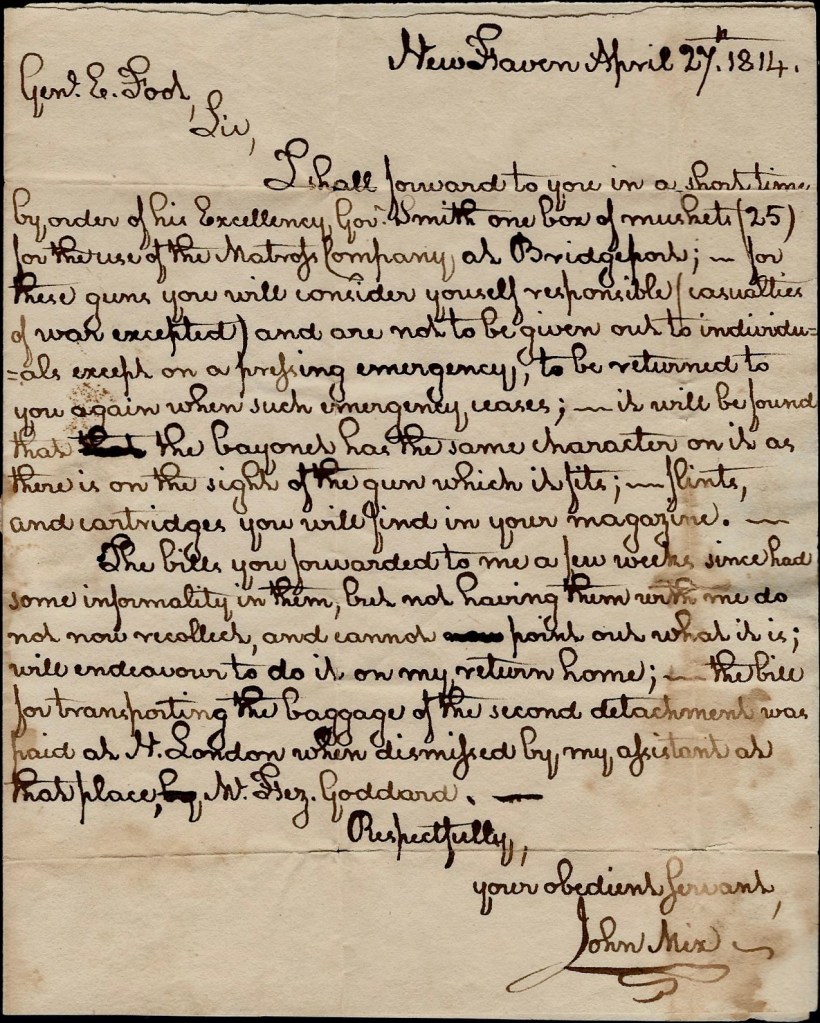
This letter was written by a Revolutionary War Soldier named John Mix (1753-1817) of New Haven, Connecticut. John’s biography was published in 1886 and includes a length description of his activities during the Revolutionary War as a Lieutenant of Marines, including his capture and imprisonment on the famous Prison Ship Jersey in New York Harbor for six months.
The biography does not say much about John’s activities after the American Revolution, simply stating that “in business, he was unsuccessful, and in 1808 he removed to New York and again engaged in trade, but gave it up at the breaking out of the War of 1812. From this letter we learn that at the age of 60, he was still engaged in supporting his country in the disposition of arms on behalf of his state. A search of newspapers from the period reveals that John had been servings as Quarter Master General for the State Militia of Connecticut until he resigned in November 1814.
The letter was addressed to Gen. Enoch Foote who served as a Connecticut militia officer before and during the War of 1812. Enoch was tasked by the Governor to maintain a militia to be called out on short notice to protect the coastal region between Stratford Point and Black Rock, thus protecting Bridgeport itself.
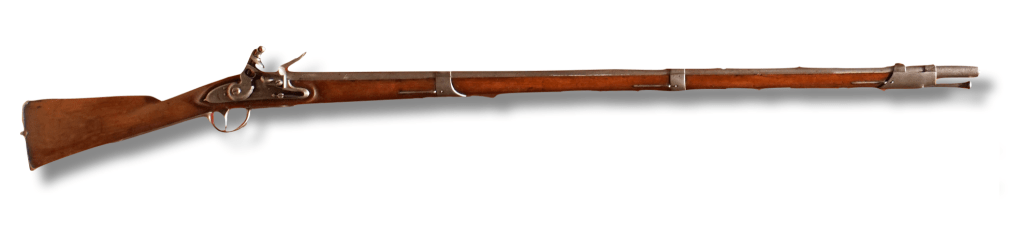
The guns provided were not identified but may have been the 1795 Model Springfield which came with a detachable bayonet.
Transcription
Addressed to General Enoch Foot, Bridgeport, [Connecticut]
New Haven [Connecticut] April 27, 1814
General E. Foot, Sir,
I shall forward to you in a short time by order of his Excellency, Gov. [John Cotton] Smith, one box of muskets (25) for the use of the matross [artillery] company at Bridgeport. For these guns you will consider yourself responsible (casualties of war excepted) and are not to be given out to individuals except on a pressing emergency, to be returned to you again when such emergency ceases. It will be found that the bayonet has the same character on it as there is on the sight of the gun which it fits; flints and cartridges you will find in your magazine.
The bills you forwarded to me a few weeks ago since had some informality in them, but not having them with me, do not now recollect and cannot point out what it is; will endeavor to do it on my return home. The bill for transporting the baggage of the second detachment was paid at New London when dismissed by my assistant at that place by Mr. Hez[ekiah] Goddard.
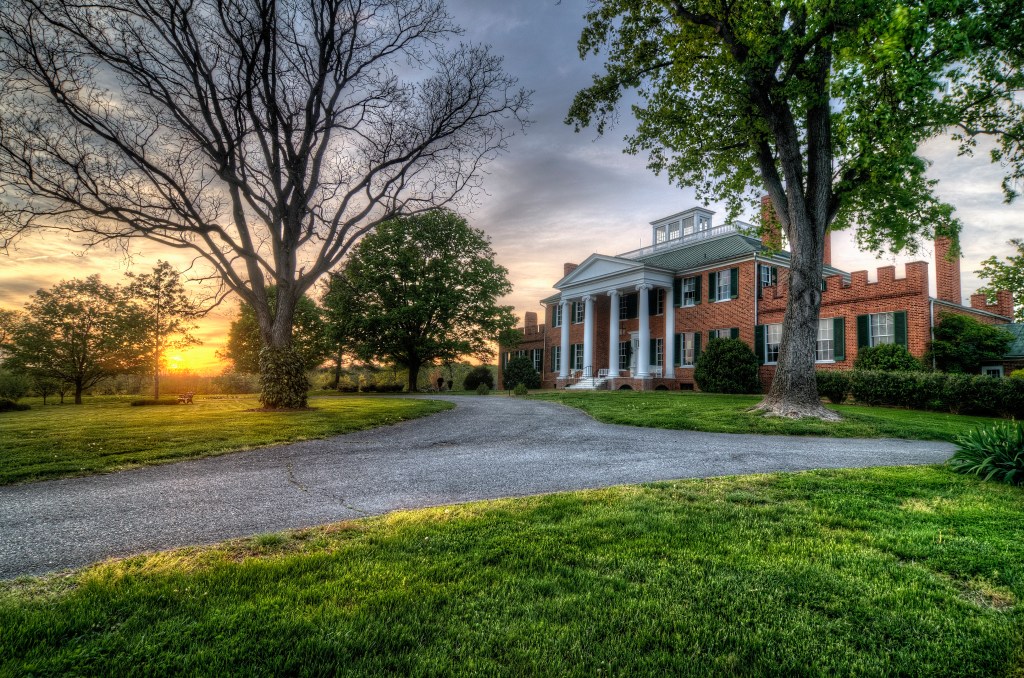
Hugh Mortimer Nelson’s Long Branch House in Clarke county, Va.
The following letter was penned in Clarke county, Virginia, by Hugh Mortimer Nelson (1811-1862). An on-line biographical sketch produced by his Long Branch estate informs us that:
Hugh Mortimer Nelson, born in Hanover County, Virginia, on October 20, 1811, was a well-educated and scholarly teacher, an enterprising and progressive farmer, and a cavalry officer for the Confederacy. Hugh was the fourteenth of fifteen children to Francis Nelson and Lucy Page, and grandson of politician John Page and Declaration of Independence signer, Thomas Nelson Jr.
During his childhood, Hugh Nelson received an early education at home from an elder brother. At the age of fourteen he was sent to a classical school four miles from his home, and at sixteen he entered the Academy at Winchester. Moving on to the University of Virginia in 1830, Hugh graduated with a Master of Arts, one of the University’s first graduates to earn the degree. It is said that while at UVa, “when worn down by work, he would get a fellow student to pump water on his head, to arouse him for renewed efforts.” After graduation, Hugh became a teacher in Charles City County – the university’s first graduate to enter the profession in Virginia.
In 1836, while on a visit to a Virginia spring, Hugh met 20-year-old Anna Maria Adelaide Holker. The two were married that November, honeymooned in Europe, and finally settled in Baltimore where Hugh, after more study, was admitted to the bar. However, before establishing himself in the legal profession, the Nelsons returned to Virginia, a decision which Hugh felt was the great mistake of his life. In a speech at the Virginia Secession Convention in 1861, it seems evident that his reason for returning to Virginia was homesickness. Back in Virginia, Hugh Nelson bought Long Branch from his uncle Philip Nelson for $32,000. They moved in with Adelaide’s mother, Nancy D. Holker, and their 3-year-old daughter “Nannie.” (A son, Hugh Nelson Jr was born a few years later). It was at this time the couple renovated Long Branch. One of these changes included putting a distinct Greek Revival stamp on the manor. They built the grand circular staircase in the entry hall and the rooftop belvedere, as well as enclosed the loggia and most likely added both porticos and the Gothic battlements to the house. The house was not the only part of the plantation that changed once Nelson bought the land. New technologies and techniques in farming started to influence the landowners in Virginia who looked to increase their already rich fields. Hugh rarely returned home from state agricultural fairs, and spent his leisure hours reading both modern and ancient literature. Unfortunately, due to an accident on the farm around 1848, Nelson was advised to go to Europe for surgical treatment. There he witnessed street fighting and protests against the Second French Republic.
In 1861, when the question of Secession was forced upon Virginia, a Convention was called to decide the answer. Nelson remained firm for the Union, and was elected by a large majority to represent Clarke County. Hugh wrote several letters home while the Convention was in session, in which he gives interesting insight into the tensions in the room. After an ordinance of Secession was passed, he wrote, “When I think of the past, and look forward to the future, it almost unnerves me.”After raising a company of cavalry in Clarke, he served under J.E.B. Stuart before being reassigned as the aide-de-camp, with the rank of Major of Cavalry, for General Richard S. Ewell, one of Stonewall Jackson’s division commanders. In May of 1862, under General Ewell, Hugh Nelson joined Jackson’s Valley Campaign.
Hugh was one of 6,402 Confederate soldiers wounded during the Battle of at Gaines Mill on June 27. Given a leave of absence, he went to the house of his cousin, Mr. Keating Nelson, in Abermarle County where he succumbed to typhoid fever, and passed away on August 6, 1862. He is buried in the Old Chapel Cemetery in Millwood, VA. Hugh had been the first layman to serve at Christ Church in Millwood. Upon his death, the Vestry wrote that they feel “…each one of them has lost a warm and valued friend; the community a public-spirited citizen; the country a devoted patriot, and the Church one of its most useful members.” An ever devoted Virginian, Hugh said on March 26, 1861, in a speech to the Chairman of the Virginia Secession Convention, “…of all the stars upon our national flag, the star of Virginia ‘is the bright particular star’ which fills my vision…All my ancestors, for near two hundred years, have lived and died in Virginia…Stern necessity, sir, once compelled me to leave her border—I felt like an exile from my native land —I thought of her by day, I dreamed of her by night. When laid upon the bed of sickness, in the delirium of fever, I was singing ‘carry me back to Old Virginia.’ I never breathed freely till I got back within her bounds. …the potent associations of my childhood bind me to her—all the joys and all the griefs of my manhood have daguerreotyped her on my heart—and I can say, as Mary of England said of Calais, when I am dead, take out my heart and you will find Virginia engraved upon it. May she be my home through life, and when I am dead, may my ashes repose within her soil.” Hugh’s death left his wife Adelaide in charge of Long Branch’s affairs, marking a change in the history of the plantation. Not only was the area devastated by war, but Long Branch also suffered from the financial hardships of the now deceased Hugh Nelson. Thus, the future of Long Branch fell into the hands of the unprepared, but forever resilient, Adelaide.
In the 1850 Slave Schedules, Hugh M. Nelson is reported to have owned 19 slaves ranging in age from 1 to 60. his brother, Philip Nelson owned as many as 35 slaves.
This letter informs us that, on occasion, the Nelson brothers used the slave auction house of R. H. Dickinson & Bro. of Richmond, Virginia, to buy and sell slaves. Their usual business entailed the purchase of slaves in Virginia and Maryland for resale in bigger, Deep South markets. Richard Henry Dickinson went in the slave-trading business about 1844. By the late 1840’s, he (with his brothers) was selling as many as 2,000 slaves annually. The biographical sketch of Dickinson and his company can be found at Encyclopedia Virginia.
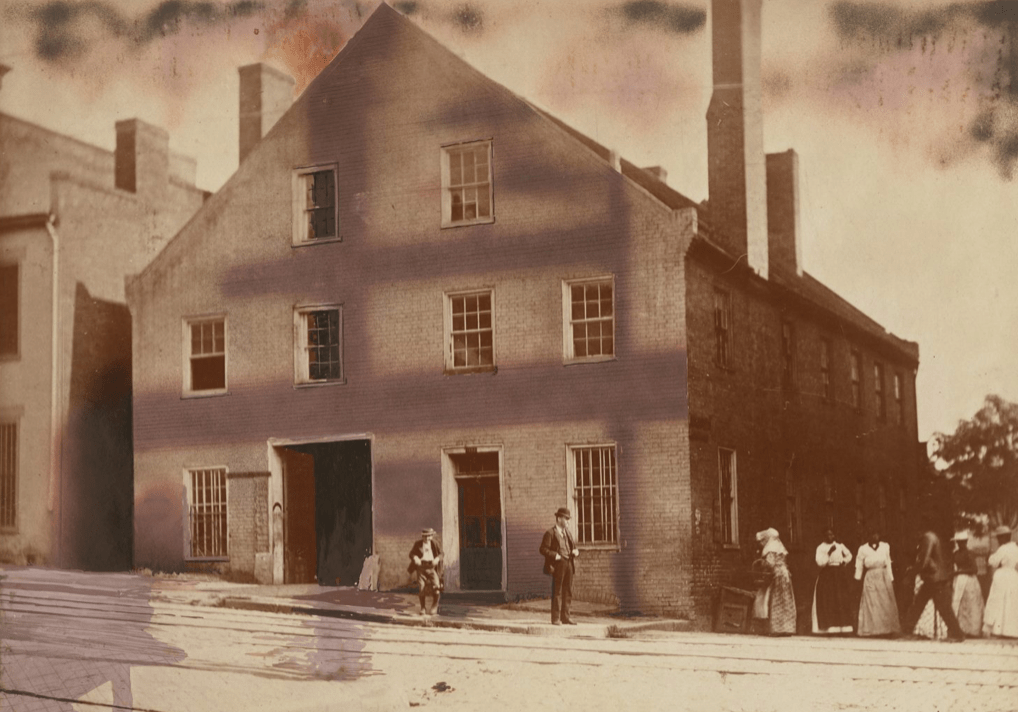
This building at the corner of Franklin and Wall Streets in Richmond was used by slave traders, including R. H. Dickinson, to sell slaves. It was originally used as a tobacco warehouse.
Transcription
Near Millwood, Clark County, Va. 1 March 23rd 1850
R. H. Dickinson Richmond Va.
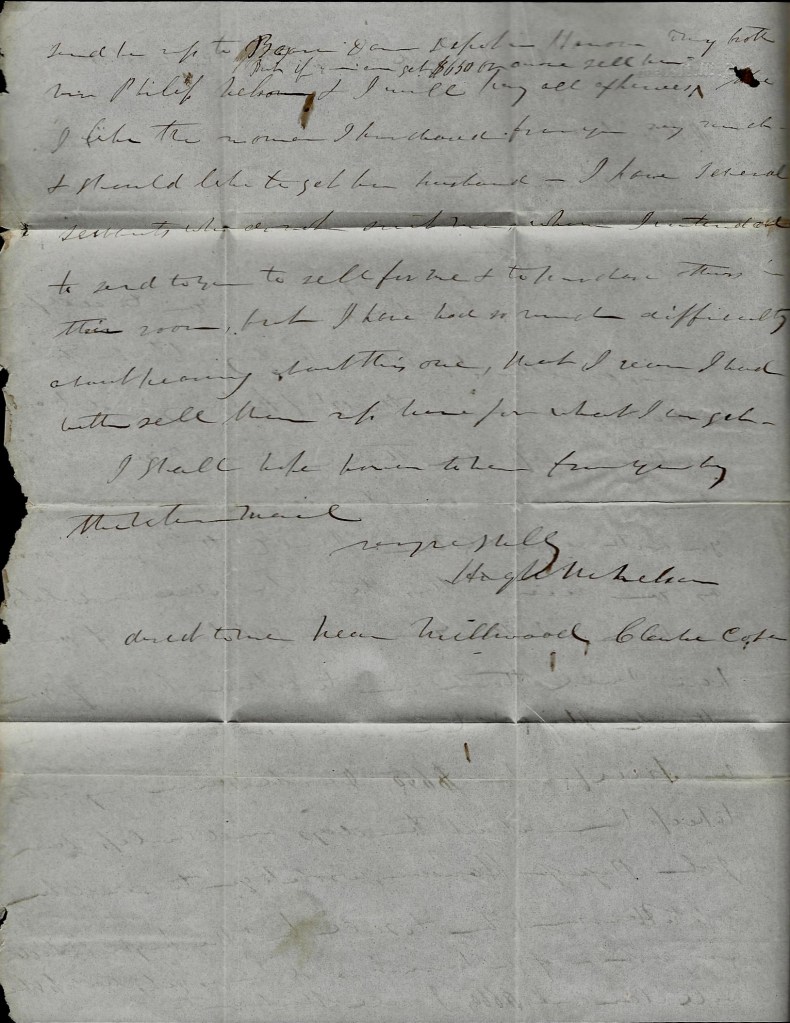
Dear Sir, I sent a Negro woman to you to sell for me—or rather I’d gotten me a boy at the junction to do so—ever since the 17th of Feb. and have written no less than three times to you about her, and have as yet received no answer from you with regard to her. I will thank you as soon as you receive this to write to me and let me hear whether you even got her. If you have, I will thank you to let me know if you think she will sell for about what I gave for her. My price for her $650.
I wrote you in my letters to keep her about ten days and unless Mr. John Pass of Hanover wrote to you to send her up to Hanover to him, to sell her to the highest bidder for cash. If you haven’t sold her as yet, unless she will clear me $650, I will thank you to send her up to Beaver Dam Depot, Hanover. My brother, Mr. Philip Nelson, and I will pay all expenses.
I like the woman I purchased from you very much and should like to get her husband. I have several servants which do not suit me whom I intended to send to you to sell for me & to purchase others in their stead but I have had so much difficulty about hearing about this one that I reckon I had better sell them up here for what I can get. I shall hope however to hear from you by the return mail.
Respectfully, — Hugh M. Nelson
Direct to me near Millwood, Clark county, Va.
1 Millwood grew up around Burwell’s Mill, built in 1760 by Daniel Morgan. In October 1862, Gen. Stonewall Jackson established his headquarters at Carter Hall.
I could not find an image of Frank but here is Pvt. Albert Conover of Co. E, 94th New York Infantry (LOC)
The following letters were written by Pvt. Franklin M. Rice (1840-1917) of Co. C, 94th New York Infantry who enlisted on 18 October 1861 and served until 18 July 1865, according to Muster Rolls.
“Frank” was the son of Franklin A. Rice (1812-1888) and Amanda Hoisington (1816-1900) of Ellisburg, Jefferson county, New York. He was married to Ellen E. Pratt (1847-1918) but given her age at the time of his enlistment, my hunch is that the couple were married while Frank was at home on a Veteran’s Furlough in early 1864.
From the regimental history we learn that the 94th New York participated in the Battle of Gettysburg and then spent the next several months in a “fruitless campaign” in Virginia culminating in the Mine Run Campaign. While most of the Army of the Potomac went into winter quarters at Culpeper, the 94th New York was ordered to Annapolis, Maryland, where it was attached to the 8th Corps temporarily, and where it remained on duty at Camp Parole until 26 May 1864 when it rejoined the army at the front.
To read other letters I’ve transcribed & posted on Spared & Shared that were written by other member of the 94th New York Infantry, see:
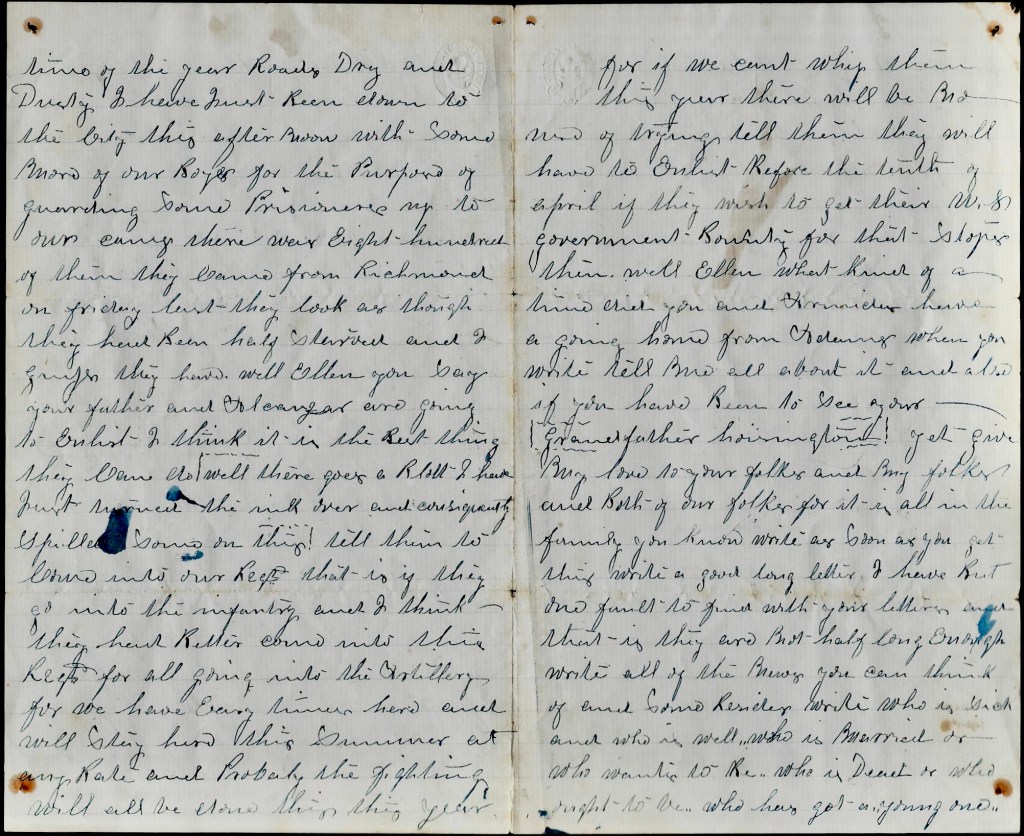
Your kind letter of the 24th came to hand this evening and I now take up my pen to write a few words in reply. Need I tell you how glad I was to hear from your brother for you know that full well without my telling you. As this leaves me well, I sincerely hope and pray when this reaches its destination, it will find you enjoying the same blessing.
In regards to news, I have nothing of importance or interest to write. The weather is very fine for this time of the year. Roads [are] dry and dusty. I have just been down to the city this afternoon with some more of our boys for the purpose of guarding some prisoners up to our camp. There were eight hundred of them. They came from Richmond on Friday but they look as though they had been half starved and I think they have.
Well, Ellen, you say your father and [ ] are going to enlist. I think it is the best thing they can do. Well, there goes a blot. I have just turned the ink over and consequently spilled some on this. Tell them to come into our regiment— that is, if they go into the infantry. And I think they had better come into this regiment for all going into the artillery for we have easy times here and will stay here this summer at any rate and probably the fighting will all be done this year for if we can’t whip them this year, there will be no more of trying. Tell them they will have to enlist before the tenth of April if they wish to get their U.S. Government Bounty for that stops then.
Well, Ellen, what kind of a time did you and [ ] have a going home from Adam’s? When you write, tell me all about it and also if you have been to see your Grandfather Hoisington yet. Give my love to your folks and my folks and both of our folks for it is all in the family you know. Write as soon as you get this letter. I have just one fault to find with your letters and that is they are but half long enough. Write of all the news you can think of and some besides. Write who is sick and who is well, who is married or who wants to be, who is dead or ought to be, who has got a young one or who is going to have one. Ha, Ha.
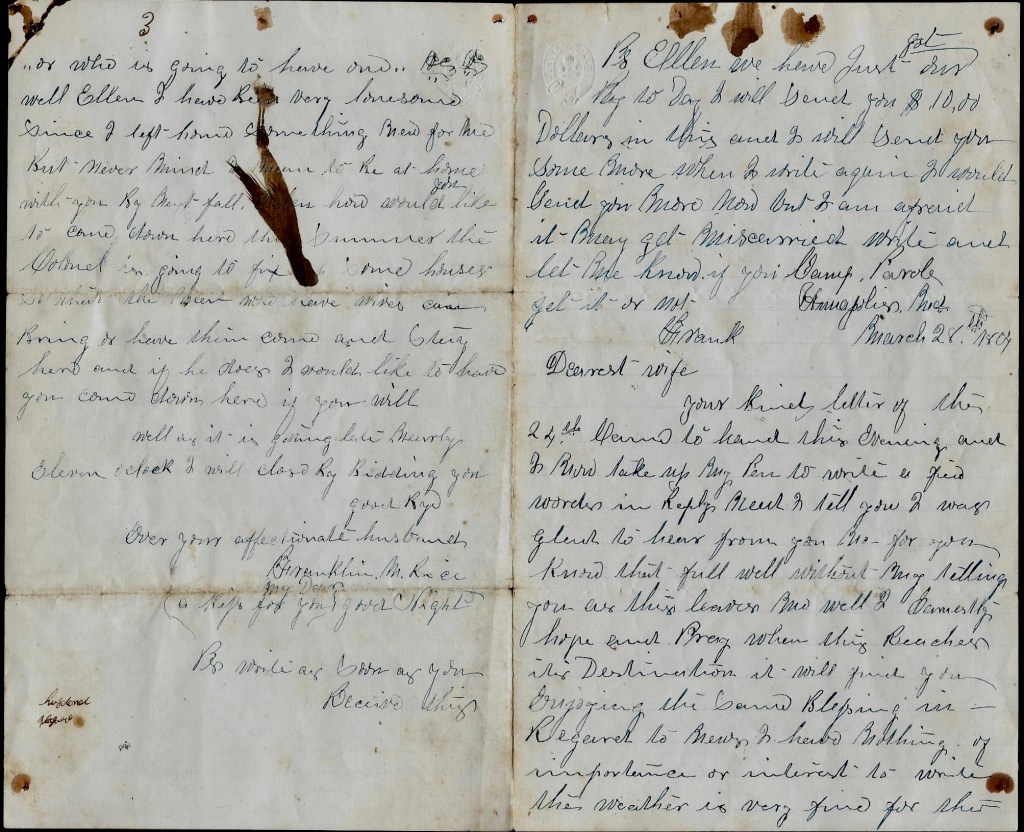
Well, Ellen, have been very lonesome since I left home—something new for me but never mind. I mean to be at home with you by next fall. Ellen, how would you like to come down here this summer? The Colonel is going to fix up some houses so that the men who have wives can bring or have them come and stay here and if he does I would like to have you come down here if you will. Well it is getting late, nearly eleven o’clock. I will close by bidding you goodbye.
Ever your affectionate husband, — Franklin M. Rice
My dear, a kiss for your goodnight. Please write as soon as you receive this.
So Ellen, we have just got our pay today. I will send you $10 in this and I will send you some more when I write again. I would send you more but I am afraid.it might get miscarried. Write and let me know if you get it or not. – Frank
Letter 2
Stationery used by Frank for his letter.
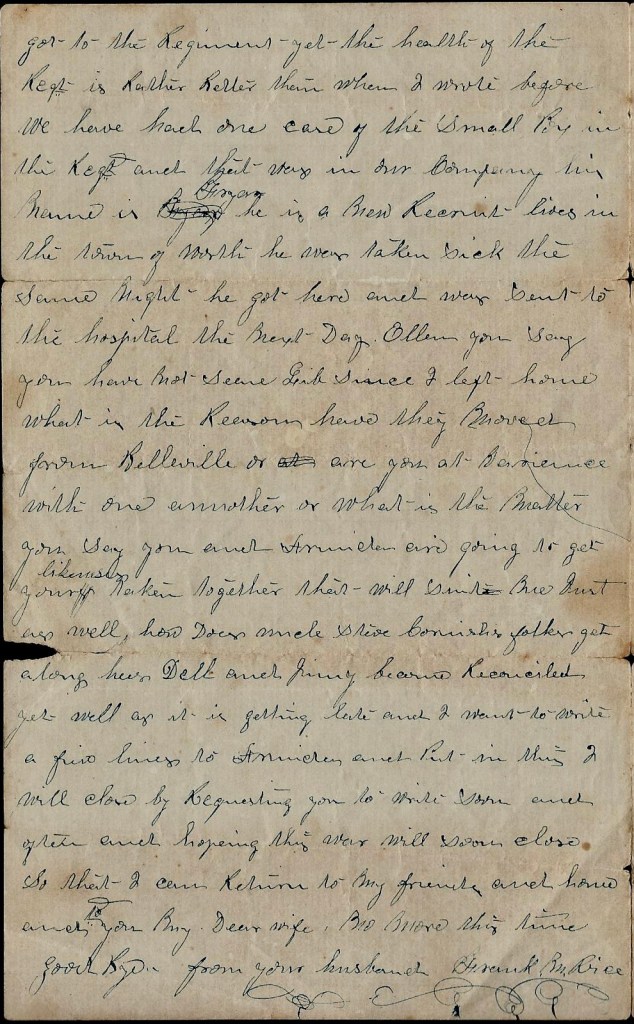
Camp Parole Annapolis, Maryland April 18, 1864
Dearest Ellen.
With pleasure I now take up y pen to write a few words on reply to your kind and welcome letter of the 13th inst. which came to hand this morning. I was very glad to hear from you and to learn you was well as this leaves me. Well, I hope and trust it will find you you enjoying the same blessing.
I have no news of importance or interest to write for it is the same thing over and over again. The weather is quite mild. We have a shower of rain occasionally—just enough to lay the dust—but it seldom rains more than 4 or 5 days at a time.
Ellen, you say you do not get all of my letters, or rather you seem to blame me for not writing more often. I have written seven or eight letters to you since I got back to the regiment. I don’t see why you have not got more of them. Your father has just got to the regiment, yet the health of the regiment is rather better than when I wrote before. We have had one case of the small pox in the regiment and that was in our company. His name is [Francis P.] Fryar. He is a new recruit. Lives in the town of Worth. He was taken sick the same night he got here and was sent to the hospital the next day. 1
Ellen you say you have not seen Lib since I left home. What is the reason? Have they moved from Belleville or are you at variance with one another, or what is the matter? You say you and [sister] Armida are going to get your likenesses taken together. That will suit me just as well. How does Uncle Steve Cornish’s folks get along? 2 Have Dell and Jimmy become reconciled yet?
Well, as it is getting late and I want to write a few lines to Armida and put in this, I will close by requesting you to write soon and often and hoping this war will soon close so that I can return to my friends and home and to you, my dear wife. No more this time. Goodbye, from your husband, — Frank M. Rice
1 Francis P. Fryar enlisted at the age of 18 on 15 March 1864 at Lorraine to serve three years in Co, C, 94th New York Infantry. He was wounded in action on 13 June 1864 at White Oak Swamp, Va., and died the following day.
2 This was Steven Silas Cornish (1824-1888) of Ellisburg, Jefferson county, New York. Steven was married to Amira Rice (b. 1822). They had a daughter named Adell (“Dell”) who was born in 1847.
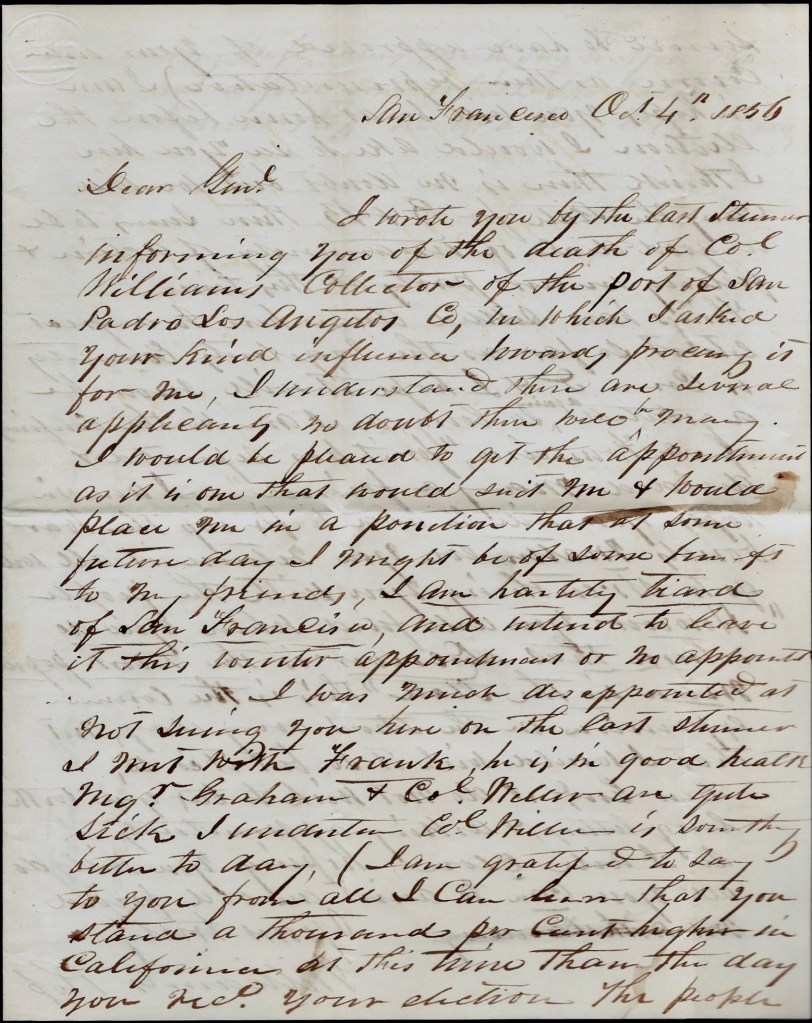
This letter was written by William George Ross (1818-1875), a native of Richmond, Virginia, who datelined his letter from San Francisco in 4 October 1856. William was married to Mary Esther Dashiell (1820-1889) in Fairfield, Iowa, in 1845, and came to California not long after, taking a public patronage job as a “warden” or “inspector” in the port at San Francisco.
Ross wrote the letter to James William Denver in October 1856, then serving as a congressman from California in the US House (March 1855-March 1857). His primary purpose for writing was to ask his “old friend” to use his influence as a congressman to have him appointed to the vacant post of Collector at the Port of San Pedros. Apparently stroking Denver’s ego and naming a son after his old friend wasn’t enough, however, as Ross was still the port inspector in San Francisco for the next few years until he landed the post of “State Gauger” in 1860. The State Gauger was tasked with gauging and inspecting all liquors arriving in the port.
At least one source in Ancestry. com claims that William had a tragic ending to his life, stating that he was shot on the street on 13 May 1875 by Charles Duane as a result of a dispute over a tract of land. I cannot find any period newspapers that corroborate this claim, however.
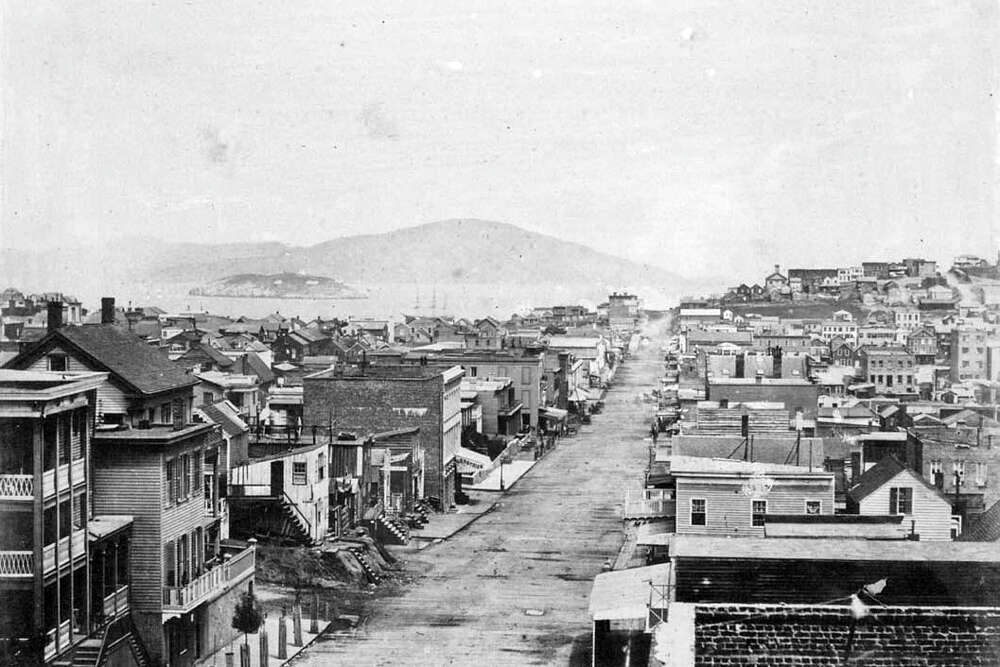
View down Stockton Street in San Francisco, May 1855: View north from Sacramento Street, with Alctraz and Angel Islands visible in bay. (UC Berkeley, Bancroft Library)
Transcription
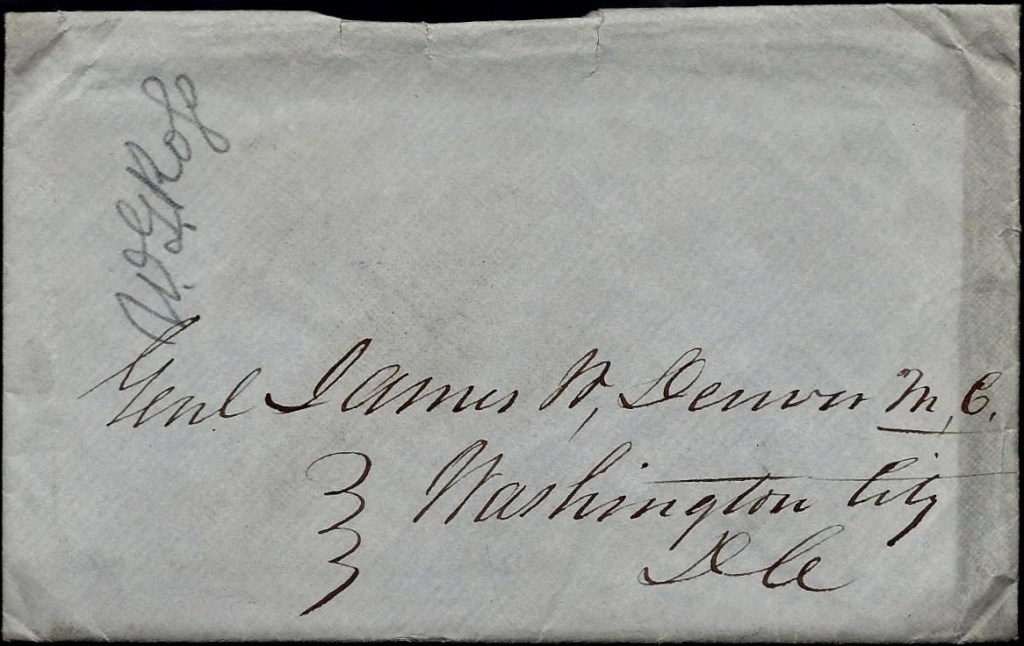
Addressed to Gen. James W. Denver, M. C., Washington City, D. C.
San Francisco [California] October 4th 1856
Dear General,
I wrote you by the last steamer informing you of the death of Col. [Isaac] Williams, Collector of the Port of San Pedros, Los Angelos county, in which I asked your kind influence towards procuring it for me. I understand there are several applicants. No doubt there will be many. I would be pleased to get the appointment as it is one that would suit me & would place me in a position that at some future day I might be of some benefit to my friends. I am heartily tired of San Francisco and intend to leave it this winter, appointment or no appointment.
I was much disappointed not seeing you here on the last steamer. I met with Frank. He is in good health. Major Graham and Col. Weller are quite sick. I understand Col. Weller is something better to day.
I am grateful to say to you from all I can learn that you stand a thousand percent higher in California at this time than the day you received your election. The people seem to have approved of your intercourse as their representative. I am in hopes you will be at home before the election. I would like to see you here. I think there is no doubt but we will carry the state for B & B. There seems to be a good deal of unanimity of action & feeling in our party at this time.
Things have settled down here to a great extent so far as the vigilante community is concerned & I hope it will never be agitated again so long as I am in the confines of San Francisco “for it has separated & divided many a friend.” I am in hopes you will be able to fix up the war bonds matter e’re you return. It all will go to strengthening you with the people. However, you will find when you do return that “Denver is the most popular man in the State.” This is the common expression on the street every day, not that I would wish it so, but it is so.
Dear General, I do not wish to tax you with long letters, and asking opportunity so I will close, hoping you will so all you can to assist an old friend. Yours truly, — William G. Ross
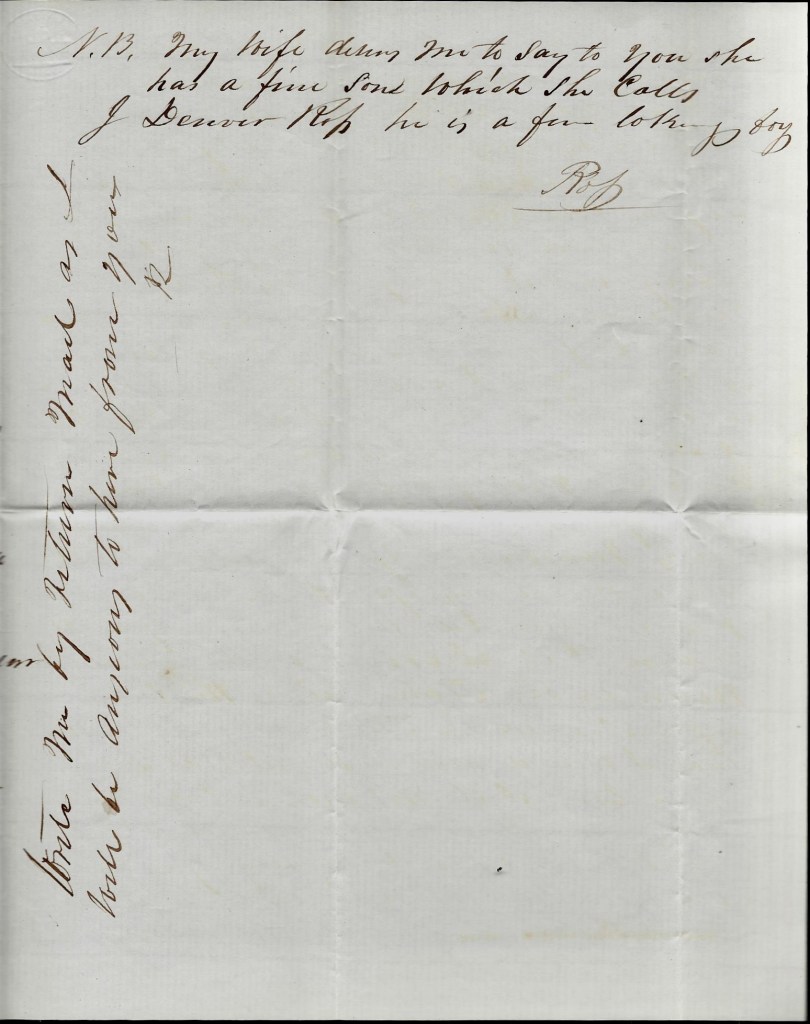
N B. My wife desires me to say to you she has a fine son which she calls J[ames] Denver Ross. He is a fine looking boy. — Ross
Write me by return mail as I will be anxious to hear from you. — R
The following letter was written by Gen. John Wilson (1790-1877), a native of the Shenandoah Valley, who came to California in 1849 as Indian Agent, then as Navy Agent in San Francisco. He soon settled down to practicing law in San Francisco, becoming somewhat of a specialist in land claim cases. Wilson was active in the Whig party in California but when that party dissolved in the 1850’s, he joined other old conservatives to join the Constitution Union Party that selected John Bell and Edward Everett as their nominees for President and Vice President in 1860.
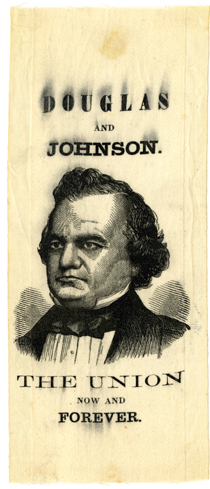
Wilson wrote this letter to his old friend, James William Denver (1817-1892) who had previously filled several military and civilian posts with the US government, most recently as the Commissioner of Indian Affairs. A life-long Democrat, Denver supported the Democratic party’s nominee, Stephen A. Douglas, for the office of President in the 1860 Election.
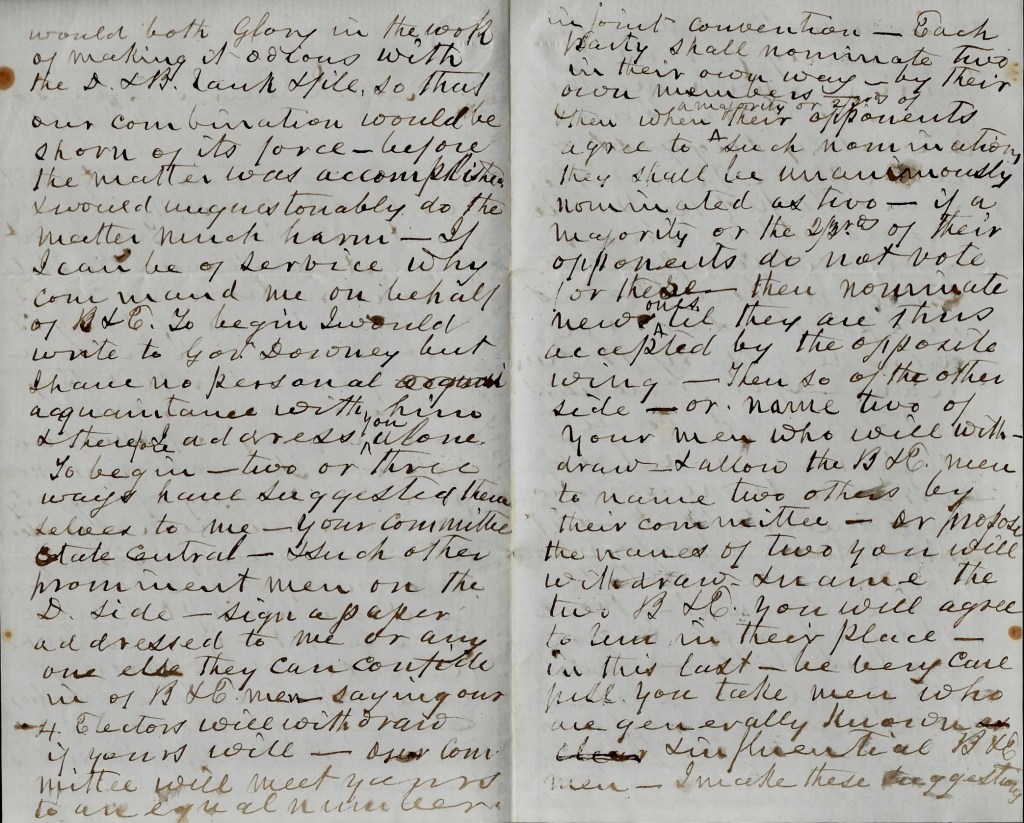
In this letter, recognizing there was little alternative to preventing Abraham Lincoln from winning the State of California in the Election of 1860, Wilson proposes to Denver that an attempt be made to unite the conservative members of their two party’s slates of electors to cast their ballots for either Douglas (Democratic Party) or Bell (Constitutional Union Party), but not for both. If “divided at the polls, victory will perch upon abolition,” warned Wilson.
Transcription
San Francisco, [California] 26th September 1860
Hon. Jas. W. Denver, Sir:
Allow me to suggest a matter that I at least think of great importance. There ought & must be—to save the state to conservatism—a combination between the Douglass & B & E [Bell & Everett] men. I think I can answer for the latter that they will agree to a fair one. You are fully informed how I stand. I have attended no public meeting od any party. My views have been expressed to you and are generally known. I feel the negotiation ought to be prompt & more than secret—if one is made that it should be sprung upon the public like a meteor.
Let it be supposed one was in embryo & all factionists the slave dealer & slave liberator would both glory in the work of making it odious with D & B [Douglass & Bell] rank and file, so that our combination would be shorn of its force—before the matter was accomplished & would unquestionably do the matter much harm.
If I can be of service, why command me on behalf of B & E [Bell & Everet]). To begin, I would write to Gov. Downey but I have no personal acquaintance with him & therefore I address you alone. To begin—two or three ways have suggested themselves to me—your committee State Central—& such other prominent men on the D [Democratic] side—sign a paper addressed to me or anyone else they can confide in of B & E men saying our 4 electors will withdraw if yours will. Our committee will meet yours to have an equal number in joint convention. Each party shall nominate two in their own way by their own members. Then when a majority of 2/3rds of their opponents agree to such nominations, they shall be unanimously nominated as two. If a majority or the 2/3rds of their opponents do not vote for these, then nominate new ones till they are thus accepted by the opposite wing. Then so of the other side—or name two of your men who will withdraw and allow the B & E men to name two others by their committee—or propose the names of two you will withdraw & name the two B & E you will agree to in their place. In this last, be very careful you take men who are generally known & influential B & E men.
I make these suggestions to begin with. No doubt you being far more familiar with matters of this sort than I am, can easily suggest a better plan than either. I am satisfied if the public should not be aware of it till completed. Therefore, there should be speed used in every necessary preliminary. If it is thought that I would be a proper channel to carry on the negotiation, I will undertake it. But I shall much prefer some other may be selected. Depend upon it. There is danger of L [Lincoln] carrying this state. This I hold would be a great political calamity to the Union for there are a majority of conservative votes here, but being divided at the polls, victory will perch upon abolition, so says your old friend, — John Wilson
Susan Gibbs (Boone) DeSaussure’s Monument in the Circular Congregational Church Burying Ground in Charleston, SC
The following letter was written by 73 year-old Susan Gibbes (Boone) DeSaussure (1789-1864), the wife of Henry Alexander DeSaussure (1788-1865)—a prominent attorney in Charleston, South Carolina. She wrote the letter to her daughter Sarah Gibbes (DeSaussure) Elliott (1811-1891) who was married to her second husband, Stephen Elliott (1804-1866). Stephen Elliott was an 1824 graduate of Harvard. He was a planter for awhile and then turned to the ministry. He was ordained an Episcopal priest in 1836 and was the rector at St. Peter’s in Charleston for a time. He devoted himself to missionary work among the Negroes and built a church for them on the Combahee River called Christ Chapel.
Several of Stephen Elliott’s sons served in the Confederate army during the Civil War: Stephen Elliott, Jr. (1830-1866), was Captain of the Beaufort Volunteer Artillery. In 1863, he was promoted Major, then Colonel and was chosen by General Beauregard to command Fort Sumter in Charleston Harbor. Transferred to Petersburg, Virginia, he was promoted Brigadier General in 1864. He was severely wounded in the Battle of the Crater and after his recovering he participated in actions at Averysboro and Bentonville, in which he was again badly wounded. William Elliott (1838-1907), joined the Confederate Army and served the entire war, attaining the rank of Lieutenant Colonel. Middleton Stuart Elliott (1841-1921) was an 1862 graduate of the Citadel. Finally, Henry (“Hal”) DeSaussure Elliott (1848-1907) must have served at war’s end.
Transcription
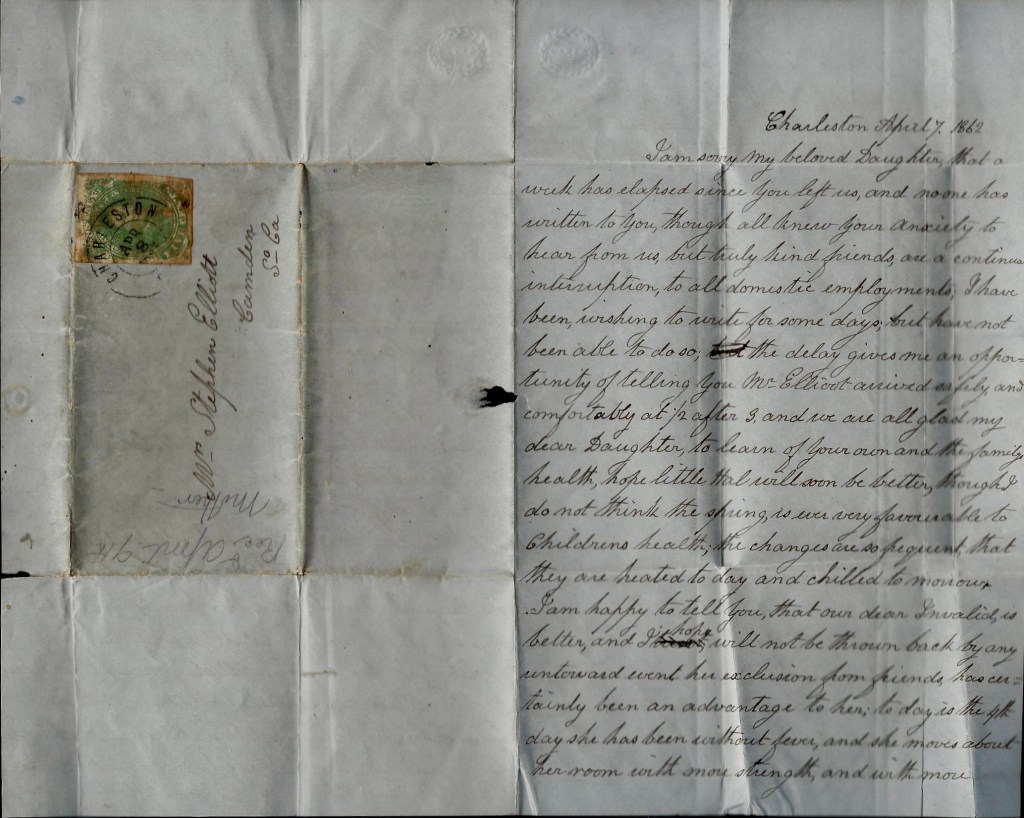
Addressed to Mrs. Stephen Elliott, Camden, South Carolina
Charleston [South Carolina] April 7, 1862
I am sorry, my beloved daughter, that a week has elapsed since you left us and no one has written to you, though all knew your anxiety to hear from us. But truly kind friends are a continuous interruption to all domestic employments. I have been wishing to write for some days but have not been able to do so. The delay gives me an opportunity of tell you Mr. Elliott arrived safely and comfortably at half past 3 and we are all glad, my dear daughter, to learn of your own and the family’s health. Hope little Hal will soon be better though I do not think the spring is ever very favorable to children’s health—the changes are so frequent that they are heated today and chilled tomorrow.
I am happy to tell you that our dear invalid is better and I hope will not be thrown back by any untoward event. Her exclusion from friends has certainly been an advantage to her. Today is the 4th day she has been without fever and she moves about her room with more strength and with more interest in her employments but with no increase of appetite. Your fresh eggs will be a treat to her for I have just run out.
The unsettled state of the country makes her (and myself also, I must confess) unwilling to be separated from the family. We feel that whatever is the fate of one, must be the fate of all.
— Susan Gibbs (Boone) DeSaussure, Charleston, 7 April 1862
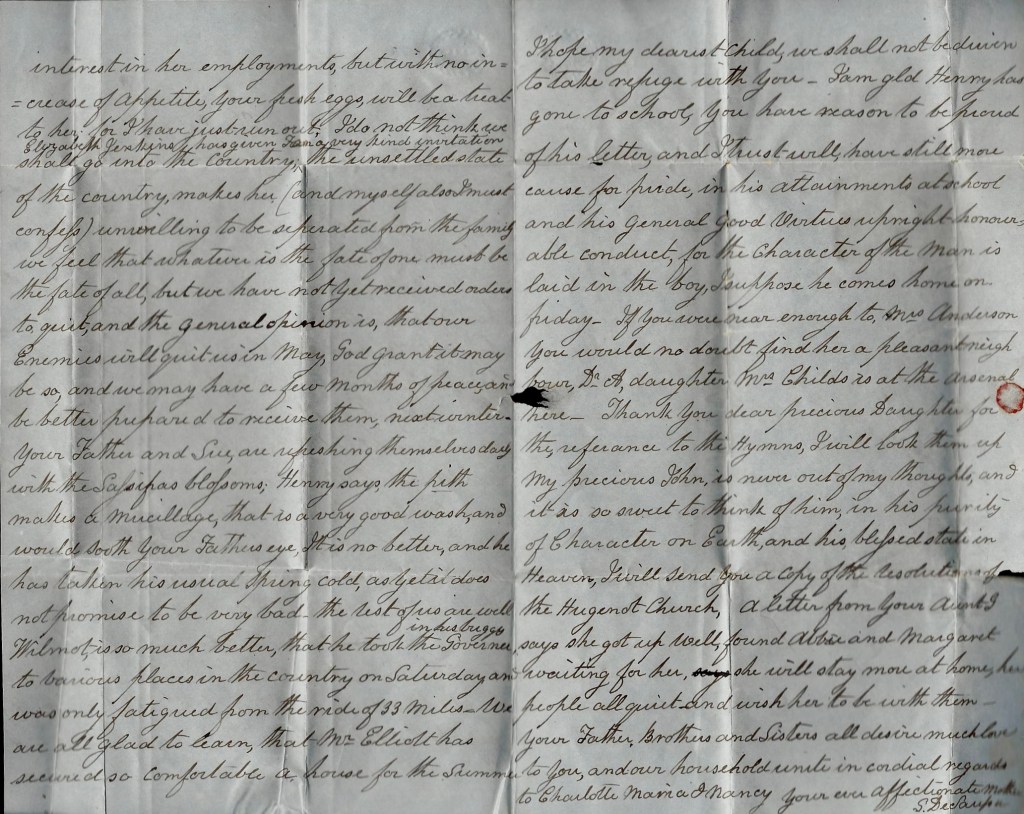
Elizabeth Jenkins has given Fan a very kind invitation [but] I do not think we shall go into the country. The unsettled state of the country makes her (and myself also, I must confess) unwilling to be separated from the family. We feel that whatever is the fate of one, must be the fate of all. But we have not yet received orders to quit and the general opinion is that our enemies will quit us in May. God grant it may be so and we may have a few months of peace and be better prepared to receive them next winter.
Your father and Sue are refreshing themselves daily with the sassafras blossoms. Henry say the pith makes a mucillage that is a very good wash and wood sooth your father’s eye. It is no better and he has taken his usual spring cold. As yet it does not promise to be very bad. The rest of us are well. Wilmot 1 is so much better that he took the Governor [Francis Pickens] in his buggy to various places in the country on Saturday and was only fatigued from the ride of 33 miles.
Wilmot Gibbes DeSaussure(1822-1886)
We are all glad to learn that Mr. Elliott has secured so comfortable a house for the summer. I hope, my dearest child, we shall not be driven to take refuge with you. I am glad Henry has gone to school. You have reason to be proud of his letter and I trust will have still more cause for pride in his attainments at school and his general good virtues upright honorable conduct, for the character of the man is laid in the boy. I suppose he comes on Friday.
If you were near enough to Mrs. Anderson, you would no doubt find her a pleasant neighbor. Dr. Anderson’s daughter, Mrs. Childs, is at the arsenal here.
Thank you dear precious daughter for the reference to the Hymns. I will look them up. My precious John is never out of my thoughts and it is so sweet to think of him in his purity of character on earth and his blessed state in Heaven. I will send you a copy of the resolutions of the Hugenot Church. A letter from your aunt G. says she got up well, [and] found Abbie and Margaret waiting for her. She will stay more at home. Her people all quiet and wish her to be with them.
Your Father, brothers and sisters all desire much love to you, and our household unite in cordial regards to Charlotte, Maria & Nancy.
Your ever affectionate mother, — S. DeSaussure
1 Susan’s son, Wilmot Gibbes DeSaussure, was the Secretary of the South Carolina Treasury and as a Representative to the State Assembly. Appointed to Brigadier General of State Militia in 1861, De Saussure led the 4th Brigade throughout the Civil War. He served on South Carolina Governor Francis Pickens cabinet as Secretary of the Treasury. In 1862, he was elected State Adjutant General and Inspector General of Militia. Post Civil War saw De Saussure resuming his profession as a lawyer and becoming the President of the Huguenot Society and the Sons of Cincinnati. The General died in Ocala, Florida on February 1, 1886.
























 Spared & Shared 23