Unfortunately I was not able to identify this soldier quickly. There are some 30 soldiers by the name of Henry Wilber in the Civil War Soldiers database and it would take a while to winnow the list down. I attempted to identify him through Ancestry.com records by tracing the relationship to his sister, “Mrs. Amy Wright” of Lower Lockport, New York, but was unsuccessful.
Transcription
Addressed to Mrs. Amy Wright, Lower Lockport, Niagara county, New York
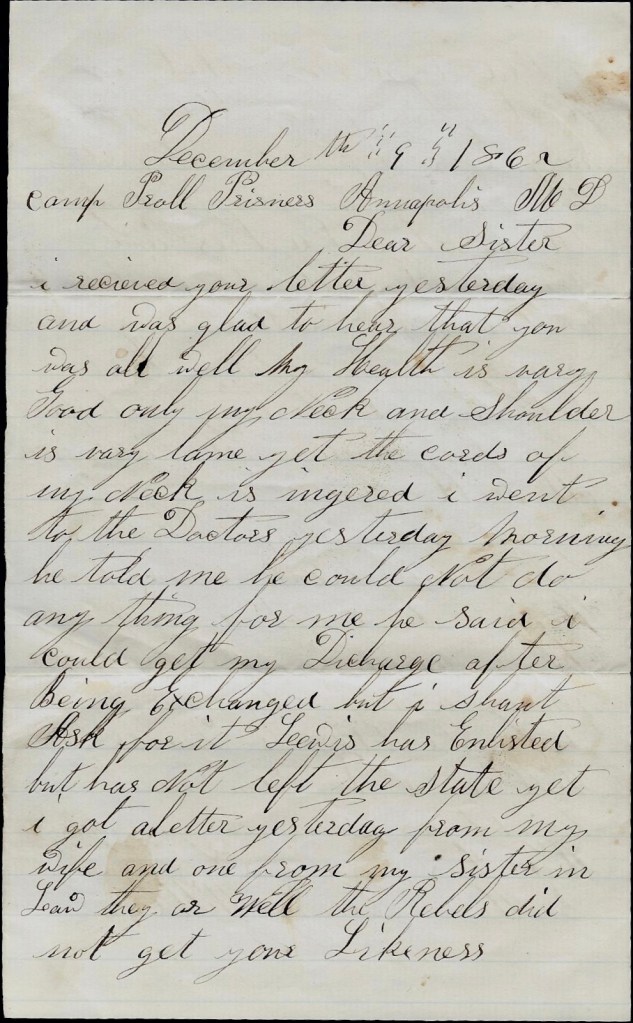
Camp Parole Prisoners Annapolis, Maryland December 9th 1862
Dear Sister,
I received your letter yesterday and was glad to hear that you was all well. My health is very good—only my neck and shoulder is very lame yet. The cords of my neck is injured. I went to the doctor’s yesterday morning. He told me he could not do anything for me. He said I could get my discharge after being exchanged but I shan’t ask for it. Lewis has enlisted but has not left the state yet.
I got a letter from my wife and one from my sister-in-law. They are well. The Rebels did not get your likeness. I had it in my pocket. I expect a letter from Oba and Mary every day and I expect their likeness too.
When you write, tell me where Lee lives and write all of the particulars.
We have nice weather here. It is very warm. I have just got through washing. I hope these few lines will find you all well. My wife writes me a great many kind letters. She wants me to come home.
Amy, I have got a good, kind woman. I have enjoyed many a happy hour with her. She likes to dance as well as I do. You must write as soon as you get this.
The following letter was written by Pvt. Edward Fisher of Co. G, 147th Pennsylvania Infantry. The year of the letter, Edward Fisher’s regiment, and the identify of his correspondent were all missing from this letter but by determining the date of the child abduction and murder described in the letter, we were able in turn to determine Edward’s regiment, then being organized and trained near Harrisburg, Pennsylvania.
I could not find an image of Edward but here is one of Benjamin Lochman of Co. H, 147th Pennsylvania (Jane Johansson Collection)
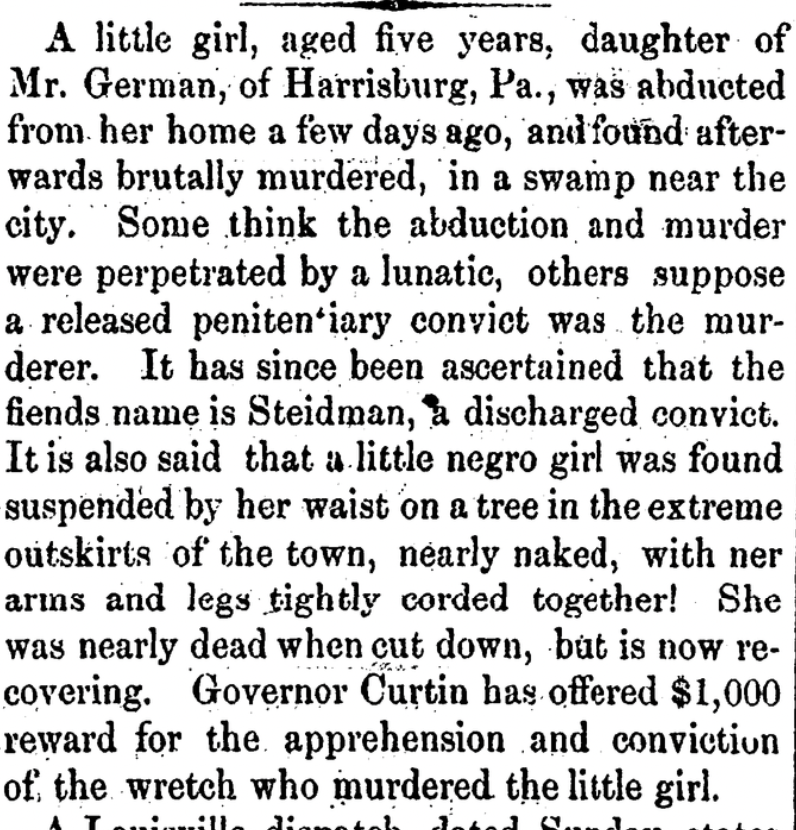
The five year-old girl abducted from her home and murdered was Mary Elizabeth German, the daughter of a Harrisburg book merchant named Emanuel Seltzer German (1822-1912) according to an article appearing in the Alexandria Gazette on 7 October 1862 (see footnote).
So who was Edward Fisher? Most likely his residence was in Snyder county as most of the boys in Co. G were recruited there in August and September 1862 and most all were of German descent. He was no doubt with his company when they departed Selinsgrove on the train bound for Harrisburg on 13 September and, once there, marched through the town to the beat of fife and drum to Camp Simmons where they encamped and mustered into the service two days later. In the memoirs kept by Sgt. Michael Simon Schroyer, also a member of Co. G, it was recorded that “while in camp, a little girl was murdered on Allison’s Hill, east of Harrisburg. It was reported that the murderer was a soldier, so orders were issued that no soldier was allowed to leave camp, but that any and all should be admitted. Some five or six citizens, men and women, were brought into camp to search for the supposed murderer. We were drawn up in line, and those people took a front and back view of us. A man was taken from the line near us, and that created quite a commotion for a little while, but he was later released. It is said that the girl was a distant relative of Governor Curtin, and that her slayer was captured two years later.”
Schroyer also stated in his memoirs that while the company was at Camp Simmons in the fall of 1862, itching to meet the enemy, “a number of the boys brought Bowie knives and revolvers. Among them was Ed Fisher who conceived the idea that if he had a self-cocking revolver, he would be able to put down the rebellion himself. One day in camp, Fisher hurriedly ran his hand down into his trousers pocket where he carried his rapid firing piece of ordnance, and to his surprise he struck the trigger and off went the gun. The hot smoke curled down his pantaloons and he, of course, imagined that it was blood. A hasty examination relieved his anxiety but the ball of the cartridge had gone through his pocketbook, which was very light after the purchase of the revolver. The ball struck the ground just in front of his big toe and that settled Ed for carrying such deadly weapons. I don’t think he ever carried one since then.”
Schroyer’s memoirs mention Edward Fisher several more times. He was identified as one of five boys in Co. G who were taken captive during the Battle of Chancellorsville. He was kept on Belle Island in Richmond until exchanged and did not return to the regiment until 31 October 1863 at Chattanooga, just prior to the Battle of Lookout Mountain. He was also mentioned in the following paragraph:
“Many darkies had gathered in camp. At night they would sing their old plantation songs, and I am sure every member of Company G enjoyed them. One night they assembled in a large tent and continued their singing and carousing until after midnight. The Colonel being kept from sleep, came out to see what was the trouble. Just at this time the darkies were in the midst of their jollification. A number of Company G boys gathered around the tent and at a given signal cut the ropes and the tent fell upon them. The screaming of the ladies of color and the noise made by the young and old bucks awakened everybody in camp. Of course, all were anxious to know the cause. The Colonel was out of humor and not appreciating the joke, placed a number under guard. I would like to tell of some real funny things that took place that night but there are some things that happened which are company secrets and are only told within the inner circle. However, if you would whisper softly into Ed Fisher’s left ear be might give you a little history of that night’s doings.“
and in this paragraph describing the Battle of Lookout Mountain:
“While marching up Lookout and changing positions owing to the nature of the ground we moved along beyond the point with the regiment left in front. The Colonel gave the command to countermarch. We were then on a road leading around the mountain, and as we were executing this command the Regiment was just doubled up as a volley from the Rebels compelled us to drop down over the embankment along the road. The adjutant of the regiment, Samuel Magee, thinking it meant a route, drew his sabre and struck Jere Hathaway across the back-cried “halt!” that he did not want us to run. Ed Fisher, who was close to the adjutant, said: “Who the Devil intends to run? You tell us what to do and we are here to do it.” The order from the Colonel to front face and dress up was speedily done. We advanced to the road. When the command forward was given, the 147th again showed the quality of the men and officers composing the regiment, for many a regiment would have been unable to rally its men under similar conditions.”
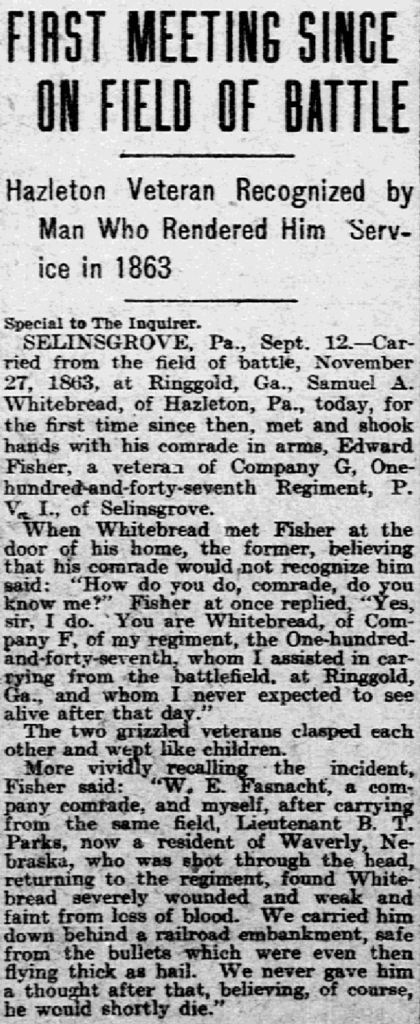
The Philadelphia Inquirer, 13 September 1908
and in this paragraph describing the Battle of Ringgold, Georgia, on 27 November 1863:
“We marched in line of battle about half way up in the woods when the command was given by the left flank. Captain Davis, who was beside the writer now, left my side to take his place at the left of the Company. Hardly had he gone, when he was mortally wounded and carried off the field by James P. Ulrich and others, whom I have forgotten. Lieutenant B. T. Parks, who then became commander of the company, was in the act of passing the writer to the left of the company, when a bullet struck him in the back of the neck, going entirely thru. I stopped and looked at him but as he never moved a muscle I thought he was dead and passed on. Later Ed Fisher and William E. Fausnaucht found him alive and kicking and carried him off the field. After arriving at the hospital Parks made the boys prop him up and light his pipe for him. Then he made Fisher go after his sword, which he had lost on the battlefield.”
and in this paragraph describing the Battle of New Hope Church on 25 May 1864:
“There we found General Hooker dismounted and directing us where to go. The Fifth Ohio regiment, following us and forming line of battle on our right, had scarcely gotten into position when a volley was fired into them, killing and wounding 105 men, including Colonel Patrick, their commander. General Hooker placed himself just in rear of Company G and drawing his sword, or cheese knife, as the boys used to call it, said: “This line can’t break unless it goes thru me first.” Ed Fisher said, “That’s so, old Fighting Joe.” ….The fighting was severe and we were repulsed. Eighteen hundred men were killed and wounded in our corps in less than three hours. The loss in Company G was: Ed Fisher, wounded in the foot; Elias Noll, wounded in the foot; William Seesholtz, leg shot off at ankle, died from amputation, and buried in National Cemetery, Chattanooga, Tenn., and William E. Fausnaucht, leg shot off just below the knee.“
and in this humorous anecdote:
“Colonel Pardee never allowed any shooting in or around camp. Ed Fisher, who, by the way, never fired a gun before he went to the army, asked the writer in a sort of confidential way that if he would pull the ball out of his gun and then fire it off, whether it would crack. The writer said: “Why of course not.” So Ed, forthwith drew the ball, put on a cap and pulled the trigger. Imagine his surprise when the report and the echo of that shot rang out there in the woods. It seemed to him like the firing of a cannon. The Colonel, who unfortunately was not far away, ordered the writer to buck and gag Fisher, which was done according to orders. While the writer was carrying out these orders, Fisher said, “I have a notion to blow on you, for all this was your fault.” I told him if he did I would haul him up tight. He sort of feared I might tighten him up, and said nothing more about it, except that he remarked that he would never believe anything I told him.”
or this one that took place on the day after Lincoln was elected in November 1864:
“The next morning after the election the rebels with a body of cavalry and artillery charged our breastworks. Ed Fisher and the writer were tenting together at this time. For some reason I had gotten up early and was preparing breakfast, when the first thing we knew a shell from a rebel battery came down our company street and exploded just beyond the street, near our suttler’s tent. A darkey, who had been sleeping in the tent, came forth with his clothes in his arms going at full speed for the rear. I began putting away my cooking utensils, when Fisher, who was still in bed, said: “Schroyer what’s that.” I replied, that I thought we had received good news from Richmond and that they were firing a salute. Just then another shell landed in our company street, exploded and striking Isaac Reed’s tent just above us, knocked a piece of board off the corner of it. Then Fisher jumped up with his clothes and his gun in his hand and said: “Like the devil, the Johnnies are coming.” All rushed for our works, shooting and dressing at the same time. This was a laughable sight. Much more could be said.”
The last mention of Edward in Schroyer’s memoirs was in December 1864 when the regiment was in Savannah. It reads:
“During our stay here two of our boys, Edward Fisher and Calvin E. Parks were promoted to orderlies on the staff of General Ario Pardee commanding the first brigade of Geary’s White Star Division. This was quite an honor to Company G and especially so to Parks and Fisher.”
Muster rolls indicate that Edward mustered out with his company on 6 June 1865. To read Sgt. Michael S. Schroyer’s Memoirs, penned five years after the war, go to Civil War Diary: Company G, 147th P. V. I.
It is my conclusion that Edward was relatively young when he enlisted, that he was a good friend of Sgt. Schroyer of Selinsgrove (since they tented together), and that he was most likely the same Edward Fisher (1845-1926) who was the son of Peter Fisher (1803-1850) and Susan Lloyd (1816-1861) of Selinsgrove, Snyder county, Pa. Edward died on 17 May 1926 at the Naval Hospital at League Island in Pennsylvania. At the time of his death, he was a widower; his wife Eliza Jane Williams (b. 1846) having preceded him in death. Edward would have been underage to enlist but was probably allowed to do so by his guardian’s consent (to whom he addressed this letter).
[Note: After spending hours researching this letter, I discovered that I had transcribed and published it previously on 15 January 2014—nine years ago. I’m leaving the prior posting on Spared & Shared 4 because the research includes different and additional information not included here. It’s good to see I came to the same conclusion regarding his identity but disappointing to see that my client purchased the letter recently with an erroneous information attached to it. See 1862: Edward B. Fisher to Guardian]
Transcription
Harrisburg [Pennsylvania] October the 6th [1862]
Dear Sir,
I now take my pen in hand to inform you that I am getting along fine so far—only these crackers we have here are so hard that I can hardly get them fine enough to swallow them without almost choking at them. We have bread twice a day and in the evening we have crackers & coffee.
There has a great many accidents happened here last week. Two cars run over a soldier and cut his legs off and broke his should bone. One of the soldiers was down town and picked up a little girl and took to a swamp and shot her through the neck and then cut her throat. The girl was only 5 years old and now no one dare go out of camp. 1
I am going to send my $20 check with this letter and I thought I would like to get myself a pair of boots if you did not care. Our boys are all getting them. They are made for army use. They are worth $8. If you could send me $6, I would have enough. I have $3.50 yet of that money you sent me. I think if I run the risk of my life, I might as well get the worth of it. Sometimes I buy my meals. The most of the boys buy theirs all the time. We got a pair of shoes but they will hardly do for wet weather and if you think proper, I wish you would send me $6 or 8 and if you think not, the it is all right. And I would like to have some stamps.
It may be you think I ask for a great many things but please over look all. If you think I ought to have them, send them the net chance you get if you please.
Yours forever, — Edward Fisher
1 Speculations were offered that the perpetrator of this heinous crime was a lunatic or a released convict and most likely the same individual who at or about the same time abducted a little negro girl who was found “suspended by her waist on a tree in the extreme outskirts of town, nearly naked, with her arms and legs tightly corded together. She was nearly dead when cut down, but is now recovering.” Despite a $1000 reward offered by Gov. Curtin, the perpetrator was never found though an article published on 29 April 1863 in the True Democrat (Lewistown, PA) claimed that the murderer (unnamed) was discovered in Dayton, Ohio.
The following curious letter was submitted anonymously to the Governor of New York making him aware of two individuals who might be southern sympathizers and therefore traitorous to the U. S. Government.
This letter was submitted anonymously but based upon the content and handwriting, my hunch is that it was written by a woman and submitted in this manner with the hope that it might be taken more seriously if they thought a man wrote it.
The first individual named was Samuel “Selden” Hetzel (1837-1897), the son of Capt. Abner Riviere Hetzel (1803-1847) and Margaret Phebe Jack (1815-1899). Margaret was the daughter of a planter in the West Indies and no doubt had a proclivity to lean south in her allegiance despite the fact that her husband had served as a Captain and the Assistant Quartermaster in the US Army during the Mexican War. He was posted primarily at Vera Cruz during the war but became ill and died in Louisville, Kentucky, before he could get home in July 1847.
A family history confirms that Selden received an appointment to West Point by virtue of a letter of recommendation by Gen. Winfield Scott in 1853 but was expelled for not responding promptly to orders and for “muttering” in the ranks. Jefferson Davis opposed the decision by Superintendent John G. Barnard but the decision stood. In 1856, Selden was reinstated to the Academy but he was finally discharged for similar offenses in February 1858. In a letter dated 8 June 1861 by Lt. Samuel S. Partridge of the 13th New York Infantry, Sam wrote his brother that that his cousin, “Sed Hetzel acted so disgracefully and abused Judge Selden’s generosity and hospitality to such an unbearable degree that the judge gave him $500 and a revolver and a new outfit and started him for Pikes Peak. The last heard of him was in a Hell at Denver City.” [“The Civil War: A Soldier’s Letters Home 1861-1863, page 14.]
Selden was not long in returning from Denver, however. In October 1861, he volunteered and was commissioned a Major in the 77th New York Infantry. Muster Rolls indicate he was discharged 15 May 1862 after tendering his resignation but he was curiously reinstated as the Major again on 3 July 1862. A newspaper article appearing in Rochester, N. Y. papers reported that Selden deserted at Yorktown. “He was a West Pointer, a very genial fellow, but a relative of Mr. Jeff Davis, ” according to the paper. It went on to say that “he was very bitter on Mr. Seward because he had prevented his promotion by having alleged that he was a ‘sympathiser.’ [Leavenworth Daily Conservative, May 17, 1862]
Another reference to Selden can be found in the letters by his cousin, Lt. Samuel S. Partridge of the 13th New York Volunteers. In a letter dated 16 June 1862, it was stated that Selden, the “late Major…had been dismissed [rather than resigned] from the service. His mother has secured the influence of Alf—Ely—Preston, King, Sherman and others to get him reinstated, but when discharged by order of A. Lincoln and G. B. McClellan, I don’t think they can do [much]. Poor Aunt Margaret, I’ve thought. All the while sick, and sometimes distressingly so; her only son always in trouble. She has cares enough to wear her out.”
The second individual suspected of being a southern sympathizer was Mary Gilliat (Gray) Harris, the wife of John Harris (1793-1864) who was the Commandant of the Marine Corps. Mary was the only daughter of William Gray, Esq., later her Britannic Majesty’s Consul for the State of Virginia, located at Norfolk, Virginia.
Transcription
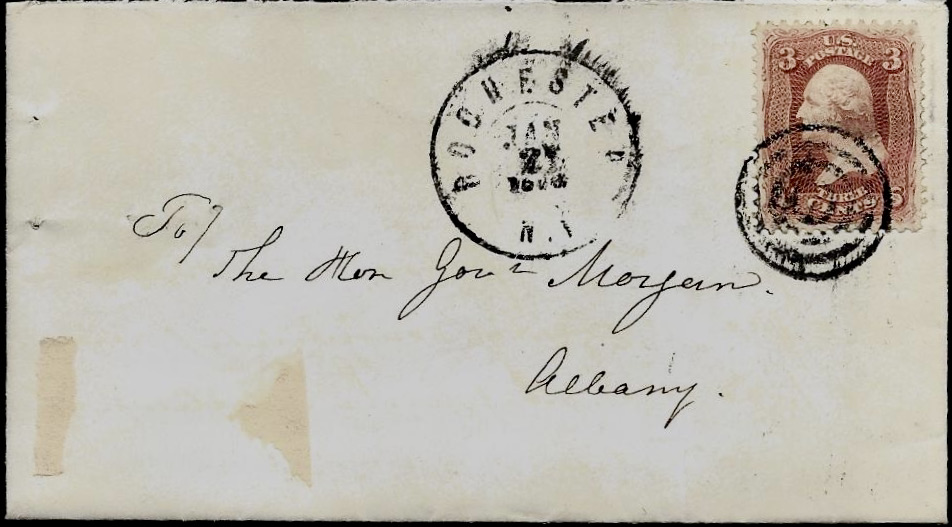
Addressed to the Hon. Governor Morgan, Albany Postmarked Rochester, N. Y.
Western N. York January 20th 1862
The Hon. Gov. Morgan Dear Sir.
As there are so many traitors in our midst, loyalty to my country impels me to disclose to you the following facts. First, that Mr. Selden Hetzel who received at Albany some months since the commission of Major in the National Army, belongs to a strong secession family. He is the son of the late Capt. Hetzel of the United States Army who died in the service of his county during the Mexican War. His widow received through the influence of Jefferson Davis & the late General Jessup between $20 and $25,000 from the government in consideration of services rendered by her husband during that campaign. 1
The son was subsequently admitted to West Point, when after a short period he was expelled for insubordination. By the influence of friends, he was again received & a second time discharged upon the same ground. Consequently he is not a graduate of that institution.
It is the opinion of those who know Mr. Hetzel that pecuniary considerations were paramount to all others in the selection of his present vocation.
Mrs. Hetzel has long been a personal friend & correspondent of the Davis family even to the present time. Nor do they hesitate in presence of their friends to to avow their secession sympathies. The public journals have at various times stated that Mrs. Hetzel had been arrested at Washington but it was incorrect. Although a resident of Washington, she left there early last summer & has not yet returned.
Secondly, I would suggest that the lady of the officer at the head of the Marine Corps [John Harris] now residing at the barracks should not be overlooked by the investigating committee. Said officer is believed (to be by all who knew him intimately) perfectly loyal to his country. His lady is the daughter of the late British Consul long resident at Norfolk. I would recommend caution in this latter case and have ground for suspicion that all is not right in that department by some now holding commissions.
May I beg, Sir, that you will consider this communication as confidential. I have struggled long between duty & inclination having know the above parties many years, & independent of their secession sympathies, with but one exception, esteem them all—knowing that early associations have produced this unhappy result.
I leave it to your own judgement to make any use of the above facts as you may deem most judicious. Be assured they are reliable.
The present crisis requires every sacrifice for our country’s good & were it the case of my own child, I as a mother would feel justified in making the disclosure.
— A true friend to the country.
1 Among the Papers of Jefferson Davis: 1849-1852, it is reported that on June 17, 1850, Davis “supports bill for relief of Capt. Abner R. Hetzel’s widow, Margaret (Congressional Globe 31:1, 1237-38).”The claim was not actually a “widow’s pension” such as might have been awarded for service to the widows of fallen servicemen during the Civil War but for the legitimate claim of a commission (percentage of funds handled and disbursed) by the quartermaster in the 1830s during the Cherokee removal. Apparently this was done to dissuade such handlers of large sums of the government’s treasury from misappropriating funds. Hetzel’s widow claimed that the government still owed her husband approximately $12,000 from this period of time which had never been closed out prior to his death because he had never left military service. The claim was debated on the floor of the 31st Congress for some months because the practice of allowing this commission had ended in the intervening years.
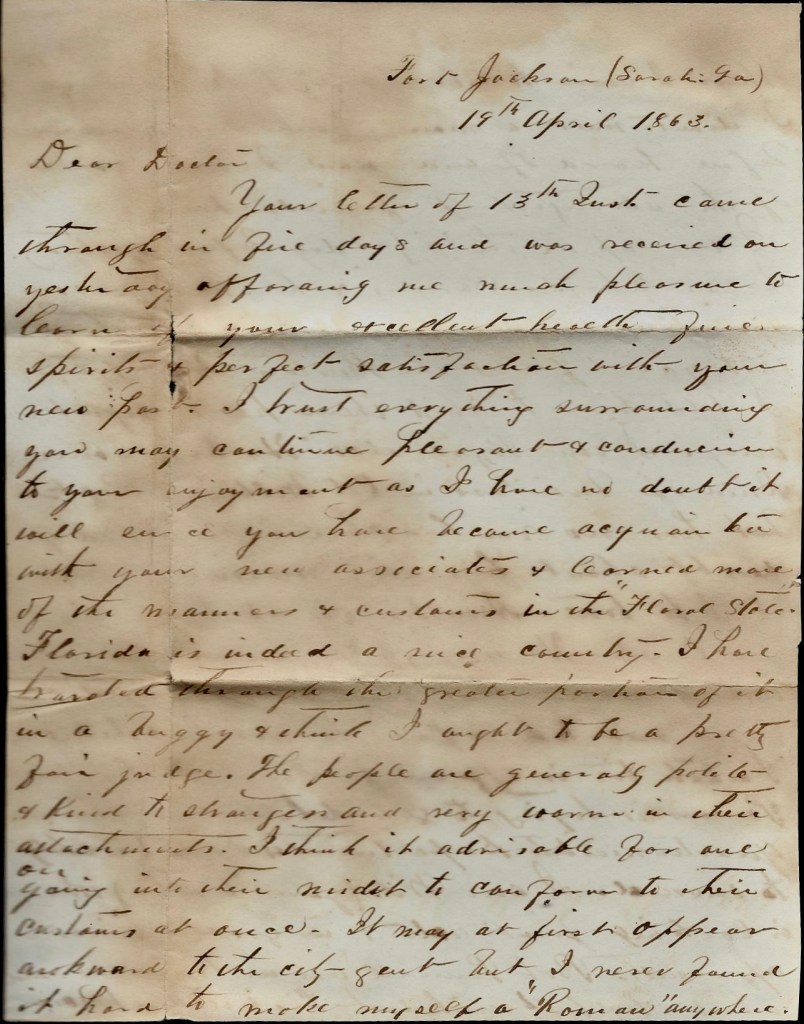
The following letter was written in mid-April 1863 by Assistant Surgeon Thomas (“Tom”) Wesley Newsome (1835-1874), formerly a lieutenant in Co. H, 49th Georgia Infantry. Tom was ordered to report to Surgeon H. V. Miller at Savannah in the spring of 1863, his appointment to rank from November 1862. His records indicate that he first entered the service on 4 March 1862 as a 2nd Lieutenant in the 49th Georgia (“Cold Steel Guards) and was promoted to 1st Lieutenant on 7 July 1862. A month later he was wounded in the fighting at Cedar Run and transferred to the Medical Department in December 1862. The last entry for medical requisitions indicates he was still at Savannah in June 1864.
Tom’s letter was datelined from Fort Jackson which was located on the Savannah River three miles east of the city. It served as the headquarters for Savannah’s river defenses after the fall of Fort Pulaski. It had to be evacuated late in 1864 as Federal troops closed in on the city.
Tom was the son of Lorenzo Dye Newsome (1810-1840) and Maryanne Ellafair Brown (1814-1862). Tom was married prior to the war but his first wife, Lonora (Ragland) Newsome, died prior to the date of this letter and their child, Thomas, Jr., born in 1862, was raised by an aunt.
There is nothing in this letter to indicate who it was addressed to but the provenance states that it was mailed to his friend, Dr. Horatio N. Hollifield (1832-1895), of Sandersville, Washington County, Georgia. Hollifield was born in Maryland but came to practice Allopathic medicine in Sandersville in 1856. His Confederate military records indicate he was posted at Bartow Hospital in Savannah early in the war and that he was a “Surgeon for Negroes” in Savannah in October 1862. He was stationed with two companies of the 2nd Florida Cavalry in May 1863 and later attached to Finnegan’s Middle District of Florida. He resigned in February 1865 at Columbia, S. C.
It should be noted that Tom Newsome and Horatio Hollifield collaborated in the authorship of a book first published in 1860 entitled, “Georgia Medical and Surgical Encyclopedia.”
Transcription
Fort Jackson Savannah, Georgia 19th April 1863
Dear Doctor,
Your letter of 13th inst. came through in five days and was received yesterday affording me much pleasure to learn of your excellent health, fine spirits, and perfect satisfaction with your new post. I trust everything surrounding you may continue pleasant and conducive to your enjoyment as I have no doubt it will since you have become acquainted with your new associates & learned more of the manners & customs in the “Floral State.” Florida is indeed a nice country. I have traveled through the greater portion of it in a buggy & think I ought to be a pretty fair judge. The people are generally polite & kind to strangers and very warm in their attachments. I think it is advisable for me on going into their midst to conform to their customs at once. It may at first appear awkward to the city gent, but I never found it hard to make myself a “Roman” anywhere.
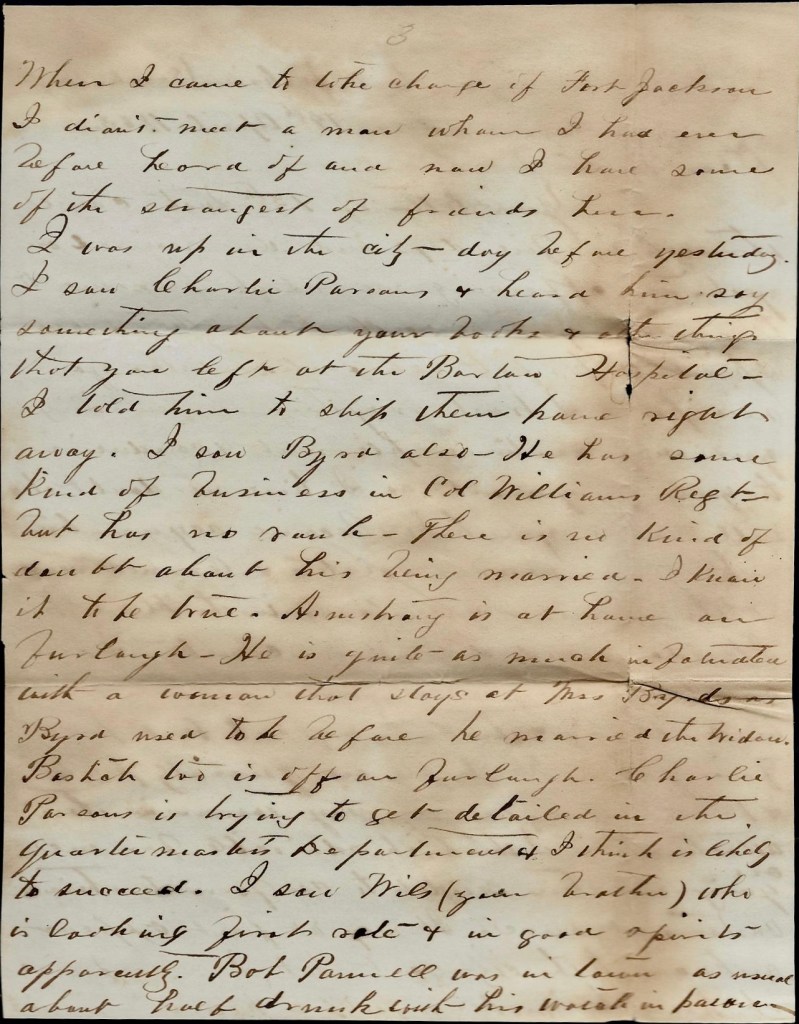
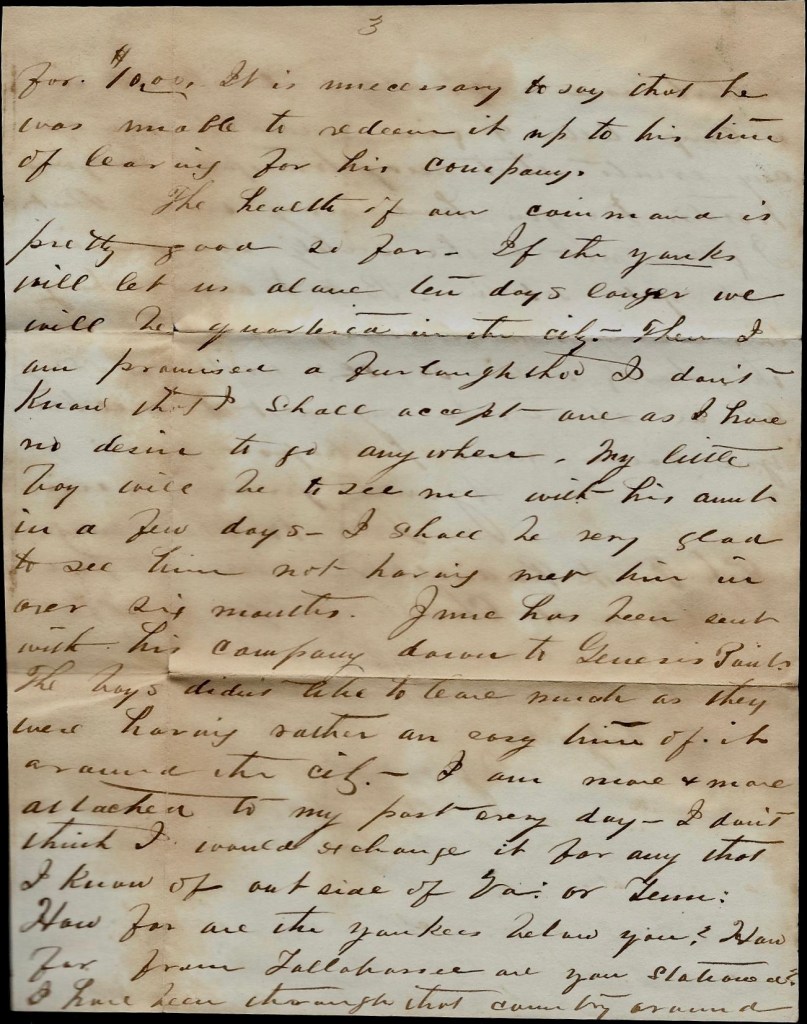
When I came to take charge of Fort Jackson, I didn’t meet a man whom I had ever before heard of and now I have some of the strongest of friends here. I was up in the city day before yesterday. I saw Charlie Parsons & heard him say something about your books & other things that you left at the Bartow Hospital. I told him to ship them home right away. I saw Byrd also. He has some kind of business in Col. Williams’ regiment but has no rank. There is no kind of doubt about his being married. I know it to be true. Armstrong is at home on furlough. He is quite as much infatuated with a woman that stays at Mrs. Byrds as Byrd used to be before he married the widow. Bastick too is off on furlough. Charlie Parsons is trying to get detailed in the Quartermaster’s Department & I think is likely to succeed. I saw Wils (your brother) 1 who is looking first rate & in good spirits apparently. Bob Parmell was in town as usual about half drunk with his watch in [ ] for $10.00. It is necessary to say that he was unable to redeem it up to his time of leaving for his company.
The health of our command is pretty good so far. If the Yanks will let us alone ten days longer, we will be quartered in the city. Then I am promised a furlough though I don’t know that I shall accept one as I have no desire to go anywhere. My little boy will be to see me with his aunt in a few days. I shall be very glad to see him, not having met him in over six months. June has been sent with his company down to Genesis Pauls. The boys didn’t like to leave much as they was having rather an easy time of it around the city.
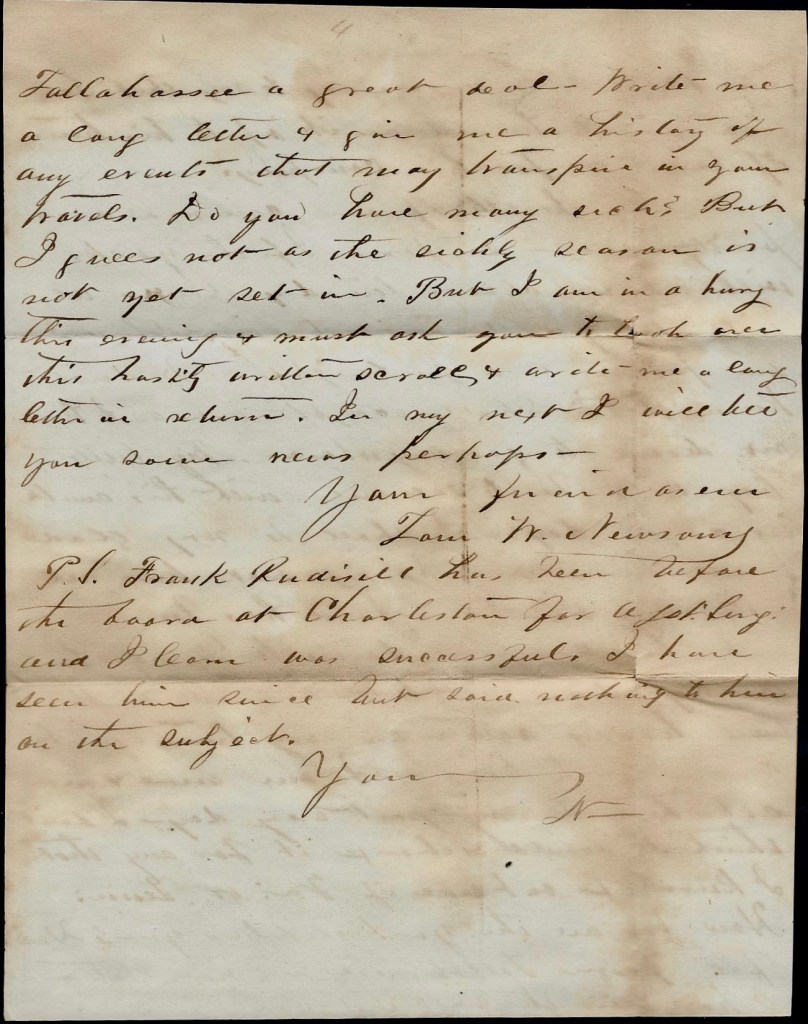
I am more and more attached to my post everyday. I don’t think I would exchange it for any that I know of outside of Virginia or Tennessee. How far are the Yankees below you? How far from Tallahassee are you stationed? I have been through that country around Tallahassee a great deal. Write me a long letter & give me a history of any events that may transpire in your travels.
Do you have many sick? But I guess not as the sickly season is not yet set in. But I am in a hurry this evening & must ask you to look over this hastily written scroll & write me a long letter in return. In my next I will tell you some news perhaps.
Your friend as ever, — Tom W. Newsome
P. S. Frank Rudisill 2 has been before the board at Charleston for Asst. Surgeon and I learn was successful. I have seen him since but said nothing to him on the subject. Yours, — N
1 Possibly W. T. Hollingsworth, a surgeon in the 3rd Georgia Infantry.
2 Probably Benjamin Franklin (“Frank”) Rudisill of the 12th Battalion George Light Artillery who served as staff assistant surgeon.
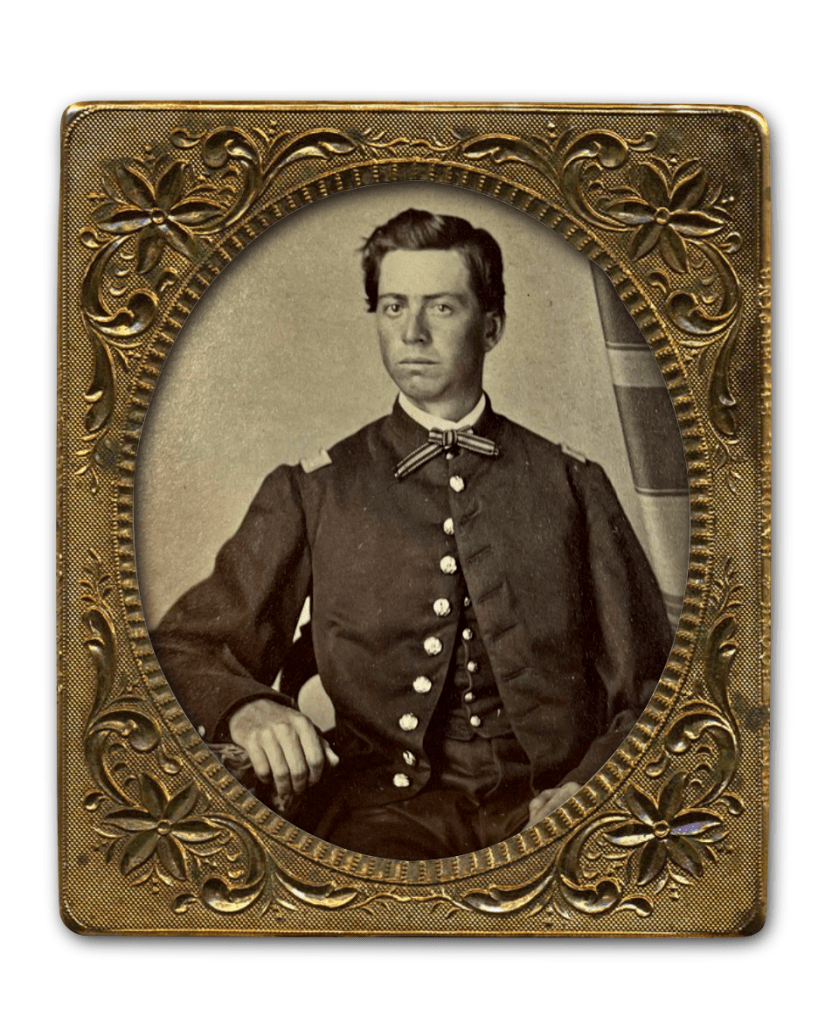
I could not find an image of William in uniform but here is one of Pvt. William B, Wheless of Co K, 24th North Carolina Infantry (Louis A. Wheless Collection)
The following letter was written by Pvt. Sidney T. Dixon (1840-1864) of Co. H, 24th North Carolina Infantry (formerly the 14th North Carolina Infantry). According to muster records, Sidney enlisted on 1 March 1862 for the duration of the war. He seems to have been present with the regiment most of the time until 21 May 1864 when he died at Chester Station from wounds received at Bermuda Hundred.
Sidney and his brother John C. Dixon (b. 1841)—who served in the same company, were the only sons of Thompson H. Dixon (1805-Bef1900) and Elizabeth Lucy Walters (1814-Bef1900) of Allensville, Person county, North Carolina. John Dixon enlisted in June 1861 (when the regiment was the 14th N. C.) and served until 28 February 1865 when he finally deserted. The other Dixon boys mentioned in the letter were probably cousins.
By the time of Sidney’s death in 1864, the regiment had seen action in the Seven Days Battles, the Maryland Campaign, the Battle of Fredericksburg, and the action around New Berne and Plymouth in North Carolina. Specifics are lacking as to where Sidney was wounded but it was likely in the Battle of Drewry’s Bluff in mid-May, 1864.
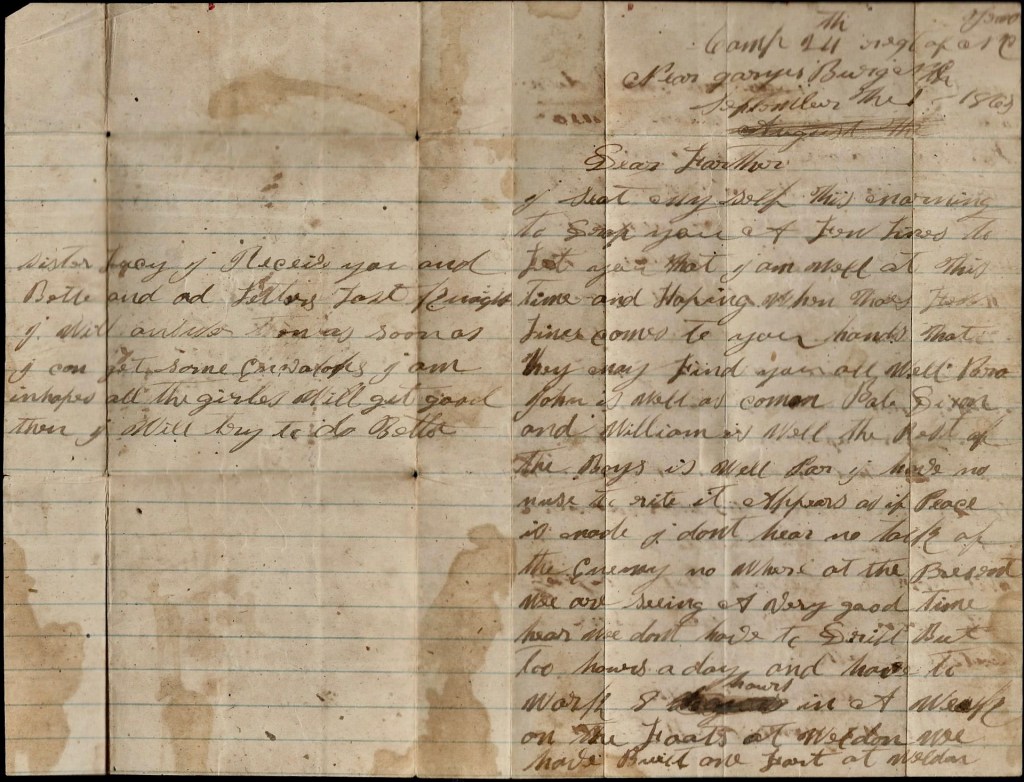
Transcription
Addressed to Mr. T. H. Dixon, Allensville P. O., Person county, North Carolina
Camp 24th Regt. of N. C. Near Garysburg, North Carolina September 1st 1863
Dear Father,
I seat myself this morning to drop you a few lines to let you [know] that I am well at this time and hoping when these few lines comes to hand, that they may find you all well. Bro. John is well as common. Bob Dixon and William is well. The rest of the boys is well.
Par, I have no news to write. It appears as if peace is made. I don’t hear no talk of the enemy no where at the present.
We are seeing a very good time here. We don’t have to drill but two hours a day and have to work 8 hours in a week on the forts at Weldon. We have built one fort at Weldon and got another one most done. We have very cool weather here for the season.
Par, let as many hold up for Old Holden 1 as will, but don’t you never let no such a set turn you to be a Holdenite for there is not a smart man in our army that would take up for him. It is true, there is a great many that hold up for him, but what sort of men are they? They are ones that has been a disadvantage to us ever since the war commenced.
So as I have no more to write, I will come to a close by saying write soon. As ever your son until death, — Sidney T. Dixon
To Mr. Thompson H. Dixon
Sister Lucy, I received yours and Bette’s letters last night. I will answer them as soon as I can get some envelopes. I am in hopes all the girls will get good. Then I will try and do better.
1 “Old Holden” is a reference to William Woods Holden (1818-1892)—a newspaper editor who used the press to criticize the Confederate government and by 1862, to rally support for a peace movement in North Carolina. He ran for the Governor’s seat in 1862 but failed.
I could not find an image of Samuel but here is one of William Needham who served in the same company and was from the same home town.Needham was promoted to a Lieutenant in 1863.
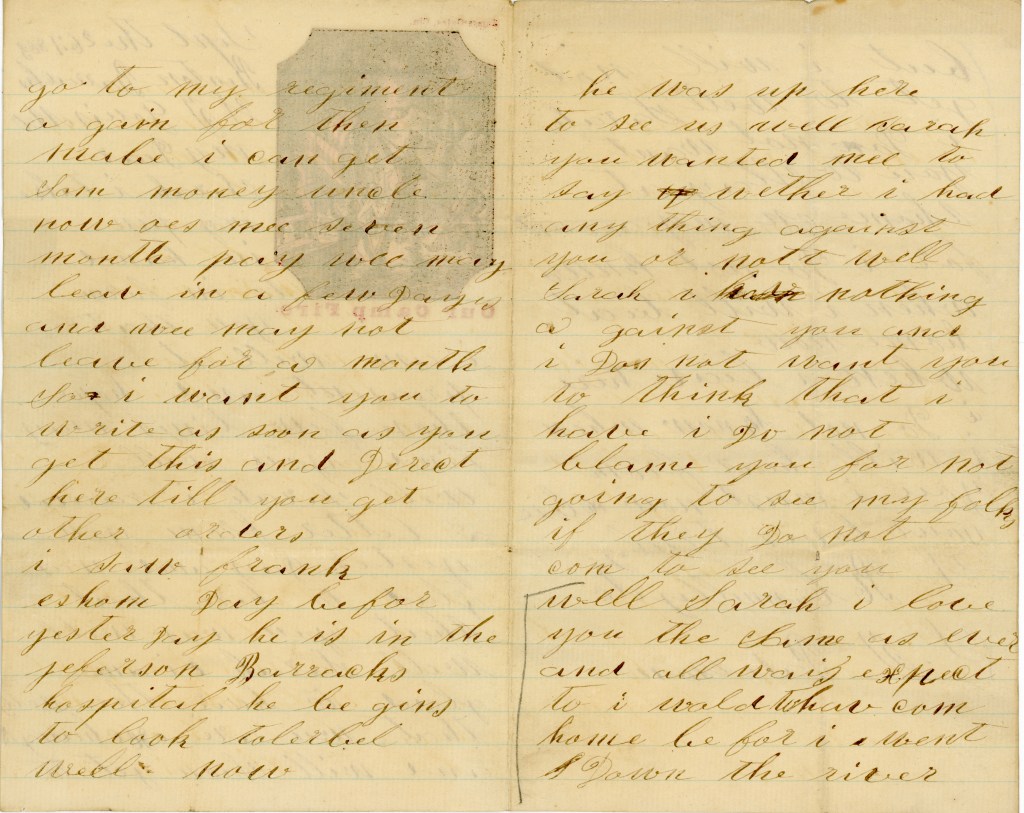
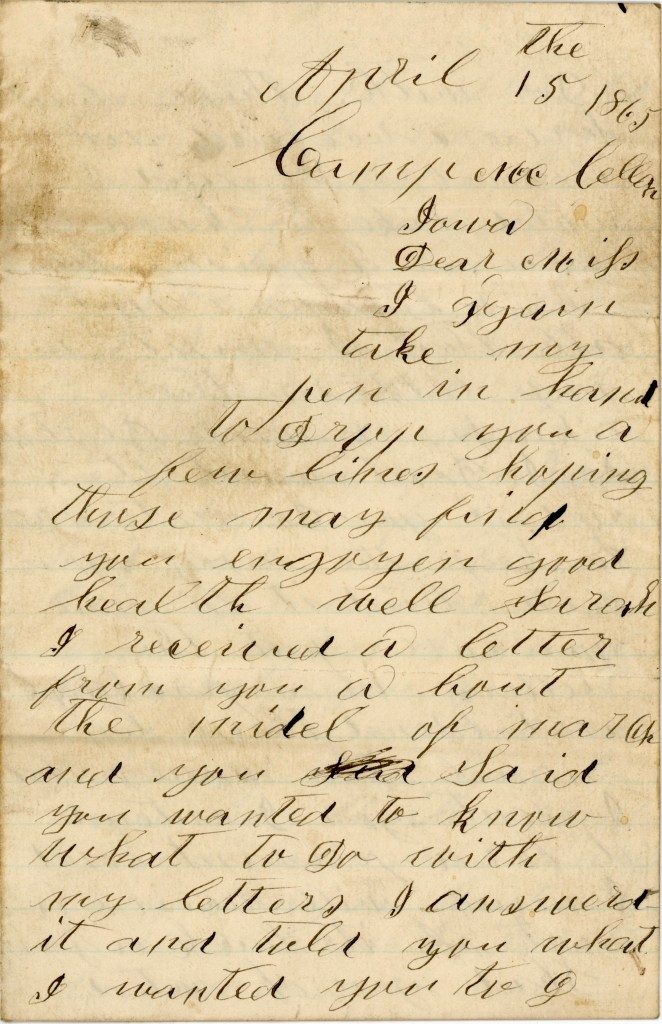
These letters were written by Samuel Connelly (1839-1918) of Co. D, 22nd Iowa Infantry. [He is identified as “Samuel B. Conley” in the muster rolls of the regiment.]
Samuel was the son of William Connelly (1812-1864) and Louisa Kilmer (1812-1847) of Cedar, Monroe county, Iowa. He wrote all of these letters to his girlfriend Sarah T. Patterson (1836-1908), the daughter of Samuel Patterson (1810-1887) and Malissa Mathews (1813-1880) of Albia, Monroe county, Iowa. But the correspondents did not “join hands for life” as Samuel expressed in his letter of 12 July 1864. From the letters we learn that their relationship ended by early 1865 and census records inform us that Sarah never married; she died “single” in 1908 and was buried at Lovilia. Samuel, however, took Paulina Odell Cross (1843-1937) as his wife in November 1866.
Samuel enlisted in the 22nd Iowa in August 1862 and spent the early part of his time in the service in southern Missouri.. During the Vicksburg Campaign in 1863 he was captured on 22 May and briefly held at Jefferson Barracks in St. Louis until they he and the other prisoners were exchanged. Later in the war he was wounded at the Battle of Cedar Creek in Virginia on 19 October 1864 and he mustered out at Savannah on 25 July 1865.
[Note: These letters are from the personal collection of Michael Huston and were transcribed and published on Spared & Shared by express consent.]
Letter 1
Camp near Rolla, MO December 24, 1862
Dear Sarah,
I take my pen in hand to inform you that I am well at present and hope that these few lines ay find you all well. I can almost speak now. I had an easy time of it I think that I can talk in a few days.
Capt. Wilson has not got here yet. I think that we will have a dry Christmas. We have very pretty weather here now. I guess that we will stay here all winter. I would like to be at home tomorrow.
Well, Sarah, I thank you very much for your kindness in sending me what you are a going to send. If you send them by captain, it will be alright. I will be sure to get them. All that I have to do is to walk about camp and eat. We have lost but four men out of our regiment by death yet.
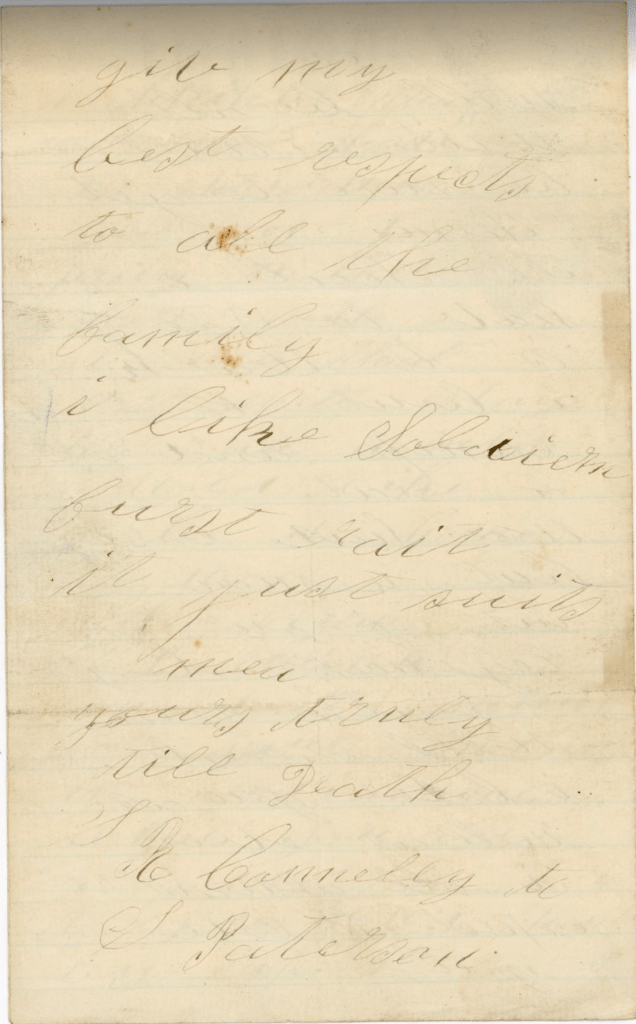
Well, Sarah, I love you as well as ever. I always expect to love you. Give my best respects to all the family. I like soldiering first rate. It just suits me.
Yours truly till death, — S. R. Connelly
To S. Patterson
Letter 2
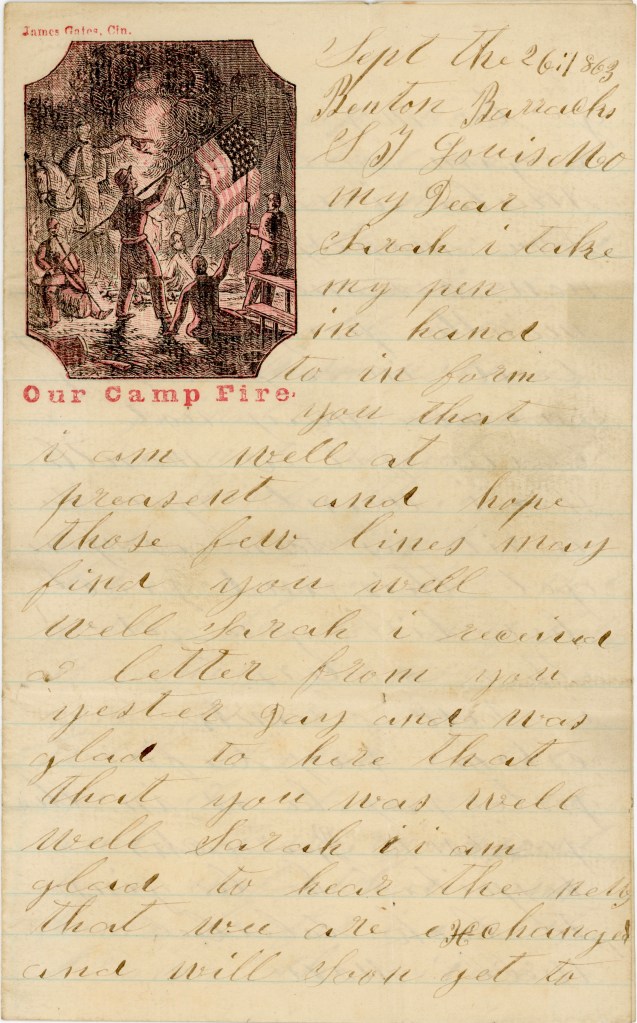
Benton Barracks St. Louis, MO. September 26, 1863
My Dear Sarah,
I take my pen in hand to inform you that I am well at present and hope these few lines may fid you well.
Well, Sarah, I received a letter from you yesterday and was glad to hear that you was well. Well, Sarah, I am glad to hear the news that we are exchanged and will soon get to go to my regiment again for then maybe I can get some money. Uncle [Sam] now owes me seven month’s pay. We may leave in a few days and we may not leave for a month so I want you to write as soon as you get this and direct here till you get other orders.
I saw Frank Eshom [Isham] day before yesterday. He is in the Jefferson Barracks Hospital. He begins to look tolerable well now. He was up here to see us.
Well, Sarah, you wanted me to say whether I had anything against you or not. Well, Sarah, I have nothing against you and I do not want you to think that I have. I do not blame you for not going to see my folks if they do not come to see you.
Well, Sarah, I love you the same as ever and always expect to. I would [like] to have come home before I went down the river but I will not get to.
Well, Sarah, I do not want you to stay at home on my account for I do not know when I will be at home now. When I leave here, I do not know when I will hear from you. I must now close. Your lover truly, — S. R. Connelly
to S. T. Patterson
Letter 3
Camp at Algiers, Louisiana July 12th 1864
Dear Sarah,
It is with pleasure that I take my pen in hand to drop you a few lines to inform you that I am well at his time and hope these few lines may find you enjoying good health.
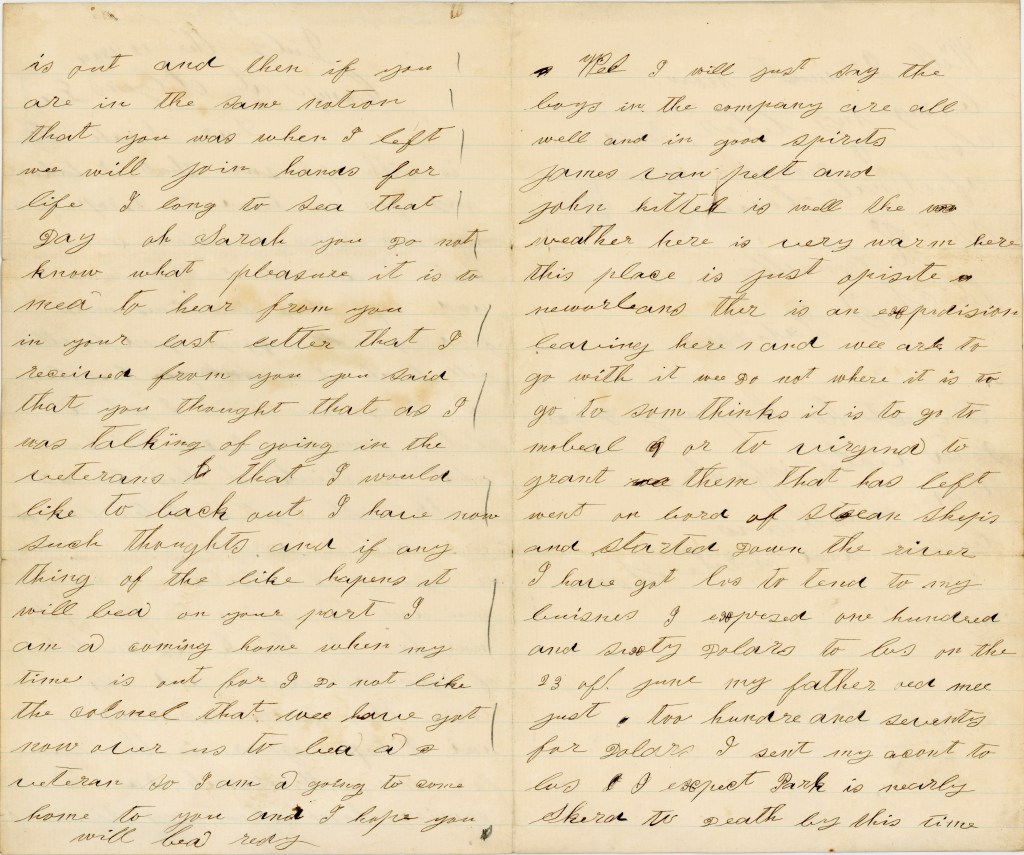
Well, Sarah, it has been a long time since I got a letter from you. I do not know what to think. It has been two months since I got a letter from you although [I have] written two or three to you. Well, Sarah, I hope you ain’t a going to forget me for I think as much of you as ever and my love [is] the same as ever and I hope yours is the same for me. I am a coming home when my time is out and then if you are in the same notion that you was when I left, we will join hands for life. I long to see that day. Oh, Sarah, you do not know what pleasure it is to me to hear from you.
In your last letter that I received from you, you said that you thought that as I was talking of going in the veteran’s [service] that I would like to back out [of our wedding plans]. I have no such thoughts and if anything of the like happens, it will be on your part. I am a coming home when my time is out for I do not like the Colonel that we have got now over us to be a veteran, so I am a doing to come home to you and I hope you will be ready.
Well, I will just say the boys in the company are all well and in good spirits. James Van Pelt and John Hittel is well. The weather here is very warm. This place is just opposite New Orleans.
There is an expedition leaving here and we are to go with it. We do not [know] where it is to go to. Some thinks it is to go to Mobile or to Virginia to Grant. Them that has left went on board of steamships and started down the river. 1
I have got Cuz to tend to my business. I expressed one hundred and sixty dollars to Cuz on the 23rd of June. My father owed me just two hundred and seventy-four dollars. I sent my account to Cuz.
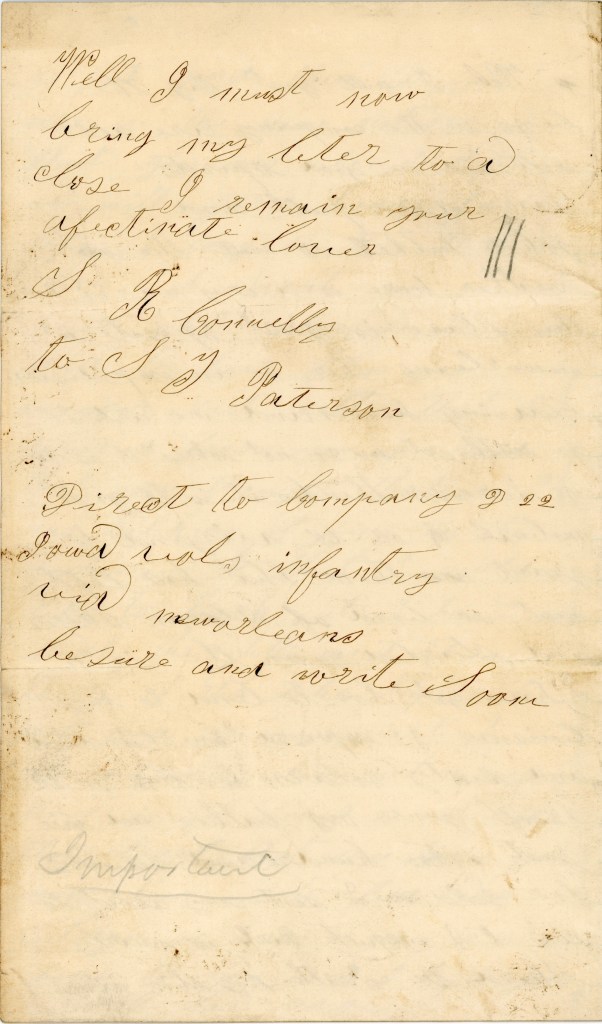
I expect Park is nearly scared to death by this time. Well, I must now bring my letter to a close. I remain your affectionate lover, — S. R. Connelly
to S. T. Patterson
Direct to Company D, 22nd Iowa Vols. Infantry via New Orleans. Be sure and write soon.
1The 13th Army Corps having been temporarily discontinued by the War Department, the 22nd Iowa was ordered to report to General Reynolds at New Orleans, was conveyed to that place on July 6th and went into camp at Algiers. The regiment was there assigned to the Second Brigade of the Second Division, 19th Army Corps, composed of the 101st and 159th New York, 13th Connecticut,3rd Massachusetts Cavalry, 22nd Iowa and 11th Indiana. The brigade was commanded by Colonel E. L. Molineaux, of the 159th New York. The 19th Corps, as reorganized, comprised three divisions. The first, General Dwight’s, was composed of eastern troops exclusively; the second, General Grover’s, had five western regiments and the remainder were eastern troops; the third, General Lawler’s, was composed entirely of western troops. The first and second divisions having been ordered to report to Washington D. C., the 22nd Iowa, with the 131st and 159th New York, embarked, on the 17th of July, on the steamer “Cahawba,” and arrived at Fortress Monroe on the 24th, after a voyage void of incident. On the 25th the ship proceeded up the James River to Bermuda Hundreds Landing, where the troops disembarked and, after marching seven miles, joined the forces under General Butler. These three regiments were separated from the division to which they had been assigned, the other portion of it having gone direct to Washington. They were temporarily attached to General Terry’s division of General Birny’s corps and placed on duty in the trenches, extending across the peninsula from the James River to Appomattox occupying a portion of the line in General Butler’s front until July 31st, when orders were received to report at Washington. The troops marched to Bermuda Hundreds Landing, where they embarked on transports, proceeded down the river to Fortress Monroe and from there up the Potomac to Washington, where they arrived on August 1st and disembarked. [From Regimental history]
Letter 4
Davenport, Iowa January 15th 1865
Dear Miss,
It is with pleasure that I take my pen in hand to inform you that I am well and hope these few lines may find you enjoying one of God’s greatest blessings—good health.
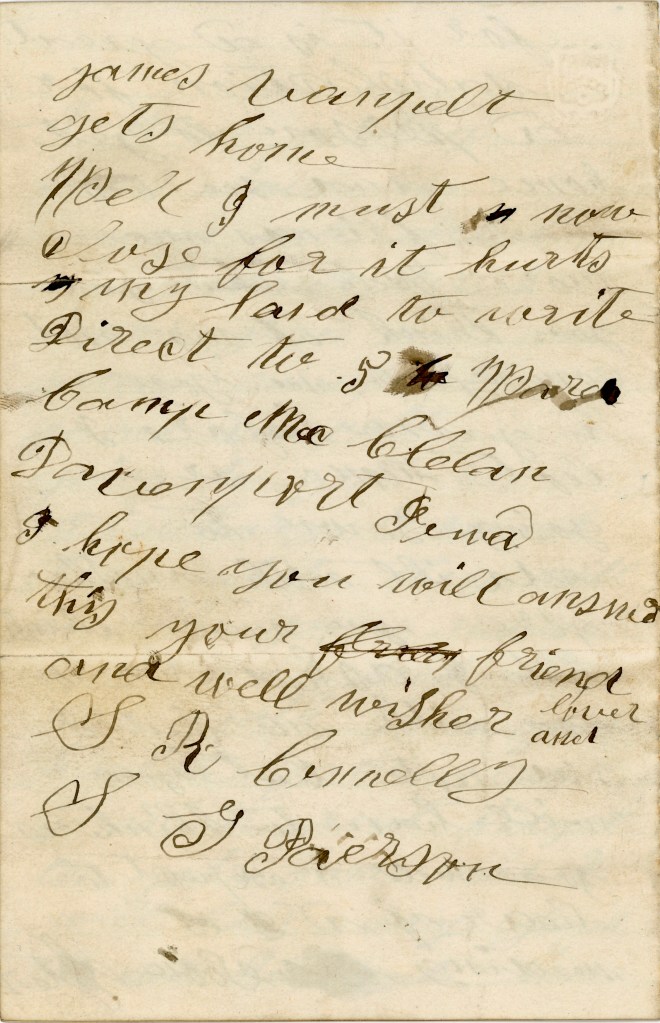
Dear Miss, I do not want you to think hard of me for not writing sooner for this is about the first letter that I have written since I have been wounded. Well, Sarah, when I arrived here, I found James Moore 1 and James Van Pelt. 2 James Van Pelt is a going to get his discharge. I do not know what they will do with James Moore and myself. They are both in good health. James Van Pelt is in a great fidget to get home and I will be very glad to see him get home for it is a great satisfaction for a person to get home and see their friends once more.
Well, what did you think of my not coming to see you again before I left home or going down to Eddyville with another girl. You may think that I asked her to go with me but I did not. But you will have to think as you will. I expect to hear of a wedding soon after James Van Pelt gets home.
Well, I must now close for it hurts my hand to write. Direct to 5th Ward, Camp McClellan, Davenport, Iowa. I hope you will answer this. Your fried and well wisher and lover, — S. R. Connelly
to S. T. Patterson
1Moore, James J. Age 19. Residence Albia, nativity Indiana. Enlisted Aug. 2, 1862. Mustered Aug. 27, 1862. Wounded May 21, 1863, Port Gibson, Miss. Wounded severely Oct. 19, 1864, Cedar Creek, Va. Discharged June 8, 1865.
2Vanpelt, James N. Age 26. Residence Albia, nativity Ohio. Enlisted July 26, 1862. Mustered Aug. 27, 1862. Wounded severely Sept. 19, 1864, Winchester, Va. Discharged for wounds Jan. 30, 1865, Davenport, Iowa.
Letter 5
Camp McClellan [Davenport, Iowa] April 15, 1865
Dear Miss,
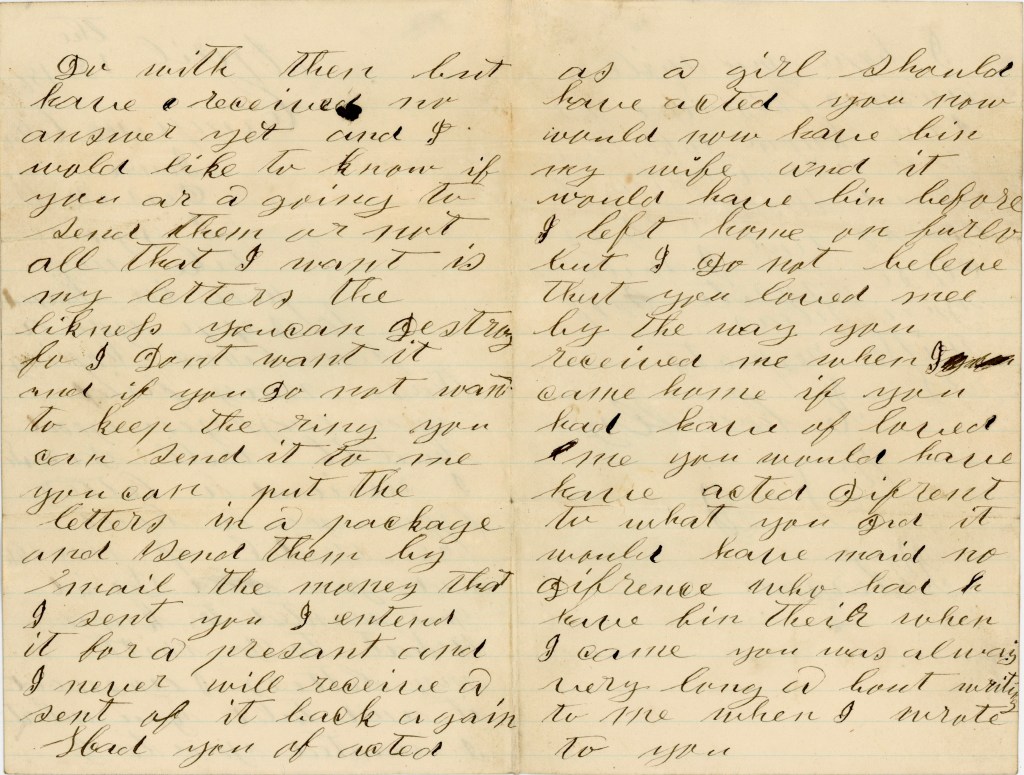
I again take my pen in hand to drop you a few lines hoping these may find you enjoying good health. Well, Sarah, I received a letter from you about the middle of March and you said you wanted to know what to do with my letters. I answered it and told you what I wanted you to do with them but have received no answer yet and I would like to know if you are a going to send them or not. All that I want is my letters. The likeness you can destroy for I don’t want it. And if you do not want to keep the ring, you can send it to me. You can put the letters in a package and send them by mail. the money that I sent you I intend it for a present and I never will receive a cent of it back again.
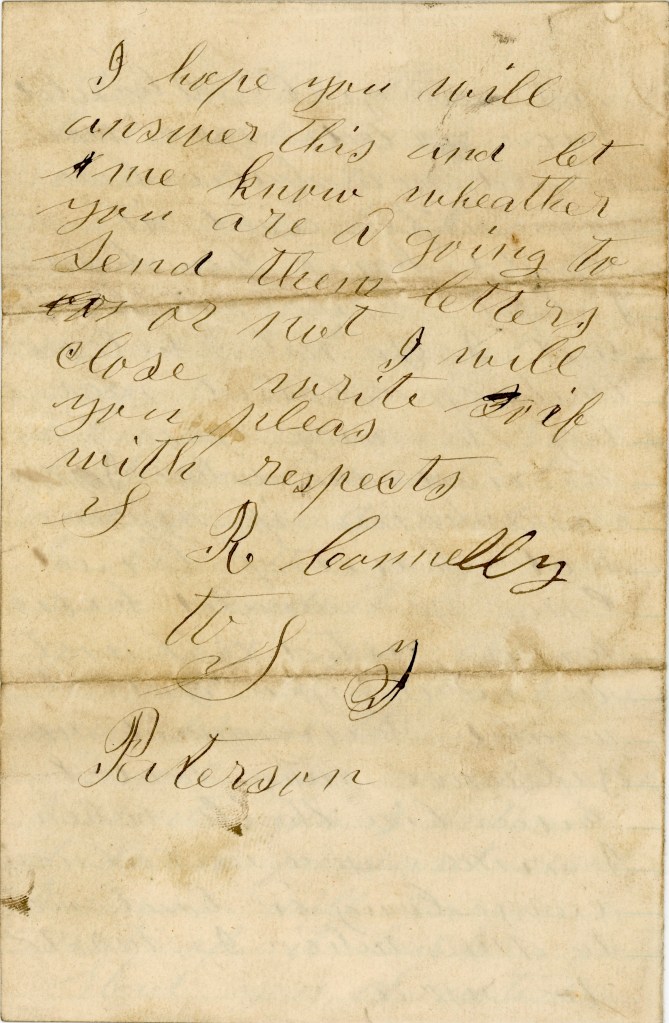
[If you] had of acted as a girl should have acted, you would now have been my wife and it would have been before I left home on furlough, but I do not believe that you loved me by the way you received me when I came home. If you had of loved me, you would have acted different to what you did. It would have made no difference who had have been there when I came. You was always very long about writing to me when I wrote to you.
I hope you will answer this and let me know whether you are a going to send them letters or not. I will close. Write soon if you please. With respects, — S. R. Connelly
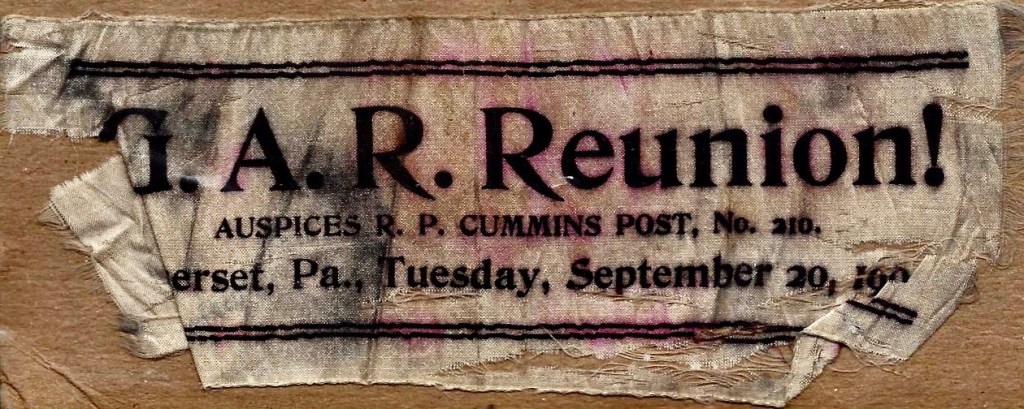
This letter was written by 28 year-old Pvt. John H. Lepley (1837-1919) of Co. G, 61st Pennsylvania Infantry. John did not put on the uniform until 26 September 1864 when he mustered into the regiment and he was discharged on 20 June 1865 after only 9 months service.
I could not find an image of John but here is a CDV of Louis D. Caron of Co. G, 61st Pennsylvania Infantry.
John was the son of Valentine Lepley (1803-1894) and Lydia Elizabeth Beal (1801-1841) of Southampton, Somerset county, Pennsylvania. In December 1861, he married 19 year-old Susana Eiber (1842-1925) and the couple would eventually have at least eleven children but only the the first two were born by the time this letter was written in June 1865. Agnes (“Aggy”) was born on 5 December 1862, and Ida Catharine (“that other little gal” whom he had not yet seen) was born on 20 March 1865.
During John’s term of service, the 61st Pennsylvania was attached to the Army of the Shenandoah during which time he must have participated in the Battle of Cedar Creek. They were then sent to the Army of the Potomac and joined Grant’s forces around Petersburg, Virginia. Following the surrender of Lee’s army at Appomattox, the 61st Pennsylvania marched to Danville where they remained until 23 May and then began the long march back to Washington D. C. by way of Richmond and Fredericksburg in time for the Grand Review on June 8th.
A GAR Reunion Ribbon kept by John Lepley
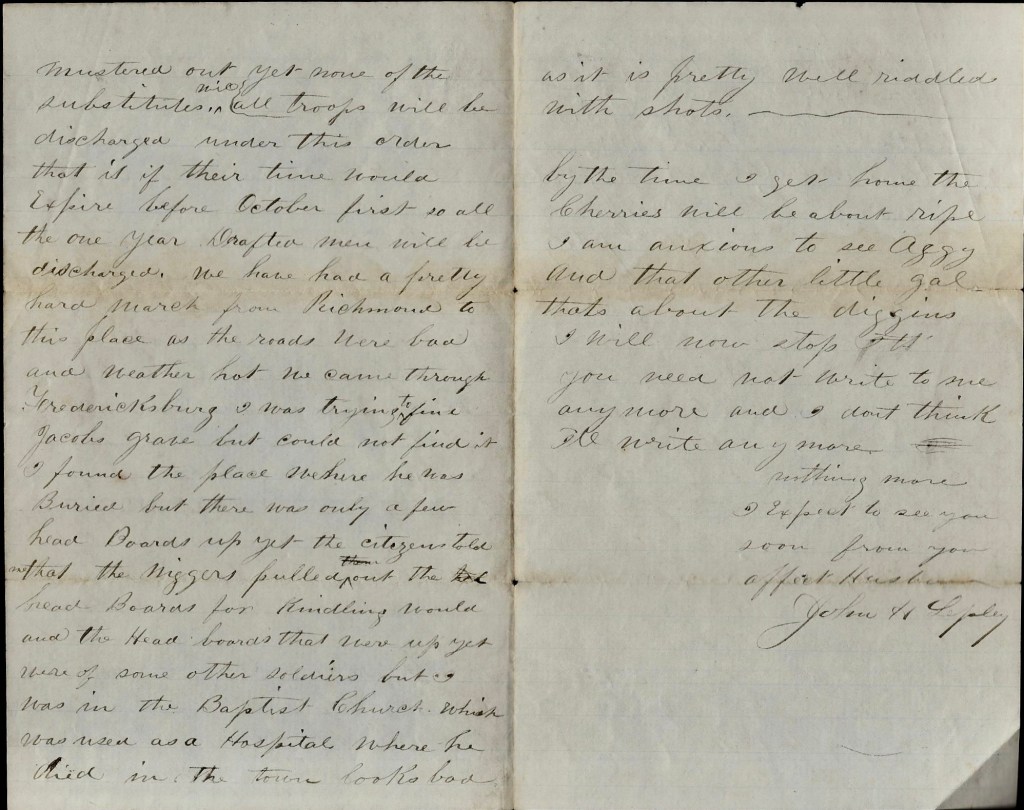
Transcription
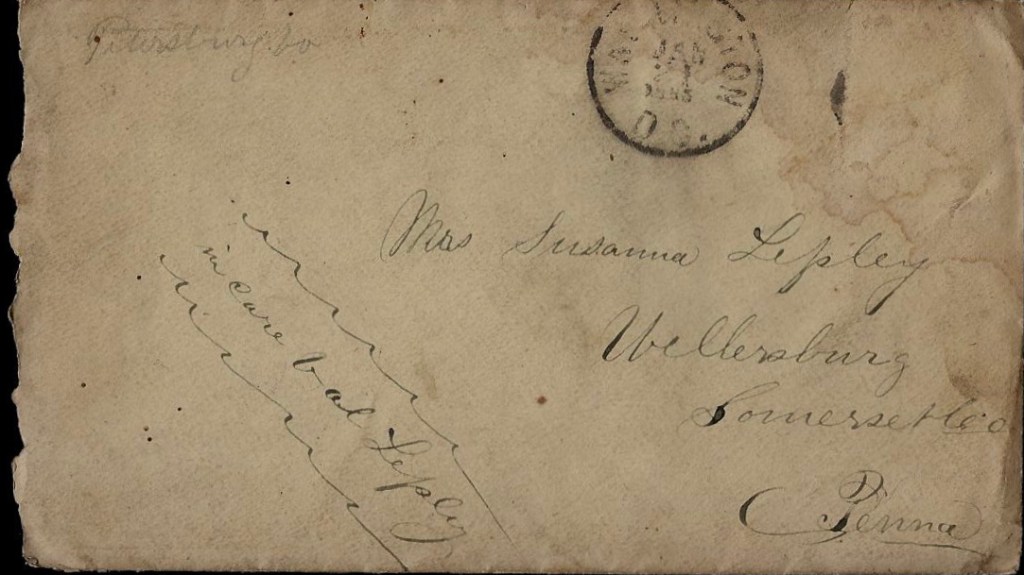
Addressed to Mrs. Susanna Lepley, Wellersburg, Somerset county, Pennsylvania
Camp near Washington City June 7, 1865
Dear Wife,
I will once more write to you although I haven’t received any letters from you for a month. The last I received was dated 5th of May and that I got while at Danville, Illinois. Well, you don’t need to write anymore as I will be home in a short time now. Tomorrow there will be a Grand Review of our Corps and after that is over we expect to go as they have made out our muster rolls already.
Joe, I suppose, is home by this time. I seen Gust Dow the other day. He looks well. He thinks they will be discharged before long. Crist Lepley won’t be mustered out yet. None of the substitutes will. All troops will be discharged under this order—that is, if their time would expire before October first, so all the one year drafted men will be discharged.
We have had a pretty hard march from Richmond to this place as the roads were bad and weather hot. We came through Fredericksburg. I was trying to find [my brother] Jacob’s grave but could not find it. 1 I found the place where he was buried but there was only a few head boards up yet. The citizens told me that the niggers pulled out the headboards for kindling wood and the headboards that were up yet were of some other soldiers. But I was in the Baptist Church which was used as a hospital where he died in. The town looks bad as it is pretty well riddled with shots.
By the time I get home, the cherries will be about ripe. I am anxious to see Aggy and that other little gal that’s about the diggins. I will now stop. you need not write to me any more and I don’t think I’ll write anymore.
Nothing more. I expect to see you soon. From your affectionate husband, — John H. Lepley
I didn’t get my letter off as soon as I had it wrote. The Review is over and we are waiting to be mustered out. I had a letter from Dan. He is at Baltimore, Maryland. It is very hot here now. Your husband, — J. H. Lepley
1 Jacob B. Lepley (1839-1864) was the 1st Sergeant of Co. F, 142nd Pennsylvania Infantry when he was mortally wounded during the Battle of the fighting in the Wilderness on 5 May 1864. He died in the Baptist Church in Fredericksburg on 24 May 1864. John does not indicate which of the Baptist churches that his brother died in but it is known that the Shiloh Baptist Church (used exclusively by a Black congregation after 1855) near the banks of the Rappahanock River was used as a hospital by Union troops during the war.
The Shiloh Baptist Church is the building about a third of the way from the right edge of the photo. It’s the relatively large two-story building just above the sloping bank of the river. (1863)
These letters were written by James William Denver (1817-1892), the son of Irish emigrant Patrick Denver, Jr. (1787-1858) and Jane Campbell (1794-1874) who lived in Winchester, Virginia, at the time of James’ birth but settled on a farm near Wilmington, Clinton county, Ohio, in the 1830s. Denver studied civil engineering, briefly taught school in Missouri, and then studied the law, graduating from the Cincinnati Law School in 1844. He practiced briefly in Xenia, Ohio, also purchasing and editing a newspaper, the Thomas Jefferson. In 1845, Denver returned to Missouri, where he practiced law at Platte City. In March 1847, he organized Co. H of Missouri’s Twelfth Infantry Regiment, serving as captain until the close of the Mexican War in July 1848.
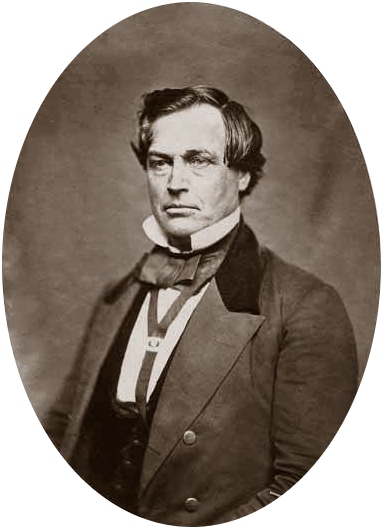
James William Denver (1850s)
Not long after the war, Denver moved to California. He was elected to the State Senate in 1851 and appointed California State Secretary in 1852. In 1855, he was elected as a Democrat to the 34th US Congress as a representative from California, serving from March 4, 1855 – March 3, 1857. He was not a candidate for renomination in 1856. Rather, he returned to Ohio where he married Louise Catherine Romback in 1856 and not long after, on 17 April 1857, President James Buchanan appointed him as Commissioner of Indian Affairs.
On June 17, 1857, Denver was appointed by Buchanan as Secretary of the Kansas Territory. In December 1857 he was appointed as Territorial Governor. On the day that Denver assumed the territorial governorship, citizens in the territory voted on the Lecompton Constitution, which opened the territory to slavery. The vote offered a choice only between full slavery and limited slavery in the territory and was thus largely boycotted by Free-Staters who were in favor of abolishing slavery. The pro-slavery constitution passed by an overwhelming margin. Later it was discovered that several thousand votes were cast fraudulently by “Border Ruffians” who had crossed into the territory from Missouri in order to cast pro-slavery ballots (The vote was overturned by a subsequent election in August 1858, and Kansas was later admitted to the Union, in 1861, as a free state. See Bleeding Kansas for details.).
In November 1858, while Denver was still serving as territorial governor, William Larimer, Jr., a land speculator from Leavenworth, planted the townsite of “Denver City” along the South Platte River in Arapaho County in western Kansas Territory (the present-day state of Colorado). Larimer chose the name “Denver” to honor the current territorial governor with the intention that the city would be chosen as the county seat of Arapaho County.
Denver retired as territorial governor in November 1858 and was reappointed Commissioner of Indian Affairs, serving until his resignation on March 31, 1859.
A few months after the start of the American Civil War in early 1861, President Abraham Lincoln commissioned Denver a brigadier general in the volunteer army on August 14. In November 1861, he was ordered to report to Fort Scott in Kansas and in December, he assumed command of all Federal troops in Kansas. During March and April 1862 he commanded the District of Kansas until he was transferred to the District of West Tennessee. On May 16, 1862, Denver assumed command of the 3rd Brigade/5th Division under Maj. Gen. William T. Sherman in the midst of the Siege of Corinth. The very next day Denver’s brigade participated in the fight for Russell’s House. Though his brigade suffered no casualties in this engagement it was nonetheless one of the two brigades leading the attack. On May 27 General Sherman again selected Denver’s brigade to be one of the leading units in an attack against the Double Log House. Denver and Morgan L. Smith’s brigade successfully stormed the log cabin turned block house. During this engagement Major General Ulysses S. Grant was present on the battlefield and indicated his approval of the handsome manner in which the troops behaved. After the fall of Corinth Denver continued in command of his brigade, serving on garrison duty in Mississippi. During the early stages of the Vicksburg Campaign Denver was in command of the 1st Division, XVI Corps, until his resignation from the Union Army on March 5, 1863.”
Letter 1
This letter was written just nine days after President James Buchanan appointed Denver as Commissioner of Indian Affairs.
Addressed to Mrs. L. C. [Louise Catherine] Denver, Wilmington, Ohio
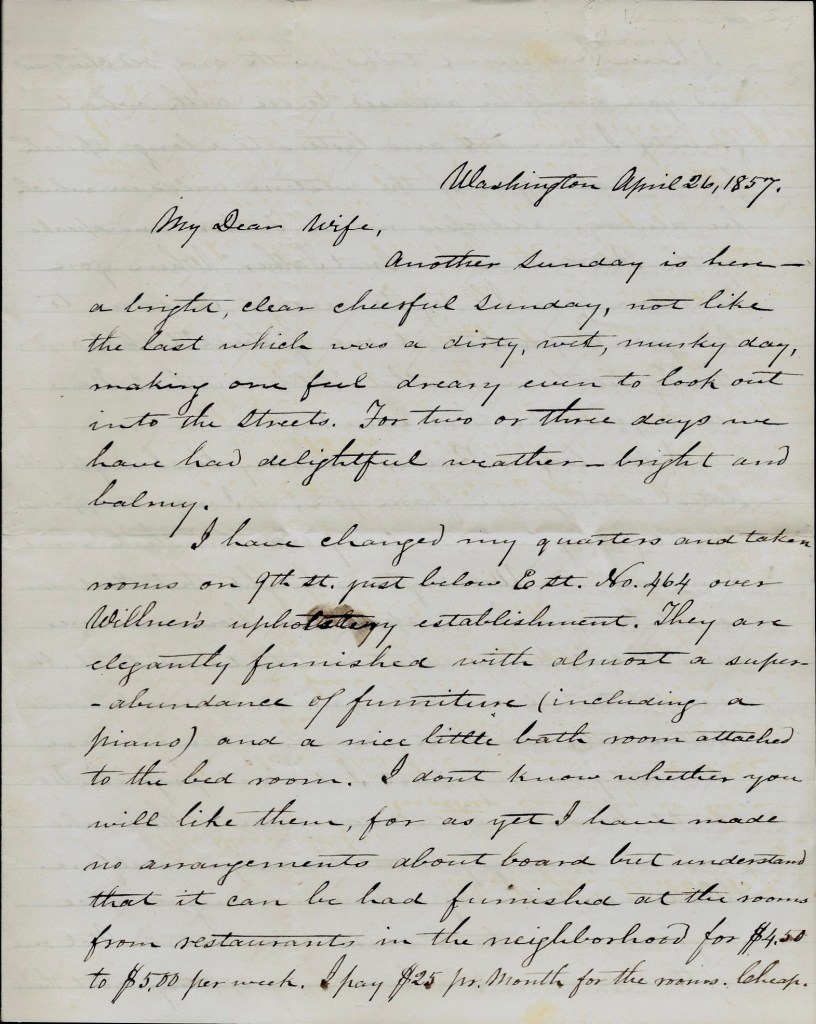
Washington April 26, 1857
My Dear Wife,
Another Sunday is here—a bright, clear, cheerful Sunday, not like the last which was a dirty, wet, murky day, making one feel dreary even to look out into the streets. For two or three days we have had delightful weather—bright and balmy.
I have changed my quarters and taken rooms on 9th Street just below E Street—No. 464—over Willner’s upholstery establishment. They are elegantly furnished with almost a superabundance of furniture (including a piano) and a nice little bath room attached to the bed room. I don’t know whether you will like them, for as yet I have made no arrangements about board but understand that it can be had furnished at the rooms from restaurants in the neighborhood for $4.50 to $5.00 per week. I pay $25 per month for the rooms. Cheap.
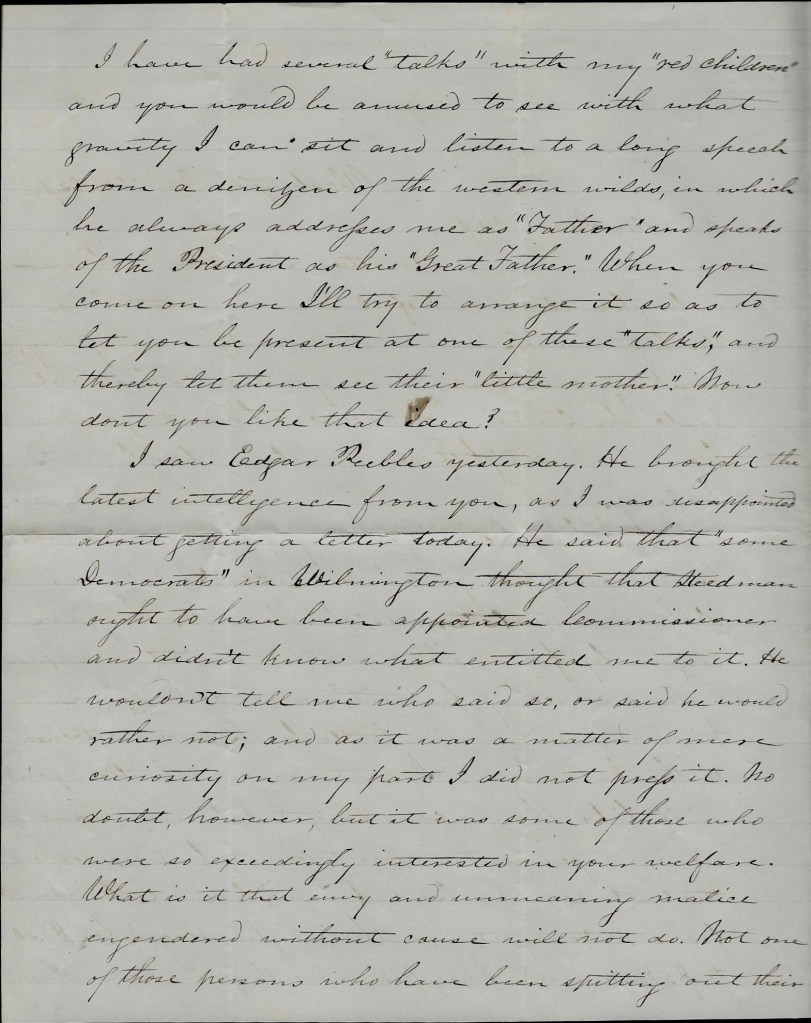
I have had several “talks” with my “red children” and you would be amused to see with what gravity I can sit and listen to a long speech from a denizen of the western wilds in which he always addresses me as “Father” and speaks of the President of the United States as his “Great Father.” When you come on here I’ll try to arrange it so as to let you be present at one of these “talks,” and thereby let them see their “little mother.” Now don’t you like that idea?
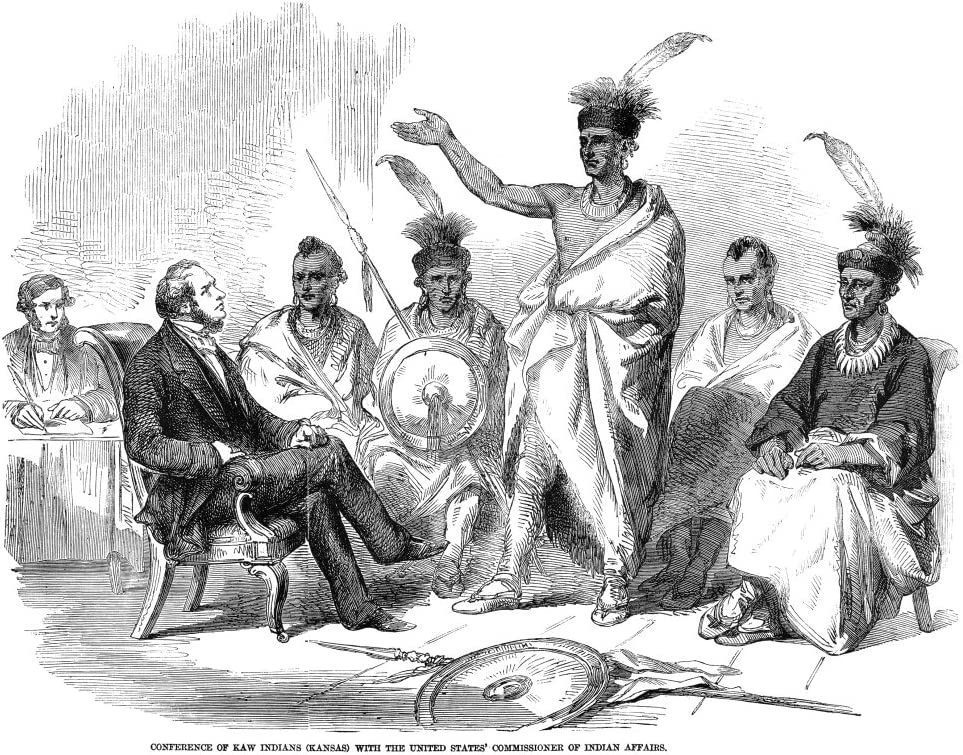
Delegation Of Kaw (Kansas) Native Americans At Conference With The Commissioner Of Indian Affairs George W. Manypenny Under President James Buchanan At Washington DC March 1857—just weeks before Denver became the Commissioner.
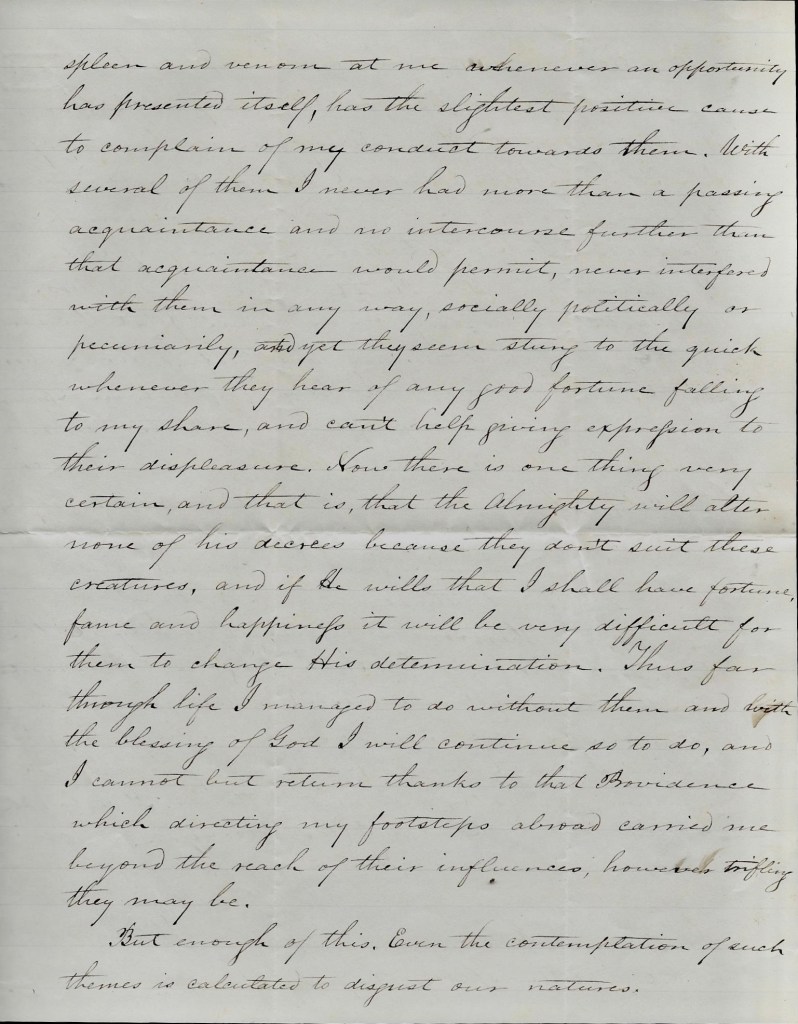
I saw Edgar Peebles yesterday. He brought the latest intelligence from you, as I was disappointed about getting a letter today. He said that “some Democrats” in Wilmington [Ohio] thought that [James] Steedman 1 ought to have been appointed Commissioner [of Indian Affairs] and didn’t know what entitled me to it. He wouldn’t tell me who said so, or said he would rather not; and as it was a matter of mere curiosity on my part, I did not press it. No doubt, however, but it was some of those who were so exceedingly interested in your welfare. What is it that envy and unmeaning malice engendered without cause will not do. Not one of those persons who have been spitting out their spleen and venom at me whenever an opportunity has presented itself, has the slightest positive cause to complain of my conduct towards them. With several of them I never had more than a passing acquaintance and no intercourse further than that acquaintance would permit, never interfered with them in any way, socially, politically, or pecuniarily, and yet they seem stung to the quick whenever they hear of any good fortune falling to my share, and can’t help giving expression to their displeasure. Now there is one thing very certain, and that is that the Almighty will alter none of His decrees because they don’t suit these creatures, and if He wills that I shall have fortune, fame and happiness, it will be very difficult for them to change His determination. Thus far through life I managed to do without them and with the blessing of God, I will continue so to do, and I cannot but return thanks to that Providence which directing my footsteps abroad carried me beyond the reach of their influences, however trifling they may be.
But enough of this. Even the contemplation of such themes is calculated to disgust our natures.
Miss [Jennie] Holman is still here but expects to leave on the 1st prox. for Texas in company with Com[mander Edwin Ward] Moore, late of the [Republic of] Texas Navy, an old friend of her father’s. Her Campbell speculation [romance] is understood to have bursted up and vanished in smoke. She seems to have taken a fancy of late to the handsome Gen. Rust of California.
Mr. and Mrs. Walworth are holding on as usual. Just the same—half laughing, half sneering, dissatisfied air, on her part, and the chuckling laugh, uncertain expression, and semi-genteel language on his part. Mr. and Mrs. Fuller are as usual. She has been all over the City to find rooms but can’t please herself & he doubts whether it is better to —-“give up present ills and fly to those we wot not of” 2 or not, and therefore is inclined to stay at the Kirkwood. Your friend Ross Fish has gone to Minnesota. Gen. Anderson (Von Alderson) is here and has been very kind and clever, as know he always is.
Well, I must wind up. Give my love to all relatives, and do try and write oftener. It is horrible to be so long without a letter from you. Believe me as ever your own, — Will
Mad Lupton & J. Campbell will be out West this spring, they say. Doubtful.
1 James Steedman was an Ohio businessman, editor and politician who, like Denver, sought a political patronage job from the Buchanan Administration. He was given the post of Public Printer of the United States instead of Commissioner of Indian Affairs.
2 Denver has paraphrased a line from Hamlet, Act 3, Scene 1 which reads: “And makes us rather bear those ills we have Than fly to others that we know not of?”
Native American (Ponca, Pawnee, Potawatomi, and Sac & Fox) men pose with white men near the White House in Washington, D. C. The Native American men wear leggings, blankets, bead necklaces, fur pelts, hats, feather roaches, and headdresses. 31 December 1857 (Digital Collections, Denver Public Library)
Letter 2
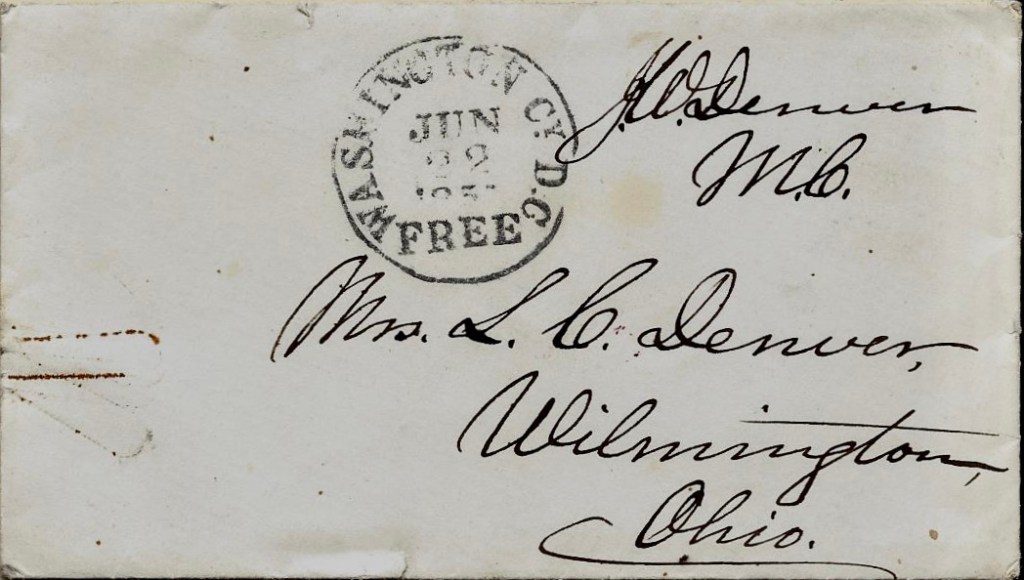
Addressed to Mrs. L. C. Denver, Wilmington, Ohio
Washington May 3rd 1857
My Dear Wife,
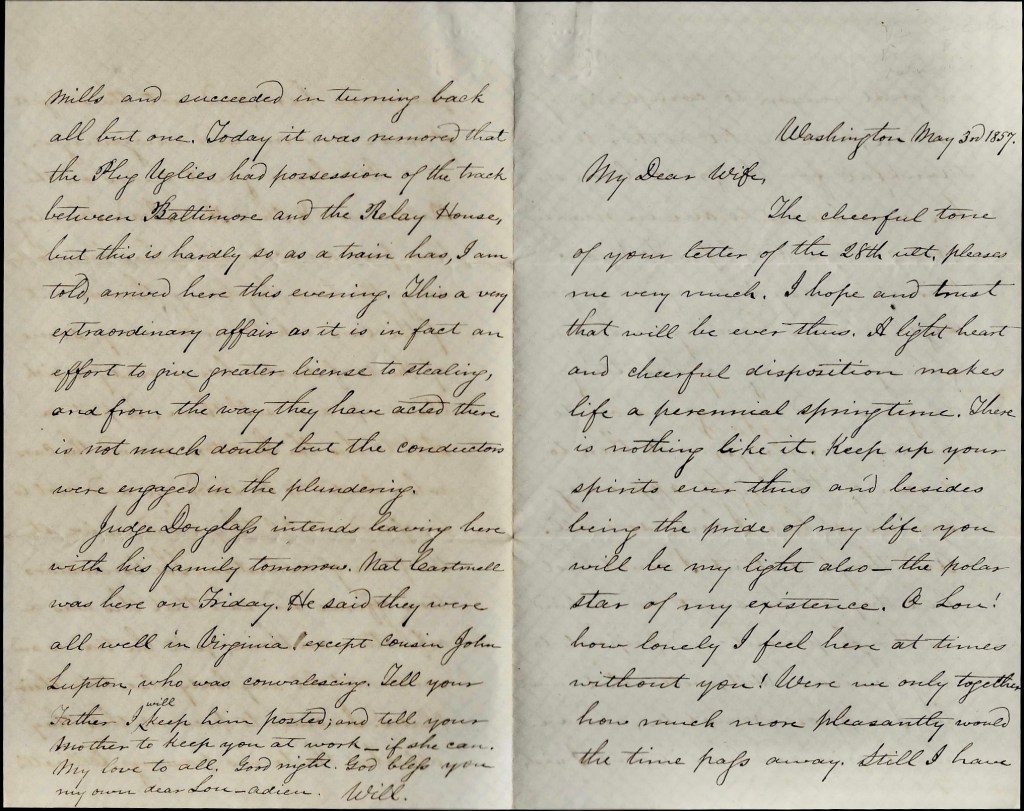
The cheerful tone of your letter of the 28th ult. pleases me very much. I hope and trust that will be ever thus. A light heart and cheerful disposition makes life a perennial springtime. There is nothing like it. Keep up your sprits ever thus and besides being the pride of my life, you will be my light also—the polar star of my existence.
Louise Catherine (Rombach) Denver—“the polar star of my existence,” J. W. Denver
O Lou! how lonely I feel here at times without you! Were we only together, how much more pleasantly would the time pass away. Still I have no great reason to complain of fortune, but ought rather to be thankful for the great boon she has vouchsafed to me in making you mine for life. To know this, it is easy to imagine a good angel always hovering near me, giving warning of besetting dangers and urging me on to greater usefulness, and then to dream of the bright approving smiles of her I love so well. And though distant, I doubt not but they are as sweet and as kind as though present and palpable to my vision. Well, well, what must be, I suppose, must be, and we must grin and bear it; but I wish you were here, and not the subject of mere dreams and imaginings.
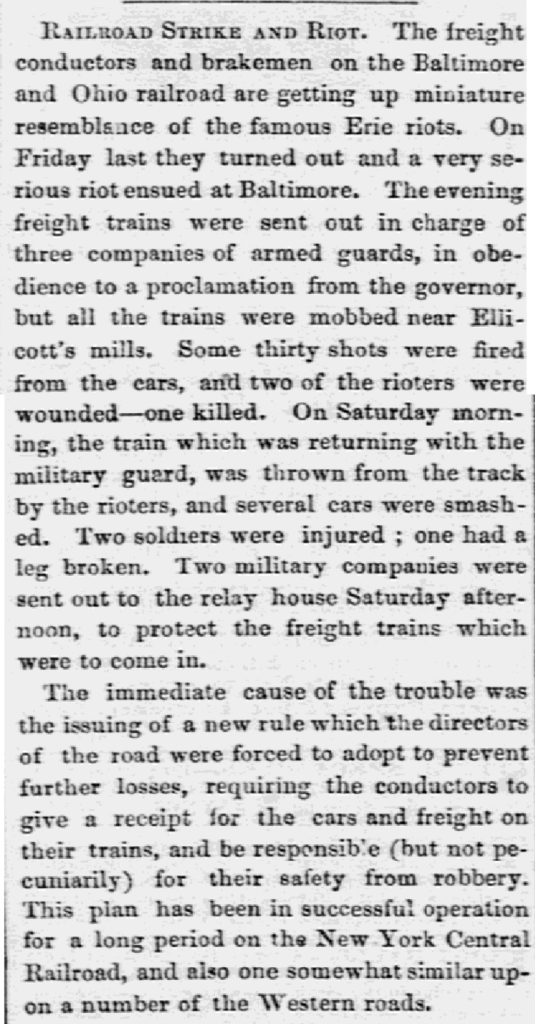
Lowell Daily Citizen & News, 4 May 1857
We have great times on the Baltimore & Ohio Railroad. For a long time past, merchandise has been lost along the line, by being thrown out of the cars while under way, some of the confederates being ready to pitch them up and sell them. To put a stop to this, the Directors ordered the cars when loaded to be sealed up and not to be opened until they should arrive at the place of destination. The conductors took offense and said that this was a reflection on them, quit the trains and would not let anybody else take their places. In order to prevent this, they attacked the trains passing Ellicott’s Mills and succeeded in turning back all but one. Today it was rumored that the Plug Uglies had possession of the track between Baltimore and the Relay House, but this is hardly so as a train has, I am told, arrived here this evening. This is a very extraordinary affair as it is in fact an effort to give greater license to stealing, and from the way they have acted, there is not much doubt but the conductors were engaged in the plundering.
Judge [Stephen A.] Douglass intends leaving here with his family tomorrow. Nat Cartmell was here on Friday. He said they were all well in Virginia except cousin John Lupton who was convalescing. Tell your father I will keep him posted, and tell your mother to keep you at work—if she can. My love to all. Goodnight. God bless you, my own dear Lou. Adieu. — Will
Letter 3
Addressed to Mrs. L. C. Denver, Wilmington, Ohio
Washington May 18, 1857
My Gentle Love,
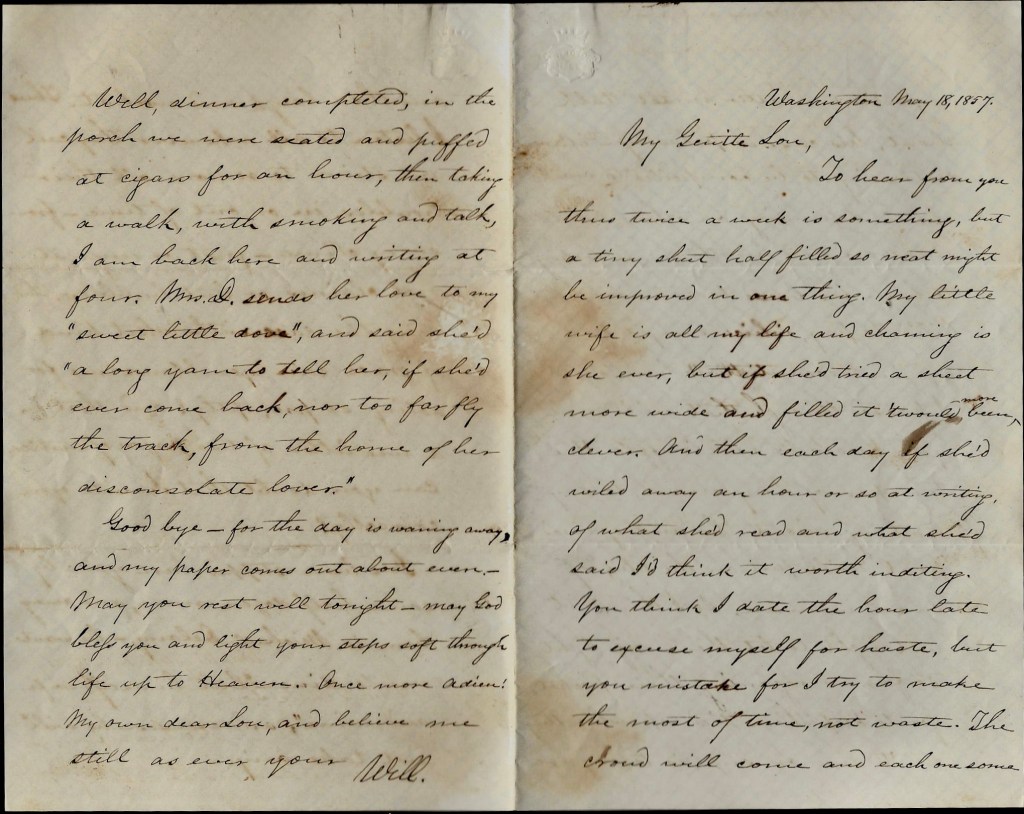
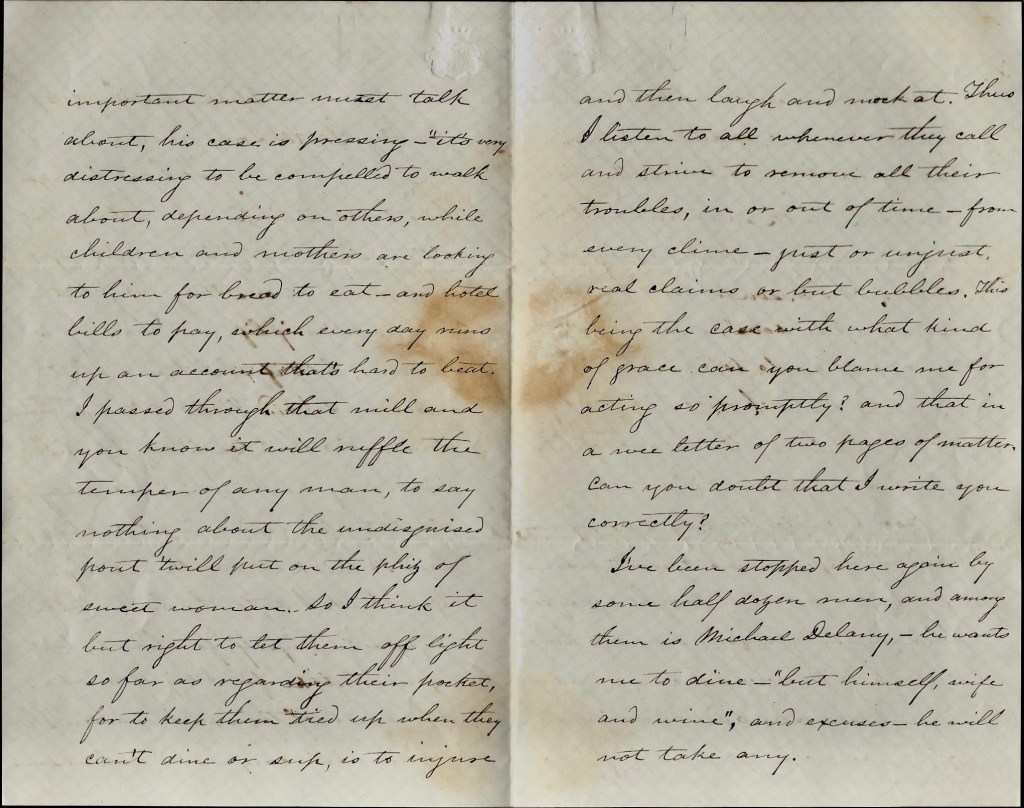
To hear from you thus twice a week is something, but a tiny sheet half filled so neat might be improved in one thing. My little wife is all my life and charming is she ever, but if she’d tried a sheet more wide and filled it, t’would been more clever. And then each day if she’s wiled away an hour or so at writing of what she’s read and what she’s said, I’d think it worth indicting.
James William Denver
You think I date the hour late to excuse myself for haste, but you mistake for I try to make the most of time, not waste. The crowd will come and each one some important matter must talk about, his case is pressing—“it’s very distressing to be compelled to walk about, depending on others, while children and mothers are looking to him for bread to eat—and hotel bills to pay, which every day runs up an account that’s hard to beat. I passed through that mill and you know it will ruffle the temper of any man, to say nothing about the undisguised pout t’will put on the phiz. of sweet woman. So I think it but right to let them off light so far as regarding their pocket, for to keep them tied up when they can’t dine or sup, is to injure and then laugh and mock at. Thus I listen to all whenever they call and strive to remove all their troubles, in or out of time—from every clime—just or unjust, real claims or but bubbles. This being the case, with what kind of grace can you blame me for acting so promptly? and that in a wee letter of two pages of matter. Can you doubt that I write you correctly?
I’ve been stopped here again by some half dozen men, and among them is Michael Delaney. He wants me to dine—“but himself, wife and wine,” and excuses—he will not take any.
Well, dinner completed, in the porch we were seated and puffed at cigars for an hour, then taking a walk, with smoking and talk, I am back here and writing at four. Mrs. Delaney sends her love to my “sweet little dove,” and said she’d “a long yarn to tell her, if she’s ever come back, nor too far fly the track from the home of her disconsolate lover.”
Goodbye, fr the day is waning away, and my paper comes out about even. May you rest well tonight. May God bless you and light your steps soft through life up to Heaven. One more adieu! my own dear Lou, and believe me still as ever your, — Will
Letter 4
Addressed to Mrs. L. C. Denver, Wilmington, Ohio
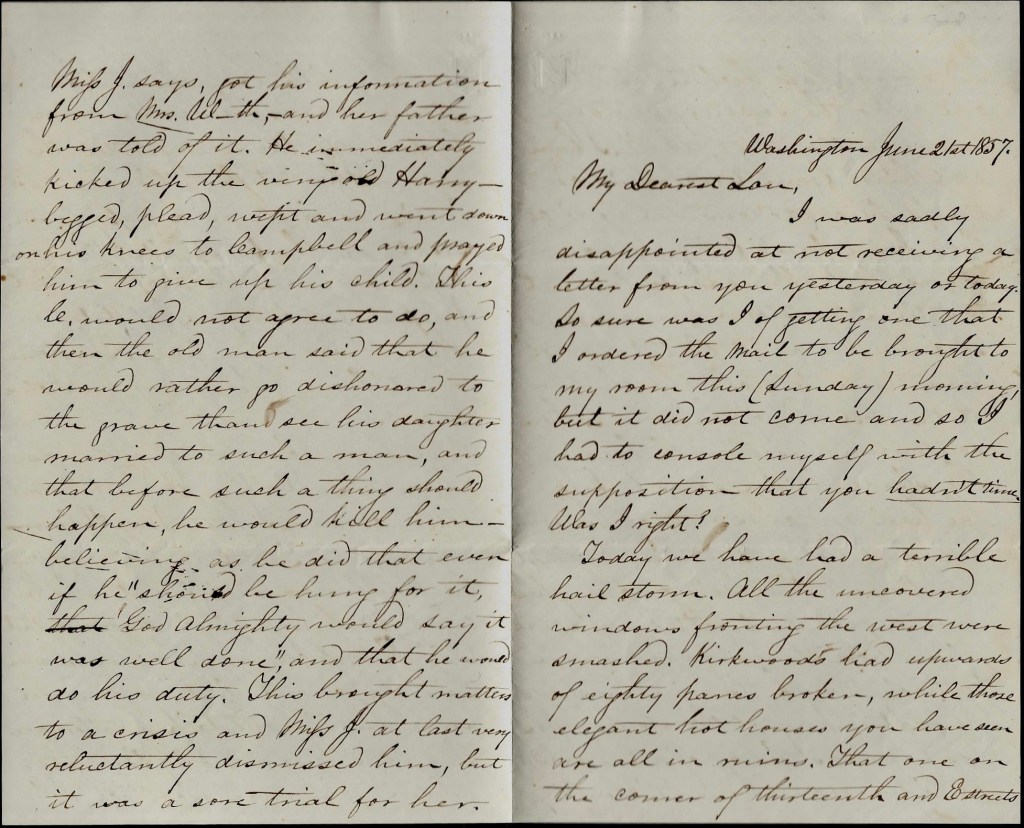
Washington June 21st 1857
My Dearest Son,
I was sadly disappointed at not receiving a letter from you yesterday or today. So sure was I of getting one that I ordered the mail to be brought to my room this (Sunday) morning, but it did not come and so I had to console myself with the supposition that you hadn’t time. Was I right?
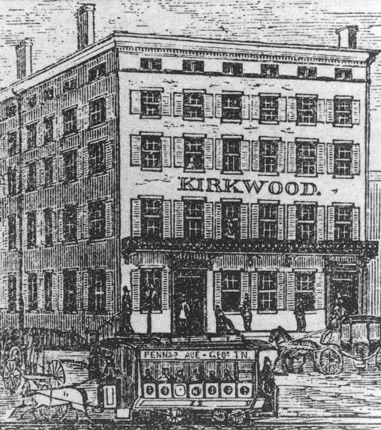
The Kirkwood House was a five-story hotel on Pennsylvania Avenue at 12th Street in WDC.
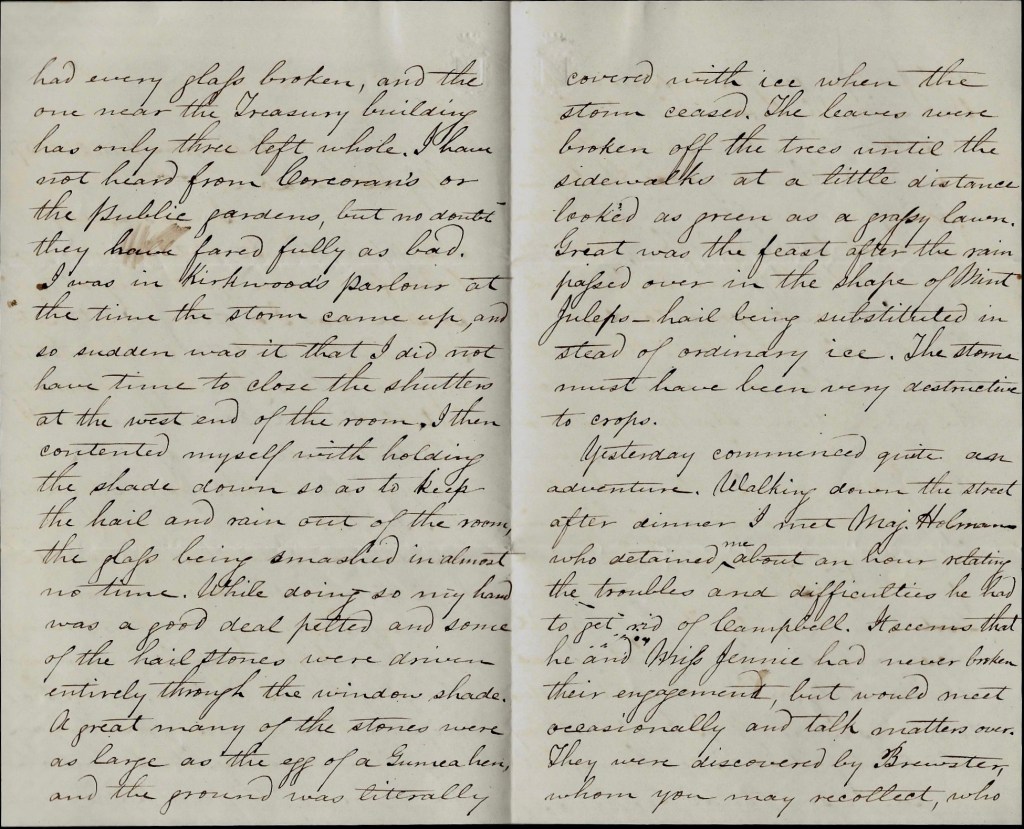
Today we have had a terrible hail storm. All the uncovered windows fronting the west were smashed. Kirkwood’s [Hotel] 1 had upwards of eighty panes broken, while those elegant hot houses you have seen are all in ruins. That one on the corner of thirteenth and E streets had every glass broken, and the one near the Treasury Building has only three left whole. I have not heard from Corcoran’s or the public gardens, but no doubt they have fared as bad. I was in Kirkwood’s parlor at the time the storm came up and so sudden was it that I did not have time to close the shutters at the west end of the room, I then contented myself with holding the shade down so as to keep the hail and rain out of the room, the glass being smashed in almost no time. While doing so, my hand was a good deal pelted and some of the hailstones were driven entirely through the window shade. A great many of the stones were as large as the egg of a Guinea hen, and the ground was literally covered with ice when the storm ceased. The leaves were broken off the trees until the sidewalks at a little distance looked as green as a grassy lawn. Great was the feast after the rain passed over in the shape of mint juleps—hail being substituted instead of ordinary ice. The storm must have been very destructive to crops.
Yesterday commenced quite an adventure. Walking down the street after dinner, I met Maj. Holman who detained me about an hour relating the troubles and difficulties he had o get rid of Campbell. It seems that he and Miss Jennie had never broken their engagement, but would meet occasionally and talk matters over. They were discovered by Brewster, whom you may recollect, who Miss. J. says, got his information from Mrs. W—th, and her father was told of it. He immediately kicked up the very Old Harry—begged, plead, wept, and went down on his knees to Campbell and prayed him to give up his child. This Campbell would not agree to do, and then the old man said that he would rather go dishonored to the grave than see his daughter married to such a man, and that before such a thing should happen, he would kill him, believing as he did that even if he “should be hung for it, God Almighty would say it was well done,” and that he would do his duty. This brought matters to a crisis and Miss J. at last very reluctantly dismissed him, but it was a sore trial for her.
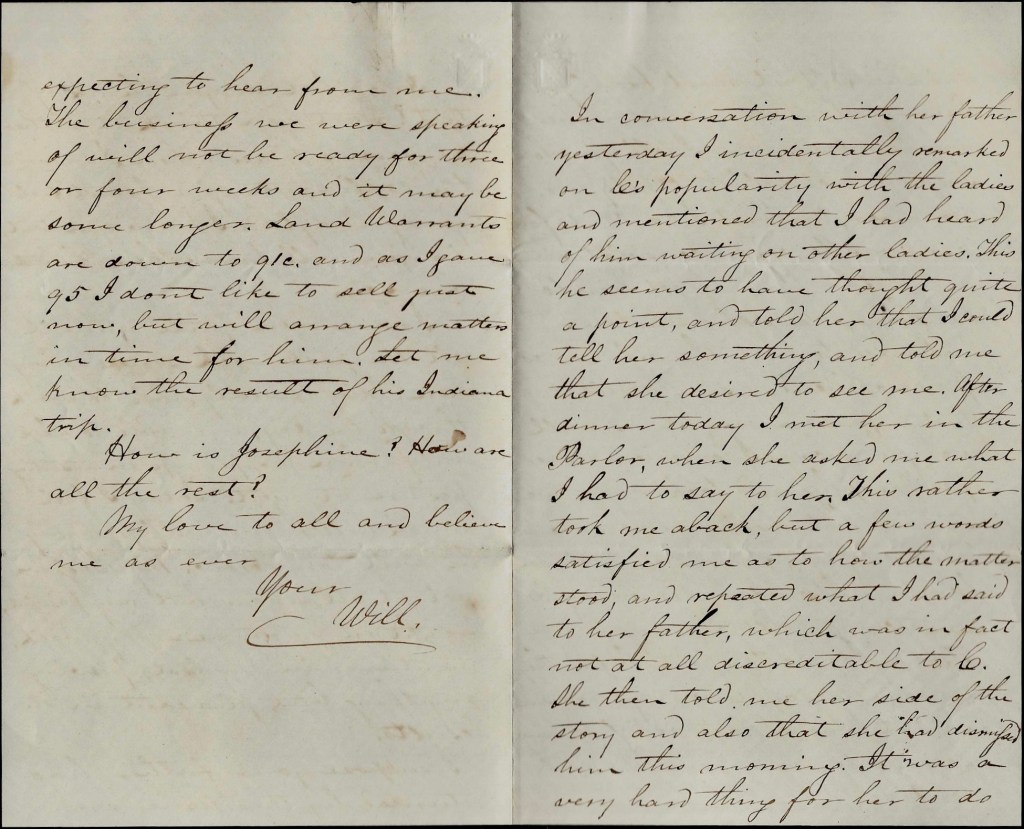
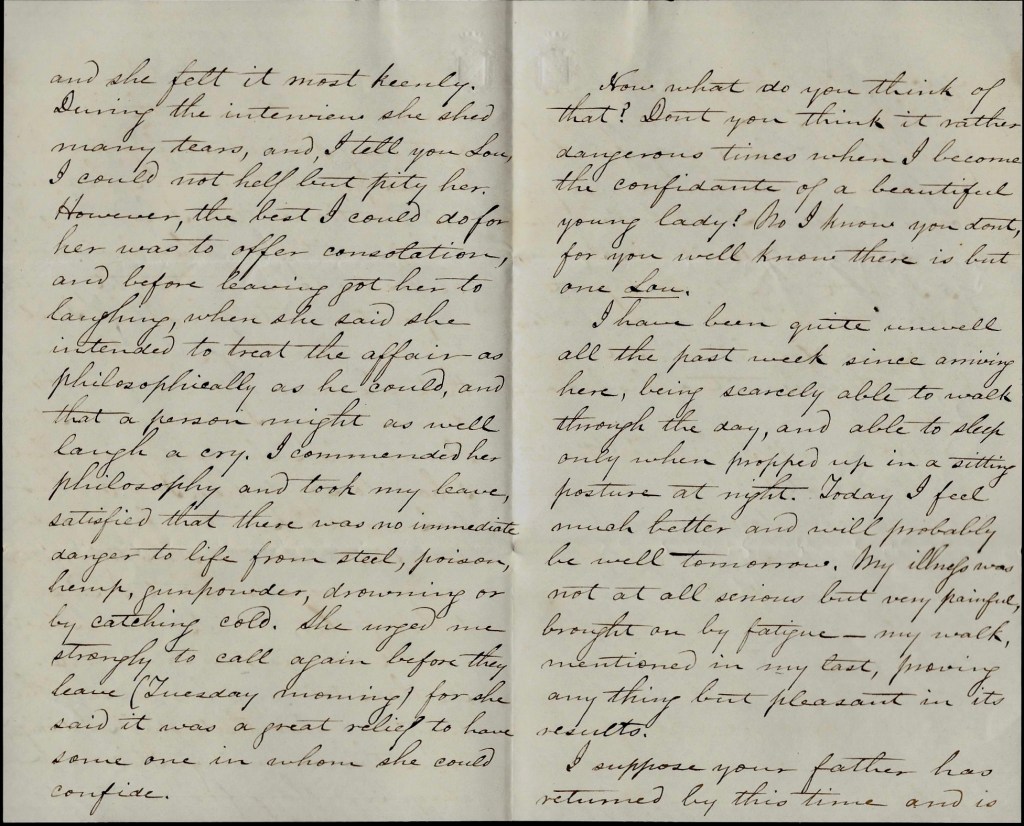
In conversation with her father yesterday, I incidentally remarked on Campbell’s popularity with the ladies and mentioned that I had heard of him waiting on other ladies. This he seems to have thought quite a point, and told her that I could tell her something, and told me that she desired to see me. After dinner today, I met her in the parlor when she asked me what I had to say to her. This rather took me aback, but a few words satisfied me as to how the matter stood, and repeated what I had said to her father, which was in fact not at all discreditable to Campbell. She then told me her side of the story and also that she had dismissed him this morning. It was a very hard thing for her to do and she felt it most keenly. During the interview she shed many tears, and, I tell you Lou, I could not help but pity her. However, the best I could do for her was to offer consolation, and before leaving got her to laughing, when she said she intended to treat the affair as philosophically as she could, and that a person might as well laugh as cry. I commended her philosophy and took my leave, satisfied that there was no immediate danger to life from steel, poison, hemp, gunpowder, drowning, or by catching cold. She urged me strongly to call again before they leave (Tuesday morning) for se said it was a great relief to have someone in whom she could confide.
Now what do you think of that? Don’t you think it rather dangerous times when I become the confidante of a beautiful young lady? No, I know you don’t, for you well know there is but one Lou.
I have been quite unwell all the past week since arriving here, being scarcely able to walk through the day, and able to sleep only when propped up in a sitting posture at night. Today I feel much better and will probably be well tomorrow. My illness was not at all serious but very painful, brought on by fatigue—my walk, mentioned in my last, proving anything but pleasant in its results.
I suppose your father has returned by this time and is expecting to hear from me. The business we were speaking of will not be ready for three or four weeks and it may be some longer. Land Warrants are down to 91 c. and as I gave 95, I don’t like to sell just now, but will arrange matters in time for him. Let me know the result of his Indiana trip.
How is Josephine? How are all the rest? My love to all and believe me as ever. Your Will.
Letter 5
Addressed to Mrs. L. C. Denver, Wilmington, Ohio
Washington August 2nd 1857
My Dear Wife,
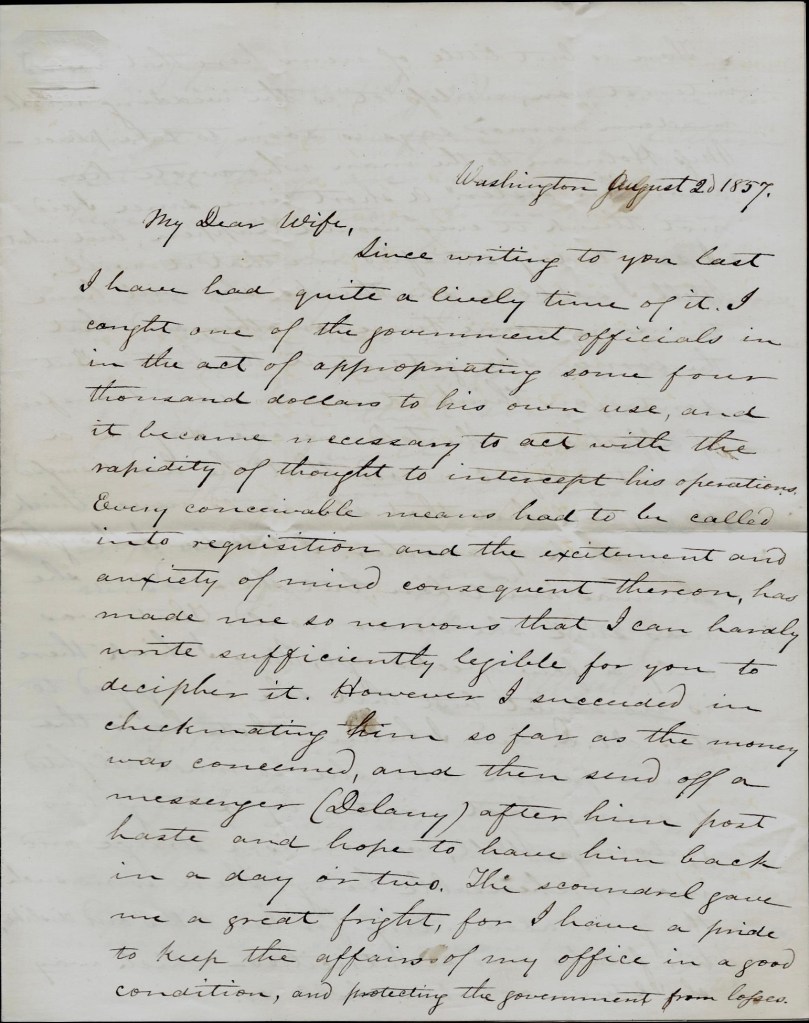
Since writing to you last, I have had quite a lively time of it. I caught one of the government officials in the act of appropriating some four thousand dollars to his own use and it became necessary to act with the rapidity of thought to intercept his operations. Every conceivable means had to be called into requisition and the excitement and anxiety of mind made me so nervous that I can hardly write sufficiently legible for you to decipher it. However, I succeeded in checkmating them so far as the money was concerned and then send off a messenger (Delaney) after him post haste and hope to have him back in a day or two. The scoundrel gave me a great fright for I have a pride to keep the affairs of my office in a good condition and protecting the government from losses.
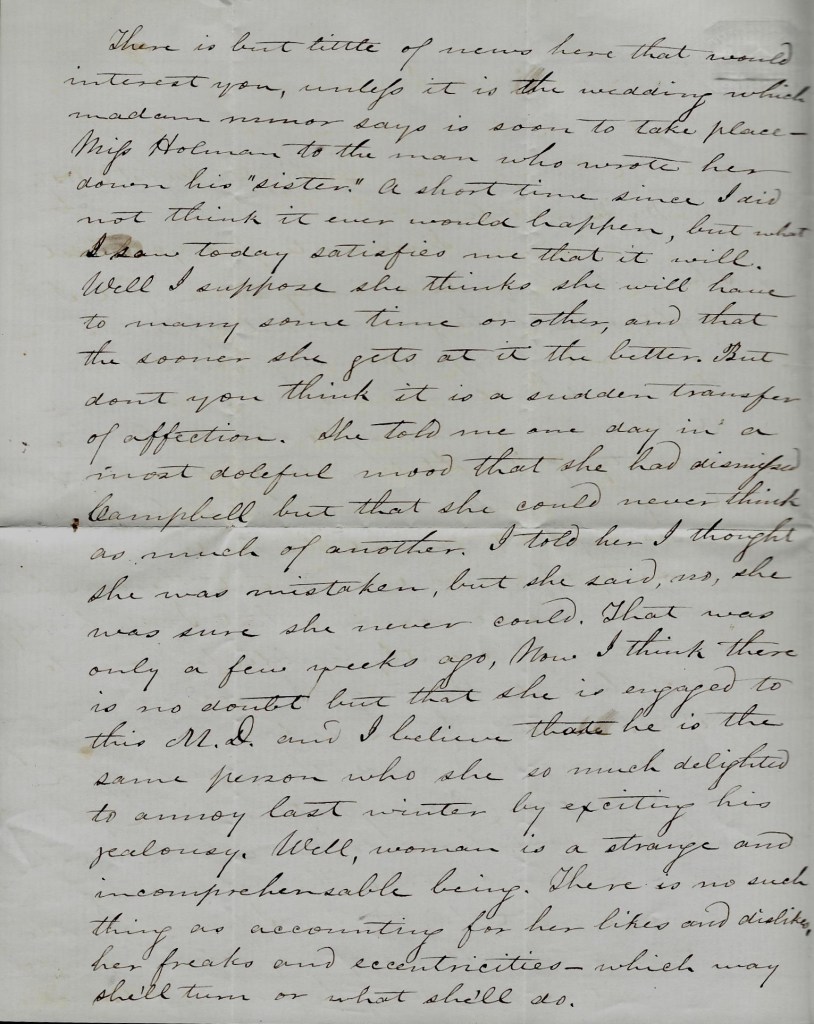
There is but little of news here that would interest you unless it is the wedding which madame rumor says is soon to take place—Miss Holman to the man who wrote her down his “sister.” A short time since I did not think it would ever happen, but what I saw today satisfies me that it will. Well, I suppose she thinks she will have to marry some time or other, and that the sooner she gets at it, the better. But don’t you think it is a sudden transfer of affection? She told me one day in a most doleful mood that she had dismissed Campbell but that she could never think as much of another. I told her I thought she was mistaken, but she said no, she was sure she never could. That was only a few weeks ago. Now I think there is no doubt but that she is engaged to this M. D. and I believe that he is the same person who she so much delighted to annoy last winter by exciting his jealousy. Well, woman is a strange and incomprehensible being. There is no such thing as accounting for her likes and dislikes, her freaks and eccentricities—which way she’ll turn or what she’ll do.
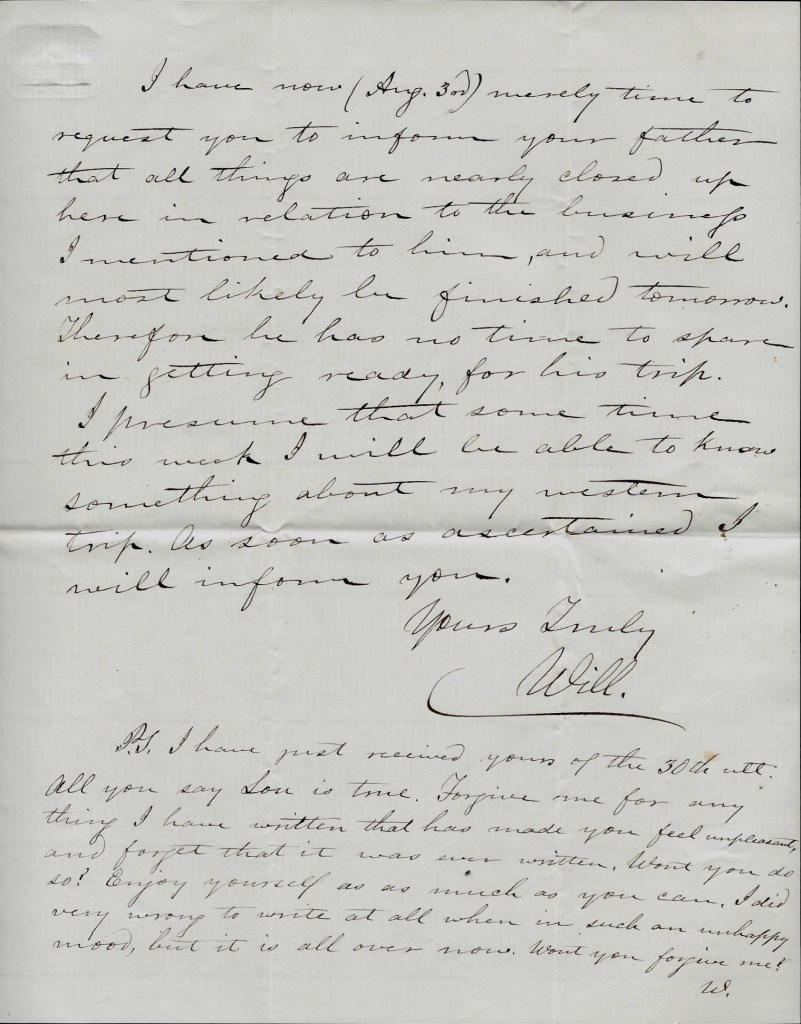
I have now (August 3rd) merely time to request you to inform your father that all things are nearly closed up here in relation to the business I mentioned to him and will most likely be finished tomorrow. Thereforre, he has no time to spare in getting ready for his trip.
I presume that some time this week I will be able to know something about my western trip. As soon as ascertained, I will inform you.
Yours truly, — Will
P. S. I have just received yours of the 30th ult. All you say Lou is true. Forgive me for anything I have written that has made you feel unpleasantly and forget that it was ever written. Won’t you do so? Enjoy yourself as much as you can. I did very wrong to write at all when in such an unhappy mood, but it is all over now. Won’t you forgive me? — W
This letter was written by James Sanks Brisbin (1837-1892), the son of Ezra Dougherty and Margaret (Packer) Brisbin of Centre county, Pennsylvania.
James Sanks Brisbin (seated), later in the war(Heritage Auctions)
When the American Civil War began in 1861, Brisbin was a lawyer in practice. He enlisted in the Pennsylvania volunteer services that April as a private. On April 26, he was appointed a second lieutenant in the mounted 2nd U.S. Dragoons. In the First Battle of Bull Run, Brisbin received two wounds, one in his side and the other in an arm, and was praised by his superiors for his performance during the fight.
On August 3, 1861, Brisbin transferred to the 1st U.S. Cavalry (previously known as the 1st Dragoons until a reorganization of the army) but then was appointed a captain in the 6th U.S. Cavalry two days later. On June 9, 1862, while fighting near Beverly Ford, Virginia, he was again wounded when he fell off of his horse. Exactly one year later Brisbin was brevetted to the rank of major for his conduct at Beverly Ford. In 1863 he very briefly led the cavalry forces in the Federal Department of the Susquehanna, and was wounded in a leg during combat near Greenbrier, Virginia, on July 26.
Brisbin was promoted to colonel on March 1, 1864, and organized the 5th United States Colored Cavalry. He served as the acting head of cavalry on the staff of Brig. Gen. Albert L. Lee during the Red River Campaign, and was again wounded during the Battle of Mansfield in Louisiana on April 8, this time in the right foot. On December 12, 1864, Brisbin was brevetted to brigadier general in the Union Army, and seven days later was appointed a brevet lieutenant colonel in the regular army for his performance at Battle of Marion in Tennessee. In 1865, he was on recruiting duty in Kentucky, serving on the staff of Maj. Gen. Stephen G. Burbridge. On March 13, Brisbin was brevetted to colonel in the regular army as well as brevetted major general in the Union Army, and on May 1 he was promoted to brigadier general. Brisbin was mustered out of the Union Army as a volunteer on January 15, 1866. [Wikipedia]
This letter was written just a few days before the Battle of Fredericksburg. The 6th US Cavalry had been encamped in the vicinity of the Rappahannock river since 24 November 1862. During the battle, the 6th sent a squadron across the Rappahannock on a pontoon bridge to reconnoiter the enemy positions but had to withdraw when they received enemy artillery fire, losing 2 men and eight horses. After making their report to Gen. Burnside, they were held in reserve near Falmouth where they remained several months. I have not learned whether Capt. Brisbin was with the squad that entered Fredericksburg or not. From this letter we learn that he had been placed under arrest on some unidentified charge though he or someone else tried to conceal that piece of information by attempting to cross out those words that I indicated with a strikethrough.
Transcription
Camp 6th US Cavalry Belle Plaine, Virginia December 9th, 1862
My Dear Wife,
I wrote you this morning but as it is my duty to write you every day, I will write you again. Te sun came out today but the air was quite cold all day. The river is now frozen over but not hard enough to bear. If the river gets solid, I think we will either go over or the Rebs will come over. All the people of Falmouth and Fredericksburg are camped out. It must be pretty cold on the women & children.
I think the great battle of the war is at hand. All other battles will be as nothing when compared with it. They say we have four hundred thousand men here. I think not so many as that but we certainly have three hundred thousand and that is a good many men. The Rebels must have two hundred and fifty thousand so we will be able to get up quite a respectable fight. Half a million of men fighting will raise considerable smoke and dust and make quite a noise.
I am afraid they will keep me under arrest and if so I can’t fight. Men under arrest can’t fight. I suppose you would not care if there was a fight & they did keep me under arrest and keep me out of it, but I would not miss the next battle for anything. I would rather lose a leg. Our men are all anxious for a fight & confident they can whip the Rebels. The next battle will end the war, one way or the other. If we are defeated, I think the Confederacy will be acknowledged. But if we whip them, they will make peace. God grant the war may soon end.
I did not get any letters today and so am disappointed. I missed the mail this morning and had to send one of my men 5 miles with your letter to get it mailed. They say we will get a mail every day hereafter so you can now write and be certain I will get your letters.
We get plenty to eat. Have flannel [pancakes] cakes, ham, butter, sugar, coffee &c. Butter is a dollar a pound but we can trade coffee for butter. Coffee is $2 a pound but we can buy it at 26 cents. Salt is any price but we get it at a cent a pound. The people of Virginia will give anything they have for a little sugar, coffee, or salt. Madden’s brother has come. Madden still has a little diarrhea. Lt. Tupper and I are now living together. Tupper is a nice, quiet fellow. Lt. Madden’s brother is coming up.
I do hope you will try and be happy and patiently bear this separation. I can assure you it is a bitter pill to me but all things have an end and so will the war. You must never quarrel with me anymore when I come home again. Wy did you not get coal? Tell them to get you coal at once. If this coal matter is not attended to, I will take some very decided action about it that will surprise you all. I would give a month’s pay to be home tonight and sleep in your arms. You can’t send a box. I would never get it. Capt. Saunders has got a leave at last & gone to Kentucky.
Do not fret about me. I am all right. The Rebs can’t kill me—at least I am not uneasy. Who is to be—what do you call them? brideswoman to Sallie? I think Josh would make a good groomsman. Your Pap made a very good one when we were married. But I will close. It is getting warmer. How I would like to be at home and get some apples tonight.
Lithograph of Maj. Gen. Henry Halleck on James Gates Co. Stationery
This letter was written by a barely literate soldier—most likely a private—named William R. Steel, if I have transcribed his name correctly. He wrote the letter to his father who I presume was “Mr. Solomon Steel” as was written near the bottom of the letter. Unfortunately I cannot find any soldier who fits the profile of this soldier with a father named Solomon.
The letter was penned in early August 1862 but no location was given. Again I’m going to presume it was written in the East by a soldier who participated on the Peninsula Campaign but I might be mistaken. The hand writing is actually more suggestive of an Indiana soldier but I cannot find any early war soldier from Indiana with that name. There was a William R. Steel who served as a private in the 1st Indiana Cavalry but he did join as a recruit until 1863.
The letter was written on stationery with a lithograph of Maj. Gen. Henry Halleck who was named Lincoln’s General in Chief after McClellan’s failed Peninsula Campaign. The stationery was produced by the James Gates company of Cincinnati, Ohio.
Transcription
The 6th of August 1862
Dear Father,
I sit down to let you [know] that I am well at present and hope that you are the same. I got your letter the 4th of this month. You wanted to know if I was wounded or not. I was in the right leg below the knee but it is well now.
I guess I will get my discharge. My arm is very lame now.





























 Spared & Shared 23