Most Americans today are probably not that familiar with Dorr’s Rebellion, particularly if they were not raised in Rhode Island. In a nutshell, it was an armed insurrection led by Thomas Wilson Dorr in Rhode Island between 1840 and 1842 with the objective of achieving greater suffrage in the state. The state lagged behind almost all of the other states in eliminating the land-holding requirement for suffrage incorporated in its colonial charter of 1663. With the industrial revolution and the migration of the population away from farms to urban areas, many men found they could not longer meet the land-holding requirement. As a result, by 1840, it is estimated that 60% of the male population were disenfranchised. With Dorr’s leadership, a People’s Convention was held that ratified a popular referendum and Dorr was elected governor under this document. The movement was only crushed militarily by Gov. King declaring marshal law and arresting its leaders, including Dorr, in June 1842 when this letter was written. Though the movement was stopped, it did initiate the drafting of a new constitution in Rhode Island that liberalized voting the following year. [See Dorr Rebellion/Rhode Island’s Very Own, Very Small Civil War by Justin Shatwell]
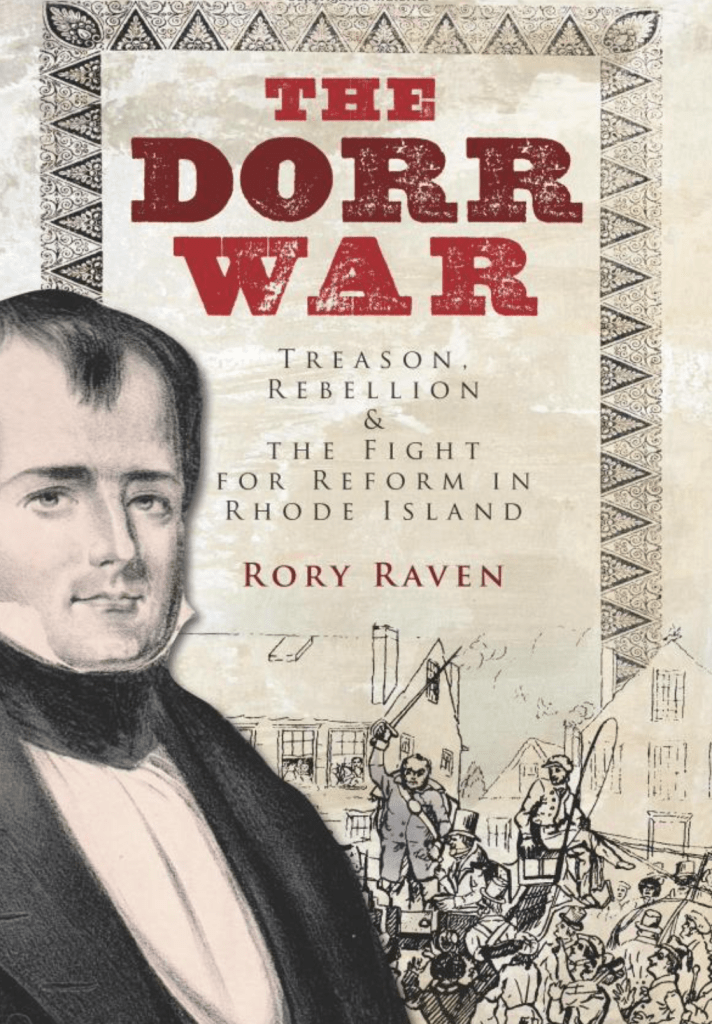
To read more on the rebellion, readers are referred to Rory Raven’s 2010 book entitled, “The Dorr War”
This letter was written by Dr. Samuel W. Butler (1815-1881) of Newport, Rhode Island, who provides detailed information about Dorr’s insurrection and, in rather melodramatic fashion, proclaims he may loose his life in “the cause of our country.” Though the rebellion caused great anxiety and the weeping of enough tears “to float a ship,” it lasted only two months without a single battle being fought, and the whole affair resulted in a single death—an innocent civilian shot by mistake.”
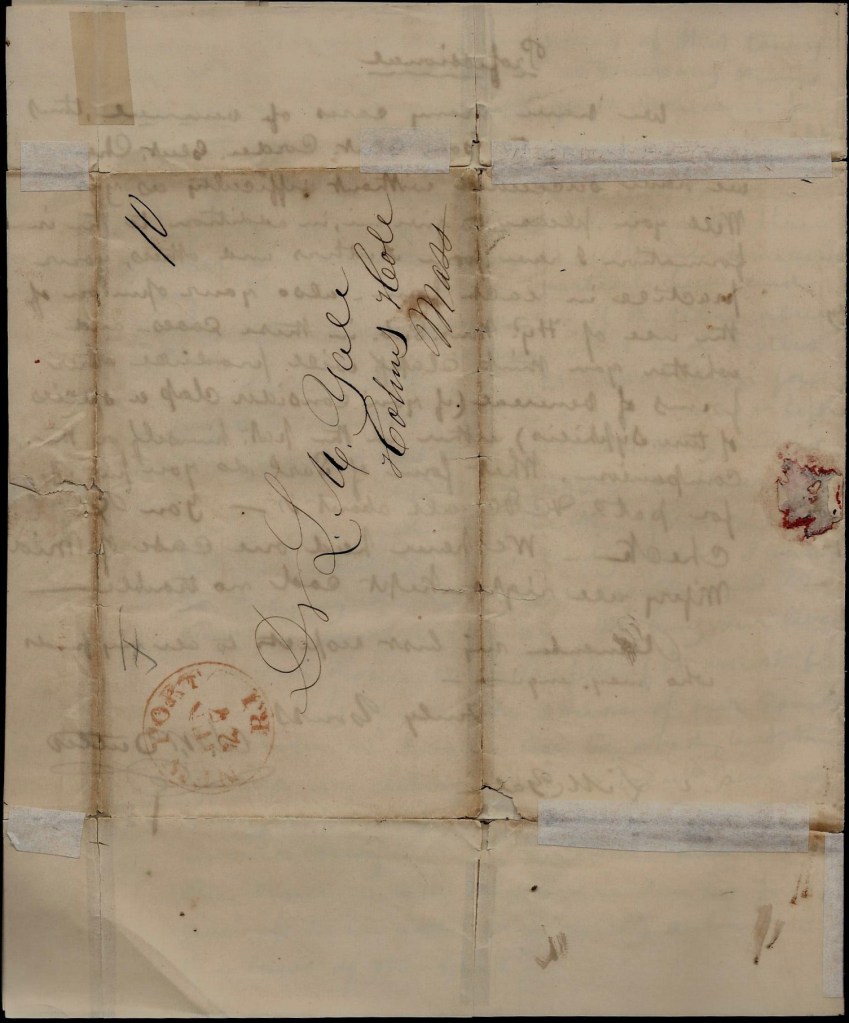
Dr. Butler wrote the letter to Dr. Leroy Milton Yale (1802-1847) of Holmes Hole [now Martha’s Vineyard], Massachusetts. Dr. Yale graduated from the Harvard Medical College in 1829 and must have been an expert on venereal diseases as his advice was sought on its treatment in the closing paragraphs of this letter. Perhaps the disease was more prevalent in both Newport, R. I. and Holmes Hole, Mass., due to the high percentage of mariners living in these villages.
Transcription
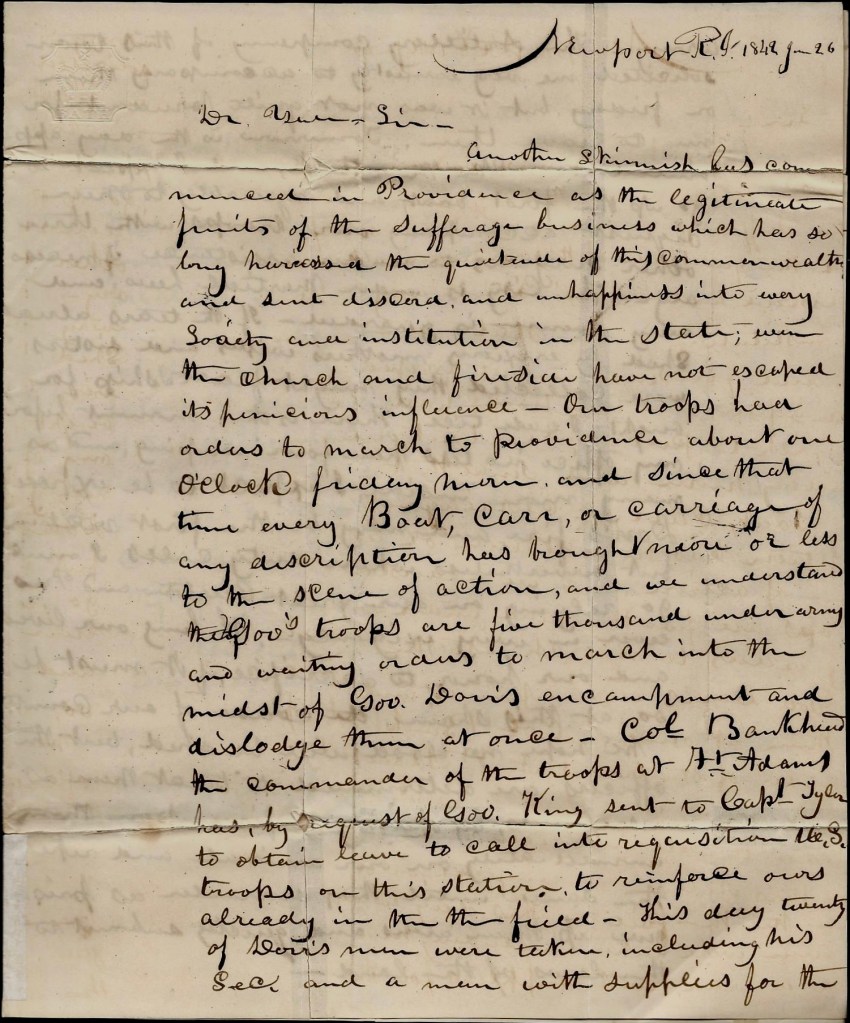
Newport, Rhode Island June 26, 1842
Dr. Yale, Sir.
Another skirmish has commenced in Providence as the legitimate fruits of the suffrage business which has so long harassed the quietude of this Commonwealth and sent discord and unhappiness into every society and institution in the state; even the Church and fireside have not escaped its pernicious influence.
Our troops had orders to march to Providence about one o’clock Friday morn and since that time every boat, carr, or carriage of any description has been brought more or less to the scene of the action, and we understand the Governor’s troops are five thousand under arms and waiting orders to march into the midst of Gov. Dorr’s encampment and dislodge them at once. Col. Bankhead—the commander of the troops at Ft. Adams—has by request of Gov. King, sent to Capt. Tyler to obtain leave to call into requisition U. S. troops on this station to reinforce ours already in the field.
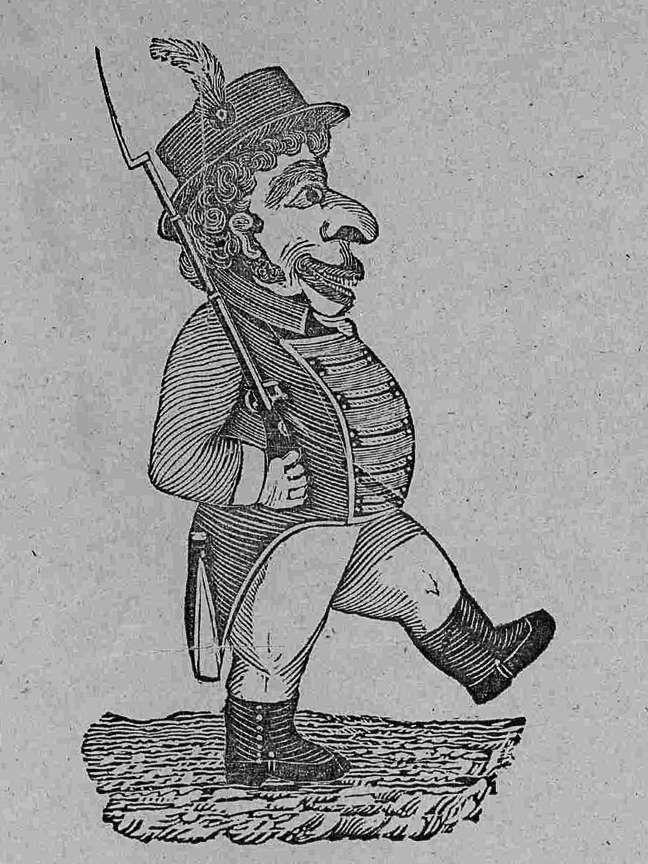
A caricature representing Dorr’s troops from a pro-charter broadside. [LOC]
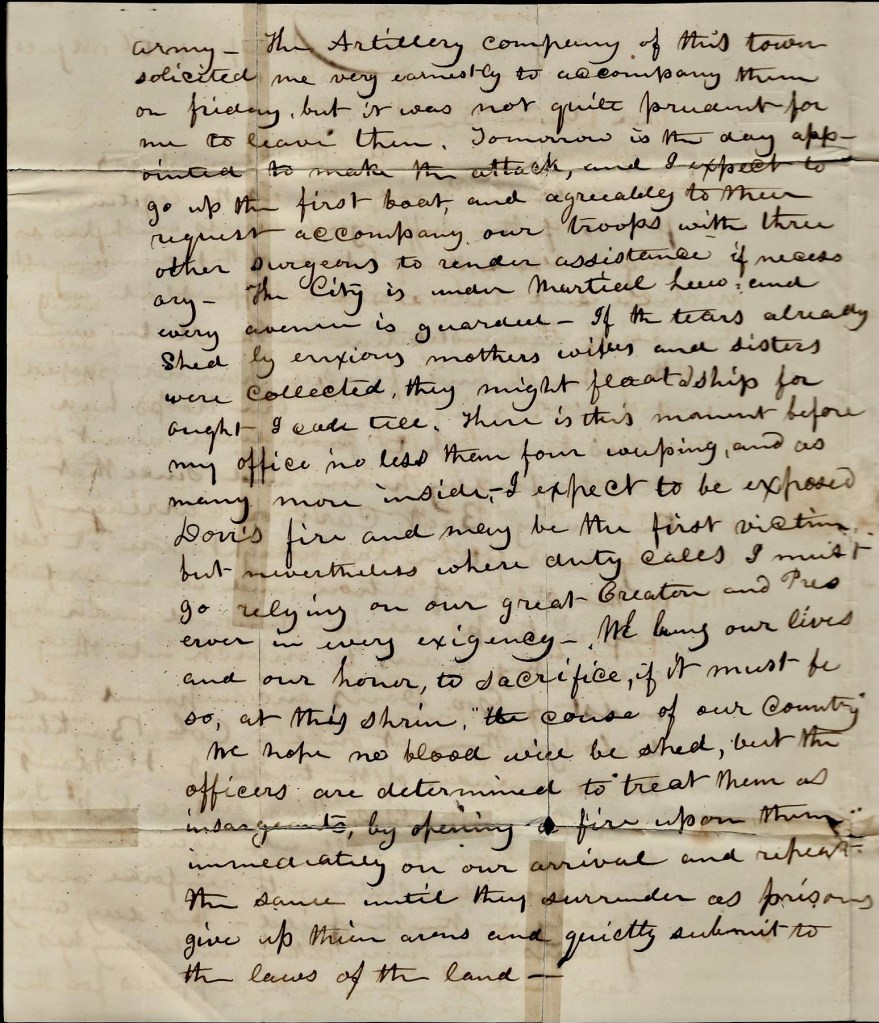
This day twenty of Dorr’s men were taken, including his Sec. and a man with supplies for their army. The artillery company of this town solicited me very earnestly to accompany them on Friday, but it was not quite prudent for me to leave then. Tomorrow is the day appointed to make the attack and I expect to go up the first boat and, agreeably to their request, accompany our troops with three other Surgeons to render assistance if necessary. The city is under martial law and every avenue is guarded. If the tears already shed by anxious mothers, wives, and sisters were collected, they might float a ship for ought I can tell. There is this moment before my office no less than four weeping, and as many more inside.
I expect to be exposed to Dorr’s fire and may be the first victim, but nevertheless where duty calls, I must go, relying on our great Creator and Preserver in every exigency. We have our lives and our honor to sacrifice, if it must be so, at this shrine—“the cause of our country.” We hope no blood will be shed, but the Officers are determined to treat them as insurgents, by opening fire upon them immediately on our arrival and repeat the same until they surrender as prisoners, give up their arms and quietly submit to the laws of the land.
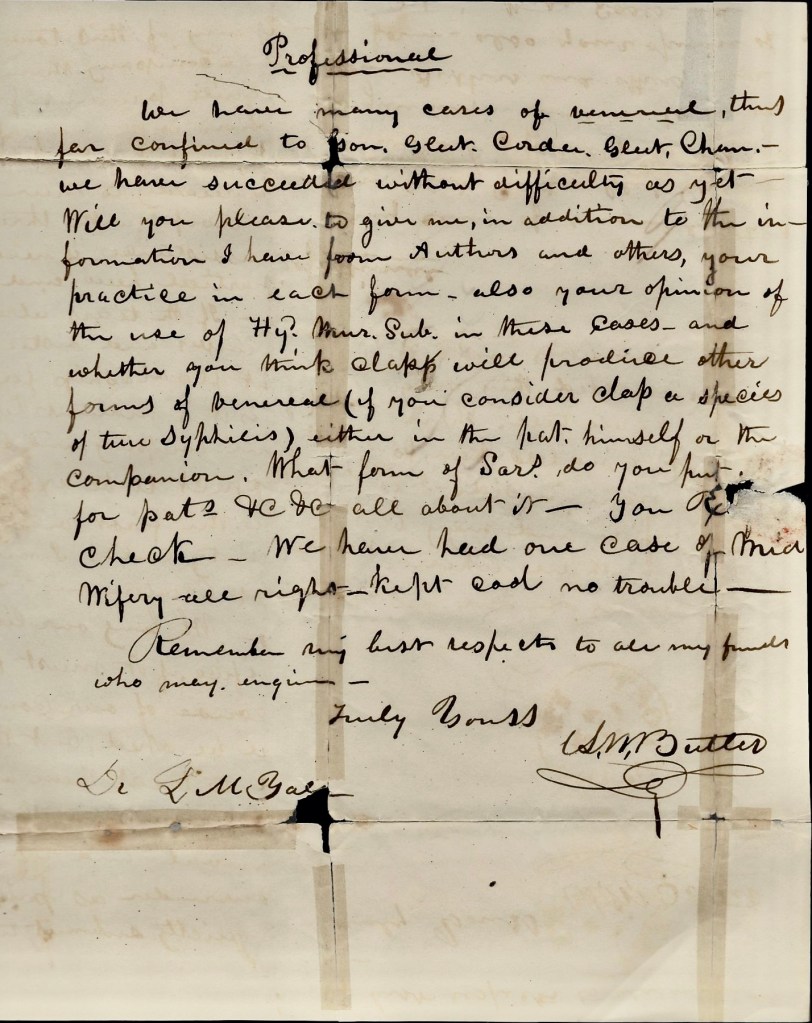
Professional
We have many cases of venereal [disease], thus far confined to Gon[orrhoea], Glut. Chordee, 1 Glut. Chlam[ydia]. We have succeeded without difficulty as yet. Will you please to give me, in addition to the information I have from authors and others, your practice in each form – also your opinion of the use of Hyd Mur. Sub. in these cases, and whether you think clapp will produce other forms of venereal (if you consider clap a species of true syphilis) either in the patient himself or the companion. What form of Sars. do you put for patients, &c, &c. all about it. You Rx check. We have had one case of midwifery all right—kept cool no trouble.
Remember my best respects to all my friends who may enquire. Truly yours, —S. M. Butler
[to] Dr. L. M. Yale
1 Chordee was variously described as a hardening of the penile shaft or painful, sustained erection. This may represent either priapism or an inflammatory infiltration of the shaft. It was almost always associated with a venereal infection. One treatment was ointment of camphor in brandy and mercury and was obviously a very painful condition; a grain of opium was suggested at bedtime.[Genitourinary medicine and surgery in nelson’s navy, by J. C. Goddard]
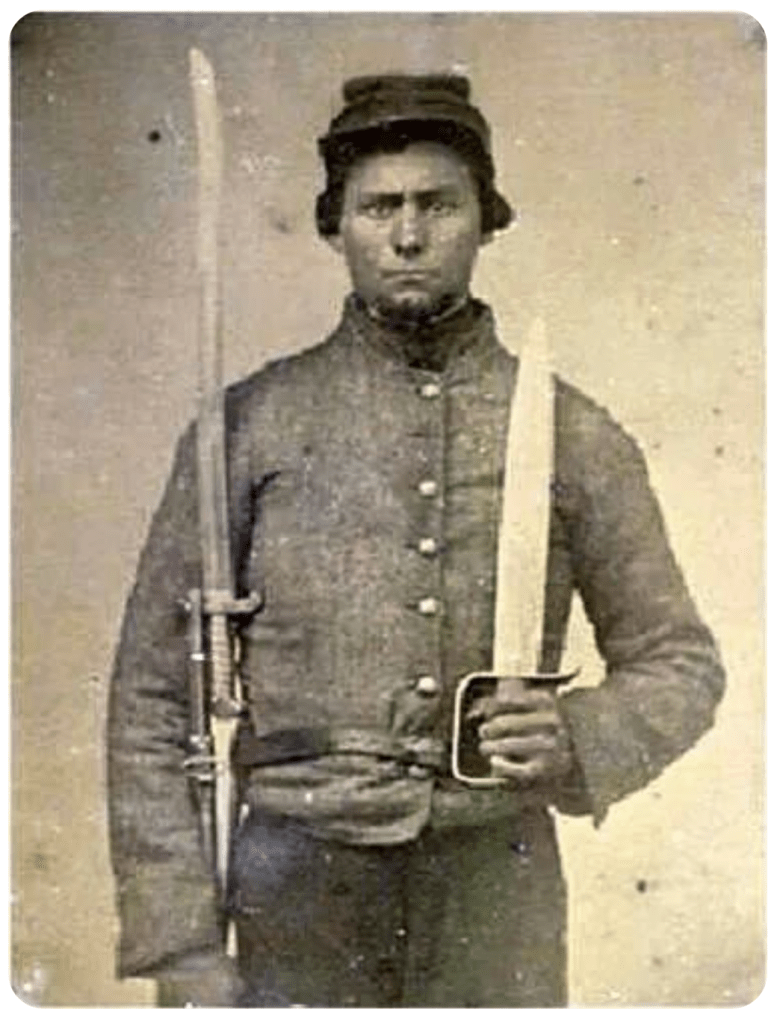
I could not find an image of Tillman but here is Jim Philyaw of Co. H, 3rd N. C. Cavalry
This letter was written by Tillman Pullen (1837-1880), the son of Roderick Pullen (1792-1873) and Margaret Matheny (1810-Aft1870) of Brinkleyville, Halifax county, North Carolina. Tillman was married in 1867 to Zilpha Annie Ennett (1834-1915). Tillman enlisted in June 1861, mustering into Co. G (“Scotland Neck Mounted Riflemen”), 3rd North Carolina Cavalry.
Tillman wrote the letter to his friend, Joseph McCarrell Weller (1841-1898). Very early in the war, Joseph had enlisted in Co. E, 2nd North Carolina Volunteers which later became the 12th North Carolina. He was discharged for disability on 1 July 1862 after a little more than one year’s service.
Transcription
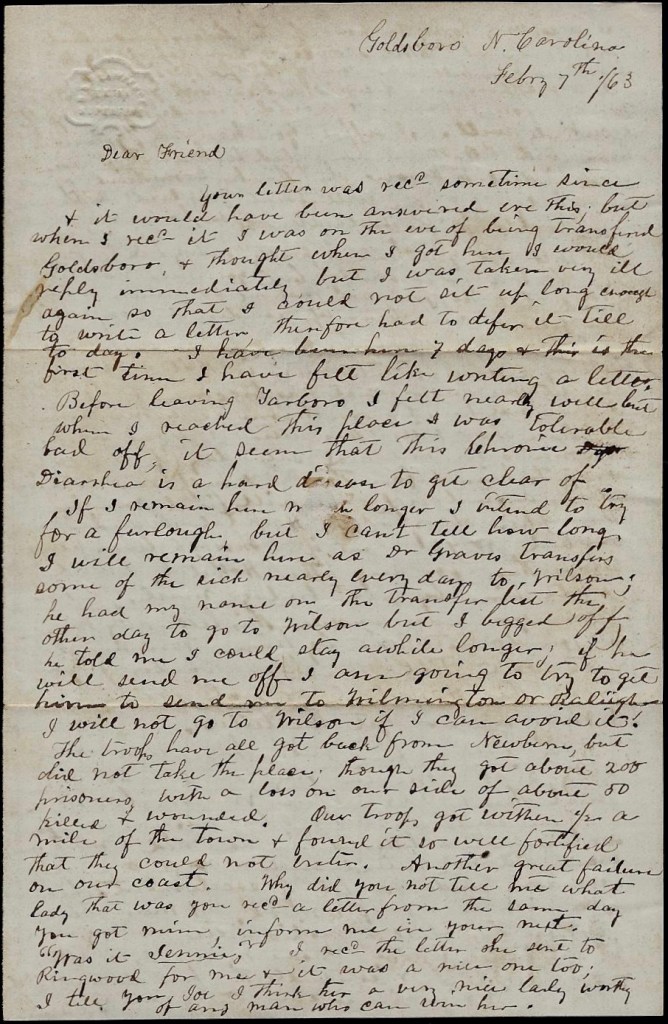
Goldsboro, North Carolina February 7th 1863
Dear Friend,
Your letter was received some time since and it would have been answered ere this but when I received it, I was on the eve of being transferred [to] Goldsboro & thought when I got here, I would reply immediately. But I was taken very ill again so that I could not sit up long enough to write a letter—therefore, had to defer it till today. I have been here 7 days and this is the first time I have felt like writing a letter.
Before leaving Tarboro, I felt nearly well but when I reached this place, I was tolerable bad off. It seems that this chronic diarrhea is a hard disease to get clear of.
If I remain here much longer, I intend to try for a furlough but I can’t tell how long I will remain here as Dr. [George Walker] Graves transfers some of the sick nearly every day to Wilson [Hospital]. He had my name on the transfer list the other day to go to Wilson but I begged off. He told me I could stay awhile longer. If he will send me off, I am going to try to get him to send me to Wilmington or Raleigh. I will not go to Wilson if I can avoid it.
The troops have all got back from Newbern but did not take the place though they got about 200 prisoners with a loss on our side of about 50 killed & wounded. Our troops got within half a mile of the town & found it so well fortified that they could not enter. Another great failure on our coast.
Why did you not tell me what lady that was you received a letter from the same day you got mine? Inform me in your next. Was it Jennie? I received the letter she sent to Ringwood for me & it was a nice one too. I tell you, Joe, I think her a very nice lady—worthy of any man who can win her.
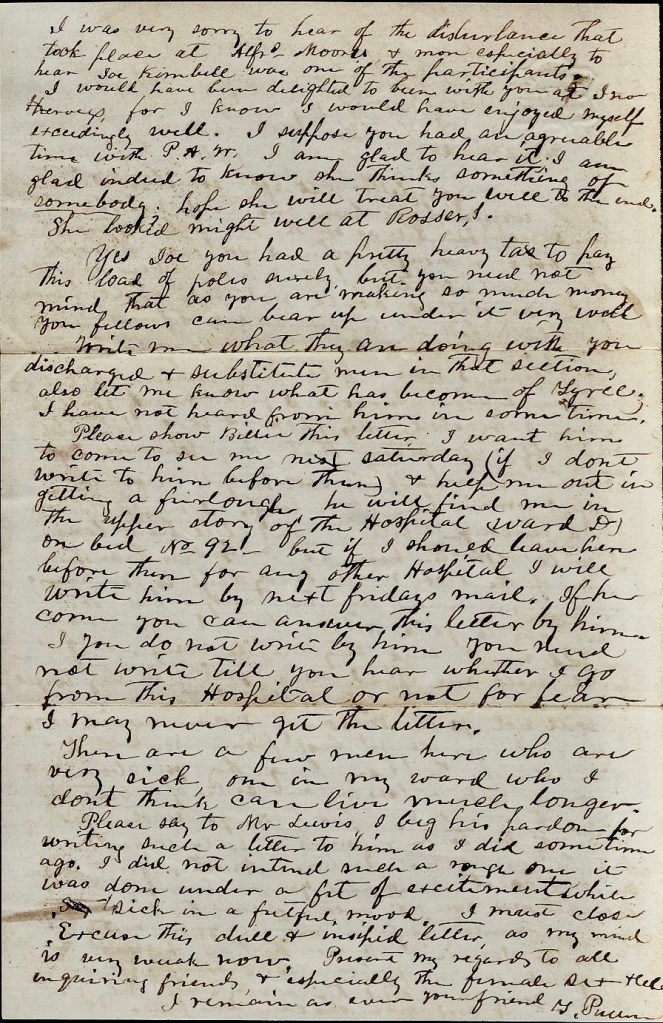
I wsa very sorry to hear of the disturbance that took place at Alfred Moore’s and more especially to hear Joe Kimball was one of the participants. I would have been delighted to been with you at Jno. Hervey’s for I know I would have enjoyed myself exceedingly well. I suppose you had an agreeable time with P. A. W. I am glad to hear it. I am glad indeed to know she thinks something of somebody. Hope she will treat you well to the end. She looked mighty well at Rosser’s.
Yes, Joe, you have a pretty heavy tax to pay this load of poles surely, but you need not mind that as you are making so much money. You fellows can bear up under it very well.
Write me what they are doing with you discharged and substitute men in that section. Also let me know what has become of Tyree. I have not heard from him in some time.
Please show Billy this letter. I want him to come to see me next Saturday (if I don’t write to him before then) & help me out in getting a furlough. He will find me in the upper story of the hospital (Ward D) on bed No. 92. But if I should leave here before then for any other hospital, I will write him by next Friday’s mail. If he comes, you can answer this letter by him. If you do not write by him, you need not write till you hear whether I go from this hospital or not for fear I may never get the letter.
There are a few men here who are very sick—one in my ward who I don’t think can live much longer.
Please say to Mr. Lewis I beg him pardon for writing such a letter to him as I did some time ago. I did not intend such a rough one. It was done under a fit of excitement which sick in a frightful mood. I must close. Excuse this dull & insipid letter as my mind is very weak now. Present my regards to all inquiring friends & especially the female set &c.
This letter was written by Gustavus Adolphus Henry Sr. (1804-1880), the son of Gen. William Henry and Elizabeth Julia (Flournoy) Henry. He was a classmate in law school with Jefferson Davis. He established a practice in Tennessee prior to the American Civil War. He became a wealthy businessman, owning cotton plantations in Hinds County, Mississippi and Desha County, Arkansas. Affiliated with the Whig Party, he campaigned for Henry Clay. In 1853, he was that party’s candidate for governor, losing to Democrat Andrew Johnson by around 2250 votes. He served in the Confederate States of America Senate from 1862–65 and was widely known as the “Eagle Orator of Tennessee.” Through his personal friendship with President Davis, he was influential in the Confederate government. As senator, he was a powerful member of the finance and military committees. Early in the war, the state of Tennessee commissioned the construction of a pair of forts to protect the Tennessee and Cumberland Rivers. The fort on the Tennessee River was named “Fort Henry” in the Senator’s honor (see Battle of Fort Henry). He died in 1880. [Wikipedia]
The letter was written to Brig. Gen. Benjamin Jefferson Hill (1825-1880), a successful merchant and Tennessee state senator from 1855 to 1861. Hill began his service as Colonel of the 5th Tennessee Volunteers and later as Colonel of the 35th Tennessee. After a long and illustrious record, he was promoted to brigadier general in 30 November 1864 (date of this letter) and tasked with organizing a mounted battalion on Northern Alabama to ride with Forrest’s Cavalry Corps.
Transcription
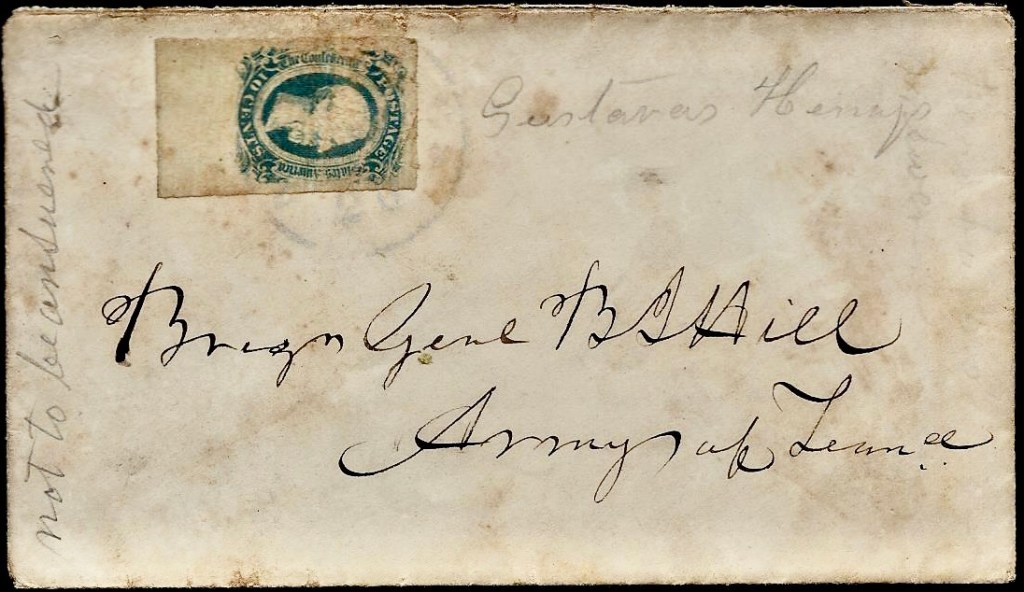
Addressed to Brig. Gen. B. J. Hill, Army of Tennessee
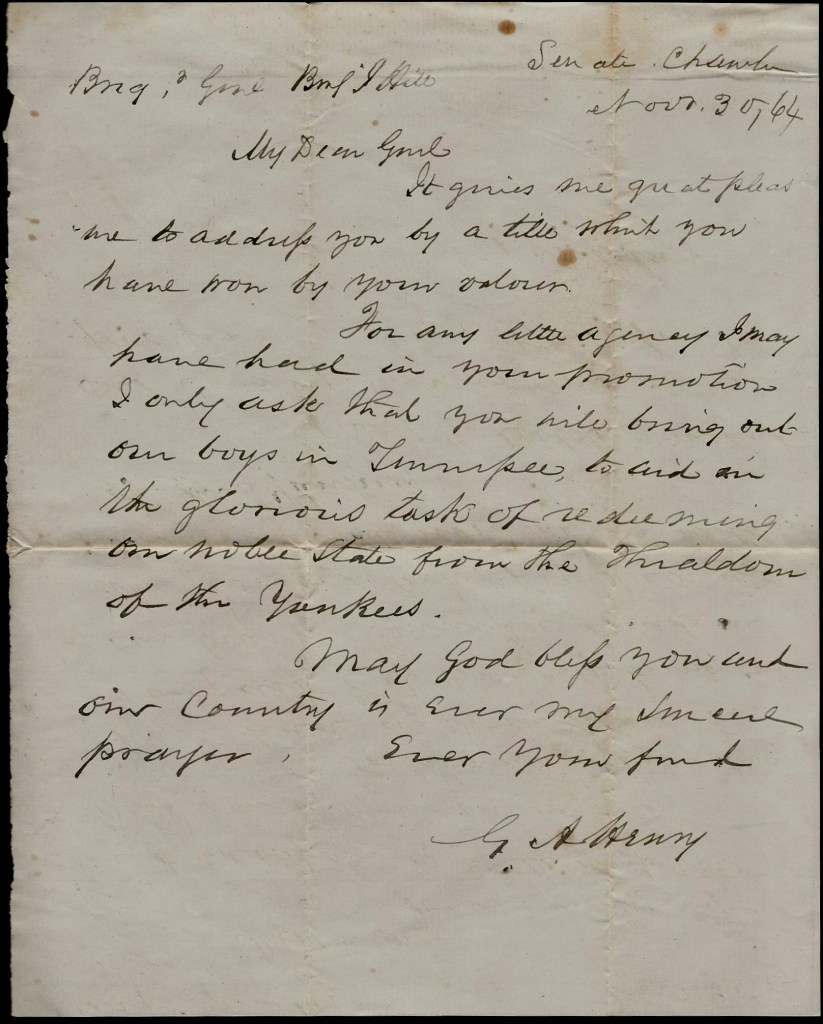
Senate Chamber [Richmond, Va.] November 30, 1864
Brig. General Benj. J. Hill My dear General,
It gives me great pleasure to address you by a title which you have won by your valor.
For any little agency I may have had in your promotion, I only ask that you will bring out our boys in Tennessee to aid in the glorious task of redeeming our noble state from the thralldom of the Yankees.
May God bless you and our Country is ever my sincere prayer.
This letter was written by 46 year-old Joseph T. Curry (1818-1881) late in the Civil War while serving as the Captain of Co. B, 58th Alabama Infantry. Though he served as a Methodist minister in northeastern Alabama before and after the Civil War, Joseph did not lack for confidence in leading men into battle. He initially entered the service as a 1st Lieutenant in Capt. Avirett’s “St. Clair Sharpshooters” In June 1863, Avirett’s company was combined with Cox’s Battalion Sharpshooters to form the 58th Regiment Alabama Volunteers. Joseph was promoted to Captain in April 1864 and remained with the company until he was wounded in August 1864 before Atlanta.
In this letter, Capt. Curry seeks a position in the “Mounted Brigade” being raised in northern Alabama. It does not appear that Gen. B. J. Hill accepted his offer, however, as he was mustered out of the service on 10 May 1865 still in the 58th Alabama after having been held prisoner.
The only post war newspaper notice I could find for Rev. Curry was published in the Mobile Daily Register on 24 February 1868, which read: “The house of Rev. Joseph T. Curry near Talladega was burned a few nights since, during his absence, his family barely escaping in their night clothes.”
The letter was mailed in an “Adversity Cover” which was an envelope fashioned out of miscellaneous scraps of paper due to a paper shortage in the South. In this case, it appear to have been made from a letter.
Joseph’s 1865 letter was mailed in an “Adversity Cover”
Transcription
Hollywood, Alabama February 20, 1865
General,
Sir, I see a notice in the Rebel that you are authorized to raise a Brigade of Mounted Men in North Alabama. I would like to get a position in a “Mounted Brigade” as Captain or authority to raise a Battalion for the Brigade. I [am a] captain of a company in the 58th Alabama Regiment Infantry and have been in service since the 15th of May 1862. I am not drilled in Cavalry Tactics but being well informed in Infantry drill, I have no fears as to my ability to comprehend the other.
I am a resident of Talladega county, Alabama, and acquainted in the surrounding counties; and think I can be successful in raising a command. Please write me as early as convenient. Address me Capt. Jos. T. Curry, Co. B, 32 & 58th Alabama Regt., Holtzclaw’s Brigade, Mobile, Alabama
I am, General, your obedient servant, — Jos. T. Curry
This letter was written Jane Elizabeth Weller (1836-1923), a seamstress and milliner temporarily residing in Petersburg, Virginia. She was the unwed daughter of Dr. Sidney Weller (1791-1854) and Elizabeth McCarrell (1803-1870) of Ringwood, Halifax county, North Carolina.
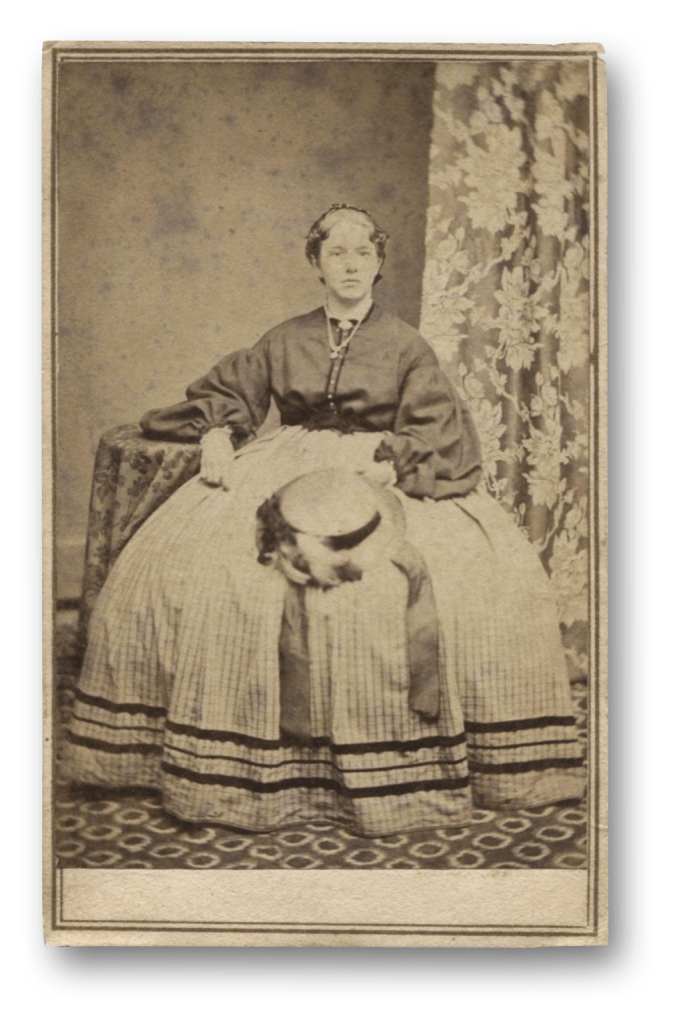
How Jane might have looked
Jane was undoubtedly residing in Petersburg at the time with her younger sister, Irene (1843-1906), the wife of commission merchant Jessie Hilliard Herbert (1834-1900). I cannot find a service record for Jessie Herbert but his grave in Battleboro, North Carolina, is marked with the CSA Iron Cross. Jane’s father Sidney, long deceased by the time this letter was written, was from New York State but came to Brinkleyville, Halifax county, North Carolina, in the 1820’s. He purchased at that time what was perceived to be poor quality land, having been depleted from years of crop production, and “instead of becoming a planter he engaged in general farming, grew grapes, and operated a small nursery. He also planted and propagated mulberry trees in a plan to make the South a region of silk production. In a six-year period he reported having sold $10,000 worth of mulberry trees that he produced in his nursery. He advocated and demonstrated methods for improving the fertility of the soil through the use of livestock manure and other natural fertilizers, rotating crops, and cover crops to prevent erosion.” By 1840, he had the largest vineyard in North Carolina. His property is now Medoc Mountain State Park. [See Sidney Weller]
Jane wrote the letter to her younger brother, Joseph McCarrell Weller (1841-1898) who married Laurel Vinson (1845-1877) after the Civil War. Very early in the war, Joseph had enlisted in Co. E, 2nd North Carolina Volunteers which later became the 12th North Carolina. He was discharged for disability on 1 July 1862 after a little more than one year’s service.
Jane died in Greensboro, North Carolina, in April 1923. At the time of her death she was living at the Masonic & Eastern Star Home where she had resided for several years suffering from dementia. She was described as having been a school teacher prior to her becoming disabled. Her death record reveals her true birth date as 27 July 1836.
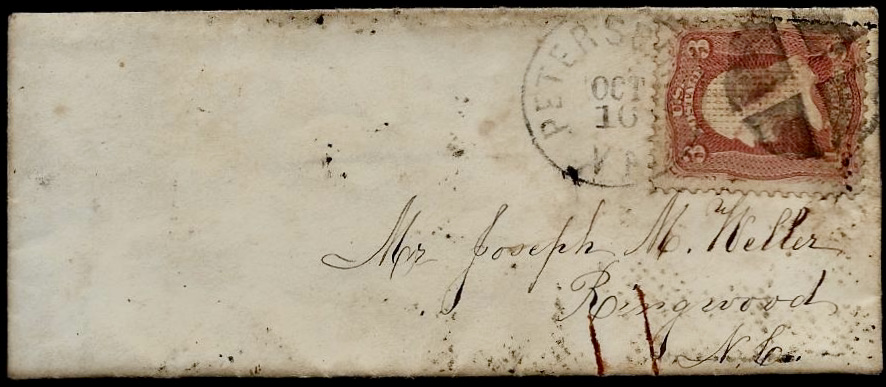
The letter is rather mundane, discussing the state of health of family members, and the usual complaints of insufficient correspondence, but the middle paragraph includes a discussion of hired labor I have not seen previously. The cost and expectations of hiring “white servants” is explored by a family that had long grown accustomed to having black servants. The envelope is postmarked Petersburg, Va., and includes a canceled US 3-cent stamp which would be considered a “Confederate State Use of US Postage” if the letter was written in 1863 or 1864. The absence of any war news, particularly in Petersburg which was enveloped by the Union army at this stage, leads me to believe the letter is post war. Unfortunately there isn’t any content within the letter to allow me to pinpoint the year of the letter.
Transcription
Addressed to Mr. Joseph M. Weller, Ringwood, North Carolina Postmarked Petersburg, Va. with 3-cent US stamp
Petersburg, Virginia October 15, [1865 or 1866?]
Dear Joseph,
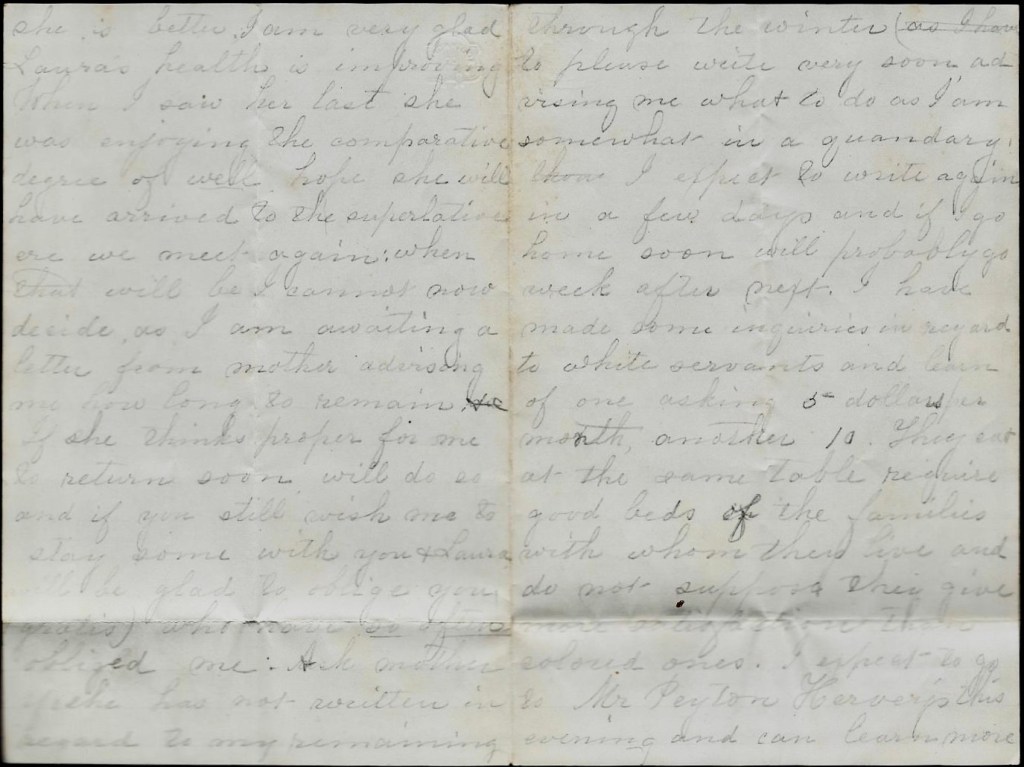
I have been anxiously expecting a letter for several days, either for Irene or myself from mother or some member of the family, so you will readily guess yours was gladly received this morning (contents noticed, &c.). You said nothing about the health of mother who was disabled by a fall when she last wrote, If she were either worse or not improving, I suppose you would have mentioned it so will take it for granted she is better. I am very glad Laura’s health is improving. When I saw her last, she was enjoying the comparative degree of well. Hope she will have arrived to the superlative ere we meet again. When that will be, I cannot now decided as I am awaiting a letter from mother advising me how long to remain here. If she thinks proper for me to return soon, will do so, and if you still wish me to stay some with you & [sister] Laura, will be glad to oblige you (gratis) who have so often obliged me. Ask mother, if she has not written in regard to my remaining through the winter, to please write very soon advising me what to do as I am somewhat in a quandary. I expect to write again in a few days and if I go home soon will probably go week after next.
I have made some inquiries in regard to white servants and learn of one asking 5 dollars per month—another 10. They eat at the same table, require good beds of the families with whom they live and do not suppose they give more satisfaction than colored ones. I expect to go to Mr. Peyton Hervey’s 1 this evening and can learn more as she has (or had) one and when I write again, will give due information.
I hope the letters, bonnet, and package sent by E. Hunter were safely delivered (they had not been when last heard from home). Irene wishes to know if Mrs. Vinson was pleased with her bonnet. Sends much love (I too). to you Laura, mother, and the family & friends. Irene says you spoke of her letters containing so little news. Thinks yours was equally deficient. Laura’s letter to her has not yet arrived. I have written two letters to mother since the one sent by Ed Hunter and have received only one from her since I left. Irene none but will not complain. Believe me faithfully your loving sister, — Jane E. Weller
1 Peyton E. Hervey (1822-1890) was married to Virginia E. Clark (b. 1830) in October 1854 in Halifax county, North Carolina.The Hervey’s lived in Petersburg in the 1860s and 1870’s before moving to Mississippi.Peyton was a merchant in Petersburg for many years. He died in Raleigh, North Carolina.
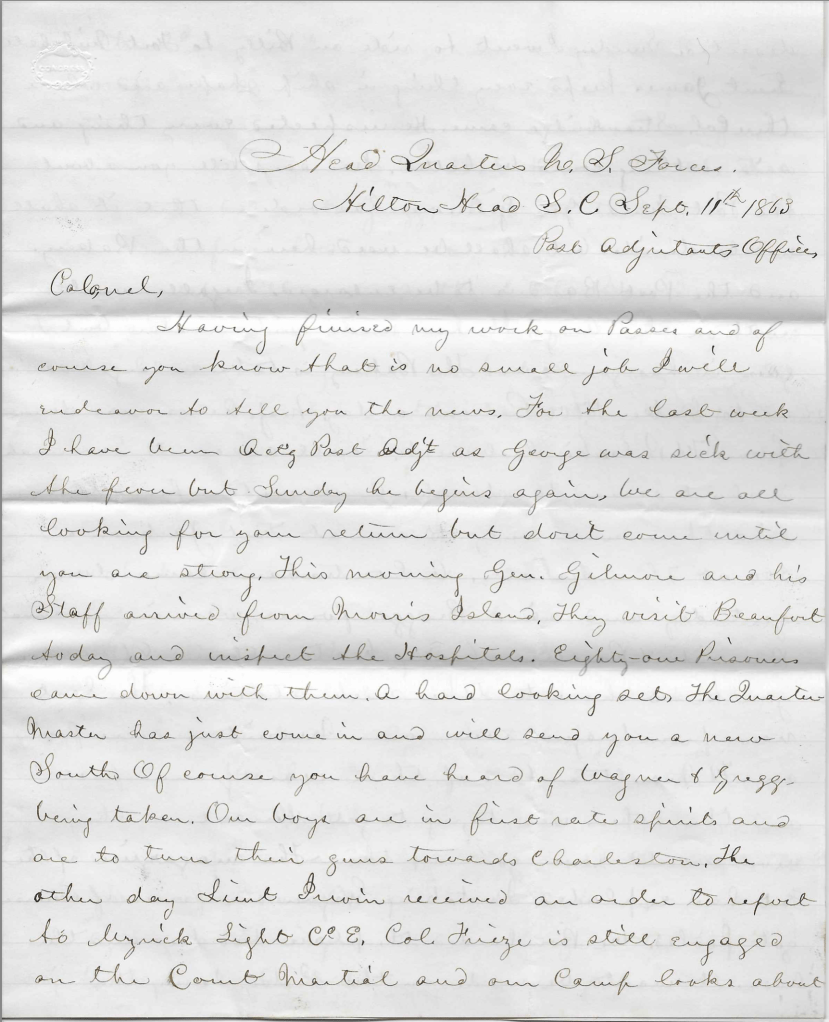
This letter was written by Lt. Henry H. Metcalf (1842-1904) of Co. C, 3rd Rhode Island Heavy Artillery while serving in the Post Adjutant’s Office at Hilton Head, South Carolina, in September 1863.
Lt. Henry H. Metcalf, 3rd Rhode Island Heavy Artillery
Edwin Metcalf (1823-1894) was a Harvard-educated lawyer and Rhode Island state legislator when he resigned his seat to join the war. Commissioned as Major of the 3rd Rhode Island Heavy Artillery, he immediately made a name for himself and the regiment when he led the first battalion in the battle of Secessionville, SC.
Promoted to Colonel and transferred at the governor’s request to command the new 11th Rhode Island Infantry, Metcalf was with the Army of the Potomac only a short time before being recalled to South Carolina. Yellow fever had swept the ranks and claimed Col. Brown of the 3rd RI HA, as well as several other officers, and Metcalf was seen as the one to revitalize the demoralized regiment. He commanded the regiment and served as Chief of Artillery until January 1864, when he returned to Providence on medical leave. He resigned due to illness on February 5, 1864.
[This letter is from the private collection of Greg Herr and is published on Spared & Shared by express consent.]
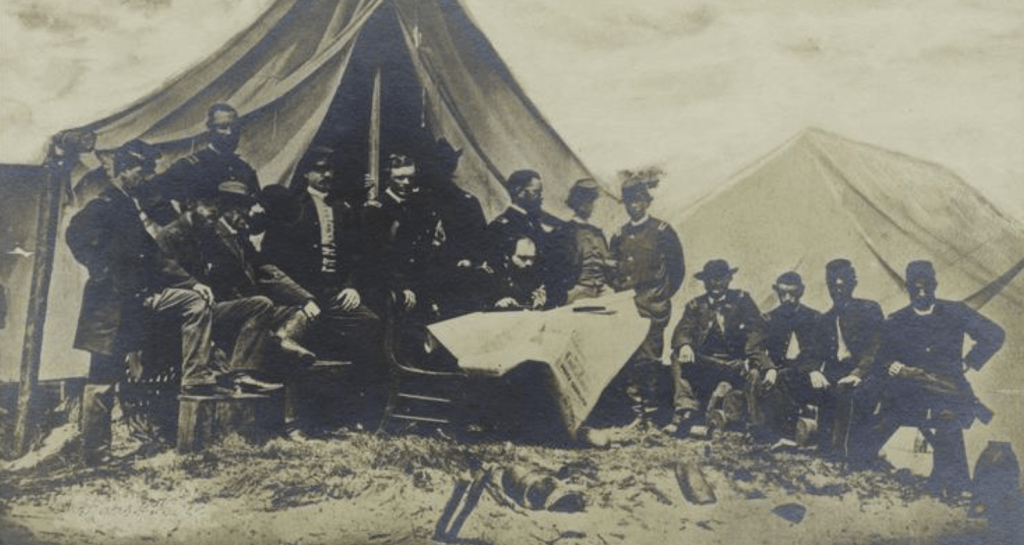
Maj. Gen. Quincy A. Gilmore and staff (N. Y. Public Library Digital Collections)
Transcription
Headquarters U. S. Forces Hilton Head, S. C. September 11th 1863 Post Adjutant’s Office
Colonel [Edwin Metcalf]
Having finished my work on passes and of course you know that is no small job, I will endeavor to tell you the news. For the last week I have been acting post adjutant as George was sick with the fever but Sunday he begins again. We are all looking for your return but come come until you are strong.
This morning Gen. [Quincy Adams] Gilmore and his staff arrived from Morris Island. They visit Beaufort today and inspect the hospitals. Eighty-one prisoners came down with them—a hard-looking set. The Quartermaster has just come in and will send you a new South. Of course you have heard of [Forts] Wagner & Gregg being taken. Our boys are in first rate spirits and are to turn their guns toward Charleston. The other day Lieut. Irwin received an order to report to [ ]ick Light Co. E. Col. [John] Frieze is still engaged on the court martial and our camp looks about deserted.
Sunday I went to ride on Billy to Fort Mitchell. Lieut. [J. P.] James keeps everything in ship shape and while there, Col. [DeWitt Clinton] Strawbridge came. He inspected everything and said nothing could be better. Fred says tell you about the Post Fund. Gen. Gilmore has ordered that it shall not be divided but shall be used here in the Bakery and the Post Band is to be enlarged. Ingalls went North on the Arago. It has made quite a stir but I guess it has gone over. The Bakery is to be enlarged so as to bake 15,000 rations a day. Maj. Ames was down from Ft. Pulaski last week. To all accounts, Savannah is about scared to death. A deserter from there said there were only 15 men at Fort Jackson [on the Savannah river] and 300 at [Fort] Thunderbolt [on the Wilmington river] . A contraband came down yesterday and said Bragg’s forces were in Savannah, Burnside & Rosecrans having beaten them. Of course you know how to take such stories.
The last news from Wagner were our monitors were firing on Ft. Moultrie. One of them [the Weehawken] was aground fast and the others were trying to get her out or they never would have gone up there. The magazine of the fort had exploded. I taking Wagner, our forces of course got fooled. We bombarded the place two days and the assault was made on the 3rd day. During the night of the 2nd day a deserter came in and said they had vamoosed. Five me were sent forward and after looking round the fort, came back. Then the wildest confusion prevailed in the trenches. We took 15 men in the fort and then pushed on to Gregg. There we took 85 in the water. But if we had assaulted Wagner, we would have had our match. All around the ditch, pikes had been placed and between them were torpedoes. Everything would have gone against us but Gen. Terry says his plan would have taken the fort. Ahem.
Capt. [David B.] Churchill met with an accident the other night which has laid him up for a short time. His horse struck the chain at the barn and of course the Captain took French Leave but the horse followed him in his somerset and fell on his arm. Lieut. Robinson was mustered yesterday. Our new doctor has arrived and is now flying round with his red whiskers in the wind. I like this business first rate and Col. Strawbridge [of the 76th Pennsylvania Infantry] is a good commandant.
We have had quite cool weather since you have been North but no rain. Your horse the other night ran with me and there was music for a short time. That head would turn and look me right in the eye but the ring is too much for him. The old Orderly is back behaving himself first rate and everything is going just as you would like to have it (except the Post Fund). I hope you will soon be with us but don’t come until your health will permit it. Give my love to Mother & all hands. I send you a paper with this. Also a letter received here for you.
I am yours truly, — Henry H. Metcalf
We have got the meanest Navy the Lord ever did float.
And send their best respects and hope that you will soon join us.
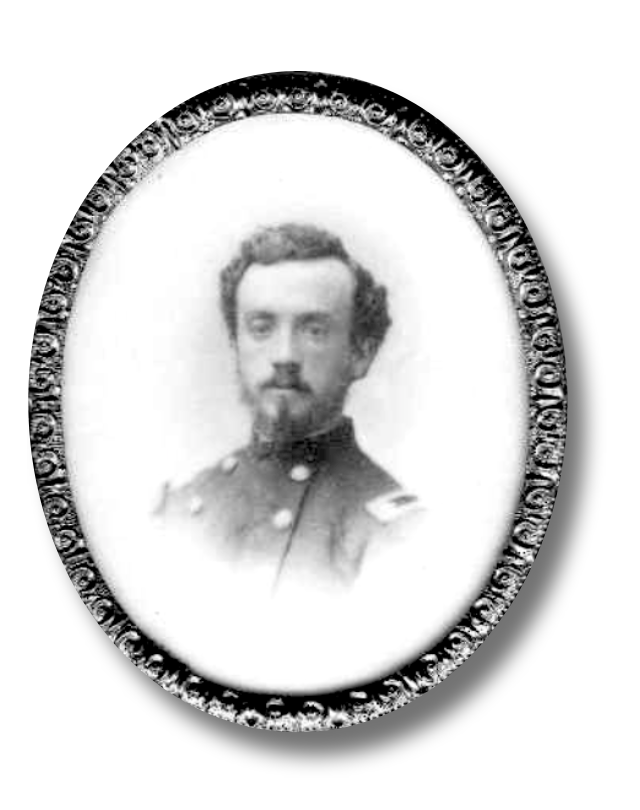
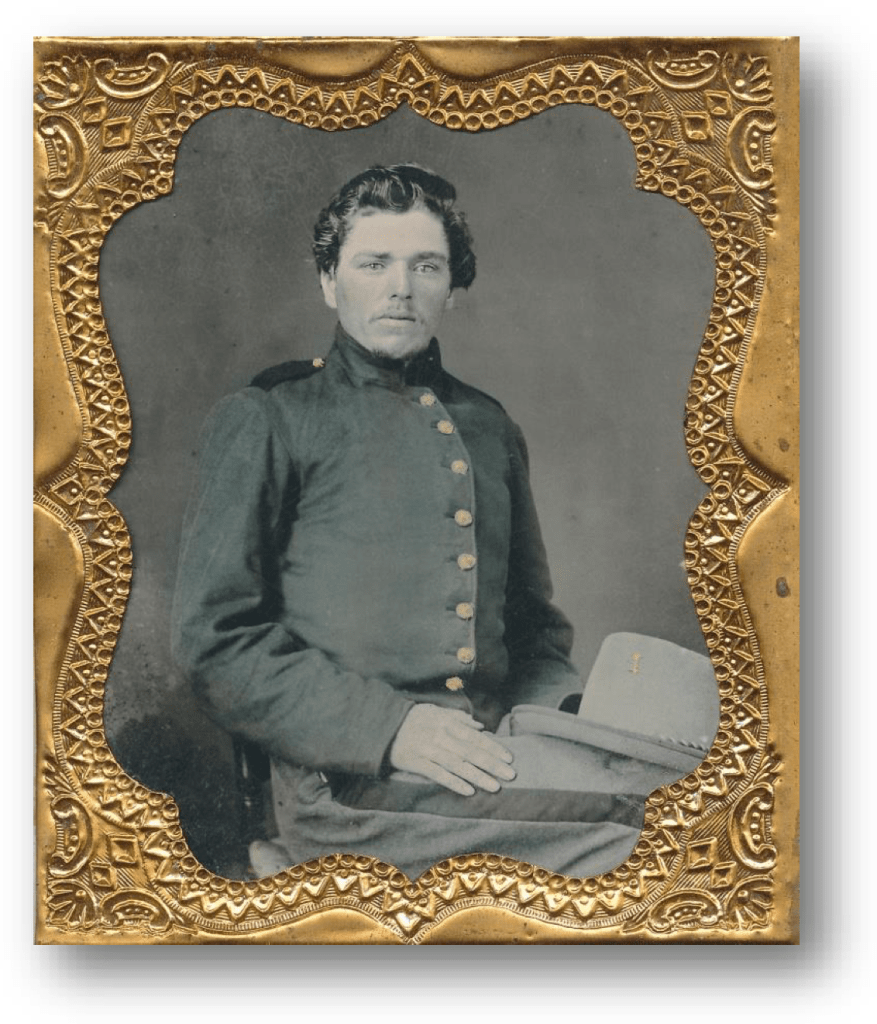
I could not find an image of Thomas but here is Sgt. Isaac King of Co. A, 1st Mississippi Light Artillery (Julie King Olsen Collection)
These letters were written by Thomas E. Atkinson (1831-1904), the son of William H. Atkinson (1788-1848) and (1793-1872) Elizabeth Harrison. Thomas’s father moved from Nash county, North Carolina to Hinds county, Mississippi, in 1833 when Thomas was only two years old. He was raised on his father’s plantation and received a “good practical” education in a neighborhood school, enabling him to clerk in a store. He married in February 1859 to Elizabeth (“Lizzy”) Hunter (1838-1907), the daughter of Joseph Lane and Susan (Stuart) Hunter of Noxubee county, Mississippi. Their two eldest children were Clara (b. 1 Dec. 1859) and Emma (b. 12 Nov. 1862).
When he was 31 years old, Thomas enlisted as a private in Co. A (“Jackson Light Artillery”), 1st Mississippi Light Artillery. At the time of his enlistment in May 1862, he was described as standing 5 feet 7 inches tall, with dark hair and grey eyes. His muster rolls credit him with having participated in the battles at Baker’s Creek (Champion’s Hill), Big Black River Bridge, and the Siege of Vicksburg where he was wounded in “several places” by a shell and taken prisoner when the city was surrendered on 4 July 1863. He was paroled on 7 July 1863 and apparently went home and did not report to to the rendezvous point in Alabama when he was ordered and subsequently considered to absent without leave or a deserter.
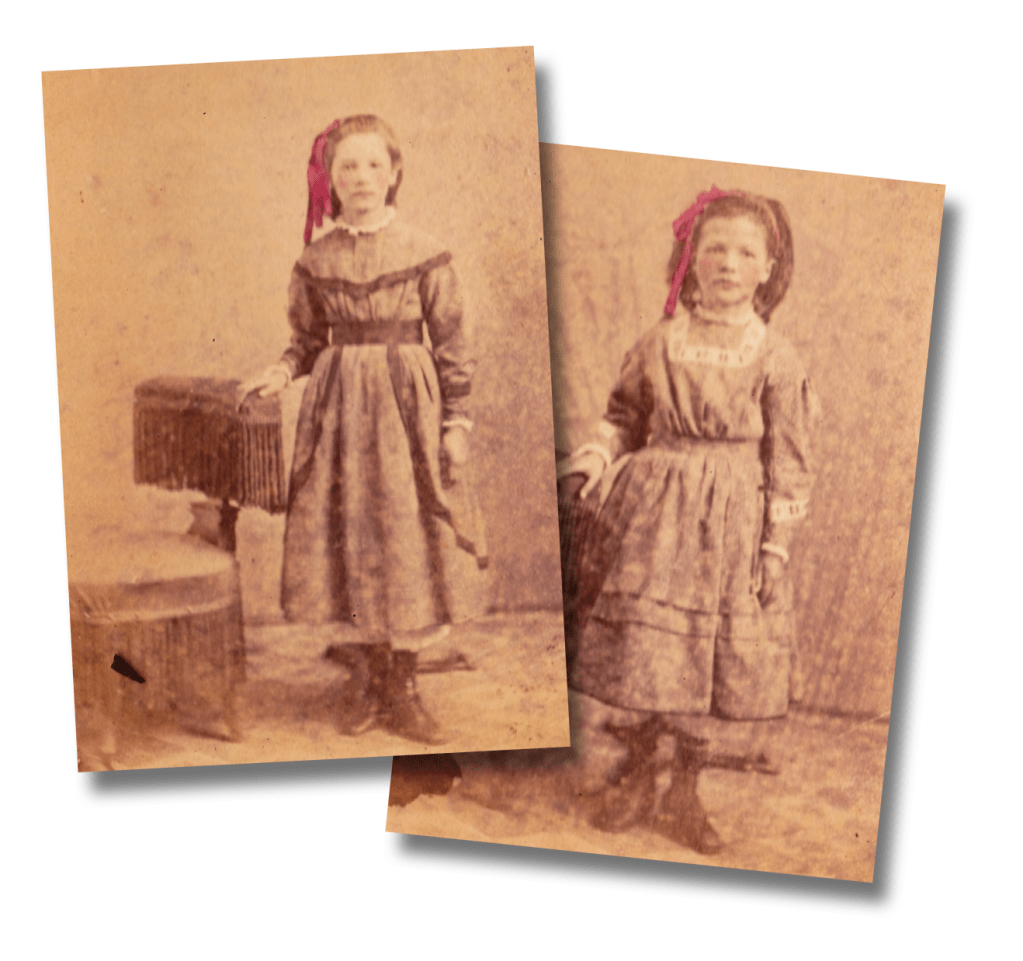
Post-war images of Thomas’s daughters, Clara and Emma
Letter 1
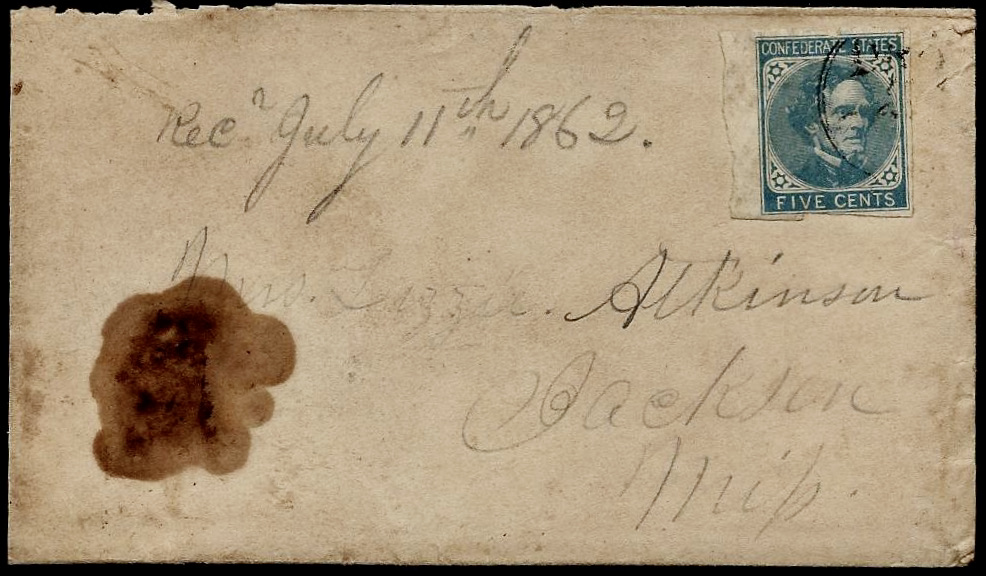
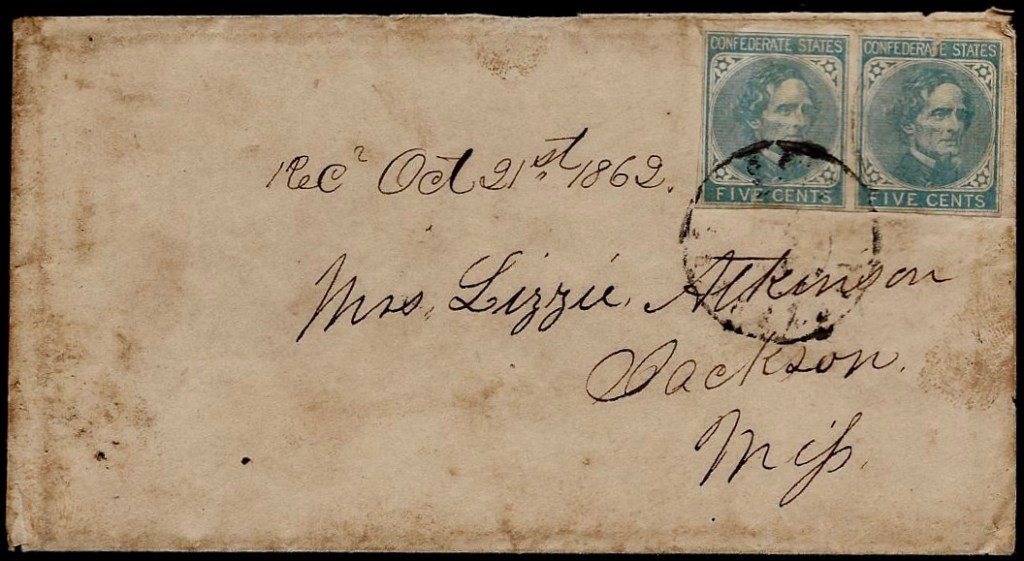
Addressed to Mrs. Lizzie Atkinson, Jackson, Mississippi
July 7, 1862
Dear Lizzie,
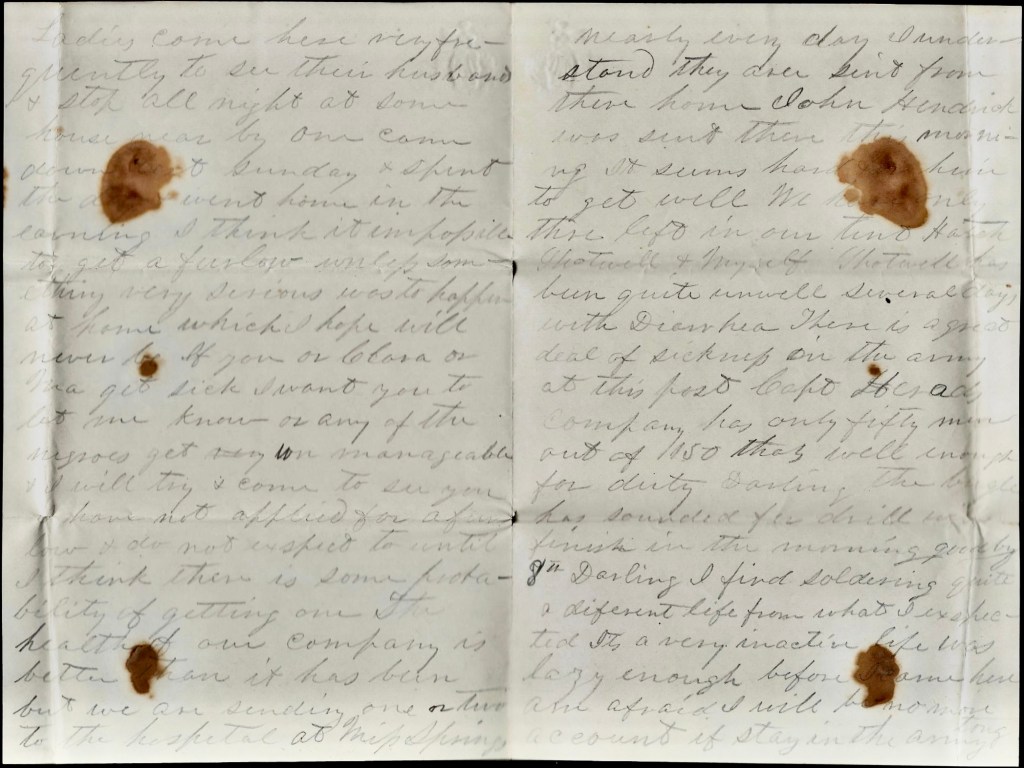
I received your kind letter of the 2nd July on the 4th & feel more than grateful to kind Providence that He has blessed you with health & protection since I left you. Darling, you know not how glad I would be to see you but can see no chance to do so unless you come down here. I know not whether to ask you to do so or not as I am not aware of your condition to travel or leave home. Mr. [Frank] Davis 1 speaks of writing to Bettie to come down. If you had a carriage to come in, it would not fatigue you much to make a day and a half trip of it. Ladies come here very frequently to see their husbands & stop all night at some house nearby. One came down last Sunday & spent the day & went home in the evening. I think it impossible to get a furlough unless something very serious was to happen at home which I hope will never be. If you or Clara or Ma get sick, I want you to let me know, or if any of the negroes get unmanageable, I will try to come to see you. I have not applied for a furlough & do not expect to until I think there is some probability of getting one.
The health of our company is better than it has been but we are sending one or two to the hospital at Miss Springs nearly ever day. I understand they are sent from there home. John Hendricks 2 was sent there this morning. It seems hard for him to get well. We have only three left in our tent—[A. Leland] Hatch, 3 [Bourbon] Shotwell, 4 and myself. Shotwell has been quite unwell several days with diarrhea. There is a great deal of sickness in the army at this post. Capt. [Andrew J.] Herod’s Company [B] has only fifty men out of 150 that [are] well enough for duty.
Darling, the bugle has sounded for drill [so I] will finish in the morning. Goodbye.
[July] 8th. Darling, I find soldiering quite a different life from what I expected. It’s a very inactive life. I was lazy enough before I came here and afraid I will be no more account if [I] stay in the army long.
The news from Virginia is glorious but sad to hear of the many good boys that suffered in the great cause. Darling, I can’t think we will have any fight here very soon , if at all. The Yanks has evidently been disappointed in their calculations & have to fall upon some other plan to accomplish their determination to open the navigation of the Mississippi. They commenced cutting a canal across the bend opposite Vicksburg to turn the river but [I] learn they have give up that plan and are now making a railroad across there.
I sent the bag that contained the potatoes with other things to Mr. Mann’s. Have the jars & bag that contained rye yet. Will send them some other time.
Darling, I heard you were very much disappointed yesterday week when you were in Jackson & did not get a letter from me. I write two or three to everyone I get. I did not get any you mailed that day. I hope you did not go to Jackson & not mail a letter for me. I expect one every time you send to office.
Darling, I do not wish the Weekly Mississippian as we get to see one nearly every day. If you wish the Daily Mississippian, take it. The Weekly would be of no use as the news would be old before you would get it. When you send after your paper, send me a letter. Darling, write me all the news about the crop, stock, &c. Continue to plant out potato vines up to the 15th or 20th of July. Would market as much as possible if have anything to market or learn everything in the way of vegetables is very high in Jackson.
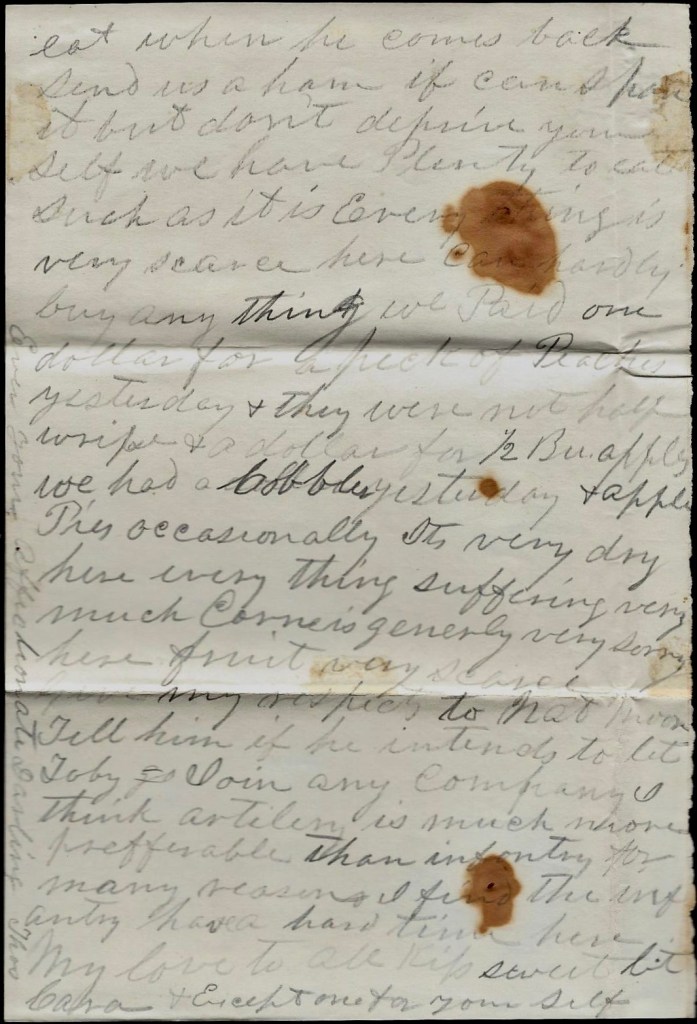
Mose [Simpson] is well. Has the cooking to do for the mess by himself. Does very well. The other two boys are both gone home sick. Expect Shotwell’s boy soon. He is to bring something to eat when he comes back. Send us a ham if can spare it but don’t deprive yourself. We have plenty to eat, such as it is. Everything is very scarce here. Can hardly buy anything. We paid one dollar for a peck of peaches yesterday & they were not half ripe, and a dollar for half bushel apples. We had a cobbler yesterday and apple pies occasionally.
It’s very dry here. Everything is suffering very much. Corn is generally very sorry here. Fruit very scarce.
Give my respects to Nat Moore. 5 Tell him if he intends to let Toby join any company, I think artillery is much more preferable than infantry for many reasons. I find the infantry have a hard time here. My love to all. Kiss sweet little Clara & accept one for yourself. Every your affectionate darling, — Thos.
1 Francis (“Frank”) C. Davis of Jackson was a 33 year-old farmer when he enlisted as a private in Co. A, 1st Mississippi Light Artillery in late March 1862. He was descried as standing a little over 6 feet tall, with black hair and black eyes. He was promoted to corporal in December 1862 and to quartermaster sergeant in July 1864. He was married in November 1858 to Bettie Hendrick (1839-1919).
2 John A. Henrick was a 19 year-old student when he enlisted as a private in Co. A, 1st Mississippi Light Artillery in April 1862. He stood a little over 5 feet 10 inches tall, had light hair and grey eyes. Later in the war he was with General Forrest’s command in the Battle of Harrisburg.
3 Twenty-nine year-old A. Leland Hatch, a Jackson (MS) nurseryman, was elected Sergeant of his Co. A, 1st Mississippi Light Artillery when he enlisted in May 1862. He stood 6 feet tall, had blue eyes and light colored hair.
4 Bourbon Shotwell of Jackson, Mississippi, was appointed a corporal when he enlisted in Co. A, 1st Mississippi Light Artillery in May 1862. He stood 5 feet 11 inches tall, had auburn hair and grey eyes.
5 Nathaniel (“Nat”) Moore (1808-1865) farmed on land very near to the Shotwells near Jackson, Mississippi. He died in Clarke county, Alabama, in January 1865, never having returned to his home in Mississippi.
Letter 2
Addressed to Mrs. Lizzie Atkinson, Jackson, Mississippi
Camp Yazoo September 4th 1862
My Dear Lizzie,
I am very tired but must write to you this evening so that you may hear from me this week. I have just returned from fishing. The boys are cleaning them while I write. We have bought a trot line. Dan Mann, Bill Hendrick, and myself went a mile on the other side of the river to a large lake. We caught forty perch & found two small catfish on the line as we returned to camp weighting about eight lb. apiece which will give us a fine bait of fish tonight. I wish you had some of them.
We have moved our guns about half mile from the river. We all stay in camp except two men to guard the gun every day and night. There is some negroes here digging pits and throwing up powder magazines ready to mount the guns before they bring them here. There was a rumor in camp this morning that the Yanks were coming up but suppose it was a false alarm as it is very doubtful whether they can get in at the mouth of the river. The river is falling very fast & it is quite probable they are afraid to venture up.
About 1200 of our men that were captured at Fort Donelson was returned to Vicksburg a few days since. I read a dispatch from Jackson yesterday giving the news of another glorious victory in Virginia. May God continue to bless our arms & it may not be long before this inhumane war will close.
Darling, I was made to rejoice yesterday evening by receiving your letter of the 2nd. It always gives me pleasure to hear from you and more especially to hear you are so happy with your Mother and sisters. Give my love to them all. I would like very much to be with you all but cannot tell when. Tell Sue to write to me some time. I am always glad to get a letter. I wrote three day before yesterday. We have more fish tonight than we know what to do with. Since writing, the boys have brought another catfish weighing about 20 lbs. & 38 perch.
Darling, send us a bushel of corn meal the first opportunity. The health of our company is very good. Our mess are all well except Rob. He is having chills. Mrs. [Isaac] King is here on a visit to see her husband. She informed me that Mat Mann 1 was agoing to take a school [and] that Mr. Mann was going to build a house for her near her house on the opposite side of the road. I was surprised to hear that she would take a school. Think she will get tired before long. Darling, if you can find a pair of blankets for sale, I wish you would get them for me—the heaviest you can find. If you have any red braid or tape, I wish you would sew it on the seam of my grey pants—the outside seam of the leg.
Give my love to Ma. Kiss little darling. Write when convenient. Nothing more. The bugle has blown to put out lights. Good night, my darling.
Your most affectionate, Thos. A.
Toby sends his love to all. Says tell his Pa to send him some shoes. He wants him to send a boy also.
1 Mattie J. Mann (1842-1927), was the daughter of Daniel Mann (1812-1868) and Penina Atkinson (1821-1912). Se married Henry Goodloe in 1864. After he died in 1870, she married Moses Philip Simpson (1835-1892) who served with Thomas Atkinson in Co. A, 1st Mississippi Light Artillery.
Letter 3
Addressed to Mrs. Lizzie Atkinson, Jackson, Mississippi
Camp on Yazoo October 2nd 1862
My Dear Darling,
Our camp is now 12 miles above Vicksburg on the Yazoo & Vicksburg road situated in a high hill overlooking the Yazoo river. We moved here last Monday supposing it to be a more healthy location which I hope it may prove. It’s really alarming to see so much sickness in our detachment. We only have one cannoneer & others are equally as bad as ours. I don’t know what we would do if the Yanks were to come now. Our guns are at the same place on the river. We have regular pits dug & earthworks thrown up for the protection of the men in case of an attack. There has been a rumor of an attack here but I think it like all heretofore false.
Mr. Davis came back last night & was taken sick soon after arriving. Billy Mann is little sick. I think [he] will be up soon. Toby is very well and hearty. Is taken with the idea of fishing. He went down to the river yesterday morning and caught a fine string—enough for three messes. This morning he caught a nice string. One very fine drum [fish] suppose would weigh four or five lbs.
Darling, your letter by Mr. Shotwell was received Tuesday evening. I was very sorry to hear that little darling [Clara] was sick. Hope she is better by this. Had rather you would not call on Bright to see or prescribe for her. It is best to have but one doctor. Hope you will spare no expense or trouble to have her attended to. I was truly glad, my darling, that you were well and almost regained your strength. I hope you will not fatigue yourself too much. A little prudence might prevent another spell.
Mr. Miller was here yesterday to see his son John. He came up to Jackson to bring his negroes. He says the Yanks are stealing negroes so rapidly in his country that he was afraid to keep him there any longer. He says he will move his family up here somewhere after awhile. He left Mary Miller— his wife, and children all well. If you have heard from Arkansas lately, please let me know so that I may write to them. John Miller is quite sick here. If can get off, he wants to go to some house near Jackson. I told him to g to our house—that you would take as good care of him as you could.
Darling, you need not buy any material to make me a coat. The government is going to furnish coats, overcoats, &c. When they come, will write you what I will need. I know will need no more outside clothes but will write more particularly about it next time. It is late at night. Must close.
May God protect your. Good night. Your affectionate, — Thos.
My love to Ma and all who may enquire after me. Kiss little Clara,
Letter 4
Addressed to Mrs. Lizzie Atkinson, Jackson, Mississippi
Snider’s Bluff October 19th, 1862
My Dear Lizzie,
Your very interesting letter of the 12th was gladly received on the 15th bearing the good news that all were in good health at home. I am happy and truly thankful to out heavenly Father to inform you in return that I am enjoying better health than usual. I know not how to account for it unless it is taking more exercise than usual. I have had charge of our detachment since [Leland] Hatch & [Bourbon Shotwell has been sick which has given me a good deal more to do than usual. The health of the company has improved very much. All of our detachment that are at camp are well, or nearly so.
I hope to have an opportunity to send some clothing home soon. Have too much here.
The sickness has generally been light—common chill & fever. Bob Goodloe & Mr. [John Alexander] Forest are both at Mr. Hodges sick. I learn from their boy that they are improving. Their wives have been with them. I hear Mrs. Forest leaves for home in the morning. It is sad to inform you of the death of Mr. Fario. He died yesterday evening. I learn it was inflammation of the bowels that caused his death. He has been sent to Scott county to be buried with some relation.
Darling, I see the government has been giving eight sacks of salt for one bale of cotton but see in yesterday’s Miss. that planters need not send anymore cotton there to exchange for salt so I hardly know what to advise you to do. I learn the government has made arrangements to exchange 1,000 bales of cotton for 10,000 sacks of salt & the government only allows two sacks to one family. If that is true, you can get four sacks by claiming two for Ma and two for ourselves, and probably you could get two for Toby. Do the best you can. We will need all you can get but I think that somebody must have swindled Nat for if the government makes the exchange at all, they certainly do give more than two sacks for one bale. Mr. Shotwell says his father has made the exchange and got eight sacks for one bale. Mr. Davis says Mr. [Daniel] Mann is going to exchange a bale for him and wants us to take some if he gets it. You take as much as they will spare for fear you will not be able to get any more, but make the exchange if you can.
[ ] Hendrick has been conscripted & sent to our company. He got here last night.
If you have not separated the hogs, I think you had better do so if there is anything in the field for them to get. Turn the sows & pigs in the woods or oat pasture & let the killing hogs remain in the field & feed them well with corn. If there is nothing in the field for them, probably you had better have them put in a pen or lot for fattening. It’s time they were getting fat. Let me know in your next how they are getting on picking cotton & hauling wood. Tell Nat I thought it best to send Horace home as it is a very poor place to take care of a sick negro.
My love to Ma. Kiss little darling [Clara] for Pa Pa. May God care for & protect you in the prayer of your affectionate— Thos. A.
Letter 5
Addressed to Mrs. Lizzie Atkinson, Jackson, Mississippi
In camp, March 4, 1863
My dear Lizzie,
Your letter of the 27th was received Monday evening bringing the news of Ma’s bad health. Am very sorry to hear she has the rheumatism. I know she suffers a great deal but hope she will recover soon. I reckon she has exposed herself too much in the cold this winter. I hope you will not spare any expense or trouble in furnishing her anything she wants or may need. I have felt some uneasiness about her since I heard she was sick. Wish you to let me know as often as you can how she is.
I have fine health now. I feel like it’s a great waste of time to be sitting around here doing nothing this pretty weather. How long do you expect to keep your cousin’s negroes? If you think they will stay during the cultivating season, would have more planted . Think you can cultivate all the land we have. Don’t forget to plant a large patch of potatoes. I want about ten acres in potatoes this year. Plant a great many vegetables for the negroes & to market on. It will pay better than anything else. A large watermelon patch will be profitable.
Very little sickness in camp now. All the boys are well. It seems impossible to get Toby to write to his Pa. Have done my best to get him to write but have not succeeded. Gave him a talk last night and all I could get out of him was that he didn’t want to write.
Two Yankee deserters have just passed which makes four deserters & two prisoners that passed here this week. They have no news of importance. Seem to know but little about the Yankee’s plans. They say the Yanks are dying very fast of the other side [of the Mississippi]. Some of them think it impossible to take Vicksburg and some think they will. It is believed here the gunboat Indianola has not been blown up but it undergoing repairs to be ready for the next boat that may come down.
Give Ma my love & tell her I hope she will be up soon. Kiss the sweet little darlings [Clara and Emma]. Goodbye.
Your affectionate, — Thos. A.
Tell Nat Moore he need not be uneasy about Horace. He is well.
Darling, have you received the different boxes sent home. One sent to Mr. [Daniel] Mann’s with my blue coat in it with other things. Sent a jar to Betty Davis’s.
This poignant letter was written by a previously unidentified soldier who signed his name “Ned,” a nickname for Edward, Edwin, or Edmund. There was very little content in the letter that might lead us to his identity though he told us he had passed through “every fight from Cedar Mountain to Resaca with scarcely a scratch.” While this narrowed down the hunt somewhat by eliminating all regiments that did not claim these as their first and last battles to the date of the letter, it unfortunately still included many regiments, including the 102nd New York, the 109th Pennsylvania, the 79th New York, the 2nd Massachusetts, the 46th Pennsylvania, the 66th Ohio, the 27th Indiana, and probably several others.
Dr. William Nichols, Jr.
The best clue in the letter was the reference to Dr. Nichols whom I believed was William Nichols, Jr. (1840-1899), as asst. surgeon from Boston who was commissioned in the 2nd Massachusetts in May 1863. William was an 1862 Graduate of the Harvard Medical School.
I finally checked my own archive of previously transcribed letters and found that I have a “Ned” who fits the profile of this author. I’m reasonably confident the letter was written by William Edward Perkins (1838-1879), the son of a Boston merchant. William served with the Forty-fourth and Second Massachusetts Infantry regiments. At the time this letter was written he was an officer in Co. I, 2nd Massachusetts Infantry.
Breastworks five miles south of Marietta [Ga.] June 23, 1864
Dear Sister,
Dr. Nichols tells me that the statement which I ran in the papers of Charlie’s death is confirmed. I have been thinking how strange it is that two whose future lives seemed so bright & promised so much usefulness should be taken while I who have had no future have been through every fight from Cedar Mountain to Resaca with scarcely a scratch.
The two Charlies seem to me like a bright dream of the past. There seemed to be so little of evil in them that I cannot think of them as I do of others who have started through life with me & been taken away by death.
A Sixth-plate ambrotype of an unidentified member of Orr’s Rifles of South Carolina. He’s wearing the blue jacket with dark green shoulder straps and trim. By the time these letters were written in early 1862, a gray jacket had been substituted for the blue ones. He has a small brass palmetto tree pinned to the side of his hat.
These three letters were written by Joseph Richard (“Dick”) Sadler (1835-1864), the son of David Sadler (1812-1885) and Jane McLees (1813-1898). Joseph was 26 when he enlisted on 20 July 1861 at Camp Pickens as a corporal in Company D, 1st (Orr’s) South Carolina Rifles. He was elected Junior 2nd Lieutenant on 4 April 1863. During the Battle of the Wilderness, 5 May 1864 he was wounded. He was sent to the hospital in Staunton, Virginia, where he died on 7 October 1864 from his wounds. Joseph’s younger brother, John A. Sadler (1842-1862), also served the Confederacy. He died at a hospital in Richmond of typhoid fever on 4 October 1862. In two of his letters, Joseph mentions the purchase of a hat that he had trimmed as a gift for his younger sister Carline (“Carrie”) G. Sadler (1849-1871).
All three of these letters were written during a six week period early in the war and before Orr’s Rifles had seen “the elephant.” They suffered their first casualty at the Battle of Mechanicsville on 26 June 1862, and then were pounded at Gaines’ Mill the following day when they lost 81 killed and 234 wounded of the 537 men that took the field.
Letter 1
Sullivan’s Island April 14th, 1862
Dear Jule,
I was somewhat disappointed today by not getting a letter from home to let me know whether Jno. was coming or not and when he would be here. In short, I wanted to know all about it.
I heard Saturday that Jim Gray was going to start home yesterday. Well I wrote him Sunday that I would try to meet him in the city last night but yesterday morning I got the chance of going to spend the day and I went expecting to see Jim in the city. I knew it was very doubtful whether Col. [Jehu Foster] Marshall 1 would let me go to stay all night if Jim started home. I did not get to see him. I wanted to send Carrie’s hat with him. Mrs. Georgia Teasdale 2 got it and trimmed it for her. The day I went over to get it, I went there to ask them what sort of a thing to get. Mrs. Georgia proposed to get it for me if I would rather. I was very willing for her to get it. They asked me seven dollars for such hats or hats not as nice as that. They are called jockey hats. It cost five dollars and that is more than double the worth of it. Everything is more than double in that place.
Jule, I would have been powerful glad if you and Ett would have come with Eugenie Carlisle. Like got a letter today saying they would start tomorrow. They will get here day after tomorrow (Thursday).
If Jim Gray did not take Carrie’s hat, I will send it by cousin Jennie. Jule, tell Jno. to bring all the butter he can find. The next time any of you write, tell what the chance to get a pair of shoes is.
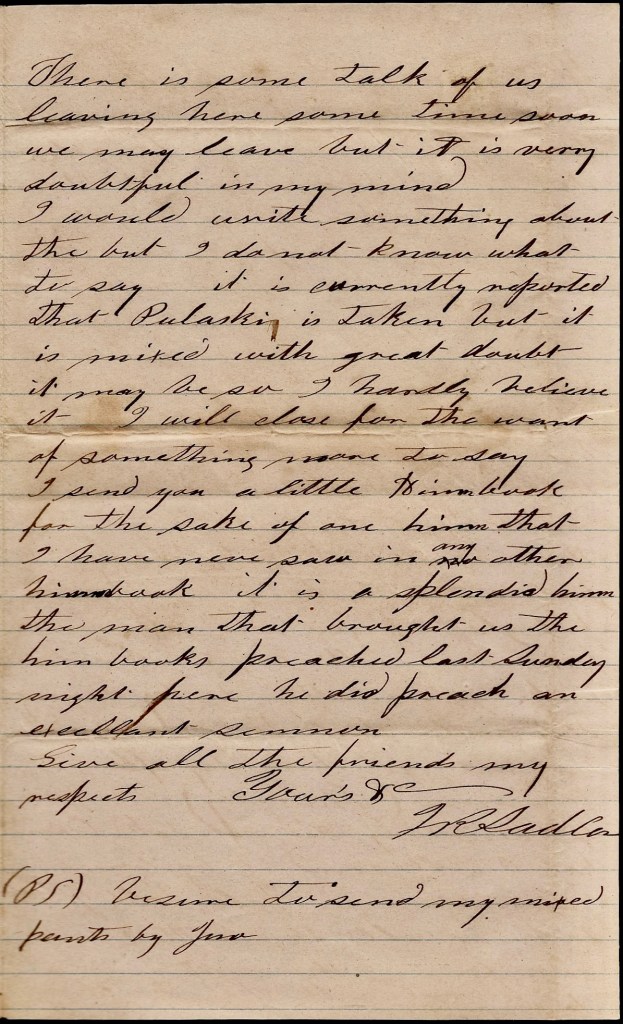
There is some talk of us leaving here sometime soon. we may leave but it is very doubtful in my mind.
I would write something about the [war] but I do not know what to say. It is currently reported that Fort Pulaski is taken but it is mixed with great doubt. It may be so [but] I hardly believe it.
I will close for the want of something more to say. I send you a little hymn book for the sake of one hymn that I have never saw in any other hymn book. It is a splendid hymn. The man that brought us the hymn books preached last Sunday night here. He did preach an excellent sermon.
Give all the friends my respects. Yours, &c. — J. R. Sadler
P. S. Be sure to send my mixed pants by Jim.
1 Col. Jehu Foster Marshall took command of the regiment during the winter of 1861-62 when Col. Orr resigned his commission and entered the Confederate Congress at Richmond. Marshall was killed during the Second Battle of Manassas in August 1862. The following website describes the Marshall Plantation Site in Marion county, Florida, where Marshall established a Sugar Plantation in 1855.
2 Mrs. Georgia (Wharton) Teasdale (1844-1900) was the 18 year-old wife of James Hamilton Teasdale (1835-1871) of Charleston, South Carolina.
Letter 2
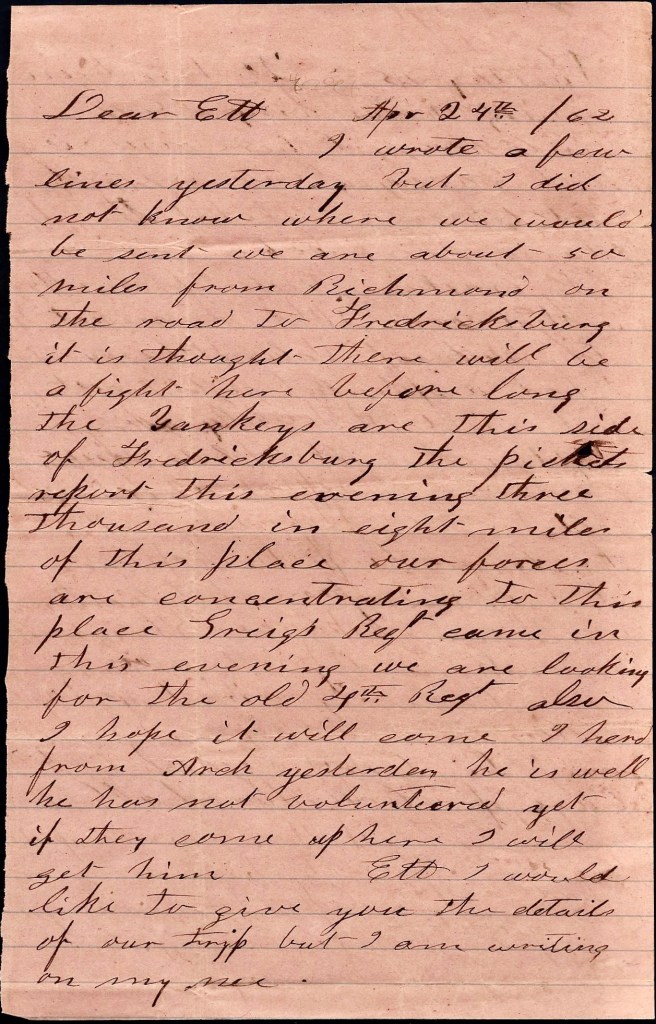
[On the road to Fredericksburg] April 24, 1862
Dear Ett,
I wrote a few lines yesterday but I did not know where we would be sent. We are about fifty miles from Richmond on the road to Fredericksburg. It is thought there will be a fight here before long. The Yankees are this side of Fredericksburg. The pickets report this evening three thousand [with]in eight miles of this place. Our forces are concentrating to this place. [Col. Maxcey] Gregg’s Regiment came in this evening. We are looking for the Old 4th Regt. also. I hope it will come.
I heard from Arch yesterday. He is well. He has not volunteered yet. If they come up here, I will get him. Ett, I would like to give you the details of our trip but I am writing on my knee.
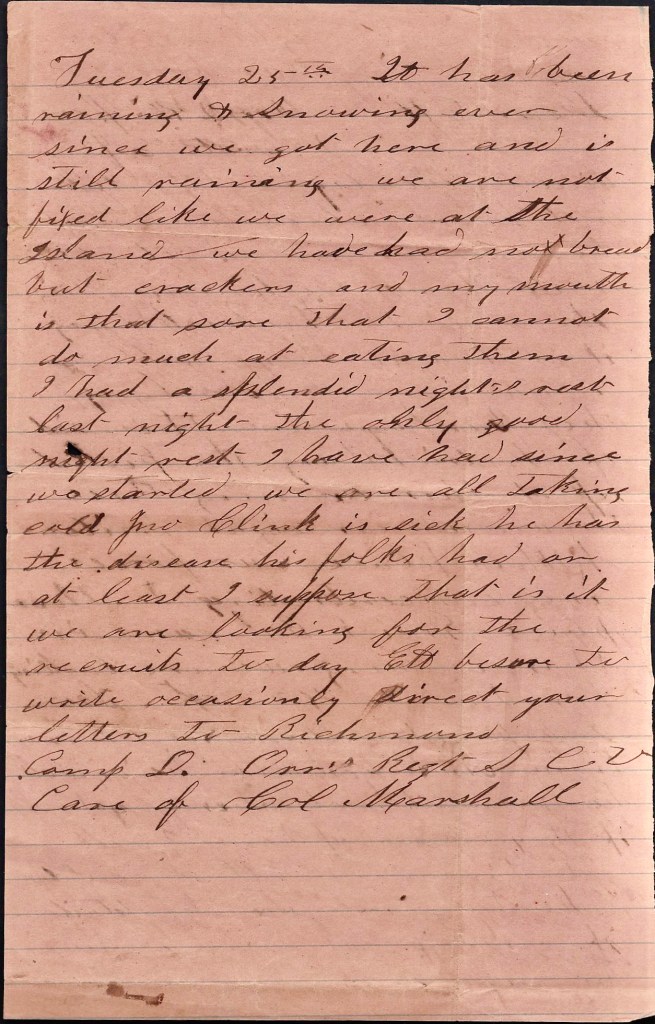
Tuesday, 25th
It has been raining & snowing ever since we got here and is still raining. We are not fixed like we were at the [Sullivan’s] Island. 1 We have had no bread, but crackers and my mouth is so sore that I cannot do much at eating them. I had a splendid night’s rest last night—the only good night’s rest I have had since we started. We are all taking cold. Jno. Clink is sick. He has the disease his folks had or at least I suppose that is it.
We are looking for the recruits today. Ett, be sure to write occasionally. Direct your letters to Richmond, Company D, Orr’s Regiment S. C. V., Care of Col. Marshall
Tuesday 25th
We left Sullivans Island Sunday the 20th about 11 o’clock. 2 Left Charleston at 4. I had time to run up to Mr. [George Cochran] Wharton’s to get them to send Carrie’s hat to the hotel to Jo Simpson. I suppose Jim Gray was there in a few minutes after I left so you would be sure to get the hat. I would have been glad to have seen Jim but I missed it.
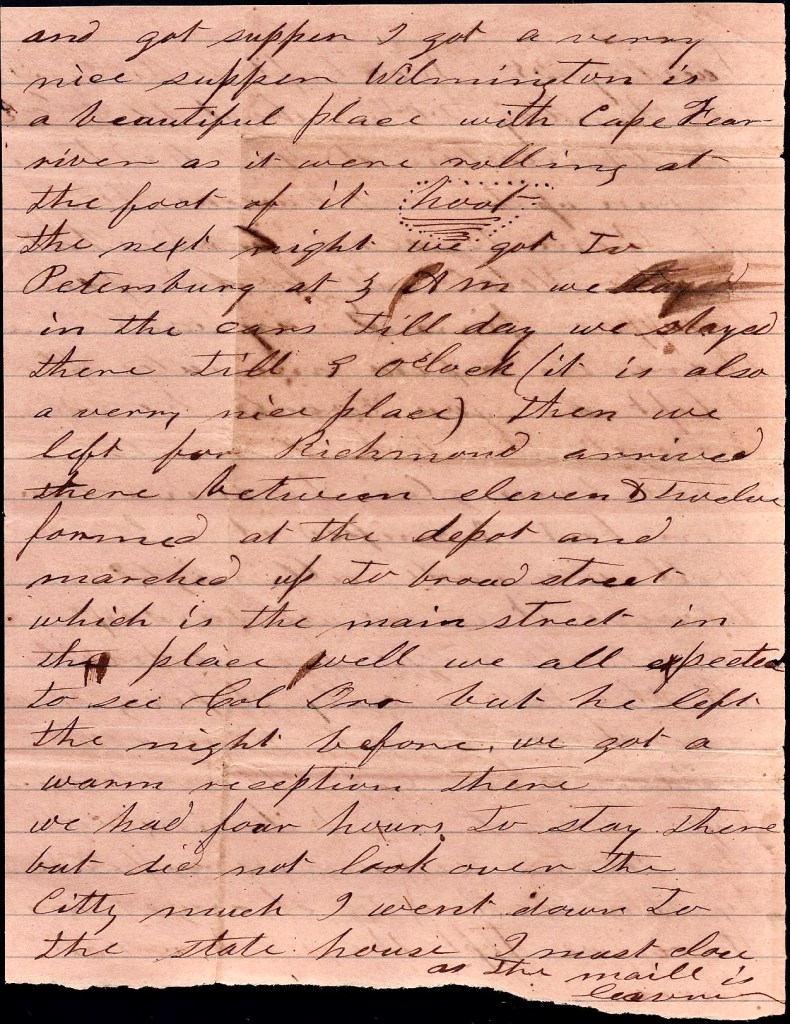
Well, we rode all night. However, it is no use to say we road all night for we traveled all the time, only stopping now and then to get wood and water and let other trains pass. We got to Wilmington the second evening and hour by sun. We had to change cars there. We stopped there two hours or more and got supper. I got a very nice supper.
Wilmington is a beautiful place with Cape Fear River as it were rolling at the foot of it. Hoot.
The next night we got to Petersburg at 3 a.m. We laid in the cars till day. We stayed there till 3 o’clock (it is also a very nice place) then we left for Richmond. Arrived there between eleven and twelve, formed at the depot, and marched up to Broad Street which is the main street in the place. Well, we all expected to see Col. Orr but he left the night before. We got a warm reception there. We had four hours to stay there but did not look over the city much. I went down to the State House. I must close as the mail is leaving.
1 On Sullivan’s Island, the regiment was quartered in dwellings then standing on the island. Part of the regiment was quartered in the old Moultrie House.
2 According to J. W. Mattison of Co. G, Col. Marshall “received orders on April 19th, to report with his command at Richmond, Va., at once. Our surplus baggage was packed and sent home at once. On Sunday, April 20th, we left the Island rejoicing that we were going to the seat of war. The regiment was called by other troops ‘The pound cake regiment,’ because of our easy position [light duty] . Our trip to Richmond was slow and tedious. We left Charleston on the evening of April 20th. When we reached Florence we were delayed the balance of the night. Monday night we reached Wilmington and remained there all night. Tusday we made Weldon. Wednesday morning we took breakfast at Petersburg, Va., and reached Richmond about 12 o’clock noon. We left Richmond in the afternoon on the Fredericksburg road, reaching Guiney’s Station after night. Tents were pitched in short order and a good night’s rest obtained. The next morning (April 24th), when reville sounded we formed line in about three inches of snow. After remaining stationed a few days we were moved nearer Fredericksburg, to a point near Massaponax church, picketing the roads towards Fredericksburg. We remained in this camp [Camp Ledbetter] until the last week in May, when General Johnson evacuated Yorktown and Peninsula and withdrew his forces to around Richmond. The commands near Fredericksburg were ordered to Richmond.
Camp Ledbetter Spotsylvania Co., Va. May 25th 1862
Dear Jule,
I received your letter a few days ago and yesterday I received a letter from Buff McLees. He said he had seen some of you about Arch and told you all the particulars. He is in the hands of the Yankees but I trust he will get good attention. I heard from good authority that our surgeon and all that attended the hospital had gone to Williamsburg under a flag of truce to attend to our sick. I think the Yankees will try to show the people of Williamsburg that they have some humanity about them.
I was in suspense a long time before I could hear anything positive about Arch. I tried to get to go to Richmond but Col. Marshall had orders from Gen. Anderson to let no man leave the camp. Col. Marshall said though if Arch was sent to Richmond, he would try to get Gen. Anderson to let me go to see him. If I hear anything from him, I will write to you. I expect there will be a big fight near Richmond. We are all doing very well here. I would rather be here than the Isle.
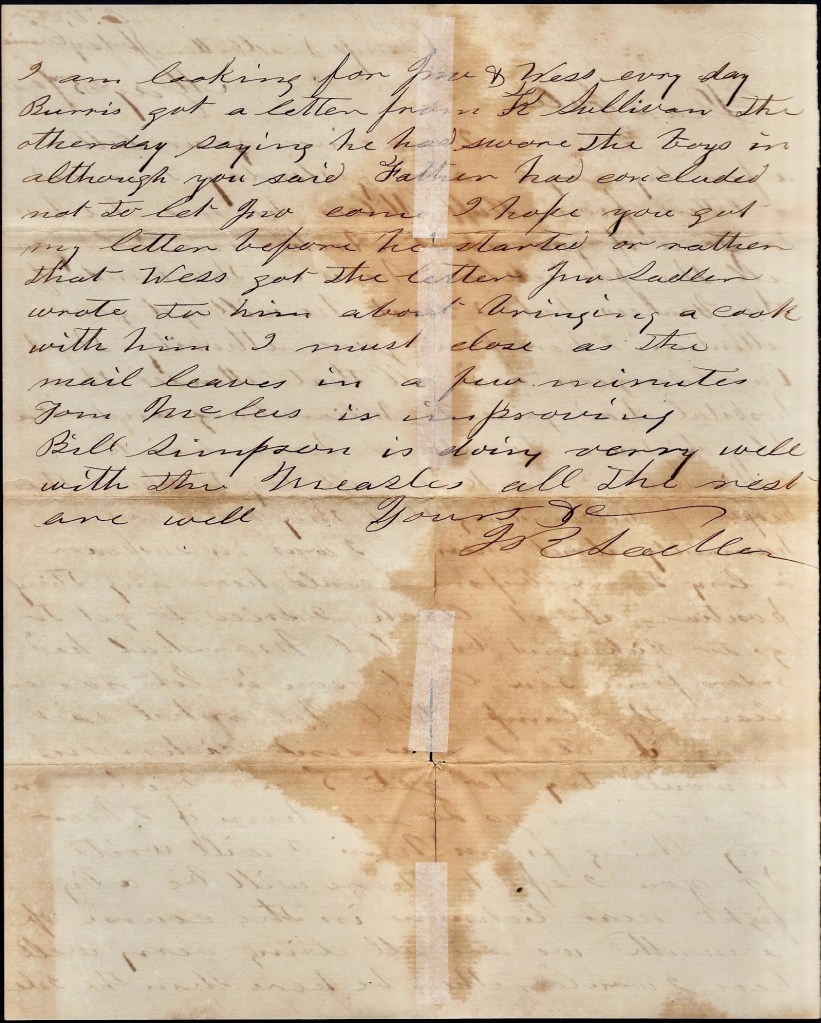
I am looking for Jim & Wes every day. Burris got a letter from K. Sullivan the other day saying he had swore the boys in although you said father had concluded not to let Jno. come. I hope you got my letter before he started, or rather that Wes got the letter Jno. Sadler wrote to him about bringing a cook with him.
I must close as the mail leaves in a few minutes. Tom McLees is improving. Bill Simpson is doing very well with the measles. All the rest are well.
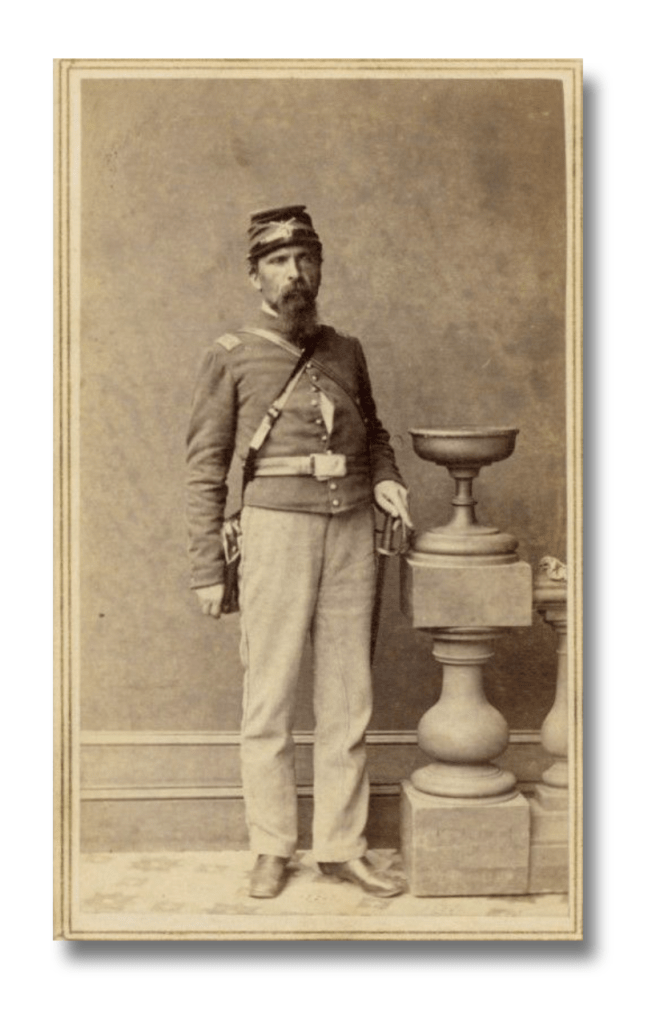
Col. Alexander Piper, 10th New York Heavy Artillery(Find-A-Grave)
These orders were penned by Lt. Eugene A. Chapman who served as adjutant to Col. Alexander Piper of the 10th New York Heavy Artillery. The orders were issued in January 1863 while the 10th manned Fort Wagner—an earthen fort in southeast Washington D. C. that was sometimes called Fort Good Hope. Eugene was 22 years old when he enlisted in August 1862 in the Black River Artillery. He was made Lieutenant and Adjutant in September, and became a Captain of Co. C by July 1, 1863. He was later discharge for promotion to serve as an Asst. Surgeon in the 127th USCT.
The 10th N. Y. artillery regiment was organized on Dec. 31, 1862, of the 1st, 2nd and 4th battalions, Black River artillery, the battalions having been organized at Sacket’s Harbor in September, and the consolidation took place on Dec. 27. The men were recruited in the counties of Jefferson and Lewis and were mustered into the U. S. service for three years as follows: Cos. A, B, C, D, E, F, G and M on Sept. 11, at Sacket’s Harbor; H and I on Sept. 12; at Staten island; Co. K on Nov. 12, and Co. L on Dec. 27, at Fort Schuyler. The 2nd and 4th battalions left the state on Sept. 17, 1862, and were at once assigned to garrison duty in the forts about Washington; the 1st battalion garrisoned Fort Richmond and Sandy Hook, N. Y. harbor until June, 1863, when it joined the others at Washington.
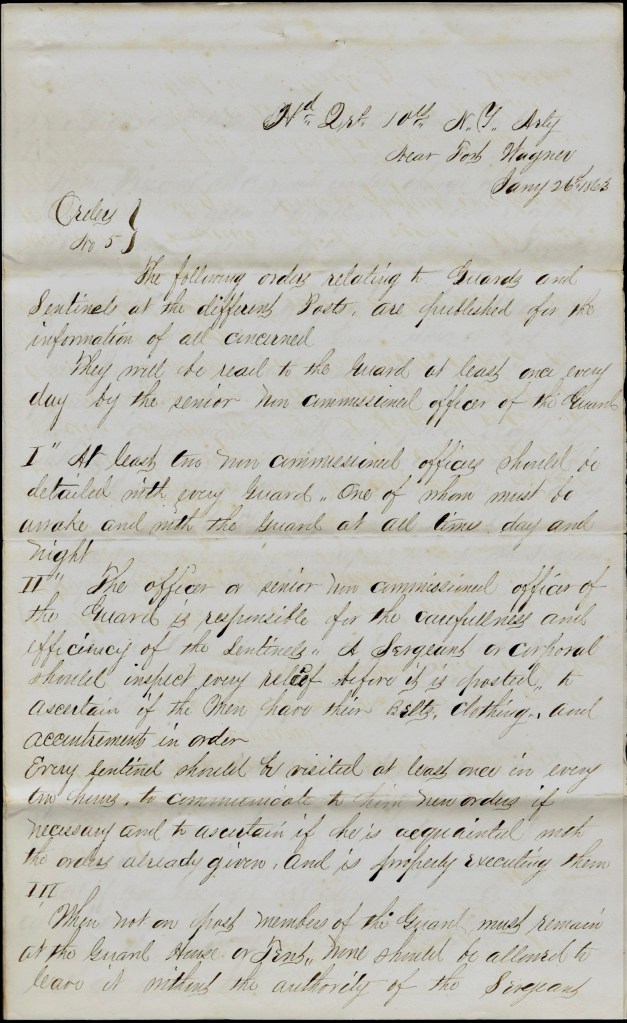
Order No. 5 pertained to the requirements and responsibilities of those carrying out the duties of the battery’s picket guard. Col. Alexander Piper, an 1851 West Point graduate with many years of military experience under his belt was a stickler for discipline.
“The Picket Guard” by N. C. Wyeth, painted in 1922
Transcription
Headquarters 10th New York Artillery Near Fort Wagner January 26th 1863
Order No. 5
The following orders relating to Guards and Sentinels at the different posts are published for the information of all concerned. They will be read to the Guard at least once every day by the senior non-commissioned Officer of the Guard.
I. At least two non-commissioned officers should be detailed with every guard—one of whom must be awake and with the guard at all times day and night.
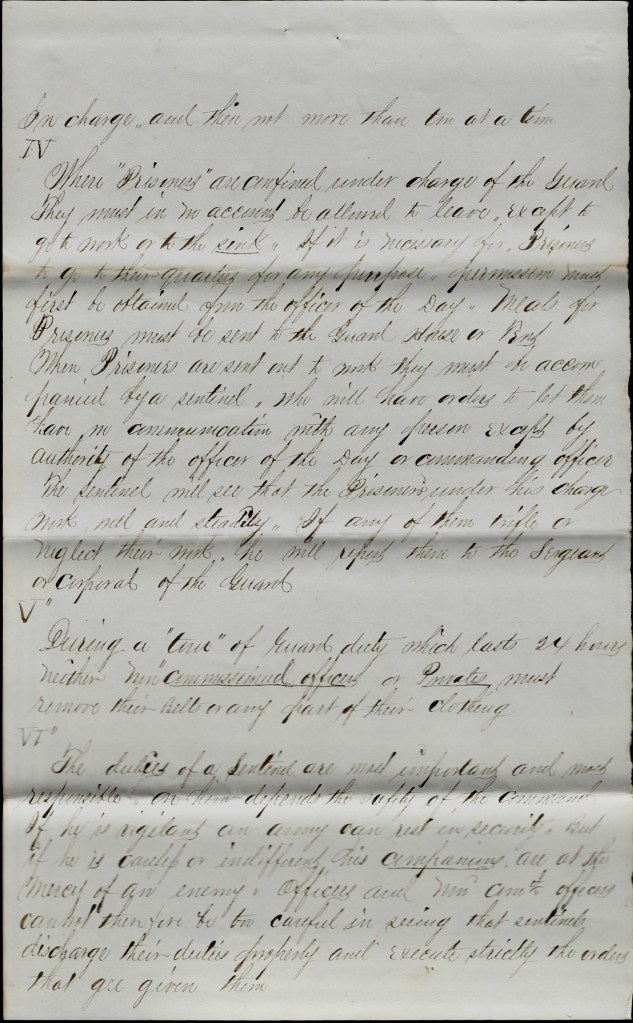
II. The officer or senior on-commissioned officer of the guard is responsible for the carefulness and efficiency of the sentinels. A sergeant or corporal should inspect every relief before it is posted to ascertain if the men have their belts, clothing, and accoutrements in order. Every sentinel should be visited at least once in every ten hours to communicate to him new orders if necessary and to ascertain if he is acquainted with the orders already given, and is properly executing them.
III. When not on a post, members of the guard must remain at the guard house or tent. None should be allowed to leave it without the authority of the Sergeant in charge and then not more than two at a time.
IV. Where “prisoners” are confined under charge of the guard, they must in no account be allowed to leave except to go to work or to the sink. If it is necessary for prisoners to go to their quarters for any purpose, permission must first be obtained from the officer of the day. Meals for prisoners must be sent to the guard house or tent. When prisoners are sent out to work, they must be accompanied by a sentinel who will have orders to let them have no communication with any person except by authority of the officer of the day or commanding officer. The sentinel will see that the prisoners under his charge work well and steadily. If any of them trifle or neglect their work, he will report them to the sergeant or corporal of the guard.
V. During a “term” of guard duty which lasts 24 hours, neither non-commissioned officers or privates must remove their belts or any part of their clothing.
VI. The duties of a sentinel are most important and most responsible. On him depends the safety of the command. If he is vigilant, and army can rest in security. But if he is careless or indifferent, his companions are at the mercy of an enemy. Officers and non-commissioned officers cannot therefore be too careful in seeing that sentinels discharge their duties properly and execute strictly the orders that are given them.
All persons, whatever their rank may be in the service, are required to observe respect towards sentinels. Sentinels will walk their posts briskly with the bayonet fixed, carrying the musket at a shoulder arms, right shoulder, shift arms, or support arms. They must not quit their post without being regularly relieved not must they hold any conversation that is not necessary for the proper discharge of their duty.
VII When an officer passes across the post of a sentinel, the latter (the sentinel) will halt face outward and salute according to the rank of the officer. The Commanding Officer, Officer of the Day, and all officers above the rank of Captain are entitled to “present arms.” Captains and all officers below that grade are entitled to “shoulder arms.” The rank of officers is indicated by the shoulder straps. After retreat, sentinels do not salute but they stand at attention when an officer passes. When a sentinel is being relieved is giving or receiving orders or whenever he speaks on post, he must come to “arms post.”
VIII In addition to the above orders the following articles of the Revised Army Regulations will be read once a day to the guard. Articles 399, 400, 401, 407, 408, 409, 411, 413, 414, 415, 416. 417, 418, 419, 420, 421, 422, 423, 424, 425, 426, 427, 428, 429.
These orders will be neatly attached to a piece of board for better preservation and will be kept with the guard.
By order of Col. A. Piper E[ugene] A. Chapman, Lieut. & Act. Adjt.





















 Spared & Shared 23