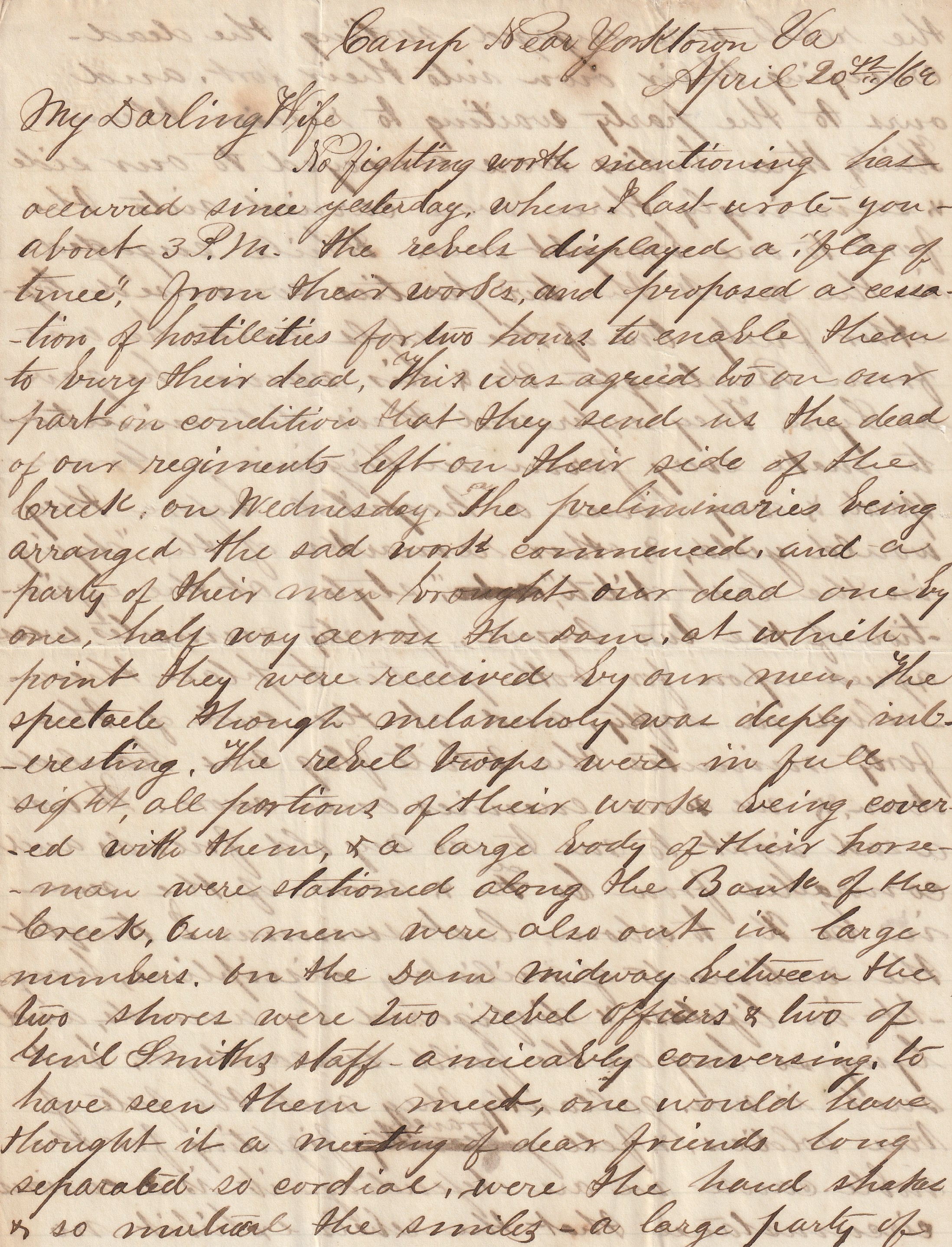
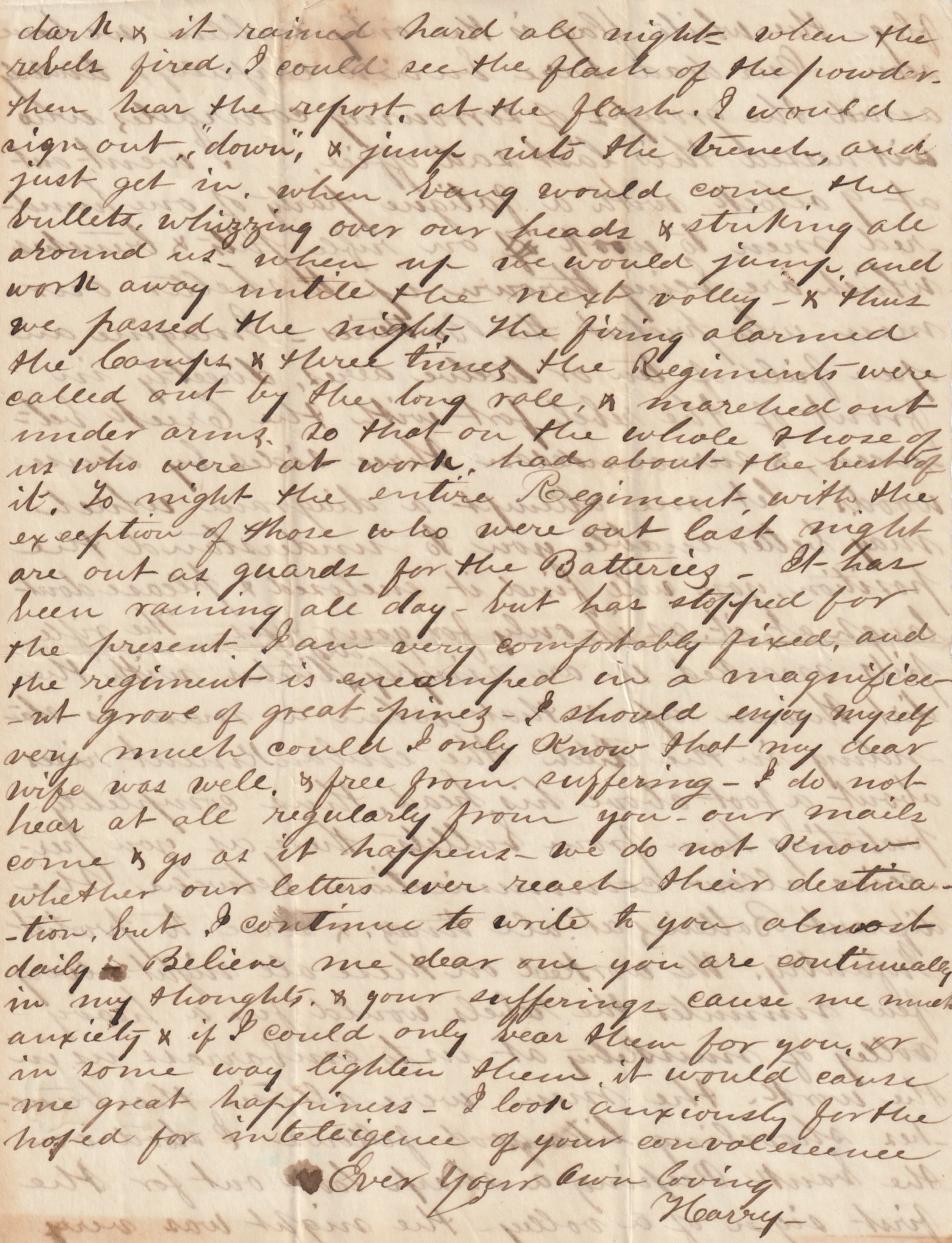
1864: Milo L. Partridge to Richard Partridge

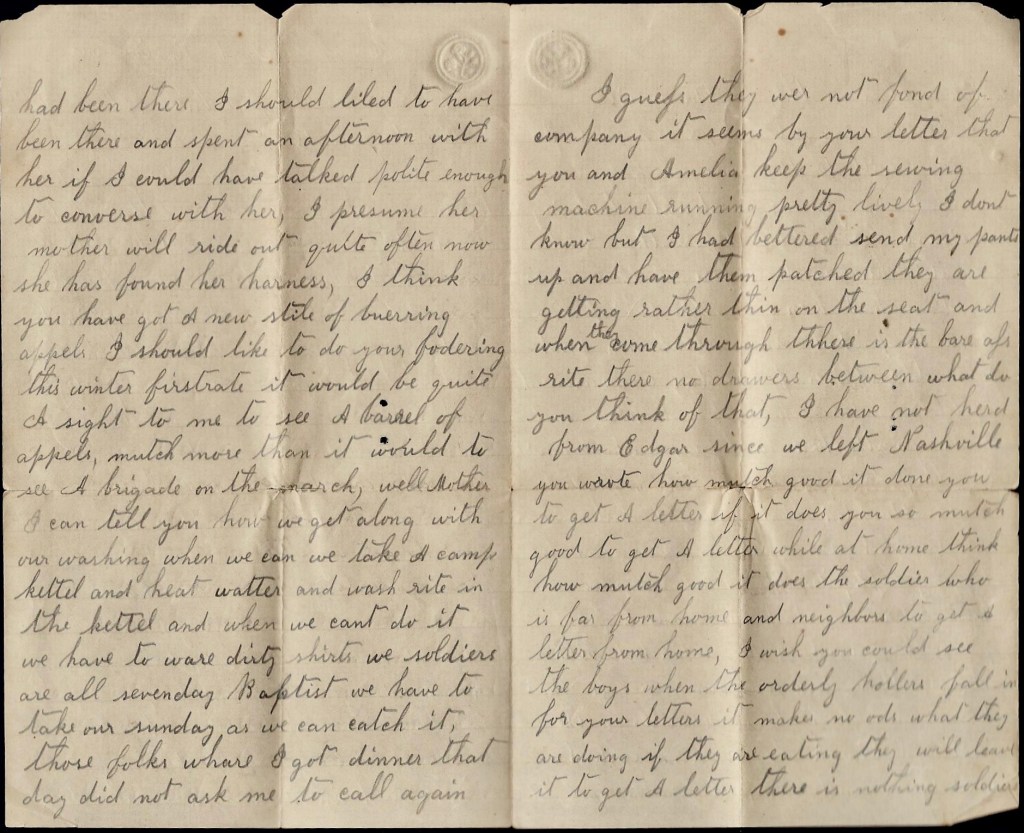
This incredibly detailed letter was written by Milo L. Partridge (1846-1865) who enlisted at age 18 as a private in Co. C, 177th Ohio Volunteer Infantry (OVI) on 17 August 1864. He did not survive the war. He died of disease at Smithville, North Carolina on 22 February 1865 after six months service.

A canteen carried by a member of the 177th OVI during the war. Milo and his comrades filled their canteens with whiskey they stole from a residence in Tennessee and then shared it with their officers. “We felt as though we could take Hood’s whole army by the time we got to camp,” he wrote his parents.

This regiment was organized at Camp Cleveland from Sept. 23 to Oct. 4, 1864, to serve for one year. Immediately after its organization it proceeded to Nashville, Tenn., via Indianapolis and Louisville. The day after its arrival it was ordered to Tullahoma and constituted a part of the garrison at that place under Gen. Milroy. It remained at Tullahoma until Hood’s invasion, when it was ordered to Murfreesboro, where it arrived on Dec. 2. On Dec. 7, Milroy’s command, including the regiment, charged the works and drove the Confederates back, capturing 2 pieces of artillery and over 200 prisoners. A few days after this, while on a foraging expedition, the regiment had an engagement with the enemy, in which it lost several wounded. After Hood had been driven from Tennessee the regiment was ordered to Clifton. About the middle of Jan., 1865, it embarked at Clifton, proceeded down the Tennessee and up the Ohio to Cincinnati, where it took the railroad for Washington, D. C. From there it moved to Annapolis, Md., and embarked on a vessel for North Carolina, arriving at Fort Fisher on Feb. 7. It was engaged in two attacks on the enemy’s works from the Cape Fear river to the coast, and crossed the river and participated in the flank movement which compelled the Confederates to evacuate Fort Anderson. It next engaged the enemy at Town creek, charging in the rear and capturing the entire command. The next morning it arrived opposite Wilmington, where it remained about a week, then joined Gen. Cox at Kinston and proceeded to Goldsboro, where it joined Sherman’s army. 

Milo was the son of Richard Partridge (b. 1817) and his wife, Maria (b. 1822) of Colebrook, Ashtabula county, Ohio. His siblings included Amelia, Esther and Harlo.

Transcription

Addressed to Mr. Richard Partridge, Colebrook, Ashtabula county, Ohio

Camp in Fort Rosecrans
Mufreesboro, Tennessee
December 14, 1864

Kind Parents,

Today finds me seated to answer your most welcome letter that I received the 4th. I was glad to hear from you and to hear that you were all well. Your letter found me in good spirits and enjoying good health.

Well it seems you have got the family pretty well shod up. I am still wearing the government [shoes] that I drawed in Warren. They are getting rather thin on the bottom. It don’t agree with shoes to march over these Cumberland Mountains very well. You wanted to know how I got along for money. I haven’t spent but $7 out of that $10 bill yet so I hant in want of any just now, but if you are a mind to, you may send me a few stamps for they are hard to be got here. I am not quite out yet but I thought I would send in time.

You wrote Addie had been there. I should like to have been there and spent an afternoon with her if I could have talked polite enough to converse with her. I presume her mother will ride out quite often now she has found her harness. I think you have got a new style of burying apples. I should like to do your foddering this winter first rate. It would be quite a sight to me to see a barrel of apples—much more than it would be to see a brigade on the march. Well, mother, I can tell you how we get along with our washing. When we can, we take a camp kettle and heat water and wash right in the kettle and when we can’t do it, we have to wear dirty shirts. We soldiers are all seven day Baptist. We have to take our Sunday as we can catch it. Those folks where I got dinner that day did not ask me to call again. I guess they were not fond of company.

“I had better send my pants up and have them patched. They are getting rather thin on the seat and when they come through, there is the bare ass right there—no drawers between. What do you think of that?”

—Milo L. Partridge, Co. C, 177th OVI, 14 December 1864

It seems by your letter that you and Amelia keep the sewing machine running pretty lively. I don’t know but I had better send my pants up and have them patched. They are getting rather thin on the seat and when they come through, there is the bare ass right there—no drawers between. What do you think of that?

I have not heard from Edgar since we left Nashville. You wrote how much good it done you to get a letter while at home. Think how much good it does the soldier who is far from home and neighbors to get a letter from home. I wish you could see the boys when the orderly hollers fall in for your letters. It makes no odds what they are doing. If they are eating, the will leave it. To get a letter, there is nothing soldiers watch as close as they do the mail. I will write as often as I can and I hope you will do the same which you have already done. You are no doubt looking for a letter before this and I should have wrote before if the communications had been open.

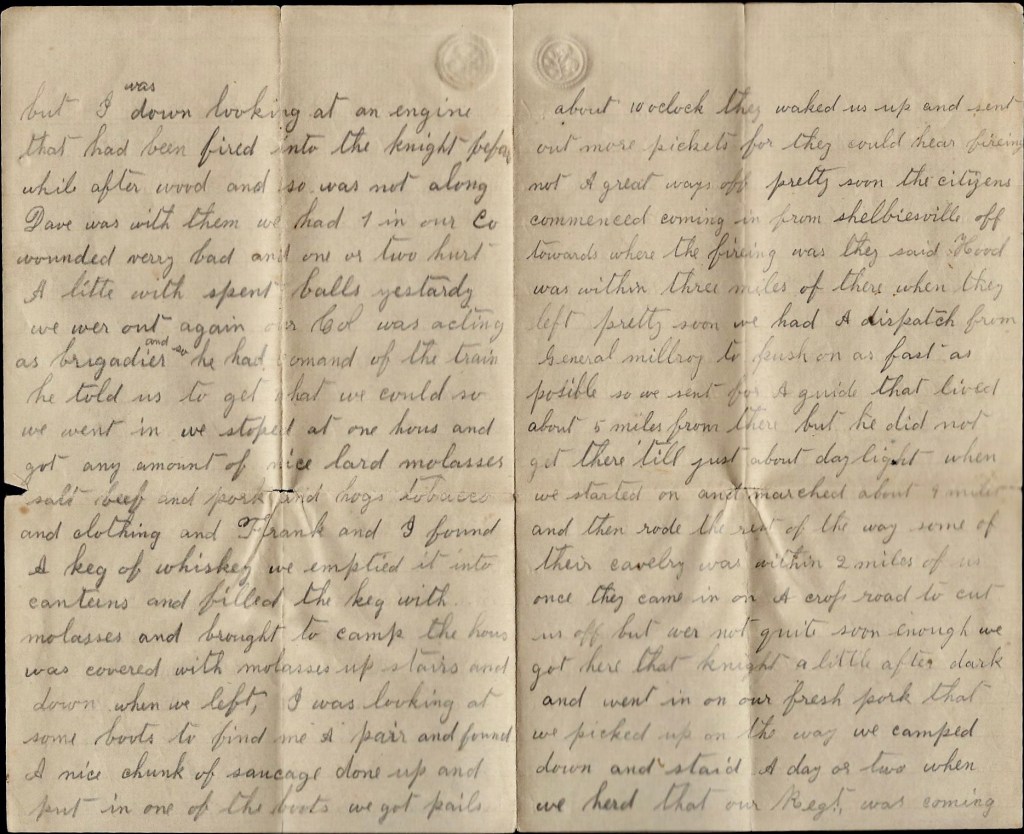
The 24th of November, I was on picket in Tullahoma and when the officer of the day came around, he told us to keep a close lookout and if we were attacked, to deploy and skirmish till they drove us in for they expected to be attacked that night. But we was not troubled. The next day they went to digging rifle pits. The 27th (Sunday), Co. C had orders to start at 5 o’clock for this place to guard a train loaded with stores. All we took was our overcoats that day. We marched about 14 miles on the railroad track to a town called Wartrace and camped for the night. About 10 o’clock they waked us up and sent out more pickets for they could hear firing not a great ways off.

Pretty soon the citizens commenced coming in from Shelbyville off towards where the fighting was. They said Hood was with three miles of there when they left. Pretty soon we had a dispatch from General Milroy to push on as fast as possible so we sent for a guide that lived about 5 miles from there but he did not get there till just about daylight when we started on and marched about 9 miles and then rode the rest of the way. Some of their cavalry was within two miles of us. Once they come in on a crossroad to cut us off but were not quite soon enough. We got there that night a little after dark and went in on our fresh pork that we picked up on the way.

We camped down and stayed a day or two when we heard that out regiment was coming so we did not start back. That Saturday night the regiment and the rest of the troops from Tullahoma came in. We were detached from the regiment to stay with the train, they liked us so well. Sunday we went over to the regiment to see if our baggage had come. I lost one blanket and a canteen. The rest came through all right and was glad to get that much. We were away from the regiment but a short time. We are with them now.

While we were waiting for the regiment to come, they were busy moving things from town into the forts so we are all here inside the fortifications, citizens and all. It seems that Hood was making for Nashville for there has been heavy cannonading by spells ever since that way. Some of his cavalry have been playing around here for a day or two but as soon as they come out of the woods in sight of our big guns, they gave them a few shells and made them scatter right smart.

There was heavy skirmishing for two or three days. We could stand on the fortifications and see both parties perfectly plain. We had a line of battle out once or twice but could not draw them out of the woods. One afternoon, General Milroy went out and captured 169 wagons and pitched in and whipped them and took some 150 or 200 prisoners. Our regiment was out but did not fire any. They were supporting a battery. Our company was not with them then. They were with the train. Their cavalry are lurking around here yet so to keep up foraging. Everyday we send out from 40 to 100 wagons but we have to have a strong guard and have a few pieces of artillery along. The boys were out the other day and got into quite a skirmish with them but I was down looking at an engine that had been fired into the night before while after wood and so was not along. Dave was with them.

We had one in our company wounded very bad and one or two hurt a little by spent balls yesterday. We were out again. Our Colonel was Acting Brigadier and so he had command of the train. He told us to get what we could so we went in. We stopped at one house and got any amount of nice lard, molasses, salt beef, ad pork and hogs, tobacco and clothing, and Frank and I found a keg of whiskey. We emptied it into canteens and filled the keg with molasses and brought to camp. The house was covered with molasses, upstairs and down when we left. I was looking at some boots to find me a pair and found a nice chunk of sausage done up and put in one of the boots. We got pails and cups and everything we could use in camp and fetched in. I think they will have a worse time cleaning the house than Amy and I did their milkroom.

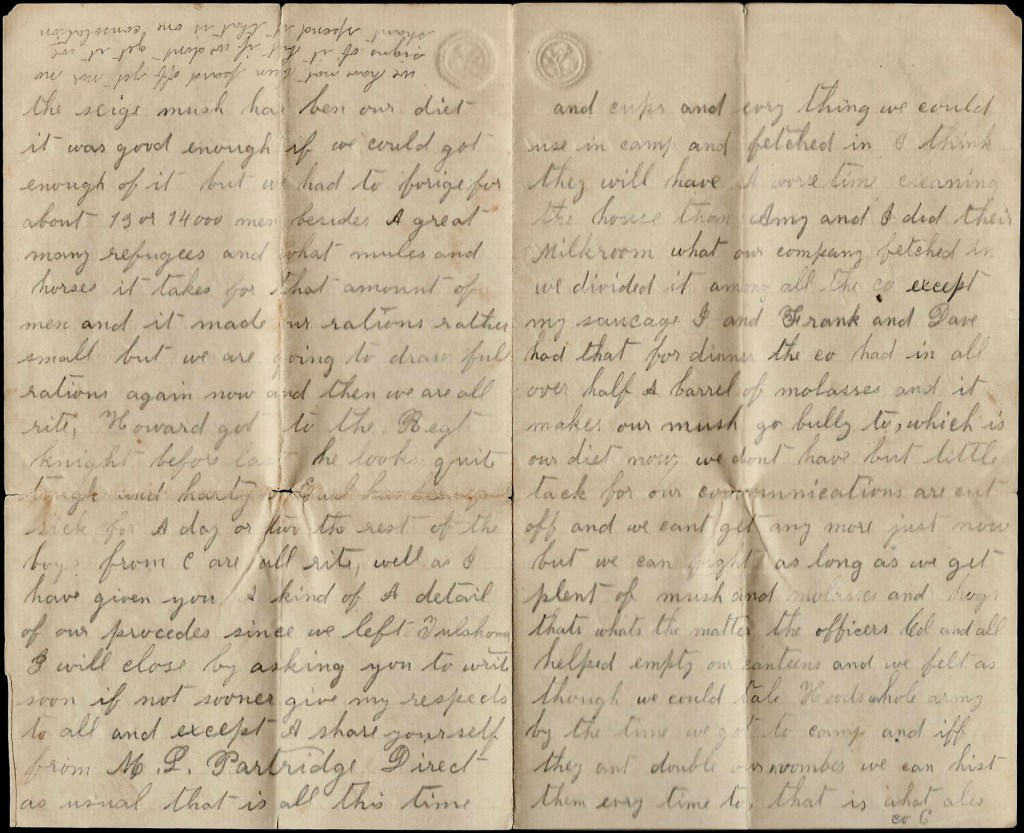
What our company fetched in we divided it among all the company except my sausage. I and Frank and Dave had that for dinner. The company had in all over half a barrel of molasses and it makes our mush go bully too which is our diet now. We don’t have but little [hard] tack for our communications are cut off and we can’ get anymore just now. But we can fight as long as we get plenty of mush and molasses and hogs—that’s whats the matter. The officers—Colonel and all—helped empty our canteens and we felt as though we could take Hood’s whole army by the time we got to camp and if they ain’t double our number, we can lick them every time too—that is what ales Co. C.

“We have had about a week or ten days about as cold weather as I ever saw in Ohio. There was one man froze to death on picket since we have been here. we had to spoon up pretty close to sleep warm in our dog tents too I notice.”

—Milo L. Partridge, Co. C, 177th OVI, 14 December 1864

The weather is wet and muddy now. We have had about a week or ten days about as cold weather as I ever saw in Ohio. There was one man froze to death on picket since we have been here. we had to spoon up pretty close to sleep warm in our dog tents too I notice. We were out foraging one Sunday when it was so cold that it was all we could do to keep warm marching with our overcoats on. There is very sudden changes in the weather down here. We have had two pretty cold snaps this winter but it is warm enough now and muddy enough too.

Friday, December 23, 1864

Well, as the Rebs are drove away from here now and the cars are expected to be running to Nashville in a few days, I will try and finish my letter. Today finds me still enjoying good health. It is rather cold and wet but we get along very well for all that. There hant been any fighting nearer than Nashville since I commenced this letter. I presume ere this you have heard of General Thomas’ victory there. Yesterday we got our mail. It came from Nashville in wagons as the railroad is not quite repaired yet. There was seven wagonloads of mail came for the troops that are here. There was about 10 bushels for our regiment. I got seven letters—one was from you dated the 11th. I see that you are looking anxiously for a letter, This will probably not go out before tomorrow or next day but I will get it ready and send it as soon as possible. I got one from G. Weed and wife, and one from Amelia and Harlo and shall answer them as soon as I can.

We are expecting to leave here today. Where to, we don’t know, but we expect along the railroad somewhere and as soon as we get settled, I will answer them. We have seen some rather snug times during the siege. Mush has been our diet. It was good enough if we could get enough of it but we had to forage for about 13 or 14,000 men besides a great many refugees and what mules and horses it takes for that amount of men and it made rations rather small. But we are going to draw full rations again now and then we are all right.

Howard got to the regiment night before last. He looks quite tough and hearty. Earl has been sick for a day or two. The rest of the boys from Co. C are all right.

Well, as I have given you a kind of a detail of our proceeds since we left Tullahoma, I will close by asking you to write soon if not sooner. Give my respects to all and accept a share yourself from — M. L. Partridge

Direct as usual. That is all this time.
1862: Cornelius J. Madden to Mary (Hadley) Madden

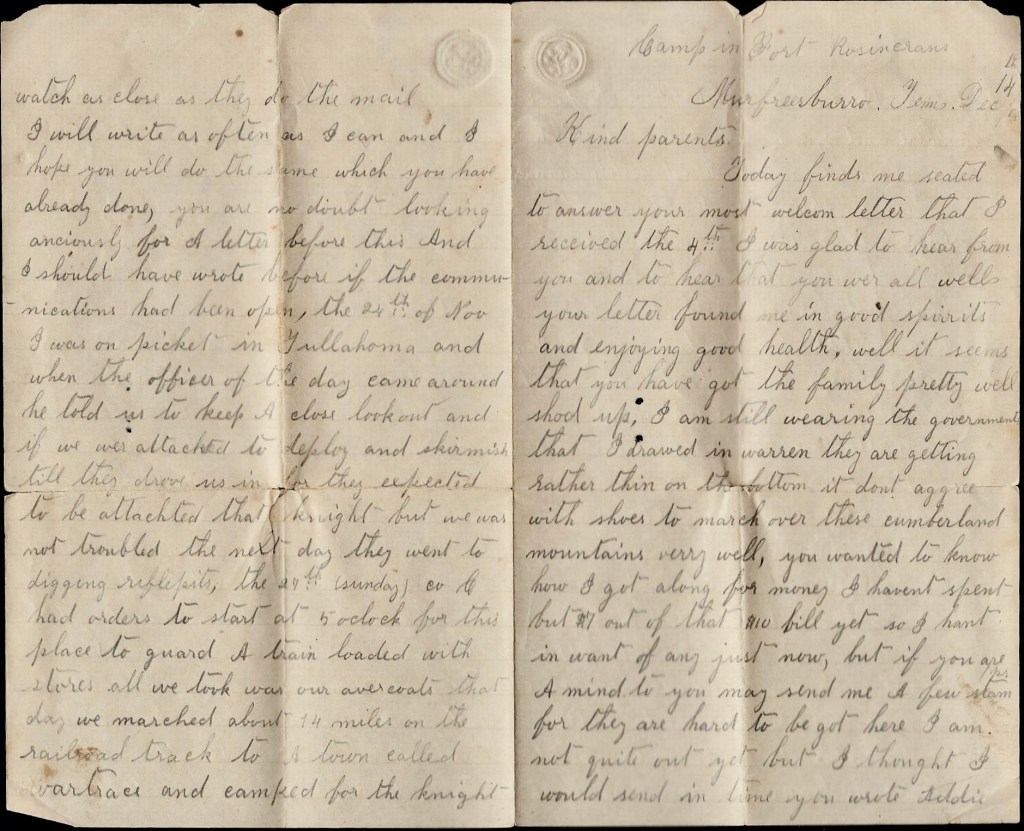
I could not find an image of Cornelius but here is one of George Washington Deatrick of Co. H, 102nd Ohio Infantry (Photo Sleuth)

This letter was written by Cornelius J. Madden of Shelby, Richland county, Ohio, who enlisted in Co. C, 102nd Ohio Volunteer Infantry (OVI) on 12 August 1862 and mustered out of the regiment on 16 June 1865. He was promoted to corporal on 18 October 1862.

Cornelius’ father, James Madden (1813-1888), a wagon maker by trade, also served in the Civil War though he was 48 years old when he enlisted in Co. H, 64th OVI. He entered in October 1861, was promoted to corporal in December, and served until 10 December 1864. He was married to Mary Hadley (1824-1888), a milliner, who was not only the mother of Cornelius, but of three girls named Florence (b. 1846), Almira (b. 1848), and Mary Estelle (b. 1852).

Cornelius wrote his letter from Louisville in late September where newly formed regiments were being rushed to the Kentucky border in order to thwart Bragg’s threatened invasion of Ohio. “Nearly all of the regiments” including the 102nd “were ill-equipped and armed with obsolete Belgian or Austrian muskets” known to misfire more times than not when the trigger was pulled. “They were also only partially uniformed and without tents, canteens, and other necessary supplies.” [Panic on the Ohio, by Roger C. Adams]

See also—1862: Cornelius J. Madden to Mary (Hadley) Madden, Spared & Shared 19, posted 16 September 2019.

[Transcribed by Jeannette Ann Vannan; edited and researched by Griff]

Transcription

In Camp near Louisville [Kentucky]
September 29, 1862

Dear Mother and Sisters, 

You owe me a letter now and I wrote to John yesterday, but I have so much to tell you about our boys in the 64th & 15[th] that I thought I must write. I have saw nearly all of them except Frum but he is here. Charley Kerr [Co. I, 15th OVI] and Davy Way was over yesterday. They are well but their hard march makes them look a little played out. Charley gave me a ring he made down in Ala[bama].

Cornelius’ mother, Mary (Hadley) Madden, ran a millinery while her husband was in the service.

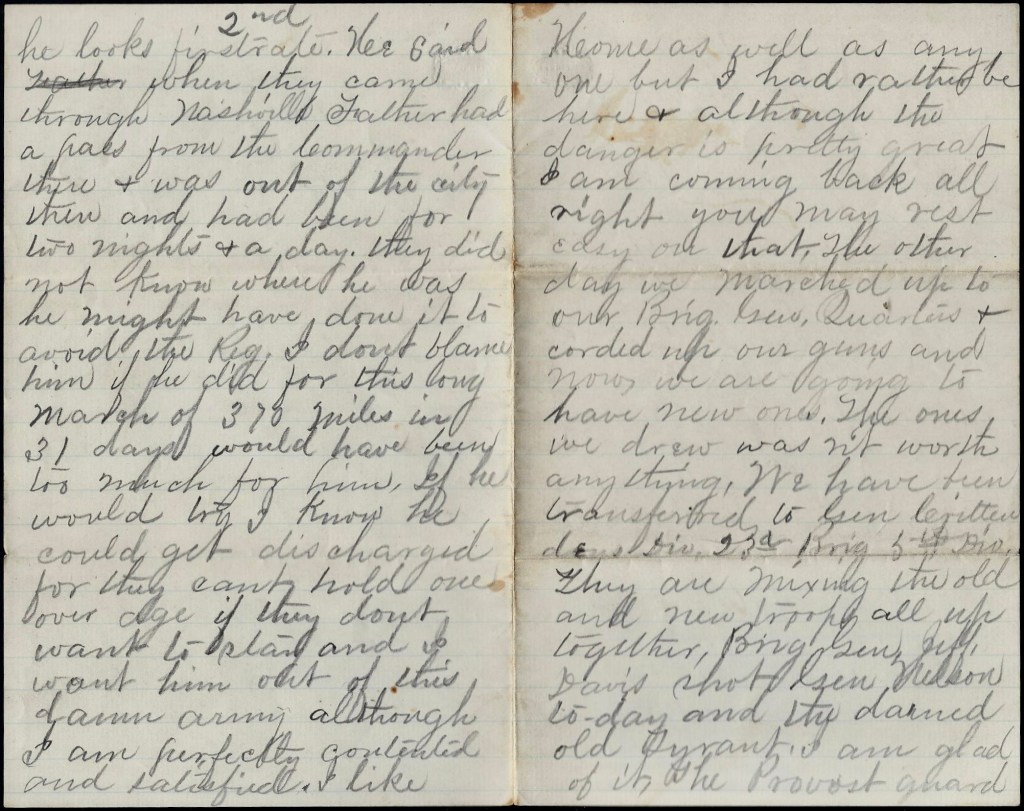
I saw George [Franklin] Marvin [Co. H, 64th OVI] today. He looks first rate. He said when they came through Nashville, father had a pass from the commander there and was out of the city then and had been for two nights and a day. They did not know where he was. He might have done it to avoid the Regiment. I don’t blame him if he did for this long march of 370 miles in 31 days would have been too much for him. If he would try, I know he could get discharged for they can’t hold one over age if they don’t want to stay and I want him out of this damn army although I am perfectly contented and satisfied. I like home as well as anyone but I had rather be here. And although the danger is pretty great, I am coming back all right, you may rest easy on that.

The other day we marched up to our Brig. General Quarters and corded up our guns and now we are going to have new ones. The ones we drew wasn’t worth anything. We have been transferred to Gen. [Thomas L.] Crittenden’s Division, 23rd Brigade, 5th Division. They are mixing the old and new troops all up together.

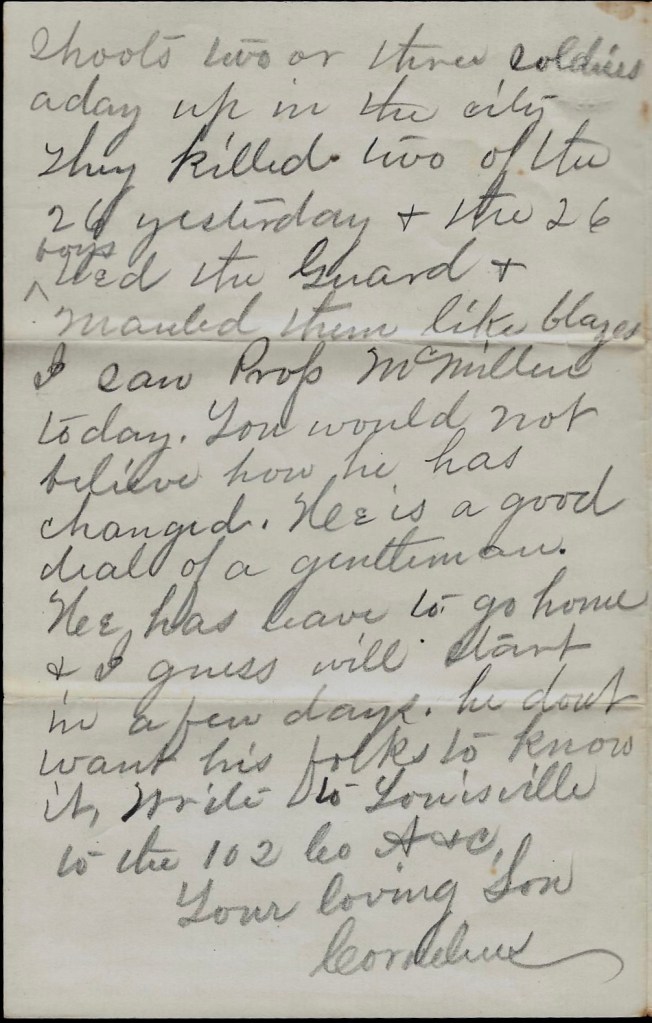
Brig. Gen. Jeff Davis shot Gen. [Bull] Nelson today and the darned old tyrant. I am glad of it. The provost guard shoots two or three soldiers a day up in the city. They killed two of the 26th [OVI] yesterday and the 26th boys tied the guards and mauled them like blazes.

I saw Proff. McMillen today. You would not believe how he has changed. He is a good deal of a gentleman. He has leave to go home and I guess will start in a few days. He don’t want his folks to know it.

Write to Louisville to the 102nd, Co. A & C. Your loving son, — Cornelius

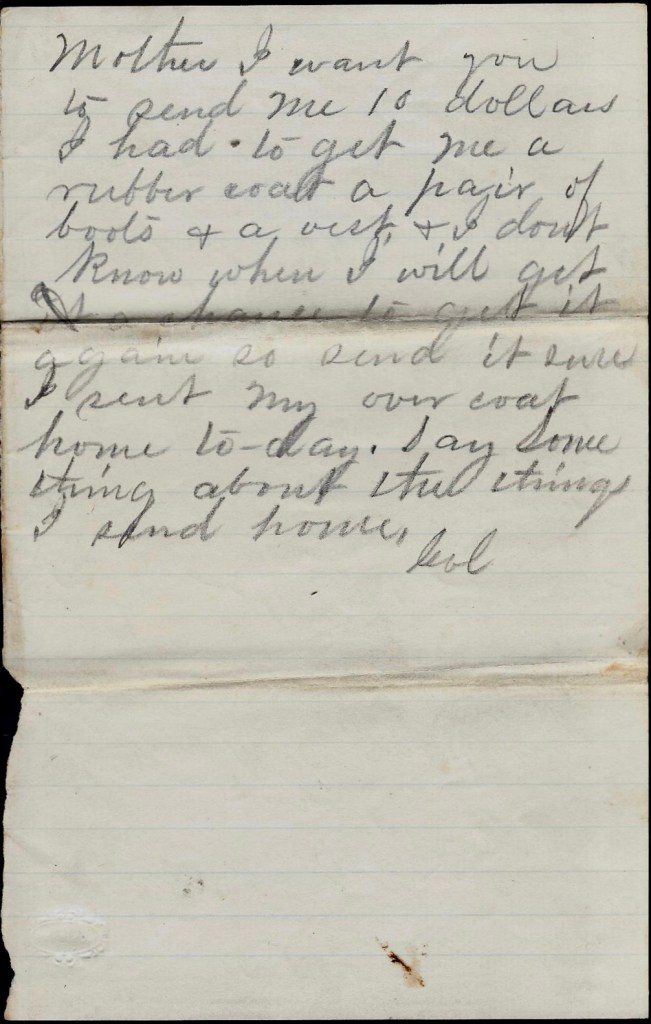
Mother, I want you to send me 10 dollars. I had to get me a rubber coat, a pair of boots, & a vest and I don’t know when I will get a chance to get it again so send it sure. I sent my overcoat home today. Say something about the things I send home. — Cal


1861: John H. Denton to Martha Cole

With undated letters, envelopes or stationery with patriotic emblems such as this one generally indicate an early-war letter (but not always!).

This letter was written by John H. Denton (1840-1893) of Aurora, Dearborn county, Indiana, who served as a private in Co. E, 7th Indiana Infantry from 20 April 1861 to 2 August 1861. Later he served as the Captain of Co. K, 10th Kentucky Infantry, which was organized in November 1861.

The 7th Indiana Infantry was organized at Indianapolis in mid-April 1861 with Ebenezer Dumont as its colonel. They made their first camp near Grafton, Virginia (now West Virginia) which is where this letter was written in June 1861. As part of Brigadier General Thomas A. Morris’ Indiana Brigade (of Major General George B. McClellan’s Army of West Virginia), the 7th Indiana participated in the Rich Mountain Campaign from July 6 to 17. The regiment saw action at Laurel Hill (July 7), Belington (July 8), the Battle of Corrick’s Ford (July 12–14), and in the pursuit of Brig. Gen. Robert S. Garnett’s forces (July 15–17). The regiment was mustered out of service on August 2, 1861.

John wrote the letter to Martha (“Mattie” or “Mat”) Cole (1844-1933) with whom he married in February 1865.

The Battle of Rich Mountain which the 7th Indiana Infantry participated.

Transcription

Camp Dumont near Grafton, Virginia
June 24, [1861]

Dearest Mat,

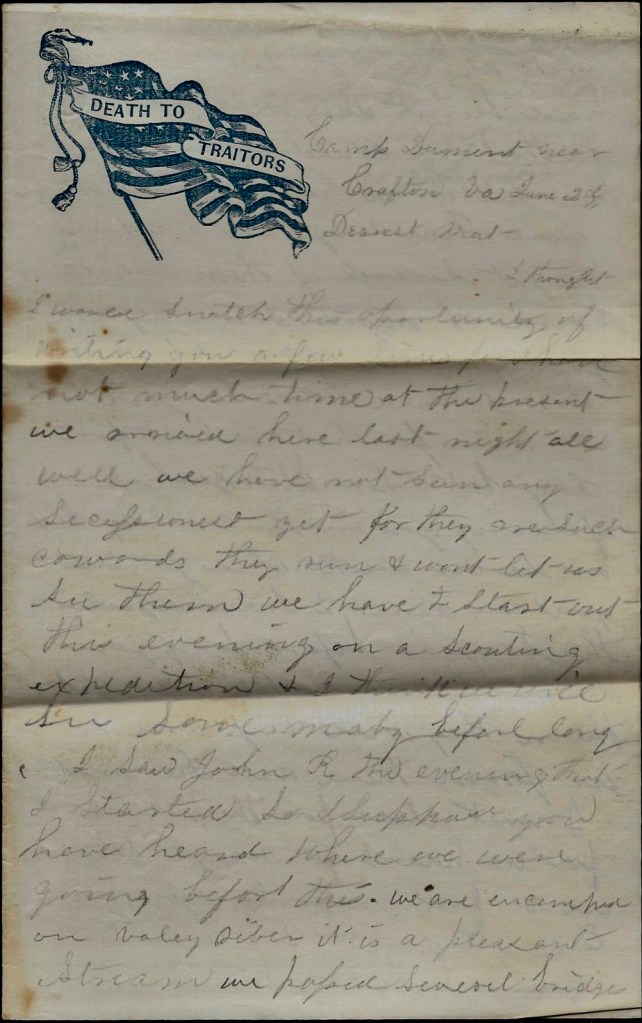
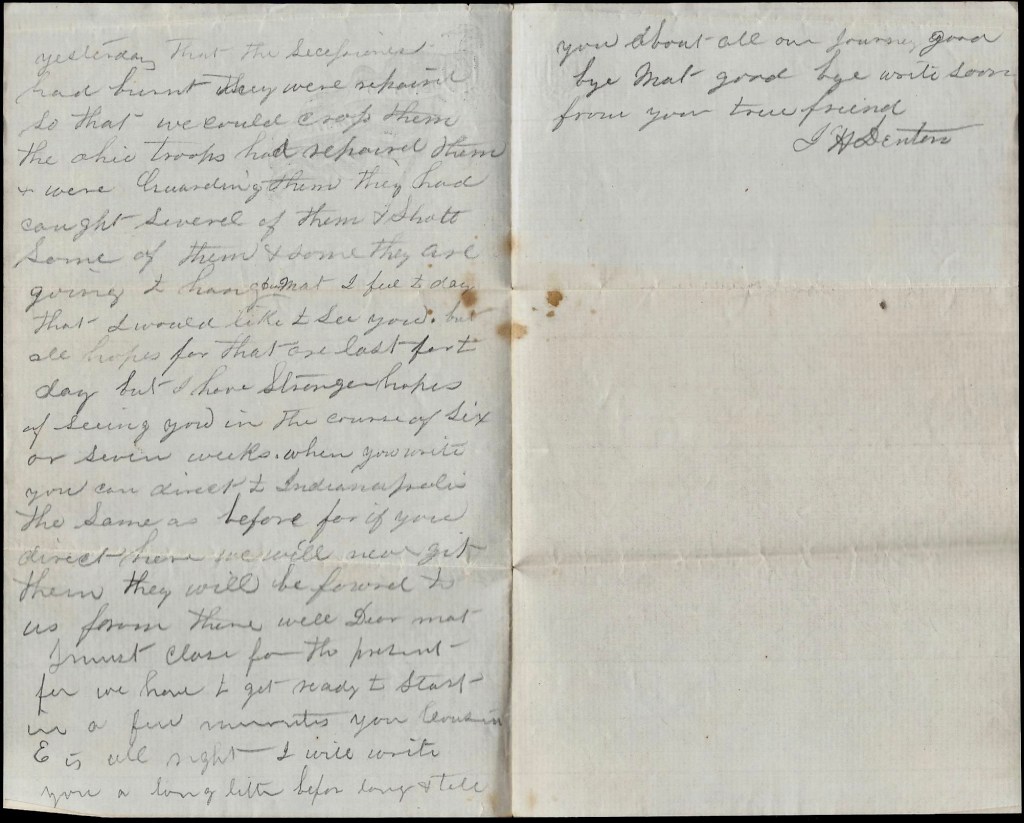
I thought I would snatch this opportunity of writing you a few lines for there is not much time at the present. We arrived here last night all well. We have not seen any secessionists yet for they are such cowards they run and won’t let us see them. We have to start out this evening on a scouting expedition & I think we will see some maybe before long.

I saw John R. the evening that I started so I suppose you have heard where we were going before this. We are encamped on Valley River. It is a pleasant stream. we passed several bridges yesterday that the secessionists had burnt. They were repaired so that we could cross them. The Ohio troops had repaired them & were guarding them. They had caught several of them & some they are going to hang.

Mat, I feel today that I would like to see you but all hopes for that are lost for today. But I have stronger hopes of seeing you in the course of six or seven weeks. When you write, you can direct to Indianapolis the same as before for if you direct here, we will never get them. They will be forwarded to us from there.

Well dear Mat, I must close for the present for we have to get ready to start in a few minutes. Your cousin E. is all right. I will write you a long letter before long and tell you about all our journey. Goodbye Mat, goodbye.

Write soon. From your true friend, — J. H. Denton

1864: H. F. Chad to her Nephew

How Mrs. Chad might have looked.

This letter was written by a woman who signed her name H. F. Chad, though I can’t be certain of the middle initial as the script is unusual. She datelined her letter from Orwell, Ashtabula county, Ohio, but I cannot find any public record online under that surname even if I search under the name Chadd instead which was the more common English spelling. I can only assume they moved into the area after 1860 and left before 1870. The woman and her husband seem to be farmers based on the content of the letter and she indicates that they were having a new barn erected on the property that was being framed by Marshall Howard, a local carpenter.

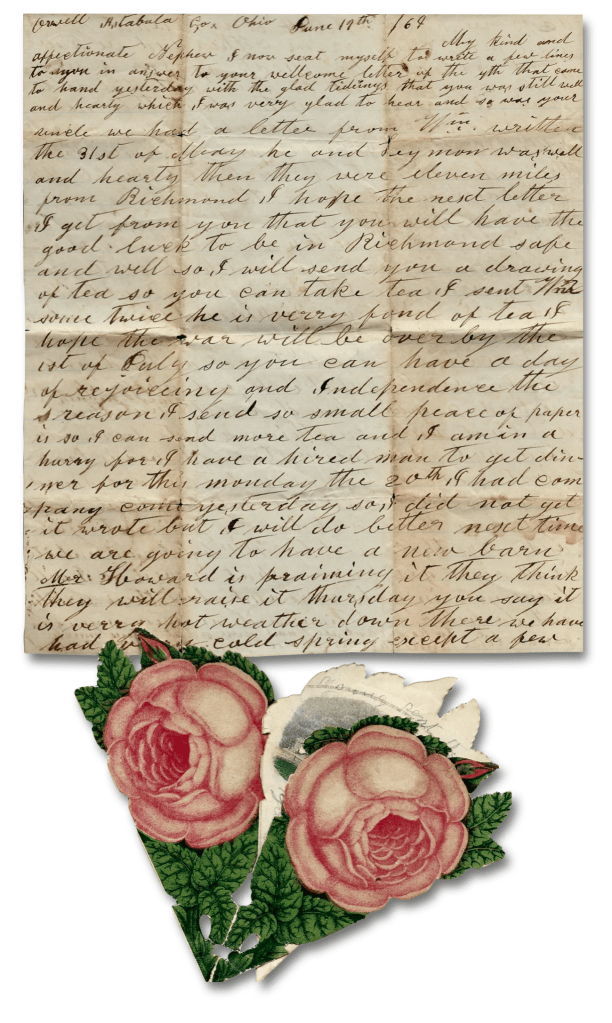
She wrote the letter to an unnamed nephew who was clearly serving in the army—probably engaged in Grant’s Overland Campaign. She mentions that she was sending him some tea in the envelope and I can only assume that the lithographed paper with scenes of Washington D. C. on one side and of flowers on the reverse contained a small pouch of tea at one time.
Transcription

Orwell, Ashtabula county, Ohio
June 19, 1864

My kind and affectionate Nephew,

I now seat myself to write a few lines to you in answer to your welcome letter of the 7th that came to hand yesterday with the glad tidings that you was still well and hearty which I was very glad to hear and so was your Uncle. We had a letter from William written the 31st of May. He and Seymour was well and hearty then. They were eleven miles from Richmond. I hope the next letter I get from you that you will have the good luck to be in Richmond safe and well.

So I will send you a drawing of tea so you can take tea. I sent William some twice. He is very fond of tea.

I hope the war will be over by the 1st of July so you can have a day of rejoicing and Independence. The reason I send so small a piece of paper is so I can send some more tea and I am in a hurry for I have a hired man to get dinner for this Monday, the 20th. I had company come yesterday so I did not get it wrote but I will do better next time.

We are going to have a new barn. Mr. [Marshall J.] Howard is framing it. They think they will raise it Thursday.

You say it is very hot weather down there. We have had a very cold spring except a few days. We have had 4 days what you may call warm weather and we have had no rain to speak of for 3 weeks. Yesterday it tried to ran but did not rain enough to lay the dust. This morning it just warm enough to be comfortable.

We think of you poor fellows down there having to march and fight these hot days and I thank the Lord too for sparing you thus far and have faith to believe he will watch over you and bring you safe home.

Mrs. Sheredeen [Sheridan?] had a letter from Mack [?] wrote the 8th. He was all right then and in 5 miles of Richmond. Carol is done going to school this spring. She has been sick with 6 boils but not as bad as 6 balls would make her, I guess. Oh yes, we had two quite hard frosts this month but they did not hurt anything right here. Our corn and potatoes, oats and beans look first rate, and peas, but they are sowed late.

I often wish I was a bird that could fly down there and take a peep at you and over the field to William but I can’t and is it all right. God knows what is best. So I will leave you in God’s care and close this scribbling and do better next time. write as often as you can for we like to hear but we know you can’t have much time. This is from your aunt, — H. F. Chad

1864: Lilburn Cummins Rogers to his Friends

This letter was written by Lilburn Cummins Rogers (1840-1912), the son of Rowland Rogers (1811-1895) and Mary Cummins (1811-1895) of Cambridge, Guernsey county, Ohio.

Lilburn datelined this letter from the Ohio river port town of Gallipolis, Ohio, on 28 May 1864 while serving as a private in Co. H, 172nd Ohio Volunteer Infantry (OVI). The 172nd was a 100 days service regiment that spent the entire time of its enlistment guarding government stores at Gallipolis. These troops were intended to provide temporary replacements for more seasoned veterans to participate in Grant’s Overland Campaign which began in May 1864.

Lilburn’s father was described as a zealot who stood tall for his beliefs which included a conviction that slavery was a moral evil. He was one of the first abolitionists in his Guernsey county and took great interest in the underground railroad. “Such was his hatred of slavery and oppression in every form that he did everything in his power to liberate the slaves and rejoiced when the word was accomplished.” [Obituary posted on Ancestry.com] Raised in this environment, it is little wonder that Lilburn came to share his father’s belief in the curse of slavery which, in the following letter, he places the full blame for causing the war.

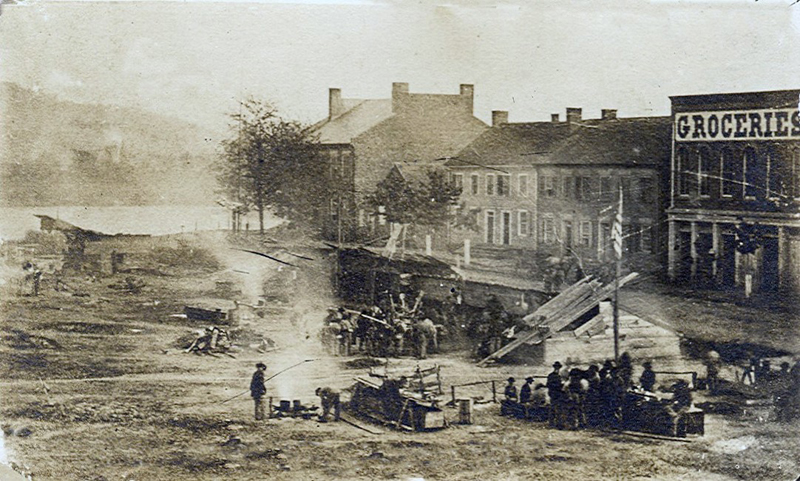
Federal encampment at Gallipolis, Ohio, during the Civil War.

Transcription

Gallipolis, Gallia County, Ohio
May 28, 1864

Much respected friends Cat and Maggie,

I received your letter yesterday morning but had not time to converse any with you until this evening. I was much pleased with the first sheet and as you requested me to write soon, I with much pleasure comply with your requests but not much to write that would interest you for I have written the same thing ever so many times that I hate to repeat it anymore.

There is not very many soldiers here now. There is none but our regiment—about 860 men. There was a good many wounded soldiers brought here to the hospital. You can see a great many carrying their arms in a sling. I guess there will be a great many more brought here to the hospital. There is a great many soldiers in the hospital. I have never been to it—only in sight, nor I don’t care much about going for the boys that went to see it said they did not want to go back again.

There is some of our regiment sick. Asbury Miller is sick. He has the fever. And Powell, he has the ague. And there is other companies from another county—I don’t mind the name of it—is sick with the measles. I received a letter from Willy the other day. He is at Cumberland, Maryland. He is well and well satisfied. John Ferryman was to see him.

Gallipolis Journal, 2 June 1864

There was a man and a little child drowned here day before yesterday evening. They fell off of the boat and was never seen afterwards. [see newspaper clipping at right]

Well girls, I have left the quarters and have gone into a regular bakery to bake bread for the regiment. There is six of us bakes bread for eight hundred and sixty men. It keeps us pretty busy, you bet. It is pretty hard work but I believe I would rather do it than muster on the account that it gives me a pain in my side to muster and then I don’t have to stand guard.

Maggie, you stated that Hinkle was missing which I had learnt before which I was very sorry to hear but I sincerely hope that he has not been harmed. And you also stated that he had a good hope of future happiness which is a mighty blessing to him & a great comfort to you and your parents. Many a poor soul has fell in the last few weeks on the bloody field of battle and many a heart has been made to mourn for the loved ones that have perished in the mighty conflict. When I think of it, it brings a sad gloom over my mind. But I hope ere long that this rebellion may come to a stopping point and our country come to peace and harmony & each one return to their homes to learn war no more with the mighty curse that caused it, wiped from existence.

But girls, I will have to close for this evening for it is getting too dark to write and I have to get up at midnight to go to making up bread for I want to get done tomorrow in time to go to meeting. I have been to meeting 3 times since I have been here, twice to the Presbyterians and one to the Methodists. So no more. Good night girls.

Sunday morning, May the 29th. Well girls, I did not get to go to meeting as I told you I wanted to go. I have been hard at work all morning & the bells have rung. But I am going tonight if nothing happens. I like to go to meeting at the forks. It appears to me I could enjoy meeting there now. There is not much Sunday here. They had regimental inspection here this morning. They made a very nice show. But to change the subject. This letter is like the dictionary—it changes the subject very often.

Well Liz, I want you to write more in the next letter and Mag, I don’t want you to write any less. I want you both to write a great big sheet. Give me all the news & particulars. You bet I like to get a letter and will answer promptly. Tell your parents I would be glad to receive a line from them. An old friends advice is sometimes very good when exposed to evils or bad company. Also from Jim and Sade. But my paper is about filled and I have to close. I might write another sheet but I might weary your patience reading it. I want you to write as soon as this comes to hand. You might not be so long as you was the other time. So I will close by saying my love to you all, from your sincere friend — Lilburn C. Rogers

to Cate and Maggie

1861: Ann (Updegraff) Starr to Nathan Updegraff Starr

How Ann might have looked in 1861 (Will Griffing Collection)

This letter was written by Ann (Updegraff) Starr (1801-1865), the widow of Merrick Starr (1795-1851), and the mother of Nathan Updegraff Starr (1825-1902) to whom she addressed her letter. Ann wrote the letter letter from Quincy, Illinois, where she resided with her daughter, Hannah (Starr) Willey (1830-1885) and Hannah’s husband, George F. W. Willey (1821-1892)—a native of Germany who previously served in the US 4th Infantry and was a Mexican War Veteran.

Ann grew up near the Quaker village of Mt. Pleasant—a rural farm community in the rolling hills of eastern Ohio. Her parents have been identified as Nathan Updegraff (1750-1827) and Ann Lupton (1767-1833) who came to Ohio in 1802, settling on Short Creek, some two and a half miles northeast of Mt. Pleasant where he built the first mill in the township. She married Merrick Starr in 1824 and raised their family as members of the Quaker faith, attending the Short Creek Monthly Meeting.

Merrick and Ann eventually relocated with their daughter Hannah and her husband George to Worthington, Franklin county, Ohio where Merrick earned a living as a shoemaker; George laboring as a music teacher. After her husband died in 1851, Ann relocated to Quincy, Illinois, with George and Hannah where George found employment as a “professor” of music, no doubt.

Ann’s letter provides us with a glimpse of Quincy, Illinois, in 1861, informs us of the “display and patriotism manifested on the occasion of the Fourth of July, and of the growing fears of a Rebel invasion up the Mississippi river or from the neighboring state of Missouri.

Transcription

Addressed to Mr. Nathan U. Starr, Delaware, Ohio

Quincy [Illinois]
August 4, 1861

My very dear Son,

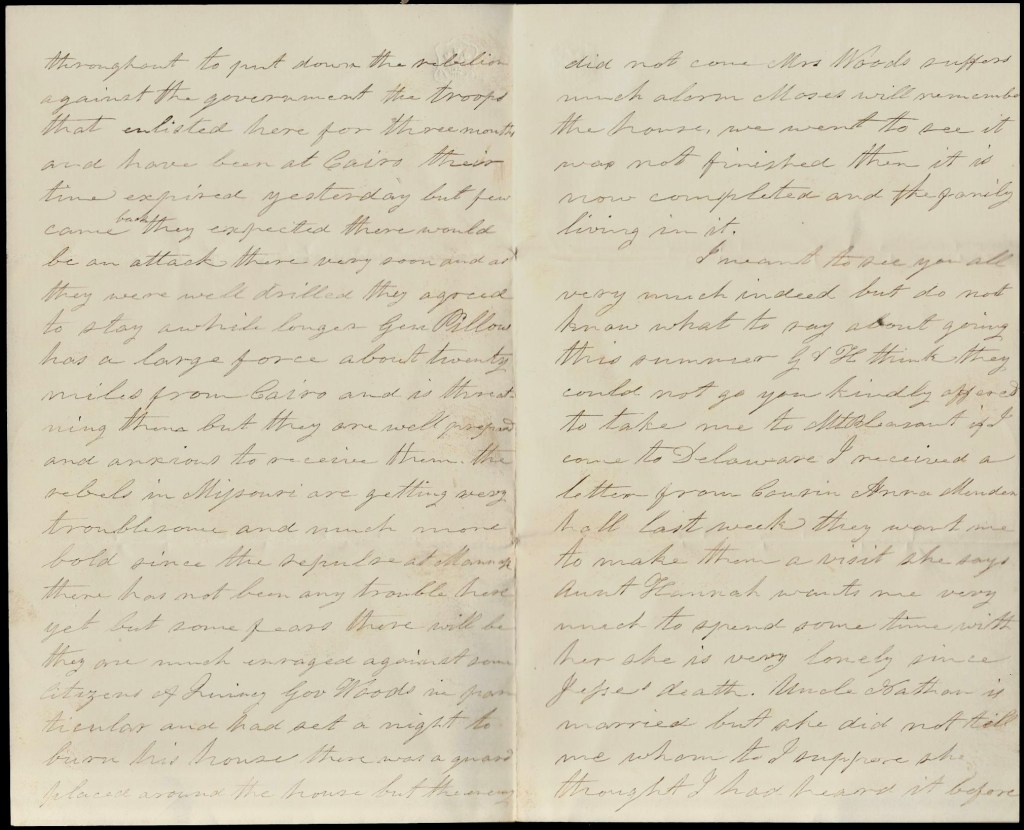
How swiftly time passes. It is now nearly a month since I received your most welcome letter giving me an account of the Fourth of July with you and although it is out of season, I will tell you a little of the doings here. There was much display and patriotism manifested on the occasion. There was a great military parade—two cavalry companies besides several other companies of soldiers, and firemen, citizens, &c. &c. marched through several streets and around the public square, and also an oration on the square by Rev. Edward Beecher of Galesburg, Ill.—brother of Henry Ward [Beecher], which was fine, and speeches by several citizens.

The North seems now to be united and the same feeling throughout to put down the rebellion against the government. The troops that enlisted here for three months and have been at Cairo, their time expired yesterday but few came back. They expected there would be an attack there very soon and as they were well drilled, they agreed to stay awhile longer. Gen. Pillow has a large force about twenty miles from Cairo and is threatening them but they are well prepared and anxious to receive them. The Rebels in Missouri are getting very troublesome and much more bold since the repulse at Manassas. There has not been any trouble here yet but some fears there will be. They are much enraged against some of the citizens of Quincy—Gov. Woods in particular—and had set a night to burn his house. There was a guard placed around the house but the enemy did not come. Mrs. Woods suffers much alarm. Moses will remember the house; he went to see it. It was not finished then. It is now completed and the family living in it.

I want to see you all very much indeed but do not know what to say about going this summer. G[eorge] & H[annah Willey] think they could not go. You kindly offered to take me to Mt. Pleasant if I come to Delaware [Ohio]. I received a letter from cousin Anna Mendenhall last week. They want me to make them a visit. She says Aunt Hannah wants me very much to spend some time with her. She is very lonely since Jesse’s death. Uncle Nathan is married but she did not tell me whom to. I suppose she thought I had heard it before. She said she had written to Moses and had received a letter from him. I suppose she told him all the news. There has been many changes since I was there. Do you ever hear from our friends at Mt. Vernon?

The weather is very warm and dry for the last week. The thermometer has risen to 104 degrees but there has not been much sickness here so far. We are all very well at present. You ask if I ever have any of those attacks to which I have been subject. I have not had any of them for some time and the last two or three were quite light. I hope I have got over them.

[Your wife,] Ollie [Olive Louise Horr], was not well when you wrote. I hope she has has recovered her health. I was glad to hear you & Mand family were well. Please write soon. G[eorge] and H[annah] send much love to you all with many wishes for your present and future happiness. Your affectionate mother, — Ann N. Starr

1863: Henry Benedict to Susanna Benedict

This letter was written by Henry Benedict (1842-1864) who enlisted on 17 September 1861 as a private in Co. A, 11th Iowa Infantry. Henry did not survive the war. He suffered a severe wound in the right arm on 22 July 1864 in front of Atlanta and died three weeks later at Marietta.

By the time Henry wrote this letter, he had seen the elephant a time or two and passed through some long marches in Mississippi. He datelined his letter from Memphis but erred in giving the date as 1862. It should have been 1863—a very common mistake. The regiment moved to Memphis on January 12th, four days prior this letter, and soon afterward went to Lake Providence where they remained until the Vicksburg Campaign. During the war, the regiment lost 5 officers and 86 enlisted men who were killed in action or who died of their wounds and 2 officers and 166 enlisted men who died of disease, for a total of 259 fatalities.

This letter and the image of Henry Benedict is from the private collection of Mike Huston and is published on Spared & Shared by express consent.

Transcription

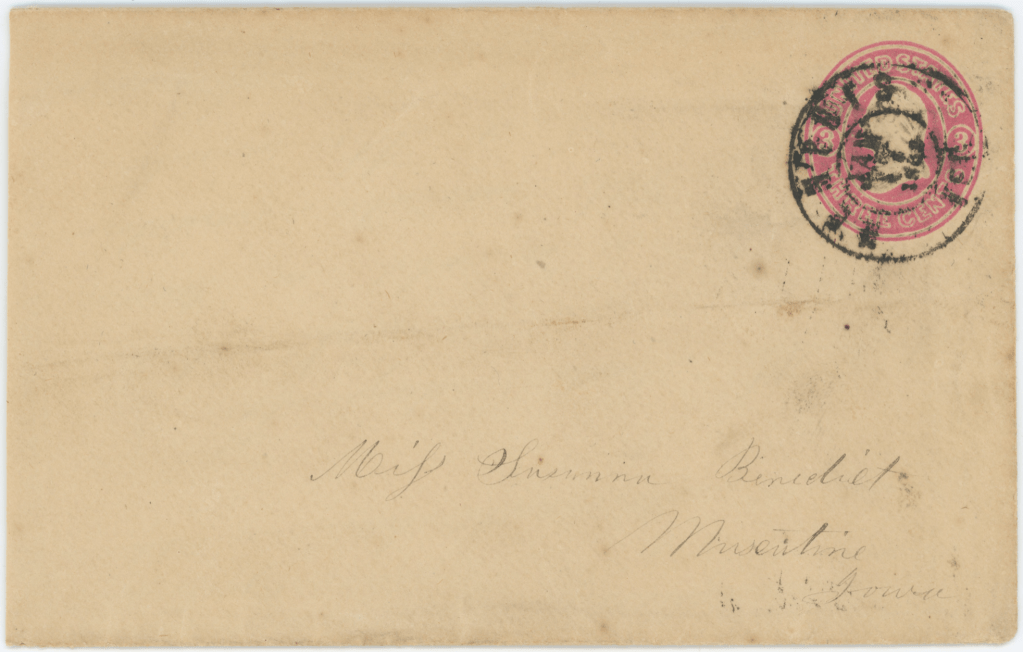
Addressed to Miss Susanna Benedict, Muscatine, Iowa

Memphis, Tennessee
January 16, 1862 [should be 1863]

Dear Sister,

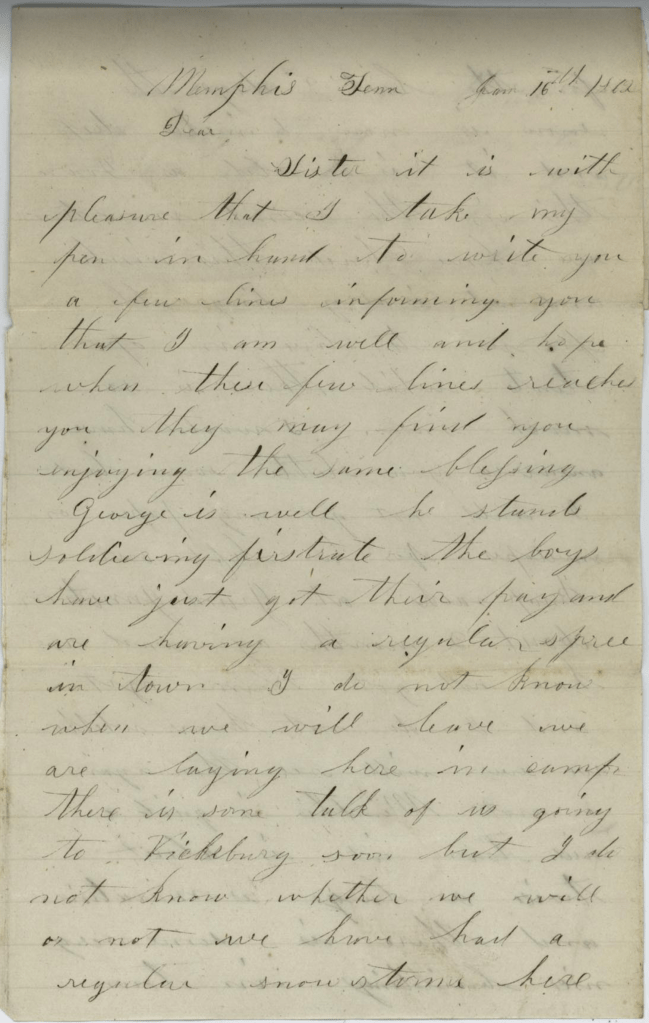
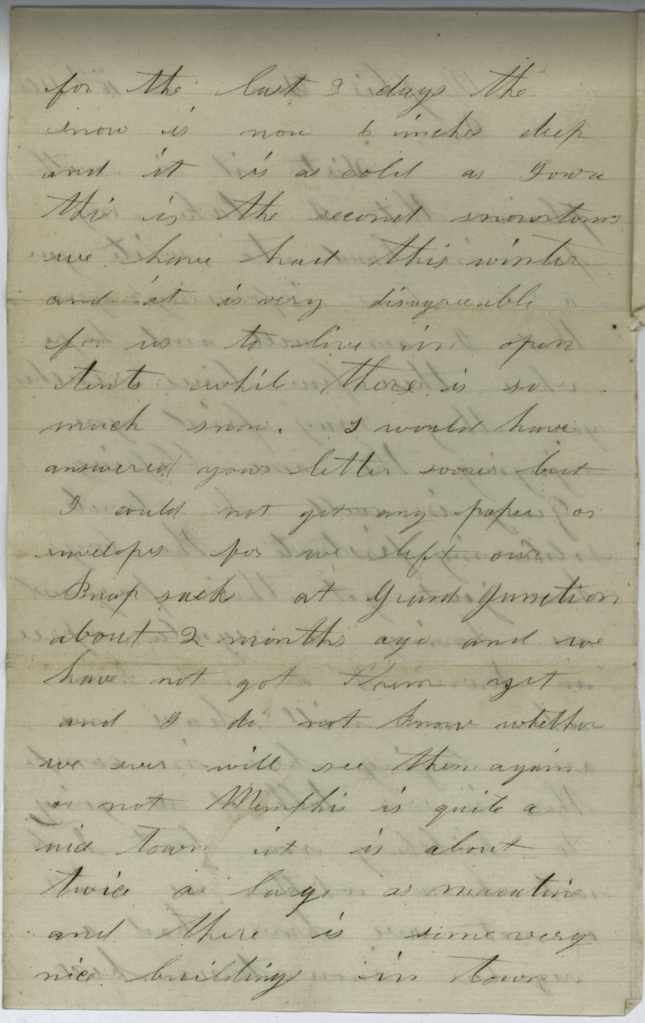
It is with pleasure that I take my pen in hand to write you a few lines informing you that I am well and hope when these few lines reaches you, they may find you enjoying the same blessing. George is well. He stands soldiering first rate. The boys have just got their pay and are having a regular spree in town. I do not know when we will leave. We are laying here in camp. There is some talk of us going to Vicksburg soon but I do not know whether we will or not. We have had a regular snowstorm here for the last 3 days. The snow is now 6 inches deep and it is as cold as Iowa. This is the second snowstorm we have had this winter and it is very disagreeable for us to live in open tents while there is so much snow.

I would have answered your letter sooner but I could not get any paper or envelopes for we left our knapsacks at Grand Junction about two months ago and we have not got them yet and I do not know whether we ever will see them again or not.

Memphis is quite a nice town. It is about twice as large as Muscatine and there is some very nice buildings in town.

Well, I cannot think of anything more to write at present so I will close. No more but I remain your affectionate brother—Henry Benedict

1861: Augustus Oswald McDonell to Elizabeth (Nowland) MacDonell

Augustus Oswald McDonell (1839-1912), Image found on Richard Ferry Military Antiques.

This letter was written by Pvt. Augustus Oswald McDonell (1839-1912), the son of Alexander Harrison MacDonell (1809-1871) and Ann Elizabeth Nowland (1808-1880). Augustus was born in Savannah, Georgia, and came to Florida in 1854 where he was educated and working as a merchant in the gulfport city of Alachua when the Civil War started. He joined the Gainesville Minute Men (militia) in 1860 and then enlisted at Gainesville, Florida on 5 April 1861 in Co. H, 1st Florida Infantry. In mid-April 1862 he was commissioned a 2nd Lieutenant in Co. K. He was wounded at the Battle of Perryville in October 1862 and promoted to the Captain of his company sometime early in 1864. He was taken prisoner by the 23rd Army Corps before Atlanta on 7 August 1864 and was not released from Johnson’s Island Prison until taking the oath on 16 June 1865.

In the 1860 US Census, “A. O. McDonell” was enumerated as a “merchant” in Alachua, Florida. His father was enumerated at that time in Marion county, Florida, and owned 25 slaves ranging in ages from 1 to 73. In the 1850 US Census, 8 year-old “Augustus” was enumerated in his father’s residence in Early County, Georgia. Others in the household included his siblings, George (age 19), Roselin (age 17), Hannah (age 8), and James (age 4).

In researching the identity of this author of this letter, I discovered that his diary was housed in the P. K. Yonge Library at the University of Florida enabling me to compare and confirm the handwriting [see Augustus O. McDonell Papers, Diary, 1862-1864, to Download]. This diary would be incredible to transcribe. An entry from Murfreesboro on January 1, 1863 gives a hint of his composition:

There has been little fighting today. At intervals artillery and musketry have been heard in blended tones, plainly telling that our skirmishers were contesting gallantly the ground they occupied. The battlefield is still strewn with the enemy’s dead—their bland eyes & distorted features show in wht agony they died. Our wounded with the enemy’s have all been cared for and our dead buried. The battlefield is one vast grove of cedars and thousands of these beautiful evergreens are wrent in shivers by the bursting shell and lightning grape shot. Among this beautiful forest wreck are the graves of the noble dead, the newly turned sod silently says, “Here sleep the Masters of Liberty.”

In this letter, datelined from Camp Magnolia near Pensacola, Florida on 19 May 1861, Augustus informs his mother that all new recruits must enlist for the duration of the war, not just for one year. He also informs her that “it is almost impossible for us to get along without a servant of some kind” and asks his Father to send a family slave named “Nero” to the camp to cook and wash his clothes for him.

Transcription

Camp Magnolia [west of Fort Barrancas]
May 19, 1861

My Dear Mother,

Both of your kind and affectionate letters were received last week—the one by mail and the other by Harry. I did not get the letter written by him until several days after his arrival here. He left his saddle bags over at Pensacola and they contained our letters. I also received one from Hannah and Grandfather all of which I prized very highly. It makes me feel much happier & contented with my lot when I receive letters often from home.

I commenced this letter yesterday which was Sunday but did not get through with it. Since then an order has been issued from General Bragg to the effect that all visitors here must enlist or leave the army encampment within three days. Harry prefers doing the latter and will leave here in the morning and take this letter to you. We all tried to persuade Harry to enlist and stay with us but it was no go. An easy life at home seem to be the height of his ambition. He says he wants to join a company and go to Virginia but the misfortune now is the President has issued an order not receiving any more companies or men in the C. S. service unless they enlist for the term of the war which I think an excellent idea because troops who have been in service 12 months will be much more effectual than raw recruits. I have made up my mind that if the war is not ended at the expiration of the term for which I joined—and I live—that I will enlist again and that for the whole war, but I hope I will not always serve as a private.

Uncle Thaddeus 1 has written by Harry for Aunt Janie to come on to Pensacola. He will board her at some private house in that place. I want you, dear Mother, to tell Father to send Nero to me as soon as you get this by Harry. Start him off to Fernandina and he can come in company with Aunt Janie and take care of the baggage for her.

The Major [Thaddeus McDonald] was disappointed in getting his boy Grand Fernandina and it is almost impossible for us to get along without a servant of some kind and in case I get sick, dear Mother, I will have him to attend to and nurse me. I have to pay $1 per dozen for all of my washing and if I had Nero here, he could do it for me. I hope he will not object to coming. He told me before I left that he wanted to come with me. He will be kindly treated and well cared for. Uncle Thaddeus will gone one half his hire and expense. Let him get a trunk out of the store to put his clothes in and tell him not to bring any more than he can feasibly help as much baggage is unhandy to move about in case we are sent from this to some other point. Do, Mother dear, send by Nero a pair of sheets for me. The weather is getting so warm that a blanket to sleep on is not so comfortable. also a couple pillow cases and two pair of my summer pants. And tell Father to look in the store among the clothing and if he has not sold them, to send me a pair of black Cap—pants marked $9. I got them in Savannah but concluded I would not need them here so I put them in the store to sell. Once in awhile I get a chance to visit Pensacola and then I like to look a little decent. If you have any little nice thing to send, it will not be at all objectionable, I assure you.

Be sure to write me. I don’t believe there is anything else that I want now. If you can think of any little thing I will need, send it along. Tell dear Father to shut down the credit business and sell for cash only. Goods are just like so much money now for they can’t be had anywhere hardly except for cash and that at the highest prices. If they do not sell now, they will before the war closes. I will write him soon more definitely with regard to it. I got a letter from cousin Gertie today. She mentions Camilla [Saussy] and Mr. Thomas H.] Jordan’s marriage and departure for the war. All were well in Savannah. I am going to write her a long letter soon as she was so kind to write me first. I hope his will find you all enjoying good health.

Laura Dunn is stopping in Warrington at a private house there. I went to call on her yesterday but she was not at home. She had gone to the camp. She sent us word that she was very anxious to see me and that I must certainly call on her before she returns home. Give much love to all relatives and friends and keep a sharp look out for John Brown parties. I believe the South is full of subversives and we should be vigilant at home and see that they do not step in upon us unawares.

I must now close. write me soon, dear Mother. Harry will tell you the news.

Your absent and affectionate child, — Augustus


1 Thaddeus A McDonald [McDonnell] was the Major of the 1st Florida Infantry. He was later promted Lt. Colonel of the regiment. He was wounded at the Battle of Shiloh on 6 April 1862.

1861: Seneca Freeman Minard to John S. Minard

This early-war tintype of an unidentified soldier was probably a member of Kane’s Rifle Regiment. Note the bucktail on the side of his cap. ( Dale Niesen Collection)

This letter was written by Seneca Freeman Minard (1837-1914) of Shippen, Cameron county, Pennsylvania, who mustered into the Kane Rifle Regiment of the Pennsylvania Reserve Corps (13th Pennsylvania Reserves, 42nd Pennsylvania Infantry)—better known as the “Bucktail Regiment”—on 1 June 1861 as a private in Co. C. At the time of his enrollment he was described as standing 5′ 9.5″ tall, with black hair, and blue eyes. He gave his occupation just prior to his enlistment as “lumberman.”

At some point Seneca appears to have been promoted to a corporal but there are no muster-out records for him and a note in the regimental history indicates that Seneca deserted his regiment though no date was given. The 1890 Veteran Schedule records him as a resident of Milton, Rock county, Wisconsin and states that he served 2.5 years.

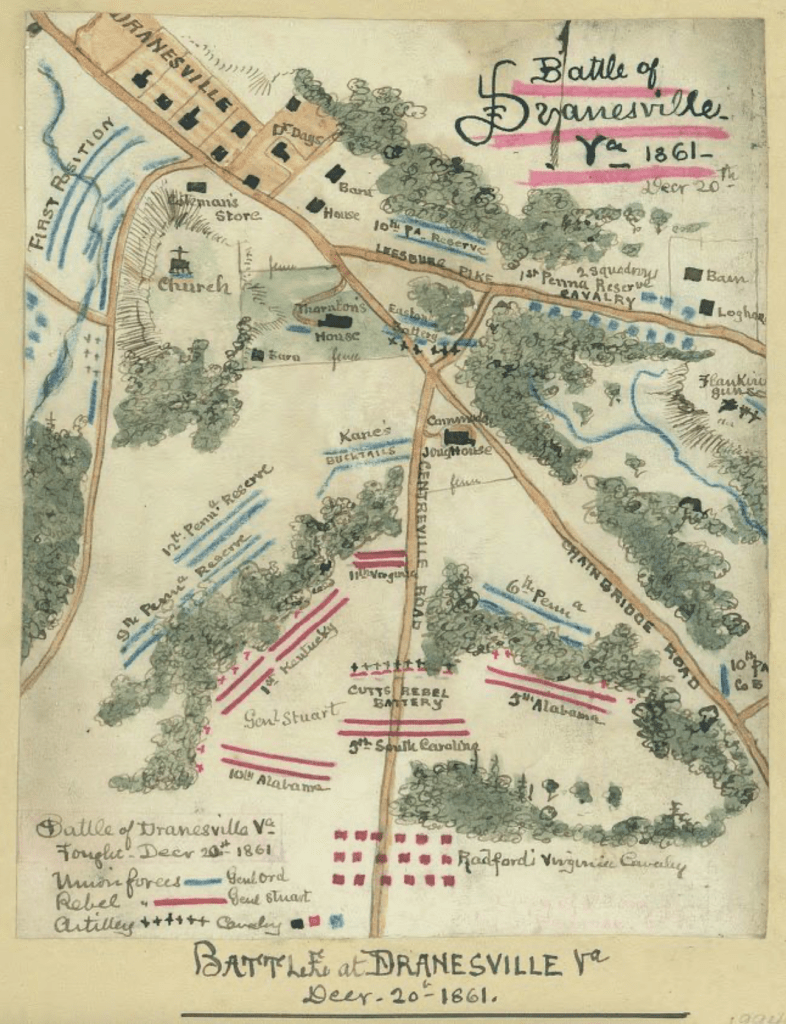
Seneca’s letter describes the Battle of Dranesville that took place between Confederate forces under Brig. General J. E. B. Stuart and Union forces under Brig. Gen. Edward O. C. Ord on 20 December 1861 in Fairfax county, Virginia.

Transcription

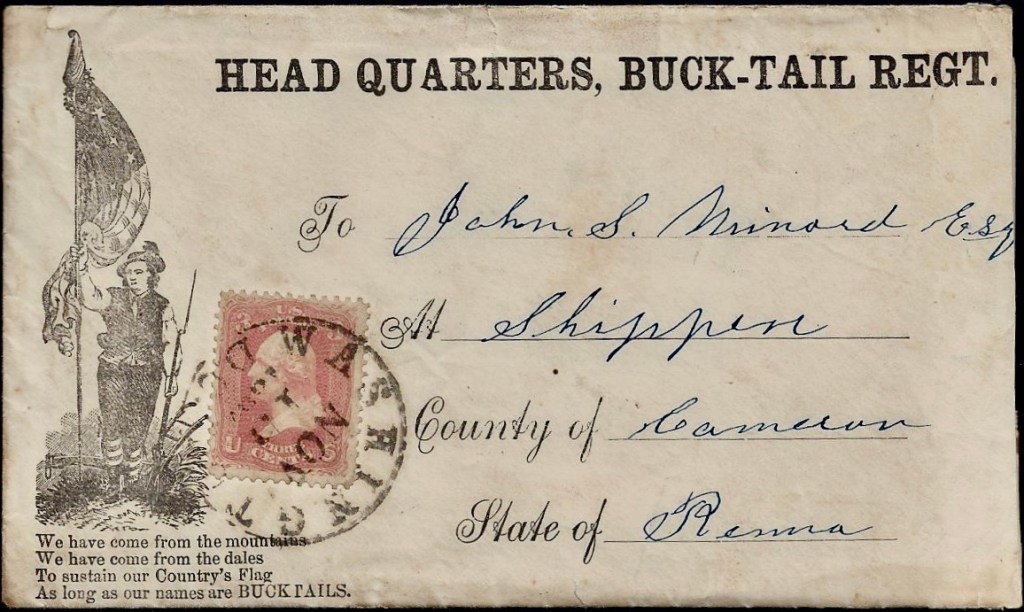
Addressed to John S. Minard, Esq., at Shippen, Camden county, Penna.

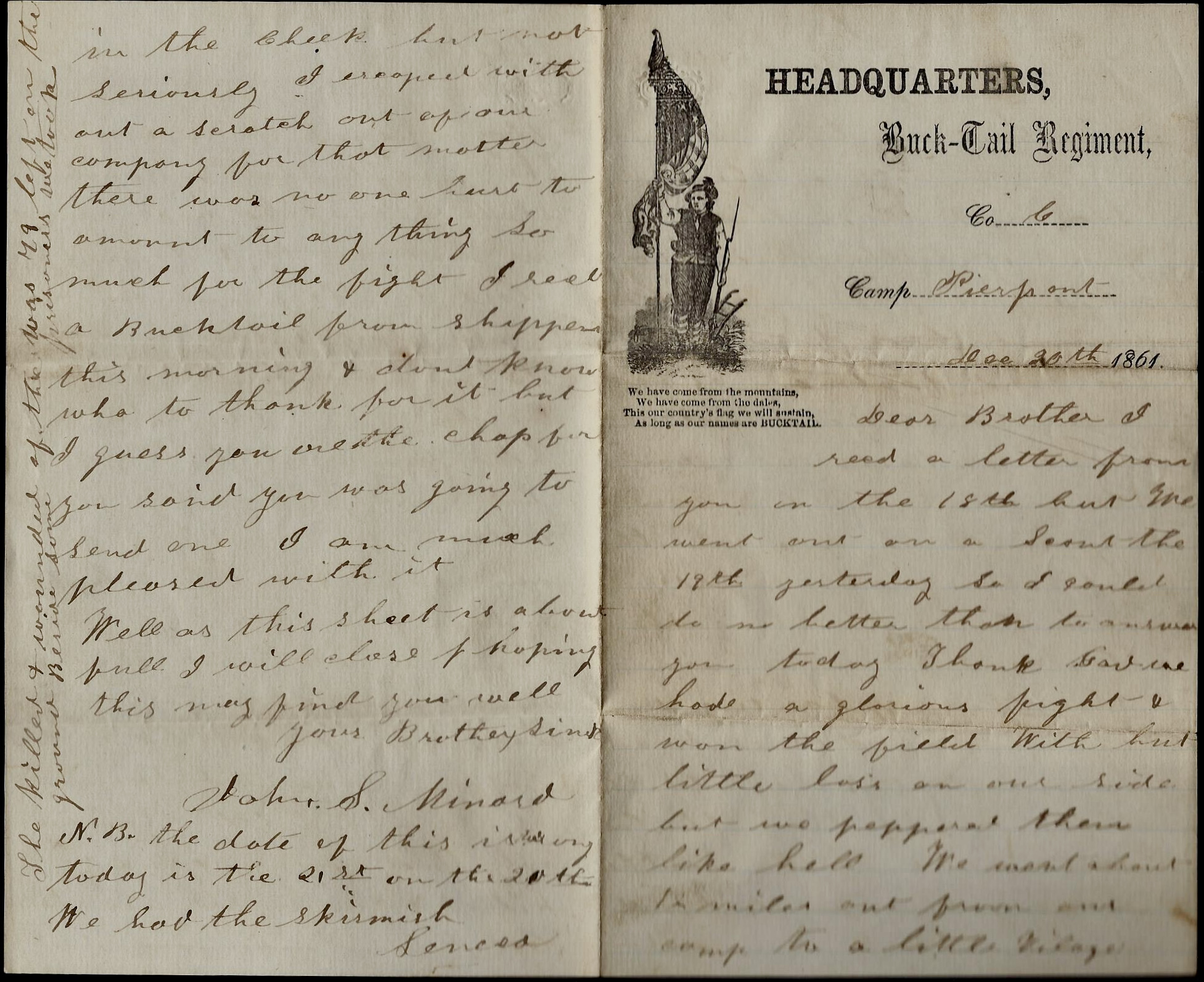
Headquarters, Bucktail Regiment
Co. C, Camp Pierpont
December 20th 1861

Dear Brother,

I read a letter from you on the 18th but we went out on a scout the 19th yesterday so I could do no better than to answer you today, thank God. We had a glorious fight & won the field with but little loss on our side but we peppered them like hell. We went about two miles out from our camp [on the Leesburg pike] to a little village called Dranesville. After scouting around there for about an hour we run into a nest of them stationed in a thick grove of little pines. They had four pieces of artillery and about four or five thousand footmen as near as we could find out.

The Bucktails were on the ground first and consequently were in the hottest of the fight. We were coming along the road & one of our [men] saw them planting a cannon in a crossroad to our left and he told the Colonel of it. Then the Colonel took us in behind a large brick house for shelter. we had hardly taken our position when they opened fire on us. The grapeshot and bomb shells flew like hail among us but we laid down as close to the ground as we could hug and they couldn’t do us much harm. But we did not have to stay here long until our big guns got on the ground and then we went in on our shape & within half an hour from the time our cannons got there, we were masters of the field.

Our loss was about ten killed and fifteen wounded—the most of them slightly. There was only three of our regiment killed and five or six wounded. [Lt.-]Col. [Thomas Leiper] Kane was wounded in the cheek but not seriously. 1 I escaped without a scratch. Out of our company, for that matter, there was no one hurt to amount to anything. So much for the fight.

I received a Bucktail from Shippen this morning & don’t know who to thank for it but I guess you are the chap for you said you was going to send one. I am much pleased with it.

Well as this sheet is about full, I will close hoping this may find you well.

Your brother, — Seneca

to John S. Minard

N. B. The date of this is wrong. Today is the 21st. On the 20th we had the skirmish. — Seneca

The killed and wounded of the [Rebs] was 79 left on the ground besides some prisoners we took.


1 Lt. Col. Kane was struck in the face by a ball that pierced his upper jaw. He halted just long enough to tie a bandage and resumed his position at he lead of his men.

1862: James Henry Platt, Jr. to Sarah (Foster) Platt

Capt. Harry Platt, Co. B, 4th Vermont (John Gibson Collection)

This letter was written by James Henry Platt, Jr. (1837-1894), who was raised in Burlington, Vermont. He completed preparatory studies and graduated from the medical department of the University of Vermont at Burlington in 1859 when he was 23. On 23 February 1859 he married Sarah Caroline Foster in Rutland, Vermont. He later married the suffragist and widow Sarah Sophia Chase Decker (1856–1912), who survived him.

“Harry” (as he preferred to be called) enlisted in August 1861 as a Captain in Co. B, 4th Vermont Volunteers. The 4th Vermont was organized at Brattleboro under the young Colonel Edwin Henry Stoughton and spent its first autumn in Virginia with Brooks’ Brigade, primarily tasked with the defense of Washington, DC at Camp Griffin.

While at Camp Griffin, the 4th Vermont was brigaded with several other Vermont regiments and was, therefore, often referred to as the “Vermont Brigade.” The brigade had a storied career and played a part in many important battles of the Army of the Potomac, including the Peninsula Campaign, Antietam, Fredericksburg, Second Battle of Fredericksburg, Gettysburg, Wilderness, Spotsylvania, Cold Harbor, Petersburg, Ft. Stevens, and Winchester.

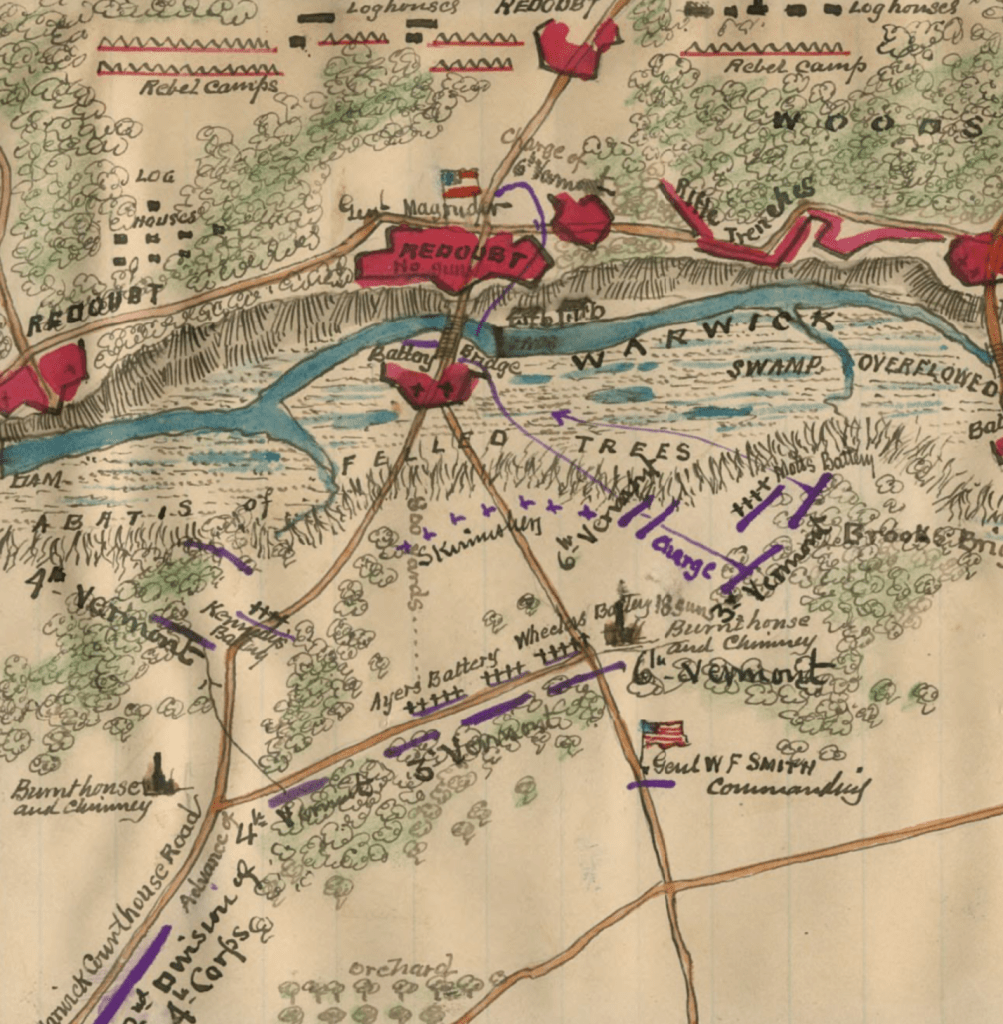
This incredible letter pertains to the first real test of the regiment which took place during McClellan’s Peninsula Campaign. After landing his troops on the tip of the peninsula formed by the James and York rivers, McClellan sent them towards Yorktown. Long before arriving there, however, he found that the Confederates had established a line of defense across the entire peninsula on or near the Warwick river—a formidable barrier by itself but also heavily fortified. On the morning of the 16th of April 1862, Brig. Gen. Baldy Smith sent two Vermont regiments from his 2nd Brigade towards the Confederate position near Lee’s Mill with orders to open fire on any working parties. Though the infantry opened the engagement, it devolved into an artillery duel with both sides suffering losses. No advance was accomplished and McClellan settled on the strategy of a siege. The engagement of 16 April 1862 has been referred to by various names, including the Battle of Lee’s Mill, the Battle of Burnt Chimneys, or the Battle of Dam No. 1.

As a counterpoint to this letter, I have placed a transcript in the footnotes of a letter written by 2Lt Cadmus M. Amoss of Cobb’s Legion who described the assault of the Vermont Brigade from the Confederate perspective.

To read other letters by members of the 4th Vermont Infantry I’ve transcribed and posted on Spared & Shared, see:
Daniel H. Gilson, Co. C, 4th Vermont (1 Letter)
Herbert Edward Taylor, Co. F, 4th Vermont (1 Letter)
William Rowe Russell, Co. F/G, 4th Vermont (13 letters)
Edwin A. Cummings, Co. G, 4th Vermont (1 Letter)
Jesse Smith Ormsbee, Co. G, 4th Vermont (1 Letter)
Mansfield Johnson Taplin, Co. H, Vermont (1 Letter)
Seth M. Bishop, Co. I, 4th Vermont (9 Letters)

[This letter is from the private collection of Richard Weiner and is published on Spared & Shared by express consent.]

Transcription

Camp near Yorktown, Virginia
April 20th 1862

My Darling Wife,

No fighting worth mentioning has occurred since yesterday when I last wrote you. About 3 p.m., the rebels displayed a “flag of truce” from their works, and proposed a cessation of hostilities for two hours to enable them to bury their dead. This was agreed to on our part on condition that they send us the dead of our regiments left on their side of the creek on Wednesday. The preliminaries being arranged, the sad work commenced and a party of their men brought our dead, one by one, half-way across the dam at which point they were received by our men. The spectacle—though melancholy—was deeply interesting. The rebel troops were in full sight, all portions of their works being covered with them, and a large body of their horsemen were stationed along the bank of the creek. Our men were also out in large numbers. On the dam midway between the two shores were two rebel officers and two of Gen. Smith’s staff amiably conversing. To have seen them meet, one would have thought it a meeting of dear friends long separated so cordial were the handshakes & so mutual the smiles.

“They expressed their determination to make every farm in Virginia a graveyard and every house a hospital before they would yield…”

Capt. Harry Platt, Co. B, 4th Vermont, 20 April 1862

A large party of the rebels were engaged sorting the dead, conveying their own into their fort, and ours to the party waiting to receive them. Thirty-three bodies were conveyed to our side, and seemingly three were carried into the fort to [every] one brought over [to ours]. While engaged in the work, the two parties conversed together freely. One of the rebels said he was from Burlington, Vermont, and his name he gave as Lyon. They expressed their determination to make every farm in Virginia a graveyard and every house a hospital before they would yield and other remarks of the “dying in the last ditch” style.

At the expiration of the two hours, forty minutes was agreed upon for both parties to place themselves in safety and at the end of forty minutes the white flag was hauled down and we were enemies once more. It was a sad sight to me to see my old friends and comrades from Co. F and some of the men in Co. K to whom last summer I taught the rudiments of military discipline, brought in lifeless & disfigured by wounds and lying so long on the field uncared for. But such is war. Gallantly they met the fate of true soldiers & fell bravely fighting for the noble cause we are defending.

It is a curious circumstance that rebels exhibit no flag. The white flag is the only emblem we have seen.

Our dead were buried carefully and tenderly amid the groups of sorrowing comrades who witnessed this last sad office. 1

I went out at 9 o’clock with a fatigue party of one hundred men to work on rifle pits & trenches which are being thrown up to shelter our men who protect the batteries. Imagine an open field of ten or twelve acres directly in front of the rebel fort with the creek between and surrounded on three sides by dense woods. Let me attempt a diagram which may better enable you to understand the position. You will find it enclosed & please don’t laugh at it as it’s only for your eyes. The rifle pits marked 10 are simply dry ditches with the dirt thrown up so that when a man is standing in the ditch, the embankment rises about a foot above his head thus completely protecting him from bullets. These, as you perceive, allow communication between the different batteries at all times & serve to protect infantry. We worked on these all night. Every few minutes the rebels would fire a heavy volley of musketry at us to embarrass us in the work. The men were all in the trenches shoveling like good fellows. I stood on the bank keeping a sharp look out for the first sign of a volley. The night was very dark & it rained hard all night. When the rebels fired, I could see the flash of the powder, then hear the report. At the flash, I would sign out “Down!” and jump into the trench and just get in when bang would come the bullets whizzing over our heads & striking all around us, when we would jump and work away until the next volley, & thus we passed the night.

The firing alarmed the camps and three times the regiments were called out by the long roll and marched out under arms so that on the whole, those of us who were at work had about the best of it. Tonight the entire regiment with the exception of those who were out last night are out as guards for the batteries. It has been raining all day but has stopped for the present.

I am very comfortably fixed and the regiment is encamped in a magnificent grove of great pines. I should enjoy myself very much could I only know that my dear wife was well and free from suffering. I do not hear at all regularly from you. Our mails come and go as it happens. We do not know whether our letters ever reach their destination but I continue to write to you almost daily. Believe me dear one, you are continually in my thoughts and your suffering causes me much anxiety and if I could only bear them for you or in some way lighten them, it would cause me great happiness. I look anxiously for the hoped for intelligence of your convalescence.

Ever your own loving, — Harry

Map showing the placement and lines of attack by the Vermont Brigade on 16 April 1862

1 The Union dead came from four companies (totaling 192 men) of the 3rd Vermont Infantry who advanced from the woods toward the Confederate position across the Warwick river. “Wading through the waist-deep river channel below the dam, the ‘Green Mountain Boys’ drove the surprised Confederates from the first line of rifle pits along the water’s edge. The Confederate unit at the center of the attack and taking the brunt of this vigorous attack was the 15th North Carolina whose Colonel William McKinney, was killed while rallying his soldiers. The death of Col. McKinney and an unauthorized order to fall back caused confusion all along the entire line. General Howell Cobb, Commander of the 2nd Brigade, 2nd Division, immediately reorganized and stabilized the line as he rode among the soldiers on horseback. General Cobb then proceeded to launch a brigade-sized counterattack against the four Vermont companies…As the Confederates regrouped and reinforced their line, the Vermonters with their backs to the river were in a desperate situation. They were running out of ammunition and taking severe casualties. With no hope of reinforcements coming, the Vermonters reluctantly withdrew back across the river after holding their position for one hour. A second attack later in the day by the 4th and 6th Vermont was even less successful…Confederate casualties for the day were approximately 75 killed and wounded. Union casualties at Dam No. 1 were 35 dead and 121 wounded. Of this number the 3rd Vermont lost 23 killed and 51 wounded.” [Newport News Park Brochure]

It should be noted that it was generally conceded by most accounts that the Warwick River was between two to four feet deep and 150-200 yards wide at the location of the attack made by the Vermonters on 16 April 1862. It is estimated that the combined force of the second attack composed of men from the 4th and 6th Vermonts could not have exceeded 750 men. It was the 6th Vermont that led the second assault. Four companies of the 4th Vermont were used only to create a diversion which was doomed by Rebel gunfire almost before it began.

It should also be noted that Capt. Platt’s inference that the cessation of hostilities was called by the Confederates is most assuredly false. Not only does the literature support the argument that the union forces called for it, but logic tells us that retrieving bodies from the other side of the Warwick River would be much more difficult for the Union army than the Confederate army, let alone the number of casualties which was tipped in favor of the Federals.

The following letter was written by 2Lt. Cadmus M. Amoss of Cobb’s Legion who described the Battle of Lee’s Mills (Dam No. 1) from the Confederate perspective. The letter was sold recently by Iron Horse Military Antiques. Amoss wrote the letter home to his wife on April 21, 1862, during the federal siege of Yorktown during the Peninsula Campaign. In the letter Amoss discusses the “stirring times we have had,” including the April 16 skirmish at Dam No. 1 on the Warwick River. The dam was one of three ordered built by Confederate General John Magruder in order to create lakes to obstruct the Union Army’s advance. The men of General Howell Cobb’s Brigade had been improving the defenses around Dam No. 1 on April 16 when Union troops of General William F. “Baldy” Smith’s division launched a probing attack.

Camp Near Lee’s Mills, York Co. Virginia
April 21st 1862

My Dear Georgia,

This is the only opportunity I have had of writing to you since my last letter and I am glad to have a few moments leisure in which to give you an account of the stirring times we have had. Last Wednesday the enemy commenced shelling our batteries placed at Dam No. 1 about a quarter of a mile above us. The shelling continued without intermission all the morning, doing little or no damage. Our company was stationed behind a breastwork at Dam No. 2. At three o’clock in the afternoon the Yankees sent over three picked companies to charge one of the rifle pits a little below Dam No. 1 at which the 15th N.C. Regiment was at work. This regiment—having no guns to fight with—were driven from the pits by the yankees, who charged over them. The Seventh Georgia was then ordered to charge the Yankees, which they did with a loud shout. The Yankees could not stand before them, but fell precipitously into the pond through which they had waded. Twenty or thirty were killed and a great number wounded. The enemy attacked us at two or three other points, but were repulsed with considerable loss every time. The regiments that bore the brunt of the battle that day was the Seventh, Eighth, and Sixteenth Georgia and Second Louisiana. Our regiment was situated at different points. Our company was fired on several times across the pond about two hundred yards by Yankees behind trees. No one hurt in the Legion. The enemy dismounted one of our largest guns that day. Our entire loss was sixteen killed and about sixty wounded. The enemy’s loss in killed and wounded is estimated at three hundred.

I was perfectly surprised at the noise and uproar made on that day. The whole world would tremble with the roar of artillery and musketry.

Our regiment remained in the breastworks day and night for four days after the battle. We were relieved yesterday morning by another regiment. I am perfectly worn out with loss of rest. I forgot to tell you that the enjoyment lasted four hours. Nearly all the troops that were at Manassas are here. I have seen a great many acquaintances recently. Gus Bacon and John McLendon are here. Reuben Jordan is also here. Yesterday evening I met up with Guss Bull. He is Lieut Col of the 35 Georgia. Virgil Hopson is in the same regiment.

Yesterday evening Gus Bacon and John McLendon came down to see me. They were nearly perished and are here without overcoats or blankets. I gave them plenty of ham and biscuits which they relished amazingly. There is at least twenty thousand Georgians here and if the yankees come over they will meet with a warm reception from them. The yankees sent over a flag of truce to bury their dead day before yesterday. I was up there at the time and saw about thirty of them carried over. They were all well uniformed and had the minnie musket. Nearly all of them were shot through the head. Several letters were found about the persons of the yankees, one of which was from a brother of the one killed who lived at Quebec, Canada. The writer was of the opinion that the South could not be conquered and wished the war would come to a close. The regiment that charged our breastworks was the Third Vermont and the company of which nearly all were killed was [of] the Vermont volunteers. I have no idea when they will attack us again. They are here in great force, but I think we will whip them every time they attempt to cross over the creek.

We hear their brass bands and drums every night. I never heard sweeter music than they have over the creek from us about a half mile.

If they intend doing anything I wish they would commence at once so that we may fight it out and quit. I am exceedingly anxious to hear from you but am afraid your letters cannot reach me. If anyone should come to this point from Atlanta I will try to let you know in time. One of your letters directed to Suffolk was handed me about the first of last week. I was truly glad to learn that you were well up to that time. Since I have been thinking about it there is a chance of getting a letter from you. It may be lost on the way but rather than not hear from you at all I think it would be well to risk writing. At all events write to me and direct your letter to Yorktown as before.

I will write again as soon as an opportunity presents itself. Give my love to all the family and kiss Henry for me.

Your affectionate husband—C. M. Amoss