This letter was written by 19 year-old Francis (“Frank”) H. Emley (1843-1935) of Germantown, Montgomery county, Ohio, who enlisted as a private in the 112th Ohio Infantry on 12 August 1862, and was transferred to Co. G, 63rd Ohio Infantry on 6 November 1863. He mustered out of the regiment on 8 July 1865 at Louisville, Kentucky.
Frank’s letter was addressed to David Laughlin (1817-1897)—the father of his comrade, Alfred A. Laughlin (1844-1862), who served with him in the same company. According to Frank’s letter, Alfred died of chronic diarrhea on 28 December 1862 at Davies’ Mills, Mississippi. Alfred’s mother was Susan Armel (1819-1904). In 1860, the Laughlin’s lived in Germantown, Montgomery county, Ohio.
Transcription
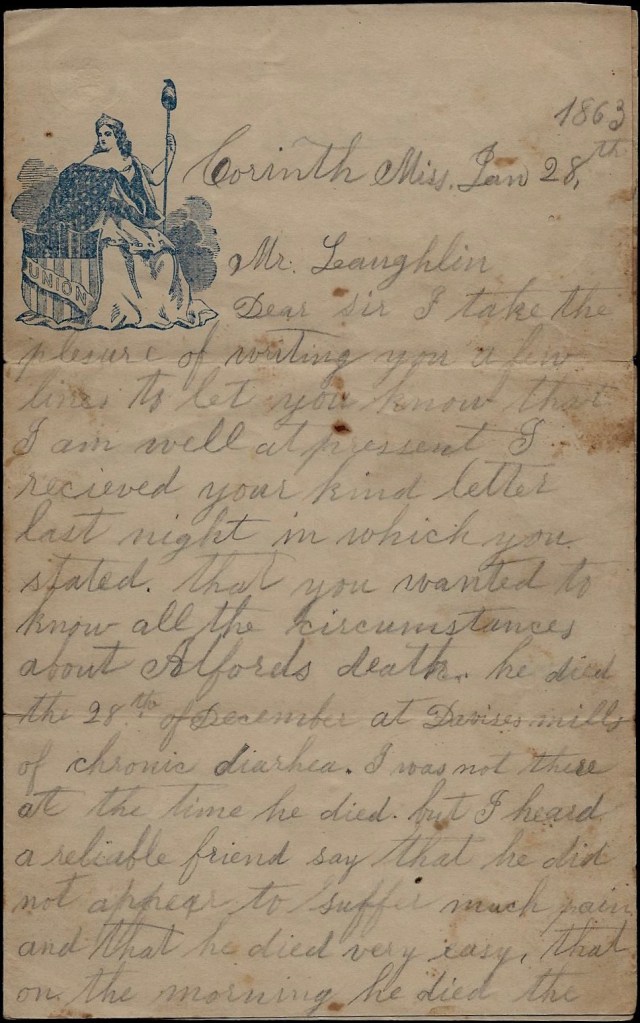
Corinth, Mississippi January 28, 1863
Mr. Laughlin Dear Sir,
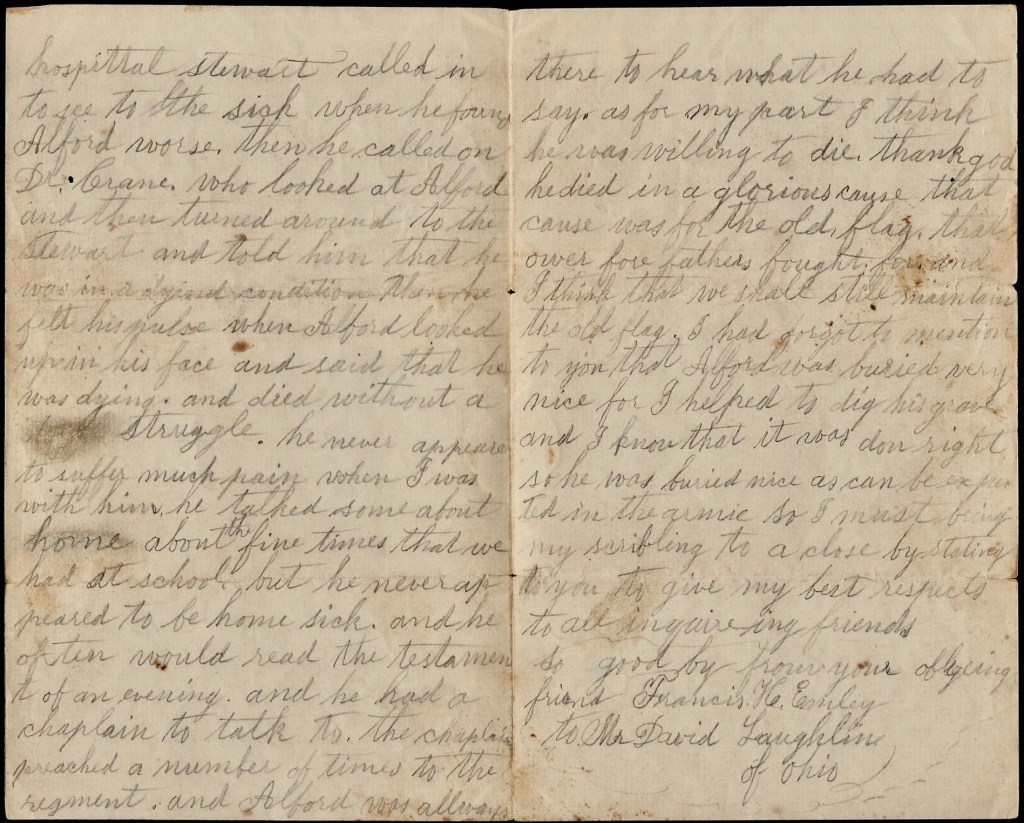
I take the pleasure of writing you a few lines to let you know that I am well at present. I received your kind letter last night in which you stated that you wanted to know all the circumstances about Alfred’s death. He died the 28th of December at Davis’s Mills of chronic diarrhea. I was not there at the time he died but I heard a reliable friend say that he did not appear to suffer much pain and that he died very easy. That on the morning he died, the hospital steward called in to see to the sick and he found Alfred worse. Then he called on Dr. Crane who looked at Alfred and then turned around to the steward and told him that he was in a dying condition. Then he felt his pulse. When Alfred looked up in his face and said that he was dying and died without a struggle. He never appeared to suffer much pain when I was with him.
He talked some about home, about the fine times that we had at school, but he never appeared to be home sick and he often would read the testament of an evening and he had a chaplain to talk to. The chaplain preached a number of times to the regiment and Alford was always there to hear what he had to say.
As for my part, I think he was willing to die. Thank God he died in a glorious cause. That cause was for the old flag that our forefathers fought for and I think that we shall still maintain the old flag. I had forgot to mention to you that Alfred was buried very nice for I helped to dig his grave and I know that it was done right. So he was buried nice as can be expected in the army.
So I must bring my scribbling to a close by stating to you to give my best respects to all enquiring friends. So goodbye from your obliging friend, — Francis H. Emley
This incredible letter was written by Emeline—“Emma”—(Washburn) Grout (1831-Aft1900), the wife of master cabinetmaker, Chester “Gilbert” Grout (1828-1903). Gilbert was raised in Bratteboro, Vermont, the son of John Grout (1788-1851) and Azubah Dunkle (1793-1866). After his marriage to Emeline, Gilbert lived in Kansas [Territory] for a time but left there during the “period of violence” days and went back East to Berlin, Sangamon county, Illinois, where this letter was datelined in September 1856. Gilbert must have traveled to Kansas Territory with an older brother, Admatha Grout (1817-1855)—a theologically trained graduate of Dartmouth and the Union Theological Seminary—who died in Osawatomie on 6 September 1855.
Voting records indicate that Gilbert cast a vote at Lawrence on 29 November 1854 when the territory selected its first delegate to Congress, and again on 9 October 1855 at Osawatomie when a “proper” election for a delate to Congress was held. Emma’s fifth paragraph refers to the gathering of Missourians south of Lawrence threatening to attack and the murder of a horseback rider. I feel certain that she is referring to the murder of Thomas Barber and the otherwise bloodless standoff which became known as the Wakarusa War. This would suggest that Gilbert and Emma made the journey back to Illinois during the middle of December 1855. Gilbert’s name does not appear on Kansas Territory land claims which is understandable given that he was not a farmer but a craftsman.
At the time of the Civil War, Gilbert and Emma were living in Agency, Wapello county, Iowa, where he enlisted as a corporal in Co. F, 7th Iowa Infantry and rose in rank to sergeant. He was discharged in January 1864 to accept a lieutenant’s commission in Co. A, 3rd Alabama (African Descent) Infantry which became the 111th USCT. After the war he returned to Kansas, settling in Augusta, Butler county. In the 1870 US Census, the couple were enumerated in Ottumwa, Wapello county, Iowa. In 1880, they were enumerated in El Dorando, Butler county, Kansas. By 1900, the couple had moved to Esculapia, Benton county, Arkansas. Gilbert’s death notice was published in the Windham county Reformer as having occurred in Magazine, Arkansas, on 28 February 1903. The couple do not appear to have had any children.
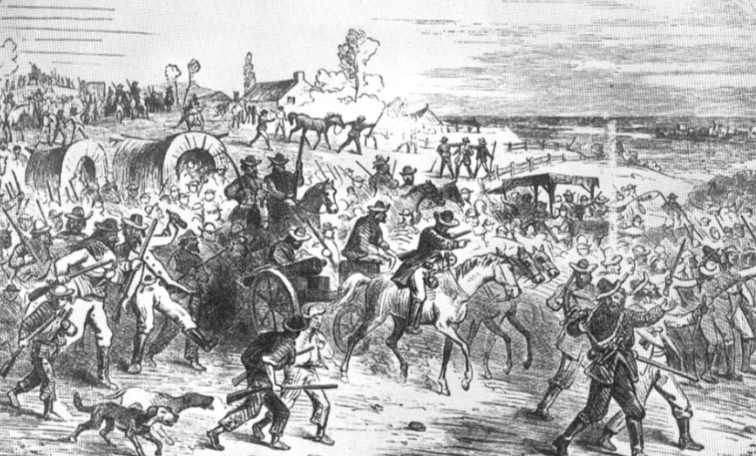
Missourians coming into Kansas Territory to vote before Election Day
[Note: This letter is from the private collection of Rob Morgan and is published on Spared & Shared by express consent.]
Transcription
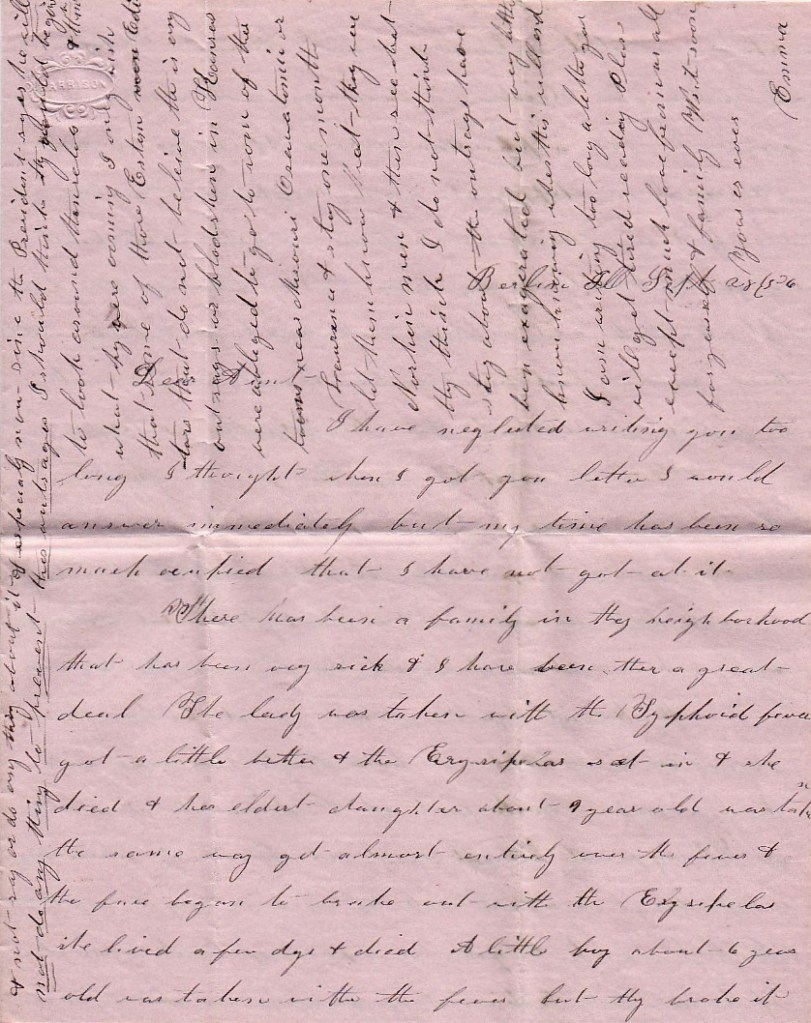
Berlin, [Sangamon county,] Illinois September 28, 1856
Dear Aunt,
I have neglected writing you too long. I thought when I got your letter I would answer immediately but my time has been so much occupied that I have not got at it.
There has been a family in the neighborhood that has been very sick & I have been there a great deal. The lady was taken with the typhoid fever, got a little better, & the erysipelas set in & she died. And her eldest daughter—about 9 years old—was taken the same way; got almost entirely over the fever & the face began to break out with the erysipelas. She lived a few days & died. A little boy about 6 years old was taken with the fever but they broke it up so it did not have a full run. But the day the little girl died, his face began to break out & swell. They got a physician from Springfield that succeeded in stopping it. Some think he is gaining slowly & some think he will never get well. He is not able to sit up any now. They have a little babe left, 6 months old, without a mother. He is a pretty little thing. I have had him & took care of him 2 weeks. They carried him home to his grandfather yesterday. With the exception of this family there has been no sickness in this vicinity this summer.
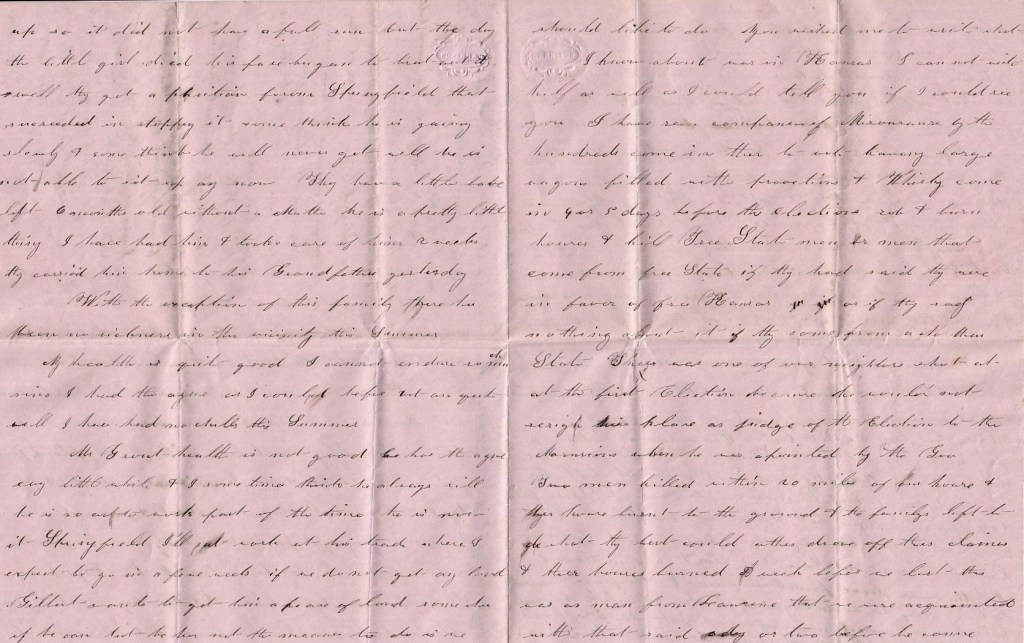
My health is quite good. I cannot endure so much since I had the ague as I could before, but am quite well. I have had no chills this summer. Mr. Grout’s health is not good. He has the ague every little while & I sometimes think he always will. He is so apt to work part of the time. He is now at Springfield, Illinois, at work at his trade where I expect to go in a few weeks if we do not get any land. Gilbert wants to get him a piece of land somewhere if he can but he has not the means to do as we should like to do.
You asked me to write what I know about was in Kansas. I cannot write half as well as I could tell you if I could see you. I have seen companies of Missourians by the hundreds come in there to vote having large wagons filled with provisions & whiskey, come in 4 or 5 days before the elections, rob & burn houses, & kill Free State men—or men that come from free states if they had said they were in favor of free Kansas, or [even] if they said nothing about it if they come from a northern state. There was one of our neighbors shot at at the first election because he would not resign his place as judge of the election to the Missourians when he was appointed by the Governor. Two men [were] killed within 20 miles of our house & their house burnt to the ground & their families left to do what they best could. Others drove off their claims & their houses burned.
A week before we left, there was a man from Lawrence that we were acquainted with that said a day or two before he came away, a man living 5 miles from there came to the store to do some errands, was riding home horseback between sundown & dark. [He] said nothing to anyone, [yet he] was shot off his horse & killed instantly. At that time they were gathering for a fight at Lawrence & were camped about 5 miles south of Lawrence. They then stopped every team & took whatever they had & [took] the drivers as prisoner. They thought in that way they should starve them out of Lawrence. They did not dare to attack Lawrence. [They] stopped there until they quarreled among themselves, killed 2 of their own men, [then] broke up and went home rather ashamed of themselves & a great many other things.
I could tell you if worthwhile but I will tell you what I think is the great cause of it—it is their being all the time, or most of the time, intoxicated. They never go into the Territory without as much whiskey as they can drink & drunken men will do almost anything you know.
There has been a great battle at Osawatomie within a few weeks. 1 Several men [were] killed & others drove from their homes and everything they had in the world left there to be destroyed. Two of the men went through Springfield & Gilbert saw them but I have not seen them & do not know whether they was anyone we knew or not. Gilman & his brother was out there that day & saw them & said that they were drove from their farms 1 mile from Osawatomie and left everything to be destroyed if they chose.
I think the New York Tribune [would] give the most correct news of any other paper there is. I do not see how the North can sit still & see such outrages go on & not say or do anything about it—& especially now since the President says he will not do anything to prevent these outrages. I should think they would begin to look around themselves & think what they were coming [to Kansas Territory]. I only wish that some of those eastern editors that do not believe there is any outrages or bloodshed in Kansas were obliged to go to some of these towns near Missouri, Osawatomie, or Lawrence & stay one month, let them know that they were northern men, & then see what they think. I do not think stories about the outrages have been exaggerated but very little. [There is] no knowing where this will end.
I am writing too long a letter. You will get tired reading. Please accept much love from us all for yourself & family. Write soon. Yours as ever, — Emma
1 Emma is referring to the “Battle of Osawatomie” that took place on 30 August 1856.
This letter was written by Manius Buchanan (1835-1914), the son of David Buchanan (1800–1874) and Lydia Tribbey (1802-1885) of Fairfield, DeKalb county, Indiana. At age 26, Manius first entered the service at LaPorte, Indiana, as a private in Co. B, 29th Indiana Infantry. He served in that regiment from 27 August 1861 until 5 September 1862 when he was discharged for disability.
In July 1863, he enrolled again to serve in the 118th Indiana Regiment which was being organized to serve for 6 months. He was selected as Captain of Co. D and served from early September 1863 to early March 1864. [Note: the officers of Co. D were originally recorded as being in Co. F, as well as some of the solders. By 1864, they were all clearly in Co. D, however.]
Service: March from Nicholasville, Ky., to Cumberland Gap September 24-October 3, and to Morristown October 6-8. Action at Blue Springs October 10. March to Greenville and duty there till November 6. March across Clinch Mountain to Clinch River. Action at Walker’s Ford, Clinch River, December 2. Duty at Tazewell, Maynardsville and Cumberland Gap till February, 1864. Skirmish at Tazewell January 24. Mustered out March 1-4, 1864.
Manius wrote this letter to his fiancee Emma W. Childs of DeKalb county, Indiana; the couple were married on 28 July 1864. In 1870 the couple were residing in Richmond, Ray county, Missouri, where Manius was employed as a surveyor. Sometime in the 1870s, Emma died and Manius remarried to a woman named Anne.
Transcription
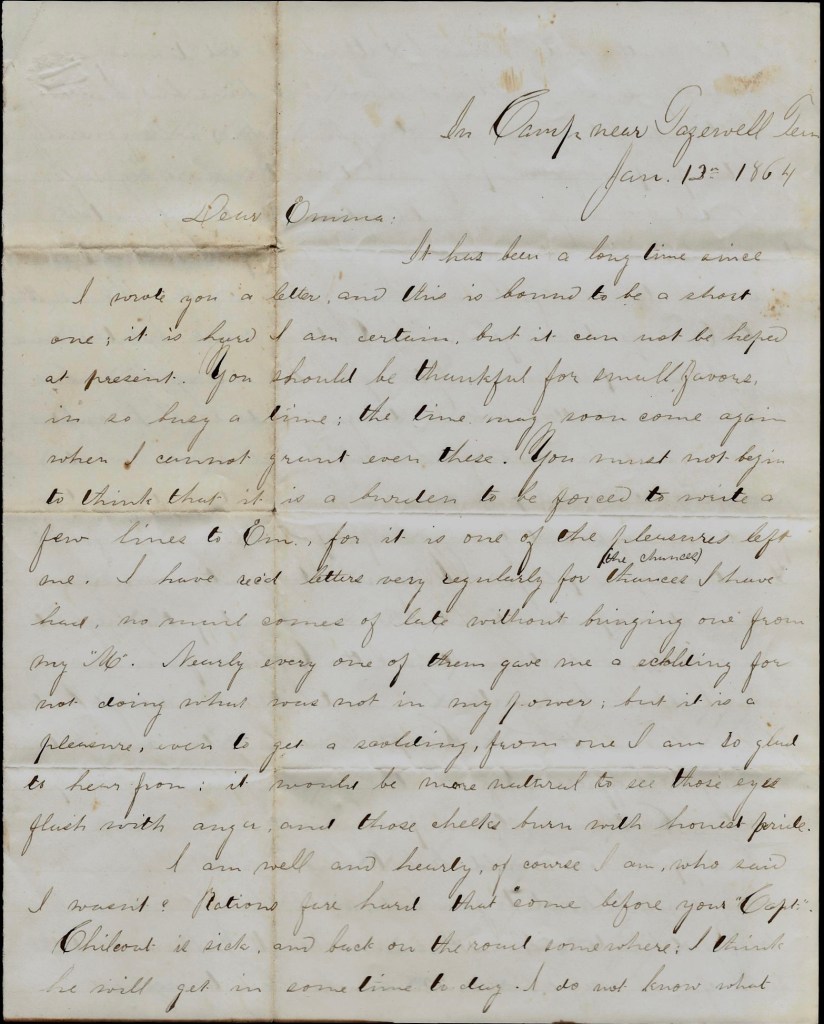
In Camp near Tazewell, Tennessee January 13, 1864
Dear Emma:
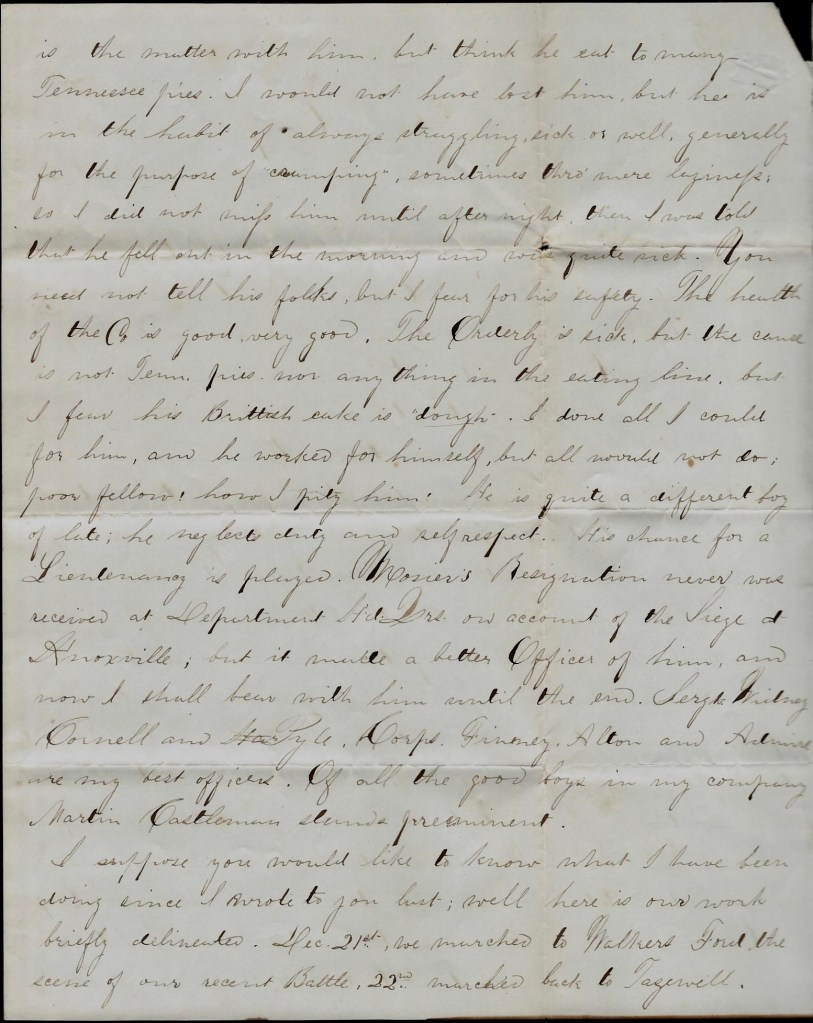
It has been a long time since I wrote you a letter and this is bound to be a short one; it is hard I am certain, but it can not be helped at present. You should be thankful for small favors in so busy a time. The time may soon come again when I cannot grant even these. you must not begin to think it is a burden to be forced to write a few lines to Em, for it is one of the pleasures left me. I have received letters very irregularly for the chance I have had, no mail comes of late without bringing one from my “M.” Nearly every one of them gave me a scolding for not doing what was not in my power, but it is a pleasure even to get a scolding from one I am so glad to hear from. It would be more natural to see those eyes flush with anger and those cheeks burn with honest pride.
I am well and hearty, of course I am. Who said I wasn’t? Rations fare hard that come before your “Capt.” [Pvt. Humphrey English] Chilcoat is sick and back on the road somewhere. I think he will get in sometime today. I do not know what is the matter with him but think he eat too many Tennessee pies. I would not have lost him, but he is in the habit of always struggling, sick or well, generally for the purpose of “crumping,” sometimes through mere laziness, so I did not miss him until after night. Then I was told that he fell out in the morning and was quite sick. You need not tell his folks, but I fear for his safety.
The health of the company is good—very good. The Orderly is sick but the cause is not Tennessee pies, nor anything in the eating line. But I fear his British cake is “dough.” I done all I could for him and he worked for himself but all would not do. Poor fellow, how I pity him. He is quite a different boy of late; he neglects duty and self respect. his chance for a Lieutenancy is played.
[1st Lt. Cyrus T.] Mosier’s resignation never was received at Department Headquarters on account of the siege at Knoxville but it made a better officer of him and now I shall bear with him until the end. Sergeants Whitney, [George N.] Cornell and [Erastus] Pyle, Corporals [Erastus] Finney, [Albert M.] Alton, and [Squire] Admire are my best officers. Of all the good boys in my company, [Pvt.] Martin Castleman stands preeminent.
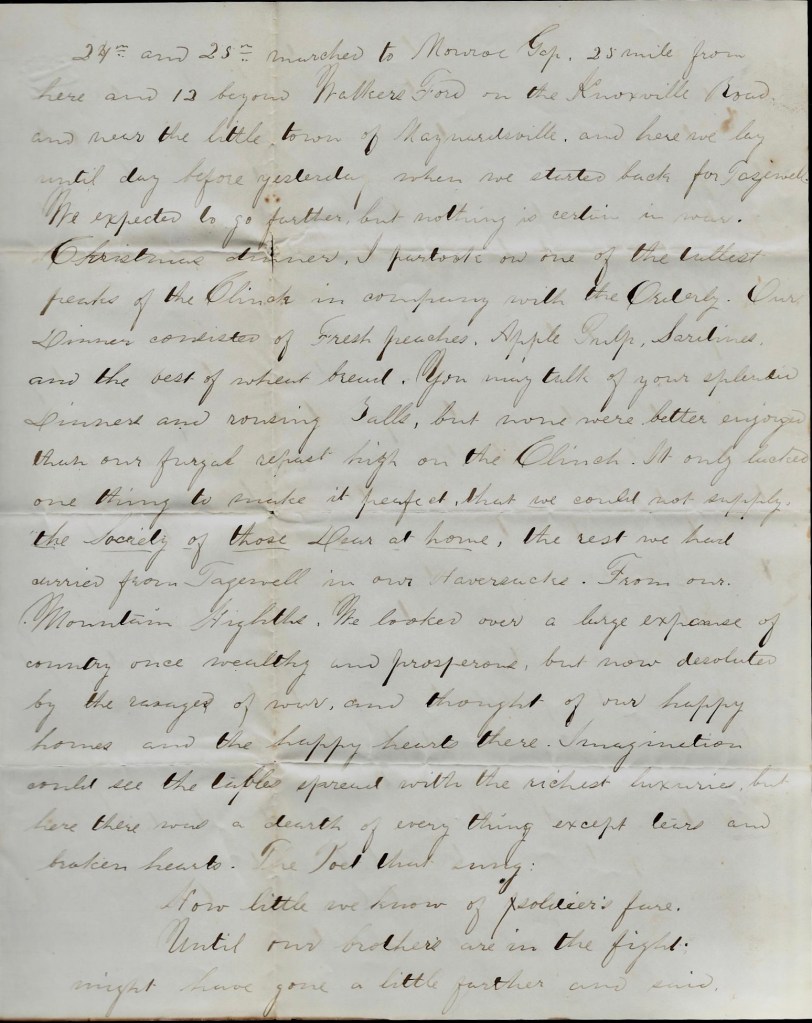
I suppose you would like to know what I have been doing since I wrote to you last. Well here is our work briefly delineated. December 21st, we marched to Walker’s Ford, the scene of our recent battle. 22nd, marched back to Tazewell. 24th and 25th, marched to Monroe Gap, 25 miles from here and 12 beyond Walker’s Ford on the Knoxville Road and near the little town of Maynardsville, and here we lay until day before yesterday when we started back for Tazewell. We expected to go farther but nothing is certain in war.
Christmas dinner I partook on one of the tallest peaks of the Clinch in company with the Orderly. Our dinner consisted of fresh peaches, apple pulp, sardines, and the best of wheat bread. You may talk of your splendid dinners and rousing balls, but none were better enjoyed than our frugal repast high on the Clinch. It only lacked one thing to make it perfect—that we could not supply the society of those dear at home. The rest we had carried from Tazewell in our haversacks. From our mountain heights we looked over a large expanse of country once wealthy and prosperous, but now desolated by the ravages of war and thought of our happy homes and the happy hearts there. Imagination could see the tables spread with the richest luxuries, but here there was a dearth of everything except tears and broken hearts. The poet that sung:
“How little we know of soldier’s fare Until our brothers are in the fight”
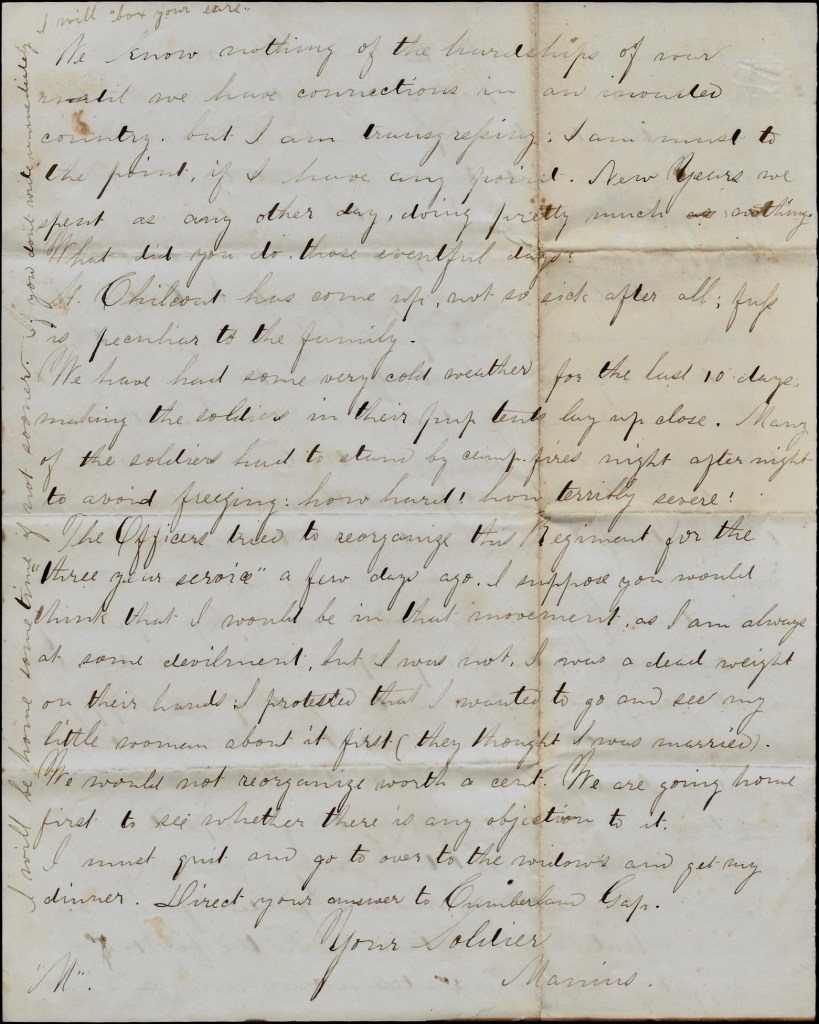
might have gone a little further and said, “We know nothing of the hardships of war until we have connections in an invaded country.”
But I am transgressing. I am most to the point—if I have any point. New Years we spent as any other day, doing pretty much nothing. What did you do those eventful days?
H[umphrey E.] Chilcoat has come up, not so sick after all; fuss is peculiar to the family.
We have had some very cold weather for the last 10 days making the soldiers in their pup tents lay up close. Many of the soldiers had to stand by campfires night after night to avoid freezing. How hard! how terribly severe!
The officers tried to reorganize this regiment fo the “three years service” a few days ago. I suppose you would think that I would be in that movement as I am always at some devilment, but I was not. I was a dead weight on their hands. I protested that I wanted to go and see my little woman about it first (they thought I was married). We would not reorganize worth a cent. We are going home first to see whether there is any objection to it. I must quit and go to over to the widow’s and get my dinner. Direct your answer to Cumberland Gap.
Your soldier, — Manins
to “M”
I will be home sometime if not sooner. If you do’t write immediately, I will “box your ears.”
This partial letter was written by 28 year old Augustus White (b. 1833) of Auburn, Androscoggin county, Maine, who served as a private in Co. H, 1st Maine Infantry (3months). There were several soldiers by that name but the key to his identity was the name and location of his camp near Columbia College on Meridian Hill in Washington D. C. This regiment was organized at Portland, Maine, and was mustered into service on 3 May 1861 and was mustered out on 5 August 1861. They did not participate in the Battle of Bull Run. Rather, they were ordered across the Chain Bridge on 20 July 1861 and held that position until the afternoon of 24 July 1861.
In his letter, Augustus conveys the hearsay news he received from those returning from the battlefield and repeats rumors of atrocities carried out by Confederates who murdered wounded and sick Union soldiers.
[Note: This letter is from the personal collection of Richard Weiner and is published on Spared & Shared by express consent.]
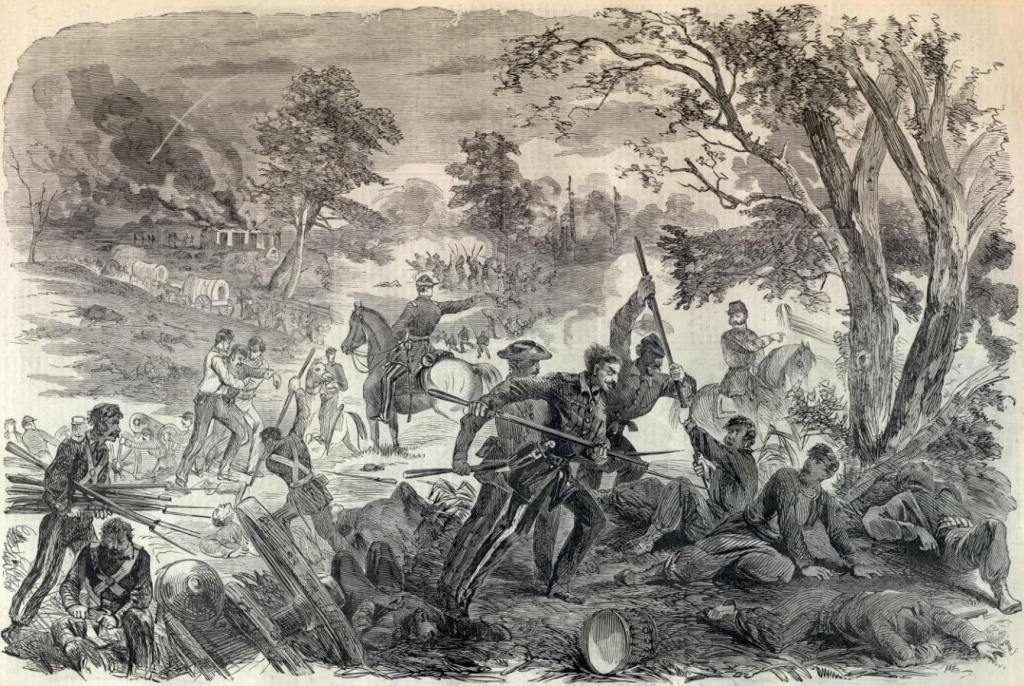
Confederate soldiers bayonetting the wounded Union Soldiers after the Battle of Bull Run, Harper’s Weekly
Transcription
Washington D. C. Meridian Hill Camp Jackson July 24th 1861
[portion of letter missing]
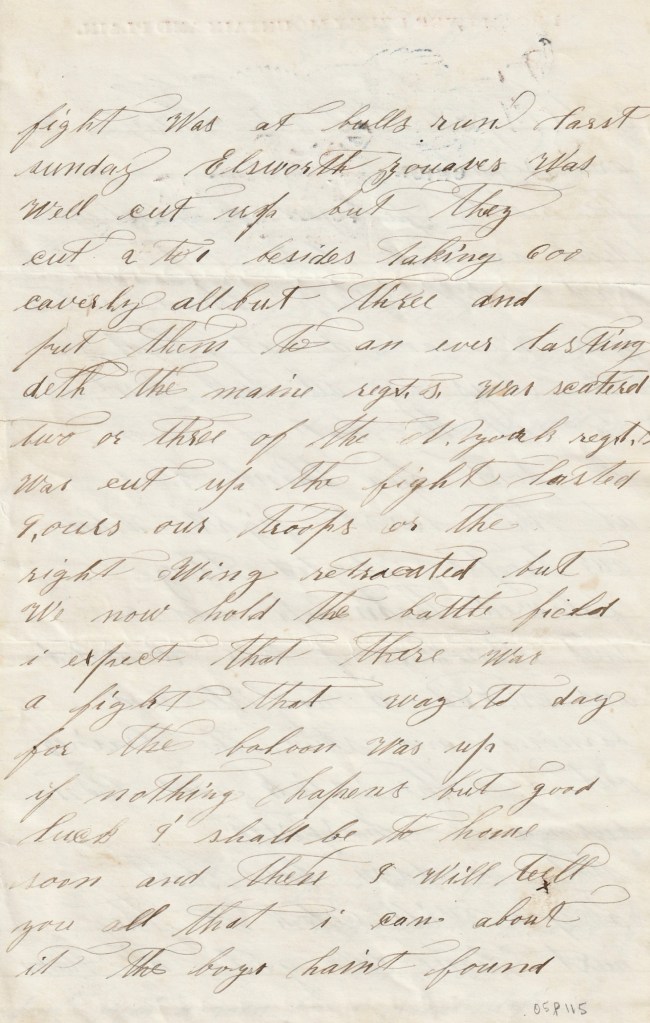
…thing for our troops to get drove but they did. But they fought like tyrants. This fight was at Bulls Run last Sunday. Ellsworth Zouaves was well cut up but they cut 2 to 1 besides taking 600 cavalry all but three and put them to an ever lasting death. The Maine regiments was scattered. Two or three of the New York regiments was cut up. The fight lasted 9 hours. Our troops—or the Right Wing—retreated but we now hold the battlefield. I expect that there was a fight that way today for the balloon was up.
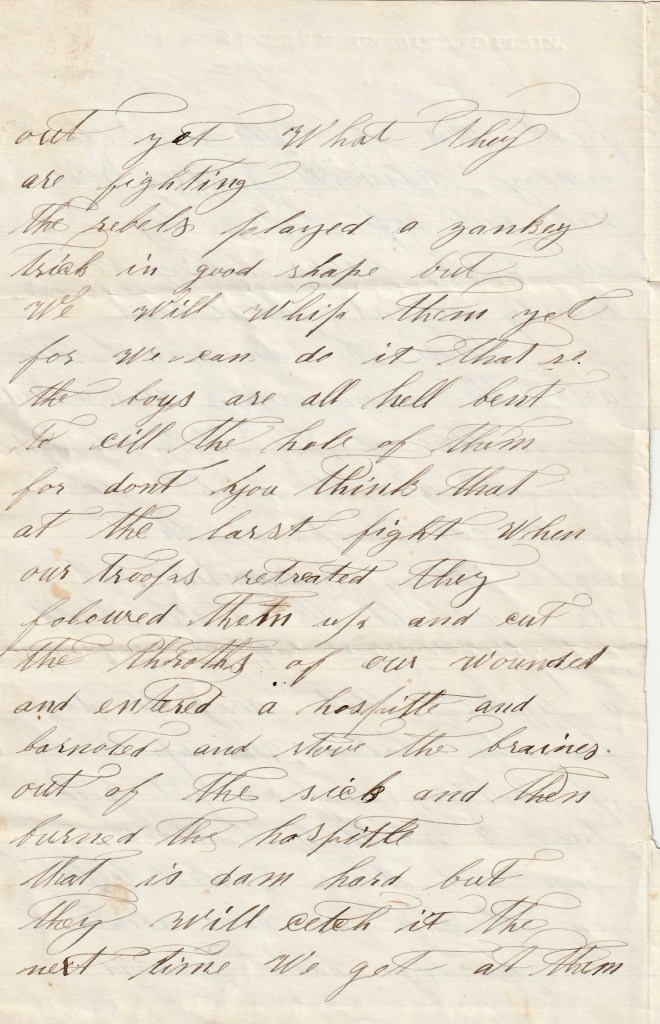
If nothing happens but good luck, I shall be to home soon and then I will tell you all that I can about it. The boys haint found out yet what they are fighting.
31 July 1861 Cincinnati Daily Commercial article about “The Barbarism of the Rebels” killing wounded Union soldiers in the Sudley Church used as a hospital.
The rebels played a yankee trick in good shape but we will whip them yet for we can do it—that’s so. The boys are all hell bent to kill the whole of them for don’t you think that at the last fight when our troops retreated, they followed them up and cut the throats of our wounded and entered a hospital and bayoneted and stove the brains out of the sick and then burned the hospital. That is damn hard but they will catch it the next time we get at them.
I don’t think of any more to write now for I am coming home soon. Then you know that I am in for a good time. I want you to get me some good old girl that will do…
[portion of letter missing]
…matter with me. From your old friend, — Augustus White
In haste. Don’t wait again for I shan’t stop here long enough to write another letter. Goodbye until I see you with my eyes.
This letter was written by James Ogburn Norton (1825-1862), a 1st Lieutenant in Co. F, 32nd Tennessee (Confederate) Infantry while imprisoned on board a boat docked at St. Louis. Lt. Norton was among the 528 members of the 32nd Tennessee that were taken prisoner on 16 February 1862. They would eventually be imprisoned at Camp Chase, Ohio, where they suffered through hard times. Though he tried to reassure his wife that he would be alright, Lt. Norton was one of the first officers to die at Camp Chase. His date of death is given as 4 March 1862, less than two weeks after this letter was written.
In the 1860 US Census, Norton was employed as a physician—a profession he learned from his father—at Hawkerville, Franklin county, Tennessee.
Surrender at Fort Donelson, 16 February 1862
Transcription
On Boat, St. Louis, Missouri February 24, 1862
My Dear Wife,
I write you a few lines by Dr. as I learn that he is going to Tennessee. I am well and am getting over hte fatigue of our late Battle Fort Donelson. We were all taken prisoners of war on Sunday morning, February 16th. There were none of our company killed and but three wounded. I was in the fight but did not get a scratch. How long we will be retained, I do not know know. I suppose we will be taken off the boats & be placed in comfortable quarters. We are treated very well by the officers who have charge of us. I can give none of the particulars as our letters will have to come open & be inspected.
I want you [to] bear up under it the best you can under the circumstances. We are in a healthy climate and when we get settled, we will enjoy fine health. My kindest regards to all. I want you all to do the best you can and not grieve about my confinement. I will ty and take care of myself the best I can and return when permitted. May God bless [my] dear wife and children.
From your affectionate husband, — Jas. O. Norton
Capt. [Elijah] Ikard [and] George is still with me.
Frank Brown, 87th Indiana Infantry, sporting his “florid mustache”
This letter was written by Frank Brown (1832-1922), the son of Enoch Brown (1805-1851) and Anna S. Leonard (1809-Aft1870). Frank enlisted at LaPorte, Indiana, in Co. G, 87th Indiana Infantry on 21 August 1862. After two years of hard fighting as a private, he was promoted to Commissary Sergeant and on 10 June 1865 was mustered out at Washington, D. C. Before his promotion, Brown fought at Perryville, Hoover’s Gap, Chickamauga, Chattanooga, Rocky Face Ridge, Resaca, Dallas, New Hope Church, Pine Hill, Kennesaw, Peach Tree Creek and Utoy Creek.
In his letter of 11 December 1863, Frank speaks of his intention of returning to the battlefield at Chickamauga to look for evidence of missing comrades. It was in the woodlands on that field where “the 87th Indiana established its bravery forever by standing steadfast with its brigade on three separate occasions, each time saving a significant part of the Union army.” [A Stupendous Effort, by Jack K. Overmeyer]
Frank wrote the letter to his sister, Charlotte (“Lottie”) Brown (b. 1835). Frank’s father died in 1851 but his mother was still residing in Almond, Allegany, New York in 1870. Frank had at least two brothers who also served in the Civil War. Joel Brown (1830-1865) served in Co. B, 211th Pennsylvania Infantry. He was killed in action in front of Petersburg on 2 April 1865. Albert Leroy Brown (1838-1862) served in Co. K, 11th Pennsylvania Reserves (40th Penn. Infantry). He was killed at Antietam on 17 September 1862.
Transcription
Chattanooga, Tennessee December 11, 1863
Dear Sis,
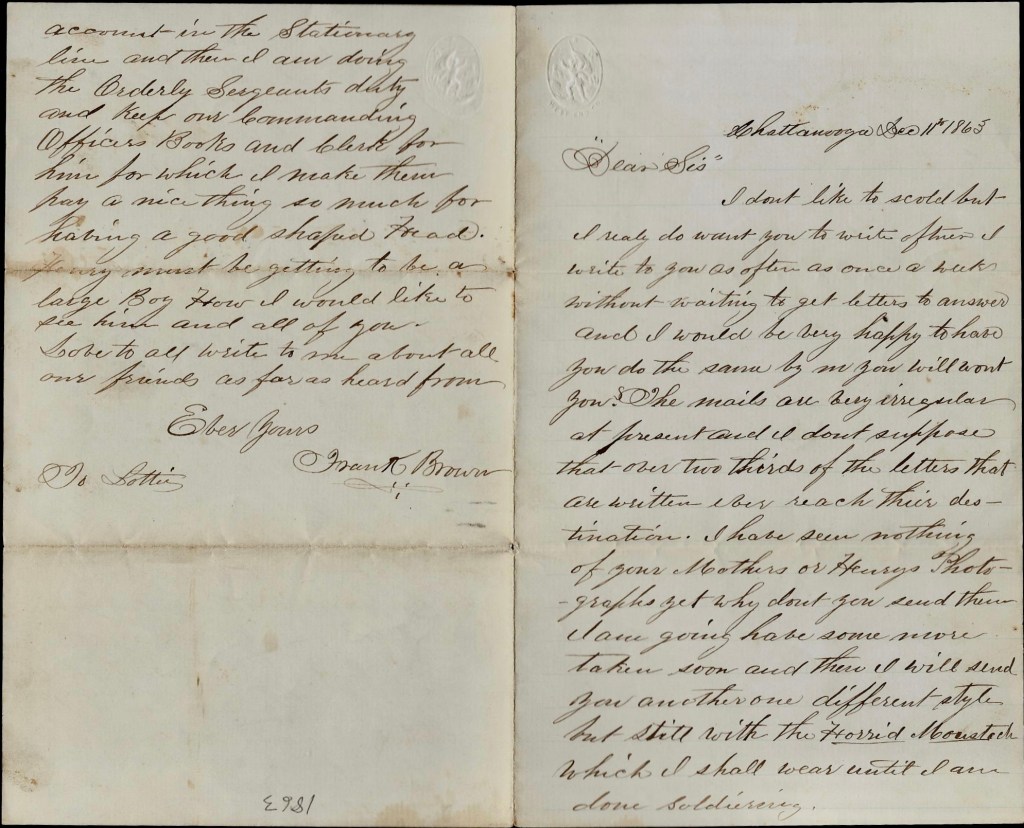
I don’t like to scold but I really do want you to write oftener. I write to you as often as once a week without waiting to get letters to answer and I would be very happy to have you do the same by me. You will, won’t you? The mails are very irregular at present and I don’t suppose that over two-thirds of the letters that are written ever reach their destination. I have seen nothing of your Mother’s or Henry’s photographs yet. Why don’t you send them? I am going to have some more taken soon and then I will send you another one different style but still with the florid mustache which I shall wear until I am done soldiering.
I am going out on the old battlefield of Chickamauga where we fought September 19th & 20th tomorrow to be gone two days. There is a party going out to see what they can find out about the lost and missing comrades that was with there. I expect it will be quite interesting to me to go over the ground again that we made such desperate efforts to win but was compelled to let it slide.
I don’t much think that I shall get to see you this winter and if I don’t this winter, I shall not for another year. I have made up my mind to stay and see the end of the show if it don’t last too long and I think it is good to last another year yet at least. I may get a furlough but it is not much of an object as they won’t let you be gone only just about long enough to go and return so a poor fellow has no chance to visit. However, I may take a short run up that way. I have the promise of the next chance in our company so watch out or I may come in and take you by surprise. When I do start, I will beat a letter through.
Frank’s brother Joel Brown, 211th Penn. Infantry.
I have no idea that I can get a furlough of sufficient length to go and see my Mother. Too bad isn’t it. I have got two letters from her yesterday and a paper. She thinks I am just one of the best boys there is. I write to her every week and have sent her seventy dollars (70.00) since last payday and shall send her fifty more in a day or two. You may wonder how I get so much money. I do a little speculating on my own account in the stationery line and then I am doing the Orderly Sergeant’s duty and keep our Commanding Officer’s Books and clerk for him for which I make them pay a nice thing. So much for having a good-shaped head.
Henry must be getting to be a large boy. How I would like to see him and all of you. Love to all. write to me about all our friends as far as heard from. Ever yours, — Frank Brown
Unidentified Confederate (Alabama Dept. of Archives & History)
This letter was written by Pvt. James B. Robbins of Co. E, 25th Georgia Infantry. James enlisted in the regiment on 5 April 1862 and was take prisoner at Marietta, Georgia, on 19 June 1864. He died of pleurisy at Camp Douglas, Illinois, on 6 January 1865.
Company E was organized in Henry county, Alabama. It was successively designated 3d Co E, and 2nd Co. K, 25th Georgia Infantry. They were originally known as the “Irwin Invincibles” and did not join the 25th Georgia until they were ordered from west Virginia to Savannah, Georgia in mid-January 1862.
In his letter, James mentions “a right smart little fight in South Carolina” that took place “this week.” He is referring to the Battle of Pocotaligo that was fought on 22 October 1862.
James wrote the letter to his brother-in-law, A. W. Benjamin Stewart.
The Battle of Pocotaligo From Frank Leslie’s Illustrated Newspaper
I this evening seat myself to write you a few lines in answer to yours that has just come to hand which give me much pleasure to hear from you and to hear that you was all well. Ben, you don’t know how much good it did to me to read your letter. I had been looking for a letter from home some time. I’m sick now and have been very sick. I tell you, it looked like taking the old fella off to the old peach orchard, but my time hadn’t come then, but I don’t know how soon it may come. I’m mending now as fast as I can. I can sit up the most of my time.
It is very sickly here now but I hope the sickness will soon be over here for this season. There is several of our boys here in the hospital but none dangerous. They are all able to knock about.
They have had a right smart little fight in South Carolina this week. Our loss killed and wounded was 55—15 killed and 40 wounded. Our regiment got back from there last night. They weren’t engaged. It was all over when they got there. We are looking for it here every day. There has been right smart cannonading round here for two or three days but no damage done yet.
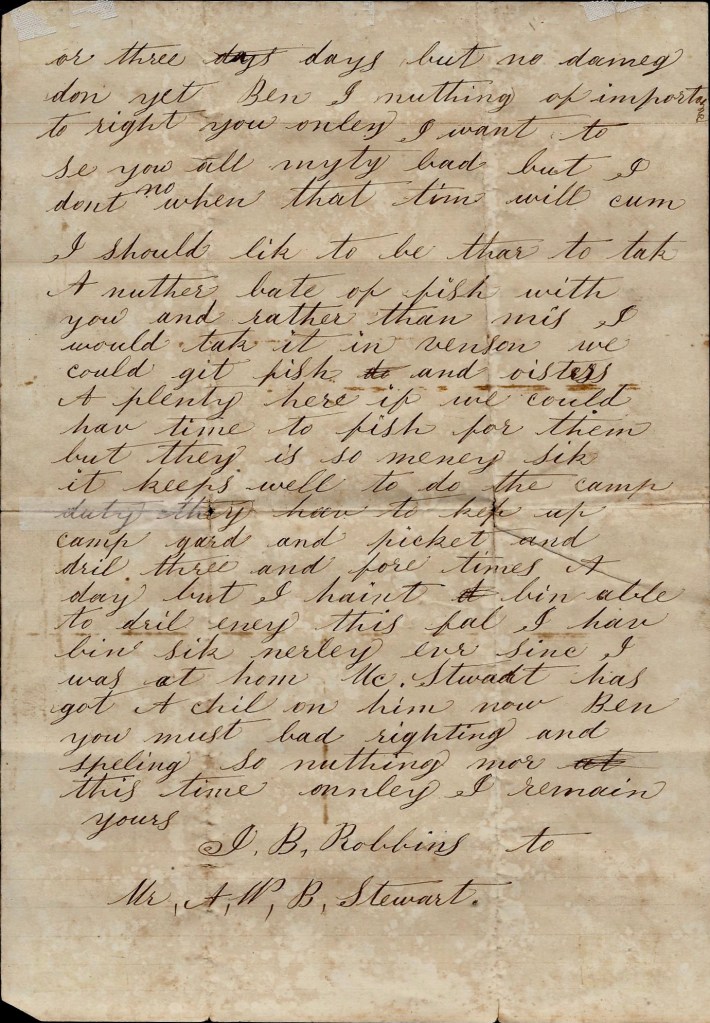
Ben, I have nothing of importance to write you—only I want to see you all mighty bad. But I don’t know when that time will come. I should like to be there to take another bate of fish with you and rather than miss, I would take it in venison. We could get fish and oysters a plenty here if we could have time to fish for them but there is so many sick, it keeps well to do the camp duty. They have to keep up camp guard and picket and drill three and four times a day. But I han’t been able to drill any this fall. I have been sick nearly ever since I was at home.
[Charles J.] McD. Stewart has got a chill on him now. Ben, you must [excuse my] bad writing and spelling. So nothing more this time only I remain yours, — J. B. Robbins
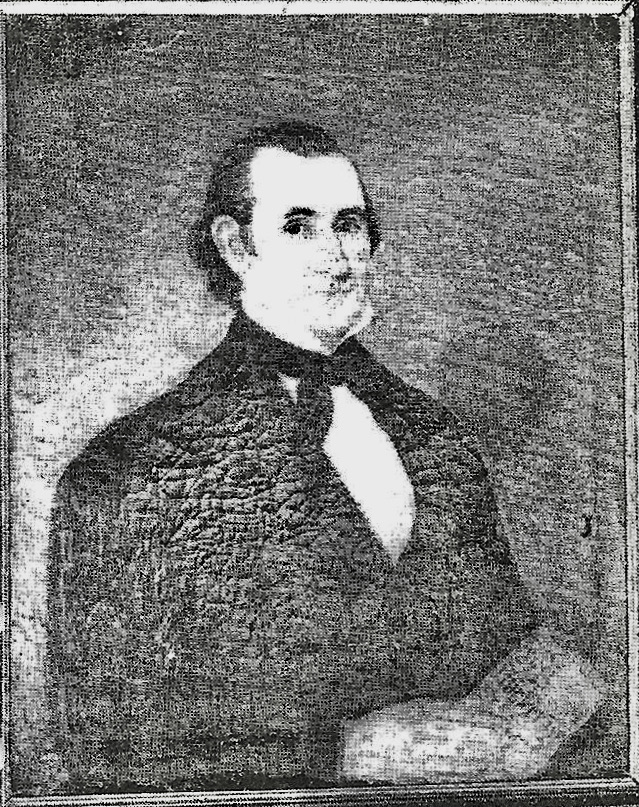
Portrait of Howard Everett from a 1977 Liberty, MO. Newspaper
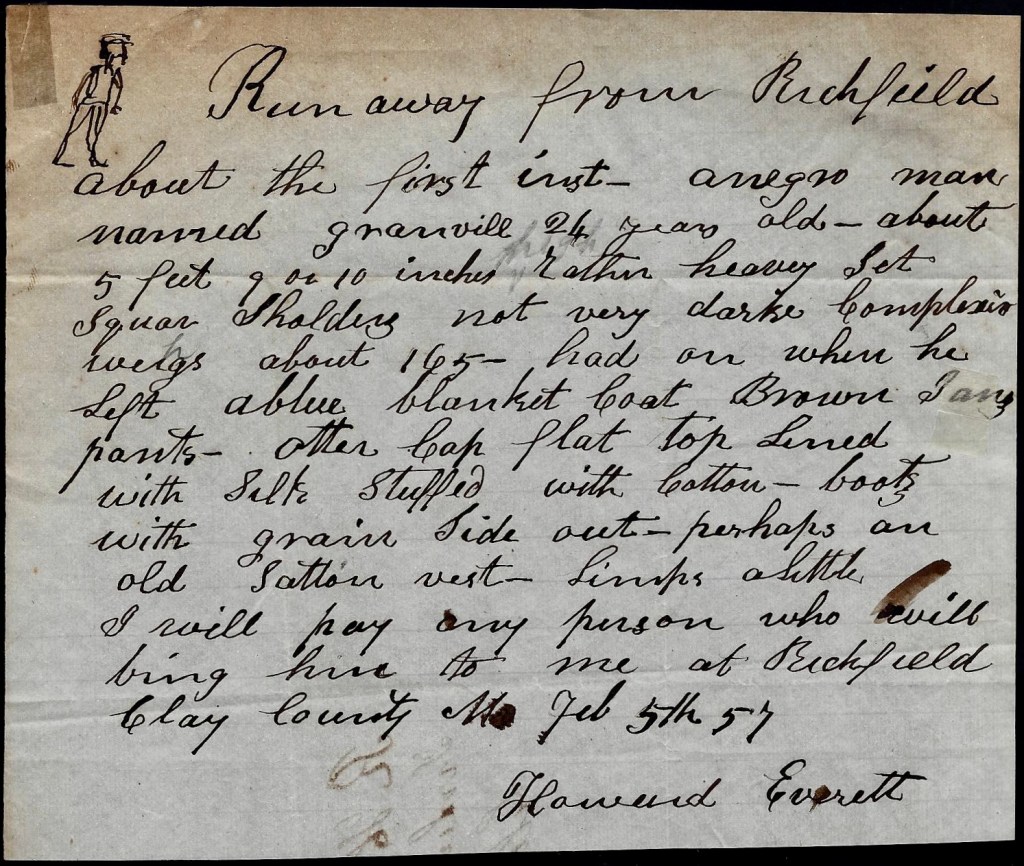
This Runaway Slave Notice was penned by 64 year-old Howard W. Everett (1793-1877), a native of Halifax county, Virginia, moved to Kentucky when he was young and then relocated again to Clay county, Missouri, in 1818 with his wife of three years, Sarah Ann Waltrip. In addition to being a farmer, Howard was ordained a Cambellite Preacher and started numerous churches in Northern Missouri.
It does not appear that Howard was always a slave holder. In the 1830 US Census, he held no slaves. In the 1860 US Census, he held only two middle-aged slaves. Howard wrote this notice from Richland which is now Missouri City—a consolidation of three villages, St. Bernard, Richfield, and Atchison. From 1850 to 1861, Richfield was probably the largest hemp market above Lexington.
Most likely this notice was a draft handed to the publisher of a local newspaper.
Transcription
Runaway from Richfield
About the first inst., a negro man named Granville, 24 years old, about 5 feet 9 or 10 inches high, rather heavy set, square shoulders, not very dark complexion, weighs about 165, had on when he left a blue blanket coat, brown [ ] pants, otter cap flat top lined with silk stuffed with cotton, boots with grain side out, perhaps an old cotton vest. Limps a little. I will pay any person who will bring him to me at Richfield, Clay county, Mo. February 5th 1857
This pass was written by Thomas G. White who enlisted in April 1862 for the duration of the war in Co. F, 3rd Battalion Light Artillery (a.k.a., the Chesnut Light Artillery). He was made a Second Lieutenant in the unit in June 1862 and detached as Commissary for the Battalion in March 1863. Beginning in January 1864, he began to sign the rolls as 1st Lt., commanding the company. Company F took part in battles around Charleston, shooting artillery rounds at Union gunboats and soldiers, and disbanded after the evacuation of Charleston.
Lt. White wrote the pass 1 for Wilson Roe (1804-Aft1864) of Edgefield District, South Carolina. The pass gives Wilson’s age as 52 but according to census record, he was even older. In the 1850 US Census, he was enumerated in the household of his brother, Simpson Roe [Rowe] and his birth year was given as 1804. Wilson’s brother Simpson also served the Confederacy as a private in Co. D, 14th South Carolina Infantry.
Confederate soldiers of the ‘Palmetto Battery’ in Charleston, South Carolina, 1863. This photograph was taken by George S. Cook, one of the most renowned photographers of the Confederacy. (Photo by Archive Photos/Getty Images)
Transcription
Camp Robertson, Wilton [S. C.] April [ ] 1864
The bearer here of private W. Roe of Capt. F. C. Schulz’s Co. F, [3rd] P. B. L.A. [Pametto Battalion Light Artillery], aged 52 years, 5 feet 10 inches high, dark complexion, grey eyes, grey hair, and by occupation a farmer, born in Edgefield district, and enlisted at Camp Chesnut on the 26th of February 1863 to serve for the period of the war, is hereby permitted to go to Edgefield, District, State of South Carolina, he having received a sick furlough for sixty days from the [ ] day of April to the [ ] day of [ ] at which period he will rejoin his company at Camp Robertson or wherever it may then be or be considered a deserter.
Subsistence has been furnished to said private W. Roe to the 20th April & pay to the 31st of December 1863.
Given under my hand at Camp Robertson this [ ] day of April 1864.
— Thomas G. White, Lieutenant Commanding, C. S. A.
Camp Roberson, Written Jan, 1864
1 A pass would have been required for a soldier returning home on a furlough of any kind. This particular pass happened to be for a sick furlough. The pass offered the bearer protection from being arrested as a deserter. Pvt. Roe’s pass (above) did not have the actual dates filled in so it may have only been a draft or a copy kept by the company. The language in these passes was pretty standard. Here is another one I found online issued by the same company:
The bearer here of private John Driggers of Capt F. C. Schultz Co. F. Palmetto Light Artillery, age 46 years, 6 foot 1 inch high, dark complexion, black eyes, black hair, by occupation farmer, born in Sumter District and enlisted at Camp Hayward on the 15th April 1862 to serve for the period of the war is hereby permitted to go to his home in Charleston District, State of South Carolina, He having received a furlough from the 13 day of January to the 23 day of January 1864, at which point he will rejoin his company at Camp Roberson on wherever they may be or be considered a deserter— Subsistence has been furnished to the said private to the 20 of January to the 31 October 1864, given under my hand at Capt Roberson on this 13th day of January 1864. F. C. Schultz Capt. Charleston District.
A sixth plate tintype of an unidentified member of the 12th Illinois Infantry, famously known as the 1st Scotch Regiment. He’s wearing the early-war state-issued tunic cut from gray fabric with blue cuff facings, six button front, and the Scotish tam or bonnet widely worn by the regiment. (This image was sold on WorthPoint)
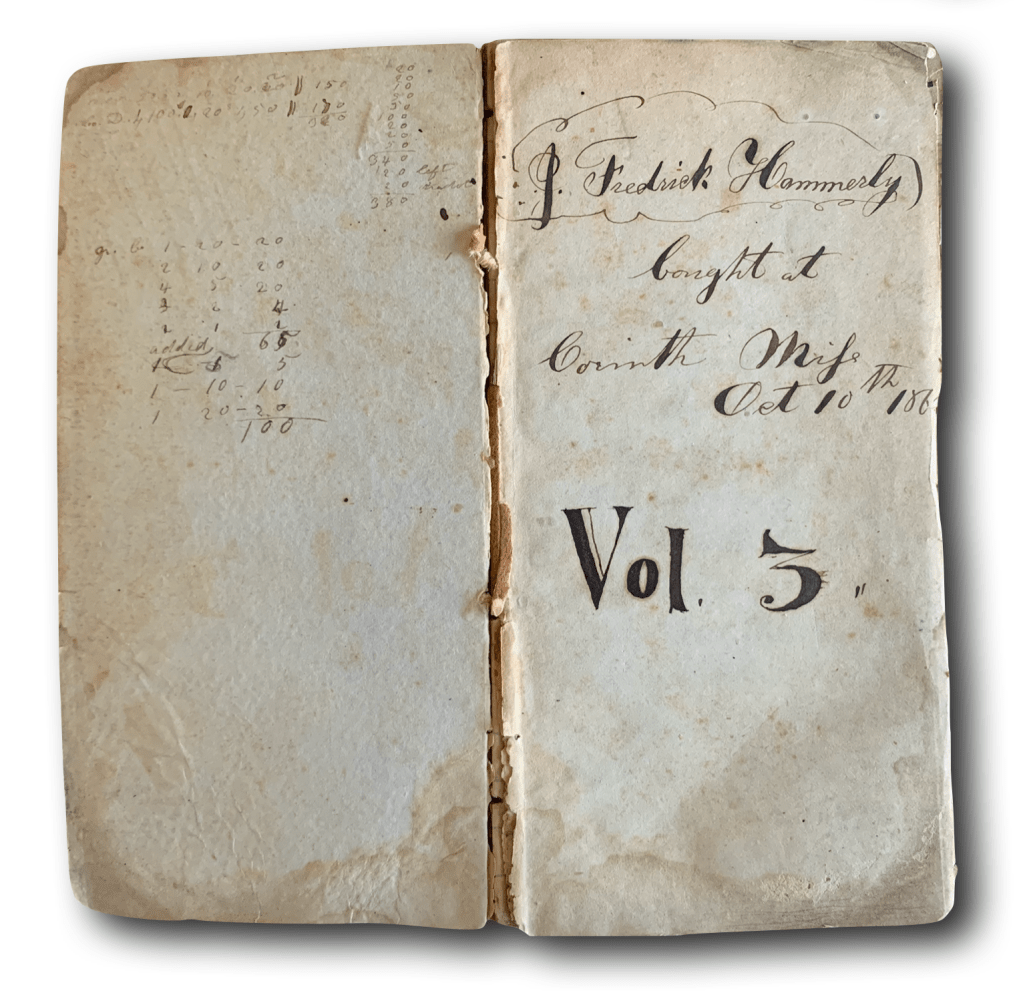
[Insert bio (yet to be written)] of J. Frederick Hammerly, born 1834 in Koenigreich, Wirtemberg, Germany. Came to America on 3 October 1852.
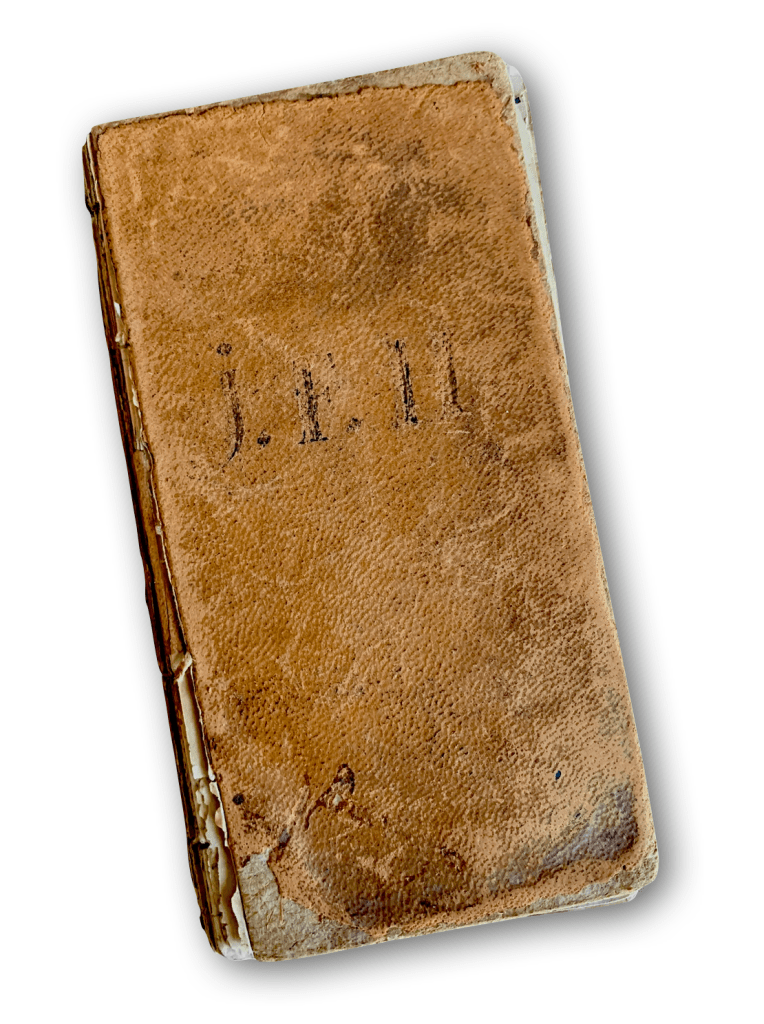
This is the second diary of J. F. H. I have transcribed. It is identified as “Vol. 3” but Vol. 2 is missing. The first diary may be found here:
Frederick’s brother, Jacob Hammerly, enlisted on 25 August 1861 in Co. B, 12th Illinois Infantry. Drowned 15 September 1861 Residence place give: Amboy, Illinois.
Transcription
J. Frederick Hammerly. Bought at Corinth, Mississippi, October 10th 1862
October 1862
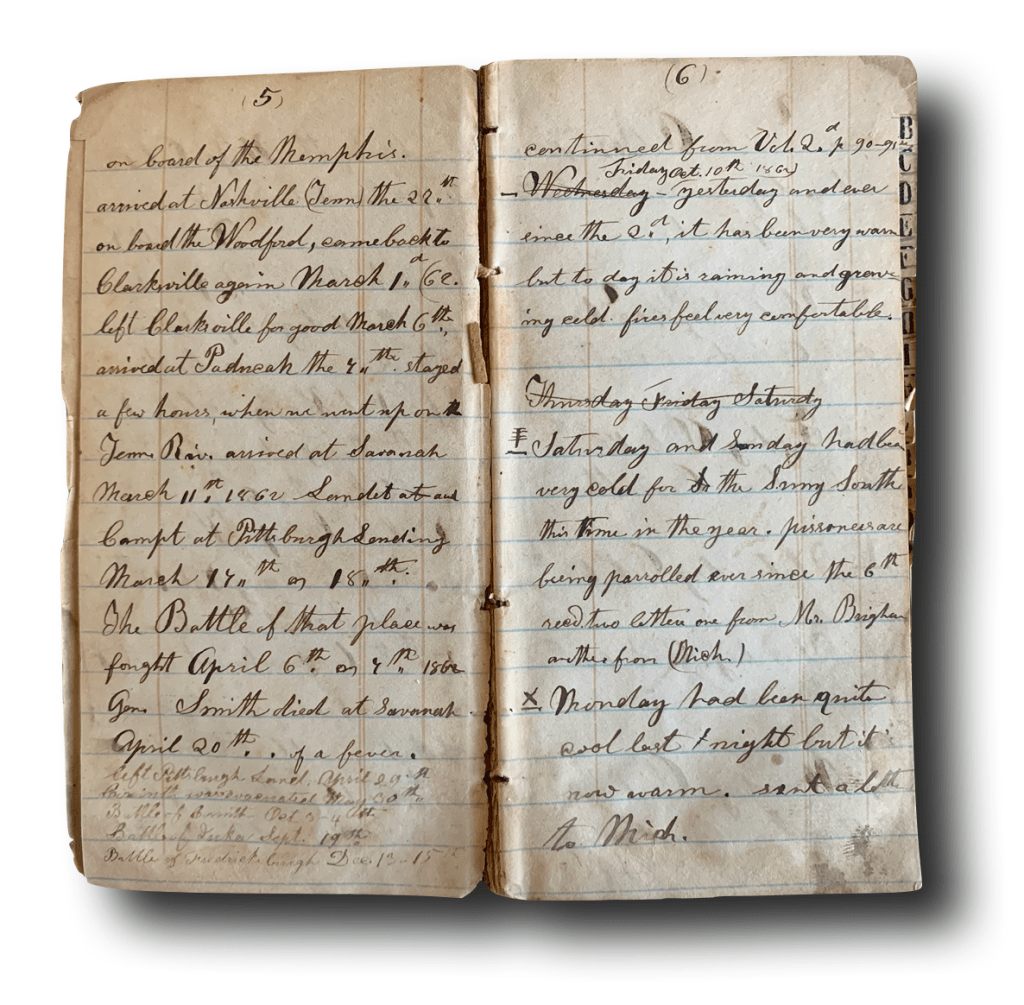
October 10, 1862. Friday. Yesterday and ever since the 2nd, it has been very warm but today it is raining and growing cold. Fires feeling very comfortable. October 11 & 12. Saturday & Sunday had been very cold for the Sunny South this time in the year. Prisoners are being paroled ever since the 6th. Received two letters—one from Mr. Brigham, another from (Mich). October 13 Monday had been quite cool last night but it’s now warm. Sent a letter to Michigan October 14. Tuesday. Weather fair. We are on duty every other day since the [2nd] Battle of Corinth doing Provost or Picket Duty. October 15 & 16. Wednesday & Thursday. Nights are cold. Guards are surrounding the fires. Received a letter from New York. October 17 Friday. Moved our camp northeast of Corinth. I am on Camp Guard. October 18 Saturday. Weather fair. Received a letter from M. B. October 19. Sunday. Cold nights and warm days. Guarded prisoners. Sent a letter to Rushville. October 20. Monday. I came off from guard this morning. The guards we relieved let a prisoner run away, consequently the orders were strict. Had a frost this morning. October 21. Tuesday. Has been quite windy today. Sent a letter to George. Saw Charlie Dykeman in the 21st Missouri. They are talking of going home. October 22. Wednesday. I am on camp guard. It is very warm. The 21st Missouri left Corinth for home before daylight. Co. K of our regiment have orders to take charge of artillery. Sent a letter to Helena, Arkansas. Received a letter from George. October 23. Thursday. Weather warm. Our stove feels comfortable this evening. October 24. Friday. Moved our camp a few rods in order to let them build a fort. Commenced clouding up before sundown. Had a very cold night. Co. K is going to stay. October 25. Saturday. It is a very cold day—cold enough to snow. 4 o’clock it snows like blazes. Cold enough to freeze. Am on Provost Guard. October 26. Sunday. Very cold this morning. The ground is covered with snow and frozen hard. Come off from guard this morning at 10 o’clock. Sent a letter to brother. October 27. Monday. Had a very heavy frost this morning. Suffered much from cold last night. The troops are breaking down houses like everything. The breastworks are growing fast in front of us. I went on Camp Guard this morning. Received a letter from Mother. October 28. Tuesday. Weather warmer. Came off from guard at 9 o’clock this morning. Heard from [brother] Martin through Glick. Sent a letter to Conrad mother, to sister Katie, a third to M. Page. October 29. Wednesday. Weather growing warmer. Am on guard. October 30. Tuesday. Had a frost last night but is warm today. October 31, 1862. Corinth, Mississippi. Am on guard. It is warm. Had muster for inspection in general. Received a letter from George.
A sample of Frederick’s handwriting
November 1862
November 1, 1862. Saturday. It is quite warm today. Had a letter from Ch. Alf[red]. November 2. Sunday. It had been cloudy last night. This morning it is quite foggy. Troops are on a move ever since 2 o’clock this morning. Their destination is reported to be Bolivar. 11 o’clock a. m. It is now real warm. Have been on guard camp. November 3. Monday. Had been warm today. Sent a letter to George and one to New York enclosed. November 4, 1862. Tuesday a.m. on Provost Guard. It is real warm today noon. Sent a letter to Ch. Alf. November 5. Wednesday. It is getting cold. This evening the wind is blowing big guns. Many have to hold their tents down. The dust blowing through our tent. The night it commenced raining. It did no rain much. Received a letter from M. Northway. November 6. Thursday. Had been very cold this morning. A fresh breeze blowing all day. Was on ordinary fatigue. November 7, 1862. Friday. The wind is again blowing heavy guns. Received a letter from Lew Roff. November 8, 1862. Saturday. Am on Provost Guard. More hopes of leaving here. Drawed a pair of socks and one overshirt. Sent a letter to Benton Barracks to Martin. November 9, 1862. Sunday. Corinth, Tishomingo Co., Mississippi. It has been warmer today than its been for weeks back although last night was a severe one. The ground was white in the morning with frost. Went as an escort to help bring Trover of Co. C. November 10, 1862. Monday. Has been quite pleasant today. Went on the sick report. Had several chills last night. November 11, 1862. Tuesday. Windy towards evening. November 12. Wednesday. Rained nearly all last night and part of today. Cloudy this evening. Took medicine three times today. November 13. Thursday. Was cloudy and frost this morning but now it is clear and warm. Received a slip from Martin. November 14, 1862. Friday. Weather fair and pleasant. Sent a letter to Cousin Fred. November 15. Saturday. Weather fair. Sent a line to Martin. After sundown, received a letter from him and another from R. M. Brigham. November 16. Sunday. Went on Camp Guard this morning. Has been real warm last night. Looks like rain. November 17. Monday. It is sprinkling at intervals, warm and calm. November 18. Tuesday. It’s cloudy all day. Commenced raining several times. went after rails about 3 miles out. November 19. Wednesday. Rained this morning. I was on Provost Guard. Cloudy nearly all day. November 20. Thursday. Has been cold and windy last night. The majority of Companies C & B went off guarding a train of wagons to some place. Has been clear and cloudy today. The artillery had a shooting match today. Some thought it an attack. November 21. Friday. Clear, cloudy, cold and windy. November 22. Weather clear and warm. Was on Water Fatigue. November 23, 1862. Sunday. Weather fair. Helped get some wood. Sent a letter to Brother John and Martin. November 24, 1862. Monday. Weather fair. Had review yesterday. Received a letter from sister Maria. Another from C. Alf. Hammerly told me of the unexpected death of cousin William. Sent a letter to M. North [?] November 25, 1862. Tuesday. Clear and cloudy alternately but cold all day. Received intelligence of a forage train being captured. Also of our correspondence between here and Columbus being cut off. No train came in the night. Am on Camp Guard. Received a letter from Rushville, Pennsylvania. November 26, 1862. Wednesday. Weather clear and cold. Rumors afloat of the rebels again advancing on here with the intention to siege it. The road is fight again and a train left here for Columbus this afternoon. November 27, 1862. Thursday. Had been very cold last night bu it is warm today. Had Battalion drill. November 28, 1862. Friday. Weather cold, clear, and cloudy. Sent a letter to Ch. Alfred. Another to Rushville. November 29, 1862. Saturday. Weather fair. Received two Watchman’s. Sent a letter to No. 2. N. Y. had a regimental drill. November 30, 1862. Sunday. Weather warm and cloudy. Looks like rain. Noon, sprinkling now. I am on patrol. Sent a letter to Mr. Brigham.
December 1862
Capt. Henry Willard Allen of Co. G, 7th Illinois Infantry was shot by Sergt. John Myers on 3 December 1862. According to Hammerly’s diary, the captain died three days later, 6 December 1862.
December 1, 1862. Monday. Weather wintery. December 2, 1862. Tuesday. Had a cold rain last night. Today it is quite cold. Rains and snows at intervals. December 3, 1862. Wednesday. Weather fair. Am on camp guard. One of the 7th Illinois shot a captain while discussing politics. December 4, 1862. Thursday. Commenced clouding up early this morning. Part of three companies—B included—went to guard a train of wagons to LaGrange. Had several small rains through the day. December 5, 1862. Friday. Had a considerable rain last night and snowed nearly all the forenoon. 4 o’clock p.m., seems to be clearing off. One of the 7th Illinois shot a Captain [Henry W. Allen of Co. G, 7th Illinois]. December 6, 1862. Saturday. Had a very cold night. Froze hard. I am on provost patrol today. I am guarding the Sergeant [John Myers] of the 7th Illinois who shot a Captain [Henry W. Allen of Co. G] in a quarrel. The Captain died this morning. [Sgt. John Myers was hung for his crime on 28 April 1864. December 7, 1862. Sunday. Weather clear but cold. Had a very cold night. Had general review. December 8, 1862. Monday. Weather fair. Sent a letter to No. 1 N. Y. The detailed guards came back tonight from LaGrange. One of Co. I was shot through both legs by an accidental discharge of a musket on the cars. Drawed a pair of boots. December 9, 1862. Tuesday. Weather warm. Have been out 10 to 12 miles foraging. December 10, 1862. Wednesday. Corinth, Mississippi. Another warm and comfortable day. Had Battalion Drill. Sent a letter to Mo. December 11, 1862. Thursday. Had been very warm today. Helped get some fire wood. December 12, 1862. Friday. Weather warm, cloudy and sprinkling at intervals. Went down to Glendale with a telegrapher on a handcar. Received a letter from Martin. Another from Charles Dykeman (Mo.), a third from N. Y. No. 2. Co. I man who had been shot through the legs had them both amputated (is alive). December 13, 1862. Saturday. Had been very warm and comfortable but windy. This evening looks like rain. wind increasing. Several detachments left here for Iuka. December 14, 1862. Sunday. Corinth, Mississippi. Another warm and fair day. Had some rain and considerable wind last night. Wrote a letter to Mich. and received a letter from Bithe and a paper from W. Bingham. December 15, 1862. Monday. Had several rain storms today mixed with heavy winds. Is quite warmer. More rain towards night. Is growing cold. Am on guard. December 16, 1862. Tuesday. Weather clear and cold. Received a letter from Cousin Fred. An attack on Jackson, Tennessee is talked of tonight. December 17, 1862. Wednesday. Had been real cold last night and is clear but cold today. Co. I man who was shot through both legs and amputated coming back on the cars from LaGrange was buried today. His sister, the Captain’s wife of the company, had been here to attend to him.1
1 The soldier who had both legs shot accidentally while returning to Corinth from LaGrange was wagoner Jacob W. Butt (1842-1862) of Princeton, Illinois. His sister was Alice Butt, was married to William D. Mills (1838-1906), Captain of Co. I, 12th Illinois Infantry.
December 18, 1862. Thursday. Corinth, Mississippi. Weather clear but fresh. I am on patrol. Sent a letter to Mo. December 19, 1862. Friday. Weather fair and nice today. Three companies of our regiment with the 90th Illinois and others—also some artillery—left last night for somewhere, supposed to harass the Rebels marching on Jackson, Tennessee. They say they are fighting there. The 9th Illinois and 31st Ohio came back with a lot of prisoners from Alabama. No train, no news tonight. December 20, 1862. Saturday. Weather fair, nice and warm. Am on Provost Guard. Considerable excitement here on account of Jackson being taken by the Rebels. Had strict orders in regard to the last group of prisoners. A mounted infantry company was organized. December 21, 1862. Sunday. Corinth, Mississippi. Weather fair. Received about one hour in the guard house of Corinth for the complaint of letting a prisoner off. This evening they are moving all Commissary and Quartermaster goods to the main fort. The question–What’s Up? No news tonight. December 22, 1862. Monday. Had been real warm today. No attack has been made on this place yet. Our forces whipped the Rebels at Jackson the day before yesterday. No reliable news from there has as yet been received although tis only 50 miles from here. A train left for the North but not come back. Today we were put on half rations. December 23, 1862. Tuesday. Another [day] like summer. Two trains came in with two days mail and some papers. Also the most of the troops that had left this place a few days previous. I am on Provost Guard. December 24, 1862. Wednesday. Had some rain early this morning but cleared off towards non. Another train came in tonight but only from Jackson. No news and no mail. We have splendid weather. Sent a letter to Peters. December 25, 1862. Christmas. Weather like summer. Our half rations are felt. Those who have money can have whole. The same are buying their whiskey. Many are having their drinking sprees. This has been a hungry Christmas. A train from Jackson again but no news. December 26, 1862. Friday. It commenced raining this morning about 9 o’clock and rained most all day and all night. Capt. Sharp—a secesh—got away last night. December 27, 1862. Saturday. Had considerable rain again today. This evening it cleared off and clouded up alternatively. No news at all. Am on Provost Guard. Drawed a pair of pants. December 28, 1862. Sunday. Had a real pleasant day today. Had company inspection. A train from Jackson arrived but no news. December 29, 1862. Monday. Another warm and nice day. No news yet (cut off yet). Am on patrol. December 30, 1862. Tuesday. Rain almost all day and the biggest part of the night. December 31, 1862. Wednesday. Clear and cold. Two trains arrived from Jackson.
January 1863
January 1, 1863. New Year’s Day. Corinth, Mississippi. Weather has been very warm and agreeable all day. Cut off yet, consequently no news. Living on half rations ever since the 19th. Such a Christmas & New Year’s I never saw! January 2, 1863. Friday. Had been very windy and clouding up alternatively and [rained] hard all last night. Several regiments left for places unknown—some say to Pittsburg Landing. Co. G went on picket and on Camp Guard. January 3, 1863. Saturday. Rained much all night and considerable today. The Tennessee River must soon be rising. It is pouring down in torrents this evening. January 4, 1863. Sunday. Cleared off this morning and proved to be very fine day. Had company inspection this morn. Received a big mail tonight over which was great rejoicing. The mail was carried over the burned and destroyed bridges. Vicksburg is said to be ours sure. Received a letter from Rushville. Another from John Amboy. Third and fourth from camp near Fredericksburg. What a splendid moonlight night! January 5, 1863. Monday. It is cloudy and windy today. The few papers came in last night was sold for one dollar apiece. According to papers, Burnside is whipped. January 6, 1863. [No entry] January 7, 1863. Wednesday. Air cold but clear and sunshine. a large train of provisions arrived here last night. Sent a letter to Alford. January 8, 1863. Thursday. Weather fair but chilly. Martin arrived tonight. Am on patrol. January 9, 1863. Friday. Weather fair but is clouding up this eve. The long roll beat today. After we had fallen in, we were dismissed. Sent a letter to Benton Barracks with $1. January 10, 1863. Saturday. Had some rain last night. Had been very comfortable all day. Some cloudy. Heard heavy thunder all night. Sent a letter to Rushville. January 11, 1863. Sunday. Looks like spring. Am on Headquarters Guard. A small mail arrived here. Drawed a dress coat, a pair of pants for [John] Griffin, [coat] $6.70; [pants] $3.05. January 12, 1863. Monday. Weather fair like spring. A train with provisions from Pittsburg Landing arrived here. Had Battalion drill. A letter from Conrad. January 13, 1863. Tuesday. Warm but windy. Some cloudy. Draw whole rations again. January 14, 1863. Wednesday. Commenced raining early this morning and it rained hard all day and all night too. January 15, 1863. Thursday. The rain turned into snow this morning. Snowed most all day but partly melted. am on Provost Guard. Guarded the sharpshooters hospital. Sent a letter to John Church and brother George. January 16, 1863. Friday. Snowed and blowed the bigger part of today. Found George. Camp of the 72nd Ohio. January 17, 1863. Saturday. Cleared off last night. The sun shines nice this morning. January 18, 1863. Sunday. It is clouding up again. the mail consisting of 4 letters came to the regiment, very unfrequent and small. Am on Provost Guard. The snow is melting. January 19, 1863. Monday. Commenced raining early this morning. Rained all day and part of the night. The snow is gone. January 20, 1863. Tuesday. It is cloudy, chilly and damp. Rains at intervals. Was detailed for Train Guard. Was dismissed. January 21, 1863. Wednesday. Is cloudy, damp and the streets are very muddy. Went on Headquarters (Paymaster) Guard, Our paymaster came in this evening. January 22, 1863. Thursday. Has cleared off this morning and it looks again like spring. This evening at 5 o’clock an expedition left here for Pittsburg Landing or Hamburg Landing. January 23, 1863. Friday. Cloudy today but warm. went on picket [but] a few hours after were relieved. Got marching orders with three days rations in our haversacks. Ready to start early in the morning. January 24, 1863. Get our breakfast by candlelight and ready to start. Marched down i town, stacked arms in front of the Corinth Music Hall. About 9 o’clock we left town as a rear guard of a forage train to Hamburg. About noon it commenced raining and rained till after midnight. Arrived at Hamburg about sundown. The train was loaded through the night. January 25, 1863. Sunday. Left Hamburg about 8 o’clock. Halted about an hour on the hill back of Hamburg, took a different road, arrived at Corinth two hours after dark. Was cloudy and windy but did not rain. We had plenty of mud to tramp through. January 26, 1863. Monday. Early this morning the 7th Illinois and 81st Ohio were loaded on the train to Hamburg. Had some rain and much wind this afternoon. The paymaster paying the 90th Illinois. January 27, 1863. Tuesday. Rained much last night. Today is cloudy, damp and chilly. January 28, 1863. Wednesday. It is cold and cloudy. Was on Fatigue [Duty] last night until 11 o’clock to help unload a train from Hamburg Landing. Snowed some last night. Sent a letter to Cincinnati, Ohio, with $1 D. C. January 29, 1863. Thursday. Whether fair. Rather windy. Am on Provost Guard. Cut off again below here and Jackson. A train only stove up! January 30, 1863. Friday. Corinth, Mississippi. Weather fair. were paid for two months. Received a letter from Michigan. January 31, 1863. Saturday. Weather nice and fair. Had monthly inspection. It sprinkled some on Dress Parade. Voted for to stand by the government. Martin received a letter from Ch. Church.
February 1863
February 1, 1863. Sunday. Drawed blouse and forage cap. Rained last night and part of the day today. It’s warm. Sent $50 to Mr. Bingham by Lieut. Cook and $5 to Martin. February 2, 1863. Monday. weather clear and comfortable. Turned cold and cloudy towards night. Am on Patrol. February 3, 1863. Tuesday. Had been very cold last night but cleared. First US Infantry leaves this morning for Vicksburg. Co. G takes their places at Fort [Battery] Williams.
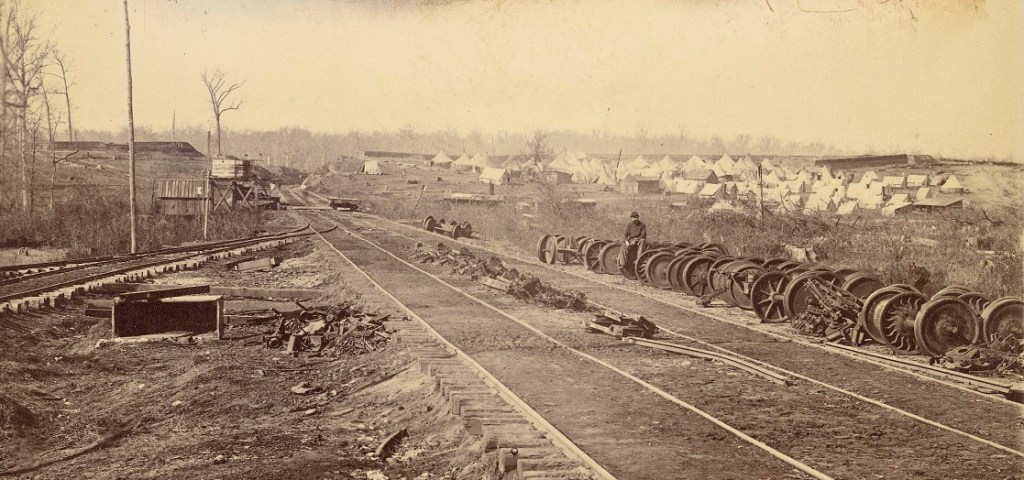
The Memphis & Charleston Railroad facing west with Battery Williams on the left and Battery Robinett on the right.
February 4, 1863. Wednesday. Corinth, Mississippi. Had been cold last night. Came off from Patrol. Is growing colder this morning. Five o’clock p.m., the ground is covered with snow and it snows like everything. went after nails to fix our tent. February 5, 1863. Thursday. Considerable snow fell last night. Is very cold this morning. Moved our bunks and altered the looks of our tent. Received a letter from Ch. Alf. February 6, 1863. Friday. Was detailed for taking off condemned horses and mules to Henderson. Went 15 miles and stayed over at a plantation. Quite a number of mules gave out. Had a hard time of it. Was freezing cold. February 7, 1863. Saturday. Corinth, Mississippi. The snow is melting fast. Went through Purdy. Is a very fine town. Arrived at Henderson after sundown. Got left behind with three more. Stayed over at the telegraph office. February 8, 1863. Sunday. Slept pretty cold last night. Now waiting for the train from Jackson. Had breakfast with some teamsters. 4 o’clock the train has come and is going. Arrived at Corinth after dark. Up in camp I am. Heard of another fight at Fort Donelson. The rebels whipped. The snow seems to have disappeared from all places but Oh! so windy February 9, 1863. Monday. Weather moderate. Looking again like rain this evening. Considerable trading done in town. The Adams express is open again. A lot of Christmas boxes received here but everything is spoiled in them. February 10, 1863. Tuesday. It is very muddy today and is raining at intervals. Two trains arrived from Jackson, Tennessee. Got a check from our money sent by Lieut. Cook. February 11, 1863. Wednesday. It is very warm today but muddy yet. Am on Camp Fatigue. went after rails for the regimental bakery. Got stuck several time [in mud]. February 12, 1863. Thursday. Rained last night and had two or three showers today. Thundered hard. It is growing cold this evening. February 13, 1863. Friday. Cleared off last night. Is growing warm. Was detailed to guard a train. Went after wood beyond Chewalla, 11 miles from Corinth on the Memphis & Charleston Railroad.Had been very warm. Sent a Valentine. February 14, 1863. Saturday. Corinth, Mississippi. Thundered and commenced raining early this morning. Was a rainy day. This eve it thundered hard and heavy dark clouds approaching. February 15, 1863. Sunday. Weather damp and cloudy. Am on patrol. Rained and thundered hard tonight. Only one letter for the [entire] regiment. February 16, 1863. Monday. Weather damp and cloudy. Commenced raining on Dress Parade. Our Colonel was going to have us meet at Headquarters in regard of their being the anniversary of the surrender of Fort Donelson [but] on account of the weather it was postponed. Received a letter from Cincinnati. February 17, 1863. Tuesday. Weather damp and cloudy. Rained last night and this evening it is again raining. Sent $5 to O. A letter to 21st Mo. February 18, 1863. Wednesday. Corinth, Mississippi. Rained much last night. Today it is damp and cloudy. Went after wood beyond Burnsville. February 19, 1863. Thursday. Weather damp, windy and cloudy. February 20, 1863. Friday. Clear but awful windy. Growing warm and nice. The roads are getting dry. A nice moonlit night. February 21, 1863. Saturday. It commenced to raining this morning early. It’s been raining all day. Am on patrol. A detail left horseback for the Shiloh. February 22, 1863. Sunday. It is very cold today. The wind is rising. Very dark this evening. Big guns were fired today in honor of Washington’s Birthday. Sent a letter to Chicago with $30. February 23, 1863. Monday. Corinth, Mississippi. It is rather cold this morning but looks like clearing off. In p.m., the sun shines and the sky is clear again. Sent off a letter to Mich. and to Church and George. A third to Ohio with $2. February 24, 1863. Tuesday. Weather fair. P. M. is warm and nice. Evening clear and moonshine. Am on camp guard. Received a letter from George and another from N. Y. February 25, 1863. Wednesday. Commenced raining early this morning. Thundered hard. Considerable rain fell. February 26, 1863. Thursday. An immense sight of rain fell last night and today it is raining continually. 5 p.m. it looks like clearing off. Am on Provost Guard. Signed the payrolls for two months pay. February 27, 1863. Friday. Corinth, Mississippi.Today it has been warm and nice. Sent a letter to Ch. Alf. February 28, 1863. Saturday. Weather fair. Some cloudy in a.m. Considerable wind. Had general muster. Am on camp guard.
March 1863
March 1, 1863. Sunday. Weather had been fair and warm today. March 2, 1863. Monday. Weather warm and clear and cloudy and windy part of this afternoon. Sent a locket to Katie Henrick. March 3, 1863. Tuesday. Corinth, Mississippi. Weather fair. Some windy. What a splendid moonlight night. Send a letter to Jim Dy. Amboy Martin to his. 200 Rebels were brought in. Am on camp guard. March 4, 1863. Wednesday. Weather fair. Nice moonshine. The capture of the Indianola and the Queen of the West is talked of and believed here. Received $4 of the $5…[See The Indianola Affair] March 5, 1863. Thursday. Weather is cold and cloudy. Snows lightly. Got two months pay. March 6, 1863. Friday. Weather changeable warm, cold, sunshine and rain. Am on Provost Guard. March 7, 1863. Saturday. Corinth, Mississippi. Weather the same as yesterday, Considerable rain fell last night. Thundered hard. Sent a letter to Rushville and to Cincinnati, Ohio. March 8, 1863. Sunday. Weather cloudy but warm; sunshine at intervals. Had an awful hailstorm this evening. Received a letter with negative note paper. Sent off a letter to Brigham. March 9, 1863. Monday. Cleared off last night. was quite fresh this morning. Went to Chewalla after wood. One car ran off the track. March 10, 1863. Tuesday. Weather cloudy and considerable rain. Rained much last night. Sent a letter to Chicago. March 11, 1863. Wednesday. Corinth, Mississippi. Weather clear but is rather fresh and windy. March 12, 1863. Thursday. Weather about the same as yesterday. Am on Camp Fatigue. Sent a letter to Cincinnati. March 13, 1863. Friday. Weather fair and very nice. Received a letter from Cincinnati. March 14, 1863. Saturday. Weather warm and nice. Went on extra patrol this afternoon. Received a letter from George’s wife. March 15, 1863. Sunday. Commenced clouding up early this morning. Looks like rain. Went on weekly inspection. March 16, 1863. Monday. Corinth, Mississippi. Weather like spring. It cleared off this morning. Sent a letter to George. Another to Cincinnati… March 17, 1863. Tuesday. Weather fair. very warm all day. Am on patrol. Had two shows and two balls in town. March 18, 1863. Wednesday. It’s very warm today. March 19, 1863. Thursday. Very warm—yes, hot. was beyond Glendale as guard to a wood train. Received a letter with S. C. from Cincinnati, Ohio. March 20, 1863. Friday. Weather fair. Sent to Chicago to Hilton for books to Philadelphia. March 21, 1863. Saturday. Corinth, Mississippi. Weather warm. Like summer. Am on Paymaster Guard to Chandler. March 22, 1863. Sunday. Weather foggy, windy and damp. Received a gold pen from Chicago. March 23, 1863. Monday. Is raining mostly all day, Went after some medicine. Sent to Philadelphia $1. S. C. March 24, 1863. Tuesday. Weather foggy, damp, and rained at intervals. Received a letter from Michigan. Am on forage guard. March 25, 1863. Wednesday. Has cleared off but is pretty chilly all day. I received news of being detailed to escort prisoners to Alton, Illinois. Much pleased. A fair show for a short furlough. March 26, 1863. Thursday. Memphis, Tennessee. Left Corinth at 8 o’clock this morning on board the cars for Memphis. Arrived at 8 in the evening. Have 21 Union prisoners to guard. marched them through the streets up to the Memphis Prison. Took our quarters n the same building. It is growing cold and a change of weather is eminent. Hear of Rosecrans fighting. Are anxious of further news. March 27, 1863. Friday. Commenced raining this morning and had several thunder showers through today. Not much news from Rosecrans nor from below here. The 190th & 130th left this eve. for Vicksburg. Slept cold last night. March 28, 1863. Saturday. Memphis, Tennessee. Had a heavy rain storm last night. Is cloudy and damp but warm. Slept comfortable last night. About sundown we marched our prisoners to the landing but as the boat could not leave before Sunday morning, we had to counter march them back to the same place.Two of them threw their shackles off, consequently they were put in the cell. One of them escaped but the secret police brought him in after two hours. Hear of the morning train being cut off by a rebel raid near Moscow. March 29, 1863. Sunday. The wind blew big guns last night. Is growing very cold. This morning it looks cloudy and may snow. Later, it is snowing and raining. 8 o’clock a.m., our prisoners are safe on board the boat, Mary Forsyth. 11 o’clock, she is pushing out. Later, are going a pretty good speed. March 30, 1863. Monday. On board the steamer Forsyth. Slept about two hours upon two barrels. Had the colic all day ad last night. Tuesday arrived at Cairo about 3 o’clock a.m. Left at 8 a.m. Stopped at Cape Girardeau at 4:30 p.m. and met an old acquaintance. March 31, 1863. Tuesday. Slept sound and comfortable on some bags of wheat.
April 1863
April 1, 1863. Wednesday. Is nice and clear today. arrived at St. Louis at 3:30 o’clock p.m. [Robert] Donnelly and myself arrested three persons (passengers of the Mary Forsyth) who were suspected of having stolen money on their persons. Stayed over night at [ ]field’s Barracks. Pretty hard place.