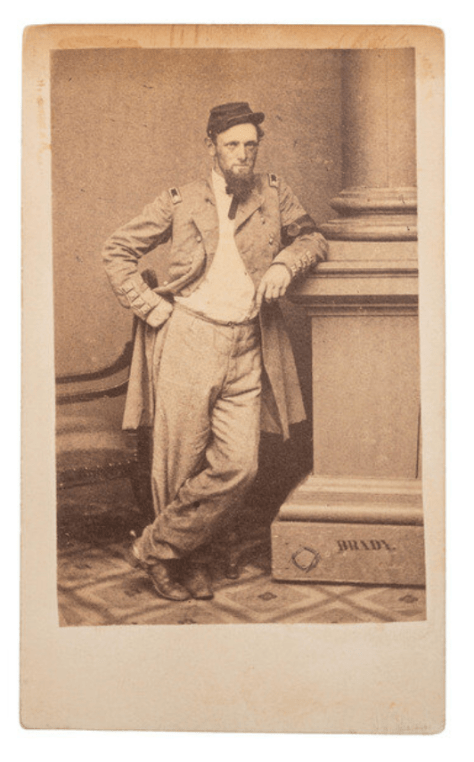
This letter was written by Capt. Edward Payson Bates (1838-1916) of Co. C, 125th Ohio Volunteer Infantry (OVI). Earlier in the war he had served in Co. D, 19th OVI. The 125th OVI was stationed around Murfreesboro and Hillsboro throughout the summer of 1863 before starting the march for Chattanooga in August. They arrived there by September and saw their first major battle at Chickamauga, as part of the 3rd Brigade (Harker’s), First Division, XXI Corps, Army of the Cumberland. The regiment was engaged on both days of the battle, literally earning a good name for themselves.
A little over a year later they also distinguished themselves in the Battle of Franklin. Infuriated by the sight of the Federal troops flying to the rear, Capt. Edward P. Bates reportedly shouted, “Come on boys, we have always whipped them and always will.” The 125th was to the west of the pike and met head-on with the advancing Confederates at the Carter House. After a quick but vicious melee, the Rebs fell back to the ditch outside the main line of works. The 125th took position around the Carter buildings, both sides just yards apart and keeping up the fire until after dark, neither able to advance across the Carter garden that lay between. Despite being in the thick of the action, acting commander Capt. Bates listed the losses as 2 killed, 21 wounded, and 8 missing. He reported that the regiment saved two artillery pieces and captured two flags and 85 prisoners.
Bates was the son of Daniel Bates and Harriet Newell Hungerford (1805-1875) of Trumbull county, Ohio. He was a graduate of Hillsdale College (Michigan).
The letter was addressed to Harriet M. (Downing) Tylee, the wife of Festus G. Tylee who enlisted in Co. C, 125th OVI on 23 October 1862. Festus did not survive the war. He died of disease on 25 August 1864.
T R A N S C R I P T I O N
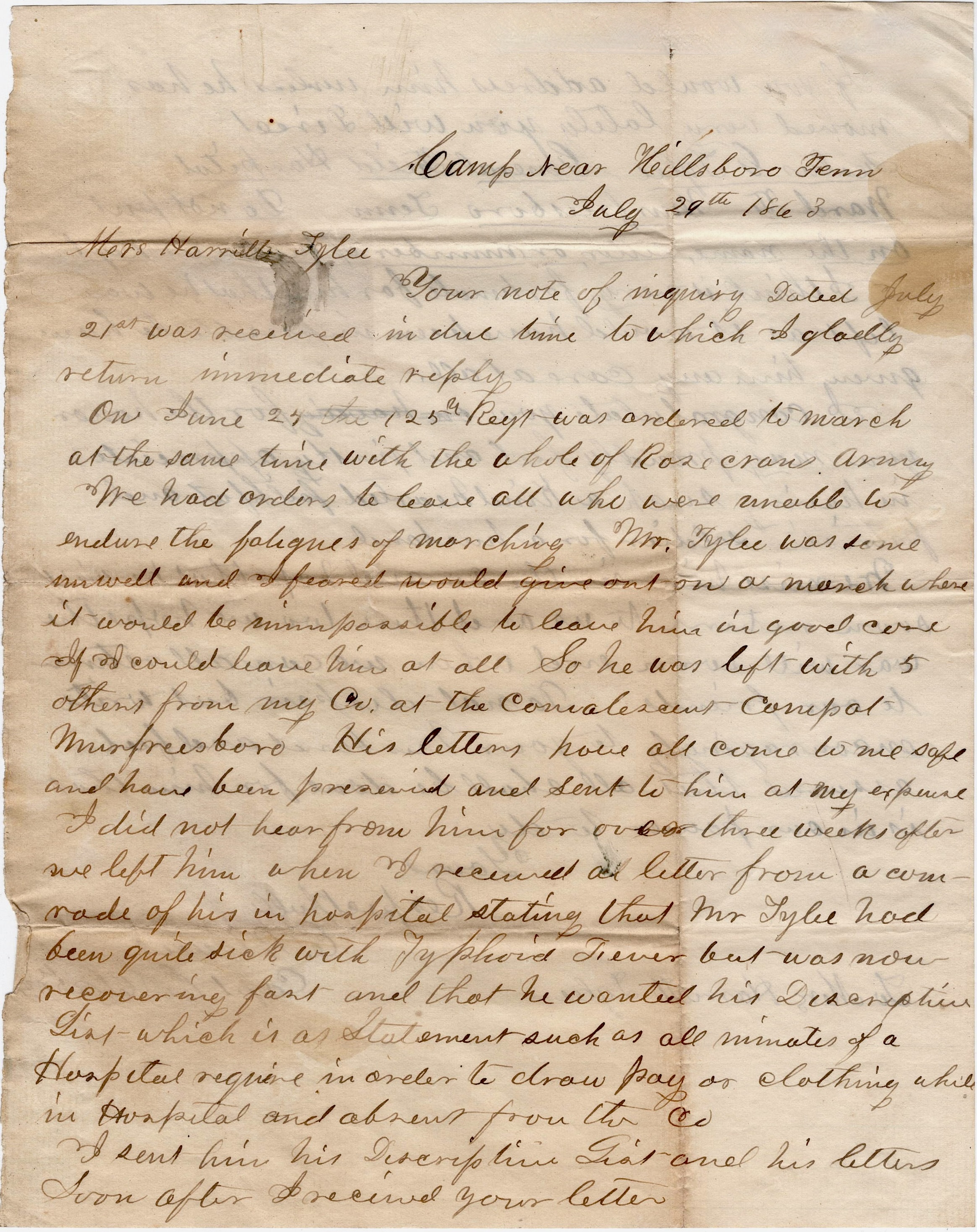
Camp near Hillsboro, Tennessee July 29th 1863
Mrs. Harriett Tylee
Your note of inquiry dates July 21st was received in due time to which I gladly return immediate reply.
On June 24, the 125th Regiment was ordered to march at the same time with the whole of Rosecrans Army. We had orders to leave all who were unable to endure the fatigues of marching. Mr. Tylee was some unwell and I feared would give out on a march where it would be impossible to leave him in good care if I could leave him at all so he was left with 5 others from my company at the Convalescent Camp, Murfreesboro. His letter have all come to me safe and have been preserved and sent to him at my expense. I did not hear from him for over three weeks after we left him when I received a letter from a comrade of his in hospital stating that Mr. Tylee had been quite sick with typhoid fever but was now recovering fast and that he wanted his Descriptive List, which is a statement such as all inmates of a hospital require in order to raw pay or clothing while in hospital and absent from the company.
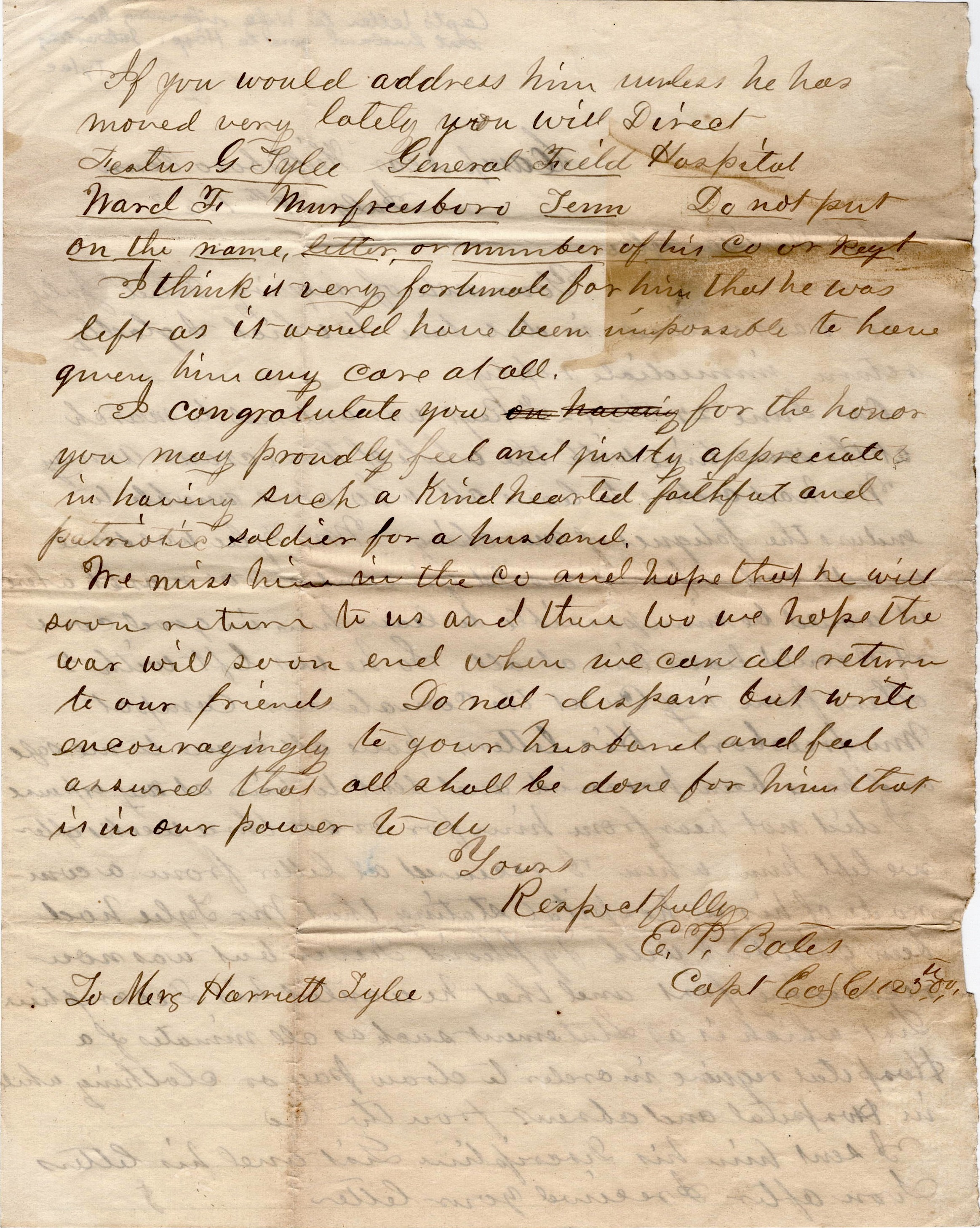
I sent him his Descriptive List and his letters soon after I received your letter. If you would address him unless he has moved very lately, you will direct Festus G. Tylee, General Field Hospital, Ward F, Murfreesboro, Tenn. Do not put on the name, letter or number of his company or regiment. I think it very fortunate for him that he was left as it would have been impossible to have given him any care at all.
I congratulate you for the honor you may proudly feel and justly appreciate in having in having such a kind-hearted, faithful and patriotic soldier for a husband. We miss him in the company and hope that he will soon return to us and then too we hope the war will soon end when we can all return to our friends. Do not despair but write encouragingly to your husband and feel assured that all shall be done for him that is in our power to do. Yours respectfully, — E. P. Bales, Capt., Co. C, 125th OVI
These letters were written by Lyman Tylee (1838-1863) who enlisted at age 23 as a private in Co. B, 19th Ohio Volunteer Infantry (OVI) on 13 September 1861 and rose in rank to Sergeant Major and transferred to Field & Staff on 1 July 1862. He was killed in action at Stones River, Tennessee, with other brave officers and men on 2 January 1863, “while gallantly performing their duties.” He was erroneously carried on the roster under the name Lyman Tyler at times.
Lyman was the son of Samuel Tylee (1798-1875) and Harriet Giddings (1805-1860) of Hubbard, Trumbull county, Ohio. He wrote these letters to his brother, Festus Giddings Tylee (1834-1864), who married Harriett Muriel Downing (1835-1921) in 1858 and was farming in Medina county, Ohio, at the time these letters were written in 1862.
Letter 1
Near Corinth, Mississippi May 27, 1862
Dear Brother,
Though I have written you twice since I received any news from you, I will today drop you a few lines. We are now much closer to the enemy’s lines than when I last wrote. Are daily skirmishing a little. We (the 19th) go on picket every four days. Came in this morning from picket. Last Thursday we were on the outposts and the Rebels shelled us wounding five men seriously. Yesterday all passed off quietly. Our pickets and theirs talked together some and there was but little firing done.
A few days since I received a letter from Amelia Tylee stating that Augustus (who was wounded at the Battle of Shiloh) was improving slowly. He was of Co. H, 45th Illinois Colunteers. Was wounded in the knee about 4 p.m. Sunday (6th) and was sent home in about a week after the battle. 1
Gus is not very well but is improving and the rest of the boys are well except Cal[vin] Clingan who has been sick for several months most of the time and was discharged and started on his way home on Sunday. Charles Hume was detached from our company and was Clerk for Gen. Boyle. His health was quite poor and he disappeared a week after the battle and since then we have not heard from him. He called to see us in the morning and left us saying he would go back to Boyle’s Headquarters (where he stayed) and would call again in the evening. He did not go back to the General’s quarters and all efforts to find him have been without success.
I saw Lt. P. W. Chase of Medina. He was taking care of Dr. Spillman who was very sick. I called again to see them and was told Chase had gone to Cincinnati, Ohio, with Dr. Spillman. Have they got to Medina?
If you see Chase, tell him I am well and would like to hear from him. Write soon. Write long and oblige your brother, — Lyme
1 Augustus Adams Tylee (1837-1909) was the son of William Tylee (1807-1884) and Juliet Hulbert (b. 1807) of Trumbull county, Ohio. Gus served as a corporal in Co. H, 45th Illinois Infantry. Military records show him under the name of Augustus A. Tyler.
Letter 2
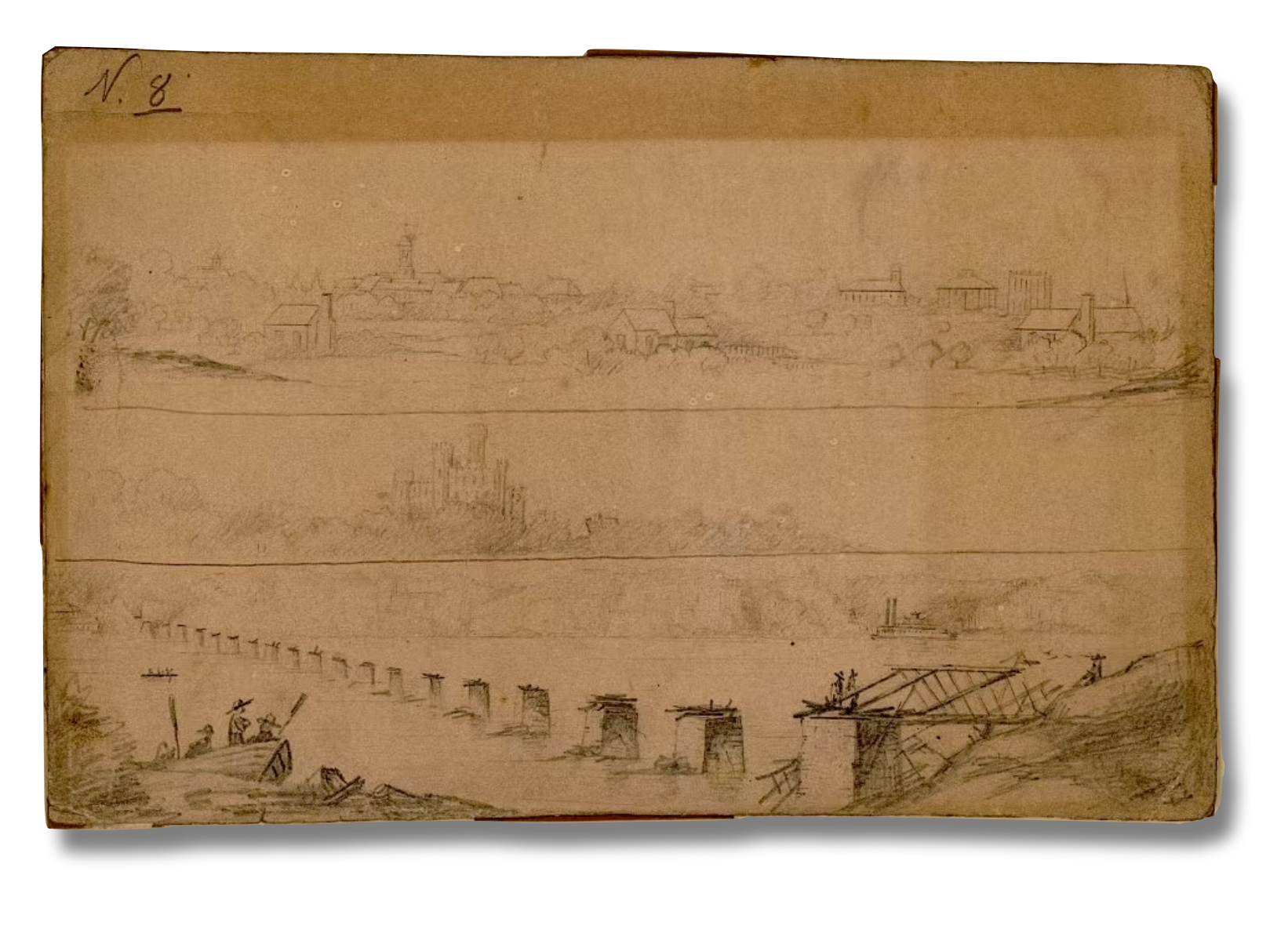
Some scenes of Florence, Alabama, and the Tennessee River drawn by Adolph Metzner on 22, June 1862
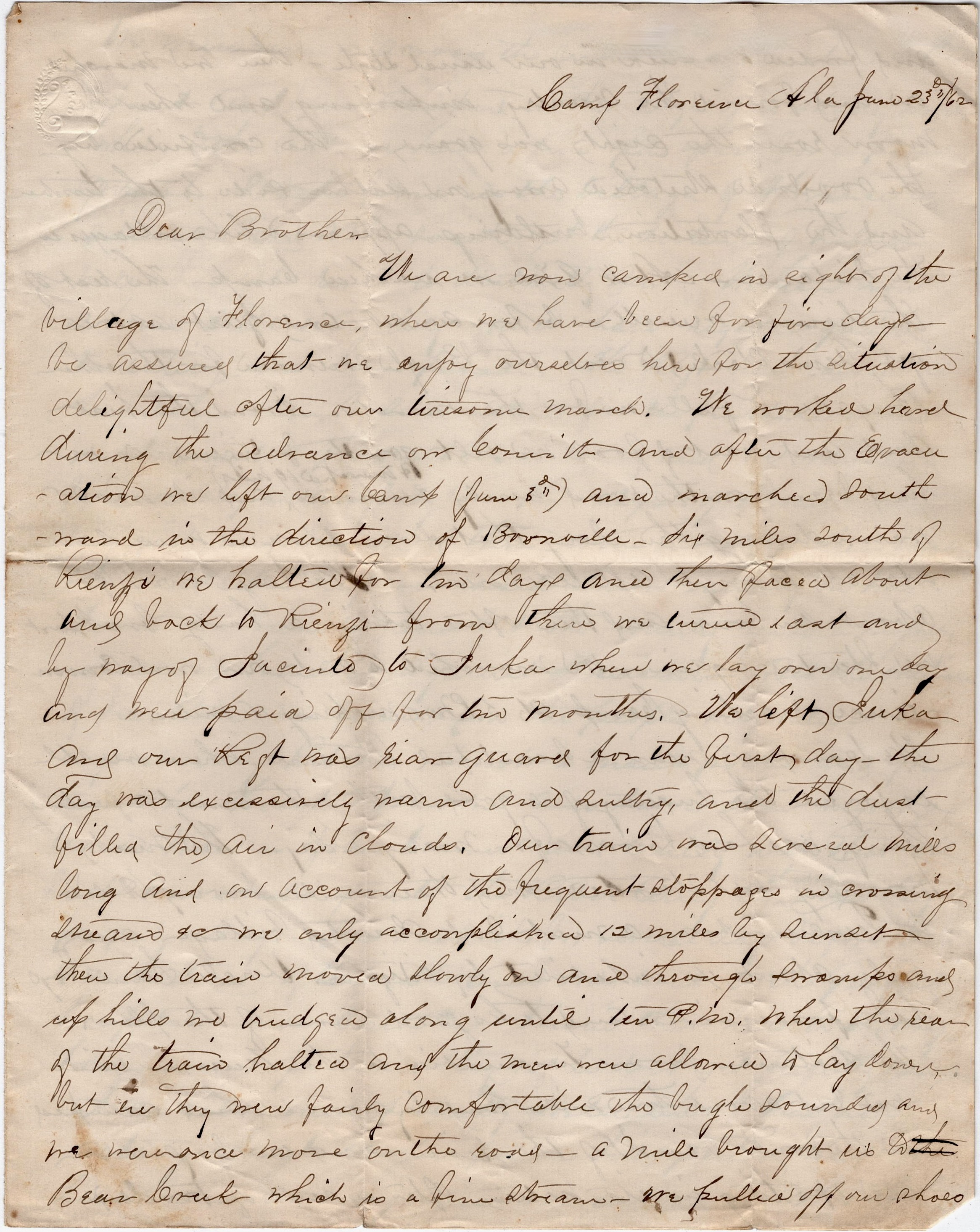
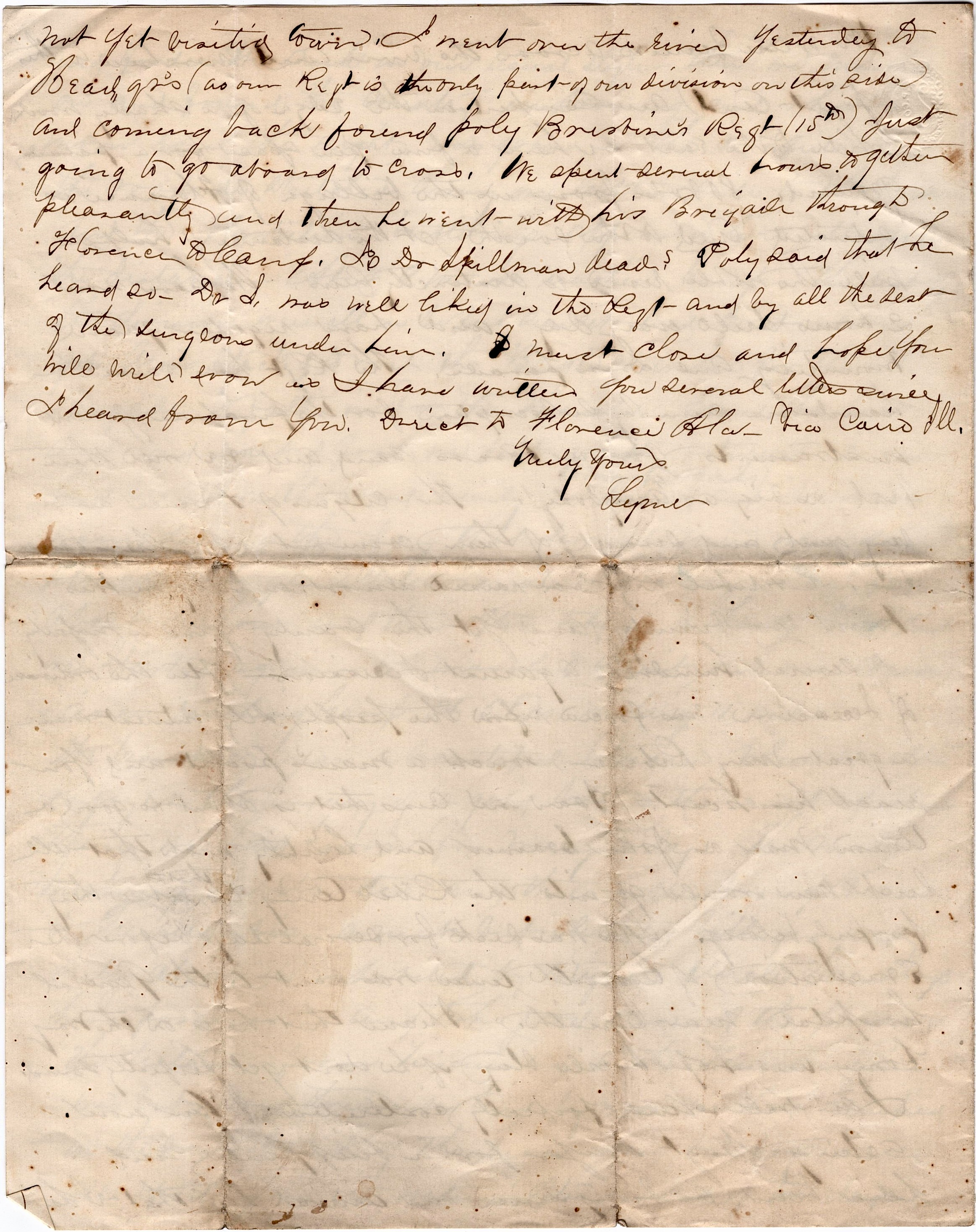
Camp Florence, Alabama June 23, 1862
Dear brother,
We are now camped in sight of the village of Florence where we have been for five days. Be assured that we enjoy ourselves here for the situation is delightful after our tiresome march. We worked hard during the advance on Corinth and after the evacuation we left our camp (June 3rd) and marched southward in the direction of Booneville. Six miles south of Rienzi we halted for two days and then faced about and back to Rienzi. From there we turned east and by way of Jacinto to Iuka where we lay over one day and were paid off for two months.
We left Iuka and our regiment was rear guard for the first day. The days was excessively warm and sultry and the dust filled the air in clouds. Our train was several miles long and on account of the frequent stoppages in crossing streams &c., we only accomplished 12 miles by sunset. Then the train moved slowly on and through swamps and up hills we trudged along until ten p.m. when the rear of the train halted and the men wrestled allowed to lay down. But ‘ere they were fairly comfortable, the bugle sounded and we were once more on the road. A mile brought us to Bear Creek which is a fine stream. We pulled on our shoes and forded the creek in our usual style, then we marched on and found the country improving and when the moon rose, the sight was grand. The cornfields by the roadside stretched away on either side to the timber and the plantation buildings appeared like villages in the distance.
After 4 a.m. we reached camp. The rest of the division were all in before sunset and just as we got arms stacked to rest, the bugle sounded for the other Brigade to fall in for the march. From the heat, dust, and want of food, we felt greatly fatigued as we had been on the road nearly 24 hours and marched 19 miles and it was so warm during the day that several men were sun struck though all recovered. We lay down for about an hour and then, after taking a hearty breakfast, we started again. We marched to suit our own convenience, reaching camp at 5 p.m. making 15 miles.
We camped near a beautiful stream where we all enjoyed the luxury of a good bath—the most refreshing thing we had known for many a day. The next morning we started and three miles brought us to Tuscumbia [Alabama]—a neat but deserted village and only about one quarter inhabited by citizens. Uncle Sam’s boys have possession and take good care of the place. The distance from Tuscumbia to the Tennessee River was about three miles and by noon we had camped on the south bank of the river and our boys were all sporting in its waters. After a rest of two days, we were ferried across the river and marched to this point and are camped in the edge of a shady wood while to the east we have a fine open space for a parade ground. 80 rods from us the village of Florence is situated and to the south at the distance of half a mile, the noble river is distinctly seen.
We have now two hours drill every day and have regular guard mounting and dress parade. The regiment has raised a handsome sum by subscription for the purchase of new instruments for our brass band and we will then feel as big as “anybody.” The citizens of Florence are very quiet and several of them come out to see dress parade, &c. A rebel regiment was raised almost entirely in this town and vicinity and yet the county gave a majority of several hundred against secession. After the Ordinance of Secession was forced upon the people, self interest made a great many rebels. Touch a man’s pocket and you reach his heart. I saw one cuss that is about as good a Union man as John Crainer and heartily wish that all such men would go into the Rebel army as that is where they properly belong.
Gus [Dilley] was sick for several days before the evacuation of Corinth and was sent to the General Hospital near Corinth. I learn that he is on the way home and hope he will stay if he don’t get perfectly sound. I am well and perfectly contented. I am now Acting Sergt. Major for a brief period and have been so busy since our arrival here that I have not yet visited town. I went over the river yesterday to Headquarters (as our regiment is the only part of our division on this side) and coming back found Poly Brisbine’s Regt. (15th) just going to go aboard to cross. We spent several hours together pleasantly and then he went with his brigade through Florence to camp.
Is Dr. Spillman dead? Poly said that he heard so. Dr. Spillman was well liked in the regiment and by all the rest of the surgeons under him. I must close and hope you will write soon as I have written you several letters since I heard from you. Direct to Florence, Alabama via Cairo, Illinois.
Truly yours, — Lyme
Letter 3
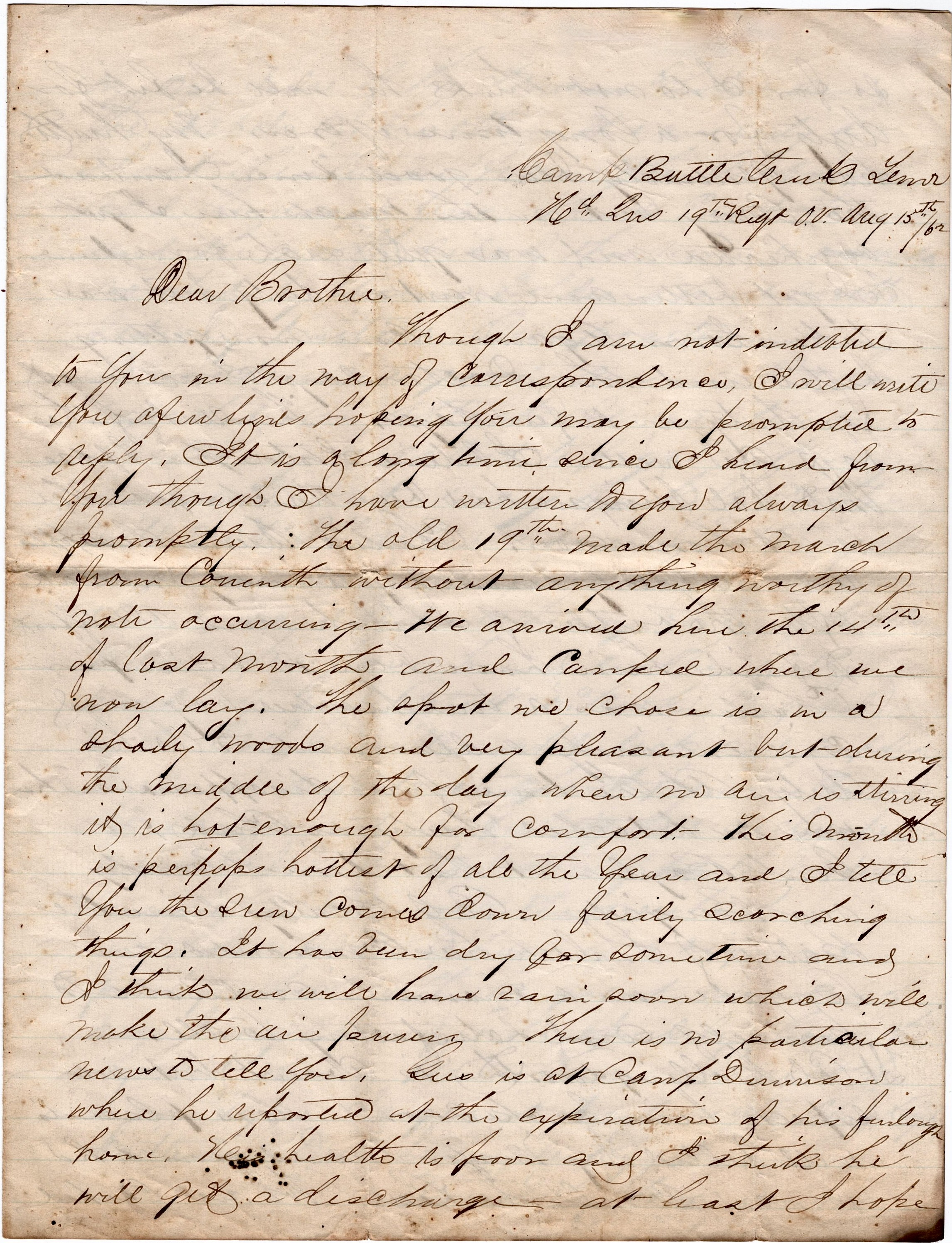
Camp Battle Creek, Tennessee Headquarters 19th Regiment O. V. August 15, 1862
Dear Brother,
Though I am not indebted to you in the way of correspondence, I will write you a few lines hoping you may be prompted to reply. It is a long time since I heard from you though I have written to you always promptly.
The Old 19th made the march from Corinth without anything worthy of note occurring. We arrived here the 14th of last month and camped where we now lay. The spt we close is in a shady woods and very pleasant but during the middle of the day when no air is stirring, it is hot enough for comfort. This month is perhaps hottest of all the year and I tell you, the sun comes down fairly scorching things. It has been dry for some time and I think we will have rain soon which will make the air purer. There is no particular news to tell you. Gus [Dilley] is at Camp Dennison where he reported at the expiration of his furlough home. His health is poor and I think he will get a discharge—at least I hope so for I do not think he will be fit for duty for a long time, if ever. My health has generally been good since I entered the army but on the march here I got overheated and was quite sick for a time. I got better and went on duty but was taken down again. Am now getting better and the Doctor says I will be fity for duty in a few days.
I believe I told you before that Cal[vin] Clingan had been discharged. He is at home now. Charlie Hume disappeared suddenly and mysteriously one eek after the Battle of Shiloh and all efforts to find him have been in vain. Poor Charlie was a true-hearted boy and conscientiously endeavored to do his duty. At the time of his disappeareance, he was on detached duty as clerk for Gen. [Jeremiah T.] Boyle, at that time commanding our brigade. Col. [Samuel] Beatty since the Battle of Shiloh has commanded our brigade in a manner creditable to himself and satisfactory to all.
Lt. Col. [Elliott Woodbridge] Hollingsworth is absent but we expect him back soon. His place is well filled by Major [Charles F.] Manderson who is now commanding the regiment. We are camped on one side of the Tennessee River and the Rebels on the other. We are only a short distance from the Alabama and Tennessee line. This is East Tennessee and the north side of the river is watched by Union soldiers and south side by traitors. Our position is considered a good one. We have expected an attack several times and may be called to fight at any moment, but many think that the Rebels will not attack us here. Chattanooga is about 25 miles from here and there is said to be a heavy force of Rebels there.
You have heard ‘ere this of the murder of Gen. Robert McCook (Brig. Gen.) by the Rebel guerrillas while sick and compelled to ride in ambulance apart from his command. It causes intense feeling here as elsewhere. Maj. Gen. McCook (brother of the murdered man) is in command of the forces here.
I hope soon to hear of a vigorous policy which with the great number of men being raised will speedily close this horrid war. Write soon. Direct to Lyme Tylee, Sergeant Major, 19th Ohio Regt., [Thomas L.] Crittenden’s Division, Louisville, Ky.
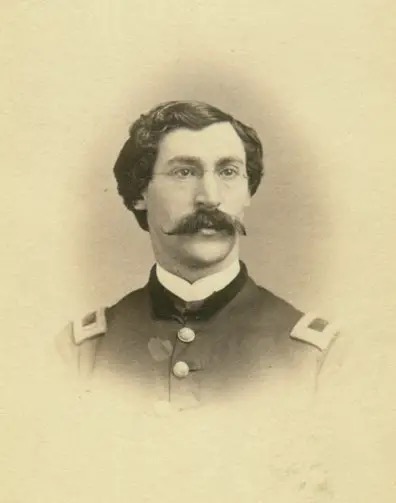
The following letters were written by Dr. Morris Joseph Asch, before and after the Battle of Bull Run in July 1861. Morris was born on July 4, 1833, and was the second son of Joseph Morris Asch (1802-1866) and Clarissa Ulman (1812-1869) of Philadelphia, Pennsylvania. His early education was mainly under private tutors and in the autumn of 1848 he entered the University of Pennsylvania where he was graduated on July 2, 1852, with the baccalaureate degree. His Master’s degree was received in course July 3, 1855. He was a member of the Alpha Chapter (University of Pennsylvania) of the P. K. E. fraternity. In the fall of 1852 he entered the Jefferson Medical College of Philadelphia from which he received the doctorate in 1855. Soon after graduation Dr. Asch was appointed clinical assistant to Dr. Samuel D. Gross, with whom he remained for several years.
Surgeon Morris Joseph Asch(World Biographical Encyclopedia)
When war was declared and his country called, it was but natural that he should enter the Army where three brothers had already volunteered. He passed the examination for assistant surgeon of the United States Army, which he entered on August 5, 1861. He was on duty at the surgeon-general’s office from August, 1861, to August, 1862. He subsequently became surgeon-in-chief to the Artillery Reserve of the Army of the Potomac, medical inspector Army of the Potomac, medical director of the 24th Army Corps, medical inspector of the Army of the James, staff surgeon of General P. H. Sheridan from 1865 to 1873. Some of the battles of the Civil War in which Dr. Asch participated were Chancellorsville, Mine Run, Gettysburg, The Wilderness and Appomattox Court House. On March 13, 1865, he was brevetted major for faithful and meritorious services during the war. He resigned from the Army of the Potomac on March 3, 1873, and entered into the practice of medicine in New York City, devoting himself largely though not exclusively to the study and treatment of diseases of the nose and throat and holding the position of surgeon to the throat departments of the New York Eye and Ear Infirmary and the Manhattan Eye and Ear Hospital. When the American Laryngological Association was formed he was one of its founders, and he was president in the work of the section of laryngology. [Source: American Medical Biographies]
Morris wrote the letters to his brother-in-law, George King—husband of Rachel Rosalie Asch (b. 1835). They were married in New York City in February 1853.
Letter 1
Washington [D. C.] July 10, 1861
Dear George,
I promised to write you and take the first opportunity to fulfill my engagement although I have nothing to write that you don’t see in the papers before I do. Nobody here is allowed to know anything. It is too near the enemy and if any information was afforded, the secessionists would know it before our own. I had expected to be sent into the field but instead I have been retained here to assist in establishing a military hospital. There are several here but a larger one is needed and to that duty I am assigned. It is abominable there is so much red tape to go through. If we want an ambulance or any important article, I go to the Surgeon General. He send me to the Medical Director. He approves and I go to General Mansfield. He approves and I go to the quartermaster. He says that he can’t give it without an order from Gen. Meigs. I go to him and he says that the President’s orders are not to issue anything except on Gen. Scott’s order. I go to Gen. Scott and he says that he can’t be troubled with such details. I go back to the quartermaster to ask what the devil he means by sending me on such a round and he says that there is no use coming for he hasn’t got what I want. That is the way that everything has to be done here so you can imagine what a pleasant time one has to establish a hospital with furniture for 400 men. But we are pretty nearly through and I hope that when the thing is in operation they will send me off with McDowell.
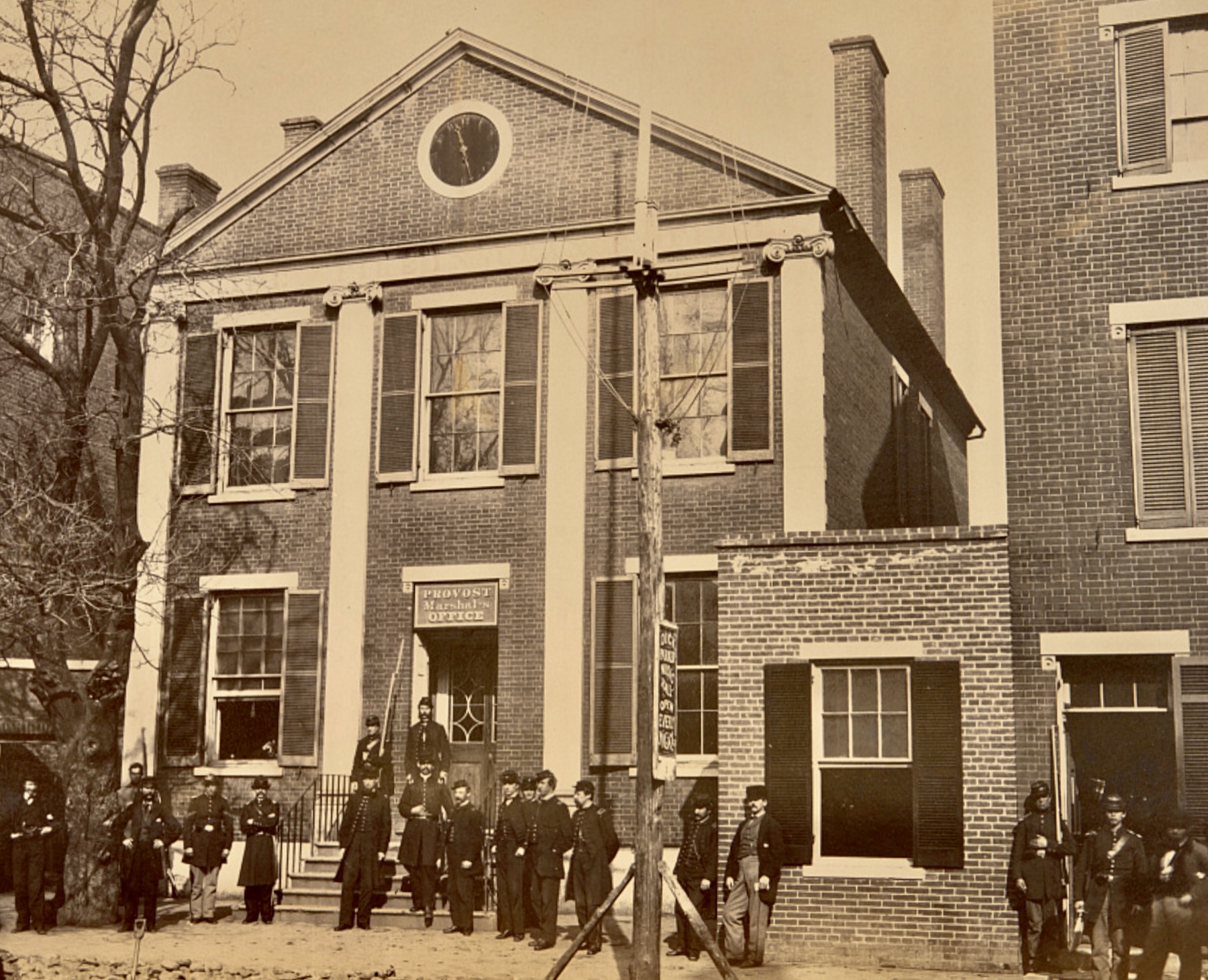
Provost Marshal’s Office in Alexandria, Virginia (LOC)
I went to Alexandria the other day and rode out to the outposts and round the pickets to Arlington. It is a real secession country. I asked in Alexandria where the Colonel lived and a fellow said that he didn’t know any such crowd. Shepard 1 the Provost Marshal said that they were tired of kicking the fellows but that it was the only thing that they could do with them. Alexandria looks deserted. You hardly see a soul in the streets. All the houses and stores are shut and the horses feet sounded as if we were in a deserted city.
Col. Noah Farnham led the 11th New York (Fire Zouaves) after the death of Elmer Ellsworth. Farnham was mortally wounded at 1st Bull Run. The Fire Zouaves were notorious for their lack of discipline.
From there we rode out to the [New York Fire] Zouave camp and saw [Col. Noah L.] Farnham and his men. They are good soldiers but need discipline. Farnham gave a captain some order about his men’s muskets and he said that he’d be damned if he would. There are some strong earth works around the town and whole round to Washington is one line of pickets and camps.
We took dinner at the Minnesota camp 2 (the best shots I ever saw hitting the target as big as your hat every shot at 230 yards) and from there passed through the camp to the earthworks of the 69th and from there to Arlington, Gen. McDowell’s headquarters, and from there to Washington. The entrenchments are very strong and extend over the whole round. We passed through the Garibaldi Guard on the march and they stoned us for going through their lines on a run. We had a couple of secession horses that were captured at Mathias Point by Capt. [James H.] Ward and the red shirts scared them. We went out as far as the pickets would let us towards Fairfax. We wanted to see the “seceshers” but didn’t get a chance. We were on horseback all day and was pretty well used up when we got home.
Give my love to Rachel and Judah and the children & let me hear from you. Regards to May. 3 Tell him his hats looked fine on the Garibaldi’s. Direct to Dr. Asch, USA, Washington D. C.
Yours, — Morris
A postwar image of Lt. Charles H. Shepard, Co. B, 5th Massachusetts Infantry. He served as Provost Marshal in Alexandria in July 1861. (Dave Morin Collection)
1 Lieutenant Charles H. Shephard of Co. B, 5th Massachusetts Infantry was serving as the Provost Marshal at the time of Morris’ visit to Alexandria in July 1861.
2The 1st Minnesota saw heavy fighting on Henry House Hill at 1st Bull Run. They were one of the last regiments to leave the field and suffered one of the highest number of casualties of the Union regiments engaged—49 killed, 107 wounded, and 34 missing. Just prior to advancing on Manassas, the regiment was encamped at Camp Forman at the reservoir on the Little River Turnpike near Alexandria.
3 Morris was probably referring to Lewis May, a hat maker at 43 Broadway in New York City. The letter suggests that the hats supplied to the Garibaldi Guards (39th New York) came from May. The regiment was famous for their distinctive Bersaglieri hats, red shirts, and black gaiters when they first took the field in 1861. Lewis was active in politics and was one of the featured speakers at Union Square War Meeting in April 1861 in which he encouraged the Germans to organize themselves into a regiment and march to Washington in its defense. German’s comprised the greatest percentage of the foreign born members of the 39th New York, Garibaldi Guard. [Source: New York Herald, 24 April 1861]
Letter 2
Columbian Hospital 1 July 29, 1861
Dear George
Now that things look a little better, I hope that you have got out of the desponding mood that you were in when you last wrote. In fact, there is no reason why you should not be. The thrashing that we got will only make us more alive to our deficiencies and our next army will be worth a dozen of the last. Anyhow, we hurt them as bad as they did us, and if it were not for the number of our prisoners that they have, I think that we would be the best off. But one government liberates every rebel that it catches and when they catch ours we have nothing to exchange.
As to the battle itself from all that I can hear from regulars who were not scared and from volunteers who were, our men had the best of it in every way until forced to give up by hunger & exhaustion. They had nothing to eat since the night before and our fine politician officers took them for miles into action on the double quick and then gave them no rest. The regulars found that their men couldn’t stand that game so they rested them for an hour or two before they went in again and then did good service. If it had not been for that cowardly panic, I believe that we would have remained masters of the field.
By the way, some of your New York Regiments behaved very well—the 69th and 71st and 14th [Brooklyn], but others lost the battle through their cowardice. The Fire Zouaves behaved in the most cowardly manner and could not be brought up for a charge—squatting and firing till they ran away and some have not turned up yet they ran so far. The enemy ran too. An officer told me that we charged and they ran. Then they charged and we ran. Then we charged and they ran. Then they charged and we ran farther and faster than they did. There is no doubt but that they must have been used up and scared or they would have advanced on Washington—for they could have taken it up to Wednesday for there was no discipline of any kind. Troops were straggling all over the country and there were not a half dozen regiments together. People were scared and if Beauregard had any chance of fighting he would have been here.
They say today that Johnston is about to attack Banks but I presume that he is prepared for him. The enemy’s lodd must have been severe. Our artillery worked well but we had not enough of it. An officer of Sherman’s Battery 2 told me that after silencing a battery, he went out to reconnoiter and saw a regiment of Louisiana Zouaves coming up a ravine to outflank them. They turned their guns—six pieces—on them and as they came in range, they let drive with grape and canister into them and made lanes right through them and routed them in short order.
[Capt. Romeyn] Ayres’ Battery got their range on a railroad crossing an open space between the woods where reinforcements were being brought up, and as the head of the train came in sight, let fly and smashed five cars with troops in all to pieces. A man who escaped from them and was employed by them in the hospital says that they have 2800 wounded. We have some of our wounded here but not many. Most of them are in town.
I have to thank you and May for that beautiful hat that you sent me. I mean to write to May soon but till I do, consider this as a joint letter to you both. The hat has been very much admired. It is the handsomest that has been seen here. You may imagine that I have to steal some time to write when I tell you that I have been four hours writing this letter. I am officer of the day and have to receive and discharge patients, attend to the business of the house, and even bury the dead—and consequently am hopping up and down every five minutes which accounts for the gaps in my letter. We have about 225 patients in the house and more coming in every hour.
Have you hot weather in New York? Here is is delightful. It is always cool and a pleasant breeze always blowing so that it scarcely seems to me that I am south of Philadelphia. I don’t know who your friend, the recruiting captain in Broadway, may be but I do know that he is a damned impertinent fellow and I will tell him so if I see him.
Give my love to Rachel and the children and Judah. Tell Ally 3 that I will bring him a secession sword of the first battlefield that I get to. My respects to the family. Ask May to write. Yours affectionately, — Morris
Direct to Columbian Hospital, Box 266, P.O., Washington
1 Built in 1820, the Columbian College was appropriated by the government on 13 July 1861 to be used as a hospital. It was located on Meridian Hill, west of 14th Street Road. The hospital was initially operated in the Washington Infirmary at the college until it burned in November 1861 at which time the hospital was relocated to the main College building.
2Co. E, 3rd U. S. Artillery, or more commonly called “Sherman’s Battery,” was commanded by Thomas W. Sherman.
3 “Ally” was Albert G. King, b. 1854, the son of George & Rachel (Asch) King.
Sherman’s Battery on the way to the Bull Run Battlefield (Harper’s Weekly)
The following letter was written by Joseph M. McKee (1845-1907), the son of Anthony Wayne McKee (1815-1873) and Emeline E. Bonner (182401876) of Ripley county, Indiana. During the Civil War, McKee served in Co. D, 123rd Indiana Volunteers from December 1863 to August 1865. After the war, Joseph went with his parents and siblings to Elmerdaro, Lyon county, Kansas. He married Lucy Craig (1853-1908) in 1871
McKee wrote the letter to Elizabeth (“Lizzie”) W. Planalp (1849-1935) of Spades Station (or Spades Depot) in Adams Township, Ripley county, Indiana Elizabeth was the daughter of Melchior Abplanalp (1803-1865), and emigrant from Switzerland, and his wife, Mary Mehl (1820-1902) of France. “Lizzie” was married in 1870 to Rev. Jacob Bockstahler (1845-1920)—a minister in the Central German Conference of the Methodist Episcopal Church.
T R A N S C R I P T I O N
Addressed to Miss Lizzie Planalp, Spades Station, Indiana
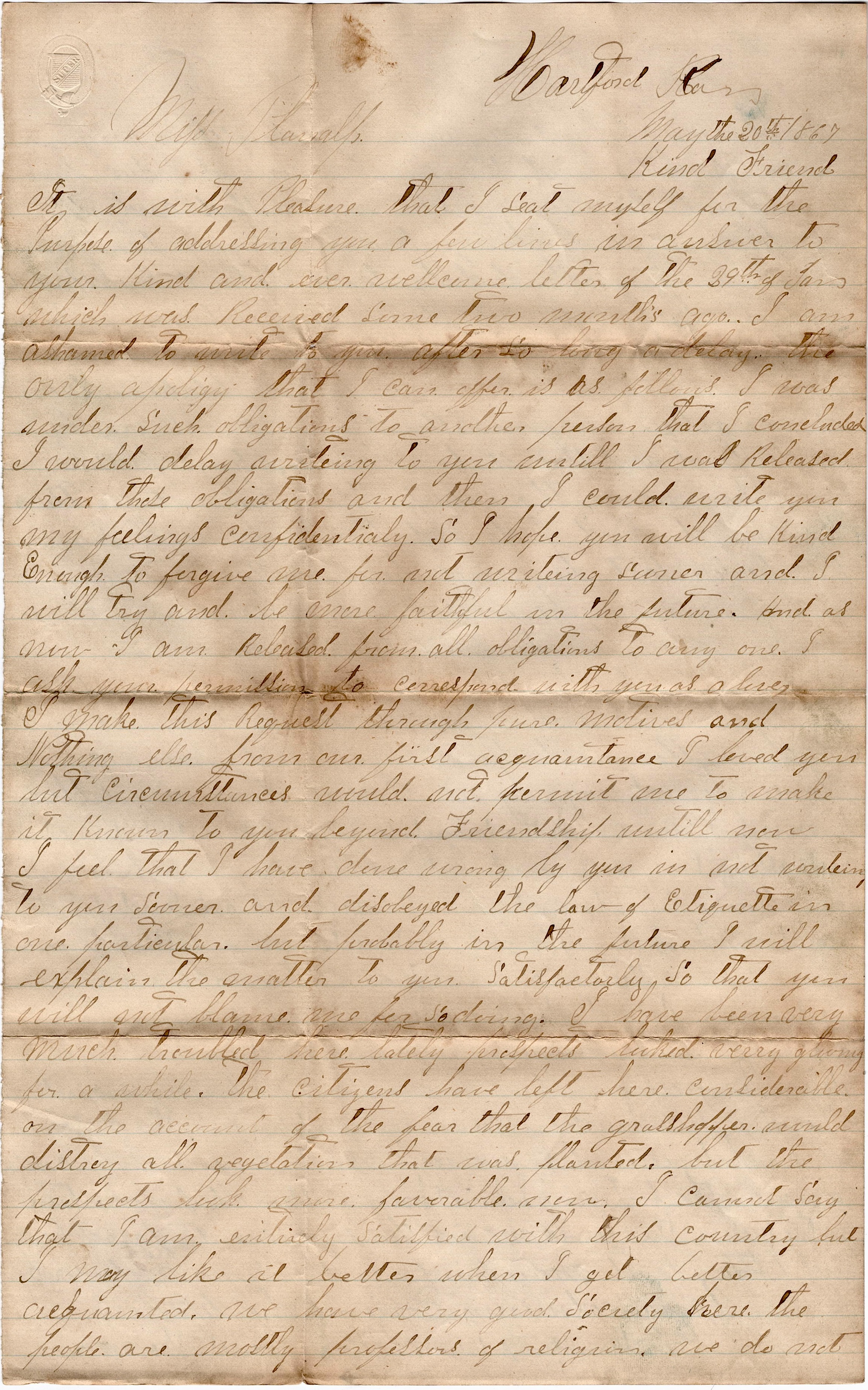
Hartford, Kansas May 20, 1867
Miss Planalp, kind friend,
It is with pleasure that I seat myself for the purpose of addressing you a few lines in answer to your kind and ever welcome letter of the 29th of January which was received some two months ago. I am ashamed to write to you after so long a delay. The only apology that I can offer is as follows. I was under such obligations to another person that I concluded I would delay writing to you until I was released from those obligations and then I could write you my feelings confidentially, So I hope you will be kind enough to forgive me for not writing sooner and I will try and be more faithful in the future. And as now I am released from all obligations to anyone, I ask you permission to correspond with you as a lover. I make this request through pure motives and nothing else. From our first acquaintance I loved you but circumstances would not permit me to make it known to you beyond friendship until now. I feel that I have done wrong by you in not writing to you sooner and disobeyed the law of etiquette in one particular, but probably in the future I will explain the matter to you satisfactorily so that you will not blame me for so doing.
I have been very much troubled here lately. Prospects looked very gloomy for a while. The citizens have left here considerable on the account of the fear that the grasshopper would destroy all vegetation that was planted, but the prospects look more favorable now. I cannot say that I am entirely satisfied with this country but I may like it better when I get better acquainted. We have very good society here. The people are mostly professors of religion. We do not have any saloons or gambling houses, or anything of that kind. The young men and ladies have found an excellent society in Hartford and it is doing a good thing toward bringing the young people to the path of duty. Their Oath of Enlistment is that they shall not drink any intoxicating liquor, go to no dances or any other immoral gathering, and I think it a very good institution.
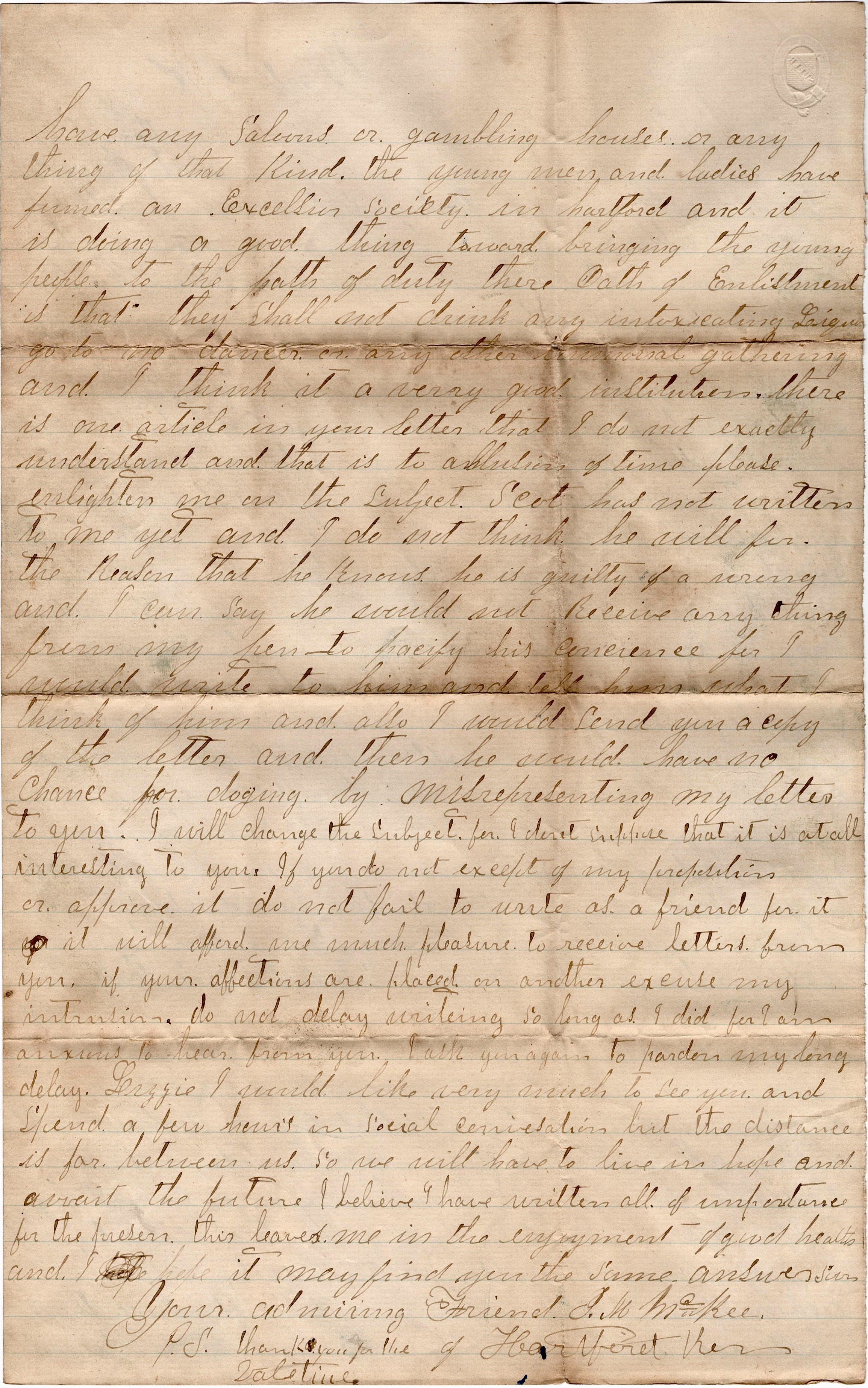
There is one article in your letter that I do not exactly understand and that is to allusion of time. Please enlighten me on the subject. Scot has not written to me yet and I do not think he will for the reason that he knows he is guilty of a wrong and I can say he would not receive anything from my pen to pacify his conscience for I would write to him and tell him what I think if him and also I would send you a copy of the letter and then he could have no chance for dodging by misrepresenting my letter to you.
I will change the subject for I don’t suppose that it is at all interesting to you. If you do not accept of my proposition or approve it, do not fail to write as a friend for it will afford me much pleasure to receive a letter from you. If your affections are placed on another, excuse my intrusion. Do not delay in writing so long as I did for I am anxious to hear from you. I ask you again to pardon my long delay. Lizzie, I would like very much to see you and spend a few hours in social conversation but the distance is far between us so we will have to live in hope and await the future. I believe I have written all of importance for the present. This leaves me in the enjoyment of good health and I hope it may find you the same. Answer soon. Your admiring friend, — J. M. McKee of Hartford, Kansas
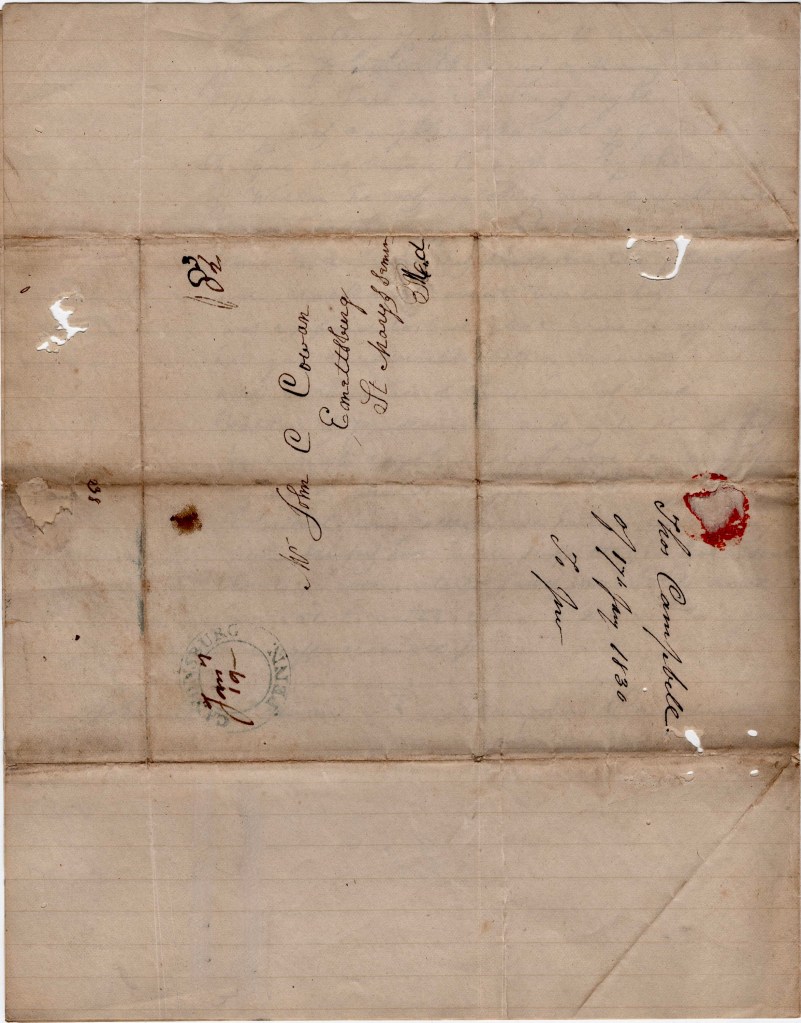
This letter was written by a student at Jefferson College in Canonsburg, Pennsylvania, named Thompson Campbell. Though I cannot prove it from the contents of this letter, I think there’s a good chance that he is the same Thompson Campbell (1811-1868) who came to this country with his parents from Ireland and settled in Chester county, Pennsylvania. Biographical sketches for Campbell don’t provide any details on his schooling until he was admitted to the bar in Pittsburgh, Pennsylvania, which is where this student says he was “at home” recently and where his correspondent, a friend, was also from.
Thompson wrote the letter to John Conway Cowan (1815-1838) of Pittsburgh. He attended Mount St. Mary’s College in Emmitsburg, Maryland, and entered the seminary there He died at Havana, Cuba, in February 1838.
Campbell’s biographical sketch: “Born in Ireland in 1811; immigrated to the United States with his parents, who settled in Chester County, Pa.; attended the public schools; studied law; was admitted to the bar in Pittsburgh, Pa.; moved to Galena, Ill., and engaged in mining; secretary of state of Illinois from 1843 until he resigned in 1846; delegate to the State constitutional convention in 1847; elected as a Democrat to the Thirty-second Congress (March 4, 1851-March 3, 1853); unsuccessful candidate for reelection in 1852 to the Thirty-third Congress; delegate to the Democratic National Convention in 1852; appointed United States land commissioner for California by President Pierce in 1853 and served until he resigned in 1855; returned to Illinois; delegate to the Democratic National Convention at Charleston in 1860; elector at large on the Breckinridge and Lane ticket in 1860; returned to California and served in the California house of representatives as a member of the Union Party in 1863 and 1864; delegate to the Republican National Convention in 1864; died in San Francisco, Calif., December 6, 1868; interment in Laurel Hill Cemetery.”
T R A N S C R I P T I O N
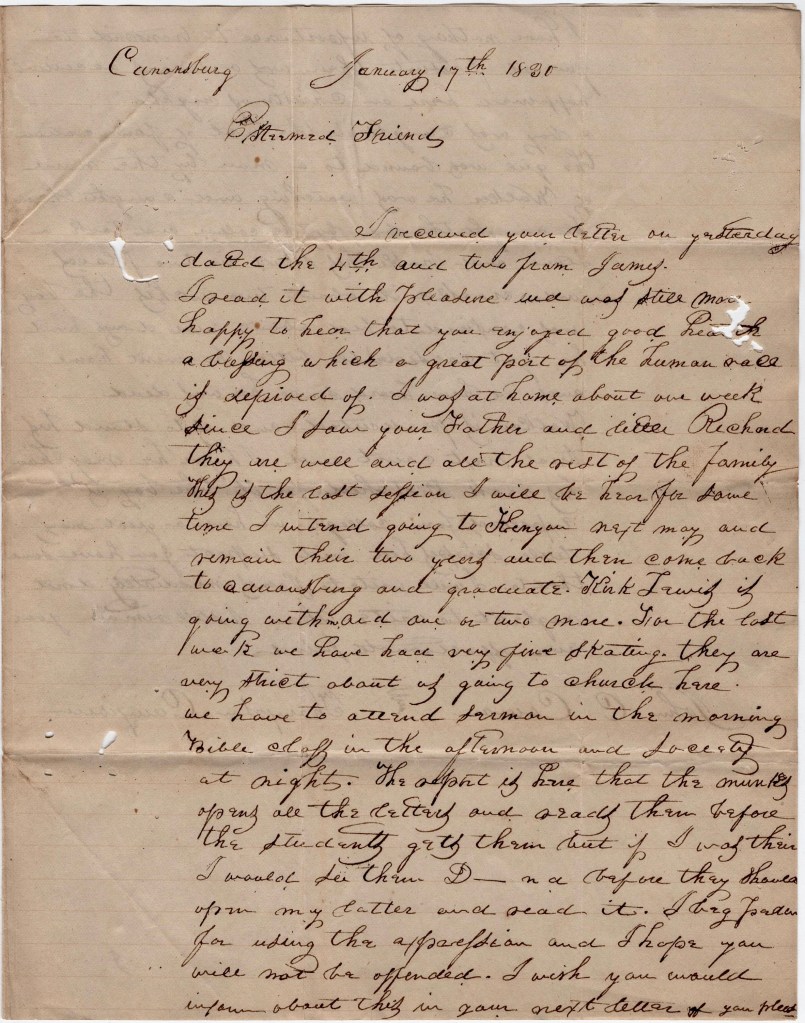
Canonsburg [Pennsylvania] January 17th 1830
Esteemed Friend,
I received your letter on yesterday dated the 4th and two from James. I read it with pleasure and was still more happy to hear that you enjoyed good health—a blessing which a great part of the human race is deprived of. I was at home about one week since. I saw your Father and little Richard. There are well and all the rest of the family. This is the last session I will be here for some time. I intend going to Kenyon [College in Gambier, Ohio] next May and remain there two years and then come back to Canonsburg and graduate. Kirk Lewis is going with me and one or two more. For the last week we have had very fine skating. They are very strict about us going to church here. We have to attend sermon in the morning, bible class in the afternoon, and society at night. The report is here that the monks open all the letters and read them before the students get them but if I was there, I would see them damned before they should open my letter and read it. I beg pardon for using the expression and I hope you will not be offended. I wish you would inform about this in your next letter if you please.
I have nothing of importance to transmit to you at present. There was a serious accident happened here on Christmas night. A boy was caught in the act of fornication. The girl was bound to a man by the name of Walker. 1 He was watching and caught them. He caught the boy by the collar and took a stone and broke his skull in two places and cracked it about two inches. The boy was confined to bed about nine days and he got considerable better. He went home and we have heard since he was dead. Walker is prosecuted and is to stand his trial next court and I hope he may have his neck stretched for it. The boy is expelled from college.
We have a great many little scrapes here and suspect you have some there to. I will write to James immediately. Do not neglect to write. And I still remain your ever affectionate friend, — Thompson Campbell
To John C. Cowan
1I couldn’t find any mention of this incident in local newspapers. However, there was a saddler named Moses Walker (1792-1855) who lived in Canonsburg at the time. It’s not surprising that the incident wasn’t reported, as such topics rarely appeared unless a pregnancy was involved, and legal action against offenders was uncommon. In 1830, fornication was illegal in Pennsylvania, so if the male offender had died, many would have considered that as justice served.
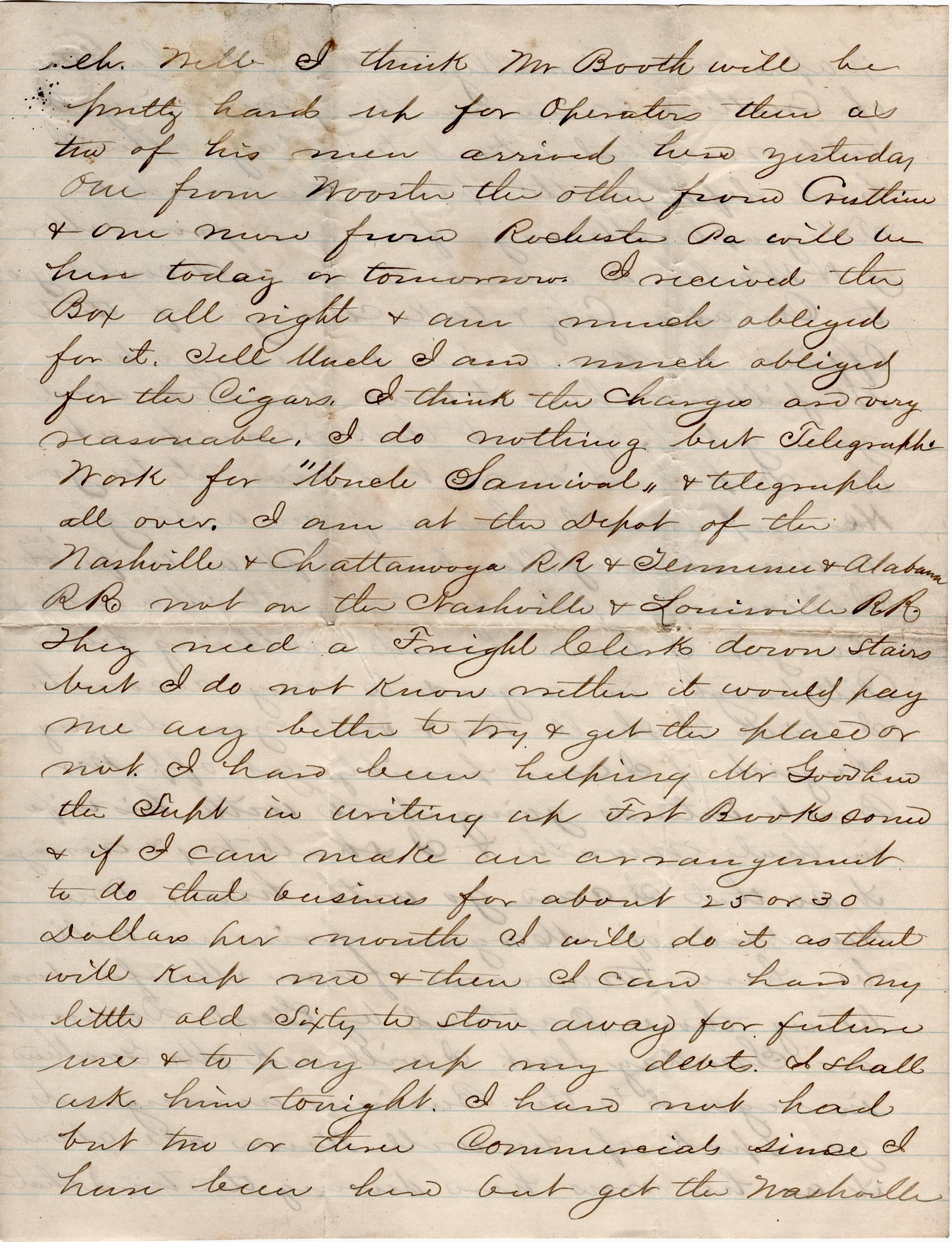
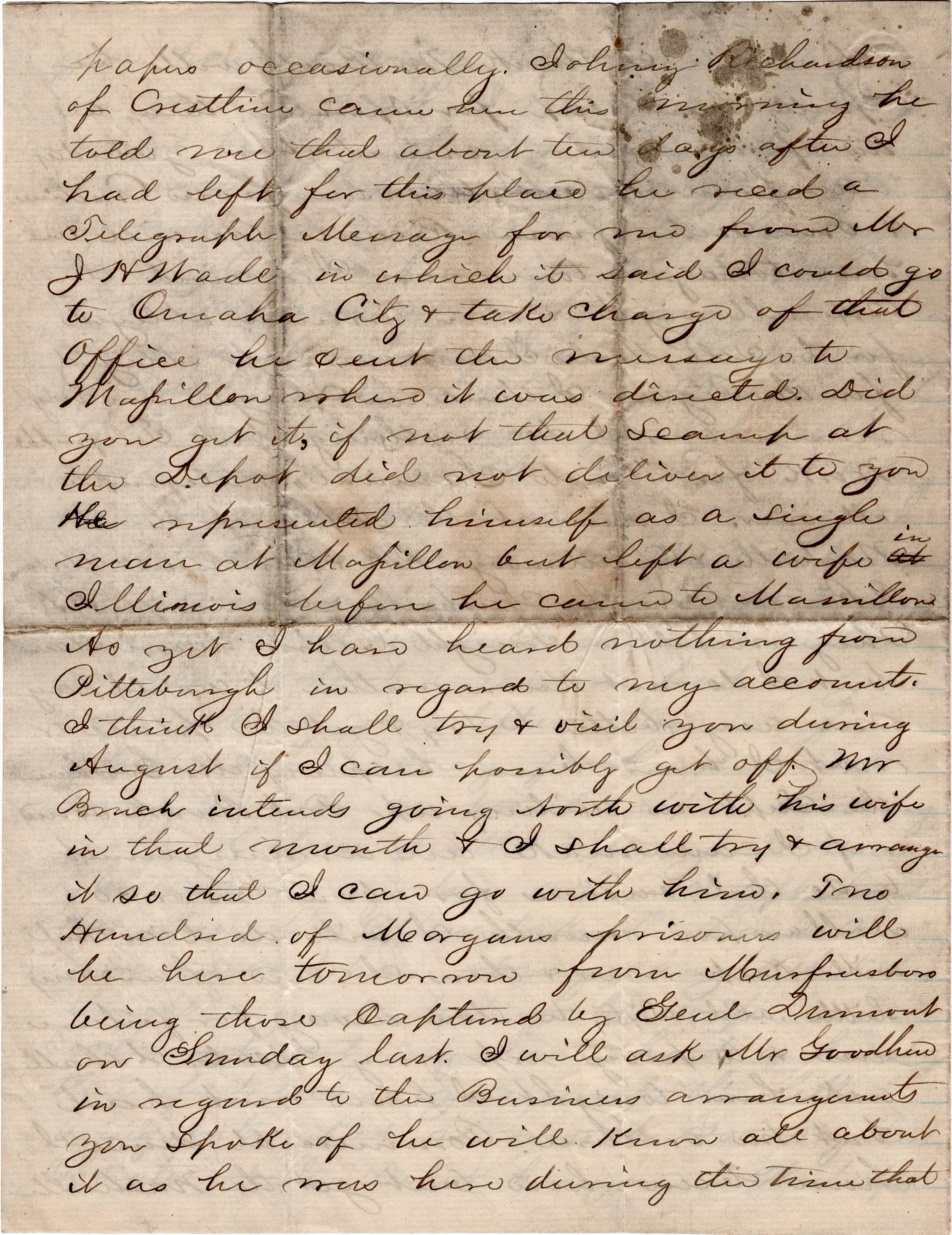
The following letter was written by William Atwater (1837-1913), the son of Joshua D. Atwater (1807-1840) and Dorcas Bronson (1807-1903) of Massillon, Stark county, Ohio. From William’s letter it is clear that he worked as telegraph operator during the Civil War and was recently stationed at Nashville, Tennessee. I believe that William was employed as a civilian contractor for the military telegraphic service.
In the 1870 US Census, William was enumerated as an inmate, age 30, in the Northern Ohio Lunatic Asylum in Newburgh, Cuyahoga county, Ohio (his former occupation given as a telegraph operator; his condition “insane”). In 1880, he was still in the asylum, age 40, suffering from “mania.”
T R A N S C R I P T I O N
Nashville, Tennessee May 6th 1862
Dear Brother,
Yours of the 2nd inst. was received. I had intended writing to Mother on Sunday to keep my promise good but was busy on the line all day, Morgan’s Cavalry having been around within 30 miles of here on the road & it made considerable stir, I can assure you. They sent some troops down to reinforce Col. Duffield at Murfreesboro. Gen. Dumont started in pursuit of Morgan & succeeded in catching or capturing 150 men, horses, and a large quantity of arms. This was at Lebanon about 40 miles from here. The Secesh do not say much this morning although “Gravevine Telegraph” worked tip top on Sunday.
Today is a splendid specimen of summer weather being warm and pleasant out. The 11th Michigan Regiment passed through here last evening en route for Columbia to join Gen. Negley at that point, I believe. I received a letter from Harry Allen from Pittsburg Landing a few days ago in which he says that Jesse Keel had gone home. Also says Jimmy Hunt had gone home having been unwell for a month past. I was much pleased upon hearing of Doct. Huxthal’s promotion. Immediately upon receiving your letter I went over & saw Dr. Hodge. He says he is glad to hear of Huxthal’s promotion and thinks him a worthy man to hold such a position. I also saw Hayden of Canal Dover. Also Henry Kaldenbaugh that was book keeper for Col. Webb while he was in New York. Old Kelly, the boat captain, is in the 51st Regt. as private. I saw him on the street about two weeks ago. I am sorry to hear that Jesse Keel is in such a bad situation adn hope that it is not as bad as you represent in your letter. Jesse is a fine fellow and I feel sorry for him. I was very much surprised upon hearing of Mrs. Allen’s death although I knew she was very low when I left home. How does Mr. Allen take it? Hard I presume as I have always thought that he thought a great deal of his wife.
You must certainly have had a hard time of it when you wrote the letter being interrupted so much. You say the operator at the Depot has gone to Washington, eh? Well, I think Mr. Booth will be pretty hard up for operators then as two of his men arrived here yesterday—one from Wooster, the other from Crestline, and one more from Rochester, Pa. will be here today or tomorrow. I received the box all right & am much obliged for it. Tell Uncle I am much obliged for the cigars. I think the charges are very reasonable. I do nothing but telegraph work for “Uncle Samual” & telegraph all over. I an at the depot of the Nashville & Chattanooga Railroad & Louisville Railroad. They need a Freight Clerk down stairs but I do not know whether it would pay me any better to try and get the place or not. I have been helping Mr. Goodhew, the Superintendent, in writing up Freight books some and if I can make an arrangement to do that business for about 25 or 30 dollars per month, I will do it as that will keep me & then I can have my little old sixty to stow away for future use & to pay up my debts. I shall ask him tonight. I have not had but two or three [Cincinnati] Commercials since I have been here but get the Nashville papers occasionally.
Johnny Richardson of Crestline came here this morning. He told me that about ten days after I had left for this place he received a telegraph message for me from Mr. J. H. Wade in which it said I could go to Omaha City & take charge of that office. He sent the message to Massillon where it was directed. Did you get it? If not, that scamp at the depot did not deliver it to you. He represented himself as a single man at Massillon but left a wife in Illinois before he came to Massillon. Asa yet, I have heard nothing from Pittsburgh in regard to my account. I think I shall try & visit you during August if I can possibly get off. Mr. Bruch intends going North with his wife in that month & I shall try and arrange it so that I can go with him.
Two hundred of Morgan’s prisoners will be here tomorrow from Murfreesboro, being those captured by Gen. Dumont on Sunday last. I will ask Mr. Goodhew in regard to the business arrangements you spoke of. He will know all about it as he was here during the time that the secesh were & can probably tell more about it than Mr. Hodge can. I got paid off today. Got $52 for last month’s pay, not being a full month. I do not get rations here. If I was in camp, then I would get them. I send you this time $25. Next month I will send you forty, probably $45. Do not know what my boarding is going to cost. I intend to send all I can…
When you write again, please let me know about what arrangements you make with the railroad folks, provided you see them. Tell Mother I will write Sunday again if nothing happens. I shall write Clem Russell in a day or two & will then let you know about what Mr. Goodhew says. The Christian Advocate was received. I will go down to supper now as the “Boy” has just informed me that it is ready. You can say to ward Cummings that I have not heard from him yet and would be glad to hear from him. Give my regards to all. Remember me to Auntie’s folks; Jacob’s also. Kove to all. I am as ever, your brother, — Will Atwater
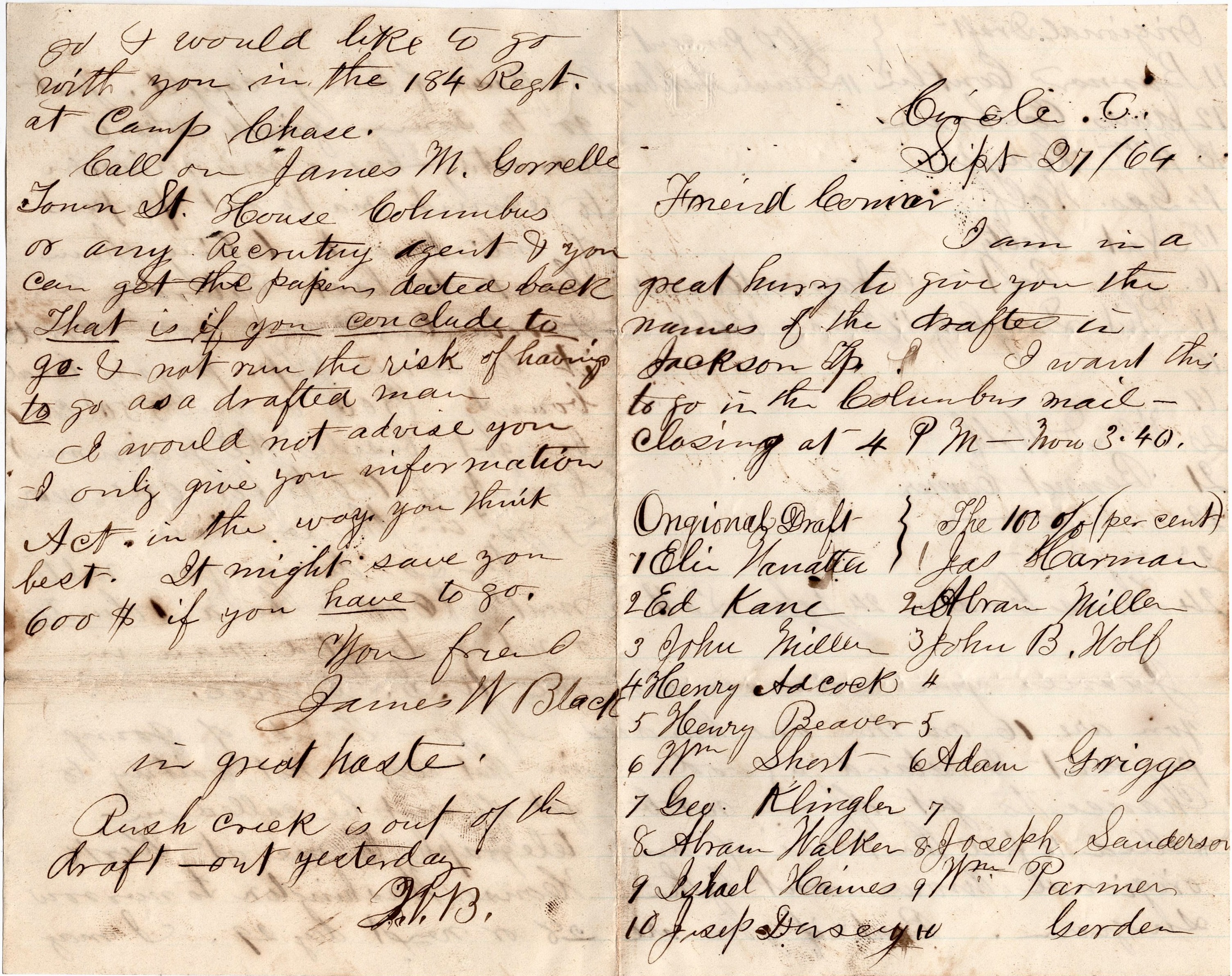
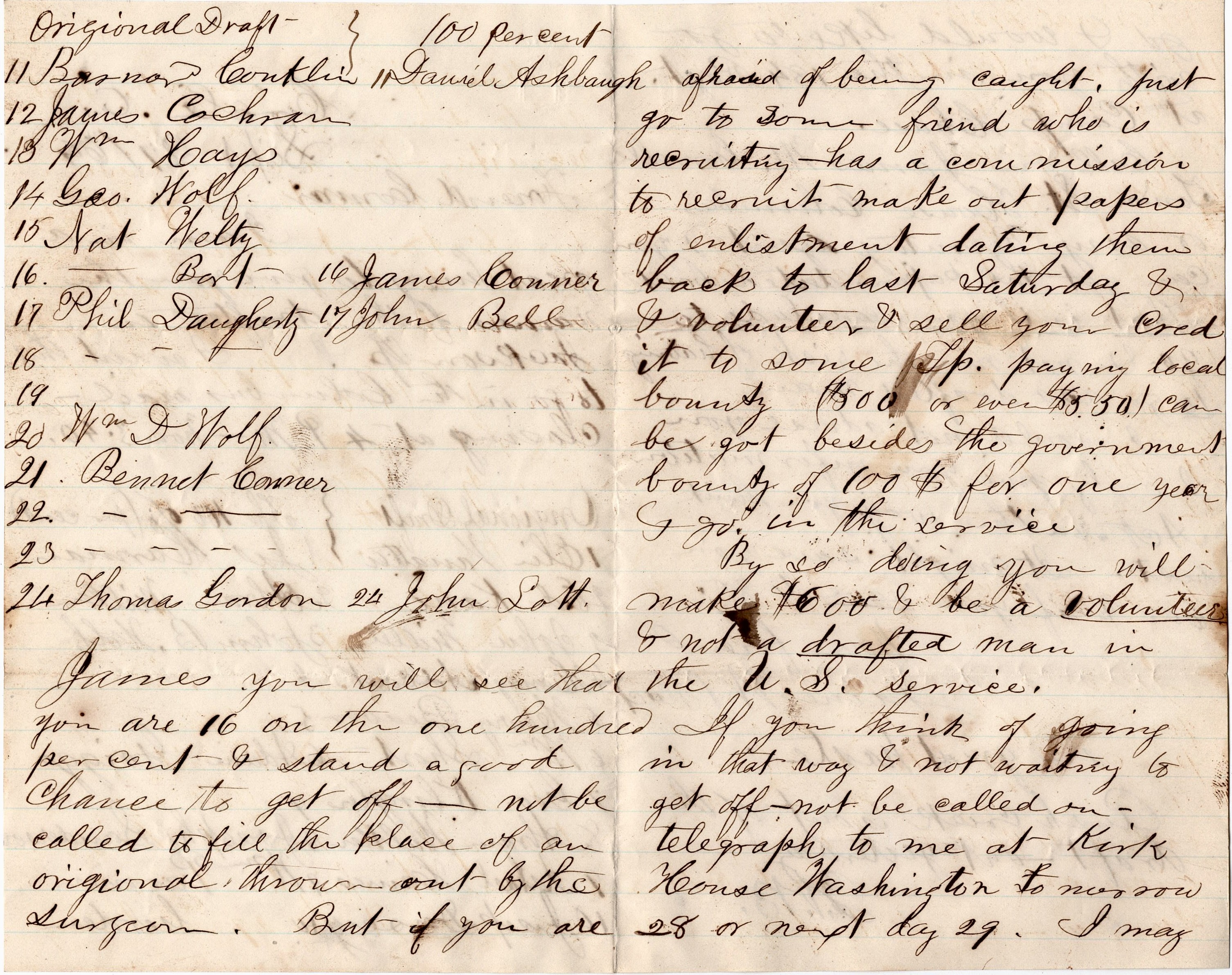
The following letter was written by James W. Black to his friend James Conner advising him of the names of those age eligible individuals selected in the 1864 draft in Pickaway county, Ohio. He suggests that his friend may want to ask a recruiter to back date enlistment papers for him as a volunteer in order to collect a hefty bounty rather than report as a draftee and receive no bounty.
T R A N S C R I P T I O N
Circle[ville], Ohio September 27, 1864
Friend Conner,
I am in a great hungry to give you the names of the drafted in Jackson township. I want this to go in the Columbus mail. Closing at 4 p.m. Now 3.40.
[list of names]
James you will see that you are 16 on the one hundred per cent & stand a good chance to get off- not be called to fill the place of an original throw out by the surgeon. But if you are afraid of being caught, just go to some friend who is recruiting, has a commission to recruit, make out papers of enlistment dating them back to last Saturday, & volunteer & sell your credit to some township paying local bounty ($500 or even $550) can be got besides the government bounty of $100 for one year & go in the service. By so doing you will make $600 & be a volunteer & not a drafted man in the U. S. service.
If you think of joining in that way & not waiting to get off, not be called on, telegraph to me at Kirk House, Washington, tomorrow 29 or next day 29. I may go & would like to go with you in the 184 Regiment at Camp Chase.
Call on James M. Gorrelle, Town St. House, Columbus or any recruiting agent & you can get the papers dated back—that is, if you conclude to go & not run the risk of having to go as a drafted man. I would not advise you. I only give you information. Act in the way you think best. It might save you $600 if you have to go. Your friend—James W. Black
in great haste.
Rush Creek is out of the draft out yesterday J. W. B.
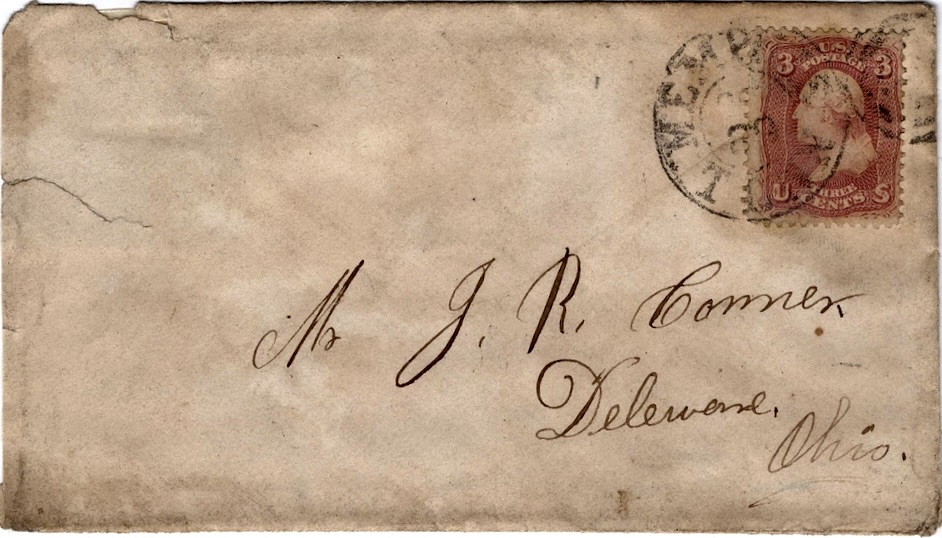
The following letter was written by Stephen S. Conner (1845-1894) to his brother James Ryan Conner (1839-1930). They were the sons of William Conner, Sr. (1794-1879) and Anna Sherwood (1805-1884) of Perry county, Ohio. Stephen wrote the letter in October 1864 from Morganza, Louisiana, while serving as a private in Co. G, 114th Ohio Volunteer Infantry (OVI).
T R A N S C R I P T I O N
Addressed to Mr. J. R. Conner, Delaware, Ohio
Morganza, Louisiana October 23, 1864
Brother Jim.
As you perceive, my letter dates from Morganza yet and I will [stay] the rest of this winter, I think. We have been here a long time, or 5 months longer than any place since come into the service. We had orders to leave last week, were ordered to be ready in a moment’s warning. Yesterday the order was countermanded.
Received your short note today dated September 29th at D[elaware]. Had looked to hear from you sooner expecting you to write first. Your letter was 10 days on the way. I was surprised to see your letter mailed at D[elaware]. Received a letter from home last week stating you was drafted and expected you would be in camp. Also said Ben was drafted and had gone to camp. You can’t be drafted or you would certainly said something about it. Have not had any late word from home stating otherwise. I don’t like to hear of a true brother of mine being drafted but I think it was the best thing that could have happened to Ben, I think it may make a true man of him.
I had a letter from him stating that he was a Peace man & greatly in favor of Mc[Clellan] & down on Lincoln. He thought L[incoln] was too much for the nigger & all other such things. I could see he was the biggest kind of a Copperhead.
Well Jim, we are fixed up bunkum here for winter. Have built houses. Went out into the country and tore down houses to build them, We just got a chimney built and now sitting by it enjoying myself writing. I am guarding at division commissary. Have been here over three months. Have no duty to but guard the rations in the commissary. Don’t have to go on picket or scout. The regiment goes on a scout once and twice a week.
Gen. [Michael K.] Lawler is commanding this post. He is our brigade commander. There has been a good deal of changing in our brigade, some times being expired have gone home, & others put in their places. Ours is the 2nd Brigade, 3rd Division. The Brigade is composed of the following regiments: 69th Indiana, 24th Indiana, 22nd Kentucky, 97th Illinois, and 114th OVI. We have two brass bands in the Brigade.
Our regiment drew new guns today. The boys belonging to the company are all in good health. My health is excellent. Seen William Paden this eve. Was starting home on the boat on furlough. Looked awfully bad.
We get mails once and twice a week as often as boats comes down the river. We get Cincinnati papers in 5 days from the time they are printed. The news appears favorable. I received a W. C. Advocate from B. Crook today. I get letters from B & Ike often. Must tell you my dream last night. Thought I went to school to Delaware expecting to find you there but you was gone to the wars, being drafted. Must close. Direct as before. Always direct so whether we move or not. Write immediately and oblige. Your brother, — S. S. Conner
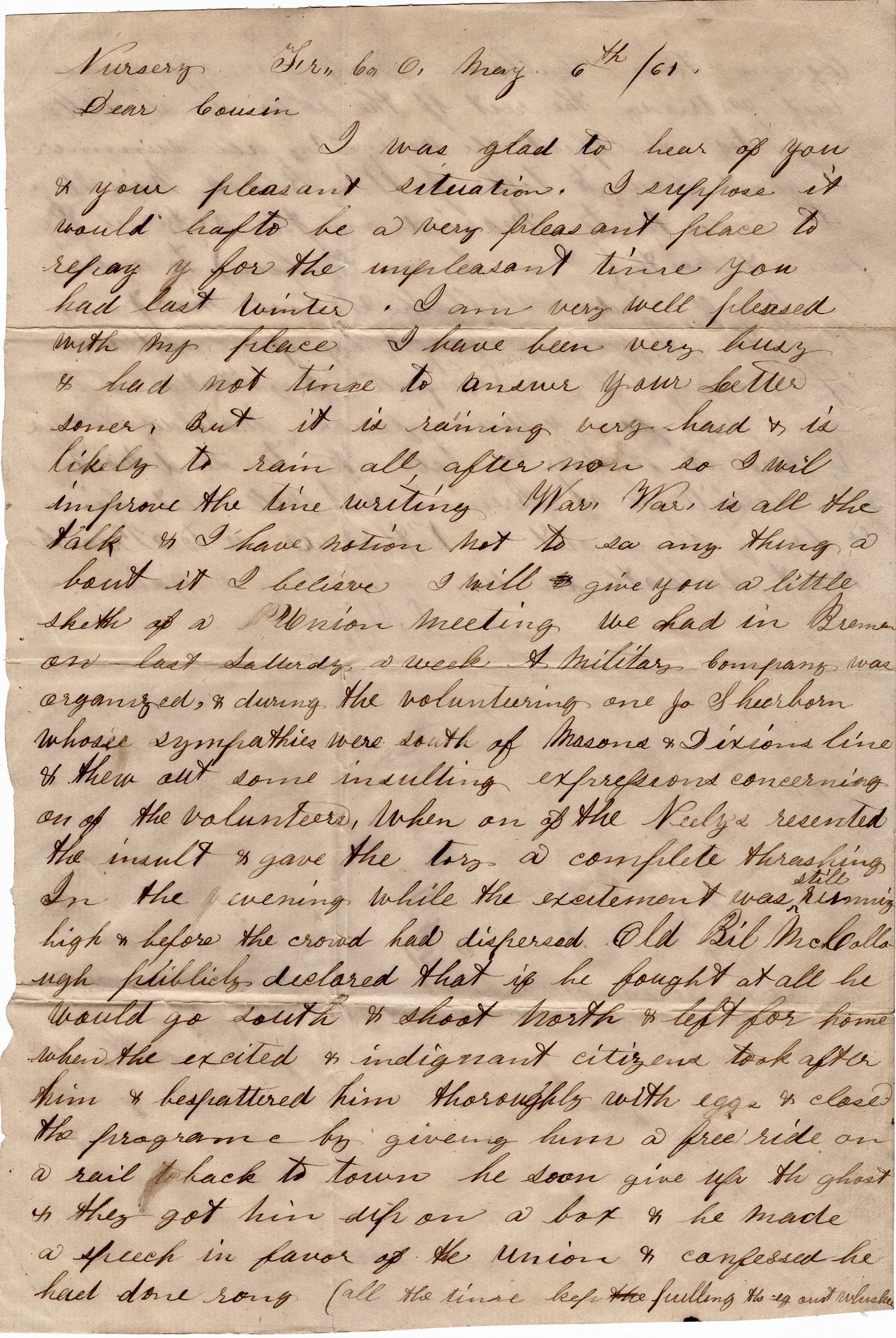
My best assessment indicates that this letter was composed by 17-year-old Catherine Solt, the offspring of Jacob Solt (1813-1886) and Sarah Glick (1819-1902) from Fairfield County, Ohio. She was likely employed as a school teacher at the time. In her correspondence to an unspecified cousin, Catherine articulates the palpable tension within the village of Bremen, where the looming threat of war has ignited conflicts stemming from divided loyalties, already resulting in acts of violence.
A newspaper article in the Lancaster Gazette published 4 days prior to this letter seems to be the source of the information contained in the letter.
T R A N S C R I P T I O N
Nursery, Fr. Co., Ohio May 6th 1861
Dear Cousin.
I was glad to hear of you & your pleasant situation. I suppose it would have to be a very pleasant place to repay for the unpleasant time you had last winter. I am very well pleased with my place. I have been very busy & had not time to answer your letter sooner. But it is raining very hard and is likely to rain all afternoon so I will improve the time writing.
Lancaster, Gazette, 2 May 1861
War, war is all the talk & I have a notion not to say anything about it [but] I believe I will give you a little sketch of a Union Meeting we had in Breman last Saturday a week [ago]. A military company was organized & during the volunteering, one Joe Sherboro whose sympathies were south of the Mason & Dixon’s line & threw out some insulting expressions concerning one of the volunteers, when one of the Neely’s resented the insult and gave the Tory a complete thrashing.
In the evening, while the excitement was still remaining high and before the crowd had dispersed, Old Bill McCollough publicly declared that if he fought at all, he would go south and shoot north & left for home when the excited and indignant citizens took after him and bespattered him thoroughly with eggs and closed the program by giving him a free ride on a rail back to town. He soon give up the ghost and they got him up on a box & he made a speech in favor of the Union & confessed he had done wrong (all the time kept pulling the egg out [his] whiskers.
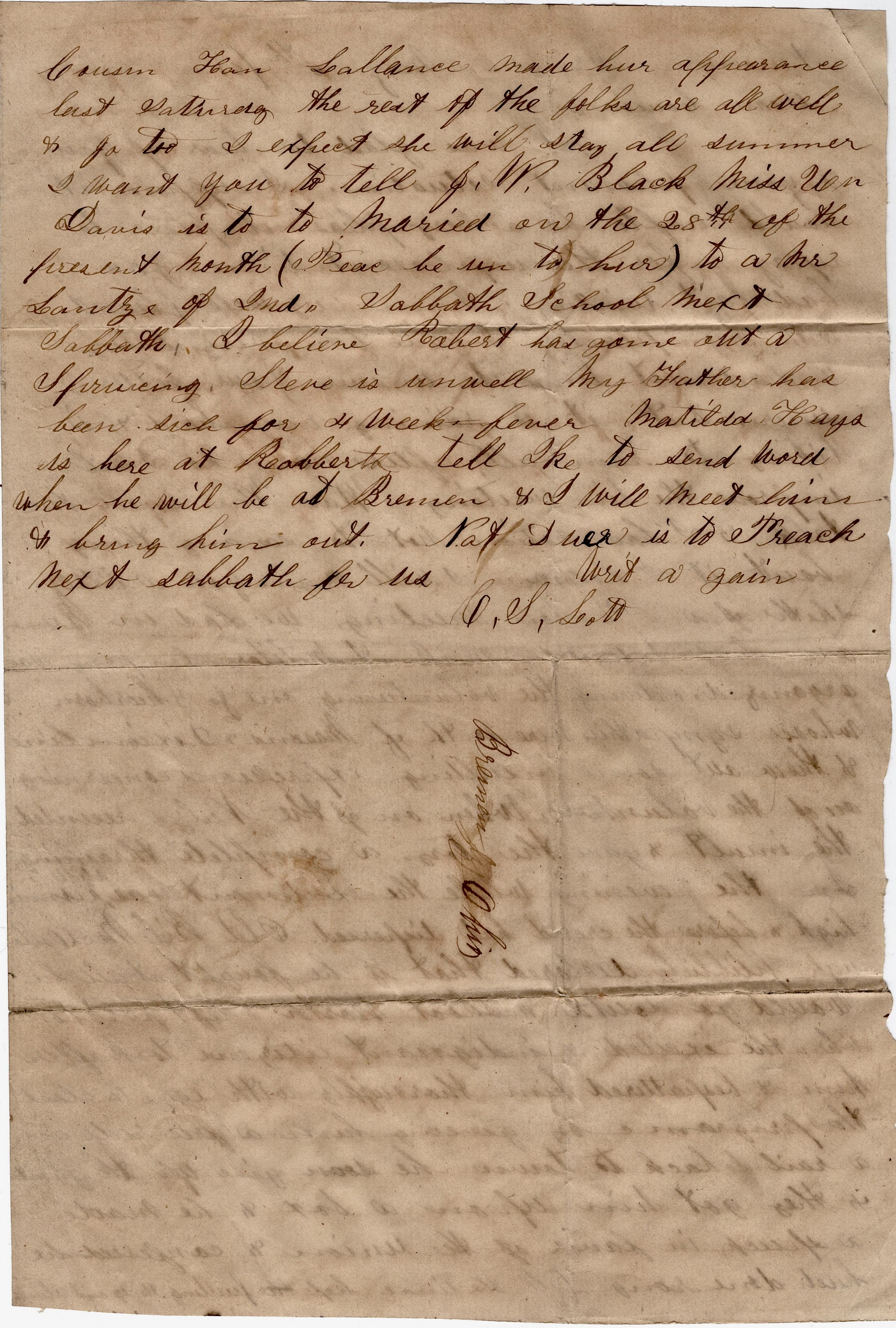
Cousin Han Lallance made her appearance last Saturday. The rest of the folks are all well & Jo too. I expect she will stay all summer. I want you to tell J. W. Black, Miss U. [Eunice E.] Davis 1 is to be married on the 28th of the present month (peace be unto her) to a Mr. [Henry P.] Lantz of Indiana. Sabbath School next Sabbath. I believe Robert has gone out a sprucing. Steve is unwell. My Father has been sick for four weeks—fever. Matilda Hays is here at Roberts. Tell Ike to send word when he will be at Bremen & I will meet him & bring him out. Nat Duer is to preach next Sabbath for us. Write again. — C. S. Solt
1 Eunice Elizabeth Davis (1838-1901) was the daughter of David Young Davis (1808-1891) and Sarah B. Parker (1816-1871) of Fairfield county, Ohio. In the 1860 US Census she was identified as a teacher in Rush Creek township.
The following letter was written by William Henry Pennock (1836-1903) who mustered into Co B, 6th Maryland Infantry as a private at Baltimore on 9 June 1862. In the fall of 1863 he was promoted to ordnance sergeant and was later detached from at the Brigade Quartermaster Department. In January 1865, he was reassigned to duty as the Brigade Forage Master.
William was the son of James Pennock (1811-1848) and Matilda Mercer (1814-1880) of Chester county, Pennsylvania. He married in 1866 to Margaret Louis McVaugh (1846-1910) and in 1870 was enumerated at Mill Creek Hundred, New Castle county, Delaware, as a farmer.
William’s letter speaks of the death of “our dear brother” whom I presume also served in the 6th Maryland Infantry as several officers names from that regiment are mentioned. Unfortunately I have not been able to identify the deceased soldier, assuming that the letter is dated correctly.
T R A N S C R I P T I O N
Asst. Quartermaster Department 2nd Brigade, 3rd Division, 6th Army Corps January 11, 1864
My dear sister,
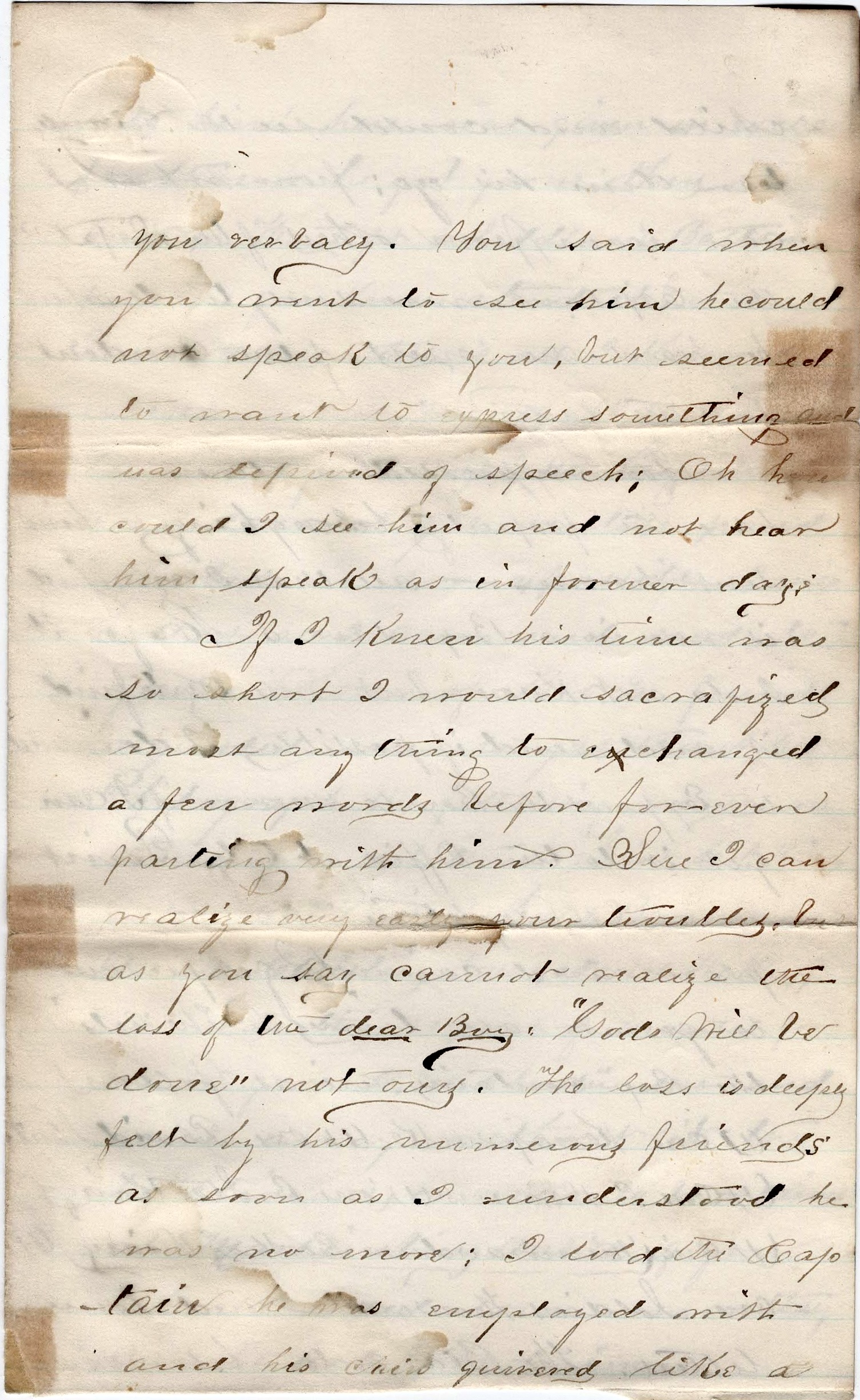
It is with a feeling of sadness intermingled with pleasure in this duty that lays before me—the first occasioned by the untimely loss of our dear brother and the latter to know “I” who is left alone is not forgotten or abandoned by you. The news of his death came to me on the 8th. An official notice was sent to the regiment and Lieutenant Col. [Joseph C.] Hill came to the office to let me know the same. Tute, I must acknowledge when I sent to see him the last time I was misinformed as to the condition of him. After I left you at the Sanitary Home to go to the boat, I stopped at the hospital to see him but was met by the nurse before I reached him saying he was better and did not want anyone to see him as rest would do him good. I did not like the only privilege denied me but for his own good, I could do no more than ask for him. I did not think after the amputation he could not survive for any great length of time and Tute, how could I tell you I thought that dear and cherished brother would leave us for a better and happier world although I thought so. And you at the same time complaining of what I was afraid might by exposure prove serious to you.
The evening before I left Washington I went to see him but met the same fate—could not get to his bedside. I then went to see the ward master in his room and the consolation was but little for what I wanted; and under circumstances existing at the time I could not come up to see you as I wanted to before I left as it was impossible for me to leave the boat on account of the office furniture being on the boat and no knowing how soon it would leave. I cannot express my feelings knowing you so near and could not see or even speakl a farewell word to those I loved.
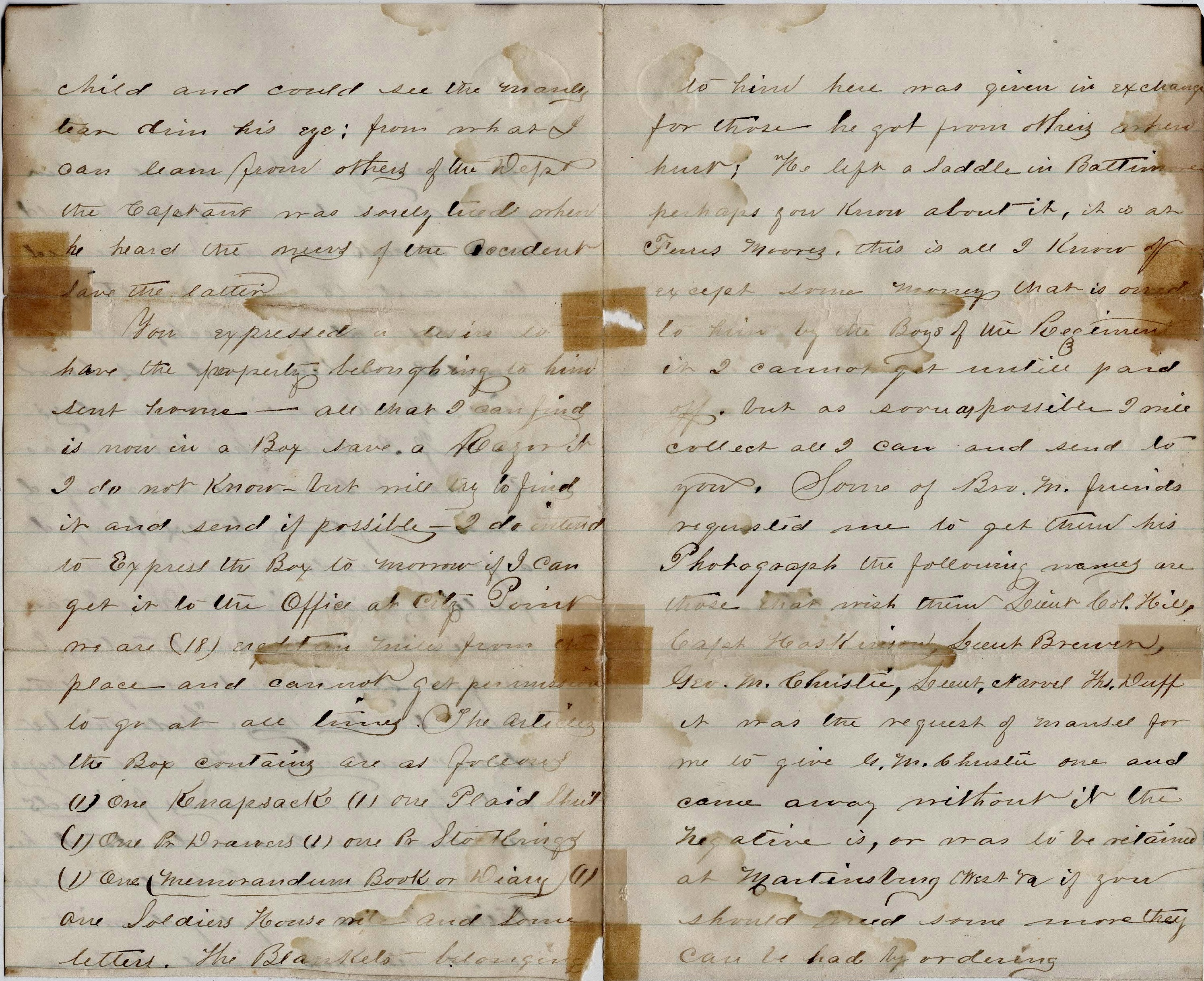
My feelings was very much depressed after the first night on account of something you might call foolish, but will tell you verbally. You said when you went to see him he could not speak to you, but seemed to want to express something and was deprived of speech. Oh how could I see him and not hear him speak as in former days. If I knew his time was so short, I would sacrificed most anything to exchange a few words before forever parting with him. Sue, I can realize very early your troubles, but as you say cannot realize the loss of the dear boy, “Gods will be done,” not ours. The loss is deeply felt by his numerous friends. As soon as I understood he was no more. I told the Captain he was employed with and his chin quivered like a child and could see the manly tear dim his eye. From what I can learn from others of the Department, the Captain was sorely tired when he heard the news of the accident save the latter.
You expressed a desire to have the property belonging to him sent home. All that I can find is now is a box save a razor. It, I don’t know but will try to find it and send if possible. I do intend to express the box tomorrow if I can get it to the office at City Point. We are eighteen miles from the place and cannot get permission to go at all times. The articles the box contains are as follows—one knapsack, one plaid shirt, one pair drawers, one pair stockings, one memorandum book or diary, one soldier’s housewife, and some letters. The blankets belonging to him here was given in exchange for those he got from others when hurt. He kept a saddle in Baltimore. Perhaps you know about it. It is at Ferris Moore’s. This all I know of except some money that is owed to him by the boys of the regiment. If I cannot get until paid off but as soon as possible I will collect all I can and send to you.
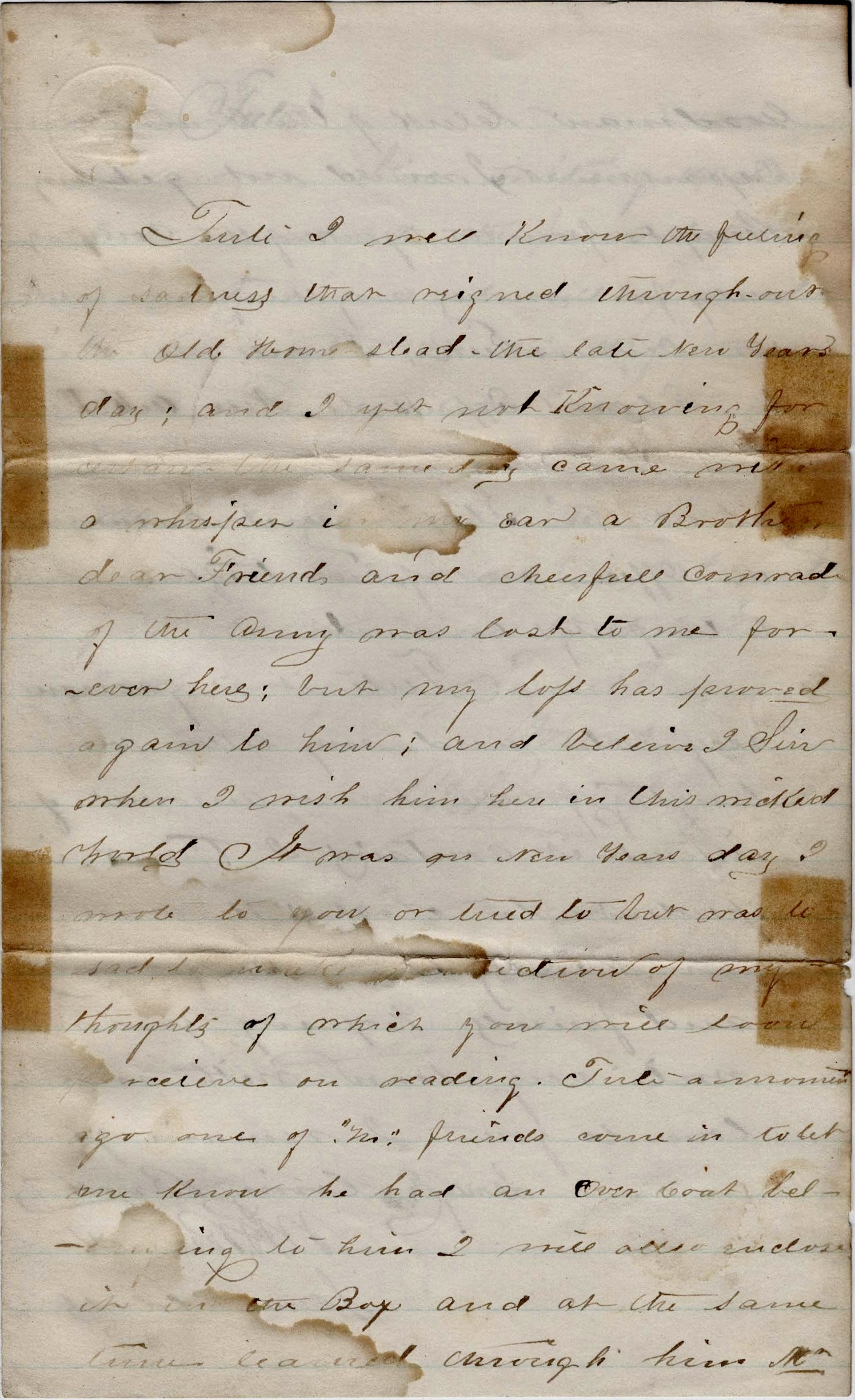
Some of brother M. friends requested me to get them his photograph. The following names are those that wish them. Lieut. Col. Hill, Capt. Haskinson, Lieut. [James H. C.] Brewer, George M. Christie, Lieut. [Erastus S.] Narval, Thomas Duff. It was the request of Mansel for me to give G. M. Christie one and came away without it. The negative is, or was to be retained at Martinsburg, West Virginia. If you should need some more, they can be had by ordering.
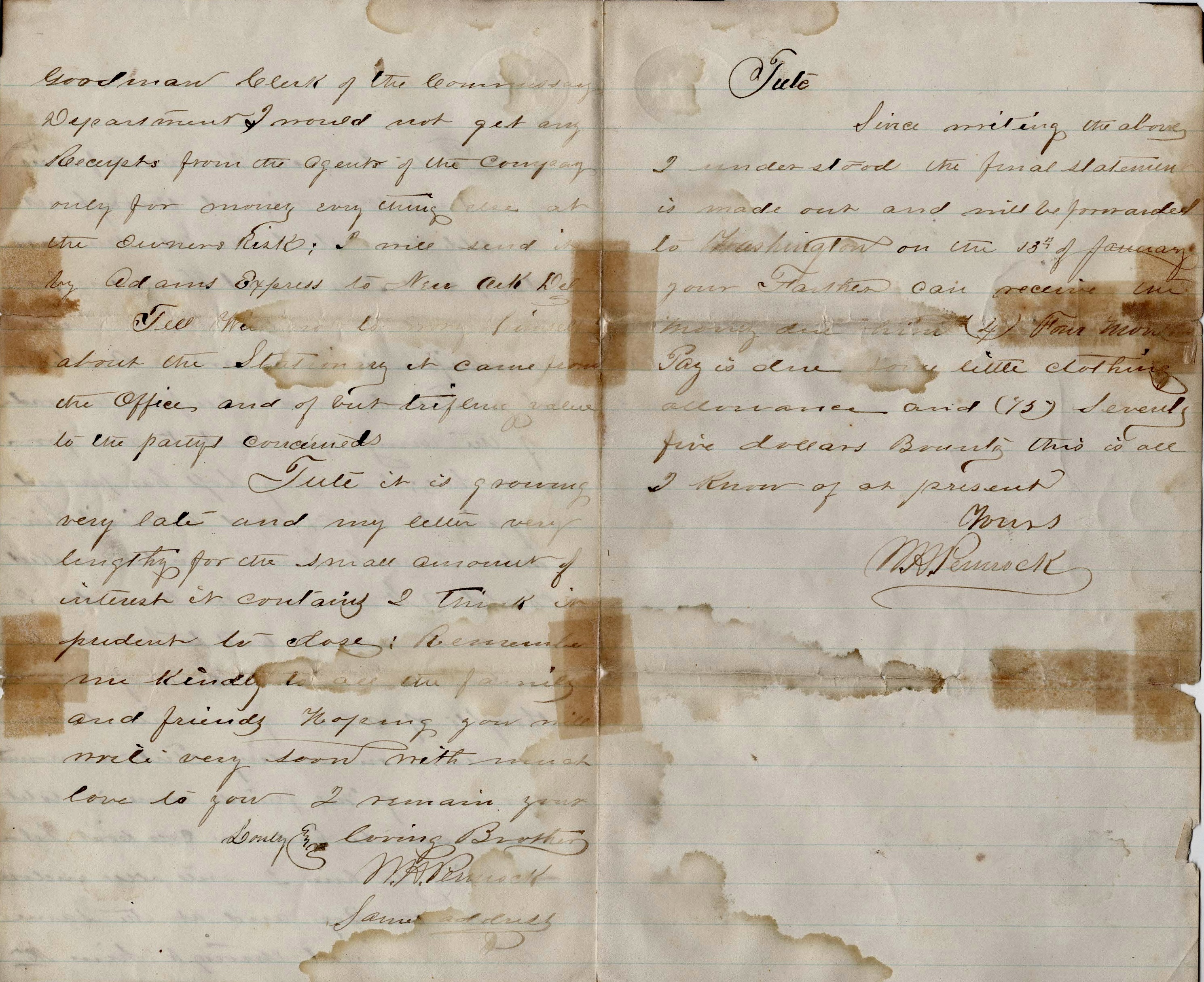
Tute, I well know the feeling of sadness that reigned throughout the old homestead the late New Years Day, and I yet not knowing for certain the same day came with a whisper in my ear a Brother, dear Friend and cheerful comrade of the army was lost me, forever here; but my loss has proved again to him; and I believe I sin when I wish him here in this wicked world. It was on New Years Day I wrote to you or tried to but was too sad to make [ ] of my thoughts of which you will soon receive on reading. Tute, a moment ago one of “no.” friends come in to let me know he had an overcoat belonging to him. I will also enclose it in the box and at the same time leaned through him Mr. Goodman, clerk of the Commissary Department, [that] I would not get any receipts from the agent of the company—only for money. Everything else at the owner’s risk. I will send it by Adams Express to Newark, Delaware.
Tell [illegible] about the stationery. It came from the office and of but trifling value to the party’s concerned. Tute, it is growing very late and my letter very lengthy for the small amount of interest it contains. I think it prudent to close. Remember me kindly to all the family and friends. Hoping you will write very soon with much love to you, I remain your lonely and loving brother, — W. H. Pennock
Tute, since writing the above, I understood the final statement is made out and will be forwarded to Washington on the 13th of January. Your Father can receive the money due him. Four months pay is due. Very little clothing allowance and 75 dollars bounty. This is all I know at present. Yours, — W. H. Pennock

















 Spared & Shared 23