The following letter was written by Henry French Day (1843-1875) to his brother Almon Curtis Day (1838-1919). They were the sons on Abiah Grover Day (1810-1879) and Gratia Lane Curtis (1817-1911) of Androscoggin county, Maine.
Henry gives no indication in his letter as to what his purpose for being in Black Hawk, Colorado Territory, but it’s presumed he was employed in the mining business in some capacity.
Black Hawk, Colorado Territory(1864)
T R A N S C R I P T I O N
Addressed to A. C. Day, Buckfield, Maine
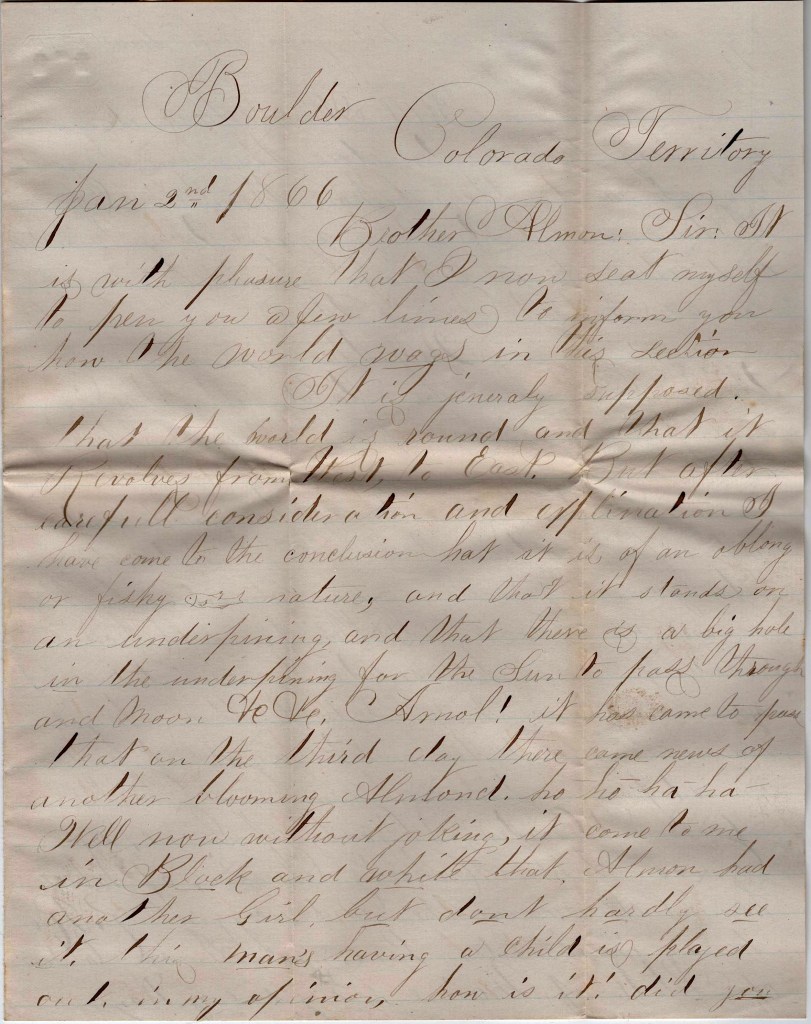
Boulder, Colorado Territory January 2nd 1866
Brother Almon, sir
It is with pleasure that I now seat myself to pen you a few lines to inform you how the world wags in this section. It is generally supposed that the world is round and that it revolves from west to east. But after careful consideration and explanation, I have come to the conclusion that it is of an oblong or fishy nature and that it stands on an underpinning for the sun to pass through and moon &c. &c. Arnol! it has come to pass that on the third day there came news of another blooming Almond, ho-ho-ha-ha.
We now, without joking, it come to me in Black and white that Almon had another girl. but don’t hardly see it. This man’s having a child is played out in my opinion. How is it? Did you have another girl or did your wife have it, there is the question.
Well, Almon, how do you get along this winter? Does hte boys use you rough or do they behave themselves (for I hear you are teaching again this winter) and where do you teach? How do you get along as School Committee?
Well, there is snow there as I have been told, but there is enough snow here for here and there too.
There is nothing for me to write of information that will be interesting to you. There is a young man here by the name of Herbert Tubbs from Hebron Academy. Says he used to be acquainted with you when you went to school there. He got out here about two weeks ago and now is stopping with me. Also saw Charles Lame & Curtis & Crosby of Greene. Saw Alonzo Tubbs, Herbert’s cousin, of Hebron. He is in Boulder here so I see lots of State of Maine boys every day.
Well Almon, there is much business going on here now. Wish you could be here for a few hours and then be back again. Well as its getting late, I must draw this to a close, so wishing you and your wife and children long life and happiness. From your ever true brother, — Henry F. Day
Black Hawk, Box 82, Colorado
Almon C. Day and Clara Day, his wife
P. S. Give my love to all and write soon. Yours truly, — Henry Day, Esq. or any other man
The following letter was written by William Taylor (b. 1807 in Penn.), the husband of Hannah (Price) Taylor (b. 1825 in Penn.)—both Mulattos—who were residents of Unionville, Chester county, Pennsylvania at the time of the 1860 US Census. William wrote the letter to his oldest son, Benjamin Jones Taylor (1842-1899) who was enumerated in the 1860 Census with his siblings, William (b. 1844), Hebert (b. 1848), Elizabeth (b. 1850), Mary A. (b. 1851), and Esther (b. 1856). I don’t know William penned the letter but since the postmark was Philadelphia, I’m going to assume he was working there at the time. I cannot find any record that his son Benjamin ever volunteered to serve in the U. S. Colored Troops (USCT).
Benjamin married Anna Frances Davis of Providence, Rhode Island, and in the 1870 US Census, he was enumerated in Providence working as a coachman. By 1880, Benjamin was working as a hosier, his home located at 379 Fountain Street. Benjamin’s son, Charles (1877-1942) served in Co. H, 9th US Cavalry—a Buffalo soldier.
It’s curious that William concluded his letter by writing, “It is very requisite that we as a combined body should make the best of everything from the fact that prejudice is raging rapidly.” This statement is further evidence of a noticeable rise in racial tensions and hostility towards Black Americans in certain areas—particularly in New York City where the military draft stoked fears and sparked racial violence.
T R A N S C R I P T I O N
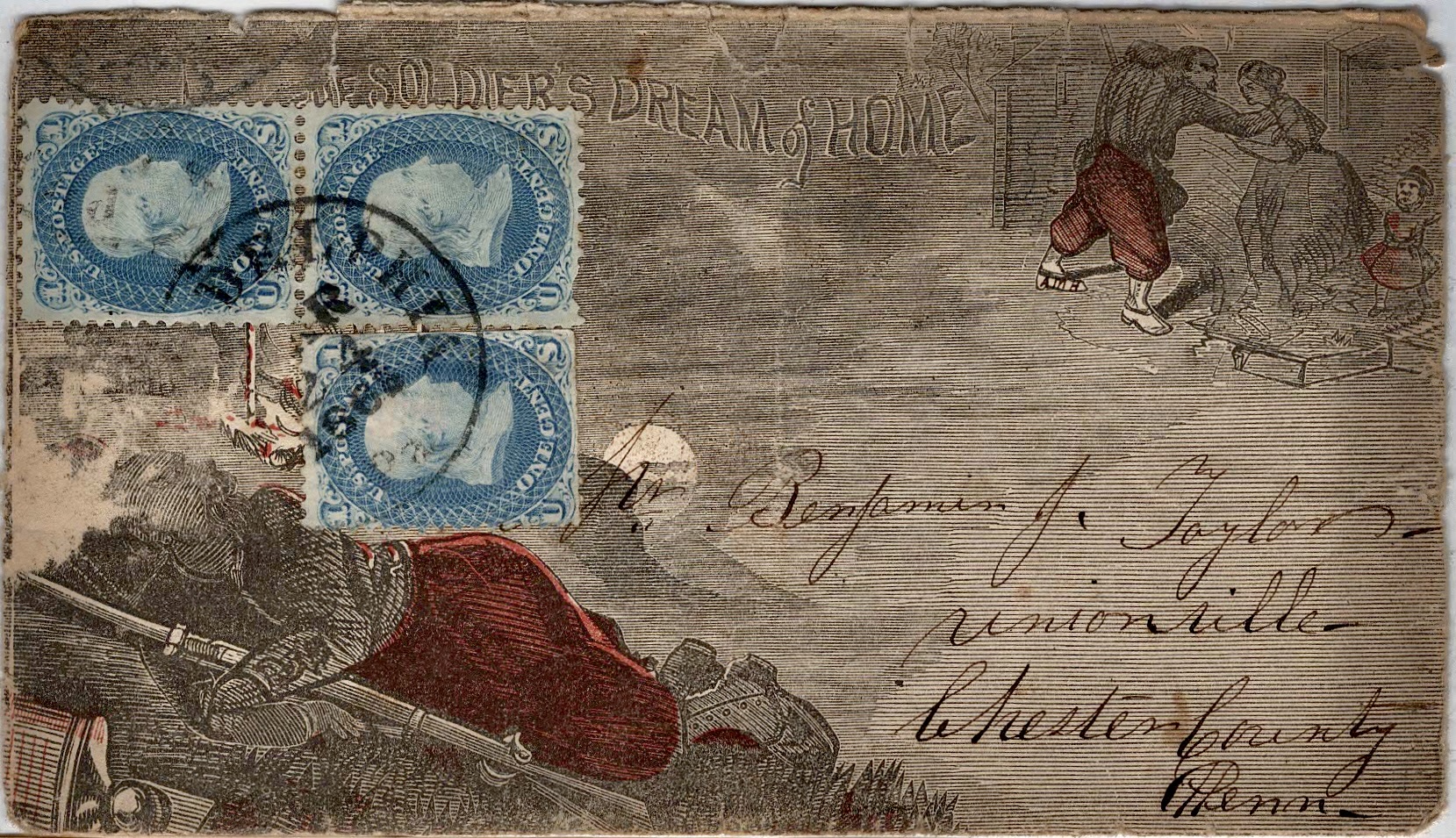
Addressed to Mr. Benjamin J. Taylor, Unionville, Chester county, Penn.
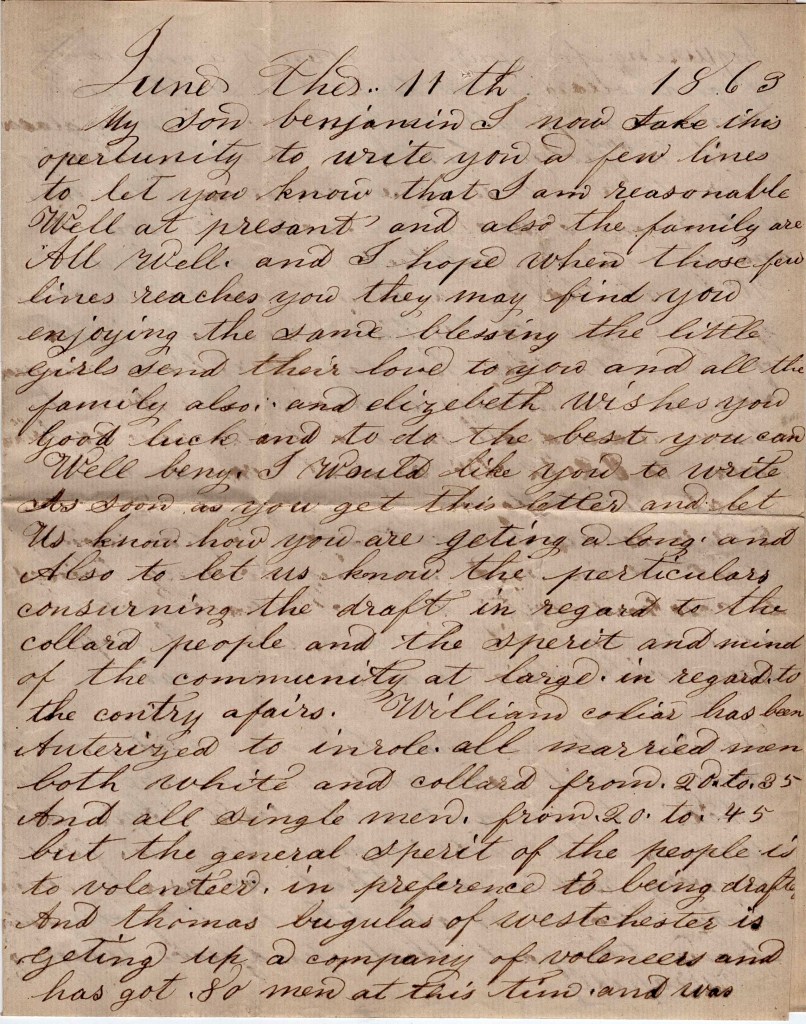
[Philadelphia, Pa.] June 11, 1863
My son Benjamin,
I now take this opportunity to write you a few lines to let you know that I am reasonable well at present and also the family are all well and I hope when those few lines reaches you, they may find you enjoying the same blessing. The little girls send their love to you and all the family also. And Elizabeth wishes you good luck and to do the best you can.
Well, Benj, I would like you to write as soon as you get this letter and let us know how you are getting along and also to let us know the particulars concerning the draft, in regard to the colored people and the spirit and mind of the community at large, in regard to the country affairs. William Collier has been authorized to enroll all married men, both white and colored, from 20 to 35, and all single men from 20 to 45. But the general spirit of the people is to volunteer in preference to being drafted and Thomas Bugulas [?] of West Chester is getting up a company of volunteers and has got 80 men at this time and was inquiring for you. He wants a company of good colored men to march with him as soon as possible.
And Aunt Mary Glasco got a letter from her son London for he has not received neither wages nor bounty and is entirely destitute of money. He was well at that time and is now in South Carolina. 1
Give our love to William Green and enquire of him whether he saw William Shirley’s son for he wishes to know. Well, Benj., I have reduced all my old debts from 14 dollars down to $2.72 cents and it would be a great relief to me if you could send me 5 or 6 dollars. I must make a portion of rent soon and having so many things to contend with that I shall not be able to raise it in due time. I hope you will oblige me if you can.
Lovina Means and Tilman and family and David Carr and family are middling well at present and send their well wishes and best respects to you for it is very requisite that we as a combined body should make the best of everything from the fact that prejudice is raging rapidly.
I must now close by saying our respects to you all together. No more at present. From your father, — William Taylor
1 London Glasco (1841-1863), mulatto, was the son of Robert Glasco (1797-1877) and Mary (Taylor) Brown (1803-Aft1870) of Unionville, Chester county, Pennsylvania. London served in Co. B of the 54th Massachusetts Infantry and was killed in the assault on Fort Wagner on 18 July 1863. London was listed in the Company Descriptive Book record as single, 22 years of age, 5 feet 6 inches tall.
A sketch of Robert S. Paul based on a circa 1900 photograph found in Ancestry.com.
The following letter was written by Robert Spencer Paul (1842-1905), the son of Hosea Paul (1809-1870) and Ellen Gamble (1813-1889) of Cuyahoga Falls, Summit, Ohio. Robert learned the surveyors trade from his father; his gateway into a career in civil engineering. From 1862 to 1865 he served on the topographical staff of the Army of the Cumberland and after attending Lebanon College in Ohio and the Pennsylvania Polytechnic College, he settled in Akron where he was elected county surveyor, succeeding his father in 1870.
He married Sarah Matilda Romig on 25 July 1872. They were the parents of at least 1 son and 6 daughters. He lived in Stow Township, Summit, Ohio, United States in 1850 and Ohio, United States in 1870. He died on 23 August 1905, in Akron, Summit, Ohio, United States, at the age of 62, and was buried in Oakwood Cemetery, Cuyahoga Falls, Summit, Ohio, United States.
In his letter Robert describes the fortifications that were being hastily constructed near Cincinnati in the fall of 1862 as Braxton Bragg’s and Kirby Smith’s Rebel Armies threatened the Queen City itself. The bulk of this work was carried out by the Black Brigade—the first formal organization of black men used for military purposes in the North during the Civil War. They felled trees, constructed roads, built breastworks, and dug rifle pits for nearly three weeks. Confederate General Henry Heth’s force of between six and eight thousand soldiers came within a few miles of the river near Fort Mitchell, but did not engage. The new defensive works and the presence of more than 25,000 Union soldiers alongside local militia and Squirrel Hunters proved a formidable deterrent. Heth’s forces departed and the Federal Army then turned its attention to safeguarding Louisville.
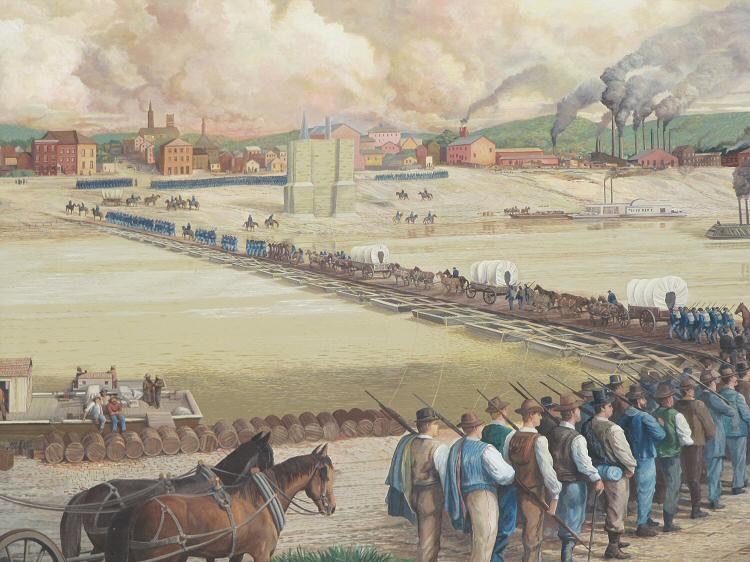
“On September 20, The Black Brigade disbanded. The 705 surviving members of Cincinnati’s Black Brigade marched through the streets of Covington, Kentucky shouldering shovels and pickaxes, then crossed the pontoon bridge. Martial music played and banners rippled in the breeze as the men strode proudly through the main streets of the Queen City. Judge Dickson dismissed them with an emotional speech: ‘The sweat-blood which the nation is now shedding at every pore is an awful warning of how fearful a thing it is to oppress the humblest being. Until our country shall again need your services, I bid you farewell.'” [Source: The Black Brigade and the Defense of Cincinnati by David T. Dixon]
Robert frequently mentions “Harry” in the letter. This was his older brother Harrison Daniel Paul (1835-1906) who served in Co. G, 1st Ohio Infantry. He became a Lieutenant Colonel and Chief Engineer of the Department of the Ohio.
A modern mural depicting the “Squirrel Hunters” crossing the Ohio River for the defense of Cincinnati.
T R A N S C R I P T I O N
Cincinnati, Ohio September 14, 1862
Dear Parents,
I am well and have been. Received two letters from home today, today being the first day in a week that I could get to the post office. Friday I was out in a very hard rain without my coat and got wet twice, but I did not take cold. There was a great influx of squirrel hunters [from Ohio] for a few days past but I hear they are going home as fast as they can as there are over 75,000 troops here to fight the rebels. I do not know when the fortifications will be finished. Harry has the Black Brigade under him now. Tom Peters has one half and Harry the other, giving each 600 negroes. They are by far the better workmen. Harry and Tom Peters’ works are by far the best constructed of any along the whole line and they have been told so by Major [James H.] Simpson and Col. [Charles] Whittlesey.1
You will see by the papers I sent you that Harry and Tom Peters have charge on the Newport side. Harry at Three Mile Run, Peters at Camp Shaler. Harry has had two forts to construct while none of the others have had more than one. Harry eats with the Black Brigade and the cooks of the negro company that he messes with were getting $100 a month apiece as cooks before they went to the fortifications. They do get things up in style. The white cooks in the camp around are too dirty to eat after. In Harry’s division, there are 300 to 500 negroes chopping all the time and they will chop more than three city white men. They are a good-natured jolly set, more than half mulatto, pretty smart fellows.
An AI generated sketch of the monument commemorating the Black Brigade.
Now in regard to the question father asks, I will state Col. Whittlesey says the Engineer Corps will get their pay and as I rank as a commissioned officer, it will be something. All corps will be paid. No persons work for nothing except those that refuse pay. As to my board, I get it where I can. If I can get around, I go to Harry’s boarding house which is about half the time. The rest of the time I have got my meals at eating houses, farm houses, groceries, bakeries, and camps just where I happen to be. I am not at all particular.
You ask why does not Harry write sometimes. I see him once a day and sometimes not at all, generally two or three times when I see him. We are either tired or busy and I have not heard whether he writes you or not. I have [not] seen any Dayton friends. If there has been any Falls boys here to see me, they could not find out much as the office has been locked all the time, all having gone to the wars. Mother thinks I could get clothes, does she? Well an officer has to find his own. What I am going to do after what I am at is done, I do not know. Perhaps I can get something else to do. I will try and find out what chance there would be for Hosea here as he is a better writer than I am and he would stand a better chance for a place in some of the departments. I will write him soon. Send me the Summit County Beacon. I have much to write you if I had time. Would like to write to Dwight and Ed. Can’t they write to me and tell me all going around the house, [such as] if Black Tom and his mother are well, how quack gets along, if our garden is good, if they go to school, and lots of things I want to know. I will write them a long letter soon. Have Mary write and ask any questions about going to Dayton for she wants to and I will try and find out all she wants to know. If I had had the time, I would have written a good long letter of the things I have seen here. I will do so soon if I can. Your son, — Robert S. Paul
1 Colonel Charles Whittlesey and Major James H. Simpson were with the Topographical Engineers for the Department of the Ohio.
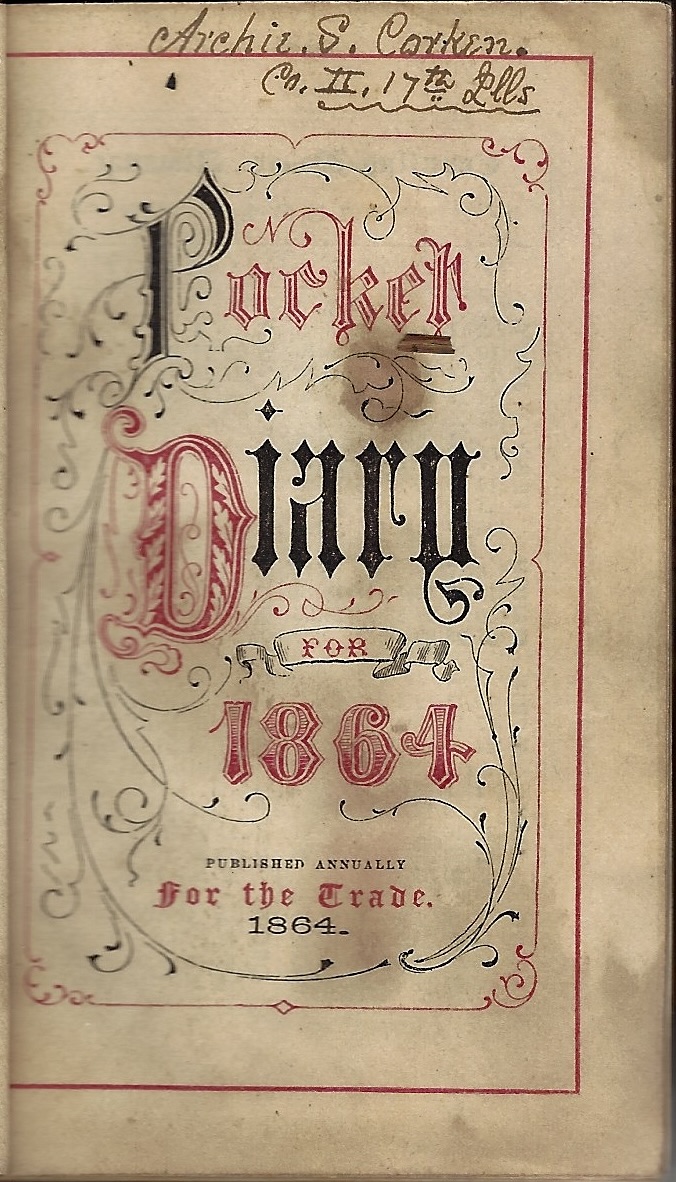
The following diary was kept by Archibald Simpson Corken, Jr. (1843-1890), an emigrant from Liverpool, England. “Archie” came to the United States in the mid 1850s with his father, Archibald Sr.—a clock and watch maker, jeweler who set up his shop in Rock Island, Illinois. His January 1857 advertisement in the Rock Island Advertiser claimed 20 years experience in some of the “principal Watch Manufactory houses of Europe” and that he was capable of offering “perfect satisfaction” to the the people of Rock Island at his shop on Illinois Street.
No doubt Archie learned the jeweler’s trade from his accomplished father in the Rock Island shop but three years later, at the time of the 1860 US Census, the Corken family was enumerated in the little town of Aledo in western Illinois, with a promising future as the newly named county seat of Mercer county. Here, 46 year-old Archibald worked as a “jeweler” and his 18 year-old son Archie worked as a “druggist.” Other members in the household included Archie’s presumed mother, 35 year-old Mary Ann, and three younger sisters, 14 year-old Ellen, 10 year-old Agnes, and 4 year-old Emma, all born in England except the youngest.
While working in Aledo, Archie was recruited to serve as a private in Co. I, 17th Illinois Infantry, his term of service being three years from June 1861 to June 1864. During the period of this diary, he was mostly stationed in the occupation of Vicksburg after the Union’s successful siege of 1863.
Supply lines were tenuous during the early part of the occupation. On 2 January 1864 he wrote “Commissary stores are getting very scarce. There is no whiskey at the post, since the potatoes have all frozen.” Tensions with the locals also ran high; the next day he wrote “Provost marshal issued an order banishing five ladies from this place for insulting our government by leaving church on Christmas Day when the prayer for the president of the United States was made.” General Sherman passed through the base twice, on 16 January and 28 February. Corken noted the regiment’s poor discipline and morale: “Every evening the town is crowded with officers and men, many of them drunk and disorderly, swearing, drinking & carousing the whole night long” (16 March).
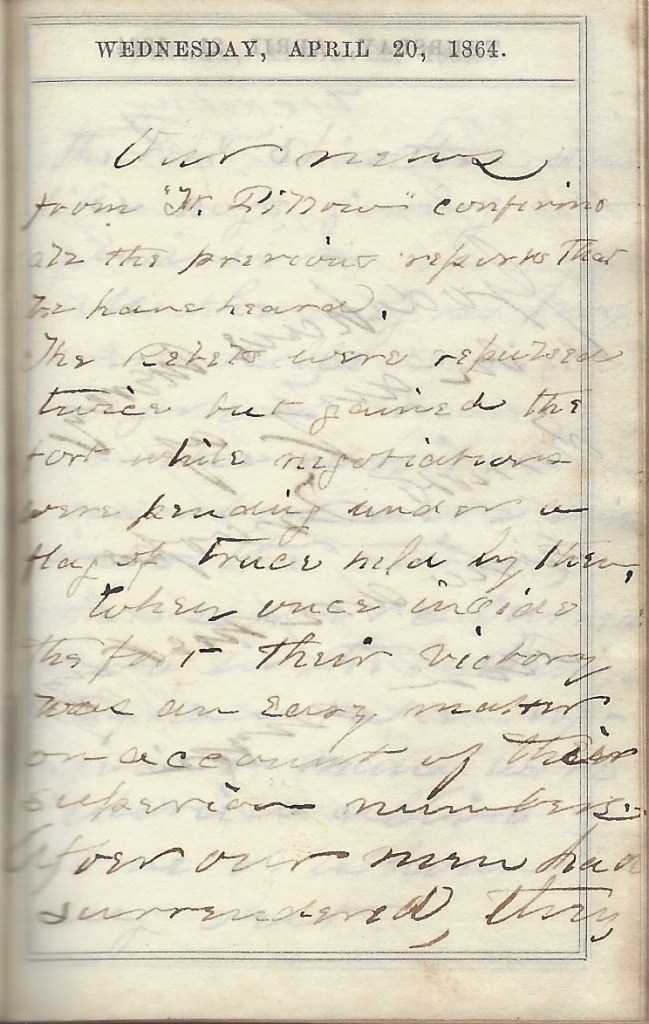
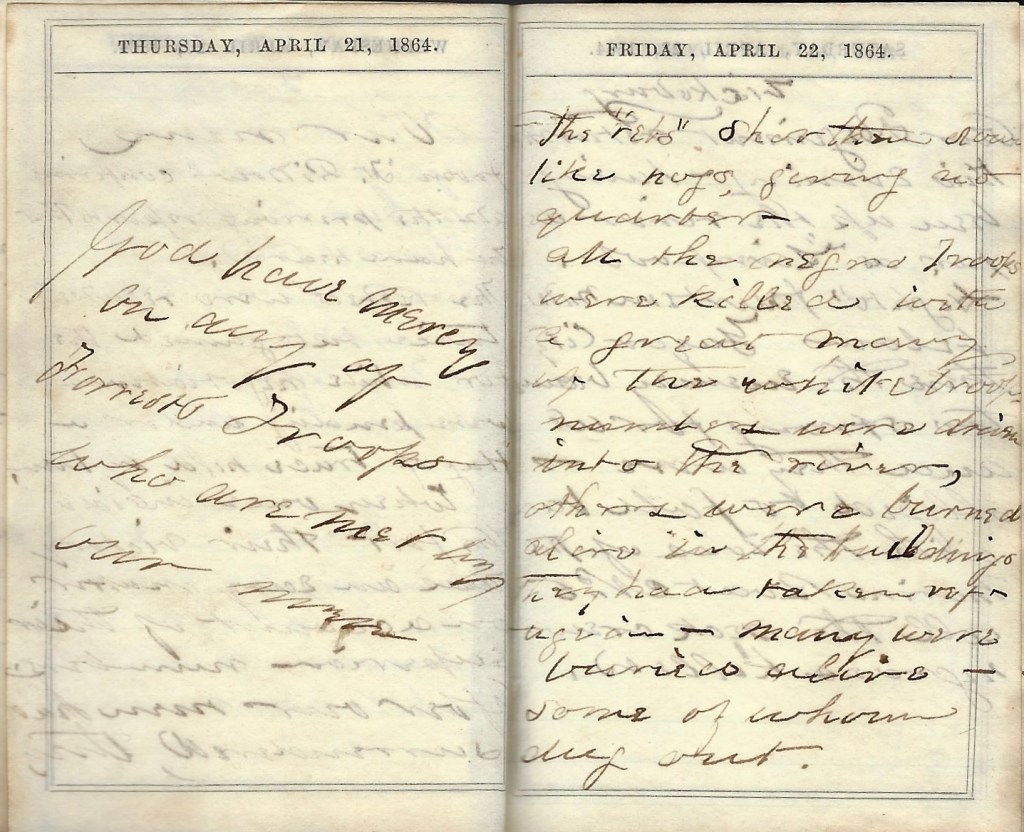
The most dramatic entry is a meditation on the notorious Fort Pillow Massacre which fills the 20-22 April pages: “Our news from Ft. Pillow confirms all the previous reports that we have heard. The Rebels were repulsed twice but gained the fort while negotiations were pending and a flag of truce held by them. . . . After our men surrendered, the Rebs shot them like hogs, giving no quarter. All the Negro troops were killed with a good many of the white troops. Numbers were driven into the river, others were burned alive in the buildings they had taken refuge in. Many were buried alive, some of whom dug out. God have mercy on any of Forrest’s troops who are met by our men.”
Corken began the process of mustering out on 17 May, and returned home to Rock Island, IL on 26 June. The diary includes a handful of civilian entries; he heard Schuyler Colfax speak in Davenport, Iowa on 31 October. After the war, Corken sold clocks and watches in Iowa, and was a jeweler in Rock Island, IL.
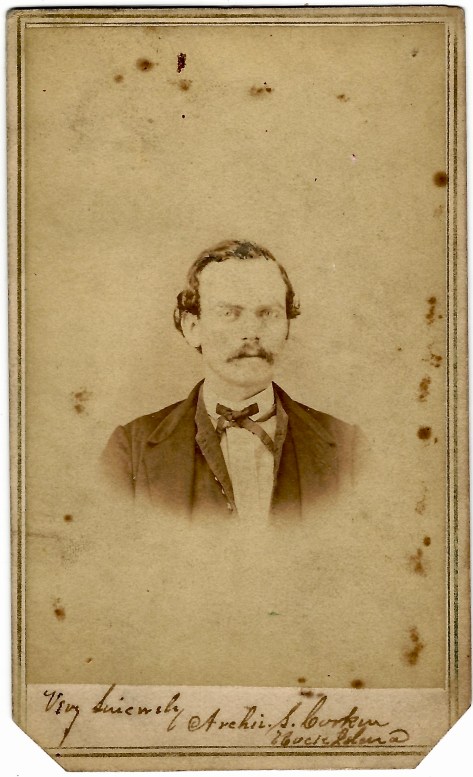
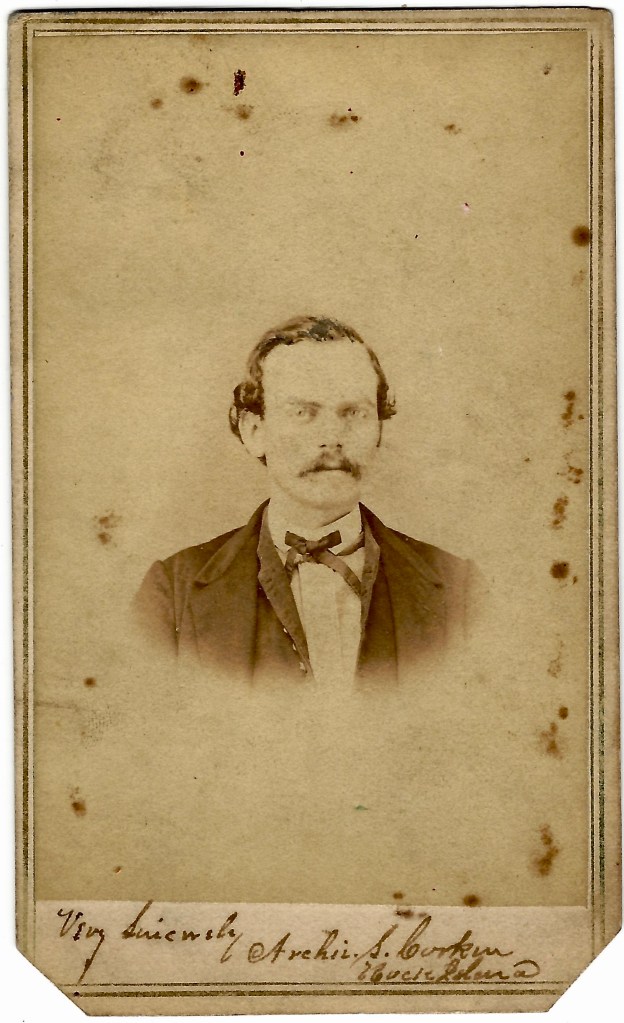
Tucked in the back of the volume are two signed cartes-de-visite: one of an unidentified Union soldier taken in the studio of William Owen of Evansville, WI; and a circa 1864 signed portrait of Corken by Cook & Newberry of Rock Island, IL. Also included is Corken’s Davenport, IA Knights Templar, Masonic Card.
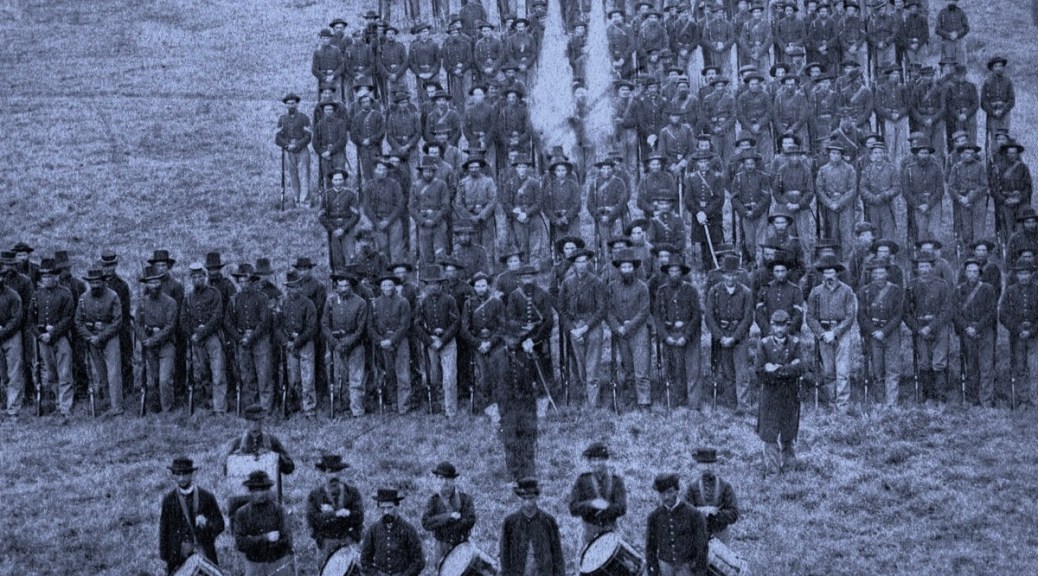
Albumen print by an unidentified photographer. Guy DeMasi Collection. This view of the 17th Illinois Infantry, taken at Vicksburg in the spring of 1864 towards the end of its three-year enlistment, visualizes under strength regiments later in the war. The number of Illinoisans present, about 217, is a shadow of the thousand or so souls who mustered at Peoria in May 1861. Losses by disease took a toll, as did combat losses, including 130 casualties at Shiloh. Military Images Magazine
T R A N S C R I P T I O N
[Editor’s note: If Archie made no entry on a given date, that date is skipped in this transcription.]
Friday, January 1, 1864—Vicksburg, Miss. Gen. Jas. B. McPherson commanding District. Gen. McArthur commanding Post. Lt. Col. Wardell P. M. [Provost Marshall]. Weather very cold—ice forms every night from one to two inches thick. It is feared the river will close at some point between Memphis and Cairo and stop our supplies and mail.
Saturday, January 2, 1864—Vicksburg, Miss. Lt. E. E. Ryan is acting R. Q. M. [Regimental Quartermaster]. H. T. Smith sentenced to suspension of rank and pay proper for three months, one month of time probably expired. Commissary stores are getting very scarce. There is no whiskey at the Post and the potatoes have all frozen.
Sunday, January 3, 1864—Vicksburg, Miss. Weather remains cold. We have to keep fire up all night in order to keep warm. Provost Marshall issued an order banishing five ladies from this place for insulting our government by leaving church on Christmas day when the prayer for the President of the United States was made.
Monday, January 4, 1864—Vicksburg, Miss. Review ordered but weather entirely disagreeable for it. Lt. E. E. Ryan, Acting Q. M., vice Glancy returned to duty.
Tuesday, January 5, 1864—Mertie F. Buck
Friday, January 8, 1864—Vicksburg, Miss. Troops at this post reviewed and inspected by Maj. Gen. David Hunter who appeared to be well satisfied with the appearance of them.
Saturday, January 9, 1864—Vicksburg, Miss. Weather moderated somewhat today although the ice on the ponds is strong enough to bear a person easily.
Sunday, January 10, 1864—Vicksburg, Miss. Received marching orders during the night & embarked on board the S. S. Northerner. Troops consisting of two Batteries and the 17th, 8th, and 30th Illinois. Also the 81st Illinois & 7th Missouri. Commanding officer Gen. [Mortimer Dormer] Leggett. Left at 3 p.m. for up the river.
Monday, January 11, 1864—S. S. Northerner. Laid up and wooded all night. We accompanied by the transports “Era” and “Madison.” We make very poor time as our vessel is a coal burner and has to burn green wood. Judge Morgan’s Plantation.
Tuesday, January 12, 1864—S. S. Northerner. Laid up last night at “Skipwith’s Landing” above Lake Providence. Wooded up again and started, assisted by a tow boat. Picked up a forlorn looking individial who commenced waving a white flag as soon as we hove in sight. He turned out to be a cotton speculator who had been captured by guerrillas but had succeeded in escaping.
Wednesday, January 13, 1864—S. S. Northerner. Old River Lake, Arkansas. Reached here last night. Our regiment went on picket. One boat and one company went up to Greenville five miles above. Fine country for foraging. The boys are getting lots of swine and chickens, beef cattle, &c. &c.
Thursday, January 14, 1864—Made a mistake of one day in the date. It was last night we reached Old River Lake, Arkansas. Lt. [Theodore] Glancey crossed the lake & visited the plantation of Mr. Dunn where we found four very good looking young ladies. Folks all conservative.
Friday, January 15, 1864—S. S. Northerner, below Skipwith’s. Made very good time & reached Vicksburg at 3 p.m. Laid at anchor last night just below Skipwith’s. Boys all glad to get back. A fruitless expedition. Captured but two prisoners.
Saturday, January 16, 1864—Vicksburg, Miss. Everything here is very quiet. Gen. Sherman arrived here this morning on his way to the Dept. of New Orleans where he is ordered to report for duty. It is rumored that his Corps—the 15th—is to come down here to New Orleans. The weather is damp but pleasant. Sergt. [George B.] Millard returned to the regiment for duty.
Monday, January 18, 1864—Vicksburg, Miss. [Thomas A.] Causey and [Alford S.] Grooms returned to day. Wrote to Schenck.
Tuesday, January 19, 1864—Vicksburg, Miss. Bill Henderson returned today. Folks all well at home. McPherson made a speech to our Brigade to encourage enlistments in the Veteran service.
Thursday, January 21, 1864—Vicksburg, Miss. Weather remarkably warm today. The paymaster with funds arrived yesterday. Will commence paying probably tomorrow. All the paymasters are engaged in paying off veterans.
Friday, January 22, 1864—Vicksburg, Miss. Today our Brigade drilled for the purpose of selecting a regiment to drill against the Division for an Excelsior flag. Our regiment was the best one present and is to drill tomorrow against the 124th Illinois and the 78th Ohio, the crack regiments of the other two Brigades. We do not expect to win because we have bot drilled during the winter.
Saturday, January 23, 1864—Our Division drill came off today resulting in our defeat and the success of the 124th [Illinois]. We have to rest satisfied on best of the Brigade.
Sunday, January 24, 1864—Vicksburg, Miss. It is reported that the 15th Army Corps is on the way down the river and that when they arrive we are to move towards Jackson or Meridian.
Wednesday, January 27, 1864—Vicksburg, Miss. Today 15 steamboats loaded with troops arrived and will move probably tomorrow or next day towards Jackson, Miss. Not yet known if our regiment will go or not.
Thursday, January 28, 1864—Vicksburg, Miss. Paid off today two months pay. Up to January 1st.
Sunday, January 31, 1864—Vicksburg, Miss. Gen. Smith’s Division, 16th Army Corps arrived here during the last days. The rest of the Corps will be here shortly. An expensive move is on foot. We shall very probably go along.
William A. Hubbard also served in Co. I, 17th Illinois Infantry. (Abraham Lincoln Presidential Library)
Wednesday, February 3, 1864—Vicksburg, Miss. Regiment marched this morning. I remained behind in charge of the Q. M. [Quartermaster] Dept. 16th and 17th Army Corps are moving toward Jackson, Miss.
Sunday, February 7, 1864—-Vicksburg, Miss. Everything very dull. No news from the front except rumors of a fight at Yazoo City.
Sunday, February 14, 1864—Vicksburg. Peach trees and Magnolias in full bloom.
Monday, February 15, 1864—Vicksburg. H[enry] C. Moorhead just arrived from home.
Wednesday, February 17, 1864—Vicksburg. Nothing new. Drew from 18th to 22nd.
Thursday, February 18, 1864—We were very much surprised to find the ground covered with snow this morning when we woke up. It soon went off though to the great delight of these southerners who can’t stand our climate. This southern climate has been putting on northern airs.
Sunday, February 28, 1864—Vicksburg. Gen. Sherman arrived here this afternoon and went down the river on the Diana. No news from the front.
Wednesday, March 2, 1864—Vicksburg. Adams, our sutler, arrived this evening from the front. He left the regiment bivouacked at Canton. They had been to Meridian and have captured a great man horses, mules, &c. & have destroyed about 200 miles of railroad. Our acting Regimental Quartermaster was taken prisoner while out with a forage train. One man killed and two wounded.
Thursday, March 3, 1864—Vicksburg, Miss. Met with an old friend today—Schenck—who is under [ ] going home. Ranks as paymaster in the Regular Navy and will probably be assigned to some vessel as soon as he reports.
Friday, March 4, 1864—Vicksburg. Regiment returned.
Saturday, March 12, 1864—Vicksburg, Miss. Today is my twenty-first birthday by the Providence of God.
Monday, March 14, 1864—We have been inside the works at this place nearly eight months and with the exception of an occasional scout have led a miserable, dreary, and monotonous existence. Camp life will do well [ ] but this life in garrison would demoralize the best Regulars in the world much more our loosely disciplined volunteers. I begin to believe that [the war correspondent William Howard] Russell was more than half right when after reviewing the troops on the Potomac that [ ] Army of McClellan’s, he said, “That is no army—nothing but an armed mob.” It will apply well to our army here. A regiment is scarcely ever seen drilling and even the garrison guard duty is miserably conducted. Every evening the town id crowded with officers and men, many of them drunk and disorderly, swearing, drinking, and carousing the whole night long. There is hardly that respect paid to an officer that is due from one gentleman to another. What this will end in remains to be seen. Our successes are making us careless.
Tuesday, March 22, 1864—Vicksburg, Miss. For the last three days it has been quite chilly and last night we had a light snow which rather astonished us. Remarkable weather for the “Sunny South.” There is a probability of our moving up the river. We have had orders to turn over all our transportation to the division quartermaster who is to move it up the river to Cairo.
Friday, March 25, 1864—Headquarters Dept. of the Ohio, Office of Board of Examiners, No. 145 Broadway, Cincinnati, Ohio. Appointment does not necessarily follow examination even when favorably passed on by the Board. Appointments being governed by the demands of the service. Examined in tactics, Army Regulations, Arithmetic, Geography, General knowledge & history. H. Van Rensselaer, Inspector General USA
Thursday, March 31, 1864—Vicksburg, Miss. Today we had a rain and hail storm. Hailstone the size of an ounce ball falling and some few much larger.
Wednesday, April 6, 1864—Vicksburg, Miss. Our regiment is now in [Brig. Gen. Jasper A.] Maltby’s command—the last and defense of Vicksburg. There is not many regiments of white troops remaining here.
Saturday, April 9, 1864—Vicksburg, Miss. The 124th Illinois moved in from Black River and camped on Veteran Hill just west of us, the former campground of the 30th Illinois.
Sunday, April 10, 1864—Vicksburg, Miss. Our regimental band and all the veterans with seven commissioned officers are to be sent up the river recruiting.
Monday, April 18, 1864—Vicksburg, Miss. This morning our regiment received [orders] to report to Gen. [John M.] Schofield at Haines Bluff to go from there to Yazoo City, Rebs permitting. Schitz & I remain behind. He sick and me to attend to the business of the regiment while absent.
Wednesday, April 20, 1864—Our news from Ft. Pillow confirms all the previous reports that we have heard. The Rebels were repulsed twice but gained the fort while negotiations were pending and a flag of truce held by them. When once inside the fort, their victory was an easy matter on account of their superior numbers. After our men had surrendered, they—the Rebs—shot them down like dogs, giving no quarter. All the negro troops were killed with a great many of the white troops. Numbers were driven into the river, others were burned alive in the buildings they had taken refuge in. Many were buried alive, some of whom dug out. God have mercy on any of Forrest’s troops who are met by our men.
Saturday, April 23, 1864—Vicksburg. Our regiment returned this evening having been up the river as far as Liverpool Heights, fourteen miles below Yazoo City. There the enemy became too strong for us and they were obliged to fall back with the loss of the Marine Boat No. 5. All the deck crew negroes killed.
Tuesday, May 17, 1864—Vicksburg. received marching orders at last and expect to go to Springfield to be mustered out.
Wednesday, May 18, 1864—Got on board the Steamboat Mollie Able at 9 o’clock this p.m.
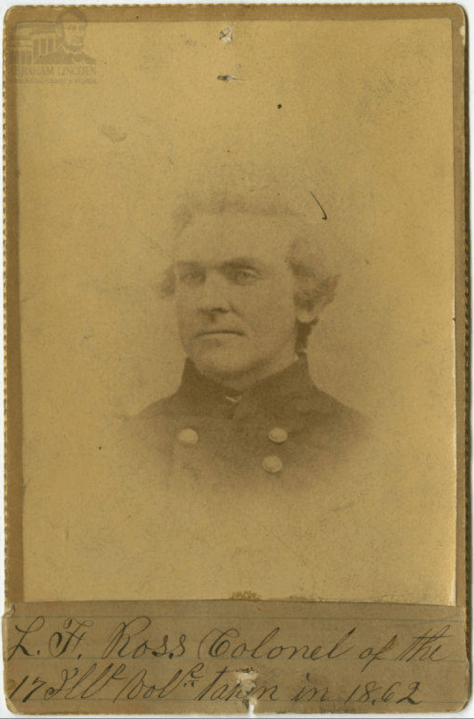
Col. L .F. Ross, 17th Illinois, Taken in 1862. (Abraham Lincoln Presidential Library)
Thursday, June 2, 1864—Descriptive List. Archibald S. Corken, Private I Co., 17th Illinois. Born in Liverpool, England. Enlisted and mustered at Alton, Ills. by L[eonard] F. Ross, Col. Last paid by Maj. Jamison to Dec. 31st 1863
Friday, June 3, 1864—Sent to Camp Yates with Descriptive List.
Saturday, June 4, 1864—Regt. mustered out of the service this afternoon.
Friday, June 24, 1864—Springfield. Discharged today. Paid in full $100 bounty.
Sunday, June 26, 1864—Rock Island, Ills. Arrived home this morning.
Monday, July 4, 1864—New Boston, Ills.
Tuesday, July 5, 1864—Keithsburg, Ills.
Thursday, July 7, 1864—Aledo, Ills. 12 a.m. Remember E. M. M.
Sunday, July 16, 1864—Aledo, Ills. Heard Mr. Ashburgh in the morning and Mr. Williams in the evening. Went to see Duty Green at Derryton.
Tuesday, July 12, 1864—Rock Island, 6 p.m.
Wednesday, July 20, 1864—Commenced going to Commercial College in Davenport.
Sunday, October 30, 1864—Went to Methodist Church in the evening with Adair.
Monday, October 31, 1864—Heard Schuyler Colfax speak at Davenport, Iowa.
Tuesday, November 1, 1864—Adair Blue left this morning after a visit of five days.
Tuesday, November 8, 1864—Election Day.
Wednesday, November 30, 1864—Rock Island Barracks. Engaged by Asst. Quartermaster of this post as forage master. Wages to be $60 or $75 per month, not definitely settled which. Engaged board at Sergt. ___ for $1 per week.
Thursday, December 1, 1864—Rock Island Barracks. Commenced work today as forage master.
Thursday, May 18, 1865—This evening I was admitted to the First Degree in Free Masonry at Trio Lodge, No. 257, State of Illinois.
Memoranda.
Caspar Schenck, Asst. Pay Master, U. S. N. U .S .Sloop of War, Portsmouth, Gulf Blockading Squadron.
Jus. Robinson, Old Bank, Chester, England
Jno. Donald, Woodside, Aberdeenshire, Scotland
Williw Donld, Merchant Man Callao, South America, and Glagow, Scotland.
S. H. Coombs, Oswestry, Shropshire, England
Denbigh, North Wales
Archibald Simpson CorkenBackmark of Corken’s CDVUnidentified Union PrivateBackmark of Unidentified PrivateSlip of paper in back of diary with the name “Andrew Erb, Pekin, Illinois” faintly visible. Andrew Erb (1836-1888) was in Co. G, 17th Illinois. Corken’s Knight Templar card
The following letter was written by Newell Dyer (1835-1899), the son of Bela Dyer (1802-1878) and Ruth Ranney (1806-1863) of Plainfield, Hampshire county, Massachusetts. Newell enlisted in Co. C, 31st Massachusetts Infantry on 12 October 1861 and served five months, mustering out on 21 March 1862, discharged for disability.
[Note: This letter is from the personal collection of Greg Herr and was offered for transcription and publication on Spared & Shared by express consent.]
A painting of Newell Dyer made by AI from a poor quality post-war photograph of Dyer on Ancestry.com
T R A N S C R I P T I O N
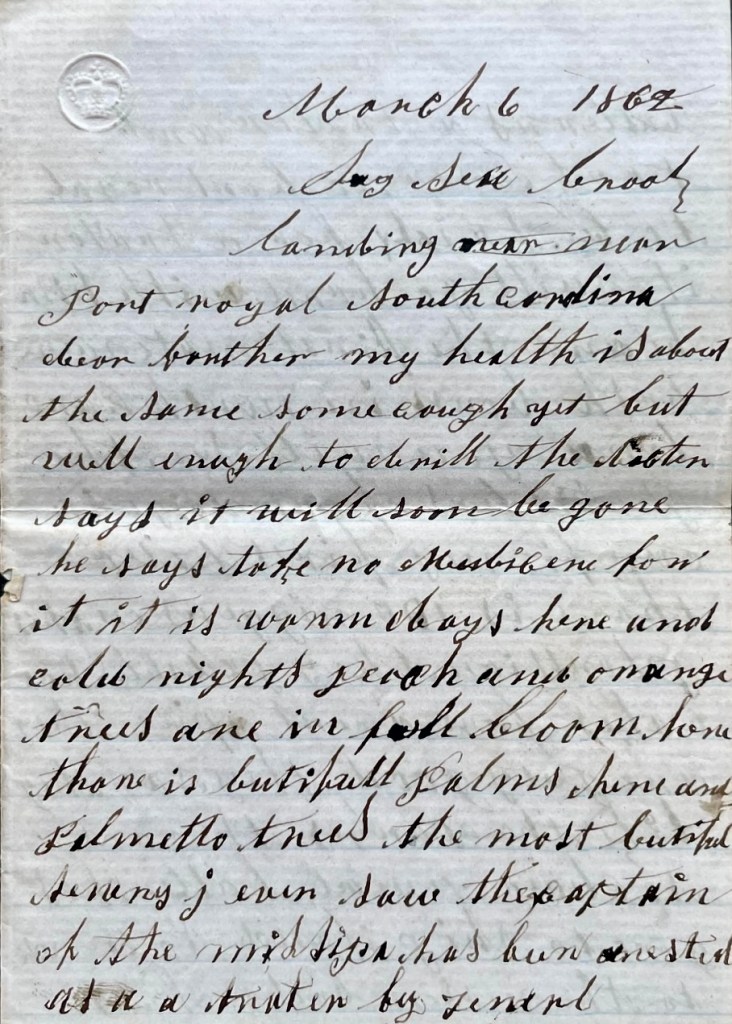
Seabrook Landing near Port Royal, South Carolina March 6, 1862
Dear Brother,
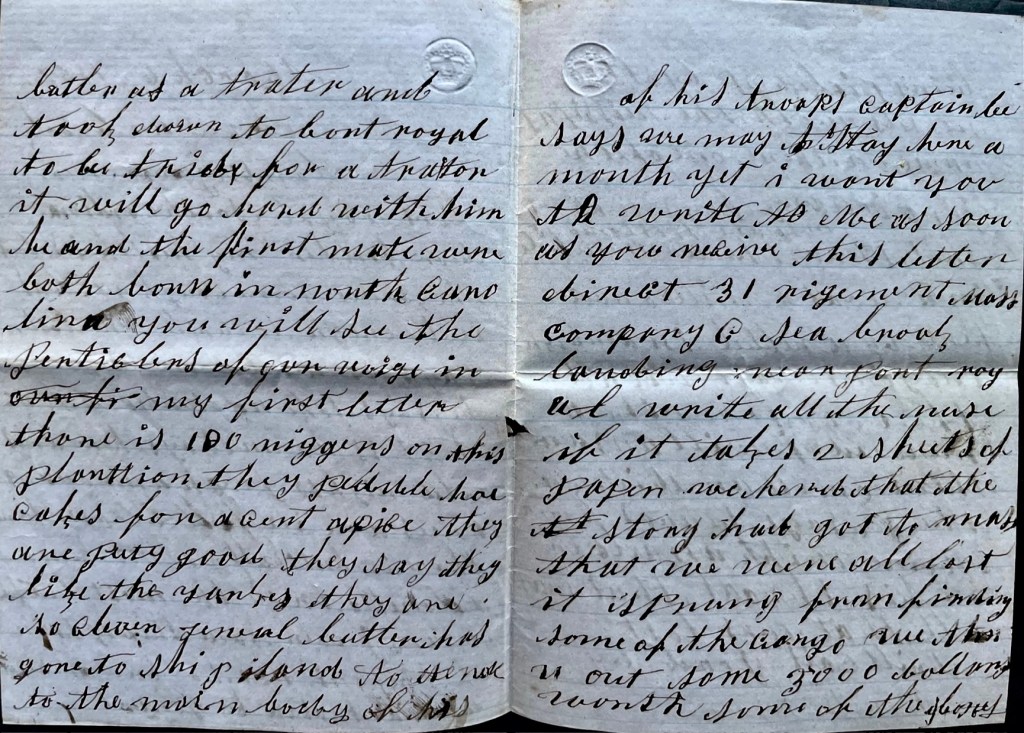
My health is about the same. Some cough yet but well enough to drill. The doctor says it will soon be gone. He says take no medicine now. It is warm days here and cold nights. Peach and orange trees are in full bloom here. There is beautiful palms here and palmetto trees. The beautiful scenery I ever saw. The captain of the militia has been arrested by General Butler as a traitor and took down to Port Royal to be tried for a traitor. It will go hard with him. He and the first mate were both born in North Carolina. You will see the particulars of our voyage in my first letter.
There is 100 niggers on this plantation. They peddle hoecakes for a cent apiece. They are pretty good. They say they like the Yanks. They are [ ]. Gen. Butler has gone to Ship Island to the main body of his troops. Captain B. says we may stay here a month yet. I want you to write to me as soon as you receive this letter. Direct to 31st Regiment Massachusetts. Company C, Seabrook Landing near Port Royal.
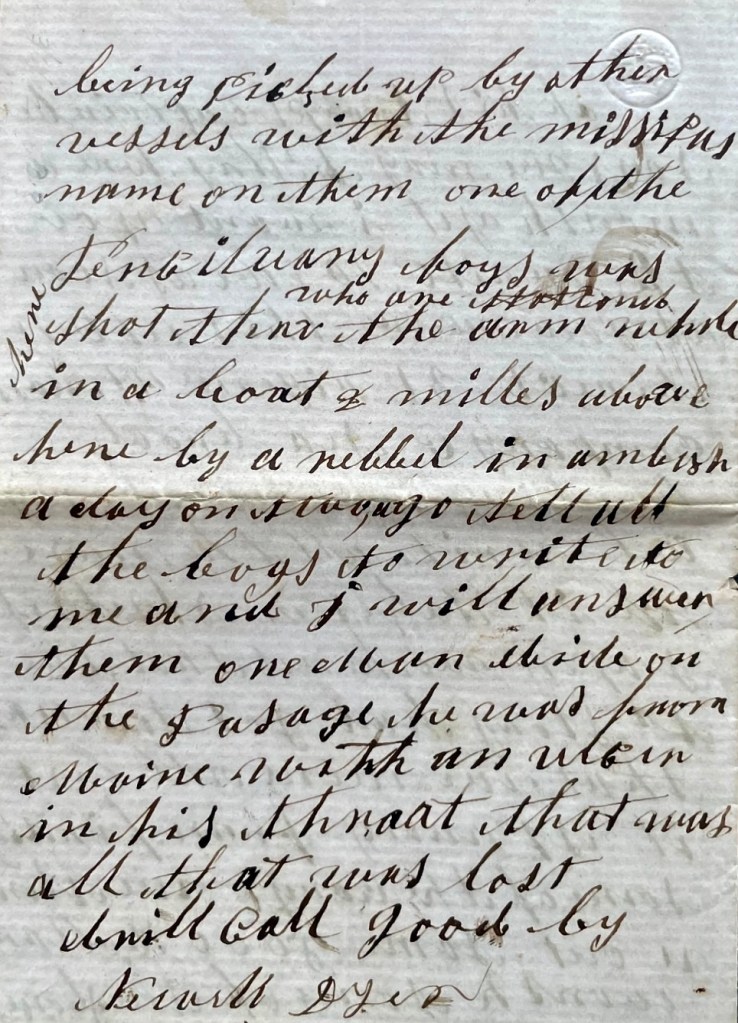
Write all the news if it takes two sheets of paper. We heard that the story had got to Massachusetts that we were all lost. It sprang from finding some of the cargo. We threw out some 3,000 dollars worth. Some of the boxes being picked up by other vessels with the [steamer] Mississippi‘s name on them. 1
One of the Pennsylvania boys was shot through the arm while in a boat two miles above here by a rebel in ambush a day or two ago. Tell all the boys to write to me and I will answer them. One man died on the passage. He was from Maine with an ulcer in his throat that was all that was lost. I will call goodbye, — Newell Dyer
1 At Boston the 31st Mass., 1,000 strong, and five companies of the 13th Me. embarked on the new transport Mississippi, bound for the Crescent City. In addition to the troops, the vessel carried a heavy cargo of military stores and 1,300 tons of coal…At Fortress Monroe, where we arrived in a brisk gale, Gen. Butler, his wife and maid, and his staff joined us. The voyage was resumed Feb. 25. When near Cape Hatteras we were tempest-tossed. The Captain in bed, locked in his room, was aroused with difficulty, and informed that disaster was imminent. He headed the ship east, standing in that direction until morning. The ice-house, in which was packed quarters of beef, gave way. Beef, barrels of pork, potatoes, rice and other provisions mingled with ammunition muskets and equipments, broken bunks and mangled humanity, rolled and smashed fore and aft’. Hatches were battened down, and Egyptian darkness prevailed, the roar of the storm neutralizing all other sounds. No brush can pain, o pen can describe, the horrors of that tempestuous night. At sunrise of the 27th the ship quivered. We were stranded on Frying Pan Shoals, five miles from shore, and in full view of Fort Macon. Casting the “gipsy,” we found 14 feet of water. The normal draft of the ship was eighteen feet. We were told that but one vessel in like predicament had ever been saved. The anchor was cast, and the ship forged against it, crushing a five inch hole in the side, through which water poured with resistless force. Fortunately, there were water-tight compartments. The men began to murmur, accusing the Captain of being a “Baltimore Secessionist.” For protection he was placed in the charge of the best drilled company on board, commanded by Capt. Fisk, who later became a General...While on the way from Cape Fear to Port Royal Gen. Butler emulated the old lady who tried to mop up the ocean. All the pumps in the steamer were started, and lines of men formed with buckets, trying to bail the water out of the fore compartment. As the hole in the vessel was the size of a large anchor fluke, of course the water in the vessel kept level with that outside, in spite of all that could be done. Sometimes the men on the steamer would move towards the stern, so that the bow would rise, and then the officers would cry, “Go it boys, you are gaining on it!” In a few minutes they would perhaps move the other way, causing the bow to sink and the water to rise in the compartment; then the cry would be, “For God’s sake, hurry, boys, the water is rising!” And that useless labor was continued night and day till March 2, when the steamer reached Port Royal. The next day the Mississippi was taken to Seabrook Landing, about five miles from Hilton Head. The troops were disembarked, the stores unloaded, and the steamer repaired sufficiently to risk finishing the voyage. March 13, the stores having been reloaded on the Mississippi, the 31st Mass. re-embarked, the battalion of the 13th me., taking the steamer Matanzas, and a new start was made for Ship Island. Before leaving the harbor, however, the Mississippi ran aground again on a bank of oyster shells. After taking off the troops, the steamer was pulled off by tugs, the troops put on board again, and (the Captain being removed and a new one appointed) she at last left the harbor. After this nothing occurred worthy of special mention, and both steamers in due time reached Ship Island in safety.” E.B. Lufkin, Co. E, 13th Me., Weld, Me. [National Tribune, March 12, 1885]
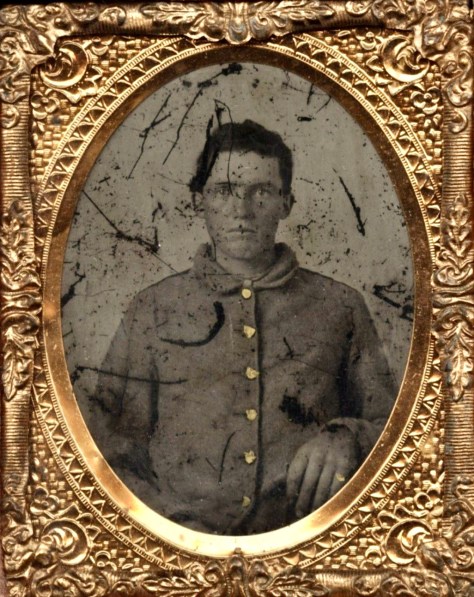
I was unable to find an image of either William or Thomas but here is one of Corp. James Needham Alexander (1833-1918) of Mecklenburg county who also served in Co. A, 11th North Carolina Infantry.
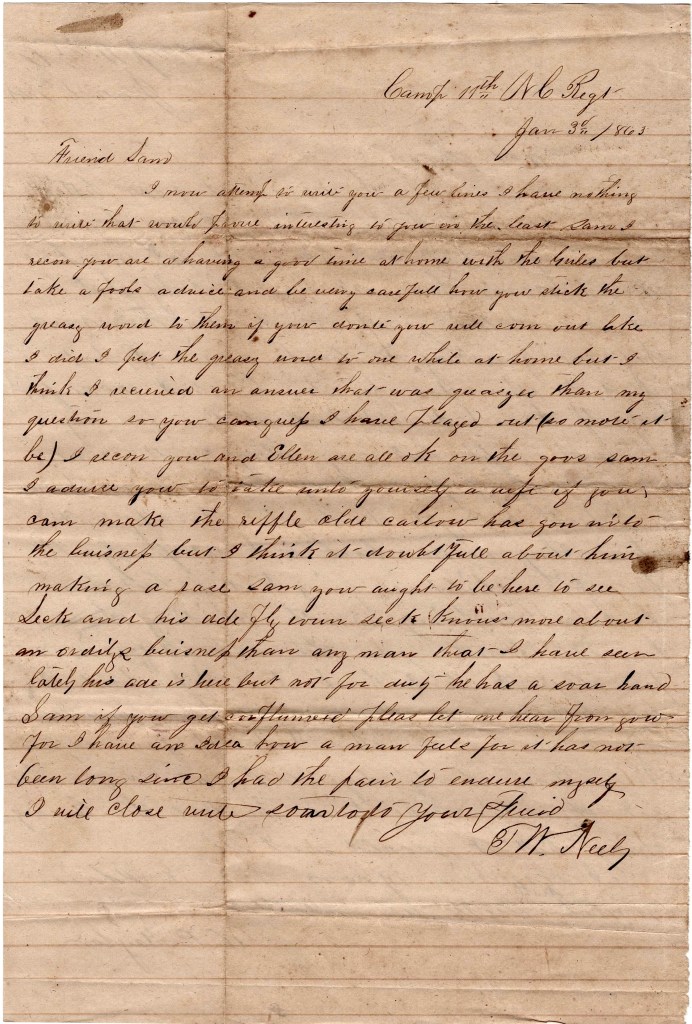
This letter was written by two members of Co. A, 11th North Carolina Infantry (the “Bethel Regiment”). Company A named themselves the “Edgcombe Guards.” Most of its members came from Mecklenburg and Gaston counties in the southwestern Piedmont region of North Carolina. The first part was penned by Lt. William B. Taylor. The second part by Sergt. Thomas W. Neely.
21 year-old William Barnette Taylor (1840-1928) of Charlotte, Mecklenburg county appears to have joined the 11th North Carolina in June of 1862 and was elected 3rd Lieutenant of his company. He continued in that capacity well into 1864 though he often signed the muster rolls as being in command of Co. A. In the May/June 1864 muster rolls he was reported “absent wounded” (a gunshot wound) and he remained in a hospital until September 1864 when he returned to the regiment, having been promoted to 2nd Lieutenant. In January & February 1865, he was reported “On furlough of indulgence” from their encampment at Petersburg. His final muster record shows him to have been paroled at Appomattox in April 1865.
Thomas W. Neely (1843-1910) of Charlotte, Mecklenburg county, appears to have accepted a $50 bounty and volunteered to serve in the 11th North Carolina at an earlier date than William Taylor—February 1862. He was elected the 5th Sergeant of Co. A in June 1862 and promoted to 4th Sergeant in June 1863. He was wounded at the Battle of Gettysburg and the July/August 1863 muster roll carried him as “Wounded. At home with leave.” He did not return to the regiment until 17 December 1863, just two weeks before this letter was written. The May and June Muster report reported Thomas “At home on wounded furlough” for a second time (a gunshot wound to the left thigh), and this time it looks like he did not return to the regiment but was detached and assigned duty in Richmond. Like Taylo, he was also paroled at Appomattox in April 1865.
I’m not confident I have accurately transcribed either of these letters or properly interpreted the meaning of their words. Both letters contain sexual innuendoes that I think might imply the risk of contracting venereal disease.
T R A N S C R I P T I O N
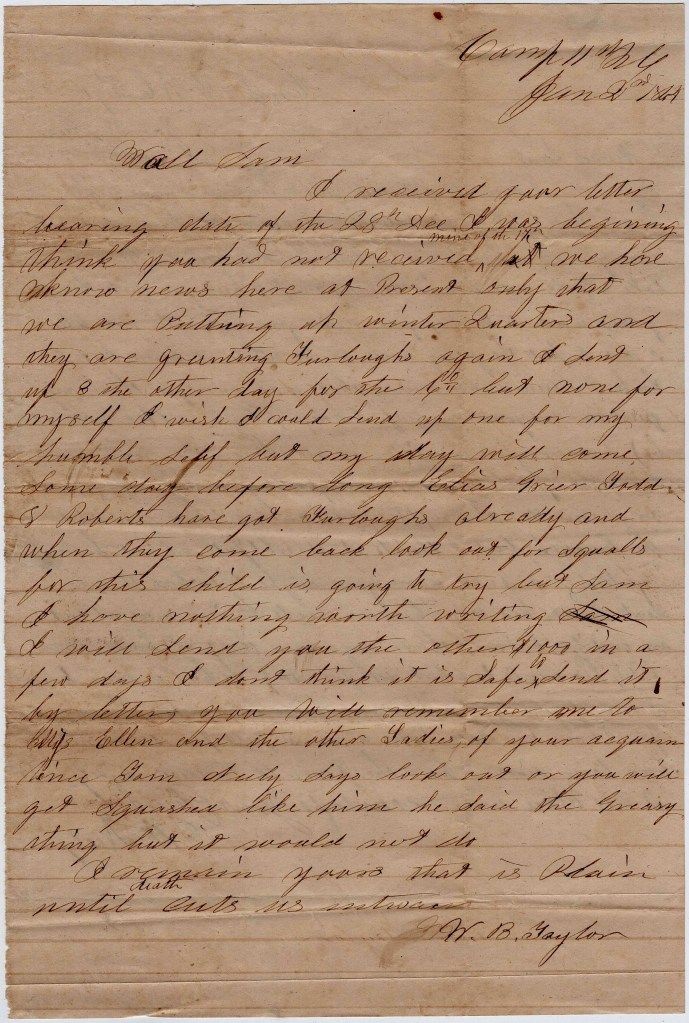
Camp 11th North Carolina January 2, 1864
Well Sam, I received your letter bearing date of the 28th December. I was beginning to[to] think you had not received mine of the 17th. We have no news here at present—only that we are putting up winter quarters and they are granting furloughs again. I sent up 8 the other day for the company but none for myself. I wish I could send up one for my humble self but my day will come someday before long. Elias Grier Todd L Roberts have got furloughs already and when they come back, look out for Squalls for this shild is going to try. But Sam, I have nothing worth writing.
I will send you the other $1000 in a few days. I don’t think it is safe to send it by letters. You will remember me to Miss Ellen and the other Ladies of your acquaintance. Tom Neely says look out or you will get squashed like him. He said the greasy thing but it would not do.
I remain yours, that is plain, until death cuts us in twain. — W. B. Taylor
[in another hand]
Camp 11th North Carolina January 3, 1863 [should be 1864]
Friend Sam, I now attempt to write you a few lines. I have nothing to write that would prove interesting to you in the least. Sam, I recon you are a having a good time at home with the girls but take a fool’s advice and be very careful how you stick the greasy word to them. If you don’t, you will come out like I did. I put the greasy word to one while at home but I think I received an answer that was greasier than my question so you can guess I have played out (so most it be).
I recon you and Ellen are all ok on the goose. Sam, I advise you to take unto yourself a wife if you can make the riffle. Old Carlow has gone into the business but I think it doubtful about him making a raise.
Sam, you ought to be here to see Leck and his aide fly. Even Leck knows more about an orderly’s business than any man that I have seen lately. His aide is here but not for duty. He has a sore hand.
Sam, if you get [conflumed?], please let me hear from you for I have an idea how a man feels for it has not been long since I had the pain to endure myself. I will close. Write soon to your friend, — T. W. Neely
Lt. Joseph Wight of Co. E, 5th Maine Infantry (McDonald Collection, Digital Maine Repository)
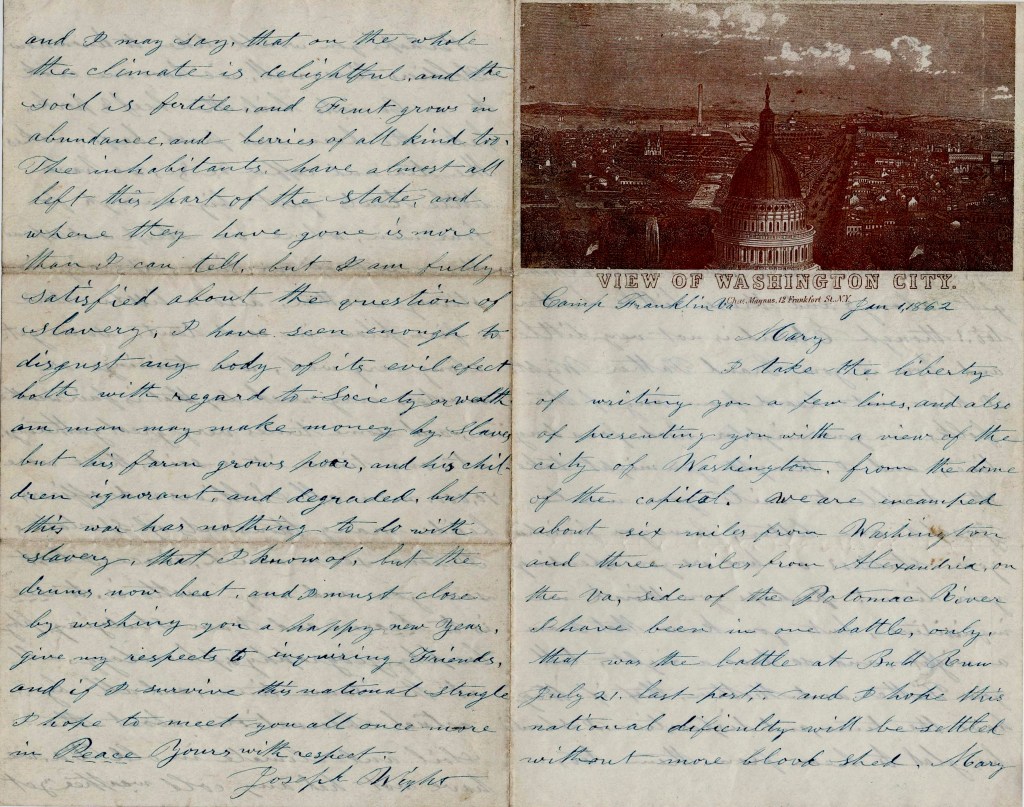
The following letter was written by Joseph Wight (1822-1911), the son of Jonathan Wight (1783-1869) and Mercy Harmon (1788-1861) of Cumberland county, Maine. In 1860, Joseph was enumerated in Windham, Cumberland county, Maine, earning his living as a grocer. He was married to Elizabeth Irish of Sebago.
Muster records inform us that Joseph enlisted in June 1861 to serve as a 2nd Lieutenant in Co. E. In June 1863 he was promoted to 1st Lieutenant of Co. A. He mustered out of the regiment on 27 July 1864.
Joseph’s final paragraph tells us much about his personal beliefs: “I am fully satisfied about the question of slavery. I have seen enough to disgust anybody of its evil effect, both with regard to society or wealth. A man may make money by slaves but his farm grows poor and his children ignorant and degraded. But this war has nothing to do with slavery that I know of.”
T R A N S C R I P T I O N
Camp Franklin, Va. January 1, 1862
Mary,
I take the liberty of writing you a few lines and also of presenting you with a view of the City of Washington from the dome of the Capitol. We are encamped about six miles from Washington and three miles from Alexandria on the Virginia side of the Potomac River. I have been in one battle only—that was the Battle of Bull Run, July 21 last past, and I hope this national difficulty will be settled without more bloodshed.
Mary, I hardly know why I should write to you, and certainly, I know of no reason why I should not write to you. I don’t know where you are but I should like to hear from you and how you and Amanda and Mercy prosper temporally & spiritually. And how does your Father and Mother get along? and those little brothers too? though Edward is not very little. And ow is your Grandfather Wight? I have not heard from any of the folks in your neighborhood for a long time and I thought you might take the trouble to write your uncle Joseph one letter. Have you finished your studies? or how are you spending your time? Perhaps you think me inquisitive but you know that I am a Wight and so have a right. Tell your Father and Mother that if they have the time and disposition, I should be glad to hear from them too.
Perhaps you would like to know how soldiers live. Well we have one cook to a company who boils the beef and pork, bakes the beans and fresh beef. makes the tea and coffee, &c. &c. We have little tents just big enough for four men where we sleep and spend the most of our time—especially in stormy weather. Also a little stove or fire place in each tent so we get along very well. We [have] trainings or musters every week day—that is, [in] fair weather, and sometimes very great gatherings at one time. It is said there were 70,000 men, all soldiers and officers, beside many thousands of spectators.
I have seen much since I last saw you and my motto is, to see is to learn. And I am studying philosophy, geography, and phrenology ll at the same time and all by actual observation about the soil and climate in old Virginia. We have not had any cold weather yet and I may say that on the whole, the climate is delightful and the soil is fertile and fruit grows in abundance and berries of all kind too.
The inhabitants have almost all left this part of the state and where they have gone is more than I can tell but I am fully satisfied about the question of slavery. I have seen enough to disgust anybody of its evil effect, both with regard to society or wealth. A man may make money by slaves but his farm grows poor and his children ignorant and degraded. But this war has nothing to do with slavery that I know of. But the drums now beat and I must close by wishing you a happy New Year. Give my respects to enquiring friends and if I survive this national struggle, I hope to meet you all once more in peace. Yours with respects, – Joseph Wight
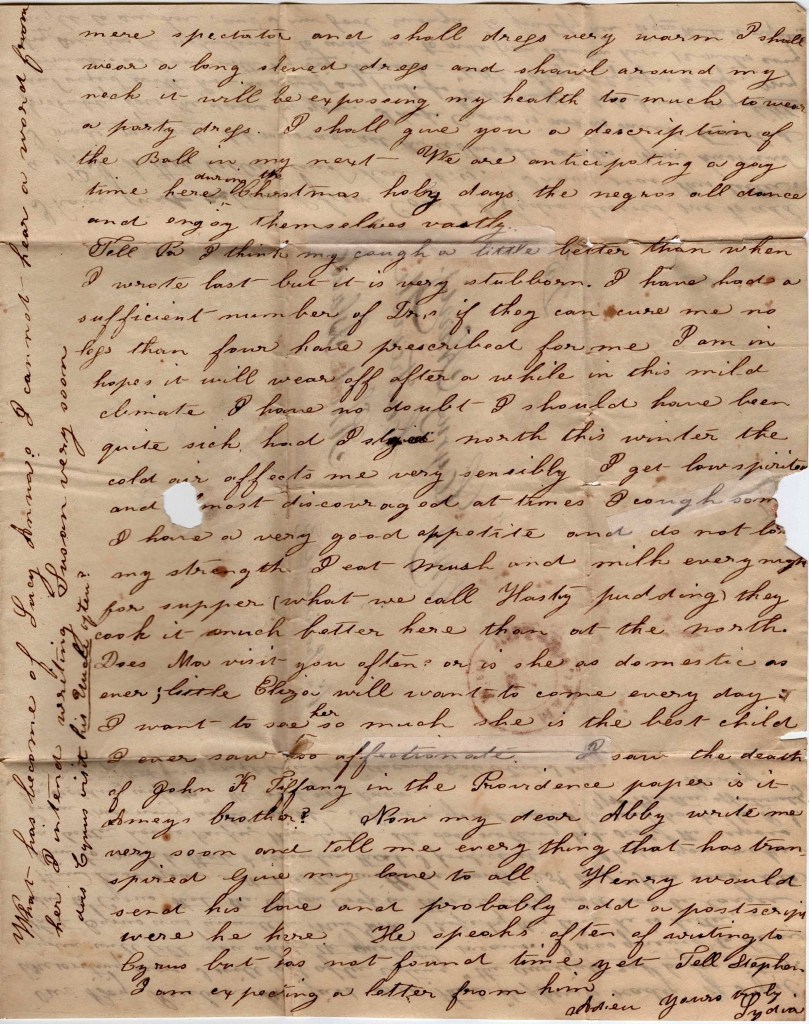
The following letter was written by Lydia Harris (1810-1836), the daughter of Dr. Stephen Harris (1786-1858) and Lydia Greene (1791-1820) of Providence, Rhode Island. Lydia was married to Henry H. Pease (1804-1840). From the letter we know that Lydia was residing in Yazoo county, Mississippi, during the winter of 1836-37. though she apparently spent the hot summers in Rhode Island with her relatives. The letter is datelined from “Woodland” which I assume was the name of the plantation owned by her husband. It seems to have been a few miles outside of Manchester (later renamed Yazoo City) where Henry also had a home.
Though her letter suggests she was suffering from chronic illness, still it was surprising to learn that Lydia died some ten days after this letter was written. Her husband did not live much longer. His obituary reads: “Melancholy Accident.—A letters received in this city, dated Yazoo City, Mississippi, September 15 [1840], states that Mr. Henry H. Pease, formerly of New York, was accidentally killed near the former place, on the previous day. It appears that he was riding with a friend in a barouche; the horses took fright at some cows, ran over one of them, and darted off at full speed. After they had advanced about fifty yards, they brought the carriage in contact with a large stump with so much violence that the vehicle was broken to pieces, and the two gentlemen who were in it were thrown a distance of 36 feet. Mr. Pease fell upon his back and neck and was killed almost instantly. His companion, Mr. George B. Dixon, escaped with some slight bruises and internal hurts. Mr. Pease was 36 years of age, and the son of John B[enjamin] Pease, Esq., [1774-1866] of Utica. His body was interred at Yazoo on the day succeeding th accident, with military honors.”
Lydia wrote the letter to her sister-in-law, Abigail (“Abby”) Spaulding (1816-1888), the wife of Cyrus Harris (1812-1887), and the daughter of Lovewell Spaulding (1780-1853) and Susannah Greene (1788-1869) of Rhode Island.
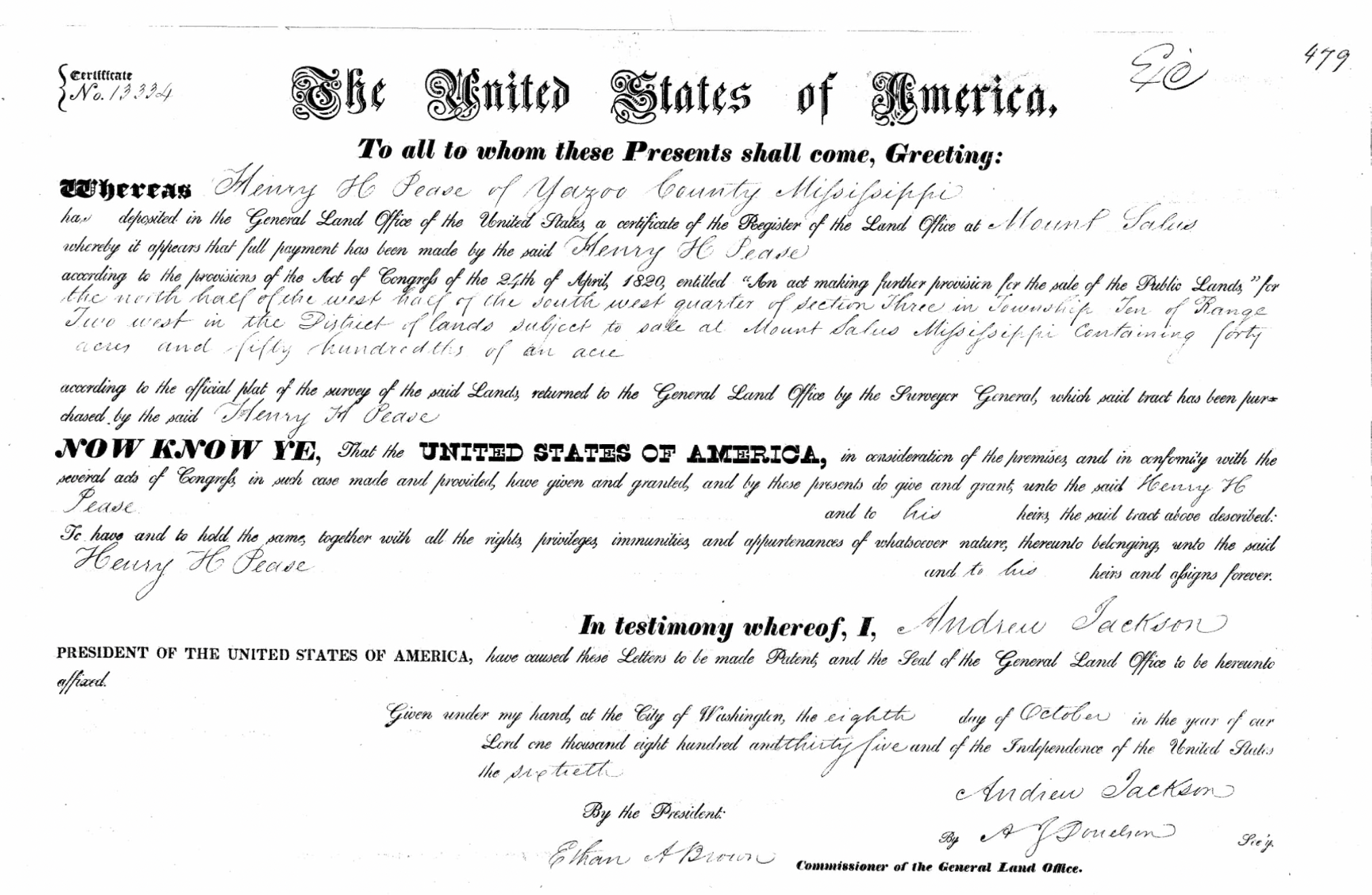
Land Deed in Yazoo County, Mississippi. Approximately 40 acres purchased by Henry H. Pease in 1835.
T R A N S C R I P T I O N
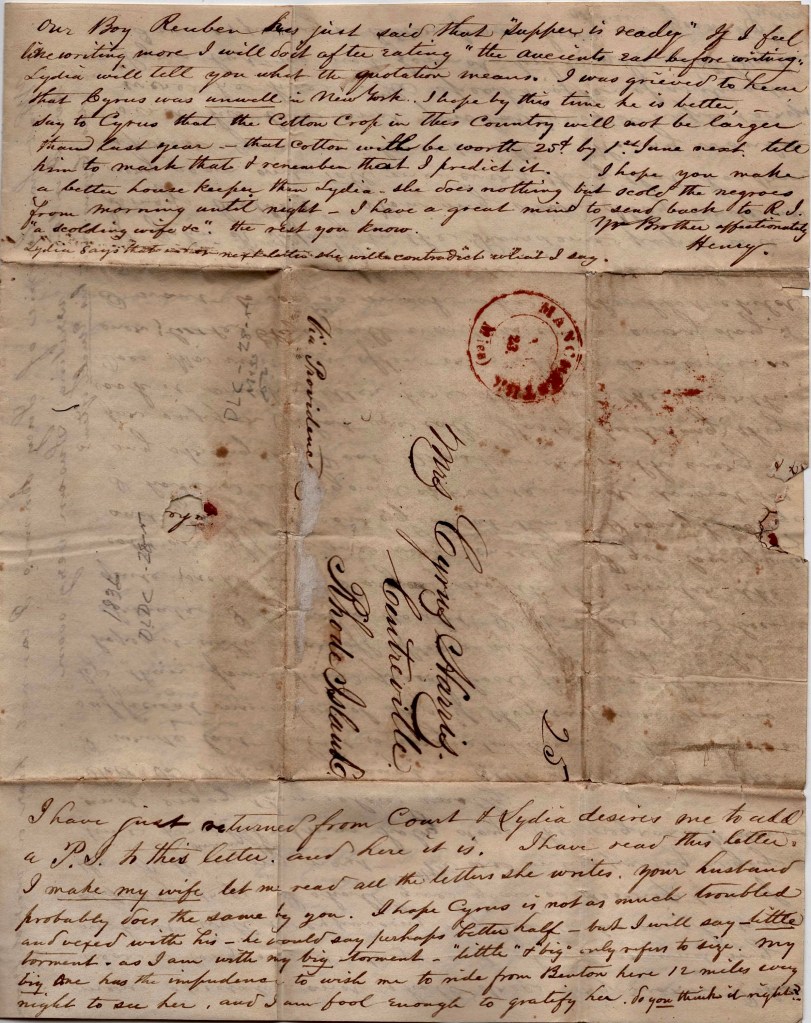
Addressed to Mrs. Cyrus Harris, Centreville, Rhode Island, Via Providence
Woodland November 21, 1836
Dear sister,
I began to think you had quite forgotten me, Abby, or did not intend to [ ] and had determined the day I received your letter to write you a very scolding one. You very fortunately escaped this time, however, for which you may thank your lucky stars.
Well Abby, how do you like housekeeping? I presume you are comfortably settled at Greenville [Rhode Island] ere this. I almost envy you your nice warm house. A house like yours would be very valuable in this country. I hope you have succeeded in getting a good servant. I should advise you to take little George. You will find him very useful. We at the South have the advantage over you in regard to servants. We can obtain good ones any time by paying for them. They are worth from one thousand to fifteen hundred dollars.
How does Stephen behave? Do you have to scold him every day? I intend taking him home with me another winter. I dream every night of being at home. I expect I shall feel as unpleasantly at leaving home next summer as I did this. I am much better contented now than when I first came. Could I be at my own home in Manchester [Mississippi], I should be quite happy. I find it very pleasant here but rather lonesome. Brother John has been from home this past week. Took his friend D. Pomery with him. Dr. Nesbit is at Vicksburg so that I am quite alone during the day, Henry comes home every evening and returns in the morning. Rides 25 miles on horseback every day to see me. Do you not think him a very affectionate husband? I will not say anything more about him for fear he should read this letter. I might raise his vanity to too high a pitch.
James has not arrived yet. We are expecting him daily. I cannot be lonesome when he is here. What does Eliza Anthony say about him? Have you forgotten “False one I love thee still.”
I expect you have cold weather now. Last year at this time it was very cold at the North. We had snow in November. It is very pleasant here; not much colder than when we came. The thermometer stands at 62 degrees above zero today in the shade. February and March are warm months here. With you they are the coldest and most unpleasant of the year.
They commenced planting their gardens in February. The woods are covered with strawberry vines. I anticipate a great deal of pleasure eating strawberries in the spring. I shall go and gather them if I am not too much afraid of snakes. I have been out but very seldom since I came here.
I intend going to Manchester on Thursday to attend a Ball. I received a note from the managers two weeks since. There are fourteen managers. They send invitations to all the ladies and let them get to the Ball the best way they can. It is all the invitations they have. I wish you was here to go with me. I know we should be amused. I have a great curiosity to see the Yazoo Ladies at a Ball. They are five or six years behind the fashion in dress and everything else. I know I shall laugh. I have heard a description of their dancing. Stephen could dance very well with them. I wish he was here. He would enjoy it so much. They use their head and arm quite as much as their feet and make as much noise with them as possible. Tell Pa and Cyrus not to scold because I am going to the Ball. I am going as a mere spectator and shall dress very warm. I shall wear a long-sleeved dress and shawl around my neck. It will be exposing my health too much to wear a party dress. I shall give you a description of the Ball in my next. We are anticipating a gay time here during the Christmas Holy days. The negroes all dance and enjoy themselves vastly.
Tell Pa I think my cough a little better than when I wrote last, but it is very stubborn. I have had a sufficient number of doctors [to see] if they can cure me. No less than four have prescribed for me. I am in hopes it will wear off after a while in this mild climate. I have no doubt I should have been quite sick had I stayed North this winter. The cold air affects me very sensibly. I get low-spirited and almost discouraged at time. I cough some. I have a very good appetite and do not lose any strength. I eat mush and milk every night for supper (what we call Hasty Pudding)/ They cook it much better here than at the North. Does Ma visit you often? Or is she as domestic as ever? Little Eliza will want to come every day. I want to see her so much. She is the best child I ever saw—so affectionate.
I saw the death of John K. Tiffany in the Providence paper. Is it Amey’s brother? Now, my dear Abby, write me very soon and tell e everything that has transpired. Give my love to all. Henry would send his love and probably add a postscript were he here. He speaks often of writing to Cyrus but has not found time yet. Tell Stephen I am expecting a letter from him. Adieu. Yours truly, — Lydia
What has become of Lucy Anna? I cannot hear a word from her. I intend writing Susan very soon. Does Cyrus visit his uncle often?
[In a different hand]
I have just returned from Court & Lydia desires me to add a P. S. to this letter and here it is. I have read this letter. I make my wife let me read all the letters she writes. Your husband probably does the same by you. I hope Cyrus is not as much troubled and vexed with his—he would say perhaps better half—but I will say lttle torment, as I am with my big torment. Little and big only refers to size. My big one has the impudence to wish me to ride from Benton 1 here 12 miles every night to see her and I am fool enough to gratify her. Do you think it right?
Our Boy Reuben has just said that “Supper is ready.” If I feel like writing more I will do it after eating. “The ancients eat before writing.” Lydia will tell you what the quotation means. I was grieved to hear that Cyrus was unwell in New York. I hope by this time he is better. Say to Cyrus that the cotton crop in this country will not be larger than last year. That cotton will be worth 25 cents by 1st June next. Tell him to mark that & remember that I predict it. I hope you make a better house keeper than Lydia. She does nothing but scold the negroes from morning until night. I have a great mind to send back to Rhode Island “a scolding wife, &c.” THe rest you know. Your brother affectionately, — Henry
Lydia says that in her next letter she will contradict what I say.
1 Benton was the county seat of Yazoo County from 1829 until 1850 when it was moved to Yazoo City (formerly named Manchester).
The following letter was written by 34 year-old Samuel Hoppenstedt who enlisted at Gardiner in August 1862 to serve three years in Co. A, 156 New York Infantry. He mustered into the regiment in November 1862 and mustered out on 23 October 1865 at Augusta, Georgia. He mentions one comrade in the letter, Abram Fuller, who was wounded in action later in 1864 at Winchester, Virginia.
Samuel wrote the letter to his friend, Abraham (“Abram”) Selah Schoonmaker (1819-1879) of Gardiner, Ulster county, New York. Abraham was married to Cornelia DuBois (1826-1886).
Note: This letter is from the personal collection of Kyle A. Williams and was offered for transcription and publication on Spared & Shared by express consent.
T R A N S C R I P T I O N
Baton Rouge, Louisiana February 20, 1864
Friend Abram,
I sit down to take the opportunity to write you a few lines to inform you that I am well and I hope these few lines may find you and the rest of your family enjoying the same blessing. I have wrote you two letters and han’t had no answer from you. You could not [have] got mine or I have not got yours. It is one or the other. So I thought I would write to you for I felt inquisitive to know how you all got along. I heard that the children had all been sick with the scarlet fever and I would like to know how they are getting along. Abram Fuller got a letter from William the other day stating that they was all sick.
The weather has been very nice for a spell back till yesterday and today it has been cold. Yesterday it snowed. It is bad on the peach blossom and plum blossoms. The trees was white of blossoms. They are plowing and planting potatoes here and making gardens.
Abram, the 22nd of the month this state [will] elect a governor. Then there will be a big time here. These citizens in this place was one year ago strong secesh. Now they are strong Union. They have turned their coat wrong side out this spring. Now they hide their gray sots [?] and put on the blue. It is a good thing for them, I think. By next fall they will all put on the blue and hang up the old stars and stripes for Old Jeff is getting tired of riding the milk steer on Old Abe. The mule helping out the mule is too long winded for the milk steer for the steer is most give out.
I hear that Johnson has left the Gilford and gone to New Jersey and Dewitt is coming in his place. When I heard that, it was big news for me for I thought [he] was pleased. Fuller is well and full of fun. He is in the cook house again.
We are in the rear of Baton Rouge yet. It begins to look like home. I will have to stop for this time for my paper is most full. So I will close my letter by sending my love to you all. Write soon. Tell Carly and the children to write. This is from your friend, — Samuel Hoppen Stedt to his friend, Abram S. Schoonmaker
The following letter was written by W. H. Len, the son of Charles Edura Len and Mary Murdock Casey (1824-1905) of Philadelphia. He wrote the letter in May 1861 to his uncle James Seaman Casey (1833-1899) who was a member of the 7th New York Militia in April 1861, just after the outbreak of the Civil War, and was commissioned as a second lieutenant of the 5th Infantry Regiment in August of the same year. He was promoted to captain in December 1863, and became Commissary of Musters of the Army of the Potomac. He was brevetted major in March 1865 for his actions in the Battle of Fort Stedman.
T R A N S C R I P T I O N
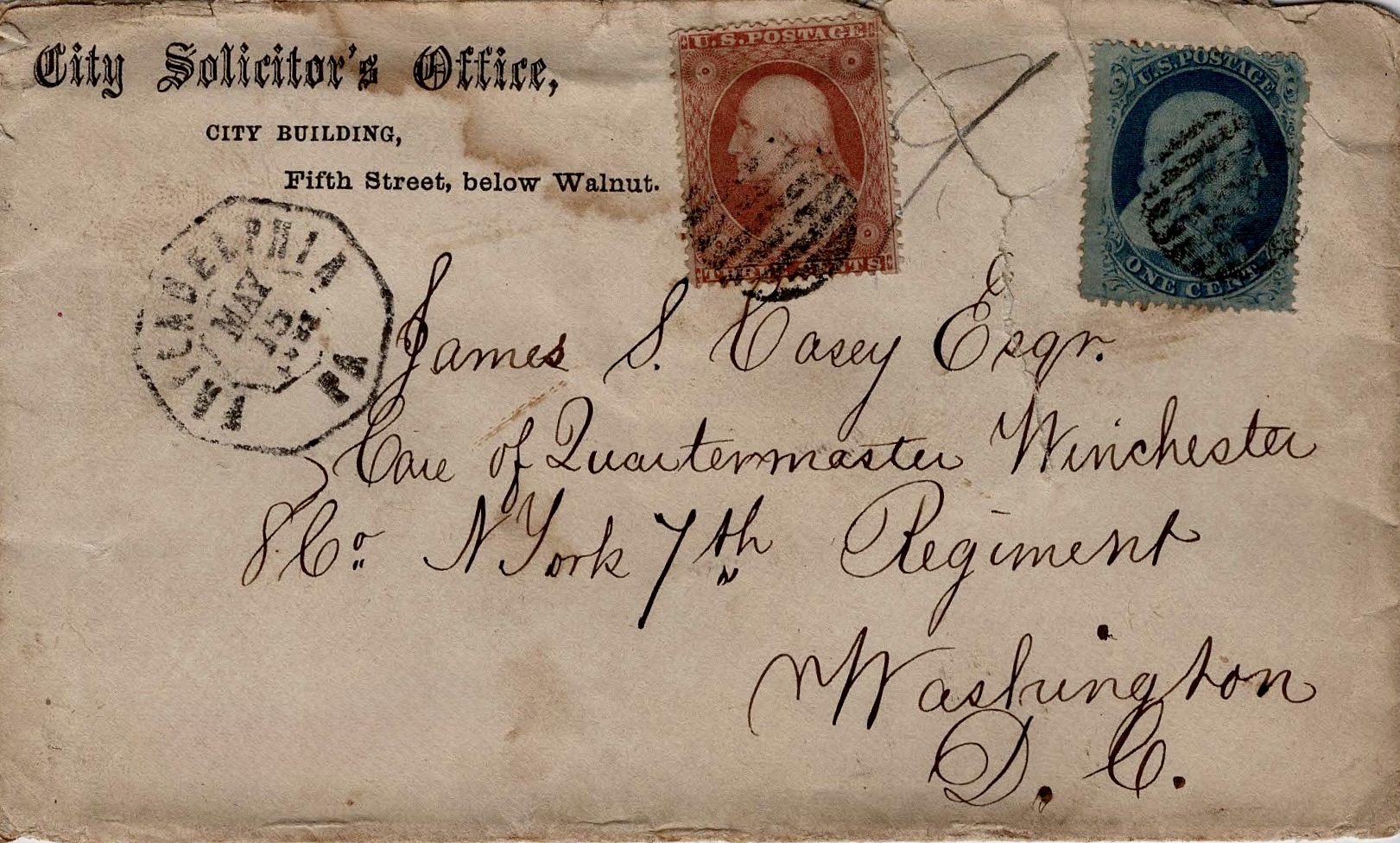
Addressed to James D. Casey, Esqr., Care of Quartermaster, New York 7th Regiment, Washington D. C.
Philadelphia, Pa. May 13th 1861
Dear Uncle,
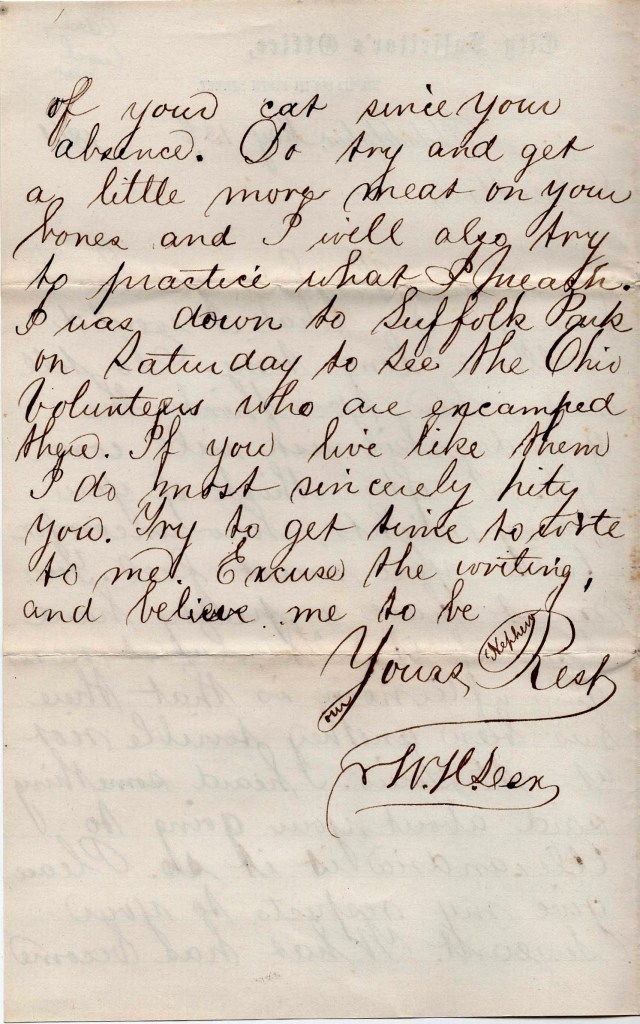
We have not heard from you for what I would call a long time. Do tell me when you think the grand skirmish will come off. I often think of you rainy nights how uncomfortable you must feel. You must have a pretty hard time of it. The latest news this afternoon is that there has been another terrible riot at St. Louis [See the Camp Jackson Affair]. I heard something said about your going to Alexandria. Is it so? Please give my respects to your sergeant. What has become of your cat since your absence? Do try and get a little more meat on your bones and I will also try to practice what I preach.
I was down to Suffolk Park [Racecourse] on Saturday to see the Ohio Volunteers 1 who are encamped there. If you live like them, I do most sincerely pity you. Try to get time to write to me. Excuse the writing and believe me to be yours respectfully, — W. H. Len





















 Spared & Shared 23